WO2017007010A1 - ケイ素含有樹脂組成物 - Google Patents
ケイ素含有樹脂組成物 Download PDFInfo
- Publication number
- WO2017007010A1 WO2017007010A1 PCT/JP2016/070239 JP2016070239W WO2017007010A1 WO 2017007010 A1 WO2017007010 A1 WO 2017007010A1 JP 2016070239 W JP2016070239 W JP 2016070239W WO 2017007010 A1 WO2017007010 A1 WO 2017007010A1
- Authority
- WO
- WIPO (PCT)
- Prior art keywords
- group
- substituent
- carbon atoms
- silicon
- containing resin
- Prior art date
- Legal status (The legal status is an assumption and is not a legal conclusion. Google has not performed a legal analysis and makes no representation as to the accuracy of the status listed.)
- Ceased
Links
- 0 CC(C)(C*1)CC1OC(C)=O Chemical compound CC(C)(C*1)CC1OC(C)=O 0.000 description 5
- NIHNNTQXNPWCJQ-UHFFFAOYSA-N C1c2ccccc2-c2ccccc12 Chemical compound C1c2ccccc2-c2ccccc12 NIHNNTQXNPWCJQ-UHFFFAOYSA-N 0.000 description 1
- ZUOUZKKEUPVFJK-UHFFFAOYSA-N c(cc1)ccc1-c1ccccc1 Chemical compound c(cc1)ccc1-c1ccccc1 ZUOUZKKEUPVFJK-UHFFFAOYSA-N 0.000 description 1
- UFWIBTONFRDIAS-UHFFFAOYSA-N c1cc2ccccc2cc1 Chemical compound c1cc2ccccc2cc1 UFWIBTONFRDIAS-UHFFFAOYSA-N 0.000 description 1
Classifications
-
- C—CHEMISTRY; METALLURGY
- C08—ORGANIC MACROMOLECULAR COMPOUNDS; THEIR PREPARATION OR CHEMICAL WORKING-UP; COMPOSITIONS BASED THEREON
- C08L—COMPOSITIONS OF MACROMOLECULAR COMPOUNDS
- C08L83/00—Compositions of macromolecular compounds obtained by reactions forming in the main chain of the macromolecule a linkage containing silicon with or without sulfur, nitrogen, oxygen or carbon only; Compositions of derivatives of such polymers
- C08L83/04—Polysiloxanes
-
- C—CHEMISTRY; METALLURGY
- C08—ORGANIC MACROMOLECULAR COMPOUNDS; THEIR PREPARATION OR CHEMICAL WORKING-UP; COMPOSITIONS BASED THEREON
- C08G—MACROMOLECULAR COMPOUNDS OBTAINED OTHERWISE THAN BY REACTIONS ONLY INVOLVING UNSATURATED CARBON-TO-CARBON BONDS
- C08G77/00—Macromolecular compounds obtained by reactions forming a linkage containing silicon with or without sulfur, nitrogen, oxygen or carbon in the main chain of the macromolecule
- C08G77/04—Polysiloxanes
-
- C—CHEMISTRY; METALLURGY
- C07—ORGANIC CHEMISTRY
- C07C—ACYCLIC OR CARBOCYCLIC COMPOUNDS
- C07C69/00—Esters of carboxylic acids; Esters of carbonic or haloformic acids
- C07C69/02—Esters of acyclic saturated monocarboxylic acids having the carboxyl group bound to an acyclic carbon atom or to hydrogen
- C07C69/12—Acetic acid esters
- C07C69/14—Acetic acid esters of monohydroxylic compounds
-
- C—CHEMISTRY; METALLURGY
- C08—ORGANIC MACROMOLECULAR COMPOUNDS; THEIR PREPARATION OR CHEMICAL WORKING-UP; COMPOSITIONS BASED THEREON
- C08G—MACROMOLECULAR COMPOUNDS OBTAINED OTHERWISE THAN BY REACTIONS ONLY INVOLVING UNSATURATED CARBON-TO-CARBON BONDS
- C08G77/00—Macromolecular compounds obtained by reactions forming a linkage containing silicon with or without sulfur, nitrogen, oxygen or carbon in the main chain of the macromolecule
- C08G77/60—Macromolecular compounds obtained by reactions forming a linkage containing silicon with or without sulfur, nitrogen, oxygen or carbon in the main chain of the macromolecule in which all the silicon atoms are connected by linkages other than oxygen atoms
-
- C—CHEMISTRY; METALLURGY
- C08—ORGANIC MACROMOLECULAR COMPOUNDS; THEIR PREPARATION OR CHEMICAL WORKING-UP; COMPOSITIONS BASED THEREON
- C08J—WORKING-UP; GENERAL PROCESSES OF COMPOUNDING; AFTER-TREATMENT NOT COVERED BY SUBCLASSES C08B, C08C, C08F, C08G or C08H
- C08J5/00—Manufacture of articles or shaped materials containing macromolecular substances
- C08J5/18—Manufacture of films or sheets
-
- C—CHEMISTRY; METALLURGY
- C08—ORGANIC MACROMOLECULAR COMPOUNDS; THEIR PREPARATION OR CHEMICAL WORKING-UP; COMPOSITIONS BASED THEREON
- C08K—Use of inorganic or non-macromolecular organic substances as compounding ingredients
- C08K5/00—Use of organic ingredients
- C08K5/04—Oxygen-containing compounds
- C08K5/10—Esters; Ether-esters
-
- C—CHEMISTRY; METALLURGY
- C08—ORGANIC MACROMOLECULAR COMPOUNDS; THEIR PREPARATION OR CHEMICAL WORKING-UP; COMPOSITIONS BASED THEREON
- C08K—Use of inorganic or non-macromolecular organic substances as compounding ingredients
- C08K5/00—Use of organic ingredients
- C08K5/16—Nitrogen-containing compounds
- C08K5/32—Compounds containing nitrogen bound to oxygen
-
- C—CHEMISTRY; METALLURGY
- C08—ORGANIC MACROMOLECULAR COMPOUNDS; THEIR PREPARATION OR CHEMICAL WORKING-UP; COMPOSITIONS BASED THEREON
- C08L—COMPOSITIONS OF MACROMOLECULAR COMPOUNDS
- C08L83/00—Compositions of macromolecular compounds obtained by reactions forming in the main chain of the macromolecule a linkage containing silicon with or without sulfur, nitrogen, oxygen or carbon only; Compositions of derivatives of such polymers
- C08L83/16—Compositions of macromolecular compounds obtained by reactions forming in the main chain of the macromolecule a linkage containing silicon with or without sulfur, nitrogen, oxygen or carbon only; Compositions of derivatives of such polymers in which all the silicon atoms are connected by linkages other than oxygen atoms
-
- C—CHEMISTRY; METALLURGY
- C09—DYES; PAINTS; POLISHES; NATURAL RESINS; ADHESIVES; COMPOSITIONS NOT OTHERWISE PROVIDED FOR; APPLICATIONS OF MATERIALS NOT OTHERWISE PROVIDED FOR
- C09D—COATING COMPOSITIONS, e.g. PAINTS, VARNISHES OR LACQUERS; FILLING PASTES; CHEMICAL PAINT OR INK REMOVERS; INKS; CORRECTING FLUIDS; WOODSTAINS; PASTES OR SOLIDS FOR COLOURING OR PRINTING; USE OF MATERIALS THEREFOR
- C09D183/00—Coating compositions based on macromolecular compounds obtained by reactions forming in the main chain of the macromolecule a linkage containing silicon, with or without sulfur, nitrogen, oxygen, or carbon only; Coating compositions based on derivatives of such polymers
- C09D183/04—Polysiloxanes
-
- C—CHEMISTRY; METALLURGY
- C09—DYES; PAINTS; POLISHES; NATURAL RESINS; ADHESIVES; COMPOSITIONS NOT OTHERWISE PROVIDED FOR; APPLICATIONS OF MATERIALS NOT OTHERWISE PROVIDED FOR
- C09D—COATING COMPOSITIONS, e.g. PAINTS, VARNISHES OR LACQUERS; FILLING PASTES; CHEMICAL PAINT OR INK REMOVERS; INKS; CORRECTING FLUIDS; WOODSTAINS; PASTES OR SOLIDS FOR COLOURING OR PRINTING; USE OF MATERIALS THEREFOR
- C09D183/00—Coating compositions based on macromolecular compounds obtained by reactions forming in the main chain of the macromolecule a linkage containing silicon, with or without sulfur, nitrogen, oxygen, or carbon only; Coating compositions based on derivatives of such polymers
- C09D183/16—Coating compositions based on macromolecular compounds obtained by reactions forming in the main chain of the macromolecule a linkage containing silicon, with or without sulfur, nitrogen, oxygen, or carbon only; Coating compositions based on derivatives of such polymers in which all the silicon atoms are connected by linkages other than oxygen atoms
-
- C—CHEMISTRY; METALLURGY
- C09—DYES; PAINTS; POLISHES; NATURAL RESINS; ADHESIVES; COMPOSITIONS NOT OTHERWISE PROVIDED FOR; APPLICATIONS OF MATERIALS NOT OTHERWISE PROVIDED FOR
- C09D—COATING COMPOSITIONS, e.g. PAINTS, VARNISHES OR LACQUERS; FILLING PASTES; CHEMICAL PAINT OR INK REMOVERS; INKS; CORRECTING FLUIDS; WOODSTAINS; PASTES OR SOLIDS FOR COLOURING OR PRINTING; USE OF MATERIALS THEREFOR
- C09D7/00—Features of coating compositions, not provided for in group C09D5/00; Processes for incorporating ingredients in coating compositions
- C09D7/40—Additives
-
- C—CHEMISTRY; METALLURGY
- C08—ORGANIC MACROMOLECULAR COMPOUNDS; THEIR PREPARATION OR CHEMICAL WORKING-UP; COMPOSITIONS BASED THEREON
- C08J—WORKING-UP; GENERAL PROCESSES OF COMPOUNDING; AFTER-TREATMENT NOT COVERED BY SUBCLASSES C08B, C08C, C08F, C08G or C08H
- C08J2383/00—Characterised by the use of macromolecular compounds obtained by reactions forming in the main chain of the macromolecule a linkage containing silicon with or without sulfur, nitrogen, oxygen, or carbon only; Derivatives of such polymers
- C08J2383/04—Polysiloxanes
-
- C—CHEMISTRY; METALLURGY
- C08—ORGANIC MACROMOLECULAR COMPOUNDS; THEIR PREPARATION OR CHEMICAL WORKING-UP; COMPOSITIONS BASED THEREON
- C08J—WORKING-UP; GENERAL PROCESSES OF COMPOUNDING; AFTER-TREATMENT NOT COVERED BY SUBCLASSES C08B, C08C, C08F, C08G or C08H
- C08J2383/00—Characterised by the use of macromolecular compounds obtained by reactions forming in the main chain of the macromolecule a linkage containing silicon with or without sulfur, nitrogen, oxygen, or carbon only; Derivatives of such polymers
- C08J2383/16—Characterised by the use of macromolecular compounds obtained by reactions forming in the main chain of the macromolecule a linkage containing silicon with or without sulfur, nitrogen, oxygen, or carbon only; Derivatives of such polymers in which all the silicon atoms are connected by linkages other than oxygen atoms
Definitions
- the present invention relates to a silicon-containing resin composition, a method for forming a silica-based film using the silicon-containing resin composition, and a crack-free silica-based film formed using the silicon-containing resin composition.
- Silica-based coatings for applications such as interlayer insulating films in various devices, sealing materials for light emitting devices such as LED devices and organic EL devices, coating films for impurity diffusion into semiconductor substrates, and gap fill materials for semiconductor processes Is used.
- Such a silica-based film is generally formed by coating a liquid composition containing a silicon-containing resin such as a siloxane resin on a substrate to form a coating film, and then baking the coating film. Yes.
- a siloxane resin having a specific structure silica having an average particle diameter of 10 nm to 50 nm, an organic solvent
- a liquid composition containing a cation Patent Document 1
- Patent Document 1 since the fine silica is used at least 20% by mass with respect to the total with the polysiloxane resin, the skeleton of the siloxane resin is limited in order to ensure compatibility. Moreover, when forming the silica-type film
- the present invention has been made in view of the above problems.
- the present invention relates to a silicon-containing resin composition capable of forming a silica-based film in which the generation of cracks is suppressed, a method for forming a silica-based film using the silicon-containing resin composition, and the silicon-containing resin composition. It is an object of the present invention to provide a cracked silica-based coating.
- the present inventors select (A) one type selected from the group consisting of a siloxane resin and a polysilane as the silicon-containing resin. Using the above, it has been found that the above problems can be solved by incorporating a cycloalkyl acetate having a specific structure in the (S) solvent, and the present invention has been completed. Specifically, the present invention provides the following.
- the first aspect of the present invention comprises (A) a silicon-containing resin and (S) a solvent, (A)
- the silicon-containing resin is one or more selected from the group consisting of a siloxane resin and polysilane, (S)
- the solvent is represented by the following formula (S1): (In the formula (S1), R s1 is an alkyl group having 1 to 3 carbon atoms, p is an integer of 1 to 6, and q is an integer of 0 to (p + 1).) It is a silicon-containing resin composition containing the cycloalkyl acetate represented by these.
- the second aspect of the present invention is: Applying the silicon-containing resin composition according to the first aspect on a substrate to form a coating film; Baking the coating film; This is a method for forming a silica-based film.
- a silicon-containing resin composition capable of forming a silica-based film in which cracks are suppressed a method for forming a silica-based film using the silicon-containing resin composition, and the silicon-containing resin composition are used.
- a method for forming a silica-based film using the silicon-containing resin composition, and the silicon-containing resin composition are used.
- the silicon-containing resin composition according to the present invention contains (A) a silicon-containing resin and (S) a solvent.
- A) As a silicon-containing resin composition 1 or more types selected from a siloxane resin and polysilane are used.
- S) The solvent contains a cycloalkyl acetate represented by the following formula (S1).
- R s1 is an alkyl group having 1 to 3 carbon atoms
- p is an integer of 1 to 6
- q is an integer of 0 to (p + 1).
- the silicon-containing resin composition contains a (S) solvent containing a cycloalkyl acetate having a predetermined structure, it is easy to suppress the occurrence of cracks in the silica-based film formed using the silicon-containing resin composition.
- a thick silica-based film having a film thickness of about 2.0 to 20 ⁇ m (more preferably about 5.0 to 20 ⁇ m) using a silicon-containing resin composition cracks are particularly likely to occur.
- the use of the silicon-containing resin composition according to the present invention suppresses the generation of cracks even when a thick silica-based film having a film thickness of about 2.0 to 20 ⁇ m (more preferably about 5.0 to 20 ⁇ m) is formed. It's easy to do.
- (A) Silicon-containing resin As a silicon containing resin, 1 or more types selected from siloxane resin and polysilane are used. These (A) films containing a silicon-containing resin are fired to give a silica-based film.
- siloxane resin and polysilane will be described.
- siloxane resin is not particularly limited as long as it is a resin that is soluble in the (S) solvent containing a cycloalkyl acetate having a structure described later.
- siloxane resin for example, a siloxane resin obtained by hydrolytic condensation of at least one selected from silane compounds represented by the following formula (A1) is preferably used.
- R represents a hydrogen atom, an alkyl group, an aryl group, or an aralkyl group
- R ′ represents an alkyl group or a phenyl group
- n represents an integer of 2 to 4.
- the plurality of R may be the same or different.
- the plurality of (OR ′) groups bonded to Si may be the same or different.
- the alkyl group as R is preferably a linear or branched alkyl group having 1 to 20 carbon atoms, more preferably a linear or branched alkyl group having 1 to 4 carbon atoms. is there.
- R is an aryl group or an aralkyl group
- the aryl group contained in these groups is not particularly limited as long as the object of the present invention is not impaired.
- Preferable examples of the aryl group include the following groups.
- R a1 is a hydrogen atom; a hydroxyl group; an alkoxy group such as a methoxy group, an ethoxy group, a butoxy group, or a propoxy group; a hydrocarbon group such as a methyl group, an ethyl group, a butyl group, or a propyl group.
- R a2 is an alkylene group such as a methylene group, an ethylene group, a propylene group, or a butylene group.
- R when R is an aryl group or an aralkyl group include a benzyl group, a phenethyl group, a phenyl group, a naphthyl group, an anthracenyl group, a phenanthryl group, a biphenylyl group, a fluorenyl group, and a pyrenyl group.
- the number of benzene rings contained in the aryl group or aralkyl group is preferably 1 to 3.
- the siloxane resin can be produced with good productivity, the volatilization during firing is suppressed due to an increase in the degree of polymerization of the siloxane resin, and a silica-based film can be easily formed.
- the aryl group or aralkyl group may have a hydroxyl group as a substituent.
- the alkyl group as R ′ is preferably a linear or branched alkyl group having 1 to 5 carbon atoms.
- the number of carbon atoms of the alkyl group as R ′ is particularly preferably 1 or 2 from the viewpoint of hydrolysis rate.
- the silane compound (i) when n in the formula (A1) is 4 is represented by the following formula (A2). Si (OR 1 ) a (OR 2 ) b (OR 3 ) c (OR 4 ) d (A2)
- R 1 , R 2 , R 3 and R 4 each independently represent the same alkyl group or phenyl group as the above R ′.
- the silane compound (ii) when n in the formula (A1) is 3 is represented by the following formula (A3).
- R 5 represents a hydrogen atom, the same alkyl group as that for R, an aryl group, or an aralkyl group.
- R 6 , R 7 , and R 8 each independently represent the same alkyl group or phenyl group as the above R ′.
- the silane compound (iii) when n in the formula (A1) is 2 is represented by the following formula (A4).
- R 9 and R 10 represent a hydrogen atom, the same alkyl group as the above R, an aryl group, or an aralkyl group.
- R 11 and R 12 each independently represent the same alkyl group or phenyl group as R ′ described above.
- silane compound (i) examples include tetramethoxysilane, tetraethoxysilane, tetrapropoxysilane, tetrabutoxysilane, tetrapentyloxysilane, tetraphenyloxysilane, trimethoxymonoethoxysilane, dimethoxydiethoxysilane, and triethoxy.
- silane compound (ii) include Trimethoxysilane, triethoxysilane, tripropoxysilane, tripentyloxysilane, triphenyloxysilane, dimethoxymonoethoxysilane, diethoxymonomethoxysilane, dipropoxymonomethoxysilane, dipropoxymonoethoxysilane, dipentyloxylmonomethoxysilane , Dipentyloxymonoethoxysilane, dipentyloxymonopropoxysilane, diphenyloxylmonomethoxysilane, diphenyloxymonoethoxysilane, diphenyloxymonopropoxysilane, methoxyethoxypropoxysilane, monopropoxydimethoxysilane, monopropoxydiethoxysilane, monobutoxydimethoxy Silane, monopentyloxydiethoxysilane, monophenyloxydiethoxysilane, etc.
- Hydrosilane compound Methyltrimethoxysilane, methyltriethoxysilane, methyltripropoxysilane, methyltripentyloxysilane, methyltriphenyloxysilane, methylmonomethoxydiethoxysilane, methylmonomethoxydipropoxysilane, methylmonomethoxydipentyloxysilane, methylmono Methylsilane compounds such as methoxydiphenyloxysilane, methylmethoxyethoxypropoxysilane, and methylmonomethoxymonoethoxymonobutoxysilane; Ethyltrimethoxysilane, ethyltriethoxysilane, ethyltripropoxysilane, ethyltripentyloxysilane, ethyltriphenyloxysilane, ethylmonomethoxydiethoxysilane, ethylmonomethoxydipropoxy
- silane compound (iii) include Dimethoxysilane, diethoxysilane, dipropoxysilane, dipentyloxysilane, diphenyloxysilane, methoxyethoxysilane, methoxypropoxysilane, methoxypentyloxysilane, methoxyphenyloxysilane, ethoxypropoxysilane, ethoxypentyloxysilane, and ethoxyphenyloxy Hydrosilane compounds such as silane; Methyldimethoxysilane, methylmethoxyethoxysilane, methyldiethoxysilane, methylmethoxypropoxysilane, methylmethoxypentyloxysilane, methylethoxypropoxysilane, methyldipropoxysilane, methyldipentyloxysilane, methyldiphenyloxysilane, methylmethoxyphenyloxysilane Methyl hydro
- a siloxane resin can be obtained by hydrolytic condensation of the silane compound described above according to a conventional method.
- the mass average molecular weight of the siloxane resin is preferably from 300 to 30,000, more preferably from 500 to 10,000. Two or more siloxane resins having different mass average molecular weights may be mixed. When the mass average molecular weight of the siloxane resin is within such a range, it is easy to obtain a silicon-containing resin composition that has excellent film forming properties and can form a flat silica-based coating.
- siloxane resin obtained by hydrolytic condensation of the silane compound described above include a siloxane resin having a structural unit represented by the following formula (a-1).
- the number of carbon atoms per one silicon atom is two or more.
- R 1 is an alkyl group, an aryl group, or an aralkyl group
- R 2 is hydrogen, an alkyl group, an aryl group, or an aralkyl group
- m is 0 or 1.
- the alkyl group, aryl group or aralkyl group in R 1 and R 2 is the same as the alkyl group, aryl group or aralkyl group in the aforementioned formula (I).
- a siloxane resin having an alkyl group, an aryl group, or an aralkyl group a silica-based film having excellent durability can be formed, and a silicon-containing resin composition that can be easily filled into a minute space is obtained. Cheap.
- the alkyl group is preferably an alkyl group having 1 to 5 carbon atoms, and examples thereof include a methyl group, an ethyl group, an n-propyl group, an i-propyl group, an n-butyl group, and a tert-butyl group.
- aryl group and aralkyl group examples include benzyl group, phenethyl group, phenyl group, naphthyl group, anthracenyl group, phenanthryl group, biphenyl group, fluorenyl group, and pyrenyl group.
- aryl group and aralkyl group preferably include those having the following structure.
- R 3 is a hydrogen atom, a hydroxyl group, a methoxy group, an ethoxy group, a butoxy group, an alkoxy group such as a propoxy group; a hydrocarbon group such as a methyl group, an ethyl group, butyl group, propyl group, R 4 Is an alkylene group such as a methylene group, an ethylene group, a propylene group, or a butylene group.
- the aromatic hydrocarbon group, at least one aromatic ring in the aromatic hydrocarbon group may have at the R 3, may be more have. In the case of having a plurality of R 3 s , these R 3 s may be the same or different.
- R 1 is preferably a group having the following structure (R 1 -a) or structure (R 1 -b), particularly preferably (R 1 -b).
- m is preferably 0.
- the siloxane resin has a silsesquioxane skeleton.
- the siloxane resin is more preferably a ladder-type silsesquioxane.
- the structural unit (unit skeleton) represented by the formula (a-1) preferably has an atomic ratio of 2 to 15 carbon atoms with respect to one silicon atom.
- the siloxane resin may have two or more types of structural units (a-1).
- the siloxane resin may be a mixture of siloxane resins composed of different structural units (a-1).
- Specific examples of the siloxane resin having two or more types of structural units (a-1) include siloxane resins represented by the following structural formulas (A-1-1) to (A-1-3).
- the siloxane resin may contain, for example, a structural unit represented by the following formula (A-1-4).
- R 13 is an organic group having in its structure at least one group selected from the group consisting of a (meth) acryl group, a vinyl group and an epoxy group. At least one group selected from the group consisting of a (meth) acryl group, a vinyl group, and an epoxy group may be directly bonded to the Si atom or via a linking group.
- the linking group is, for example, an alkylene group or an arylene group which may be a straight chain or branched chain having 1 to 10 carbon atoms, or a divalent group obtained by combining these.
- the linking group may have an ether bond, an amino bond, or an amide bond.
- Examples of the structural unit represented by (A-1-4) include, but are not limited to, the following units.
- R 13 has an epoxy group
- preferred examples of R 13 include 2- (3,4-epoxycyclohexyl) ethyl group and 2- (3,4-epoxycyclohexyl) propyl group.
- the siloxane resin may contain, for example, a structural unit represented by the following formula (A-1-5).
- R 14 represents an organic group having at least one carboxy group in its structure.
- the carboxy group is preferably bonded to the Si atom via a linking group.
- the linking group is, for example, an alkylene group, a cycloalkylene group, which may be a straight chain or branched chain having 1 to 10 carbon atoms, or An arylene group or a divalent group obtained by combining these groups.
- the linking group may have an ether bond, an amino bond, an amide bond, or a vinyl bond, and preferably has an amide bond.
- R 14 include, but are not limited to, the following.
- * means the end of the bond of R 14 that is bonded to Si in the formula (A-1-5).
- the silicon-containing resin composition may contain (B) a curing agent.
- B) the silicon-containing resin composition containing a curing agent when (i) (B) the curing agent contains a curing agent that generates a base component by light or heat, (ii) the silicon-containing resin composition is the others described later.
- the siloxane resin is (A- It is preferable to contain the structural unit represented by 1-4).
- the siloxane resin preferably contains a structural unit represented by (A-1-4).
- the content ratio of the structural unit represented by (A-1-4) in the siloxane resin is, for example, 10 to 80 mol%.
- Other structural units may further include a structural unit represented by the formula (a-1) and / or a structural unit represented by (A-1-5).
- 2 or more types of structural units corresponding to each formula may be included.
- the siloxane resin has a structural unit represented by (A-1-5), a structural unit having the structure (R 1 -a), and a structure (R 1 -b). It is preferable to contain one or more structural units selected from the group consisting of structural units.
- a structural unit selected from the group consisting of a structural unit represented by (A-1-5), a structural unit having the structure (R 1 -a), and a structural unit having the structure (R 1 -b) in the siloxane resin The content of is, for example, 20 to 90 mol%.
- the structural unit represented by the formula (a-1) and / or the structural unit represented by (A-1-4) may further be included as another structural unit, and (A-1-4) And a siloxane resin containing a structural unit represented by (A-1-5).
- a siloxane resin containing a structural unit represented by (A-1-5) may be included.
- the polysilane is not particularly limited as long as a silica-based film can be formed by firing.
- the structure of polysilane is not particularly limited.
- the polysilane may be linear, branched, network, or cyclic, but a linear or branched chain structure is preferred.
- the polysilane may contain a silanol group and / or an alkoxy group.
- Suitable polysilanes include, for example, at least one unit represented by the following formulas (A5) and (A6), and from units represented by the following formulas (A7), (A8), and (A9): Polysilanes optionally containing at least one selected unit are mentioned.
- Such polysilane may contain a silanol group or an alkoxy group bonded to a silicon atom.
- R a3 and R a4 represent a hydrogen atom, an organic group, or a silyl group.
- R a5 represents a hydrogen atom or an alkyl group.
- R a5 represents an alkyl. When it is a group, an alkyl group having 1 to 4 carbon atoms is preferable, and a methyl group and an ethyl group are more preferable.
- the organic groups include hydrocarbon groups such as alkyl groups, alkenyl groups, cycloalkyl groups, cycloalkenyl groups, aryl groups, aralkyl groups, alkoxy groups, alkenyloxy groups, cycloalkoxy groups, cyclo An alkenyloxy group, an aryloxy group, an aralkyloxy group, etc. are mentioned.
- an alkyl group, an aryl group, and an aralkyl group are preferable.
- Suitable examples of the alkyl group, aryl group, and aralkyl group are the same as those in the case where R in the above formula (A1) is an alkyl group, an aryl group, or an aralkyl group.
- R a3 and R a4 are silyl groups
- examples of the silyl group include Si 1-10 silanyl groups (Si 1-6 silanyl group, etc.) such as silyl group, disilanyl group, and trisilanyl group.
- the polysilane preferably contains the following units (A10) to (A13).
- R a3 and R a4 are the formula (A5), which is the same as R a3 and R a4 in the (A7), and (A8).
- a, b, and c are each an integer of 2 to 1000.
- a, b, and c are each preferably 10 to 500, and more preferably 10 to 100.
- the structural unit in each unit may be included randomly in the unit or may be included in a block state.
- polysilanes containing a combination of an alkyl group and an aryl group or an aralkyl group, each bonded to a silicon atom, or a polysilane having only an alkyl group bonded to a silicon atom are preferred. More specifically, a polysilane containing a combination of a methyl group and a benzyl group, each bonded to a silicon atom, or a polysilane containing a combination of a methyl group and a phenyl group, each bonded to a silicon atom. Alternatively, polysilanes in which only methyl groups are bonded to silicon atoms are preferably used.
- the mass average molecular weight of the polysilane is preferably 300 to 100,000, more preferably 500 to 70000, and still more preferably 800 to 30000. Two or more polysilanes having different mass average molecular weights may be mixed.
- the content of (A) silicon-containing resin in the silicon-containing resin composition is not particularly limited, and may be set according to a desired film thickness. From the viewpoint of film forming property, the content of the (A) silicon-containing resin in the silicon-containing resin composition is preferably 1 to 50% by mass, more preferably 5 to 40% by mass, and particularly preferably 10 to 35% by mass. preferable.
- the silicon-containing resin composition may contain (B) a curing agent.
- a curing agent When the silicon-containing resin composition contains (B) a curing agent, it has a low dielectric constant and is difficult to dissolve, swell, or deform with an organic solvent such as N-methyl-2-pyrrolidone, and has excellent resistance to organic solvents. It is easy to form a silica-based film.
- (B) Preferred examples of the curing agent include Bronsted acids such as hydrochloric acid, sulfuric acid, nitric acid, benzenesulfonic acid, and p-toluenesulfonic acid; imidazoles such as 2-methylimidazole and 2-ethyl-4-methylimidazole.
- the polysilane is used as the component (A)
- a compound conventionally used as a thermal base generator can be used without any particular limitation.
- 2-benzyl-2-dimethylamino-1- (4-morpholinophenyl) -butan-1-one can be used as an effector that generates a base component by heat.
- 2-Benzyl-2-dimethylamino-1- (4-morpholinophenyl) -butan-1-one also generates a base by the action of light.
- a compound that generates an imidazole compound represented by the following formula (B1) by heating (hereinafter also referred to as a thermal imidazole generator) is also preferably used as a curing agent.
- R b1 , R b2 and R b3 each independently represent a hydrogen atom, a halogen atom, a hydroxyl group, a mercapto group, a sulfide group, a silyl group, a silanol group, a nitro group, a nitroso group, a phosphino group, Represents a sulfonate group, a phosphinyl group, a phosphonate group, or an organic group.
- Examples of the organic group in R b1 , R b2 , and R b3 include an alkyl group, an alkenyl group, a cycloalkyl group, a cycloalkenyl group, an aryl group, and an aralkyl group.
- This organic group may contain a bond or substituent other than a hydrocarbon group such as a hetero atom in the organic group.
- the organic group may be linear, branched or cyclic. This organic group is usually monovalent, but can be a divalent or higher organic group when a cyclic structure is formed.
- R b1 and R b2 may be bonded to each other to form a cyclic structure, and may further include a hetero atom bond.
- Examples of the cyclic structure include a heterocycloalkyl group and a heteroaryl group, and may be a condensed ring.
- the bond contained in the organic groups of R b1 , R b2 , and R b3 is not particularly limited as long as the effects of the present invention are not impaired, and the organic group includes a hetero atom such as an oxygen atom, a nitrogen atom, or a silicon atom. Bonds may be included.
- the bond containing a hetero atom that the organic group of R b1 , R b2 , and R b3 may have, from the viewpoint of heat resistance of the imidazole compound, an ether bond, a thioether bond, a carbonyl bond, a thiocarbonyl bond, an ester bond Amide bond, urethane bond, imino bond (—N ⁇ C (—R) —, —C ( ⁇ NR) —: R represents a hydrogen atom or a monovalent organic group), carbonate bond, sulfonyl bond, sulfinyl bond Is preferred.
- R b1, R b2, and organic group R b3 is a substituent other than a hydrocarbon group
- R b1, R b2, and R b3 is not particularly limited as long as the effects of the present invention are not impaired.
- Specific examples of R b1 , R b2 and R b3 include a halogen atom, a hydroxyl group, a mercapto group, a sulfide group, a cyano group, an isocyano group, a cyanato group, an isocyanato group, a thiocyanato group, an isothiocyanato group, a silyl group, a silanol group, Alkoxy, alkoxycarbonyl, carbamoyl, thiocarbamoyl, nitro, nitroso, carboxylate, acyl, acyloxy, sulfino, sulfonate, phosphino, phosphinyl, phospho
- R b1 , R b2 , and R b3 are preferably a hydrogen atom, an alkyl group having 1 to 12 carbon atoms, an aryl group having 1 to 12 carbon atoms, an alkoxy group having 1 to 12 carbon atoms, and a halogen atom. Is more preferable.
- the thermal imidazole generator is not particularly limited as long as it is a compound that can generate the imidazole compound represented by the above formula (B1) by heating.
- the compound (thermal base generator) which is conventionally compounded in various compositions and generates an amine by the action of heat, the skeleton derived from the amine generated upon heating is represented by the above formula (B1).
- a compound used as a thermal imidazole generator is obtained by substituting the skeleton derived from the compound.
- R b1 , R b2 and R b3 each independently represent a hydrogen atom, a halogen atom, a hydroxyl group, a mercapto group, a sulfide group, a silyl group, a silanol group, a nitro group, a nitroso group, a sulfonate group
- R b4 and R b5 each independently represent a hydrogen atom, a halogen atom, a hydroxyl group, a mercapto group, a sulfide group, a silyl group, a silanol group, a nitro group, or a nitroso group.
- Halogen atom hydroxyl group, mercapto group, sulfide group, silyl group, silanol group, nitro group, nitro A So-group, a sulfino group, a sulfo group, a sulfonato group, a phosphino group, a phosphinyl group, a phosphono group, a phosphonato group, an amino group, an ammonio group, or an organic group, R b6 , R b7 , R b8 , R b9 , and R In b10 , two or more of them may be bonded to form a cyclic structure, and may include a heteroatom bond.
- the compound represented by these is mentioned.
- R b1 , R b2 , and R b3 are the same as those described for the formula (B1).
- R b4 and R b5 each independently represent a hydrogen atom, a halogen atom, a hydroxyl group, a mercapto group, a sulfide group, a silyl group, a silanol group, a nitro group, a nitroso group, a sulfino group, a sulfo group, or a sulfonate group.
- Examples of the organic group for R b4 and R b5 include those exemplified for R b1 , R b2 , and R b3 .
- This organic group may contain a hetero atom in the organic group as in the case of R b1 , R b2 and R b3 .
- the organic group may be linear, branched or cyclic.
- R b4 and R b5 each independently represents a hydrogen atom, an alkyl group having 1 to 10 carbon atoms, a cycloalkyl group having 4 to 13 carbon atoms, a cycloalkenyl group having 4 to 13 carbon atoms, or 7 carbon atoms.
- a cyano group is preferably a methylthio group. More preferably, both R b4 and R
- R b6 , R b7 , R b8 , R b9 , and R b10 each independently represent a hydrogen atom, a halogen atom, a hydroxyl group, a mercapto group, a sulfide group, a silyl group, a silanol group, a nitro group, a nitroso group, A group, a sulfino group, a sulfo group, a sulfonato group, a phosphino group, a phosphinyl group, a phosphono group, a phosphonato group, an amino group, an ammonio group, or an organic group.
- Examples of the organic group in R b6 , R b7 , R b8 , R b9 , and R b10 include those exemplified for R b1 , R b2 , and R b3 .
- this organic group may contain a bond or substituent other than a hydrocarbon group such as a hetero atom in the organic group.
- the organic group may be linear, branched or cyclic.
- R b6 , R b7 , R b8 , R b9 , and R b10 may be bonded to form a cyclic structure, and may include a hetero atom bond.
- examples of the cyclic structure include a heterocycloalkyl group and a heteroaryl group, and may be a condensed ring.
- R b6, R b7, R b8, R b9, and R b10 are two or more are bonded thereof, R b6, R b7, R b8, benzene R b9, where and R b10 are attached
- a ring atom may be shared to form a condensed ring such as naphthalene, anthracene, phenanthrene, and indene.
- R b6 , R b7 , R b8 , R b9 , and R b10 each independently represents a hydrogen atom, an alkyl group having 1 to 10 carbon atoms, a cycloalkyl group having 4 to 13 carbon atoms, or 4 carbon atoms.
- An aryl group having 20 to 20 carbon atoms, an aryl group having 6 to 20 carbon atoms substituted with an electron donating group and / or an electron withdrawing group, a benzyl group substituted with an electron donating group and / or an electron withdrawing group, a cyano group, Thio is preferably a nitro group.
- R b6 , R b7 , R b8 , R b9 , and R b10 two or more of them are bonded, and R b6 , R b7 , R b8 , R b9 , and R b10 are bonded. It is also preferred if a benzene ring atom is shared to form a condensed ring such as naphthalene, anthracene, phenanthrene or indene.
- the compound represented by the formula (B3) has a substituent —O—R b11 , the compound has excellent solubility in an organic solvent.
- R b11 represents a hydrogen atom or an organic group.
- examples of the organic group include those exemplified for R b1 , R b2 , and R b3 .
- This organic group may contain a hetero atom in the organic group.
- the organic group may be linear, branched or cyclic.
- R b11 is preferably a hydrogen atom, an alkyl group having 1 to 12 carbon atoms or an alkoxyalkyl group, and is preferably a methyl group, an ethyl group, an n-propyl group, an i-propyl group, an n-butyl group, an i-butyl group, t -Butyl group, methoxymethyl group, ethoxymethyl group, methoxyethyl group, ethoxyethyl group, propoxymethyl group, butoxymethyl group are more preferred.
- oxime ester compound The oxime ester compound is decomposed by the action of light to generate a base.
- Suitable oxime ester compounds include compounds represented by the following formula (B4).
- R b12 represents an alkyl group having 1 to 10 carbon atoms, a phenyl group which may have a substituent, or a carbazolyl group which may have a substituent.
- m1 is 0 or 1.
- R b13 represents an optionally substituted alkyl group having 1 to 10 carbon atoms, an optionally substituted phenyl group, or an optionally substituted carbazolyl group.
- R b14 represents a hydrogen atom, an alkyl group having 1 to 6 carbon atoms, or a phenyl group which may have a substituent.
- R b12 is an alkyl group having 1 to 10 carbon atoms
- the alkyl group may be linear or branched.
- the number of carbon atoms of the alkyl group is preferably 1-8, and more preferably 1-5.
- R b12 is a phenyl group which may have a substituent
- the type of the substituent is not particularly limited as long as the object of the present invention is not impaired .
- Suitable examples of the substituent that the phenyl group may have include an alkyl group, an alkoxy group, a cycloalkyl group, a cycloalkoxy group, a saturated aliphatic acyl group, an alkoxycarbonyl group, a saturated aliphatic acyloxy group, and a substituent.
- the number of carbon atoms is preferably 1 to 20, more preferably 1 to 10, still more preferably 1 to 6, particularly preferably 1 to 3, and most preferably 1.
- the alkyl group may be linear or branched.
- substituent of the phenyl group is an alkyl group
- substituent of the phenyl group is an alkyl group
- substituent of the phenyl group include a methyl group, an ethyl group, an n-propyl group, an isopropyl group, an n-butyl group, an isobutyl group, a sec-butyl group, a tert-butyl group, n-pentyl group, isopentyl group, sec-pentyl group, tert-pentyl group, n-hexyl group, n-heptyl group, n-octyl group, isooctyl group, sec-octyl group, tert-octyl group, n-nonyl group , Isononyl group, n-decyl group, isodecyl group and the like.
- the alkyl group may contain an ether bond (—O—) in the carbon chain.
- substituent that the phenyl group has include an alkoxyalkyl group and an alkoxyalkoxyalkyl group.
- a group represented by —R b15 —O—R b16 is preferable.
- R b15 is an alkylene group having 1 to 10 carbon atoms which may be linear or branched.
- R b16 is an alkyl group having 1 to 10 carbon atoms which may be linear or branched.
- the number of carbon atoms of R b15 is preferably 1-8, more preferably 1-5, and particularly preferably 1-3.
- the number of carbon atoms of R b16 is preferably 1 to 8, more preferably 1 to 5, particularly preferably 1 to 3, and most preferably 1.
- Examples of the alkyl group having an ether bond in the carbon chain include a methoxyethyl group, an ethoxyethyl group, a methoxyethoxyethyl group, an ethoxyethoxyethyl group, a propyloxyethoxyethyl group, and a methoxypropyl group.
- the number of carbon atoms is preferably 1-20, and more preferably 1-6. Further, the alkoxy group may be linear or branched. Specific examples where the substituent of the phenyl group is an alkoxy group include methoxy group, ethoxy group, n-propyloxy group, isopropyloxy group, n-butyloxy group, isobutyloxy group, sec-butyloxy group, tert- Butyloxy group, n-pentyloxy group, isopentyloxy group, sec-pentyloxy group, tert-pentyloxy group, n-hexyloxy group, n-heptyloxy group, n-octyloxy group, isooctyloxy group, sec -Octyloxy group, tert-octyloxy group, n-nonyloxy group, isononyloxy group
- the alkoxy group may contain an ether bond (—O—) in the carbon chain.
- alkoxy groups having an ether bond in the carbon chain include methoxyethoxy groups, ethoxyethoxy groups, 2-methoxy-1-methylethoxy groups, methoxyethoxyethoxy groups, ethoxyethoxyethoxy groups, propyloxyethoxyethoxy groups, and A methoxypropyloxy group etc. are mentioned.
- the number of carbon atoms is preferably 3 to 10, and more preferably 3 to 6.
- Specific examples when the substituent of the phenyl group is a cycloalkyl group include a cyclopropyl group, a cyclobutyl group, a cyclopentyl group, a cyclohexyl group, a cycloheptyl group, and a cyclooctyl group.
- substituent of the phenyl group is a cycloalkoxy group
- substituent of the phenyl group is a cycloalkoxy group
- substituent of the phenyl group is a cycloalkoxy group
- the number of carbon atoms is preferably 2 to 20, and more preferably 2 to 7.
- Specific examples when the substituent of the phenyl group is a saturated aliphatic acyl group include acetyl group, propanoyl group, n-butanoyl group, 2-methylpropanoyl group, n-pentanoyl group, 2,2-dimethylpropanoyl group.
- substituent of the phenyl group is a saturated aliphatic acyloxy group
- substituent of the phenyl group is a saturated aliphatic acyloxy group
- examples when the substituent of the phenyl group is a saturated aliphatic acyloxy group include acetyloxy group, propanoyloxy group, n-butanoyloxy group, 2-methylpropanoyloxy group, n-pentanoyloxy group Group, 2,2-dimethylpropanoyloxy group, n-hexanoyloxy group, n-heptanoyloxy group, n-octanoyloxy group, n-nonanoyloxy group, n-decanoyloxy group, n-undecanoyl
- Examples thereof include an oxy group, n-dodecanoyloxy group, n-tridecanoyloxy group, n-tetradecanoyloxy group,
- the number of carbon atoms is preferably 2 to 20, and more preferably 2 to 7.
- the substituent of the phenyl group is an alkoxycarbonyl group include a methoxycarbonyl group, an ethoxycarbonyl group, an n-propyloxycarbonyl group, an isopropyloxycarbonyl group, an n-butyloxycarbonyl group, and an isobutyloxycarbonyl group.
- the number of carbon atoms is preferably 7-20, and more preferably 7-10.
- the number of carbon atoms is preferably 11 to 20, and more preferably 11 to 14.
- Specific examples when the substituent of the phenyl group is a phenylalkyl group include a benzyl group, a 2-phenylethyl group, a 3-phenylpropyl group, and a 4-phenylbutyl group.
- the substituent of the phenyl group is a naphthylalkyl group
- substituents include an ⁇ -naphthylmethyl group, a ⁇ -naphthylmethyl group, a 2- ( ⁇ -naphthyl) ethyl group, and 2- ( ⁇ -naphthyl) ethyl.
- the substituent that the phenyl group has is a phenylalkyl group or a naphthylalkyl group
- the substituent may further have a substituent on the phenyl group or naphthyl group.
- the heterocyclyl group is a 5-membered or 6-membered monocycle containing one or more N, S, and O, such monocycles, or such monocycles and benzene.
- the ring number is up to 3.
- heterocyclic ring constituting the heterocyclyl group examples include furan, thiophene, pyrrole, oxazole, isoxazole, thiazole, thiadiazole, isothiazole, imidazole, pyrazole, triazole, pyridine, pyrazine, pyrimidine, pyridazine, benzofuran, benzothiophene, indole, Examples include isoindole, indolizine, benzimidazole, benzotriazole, benzoxazole, benzothiazole, carbazole, purine, quinoline, isoquinoline, quinazoline, phthalazine, cinnoline, and quinoxaline.
- the substituent that the phenyl group has is a heterocyclyl group
- the heterocyclyl group may further have a substituent.
- the organic group include alkyl groups having 1 to 20 carbon atoms and cycloalkyl having 3 to 10 carbon atoms.
- a saturated aliphatic acyl group having 2 to 20 carbon atoms a saturated aliphatic acyloxy group having 2 to 20 carbon atoms
- a phenyl group which may have a substituent a benzoyl group which may have a substituent
- these suitable organic groups include the same ones as described above for the substituent of the phenyl group.
- Specific examples of the amino group substituted with one or two organic groups include methylamino group, ethylamino group, diethylamino group, n-propylamino group, di-n-propylamino group, isopropylamino group, n- Butylamino group, di-n-butylamino group, n-pentylamino group, n-hexylamino group, n-heptylamino group, n-octylamino group, n-nonylamino group, n-decylamino group, phenylamino group, Naphthylamino group, acetylamino group, propanoylamino group, n-butanoylamino group, n-pentanoylamino group, n-hexanoylamino
- the substituent may be an alkyl group having 1 to 6 carbon atoms or an alkoxy group having 1 to 6 carbon atoms.
- Examples thereof include a monoalkylamino group, a dialkylamino group having an alkyl group having 1 to 6 carbon atoms, a morpholin-1-yl group, a piperazin-1-yl group, a halogen, a nitro group, and a cyano group.
- the number of the substituent is not limited as long as the object of the present invention is not hindered. Is preferred.
- the phenyl group, the naphthyl group, and the heterocyclyl group contained in the substituent that the phenyl group has have a plurality of substituents the plurality of substituents may be the same or different.
- Rb12 is the phenyl group which may have a substituent
- an alkyl group or an alkoxyalkyl group is preferable.
- R b12 is a phenyl group which may have a substituent
- the number of substituents and the bonding position of the substituent are not particularly limited as long as the object of the present invention is not impaired .
- the phenyl group which may have a substituent is o- which may have a substituent in terms of excellent base generation efficiency.
- a tolyl group is preferred.
- R b12 is a carbazolyl group which may have a substituent
- the type of the substituent is not particularly limited as long as the object of the present invention is not impaired .
- suitable substituents that the carbazolyl group may have on the carbon atom include an alkyl group having 1 to 20 carbon atoms, an alkoxy group having 1 to 20 carbon atoms, and a cycloalkyl having 3 to 10 carbon atoms.
- R b12 is a carbazolyl group which may have a substituent
- suitable substituents that the carbazolyl group may have on the nitrogen atom include alkyl groups having 1 to 20 carbon atoms, carbon atoms A cycloalkyl group having 3 to 10 carbon atoms, a saturated aliphatic acyl group having 2 to 20 carbon atoms, an alkoxycarbonyl group having 2 to 20 carbon atoms, an optionally substituted phenyl group, and a substituent.
- substituents Heterocyclylcarbonyl group etc. which may have these are mentioned.
- an alkyl group having 1 to 20 carbon atoms is preferable, an alkyl group having 1 to 6 carbon atoms is more preferable, and an ethyl group is particularly preferable.
- R b12 is substituted for an optionally substituted phenylalkyl group, an optionally substituted naphthylalkyl group, an optionally substituted heterocyclyl group, and an amino group substituted with one or two organic groups.
- a phenyl group which may have a group it is the same as the example of the substituent which the phenyl group has.
- Examples of the substituent when the phenyl group, the naphthyl group, and the heterocyclyl group included in the substituent that the carbazolyl group has in R b12 further have a substituent include an alkyl group having 1 to 6 carbon atoms; An alkoxy group having 1 to 6 carbon atoms; a saturated aliphatic acyl group having 2 to 7 carbon atoms; an alkoxycarbonyl group having 2 to 7 carbon atoms; a saturated aliphatic acyloxy group having 2 to 7 carbon atoms; a phenyl group; a naphthyl group; A benzoyl group; a naphthoyl group; a benzoyl group substituted by a group selected from the group consisting of an alkyl group having 1 to 6 carbon atoms, a morpholin-1-yl group, a piperazin-1-yl group, and a phenyl group; a carbon atom A monoalkylamino group having an al
- the number of the substituent is not limited as long as the object of the present invention is not hindered, but 1 to 4 is preferable.
- the phenyl group, naphthyl group, and heterocyclyl group have a plurality of substituents, the plurality of substituents may be the same or different.
- R b13 is an alkyl group having 1 to 10 carbon atoms which may have a substituent, a phenyl group which may have a substituent, or a carbazolyl group which may have a substituent.
- R b13 is an optionally substituted alkyl group having 1 to 10 carbon atoms
- the alkyl group may be linear or branched.
- the number of carbon atoms of the alkyl group is preferably 1-8, and more preferably 1-5.
- the substituent that the alkyl group, the phenyl group, or the carbazolyl group has is not particularly limited as long as the object of the present invention is not impaired.
- suitable substituents that the alkyl group may have on the carbon atom include an alkoxy group having 1 to 20 carbon atoms, a cycloalkyl group having 3 to 10 carbon atoms, and a cycloalkyl group having 3 to 10 carbon atoms.
- Benzoyloxy group which may have a substituent, phenylalkyl group having 7 to 20 carbon atoms which may have a substituent, naphthyl group which may have a substituent, naphthoxy group which may have a substituent, substituted Even if it has a group Naphthoyl group, naphthoxycarbonyl group which may have a substituent, naphthoyloxy group which may have a substituent, naphthylalkyl group having 11 to 20 carbon atoms which may have a substituent, substituted
- a heterocyclyl group which may have a group, a heterocyclylcarbonyl group which may have a substituent, an amino group, an amino group substituted with one or two organic groups, a morpholin-1-yl group, and a piperazine-1- Yl group, halogen, nitro group, cyano group and the like.
- Suitable substituents that the phenyl group and carbazolyl group may have on the carbon atom include, in addition to the groups exemplified above as suitable substituents that the alkyl group may have on the carbon atom. And an alkyl group having 1 to 20 carbon atoms.
- substituents that the alkyl group, phenyl group, or carbazolyl group may have include an alkyl group, an alkoxy group, a cycloalkyl group, a cycloalkoxy group, a saturated aliphatic acyl group, an alkoxycarbonyl group, and a saturated aliphatic acyloxy group.
- Group, phenylalkyl group optionally having substituent, naphthylalkyl group optionally having substituent, heterocyclyl group optionally having substituent, and amino group substituted by one or two organic groups Is the same as the example of the substituent that the phenyl group has when R b12 is a phenyl group that may have a substituent.
- examples of the substituent when the phenyl group, naphthyl group, and heterocyclyl group included in the substituent of the alkyl group, phenyl group, or carbazolyl group further have a substituent include those having 1 to 6 carbon atoms.
- the number of substituents is not limited as long as the object of the present invention is not impaired. ⁇ 4 are preferred.
- the phenyl group, naphthyl group, and heterocyclyl group have a plurality of substituents, the plurality of substituents may be the same or different.
- R b13 is represented by the following formula (B5): And a group represented by the following formula (B6): The group represented by these is preferable.
- R b17 and R b18 are each a monovalent organic group, and m2 is 0 or 1.
- R b19 is a group selected from the group consisting of a monovalent organic group, amino group, halogen, nitro group, and cyano group, A is S or O, and m3 is 0 to It is an integer of 4.
- R b17 in formula (B5) can be selected from various organic groups as long as the object of the present invention is not impaired .
- Preferable examples of R b17 include an alkyl group having 1 to 20 carbon atoms, a cycloalkyl group having 3 to 10 carbon atoms, a saturated aliphatic acyl group having 2 to 20 carbon atoms, and a group having 2 to 20 carbon atoms.
- Alkoxycarbonyl group phenyl group which may have a substituent, benzoyl group which may have a substituent, phenoxycarbonyl group which may have a substituent, carbon atoms which may have a substituent 7 ⁇ 20 phenylalkyl groups, optionally substituted naphthyl groups, optionally substituted naphthoyl groups, optionally substituted naphthoxycarbonyl groups, optionally substituted Examples thereof include a naphthylalkyl group having 11 to 20 carbon atoms, a heterocyclyl group which may have a substituent, and a heterocyclylcarbonyl group which may have a substituent.
- an alkyl group having 1 to 20 carbon atoms is preferable, an alkyl group having 1 to 6 carbon atoms is more preferable, and an ethyl group is particularly preferable.
- R b18 in formula (B5) is not particularly limited as long as the object of the present invention is not impaired , and can be selected from various organic groups.
- Specific examples of the group suitable as R b18 include an alkyl group having 1 to 20 carbon atoms, a phenyl group which may have a substituent, a naphthyl group which may have a substituent, and a substituent.
- the heterocyclyl group which may be sufficient is mentioned.
- R b18 among these groups, a phenyl group which may have a substituent and a naphthyl group which may have a substituent are more preferable, and a 2-methylphenyl group and a naphthyl group are particularly preferable.
- phenyl group, naphthyl group, and heterocyclyl group contained in R b17 or R b18 further have a substituent
- substituents include an alkyl group having 1 to 6 carbon atoms and an alkoxy group having 1 to 6 carbon atoms.
- Monocyclic compounds having a saturated aliphatic acyl group having 2 to 7 carbon atoms, an alkoxycarbonyl group having 2 to 7 carbon atoms, a saturated aliphatic acyloxy group having 2 to 7 carbon atoms, and an alkyl group having 1 to 6 carbon atoms examples thereof include an alkylamino group, a dialkylamino group having an alkyl group having 1 to 6 carbon atoms, a morpholin-1-yl group, a piperazin-1-yl group, a halogen, a nitro group, and a cyano group.
- the number of the substituent is not limited as long as the object of the present invention is not impaired , but 1 to 4 is preferable.
- the phenyl group, naphthyl group, and heterocyclyl group contained in R b17 or R b18 have a plurality of substituents, the plurality of substituents may be the same or different.
- R b19 in formula (B6) is an organic group
- R b19 can be selected from various organic groups as long as the object of the present invention is not impaired .
- preferred examples include an alkyl group having 1 to 6 carbon atoms; an alkoxy group having 1 to 6 carbon atoms; and a saturated aliphatic group having 2 to 7 carbon atoms.
- R b19 it is substituted with a group selected from the group consisting of a benzoyl group; a naphthoyl group; an alkyl group having 1 to 6 carbon atoms, a morpholin-1-yl group, a piperazin-1-yl group, and a phenyl group.
- m3 and an integer of 0 to 3 are preferable, an integer of 0 to 2 is more preferable, and 0 or 1 is particularly preferable. If m3 is 1, the binding position of R b19, relative bond which the phenyl group R b19 are bonded is bonded to the sulfur atom is preferably in the para position.
- R b14 is a hydrogen atom, an alkyl group having 1 to 6 carbon atoms, or an optionally substituted phenyl group. When it is a phenyl group which may have a substituent, the substituent which the phenyl group may have is the same as the case where R b12 is a phenyl group which may have a substituent.
- R b14 is preferably a methyl group, an ethyl group, or a phenyl group, and more preferably a methyl group or a phenyl group.
- the oxime ester compound represented by the above formula (B4) can be synthesized, for example, by the method described below. First, a ketone compound represented by R b13 —CO—R b12 is oximed with hydroxylamine to obtain an oxime compound represented by R b13 — (C ⁇ N—OH) —R b12 . Next, the obtained oxime compound is acylated with an acid halide represented by R b14 —CO—Hal (Hal represents halogen) or an acid anhydride represented by (R b14 CO) 2 O, An oxime ester compound represented by the above formula (B4) in which m1 is 0 is obtained.
- the oxime ester compound represented by the said formula (B4) is compoundable by the method demonstrated below, for example.
- a ketone compound represented by R b13 —CO—CH 2 —R b12 is reacted with a nitrite in the presence of hydrochloric acid to represent R b13 —CO— (C ⁇ N—OH) —R b12.
- An oxime compound is obtained.
- the obtained oxime compound is acylated with an acid halide represented by R b14 —CO—Hal (Hal represents halogen) or an acid anhydride represented by (R b14 CO) 2 O,
- An oxime ester compound represented by the above formula (B4) in which m1 is 1 is obtained.
- Examples of the compound represented by the above formula (B4) include a compound represented by the following formula (B7).
- R b20 is a group selected from the group consisting of a monovalent organic group, amino group, halogen, nitro group, and cyano group
- m4 is an integer of 0 to 4
- R b21 is a hydrogen atom or carbon An alkyl group having 1 to 6 atoms.
- R b20 is not particularly limited as long as the object of the present invention is not impaired , and when it is an organic group, it is appropriately selected from various organic groups.
- R b20 include an alkyl group, an alkoxy group, a cycloalkyl group, a cycloalkoxy group, a saturated aliphatic acyl group, an alkoxycarbonyl group, a saturated aliphatic acyloxy group, a phenyl group which may have a substituent, It may have a phenoxy group that may have a substituent, a benzoyl group that may have a substituent, a phenoxycarbonyl group that may have a substituent, a benzoyloxy group that may have a substituent, and a substituent.
- R b20 may be the same or different. Further, the number of carbon atoms of the substituent does not include the number of carbon atoms of the substituent that the substituent further has.
- R b20 When R b20 is an alkyl group, it preferably has 1 to 20 carbon atoms, and more preferably 1 to 6 carbon atoms. Further, when R b20 is an alkyl group, it may be linear or branched. Specific examples when R b20 is an alkyl group include a methyl group, an ethyl group, an n-propyl group, an isopropyl group, an n-butyl group, an isobutyl group, a sec-butyl group, a tert-butyl group, and an n-pentyl group.
- R b20 is an alkyl group
- the alkyl group may contain an ether bond (—O—) in the carbon chain.
- alkyl group having an ether bond in the carbon chain examples include a methoxyethyl group, an ethoxyethyl group, a methoxyethoxyethyl group, an ethoxyethoxyethyl group, a propyloxyethoxyethyl group, and a methoxypropyl group.
- R b20 When R b20 is an alkoxy group, it preferably has 1 to 20 carbon atoms, and more preferably 1 to 6 carbon atoms. Further, when R b20 is an alkoxy group, it may be linear or branched. Specific examples in the case where R b20 is an alkoxy group include methoxy group, ethoxy group, n-propyloxy group, isopropyloxy group, n-butyloxy group, isobutyloxy group, sec-butyloxy group, tert-butyloxy group, n -Pentyloxy group, isopentyloxy group, sec-pentyloxy group, tert-pentyloxy group, n-hexyloxy group, n-heptyloxy group, n-octyloxy group, isooctyloxy group, sec-octyloxy group Tert-octyloxy group, n-nonyloxy group, is
- the alkoxy group may include an ether bond (—O—) in the carbon chain.
- the alkoxy group having an ether bond in the carbon chain include a methoxyethoxy group, an ethoxyethoxy group, a methoxyethoxyethoxy group, an ethoxyethoxyethoxy group, a propyloxyethoxyethoxy group, and a methoxypropyloxy group.
- R b20 is a cycloalkyl group or a cycloalkoxy group, it preferably has 3 to 10 carbon atoms, more preferably 3 to 6 carbon atoms.
- R b20 is a cycloalkyl group include a cyclopropyl group, a cyclobutyl group, a cyclopentyl group, a cyclohexyl group, a cycloheptyl group, and a cyclooctyl group.
- R b20 is a cycloalkoxy group
- R b20 is a cycloalkoxy group
- R b20 is a cycloalkoxy group
- R b20 is a saturated aliphatic acyl group or a saturated aliphatic acyloxy group, it preferably has 2 to 20 carbon atoms, more preferably 2 to 7 carbon atoms.
- R b20 is a saturated aliphatic acyl group include acetyl group, propanoyl group, n-butanoyl group, 2-methylpropanoyl group, n-pentanoyl group, 2,2-dimethylpropanoyl group, n -Hexanoyl group, n-heptanoyl group, n-octanoyl group, n-nonanoyl group, n-decanoyl group, n-undecanoyl group, n-dodecanoyl group, n-tridecanoyl group, n-tetradecanoyl group, n-pentadecane group
- Examples include a noyl group and an
- R b20 is a saturated aliphatic acyloxy group
- R b20 is a saturated aliphatic acyloxy group
- examples when R b20 is a saturated aliphatic acyloxy group include acetyloxy group, propanoyloxy group, n-butanoyloxy group, 2-methylpropanoyloxy group, n-pentanoyloxy group, 2, 2-dimethylpropanoyloxy group, n-hexanoyloxy group, n-heptanoyloxy group, n-octanoyloxy group, n-nonanoyloxy group, n-decanoyloxy group, n-undecanoyloxy group, n -Dodecanoyloxy group, n-tridecanoyloxy group, n-tetradecanoyloxy group, n-pentadecanoyloxy group, n-hexadecanoy
- R b20 is an alkoxycarbonyl group
- it preferably has 2 to 20 carbon atoms, more preferably 2 to 7 carbon atoms.
- Specific examples when R b20 is an alkoxycarbonyl group include methoxycarbonyl group, ethoxycarbonyl group, n-propyloxycarbonyl group, isopropyloxycarbonyl group, n-butyloxycarbonyl group, isobutyloxycarbonyl group, sec-butyl Oxycarbonyl group, tert-butyloxycarbonyl group, n-pentyloxycarbonyl group, isopentyloxycarbonyl group, sec-pentyloxycarbonyl group, tert-pentyloxycarbonyl group, n-hexyloxycarbonyl group, n-heptyloxycarbonyl Group, n-octyloxycarbonyl group, isooctyloxycarbonyl group, sec-octy
- R b20 is a phenylalkyl group, it preferably has 7 to 20 carbon atoms, and more preferably 7 to 10 carbon atoms.
- R b20 is a naphthylalkyl group, it preferably has 11 to 20 carbon atoms, and more preferably 11 to 14 carbon atoms.
- R b20 is a phenylalkyl group include a benzyl group, a 2-phenylethyl group, a 3-phenylpropyl group, and a 4-phenylbutyl group.
- R b20 is a naphthylalkyl group
- R b20 is a naphthylalkyl group
- R b20 may further have a substituent on the phenyl group or naphthyl group.
- R b20 is a heterocyclyl group
- the heterocyclyl group is a 5-membered or 6-membered monocycle containing one or more N, S, and O, or such monocycles are fused with each other or with such a monocycle and a benzene ring.
- the heterocyclyl group is a condensed ring, the ring number is up to 3.
- heterocyclic ring constituting the heterocyclyl group examples include furan, thiophene, pyrrole, oxazole, isoxazole, thiazole, thiadiazole, isothiazole, imidazole, pyrazole, triazole, pyridine, pyrazine, pyrimidine, pyridazine, benzofuran, benzothiophene, indole, Examples include isoindole, indolizine, benzimidazole, benzotriazole, benzoxazole, benzothiazole, carbazole, purine, quinoline, isoquinoline, quinazoline, phthalazine, cinnoline, and quinoxaline.
- R b20 is a heterocyclyl group
- the heterocyclyl group may further have a substituent.
- R b20 is an amino group substituted with an organic group having 1 or 2
- suitable examples of the organic group include alkyl groups having 1 to 20 carbon atoms, cycloalkyl groups having 3 to 10 carbon atoms, and carbon atoms.
- Specific examples of these suitable organic groups are the same as those for R b20 .
- Specific examples of the amino group substituted with one or two organic groups include methylamino group, ethylamino group, diethylamino group, n-propylamino group, di-n-propylamino group, isopropylamino group, and n-butyl.
- examples of the substituent include an alkyl group having 1 to 6 carbon atoms, an alkoxy group having 1 to 6 carbon atoms, and a carbon atom.
- a dialkylamino group having an alkyl group having 1 to 6 carbon atoms, a morpholin-1-yl group, a piperazin-1-yl group, a halogen, a nitro group, and a cyano group are examples of the alkyl group having 1 to 6 carbon atoms, a morpholin-1-yl group, a piperazin-1-yl group, a halogen, a nitro group, and a cyano group.
- the number of the substituent is not limited as long as the object of the present invention is not impaired, but 1 to 4 is preferable.
- the phenyl group, naphthyl group, and heterocyclyl group contained in R b20 have a plurality of substituents, the plurality of substituents may be the same or different.
- an alkyl group having 1 to 6 carbon atoms an alkyl group having 1 to 6 carbon atoms because it is chemically stable, has few steric hindrances, and is easy to synthesize an oxime ester compound.
- a group selected from the group consisting of 6 alkoxy groups and saturated aliphatic acyl groups having 2 to 7 carbon atoms is preferred, alkyls having 1 to 6 carbon atoms are more preferred, and methyl groups are particularly preferred.
- Position R b20 is attached to the phenyl group, the phenyl group R b20 are attached the position of the bond to the main chain of the phenyl group and the oxime ester compound as a 1-position, if the 2-position of the position of the methyl group 4th or 5th is preferable, and 5th is more preferable.
- M4 is preferably an integer of 0 to 3, more preferably an integer of 0 to 2, and particularly preferably 0 or 1.
- R b21 in the above formula (B7) is a hydrogen atom or an alkyl group having 1 to 6 carbon atoms.
- R b21 is preferably a methyl group or an ethyl group, and more preferably a methyl group.
- a compound represented by the following formula (B8) is also preferably used as the oxime ester compound.
- R b22 is a hydrogen atom, a nitro group or a monovalent organic group
- R b23 and R b24 are each a chain alkyl group which may have a substituent, or a cyclic organic which may have a substituent.
- R b23 and R b24 may be bonded to form a ring with each other
- R b25 is a monovalent organic group
- R b26 is a hydrogen atom
- a substituent Yes An optionally substituted alkyl group having 1 to 11 carbon atoms or an aryl group which may have a substituent
- m6 is an integer of 0 to 4, and m5 is 0 or 1.
- R b22 represents a hydrogen atom, a nitro group, or a monovalent organic group.
- R b22 is bonded to a 6-membered aromatic ring different from the 6-membered aromatic ring bonded to the group represented by — (CO) m5 — on the fluorene ring in the formula (B8).
- the bonding position of R b22 to the fluorene ring is not particularly limited.
- the compound represented by the formula (B8) has one or more R b22 , one of the one or more R b22 is a fluorene ring because synthesis of the compound represented by the formula (B8) is easy. Bonding at the 2-position is preferable. If R b22 is plural, R b22 may be the be the same or different.
- R b22 is not particularly limited as long as the object of the present invention is not impaired, and is appropriately selected from various organic groups.
- Preferred examples when R b22 is an organic group include an alkyl group, an alkoxy group, a cycloalkyl group, a cycloalkoxy group, a saturated aliphatic acyl group, an alkoxycarbonyl group, a saturated aliphatic acyloxy group, and a substituent.
- R b22 is an alkyl group
- the alkyl group preferably has 1 to 20 carbon atoms, and more preferably 1 to 6 carbon atoms.
- R b22 is an alkyl group, it may be linear or branched. Specific examples when R b22 is an alkyl group include a methyl group, an ethyl group, an n-propyl group, an isopropyl group, an n-butyl group, an isobutyl group, a sec-butyl group, a tert-butyl group, and an n-pentyl group.
- R b22 is an alkyl group
- the alkyl group may contain an ether bond (—O—) in the carbon chain.
- alkyl group having an ether bond in the carbon chain examples include a methoxyethyl group, an ethoxyethyl group, a methoxyethoxyethyl group, an ethoxyethoxyethyl group, a propyloxyethoxyethyl group, and a methoxypropyl group.
- R b22 is an alkoxy group
- the number of carbon atoms of the alkoxy group is preferably 1-20, and more preferably 1-6. Further, when R b22 is an alkoxy group, it may be linear or branched. Specific examples in the case where R b22 is an alkoxy group include methoxy group, ethoxy group, n-propyloxy group, isopropyloxy group, n-butyloxy group, isobutyloxy group, sec-butyloxy group, tert-butyloxy group, n -Pentyloxy group, isopentyloxy group, sec-pentyloxy group, tert-pentyloxy group, n-hexyloxy group, n-heptyloxy group, n-octyloxy group, isooctyloxy group, sec-octyloxy group Tert-octyloxy group, n-nonyloxy group, isonon
- R b22 is an alkoxy group
- the alkoxy group may contain an ether bond (—O—) in the carbon chain.
- the alkoxy group having an ether bond in the carbon chain include a methoxyethoxy group, an ethoxyethoxy group, a methoxyethoxyethoxy group, an ethoxyethoxyethoxy group, a propyloxyethoxyethoxy group, and a methoxypropyloxy group.
- R b22 is a cycloalkyl group or a cycloalkoxy group
- the cycloalkyl group or cycloalkoxy group preferably has 3 to 10 carbon atoms, and more preferably 3 to 6 carbon atoms.
- Specific examples when R b22 is a cycloalkyl group include a cyclopropyl group, a cyclobutyl group, a cyclopentyl group, a cyclohexyl group, a cycloheptyl group, a cyclooctyl group, and the like.
- R b22 is a cycloalkoxy group
- R b22 is a cycloalkoxy group
- R b22 is a cycloalkoxy group
- R b22 is a saturated aliphatic acyl group or a saturated aliphatic acyloxy group
- the saturated aliphatic acyl group or the saturated aliphatic acyloxy group preferably has 2 to 21 carbon atoms, more preferably 2 to 7.
- R b22 is a saturated aliphatic acyl group
- R b22 is a saturated aliphatic acyl group
- examples in the case where R b22 is a saturated aliphatic acyl group include acetyl group, propanoyl group, n-butanoyl group, 2-methylpropanoyl group, n-pentanoyl group, 2,2-dimethylpropanoyl group, n -Hexanoyl group, n-heptanoyl group, n-octanoyl group, n-nonanoyl group, n-decanoyl group, n-undecanoyl group, n-dodecanoyl group, n-tridecanoyl group, n-tetradecanoyl group, n-pentadecane group
- R b22 is a saturated aliphatic acyloxy group
- R b22 is a saturated aliphatic acyloxy group
- examples when R b22 is a saturated aliphatic acyloxy group include acetyloxy group, propanoyloxy group, n-butanoyloxy group, 2-methylpropanoyloxy group, n-pentanoyloxy group, 2, 2-dimethylpropanoyloxy group, n-hexanoyloxy group, n-heptanoyloxy group, n-octanoyloxy group, n-nonanoyloxy group, n-decanoyloxy group, n-undecanoyloxy group, n -Dodecanoyloxy group, n-tridecanoyloxy group, n-tetradecanoyloxy group, n-pentadecanoyloxy group, n-hexadecanoy
- R b22 is an alkoxycarbonyl group
- the alkoxycarbonyl group preferably has 2 to 20 carbon atoms, and more preferably 2 to 7 carbon atoms.
- Specific examples when R b22 is an alkoxycarbonyl group include methoxycarbonyl group, ethoxycarbonyl group, n-propyloxycarbonyl group, isopropyloxycarbonyl group, n-butyloxycarbonyl group, isobutyloxycarbonyl group, sec-butyl Oxycarbonyl group, tert-butyloxycarbonyl group, n-pentyloxycarbonyl group, isopentyloxycarbonyl group, sec-pentyloxycarbonyl group, tert-pentyloxycarbonyl group, n-hexyloxycarbonyl group, n-heptyloxycarbonyl Group, n-octyloxycarbonyl group, isooctyloxycarbonyl
- R b22 is a phenylalkyl group
- the phenylalkyl group preferably has 7 to 20 carbon atoms, and more preferably 7 to 10 carbon atoms.
- R b22 is a naphthylalkyl group
- the number of carbon atoms of the naphthylalkyl group is preferably 11 to 20, and more preferably 11 to 14.
- Specific examples when R b22 is a phenylalkyl group include a benzyl group, a 2-phenylethyl group, a 3-phenylpropyl group, and a 4-phenylbutyl group.
- R b22 is a naphthylalkyl group
- R b22 is a naphthylalkyl group
- R b22 may further have a substituent on the phenyl group or naphthyl group.
- R b22 is a heterocyclyl group
- the heterocyclyl group is a 5-membered or 6-membered monocycle containing one or more N, S, and O, or such monocycles are fused with each other or with such a monocycle and a benzene ring.
- Heterocyclyl group When the heterocyclyl group is a condensed ring, the ring number is up to 3.
- the heterocyclyl group may be an aromatic group (heteroaryl group) or a non-aromatic group.
- heterocyclic ring constituting the heterocyclyl group examples include furan, thiophene, pyrrole, oxazole, isoxazole, thiazole, thiadiazole, isothiazole, imidazole, pyrazole, triazole, pyridine, pyrazine, pyrimidine, pyridazine, benzofuran, benzothiophene, indole, Examples include isoindole, indolizine, benzimidazole, benzotriazole, benzoxazole, benzothiazole, carbazole, purine, quinoline, isoquinoline, quinazoline, phthalazine, cinnoline, quinoxaline, piperidine, piperazine, morpholine, piperidine, tetrahydropyran, and tetrahydrofuran. It is done.
- R b22 is a heterocyclyl group
- the heterocyclyl group may
- R b22 is a heterocyclylcarbonyl group
- the heterocyclyl group contained in the heterocyclylcarbonyl group is the same as when R b22 is a heterocyclyl group.
- R b22 is an amino group substituted with an organic group having 1 or 2
- suitable examples of the organic group include alkyl groups having 1 to 20 carbon atoms, cycloalkyl groups having 3 to 10 carbon atoms, and carbon atoms.
- Specific examples of these suitable organic groups are the same as those for R b22 .
- Specific examples of the amino group substituted with one or two organic groups include methylamino group, ethylamino group, diethylamino group, n-propylamino group, di-n-propylamino group, isopropylamino group, n- Butylamino group, di-n-butylamino group, n-pentylamino group, n-hexylamino group, n-heptylamino group, n-octylamino group, n-nonylamino group, n-decylamino group, phenylamino group, Naphthylamino group, acetylamino group, propanoylamino group, n-butanoylamino group, n-pentanoylamino group, n-hexanoylamino group, n
- examples of the substituent include an alkyl group having 1 to 6 carbon atoms, an alkoxy group having 1 to 6 carbon atoms, and a carbon atom.
- a dialkylamino group having an alkyl group having 1 to 6 carbon atoms, a morpholin-1-yl group, a piperazin-1-yl group, a halogen, a nitro group, and a cyano group are examples of the alkyl group having 1 to 6 carbon atoms, a morpholin-1-yl group, a piperazin-1-yl group, a halogen, a nitro group, and a cyano group.
- the number of the substituent is not limited as long as the object of the present invention is not impaired, but 1 to 4 is preferable.
- the phenyl group, naphthyl group, and heterocyclyl group contained in R b22 have a plurality of substituents, the plurality of substituents may be the same or different.
- R b22 is preferably a nitro group or a group represented by R b27 —CO— because the sensitivity tends to be improved.
- R b27 is not particularly limited as long as the object of the present invention is not impaired , and can be selected from various organic groups. Examples of a group suitable as R b27 include an alkyl group having 1 to 20 carbon atoms, a phenyl group which may have a substituent, a naphthyl group which may have a substituent, and a substituent. Or a heterocyclyl group that may be used.
- R b27 among these groups, a 2-methylphenyl group, a thiophen-2-yl group, and an ⁇ -naphthyl group are particularly preferable. It is also preferred that R b22 is a hydrogen atom. When R b22 is a hydrogen atom, R b25 is preferably a group represented by the following formula (B10).
- R b23 and R b24 each represent a chain alkyl group that may have a substituent, a cyclic organic group that may have a substituent, or a hydrogen atom.
- R b23 and R b24 may be bonded to each other to form a ring.
- R b23 and R b24 are preferably chain alkyl groups which may have a substituent.
- the chain alkyl group may be a linear alkyl group or a branched alkyl group.
- R b23 and R b24 are a chain alkyl group having no substituent
- the number of carbon atoms of the chain alkyl group is preferably 1-20, more preferably 1-10, and particularly preferably 1-6.
- Specific examples when R b23 and R b24 are chain alkyl groups include methyl, ethyl, n-propyl, isopropyl, n-butyl, isobutyl, sec-butyl, tert-butyl groups N-pentyl group, isopentyl group, sec-pentyl group, tert-pentyl group, n-hexyl group, n-heptyl group, n-octyl group, isooctyl group, sec-octyl group, tert-octyl group, n-nonyl Group, isononyl group, n-decyl group, isodecyl group and the like.
- the alkyl group may contain an ether bond (—O—) in the carbon chain.
- the alkyl group having an ether bond in the carbon chain include a methoxyethyl group, an ethoxyethyl group, a methoxyethoxyethyl group, an ethoxyethoxyethyl group, a propyloxyethoxyethyl group, and a methoxypropyl group.
- R b23 and R b24 are a chain alkyl group having a substituent
- the number of carbon atoms of the chain alkyl group is preferably 1-20, more preferably 1-10, and particularly preferably 1-6. In this case, the number of carbon atoms of the substituent is not included in the number of carbon atoms of the chain alkyl group.
- the chain alkyl group having a substituent is preferably linear.
- the substituent that the alkyl group may have is not particularly limited as long as the object of the present invention is not impaired.
- Preferable examples of the substituent include a cyano group, a halogen atom, a cyclic organic group, and an alkoxycarbonyl group.
- halogen atom examples include a fluorine atom, a chlorine atom, a bromine atom, and an iodine atom. In these, a fluorine atom, a chlorine atom, and a bromine atom are preferable.
- cyclic organic group examples include a cycloalkyl group, an aromatic hydrocarbon group, and a heterocyclyl group. Specific examples of the cycloalkyl group are the same as the preferred examples when R b22 is a cycloalkyl group.
- aromatic hydrocarbon group include a phenyl group, a naphthyl group, a biphenylyl group, an anthryl group, and a phenanthryl group.
- heterocyclyl group is the same as the preferred examples in the case where R b22 is a heterocyclyl group.
- R b22 is an alkoxycarbonyl group
- the alkoxy group contained in the alkoxycarbonyl group may be linear or branched, and is preferably linear.
- the number of carbon atoms of the alkoxy group contained in the alkoxycarbonyl group is preferably 1 to 10, and more preferably 1 to 6.
- the number of substituents is not particularly limited.
- the number of preferred substituents varies depending on the number of carbon atoms in the chain alkyl group.
- the number of substituents is typically 1 to 20, preferably 1 to 10, and more preferably 1 to 6.
- the cyclic organic group may be an alicyclic group or an aromatic group.
- the cyclic organic group include an aliphatic cyclic hydrocarbon group, an aromatic hydrocarbon group, and a heterocyclyl group.
- R b23 and R b24 are cyclic organic groups, the substituent that the cyclic organic group may have is the same as when R b23 and R b24 are chain alkyl groups.
- R b23 and R b24 are aromatic hydrocarbon groups
- a group formed by condensation of a plurality of benzene rings is preferred.
- the aromatic hydrocarbon group is a phenyl group or a group formed by combining or condensing a plurality of benzene rings
- the number of benzene rings contained in the aromatic hydrocarbon group is not particularly limited, 3 or less is preferable, 2 or less is more preferable, and 1 is particularly preferable.
- Preferable specific examples of the aromatic hydrocarbon group include a phenyl group, a naphthyl group, a biphenylyl group, an anthryl group, and a phenanthryl group.
- the aliphatic cyclic hydrocarbon group may be monocyclic or polycyclic.
- the number of carbon atoms in the aliphatic cyclic hydrocarbon group is not particularly limited, but is preferably 3 to 20, and more preferably 3 to 10.
- monocyclic hydrocarbon groups include cyclopropyl, cyclobutyl, cyclopentyl, cyclohexyl, cycloheptyl, cyclooctyl, norbornyl, isobornyl, tricyclononyl, tricyclodecyl, Examples thereof include a tetracyclododecyl group and an adamantyl group.
- R b23 and R b24 are a heterocyclyl group
- the heterocyclyl group is a 5-membered or 6-membered monocycle containing one or more N, S, O, such monocycles, or such monocycles and a benzene ring.
- a condensed heterocyclyl group When the heterocyclyl group is a condensed ring, the ring number is up to 3.
- the heterocyclyl group may be an aromatic group (heteroaryl group) or a non-aromatic group.
- heterocyclic ring constituting the heterocyclyl group examples include furan, thiophene, pyrrole, oxazole, isoxazole, thiazole, thiadiazole, isothiazole, imidazole, pyrazole, triazole, pyridine, pyrazine, pyrimidine, pyridazine, benzofuran, benzothiophene, indole, Examples include isoindole, indolizine, benzimidazole, benzotriazole, benzoxazole, benzothiazole, carbazole, purine, quinoline, isoquinoline, quinazoline, phthalazine, cinnoline, quinoxaline, piperidine, piperazine, morpholine, piperidine, tetrahydropyran, and tetrahydrofuran. It is done.
- R b23 and R b24 may be bonded to each other to form a ring.
- the group formed by the ring formed by R b23 and R b24 is preferably a cycloalkylidene group.
- the ring constituting the cycloalkylidene group is preferably a 5-membered ring to a 6-membered ring, and more preferably a 5-membered ring.
- the cycloalkylidene group may be condensed with one or more other rings.
- the ring that may be condensed with the cycloalkylidene group include benzene ring, naphthalene ring, cyclobutane ring, cyclopentane ring, cyclohexane ring, cycloheptane ring, cyclooctane ring, furan ring, thiophene ring, pyrrole ring, pyridine A ring, a pyrazine ring, and a pyrimidine ring.
- R b23 and R b24 examples include groups represented by the formula -A b1 -A b2 .
- a b1 is a linear alkylene group
- a b2 is an alkoxy group, a cyano group, a halogen atom, a halogenated alkyl group, a cyclic organic group, or an alkoxycarbonyl group.
- the number of carbon atoms of the straight-chain alkylene group for A b1 is preferably 1 to 10, and more preferably 1 to 6.
- a b2 is an alkoxy group
- the alkoxy group may be linear or branched, and is preferably linear.
- the number of carbon atoms of the alkoxy group is preferably 1 to 10, and more preferably 1 to 6.
- a b2 is a halogen atom, a fluorine atom, a chlorine atom, a bromine atom and an iodine atom are preferable, and a fluorine atom, a chlorine atom and a bromine atom are more preferable.
- the halogen atom contained in the halogenated alkyl group is preferably a fluorine atom, a chlorine atom, a bromine atom, or an iodine atom, and more preferably a fluorine atom, a chlorine atom, or a bromine atom.
- the halogenated alkyl group may be linear or branched, and is preferably linear.
- a b2 is a cyclic organic group
- examples of the cyclic organic group are the same as the cyclic organic group that R b23 and R b24 have as a substituent.
- a b2 is an alkoxycarbonyl group
- examples of the alkoxycarbonyl group are the same as the alkoxycarbonyl group that R b23 and R b24 have as a substituent.
- R b23 and R b24 include an alkyl group such as an ethyl group, n-propyl group, n-butyl group, n-hexyl group, n-heptyl group, and n-octyl group; 2-methoxyethyl Group, 3-methoxy-n-propyl group, 4-methoxy-n-butyl group, 5-methoxy-n-pentyl group, 6-methoxy-n-hexyl group, 7-methoxy-n-heptyl group, 8-methoxy -N-octyl group, 2-ethoxyethyl group, 3-ethoxy-n-propyl group, 4-ethoxy-n-butyl group, 5-ethoxy-n-pentyl group, 6-ethoxy-n-hexyl group, 7- Alkoxyalkyl groups such as ethoxy-n-heptyl group and 8-ethoxy-n
- R b23 and R b24 preferred groups among the above are ethyl group, n-propyl group, n-butyl group, n-pentyl group, 2-methoxyethyl group, 2-cyanoethyl group, 2-phenylethyl group, 2-cyclohexylethyl group, 2-methoxycarbonylethyl group, 2-chloroethyl group, 2-bromoethyl group, 3,3,3-trifluoropropyl group, and 3,3,4,4,5,5,5-hepta A fluoro-n-pentyl group;
- Suitable organic groups R b25 like the R b22, alkyl group, alkoxy group, cycloalkyl group, cycloalkoxy group, a saturated aliphatic acyl group, an alkoxycarbonyl group, a saturated aliphatic acyloxy group, a substituted group
- R b25 is also preferably a cycloalkylalkyl group, a phenoxyalkyl group that may have a substituent on the aromatic ring, or a phenylthioalkyl group that may have a substituent on the aromatic ring.
- the substituent that the phenoxyalkyl group and the phenylthioalkyl group may have is the same as the substituent that the phenyl group contained in R b22 may have.
- Alkyl groups are preferred.
- an alkyl group having 1 to 20 carbon atoms is preferable, an alkyl group having 1 to 8 carbon atoms is more preferable, an alkyl group having 1 to 4 carbon atoms is particularly preferable, and a methyl group is most preferable.
- a methylphenyl group is preferable, and a 2-methylphenyl group is more preferable.
- the number of carbon atoms of the cycloalkyl group contained in the cycloalkylalkyl group is preferably 5 to 10, more preferably 5 to 8, and particularly preferably 5 or 6.
- the number of carbon atoms of the alkylene group contained in the cycloalkylalkyl group is preferably 1 to 8, more preferably 1 to 4, and particularly preferably 2.
- a cyclopentylethyl group is preferred.
- the number of carbon atoms of the alkylene group contained in the phenylthioalkyl group which may have a substituent on the aromatic ring is preferably 1 to 8, more preferably 1 to 4, and particularly preferably 2.
- a 2- (4-chlorophenylthio) ethyl group is preferred.
- R b25 is also preferably a group represented by —A b3 —CO—O—A b4 .
- a b3 is a divalent organic group, preferably a divalent hydrocarbon group, and preferably an alkylene group.
- a b4 is a monovalent organic group, and is preferably a monovalent hydrocarbon group.
- the alkylene group may be linear or branched, and is preferably linear.
- the alkylene group preferably has 1 to 10 carbon atoms, more preferably 1 to 6, and particularly preferably 1 to 4.
- a b4 include an alkyl group having 1 to 10 carbon atoms, an aralkyl group having 7 to 20 carbon atoms, and an aromatic hydrocarbon group having 6 to 20 carbon atoms.
- Ab4 include methyl group, ethyl group, n-propyl group, isopropyl group, n-butyl group, isobutyl group, sec-butyl group, tert-butyl group, n-pentyl group, and n-hexyl.
- Preferable specific examples of the group represented by —A b3 —CO—O—A b4 include 2-methoxycarbonylethyl group, 2-ethoxycarbonylethyl group, 2-n-propyloxycarbonylethyl group, 2-n -Butyloxycarbonylethyl group, 2-n-pentyloxycarbonylethyl group, 2-n-hexyloxycarbonylethyl group, 2-benzyloxycarbonylethyl group, 2-phenoxycarbonylethyl group, 3-methoxycarbonyl-n-propyl Group, 3-ethoxycarbonyl-n-propyl group, 3-n-propyloxycarbonyl-n-propyl group, 3-n-butyloxycarbonyl-n-propyl group, 3-n-pentyloxycarbonyl-n-propyl group 3-n-hexyloxycarbonyl-n-propyl group, 3-benzyloxycal Alkylsulfon
- R b25 preferably a group represented by the following formula (B9) or (B10).
- R b28 and R b29 are each an organic group
- m7 is an integer of 0 to 4
- R b28 and R b29 are present at adjacent positions on the benzene ring.
- R b28 and R b29 may be bonded to each other to form a ring
- m8 is an integer of 1 to 8
- m9 is an integer of 1 to 5
- m10 is an integer of 0 to (m9 + 3).
- R b30 is an organic group.
- R b28 and R b29 in formula (B9) are the same as those for R b22 .
- R b28 is preferably an alkyl group or a phenyl group.
- the number of carbon atoms is preferably 1 to 10, more preferably 1 to 5, particularly preferably 1 to 3, and most preferably 1. That is, R b28 is most preferably a methyl group.
- the ring may be an aromatic ring or an aliphatic ring.
- Preferable examples of the group represented by the formula (B9) in which R b28 and R b29 form a ring include a naphthalen-1-yl group, 1,2,3,4- And tetrahydronaphthalen-5-yl group.
- m7 is an integer of 0 to 4, preferably 0 or 1, and more preferably 0.
- R b30 is an organic group.
- the organic group include the same groups as those described for R b22 .
- an alkyl group is preferred.
- the alkyl group may be linear or branched.
- the number of carbon atoms in the alkyl group is preferably 1 to 10, more preferably 1 to 5, and particularly preferably 1 to 3.
- a methyl group, an ethyl group, a propyl group, an isopropyl group, a butyl group and the like are preferably exemplified, and among these, a methyl group is more preferable.
- m9 is an integer of 1 to 5, preferably an integer of 1 to 3, and more preferably 1 or 2.
- m10 is 0 to (m9 + 3), preferably an integer of 0 to 3, more preferably an integer of 0 to 2, and particularly preferably 0.
- m8 is an integer of 1 to 8, preferably an integer of 1 to 5, more preferably an integer of 1 to 3, and particularly preferably 1 or 2.
- R b26 represents a hydrogen atom, an alkyl group having 1 to 11 carbon atoms which may have a substituent, or an aryl group which may have a substituent.
- Preferred examples of the substituent that v may have when v is an alkyl group include a phenyl group and a naphthyl group.
- preferred examples of the substituent that may be contained when R b22 is an aryl group include an alkyl group having 1 to 5 carbon atoms, an alkoxy group, and a halogen atom.
- R b26 is preferably a hydrogen atom, a methyl group, an ethyl group, an n-propyl group, an isopropyl group, an n-butyl group, a phenyl group, a benzyl group, a methylphenyl group, a naphthyl group, or the like. Among these, a methyl group or a phenyl group is more preferable.
- a method for producing the compound represented by the formula (B8) is not particularly limited.
- R b26 are the same as R b26 in the formula (B8).
- R b22, R b23, R b24, R b25, m5, and m6 are the same as the formula (B8) .
- m6 is an integer of 0 ⁇ 4, m5 is 0 or 1.
- the acylating agent, (R b26 CO) acid anhydride represented by 2 O and, R b26 COHal (Hal is a halogen atom) include acid halide represented by.
- the compound represented by the general formula (B8) can be synthesized according to the following scheme 1, for example.
- a fluorene derivative represented by the following formula (b1-1) is used as a raw material.
- R b22 is a nitro group or a monovalent organic group
- the fluorene derivative represented by the formula (b1-1) is converted into a fluorene derivative substituted at the 9-position with R b23 and R b24 by a known method. It can be obtained by introducing the substituent R b22 .
- the fluorene derivative substituted at the 9-position with R b23 and R b24 is, for example, an alkali metal hydroxide when R b23 and R b24 are alkyl groups, as described in JP-A-06-234668. It can be obtained by reacting fluorene with an alkylating agent in the presence of an aprotic polar organic solvent.
- an alkylating agent such as an alkyl halide, an aqueous solution of an alkali metal hydroxide, and a phase transfer catalyst such as tetrabutylammonium iodide or potassium tert-butoxide are added to an organic solvent solution of fluorene.
- the fluorene derivative represented by the formula (b1-1), by Friedel-Crafts acylation reaction to introduce an acyl group represented by -CO-R b25, fluorene derivative represented by the formula (b1-3) can get.
- the acylating agent for introducing an acyl group represented by —CO—R b25 may be a halocarbonyl compound or an acid anhydride.
- a halocarbonyl compound represented by the formula (b1-2) is preferable.
- Hal is a halogen atom.
- the position at which the acyl group is introduced on the fluorene ring can be selected by changing the Friedel-Crafts reaction conditions as appropriate, or by performing protection and deprotection at other positions where acylation is performed. it can.
- R b22 , R b23, R b24, R b25 , and R b26 are the same as the formula (B8).
- formula (b1-2), the formula (b1-3), and R b25 included in each formula (b1-4) may have be the same or different.
- the formula (b1-2), R b25 of formula (b1-3), and wherein (b1-4), in the synthesis process shown as Scheme 1 may be subjected to chemical modification.
- chemical modification include esterification, etherification, acylation, amidation, halogenation, substitution of a hydrogen atom in an amino group with an organic group, and the like.
- the chemical modification that R b25 may undergo is not limited thereto.
- the compound represented by the formula (B8) can be synthesized according to the following scheme 2, for example.
- a fluorene derivative represented by the following formula (b1-7) is used as a raw material.
- the fluorene derivative represented by the formula (b2-1) is converted into a compound represented by the formula (b1-1) by a method similar to that in the scheme 1, and represented by —CO—CH 2 —R b25 by Friedel-Crafts reaction. It is obtained by introducing an acyl group.
- the acylating agent of the formula (b1-8): the carboxylic acid halide is preferably represented by Hal-CO-CH 2 -R b25 .
- the methylene group present between R b25 and the carbonyl group is oximed to obtain a ketoxime compound represented by the following formula (b2-3).
- the method for oximation of a methylene group is not particularly limited, but a nitrite ester (RONO, R is an alkyl group having 1 to 6 carbon atoms) represented by the following general formula (b2-2) is reacted in the presence of hydrochloric acid.
- the method of making it preferable is.
- a ketoxime compound represented by the following formula (b2-3) and an acid anhydride ((R b26 CO) 2 O) represented by the following formula (b2-4), or the following general formula (b2-5) in represented by acid halide (R b26 COHal, Hal is a halogen atom.) can be reacted and to obtain a compound represented by the following formula (B2-6).
- the following formula (b2-1), (b2-3), (b2-4), in (b2-5), and (b2-6), R b22, R b23, R b24, R b25, and R b26 is the same as in the general formula (B8).
- m5 is 1, there exists a tendency which can reduce more the generation
- Formula (b1-8), the formula (b2-1), and R b25 included in each formula (b2-3) may have be the same or different.
- the formula (b1-8), R b25 of formula (b2-1), and wherein (b2-3), in the synthesis process shown as Scheme 2 may be subjected to chemical modification.
- Examples of chemical modification include esterification, etherification, acylation, amidation, halogenation, substitution of a hydrogen atom in an amino group with an organic group, and the like.
- the chemical modification that R b25 may undergo is not limited thereto.
- Preferable specific examples of the compound represented by the formula (B8) include the following compounds 1 to 41.
- the (B) curing agent in the silicon-containing resin composition may contain two or more different types or types of curing agents.
- the content of the curing agent (B) in the silicon-containing resin composition is typically preferably 0.01 to 40% by mass, and preferably 0.1 to 20% by mass with respect to the total mass of the composition. More preferred is 1 to 10% by mass.
- the silicon-containing resin composition may contain (C) a nitroxy compound.
- the silicon-containing resin composition contains (C) a nitroxy compound, it is preferable because a silica-based film having a lower dielectric constant can be formed.
- the firing temperature when forming the silica-based film is a low temperature of, for example, 250 ° C. or less (for example, a range of 200 ° C. or more and 250 ° C. or less). Is also preferable because residues in the silica-based film (impurities derived from the silica-based film) can be reduced.
- the nitroxy compound is not particularly limited as long as it is a compound that can stably exist as a nitroxide radical.
- a nitroxy compound the compound containing the structure represented by the following Formula (c1) is mentioned.
- R c1 , R c2 , R c3 , and R c4 are each independently a hydrogen atom or an organic group having 1 to 10 carbon atoms.
- R c1 and R c2 may be bonded to each other to form a ring.
- R c3 and R c4 may be bonded to each other to form a ring.
- R c1 , R c2 , R c3 , and R c4 are preferably each independently an alkyl group or an alkyl group substituted with a hetero atom.
- the alkyl group a methyl group, an ethyl group, an n-propyl group, and an isopropyl group are preferable.
- the hetero atom include a halogen atom, an oxygen atom, a sulfur atom, and a nitrogen atom.
- nitroxy compound examples include, for example, di-tert-butyl nitroxide, di-1,1-dimethylpropyl nitroxide, di-1,2-dimethylpropyl nitroxide, di-2,2-dimethylpropyl.
- Nitroxide and a compound represented by the following formula (c2), (c3), or (c4) are preferable.
- a compound represented by the following formula (c2), (c3), or (c4) is more preferable in that a silica-based film having a lower dielectric constant can be easily formed.
- R c5 represents a hydrogen atom, an alkyl group having 1 to 12 carbon atoms, a hydroxyl group, an amino group, a carboxy group, a cyano group, or an alkyl substituted with a heteroatom. Or a monovalent organic group bonded through an ether bond, an ester bond, an amide bond, or a urethane bond.
- R c6 represents a divalent or trivalent organic group.
- n1 and n2 are integers satisfying 1 ⁇ n1 + n2 ⁇ 2.
- n3 and n4 are integers satisfying 1 ⁇ n3 + n4 ⁇ 2.
- n5 and n6 are integers satisfying 1 ⁇ n5 + n6 ⁇ 2.
- n7 is 2 or 3.
- each R c7 may independently have an alkyl group having 1 to 20 carbon atoms which may have a substituent, an aromatic group which may have a substituent, or a substituent. Represents a good alicyclic group.
- More preferable (C) nitroxy compounds are those that can easily form a silica-based film having a lower dielectric constant, so that 2,2,6,6-tetramethylpiperidine 1-oxyl free radical, 4-hydroxy-2,2, 6,6-Atetramethylpiperidine 1-oxyl free radical, 4-amino-2,2,6,6-tetramethylpiperidine 1-oxyl free radical, 4-carboxy-2,2,6,6-tetramethylpiperidine 1-oxyl free radical, 4-cyano-2,2,6,6-tetramethylpiperidine 1-oxyl free radical, 4-methacrylic acid-2,2,6,6-tetramethylpiperidine 1-oxyl free radical, 4 -Acrylic acid-2,2,6,6-tetramethylpiperidine 1-oxyl free radical, 4-oxo -2,2,6,6-tetramethylpiperidine 1-oxyl free radical, 3-carboxy-2,2,5,5-tetramethylpyrrolidine 1-oxyl free radical, 4-acetamido-2,2,6,6
- the content of the (C) nitroxy compound in the silicon-containing resin composition may be a trace amount. Since the content of the (C) nitroxy compound in the silicon-containing resin composition is easy to form a silica-based film having a lower dielectric constant, the total mass of components other than the (S) solvent in the silicon-containing resin composition On the other hand, 0.005 mass% or more is preferable and 0.009 mass% or more is more preferable. Further, the content of the (C) nitroxy compound in the silicon-containing resin composition is preferably 2% by mass or less, preferably 1% by mass with respect to the total mass of components other than the (S) solvent of the silicon-containing resin composition. The following is more preferable.
- the silicon-containing resin composition contains (S) a solvent.
- the solvent contains a cycloalkyl acetate represented by the following formula (S1).
- Silica formed using the silicon-containing resin composition by including the (S) solvent containing the cycloalkyl acetate represented by the following formula (S1) together with the silicon-containing resin (A) the silicon-containing resin composition It is easy to suppress the occurrence of cracks in the system coating.
- R s1 is an alkyl group having 1 to 3 carbon atoms
- p is an integer of 1 to 6
- q is an integer of 0 to (p + 1).
- cycloalkyl acetate represented by the formula (S1) include cyclopropyl acetate, cyclobutyl acetate, cyclopentyl acetate, cyclohexyl acetate, cycloheptyl acetate, and cyclooctyl acetate.
- cyclooctyl acetate is preferable because it is easily available and crack generation is easily suppressed.
- the (S) solvent may contain a combination of two or more cycloalkyl acetates represented by the formula (S1).
- the content of the cycloalkyl acetate represented by the formula (S1) in the solvent is not particularly limited as long as the object of the present invention is not impaired.
- the content of the cycloalkyl acetate represented by the formula (S1) in the solvent is typically, for example, 30% by mass or more, preferably 50% by mass or more, and more preferably 70% by mass or more. 90 mass% or more is particularly preferable, and may be 100 mass%.
- the type of the solvent other than the cycloalkyl acetate represented by the formula (S1) is within a range that does not impair the object of the present invention. There is no particular limitation.
- solvents other than the cycloalkyl acetate represented by the formula (S1) that the (S) solvent may contain include: Alcohols such as methanol, ethanol, propanol, n-butanol; Polyhydric alcohols such as ethylene glycol, diethylene glycol, propylene glycol, dipropylene glycol; Ketones such as acetone, methyl ethyl ketone, cyclohexanone, methyl-n-amyl ketone, methyl isoamyl ketone, 2-heptanone; a lactone ring-containing organic solvent such as ⁇ -butyrolactone; Compounds having an ester bond such as ethylene glycol monoacetate, diethylene glycol monoacetate, propylene glycol monoacetate, dipropylene glycol monoacetate, monomethyl ether, monoethyl ether, monopropyl of the polyhydric alcohols or the compound having an ester bond Derivatives of polyhydric alcohols such as
- the proportion of the solvent other than the cycloalkyl acetate represented by the formula (S1) in the total amount of the (S) solvent may be appropriately set to, for example, 70% by mass or less, and preferably 0.01 to 55% by mass. The mass% is more preferable.
- the water content of the silicon-containing resin composition is 0.00 in terms of suppressing cracks or forming a silica-based film having a low dielectric constant. 5 mass% or less is preferable, 0.3 mass% or less is more preferable, and less than 0.3 mass% is especially preferable.
- the water content of the silicon-containing resin composition is often derived from the (S) solvent. For this reason, it is preferable that the (S) solvent is dehydrated so that the water content of the silicon-containing resin composition becomes the above amount.
- the amount of the solvent used is not particularly limited as long as the object of the present invention is not impaired. From the viewpoint of film forming property, the (S) solvent is used so that the solid content concentration of the silicon-containing resin composition is preferably 1 to 50% by mass, more preferably 10 to 40% by mass.
- the silicon-containing resin composition contains, in addition to (A) the silicon-containing resin and (S) the solvent, various components that have been added to silicon-containing resin compositions that have been used in various applications. Also good. Examples of other components include a photopolymerization initiator, an acid generator, a base generator, a catalyst, a silane coupling agent, an adhesion enhancer, a dispersant, a surfactant, an ultraviolet absorber, an antioxidant, and an antifoaming agent. , Viscosity modifiers, colorants and the like. Each of these components is blended in the silicon-containing resin composition in accordance with the amount usually used.
- the method for producing the silicon-containing resin composition is not particularly limited. Typically, a silicon-containing resin composition is produced by uniformly mixing a predetermined amount of each of the above-described components and dissolving the solid content in the (S) solvent. In order to remove minute insolubles, the silicon-containing resin composition may be filtered using a filter having a desired pore size.
- ⁇ Film formation method> As a method of forming a silica-based film using a silicon-containing resin composition, Applying a silicon-containing resin composition on a substrate to form a coating film; Baking the formed coating film; The method containing is mentioned.
- the silicon-containing resin composition includes a curing agent that decomposes by the action of light to generate a base, it is preferable to include an exposure step. You may perform the process to expose with the process of baking instead of the process of baking. Further, in the exposure step, for example, the formed coating film may be selectively exposed, and in the case of including a selective exposure step, a developing step may be included. Further, for example, imprint lithography may be performed on the formed coating film.
- the method for forming the coating film is not particularly limited.
- the silicon-containing resin composition is applied by a method such as a spray method, a spin coating method, a roll coating method, a dipping method, or a dropping method to form a coating film on the substrate.
- the thickness of the coating film is not particularly limited.
- the coating film is formed to a thickness that can form a silica-based film having a thickness of preferably 0.01 to 20 ⁇ m, more preferably 2.0 to 20 ⁇ m, and 5.0 to 10 ⁇ m.
- the material of the substrate is not particularly limited as long as it can withstand baking.
- Preferable examples of the material of the substrate include inorganic materials such as metal, silicon and glass, and heat resistant materials such as polyimide resin and polyamideimide resin.
- the thickness of the substrate is not particularly limited, and the substrate may be a film or a sheet.
- a convex part consists of various elements, such as a LED element and an organic EL element, for example.
- the recess is formed by etching the substrate surface, for example.
- the substrate provided with the coating film is then fired.
- the firing method is not particularly limited, but typically firing is performed using an electric furnace or the like.
- the firing temperature is typically preferably 300 ° C. or higher, and more preferably 350 ° C. or higher. Although an upper limit is not specifically limited, For example, it is 1000 degrees C or less.
- an upper limit is not specifically limited, For example, it is 1000 degrees C or less.
- the firing atmosphere is not particularly limited, and may be an inert gas atmosphere such as a nitrogen atmosphere or an argon atmosphere, a vacuum, or a reduced pressure. It may be under air or the oxygen concentration may be controlled appropriately.
- the silica-based film thus formed does not have cracks and exhibits a low dielectric constant.
- a silica-based film having a film thickness of 2.0 to 20 ⁇ m and a relative dielectric constant of less than 3.5 can be formed.
- the silica-type film formed using the silicon-containing resin composition concerning this invention is used suitably for uses, such as an interlayer insulation material.
- the residue in the silica-based film (impurities derived from the silica-based film) can be reduced.
- a light emitting element such as LED or organic EL, a semiconductor element, a solar cell element, an electronic element such as a solid-state imaging element, or these elements are formed on an insulating layer including a silica-based film according to the present invention.
- the gas generation from the silica coating is considered to be satisfactorily suppressed when the silica coating is placed in a high temperature atmosphere or vacuum.
- the silica-based film is suitably used as an insulating film in flexible display and foldable display applications.
- a suitable example of the foldable display is a display device described in JP-A-2015-026055.
- Example 1, Example 3, and Comparative Examples 1 to 4 the silicon-containing resin A1 (polyphenylsiloxane resin having the following structural unit (a-1-1) (mass average molecular weight: 1000)) is shown in Table 1.
- a silicon-containing resin composition was obtained by dissolving in a solvent of the type described in 1 to a solid content concentration of 30% by mass.
- the water content of the silicon-containing resin compositions of Example 1, Example 3, and Comparative Examples 1 to 4 were all less than 0.3% by mass.
- S1 to S6 were used as the solvent.
- S1 Cyclohexyl acetate
- S2 Mixture of cyclohexyl acetate and propylene glycol monomethyl ether acetate at a mass ratio of 1: 1
- S3 Propylene glycol monomethyl ether acetate
- S4 3-methoxybutyl acetate
- S5 Isopropanol
- S6 Ethyl diglycol acetate
- Examples 2 and 4 In Examples 2 and 4, a silicon-containing resin A2 (a linear polysilane containing a silanol group bonded to a silicon atom, a benzyl group, and a methyl group (mass average molecular weight: 1500)) of the type described in Table 1 was used. It was made to melt
- a silicon-containing resin A2 a linear polysilane containing a silanol group bonded to a silicon atom, a benzyl group, and a methyl group (mass average molecular weight: 1500)
- a silica-based film having a thickness of 5.0 ⁇ m was formed according to the following method.
- the presence or absence of a crack and a dielectric constant were evaluated according to the following method.
- permeability was also evaluated about the silica type film in which the crack did not generate
- the silicon-containing resin composition was applied using a spin coater to form a coating film having a film thickness capable of forming a silica-based film having a film thickness of 5.0 ⁇ m.
- the coating film is baked at 350 ° C. for 30 minutes using a vertical baking furnace (TS8000MB, manufactured by Tokyo Ohka Kogyo Co., Ltd.), and the silica film having a film thickness of 5.0 ⁇ m A coating was obtained.
- TS8000MB vertical baking furnace
- ⁇ Evaluation of dielectric constant> The relative dielectric constant of the formed silica-based film was measured using a mercury probe type CV measuring device (manufactured by SSM Japan, product name: SSM495). The case where the relative dielectric constant could not be measured due to conduction was evaluated as x, and the case where the relative dielectric constant was within the range measurable by the dielectric constant measuring apparatus was evaluated as ⁇ . The evaluation results of the dielectric constant are shown in Table 1. In Examples 2 and 4, the relative dielectric constant of the silica-based film formed using the silicon-containing resin composition was less than 3.5.
- Example 5 to 12 the concentration of the (A) silicon-containing resin of the type described in Table 2 is 30% by mass, and the concentration of the (B) curing agent of the type described in Table 2 is 1.5% by mass.
- (A) a silicon-containing resin and (B) a curing agent were dissolved in a solvent of the type shown in Table 1 to obtain a silicon-containing resin composition.
- the water content of the silicon-containing resin composition of each Example and each Comparative Example was less than 0.3% by mass.
- A3 to A4 were used as the silicon-containing resin.
- A3 Methylphenyl polysilane (a chain polysilane containing a methyl group bonded to a silicon atom and a phenyl group (mass average molecular weight: 1500))
- A4 Methylphenyl polysilane (chain polysilane containing a methyl group bonded to a silicon atom and a phenyl group (mass average molecular weight: 13000))
- B1 to B5 were used as the curing agents.
- B1 Hydrochloric acid
- B2 DBU (1,8-diazabicyclo [5.4.0] -7-undecene)
- B3 The following compound (curing agent that generates a base component (imidazole) by light or heat)
- B4 Triphenylphosphine triphenylborane
- B5 Boron trifluoride-piperidine complex
- the silica-based coating formed using the obtained silicon-containing resin composition was evaluated for cracks and dielectric constant in the same manner as in Examples 1 to 4 and Comparative Examples 1 to 4.
- Comparative Examples 5 to 8 cracks occurred even when a silica-based film having a thickness of 2 ⁇ m was formed.
- NMP tolerance was evaluated about the formed silica-type film according to the following method.
- the evaluation results of the silica-based coating films formed using the silicon-containing resin compositions of Comparative Examples 1 to 4 are shown in Table 2.
- the silicon-containing resin composition contains cyclohexyl acetate, which is a cycloalkyl acetate, as the (S) solvent, the silica-based resin having a film thickness of 5.0 ⁇ m, no cracks, and a low dielectric constant It can be seen that a film can be formed. It can be seen that when the silicon-containing resin composition contains (B) a curing agent, a silica-based film having a lower dielectric constant can be easily formed. In particular, when (B) a curing agent that generates a base component by light or heat is included as the curing agent, it was confirmed that not only the dielectric constant was lowered but also NMP resistance was improved.
- Example 13 ⁇ Formation of silica-based film at low temperature> [Example 13]
- the silicon-containing resin composition of Example 10 was applied using a spin coater to form a coating film having a thickness capable of forming a silica-based film having a thickness of 5.0 ⁇ m.
- the coating film is baked at 230 ° C. for 30 minutes using a vertical baking furnace (TS8000MB, manufactured by Tokyo Ohka Kogyo Co., Ltd.), and the silica film having a film thickness of 5.0 ⁇ m A coating was obtained.
- TS8000MB vertical baking furnace
- Examples 14 to 17 (A) silicon-containing resin of the type and amount shown in Table 3 and (C) 0.1 part by mass of 2,2,6,6-tetramethylpiperidine 1-oxyl free radical (TEMPO) which is a nitroxy compound (A) It dissolved in cyclohexyl acetate (S1) so that the density
- TEMPO 2,2,6,6-tetramethylpiperidine 1-oxyl free radical
- Examples 18 and 19 The types and amounts of (A) silicon-containing resins described in Table 3; the types and amounts of (B) curing agents described in Table 3; and (C) 2,2,6,6-tetramethyl which is a nitroxy compound.
- Piperidine 1-oxyl free radical (TEMPO) 0.1 part by mass is dissolved in cyclohexyl acetate (S1) so that the concentration of (A) silicon-containing resin is 30% by mass, and a silicon-containing resin composition is obtained. Obtained.
- a silica-based film having a thickness of 5.0 ⁇ m was formed in the same manner as in Example 13 using the obtained silicon-containing resin composition.
- the formed silica-based film was evaluated for cracks and dielectric constant in the same manner as in Examples 1 to 4 and Comparative Examples 1 to 4. The evaluation results are shown in Table 3.
- Example 14 when the silicon-containing resin composition contains (C) a nitroxy compound, the crack resistance is good even when fired at a low temperature (230 ° C.). It can be seen that a silica-based film having a lower dielectric constant can be formed.
- the silicon-containing resin composition used in combination with (B) the curing agent and (C) the nitroxy compound allows the dielectric constant to be increased even when firing at a low temperature (230 ° C.). It can be seen that a particularly low silica-based film can be formed.
Landscapes
- Chemical & Material Sciences (AREA)
- Organic Chemistry (AREA)
- Chemical Kinetics & Catalysis (AREA)
- Health & Medical Sciences (AREA)
- Medicinal Chemistry (AREA)
- Polymers & Plastics (AREA)
- Engineering & Computer Science (AREA)
- Materials Engineering (AREA)
- Life Sciences & Earth Sciences (AREA)
- Wood Science & Technology (AREA)
- Manufacturing & Machinery (AREA)
- Paints Or Removers (AREA)
- Compositions Of Macromolecular Compounds (AREA)
- Silicon Compounds (AREA)
- Silicon Polymers (AREA)
- Structures Or Materials For Encapsulating Or Coating Semiconductor Devices Or Solid State Devices (AREA)
- Application Of Or Painting With Fluid Materials (AREA)
Abstract
Description
(A)ケイ素含有樹脂が、シロキサン樹脂、及びポリシランからなる群より選択される1種以上であり、
(S)溶剤が下式(S1):
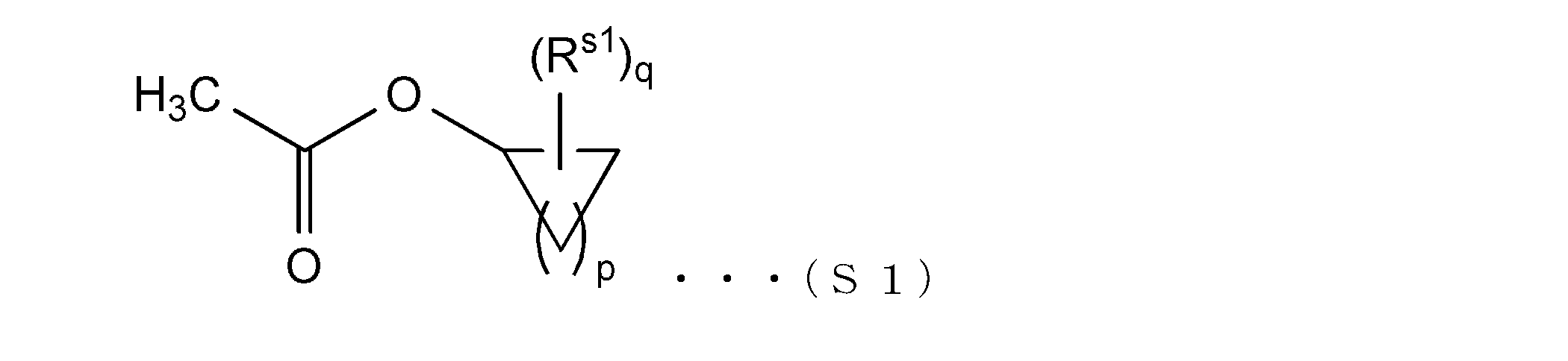
で表されるシクロアルキルアセテートを含有するケイ素含有樹脂組成物である。
第一の態様にかかるケイ素含有樹脂組成物を基板上に塗布して塗布膜を形成する工程と、
塗布膜を焼成する工程と、
を含む、シリカ系被膜の形成方法である。
本発明にかかるケイ素含有樹脂組成物は、(A)ケイ素含有樹脂と、(S)溶剤とを含有する。(A)ケイ素含有樹脂組成物としては、シロキサン樹脂、及びポリシランから選択される1種以上が使用される。(S)溶剤は、下式(S1)で表される、シクロアルキルアセテートを含有する。
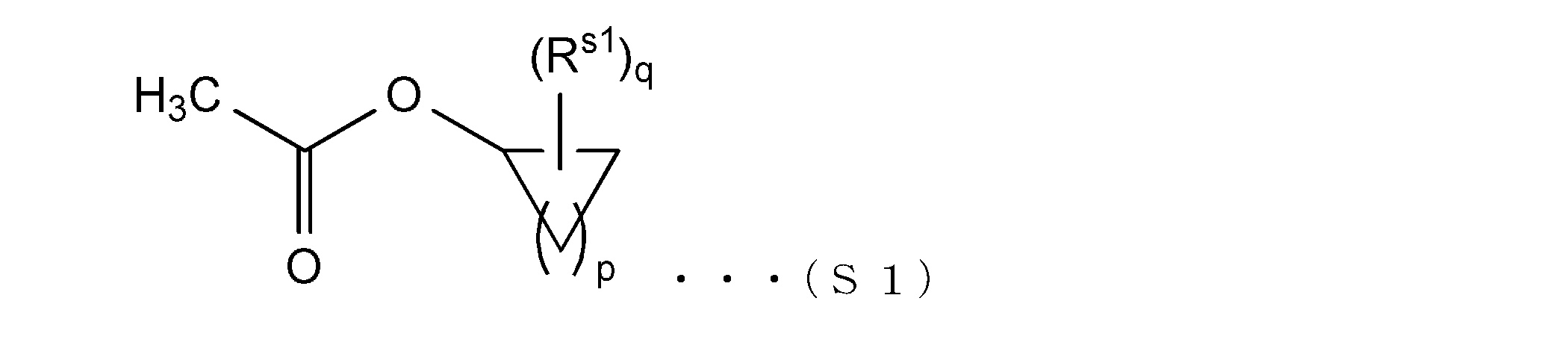
(A)ケイ素含有樹脂としては、シロキサン樹脂、及びポリシランから選択される1種以上が使用される。これらの(A)ケイ素含有樹脂を含む膜は、焼成されることでシリカ系の膜を与える。以下、シロキサン樹脂、及びポリシランとについて説明する。
シロキサン樹脂について、後述する構造のシクロアルキルアセテートを含有する(S)溶剤に可溶である樹脂であれば、特に制限はない。
シロキサン樹脂としては、例えば下式(A1)で表されるシラン化合物から選択される少なくとも1種を加水分解縮合して得られるシロキサン樹脂が好適に使用される。
R4-nSi(OR’)n・・・(A1)


式(A1)におけるnが4の場合のシラン化合物(i)は下式(A2)で表される。
Si(OR1)a(OR2)b(OR3)c(OR4)d・・・(A2)
R5Si(OR6)e(OR7)f(OR8)g・・・(A3)
R9R10Si(OR11)h(OR12)i・・・(A4)
トリメトキシシラン、トリエトキシシラン、トリプロポキシシラン、トリペンチルオキシシラン、トリフェニルオキシシラン、ジメトキシモノエトキシシラン、ジエトキシモノメトキシシラン、ジプロポキシモノメトキシシラン、ジプロポキシモノエトキシシラン、ジペンチルオキシルモノメトキシシラン、ジペンチルオキシモノエトキシシラン、ジペンチルオキシモノプロポキシシラン、ジフェニルオキシルモノメトキシシラン、ジフェニルオキシモノエトキシシラン、ジフェニルオキシモノプロポキシシラン、メトキシエトキシプロポキシシラン、モノプロポキシジメトキシシラン、モノプロポキシジエトキシシラン、モノブトキシジメトキシシラン、モノペンチルオキシジエトキシシラン、及びモノフェニルオキシジエトキシシラン等のヒドロシラン化合物;
メチルトリメトキシシラン、メチルトリエトキシシラン、メチルトリプロポキシシラン、メチルトリペンチルオキシシラン、メチルトリフェニルオキシシラン、メチルモノメトキシジエトキシシラン、メチルモノメトキシジプロポキシシラン、メチルモノメトキシジペンチルオキシシラン、メチルモノメトキシジフェニルオキシシラン、メチルメトキシエトキシプロポキシシラン、及びメチルモノメトキシモノエトキシモノブトキシシラン等のメチルシラン化合物;
エチルトリメトキシシラン、エチルトリエトキシシラン、エチルトリプロポキシシラン、エチルトリペンチルオキシシラン、エチルトリフェニルオキシシラン、エチルモノメトキシジエトキシシラン、エチルモノメトキシジプロポキシシラン、エチルモノメトキシジペンチルオキシシラン、エチルモノメトキシジフェニルオキシシラン、エチルメトキシエトキシプロポキシシラン、及びエチルモノメトキシモノエトキシモノブトキシシラン等のエチルシラン化合物;
プロピルトリメトキシシラン、プロピルトリエトキシシラン、プロピルトリプロポキシシラン、プロピルトリペンチルオキシシラン、及びプロピルトリフェニルオキシシラン、プロピルモノメトキシジエトキシシラン、プロピルモノメトキシジプロポキシシラン、プロピルモノメトキシジペンチルオキシシラン、プロピルモノメトキシジフェニルオキシシラン、プロピルメトキシエトキシプロポキシシラン、及びプロピルモノメトキシモノエトキシモノブトキシシラン、等のプロピルシラン化合物;
ブチルトリメトキシシラン、ブチルトリエトキシシラン、ブチルトリプロポキシシラン、ブチルトリペンチルオキシシラン、ブチルトリフェニルオキシシラン、ブチルモノメトキシジエトキシシラン、ブチルモノメトキシジブロポキシシラン、ブチルモノメトキシジペンチルオキシシラン、ブチルモノメトキシジフェニルオキシシラン、ブチルメトキシエトキシプロポキシシラン、及びブチルモノメトキシモノエトキシモノブトキシシラン等のブチルシラン化合物;
フェニルトリメトキシシラン、フェニルトリエトキシシラン、フェニルトリプロポキシシラン、フェニルトリペンチルオキシシラン、フェニルトリフェニルオキシシラン、フェニルモノメトキシジエトキシシラン、フェニルモノメトキシジプロポキシシラン、フェニルモノメトキシジペンチルオキシシラン、フェニルモノメトキシジフェニルオキシシラン、フェニルメトキシエトキシプロポキシシラン、及びフェニルモノメトキシモノエトキシモノブトキシシラン等のフェニルシラン化合物;
ヒドロキシフェニルトリメトキシシラン、ヒドロキシフェニルトリエトキシシラン、ヒドロキシフェニルトリプロポキシシラン、ヒドロキシフェニルトリペンチルオキシシラン、ヒドロキシフェニルトリフェニルオキシシラン、ヒドロキシフェニルモノメトキシジエトキシシラン、ヒドロキシフェニルモノメトキシジプロポキシシラン、ヒドロキシフェニルモノメトキシジペンチルオキシシラン、ヒドロキシフェニルモノメトキシジフェニルオキシシラン、ヒドロキシフェニルメトキシエトキシプロポキシシラン、及びヒドロキシフェニルモノメトキシモノエトキシモノブトキシシラン等のヒドロキシフェニルシラン化合物;
ナフチルトリメトキシシラン、ナフチルトリエトキシシラン、ナフチルトリプロポキシシラン、ナフチルトリペンチルオキシシラン、ナフチルトリフェニルオキシシラン、ナフチルモノメトキシジエトキシシラン、ナフチルモノメトキシジプロポキシシラン、ナフチルモノメトキシジペンチルオキシシラン、ナフチルモノメトキシジフェニルオキシシラン、ナフチルメトキシエトキシプロポキシシラン、及びナフチルモノメトキシモノエトキシモノブトキシシラン等のナフチルシラン化合物;
ベンジルトリメトキシシラン、ベンジルトリエトキシシラン、ベンジルトリプロポキシシラン、ベンジルトリペンチルオキシシラン、ベンジルトリフェニルオキシシラン、ベンジルモノメトキシジエトキシシラン、ベンジルモノメトキシジプロポキシシラン、ベンジルモノメトキシジペンチルオキシシラン、ベンジルモノメトキシジフェニルオキシシラン、ベンジルメトキシエトキシプロポキシシラン、及びベンジルモノメトキシモノエトキシモノブトキシシラン等のベンジルシラン化合物;
ヒドロキシベンジルトリメトキシシラン、ヒドロキシベンジルトリエトキシシラン、ヒドロキシベンジルトリプロポキシシラン、ヒドロキシベンジルトリペンチルオキシシラン、ヒドロキシベンジルトリフェニルオキシシラン、ヒドロキシベンジルモノメトキシジエトキシシラン、ヒドロキシベンジルモノメトキシジプロポキシシラン、ヒドロキシベンジルモノメトキシジペンチルオキシシラン、ヒドロキシベンジルモノメトキシジフェニルオキシシラン、ヒドロキシベンジルメトキシエトキシプロポキシシラン、及びヒドロキシベンジルモノメトキシモノエトキシモノブトキシシラン等のヒドロキシベンジルシラン化合物;
が挙げられる。
ジメトキシシラン、ジエトキシシラン、ジプロポキシシラン、ジペンチルオキシシラン、ジフェニルオキシシラン、メトキシエトキシシラン、メトキシプロポキシシラン、メトキシペンチルオキシシラン、メトキシフェニルオキシシラン、エトキシプロポキシシラン、エトキシペンチルオキシシラン、及びエトキシフェニルオキシシラン等のヒドロシラン化合物;
メチルジメトキシシラン、メチルメトキシエトキシシラン、メチルジエトキシシラン、メチルメトキシプロポキシシラン、メチルメトキシペンチルオキシシラン、メチルエトキシプロポキシシラン、メチルジプロポキシシラン、メチルジペンチルオキシシラン、メチルジフェニルオキシシラン、メチルメトキシフェニルオキシシラン等のメチルヒドロシラン化合物;
エチルジメトキシシラン、エチルメトキシエトキシシラン、エチルジエトキシシラン、エチルメトキシプロポキシシラン、エチルメトキシペンチルオキシシラン、エチルエトキシプロポキシシラン、エチルジプロポキシシラン、エチルジペンチルオキシシラン、エチルジフェニルオキシシラン、エチルメトキシフェニルオキシシラン等のエチルヒドロシラン化合物;
プロピルジメトキシシラン、プロピルメトキシエトキシシラン、プロピルジエトキシシラン、プロピルメトキシプロポキシシラン、プロピルメトキシペンチルオキシシラン、プロピルエトキシプロポキシシラン、プロピルジプロポキシシラン、プロピルジペンチルオキシシラン、プロピルジフェニルオキシシラン、プロピルメトキシフェニルオキシシラン等のプロピルヒドロシラン化合物;
ブチルジメトキシシラン、ブチルメトキシエトキシシラン、ブチルジエトキシシラン、ブチルメトキシプロポキシシラン、ブチルメトキシペンチルオキシシラン、ブチルエトキシプロポキシシラン、ブチルジプロポキシシラン、ブチルジペンチルオキシシラン、ブチルジフェニルオキシシラン、ブチルメトキシフェニルオキシシラン等のブチルヒドロシラン化合物;
フェニルジメトキシシラン、フェニルメトキシエトキシシラン、フェニルジエトキシシラン、フェニルメトキシプロポキシシラン、フェニルメトキシペンチルオキシシラン、フェニルエトキシプロポキシシラン、フェニルジプロポキシシラン、フェニルジペンチルオキシシラン、フェニルジフェニルオキシシラン、フェニルメトキシフェニルオキシシラン等のフェニルヒドロシラン化合物;
ヒドロキシフェニルジメトキシシラン、ヒドロキシフェニルメトキシエトキシシラン、ヒドロキシフェニルジエトキシシラン、ヒドロキシフェニルメトキシプロポキシシラン、ヒドロキシフェニルメトキシペンチルオキシシラン、ヒドロキシフェニルエトキシプロポキシシラン、ヒドロキシフェニルジプロポキシシラン、ヒドロキシフェニルジペンチルオキシシラン、ヒドロキシフェニルジフェニルオキシシラン、ヒドロキシフェニルメトキシフェニルオキシシラン等のヒドロキシフェニルヒドロシラン化合物;
ナフチルジメトキシシラン、ナフチルメトキシエトキシシラン、ナフチルジエトキシシラン、ナフチルメトキシプロポキシシラン、ナフチルメトキシペンチルオキシシラン、ナフチルエトキシプロポキシシラン、ナフチルジプロポキシシラン、ナフチルジペンチルオキシシラン、ナフチルジフェニルオキシシラン、ナフチルメトキシフェニルオキシシラン等のナフチルヒドロシラン化合物;
ベンジルジメトキシシラン、ベンジルメトキシエトキシシラン、ベンジルジエトキシシラン、ベンジルメトキシプロポキシシラン、ベンジルメトキシペンチルオキシシラン、ベンジルエトキシプロポキシシラン、ベンジルジプロポキシシラン、ベンジルジペンチルオキシシラン、ベンジルジフェニルオキシシラン、ベンジルメトキシフェニルオキシシラン等のベンジルヒドロシラン化合物;
ヒドロキシベンジルジメトキシシラン、ヒドロキシベンジルメトキシエトキシシラン、ヒドロキシベンジルジエトキシシラン、ヒドロキシベンジルメトキシプロポキシシラン、ヒドロキシベンジルメトキシペンチルオキシシラン、ヒドロキシベンジルエトキシプロポキシシラン、ヒドロキシベンジルジプロポキシシラン、ヒドロキシベンジルジペンチルオキシシラン、ヒドロキシベンジルジフェニルオキシシラン、ヒドロキシベンジルメトキシフェニルオキシシラン等のヒドロキシベンジルヒドロシラン化合物;
ジメチルジメトキシシラン、ジメチルメトキシエトキシシラン、ジメチルメトキシプロポキシシラン、ジメチルジエトキシシラン、ジメチルジペンチルオキシシラン、ジメチルジフェニルオキシシラン、ジメチルエトキシプロポキシシラン、ジメチルジプロポキシシラン等のジメチルシラン化合物;
ジエチルジメトキシシラン、ジエチルメトキシエトキシシラン、ジエチルメトキシプロポキシシラン、ジエチルジエトキシシラン、ジエチルジペンチルオキシシラン、ジエチルジフェニルオキシシラン、ジエチルエトキシプロポキシシラン、ジエチルジプロポキシシラン等のジエチルシラン化合物;
ジプロピルジメトキシシラン、ジプロピルメトキシエトキシシラン、ジプロピルメトキシプロポキシシラン、ジプロピルジエトキシシラン、ジプロピルジペンチルオキシシラン、ジプロピルジフェニルオキシシラン、ジプロピルエトキシプロポキシシラン、ジプロピルジプロポキシシラン等のジプロポキシシラン化合物;
ジブチルジメトキシシラン、ジブチルメトキシエトキシシラン、ジブチルメトキシプロポキシシラン、ジブチルジエトキシシラン、ジブチルジペンチルオキシシラン、ジブチルジフェニルオキシシラン、ジブチルエトキシプロポキシシラン、ジブチルジプロポキシシラン等のジブチルシラン化合物;
ジフェニルジメトキシシラン、ジフェニルメトキシエトキシシラン、ジフェニルメトキシプロポキシシラン、ジフェニルジエトキシシラン、ジフェニルジペンチルオキシシラン、ジフェニルジフェニルオキシシラン、ジフェニルエトキシプロポキシシラン、ジフェニルジプロポキシシラン等のジフェニルシラン化合物;
ジ(ヒドロキシフェニル)ジメトキシシラン、ジ(ヒドロキシフェニル)メトキシエトキシシラン、ジ(ヒドロキシフェニル)メトキシプロポキシシラン、ジ(ヒドロキシフェニル)ジエトキシシラン、ジ(ヒドロキシフェニル)ジペンチルオキシシラン、ジ(ヒドロキシフェニル)ジフェニルオキシシラン、ジ(ヒドロキシフェニル)エトキシプロポキシシラン、ジ(ヒドロキシフェニル)ジプロポキシシラン等のジ(ヒドロキシフェニル)シラン化合物;
ジナフチルジメトキシシラン、ジナフチルメトキシエトキシシラン、ジナフチルメトキシプロポキシシラン、ジナフチルジエトキシシラン、ジナフチルジペンチルオキシシラン、ジナフチルジフェニルオキシシラン、ジナフチルエトキシプロポキシシラン、ジナフチルジプロポキシシラン等のジナフチルシラン化合物;
ジベンジルジメトキシシラン、ジベンジルメトキシエトキシシラン、ジベンジルメトキシプロポキシシラン、ジベンジルジエトキシシラン、ジベンジルジペンチルオキシシラン、ジベンジルジフェニルオキシシラン、ジベンジルエトキシプロポキシシラン、ジベンジルジプロポキシシラン等のジベンジルシラン化合物;
ジ(ヒドロキシベンジル)ジメトキシシラン、ジ(ヒドロキシベンジル)メトキシエトキシシラン、ジ(ヒドロキシベンジル)メトキシプロポキシシラン、ジ(ヒドロキシベンジル)ジエトキシシラン、ジ(ヒドロキシベンジル)ジペンチルオキシシラン、ジ(ヒドロキシベンジル)ジフェニルオキシシラン、ジ(ヒドロキシベンジル)エトキシプロポキシシラン、ジ(ヒドロキシベンジル)ジプロポキシシラン等のジ(ヒドロキシベンジル)シラン化合物;
メチルエチルジメトキシシラン、メチルエチルメトキシエトキシシラン、メチルエチルメトキシプロポキシシラン、メチルエチルジエトキシシラン、メチルエチルジペンチルオキシシラン、メチルエチルジフェニルオキシシラン、メチルエチルエトキシプロポキシシラン、メチルエチルジプロポキシシラン等のメチルエチルシラン化合物;
メチルプロピルジメトキシシラン、メチルプロピルメトキシエトキシシラン、メチルプロピルメトキシプロポキシシラン、メチルプロピルジエトキシシラン、メチルプロピルジペンチルオキシシラン、メチルプロピルジフェニルオキシシラン、メチルプロピルエトキシプロポキシシラン、メチルプロピルジプロポキシシラン等のメチルプロピルシラン化合物;
メチルブチルジメトキシシラン、メチルブチルメトキシエトキシシラン、メチルブチルメトキシプロポキシシラン、メチルブチルジエトキシシラン、メチルブチルジペンチルオキシシラン、メチルブチルジフェニルオキシシラン、メチルブチルエトキシプロポキシシラン、メチルブチルジプロポキシシラン等のメチルブチルシラン化合物;
メチル(フェニル)ジメトキシシラン、メチル(フェニル)メトキシエトキシシラン、メチル(フェニル)メトキシプロポキシシラン、メチル(フェニル)ジエトキシシラン、メチル(フェニル)ジペンチルオキシシラン、メチル(フェニル)ジフェニルオキシシラン、メチル(フェニル)エトキシプロポキシシラン、メチル(フェニル)ジプロポキシシラン等のメチル(フェニル)シラン化合物;
メチル(ヒドロキシフェニル)ジメトキシシラン、メチル(ヒドロキシフェニル)メトキシエトキシシラン、メチル(ヒドロキシフェニル)メトキシプロポキシシラン、メチル(ヒドロキシフェニル)ジエトキシシラン、メチル(ヒドロキシフェニル)ジペンチルオキシシラン、メチル(ヒドロキシフェニル)ジフェニルオキシシラン、メチル(ヒドロキシフェニル)エトキシプロポキシシラン、メチル(ヒドロキシフェニル)ジプロポキシシラン等のメチル(ヒドロキシフェニル)シラン化合物;
メチル(ナフチル)ジメトキシシラン、メチル(ナフチル)メトキシエトキシシラン、メチル(ナフチル)メトキシプロポキシシラン、メチル(ナフチル)ジエトキシシラン、メチル(ナフチル)ジペンチルオキシシラン、メチル(ナフチル)ジフェニルオキシシラン、メチル(ナフチル)エトキシプロポキシシラン、メチル(ナフチル)ジプロポキシシラン等のメチル(ナフチル)シラン化合物;
メチル(ベンジル)ジメトキシシラン、メチル(ベンジル)メトキシエトキシシラン、メチル(ベンジル)メトキシプロポキシシラン、メチル(ベンジル)ジエトキシシラン、メチル(ベンジル)ジペンチルオキシシラン、メチル(ベンジル)ジフェニルオキシシラン、メチル(ベンジル)エトキシプロポキシシラン、メチル(ベンジル)ジプロポキシシラン等のメチル(ベンジル)シラン化合物;
メチル(ヒドロキシベンジル)ジメトキシシラン、メチル(ヒドロキシベンジル)メトキシエトキシシラン、メチル(ヒドロキシベンジル)メトキシプロポキシシラン、メチル(ヒドロキシベンジル)ジエトキシシラン、メチル(ヒドロキシベンジル)ジペンチルオキシシラン、メチル(ヒドロキシベンジル)ジフェニルオキシシラン、メチル(ヒドロキシベンジル)エトキシプロポキシシラン、メチル(ヒドロキシベンジル)ジプロポキシシラン等のメチル(ヒドロキシベンジル)シラン化合物;
エチルプロピルジメトキシシラン、エチルプロピルメトキシエトキシシラン、エチルプロピルメトキシプロポキシシラン、エチルプロピルジエトキシシラン、エチルプロピルジペンチルオキシシラン、エチルプロピルジフェニルオキシシラン、エチルプロピルエトキシプロポキシシラン、エチルプロピルジプロポキシシラン等のエチルプロピルシラン化合物;
エチルブチルジメトキシシラン、エチルブチルメトキシエトキシシラン、エチルブチルメトキシプロポキシシラン、エチルブチルジエトキシシラン、エチルブチルジペンチルオキシシラン、エチルブチルジフェニルオキシシラン、エチルブチルエトキシプロポキシシラン、エチルブチルジプロポキシシラン等のエチルブチルシラン化合物;
エチル(フェニル)ジメトキシシラン、エチル(フェニル)メトキシエトキシシラン、エチル(フェニル)メトキシプロポキシシラン、エチル(フェニル)ジエトキシシラン、エチル(フェニル)ジペンチルオキシシラン、エチル(フェニル)ジフェニルオキシシラン、エチル(フェニル)エトキシプロポキシシラン、エチル(フェニル)ジプロポキシシラン等のエチル(フェニル)シラン化合物;
エチル(ヒドロキシフェニル)ジメトキシシラン、エチル(ヒドロキシフェニル)メトキシエトキシシラン、エチル(ヒドロキシフェニル)メトキシプロポキシシラン、エチル(ヒドロキシフェニル)ジエトキシシラン、エチル(ヒドロキシフェニル)ジペンチルオキシシラン、エチル(ヒドロキシフェニル)ジフェニルオキシシラン、エチル(ヒドロキシフェニル)エトキシプロポキシシラン、エチル(ヒドロキシフェニル)ジプロポキシシラン等のエチル(ヒドロキシフェニル)シラン化合物;
エチル(ナフチル)ジメトキシシラン、エチル(ナフチル)メトキシエトキシシラン、エチル(ナフチル)メトキシプロポキシシラン、エチル(ナフチル)ジエトキシシラン、エチル(ナフチル)ジペンチルオキシシラン、エチル(ナフチル)ジフェニルオキシシラン、エチル(ナフチル)エトキシプロポキシシラン、エチル(ナフチル)ジプロポキシシラン等のエチル(ナフチル)シラン化合物;
エチル(ベンジル)ジメトキシシラン、エチル(ベンジル)メトキシエトキシシラン、エチル(ベンジル)メトキシプロポキシシラン、エチル(ベンジル)ジエトキシシラン、エチル(ベンジル)ジペンチルオキシシラン、エチル(ベンジル)ジフェニルオキシシラン、エチル(ベンジル)エトキシプロポキシシラン、エチル(ベンジル)ジプロポキシシラン等のエチル(ベンジル)シラン化合物;
エチル(ヒドロキシベンジル)ジメトキシシラン、エチル(ヒドロキシベンジル)メトキシエトキシシラン、エチル(ヒドロキシベンジル)メトキシプロポキシシラン、エチル(ヒドロキシベンジル)ジエトキシシラン、エチル(ヒドロキシベンジル)ジペンチルオキシシラン、エチル(ヒドロキシベンジル)ジフェニルオキシシラン、エチル(ヒドロキシベンジル)エトキシプロポキシシラン、エチル(ヒドロキシベンジル)ジプロポキシシラン等のエチル(ヒドロキシベンジル)シラン化合物;
プロピルブチルジメトキシシラン、プロピルブチルメトキシエトキシシラン、プロピルブチルメトキシプロポキシシラン、プロピルブチルジエトキシシラン、プロピルブチルジペンチルオキシシラン、プロピルブチルジフェニルオキシシラン、プロピルブチルエトキシプロポキシシラン、プロピルブチルジプロポキシシラン等のプロピルブチルシラン化合物;
プロピル(フェニル)ジメトキシシラン、プロピル(フェニル)メトキシエトキシシラン、プロピル(フェニル)メトキシプロポキシシラン、プロピル(フェニル)ジエトキシシラン、プロピル(フェニル)ジペンチルオキシシラン、プロピル(フェニル)ジフェニルオキシシラン、プロピル(フェニル)エトキシプロポキシシラン、プロピル(フェニル)ジプロポキシシラン等のプロピル(フェニル)シラン化合物;
プロピル(ヒドロキシフェニル)ジメトキシシラン、プロピル(ヒドロキシフェニル)メトキシエトキシシラン、プロピル(ヒドロキシフェニル)メトキシプロポキシシラン、プロピル(ヒドロキシフェニル)ジエトキシシラン、プロピル(ヒドロキシフェニル)ジペンチルオキシシラン、プロピル(ヒドロキシフェニル)ジフェニルオキシシラン、プロピル(ヒドロキシフェニル)エトキシプロポキシシラン、プロピル(ヒドロキシフェニル)ジプロポキシシラン等のプロピル(ヒドロキシフェニル)シラン化合物;
プロピル(ナフチル)ジメトキシシラン、プロピル(ナフチル)メトキシエトキシシラン、プロピル(ナフチル)メトキシプロポキシシラン、プロピル(ナフチル)ジエトキシシラン、プロピル(ナフチル)ジペンチルオキシシラン、プロピル(ナフチル)ジフェニルオキシシラン、プロピル(ナフチル)エトキシプロポキシシラン、プロピル(ナフチル)ジプロポキシシラン等のプロピル(ナフチル)シラン化合物;
プロピル(ベンジル)ジメトキシシラン、プロピル(ベンジル)メトキシエトキシシラン、プロピル(ベンジル)メトキシプロポキシシラン、プロピル(ベンジル)ジエトキシシラン、プロピル(ベンジル)ジペンチルオキシシラン、プロピル(ベンジル)ジフェニルオキシシラン、プロピル(ベンジル)エトキシプロポキシシラン、プロピル(ベンジル)ジプロポキシシラン等のプロピル(ベンジル)シラン化合物;
プロピル(ヒドロキシベンジル)ジメトキシシラン、プロピル(ヒドロキシベンジル)メトキシエトキシシラン、プロピル(ヒドロキシベンジル)メトキシプロポキシシラン、プロピル(ヒドロキシベンジル)ジエトキシシラン、プロピル(ヒドロキシベンジル)ジペンチルオキシシラン、プロピル(ヒドロキシベンジル)ジフェニルオキシシラン、プロピル(ヒドロキシベンジル)エトキシプロポキシシラン、プロピル(ヒドロキシベンジル)ジプロポキシシラン等のプロピル(ヒドロキシベンジル)シラン化合物;
が挙げられる。
シロキサン樹脂の質量平均分子量は、300~30000が好ましく、500~10000がより好ましい。異なる質量平均分子量のシロキサン樹脂を2種以上混合してもよい。シロキサン樹脂の質量平均分子量がかかる範囲内である場合、製膜性に優れ、平坦なシリカ系被膜を形成できるケイ素含有樹脂組成物を得やすい。
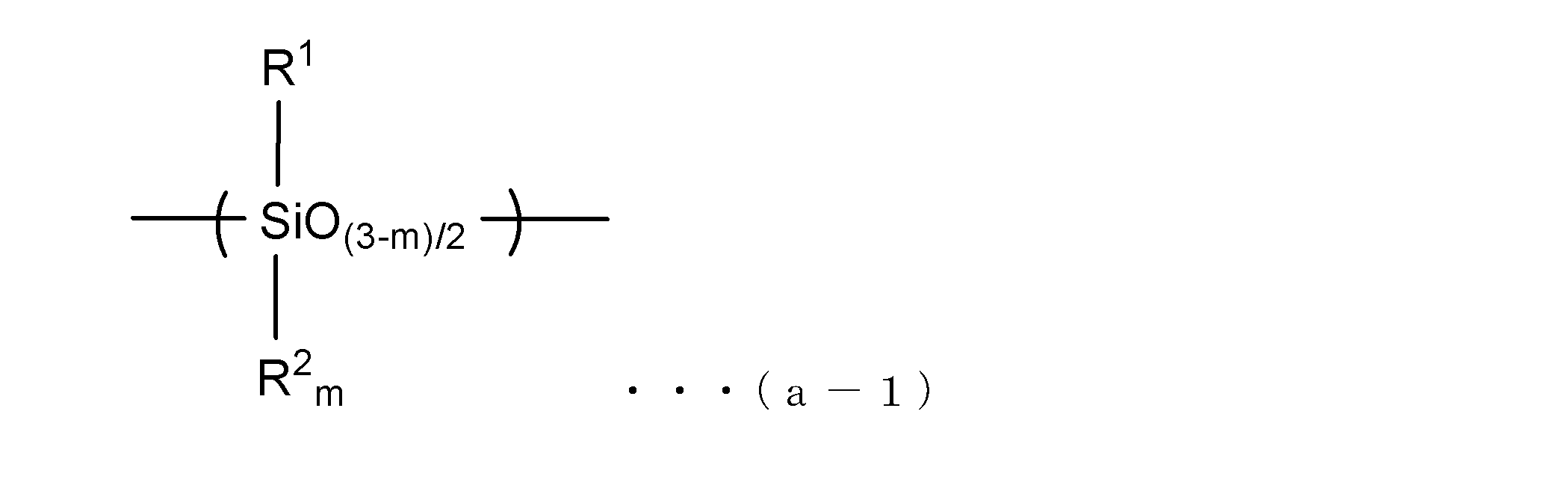
上記のように、アルキル基、アリール基、又はアラルキル基を有するシロキサン樹脂を用いることにより、耐久性に優れるシリカ系被膜を形成でき、微小な空間への充填が容易なケイ素含有樹脂組成物を得やすい。
アリール基及びアラルキル基としては、ベンジル基、フェネチル基、フェニル基、ナフチル基、アントラセニル基、フェナントリル基、ビフェニル基、フルオレニル基、及びピレニル基等が挙げられる。
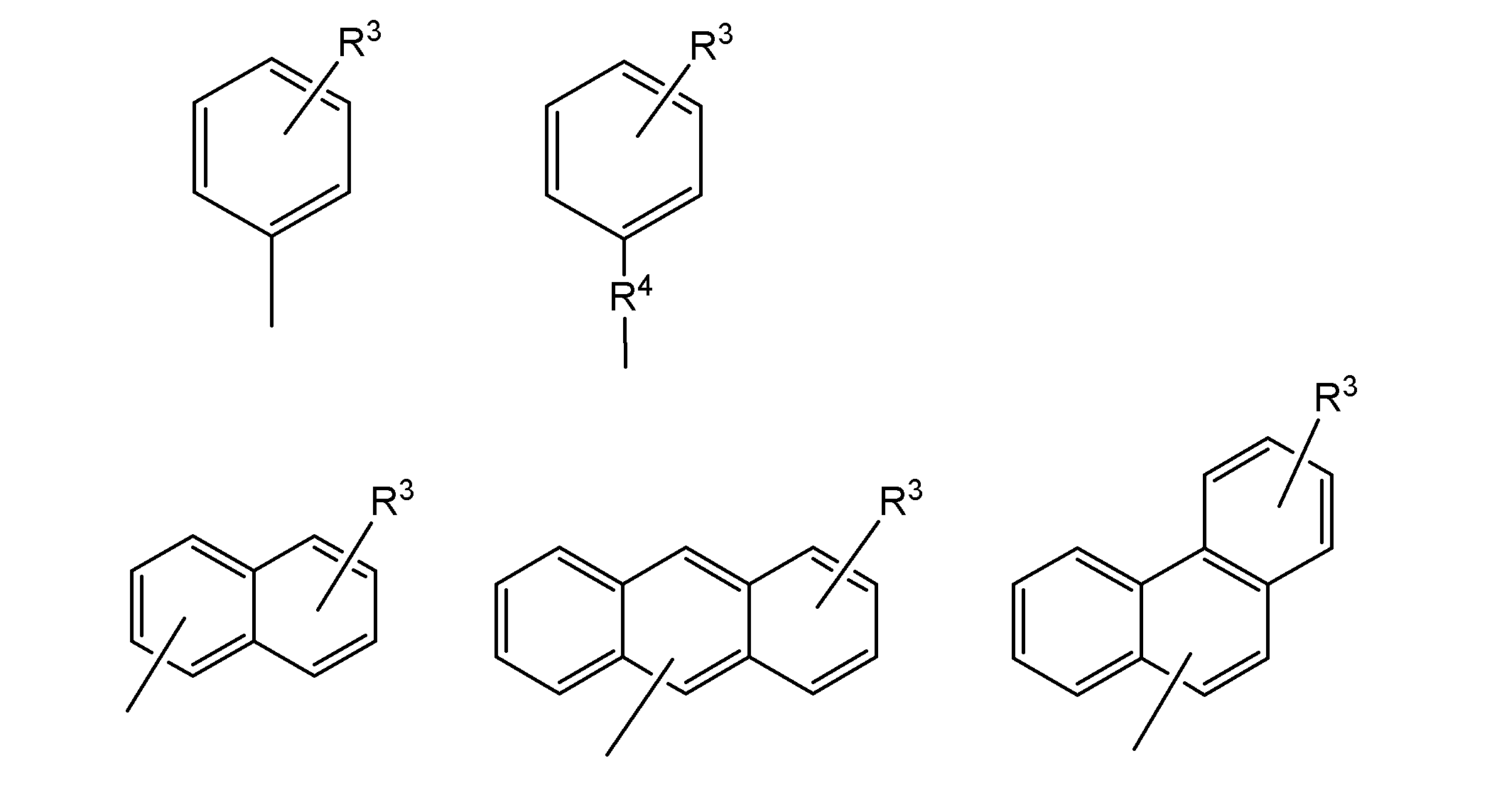

構造単位(a-1)を2種類以上有するシロキサン樹脂としては、具体的には下記の構造式(A-1-1)~(A-1-3)で表されるシロキサン樹脂が挙げられる。

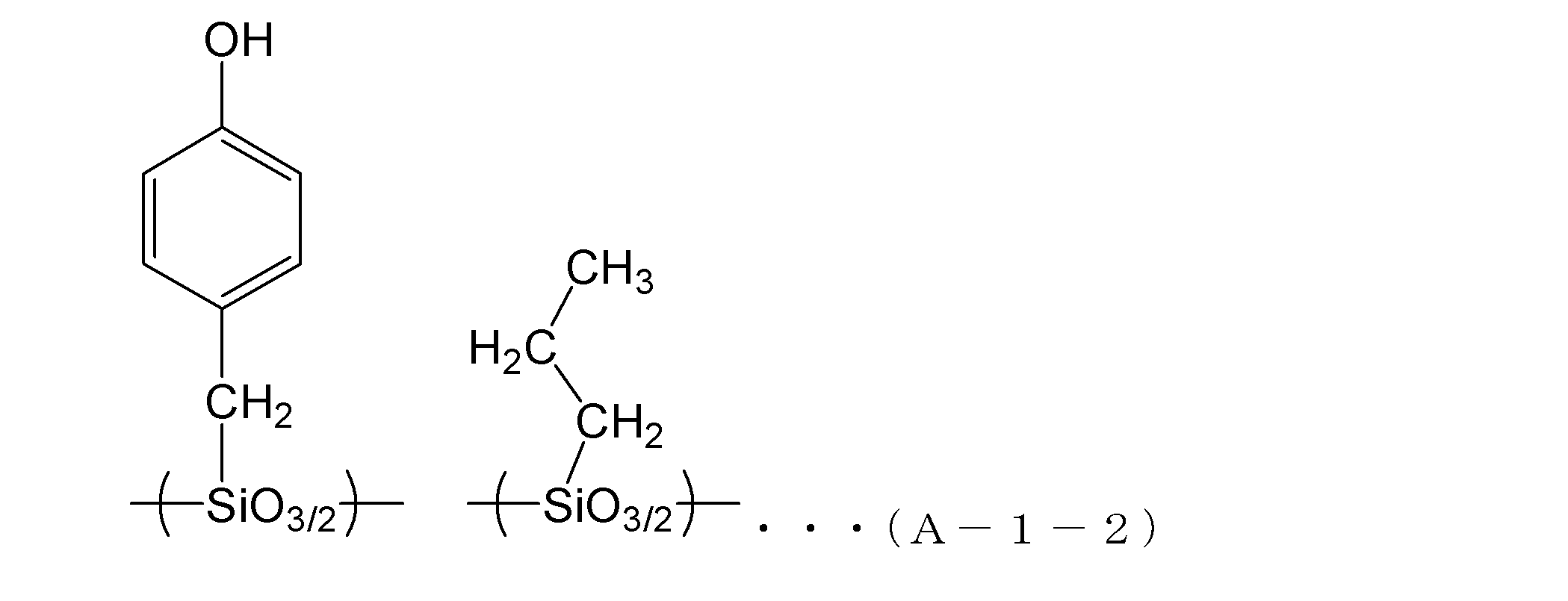


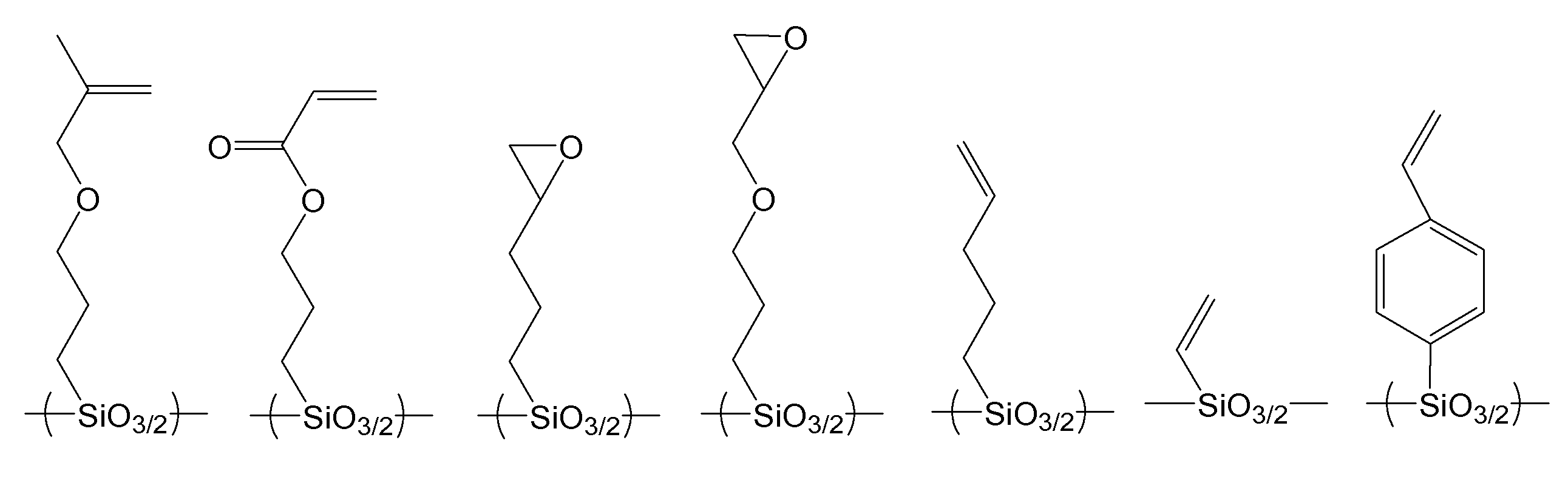

連結基は、エーテル結合、アミノ結合、アミド結合、又はビニル結合を有していてもよく、アミド結合を有していることが好ましい。R14は、例えば以下のものが挙げられるが、これらに限定されない。なお、下式中*は、式(A-1-5)中のSiと結合する、R14の結合手の末端を意味する。

ポリシランは、焼成によりシリカ系被膜を形成できれば特に限定されない。ポリシランの構造は特に限定されない。ポリシランは直鎖状であっても、分岐鎖状であっても、網目状であっても、環状であってもよいが、直鎖状又は分岐鎖状の鎖状構造が好ましい。
ポリシランは、シラノール基及び/又はアルコキシ基を含有していてもよい。
好適なポリシランとしては、例えば、下式(A5)及び(A6)で表される単位の少なくとも1つを必須に含み、下式(A7)、(A8)及び(A9)で表される単位から選択される少なくとも1つの単位を任意に含有するポリシランが挙げられる。かかるポリシランは、シラノール基、又はケイ素原子に結合するアルコキシ基を含有していてもよい。

これらの基の中では、アルキル基、アリール基、及びアラルキル基が好ましい。アルキル基、アリール基、及びアラルキル基の好適な例は、前述の式(A1)中のRがアルキル基、アリール基、又はアラルキル基である場合の例と同様である。
ポリシランは、下記(A10)から(A13)のユニットを含むのが好ましい。

a、b、及びcは、それぞれ、10~500が好ましく、10~100がより好ましい。各ユニット中の構成単位は、ユニット中に、ランダムに含まれていても、ブロック化された状態で含まれていてもよい。
ケイ素含有樹脂組成物は、(B)硬化剤を含んでいてもよい。ケイ素含有樹脂組成物が(B)硬化剤を含む場合、低誘電率であって、N-メチル-2-ピロリドン等の有機溶剤により、溶解、膨潤、変形したりしにくい、有機溶剤耐性に優れるシリカ系被膜を形成しやすい。
熱により塩基成分を発生する硬化剤としては、従来から熱塩基発生剤として使用されている化合物を特に限定なく用いることができる。
例えば、2-ベンジル-2-ジメチルアミノ-1-(4-モルフォリノフェニル)-ブタン-1-オンを、熱により塩基成分を発生する効果剤として用いることができる。なお、2-ベンジル-2-ジメチルアミノ-1-(4-モルフォリノフェニル)-ブタン-1-オンは光の作用によっても塩基を発生させる。


で表される化合物が挙げられる。

で表される化合物が好ましい。
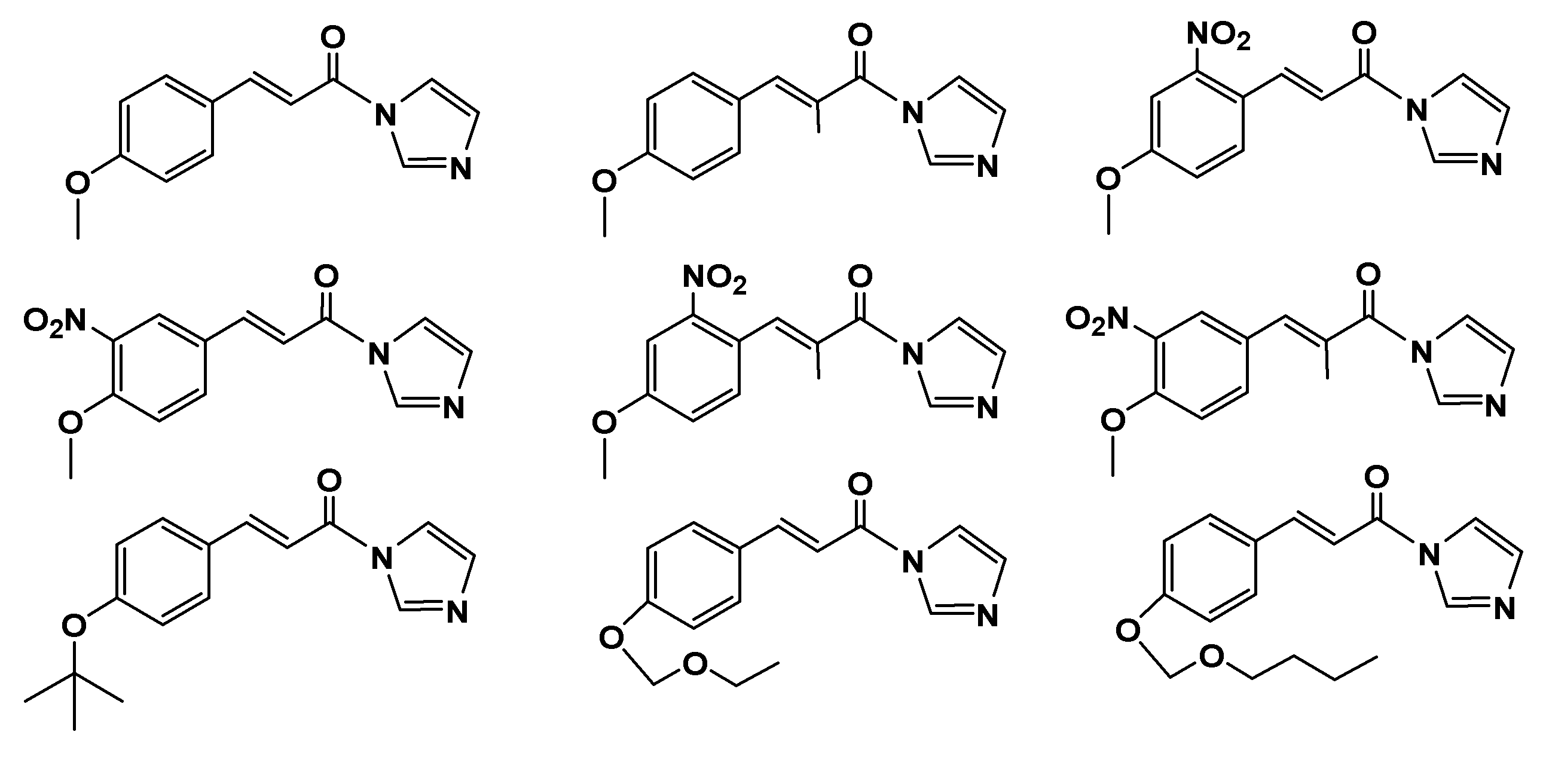
オキシムエステル化合物は、光の作用により分解して塩基を発生する。好適なオキシムエステル化合物としては、下記式(B4)で表される化合物が挙げられる。

アルキル基が炭素原子上に有してもよい好適な置換基の例としては、炭素原子数1~20のアルコキシ基、炭素原子数3~10のシクロアルキル基、炭素原子数3~10のシクロアルコキシ基、炭素原子数2~20の飽和脂肪族アシル基、炭素原子数2~20のアルコキシカルボニル基、炭素原子数2~20の飽和脂肪族アシルオキシ基、置換基を有してもよいフェニル基、置換基を有してもよいフェノキシ基、置換基を有してもよいフェニルチオ基、置換基を有してもよいベンゾイル基、置換基を有してもよいフェノキシカルボニル基、置換基を有してもよいベンゾイルオキシ基、置換基を有してもよい炭素原子数7~20のフェニルアルキル基、置換基を有してもよいナフチル基、置換基を有してもよいナフトキシ基、置換基を有してもよいナフトイル基、置換基を有してもよいナフトキシカルボニル基、置換基を有してもよいナフトイルオキシ基、置換基を有してもよい炭素原子数11~20のナフチルアルキル基、置換基を有してもよいヘテロシクリル基、置換基を有してもよいヘテロシクリルカルボニル基、アミノ基、1又は2の有機基で置換されたアミノ基、モルホリン-1-イル基、及びピペラジン-1-イル基、ハロゲン、ニトロ基、及びシアノ基等が挙げられる。
フェニル基、及びカルバゾリル基が炭素原子上に有してもよい好適な置換基の例としては、アルキル基が炭素原子上に有してもよい好適な置換基として上記で例示した基に加えて、炭素原子数1~20のアルキル基が挙げられる。
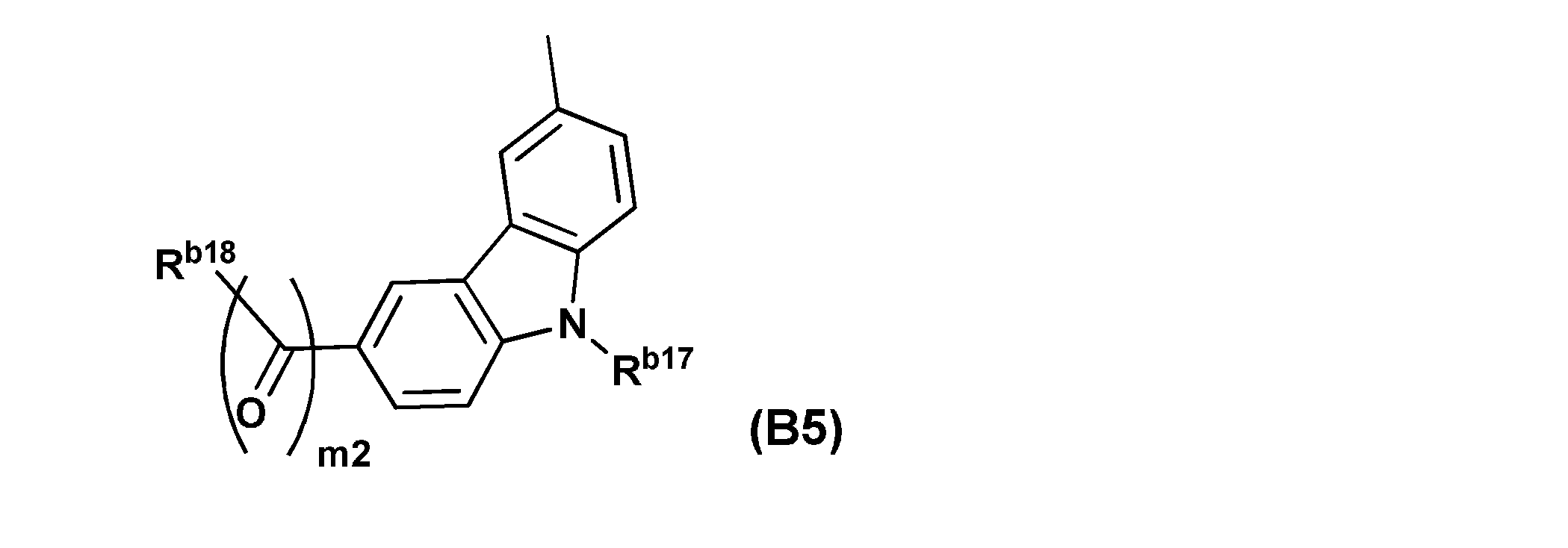


また、Rb22が水素原子であるのも好ましい。Rb22が水素原子である場合、Rb25が後述の式(B10)で表される基であるのが好ましい。
アルキル基が有してもよい置換基は、本発明の目的を阻害しない範囲で特に限定されない。置換基の好適な例としては、シアノ基、ハロゲン原子、環状有機基、及びアルコキシカルボニル基が挙げられる。ハロゲン原子としては、フッ素原子、塩素原子、臭素原子、ヨウ素原子が挙げられる。これらの中では、フッ素原子、塩素原子、臭素原子が好ましい。環状有機基としては、シクロアルキル基、芳香族炭化水素基、ヘテロシクリル基が挙げられる。シクロアルキル基の具体例としては、Rb22がシクロアルキル基である場合の好適な例と同様である。芳香族炭化水素基の具体例としては、フェニル基、ナフチル基、ビフェニリル基、アントリル基、及びフェナントリル基等が挙げられる。ヘテロシクリル基の具体例としては、Rb22がヘテロシクリル基である場合の好適な例と同様である。Rb22がアルコキシカルボニル基である場合、アルコキシカルボニル基に含まれるアルコキシ基は、直鎖状でも分岐鎖状でもよく、直鎖状が好ましい。アルコキシカルボニル基に含まれるアルコキシ基の炭素原子数は、1~10が好ましく、1~6がより好ましい。
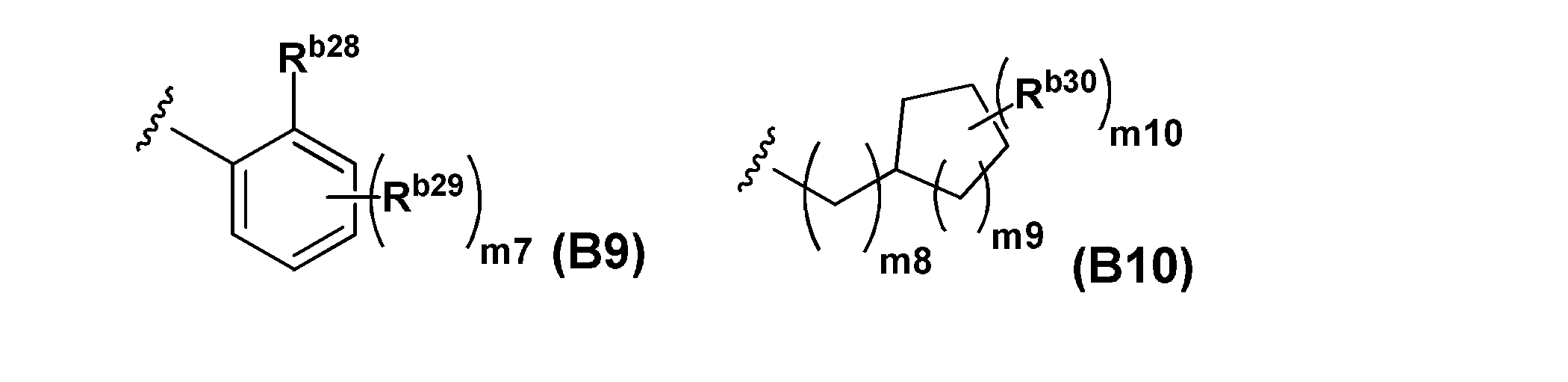
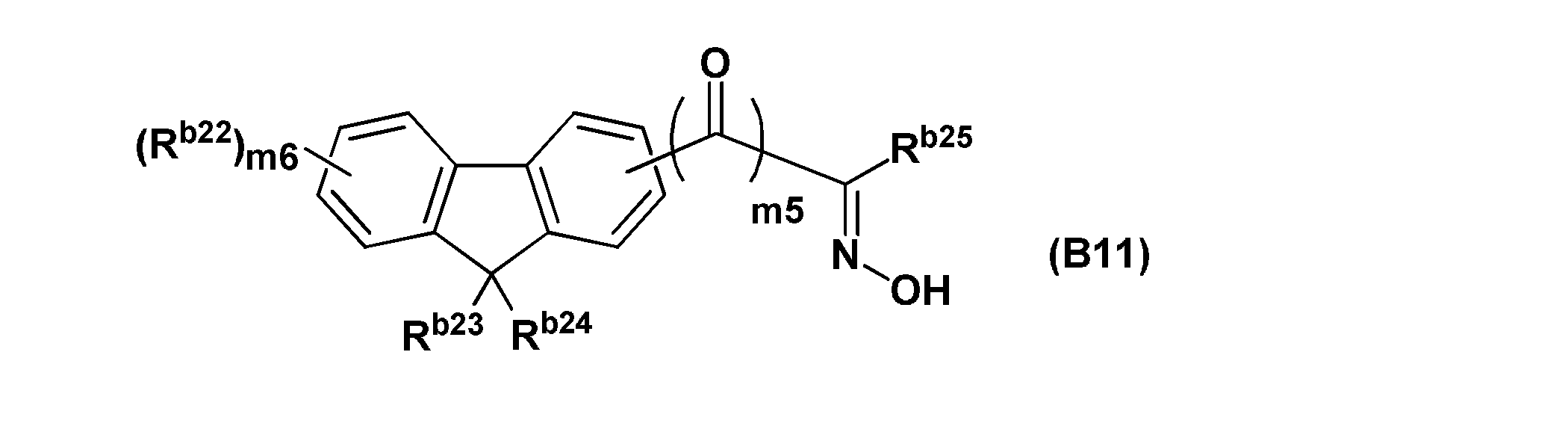
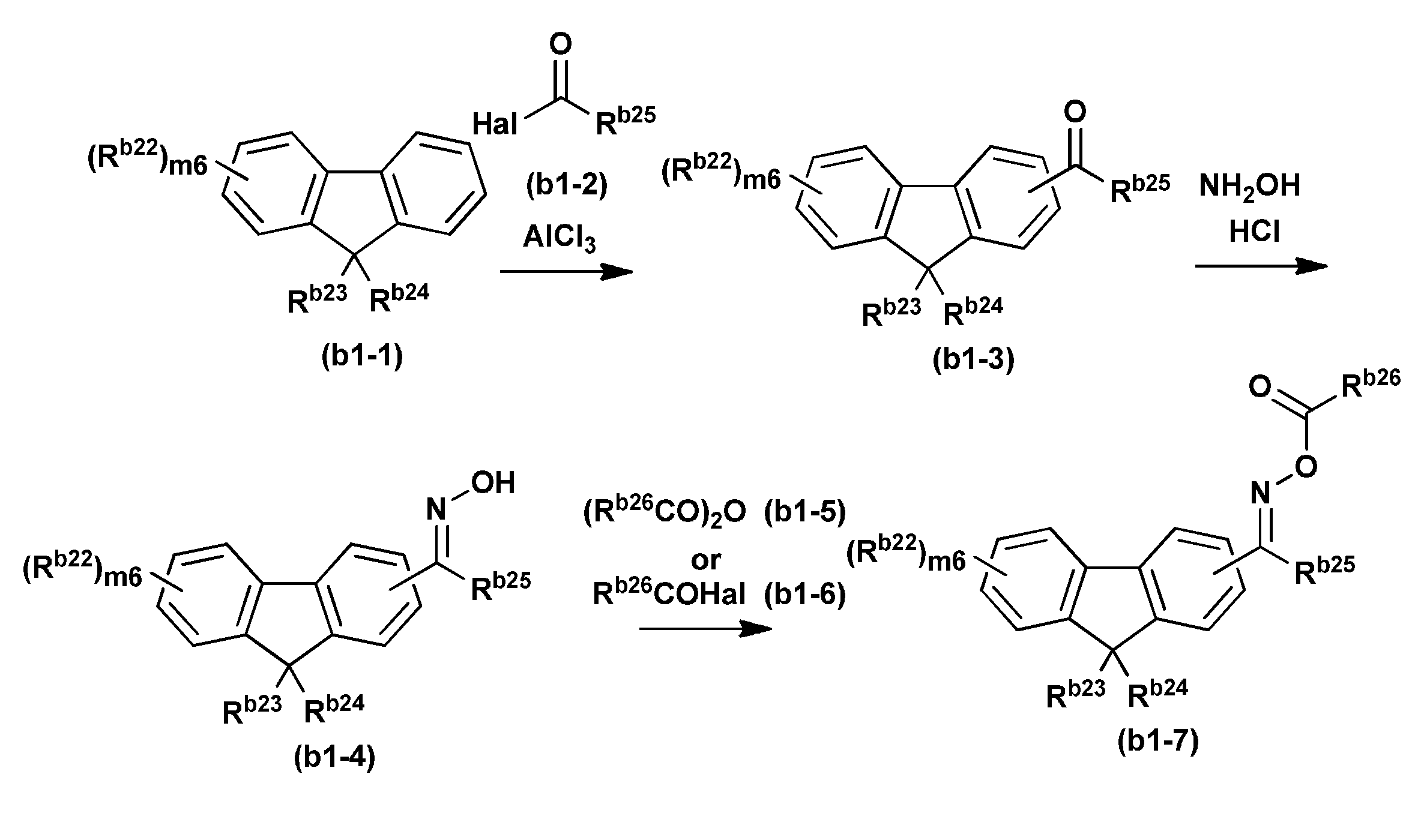
m5が1である場合、式(B8)で表される化合物を含有するケイ素含有樹脂組成物を用いて形成されるパターン中での異物の発生をより低減できる傾向がある。


ケイ素含有樹脂組成物中の、(B)硬化剤の含有量は、典型的には、組成物全体の質量に対して、0.01~40質量%が好ましく、0.1~20質量%がより好ましく、1~10質量%が特に好ましい。
ケイ素含有樹脂組成物は、(C)ニトロキシ化合物を含んでいてもよい。ケイ素含有樹脂組成物が(C)ニトロキシ化合物を含む場合、より誘電率の低いシリカ系被膜を形成できるので好ましい。また、ケイ素含有樹脂組成物が(C)ニトロキシ化合物を含む場合、シリカ系被膜を形成する際の焼成温度が、例えば250℃以下(例えば200℃以上250℃以下の範囲)の低い温度であっても、シリカ系被膜の膜中残渣(シリカ系被膜由来の不純物)を低減できるので好ましい。シリカ系被膜の膜中残渣が少ないと、シリカ系被膜が高温雰囲気や減圧雰囲気におかれる場合でも、シリカ系被膜からの、膜中残渣そのものや膜中残渣の分解物に由来するガス発生が抑制される。

ケイ素含有樹脂組成物が、(C)ニトロキシ化合物として上記式(c1)で表される構造を含む化合物を含有すると、より誘電率の低いシリカ系被膜を形成しやすい。
式(c1)において、Rc1、Rc2、Rc3、及びRc4は、それぞれ独立に、アルキル基又はヘテロ原子で置換されたアルキル基であるのが好ましい。アルキル基としては、メチル基、エチル基、n-プロピル基、及びイソプロピル基が好ましい。ヘテロ原子の好適な例としては、ハロゲン原子、酸素原子、硫黄原子、及び窒素原子等が挙げられる。
中でも、より誘電率の低いシリカ系被膜を形成しやすい点で、下記式(c2)、(c3)、又は(c4)で表される化合物がより好ましい。
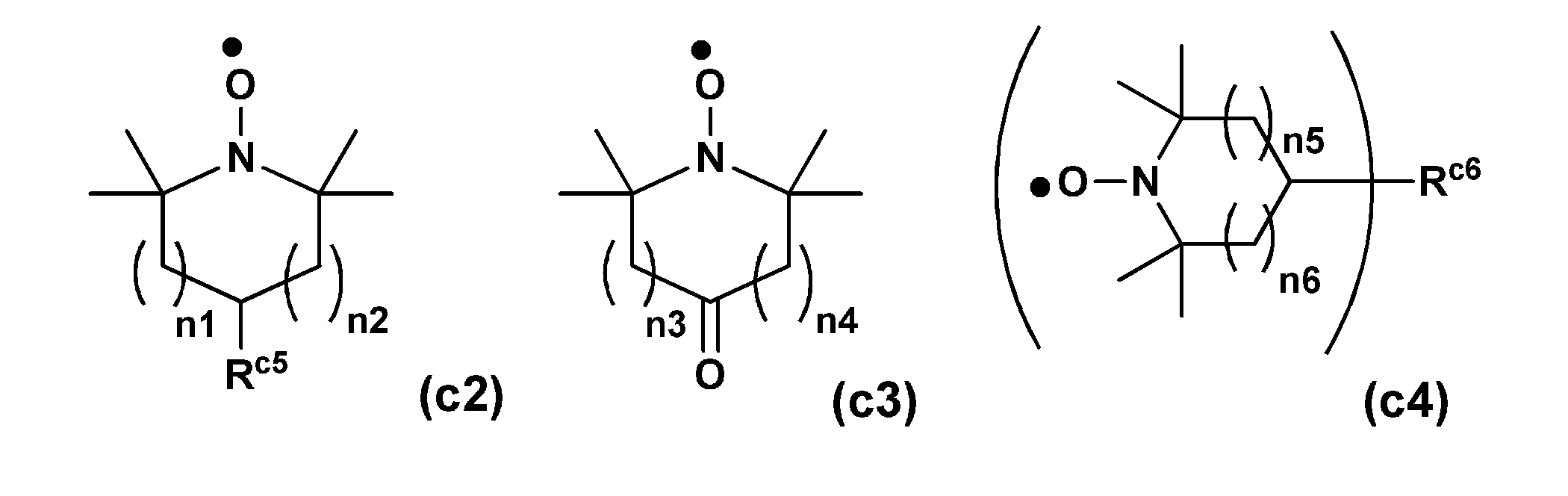
Rc6は、2価又は3価の有機基を表す。
n1及びn2は、1≦n1+n2≦2を満たす整数である。
n3及びn4は、1≦n3+n4≦2を満たす整数である。
n5及びn6は、1≦n5+n6≦2を満たす整数である。
n7は、2又は3である。
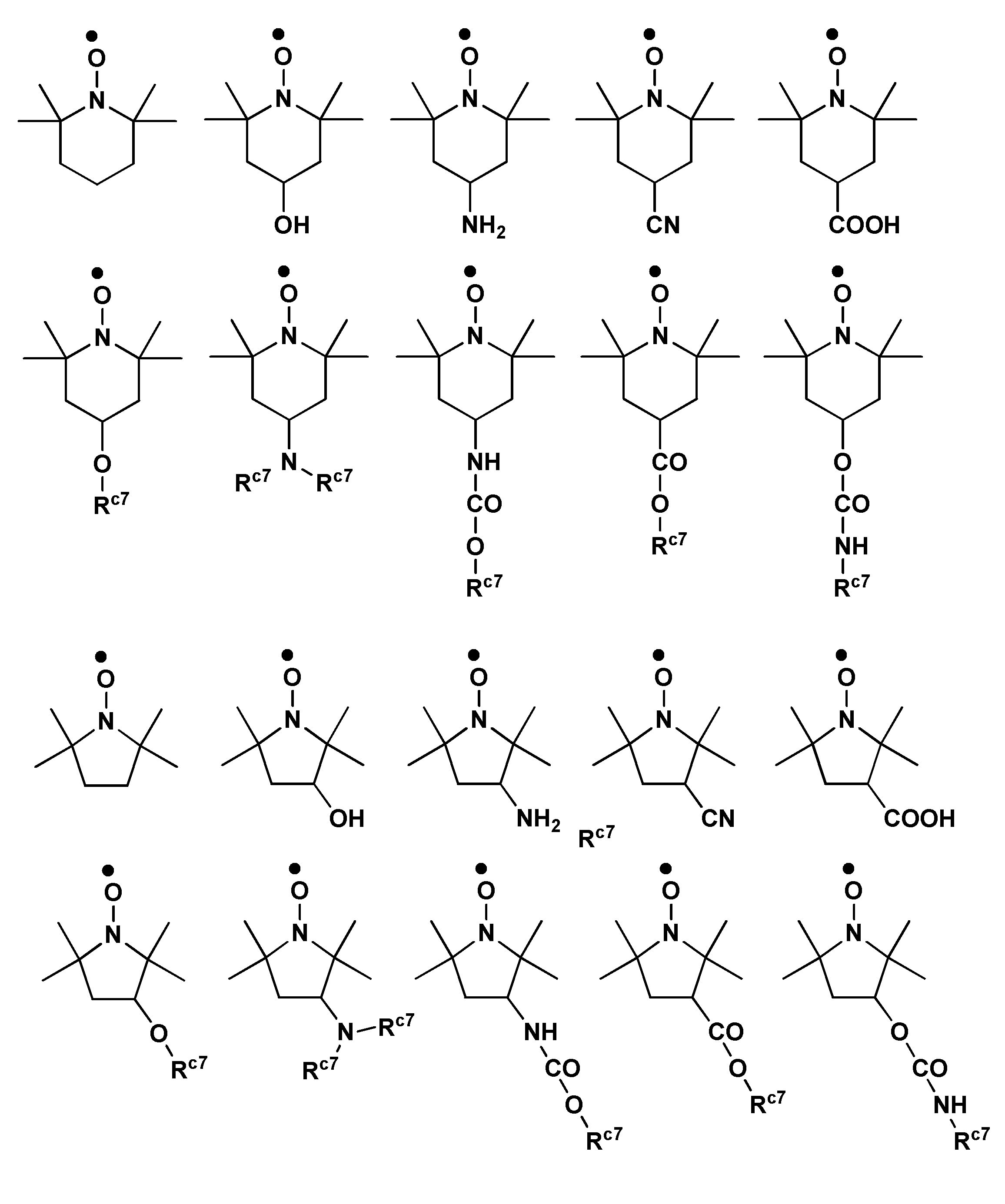
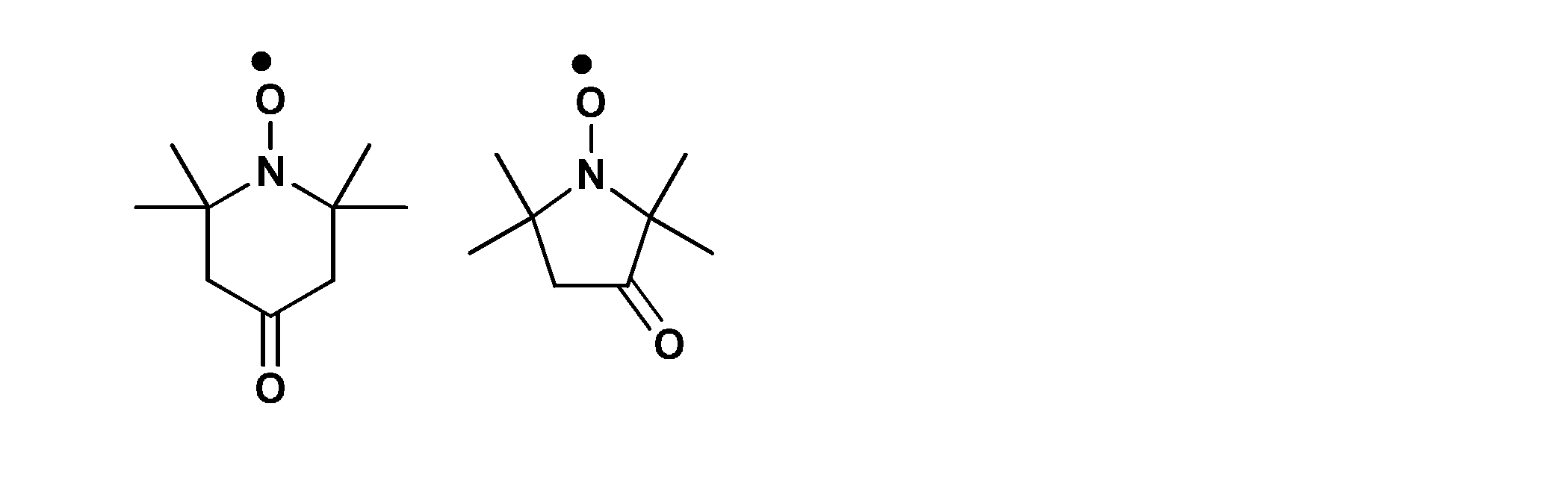
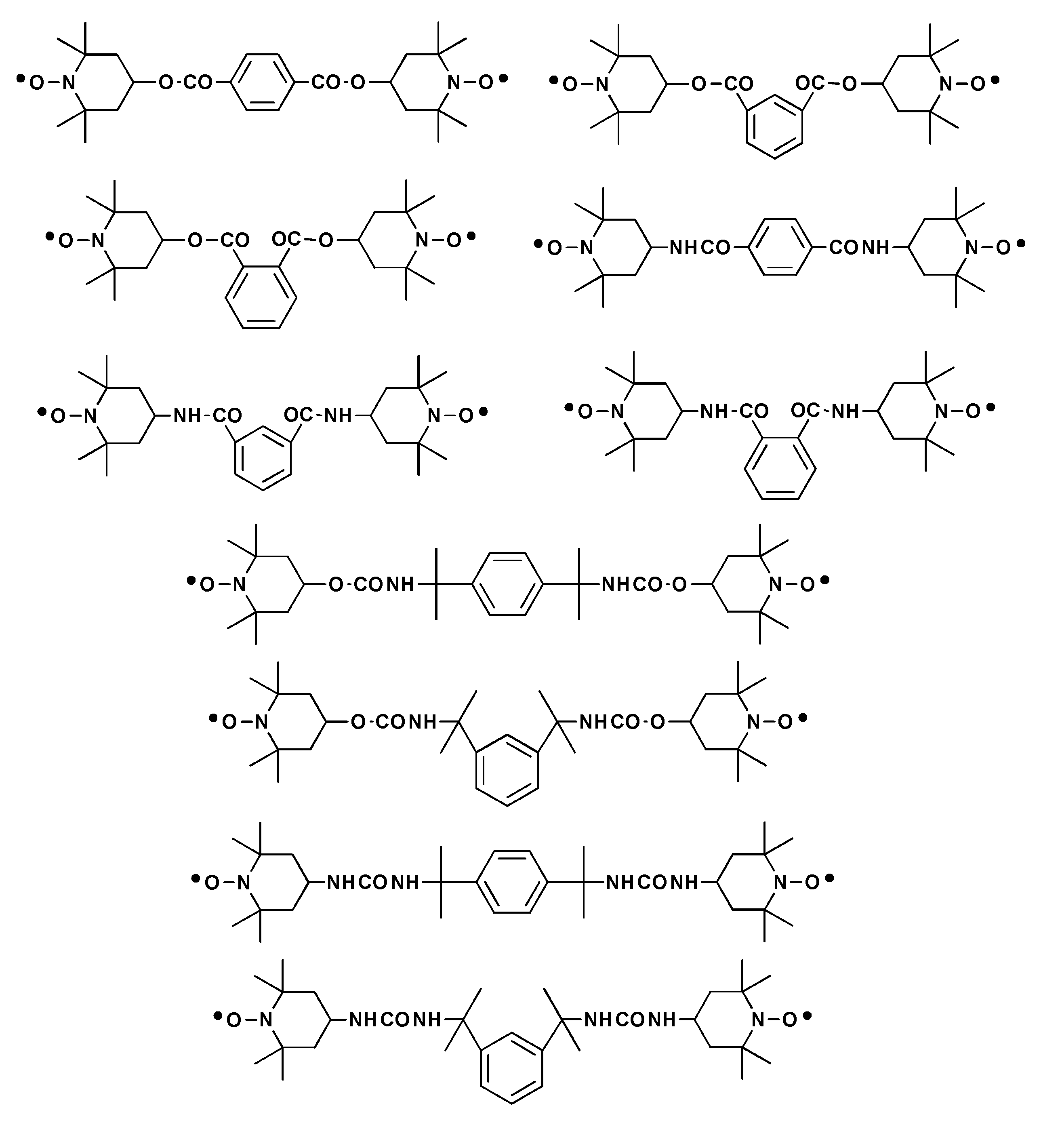
(C)ニトロキシ化合物は、単独で用いてもよく、2種以上を組み合わせて用いてもよい。
また、ケイ素含有樹脂組成物中の(C)ニトロキシ化合物の含有量は、ケイ素含有樹脂組成物の(S)溶剤以外の成分の質量の合計に対して、2質量%以下が好ましく、1質量%以下がより好ましい。
ケイ素含有樹脂組成物は、(S)溶剤を含有する。(S)溶剤は、下式(S1)で表されるシクロアルキルアセテートを含有する。ケイ素含有樹脂組成物が、(A)ケイ素含有樹脂とともに下式(S1)で表されるシクロアルキルアセテートを含有する(S)溶剤を含むことにより、ケイ素含有樹脂組成物を用いて形成されるシリカ系被膜におけるクラックの発生を抑制しやすい。
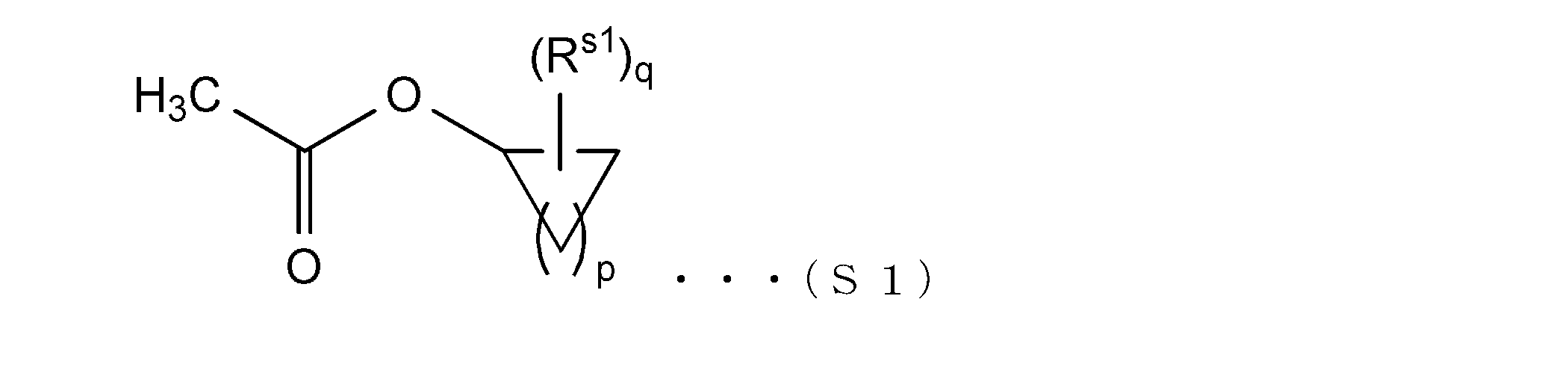
これらの中では、入手が容易であり、クラックの発生を抑制しやすいことから、シクロオクチルアセテートが好ましい。
(S)溶剤は、式(S1)で表されるシクロアルキルアセテートを2種以上組み合わせて含んでいてもよい。
メタノール、エタノール、プロパノール、n-ブタノール等のアルコール類;
エチレングリコール、ジエチレングリコール、プロピレングリコール、ジプロピレングリコール等の多価アルコール類;
アセトン、メチルエチルケトン、シクロヘキサノン、メチル-n-アミルケトン、メチルイソアミルケトン、2-ヘプタノン等のケトン類;
γ-ブチロラクトン等のラクトン環含有有機溶媒;
エチレングリコールモノアセテート、ジエチレングリコールモノアセテート、プロピレングリコールモノアセテート、又はジプロピレングリコールモノアセテート等のエステル結合を有する化合物、前記多価アルコール類又は前記エステル結合を有する化合物のモノメチルエーテル、モノエチルエーテル、モノプロピルエーテル、モノブチルエーテル等のモノアルキルエーテル又はモノフェニルエーテル等のエーテル結合を有する化合物等の多価アルコール類の誘導体;
ジオキサンのような環式エーテル類や、乳酸メチル、乳酸エチル、酢酸メチル、酢酸エチル、酢酸ブチル、ピルビン酸メチル、ピルビン酸エチル、メトキシプロピオン酸メチル、エトキシプロピオン酸エチル等のエステル類;
アニソール、エチルベンジルエーテル、クレジルメチルエーテル、ジフェニルエーテル、ジベンジルエーテル、フェネトール、ブチルフェニルエーテル、エチルベンゼン、ジエチルベンゼン、アミルベンゼン、イソプロピルベンゼン、トルエン、キシレン、シメン、メシチレン等の芳香族系有機溶剤;
N,N,N’,N’-テトラメチルウレア、N,N,2-トリメチルプロピオンアミド、N,N-ジメチルアセトアミド、N,N-ジメチルホルムアミド、N,N-ジエチルアセトアミド、N,N-ジエチルホルムアミド、1,3-ジメチル-2-イミダゾリジノン、N-メチルピロリドン、N-エチルピロリドン等の窒素含有有機溶媒;
が挙げられる。これらの溶剤は、2種以上組み合わせて使用してもよい。
式(S1)で表されるシクロアルキルアセテート以外の溶剤の(S)溶剤全体における割合は、例えば、70質量%以下で適宜設定すればよく、0.01~55質量%が好ましく、1~50質量%がより好ましい。
ケイ素含有樹脂組成物の水分は、(S)溶剤に由来する場合が多い。このため、ケイ素含有樹脂組成物の水分量が上記の量となるように、(S)溶剤が脱水されているのが好ましい。
ケイ素含有樹脂組成物は、(A)ケイ素含有樹脂、及び(S)溶剤以外に、従来から種々の用途に使用されているケイ素含有樹脂組成物に添加されている、種々の成分を含んでいてもよい。
その他の成分の例としては、光重合開始剤、酸発生剤、塩基発生剤、触媒、シランカップリング剤、密着増強剤、分散剤、界面活性剤、紫外線吸収剤、酸化防止剤、消泡剤、粘度調整剤、及び着色剤等が挙げられる。
これらの成分は、それぞれ、通常使用される量に従って、ケイ素含有樹脂組成物に配合される。
ケイ素含有樹脂組成物の製造方法は特に限定されない。典型的には、それぞれ所定量の以上説明した成分を均一に混合し、固形分を(S)溶剤に溶解させることによりケイ素含有樹脂組成物が製造される。微小は不溶物を除去するため、ケイ素含有樹脂組成物を所望の孔径のフィルターを用いてろ過してもよい。
ケイ素含有樹脂組成物を用いてシリカ系被膜を形成する方法としては、
ケイ素含有樹脂組成物を基板上に塗布して、塗布膜を形成する工程と、
形成された塗布膜を焼成する工程と、
を含む方法が挙げられる。
ケイ素含有樹脂組成物が光の作用により分解して塩基を発生する硬化剤を含む場合、露光する工程を含むことが好ましい。露光する工程は、焼成する工程の代わり又は焼成する工程ともに行ってもよい。また、露光する工程では、例えば、形成された塗布膜を選択的に露光してもよく、選択的露光工程を含む場合は、現像する工程を含んでいてもよい。また、例えば、形成された塗布膜に対し、インプリントリソグラフィーを行ってもよい。インプリントリソグラフィーを行う場合は、例えば;
ケイ素含有樹脂組成物を基板上に塗布して、塗布膜を形成する工程と、
所定のパターンの凹凸構造が形成されたモールドを塗布膜に対し押圧する工程と、
露光する工程と、を含む方法が挙げられる。
露光する工程は、モールドが塗布膜に押圧された状態で、ケイ素含有樹脂組成物からなる塗布膜に対して行われる。露光による硬化後、前記モールドを剥離することで、モールドの形状に応じてパターニングされたシリカ系被膜を得ることができる。
塗布膜の膜厚は特に限定されない。典型的には、塗布膜は、好ましくは0.01~20μm、より好ましくは2.0~20μm、5.0~10μmの膜厚のシリカ系被膜を形成できるような厚さで形成される。
具体的には、例えば、膜厚が2.0~20μmであり、比誘電率が3.5未満であるシリカ系被膜を形成できる。
このため、本発明にかかるケイ素含有樹脂組成物を用いて形成されたシリカ系被膜は、層間絶縁材料等の用途に好適に用いられる。また、シリカ系被膜の膜中残渣(シリカ系被膜由来の不純物)を低減できる。このため、例えば、本発明にかかるシリカ系被膜を含む絶縁層上に、LED若しくは有機EL等の発光素子、半導体素子、太陽電池素子、又は固体撮像素子等の電子素子、あるいはこれらの素子を構成する発光層、半導体層、又は薄膜太陽電池等を形成する際に、シリカ系被膜が高温雰囲気下や真空下に置かれる場合に、シリカ系被膜からのガス発生が良好に抑制されると考えられる。特にシリカ系被膜は、フレキシブルディスプレイやフォルダブルディスプレイ用途において絶縁膜として好適に用いられる。フォルダブルディスプレイの好適な例としては、特開2015-026055号公報に記載される表示装置が挙げられる。
実施例1、実施例3、及び比較例1~4では、ケイ素含有樹脂A1(下記の構造単位(a-1-1)を有するポリフェニルシロキサン樹脂(質量平均分子量:1000))を、表1に記載の種類の溶剤に固形分濃度が30質量%となるように溶解させて、ケイ素含有樹脂組成物を得た。なお、実施例1、実施例3、及び比較例1~4のケイ素含有樹脂組成物の水分含有量はいずれも0.3質量%未満であった。

S1:シクロヘキシルアセテート
S2:シクロヘキシルアセテートと、プロピレングリコールモノメチルエーテルアセテートとの質量比1:1での混合物
S3:プロピレングリコールモノメチルエーテルアセテート
S4:3-メトキシブチルアセテート
S5:イソプロパノール
S6:エチルジグリコールアセテート
実施例2及び4では、ケイ素含有樹脂A2(ケイ素原子に結合するシラノール基と、ベンジル基と、メチル基とを含む鎖状ポリシラン(質量平均分子量:1500))を、表1に記載の種類の溶剤に固形分濃度30質量%となるように溶解させて、ケイ素含有樹脂組成物を得た。なお、実施例2及び4のケイ素含有樹脂組成物の水分含有量はいずれも0.3質量%未満であった。
サンプル基板上に、ケイ素含有樹脂組成物をスピンコーターを用いて塗布して、膜厚5.0μmのシリカ系被膜を形成可能な膜厚の塗布膜を形成した。
塗布膜を100℃で2分間プリベークした後、縦型ベーク炉(TS8000MB、東京応化工業株式会社製)を用いて、塗布膜を350℃で30分間焼成して、膜厚5.0μmのシリカ系被膜を得た。
形成されたシリカ系被膜の表面を光学顕微鏡を用いて観察し、クラックの有無を確認した。クラックの有無について、表1に記す。
形成されたシリカ系被膜の比誘電率を、水銀プローブ式CV測定装置(日本SSM株式会社製、製品名;SSM495)を用いて測定した。導通により、比誘電率を計測できなかった場合を×と評価し、比誘電率が誘電率測定装置により測定可能な範囲内であった場合を○と評価した。誘電率の評価結果を表1に記す。
なお、実施例2と実施例4について、ケイ素含有樹脂組成物を用いて形成されたシリカ系被膜の比誘電率はいずれも3.5未満であった。
実施例2及び実施例4のシリカ系被膜について、波長400nmの光線の透過率を測定した。いずれも、98%以上の透過率であった。
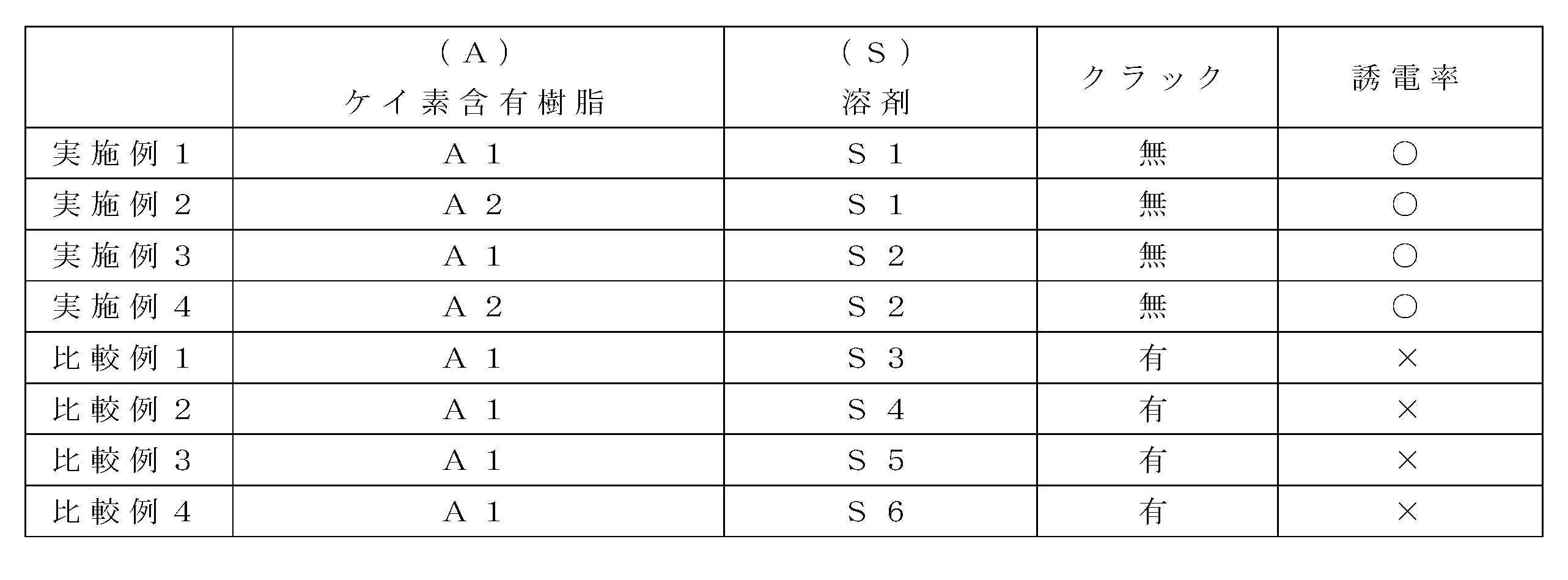
他方、比較例1~4から、ケイ素含有樹脂組成物が、(S)溶剤としてシクロアルキルアセテートを含まない場合、膜厚が5.0μmのシリカ系被膜においてクラックが生じ、シリカ系被膜の誘電率が高いことが分かる。なお、比較例1~4は膜厚2.0μmに下げてもクラックが生じることが確認できた。
実施例5~12では、表2に記載の種類の(A)ケイ素含有樹脂の濃度が30質量%であり、表2に記載の種類の(B)硬化剤の濃度が1.5質量%であるように、(A)ケイ素含有樹脂と(B)硬化剤とを、表1に記載の種類の溶剤に溶解させて、ケイ素含有樹脂組成物を得た。なお、各実施例及び各比較例のケイ素含有樹脂組成物の水分含有量はいずれも0.3質量%未満であった。
A3:メチルフェニルポリシラン(ケイ素原子に結合するメチル基と、フェニル基とを含む鎖状ポリシラン(質量平均分子量:1500))
A4:メチルフェニルポリシラン(ケイ素原子に結合するメチル基と、フェニル基とを含む鎖状ポリシラン(質量平均分子量:13000))
硬化剤としては、以下のB1~B5を用いた。
B1:塩酸
B2:DBU(1,8-ジアザビシクロ〔5.4.0〕-7-ウンデセン)
B3:下記化合物(光又は熱により塩基成分(イミダゾール)を発生する硬化剤)
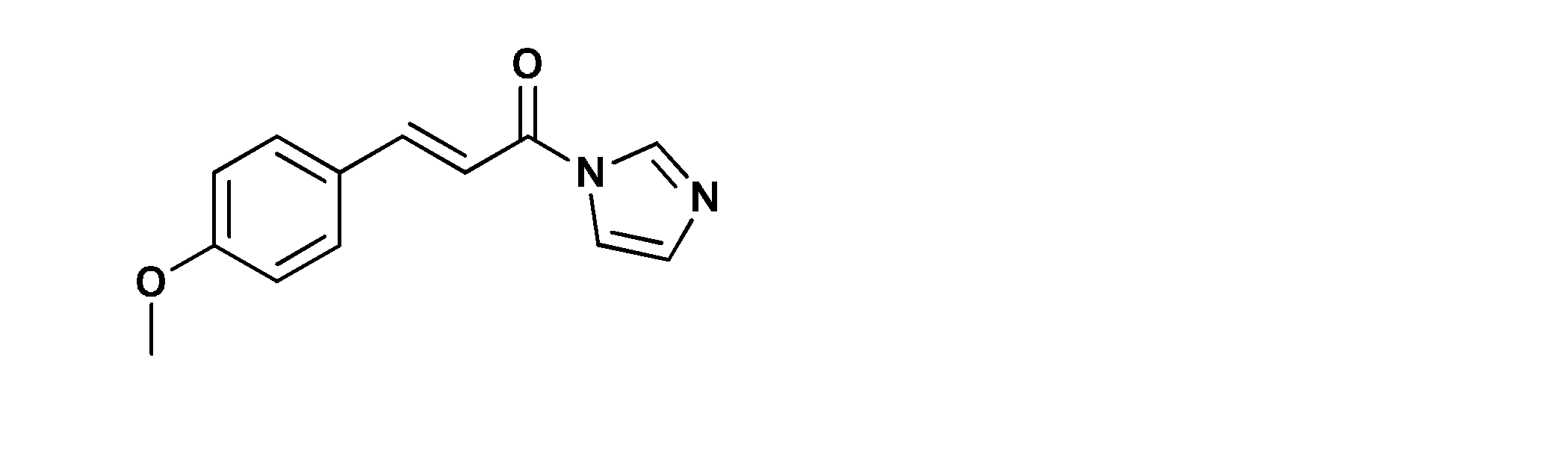
B5:三フッ化ホウ素-ピペリジン錯体
なお、参考として、比較例1~4のケイ素含有樹脂組成物を用いて形成されたシリカ系被膜についても、評価結果を表2に記す。
クラック耐性の良好だった実施例5~12について、形成されたシリカ系被膜をNMP溶媒に70℃10分間浸漬し、浸漬前後の膜厚の変化率を測定した。値が小さいほど、膨潤が起きず良好なシリカ系被膜が得られていることを示す。結果を表2に併記する。
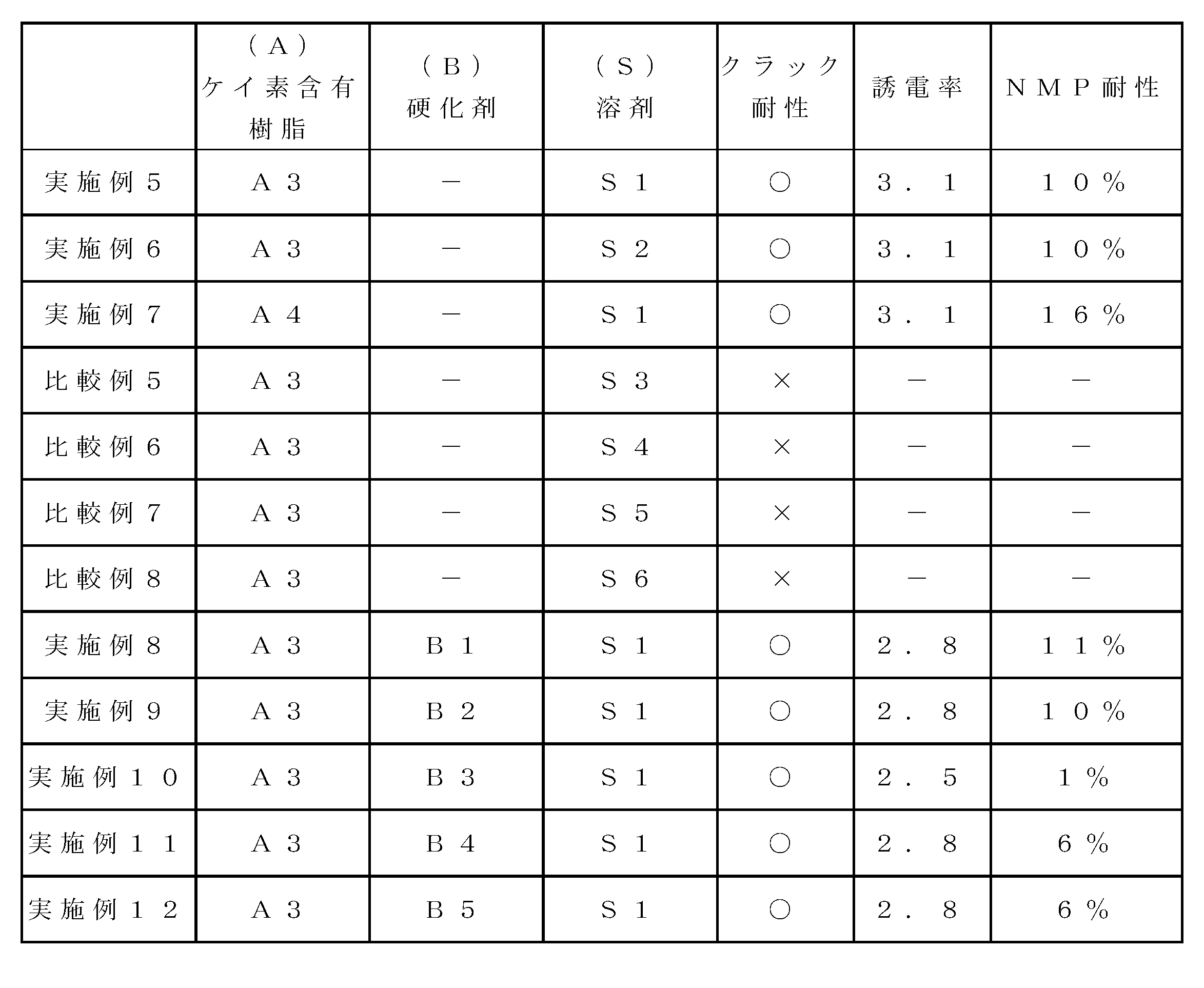
ケイ素含有樹脂組成物が(B)硬化剤を含む場合、誘電率がより低い、シリカ系被膜を形成しやすいことが分かる。特に(B)硬化剤として光又は熱により塩基成分を発生する硬化剤を含む場合は、誘電率を下げるだけでなくNMP耐性の向上にも優れることが確認できた。
[実施例13]
サンプル基板上に、実施例10のケイ素含有樹脂組成物をスピンコーターを用いて塗布して、膜厚5.0μmのシリカ系被膜を形成可能な膜厚の塗布膜を形成した。
塗布膜を100℃で2分間プリベークした後、縦型ベーク炉(TS8000MB、東京応化工業株式会社製)を用いて、塗布膜を230℃で30分間焼成して、膜厚5.0μmのシリカ系被膜を得た。実施例10と同様に、クラック、誘電率、及びNNP耐性を評価したところ、クラック及び誘電率は同等であり、NMP耐性も3%と良好な値を示した。
表3に記載の種類及び量の(A)ケイ素含有樹脂と、(C)ニトロキシ化合物である2,2,6,6-テトラメチルピペリジン1-オキシル フリーラジカル(TEMPO)0.1質量部とを、(A)ケイ素含有樹脂の濃度が30質量%となるようにシクロヘキシルアセテート(S1)中に溶解させて、ケイ素含有樹脂組成物を得た。
得られたケイ素含有樹脂組成物を用いて、実施例13と同様にして膜厚5.0μmのシリカ系被膜を形成した。形成されたシリカ系被膜について、実施例1~4及び比較例1~4と同様に、クラック及び誘電率の評価を行った。評価結果を、表3に記す。
表3に記載の種類及び量の(A)ケイ素含有樹脂と、表3に記載の種類及び量の(B)硬化剤と、(C)ニトロキシ化合物である2,2,6,6-テトラメチルピペリジン1-オキシル フリーラジカル(TEMPO)0.1質量部とを、(A)ケイ素含有樹脂の濃度が30質量%となるようにシクロヘキシルアセテート(S1)中に溶解させて、ケイ素含有樹脂組成物を得た。
得られたケイ素含有樹脂組成物を用いて、実施例13と同様にして膜厚5.0μmのシリカ系被膜を形成した。形成されたシリカ系被膜について、実施例1~4及び比較例1~4と同様に、クラック及び誘電率の評価を行った。評価結果を、表3に記す。
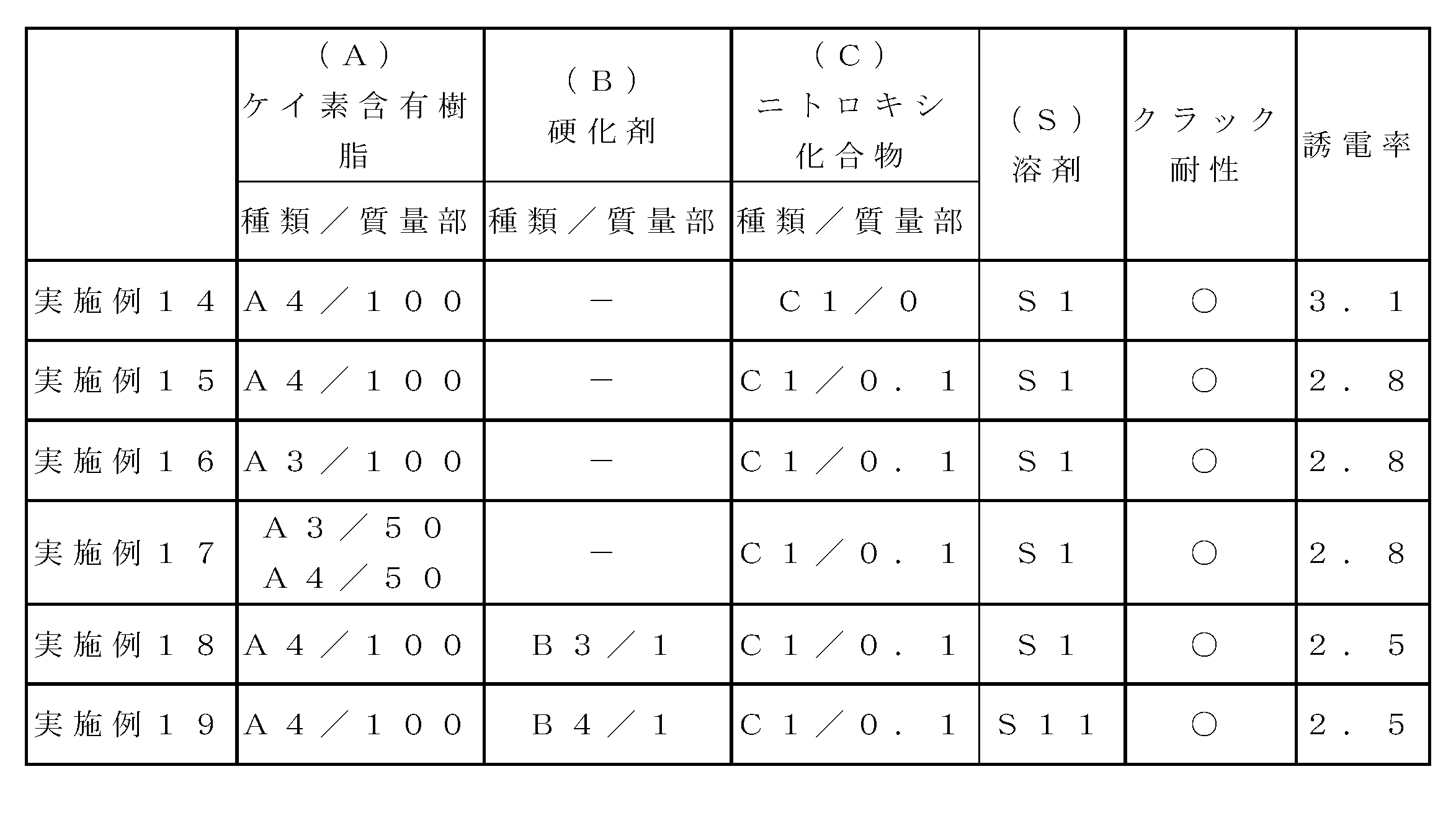
また、実施例18~19によれば、ケイ素含有樹脂組成物において(B)硬化剤と(C)ニトロキシ化合物とを併用することにより、低温(230℃)で焼成を行っても、誘電率が特に低いシリカ系被膜を形成できることが分かる。
Claims (4)
- (A)ケイ素含有樹脂と、(S)溶剤とを含有し、
前記(A)ケイ素含有樹脂が、シロキサン樹脂、及びポリシランからなる群より選択される1種以上であり、
前記(S)溶剤が下式(S1):

で表されるシクロアルキルアセテートを含有するケイ素含有樹脂組成物。 - さらに、(B)硬化剤を含有する、請求項1に記載のケイ素含有樹脂組成物。
- 請求項1又は2に記載のケイ素含有樹脂組成物を基板上に塗布して塗布膜を形成する工程と、
前記塗布膜を焼成する工程と、
を含む、シリカ系被膜の形成方法。 - 前記シリカ系被膜の膜厚が0.01~20μmである、請求項3に記載のシリカ系被膜の形成方法。
Priority Applications (8)
| Application Number | Priority Date | Filing Date | Title |
|---|---|---|---|
| CN201680035786.8A CN107709464B (zh) | 2015-07-09 | 2016-07-08 | 含硅树脂组合物 |
| KR1020187003507A KR102035434B1 (ko) | 2015-07-09 | 2016-07-08 | 규소 함유 수지 조성물 |
| KR1020197030297A KR102371425B1 (ko) | 2015-07-09 | 2016-07-08 | 규소 함유 수지 조성물 |
| JP2017527506A JP6462876B2 (ja) | 2015-07-09 | 2016-07-08 | ケイ素含有樹脂組成物 |
| EP16821478.1A EP3318606B1 (en) | 2015-07-09 | 2016-07-08 | Silicon-containing resin composition |
| EP20152755.3A EP3705534A1 (en) | 2015-07-09 | 2016-07-08 | Silicon-containing resin composition |
| US15/740,227 US10689514B2 (en) | 2015-07-09 | 2016-07-08 | Silicon-containing resin composition |
| US16/870,552 US20200270456A1 (en) | 2015-07-09 | 2020-05-08 | Silicon-containing resin composition |
Applications Claiming Priority (4)
| Application Number | Priority Date | Filing Date | Title |
|---|---|---|---|
| JP2015138064 | 2015-07-09 | ||
| JP2015-138064 | 2015-07-09 | ||
| JP2015-247917 | 2015-12-18 | ||
| JP2015247917 | 2015-12-18 |
Related Child Applications (2)
| Application Number | Title | Priority Date | Filing Date |
|---|---|---|---|
| US15/740,227 A-371-Of-International US10689514B2 (en) | 2015-07-09 | 2016-07-08 | Silicon-containing resin composition |
| US16/870,552 Continuation US20200270456A1 (en) | 2015-07-09 | 2020-05-08 | Silicon-containing resin composition |
Publications (1)
| Publication Number | Publication Date |
|---|---|
| WO2017007010A1 true WO2017007010A1 (ja) | 2017-01-12 |
Family
ID=57685659
Family Applications (1)
| Application Number | Title | Priority Date | Filing Date |
|---|---|---|---|
| PCT/JP2016/070239 Ceased WO2017007010A1 (ja) | 2015-07-09 | 2016-07-08 | ケイ素含有樹脂組成物 |
Country Status (7)
| Country | Link |
|---|---|
| US (2) | US10689514B2 (ja) |
| EP (2) | EP3318606B1 (ja) |
| JP (3) | JP6462876B2 (ja) |
| KR (2) | KR102371425B1 (ja) |
| CN (1) | CN107709464B (ja) |
| TW (2) | TWI744903B (ja) |
| WO (1) | WO2017007010A1 (ja) |
Cited By (5)
| Publication number | Priority date | Publication date | Assignee | Title |
|---|---|---|---|---|
| JP2018113412A (ja) * | 2017-01-13 | 2018-07-19 | 東京応化工業株式会社 | 組成物及びシリカ質膜の製造方法 |
| KR20190125183A (ko) | 2018-04-27 | 2019-11-06 | 도쿄 오카 고교 가부시키가이샤 | 감에너지성 조성물, 경화물, 및 패턴 형성 방법 |
| JP2020125492A (ja) * | 2015-07-09 | 2020-08-20 | 東京応化工業株式会社 | ケイ素含有樹脂組成物 |
| US11905433B2 (en) | 2020-11-06 | 2024-02-20 | Tokyo Ohka Kogyo Co., Ltd. | Energy-sensitive composition, cured product, and forming method of cured product |
| US12099297B2 (en) | 2020-11-06 | 2024-09-24 | Tokyo Ohka Kogyo Co., Ltd. | Energy-sensitive composition, cured product, and forming method of patterned cured product |
Families Citing this family (7)
| Publication number | Priority date | Publication date | Assignee | Title |
|---|---|---|---|---|
| US11542397B2 (en) * | 2018-06-26 | 2023-01-03 | Tokyo Ohka Kogyo Co., Ltd. | Liquid composition, quantum dot-containing film, optical film, light-emitting display element panel, and light-emitting display device |
| JP6981390B2 (ja) * | 2018-10-15 | 2021-12-15 | 信越化学工業株式会社 | 感光性樹脂組成物、感光性ドライフィルム、及びパターン形成方法 |
| WO2020230828A1 (ja) | 2019-05-14 | 2020-11-19 | 東京応化工業株式会社 | 含ケイ素ポリマー、膜形成用組成物、含ケイ素ポリマー被膜の形成方法、シリカ系被膜の形成方法、及び含ケイ素ポリマーの製造方法 |
| US11377522B2 (en) * | 2019-05-14 | 2022-07-05 | Tokyo Ohka Kogyo Co., Ltd. | Silicon-containing polymer, film-forming composition, method for forming silicon-containing polymer coating, method for forming silica-based coating, and production method for silicon-containing polymer |
| JP2022075179A (ja) * | 2020-11-06 | 2022-05-18 | 東京応化工業株式会社 | 感エネルギー性組成物、硬化物、硬化物の形成方法、熱塩基発生剤及び化合物 |
| JP2022075178A (ja) * | 2020-11-06 | 2022-05-18 | 東京応化工業株式会社 | 感エネルギー性組成物、硬化物、硬化物の形成方法、熱塩基発生剤及び化合物 |
| KR102239888B1 (ko) * | 2020-12-24 | 2021-04-12 | 이의정 | 부식방지층을 갖는 금속가스켓 및 그 제조방법 |
Citations (7)
| Publication number | Priority date | Publication date | Assignee | Title |
|---|---|---|---|---|
| JPH0931202A (ja) * | 1995-07-13 | 1997-02-04 | Tonen Corp | ポリシラザン組成物、ポリシラザン溶液の調製方法及び該組成物を用いたコーティング用組成物 |
| JP2005072615A (ja) * | 2004-10-29 | 2005-03-17 | Hitachi Chem Co Ltd | シリカ系被膜形成用組成物、シリカ系被膜、シリカ系被膜の製造方法及び電子部品 |
| JP2006291106A (ja) * | 2005-04-13 | 2006-10-26 | Tokyo Ohka Kogyo Co Ltd | シリカ系被膜形成用組成物 |
| JP2007211062A (ja) * | 2006-02-07 | 2007-08-23 | Tokyo Ohka Kogyo Co Ltd | 着色シリカ系被膜形成用組成物 |
| JP2008120911A (ja) * | 2006-11-10 | 2008-05-29 | Tokyo Ohka Kogyo Co Ltd | 被膜形成用組成物およびそれから形成される被膜 |
| JP2009053273A (ja) * | 2007-08-23 | 2009-03-12 | Toyo Ink Mfg Co Ltd | スピンコート用着色組成物および該着色組成物を用いて形成されたカラーフィルタ |
| JP2009211033A (ja) * | 2008-02-06 | 2009-09-17 | Hitachi Chem Co Ltd | 感光性樹脂組成物、シリカ系被膜の形成方法、シリカ系被膜を備える装置及び部材、並びに感光性樹脂組成物の製造方法 |
Family Cites Families (26)
| Publication number | Priority date | Publication date | Assignee | Title |
|---|---|---|---|---|
| JPH06234668A (ja) | 1993-02-10 | 1994-08-23 | Nippon Steel Corp | 9,9−ジアルキルフルオレンの製造方法 |
| JP3208040B2 (ja) * | 1995-04-04 | 2001-09-10 | 触媒化成工業株式会社 | シリカ系被膜形成用塗布液および被膜付基材 |
| JP2004161877A (ja) | 2002-11-13 | 2004-06-10 | Shin Etsu Chem Co Ltd | 多孔質膜形成用組成物、多孔質膜とその製造方法、層間絶縁膜及び半導体装置 |
| EP1719793A4 (en) | 2004-02-26 | 2009-05-20 | Jsr Corp | POLYMER AND MANUFACTURING METHOD THEREFOR, COMPOSITION FOR FORMING AN INSULATING FILM AND PRODUCTION METHOD THEREFOR |
| CN1950473B (zh) * | 2004-05-11 | 2010-10-27 | Jsr株式会社 | 绝缘膜形成用组合物和其制法及二氧化硅系绝缘膜和其形成法 |
| JP4803342B2 (ja) * | 2004-10-19 | 2011-10-26 | 信越化学工業株式会社 | 耐擦傷性表面被膜形成用シリコーンコーティング組成物及びそれを用いた被覆物品 |
| KR100930854B1 (ko) | 2005-04-13 | 2009-12-10 | 도오꾜오까고오교 가부시끼가이샤 | 실리카계 피막 형성용 조성물 |
| JP2007182539A (ja) | 2005-12-06 | 2007-07-19 | Jsr Corp | 樹脂組成物、カラーフィルタの保護膜の形成方法、およびカラーフィルタの保護膜 |
| JP2007286205A (ja) * | 2006-04-13 | 2007-11-01 | Toyo Ink Mfg Co Ltd | カラーフィルタ用着色組成物およびカラーフィルタ |
| KR100955570B1 (ko) * | 2006-09-18 | 2010-04-30 | 주식회사 엘지화학 | 저온 경화형 보호막 형성용 조성물, 이로부터 제조되는보호막, 및 이를 포함하는 기재 |
| CN101889243B (zh) * | 2008-01-30 | 2012-10-17 | Jsr株式会社 | 液晶取向剂、液晶取向膜以及液晶显示元件 |
| TWI428697B (zh) | 2008-03-31 | 2014-03-01 | Hitachi Chemical Co Ltd | 氧化矽系正型感光性樹脂組成物 |
| JP2009265602A (ja) | 2008-04-04 | 2009-11-12 | Toyo Ink Mfg Co Ltd | 着色組成物、着色組成物セット及びカラーフィルタ |
| KR101541439B1 (ko) * | 2008-07-24 | 2015-08-03 | 닛산 가가쿠 고교 가부시키 가이샤 | 코팅 조성물 및 패턴 형성방법 |
| TWI521018B (zh) | 2010-07-14 | 2016-02-11 | Jsr股份有限公司 | Poly Silicon alumoxane composition and pattern forming method |
| CN110095941B (zh) * | 2011-12-26 | 2023-02-17 | 东丽株式会社 | 感光性树脂组合物和半导体元件的制造方法 |
| CN104245846B (zh) | 2012-04-20 | 2016-08-24 | 旭化成株式会社 | 具有自由基交联性基团的聚硅氧烷组合物 |
| US9856400B2 (en) | 2012-04-27 | 2018-01-02 | Burning Bush Group, Llc | High performance silicon based coating compositions |
| JP5997041B2 (ja) | 2012-12-26 | 2016-09-21 | 東京応化工業株式会社 | 感光性樹脂組成物 |
| KR102051803B1 (ko) | 2013-07-29 | 2020-01-09 | 삼성디스플레이 주식회사 | 접이식 표시 장치 |
| JP6347597B2 (ja) | 2013-12-05 | 2018-06-27 | 東京応化工業株式会社 | シリカ系被膜形成用組成物及びこれを用いたシリカ系被膜の製造方法 |
| WO2015118995A1 (ja) | 2014-02-07 | 2015-08-13 | 株式会社ダイセル | シリコーン溶解用溶剤 |
| EP2960280A1 (en) | 2014-06-26 | 2015-12-30 | E.T.C. S.r.l. | Photocrosslinkable compositions, patterned high k thin film dielectrics and related devices |
| TW201612250A (en) * | 2014-09-29 | 2016-04-01 | Fujifilm Corp | Photosensitive resin composition, manufacturing method for cured film, cured film, liquid crystal display device, organic electroluminescence display device and touch panel |
| JP6250513B2 (ja) | 2014-10-03 | 2017-12-20 | 信越化学工業株式会社 | 塗布型ケイ素含有膜形成用組成物、基板、及びパターン形成方法 |
| WO2017007010A1 (ja) | 2015-07-09 | 2017-01-12 | 東京応化工業株式会社 | ケイ素含有樹脂組成物 |
-
2016
- 2016-07-08 WO PCT/JP2016/070239 patent/WO2017007010A1/ja not_active Ceased
- 2016-07-08 EP EP16821478.1A patent/EP3318606B1/en active Active
- 2016-07-08 CN CN201680035786.8A patent/CN107709464B/zh not_active Expired - Fee Related
- 2016-07-08 KR KR1020197030297A patent/KR102371425B1/ko active Active
- 2016-07-08 US US15/740,227 patent/US10689514B2/en active Active
- 2016-07-08 JP JP2017527506A patent/JP6462876B2/ja active Active
- 2016-07-08 KR KR1020187003507A patent/KR102035434B1/ko active Active
- 2016-07-08 EP EP20152755.3A patent/EP3705534A1/en not_active Withdrawn
- 2016-07-11 TW TW109116697A patent/TWI744903B/zh active
- 2016-07-11 TW TW105121813A patent/TWI696663B/zh active
-
2018
- 2018-12-27 JP JP2018245500A patent/JP6698147B2/ja active Active
-
2020
- 2020-04-27 JP JP2020078591A patent/JP7141424B2/ja active Active
- 2020-05-08 US US16/870,552 patent/US20200270456A1/en not_active Abandoned
Patent Citations (7)
| Publication number | Priority date | Publication date | Assignee | Title |
|---|---|---|---|---|
| JPH0931202A (ja) * | 1995-07-13 | 1997-02-04 | Tonen Corp | ポリシラザン組成物、ポリシラザン溶液の調製方法及び該組成物を用いたコーティング用組成物 |
| JP2005072615A (ja) * | 2004-10-29 | 2005-03-17 | Hitachi Chem Co Ltd | シリカ系被膜形成用組成物、シリカ系被膜、シリカ系被膜の製造方法及び電子部品 |
| JP2006291106A (ja) * | 2005-04-13 | 2006-10-26 | Tokyo Ohka Kogyo Co Ltd | シリカ系被膜形成用組成物 |
| JP2007211062A (ja) * | 2006-02-07 | 2007-08-23 | Tokyo Ohka Kogyo Co Ltd | 着色シリカ系被膜形成用組成物 |
| JP2008120911A (ja) * | 2006-11-10 | 2008-05-29 | Tokyo Ohka Kogyo Co Ltd | 被膜形成用組成物およびそれから形成される被膜 |
| JP2009053273A (ja) * | 2007-08-23 | 2009-03-12 | Toyo Ink Mfg Co Ltd | スピンコート用着色組成物および該着色組成物を用いて形成されたカラーフィルタ |
| JP2009211033A (ja) * | 2008-02-06 | 2009-09-17 | Hitachi Chem Co Ltd | 感光性樹脂組成物、シリカ系被膜の形成方法、シリカ系被膜を備える装置及び部材、並びに感光性樹脂組成物の製造方法 |
Non-Patent Citations (1)
| Title |
|---|
| See also references of EP3318606A4 * |
Cited By (11)
| Publication number | Priority date | Publication date | Assignee | Title |
|---|---|---|---|---|
| JP2020125492A (ja) * | 2015-07-09 | 2020-08-20 | 東京応化工業株式会社 | ケイ素含有樹脂組成物 |
| JP7141424B2 (ja) | 2015-07-09 | 2022-09-22 | 東京応化工業株式会社 | ケイ素含有樹脂組成物 |
| JP2018113412A (ja) * | 2017-01-13 | 2018-07-19 | 東京応化工業株式会社 | 組成物及びシリカ質膜の製造方法 |
| CN108300305A (zh) * | 2017-01-13 | 2018-07-20 | 东京应化工业株式会社 | 组合物及二氧化硅质膜的制造方法 |
| KR20180083797A (ko) * | 2017-01-13 | 2018-07-23 | 도쿄 오카 고교 가부시키가이샤 | 조성물 및 실리카질막의 제조 방법 |
| TWI760411B (zh) * | 2017-01-13 | 2022-04-11 | 日商東京應化工業股份有限公司 | 組合物及二氧化矽質膜之製造方法 |
| KR102457375B1 (ko) * | 2017-01-13 | 2022-10-21 | 도쿄 오카 고교 가부시키가이샤 | 조성물 및 실리카질막의 제조 방법 |
| KR20190125183A (ko) | 2018-04-27 | 2019-11-06 | 도쿄 오카 고교 가부시키가이샤 | 감에너지성 조성물, 경화물, 및 패턴 형성 방법 |
| US11106132B2 (en) | 2018-04-27 | 2021-08-31 | Tokyo Ohka Kogyo Co., Ltd. | Energy-sensitive composition, cured product, and pattern forming method |
| US11905433B2 (en) | 2020-11-06 | 2024-02-20 | Tokyo Ohka Kogyo Co., Ltd. | Energy-sensitive composition, cured product, and forming method of cured product |
| US12099297B2 (en) | 2020-11-06 | 2024-09-24 | Tokyo Ohka Kogyo Co., Ltd. | Energy-sensitive composition, cured product, and forming method of patterned cured product |
Also Published As
| Publication number | Publication date |
|---|---|
| US20180187010A1 (en) | 2018-07-05 |
| CN107709464B (zh) | 2021-09-28 |
| TW202033664A (zh) | 2020-09-16 |
| TW201708398A (zh) | 2017-03-01 |
| JP2019085574A (ja) | 2019-06-06 |
| JP6462876B2 (ja) | 2019-01-30 |
| JP7141424B2 (ja) | 2022-09-22 |
| KR102035434B1 (ko) | 2019-10-22 |
| US10689514B2 (en) | 2020-06-23 |
| KR102371425B1 (ko) | 2022-03-07 |
| EP3318606B1 (en) | 2020-03-18 |
| KR20190119683A (ko) | 2019-10-22 |
| US20200270456A1 (en) | 2020-08-27 |
| JPWO2017007010A1 (ja) | 2018-05-24 |
| JP6698147B2 (ja) | 2020-05-27 |
| CN107709464A (zh) | 2018-02-16 |
| EP3705534A1 (en) | 2020-09-09 |
| KR20180027549A (ko) | 2018-03-14 |
| EP3318606A1 (en) | 2018-05-09 |
| TWI696663B (zh) | 2020-06-21 |
| TWI744903B (zh) | 2021-11-01 |
| EP3318606A4 (en) | 2018-07-11 |
| JP2020125492A (ja) | 2020-08-20 |
Similar Documents
| Publication | Publication Date | Title |
|---|---|---|
| JP6698147B2 (ja) | ケイ素含有樹脂組成物 | |
| CN108250754B (zh) | 含硅树脂组合物、含硅树脂薄膜、二氧化硅薄膜、发光显示元件面板以及发光显示装置 | |
| CN107429059B (zh) | 能量敏感性树脂组合物 | |
| KR102157030B1 (ko) | 네거티브형 감광성 실록산 조성물 | |
| KR102776082B1 (ko) | 표면 수식 금속 산화물 미립자의 제조 방법, 개질 금속 산화물 미립자의 제조 방법, 표면 수식 금속 산화물 미립자, 및 금속 산화물 미립자 분산액 | |
| TWI744376B (zh) | 黑色矩陣用組成物、及使用其之黑色矩陣之製造方法 | |
| US20200139433A1 (en) | Method for producing surface-modified metal oxide fine particle, method for producing improved metal oxide fine particles, surface-modified metal oxide fine particles, and metal oxide fine particle dispersion liquid | |
| TWI768059B (zh) | 光或熱硬化方法,及硬化性樹脂組成物 | |
| WO2021220919A1 (ja) | 改質金属酸化物微粒子の製造方法、改質金属酸化物微粒子分散液の製造方法、及び固体物品の製造方法 | |
| WO2021220920A1 (ja) | 表面改質金属酸化物微粒子の製造方法、表面改質金属酸化物微粒子、表面改質金属酸化物微粒子分散液、固体物品、表面改質金属酸化物微粒子分散液の製造方法、及び固体物品の製造方法 | |
| KR102921038B1 (ko) | 함규소 폴리머, 막형성용 조성물, 함규소 폴리머 피막의 형성 방법, 실리카계 피막의 형성 방법, 및 함규소 폴리머의 제조 방법 | |
| KR102124920B1 (ko) | 마스크 페이스트 조성물, 이것을 사용해서 얻어지는 반도체 소자 및 반도체 소자의 제조 방법 | |
| CN102453377A (zh) | 印刷用溶剂或溶剂组合物 | |
| JP2004131518A (ja) | 硬化性組成物、硬化物および硬化物の製造方法 | |
| JP6436838B2 (ja) | 感光性樹脂組成物 | |
| JP2015101604A (ja) | 感エネルギー性組成物 | |
| JP2016186572A (ja) | 感光性樹脂組成物 |
Legal Events
| Date | Code | Title | Description |
|---|---|---|---|
| 121 | Ep: the epo has been informed by wipo that ep was designated in this application |
Ref document number: 16821478 Country of ref document: EP Kind code of ref document: A1 |
|
| ENP | Entry into the national phase |
Ref document number: 2017527506 Country of ref document: JP Kind code of ref document: A |
|
| NENP | Non-entry into the national phase |
Ref country code: DE |
|
| WWE | Wipo information: entry into national phase |
Ref document number: 2016821478 Country of ref document: EP |
|
| ENP | Entry into the national phase |
Ref document number: 20187003507 Country of ref document: KR Kind code of ref document: A |