WO2017010318A1 - Imaging lens - Google Patents
Imaging lens Download PDFInfo
- Publication number
- WO2017010318A1 WO2017010318A1 PCT/JP2016/069649 JP2016069649W WO2017010318A1 WO 2017010318 A1 WO2017010318 A1 WO 2017010318A1 JP 2016069649 W JP2016069649 W JP 2016069649W WO 2017010318 A1 WO2017010318 A1 WO 2017010318A1
- Authority
- WO
- WIPO (PCT)
- Prior art keywords
- imaging lens
- polycarbonate resin
- mol
- refractive index
- lens according
- Prior art date
- Legal status (The legal status is an assumption and is not a legal conclusion. Google has not performed a legal analysis and makes no representation as to the accuracy of the status listed.)
- Ceased
Links
- 0 CC*C(OCC(C)(C)C1OCC2(COC(C(C)(C)CO*(C)CC)OC2)CO1)=O Chemical compound CC*C(OCC(C)(C)C1OCC2(COC(C(C)(C)CO*(C)CC)OC2)CO1)=O 0.000 description 1
Classifications
-
- G—PHYSICS
- G02—OPTICS
- G02B—OPTICAL ELEMENTS, SYSTEMS OR APPARATUS
- G02B1/00—Optical elements characterised by the material of which they are made; Optical coatings for optical elements
- G02B1/04—Optical elements characterised by the material of which they are made; Optical coatings for optical elements made of organic materials, e.g. plastics
- G02B1/041—Lenses
-
- C—CHEMISTRY; METALLURGY
- C08—ORGANIC MACROMOLECULAR COMPOUNDS; THEIR PREPARATION OR CHEMICAL WORKING-UP; COMPOSITIONS BASED THEREON
- C08G—MACROMOLECULAR COMPOUNDS OBTAINED OTHERWISE THAN BY REACTIONS ONLY INVOLVING UNSATURATED CARBON-TO-CARBON BONDS
- C08G64/00—Macromolecular compounds obtained by reactions forming a carbonic ester link in the main chain of the macromolecule
- C08G64/16—Aliphatic-aromatic or araliphatic polycarbonates
-
- C—CHEMISTRY; METALLURGY
- C08—ORGANIC MACROMOLECULAR COMPOUNDS; THEIR PREPARATION OR CHEMICAL WORKING-UP; COMPOSITIONS BASED THEREON
- C08G—MACROMOLECULAR COMPOUNDS OBTAINED OTHERWISE THAN BY REACTIONS ONLY INVOLVING UNSATURATED CARBON-TO-CARBON BONDS
- C08G64/00—Macromolecular compounds obtained by reactions forming a carbonic ester link in the main chain of the macromolecule
- C08G64/20—General preparatory processes
- C08G64/30—General preparatory processes using carbonates
- C08G64/302—General preparatory processes using carbonates and cyclic ethers
-
- C—CHEMISTRY; METALLURGY
- C08—ORGANIC MACROMOLECULAR COMPOUNDS; THEIR PREPARATION OR CHEMICAL WORKING-UP; COMPOSITIONS BASED THEREON
- C08G—MACROMOLECULAR COMPOUNDS OBTAINED OTHERWISE THAN BY REACTIONS ONLY INVOLVING UNSATURATED CARBON-TO-CARBON BONDS
- C08G64/00—Macromolecular compounds obtained by reactions forming a carbonic ester link in the main chain of the macromolecule
- C08G64/20—General preparatory processes
- C08G64/30—General preparatory processes using carbonates
- C08G64/307—General preparatory processes using carbonates and phenols
-
- G—PHYSICS
- G02—OPTICS
- G02B—OPTICAL ELEMENTS, SYSTEMS OR APPARATUS
- G02B1/00—Optical elements characterised by the material of which they are made; Optical coatings for optical elements
- G02B1/04—Optical elements characterised by the material of which they are made; Optical coatings for optical elements made of organic materials, e.g. plastics
-
- G—PHYSICS
- G02—OPTICS
- G02B—OPTICAL ELEMENTS, SYSTEMS OR APPARATUS
- G02B13/00—Optical objectives specially designed for the purposes specified below
Definitions
- the present invention relates to an imaging lens made of a specific polycarbonate resin.
- imaging lenses for mobile devices such as mobile phones and smartphones are manufactured from aspheric plastic, and aberration correction is performed by combining lenses having different optical characteristics (refractive index, Abbe number) and lens shapes.
- the polycarbonate resin made from bisphenol A has a weak point that it has a large birefringence, so it cannot be used for a recent high-resolution camera.
- Patent Documents 1 and 2 A polycarbonate copolymer containing a fluorene group or an oxaspiroundecane group is disclosed as a method for reducing birefringence (Patent Documents 1 and 2).
- Patent Document 1 discloses an information recording medium such as an optical disk
- Patent Document 2 discloses an optical disk, an optical film, an optical prism, and a pickup lens (only discriminating 0 or 1 of an optical signal), but an imaging lens is assumed. Therefore, characteristics necessary for the imaging lens, such as refractive index, Abbe number, orientation birefringence, and water absorption, have not been clarified.
- a camera lens made of a polycarbonate resin and a styrene resin having a specific structure is disclosed (Patent Document 3).
- this patent document has a problem that the resin is brittle and heat resistance is low due to mixing of incompatible components, including a polystyrene component.
- an object of the present invention is to provide an imaging lens having a specific refractive index and Abbe number, low birefringence and low water absorption by using a specific polycarbonate resin.
- an imaging lens made of the following polycarbonate resin is provided. 1.
- the polycarbonate resin used in the imaging lens of the present invention has a refractive index of 1.57 to 1.60, more preferably 1.58 to 1.59 at a measurement temperature: 25 ° C. and a measurement wavelength: 589 nm. .
- the polycarbonate resin used in the imaging lens of the present invention preferably has an Abbe number of 27.0 to 31.0 at a measurement temperature of 25 ° C., more preferably 27.5 to 29.5.
- the Abbe number is calculated from the refractive index of measurement temperature: 25 ° C., measurement wavelength: 486 nm, 589 nm, and 656 nm using the following formula.
- the polycarbonate resin used in the imaging lens of the present invention contains 50 to 70 mol% of formula (1), preferably 55 to 65 mol%, more preferably 57 to 64 mol%. Further, the formula (2) is contained in an amount of more than 30 mol% and not more than 50 mol%, preferably 35 to 45 mol%, more preferably 36 to 43 mol%.
- the polycarbonate resin used for the imaging lens of the present invention contains repeating units represented by the formulas (1) and (2), but is copolymerized with other diol components to such an extent that the characteristics of the present invention are not impaired. Also good.
- the other diol component is preferably 10 mol% or less in all repeating units.
- diol components include ethylene glycol, propanediol, butanediol, pentanediol, hexanediol, heptanediol, octanediol, nonanediol, tricyclo [5.2.1.0 2,6 ] decanedimethanol, cyclohexane-1 , 4-dimethanol, decalin-2,6-dimethanol, norbornanedimethanol, pentacyclopentadecanedimethanol, cyclopentane-1,3-dimethanol, isosorbide, hydroquinone, resorcinol, 2,2-bis (4-hydroxy Phenyl) propane, 2,2-bis (3-methyl-4-hydroxyphenyl) propane, 1,1-bis (4-hydroxyphenyl) -1-phenylethane, bis (4-hydroxyphenyl) diphenylmethane, 1,3 -Bis (2- (4-H Loxyphenyl) -2-prop
- the polycarbonate resin used in the imaging lens of the present invention has an absolute value of orientation birefringence ( ⁇ n) of preferably 0 to 6 ⁇ 10 ⁇ 3 , more preferably 0 to 4 ⁇ 10 ⁇ 3 , and still more preferably 0 to The range is 2 ⁇ 10 ⁇ 3 .
- the orientation birefringence ( ⁇ n) is measured at a wavelength of 589 nm when a cast film having a thickness of 100 ⁇ m obtained from the polycarbonate resin is stretched twice at Tg + 10 ° C.
- the polycarbonate resin used in the imaging lens of the present invention has a total light transmittance of 1 mm thickness, preferably 80% or more, more preferably 85% or more, and still more preferably 88% or more.
- the polycarbonate resin used in the imaging lens of the present invention preferably has a glass transition point of 120 to 160 ° C, more preferably 125 to 150 ° C.
- the transesterification reaction using a carbonic acid diester as a carbonate precursor is performed by a method in which an aromatic dihydroxy component in a predetermined ratio is stirred with a carbonic acid diester while heating with an inert gas atmosphere to distill the generated alcohol or phenols. .
- the reaction temperature varies depending on the boiling point of the alcohol or phenol produced, but is usually in the range of 120 to 300 ° C.
- the reaction is completed while distilling off the alcohol or phenol produced under reduced pressure from the beginning. Moreover, you may add a terminal stopper, antioxidant, etc. as needed.
- Examples of the polymerization catalyst include alkali metal compounds, alkaline earth metal compounds, basic phosphorus compounds, nitrogen-containing compounds, and metal compounds. Can be mentioned. As such compounds, organic acid salts, inorganic salts, oxides, hydroxides, hydrides, alkoxides, quaternary ammonium hydroxides, and the like of alkali metals and alkaline earth metals are preferably used. It can be used alone or in combination.
- Alkaline earth metal compounds include magnesium hydroxide, calcium hydroxide, strontium hydroxide, barium hydroxide, magnesium carbonate, calcium carbonate, strontium carbonate, barium carbonate, calcium bicarbonate, barium bicarbonate, magnesium bicarbonate, bicarbonate Examples include strontium, magnesium diacetate, calcium diacetate, strontium diacetate, and barium diacetate.
- Examples of the basic boron compound include tetramethyl boron, tetraethyl boron, tetrapropyl boron, tetrabutyl boron, trimethylethyl boron, trimethylbenzyl boron, trimethylphenyl boron, triethylmethyl boron, triethylbenzyl boron, triethylphenyl boron, tributylbenzyl.
- Examples of the basic phosphorus compound include triethylphosphine, tri-n-propylphosphine, triisopropylphosphine, tri-n-butylphosphine, triphenylphosphine, tributylphosphine, and quaternary phosphonium salts.
- nitrogen-containing compounds include quaternary ammonium hydroxides having alkyl, aryl groups, etc., such as tetramethylammonium hydroxide, tetraethylammonium hydroxide, tetrapropylammonium hydroxide, tetrabutylammonium hydroxide, and trimethylbenzylammonium hydroxide.
- quaternary ammonium hydroxides having alkyl, aryl groups, etc. such as tetramethylammonium hydroxide, tetraethylammonium hydroxide, tetrapropylammonium hydroxide, tetrabutylammonium hydroxide, and trimethylbenzylammonium hydroxide.
- tertiary amines such as triethylamine, dimethylbenzylamine and triphenylamine
- imidazoles such as 2-methylimidazole, 2-phenylimidazole and benzimidazole can
- bases or basic salts such as ammonia, tetramethylammonium borohydride, tetrabutylammonium borohydride, tetrabutylammonium tetraphenylborate, tetraphenylammonium tetraphenylborate and the like are exemplified.
- metal compounds include zinc aluminum compounds, germanium compounds, organic tin compounds, antimony compounds, manganese compounds, titanium compounds, zirconium compounds, and the like. These compounds may be used alone or in combination of two or more.
- the amount of these polymerization catalysts used is preferably 1 ⁇ 10 ⁇ 9 to 1 ⁇ 10 ⁇ 2 equivalent, preferably 1 ⁇ 10 ⁇ 8 to 1 ⁇ 10 ⁇ 3 equivalent, more preferably 1 ⁇ with respect to 1 mol of the diol component. It is selected in the range of 10 ⁇ 7 to 1 ⁇ 10 ⁇ 5 equivalents.
- a catalyst deactivator may be added at a later stage of the reaction.
- a known catalyst deactivator is effectively used.
- sulfonic acid ammonium salt and phosphonium salt are preferable.
- salts of dodecylbenzenesulfonic acid such as tetrabutylphosphonium salt of dodecylbenzenesulfonic acid and salts of paratoluenesulfonic acid such as tetrabutylammonium salt of paratoluenesulfonic acid are preferable.
- esters of sulfonic acid methyl benzenesulfonate, ethyl benzenesulfonate, butyl benzenesulfonate, octyl benzenesulfonate, phenyl benzenesulfonate, methyl paratoluenesulfonate, ethyl paratoluenesulfonate, butyl paratoluenesulfonate, Octyl paratoluenesulfonate, phenyl paratoluenesulfonate and the like are preferably used.
- dodecylbenzenesulfonic acid tetrabutylphosphonium salt is most preferably used.
- the amount of the catalyst deactivator used is preferably 0.5 to 50 mol per mol of the catalyst when at least one polymerization catalyst selected from alkali metal compounds and / or alkaline earth metal compounds is used. It can be used in a proportion, more preferably in a proportion of 0.5 to 10 mol, still more preferably in a proportion of 0.8 to 5 mol.
- the polycarbonate resin of the present invention can be used as a heat stabilizer, a plasticizer, a light stabilizer, a polymerized metal deactivator, a flame retardant, a lubricant, an antistatic agent, a surfactant, an antibacterial agent, an ultraviolet ray, if necessary and necessary.
- Additives such as an absorbent and a release agent can be blended.
- the imaging lens of the present invention can be molded and processed by any method such as injection molding, compression molding, injection compression molding, melt extrusion molding, and casting, but injection molding is particularly suitable.
- the molding conditions for injection molding are not particularly limited, but the cylinder temperature of the molding machine is preferably 180 to 320 ° C, more preferably 220 to 300 ° C, and even more preferably 240 to 280 ° C.
- the mold temperature is preferably 70 to 130 ° C, more preferably 80 to 125 ° C, and still more preferably 90 to 120 ° C.
- Injection pressure is preferably 50 ⁇ 1,700kgf / cm 2, preferably 500 ⁇ 1,600kgf / cm 2, and still more preferably, 1,000 ⁇ 1,500kgf / cm 2.
- the imaging lens of the present invention can be used for imaging lenses such as smartphones, digital cameras, and video cameras.
- Examples 1 to 3 and Comparative Examples 1 to 4 Evaluation was performed as follows.
- ⁇ (nD-1) / (nF-nC) nD: Refractive index at a wavelength of 589 nm nC: Refractive index at a wavelength of 656 nm nF: Refractive index at a wavelength of 486 nm (4)
- Example 1 110.50 parts of 9,9-bis (4- (2-hydroxyethoxy) phenyl) fluorene (hereinafter abbreviated as BPEF), 3,9-bis (1,1-dimethyl-2-hydroxyethyl) -2,4 , 8,10-tetraoxaspiro [5.5] undecane (hereinafter abbreviated as SPG) 45.05 parts, diphenyl carbonate 87.40 parts, and sodium hydroxide 8.00 ⁇ 10 ⁇ 5 parts as a catalyst, tetramethyl Ammonium hydroxide (3.65 ⁇ 10 ⁇ 3 parts) was placed in a reaction kettle equipped with a stirrer and a distillation apparatus, and was purged with nitrogen three times.
- BPEF 9,9-bis (4- (2-hydroxyethoxy) phenyl) fluorene
- SPG 3,9-bis (1,1-dimethyl-2-hydroxyethyl) -2,4 , 8,10-tetraoxaspiro
- the jacket was heated to 180 ° C. to melt the raw material. After complete dissolution, the pressure was reduced to 20 kPa over 20 minutes, and at the same time, the jacket was heated to 260 ° C. at a rate of 60 ° C./hr to conduct a transesterification reaction. Thereafter, the pressure was reduced to 0.13 kPa over 80 minutes while maintaining the jacket at 260 ° C., and a polymerization reaction was performed for 30 minutes under the conditions of 260 ° C. and 0.13 kPa or less. After completion of the reaction, the produced polycarbonate resin was extracted while pelletizing to obtain polycarbonate resin pellets.
- Example 2 Polycarbonate resin pellets were obtained in the same manner as in Example 1 except that 105.24 parts of BPEF and 48.70 parts of SPG were used. The pellets were measured in the same manner as in Example 1, and the results are shown in Table 1.
Landscapes
- Chemical & Material Sciences (AREA)
- Physics & Mathematics (AREA)
- Health & Medical Sciences (AREA)
- Chemical Kinetics & Catalysis (AREA)
- Medicinal Chemistry (AREA)
- Polymers & Plastics (AREA)
- Organic Chemistry (AREA)
- General Physics & Mathematics (AREA)
- Optics & Photonics (AREA)
- Polyesters Or Polycarbonates (AREA)
Abstract
Description
本発明は、特定のポリカーボネート樹脂からなる撮像レンズに関する。 The present invention relates to an imaging lens made of a specific polycarbonate resin.
近年、携帯電話機の殆どにカメラ機能が搭載され、最近ではデジタルスティルカメラに匹敵する高解像度のカメラ機能を搭載した携帯電話機が登場している。撮像素子の画素サイズは微細化され、画素ピッチは1.4ミクロンを下回っている。一方、携帯電話機の小型化や薄型化に対応して、撮像レンズの小型化も要求されている。したがって、撮像素子の高解像度化と撮像レンズの小型化に対応すべく、撮像レンズの低複屈折化や収差補正能力の向上が強く求められている。従来、携帯電話、スマートフォン等の携帯機器用撮像レンズは非球面プラスチックで製造され、収差補正は異なる光学特性(屈折率、アッベ数)のレンズの組み合わせとレンズ形状の組み合わせにより行われる。 Recently, most mobile phones are equipped with camera functions, and recently, mobile phones equipped with high-resolution camera functions comparable to digital still cameras have appeared. The pixel size of the image sensor is miniaturized, and the pixel pitch is less than 1.4 microns. On the other hand, in response to miniaturization and thinning of cellular phones, there is a demand for miniaturization of imaging lenses. Accordingly, there is a strong demand for lower birefringence and improved aberration correction capability of the imaging lens in order to cope with higher resolution of the imaging element and downsizing of the imaging lens. Conventionally, imaging lenses for mobile devices such as mobile phones and smartphones are manufactured from aspheric plastic, and aberration correction is performed by combining lenses having different optical characteristics (refractive index, Abbe number) and lens shapes.
レンズ用途に実用化されている光学用透明樹脂の中で高屈折率、低アッベ数のものとして、ビスフェノールAを原料とするポリカーボネート樹脂(nd=1.584)が幅広く使用されてきた。しかしながら、ビスフェノールAを原料とするポリカーボネート樹脂は複屈折が大きいという弱点を有するため、近年の高解像度のカメラには使用できなくなってきた。 Among optical transparent resins that have been put into practical use for lenses, polycarbonate resins (nd = 1.484) made of bisphenol A as a raw material have been widely used as those having a high refractive index and a low Abbe number. However, the polycarbonate resin made from bisphenol A has a weak point that it has a large birefringence, so it cannot be used for a recent high-resolution camera.
複屈折を低減する方法として、フルオレン基やオキサスピロウンデカン基を含有するポリカーボネート共重合体が開示されている(特許文献1,2)。特許文献1では光ディスク等の情報記録媒体、特許文献2では光ディスク、光学フィルム、光学プリズム、ピックアップレンズ(光信号の0か1を識別するのみ)が開示されているが、撮像レンズを想定していないため、屈折率、アッベ数、配向複屈折、吸水率等、撮像レンズに必要な特性は明らかにされていない。また、ポリカーボネート樹脂と特定の構造を有するスチレン樹脂からなるカメラレンズが開示されている(特許文献3)。しかしながら、該特許文献は、ポリスチレン成分を含み、さらに、非相溶成分どうしの混合のため、樹脂が脆く、耐熱性も低いという課題があった。 A polycarbonate copolymer containing a fluorene group or an oxaspiroundecane group is disclosed as a method for reducing birefringence (Patent Documents 1 and 2). Patent Document 1 discloses an information recording medium such as an optical disk, and Patent Document 2 discloses an optical disk, an optical film, an optical prism, and a pickup lens (only discriminating 0 or 1 of an optical signal), but an imaging lens is assumed. Therefore, characteristics necessary for the imaging lens, such as refractive index, Abbe number, orientation birefringence, and water absorption, have not been clarified. Further, a camera lens made of a polycarbonate resin and a styrene resin having a specific structure is disclosed (Patent Document 3). However, this patent document has a problem that the resin is brittle and heat resistance is low due to mixing of incompatible components, including a polystyrene component.
そこで、本発明の目的は、特定のポリカーボネート樹脂を用いることにより、特定の屈折率、アッベ数を有し、低複屈折であって低吸水率である撮像レンズを提供することにある。 Therefore, an object of the present invention is to provide an imaging lens having a specific refractive index and Abbe number, low birefringence and low water absorption by using a specific polycarbonate resin.
本発明者は、上記課題を達成せんとして新規な撮像レンズ用樹脂について鋭意研究を重ねた結果、9,9-ビス[4-(2-ヒドロキシエトキシ)フェニル]フルオレンと3,9-ビス(1,1-ジメチル-2-ヒドロキシエチル)2,4,8,10-テトラオキサスピロ[5.5]ウンデカンを特定の組成比で共重合することにより、撮像レンズ用ポリカーボネート樹脂を得、該樹脂を用いることにより、特定の屈折率、アッベ数を有し、低複屈折であって低吸水率である撮像レンズになることを見出した。 As a result of intensive studies on a novel imaging lens resin, the present inventor has achieved 9,9-bis [4- (2-hydroxyethoxy) phenyl] fluorene and 3,9-bis (1 , 1-dimethyl-2-hydroxyethyl) 2,4,8,10-tetraoxaspiro [5.5] undecane is copolymerized at a specific composition ratio to obtain a polycarbonate resin for an imaging lens. It has been found that an imaging lens having a specific refractive index and Abbe number, low birefringence and low water absorption can be obtained by using it.
すなわち、本発明によれば、以下に示すポリカーボネート樹脂からなる撮像レンズが提供される。
1.式(1)及び式(2)を下記式の割合で含むポリカーボネートからなる撮像レンズ。
That is, according to the present invention, an imaging lens made of the following polycarbonate resin is provided.
1. An imaging lens made of polycarbonate containing Formula (1) and Formula (2) at a ratio of the following formula.
50mol%≦(1)<70mol%
30mol%<(2)≦50mol%
50 mol% ≦ (1) <70 mol%
30 mol% <(2) ≦ 50 mol%
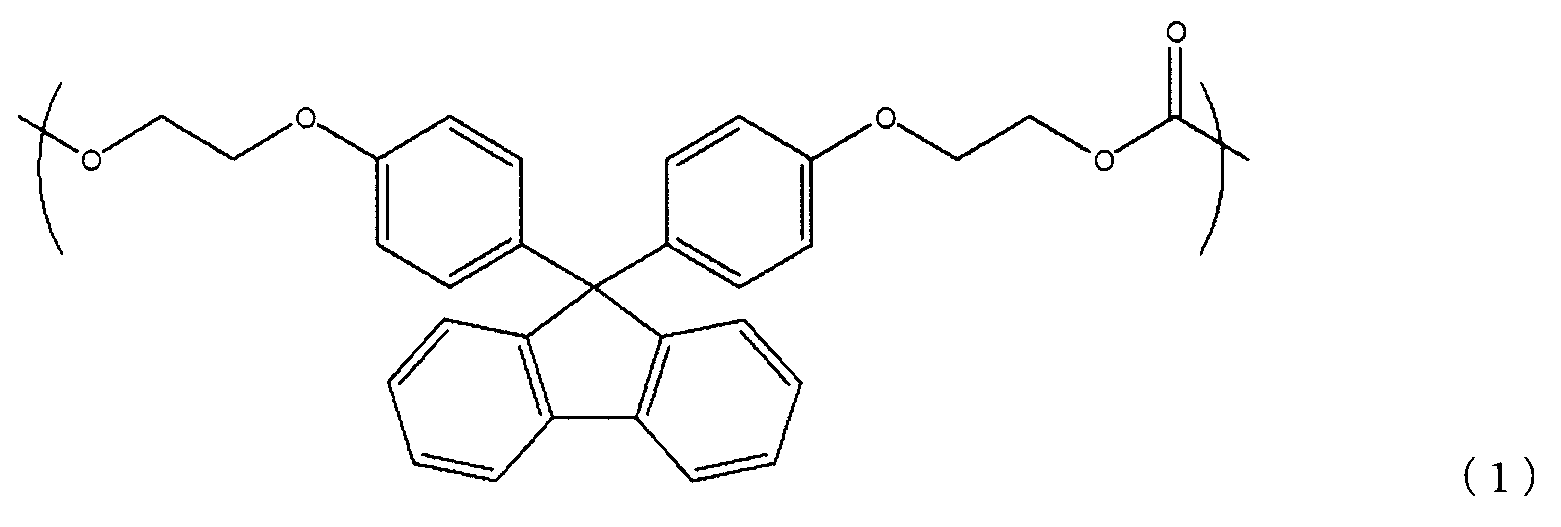

2.ポリカーボネート樹脂の屈折率が1.57~1.60で且つアッベ数が27~31である前記1に記載の撮像レンズ。
3.ポリカーボネート樹脂からなるフィルムの配向複屈折が2×10⁻³以下である上記1または2に記載の撮像レンズ。
4.ポリカーボネート樹脂の屈折率が1.58~1.59である上記1~3のいずれかに記載の撮像レンズ。
5.ポリカーボネート樹脂のアッベ数が27.5~29.5である上記1~4のいずれかに記載の撮像レンズ。
6.ポリカーボネート樹脂の比粘度が0.12~0.32である上記1~5のいずれかに記載の撮像レンズ。
7.ポリカーボネート樹脂の吸水率が0.2%以下である上記1~6のいずれかに記載の撮像レンズ。
8.携帯電話、スマートフォン、タブレット端末、パソコン、デジタルカメラ、ビデオカメラ、車載カメラ、監視カメラのいずれかに用いる上記1~7のいずれかに記載の撮像レンズ。
2. 2. The imaging lens as described in 1 above, wherein the polycarbonate resin has a refractive index of 1.57 to 1.60 and an Abbe number of 27 to 31.
3. 3. The imaging lens as described in 1 or 2 above, wherein the film made of polycarbonate resin has an orientation birefringence of 2 × 10 −3 or less.
4). 4. The imaging lens as described in any one of 1 to 3 above, wherein the polycarbonate resin has a refractive index of 1.58 to 1.59.
5). 5. The imaging lens according to any one of 1 to 4 above, wherein the Abbe number of the polycarbonate resin is 27.5 to 29.5.
6). 6. The imaging lens as described in any one of 1 to 5 above, wherein the polycarbonate resin has a specific viscosity of 0.12 to 0.32.
7). 7. The imaging lens as described in any one of 1 to 6 above, wherein the polycarbonate resin has a water absorption rate of 0.2% or less.
8). 8. The imaging lens according to any one of 1 to 7 above, which is used for any of a mobile phone, a smartphone, a tablet terminal, a personal computer, a digital camera, a video camera, an in-vehicle camera, and a surveillance camera.
本発明の撮像レンズに用いられる樹脂は、9,9-ビス[4-(2-ヒドロキシエトキシ)フェニル]フルオレンと3,9-ビス(1,1-ジメチル-2-ヒドロキシエチル)2,4,8,10-テトラオキサスピロ[5.5]ウンデカンを特定の組成比で共重合することにより、撮像レンズ用ポリカーボネート樹脂を得、該樹脂を用いることにより、特定の屈折率、アッベ数を有し、低複屈折であって低吸水率を有する撮像レンズとなるため、その奏する産業上の効果は、格別である。 Resins used for the imaging lens of the present invention include 9,9-bis [4- (2-hydroxyethoxy) phenyl] fluorene and 3,9-bis (1,1-dimethyl-2-hydroxyethyl) 2,4. A polycarbonate resin for an imaging lens is obtained by copolymerizing 8,10-tetraoxaspiro [5.5] undecane at a specific composition ratio. By using the resin, the resin has a specific refractive index and an Abbe number. Since the imaging lens has a low birefringence and a low water absorption rate, the industrial effect exerted by the imaging lens is exceptional.
以下、本発明の撮像レンズについて、順次具体的に説明する。
<ポリカーボネート樹脂>
本発明の撮像レンズに使用されるポリカーボネート樹脂は、測定温度:25℃、測定波長:589nmにおける屈折率が1.57~1.60であり、1.58~1.59であることがより好ましい。
Hereinafter, the imaging lens of the present invention will be specifically described sequentially.
<Polycarbonate resin>
The polycarbonate resin used in the imaging lens of the present invention has a refractive index of 1.57 to 1.60, more preferably 1.58 to 1.59 at a measurement temperature: 25 ° C. and a measurement wavelength: 589 nm. .
本発明の撮像レンズに使用されるポリカーボネート樹脂は、測定温度:25℃におけるアッベ数が27.0~31.0であることが好ましく、27.5~29.5であることがより好ましい。アッベ数は測定温度:25℃、測定波長:486nm、589nm、656nmの屈折率から下記式を用いて算出する。 The polycarbonate resin used in the imaging lens of the present invention preferably has an Abbe number of 27.0 to 31.0 at a measurement temperature of 25 ° C., more preferably 27.5 to 29.5. The Abbe number is calculated from the refractive index of measurement temperature: 25 ° C., measurement wavelength: 486 nm, 589 nm, and 656 nm using the following formula.
ν=(nD-1)/(nF-nC)
nD:波長589nmでの屈折率
nC:波長656nmでの屈折率
nF:波長486nmでの屈折率
本発明の撮像レンズに使用されるポリカーボネート樹脂は、式(1)及び式(2)を含む。
ν = (nD-1) / (nF-nC)
nD: Refractive index at a wavelength of 589 nm nC: Refractive index at a wavelength of 656 nm nF: Refractive index at a wavelength of 486 nm The polycarbonate resin used for the imaging lens of the present invention includes formulas (1) and (2).


本発明の撮像レンズに使用されるポリカーボネート樹脂は、式(1)を50mol%以上70mol%未満含み、55~65mol%含むことが好ましく、57~64mol%含むことがさらに好ましい。また、式(2)を30mol%より大きく50mol%以下含み、35~45mol%含むことが好ましく、36~43mol%含むことがさらに好ましい。 The polycarbonate resin used in the imaging lens of the present invention contains 50 to 70 mol% of formula (1), preferably 55 to 65 mol%, more preferably 57 to 64 mol%. Further, the formula (2) is contained in an amount of more than 30 mol% and not more than 50 mol%, preferably 35 to 45 mol%, more preferably 36 to 43 mol%.
本発明の撮像レンズに使用されるポリカーボネート樹脂は、式(1)及び式(2)で表される繰り返し単位を含むが、本発明の特性を損なわい程度に他のジオール成分を共重合してもよい。他のジオール成分は、全繰り返し単位中10mol%以下が好ましい。その他のジオール成分として、エチレングリコール、プロパンジオール、ブタンジオール、ペンタンジオール、ヘキサンジオール、ヘプタンジオール、オクタンジオール、ノナンジオール、トリシクロ[5.2.1.02,6]デカンジメタノール、シクロヘキサン-1,4-ジメタノール、デカリン-2,6-ジメタノール、ノルボルナンジメタノール、ペンタシクロペンタデカンジメタノール、シクロペンタン-1,3-ジメタノール、イソソルビド、ヒドロキノン、レゾルシノール、2,2-ビス(4-ヒドロキシフェニル)プロパン、2,2-ビス(3-メチル-4-ヒドロキシフェニル)プロパン、1,1-ビス(4-ヒドロキシフェニル)-1-フェニルエタン、ビス(4-ヒドロキシフェニル)ジフェニルメタン、1,3-ビス(2-(4-ヒドロキシフェニル)-2-プロピル)ベンゼン、ビス(4-ヒドロキシフェニル)スルホン、ビス(4-ヒドロキシフェニル)スルフィド、1,1-ビス(4-ヒドロキシフェニル)-3,3,5-トリメチルシクロヘキサン、1,1-ビス(4-ヒドロキシフェニル)シクロヘキサン、ビフェノール、ビスフェノールフルオレン、ビスクレゾールフルオレン等が挙げられる。 The polycarbonate resin used for the imaging lens of the present invention contains repeating units represented by the formulas (1) and (2), but is copolymerized with other diol components to such an extent that the characteristics of the present invention are not impaired. Also good. The other diol component is preferably 10 mol% or less in all repeating units. Other diol components include ethylene glycol, propanediol, butanediol, pentanediol, hexanediol, heptanediol, octanediol, nonanediol, tricyclo [5.2.1.0 2,6 ] decanedimethanol, cyclohexane-1 , 4-dimethanol, decalin-2,6-dimethanol, norbornanedimethanol, pentacyclopentadecanedimethanol, cyclopentane-1,3-dimethanol, isosorbide, hydroquinone, resorcinol, 2,2-bis (4-hydroxy Phenyl) propane, 2,2-bis (3-methyl-4-hydroxyphenyl) propane, 1,1-bis (4-hydroxyphenyl) -1-phenylethane, bis (4-hydroxyphenyl) diphenylmethane, 1,3 -Bis (2- (4-H Loxyphenyl) -2-propyl) benzene, bis (4-hydroxyphenyl) sulfone, bis (4-hydroxyphenyl) sulfide, 1,1-bis (4-hydroxyphenyl) -3,3,5-trimethylcyclohexane, , 1-bis (4-hydroxyphenyl) cyclohexane, biphenol, bisphenol fluorene, biscresol fluorene and the like.
本発明の撮像レンズに使用されるポリカーボネート樹脂は、比粘度が0.12~0.32の範囲にあることが好ましく、0.18~0.30の範囲にあることがより好ましい。比粘度が0.12~0.32であると成形性と強度とのバランスに優れる。 The polycarbonate resin used in the imaging lens of the present invention preferably has a specific viscosity in the range of 0.12 to 0.32, more preferably in the range of 0.18 to 0.30. When the specific viscosity is 0.12 to 0.32, the balance between moldability and strength is excellent.
本発明の撮像レンズに使用されるポリカーボネート樹脂は、配向複屈折(Δn)の絶対値が、好ましくは0~6×10⁻³、より好ましくは0~4×10⁻³、さらに好ましくは0~2×10⁻³の範囲である。配向複屈折(Δn)は、該ポリカーボネート樹脂より得られる厚さ100μmのキャストフィルムをTg+10℃で2倍延伸した時、波長589nmにおいて測定する。 The polycarbonate resin used in the imaging lens of the present invention has an absolute value of orientation birefringence (Δn) of preferably 0 to 6 × 10 −3 , more preferably 0 to 4 × 10 −3 , and still more preferably 0 to The range is 2 × 10 −3 . The orientation birefringence (Δn) is measured at a wavelength of 589 nm when a cast film having a thickness of 100 μm obtained from the polycarbonate resin is stretched twice at Tg + 10 ° C.
本発明の撮像レンズに使用されるポリカーボネート樹脂は、1mm厚の全光線透過率が、好ましくは80%以上、より好ましくは85%以上、さらに好ましくは88%以上である。 The polycarbonate resin used in the imaging lens of the present invention has a total light transmittance of 1 mm thickness, preferably 80% or more, more preferably 85% or more, and still more preferably 88% or more.
本発明の撮像レンズに使用されるポリカーボネート樹脂は、23℃、24時間浸漬後の吸水率が0.20%以下であると好ましく、0.17%以下であるとより好ましい。 The polycarbonate resin used in the imaging lens of the present invention preferably has a water absorption of 0.20% or less after being immersed at 23 ° C. for 24 hours, more preferably 0.17% or less.
本発明の撮像レンズに使用されるポリカーボネート樹脂は、ガラス転移点が120~160℃であると好ましく、125~150℃であるとより好ましい。 The polycarbonate resin used in the imaging lens of the present invention preferably has a glass transition point of 120 to 160 ° C, more preferably 125 to 150 ° C.
<ポリカーボネート樹脂の製造方法>
本発明の撮像レンズに使用されるポリカーボネート樹脂は、通常のポリカーボネート樹脂を製造するそれ自体公知の反応手段、例えばジオール成分に炭酸ジエステルなどのカーボネート前駆物質を反応させる方法により製造される。次にこれらの製造方法について基本的な手段を簡単に説明する。
<Production method of polycarbonate resin>
The polycarbonate resin used in the imaging lens of the present invention is produced by a reaction means known per se for producing an ordinary polycarbonate resin, for example, a method of reacting a diol component with a carbonate precursor such as a carbonic acid diester. Next, basic means for these manufacturing methods will be briefly described.
カーボネート前駆物質として炭酸ジエステルを用いるエステル交換反応は、不活性ガス雰囲気下所定割合の芳香族ジヒドロキシ成分を炭酸ジエステルと加熱しながら撹拌して、生成するアルコールまたはフェノール類を留出させる方法により行われる。反応温度は生成するアルコールまたはフェノール類の沸点などにより異なるが、通常120~300℃の範囲である。反応はその初期から減圧にして生成するアルコールまたはフェノール類を留出させながら反応を完結させる。また、必要に応じて末端停止剤、酸化防止剤等を加えてもよい。 The transesterification reaction using a carbonic acid diester as a carbonate precursor is performed by a method in which an aromatic dihydroxy component in a predetermined ratio is stirred with a carbonic acid diester while heating with an inert gas atmosphere to distill the generated alcohol or phenols. . The reaction temperature varies depending on the boiling point of the alcohol or phenol produced, but is usually in the range of 120 to 300 ° C. The reaction is completed while distilling off the alcohol or phenol produced under reduced pressure from the beginning. Moreover, you may add a terminal stopper, antioxidant, etc. as needed.
前記エステル交換反応に使用される炭酸ジエステルとしては、置換されてもよい炭素数6~12のアリール基、アラルキル基等のエステルが挙げられる。具体的には、ジフェニルカーボネート、ジトリールカーボネート、ビス(クロロフェニル)カーボネートおよびm-クレジルカーボネート等が例示される。なかでもジフェニルカーボネートが特に好ましい。ジフェニルカーボネートの使用量は、ジヒドロキシ化合物の合計1モルに対して、好ましくは0.95~1.10モル、より好ましは0.98~1.04モルである。
また溶融重合法においては重合速度を速めるために、重合触媒を用いることができ、かかる重合触媒としては、アルカリ金属化合物、アルカリ土類金属化合物、塩基性リン化合物、含窒素化合物、金属化合物等が挙げられる。このような化合物としては、アルカリ金属やアルカリ土類金属の、有機酸塩、無機塩、酸化物、水酸化物、水素化物、アルコキシド、4級アンモニウムヒドロキシド等が好ましく用いられ、これらの化合物は単独もしくは組み合わせて用いることができる。
Examples of the carbonic acid diester used in the transesterification include esters such as an aryl group having 6 to 12 carbon atoms and an aralkyl group which may be substituted. Specific examples include diphenyl carbonate, ditolyl carbonate, bis (chlorophenyl) carbonate, and m-cresyl carbonate. Of these, diphenyl carbonate is particularly preferred. The amount of diphenyl carbonate to be used is preferably 0.95 to 1.10 mol, more preferably 0.98 to 1.04 mol, per 1 mol of the total of dihydroxy compounds.
In the melt polymerization method, a polymerization catalyst can be used to increase the polymerization rate. Examples of the polymerization catalyst include alkali metal compounds, alkaline earth metal compounds, basic phosphorus compounds, nitrogen-containing compounds, and metal compounds. Can be mentioned. As such compounds, organic acid salts, inorganic salts, oxides, hydroxides, hydrides, alkoxides, quaternary ammonium hydroxides, and the like of alkali metals and alkaline earth metals are preferably used. It can be used alone or in combination.
アルカリ金属化合物としては、水酸化ナトリウム、水酸化カリウム、水酸化セシウム、水酸化リチウム、炭酸水素ナトリウム、炭酸ナトリウム、炭酸カリウム、炭酸セシウム、炭酸リチウム、酢酸ナトリウム、酢酸カリウム、酢酸セシウム、酢酸リチウム、ステアリン酸ナトリウム、ステアリン酸カリウム、ステアリン酸セシウム、ステアリン酸リチウム、水素化ホウ素ナトリウム、安息香酸ナトリウム、安息香酸カリウム、安息香酸セシウム、安息香酸リチウム、リン酸水素2ナトリウム、リン酸水素2カリウム、リン酸水素2リチウム、フェニルリン酸2ナトリウム、ビスフェノールAの2ナトリウム塩、2カリウム塩、2セシウム塩、2リチウム塩、フェノールのナトリウム塩、カリウム塩、セシウム塩、リチウム塩等が例示される。 Examples of the alkali metal compound include sodium hydroxide, potassium hydroxide, cesium hydroxide, lithium hydroxide, sodium bicarbonate, sodium carbonate, potassium carbonate, cesium carbonate, lithium carbonate, sodium acetate, potassium acetate, cesium acetate, lithium acetate, Sodium stearate, potassium stearate, cesium stearate, lithium stearate, sodium borohydride, sodium benzoate, potassium benzoate, cesium benzoate, lithium benzoate, disodium hydrogen phosphate, dipotassium hydrogen phosphate, phosphorus Examples include dilithium oxyhydrogen, disodium phenylphosphate, disodium salt of bisphenol A, 2 potassium salt, 2 cesium salt, 2 lithium salt, sodium salt of phenol, potassium salt, cesium salt and lithium salt.
アルカリ土類金属化合物としては、水酸化マグネシウム、水酸化カルシウム、水酸化ストロンチウム、水酸化バリウム、炭酸マグネシウム、炭酸カルシウム、炭酸ストロンチウム、炭酸バリウム、炭酸水素カルシウム、炭酸水素バリウム、炭酸水素マグネシウム、炭酸水素ストロンチウム、二酢酸マグネシウム、二酢酸カルシウム、二酢酸ストロンチウム、二酢酸バリウム等が例示される。塩基性ホウ素化合物としては、例えば、テトラメチルホウ素、テトラエチルホウ素、テトラプロピルホウ素、テトラブチルホウ素、トリメチルエチルホウ素、トリメチルベンジルホウ素、トリメチルフェニルホウ素、トリエチルメチルホウ素、トリエチルベンジルホウ素、トリエチルフェニルホウ素、トリブチルベンジルホウ素、トリブチルフェニルホウ素、テトラフェニルホウ素、ベンジルトリフェニルホウ素、メチルトリフェニルホウ素、ブチルトリフェニルホウ素等のナトリウム塩、カリウム塩、リチウム塩、カルシウム塩、バリウム塩、マグネシウム塩、あるいはストロンチウム塩等が挙げられる。 Alkaline earth metal compounds include magnesium hydroxide, calcium hydroxide, strontium hydroxide, barium hydroxide, magnesium carbonate, calcium carbonate, strontium carbonate, barium carbonate, calcium bicarbonate, barium bicarbonate, magnesium bicarbonate, bicarbonate Examples include strontium, magnesium diacetate, calcium diacetate, strontium diacetate, and barium diacetate. Examples of the basic boron compound include tetramethyl boron, tetraethyl boron, tetrapropyl boron, tetrabutyl boron, trimethylethyl boron, trimethylbenzyl boron, trimethylphenyl boron, triethylmethyl boron, triethylbenzyl boron, triethylphenyl boron, tributylbenzyl. Examples include sodium, potassium, lithium, calcium, barium, magnesium, or strontium salts such as boron, tributylphenylboron, tetraphenylboron, benzyltriphenylboron, methyltriphenylboron, butyltriphenylboron, etc. It is done.
塩基性リン化合物としては、例えば、トリエチルホスフィン、トリ-n-プロピルホスフィン、トリイソプロピルホスフィン、トリ-n-ブチルホスフィン、トリフェニルホスフィン、トリブチルホスフィン、あるいは四級ホスホニウム塩等が挙げられる。 Examples of the basic phosphorus compound include triethylphosphine, tri-n-propylphosphine, triisopropylphosphine, tri-n-butylphosphine, triphenylphosphine, tributylphosphine, and quaternary phosphonium salts.
含窒素化合物としては、テトラメチルアンモニウムヒドロキシド、テトラエチルアンモニウムヒドロキシド、テトラプロピルアンモニウムヒドロキシド、テトラブチルアンモニウムヒドロキシド、トリメチルベンジルアンモニウムヒドロキシド等のアルキル、アリール基等を有する4級アンモニウムヒドロキシド類が挙げられる。また、トリエチルアミン、ジメチルベンジルアミン、トリフェニルアミン等の3級アミン類、2-メチルイミダゾール、2-フェニルイミダゾール、ベンゾイミダゾール等のイミダゾール類が挙げられる。また、アンモニア、テトラメチルアンモニウムボロハイドライド、テトラブチルアンモニウムボロハイドライド、テトラブチルアンモニウムテトラフェニルボレート、テトラフェニルアンモニウムテトラフェニルボレート等の塩基あるいは塩基性塩等が例示される。 Examples of nitrogen-containing compounds include quaternary ammonium hydroxides having alkyl, aryl groups, etc., such as tetramethylammonium hydroxide, tetraethylammonium hydroxide, tetrapropylammonium hydroxide, tetrabutylammonium hydroxide, and trimethylbenzylammonium hydroxide. Can be mentioned. Further, tertiary amines such as triethylamine, dimethylbenzylamine and triphenylamine, and imidazoles such as 2-methylimidazole, 2-phenylimidazole and benzimidazole can be mentioned. Moreover, bases or basic salts such as ammonia, tetramethylammonium borohydride, tetrabutylammonium borohydride, tetrabutylammonium tetraphenylborate, tetraphenylammonium tetraphenylborate and the like are exemplified.
金属化合物としては亜鉛アルミニウム化合物、ゲルマニウム化合物、有機スズ化合物、アンチモン化合物、マンガン化合物、チタン化合物、ジルコニウム化合物等が例示される。これらの化合物は1種または2種以上併用してもよい。 Examples of metal compounds include zinc aluminum compounds, germanium compounds, organic tin compounds, antimony compounds, manganese compounds, titanium compounds, zirconium compounds, and the like. These compounds may be used alone or in combination of two or more.
これらの重合触媒の使用量は、ジオール成分1モルに対し好ましくは1×10⁻⁹~1×10⁻²当量、好ましくは1×10⁻⁸~1×10⁻³当量、より好ましくは1×10⁻⁷~1×10⁻⁵当量の範囲で選ばれる。 The amount of these polymerization catalysts used is preferably 1 × 10 −9 to 1 × 10 −2 equivalent, preferably 1 × 10 −8 to 1 × 10 −3 equivalent, more preferably 1 × with respect to 1 mol of the diol component. It is selected in the range of 10 −7 to 1 × 10 −5 equivalents.
また、必要によって反応後期に触媒失活剤を添加してもよい。使用する触媒失活剤としては、公知の触媒失活剤が有効に使用されるが、この中でもスルホン酸のアンモニウム塩、ホスホニウム塩が好ましい。更にドデシルベンゼンスルホン酸テトラブチルホスホニウム塩等のドデシルベンゼンスルホン酸の塩類、パラトルエンスルホン酸テトラブチルアンモニウム塩等のパラトルエンスルホン酸の塩類が好ましい。 If necessary, a catalyst deactivator may be added at a later stage of the reaction. As the catalyst deactivator to be used, a known catalyst deactivator is effectively used. Among them, sulfonic acid ammonium salt and phosphonium salt are preferable. Furthermore, salts of dodecylbenzenesulfonic acid such as tetrabutylphosphonium salt of dodecylbenzenesulfonic acid and salts of paratoluenesulfonic acid such as tetrabutylammonium salt of paratoluenesulfonic acid are preferable.
またスルホン酸のエステルとして、ベンゼンスルホン酸メチル、ベンゼンスルホン酸エチル、ベンゼンスルホン酸ブチル、ベンゼンスルホン酸オクチル、ベンゼンスルホン酸フェニル、パラトルエンスルホン酸メチル、パラトルエンスルホン酸エチル、パラトルエンスルホン酸ブチル、パラトルエンスルホン酸オクチル、パラトルエンスルホン酸フェニル等が好ましく用いられる。なかでも、ドデシルベンゼンスルホン酸テトラブチルホスホニウム塩が最も好ましく使用される。 Further, as esters of sulfonic acid, methyl benzenesulfonate, ethyl benzenesulfonate, butyl benzenesulfonate, octyl benzenesulfonate, phenyl benzenesulfonate, methyl paratoluenesulfonate, ethyl paratoluenesulfonate, butyl paratoluenesulfonate, Octyl paratoluenesulfonate, phenyl paratoluenesulfonate and the like are preferably used. Among these, dodecylbenzenesulfonic acid tetrabutylphosphonium salt is most preferably used.
これらの触媒失活剤の使用量はアルカリ金属化合物および/またはアルカリ土類金属化合物より選ばれた少なくとも1種の重合触媒を用いた場合、その触媒1モル当たり好ましくは0.5~50モルの割合で、より好ましくは0.5~10モルの割合で、更に好ましくは0.8~5モルの割合で使用することができる。 The amount of the catalyst deactivator used is preferably 0.5 to 50 mol per mol of the catalyst when at least one polymerization catalyst selected from alkali metal compounds and / or alkaline earth metal compounds is used. It can be used in a proportion, more preferably in a proportion of 0.5 to 10 mol, still more preferably in a proportion of 0.8 to 5 mol.
また、本発明のポリカーボネート樹脂は、用途や必要に応じて熱安定剤、可塑剤、光安定剤、重合金属不活性化剤、難燃剤、滑剤、帯電防止剤、界面活性剤、抗菌剤、紫外線吸収剤、離型剤等の添加剤を配合することができる。 In addition, the polycarbonate resin of the present invention can be used as a heat stabilizer, a plasticizer, a light stabilizer, a polymerized metal deactivator, a flame retardant, a lubricant, an antistatic agent, a surfactant, an antibacterial agent, an ultraviolet ray, if necessary and necessary. Additives such as an absorbent and a release agent can be blended.
さらに、用途や必要に応じて熱安定剤、可塑剤、光安定剤、重合金属不活性化剤、難燃剤、滑剤、帯電防止剤、界面活性剤、抗菌剤、紫外線吸収剤、離型剤等の添加剤を配合することができる。
<撮像レンズの製造方法>
本発明の撮像レンズは、射出成形、圧縮成形、射出圧縮成形、溶融押出成形、キャスティング等の任意の方法により成形、加工することができるが、射出成形が特に好適である。
Furthermore, heat stabilizers, plasticizers, light stabilizers, polymerized metal deactivators, flame retardants, lubricants, antistatic agents, surfactants, antibacterial agents, ultraviolet absorbers, mold release agents, etc. Additives can be blended.
<Method for manufacturing imaging lens>
The imaging lens of the present invention can be molded and processed by any method such as injection molding, compression molding, injection compression molding, melt extrusion molding, and casting, but injection molding is particularly suitable.
射出成形の成形条件は特に限定されないが、成形機のシリンダ温度は180~320℃が好ましく、220~300℃がより好ましく、240~280℃がよりいっそう好ましい。また、金型温度は70~130℃が好ましく、80~125℃がよりいっそう好ましく、90~120℃がよりいっそう好ましい。射出圧力は50~1,700kgf/cm2が好ましく、500~1,600kgf/cm2が好ましく、1,000~1,500kgf/cm2がよりいっそう好ましい。 The molding conditions for injection molding are not particularly limited, but the cylinder temperature of the molding machine is preferably 180 to 320 ° C, more preferably 220 to 300 ° C, and even more preferably 240 to 280 ° C. The mold temperature is preferably 70 to 130 ° C, more preferably 80 to 125 ° C, and still more preferably 90 to 120 ° C. Injection pressure is preferably 50 ~ 1,700kgf / cm 2, preferably 500 ~ 1,600kgf / cm 2, and still more preferably, 1,000 ~ 1,500kgf / cm 2.
本発明の撮像レンズは、スマートフォン、デジタルカメラ、ビデオカメラ等の撮像レンズに用いることができる。 The imaging lens of the present invention can be used for imaging lenses such as smartphones, digital cameras, and video cameras.
以下に実施例を挙げて本発明をさらに説明する。
実施例1~3、比較例1~4
評価は下記の方法の通り実施した。
(1)比粘度:重合終了後に得られたポリカーボネート樹脂を十分に乾燥し、該ペレット0.7gを塩化メチレン100mlに溶解した溶液から、その溶液の20℃における比粘度(ηsp)を測定した。
(2)共重合比:日本電子社製JNM-AL400のプロトンNMRを用いて測定した。7.6~7.8ppm付近の式(1)の構造に起因するピークと0.8~1.1ppm付近の式(2)の構造に起因するピークの積分比から求めた。
(3)屈折率(nD)、アッベ数(ν):射出成形により得られた厚さ0.3mm、φ5mmの円板をATAGO製DR-M2のアッベ屈折計を用いて、25℃における屈折率を測定した。アッベ数は測定波長:486nm、589nm、656nmの屈折率から下記式を用いて算出した。
The following examples further illustrate the present invention.
Examples 1 to 3 and Comparative Examples 1 to 4
Evaluation was performed as follows.
(1) Specific viscosity: The polycarbonate resin obtained after completion of the polymerization was sufficiently dried, and the specific viscosity (ηsp) at 20 ° C. of the solution was measured from a solution obtained by dissolving 0.7 g of the pellets in 100 ml of methylene chloride.
(2) Copolymerization ratio: Measured using proton NMR of JNM-AL400 manufactured by JEOL Ltd. It was determined from the integral ratio of the peak attributed to the structure of formula (1) near 7.6 to 7.8 ppm and the peak attributed to the structure of formula (2) near 0.8 to 1.1 ppm.
(3) Refractive index (nD), Abbe number (ν): Refractive index at 25 ° C. using a 0.3 mm-thick φ5 mm disk obtained by injection molding using an ATAGO DR-M2 Abbe refractometer Was measured. The Abbe number was calculated using the following formula from the refractive indexes of the measurement wavelengths: 486 nm, 589 nm, and 656 nm.
ν=(nD-1)/(nF-nC)
nD:波長589nmでの屈折率
nC:波長656nmでの屈折率
nF:波長486nmでの屈折率
(4)配向複屈折(Δn):ポリカーボネート樹脂を塩化メチレンに溶解した後、ガラスシャーレ上にキャストし、十分に乾燥することで厚さ100μmのキャストフィルムを作成した。該フィルムをガラス転移点(Tg)+10℃で2倍延伸し、日本分光(株)製エリプソメーターM-220を用いて589nmにおける位相差(Re)を測定し、下記式より配向複屈折(Δn)を求めた。なお、ガラス転移点は、島津製作所製DSC-60Aにより、昇温速度20℃/minで測定した。
ν = (nD-1) / (nF-nC)
nD: Refractive index at a wavelength of 589 nm nC: Refractive index at a wavelength of 656 nm nF: Refractive index at a wavelength of 486 nm (4) Oriented birefringence (Δn): After dissolving a polycarbonate resin in methylene chloride, cast it on a glass petri dish The cast film having a thickness of 100 μm was prepared by sufficiently drying. The film was stretched twice at a glass transition point (Tg) + 10 ° C., and the retardation (Re) at 589 nm was measured using an ellipsometer M-220 manufactured by JASCO Corporation. The orientation birefringence (Δn ) The glass transition point was measured by DSC-60A manufactured by Shimadzu Corporation at a heating rate of 20 ° C./min.
Δn=Re/d
Δn:配向複屈折
Re:位相差
d:厚さ
(5)吸水率:射出成形により得られた板状成形片をISO62に準拠して測定した。
(6)レンズの光学歪み評価:シリンダー温度280℃、金型温度120℃で、住友重機械(株)製SE30DU射出成形機を用いて厚さ0.2mm、凸面曲率半径5mm、凹面曲率半径4mm、Φ5mmの非球面レンズを射出成形した。非球面レンズを二枚の偏光板の間に挟み直交ニコル法で光漏れを目視することにより光学歪み評価した。評価は以下の基準で行った。
Δn = Re / d
Δn: orientation birefringence Re: phase difference d: thickness (5) water absorption: a plate-like molded piece obtained by injection molding was measured according to ISO62.
(6) Evaluation of optical distortion of lens: cylinder temperature 280 ° C., mold temperature 120 ° C., using a Sumitomo Heavy Industries SE30DU injection molding machine, thickness 0.2 mm, convex curvature radius 5 mm, concave curvature radius 4 mm An aspherical lens with a diameter of 5 mm was injection molded. Optical distortion was evaluated by sandwiching an aspheric lens between two polarizing plates and visually observing light leakage by the crossed Nicols method. Evaluation was performed according to the following criteria.
◎:殆ど光漏れがない。 ◎: There is almost no light leakage.
○:僅かに光漏れが認められる。 ○: Slight light leakage is observed.
×:光漏れが顕著である。
(7)レンズの成形性評価:(6)と同様の方法により成形した非球面レンズの充填不良、成形不良、レンズの脆さ、金型付着物の有無等を目視にて確認した。評価は、500枚成形した際に欠陥品となる確率が、1%未満(◎)、1~5%未満(○)5~10%未満(△)、10%以上(×)で分類した。
[実施例1]
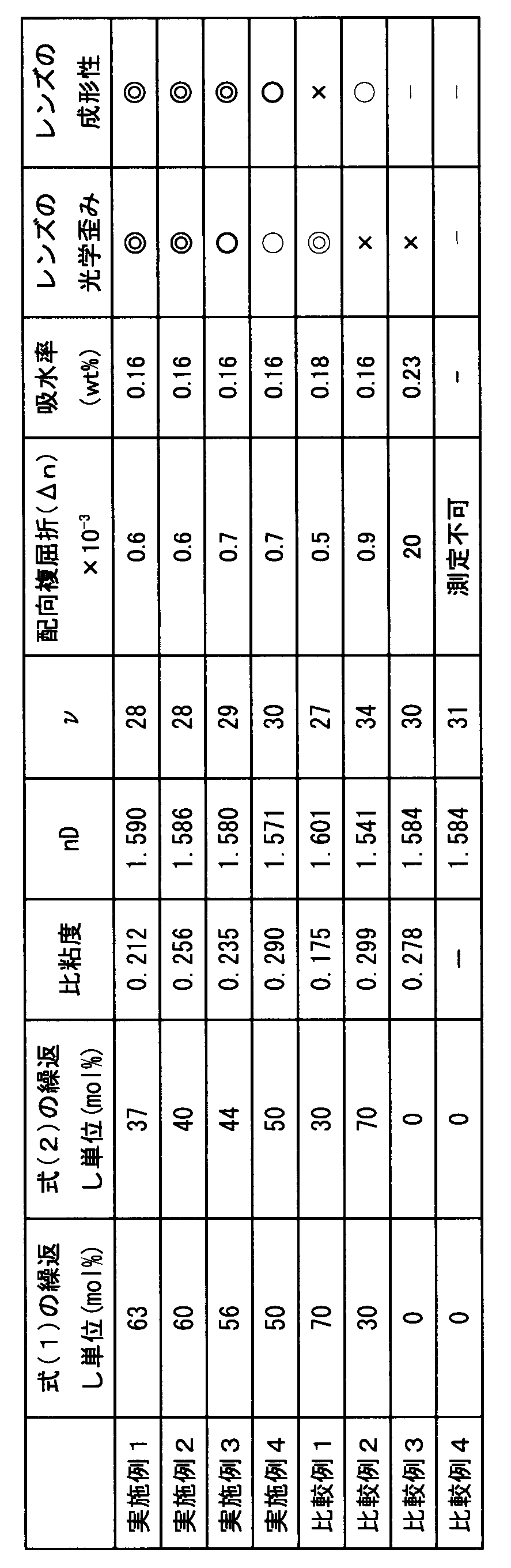
9,9-ビス(4-(2-ヒドロキシエトキシ)フェニル)フルオレン(以下、BPEFと略す)110.50部、3,9-ビス(1,1-ジメチル-2-ヒドロキシエチル)-2,4,8,10-テトラオキサスピロ[5.5]ウンデカン(以下、SPGと略す)45.05部、ジフェニルカーボネート87.40部、および触媒として水酸化ナトリウム8.00×10⁻⁵部、テトラメチルアンモニウムヒドロキシド3.65×10⁻³部を攪拌機および留出装置付きの反応釜に入れ、窒素置換を3度行った後、ジャケットを180℃に加熱し、原料を溶融させた。完全溶解後、20分かけて20kPaまで減圧すると同時に、60℃/hrの速度でジャケットを260℃まで昇温し、エステル交換反応を行った。その後、ジャケットを260℃に保持したまま、80分かけて0.13kPaまで減圧し、260℃、0.13kPa以下の条件下で30分重合反応を行った。反応終了後、生成したポリカーボネート樹脂をペレタイズしながら抜き出し、ポリカーボネート樹脂ペレットを得た。該ペレットを用いて、比粘度、共重合比、配向複屈折を測定し、結果を表1に記載した。また、該ペレットを110℃で4時間乾燥後、射出成形にて測定片を成形し、屈折率(nD)、アッベ数(ν)、吸水率、レンズの光学歪み評価、レンズの成形性の測定結果を表1に記載した。
[実施例2]
BPEFを105.24部、SPG48.70部とする以外は実施例1と同様の方法でポリカーボネート樹脂ペレットを得た。該ペレットを用いて、実施例1と同様に測定し、結果を表1に記載した。
[実施例3]
BPEFを98.22部、SPG53.57部とする以外は実施例1と同様の方法でポリカーボネート樹脂ペレットを得た。該ペレットを用いて、実施例1と同様に測定し、結果を表1に記載した。
[実施例4]
BPEFを87.70部、SPG60.88部とする以外は実施例1と同様の方法でポリカーボネート樹脂ペレットを得た。該ペレットを用いて、実施例1と同様に測定し、結果を表1に記載した。
[比較例1]
特許第3160209号の実施例17に記載の方法でポリカーボネート樹脂ペレットを得た。該ペレットを用いて、実施例1と同様に測定し、結果を表1に記載した。レンズ成形性評価時、レンズ割れやスプルー折れが多発し、成形性が悪かった。
[比較例2]
BPEFを52.62部、SPG85.23部とする以外は実施例1と同様の方法でポリカーボネート樹脂ペレットを得た。該ペレットを用いて、実施例1と同様に測定し、結果を表1に記載した。
[比較例3]
帝人(株)製ポリカーボネート樹脂AD-5503を用いて、実施例1と同様に測定し、結果を表1に記載した。
[比較例4]
特許第5217644号の実施例3に記載の方法でポリカーボネート樹脂ペレットを得た。すなわち、ポリカーボネート樹脂として上記ユーピロンH-4000(三菱エンジニアリングプラスチックス(株)製)50.0部と、スチレン樹脂として上記ダイラークD-232(ノバケミカル(株)製)50.0部を押出し機にて255℃にて練り合わせ、ペレタイズして光学レンズ用樹脂組成物のペレットを得た。
該ペレットを用いて、実施例1と同様に測定し、結果を表1に記載した。
X: Light leakage is remarkable.
(7) Evaluation of moldability of lens: The aspherical lens molded by the same method as in (6) was visually checked for filling failure, molding failure, lens brittleness, presence of mold deposits, and the like. The evaluation was classified as less than 1% (◎), 1 to less than 5% (○), 5 to less than 10% (Δ), and 10% or more (×) when 500 sheets were formed.
[Example 1]
110.50 parts of 9,9-bis (4- (2-hydroxyethoxy) phenyl) fluorene (hereinafter abbreviated as BPEF), 3,9-bis (1,1-dimethyl-2-hydroxyethyl) -2,4 , 8,10-tetraoxaspiro [5.5] undecane (hereinafter abbreviated as SPG) 45.05 parts, diphenyl carbonate 87.40 parts, and sodium hydroxide 8.00 × 10 −5 parts as a catalyst, tetramethyl Ammonium hydroxide (3.65 × 10 −3 parts) was placed in a reaction kettle equipped with a stirrer and a distillation apparatus, and was purged with nitrogen three times. Then, the jacket was heated to 180 ° C. to melt the raw material. After complete dissolution, the pressure was reduced to 20 kPa over 20 minutes, and at the same time, the jacket was heated to 260 ° C. at a rate of 60 ° C./hr to conduct a transesterification reaction. Thereafter, the pressure was reduced to 0.13 kPa over 80 minutes while maintaining the jacket at 260 ° C., and a polymerization reaction was performed for 30 minutes under the conditions of 260 ° C. and 0.13 kPa or less. After completion of the reaction, the produced polycarbonate resin was extracted while pelletizing to obtain polycarbonate resin pellets. Using the pellets, specific viscosity, copolymerization ratio and orientation birefringence were measured, and the results are shown in Table 1. Further, after drying the pellets at 110 ° C. for 4 hours, a measurement piece is formed by injection molding, and refractive index (nD), Abbe number (ν), water absorption, evaluation of lens optical distortion, and measurement of lens moldability. The results are shown in Table 1.
[Example 2]
Polycarbonate resin pellets were obtained in the same manner as in Example 1 except that 105.24 parts of BPEF and 48.70 parts of SPG were used. The pellets were measured in the same manner as in Example 1, and the results are shown in Table 1.
[Example 3]
Polycarbonate resin pellets were obtained in the same manner as in Example 1 except that 98.22 parts of BPEF and 53.57 parts of SPG were used. The pellets were measured in the same manner as in Example 1, and the results are shown in Table 1.
[Example 4]
Polycarbonate resin pellets were obtained in the same manner as in Example 1 except that 87.70 parts of BPEF and 60.88 parts of SPG were used. The pellets were measured in the same manner as in Example 1, and the results are shown in Table 1.
[Comparative Example 1]
Polycarbonate resin pellets were obtained by the method described in Example 17 of Japanese Patent No. 3160209. The pellets were measured in the same manner as in Example 1, and the results are shown in Table 1. When evaluating lens moldability, lens cracks and sprue breakage occurred frequently, resulting in poor moldability.
[Comparative Example 2]
A polycarbonate resin pellet was obtained in the same manner as in Example 1 except that 52.62 parts of BPEF and 85.23 parts of SPG were used. The pellets were measured in the same manner as in Example 1, and the results are shown in Table 1.
[Comparative Example 3]
Measurements were made in the same manner as in Example 1 using Teijin's polycarbonate resin AD-5503, and the results are shown in Table 1.
[Comparative Example 4]
Polycarbonate resin pellets were obtained by the method described in Example 3 of Japanese Patent No. 5217644. That is, 50.0 parts of the above-mentioned Iupilon H-4000 (manufactured by Mitsubishi Engineering Plastics Co., Ltd.) as a polycarbonate resin and 50.0 parts of the above-mentioned Dailark D-232 (manufactured by Nova Chemical Co., Ltd.) as a styrene resin are used as an extruder. The mixture was kneaded at 255 ° C. and pelletized to obtain pellets of a resin composition for optical lenses.
The pellets were measured in the same manner as in Example 1, and the results are shown in Table 1.
本発明の撮像レンズは、特定の屈折率、アッベ数を有し、低複屈折であって低吸水率を有するため、携帯電話、スマートフォン、タブレット端末、パソコン、デジタルカメラ、ビデオカメラ、車載カメラ、監視カメラ等の撮像レンズに用いることができ極めて有用である。 The imaging lens of the present invention has a specific refractive index, Abbe number, low birefringence and low water absorption, so that it can be used for mobile phones, smartphones, tablet terminals, personal computers, digital cameras, video cameras, in-vehicle cameras, It can be used for imaging lenses such as surveillance cameras and is extremely useful.
Claims (8)
50mol%≦(1)<70mol%
30mol%<(2)≦50mol%
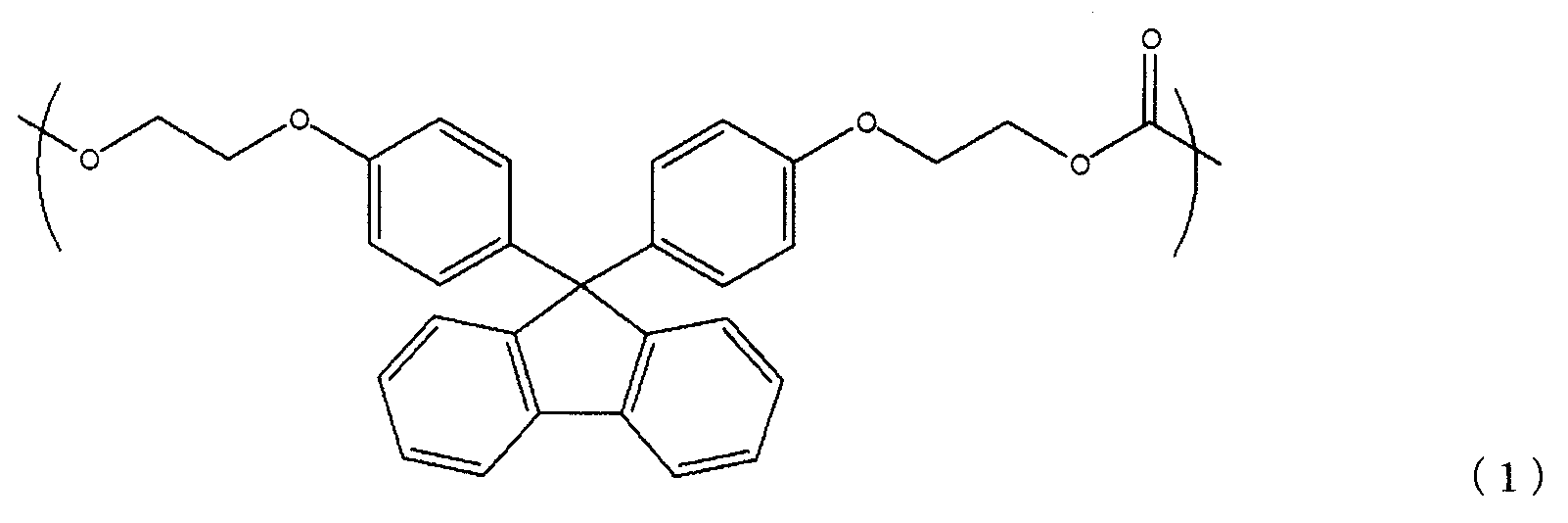

50 mol% ≦ (1) <70 mol%
30 mol% <(2) ≦ 50 mol%
Priority Applications (3)
| Application Number | Priority Date | Filing Date | Title |
|---|---|---|---|
| JP2017528388A JP6727200B2 (en) | 2015-07-13 | 2016-07-01 | Imaging lens |
| KR1020177031123A KR102607476B1 (en) | 2015-07-13 | 2016-07-01 | Imaging lens |
| CN201680026201.6A CN107533153B (en) | 2015-07-13 | 2016-07-01 | Image pickup lens |
Applications Claiming Priority (2)
| Application Number | Priority Date | Filing Date | Title |
|---|---|---|---|
| JP2015-139668 | 2015-07-13 | ||
| JP2015139668 | 2015-07-13 |
Publications (1)
| Publication Number | Publication Date |
|---|---|
| WO2017010318A1 true WO2017010318A1 (en) | 2017-01-19 |
Family
ID=57757121
Family Applications (1)
| Application Number | Title | Priority Date | Filing Date |
|---|---|---|---|
| PCT/JP2016/069649 Ceased WO2017010318A1 (en) | 2015-07-13 | 2016-07-01 | Imaging lens |
Country Status (5)
| Country | Link |
|---|---|
| JP (1) | JP6727200B2 (en) |
| KR (1) | KR102607476B1 (en) |
| CN (1) | CN107533153B (en) |
| TW (1) | TWI737621B (en) |
| WO (1) | WO2017010318A1 (en) |
Cited By (12)
| Publication number | Priority date | Publication date | Assignee | Title |
|---|---|---|---|---|
| WO2019049471A1 (en) * | 2017-09-06 | 2019-03-14 | 日本電産株式会社 | Lens |
| WO2019188702A1 (en) | 2018-03-30 | 2019-10-03 | 帝人株式会社 | Polycarbonate resin and optical member containing same |
| WO2020166408A1 (en) | 2019-02-13 | 2020-08-20 | 帝人株式会社 | Polycarbonate resin composition or copolymer, and optical film |
| KR20210124193A (en) * | 2019-02-08 | 2021-10-14 | 미츠비시 가스 가가쿠 가부시키가이샤 | Polycarbonate resin composition and optical lens using same |
| US11261294B2 (en) | 2017-08-30 | 2022-03-01 | Teijin Limited | Thermoplastic resin and optical member |
| JP2022070481A (en) * | 2020-10-27 | 2022-05-13 | 帝人株式会社 | Resin composition and molded article of the same |
| JP2022137821A (en) * | 2021-03-09 | 2022-09-22 | 帝人株式会社 | Resin composition and molded article of the same |
| JP2022187598A (en) * | 2021-06-08 | 2022-12-20 | 帝人株式会社 | Resin composition and molding thereof |
| US11566102B2 (en) | 2018-03-12 | 2023-01-31 | Teijin Limited | Polyester resin or polyester carbonate resin, and optical member using said resin |
| KR20240141324A (en) | 2022-03-25 | 2024-09-26 | 데이진 가부시키가이샤 | Thermoplastic resin and optical member comprising the same |
| WO2024225099A1 (en) * | 2023-04-25 | 2024-10-31 | 帝人株式会社 | Polycarbonate resin and optical member using said resin |
| US12281198B2 (en) | 2019-02-27 | 2025-04-22 | Teijin Limited | Thermoplastic resin and optical member |
Families Citing this family (1)
| Publication number | Priority date | Publication date | Assignee | Title |
|---|---|---|---|---|
| CN115916869A (en) * | 2020-06-30 | 2023-04-04 | 帝人株式会社 | Thermoplastic resin and optical part containing the thermoplastic resin |
Citations (6)
| Publication number | Priority date | Publication date | Assignee | Title |
|---|---|---|---|---|
| WO2008156186A1 (en) * | 2007-06-19 | 2008-12-24 | Teijin Chemicals Ltd. | Optical film |
| JP2009029879A (en) * | 2007-07-25 | 2009-02-12 | Toray Ind Inc | Optical resin and film containing the same |
| JP2010077249A (en) * | 2008-09-25 | 2010-04-08 | Teijin Chem Ltd | Film for light transmission layer |
| WO2010071079A1 (en) * | 2008-12-16 | 2010-06-24 | 帝人化成株式会社 | Optical film |
| JP2013164501A (en) * | 2012-02-10 | 2013-08-22 | Teijin Ltd | Optical film |
| WO2014021151A1 (en) * | 2012-07-31 | 2014-02-06 | 日東電工株式会社 | Method for manufacturing phase difference film |
Family Cites Families (12)
| Publication number | Priority date | Publication date | Assignee | Title |
|---|---|---|---|---|
| JPS6218501A (en) * | 1985-07-18 | 1987-01-27 | Teijin Chem Ltd | Optical formed article |
| JP3160209B2 (en) | 1996-01-30 | 2001-04-25 | 帝人株式会社 | Polycarbonate copolymer containing oxaspiroundecan group and process for producing the same |
| US5859685A (en) * | 1996-07-18 | 1999-01-12 | Innotech, Inc. | Achromatic ophthalmic lenses |
| JP4196326B2 (en) | 2002-06-12 | 2008-12-17 | 三菱瓦斯化学株式会社 | Polycarbonate copolymer |
| JP2004269719A (en) * | 2003-03-10 | 2004-09-30 | Teijin Chem Ltd | Molding material for plastic mirror and plastic mirror obtained by molding it |
| WO2007142149A1 (en) * | 2006-06-05 | 2007-12-13 | Mitsubishi Gas Chemical Company, Inc. | Optical lens |
| JP5217644B2 (en) | 2007-09-19 | 2013-06-19 | 三菱瓦斯化学株式会社 | Optical lens and manufacturing method thereof |
| JP5883204B2 (en) * | 2007-09-27 | 2016-03-09 | 帝人株式会社 | Method for producing surface protective film or sheet |
| JP2009161746A (en) * | 2007-12-12 | 2009-07-23 | Mitsubishi Chemicals Corp | Polycarbonate production method and polycarbonate molding |
| JP2011079898A (en) * | 2009-10-05 | 2011-04-21 | Teijin Chem Ltd | Polycarbonate resin with low photoelastic constant, and optical film |
| WO2011149073A1 (en) * | 2010-05-27 | 2011-12-01 | 三菱化学株式会社 | Polycarbonate resin and transparent film formed from same |
| US8816039B2 (en) * | 2010-11-12 | 2014-08-26 | Teijin Limited | Copolycarbonate |
-
2016
- 2016-07-01 WO PCT/JP2016/069649 patent/WO2017010318A1/en not_active Ceased
- 2016-07-01 JP JP2017528388A patent/JP6727200B2/en active Active
- 2016-07-01 KR KR1020177031123A patent/KR102607476B1/en active Active
- 2016-07-01 CN CN201680026201.6A patent/CN107533153B/en active Active
- 2016-07-11 TW TW105121772A patent/TWI737621B/en active
Patent Citations (6)
| Publication number | Priority date | Publication date | Assignee | Title |
|---|---|---|---|---|
| WO2008156186A1 (en) * | 2007-06-19 | 2008-12-24 | Teijin Chemicals Ltd. | Optical film |
| JP2009029879A (en) * | 2007-07-25 | 2009-02-12 | Toray Ind Inc | Optical resin and film containing the same |
| JP2010077249A (en) * | 2008-09-25 | 2010-04-08 | Teijin Chem Ltd | Film for light transmission layer |
| WO2010071079A1 (en) * | 2008-12-16 | 2010-06-24 | 帝人化成株式会社 | Optical film |
| JP2013164501A (en) * | 2012-02-10 | 2013-08-22 | Teijin Ltd | Optical film |
| WO2014021151A1 (en) * | 2012-07-31 | 2014-02-06 | 日東電工株式会社 | Method for manufacturing phase difference film |
Cited By (30)
| Publication number | Priority date | Publication date | Assignee | Title |
|---|---|---|---|---|
| US11261294B2 (en) | 2017-08-30 | 2022-03-01 | Teijin Limited | Thermoplastic resin and optical member |
| US12240944B2 (en) | 2017-08-30 | 2025-03-04 | Teijin Limited | Optical lens |
| WO2019049471A1 (en) * | 2017-09-06 | 2019-03-14 | 日本電産株式会社 | Lens |
| US11566102B2 (en) | 2018-03-12 | 2023-01-31 | Teijin Limited | Polyester resin or polyester carbonate resin, and optical member using said resin |
| US11578168B2 (en) | 2018-03-30 | 2023-02-14 | Teijin Limited | Polycarbonate resin and optical member containing same |
| KR102415801B1 (en) * | 2018-03-30 | 2022-06-30 | 데이진 가부시키가이샤 | Polycarbonate resin and optical member comprising same |
| WO2019188702A1 (en) | 2018-03-30 | 2019-10-03 | 帝人株式会社 | Polycarbonate resin and optical member containing same |
| KR20200062330A (en) | 2018-03-30 | 2020-06-03 | 데이진 가부시키가이샤 | Polycarbonate resin and optical member comprising same |
| EP3778699A4 (en) * | 2018-03-30 | 2021-02-17 | Teijin Limited | POLYCARBONATE RESIN AND OPTICAL ELEMENT CONTAINING IT |
| JPWO2019188702A1 (en) * | 2018-03-30 | 2020-10-22 | 帝人株式会社 | Polycarbonate resin and optical members containing it |
| JP7072637B2 (en) | 2018-03-30 | 2022-05-20 | 帝人株式会社 | Polycarbonate resin and optical members containing it |
| KR20210124193A (en) * | 2019-02-08 | 2021-10-14 | 미츠비시 가스 가가쿠 가부시키가이샤 | Polycarbonate resin composition and optical lens using same |
| US20220135738A1 (en) * | 2019-02-08 | 2022-05-05 | Mitsubishi Gas Chemical Company, Inc. | Polycarbonate resin composition and optical lens using this |
| TWI858011B (en) * | 2019-02-08 | 2024-10-11 | 日商三菱瓦斯化學股份有限公司 | Polycarbonate resin composition and optical lens using the same |
| KR102896267B1 (en) | 2019-02-08 | 2025-12-04 | 미츠비시 가스 가가쿠 가부시키가이샤 | Polycarbonate resin composition and optical lens using the same |
| TWI915950B (en) | 2019-02-08 | 2026-02-21 | 日商三菱瓦斯化學股份有限公司 | Polycarbonate resin composition and optical lenses using the same. |
| WO2020166408A1 (en) | 2019-02-13 | 2020-08-20 | 帝人株式会社 | Polycarbonate resin composition or copolymer, and optical film |
| JP7219291B2 (en) | 2019-02-13 | 2023-02-07 | 帝人株式会社 | POLYCARBONATE RESIN COMPOSITION OR COPOLYMER, AND OPTICAL FILM |
| KR20210124386A (en) | 2019-02-13 | 2021-10-14 | 데이진 가부시키가이샤 | Polycarbonate-based resin composition or copolymer, and optical film |
| JPWO2020166408A1 (en) * | 2019-02-13 | 2021-10-14 | 帝人株式会社 | Polycarbonate resin composition or copolymer, and optical film |
| US12195622B2 (en) | 2019-02-13 | 2025-01-14 | Teijin Limited | Polycarbonate resin composition or copolymer, and optical film |
| US12281198B2 (en) | 2019-02-27 | 2025-04-22 | Teijin Limited | Thermoplastic resin and optical member |
| JP2022070481A (en) * | 2020-10-27 | 2022-05-13 | 帝人株式会社 | Resin composition and molded article of the same |
| JP7582837B2 (en) | 2020-10-27 | 2024-11-13 | 帝人株式会社 | Resin composition and molded article thereof |
| JP2022137821A (en) * | 2021-03-09 | 2022-09-22 | 帝人株式会社 | Resin composition and molded article of the same |
| JP7658759B2 (en) | 2021-03-09 | 2025-04-08 | 帝人株式会社 | Resin composition and molded article thereof |
| JP7704578B2 (en) | 2021-06-08 | 2025-07-08 | 帝人株式会社 | Resin composition and molded article thereof |
| JP2022187598A (en) * | 2021-06-08 | 2022-12-20 | 帝人株式会社 | Resin composition and molding thereof |
| KR20240141324A (en) | 2022-03-25 | 2024-09-26 | 데이진 가부시키가이샤 | Thermoplastic resin and optical member comprising the same |
| WO2024225099A1 (en) * | 2023-04-25 | 2024-10-31 | 帝人株式会社 | Polycarbonate resin and optical member using said resin |
Also Published As
| Publication number | Publication date |
|---|---|
| KR102607476B1 (en) | 2023-11-28 |
| KR20180029952A (en) | 2018-03-21 |
| TW201716465A (en) | 2017-05-16 |
| JP6727200B2 (en) | 2020-07-22 |
| CN107533153A (en) | 2018-01-02 |
| CN107533153B (en) | 2021-02-19 |
| JPWO2017010318A1 (en) | 2018-02-22 |
| TWI737621B (en) | 2021-09-01 |
Similar Documents
| Publication | Publication Date | Title |
|---|---|---|
| JP6727200B2 (en) | Imaging lens | |
| JP5245824B2 (en) | Optical lens | |
| JP7040518B2 (en) | Polycarbonate resin composition and optical lens using it | |
| JP5332696B2 (en) | Polycarbonate resin composition and method for producing the same | |
| JP6916026B2 (en) | Thermoplastic resin | |
| CN111630109B (en) | Polycarbonate resin composition, method for producing same, and optical lens | |
| KR20170007321A (en) | Polycarbonate resin composition, and optical material and optical lens each manufactured using same | |
| JP2017082038A (en) | Polycarbonate resin and optical member | |
| JP5722554B2 (en) | Polycarbonate resin and optical molded body with high refractive index and excellent heat resistance | |
| JP2024026220A (en) | Thermoplastic resin and optical components containing it | |
| WO2010010703A1 (en) | Polycarbonate resin composition and optical material using the same | |
| JP2011236336A (en) | Polycarbonate resin having low photoelastic constant and optical molded article | |
| TW202342579A (en) | Thermoplastic resins and optical components containing them | |
| WO2022091780A1 (en) | Thermoplastic resin and optical member including same | |
| CN121013877A (en) | Polycarbonate resin and optical components using the resin | |
| JPWO2020080205A1 (en) | Thermoplastic resin composition and optical lens or film using it | |
| JP2017082040A (en) | Thermoplastic resin and optical member | |
| JP7750235B2 (en) | resin composition | |
| JP6599726B2 (en) | Polycarbonate resin composition and optical member | |
| JP6130255B2 (en) | Polyester carbonate copolymer | |
| JP2025119167A (en) | Polycarbonate resin and optical member using said resin | |
| JP2011079898A (en) | Polycarbonate resin with low photoelastic constant, and optical film | |
| JP2025119165A (en) | Polycarbonate resin and optical member using said resin | |
| WO2025164207A1 (en) | Polycarbonate resin and optical member using same | |
| JP6534793B2 (en) | Polycarbonate resin and optical film |
Legal Events
| Date | Code | Title | Description |
|---|---|---|---|
| 121 | Ep: the epo has been informed by wipo that ep was designated in this application |
Ref document number: 16824298 Country of ref document: EP Kind code of ref document: A1 |
|
| ENP | Entry into the national phase |
Ref document number: 2017528388 Country of ref document: JP Kind code of ref document: A |
|
| ENP | Entry into the national phase |
Ref document number: 20177031123 Country of ref document: KR Kind code of ref document: A |
|
| NENP | Non-entry into the national phase |
Ref country code: DE |
|
| 122 | Ep: pct application non-entry in european phase |
Ref document number: 16824298 Country of ref document: EP Kind code of ref document: A1 |