WO2017010364A1 - Composition de résine de sulfure de polyarylène et procédé pour réduire des substances adhérant à une filière à l'aide de celle-ci - Google Patents
Composition de résine de sulfure de polyarylène et procédé pour réduire des substances adhérant à une filière à l'aide de celle-ci Download PDFInfo
- Publication number
- WO2017010364A1 WO2017010364A1 PCT/JP2016/069984 JP2016069984W WO2017010364A1 WO 2017010364 A1 WO2017010364 A1 WO 2017010364A1 JP 2016069984 W JP2016069984 W JP 2016069984W WO 2017010364 A1 WO2017010364 A1 WO 2017010364A1
- Authority
- WO
- WIPO (PCT)
- Prior art keywords
- resin composition
- polyarylene sulfide
- sulfide resin
- antioxidant
- mold
- Prior art date
- Legal status (The legal status is an assumption and is not a legal conclusion. Google has not performed a legal analysis and makes no representation as to the accuracy of the status listed.)
- Ceased
Links
Images
Classifications
-
- B—PERFORMING OPERATIONS; TRANSPORTING
- B29—WORKING OF PLASTICS; WORKING OF SUBSTANCES IN A PLASTIC STATE IN GENERAL
- B29C—SHAPING OR JOINING OF PLASTICS; SHAPING OF MATERIAL IN A PLASTIC STATE, NOT OTHERWISE PROVIDED FOR; AFTER-TREATMENT OF THE SHAPED PRODUCTS, e.g. REPAIRING
- B29C45/00—Injection moulding, i.e. forcing the required volume of moulding material through a nozzle into a closed mould; Apparatus therefor
-
- B—PERFORMING OPERATIONS; TRANSPORTING
- B29—WORKING OF PLASTICS; WORKING OF SUBSTANCES IN A PLASTIC STATE IN GENERAL
- B29C—SHAPING OR JOINING OF PLASTICS; SHAPING OF MATERIAL IN A PLASTIC STATE, NOT OTHERWISE PROVIDED FOR; AFTER-TREATMENT OF THE SHAPED PRODUCTS, e.g. REPAIRING
- B29C45/00—Injection moulding, i.e. forcing the required volume of moulding material through a nozzle into a closed mould; Apparatus therefor
- B29C45/17—Component parts, details or accessories; Auxiliary operations
- B29C45/26—Moulds
- B29C45/34—Moulds having venting means
-
- C—CHEMISTRY; METALLURGY
- C08—ORGANIC MACROMOLECULAR COMPOUNDS; THEIR PREPARATION OR CHEMICAL WORKING-UP; COMPOSITIONS BASED THEREON
- C08J—WORKING-UP; GENERAL PROCESSES OF COMPOUNDING; AFTER-TREATMENT NOT COVERED BY SUBCLASSES C08B, C08C, C08F, C08G or C08H
- C08J5/00—Manufacture of articles or shaped materials containing macromolecular substances
-
- C—CHEMISTRY; METALLURGY
- C08—ORGANIC MACROMOLECULAR COMPOUNDS; THEIR PREPARATION OR CHEMICAL WORKING-UP; COMPOSITIONS BASED THEREON
- C08K—Use of inorganic or non-macromolecular organic substances as compounding ingredients
- C08K5/00—Use of organic ingredients
- C08K5/04—Oxygen-containing compounds
- C08K5/13—Phenols; Phenolates
-
- C—CHEMISTRY; METALLURGY
- C08—ORGANIC MACROMOLECULAR COMPOUNDS; THEIR PREPARATION OR CHEMICAL WORKING-UP; COMPOSITIONS BASED THEREON
- C08L—COMPOSITIONS OF MACROMOLECULAR COMPOUNDS
- C08L23/00—Compositions of homopolymers or copolymers of unsaturated aliphatic hydrocarbons having only one carbon-to-carbon double bond; Compositions of derivatives of such polymers
- C08L23/02—Compositions of homopolymers or copolymers of unsaturated aliphatic hydrocarbons having only one carbon-to-carbon double bond; Compositions of derivatives of such polymers not modified by chemical after-treatment
- C08L23/04—Homopolymers or copolymers of ethene
- C08L23/08—Copolymers of ethene
-
- C—CHEMISTRY; METALLURGY
- C08—ORGANIC MACROMOLECULAR COMPOUNDS; THEIR PREPARATION OR CHEMICAL WORKING-UP; COMPOSITIONS BASED THEREON
- C08L—COMPOSITIONS OF MACROMOLECULAR COMPOUNDS
- C08L81/00—Compositions of macromolecular compounds obtained by reactions forming in the main chain of the macromolecule a linkage containing sulfur with or without nitrogen, oxygen or carbon only; Compositions of polysulfones; Compositions of derivatives of such polymers
- C08L81/02—Polythioethers; Polythioether-ethers
Definitions
- the present invention relates to a polyarylene sulfide resin composition and a method for reducing mold deposits using the same.
- PAS resin Polyarylene sulfide (hereinafter also referred to as “PAS”) resin, represented by polyphenylene sulfide (hereinafter also referred to as “PPS”) resin, has high heat resistance, mechanical properties, chemical resistance, dimensional stability, and difficulty. Has flammability. For this reason, PAS resins are widely used in electrical / electronic equipment component materials, automotive equipment component materials, chemical equipment component materials, and the like. PAS resins are used in particular as materials for parts used at high ambient temperatures.
- compositions containing PAS resin have been proposed. Specifically, together with a PAS resin, a composition containing an olefin copolymer containing ⁇ -olefin and a glycidyl ester of ⁇ , ⁇ -unsaturated acid as main components (for example, Patent Document 1), together with the PAS resin, A composition containing an olefin copolymer of ethylene and an ⁇ -olefin having 5 or more carbon atoms is known (for example, Patent Document 2).
- thermoplastic elastomers such as the above olefin copolymers are likely to be thermally deteriorated at high temperatures. For this reason, when the resin composition described in Patent Documents 1 and 2 including a thermoplastic elastomer is used, a new problem arises that a large amount of mold deposit (MD) is likely to occur during molding.
- MD mold deposit
- patent document 3 it is said that the problem of mold deposit can be solved by said method.
- the reduction of mold deposit is confirmed in Patent Document 3 when the mold temperature is 80 ° C.
- the PAS resin composition described in Patent Document 3 is injection-molded at a high mold temperature of about 130 ° C. to 180 ° C., mold deposit at the gas vent is suppressed. Even if it was possible, it was found that mold deposits in the mold cavity were difficult to suppress.
- the present invention has been made to solve the above-mentioned problems, and its purpose is to perform injection molding at a high mold temperature in a range of 130 ° C. to 180 ° C., not only in a gas vent but also in a cavity.
- An object of the present invention is to provide a polyarylene sulfide resin composition capable of significantly reducing mold deposits during molding and a method for reducing mold deposits using the same.
- the inventors of the present invention have made extensive studies to solve the above problems. As a result, it has been found that the above-mentioned problems can be solved by a polyarylene sulfide resin composition containing a phenol-based antioxidant and not containing a thioether-based antioxidant and a phosphorus-based antioxidant as an antioxidant.
- the invention has been completed. More specifically, the present invention provides the following.
- the (C) antioxidant is a phenolic antioxidant.
- a polyarylene sulfide resin composition containing no thioether-based antioxidant and no phosphorus-based antioxidant.
- the (B) epoxy group-containing olefin copolymer is an olefin copolymer containing a structural unit derived from ⁇ -olefin and a structural unit derived from a glycidyl ester of ⁇ , ⁇ -unsaturated acid ( The polyarylene sulfide resin composition according to 1).
- the phenol-based antioxidant is bonded to two or more carbon atoms out of two carbon atoms in the ortho position and two carbon atoms in the meta position with respect to the carbon atom to which the phenolic hydroxyl group is bonded.
- the polyarylene sulfide resin composition according to (3) which has at least one structure to which a tert-butyl group is bonded.
- the phenolic antioxidant has at least one structure in which a tert-butyl group is bonded to both of the two carbon atoms in the ortho position with respect to the carbon atom to which the phenolic hydroxyl group is bonded.
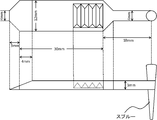
- a method for reducing mold deposits when injection molding a molding material using a mold having a cavity and a gas vent A reduction method using the polyarylene sulfide resin composition according to any one of (1) to (7) as the molding material.
- polyarylene sulfide can remarkably reduce mold deposits during molding not only in a gas vent but also in a cavity even when injection molding is performed at a high mold temperature in the range of 130 ° C. to 180 ° C. It is possible to provide a resin composition and a method for reducing mold deposits using the resin composition.
- the polyarylene sulfide resin composition according to the present invention comprises (A) a polyarylene sulfide resin, (B) an epoxy group-containing olefin copolymer, and (C) an antioxidant, and the (C) oxidation
- the inhibitor contains a phenolic antioxidant and does not contain a thioether antioxidant or a phosphorus antioxidant.
- resin composition when it describes with "resin composition” in this specification, unless there is particular description, it means the polyarylene sulfide resin composition which concerns on this invention.
- the resin composition according to the present invention can remarkably reduce mold deposits during molding not only in a gas vent but also in a cavity even when injection molding is performed at a high mold temperature in the range of 130 ° C. to 180 ° C. . Therefore, the obtained molded body is less likely to cause surface defects due to deposits on the cavity wall surface. Therefore, by using the resin composition according to the present invention, a high-quality molded product can be efficiently produced regardless of the mold temperature.
- the resin composition according to the present invention is particularly preferably used for injection molding at a mold temperature of 130 ° C. to 180 ° C. Moreover, since the deposits on the wall surface of the gas vent are reduced, the gas vent is not easily narrowed or clogged.
- the cavity refers to the entire space filled with the resin inside the mold.
- polyarylene sulfide resin A conventionally well-known polyarylene sulfide resin can be used.
- polyarylene sulfide resin polyphenylene sulfide (PPS) resin is preferable.
- PPS polyphenylene sulfide
- Polyarylene sulfide resin can be used individually by 1 type or in combination of 2 or more types.
- the melt viscosity of the polyarylene sulfide resin measured under the conditions of 310 ° C. and a shear rate of 1216 / sec is preferably 8 to 600 Pa ⁇ s.
- the melt viscosity is particularly preferably 8 to 300 Pa ⁇ s in that the balance between mechanical properties and fluidity is easy to be excellent.
- melt viscosity is not too low, it is easy to obtain the molded object which is sufficiently excellent in mechanical strength, and it is preferable.
- melt viscosity is not too high, the fluidity
- the (B) epoxy group-containing olefin copolymer (hereinafter also referred to as the component (B)) is not particularly limited.
- a component can be used individually by 1 type or in combination of 2 or more types. Since the resin composition contains the component (B), it is easy to obtain a molded article having excellent impact resistance.
- Examples of the component (B) include an olefin copolymer containing a structural unit derived from ⁇ -olefin and a structural unit derived from a glycidyl ester of ⁇ , ⁇ -unsaturated acid. Such an olefin copolymer may further contain a structural unit derived from a (meth) acrylic acid ester.
- (meth) acrylic acid ester is also referred to as (meth) acrylate.
- glycidyl (meth) acrylate is also referred to as glycidyl (meth) acrylate.
- (meth) acrylic acid” means both acrylic acid and methacrylic acid
- (meth) acrylate” means both acrylate and methacrylate.
- ⁇ -olefin is not particularly limited. Preferable examples include ethylene, propylene, butylene and the like. Ethylene is particularly preferred.
- the ⁇ -olefin can be used alone or in combination of two or more.
- component (B) contains a structural unit derived from ⁇ -olefin, flexibility is easily imparted to the resulting molded article. Improvement of the flexibility of the molded body by imparting flexibility contributes to improvement of impact resistance.
- the glycidyl ester of ⁇ , ⁇ -unsaturated acid is not particularly limited. Preferable examples include glycidyl acrylate, glycidyl methacrylate, and glycidyl ethacrylate. Particularly preferred is glycidyl methacrylate.
- the glycidyl esters of ⁇ , ⁇ -unsaturated acid can be used alone or in combination of two or more.
- the component (B) contains a structural unit derived from a glycidyl ester of an ⁇ , ⁇ -unsaturated acid, the component (B) is easily dispersed well in the resin composition. Good dispersibility of the component (B) is preferable in that it is easy to obtain a molded body with improved mechanical properties.
- (Meth) acrylic acid ester is not particularly limited. Preferable examples include acrylic acid esters such as methyl acrylate, ethyl acrylate, acrylate-n-propyl, isopropyl acrylate, acrylate-n-butyl, acrylate-n-hexyl, and acrylate-n-octyl.
- Methacrylic acid esters such as methyl methacrylate, ethyl methacrylate, methacrylic acid-n-propyl, isopropyl methacrylate, methacrylic acid-n-butyl, isobutyl methacrylate, methacrylic acid-n-amyl, and methacrylic acid-n-octyl; Is mentioned.
- methyl acrylate is particularly preferable.
- the (meth) acrylic acid ester can be used alone or in combination of two or more.
- Olefin copolymer containing a structural unit derived from ⁇ -olefin and a structural unit derived from a glycidyl ester of ⁇ , ⁇ -unsaturated acid, and an olefin copolymer containing a structural unit derived from (meth) acrylic acid ester The coalescence can be produced by performing copolymerization by a conventionally known method.
- the copolymer can be produced by carrying out copolymerization by a well-known radical polymerization reaction.
- the type of copolymer is not particularly limited, and may be, for example, a random copolymer or a block copolymer.
- the olefin copolymer examples include polymethyl methacrylate, polyethyl methacrylate, polymethyl acrylate, polyethyl acrylate, polybutyl acrylate, poly-2-ethylhexyl acrylate, polystyrene, polyacrylonitrile.
- An olefin-based graft copolymer in which acrylonitrile / styrene copolymer, butyl acrylate / styrene copolymer, and the like are chemically bonded in a branched or cross-linked structure may be used.
- the type of the copolymer may be one type or two or more types.
- a random copolymer and a block copolymer are preferable, 1 type, or 2 or more types of random copolymers, 1 type, or 2 or more types of block copolymers, or 1 type, or 2 or more types.
- a combination of the random copolymer and one or more block copolymers is more preferred.
- the olefin-based copolymer can contain structural units derived from other copolymerization components as long as the effects of the present invention are not impaired.
- examples of the component (B) include glycidyl methacrylate-modified ethylene copolymers and glycidyl ether-modified ethylene copolymers. Among these, a glycidyl methacrylate-modified ethylene copolymer is preferable.
- Examples of the glycidyl methacrylate-modified ethylene copolymer include glycidyl methacrylate graft-modified ethylene polymer, ethylene-glycidyl methacrylate copolymer, and ethylene-glycidyl methacrylate-methyl acrylate copolymer.
- an ethylene-glycidyl methacrylate copolymer and an ethylene-glycidyl methacrylate-methyl acrylate copolymer are preferred, and an ethylene-glycidyl methacrylate-methyl acrylate copolymer is preferable because a particularly excellent metal resin composite molded body can be obtained. Coalescence is particularly preferred.
- ethylene-glycidyl methacrylate copolymer and the ethylene-glycidyl methacrylate-methyl acrylate copolymer include “Bond First” (manufactured by Sumitomo Chemical Co., Ltd.).
- Examples of the glycidyl ether-modified ethylene copolymer include glycidyl ether graft-modified ethylene copolymer and glycidyl ether-ethylene copolymer.
- the content of the component (B) is preferably 0.5 to 50 parts by mass, more preferably 1 to 20 parts by mass, and further preferably 3 to 3 parts by mass with respect to 100 parts by mass of the (A) polyarylene sulfide resin. 15 parts by mass.
- the content is within the above range, the fluidity during molding of the resin composition is unlikely to decrease, and the impact resistance of the resulting molded article is unlikely to decrease.
- the antioxidant (C) (hereinafter also referred to as the component (C)) is not particularly limited as long as it contains a phenolic antioxidant and does not contain a thioether antioxidant or a phosphorus antioxidant.
- a component can be used individually by 1 type or in combination of 2 or more types. Thioether antioxidants and phosphorus antioxidants are highly effective as antioxidants. On the other hand, when the resin composition contains a thioether-based antioxidant or a phosphorus-based antioxidant, the thioether-based antioxidant or the phosphorus-based antioxidant itself causes mold deposit. I found it easy. This is probably because the heat resistance of the thioether antioxidant and the phosphorus antioxidant is lower than that of the phenol antioxidant.
- the phenolic antioxidant is a compound having in its molecular structure one or more phenyl groups substituted with a hydroxyl group, preferably one substituted with a hydroxyl group and an alkyl group. From the viewpoint of the effect of reducing mold deposits at the time of molding, the phenolic antioxidant is preferably a compound having a phenyl group substituted with a hydroxyl group and a tert-butyl group. Of these, compounds having two or more tert-butyl groups per phenolic hydroxyl group are preferred.
- the phenol-based antioxidant is preferably two or more carbons out of two carbon atoms in the ortho position and two carbon atoms in the meta position with respect to the carbon atom to which the phenolic hydroxyl group is bonded. More preferably, two or more carbon atoms including at least one of the two carbon atoms in the ortho position among the two carbon atoms in the ortho position and the two carbon atoms in the meta position Preferably, it has at least one structure in which a tert-butyl group is bonded to both of the two carbon atoms in the ortho position.
- phenolic antioxidant examples include 2,6-di-tert-butyl-p-cresol, stearyl- (3,5-dimethyl-4-hydroxybenzyl) thioglycolate, stearyl- ⁇ - (4- Hydroxy-3,5-di-tert-butylphenyl) propionate, distearyl-3,5-di-tert-butyl-4-hydroxybenzylphosphonate, distearyl (4-hydroxy-3-methyl-5-tert-butyl) ) Benzyl malonate, 2,2′-methylenebis (4-methyl-6-tert-butylphenol), 4,4′-methylenebis (2,6-di-tert-butylphenol), 2,2′-methylenebis [6- (1-methylcyclohexyl) -p-cresol], bis [3,3-bis (4-hydroxy-3- ert-butylphenyl) butyric acid] glycol ester, 4,4′-butylidenebis (6-
- the component (C) may contain an antioxidant other than the thioether antioxidant and the phosphorus antioxidant together with the phenol antioxidant as long as the object of the present invention is not impaired.
- the content of the phenolic antioxidant in the component (C) is not particularly limited as long as the object of the present invention is not impaired. Typically, 70 mass% or more is preferable with respect to the total mass of (C) component, 80 mass% or more is more preferable, 90 mass% or more is especially preferable, and 100 mass% is the most preferable.
- the content of the component (C) is preferably 0.05 to 5 parts by mass, more preferably 0.1 to 3 parts by mass with respect to 100 parts by mass of the (A) polyarylene sulfide resin. When the content is within the above range, it is easy to reduce the amount of mold deposits at the time of molding, and in particular, it is easy to reduce the amount of deposits on the wall surface of the cavity.
- the resin composition may include (D) an inorganic filler (hereinafter also referred to as (D) component).
- (D) component an inorganic filler
- the shape of the component (D) is not particularly limited.
- the shape of the component (D) may be fibrous, or may be non-fibrous such as spherical, powdery, plate-like, scale-like, and indefinite shape, and is preferably fibrous.
- Examples of the component (D) include glass fiber, spherical silica, and glass beads. In these, glass fiber is preferable.
- a component can be used individually by 1 type or in combination of 2 or more types.
- the content of the component (D) is preferably 5 to 300 parts by mass, more preferably 10 to 100 parts by mass with respect to 100 parts by mass of the (A) polyarylene sulfide resin.
- the content is within the above range, it is preferable in that the effect of adding the component (D) to the resin composition according to the present invention can be easily obtained while maintaining good fluidity at the time of molding.
- the resin composition is an epoxy group-free olefinic compound (ethylene-octene copolymer, etc.), a deburring agent, in order to impart desired physical properties within a range that does not greatly impair the effects of the present invention.
- a deburring agent in order to impart desired physical properties within a range that does not greatly impair the effects of the present invention.
- An agent or other resin may be contained.
- the manufacturing method of a resin composition will not be specifically limited if said essential or arbitrary component can be mixed uniformly, It can select suitably from the manufacturing method of a resin composition known conventionally. For example, after melt-kneading and extruding each component using a melt-kneading apparatus such as a single-screw or twin-screw extruder, the resulting resin composition is processed into a desired form such as powder, flakes, pellets, etc. Is mentioned.
- the method for reducing a deposit on a mold according to the present invention is a method for reducing a deposit on a mold when a molding material is injection-molded using a mold including a cavity and a gas vent.
- the molding material the aforementioned resin composition is used.
- the above-mentioned resin composition remarkably shows mold deposits during molding not only in the gas vent but also in the cavity even when injection molding is performed at a high mold temperature in the range of 130 ° C. to 180 ° C. Can be reduced. Therefore, according to the method for reducing deposits on the mold according to the present invention, even when injection molding is performed at a mold temperature in the range of 130 ° C. to 180 ° C., preferably in the range of 130 ° C. to 160 ° C., the gas vent and cavity Can reduce the total amount of deposits on the wall surface. In particular, the effect of reducing deposits on the wall surface of the cavity is high.
- the method for producing a molded body according to the present invention comprises a molding step of molding the above resin composition at a mold temperature of 130 to 180 ° C., preferably 130 to 160 ° C., using a mold having a cavity and a gas vent. Have. This molding process is continuously repeated 1000 times or more.
- the mold temperature is low (for example, 80 ° C.)
- crystallization of the polyarylene sulfide resin composition is difficult to proceed.
- the mold deposit is mainly derived from the gas at the time of molding, so that it is difficult to adhere to the cavity and to the gas vent.
- the mold temperature is 130 ° C.
- the polyarylene sulfide resin composition tends to stick to the cavity and mold deposits that adhere to the cavity tend to occur.
- the above-mentioned resin composition remarkably shows mold deposits during molding not only in the gas vent but also in the cavity even when injection molding is performed at a high mold temperature in the range of 130 ° C. to 180 ° C. Can be reduced. Therefore, in the method for producing a molded body according to the present invention, even when long-term continuous molding is performed, problems caused by deposits on the wall surface of the cavity are less likely to occur on the surface of the obtained molded body. Therefore, according to the manufacturing method of the molded object which concerns on this invention, a high quality molded object can be manufactured efficiently over a long period of time.
- Epoxy group-containing olefin copolymer ((B )component) B-1 Ethylene-glycidyl methacrylate copolymer, Bond First 2C (product name), glycidyl methacrylate-derived constituent unit content: 6% by mass, manufactured by Sumitomo Chemical Co., Ltd.
- B-2 Ethylene-glycidyl methacrylate copolymer A copolymer obtained by graft-polymerizing 30 parts by mass of methyl methacrylate / butyl acrylate copolymer to 70 parts by mass, Modiper A4300 (product name), Content of structural units derived from glycidyl methacrylate in the ethylene-glycidyl methacrylate copolymer: 15 Mass%, manufactured by NOF Corporation B-3: ethylene-glycidyl methacrylate-methyl acrylate copolymer, Bond First 7L (product name), glycidyl methacrylate-derived constituent unit content: 3 mass%, derived from methyl acrylate Constituent unit content: 27 Amount%, manufactured by Sumitomo Chemical Co., Ltd.
- B-4 Ethylene-glycidyl methacrylate-methyl acrylate copolymer, Bondfast 7M (product name), content of structural unit derived from glycidyl methacrylate: 6 mass%, derived from methyl acrylate Constituent unit content of: 27% by mass, manufactured by Sumitomo Chemical Co., Ltd., antioxidant (component (C))
- C-1 Triethylene glycol-bis [3- (3-tert-butyl-5-methyl-4-hydroxyphenyl) propionate], IRGANOX 245 (product name), manufactured by BASF Japan Ltd.
- C-2 Tetrakis [ Methylene-3- (3,5-di-tert-butyl-4-hydroxyphenyl) propionate] methane, IRGANOX 1010 (product name), manufactured by BASF Japan Ltd.
- C-3 Bis (2,6-di-tert -Butyl-4-methylphenyl) pentaerythritol diphosphite, ADEKA STAB PEP36 (product name), manufactured by ADEKA Corporation
- C-4 tetrakis [methylene-3- (dodecylthio) propionate] methane, ADEKA STAB AO-412S (product name) ), Manufactured by ADEKA Corporation, inorganic filler (component (D))
- D-1 Glass fiber (chopped strand), T-747 (product name), manufactured by Nippon Electric Glass Co., Ltd.
- D-2 Calcium carbonate, Whiten P-30 (product name), manufactured by Toyo Fine Chemical Co., Ltd. Average particle diameter (50% d
- melt viscosity Using a Capillograph manufactured by Toyo Seiki Co., Ltd., a melt viscosity at a barrel temperature of 310 ° C. and a shear rate of 1216 / sec was measured using a 1 mm ⁇ ⁇ 20 mmL / flat die as a capillary.
Landscapes
- Chemical & Material Sciences (AREA)
- Health & Medical Sciences (AREA)
- Chemical Kinetics & Catalysis (AREA)
- Medicinal Chemistry (AREA)
- Polymers & Plastics (AREA)
- Organic Chemistry (AREA)
- Engineering & Computer Science (AREA)
- Manufacturing & Machinery (AREA)
- Mechanical Engineering (AREA)
- Materials Engineering (AREA)
- Injection Moulding Of Plastics Or The Like (AREA)
- Compositions Of Macromolecular Compounds (AREA)
- Moulds For Moulding Plastics Or The Like (AREA)
Abstract
L'invention concerne une composition de résine de sulfure de polyarylène qui permet une réduction significative dans les substances adhérant à une filière pendant un moulage non seulement dans un évent à gaz mais également dans une cavité même lorsque le moulage par injection est effectué à une température de filière élevée à l'intérieur de la plage de 130 à 180 °C, et un procédé de réduction des substances adhérant à la filière à l'aide de la composition de résine de sulfure de polyarylène. La composition de résine de sulfure de polyarylène de l'invention contient (A) une résine de sulfure de polyarylène, (B) un copolymère d'oléfine contenant des groupes époxy, et (C) un antioxydant dans lequel l'antioxydant (C) contient un antioxydant à base de phénol, et ne contient pas d'antioxydant à base de thioéther ou à base de phosphore.
Applications Claiming Priority (2)
| Application Number | Priority Date | Filing Date | Title |
|---|---|---|---|
| JP2015-138843 | 2015-07-10 | ||
| JP2015138843 | 2015-07-10 |
Publications (1)
| Publication Number | Publication Date |
|---|---|
| WO2017010364A1 true WO2017010364A1 (fr) | 2017-01-19 |
Family
ID=57757433
Family Applications (1)
| Application Number | Title | Priority Date | Filing Date |
|---|---|---|---|
| PCT/JP2016/069984 Ceased WO2017010364A1 (fr) | 2015-07-10 | 2016-07-06 | Composition de résine de sulfure de polyarylène et procédé pour réduire des substances adhérant à une filière à l'aide de celle-ci |
Country Status (1)
| Country | Link |
|---|---|
| WO (1) | WO2017010364A1 (fr) |
Cited By (8)
| Publication number | Priority date | Publication date | Assignee | Title |
|---|---|---|---|---|
| WO2017110807A1 (fr) * | 2015-12-25 | 2017-06-29 | ポリプラスチックス株式会社 | Composition de résine à base de poly(sulfure d'arylène) et article moulé par insertion |
| JP2017149816A (ja) * | 2016-02-23 | 2017-08-31 | 帝人株式会社 | 樹脂組成物 |
| US10450461B2 (en) | 2015-12-11 | 2019-10-22 | Ticona Llc | Crosslinkable polyarylene sulfide composition |
| US10590273B2 (en) | 2015-12-11 | 2020-03-17 | Ticona Llc | Polyarylene sulfide composition |
| CN111051436A (zh) * | 2017-08-31 | 2020-04-21 | 宝理塑料株式会社 | 树脂组合物、成型品和其制造方法 |
| US11383491B2 (en) | 2016-03-24 | 2022-07-12 | Ticona Llc | Composite structure |
| JPWO2023223738A1 (fr) * | 2022-05-17 | 2023-11-23 | ||
| JP2024095272A (ja) * | 2022-12-28 | 2024-07-10 | 住友重機械工業株式会社 | 金型装置内の堆積物予測装置及び、射出成形機 |
Citations (10)
| Publication number | Priority date | Publication date | Assignee | Title |
|---|---|---|---|---|
| JPH0368656A (ja) * | 1989-08-08 | 1991-03-25 | Toray Ind Inc | ポリフェニレンスルフィド組成物 |
| JPH04332735A (ja) * | 1991-05-08 | 1992-11-19 | Toray Ind Inc | ブロー中空成形品 |
| JPH07157661A (ja) * | 1993-10-21 | 1995-06-20 | Solvay & Cie | 衝撃強度を改良したポリフェニレンスルフィドベースの組成物及びその製造方法 |
| JPH10279802A (ja) * | 1997-04-08 | 1998-10-20 | Polyplastics Co | ポリアリーレンサルファイド樹脂組成物 |
| JPH11100506A (ja) * | 1997-09-29 | 1999-04-13 | Polyplastics Co | ポリアリーレンサルファイド樹脂組成物の製造方法 |
| JP2002226706A (ja) * | 2001-01-31 | 2002-08-14 | Toray Ind Inc | ポリフェニレンスルフィド樹脂組成物 |
| JP2002226707A (ja) * | 2001-01-31 | 2002-08-14 | Toyoda Gosei Co Ltd | 燃料系部品 |
| JP2002226604A (ja) * | 2001-01-31 | 2002-08-14 | Toyoda Gosei Co Ltd | 樹脂成形体 |
| JP2008202781A (ja) * | 2007-01-24 | 2008-09-04 | Nsk Ltd | 転がり軸受 |
| JP2011173946A (ja) * | 2010-02-23 | 2011-09-08 | Toray Ind Inc | ポリフェニレンサルファイド樹脂組成物および成形体 |
-
2016
- 2016-07-06 WO PCT/JP2016/069984 patent/WO2017010364A1/fr not_active Ceased
Patent Citations (10)
| Publication number | Priority date | Publication date | Assignee | Title |
|---|---|---|---|---|
| JPH0368656A (ja) * | 1989-08-08 | 1991-03-25 | Toray Ind Inc | ポリフェニレンスルフィド組成物 |
| JPH04332735A (ja) * | 1991-05-08 | 1992-11-19 | Toray Ind Inc | ブロー中空成形品 |
| JPH07157661A (ja) * | 1993-10-21 | 1995-06-20 | Solvay & Cie | 衝撃強度を改良したポリフェニレンスルフィドベースの組成物及びその製造方法 |
| JPH10279802A (ja) * | 1997-04-08 | 1998-10-20 | Polyplastics Co | ポリアリーレンサルファイド樹脂組成物 |
| JPH11100506A (ja) * | 1997-09-29 | 1999-04-13 | Polyplastics Co | ポリアリーレンサルファイド樹脂組成物の製造方法 |
| JP2002226706A (ja) * | 2001-01-31 | 2002-08-14 | Toray Ind Inc | ポリフェニレンスルフィド樹脂組成物 |
| JP2002226707A (ja) * | 2001-01-31 | 2002-08-14 | Toyoda Gosei Co Ltd | 燃料系部品 |
| JP2002226604A (ja) * | 2001-01-31 | 2002-08-14 | Toyoda Gosei Co Ltd | 樹脂成形体 |
| JP2008202781A (ja) * | 2007-01-24 | 2008-09-04 | Nsk Ltd | 転がり軸受 |
| JP2011173946A (ja) * | 2010-02-23 | 2011-09-08 | Toray Ind Inc | ポリフェニレンサルファイド樹脂組成物および成形体 |
Cited By (13)
| Publication number | Priority date | Publication date | Assignee | Title |
|---|---|---|---|---|
| US10450461B2 (en) | 2015-12-11 | 2019-10-22 | Ticona Llc | Crosslinkable polyarylene sulfide composition |
| US10590273B2 (en) | 2015-12-11 | 2020-03-17 | Ticona Llc | Polyarylene sulfide composition |
| US10927255B2 (en) | 2015-12-25 | 2021-02-23 | Polyplastics Co., Ltd. | Polyarylene sulfide resin composition and insert molded article |
| JPWO2017110807A1 (ja) * | 2015-12-25 | 2018-05-31 | ポリプラスチックス株式会社 | ポリアリーレンサルファイド系樹脂組成物及びインサート成形品 |
| WO2017110807A1 (fr) * | 2015-12-25 | 2017-06-29 | ポリプラスチックス株式会社 | Composition de résine à base de poly(sulfure d'arylène) et article moulé par insertion |
| JP2017149816A (ja) * | 2016-02-23 | 2017-08-31 | 帝人株式会社 | 樹脂組成物 |
| US11383491B2 (en) | 2016-03-24 | 2022-07-12 | Ticona Llc | Composite structure |
| US11919273B2 (en) | 2016-03-24 | 2024-03-05 | Ticona Llc | Composite structure |
| CN111051436A (zh) * | 2017-08-31 | 2020-04-21 | 宝理塑料株式会社 | 树脂组合物、成型品和其制造方法 |
| CN111051436B (zh) * | 2017-08-31 | 2022-07-08 | 宝理塑料株式会社 | 树脂组合物、成型品和其制造方法 |
| JPWO2023223738A1 (fr) * | 2022-05-17 | 2023-11-23 | ||
| WO2023223738A1 (fr) * | 2022-05-17 | 2023-11-23 | ポリプラスチックス株式会社 | Procédé de production d'une composition de résine thermoplastique, procédé de détermination de l'aptitude au moulage d'une composition de résine thermoplastique, et composition de résine thermoplastique pour moulage à une température qui n'est pas inférieure à la température de décomposition d'un élastomère |
| JP2024095272A (ja) * | 2022-12-28 | 2024-07-10 | 住友重機械工業株式会社 | 金型装置内の堆積物予測装置及び、射出成形機 |
Similar Documents
| Publication | Publication Date | Title |
|---|---|---|
| WO2017010364A1 (fr) | Composition de résine de sulfure de polyarylène et procédé pour réduire des substances adhérant à une filière à l'aide de celle-ci | |
| JP5711148B2 (ja) | ポリアリーレンサルファイド系樹脂組成物及びインサート成形品 | |
| JP5916972B2 (ja) | ポリアリーレンサルファイド系樹脂組成物及びインサート成形体 | |
| CN104736636B (zh) | 聚碳酸酯树脂组合物 | |
| JP3892114B2 (ja) | ポリアリーレンサルファイド樹脂成形品とポリカーボネートフィルムとの複合成形品 | |
| CN103665817B (zh) | 一种高抗冲聚碳酸酯复合材料及其制备方法 | |
| CN111154246B (zh) | 玻璃纤维增强聚碳酸酯组合物及其制备方法和用途 | |
| JP2019183156A (ja) | ポリアリーレンサルファイド樹脂組成物及びインサート成形品 | |
| JP2020109135A (ja) | ポリアリーレンサルファイド系樹脂組成物及びインサート成形品 | |
| JP6392998B2 (ja) | ポリアリーレンサルファイド系樹脂組成物及びインサート成形品 | |
| CN108026369A (zh) | 树脂组合物和抑制脂组合物的弯曲断裂应变降低的方法 | |
| KR102247303B1 (ko) | 낮은 유전 상수 및 고강성을 갖는 열가소성 조성물 및 이에 따른 성형품 | |
| KR100725940B1 (ko) | 폴리메틸메타크릴레이트 수지 조성물 | |
| JP6387211B1 (ja) | ポリアリーレンサルファイド樹脂組成物 | |
| JP5786817B2 (ja) | 押出成形用熱伝導性樹脂組成物及びそれを用いた熱伝導性樹脂押出成形品 | |
| JP2004204170A (ja) | ポリブチレンテレフタレート樹脂組成物及び成形品 | |
| JP2007204615A (ja) | 箱形形状を有する成形品用ポリアリーレンサルファイド樹脂組成物及び箱形形状を有する成形品 | |
| JP6186898B2 (ja) | ポリアリーレンスルフィド樹脂組成物 | |
| JP6576132B2 (ja) | 管状流路形成用ポリアリーレンサルファイド樹脂組成物及びそれを用いた成形体 | |
| JP6374290B2 (ja) | ガラス繊維強化ポリカーボネート樹脂組成物 | |
| CN111363356B (zh) | 一种pps复合材料及其制备方法和应用 | |
| WO2023223738A1 (fr) | Procédé de production d'une composition de résine thermoplastique, procédé de détermination de l'aptitude au moulage d'une composition de résine thermoplastique, et composition de résine thermoplastique pour moulage à une température qui n'est pas inférieure à la température de décomposition d'un élastomère | |
| WO2005054369A1 (fr) | Composition de resine de sulfure de polyarylene | |
| JP6652332B2 (ja) | ガラス繊維強化ポリカーボネート樹脂組成物 | |
| JPS62151452A (ja) | ポリエ−テルケトン樹脂組成物 |
Legal Events
| Date | Code | Title | Description |
|---|---|---|---|
| 121 | Ep: the epo has been informed by wipo that ep was designated in this application |
Ref document number: 16824344 Country of ref document: EP Kind code of ref document: A1 |
|
| NENP | Non-entry into the national phase |
Ref country code: DE |
|
| NENP | Non-entry into the national phase |
Ref country code: JP |
|
| 122 | Ep: pct application non-entry in european phase |
Ref document number: 16824344 Country of ref document: EP Kind code of ref document: A1 |