WO2017014112A1 - Dispositif de commande d'évitement de collision pour véhicule, et procédé de commande d'évitement de collision - Google Patents
Dispositif de commande d'évitement de collision pour véhicule, et procédé de commande d'évitement de collision Download PDFInfo
- Publication number
- WO2017014112A1 WO2017014112A1 PCT/JP2016/070614 JP2016070614W WO2017014112A1 WO 2017014112 A1 WO2017014112 A1 WO 2017014112A1 JP 2016070614 W JP2016070614 W JP 2016070614W WO 2017014112 A1 WO2017014112 A1 WO 2017014112A1
- Authority
- WO
- WIPO (PCT)
- Prior art keywords
- deceleration
- vehicle
- collision avoidance
- ecu
- control
- Prior art date
- Legal status (The legal status is an assumption and is not a legal conclusion. Google has not performed a legal analysis and makes no representation as to the accuracy of the status listed.)
- Ceased
Links
Images

Classifications
-
- B—PERFORMING OPERATIONS; TRANSPORTING
- B60—VEHICLES IN GENERAL
- B60R—VEHICLES, VEHICLE FITTINGS, OR VEHICLE PARTS, NOT OTHERWISE PROVIDED FOR
- B60R21/00—Arrangements or fittings on vehicles for protecting or preventing injuries to occupants or pedestrians in case of accidents or other traffic risks
-
- B—PERFORMING OPERATIONS; TRANSPORTING
- B60—VEHICLES IN GENERAL
- B60T—VEHICLE BRAKE CONTROL SYSTEMS OR PARTS THEREOF; BRAKE CONTROL SYSTEMS OR PARTS THEREOF, IN GENERAL; ARRANGEMENT OF BRAKING ELEMENTS ON VEHICLES IN GENERAL; PORTABLE DEVICES FOR PREVENTING UNWANTED MOVEMENT OF VEHICLES; VEHICLE MODIFICATIONS TO FACILITATE COOLING OF BRAKES
- B60T7/00—Brake-action initiating means
- B60T7/12—Brake-action initiating means for automatic initiation; for initiation not subject to will of driver or passenger
-
- B—PERFORMING OPERATIONS; TRANSPORTING
- B60—VEHICLES IN GENERAL
- B60W—CONJOINT CONTROL OF VEHICLE SUB-UNITS OF DIFFERENT TYPE OR DIFFERENT FUNCTION; CONTROL SYSTEMS SPECIALLY ADAPTED FOR HYBRID VEHICLES; ROAD VEHICLE DRIVE CONTROL SYSTEMS FOR PURPOSES NOT RELATED TO THE CONTROL OF A PARTICULAR SUB-UNIT
- B60W30/00—Purposes of road vehicle drive control systems not related to the control of a particular sub-unit, e.g. of systems using conjoint control of vehicle sub-units
- B60W30/08—Active safety systems predicting or avoiding probable or impending collision or attempting to minimise its consequences
- B60W30/09—Taking automatic action to avoid collision, e.g. braking and steering
-
- G—PHYSICS
- G08—SIGNALLING
- G08G—TRAFFIC CONTROL SYSTEMS
- G08G1/00—Traffic control systems for road vehicles
- G08G1/16—Anti-collision systems
Definitions
- the present invention relates to a vehicle collision avoidance control device and a collision avoidance control method.
- Patent Document 1 a collision avoidance control device for a vehicle that performs control for avoiding a collision with an obstacle ahead based on data acquired during traveling is known.
- one of the problems of the present invention is to obtain a vehicle collision avoidance control apparatus that can more smoothly execute a transition from vehicle behavior different from collision avoidance to collision avoidance, for example.
- the vehicle collision avoidance control apparatus includes, for example, a determination unit that determines whether or not to execute collision avoidance control with an obstacle ahead based on data acquired during traveling, and When the execution of the collision avoidance control is determined by the vehicle behavior control unit that controls at least one of the drive device and the brake device and the determination unit so that a behavior different from the collision avoidance with an object occurs, a predetermined period of time
- a braking control unit that controls at least a brake device so that the vehicle decelerates at a second deceleration larger than the first deceleration after the vehicle decelerates at the first deceleration at
- the control unit is configured to avoid the collision by the determination unit while the vehicle behavior control unit controls at least one of the drive device and the brake device so that the vehicle decelerates at the third deceleration. If the execution is determined, the vehicle decelerates at the second deceleration after the vehicle decelerates at a large one of the first deceleration and the third deceleration during the predetermined period.
- the vehicle deceleration After the vehicle is decelerating at the third deceleration in a vehicle behavior different from collision avoidance, the vehicle decelerates to the first deceleration of collision avoidance that is smaller than the third deceleration, and then from the first deceleration Change to the second deceleration for avoiding large collisions, the deceleration changes rapidly and frequently from the third to the first and from the first to the second.
- the vehicle deceleration is set to the larger one of the first deceleration and the third deceleration, and then changes to the second deceleration.
- the change in deceleration becomes smoother.
- the vehicle behavior control unit determines that the third deceleration is In a state larger than the first deceleration, the vehicle is controlled to decelerate at the third deceleration. Therefore, according to the vehicle collision avoidance control apparatus, for example, even when the third deceleration decreases with the passage of time, the vehicle collision avoidance is reduced when the vehicle behavior is changed from collision avoidance to collision avoidance. The speed change becomes smoother.
- the computer determines whether or not to execute collision avoidance control with an obstacle ahead based on data acquired during traveling, and the collision
- the execution of the avoidance control is determined, at least the brake device so that the vehicle decelerates at the second deceleration larger than the first deceleration after the vehicle decelerates at the first deceleration for a predetermined period.
- the collision avoidance is performed in a state where at least one of the drive device and the brake device is controlled so that the vehicle decelerates at the third deceleration in a vehicle behavior different from the avoidance of the collision with the obstacle.
- the vehicle decelerates at the second deceleration after the vehicle decelerates at a large one of the first deceleration and the third deceleration during the predetermined period.
- the brake device At least the brake device.
- the vehicle After the vehicle is decelerating at the third deceleration in a vehicle behavior different from collision avoidance, the vehicle decelerates to the first deceleration of collision avoidance that is smaller than the third deceleration, and then from the first deceleration Change to the second deceleration for avoiding large collisions, the deceleration changes rapidly and frequently from the third to the first and from the first to the second.
- the collision avoidance control method for a vehicle since the larger one of the first deceleration and the third deceleration is selected and then changed to the second deceleration, it is different from the collision avoidance.
- the change in deceleration becomes smoother.
- FIG. 1 is an exemplary schematic diagram of a vehicle on which the collision avoidance control device for a vehicle according to the embodiment is mounted.
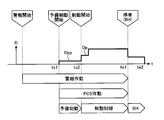
- FIG. 2 is an exemplary explanatory diagram illustrating transition of the control state by the vehicle collision avoidance control device of the embodiment.
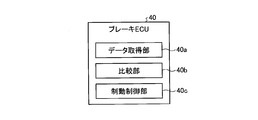
- FIG. 3 is an exemplary schematic block diagram of a brake ECU included in the collision avoidance control device for a vehicle according to the embodiment.
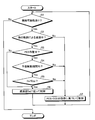
- FIG. 4 is an exemplary flowchart of control by the vehicle collision avoidance control device of the embodiment.
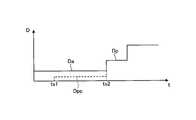
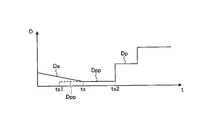
- FIG. 5 is a graph showing an example of a change over time in the deceleration of the vehicle when the vehicle behavior is different from the collision avoidance to the collision avoidance in the vehicle collision avoidance control apparatus of the embodiment.
- FIG. 6 is a graph showing another example of the change over time in the deceleration of the vehicle when the vehicle behavior is different from the collision avoidance to the collision avoidance in the vehicle collision avoidance control apparatus of the embodiment.
- each part of the vehicle 100 is controlled to avoid a collision with an obstacle ahead while the vehicle 100 is traveling forward is illustrated.
- FIG. 1 is an exemplary and schematic configuration diagram of the vehicle 100.
- the vehicle 100 includes an engine 51, a motor generator 62 (M / G), a brake device 41, and the like.
- Engine 51 and motor generator 62 cause acceleration of vehicle 100. Therefore, the engine 51 and the motor generator 62 can also be referred to as drive sources or drive devices.
- the vehicle 100 only needs to be equipped with at least one of the engine 51 and the motor generator 62 as a drive source. Further, the acceleration of the vehicle 100 is an increase over time of the speed toward the front of the vehicle 100 (time differentiation), and the deceleration of the vehicle 100 is a decrease over time of the speed toward the front of the vehicle 100 (time differentiation). ).
- the acceleration is also a negative deceleration
- the deceleration is also a negative acceleration. That is, the acceleration increases when the braking force or deceleration by the brake device 41 decreases, and the deceleration increases when the driving force or acceleration by the engine 51 or the motor generator 62 decreases.
- the vehicle 100 includes a PCS-ECU 10 (pre-crash safety electronic control unit).
- the PCS-ECU 10 detects that there is an obstacle ahead of the vehicle 100 based on the data acquired during traveling, the PCS-ECU 10 determines whether or not there is a possibility of a collision with the obstacle.
- the brake ECU 41 that controls the brake device 41, the engine 51, the motor generator 62, etc.
- the engine ECU 50 the M / GECU 60 (motor generator ECU), etc.
- the PCS-ECU 10 is an example of a determination unit.
- the PCS-ECU 10 instructs to control the acceleration or deceleration of the vehicle 100, that is, the driving force or the braking force, but the PCS-ECU 10 further instructs to control the steering of the vehicle 100. May be.
- the PCS-ECU 10 includes a control unit such as a CPU (central processing unit) and a controller, and a storage unit such as a ROM (read only memory), a RAM (random access memory), and a flash memory.
- the storage unit can store a program for operating the PCS-ECU 10, data used for arithmetic processing of the PCS-ECU 10, and the like.
- the vehicle 100 is equipped with a distance measuring device 21 and a camera 22.
- the distance measuring device 21 and the camera 22 are an example of an obstacle detection unit.
- the distance measuring device 21 is a device that wirelessly measures the distance to the obstacle without contact, and is, for example, a radar device or a sonar device.
- the PCS-ECU 10 acquires data indicating the distance from the obstacle from the distance measuring device 21.
- the data indicating the distance may be numerical data indicating the distance itself, or may be data having a value corresponding to the distance.
- the camera 22 is a digital camera incorporating an image sensor such as a CCD (charge coupled device) or a CIS (CMOS image sensor).
- the camera 22 can output moving image data at a predetermined frame rate.
- the PCS-ECU 10 may acquire data indicating an image captured by the camera 22 and acquire the distance to the obstacle using the image data.
- PCS-ECU 10 receives data indicating detection results from the various sensors from various sensors mounted on vehicle 100.
- the sensor mounted on the vehicle 100 may include a sensor that indicates a detection result of the state of the vehicle 100.
- Sensors indicating the detection result of the state of the vehicle 100 are, for example, a vehicle speed sensor, an acceleration sensor, a gyro sensor, and the like.
- the sensor mounted on the vehicle 100 may include a sensor that indicates a detection result of an operation amount or an operation request amount in an operation unit operated by a driver.
- the operation unit by the driver is, for example, an accelerator pedal, a brake pedal, a brake handle, a steering wheel, a switch, or the like.
- the sensor mounted on the vehicle 100 may include a sensor that indicates the detection result of the state of each device mounted on the vehicle 100.
- Devices mounted on the vehicle 100 are, for example, a brake device 41, an engine 51, a motor generator 62, an inverter 61 (IV), a steering system, a suspension system, and the like.
- the physical quantities detected by various sensors mounted on the vehicle 100 are, for example, distance, displacement, speed, acceleration, rotational speed, angle, angular velocity, angular acceleration, and the like.
- the PCS-ECU 10 may be input with numerical data indicating each physical quantity itself, or may be input with data corresponding to the magnitude of each physical quantity.
- the data input to the PCS-ECU 10 may be digital data, analog data such as non-numerical potentials, or data corresponding to on / off and stages instead of physical values. There may be.
- the PCS-ECU 10 calculates a predicted time to collide with an obstacle ahead, that is, TTC (time to collision) when performing collision avoidance control.
- TTC time to collision
- the TTC may be calculated in consideration of the relative acceleration of the obstacle, the deceleration of the vehicle 100, and the like. For example, the PCS-ECU 10 can determine that there is a possibility of a collision when the TTC is equal to or less than a predetermined value.
- the PCS-ECU 10 calculates the acceleration or deceleration of the vehicle 100 when performing collision avoidance control.
- the PCS-ECU 10 is an example of a collision avoidance control unit, and is also an example of a first collision avoidance control unit.
- the brake ECU 40 controls the brake device 41 so that the acceleration or deceleration set by the PCS-ECU 10 can be obtained.
- the brake ECU 40 is an example of a braking control unit.
- the engine ECU 50 controls the engine 51 so that the acceleration or deceleration set by the PCS-ECU 10 can be obtained.
- the M / GECU 60 controls the inverter 61 so that the motor generator 62 operates so that the acceleration or deceleration set by the PCS-ECU 10 can be obtained.
- the brake ECU 40 can control the stop lamp 42 provided at the rear end of the vehicle 100 to light up.
- the lighting of the stop lamp 42 can be an alarm display for the surroundings of the vehicle 100, for example, the following vehicle.
- meter ECU70 can control the meter 71 provided in the instrument panel etc. so that a warning display may be output.
- the display output of the meter 71 can be an alarm display for the driver and passengers in the passenger compartment.
- the stop lamp 42 and the meter 71 can also be referred to as an alarm output device, an output device, an alarm device, a display output device, or the like.
- an audio output can be output from an audio output device (not shown).
- the audio output device is, for example, a speaker or a buzzer, and can also be called an alarm output device, an output device, an alarm device, or the like.
- the ACC (adaptive cruise control) -ECU 31 is, for example, a drive device, that is, the engine 51 or the motor generator 62, the brake ECU 40 that controls the brake device 41, the engine ECU 50, and the M so that the vehicle 100 travels at a set speed. / GECU 60 can be instructed. Further, for example, the ACC-ECU 31 controls the drive device and the brake device 41 so as to realize automatic traveling and automatic tracking to follow the vehicle traveling ahead while maintaining the inter-vehicle distance with the vehicle traveling forward.
- the brake ECU 40, the engine ECU 50, the M / GECU 60, and the like may be instructed.
- the ACC-ECU 31 is an example of a vehicle behavior control unit that controls each part of the vehicle 100 so that a vehicle behavior different from the collision avoidance by the PCS-ECU 10 occurs.
- FIG. 1 the connection between the ACC-ECU 31 and the engine ECU 50, the M / GECU 60, or the like is not shown.
- IPA (intelligent parking assist) -ECU 32 constitutes a parking assistance system.
- the IPA-ECU 32 controls a steering device (not shown) so that the vehicle 100 moves to a target position (parking position) along a predetermined route, and drives and a brake device 41 so that the speed of the vehicle 100 is maintained. Can be instructed to the brake ECU 40, the engine ECU 50, the M / GECU 60, and the like.
- the IPA-ECU 32 is also an example of a vehicle behavior control unit. In FIG. 1, the connection between the IPA-ECU 32 and the engine ECU 50, the M / GECU 60, etc. is not shown.
- ICS-ECU 33 constitutes a second collision prevention system.
- the ICS-ECU 33 controls a display or a speaker (not shown) so that a warning by display or sound is output when approaching an obstacle, and the obstacle is detected within a predetermined distance.
- the operation of the driving device is restricted by an instruction to the engine ECU 50, the M / GECU 60, etc. to suppress the movement of the vehicle 100, and an obstacle is detected within a predetermined distance during the movement of the vehicle 100. Instructs the brake ECU 40 that controls the brake device 41 to prevent a collision with the obstacle.
- the ICS-ECU 33 is also an example of a vehicle behavior control unit.
- the ICS-ECU 33 is also an example of a second collision avoidance control unit.
- the PCS-ECU 10, ACC-ECU 31, IPA-ECU 32, ICS-ECU 33, and brake ECU 40 are included in the collision avoidance control device.
- FIG. 1 the connection between the ICS-ECU 33 and the engine ECU 50, the M / GECU 60, etc. is not shown.
- FIG. 2 shows an example of the transition of the control state in the automatic collision avoidance control when the driver does not perform the brake operation.
- the horizontal axis represents time t and the vertical axis represents deceleration D.
- the vertical axis in FIG. 2 is the required deceleration value.
- the PCS-ECU 10 calculates TTC at predetermined time intervals based on data acquired while the vehicle 100 is traveling, and starts collision avoidance control or performs collision avoidance control according to this TTC value. To the next stage, or the collision avoidance control is terminated. That is, the PCS-ECU 10 monitors the situation related to collision avoidance based on the TTC.
- the PCS-ECU 10 starts an alarm operation by the meter 71 or a speaker.
- the PCS-ECU 10 instructs the brake ECU 40 to start preliminary braking. Specifically, the PCS-ECU 10 transmits an instruction signal to the brake ECU 40 so that the stop lamp 42 is lit. Further, for example, the PCS-ECU 10 instructs the brake ECU 40 to obtain the minimum necessary deceleration (braking force) accompanying the lighting of the stop lamp 42, and the brake ECU 40 controls the brake device 41 based on the instruction. .
- the main purpose of the preliminary braking is to turn on the stop lamp 42, but a required deceleration that makes the driver of the rear vehicle aware of the deceleration operation may be obtained.
- the PCS-ECU 10 instructs the brake ECU 40 to start braking control for the purpose of avoiding a collision. Specifically, the PCS-ECU 10 instructs the brake ECU 40 to change the speed of the vehicle 100 at a required deceleration, that is, to obtain a required braking force, and the brake ECU 40 determines a brake device based on the instruction. 41 is controlled. In the braking control, the deceleration (braking force) may increase stepwise. The deceleration in the braking control is larger than the deceleration in the preliminary braking.
- the PCS-ECU 10 instructs the brake ECU 40 to maintain the stopped state for a predetermined period, and the brake ECU 40 controls the brake device 41 based on the instruction. To do.
- This operation can also be referred to as a brake hold (BH).
- the PCS-ECU 10 can end the above-described collision avoidance control by an operation of an accelerator pedal or a steering wheel by the driver, that is, an acceleration request operation, a steering operation, or the like.
- FIG. 2 shows a change with time of the deceleration D in a state where the vehicle 100 is not controlled to decelerate in a vehicle behavior different from the collision avoidance control.
- the collision avoidance control is started, that is, the collision avoidance.
- control different from FIG. 2 is executed so that the deceleration changes more smoothly.
- a processing unit for changing the deceleration more smoothly is mounted on the brake ECU 40.
- FIG. 3 shows an example of the brake ECU 40.
- the brake ECU 40 can execute processing according to the installed and loaded program to realize each function. That is, by executing the process according to the program, the brake ECU 40 can function as the data acquisition unit 40a, the comparison unit 40b, the braking control unit 40c, and the like. Note that at least some of the functions of the above-described units may be realized by hardware.
- the data acquisition unit 40a can acquire data used for braking control.
- the data used for the braking control includes data indicating the deceleration obtained from the PCS-ECU 10, ACC-ECU 31, IPA-ECU 32, ICS-ECU 33, and the like.
- the comparison unit 40b executes the preliminary braking when the vehicle 100 is decelerated in the vehicle behavior different from the collision avoidance control by the PCS-ECU 10 before the start of the preliminary braking, that is, before the time ts1 in FIG. 2, that is, the data indicating the deceleration obtained from the PCS-ECU 10 and the ACC-ECU 31, IPA-ECU 32, or ICS-ECU 33 during the period (predetermined period) from time ts1 to time ts2 in FIG. Compared with the data indicating the measured deceleration.
- the braking control unit 40c performs the above-described preliminary braking, braking control, and brake hold in the PCS operation of FIG. 2, that is, collision avoidance control. Further, the braking control unit 40c executes braking in a vehicle behavior different from the collision avoidance control, that is, in ACC, IPA, or ICS. Note that the control for causing the vehicle behavior different from the collision avoidance control may be simply referred to as other control hereinafter.
- FIG. 4 shows an example of a braking control procedure according to this embodiment.
- the flow shown in FIG. 4 is executed at predetermined time intervals.
- the PCS-ECU 10 determines that there is a possibility of a collision based on the TTC, specifically, for example, when the TTC is equal to or less than a predetermined value (Yes in S1), the vehicle is different from the collision avoidance control.
- the vehicle is not decelerating in the behavior, that is, ACC, IPA, ICS, that is, when other control is not being executed, when the vehicle 100 is controlled to travel at a constant speed by another control, or other
- the control is executed based on an instruction from the PCS-ECU 10 (S7).
- the comparison by the comparison unit 40b in FIG. 3 is performed. That is, the comparison unit 40b compares the deceleration Dpp of preliminary braking by the PCS-ECU 10 with the deceleration Da by other control (S5).
- the braking control unit 40c controls the brake device 41 so that the vehicle 100 decelerates according to the deceleration Da, that is, at the deceleration Da. (S6).
- the deceleration Da is an example of a third deceleration
- the deceleration Dpp is an example of a first deceleration.
- FIG. 5 shows a case where it is determined that there is a possibility of a collision when the vehicle 100 is controlled to decelerate at the deceleration Da by other control, and when Da> Dpp.
- the change in speed over time is shown.
- the deceleration D of the vehicle 100 shifts from the deceleration Da in the other control to the deceleration Dp in the braking control without shifting to the deceleration Dpp in the preliminary braking. Therefore, compared with the case where the deceleration D of the vehicle 100 decreases from Da to Dpp and further increases to Dp, the frequency of change of the deceleration D is lower and the range of change of the deceleration D is smaller.
- the deceleration Dp is an example of a second deceleration.
- FIG. 6 shows an example different from FIG. 5 when it is determined that there is a possibility of collision when the vehicle 100 is controlled to decelerate at the deceleration Da by other control.
- Da Dpp at time tx.
- the deceleration D of the vehicle 100 becomes the deceleration Da in other control, and after time tx, the deceleration in the collision avoidance control by the PCS-ECU 10
- the speeds Dpp and Dp are obtained. Therefore, for example, compared with a case where the deceleration D of the vehicle 100 decreases from Da to Dpp at time ts1, a sudden change in the deceleration D is suppressed.
- the deceleration D is the deceleration Da (third deceleration) by other control and the deceleration Dpp (first deceleration) in the preliminary braking of the collision avoidance control.
- the speed changes to the deceleration Dp (second deceleration) in the braking control of the collision avoidance control. Therefore, when the vehicle behavior is different from the collision avoidance, the deceleration D is changed. Changes more smoothly.
- the deceleration D is changed from the deceleration Da to the preliminary braking. Since the transition to the deceleration Dpp is performed without a step, the transition of the deceleration D becomes smoother when shifting from the vehicle behavior different from the collision avoidance to the collision avoidance.
- SYMBOLS 10 ... PCS-ECU (determination part), 31 ... ACC-ECU (vehicle behavior control part), 32 ... IPA-ECU (vehicle behavior control part), 33 ... ICS-ECU (vehicle behavior control part), 40 ... Brake ECU (Braking control part), 41 ... brake device, 51 ... engine (drive device), 62 ... motor generator (drive device), 100 ... vehicle.
Landscapes
- Engineering & Computer Science (AREA)
- Mechanical Engineering (AREA)
- Transportation (AREA)
- Physics & Mathematics (AREA)
- General Physics & Mathematics (AREA)
- Automation & Control Theory (AREA)
- Control Of Driving Devices And Active Controlling Of Vehicle (AREA)
- Regulating Braking Force (AREA)
- Traffic Control Systems (AREA)
Abstract
Dans le dispositif de commande d'évitement de collision pour véhicule de l'invention, dans le cas où l'exécution d'une commande d'évitement de collision est jugée par une partie jugement, dans des conditions telles qu'une partie commande de comportement de véhicule commande un dispositif d'entraînement et/ou un dispositif de frein de sorte que le véhicule décélère selon une troisième vitesse, une partie commande de freinage commande au moins un dispositif de frein de sorte que le véhicule décélère selon une vitesse de décélération importante parmi une première vitesse de décélération et la troisième vitesse de décélération pendant une durée prédéfinie, puis décélère selon une seconde vitesse de décélération supérieure à la première vitesse de décélération.
Applications Claiming Priority (2)
| Application Number | Priority Date | Filing Date | Title |
|---|---|---|---|
| JP2015143477A JP2017024494A (ja) | 2015-07-17 | 2015-07-17 | 車両の衝突回避制御装置および衝突回避制御方法 |
| JP2015-143477 | 2015-07-17 |
Publications (1)
| Publication Number | Publication Date |
|---|---|
| WO2017014112A1 true WO2017014112A1 (fr) | 2017-01-26 |
Family
ID=57834888
Family Applications (1)
| Application Number | Title | Priority Date | Filing Date |
|---|---|---|---|
| PCT/JP2016/070614 Ceased WO2017014112A1 (fr) | 2015-07-17 | 2016-07-12 | Dispositif de commande d'évitement de collision pour véhicule, et procédé de commande d'évitement de collision |
Country Status (2)
| Country | Link |
|---|---|
| JP (1) | JP2017024494A (fr) |
| WO (1) | WO2017014112A1 (fr) |
Cited By (3)
| Publication number | Priority date | Publication date | Assignee | Title |
|---|---|---|---|---|
| CN108032858A (zh) * | 2017-11-30 | 2018-05-15 | 广州小鹏汽车科技有限公司 | 基于旁车行驶路径预测的自适应巡航控制方法及系统 |
| CN110304060A (zh) * | 2018-03-20 | 2019-10-08 | 本田技研工业株式会社 | 车辆控制装置以及车辆控制方法 |
| CN112046473A (zh) * | 2020-09-22 | 2020-12-08 | 北京信息科技大学 | 用于自动驾驶的装置和方法 |
Families Citing this family (1)
| Publication number | Priority date | Publication date | Assignee | Title |
|---|---|---|---|---|
| JP7116427B2 (ja) * | 2018-05-10 | 2022-08-10 | 本田技研工業株式会社 | 駐車支援装置及び自動駐車可能な車両 |
Citations (2)
| Publication number | Priority date | Publication date | Assignee | Title |
|---|---|---|---|---|
| JP2008296887A (ja) * | 2007-06-04 | 2008-12-11 | Denso Corp | 車両制御装置 |
| JP2015027846A (ja) * | 2013-07-30 | 2015-02-12 | トヨタ自動車株式会社 | 車両制御装置 |
-
2015
- 2015-07-17 JP JP2015143477A patent/JP2017024494A/ja active Pending
-
2016
- 2016-07-12 WO PCT/JP2016/070614 patent/WO2017014112A1/fr not_active Ceased
Patent Citations (2)
| Publication number | Priority date | Publication date | Assignee | Title |
|---|---|---|---|---|
| JP2008296887A (ja) * | 2007-06-04 | 2008-12-11 | Denso Corp | 車両制御装置 |
| JP2015027846A (ja) * | 2013-07-30 | 2015-02-12 | トヨタ自動車株式会社 | 車両制御装置 |
Cited By (4)
| Publication number | Priority date | Publication date | Assignee | Title |
|---|---|---|---|---|
| CN108032858A (zh) * | 2017-11-30 | 2018-05-15 | 广州小鹏汽车科技有限公司 | 基于旁车行驶路径预测的自适应巡航控制方法及系统 |
| CN108032858B (zh) * | 2017-11-30 | 2020-06-12 | 广州小鹏汽车科技有限公司 | 基于旁车行驶路径预测的自适应巡航控制方法及系统 |
| CN110304060A (zh) * | 2018-03-20 | 2019-10-08 | 本田技研工业株式会社 | 车辆控制装置以及车辆控制方法 |
| CN112046473A (zh) * | 2020-09-22 | 2020-12-08 | 北京信息科技大学 | 用于自动驾驶的装置和方法 |
Also Published As
| Publication number | Publication date |
|---|---|
| JP2017024494A (ja) | 2017-02-02 |
Similar Documents
| Publication | Publication Date | Title |
|---|---|---|
| JP6347448B2 (ja) | 車両の衝突回避制御装置および衝突回避制御方法 | |
| US11008020B2 (en) | Method and device for controlling a warning module | |
| JP5577460B2 (ja) | 走行制御装置 | |
| CN105835819B (zh) | 车辆制动控制装置 | |
| US10611349B2 (en) | Vehicular collision avoidance control device and vehicular collision avoidance control method | |
| JP4412356B2 (ja) | 車両用衝突緩和装置 | |
| JP6611085B2 (ja) | 車両制御装置 | |
| JP6547394B2 (ja) | 車両用制動制御装置 | |
| JP2008296887A (ja) | 車両制御装置 | |
| JP6347447B2 (ja) | 車両の衝突回避制御装置および衝突回避制御方法 | |
| WO2017014112A1 (fr) | Dispositif de commande d'évitement de collision pour véhicule, et procédé de commande d'évitement de collision | |
| WO2016084968A1 (fr) | Dispositif anticollision | |
| JP6365141B2 (ja) | 車両制御装置 | |
| CN116096615A (zh) | 用以及时触发自动紧急制动操作并控制车辆的纵向运动的方法和装置 | |
| JP7268464B2 (ja) | 車両制御装置 | |
| JP2023138401A5 (fr) | ||
| RU2828924C1 (ru) | Способ и устройство для своевременного инициирования процесса автоматического аварийного торможения и управления продольным движением транспортного средства | |
| WO2017014114A1 (fr) | Dispositif de commande anticollision et procédé de commande anticollision | |
| JP7254420B2 (ja) | 追従走行制御装置 | |
| JP2024126319A (ja) | 走行制御装置および走行制御装置用のプログラム | |
| JP2015137575A (ja) | 車両用制御装置 |
Legal Events
| Date | Code | Title | Description |
|---|---|---|---|
| 121 | Ep: the epo has been informed by wipo that ep was designated in this application |
Ref document number: 16827672 Country of ref document: EP Kind code of ref document: A1 |
|
| NENP | Non-entry into the national phase |
Ref country code: DE |
|
| 122 | Ep: pct application non-entry in european phase |
Ref document number: 16827672 Country of ref document: EP Kind code of ref document: A1 |