WO2017018104A1 - Appareil d'ébavurage permettant de maintenir verticalement une pièce de travail et système de traitement de matériau plan - Google Patents
Appareil d'ébavurage permettant de maintenir verticalement une pièce de travail et système de traitement de matériau plan Download PDFInfo
- Publication number
- WO2017018104A1 WO2017018104A1 PCT/JP2016/068546 JP2016068546W WO2017018104A1 WO 2017018104 A1 WO2017018104 A1 WO 2017018104A1 JP 2016068546 W JP2016068546 W JP 2016068546W WO 2017018104 A1 WO2017018104 A1 WO 2017018104A1
- Authority
- WO
- WIPO (PCT)
- Prior art keywords
- workpiece
- deburring
- brush
- rotating
- laser processing
- Prior art date
- Legal status (The legal status is an assumption and is not a legal conclusion. Google has not performed a legal analysis and makes no representation as to the accuracy of the status listed.)
- Ceased
Links
Images




Classifications
-
- B—PERFORMING OPERATIONS; TRANSPORTING
- B24—GRINDING; POLISHING
- B24B—MACHINES, DEVICES, OR PROCESSES FOR GRINDING OR POLISHING; DRESSING OR CONDITIONING OF ABRADING SURFACES; FEEDING OF GRINDING, POLISHING, OR LAPPING AGENTS
- B24B9/00—Machines or devices designed for grinding edges or bevels on work or for removing burrs; Accessories therefor
-
- B—PERFORMING OPERATIONS; TRANSPORTING
- B24—GRINDING; POLISHING
- B24B—MACHINES, DEVICES, OR PROCESSES FOR GRINDING OR POLISHING; DRESSING OR CONDITIONING OF ABRADING SURFACES; FEEDING OF GRINDING, POLISHING, OR LAPPING AGENTS
- B24B29/00—Machines or devices for polishing surfaces on work by means of tools made of soft or flexible material with or without the application of solid or liquid polishing agents
-
- B—PERFORMING OPERATIONS; TRANSPORTING
- B24—GRINDING; POLISHING
- B24B—MACHINES, DEVICES, OR PROCESSES FOR GRINDING OR POLISHING; DRESSING OR CONDITIONING OF ABRADING SURFACES; FEEDING OF GRINDING, POLISHING, OR LAPPING AGENTS
- B24B41/00—Component parts such as frames, beds, carriages, headstocks
- B24B41/06—Work supports, e.g. adjustable steadies
Definitions
- the present invention relates to a deburring device that deburrs a plate-like workpiece processed by a plate processing machine such as a laser processing machine, and a plate processing system including the deburring device. More specifically, the present invention relates to a deburring device that performs deburring by holding a workpiece in a vertical state, and a plate material processing system that performs laser machining and bending processing while holding the workpiece in a vertical state.
- Patent Document 1 The configuration described in Patent Document 1 is a configuration in which a rotating brush for deburring a plate-like workpiece conveyed by the conveyance belt is provided at a position above a conveyance belt that can be moved horizontally so as to be movable up and down. .
- the conveyor belt has a plurality of suction holes in order to suck and hold the work placed on the transport surface.
- the rotating brush has a brush such as an elongated strip-shaped sandpaper extending in the radial direction at an appropriate interval in the circumferential direction on the outer peripheral surface of the disc-shaped brush body. I have.
- the rotating brush has a configuration in which a plurality of the brush bodies are stacked in an inclined state with respect to the rotation axis of the rotating brush.
- a conveyance belt that adsorbs and conveys a plate-like workpiece in a vertical state, and a plurality of adsorption holes for adsorbing the workpiece are provided on a vertical conveyance surface;
- a deburring device comprising a rotating brush for deburring the work, which is provided so as to be movable in a direction approaching and separating from the conveyor belt.
- the suction holes are provided closer to the upper side than to the lower side of the transport surface.
- the deburring device further includes a belt guide provided on a lower side of the conveyor belt for guiding a lower end edge of the conveyor belt.
- the deburring device includes a detection light irradiation unit configured to irradiate detection light on one side of the rotation region of the rotary brush, and the rotation region in order to detect the working diameter of the rotation brush. It further comprises a light receiving portion for receiving the detection light transmitted through the rotation region on the side.
- a laser processing machine that performs laser processing while holding a plate-shaped workpiece in a vertical state, and a bending work that holds a workpiece processed by the laser processing machine in a vertical state.
- a bending apparatus to be performed a workpiece conveying apparatus that conveys a workpiece in a vertical state from the laser processing machine to the bending apparatus, and between the laser processing machine and the workpiece conveying apparatus, or the workpiece conveying apparatus.
- a deburring device provided between the bending device and the bending device for performing deburring while holding the workpiece in a vertical state.
- a laser processing machine that holds a workpiece in a vertical state and performs laser processing
- a workpiece transfer device that holds and transfers a workpiece in a vertical state
- a bending machine that holds a workpiece in a vertical state and performs bending processing
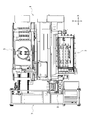
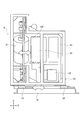
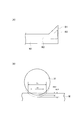
- FIG. 1 is a perspective view conceptually and schematically showing a deburring device according to an embodiment of the present invention. It is a side view of the deburring apparatus which concerns on embodiment of this invention. It is a perspective view which shows the conveyance belt in the deburring apparatus which concerns on embodiment of this invention. It is explanatory drawing of the board thickness and burr
- the plate material processing system 1 includes a vertical laser processing machine 3 that holds a plate-shaped workpiece (not shown in FIG. 1) vertically and performs laser processing, as shown in a plan view in FIG.
- a bending device 5 that performs bending while holding the workpiece in a vertical state is disposed downstream of the workpiece conveyance direction in which the workpiece processed by the vertical laser beam machine 3 is conveyed.
- a workpiece transfer device 7 is provided to transfer the workpiece from the vertical laser beam machine 3 to the bending device 5 while holding the workpiece vertically.
- a laser processing machine that performs laser processing while holding a plate-shaped workpiece vertically and a processing machine that performs workpiece punching are described in, for example, Japanese Patent Application Laid-Open Nos. 6-246474 and 8-111261. As shown, the configuration is already known.
- a bending apparatus that performs bending while holding a workpiece vertically has a known configuration as described in, for example, the above-mentioned Japanese Patent Application Laid-Open Nos. 8-121261 and 4102480. Therefore, the detailed description about the structure of the said vertical laser beam machine 3 and the bending apparatus 5 is abbreviate
- the plate material processing system including the vertical laser processing machine 3 and the bending device 5
- the plate material processing that holds the workpiece processed by the vertical laser processing machine 3 vertically and conveys it to the bending machine 5.
- the system has a known configuration as described in, for example, Japanese Patent Application Laid-Open No. 2013-112491. Therefore, the detailed description of the workpiece transfer device 7 is omitted.
- the vertical laser processing machine 3 performs laser processing while holding a plate-like workpiece vertically. Then, the workpiece processed by laser processing is held vertically by the workpiece transfer device 7 and transferred to the bending device 5 so that the workpiece can be held vertically and bent.
- the deburring device described in Patent Document 1 Japanese Patent Laid-Open No. 2009-131945
- the deburring device described in Patent Document 1 is a plate-shaped workpiece. It is the structure which deburrs by hold
- the deburring apparatus is configured to be able to perform deburring while holding a plate-like workpiece vertically.
- the deburring apparatus 9 is arrange
- the deburring device 9 may be disposed between the workpiece conveying device 7 and the bending device 5 because the workpiece needs to be deburred before being bent by the bending machine 5. It is also possible to do.
- the deburring device 9 includes a base frame 11.
- a fixed frame 13 is erected on the base frame 11.
- the fixed frame 13 is provided with an endless conveyance belt 15 having a vertical conveyance surface that adsorbs and conveys a plate-like workpiece (processing workpiece) W in a vertical state.
- the conveyor belt 15 is separated in the X-axis direction, which is the conveying direction of the workpiece W, and is provided with a rotating shaft 17 ⁇ / b> A that is vertically and rotatably provided on the fixed frame 13. 17B (the mounting state of the rotating shafts 17A and 17B with respect to the fixed frame 13 is not shown).
- the conveyor belt 15 is vertically held and guided by a plurality of guide members 19 provided perpendicular to the fixed frame 13.
- a suction box 23 having an opening on the vertical transport surface side of the transport belt 15 is disposed.
- the suction box 23 is supported by the fixed frame 13, and a suction unit (not shown) such as a suction blower is connected to the suction box 23.
- the conveyor belt 15 is provided with a plurality of suction holes 25 made up of small holes for sucking the workpiece W.
- a belt guide 27 for guiding the lower edge of the conveyor belt 15 is provided below the conveyor belt 15.
- the belt guide 27 has a function of guiding and supporting the lower end edge of the conveyor belt 15 and a function of supporting the workpiece W when the workpiece W falls from the suction surface (conveyance surface) of the conveyor belt 15. Further, in order to prevent the workpiece W from falling down away from the transport belt 15 when being sucked and transported by the transport belt 15, the suction hole 25 has an upper side than the lower side of the transport belt 15. It is prepared to be dense.
- the conveyor belt motor 29 such as a servo motor for driving the conveyor belt 15 is rotated and the suction blower is driven, the workpiece W is placed on the vertical conveyor surface of the conveyor belt 15. Adsorbed in a vertical state and can be conveyed in the X-axis direction.
- the rotary brush 31 is provided so as to be movable and adjustable in the Y-axis direction, which is a direction of approaching and moving away from the conveyor belt 15.
- the base frame 11 is provided with a guide member 33 (see FIG. 3) in the Y-axis direction.
- a moving frame 35 is supported on the guide member 33 so as to be movable in the Y-axis direction. Yes.
- the moving brush 35 is rotatably provided with the rotating brush 31. Therefore, the moving frame 35 can also be called a brush frame.
- a pair of the rotating brushes 31 are provided to face the vertical conveying surface 15F of the conveying belt 15.
- the pair of rotating brushes 31 ⁇ / b> A and 31 ⁇ / b> B are arranged on the same vertical plane parallel to the conveyance surface 15 ⁇ / b> F of the conveyance belt 15.
- the rotary shafts 37 of the rotary brushes 31 ⁇ / b> A and 31 ⁇ / b> B are inclined so that the upper side is directed to the upstream side, which is the loading direction of the workpiece W.
- the upper end side and the lower end side of the rotating shaft 37 are rotatably supported by bearings 39 attached to the moving frame 35.
- the pulleys 41 provided at the lower ends of the rotary shafts 37 are linked to the brush motors 43 attached to the moving frame (brush frame) 35, respectively.
- the rotating brush 31A located on the upstream side in the conveying direction of the workpiece W is rotated so as to feed the workpiece W, and the rotating brush 31B located on the downstream side is rotated in the reverse direction. Accordingly, the dust generated when the rotating brushes 31A and 31B come into contact with the workpiece W to be deburred is prevented from being scattered in the direction between the rotating brushes 31A and 31B and to the outside.
- the brush depth with respect to the surface of the workpiece W that is, the workpiece, corresponding to the plate thickness and material of the workpiece W
- the penetration depth of the rotating brush (the deburring depth and the working depth of the rotating brush) with respect to the W processed surface (cut surface) is adjustable. That is, the approach distances of the rotary brushes 31A and 31B with respect to the transport surface 15F of the transport belt 15 are configured to be controllable according to the plate thickness and material of the workpiece W.
- a frame moving positioning device is provided in order to control the position of the moving frame 35 in the Y-axis direction.
- a frame moving positioning device As a configuration for moving and positioning the moving frame 35 in the Y-axis direction, for example, a ball screw mechanism (not shown) is provided.
- a frame moving motor (not shown in FIGS. 2 and 3) including a servo motor is provided.
- the rotating brushes 31A and 31B provided in the moving frame 35 can be moved and positioned in the Y-axis direction.
- the moving positions of the rotary brushes 31A and 31B from the reference position in the Y-axis direction can be detected by a rotary encoder serving as a position detector provided in the frame moving motor. Therefore, by controlling the rotation of the frame moving motor, the distance between the conveying surface 15F of the conveying belt 15 and the rotating brushes 31A and 31B can be controlled to a desired distance.
- the brush depths BD1 and BD2 at which the rotating brush 31 acts on the workpiece W are adjusted in accordance with the height of the burr, that is, the plate thickness of the workpiece.
- the machining times T1 and T2 during which the rotary brush 31 is acting on the workpiece W are adjusted according to the plate thickness of the workpiece.
- the processing time during which the rotary brush 31 is acting on the workpiece W can be adjusted, and deburring can be performed more reliably. It can be carried out.
- the configuration of the rotary brush 31 is the same as the configuration of the rotary brush described in Patent Document 1 and is publicly known, but in order to facilitate understanding, the configuration of the rotary brush 31 will be schematically described.
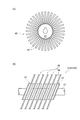
- the rotating brush 31 includes a disc-like brush body 45 as shown in FIG.
- the brush body 45 is provided with a disk 47 for attaching to the rotating shaft 37 of the rotating brush 31, and the outer peripheral surface of the disk 47 includes a plurality of strips such as an elongated strip-shaped sandpaper extending in the radial direction.
- Brushes (abrasives) 49 are provided at equal intervals in the circumferential direction.
- the rotating brush 31 is configured by integrally attaching a plurality of brush bodies 45 to the rotating shaft 37 of the rotating brush 31 in an inclined state. . Therefore, when the rotating shaft 37 is rotated, each brush body 45 is rotated while maintaining a state inclined with respect to the rotating shaft 37, and the brush 49 acts on the workpiece to deburr the workpiece. Done.
- a brush diameter detector 51 In order to detect the diameters of the rotating brushes 31A and 31B, a brush diameter detector 51 (see FIG. 7) is provided.
- the brush diameter detection unit 51 optically detects the brush diameter.
- one side of the rotating brushes 31A and 31B has, for example, detection of laser light or the like.
- Detection light irradiation units 53A, 53B, 53C, and 53D such as a laser diode (LD) that irradiates (incides) the light LB to the rotation regions of the rotating brushes 31A and 31B are arranged in the same plane.
- a plurality of light receiving portions 55A, 55B, 55C, and 55D such as photodiodes that receive the detection light LB transmitted through the rotation region are arranged in the same plane on the other side of the rotation region.
- Each of the detection light irradiators 53A to 53D is provided at a predetermined position of the fixed frame 13 so as to pass through a position at a predetermined distance from the transport surface 15F of the transport belt 15.
- the light receiving units 55A to 55D are provided on the fixed frame 13 so as to face the detection light irradiating units 53A to 53D.
- the irradiation direction (incident direction) of the detection light LB by each of the detection light irradiation units 53A to 53D is relative to the axial direction of the rotary brushes 31A and 31B, that is, the longitudinal direction of the rotary shaft 37 of the rotary brushes 31A and 31B. And a direction inclined with respect to the central axis of the brush body 45.
- the detection light LB is irradiated in a direction crossing a plurality of rotation surfaces drawn when the plurality of brush bodies 45 in an overlapped state are rotated.
- the rotating brushes 31A and 31B can be moved from the reference position (origin position) 0 toward the conveyance belt 15.
- the movement positions of the rotary brushes 31A and 31B in the Y-axis direction from the reference position 0 can be detected by a position detection unit such as a rotary encoder provided in the servo motor.
- the detection light LB passes through the inner region from the vicinity of the outer peripheral edge of the rotating region, as shown in FIG. 8B. .
- the detection light LB passes through the inside of the rotation region, the repetition of ON / OFF of the light receiving portions 55A to 55D within a predetermined time T is reduced as shown in FIG. That is, the time during which light is shielded by the brush 49 becomes gradually longer.
- the detection light LB does not pass through the rotating regions of the rotating brushes 31A and 31B. Therefore, the outputs of the light receiving portions 55A to 55D via the NOT circuit are continuously turned on as shown in FIG. Incidentally, since the reference position 0 and the irradiation position of the detection light LB are preset positions and are known, as described above, the rotating brush 31A when the light receiving portions 55A to 55D do not receive the detection light LB. By detecting the position of 31B in the Y-axis direction by the position detector, the diameters of the rotating brushes 31A and 31B can be calculated and obtained.
- the state of FIG. 8A is detected by the vicinity of the tips of the plurality of brushes 49 that slightly protrude from the outer peripheral surfaces of the rotating brushes 31A and 31B when the rotating brushes 31A and 31B rotate.
- the blocking of the light LB is detected. Therefore, it is not desirable to set the diameters of the rotating brushes 31A and 31B to the accurate diameters of the rotating brushes 31A and 31B when in the detection state of FIG.
- the diameters of the rotating brushes 31A and 31B when the light receiving portions 55A to 55D do not receive the detection light LB be the correct diameter.
- the outer peripheral surfaces of the rotating brushes 31A and 31B act substantially uniformly on the workpiece. Therefore, the diameters of the rotating brushes 31A and 31B when the light receiving portions 55A to 55D no longer receive the detection light LB can be referred to as working diameters.
- the outer peripheral surfaces of the rotating brushes 31A and 31B when the light receiving portions 55A to 55D stop receiving the detection light LB have an effective diameter that can effectively deburr the workpiece. Therefore, the diameters of the rotating brushes 31A and 31B when the light receiving portions 55A to 55D do not receive the detection light LB can be referred to as effective diameters.
- the deburring device 9 includes a control unit 57 (see FIG. 9).
- the control unit 57 is configured by, for example, a computer, and includes a CPU 59, and the peripheral speed data of the rotating brush with respect to the material of the work W, the deburring depth corresponding to the plate thickness of the work W, That is, a machining condition database 61 is provided in which the data of the brush depths BD1 and BD2 described above, and the workpiece feed speed data corresponding to the material and thickness of the workpiece W are stored in advance.
- control unit 57 includes an input unit 63 for inputting various data, and the light receiving units 55A to 55D are connected.
- the detection light LB emitted from the detection light irradiators 53A to 55D to the rotation regions of the rotary brushes 31A and 31B is not received by the light receivers 55A to 55D.
- Position storage memories 65A to 65D for storing data of movement positions from the reference position 0 are provided.
- the control unit 57 is provided with a calculation unit 67 that performs various calculations. Accordingly, the diameters (working diameters) of the rotary brushes 31A and 31B are calculated by the calculation unit 67 based on the movement position data stored in the position storage memories 65A to 65D. The calculation result is stored in the brush diameter memory 69.
- controller 57 is connected to a motor driver 71A for controlling the rotation of the conveyor belt motor 29 for driving the conveyor belt 15, and is connected to a plurality of suction holes 25 provided in the conveyor belt 15.
- a motor driver (not shown) for driving a suction blower that generates a suction action is connected.
- the controller 57 is connected to a motor driver 71B that controls the rotation of the brush motor 43 for rotating the rotary brushes 31A and 31B.
- the controller 57 is connected to a motor driver 71C that controls the rotation of the frame moving motor 73.
- the frame moving motor 73 has a function of moving and positioning the moving frame 35 that rotatably supports the rotating brushes 31A and 31B in the Y-axis direction.
- the frame moving motor 73 has a function of controlling the approach positions of the rotary brushes 31 ⁇ / b> A and 31 ⁇ / b> B with respect to the transport surface 15 ⁇ / b> F of the transport belt 15.
- the frame moving motor 73 is composed of a servo motor and is provided with a rotary encoder as a position detecting unit. Therefore, the moving position of the moving frame 35 from the reference position can be detected.
- the position detection unit is not limited to the rotary encoder, and the moving frame 35 may include a linear sensor such as a linear encoder.
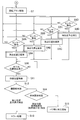
- the rotating brushes 31A and 31B are rotated at a preset high speed rotation as shown in step S1 of FIG.
- the brushes 49 provided on the rotating brushes 31A and 31B extend substantially uniformly by centrifugal force.
- the frame moving motor 73 is rotationally driven to move the rotating brushes 31A and 31B from the reference position 0 in a direction approaching the conveyor belt 15 (step). S2).
- step S3 when the rotating brushes 31A and 31B are moved from the reference position 0 toward the transport belt 15, it is determined in step S3 whether or not a preset amount of movement has been exceeded. If YES, a sensor detection error is notified by the notification unit 75 in step S4. Therefore, in this case, it is checked whether or not the detection light irradiation units 53A to 53D and the light receiving units 55A to 55D operate normally.
- step S5 when the rotating brushes 31A and 31B are moved, in step S5, the light receiving units 55A to 55D perform an operation in which the detection light LB is not detected as described above. Therefore, it is confirmed that the detection light irradiation units 53A to 53D and the light receiving units 55A to 55D operate correctly.
- the frame moving motor 73 is reversely rotated, and the rotating brushes 31A and 31B are returned to the reference position 0 or a predetermined position set in advance from the position of the detection light LB. (Step S6).
- step S7 the frame moving motor 73 is driven to move the rotating brushes 31A and 31B from the reference position 0 or the predetermined position in the direction approaching the transport belt 15 (step S7).
- steps S8A to S8D it is detected whether or not the detection light LB has passed through the rotation areas of the rotary brushes 31A and 31B between the detection light irradiation units 53A to 53D and the light reception units 55A to 55D. To do.
- the position data where the detection light LB is not transmitted is stored in the position storage memories 65A to 65D in steps S9A to S9D.
- step S10 it is determined whether or not all position detection has been completed.
- step S11 the position is moved (returned) to the predetermined position as the standby position.
- step S12 the comparison calculation unit 77 determines uneven wear based on the position data stored in each of the position storage memories 65A to 65D.
- error processing is performed in step S13. That is, for example, the rotating brushes 31A and 31B are replaced.
- step S14 the minimum diameters of the rotating brushes 31A and 31B calculated by the calculation unit 67 are compared with the preset use limit diameters to determine whether the use limit is reached. Is determined. If the usage limit is determined, error processing is performed in step S13. If it is determined in step S14 that it can be used, deburring is started in step S15.
- a necessary machining program is selected from the machining program memory 79, and the peripheral speed data and variability of the rotating brushes 31A and 31B from the machining condition database 61 corresponding to the material and thickness of the workpiece input from the input unit 63.
- the machining depth memory BD1 and BD2 data and the workpiece feed speed data are stored in the machining condition memory 81.
- the rotation of the conveyor belt motor 29 is controlled so that the workpiece feed speed stored in the machining condition memory 81 is reached. Further, based on the minimum diameter detected by the rotating brushes 31A and 31B, or based on the average diameter of the rotating brushes 31A and 31B calculated by the calculating unit 67, the peripheral speed of the rotating brushes 31A and 31B is the processing condition memory.
- the rotation of the brush motor 43 is controlled so as to coincide with the peripheral speed data of the rotary brushes 31 ⁇ / b> A and 31 ⁇ / b> B stored in 81.
- the rotating brushes 31 ⁇ / b> A and 31 ⁇ / b> B with respect to the conveying surface 15 ⁇ / b> F of the conveying belt 15 are used by the frame moving motor 73 so that the deburring depth with respect to the workpiece W matches the deburring depth data stored in the machining condition memory 81.
- the proximity position of is controlled.
- the thickness and material of the workpiece W are changed.
- the corresponding deburring depth, rotational speed (circumferential speed of the rotating brushes 31A, 31B), and workpiece W conveyance speed of the rotating brushes 31A, 31B are appropriately controlled. Therefore, the work can be deburred well.
- the work is sucked and transported by the vertical transport surface of the transport belt. Therefore, the present invention can be easily applied to a plate material processing system that performs processing while holding a plate-like workpiece in a vertical state and conveys the workpiece.
Landscapes
- Engineering & Computer Science (AREA)
- Mechanical Engineering (AREA)
- Finish Polishing, Edge Sharpening, And Grinding By Specific Grinding Devices (AREA)
- Grinding And Polishing Of Tertiary Curved Surfaces And Surfaces With Complex Shapes (AREA)
- Constituent Portions Of Griding Lathes, Driving, Sensing And Control (AREA)
Abstract
L'invention concerne un appareil d'ébavurage qui est capable d'ébavurer une pièce de travail plane tout en maintenant verticalement la pièce de travail, et un système de traitement de matériau plan qui est équipé de l'appareil d'ébavurage. L'appareil d'ébavurage comprend : une bande de transport (15) qui transporte la pièce de travail plane (W) dans un état fixé verticalement par aspiration à celle-ci, une pluralité de trous d'aspiration (25) permettant de fixer par aspiration la pièce de travail étant présente sur une surface de transport verticale (15A) ; et des brosses rotatives (31A, 31B) qui sont placées de façon à pouvoir se déplacer dans une direction s'approchant et s'éloignant de la bande de transport (15) et qui ébavurent la pièce de travail.
Applications Claiming Priority (2)
| Application Number | Priority Date | Filing Date | Title |
|---|---|---|---|
| JP2015149600A JP6055877B1 (ja) | 2015-07-29 | 2015-07-29 | バリ取り装置及び板材加工システム |
| JP2015-149600 | 2015-07-29 |
Publications (1)
| Publication Number | Publication Date |
|---|---|
| WO2017018104A1 true WO2017018104A1 (fr) | 2017-02-02 |
Family
ID=57582294
Family Applications (1)
| Application Number | Title | Priority Date | Filing Date |
|---|---|---|---|
| PCT/JP2016/068546 Ceased WO2017018104A1 (fr) | 2015-07-29 | 2016-06-22 | Appareil d'ébavurage permettant de maintenir verticalement une pièce de travail et système de traitement de matériau plan |
Country Status (2)
| Country | Link |
|---|---|
| JP (1) | JP6055877B1 (fr) |
| WO (1) | WO2017018104A1 (fr) |
Cited By (1)
| Publication number | Priority date | Publication date | Assignee | Title |
|---|---|---|---|---|
| CN108422293A (zh) * | 2018-03-30 | 2018-08-21 | 重庆市永川区华益机械铸造有限责任公司 | 一种铸件加工装置 |
Citations (5)
| Publication number | Priority date | Publication date | Assignee | Title |
|---|---|---|---|---|
| JPH03107447U (fr) * | 1990-02-20 | 1991-11-06 | ||
| JP2000210821A (ja) * | 1999-01-25 | 2000-08-02 | Matsushita Refrig Co Ltd | 板状部品の製造方法 |
| JP2001030028A (ja) * | 1999-05-18 | 2001-02-06 | Amada Co Ltd | 板材加工機およびこの板材加工機を用いた加工方法並びに製品集積方法 |
| JP2001047335A (ja) * | 1999-08-09 | 2001-02-20 | Matsushita Electric Ind Co Ltd | ワーク保持方法およびワーク保持装置 |
| JP2011067919A (ja) * | 2009-09-28 | 2011-04-07 | Fuji Heavy Ind Ltd | 加工バリ取り装置 |
-
2015
- 2015-07-29 JP JP2015149600A patent/JP6055877B1/ja active Active
-
2016
- 2016-06-22 WO PCT/JP2016/068546 patent/WO2017018104A1/fr not_active Ceased
Patent Citations (5)
| Publication number | Priority date | Publication date | Assignee | Title |
|---|---|---|---|---|
| JPH03107447U (fr) * | 1990-02-20 | 1991-11-06 | ||
| JP2000210821A (ja) * | 1999-01-25 | 2000-08-02 | Matsushita Refrig Co Ltd | 板状部品の製造方法 |
| JP2001030028A (ja) * | 1999-05-18 | 2001-02-06 | Amada Co Ltd | 板材加工機およびこの板材加工機を用いた加工方法並びに製品集積方法 |
| JP2001047335A (ja) * | 1999-08-09 | 2001-02-20 | Matsushita Electric Ind Co Ltd | ワーク保持方法およびワーク保持装置 |
| JP2011067919A (ja) * | 2009-09-28 | 2011-04-07 | Fuji Heavy Ind Ltd | 加工バリ取り装置 |
Cited By (1)
| Publication number | Priority date | Publication date | Assignee | Title |
|---|---|---|---|---|
| CN108422293A (zh) * | 2018-03-30 | 2018-08-21 | 重庆市永川区华益机械铸造有限责任公司 | 一种铸件加工装置 |
Also Published As
| Publication number | Publication date |
|---|---|
| JP2017030062A (ja) | 2017-02-09 |
| JP6055877B1 (ja) | 2016-12-27 |
Similar Documents
| Publication | Publication Date | Title |
|---|---|---|
| JP6378418B2 (ja) | 工作物を回転させるための回転ユニットを備える装置、及び加工装置 | |
| JP5596248B1 (ja) | 加工装置及びバリ取り装置 | |
| JP6126657B2 (ja) | バリ取り方法及び装置 | |
| CN110337413B (zh) | 托盘输送装置及托盘输送方法 | |
| JP5919002B2 (ja) | 切削装置 | |
| CN108857086B (zh) | 激光加工方法 | |
| CN108527678B (zh) | 被加工物的切削方法 | |
| JP2014172131A (ja) | 研削装置 | |
| CN113305445A (zh) | 激光加工装置 | |
| JP6226722B2 (ja) | 高さ位置検出方法 | |
| JP6055877B1 (ja) | バリ取り装置及び板材加工システム | |
| CN110370421B (zh) | 用于加工工件的边缘的机器和方法 | |
| JP5149072B2 (ja) | 切削装置 | |
| KR20210039943A (ko) | 판형 가공물의 연삭 방법 | |
| US11839933B2 (en) | Laser processing apparatus | |
| JP6926828B2 (ja) | バリ取り装置 | |
| JP6422338B2 (ja) | 加工装置 | |
| JP2000033434A (ja) | バリ取り機 | |
| JP7790268B2 (ja) | 研磨装置 | |
| JP6905419B2 (ja) | 切削方法 | |
| KR101701472B1 (ko) | 절삭 가공 장치 | |
| JP4554228B2 (ja) | ガイドレールの加工装置 | |
| JP2017092362A (ja) | 被加工物の加工方法 | |
| JPH08215958A (ja) | 板材複合加工機 | |
| KR20180001319A (ko) | 홈 커팅 장치 |
Legal Events
| Date | Code | Title | Description |
|---|---|---|---|
| 121 | Ep: the epo has been informed by wipo that ep was designated in this application |
Ref document number: 16830209 Country of ref document: EP Kind code of ref document: A1 |
|
| NENP | Non-entry into the national phase |
Ref country code: DE |
|
| 122 | Ep: pct application non-entry in european phase |
Ref document number: 16830209 Country of ref document: EP Kind code of ref document: A1 |