WO2017018390A1 - シート状成形体、及び、積層体 - Google Patents
シート状成形体、及び、積層体 Download PDFInfo
- Publication number
- WO2017018390A1 WO2017018390A1 PCT/JP2016/071776 JP2016071776W WO2017018390A1 WO 2017018390 A1 WO2017018390 A1 WO 2017018390A1 JP 2016071776 W JP2016071776 W JP 2016071776W WO 2017018390 A1 WO2017018390 A1 WO 2017018390A1
- Authority
- WO
- WIPO (PCT)
- Prior art keywords
- sheet
- resin composition
- vinyl chloride
- yarn
- resin
- Prior art date
- Legal status (The legal status is an assumption and is not a legal conclusion. Google has not performed a legal analysis and makes no representation as to the accuracy of the status listed.)
- Ceased
Links
Images
Classifications
-
- B—PERFORMING OPERATIONS; TRANSPORTING
- B32—LAYERED PRODUCTS
- B32B—LAYERED PRODUCTS, i.e. PRODUCTS BUILT-UP OF STRATA OF FLAT OR NON-FLAT, e.g. CELLULAR OR HONEYCOMB, FORM
- B32B3/00—Layered products comprising a layer with external or internal discontinuities or unevennesses, or a layer of non-planar shape; Layered products comprising a layer having particular features of form
- B32B3/10—Layered products comprising a layer with external or internal discontinuities or unevennesses, or a layer of non-planar shape; Layered products comprising a layer having particular features of form characterised by a discontinuous layer, i.e. formed of separate pieces of material
- B32B3/14—Layered products comprising a layer with external or internal discontinuities or unevennesses, or a layer of non-planar shape; Layered products comprising a layer having particular features of form characterised by a discontinuous layer, i.e. formed of separate pieces of material characterised by a face layer formed of separate pieces of material which are juxtaposed side-by-side
-
- B—PERFORMING OPERATIONS; TRANSPORTING
- B32—LAYERED PRODUCTS
- B32B—LAYERED PRODUCTS, i.e. PRODUCTS BUILT-UP OF STRATA OF FLAT OR NON-FLAT, e.g. CELLULAR OR HONEYCOMB, FORM
- B32B3/00—Layered products comprising a layer with external or internal discontinuities or unevennesses, or a layer of non-planar shape; Layered products comprising a layer having particular features of form
- B32B3/26—Layered products comprising a layer with external or internal discontinuities or unevennesses, or a layer of non-planar shape; Layered products comprising a layer having particular features of form characterised by a particular shape of the outline of the cross-section of a continuous layer; characterised by a layer with cavities or internal voids ; characterised by an apertured layer
- B32B3/30—Layered products comprising a layer with external or internal discontinuities or unevennesses, or a layer of non-planar shape; Layered products comprising a layer having particular features of form characterised by a particular shape of the outline of the cross-section of a continuous layer; characterised by a layer with cavities or internal voids ; characterised by an apertured layer characterised by a layer formed with recesses or projections, e.g. hollows, grooves, protuberances, ribs
-
- B—PERFORMING OPERATIONS; TRANSPORTING
- B29—WORKING OF PLASTICS; WORKING OF SUBSTANCES IN A PLASTIC STATE IN GENERAL
- B29C—SHAPING OR JOINING OF PLASTICS; SHAPING OF MATERIAL IN A PLASTIC STATE, NOT OTHERWISE PROVIDED FOR; AFTER-TREATMENT OF THE SHAPED PRODUCTS, e.g. REPAIRING
- B29C41/00—Shaping by coating a mould, core or other substrate, i.e. by depositing material and stripping-off the shaped article; Apparatus therefor
- B29C41/02—Shaping by coating a mould, core or other substrate, i.e. by depositing material and stripping-off the shaped article; Apparatus therefor for making articles of definite length, i.e. discrete articles
- B29C41/18—Slush casting, i.e. pouring moulding material into a hollow mould with excess material being poured off
-
- B—PERFORMING OPERATIONS; TRANSPORTING
- B29—WORKING OF PLASTICS; WORKING OF SUBSTANCES IN A PLASTIC STATE IN GENERAL
- B29C—SHAPING OR JOINING OF PLASTICS; SHAPING OF MATERIAL IN A PLASTIC STATE, NOT OTHERWISE PROVIDED FOR; AFTER-TREATMENT OF THE SHAPED PRODUCTS, e.g. REPAIRING
- B29C44/00—Shaping by internal pressure generated in the material, e.g. swelling or foaming ; Producing porous or cellular expanded plastics articles
- B29C44/02—Shaping by internal pressure generated in the material, e.g. swelling or foaming ; Producing porous or cellular expanded plastics articles for articles of definite length, i.e. discrete articles
- B29C44/12—Incorporating or moulding on preformed parts, e.g. inserts or reinforcements
- B29C44/14—Incorporating or moulding on preformed parts, e.g. inserts or reinforcements the preformed part being a lining
-
- B—PERFORMING OPERATIONS; TRANSPORTING
- B29—WORKING OF PLASTICS; WORKING OF SUBSTANCES IN A PLASTIC STATE IN GENERAL
- B29C—SHAPING OR JOINING OF PLASTICS; SHAPING OF MATERIAL IN A PLASTIC STATE, NOT OTHERWISE PROVIDED FOR; AFTER-TREATMENT OF THE SHAPED PRODUCTS, e.g. REPAIRING
- B29C44/00—Shaping by internal pressure generated in the material, e.g. swelling or foaming ; Producing porous or cellular expanded plastics articles
- B29C44/34—Auxiliary operations
- B29C44/35—Component parts; Details or accessories
- B29C44/351—Means for preventing foam to leak out from the foaming device during foaming
-
- B—PERFORMING OPERATIONS; TRANSPORTING
- B32—LAYERED PRODUCTS
- B32B—LAYERED PRODUCTS, i.e. PRODUCTS BUILT-UP OF STRATA OF FLAT OR NON-FLAT, e.g. CELLULAR OR HONEYCOMB, FORM
- B32B1/00—Layered products having a non-planar shape
-
- B—PERFORMING OPERATIONS; TRANSPORTING
- B32—LAYERED PRODUCTS
- B32B—LAYERED PRODUCTS, i.e. PRODUCTS BUILT-UP OF STRATA OF FLAT OR NON-FLAT, e.g. CELLULAR OR HONEYCOMB, FORM
- B32B27/00—Layered products comprising a layer of synthetic resin
- B32B27/06—Layered products comprising a layer of synthetic resin as the main or only constituent of a layer, which is next to another layer of the same or of a different material
- B32B27/065—Layered products comprising a layer of synthetic resin as the main or only constituent of a layer, which is next to another layer of the same or of a different material of foam
-
- B—PERFORMING OPERATIONS; TRANSPORTING
- B32—LAYERED PRODUCTS
- B32B—LAYERED PRODUCTS, i.e. PRODUCTS BUILT-UP OF STRATA OF FLAT OR NON-FLAT, e.g. CELLULAR OR HONEYCOMB, FORM
- B32B27/00—Layered products comprising a layer of synthetic resin
- B32B27/18—Layered products comprising a layer of synthetic resin characterised by the use of special additives
-
- B—PERFORMING OPERATIONS; TRANSPORTING
- B32—LAYERED PRODUCTS
- B32B—LAYERED PRODUCTS, i.e. PRODUCTS BUILT-UP OF STRATA OF FLAT OR NON-FLAT, e.g. CELLULAR OR HONEYCOMB, FORM
- B32B27/00—Layered products comprising a layer of synthetic resin
- B32B27/18—Layered products comprising a layer of synthetic resin characterised by the use of special additives
- B32B27/20—Layered products comprising a layer of synthetic resin characterised by the use of special additives using fillers, pigments, thixotroping agents
-
- B—PERFORMING OPERATIONS; TRANSPORTING
- B32—LAYERED PRODUCTS
- B32B—LAYERED PRODUCTS, i.e. PRODUCTS BUILT-UP OF STRATA OF FLAT OR NON-FLAT, e.g. CELLULAR OR HONEYCOMB, FORM
- B32B27/00—Layered products comprising a layer of synthetic resin
- B32B27/18—Layered products comprising a layer of synthetic resin characterised by the use of special additives
- B32B27/22—Layered products comprising a layer of synthetic resin characterised by the use of special additives using plasticisers
-
- B—PERFORMING OPERATIONS; TRANSPORTING
- B32—LAYERED PRODUCTS
- B32B—LAYERED PRODUCTS, i.e. PRODUCTS BUILT-UP OF STRATA OF FLAT OR NON-FLAT, e.g. CELLULAR OR HONEYCOMB, FORM
- B32B27/00—Layered products comprising a layer of synthetic resin
- B32B27/30—Layered products comprising a layer of synthetic resin comprising vinyl (co)polymers; comprising acrylic (co)polymers
-
- B—PERFORMING OPERATIONS; TRANSPORTING
- B32—LAYERED PRODUCTS
- B32B—LAYERED PRODUCTS, i.e. PRODUCTS BUILT-UP OF STRATA OF FLAT OR NON-FLAT, e.g. CELLULAR OR HONEYCOMB, FORM
- B32B27/00—Layered products comprising a layer of synthetic resin
- B32B27/30—Layered products comprising a layer of synthetic resin comprising vinyl (co)polymers; comprising acrylic (co)polymers
- B32B27/304—Layered products comprising a layer of synthetic resin comprising vinyl (co)polymers; comprising acrylic (co)polymers comprising vinyl halide (co)polymers, e.g. PVC, PVDC, PVF, PVDF
-
- B—PERFORMING OPERATIONS; TRANSPORTING
- B32—LAYERED PRODUCTS
- B32B—LAYERED PRODUCTS, i.e. PRODUCTS BUILT-UP OF STRATA OF FLAT OR NON-FLAT, e.g. CELLULAR OR HONEYCOMB, FORM
- B32B27/00—Layered products comprising a layer of synthetic resin
- B32B27/32—Layered products comprising a layer of synthetic resin comprising polyolefins
-
- B—PERFORMING OPERATIONS; TRANSPORTING
- B32—LAYERED PRODUCTS
- B32B—LAYERED PRODUCTS, i.e. PRODUCTS BUILT-UP OF STRATA OF FLAT OR NON-FLAT, e.g. CELLULAR OR HONEYCOMB, FORM
- B32B27/00—Layered products comprising a layer of synthetic resin
- B32B27/40—Layered products comprising a layer of synthetic resin comprising polyurethanes
-
- B—PERFORMING OPERATIONS; TRANSPORTING
- B32—LAYERED PRODUCTS
- B32B—LAYERED PRODUCTS, i.e. PRODUCTS BUILT-UP OF STRATA OF FLAT OR NON-FLAT, e.g. CELLULAR OR HONEYCOMB, FORM
- B32B5/00—Layered products characterised by the non- homogeneity or physical structure, i.e. comprising a fibrous, filamentary, particulate or foam layer; Layered products characterised by having a layer differing constitutionally or physically in different parts
- B32B5/18—Layered products characterised by the non- homogeneity or physical structure, i.e. comprising a fibrous, filamentary, particulate or foam layer; Layered products characterised by having a layer differing constitutionally or physically in different parts characterised by features of a layer of foamed material
-
- B—PERFORMING OPERATIONS; TRANSPORTING
- B32—LAYERED PRODUCTS
- B32B—LAYERED PRODUCTS, i.e. PRODUCTS BUILT-UP OF STRATA OF FLAT OR NON-FLAT, e.g. CELLULAR OR HONEYCOMB, FORM
- B32B7/00—Layered products characterised by the relation between layers; Layered products characterised by the relative orientation of features between layers, or by the relative values of a measurable parameter between layers, i.e. products comprising layers having different physical, chemical or physicochemical properties; Layered products characterised by the interconnection of layers
- B32B7/04—Interconnection of layers
- B32B7/08—Interconnection of layers by mechanical means
- B32B7/09—Interconnection of layers by mechanical means by stitching, needling or sewing
-
- B—PERFORMING OPERATIONS; TRANSPORTING
- B32—LAYERED PRODUCTS
- B32B—LAYERED PRODUCTS, i.e. PRODUCTS BUILT-UP OF STRATA OF FLAT OR NON-FLAT, e.g. CELLULAR OR HONEYCOMB, FORM
- B32B7/00—Layered products characterised by the relation between layers; Layered products characterised by the relative orientation of features between layers, or by the relative values of a measurable parameter between layers, i.e. products comprising layers having different physical, chemical or physicochemical properties; Layered products characterised by the interconnection of layers
- B32B7/04—Interconnection of layers
- B32B7/12—Interconnection of layers using interposed adhesives or interposed materials with bonding properties
-
- B—PERFORMING OPERATIONS; TRANSPORTING
- B60—VEHICLES IN GENERAL
- B60K—ARRANGEMENT OR MOUNTING OF PROPULSION UNITS OR OF TRANSMISSIONS IN VEHICLES; ARRANGEMENT OR MOUNTING OF PLURAL DIVERSE PRIME-MOVERS IN VEHICLES; AUXILIARY DRIVES FOR VEHICLES; INSTRUMENTATION OR DASHBOARDS FOR VEHICLES; ARRANGEMENTS IN CONNECTION WITH COOLING, AIR INTAKE, GAS EXHAUST OR FUEL SUPPLY OF PROPULSION UNITS IN VEHICLES
- B60K37/00—Dashboards
- B60K37/20—Dashboard panels
-
- B—PERFORMING OPERATIONS; TRANSPORTING
- B60—VEHICLES IN GENERAL
- B60R—VEHICLES, VEHICLE FITTINGS, OR VEHICLE PARTS, NOT OTHERWISE PROVIDED FOR
- B60R13/00—Elements for body-finishing, identifying, or decorating; Arrangements or adaptations for advertising purposes
- B60R13/02—Internal Trim mouldings ; Internal Ledges; Wall liners for passenger compartments; Roof liners
- B60R13/0256—Dashboard liners
-
- D—TEXTILES; PAPER
- D05—SEWING; EMBROIDERING; TUFTING
- D05B—SEWING
- D05B23/00—Sewing apparatus or machines not otherwise provided for
-
- B—PERFORMING OPERATIONS; TRANSPORTING
- B29—WORKING OF PLASTICS; WORKING OF SUBSTANCES IN A PLASTIC STATE IN GENERAL
- B29C—SHAPING OR JOINING OF PLASTICS; SHAPING OF MATERIAL IN A PLASTIC STATE, NOT OTHERWISE PROVIDED FOR; AFTER-TREATMENT OF THE SHAPED PRODUCTS, e.g. REPAIRING
- B29C65/00—Joining or sealing of preformed parts, e.g. welding of plastics materials; Apparatus therefor
- B29C65/56—Joining or sealing of preformed parts, e.g. welding of plastics materials; Apparatus therefor using mechanical means or mechanical connections, e.g. form-fits
- B29C65/62—Stitching
-
- B—PERFORMING OPERATIONS; TRANSPORTING
- B29—WORKING OF PLASTICS; WORKING OF SUBSTANCES IN A PLASTIC STATE IN GENERAL
- B29C—SHAPING OR JOINING OF PLASTICS; SHAPING OF MATERIAL IN A PLASTIC STATE, NOT OTHERWISE PROVIDED FOR; AFTER-TREATMENT OF THE SHAPED PRODUCTS, e.g. REPAIRING
- B29C65/00—Joining or sealing of preformed parts, e.g. welding of plastics materials; Apparatus therefor
- B29C65/72—Joining or sealing of preformed parts, e.g. welding of plastics materials; Apparatus therefor by combined operations or combined techniques, e.g. welding and stitching
-
- B—PERFORMING OPERATIONS; TRANSPORTING
- B29—WORKING OF PLASTICS; WORKING OF SUBSTANCES IN A PLASTIC STATE IN GENERAL
- B29K—INDEXING SCHEME ASSOCIATED WITH SUBCLASSES B29B, B29C OR B29D, RELATING TO MOULDING MATERIALS OR TO MATERIALS FOR MOULDS, REINFORCEMENTS, FILLERS OR PREFORMED PARTS, e.g. INSERTS
- B29K2075/00—Use of PU, i.e. polyureas or polyurethanes or derivatives thereof, as moulding material
-
- B—PERFORMING OPERATIONS; TRANSPORTING
- B29—WORKING OF PLASTICS; WORKING OF SUBSTANCES IN A PLASTIC STATE IN GENERAL
- B29K—INDEXING SCHEME ASSOCIATED WITH SUBCLASSES B29B, B29C OR B29D, RELATING TO MOULDING MATERIALS OR TO MATERIALS FOR MOULDS, REINFORCEMENTS, FILLERS OR PREFORMED PARTS, e.g. INSERTS
- B29K2105/00—Condition, form or state of moulded material or of the material to be shaped
- B29K2105/04—Condition, form or state of moulded material or of the material to be shaped cellular or porous
-
- B—PERFORMING OPERATIONS; TRANSPORTING
- B29—WORKING OF PLASTICS; WORKING OF SUBSTANCES IN A PLASTIC STATE IN GENERAL
- B29L—INDEXING SCHEME ASSOCIATED WITH SUBCLASS B29C, RELATING TO PARTICULAR ARTICLES
- B29L2031/00—Other particular articles
- B29L2031/30—Vehicles, e.g. ships or aircraft, or body parts thereof
- B29L2031/3005—Body finishings
- B29L2031/3008—Instrument panels
-
- B—PERFORMING OPERATIONS; TRANSPORTING
- B32—LAYERED PRODUCTS
- B32B—LAYERED PRODUCTS, i.e. PRODUCTS BUILT-UP OF STRATA OF FLAT OR NON-FLAT, e.g. CELLULAR OR HONEYCOMB, FORM
- B32B2250/00—Layers arrangement
- B32B2250/02—2 layers
-
- B—PERFORMING OPERATIONS; TRANSPORTING
- B32—LAYERED PRODUCTS
- B32B—LAYERED PRODUCTS, i.e. PRODUCTS BUILT-UP OF STRATA OF FLAT OR NON-FLAT, e.g. CELLULAR OR HONEYCOMB, FORM
- B32B2264/00—Composition or properties of particles which form a particulate layer or are present as additives
- B32B2264/10—Inorganic particles
-
- B—PERFORMING OPERATIONS; TRANSPORTING
- B32—LAYERED PRODUCTS
- B32B—LAYERED PRODUCTS, i.e. PRODUCTS BUILT-UP OF STRATA OF FLAT OR NON-FLAT, e.g. CELLULAR OR HONEYCOMB, FORM
- B32B2264/00—Composition or properties of particles which form a particulate layer or are present as additives
- B32B2264/10—Inorganic particles
- B32B2264/102—Oxide or hydroxide
-
- B—PERFORMING OPERATIONS; TRANSPORTING
- B32—LAYERED PRODUCTS
- B32B—LAYERED PRODUCTS, i.e. PRODUCTS BUILT-UP OF STRATA OF FLAT OR NON-FLAT, e.g. CELLULAR OR HONEYCOMB, FORM
- B32B2264/00—Composition or properties of particles which form a particulate layer or are present as additives
- B32B2264/10—Inorganic particles
- B32B2264/104—Oxysalt, e.g. carbonate, sulfate, phosphate or nitrate particles
-
- B—PERFORMING OPERATIONS; TRANSPORTING
- B32—LAYERED PRODUCTS
- B32B—LAYERED PRODUCTS, i.e. PRODUCTS BUILT-UP OF STRATA OF FLAT OR NON-FLAT, e.g. CELLULAR OR HONEYCOMB, FORM
- B32B2266/00—Composition of foam
- B32B2266/02—Organic
- B32B2266/0214—Materials belonging to B32B27/00
- B32B2266/0278—Polyurethane
-
- B—PERFORMING OPERATIONS; TRANSPORTING
- B32—LAYERED PRODUCTS
- B32B—LAYERED PRODUCTS, i.e. PRODUCTS BUILT-UP OF STRATA OF FLAT OR NON-FLAT, e.g. CELLULAR OR HONEYCOMB, FORM
- B32B2307/00—Properties of the layers or laminate
- B32B2307/70—Other properties
- B32B2307/732—Dimensional properties
-
- B—PERFORMING OPERATIONS; TRANSPORTING
- B32—LAYERED PRODUCTS
- B32B—LAYERED PRODUCTS, i.e. PRODUCTS BUILT-UP OF STRATA OF FLAT OR NON-FLAT, e.g. CELLULAR OR HONEYCOMB, FORM
- B32B2605/00—Vehicles
- B32B2605/003—Interior finishings
-
- B—PERFORMING OPERATIONS; TRANSPORTING
- B32—LAYERED PRODUCTS
- B32B—LAYERED PRODUCTS, i.e. PRODUCTS BUILT-UP OF STRATA OF FLAT OR NON-FLAT, e.g. CELLULAR OR HONEYCOMB, FORM
- B32B2605/00—Vehicles
- B32B2605/08—Cars
Definitions
- the present invention relates to a sheet-like molded body used for an automobile instrument panel and the like, and a laminate.
- An automotive instrument panel has a structure in which a polyurethane foam layer is provided between a base material made of a synthetic resin such as vinyl chloride resin, thermoplastic urethane resin, thermoplastic olefin resin, or leather, and a base material. ing.
- Automobile instrument panels are sometimes subjected to sewing processing such as stitch patterns on the skin in order to improve design and merchandise.
- sewing processing such as stitch patterns on the skin
- the raw material of the foamed polyurethane layer flows out to the front side from the hole in the sewing portion. Since the part from which the raw material of the foamed polyurethane layer has flowed is discolored, the appearance of the automobile instrument panel has been damaged.
- Patent Document 1 discloses that a foaming agent or the like leaks from a seam of a skin material made of a plastic sheet such as vinyl chloride.
- the method of attaching a sealing tape from the back side of the skin material the method of performing a cross-linking and curing process by applying and drying an adhesive, the method of heating and melting the resin yarn from the back side when the stitch is a resin yarn, etc. It is disclosed that a seam sealing process is performed.
- Patent Document 2 an upper thread and a lower thread are sewn at a sewing position of a molten thermoplastic resin material, and the sewing position is cured so that the thermoplastic resin material, the upper thread and the lower thread are integrated.
- sealing the gap between the outer peripheral surface of the sewing thread sewn on the resin material and the resin material is disclosed.
- the skin material is made of resin as in Patent Documents 1 and 2
- various additives such as a plasticizer are usually added to the skin material for the purpose of improving flexibility and the like. Since the various components migrate to the polyurethane foam layer over time due to heat or the like, the skin material may change color over time.
- a sealing tape or an adhesive is used, the transition speed of various components changes at locations where these materials are used. There was a problem that it was different and it was revealed that a tape or an adhesive was placed on the back side. Further, as in Patent Document 1, when the resin yarn is melted and sealed, there is a problem that the design property is impaired by simultaneously melting and decomposing the skin material.
- Patent Document 2 since it is not necessary to seal the back side of the skin material, the problem as in Patent Document 1 does not occur, but the sewing portion is melted by a heating device or a warmed sewing needle. Therefore, there is a problem that high temperature management is required, the manufacturing apparatus and the manufacturing process are complicated, and the cost is increased.
- the present invention can be manufactured by an inexpensive and simple method, the designability is not deteriorated with time, and it is possible to prevent the outflow of raw materials and the like from the sewing site when the polyurethane foam layer is lined. It is an object of the present invention to provide a sheet-like molded body that is possible, and a laminate having the sheet-shaped molded body and a polyurethane foam layer.
- the first aspect of the present invention is a sheet-like molded article obtained by sewing a sheet-like material, wherein at least a part of the sewing processing includes a yarn resin composition. Therefore, a yarn having a melting point of 200 ° C. or lower is used.
- the yarn resin constituting the yarn resin composition is mainly composed of polyester and nylon.
- the yarn resin “mainly composed of nylon and polyester” means that the total of the nylon component and the polyester component contained in the yarn resin is 80% by mass or more with respect to 100% by mass of the yarn resin. It means that.
- the yarn resin preferably contains 50% by mass or more of nylon having a melting point of 200 ° C. or less.
- the yarn may be fused to at least one surface of the sheet-like material.
- the sheet-like material may be mainly composed of a sheet resin composition.
- the sheet-like material “having the resin composition for sheet as a main component” means that the sheet-like material contains 80% by mass or more of the resin composition for sheet with respect to 100% by mass of the sheet-like material. It means to do.
- the sheet resin composition may be a powder molding resin composition
- the sheet material may be formed by powder slush molding of the powder molding resin composition.
- the powder molding resin composition is at least selected from the group consisting of a vinyl chloride resin composition containing a vinyl chloride resin, a urethane resin composition containing a urethane resin, and an olefin resin composition containing an olefin resin. It is preferable that it consists of 1 type.
- the powder molding resin composition is preferably the vinyl chloride resin composition.
- the average degree of polymerization of the vinyl chloride resin is preferably 800 to 5000.
- the powder molding resin composition preferably contains 30 to 200 parts by mass of a plasticizer with respect to 100 parts by mass of the vinyl chloride resin.
- the sewing process is performed using an upper thread and a lower thread, and of the upper thread and the lower thread, at least the lower thread is composed of the thread resin composition including the thread resin, and has a melting point. It is preferable that the yarn has a temperature of 200 ° C. or lower.
- the “upper thread” as used herein refers to the design surface (visible from the outside) when the sheet-like molded body according to the first aspect of the present invention or the laminate according to the second aspect of the present invention described later is installed.
- the surface is the same, and the same shall apply hereinafter.
- positioned on the opposite side to a design surface is pointed out.
- the second aspect of the present invention is a laminate having the sheet-like molded body according to the first aspect of the present invention and a polyurethane foam molded body.
- the laminate according to the second aspect of the present invention can be preferably used as a laminate for an automobile instrument panel.
- the present invention it is possible to manufacture by an inexpensive and simple method, the designability is not deteriorated with time, and the outflow of raw materials and the like is prevented from the sewing site when the polyurethane foam layer is lined. And a laminate having the sheet-like molded body and the foamed polyurethane layer can be provided.
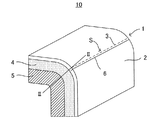
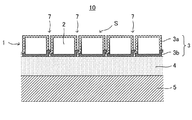
- FIG. 2 is a cross-sectional view of a sewing portion of the laminate 10 according to an embodiment of the present invention, and is a cross-sectional view taken along the line II-II in FIG.
- the sheet-like molded product of the present invention is a yarn in which a sheet-like product is subjected to sewing processing, and is composed of a yarn resin composition containing yarn resin in at least a part of the sewing processing, and has a melting point of 200 ° C. or lower. Is used.
- the laminated body of this invention has the skin layer which consists of this sheet-like molded object, and the foaming polyurethane layer which consists of a foaming polyurethane molding.
- FIG. 1 is a perspective view of a laminate 10 according to an embodiment of the present invention.
- FIG. 2 is a cross-sectional view of the laminate 10 taken along the line II-II in FIG. In FIG. 2, attention is paid to a part including a repetitive structure in the cross-sectional view, and both end portions thereof are omitted.
- the laminate 10 includes a sheet-like molded body 1, a foamed polyurethane-molded body 4, and a base material 5, which are obtained by performing a sewing process (stitch S) on a sheet-like object 2 using a thread 3. Have a structure laminated in this order.
- the thread 3 is composed of an upper thread 3a and a lower thread 3b, and the stitch S is applied to the sheet-like object 2 by a main sewing method using the upper thread 3a and the lower thread 3b.
- the upper thread 3 a is a part of the design surface of the laminated body 10 (refers to a surface that is visually recognized from the outside when the laminated body is installed. It plays the role which improves the design property of the laminated body 10.
- the lower thread 3b is normally not visible from the outside, and is disposed on the side where the foamed polyurethane molded body 4 is laminated, and the raw materials and the like flow out from the sewing portion 7 when the foamed polyurethane molded body 4 is laminated. It plays a major role in preventing this.
- the sheet-like material in the present invention is a member that is used as a skin material for an automotive instrument panel, a console box or a door trim, or a housing interior such as furniture, and is a member that enhances design and commercial properties.
- the material of the sheet-like material used in the present invention is not particularly limited, and examples thereof include resins such as vinyl chloride resin, thermoplastic urethane resin, and thermoplastic olefin resin, or leather.
- the amount of the resin composition for the sheet contained in the sheet is preferably 80% by mass or more, and 85% by mass with respect to 100% by mass of the sheet. More preferably, it is more preferably 90% by mass or more, and particularly preferably 100% by mass.
- the resin composition for a sheet is not particularly limited as long as it is a resin composition that can be molded into a sheet, but from the viewpoint of excellent molding processability, low dependence on petroleum, and low environmental impact,
- the composition is preferably a sheet, and the sheet-like product is preferably obtained by powder slush molding of the powder molding resin composition.
- a vinyl chloride resin composition containing a thermoplastic olefin resin (TPO) is used, and among them, a vinyl chloride resin composition is preferably used.
- the vinyl chloride resin composition used as the powder molding resin composition is referred to as “powder molding vinyl chloride resin composition”.
- the vinyl chloride resin (a) contained in the vinyl chloride resin composition for powder molding preferably contains vinyl chloride resin particles (a1) having an average degree of polymerization of 800 to 5000.
- the vinyl chloride resin constituting the vinyl chloride resin particles (a1) includes, in addition to a vinyl chloride homopolymer, a copolymer containing vinyl chloride units, preferably 50% by mass or more, more preferably 70% by mass or more.
- Specific examples of comonomers of the vinyl chloride copolymer include olefins such as ethylene and propylene; halogenated olefins such as allyl chloride, vinylidene chloride, vinyl fluoride, and ethylene trifluoride; vinyl acetate and propionic acid.
- Carboxylic acid vinyl esters such as vinyl; vinyl ethers such as isobutyl vinyl ether and cetyl vinyl ether; allyl ethers such as allyl-3-chloro-2-oxypropyl ether and allyl glycidyl ether; acrylic acid, maleic acid, itaconic acid, acrylic 2-hydroxyethyl acid, methyl methacrylate, monomethyl maleate, diethyl maleate, maleic anhydride and other unsaturated carboxylic acids, their esters or acid anhydrides; acrylonitrile, methacrylonitrile and other unsaturated nitriles; Acrylamide, N- methylol acrylamide, acrylamido-2-methylpropanesulfonic acid, (meth) acrylamides such as acrylamide propyl trimethyl ammonium chloride; allyl amine benzoates, allylamine and its derivatives such as diallyl dimethyl ammonium chloride; and the like.
- the monomers exemplified above are only a part of the monomers copolymerizable with vinyl chloride, and “polyvinyl chloride”, Nikkan Kogyo Shimbun (1988) 75-104, edited by Kinki Chemical Association Vinyl Division.
- Various monomers exemplified on the page can be used. One or more of these monomers can be used.
- the vinyl chloride resin constituting the vinyl chloride resin particles (a1) is a resin such as ethylene-vinyl acetate copolymer, ethylene-methyl methacrylate copolymer, ethylene-ethyl acrylate copolymer, chlorinated polyethylene, It also includes a resin obtained by graft polymerization of (1) vinyl chloride or (2) vinyl chloride and the above copolymerizable monomer.
- the vinyl chloride resin constituting the vinyl chloride resin particles (a1) can be produced by any conventionally known production method such as a suspension polymerization method, an emulsion polymerization method, a solution polymerization method, or a bulk polymerization method.
- a vinyl chloride resin produced by a suspension polymerization method is preferable.
- the average degree of polymerization of the vinyl chloride resin particles (a1) is preferably 800 to 5000, more preferably 800 to 3000, and still more preferably 800 to 2000.
- the average degree of polymerization is measured according to JIS K 6720-2.
- the average particle diameter of the vinyl chloride resin particles (a1) is not particularly limited.
- the average particle diameter is preferably 50 ⁇ m or more and 500 ⁇ m or less, more preferably 50 ⁇ m or more and 250 ⁇ m or less, and still more preferably 100 ⁇ m or more and 200 ⁇ m or less.
- the average particle diameter of the vinyl chloride resin particles (a1) is within the above range, the powder flowability of the vinyl chloride resin composition for powder molding is improved, and the vinyl chloride resin composition for powder molding is powdered. The smoothness of the molded body of vinyl chloride resin is improved.
- the average particle diameter is measured in accordance with a sieving method using a JIS standard sieve specified in JIS Z8801.
- the vinyl chloride resin (a) may contain vinyl chloride resin fine particles (a2) as necessary.
- the vinyl chloride resin fine particles (a2) function as a dusting agent that improves the powder fluidity of the vinyl chloride resin composition for powder molding.
- the vinyl chloride resin constituting the vinyl chloride resin fine particles (a2) can be produced by any conventionally known production method such as suspension polymerization method, emulsion polymerization method, solution polymerization method, bulk polymerization method and the like.
- a vinyl chloride resin produced by an emulsion polymerization method is preferable.
- the average degree of polymerization of the vinyl chloride resin constituting the vinyl chloride resin fine particles (a2) is preferably 500 to 5000, more preferably the average degree of polymerization is 600 to 3000, and further preferably the average degree of polymerization is 700 to 2500. .
- the average degree of polymerization is measured according to JIS K 6720-2.
- the average particle diameter of the vinyl chloride resin fine particles (a2) is preferably 0.1 ⁇ m or more and 10 ⁇ m or less. This is because the powder fluidity of the vinyl chloride resin composition for powder molding is improved.
- the average particle diameter is measured by a laser diffraction method using “SALD-2300” manufactured by Shimadzu Corporation in accordance with JIS Z 8825.
- the content of the vinyl chloride resin fine particles (a2) in 100% by mass of the vinyl chloride resin (a) is preferably 0 to 30% by mass, more preferably 1 to 30% by mass, and still more preferably 5 to It is 25% by mass, and particularly preferably 8 to 20% by mass.
- the content of the vinyl chloride resin fine particles (a2) is in the above range, the powder fluidity of the vinyl chloride resin composition for powder molding is good.
- the vinyl chloride resin composition for powder molding preferably contains a plasticizer.
- the plasticizer include trimellitic acid tri-n-hexyl, trimellitic acid tri-n-heptyl, trimellitic acid tri-n-octyl, trimellitic acid tri- (2-ethylhexyl), trimellitic acid tri- n-nonyl, trimellitic acid tri-n-decyl, trimellitic acid triisodecyl, trimellitic acid tri-n-undecyl, trimellitic acid tri-n-dodecyl, trimellitic acid tri-n-alkyl Is a mixture of 6 to 12) ester, trimellitic acid trialkyl (mixture of alkyl group having 8 to 10 carbon atoms) ester, trimellitic acid tri-n-alkyl (mixture of alkyl group having 8 to 10 carbon atoms) Trimellitic acid esters such as esters; pyromellitic acid tetra-n-hex
- the preferable content of the plasticizer with respect to 100 parts by mass of the vinyl chloride resin (a) is 30 to 200 parts by mass, more preferably 60 to 170 parts by mass, and still more preferably 90 to 160 parts by mass. It is. When the content of the plasticizer is within the above range, the plasticizer is well absorbed by the vinyl chloride resin (a), and the powder moldability of the vinyl chloride resin composition for powder molding is improved.
- the vinyl chloride resin composition for powder molding may contain perchloric acid-treated hydrotalcite as a stabilizer.
- Perchloric acid-treated hydrotalcite for example, by adding hydrotalcite to a dilute aqueous solution of perchloric acid, stirring, and then filtering, dehydrating or drying as necessary, thereby allowing carbonate anions in hydrotalcite It can be easily produced by replacing at least part of (CO 3 2 ⁇ ) with a perchlorate anion (ClO 4 ⁇ ) (2 mol of perchlorate anion is substituted for 1 mol of carbonate anion). it can.
- the molar ratio of the hydrotalcite to the perchloric acid can be arbitrarily set, it is generally 0.1 to 2 moles of perchloric acid per mole of hydrotalcite.
- the substitution rate of the carbonate anion to the perchlorate anion in the untreated (unsubstituted) hydrotalcite is preferably 50 mol% or more, more preferably 70 mol% or more, and still more preferably 85 mol% or more. Further, the substitution rate of the carbonate anion to the perchlorate anion in the untreated (unsubstituted) hydrotalcite is preferably 95 mol% or less.
- Hydrotalcite is a non - stoichiometric compound represented by the general formula [Mg 1-x Al x (OH) 2 ] x + [(CO 3 ) x / 2 ⁇ mH 2 O] x- , and is a positively charged base layer It is an inorganic substance having a layered crystal structure composed of [Mg 1-x Al x (OH) 2 ] x + and a negatively charged intermediate layer [(CO 3 ) x / 2 ⁇ mH 2 O] x ⁇ .
- x is a number in the range from 0 to 0.33.
- Natural hydrotalcite is Mg 6 Al 2 (OH) 16 CO 3 ⁇ 4H 2 O.
- Synthetic hydrotalcite Mg 4.5 Al 2 (OH) 13 CO 3 ⁇ 3.5H 2 O are commercially available. A method for synthesizing synthetic hydrotalcite is described in JP-A No. 61-174270.
- the preferred content of perchloric acid-treated hydrotalcite with respect to 100 parts by weight of the vinyl chloride resin (a) is 0.5 to 7 parts by weight, more preferably 1 to 6 parts by weight, and still more preferred content is 1.5 to 5.5 parts by mass.
- the vinyl chloride resin composition for powder molding may contain zeolite as a stabilizer.
- Zeolite has the general formula M x / n ⁇ [(AlO 2 ) x ⁇ (SiO 2 ) y ] ⁇ zH 2 O (where M is a metal ion of valence n and x + y is the number of tetrahedrons per monolattice lattice. , Z is the number of moles of water), and the type of M in the formula is a monovalent or divalent metal such as Na, Li, Ca, Mg, Zn or a mixture thereof A type is mentioned.
- Zeolite content is not limited to a specific range.
- the content is preferably 0.1 to 5 parts by mass with respect to 100 parts by mass of the vinyl chloride resin (a).
- the vinyl chloride resin composition for powder molding may contain a fatty acid metal salt as a stabilizer.
- Preferred fatty acid metal salts are monovalent fatty acid metal salts, more preferred fatty acid metal salts are monovalent fatty acid metal salts having 12 to 24 carbon atoms, and more preferred fatty acid metal salts having 15 to 21 carbon atoms. It is a monovalent fatty acid metal salt.
- Specific examples of the fatty acid metal salt include lithium stearate, magnesium stearate, aluminum stearate, calcium stearate, strontium stearate, barium stearate, zinc stearate, calcium laurate, barium laurate, zinc laurate, 2-ethylhexane.
- the metal constituting the fatty acid metal salt is preferably a metal capable of generating a polyvalent cation, more preferably a metal capable of generating a divalent cation, and a divalent cation of the third to sixth periods of the periodic table. Is more preferable, and a metal capable of generating a divalent cation in the fourth period of the periodic table is particularly preferable.
- the most preferred fatty acid metal salt is zinc stearate.
- the preferred content of the fatty acid metal salt with respect to 100 parts by mass of the vinyl chloride resin (a) is 0.05 to 5 parts by mass, more preferably 0.1 to 1 part by mass, still more preferably 0.1 to 0. 5 parts by mass.
- the content of the fatty acid metal salt is within the above range, the value of the color difference of the sheet-like product formed by powder molding the vinyl chloride resin composition for powder molding can be reduced.
- the above-mentioned vinyl chloride resin composition for powder molding may contain a dusting agent other than the vinyl chloride resin fine particles (a2) (hereinafter sometimes referred to as “other dusting agents”).
- a dusting agent other than the vinyl chloride resin fine particles (a2) hereinafter sometimes referred to as “other dusting agents”.
- other dusting agents include inorganic fine particles such as calcium carbonate, talc and aluminum oxide; polyacrylonitrile resin fine particles, poly (meth) acrylate resin fine particles, polystyrene resin fine particles, polyethylene resin fine particles, polypropylene resin fine particles, polyester resin fine particles Organic fine particles such as polyamide resin fine particles.
- inorganic fine particles having an average particle size of 10 nm to 100 nm are preferable.
- the content of other dusting agents is not limited to a specific range.
- the said content becomes like this.
- the above-mentioned vinyl chloride resin composition for powder molding is composed of a colorant, impact modifier, perchloric acid compound other than perchloric acid-treated hydrotalcite (sodium perchlorate, potassium perchlorate, etc.), antioxidant. And other additives such as anti-mold agents, flame retardants, antistatic agents, fillers, light stabilizers such as UV absorbers, foaming agents, ⁇ -diketones and the like.
- the colorant are quinacridone pigments, perylene pigments, polyazo condensation pigments, isoindolinone pigments, copper phthalocyanine pigments, titanium white, and carbon black.
- the quinacridone pigment is obtained by treating p-phenylene dianthranilic acid with concentrated sulfuric acid and exhibits a yellowish red to reddish purple hue.
- Specific examples of the quinacridone pigment are quinacridone red, quinacridone magenta, and quinacridone violet.
- the perylene pigment is obtained by a condensation reaction of perylene-3,4,9,10-tetracarboxylic anhydride and an aromatic primary amine, and exhibits a hue from red to magenta and brown.
- the perylene pigment are perylene red, perylene orange, perylene maroon, perylene vermilion, and perylene bordeaux.
- the polyazo condensation pigment is obtained by condensing an azo dye in a solvent to obtain a high molecular weight, and exhibits a hue of a yellow or red pigment.
- Specific examples of the polyazo condensation pigment are polyazo red, polyazo yellow, chromophthal orange, chromophthal red, and chromophthal scarlet.
- the isoindolinone pigment is obtained by a condensation reaction of 4,5,6,7-tetrachloroisoindolinone and an aromatic primary diamine, and exhibits a hue of greenish yellow to red and brown.
- the isoindolinone pigment is isoindolinone yellow.
- the copper phthalocyanine pigment is a pigment in which copper is coordinated to phthalocyanines, and exhibits a hue of yellowish green to vivid blue.
- Specific examples of the copper phthalocyanine pigment are phthalocyanine green and phthalocyanine blue.
- Titanium white is a white pigment made of titanium dioxide and has a large hiding power, and there are anatase type and rutile type.
- Carbon black is a black pigment containing carbon as a main component and containing oxygen, hydrogen, and nitrogen. Specific examples of carbon black are thermal black, acetylene black, channel black, furnace black, lamp black, and bone black.
- the impact resistance improver include acrylonitrile-butadiene-styrene copolymer, methyl methacrylate-butadiene-styrene copolymer, chlorinated polyethylene, ethylene-vinyl acetate copolymer, chlorosulfonated polyethylene and the like.
- One or more impact modifiers can be used.
- the impact resistance improver is dispersed as a heterogeneous phase of fine elastic particles in the vinyl chloride resin composition for powder molding.
- the vinyl chloride resin composition for powder molding contains vinyl chloride resin particles (a1), the chain and the polar group graft-polymerized on the elastic particles are compatible with the vinyl chloride resin particles (a1), and a sheet-like material Improves impact resistance.
- antioxidant examples include a phenol-based antioxidant, a sulfur-based antioxidant, and a phosphorus-based antioxidant.
- Specific examples of the antifungal agent include aliphatic ester antifungal agents, hydrocarbon antifungal agents, organic nitrogen antifungal agents, organic nitrogen sulfur antifungal agents, and the like.
- the flame retardant include halogen-based flame retardants such as chlorinated paraffins; phosphorus-based flame retardants such as phosphate esters; inorganic hydroxides such as magnesium hydroxide and aluminum hydroxide;
- Specific examples of the antistatic agent include anionic antistatic agents such as fatty acid salts, higher alcohol sulfates and sulfonates; cationic antistatic agents such as aliphatic amine salts and quaternary ammonium salts; polyoxyethylene alkyl ethers And nonionic antistatic agents such as polyoxyethylene alkylphenol ethers.
- the filler are silica, talc, mica, calcium carbonate, clay and the like.
- the light stabilizer include benzotriazole-based, benzophenone-based, nickel chelate-based ultraviolet absorbers, hindered amine-based light stabilizers, and the like.
- blowing agent examples include azo compounds such as azodicarbonamide and azobisisobutyronitrile, nitroso compounds such as N, N'-dinitrosopentamethylenetetramine, p-toluenesulfonyl hydrazide, p, p-oxybis (benzene)
- Organic foaming agents such as sulfonyl hydrazide compounds such as sulfonyl hydrazide; volatile hydrocarbon compounds such as chlorofluorocarbon gas, carbon dioxide gas, water and pentane; gas-based foaming agents such as microcapsules enclosing these.
- ⁇ -diketones can be used as a stabilizer in order to more effectively suppress fluctuations in the initial color tone of a sheet-like product obtained by powder-molding the above powder-molding vinyl chloride resin composition.
- Specific examples of ⁇ -diketones are dibenzoylmethane, stearoylbenzoylmethane, palmitoylbenzoylmethane, and the like. These ⁇ -diketones may be used alone or in combination of two or more.
- the content of ⁇ -diketones is not limited to a specific range. The content is preferably 0.1 to 5 parts by mass with respect to 100 parts by mass of the vinyl chloride resin (a).
- the mixing method of the vinyl chloride resin (a) and additives added as necessary is not limited.
- a preferred mixing method is a method in which components other than the plasticizer and the dusting agent (vinyl chloride resin fine particles (a2)) are mixed by dry blending, and then the plasticizer and the dusting agent are sequentially mixed.
- the Henschel mixer is preferably used for dry blending.
- the temperature during dry blending is preferably 50 to 100 ° C., more preferably 70 to 80 ° C.
- the sheet-like product provided in the sheet-like molded product and laminate of the present invention is preferably formed by powder-molding the powder-molded vinyl chloride resin composition, more preferably the powder-molded vinyl chloride resin composition. Obtained by powder slush molding.
- the mold temperature at the time of powder slush molding is preferably 200 ° C. or higher and 300 ° C. or lower, more preferably 220 ° C. or higher and 280 ° C. or lower.
- the sheet-like product is sprinkled with the vinyl chloride resin composition for powder molding on a mold in the above temperature range and left for 5 seconds or more and 30 seconds or less. Thereafter, the excess composition is shaken off, and further 30 seconds or more.
- the mold After leaving for 3 minutes or less, the mold can be cooled to 10 ° C. or more and 60 ° C. or less, and then removed from the mold.
- the sheet-like material is preferably used as an automotive instrument panel or an automobile interior material other than the instrument panel, for example, a skin of a door trim or the like.
- the thickness of the sheet is not limited to a specific range.
- the thickness is preferably 100 ⁇ m to 3 mm, more preferably 500 ⁇ m to 2 mm, and particularly preferably 800 ⁇ m to 1.5 mm.
- a thread having a melting point of 200 ° C. or lower is used for at least part of the sewing process, which is made of a thread resin composition containing a thread resin.
- the melting point of the yarn was measured using a differential scanning calorimeter (DSC) at a heating rate of 10 ° C./min, a measurement temperature range of 30 to 300 ° C., a sample amount of 2 mg, and a nitrogen atmosphere.
- the peak expression temperature is defined as the melting point.
- the melting point of the yarn used in the present invention is preferably 200 ° C. or less, more preferably 180 ° C. or less, and more preferably 170 ° C. or less, from the viewpoint of heat melt processability when heating the yarn. Further preferred.
- the melting point of the yarn is preferably 30 ° C. or higher, more preferably 60 ° C. or higher, and further preferably 90 ° C. or higher.
- the yarn resin composition constituting the yarn used in the present invention preferably contains a yarn resin as a main component. That is, the content of the yarn resin constituting the yarn resin composition is 80% by mass or more, preferably 85% by mass or more, and 90% by mass with respect to 100% by mass of the yarn resin composition. More preferably, it is more preferably 100% by mass.
- a yarn resin as a main component.
- the content of the yarn resin constituting the yarn resin composition is 80% by mass or more, preferably 85% by mass or more, and 90% by mass with respect to 100% by mass of the yarn resin composition. More preferably, it is more preferably 100% by mass.
- titanium dioxide as a matting agent
- silica and alumina fine particles as a lubricant
- hindered phenol derivatives as an antioxidant
- coloring Other additives such as pigments may be added.
- the content of other additives is preferably 20% by mass or less with respect to 100% by mass of the resin composition for yarn.
- the yarn resin used in the present invention is not particularly limited as long as it is a resin that can be formed into a yarn shape, but preferably contains nylon and polyester as main components. That is, the total of the nylon component and the polyester component constituting the yarn resin is preferably 80% by mass or more, more preferably 85% by mass or more, and 90% by mass with respect to 100% by mass of the yarn resin. % Or more is more preferable, and 100% by mass is particularly preferable.
- the resin for yarn has nylon and polyester as main components, it becomes easy to satisfy the above-mentioned melting point range of the yarn, and when the foamed polyurethane molded product is lined on the sheet-like molded product, the raw material etc. flows out from the sewing location. It becomes easy to prevent.
- the yarn resin used in the present invention may be a mixture of nylon and polyester, or may be a polymer alloy of nylon and polyester.
- the yarn resin preferably contains nylon having a melting point of 200 ° C. or lower.
- the content of nylon having a melting point of 200 ° C. or less contained in the yarn resin is preferably 50% by mass or more, more preferably 65% by mass or more, based on 100% by mass of the yarn resin.
- the content is more preferably at least mass%, particularly preferably at least 85 mass%.
- the melting point of nylon contained in the yarn resin while satisfying the above content is preferably 200 ° C. or less, more preferably 180 ° C. or less, and further preferably 170 ° C. or less.
- the melting point of nylon contained in the yarn resin is preferably 30 ° C or higher, more preferably 60 ° C or higher, and 90 ° C or higher. Further preferred.
- the content of the polyester contained in the yarn resin is preferably 50% by mass or less and more preferably 35% by mass or less with respect to 100% by mass of the yarn resin. Preferably, it is more preferably 20% by mass or less, and particularly preferably 15% by mass or less.
- the fineness of the yarn used in the present invention is preferably 500 dtex or more, more preferably 800 dtex or more, further preferably 900 dtex or more, and particularly preferably 1000 dtex or more.
- the fineness may be a single yarn or an alignment yarn or a twisted yarn composed of two or more single yarns, but means a total fineness as a yarn.
- the fineness of the yarn is equal to or more than the lower limit value, it is easy to prevent the raw material from flowing out from the sewing portion when the foamed polyurethane molded body is lined on the sheet-shaped molded body.
- a thread that satisfies the above conditions may be used for at least the lower thread.
- the material of the upper yarn is not particularly limited, and a conventionally known yarn can be used.
- the present invention by performing sewing with a thread mainly composed of nylon and polyester, it is possible to prevent outflow of raw materials and the like from a sewing site when a polyurethane foam molded body is lined on a sheet-like molded body. Is possible. Therefore, it is not always necessary to fuse the yarn to the sheet-like material by heating or the like, but the yarn is fused to at least one surface of the sheet-like material (at least the surface on which the foamed polyurethane molded body is laminated). Also good. By fusing the yarn to at least one surface of the sheet-like material and backing the foamed polyurethane molded product to the side to which the yarn is fused, the yarn is fused when backing the foamed polyurethane molded product. Even in the case where the surface side is high pressure, it is easy to prevent the outflow of the raw material from the sewing location.
- FIG. 2 although the form which is sewn by the main sewing using an upper thread and a lower thread was illustrated, the method of a sewing process is not limited to this form, For example, one thread
- a foamed polyurethane molded product is lined on the sheet-shaped molded product.
- a method of laminating a foamed polyurethane molded body on a sheet-shaped molded body is to separately bond a sheet-shaped molded body and a foamed polyurethane molded body by thermal fusion, thermal bonding, or using a known adhesive.
- Method A method of performing polymerization by reacting an isocyanate and a polyol as raw materials of a foamed polyurethane molded body on a sheet-like molded body, and laminating by foaming polyurethane by a known method; Can be mentioned.
- a member covering the sewing location is arranged at least on the sewing location (for example, reference numeral 7 in FIG. 2) in the design surface. It is preferable to keep. By arranging a member that covers at least the sewing location, the effect of preventing the polyurethane raw material from flowing out from the sewing location can be further enhanced.
- the member that covers the sewing location is not particularly limited as long as it conforms to the shape of the sewing location, and may be made of metal, resin, wood, or the like.
- the adhesive or the raw material of the polyurethane foam flows out from the sewing location. Can be prevented.
- the foamed polyurethane molded product may be further lined with a substrate.
- a base material By having a base material, the rigidity of a laminated body can be improved.
- the base material used for this invention is not specifically limited, Well-known materials, such as metal and synthetic resin property, can be used.
- the method of laminating the base material is not particularly limited, but after laminating the sheet-shaped molded body and the polyurethane foam molded body, and separately preparing the base material, heat fusion or thermal bonding or a known adhesive is used.
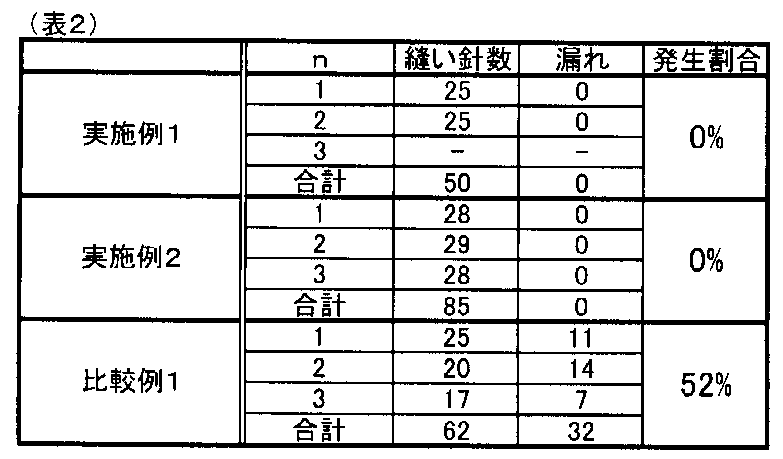
- urethane leak check evaluation> As described later, a sheet-like molded body obtained by sewing a sheet-like material with a predetermined thread and a laminate obtained by laminating a foamed polyurethane molded body on the sheet-like molded body were prepared. The number of stitches in each condition was counted, and it was visually confirmed whether urethane leaked from some places.
- urethane leakage means that urethane can be seen from the stitched portion of the design surface. The number of stitches where urethane leakage occurred was divided by the total number of stitches to determine the proportion of urethane leakage. The results are shown in Table 2.
- Example 1 ⁇ Production of sheet-like molded body and laminate>
- Example 1 Ingredients shown in Table 1 except for the plasticizer and dusting agent are mixed in a Henschel mixer, and when the temperature of the mixture rises to 80 ° C., the plasticizer is added and then dried up (the plasticizer is chlorinated). And the mixture is further absorbed by the vinyl resin particles.) After that, the emulsion polymerization vinyl chloride resin, which is a dusting agent, is added when the mixture is cooled to 70 ° C. or lower. A vinyl chloride resin composition for body molding was prepared.
- the vinyl chloride resin composition for powder molding is sprinkled on a metal mold with a grain heated to 250 ° C., and is left for a time (specifically, 8 to 18 seconds) adjusted so that the thickness of the vinyl chloride resin molded sheet becomes 1 mm.
- surplus vinyl chloride resin composition for powder molding is shaken off and left to stand in an oven set at 200 ° C.
- the mold is cooled with water, and the mold temperature is When cooled to 40 ° C., a 150 mm ⁇ 200 mm ⁇ 1 mm thick vinyl chloride resin molded sheet (hereinafter referred to as “sheet-like product”) was removed from the mold.
- ⁇ Sewing processing was applied to the sheet-like material.
- the sewing machine used is LU-2860-7 manufactured by JUKI. Sewing thread: Upper thread: Ace Crown manufactured by Onuki Fiber Co., Ltd. For vehicles # 5 (100% polyester; melting point: 249 ° C.), Lower thread: Melter No. manufactured by Fujix Co., Ltd. 3 (85% nylon, 15% polyester; melting point 114 ° C., fineness 1160 dtex).
- the stitch interval was 3 stitches / cm, the speed was 3.3 stitches / sec, and a length of about 9 to 10 cm was sewn. Two pieces of this were sewn on the same sheet-like material to produce a sheet-like molded body according to Example 1.
- an aluminum plate of 250 mm ⁇ 340 mm ⁇ 2 mm is placed under a mold of 200 mm ⁇ 300 mm ⁇ 10 mm, and two obtained sheet-like molded bodies are embossed on a lid of a mold of 348 mm ⁇ 255 mm ⁇ 10 mm.
- Example 1 which is a sample backed with foamed polyurethane having a thickness of 9 mm and a density of 0.18 g / cm 3 and an aluminum plate in this order on the skin made of a 1 mm thick sheet-like molded article.
- the laminated body was taken out from the mold.
- Example 2 Example except that three sewing processes were applied to the sheet-like material, and a household iron heated to 100 ° C. was pressed for 30 seconds from the back surface of the sewn sheet-like material, and the lower thread was fused.
- Example 2 Example except that three sewing processes were applied to the sheet-like material, and a household iron heated to 100 ° C. was pressed for 30 seconds from the back surface of the sewn sheet-like material, and the lower thread was fused.
- Example 2 Example 1 except that three sewing processes were applied to the sheet-like material, and a household iron heated to 100 ° C. was pressed for 30 seconds from the back surface of the sewn sheet-like material, and the lower thread was fused.
- Example 1 As the lower thread used in the sewing process, # 1 (100% polyester; melting point 249 ° C.) for ace crown vehicle manufactured by Onuki Fiber Co., Ltd. was used, and Example 1 was applied except that three sewing processes were applied to the sheet-like material. Similarly, the sheet-like molded object and laminated body which concern on the comparative example 1 were produced.
Landscapes
- Engineering & Computer Science (AREA)
- Mechanical Engineering (AREA)
- Chemical & Material Sciences (AREA)
- Combustion & Propulsion (AREA)
- Transportation (AREA)
- Textile Engineering (AREA)
- Laminated Bodies (AREA)
- Moulding By Coating Moulds (AREA)
- Lining Or Joining Of Plastics Or The Like (AREA)
- Treatments For Attaching Organic Compounds To Fibrous Goods (AREA)
- Vehicle Interior And Exterior Ornaments, Soundproofing, And Insulation (AREA)
- Instrument Panels (AREA)
Abstract
Description
特許文献1のように、シール用テープや接着剤を用いた場合には、これら材料を用いた箇所で各種成分の移行速度が変化するため、当該箇所の色味の変化が当該箇所周辺とは異なるものとなり、裏側にテープや接着剤が配置されていることが露見してしまうという問題があった。また、特許文献1のように、樹脂糸を溶かしてシールしようとした場合には、同時に表皮材が溶融、分解等することにより意匠性が損なわれるという問題があった。
一方、特許文献2に記載の方法によれば、表皮材の裏側をシールする必要がないため、上記特許文献1のような問題は生じないものの、加熱装置又は保温した縫製針により縫製箇所を溶融させる必要があるため、高度な温度管理が必要となり、製造装置及び製造工程が複雑化し、コスト高となるという問題があった。
本発明のシート状成形体は、シート状物に縫製加工が施されてなり、縫製加工の少なくとも一部に、糸用樹脂を含む糸用樹脂組成物からなり、融点が200℃以下である糸が用いられている。また、本発明の積層体は、該シート状成形体からなる表皮層と、発泡ポリウレタン成形体からなる発泡ポリウレタン層と、を有する。
以下、本発明の一実施形態に係るシート状成形体、及び、積層体について、図1、2を参照しつつ説明する。
図1に示すように、積層体10は、シート状物2に糸3を用いて縫製加工(ステッチS)が施されてなるシート状成形体1、発泡ポリウレタン成形体4、及び、基材5がこの順に積層された構造を有する。また、積層体10には、シート状物1からなる表皮材同士が縫い合わされているかのような美感を与える目的で、ステッチSに沿って凹溝6が形成されている。図2の断面図に表れているように、糸3は上糸3a及び下糸3bからなり、ステッチSは該上糸3a及び下糸3bを用いた本縫い方式により、シート状物2に施されている。図2に示すように、積層体10において、上糸3aは積層体10の意匠面(積層体を設置した際に外部から視認される面をいう。以下、同様とする。)の一部を構成し、積層体10の意匠性を高める役割を果たす。一方、下糸3bは、通常外部から視認されることはなく、発泡ポリウレタン成形体4が積層される側に配置され、発泡ポリウレタン成形体4を積層する際に縫製箇所7から原料等が流出することを防止するのに主要な役割を果たす。
本発明におけるシート状物は、自動車用のインスツルメントパネル、コンソールボックス若しくはドアトリム、又は、家具等の住宅用内装品等の表皮材として使用され、意匠性や商品性を高める部材である。
防黴剤の具体例は、脂肪族エステル系防黴剤、炭化水素系防黴剤、有機窒素系防黴剤、有機窒素硫黄系防黴剤等である。
帯電防止剤の具体例は、脂肪酸塩類、高級アルコール硫酸エステル類、スルホン酸塩類等のアニオン系帯電防止剤;脂肪族アミン塩類、第四級アンモニウム塩類のカチオン系帯電防止剤;ポリオキシエチレンアルキルエーテル類、ポリオキシエチレンアルキルフェノールエーテル類等のノニオン系帯電防止剤等である。
光安定剤の具体例は、ベンゾトリアゾール系、ベンゾフェノン系、ニッケルキレート系等の紫外線吸収剤、ヒンダートアミン系光安定剤等である。
β-ジケトン類の含有量は特定の範囲に限定されない。好ましい当該含有量は、塩化ビニル樹脂(a)100質量部に対して0.1~5質量部である。
本発明において、縫製加工の少なくとも一部には、糸用樹脂を含む糸用樹脂組成物からなり、融点が200℃以下である糸が用いられる。なお、糸の融点は示差走査型熱量計(DSC)を用いて、昇温速度10℃/分、測定温度範囲30~300℃、試料量2mg、窒素雰囲気下で測定され、最も面積の大きい吸熱ピークの発現温度を融点とする。
なお、本発明に用いる糸用樹脂は、ナイロンとポリエステルとの混合物であってもよく、ナイロンとポリエステルとのポリマーアロイであってもよい。
また、上記含有量を満たしつつ、糸用樹脂に含まれるナイロンの融点は、200℃以下であることが好ましく、180℃以下であることがより好ましく、170℃以下であることがさらに好ましい。一方、縫製加工性と耐熱老化性の観点から、糸用樹脂に含まれるナイロンの融点は、30℃以上であることが好ましく、60℃以上であることがより好ましく、90℃以上であることがさらに好ましい。
なお、縫製加工後の成形品意匠性の観点から、上糸及び下糸のいずれもが、上記した条件を満たす糸を用いることが好ましい。
上記シート状成形体には、発泡ポリウレタン成形体が裏打ちされる。シート状成形体に発泡ポリウレタン成形体を積層する方法は、シート状成形体と、発泡ポリウレタン成形体とを別途作製した後に、熱融着あるいは熱接着又は公知の接着剤などを用いることにより貼り合わせる方法;シート状成形体上にて、発泡ポリウレタン成形体の原料となるイソシアネート類とポリオール類などを反応させて重合を行うと共に、公知の方法によりポリウレタンの発泡を行うことにより積層する方法;などが挙げられる。後者の方が、工程が簡素であり、かつ、種々の形状の積層体を得る場合においても、シート状成形体と発泡ポリウレタン成形体との接着を確実に行うことができるのでより好適である。なお、後者の方法により、シート状成形体に発泡ポリウレタン成形体を積層する場合、意匠面のうち、少なくとも縫製箇所(例えば、図2の符号7)には、縫製箇所を覆う部材を配置しておくことが好ましい。少なくとも縫製箇所を覆う部材を配置しておくことにより、縫製箇所からポリウレタンの原料等が流出することを防止する効果をさらに高めることが可能となる。縫製箇所を覆う部材は、縫製箇所の形状に沿うものであれば特に限定されず、金属製、樹脂製、木材製等であればよい。
本発明において、発泡ポリウレタン成形体にはさらに基材が裏打ちされていてもよい。基材を有することにより、積層体の剛性を高めることができる。本発明に用いる基材は特に限定されず、金属製、合成樹脂性等、公知の材料を用いることができる。基材を積層する方法は、特に限定されないが、シート状成形体と発泡ポリウレタン成形体との積層体、及び、基材を別途作製した後に、熱融着あるいは熱接着又は公知の接着剤などを用いることにより貼り合わせる方法;シート状成形体と基材との間で上記公知の方法によりポリウレタンの発泡を行う方法;などが挙げられる。後者の方が、工程が簡素であり、かつ、種々の形状の積層体を得る場合においても、発泡ポリウレタン成形体と基材との接着を確実に行うことができるのでより好適である。
後に説明するようにして、シート状物に所定の糸を用いて縫製加工が施されたシート状成形体、及び、シート状成形体に発泡ポリウレタン成形体が積層されてなる積層体を作製した。各条件のステッチ数を数え、そのうち何か所からウレタンが漏れているかを目視で確認した。ここで、「ウレタン漏れ」とは、意匠面のステッチ部からウレタンが見えることを指す。このウレタン漏れが発生するステッチ数を、総ステッチ数で割り、ウレタン漏れ発生割合を求めた。結果を表2に示す。
(実施例1)
表1に示す配合成分のうち可塑剤及びダスティング剤を除く成分をヘンシェルミキサーに入れて混合し、混合物の温度が80℃に上昇した時点で可塑剤を添加後、ドライアップ(可塑剤が塩化ビニル樹脂粒子に吸収されて、上記混合物がさらさらになった状態をいう。)し、その後、混合物が70℃以下に冷却された時点でダスティング剤である乳化重合塩化ビニル樹脂を添加し、粉体成形用塩化ビニル樹脂組成物を調製した。
シート状物に3本の縫製加工を施し、該縫製加工を施したシート状物の裏面より、100℃に加熱した家庭用アイロンを30秒間押し当て、下糸を融着させた以外は実施例1と同様にして、実施例2に係るシート状成形体、及び、積層体を作製した。
縫製加工に用いる下糸として、大貫繊維(株)製エースクラウン 車輌用 #8(ポリエステル100%;融点 249℃)を用い、シート状物に3本の縫製加工を施した以外は実施例1と同様にして、比較例1に係るシート状成形体、及び、積層体を作製した。

2 シート状物
3 糸
3a 上糸
3b 下糸
4 発泡ポリウレタン成形体(発泡ポリウレタン層)
5 基材
6 凹溝
7 縫製箇所
10 積層体
Claims (13)
- シート状物に縫製加工が施されてなるシート状成形体であって、前記縫製加工の少なくとも一部に、糸用樹脂を含む糸用樹脂組成物からなり、融点が200℃以下である糸が用いられているシート状成形体。
- 前記糸用樹脂が、ポリエステルおよびナイロンを主成分とするものである、請求項1に記載のシート状成形体。
- 前記糸用樹脂が、融点が200℃以下のナイロンを50質量%以上含有する、請求項1又は2に記載のシート状成形体。
- 前記シート状物の少なくとも一方の面に前記糸が融着している、請求項1~3のいずれかに記載のシート状成形体。
- 前記シート状物が、シート用樹脂組成物を主成分とするものである、請求項1~4のいずれかに記載のシート状成形体。
- 前記シート用樹脂組成物が粉体成形用樹脂組成物であり、
前記シート状物が、前記粉体成形用樹脂組成物をパウダースラッシュ成形してなるものである、請求項5に記載のシート状成形体。 - 前記粉体成形用樹脂組成物が、塩化ビニル樹脂を含有する塩化ビニル樹脂組成物、ウレタン樹脂を含有するウレタン樹脂組成物、及び、オレフィン樹脂を含有するオレフィン樹脂組成物からなる群から選ばれる少なくとも1種からなるものである、請求項6に記載のシート状成形体。
- 前記粉体成形用樹脂組成物が前記塩化ビニル樹脂組成物である、請求項7に記載のシート状成形体。
- 前記塩化ビニル樹脂の平均重合度が800~5000である、請求項7又は8に記載のシート状成形体。
- 前記粉体成形用樹脂組成物が、前記塩化ビニル樹脂100質量部に対して、可塑剤を30~200質量部含む、請求項7~9のいずれかに記載のシート状成形体。
- 前記縫製加工が上糸及び下糸を用いて施され、前記上糸及び前記下糸のうち、少なくとも前記下糸が前記糸用樹脂を含む前記糸用樹脂組成物からなり、融点が200℃以下である前記糸である、請求項1~10のいずれかに記載のシート状成形体。
- 請求項1~11のいずれかに記載のシート状成形体と、発泡ポリウレタン成形体と、を有する積層体。
- 自動車インスツルメントパネル用積層体である、請求項12に記載の積層体。
Priority Applications (7)
| Application Number | Priority Date | Filing Date | Title |
|---|---|---|---|
| JP2017530865A JP6760289B2 (ja) | 2015-07-29 | 2016-07-25 | シート状成形体、及び、積層体 |
| CA2993641A CA2993641A1 (en) | 2015-07-29 | 2016-07-25 | Sheet-type molded body, and laminate |
| MX2018000909A MX2018000909A (es) | 2015-07-29 | 2016-07-25 | Cuerpo moldeado con forma de hoja y laminado. |
| US15/746,130 US11052635B2 (en) | 2015-07-29 | 2016-07-25 | Sheet-type molded body, and laminate |
| KR1020187002865A KR20180035820A (ko) | 2015-07-29 | 2016-07-25 | 시트상 성형체 및 적층체 |
| EP16830495.4A EP3330074A4 (en) | 2015-07-29 | 2016-07-25 | FILM-TYPE FORM BODY AND LAMINATE |
| CN201680042552.6A CN107848249A (zh) | 2015-07-29 | 2016-07-25 | 片状成型体及层叠体 |
Applications Claiming Priority (2)
| Application Number | Priority Date | Filing Date | Title |
|---|---|---|---|
| JP2015-149260 | 2015-07-29 | ||
| JP2015149260 | 2015-07-29 |
Publications (1)
| Publication Number | Publication Date |
|---|---|
| WO2017018390A1 true WO2017018390A1 (ja) | 2017-02-02 |
Family
ID=57884434
Family Applications (1)
| Application Number | Title | Priority Date | Filing Date |
|---|---|---|---|
| PCT/JP2016/071776 Ceased WO2017018390A1 (ja) | 2015-07-29 | 2016-07-25 | シート状成形体、及び、積層体 |
Country Status (9)
| Country | Link |
|---|---|
| US (1) | US11052635B2 (ja) |
| EP (1) | EP3330074A4 (ja) |
| JP (1) | JP6760289B2 (ja) |
| KR (1) | KR20180035820A (ja) |
| CN (1) | CN107848249A (ja) |
| CA (1) | CA2993641A1 (ja) |
| MX (1) | MX2018000909A (ja) |
| TW (1) | TW201710071A (ja) |
| WO (1) | WO2017018390A1 (ja) |
Cited By (2)
| Publication number | Priority date | Publication date | Assignee | Title |
|---|---|---|---|---|
| JP2021181177A (ja) * | 2020-05-19 | 2021-11-25 | トヨタ自動車株式会社 | 発泡成形体 |
| JP7423116B1 (ja) | 2023-10-30 | 2024-01-29 | 株式会社K&I | 皮革製品の製造方法 |
Families Citing this family (4)
| Publication number | Priority date | Publication date | Assignee | Title |
|---|---|---|---|---|
| EP3814177B1 (en) * | 2018-06-28 | 2025-01-08 | Shanghai Yanfeng Jinqiao Automotive Trim Systems Co. Ltd | Vehicle trim component |
| US11840188B2 (en) * | 2018-06-28 | 2023-12-12 | Shanghai Yanfeng Jinqiao Automotive Trim Systems Co. Ltd. | Vehicle interior component |
| CN112867592B (zh) * | 2018-10-31 | 2022-10-28 | 日本瑞翁株式会社 | 粉体成型用氯乙烯树脂组合物、氯乙烯树脂成型体以及层叠体 |
| JP2021079822A (ja) * | 2019-11-19 | 2021-05-27 | 豊田合成株式会社 | 表皮付き製品 |
Citations (3)
| Publication number | Priority date | Publication date | Assignee | Title |
|---|---|---|---|---|
| JPH06136173A (ja) * | 1992-02-10 | 1994-05-17 | Toagosei Chem Ind Co Ltd | 粉末成形用樹脂組成物 |
| JPH08243271A (ja) * | 1995-03-13 | 1996-09-24 | Achilles Corp | 縫製表皮材及びこれを用いた表皮一体発泡成形方法 |
| WO2006001067A1 (ja) * | 2004-06-29 | 2006-01-05 | Inoac Corporation | 発泡成形体用縫製糸、発泡成形体及び発泡成形体の製造方法 |
Family Cites Families (35)
| Publication number | Priority date | Publication date | Assignee | Title |
|---|---|---|---|---|
| US4247345A (en) * | 1978-11-30 | 1981-01-27 | Olin Corporation | Method for joining synthetic materials |
| JPS6222682A (ja) * | 1985-07-23 | 1987-01-30 | 高島屋日発工業株式会社 | 座席用クツシヨン体の製造方法 |
| DE3672982D1 (de) * | 1985-12-05 | 1990-08-30 | Sakae Lace Kk | Kettengewirkte spitzen. |
| JPS63242606A (ja) * | 1987-03-31 | 1988-10-07 | Tokai Chem Ind Ltd | 表皮材をもつ発泡樹脂成形体の製造方法 |
| JPS63291748A (ja) * | 1987-05-25 | 1988-11-29 | Kasai Kogyo Co Ltd | 自動車用内装部品 |
| JPH031938A (ja) | 1989-05-30 | 1991-01-08 | Honda Motor Co Ltd | ステッチ模様を有する内装材及びその製法 |
| GB9104895D0 (en) * | 1991-03-08 | 1991-04-24 | Gen Motors Corp | Upholstery fabric |
| US5203939A (en) * | 1991-08-05 | 1993-04-20 | Coats Viyella, Plc | Process for production of internally bonded sewing threads |
| US5225214A (en) * | 1992-05-18 | 1993-07-06 | Davidson Textron Inc. | Laterally adjustable divider wall for molding two color shells |
| JPH07314465A (ja) * | 1994-05-23 | 1995-12-05 | Nishikawa Kasei Co Ltd | スラッシュ表皮を有する発泡成形品 |
| JP2963642B2 (ja) * | 1995-05-17 | 1999-10-18 | 株式会社イノアックコーポレーション | ヘッドレストの製造方法 |
| US5682771A (en) * | 1996-03-12 | 1997-11-04 | General Motors Corporation | Knitted cover |
| US5887452A (en) * | 1996-08-29 | 1999-03-30 | Lear Corporation | Knitted cover |
| JPH10306187A (ja) * | 1997-05-06 | 1998-11-17 | Zeon Kasei Co Ltd | 粉末成形用塩化ビニル系樹脂組成物 |
| JP3893514B2 (ja) * | 2001-11-29 | 2007-03-14 | 平岡織染株式会社 | 接合部分の耐熱クリープ性に優れたテント膜構造体用ポリオレフィン系樹脂シート接合体及びその製造方法 |
| DE60201968T2 (de) * | 2002-02-08 | 2005-12-22 | Visteon Global Technologies, Inc., Dearborn | Verfahren zur Herstellung eines dekorativen Armaturbretts und entsprechendes Armaturbrett |
| DE10244311B4 (de) * | 2002-09-23 | 2019-01-03 | Volkswagen Ag | Innenausstattungsteil für Fahrzeuge und Verfahren zur Herstellung desselben |
| EP1714567A3 (en) * | 2003-06-27 | 2007-09-19 | W.L. GORE & ASSOCIATES GmbH | Microseam |
| US20050188907A1 (en) * | 2004-02-27 | 2005-09-01 | American & Efird, Inc. | Sewing method to increase seam strength |
| WO2005085505A1 (en) * | 2004-03-01 | 2005-09-15 | Pliana Holdings, S.A. De C.V. | Method of producing yarns and fabrics |
| KR101438246B1 (ko) * | 2007-01-05 | 2014-09-04 | 존슨 컨트롤스 테크놀러지 컴퍼니 | 국소적인 깊은 연성 구역을 구비하는 트림 패널을 형성하는 방법 및 그에 의해 얻을 수 있는 트림 패널 |
| DE102007057637A1 (de) * | 2007-11-30 | 2009-06-04 | Trw Automotive Safety Systems Gmbh | Verfahren zum Beledern eines Fahrzeuginnenraumteiles, insbesondere eines Fahrzeuglenkrades |
| US9682512B2 (en) * | 2009-02-06 | 2017-06-20 | Nike, Inc. | Methods of joining textiles and other elements incorporating a thermoplastic polymer material |
| JP2013119688A (ja) * | 2011-12-08 | 2013-06-17 | Kanagawa Kk | 熱膨張性縫製糸及びその縫製方法 |
| JP5926947B2 (ja) * | 2011-12-16 | 2016-05-25 | 倉敷紡績株式会社 | 繊維強化樹脂成形体及びそれを用いた車両用内装材 |
| US8597760B2 (en) * | 2012-03-30 | 2013-12-03 | Swnr Development, Llc | Stitched multi-layer fabric |
| US9272486B2 (en) * | 2012-03-30 | 2016-03-01 | Swnr Development, Llc | Stitched multi-layer fabric |
| US20130255103A1 (en) * | 2012-04-03 | 2013-10-03 | Nike, Inc. | Apparel And Other Products Incorporating A Thermoplastic Polymer Material |
| EP2662480B1 (de) * | 2012-05-11 | 2014-10-01 | Groz-Beckert KG | Textilteil, Verbundwerkstoffelement mit Textilteil und deren Herstellungsverfahren |
| JP2014019060A (ja) | 2012-07-18 | 2014-02-03 | Toyota Motor Corp | 成形方法と成形品 |
| US8678458B2 (en) * | 2012-08-09 | 2014-03-25 | Faurecia Interior Systems, Inc. | Vehicle interior components with decorative stitching |
| US20140079901A1 (en) * | 2012-09-14 | 2014-03-20 | Anji Mountain | Decorative laminate pad for supporting an item of furniture |
| WO2016029223A1 (en) * | 2014-08-22 | 2016-02-25 | Inteva Products, Llc | Method and apparatus for blind stitching a formed component and components formed from the method |
| JP6597529B2 (ja) * | 2016-09-08 | 2019-10-30 | トヨタ車体株式会社 | 内装部品及びその製造方法 |
| JP6766548B2 (ja) * | 2016-09-20 | 2020-10-14 | トヨタ紡織株式会社 | 内装部品及びその製造方法 |
-
2016
- 2016-07-25 CN CN201680042552.6A patent/CN107848249A/zh active Pending
- 2016-07-25 US US15/746,130 patent/US11052635B2/en not_active Expired - Fee Related
- 2016-07-25 EP EP16830495.4A patent/EP3330074A4/en not_active Withdrawn
- 2016-07-25 WO PCT/JP2016/071776 patent/WO2017018390A1/ja not_active Ceased
- 2016-07-25 MX MX2018000909A patent/MX2018000909A/es unknown
- 2016-07-25 JP JP2017530865A patent/JP6760289B2/ja active Active
- 2016-07-25 CA CA2993641A patent/CA2993641A1/en not_active Abandoned
- 2016-07-25 KR KR1020187002865A patent/KR20180035820A/ko not_active Withdrawn
- 2016-07-27 TW TW105123661A patent/TW201710071A/zh unknown
Patent Citations (3)
| Publication number | Priority date | Publication date | Assignee | Title |
|---|---|---|---|---|
| JPH06136173A (ja) * | 1992-02-10 | 1994-05-17 | Toagosei Chem Ind Co Ltd | 粉末成形用樹脂組成物 |
| JPH08243271A (ja) * | 1995-03-13 | 1996-09-24 | Achilles Corp | 縫製表皮材及びこれを用いた表皮一体発泡成形方法 |
| WO2006001067A1 (ja) * | 2004-06-29 | 2006-01-05 | Inoac Corporation | 発泡成形体用縫製糸、発泡成形体及び発泡成形体の製造方法 |
Non-Patent Citations (1)
| Title |
|---|
| See also references of EP3330074A4 * |
Cited By (5)
| Publication number | Priority date | Publication date | Assignee | Title |
|---|---|---|---|---|
| JP2021181177A (ja) * | 2020-05-19 | 2021-11-25 | トヨタ自動車株式会社 | 発泡成形体 |
| JP7268639B2 (ja) | 2020-05-19 | 2023-05-08 | トヨタ自動車株式会社 | 発泡成形体 |
| JP7423116B1 (ja) | 2023-10-30 | 2024-01-29 | 株式会社K&I | 皮革製品の製造方法 |
| JP7444515B1 (ja) | 2023-10-30 | 2024-03-06 | 株式会社K&I | 皮革製品 |
| WO2025094455A1 (ja) * | 2023-10-30 | 2025-05-08 | 株式会社K&I | 皮革製品およびその製造方法 |
Also Published As
| Publication number | Publication date |
|---|---|
| MX2018000909A (es) | 2018-05-15 |
| CA2993641A1 (en) | 2017-02-02 |
| EP3330074A4 (en) | 2019-04-10 |
| US20180207908A1 (en) | 2018-07-26 |
| EP3330074A1 (en) | 2018-06-06 |
| KR20180035820A (ko) | 2018-04-06 |
| US11052635B2 (en) | 2021-07-06 |
| JPWO2017018390A1 (ja) | 2018-05-17 |
| TW201710071A (zh) | 2017-03-16 |
| CN107848249A (zh) | 2018-03-27 |
| JP6760289B2 (ja) | 2020-09-23 |
Similar Documents
| Publication | Publication Date | Title |
|---|---|---|
| JP5729552B2 (ja) | 粉体成形用塩化ビニル樹脂組成物、塩化ビニル樹脂成形体及び積層体 | |
| JP6191619B2 (ja) | 粉体成形用塩化ビニル樹脂組成物、塩化ビニル樹脂成形体及び積層体 | |
| JP6614132B2 (ja) | 粉体成形用塩化ビニル樹脂組成物、塩化ビニル樹脂成形体及び積層体 | |
| WO2017018390A1 (ja) | シート状成形体、及び、積層体 | |
| JP6750503B2 (ja) | リアルステッチ表皮用粉体成形性塩化ビニル樹脂組成物及びその製造方法、リアルステッチ表皮用塩化ビニル樹脂成形体及びその製造方法、並びに、積層体 | |
| JP6673335B2 (ja) | 自動車内装材用積層体 | |
| JP6724787B2 (ja) | 粉体成形用塩化ビニル樹脂組成物及びその製造方法、塩化ビニル樹脂成形体及びその製造方法、並びに、積層体 | |
| JP6812964B2 (ja) | 自動車内装材用積層体 | |
| WO2016152085A1 (ja) | 粉体成形用塩化ビニル樹脂組成物、塩化ビニル樹脂成形体、及び積層体 | |
| WO2015141181A1 (ja) | 塩化ビニル樹脂組成物、塩化ビニル樹脂成形体及び積層体 | |
| WO2017018387A1 (ja) | 積層体の製造方法 | |
| WO2016139959A1 (ja) | 粉体成形用塩化ビニル樹脂組成物、塩化ビニル樹脂成形体及び積層体 | |
| WO2016143343A1 (ja) | 粉体成形用塩化ビニル樹脂組成物、塩化ビニル樹脂成形体及び積層体 | |
| WO2016075903A1 (ja) | 粉体成形用塩化ビニル樹脂組成物及びその製造方法、塩化ビニル樹脂成形体及びその製造方法、並びに、積層体 |
Legal Events
| Date | Code | Title | Description |
|---|---|---|---|
| 121 | Ep: the epo has been informed by wipo that ep was designated in this application |
Ref document number: 16830495 Country of ref document: EP Kind code of ref document: A1 |
|
| ENP | Entry into the national phase |
Ref document number: 2017530865 Country of ref document: JP Kind code of ref document: A |
|
| WWE | Wipo information: entry into national phase |
Ref document number: 15746130 Country of ref document: US |
|
| WWE | Wipo information: entry into national phase |
Ref document number: MX/A/2018/000909 Country of ref document: MX |
|
| ENP | Entry into the national phase |
Ref document number: 2993641 Country of ref document: CA |
|
| ENP | Entry into the national phase |
Ref document number: 20187002865 Country of ref document: KR Kind code of ref document: A |
|
| NENP | Non-entry into the national phase |
Ref country code: DE |
|
| WWE | Wipo information: entry into national phase |
Ref document number: 2016830495 Country of ref document: EP |
|
| WWW | Wipo information: withdrawn in national office |
Ref document number: 2016830495 Country of ref document: EP |