WO2017018441A1 - Cellule électrolytique en bain de sels fondus, procédé de production de magnésium métallique utilisant ladite cellule et procédé de production d'une éponge de titane - Google Patents
Cellule électrolytique en bain de sels fondus, procédé de production de magnésium métallique utilisant ladite cellule et procédé de production d'une éponge de titane Download PDFInfo
- Publication number
- WO2017018441A1 WO2017018441A1 PCT/JP2016/071985 JP2016071985W WO2017018441A1 WO 2017018441 A1 WO2017018441 A1 WO 2017018441A1 JP 2016071985 W JP2016071985 W JP 2016071985W WO 2017018441 A1 WO2017018441 A1 WO 2017018441A1
- Authority
- WO
- WIPO (PCT)
- Prior art keywords
- bipolar
- cathode
- electrolytic cell
- anode
- molten salt
- Prior art date
- Legal status (The legal status is an assumption and is not a legal conclusion. Google has not performed a legal analysis and makes no representation as to the accuracy of the status listed.)
- Ceased
Links
Images


Classifications
-
- C—CHEMISTRY; METALLURGY
- C25—ELECTROLYTIC OR ELECTROPHORETIC PROCESSES; APPARATUS THEREFOR
- C25C—PROCESSES FOR THE ELECTROLYTIC PRODUCTION, RECOVERY OR REFINING OF METALS; APPARATUS THEREFOR
- C25C7/00—Constructional parts, or assemblies thereof, of cells; Servicing or operating of cells
-
- C—CHEMISTRY; METALLURGY
- C22—METALLURGY; FERROUS OR NON-FERROUS ALLOYS; TREATMENT OF ALLOYS OR NON-FERROUS METALS
- C22B—PRODUCTION AND REFINING OF METALS; PRETREATMENT OF RAW MATERIALS
- C22B26/00—Obtaining alkali, alkaline earth metals or magnesium
- C22B26/20—Obtaining alkaline earth metals or magnesium
- C22B26/22—Obtaining magnesium
-
- C—CHEMISTRY; METALLURGY
- C22—METALLURGY; FERROUS OR NON-FERROUS ALLOYS; TREATMENT OF ALLOYS OR NON-FERROUS METALS
- C22B—PRODUCTION AND REFINING OF METALS; PRETREATMENT OF RAW MATERIALS
- C22B34/00—Obtaining refractory metals
- C22B34/10—Obtaining titanium, zirconium or hafnium
- C22B34/12—Obtaining titanium or titanium compounds from ores or scrap by metallurgical processing; preparation of titanium compounds from other titanium compounds see C01G23/00 - C01G23/08
-
- C—CHEMISTRY; METALLURGY
- C22—METALLURGY; FERROUS OR NON-FERROUS ALLOYS; TREATMENT OF ALLOYS OR NON-FERROUS METALS
- C22B—PRODUCTION AND REFINING OF METALS; PRETREATMENT OF RAW MATERIALS
- C22B34/00—Obtaining refractory metals
- C22B34/10—Obtaining titanium, zirconium or hafnium
- C22B34/12—Obtaining titanium or titanium compounds from ores or scrap by metallurgical processing; preparation of titanium compounds from other titanium compounds see C01G23/00 - C01G23/08
- C22B34/1263—Obtaining titanium or titanium compounds from ores or scrap by metallurgical processing; preparation of titanium compounds from other titanium compounds see C01G23/00 - C01G23/08 obtaining metallic titanium from titanium compounds, e.g. by reduction
- C22B34/1268—Obtaining titanium or titanium compounds from ores or scrap by metallurgical processing; preparation of titanium compounds from other titanium compounds see C01G23/00 - C01G23/08 obtaining metallic titanium from titanium compounds, e.g. by reduction using alkali or alkaline-earth metals or amalgams
- C22B34/1272—Obtaining titanium or titanium compounds from ores or scrap by metallurgical processing; preparation of titanium compounds from other titanium compounds see C01G23/00 - C01G23/08 obtaining metallic titanium from titanium compounds, e.g. by reduction using alkali or alkaline-earth metals or amalgams reduction of titanium halides, e.g. Kroll process
-
- C—CHEMISTRY; METALLURGY
- C22—METALLURGY; FERROUS OR NON-FERROUS ALLOYS; TREATMENT OF ALLOYS OR NON-FERROUS METALS
- C22B—PRODUCTION AND REFINING OF METALS; PRETREATMENT OF RAW MATERIALS
- C22B5/00—General methods of reducing to metals
- C22B5/02—Dry methods smelting of sulfides or formation of mattes
- C22B5/04—Dry methods smelting of sulfides or formation of mattes by aluminium, other metals or silicon
-
- C—CHEMISTRY; METALLURGY
- C25—ELECTROLYTIC OR ELECTROPHORETIC PROCESSES; APPARATUS THEREFOR
- C25C—PROCESSES FOR THE ELECTROLYTIC PRODUCTION, RECOVERY OR REFINING OF METALS; APPARATUS THEREFOR
- C25C3/00—Electrolytic production, recovery or refining of metals by electrolysis of melts
-
- C—CHEMISTRY; METALLURGY
- C25—ELECTROLYTIC OR ELECTROPHORETIC PROCESSES; APPARATUS THEREFOR
- C25C—PROCESSES FOR THE ELECTROLYTIC PRODUCTION, RECOVERY OR REFINING OF METALS; APPARATUS THEREFOR
- C25C3/00—Electrolytic production, recovery or refining of metals by electrolysis of melts
- C25C3/04—Electrolytic production, recovery or refining of metals by electrolysis of melts of magnesium
-
- C—CHEMISTRY; METALLURGY
- C25—ELECTROLYTIC OR ELECTROPHORETIC PROCESSES; APPARATUS THEREFOR
- C25C—PROCESSES FOR THE ELECTROLYTIC PRODUCTION, RECOVERY OR REFINING OF METALS; APPARATUS THEREFOR
- C25C7/00—Constructional parts, or assemblies thereof, of cells; Servicing or operating of cells
- C25C7/005—Constructional parts, or assemblies thereof, of cells; Servicing or operating of cells of cells for the electrolysis of melts
-
- C—CHEMISTRY; METALLURGY
- C25—ELECTROLYTIC OR ELECTROPHORETIC PROCESSES; APPARATUS THEREFOR
- C25C—PROCESSES FOR THE ELECTROLYTIC PRODUCTION, RECOVERY OR REFINING OF METALS; APPARATUS THEREFOR
- C25C7/00—Constructional parts, or assemblies thereof, of cells; Servicing or operating of cells
- C25C7/02—Electrodes; Connections thereof
-
- C—CHEMISTRY; METALLURGY
- C25—ELECTROLYTIC OR ELECTROPHORETIC PROCESSES; APPARATUS THEREFOR
- C25C—PROCESSES FOR THE ELECTROLYTIC PRODUCTION, RECOVERY OR REFINING OF METALS; APPARATUS THEREFOR
- C25C7/00—Constructional parts, or assemblies thereof, of cells; Servicing or operating of cells
- C25C7/02—Electrodes; Connections thereof
- C25C7/025—Electrodes; Connections thereof used in cells for the electrolysis of melts
Definitions
- the present invention relates to a molten salt electrolyzer equipped with two or more electrolytic cells, a method for producing metallic magnesium using the same, and a method for producing sponge titanium.
- a molten salt electrolytic cell particularly a molten salt electrolytic cell for producing metallic magnesium from magnesium chloride is used to regenerate metallic magnesium used as a reducing agent in the production of sponge titanium by the crawl method.
- sponge titanium by the crawl method is manufactured by chlorinating titanium ore to titanium tetrachloride, and reducing this titanium tetrachloride with magnesium.
- Magnesium chloride by-produced in this reduction reaction is molten salt electrolysis. Thus, it is regenerated into metallic magnesium and reused as a reducing agent.
- Patent Documents 1 and 2 In this type of molten salt electrolyzer, a plate-like anode and cathode, or a bipolar electrode (bipolar) between them is used in an electrolysis chamber (for example, Patent Documents 1 and 2).
- a cylindrical multi-electrode in which a bipolar electrode and a cathode are arranged in a cylindrical shape so as to surround the anode is used as one cell, and an electrolytic cell (Patent Document 3) in which a plurality of the cells are installed, or the cylinder
- Patent Document 4 an electrolytic cell in which a rectangular tube multi-electrode having a rectangular tube shape is used as one cell and a plurality of electrodes are similarly installed.
- the electrolytic cell provided with the plate-like electrode has low current efficiency and performs molten salt electrolysis in the space surrounded by the cathode and the inner wall material, so that the reaction between the generated metal and the inner wall material, etc., and electrolytic corrosion, etc.
- the inner wall material of the electrolysis chamber is damaged by impurities, impurities are mixed into the generated metal, and the purity of the generated metal is lowered.
- a cylinder or square tube with a multi-electrode built-in has a problem that a dead space is generated between the cell and the electrolytic cell wall or between the cell and the cell, resulting in inferior productivity of metallic magnesium per unit volume. is there.
- the present invention solves the above problems, and the problem of the present invention is that the current efficiency can be further improved, the productivity of the metal per unit volume of the electrolytic cell can be increased, and further the production efficiency is excellent.
- a molten salt electrolyzer comprising two or more electrolysis cell units in an electrolysis chamber,
- the electrolytic cell unit includes a cathode having a prismatic space, a prismatic anode, and at least one prismatic bipolar electrode;
- the bipolar electrode is disposed in the inner space of the cathode, and the anode is disposed in the inner space of the bipolar electrode.
- Each of the planes forming the outer side of the bipolar cylinder closest to the cathode among the bipolar poles respectively faces at least a part of the plane forming a prismatic space of the cathode
- a molten salt electrolytic cell in which at least one surface of the cathode is one surface of a cathode of another electrolytic cell unit.
- the anode of the electrolytic cell unit has a distance from the center of the anode to the cathode surface opposite to the metal recovery chamber and a distance from the center of the anode to the cathode surface on the metal recovery chamber side of 1:
- [5] A method for producing metallic magnesium by melt electrolysis of magnesium chloride using the molten salt electrolytic cell according to any one of [1] to [4].
- [6] A method for producing titanium sponge by reducing titanium tetrachloride using the magnesium metal obtained by the method described in [5] above.
- the molten salt electrolyzer of the present invention can greatly reduce the metal production cost because the current efficiency is improved, and the metal productivity per unit volume is high, so that the electrolyzer can be made compact, It has the effect of being able to produce metallic magnesium and thus sponge titanium efficiently at low cost.
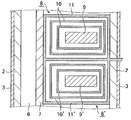
- FIG. 1 is an explanatory view showing a horizontal section of a molten salt electrolyzer according to an embodiment of the present invention.
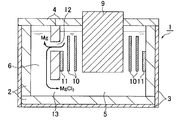
- FIG. 2 is an explanatory view showing a vertical section of the molten salt electrolytic cell of one embodiment of the present invention.
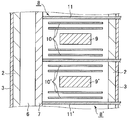
- FIG. 3 is an explanatory view showing another aspect of FIG.
- FIG. 4 is an explanatory view showing a horizontal cross section of a molten salt electrolytic cell in which concentric electrolytic cells used as a comparative example are installed.
- FIG. 5 is an explanatory view showing a horizontal cross section of a molten salt electrolytic cell in which a flat electrode used as a comparative example is installed.
- the molten salt electrolytic cell in the present invention has an electrolytic chamber for performing electrolysis and a metal recovery chamber for recovering metal obtained by electrolysis, and has a partition wall having an opening between the metal recovery chamber and the electrolytic chamber.
- the electrolytic cell unit has a prismatic anode in the vicinity of the center, and at least one bipolar (bipolar) and cathode having a rectangular tube shape so as to surround the anode, and the space surrounded by the bipolar and cathode is a prismatic shape.
- at least one surface of the cathode is at least one surface of the cathode of one or more other electrolysis cells adjacent to each other.
- both surfaces of the cathode plate of the electrolysis cell can be used for electrolysis, and a limited space can be used effectively. Furthermore, since molten salt electrolysis is performed in the space surrounded by the cathode plate, the reaction between the generated metal and the inner wall material, partition wall material, etc., and damage to the inner wall material of the electrolytic chamber due to electric corrosion, etc. can be suppressed, and the molten salt electrolytic cell The life of the metal can be extended, and the purity of the produced metal can be improved. Furthermore, since the cathode of each electrolytic cell unit conducts, the connection to the cathode can be simplified.
- the electrode of the present invention has a horizontal cross-sectional shape of a square, a rectangle, or a polygon, and in a three-dimensional shape, in the anode, a cube, a rectangular parallelepiped or a polygonal column, a double pole, and a cathode are in the shape of these cylinders. is there. It is preferable that the horizontal cross-sectional shape is square or rectangular because it is easy to assemble and processing costs are low. A rectangular shape is more preferable because it has high current efficiency and can increase the electrolytic area. These electrodes may be provided with chamfered portions at the corners. In addition, it is preferable that two or more electrolytic cell units are arranged along the direction of the metal recovery chamber for efficient metal recovery.
- the anode is disposed in the vicinity of the center of the space surrounded by the bipolar or cathode when viewed in a horizontal section.
- the anode is disposed so as to be shifted from the center of the space surrounded by the cathode to the side opposite to the metal recovery chamber (hereinafter also referred to as “electrolyzer rear wall side”).
- the distance between the electrodes on the rear wall side of the electrolytic cell is shorter than the distance between the electrodes on the metal recovery chamber side, the current density of the electrodes on the short side between the electrodes is increased, and the electrolytic reaction of the electrolytic bath is active. To be done.
- the gap between the electrodes rises more rapidly than the gap on the metal recovery chamber side and flows into the metal recovery chamber. Then, an apparent density difference is produced, and a fast bath flow that rotates counterclockwise is generated in the molten salt electrolyzer.
- the metal generated in the electrolysis chamber can be quickly moved to the metal recovery chamber, preventing metal stagnation, and preventing re-reaction with chlorine generated between the electrodes ( It is also possible to control the electrolytic bath.
- the distance between the cathode surface opposite to the metal recovery chamber that is, the cathode surface on the rear wall side of the electrolytic cell and the bipolar surface closest to the cathode surface, or the bipolar surface and the bipolar surface closest to the bipolar surface
- at least one of the distance between the bipolar surface and the anode surface closest to the bipolar surface is the distance between the corresponding cathode surface on the metal chamber side and the bipolar surface closest to the cathode, or By placing it so that it is shorter than the distance between the pole face and its bipolar face and the nearest bipolar face, or the distance between the bipolar face and the anode face closest to the bipolar face, This is more preferable because the flow of gas can be improved, and after electrolysis, re-reaction of gas and metal between the electrodes can be suppressed and current efficiency can be improved.
- the distance between the cathode surface on the rear wall side of the electrolytic cell and the bipolar surface closest to the cathode surface is shorter than the distance between the cathode surface on the metal recovery chamber side and the bipolar surface closest to the cathode surface. More preferably.
- the anode of the electrolytic cell unit is arranged such that the distance from the central portion of the anode to the cathode surface on the rear wall side of the electrolytic cell and the cathode surface on the metal recovery chamber side is 1: 0.5 to 1: 2. It is preferably 1: 0.5 to 1: 1.8, more preferably 1: 0.5 to 1: 1.5.
- the anode is preferably made of graphite as the material, and the size of the anode is 40 to 90% of the electrolytic cell unit in the long side in the direction of the rear wall of the electrolytic cell and the direction of the metal recovery chamber (the vertical direction of the electrolytic cell).
- the short side in the right-angle direction (electrolytic cell lateral direction) on the plane is 10 to 100% of the long side, and the ratio of the long side to the short side of the horizontal cross section of the anode is 1: 1 to 10: 1.
- the height is preferably 20 to 70% of the electrolytic bath height, and the upper end of the cathode is preferably disposed below the electrolytic bath surface.
- the cathode in the present invention is arranged so as to surround the anode. However, it is sufficient to surround a part of the anode, and the anode below the through portion of the partition wall between the metal recovery chamber and the electrolysis chamber is surrounded. It is preferable.
- the material of the cathode is preferably iron or graphite, and more preferably iron. When using iron, it may be manufactured from a single plate, but may be manufactured by combining a plurality of plates in consideration of thermal expansion. It is preferable to install one side of the cathode on the rear wall of the electrolytic cell and the other side on the partition wall.
- the vertical direction of the cathode (the same direction as the vertical direction of the electrolytic cell) and the horizontal direction (the same direction as the horizontal direction of the electrolytic cell) determine the size of the electrolytic cell unit.
- the horizontal direction is 10 to 100% of the vertical direction
- the depth direction is the same as the lower end of the anode, or the upper end is higher than the lower end of the anode, and the upper end does not protrude from the bath surface.
- the thickness of the cathode is preferably thinner in order to improve the flow of the electrolytic bath, but is preferably 3 to 10 cm in order to maintain the strength.
- the bipolar (bipolar) in the present invention is disposed between the anode and the cathode so as to surround the anode, but it is sufficient that a part of the anode can be surrounded.
- the height of the bipolar electrode is preferably such that the molten salt can pass over the upper part of the bipolar electrode, and is preferably higher than the upper end of the cathode and lower than the lower surface of the ceiling lid. It is preferable that at least one bipolar electrode is inserted, two bipolar electrodes are inserted, and it is more preferable that three or more bipolar electrodes are inserted.
- the bipolar material is preferably graphite and may be manufactured from a single plate, but may be manufactured by combining a plurality of plates in consideration of thermal expansion.
- Steel liner processing may be applied to one side of the bipolar.
- the thickness of this bipolar electrode varies depending on the number of inserted electrodes, and the thickness is different between the anode and the bipolar electrode closest to the anode, and between the bipolar electrode and the bipolar electrode closest to the bipolar electrode, and closest to the bipolar electrode and the bipolar electrode. It is preferable that the distance between the cathodes be equal in the front-rear direction of the electrolytic cell unit.
- the thickness of the bipolar electrode is preferably 3 to 10 cm.
- the material of the inner wall and the partition wall in the present invention is preferably one that hardly reacts with the generated metal, does not react with the molten salt, and has high corrosion resistance from chlorine.
- Any material that has been conventionally used for the inner wall of a molten salt electrolytic cell may be used.
- bricks 90% or more are made of Al 2 O 3
- bricks 90% or more are made of SiO 2
- bricks 90% or more are made of Si 3 N 4
- 90% Brick made of MgO, 90% or more made of Al 2 O 3 and SiO 2 90% or more made of Al 2 O 3 and SiO 2, Si 3 N 4 and MgO Brick made of a combination of these is preferred.
- Ingredients constituting the brick shall be measured according to JIS M 8856-6: 1998.
- FIG. 1 is an explanatory diagram showing a horizontal section of the molten salt electrolyzer
- FIG. 2 is an explanatory diagram showing a vertical section along AA ′ in FIG. 1
- FIG. 3 is another embodiment of FIG. It is explanatory drawing shown.
- the molten salt electrolytic cell 1 main body is composed of an inner wall 2 made of refractory bricks and an outer wall 3 made of heat insulating bricks, and the upper part is covered with a ceiling lid 4.
- This molten salt electrolysis tank 1 has an electrolysis chamber 5 for electrolysis and a metal recovery chamber 6 for recovering the metal obtained by electrolysis, and a partition wall 7 is provided between the electrolysis chamber 5 and the metal recovery chamber 6. Yes.
- a plurality (two in FIG. 1) of electrolysis cell units 8 and 8 ′ are arranged in the electrolysis chamber 5 in a direction parallel to the metal recovery chamber 6, and the electrolysis cell units 8 and 8 ′ are arranged in the electrolysis cell units 8 and 8 ′ .
- the cathodes 11 and 11 ′ and the space surrounded by the bipolar electrodes 10 and 10 ′ and the cathodes 11 and 11 ′ has a prismatic shape. And the cathodes 11 and 11 'bear one surface of the cathode of the electrolysis cell which the one surface adjoins, and the cathode of each electrolysis cell is conducted.
- the partition wall 7 provided between the electrolysis chamber 5 and the metal recovery chamber 6 is provided with a through-hole 12 that communicates the two chambers at the upper portion and below the electrolyte surface.
- the lower end of the partition wall 7 is preferably fixed on a brick having an opening at the bottom of the molten salt electrolysis tank 1 , and an opening 13 for communicating the electrolysis chamber 5 and the metal recovery chamber 6 is provided. Is provided.
- the anode 9 passes through the ceiling lid 4 of the electrolysis chamber 5 and protrudes above the ceiling lid, and the cathode 11 is arranged so that the upper end thereof is at the same level as or below the lower side of the through hole 12 of the partition wall 7.
- the bipolar electrode 10 is arranged so that the upper end of the bipolar electrode 10 is above the through-hole 12 and has a height that allows the electrolytic bath in operation to get over the bipolar electrode.
- the lower ends of the anode 9, the bipolar electrode 10, and the cathode 11 are arranged so as to be higher than the upper end of the opening 13 that allows the electrolysis chamber 5 and the metal recovery chamber 6 to communicate with each other.
- the anode and cathode pair are connected to a DC power source not shown.
- FIG 3 shows another embodiment of the molten salt electrolyzer, in which the anode 9, 9 ′ and the bipolar electrodes 10, 10 ′ are located at the rear wall of the electrolyzer rather than the center of the space surrounded by the cathodes 11, 11 ′. It is shifted to the side.
- the metal produced in the molten salt electrolyzer of the present invention is not particularly limited as long as molten salt electrolysis can be performed, but metal magnesium, metal aluminum, metal calcium, or metal zinc is preferable, and metal magnesium is particularly preferable. preferable.
- metal magnesium is particularly preferable. preferable.
- FIG. 2 in the molten salt electrolysis tank 1 , heat-melted magnesium chloride is introduced from a raw material supply port (not shown), and the electrolytic bath surface is held so as to be above the through holes 12 of the partition walls 7. ing.
- an electrolysis current flows from the anode 9 to the cathode 11 through the bipolar electrode 10, and magnesium chloride is electrolyzed between the electrodes to generate metallic magnesium and generate chlorine gas. Since chlorine gas rises in the electrolytic bath, a circulating flow is generated in the electrolytic bath. Due to this circulating flow, the magnesium metal produced at the cathode passes through the through-hole 12 of the partition wall 7 and is carried to the metal recovery chamber 6 where it collects on the surface of the metal recovery chamber 6 due to the difference in specific gravity with the electrolytic bath. It is recovered from the metal recovery port that is not, and metal magnesium is produced. On the other hand, the generated chlorine gas gathers in the upper space of the electrolysis chamber 5 and is recovered from a chlorine recovery port (not shown).
- the magnesium metal obtained using the molten salt electrolyzer of the present invention can be used to reduce titanium tetrachloride in a reduction step which is one of the production steps of sponge titanium. Further, by reducing titanium tetrachloride using high-purity magnesium, it is possible to produce higher-purity sponge titanium. That is, in the titanium sponge production process, titanium ore is chlorinated to produce titanium tetrachloride, the titanium tetrachloride is reduced with magnesium to produce sponge titanium, and the sponge titanium is crushed. Sizing and producing product sponge titanium, and molten salt electrolysis of magnesium chloride by-produced by magnesium reduction of titanium tetrachloride to produce metal magnesium and chlorine gas as by-products (for example, Journal of MMIJ Vol. 123, P693-697 (2007) "Manufacture of titanium metal in Toho Titanium Co., Ltd.”). By incorporating the molten salt electrolytic cell of the present invention into this molten electrolysis process, sponge titanium can be produced efficiently at low cost.
- the inner wall constituting the electrolytic cell is performed using one of Al 2 O 3 content of 95% or more bricks.
- bricks of the present invention is not particularly limited to the Al 2 O 3 content of 95% or more bricks.
- Example 1 As shown in FIG. 1, two electrolytic cell units are installed in the molten salt electrolytic cell of the electrolytic chamber 2m 3 and the metal recovery chamber 0.5m 3 shown in FIG. 2 , and MgCl 2 , CaCl 2 , NaCl, MgF 2900 kg of molten salt comprising 2 %, 20%, 30%, 49% and 1%, respectively, was charged. To this, magnesium chloride corresponding to the production amount of metallic magnesium was appropriately added, and the average current density was set to 0.48 A / cm 2 , and molten salt electrolysis was performed. Since the energization amount in this case was 16.0 kA, the theoretical production amount was 21.8 kg / h, but the actual production amount was 18.5 kg / h. Therefore, the current efficiency of the molten salt electrolytic cell was 85%. The production amount per unit volume of the electrolysis chamber at that time was 9.3 kg / m 3 ⁇ h.
- Example 2 As shown in FIG. 3, using the same molten salt electrolytic cell and molten salt as in Example 1, except that the electrolytic cell was installed by shifting the center position of the anode and the bipolar electrode to the rear wall side of the electrolytic cell by 5 mm, Molten salt electrolysis was performed with an average current density of 0.48 A / cm 2 . Since the energization amount in this case is 16.0 kA, the theoretical production amount is 21.8 kg / h, but the actual production amount is 18.9 kg / h, and the current efficiency of the molten salt electrolyzer is 87%. It was. The production amount per unit volume of the electrolysis chamber at that time was 9.5 kg / m 3 ⁇ h.
- molten salt electrolytic cell in which two concentric electrolytic cell units are installed is used as the molten salt electrolytic cell shown in FIG. 2, and each of MgCl 2 , CaCl 2 , NaCl, and MgF 2 has a mass. 3100 kg of molten salt consisting of 20%, 30%, 49% and 1% in a ratio was charged. Magnesium chloride corresponding to the production amount of metallic magnesium was appropriately added thereto, and the average current density was set to 0.48 A / cm 2, and molten salt electrolysis was performed.
- Example 2 As shown in FIG. 5, the molten salt electrolyzer shown in FIG. 2 is installed with two sets of conventionally used flat plate-like anode, bipolar electrode, and cathode, and MgCl 2 , CaCl 2 , NaCl, and MgF 2 are respectively present. 2800 kg of molten salt consisting of 20%, 30%, 49% and 1% in terms of mass ratio was charged. This appropriately charged with magnesium chloride corresponding to production of magnesium metal, the average current density was 0.48A / cm 2, was subjected to molten salt electrolysis.
- the molten salt electrolytic cell of Example 1 was the same as that of Example 1 except that there were no electrode surfaces facing the cathode and the bipolar wall.
- the energization amount in this case is 12.3 kA
- the theoretical production amount is 16.7 kg / h
- the actual production amount is 13.9 kg / h
- the current efficiency of the molten salt electrolytic cell is 83%. It was.
- the production amount per unit volume of the electrolysis chamber was 7.0 kg / m 3 ⁇ h.
- Example 3 The molten salt electrolyzer used in Example 1 was operated for 5 days, and about 10 g of the produced metal magnesium was collected from the upper part of the metal recovery chamber so as not to contain magnesium chloride, and solidified at room temperature. Then, it melt
- Example 4 The experiment was performed under the same conditions as in Example 3 except that the molten salt electrolytic cell used in Example 2 was used. The results are shown in Table 1. (Comparative Example 3) The experiment was performed under the same conditions as in Example 3 except that the molten salt electrolytic cell used in Comparative Example 1 was used. The results are shown in Table 1. (Comparative Example 4) The experiment was performed under the same conditions as in Example 3 except that the molten salt electrolytic cell used in Comparative Example 2 was used. The results are shown in Table 1.
- the molten salt electrolytic cell of the present invention is useful for the production of metallic aluminum, metallic calcium, metallic zinc and the like in addition to metallic magnesium, and the molten salt of the present invention is used in the molten electrolytic process of magnesium chloride in the production of sponge titanium.
- sponge titanium By incorporating an electrolytic cell, sponge titanium can be produced efficiently at low cost.
Landscapes
- Chemical & Material Sciences (AREA)
- Engineering & Computer Science (AREA)
- Metallurgy (AREA)
- Materials Engineering (AREA)
- Organic Chemistry (AREA)
- Chemical Kinetics & Catalysis (AREA)
- Electrochemistry (AREA)
- Geology (AREA)
- General Life Sciences & Earth Sciences (AREA)
- Environmental & Geological Engineering (AREA)
- Life Sciences & Earth Sciences (AREA)
- Manufacturing & Machinery (AREA)
- Mechanical Engineering (AREA)
- Electrolytic Production Of Metals (AREA)
- Manufacture And Refinement Of Metals (AREA)
Abstract
Priority Applications (4)
| Application Number | Priority Date | Filing Date | Title |
|---|---|---|---|
| US15/741,197 US10837084B2 (en) | 2015-07-28 | 2016-07-27 | Molten salt electrolyzer, and method for producing metal magnesium using the same and method for producing a titanium sponge |
| RU2018107106A RU2686719C1 (ru) | 2015-07-28 | 2016-07-27 | Электролизер солевого расплава, способ получения металлического магния с его использованием и способ получения губчатого титана |
| CN201680044048.XA CN107849718B (zh) | 2015-07-28 | 2016-07-27 | 熔融盐电解槽、以及使用其的金属镁的制造方法以及海绵钛的制造方法 |
| JP2017530897A JP6501886B2 (ja) | 2015-07-28 | 2016-07-27 | 溶融塩電解槽、およびそれを用いた金属マグネシウムの製造方法並びにスポンジチタンの製造方法 |
Applications Claiming Priority (2)
| Application Number | Priority Date | Filing Date | Title |
|---|---|---|---|
| JP2015148820 | 2015-07-28 | ||
| JP2015-148820 | 2015-07-28 |
Publications (1)
| Publication Number | Publication Date |
|---|---|
| WO2017018441A1 true WO2017018441A1 (fr) | 2017-02-02 |
Family
ID=57885612
Family Applications (1)
| Application Number | Title | Priority Date | Filing Date |
|---|---|---|---|
| PCT/JP2016/071985 Ceased WO2017018441A1 (fr) | 2015-07-28 | 2016-07-27 | Cellule électrolytique en bain de sels fondus, procédé de production de magnésium métallique utilisant ladite cellule et procédé de production d'une éponge de titane |
Country Status (5)
| Country | Link |
|---|---|
| US (1) | US10837084B2 (fr) |
| JP (1) | JP6501886B2 (fr) |
| CN (1) | CN107849718B (fr) |
| RU (1) | RU2686719C1 (fr) |
| WO (1) | WO2017018441A1 (fr) |
Cited By (8)
| Publication number | Priority date | Publication date | Assignee | Title |
|---|---|---|---|---|
| JP2019052336A (ja) * | 2017-09-13 | 2019-04-04 | 東邦チタニウム株式会社 | 溶融塩電解槽 |
| JP2019052337A (ja) * | 2017-09-13 | 2019-04-04 | 東邦チタニウム株式会社 | 溶融塩電解槽 |
| JP2019052335A (ja) * | 2017-09-13 | 2019-04-04 | 東邦チタニウム株式会社 | 溶融金属収集用部材及び金属マグネシウムの製造方法 |
| RU2702215C1 (ru) * | 2019-04-29 | 2019-10-04 | Публичное Акционерное Общество "Корпорация Всмпо-Ависма" | Электролизер для получения магния и хлора |
| CN111850614A (zh) * | 2020-07-31 | 2020-10-30 | 新疆湘晟新材料科技有限公司 | 高效节能多极镁电解槽 |
| JP2022102307A (ja) * | 2020-12-25 | 2022-07-07 | 東邦チタニウム株式会社 | 溶融塩電解装置及び、金属マグネシウムの製造方法 |
| JP2023080740A (ja) * | 2021-11-30 | 2023-06-09 | 東邦チタニウム株式会社 | 電極、溶融塩電解装置及び金属マグネシウムの製造方法 |
| JP2024005000A (ja) * | 2022-06-29 | 2024-01-17 | 東邦チタニウム株式会社 | 複極、溶融塩電解装置及び金属マグネシウムの製造方法 |
Families Citing this family (2)
| Publication number | Priority date | Publication date | Assignee | Title |
|---|---|---|---|---|
| JP7892452B2 (ja) * | 2022-06-15 | 2026-07-21 | 東邦チタニウム株式会社 | 陽極配置構造、溶融塩電解槽及び、金属の製造方法 |
| CN115772685A (zh) * | 2022-11-25 | 2023-03-10 | 新疆湘润新材料科技有限公司 | 节能高效的镁电解生产方法及系统 |
Citations (3)
| Publication number | Priority date | Publication date | Assignee | Title |
|---|---|---|---|---|
| JPS5943890A (ja) * | 1982-08-06 | 1984-03-12 | アルカン・インタ−ナシヨナル・リミテツド | 電解による金属の製造方法およびその装置 |
| JPH11503794A (ja) * | 1995-04-21 | 1999-03-30 | アルキャン・インターナショナル・リミテッド | 溶融電解質の電解による金属回収のための多極電解槽 |
| JP2012251221A (ja) * | 2011-06-03 | 2012-12-20 | Osaka Titanium Technologies Co Ltd | 溶融塩電解方法 |
Family Cites Families (7)
| Publication number | Priority date | Publication date | Assignee | Title |
|---|---|---|---|---|
| EP0560814B1 (fr) | 1990-11-28 | 1995-07-05 | MOLTECH Invent S.A. | Ensembles d'electrodes et cellules multimonopolaires pour l'extraction electrolytique d'aluminium |
| CN1073171C (zh) * | 1995-04-21 | 2001-10-17 | 艾尔坎国际有限公司 | 用熔融电解液电解以再生金属的多极电解槽 |
| JP2005171354A (ja) | 2003-12-15 | 2005-06-30 | Toho Titanium Co Ltd | 溶融金属塩化物の電解装置 |
| US7901483B2 (en) * | 2006-10-16 | 2011-03-08 | Metals Production Research, Inc. | Process for recovering titanium |
| JP5511083B2 (ja) | 2011-01-19 | 2014-06-04 | 株式会社大阪チタニウムテクノロジーズ | 溶融塩電解槽 |
| CN102206839A (zh) * | 2011-06-24 | 2011-10-05 | 遵宝钛业有限公司 | 一种镁电解槽的砌筑方法 |
| US20130032487A1 (en) | 2011-08-05 | 2013-02-07 | Olivo Sivilotti | Multipolar Magnesium Cell |
-
2016
- 2016-07-27 CN CN201680044048.XA patent/CN107849718B/zh active Active
- 2016-07-27 US US15/741,197 patent/US10837084B2/en active Active
- 2016-07-27 WO PCT/JP2016/071985 patent/WO2017018441A1/fr not_active Ceased
- 2016-07-27 RU RU2018107106A patent/RU2686719C1/ru active
- 2016-07-27 JP JP2017530897A patent/JP6501886B2/ja active Active
Patent Citations (3)
| Publication number | Priority date | Publication date | Assignee | Title |
|---|---|---|---|---|
| JPS5943890A (ja) * | 1982-08-06 | 1984-03-12 | アルカン・インタ−ナシヨナル・リミテツド | 電解による金属の製造方法およびその装置 |
| JPH11503794A (ja) * | 1995-04-21 | 1999-03-30 | アルキャン・インターナショナル・リミテッド | 溶融電解質の電解による金属回収のための多極電解槽 |
| JP2012251221A (ja) * | 2011-06-03 | 2012-12-20 | Osaka Titanium Technologies Co Ltd | 溶融塩電解方法 |
Cited By (12)
| Publication number | Priority date | Publication date | Assignee | Title |
|---|---|---|---|---|
| JP2019052336A (ja) * | 2017-09-13 | 2019-04-04 | 東邦チタニウム株式会社 | 溶融塩電解槽 |
| JP2019052337A (ja) * | 2017-09-13 | 2019-04-04 | 東邦チタニウム株式会社 | 溶融塩電解槽 |
| JP2019052335A (ja) * | 2017-09-13 | 2019-04-04 | 東邦チタニウム株式会社 | 溶融金属収集用部材及び金属マグネシウムの製造方法 |
| RU2702215C1 (ru) * | 2019-04-29 | 2019-10-04 | Публичное Акционерное Общество "Корпорация Всмпо-Ависма" | Электролизер для получения магния и хлора |
| CN111850614A (zh) * | 2020-07-31 | 2020-10-30 | 新疆湘晟新材料科技有限公司 | 高效节能多极镁电解槽 |
| CN111850614B (zh) * | 2020-07-31 | 2023-01-10 | 新疆湘晟新材料科技有限公司 | 高效节能多极镁电解槽 |
| JP2022102307A (ja) * | 2020-12-25 | 2022-07-07 | 東邦チタニウム株式会社 | 溶融塩電解装置及び、金属マグネシウムの製造方法 |
| JP7494106B2 (ja) | 2020-12-25 | 2024-06-03 | 東邦チタニウム株式会社 | 溶融塩電解装置及び、金属マグネシウムの製造方法 |
| JP2023080740A (ja) * | 2021-11-30 | 2023-06-09 | 東邦チタニウム株式会社 | 電極、溶融塩電解装置及び金属マグネシウムの製造方法 |
| JP7715611B2 (ja) | 2021-11-30 | 2025-07-30 | 東邦チタニウム株式会社 | 電極、溶融塩電解装置及び金属マグネシウムの製造方法 |
| JP2024005000A (ja) * | 2022-06-29 | 2024-01-17 | 東邦チタニウム株式会社 | 複極、溶融塩電解装置及び金属マグネシウムの製造方法 |
| JP7892462B2 (ja) | 2022-06-29 | 2026-07-21 | 東邦チタニウム株式会社 | 複極、溶融塩電解装置及び金属マグネシウムの製造方法 |
Also Published As
| Publication number | Publication date |
|---|---|
| RU2686719C1 (ru) | 2019-04-30 |
| CN107849718A (zh) | 2018-03-27 |
| US10837084B2 (en) | 2020-11-17 |
| US20180195151A1 (en) | 2018-07-12 |
| JPWO2017018441A1 (ja) | 2018-04-19 |
| CN107849718B (zh) | 2019-05-14 |
| JP6501886B2 (ja) | 2019-04-17 |
Similar Documents
| Publication | Publication Date | Title |
|---|---|---|
| JP6501886B2 (ja) | 溶融塩電解槽、およびそれを用いた金属マグネシウムの製造方法並びにスポンジチタンの製造方法 | |
| JP2016510362A (ja) | HClを生成する水素ガス拡散陽極の集成装置 | |
| CN103290433A (zh) | 一种双电解槽熔盐电解制备纯钛的装置及其工艺 | |
| US20160215405A1 (en) | Molten salt electrolysis apparatus and process | |
| JP2019214773A (ja) | 溶融塩電解方法および、金属マグネシウムの製造方法 | |
| JP2018070924A (ja) | 溶融塩電解槽およびそれを用いた金属マグネシウムの製造方法並びにスポンジチタンの製造方法。 | |
| JP2021021132A (ja) | 陽極接続構造、溶融塩電解装置、溶融塩電解方法及び、金属マグネシウムの製造方法 | |
| JP2024005002A (ja) | 複極の製造方法及び金属マグネシウムの製造方法 | |
| US20210254228A1 (en) | Method for producing magnesium and chlorine and electrolytic cell for implementing same | |
| JP7333223B2 (ja) | 溶融塩電解槽、溶融塩固化層の形成方法、金属の製造方法 | |
| CN111850614B (zh) | 高效节能多极镁电解槽 | |
| JP7076296B2 (ja) | 溶融金属の製造方法および、溶融塩電解槽 | |
| JP7043275B2 (ja) | 溶融塩電解方法、溶融金属の製造方法および、溶融塩電解槽 | |
| JP2025103980A (ja) | 金属マグネシウムの製造方法 | |
| US3676323A (en) | Fused salt electrolyzer for magnesium production | |
| JP6945398B2 (ja) | 溶融塩電解槽 | |
| JP7648444B2 (ja) | 金属の製造方法 | |
| CN111270271A (zh) | 一种氯化铝电解制备金属铝的双极性电极板及其使用方法 | |
| CN106702434B (zh) | 电解装置及电解方法 | |
| JP2022102307A (ja) | 溶融塩電解装置及び、金属マグネシウムの製造方法 | |
| JP2024005000A (ja) | 複極、溶融塩電解装置及び金属マグネシウムの製造方法 | |
| JP6532758B2 (ja) | 溶融塩電解槽並びに該溶融塩電解槽に使用される電極及び該溶融塩電解槽を用いた金属の製造方法 | |
| Van Vuuren et al. | Fundamental differences between magnesium and alkali metal electrowinning | |
| JPS5930794B2 (ja) | アルミニウムの電解製造法 | |
| JPWO2008038405A1 (ja) | 金属製造用溶融塩電解槽およびこれを用いた金属の製造方法 |
Legal Events
| Date | Code | Title | Description |
|---|---|---|---|
| 121 | Ep: the epo has been informed by wipo that ep was designated in this application |
Ref document number: 16830546 Country of ref document: EP Kind code of ref document: A1 |
|
| ENP | Entry into the national phase |
Ref document number: 2017530897 Country of ref document: JP Kind code of ref document: A |
|
| NENP | Non-entry into the national phase |
Ref country code: DE |
|
| WWE | Wipo information: entry into national phase |
Ref document number: 2018107106 Country of ref document: RU |
|
| 122 | Ep: pct application non-entry in european phase |
Ref document number: 16830546 Country of ref document: EP Kind code of ref document: A1 |