WO2017065188A1 - 粘着シート - Google Patents
粘着シート Download PDFInfo
- Publication number
- WO2017065188A1 WO2017065188A1 PCT/JP2016/080286 JP2016080286W WO2017065188A1 WO 2017065188 A1 WO2017065188 A1 WO 2017065188A1 JP 2016080286 W JP2016080286 W JP 2016080286W WO 2017065188 A1 WO2017065188 A1 WO 2017065188A1
- Authority
- WO
- WIPO (PCT)
- Prior art keywords
- pressure
- sensitive adhesive
- group
- adhesive sheet
- aliphatic polycarbonate
- Prior art date
- Legal status (The legal status is an assumption and is not a legal conclusion. Google has not performed a legal analysis and makes no representation as to the accuracy of the status listed.)
- Ceased
Links
Classifications
-
- C—CHEMISTRY; METALLURGY
- C09—DYES; PAINTS; POLISHES; NATURAL RESINS; ADHESIVES; COMPOSITIONS NOT OTHERWISE PROVIDED FOR; APPLICATIONS OF MATERIALS NOT OTHERWISE PROVIDED FOR
- C09J—ADHESIVES; NON-MECHANICAL ASPECTS OF ADHESIVE PROCESSES IN GENERAL; ADHESIVE PROCESSES NOT PROVIDED FOR ELSEWHERE; USE OF MATERIALS AS ADHESIVES
- C09J7/00—Adhesives in the form of films or foils
- C09J7/30—Adhesives in the form of films or foils characterised by the adhesive composition
- C09J7/38—Pressure-sensitive adhesives [PSA]
-
- C—CHEMISTRY; METALLURGY
- C08—ORGANIC MACROMOLECULAR COMPOUNDS; THEIR PREPARATION OR CHEMICAL WORKING-UP; COMPOSITIONS BASED THEREON
- C08K—Use of inorganic or non-macromolecular organic substances as compounding ingredients
- C08K5/00—Use of organic ingredients
- C08K5/16—Nitrogen-containing compounds
- C08K5/205—Compounds containing groups, e.g. carbamates
-
- C—CHEMISTRY; METALLURGY
- C08—ORGANIC MACROMOLECULAR COMPOUNDS; THEIR PREPARATION OR CHEMICAL WORKING-UP; COMPOSITIONS BASED THEREON
- C08K—Use of inorganic or non-macromolecular organic substances as compounding ingredients
- C08K5/00—Use of organic ingredients
- C08K5/16—Nitrogen-containing compounds
- C08K5/29—Compounds containing one or more carbon-to-nitrogen double bonds
-
- C—CHEMISTRY; METALLURGY
- C08—ORGANIC MACROMOLECULAR COMPOUNDS; THEIR PREPARATION OR CHEMICAL WORKING-UP; COMPOSITIONS BASED THEREON
- C08K—Use of inorganic or non-macromolecular organic substances as compounding ingredients
- C08K5/00—Use of organic ingredients
- C08K5/16—Nitrogen-containing compounds
- C08K5/29—Compounds containing one or more carbon-to-nitrogen double bonds
- C08K5/31—Guanidine; Derivatives thereof
-
- C—CHEMISTRY; METALLURGY
- C08—ORGANIC MACROMOLECULAR COMPOUNDS; THEIR PREPARATION OR CHEMICAL WORKING-UP; COMPOSITIONS BASED THEREON
- C08K—Use of inorganic or non-macromolecular organic substances as compounding ingredients
- C08K5/00—Use of organic ingredients
- C08K5/16—Nitrogen-containing compounds
- C08K5/34—Heterocyclic compounds having nitrogen in the ring
- C08K5/3412—Heterocyclic compounds having nitrogen in the ring having one nitrogen atom in the ring
- C08K5/3432—Six-membered rings
- C08K5/3435—Piperidines
-
- C—CHEMISTRY; METALLURGY
- C08—ORGANIC MACROMOLECULAR COMPOUNDS; THEIR PREPARATION OR CHEMICAL WORKING-UP; COMPOSITIONS BASED THEREON
- C08K—Use of inorganic or non-macromolecular organic substances as compounding ingredients
- C08K5/00—Use of organic ingredients
- C08K5/16—Nitrogen-containing compounds
- C08K5/34—Heterocyclic compounds having nitrogen in the ring
- C08K5/3442—Heterocyclic compounds having nitrogen in the ring having two nitrogen atoms in the ring
- C08K5/3445—Five-membered rings
-
- C—CHEMISTRY; METALLURGY
- C08—ORGANIC MACROMOLECULAR COMPOUNDS; THEIR PREPARATION OR CHEMICAL WORKING-UP; COMPOSITIONS BASED THEREON
- C08K—Use of inorganic or non-macromolecular organic substances as compounding ingredients
- C08K5/00—Use of organic ingredients
- C08K5/16—Nitrogen-containing compounds
- C08K5/34—Heterocyclic compounds having nitrogen in the ring
- C08K5/3442—Heterocyclic compounds having nitrogen in the ring having two nitrogen atoms in the ring
- C08K5/3462—Six-membered rings
-
- C—CHEMISTRY; METALLURGY
- C09—DYES; PAINTS; POLISHES; NATURAL RESINS; ADHESIVES; COMPOSITIONS NOT OTHERWISE PROVIDED FOR; APPLICATIONS OF MATERIALS NOT OTHERWISE PROVIDED FOR
- C09J—ADHESIVES; NON-MECHANICAL ASPECTS OF ADHESIVE PROCESSES IN GENERAL; ADHESIVE PROCESSES NOT PROVIDED FOR ELSEWHERE; USE OF MATERIALS AS ADHESIVES
- C09J11/00—Features of adhesives not provided for in group C09J9/00, e.g. additives
- C09J11/02—Non-macromolecular additives
- C09J11/06—Non-macromolecular additives organic
-
- C—CHEMISTRY; METALLURGY
- C09—DYES; PAINTS; POLISHES; NATURAL RESINS; ADHESIVES; COMPOSITIONS NOT OTHERWISE PROVIDED FOR; APPLICATIONS OF MATERIALS NOT OTHERWISE PROVIDED FOR
- C09J—ADHESIVES; NON-MECHANICAL ASPECTS OF ADHESIVE PROCESSES IN GENERAL; ADHESIVE PROCESSES NOT PROVIDED FOR ELSEWHERE; USE OF MATERIALS AS ADHESIVES
- C09J133/00—Adhesives based on homopolymers or copolymers of compounds having one or more unsaturated aliphatic radicals, each having only one carbon-to-carbon double bond, and at least one being terminated by only one carboxyl radical, or of salts, anhydrides, esters, amides, imides, or nitriles thereof; Adhesives based on derivatives of such polymers
-
- C—CHEMISTRY; METALLURGY
- C09—DYES; PAINTS; POLISHES; NATURAL RESINS; ADHESIVES; COMPOSITIONS NOT OTHERWISE PROVIDED FOR; APPLICATIONS OF MATERIALS NOT OTHERWISE PROVIDED FOR
- C09J—ADHESIVES; NON-MECHANICAL ASPECTS OF ADHESIVE PROCESSES IN GENERAL; ADHESIVE PROCESSES NOT PROVIDED FOR ELSEWHERE; USE OF MATERIALS AS ADHESIVES
- C09J133/00—Adhesives based on homopolymers or copolymers of compounds having one or more unsaturated aliphatic radicals, each having only one carbon-to-carbon double bond, and at least one being terminated by only one carboxyl radical, or of salts, anhydrides, esters, amides, imides, or nitriles thereof; Adhesives based on derivatives of such polymers
- C09J133/04—Homopolymers or copolymers of esters
- C09J133/06—Homopolymers or copolymers of esters of esters containing only carbon, hydrogen and oxygen, the oxygen atom being present only as part of the carboxyl radical
- C09J133/08—Homopolymers or copolymers of acrylic acid esters
-
- C—CHEMISTRY; METALLURGY
- C09—DYES; PAINTS; POLISHES; NATURAL RESINS; ADHESIVES; COMPOSITIONS NOT OTHERWISE PROVIDED FOR; APPLICATIONS OF MATERIALS NOT OTHERWISE PROVIDED FOR
- C09J—ADHESIVES; NON-MECHANICAL ASPECTS OF ADHESIVE PROCESSES IN GENERAL; ADHESIVE PROCESSES NOT PROVIDED FOR ELSEWHERE; USE OF MATERIALS AS ADHESIVES
- C09J133/00—Adhesives based on homopolymers or copolymers of compounds having one or more unsaturated aliphatic radicals, each having only one carbon-to-carbon double bond, and at least one being terminated by only one carboxyl radical, or of salts, anhydrides, esters, amides, imides, or nitriles thereof; Adhesives based on derivatives of such polymers
- C09J133/04—Homopolymers or copolymers of esters
- C09J133/06—Homopolymers or copolymers of esters of esters containing only carbon, hydrogen and oxygen, the oxygen atom being present only as part of the carboxyl radical
- C09J133/10—Homopolymers or copolymers of methacrylic acid esters
-
- C—CHEMISTRY; METALLURGY
- C09—DYES; PAINTS; POLISHES; NATURAL RESINS; ADHESIVES; COMPOSITIONS NOT OTHERWISE PROVIDED FOR; APPLICATIONS OF MATERIALS NOT OTHERWISE PROVIDED FOR
- C09J—ADHESIVES; NON-MECHANICAL ASPECTS OF ADHESIVE PROCESSES IN GENERAL; ADHESIVE PROCESSES NOT PROVIDED FOR ELSEWHERE; USE OF MATERIALS AS ADHESIVES
- C09J169/00—Adhesives based on polycarbonates; Adhesives based on derivatives of polycarbonates
-
- C—CHEMISTRY; METALLURGY
- C09—DYES; PAINTS; POLISHES; NATURAL RESINS; ADHESIVES; COMPOSITIONS NOT OTHERWISE PROVIDED FOR; APPLICATIONS OF MATERIALS NOT OTHERWISE PROVIDED FOR
- C09J—ADHESIVES; NON-MECHANICAL ASPECTS OF ADHESIVE PROCESSES IN GENERAL; ADHESIVE PROCESSES NOT PROVIDED FOR ELSEWHERE; USE OF MATERIALS AS ADHESIVES
- C09J201/00—Adhesives based on unspecified macromolecular compounds
-
- C—CHEMISTRY; METALLURGY
- C09—DYES; PAINTS; POLISHES; NATURAL RESINS; ADHESIVES; COMPOSITIONS NOT OTHERWISE PROVIDED FOR; APPLICATIONS OF MATERIALS NOT OTHERWISE PROVIDED FOR
- C09J—ADHESIVES; NON-MECHANICAL ASPECTS OF ADHESIVE PROCESSES IN GENERAL; ADHESIVE PROCESSES NOT PROVIDED FOR ELSEWHERE; USE OF MATERIALS AS ADHESIVES
- C09J7/00—Adhesives in the form of films or foils
- C09J7/10—Adhesives in the form of films or foils without carriers
-
- C—CHEMISTRY; METALLURGY
- C09—DYES; PAINTS; POLISHES; NATURAL RESINS; ADHESIVES; COMPOSITIONS NOT OTHERWISE PROVIDED FOR; APPLICATIONS OF MATERIALS NOT OTHERWISE PROVIDED FOR
- C09J—ADHESIVES; NON-MECHANICAL ASPECTS OF ADHESIVE PROCESSES IN GENERAL; ADHESIVE PROCESSES NOT PROVIDED FOR ELSEWHERE; USE OF MATERIALS AS ADHESIVES
- C09J7/00—Adhesives in the form of films or foils
- C09J7/20—Adhesives in the form of films or foils characterised by their carriers
-
- C—CHEMISTRY; METALLURGY
- C09—DYES; PAINTS; POLISHES; NATURAL RESINS; ADHESIVES; COMPOSITIONS NOT OTHERWISE PROVIDED FOR; APPLICATIONS OF MATERIALS NOT OTHERWISE PROVIDED FOR
- C09J—ADHESIVES; NON-MECHANICAL ASPECTS OF ADHESIVE PROCESSES IN GENERAL; ADHESIVE PROCESSES NOT PROVIDED FOR ELSEWHERE; USE OF MATERIALS AS ADHESIVES
- C09J7/00—Adhesives in the form of films or foils
- C09J7/30—Adhesives in the form of films or foils characterised by the adhesive composition
- C09J7/38—Pressure-sensitive adhesives [PSA]
- C09J7/381—Pressure-sensitive adhesives [PSA] based on macromolecular compounds obtained by reactions involving only carbon-to-carbon unsaturated bonds
- C09J7/385—Acrylic polymers
-
- C—CHEMISTRY; METALLURGY
- C09—DYES; PAINTS; POLISHES; NATURAL RESINS; ADHESIVES; COMPOSITIONS NOT OTHERWISE PROVIDED FOR; APPLICATIONS OF MATERIALS NOT OTHERWISE PROVIDED FOR
- C09J—ADHESIVES; NON-MECHANICAL ASPECTS OF ADHESIVE PROCESSES IN GENERAL; ADHESIVE PROCESSES NOT PROVIDED FOR ELSEWHERE; USE OF MATERIALS AS ADHESIVES
- C09J2203/00—Applications of adhesives in processes or use of adhesives in the form of films or foils
- C09J2203/326—Applications of adhesives in processes or use of adhesives in the form of films or foils for bonding electronic components such as wafers, chips or semiconductors
-
- C—CHEMISTRY; METALLURGY
- C09—DYES; PAINTS; POLISHES; NATURAL RESINS; ADHESIVES; COMPOSITIONS NOT OTHERWISE PROVIDED FOR; APPLICATIONS OF MATERIALS NOT OTHERWISE PROVIDED FOR
- C09J—ADHESIVES; NON-MECHANICAL ASPECTS OF ADHESIVE PROCESSES IN GENERAL; ADHESIVE PROCESSES NOT PROVIDED FOR ELSEWHERE; USE OF MATERIALS AS ADHESIVES
- C09J2301/00—Additional features of adhesives in the form of films or foils
- C09J2301/30—Additional features of adhesives in the form of films or foils characterized by the chemical, physicochemical or physical properties of the adhesive or the carrier
- C09J2301/302—Additional features of adhesives in the form of films or foils characterized by the chemical, physicochemical or physical properties of the adhesive or the carrier the adhesive being pressure-sensitive, i.e. tacky at temperatures inferior to 30°C
-
- C—CHEMISTRY; METALLURGY
- C09—DYES; PAINTS; POLISHES; NATURAL RESINS; ADHESIVES; COMPOSITIONS NOT OTHERWISE PROVIDED FOR; APPLICATIONS OF MATERIALS NOT OTHERWISE PROVIDED FOR
- C09J—ADHESIVES; NON-MECHANICAL ASPECTS OF ADHESIVE PROCESSES IN GENERAL; ADHESIVE PROCESSES NOT PROVIDED FOR ELSEWHERE; USE OF MATERIALS AS ADHESIVES
- C09J2301/00—Additional features of adhesives in the form of films or foils
- C09J2301/40—Additional features of adhesives in the form of films or foils characterized by the presence of essential components
- C09J2301/408—Additional features of adhesives in the form of films or foils characterized by the presence of essential components additives as essential feature of the adhesive layer
-
- C—CHEMISTRY; METALLURGY
- C09—DYES; PAINTS; POLISHES; NATURAL RESINS; ADHESIVES; COMPOSITIONS NOT OTHERWISE PROVIDED FOR; APPLICATIONS OF MATERIALS NOT OTHERWISE PROVIDED FOR
- C09J—ADHESIVES; NON-MECHANICAL ASPECTS OF ADHESIVE PROCESSES IN GENERAL; ADHESIVE PROCESSES NOT PROVIDED FOR ELSEWHERE; USE OF MATERIALS AS ADHESIVES
- C09J2301/00—Additional features of adhesives in the form of films or foils
- C09J2301/50—Additional features of adhesives in the form of films or foils characterized by process specific features
- C09J2301/502—Additional features of adhesives in the form of films or foils characterized by process specific features process for debonding adherents
-
- C—CHEMISTRY; METALLURGY
- C09—DYES; PAINTS; POLISHES; NATURAL RESINS; ADHESIVES; COMPOSITIONS NOT OTHERWISE PROVIDED FOR; APPLICATIONS OF MATERIALS NOT OTHERWISE PROVIDED FOR
- C09J—ADHESIVES; NON-MECHANICAL ASPECTS OF ADHESIVE PROCESSES IN GENERAL; ADHESIVE PROCESSES NOT PROVIDED FOR ELSEWHERE; USE OF MATERIALS AS ADHESIVES
- C09J2433/00—Presence of (meth)acrylic polymer
-
- C—CHEMISTRY; METALLURGY
- C09—DYES; PAINTS; POLISHES; NATURAL RESINS; ADHESIVES; COMPOSITIONS NOT OTHERWISE PROVIDED FOR; APPLICATIONS OF MATERIALS NOT OTHERWISE PROVIDED FOR
- C09J—ADHESIVES; NON-MECHANICAL ASPECTS OF ADHESIVE PROCESSES IN GENERAL; ADHESIVE PROCESSES NOT PROVIDED FOR ELSEWHERE; USE OF MATERIALS AS ADHESIVES
- C09J2469/00—Presence of polycarbonate
Definitions
- the present invention relates to a pressure-sensitive adhesive sheet that can reduce the adhesive strength at a desired timing and facilitates the peeling of the adherend.
- an adhesive sheet may be used to temporarily fix a processing target such as a semiconductor wafer or a ceramic green sheet laminate.
- a pressure-sensitive adhesive sheet can reduce the pressure-sensitive adhesive force of the pressure-sensitive adhesive sheet at a desired timing by a method such as applying energy, thereby facilitating the separation of the object to be processed (the adherend).
- the adherend for example, in a state where an adherend such as a semiconductor wafer or a ceramic green sheet laminate is fixed to the adhesive sheet, these are cut into a predetermined size, and then the adhesive strength of the adhesive sheet The obtained cut pieces are peeled and collected.
- An object of the present invention is to provide a pressure-sensitive adhesive sheet that can reduce the adhesive strength at a desired timing by a novel action mechanism, and can easily peel off the adherend.
- the present invention provides a pressure-sensitive adhesive sheet comprising a pressure-sensitive adhesive layer formed from a pressure-sensitive adhesive composition, the pressure-sensitive adhesive composition comprising an aliphatic polycarbonate and the aliphatic polycarbonate.
- An adhesive sheet containing an adhesive resin other than the above is provided (Invention 1).
- the aliphatic polycarbonate contained in the pressure-sensitive adhesive composition decomposes while generating carbon dioxide by heat. It is considered that when the aliphatic polycarbonate is thermally decomposed, the generated carbon dioxide is accumulated at the interface between the pressure-sensitive adhesive layer and the adherend, and the contact area with the adherend is reduced. For this reason, by applying heat at a desired timing, the adhesive force of the adhesive layer can be reduced by a mechanism different from cohesive failure. Moreover, it becomes easy to set the adhesive force of an adhesive sheet to a desired value because an adhesive composition contains adhesive resins other than the said aliphatic polycarbonate.
- the aliphatic polycarbonate does not have a carboxylic acid ester bond and a urethane bond in the main chain (Invention 2).
- the aliphatic polycarbonate preferably has a weight average molecular weight of 10,000 to 1,000,000 (Invention 3), and the aliphatic polycarbonate has a glass transition temperature of ⁇ It is preferable that it is 100 degreeC or more and 150 degrees C or less (invention 4).
- the aliphatic polycarbonate preferably has a structural unit represented by the following general formula (1a) (Invention 5).
- R 1 , R 2 , R 3 and R 4 are each independently a hydrogen atom, an unsubstituted or substituted alkyl group or an alkoxy group, provided that R 1 , R 2 , R 4 When any two or more of 3 and R 4 are an unsubstituted or substituted alkyl group or alkoxy group, the two or more alkyl groups or alkoxy groups may be bonded to each other to form a ring. .
- the pressure-sensitive adhesive composition preferably contains 1 to 100 parts by mass of the aliphatic polycarbonate with respect to 100 parts by mass of the adhesive resin (Invention 6).
- the polymer constituting the adhesive resin preferably has a weight average molecular weight of 300,000 to 2,000,000 (Invention 7), and the polymer constituting the adhesive resin is The glass transition temperature is preferably ⁇ 70 ° C. or higher and 5 ° C. or lower (Invention 8).
- the polymer constituting the adhesive resin is preferably an acrylic polymer (Invention 9).
- the pressure-sensitive adhesive composition preferably contains an acid / base generator that generates an acid or a base by applying energy (Invention 10).
- the adhesive resin is preferably a curable adhesive resin that is cured by applying the energy (Invention 11).
- the means for applying energy is preferably irradiation with active energy rays (Invention 12).
- the polymer constituting the adhesive resin is preferably an acrylic polymer having an active energy ray-curable group in the side chain (Invention 13).
- the energy is preferably thermal energy (Invention 14).
- the acid / base generator preferably has a cation composed of a biguanide derivative (Invention 15).
- the pressure-sensitive adhesive composition preferably contains 0.5 parts by mass or more and 50 parts by mass or less of the acid / base generator with respect to 100 parts by mass of the aliphatic polycarbonate. (Invention 16).
- invention 17 it is preferable to provide a substrate (Invention 17), and the substrate preferably has heat resistance (Invention 18).
- the pressure-sensitive adhesive sheet of the present invention can reduce the pressure-sensitive adhesive force at a desired timing by a novel action mechanism, and facilitates the peeling of the adherend.
- the pressure-sensitive adhesive sheet according to this embodiment includes a pressure-sensitive adhesive layer formed from a predetermined pressure-sensitive adhesive composition.
- a pressure-sensitive adhesive composition contains an aliphatic polycarbonate and an adhesive resin other than the aliphatic polycarbonate, and preferably contains an acid / base generator that generates an acid or a base by applying energy.
- the aliphatic polycarbonate contained in the pressure-sensitive adhesive composition decomposes while generating carbon dioxide by heat.
- the aliphatic polycarbonate is thermally decomposed, the generated carbon dioxide is accumulated at the interface between the pressure-sensitive adhesive layer and the adherend, and the contact area with the adherend is reduced. For this reason, by applying heat at a desired timing, the adhesive force of the adhesive layer can be reduced by a mechanism different from cohesive failure.
- the pressure-sensitive adhesive composition contains an acid / base generator, the acid or base generated by applying energy accelerates the thermal decomposition of the aliphatic polycarbonate. can do.
- the pressure-sensitive adhesive composition contains a pressure-sensitive adhesive resin other than the aliphatic polycarbonate, it becomes easy to set the pressure-sensitive adhesive strength of the pressure-sensitive adhesive sheet to a desired value.
- the adhesive resin is an active energy ray curable resin, a thermosetting resin, or the like, or when the adhesive resin contains thermally expandable particles, the degree to which the adhesive strength of the adhesive sheet decreases. It becomes easy to control.
- Aliphatic polycarbonate The adhesive composition of this embodiment contains an aliphatic polycarbonate as an essential component. Since the aliphatic polycarbonate decomposes while generating carbon dioxide by heat, the adhesive force of the pressure-sensitive adhesive layer can be reduced by applying heat at a desired timing. Aliphatic polycarbonates, unlike aromatic polycarbonates, are soluble in solvents, so a coating composition for pressure-sensitive adhesive compositions containing aliphatic polycarbonates can be prepared and processed into sheets. It is.
- the aliphatic polycarbonate contained in the pressure-sensitive adhesive composition of the present embodiment is composed of a carbonate group (—O—C ( ⁇ O) —O—) and a fatty acid in the polycarbonate. It has a structure in which a carbonate group is connected to divalent aliphatic groups constituting the main chain.
- the aliphatic polycarbonate may have a carboxylic ester bond (—C ( ⁇ O) —O—) in its main chain, but preferably does not have a carboxylic acid ester bond (—C ( ⁇ O) —O—).
- the aliphatic polycarbonate did not have a carboxylic ester bond in the main chain, the aliphatic polycarbonate was obtained by reacting a carboxylic acid or a derivative thereof with an alcohol to form an ester bond in the main chain.
- the polymer having a polycarbonate skeleton is not included.
- examples of the carboxylic acid derivative include carboxylic acid anhydrides and carboxylic acid halides capable of forming an ester bond.
- the aliphatic polycarbonate may have a urethane bond (—NH—C ( ⁇ O) —O—) in its main chain, but preferably does not have a urethane bond.
- the aliphatic polycarbonate has no urethane bond in the main chain, the aliphatic polycarbonate is obtained by reacting a compound having an isocyanate group with an alcohol to form a urethane bond in the main chain. Polymers having a skeleton are not included.
- the aliphatic polycarbonate may or may not have either one or both of a carboxylic acid ester bond and a urethane bond in its side chain.
- Examples of the aliphatic polycarbonate include those having a structural unit represented by the following general formula (1).
- X is an unsubstituted or substituted divalent aliphatic hydrocarbon group.
- X is an unsubstituted or substituted divalent aliphatic hydrocarbon group, and the aliphatic hydrocarbon group may be linear, branched or cyclic, and has a chain structure and It may have a ring structure.
- the cyclic aliphatic hydrocarbon group may be monocyclic or polycyclic.
- an aliphatic hydrocarbon group having a substituent is an aliphatic hydrocarbon group in which one or more hydrogen atoms are substituted with a group other than a hydrogen atom (substituent)
- a hydrocarbon group is meant.
- the substituent is not particularly limited.
- a hydroxyl group hydroxy group, —OH), a carboxy group (—C ( ⁇ O) —OH), a halogen atom, an alkoxy group Group, alkenyl group, alkenyloxy group, aryl group, heteroaryl group, aryloxy group, heteroaryloxy group, alkylsilyl group, alkylsilyloxy group and the like.
- the aliphatic polycarbonate has an aromatic group in the side chain branched from the main chain (aliphatic group) if the group other than the carbonate group constituting the main chain is only an aliphatic group. It may or may not have, but it is preferable that it does not have an aromatic group.
- halogen atom in the above substituent examples include a fluorine atom, a chlorine atom, a bromine atom, and an iodine atom.
- alkoxy group in the substituent examples include a methoxy group, an ethoxy group, an n-propoxy group, an isopropoxy group, an n-butoxy group, an isobutoxy group, a sec-butoxy group, a tert-butoxy group, a cyclopropoxy group, and a cyclobutoxy group.
- alkoxy groups in R 1 and the like described later examples include the same groups as the alkoxy groups in R 1 and the like described later.
- alkenyl group in the above substituent examples include ethenyl group (vinyl group), 2-propenyl group (allyl group), 1-methylethenyl group, 2-methylethenyl group, 1-cyclohexenyl group, 2-cyclohexenyl group, 3 Examples thereof include the same as the alkenyl group in R 1 and the like to be described later, such as -cyclohexenyl group.
- alkenyloxy group in the above substituent examples include ethenyloxy group (vinyloxy group), 2-propenyloxy group (allyloxy group), 1-methylethenyloxy group, 2-methylethenyloxy group, 1-cyclohexenyloxy. And monovalent groups in which an oxygen atom is bonded to the aforementioned alkenyl group, such as a group, 2-cyclohexenyloxy group, and 3-cyclohexenyloxy group.
- the aryl group in the substituent may be monocyclic or polycyclic and preferably has 6 to 13 carbon atoms.
- One or more hydrogen atoms of these aryl groups are further substituted with these aryl groups or alkyl groups similar to R 1 and the like described later. And those substituted with.
- These aryl groups having a substituent preferably have 6 to 13 carbon atoms including the substituent.
- the heteroaryl group in the substituent may be monocyclic or polycyclic.
- a heteroaryl group for example, in the above-described aryl group, one or more carbon atoms constituting the aromatic ring skeleton are substituted with a heteroatom alone or together with a hydrogen atom bonded to the carbon atom,
- the cyclic unsaturated aliphatic hydrocarbon group having 3 or more carbon atoms one or more carbon atoms constituting the ring skeleton alone or in the carbon atom may be an aromatic group. It may be a group substituted with a hetero atom together with a hydrogen atom bonded thereto and having aromaticity.
- heteroatoms include an oxygen atom, a nitrogen atom, a sulfur atom, a selenium atom, and a phosphorus atom.
- the number of heteroatoms constituting the aromatic ring skeleton is not particularly limited, but is preferably 1 to 2. When the number of heteroatoms constituting the aromatic ring skeleton is two or more, these plural heteroatoms may all be the same, all may be different, or only some may be the same. .
- an aromatic heterocyclic group for example, a group having a structure in which an aromatic hydrocarbon group and an aromatic heterocyclic group are condensed is referred to as an aromatic heterocyclic group.
- aryloxy group in the above substituent examples include monovalent groups in which an oxygen atom is bonded to the aryl group described above, such as a phenoxy group, 1-naphthoxy group, and 2-naphthoxy group.
- heteroaryloxy group in the above substituent examples include a monovalent group formed by bonding an oxygen atom to the heteroaryl group described above.
- the alkylsilyl group in the substituent may be any of a monoalkylsilyl group, a dialkylsilyl group, and a trialkylsilyl group.
- the alkyl group bonded to the silicon atom may be linear, branched or cyclic, and may have both a linear structure and a cyclic structure.
- the cyclic alkyl group may be monocyclic or polycyclic. Examples of the alkyl group bonded to the silicon atom include the same alkyl groups as those described later for R 1 and the like, and preferably have 1 to 10 carbon atoms.
- the plurality of alkyl groups may be the same as or different from each other. That is, in the dialkylsilyl group, the two alkyl groups may be the same as each other (such a dialkylsilyl group includes, for example, a dimethylsilyl group) or may be different (such as Examples of such dialkylsilyl groups include ethylmethylsilyl groups).
- trialkylsilyl group all three alkyl groups may be the same (such a trialkylsilyl group includes, for example, a trimethylsilyl group) or all may be different (such as Examples of such a trialkylsilyl group include an ethylmethyl-n-propylsilyl group), and only two of them may be the same (such a trialkylsilyl group includes, for example, an ethyldimethylsilyl group Etc.).
- alkylsilyloxy group in the above substituent examples include the dimethylsilyloxy group, the ethylmethylsilyloxy group, the trimethylsilyloxy group, the ethylmethyl-n-propylsilyloxy group, the ethyldimethylsilyloxy group, etc.
- Monovalent group formed by bonding to an oxygen atom examples include the dimethylsilyloxy group, the ethylmethylsilyloxy group, the trimethylsilyloxy group, the ethylmethyl-n-propylsilyloxy group, the ethyldimethylsilyloxy group, etc.
- the number of substituents possessed by the aliphatic hydrocarbon group is not particularly limited, and may be one or two or more, and all hydrogen atoms may be substituted with substituents.
- the unsubstituted or substituted aliphatic hydrocarbon group may have a total carbon number of 1 or more including the substituent, but is preferably 2 or more. Further, the total number of carbon atoms including the above substituents is preferably 18 or less, more preferably 14 or less, and particularly preferably 12 or less.
- the aliphatic hydrocarbon group has improved gassing properties and the adhesive strength of the pressure-sensitive adhesive composition after thermally decomposing the aliphatic polycarbonate. Is sufficiently small.
- the adhesive force before thermally decomposing the aliphatic polycarbonate becomes sufficiently large.
- the bonding position of the substituent in the aliphatic hydrocarbon group is not particularly limited, but it is preferably a position where the terminal portion of the substituent is the terminal portion of the side chain, and the carbon constituting the main chain in X An atom may be sufficient and the carbon atom of the terminal of a side chain may be sufficient.
- the unsubstituted or substituted aliphatic hydrocarbon group described above is preferably an unsubstituted or substituted alkylene group, and more preferably an unsubstituted or substituted ethylene group. preferable.
- the aliphatic hydrocarbon group is an alkylene group (especially an ethylene group)
- Tg glass transition temperature
- the aliphatic polycarbonate preferably has a structural unit represented by the following general formula (1a) (hereinafter sometimes abbreviated as “structural unit (1a)”).
- R 1 , R 2 , R 3 and R 4 are each independently a hydrogen atom, an unsubstituted or substituted alkyl group or an alkoxy group, and R 1 , R 2 , R 3 and When any two or more of R 4 are unsubstituted or substituted alkyl groups or alkoxy groups, these two or more alkyl groups or alkoxy groups may be bonded to each other to form a ring.
- R 1 , R 2 , R 3 and R 4 are each independently a hydrogen atom, an unsubstituted or substituted alkyl group or an alkoxy group.
- the alkyl group in R 1 to R 4 may be linear, branched or cyclic, and may have both a linear structure and a cyclic structure, but is preferably linear.
- the cyclic alkyl group may be monocyclic or polycyclic.
- the alkyl group in R 1 to R 4 preferably has 2 or less carbon atoms, more preferably 1.
- linear or branched alkyl group examples include a methyl group, an ethyl group, an n-propyl group, an isopropyl group, an n-butyl group, an isobutyl group, a sec-butyl group, a tert-butyl group, and an n-pentyl group.
- Examples of the cyclic alkyl group include a cyclopropyl group, a cyclobutyl group, a cyclopentyl group, a cyclohexyl group, a cycloheptyl group, a cyclooctyl group, a cyclononyl group, a cyclodecyl group, a norbornyl group, an isobornyl group, a 1-adamantyl group, and a 2-adamantyl group.
- examples of the linear, branched and cyclic alkyl groups for substituting a hydrogen atom include those described above as examples of the alkyl group for R 1 to R 4 .
- the linear alkyl group preferably has 2 or less carbon atoms, more preferably 1.
- the carbon number of the alkyl group in R 1 to R 4 is such an upper limit value, the gas generating property is improved.
- the carbon number of the alkyl group in R 1 to R 4 is in such a numerical range, the aliphatic polycarbonate having the structural unit (1a) has a low glass transition temperature (Tg), and has an adhesive force and workability. The properties as an adhesive component are improved.
- the alkoxy group in R 1 to R 4 may be linear, branched or cyclic, and may have both a linear structure and a cyclic structure, but is preferably linear.
- the cyclic alkoxy group may be monocyclic or polycyclic.
- the alkoxy group in R 1 to R 4 preferably has 2 or less carbon atoms, more preferably 1.
- linear or branched alkoxy groups include methoxy, ethoxy, n-propoxy, isopropoxy, n-butoxy, isobutoxy, sec-butoxy, tert-butoxy, n- Pentyloxy group, isopentyloxy group, neopentyloxy group, tert-pentyloxy group, 1-methylbutyloxy group, n-hexyloxy group, 2-methylpentyloxy group, 3-methylpentyloxy group, 2,2 -Dimethylbutyloxy group, 2,3-dimethylbutyloxy group, n-heptyloxy group, 2-methylhexyloxy group, 3-methylhexyloxy group, 2,2-dimethylpentyloxy group, 2,3-dimethylpentyl Oxy group, 2,4-dimethylpentyloxy group, 3,3-dimethylpentyloxy group, 3- Tylpentyloxy, 2,2,3-trimethylbutyloxy,
- cyclic alkoxy group examples include a monovalent group in which an oxygen atom is bonded to a cyclic alkyl group in R 1 to R 4 such as a cyclopropoxy group, a cyclobutoxy group, a cyclopentyloxy group, and a cyclohexyloxy group. It is done.
- the linear alkoxy group preferably has 2 or less carbon atoms, more preferably 1.
- the number of carbon atoms of the alkoxy group in R 1 to R 4 is such an upper limit value, gas generating properties are improved.
- the carbon number of the alkyl group in R 1 to R 4 is within such a numerical range, the aliphatic polycarbonate having the structural unit (1a) has a lower glass transition temperature (Tg), and can exhibit adhesive strength and workability. The properties as an adhesive component are further improved.
- R 1 to R 4 When any two or more of R 1 to R 4 are an unsubstituted or substituted alkyl group or an alkoxy group (hereinafter referred to as “alkyl group”), these two or more alkyl groups are bonded to each other.
- a ring may be formed together with the carbon atoms to which these alkyl groups and the like are bonded.
- the positions (carbon atoms) of these alkyl groups and the like bonded to each other are not particularly limited.
- the alkyl group having a substituent forms a ring, the carbon at a site other than the substituent It is assumed that an atom is bonded to a carbon atom of the other alkyl group.
- Examples of preferable ones at positions (carbon atoms) bonded to each other such as two or more alkyl groups include terminal carbon atoms (carbon atoms of methyl groups) such as these alkyl groups.
- any two or more alkyl groups or the like When two or more alkyl groups or the like are bonded to each other to form a ring, it may be monocyclic or polycyclic, and preferably has 5 to 10 ring members.
- Preferred examples of the structural unit (1a) in which any two or more alkyl groups of R 1 to R 4 form a ring include, for example, any one of R 1 and R 2 and R 3 and R 4. And any one of these may be bonded to each other to form a ring.
- examples of the substituent include a hydroxyl group, a carboxy group, a halogen atom, an alkoxy group, an alkenyl group, an alkenyloxy group, an aryl group, and a heteroaryl group.
- Aryloxy group, heteroaryloxy group, alkylsilyl group, alkylsilyloxy group, etc., and these substituents are the same as the above-mentioned substituents when the aliphatic hydrocarbon group has a substituent. is there.
- the number of substituent groups of the alkyl or alkoxy group in R 1 ⁇ R 4 is not particularly limited and may be one, may be two or more, all of the hydrogen atoms may be substituted with a substituent. And it is preferable that the alkyl group or alkoxy group which has a substituent is carbon number range including the substituent in the range mentioned above. When the alkyl group or alkoxy group in R 1 to R 4 has a substituent and the number of the substituents is 2 or more, these substituents may be the same as or different from each other. That is, two or more substituents may all be the same, all may be different, or only a part may be the same.
- the bonding position of the substituent in the alkyl group or alkoxy group is not particularly limited.
- the terminal portion (the terminal on the opposite side of the carbon atom bonded to the ethylene group of the alkyl group) Preferably a carbon atom).
- R 1 to R 4 having a substituent for example, if it is an alkyl group having a substituent, a hydroxyalkyl group having a hydroxyl group as a substituent, a carboxyalkyl group having a carboxy group as a substituent, a halogen atom as a substituent
- R 1 to R 4 may be an unsubstituted or substituted alkyl group or an alkoxy group (such as an alkyl group) from the viewpoint of adhesiveness. from the viewpoint of gas resistance, alkyl group or the like, it is is preferable, more preferably 1 or less, is 0 (R 1 ⁇ R 4 are all hydrogen atoms is 2 or less of R 1 ⁇ R 4 Is particularly preferred.
- the alkyl group or the like is preferably R 1 or R 2 .
- the aliphatic polycarbonate may have only one structural unit, two or more structural units, and in the case of two or more structural units, the combination and ratio can be appropriately selected according to the purpose.
- the aliphatic polycarbonate may or may not have a structural unit other than the structural unit (1a).
- the structural unit (1a) which an aliphatic polycarbonate has may be only 1 type, may be 2 or more types, may be only 1 type of structural units other than a structural unit (1a), and may be 2 or more types.
- the ratio of the amount (mole number) of the structural unit (1a) to the total amount (mole number) of the structural unit is preferably 90 mol% or more, and 95 mol% or more. More preferably, it is more preferably 97 mol% or more, particularly preferably 99 mol% or more, and may be 100 mol%.
- the aliphatic polycarbonate in the present embodiment may have an alkyl group or the like in its side chain, but from the standpoint that the effect of easily generating carbon dioxide by thermal decomposition is particularly prominent,
- the alkyl group or the like is preferably 2 or less, particularly preferably 1 or less, and particularly preferably 0 (having no alkyl group or the like as a side chain).
- Tg glass transition temperature
- the carbon number of the alkyl group and alkoxy group is as described above. For example, it is preferably 2 or less, particularly preferably 1.
- R 1 ⁇ R 4 1 or more may be an alkyl group or an alkoxy group, such alkyl group or an alkoxy group Is preferably 2 or less of R 1 to R 4 , more preferably 1 or less, and particularly preferably 0 (all R 1 to R 4 are all hydrogen atoms).
- R 1 to R 4 is an alkyl group or an alkoxy group
- the alkyl group or the alkoxy group is preferably an alkyl group or an alkoxy group having 2 or less carbon atoms, and the carbon number is 2 or less.
- the alkyl group or alkoxy group is more preferably R 1 or R 2 among R 1 to R 4 .
- the aliphatic polycarbonate used in this embodiment preferably has a weight average molecular weight (Mw) of 10,000 or more, more preferably 30,000 or more, and 50,000 or more. It is particularly preferred that The aliphatic polycarbonate preferably has a weight average molecular weight of 1,000,000 or less, more preferably 500,000 or less, and particularly preferably 250,000 or less. Aliphatic polycarbonate has more excellent adhesiveness because the weight average molecular weight is not less than the above lower limit, and the weight average molecular weight is not more than the above upper limit, so that the viscosity of the solution is lowered and the coatability is increased. Will improve.
- “weight average molecular weight” is a polystyrene equivalent value measured by gel permeation chromatography (GPC) method unless otherwise specified.
- the aliphatic polycarbonate used in this embodiment preferably has a dispersity (Mw / Mn) of 1.0 to 10.0, more preferably 1.0 to 8.5, and 1.0 to Particularly preferred is 7.0.
- the “dispersion degree” means a weight average molecular weight (Mw) and a number average molecular weight (Mw) measured as a polystyrene conversion value by a gel permeation chromatography (GPC) method unless otherwise specified. Mn).
- the glass transition temperature (Tg) of the aliphatic polycarbonate used in the present embodiment is preferably 150 ° C. or lower, more preferably 100 ° C. or lower, and particularly preferably 50 ° C. or lower.
- the glass transition temperature of the aliphatic polycarbonate is not more than the above upper limit value, the adhesive strength before applying energy for thermal decomposition is increased.
- the glass transition temperature (Tg) of the aliphatic polycarbonate is preferably ⁇ 100 ° C. or higher, more preferably ⁇ 85 ° C. or higher, and particularly preferably ⁇ 70 ° C. or higher.
- the glass transition temperature measurement method is as follows. Using a DSC (PYRIS Diamond DSC) manufactured by PerkinElmer, measurement was performed with a temperature profile of ⁇ 70 ° C. to 25 ° C. at a temperature increase / decrease rate of 10 ° C./min, the inflection point was confirmed, and the glass transition temperature was determined.
- DSC PYRIS Diamond DSC
- the pressure-sensitive adhesive composition in the present embodiment preferably contains aliphatic polycarbonate in an amount of 1 part by mass or more, more preferably 5 parts by mass or more, with respect to 100 parts by mass of the adhesive resin described later. More preferably, it is contained in parts or more. Further, the pressure-sensitive adhesive composition of the present embodiment preferably contains an aliphatic polycarbonate at 100 parts by mass or less, more preferably 85 parts by mass or less, with respect to 100 parts by mass of the adhesive resin. More preferably, it is contained in an amount of at most parts.
- the content of the aliphatic polycarbonate is not less than the above lower limit value, it is possible to more efficiently realize the decrease in the adhesive strength of the pressure-sensitive adhesive layer due to the thermal decomposition of the aliphatic polycarbonate. Moreover, the adherend contamination of the pressure-sensitive adhesive sheet can be suppressed when the content of the aliphatic polycarbonate is not more than the above upper limit value.
- the aliphatic polycarbonate used in the present embodiment includes, for example, a metal catalyst comprising carbon dioxide (CO 2 ) and a monomer that polymerizes so that the main chain is composed of an aliphatic group.
- a metal catalyst comprising carbon dioxide (CO 2 ) and a monomer that polymerizes so that the main chain is composed of an aliphatic group.
- CO 2 carbon dioxide
- it can be produced by a production method having a step of carrying out a polymerization reaction by controlling the water content to a predetermined amount or less if necessary.
- the aliphatic polycarbonate having the structural unit (1a) includes carbon dioxide and a compound represented by the following general formula (1b) (ethylene oxide (epoxide) or a derivative thereof, hereinafter “compound (1b) ) "May be abbreviated as") "in the presence of a metal catalyst, and may be produced by a production method having a step of carrying out a polymerization reaction by controlling the water content to a predetermined amount or less as necessary (for example," International publication 2011/142259 ").
- “monomer” means a compound that undergoes a polymerization reaction with carbon dioxide so that the main chain is composed of an aliphatic group, unless otherwise specified.
- the “derivative” means a compound in which one or more hydrogen atoms of the original compound are substituted with a group (substituent) other than a hydrogen atom. Examples thereof are the same as those substituents when R 1 to R 4 have a substituent.
- n represents an integer of 2 or more.
- R 1 to R 4 are the same as R 1 to R 4 in the general formula (1a).
- N is an integer of 2 or more, and represents the number of structural units (1a) in the aliphatic polycarbonate.
- Preferred examples of the compound (1b) include ethylene oxide, propylene oxide, 1-butene oxide, 2-butene oxide, isobutylene oxide, 1-pentene oxide, 2-pentene oxide, 1-hexene oxide, 1-octene oxide, 1-decene oxide, cyclopentene oxide, cyclohexene oxide, styrene oxide, vinylcyclohexene oxide, 3-phenylpropylene oxide, 3,3,3-trifluoropropylene oxide, 3-naphthylpropylene oxide, 3-phenoxypropylene oxide, 3-naphtho Xypropylene oxide, butadiene monooxide, 3-vinyloxypropylene oxide, 3-trimethylsilyloxypropylene oxide, 3-methoxypropylene oxide (medium Luglycidyl ether), 3-ethoxypropylene oxide (ethyl glycidyl ether), 3-n-propoxypropylene oxide (n-propyl glycidy
- the monomer used in the polymerization reaction step may be only one type, two or more types, and in the case of two or more types, the combination and ratio are as follows. It may be adjusted as appropriate according to the purpose.
- the metal catalyst used in the polymerization reaction step examples include an aluminum catalyst and a zinc catalyst.
- the metal catalyst is preferably a zinc catalyst and more preferably an organic zinc catalyst because it exhibits high polymerization activity in the polymerization reaction between carbon dioxide and the above-described monomer.
- organic zinc catalyst examples include organic zinc compounds such as zinc acetate, diethyl zinc, and dibutyl zinc; primary amine, divalent phenol, divalent aromatic carboxylic acid, aromatic hydroxy acid, aliphatic dicarboxylic acid, and aliphatic Examples thereof include an organic zinc catalyst obtained by reacting one or more compounds selected from the group consisting of monocarboxylic acids with a zinc compound.
- the zinc compound is not particularly limited as long as it can perform the above-described reaction.
- inorganic zinc compounds such as zinc oxide, zinc hydroxide, zinc nitrate, and zinc carbonate; diethyl zinc, zinc acetate, dibutyl zinc And organic zinc compounds.
- the zinc compound is preferably zinc oxide, zinc hydroxide, or diethyl zinc because it exhibits higher polymerization activity.
- a zinc compound may be used individually by 1 type, may use 2 or more types together, and when using 2 or more types together, the combination and ratio should just adjust suitably according to the objective.
- the organozinc catalyst is preferably an organozinc catalyst obtained by reacting a zinc compound, an aliphatic dicarboxylic acid and an aliphatic monocarboxylic acid because it exhibits higher polymerization activity.
- a zinc compound an aliphatic dicarboxylic acid and an aliphatic monocarboxylic acid because it exhibits higher polymerization activity.
- zinc glutarate is obtained by reacting zinc oxide and glutaric acid, but the organic zinc catalyst is not limited thereto.
- the amount of the metal catalyst used in the polymerization reaction is preferably 0.001 part by mass or more and more preferably 0.01 part by mass or more with respect to 100 parts by mass of the monomer.
- the amount of the metal catalyst used is preferably 20 parts by mass or less, more preferably 14 parts by mass or less, based on 100 parts by mass of the monomer used.
- the amount of the metal catalyst used is not less than the above lower limit, the polymerization reaction is more likely to proceed.
- the usage-amount of a metal catalyst is below the said upper limit, the excessive use of a metal catalyst is suppressed and economical efficiency improves.
- the method for carrying out the polymerization reaction is not particularly limited as long as the desired product is obtained.
- the above-mentioned monomer, metal catalyst, and solvent as necessary are charged into an autoclave and mixed, and then the resulting mixture is carbon dioxide.
- the method of injecting and making it react is mentioned.
- the solvent used as needed in the polymerization reaction is not particularly limited.
- examples of the organic solvent include aliphatic hydrocarbons such as pentane, hexane, octane, decane, and cyclohexane; aromatic hydrocarbons such as benzene, toluene, and xylene; chloromethane, dichloromethane, chloroform, and carbon tetrachloride.
- hydrocarbons include hydrocarbons; carboxylic acid esters such as ethyl acetate and propyl acetate; and carbonates such as dimethyl carbonate, diethyl carbonate and propylene carbonate.
- the amount of the solvent used is preferably 100 to 10,000 parts by mass with respect to 100 parts by mass of the monomer, because the polymerization reaction is more likely to proceed.
- the pressure at the time of injecting carbon dioxide in the polymerization reaction is not particularly limited, but is preferably 0.1 to 20 MPa, more preferably 0.1 to 10 MPa, and further preferably 0.1 to 5 MPa. preferable.
- the pressure at the time of press-fitting carbon dioxide is not less than the above lower limit value, the polymerization reaction is more likely to proceed.
- the excessive use of a carbon dioxide is suppressed because the pressure at the time of the press injection of a carbon dioxide is below the said upper limit, and economical efficiency improves.
- the amount of water in the reaction system is preferably 5 mol% or less, more preferably 4.5 mol% or less, based on the amount (mol) of metal catalyst used.
- the amount of water in the reaction system during the polymerization reaction can be measured using, for example, a Karl Fischer moisture meter.
- the amount of water in the reaction system can be adjusted by a known method such as a method using a desiccant.
- the reaction temperature during the polymerization reaction is not particularly limited, but is preferably 20 ° C. or higher, and more preferably 40 ° C. or higher. In addition, the reaction temperature during the polymerization reaction is preferably 100 ° C. or less, and more preferably 80 ° C. or less. When the reaction temperature is equal to or higher than the lower limit, the polymerization reaction is completed in a shorter time. Moreover, a side reaction is suppressed because reaction temperature is below the said upper limit, and the yield of an aliphatic polycarbonate improves.
- the reaction time of the polymerization reaction may be appropriately adjusted depending on the reaction temperature, but is preferably 2 to 40 hours.
- Carbon dioxide is a causative agent of global warming, but on the other hand, it is emitted every day in various industrial fields, and there is a need to reduce emissions on a global scale.
- the above-mentioned production method uses carbon dioxide as a raw material, it can be said that carbon dioxide can be fixed and that it is excellent in terms of expanding options for carbon resources.
- the aliphatic polycarbonate contained in the pressure-sensitive adhesive composition of the present embodiment may be only one type, or two or more types, and in the case of two or more types, the combination and ratio can be arbitrarily selected according to the purpose. .
- Acid / Base Generator (1) Acid / Base Generator
- the pressure-sensitive adhesive composition according to this embodiment preferably contains an acid / base generator that generates an acid or a base by applying energy.
- the acid or base generated by applying energy accelerates the thermal decomposition of the aliphatic polycarbonate, and hence the adhesive force can be reduced more efficiently.
- Examples of the acid / base generator include a photoacid / base generator and a thermal acid / base generator depending on the type of energy to be added.
- the photoacid / base generator generates an acid or a base when energy is applied by irradiation with active energy rays such as visible light, ultraviolet rays, and electron beams.
- photobase generators that generate bases include, for example, ⁇ -aminoacetophenone compounds, oxime ester compounds, acyloxyimino groups, N-formylated aromatic amino groups, N-acylated aromatic amino groups, nitro Examples thereof include compounds having a substituent such as a benzyl carbamate group and an alkoxybenzyl carbamate group.
- the ⁇ -aminoacetophenone compound those having two or more nitrogen atoms are particularly preferable.
- a commercially available product may be used as the photobase generator.
- Commercially available photobase generators include WPBG-018 (9-anthramethyl N, N′-diethyl carbamate), WPBG-027 ((E) -1- [3- (2-hydroxyphenyl) -2- Propenoyl] piperidine), WPBG-082 (guanidinium 2- (3-benzoylphenyl) propionate), WPBG-140 (trade name: 1- (anthraquinone-2-yl) ethylimidazolecarboxylate), WPBG-266 (1,2 -Diisopropyl-3- [bis (dimethylamino) methylene] guanidinium 2- (3-benzoylphenyl) propionate), WPBG-300 (1,2-dicyclohexyl-4,4,5,5-tetramethylbiguanidinium n- Butyltriphenylborate) (Wako Pure Chemical Industries,
- the above photobase generators may be used alone or in combination of two or more.
- the photoacid generator that generates an acid upon irradiation with active energy rays is not particularly limited.
- sulfonium salt, iodonium salt, diazonium salt, selenium salt, pyridinium salt, ferrocenium salt, phosphonium salt, and thiopyrinium salt are preferable.
- anion component examples include BF 4 ⁇ , PF 6 ⁇ , AsF 6 ⁇ , SbF 6 ⁇ , and B (C 6 F 5 ) 4 —, and the like, and particularly preferably PF 6 ⁇ and B (C 6 F 5) 4 - it is.
- a commercially available product may be used as the photoacid generator.
- those of aromatic sulfonium salts include Cyracure UVI-6922, UVI-6974 (above, manufactured by Dow Chemical Co., Ltd.), Adekaoptomer SP-150, SP-152, SP -170, SP-172 (Asahi Denka Kogyo Co., Ltd.), CPI-100P, CPI-101A (San Apro Co., Ltd.)
- those of aromatic iodonium salts include UV-9380C (Momentive Performance Materials), PHOTOINITIATOR 2074 (manufactured by Rhodia), WPI-116, WPI-113 (above, Wako Pure Chemical Industries, Ltd.), CI-5102 (manufactured by Nippon Soda Co., Ltd.), and the like.
- the above photoacid generators can be used singly or in combination of two or more.
- the thermal acid / base generator generates an acid or a base when heat energy is applied.
- the thermal acid generator that generates an acid is not particularly limited, but pyridinium salt derivatives such as N- (4-methylbenzyl) 4'-pyridinium hexafluoroantimonate; hydrazinium salt; phosphonium salt; dimethylphenylsulfonium hexa Sulfonium salts such as fluorophosphates; phosphonic acid esters; sulfonic acid esters such as cyclohexyl (4-methylphenyl) sulfonate and isopropyl (4-methylphenyl) sulfonate; carboxylic acids such as propyl vinyl ether of 1,2,4-trimellitic acid And vinyl ether adduct derivatives thereof. These can be used alone or in combination of two or more.
- the thermal base generator that generates a base when heat energy is applied is not particularly limited, but includes 1-methyl-1- (4-biphenylyl) ethyl carbamate, 1,1-dimethyl-2-cyanoethyl carbamate.
- Carbamate derivatives such as N- (isopropoxycarbonyl) -2,6-dimethylpiperazine, N- (benzyloxycarbonyl) -2,6-dimethylpiperazine, N- (2-nitrobenzyloxycarbonyl) cyclohexylamine; Urea derivatives such as N, N-dimethyl-N′-methylurea; guanidine trichloroacetate, methylguanidine trichloroacetate, guanidine phenylsulfonylacetate, guanidine p-methanesulfonylacetate, guanidine phenylpropiolate, p-phenylene-bis-phenylpropio Guanidine luate, 1,2-ethane-bis (N, N′-diethylguanidinium) 4-phenyl (sulfonylphenylsulfonyl) acetic acid, (1,4-butane-bisguanidinium) 4-pheny
- a photobase generator or a thermal base generator is preferable from the viewpoint of preventing corrosion of the adherend. Furthermore, it is preferable to have a cation composed of a biguanide derivative since the decomposition of the aliphatic polycarbonate can be promoted even with a small amount of addition.
- examples of those having a cation composed of a biguanide derivative include WPBG-266 and WPBG-300 which are photobase generators.
- the pressure-sensitive adhesive composition of the present embodiment preferably contains the acid / base generator at 0.5 parts by mass or more, more preferably 1 part by mass or more, with respect to 100 parts by mass of the aliphatic polycarbonate. It is particularly preferable to contain 2 parts by mass or more. Further, the pressure-sensitive adhesive composition of the present embodiment is preferably contained at 50 parts by mass or less, more preferably at 30 parts by mass or less, and at 20 parts by mass or less with respect to 100 parts by mass of the aliphatic polycarbonate. It is particularly preferable to do this. When the content of the acid / base generator is not less than the above lower limit, the thermal decomposition of the aliphatic polycarbonate can be more efficiently promoted. Further, when the content of the acid / base generator is not more than the above upper limit, when the coating solution is applied to form a coating film, the amount of the acid / base generator that is a solid substance can be suppressed. Workability is improved.
- the pressure-sensitive adhesive composition of this embodiment contains an acid / base generating group, energy is added to generate an acid or a base.
- the means for applying energy may be irradiation of active energy rays or heating.
- examples of the active energy rays include ionizing radiation, that is, X-rays, ultraviolet rays, electron beams, and the like.
- ionizing radiation that is, X-rays, ultraviolet rays, electron beams, and the like.
- ultraviolet rays that are relatively easy to introduce irradiation equipment are preferable.
- near ultraviolet rays including ultraviolet rays having a wavelength of about 200 to 380 nm may be used for ease of handling.
- the amount of light the type and amount of photoacid / base generator (if the adhesive resin described later is an active energy ray-curable adhesive resin, the type of active energy ray-curable group possessed by the resin, etc.) Further, it may be appropriately selected according to the thickness of the pressure-sensitive adhesive layer. Is usually about 50 ⁇ 2000mJ / cm 2, preferably 100 ⁇ 1700mJ / cm 2, more preferably 200 ⁇ 1400mJ / cm 2.
- the ultraviolet illumination is usually 50 ⁇ 500mW / cm 2 or so, preferably 100 ⁇ 450mW / cm 2, more preferably 200 ⁇ 400mW / cm 2.
- the ultraviolet light source is not particularly limited, and for example, a high pressure mercury lamp, a metal halide lamp, a UV-LED, or the like is used.
- the acceleration voltage is determined based on the type and amount of the photoacid / base generator (when the adhesive resin described later is an active energy ray-curable adhesive resin (A)). May be appropriately selected according to the type of active energy ray-curable group possessed by the resin and the thickness of the pressure-sensitive adhesive layer. Usually, the acceleration voltage is preferably about 10 to 1000 kV.
- the irradiation dose is within a range where an acid or base is appropriately generated from a photoacid / base generator (in addition, when the adhesive resin described later is an active energy ray-curable adhesive resin (A), The range A) is suitably cured, and is usually selected within a range of 10 to 1000 krad.
- the electron beam source is not particularly limited, and for example, various electron beam accelerators such as a Cockloft Walton type, a bandegraft type, a resonant transformer type, an insulated core transformer type, a linear type, a dynamitron type, and a high frequency type are used. be able to.
- various electron beam accelerators such as a Cockloft Walton type, a bandegraft type, a resonant transformer type, an insulated core transformer type, a linear type, a dynamitron type, and a high frequency type are used. be able to.
- examples of the means for heating and the heating conditions are the same as those described later as means and conditions for thermally decomposing the aliphatic polycarbonate.
- Adhesive resin The adhesive composition of this embodiment contains adhesive resin other than aliphatic polycarbonate as an essential component. Thereby, it becomes easy to set the adhesive force of an adhesive sheet to a desired value.
- the above adhesive resin is not particularly limited as long as it can impart desired adhesive force and removability to the adhesive layer.
- the polymer constituting the adhesive resin for example, acrylic polymer, rubber polymer, silicone polymer, urethane polymer, polyester polymer, polyvinyl ether polymer and the like can be used. Among these, an acrylic polymer that can effectively prevent the adherend from falling off is preferable.
- the adhesive resin may be a curable adhesive resin or a non-curable adhesive resin, but when the adhesive composition of the present embodiment contains an acid / base generator, A curable adhesive resin that is cured by the same energy as that applied to generate an acid or a base is preferable.
- curable adhesive resins include active energy ray curable adhesive resins, thermosetting adhesive resins, etc., depending on the type of energy that cures the adhesive resin (generates acid or base from the acid / base generator). Is mentioned.
- active energy ray-curable adhesive resin (hereinafter sometimes referred to as “active energy ray-curable adhesive resin (A)”) is: It may be a polymer (A1) having an active energy ray-curable group in the side chain, or a polymer (A2) having no active energy ray-curable group and a polymer (A1) having an active energy ray-curable group in the side chain. ) And the active energy ray-curable compound (A3).
- the active energy ray-curable adhesive resin contains a polymer (A1) having an active energy ray-curable group in the side chain, it contains only the polymer (A1) having an active energy ray-curable group in the side chain.
- the polymer (A1) and the polymer (A2) and / or the active energy ray-curable compound (A3) not having active energy ray-curability may be contained.
- (3-1-1) Polymer having active energy ray-curable group in side chain (A1)
- the active energy ray-curable pressure-sensitive adhesive resin (A) in this embodiment contains a polymer (A1) having an active energy ray-curable group in the side chain
- the polymer (A1) is contained as it is in the pressure-sensitive adhesive layer. Or at least a part thereof may be contained as a cross-linked product through a cross-linking reaction with a cross-linking agent.
- Examples of the polymer (A1) having an active energy ray-curable group in the side chain include, for example, a functional group-containing acrylic polymer (A1-1) having a functional group-containing monomer as a constituent component, and the functional group. And an acrylic polymer obtained by reacting the active energy ray-curable group-containing compound (A1-2) having a reactive group and a reactive energy ray-curable carbon-carbon double bond.
- the functional group-containing acrylic polymer (A1-1) is obtained by copolymerizing an acrylic monomer containing a functional group, an acrylic monomer not containing a functional group, and, if desired, a monomer other than the acrylic monomer. Is preferred. That is, the functional group-containing monomer is preferably an acrylic monomer containing a functional group.
- the functional group of the acrylic monomer containing a functional group (functional group of the functional group-containing monomer) one that can react with the substituent of the active energy ray-curable group-containing compound (A1-2) is selected.
- a functional group include a hydroxy group, a carboxy group, an amino group, a substituted amino group, and an epoxy group.
- a hydroxy group is preferable from the viewpoint of preventing corrosion of an adherend such as a semiconductor wafer.
- the functional group-containing monomer preferably does not substantially contain a carboxy group.
- the functional group-containing acrylic polymer (A1-1) has a functional group that reacts with the crosslinking agent. It is preferable to contain a functional group-containing monomer as a constituent component, and the functional group-containing monomer may also serve as a functional group-containing monomer having a functional group capable of reacting with a substituent of the curable group-containing compound.
- acrylic monomers containing hydroxy groups examples include 2-hydroxyethyl (meth) acrylate, 2-hydroxypropyl (meth) acrylate, 3-hydroxypropyl (meth) acrylate, and 2-hydroxybutyl.
- acrylic acid hydroxyalkyl esters such as (meth) acrylate, 3-hydroxybutyl (meth) acrylate and 4-hydroxybutyl (meth) acrylate.
- 2-hydroxyethyl (meth) acrylate is preferable from the viewpoint of reactivity with the active energy ray-curable group-containing compound (A1-2).
- acrylic acid in the present specification means both acrylic acid and methacrylic acid. The same applies to other similar terms.
- the acrylic monomer that does not contain a functional group preferably contains a (meth) acrylic acid alkyl ester monomer.
- (meth) acrylic acid alkyl ester monomers include methyl (meth) acrylate, ethyl (meth) acrylate, propyl (meth) acrylate, n-butyl (meth) acrylate, n-pentyl (meth) acrylate, and n-hexyl.
- the (meth) acrylic acid alkyl ester monomers those having 1 to 18 carbon atoms in the alkyl group are preferable, and those having 1 to 4 carbon atoms are particularly preferable. These may be used alone or in combination of two or more.
- acrylic monomers not containing functional groups include, for example, methoxymethyl (meth) acrylate, methoxyethyl (meth) acrylate, ethoxymethyl (meth) acrylate, ethoxyethyl (meth) ) Alkoxyalkyl group-containing (meth) acrylate such as acrylate, (meth) acrylate having an aromatic ring such as phenyl (meth) acrylate, non-crosslinkable acrylamide such as acrylamide and methacrylamide, N, N—
- a (meth) acrylic acid ester having a non-crosslinkable tertiary amino group such as dimethylaminoethyl (meth) acrylate and N, N-dimethylaminopropyl (meth) acrylate may also be included.
- monomers other than acrylic monomers include olefins such as ethylene and norbornene, vinyl acetate, and styrene.
- the ratio of the mass of the structural portion derived from the functional group-containing monomer to the total mass of the functional group-containing acrylic polymer (A1-1) is 0.1% by mass or more. It is preferably 1% by mass or more, more preferably 3% by mass or more.
- the proportion of the mass of the structural portion derived from the functional group-containing monomer is preferably 50% by mass or less, particularly preferably 40% by mass or less, and further preferably 30% by mass or less.
- the amount of the curable group introduced by the active energy ray-curable group-containing compound (A1-2) (and the amount of reaction with the crosslinking agent) is adjusted to a desired amount, and the degree of curing of the resulting pressure-sensitive adhesive layer (Degree of crosslinking) can be controlled within a preferable range.
- the functional group-containing acrylic polymer (A1-1) can be obtained by copolymerizing the above monomers by a conventional method.
- the polymerization mode of the functional group-containing acrylic polymer (A1-1) may be a random copolymer or a block copolymer.
- the active energy ray-curable group-containing compound (A1-2) has a substituent that reacts with the functional group of the functional group-containing acrylic polymer (A1-1) and an active energy ray-curable carbon-carbon double bond It is.
- substituent that reacts with the functional group of the functional group-containing acrylic polymer (A1-1) include an isocyanate group, an epoxy group, and a carboxy group, and among them, an isocyanate group highly reactive with a hydroxy group is exemplified. preferable.
- the active energy ray-curable group-containing compound (A1-2) has 1 to 5 active energy ray-curable carbon-carbon double bonds per molecule of the active energy ray-curable group-containing compound (A1-2). It is preferable to include.
- Examples of the active energy ray-curable group-containing compound (A1-2) include 2-methacryloyloxyethyl isocyanate, meta-isopropenyl- ⁇ , ⁇ -dimethylbenzyl isocyanate, methacryloyl isocyanate, allyl isocyanate, 1,1 -(Bisacryloyloxymethyl) ethyl isocyanate; an acryloyl monoisocyanate compound obtained by reacting a diisocyanate compound or polyisocyanate compound with hydroxyethyl (meth) acrylate; a diisocyanate compound or polyisocyanate compound, a polyol compound, and hydroxyethyl ( Examples include acryloyl monoisocyanate compounds obtained by reaction with (meth) acrylates. Among these, 2-methacryloyloxyethyl isocyanate is particularly preferable.
- the active energy ray-curable group-containing compound (A1-2) can be used alone or
- the weight average molecular weight (Mw) of the polymer (A1) having an active energy ray-curable group in the side chain is a pressure-sensitive adhesive film that remains on the adherend in view of film-forming properties during coating and reduces volatile components. From the viewpoint of reducing agent residue, it is preferably 300,000 or more, and more preferably 500,000 or more.
- the weight average molecular weight of the polymer (A1) is preferably 2 million or less, and more preferably 1 million or less.
- the active energy ray-curable adhesive resin (A) in this embodiment contains a polymer (A2) that does not have active energy ray curability
- the polymer (A2) may be contained as it is in the pressure-sensitive adhesive layer. Moreover, at least a part thereof may be contained as a crosslinked product by performing a crosslinking reaction with the crosslinking agent.
- the polymer (A2) having no active energy ray curability include phenoxy polymers, acrylic polymers, urethane polymers, polyester polymers, rubber polymers, and acrylic urethane polymers. Among these, acrylic polymers are preferable.
- the acrylic polymer used as a polymer (A2) which does not have active energy ray curability.
- the acrylic polymer may be a homopolymer formed from one type of acrylic monomer, may be a copolymer formed from a plurality of types of acrylic monomer, or may be one type or a plurality of types.
- a copolymer formed from the acrylic monomer and a monomer other than the acrylic monomer may be used.
- Specific types of the compound that becomes the acrylic monomer are not particularly limited, and specific examples include (meth) acrylic acid, (meth) acrylic acid ester, and derivatives thereof (acrylonitrile, itaconic acid, and the like).
- (meth) acrylic acid esters include methyl (meth) acrylate, ethyl (meth) acrylate, propyl (meth) acrylate, butyl (meth) acrylate, 2-ethylhexyl (meth) acrylate, and lauryl (meth).
- (Meth) acrylate having a chain skeleton such as acrylate; cyclohexyl (meth) acrylate, benzyl (meth) acrylate, isobornyl (meth) acrylate, dicyclopentanyl (meth) acrylate, tetrahydrofurfuryl (meth) acrylate, (Meth) acrylates having a cyclic skeleton such as imide acrylate; hydroxy groups such as 2-hydroxyethyl (meth) acrylate, 2-hydroxypropyl (meth) acrylate and 4-hydroxybutyl (meth) acrylate A (meth) acrylate; glycidyl (meth) acrylate, (meth) acrylates having reactive functional groups other than hydroxy group, such as N- methylaminoethyl (meth) acrylate.
- monomers other than acrylic monomers include olefins such as ethylene and norbornene, vinyl acetate, and styrene.
- the acrylic monomer is an alkyl (meth) acrylate, the alkyl group preferably has 1 to 18 carbon atoms.
- the polymer (A2) that does not have active energy ray curability preferably has a reactive functional group that reacts with the crosslinking agent.
- the type of the reactive functional group is not particularly limited, and may be appropriately determined based on the type of the crosslinking agent.
- examples of the reactive functional group possessed by the polymer (A2) having no active energy ray curability include a hydroxy group, a carboxy group, and an amino group.
- a hydroxy group highly reactive with the group is preferred.
- examples of the reactive functional group possessed by the polymer (A2) having no active energy ray curability include a carboxy group, an amino group, and an amide group.
- a carboxy group having high reactivity with is preferable.
- it is preferable that a reactive functional group is a hydroxy group from a viewpoint of preventing corrosion of adherends, such as a semiconductor wafer.
- the method for introducing a reactive functional group into the polymer (A2) having no active energy ray curability is not particularly limited.
- an acrylic polymer is formed using a monomer having a reactive functional group, and a reactive functional group is formed.
- examples thereof include a method in which a structural unit based on a monomer having a group is contained in a polymer skeleton.
- an acrylic polymer may be formed using a monomer having a hydroxy group such as 2-hydroxyethyl acrylate.
- the monomer having the reactive functional group in the total mass of the acrylic polymer from the viewpoint of making the degree of crosslinking in a favorable range
- the proportion of the mass of the derived structural part is preferably about 1 to 20% by mass, and more preferably 2 to 10% by mass.
- the weight average molecular weight (Mw) of the polymer (A2) that does not have active energy ray curability is a pressure-sensitive adhesive residue that remains on the adherend in view of film-forming properties during coating and reduces volatile components. From the viewpoint of reducing the above, it is preferably 300,000 to 2,000,000, more preferably 400,000 to 1,500,000.
- the active energy ray-curable adhesive resin (A) may contain an active energy ray-curable compound (A3) excluding the polymer (A1) having an active energy ray-curable group in the side chain. In this case, it is preferable that the polymer (A2) having no active energy ray curability described above is contained together. Moreover, it may replace with the polymer (A2) which does not have active energy ray curability, or may contain the polymer (A1) which has an active energy ray-curable group in a side chain with this.
- the active energy ray-curable compound (A3) is a compound having an active energy ray-curable group and polymerizing when irradiated with active energy rays.
- the active energy ray-curable group possessed by the active energy ray-curable compound (A3) is, for example, a group containing an active energy ray-curable carbon-carbon double bond, specifically, a (meth) acryloyl group, vinyl Examples include groups.
- Examples of the active energy ray-curable compound (A3) are not particularly limited as long as the active energy ray-curable group has the above-mentioned active energy ray-curable group, but from the viewpoint of versatility, a low molecular weight compound (monofunctional or polyfunctional monomer or Oligomer) is preferable.
- the low molecular weight active energy ray-curable compound (A3) include trimethylolpropane triacrylate, tetramethylolmethane tetraacrylate, pentaerythritol triacrylate, dipentaerythritol monohydroxypentaacrylate, dipentaerythritol hexaacrylate, 1 , 4-butylene glycol diacrylate or 1,6-hexanediol diacrylate, cyclic aliphatic skeleton-containing acrylates such as dicyclopentadiene dimethoxydiacrylate and isobornyl acrylate, polyethylene glycol diacrylate, oligoester acrylate, urethane acrylate oligomer, Epoxy-modified acrylate, polyether acrylate, acrylate such as itaconic acid oligomer Compounds.
- examples of the active energy ray-curable compound (A3) include an epoxy resin having an active energy ray-curable group, a phenol resin having an active energy ray-curable group, and the like.
- a resin for example, those described in JP 2013-194102 A can be used.
- the active energy ray-curable compound (A3) usually has a molecular weight of 100 or more, preferably 300 or more. Moreover, the molecular weight of the active energy ray-curable compound (A3) is usually 30000 or less, preferably 10,000 or less.
- thermosetting adhesive resin examples include epoxy resins and phenol resins.
- Non-curable adhesive resin is not particularly limited, and examples of the polymer constituting the adhesive resin include the above-described polymer having no active energy ray curability (A2 The same polymers as those described in (1) can be used.
- the polymer constituting the adhesive resin has a film forming property at the time of coating, reduces volatile components, and removes adhesive residue remaining on the adherend.
- the weight average molecular weight (Mw) is preferably 300,000 or more, and more preferably 500,000 or more.
- the polymer constituting the adhesive resin preferably has a weight average molecular weight of 2 million or less, and more preferably 1 million or less.
- the polymer constituting the adhesive resin preferably has a glass transition temperature (Tg) of ⁇ 70 ° C. or higher, more preferably ⁇ 60 ° C. or higher, and particularly preferably ⁇ 50 ° C. or higher. .
- the polymer constituting the adhesive resin preferably has a glass transition temperature of 5 ° C. or lower, more preferably ⁇ 5 ° C. or lower, and particularly preferably ⁇ 15 ° C. or lower.
- Tg glass transition temperature
- the polymer constituting the adhesive resin preferably has a glass transition temperature of 5 ° C. or lower, more preferably ⁇ 5 ° C. or lower, and particularly preferably ⁇ 15 ° C. or lower.
- Adhesive Layer (4-1) Crosslinking Agent The adhesive layer in the present embodiment may be formed using a crosslinking agent that can react with the polymer constituting the adhesive resin described above.
- a crosslinking agent that can react with the polymer constituting the adhesive resin described above.
- a pressure-sensitive adhesive composition containing the above-mentioned pressure-sensitive adhesive resin and a crosslinking agent can be prepared and used for forming a pressure-sensitive adhesive layer.
- the pressure-sensitive adhesive layer formed using the cross-linking agent contains a cross-linked product obtained by a cross-linking reaction between the polymer constituting the pressure-sensitive adhesive resin and the cross-linking agent.
- crosslinking agent examples include polyimine compounds such as polyisocyanate compounds, epoxy compounds, metal chelate compounds, and aziridine compounds, melamine resins, urea resins, dialdehydes, methylol polymers, metal alkoxides, metal salts, and the like. Is mentioned. Among these, a polyisocyanate compound or an epoxy compound is preferable because the crosslinking reaction is easily controlled.
- the polyisocyanate compound is a compound having two or more isocyanate groups per molecule.
- aromatic polyisocyanates such as tolylene diisocyanate, diphenylmethane diisocyanate, xylylene diisocyanate, aliphatic polyisocyanates such as hexamethylene diisocyanate, alicyclic polyisocyanates such as isophorone diisocyanate, hydrogenated diphenylmethane diisocyanate, and the like
- epoxy compound examples include 1,3-bis (N, N′-diglycidylaminomethyl) cyclohexane, N, N, N ′, N′-tetraglycidyl-m-xylylenediamine, ethylene glycol diglycidyl ether. 1,6-hexanediol diglycidyl ether, trimethylolpropane diglycidyl ether, diglycidylaniline, diglycidylamine and the like.
- the pressure-sensitive adhesive layer is formed using a crosslinking agent
- it is preferably 0.01 to 50 parts by weight, particularly preferably 0.1 to 10 parts by weight with respect to 100 parts by weight of the polymer constituting the above-mentioned pressure-sensitive adhesive resin. It is preferable to form a pressure-sensitive adhesive layer using a crosslinking agent.
- the pressure-sensitive adhesive layer in the present embodiment is formed using a crosslinking agent
- an appropriate crosslinking accelerator depending on the type of the crosslinking agent.
- the crosslinking agent is a polyisocyanate compound
- an organic metal compound-based crosslinking accelerator such as an organic tin compound.
- the pressure-sensitive adhesive composition in the present embodiment contains a photoacid / base generator that generates an acid or a base by active energy rays such as ultraviolet rays
- a sensitizer may be contained.
- the sensitivity of the photoacid / base generator can be improved, and the amount of acid or base generated by irradiation with active energy rays can be increased.
- the sensitizing mechanism of the sensitizer is not particularly limited, and may be any of energy transfer, electron transfer, proton transfer, and the like.
- Sensitizers include thioxanthone sensitizers such as thioxanthone and 2-isopropylthioxanthone; benzobenzophenone sensitizers such as benzophenone and p, p'-tetramethyldiaminobenzophenone; carbazole sensitizers; acetophene sensitizers Agents; naphthalene sensitizers; phenol sensitizers; anthracene sensitizers such as 9-ethoxyanthracene; biacetyl, eosin, rose bengal, pyrene, phenothiazine, anthrone and the like.
- thioxanthone-based sensitizer is preferable and 2-isopropylthioxanthone is particularly preferable because the applicable wavelength region is suitable and sensitivity is high.
- the content of the sensitizer is preferably 0.01 parts by mass or more with respect to 100 parts by mass of the photoacid / base generator.
- the amount is more preferably 0.05 parts by mass or more, and particularly preferably 0.1 parts by mass or more.
- the content of the sensitizer is preferably 20 parts by mass or less, more preferably 10 parts by mass or less, and more preferably 5 parts by mass or less with respect to 100 parts by mass of the photoacid / base generator. Particularly preferred.
- the content of the sensitizer is not less than the above lower limit value, the sensitivity to active energy rays can be sufficiently improved, and when the content of the sensitizer is not more than the above upper limit value, the present embodiment is concerned. Excellent storage stability of the adhesive sheet.
- the pressure-sensitive adhesive composition of this embodiment contains an active energy ray-curable pressure-sensitive adhesive resin (A) that is cured by active energy rays such as ultraviolet rays
- the pressure-sensitive adhesive composition Preferably contains a photopolymerization initiator.
- photopolymerization initiators examples include photoinitiators such as benzoin compounds, acetophenone compounds, acylphosphine oxide compounds, titanocene compounds, thioxanthone compounds, and peroxide compounds, and photosensitizers such as amines and quinones.
- 1-hydroxycyclohexyl phenyl ketone benzoin, benzoin methyl ether, benzoin ethyl ether, benzoin isopropyl ether, benzyldiphenyl sulfide, tetramethylthiuram monosulfide, azobisisobutyronitrile, dibenzyl, diacetyl, ⁇ -chloranthraquinone Examples include 2,4,6-trimethylbenzoyldiphenylphosphine oxide.
- ultraviolet rays When ultraviolet rays are used as the active energy rays, the irradiation time and the irradiation amount can be reduced by adding a photopolymerization initiator.
- content of a photoinitiator is 2 mass parts or more with respect to 100 mass parts of active energy ray hardening-type adhesive resins (A) mentioned above. It is preferable that it is 4 mass parts or more. Moreover, it is preferable that it is 15 mass parts or less with respect to active energy ray hardening-type adhesive resin (A), and, as for content of a photoinitiator, it is especially preferable that it is 12 mass parts or less.
- the content of the photopolymerization initiator is not less than the above lower limit, the photopolymerization reaction by active energy rays can be sufficiently promoted, and when the content of the photopolymerization initiator is not more than the above upper limit, The storage stability of the pressure-sensitive adhesive sheet according to the embodiment is excellent.
- the pressure-sensitive adhesive composition for forming the pressure-sensitive adhesive layer in this embodiment includes coloring materials such as dyes and pigments, flame retardants, fillers, plasticizers, charging Various additives such as an inhibitor may be contained.
- Adhesive sheet which concerns on this embodiment is provided with the adhesive layer formed from the adhesive composition mentioned above. Unlike the composition that requires spin coating or the like, the pressure-sensitive adhesive sheet according to the present embodiment can be provided as a sheet, so that it has excellent handling properties and is easy to store. Further, in the case of the pressure-sensitive adhesive sheet as in the present embodiment, since the pressure-sensitive adhesive layer is formed in advance, the layer thickness accuracy of the pressure-sensitive adhesive layer can be increased.
- the pressure-sensitive adhesive sheet according to the present embodiment is peeled off on the adhesive surface for the purpose of protecting the pressure-sensitive adhesive layer until the pressure-sensitive adhesive layer is applied to the adherend. Sheets may be laminated. Moreover, in addition to the said adhesive layer, the adhesive sheet of this embodiment may be equipped with the base material and does not need to be equipped.
- the case where the pressure-sensitive adhesive sheet is not provided with a substrate includes, for example, a case where release sheets are laminated on both sides of the pressure-sensitive adhesive layer.
- the thickness of the pressure-sensitive adhesive layer is preferably 1 ⁇ m or more, particularly preferably 5 ⁇ m or more, and more preferably 10 ⁇ m or more.
- the thickness of the pressure-sensitive adhesive layer is preferably 50 ⁇ m or less, particularly preferably 40 ⁇ m or less, and further preferably 30 ⁇ m or less.
- the thickness of the pressure-sensitive adhesive layer is less than or equal to the upper limit value, after heating (or, when the pressure-sensitive adhesive resin is a curable pressure-sensitive adhesive resin, after applying energy for curing) Good peelability to the body.
- the pressure-sensitive adhesive sheet according to the present embodiment is different from the case where the pressure-sensitive adhesive is applied at the time of pasting, such as spin coating, because the pressure-sensitive adhesive layer is formed in advance, so that the accuracy of the layer thickness is increased. Is easy.
- the pressure-sensitive adhesive sheet according to the present embodiment includes a substrate, in each step such as sticking to the adherend and processing of the adherend, heating to thermally decompose the aliphatic polycarbonate,
- its constituent material is not particularly limited, and is usually composed of a film mainly composed of a resin-based material.
- films include ethylene-copolymer films such as ethylene-vinyl acetate copolymer films, ethylene- (meth) acrylic acid copolymer films, and ethylene- (meth) acrylic acid ester copolymer films; low density Polyethylene films such as polyethylene (LDPE) film, linear low density polyethylene (LLDPE) film, high density polyethylene (HDPE) film, polypropylene film, polybutene film, polybutadiene film, polymethylpentene film, ethylene-norbornene copolymer film, Polyolefin film such as norbornene resin film; Polyvinyl chloride film such as polyvinyl chloride film and vinyl chloride copolymer film; Polyethylene terephthalate film, Polybutylene Polyurethane film; polyimide film; polyamide films; polystyrene films; polycarbonate films; phthalate film, polyester films such as polyethylene naphthalate film and a fluorine resin film. Further, modified films such as
- the base material preferably has heat resistance. Thereby, also in the heating process for thermally decomposing aliphatic polycarbonate, the function as a base material can be exhibited appropriately. From such a viewpoint, among the above-described films, a polyester film, a polyamide film and a polyimide film having sufficient heat resistance are preferable, and a polyethylene terephthalate film is particularly preferable.
- the base material used in this embodiment contains various additives such as pigments, flame retardants, plasticizers, antistatic agents, lubricants, fillers, etc., in the film mainly composed of the above-mentioned resin-based material.
- additives such as pigments, flame retardants, plasticizers, antistatic agents, lubricants, fillers, etc.
- the pigment include titanium dioxide and carbon black.
- the filler include organic materials such as melamine resin, inorganic materials such as fumed silica, and metal materials such as nickel particles.
- the content of such an additive is not particularly limited, but should be within a range where the substrate exhibits a desired function and does not lose smoothness and flexibility.
- the primer process which provides a primer layer on one side or both sides as needed, an oxidation method, an uneven
- Surface treatment can be performed by such as.
- synthetic resins such as a polyester type, a polyurethane type, a polyacryl type, are illustrated, for example, These can be used individually or in combination of 2 or more types.
- the oxidation method include corona discharge treatment, chromic acid treatment, flame treatment, hot air treatment, ozone / ultraviolet treatment, and examples of the unevenness method include a sand blast method and a solvent treatment method. These surface treatment methods are appropriately selected according to the type of substrate.
- a resin film having a primer layer formed by primer treatment, particularly a polyethylene terephthalate film is preferably used.
- the thickness of the substrate is not limited as long as the adhesive sheet can function properly in a desired process.
- the lower limit value of the thickness of the substrate is preferably 20 ⁇ m, more preferably 25 ⁇ m, and particularly preferably 50 ⁇ m.
- the upper limit of the thickness of the substrate is preferably 450 ⁇ m, more preferably 400 ⁇ m, and particularly preferably 350 ⁇ m.
- the configuration of the release sheet is arbitrary.
- a paper substrate such as glassine paper, coated paper, high-quality paper
- examples thereof include laminated paper obtained by laminating a resin such as polyethylene on these paper base materials, or a plastic film such as a polyester film such as polyethylene terephthalate, polybutylene terephthalate, and polyethylene naphthalate, and a polyolefin film such as polypropylene and polyethylene.
- a release treatment is performed on these release surfaces (surfaces in contact with the pressure-sensitive adhesive layer).
- the release agent used for the release treatment include silicone-based, fluorine-based, and long-chain alkyl-based release agents.
- one release sheet is a heavy release release sheet having a high release force and the other release sheet is a light release release sheet having a low release force.
- the thickness of the release sheet is not particularly limited, but is usually about 20 to 250 ⁇ m.
- the pressure-sensitive adhesive force before heating of the pressure-sensitive adhesive sheet according to the present embodiment (and before applying energy for curing when the pressure-sensitive adhesive resin is a curable pressure-sensitive adhesive resin) is It is preferably 1000 mN / 25 mm or more, more preferably 2000 to 20000 mN / 25 mm, and particularly preferably 3000 to 10000 mN / 25 mm.
- the adherend can be sufficiently fixed in the processing step of the adherend (semiconductor wafer, ceramic green sheet laminate, etc.). For example, when a semiconductor wafer or a ceramic green sheet laminate is subjected to a dicing process, chipping, scattering of separated semiconductor chips, multilayer ceramic capacitors, and the like can be suppressed.
- the adhesive strength after heating of the pressure-sensitive adhesive sheet according to the present embodiment is 100 mN / 25 mm or less. Is preferable, 0 to 70 mN / 25 mm is more preferable, and 5 to 40 mN / 25 mm is particularly preferable.
- the adhesive strength is 100 mN / 25 mm or less, the adhesive strength is sufficiently lowered after the thermal decomposition of the aliphatic polycarbonate by heating, and the adherend can be easily peeled off.
- the adhesive force here means the adhesive force measured by the 180 degree peeling method according to JIS Z0237: 2000, and the detailed measuring method is shown in the Example mentioned later.
- the pressure-sensitive adhesive sheet according to this embodiment includes the above-described configuration, particularly the above-described aliphatic polycarbonate, in the pressure-sensitive adhesive composition, it is easy to control the pressure-sensitive adhesive strength before and after heating to the above-described preferable range.
- the adhesive sheet which concerns on this embodiment can be manufactured similarly to the conventional adhesive sheet.
- the method for producing a pressure-sensitive adhesive sheet comprising a base material and a pressure-sensitive adhesive layer is not particularly limited as long as the pressure-sensitive adhesive layer formed from the pressure-sensitive adhesive composition can be laminated on one surface of the base material.
- a pressure-sensitive adhesive composition constituting the pressure-sensitive adhesive layer and, if desired, a coating liquid further containing a solvent or a dispersion medium are prepared, and a die coater, a curtain coater, and a spray are formed on one surface of the substrate.
- the pressure-sensitive adhesive layer can be formed by applying the coating solution with a coater, slit coater, knife coater or the like to form a coating film and drying the coating film.
- the properties of the coating liquid are not particularly limited as long as it can be applied, and may contain a component for forming the pressure-sensitive adhesive layer as a solute or a dispersoid.
- a laminate comprising a pressure-sensitive adhesive layer and a release sheet is formed by applying a coating liquid on the release surface of the above-described release sheet to form a coating film, and drying it. And a surface of the pressure-sensitive adhesive layer of the laminate that is opposite to the surface on the side of the release sheet may be attached to the substrate to obtain a laminate of the pressure-sensitive adhesive sheet and the release sheet.
- the release sheet in the laminate may be peeled off as a process material, or the adhesive layer may be protected until being attached to an adherend such as a semiconductor wafer or a ceramic green sheet laminate.
- a coating liquid is applied on the release surface of the above-described release sheet. It is applied to form a coating film, and this is dried to form a laminate composed of an adhesive layer and a release sheet.
- a laminate comprising a release sheet / adhesive sheet / release sheet can be obtained by sticking to the release surface of the release sheet.
- the release sheet in the laminate may be peeled off as a process material, or the adhesive layer may be protected until being attached to an adherend such as a semiconductor wafer or a ceramic green sheet laminate.
- the coating solution contains a crosslinking agent
- the polymer and the crosslinking agent constituting the adhesive resin can be obtained by changing the drying conditions (temperature, time, etc.) or by separately providing a heat treatment.
- a crosslinking structure may be formed at a desired density in the pressure-sensitive adhesive layer.
- the obtained pressure-sensitive adhesive sheet is allowed to stand for several days in an environment of 23 ° C. and 50% relative humidity, for example. You may also take care of it.
- the pressure-sensitive adhesive sheet according to the present embodiment is used, for example, in the manufacture of electronic components.
- the adherend is fixed in each step of manufacturing the electronic component, subjected to various processing steps, and then used for peeling and collecting the adherend by heating.
- examples of the adherend include a semiconductor wafer, a multilayer substrate, a ceramic green sheet laminate, and a batch sealing module.
- a semiconductor wafer will be described as an example of an adherend.
- the semiconductor wafer is attached to the surface on the adhesive layer side. If a release sheet is laminated on the adhesive layer side surface of the adhesive sheet, peel the release sheet to expose the adhesive layer side surface, and attach that surface to the adhesive surface of the semiconductor wafer. That's fine.
- a release sheet is laminated on the adhesive layer side surface of the adhesive sheet, peel the release sheet to expose the adhesive layer side surface, and attach that surface to the adhesive surface of the semiconductor wafer. That's fine.
- you may fix an adhesive sheet on a hard support body before or after sticking a semiconductor wafer.
- the adherend (workpiece) to be processed is subjected to various processing steps.
- the processing step include a dicing step, a back surface polishing step, and a fine processing step. These steps may be performed on a rigid support.
- the pressure-sensitive adhesive sheet according to the present embodiment has a sufficient pressure-sensitive adhesive force before heating, the adherend (workpiece) can be sufficiently fixed in these processing steps. For example, a semiconductor wafer is diced. When subjected to a process, chipping and scattering of a workpiece (separated semiconductor chip or the like) obtained can be suppressed.
- the pressure-sensitive adhesive composition contains a photoacid / base generator
- active energy rays are irradiated.
- an acid or a base is generated, and the aliphatic polycarbonate is easily thermally decomposed in the subsequent heating step.
- the pressure-sensitive adhesive composition contains an active energy ray-curable pressure-sensitive adhesive resin
- the pressure-sensitive adhesive resin is cured, so that the pressure-sensitive adhesive force of the pressure-sensitive adhesive layer is reduced, and the pressure-sensitive adhesive force is further reduced by the subsequent heating step. Thereby, peeling of a workpiece can be made easier.
- the irradiation conditions of the active energy ray are as described above. Such irradiation with active energy rays is preferably performed before the heating step described later, because volatilization of the photopolymerization initiator by the heating step can be suppressed.
- the aliphatic polycarbonate is thermally decomposed.
- the pressure-sensitive adhesive composition contains a thermal acid / base generator, an acid or a base is generated by the heating step, and the aliphatic polycarbonate is easily decomposed.
- the pressure-sensitive adhesive composition contains a thermosetting pressure-sensitive adhesive resin, the pressure-sensitive adhesive resin is cured, whereby the pressure-sensitive adhesive force of the pressure-sensitive adhesive layer is reduced, and the workpiece can be easily peeled off.
- the pressure-sensitive adhesive sheet according to the present embodiment can reduce the pressure-sensitive adhesive force of the pressure-sensitive adhesive layer by a mechanism different from cohesive failure, contamination of the adherend due to the pressure-sensitive adhesive residue is suppressed after peeling.
- the means for heating for example, appropriate means such as a hot plate, a hot air dryer, a near infrared lamp, etc. can be adopted.
- the heating conditions are appropriately set depending on the heating temperature required for the thermal decomposition of the aliphatic polycarbonate contained in the pressure-sensitive adhesive layer, the desired peelability, the heat resistance of the electronic component, the substrate, etc., the heating means, and the like.
- the heating temperature is 100 to 250 ° C.
- the heating time is 5 to 90 seconds, and the like.
- the workpiece semiconductor chip etc.
- pick-up by general means such as a suction collet may be performed, the adhesive sheet is turned upside down with the adherend adhered, and the material peeled off from the adhesive sheet by the weight of the workpiece is recovered as it is. May be.
- the pressure-sensitive adhesive sheet according to the present embodiment is a case where a pin, a needle, or the like is not used, for example, since the adhesive force is sufficiently reduced by heating, and the processing step of the adherend is performed on a hard support.
- the workpiece can be picked up by a suction collet or the like, or the workpiece can be recovered by turning the adhesive sheet upside down and peeling it from the adhesive sheet by its own weight.
- the collected workpiece semiconductor chip or the like is used for the next step such as a transfer step.
- the adhesive force of the pressure-sensitive adhesive layer can be reduced by applying heat at a desired timing.
- the kimono can be easily peeled off.
- the autoclave was cooled and depressurized, the contents were diluted with ethyl acetate, and the insoluble catalyst was removed by filtration.
- the obtained ethyl acetate solution was dried, and aliphatic polycarbonate was obtained and analyzed. As a result, the weight average molecular weight was 65,000, the dispersity was 4.66, and the glass transition temperature was 8 ° C.
- Example 1 100 parts by mass of polymer (A1) having an active energy ray-curable group in the side chain obtained in Production Example 1 (in terms of solid content, hereinafter the same) and aliphatic polycarbonate 57.4 obtained in Production Example 2 1 part by mass, 1.72 parts by mass of a photobase generator (WPBG-300, manufactured by Wako Pure Chemical Industries, Ltd.) (3 parts by mass with respect to 100 parts by mass of aliphatic polycarbonate), and 2-isopropylthioxanthone as a sensitizer 0.017 parts by mass (manufactured by Wako Pure Chemical Industries, Ltd.), 3 parts by mass of a photoinitiator (manufactured by BASF, Irgacure 184), and a tolylene diisocyanate adduct of trimethylolpropane as an isocyanate-based crosslinking agent (Tosoh Corporation) Co., Ltd., Coronate L) 0.5 parts by mass was sufficiently stirred
- Release treatment of release sheet (product name “SP-PET 381031”, thickness: 38 ⁇ m), manufactured by Lintec Corporation) from the coating solution of the obtained pressure-sensitive adhesive composition with release treatment of one side of polyethylene terephthalate film with a silicone release agent
- the surface was coated with a knife coater and then treated at 80 ° C. for 1 minute to form an adhesive layer.
- the thickness of the obtained pressure-sensitive adhesive layer after drying was 20 ⁇ m.
- the base material in an adhesive layer is bonded by bonding the obtained adhesive layer and the polyethylene terephthalate film (Toyobo Co., Ltd. product name "Cosmo Shine A4100", thickness: 50 micrometers) as a base material.
- a pressure-sensitive adhesive sheet was obtained in a state where a release sheet was laminated on the surface opposite to the side surface.
- Examples 2 to 16, Comparative Examples 1 to 4 A pressure-sensitive adhesive sheet was obtained in the same manner as in Example 1 except that the contents of the acrylic polymer (A1), the photobase generator, the sensitizer, and the crosslinking agent were changed as shown in Table 1.
- the glass transition temperature (Tg) described in the production examples and examples is a temperature profile from ⁇ 70 ° C. to 25 ° C. at a temperature rising / falling rate of 10 ° C./min using DSC (PYRIS Diamond DSC) manufactured by PerkinElmer. The glass transition temperature was determined by confirming the inflection point.
- the weight average molecular weight (Mw) and dispersity (Mw / Mn) described in the production examples and examples are the same as those obtained by gel permeation chromatography (manufactured by Tosoh Corporation, product name “HLC-8020”). It is a value obtained from the weight average molecular weight and number average molecular weight (Mn) in terms of standard polystyrene measured using the following conditions (GPC measurement).
- Test Example Adhesive strength evaluation The pressure-sensitive adhesive sheets prepared in Examples and Comparative Examples were cut into a size of 25 mm wide by 300 mm long to obtain a test piece of this test example. The obtained test piece was allowed to stand in an environment of 23 ° C. and 50% RH (relative humidity) for 24 hours, and then the release sheet was peeled off, and an adhesive was applied to a glass plate (product name “Eagle XG” manufactured by Corning). The layers were stacked and bonded by applying a load by reciprocating a 5 kg roller, and left for 20 minutes.
- the test piece was bonded to a glass plate and allowed to stand for 20 minutes. Then, from the substrate side of the pressure-sensitive adhesive sheet, an ultraviolet irradiation device (product name “RAD-2000” manufactured by Lintec Corporation) was used. Ultraviolet (UV) irradiation (illuminance: 254 mW / cm 2 , light amount: 1100 mJ / cm 2 ) was performed to cure the pressure-sensitive adhesive layer. Then, it was left to stand on a hot plate heated to 130 ° C. for 30 seconds so that the base material side of the test piece was in contact with the hot plate. Further, the adhesive strength (mN / 25 mm) after heating was measured by a 180 ° peeling method similar to the above while heating. The results are shown in Table 1.
- the pressure-sensitive adhesive sheet according to the present invention can reduce the adhesive force by applying heat at a desired timing. Therefore, in the manufacturing process of electronic components such as a semiconductor chip and a multilayer ceramic capacitor, a semiconductor wafer, a ceramic green sheet laminate, etc. It is particularly suitable as an adhesive sheet used for temporarily fixing the object to be processed.
Landscapes
- Chemical & Material Sciences (AREA)
- Organic Chemistry (AREA)
- Chemical Kinetics & Catalysis (AREA)
- Health & Medical Sciences (AREA)
- Medicinal Chemistry (AREA)
- Polymers & Plastics (AREA)
- Adhesives Or Adhesive Processes (AREA)
- Laminated Bodies (AREA)
- Adhesive Tapes (AREA)
- Compositions Of Macromolecular Compounds (AREA)
Abstract
Description

(式中、R1、R2、R3およびR4は、それぞれ独立に水素原子、または、無置換のもしくは置換基を有するアルキル基もしくはアルコキシ基である。ただし、R1、R2、R3およびR4のいずれか二以上が無置換のもしくは置換基を有するアルキル基もしくはアルコキシ基である場合、当該二以上のアルキル基もしくはアルコキシ基は相互に結合して環を形成していてもよい。)
本実施形態に係る粘着シートは、所定の粘着剤組成物から形成される粘着剤層を備えるものである。かかる粘着剤組成物は、脂肪族ポリカーボネートと、脂肪族ポリカーボネート以外の粘着性樹脂とを含有し、好ましくは、エネルギーを加えることで酸または塩基を発生する酸・塩基発生剤を含有する。
本実施形態の粘着剤組成物は、必須成分として脂肪族ポリカーボネートを含有する。脂肪族ポリカーボネートは、熱により二酸化炭素を発生しつつ分解するため、所望のタイミングで熱を加えることにより、粘着剤層の粘着力を低下させることができる。なお、脂肪族ポリカーボネートは、芳香族ポリカーボネート等と異なり、溶媒に対し溶解するため、脂肪族ポリカーボネートを含有する粘着剤組成物の塗工液を調製することができ、シート状に加工することが可能である。
本実施形態の粘着剤組成物が含有する脂肪族ポリカーボネートは、ポリカーボネートのうち、主鎖がカーボネート基(-O-C(=O)-O-)および脂肪族基のみで構成されているものであり、主鎖を構成している2価の脂肪族基同士をカーボネート基が連結した構造を有する。
さらに、上記脂肪族ポリカーボネートは、その主鎖中に、ウレタン結合(-NH-C(=O)-O-)を有していてもよいが、有しないものが好ましい。脂肪族ポリカーボネートが主鎖中にウレタン結合を有しない場合、上記脂肪族ポリカーボネートには、イソシアネート基を有する化合物とアルコールとが反応して、ウレタン結合を主鎖中に形成して得られた、ポリカーボネート骨格を有するポリマー等は含まれない。
なお、脂肪族ポリカーボネートは、その側鎖中に、カルボン酸エステル結合およびウレタン結合のいずれか一方または両方を有していてもよく、また有していなくてもよい。

(式中、Xは無置換のまたは置換基を有する2価の脂肪族炭化水素基である。)
かかるヘテロアリール基としては、例えば、前述したアリール基において、芳香環骨格を構成する1個以上の炭素原子が単独で、または当該炭素原子に結合している水素原子と共に、ヘテロ原子で置換され、且つ芳香族性を有する基であってもよく、また炭素数3以上の環状の不飽和脂肪族炭化水素基において、環骨格を構成する1個以上の炭素原子が単独で、または当該炭素原子に結合している水素原子と共に、ヘテロ原子で置換され、且つ芳香族性を有する基であってもよい。かかるヘテロ原子で好ましいものとしては、例えば、酸素原子、窒素原子、硫黄原子、セレン原子、リン原子等が挙げられる。芳香環骨格を構成するヘテロ原子の数は、特に限定されないが、1~2個であることが好ましい。そして、芳香環骨格を構成するヘテロ原子の数が2個以上である場合、これら複数個のヘテロ原子は、すべて同一でもよいし、すべて異なっていてもよく、一部のみ同一であってもよい。
なお、本明細書においては、例えば、芳香族炭化水素基および芳香族複素環式基が縮環した構造を有する基を、芳香族複素環式基と称する。
そして、上記脂肪族ポリカーボネートは、下記一般式(1a)で表される構成単位(以下、「構成単位(1a)」と略記することがある)を有するものが好ましい。

(式中、R1、R2、R3およびR4は、それぞれ独立に水素原子、または、無置換のもしくは置換基を有するアルキル基もしくはアルコキシ基であり、R1、R2、R3およびR4のいずれか二以上が無置換のもしくは置換基を有するアルキル基もしくはアルコキシ基である場合、これら二以上のアルキル基もしくはアルコキシ基は相互に結合して、環を形成していてもよい。)
R1~R4におけるアルキル基は、直鎖状、分岐鎖状および環状のいずれでもよく、鎖状構造および環状構造を共に有するものでもよいが、直鎖状であることが好ましい。環状のアルキル基は、単環状および多環状のいずれでもよい。
R1~R4におけるアルキル基は、炭素数が2以下であることが好ましく、1であることがより好ましい。
環状のアルキル基としては、例えば、シクロプロピル基、シクロブチル基、シクロペンチル基、シクロヘキシル基、シクロヘプチル基、シクロオクチル基、シクロノニル基、シクロデシル基、ノルボルニル基、イソボルニル基、1-アダマンチル基、2-アダマンチル基、トリシクロデシル基等が挙げられ、さらに、これら環状のアルキル基の1個以上の水素原子が、直鎖状、分岐鎖状または環状のアルキル基で置換されたものが挙げられる。ここで、水素原子を置換する直鎖状、分岐鎖状および環状のアルキル基としては、R1~R4におけるアルキル基として例示した上記のものが挙げられる。
R1~R4におけるアルキル基の炭素数がこのような上限値であることで、発ガス性が向上する。またR1~R4におけるアルキル基の炭素数がこのような数値範囲であると、構成単位(1a)を有する上記脂肪族ポリカーボネートはガラス転移温度(Tg)が低くなり、粘着力や加工性が向上するなど、粘着成分としての性状が向上する。
R1~R4におけるアルコキシ基は、炭素数が2以下であることが好ましく、1であることがより好ましい。
環状のアルコキシ基としては、例えば、シクロプロポキシ基、シクロブトキシ基、シクロペンチルオキシ基、シクロヘキシルオキシ基等、R1~R4における環状のアルキル基に酸素原子が結合してなる1価の基が挙げられる。
R1~R4におけるアルコキシ基の炭素数がこのような上限値であることで、発ガス性が向上する。またR1~R4におけるアルキル基の炭素数がこのような数値範囲であると、構成単位(1a)を有する上記脂肪族ポリカーボネートはガラス転移温度(Tg)がより低くなり、粘着力や加工性が向上するなど、粘着成分としての性状がより向上する。
この場合、これらアルキル基等の相互に結合している位置(炭素原子)は特に限定されないが、置換基を有するアルキル基等が環を形成している場合には、置換基以外の部位の炭素原子が、もう一方のアルキル基の炭素原子と結合しているものとする。
二以上のアルキル基等の相互に結合している位置(炭素原子)で好ましいものの例としては、これらアルキル基等の末端の炭素原子(メチル基の炭素原子)が挙げられる。
R1~R4のいずれか二以上のアルキル基等が環を形成している構成単位(1a)で好ましいものとしては、例えば、R1およびR2のいずれか一方と、R3およびR4のいずれか一方とが、相互に結合して環を形成しているものが挙げられる。
R1~R4におけるアルキル基またはアルコキシ基が置換基を有し、当該置換基の数が2個以上である場合、これら置換基は互いに同一でも異なっていてもよい。すなわち、2個以上の置換基はすべて同一であってもよいし、すべて異なっていてもよく、一部のみ同一であってもよい。
アルキル基またはアルコキシ基における置換基の結合位置は、特に限定されないが、例えば、アルキル基の場合には、その末端部(アルキル基のエチレン基へ結合している炭素原子とは反対側の末端の炭素原子)であることが好ましい。
アルキル基以外のR1~R4が置換基を有する場合も、同様に水素原子が置換基で置換されたものが挙げられる。
かかるアルキル基およびアルコキシ基の炭素数については先に説明したとおりであり、例えば、2以下であることが好ましく、1であることが特に好ましい。
例えば、本実施形態の脂肪族ポリカーボネートが構成単位(1a)を有する場合であれば、R1~R4のいずれか1以上がアルキル基またはアルコキシ基であってよいが、かかるアルキル基またはアルコキシ基はR1~R4のうち2以下であることが好ましく、1以下であることがさらに好ましく、0である(R1~R4が全て水素原子である)ことが特に好ましい。そして、R1~R4のいずれか1以上がアルキル基またはアルコキシ基である場合、アルキル基またはアルコキシ基は炭素数2以下のアルキル基またはアルコキシ基であることが好ましく、また当該炭素数2以下のアルキル基またはアルコキシ基は、R1~R4の中でもR1またはR2であることがより好ましい。
本実施形態で用いる脂肪族ポリカーボネートは、重量平均分子量(Mw)が1万以上であることが好ましく、3万以上であることがより好ましく、5万以上であることが特に好ましい。
また、かかる脂肪族ポリカーボネートは、重量平均分子量が100万以下であることが好ましく、50万以下であることがより好ましく、25万以下であることが特に好ましい。
脂肪族ポリカーボネートは、重量平均分子量が上記下限値以上であることで、より優れた粘着性を有し、重量平均分子量が上記上限値以下であることで、溶液の粘度が低くなり、塗工性が向上する。
なお、本明細書において、「重量平均分子量」とは、特に断りのない限り、ゲル・パーミエーション・クロマトグラフィー(GPC)法により測定されるポリスチレン換算値である。
また、かかる脂肪族ポリカーボネートのガラス転移温度(Tg)は、-100℃以上であることが好ましく、-85℃以上であることがより好ましく、-70℃以上であることが特に好ましい。脂肪族ポリカーボネートのガラス転移温度が上記下限値以上であることで、常温環境下において、粘着剤が柔らかくなり過ぎないことにより、粘着剤の抜き加工時に抜き刃に粘着剤が付着したり、粘着剤を介して被着体に貼付したラベルがずれたりする等の不具合の発生が高度に抑制される。
尚、ガラス転移温度測定方法は、以下の通りである。パーキンエルマー社製DSC(PYRIS Diamond DSC)を用い、昇降温速度10℃/分で-70℃から25℃の温度プロファイルでの測定を実施し、変曲点を確認しガラス転移温度を求めた。
脂肪族ポリカーボネートの含有量が上記下限値以上であることで、脂肪族ポリカーボネートの熱分解による粘着剤層の粘着力の低下をより効率的に実現することができる。また、脂肪族ポリカーボネートの含有量が上記上限値以下であることで、粘着シートの被着体汚染を抑制することができる。
本実施形態で用いる脂肪族ポリカーボネートは、例えば、二酸化炭素(CO2)と、主鎖を脂肪族基で構成するように重合するモノマーとを、金属触媒の存在下で、必要に応じて水分含有量を所定量以下に制御して、重合反応させる工程を有する製造方法で製造できる。例えば、構成単位(1a)を有する脂肪族ポリカーボネートは、以下に示すように、二酸化炭素と、下記一般式(1b)で表される化合物(エチレンオキシド(エポキシド)またはその誘導体、以下、「化合物(1b)」と略記することがある)とを、金属触媒の存在下で、必要に応じて水分含有量を所定量以下に制御して、重合反応させる工程を有する製造方法で製造できる(例えば、「国際公開第2011/142259号」参照)。なお、本明細書において「モノマー」とは、特に断りのない限り、主鎖を脂肪族基で構成するように二酸化炭素と重合反応する化合物を意味するものとする。また、「誘導体」とは、元の化合物の1個以上の水素原子が水素原子以外の基(置換基)で置換されている化合物を意味し、ここでの「置換基」としては、上述のR1~R4が置換基を有する場合の当該置換基と同様のものが挙げられる。

(式中、R1、R2、R3およびR4は前記と同じであり、nは2以上の整数である。)
また、nは2以上の整数であり、上記脂肪族ポリカーボネート中の構成単位(1a)の数を表す。
これらの中でも化合物(1b)は、二酸化炭素との高い重合反応性を有する点においては、エチレンオキシド、エチレンオキシドの誘導体、プロピレンオキシドおよびプロピレンオキシドの誘導体がより好ましい。
これらの中でも、より高い重合活性を示すことから、亜鉛化合物は、酸化亜鉛、水酸化亜鉛、ジエチル亜鉛であることが好ましい。
亜鉛化合物は、1種を単独で用いてもよいし、2種以上を併用してもよく、2種以上を併用する場合、その組み合わせおよび比率は、目的に応じて適宜調節すればよい。
かかる溶媒のうち、有機溶媒としては、例えば、ペンタン、ヘキサン、オクタン、デカン、シクロヘキサン等の脂肪族炭化水素;ベンゼン、トルエン、キシレン等の芳香族炭化水素;クロロメタン、ジクロロメタン、クロロホルム、四塩化炭素、1,1-ジクロロエタン、1,2-ジクロロエタン、クロロエタン、トリクロロエタン、1-クロロプロパン、2-クロロプロパン、1-クロロブタン、2-クロロブタン、1-クロロ-2-メチルプロパン、クロロベンゼン、ブロモベンゼン等のハロゲン化炭化水素;酢酸エチル、酢酸プロピル等のカルボン酸エステル;ジメチルカーボネート、ジエチルカーボネート、プロピレンカーボネート等の炭酸エステル等が挙げられる。
(1)酸・塩基発生剤
本実施形態に係る粘着剤組成物は、エネルギーを加えることで酸または塩基を発生する酸・塩基発生剤を含有することが好ましい。酸・塩基発生剤をさらに含有する場合、エネルギーを加えることにより発生した酸または塩基が脂肪族ポリカーボネートの熱分解を促進するため、粘着力の低下をより効率的に実現することができる。
酸・塩基発生剤の含有量が上記下限値以上であることで、脂肪族ポリカーボネートの熱分解をより効率的に促進することができる。また、酸・塩基発生剤の含有量が上記上限値以下であることで、塗布液を塗布して塗膜を形成する際に、固形物である酸・塩基発生剤の量が抑えられ、塗工性が良好となる。
本実施形態の粘着剤組成物が酸・塩基発生基を含有する場合、酸または塩基を発生させるために、エネルギーが加えられる。ここで、エネルギーを加える手段は、活性エネルギー線の照射であってもよく、加熱であってもよい。
本実施形態の粘着剤組成物は、必須成分として、脂肪族ポリカーボネート以外の粘着性樹脂を含有する。これにより、粘着シートの粘着力を所望の値に設定することが容易となる。
活性エネルギー線硬化型粘着性樹脂(以下「活性エネルギー線硬化型粘着性樹脂(A)」という場合がある。)を構成する主な材料は、側鎖に活性エネルギー線硬化性基を有するポリマー(A1)であってよく、または、活性エネルギー線硬化性を有しないポリマー(A2)と、側鎖に活性エネルギー線硬化性基を有するポリマー(A1)を除く活性エネルギー線硬化性化合物(A3)と、の組み合わせであってよい。また、活性エネルギー線硬化型粘着性樹脂として側鎖に活性エネルギー線硬化性基を有するポリマー(A1)を含有する場合、側鎖に活性エネルギー線硬化性基を有するポリマー(A1)のみを含有してもよいし、当該ポリマー(A1)と、活性エネルギー線硬化性を有しないポリマー(A2)および/または活性エネルギー線硬化性化合物(A3)とを含有してもよい。
本実施形態における活性エネルギー線硬化型粘着性樹脂(A)が、側鎖に活性エネルギー線硬化性基を有するポリマー(A1)を含有する場合、かかるポリマー(A1)は、粘着剤層にそのまま含有されていてもよく、また少なくともその一部が架橋剤と架橋反応を行って架橋物として含有されていてもよい。
本実施形態における活性エネルギー線硬化型粘着性樹脂(A)が活性エネルギー線硬化性を有しないポリマー(A2)を含有する場合、当該ポリマー(A2)は、粘着剤層にそのまま含有されていてもよく、また少なくともその一部が架橋剤と架橋反応を行って架橋物として含有されていてもよい。活性エネルギー線硬化性を有しないポリマー(A2)としては、フェノキシ系ポリマー、アクリル系ポリマー、ウレタン系ポリマー、ポリエステル系ポリマー、ゴム系ポリマー、アクリルウレタン系ポリマー等が挙げられる。これらの中でも、アクリル系ポリマーが好ましい。
活性エネルギー線硬化型粘着性樹脂(A)は、側鎖に活性エネルギー線硬化性基を有するポリマー(A1)を除く活性エネルギー線硬化性化合物(A3)を含有するものであってもよく、この場合、上述した活性エネルギー線硬化性を有しないポリマー(A2)を合わせて含有することが好ましい。また、活性エネルギー線硬化性を有しないポリマー(A2)に代えて、またはこれと共に、側鎖に活性エネルギー線硬化性基を有するポリマー(A1)を含有していてもよい。活性エネルギー線硬化性化合物(A3)は、活性エネルギー線硬化性基を有し、活性エネルギー線の照射を受けると重合する化合物である。
熱硬化型粘着性樹脂としては、エポキシ樹脂、フェノール樹脂などが挙げられる。
非硬化性の粘着性樹脂は特に限定されず、かかる粘着性樹脂を構成するポリマーとしては、例えば、前述した活性エネルギー線硬化性を有しないポリマー(A2)で説明したポリマーと同様のものを用いることができる。
粘着性樹脂を構成するポリマーは、塗工時の造膜性の観点、また、揮発性成分を低減させ、被着体に残存する粘着剤残渣物を低減させる観点から、重量平均分子量(Mw)が30万以上であることが好ましく、50万以上であることがより好ましい。また、粘着性樹脂を構成するポリマーは、重量平均分子量が200万以下であることが好ましく、100万以下であることがより好ましい。
(4-1)架橋剤
本実施形態における粘着剤層は、前述した粘着性樹脂を構成するポリマーと反応し得る架橋剤を使用して形成してもよい。この場合、例えば、上記の粘着性樹脂および架橋剤を含む粘着剤組成物を調製し、粘着剤層の形成に用いることができる。架橋剤を用いて形成された粘着剤層は、前述した粘着性樹脂を構成するポリマーと架橋剤との架橋反応により得られた架橋物を含有する。
本実施形態における粘着剤組成物が、紫外線等の活性エネルギー線によって酸または塩基を発生する光酸・塩基発生剤を含有する場合には、かかる粘着剤組成物は、さらに増感剤を含有してもよい。増感剤を含有することにより、光酸・塩基発生剤の感度が向上し、活性エネルギー線の照射による酸または塩基の発生量を増加させることができる。
本実施形態の粘着剤組成物が、紫外線等の活性エネルギー線によって硬化する活性エネルギー線硬化型粘着性樹脂(A)を含有する場合には、粘着剤組成物は、光重合開始剤を含有することが好ましい。
本実施形態における粘着剤層を形成するための粘着剤組成物は、上記の成分に加えて、染料や顔料等の着色材料、難燃剤、フィラー、可塑剤、帯電防止剤などの各種添加剤を含有してもよい。
本実施形態に係る粘着シートは、前述した粘着剤組成物から形成される粘着剤層を備えるものである。本実施形態に係る粘着シートは、スピンコート等が必要な組成物と異なり、シートとして提供することができるため、ハンドリング性に優れており、また保管も容易である。また、本実施形態のような粘着シートの場合、あらかじめ粘着剤層が形成されているため、粘着剤層の層厚精度を高くすることができる。
本実施形態に係る粘着シートは、前述した粘着剤層を被着体に貼付するまでの間、粘着剤層を保護する目的で、粘着性を有する面に剥離シートが積層されていてもよい。また、本実施形態の粘着シートは、上記粘着剤層に加え、基材を備えていてもよく、備えていなくてもよい。粘着シートが基材を備えていない場合とは、例えば、粘着剤層の両面に剥離シートが積層されている場合などが挙げられる。
本実施形態に係る粘着シートが基材を備える場合、被着体への貼付および被着体の加工、脂肪族ポリカーボネートを熱分解させるための加熱などの各工程において、粘着シートが適切に機能できる限り、その構成材料は特に限定されず、通常は樹脂系の材料を主材とするフィルムから構成される。
本実施形態に係る粘着シートにおいて剥離シートがさらに積層されている場合、剥離シートの構成は任意であり、例えば、グラシン紙、コート紙、上質紙等の紙基材、これらの紙基材にポリエチレン等の樹脂をラミネートしたラミネート紙、またはポリエチレンテレフタレート、ポリブチレンテレフタレート、ポリエチレンナフタレート等のポリエステルフィルム、ポリプロピレン、ポリエチレン等のポリオレフィンフィルムなどのプラスチックフィルムが挙げられる。これらの剥離面(粘着剤層と接する面)には、剥離処理が施されていることが好ましい。剥離処理に使用される剥離剤としては、例えば、シリコーン系、フッ素系、長鎖アルキル系等の剥離剤が挙げられる。
本実施形態に係る粘着シートの加熱前(さらに、粘着性樹脂が硬化型粘着性樹脂である場合には、硬化させるためのエネルギーを加える前)の粘着力は、1000mN/25mm以上であることが好ましく、2000~20000mN/25mmであることがさらに好ましく、3000~10000mN/25mmであることが特に好ましい。かかる粘着力が1000mN/25mm以上であると、被着体(半導体ウェハやセラミックグリーンシート積層体等)の加工工程において被着体を十分に固定することができる。例えば、半導体ウェハやセラミックグリーンシート積層体をダイシング工程に付したときに、チッピングや、個片化された半導体チップや積層セラミックコンデンサ等の飛散などを抑制することができる。
本実施形態に係る粘着シートは、従来の粘着シートと同様に製造することができる。例えば、基材と粘着剤層とからなる粘着シートの製造方法としては、前述の粘着剤組成物から形成される粘着剤層を基材の一の面に積層できれば、詳細な方法は特に限定されない。一例を挙げれば、粘着剤層を構成する粘着剤組成物、および所望によりさらに溶媒または分散媒を含有する塗工液を調製し、基材の一の面上に、ダイコーター、カーテンコーター、スプレーコーター、スリットコーター、ナイフコーター等によりその塗工液を塗布して塗膜を形成し、当該塗膜を乾燥させることにより、粘着剤層を形成することができる。塗工液は、塗布を行うことが可能であればその性状は特に限定されず、粘着剤層を形成するための成分を溶質として含有する場合もあれば、分散質として含有する場合もある。
本実施形態に係る粘着シートは、例えば、電子部品の製造において用いられる。すなわち、電子部品の製造における各工程において被着体を固定し、種々の加工工程に付した後、加熱により被着体を剥離・回収するために用いられる。ここで、被着体としては、半導体ウェハ、多層基板、セラミックグリーンシート積層体、一括封止モジュールなどが挙げられる。
n-ブチルアクリレート(BA)と、メチルメタクリレート(MMA)と、2-ヒドロキシエチルアクリレート(HEA)とを、モル比がBA:MMA:HEA=60:30:10となるように共重合し、官能基含有アクリル系ポリマー(A1-1)を得た。得られたアクリル系ポリマー(A1-1)に、活性エネルギー線硬化性基含有化合物(A1-2)としての2-メタクリロイルオキシエチルイソシアネート(MOI)(上記モル比に換算して8)を反応させ、側鎖に活性エネルギー線硬化性基を有するポリマー(A1)を得た。得られたアクリル系ポリマー(A1)の重量平均分子量およびガラス転移温度を測定したところ、重量平均分子量(Mw)は73万であり、ガラス転移温度(Tg)は-18℃であった。
撹拌機、ガス導入管および温度計を備えた1L容のオートクレーブの系内をあらかじめ窒素雰囲気に置換した後、金属触媒としてグルタル酸亜鉛を含むトルエンスラリー液、酢酸エチルおよびプロピレンオキシドを仕込んだ。次に、得られた混合物を撹拌しながら、二酸化炭素ガスを加え、反応系内が1MPaとなるまで二酸化炭素ガスを充填した。その後、60℃に昇温し、反応により消費される二酸化炭素を補給しながら重合反応を行なった。反応終了後、オートクレーブを冷却して脱圧し、内容物を酢酸エチルで希釈し、ろ過により不溶の触媒を除去した。得られた酢酸エチル溶液を乾燥させ、脂肪族ポリカーボネートを取得し、分析したところ、重量平均分子量は65,000、分散度は4.66、ガラス転移温度は8℃であった。
製造例1で得られた側鎖に活性エネルギー線硬化性基を有するポリマー(A1)100質量部(固形分換算,以下同様に表記)と、製造例2で得られた脂肪族ポリカーボネート57.4質量部と、光塩基発生剤(和光純薬工業株式会社製,WPBG-300)1.72質量部(脂肪族ポリカーボネート100質量部に対し3質量部)と、増感剤としての2-イソプロピルチオキサントン(和光純薬工業株式会社製)0.017質量部と、光重合開始剤(BASF社製,イルガキュア184)3質量部と、イソシアネート系架橋剤としてのトリメチロールプロパンのトリレンジイソシアネート付加物(東ソー株式会社製,コロネートL)0.5質量部とを、メチルエチルケトンを溶媒として十分に撹拌・混合し、粘着剤組成物の塗布溶液を得た。得られた粘着剤組成物の塗布溶液を、ポリエチレンテレフタレートフィルムの片面をシリコーン系剥離剤で剥離処理した剥離シート(リンテック株式会社製,製品名「SP-PET381031」,厚さ:38μm)の剥離処理面に、ナイフコーターで塗布したのち、80℃で1分間処理して粘着剤層を形成した。得られた粘着剤層の乾燥後の厚さは20μmであった。次いで、得られた粘着剤層と、基材としてのポリエチレンテレフタレートフィルム(東洋紡株式会社製,製品名「コスモシャインA4100」,厚さ:50μm)とを貼合することにより、粘着剤層における基材側の面とは反対側の面に剥離シートが積層された状態で、粘着シートを得た。
アクリル系ポリマー(A1)、光塩基発生剤、増感剤および架橋剤の含有量を、表1に示すように変更したこと以外は、実施例1と同様にして粘着シートを得た。
・カラム :「TSK guard column HXL-L」、「TSK gel G2500HXL」、「TSK gel G2000HXL」、「TSK gel G1000HXL」(いずれも東ソー株式会社製)を順次連結したもの
・カラム温度:40℃
・展開溶媒 :テトラヒドロフラン
・流速 :1.0mL/min
・検出器 :示差屈折計
・標準試料 :ポリスチレン
実施例および比較例で作製した粘着シートを幅25mm×長さ300mmの大きさに切断し、本試験例の試験片を得た。得られた試験片を、23℃、50%RH(相対湿度)の環境下で24時間放置した後、剥離シートを剥離し、ガラス板(コーニング社製、製品名「イーグルXG」)に粘着剤層を重ね合わせ、5kgのローラーを1往復させることにより荷重をかけて貼合し、20分放置した。その後、ガラス板から、剥離速度300mm/min、剥離角度180°にて粘着シートを剥離し、JIS Z0237:2000に準じた180°引き剥がし法により、加熱前の粘着力(mN/25mm)を測定した。結果を表1に示す。

Claims (18)
- 粘着剤組成物から形成される粘着剤層を備える粘着シートであって、
前記粘着剤組成物は、脂肪族ポリカーボネートと、前記脂肪族ポリカーボネート以外の粘着性樹脂とを含有する
ことを特徴とする粘着シート。 - 前記脂肪族ポリカーボネートは、その主鎖中にカルボン酸エステル結合およびウレタン結合を有しないことを特徴とする請求項1に記載の粘着シート。
- 前記脂肪族ポリカーボネートは、重量平均分子量が1万以上、100万以下であることを特徴とする請求項1または2に記載の粘着シート。
- 前記脂肪族ポリカーボネートは、ガラス転移温度が-100℃以上、150℃以下であることを特徴とする請求項1~3のいずれか一項に記載の粘着シート。
- 前記脂肪族ポリカーボネートが、下記一般式(1a)で表される構成単位を有することを特徴とする請求項1~4のいずれか一項に記載の粘着シート。
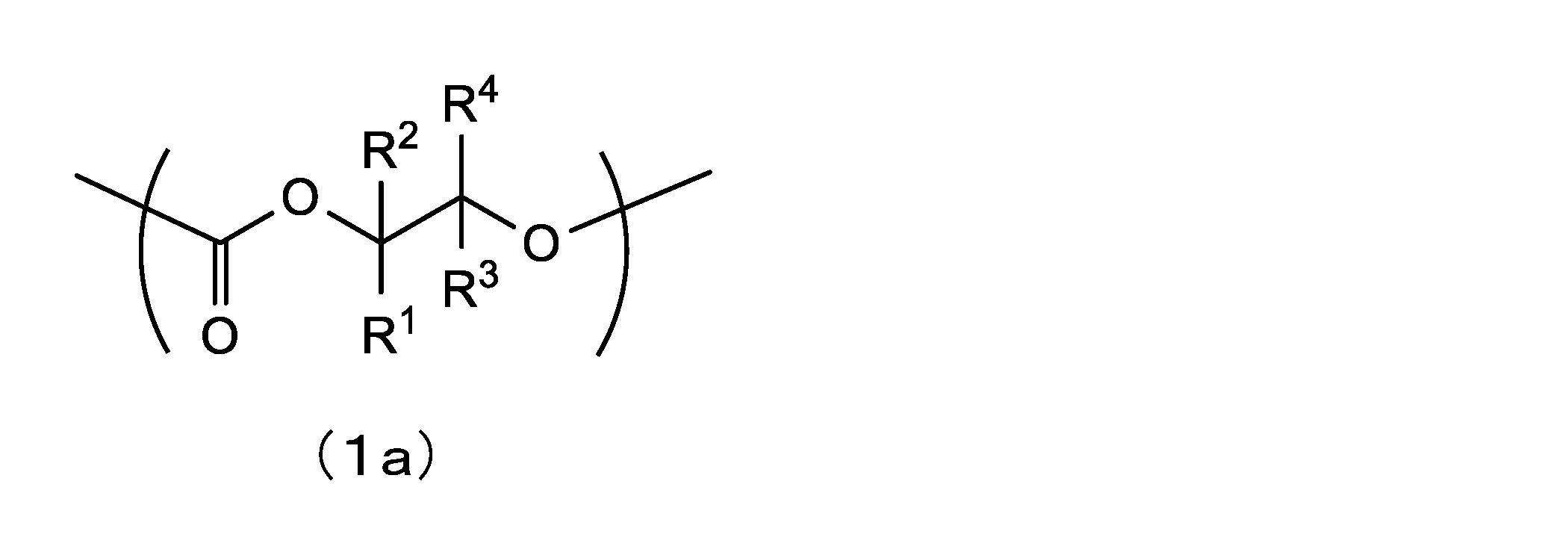
(式中、R1、R2、R3およびR4は、それぞれ独立に水素原子、または、無置換のもしくは置換基を有するアルキル基もしくはアルコキシ基である。ただし、R1、R2、R3およびR4のいずれか二以上が無置換のもしくは置換基を有するアルキル基もしくはアルコキシ基である場合、当該二以上のアルキル基もしくはアルコキシ基は相互に結合して環を形成していてもよい。) - 前記粘着剤組成物は、前記粘着性樹脂100質量部に対し前記脂肪族ポリカーボネートを1質量部以上100質量部以下で含有することを特徴とする請求項1~5のいずれか一項に記載の粘着シート。
- 前記粘着性樹脂を構成するポリマーは、重量平均分子量が30万以上、200万以下であることを特徴とする請求項1~6のいずれか一項に記載の粘着シート。
- 前記粘着性樹脂を構成するポリマーは、ガラス転移温度が-70℃以上、5℃以下であることを特徴とする請求項1~7のいずれか一項に記載の粘着シート。
- 前記粘着性樹脂を構成するポリマーは、アクリル系ポリマーであることを特徴とする請求項1~8のいずれか一項に記載の粘着シート。
- 前記粘着剤組成物は、エネルギーを加えることで酸または塩基を発生する酸・塩基発生剤を含有することを特徴とする請求項1~9のいずれか一項に記載の粘着シート。
- 前記粘着性樹脂は、前記エネルギーを加えることで硬化する硬化型粘着性樹脂であることを特徴とする請求項10に記載の粘着シート。
- 前記エネルギーを加える手段が活性エネルギー線の照射であることを特徴とする請求項10または11に記載の粘着シート。
- 前記粘着性樹脂を構成するポリマーは、側鎖に活性エネルギー線硬化性基を有するアクリル系ポリマーであることを特徴とする請求項12に記載の粘着シート。
- 前記エネルギーは熱エネルギーであることを特徴とする請求項10または11に記載の粘着シート。
- 前記酸・塩基発生剤は、ビグアニド誘導体からなるカチオンを有することを特徴とする請求項10~14のいずれか一項に記載の粘着シート。
- 前記粘着剤組成物は、前記脂肪族ポリカーボネート100質量部に対し前記酸・塩基発生剤を0.5質量部以上、50質量部以下で含有することを特徴とする請求項10~15のいずれか一項に記載の粘着シート。
- 基材を備えることを特徴とする請求項1~16のいずれか一項に記載の粘着シート。
- 前記基材が耐熱性を有することを特徴とする請求項17に記載の粘着シート。
Priority Applications (5)
| Application Number | Priority Date | Filing Date | Title |
|---|---|---|---|
| EP16855441.8A EP3363871B1 (en) | 2015-10-13 | 2016-10-12 | Pressure-sensitive adhesive sheet |
| KR1020187009919A KR102623652B1 (ko) | 2015-10-13 | 2016-10-12 | 점착 시트 |
| CN201680053257.0A CN108026418B (zh) | 2015-10-13 | 2016-10-12 | 粘着片 |
| US15/767,932 US10450485B2 (en) | 2015-10-13 | 2016-10-12 | Pressure sensitive adhesive sheet |
| JP2017507905A JP6147458B1 (ja) | 2015-10-13 | 2016-10-12 | 粘着シート |
Applications Claiming Priority (2)
| Application Number | Priority Date | Filing Date | Title |
|---|---|---|---|
| JP2015202388 | 2015-10-13 | ||
| JP2015-202388 | 2015-10-13 |
Publications (1)
| Publication Number | Publication Date |
|---|---|
| WO2017065188A1 true WO2017065188A1 (ja) | 2017-04-20 |
Family
ID=58517271
Family Applications (1)
| Application Number | Title | Priority Date | Filing Date |
|---|---|---|---|
| PCT/JP2016/080286 Ceased WO2017065188A1 (ja) | 2015-10-13 | 2016-10-12 | 粘着シート |
Country Status (7)
| Country | Link |
|---|---|
| US (1) | US10450485B2 (ja) |
| EP (1) | EP3363871B1 (ja) |
| JP (1) | JP6147458B1 (ja) |
| KR (1) | KR102623652B1 (ja) |
| CN (1) | CN108026418B (ja) |
| TW (1) | TWI748966B (ja) |
| WO (1) | WO2017065188A1 (ja) |
Cited By (8)
| Publication number | Priority date | Publication date | Assignee | Title |
|---|---|---|---|---|
| WO2020235530A1 (ja) * | 2019-05-20 | 2020-11-26 | リンテック株式会社 | 粘着剤組成物および粘着シート |
| WO2023053538A1 (ja) * | 2021-09-29 | 2023-04-06 | 日東電工株式会社 | 電子部品仮固定用粘着シートおよび電子部品の処理方法 |
| WO2023053537A1 (ja) * | 2021-09-29 | 2023-04-06 | 日東電工株式会社 | 電子部品仮固定用粘着シートおよび電子部品の処理方法 |
| WO2024070798A1 (ja) * | 2022-09-30 | 2024-04-04 | リンテック株式会社 | 脂肪族ポリカーボネート樹脂、脂肪族ポリカーボネート樹脂架橋体およびその製造方法、ならびに粘着シート |
| JP2024051732A (ja) * | 2022-09-30 | 2024-04-11 | リンテック株式会社 | 脂肪族ポリカーボネート樹脂、脂肪族ポリカーボネート樹脂架橋体およびその製造方法 |
| JP2024051733A (ja) * | 2022-09-30 | 2024-04-11 | リンテック株式会社 | 粘着シート |
| JP7741995B1 (ja) * | 2024-03-29 | 2025-09-18 | リンテック株式会社 | 粘着シート、及び粘着シートの使用方法 |
| WO2025203789A1 (ja) * | 2024-03-29 | 2025-10-02 | リンテック株式会社 | 粘着シート、及び粘着シートの使用方法 |
Families Citing this family (5)
| Publication number | Priority date | Publication date | Assignee | Title |
|---|---|---|---|---|
| JP7040968B2 (ja) * | 2018-03-19 | 2022-03-23 | 日東電工株式会社 | 粘着シートおよび磁気ディスク装置 |
| KR102478586B1 (ko) * | 2018-09-28 | 2022-12-19 | 가부시키가이샤 유포 코포레숀 | 인몰드 라벨 및 인몰드 라벨 부착 용기 |
| JP7373337B2 (ja) * | 2018-10-24 | 2023-11-02 | 日東電工株式会社 | 粘着テープ |
| CN112552839B (zh) * | 2019-09-25 | 2024-03-15 | 麦克赛尔株式会社 | 粘着带 |
| CN113046010A (zh) * | 2021-03-19 | 2021-06-29 | 立铠精密科技(盐城)有限公司 | 一种保护胶体及其使用方法 |
Citations (9)
| Publication number | Priority date | Publication date | Assignee | Title |
|---|---|---|---|---|
| JPH09263749A (ja) * | 1995-03-15 | 1997-10-07 | Nitto Denko Corp | 粘着剤組成物とその粘着シ―ト類 |
| JP2005206674A (ja) * | 2004-01-22 | 2005-08-04 | Arakawa Chem Ind Co Ltd | コーティング剤組成物 |
| JP2006504853A (ja) * | 2002-11-01 | 2006-02-09 | ジョージア テック リサーチ コーポレイション | 犠牲組成物、その使用方法、及びその分解方法 |
| JP2010126587A (ja) * | 2008-11-26 | 2010-06-10 | Cheil Industries Inc | 粘着剤組成物およびこれを用いた光学部材 |
| JP2011207953A (ja) * | 2010-03-29 | 2011-10-20 | Nagase & Co Ltd | 塗料組成物および塗膜 |
| JP2012126781A (ja) * | 2010-12-14 | 2012-07-05 | Sumitomo Bakelite Co Ltd | 熱分解性の樹脂組成物 |
| JP2014505141A (ja) * | 2010-12-28 | 2014-02-27 | エスケー イノベーション カンパニー リミテッド | 環境にやさしいホットメルト組成物 |
| JP2014525835A (ja) * | 2011-06-15 | 2014-10-02 | プロメラス, エルエルシー | 熱活性化塩基発生剤を包含する熱分解性ポリマー組成物 |
| WO2016104188A1 (ja) * | 2014-12-24 | 2016-06-30 | 日東電工株式会社 | 加熱接合用シート、及び、ダイシングテープ付き加熱接合用シート |
Family Cites Families (16)
| Publication number | Priority date | Publication date | Assignee | Title |
|---|---|---|---|---|
| JP3035179B2 (ja) | 1995-01-13 | 2000-04-17 | 住友ベークライト株式会社 | 半導体ウエハ加工用粘着シート |
| KR19980702971A (ko) * | 1995-03-15 | 1998-09-05 | 야마모토히데키 | 접착제 조성물, 이의 접착 시트 및 이를 이용한 밀봉재, 보강용시트 및 인쇄용 접착 시트 |
| JP3257391B2 (ja) * | 1996-03-18 | 2002-02-18 | 東洋インキ製造株式会社 | インクジェット記録液 |
| JPH10176152A (ja) * | 1996-10-14 | 1998-06-30 | Nitto Denko Corp | 塗膜保護用シート |
| JP2000248240A (ja) | 1999-03-01 | 2000-09-12 | Nitto Denko Corp | 加熱剥離型粘着シート |
| JP5100925B2 (ja) | 2000-11-09 | 2012-12-19 | 日東電工株式会社 | シート材、ならびにそれを有する感圧性接着シート |
| US20040219193A1 (en) * | 2001-08-31 | 2004-11-04 | Hidetoshi Abe | Adhesive composition and low temperature applicable adhesive sheet |
| JP4570836B2 (ja) | 2002-05-08 | 2010-10-27 | スリーエム イノベイティブ プロパティズ カンパニー | 接着剤組成物 |
| FR2846665B1 (fr) * | 2002-10-31 | 2006-09-08 | Karine Marion | Procede d'elimination du biofilm |
| US7070051B2 (en) * | 2004-03-26 | 2006-07-04 | Atrion Medical Products, Inc. | Needle counter device including troughs of cohesive material |
| JP5339907B2 (ja) * | 2007-06-14 | 2013-11-13 | 積水化学工業株式会社 | 光硬化型粘接着剤組成物 |
| JPWO2011004818A1 (ja) * | 2009-07-06 | 2012-12-20 | リンテック株式会社 | エネルギー線硬化型粘着剤組成物及びスタンパー検査用粘着シート |
| CN105143387B (zh) * | 2013-09-10 | 2017-05-24 | Lg化学株式会社 | 包含聚碳酸亚烃酯的树脂组合物及由此生产的自粘膜 |
| KR101876182B1 (ko) * | 2015-06-24 | 2018-07-09 | 린텍 가부시키가이샤 | 점착제 및 점착 시트 |
| JP6892744B2 (ja) * | 2015-08-24 | 2021-06-23 | 日東電工株式会社 | 積層光学フィルム、積層光学フィルムの製造方法、光学部材、および画像表示装置 |
| JP2017069003A (ja) * | 2015-09-29 | 2017-04-06 | 日東電工株式会社 | フレキシブル発光デバイス、照明装置および画像表示装置 |
-
2016
- 2016-10-12 CN CN201680053257.0A patent/CN108026418B/zh active Active
- 2016-10-12 KR KR1020187009919A patent/KR102623652B1/ko active Active
- 2016-10-12 EP EP16855441.8A patent/EP3363871B1/en active Active
- 2016-10-12 JP JP2017507905A patent/JP6147458B1/ja active Active
- 2016-10-12 US US15/767,932 patent/US10450485B2/en active Active
- 2016-10-12 WO PCT/JP2016/080286 patent/WO2017065188A1/ja not_active Ceased
- 2016-10-13 TW TW105132997A patent/TWI748966B/zh active
Patent Citations (9)
| Publication number | Priority date | Publication date | Assignee | Title |
|---|---|---|---|---|
| JPH09263749A (ja) * | 1995-03-15 | 1997-10-07 | Nitto Denko Corp | 粘着剤組成物とその粘着シ―ト類 |
| JP2006504853A (ja) * | 2002-11-01 | 2006-02-09 | ジョージア テック リサーチ コーポレイション | 犠牲組成物、その使用方法、及びその分解方法 |
| JP2005206674A (ja) * | 2004-01-22 | 2005-08-04 | Arakawa Chem Ind Co Ltd | コーティング剤組成物 |
| JP2010126587A (ja) * | 2008-11-26 | 2010-06-10 | Cheil Industries Inc | 粘着剤組成物およびこれを用いた光学部材 |
| JP2011207953A (ja) * | 2010-03-29 | 2011-10-20 | Nagase & Co Ltd | 塗料組成物および塗膜 |
| JP2012126781A (ja) * | 2010-12-14 | 2012-07-05 | Sumitomo Bakelite Co Ltd | 熱分解性の樹脂組成物 |
| JP2014505141A (ja) * | 2010-12-28 | 2014-02-27 | エスケー イノベーション カンパニー リミテッド | 環境にやさしいホットメルト組成物 |
| JP2014525835A (ja) * | 2011-06-15 | 2014-10-02 | プロメラス, エルエルシー | 熱活性化塩基発生剤を包含する熱分解性ポリマー組成物 |
| WO2016104188A1 (ja) * | 2014-12-24 | 2016-06-30 | 日東電工株式会社 | 加熱接合用シート、及び、ダイシングテープ付き加熱接合用シート |
Non-Patent Citations (1)
| Title |
|---|
| See also references of EP3363871A4 * |
Cited By (12)
| Publication number | Priority date | Publication date | Assignee | Title |
|---|---|---|---|---|
| WO2020235530A1 (ja) * | 2019-05-20 | 2020-11-26 | リンテック株式会社 | 粘着剤組成物および粘着シート |
| JPWO2020235530A1 (ja) * | 2019-05-20 | 2020-11-26 | ||
| JP7434306B2 (ja) | 2019-05-20 | 2024-02-20 | リンテック株式会社 | 粘着剤組成物および粘着シート |
| WO2023053538A1 (ja) * | 2021-09-29 | 2023-04-06 | 日東電工株式会社 | 電子部品仮固定用粘着シートおよび電子部品の処理方法 |
| WO2023053537A1 (ja) * | 2021-09-29 | 2023-04-06 | 日東電工株式会社 | 電子部品仮固定用粘着シートおよび電子部品の処理方法 |
| WO2024070798A1 (ja) * | 2022-09-30 | 2024-04-04 | リンテック株式会社 | 脂肪族ポリカーボネート樹脂、脂肪族ポリカーボネート樹脂架橋体およびその製造方法、ならびに粘着シート |
| JP2024051732A (ja) * | 2022-09-30 | 2024-04-11 | リンテック株式会社 | 脂肪族ポリカーボネート樹脂、脂肪族ポリカーボネート樹脂架橋体およびその製造方法 |
| JP2024051733A (ja) * | 2022-09-30 | 2024-04-11 | リンテック株式会社 | 粘着シート |
| JP7746248B2 (ja) | 2022-09-30 | 2025-09-30 | リンテック株式会社 | 脂肪族ポリカーボネート樹脂およびその製造方法、ならびに、脂肪族ポリカーボネート樹脂架橋体およびその製造方法 |
| JP7759866B2 (ja) | 2022-09-30 | 2025-10-24 | リンテック株式会社 | 粘着シートおよび粘着シートの製造方法 |
| JP7741995B1 (ja) * | 2024-03-29 | 2025-09-18 | リンテック株式会社 | 粘着シート、及び粘着シートの使用方法 |
| WO2025203789A1 (ja) * | 2024-03-29 | 2025-10-02 | リンテック株式会社 | 粘着シート、及び粘着シートの使用方法 |
Also Published As
| Publication number | Publication date |
|---|---|
| EP3363871A1 (en) | 2018-08-22 |
| US10450485B2 (en) | 2019-10-22 |
| KR20180066083A (ko) | 2018-06-18 |
| JP6147458B1 (ja) | 2017-06-14 |
| CN108026418B (zh) | 2020-09-29 |
| CN108026418A (zh) | 2018-05-11 |
| EP3363871A4 (en) | 2019-05-15 |
| TW201726856A (zh) | 2017-08-01 |
| TWI748966B (zh) | 2021-12-11 |
| US20180298238A1 (en) | 2018-10-18 |
| KR102623652B1 (ko) | 2024-01-10 |
| JPWO2017065188A1 (ja) | 2017-10-12 |
| EP3363871B1 (en) | 2022-02-16 |
Similar Documents
| Publication | Publication Date | Title |
|---|---|---|
| JP6147458B1 (ja) | 粘着シート | |
| JP5774799B2 (ja) | 保護膜形成用複合シート | |
| KR101919547B1 (ko) | 보호막 형성층을 갖는 다이싱 시트 및 칩의 제조 방법 | |
| CN107615454B (zh) | 保护膜形成用复合片 | |
| KR102644545B1 (ko) | 점착제 조성물, 점착 시트 및 가공물의 제조 방법 | |
| TW201442113A (zh) | 保護膜形成用膜 | |
| JP6656222B2 (ja) | 半導体加工用シート | |
| JP6091955B2 (ja) | 粘着シートおよび保護膜形成用複合シートならびに保護膜付きチップの製造方法 | |
| JP2019156967A (ja) | 半導体保護用粘着テープ | |
| JPWO2014155756A1 (ja) | 粘着シートおよび保護膜形成用複合シートならびに保護膜付きチップの製造方法 | |
| CN108701640B (zh) | 保护膜形成用膜以及保护膜形成用复合片 | |
| WO2017145938A1 (ja) | 保護膜形成用シート、保護膜形成用シートの製造方法及び半導体装置の製造方法 | |
| JP7237847B2 (ja) | 保護膜形成用複合シート、及び半導体チップの製造方法 | |
| TW201505832A (zh) | 保護膜形成用複合膜片、保護膜形成用複合膜片之製造方法以及具有保護膜之晶片的製造方法 | |
| JP7132938B2 (ja) | 保護膜形成用複合シート、及び半導体チップの製造方法 | |
| JP7159186B2 (ja) | 保護膜形成用複合シート、及び半導体チップの製造方法 | |
| CN112447577A (zh) | 支撑片、保护膜形成用膜、保护膜形成用复合片、及带保护膜的工件加工物的制造方法 | |
| JP2017214528A (ja) | 真空プロセス用粘着テープ | |
| JP7176072B2 (ja) | キット及び半導体チップの製造方法 | |
| CN108883620A (zh) | 保护膜形成用复合片 | |
| CN109005667B (zh) | 保护膜形成用膜及保护膜形成用复合片 | |
| TWI895380B (zh) | 膜狀接著劑以及切割黏晶片 | |
| CN108886023A (zh) | 保护膜形成用膜及保护膜形成用复合片 | |
| JP2025089837A (ja) | 粘着剤層形成材料、粘着シート中間体、粘着シートの製造方法、および、粘着シート | |
| JP2023147741A (ja) | 保護膜形成フィルム、保護膜形成用複合シート、半導体装置の製造方法、及び保護膜形成フィルムの使用 |
Legal Events
| Date | Code | Title | Description |
|---|---|---|---|
| ENP | Entry into the national phase |
Ref document number: 2017507905 Country of ref document: JP Kind code of ref document: A |
|
| 121 | Ep: the epo has been informed by wipo that ep was designated in this application |
Ref document number: 16855441 Country of ref document: EP Kind code of ref document: A1 |
|
| ENP | Entry into the national phase |
Ref document number: 20187009919 Country of ref document: KR Kind code of ref document: A |
|
| WWE | Wipo information: entry into national phase |
Ref document number: 15767932 Country of ref document: US |
|
| NENP | Non-entry into the national phase |
Ref country code: DE |
|
| WWE | Wipo information: entry into national phase |
Ref document number: 2016855441 Country of ref document: EP |