WO2017104811A1 - Composition de caoutchouc de silicone, procédé de production correspondant et produit extrudé en caoutchouc de silicone - Google Patents
Composition de caoutchouc de silicone, procédé de production correspondant et produit extrudé en caoutchouc de silicone Download PDFInfo
- Publication number
- WO2017104811A1 WO2017104811A1 PCT/JP2016/087577 JP2016087577W WO2017104811A1 WO 2017104811 A1 WO2017104811 A1 WO 2017104811A1 JP 2016087577 W JP2016087577 W JP 2016087577W WO 2017104811 A1 WO2017104811 A1 WO 2017104811A1
- Authority
- WO
- WIPO (PCT)
- Prior art keywords
- component
- silicone rubber
- rubber composition
- mass
- viscosity
- Prior art date
- Legal status (The legal status is an assumption and is not a legal conclusion. Google has not performed a legal analysis and makes no representation as to the accuracy of the status listed.)
- Ceased
Links
Images
Classifications
-
- C—CHEMISTRY; METALLURGY
- C08—ORGANIC MACROMOLECULAR COMPOUNDS; THEIR PREPARATION OR CHEMICAL WORKING-UP; COMPOSITIONS BASED THEREON
- C08J—WORKING-UP; GENERAL PROCESSES OF COMPOUNDING; AFTER-TREATMENT NOT COVERED BY SUBCLASSES C08B, C08C, C08F, C08G or C08H
- C08J3/00—Processes of treating or compounding macromolecular substances
- C08J3/28—Treatment by wave energy or particle radiation
-
- C—CHEMISTRY; METALLURGY
- C08—ORGANIC MACROMOLECULAR COMPOUNDS; THEIR PREPARATION OR CHEMICAL WORKING-UP; COMPOSITIONS BASED THEREON
- C08K—Use of inorganic or non-macromolecular organic substances as compounding ingredients
- C08K3/00—Use of inorganic substances as compounding ingredients
- C08K3/34—Silicon-containing compounds
- C08K3/36—Silica
-
- C—CHEMISTRY; METALLURGY
- C08—ORGANIC MACROMOLECULAR COMPOUNDS; THEIR PREPARATION OR CHEMICAL WORKING-UP; COMPOSITIONS BASED THEREON
- C08K—Use of inorganic or non-macromolecular organic substances as compounding ingredients
- C08K5/00—Use of organic ingredients
- C08K5/04—Oxygen-containing compounds
- C08K5/14—Peroxides
-
- C—CHEMISTRY; METALLURGY
- C08—ORGANIC MACROMOLECULAR COMPOUNDS; THEIR PREPARATION OR CHEMICAL WORKING-UP; COMPOSITIONS BASED THEREON
- C08K—Use of inorganic or non-macromolecular organic substances as compounding ingredients
- C08K5/00—Use of organic ingredients
- C08K5/56—Organo-metallic compounds, i.e. organic compounds containing a metal-to-carbon bond
-
- C—CHEMISTRY; METALLURGY
- C08—ORGANIC MACROMOLECULAR COMPOUNDS; THEIR PREPARATION OR CHEMICAL WORKING-UP; COMPOSITIONS BASED THEREON
- C08L—COMPOSITIONS OF MACROMOLECULAR COMPOUNDS
- C08L83/00—Compositions of macromolecular compounds obtained by reactions forming in the main chain of the macromolecule a linkage containing silicon with or without sulfur, nitrogen, oxygen or carbon only; Compositions of derivatives of such polymers
- C08L83/04—Polysiloxanes
-
- C—CHEMISTRY; METALLURGY
- C08—ORGANIC MACROMOLECULAR COMPOUNDS; THEIR PREPARATION OR CHEMICAL WORKING-UP; COMPOSITIONS BASED THEREON
- C08L—COMPOSITIONS OF MACROMOLECULAR COMPOUNDS
- C08L83/00—Compositions of macromolecular compounds obtained by reactions forming in the main chain of the macromolecule a linkage containing silicon with or without sulfur, nitrogen, oxygen or carbon only; Compositions of derivatives of such polymers
- C08L83/04—Polysiloxanes
- C08L83/06—Polysiloxanes containing silicon bound to oxygen-containing groups
-
- C—CHEMISTRY; METALLURGY
- C08—ORGANIC MACROMOLECULAR COMPOUNDS; THEIR PREPARATION OR CHEMICAL WORKING-UP; COMPOSITIONS BASED THEREON
- C08G—MACROMOLECULAR COMPOUNDS OBTAINED OTHERWISE THAN BY REACTIONS ONLY INVOLVING UNSATURATED CARBON-TO-CARBON BONDS
- C08G77/00—Macromolecular compounds obtained by reactions forming a linkage containing silicon with or without sulfur, nitrogen, oxygen or carbon in the main chain of the macromolecule
- C08G77/04—Polysiloxanes
- C08G77/06—Preparatory processes
- C08G77/08—Preparatory processes characterised by the catalysts used
-
- C—CHEMISTRY; METALLURGY
- C08—ORGANIC MACROMOLECULAR COMPOUNDS; THEIR PREPARATION OR CHEMICAL WORKING-UP; COMPOSITIONS BASED THEREON
- C08G—MACROMOLECULAR COMPOUNDS OBTAINED OTHERWISE THAN BY REACTIONS ONLY INVOLVING UNSATURATED CARBON-TO-CARBON BONDS
- C08G77/00—Macromolecular compounds obtained by reactions forming a linkage containing silicon with or without sulfur, nitrogen, oxygen or carbon in the main chain of the macromolecule
- C08G77/04—Polysiloxanes
- C08G77/12—Polysiloxanes containing silicon bound to hydrogen
-
- C—CHEMISTRY; METALLURGY
- C08—ORGANIC MACROMOLECULAR COMPOUNDS; THEIR PREPARATION OR CHEMICAL WORKING-UP; COMPOSITIONS BASED THEREON
- C08G—MACROMOLECULAR COMPOUNDS OBTAINED OTHERWISE THAN BY REACTIONS ONLY INVOLVING UNSATURATED CARBON-TO-CARBON BONDS
- C08G77/00—Macromolecular compounds obtained by reactions forming a linkage containing silicon with or without sulfur, nitrogen, oxygen or carbon in the main chain of the macromolecule
- C08G77/04—Polysiloxanes
- C08G77/20—Polysiloxanes containing silicon bound to unsaturated aliphatic groups
-
- C—CHEMISTRY; METALLURGY
- C08—ORGANIC MACROMOLECULAR COMPOUNDS; THEIR PREPARATION OR CHEMICAL WORKING-UP; COMPOSITIONS BASED THEREON
- C08J—WORKING-UP; GENERAL PROCESSES OF COMPOUNDING; AFTER-TREATMENT NOT COVERED BY SUBCLASSES C08B, C08C, C08F, C08G or C08H
- C08J2383/00—Characterised by the use of macromolecular compounds obtained by reactions forming in the main chain of the macromolecule a linkage containing silicon with or without sulfur, nitrogen, oxygen, or carbon only; Derivatives of such polymers
- C08J2383/04—Polysiloxanes
Definitions
- the present invention relates to a silicone rubber composition, a method for producing the same, and a silicone rubber extruded product, and particularly to a millable silicone rubber composition, a method for producing the same, and a silicone rubber extruded product.
- Silicone rubber has excellent weather resistance, electrical properties, low compression set, heat resistance, cold resistance, and other properties, so it can be used in various fields including electrical equipment, automobiles, architecture, medical care and food. Widely used.
- millable silicone rubber is widely used in the manufacture of rubber parts because it can mix colorants with a simple device such as a two-roll machine and can be molded with simple equipment such as a press. Since the shape can be maintained even in an uncured state, it is widely used for extrusion molding of tubes and gaskets.
- Patent Document 1 discloses a liquid silicone rubber coating composition using gel silica having an average particle size of 0.5 to 20 ⁇ m as a filler.
- this coating composition technique is applied to a composition for a thick silicone rubber molded article, such as extrusion, it has a specific particle system formulated to prevent blocking. Since the filler is not easily exposed to the surface effectively, it is difficult to effectively eliminate the blocking problem. Moreover, in order to prevent blocking by this method, it is necessary to mix
- conventional millable silicone rubber base compounds are manufactured by mixing a raw rubber-like high-polymerization polyorganosiloxane with a filler, and have a low viscosity as a process oil to facilitate the blending of the filler. It is common to add disilanol and the like.
- the raw rubber-like polyorganosiloxane having a high degree of polymerization is generally produced by ring-opening polymerization of a low-molecular cyclic siloxane using an alkali catalyst, but this reaction is balanced and unreacted low-molecular-weight A certain amount of siloxane remains in the polymer.
- there has been a demand for reduction of low molecular weight siloxane but it is difficult to remove low molecular weight siloxane from raw rubber-like base polymer, so the cured product must be post-cured at high temperature, resulting in increased cost. Is inevitable. Further, post-curing at high temperature narrows the range of material selection when performing composite molding with heat-sensitive materials such as thermoplastic plastics in particular.
- Patent Document 2 discloses a polyorganosiloxane blended in a base compound with a content of low molecular siloxane having a polymerization degree of 10 or less in order to prevent contact failure of electronic parts. Reduced silicone rubber compositions are described. However, in recent years, in medical applications and healthcare applications, in addition to low-molecular siloxanes having a polymerization degree of 10 or less, reduction of total volatile siloxanes is required, and further improvements are required.
- the present invention was made from the above viewpoint, and a silicone rubber composition having improved moldability, particularly extrusion moldability, and a method for producing the same, and anti-blocking property while sufficiently maintaining the strength of the resulting cured product It aims at providing the silicone rubber extrusion molded article which has property.
- the molded product of the silicone rubber composition in this specification means a cured product obtained by molding and curing the silicone rubber composition.
- silicone rubber simply means a cured product of the silicone rubber composition.
- the silicone rubber composition of the present invention is (A) It consists of the following (A1) and (A2), the ratio of (A1) is 20 to 100% by mass relative to the whole (A), the viscosity at 25 ° C. is 5 to 20000 Pas, and the alkenyl group content is 0. 100 parts by weight of a base polymer that is 0.001 to 0.3 mmol / g, (A1) Polyorganosiloxanediol represented by the following formula (1) having a viscosity at 25 ° C.
- R 1 is each independently a monovalent unsubstituted or substituted hydrocarbon group not containing an alkenyl group
- R 2 represents an alkenyl group
- N1 and n2 in formula (1) are Represents the total number of repeating units that are randomly or block polymerized, n1 is an integer of 200 to 1200, and n2 is an integer of 0 to 30.
- A2 a viscosity at 25 ° C.
- each R 3 independently represents a monovalent unsubstituted or substituted saturated or unsaturated hydrocarbon group not containing a hydroxyl group, and a represents a number in the range of 1.98 to 2.02.
- B 10 to 50 parts by mass of silica powder having a specific surface area of 50 to 400 m 2 / g,
- C 1 to 10 parts by mass of organosilazane, and
- D a catalyst amount of a curing agent.
- the silicone rubber composition of the present invention having the above configuration is a silicone rubber composition having improved moldability, particularly extrusion moldability, while sufficiently maintaining the strength of the resulting cured product.
- an extrusion-molded product having excellent surface blocking resistance can be obtained without post-processing by extrusion molding and curing treatment.
- the silicone rubber composition of the present invention when the composition is extruded at a rate of 2 m / min with a screw extruder and then cured to form a tube-shaped cured product, the surface is scanned with an electron microscope image. It is preferable to have 1 to 300 granular projections with a maximum diameter of 0.1 to 30 ⁇ m measured in step / 0.01 mm 2 .
- the ratio of the component (A1) to the total component (A) is 50 to 100% by mass, and the viscosity of the component (A) at 25 ° C. is 5 to 3000 Pas. Embodiments are preferred.
- the ratio of the component (A1) to the total component (A) is 40 to 100% by mass, and the viscosity of the component (A) at 25 ° C. is 5 to 1000 Pas.
- the component (A) in which the ratio of the component (A1) to the entire component (A) is 40 to 100% by mass, and the viscosity of the component (A) at 25 ° C. is 5 to 1000 Pas is referred to as “low viscosity”.
- the silicone rubber composition of the present invention which is referred to as “component (A)” and component (A) is a low viscosity component (A), is referred to as “low viscosity (A) component-containing silicone rubber composition”.
- Such a low-viscosity (A) component-containing silicone rubber composition can easily remove low-molecular-weight siloxane from the raw material, and thus the low-molecular-weight siloxane content is sufficiently reduced without post-curing.
- a cured product can be produced.
- the component (A) has a mass reduction rate of 1.0% or less before and after heat treatment at 200 ° C. for 4 hours at normal pressure.
- a silicone rubber composition that provides a cured product having a mass reduction rate of 0.5% or less before and after heat treatment at 200 ° C. for 4 hours without curing is preferable.
- the low-viscosity (A) component-containing silicone rubber composition can be used as a silicone rubber composition that gives such a cured product with a low mass reduction rate.
- the present invention provides the silicone rubber composition of the present invention in which the low viscosity (A) component-containing silicone rubber composition or the component (A) has a mass reduction rate of 1.0% or less before and after heat treatment at 200 ° C. for 4 hours at normal pressure.
- the composition is molded, cured by heat or UV irradiation, and a silicone rubber molded article having a mass reduction rate of 0.5% or less before and after heat treatment at 200 ° C. for 4 hours without performing post cure is obtained.
- a method for producing a silicone rubber molded article is provided.
- the present invention also relates to a method for producing the silicone rubber composition of the present invention, wherein the component (A) and the component (B) and the component (C) are divided into a plurality of times or continuously at a predetermined rate.
- the manufacturing method including the process of adding the said (D) component after adding typically.
- the silicone rubber extruded product of the present invention is an extruded product obtained using the silicone rubber composition of the present invention, and has a maximum diameter of 0.1 to 0.1 measured on the surface by a scanning electron microscope (SEM) image. It has a 30 ⁇ m granular projection.
- SEM scanning electron microscope
- the present invention it is possible to provide a silicone rubber composition having improved moldability, particularly extrusion moldability, while sufficiently maintaining the strength of the resulting cured product.
- the surface of the extrusion-molded product is excellent in slipperiness, so that blocking can be suppressed. It is considered that this improvement in surface slipping occurs because spherical bodies in which silica particles are aggregated are exposed on the surface.
- the silicone rubber composition of the present invention contains the predetermined amounts of the components (A), (B), (C) and (D). Each component will be described below.
- the component (A) component contains a specific polyorganosiloxane diol, has a predetermined amount of alkenyl groups and has a predetermined viscosity, and is mixed with the component (B), the component (C), and the component (D). It is a base polymer that forms a millable silicone rubber composition.
- the component (A) comprises the following components (A1) and (A2), and the proportion of the component (A1) is 20 to 100% by mass with respect to the entire component (A).
- the component (A) has an alkenyl group content of 0.001 to 0.3 mmol / g and a viscosity at 25 ° C. of 5 to 20000 Pas. That is, the component (A) is obtained by mixing the following components (A1) and (A2) at a ratio such that the ratio of the component (A1) is 20 to 100% by mass with respect to the total component (A) A) It is obtained by mixing so that the alkenyl group content as a whole component is 0.001 to 0.3 mmol / g and the viscosity at 25 ° C. is 5 to 20000 Pas.
- viscosity refers to a viscosity measured at 25 ° C. with a shear rate of 0.1 s ⁇ 1 .
- the component (A1) is a polyorganosiloxane diol represented by the following formula (1) having a viscosity at 25 ° C. of 1 to 100 Pas.
- the polyorganosiloxane diol represented by the formula (1) is also referred to as polyorganosiloxane diol (1).
- R 1 is each independently a monovalent unsubstituted or substituted hydrocarbon group not containing an alkenyl group
- R 2 represents an alkenyl group
- N1 and n2 in formula (1) are Represents the total number of repeating units that are randomly or block polymerized, n1 is an integer of 200 to 1200, and n2 is an integer of 0 to 30.
- the above formula (1) does not necessarily mean a block copolymer. That is, n1 indicating the number of polymerized units — (R 1 2 ) SiO— and n2 indicating the number of —R 1 R 2 SiO— do not indicate the number in the block, Indicates the total number of each. That is, the polyorganosiloxane diol represented by the formula (1) may be a random copolymer.
- the siloxane skeleton of the polyorganosiloxane diol (1) is substantially linear since it can synthesize a polymer having a predetermined viscosity with a high degree of polymerization with good control. There may be a plurality of branches therein.
- the component (A1) may be composed of one type of polyorganosiloxane diol (1) or may be composed of two or more types.
- the viscosity of the polyorganosiloxane diol (1) is 1 to 100 Pas.
- the viscosity of the polyorganosiloxane diol (1) is two or more, the viscosity of the polyorganosiloxane diol (1) is not necessarily the above as long as the viscosity is within the above range as the component (A1) obtained by mixing them. Although it is not necessary to be in the range, the viscosity is preferably 1 to 100 Pas in each polyorganosiloxane diol (1).
- the viscosity of the component (A1) is 1 to 100 Pas, it can be adjusted to 5 to 20000 Pas which is the predetermined viscosity as the component (A) when blended with the component (A2) at a predetermined ratio.
- the viscosity of the polyorganosiloxane diol (1) is preferably 5 to 100 Pas, more preferably 5 to 50 Pas.
- the average degree of polymerization of the polyorganosiloxane diol (1) that is, the average number of siloxane units in the molecule of the polyorganosiloxane diol (1) is represented by the total number (n1 + n2) of n1 and n2 in the formula (1).
- the average degree of polymerization is not particularly limited. In the polyorganosiloxane diol (1) having a viscosity in the range of 1 to 100 Pas, the average degree of polymerization is about 200 to 1200.
- Polyorganosiloxane diol (1) whether having R 2 is an alkenyl group in a molecule is arbitrary.
- the alkenyl group content of the component (A1) is 0.001 to 0.3 mmol / g
- the polyorganosiloxane diol ( At least one of 1) has R 2 which is an alkenyl group.
- the polyorganosiloxane diol (1) has an alkenyl group content of 0.001 to 0.3 mmol / g.
- the alkenyl group content of the polyorganosiloxane diol (1) is more preferably 0.01 to 0.3 mmol / g, and further preferably 0.05 to 0.2 mmol / g.
- the polyorganosiloxane diol (1) has an alkenyl group in the molecule means that the formula (1) has —R 1 R 2 SiO— polymerized units, and n2 indicating the number of polymerized units is 1 or more. It means that. The number of n2 depends on the alkenyl group content of the polyorganosiloxane diol (1).
- the alkenyl group of the polyorganosiloxane diol (1) is not present in the terminal O 1/2 —Si—OH unit but is bonded to the silicon atom of the intermediate Si—O 2/2 unit.
- alkenyl group represented by R 2 in Formula (1) examples include a vinyl group, an allyl group, a 3-butenyl group, a 4-pentenyl group, and a 5-hexenyl group.
- R 2 is preferably a vinyl group because the synthesis and handling of the polyorganosiloxane diol (1) is easy and the addition reaction is easily performed. If R 2 there are a plurality in the formula (1), a plurality of R 2 may be the same or different, but from the viewpoint of easy synthesis, but are preferably the same.
- each R 1 is a monovalent unsubstituted or substituted hydrocarbon group that does not contain an alkenyl group.
- R 1 include alkyl groups such as methyl group, ethyl group, propyl group, butyl group, pentyl group, and hexyl group; aryl groups such as phenyl group, xenyl group, naphthyl group, tolyl group, and xylyl group; Aralkyl groups such as benzyl group and phenethyl group; cycloalkyl groups such as cyclohexyl group; cycloalyanyl groups such as cyclohexenyl group; chloromethyl group, 3-chloropropyl group, 3,3,3-trifluoropropyl group, 3 -Substituted hydrocarbon groups such as cyanopropyl group and 3-methoxypropyl group.
- a plurality of R 1 may be the same or
- R 1 is a 3,3,3-trifluoropropyl group, and the remaining R 1 is all a methyl group.
- Combinations can be used. In this case, a combination in which R 1 of the unit surrounded by n1 in the formula (1) is partially a 3,3,3-trifluoropropyl group and the remaining R 1 is all methyl groups is preferable.
- the polyorganosiloxane diol (1) is alkenyl. It does not have to have a group.
- the polyorganosiloxane diol (1) is a compound represented by HO [(R 1 2 ) SiO] n1 H, which does not have —R 1 R 2 SiO— units.
- polyorganosiloxane diol (1) having an alkenyl group is referred to as polyorganosiloxane diol (11), and polyorganosiloxane diol (1) having no alkenyl group is referred to as polyorganosiloxane diol (12).
- (A1) component may comprise (A) component only by (A1) component, and may comprise (A) component in combination with (A2) component.
- the component (A1) contains the polyorganosiloxane diol (11) as an essential component.
- the component (A) contains the component (A2)
- the component (A1) comprises at least one selected from the polyorganosiloxane diol (11) and the polyorganosiloxane diol (12) (A2)
- the viscosity and alkenyl group content as the component (A) are adjusted by adjusting the combination of the types and blending amounts with the components.
- Component (A2) is a polyorganosiloxane represented by the following average composition formula (2) having a viscosity at 25 ° C. of 0.2 to 40,000 Pas.
- the polyorganosiloxane represented by the formula (2) is also referred to as polyorganosiloxane (2).
- R 3 a SiO (4-a) / 2 (2) In the formula (2), each R 3 independently represents a monovalent unsubstituted or substituted saturated or unsaturated hydrocarbon group not containing a hydroxyl group, and a represents a number in the range of 1.98 to 2.02. Show.)
- the polyorganosiloxane (2) a linear polymer that is partially branched and may form a three-dimensional structure is preferable. Further, the polyorganosiloxane (2) may be a homopolymer or a copolymer.
- R 3 in the formula (2) include an unsubstituted or substituted hydrocarbon group exemplified for R 1 and an alkenyl group exemplified for R 2 .
- R ⁇ 3 > in Formula (2) shows the said monovalent group each independently, not all of R ⁇ 3 > is an alkenyl group.
- the preferred embodiment of R 3 is also the same as the preferred embodiment of the unsubstituted or substituted hydrocarbon group in R 1 and the preferred embodiment of the alkenyl group in R 2 .
- Polyorganosiloxane (2) may be R 3 is a compound having no alkenyl group may be a compound part of R 3 is an alkenyl group.
- polyorganosiloxane (2) having an alkenyl group is referred to as polyorganosiloxane (21)
- polyorganosiloxane (2) having no alkenyl group is referred to as polyorganosiloxane (22).
- the component (A2) may be composed of one type of polyorganosiloxane (2), or may be composed of two or more types.
- the viscosity of the polyorganosiloxane (2) is 0.2 to 40,000 Pas.
- the viscosity of the polyorganosiloxane diol (1) is within the above range as the component (A2) obtained by mixing them, the viscosity of each polyorganosiloxane (2) is not necessarily within the above range.
- the viscosity of each polyorganosiloxane (2) is preferably 0.2 to 40,000 Pas.
- the viscosity of the component (A2) is 0.2 to 40000 Pas, it can be adjusted to 5 to 20000 Pas, which is the predetermined viscosity as the component (A), when blended with the component (A1) at a predetermined ratio.
- the viscosity of the polyorganosiloxane (2) is preferably 0.4 to 40000 Pas.
- the average degree of polymerization of the polyorganosiloxane (2) is not particularly limited as long as the viscosity is in the above range. In the polyorganosiloxane (2) having a viscosity in the range of 0.2 to 40,000 Pas, the average degree of polymerization is about 100 to 7100.
- the component may or may not contain the component (A2).
- the component (A) contains the component (A2)
- at least one of the polyorganosiloxane (21) having an alkenyl group and the polyorganosiloxane (22) having no alkenyl group is selected depending on the component (A1) to be combined. Select appropriately (A2).
- the polyorganosiloxane diol (12) is preferable as the component (A1)
- the polyorganosiloxane (21) is preferable as the component (A2).
- polyorganosiloxane (21) for example, a linear polymer represented by the following formula (2A) (hereinafter also referred to as polyorganosiloxane (2A)) is preferable.
- R 3 is the same as that shown in formula (2), but a part thereof is an alkenyl group.
- m represents a number having an average degree of polymerization of ⁇ 2.
- the alkenyl group content in the polyorganosiloxane (2A) depends on the type and blending amount of the polyorganosiloxane diol (1) used in combination, but is preferably 0.001 to 0.3 mmol / g, preferably 0.003 to 0.00. 3 mmol / g is more preferable, and 0.003 to 0.25 mmol / g is more preferable.
- the alkenyl group in the polyorganosiloxane (2A) may be bonded to any silicon atom in the molecule, but since it exhibits excellent reactivity, a part of the alkenyl group is bonded to the silicon atom at the molecular end. It is preferable. That is, it is preferable that a part of R 3 of the terminal M unit represented by —OSi (R 3 3 ) is an alkenyl group, and the polyorganosiloxane (2A) has one R 3 of M units at both ends.
- the alkenyl group-containing polyorganosiloxane (2A) containing both alkenyl groups is preferred.
- the intermediate unit - [(R 3 2) SiO ] - R 3 may be partially alkenyl group for.
- the alkenyl group is preferably a vinyl group because the synthesis and handling of the polyorganosiloxane (2A) is easy and the addition reaction is easily performed.
- the polyorganosiloxane (2A) having alkenyl groups at both ends having an alkenyl group in the intermediate unit up to approximately 2.3% of the m intermediate units is an intermediate unit in which one of the two R 3 is an alkenyl group. be able to.
- the intermediate unit having an alkenyl group is contained in the polyorganosiloxane (2A) containing alkenyl groups at both ends in a random or block manner.
- Groups other than the alkenyl group in the polyorganosiloxane (2A) are easy to synthesize and handle the polyorganosiloxane (2A) and have excellent heat resistance. Therefore, 50% or more of R 3 other than the alkenyl group is methyl. It is particularly preferable that all of them are methyl groups. In particular, when heat resistance, cold resistance or radiation resistance is required, phenyl group, and 3,3,3-trifluoropyrrolyl group, etc. should be used as appropriate when oil resistance and / or solvent resistance is required. Can do.
- the component (A) is composed of the component (A1) and the component (A2), and the ratio of the component (A1) is 20 to 100% by mass with respect to the whole component (A).
- the component (A) has an alkenyl group content of 0.001 to 0.3 mmol / g and a viscosity at 25 ° C. of 5 to 20000 Pas. Adjustment of the alkenyl group content and viscosity in the component (A) is performed by adjusting the types and blending ratios of the component (A1) and the component (A2).
- the component (A) has the blending ratio, the alkenyl group content, and the viscosity of the predetermined component (A1) and component (A2), and the components (B), (C), and (D) described below.
- the silicone rubber composition When the silicone rubber composition is combined with the component at a predetermined ratio, the silicone rubber composition has improved moldability, particularly extrudability, while maintaining sufficient strength of the resulting cured product. Can do.
- an extrusion-molded product having excellent surface blocking resistance can be obtained by post-molding and curing without post-processing.
- the viscosity of the component (A) is 5 to 20000 Pas, and the ratio of the component (A1) to the whole component (A) giving the viscosity is 20 to 100% by mass. If the viscosity of the component (A) is less than 5 Pas, the resulting silicone rubber composition becomes excessively sticky and roll workability deteriorates. If it exceeds 20000 Pas, the viscosity of the silicone rubber composition becomes too high and kneading is difficult. It is.
- the viscosity of the component (A) is preferably from 5 to 15000 Pas, more preferably from 5 to 3000 Pas, particularly for the purpose of improving the blocking resistance in the extruded product.
- the viscosity in (A) component can be adjusted with the compounding ratio of the (A1) component and (A2) component in (A) component, for example.
- the ratio of the component (A1) to the whole component (A) for obtaining the viscosity is preferably 30 to 100% by mass, more preferably 50 to 100% by mass.
- the viscosity of the component (A) By reducing the viscosity of the component (A), it is possible to easily remove the low molecular siloxane from the raw material, and thereby the cured product in which the content of the low molecular siloxane is sufficiently reduced without post-curing. Is preferably 5 to 1000 Pas, more preferably 5 to 500 Pas, and still more preferably 5 to 150 Pas.
- the ratio of the component (A1) to the total component (A) for obtaining such a viscosity is preferably 40 to 100% by mass, and more preferably 50 to 100% by mass.
- the alkenyl group content in component (A) is preferably 0.002 to 0.3 mmol / g, more preferably 0.003 to 0.25 mmol / g.
- the alkenyl group content of the component (A) is less than 0.001 mmol / g, the strength of the resulting cured product is not sufficient, and when it exceeds 0.3 mmol / g, the resulting cured product becomes brittle.
- the content of OH groups bonded to silicon atoms is preferably 0.005 to 0.1 mmol / g, more preferably 0.005 to 0.08 mmol / g. 0.01 to 0.07 mmol / g is more preferable.
- the silanol group of the component (A) not only suppresses the plasticization return of the silicone composition by the component (B) by performing a condensation reaction with the silanol group present on the surface of the silica powder of the component (B).
- the rubber composition is imparted with an appropriate viscosity, and further, (B) components are bound together during kneading or extrusion molding to produce fine spherical aggregates. It has the effect of reducing surface tackiness by being partially exposed on the surface.
- the silicone rubber composition is not sticky and roll workability is not deteriorated, or the mechanical properties of the cured product are not deteriorated. It can sufficiently condense with silanol groups present on the surface of the component silica powder.
- the state in which the spherical aggregate is exposed on the surface of the extruded product can be evaluated by, for example, the following method.
- the silicone rubber composition of the present invention is extruded at a rate of 2 m / min with a screw extruder, and then cured to obtain a tubular cured product.
- the curing method depends on the type of component (D).
- the component (D) is an ultraviolet curable curing agent, for example, an ultraviolet ray is irradiated with ultraviolet rays at 365 nm and an integrated irradiation amount of about 6000 mJ / cm 2 .
- the component (D) is a thermosetting type, for example, a curing treatment is performed at 200 ° C. for 5 minutes.
- the spherical aggregate is, for example, as shown in FIG.
- the tube-like cured product obtained by using the silicone rubber composition as described above has 1 to 300 granular projections having a maximum diameter of 0.1 to 30 ⁇ m on the surface. preferably has 01mm 2, and more preferably has 10 to 200 amino /0.01mm 2.
- cured material surface is not specifically limited. In any one SEM image of the surface of the tube-shaped cured product, it is only necessary to observe granular projections having a maximum diameter of 0.1 to 30 ⁇ m, and 1 to 300 are measured as the number per 0.01 mm 2. It is preferable that 10 to 200 are measured.
- the average polymerization degree of the (A1) component and the (A2) component contained in the component (A) is as described above, but the component (A) contains a low-molecular siloxane that can volatilize at normal pressure and 200 ° C. It is preferred that the amount be sufficiently low.
- the low molecular siloxane refers to a siloxane that can volatilize at 200 ° C. under normal pressure.
- the component (A) is a low-viscosity (A) component
- the content of the low-molecular siloxane contained in the low-viscosity (A) can be easily reduced by an existing method, and a silicone rubber containing the same In the composition, the content of the low molecular siloxane can be sufficiently reduced.
- cured material obtained using a low-viscosity (A) component containing silicone rubber composition can turn into a hardened
- content of the low molecular siloxane in (A) component can be shown, for example as a parameter
- the mass reduction rate [%] refers to the mass reduction rate [%] before and after heat treatment at normal pressure and 200 ° C. for 4 hours.
- the mass reduction rate [%] is preferably 1.0% or less, and if the mass reduction rate [%] is 1.0% or less, the content of the low molecular siloxane post-cure the cured product. It can be said that it is low enough to make a product without any problems.
- the component (A) is a low viscosity component (A)
- a mass reduction rate [%] of 1.0% or less can be easily achieved.
- the mass reduction rate [%] of the component (A) is more preferably 0.8% or less, and more preferably 0.6% or less.
- the silicone rubber composition of the present invention is preferably a silicone rubber composition that gives a cured product that can be made into a product without post-curing.
- the fact that the cured product can be made into a product without post-curing means that the mass reduction rate [%] of the cured product is approximately 0.5% or less.
- the curing conditions for obtaining a cured product to be subjected to the mass reduction rate [%] test from the silicone rubber composition include the thermal curing conditions and UV curing conditions described later according to the type of component (D). .
- the siloxane polymer such as the component (A1) or the component (A2) constituting the component (A) is usually generated by an equilibrium reaction of a siloxane oligomer with acid or alkali. Therefore, even in the siloxane polymer having the average degree of polymerization as described above, a considerable amount of low molecular weight siloxane exists.
- the removal of the low-molecular siloxane is performed after mixing (A1) component and (A2) component as (A) component, or before mixing (A1) component and (A2) component.
- it performs with respect to (A1) component and (A2) component before mixing.
- a method for reducing the low molecular weight siloxane component contained in the siloxane polymer a method for vaporizing and removing the low molecular weight siloxane component under high temperature heating at about 100 to 300 ° C. in a reduced pressure state, or during or after the vaporization removal is performed. Furthermore, a conventionally known method such as a method of further promoting vaporization by blowing an inert gas can be used.
- the component (B) is a silica powder having a specific surface area of 50 to 400 m 2 / g, and the blending amount is 10 to 100 parts by mass with respect to 100 parts by mass of the component (A). 50 parts by mass.
- the blending amount of each component is shown in parts by mass with respect to 100 parts by mass of the component (A), and may be simply shown as.
- the component (B) is a component having a function of imparting appropriate fluidity to the silicone rubber composition and imparting excellent mechanical strength to the silicone rubber obtained by curing the composition.
- the silica powder as the component (B) has a specific surface area of 50 to 400 m 2 / g in order to perform the above function when added to the composition of the present invention.
- a specific surface area says the specific surface area by BET method.
- the silica powder having a specific surface area of 50 to 400 m 2 / g is also referred to as silica powder (B).
- the specific surface area of silica powder (B) is preferably from 100 ⁇ 360m 2 / g, more preferably 130 ⁇ 300m 2 / g.
- the type of silica is not particularly limited, but precipitated silica, fumed silica (fumed silica), calcined silica, and the like are preferably used. From the viewpoint of reinforcement, fumed silica is preferred.
- silica powder since silica powder is used after being surface-treated as necessary, surface-untreated silica powder and surface-treated silica powder are referred to as “silica powder” without distinction.
- the silica powder of the component (B) shows only the untreated surface silica powder that has not been surface-treated.
- a commercially available product may be used as the silica powder (B).
- Commercially available products are fumed silica, all of which are EVONIC trade names, Aerosil 130 (specific surface area: 130 m 2 / g), Aerosil 200 (specific surface area: 200 m 2 / g), Aerosil 300 (specific surface area: 300 m) 2 / g).
- Silica powder (B) may use 1 type, or may use 2 or more types together.
- the blending amount of the component (B) in the silicone rubber composition of the present invention is 10 to 50 parts by mass, preferably 15 to 40 parts by mass with respect to 100 parts by mass of the component (A).
- the blending amount of the component (B) exceeds 50 parts by mass, the viscosity of the silicone rubber composition is remarkably increased, making it difficult to blend the component (B) into the component (A), and conversely, it is less than 10 parts by mass.
- the roll workability of the silicone rubber composition deteriorates and the properties such as mechanical strength of the resulting silicone rubber become insufficient.
- a millable type silicone rubber composition suitable for extrusion molding and having both good shape maintenance and low hardness of the extrusion molded product can be obtained by blending a smaller amount of silica powder than usual. It is done. Moreover, when the fine spherical aggregates of silica powder are exposed on the surface of the extrusion-molded product, the surface of the extrusion-molded product is excellent in slipping property and blocking can be suppressed.
- the amount of component (B) is preferably 10 to 40 parts by mass, more preferably 15 to 40 parts by mass.
- the silicone rubber composition of the embodiment of the present invention contains 1 to 10 parts by mass of organosilazane as the component (C).
- the component (C) has a function of silylating silanol groups on the surface of the silica powder of the component (B). This improves the stability of the base compound composed of the component (A), the component (B), and the component (C), and the silicone rubber composition further containing the component (D) in the base compound. Furthermore, ammonia is by-produced during the silylation, and the ammonia promotes the condensation reaction between the terminal silanol groups of the polyorganosiloxane diol (A1) and the silanol groups on the surface of the silica powder (B), Thereby, the viscosity suitable for roll workability
- ammonia is by-produced during the silylation, and the ammoni
- component (C) hexamethyldisilazane, 1-vinylpentamethyldisilazane, 1,3-divinyl-1,1,3,3-tetramethyldisilazane, 1,3-dimethyl-1,1,3 Hexaorganodisilazane such as 1,3-tetravinyldisilazane, and octaorganotrisilazane such as octamethyltrisilazane and 1,5-divinylhexamethyltrisilazane.
- the component (C) may be composed of one of these or may be composed of two or more.
- hexamethyldisilazane and 1,3-divinyl-1,1,3,3-tetramethyldisilazane are preferable.
- Hexamethyldisilazane, hexamethyldisilazane and 1,3-divinyl-1 1,3,3-tetramethyldisilazane is more preferred.
- the blending amount of the component (C) is 1 to 10 parts by mass with respect to 100 parts by mass of the organopolysiloxane of the component (A).
- the amount of component (C) is preferably 1 to 8 parts by mass, more preferably 2 to 8 parts by mass.
- the blending amount of the component (C) is preferably 1 to 40 parts by mass, more preferably 5 to 30 parts by mass with respect to 100 parts by mass of the component (B).
- component (C) When the blending amount of component (C) is too small, a sufficient amount of component (B) cannot be blended for the resulting silicone rubber to obtain mechanical strength, and the storage stability of the composition When the amount is too large, the workability of the composition deteriorates, and it is not preferable economically.
- Component (B) Component (B) Silica powder on the surface of the silanol group on the surface Silyl group by-produced ammonia and low molecular siloxane, such as hexamethyldisiloxane, and further unreacted organosilazane Can be easily removed by heat treatment in the production process described later.
- the component (D) is a catalytic amount of a curing agent.
- Component (D) is a rubber-like elastic body obtained by curing a silicone rubber composition, particularly the base polymer of component (A).
- curing agent of a component the combination (D2) of an organic peroxide (D1) and an addition type crosslinking agent and a catalyst is mentioned.
- the organic peroxide (D1) is used, the silicone rubber composition is heated and cured.
- either heat curing or ultraviolet curing (UV curing) can be selected depending on the type of the catalyst. You may use combining an organic peroxide (D1) and the combination (D2) of an addition type crosslinking agent and a catalyst.
- the organic peroxide (D1) is not particularly limited as long as it is usually used in this type of silicone rubber composition. Specifically, benzoyl peroxide, 2,4-dichlorobenzoyl peroxide, p-chlorobenzoyl peroxide, dicumyl peroxide, p-methylbenzoyl peroxide, 2,5-dimethyl-2,5-di (t -Butylperoxy) hexane, 2,5-bis (t-butylperoxy) -2,5-dimethylhexane, di-t-butylperoxide, t-butylperoxybenzoate, bis (4-t-butylcyclohexyl) ) Peroxydicarbonate.
- organic peroxides (D1) 2,4-dichlorobenzoyl peroxide, p-methylbenzoyl peroxide, and 2,5-bis (t-butylperoxy) -2,5-dimethylhexane are preferable. 2,4-dichlorobenzoyl peroxide and p-methylbenzoyl peroxide are more preferred.
- the component (D1) one type may be used, or two or more types may be used in combination.
- the blending amount of the component (D1) is an effective amount that catalyzes the curing reaction of the component (A). Specifically, the amount is preferably 0.01 to 5 parts by mass, more preferably 0.1 to 2 parts by mass with respect to 100 parts by mass of the component (A).
- the blending amount of the component (D1) is less than 0.01 parts by mass, the curing reaction of the component (A) may not be sufficiently performed, and when it exceeds 5 parts by mass, the resulting silicone rubber has characteristics such as heat resistance. May decrease.
- addition type crosslinking agent in the combination (D2) of the addition type crosslinking agent and the catalyst a polyorgano having a siloxane skeleton in which a hydrogen atom and an organic group are bonded to a silicon atom, and an average of two or more hydrogen atoms in the molecule.
- examples thereof include hydrogen siloxane (D21).
- the polyorganohydrogensiloxane (D21) component forms a crosslinked product by the addition reaction with the alkenyl group of the component (A) by the action of the catalyst used together.
- the catalyst used is an addition reaction catalyst (D22) having an action of catalyzing this addition reaction.
- examples of the organic group bonded to the silicon atom include an unsubstituted or substituted monovalent hydrocarbon group in the same range as R 1 of the component (A1), and the synthesis and handling are easy. Therefore, a methyl group is preferable.
- the siloxane skeleton of the component (D21) may be linear, branched or cyclic.
- the amount of hydrogen atoms bonded to the silicon atom is preferably 0.1 mmol / g or more and 20 mmol / g or less as the content per mass.
- a hydrogen atom may be bonded to the silicon atom of the intermediate unit or may be bonded to the silicon atom at the molecular end. It is preferably bonded to an intermediate unit silicon atom.
- the average degree of polymerization of the component (D21) is preferably 10 to 500, preferably 20 to 100, from the viewpoint of maintaining the liquid state at the reaction temperature of the addition reaction to contact the component (A) and reducing the content of low molecular siloxane. Is more preferable.
- the component (D21) one type may be used, or two or more types may be used in combination.
- a low viscosity (A) component is used as the (A) component, even in the (D21) component, a low molecular weight Until the content of siloxane is the same as the preferred content in component (A), preferably until the mass reduction rate [%] is in the same range as the preferred mass reduction rate [%] in component (A) It is preferable to remove.
- the removal method the same method as in the component (A) can be used.
- the amount of the component (D21) in the composition is an amount sufficient to crosslink the component (A).
- the content of component (D21) is the molar ratio of hydrogen atoms bonded to silicon atoms in component (D21) to alkenyl groups in component (A) (moles of hydrogen atoms bonded to silicon atoms in component (D21)).
- the number / (the number of moles of the alkenyl group of the component (A)) is from 0.01 to 10.
- the molar ratio is preferably 0.1 to 5.
- the addition reaction catalyst (D22) catalyzes the addition reaction between the alkenyl group of component (A) and the hydrosilyl group of component (D21).
- the addition reaction catalyst (D22) include at least one selected from the group consisting of platinum, rhodium, palladium, iridium, and nickel.
- the addition reaction catalyst (D22) is preferably a platinum catalyst similar to the platinum catalyst usually used for the addition reaction as described above.
- the platinum-based catalyst includes a heat-activated platinum-based catalyst (hereinafter also referred to as “thermal platinum-based catalyst”) and an ultraviolet-activated platinum-based catalyst (hereinafter also referred to as “UV platinum-based catalyst”). is there.
- Thermal platinum-based catalysts include compounds containing platinum-based metals, such as platinum metal fine powder, chloroplatinic acid, alcohol-modified chloroplatinic acid, complexes of platinum and diketone, complexes of chloroplatinic acid and olefins, chloroplatinic acid And alkenylsiloxane complexes.
- the platinum-based metal refers to platinum, rhodium, palladium and the like.
- the thermal platinum catalyst may be used alone or in combination of two or more.
- the UV platinum-based catalyst is an ultraviolet-active catalyst designed as a compound containing a platinum-based metal so that the catalytic activity is exposed when irradiated with ultraviolet rays.
- particularly preferable catalysts include ( ⁇ 5-cyclic pentadienyl) -trialkyl-platinum complexes and the like (Cp is cyclopentadienyl).
- Cp trimethylplatinum (Cp) ethyldimethylplatinum (Cp) triethylplatinum (Cp) triallylplatinum (Cp) tripentylplatinum (Cp) trihexylplatinum (methyl-Cp) trimethylplatinum (trimethylsilyl-Cp) trimethylplatinum (phenyldimethylsilyl- Cp) Trimethylplatinum (Cp) Acetyldimethylplatinum (Cp) Diethylmethylplatinum (Cp) Triisopropylplatinum (Cp) Tri (2-butyl) platinum (Cp) Triallylplatinum (Cp) Trinonylplatinum (Cp) Tridodecylplatinum (Cp) Tricyclopentylplatinum (Cp) Tricyclohexylplatinum (chloro-Cp) Trimethylplatinum (fluoro-Cp) Trimethylplatinum (flu
- the most preferred UV platinum-based catalysts used in the present invention are cyclopentadienyl-tris-alkyl-platinum compounds which may be substituted with alkyl or trialkylsilyl, in particular alkylcyclopentadienyl-trimethyl-platinum, in particular Methylcyclopentadienyl-trimethyl-platinum.
- the UV platinum catalyst may be used alone or in combination of two or more.
- the compounding quantity of the addition reaction catalyst (D22) in a composition catalyzes the addition reaction of (A) component and (D21) component.
- the platinum-based catalyst including the thermal platinum-based catalyst and the UV platinum-based catalyst is usually 0.1 to 1000 ppm in terms of platinum metal atoms relative to the total amount of the component (A) and the component (D21). 0.1-100 ppm is preferred. Within this range, the addition reaction of the component (A) and the component (D21) is sufficiently catalyzed, and an excellent addition reaction rate can be obtained.
- the blending amount of the platinum-based catalyst is more preferably 0.5 to 50 ppm, preferably 1 to 20 ppm in terms of the platinum metal atom. Particularly preferred.
- polyorganosiloxanes other than the above in addition to the above components, polyorganosiloxanes other than the above (hereinafter referred to as “other polyorganosiloxanes”), various types, as long as the effects of the present invention are not impaired.
- Various additives conventionally used may be blended depending on the purpose.
- the low viscosity (A) component is used as the component (A)
- the other polyorganosiloxane has a mass reduction rate [%] in the same range as the preferred mass reduction rate [%] in the component (A). Is preferred.
- Additives such as ground silica (quartz fine powder), diatomaceous earth, metal carbonate, clay, talc, mica, titanium oxide and other inorganic fillers other than the silica powder of component (B), conductivity such as carbon black Materials, pigments, thixotropy imparting agents, viscosity modifiers for improving extrusion workability, UV inhibitors, fungicides, heat resistance improvers, flame retardants, antioxidants, reaction inhibitors for addition reactions, etc. Is mentioned.
- the silicone rubber composition according to the embodiment of the present invention is prepared by uniformly kneading the components (A) to (D) and other components blended as necessary with a mixing means such as a kneader. Can do.
- curing agent of (D) component is mix
- the base compound is preferably prepared by gradually adding the component (B) and the component (C) to the component (A) while kneading the component (A).
- the addition of the component (B) and the component (C) may be intermittent or may be continuous. Specifically, the component (B) and the component (C) are added to the component (A) in a plurality of times, continuously added at a predetermined rate, and the like.
- the temperature at which the components (A), (B) and (C) are kneaded is preferably 100 ° C. or less, and more preferably in the range of 20 to 70 ° C.
- the mixture obtained is mixed with ammonia, hexamethyldisiloxane, etc. before blending the curing agent (D).
- the heating step is preferably performed by heating and kneading, and the time is preferably 0.5 to 12 hours.
- the silicone rubber composition of the embodiment of the present invention may be provided with a low molecular siloxane removal step, for example, the above heating step, if necessary.
- the component (D) is added to the composition.
- the mass reduction rate [%] of the previous base compound is preferably 0.8% or less, more preferably 0.6% or less, and more preferably 0.3% or less.
- the low molecular siloxane content of the component (A), the base compound, the silicone rubber composition, etc. can be analyzed by gas chromatography or the like.
- the content of cyclic siloxane having a polymerization degree of 10 or less is preferably 1000 ppm or less, more preferably 500 ppm or less, More preferably, it can be 300 ppm or less.
- the silicone rubber composition is obtained by a method such as press molding, transfer molding, injection molding, extrusion molding, calendar molding and the like. Mold into shape.
- the organic peroxide (D1) is used as the component (D)
- the above molding is performed under conditions of, for example, about 100 to 400 ° C. for about 3 to 30 minutes depending on the decomposition temperature of the organic peroxide.
- cured is obtained as a molded object.
- the temperature depends on the temperature at which the thermal platinum catalyst to be used is activated.
- the addition reaction catalyst (D22) is a UV platinum-based catalyst
- a silicone rubber molded product obtained by curing the silicone rubber composition by irradiating the obtained silicone rubber composition molded product with ultraviolet rays is obtained. can get.
- the wavelength of the ultraviolet rays to be irradiated depends on the type of the UV platinum catalyst used, but is usually 200 nm to 400 nm, preferably 250 nm to 400 nm.
- Irradiation energy can be 100mJ / cm 2 ⁇ 100,000mJ / cm 2 as the accumulated light quantity at 365 nm.
- the silicone rubber composition of the present invention can be prepared using a base polymer having a wide viscosity range as the component (A), and is a millable silicone rubber composition having good roll workability and extrusion moldability.
- the silicone rubber composition of the present invention has good roll workability and extrusion moldability because it has a good shape maintaining property while the blending amount of the silica powder of the component (B) is small compared with the conventional product. A cured product with low hardness is obtained. In particular, for extruded products, the surface is excellent in slipperiness and does not block.
- the extrusion molded product obtained from the silicone rubber composition of the present invention preferably has a granular projection having a maximum diameter of 0.1 to 30 ⁇ m as measured by an SEM image on the surface.
- the components (B) are bonded together during kneading to form fine spherical aggregates, and these spherical aggregates are partially exposed on the surface of the extruded product. To do. That is, the spherical agglomerates are observed as granular protrusions that are partly or entirely exposed from the surface of the generally flat extruded product.
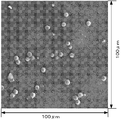
- the number of granular protrusions having a maximum diameter of 0.1 to 30 ⁇ m per 100 ⁇ m ⁇ 100 ⁇ m (0.01 mm 2 ) is 1 to 300/0. 0.01 mm 2 is preferable, and 10 to 200 / 0.01 mm 2 is more preferable.
- the number per 100 ⁇ m ⁇ 100 ⁇ m (0.01 mm 2 ) of granular projections having a maximum diameter of 0.1 to 30 ⁇ m on the surface of an extrusion-molded product obtained from the silicone rubber composition of the present invention is arbitrarily selected from 5 It is preferable that it exists in the said range as an average value in a location.
- the component (A) can be a liquid base polymer from which low molecular siloxane has been sufficiently removed. Accordingly, a cured product having a very low content of low molecular siloxane can be easily obtained.
- the low-viscosity (A) component-containing silicone rubber composition or (A) component has a mass reduction rate of 1.0% or less before and after heat treatment at 200 ° C. for 4 hours at normal pressure.
- the low viscosity (A) component-containing silicone rubber composition or the component (A) has a mass reduction rate before and after heat treatment at 200 ° C. for 4 hours at normal pressure.
- the mass reduction rate [%] of a cured product obtained by curing the silicone rubber composition of the present invention having a ratio of 1.0% or less at 170 ° C. for 10 minutes can be approximately 0.5% or less.
- the mass reduction rate [%] of the cured product in this case is preferably 0.3% or less, more preferably 0.2% or less.
- the content of the cyclic siloxane having a polymerization degree of 10 or less can be 1000 ppm or less, preferably 500 ppm or less, more preferably 300 ppm or less.
- the low viscosity (A) component The silicone rubber composition of the present invention in which the content silicone rubber composition or the component (A) is 1.0% or less before and after heat treatment at 200 ° C. for 4 hours at normal pressure is cured at 120 ° C. for 10 minutes.
- the mass reduction rate [%] of the cured product obtained by the above treatment can be approximately 0.5% or less.
- the mass reduction rate [%] of the cured product in this case is preferably 0.3% or less, more preferably 0.2% or less.
- the addition reaction catalyst (D22) is a UV platinum catalyst
- the low viscosity (A) component-containing silicone rubber composition or the component (A) is reduced in mass before and after heat treatment at 200 ° C. for 4 hours at normal pressure.
- the mass reduction rate [%] of the cured product obtained by curing the silicone rubber composition of the present invention having a rate of 1.0% or less at 7200 mJ / cm 2 as the integrated light quantity at 365 nm is approximately 0.5%. The following can be done.
- the mass reduction rate [%] of the cured product in this case is preferably 0.3% or less, more preferably 0.2% or less.
- the content of the cyclic siloxane having a polymerization degree of 10 or less can be 1000 ppm or less, preferably 500 ppm or less, more preferably 300 ppm or less.
- the following polyorganosiloxane was used as the component (A1), the component (A2), and the component (D21).
- the siloxane unit is indicated by the following symbols.
- the structural formula, mass reduction ratio [%], viscosity [Pas], silanol group content [mmol / g], each linear polyorganosiloxane polymer having an alkenyl group content [mmol / g] was used.
- Table 1 also shows polyorganosiloxane diols (A1-cf) for comparative examples that are polyorganosiloxane diols but do not satisfy the requirements of the component (A1).
- silica powder is a surface-treated silica powder for a comparative example.
- (B) component fumed silica (B1); Aerosil 130 (trade name, manufactured by EVONIC), specific surface area of 130 m 2 / g (B2); Aerosil 200 (trade name, manufactured by EVONIC), specific surface area of 200 m 2 / g (B3); Aerosil 300 (trade name, manufactured by EVONIC), specific surface area of 300 m 2 / g (Bcf): Aerosil 130 treated with dimethyldichlorosilane (silica surface carbon content: 1.0 mass%)
- Component (C) organosilazane (C1); hexamethyldisilazane (C2); 1,3-divinyl-1,1,3,3-tetramethyldisilazane
- Example 1 to 23 Silicone rubber compositions of Examples 1 to 23 were produced with the compositions shown in Tables 2 to 5 as follows. Similarly, the silicone rubber compositions of Comparative Examples 1 to 7 having the compositions shown in Table 6 were produced as base compounds containing no component (D) as follows.
- component (A1) and component (A2) were mixed with a kneader to prepare component (A).
- the components (B) and (C) are continuously added to the component (A) over a period of 20 to 60 minutes, blended with a kneader, kneaded at 50 ° C. for 1 hour, and then heat-kneaded at 150 ° C. for 2 hours. This was cooled to 40 ° C. or lower to prepare a base compound.
- component was mix
- viscosity (Pas) as component (A) alkenyl group content [mmol / g]
- mass reduction rate [%] mass reduction rate as a base compound [ %].
- the alkenyl group content [mmol / g] and the mass reduction rate [%] of the component (A) are calculated values.
- “phc” in (D11), (D21), and (D22) is a blending amount (parts by mass) with respect to 100 parts by mass of the base compound composed of the components (A), (B), and (C). is there.
- the ppmPt in (D22) indicates ppm in terms of platinum metal atom relative to the total amount of the (A) component, the (B) component, the (C) component (base compound), and the (D21) component.
- the blank indicates the blending amount “0”, and “ ⁇ ” indicates that the blending is not performed.
- the extrusion processability is good.
- Blocking resistance After winding the cured tube and leaving it to stand at room temperature for 1 day, the presence or absence of adhesion between the surfaces of the tubes is visually confirmed. was recognized as blocking resistance “none”.
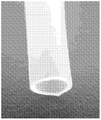
- FIG. 1A is a SEM photograph (1 ⁇ ) of the tube surface obtained in Example 12
- FIG. 1B is a photograph showing a 100 ⁇ m ⁇ 100 ⁇ m area obtained by enlarging a 250 ⁇ SEM photograph of the same tube surface
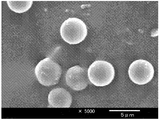
- FIG. 1C is the same tube surface. Is a SEM photograph at a magnification of 5000 times (the length of the white line at the lower right of the photograph is 5 ⁇ m).
- test pieces were prepared using the silicone rubber composition of the example obtained above, and the following evaluation items were evaluated. The results are also shown in Tables 2 to 6.
- Examples 1 to 11 Test pieces for measuring mechanical properties (hardness, tensile strength, elongation) according to JIS K6249, which were press-molded at 120 ° C. for 15 minutes under the conditions obtained above. A dumbbell-shaped No. 3 shape was produced.
- the silicone rubber compositions obtained in Examples 1 to 11 were press-molded under the same conditions as those for producing test pieces for measuring mechanical properties to obtain silicone rubber sheets.
- the silicone rubber compositions obtained in Examples 12 to 23 were cured using a UV lamp in the same manner as in the production of the test pieces for measuring mechanical properties to obtain silicone rubber sheets. These silicone rubber sheets were cut into appropriate sizes, and the mass (w1) was measured as sample sheets. The sample sheet was placed in an oven at 200 ° C. for 4 hours, taken out, measured for mass (g; w2), and mass reduction rate [%] ((w1-w2) / w1 ⁇ 100) was calculated.
- the silicone rubber composition obtained in Examples 1 and 3 was press-molded under the conditions of 170 ° C. and 10 minutes to obtain a silicone rubber sheet in the same manner as the test piece for measuring mechanical properties.
- the silicone rubber compositions obtained in Examples 12 and 15 were cured using a UV lamp in the same manner as in the preparation of the mechanical property measurement test pieces to obtain silicone rubber sheets. These silicone rubber sheets are immersed in n-hexane to extract low molecular weight siloxane, and the amount of low molecular siloxane contained in the extract is determined by gas chromatography (manufactured by Agilent Technologies, Model 6890). Tables 2 to 5 show the results of the determination of the content of cyclic siloxane having a degree of polymerization of 4 to 10 contained in Table 2, respectively.
- the silicone rubber compositions of the examples have good moldability, particularly extrudability, while maintaining sufficient strength of the cured product.
- the surface of the extruded product was excellent in slipperiness and did not block.
- the base compound is the same as in Examples 12 and 14 to 20, and the curing agent is the same as in Examples 9 to 11, so that the extrusion moldability is good and the blocking resistance is good. Is also assumed to be good.
- the spherical particles are considered to be an aggregate of silica particles. It is considered that the surface slipperiness of the extruded product was improved by the presence of the spherical body in which the silica particles were aggregated.
- component (A) is a low viscosity component (A) (Examples 1 to 6, 9, 12 to 18), low molecular weight siloxane can be sufficiently reduced from the raw material components, and the low molecular weight When the component (A) in which siloxane is reduced is used, it is not necessary to post-cure the cured product.
- the silicone rubber composition of the present invention has good moldability, particularly extrusion moldability, while maintaining sufficient strength of the cured product. Moreover, if the low viscosity (A) component containing silicone rubber composition which is a preferable aspect in the silicone rubber composition of this invention is used, the low molecular siloxane contained in (A) component beforehand can fully be reduced. Therefore, a cured product in which the content of low molecular siloxane is sufficiently reduced without post-curing, for example, a silicone rubber molded product having a mass reduction rate of 0.5% or less before and after heat treatment at 200 ° C. for 4 hours at normal pressure Is obtained.
- Such silicone rubber moldings are suitable as connector seals / gaskets / packings / buffer materials for automobiles and electronic devices because there is almost no contact failure of electronic devices due to volatile low molecular weight siloxane. It is.
- the amount of volatile low-molecular-weight siloxane is sufficiently small, it can be used as medical tubes, catheters, check valves, packings, wound care products, health care applications such as baby nipples, and kitchen products. Is preferred.
- composite molding with a wide range of materials such as heat-sensitive materials such as thermoplastics is possible.
- the surface of the extrusion-molded product with the silicone rubber composition of the present invention is excellent in slipperiness, so that almost no blocking occurs.
- the silicone rubber composition of the present invention is suitable for producing extruded products such as packings, tubes and cables. Moreover, since the extruded product has a matte and non-sticky surface texture due to the granular protrusions exposed on the surface, it is suitable for uses such as wearable devices and automotive weather strips.
Landscapes
- Chemical & Material Sciences (AREA)
- Health & Medical Sciences (AREA)
- Chemical Kinetics & Catalysis (AREA)
- Medicinal Chemistry (AREA)
- Polymers & Plastics (AREA)
- Organic Chemistry (AREA)
- Compositions Of Macromolecular Compounds (AREA)
- Processes Of Treating Macromolecular Substances (AREA)
- Extrusion Moulding Of Plastics Or The Like (AREA)
Abstract
L'invention concerne une composition de caoutchouc de silicone qui présente une aptitude améliorée au moulage, en particulier une aptitude améliorée au moulage par extrusion, tout en garantissant également qu'un produit durci obtenu à partir de celle-ci présente une résistance suffisante. L'invention concerne une composition de caoutchouc de silicone comprenant : (A) 100 parties en masse d'un polymère de base formé à partir de (A1) un polyorganosiloxanediol présentant une viscosité, à 25°C, de 1 à 100 Pa.s et (A2) un polyorganosiloxane présentant une viscosité, à 25°C, de 0,2 à 40.000 Pa.s, la proportion de (A1) par rapport à la quantité totale (A) étant de 20 à 100 % en masse, la viscosité, à 25°C, étant comprise entre 5 et 20.000 Pa.s et la teneur en groupe alcényle étant de 0,001 à 0,3 mmole/g; (B) 10 à 50 parties en masse d'une poudre de silice présentant une aide de surface spécifique de 50 à 400 m2/g; (C) 1 à 10 parties en masse d'un organosilazane; et (D) une quantité catalytique d'un agent de durcissement.
Priority Applications (4)
| Application Number | Priority Date | Filing Date | Title |
|---|---|---|---|
| JP2016574201A JP6228692B1 (ja) | 2015-12-17 | 2016-12-16 | シリコーンゴム組成物、その製造方法およびシリコーンゴム押出し成形品 |
| CN201680074243.7A CN108473769B (zh) | 2015-12-17 | 2016-12-16 | 硅橡胶组合物、其制造方法和硅橡胶挤出成型品 |
| EP16875785.4A EP3392314B1 (fr) | 2015-12-17 | 2016-12-16 | Composition de caoutchouc de silicone, procédé de production correspondant et produit extrudé en caoutchouc de silicone |
| US16/008,255 US10654980B2 (en) | 2015-12-17 | 2018-06-14 | Silicone rubber composition, method of producing the same, and silicone rubber extrudate |
Applications Claiming Priority (2)
| Application Number | Priority Date | Filing Date | Title |
|---|---|---|---|
| JP2015246104 | 2015-12-17 | ||
| JP2015-246104 | 2015-12-17 |
Related Child Applications (1)
| Application Number | Title | Priority Date | Filing Date |
|---|---|---|---|
| US16/008,255 Continuation US10654980B2 (en) | 2015-12-17 | 2018-06-14 | Silicone rubber composition, method of producing the same, and silicone rubber extrudate |
Publications (1)
| Publication Number | Publication Date |
|---|---|
| WO2017104811A1 true WO2017104811A1 (fr) | 2017-06-22 |
Family
ID=59056742
Family Applications (1)
| Application Number | Title | Priority Date | Filing Date |
|---|---|---|---|
| PCT/JP2016/087577 Ceased WO2017104811A1 (fr) | 2015-12-17 | 2016-12-16 | Composition de caoutchouc de silicone, procédé de production correspondant et produit extrudé en caoutchouc de silicone |
Country Status (6)
| Country | Link |
|---|---|
| US (1) | US10654980B2 (fr) |
| EP (1) | EP3392314B1 (fr) |
| JP (1) | JP6228692B1 (fr) |
| CN (1) | CN108473769B (fr) |
| TW (1) | TW201731964A (fr) |
| WO (1) | WO2017104811A1 (fr) |
Cited By (2)
| Publication number | Priority date | Publication date | Assignee | Title |
|---|---|---|---|---|
| KR20200139193A (ko) | 2018-03-29 | 2020-12-11 | 신에쓰 가가꾸 고교 가부시끼가이샤 | 실리콘 고무-실리콘 변성 폴리이미드 수지 적층체 |
| JP2021042332A (ja) * | 2019-09-12 | 2021-03-18 | 信越化学工業株式会社 | 付加硬化型シリコーン組成物、その硬化物、光反射材、及び、光半導体装置 |
Families Citing this family (5)
| Publication number | Priority date | Publication date | Assignee | Title |
|---|---|---|---|---|
| KR102819646B1 (ko) * | 2018-05-24 | 2025-06-12 | 신에쓰 가가꾸 고교 가부시끼가이샤 | 부가 경화성 액상 실리콘 고무 조성물 및 실리콘 고무 성형체 |
| WO2020032143A1 (fr) * | 2018-08-09 | 2020-02-13 | 日星電気株式会社 | Fil électrique isolé |
| WO2020262057A1 (fr) * | 2019-06-24 | 2020-12-30 | 帝國製薬株式会社 | Timbre adhésif à base d'eau |
| CN111117260A (zh) * | 2019-12-31 | 2020-05-08 | 深圳市飞鸿达科技有限公司 | 一种微交联单组分导热吸波凝胶的制备方法 |
| CN112670012A (zh) * | 2020-12-04 | 2021-04-16 | 上海福尔欣线缆有限公司 | 一种新型汽车硅橡胶电缆及制造方法 |
Citations (6)
| Publication number | Priority date | Publication date | Assignee | Title |
|---|---|---|---|---|
| JPS514249A (fr) * | 1974-05-15 | 1976-01-14 | Wacker Chemie Gmbh | |
| JPS6443564A (en) * | 1987-07-30 | 1989-02-15 | Dow Corning | Preparation of optically transparent curable polyorganosiloxane |
| JPH06306295A (ja) * | 1993-04-09 | 1994-11-01 | General Electric Co <Ge> | 簡素化された組成の熱硬化性シリコーンゴム組成物 |
| JPH0977978A (ja) * | 1995-09-12 | 1997-03-25 | Shin Etsu Chem Co Ltd | 硬化性シリコーンエラストマー組成物及びその製造方法 |
| JP2001342347A (ja) * | 2000-05-31 | 2001-12-14 | Dow Corning Toray Silicone Co Ltd | 押出成形用シリコーンゴム組成物およびシリコーンゴム押出成形品の製造方法 |
| JP2004067961A (ja) * | 2002-08-09 | 2004-03-04 | Shin Etsu Chem Co Ltd | 室温硬化性オルガノポリシロキサン組成物 |
Family Cites Families (9)
| Publication number | Priority date | Publication date | Assignee | Title |
|---|---|---|---|---|
| US5563211A (en) * | 1995-10-16 | 1996-10-08 | Dow Corning Corporation | Extrudable silicone elastomer with improved mold release |
| US6750279B1 (en) * | 2000-08-11 | 2004-06-15 | General Electric Company | High tear strength low compression set heat curable silicone elastomer and additive |
| KR20040031021A (ko) * | 2001-08-29 | 2004-04-09 | 다우 코닝 도레이 실리콘 캄파니 리미티드 | 저비중 액체 실리콘 고무 조성물 및 이로부터 성형된 제품 |
| DE602006002040D1 (de) | 2005-01-18 | 2008-09-18 | Shinetsu Chemical Co | Flüssige Siliconkautschuk-Beschichtungszusammensetzung und damit beschichteter Airbag |
| JP4878162B2 (ja) | 2005-01-18 | 2012-02-15 | 信越化学工業株式会社 | 液状シリコーンゴムコーティング剤組成物および該組成物を用いたエアーバッグ |
| JP5117713B2 (ja) * | 2006-12-25 | 2013-01-16 | 東レ・ダウコーニング株式会社 | シリコーン系感圧接着剤組成物および粘着テープ |
| JP5343912B2 (ja) | 2009-06-09 | 2013-11-13 | 信越化学工業株式会社 | シリコーンゴム組成物及びその製造方法 |
| CN103502337B (zh) * | 2011-12-09 | 2015-11-25 | 迈图高新材料日本合同公司 | 硅橡胶发泡体用组合物、硅橡胶发泡体的制造方法和硅橡胶发泡体 |
| TWI678551B (zh) * | 2015-07-28 | 2019-12-01 | 美商道康寧公司 | 智慧型光學材料、配方、方法、用途、物品、及裝置 |
-
2016
- 2016-12-16 WO PCT/JP2016/087577 patent/WO2017104811A1/fr not_active Ceased
- 2016-12-16 TW TW105141855A patent/TW201731964A/zh unknown
- 2016-12-16 JP JP2016574201A patent/JP6228692B1/ja not_active Expired - Fee Related
- 2016-12-16 CN CN201680074243.7A patent/CN108473769B/zh not_active Expired - Fee Related
- 2016-12-16 EP EP16875785.4A patent/EP3392314B1/fr active Active
-
2018
- 2018-06-14 US US16/008,255 patent/US10654980B2/en not_active Expired - Fee Related
Patent Citations (6)
| Publication number | Priority date | Publication date | Assignee | Title |
|---|---|---|---|---|
| JPS514249A (fr) * | 1974-05-15 | 1976-01-14 | Wacker Chemie Gmbh | |
| JPS6443564A (en) * | 1987-07-30 | 1989-02-15 | Dow Corning | Preparation of optically transparent curable polyorganosiloxane |
| JPH06306295A (ja) * | 1993-04-09 | 1994-11-01 | General Electric Co <Ge> | 簡素化された組成の熱硬化性シリコーンゴム組成物 |
| JPH0977978A (ja) * | 1995-09-12 | 1997-03-25 | Shin Etsu Chem Co Ltd | 硬化性シリコーンエラストマー組成物及びその製造方法 |
| JP2001342347A (ja) * | 2000-05-31 | 2001-12-14 | Dow Corning Toray Silicone Co Ltd | 押出成形用シリコーンゴム組成物およびシリコーンゴム押出成形品の製造方法 |
| JP2004067961A (ja) * | 2002-08-09 | 2004-03-04 | Shin Etsu Chem Co Ltd | 室温硬化性オルガノポリシロキサン組成物 |
Non-Patent Citations (1)
| Title |
|---|
| See also references of EP3392314A4 * |
Cited By (3)
| Publication number | Priority date | Publication date | Assignee | Title |
|---|---|---|---|---|
| KR20200139193A (ko) | 2018-03-29 | 2020-12-11 | 신에쓰 가가꾸 고교 가부시끼가이샤 | 실리콘 고무-실리콘 변성 폴리이미드 수지 적층체 |
| US12384889B2 (en) | 2018-03-29 | 2025-08-12 | Shin-Etsu Chemical Co., Ltd. | Silicone rubber-silicone modified polyimide resin laminated body |
| JP2021042332A (ja) * | 2019-09-12 | 2021-03-18 | 信越化学工業株式会社 | 付加硬化型シリコーン組成物、その硬化物、光反射材、及び、光半導体装置 |
Also Published As
| Publication number | Publication date |
|---|---|
| EP3392314A4 (fr) | 2019-07-24 |
| US10654980B2 (en) | 2020-05-19 |
| EP3392314A1 (fr) | 2018-10-24 |
| EP3392314B1 (fr) | 2020-12-02 |
| JPWO2017104811A1 (ja) | 2017-12-14 |
| JP6228692B1 (ja) | 2017-11-08 |
| US20180291160A1 (en) | 2018-10-11 |
| CN108473769B (zh) | 2021-03-16 |
| TW201731964A (zh) | 2017-09-16 |
| CN108473769A (zh) | 2018-08-31 |
Similar Documents
| Publication | Publication Date | Title |
|---|---|---|
| JP6228692B1 (ja) | シリコーンゴム組成物、その製造方法およびシリコーンゴム押出し成形品 | |
| JP5281206B1 (ja) | シリコーンゴム発泡体用組成物、シリコーンゴム発泡体の製造方法およびシリコーンゴム発泡体 | |
| EP2759573B1 (fr) | Composition de caoutchouc de silicone thermodurcissable | |
| CN1108276A (zh) | 注射模塑用硅橡胶组合物 | |
| JPH0514742B2 (fr) | ||
| JP6274125B2 (ja) | フロロシリコーンゴム組成物 | |
| JP5338380B2 (ja) | オルガノポリシロキサン及びその製造方法並びにフルオロシリコーンゴム組成物 | |
| JP5164289B2 (ja) | シリコーン組成物、物品およびかかるシリコーン組成物を製造する方法 | |
| JP2012211232A (ja) | シリコーンゴム系硬化性組成物 | |
| JP2016530394A (ja) | シリコーン物品、チューブ及び物品形成方法 | |
| CN1847317A (zh) | 阻燃性硅橡胶用组合物、阻燃性聚硅氧烷橡胶组合物和阻燃性硅橡胶 | |
| JP6107741B2 (ja) | ミラブル型シリコーンゴムコンパウンド及びミラブル型シリコーンゴム組成物の製造方法 | |
| JP2014109014A (ja) | ミラブル型シリコーンゴムコンパウンド及びシリコーンゴム組成物の製造方法 | |
| JP4439802B2 (ja) | 難燃性液状シリコーンゴム組成物 | |
| JP4553562B2 (ja) | 接着性ポリオルガノシロキサン組成物 | |
| JP3472472B2 (ja) | シリコーンゴム組成物およびシリコーンゴム成形体の製造方法 | |
| JP2005068273A (ja) | ポリオルガノシロキサン組成物およびその製造方法ならびにシリコーンゴム成形品 | |
| EP0768341A1 (fr) | Elastomère de silicone extrudable avec démoulage amélioré | |
| JP3838562B2 (ja) | オイルブリード性シリコーンゴム組成物及びその製造方法 | |
| TW202436511A (zh) | 導電性聚矽氧橡膠組成物及其硬化物 | |
| JP6778834B2 (ja) | 液状シリコーンゴム組成物、その硬化物、該硬化物を備える物品、及びシリコーンゴムの製造方法 | |
| JP3482834B2 (ja) | シリコーンゴムの製造方法 | |
| JP3919011B2 (ja) | 熱硬化性シリコーンゴム組成物 | |
| JPH07179765A (ja) | シリコーンゴム組成物及びその製造方法 | |
| JP3157529B2 (ja) | シリコーンゴム組成物 |
Legal Events
| Date | Code | Title | Description |
|---|---|---|---|
| ENP | Entry into the national phase |
Ref document number: 2016574201 Country of ref document: JP Kind code of ref document: A |
|
| 121 | Ep: the epo has been informed by wipo that ep was designated in this application |
Ref document number: 16875785 Country of ref document: EP Kind code of ref document: A1 |
|
| NENP | Non-entry into the national phase |
Ref country code: DE |
|
| WWE | Wipo information: entry into national phase |
Ref document number: 2016875785 Country of ref document: EP |