WO2017111132A1 - Pile rechargeable tout solide, particules pour piles rechargeables tout solide, composition d'électrolyte solide pour piles rechargeables tout solide, feuille d'électrode pour piles rechargeables tout solide, et leurs procédés de fabrication - Google Patents
Pile rechargeable tout solide, particules pour piles rechargeables tout solide, composition d'électrolyte solide pour piles rechargeables tout solide, feuille d'électrode pour piles rechargeables tout solide, et leurs procédés de fabrication Download PDFInfo
- Publication number
- WO2017111132A1 WO2017111132A1 PCT/JP2016/088573 JP2016088573W WO2017111132A1 WO 2017111132 A1 WO2017111132 A1 WO 2017111132A1 JP 2016088573 W JP2016088573 W JP 2016088573W WO 2017111132 A1 WO2017111132 A1 WO 2017111132A1
- Authority
- WO
- WIPO (PCT)
- Prior art keywords
- solid
- particles
- secondary battery
- solid electrolyte
- state secondary
- Prior art date
- Legal status (The legal status is an assumption and is not a legal conclusion. Google has not performed a legal analysis and makes no representation as to the accuracy of the status listed.)
- Ceased
Links
Images
Classifications
-
- H—ELECTRICITY
- H01—ELECTRIC ELEMENTS
- H01M—PROCESSES OR MEANS, e.g. BATTERIES, FOR THE DIRECT CONVERSION OF CHEMICAL ENERGY INTO ELECTRICAL ENERGY
- H01M10/00—Secondary cells; Manufacture thereof
- H01M10/05—Accumulators with non-aqueous electrolyte
- H01M10/056—Accumulators with non-aqueous electrolyte characterised by the materials used as electrolytes, e.g. mixed inorganic/organic electrolytes
- H01M10/0561—Accumulators with non-aqueous electrolyte characterised by the materials used as electrolytes, e.g. mixed inorganic/organic electrolytes the electrolyte being constituted of inorganic materials only
- H01M10/0562—Solid materials
-
- H—ELECTRICITY
- H01—ELECTRIC ELEMENTS
- H01M—PROCESSES OR MEANS, e.g. BATTERIES, FOR THE DIRECT CONVERSION OF CHEMICAL ENERGY INTO ELECTRICAL ENERGY
- H01M10/00—Secondary cells; Manufacture thereof
- H01M10/05—Accumulators with non-aqueous electrolyte
- H01M10/052—Li-accumulators
-
- H—ELECTRICITY
- H01—ELECTRIC ELEMENTS
- H01M—PROCESSES OR MEANS, e.g. BATTERIES, FOR THE DIRECT CONVERSION OF CHEMICAL ENERGY INTO ELECTRICAL ENERGY
- H01M10/00—Secondary cells; Manufacture thereof
- H01M10/05—Accumulators with non-aqueous electrolyte
- H01M10/052—Li-accumulators
- H01M10/0525—Rocking-chair batteries, i.e. batteries with lithium insertion or intercalation in both electrodes; Lithium-ion batteries
-
- H—ELECTRICITY
- H01—ELECTRIC ELEMENTS
- H01M—PROCESSES OR MEANS, e.g. BATTERIES, FOR THE DIRECT CONVERSION OF CHEMICAL ENERGY INTO ELECTRICAL ENERGY
- H01M10/00—Secondary cells; Manufacture thereof
- H01M10/05—Accumulators with non-aqueous electrolyte
- H01M10/054—Accumulators with insertion or intercalation of metals other than lithium, e.g. with magnesium or aluminium
-
- H—ELECTRICITY
- H01—ELECTRIC ELEMENTS
- H01M—PROCESSES OR MEANS, e.g. BATTERIES, FOR THE DIRECT CONVERSION OF CHEMICAL ENERGY INTO ELECTRICAL ENERGY
- H01M10/00—Secondary cells; Manufacture thereof
- H01M10/05—Accumulators with non-aqueous electrolyte
- H01M10/058—Construction or manufacture
-
- H—ELECTRICITY
- H01—ELECTRIC ELEMENTS
- H01M—PROCESSES OR MEANS, e.g. BATTERIES, FOR THE DIRECT CONVERSION OF CHEMICAL ENERGY INTO ELECTRICAL ENERGY
- H01M10/00—Secondary cells; Manufacture thereof
- H01M10/05—Accumulators with non-aqueous electrolyte
- H01M10/058—Construction or manufacture
- H01M10/0585—Construction or manufacture of accumulators having only flat construction elements, i.e. flat positive electrodes, flat negative electrodes and flat separators
-
- H—ELECTRICITY
- H01—ELECTRIC ELEMENTS
- H01M—PROCESSES OR MEANS, e.g. BATTERIES, FOR THE DIRECT CONVERSION OF CHEMICAL ENERGY INTO ELECTRICAL ENERGY
- H01M4/00—Electrodes
- H01M4/02—Electrodes composed of, or comprising, active material
- H01M4/13—Electrodes for accumulators with non-aqueous electrolyte, e.g. for lithium-accumulators; Processes of manufacture thereof
-
- H—ELECTRICITY
- H01—ELECTRIC ELEMENTS
- H01M—PROCESSES OR MEANS, e.g. BATTERIES, FOR THE DIRECT CONVERSION OF CHEMICAL ENERGY INTO ELECTRICAL ENERGY
- H01M4/00—Electrodes
- H01M4/02—Electrodes composed of, or comprising, active material
- H01M4/13—Electrodes for accumulators with non-aqueous electrolyte, e.g. for lithium-accumulators; Processes of manufacture thereof
- H01M4/133—Electrodes based on carbonaceous material, e.g. graphite-intercalation compounds or CFx
-
- H—ELECTRICITY
- H01—ELECTRIC ELEMENTS
- H01M—PROCESSES OR MEANS, e.g. BATTERIES, FOR THE DIRECT CONVERSION OF CHEMICAL ENERGY INTO ELECTRICAL ENERGY
- H01M4/00—Electrodes
- H01M4/02—Electrodes composed of, or comprising, active material
- H01M4/13—Electrodes for accumulators with non-aqueous electrolyte, e.g. for lithium-accumulators; Processes of manufacture thereof
- H01M4/139—Processes of manufacture
-
- H—ELECTRICITY
- H01—ELECTRIC ELEMENTS
- H01M—PROCESSES OR MEANS, e.g. BATTERIES, FOR THE DIRECT CONVERSION OF CHEMICAL ENERGY INTO ELECTRICAL ENERGY
- H01M4/00—Electrodes
- H01M4/02—Electrodes composed of, or comprising, active material
- H01M4/13—Electrodes for accumulators with non-aqueous electrolyte, e.g. for lithium-accumulators; Processes of manufacture thereof
- H01M4/139—Processes of manufacture
- H01M4/1393—Processes of manufacture of electrodes based on carbonaceous material, e.g. graphite-intercalation compounds or CFx
-
- H—ELECTRICITY
- H01—ELECTRIC ELEMENTS
- H01M—PROCESSES OR MEANS, e.g. BATTERIES, FOR THE DIRECT CONVERSION OF CHEMICAL ENERGY INTO ELECTRICAL ENERGY
- H01M4/00—Electrodes
- H01M4/02—Electrodes composed of, or comprising, active material
- H01M4/36—Selection of substances as active materials, active masses, active liquids
- H01M4/58—Selection of substances as active materials, active masses, active liquids of inorganic compounds other than oxides or hydroxides, e.g. sulfides, selenides, tellurides, halogenides or LiCoFy; of polyanionic structures, e.g. phosphates, silicates or borates
- H01M4/583—Carbonaceous material, e.g. graphite-intercalation compounds or CFx
- H01M4/587—Carbonaceous material, e.g. graphite-intercalation compounds or CFx for inserting or intercalating light metals
-
- H—ELECTRICITY
- H01—ELECTRIC ELEMENTS
- H01M—PROCESSES OR MEANS, e.g. BATTERIES, FOR THE DIRECT CONVERSION OF CHEMICAL ENERGY INTO ELECTRICAL ENERGY
- H01M4/00—Electrodes
- H01M4/02—Electrodes composed of, or comprising, active material
- H01M4/62—Selection of inactive substances as ingredients for active masses, e.g. binders, fillers
-
- H—ELECTRICITY
- H01—ELECTRIC ELEMENTS
- H01M—PROCESSES OR MEANS, e.g. BATTERIES, FOR THE DIRECT CONVERSION OF CHEMICAL ENERGY INTO ELECTRICAL ENERGY
- H01M4/00—Electrodes
- H01M4/02—Electrodes composed of, or comprising, active material
- H01M4/62—Selection of inactive substances as ingredients for active masses, e.g. binders, fillers
- H01M4/624—Electric conductive fillers
- H01M4/625—Carbon or graphite
-
- H—ELECTRICITY
- H01—ELECTRIC ELEMENTS
- H01M—PROCESSES OR MEANS, e.g. BATTERIES, FOR THE DIRECT CONVERSION OF CHEMICAL ENERGY INTO ELECTRICAL ENERGY
- H01M2300/00—Electrolytes
- H01M2300/0017—Non-aqueous electrolytes
- H01M2300/0065—Solid electrolytes
- H01M2300/0068—Solid electrolytes inorganic
-
- Y—GENERAL TAGGING OF NEW TECHNOLOGICAL DEVELOPMENTS; GENERAL TAGGING OF CROSS-SECTIONAL TECHNOLOGIES SPANNING OVER SEVERAL SECTIONS OF THE IPC; TECHNICAL SUBJECTS COVERED BY FORMER USPC CROSS-REFERENCE ART COLLECTIONS [XRACs] AND DIGESTS
- Y02—TECHNOLOGIES OR APPLICATIONS FOR MITIGATION OR ADAPTATION AGAINST CLIMATE CHANGE
- Y02E—REDUCTION OF GREENHOUSE GAS [GHG] EMISSIONS, RELATED TO ENERGY GENERATION, TRANSMISSION OR DISTRIBUTION
- Y02E60/00—Enabling technologies; Technologies with a potential or indirect contribution to GHG emissions mitigation
- Y02E60/10—Energy storage using batteries
-
- Y—GENERAL TAGGING OF NEW TECHNOLOGICAL DEVELOPMENTS; GENERAL TAGGING OF CROSS-SECTIONAL TECHNOLOGIES SPANNING OVER SEVERAL SECTIONS OF THE IPC; TECHNICAL SUBJECTS COVERED BY FORMER USPC CROSS-REFERENCE ART COLLECTIONS [XRACs] AND DIGESTS
- Y02—TECHNOLOGIES OR APPLICATIONS FOR MITIGATION OR ADAPTATION AGAINST CLIMATE CHANGE
- Y02P—CLIMATE CHANGE MITIGATION TECHNOLOGIES IN THE PRODUCTION OR PROCESSING OF GOODS
- Y02P70/00—Climate change mitigation technologies in the production process for final industrial or consumer products
- Y02P70/50—Manufacturing or production processes characterised by the final manufactured product
Definitions
- the present invention relates to an all-solid secondary battery, all-solid-state secondary battery particles, all-solid-state secondary battery solid electrolyte composition, all-solid-state secondary battery electrode sheet, and methods for producing these.
- Electrolytic solutions have been used for lithium ion batteries. Attempts have been made to replace the electrolytic solution with a solid electrolyte to obtain an all-solid-state secondary battery in which all constituent materials are solid.
- An advantage of the technology using an inorganic solid electrolyte is the reliability of the overall performance of the battery. For example, a flammable material such as a carbonate-based solvent is applied as a medium to an electrolytic solution used in a lithium ion secondary battery.
- Various safety measures have been taken for lithium ion secondary batteries. However, there is a risk of inconvenience during overcharging, and further measures are desired.
- An all-solid-state secondary battery that employs a solid electrolyte is positioned as a fundamental solution.
- a further advantage of the all-solid-state secondary battery is that it is suitable for increasing the energy density by stacking electrodes. Specifically, a battery having a structure in which an electrode and an electrolyte are directly arranged in series can be obtained. At this time, since the metal package for sealing the battery cell, the copper wire and the bus bar for connecting the battery cell can be omitted, the energy density of the battery is greatly increased. In addition, good compatibility with the positive electrode material capable of increasing the potential is also mentioned as an advantage.
- Patent Document 1 describes a solid battery containing a hydrocarbon polymer having a crosslinked structure in any one of a positive electrode, a negative electrode, and an electrolyte layer containing a sulfide solid electrolyte.
- Patent Document 2 discloses an all-solid-state secondary battery in which a plurality of battery elements provided by sequentially laminating a positive electrode, a solid electrolyte, and a negative electrode made of an inorganic compound are disposed on a current collector. All solid state secondary batteries arranged with a gap of 1 to 5000 ⁇ m are described.
- JP 2014-112485 A Japanese Patent Laid-Open No. 2001-15153
- Patent Document 1 uses a hydrocarbon polymer having a crosslinked structure so as not to cause a decrease in adhesion between the electrode layer and the solid electrolyte layer. It aims to prevent generation and improve cycle characteristics.
- the solid battery described in the document has a low binding property between solid particles such as a solid electrolyte, and this low binding property causes a low handling property when the solid battery is manufactured.
- the all-solid-state secondary battery described in Patent Document 2 similarly has a low binding property between solid particles.
- an object of the present invention is to provide an all-solid-state secondary battery having excellent binding properties between solid particles in each layer, between each layer and between the layer and the current collector. Moreover, this invention makes it a subject to provide the particle
- an all-solid-state secondary battery such as an electrode active material or a sulfide-based inorganic solid electrolyte is exposed to actinic rays, thereby providing an elemental composition on the surface of the solid particles.
- the binding property between the particles, between each layer and between the layer and the current collector is improved.
- the present invention has been made based on this finding.
- An all-solid secondary battery containing non-oxide-based electrode active material particles An all-solid secondary battery in which the proportion of oxygen element in the elemental composition of at least one surface of sulfide-based inorganic solid electrolyte particles and non-oxide-based electrode active material particles is 3.0 atm% or more.
- ⁇ 2> The all-solid-state secondary battery according to ⁇ 1> above, Containing conductive aid particles, An all-solid secondary battery in which the proportion of oxygen element in the elemental composition of at least one surface of sulfide-based inorganic solid electrolyte particles, non-oxide-based electrode active material particles, and conductive additive particles is 3.0 atm% or more.
- ⁇ 3> The all-solid-state secondary battery according to ⁇ 1> or ⁇ 2>, wherein the proportion of oxygen element in the elemental composition on the particle surface is set to 3.0 atm% or more by active light.
- At least one of the non-oxide-based electrode active material particles and the conductive auxiliary agent particles is a carbonaceous material particle having an oxygen element ratio of 3.0 atm% or more in the surface elemental composition ⁇ 2> or ⁇ 3>
- the ratio of oxygen element in the elemental composition of at least one surface of the particle is 3.0 atm% or more, and 2,800 cm -1 to 3,700 cm -1 1,600 cm -1 to 1,800 cm -1 1,020cm -1 ⁇ 1,250cm -1
- ⁇ 7> The all solid state secondary battery according to ⁇ 6>, wherein the binder has a basic group.
- ⁇ 8> Manufacture of the all-solid-state secondary battery according to any one of ⁇ 1> to ⁇ 7>, including a step of setting the ratio of oxygen element in the elemental composition on the particle surface to 3.0 atm% or more by actinic rays Method.
- the actinic ray is a plasma generated from any gas of nitrogen, oxygen, hydrogen, carbon dioxide, ammonia, helium and argon, or a mixed gas of two or more thereof.
- Battery manufacturing method ⁇ 10> The method for producing an all-solid-state secondary battery according to ⁇ 9>, wherein the plasma is low-temperature atmospheric pressure plasma.
- ⁇ 11> A sulfide-based inorganic solid electrolyte particle having conductivity of metal ions belonging to Group 1 or Group 2 of the periodic table, non-oxide-based electrode active material particles, or conductive assistant particles, the surface All-solid-state secondary battery particles having a ratio of oxygen element in the elemental composition of 3.0 atm% or more.
- the method for producing particles for an all-solid-state secondary battery according to ⁇ 11> including a step of setting the ratio of the oxygen element in the elemental composition on the particle surface to 3.0 atm% or more with actinic rays.
- a solid electrolyte for an all-solid-state secondary battery containing sulfide-based inorganic solid electrolyte particles having conductivity of ions of metals belonging to Group 1 or Group 2 of the periodic table and non-oxide-based electrode active material particles A composition comprising: Any one of ⁇ 1> to ⁇ 7>, wherein the ratio of oxygen element in the elemental composition of at least one surface of the sulfide-based inorganic solid electrolyte particles and the non-oxide-based electrode active material particles is 3.0 atm% or more
- Solid electrolyte composition containing sulfide-based inorganic solid electrolyte particles having conductivity of metal ions belonging to Group 1 or Group 2 of the periodic table, non-oxide-based electrode active material particles, and conductive assistant particles [2] A step of irradiating the solid electrolyte composition with an actinic ray to increase the oxygen atom ratio in the elemental composition of the particle surface to 3.0 atm% or more.
- a numerical range expressed using “to” means a range including numerical values described before and after “to” as a lower limit value and an upper limit value.
- acryl or “(meth) acryl” is described, it is used in the meaning including both methacryl and acryl.
- the ratio of the oxygen element in the elemental composition on the particle surface is a value calculated using X-ray photoelectron spectroscopy (XPS (trade name: PHI 5000 VersaProbe II, ULVAC-PHI Co., Ltd.)). means.
- the horizontal axis represents the bond energy value (eV) of the measured electrons to the nucleus
- the vertical axis represents the emitted photoelectron intensity. Since the bond energy value depends on the element and the electronic state, the composition of the material can be analyzed from the energy value. The quantitative value is obtained by calculating the area intensity of each peak intensity. The proportion of oxygen atoms is calculated from the peak detected at 528.1 eV to 533.7 eV, which is the binding energy value of the 1s electron orbit with respect to the nucleus.
- the all solid state secondary battery of the present invention is excellent in the binding property between solid particles in each layer, between each layer and between the layer and the current collector.
- the particles for an all-solid-state secondary battery of the present invention are excellent in binding properties.
- the solid electrolyte composition for an all-solid secondary battery of the present invention is used for the production of an all-solid secondary battery, so that the solid particles in each layer of the all-solid secondary battery, the respective layers, the layers and the current collector The binding property can be improved.
- the electrode sheet for an all-solid secondary battery of the present invention is used for an all-solid-state secondary battery, thereby binding between solid particles in each layer of the all-solid-state secondary battery, between each layer and between the layer and the current collector. Can increase the sex.
- the production method of the present invention makes it possible to produce the all-solid secondary battery, the all-solid-state secondary battery particles, the all-solid-state secondary battery solid electrolyte composition, and the all-solid-state secondary battery electrode sheet.
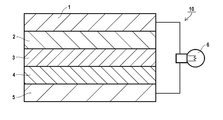
- FIG. 1 is a cross-sectional view schematically showing an all solid state secondary battery (lithium ion secondary battery) according to a preferred embodiment of the present invention.
- the all-solid-state secondary battery 10 of this embodiment has a negative electrode current collector 1, a negative electrode active material layer 2, a solid electrolyte layer 3, a positive electrode active material layer 4, and a positive electrode current collector 5 in this order as viewed from the negative electrode side. .
- Each layer is in contact with each other and has a laminated structure.
- the solid electrolyte composition for an all-solid-state secondary battery of the present invention can be preferably used as a molding material for the negative electrode active material layer, the positive electrode active material layer, and the solid electrolyte layer.
- the thicknesses of the positive electrode active material layer 4, the solid electrolyte layer 3, and the negative electrode active material layer 2 are not particularly limited. In consideration of general battery dimensions, the thickness is preferably 10 to 1,000 ⁇ m, more preferably 20 ⁇ m or more and less than 500 ⁇ m. In the all solid state secondary battery of the present invention, it is more preferable that the thickness of at least one of the positive electrode active material layer 4, the solid electrolyte layer 3, and the negative electrode active material layer 2 is 50 ⁇ m or more and less than 500 ⁇ m. In this specification, the positive electrode active material layer and the negative electrode active material layer may be collectively referred to as an electrode layer.
- the electrode active material that can be used in the present invention includes a positive electrode active material contained in the positive electrode active material layer and a negative electrode active material contained in the negative electrode active material layer. May be simply referred to as an active material or an electrode active material.
- solid electrolyte composition for an all-solid secondary battery of the present invention that can be suitably used for the production of the all-solid secondary battery of the present invention will be described.
- the solid electrolyte composition for an all-solid-state secondary battery according to the present invention includes a sulfide-based inorganic solid electrolyte particle and a non-oxide-based electrode active material having conductivity of metal ions belonging to Group 1 or Group 2 of the Periodic Table Contains particles. Moreover, it is preferable that the solid electrolyte composition for all-solid-state secondary batteries of this invention contains a conductive support agent particle.
- the ratio of oxygen element in the elemental composition of at least one surface of the sulfide-based inorganic solid electrolyte particles and the non-oxide-based electrode active material particles Is 3.0 atm% or more.
- the solid electrolyte composition for an all-solid-state secondary battery of the present invention contains conductive aid particles, at least one of the sulfide-based inorganic solid electrolyte particles, the non-oxide-based electrode active material particles, and the conductive aid particles.
- the proportion of oxygen element in the elemental composition of one kind of surface is 3.0 atm% or more.
- sulfide-based inorganic solid electrolyte particles in which the ratio of oxygen element in the surface element composition is 3.0 atm% or more, and the non-oxide electrode activity in which the ratio of oxygen element in the surface element composition is 3.0 atm% or more are referred to as particles for an all-solid-state secondary battery of the present invention.
- sulfide-based inorganic solid electrolyte particles may be referred to as inorganic solid electrolytes, non-oxide-based electrode active material particles as electrode active materials, and conductive aid particles as conductive aids.
- the inorganic solid electrolyte is an inorganic solid electrolyte, and the solid electrolyte is a solid capable of moving ions inside thereof.
- Organic solid electrolytes polymer electrolytes typified by polyethylene oxide (PEO) and the like, organic electrolyte salts typified by lithium bis (trifluoromethanesulfonyl) imide (LiTFSI) and the like) because they do not contain organic substances, that is, carbon atoms Clearly distinguished.
- the inorganic solid electrolyte is solid in a steady state, the cation and the anion are not dissociated or released, and the cation and the anion are dissociated or released in the electrolyte or polymer (LiPF 6 , LiBF 4 And lithium bis (fluorosulfonyl) imide (LiFSI), LiCl, etc.).
- the inorganic solid electrolyte is not particularly limited as long as it has conductivity of ions of metal elements belonging to Group 1 or Group 2 of the periodic table, and generally does not have electron conductivity.
- the solid electrolyte composition for an all-solid-state secondary battery contains a sulfide-based inorganic solid electrolyte having conductivity of ions of metal elements belonging to Group 1 or Group 2 of the periodic table.
- the sulfide inorganic solid electrolyte contains a sulfur atom (S), has ionic conductivity of a metal element belonging to Group 1 or Group 2 of the periodic table, and has electronic insulation. There is no particular limitation. For example, it is a lithium ion conductive inorganic solid electrolyte that satisfies the composition represented by the following formula (1).
- M 1 represents an element selected from B, Zn, Sn, Si, Cu, Ga, Sb, Al, and Ge. Of these, B, Sn, Si, Al, and Ge are preferable, and Sn, Al, and Ge are more preferable.
- A represents I, Br, Cl or F, preferably I or Br, and particularly preferably I.
- a to e represent the composition ratio of each element, and a: b: c: d: e preferably satisfies 1 to 12: 0 to 1: 1: 2 to 12: 0 to 5.
- a is further preferably 1 to 9, and more preferably 1.5 to 4.
- b is preferably 0 to 0.5.
- d is further preferably 3 to 7, and more preferably 3.25 to 4.5.
- e is preferably from 0 to 3, more preferably from 0 to 2.
- the composition ratio of each element can be controlled by adjusting the blending amount of the raw material compound when producing the sulfide-based inorganic solid electrolyte.
- the sulfide-based inorganic solid electrolyte may be amorphous (glass) or crystallized (glass ceramic), or only part of it may be crystallized.
- the ratio of Li 2 S to P 2 S 5 in the Li—PS system glass and the Li—PS system glass ceramic is a molar ratio of Li 2 S: P 2 S 5 , preferably 65:35 to 85:15, more preferably 68:32 to 75:25.
- the lithium ion conductivity can be increased.
- the lithium ion conductivity can be preferably 1 ⁇ 10 ⁇ 4 S / cm or more, more preferably 1 ⁇ 10 ⁇ 3 S / cm or more. Although there is no particular upper limit, it is practical that it is 1 ⁇ 10 ⁇ 1 S / cm or less.
- Li—PS glass is preferably used.
- the compound of the sulfide-based inorganic solid electrolyte include those formed using a raw material composition containing, for example, Li 2 S and a sulfide of an element belonging to Group 13 to Group 15. . More specifically, Li 2 S—P 2 S 5 , Li 2 S—LiI—P 2 S 5 , Li 2 S—LiI—Li 2 O—P 2 S 5 , Li 2 S—LiBr—P 2 S 5 , Li 2 S—Li 2 O—P 2 S 5 , Li 2 S—Li 3 PO 4 —P 2 S 5 , Li 2 S—P 2 S 5 —P 2 O 5 , Li 2 S—P 2 S 5- SiS 2 , Li 2 S—P 2 S 5 —SnS, Li 2 S—P 2 S 5 —Al 2 S 3 , Li 2 S—GeS 2 , Li 2 S—GeS 2 —ZnS, Li 2 S— Ga 2 S 3 , Li 2 S—GeS 2
- Examples of a method for synthesizing a sulfide-based inorganic solid electrolyte material using such a raw material composition include an amorphization method.
- Examples of the amorphization method include a mechanical milling method and a melt quenching method, and among them, the mechanical milling method is preferable. This is because processing at room temperature is possible, and the manufacturing process can be simplified.
- the inorganic solid electrolyte may be used singly or in combination of two or more.
- the average particle size of the inorganic solid electrolyte is not particularly limited, but is preferably 0.01 ⁇ m or more, and more preferably 0.1 ⁇ m or more. As an upper limit, it is preferable that it is 100 micrometers or less, and it is more preferable that it is 50 micrometers or less.
- the content of the inorganic solid electrolyte in the solid electrolyte composition for an all-solid-state secondary battery is 5% by mass or more in 100% by mass of the solid component when considering both battery performance, reduction in interface resistance and maintenance effect. It is preferable that it is 10 mass% or more, and it is especially preferable that it is 20 mass% or more. As an upper limit, it is preferable that it is 99.9 mass% or less from the same viewpoint, It is more preferable that it is 99.5 mass% or less, It is especially preferable that it is 99.0 mass% or less. However, when used together with a positive electrode active material or a negative electrode active material described later, the total content is preferably within the above range.
- the solid component refers to a component that does not disappear by volatilization or evaporation when dried at 170 ° C. for 6 hours. Typically, it refers to components other than the dispersion medium described below. Moreover, it is preferable that content of the solid component in the all-solid-state secondary battery and the electrode sheet for all-solid-state secondary batteries is the same as content of the solid component in the solid electrolyte composition for all-solid-state secondary batteries.
- the electrode active material used for the solid electrolyte composition for an all-solid-state secondary battery of the present invention will be described.
- non-oxide-based electrode active material particles containing no oxygen element are used.
- the solid electrolyte composition for an all-solid-state secondary battery for forming the positive electrode active material layer may be referred to as a positive electrode composition.
- the solid electrolyte composition for an all-solid-state secondary battery for forming the negative electrode active material layer may be referred to as a negative electrode composition.
- the positive electrode active material is preferably one that can reversibly insert and release lithium ions.
- the material is not particularly limited as long as it does not contain an oxygen atom, and examples thereof include metal atoms, sulfides and nitrides of metal atoms, and atoms that can be combined with Li such as sulfur.
- the positive electrode active material not containing oxygen atoms include sulfur (preferably sulfur powder), titanium sulfide (TiS 2 ), lithium cobalt nitride (LiCoN), lithium silicon nitride (LiCoN), lithium metal, lithium alloy ( LiM 2 and M 2 represent atoms selected from Sn, Si, Al, Ge, Sb and P.), lithium-storable intermetallic compounds (Mgx 1 M 3 and M 3 are Sn, Ge, Sb and X represents one selected from XySb, and x 1 represents 0.1 to 10.
- X in XySb represents an atom selected from In, Cu and Mn, and y represents 0.1 to 10.
- sulfur is preferably used.
- the volume average particle diameter (sphere conversion average particle diameter) of the positive electrode active material used in the all solid state secondary battery of the present invention is not particularly limited. For example, 0.1 ⁇ m to 50 ⁇ m is preferable. In order to make the positive electrode active substance have a predetermined particle size, a normal pulverizer or classifier may be used.
- the positive electrode active material obtained by the firing method may be used after being washed with water, an acidic aqueous solution, an alkaline aqueous solution, or an organic solvent.
- a volume average particle diameter (average particle diameter in terms of sphere) is measured using a laser diffraction / scattering particle size distribution analyzer LA-920 (trade name, manufactured by HORIBA).
- the chemical formula of the positive electrode active material obtained by the above firing method can be calculated from an inductively coupled plasma (ICP) emission spectroscopic analysis method as a measurement method and a mass difference between powders before and after firing as a simple method.
- ICP inductively coupled plasma
- the content of the positive electrode active material is not particularly limited, but is preferably 10 to 90% by mass, preferably 20 to 90% by mass in 100% by mass of the solid component in the solid electrolyte composition for an all-solid secondary battery for forming the positive electrode active material layer. 80 mass% is more preferable.
- the positive electrode active materials may be used singly or in combination of two or more.
- the positive electrode active material layer may contain a conductive additive as necessary.
- a conductive additive those described below can be used.
- the negative electrode active material used in the solid electrolyte composition for an all solid secondary battery for forming the negative electrode active material layer of the all solid secondary battery of the present invention will be described.
- the negative electrode active material those capable of reversibly inserting and releasing lithium ions are preferable.
- the material is not particularly limited as long as it is a non-oxide type, and examples thereof include carbonaceous materials, lithium alloys such as lithium alone and lithium aluminum alloys, and metals that can form alloys with lithium such as Sn, Si, and In. It is done. Of these, carbonaceous materials are preferably used from the viewpoint of reliability.
- the carbonaceous material used as the negative electrode active material is a material substantially made of carbon.
- Examples thereof include carbonaceous materials obtained by firing various synthetic resins such as artificial pitches such as petroleum pitch, natural graphite, and vapor-grown graphite, and PAN (polyacrylonitrile) -based resins and furfuryl alcohol resins.
- various carbon fibers such as PAN-based carbon fiber, cellulose-based carbon fiber, pitch-based carbon fiber, vapor-grown carbon fiber, dehydrated PVA (polyvinyl alcohol) -based carbon fiber, lignin carbon fiber, glassy carbon fiber, activated carbon fiber, etc. And mesophase microspheres, graphite whiskers, flat graphite and the like.
- the average particle size of the negative electrode active material is preferably 0.1 ⁇ m to 60 ⁇ m.
- a normal pulverizer or classifier is used.
- a mortar, a ball mill, a sand mill, a vibrating ball mill, a satellite ball mill, a planetary ball mill, a swirling air flow type jet mill or a sieve is preferably used.
- wet pulverization in the presence of water or an organic solvent such as methanol can be performed as necessary.
- classification is preferably performed.
- the classification method is not particularly limited, and a sieve, an air classifier, or the like can be used as necessary. Classification can be used both dry and wet.
- the chemical formula of the carbonaceous material obtained by firing the above various synthetic resins can be calculated from the mass difference between the powders before and after firing as an inductively coupled plasma (ICP) emission spectroscopic analysis method as a measurement method.
- ICP inductively coupled plasma
- Preferred examples of the negative electrode active material centered on Sn, Si, and Ge include carbonaceous materials capable of inserting and extracting lithium ions or lithium metal, lithium, lithium alloys, and metals that can be alloyed with lithium.
- At least one negative electrode active material represented by the following formula (A) is included.
- x represents a number of 0.01 or more and less than 1, and means a mole fraction.
- M 4 represents any of a chalcogen element, a metalloid element, an alkali metal element, an alkaline earth metal element, a transition metal element, or a combination thereof.
- M is preferably a chalcogen element such as S or Se, a metalloid element such as B or Ge, an alkali metal element such as Li or Na, an alkaline earth metal element such as Mg or Ca, Ti, V, Mn, It can be selected from transition metal elements such as Fe, Co, Ni, and Cu. Further, a combination of two or more of these elements may be used. Of these, chalcogen elements and transition metal elements are preferable, and transition metal elements are more preferable. Among the transition metal elements, the first transition metal element is preferable, Ti, V, Mn, Fe, Co, Ni, and Cu are more preferable, and Ti, Mn, Fe, Co, and Ni are particularly preferable.
- X is preferably from 0.1 to less than 1, more preferably from 0.1 to 0.99, further preferably from 0.2 to 0.98, particularly preferably from 0.3 to 0.95.
- the content of the negative electrode active material is not particularly limited, but is preferably 10 to 80% by mass, and preferably 20 to 70% by mass in 100% by mass of the solid component in the solid electrolyte composition for an all-solid secondary battery. Is more preferable.
- the negative electrode active materials may be used alone or in combination of two or more.
- the negative electrode active material layer may contain a conductive additive as necessary.
- a conductive additive those described below can be used.
- carbonaceous materials tin, silicon (preferably silicon powder), indium, and sulfides thereof are preferable.
- a general conductive support agent can be used.
- graphites such as natural graphite and artificial graphite, carbon blacks such as acetylene black, ketjen black and furnace black, amorphous carbon such as needle coke, vapor-grown carbon fiber and carbon nanotubes, which are electron conductive materials
- Carbon fibers such as graphene, carbonaceous materials such as graphene and fullerene, metal powders such as copper and nickel, and metal fibers may be used, and conductive polymers such as polyaniline, polypyrrole, polythiophene, polyacetylene, and polyphenylene derivatives may be used. It may be used.
- 1 type may be used among these and 2 or more types may be used.
- a carbonaceous material or acetylene black is preferably used.
- the non-oxide-based electrode active material particles and the conductive auxiliary particles used is a carbonaceous material in which the ratio of oxygen element in the surface element composition is 3.0 atm% or more. More preferably, the non-oxide-based electrode active material particles are carbonaceous materials in which the ratio of oxygen element in the surface elemental composition is 3.0 atm% or more, and the non-oxide-based negative electrode active material particles are It is particularly preferable that the carbonaceous material has an oxygen element ratio of 3.0 atm% or more in the elemental composition.
- the above-mentioned graphite preferably natural graphite
- the all-solid-state secondary battery of the present invention can be a battery having a large amount of Li storage and a large battery capacity.
- Carbonaceous materials are preferably used because of their high chemical stability with respect to sulfide solid electrolytes.
- the particles for an all-solid-state secondary battery according to the present invention are obtained by modifying the surface of the sulfide-based inorganic solid electrolyte particles, the non-oxide-based electrode active material particles, or the conductive additive particles, so that the oxygen element in the surface elemental composition
- the ratio is 3.0 atm% or more.
- the oxygen element ratio in the elemental composition is preferably 5.0 atm% or more, and more preferably 7.0 atm% or more.
- the upper limit is not particularly limited, but is preferably 50 atm% or less, more preferably 30 atm% or less, further preferably less than 20 atm%, further preferably 15 atm% or less, and further preferably 12 atm% or less.
- the sulfide-based inorganic solid electrolyte particles, the non-oxide-based electrode active material particles, or the conductive auxiliary particles before the surface is modified by the method described later are also simply referred to as particles.
- the particle surface can be hydrophilized by exposing the surface of the particle to actinic rays to contain a predetermined amount of oxygen atoms.
- the reason why the surface of the particle is made hydrophilic is that, besides the removal of oils and fats such as organic substances attached to the particle surface, the particle surface is caused by dissociation of covalent bonds and generation of radicals due to actinic energy, and contact with the outside air accompanying it.
- the surface is formed by bonding with various groups and heteroatoms (for example, oxygen atom or nitrogen atom) (atmospheric pressure plasma technology and process development (Toshitoshi Okino, CMC Publishing (2011)), Surface treatment / modification technology of inorganic materials and future prospects: Metals, ceramics, glass (Osamu Kamijo / Yoshihiko Suzuki / Akira Fujisawa CMC (2007)).
- groups and heteroatoms for example, oxygen atom or nitrogen atom
- Preferred examples of the actinic rays in the present invention include infrared rays, microwaves, ultraviolet rays, excimer laser light, electron beams (EB), X-rays, high-energy rays having a wavelength of 50 nm or less (such as EUV), and plasma.
- the actinic ray is more preferably plasma, and particularly preferably low-temperature atmospheric pressure plasma.
- Plasma is preferably used in that the effect of improvement is exhibited.
- the atmosphere for exposing the particles to actinic rays is not particularly limited, and may be a vacuum, air, or other gas atmosphere.
- Oxygen is preferably present to oxygenate (oxidize) the surface.
- the exposure time is not particularly limited, but is preferably 1 second to 24 hours, more preferably 5 seconds to 1 hour, and particularly preferably 10 seconds to 10 minutes.
- oxygen element In order to introduce oxygen element to the particle surface, for example, after actinic ray treatment on the particle surface, it is exposed to oxygen (air), or a method of directly injecting oxygen radicals (irradiating actinic rays in an oxygen atmosphere, Irradiation with plasma of oxygen-containing gas).
- the oxygen element content can be determined by X-ray photoelectron spectroscopy (abbreviated as XPS or ESCA).
- XPS X-ray photoelectron spectroscopy
- ESCA X-ray photoelectron spectroscopy
- the constituent elements of the sample and their electronic states can be analyzed.
- the element ratio can be determined from the generated photoelectron energy intensity. Since the spatial resolution is about 1 to 10 ⁇ m, even if the sample is a sheet of a powder composition in which a solid electrolyte and an active material are mixed, such as an electrode active material layer of an all-solid-state secondary battery, any particle is measured. Can be identified.
- the measurement depth is 1 to 10 nm, and the elemental composition of the outermost surface of the all-solid-state secondary battery particles can be obtained.
- an organic compound having an oxygen atom-containing functional group acetal, alcohol, aldehyde, aldol, ester
- Ethers enolates, epoxides, carboxylic acids, carboxylic anhydrides, cyclic ethers, quinones, ketenes, ketones, hydroxy acids, phenols, lactides, lactones, etc.
- These functional groups can be detected with micro Raman. The relationship between the Raman shift and the observed peak is described below.
- the ratio of the oxygen element in the elemental composition on the surface of at least one kind of all-solid-state secondary battery particle is 3.0 atm% or more, and one or more spectral peaks are detected within any of the above ranges. It is preferred that The presence of the oxygen-containing functional group can be confirmed by detecting the spectrum peak, and it can be seen that the contribution of the hydrophilic effect is due to these functional groups.
- “spectrum peak is detected” means that the local maximum value “exists” with respect to the base line connecting both ends of the above ranges.
- “Predominantly” means certainty that is above the detection limit and above the lower limit of quantification, and in the present specification, “the concept of detection limit and lower limit of quantification (Bunkeki 2010 (5) p216)” is referred to.
- the resolution of microscopic Raman is about 0.5 ⁇ m in the high resolution region, and has sufficient resolution to analyze the surface of each particle for all-solid-state secondary batteries.
- the actinic ray treatment can be performed even when the all-solid-state secondary battery particles are in a powder state or dispersed in a liquid such as a slurry. Furthermore, even if it is the state contained in the apply
- the plasma used in the present invention may be either vacuum plasma or atmospheric pressure plasma.
- non-equilibrium plasma jet, low-temperature plasma by AC pulse discharge, powder plasma, in-liquid plasma, torch type plasma, tube plasma, etc. can be used, all using plasma generated under conditions near atmospheric pressure. Is preferred.
- Various atmospheric pressure plasma devices can be used for plasma irradiation.
- a device that can generate low-temperature atmospheric pressure plasma by performing intermittent discharge while passing an inert gas having a pressure near atmospheric pressure between electrodes covered with a dielectric is preferable.
- Various modified examples of the plasma apparatus can be selected according to the purpose of use. More specifically, in Japanese Patent Application Laid-Open No. 2008-60115, an apparatus used for substrate plasma processing, an atmospheric pressure plasma apparatus described in Japanese Patent Application Laid-Open No. 2004-228136, Japanese Patent Application Laid-Open No. 2006-21972, and Japanese Patent Application Laid-Open No. 2007-2007. Examples thereof include plasma apparatuses described in specifications such as 188690 and International Publication No. 2005/062338, International Publication No. 2007/024134, and International Publication No. 2007/145513.
- atmospheric pressure plasma devices such as ATMP-1000 from Arios Co., Ltd., atmospheric pressure plasma device from HEIDEN LABORATORIES, INC., S5000 type atmospheric pressure low-temperature plasma jet device from SAMURAI Semiconductor Co., Ltd., ASS. -Atmospheric plasma currently on the market, such as powder plasma equipment shown by -400, PPU-800, and SKIp-ZKB, MyPL100 and ILP-1500 from Well Co., Ltd., and RD550 from Sekisui Chemical Co., Ltd.
- An apparatus can also be used suitably (all are brand names).
- the “pressure near atmospheric pressure” in the “low temperature atmospheric plasma” refers to a range of 70 kPa to 130 kPa, preferably 90 kPa to 110 kPa.
- plasma treatment may be performed in a batch system or an inline system connected to other processes.
- the plasma action site is separated from the discharge site, or the local concentration of the plasma (streamer) is suppressed by devising the discharge circuit. It is effective to generate a uniform plasma.
- the latter is particularly preferable in that a uniform plasma treatment over a large area can be performed.
- a method in which the plasma generated by the discharge is brought into contact with the surface of the solid electrolyte layer or the electrode active material layer by an inert gas stream is preferable, and a so-called plasma jet method is particularly preferable.
- the path (conducting tube) for transporting the inert gas containing plasma is preferably a dielectric such as glass, porcelain, or organic polymer.
- the latter includes a uniform glow in which streamers are suppressed by applying current to an electrode covered with a dielectric via a pulse control element, as described in WO 2005/062338 and WO 2007/024134. A method of generating plasma is preferable.
- the distance from the supply nozzle of the inert gas containing plasma to the surface of the solid electrolyte layer or the electrode active material layer is preferably 0.01 mm to 100 mm, and more preferably 1 mm to 20 mm.
- An inert gas may be sufficiently supplied to a region where plasma treatment is performed, or the region may be filled with an inert gas.
- an inert gas is allowed to flow through the plasma generation site before the plasma is turned on, and the inert gas is allowed to continue even after the plasma is extinguished.
- the inert gas after the plasma treatment may be exhausted without performing any special treatment because the plasma has a short life, but the inert gas that has been treated by providing an inlet in the vicinity of the treatment region. May be recovered.
- the temperature at the time of plasma irradiation can be selected arbitrarily depending on the characteristics of the material in the solid electrolyte layer or electrode active material layer irradiated with plasma, but the temperature rise caused by irradiation with low-temperature atmospheric pressure plasma is small Is preferable because damage can be reduced. The effect is further improved by separating the plasma application region from the plasma generator.
- the supply of thermal energy from the plasma can be reduced, and the temperature rise of the solid electrolyte layer or the electrode active material layer can be suppressed.
- the temperature rise of the solid electrolyte layer or the electrode active material layer due to the plasma irradiation is preferably 50 ° C. or less, more preferably 40 ° C. or less, and particularly preferably 20 ° C. or less.
- the temperature at the time of plasma irradiation is preferably equal to or lower than the temperature that can be withstood by the material in the solid electrolyte layer or electrode active material layer irradiated with plasma, and is generally ⁇ 196 ° C.
- the temperature is from 100 ° C to 100 ° C. Furthermore, it is preferably ⁇ 10 ° C. or higher and 80 ° C. or lower, and more preferably near room temperature (25 ° C.), which is an ambient temperature atmosphere.
- the low temperature atmospheric pressure plasma in this invention means the plasma irradiated at the said 0 degreeC or more and 50 degrees C or less.
- the oxygen element can be introduced into the particle surface also by firing.
- the method of baking is to expose the particles to a temperature of 200 ° C. or higher and 1200 ° C. or lower, more preferably 300 ° C. or higher and 900 ° C. or lower, and most preferably 350 ° C. or higher and 500 ° C. or lower.
- the atmosphere may be any of oxygen, air, and inert atmosphere (nitrogen, argon, etc.).
- firing in an atmosphere in which oxygen is not present it is exposed to an oxygen atmosphere for a certain period of time after firing. As a result, the particle surface is oxidized, oxygen element is introduced, and the hydrophilicity of the surface is improved.
- a firing furnace can be used as an apparatus for firing, and an electric furnace, a gas furnace, a kerosene furnace, or the like can be suitably used as the kind of firing furnace.
- the solid electrolyte composition for an all-solid secondary battery of the present invention preferably contains a binder.
- the binder used in the present invention is not particularly limited as long as it is an organic polymer.
- the binder that can be used in the present invention is preferably a binder that is usually used as a binder for a positive electrode or a negative electrode of a battery material, and is not particularly limited.
- a binder made of a resin described below is preferable.
- fluorine-containing resin examples include polytetrafluoroethylene (PTFE), polyvinylidene fluoride (PVdF), a copolymer of polyvinylidene fluoride and hexafluoropropylene (PVdF-HFP), and the like.
- hydrocarbon-based thermoplastic resin examples include polyethylene, polypropylene, styrene butadiene rubber (SBR), hydrogenated styrene butadiene rubber (HSBR), butylene rubber, acrylonitrile butadiene rubber, polybutadiene, and polyisoprene.
- acrylic resin examples include poly (meth) methyl acrylate, poly (meth) ethyl acrylate, poly (meth) acrylate isopropyl, poly (meth) acrylate isobutyl, poly (meth) butyl acrylate, poly (meth) ) Hexyl acrylate, poly (meth) acrylate octyl, poly (meth) acrylate dodecyl, poly (meth) acrylate stearyl, poly (meth) acrylate 2-hydroxyethyl, poly (meth) acrylic acid, poly (meth) ) Benzyl acrylate, poly (meth) acrylate glycidyl, poly (meth) acrylate dimethylaminopropyl, and copolymers of monomers constituting these resins.
- copolymers with other vinyl monomers are also preferably used.
- examples thereof include poly (meth) acrylate methyl-polystyrene copolymer, poly (meth) acrylate methyl-acrylonitrile copolymer, poly (meth) acrylate butyl-acrylonitrile-styrene copolymer, and the like.
- a polycondensation polymer can also be used.
- the polycondensation polymer for example, urethane resin, urea resin, amide resin, imide resin, polyester resin, and the like can be suitably used.
- the polycondensation polymer preferably has a hard segment part and a soft segment part.
- the hard segment site indicates a site capable of forming an intermolecular hydrogen bond
- the soft segment site generally indicates a flexible site having a glass transition temperature (Tg) of room temperature (25 ⁇ 5 ° C.) or lower and a molecular weight of 400 or higher. These may be used individually by 1 type, or may be used in combination of 2 or more type.
- the upper limit of the glass transition temperature of the binder is preferably 50 ° C. or lower, more preferably 0 ° C. or lower, and most preferably ⁇ 20 ° C. or lower.
- the lower limit is preferably ⁇ 100 ° C. or higher, more preferably ⁇ 70 ° C. or higher, and particularly preferably ⁇ 50 ° C. or higher.
- the glass transition temperature (Tg) is measured by using a differential scanning calorimeter “X-DSC7000” (manufactured by SII Nanotechnology Co., Ltd.) under the following conditions using a dry sample. The measurement is performed twice on the same sample, and the second measurement result is adopted. Measurement chamber atmosphere: Nitrogen (50 mL / min) Temperature increase rate: 5 ° C / min Measurement start temperature: -100 ° C Measurement end temperature: 200 ° C Sample pan: Aluminum pan Mass of measurement sample: 5 mg Calculation of Tg: Tg is calculated by rounding off the decimal point of the intermediate temperature between the lowering start point and the lowering end point of the DSC chart.
- the water concentration of the polymer constituting the binder used in the present invention is preferably 100 ppm (mass basis) or less, and Tg is preferably 100 ° C. or less.
- the solvent used for the polymerization reaction of the polymer is not particularly limited. It is desirable to use a solvent that does not react with the inorganic solid electrolyte or the active material and that does not decompose them.
- hydrocarbon solvents toluene, heptane, xylene
- ester solvents ethyl acetate, propylene glycol monomethyl ether acetate
- ether solvents tetrahydrofuran, dioxane, 1,2-diethoxyethane
- ketone solvents acetone
- Methyl ethyl ketone Methyl ethyl ketone, cyclohexanone
- nitrile solvents acetonitrile, propionitrile, butyronitrile, isobutyronitrile
- halogen solvents dichloromethane, chloroform
- the polymer constituting the binder used in the present invention preferably has a mass average molecular weight of 10,000 or more, more preferably 20,000 or more, and even more preferably 50,000 or more. As an upper limit, 1,000,000 or less is preferable, 200,000 or less is more preferable, and 100,000 or less is more preferable.
- the molecular weight of the polymer means a mass average molecular weight unless otherwise specified. The mass average molecular weight can be measured as a molecular weight in terms of polystyrene by GPC.
- GPC device HLC-8220 manufactured by Tosoh Corporation
- G3000HXL + G2000HXL is used as the column
- the flow rate is 1 mL / min at 23 ° C.
- detection is performed by RI.
- the eluent can be selected from THF (tetrahydrofuran), chloroform, NMP (N-methyl-2-pyrrolidone), m-cresol / chloroform (manufactured by Shonan Wako Pure Chemical Industries, Ltd.) and dissolves. If present, use THF.
- the content of the binder in the solid electrolyte composition for an all-solid-state secondary battery is 100% by mass of the solid component in consideration of a good interfacial resistance reduction property and its maintainability when used in an all-solid-state secondary battery. 0.01% by mass or more is preferable, 0.1% by mass or more is more preferable, and 1% by mass or more is more preferable. As an upper limit, from a viewpoint of a battery characteristic, 20 mass% or less is preferable, 10 mass% or less is more preferable, and 10 mass% or less is further more preferable.
- the mass ratio [(mass of inorganic solid electrolyte + mass of electrode active material) / mass of binder] of the total mass (total amount) of the inorganic solid electrolyte and the electrode active material to be included if necessary with respect to the mass of the binder is: A range of 1,000 to 1 is preferred. This ratio is more preferably 500 to 2, and further preferably 100 to 10.
- the binder preferably has a substituent X which is a basic group.
- the surface of the all-solid-state secondary battery particle is modified with oxygen atoms, and is acidic, so that the ionic interaction with the basic group becomes strong, so that a stronger binding property can be expressed.
- the substituent X represents a group containing a functional group (functional group X) having a pKa of the conjugate acid of 14 or less, and the pKa of the conjugate acid of the substituent X is preferably 10 or less, and is 8 or less. Is more preferable and 6 or less is particularly preferable.
- the pKa of the conjugate acid is preferably 10 or more, more preferably ⁇ 5 or more, and particularly preferably 0 or more.
- “pKa” has the definition described in Chemical Handbook (II) (4th revised edition, 1993, edited by The Chemical Society of Japan, Maruzen Co., Ltd.).
- the measurement temperature is a water temperature of 25 ° C.
- the functional group X whose pKa of the conjugate acid is 14 or less is not particularly limited as long as its physical properties satisfy this condition.
- the pKa of the conjugate acid those described in the Bordwell pKa Table can be used.
- Specific examples of the functional group X include amines. —NH 3 + (pKa of conjugate acid of —NH 2 ) 10.66 —NR 1 R 2 H + (pKa of the conjugate acid of —NR 1 R 2 )
- R 1 R 2 is an alkyl group: 9.0 to 11.0
- R 1 is an alkyl group
- R 2 is an aryl group Case: 2.0 to 5.0 or the like.
- R 1 and R 2 are preferably an alkyl group having 1 to 18 carbon atoms. Specific examples include methyl, ethyl, butyl, isobutyl, cyclohexyl and benzyl, and a methyl group is preferred. R 1 and R 2 may form a ring with an appropriate divalent group. Examples of such cyclic amines include piperidine, pyrrolidine and morpholine. In addition to the amines described above, nitriles and the like can be mentioned.
- the binder used in the present invention is a polymer particle that retains the particle shape.
- the “polymer particles” refer to particles that do not completely dissolve even when added to the dispersion medium described later, and are dispersed in the dispersion medium in the form of particles and exhibit an average particle diameter of more than 0.01 ⁇ m.
- the shape of the polymer particles is not limited as long as they are solid.
- the polymer particles may be monodispersed or polydispersed.
- the polymer particles may be spherical or flat and may be amorphous.
- the surface of the polymer particles may be smooth or may have an uneven shape.
- the polymer particles may have a core-shell structure, and the core (inner core) and the shell (outer shell) may be made of the same material or different materials. Moreover, it may be hollow and the hollow ratio is not limited.
- the polymer particles can be synthesized by a method of polymerizing in the presence of a surfactant, an emulsifier or a dispersant, or a method of depositing in a crystalline form as the molecular weight increases. Moreover, you may use the method of crushing the existing polymer mechanically, and the method of making a polymer liquid into a fine particle form by reprecipitation.
- the average particle diameter of the polymer particles is preferably 0.01 ⁇ m to 100 ⁇ m, more preferably 0.05 ⁇ m to 50 ⁇ m, further preferably 0.1 ⁇ m to 20 ⁇ m, and particularly preferably 0.2 ⁇ m to 10 ⁇ m.
- the average particle size of the polymer particles used in the present invention shall be based on the measurement conditions and definitions described below.
- the polymer particles are diluted and prepared in a 20 ml sample bottle using an arbitrary solvent (dispersion medium used for preparation of the solid electrolyte composition for an all-solid-state secondary battery, for example, heptane).
- the diluted dispersion sample is irradiated with 1 kHz ultrasonic waves for 10 minutes and used immediately after that.
- the measurement from the produced all-solid-state secondary battery is performed, for example, after disassembling the battery and peeling off the electrode, then measuring the electrode material according to the method for measuring the average particle diameter of the polymer particles, This can be done by eliminating the measured value of the average particle diameter of the particles other than the polymer particles that have been measured.
- a commercial item can be used for the binder used for this invention. Moreover, it can also prepare by a conventional method.
- the solid electrolyte composition for an all-solid secondary battery of the present invention preferably contains a lithium salt.
- a lithium salt the lithium salt normally used for this kind of product is preferable and there is no restriction
- the content of the lithium salt is preferably 0 parts by mass or more, more preferably 5 parts by mass or more with respect to 100 parts by mass of the solid electrolyte.
- As an upper limit 50 mass parts or less are preferable, and 20 mass parts or less are more preferable.
- the composition for all-solid-state secondary batteries of this invention contains a dispersing agent. Since the particle surface is hydrophilized, the wettability with the dispersant is improved, which is preferable from the viewpoint of improving the binding property.
- the dispersant is preferably composed of a low molecular weight or oligomer having a molecular weight of 200 or more and less than 3000, and at least one selected from the following functional group group (I) and an alkyl group having 8 or more carbon atoms or 10 or more carbon atoms. It is preferable to contain an aryl group in the same molecule.
- Functional group (I) acidic group, group having basic nitrogen atom, (meth) acryl group, (meth) acrylamide group, alkoxysilyl group, epoxy group, oxetanyl group, isocyanate group, cyano group, thiol group and hydroxy Base
- the molecular weight of the dispersant is more preferably 300 or more and less than 2000, and particularly preferably 500 or more and less than 1000.
- the molecular weight of the dispersant is more preferably 300 or more and less than 2000, and particularly preferably 500 or more and less than 1000.
- an acidic group for example, carboxy group, sulfonic acid group, phosphoric acid group
- a group having a basic nitrogen atom (for example, amino group) or a cyano group is preferable, and an acidic group is more preferable.
- the acidic groups a carboxy group is particularly preferable.
- the dispersant has an alkyl group having 8 or more carbon atoms or an aryl group having 10 or more carbon atoms.
- the alkyl group having 8 or more carbon atoms may be an alkyl group having 8 or more carbon atoms in total, and may be linear, branched, cyclic, or hydrocarbon, and is not limited to a carbon-carbon bond. A hetero atom may be contained in between.
- the alkyl group having 8 or more carbon atoms may be unsubstituted, may further have a substituent, and when it has a substituent, the substituent is preferably a halogen atom.
- halogen atom examples include a fluorine atom, a chlorine atom, a bromine atom, and an iodine atom, and a fluorine atom is preferable.
- the alkyl group having 8 or more carbon atoms is preferably an alkyl group having 8 to 50 carbon atoms, more preferably an alkyl group having 8 to 30 carbon atoms, still more preferably an alkyl group having 8 to 20 carbon atoms, 8 to 18 alkyl groups are particularly preferred.
- normal octyl group normal decyl group, normal dodecyl group, normal tetradecyl group, normal hexadecyl group, stearyl group, lauryl group, linol group, linolene group, 2-ethylhexyl group, 2-ethyloctyl group, Examples thereof include 2-ethyldodecyl group, polyethylene glycol monomethyl group, perfluorooctyl group, and perfluorododecyl group.
- normal octyl group 2-ethylhexyl group, normal nonyl group, normal decyl group, normal undecyl group, normal dodecyl group, normal tetradecyl group or normal octadecyl group (stearyl group) are preferable.
- alkyl group having 8 or more carbon atoms has a substituent
- substituents include an aryl group having 6 or more carbon atoms such as a phenyl group or a naphthyl group, or a halogen atom.
- an alkyl group substituted with an aryl group or a halogenated alkyl group substituted with a halogen may be used.
- the aryl group having 10 or more carbon atoms may be an aryl group having a total carbon number of 10 or more, and is not limited to being a hydrocarbon, and may contain a hetero atom between carbon-carbon bonds.
- the aryl group having 10 or more carbon atoms may be unsubstituted or may further have a substituent.
- the substituent is preferably a halogen atom.
- the aryl group having 10 or more carbon atoms is preferably an aryl group having 10 to 50 carbon atoms, more preferably an aryl group having 10 to 30 carbon atoms, still more preferably an aryl group having 10 to 20 carbon atoms,
- An aryl group of 10 to 18 is particularly preferred.
- Specific examples include a naphthyl group, anthracenyl group, pyrenyl group, terphenyl group, naphthacenyl group, pentacenyl group, benzopyrenyl group, chrysenyl group, triphenylenyl group, corannulenyl group, coronenyl group, and obalenyl group.
- a condensed aromatic hydrocarbon group is preferable.
- the substituent include an alkyl group having 8 or more carbon atoms such as a normal octyl group or a halogen atom.
- an aryl group substituted with an alkyl group may be used.
- a particularly preferred combination is a combination having a carboxy group and an alkyl group having 8 or more carbon atoms in the same molecule.
- a long-chain saturated fatty acid or a long-chain unsaturated fatty acid can be used more suitably.
- it has two or more groups represented by the functional group (I) in the same molecule, and two or more alkyl groups having 8 or more carbon atoms or two or more aryl groups having 10 or more carbon atoms.
- the solid electrolyte composition for an all-solid secondary battery of the present invention may contain a dispersion medium. Any dispersion medium may be used as long as it can disperse the above-described components. Specific examples thereof include the following.
- alcohol compound solvents examples include methyl alcohol, ethyl alcohol, 1-propyl alcohol, 2-propyl alcohol, 2-butanol, t-butanol, ethylene glycol, propylene glycol, glycerin, 1,6-hexanediol, cyclohexanediol, and sorbitol.
- ether compound solvent examples include alkylene glycol alkyl ether (ethylene glycol monomethyl ether, ethylene glycol monobutyl ether, diethylene glycol, dipropylene glycol, propylene glycol monomethyl ether, propylene glycol dimethyl ether, diethylene glycol monomethyl ether, diethylene glycol dimethyl ether (diglyme), triethylene glycol.
- alkylene glycol alkyl ether ethylene glycol monomethyl ether, ethylene glycol monobutyl ether, diethylene glycol, dipropylene glycol, propylene glycol monomethyl ether, propylene glycol dimethyl ether, diethylene glycol monomethyl ether, diethylene glycol dimethyl ether (diglyme), triethylene glycol.
- amide compound solvent examples include N, N-dimethylformamide, 1-methyl-2-pyrrolidone, 2-pyrrolidone, 1,3-dimethyl-2-imidazolidinone, ⁇ -caprolactam, formamide, N-methylformamide, and acetamide. , N-methylacetamide, N, N-dimethylacetamide, N-methylpropanamide, hexamethylphosphoric triamide.
- amino compound solvent examples include triethylamine, diisopropylethylamine, and tributylamine.
- ketone compound solvent examples include acetone, methyl ethyl ketone, methyl isobutyl ketone, cyclohexanone, and diisobutyl ketone.
- aromatic compound solvent examples include benzene, toluene, and xylene.
- the ester compound solvent is, for example, ethyl acetate, propyl acetate, butyl acetate, ethyl formate, propyl formate, butyl formate, ethyl lactate, propylene glycol monomethyl ether acetate, methyl isobutyrate, isopropyl isobutyrate, methyl pivalate, isopropyl cyclohexanecarboxylate Is mentioned.
- Examples of the aliphatic compound solvent include pentane, hexane, heptane, octane, decane, and cyclohexane.
- nitrile compound solvent examples include acetonitrile, propyronitrile, and butyronitrile.
- the said dispersion medium may be used individually by 1 type, or may be used in combination of 2 or more type.
- the dispersion medium preferably has a boiling point of 50 ° C. or higher, more preferably 70 ° C. or higher at normal pressure (1 atm).
- the upper limit is preferably 250 ° C. or lower, and more preferably 220 ° C. or lower.
- an alcohol compound solvent preferably t-butanol
- an ether compound solvent preferably dibutyl ether, propylene glycol dimethyl ether, diglyme
- an amide compound solvent preferably N, N-dimethylformamide
- an aromatic compound solvent preferably toluene
- an ester compound solvent preferably propylene glycol monomethyl ether acetate
- an aliphatic compound solvent preferably heptane
- the dispersion medium comprising an ester compound solvent and a hydrocarbon solvent
- a hydrocarbon solvent is particularly preferable.
- the hydrocarbon solvent include the aromatic compound solvent and the aliphatic compound solvent.
- the water content of the solid electrolyte composition for an all solid secondary battery of the present invention is preferably 50 ppm or less, more preferably 40 ppm or less. 30 ppm or less is more preferable.
- the lower limit of the moisture content is not particularly limited, but 0.001 ppm or more is practical.
- the moisture content of the solid electrolyte composition for all-solid-state secondary batteries can be measured by the Karl Fischer method.
- a trace moisture measuring device CA-200 (trade name, manufactured by Mitsubishi Chemical Analytech Co., Ltd.) may be used as the measuring device, and Aquamicron AX (trade name, manufactured by Mitsubishi Chemical Corporation) may be used as the Karl Fischer liquid. it can. By being in the said preferable range, reaction with sulfide type inorganic solid electrolyte and water can be suppressed.
- the content of the dispersion medium is preferably 10 to 300 parts by mass, more preferably 50 to 150 parts by mass with respect to 100 parts by mass of the total solid content of the solid electrolyte composition for an all-solid secondary battery.
- the positive electrode current collector and the negative electrode current collector are preferably electron conductors.
- the positive electrode current collector is preferably made by treating the surface of aluminum or stainless steel with carbon, nickel, titanium or silver in addition to aluminum, stainless steel, nickel, titanium, etc. Among them, aluminum and aluminum alloys are more preferable. preferable.
- the current collector of the negative electrode is preferably aluminum, copper, stainless steel, nickel, or titanium, and more preferably aluminum, copper, or a copper alloy.
- the current collector is usually in the form of a film sheet, but a net, a punched one, a lath, a porous body, a foam, a fiber group molded body, or the like can also be used.
- the thickness of the current collector is not particularly limited, but is preferably 1 ⁇ m to 500 ⁇ m.
- the current collector surface is roughened by surface treatment.
- the all-solid-state secondary battery may be manufactured by a conventional method. Specifically, the solid electrolyte composition for an all-solid-state secondary battery of the present invention is applied on a metal foil as a current collector to form an electrode sheet for an all-solid-state secondary battery in which a coating film is formed. .
- the electrode layer contains an active material. From the viewpoint of improving ion conductivity, the electrode layer preferably contains the inorganic solid electrolyte.
- the electrode layer preferably contains a binder from the viewpoint of improving the binding between the solid particles, between each layer, and between the electrode active material layer and the current collector.
- the solid electrolyte layer contains an inorganic solid electrolyte. From the viewpoint of improving the binding between the solid particles and between the layers, the solid electrolyte layer preferably also contains a binder.
- a solid electrolyte composition for an all-solid secondary battery of the present invention as a positive electrode material is applied onto a metal foil that is a positive electrode current collector, a positive electrode active material layer is formed, and a positive electrode sheet for an all-solid secondary battery is formed. Make it.
- a composition for forming a solid electrolyte layer is applied on the positive electrode active material layer to form a solid electrolyte layer.
- the solid electrolyte composition for an all-solid-state secondary battery of the present invention which is a negative electrode material, is applied to form a negative electrode active material layer.
- a structure of an all-solid-state secondary battery in which a solid electrolyte layer is sandwiched between a positive electrode layer and a negative electrode layer can be obtained by stacking a negative electrode side current collector (metal foil) on the negative electrode active material layer. it can.
- coating method of said each composition should just follow a conventional method.
- the solid electrolyte composition for an all-solid-state secondary battery of the present invention for forming the positive electrode active material layer, the composition for forming the inorganic solid electrolyte layer, and the book for forming the negative electrode active material layer The solid electrolyte composition for an all-solid-state secondary battery of the invention may be subjected to a drying treatment after being applied, or may be subjected to a drying treatment after being applied in multiple layers.
- the drying temperature is not particularly limited.
- the lower limit is preferably 30 ° C or higher, more preferably 60 ° C or higher, and the upper limit is preferably 300 ° C or lower, more preferably 250 ° C or lower. By heating in such a temperature range, a dispersion medium can be removed and it can be set as a solid state.
- the all solid state secondary battery of the present invention can be applied to various uses. Although there is no particular limitation on the application mode, for example, when installed in an electronic device, a notebook computer, a pen input personal computer, a mobile personal computer, an electronic book player, a mobile phone, a cordless phone, a pager, a handy terminal, a mobile fax machine, a mobile phone Copy, portable printer, headphone stereo, video movie, LCD TV, handy cleaner, portable CD, mini-disc, electric shaver, transceiver, electronic notebook, calculator, memory card, portable tape recorder, radio, backup power supply, etc.
- Other consumer products include automobiles, electric vehicles, motors, lighting equipment, toys, game equipment, road conditioners, watches, strobes, cameras, medical equipment (such as pacemakers, hearing aids, and shoulder grinders). Furthermore, it can be used for various military use and space use. Moreover, it can also combine with a solar cell.
- [1] containing sulfide-based inorganic solid electrolyte particles having conductivity of metal ions belonging to Group 1 or Group 2 of the periodic table, comprising non-oxide-based electrode active material particles and conductive auxiliary particles, Solid electrolyte composition for all-solid-state secondary battery in which the ratio of oxygen element in the elemental composition of each surface of sulfide-based inorganic solid electrolyte particles, non-oxide-based electrode active material particles, and conductive additive particles is 3.0 atm% or more (Positive electrode or negative electrode composition).
- An all-solid secondary battery configured using the electrode sheet for an all-solid secondary battery.
- a method for producing an electrode sheet for an all-solid-state secondary battery wherein the solid electrolyte composition for an all-solid-state secondary battery is applied onto a metal foil to form a film.
- a method for producing an electrode sheet for an all-solid-state secondary battery wherein the solid electrolyte composition for an all-solid-state secondary battery is coated with a wet slurry.
- a method for producing an all-solid-state secondary battery wherein an all-solid-state secondary battery is produced via the above-described method for producing an electrode sheet for an all-solid-state secondary battery.
- the solid electrolyte composition for an all-solid-state secondary battery of the present invention for example, coating (wet coating, spray coating, spin coating coating, slit coating, stripe coating, bar coating coating) Dip coating), and wet coating (coating) is preferred.
- An all-solid secondary battery refers to a secondary battery in which the positive electrode, the negative electrode, and the electrolyte are all solid. In other words, it is distinguished from an electrolyte type secondary battery using a carbonate-based solvent as an electrolyte.
- this invention presupposes an inorganic all-solid-state secondary battery.
- the all-solid-state secondary battery includes an organic (polymer) all-solid-state secondary battery that uses a polymer compound such as polyethylene oxide as an electrolyte, and an inorganic all-solid-state that uses the above-described Li—PS glass, LLT, LLZ, or the like. It is divided into secondary batteries.
- the application of the polymer compound to the inorganic all-solid secondary battery is not hindered, and the polymer compound can be applied as a binder for the positive electrode active material, the negative electrode active material, and the inorganic solid electrolyte.
- the inorganic solid electrolyte is distinguished from an electrolyte (polymer electrolyte) using the above-described polymer compound as an ion conductive medium, and the inorganic compound serves as an ion conductive medium.
- the above-described Li—PS—S glass can be given.
- the inorganic solid electrolyte itself does not release cations (Li ions) but exhibits an ion transport function.
- electrolyte a material that is added to the electrolytic solution or the solid electrolyte layer and serves as a source of ions that release cations (Li ions) is sometimes called an electrolyte.
- electrolyte salt When distinguishing from the electrolyte as the above ion transport material, this is called “electrolyte salt” or “supporting electrolyte”.
- electrolyte salt An example of the electrolyte salt is LiTFSI.
- composition means a mixture in which two or more components are uniformly mixed. However, as long as the uniformity is substantially maintained, aggregation or uneven distribution may partially occur within a range in which a desired effect is achieved.
- Li 2 S lithium sulfide
- P 2 S 5 diphosphorus pentasulfide
- 66 zirconia beads having a diameter of 5 mm were introduced into a 45 mL container (manufactured by Fritsch) made of zirconia, the whole mixture of lithium sulfide and phosphorous pentasulfide was introduced, and the container was sealed under an argon atmosphere.
- This container is set in a planetary ball mill P-7 (trade name) manufactured by Frichtu, and mechanical milling is performed at a temperature of 25 ° C. and a rotation speed of 510 rpm for 20 hours to obtain a yellow powder sulfide solid electrolyte (Li-PS system). 6.20 g of glass) was obtained.
- Teflon vat is conditioned with 20 g of natural graphite powder CGB-20 uniformly and placed in EB processing equipment EC250 / 15 / 180L (trade name, manufactured by I Electron Beam). Irradiated and surface-treated natural graphite powder was obtained. When the ratio of oxygen element on the particle surface was determined using XPS, it was 3.6 atm%. Further, a new peak was detected in the region (I) by a micro Raman spectrum apparatus, and it was confirmed that the oxygen-containing functional group was directly bonded to the particle surface. In this way, particle OR-12 was obtained by modifying the particle surface of the natural graphite powder. Similarly, particles OR-42 and OR-53 shown in Table 1 described later were obtained.
- Natural graphite powder CGB-2020g was added to an atmospheric pressure powder plasma apparatus ASS-400 (trade name, manufactured by Sakai Semiconductor), and oxygen plasma was irradiated as a low temperature atmospheric pressure plasma for 20 minutes. Irradiation conditions are shown below.
- Irradiation temperature Room temperature (25 ° C)
- Distance between natural graphite powder CGB-2020 and nozzle of atmospheric pressure powder plasma device 100mm
- Output 250W
- Li—PS Li—PS system glass AB synthesized above: Acetylene black (I): Region (I) 2,800 cm ⁇ 1 to 3,700 cm ⁇ 1 (II): Region (II) 1,600 cm ⁇ 1 to 1,800 cm ⁇ 1 (III): area (III) 1,020cm -1 ⁇ 1,250cm -1
- the container was set in a planetary ball mill P-7 (trade name) manufactured by Fritsch, and mixing was continued at a temperature of 25 ° C. and a rotation speed of 300 rpm for 2 hours to prepare a solid electrolyte composition slurry for an all-solid-state secondary battery.
- a solid electrolyte composition slurry for an all-solid-state secondary battery was prepared by applying the solid electrolyte composition slurry for an all-solid-state secondary battery to an aluminum foil having a thickness of 20 ⁇ m with an applicator (trade name: SA-201 Baker type applicator, manufactured by Tester Sangyo Co., Ltd.) and heating at 80 ° C. for 1 hour. Further, the dispersion medium was dried by heating at 120 ° C. for 1 hour.
- All-solid-state secondary battery electrode sheets S-2 to S-6 and HS-1 to HS are the same as all-solid-state secondary battery electrode sheet S-1 except that the components listed in Table 2 below are used. -4 was obtained.
- the usage-amount of a positive electrode active material is 8.0g
- the usage-amount of a binder is 1.0g
- the usage-amount of a conductive support agent is 1g.
- composition slurry for forming solid electrolyte layer Into a 45 mL zirconia container (manufactured by Fritsch), 180 pieces of zirconia beads having a diameter of 5 mm are charged, 8 g of surface-modified inorganic solid electrolyte (particle OR-32), 1.0 g of PMMA-DMEAMA as a binder, and as a dispersion medium 10 g of propylene glycol monomethyl ether acetate was added. Thereafter, this container was set in a planetary ball mill P-7 (manufactured by Fritsch), and stirring was continued for 2 hours at a temperature of 25 ° C. and a rotation speed of 300 rpm to prepare a composition slurry for forming a solid electrolyte layer.
- P-7 planetary ball mill
- the positive electrode active material layer forming composition slurry was applied onto an aluminum foil having a thickness of 20 ⁇ m by an applicator (trade name SA-201 Baker type applicator, manufactured by Tester Sangyo Co., Ltd.), heated at 80 ° C. for 1 hour, The dispersion medium was dried by heating at 120 ° C. for 1 hour. Thereafter, using a heat press, the electrode active material layer was pressurized while being heated (150 ° C.) (600 MPa, 10 seconds) to obtain a positive electrode sheet for an all-solid-state secondary battery having a positive electrode active material layer thickness of 150 ⁇ m. .
- the solid electrolyte layer forming composition slurry is applied onto the positive electrode sheet for an all-solid-state secondary battery prepared above by an applicator (trade name: SA-201 Baker type applicator, manufactured by Tester Sangyo Co., Ltd.), and 80 ° C. And then heated at 110 ° C. for 1 hour to form a solid electrolyte layer having a thickness of 50 ⁇ m. Thereafter, the negative electrode active material layer-forming composition slurry prepared above was further applied, heated at 80 ° C. for 1 hour, and further heated at 110 ° C. for 1 hour to form a negative electrode active material layer having a thickness of 100 ⁇ m.
- an applicator trade name: SA-201 Baker type applicator, manufactured by Tester Sangyo Co., Ltd.
- All-solid-state secondary battery electrode sheets S-8 to S-11 and HS-5 were obtained in the same manner as the all-solid-state secondary battery electrode sheet S-7 except that the components listed in Table 2 below were used. It was. Note that, in the production of the sheets S-11 and HS-5, the amount of the conductive aid used in each slurry is 1 g.
- S-1 to S-11 are all-solid-state secondary battery electrode sheets that satisfy the provisions of the present invention, and HS-1 to HS-5 are all-solid-state secondary battery electrode sheets for comparison.
- Table 2 the electrode sheet for an all-solid-state secondary battery is described as “sheet”.
- the obtained electrode sheet for an all-solid-state secondary battery was subjected to a 180 ° peel strength test (JIS Z0237-2009).
- An adhesive tape (width 24 mm, length 300 mm) (trade name: Cellotape CT-24, manufactured by Nichiban Co., Ltd.) was attached to the electrode active material layer of the electrode sheet for an all-solid-state secondary battery.
- One end of the electrode sheet was fixed, and an adhesive tape was fixed to the upper jig.
- the test was carried out at a load speed of 300 mm / min. After the measurement was started, the 25 mm adhesive tape was peeled off, and then the measured adhesive strength value for each 0.05 mm length of 50 mm peeled from the electrode active material layer was averaged, and the peel adhesive value (average peel strength ( N)). The higher the average peel strength, the higher the binding force.
- the peel strength was measured by combining a standard type digital force gauge ZTS-5N and a vertical electric measurement stand MX2 series (both trade names, manufactured by Imada Co., Ltd.). Of the sheets shown in Table 2, S-4 to S-6, HS-2, and HS-3 were tested on the positive electrode active material layer, and sheets S-1 to S-3, S-7 were tested. For S-11, HS-1, HS-4, and HS-5, the negative electrode active material layer was tested.
- PVdF-HFP Copolymer of polyvinylidene fluoride and hexafluoropropylene (manufactured by Arkema Co., Ltd.)
- PMMA-DMEAMA Copolymer of polymethyl methacrylate and 2- (dimethylaminoethyl) methacrylate
- PMMA DMEAMA molar ratio 80:20 (prepared by conventional radical polymerization. The molar ratio indicates the monomer charge ratio.
- PMMA polymethyl methacrylate: mass average molecular weight 70,000
- Aldrich PMMA-PMA poly (methyl methacrylate-methacrylic acid) copolymer: mass average molecular weight 70,000
- the electrode sheet for an all-solid-state secondary battery containing the particles for an all-solid-state secondary battery according to the present invention in which the particle surface is modified with an oxygen element, has a high peel strength and a binding property. It turns out that it is excellent. From Table 2 above, it is clear that the all-solid-state secondary battery of the present invention has high peel strength and excellent binding properties.
Landscapes
- Chemical & Material Sciences (AREA)
- Engineering & Computer Science (AREA)
- Electrochemistry (AREA)
- General Chemical & Material Sciences (AREA)
- Chemical Kinetics & Catalysis (AREA)
- Manufacturing & Machinery (AREA)
- Materials Engineering (AREA)
- Inorganic Chemistry (AREA)
- Physics & Mathematics (AREA)
- Condensed Matter Physics & Semiconductors (AREA)
- General Physics & Mathematics (AREA)
- Secondary Cells (AREA)
- Battery Electrode And Active Subsutance (AREA)
- Conductive Materials (AREA)
Abstract
L'invention concerne une pile rechargeable tout solide qui comprend des particules d'électrolyte solide inorganiques à base de sulfure présentant une conductivité relativement à des ions d'un métal appartenant au groupe 1 ou au groupe 2 du tableau périodique, et des particules de matériau actif d'électrode non à base d'oxyde, la proportion d'oxygène élémentaire dans la composition élémentaire des surfaces des particules d'électrolyte solide inorganiques à base de sulfure et/ou des particules de matériau actif d'électrode non à base d'oxyde étant supérieure ou égale à 3,0 % atomique. L'invention concerne également : des particules pour piles rechargeables tout solide ; une composition d'électrolyte solide pour piles rechargeables tout solide, une feuille d'électrode pour piles rechargeables tout solide, et la pile rechargeable tout solide qui utilisent les particules pour pile rechargeable tout solide ; et leurs procédés de fabrication.
Priority Applications (3)
| Application Number | Priority Date | Filing Date | Title |
|---|---|---|---|
| JP2017558312A JP6779912B2 (ja) | 2015-12-25 | 2016-12-22 | 全固体二次電池、全固体二次電池用粒子、全固体二次電池用固体電解質組成物および全固体二次電池用電極シートならびにこれらの製造方法 |
| CN201680074732.2A CN108370062B (zh) | 2015-12-25 | 2016-12-22 | 全固态二次电池及制造方法 |
| US16/002,204 US10892516B2 (en) | 2015-12-25 | 2018-06-07 | All-solid state secondary battery, particles for all-solid state secondary battery, solid electrolyte composition for all-solid state secondary battery, and electrode sheet for all-solid state secondary battery, and methods for manufacturing same |
Applications Claiming Priority (2)
| Application Number | Priority Date | Filing Date | Title |
|---|---|---|---|
| JP2015255357 | 2015-12-25 | ||
| JP2015-255357 | 2015-12-25 |
Related Child Applications (1)
| Application Number | Title | Priority Date | Filing Date |
|---|---|---|---|
| US16/002,204 Continuation US10892516B2 (en) | 2015-12-25 | 2018-06-07 | All-solid state secondary battery, particles for all-solid state secondary battery, solid electrolyte composition for all-solid state secondary battery, and electrode sheet for all-solid state secondary battery, and methods for manufacturing same |
Publications (1)
| Publication Number | Publication Date |
|---|---|
| WO2017111132A1 true WO2017111132A1 (fr) | 2017-06-29 |
Family
ID=59090695
Family Applications (1)
| Application Number | Title | Priority Date | Filing Date |
|---|---|---|---|
| PCT/JP2016/088573 Ceased WO2017111132A1 (fr) | 2015-12-25 | 2016-12-22 | Pile rechargeable tout solide, particules pour piles rechargeables tout solide, composition d'électrolyte solide pour piles rechargeables tout solide, feuille d'électrode pour piles rechargeables tout solide, et leurs procédés de fabrication |
Country Status (4)
| Country | Link |
|---|---|
| US (1) | US10892516B2 (fr) |
| JP (1) | JP6779912B2 (fr) |
| CN (1) | CN108370062B (fr) |
| WO (1) | WO2017111132A1 (fr) |
Cited By (3)
| Publication number | Priority date | Publication date | Assignee | Title |
|---|---|---|---|---|
| CN109494347A (zh) * | 2017-09-13 | 2019-03-19 | 株式会社Lg化学 | 包含固体电解质的全固态电池用电极和全固态电池 |
| JP2023079620A (ja) * | 2021-11-29 | 2023-06-08 | トヨタ自動車株式会社 | 造粒体の製造方法および電極の製造方法 |
| JP2024538756A (ja) * | 2021-10-08 | 2024-10-23 | シーアンドシー マテリアルズ カンパニー リミテッド | 耐食性に優れた導電性炭素系粒子 |
Families Citing this family (9)
| Publication number | Priority date | Publication date | Assignee | Title |
|---|---|---|---|---|
| JP6385486B2 (ja) * | 2016-03-11 | 2018-09-05 | 東京電力ホールディングス株式会社 | 固体電池用正極材およびその製造方法、ならびに、固体電池用正極材を用いた全固体リチウム硫黄電池およびその製造方法 |
| CN109167062B (zh) * | 2018-08-28 | 2021-08-06 | 电子科技大学 | 一种氮气和氢气混合等离子体处理石墨粉末的方法 |
| CN114006028B (zh) * | 2020-07-28 | 2024-08-20 | 中国石油化工股份有限公司 | 改性无机快离子导体及其制备方法和应用 |
| EP4205215A2 (fr) * | 2020-09-23 | 2023-07-05 | Solid Power Operating, Inc. | Matériau d'électrolyte solide et batterie à l'état solide fabriquée au moyen de ce dernier |
| CN114447416B (zh) * | 2020-11-02 | 2024-09-17 | 中国石油化工股份有限公司 | 改性无机快离子导体及其制备方法和应用 |
| CN115347244A (zh) * | 2022-09-13 | 2022-11-15 | 重庆太蓝新能源有限公司 | 锂离子电池及其制备方法 |
| CN115663104B (zh) * | 2022-09-20 | 2024-07-26 | 青岛科技大学 | 一种水系锌离子电池负极保护涂层制备方法及其应用 |
| CN118380572B (zh) * | 2024-06-25 | 2024-11-12 | 上海巴库斯超导新材料有限公司 | 一种高倍率石墨负极材料及其制备工艺 |
| KR20260031901A (ko) * | 2024-08-30 | 2026-03-09 | 삼성에스디아이 주식회사 | 고체 전해질 슬러리, 그의 제조 방법 및 그에 의해 제조되는 전고체 전지 |
Citations (5)
| Publication number | Priority date | Publication date | Assignee | Title |
|---|---|---|---|---|
| JPH07105938A (ja) * | 1993-10-08 | 1995-04-21 | Matsushita Electric Ind Co Ltd | 非水電解質二次電池用負極の製造法 |
| JP2004039443A (ja) * | 2002-07-03 | 2004-02-05 | Mitsubishi Electric Corp | 電池およびその製造方法 |
| JP2005317447A (ja) * | 2004-04-30 | 2005-11-10 | Sony Corp | 電池 |
| JP2008198536A (ja) * | 2007-02-14 | 2008-08-28 | Unitika Ltd | 電極及びそれを用いた二次電池又はキャパシタ |
| JP2012094445A (ja) * | 2010-10-28 | 2012-05-17 | Toyota Motor Corp | 硫化物固体電解質粒子 |
Family Cites Families (12)
| Publication number | Priority date | Publication date | Assignee | Title |
|---|---|---|---|---|
| JP2001015153A (ja) | 1999-06-29 | 2001-01-19 | Kyocera Corp | 全固体二次電池およびその製造方法 |
| JP4165536B2 (ja) * | 2005-06-28 | 2008-10-15 | 住友電気工業株式会社 | リチウム二次電池負極部材およびその製造方法 |
| CN102187500B (zh) * | 2009-11-25 | 2014-06-04 | 丰田自动车株式会社 | 电极层压体的制造方法及电极层压体 |
| JP5053427B2 (ja) | 2010-08-09 | 2012-10-17 | シャープ株式会社 | 表示装置 |
| CN103339768A (zh) * | 2011-02-04 | 2013-10-02 | 丰田自动车株式会社 | 被覆活性物质、电池及被覆活性物质的制造方法 |
| CN104106164A (zh) * | 2012-02-17 | 2014-10-15 | 索尼公司 | 二次电池、二次电池的制造方法、用于二次电池的电极以及电子装置 |
| JP2014112485A (ja) | 2012-12-05 | 2014-06-19 | Samsung R&D Institute Japan Co Ltd | 固体電池 |
| US9882238B2 (en) * | 2013-05-16 | 2018-01-30 | Nanotek Instruments, Inc. | Lithium-sulfur secondary battery containing gradient electrolyte |
| JP6110823B2 (ja) * | 2013-09-25 | 2017-04-05 | 富士フイルム株式会社 | 固体電解質組成物および全固体二次電池用のバインダー、ならびにこれらを用いた電池用電極シートおよび全固体二次電池 |
| JP6265773B2 (ja) * | 2014-02-14 | 2018-01-24 | 古河電気工業株式会社 | 全固体二次電池 |
| JP6071938B2 (ja) * | 2014-03-28 | 2017-02-01 | 富士フイルム株式会社 | 全固体二次電池、これに用いる固体電解質組成物および電池用電極シート、ならびに電池用電極シートおよび全固体二次電池の製造方法 |
| US9859560B2 (en) * | 2014-06-04 | 2018-01-02 | Quantumscape Corporation | Electrode materials with mixed particle sizes |
-
2016
- 2016-12-22 CN CN201680074732.2A patent/CN108370062B/zh active Active
- 2016-12-22 JP JP2017558312A patent/JP6779912B2/ja active Active
- 2016-12-22 WO PCT/JP2016/088573 patent/WO2017111132A1/fr not_active Ceased
-
2018
- 2018-06-07 US US16/002,204 patent/US10892516B2/en active Active
Patent Citations (5)
| Publication number | Priority date | Publication date | Assignee | Title |
|---|---|---|---|---|
| JPH07105938A (ja) * | 1993-10-08 | 1995-04-21 | Matsushita Electric Ind Co Ltd | 非水電解質二次電池用負極の製造法 |
| JP2004039443A (ja) * | 2002-07-03 | 2004-02-05 | Mitsubishi Electric Corp | 電池およびその製造方法 |
| JP2005317447A (ja) * | 2004-04-30 | 2005-11-10 | Sony Corp | 電池 |
| JP2008198536A (ja) * | 2007-02-14 | 2008-08-28 | Unitika Ltd | 電極及びそれを用いた二次電池又はキャパシタ |
| JP2012094445A (ja) * | 2010-10-28 | 2012-05-17 | Toyota Motor Corp | 硫化物固体電解質粒子 |
Cited By (7)
| Publication number | Priority date | Publication date | Assignee | Title |
|---|---|---|---|---|
| CN109494347A (zh) * | 2017-09-13 | 2019-03-19 | 株式会社Lg化学 | 包含固体电解质的全固态电池用电极和全固态电池 |
| EP3579307A4 (fr) * | 2017-09-13 | 2020-04-22 | LG Chem, Ltd. | Électrode pour batterie tout solide, comprenant un électrolyte solide |
| CN109494347B (zh) * | 2017-09-13 | 2020-12-04 | 株式会社Lg化学 | 包含固体电解质的全固态电池用电极和全固态电池 |
| US12113186B2 (en) | 2017-09-13 | 2024-10-08 | Lg Energy Solution, Ltd. | Electrode for all solid-state battery including solid electrolyte |
| JP2024538756A (ja) * | 2021-10-08 | 2024-10-23 | シーアンドシー マテリアルズ カンパニー リミテッド | 耐食性に優れた導電性炭素系粒子 |
| JP7746563B2 (ja) | 2021-10-08 | 2025-09-30 | シーアンドシー マテリアルズ カンパニー リミテッド | 耐食性に優れた導電性炭素系粒子 |
| JP2023079620A (ja) * | 2021-11-29 | 2023-06-08 | トヨタ自動車株式会社 | 造粒体の製造方法および電極の製造方法 |
Also Published As
| Publication number | Publication date |
|---|---|
| US20180287206A1 (en) | 2018-10-04 |
| US10892516B2 (en) | 2021-01-12 |
| CN108370062B (zh) | 2021-01-29 |
| JP6779912B2 (ja) | 2020-11-04 |
| JPWO2017111132A1 (ja) | 2018-09-20 |
| CN108370062A (zh) | 2018-08-03 |
Similar Documents
| Publication | Publication Date | Title |
|---|---|---|
| US10892516B2 (en) | All-solid state secondary battery, particles for all-solid state secondary battery, solid electrolyte composition for all-solid state secondary battery, and electrode sheet for all-solid state secondary battery, and methods for manufacturing same | |
| US10797354B2 (en) | All-solid state secondary battery, particles for all-solid state secondary battery, solid electrolyte composition for all-solid state secondary battery, and electrode sheet for all-solid state secondary battery, and methods for manufacturing same | |
| CN109560262B (zh) | 负极活性材料、包括其的锂二次电池和制造负极活性材料的方法 | |
| CN107925042B (zh) | 具有包含聚多巴胺的复合涂层的锂硫电池隔膜、其制造方法及包含其的锂硫电池 | |
| KR100790833B1 (ko) | 탄소 나노튜브 함유 복합체 바인더 및 이를 포함하는 리튬이차전지 | |
| KR102590173B1 (ko) | 리튬 전극용 보호막, 이를 포함하는 리튬 전극 및 리튬 이차전지 | |
| US20190207253A1 (en) | Electrode layer material, electrode sheet for all-solid state secondary battery, all-solid state secondary battery, and methods for manufacturing electrode sheet for all-solid state secondary battery and all-solid state secondary battery | |
| KR101747468B1 (ko) | 화학 방사선 및 전자 빔 방사선 경화성 전극 결합제 및 그를 포함하는 전극 | |
| CN108780918B (zh) | 固体电解质组合物、含有固体电解质的片材、全固态二次电池以及这些的制造方法 | |
| TWI487171B (zh) | 正極及鋰離子電池 | |
| JP6762319B2 (ja) | 全固体二次電池、全固体二次電池用粒子、全固体二次電池用固体電解質組成物および全固体二次電池用電極シートならびにこれらの製造方法 | |
| JP2017147173A (ja) | 固体電解質組成物、全固体二次電池用シート及び全固体二次電池、並びに、全固体二次電池用シート及び全固体二次電池の製造方法 | |
| CN109768229B (zh) | 锂离子二次电池用电极 | |
| CN112840480B (zh) | 负极和包含所述负极的锂二次电池 | |
| JP6839264B2 (ja) | 固体電解質含有シート、固体電解質組成物および全固体二次電池、ならびに、固体電解質含有シートおよび全固体二次電池の製造方法 | |
| Cho et al. | Partially carbonized poly (acrylic acid) grafted to carboxymethyl cellulose as an advanced binder for Si anode in Li-ion batteries | |
| JP2021170442A (ja) | リチウム硫黄二次電池の正極用バインダ | |
| JPWO2017130832A1 (ja) | 固体電解質組成物、固体電解質含有シートおよび全固体二次電池、ならびに固体電解質含有シートおよび全固体二次電池の製造方法 | |
| JP6689513B2 (ja) | 負極活物質及びこれを含む二次電池 | |
| CN105742584A (zh) | 复合负极活性材料、其制备方法、负极和锂二次电池 | |
| Rousselot et al. | Plasma-modified cellulose-based Li-ion electrodes for rechargeable aqueous Li-ion batteries | |
| WO2016062756A1 (fr) | Structure précurseur d'électrode comprenant une couche antiadhésive fonctionnelle | |
| WO2020138216A1 (fr) | Composition d'électrolyte solide, feuille pour batterie secondaire tout solide, batterie secondaire tout solide, et procédé de fabrication de batterie secondaire tout solide ou de feuille pour batterie secondaire tout solide | |
| KR20230103806A (ko) | 리튬-황 전지용 양극 및 그의 제조방법 및 그를 포함하는 리튬-황 전지 | |
| WO2020031595A1 (fr) | Procédé de production d'électrode négative |
Legal Events
| Date | Code | Title | Description |
|---|---|---|---|
| 121 | Ep: the epo has been informed by wipo that ep was designated in this application |
Ref document number: 16879018 Country of ref document: EP Kind code of ref document: A1 |
|
| ENP | Entry into the national phase |
Ref document number: 2017558312 Country of ref document: JP Kind code of ref document: A |
|
| NENP | Non-entry into the national phase |
Ref country code: DE |
|
| 122 | Ep: pct application non-entry in european phase |
Ref document number: 16879018 Country of ref document: EP Kind code of ref document: A1 |