WO2017115417A1 - Élément de chaussure, chaussure, et son procédé de fabrication - Google Patents
Élément de chaussure, chaussure, et son procédé de fabrication Download PDFInfo
- Publication number
- WO2017115417A1 WO2017115417A1 PCT/JP2015/086508 JP2015086508W WO2017115417A1 WO 2017115417 A1 WO2017115417 A1 WO 2017115417A1 JP 2015086508 W JP2015086508 W JP 2015086508W WO 2017115417 A1 WO2017115417 A1 WO 2017115417A1
- Authority
- WO
- WIPO (PCT)
- Prior art keywords
- shoe
- inner member
- sole
- resin
- outer member
- Prior art date
- Legal status (The legal status is an assumption and is not a legal conclusion. Google has not performed a legal analysis and makes no representation as to the accuracy of the status listed.)
- Ceased
Links
Images






Classifications
-
- B—PERFORMING OPERATIONS; TRANSPORTING
- B29—WORKING OF PLASTICS; WORKING OF SUBSTANCES IN A PLASTIC STATE IN GENERAL
- B29D—PRODUCING PARTICULAR ARTICLES FROM PLASTICS OR FROM SUBSTANCES IN A PLASTIC STATE
- B29D35/00—Producing footwear
- B29D35/12—Producing parts thereof, e.g. soles, heels, uppers, by a moulding technique
-
- A—HUMAN NECESSITIES
- A43—FOOTWEAR
- A43B—CHARACTERISTIC FEATURES OF FOOTWEAR; PARTS OF FOOTWEAR
- A43B13/00—Soles; Sole-and-heel integral units
-
- A—HUMAN NECESSITIES
- A43—FOOTWEAR
- A43B—CHARACTERISTIC FEATURES OF FOOTWEAR; PARTS OF FOOTWEAR
- A43B13/00—Soles; Sole-and-heel integral units
- A43B13/02—Soles; Sole-and-heel integral units characterised by the material
- A43B13/12—Soles with several layers of different materials
-
- A—HUMAN NECESSITIES
- A43—FOOTWEAR
- A43B—CHARACTERISTIC FEATURES OF FOOTWEAR; PARTS OF FOOTWEAR
- A43B5/00—Footwear for sporting purposes
-
- A—HUMAN NECESSITIES
- A43—FOOTWEAR
- A43C—FASTENINGS OR ATTACHMENTS OF FOOTWEAR; LACES IN GENERAL
- A43C15/00—Non-skid devices or attachments
- A43C15/02—Non-skid devices or attachments attached to the sole
-
- B—PERFORMING OPERATIONS; TRANSPORTING
- B29—WORKING OF PLASTICS; WORKING OF SUBSTANCES IN A PLASTIC STATE IN GENERAL
- B29D—PRODUCING PARTICULAR ARTICLES FROM PLASTICS OR FROM SUBSTANCES IN A PLASTIC STATE
- B29D35/00—Producing footwear
- B29D35/0009—Producing footwear by injection moulding; Apparatus therefor
-
- B—PERFORMING OPERATIONS; TRANSPORTING
- B29—WORKING OF PLASTICS; WORKING OF SUBSTANCES IN A PLASTIC STATE IN GENERAL
- B29D—PRODUCING PARTICULAR ARTICLES FROM PLASTICS OR FROM SUBSTANCES IN A PLASTIC STATE
- B29D35/00—Producing footwear
- B29D35/02—Producing footwear made in one piece using a moulding technique, e.g. by injection moulding or casting
- B29D35/04—Producing footwear made in one piece using a moulding technique, e.g. by injection moulding or casting having multilayered parts
-
- B—PERFORMING OPERATIONS; TRANSPORTING
- B29—WORKING OF PLASTICS; WORKING OF SUBSTANCES IN A PLASTIC STATE IN GENERAL
- B29D—PRODUCING PARTICULAR ARTICLES FROM PLASTICS OR FROM SUBSTANCES IN A PLASTIC STATE
- B29D35/00—Producing footwear
- B29D35/12—Producing parts thereof, e.g. soles, heels, uppers, by a moulding technique
- B29D35/122—Soles
-
- A—HUMAN NECESSITIES
- A43—FOOTWEAR
- A43B—CHARACTERISTIC FEATURES OF FOOTWEAR; PARTS OF FOOTWEAR
- A43B13/00—Soles; Sole-and-heel integral units
- A43B13/02—Soles; Sole-and-heel integral units characterised by the material
- A43B13/04—Plastics, rubber or vulcanised fibre
-
- C—CHEMISTRY; METALLURGY
- C08—ORGANIC MACROMOLECULAR COMPOUNDS; THEIR PREPARATION OR CHEMICAL WORKING-UP; COMPOSITIONS BASED THEREON
- C08J—WORKING-UP; GENERAL PROCESSES OF COMPOUNDING; AFTER-TREATMENT NOT COVERED BY SUBCLASSES C08B, C08C, C08F, C08G or C08H
- C08J2300/00—Characterised by the use of unspecified polymers
- C08J2300/22—Thermoplastic resins
Definitions
- the present invention relates to a shoe member, a shoe, and a manufacturing method thereof, and more particularly to a shoe member provided with an injection molded product, a shoe provided with the shoe member, and a manufacturing method of the shoe member.
- shoes are constructed from various shoe members such as upper materials, soles, and counters. In many cases, a plurality of different members are used in combination for the member for shoes. Such a member for shoes can be provided with various textures derived from combinations of color tone and mechanical properties of each member.
- a bicycle shoe sole described in Patent Document 1 As a member for a shoe in which a plurality of different members are used in combination, for example, a bicycle shoe sole described in Patent Document 1 is known.
- the bicycle sole is filled with a core material in a cavity surrounded by a plurality of overlapping carbon fiber layers and / or glass fiber layers.
- the present invention provides a shoe member that can be easily manufactured, having various textures derived from a plurality of members, a shoe provided with the shoe member, and a method for manufacturing the shoe member.
- the issue is to provide.
- the member for shoes concerning the present invention is a member for shoes which constitutes a part of shoes,
- An injection molded product comprising an inner member and an outer member containing part or all of the inner member,
- the inner member and the outer member are shoe members formed of a resin composition containing a thermoplastic resin.
- the shoe according to the present invention is a shoe provided with the shoe member.
- the method for manufacturing a member for shoes according to the present invention is a method for manufacturing a member for shoes constituting a part of a shoe,
- the shoe member includes a composite member provided with an inner member and an outer member containing part or all of the inner member. Producing the composite member by injection molding.
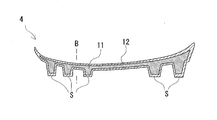
- FIG. 3 is a cross-sectional view taken along the line ABC of the member for the sole of FIG.
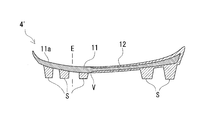
- FIG. 5 is a sectional view of the shoe sole member in FIG.
- the schematic which showed the shoes in which the heel counter which is another member for shoes was used.
- the member for shoes of the present invention is a member which constitutes a part of shoes.
- An embodiment of a shoe sole as a shoe member of the present invention and a shoe equipped with the shoe sole member will be described below with reference to FIGS.
- the following embodiment is merely an example.
- the present invention is not limited to the following embodiments.
- FIG. 1 shows a shoe 1 having a shoe sole member as a shoe member of the present embodiment.
- the shoe 1 includes an upper material 2 that covers the upper surface of the foot, and members 3 and 4 for the sole that are disposed on the lower side of the upper material 2 to form a shoe sole.
- the shoe 1 includes an outer sole 4 disposed at a position in contact with the ground and a midsole 3 disposed on the upper side of the outer sole 4 as the sole member.
- the shoe 1 is a spike shoe including a plurality of spike portions S in which the outer sole 4 protrudes downward. More specifically, the shoe 1 is a spiked shoe for soccer.
- FIG.2 and FIG.3 shows the outer sole 4 as a member for shoe soles of this embodiment.
- the outer sole 4 is an injection molded product that includes an inner member 11 and an outer member 12 that encloses the entire inner member 11. Since the outer sole 4 of the present embodiment is configured as described above, the inner member 11 and the outer member 12 are derived from the inner member 11 and the outer member 12 by having different colors and mechanical properties, respectively. Various textures can be provided on the outer sole 4.
- the state in which the outer member encloses the entire inner member refers to a state in which the entire inner member is held inside a region surrounded by the outer member. That is, the entire inner member may be covered with the outer member, but a part of the inner member surface is covered with the outer member unless the inner member is outside the area surrounded by the outer member. It does not have to be broken.
- the inner member may be included inside the net-like outer member.
- the outer member 12 preferably covers 60% or more of the surface of the inner member 11, It is more preferable to cover more than%.
- the outer sole 4 is an injection molded product manufactured by injection molding, the inner member 11 and the outer member 12 each have a continuous integral structure without a joint.
- the inner member 11 and the outer member 12 are formed of a resin composition containing a thermoplastic resin. Therefore, the outer sole 4 of the present embodiment configured as described above can be easily obtained by injection molding.
- thermoplastic resin that is the main component of the resin composition that forms the inner member 11 and the outer member 12 may be any type of thermoplastic resin that is generally used for shoe members.
- the thermoplastic resin for example, polyethylene (for example, linear low density polyethylene (LLDPE), high density polyethylene (HDPE)), polypropylene, ethylene-propylene copolymer, propylene 1-hexene copolymer, propylene-4-methyl-1-pentene copolymer, propylene-1-butene copolymer, ethylene-1-hexene copolymer, ethylene-4-methyl-pentene copolymer, ethylene -Butene copolymer (EBM), 1-butene-1-hexene copolymer, 1-butene-4-methyl-pentene, ethylene-methacrylic acid copolymer, ethylene-methyl methacrylate copolymer, ethylene-methacrylic acid Ethyl acid copolymer, ethylene-butyl methacrylate
- the thermoplastic resin if it is other than olefin, the styrene-ethylene-butylene copolymer (SEB), styrene-butadiene-styrene copolymer (SBS), hydrogenated product of SBS (styrene- Ethylene-butylene-styrene copolymer (SEBS)), styrene-isoprene-styrene copolymer (SIS), hydrogenated product of SIS (styrene-ethylene-propylene-styrene copolymer (SEPS)), styrene-isobutylene- Styrene copolymer (SIBS), styrene-butadiene-styrene-butadiene (SBSB), styrene-butadiene-styrene-butadiene-styrene (SBSBS), polystyrene, acryl
- thermoplastic resin examples include fluorine-based polymers such as fluororesin and fluororubber; polyamide-based resins such as polyamide 6, polyamide 11, polyamide 12, polyamide 6, 6, polyamide 610, and polyamide-based elastomers such as polyamide-based elastomer Polymers: Polyester resins such as polyethylene terephthalate and polybutylene terephthalate; polyvinyl chloride resins; acrylic resins such as polymethyl methacrylate; butadiene rubber (BR); isoprene rubber (IR); chloroprene (CR); natural rubber ( NR); styrene butadiene rubber (SBR); acrylonitrile butadiene rubber (NBR); or butyl rubber (IIR).
- fluorine-based polymers such as fluororesin and fluororubber
- polyamide-based resins such as polyamide 6, polyamide 11, polyamide 12, polyamide 6, 6, polyamide 610
- polyamide-based elastomers such as polyamide-based
- the said resin composition may contain 1 type or multiple types of thermoplastic resins.
- the thermoplastic resin as the main component of the resin composition forming the inner member 11 and the outer member 12 is an olefin resin, a polyamide resin, a urethane resin, or a styrene resin.
- Olefin-based resins are characterized by being relatively lightweight. Therefore, when the thermoplastic resin is an olefin resin, the outer sole 4 can be reduced in weight. Although the olefin resin is difficult to directly adhere to other resins such as polyamide resin, urethane resin, styrene resin, etc., in the outer sole 4 of this embodiment, as described later, Can be used in combination.
- the polyamide-based resin has a characteristic of relatively high rigidity.
- thermoplastic resin is a polyamide-based resin
- rigidity of the outer sole 4 can be increased.
- a urethane-based resin has a feature that it is relatively excellent in wear resistance. Therefore, when the thermoplastic resin is a urethane resin, the wear resistance of the outer sole 4 can be improved.
- Styrenic resins have the characteristic of being relatively flexible. Therefore, when the thermoplastic resin is a styrene resin, the flexibility of the outer sole 4 can be increased.
- the thermoplastic resin that is the main component of the resin composition that forms the inner member 11 may be an olefin resin or a polyamide resin, and is the main component of the resin composition that forms the outer member 12.
- the thermoplastic resin is a urethane resin or a styrene resin.
- the inner member 11 and the outer member 12 may be formed of a resin composition mainly composed of the same thermoplastic resin, or may be formed of resin compositions mainly composed of different thermoplastic resins. .
- the inner member 11 and the outer member 12 are formed of resin compositions containing different thermoplastic resins as main components.
- various mechanical properties derived from both the inner member 11 and the outer member 12 are imparted to the outer sole 4 by applying various combinations of thermoplastic resins to the inner member 11 and the outer member 12.
- be able to for example, by using a polyamide-based resin or an olefin-based resin as the main component of the resin composition that forms the inner member 11, and using a urethane-based resin or a styrene-based resin as the main component of the resin composition that forms the outer member 12.
- the outer sole 4 having high rigidity or light weight which is a physical property of the inner member 11 and high wear resistance or flexibility which is a physical property of the outer member 12 can be provided.
- the outer sole 4 is deformed by receiving an external force.
- the inner member 11 is not deformed independently, and the deformation of the inner member 11 is controlled by the deformation of the outer member 12 including the entire inner member 11. Therefore, deformation due to the external force of the outer sole 4 can be reduced.
- the outer sole 4 of the present embodiment is compared with a conventional shoe sole member having a configuration in which two resin compositions having different elastic moduli are laminated substantially parallel to the ground. It is. In this case, the outer sole 4 is particularly less deformed by an external force from the lateral direction than the conventional shoe sole member.
- the inner member 11 extends to the inside of the spike portion S. Therefore, mechanical properties derived from both the inner member 11 and the outer member 12 can also be imparted to the spike portion S of the outer sole 4.
- the outer sole 4 provided with the inner member 11 and the outer member 12 of the present embodiment is an injection molded product. Therefore, a member for a shoe sole having a combination of an inner member and an outer member that could not be provided conventionally can be provided.
- the difference in SP value (solubility parameter) between two thermoplastic resins is 1.0 or more, the adhesive force between these thermoplastic resins is low, and the resins can be directly bonded to each other. It is known to be difficult. Therefore, in the conventional method for manufacturing a shoe sole member, such resins are directly bonded without using an adhesive, and cannot be integrally formed as a single shoe sole member.
- the outer sole 4 of this embodiment is an injection molded product manufactured by injection molding. Therefore, in the outer sole 4, even when the difference in SP value between the thermoplastic resin contained in the inner member 11 and the thermoplastic resin contained in the outer member 12 is 1.0 or more, these two resins are used. Are mixed at the time of melting, the inner member 11 and the outer member 12 can be directly bonded.
- the outer sole 4 of the present invention is an injection molded product manufactured by injection molding, the outer sole 4 is provided in which the inner member 11 is physically fixed in the outer member 12 by the three-dimensional shape of the outer member 12. You can also In this case, if the outer sole 4 has a structure in which the inner member 11 is included in the outer member 12, the inner member 11 and the outer member 12 do not necessarily have to be bonded.
- the difference in SP value between the thermoplastic resin contained in the inner member 11 and the thermoplastic resin contained in the outer member 12 may be 1.2 or more, more preferably 1.5 or more. May be present, and more preferably in the range of 1.5 to 3.0.
- SP value of this specification means the value defined by Hildebrand's regular solution theory.
- the inner member 11 and the outer member 12 may be formed of resin compositions having different colors or textures. In that case, a unique color or texture can be imparted to the outer sole 4 by selecting a combination of colors or textures in the resin composition forming the inner member 11 and the outer member 12, and the aesthetic appearance is excellent.
- the outer sole 4 can be provided.
- the outer member 12 may be formed of a highly transparent resin composition so that the color and the like of the inner member 11 can be visually recognized from the outside. In that case, the transparency of the resin composition forming the outer member 12 is preferably such that the transmittance specified by ASTM D 1746 for visible light is 70% or more.
- the inner member 11 and the outer member 12 may be shock absorbers. In that case, shock absorbing properties can be imparted to the inner member 11 and the outer member 12.
- the inner member 11 is a shock absorber and the outer member 12 is not a shock absorber.
- the shock absorber since the inner member 11 which is a shock absorber is included in the outer member 12 which is not a shock absorber, the shock absorber does not come into contact with the ground when the shoe 1 having the outer sole 4 is used. . Therefore, the impact buffering property of the outer sole 4 can be enhanced without being affected by the low wear resistance of the shock absorber constituting the inner member 11.
- the configuration in which the inner member 11 that is a shock absorber is disposed in the outer sole 4 in a state of being included in the outer member 12 that is not a shock absorber is advantageous in that it is not necessary to separately coat the shock absorber.
- the impact absorber may be, for example, a polymer gel obtained by gelling the resin composition.
- the impact absorber means that when a 10 kg spherical weight is caused to fall freely from a position 50 mm above the member formed of the resin composition at 25 ° C., it is made to collide with the member.
- a member in which the maximum negative acceleration applied to the weight is in the range of 5 to 20 G at a thickness of 20 mm.
- the maximum value of the negative acceleration applied to the weight is in the range of 8 to 17G.
- the maximum value of the negative acceleration can be measured as follows. First, a circular member having a diameter of 50 mm and a thickness of 20 mm formed of a resin composition is placed on a horizontal base (material: iron).
- a spherical weight (mass: 10 kg, material: iron) is freely dropped from a position 50 mm above the member, whereby the maximum negative acceleration applied to the weight when colliding with the member is reached. Measure.
- the inner member 11 and the outer member 12 may be foams in which a resin composition is foamed. Since the foam is excellent in shock-absorbing properties, shock-absorbing properties can be imparted to the inner member 11 and the outer member 12 by using the foam as the resin composition. In addition, since the foam is significantly lighter than the non-foam, using the foam as the inner member 11 and the outer member 12 can significantly reduce the weight of the inner member 11 and the outer member 12. it can.
- the inner member 11 is preferably a foam and the outer member 12 is not a non-foam. In this case, since the foam inner member 11 is included in the non-foam outer member 12, the foam does not contact the ground when the shoe 1 having the outer sole 4 is used. Therefore, the lightness and impact buffering property of the outer sole 4 can be improved without being affected by the low wear resistance of the foam constituting the inner member 11.
- the ratio of the inner member 11 and the outer member 12 in the outer sole 4 is not particularly limited.
- the volume of the inner member 11 included in the outer sole 4 is 0.1 to 2.0 with respect to the volume of the outer member 12. It is preferable that it is double.
- the outer sole 4 of the present embodiment includes, for example, a nozzle for introducing the resin composition for the inner member 11 and the resin composition for the outer member 12 into the cavity, and melt-kneading the resin composition, respectively.
- An outer sole using a two-material injection molding machine comprising a first cylinder and a second cylinder for supplying the nozzle to the nozzle, the resin inside the first and second cylinders joining before the nozzle. 4 can be produced by injecting the resin composition for the inner member 11 and the resin composition for the outer member 12 in the following steps into a mold having a cavity corresponding to the shape of No. 4.
- the outer sole 4 in which the inner member is included in the outer member can be easily injection-molded.
- the ratio of the weight of the resin composition for the outer member 12 used in the step (b) to the weight of the resin composition for the outer member 12 used in the step (d) is 5: 5 to 9 : 1, preferably 6: 4 to 8: 2.
- a foaming agent is mixed in advance with a resin composition that is a material for forming the foams.
- the resin composition may be foamed by heating the resin composition in the second cylinder.
- a chemical foaming agent may be sufficient and a physical foaming agent may be sufficient.
- the chemical foaming agent is a foaming agent that generates gas by chemical reaction or thermal decomposition. Examples of such chemical foaming agents include inorganic chemical foaming agents such as sodium bicarbonate and ammonium carbonate, and organic chemical foaming agents such as azodicarbonamide.
- the physical foaming agent is a liquefied gas, a supercritical fluid, or the like, and foams by a pressure drop or heating.
- Examples of such physical foaming agents include aliphatic hydrocarbons such as butane, alicyclic hydrocarbons such as cyclobutane, and inorganic gases such as carbon dioxide, nitrogen, and air.
- the outer sole 4 that is the shoe sole member of the first embodiment is an injection-molded product in which the entire inner member 11 is included in the outer member 12, but the shoe member of the present invention is a part of the inner member. Only the outer member may be included.
- 2nd Embodiment which concerns on the member for soles provided with such a structure is described using FIG.4 and FIG.5.
- the same reference number is attached
- the outer sole 4 ′ of the present embodiment has a bag shape in which the outer member 12 has an opening, and the inner member 11 extends outside the outer member 12 from the opening. It has the composition which is. More specifically, the outer member 12 opens toward the forefoot side of the outer sole 4 ′, and the inner member 11 extends at the forefoot portion of the outer sole 4 ′.
- the outer sole 4 ′ of the present embodiment has the above-described configuration, in the extended portion 11a in which the inner member 11 extends from the outer member 12, the inner member 11 is the surface of the outer sole 4 ′. Is exposed. Therefore, the outer sole 4 ′ can more effectively draw out the features of the inner member 11 in the extending portion 11 a.
- the boundary portion V between the extended portion 11a of the inner member 11 and the outer member 12 exposed on the surface of the outer sole 4 ′ (that is, the tip of the opening of the outer member 12).
- the inner member and the outer member are smoothly joined. Therefore, even when there is a difference in rigidity between the resin compositions forming the inner member 11 and the outer member 12, no steep rigidity step occurs at the interface. Therefore, the outer sole 4 ′ can exhibit a continuous deformation distribution with respect to the external force.
- the outer sole 4 ′ also has a feature that cracks and peeling are unlikely to occur at the boundary portion V between the inner member 11 and the outer member 12.
- the outer member 12 covers 30% or more and less than 100% of the surface of the inner member 11. It is preferable to cover 50% or more and less than 100%.
- the inner member 11 and the outer member 12 are made of a highly compatible thermoplastic resin as a main component in order to further prevent cracks and peeling at the boundary portion V between the inner member 11 and the outer member 12. It is preferable to form each by the resin composition to perform. Specifically, the difference in SP value between the thermoplastic resin contained in the inner member 11 and the thermoplastic resin contained in the outer member 12 is preferably 1.0 or less.
- the resin composition forming the inner member 11 has a smaller viscosity at 200 ° C. than the resin composition forming the outer member 12. In that case, the outer sole 4 ′ in which the inner member 11 extends from the outer member 12 can be obtained more easily.
- the outer sole 4 ′ has one opening of the outer member 12 that is an outlet from which the inner member 11 extends from the outer member 12, but the shoe member of the present invention has two such openings. You may have more than one.
- the inner member 11 is not included in the spike portion S. In that case, in the spike portion S, the characteristics of the outer member 12 can be effectively extracted without being affected by the inner member 11.
- the ratio of the weight of the resin composition for the outer member 12 used in the step (b) to the weight of the resin composition for the outer member 12 used in the step (d) is 5: 5 to 9 : 1, preferably 6: 4 to 8: 2.
- the resin composition for the inner member 11 and the resin composition for the outer member 12 are injected into the mold, a portion where the inner member 11 is desired to be included in the outer member 12 is located near the injection port. It is preferable to adjust the direction of the mold so that a portion where 11 extends from the outer member 12 is formed far from the injection port.
- the inner member 11 is included in the outer member 12 throughout, but the shoe member of the present invention does not include the inner member inside. You may provide the site
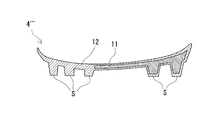
- the inner member 11 does not have to be included in the spike portion S as in the outer sole 4 ′′ shown in FIG.
- the inner member 11 is only present up to the vicinity of the middle foot portion of the outer sole 4 ′ ′′, and the forefoot portion of the outer sole 4 ′ ′′. May be constituted only by the outer member 12.
- the member for shoes having such a configuration can effectively draw out the characteristics of the outer member in a portion consisting only of the outer member.
- the outer sole 4 ′ ′′ scissors having a portion not including the inner member As described above, for example, before injecting the resin composition into the mold, A member made of the resin composition forming the outer member may be inserted. As a result, the outer sole 4 ′ ′′ scissors having a portion not including the inner member can be provided at a portion where the member has been inserted.
- the outer soles 4 and 4 ′ in the above embodiment are members for a shoe shoe for a spike shoe including a plurality of spike portions S
- the member for a shoe shoe need not be for a shoe shoe.
- the spike portion S is not necessarily provided. That is, the member for shoes of the present invention is not limited to that for spike shoes, but may be a member used for running shoes, volleyball shoes, tennis shoes, and the like.
- the outer soles 4 and 4 ′ which are members for shoe soles
- the present invention is not limited to this.
- the member for the sole according to the present invention is not limited to the outer sole, and may be a midsole or a sock liner.
- the shoe sole member is arranged not on the entire shoe sole but only on a part of the shoe sole, such as the shank 5 arranged on the arch of the outer sole 4 ′′ ′′ shown in FIG. It may be a member.
- the member disposed only on a part of the shoe sole may be selectively disposed, for example, at any one or a plurality of positions of the front foot portion, the middle foot portion, and the heel portion of the shoe sole.
- the member for shoes of this invention is not limited to the member for shoe soles.
- the shoe member of the present invention may be a heel counter 6 provided so as to cover the buttocks outside or inside the upper material 2, such as a shoe 1 'shown in FIG. A tip or the like may be used.
- Example 1 A mold (maximum length 270 mm, maximum width 90 mm, maximum thickness 5 mm excluding spike part, spike part height 7 mm) corresponding to the soccer spike sole member shown in FIG. 2 and commercially available two-material injection molding
- the sole member obtained in this way is entirely encased in the outer member composed of the above-mentioned polyurethane having high abrasion resistance, as a whole of the inner member composed of the above-mentioned highly rigid polyamide. It was what was done. Therefore, the shoe sole member is excellent in both rigidity and wear resistance.
- a soccer spike shoe sole member was injection molded in the same manner as in Example 1 except that about 50 parts by weight were used.
- the sole member thus obtained is composed of the polyolefin B, which is light and relatively soft, as a whole of the inner member made of the polyolefin A that is light and relatively hard.
- the outer member was included. Therefore, the shoe sole member is excellent in both light weight and flexibility.
- Example 3 Soccer spike shoes in the same manner as in Example 1 except that about 50 parts by weight of polyolefin B (“DF9200” manufactured by Mitsui Chemicals, SP value 7.7 to 8.4) was used as the resin for the inner member.
- the bottom member was injection molded.
- the shoe sole member obtained in this way includes the entire inner member made of the lightweight polyolefin B contained in the outer member made of the polyurethane having high wear resistance. It was what was done. Therefore, the shoe sole member is excellent in both light weight and wear resistance.
- the shoe sole member obtained in this way has a cushioning property and the entire inner member made of the lightweight polyurethane foam is made of the lightweight polyolefin B. It was included in the constructed outer member. Therefore, the shoe sole member is excellent in both shock absorption and light weight.
- Example 8 A soccer spike shoe sole member was injection molded in the same manner as in Example 1 except that about 30 parts by weight of the resin for the inner member and about 70 parts by weight of the resin for the outer member were used.
- the shoe sole member thus obtained had a larger volume occupied by the outer member than the shoe sole member obtained in Example 1. Therefore, the shoe sole member is more excellent in wear resistance than the shoe sole member of the first embodiment.
- Example 9 A soccer spike shoe sole member was injection molded in the same manner as in Example 1 except that about 70 parts by weight of the resin for the inner member and about 30 parts by weight of the resin for the outer member were used.
- the shoe sole member thus obtained had a larger volume occupied by the inner member than the shoe sole member obtained in Example 1. Therefore, the shoe sole member has higher rigidity than the shoe sole member of the first embodiment.
- Example 10 A shoe spike member for soccer spikes was made in the same manner as in Example 1 except that about 20 parts by weight of the resin for the inner member and about 80 parts by weight of the resin for the outer member were used and the temperature at the time of injection was 220 ° C. Injection molded. As shown in FIG. 4, in the shoe sole member obtained in this manner, the inner member was not covered with the outer member in the forefoot portion, and the inner member was deposited on the surface of the shoe sole member. Therefore, the sole member exhibits the rigidity of the polyamide, which is the inner member, more effectively at the forefoot portion.
- the mold is taken out, and a flat plate injection molding in which the flat plate made of polyolefin A and the flat plate made of polyolefin B are joined near the center in the length direction.
- the molded injection molded product was sliced in the thickness direction so as to have a thickness of 4 mm, and then a dumbbell test piece (5A type, total length 75 mm, thickness 4 mm) defined in ISO 527-2 was cut out. At this time, the dumbbell test piece was cut out so that the interface where the different resins were joined to each other was located approximately at the center of the narrow parallel portion of the dumbbell test piece.
- region which consists only of the outer member which does not include the inner member extended from the center vicinity in the length direction of this injection molded product to the front end side.
- the injection molded product was sliced in the thickness direction so as to remove the outer members sandwiching the inner member from the upper surface and the lower surface, and the inner member was exposed.
- dumbbell test The dumbbell specimens obtained in Examples 11 and 12 and Comparative Examples 1 and 2 were subjected to a tensile test in accordance with ISO 527-2 at a test speed of 300 mm / min using “AG-IS 50 kN” manufactured by Shimadzu Corporation. By performing, the breaking strength TB of each dumbbell test piece was measured. The results are shown in Table 1 below.
- test pieces of Examples 11 and 12 which were two-material injection molded in the same manner as the shoe member of the present invention were compared with the test pieces of Comparative Examples 1 and 2 formed by overmolding.
- TB is high and has excellent adhesive strength.
- the polyurethane and the polyolefin B constituting the test piece of Example 11 have a difference in SP value between them of 1.6 or more, and are generally resins that are hardly directly bonded.
- the breaking strength TB of the test piece of Example 11 is greater than the breaking strength TB of the test piece of Comparative Example 2 in which the olefin materials are directly bonded to each other because these two resins are mixed at the time of melting. It is high.
- the low-adhesive resins having a difference in SP value of 1.6 or more are directly bonded to each other by a similar resin by an overmold that can be generally used for a shoe member. It can be seen that direct adhesion can be achieved with an adhesive strength equal to or greater than the case.
Landscapes
- Engineering & Computer Science (AREA)
- Mechanical Engineering (AREA)
- Health & Medical Sciences (AREA)
- General Health & Medical Sciences (AREA)
- Physical Education & Sports Medicine (AREA)
- Chemical & Material Sciences (AREA)
- Materials Engineering (AREA)
- Footwear And Its Accessory, Manufacturing Method And Apparatuses (AREA)
- Injection Moulding Of Plastics Or The Like (AREA)
Abstract
L'invention concerne : un élément de chaussure qui constitue une partie d'une chaussure et comprend un article moulé par injection qui a un élément interne (11) et un élément externe (12) qui renferme une partie ou la totalité de l'élément interne, l'élément interne et l'élément externe étant formés d'une composition de résine comprenant une résine thermoplastique ; une chaussure qui comprend l'élément de chaussure ; et un procédé de fabrication de l'élément de chaussure.
Priority Applications (4)
| Application Number | Priority Date | Filing Date | Title |
|---|---|---|---|
| PCT/JP2015/086508 WO2017115417A1 (fr) | 2015-12-28 | 2015-12-28 | Élément de chaussure, chaussure, et son procédé de fabrication |
| JP2017559235A JP6413031B2 (ja) | 2015-12-28 | 2016-12-28 | 靴用部材、靴、及びその製造方法 |
| PCT/JP2016/089062 WO2017115840A1 (fr) | 2015-12-28 | 2016-12-28 | Élément pour chaussure, chaussure, et procédé pour sa fabrication |
| US16/066,668 US10695999B2 (en) | 2015-12-28 | 2016-12-28 | Shoe member, shoe, and method for producing the same |
Applications Claiming Priority (1)
| Application Number | Priority Date | Filing Date | Title |
|---|---|---|---|
| PCT/JP2015/086508 WO2017115417A1 (fr) | 2015-12-28 | 2015-12-28 | Élément de chaussure, chaussure, et son procédé de fabrication |
Related Child Applications (1)
| Application Number | Title | Priority Date | Filing Date |
|---|---|---|---|
| US16/066,668 Continuation US10695999B2 (en) | 2015-12-28 | 2016-12-28 | Shoe member, shoe, and method for producing the same |
Publications (1)
| Publication Number | Publication Date |
|---|---|
| WO2017115417A1 true WO2017115417A1 (fr) | 2017-07-06 |
Family
ID=59224820
Family Applications (2)
| Application Number | Title | Priority Date | Filing Date |
|---|---|---|---|
| PCT/JP2015/086508 Ceased WO2017115417A1 (fr) | 2015-12-28 | 2015-12-28 | Élément de chaussure, chaussure, et son procédé de fabrication |
| PCT/JP2016/089062 Ceased WO2017115840A1 (fr) | 2015-12-28 | 2016-12-28 | Élément pour chaussure, chaussure, et procédé pour sa fabrication |
Family Applications After (1)
| Application Number | Title | Priority Date | Filing Date |
|---|---|---|---|
| PCT/JP2016/089062 Ceased WO2017115840A1 (fr) | 2015-12-28 | 2016-12-28 | Élément pour chaussure, chaussure, et procédé pour sa fabrication |
Country Status (3)
| Country | Link |
|---|---|
| US (1) | US10695999B2 (fr) |
| JP (1) | JP6413031B2 (fr) |
| WO (2) | WO2017115417A1 (fr) |
Cited By (3)
| Publication number | Priority date | Publication date | Assignee | Title |
|---|---|---|---|---|
| CN109531904A (zh) * | 2017-09-22 | 2019-03-29 | 阿迪达斯股份公司 | 生产模制件的方法和模制件 |
| CN116138540A (zh) * | 2018-06-04 | 2023-05-23 | 耐克创新有限合伙公司 | 两部分鞋底结构及其用途 |
| US20240065373A1 (en) * | 2019-07-19 | 2024-02-29 | Nike, Inc. | Sole structures including polyolefin plates and articles of footwear formed therefrom |
Families Citing this family (8)
| Publication number | Priority date | Publication date | Assignee | Title |
|---|---|---|---|---|
| JP2019515057A (ja) | 2016-03-15 | 2019-06-06 | ナイキ イノヴェイト シーヴィーNike Innovate C.V. | 発泡体組成物及びその使用 |
| CN112244426B (zh) | 2018-01-24 | 2022-04-29 | 耐克创新有限合伙公司 | 包括聚烯烃板的鞋底结构和由其形成的鞋类物品 |
| AU2018438546A1 (en) * | 2018-08-30 | 2021-04-08 | Asics Corporation | Shoe sole member and shoe |
| US11523655B2 (en) | 2018-12-03 | 2022-12-13 | Nike, Inc. | High energy return foam compositions having improved abrasion resistance and uses thereof |
| WO2021016039A1 (fr) * | 2019-07-19 | 2021-01-28 | Nike Innovate C.V. | Articles chaussants comprenant des structures de semelle et une fausse trépointe |
| JP7330237B2 (ja) * | 2020-07-23 | 2023-08-21 | プーマ エス イー | ソール構造、履物具、およびアッセンブリ |
| WO2023034681A1 (fr) | 2021-08-30 | 2023-03-09 | Nike, Inc. | Résines à base de polyoléfine, structures de semelle, et articles chaussants et équipement sportif formés à partir de celles-ci |
| WO2023056381A1 (fr) * | 2021-10-01 | 2023-04-06 | Nike Innovate C.V. | Structure de plaque pour article chaussant |
Citations (6)
| Publication number | Priority date | Publication date | Assignee | Title |
|---|---|---|---|---|
| JPS61154503A (ja) * | 1984-07-27 | 1986-07-14 | 月星化成株式会社 | ミツドソ−ル |
| JPS62213701A (ja) * | 1986-03-14 | 1987-09-19 | 月星化成株式会社 | スポンジ底芯を有する履物の製造法 |
| JPH09206102A (ja) * | 1996-02-06 | 1997-08-12 | Bridgestone Corp | シューズ |
| JP3392395B2 (ja) * | 2000-07-18 | 2003-03-31 | 美津濃株式会社 | 靴 底 |
| JP3757238B2 (ja) * | 1996-02-26 | 2006-03-22 | 山田 啓子 | 温度・圧力感応加硫ゴム組成物 |
| JP5631689B2 (ja) * | 2010-10-13 | 2014-11-26 | 株式会社タイカ | 緩衝部品の製造方法及び緩衝部品 |
Family Cites Families (27)
| Publication number | Priority date | Publication date | Assignee | Title |
|---|---|---|---|---|
| US3613272A (en) * | 1968-10-24 | 1971-10-19 | Tatsuo Fukuoka | Footwear |
| JPS51115665A (en) | 1975-04-03 | 1976-10-12 | Hitachi Ltd | Gas breaker |
| US4561140A (en) * | 1983-09-23 | 1985-12-31 | New Balance Athletic Shoe, Inc. | Sole construction for footwear |
| US4654983A (en) * | 1984-06-05 | 1987-04-07 | New Balance Athletic Shoe, Inc. | Sole construction for footwear |
| DE8423344U1 (de) * | 1984-08-06 | 1984-10-31 | Puma-Sportschuhfabriken Rudolf Dassler Kg, 8522 Herzogenaurach | Schuhsole mit einer aus mehreren Schichten bestehenden Zwischensohle |
| US5572805A (en) * | 1986-06-04 | 1996-11-12 | Comfort Products, Inc. | Multi-density shoe sole |
| FR2632497A1 (fr) * | 1988-03-22 | 1989-12-15 | Beneteau Charles Marie | Semelle de chaussures pour la pratique des sports et activites analogues |
| IT1290354B1 (it) * | 1997-02-07 | 1998-10-22 | Vibram Spa | Suola biomeccanica |
| DE19904744B4 (de) * | 1999-02-05 | 2005-11-10 | Adidas International Marketing B.V. | Schuh |
| US6954998B1 (en) * | 2000-08-02 | 2005-10-18 | Adidas International Marketing B.V. | Chassis construction for an article of footwear |
| AU784929B2 (en) * | 2000-10-13 | 2006-07-27 | Dansko International, Inc. | Process for manufacturing a shoe and shoe manufactured using said process |
| US6598319B2 (en) * | 2001-01-17 | 2003-07-29 | Spenco Medical Corporation | Insole with rebounding and cushioning areas and adjustable arch support |
| US7418791B2 (en) * | 2001-10-10 | 2008-09-02 | Cole Iii Charles D | Apparatus and methods for imbedded rubber outer |
| TW579708U (en) * | 2002-01-30 | 2004-03-11 | Kuen-Jung Liou | Shoes that can shorten forming time |
| US20040148809A1 (en) | 2003-02-03 | 2004-08-05 | Shimano Inc. | Bicycle shoe sole |
| US7597946B2 (en) * | 2003-08-29 | 2009-10-06 | Nike, Inc. | Gel reduction in blends of thermoplastic polyurethane and hydroxyl functional polymers |
| US8084537B2 (en) * | 2005-03-17 | 2011-12-27 | Dow Global Technologies Llc | Polymer blends from interpolymers of ethylene/α-olefin with improved compatibility |
| US7313876B2 (en) * | 2005-04-12 | 2008-01-01 | Wolverine World Wide, Inc. | Footwear outsole and method of manufacture |
| US7421808B2 (en) * | 2005-06-07 | 2008-09-09 | Converse Inc. | Simplified shoe construction with midsole having overmolded insert |
| US7941938B2 (en) * | 2006-05-26 | 2011-05-17 | Nike, Inc. | Article of footwear with lightweight sole assembly |
| ITPD20070107A1 (it) * | 2007-03-23 | 2008-09-24 | Frasson S R L | Battistrada antiscivolo e procedimento per la realizzazione di un tale battistrada |
| WO2010077296A2 (fr) * | 2008-12-09 | 2010-07-08 | Red Wing Shoe Company, Inc. | Semelle intérieure moulée pour chaussure à trépointe |
| CN102300936B (zh) * | 2009-03-16 | 2014-03-12 | 东丽株式会社 | 纤维增强树脂组合物、成型材料及纤维增强树脂组合物的制造方法 |
| FR2955466B1 (fr) * | 2010-01-25 | 2012-04-20 | Salomon Sas | Chaussure a semelage ameliore |
| US9615621B2 (en) * | 2012-06-04 | 2017-04-11 | Nike, Inc. | Sole structure with integrated cleat member and methods of making |
| US10206451B2 (en) * | 2012-07-06 | 2019-02-19 | Specialized Bicycle Components, Inc. | Cycling shoe |
| US9883714B2 (en) * | 2013-06-14 | 2018-02-06 | Nike, Inc. | Sole plate assembly and method of making |
-
2015
- 2015-12-28 WO PCT/JP2015/086508 patent/WO2017115417A1/fr not_active Ceased
-
2016
- 2016-12-28 WO PCT/JP2016/089062 patent/WO2017115840A1/fr not_active Ceased
- 2016-12-28 JP JP2017559235A patent/JP6413031B2/ja active Active
- 2016-12-28 US US16/066,668 patent/US10695999B2/en active Active
Patent Citations (6)
| Publication number | Priority date | Publication date | Assignee | Title |
|---|---|---|---|---|
| JPS61154503A (ja) * | 1984-07-27 | 1986-07-14 | 月星化成株式会社 | ミツドソ−ル |
| JPS62213701A (ja) * | 1986-03-14 | 1987-09-19 | 月星化成株式会社 | スポンジ底芯を有する履物の製造法 |
| JPH09206102A (ja) * | 1996-02-06 | 1997-08-12 | Bridgestone Corp | シューズ |
| JP3757238B2 (ja) * | 1996-02-26 | 2006-03-22 | 山田 啓子 | 温度・圧力感応加硫ゴム組成物 |
| JP3392395B2 (ja) * | 2000-07-18 | 2003-03-31 | 美津濃株式会社 | 靴 底 |
| JP5631689B2 (ja) * | 2010-10-13 | 2014-11-26 | 株式会社タイカ | 緩衝部品の製造方法及び緩衝部品 |
Cited By (7)
| Publication number | Priority date | Publication date | Assignee | Title |
|---|---|---|---|---|
| CN109531904A (zh) * | 2017-09-22 | 2019-03-29 | 阿迪达斯股份公司 | 生产模制件的方法和模制件 |
| JP2019058661A (ja) * | 2017-09-22 | 2019-04-18 | アディダス アーゲー | 成形部品の作製方法および成形部品 |
| US11161284B2 (en) | 2017-09-22 | 2021-11-02 | Adidas Ag | Method for producing a molded part and molded part |
| CN109531904B (zh) * | 2017-09-22 | 2021-12-14 | 阿迪达斯股份公司 | 生产模制件的方法和模制件 |
| US12491670B2 (en) | 2017-09-22 | 2025-12-09 | Adidas Ag | Method for producing a molded part and molded part |
| CN116138540A (zh) * | 2018-06-04 | 2023-05-23 | 耐克创新有限合伙公司 | 两部分鞋底结构及其用途 |
| US20240065373A1 (en) * | 2019-07-19 | 2024-02-29 | Nike, Inc. | Sole structures including polyolefin plates and articles of footwear formed therefrom |
Also Published As
| Publication number | Publication date |
|---|---|
| JPWO2017115840A1 (ja) | 2018-08-23 |
| JP6413031B2 (ja) | 2018-10-24 |
| US20190016079A1 (en) | 2019-01-17 |
| WO2017115840A1 (fr) | 2017-07-06 |
| US10695999B2 (en) | 2020-06-30 |
Similar Documents
| Publication | Publication Date | Title |
|---|---|---|
| JP6413031B2 (ja) | 靴用部材、靴、及びその製造方法 | |
| JP7390832B2 (ja) | 運動靴用のソール | |
| US7276191B2 (en) | Crosslinked foam which has inner-cavity structure, and process of forming thereof | |
| US6412196B1 (en) | Contoured platform and footwear made therefrom | |
| JP7071263B2 (ja) | 靴、特に運動靴 | |
| US11576461B2 (en) | Shoe sole member, method for producing the same, and shoe | |
| US20090094858A1 (en) | Article of footwear with tubular sole assembly and method of manufacture | |
| JP6906114B2 (ja) | 靴底用部材、靴、及び、靴底用部材の製造方法 | |
| JP2020530411A (ja) | 靴を製造する方法 | |
| JP6307667B2 (ja) | 靴底用部材、及び、靴 | |
| JP6963694B2 (ja) | 靴底用部材、及び、靴 | |
| JP4880284B2 (ja) | 靴底、靴底の製造方法及びゴルフシューズ | |
| JP2024117083A (ja) | 発泡部品を製造するためのシステムおよび方法 | |
| JP2013208199A (ja) | 靴底および靴底の製造方法 |
Legal Events
| Date | Code | Title | Description |
|---|---|---|---|
| 121 | Ep: the epo has been informed by wipo that ep was designated in this application |
Ref document number: 15912083 Country of ref document: EP Kind code of ref document: A1 |
|
| NENP | Non-entry into the national phase |
Ref country code: DE |
|
| 122 | Ep: pct application non-entry in european phase |
Ref document number: 15912083 Country of ref document: EP Kind code of ref document: A1 |
|
| NENP | Non-entry into the national phase |
Ref country code: JP |