WO2017126633A1 - ゴム組成物及びタイヤ - Google Patents
ゴム組成物及びタイヤ Download PDFInfo
- Publication number
- WO2017126633A1 WO2017126633A1 PCT/JP2017/001814 JP2017001814W WO2017126633A1 WO 2017126633 A1 WO2017126633 A1 WO 2017126633A1 JP 2017001814 W JP2017001814 W JP 2017001814W WO 2017126633 A1 WO2017126633 A1 WO 2017126633A1
- Authority
- WO
- WIPO (PCT)
- Prior art keywords
- rubber composition
- diene polymer
- mass
- parts
- composition according
- Prior art date
- Legal status (The legal status is an assumption and is not a legal conclusion. Google has not performed a legal analysis and makes no representation as to the accuracy of the status listed.)
- Ceased
Links
Classifications
-
- B—PERFORMING OPERATIONS; TRANSPORTING
- B60—VEHICLES IN GENERAL
- B60C—VEHICLE TYRES; TYRE INFLATION; TYRE CHANGING; CONNECTING VALVES TO INFLATABLE ELASTIC BODIES IN GENERAL; DEVICES OR ARRANGEMENTS RELATED TO TYRES
- B60C1/00—Tyres characterised by the chemical composition or the physical arrangement or mixture of the composition
-
- B—PERFORMING OPERATIONS; TRANSPORTING
- B60—VEHICLES IN GENERAL
- B60C—VEHICLE TYRES; TYRE INFLATION; TYRE CHANGING; CONNECTING VALVES TO INFLATABLE ELASTIC BODIES IN GENERAL; DEVICES OR ARRANGEMENTS RELATED TO TYRES
- B60C1/00—Tyres characterised by the chemical composition or the physical arrangement or mixture of the composition
- B60C1/0016—Compositions of the tread
-
- B—PERFORMING OPERATIONS; TRANSPORTING
- B60—VEHICLES IN GENERAL
- B60C—VEHICLE TYRES; TYRE INFLATION; TYRE CHANGING; CONNECTING VALVES TO INFLATABLE ELASTIC BODIES IN GENERAL; DEVICES OR ARRANGEMENTS RELATED TO TYRES
- B60C11/00—Tyre tread bands; Tread patterns; Anti-skid inserts
- B60C11/0008—Tyre tread bands; Tread patterns; Anti-skid inserts characterised by the tread rubber
-
- C—CHEMISTRY; METALLURGY
- C08—ORGANIC MACROMOLECULAR COMPOUNDS; THEIR PREPARATION OR CHEMICAL WORKING-UP; COMPOSITIONS BASED THEREON
- C08K—Use of inorganic or non-macromolecular organic substances as compounding ingredients
- C08K3/00—Use of inorganic substances as compounding ingredients
- C08K3/34—Silicon-containing compounds
- C08K3/36—Silica
-
- C—CHEMISTRY; METALLURGY
- C08—ORGANIC MACROMOLECULAR COMPOUNDS; THEIR PREPARATION OR CHEMICAL WORKING-UP; COMPOSITIONS BASED THEREON
- C08L—COMPOSITIONS OF MACROMOLECULAR COMPOUNDS
- C08L15/00—Compositions of rubber derivatives
-
- C—CHEMISTRY; METALLURGY
- C08—ORGANIC MACROMOLECULAR COMPOUNDS; THEIR PREPARATION OR CHEMICAL WORKING-UP; COMPOSITIONS BASED THEREON
- C08L—COMPOSITIONS OF MACROMOLECULAR COMPOUNDS
- C08L7/00—Compositions of natural rubber
-
- C—CHEMISTRY; METALLURGY
- C08—ORGANIC MACROMOLECULAR COMPOUNDS; THEIR PREPARATION OR CHEMICAL WORKING-UP; COMPOSITIONS BASED THEREON
- C08L—COMPOSITIONS OF MACROMOLECULAR COMPOUNDS
- C08L9/00—Compositions of homopolymers or copolymers of conjugated diene hydrocarbons
-
- C—CHEMISTRY; METALLURGY
- C08—ORGANIC MACROMOLECULAR COMPOUNDS; THEIR PREPARATION OR CHEMICAL WORKING-UP; COMPOSITIONS BASED THEREON
- C08K—Use of inorganic or non-macromolecular organic substances as compounding ingredients
- C08K9/00—Use of pretreated ingredients
- C08K9/04—Ingredients treated with organic substances
Definitions
- the present invention relates to a rubber composition and a tire.
- studless tires with softened tread rubber have been used as tires for safe driving on ice in addition to normal road surfaces.
- the on-ice performance of the tire can be improved.
- a tire including a soft tread rubber has a problem of poor wear resistance on a normal road surface, and the on-ice performance and the wear resistance of the tire are in a trade-off relationship.
- JP 2008-303334 A (Patent Document 1) describes 0.5 to 20 parts by weight of potassium titanate fiber with respect to 100 parts by weight of a rubber component made of natural rubber and butadiene rubber, and A rubber composition containing 5 to 200 parts by weight of carbon black having an iodine adsorption amount of 100 to 300 mg / g has been proposed, and the rubber composition is composed of a tread having a two-layer structure including a cap tread and a base tread. It has been reported that use on a tread improves performance on ice (performance on ice and snow) while suppressing a decrease in wear resistance.
- Patent Document 1 a rubber composition containing a specific amount of potassium titanate fiber is used for a cap tread, so that the performance on ice (on ice) Although the coefficient of friction is improved, the wear resistance is slightly lowered, and it is impossible to improve both the performance on ice and the wear resistance.
- this invention makes it a subject to solve the said problem of the said prior art and to provide the rubber composition which can improve both on-ice performance and abrasion resistance of a tire. Moreover, this invention makes it the further subject to provide the tire which is excellent in both on-ice performance and abrasion resistance.
- the gist configuration of the present invention for solving the above-described problems is as follows.
- the rubber composition of the present invention has a storage elastic modulus (E ′) at ⁇ 20 ° C. of 5 MPa or more and 10 MPa or less
- the storage elastic modulus (E ′) at ⁇ 20 ° C. and the loss tangent (tan ⁇ ) at ⁇ 20 ° C. are expressed by the following formula (1): 0.02 ⁇ (E′ ⁇ 20 ° C. ) + 0.25 ⁇ (tan ⁇ 20 ° C. ) ⁇ 0.65 (1)
- (E ′ ⁇ 20 ° C. ) is the storage elastic modulus (MPa) at ⁇ 20 ° C.
- (tan ⁇ ⁇ 20 ° C. is the loss tangent at ⁇ 20 ° C.
- a mass ratio (amount of silica / amount of resin) of a blend amount (parts by mass) of the silica and a blend amount (parts by mass) of the resin is 1.00 to 4.00. According to such a rubber composition of the present invention, it is possible to improve both the performance on ice and the wear resistance of the tire by applying it to the tire.
- the rubber composition of the present invention it is preferable that at least one of the diene polymers has a terminal modified.
- the on-ice performance of the tire is further improved, and the fuel efficiency of the tire is also improved.
- the amount of the silica is preferably 20 parts by mass or more with respect to a total of 100 parts by mass of the diene polymer, and the rubber composition of the present invention further includes It is preferable to contain 20 parts by mass or more of carbon black with respect to 100 parts by mass in total of the diene polymer.
- the total compounding quantity of the said silica and the said carbon black is 60 mass parts or more.
- the compounding quantity of the said silica is more than the compounding quantity of the said carbon black. In this case, when the rubber composition is applied to the tire, the on-ice performance can be further improved while further improving the fuel efficiency performance.
- the diene polymer includes at least two diene polymers that form a plurality of incompatible polymer phases, Among the diene polymers, the diene polymer (A) having the lowest glass transition temperature (Tg) among the diene polymer having the largest amount and the diene polymer having the second largest amount.
- the blending amount is preferably 80% by mass or more of the blending amount of the diene polymer (B) having a higher glass transition temperature (Tg). In this case, the softness of the rubber composition can be sufficiently secured, and the performance on ice is further improved.
- the incompatibility of the polymer phase is determined by processing the target rubber composition into a sheet using a test roll, and 150 ° C. ⁇ 30 minutes in a 15 cm ⁇ 15 cm ⁇ 1 cm test mold.
- a vulcanized sheet is prepared by press vulcanization, and the obtained vulcanized sheet is evaluated by observing with a scanning probe microscope as an ultrathin section by a microtome, and a phase separation structure is confirmed, a polymer
- the phases are incompatible with each other.
- the glass transition temperature (Tg) of the diene polymer is extrapolated Donset temperature measured using a differential scanning calorimeter (DSC) according to ASTM D3418-82: Tf.
- DSC differential scanning calorimeter
- the end of the diene polymer (A) is modified in the rubber composition of the present invention.
- the rubber composition is applied to the tread, the on-ice performance and the wear resistance of the tire are further improved, and the fuel efficiency of the tire is also improved.
- the rubber composition of the present invention has a mass ratio of the blended amount (parts by mass) of the diene polymer (A) having the terminal modified and the blended amount (parts by mass) of the resin (terminals modified).
- the blending amount of the diene polymer (A) / the blending amount of the resin) is preferably 1.2 to 7.5. Also in this case, when the rubber composition is applied to the tread, the performance on ice and the wear resistance of the tire are further improved.
- the rubber composition of the present invention has a mass ratio (amount of silica / amount of resin) of a blending amount (parts by mass) of the silica and a blending amount (parts by mass) of the resin. .95 is preferred. In this case, when the rubber composition is applied to the tread, the on-ice performance and the wear resistance of the tire are further improved.
- the rubber composition of the present invention has a ratio of the resin content (parts by mass) to the foaming rate (%) of the rubber composition [amount of resin (parts by mass) / foaming rate of the rubber composition (% )] Is preferably 0.4 to 4.0, more preferably 0.4 to 3.5, and still more preferably 0.4 to 2.0. Also in this case, when the rubber composition is applied to the tread, the performance on ice and the wear resistance of the tire are further improved.
- the rubber composition of the present invention preferably has a loss tangent (tan ⁇ ) at ⁇ 20 ° C. of 0.46 or more and 0.55 or less. In this case, when the rubber composition is applied to the tread, the on-ice performance and the wear resistance of the tire are further improved.
- the diene polymer (A) preferably has a butadiene skeleton.
- the rubber composition becomes soft, and when the rubber composition is applied to the tread, the ground contact area of the tread increases and the performance on ice is further improved.
- the diene polymer (A) is preferably a polybutadiene rubber. In this case, since the rubber composition is further softened, the contact area is further increased, and the performance on ice is further improved.
- the diene polymer (B) preferably has an isoprene skeleton. In this case, the reinforcing property of the rubber composition is increased and the wear resistance is further improved.
- the diene polymer (B) is preferably natural rubber. In this case, the reinforcing property of the rubber composition is further increased, and the wear resistance is further improved.
- the terminal of the diene polymer (A) is modified with a silane compound.
- the silane compound preferably has a glycidoxy group. In this case, when the rubber composition is applied to the tire, the on-ice performance of the tire is further improved.
- the rubber composition of this invention contains a foaming agent further.
- a tire is produced using a rubber composition containing a foaming agent for the tread rubber, when the raw tire is vulcanized, bubbles derived from the foaming agent are formed in the tread rubber.
- the on-ice performance of the tire can be further improved.
- the rubber composition of this invention has a foaming hole.
- the on-ice performance of the tire can be further improved by the scratching effect and drainage effect of the tread foam holes (bubbles).
- the rubber composition of the present invention preferably contains a C 5 resin as the resin. In this case, the on-ice performance of the tire can be further improved.
- the rubber composition of the present invention preferably further contains hydrophilic short fibers. In this case, the on-ice performance of the tire can be greatly improved.
- the tire of the present invention is characterized by using the above rubber composition. Since the tire of the present invention uses the above rubber composition, it is excellent in both performance on ice and wear resistance.
- the rubber composition which can improve both the on-ice performance and abrasion resistance of a tire can be provided.
- the rubber composition of the present invention has a storage elastic modulus (E ′) at ⁇ 20 ° C. of 5 MPa or more and 10 MPa or less
- the storage elastic modulus (E ′) at ⁇ 20 ° C. and the loss tangent (tan ⁇ ) at ⁇ 20 ° C. are expressed by the following formula (1): 0.02 ⁇ (E′ ⁇ 20 ° C. ) + 0.25 ⁇ (tan ⁇ 20 ° C. ) ⁇ 0.65 (1)
- (E ′ ⁇ 20 ° C. ) is the storage elastic modulus (MPa) at ⁇ 20 ° C.
- a mass ratio (amount of silica / amount of resin) of a blend amount (parts by mass) of the silica and a blend amount (parts by mass) of the resin is 1.00 to 4.00.
- a rubber composition having a low storage elastic modulus (E ′) at ⁇ 20 ° C. is soft even at a low temperature.
- a rubber composition having a high loss tangent (tan ⁇ ) at ⁇ 20 ° C. has a large hysteresis loss at a low temperature, and applying the rubber composition to a tire improves the shearing force of the tire during braking.
- the rubber composition of the present invention has a storage elastic modulus (E ′) at ⁇ 20 ° C. of 10 MPa or less, so that the contact property with the icy road surface of the tire is improved, and the loss at ⁇ 20 ° C.
- the storage elastic modulus (E ′) at ⁇ 20 ° C. of the rubber composition of the present invention is 5 MPa or more, so that the wear resistance of the tire can be improved when applied to the tire. .
- the rubber composition of the present invention preferably has a storage elastic modulus (E ′) at ⁇ 20 ° C. of 9.2 MPa or less from the viewpoint of performance on ice, and at ⁇ 20 ° C. from the viewpoint of wear resistance.
- the storage elastic modulus (E ′) is preferably 7 MPa or more, and more preferably 7.8 MPa or more.
- the rubber composition of the present invention preferably has a loss tangent (tan ⁇ ) at ⁇ 20 ° C. of 0.46 or more, more preferably 0.48 or more, from the viewpoint of performance on ice.
- the loss tangent (tan ⁇ ) at ⁇ 20 ° C. is preferably 0.59 or less, more preferably 0.56 or less, and even more preferably 0.55 or less.
- the loss tangent (tan ⁇ ) at ⁇ 20 ° C. of the rubber composition is 0.46 or more and 0.55 or less, the use of the rubber composition for a tire tread can improve the performance on ice and the resistance to ice on the tire. Abrasion is greatly improved.
- the storage elastic modulus (E ′) at ⁇ 20 ° C. is 5 MPa or more and 10 MPa or less
- the storage elastic modulus (E ′) at ⁇ 20 ° C. and the loss tangent (tan ⁇ ) at ⁇ 20 ° C. ) can be produced by adjusting the type and amount of compounding agents such as diene polymer (rubber component), silica, and resin to be blended.
- compounding agents such as a diene polymer (rubber component), silica, and resin that can be used in the production of the rubber composition of the present invention will be described.
- the rubber composition of the present invention contains one or more diene polymers, and at least one of the diene polymers is preferably modified at the terminal.
- a diene polymer having a terminal modified the interaction with a filler such as silica increases, and when the rubber composition is used in a tire tread, the performance on ice and the wear resistance of the tire are reduced. Further improvement.
- the rubber composition of the present invention contains silica.
- the silica imparts micro unevenness to the polymer phase formed from the diene polymer and softens the polymer phase to improve the performance on ice.
- the silica preferably has a CTAB (cetyltrimethylammonium bromide) specific surface area of preferably 180 m 2 / g or more, more preferably 190 m 2 g or more, still more preferably 195 m 2 / g or more, particularly preferably 197 m 2 / g or more. Moreover, it is preferably 600 m 2 / g or less, more preferably 300 m 2 / g or less, and particularly preferably 250 m 2 / g or less.
- CTAB cetyltrimethylammonium bromide
- the wear resistance is further improved, and when the CTAB specific surface area of silica is 600 m 2 / g or less, the rolling resistance is reduced.
- wet silica hydrous silicic acid
- dry-type silica anhydrous silicic acid
- calcium silicate aluminum silicate etc.
- wet silica is preferable.
- These silicas may be used individually by 1 type, and may use 2 or more types together.
- the amount of the silica is preferably 20 parts by mass or more, more preferably 25 parts by mass or more, still more preferably 30 parts by mass or more, and particularly preferably 40 parts by mass with respect to 100 parts by mass in total of the diene polymer. Part or more, preferably 80 parts by mass or less, more preferably 70 parts by mass or less.
- the on-ice performance can be further improved by setting the blending amount of silica to 20 parts by mass or more with respect to 100 parts by mass in total of the diene polymer.
- operativity of a rubber composition can be made favorable by the compounding quantity of a silica being 80 mass parts or less with respect to a total of 100 mass parts of a diene polymer.
- the amount of silica is preferably the same as or greater than the amount of carbon black described later.
- the compounding amount of silica is the same as or more than the compounding amount of carbon black, when the rubber composition is applied to a tire, the performance on ice can be further improved while further improving the fuel efficiency.
- the rubber composition of the present invention preferably contains carbon black.
- the carbon black reinforces the polymer phase formed from the diene polymer and improves the wear resistance.
- the carbon black is not particularly limited, and examples thereof include GPF, FEF, HAF, ISAF, and SAF grade carbon black. These carbon blacks may be used individually by 1 type, and may use 2 or more types together.
- the blending amount of the carbon black is preferably 20 parts by mass or more, more preferably 25 parts by mass or more, still more preferably 27 parts by mass or more, particularly preferably 29 parts per 100 parts by mass of the diene polymer. It is at least 50 parts by mass, more preferably at most 50 parts by mass, more preferably at most 40 parts by mass. Wear resistance can be further improved by making the compounding quantity of carbon black into 20 mass parts or more with respect to a total of 100 mass parts of a diene polymer. Moreover, workability
- operativity of a rubber composition can be made favorable by the compounding quantity of carbon black being 50 mass parts or less with respect to a total of 100 mass parts of a diene polymer.
- the amount of silica is 20 parts by mass or more and the amount of carbon black is 20 parts by mass or more with respect to 100 parts by mass of the diene polymer.
- the performance on ice is further improved by containing 20 parts by mass or more of silica
- the wear resistance is further improved by containing 20 parts by mass or more of carbon black. Therefore, when the rubber composition is applied to a tire.
- the on-ice performance and wear resistance of the tire can be improved to a high degree.
- the total compounding quantity of the said silica and the said carbon black is 60 mass parts or more.
- the on-ice performance and wear resistance of the tire are further improved.
- the rubber composition of the present invention preferably contains at least two diene polymers that form a plurality of incompatible polymer phases, and the diene having the largest compounding amount among the diene polymers.
- the diene polymers having the second highest blending amount and the diene polymer having the lower glass transition temperature (Tg) the diene polymer (A) having the lower glass transition temperature has a higher glass transition temperature (Tg). It is preferably 80% by mass or more of the blending amount of the diene polymer (B), more preferably 90% by mass or more, still more preferably 100% by mass or more, and 175% by mass or less.
- the polymer blend comprising the two or more diene polymers forms a plurality of polymer phases that are incompatible with each other.
- the diene polymer having the largest blending amount among the diene polymers constitutes a sea phase having a sea-island structure formed by the plurality of incompatible polymer phases, Among them, the diene polymer having the second highest blending amount constitutes an island phase having a sea-island structure formed by the plurality of incompatible polymer phases.
- the glass transition temperature (Tg) The lower diene polymer (A) is soft and has high performance on ice.
- the diene polymer (B) having a higher glass transition temperature (Tg) is harder and has higher wear resistance. And if the compounding quantity of the diene polymer (A) whose glass transition temperature (Tg) is lower is 80 mass% or more of the compounding quantity of the diene polymer (B) whose glass transition temperature (Tg) is higher. The softness of the rubber composition can be sufficiently secured, and the performance on ice is further improved.
- the diene polymer forming the polymer phase exhibits rubber elasticity at room temperature (25 ° C.), and examples of the diene polymer include natural rubber (NR) and synthetic diene rubber.
- specific examples of the rubber include polybutadiene rubber (BR), synthetic polyisoprene rubber (IR), styrene-butadiene copolymer rubber (SBR), and styrene-isoprene copolymer rubber (SIR).
- BR polybutadiene rubber
- IR synthetic polyisoprene rubber
- SBR styrene-butadiene copolymer rubber
- SIR styrene-isoprene copolymer rubber
- SIR styrene-isoprene copolymer rubber
- SIR styrene-isoprene copolymer rubber
- SIR styrene-isoprene copolymer rubber
- SIR styren
- the end of the diene polymer (A) is preferably modified.
- the diene polymer (A) has a large interaction with the filler, and in the polymer phase containing the diene polymer (A).
- the rubber composition is used in a tire tread, the performance on ice and the wear resistance of the tire are further improved, and the fuel efficiency of the tire is also improved.
- the rubber composition of the present invention has a loss tangent (tan ⁇ ) at 50 ° C. of preferably 0.18 or less, and more preferably 0.16 or less. If the loss tangent (tan ⁇ ) at 50 ° C. of the rubber composition is 0.18 or less, the rolling resistance of the tire is reduced when applied to a tire, and the fuel efficiency of the tire can be improved. As described above, the rubber composition of the present invention has a loss tangent (tan ⁇ ) at ⁇ 20 ° C. and a loss tangent (tan ⁇ ) at ⁇ 20 ° C. from the viewpoint of improving the performance on ice of the tire. However, in general, when the loss tangent (tan ⁇ ) at ⁇ 20 ° C.
- the loss tangent (tan ⁇ ) at 50 ° C. also tends to increase, making it difficult to achieve both on-ice performance of the tire and low fuel consumption.
- the loss tangent (tan ⁇ ) at ⁇ 20 ° C. can be increased while the loss tangent (tan ⁇ ) at 50 ° C. can be decreased, and the rubber composition
- both on-ice performance of the tire and low fuel consumption can be achieved.
- the diene polymer (A) preferably has a terminal modified with a silane compound, and the silane compound preferably has a glycidoxy group.
- the terminal of the diene polymer (A) is modified with a silane compound, the diene polymer (A) has a large interaction with silica and a polymer phase containing the diene polymer (A).
- more silica is distributed, and the polymer phase is softened while giving micro unevenness to the polymer phase. Therefore, when the rubber composition is used for a tread of a tire, the contact area of the tread is increased, and the performance on ice of the tire is improved.
- the polymer phase not containing the diene polymer (A) is formed from another diene polymer, and a large amount of silica is distributed to the polymer phase containing the diene polymer (A). A lot of carbon black is distributed. And since this polymer phase contains many carbon blacks with high reinforcement property, the abrasion resistance of this polymer phase improves.
- the end of the diene polymer (A) is modified with a silane compound having a glycidoxy group, the interaction between the diene polymer (A) and silica is further improved, and the diene polymer When the dispersibility of the silica in the polymer phase containing the coalesced (A) is further improved and the rubber composition is applied to the tire, the performance on ice of the tire is further improved.
- the diene polymer (A) [hereinafter sometimes abbreviated as “low Tg diene polymer (A)”]
- denatured the molecular terminal and / or main chain of these (co) polymers can also be used.
- known modified diene polymers having molecular ends modified include International Publication No. 2003/046020, Japanese Translation of PCT International Publication No. 2004-513987, Japanese Patent Application Laid-Open No.
- modified diene polymer disclosed in JP-B-6-29338 examples of known modified diene polymers having a modified main chain include JP-T2003-534426 and JP-A-2003-534426. Examples thereof include a modified diene polymer disclosed in Japanese Patent Application Laid-Open No. 2002-201310.
- conjugated diene compounds include 1,3-butadiene, isoprene, 1,3-pentadiene, 2,3-dimethylbutadiene, 2-phenyl-
- aromatic vinyl compound include styrene, ⁇ -methylstyrene, 1-vinylnaphthalene, 3-vinyltoluene, ethylvinylbenzene, divinylbenzene, 4 -Cyclohexyl styrene, 2,4,6-trimethyl styrene and the like.
- the low-Tg diene polymer (A) having a modified molecular terminal is obtained by, for example, the terminal of a diene polymer having an active terminal according to the methods described in International Publication Nos. 2003/046020 and 2007-217562. Further, it can be produced by reacting various modifiers. In one preferred embodiment, the low-Tg diene polymer (A) having a modified molecular end is prepared according to the method described in International Publication Nos. 2003/046020 and JP-A-2007-217562.
- a silane compound for example, hydrocarbyloxysilane compound
- a diene polymer having an active terminal with a bond content of 75% or more is reacted with the terminal of a diene polymer having an active terminal with a bond content of 75% or more, and then stabilized with a carboxylic acid partial ester of a polyhydric alcohol.
- silane compound having a glycidoxy group As the silane compound having a glycidoxy group, 2- Glycidoxyethyltrimethoxysilane, 2-glycidoxyethyltriethoxysilane, (2-glycidoxyethyl) methyldimethoxysilane, 3-glycidoxypropyltrimethoxysilane, 3-glycidoxypropyltriethoxysilane, (3-glycidoxypropyl) methyldimethoxysilane and the like can be mentioned, among which 3-glycidoxypropyltrimethoxysilane and 3-glycidoxypropyltriethoxysilane are particularly preferable.
- the carboxylic acid partial ester of the polyhydric alcohol is an ester of a polyhydric alcohol and a carboxylic acid and means a partial ester having one or more hydroxyl groups.
- an ester of a saccharide having 4 or more carbon atoms or a modified saccharide and a fatty acid is preferably used.
- This ester is more preferably (1) a fatty acid partial ester of a polyhydric alcohol, in particular, a saturated higher fatty acid having 10 to 20 carbon atoms or a partial ester of an unsaturated higher fatty acid and a polyhydric alcohol (monoester, diester, triester).
- ester compounds in which 1 to 3 partial esters of a polyvalent carboxylic acid and a higher alcohol are bonded to the polyhydric alcohol.
- the polyhydric alcohol used as the raw material of the partial ester is preferably a saccharide having 5 or 6 carbon atoms having at least three hydroxyl groups (which may be hydrogenated or not hydrogenated), glycol or poly Hydroxy compounds and the like are used.
- the raw fatty acid is preferably a saturated or unsaturated fatty acid having 10 to 20 carbon atoms, and for example, stearic acid, lauric acid, and palmitic acid are used.
- sorbitan fatty acid esters are preferable. Specifically, sorbitan monolaurate, sorbitan monopalmitate, sorbitan monostearate, sorbitan tristearate, sorbitan monooleate Examples thereof include esters and sorbitan trioleate.
- the low Tg diene polymer (A) having a modified main chain is, for example, (1) a method of graft polymerizing a polar group-containing monomer to a (co) polymer of the above monomer, (2) It can be produced by a method of copolymerizing the monomer and the polar group-containing monomer, (3) a method of adding a polar group-containing compound to the (co) polymer of the monomer.
- the copolymerization using the polar group-containing monomer may be carried out by emulsion polymerization, living anion polymerization or living radical polymerization.
- the polymer may be a polymer obtained by block polymerization of a monomer selected from a conjugated diene compound and an aromatic vinyl compound and a polar group-containing monomer.
- a method of graft polymerizing a polar group-containing monomer to a (co) polymer such as a conjugated diene compound or an aromatic vinyl compound and (2) a conjugated diene compound or an aromatic vinyl compound
- the polar group-containing monomer used is preferably a polar group-containing vinyl monomer.
- the polar group-containing mercapto compound is preferably used as the polar group-containing compound.
- an alkoxy silyl group etc. can be mentioned suitably.
- the polar group-containing vinyl monomer examples include (meth) acryloxymethyltrimethoxysilane [where “(meth) acrylooxy” refers to acryloxy and / or methacrylooxy. same as below. ], (Meth) acryloxymethylmethyldimethoxysilane, (meth) acryloxymethyldimethylmethoxysilane, (meth) acryloxymethyltriethoxysilane, (meth) acryloxymethylmethyldiethoxysilane, (meth) acryloxymethyldimethyl Ethoxysilane, (meth) acryloxymethyltripropoxysilane, (meth) acryloxymethylmethyldipropoxysilane, (meth) acryloxymethyldipropoxysilane, (meth) acryloxymethyldimethylpropoxysilane, ⁇ - (meth) acryloxypropyltrimethoxysilane, ⁇ - (meta ) Acryloxypropylmethyldimethoxysilane,
- the polar group-containing mercapto compound examples include 3-mercaptopropyltrimethoxysilane, 3-mercaptopropyltriethoxysilane, 3-mercaptopropylmethyldimethoxysilane, 3-mercaptopropyldimethylmethoxysilane, and 2-mercapto.
- Examples include ethyltrimethoxysilane, 2-mercaptoethyltriethoxysilane, mercaptomethylmethyldiethoxysilane, and mercaptomethyltrimethoxysilane. These compounds may be used individually by 1 type, and may be used in combination of 2 or more type.
- the diene polymer (A) is preferably modified with a compound containing at least one of a tin atom (Sn) and a nitrogen atom (N) at the end. Since the diene polymer (A) is modified with a compound containing at least one of a tin atom and a nitrogen atom, the interaction between the diene polymer (A) and carbon black is further improved. The dispersibility of carbon black in the polymer phase containing the polymer (A) is further improved, and the wear resistance of the rubber composition is further improved.
- the diene polymer (A) modified with a compound containing at least one of a tin atom (Sn) and a nitrogen atom (N) at the molecular end is, for example, a polymer containing a tin atom and / or a nitrogen atom.
- the polymerization active terminal can be modified by a modifying agent containing a tin atom and / or a nitrogen atom.
- the living polymerization is preferably performed by anionic polymerization.
- the polymerization initiator is preferably a lithium amide compound.
- the lithium amide compound include lithium hexamethylene imide, lithium pyrrolidide, lithium piperidide, lithium heptamethylene imide, lithium dodecamethylene imide, lithium dimethyl amide, lithium diethyl amide, lithium dipropyl amide, lithium dibutyl amide, and lithium dihexyl amide.
- the lithium amide compound the formula: Li-AM [wherein AM is the following formula (I): (Wherein R 1 is each independently an alkyl group, cycloalkyl group or aralkyl group having 1 to 12 carbon atoms) or a substituted amino group represented by the following formula (II): (Wherein R 2 represents a cyclic amino group represented by an alkylene group, a substituted alkylene group, an oxyalkylene group or an N-alkylamino-alkylene group having 3 to 16 methylene groups)]
- R 1 is each independently an alkyl group, cycloalkyl group or aralkyl group having 1 to 12 carbon atoms
- R 2 represents a cyclic amino group represented by an alkylene group, a substituted alkylene group, an oxyalkylene group or an N-alkylamino-alkylene group having 3 to 16 methylene groups
- R 1 is an alkyl group, cycloalkyl group or aralkyl group having 1 to 12 carbon atoms, specifically, a methyl group, an ethyl group, a butyl group, an octyl group, a cyclohexyl group, Preferable examples include 3-phenyl-1-propyl group and isobutyl group.
- R 1 may be the same or different.
- R 2 is an alkylene group, a substituted alkylene group, an oxyalkylene group or an N-alkylamino-alkylene group having 3 to 16 methylene groups.
- the substituted alkylene group includes a mono- to octa-substituted alkylene group, and examples of the substituent include a chain or branched alkyl group having 1 to 12 carbon atoms, a cycloalkyl group, a bicycloalkyl group, An aryl group and an aralkyl group are mentioned.
- R 2 is specifically preferably a trimethylene group, a tetramethylene group, a hexamethylene group, an oxydiethylene group, an N-alkylazadiethylene group, a dodecamethylene group, a hexadecamethylene group, or the like.
- the lithium amide compound may be preliminarily prepared from a secondary amine and a lithium compound and used for the polymerization reaction, but may be generated in a polymerization system.
- the secondary amine include dimethylamine, diethylamine, dibutylamine, dioctylamine, dicyclohexylamine, diisobutylamine and the like, azacycloheptane (ie, hexamethyleneimine), 2- (2-ethylhexyl) pyrrolidine, 3 -(2-propyl) pyrrolidine, 3,5-bis (2-ethylhexyl) piperidine, 4-phenylpiperidine, 7-decyl-1-azacyclotridecane, 3,3-dimethyl-1-azacyclotetradecane, 4- Dodecyl-1-azacyclooctane, 4- (2-phenylbutyl) -1-azacyclooctane, 3-ethyl-5-cycl
- cyclic amines such as decane.
- the lithium compound include ethyl lithium, n-propyl lithium, isopropyl lithium, n-butyl lithium, sec-butyl lithium, tert-octyl lithium, n-decyl lithium, phenyl lithium, 2-naphthyl lithium, 2-butyl- Hydrocarbyllithium such as phenyllithium, 4-phenyl-butyllithium, cyclohexyllithium, cyclopentyllithium, a reaction product of diisopropenylbenzene and butyllithium can be used.
- a modifier containing at least one of a tin atom and a nitrogen atom can be used as the modifier.
- each R 3 independently comprises an alkyl group having 1 to 20 carbon atoms, a cycloalkyl group having 3 to 20 carbon atoms, an aryl group having 6 to 20 carbon atoms, and an aralkyl group having 7 to 20 carbon atoms.
- the diene polymer (A) modified with the tin-containing coupling agent of the formula (III) has at least one tin-carbon bond.
- R 3 examples include a methyl group, an ethyl group, an n-butyl group, a neophyll group, a cyclohexyl group, an n-octyl group, and a 2-ethylhexyl group.
- the coupling agent of formula (III) tin tetrachloride, R 3 SnCl 3, R 3 2 SnCl 2, R 3 3 SnCl , and the like are preferable, and tin tetrachloride is particularly preferred.
- modifier containing nitrogen atoms examples include nitrogen-containing compounds having a substituted or unsubstituted amino group, amide group, imino group, imidazole group, nitrile group, pyridyl group, and the like.
- N, N′-dimethylimidazolidinone ie, 1,3-dimethyl-2-imidazolidinone
- N-methylpyrrolidone 4-dimethylaminobenzylideneaniline
- 4,4′-bis N, N-dimethylamino) benzophenone
- 4,4′-bis N, N-diethylamino) benzophenone
- 4- (N, N-diethylamino) benzophenone [4 -(N, N-dimethylamino) phenyl] methyl ethyl ketone
- the diene polymer (A) preferably has a butadiene skeleton.
- the rubber composition becomes soft, and when the rubber composition is used for a tread, the contact area of the tread increases and the performance on ice is further improved.
- the diene polymer having a butadiene skeleton include polybutadiene rubber (BR) and styrene-butadiene copolymer rubber (SBR).
- the low Tg diene polymer (A) is particularly preferably a polybutadiene rubber (BR) from the viewpoint of performance on ice.
- the blending amount of the diene polymer (A) described above is preferably 45% by mass or more, more preferably 50% by mass or more of the total amount of the diene polymer, and preferably 75% by mass of the total amount of the diene polymer.
- it is more preferably 70% by mass or less, particularly preferably 65% by mass or less.
- the diene polymer (B) [hereinafter sometimes abbreviated as “high Tg diene polymer (B)]” preferably has an isoprene skeleton.
- the high Tg diene polymer (B) has an isoprene skeleton, the reinforcing property of the rubber composition is increased and the wear resistance is further improved.
- the diene polymer having an isoprene skeleton include natural rubber (NR), synthetic polyisoprene rubber (IR), and styrene-isoprene copolymer rubber (SIR).
- the high Tg diene polymer (B) is particularly preferably natural rubber (NR) from the viewpoint of wear resistance.
- the blending amount of the diene polymer (B) described above is preferably 25% by mass or more, more preferably 30% by mass or more, particularly preferably 35% by mass or more, and preferably 35% by mass or more of the total amount of the diene polymer. It is 55 mass% or less of the total amount of a diene polymer, More preferably, it is 50 mass% or less. If the blending amount of the diene polymer (B) is within this range, the performance on ice and the wear resistance can be sufficiently improved.
- the rubber composition of the present invention may further contain another diene polymer (C) in addition to the diene polymer (A) and the diene polymer (B) described above.
- the other diene polymer (C) preferably has a glass transition temperature (Tg) between the low Tg diene polymer (A) and the high Tg diene polymer (B).
- the diene polymer (C) [hereinafter sometimes abbreviated as “medium Tg diene polymer (C)]” is the low Tg diene polymer (A) and the high Tg diene polymer ( Depending on the type of B), for example, the low Tg diene polymer (A) is polybutadiene rubber (BR), and the high Tg diene polymer (B) is natural rubber (NR) or synthetic polyisoprene rubber (IR). ), Examples of the medium Tg diene polymer (C) include styrene-butadiene copolymer rubber (SBR) and styrene-isoprene copolymer rubber (SIR).
- SBR styrene-butadiene copolymer rubber
- SIR styrene-isoprene copolymer rubber
- the rubber composition of this invention contains a foaming agent.
- the rubber composition contains a foaming agent
- the rubber composition is vulcanized to produce a vulcanized rubber
- bubbles derived from the foaming agent are formed in the vulcanized rubber. Therefore, when a tire is produced using a rubber composition containing a foaming agent for the tread, the on-ice performance of the tire can be further improved by the scratching effect and drainage effect of the tread bubbles.
- foaming agent examples include azodicarbonamide (ADCA), dinitrosopentamethylenetetramine (DNPT), dinitrosopentastyrenetetramine, benzenesulfonylhydrazide derivatives, p, p'-oxybisbenzenesulfonylhydrazide (OBSH), ammonium bicarbonate.
- ADCA azodicarbonamide
- DNPT dinitrosopentamethylenetetramine
- OBSH p'-oxybisbenzenesulfonylhydrazide
- foaming agents dinitrosopentamethylenetetramine (DNPT) is preferable.
- DNPT dinitrosopentamethylenetetramine
- foaming agents may be used individually by 1 type, and may use 2 or more types together.
- the blending amount of the foaming agent is not particularly limited, but is preferably in the range of 0.1 to 30 parts by mass with respect to 100 parts by mass in total of the diene polymer, and 1 to 20 parts by mass. A range is more preferred.
- the foaming agent is preferably used in combination with urea, zinc stearate, zinc benzenesulfinate, zinc white or the like as a foaming aid.
- foaming aids may be used alone or in combination of two or more.
- the foaming aid is not particularly limited, but is preferably in the range of 1 to 30 parts by mass with respect to 100 parts by mass in total of the diene polymer.
- the foaming ratio is usually 1 to 50%, preferably 5 to 40%.
- the foaming rate of the vulcanized rubber means an average foaming rate Vs, and specifically means a value calculated by the following equation (2).
- Vs ( ⁇ 0 / ⁇ 1 ⁇ 1) ⁇ 100 (%) (2)
- ⁇ 1 represents the density (g / cm 3 ) of the vulcanized rubber (foamed rubber)
- ⁇ 0 represents the density (g / cm 3 ) of the solid phase part in the vulcanized rubber (foamed rubber).
- the density of the vulcanized rubber and the density of the solid phase portion of the vulcanized rubber are calculated from the mass in ethanol and the mass in the air. Further, the foaming rate can be appropriately changed depending on the type and amount of the foaming agent and foaming aid.
- the rubber composition of the present invention contains a resin.
- a resin As the resin, C 5 resins, include C 5 -C 9 resins, these resins may be used alone, may be used in combination of two or more.
- the rubber composition of the present invention particularly preferably contains a C 5 resin.
- a rubber composition containing a C 5 resin used in the tire it is possible to further improve the on-ice performance of the tire.
- the C 5 resin and a petroleum chemical industry the C 5 fraction obtained by thermal cracking of naphtha (co) polymer obtained by aliphatic petroleum resin.
- the C 5 fraction usually contains 1-pentene, 2-pentene, 2-methyl-1-butene, 2-methyl-2-butene, 3-methyl-1-butene and other olefinic hydrocarbons, 2-methyl 1,3-butadiene, 1,2-pentadiene, 1,3-pentadiene, diolefin hydrocarbons such as 3-methyl-1,2-butadiene and the like are included.
- the above-mentioned C 5 resins it can be utilized commercially.
- the amount of the C 5 resin is not particularly limited, is preferably in the range of 5 to 50 parts by weight per 100 parts by weight of the diene polymer, of from 13 to 43 parts by weight The range is more preferable, and the range of 15 to 25 parts by mass is even more preferable. If the amount of C 5 resin is 5 parts by mass or more, the performance on ice is sufficiently improved, and if more than 50 parts by mass, it is possible to sufficiently ensure wear resistance.
- the rubber composition of the present invention preferably contains a C 5 -C 9 series resin.
- the C 5 -C 9 series resin refers to a C 5 -C 9 series synthetic petroleum resin, and as the C 5 -C 9 series resin, for example, a C 5 -C 11 fraction derived from petroleum is mixed with AlCl 3 And a solid polymer obtained by polymerization using a Friedel-Crafts catalyst such as BF 3 and more specifically, a copolymer mainly composed of styrene, vinyltoluene, ⁇ -methylstyrene, indene, etc.
- the C 5 -C 9 resin a resin having a component of C 9 or higher is preferable from the viewpoint of compatibility with the diene polymer.
- “there is little component of C 9 or more” means that the component of C 9 or more in the total amount of the resin is less than 50% by mass, preferably 40% by mass or less.
- Commercially available products can be used as the C 5 -C 9 resin, for example, trade name “Quinton (registered trademark) G100B” (manufactured by Nippon Zeon Co., Ltd.), trade name “ECR213” (ExxonMobil Chemical). Etc.).
- the blending amount of the C 5 -C 9 resin is not particularly limited, but is more preferably in the range of 13 to 43 parts by mass with respect to 100 parts by mass in total of the diene polymer. If the amount of the C 5 -C 9 resin is 13 parts by mass or more, the performance on ice is sufficiently improved, and if it is 43 parts by mass or less, sufficient wear resistance can be ensured.
- the rubber composition of the present invention has a mass ratio (amount of silica / amount of resin) of a blending amount (parts by mass) of the silica and a blending amount (parts by weight) of the resin of 1.00 to 4.00. It is preferably 1.00 to 2.95. If the blending amount of silica / the blending amount of the resin is 1.00 to 4.00, when the rubber composition is used for the tread, the performance on ice and the wear resistance of the tire are further improved, and the blending amount of the silica / If the amount of the resin is 1.00 to 2.95, when the rubber composition is used for a tread, the performance on ice and the wear resistance of the tire are further improved.
- the blending amount of silica / the blending amount of the resin is 2.95 or less, the rubber composition does not have an excessively high elastic modulus at low temperature and tan ⁇ at a low temperature is not too low.
- the on-ice performance of the tire is further improved.
- the blending amount of the silica / the blending amount of the resin is more preferably 2.30 or less, still more preferably 1.70 or less, more preferably 1.20 or more, and still more preferably 1. If it is 50 or more and it is this range, on-ice performance and wear performance can be optimized.
- the rubber composition of the present invention has a mass ratio of the blended amount (parts by mass) of the diene polymer (A) having the terminal modified and the blended amount (parts by mass) of the resin (terminals modified). It is also preferable that the blending amount of the diene polymer (A) / the blending amount of the resin) is 1.2 to 7.5. If the blending amount of the terminally modified diene polymer (A) / resin blending amount is 1.2 to 7.5, when the rubber composition is used in a tread, the on-ice performance and wear resistance of the tire are obtained. Is further improved.
- the blending amount of the diene polymer (A) having a modified terminal / the blending amount of the resin is 1.2 or more, the elastic modulus of the rubber composition does not become too low, and the rubber composition is treaded. When used in a tire, the wear resistance of the tire is further improved.
- the mass ratio of the blending amount (parts by mass) of the diene polymer (A) described above and the blending amount (parts by mass) of the resin is more preferably 6.0 or less, and even more preferably 4.5 or less. More preferably, it is 2.0 or more, and if it is within this range, the performance on ice and the wear performance can be optimized.
- the rubber composition of the present invention has a ratio of the blending amount (parts by mass) of the resin and the foaming rate (%) of the rubber composition [the blending amount of resin (parts by mass) / the foaming rate of the rubber composition ( %)] Is preferably 0.4 to 4.0, more preferably 0.4 to 3.5, and still more preferably 0.4 to 0.9. If the blending amount of the resin / the foaming ratio of the rubber composition is within the above range, when the rubber composition is used for a tread, the on-ice performance and the wear resistance of the tire are further improved.
- the rubber composition of this invention contains a hydrophilic short fiber.
- the gas generated from the foaming agent during vulcanization penetrates into the inside of the hydrophilic short fibers and corresponds to the shape of the hydrophilic short fibers. Bubbles having a shape can be formed, and the walls of the bubbles are made hydrophilic by being covered with a resin derived from hydrophilic short fibers. Therefore, when a tire is manufactured using a rubber composition containing hydrophilic short fibers and a foaming agent for the tread, the affinity for water is improved by exposing the wall surface of the bubbles to the tread surface when the tire is used.
- the bubbles can actively take in water, the tire is provided with excellent drainage, and the on-ice performance of the tire can be greatly improved.
- the hydrophilic resin used as a raw material for the hydrophilic short fiber include ethylene-vinyl alcohol copolymer, vinyl alcohol homopolymer, poly (meth) acrylic acid or ester thereof, polyethylene glycol, carboxyvinyl copolymer, styrene- Maleic acid copolymer, polyvinyl pyrrolidone, vinyl pyrrolidone-vinyl acetate copolymer, mercaptoethanol, and the like.
- ethylene-vinyl alcohol copolymer, vinyl alcohol homopolymer, poly (meth) acrylic acid are used.
- An ethylene-vinyl alcohol copolymer is preferred, and particularly preferred.
- a coating layer made of a low melting point resin having an affinity for the diene polymer and preferably having a melting point lower than the maximum vulcanization temperature of the rubber composition is formed on the surface of the hydrophilic short fiber. May be.
- the affinity between the hydrophilic short fibers and water is effectively maintained, and the affinity between the coating layer and the diene polymer is good, so that the short fiber diene polymer.
- the low melting point resin melts during vulcanization and becomes a fluid coating layer that contributes to adhesion between the diene polymer and the hydrophilic short fibers, and has good drainage and durability.
- the thickness of the coating layer may vary depending on the blending amount and average diameter of the hydrophilic short fibers, but is usually 0.001 to 10 ⁇ m, preferably 0.001 to 5 ⁇ m.
- the melting point of the low melting point resin used for the coating layer is preferably lower than the maximum temperature for vulcanization of the rubber composition.
- the maximum temperature for vulcanization means the maximum temperature that the rubber composition reaches when the rubber composition is vulcanized. For example, in the case of mold vulcanization, it means the maximum temperature that the rubber composition reaches from the time when the rubber composition enters the mold until the rubber composition exits the mold and cools. It can be measured by embedding a thermocouple in the rubber composition.
- the upper limit of the melting point of the low-melting resin is not particularly limited, but is preferably selected in consideration of the above points. Generally, it is 10 ° C. or more lower than the maximum vulcanization temperature of the rubber composition. Is preferable, and it is more preferably lower by 20 ° C. or more.
- the industrial vulcanization temperature of the rubber composition is generally about 190 ° C. at the maximum. For example, when the maximum vulcanization temperature is set to 190 ° C., the low melting point resin The melting point is usually selected within a range of less than 190 ° C, preferably 180 ° C or less, and more preferably 170 ° C or less.
- the low melting point resin is preferably a polyolefin resin, and examples include polyethylene, polypropylene, polybutene, polystyrene, ethylene-propylene copolymer, ethylene-methacrylic acid copolymer, ethylene-ethyl acrylate copolymer, ethylene- Examples thereof include propylene-diene terpolymers, ethylene-vinyl acetate copolymers, and ionomer resins thereof.
- the hydrophilic short fibers have an average length of preferably 0.1 to 50 mm, more preferably 1 to 7 mm, and an average diameter of preferably 1 ⁇ m to 2 mm, more preferably 5 ⁇ m to 0.5 mm. When the average length and the average diameter are within the above ranges, there is no possibility that the short fibers are entangled more than necessary, and good dispersibility can be ensured.
- the blending amount of the hydrophilic short fibers is preferably in the range of 0.1 to 100 parts by weight, more preferably in the range of 1 to 50 parts by weight, with respect to 100 parts by weight in total of the diene polymer. The range of part is even more preferable. By keeping the blending amount of the hydrophilic short fibers in the above range, a good balance between performance on ice and wear resistance can be achieved.
- the rubber composition of the present invention the diene polymer, silica, carbon black, blowing agent, foaming aid, C 5 resins, resin such as C 5 -C 9 resins, other hydrophilic short fiber, Compounding agents commonly used in the rubber industry, such as silane coupling agents, softeners (process oils, etc.), stearic acid, anti-aging agents, waxes, zinc oxide (zinc white), vulcanization accelerators, vulcanizing agents Etc. may be appropriately selected and blended within a range that does not impair the object of the present invention. As these compounding agents, commercially available products can be suitably used.
- the rubber composition of the present invention is not particularly limited.
- the diene polymer is blended with various compounding agents appropriately selected as necessary, kneaded, heated, extruded, etc. Can be manufactured.
- the storage elastic modulus (E ′) at ⁇ 20 ° C. and the loss tangent (tan ⁇ ) at ⁇ 20 ° C. of the rubber composition are the types and blend ratios of the above-mentioned diene polymers, and the types and amounts of the compounding agents. It can be changed by adjusting.
- the tire of the present invention is characterized by using the above rubber composition, and the above rubber composition is preferably used for a tread.
- a tire using the rubber composition as a tread is excellent in both on-ice performance and wear resistance, and is useful as a winter tire such as a studless tire.
- the tire of the present invention may be obtained by vulcanization after molding using an unvulcanized rubber composition according to the type and member of the tire to be applied, or semi-vulcanized rubber that has undergone a preliminary vulcanization process or the like. It may be obtained by further vulcanization after use.
- inert gas such as nitrogen, argon, helium other than the air which adjusted normal or oxygen partial pressure, can be used.
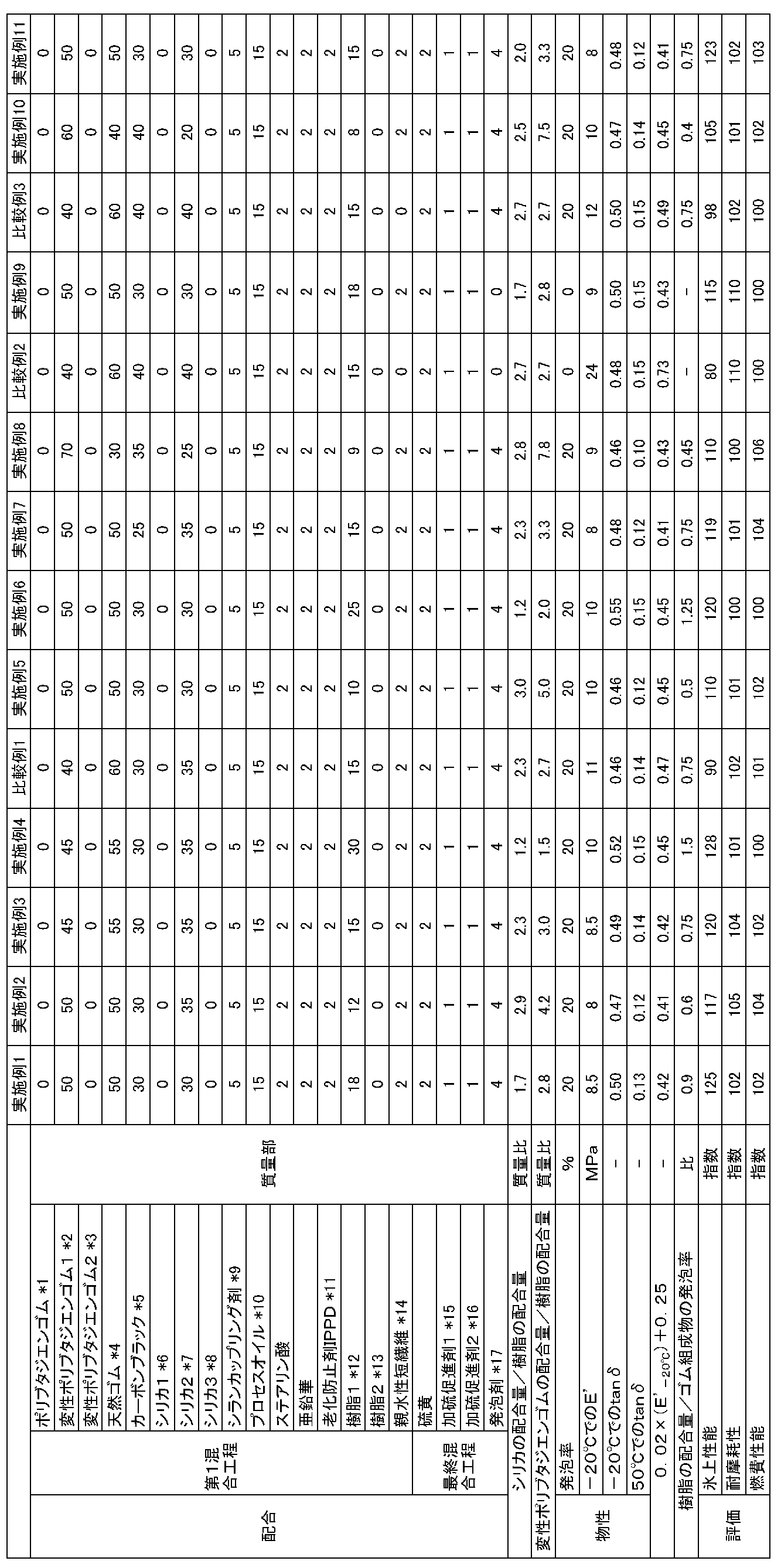
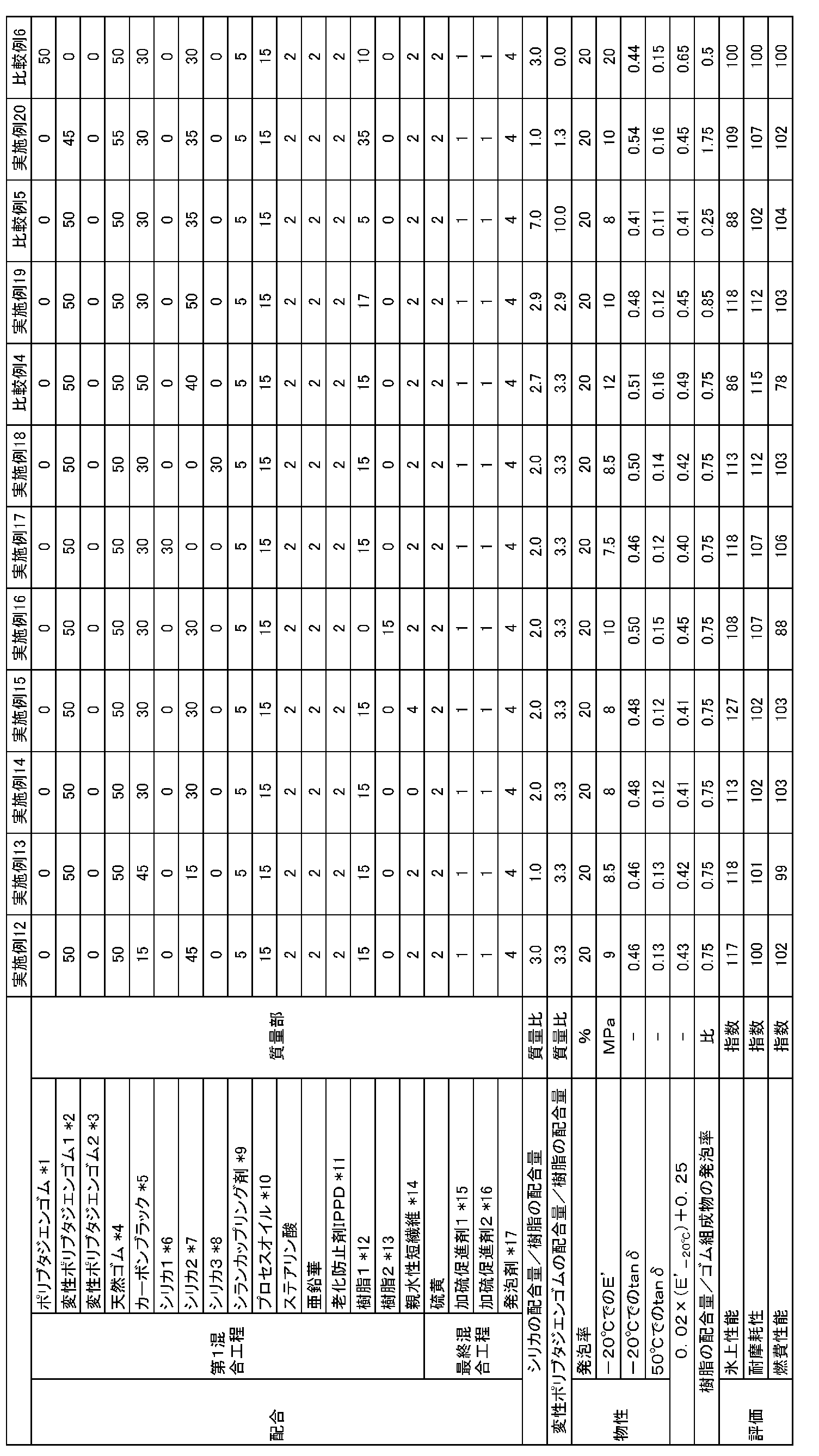
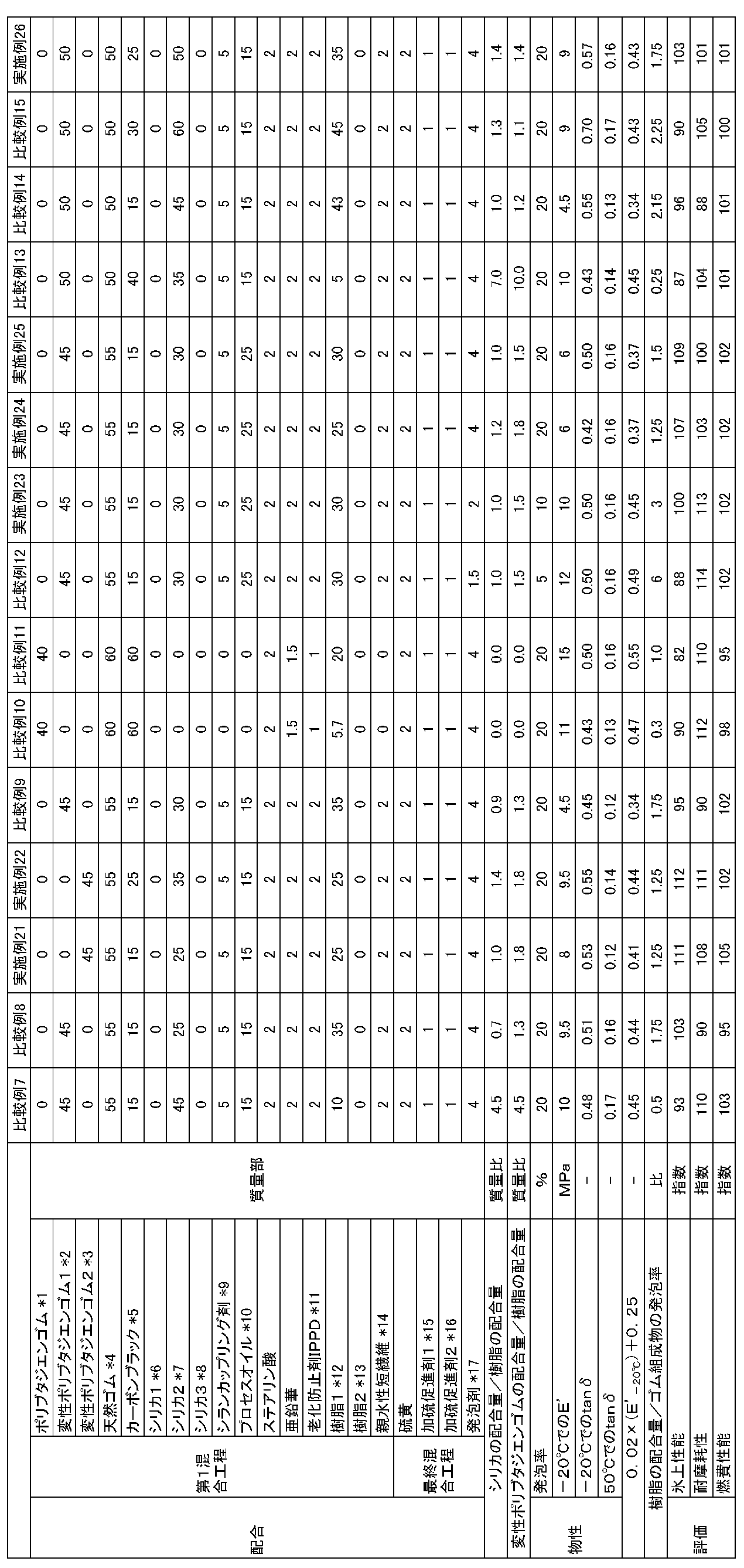
- a rubber composition was manufactured by mixing in the order of the first mixing step and the final mixing step using an ordinary Banbury mixer with the formulation shown in Tables 1 to 3.
- finish of a 1st mixing process the mixture was once taken out from the Banbury mixer, and after that, the mixture was thrown into the Banbury mixer again, and the final mixing process was implemented.
- the maximum temperature of the mixture in the first mixing step was 170 ° C.
- the maximum temperature of the rubber composition in the final mixing step was 110 ° C.
- the phase separation structure was confirmed in each rubber composition, and a plurality of incompatible polymer phases were formed.
- On-ice performance Four of the test tires were mounted on a 1600cc class domestic passenger car and the braking performance on ice at an ice temperature of -1 ° C was confirmed.
- anti-aging agent 2 The reaction was stopped by adding 2 ml of a 5% solution of 2'-methylene-bis (4-ethyl-6-tert-butylphenol) (NS-5) in isopropanol, and the reaction was repeated in isopropanol containing a trace amount of NS-5. Precipitation was performed and drum drying was performed to obtain a polybutadiene rubber having a modified active end.
- the resulting modified polybutadiene rubber 1 had a glass transition temperature of ⁇ 110 ° C.
- ⁇ Modified polybutadiene rubber 2> In a pressure-resistant glass container with an internal volume of about 900 mL that has been dried and purged with nitrogen, 283 g of cyclohexane, 50 g of 1,3-butadiene, 0.0057 mmol of 2,2-ditetrahydrofurylpropane, and 0.513 mmol of hexamethyleneimine are each injected as a cyclohexane solution. After adding 0.57 mmol of n-butyllithium (n-BuLi) to this, a polymerization reaction was carried out for 4.5 hours in a 50 ° C. warm water bath equipped with a stirrer. The polymerization conversion rate at this time was almost 100%.
- the rubber composition of the present invention can be used for a tread rubber of a tire, particularly a studless tire.
- the tire of the present invention is useful as a studless tire.
Landscapes
- Chemical & Material Sciences (AREA)
- Health & Medical Sciences (AREA)
- Chemical Kinetics & Catalysis (AREA)
- Medicinal Chemistry (AREA)
- Polymers & Plastics (AREA)
- Organic Chemistry (AREA)
- Engineering & Computer Science (AREA)
- Mechanical Engineering (AREA)
- Compositions Of Macromolecular Compounds (AREA)
- Tires In General (AREA)
- Oil, Petroleum & Natural Gas (AREA)
Abstract
Description
また、本発明は、氷上性能と耐摩耗性との両方に優れるタイヤを提供することを更なる課題とする。
-20℃での貯蔵弾性率(E’)と-20℃での損失正接(tanδ)とが下記式(1):
0.02×(E’-20℃)+0.25≦(tanδ-20℃)≦0.65 ・・・ (1)
[式中、(E’-20℃)は-20℃での貯蔵弾性率(MPa)であり、(tanδ-20℃)は-20℃での損失正接である]の関係を満たし、
一種以上のジエン系重合体と、シリカと、樹脂とを含み、
前記シリカの配合量(質量部)と前記樹脂の配合量(質量部)との質量比(シリカの配合量/樹脂の配合量)が1.00~4.00であることを特徴とする。
かかる本発明のゴム組成物によれば、タイヤに適用することで、タイヤの氷上性能と耐摩耗性との両方を向上させることができる。
ここで、前記シリカと前記カーボンブラックとの合計配合量は、60質量部以上であることが好ましい。この場合、ゴム組成物をトレッドに適用した際に、タイヤの氷上性能と耐摩耗性がより一層向上する。
また、前記シリカの配合量は、前記カーボンブラックの配合量以上であることが好ましい。この場合、ゴム組成物をタイヤに適用した際に、燃費性能をより向上させつつ、氷上性能をより向上させることができる。
前記ジエン系重合体の中で配合量が最も多いジエン系重合体と配合量が2番目に多いジエン系重合体との内、ガラス転移温度(Tg)がより低いジエン系重合体(A)は、配合量が、ガラス転移温度(Tg)がより高いジエン系重合体(B)の配合量の80質量%以上であることが好ましい。この場合、ゴム組成物の柔らかさを十分に確保でき、氷上性能が更に向上する。
ここで、前記ジエン系重合体(A)は、ポリブタジエンゴムであることが好ましい。この場合、ゴム組成物が更に柔らかくなることで、接地面積が更に大きくなり、氷上性能が更に向上する。
ここで、前記ジエン系重合体(B)は、天然ゴムであることが好ましい。この場合、ゴム組成物の補強性が更に高くなり、耐摩耗性が更に向上する。
ここで、前記シラン化合物は、グリシドキシ基を有することが好ましい。この場合、ゴム組成物をタイヤに適用した際に、タイヤの氷上性能がより一層向上する。
また、本発明のゴム組成物は、発泡孔を有することが好ましい。発泡孔を有するゴム組成物をトレッドゴムに使用した場合、トレッドの発泡孔(気泡)による引っ掻き効果及び排水効果で、タイヤの氷上性能を更に向上させることができる。
また、本発明によれば、氷上性能と耐摩耗性との両方に優れるタイヤを提供することができる。
以下に、本発明のゴム組成物を、その実施形態に基づき、詳細に例示説明する。
本発明のゴム組成物は、-20℃での貯蔵弾性率(E’)が5MPa以上且つ10MPa以下であり、
-20℃での貯蔵弾性率(E’)と-20℃での損失正接(tanδ)とが下記式(1):
0.02×(E’-20℃)+0.25≦(tanδ-20℃)≦0.65 ・・・ (1)
[式中、(E’-20℃)は-20℃での貯蔵弾性率(MPa)であり、(tanδ-20℃)は-20℃での損失正接である]の関係を満たし、
一種以上のジエン系重合体と、シリカと、樹脂とを含み、
前記シリカの配合量(質量部)と前記樹脂の配合量(質量部)との質量比(シリカの配合量/樹脂の配合量)が1.00~4.00であることを特徴とする。
そして、本発明のゴム組成物は、-20℃での貯蔵弾性率(E’)が10MPa以下であることで、タイヤの氷路面との接触性が向上し、また、-20℃での損失正接(tanδ)と-20℃での損失正接(tanδ)とが式(1)の関係を満たすことで、ブレーキ時のタイヤのせん断力が向上し、その結果として、タイヤの氷上性能を向上させることができる。
また、本発明のゴム組成物は、-20℃での貯蔵弾性率(E’)が5MPa以上であることで、タイヤに適用に適用した際に、タイヤの耐摩耗性を向上させることができる。
なお、ゴム組成物の-20℃での損失正接(tanδ)が0.46以上且つ0.55以下である場合、該ゴム組成物をタイヤのトレッドに使用することで、タイヤの氷上性能と耐摩耗性が大幅に向上する。
以下、本発明のゴム組成物の製造に使用できるジエン系重合体(ゴム成分)、シリカ、樹脂等の配合剤の好適例について説明する。
前記シリカは、CTAB(セチルトリメチルアンモニウムブロミド)比表面積が好ましくは180m2/g以上、更に好ましくは190m2g以上、より一層好ましくは195m2/g以上、特に好ましくは197m2/g以上であり、また、好ましくは600m2/g以下、より好ましくは300m2/g以下、特に好ましくは250m2/g以下である。シリカのCTAB比表面積が180m2/g以上の場合、耐摩耗性が更に向上し、また、シリカのCTAB比表面積が600m2/g以下の場合、転がり抵抗が小さくなる。
前記シリカとしては、特に制限はなく、例えば、湿式シリカ(含水ケイ酸)、乾式シリカ(無水ケイ酸)、ケイ酸カルシウム、ケイ酸アルミニウム等が挙げられ、これらの中でも、湿式シリカが好ましい。これらシリカは、一種単独で使用してもよいし、二種以上を併用してもよい。
前記カーボンブラックとしては、特に限定されるものではなく、例えば、GPF、FEF、HAF、ISAF、SAFグレードのカーボンブラックが挙げられる。これらカーボンブラックは、一種単独で使用してもよいし、二種以上を併用してもよい。
ここで、前記二種以上のジエン系重合体からなるポリマーブレンドは、互いに非相溶な複数のポリマー相を形成することとなる。そして、前記ジエン系重合体の中で配合量が最も多いジエン系重合体は、前記非相溶な複数のポリマー相が形成する海島構造の海相を構成し、一方、前記ジエン系重合体の中で配合量が2番目に多いジエン系重合体は、前記非相溶な複数のポリマー相が形成する海島構造の島相を構成することとなるが、これらの内、ガラス転移温度(Tg)がより低いジエン系重合体(A)は、柔らかく、氷上性能が高い。一方、ガラス転移温度(Tg)がより高いジエン系重合体(B)は、より硬く、耐摩耗性が高い。
そして、ガラス転移温度(Tg)がより低いジエン系重合体(A)の配合量が、ガラス転移温度(Tg)がより高いジエン系重合体(B)の配合量の80質量%以上であれば、ゴム組成物の柔らかさを十分に確保でき、氷上性能が更に向上する。
前述のように、本発明のゴム組成物は、タイヤの氷上性能を向上させる観点から、-20℃での損失正接(tanδ)と-20℃での損失正接(tanδ)とが式(1)の関係を満たすが、一般に、-20℃での損失正接(tanδ)が大きくなると、50℃での損失正接(tanδ)も大きくなり易く、タイヤの氷上性能と低燃費性を両立することが難しくなる。しかしながら、前記ジエン系重合体(A)の末端が変性されている場合、-20℃での損失正接(tanδ)を大きくしつつ、50℃での損失正接(tanδ)を小さくでき、ゴム組成物をタイヤに適用した際に、タイヤの氷上性能と低燃費性を両立することができる。
前記ジエン系重合体(A)の末端がシラン化合物で変性されている場合、該ジエン系重合体(A)は、シリカとの相互作用が大きく、該ジエン系重合体(A)を含むポリマー相に、シリカがより多く分配され、該ポリマー相にミクロな凹凸を付与しつつ、該ポリマー相を柔らかくする。そのため、該ゴム組成物をタイヤのトレッドに使用した場合、トレッドの接地面積が大きくなり、タイヤの氷上性能が向上する。一方、前記ジエン系重合体(A)を含まないポリマー相は、他のジエン系重合体から形成され、前記ジエン系重合体(A)を含むポリマー相にシリカが多く分配されるため、相対的にカーボンブラックが多く分配される。そして、該ポリマー相は、補強性の高いカーボンブラックを多く含むため、該ポリマー相の耐摩耗性が向上する。
また、前記ジエン系重合体(A)の末端がグリシドキシ基を有するシラン化合物で変性されていることで、該ジエン系重合体(A)とシリカとの相互作用がより向上し、該ジエン系重合体(A)を含むポリマー相中でのシリカの分散性が更に向上して、ゴム組成物をタイヤに適用した際に、タイヤの氷上性能がより一層向上する。
一好適態様においては、該分子末端が変性された低Tgジエン系重合体(A)は、国際公開第2003/046020号、特開2007-217562号公報に記載の方法に従って、シス-1,4結合含有量が75%以上の活性末端を有するジエン系重合体の末端に、シラン化合物(例えば、ヒドロカルビルオキシシラン化合物)を反応させた後、多価アルコールのカルボン酸部分エステルと反応させて安定化を行うことで製造することができる。
前記部分エステルの原料に用いられる多価アルコールとしては、好ましくは少なくとも三つの水酸基を有する炭素数5又は6の糖類(水素添加されていても、水素添加されていなくてもよい)、グリコールやポリヒドロキシ化合物などが用いられる。また、原料脂肪酸としては、好ましくは炭素数10~20の飽和又は不飽和脂肪酸であり、例えば、ステアリン酸、ラウリン酸、パルミチン酸が用いられる。
前記多価アルコールの脂肪酸部分エステルの中では、ソルビタン脂肪酸エステルが好ましく、具体的には、ソルビタンモノラウリン酸エステル、ソルビタンモノパルミチン酸エステル、ソルビタンモノステアリン酸エステル、ソルビタントリステアリン酸エステル、ソルビタンモノオレイン酸エステル、ソルビタントリオレイン酸エステル等が挙げられる。
また、上記(1)共役ジエン化合物や芳香族ビニル化合物等の(共)重合体に極性基含有単量体をグラフト重合させる方法、並びに、上記(2)共役ジエン化合物や芳香族ビニル化合物等と極性基含有単量体を共重合させる方法において、使用する極性基含有単量体としては、極性基含有ビニル系単量体が好ましい。また、上記(3)共役ジエン化合物や芳香族ビニル化合物等の(共)重合体に極性基含有化合物を付加させる方法において、使用する極性基含有化合物としては、極性基含有メルカプト化合物が好ましい。なお、上記極性基の具体例としては、アルコキシシリル基等を好適に挙げることができる。
分子末端がスズ原子(Sn)及び窒素原子(N)の少なくとも一方を含む化合物で変性されたジエン系重合体(A)は、例えば、上記単量体をスズ原子及び/又は窒素原子を含む重合開始剤を用いてリビング重合させた後、重合活性末端をスズ原子及び/又は窒素原子を含む変性剤で変性させる方法で製造することができる。なお、上記リビング重合は、アニオン重合で行うことが好ましい。


また、上記式(II)において、R2は、3~16個のメチレン基を有する、アルキレン基、置換アルキレン基、オキシアルキレン基又はN-アルキルアミノ-アルキレン基である。ここで、置換アルキレン基には、一置換から八置換のアルキレン基が含まれ、置換基としては、炭素数1~12の、鎖状若しくは分枝状アルキル基、シクロアルキル基、ビシクロアルキル基、アリール基及びアラルキル基が挙げられる。また、R2として、具体的には、トリメチレン基、テトラメチレン基、ヘキサメチレン基、オキシジエチレン基、N-アルキルアザジエチレン基、ドデカメチレン基及びヘキサデカメチレン基等が好ましい。
ここで、二級アミンとしては、ジメチルアミン、ジエチルアミン、ジブチルアミン、ジオクチルアミン、ジシクロヘキシルアミン、ジイソブチルアミン等の他、アザシクロヘプタン(即ち、ヘキサメチレンイミン)、2-(2-エチルヘキシル)ピロリジン、3-(2-プロピル)ピロリジン、3,5-ビス(2-エチルヘキシル)ピペリジン、4-フェニルピペリジン、7-デシル-1-アザシクロトリデカン、3,3-ジメチル-1-アザシクロテトラデカン、4-ドデシル-1-アザシクロオクタン、4-(2-フェニルブチル)-1-アザシクロオクタン、3-エチル-5-シクロヘキシル-1-アザシクロヘプタン、4-ヘキシル-1-アザシクロヘプタン、9-イソアミル-1-アザシクロヘプタデカン、2-メチル-1-アザシクロヘプタデセ-9-エン、3-イソブチル-1-アザシクロドデカン、2-メチル-7-tert-ブチル-1-アザシクロドデカン、5-ノニル-1-アザシクロドデカン、8-(4’-メチルフェニル)-5-ペンチル-3-アザビシクロ[5.4.0]ウンデカン、1-ブチル-6-アザビシクロ[3.2.1]オクタン、8-エチル-3-アザビシクロ[3.2.1]オクタン、1-プロピル-3-アザビシクロ[3.2.2]ノナン、3-(tert-ブチル)-7-アザビシクロ[4.3.0]ノナン、1,5,5-トリメチル-3-アザビシクロ[4.4.0]デカン等の環状アミンが挙げられる。
また、リチウム化合物としては、エチルリチウム、n-プロピルリチウム、イソプロピルリチウム、n-ブチルリチウム、sec-ブチルリチウム、tert-オクチルリチウム、n-デシルリチウム、フェニルリチウム、2-ナフチルリチウム、2-ブチル-フェニルリチウム、4-フェニル-ブチルリチウム、シクロヘキシルリチウム、シクロペンチルリチウム、ジイソプロペニルベンゼンとブチルリチウムとの反応生成物等のヒドロカルビルリチウムを用いることができる。
R3 aSnXb ・・・ (III)
[式中、R3は、それぞれ独立して炭素数1~20のアルキル基、炭素数3~20のシクロアルキル基、炭素数6~20のアリール基及び炭素数7~20のアラルキル基からなる群から選択され;Xは、それぞれ独立して塩素又は臭素であり;aは0~3で、bは1~4で、但し、a+b=4である]で表されるスズ含有カップリング剤が好ましい。式(III)のスズ含有カップリング剤で変性したジエン系重合体(A)は、少なくとも一種のスズ-炭素結合を有する。
ここで、R3として、具体的には、メチル基、エチル基、n-ブチル基、ネオフィル基、シクロヘキシル基、n-オクチル基、2-エチルヘキシル基等が挙げられる。また、式(III)のカップリング剤としては、四塩化スズ、R3SnCl3、R3 2SnCl2、R3 3SnCl等が好ましく、四塩化スズが特に好ましい。
前記発泡剤としては、アゾジカルボンアミド(ADCA)、ジニトロソペンタメチレンテトラミン(DNPT)、ジニトロソペンタスチレンテトラミンやベンゼンスルホニルヒドラジド誘導体、p,p’-オキシビスベンゼンスルホニルヒドラジド(OBSH)、重炭酸アンモニウム、重炭酸ナトリウム、炭酸アンモニウム、ニトロソスルホニルアゾ化合物、N,N’-ジメチル-N,N’-ジニトロソフタルアミド、トルエンスルホニルヒドラジド、p-トルエンスルホニルセミカルバジド、p,p’-オキシビスベンゼンスルホニルセミカルバジド等が挙げられる。これら発泡剤の中でも、ジニトロソペンタメチレンテトラミン(DNPT)が好ましい。これら発泡剤は、一種単独で使用してもよいし、二種以上を併用してもよい。
また、該発泡剤の配合量は、特に限定されるものではないが、前記ジエン系重合体の合計100質量部に対して0.1~30質量部の範囲が好ましく、1~20質量部の範囲が更に好ましい。
また、該発泡助剤の配合量は、特に限定されるものではないが、前記ジエン系重合体の合計100質量部に対して1~30質量部の範囲が好ましい。
Vs=(ρ0/ρ1-1)×100(%) ・・・ (2)
式(2)中、ρ1は加硫ゴム(発泡ゴム)の密度(g/cm3)を示し、ρ0は加硫ゴム(発泡ゴム)における固相部の密度(g/cm3)を示す。なお、加硫ゴムの密度及び加硫ゴムの固相部の密度は、エタノール中の質量と空気中の質量を測定し、これから算出される。また、発泡率は、発泡剤や発泡助剤の種類、量等により適宜変化させることができる。
前記C5系樹脂としては、石油化学工業のナフサの熱分解によって得られるC5留分を(共)重合して得られる脂肪族系石油樹脂が挙げられる。上記C5留分には、通常1-ペンテン、2-ペンテン、2-メチル-1-ブテン、2-メチル-2-ブテン、3-メチル-1-ブテン等のオレフィン系炭化水素、2-メチル-1,3-ブタジエン、1,2-ペンタジエン、1,3-ペンタジエン、3-メチル-1,2-ブタジエン等のジオレフィン系炭化水素等が含まれる。なお、上記C5系樹脂としては、市販品を利用することができる。
また、該C5系樹脂の配合量は、特に限定されるものではないが、前記ジエン系重合体の合計100質量部に対して5~50質量部の範囲が好ましく、13~43質量部の範囲が更に好ましく、15~25質量部の範囲がより一層好ましい。C5系樹脂の配合量が5質量部以上であれば、氷上性能が十分に向上し、また、50質量部以下であれば、耐摩耗性を十分に確保することができる。
前記C5-C9系樹脂とは、C5-C9系合成石油樹脂を指し、該C5-C9系樹脂としては、例えば、石油由来のC5-C11留分を、AlCl3やBF3などのフリーデルクラフツ触媒を用いて重合して得られる固体重合体が挙げられ、より具体的には、スチレン、ビニルトルエン、α-メチルスチレン、インデンなどを主成分とする共重合体などが挙げられる。該C5-C9系樹脂としては、C9以上の成分の少ない樹脂が、ジエン系重合体との相溶性の観点から好ましい。ここで、「C9以上の成分が少ない」とは、樹脂全量中のC9以上の成分が50質量%未満、好ましくは40質量%以下であることを言うものとする。前記C5-C9系樹脂しては、市販品を利用することができ、例えば、商品名「クイントン(登録商標)G100B」(日本ゼオン株式会社製)、商品名「ECR213」(エクソンモービルケミカル社製)等が挙げられる。
また、該C5-C9系樹脂の配合量は、特に限定されるものではないが、前記ジエン系重合体の合計100質量部に対して13~43質量部の範囲が更に好ましい。C5-C9系樹脂の配合量が13質量部以上であれば、氷上性能が十分に向上し、また、43質量部以下であれば、耐摩耗性を十分に確保することができる。
また、上述したシリカの配合量/樹脂の配合量は、より好ましくは2.30以下、より一層好ましくは1.70以下であり、また、より好ましくは1.20以上、より一層好ましくは1.50以上であり、この範囲であれば、氷上性能と摩耗性能を最適にすることが出来る。
また、上述したジエン系重合体(A)の配合量(質量部)と前記樹脂の配合量(質量部)との質量比は、より好ましくは6.0以下、より一層好ましくは4.5以下であり、また、より好ましくは2.0以上であり、この範囲であれば、氷上性能と摩耗性能を最適にすることが出来る。
前記親水性短繊維の原料として用いる親水性樹脂としては、エチレン-ビニルアルコール共重合体、ビニルアルコール単独重合体、ポリ(メタ)アクリル酸或いはそのエステル、ポリエチレングリコール、カルボキシビニル共重合体、スチレン-マレイン酸共重合体、ポリビニルピロリドン、ビニルピロリドン-酢酸ビニル共重合体、メルカプトエタノール等が挙げられ、これらの中でも、エチレン-ビニルアルコール共重合体、ビニルアルコール単独重合体、ポリ(メタ)アクリル酸が好ましく、エチレン-ビニルアルコール共重合体が特に好ましい。
前記被覆層に用いる低融点樹脂の融点は、ゴム組成物の加硫の最高温度よりも低いことが好ましい。なお、加硫の最高温度とは、ゴム組成物の加硫時にゴム組成物が達する最高温度を意味する。例えば、モールド加硫の場合には、上記ゴム組成物がモールド内に入ってからモールドを出て冷却されるまでに該ゴム組成物が達する最高温度を意味し、かかる加硫最高温度は、例えば、ゴム組成物中に熱電対を埋め込むこと等により測定することができる。低融点樹脂の融点の上限としては、特に制限はないものの、以上の点を考慮して選択することが好ましく、一般的には、ゴム組成物の加硫最高温度よりも、10℃以上低いことが好ましく、20℃以上低いことがより好ましい。なお、ゴム組成物の工業的な加硫温度は、一般的には最高で約190℃程度であるが、例えば、加硫最高温度がこの190℃に設定されている場合には、低融点樹脂の融点としては、通常190℃未満の範囲で選択され、180℃以下が好ましく、170℃以下がより好ましい。
前記低融点樹脂としては、ポリオレフィン系樹脂が好ましく、例としては、ポリエチレン、ポリプロピレン、ポリブテン、ポリスチレン、エチレン-プロピレン共重合体、エチレン-メタクリル酸共重合体、エチレン-エチルアクリレート共重合体、エチレン-プロピレン-ジエン三元共重合体、エチレン-酢酸ビニル共重合体、並びにこれらのアイオノマー樹脂等が挙げられる。
前記親水性短繊維の配合量は、前記ジエン系重合体の合計100質量部に対して0.1~100質量部の範囲が好ましく、1~50質量部の範囲が更に好ましく、1~10質量部の範囲がより一層好ましい。親水性短繊維の配合量を上記範囲に収めることで、氷上性能と耐摩耗性の良好なバランスを取ることができる。
なお、ゴム組成物の-20℃での貯蔵弾性率(E’)、-20℃での損失正接(tanδ)は、上述のジエン系重合体の種類やブレンド比、配合剤の種類や配合量を調整することで、変化させることができる。
本発明のタイヤは、上記のゴム組成物を用いたことを特徴とし、前述のゴム組成物がトレッドに使用されていることが好ましい。前記ゴム組成物をトレッドに使用したタイヤは、氷上性能と耐摩耗性との両方に優れ、スタッドレスタイヤ等の冬用タイヤとして有用である。
本発明のタイヤは、適用するタイヤの種類や部材に応じ、未加硫のゴム組成物を用いて成形後に加硫して得てもよく、又は予備加硫工程等を経た半加硫ゴムを用いて成形後、さらに本加硫して得てもよい。なお、タイヤに充填する気体としては、通常の或いは酸素分圧を調整した空気の他、窒素、アルゴン、ヘリウム等の不活性ガスを用いることができる。
表1~表3に示す配合処方で、通常のバンバリーミキサーを用いて、第1混合工程、最終混合工程の順に混合を行って、ゴム組成物を製造した。なお、第1混合工程の終了後、混合物をバンバリーミキサーから一旦取り出し、その後、再度混合物をバンバリーミキサーに投入して、最終混合工程を実施した。また、第1混合工程における混合物の最高温度は170℃とし、最終混合工程におけるゴム組成物の最高温度は110℃とした。
また、段落[0012]に記載の方法に従い走査型プローブ顕微鏡を用いて観察したところ、いずれのゴム組成物も相分離構造が確認され、互いに非相溶な複数のポリマー相が形成されていた。
更に、上記のようにして得られたゴム組成物に対して、下記の方法で、-20℃での貯蔵弾性率(E’)、-20℃での損失正接(tanδ)、50℃での損失正接(tanδ)を測定した。結果を表1~表3に示す。
ゴム組成物を145℃で33分間加硫して得られた加硫ゴムに対して、上島製作所(株)製スペクトロメーターを用いて、初期歪2%、動歪1%、周波数52Hzの条件下で、-20℃における貯蔵弾性率(E’)、並びに、-20℃及び50℃における損失正接(tanδ)を測定した。
上記のようにして得られたゴム組成物をトレッドに用いて、常法によって試験用のタイヤ(タイヤサイズ195/65R15)を作製し、トレッドの発泡率を上記式(2)に従って算出した。次に、該タイヤに対して、下記の方法で、氷上性能、耐摩耗性及び燃費性能を評価した。結果を表1~表3に示す。
前記試験用のタイヤを排気量1600ccクラスの国産乗用車に4本を装着し、氷温-1℃の氷上制動性能を確認した。比較例6のタイヤをコントロールとし、氷上性能=(比較例6の制動距離/その他の例の制動距離)×100として、指数表示した。指数値が大きい程、氷上性能が優れていることを示す。
前記試験用のタイヤを用いた実車にて舗装路面を1万km走行後、残溝を測定し、トレッドが1mm摩耗するのに要する走行距離を相対比較し、比較例6のタイヤを100として指数表示した。指数値が大きい程、耐摩耗性が良好なことを示す。
供試タイヤを試験車に装着し、25~30℃(常温)の環境下において、実車試験にて、燃費性能を測定し、比較例6のタイヤの燃費性能を100として指数表示した。指数値が大きい程、燃費性能が良好なこと(低燃費性に優れること)を示す。
*2 変性ポリブタジエンゴム1: 下記の方法で合成した変性ポリブタジエンゴム、Tg=-110℃
*3 変性ポリブタジエンゴム2: 下記の方法で合成した変性ポリブタジエンゴム、Tg=-95℃
*4 天然ゴム: Tg=-60℃
*5 カーボンブラック: N134、旭カーボン製、窒素吸着比表面積(N2SA)=146m2/g
*6 シリカ1: 商品名「Nipsil EQ」、東ソー・シリカ製、CTAB比表面積=100m2/g、窒素吸着比表面積(N2SA)=100m2/g
*7 シリカ2: 商品名「Nipsil AQ」、東ソー・シリカ製、CTAB比表面積=150m2/g、窒素吸着比表面積(N2SA)=200m2/g
*8 シリカ3: 商品名「ニップシールHQ」、東ソー・シリカ製、CTAB比表面積=200m2/g、窒素吸着比表面積(N2SA)=250m2/g
*9 シランカップリング剤: 「Si69」、Evonic製
*10 プロセスオイル: ナフテン系プロセスオイル、商品名「ダイアナプロセスオイルNS-24」、出光興産製、流動点=-30℃
*11 老化防止剤IPPD: N-イソプロピル-N’-フェニル-p-フェニレンジアミン
*12 樹脂1: C5系樹脂: 商品名「Escorez 1102」、東燃化学製
*13 樹脂2: C5系以外の樹脂: 商品名「NEOPOLYMER」、日本合成樹脂製
*14 親水性短繊維: 下記の方法で作製した親水性短繊維
*15 加硫促進剤1: ジ-2-ベンゾチアゾリルジスルフィド(MBTS)
*16 加硫促進剤2: N-シクロヘキシル-2-ベンゾチアゾリルスルフェンアミド(CBS)
*17 発泡剤: ジニトロソペンタメチレンテトラミン(DNPT)
(i)触媒の調製
乾燥・窒素置換された、ゴム栓付容積100ミリリットルのガラスびんに、以下の順番に、ブタジエンのシクロヘキサン溶液(15.2質量%)7.11g、ネオジムネオデカノエートのシクロヘキサン溶液(0.56M)0.59ミリリットル、メチルアルミノキサンMAO(東ソ―アクゾ製PMAO)のトルエン溶液(アルミニウム濃度として3.23M)10.32ミリリットル、水素化ジイソブチルアルミ(関東化学製)のヘキサン溶液(0.90M)7.77ミリリットルを投入し、室温で2分間熟成した後、塩素化ジエチルアルミ(関東化学製)のヘキサン溶液(0.95M)1.45ミリリットルを加え室温で、時折撹拌しながら15分間熟成した。こうして得られた触媒溶液中のネオジムの濃度は、0.011M(モル/リットル)であった。
(ii)活性末端を変性した変性ジエン系ゴムの製造
900ミリリットル容積のゴム栓付きガラスびんを乾燥・窒素置換し、乾燥精製されたブタジエンのシクロヘキサン溶液および乾燥シクロヘキサンを各々投入し、ブタジエン12.5質量%のシクロヘキサン溶液が400g投入された状態とした。次に、前記調製した触媒溶液2.28ミリリットル(ネオジム換算0.025mmol)を投入し、50℃温水浴中で1.0時間重合を行った。
(iii)第1次変性処理
第1次変性剤として、3-グリシドキシプロピルトリメトキシシランをヘキサン溶液(1.0M)として、23.5(ネオジム対比のモル当量)投入し、50℃で60分間処理した。
(iv)その後の処理
続いて、多価アルコールのカルボン酸エステルとしてソルビタントリオレイン酸エステルを単体で1.2ミリリットル加えて、さらに50℃で1時間変性反応を行った後、老化防止剤2,2'-メチレン-ビス(4-エチル-6-t-ブチルフェノール)(NS-5)のイソプロパノール5%溶液2ミリリットルを加えて反応の停止を行い、さらに微量のNS-5を含むイソプロパノール中で再沈殿を行ない、ドラム乾燥することにより活性末端を変性したポリブタジエンゴムを得た。得られた変性ポリブタジエンゴム1は、ガラス転移温度が-110℃であった。
乾燥し、窒素置換した内容積約900mLの耐圧ガラス容器に、シクロヘキサン283g、1,3-ブタジエン50g、2,2-ジテトラヒドロフリルプロパン0.0057mmol及びヘキサメチレンイミン0.513mmolをそれぞれシクロヘキサン溶液として注入し、これにn-ブチルリチウム(n-BuLi)0.57mmolを加えた後、撹拌装置を備えた50℃の温水浴中で4.5時間重合反応を行った。この際の重合転化率は、ほぼ100%であった。
次に、重合反応系に、四塩化スズ0.100mmolをシクロヘキサン溶液として加え、50℃で30分間撹拌した。その後、反応系に、2,6-ジ-tert-ブチル-p-クレゾール(BHT)のイソプロパノール溶液(BHT濃度:5質量%)0.5mLを加えて、重合反応を停止させ、更に常法に従って乾燥して変性ポリブタジエンゴム2を得た。得られた変性ポリブタジエンゴム2は、ガラス転移温度が-95℃であった。
特開2012-219245号公報に開示の製造例3に従い、二軸押出機を2台用い、ホッパーにポリエチレン[日本ポリエチレン製、ノバテックHJ360(MFR5.5、融点132℃)]40質量部と、エチレン-ビニルアルコール共重合体[クラレ製、エバールF104B(MFR4.4、融点183℃)]40質量部とを投入し、ダイ出口から各々同時に押し出して、常法に従って得られた繊維を長さ2mmにカットして、ポリエチレンからなる被覆層が形成された親水性短繊維を作製した。
Claims (21)
- -20℃での貯蔵弾性率(E’)が5MPa以上且つ10MPa以下であり、
-20℃での貯蔵弾性率(E’)と-20℃での損失正接(tanδ)とが下記式(1):
0.02×(E’-20℃)+0.25≦(tanδ-20℃)≦0.65 ・・・ (1)
[式中、(E’-20℃)は-20℃での貯蔵弾性率(MPa)であり、(tanδ-20℃)は-20℃での損失正接である]の関係を満たし、
一種以上のジエン系重合体と、シリカと、樹脂とを含み、
前記シリカの配合量(質量部)と前記樹脂の配合量(質量部)との質量比(シリカの配合量/樹脂の配合量)が1.00~4.00であることを特徴とする、
ゴム組成物。 - 前記ジエン系重合体のうち少なくとも一種は、末端が変性されている、請求項1に記載のゴム組成物。
- 前記シリカの配合量が、前記ジエン系重合体の合計100質量部に対して20質量部以上であり、
更にカーボンブラックを、前記ジエン系重合体の合計100質量部に対して20質量部以上含む、請求項1又は2に記載のゴム組成物。 - 前記シリカと前記カーボンブラックとの合計配合量が、60質量部以上である、請求項3に記載のゴム組成物。
- 前記シリカの配合量が、前記カーボンブラックの配合量以上である、請求項3又は4に記載のゴム組成物。
- 前記ジエン系重合体は、互いに非相溶な複数のポリマー相を形成する少なくとも二種のジエン系重合体を含み、
前記ジエン系重合体の中で配合量が最も多いジエン系重合体と配合量が2番目に多いジエン系重合体との内、ガラス転移温度(Tg)がより低いジエン系重合体(A)は、配合量が、ガラス転移温度(Tg)がより高いジエン系重合体(B)の配合量の80質量%以上である、請求項1~5のいずれか一項に記載のゴム組成物。 - 前記ジエン系重合体(A)は、末端が変性されている、請求項6に記載のゴム組成物。
- 前記末端が変性されたジエン系重合体(A)の配合量(質量部)と前記樹脂の配合量(質量部)との質量比(末端が変性されたジエン系重合体(A)の配合量/樹脂の配合量)が1.2~7.5である、請求項7に記載のゴム組成物。
- 前記樹脂の配合量(質量部)とゴム組成物の発泡率(%)との比[樹脂の配合量(質量部)/ゴム組成物の発泡率(%)]が0.4~3.5である、請求項1~8のいずれか一項に記載のゴム組成物。
- -20℃での損失正接(tanδ)が0.46以上且つ0.55以下である、請求項1~9のいずれか一項に記載のゴム組成物。
- 前記ジエン系重合体(A)が、ブタジエン骨格を有する、請求項6~10のいずれか一項に記載のゴム組成物。
- 前記ジエン系重合体(A)が、ポリブタジエンゴムである、請求項11に記載のゴム組成物。
- 前記ジエン系重合体(B)が、イソプレン骨格を有する、請求項6~12のいずれか一項に記載のゴム組成物。
- 前記ジエン系重合体(B)が、天然ゴムである、請求項13に記載のゴム組成物。
- 前記ジエン系重合体(A)は、末端がシラン化合物で変性されている、請求項7~14のいずれか一項に記載のゴム組成物。
- 前記シラン化合物が、グリシドキシ基を有する、請求項15に記載のゴム組成物。
- 更に発泡剤を含む、請求項1~16のいずれか一項に記載のゴム組成物。
- 発泡孔を有する、請求項1~16のいずれか一項に記載のゴム組成物。
- 前記樹脂としてC5系樹脂を含む、請求項1~18のいずれか一項に記載のゴム組成物。
- 更に親水性短繊維を含む、請求項1~19のいずれか一項に記載のゴム組成物。
- 請求項1~20のいずれか一項に記載のゴム組成物を用いたことを特徴とする、タイヤ。
Priority Applications (5)
| Application Number | Priority Date | Filing Date | Title |
|---|---|---|---|
| EP17741510.6A EP3406664B1 (en) | 2016-01-19 | 2017-01-19 | Rubber composition and tire |
| US16/066,543 US10611899B2 (en) | 2016-01-19 | 2017-01-19 | Rubber composition and tire |
| CN201780007297.6A CN108602987B (zh) | 2016-01-19 | 2017-01-19 | 橡胶组合物和轮胎 |
| RU2018129909A RU2708574C1 (ru) | 2016-01-19 | 2017-01-19 | Каучуковая композиция и покрышка |
| JP2017562909A JP6948267B2 (ja) | 2016-01-19 | 2017-01-19 | ゴム組成物及びタイヤ |
Applications Claiming Priority (2)
| Application Number | Priority Date | Filing Date | Title |
|---|---|---|---|
| JP2016008208 | 2016-01-19 | ||
| JP2016-008208 | 2016-01-19 |
Publications (1)
| Publication Number | Publication Date |
|---|---|
| WO2017126633A1 true WO2017126633A1 (ja) | 2017-07-27 |
Family
ID=59362236
Family Applications (1)
| Application Number | Title | Priority Date | Filing Date |
|---|---|---|---|
| PCT/JP2017/001814 Ceased WO2017126633A1 (ja) | 2016-01-19 | 2017-01-19 | ゴム組成物及びタイヤ |
Country Status (6)
| Country | Link |
|---|---|
| US (1) | US10611899B2 (ja) |
| EP (1) | EP3406664B1 (ja) |
| JP (1) | JP6948267B2 (ja) |
| CN (1) | CN108602987B (ja) |
| RU (1) | RU2708574C1 (ja) |
| WO (1) | WO2017126633A1 (ja) |
Cited By (10)
| Publication number | Priority date | Publication date | Assignee | Title |
|---|---|---|---|---|
| JP2020100700A (ja) * | 2018-12-20 | 2020-07-02 | Toyo Tire株式会社 | スタッドレスタイヤトレッド用ゴム組成物及びスタッドレスタイヤ |
| WO2021024723A1 (ja) * | 2019-08-08 | 2021-02-11 | 住友ゴム工業株式会社 | タイヤ用ゴム組成物及びタイヤ |
| WO2021090660A1 (ja) * | 2019-11-06 | 2021-05-14 | 住友ゴム工業株式会社 | タイヤ用ゴム組成物およびタイヤ |
| WO2021117337A1 (ja) * | 2019-12-13 | 2021-06-17 | 株式会社ブリヂストン | ベーストレッド用ゴム組成物及びタイヤ |
| JP2021095464A (ja) * | 2019-12-13 | 2021-06-24 | 株式会社ブリヂストン | ベーストレッド用ゴム組成物及びタイヤ |
| JP2021130442A (ja) * | 2020-02-21 | 2021-09-09 | 住友ゴム工業株式会社 | タイヤ |
| JPWO2020100627A1 (ja) * | 2018-11-16 | 2021-09-30 | 株式会社ブリヂストン | ゴム組成物、加硫ゴム及びタイヤ |
| JPWO2020110941A1 (ja) * | 2018-11-30 | 2021-10-07 | 横浜ゴム株式会社 | タイヤ用ゴム組成物 |
| RU2801641C2 (ru) * | 2017-09-15 | 2023-08-11 | Бриджстоун Юроп Нв/Са | Пневматическая покрышка, включающая протектор, имеющий пористую поверхность |
| JP2024546389A (ja) * | 2021-12-30 | 2024-12-20 | 株式会社ブリヂストン | 官能化シリル化ポリマーを含む組成物、硬化組成物、及び方法 |
Families Citing this family (6)
| Publication number | Priority date | Publication date | Assignee | Title |
|---|---|---|---|---|
| CN109790331A (zh) * | 2016-09-26 | 2019-05-21 | 株式会社普利司通 | 橡胶组合物和轮胎 |
| WO2020227531A1 (en) | 2019-05-07 | 2020-11-12 | Bridgestone Americas Tire Operations, Llc | Modified high-cis polybutadiene polymer, related methods and rubber compositions |
| JP7283309B2 (ja) * | 2019-08-28 | 2023-05-30 | 住友ゴム工業株式会社 | タイヤ |
| FR3111138B1 (fr) * | 2020-06-04 | 2022-07-08 | Michelin & Cie | Composition de caoutchouc. |
| JPWO2022249764A1 (ja) * | 2021-05-28 | 2022-12-01 | ||
| JPWO2022249763A1 (ja) * | 2021-05-28 | 2022-12-01 |
Citations (8)
| Publication number | Priority date | Publication date | Assignee | Title |
|---|---|---|---|---|
| JPH07133376A (ja) * | 1993-09-16 | 1995-05-23 | Yokohama Rubber Co Ltd:The | ゴム組成物 |
| JPH11189616A (ja) * | 1997-12-26 | 1999-07-13 | Bridgestone Corp | 重合体の製造方法、得られた重合体、及びそれを用いたゴム組成物 |
| JP2001158836A (ja) * | 1999-12-02 | 2001-06-12 | Bridgestone Corp | ゴム組成物,油展ゴム及び空気入りタイヤ |
| JP2001279028A (ja) * | 2000-03-28 | 2001-10-10 | Degussa Ag | ゴム混合物、その製造法、その使用およびそれにより得られる成形体 |
| JP2004066894A (ja) * | 2002-08-02 | 2004-03-04 | Yokohama Rubber Co Ltd:The | 空気入りタイヤ |
| JP2004238619A (ja) * | 2003-01-17 | 2004-08-26 | Bridgestone Corp | ゴム組成物及びこれを用いたスタッドレスタイヤ |
| JP2005105060A (ja) * | 2003-09-29 | 2005-04-21 | Tokai Rubber Ind Ltd | ダンパー用ゴム組成物 |
| JP2015078272A (ja) * | 2013-10-15 | 2015-04-23 | 株式会社ブリヂストン | ゴム組成物の製造方法 |
Family Cites Families (20)
| Publication number | Priority date | Publication date | Assignee | Title |
|---|---|---|---|---|
| JPH02135241A (ja) | 1988-11-16 | 1990-05-24 | Nitto Sangyo Kk | タイヤトレッドゴム組成物 |
| JP2002206037A (ja) | 2001-01-10 | 2002-07-26 | Yokohama Rubber Co Ltd:The | タイヤ用ゴム組成物 |
| CN100415814C (zh) | 2003-06-30 | 2008-09-03 | 日本瑞翁株式会社 | 含二氧化硅的橡胶组合物及其制备方法 |
| JP5030367B2 (ja) | 2003-07-23 | 2012-09-19 | 株式会社ブリヂストン | タイヤ |
| JP4990575B2 (ja) | 2006-07-24 | 2012-08-01 | 株式会社ブリヂストン | 空気入りタイヤ用インナーライナー及びそれを備えた空気入りタイヤ |
| JP2008138086A (ja) * | 2006-12-01 | 2008-06-19 | Yokohama Rubber Co Ltd:The | タイヤトレッド用ゴム組成物 |
| JP2008303334A (ja) | 2007-06-08 | 2008-12-18 | Sumitomo Rubber Ind Ltd | キャップトレッド用ゴム組成物およびそれを用いたキャップトレッドを有するタイヤ |
| EP2193938A4 (en) | 2007-08-10 | 2010-09-29 | Bridgestone Corp | TIRE |
| CN101889050A (zh) * | 2007-12-07 | 2010-11-17 | 株式会社普利司通 | 轮胎 |
| FR2925913B1 (fr) | 2007-12-27 | 2010-10-22 | Michelin Soc Tech | Composition de caoutchouc pour bande de roulement de pneumatique hiver |
| ES2582231T3 (es) | 2008-06-26 | 2016-09-09 | Bridgestone Corporation | Composiciones de caucho que incluyen derivados de poliisobutileno funcionalizado con metal y métodos para preparar tales composiciones |
| JP2011088988A (ja) | 2009-10-21 | 2011-05-06 | Bridgestone Corp | タイヤ |
| JP2011089066A (ja) | 2009-10-23 | 2011-05-06 | Bridgestone Corp | タイヤ |
| WO2011052027A1 (ja) | 2009-10-26 | 2011-05-05 | 株式会社ブリヂストン | 空気入りタイヤ |
| JP5638936B2 (ja) | 2010-12-24 | 2014-12-10 | 住友ゴム工業株式会社 | タイヤ用ゴム組成物及びスタッドレスタイヤ |
| WO2012147891A1 (ja) | 2011-04-28 | 2012-11-01 | 株式会社ブリヂストン | ゴム組成物 |
| JP5770559B2 (ja) | 2011-08-04 | 2015-08-26 | 住友ゴム工業株式会社 | タイヤ用ゴム組成物及びスタッドレスタイヤ |
| CN103059357B (zh) | 2012-12-31 | 2015-04-22 | 特拓(青岛)轮胎技术有限公司 | 一种用于一四零规格的乘用车轮胎胎面的橡胶组合物 |
| CN104072825A (zh) | 2013-03-27 | 2014-10-01 | 住友橡胶工业株式会社 | 冬季用无钉轮胎 |
| JP6118156B2 (ja) * | 2013-03-28 | 2017-04-19 | 住友ゴム工業株式会社 | ベーストレッド用ゴム組成物 |
-
2017
- 2017-01-19 EP EP17741510.6A patent/EP3406664B1/en active Active
- 2017-01-19 CN CN201780007297.6A patent/CN108602987B/zh active Active
- 2017-01-19 WO PCT/JP2017/001814 patent/WO2017126633A1/ja not_active Ceased
- 2017-01-19 US US16/066,543 patent/US10611899B2/en active Active
- 2017-01-19 JP JP2017562909A patent/JP6948267B2/ja active Active
- 2017-01-19 RU RU2018129909A patent/RU2708574C1/ru active
Patent Citations (8)
| Publication number | Priority date | Publication date | Assignee | Title |
|---|---|---|---|---|
| JPH07133376A (ja) * | 1993-09-16 | 1995-05-23 | Yokohama Rubber Co Ltd:The | ゴム組成物 |
| JPH11189616A (ja) * | 1997-12-26 | 1999-07-13 | Bridgestone Corp | 重合体の製造方法、得られた重合体、及びそれを用いたゴム組成物 |
| JP2001158836A (ja) * | 1999-12-02 | 2001-06-12 | Bridgestone Corp | ゴム組成物,油展ゴム及び空気入りタイヤ |
| JP2001279028A (ja) * | 2000-03-28 | 2001-10-10 | Degussa Ag | ゴム混合物、その製造法、その使用およびそれにより得られる成形体 |
| JP2004066894A (ja) * | 2002-08-02 | 2004-03-04 | Yokohama Rubber Co Ltd:The | 空気入りタイヤ |
| JP2004238619A (ja) * | 2003-01-17 | 2004-08-26 | Bridgestone Corp | ゴム組成物及びこれを用いたスタッドレスタイヤ |
| JP2005105060A (ja) * | 2003-09-29 | 2005-04-21 | Tokai Rubber Ind Ltd | ダンパー用ゴム組成物 |
| JP2015078272A (ja) * | 2013-10-15 | 2015-04-23 | 株式会社ブリヂストン | ゴム組成物の製造方法 |
Non-Patent Citations (1)
| Title |
|---|
| See also references of EP3406664A4 * |
Cited By (21)
| Publication number | Priority date | Publication date | Assignee | Title |
|---|---|---|---|---|
| RU2801641C2 (ru) * | 2017-09-15 | 2023-08-11 | Бриджстоун Юроп Нв/Са | Пневматическая покрышка, включающая протектор, имеющий пористую поверхность |
| JP7398387B2 (ja) | 2018-11-16 | 2023-12-14 | 株式会社ブリヂストン | ゴム組成物、加硫ゴム及びタイヤ |
| JPWO2020100627A1 (ja) * | 2018-11-16 | 2021-09-30 | 株式会社ブリヂストン | ゴム組成物、加硫ゴム及びタイヤ |
| JPWO2020110941A1 (ja) * | 2018-11-30 | 2021-10-07 | 横浜ゴム株式会社 | タイヤ用ゴム組成物 |
| JP7103434B2 (ja) | 2018-11-30 | 2022-07-20 | 横浜ゴム株式会社 | 空気入りタイヤ |
| JP7225500B2 (ja) | 2018-12-20 | 2023-02-21 | Toyo Tire株式会社 | スタッドレスタイヤトレッド用ゴム組成物及びスタッドレスタイヤ |
| JP2020100700A (ja) * | 2018-12-20 | 2020-07-02 | Toyo Tire株式会社 | スタッドレスタイヤトレッド用ゴム組成物及びスタッドレスタイヤ |
| WO2021024723A1 (ja) * | 2019-08-08 | 2021-02-11 | 住友ゴム工業株式会社 | タイヤ用ゴム組成物及びタイヤ |
| JP2021025006A (ja) * | 2019-08-08 | 2021-02-22 | 住友ゴム工業株式会社 | タイヤ用ゴム組成物及びタイヤ |
| CN114641524A (zh) * | 2019-11-06 | 2022-06-17 | 住友橡胶工业株式会社 | 轮胎用橡胶组合物和轮胎 |
| JP2021075601A (ja) * | 2019-11-06 | 2021-05-20 | 住友ゴム工業株式会社 | タイヤ用ゴム組成物およびタイヤ |
| WO2021090660A1 (ja) * | 2019-11-06 | 2021-05-14 | 住友ゴム工業株式会社 | タイヤ用ゴム組成物およびタイヤ |
| CN114641524B (zh) * | 2019-11-06 | 2024-06-04 | 住友橡胶工业株式会社 | 轮胎用橡胶组合物和轮胎 |
| JP7500952B2 (ja) | 2019-11-06 | 2024-06-18 | 住友ゴム工業株式会社 | タイヤ用ゴム組成物およびタイヤ |
| JP2021095464A (ja) * | 2019-12-13 | 2021-06-24 | 株式会社ブリヂストン | ベーストレッド用ゴム組成物及びタイヤ |
| WO2021117337A1 (ja) * | 2019-12-13 | 2021-06-17 | 株式会社ブリヂストン | ベーストレッド用ゴム組成物及びタイヤ |
| JP7360314B2 (ja) | 2019-12-13 | 2023-10-12 | 株式会社ブリヂストン | ベーストレッド用ゴム組成物及びタイヤ |
| US12534599B2 (en) | 2019-12-13 | 2026-01-27 | Bridgestone Corporation | Rubber composition for base tread and tire |
| JP2021130442A (ja) * | 2020-02-21 | 2021-09-09 | 住友ゴム工業株式会社 | タイヤ |
| JP7484212B2 (ja) | 2020-02-21 | 2024-05-16 | 住友ゴム工業株式会社 | タイヤ |
| JP2024546389A (ja) * | 2021-12-30 | 2024-12-20 | 株式会社ブリヂストン | 官能化シリル化ポリマーを含む組成物、硬化組成物、及び方法 |
Also Published As
| Publication number | Publication date |
|---|---|
| US20190010312A1 (en) | 2019-01-10 |
| US10611899B2 (en) | 2020-04-07 |
| RU2708574C1 (ru) | 2019-12-09 |
| CN108602987B (zh) | 2020-07-21 |
| CN108602987A (zh) | 2018-09-28 |
| JPWO2017126633A1 (ja) | 2018-11-08 |
| JP6948267B2 (ja) | 2021-10-13 |
| EP3406664A4 (en) | 2019-01-09 |
| EP3406664B1 (en) | 2020-08-05 |
| EP3406664A1 (en) | 2018-11-28 |
Similar Documents
| Publication | Publication Date | Title |
|---|---|---|
| JP6948267B2 (ja) | ゴム組成物及びタイヤ | |
| EP2060604B1 (en) | Rubber composition and pneumatic tire using the same | |
| JP6030697B1 (ja) | タイヤ外層用ゴム組成物及び空気入りタイヤ | |
| JP6920217B2 (ja) | ゴム組成物及びタイヤ | |
| JP7218302B2 (ja) | ゴム組成物及び空気入りタイヤ | |
| WO2019123749A1 (ja) | ゴム組成物 | |
| JP2019108515A (ja) | ゴム組成物、加硫ゴム及びタイヤ | |
| JP2007197671A (ja) | ゴム組成物およびそれを用いたタイヤ | |
| JP2019099747A (ja) | ゴム組成物、加硫ゴム及びタイヤ | |
| JP2019001898A (ja) | タイヤ用ゴム組成物、トレッドおよびタイヤ | |
| WO2017126632A1 (ja) | ゴム組成物及びタイヤ | |
| WO2019116701A1 (ja) | ゴム組成物、加硫ゴム及びタイヤ | |
| JP7518454B2 (ja) | タイヤ用ゴム組成物 | |
| JP2008120937A (ja) | タイヤトレッド用ゴム組成物 | |
| JP2005290139A (ja) | ゴム組成物およびそれを用いたタイヤ | |
| JP2019006846A (ja) | ゴム組成物およびこれを用いたタイヤ | |
| RU2781874C2 (ru) | Резиновая композиция, вулканизированная резина и шина | |
| JP2008297358A (ja) | ゴム組成物及びそれを用いたタイヤ | |
| JP2017128648A (ja) | ゴム組成物の製造方法、ゴム組成物及びタイヤ | |
| JP2017128646A (ja) | ゴム組成物の製造方法、ゴム組成物及びタイヤ |
Legal Events
| Date | Code | Title | Description |
|---|---|---|---|
| 121 | Ep: the epo has been informed by wipo that ep was designated in this application |
Ref document number: 17741510 Country of ref document: EP Kind code of ref document: A1 |
|
| ENP | Entry into the national phase |
Ref document number: 2017562909 Country of ref document: JP Kind code of ref document: A |
|
| NENP | Non-entry into the national phase |
Ref country code: DE |
|
| WWE | Wipo information: entry into national phase |
Ref document number: 2017741510 Country of ref document: EP |
|
| ENP | Entry into the national phase |
Ref document number: 2017741510 Country of ref document: EP Effective date: 20180820 |