WO2017126668A1 - 液状成分の増粘剤 - Google Patents
液状成分の増粘剤 Download PDFInfo
- Publication number
- WO2017126668A1 WO2017126668A1 PCT/JP2017/001954 JP2017001954W WO2017126668A1 WO 2017126668 A1 WO2017126668 A1 WO 2017126668A1 JP 2017001954 W JP2017001954 W JP 2017001954W WO 2017126668 A1 WO2017126668 A1 WO 2017126668A1
- Authority
- WO
- WIPO (PCT)
- Prior art keywords
- oil
- thickener
- fat
- composition
- liquid component
- Prior art date
- Legal status (The legal status is an assumption and is not a legal conclusion. Google has not performed a legal analysis and makes no representation as to the accuracy of the status listed.)
- Ceased
Links
Images
Classifications
-
- A—HUMAN NECESSITIES
- A23—FOODS OR FOODSTUFFS; TREATMENT THEREOF, NOT COVERED BY OTHER CLASSES
- A23D—EDIBLE OILS OR FATS, e.g. MARGARINES, SHORTENINGS OR COOKING OILS
- A23D7/00—Edible oil or fat compositions containing an aqueous phase, e.g. margarines
- A23D7/003—Compositions other than spreads
-
- A—HUMAN NECESSITIES
- A23—FOODS OR FOODSTUFFS; TREATMENT THEREOF, NOT COVERED BY OTHER CLASSES
- A23C—DAIRY PRODUCTS, e.g. MILK, BUTTER OR CHEESE; MILK OR CHEESE SUBSTITUTES; PREPARATION THEREOF
- A23C9/00—Milk preparations; Milk powder or milk powder preparations
- A23C9/12—Fermented milk preparations; Treatment using microorganisms or enzymes
-
- A—HUMAN NECESSITIES
- A23—FOODS OR FOODSTUFFS; TREATMENT THEREOF, NOT COVERED BY OTHER CLASSES
- A23C—DAIRY PRODUCTS, e.g. MILK, BUTTER OR CHEESE; MILK OR CHEESE SUBSTITUTES; PREPARATION THEREOF
- A23C9/00—Milk preparations; Milk powder or milk powder preparations
- A23C9/152—Milk preparations; Milk powder or milk powder preparations containing additives
- A23C9/154—Milk preparations; Milk powder or milk powder preparations containing additives containing thickening substances, eggs or cereal preparations; Milk gels
-
- A—HUMAN NECESSITIES
- A23—FOODS OR FOODSTUFFS; TREATMENT THEREOF, NOT COVERED BY OTHER CLASSES
- A23D—EDIBLE OILS OR FATS, e.g. MARGARINES, SHORTENINGS OR COOKING OILS
- A23D7/00—Edible oil or fat compositions containing an aqueous phase, e.g. margarines
- A23D7/005—Edible oil or fat compositions containing an aqueous phase, e.g. margarines characterised by ingredients other than fatty acid triglycerides
- A23D7/0053—Compositions other than spreads
-
- A—HUMAN NECESSITIES
- A23—FOODS OR FOODSTUFFS; TREATMENT THEREOF, NOT COVERED BY OTHER CLASSES
- A23D—EDIBLE OILS OR FATS, e.g. MARGARINES, SHORTENINGS OR COOKING OILS
- A23D7/00—Edible oil or fat compositions containing an aqueous phase, e.g. margarines
- A23D7/02—Edible oil or fat compositions containing an aqueous phase, e.g. margarines characterised by the production or working-up
- A23D7/04—Working-up
-
- A—HUMAN NECESSITIES
- A23—FOODS OR FOODSTUFFS; TREATMENT THEREOF, NOT COVERED BY OTHER CLASSES
- A23K—FODDER
- A23K20/00—Accessory food factors for animal feeding-stuffs
- A23K20/10—Organic substances
- A23K20/158—Fatty acids; Fats; Products containing oils or fats
-
- A—HUMAN NECESSITIES
- A23—FOODS OR FOODSTUFFS; TREATMENT THEREOF, NOT COVERED BY OTHER CLASSES
- A23L—FOODS, FOODSTUFFS OR NON-ALCOHOLIC BEVERAGES, NOT OTHERWISE PROVIDED FOR; PREPARATION OR TREATMENT THEREOF
- A23L2/00—Non-alcoholic beverages; Dry compositions or concentrates therefor; Preparation or treatment thereof
- A23L2/02—Non-alcoholic beverages; Dry compositions or concentrates therefor; Preparation or treatment thereof containing fruit or vegetable juices
-
- A—HUMAN NECESSITIES
- A23—FOODS OR FOODSTUFFS; TREATMENT THEREOF, NOT COVERED BY OTHER CLASSES
- A23L—FOODS, FOODSTUFFS OR NON-ALCOHOLIC BEVERAGES, NOT OTHERWISE PROVIDED FOR; PREPARATION OR TREATMENT THEREOF
- A23L2/00—Non-alcoholic beverages; Dry compositions or concentrates therefor; Preparation or treatment thereof
- A23L2/38—Other non-alcoholic beverages
-
- A—HUMAN NECESSITIES
- A23—FOODS OR FOODSTUFFS; TREATMENT THEREOF, NOT COVERED BY OTHER CLASSES
- A23L—FOODS, FOODSTUFFS OR NON-ALCOHOLIC BEVERAGES, NOT OTHERWISE PROVIDED FOR; PREPARATION OR TREATMENT THEREOF
- A23L2/00—Non-alcoholic beverages; Dry compositions or concentrates therefor; Preparation or treatment thereof
- A23L2/52—Adding ingredients
-
- C—CHEMISTRY; METALLURGY
- C09—DYES; PAINTS; POLISHES; NATURAL RESINS; ADHESIVES; COMPOSITIONS NOT OTHERWISE PROVIDED FOR; APPLICATIONS OF MATERIALS NOT OTHERWISE PROVIDED FOR
- C09K—MATERIALS FOR MISCELLANEOUS APPLICATIONS, NOT PROVIDED FOR ELSEWHERE
- C09K3/00—Materials not provided for elsewhere
-
- C—CHEMISTRY; METALLURGY
- C11—ANIMAL OR VEGETABLE OILS, FATS, FATTY SUBSTANCES OR WAXES; FATTY ACIDS THEREFROM; DETERGENTS; CANDLES
- C11C—FATTY ACIDS FROM FATS, OILS OR WAXES; CANDLES; FATS, OILS OR FATTY ACIDS BY CHEMICAL MODIFICATION OF FATS, OILS, OR FATTY ACIDS OBTAINED THEREFROM
- C11C3/00—Fats, oils, or fatty acids by chemical modification of fats, oils, or fatty acids obtained therefrom
-
- A—HUMAN NECESSITIES
- A23—FOODS OR FOODSTUFFS; TREATMENT THEREOF, NOT COVERED BY OTHER CLASSES
- A23V—INDEXING SCHEME RELATING TO FOODS, FOODSTUFFS OR NON-ALCOHOLIC BEVERAGES AND LACTIC OR PROPIONIC ACID BACTERIA USED IN FOODSTUFFS OR FOOD PREPARATION
- A23V2002/00—Food compositions, function of food ingredients or processes for food or foodstuffs
-
- A—HUMAN NECESSITIES
- A23—FOODS OR FOODSTUFFS; TREATMENT THEREOF, NOT COVERED BY OTHER CLASSES
- A23V—INDEXING SCHEME RELATING TO FOODS, FOODSTUFFS OR NON-ALCOHOLIC BEVERAGES AND LACTIC OR PROPIONIC ACID BACTERIA USED IN FOODSTUFFS OR FOOD PREPARATION
- A23V2200/00—Function of food ingredients
- A23V2200/20—Ingredients acting on or related to the structure
- A23V2200/242—Thickening agent
-
- A—HUMAN NECESSITIES
- A23—FOODS OR FOODSTUFFS; TREATMENT THEREOF, NOT COVERED BY OTHER CLASSES
- A23V—INDEXING SCHEME RELATING TO FOODS, FOODSTUFFS OR NON-ALCOHOLIC BEVERAGES AND LACTIC OR PROPIONIC ACID BACTERIA USED IN FOODSTUFFS OR FOOD PREPARATION
- A23V2250/00—Food ingredients
- A23V2250/18—Lipids
- A23V2250/194—Triglycerides
-
- A—HUMAN NECESSITIES
- A23—FOODS OR FOODSTUFFS; TREATMENT THEREOF, NOT COVERED BY OTHER CLASSES
- A23V—INDEXING SCHEME RELATING TO FOODS, FOODSTUFFS OR NON-ALCOHOLIC BEVERAGES AND LACTIC OR PROPIONIC ACID BACTERIA USED IN FOODSTUFFS OR FOOD PREPARATION
- A23V2300/00—Processes
- A23V2300/24—Heat, thermal treatment
-
- A—HUMAN NECESSITIES
- A23—FOODS OR FOODSTUFFS; TREATMENT THEREOF, NOT COVERED BY OTHER CLASSES
- A23V—INDEXING SCHEME RELATING TO FOODS, FOODSTUFFS OR NON-ALCOHOLIC BEVERAGES AND LACTIC OR PROPIONIC ACID BACTERIA USED IN FOODSTUFFS OR FOOD PREPARATION
- A23V2300/00—Processes
- A23V2300/31—Mechanical treatment
-
- C—CHEMISTRY; METALLURGY
- C11—ANIMAL OR VEGETABLE OILS, FATS, FATTY SUBSTANCES OR WAXES; FATTY ACIDS THEREFROM; DETERGENTS; CANDLES
- C11B—PRODUCING, e.g. BY PRESSING RAW MATERIALS OR BY EXTRACTION FROM WASTE MATERIALS, REFINING OR PRESERVING FATS, FATTY SUBSTANCES, e.g. LANOLIN, FATTY OILS OR WAXES; ESSENTIAL OILS; PERFUMES
- C11B15/00—Solidifying fatty oils, fats, or waxes by physical processes
Definitions
- the present invention relates to a liquid component thickener, a method for producing a thickening composition using the thickener, and the like.
- JP 2012-157370 A Japanese Patent No. 2646422 Japanese Patent No. 2700377
- the present inventor has made it easy for anyone to use a liquid composition (particularly a liquid component containing a hydrophobic substance) when using an oil or fat composition containing a specific composition of triglyceride having a specific structure. It was found that it can be thickened. Moreover, since the said fat-and-oil composition is a foodstuff and not a food additive, it can be used without a problem also in terms of safety. The present invention has been made based on this finding.
- a liquid component thickener comprises an oil and fat composition;
- the oil and fat composition contains an oil and fat component containing one or more XXX type triglycerides having a fatty acid residue X having a carbon number x at the 1st to 3rd positions of glycerin, The carbon number x is an integer selected from 10 to 22;
- the XXX type triglyceride contains 50% by mass or more with respect to 100% by mass of the oil and fat component, A thickener characterized by that.
- the thickener is a powdered oil and fat composition
- the fat component includes ⁇ -type fat
- the particles of the powdered fat composition have a plate shape
- the liquid component is an emulsion of a hydrophobic substance.
- the emulsion of the hydrophobic substance includes one or more selected from the group consisting of water, an emulsifier, and glycerin.
- the hydrophobic substance is selected from the group consisting of flavors, pigments, vitamins, lipids, and mixtures thereof.
- the solvent of the solution is selected from the group consisting of water, alcohol, an organic solvent, and a mixture thereof.
- the thickener according to [16], wherein the liquid food is selected from the group consisting of milk, wine, fruit juice, soup stock, and yogurt.
- a method for producing a thickening composition A manufacturing method comprising a mixing step of mixing the thickener according to any one of [1] to [17] and a liquid component. [19] The production method according to [18], further including a cooling step of cooling the mixture of the thickener and the liquid component. [20] The method according to any one of [18] to [19], wherein a seeding method, a tempering method, and / or a preliminary cooling method is further performed between the mixing step and the cooling step. . [21] The production method according to any one of [18] to [20], wherein the amount of the liquid component used is more than 30% by mass to 99% by mass with respect to the total mass of the thickening composition. .
- a thickening composition comprising the thickener according to any one of [1] to [17] and having a viscosity of 1 to 30000 mPa ⁇ S.
- the thickening composition according to [24], wherein the product is selected from the group consisting of foods and drinks, cosmetics, quasi drugs, pharmaceuticals, daily necessities, feeds, miscellaneous goods, agricultural chemicals, and chemical industrial products.
- a food and drink comprising the thickening composition according to any one of [22] to [25].
- a method for thickening a liquid component A method comprising the step of mixing the thickener according to any one of [1] to [17] and a liquid component.
- the method according to [28] further including a cooling step of cooling the mixture of the thickener and the liquid component.
- the thickener of the present invention can easily thicken the liquid component. Furthermore, since the thickener of the present invention contains an oil and fat composition as a main component, there is no safety concern associated with a thickener containing a conventional food additive as a main component. Therefore, the present invention is useful as a thickener having an added value not found in conventional thickeners.
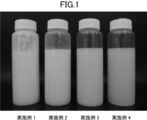
- FIG. 1 is a diagram showing Examples 1 to 4.
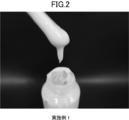
- FIG. 2 is a diagram illustrating the state of the thickening composition of Example 1.
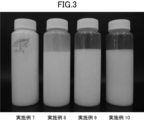
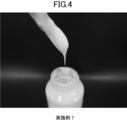
- FIG. 3 is a diagram showing Examples 7 to 10. 4 is a diagram showing the state of the thickening composition of Example 7.
- FIG. 1 is a diagram showing Examples 1 to 4.
- FIG. 2 is a diagram illustrating the state of the thickening composition of Example 1.
- FIG. 1 is a diagram showing Examples 1 to 4.
- FIG. 2 is a diagram illustrating the state of the thickening composition of Example 1.
- FIG. 1 is a diagram showing Examples 1 to 4.
- FIG. 2 is a diagram illustrating the state of the thickening composition of Example 1.
- the “liquid component thickener” (hereinafter also referred to as “thickener”) of the present invention contains an oil or fat composition described below as an essential component.
- the oil / fat composition of the present invention contains an oil / fat component containing one or more XXX type triglycerides having a fatty acid residue X having carbon number x at positions 1 to 3 of glycerin, and the carbon number x is 10 to 22 is an integer selected from 22, wherein the XXX type triglyceride is contained in an amount of 50% by mass or more based on 100% by mass of the oil / fat component.
- the oil and fat composition of the present invention is a powdery oil and fat composition in a solid state, wherein the oil and fat component includes ⁇ -type oil and fat, and the particles of the powder and fat composition have a plate shape,
- a powdered oil / fat composition (hereinafter referred to as a powdered oil / fat composition) produced from the above liquid oil / fat composition, wherein the loose bulk density of the powdered oil / fat composition is 0.05 to 0.6 g / cm 3 . It is also called).
- the fat composition used in the thickener of the present invention (especially the powdery fat composition) will be described in detail.
- the oil and fat composition of the present invention contains an oil and fat component regardless of whether it is liquid or powdered.
- the fat component contains at least XXX type triglyceride, and optionally other triglycerides.
- the oil / fat component contains ⁇ -type oil / fat.
- the ⁇ -type fats and oils are fats and oils composed only of ⁇ -type crystals, which is one of crystal polymorphs of fats and oils.
- crystalline polymorphic fats and oils include ⁇ ′ type fats and oils and ⁇ type fats and oils, and ⁇ ′ type fats and oils are fats and oils composed only of ⁇ ′ type crystals that are one of the polymorphic forms of fats and oils.
- ⁇ -type fats and oils are fats and oils composed only of ⁇ -type crystals, which is one of crystal polymorphs of fats and oils.
- Some fats and oils crystals have the same composition but have different sublattice structures (crystal structures) and are called crystal polymorphs.
- the melting points of each polymorph increase in the order of ⁇ , ⁇ ′, ⁇ , and the melting point of each polymorph varies depending on the type of fatty acid residue X having carbon number x. , Trilaurin, trimyristin, tripalmitin, tristearin, triarachidin, and tribehenine, the melting point (° C.) of each polymorph is shown.
- Table 1 was prepared based on Nissim Garti et al., “Crystallization and Polymorphism of Fats and Fatty Acids”, Marcel Dekker Inc., 1988, pp. 32-33. In preparing Table 1, the melting point temperature (° C.) was rounded to the first decimal place. Further, if the composition of the oil and fat and the melting point of each polymorph are known, it can be detected whether or not ⁇ -type oil or fat is present in the oil or fat.
- d is a lattice constant
- ⁇ is a diffraction (incident) angle
- ⁇ is an X-ray wavelength
- the crystal polymorphism of the above fats and oils can also be predicted by a differential scanning calorimetry (DSC method).
- DSC method differential scanning calorimetry
- the prediction of ⁇ -type fats and oils is based on a DSC curve obtained by heating up to 100 ° C. at a rate of temperature increase of 10 ° C./min with a differential scanning calorimeter (product number, BSC 6220, manufactured by SII Nano Technology Co., Ltd.). This is done by predicting the crystal structure of the oil.
- the oil-and-fat component may contain ⁇ -type oil or fat, or may contain ⁇ -type oil and fat as a main component (greater than 50% by mass).
- the oil and fat component is substantially composed of ⁇ -type oil and fat, and a more preferable embodiment is that the oil and fat component is composed of ⁇ -type oil and fat, and a particularly preferable embodiment is that the oil and fat component consists of ⁇ -type oil and fat. Is.
- the case where all of the oil and fat components are ⁇ -type oils and fats is a case where ⁇ -type oils and / or ⁇ ′-type oils and fats are not detected by differential scanning calorimetry.
- the above fat component (or powdered fat composition containing the fat component) has a diffraction peak in the vicinity of 4.5 to 4.7 mm, preferably in the vicinity of 4.6 mm in the X-ray diffraction measurement.
- the fat component in the present invention includes “ ⁇ -type fat” and an index of the relative amount of ⁇ -type fat with respect to ⁇ -type fat and ⁇ -type fat is the ⁇ -type characteristic peak among the X-ray diffraction peaks. Intensity ratio between [alpha] -type characteristic peak and [[beta] -type characteristic peak intensity / [[alpha] -type characteristic peak intensity + [beta] -type characteristic peak intensity)] (hereinafter also referred to as peak intensity ratio). ).
- it is preferable that all of the oil and fat components are ⁇ -type oils and fats (that is, peak intensity ratio 1).
- the lower limit value of the peak intensity ratio is, for example, 0.4 or more, preferably 0.
- the ⁇ -type oil can be regarded as having a main component of more than 50% by mass.
- the upper limit of the peak intensity ratio is preferably 1, but 0.99 or less, 0.98 or less, 0.95 or less, 0.93 or less, 0.90 or less, 0.85 or less, 0.80 or less Etc.
- the peak intensity ratio may be any one or any combination of the above lower limit value and upper limit value.
- the oil and fat component of the present invention includes one or more XXX type triglycerides having a fatty acid residue X having x carbon atoms at the 1st to 3rd positions of glycerin, whether liquid or powdery.
- the XXX type triglyceride is a triglyceride having a fatty acid residue X having x carbon atoms at the 1st to 3rd positions of glycerin, and each fatty acid residue X is the same as each other.
- the carbon number x is an integer selected from 10 to 22, preferably an integer selected from 12 to 22, more preferably an integer selected from 14 to 20, and still more preferably selected from 16 to 18 Is an integer.
- the fatty acid residue X may be a saturated or unsaturated fatty acid residue. Specific examples of the fatty acid residue X include residues such as capric acid, lauric acid, myristic acid, palmitic acid, stearic acid, arachidic acid, and behenic acid, but are not limited thereto.
- fatty acids More preferred as fatty acids are lauric acid, myristic acid, palmitic acid, stearic acid, arachidic acid and behenic acid, more preferred are myristic acid, palmitic acid, stearic acid and arachidic acid, and even more preferred is palmitic acid. Acids and stearic acid.
- the content of the XXX type triglyceride is 50% by mass or more, preferably 60% by mass or more, more preferably 70% by mass or more, and still more preferably 80% by mass, when the total mass of the fat and oil component is 100% by mass.
- the lower limit is, for example, 100% by mass or less, preferably 99% by mass or less, and more preferably 95% by mass or less.
- XXX type triglycerides can be used singly or in combination of two or more, preferably one or two, more preferably one. When there are two or more types of XXX type triglycerides, the total value is the content of XXX type triglycerides.
- the oil and fat component of the present invention may be liquid or powdery and may contain other triglycerides other than the XXX type triglyceride as long as the effects of the present invention are not impaired.
- the other triglycerides may be a plurality of types of triglycerides, and may be synthetic fats and oils or natural fats and oils. Examples of synthetic fats and oils include glyceryl tricaprylate and glyceryl tricaprate. Examples of natural fats and oils include cocoa butter, sunflower oil, rapeseed oil, soybean oil, and cottonseed oil.
- the total triglyceride in the oil and fat component of the present invention is 100% by mass, there is no problem even if other triglycerides are contained in an amount of 1% by mass or more, for example, about 5 to 50% by mass.
- the content of other triglycerides is, for example, 0 to 30% by mass, preferably 0 to 18% by mass, more preferably 0 to 15% by mass, and further preferably 0 to 8% by mass.
- the oil and fat composition of the present invention may be liquid or powdery, and in addition to the above oil and fat components such as triglycerides, optionally emulsifiers, fragrances, skim milk powder, whole milk powder, cocoa powder, sugar Other components such as dextrin may be included.
- the amount of these other components may be any amount as long as the effects of the present invention are not impaired. For example, when the total mass of the oil and fat composition is 100% by mass, 0 to 70% by mass, preferably It is 0 to 65% by mass, more preferably 0 to 30% by mass.
- the other components are preferably a powder having an average particle size of 1000 ⁇ m or less, and more preferably a powder having an average particle size of 500 ⁇ m or less.
- the average particle diameter here is a value measured by a laser diffraction scattering method (ISO133201 and ISO9276-1).
- the preferred oil and fat composition of the present invention preferably consists essentially of the above oil and fat component, and the oil and fat component preferably consists essentially of only a triglyceride.
- substantially means a component other than the fat component contained in the fat composition or a component other than the triglyceride contained in the fat component, when the fat composition or fat component is 100% by mass, for example, 0 to 15% by mass, preferably 0 to 10% by mass, more preferably 0 to 5% by mass.
- the powdered fat and oil composition of the present invention is prepared by melting an oil and fat composition containing one or more XXX type triglycerides having a fatty acid residue X having a carbon number x at the 1st to 3rd positions of glycerin, and keeping it at a specific cooling temperature.
- a powdery oil / fat composition can be obtained without employing special processing means such as mechanical pulverization by a pulverizer such as spray or mill.
- step (a) preparing an oil / fat composition containing the XXX type triglyceride, and optionally heating the oil / fat composition obtained in step (a) as step (b), in the oil / fat composition
- the oil and fat composition in a molten state is obtained by dissolving the triglyceride contained in the powder, and (d) the oil and fat composition is cooled and solidified to contain the ⁇ -type oil and fat, and the particle shape of the powder and fat composition is plate-like Get things.
- the powder oil composition can also be produced by applying known pulverization processing means such as a hammer mill and a cutter mill to the solid obtained after cooling.
- fine refers to the case where the primary particles (smallest size crystals) are, for example, 20 ⁇ m or less, preferably 15 ⁇ m or less, more preferably 10 ⁇ m. Moreover, if it does not cool in such a temperature range, (beta) type fats and oils will not be produced
- the powdery fat composition of the present invention is a powdery solid at ordinary temperature (20 ° C.).
- Loose bulk density of the powder fat and oil composition of the present invention for example, be comprised of substantially only the oil component, 0.05 ⁇ 0.6g / cm 3, preferably 0.1 ⁇ 0.5g / cm 3, More preferably, it is 0.15-0.4 g / cm 3 , and still more preferably 0.2-0.3 g / cm 3 .
- the “loosened bulk density” is a packing density in a state where the powder is naturally dropped.
- the loose bulk density (g / cm 3 ) is measured by, for example, dropping an appropriate amount of the powdered fat composition from about 2 cm above the upper opening end of the graduated cylinder into a graduated cylinder with an inner diameter of 15 mm ⁇ 25 mL, It can be determined by measuring the filled mass (g) and reading the volume (mL), and calculating the mass (g) of the powdered oil / fat composition per mL.
- the loose bulk density can also be calculated from the bulk specific gravity measured based on JIS K-6720 (or ISO 1060-1 and 2) using a bulk density measuring instrument of Kuramochi Scientific Instruments.
- the powdered fat composition of the present invention usually has a plate-like particle shape, for example, 5 to 200 ⁇ m, preferably 10 to 150 ⁇ m, more preferably 20 to 120 ⁇ m, and even more preferably 25 to It has an average particle diameter (effective diameter) of 100 ⁇ m.
- the average particle diameter (effective diameter) can be determined based on a laser diffraction scattering method (ISO133201, ISO9276-1) with a particle size distribution measuring device (for example, Microtrac MT3300ExII manufactured by Nikkiso Co., Ltd.).
- the effective diameter means the particle diameter of the spherical shape when the actually measured diffraction pattern of the crystal to be measured matches the theoretical diffraction pattern obtained on the assumption that it is spherical.
- the effective diameter is calculated by fitting the theoretical diffraction pattern obtained on the assumption of a sphere and the actual diffraction pattern, so even if the measurement target is a plate shape Even a spherical shape can be measured by the same principle.
- the plate-like shape preferably has an aspect ratio of 1.1 or more, more preferably an aspect ratio of 1.2 or more, still more preferably 1.2 to 3.0, particularly preferably The aspect ratio is 1.3 to 2.5, particularly preferably 1.4 to 2.0.
- the aspect ratio here is defined as the ratio of the length of the long side to the length of the short side of the particle figure surrounded by a rectangle circumscribing so as to minimize the area. Further, when the particles are spherical, the aspect ratio is smaller than 1.1. In the conventional method, in which oils with a high solid fat content such as extremely hardened oil are dissolved and sprayed directly, the particles of the powdered oil composition become spherical due to surface tension, and the aspect ratio is less than 1.1. Become.
- the aspect ratio is measured, for example, by measuring the length in the major axis direction and the length in the minor axis direction of the arbitrarily selected particles by direct observation with an optical microscope, a scanning electron microscope, or the like. It can obtain
- the powdered fat composition of the present invention comprises the following steps: (A) preparing an oil and fat composition containing XXX type triglyceride, (B) The optional step of heating the fat composition obtained in step (a) arbitrarily, etc., and dissolving the triglyceride contained in the fat composition to obtain the molten fat composition, (D) A step of cooling and solidifying the oil / fat composition to obtain a powdered oil / fat composition containing ⁇ -type oil / fat and having a plate-like particle shape; It can manufacture by the method containing.
- stimulating powder production as a process (c) for example, (c1) Seeding process, (c2) Tempering process, and / or (c3) A pre-cooling step may be included.
- the powdered fat composition obtained in the step (d) may be obtained by the step (e) of obtaining a powdery fat composition by grinding the solid obtained after cooling in the step (d). Good.
- the steps (a) to (e) will be described.
- the oil and fat composition containing the XXX type triglyceride prepared in the step (a) contains one or more XXX type triglycerides having a fatty acid residue X having x carbon atoms at the 1st to 3rd positions of glycerin. It is produced based on a method for producing oils and fats such as ordinary XXX type triglycerides, or can be easily obtained from the market.
- the XXX-type triglyceride specified by the carbon number x and the fatty acid residue X is the same as that of the finally obtained fat component except for the crystal polymorph.
- the fat and oil composition may contain ⁇ -type fat and oil, for example, the content of ⁇ -type fat and oil contains 0.1% by mass or less, 0.05% by mass or less, or 0.01% by mass or less. Also good. However, since the ⁇ -type oil and fat disappears when the oil and fat composition is brought into a molten state by heating and the like, the oil and fat composition may be a molten oil and fat composition. For example, when the oil / fat composition is in a molten state, not substantially containing ⁇ -type oil / fat means not only XXX-type triglycerides, but also cases where not all oil / fat components are ⁇ -type oil / fat.
- the presence of ⁇ -type fats and oils can be confirmed by confirming the diffraction peaks caused by ⁇ -type fats and oils by the above-mentioned X-ray diffraction measurement, ⁇ -type fats and oils by differential scanning calorimetry, and the like.
- the amount of ⁇ -type oil / fat in the case of “substantially free of ⁇ -type oil / fat” is the intensity ratio between the characteristic peak of ⁇ -type and the characteristic peak of ⁇ -type among the X-ray diffraction peaks [characteristic of ⁇ -type It can be assumed from the following: intensity of target peak / (intensity of characteristic peak of ⁇ type + intensity of characteristic peak of ⁇ type)] (peak intensity ratio).
- the said peak intensity ratio of the said fats and oils composition is 0.2 or less, for example, Preferably, it is 0.15 or less, More preferably, it is 0.10 or less.
- the oil and fat composition may contain one or more XXX triglycerides as described above, preferably one or two, more preferably one.
- the XXX type triglyceride can be produced by direct synthesis using a fatty acid or a fatty acid derivative and glycerin.
- a method of directly synthesizing XXX type triglyceride (i) a method of directly esterifying a fatty acid having X carbon atoms and glycerin (direct ester synthesis), (ii) a carboxyl group of fatty acid X having carbon number x is an alkoxyl group
- the method (acid halide synthesis
- XXX type triglycerides can be produced by any of the above-mentioned methods (i) to (iii), but from the viewpoint of ease of production, (i) direct ester synthesis or (ii) transesterification synthesis using fatty acid alkyl is Preferably, (i) direct ester synthesis is more preferred.
- reaction temperature in the (i) direct ester synthesis of the XXX type triglyceride may be a temperature at which the water produced by the esterification reaction can be removed out of the system, for example, preferably 120 ° C. to 300 ° C. More preferably, 180 ° C. to 250 ° C. is even more preferable. By carrying out the reaction at 180 to 250 ° C., XXX type triglyceride can be produced particularly efficiently.
- a catalyst for promoting the esterification reaction may be used.
- the catalyst include an acid catalyst and an alkaline earth metal alkoxide.
- the amount of the catalyst used is preferably about 0.001 to 1% by mass relative to the total mass of the reaction raw materials.
- the catalyst and raw material unreacted substances are removed by performing known purification treatments such as washing with water, alkaline deoxidation and / or vacuum deoxidation, and adsorption treatment. can do.
- the obtained reaction product can be further purified by performing decolorization / deodorization treatment.
- the amount of the XXX type triglyceride contained in the oil / fat composition is, for example, 100 to 50% by mass, preferably 95 to 55% by mass when the total mass of all triglycerides contained in the oil / fat composition is 100% by mass. %, More preferably 90 to 60% by mass. Even more preferably, it is 85 to 65% by mass.
- triglycerides to be an oil and fat composition containing XXX type triglyceride various triglycerides may be included in addition to the above XXX type triglyceride as long as the effects of the present invention are not impaired.
- triglycerides for example, an X2Y type triglyceride in which one fatty acid residue X of the XXX type triglyceride is substituted with a fatty acid residue Y, and two fatty acid residues X in the XXX type triglyceride are substituted with a fatty acid residue Y.
- XY2 type triglyceride etc. can be mentioned.
- the amount of the other triglycerides is, for example, 0 to 100% by mass, preferably 0 to 70% by mass, more preferably 1 to 40% by mass, when the total mass of the XXX type triglyceride is 100% by mass.
- a natural triglyceride composition obtained by hydrogenation, transesterification or fractionation may be used.
- naturally occurring triglyceride compositions include rapeseed oil, soybean oil, sunflower oil, high oleic sunflower oil, safflower oil, palm stearin, and mixtures thereof.
- hardened oils, partially hardened oils and extremely hardened oils of these naturally derived triglyceride compositions More preferred are hard palm stearin, high oleic sunflower oil extremely hardened oil, rapeseed extremely hardened oil, and soybean extremely hardened oil.
- examples of the oil / fat composition of the present invention include a commercially available triglyceride composition or synthetic oil / fat.
- a triglyceride composition hard palm stearin (manufactured by Nisshin Oillio Group Co., Ltd.), rapeseed extremely hardened oil (manufactured by Yokoseki Yushi Kogyo Co., Ltd.), soybean super hardened oil (manufactured by Yokoseki Yushi Kogyo Co., Ltd.) can be mentioned. it can.
- Synthetic fats and oils include tripalmitin (manufactured by Tokyo Chemical Industry Co., Ltd.), tristearin (manufactured by Sigma Aldrich), tristearin (manufactured by Tokyo Chemical Industry Co., Ltd.), triarachidin (manufactured by Tokyo Chemical Industry Co., Ltd.) and tribehenine (manufactured by Tokyo Chemical Industry Co., Ltd.). Manufactured by Kogyo Co., Ltd.).
- palm extremely hardened oil has a low content of XXX type triglyceride, and therefore can be used as a dilute component of triglyceride.
- the oil / fat composition may optionally contain other components such as a partial glyceride, a fatty acid, an antioxidant, an emulsifier, a solvent such as water, in addition to the triglyceride.
- the amount of these other components may be any amount as long as the effects of the present invention are not impaired. For example, when the total mass of the XXX triglyceride is 100% by mass, 0 to 5% by mass, preferably It is 0-2% by mass, more preferably 0-1% by mass.
- the said oil-fat composition contains two or more components, you may mix arbitrarily. Any known mixing method may be used for mixing as long as a homogeneous reaction substrate can be obtained. For example, a paddle mixer, an adihomo mixer, a disper mixer, or the like can be used. You may mix the said heating under a heating as needed.
- the heating is preferably at the same level as the heating temperature in the step (b) described later, for example, 50 to 120 ° C., preferably 60 to 100 ° C., more preferably 70 to 90 ° C., more preferably 80 ° C. Is called.
- the heating of the oil / fat composition is performed at a temperature equal to or higher than the melting point of the triglyceride contained in the oil / fat composition, particularly at a temperature at which the XXX type triglyceride can be melted, for example, 70 to 200 ° C., preferably 75 to 150 ° C.
- the temperature is preferably 80 to 100 ° C.
- the heating is suitably continued, for example, for 0.1 to 3 hours, preferably 0.3 to 2 hours, more preferably 0.5 to 1 hour.
- the liquid oil-fat composition in the molten state which is one of the thickeners of the present invention is produced by the step (a) or (b).
- the powdery fat composition in the solid state which is another thickener of the present invention is further produced by the following step (d).
- Step D Step of cooling the molten fat composition to obtain a powdered fat composition
- the molten fat composition prepared in the above step (a) or (b) is further cooled and solidified to form a ⁇ -type fat.
- a powdery fat composition having a plate shape of the particle shape is formed.
- the upper limit value of the cooling temperature is obtained by changing the molten oil composition from the melting point of the ⁇ -type oil of the oil component contained in the oil composition. It is necessary to keep it at a low temperature.
- “Temperature lower than the melting point of the ⁇ -type oil and fat of the fat and oil component contained in the fat and oil composition” means, for example, in the case of XXX type triglyceride having 3 stearic acid residues having 18 carbon atoms, the melting point of the ⁇ -type oil and fat is 74 (Table 1), it is 1-30 ° C. lower than the melting point (ie 44-73 ° C.), preferably 1-20 ° C. lower than the melting point (ie 54-73 ° C.), more preferably the melting point.
- 1-15 ° C lower temperature ie 59-73 ° C
- 1 ° C, 2 ° C, 3 ° C, 4 ° C, 5 ° C, 6 ° C, 7 ° C, 8 ° C, 9 ° C or 10 ° C lower It is. More preferably, in order to obtain the ⁇ -type oil and fat, it is appropriate to keep the cooling temperature lower than the cooling temperature obtained from the following formula as the lower limit value of the cooling temperature.
- Cooling temperature (° C.) Carbon number ⁇ 6.6 ⁇ 68 (In the formula, carbon number x is carbon number x of XXX type triglyceride contained in the oil and fat composition)
- the cooling temperature is set to ⁇ -type fats other than ⁇ -type fats and ⁇ ′-type fats and oils other than ⁇ -type fats. This is because it is necessary to set a temperature at which crystallization does not occur. Since the cooling temperature mainly depends on the molecular size of the XXX type triglyceride, it can be understood that there is a certain correlation between the carbon number x and the lower limit of the optimum cooling temperature.
- the lower limit of the cooling temperature is 50.8 ° C. or higher. Therefore, in the case of the XXX type triglyceride having 3 stearic acid residues having 18 carbon atoms, the temperature for “cooling and solidifying the molten oil composition” is more preferably 50.8 ° C. or more and 72 ° C. or less. Moreover, when XXX type
- the XXX type triglyceride contained in the oil and fat composition is a mixture of XXX type triglyceride having 3 palmitic acid residues having 16 carbon atoms and XXX type triglyceride having 3 stearic acid residues having 18 carbon atoms.
- the lower limit of the cooling temperature is 37.6 ° C. or higher in accordance with the smaller carbon number of 16.
- the lower limit value of the cooling temperature is suitably a temperature equal to or higher than the melting point of the ⁇ -type oil or fat corresponding to the ⁇ -type oil or fat of the oil or fat composition containing XXX type triglyceride.
- the XXX type triglyceride contained in the oil and fat composition is a XXX type triglyceride having 3 stearic acid residues having 18 carbon atoms
- the melting point is 55 ° C. (Table 1)
- the temperature for “cooling and solidifying the molten oil composition” in this case is preferably 55 ° C. or more and 72 ° C. or less.
- the cooling of the fat and oil composition in the molten state is performed, for example, when x is 10 to 12, the final temperature is preferably ⁇ 2 to 46 ° C., more preferably 12 to 44 ° C., and still more preferably 14 This is done by cooling to a temperature of ⁇ 42 ° C.
- the final temperature in cooling is preferably 24 to 56 ° C., more preferably 32 to 54 ° C., still more preferably 40 to 52 ° C., and when x is 15 or 16, Preferably it is 36 to 66 ° C., more preferably 44 to 64 ° C., further preferably 52 to 62 ° C., and when x is 17 or 18, it is preferably 50 to 72 ° C., more preferably 54 to 70 ° C. Preferably, it is 58 to 68 ° C. When x is 19 or 20, it is preferably 62 to 80 ° C, more preferably 66 to 78 ° C, still more preferably 70 to 77 ° C, and when x is 21 or 22.
- At the final temperature for example, preferably 2 hours or more, more preferably 4 hours or more, still more preferably 6 hours or more, preferably 2 days or less, more preferably 24 hours or less, still more preferably 12 hours or less, It is appropriate to stand still.
- step (a) or (b) and step (d) is after step (a) or (b) in step (a) or (b) and in step (d). It means to include the previous step (d).
- the seeding method (c1) and the tempering method (c2) are performed before the cooling to the final temperature in order to make the fat and oil composition in a molten state more reliable in the production of the fat and oil composition of the present invention.
- This is a method for accelerating the production of powder for treating an oil and fat composition in a molten state.
- the seeding method (c1) is a method in which a small amount of a component that becomes a powder core (seed) is added at the time of cooling the molten oil composition to promote thickening.
- XXX type triglyceride having the same carbon number as that of the XXX type triglyceride in the oil and fat composition is preferably 80% by mass or more.
- an oil and fat powder containing 90% by mass or more is prepared as a component serving as a nucleus (seed).
- the temperature of the fat and oil composition reaches, for example, the final cooling temperature ⁇ 0 to + 10 ° C., preferably +5 to + 10 ° C.
- the thickening of the fat and oil composition is promoted.
- the tempering method (c2) is a temperature lower than the cooling temperature in the step (d), for example, 5 to 20 ° C. before cooling at the final cooling temperature in cooling the fat and oil composition in a molten state.
- the thickening of the fat composition is promoted by cooling to a temperature, preferably 7 to 15 ° C lower, more preferably about 10 ° C lower, preferably 10 to 120 minutes, more preferably 30 to 90 minutes. It is a method to do.
- the pre-cooling method (c3) is an oil / fat containing the XXX type triglyceride before the molten oil / fat composition obtained in the step (a) or (b) is cooled in the step (d).
- C3 Subsequent to the precooling method, cooling is performed at the cooling temperature at the time of cooling the oil and fat composition in the step (d).
- the temperature higher than the cooling temperature of step (d) is, for example, a temperature 2 to 40 ° C. higher than the cooling temperature of step (d), preferably a temperature higher by 3 to 30 ° C., more preferably a temperature higher by 4 to 30 ° C., More preferably, the temperature may be as high as 5 to 10 ° C.
- the lower the temperature for the preliminary cooling the shorter the main cooling time at the cooling temperature in the step (d). That is, unlike the seeding method or the tempering method, the pre-cooling method is a method that can accelerate the thickening of the fat composition simply by lowering the cooling temperature step by step, and has a great advantage in industrial production. .
- Step of obtaining a powdered fat composition by pulverizing a solid matter is more specifically a solid matter obtained by cooling in the step (d). It may be performed by the process (e) which grind
- the fat and oil composition that has become a solid having voids can be pulverized by applying a light impact, and the solid is easily disintegrated into a powder form.
- a means for applying a light impact is not particularly specified, but a method of lightly applying vibration (impact) and pulverizing (raising) by shaking, sieving, etc. is simple and preferable.
- the solid material may be pulverized by a known pulverization means. Examples of such pulverization means include a hammer mill and a cutter mill.
- the oil / fat composition used in the present invention (there are two forms of liquid and powder) is preferably substantially composed of only oil / fat.
- the fats and oils consist essentially of triglycerides.
- substantially means that the component other than the fat or oil contained in the fat or oil composition or the component other than the triglyceride contained in the fat or oil makes the oil or fat composition or fat and oil 100% by mass, for example, 0 to It means 15% by mass, preferably 0 to 10% by mass, more preferably 0 to 5% by mass.
- the thickener of this invention contains the above-mentioned oil and fat composition (there are two modes, liquid and powder) as an essential component.
- a powdery fat composition is used as the thickener of the present invention, a powder having an average particle size of 10 to 1000 ⁇ m is preferable, and a powder having an average particle size of 20 to 200 is more preferable. A powder of 50 to 100 ⁇ m is more preferable.
- a powder having the above average particle diameter is used, a smooth powder composition in which a liquid component and a thickener are uniformly distributed can be obtained.
- the average particle diameter here is a value measured by a laser diffraction scattering method (ISO133201 and ISO9276-1).
- the powder having the above average particle diameter can be produced using a known pulverization means generally used for the production of fats and oils, such as spraying or pulverizing machine.
- the thickener of this invention consists only of an oil-fat composition.
- the thickener of this invention may contain the arbitrary component in the range which does not impair the function as a thickener other than said oil-and-fat composition.
- An arbitrary component here means components other than the liquid component (object of thickening) mentioned later.
- Optional ingredients include emulsifiers, skim milk powder, whole milk powder, cocoa powder, sugar, dextrin and the like.
- the blending amount of the optional component is, for example, 0 to 70% by mass, preferably 0 to 65% by mass, more preferably 0 to 30% by mass when the total mass of the thickener is 100% by mass.
- the optional component is preferably a powder having an average particle size of 1000 ⁇ m or less, from the viewpoint that a smooth powder composition in which the liquid component and the thickener are uniformly distributed can be obtained. More preferably, it is a powder having an average particle size of 500 ⁇ m or less.
- the average particle diameter here is a value measured by a laser diffraction scattering method (ISO133201 and ISO9276-1).
- a liquid component means the liquid containing the functional substance contained in the product mentioned later.
- a liquid component means the component which is a liquid at normal temperature (20 degreeC).
- the viscosity of the liquid component can be measured using a B-type viscometer at room temperature (20 ° C.).
- the functional substance a substance capable of imparting some function to a product can be used without particular limitation.
- the functional substance may be a substance that imparts the main function of the product (for example, an active ingredient in a pharmaceutical or functional food), or a substance that imparts a sub-function of the product (for example, a dye or a fragrance in a food). It may be.
- a functional substance may be used individually by 1 type, and may combine 2 or more types suitably.
- Functional materials can be classified into hydrophobic materials and hydrophilic materials.
- hydrophobic substance what is blended as a functional substance in a product described later can be used without particular limitation.
- Specific examples include fragrances, pigments, vitamins, lipids and proteins (hydrophobic peptides).
- the present invention can be suitably applied to fragrances, pigments, vitamins and lecithin.
- flavor what is mix
- menthol examples include menthol, cocoa (powder, extract, etc.), esters (eg, isoamyl acetate, linalyl acetate, isoamyl propionate, linalyl butyrate, etc.), natural essential oils (vegetable essential oils such as vanilla extract, Spearmint, peppermint, cassia, jasmine, etc .; animal essential oils such as musk, ambergris, civet, castrium, etc., simple flavors (eg, anethole, limonene, linalool, eugenol, vanillin, etc.) Oil, onion oil, etc.).
- esters eg, isoamyl acetate, linalyl acetate, isoamyl propionate, linalyl butyrate, etc.
- natural essential oils vegetable essential oils such as vanilla extract, Spearmint, peppermint, cassia, jasmine, etc .
- animal essential oils such
- limonene, vanillin, roasted shrimp oil, onion oil and the like can be mentioned.
- the pigment for example, those blended in foods and drinks, cosmetics, quasi drugs, pharmaceuticals, and the like can be used without particular limitation. Specific examples include orange dyes, yellow dyes, magenta dyes, and cyan dyes.
- vitamins for example, those blended in foods and drinks, cosmetics, quasi drugs and pharmaceuticals can be used without particular limitation. Specific examples include vitamin E, vitamin A, vitamin D and vitamin K.
- lipid what is mix
- hydrophobic means low solubility in water. Here, less than 1 ⁇ g is dissolved per 1 ml of water. Things are defined as hydrophobic.
- One kind of hydrophobic substance may be used alone, or two or more kinds of hydrophobic substances may be used in combination as appropriate.
- the liquid component may be a solution of a hydrophobic substance.
- a solvent capable of dissolving a hydrophobic substance can be used without particular limitation. Specific examples include liquid oil, alcohol and organic solvents.
- the solution of the hydrophobic substance it is preferable that the solution itself is hydrophobic.
- liquid oil what is mix
- rapeseed oil canola oil
- examples thereof include edible oils and fats such as oil, coconut oil, tea seed oil, MCT oil (excluding XXX type triglyceride constituting the above-mentioned thickener), and MLCT oil.
- Specific examples include lower alcohols such as methyl alcohol, ethyl alcohol, n-propyl alcohol, isopropyl alcohol, or butyl alcohol.
- As an organic solvent what is mix
- Specific examples include ethyl acetate, butyl acetate, diethyl ether, methyl ether, methyl isobutyl ketone, hexane, acetone or chloroform.
- a solvent may be used individually by 1 type and may be used as a mixture combining 2 or more types as appropriate.
- the hydrophobic substance content in the solution is not particularly limited, but is, for example, 1 to 99% by mass, preferably 5 to 80% by mass, and more preferably 10 to 60% by mass with respect to the total mass of the solution.
- the liquid component may be an emulsion of a hydrophobic substance.
- a dispersion medium constituting the emulsion a medium capable of dispersing a hydrophobic substance can be used without particular limitation. Specific examples include water, glycerin, sugar alcohol, liquid oil and the like, preferably water, glycerin and liquid oil, more preferably water and glycerin.
- a dispersion medium may be used individually by 1 type, and may combine 2 or more types suitably.
- the emulsion may contain an emulsifier.
- the emulsifier those capable of dispersing a hydrophobic substance can be used without particular limitation. Specific examples include glycerin fatty acid ester, propylene glycol fatty acid ester, sucrose fatty acid ester, polyglycerin fatty acid ester, sorbitan fatty acid ester, fatty acid salt, alkyl sulfate ester, alkylamine salt, quaternary ammonium salt, alkylbetaine, lecithin, Quillaja extract, gum arabic, tragacanth gum, guar gum, karaya gum, xanthan gum, pectin, pullulan, cyclodextrin, alginic acid and its salts, carrageenan, gelatin, casein, starch, starch derivatives, etc., preferably glycerin fatty acid ester, propylene Glycol fatty acid ester, sucrose fatty acid ester, poly
- the content of the hydrophobic substance in the emulsion is not particularly limited, but is, for example, 1 to 99% by mass, preferably 5 to 80% by mass, and more preferably 10 to 60% by mass with respect to the total mass of the solution.
- the liquid component may be a material in which the hydrophobic substance itself is melted (melt).
- the liquid component is composed only of a hydrophobic substance.
- hydrophobic substances that can be used as a melt include vitamin E, limonene, vanillin, and the like.
- ⁇ Hydrophilic substance> As a hydrophilic substance, what is blended as a functional substance in a product described later can be used without particular limitation. Specific examples include fragrances, pigments, vitamins, carbohydrates, proteins (hydrophilic peptides), nucleic acids, and the like. Among these, the present invention can be suitably applied to fragrances, pigments and vitamins. As a fragrance
- aqueous flavors for example, shrimp flavor
- natural plant flavors for example, licorice, St.
- acids for example, malic acid, tartaric acid, citric acid, butyric acid, etc.
- Etc As the pigment, for example, those blended in foods and drinks, cosmetics, quasi drugs, pharmaceuticals, and the like can be used without particular limitation. Specific examples include azine dyes, acridine dyes, triphenylmethane dyes, xanthene dyes, porphyrin dyes, cyanine dyes, phthalocyanine dyes, styryl dyes, pyrylium dyes, azo dyes, quinone dyes.
- Tetracycline dyes Tetracycline dyes, flavone dyes, polyene dyes, BODIPY (registered trademark) dyes, indigoid dyes, and the like.
- vitamins for example, those blended in foods and drinks, cosmetics, quasi drugs and pharmaceuticals can be used without particular limitation. Specific examples include vitamins B1, B2, B6, nicotinic acid, pantothenic acid, vitamin B12 and vitamin C.
- saccharide for example, those blended in foods and drinks, cosmetics, quasi drugs, pharmaceuticals, and the like can be used without particular limitation.
- polysaccharides such as starch, dextrin, ⁇ -cyclodextrin, dextran, pullulan, gum arabic, tragacanth and agar, monosaccharides such as glucose, fructose and galactose, and oligosaccharides.
- proteins include hydrophilic peptides. Peptides are a series of 3 or more amino acids. Hydrophilic means high solubility in water. Here, 1 ⁇ g or more is dissolved per 1 ml of water. Is defined as hydrophilic.
- nucleic acid examples include deoxyribonucleic acid (DNA), ribonucleic acid (RNA), DNA-RNA hybrid, oligonucleotide, polynucleotide, aptamer, peptide nucleic acid (PNA) and the like.
- a hydrophilic substance may be used individually by 1 type, and may be used as a mixture combining 2 or more types as appropriate.
- the liquid component may be a solution of a hydrophilic substance.
- a solvent capable of dissolving a hydrophilic substance can be used without particular limitation. Specific examples include water, alcohol and organic solvents, preferably water and alcohol, more preferably water.
- the solution of the said hydrophilic substance it is preferable that the said solution itself is hydrophilic.
- alcohol what is mix
- monohydric lower alcohols such as ethanol, n-propanol, isopropanol, and n-butanol
- dihydric alcohols such as 1,3-butylene glycol, ethylene glycol, and propylene glycol
- polyalkylene glycols such as polypropylene glycol
- polyhydric alcohols such as glycerin, diglycerin, trimethylolpropane, pentaerythritol, ru, and sorbitol.
- As an organic solvent what is mix
- glycols can be especially used without a restriction
- Specific examples include glycols, esters, ethers, and ketones.
- glycols include ethylene glycol and propylene glycol.
- Esters include esters of the above alcohols and glycols such as formic acid, acetic acid, propionic acid, specifically methyl formate, ethyl formate, butyl formate, methyl acetate, ethyl acetate, butyl acetate, and ethyl propionate. It can be illustrated.
- ethers include alkyl ethers of the alcohols and glycols, such as dimethyl ether, diethyl ether, dibutyl ether, methyl ethyl ether, ethyl butyl ether, ethylene glycol monobutyl ether, ethylene glycol monoethyl ether acetate, and propylene glycol. And monoethyl ether.
- ketones include acetone, diethyl ketone, methyl ethyl ketone, and acetophenone.
- a solvent may be used individually by 1 type and may be used as a mixture combining 2 or more types as appropriate.
- the content of the hydrophilic substance in the solution is not particularly limited, but is, for example, 1 to 99% by mass, preferably 5 to 80% by mass, and more preferably 10 to 70% by mass with respect to the total mass of the solution.
- the liquid component may be an emulsion of a hydrophilic substance.
- a dispersion medium constituting the emulsion a medium capable of dispersing a hydrophilic substance can be used without particular limitation. Specific examples include water, glycerin, sugar alcohol, liquid oil and the like, preferably water, glycerin and liquid oil, more preferably water and glycerin.
- a dispersion medium may be used individually by 1 type, and may combine 2 or more types suitably.
- the emulsion may contain an emulsifier.
- the emulsifier those capable of dispersing a hydrophilic substance can be used without particular limitation. Specific examples include sucrose fatty acid ester, polyglycerin fatty acid ester, organic acid monoglycerin fatty acid ester, lysolecithin and the like, preferably sucrose fatty acid ester, polyglycerin fatty acid ester and organic acid monoglycerin fatty acid ester, More preferred are sucrose fatty acid esters and organic acid monoglycerin fatty acid esters.
- One type of emulsifier may be used alone, or two or more types may be appropriately combined.
- the hydrophilic substance content in the emulsion is not particularly limited, but is, for example, 1 to 99% by mass, preferably 5 to 80% by mass, and more preferably 10 to 60% by mass with respect to the total mass of the solution.
- the liquid component may be a melt (melt) of the hydrophilic substance itself.
- the liquid component is composed only of a hydrophilic substance.
- the hydrophilic substance that can be used as the melt include water and sugar alcohol (for example, erythritol and maltitol).
- the liquid component may be a substance containing a hydrophobic substance and / or a hydrophilic substance, for example, a liquid food.
- a liquid food include milk, wine, fruit juice, beverages, yogurt and soup stock, preferably milk and fruit juice.
- the “fruit juice” includes 100% juice such as orange juice.
- the said food it is preferable that the said food itself is hydrophilic.
- the liquid component includes a solution or emulsion containing water as a functional substance, and water itself (functional substance only).
- a thickening composition containing a thickened liquid component (hereinafter simply referred to as “thickening composition”) is obtained by thickening the liquid component by subjecting the thickener and the liquid component to a mixing step. (Also called).
- the thickening agent used in the production of the thickening composition may be in a molten state (liquid) or in a solid state (powdered). A cooling step is necessary.
- the thickener which is a solid state (powder form) this cooling process can be skipped.
- the manufacturing method of the thickening composition using a thickener is demonstrated.
- the thickener applied to the mixing step may be in a molten state (liquid) or in a solid state (powder), but is preferably used in a molten state. By using it in a molten state, the thickener and the liquid component can be mixed well, and a more uniform thickening composition can be obtained.
- the amount of the liquid component used may be, for example, more than 30% by mass (that is, not including 30% by mass) to 99% by mass with respect to the total mass of the thickening composition (final product).
- the amount is preferably 40 to 97% by mass, more preferably 50 to 95% by mass.
- the liquid component can be thickened more sufficiently when the amount is as described above.
- Any known mixing means may be used for the mixing as long as a homogeneous mixture is obtained.
- a paddle mixer, an azimuth homomixer, a disper mixer, or the like can be used. You may perform mixing under a heating as needed.
- the mixing temperature is, for example, 5 to 120 ° C., preferably 50 to 100 ° C., more preferably 55 to 90 ° C.
- the mixing temperature is a temperature at which the liquid components do not decompose or denature.
- the mixing time is not particularly limited, but may be mixed until the thickener and the liquid component are sufficiently uniform, for example, 5 to 60 minutes, preferably 10 to 50 minutes, more preferably 20 to 40 minutes.
- the mixture of the thickener and the liquid component may be subsequently subjected to a cooling step to increase the viscosity.
- a cooling step to increase the viscosity.
- the mixture is in a liquid state, so that the thickening is generally performed in a cooling step.
- the fat-and-oil composition of a solid state (powder form) is used as the said thickener, a cooling process becomes an arbitrary process performed as needed.
- the cooling step refers to a step of cooling the mixture of the thickener and the liquid component to a predetermined final temperature. For example, when the liquid component contains a hydrophilic substance, the molten fat composition is used as the fat composition.
- Cooling temperature (° C.) Carbon number ⁇ 6.6 ⁇ 68 It is performed at a temperature higher than the cooling temperature required from If it cools in such a temperature range, beta type fats and oils can be produced
- the liquid component contains a hydrophilic substance
- the mixture is cooled, for example, when x is 10 to 12, the final temperature is preferably ⁇ 2 to 46 ° C., more preferably 12 to 44 ° C., and still more preferably 14 This is done by cooling to a temperature of ⁇ 42 ° C.
- the final temperature in cooling is preferably 24 to 56 ° C., more preferably 32 to 54 ° C., still more preferably 40 to 52 ° C., and when x is 15 or 16, Preferably it is 36 to 66 ° C., more preferably 44 to 64 ° C., further preferably 52 to 62 ° C., and when x is 17 or 18, it is preferably 50 to 72 ° C., more preferably 54 to 70 ° C. Preferably, it is 58 to 68 ° C. When x is 19 or 20, it is preferably 62 to 80 ° C, more preferably 66 to 78 ° C, still more preferably 70 to 77 ° C, and when x is 21 or 22.
- At the final temperature for example, preferably 2 hours or more, more preferably 4 hours or more, still more preferably 6 hours or more, preferably 2 days or less, more preferably 24 hours or less, still more preferably 12 hours or less, It is appropriate to stand still.
- the thickener dissolves in the liquid component and is homogenized. Therefore, the optimum final temperature tends to decrease as the content of the liquid component increases.
- the mixture is cooled when the content of the liquid component is 30 to 50% by mass and, for example, when x (the number of carbon atoms of the fatty acid residue X) is 10 to 12,
- the final temperature is preferably ⁇ 32 to 29 ° C., more preferably ⁇ 22 to 27 ° C., and even more preferably ⁇ 20 to 25 ° C.
- the final temperature in cooling is preferably ⁇ 6 to 39 ° C., more preferably 2 to 37 ° C., further preferably 10 to 35 ° C., and when x is 15 or 16, Preferably 6 to 49 ° C., more preferably 14 to 47 ° C., still more preferably 22 to 45 ° C., and when x is 17 or 18, preferably 20 to 55 ° C., more preferably 24 to 53 ° C. More preferably, it is 28 to 51 ° C. When x is 19 or 20, it is preferably 32 to 63 ° C, more preferably 36 to 61 ° C, still more preferably 40 to 60 ° C, and x is 21 or 22.
- the temperature is preferably 36 to 67 ° C, more preferably 40 to 65 ° C, and still more preferably 44 to 63 ° C.
- the temperature obtained by further lowering the above temperature by 5 ° C. is the optimum final temperature, and when the content of the liquid component is 75 to 9% by mass Is the optimum final temperature obtained by further lowering the above temperature by 10 ° C.
- At the above temperature for example, preferably 1 hour or more, more preferably 2 hours or more, still more preferably 4 hours or more, preferably 2 days or less, more preferably 24 hours or less, still more preferably 12 hours or less, static It is appropriate to place them.
- ⁇ Thickening acceleration step seeding method, tempering method and / or precooling method
- a seeding method, a tempering method, and / or a preliminary cooling method may be performed.
- “between the mixing step and the cooling step” means that after the mixing step, after the mixing step, before the cooling step, and during the cooling step.
- the seeding method (c1) mentioned above regarding manufacture of the powder oil-fat composition which comprises a thickener can be used.
- the tempering method (c2) mentioned above regarding manufacture of the powdered oil-fat composition which comprises a thickener can be used.
- the preliminary cooling method (c3) mentioned above regarding manufacture of the powdered oil-fat composition which comprises a thickener can be used.
- the fact that the liquid component can be easily thickened by using the thickener of the present invention is the characteristics of the oil and fat composition contained in the thickener. It is conceivable that. Specifically, when the XXX type triglyceride is adjusted to an appropriate temperature condition, it crystallizes in a very sparse state (a state where the volume increases and voids are formed), and at that time, a liquid component is taken into the voids, It becomes a solid and thickening is considered to be achieved. It is considered that the liquid component is taken into the voids similarly by adding a powdery thickener to the liquid component.
- the thickening composition obtained by applying the thickener of the present invention to a liquid component refers to all those having a viscosity higher than that of the liquid component before thickening. Those having fluidity (for example, pastes) and plastics are also included in the thickening composition referred to in the present invention.
- the thickening composition of the present invention is not a powdery composition.
- the thickening composition of the present invention has a viscosity greater than 1 time the viscosity of the liquid component. For example, it has a viscosity of 1.5 to 100 times. Preferably 2 to 75 times. More preferably, it has a viscosity of 5 to 50 times.
- the viscosity (normal temperature 20 ° C.) of the thickening composition can be measured using a B-type viscometer.
- the viscosity of the thickening composition itself of the present invention is not particularly limited because it depends on the viscosity of the liquid component that is the starting point. However, in consideration of convenience in handling, a fluid state is preferable.
- To 30000 mPa ⁇ s (mPa ⁇ s millipascal ⁇ second, B-type viscometer, 20 ° C., 6 to 60 rpm, No. 1 to 4), preferably 2 to 25000 mPa ⁇ s, more preferably 5 to 15000 mPa ⁇ s, The viscosity is more preferably 7 to 1000 mPa ⁇ s.
- the thickening composition obtained by applying the thickener of the present invention to a liquid component can be applied to various products without particular limitation depending on the function performed by the functional substance contained in the thickened liquid component.
- Specific examples of the product include foods and drinks, cosmetics, quasi drugs, pharmaceuticals, daily necessities, feed, sundries, agricultural chemicals, and chemical industrial products.
- the thickening composition itself may be used as a product (for example, a gel food), or may be used as a raw material or an intermediate for the above-mentioned product.
- the present invention also relates to a food or drink containing the above thickening composition.
- a palatability food is mentioned.
- the thickening composition itself may be sufficient as the food / beverage products of this invention, and the person who mix
- a palatability food what can mix
- fats or processed oils and fats for example, frying oil for business use or household use, fried oil, mold release oil, top plate oil, margarine, fat spread, shortening, flower paste, creams, powdered fats and oils, emulsified fats and oils.
- instant foods eg instant noodles, cup noodles, instant soups and stews
- retort foods and canned foods eg curry, soups, stews, pasta sauce, Chinese food ingredients, rice bowl ingredients
- Functional foods for example, high-calorie beverages, liquid foods, nutritionally balanced foods, dietary supplements and foods for specified health use
- flour or starch foods for example, pasta such as bread, macaroni and spaghetti, pizza pie, noodles, Cake mix, cooked rice, cereal, etc.
- confectionery and dessert eg caramel, candy, chewing gum, chocolate, Lucky biscuits, cakes, pies, snacks, crackers, Japanese confectionery, rice confectionery, bean confectionery, jelly, pudding, etc.
- basic seasonings eg, soy sauce, miso, sauces, etc.
- complex seasonings curry or stew roux
- Sauce dressing, mayonnaise-style seasoning, noodle soup, hot pot soy sauce, mustard oil, mustard, mustard, wasabi, grated ginger, garlic, kimchi, demiglace sauce, white sauce, tomato sauce
- Thickener Commercially available rapeseed extremely hardened oil (manufactured by Yokoseki Oil & Fat Co., Ltd.) was used as the oil and fat composition.
- fusing point of this oil-fat composition was about 67 degreeC, and was a solid state at normal temperature. This oil / fat composition becomes liquid when heated and melted.
- This oil / fat composition was used as thickener A below. Furthermore, 25 g of this oil / fat composition was completely melted by maintaining at 80 ° C. for 0.5 hour, cooled in a constant temperature bath at 55 ° C. for 12 hours to form a solid having voids with increased volume, and crystallized. Was completed, and then cooled to room temperature (25 ° C.). The obtained solid matter is loosened to obtain a solid (powdered) crystalline composition (relaxed bulk density: 0.2 g / cm 3, aspect ratio 1.6 (plate shape), average particle size 54 ⁇ m, X-ray diffraction measurement. Diffraction peak: 4.6 ⁇ (peak characteristic of ⁇ -type oil), peak intensity ratio: 0.89). This oil / fat composition was used as thickener A ′ below.
- Average particle diameter The average particle diameter was measured with a Nikkiso Co., Ltd. Microtrac MT3300Ex II) based on the laser diffraction scattering method (ISO133201, ISO9276-1).
- the viscosity of the liquid component and the viscosity of the thickening composition were measured using a B-type viscometer (Tokyo Keiki Co., Ltd., 20 ° C., 6 to 60 rpm, rotor Nos. 1 to 4).
- canola oil (viscosity: 71.2 mPa ⁇ s) was used as the liquid component. It can be said that the canola oil (manufactured by Nisshin Oillio Group, Inc.) used in Examples 1 to 6 contains a lipid (particularly triglyceride) as a hydrophobic substance, and the hydrophobic substance itself is melted (melt).
- Example 1 Thickener A ′ 40.0 g and canola oil 40.0 g 8 (manufactured by Maruemu Co., Ltd.) and mixed at 20 ° C. to obtain a thickening composition.
- the usage-amount of the liquid component was 50 mass% with respect to the total mass of a thickening composition (thickener A '+ liquid component).
- the resulting thickened composition was in a fluid state (paste-like) (FIG. 2), but could not be measured under the measurement conditions described above, and its viscosity was estimated to be 100,000 mPa ⁇ s or more.
- Example 2 Thickener A ′ 20.0 g and canola oil 60.0 g 8 (manufactured by Maruemu Co., Ltd.) and mixed at 20 ° C. to obtain a thickening composition.
- the usage-amount of the liquid component was 75 mass% with respect to the total mass of a thickening composition (thickener A '+ liquid component).
- the viscosity of the resulting thickening composition was 560.0 mPa ⁇ s (20 ° C., 6 rpm, No. 1).
- Example 3 Thickener A ′ 8.0 g and canola oil 72.0 g 8 (manufactured by Maruemu Co., Ltd.) and mixed at 20 ° C. to obtain a thickening composition.
- the usage-amount of the liquid component was 90 mass% with respect to the total mass of a thickening composition (thickener A '+ liquid component).
- the viscosity of the resulting thickening composition was 110.4 mPa ⁇ s (20 ° C., 30 rpm, No. 1).
- Example 4 Thickener A ′ 4.0 g and canola oil 76.0 g 8 (manufactured by Maruemu Co., Ltd.) and mixed at 20 ° C. to obtain a thickening composition.
- the usage-amount of the liquid component was 95 mass% with respect to the total mass of a thickening composition (thickener A '+ liquid component).
- the viscosity of the resulting thickening composition was 85.5 mPa ⁇ s (20 ° C., 60 rpm, No. 1).
- Example 5 Thickener A 8.0g and canola oil 72.0g 8 (manufactured by Maruemu Co., Ltd.) and mixed, maintained at 80 ° C. for 0.5 hours, completely melted and mixed. Next, the mixture was cooled in a thermostatic bath at 30 ° C. for 12 hours to obtain a thickening composition.
- the usage-amount of the liquid component was 90 mass% with respect to the total mass of a thickening composition (thickener A + liquid component).
- the viscosity of the thickening composition obtained was 128.3 mPa ⁇ s (20 ° C., 60 rpm, No. 2).
- Example 6 Thickener A 4.0g and canola oil 76.0g 8 (manufactured by Maruemu Co., Ltd.) and mixed, maintained at 80 ° C. for 0.5 hours, completely melted and mixed. Next, the mixture was cooled in a thermostatic bath at 30 ° C. for 12 hours to obtain a thickening composition.
- the usage-amount of the liquid component was 95 mass% with respect to the total mass of a thickening composition (thickener A + liquid component).
- the viscosity of the resulting thickening composition was 92.3 mPa ⁇ s (20 ° C., 60 rpm, No. 1).
- Table 2 shows the viscosity of the canola oil before thickening and the viscosity of the thickening composition obtained using the thickener A or A ′.
- Table 2 shows that the canola oil could be thickened using the thickener of the present invention. Further, it is shown that the thickener can be suitably used not only in a liquid state but also in a solid state (powdered state). In addition, when using the thing of a solid state, the cooling process was unnecessary.
- Triethylhexanoin (viscosity: 39.5 mPa ⁇ s) was used as the liquid component.
- Triethylhexanoin (trade name: TIO, manufactured by Nisshin Oilio Group Co., Ltd.) used in Examples 6 to 8 contains triethylhexanoin as a hydrophobic substance, and the hydrophobic substance itself is melted ( It can be said that it is a melt.
- Example 7 Thickener A ′ 40.0 g and triethylhexanoin 40.0 g 8 (manufactured by Maruemu Co., Ltd.) and mixed at 20 ° C. to obtain a thickening composition.
- the usage-amount of the liquid component was 50 mass% with respect to the total mass of a powder composition (thickener A '+ liquid component).
- the resulting thickening composition was in a fluid state (paste-like) (FIG. 4), but could not be measured under the measurement conditions described above, and its viscosity was estimated to be 100,000 mPa ⁇ s or more.
- Example 8 Thickener A ′ 20.0 g and triethylhexanoin 60.0 g 8 (manufactured by Maruemu Co., Ltd.) and mixed at 20 ° C. to obtain a thickening composition.
- the usage-amount of the liquid component was 75 mass% with respect to the total mass of a powder composition (thickener A '+ liquid component).
- the viscosity of the resulting thickening composition was 384.5 mPa ⁇ s (20 ° C., 12 rpm, No. 1).
- Example 9 Thickener A ′ 8.0 g and triethylhexanoin 72.0 g 8 (manufactured by Maruemu Co., Ltd.) and mixed at 20 ° C. to obtain a thickening composition.
- the usage-amount of the liquid component was 90 mass% with respect to the total mass of a powder composition (thickener A '+ liquid component).
- the viscosity of the resulting thickening composition was 62.4 mPa ⁇ s (20 ° C., 60 rpm, No. 1).
- Example 10 Thickener A ′ 4.0 g and triethylhexanoin 76.0 g 8 (manufactured by Maruemu Co., Ltd.) and mixed at 20 ° C. to obtain a thickening composition.
- the usage-amount of the liquid component was 95 mass% with respect to the total mass of a powder composition (thickener A '+ liquid component).
- the viscosity of the resulting thickening composition was 48.8 mPa ⁇ s (20 ° C., 60 rpm, No. 1).
- Table 3 shows the viscosity of triethylhexanoin before thickening and the viscosity of the thickening composition obtained using thickener A or A '.
- Table 3 shows that it was possible to thicken triethylhexanoin using the thickener of the present invention. In the case of using a powdered product, the cooling step was unnecessary.
- the present invention can be used in various fields such as food, medicine, agriculture and industry.
Landscapes
- Chemical & Material Sciences (AREA)
- Life Sciences & Earth Sciences (AREA)
- Engineering & Computer Science (AREA)
- Polymers & Plastics (AREA)
- Food Science & Technology (AREA)
- Oil, Petroleum & Natural Gas (AREA)
- Nutrition Science (AREA)
- Health & Medical Sciences (AREA)
- Organic Chemistry (AREA)
- Materials Engineering (AREA)
- Zoology (AREA)
- Animal Husbandry (AREA)
- Microbiology (AREA)
- General Chemical & Material Sciences (AREA)
- Chemical Kinetics & Catalysis (AREA)
- Wood Science & Technology (AREA)
- Fats And Perfumes (AREA)
- Edible Oils And Fats (AREA)
- General Preparation And Processing Of Foods (AREA)
- Lubricants (AREA)
Abstract
Description
これらの製品のなかには、液体食品、液体化粧料や液体充填カプセル剤等、機能性物質を液状成分として含むものが多く存在する。こうした液状成分は、液状であるがゆえに、嚥下能力が衰えた者にとっては飲み込みにくいという問題があった。また、液状であるがゆえに、流動性が高く、ハンドリング性や利用面での問題もあった。これらの問題を解決する手段として、液状成分を増粘化することが行われている(特許文献1~3)。
〔1〕液状成分の増粘剤であって、
前記増粘剤が油脂組成物を含み、
前記油脂組成物が、グリセリンの1位~3位に炭素数xの脂肪酸残基Xを有する1種以上のXXX型トリグリセリドを含む油脂成分を含有し、
前記炭素数xは10~22から選択される整数であり、
前記XXX型トリグリセリドが前記油脂成分の含有量100質量%に対して50質量%以上含有する、
ことを特徴とする、増粘剤。
〔2〕前記増粘剤が粉末状の油脂組成物であって、
前記油脂成分がβ型油脂を含み、
前記粉末油脂組成物の粒子は板状形状を有し、かつ、
前記粉末油脂組成物のゆるめ嵩密度が0.05~0.6g/cm3である
ことを特徴とする、前記〔1〕に記載の増粘剤。
〔3〕前記液状成分が1~300mPa・sの粘度を有する、前記〔1〕又は〔2〕に記載の増粘剤。
〔4〕前記液状成分が、疎水性物質を含む、前記〔1〕~〔3〕のいずれか1項に記載の増粘剤。
〔5〕前記液状成分が、疎水性物質の溶液である、前記〔1〕~〔4〕いずれか1項に記載の増粘剤。
〔6〕前記溶液の溶媒が、液油、アルコール、有機溶剤及びこれらの混合物からなる群より選ばれる、前記〔5〕に記載の増粘剤。
〔7〕前記液状成分が、疎水性物質のエマルジョンである、前記〔1〕~〔4〕のいずれか1項に記載の増粘剤。
〔8〕前記疎水性物質のエマルジョンが、水、乳化剤及びグリセリンからなる群より選ばれる1種以上を含む、前記〔7〕に記載の増粘剤。
〔9〕前記疎水性物質が、香料、色素、ビタミン、脂質及びこれらの混合物からなる群より選ばれる、前記〔4〕~〔8〕のいずれか1項に記載の増粘剤。
〔10〕前記液状成分が、親水性物質を含む、前記〔1〕~〔3〕のいずれか1項に記載の増粘剤。
〔11〕前記液状成分が、親水性物質の溶液である、前記〔1〕~〔3〕又は〔10〕のいずれか1項に記載の増粘剤。
〔12〕前記溶液の溶媒が、水、アルコール、有機溶剤及びこれらの混合物からなる群より選ばれる、前記〔11〕に記載の増粘剤。
〔13〕前記液状成分が、親水性物質のエマルジョンである、前記〔1〕~〔3〕又は〔10〕のいずれか1項に記載の増粘剤。
〔14〕前記親水性物質のエマルジョンが、水、乳化剤及びグリセリンからなる群より選ばれる1種以上を含む、前記〔13〕に記載の増粘剤。
〔15〕前記親水性物質が、香料、色素、ビタミン及びこれらの混合物からなる群より選ばれる、前記〔10〕~〔14〕のいずれか1項に記載の増粘剤。
〔16〕前記液状成分が、液状食品である、前記〔1〕~〔15〕のいずれか1項に記載の増粘剤。
〔17〕前記液状食品が、牛乳、ワイン、果汁、出汁及びヨーグルトからなる群より選ばれる、前記〔16〕に記載の増粘剤。
〔18〕増粘組成物の製造方法であって、
前記〔1〕~〔17〕のいずれか1項に記載の増粘剤と、液状成分とを混合する混合工程
を含むことを特徴とする、製造方法。
〔19〕更に、前記増粘剤と、前記液状成分との混合物を冷却する冷却工程を含む、前記〔18〕に記載の製造方法。
〔20〕更に、前記混合工程と前記冷却工程との間に、シーディング法、テンパリング法及び/又は予備冷却法を行う、前記〔18〕~〔19〕のいずれか1項に記載の製造方法。
〔21〕前記液状成分の使用量が、増粘組成物の総質量に対して30質量%超~99質量%である、前記〔18〕~〔20〕のいずれか1項に記載の製造方法。
〔22〕前記〔18〕~〔21〕のいずれか1項に記載の製造方法によって製造された、増粘組成物。
〔23〕前記〔1〕~〔17〕のいずれか1項に記載の増粘剤を含み、1~30000mPa・Sの粘度を有する、増粘組成物。
〔24〕製品の原料又は中間体として用いるための、前記〔22〕又は〔23〕に記載の増粘組成物。
〔25〕製品が、飲食品、化粧品、医薬部外品、医薬品、日用品、飼料、雑貨、農薬及び化学工業品からなる群より選ばれる、前記〔24〕に記載の増粘組成物。
〔26〕前記〔22〕~〔25〕のいずれか1項に記載の増粘組成物を含む、飲食品。
〔27〕嗜好性食品である、前記〔26〕に記載の飲食品。
〔28〕液状成分の増粘化方法であって、
前記〔1〕~〔17〕のいずれか1項に記載の増粘剤と、液状成分とを混合する工程を含むことを特徴とする方法。
〔29〕更に、前記増粘剤と、前記液状成分との混合物を冷却する冷却工程を含む、前記〔28〕に記載の方法。
〔30〕前記〔28〕又は〔29〕に記載の方法によって増粘化された、増粘組成物。
したがって、本発明は、従来の増粘剤にはない付加価値を有する増粘剤として有用である。
本発明の「液状成分の増粘剤」(以下、「増粘剤」ともいう)は、以下に説明する油脂組成物を必須成分として含む。
本発明の油脂組成物は、グリセリンの1位~3位に炭素数xの脂肪酸残基Xを有する1種又はそれ以上のXXX型トリグリセリドを含む油脂成分を含有し、前記炭素数xは10~22から選択される整数であり、前記XXX型トリグリセリドが前記油脂成分の含有量100質量%に対して50質量%以上含有することを特徴とする、溶融状態にある液状の油脂組成物である。
また、本発明の油脂組成物は、固体状態にある粉末状の油脂組成物であって、前記油脂成分がβ型油脂を含み、前記粉末油脂組成物の粒子は板状形状を有し、前記粉末油脂組成物のゆるめ嵩密度が0.05~0.6g/cm3であることを特徴とする、上記液状の油脂組成物から製造した、粉末状の油脂組成物(以下、粉末油脂組成物ともいう)でもある。
以下、本発明の増粘剤で用いる油脂組成物(特に粉末状の油脂組成物を中心に)を詳細に説明する。
本発明の油脂組成物は、液状のものであっても粉末状のものであっても、油脂成分を含有する。当該油脂成分は、少なくともXXX型トリグリセリドを含み、任意にその他のトリグリセリドを含む。
本発明の油脂組成物が粉末状である場合、上記油脂成分はβ型油脂を含む。ここで、β型油脂とは、油脂の結晶多形の一つであるβ型の結晶のみからなる油脂である。その他の結晶多形の油脂としては、β’型油脂及びα型油脂があり、β’型油脂とは、油脂の結晶多形の一つであるβ’型の結晶のみからなる油脂である。α型油脂とは、油脂の結晶多形の一つであるα型の結晶のみからなる油脂である。油脂の結晶には、同一組成でありながら、異なる副格子構造(結晶構造)を持つものがあり、結晶多形と呼ばれている。代表的には、六方晶型、斜方晶垂直型及び三斜晶平行型があり、それぞれα型、β’型及びβ型と呼ばれている。また、各多形の融点はα、β’、βの順に融点が高くなり、各多形の融点は、炭素数xの脂肪酸残基Xの種類により異なるので、以下、表1にそれぞれ、トリカプリン、トリラウリン、トリミリスチン、トリパルミチン、トリステアリン、トリアラキジン、トリベヘニンである場合の各多形の融点(℃)を示す。なお、表1は、Nissim Garti et al.、”Crystallization and Polymorphism of Fats and Fatty Acids”、Marcel Dekker Inc.、1988、pp.32-33に基づいて作成した。そして、表1の作成にあたり、融点の温度(℃)は小数点第1位を四捨五入した。また、油脂の組成とその各多形の融点がわかれば、少なくとも当該油脂中にβ型油脂が存在するか否かを検出することができる。
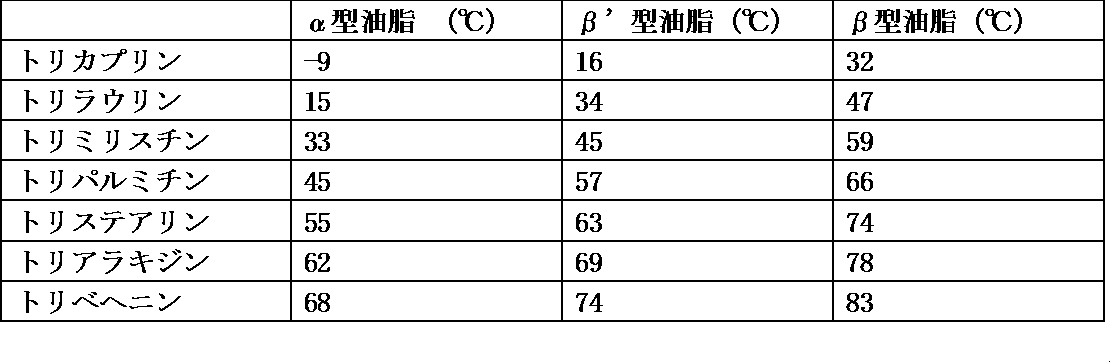
2dsinθ=nλ(n=1,2,3・・・)
この式を満たす位置に回折ピークが現れる。ここでdは格子定数、θは回折(入射)角、λはX線の波長、nは自然数である。短面間隔に対応する回折ピークの2θ=16~27°からは、結晶中の側面のパッキング(副格子)に関する情報が得られ、多形の同定を行なうことができる。特にトリアシルグリセロールの場合、2θ=19、23、24°(4.6Å付近、3.9Å付近、3.8Å付近)にβ型の特徴的ピークが、21°(4.2Å)付近にα型の特徴的なピークが出現する。なお、X線回折測定は、例えば、20℃に維持したX線回折装置((株)リガク、試料水平型X線回折装置UItimaIV)を用いて測定される。X線の光源としてはCuKα線(1.54Å)が最もよく利用される。
本発明の油脂成分は、液状のものであっても粉末状のものであっても、グリセリンの1位~3位に炭素数xの脂肪酸残基Xを有する1種以上のXXX型トリグリセリドを含む。当該XXX型トリグリセリドは、グリセリンの1位~3位に炭素数xの脂肪酸残基Xを有するトリグリセリドであり、各脂肪酸残基Xは互いに同一である。ここで、当該炭素数xは10~22から選択される整数であり、好ましくは12~22から選択される整数、より好ましくは14~20から選択される整数、更に好ましくは16~18から選択される整数である。
脂肪酸残基Xは、飽和あるいは不飽和の脂肪酸残基であってもよい。具体的な脂肪酸残基Xとしては、例えば、カプリン酸、ラウリン酸、ミリスチン酸、パルミチン酸、ステアリン酸、アラキジン酸、ベヘン酸等の残基が挙げられるがこれに限定するものではない。脂肪酸としてより好ましくは、ラウリン酸、ミリスチン酸、パルミチン酸、ステアリン酸、アラキジン酸及びベヘン酸であり、さらに好ましくは、ミリスチン酸、パルミチン酸、ステアリン酸、及びアラキジン酸であり、殊更好ましくは、パルミチン酸及びステアリン酸である。
当該XXX型トリグリセリドの含有量は、油脂成分の全質量を100質量%とした場合、50質量%以上、好ましくは60質量%以上、より好ましくは、70質量%以上、さらに好ましくは、80質量%以上を下限とし、例えば、100質量%以下、好ましくは、99質量%以下、より好ましくは、95質量%以下を上限とする範囲である。XXX型トリグリセリドは1種類又は2種類以上用いることができ、好ましくは1種類又は2種類であり、より好ましくは1種類が用いられる。XXX型トリグリセリドが2種類以上の場合は、その合計値がXXX型トリグリセリドの含有量となる。
本発明の油脂成分は、液状のものであっても粉末状のものであっても、本発明の効果を損なわない限り、上記XXX型トリグリセリド以外の、その他のトリグリセリドを含んでいてもよい。その他のトリグリセリドは、複数の種類のトリグリセリドであってもよく、合成油脂であっても天然油脂であってもよい。合成油脂としては、トリカプリル酸グリセリル、トリカプリン酸グリセリル等が挙げられる。天然油脂としては、例えば、ココアバター、ヒマワリ油、菜種油、大豆油、綿実油等が挙げられる。本発明の油脂成分中の全トリグリセリドを100質量%とした場合、その他のトリグリセリドは、1質量%以上、例えば、5~50質量%程度含まれていても問題はない。その他のトリグリセリドの含有量は、例えば、0~30質量%、好ましくは0~18質量%、より好ましくは0~15質量%、更に好ましくは0~8質量%である。
本発明の油脂組成物は、液状のものであっても粉末状のものであっても、上記トリグリセリド等の油脂成分の他、任意に乳化剤、香料、脱脂粉乳、全脂粉乳、ココアパウダー、砂糖、デキストリン等のその他の成分を含んでいてもよい。これらその他の成分の量は、本発明の効果を損なわない限り任意の量とすることができるが、例えば、油脂組成物の全質量を100質量%とした場合、0~70質量%、好ましくは0~65質量%、より好ましくは0~30質量%である。その他の成分は、その90質量%以上が、平均粒径が1000μm以下である紛体であることが好ましく、平均粒径が500μm以下の紛体であることがより好ましい。なお、ここでいう平均粒径は、レーザー回折散乱法(ISO133201及びISO9276-1)によって測定した値である。
但し、本発明の好ましい油脂組成物は、実質的に上記油脂成分のみからなることが好ましく、かつ、油脂成分は、実質的にトリグリセリドのみからなることが好ましい。また、「実質的に」とは、油脂組成物中に含まれる油脂成分以外の成分または油脂成分中に含まれるトリグリセリド以外の成分が、油脂組成物または油脂成分を100質量%とした場合、例えば、0~15質量%、好ましくは0~10質量%、より好ましくは0~5質量%であることを意味する。
本発明の粉末油脂組成物は、グリセリンの1位~3位に炭素数xの脂肪酸残基Xを有する1種以上のXXX型トリグリセリドを含む油脂組成物を溶融状態とし、特定の冷却温度に保ち、冷却固化することにより、噴霧やミル等の粉砕機による機械粉砕等特別の加工手段を採らなくても、粉末状の油脂組成物(粉末油脂組成物)を得ることができる。より具体的には、(a)上記XXX型トリグリセリドを含む油脂組成物を準備し、任意に工程(b)として、工程(a)で得られた油脂組成物を加熱し、前記油脂組成物中に含まれるトリグリセリドを溶解して溶融状態の前記油脂組成物を得、さらに(d)前記油脂組成物を冷却固化して、β型油脂を含有し、その粒子形状が板状である粉末油脂組成物を得る。なお、冷却後に得られる固形物に対して、ハンマーミル、カッターミル等、公知の粉砕加工手段を適用して、該粉末油脂組成物を生産することもできる。
冷却温度(℃) = 炭素数x × 6.6 ― 68
から求められる冷却温度以上の温度で行われる。このような温度範囲で冷却すれば、β型油脂を効率よく生成でき、細かい結晶ができるので、粉末油脂組成物を容易に得ることができる。なお、前記「細かい」とは、一次粒子(一番小さい大きさの結晶)が、例えば20μm以下、好ましくは、15μm以下、より好ましくは10μmの場合をいう。また、このような温度範囲で冷却しないと、β型油脂が生成せず、溶融状態の油脂組成物よりも体積が増加した空隙を有する固形物ができない場合がある。さらに、本発明では、このような温度範囲で冷却することによって、静置した状態でβ型油脂を生成させ、粉末油脂組成物の粒子を板状形状とさせたものであり、冷却方法は、本発明の粉末油脂組成物を特定するために有益なものである。
本発明の粉末油脂組成物は、常温(20℃)で粉末状の固体である。
本発明の粉末油脂組成物のゆるめ嵩密度は、例えば実質的に油脂成分のみからなる場合、0.05~0.6g/cm3、好ましくは0.1~0.5g/cm3であり、より好ましくは0.15~0.4g/cm3であり、さらに好ましくは0.2~0.3g/cm3である。ここで「ゆるめ嵩密度」とは、粉体を自然落下させた状態の充填密度である。ゆるめ嵩密度(g/cm3)の測定は、例えば、内径15mm×25mLのメスシリンダーに、当該メスシリンダーの上部開口端から2cm程度上方から粉末油脂組成物の適量を落下させて疎充填し、充填された質量(g)の測定と容量(mL)の読み取りを行い、mL当たりの当該粉末油脂組成物の質量(g)を算出することで求めることができる。また、ゆるめ嵩密度は、(株)蔵持科学器械製作所のカサ比重測定器を使用し、JIS K-6720(又はISO 1060-1及び2)に基づいて測定したカサ比重から算出することもできる。具体的には、試料120mLを、受器(内径40mm×高さ85mmの100mL円柱形容器)の上部開口部から38mmの高さの位置から、該受器に落とす。受器から盛り上がった試料はすり落とし、受器の内容積(100mL)分の試料の質量(Ag)を秤量し、以下の式からゆるめ嵩密度を求めることができる。
ゆるめ嵩密度(g/mL)=A(g)/100(mL)
測定は3回行ってその平均値を取ることが好ましい。
本発明の粉末油脂組成物は、以下の工程、
(a)XXX型トリグリセリドを含む油脂組成物を準備する工程、
(b)工程(a)で得られた油脂組成物を任意に加熱等し、前記油脂組成物中に含まれるトリグリセリドを溶解して溶融状態の前記油脂組成物を得る任意の工程、
(d)前記油脂組成物を冷却固化して、β型油脂を含有し、その粒子形状が板状である粉末油脂組成物を得る工程、
を含む方法によって製造することができる。
また、上記工程(b)と(d)の間に、工程(c)として粉末生成を促進するための任意工程、例えば(c1)シーディング工程、(c2)テンパリング工程、及び/又は(c3)予備冷却工程を含んでいてもよい。さらに上記工程(d)で得られる粉末油脂組成物は、工程(d)の冷却後に得られる固形物を粉砕して粉末状の油脂組成物を得る工程(e)によって得られるものであってもよい。以下、上記工程(a)~(e)について説明する。
工程(a)で準備されるXXX型トリグリセリドを含む油脂組成物は、グリセリンの1位~3位に炭素数xの脂肪酸残基Xを有する1種以上のXXX型トリグリセリドを含む通常のXXX型トリグリセリド等の油脂の製造方法に基づいて製造され、もしくは容易に市場から入手され得る。ここで、上記炭素数x及び脂肪酸残基Xで特定されるXXX型トリグリセリドは、最終的に得られる目的の油脂成分のものと結晶多形以外の点で同じである。当該油脂組成物にはβ型油脂が含まれていてもよく、例えば、β型油脂の含有量が0.1質量%以下、0.05質量%以下、又は0.01質量%以下含んでいてもよい。但し、β型油脂は、当該油脂組成物を加熱等により溶融状態にすることにより消失するので、当該油脂組成物は溶融状態の油脂組成物であってもよい。当該油脂組成物が、例えば溶融状態である場合に、β型油脂を実質的に含まないことは、XXX型トリグリセリドに限らず、実質的に全ての油脂成分がβ型油脂ではない場合も意味し、β型油脂の存在は、上述したX線回折測定によりβ型油脂に起因する回折ピーク、示差走査熱量測定法によるβ型油脂の確認等によって確認することができる。「β型油脂を実質的に含まない」場合のβ型油脂の存在量は、X線回折ピークのうち、β型の特徴的ピークとα型の特徴的ピークとの強度比率[β型の特徴的ピークの強度/(α型の特徴的ピークの強度+β型の特徴的ピークの強度)](ピーク強度比)から想定できる。上記油脂組成物の当該ピーク強度比は、例えば0.2以下であり、好ましくは、0.15以下であり、より好ましくは、0.10以下である。油脂組成物には、上述したとおりのXXX型トリグリセリドを1種類又は2種以上含んでいてもよく、好ましくは1種類又は2種類であり、より好ましくは1種類である。
具体的には、例えば、上記XXX型トリグリセリドは、脂肪酸または脂肪酸誘導体とグリセリンを用いた直接合成によって製造することができる。XXX型トリグリセリドを直接合成する方法としては、(i)炭素数Xの脂肪酸とグリセリンとを直接エステル化する方法(直接エステル合成)、(ii)炭素数xである脂肪酸Xのカルボキシル基がアルコキシル基と結合した脂肪酸アルキル(例えば、脂肪酸メチル及び脂肪酸エチル)とグリセリンとを塩基性または酸性触媒条件下にて反応させる方法(脂肪酸アルキルを用いたエステル交換合成)、(iii)炭素数xである脂肪酸Xのカルボキシル基の水酸基がハロゲンに置換された脂肪酸ハロゲン化物(例えば、脂肪酸クロリド及び脂肪酸ブロミド)とグリセリンとを塩基性触媒下にて反応させる方法(酸ハライド合成)が挙げられる。
XXX型トリグリセリドは前述の(i)~(iii)のいずれの方法によっても製造できるが、製造の容易さの観点から、(i)直接エステル合成又は(ii)脂肪酸アルキルを用いたエステル交換合成が好ましく、(i)直接エステル合成がより好ましい。
XXX型トリグリセリドの(i)直接エステル合成における反応温度は、エステル化反応によって生ずる生成水が系外に除去できる温度であればよく、例えば、120℃~300℃が好ましく、150℃~270℃がより好ましく、180℃~250℃がさらに好ましい。反応を180~250℃で行うことで、特に効率的にXXX型トリグリセリドを製造することができる。
XXX型トリグリセリドの(i)直接エステル合成においては、反応後、水洗、アルカリ脱酸及び/又は減圧脱酸、及び吸着処理等の公知の精製処理を行うことで、触媒や原料未反応物を除去することができる。更に、脱色・脱臭処理を施すことで、得られた反応物をさらに精製することができる。
XXX型トリグリセリドを含む油脂組成物となるその他のトリグリセリドとしては、上記XXX型トリグリセリドの他、本発明の効果を損なわない限り、各種トリグリセリドを含めてもよい。その他のトリグリセリドとしては、例えば、上記XXX型トリグリセリドの脂肪酸残基Xの1つが脂肪酸残基Yに置換したX2Y型トリグリセリド、上記XXX型トリグリセリドの脂肪酸残基Xの2つが脂肪酸残基Yに置換したXY2型トリグリセリド等を挙げることができる。
上記その他のトリグリセリドの量は、例えば、XXX型トリグリセリドの全質量を100質量%とした場合、0~100質量%、好ましくは0~70質量%、より好ましくは1~40質量%である。
上記油脂組成物としては、上記トリグリセリドの他、任意に部分グリセリド、脂肪酸、抗酸化剤、乳化剤、水などの溶媒等のその他の成分を含んでいてもよい。これらその他の成分の量は、本発明の効果を損なわない限り任意の量とすることができるが、例えば、XXX型トリグリセリドの全質量を100質量%とした場合、0~5質量%、好ましくは0~2質量%、より好ましくは0~1質量%である。
当該混合は、必要に応じて加熱下で混合してもよい。加熱は、後述の工程(b)における加熱温度と同程度であることが好ましく、例えば、50~120℃、好ましくは60~100℃、より好ましくは70~90℃、さらに好ましくは80℃で行われる。
上記(d)工程の前に、上記工程(a)で準備された油脂組成物は、準備された時点で溶融状態にある場合、加熱せずにそのまま冷却されるが、準備された時点で溶融状態にない場合は、任意に加熱され、該油脂組成物中に含まれるトリグリセリドを融解して溶融状態の油脂組成物を得る。
ここで、油脂組成物の加熱は、上記油脂組成物中に含まれるトリグリセリドの融点以上の温度、特にXXX型トリグリセリドを融解できる温度、例えば、70~200℃、好ましくは、75~150℃、より好ましくは80~100℃であることが適当である。また、加熱は、例えば、0.1~3時間、好ましくは、0.3~2時間、より好ましくは0.5~1時間継続することが適当である。
上記工程(a)又は(b)で準備された溶融状態の油脂組成物は、さらに冷却固化されて、β型油脂を含有し、その粒子形状が板状である粉末油脂組成物を形成する。
ここで、「溶融状態の油脂組成物を冷却固化」するためには、冷却温度の上限値として、溶融状態の油脂組成物を、当該油脂組成物に含まれる油脂成分のβ型油脂の融点より低い温度に保つことが必要である。「油脂組成物に含まれる油脂成分のβ型油脂の融点より低い温度」とは、例えば、炭素数が18のステアリン酸残基を3つ有するXXX型トリグリセリドの場合、β型油脂の融点は74℃であるので(表1)、当該融点より1~30℃低い温度(即ち44~73℃)、好ましくは当該融点より1~20℃低い温度(即ち54~73℃)、より好ましくは当該融点より1~15℃低い温度(即ち59~73℃)、特に好ましくは、1℃、2℃、3℃、4℃、5℃、6℃、7℃、8℃、9℃または10℃低い温度である。
より好ましくは、β型油脂を得るためには、冷却温度の下限値として、以下の式から求められる冷却温度以上に保つことが適当である。
冷却温度(℃) = 炭素数x × 6.6 ― 68
(式中、炭素数xは、油脂組成物中に含まれるXXX型トリグリセリドの炭素数x)
このような冷却温度以上とするのは、XXX型トリグリセリドを含有するβ型油脂を得るために、当該油脂の結晶化の際、冷却温度をβ型油脂以外のα型油脂やβ’型油脂が結晶化しない温度に設定する必要があるためである。冷却温度は、主にXXX型トリグリセリドの分子の大きさに依存するので、炭素数xと最適な冷却温度の下限値との間には一定の相関関係があることが理解できる。
例えば、油脂組成物に含まれるXXX型トリグリセリドが、炭素数が18のステアリン酸残基を3つ有するXXX型トリグリセリドである場合、冷却温度の下限値は50.8℃以上となる。従って、炭素数が18のステアリン酸残基を3つ有するXXX型トリグリセリドの場合、「溶融状態の油脂組成物を冷却固化」する温度は、50.8℃以上72℃以下がより好ましいこととなる。
また、XXX型トリグリセリドが2種以上の混合物である場合は、炭素数xが小さい方の冷却温度に合わせてその下限値を決定することができる。例えば、油脂組成物に含まれるXXX型トリグリセリドが、炭素数が16のパルミチン酸残基を3つ有するXXX型トリグリセリドと炭素数が18のステアリン酸残基を3つ有するXXX型トリグリセリドとの混合物である場合、冷却温度の下限値は小さい方の炭素数16に合わせて37.6℃以上となる。
さらに、工程(d)の前、上記工程(a)又は(b)と(d)との間に、(c)粉末生成を促進するための任意工程として、工程(d)で使用する溶融状態の油脂組成物に対し、シーディング法(c1)、テンパリング法(c2)及び/又は(c3)予備冷却法による処理を行ってもよい。これらの任意工程(c1)~(c3)は、いずれか単独で行ってもよいし、複数の工程を組み合わせて行ってもよい。ここで、工程(a)又は(b)と工程(d)との間とは、工程(a)又は(b)中、工程(a)又は(b)の後であって工程(d)の前、工程(d)中を含む意味である。
シーディング法(c1)及びテンパリング法(c2)は、本発明の粉末油脂組成物の製造において、溶融状態にある油脂組成物をより確実に粉末状とするために、最終温度まで冷却する前に、溶融状態にある油脂組成物を処置する粉末生成促進方法である。
ここで、シーディング法(c1)とは、粉末の核(種)となる成分を溶融状態にある油脂組成物の冷却時に少量添加して、増粘化を促進する方法である。具体的には、例えば、工程(b)で得られた溶融状態にある油脂組成物に、当該油脂組成物中のXXX型トリグリセリドと炭素数が同じXXX型トリグリセリドを好ましくは80質量%以上、より好ましくは90質量%以上含む油脂粉末を核(種)となる成分として準備する。この核となる油脂粉末を、溶融状態にある油脂組成物の冷却時、当該油脂組成物の温度が、例えば、最終冷却温度±0~+10℃、好ましくは+5~+10℃の温度に到達した時点で、当該溶融状態にある油脂組成物100質量部に対して0.1~1質量部、好ましくは0.2~0.8質量部添加することにより、油脂組成物の増粘化を促進する方法である。
また、テンパリング法(c2)とは、溶融状態にある油脂組成物の冷却において、最終冷却温度で静置する前に一度、工程(d)の冷却温度よりも低い温度、例えば5~20℃低い温度、好ましくは7~15℃低い温度、より好ましくは10℃程度低い温度に、好ましくは10~120分間、より好ましくは30~90分間程度冷却することにより、油脂組成物の増粘化を促進する方法である。
さらに、予備冷却法(c3)とは、前記工程(a)又は(b)で得られた溶融状態の油脂組成物を、工程(d)にて冷却する前に、前記XXX型トリグリセリドを含む油脂組成物を準備した時の温度と前記油脂組成物の冷却時の冷却温度との間の温度で一旦冷却する方法、言い換えれば、工程(a)又は(b)の溶融状態の温度よりも低く、工程(d)の冷却温度よりも高い温度で一旦予備冷却する方法である。(c3)予備冷却法に続いて、工程(d)の油脂組成物の冷却時の冷却温度で冷却することが行われる。工程(d)の冷却温度より高い温度とは、例えば、工程(d)の冷却温度よりも2~40℃高い温度、好ましくは3~30℃高い温度、より好ましくは4~30℃高い温度、さらに好ましくは5~10℃程度高い温度であり得る。前記予備冷却する温度を低く設定すればするほど、工程(d)の冷却温度における本冷却時間を短くすることができる。すなわち、予備冷却法とは、シーディング法やテンパリング法と異なり、冷却温度を段階的に下げるだけで油脂組成物の増粘化を促進できる方法であり、工業的に製造する場合に利点が大きい。
上記工程(d)の冷却によって粉末油脂組成物を得る工程は、より具体的には、工程(d)の冷却によって得られる固形物を粉砕して粉末油脂組成物を得る工程(e)によって行われてもよい。
詳細に説明すると、まず、上記油脂組成物を融解して溶融状態の油脂組成物を得、その後冷却して溶融状態の油脂組成物よりも体積が増加した空隙を有する固形物を形成する。空隙を有する固形物となった油脂組成物は、軽い衝撃を加えることで粉砕でき、固形物が容易に崩壊して粉末状となる。
ここで、軽い衝撃を加える手段は特に特定されないが、振る、篩に掛ける等により、軽く振動(衝撃)を与えて粉砕する(ほぐす)方法が、簡便で好ましい。
なお、該固形物を公知の粉砕加工手段により粉砕してもよい。このような粉砕加工手段の一例としては、ハンマーミル、カッターミル等が挙げられる。
本発明で用いる油脂組成物(液状と粉末状の二態様がある)は、実質的に油脂のみからなることが好ましい。ここで油脂とは、実質的にトリグリセリドのみからなるものである。また、「実質的に」とは、油脂組成物中に含まれる油脂以外の成分または油脂中に含まれるトリグリセリド以外の成分が、油脂組成物または油脂を100質量%とした場合、例えば、0~15質量%、好ましくは0~10質量%、より好ましくは0~5質量%であることを意味する。
本発明の増粘剤は、前述の油脂組成物(液状と粉末状の二態様がある)を必須成分として含む。
本発明の増粘剤として、粉末状の油脂組成物を用いる場合は、平均粒径が10~1000μmである紛体であることが好ましく、平均粒径が20~200である紛体であることがより好ましく、50~100μmの紛体であることがさらに好ましい。前記の平均粒径を有する粉体を用いると、液状成分と増粘剤とが均一に分布した、滑らかな粉末組成物を得ることができる。なお、ここでいう平均粒径は、レーザー回折散乱法(ISO133201及びISO9276-1)によって測定した値である。
また、上記の平均粒径を有する粉体は、油脂の製造に一般的に用いられている公知の粉砕手段、例えば噴霧や粉砕機等を用いて製造することができる。
但し、本発明の増粘剤は、上記の油脂組成物の他、増粘剤としての機能を損なわない範囲で任意成分を含んでいてもよい。ここでいう任意成分とは、後述する液状成分(増粘の対象)以外の成分をいう。任意成分としては、乳化剤、脱脂粉乳、全脂粉乳、ココアパウダー、砂糖やデキストリン等が挙げられる。
任意成分の配合量は、例えば、増粘剤の全質量を100質量%とした場合、0~70質量%、好ましくは0~65質量%、より好ましくは0~30質量%である。
任意成分は、その90質量%以上が、平均粒径が1000μm以下である紛体であることが、液状成分と増粘剤とが均一に分布した滑らかな粉末組成物を得ることができる点で好ましく、平均粒径が500μm以下の紛体であることがより好ましい。なお、ここでいう平均粒径は、レーザー回折散乱法(ISO133201及びISO9276-1)によって測定した値である。
液状成分とは、後述する製品中に含まれる機能性物質を含んだ液体をいう。
また、液状成分とは、常温(20℃)において液体である成分をいう。
また、本発明の増粘剤は、1~300mPa・S(mPa・s=ミリパスカル×秒、例えば、B型粘度計、20℃、60rpm、No.1又は2、以下別に定義する場合を除き、粘度値はこの条件下でのものをいう。なお、1mPa・s=1cP(センチポアズ)である。)、好ましくは2~200mPa・s、より好ましくは3~180mPa・s、更に好ましくは4~150mPa・sの粘度を有する液状成分に対して好適に使用することができる。液状成分の粘度は、常温(20℃)下におけるB型粘度計を用いて測定することができる。
機能性物質は、製品へ何らかの機能を付与することができるものを特に制限なく用いることができる。
また、機能性物質は、製品の主機能を付与する物質(例えば、医薬や機能性食品における有効成分)であってもよく、製品の副機能を付与する物質(例えば、食品における色素や香料)であってもよい。
機能性物質は、1種類を単独で用いてもよく、2種以上を適宜組み合わせてもよい。
疎水性物質としては、後述する製品中に機能性物質として配合されているものを特に制限なく用いることができる。具体例としては、香料、色素、ビタミン、脂質やタンパク質(疎水性ペプチド)等が挙げられる。これらの中でも、香料、色素、ビタミンやレシチンに、本発明の好適に適用することができる。
香料としては、例えば、飲食品、化粧品、医薬部外品や医薬品等に配合されているものを特に制限なく用いることができる。具体例としては、メントール、ココア類(パウダー、エキス等)、エステル類(例えば、酢酸イソアミル、酢酸リナリル、プロピオン酸イソアミル、酪酸リナリル等)、天然精油類(植物性精油として、例えば、バニラエキス、スペアミント、ペパーミント、カシア、ジャスミン等;動物性精油として、例えば、ムスク、アンバーグリス、シベット、カストリウム等)、単体香料(例えば、アネトール、リモネン、リナロール、オイゲノール、バニリン等)、油性調味料(ローストエビオイル、オニオンオイル等)が挙げられる。より具体的には、リモネン、バニリン、ローストエビオイルや、オニオンオイル等が挙げられる。
色素としては、例えば、飲食品、化粧品、医薬部外品や医薬品等に配合されているものを特に制限なく用いることができる。具体例としては、オレンジ色素、イエロー色素、マゼンタ色素やシアン色素等が挙げられる。
ビタミンとしては、例えば、飲食品、化粧品、医薬部外品や医薬品等に配合されているものを特に制限なく用いることができる。具体例としては、ビタミンE、ビタミンA、ビタミンDやビタミンK等が挙げられる。
脂質としては、例えば、飲食品、化粧品、医薬部外品や医薬品等に配合されているものを特に制限なく用いることができる。具体例としては、トリグリセリド、脂肪酸、リン脂質(例えば、レシチン、リゾレシチン、ホスファチジン酸やリゾホスファチジン酸等)やトリエチルヘキサノイン等が挙げられる。
タンパク質としては、疎水性ペプチドが挙げられ、ペプチドとは3以上のアミノ酸が連なったものであり、疎水性とは水への溶解度が低いことを意味し、ここでは水1mlあたり1μg未満しか溶解しないものを疎水性と定義する。
疎水性物質は、1種類を単独で用いてもよく、2種以上を適宜組み合わせて混合物として用いてもよい。
液油としては、例えば、飲食品、化粧品、医薬部外品や医薬品等に配合されているものを特に制限なく用いることができる。具体例としては、菜種油(キャノーラ油)、オリーブ油、米油、ゴマ油、綿実油、落花生油、トウモロコシ油、大豆油、ひまわり油、紅花油、ブドウ種子油、マカデミアナッツ油、ヘーゼルナッツ油、カボチャ種子油、クルミ油、椿油、茶実油、MCT油(但し、前述の増粘剤を構成するXXX型トリグリセリドを除く)や、MLCT油等の食用油脂が挙げられる。
アルコールとしては、例えば、飲食品、化粧品、医薬部外品や医薬品等に配合されているものを特に制限なく用いることができる。具体例としては、メチルアルコール、エチルアルコール、n-プロピルアルコール、イソプロピルアルコール、又はブチルアルコール等の低級アルコール等が挙げられる。
有機溶剤としては、例えば、飲食品、化粧品、医薬部外品や医薬品等に配合されているものを特に制限なく用いることができる。具体例としては、酢酸エチル、酢酸ブチル、ジエチルエーテル、メチルエーテル、メチルイソブチルケトン、ヘキサン、アセトン又はクロロホルム等が挙げられる。
溶媒は、1種類を単独で用いてもよく、2種以上を適宜組み合わせて混合物として用いてもよい。
分散媒は、1種類を単独で用いてもよく、2種以上を適宜組み合わせてもよい。
乳化剤は、1種類を単独で用いてもよく、2種以上を適宜組み合わせてもよい。
親水性物質としては、後述する製品中に機能性物質として配合されているものを特に制限なく用いることができる。具体例としては、香料、色素、ビタミン、糖質やタンパク質(親水性ペプチド)あるいは核酸等が挙げられる。これらの中でも、香料、色素やビタミンに、本発明の好適に適用することができる。
香料としては、例えば、飲食品、化粧品、医薬部外品や医薬品等に配合されているものを特に制限なく用いることができる。具体例としては、水性香料(例えば、えびフレーバー)、天然植物性香料(例えば、リコリス、セントジョンズブレッド、スモモエキス、ピーチエキス等)、酸類(例えば、リンゴ酸、酒石酸、クエン酸、酪酸等)等が挙げられる。
色素としては、例えば、飲食品、化粧品、医薬部外品や医薬品等に配合されているものを特に制限なく用いることができる。具体例としては、アジン系色素、アクリジン系色素、トリフェニルメタン系色素、キサンテン系色素、ポルフィリン系色素、シアニン系色素、フタロシアニン系色素、スチリル系色素、ピリリウム系色素、アゾ系色素、キノン系色素、テトラサイクリン系色素、フラボン系色素、ポリエン系色素、BODIPY(登録商標)系色素や、インジゴイド系色素等が挙げられる。
ビタミンとしては、例えば、飲食品、化粧品、医薬部外品や医薬品等に配合されているものを特に制限なく用いることができる。具体例としては、ビタミンB1、B2、B6、ニコチン酸、パントテン酸、ビタミンB12やビタミンC等が挙げられる。
糖質としては、例えば、飲食品、化粧品、医薬部外品や医薬品等に配合されているものを特に制限なく用いることができる。具体例としては、デンプン、デキストリン、α-シクロデキストリン、デキストラン、プルラン、アラビアゴム、トラガント、カンテン等の多糖類、グルコース、フルクトース、ガラクトース等の単糖類、オリゴ糖類が挙げられる。
タンパク質としては、親水性ペプチドが挙げられ、ペプチドとは3以上のアミノ酸が連なったものであり、親水性とは水への溶解度が高いことを意味し、ここでは水1mlあたり1μg以上溶解するものを親水性と定義する。
核酸としては、デオキシリボ核酸(DNA)、リボ核酸(RNA)、DNA-RNAハイブリッド、オリゴヌクレオチド、ポリヌクレオチド、アプタマー、ペプチド核酸(PNA)などが挙げられる。
親水性物質は、1種類を単独で用いてもよく、2種以上を適宜組み合わせて混合物として用いてもよい。
アルコールとしては、例えば、飲食品、化粧品、医薬部外品や医薬品等に配合されているものを特に制限なく用いることができる。具体例としては、エタノール、n-プロパノール、イソプロパノールや、n-ブタノール等の1価低級アルコール;1,3-ブチレングリコール、エチレングリコールや、プロピレングリコール等の2価アルコール;ポリエチレングリコール、ジプロピレングリコールや、ポリプロピレングリコール等のポリアルキレングリコール;グリセリン、ジグリセリン、トリメチロールプロパン、ペンタエリスリトーやル、ソルビトール等の多価アルコール等が挙げられる。
有機溶剤としては、例えば、飲食品、化粧品、医薬部外品や医薬品等に配合されているものを特に制限なく用いることができる。具体例としては、グリコール類、エステル類、エーテル類や、ケトン類などである。グリコール類としては、例えばエチレングリコールや、プロピレングリコールが挙られる。エステル類としては、前記アルコール類およびグリコール類のギ酸、酢酸、プロピオン酸などのエステル、具体的にはギ酸メチル、ギ酸エチル、ギ酸ブチル、酢酸メチル、酢酸エチル、酢酸ブチルや、プロピオン酸エチルなどを例示できる。エーテル類としては、前記アルコール類およびグリコール類のアルキルエーテルなど、具体的にはジメチルエーテル、ジエチルエーテル、ジブチルエーテル、メチルエチルエーテル、エチルブチルエーテル、エチレングリコールモノブチルエーテル、酢酸エチレングリコールモノエチルエーテルや、プロピレングリコールモノエチルエーテルなどが挙げられる。ケトン類としては、アセトン、ジエチルケトン、メチルエチルケトンや、アセトフェノン等が挙げられる。
溶媒は、1種類を単独で用いてもよく、2種以上を適宜組み合わせて混合物として用いてもよい。
分散媒は、1種類を単独で用いてもよく、2種以上を適宜組み合わせてもよい。
乳化剤は、1種類を単独で用いてもよく、2種以上を適宜組み合わせてもよい。
本発明では、増粘剤と液状成分とを混合工程に付することにより液状成分を増粘化して、増粘化された液状成分を含む増粘組成物(以下、単に「増粘組成物」ともいう)を製造する。増粘組成物の製造に用いる増粘剤は溶融状態(液状)であってもよく、固体状態(粉末状)であってもよいが、溶融状態のもの用いた場合には、次に説明する冷却工程が必要である。なお、固体状態(粉末状)である増粘剤を用いれば、この冷却工程を省略することができる。
以下、増粘剤を用いた増粘組成物の製造方法を説明する。
混合工程に付される増粘剤は溶融状態(液状)であってもよく、固体状態(粉末状)であってもよいが、溶融状態で用いることが好ましい。溶融状態で用いることにより、増粘剤と液状成分との混合を良好なものとし、より均質な増粘組成物を得ることができる。
混合工程における増粘剤と液状成分との質量比(増粘剤:液状成分)に特に制限はない。
また、液状成分の使用量は、増粘組成物(最終生成物)の総質量に対して、例えば30質量%超(すなわち、30質量%を含まない)~99質量%であってもよく、好ましくは40~97質量%、より好ましくは50~95質量%である。上記の使用量であると液状成分をより十分に増粘化することができる。
混合は、均質な混合物が得られる限り公知のいかなる混合手段を用いてもよいが、例えば、パドルミキサー、アジホモミキサー、ディスパーミキサー等で行うことができる。
混合は、必要に応じて加熱下で行ってもよい。混合温度は、溶融状態の増粘剤を用いる場合、例えば5~120℃、好ましくは50~100℃、より好ましくは55~90℃である。粉末状の増粘剤を用いる場合、例えば5~40℃、好ましくは10~30℃、より好ましくは15~25℃である。但し、熱に特に敏感な液状成分(例えば、香料、色素、ビタミン等)を増粘化する場合、混合温度は、当該液状成分の分解や変性が起きない温度とする。
混合時間に特に制限はないが、増粘剤と液状成分とが十分均一になるまで混合すればよく、例えば5~60分間、好ましくは10~50分間、より好ましくは20~40分間である。
増粘剤と液状成分との混合物は、続いて冷却工程に付して、増粘化を行うこともある。特に前記増粘剤として溶融状態(液状)の油脂組成物を用いた場合、前記混合物の状態は液状であるので、一般的には冷却工程に付して増粘化を行う。なお、前記増粘剤として固体状態(粉末状)の油脂組成物を用いた場合は、冷却工程は必要に応じて行う任意の工程となる。
冷却工程とは、増粘剤と液状成分との混合物を所定の最終温度まで冷却する工程をいい、例えば、液状成分が親水性物質を含む場合は、溶融状態の油脂組成物を、当該油脂組成物に含まれる油脂成分のβ型油脂の融点より低い温度であって、かつ、次式:
冷却温度(℃) = 炭素数x × 6.6 ― 68
から求められる冷却温度以上の温度で行われる。このような温度範囲で冷却すれば、β型油脂を効率よく生成でき、細かい結晶ができるので、増粘組成物を容易に得ることができる。
また、液状成分が親水性物質を含む場合、混合物の冷却は、例えばxが10~12のときは最終温度が、好ましくは-2~46℃、より好ましくは12~44℃、更に好ましくは14~42℃の温度になるように冷却することによって行われる。冷却における最終温度は、例えばxが13又は14のときは、好ましくは24~56℃、より好ましくは32~54℃、更に好ましくは40~52℃であり、xが15又は16のときは、好ましくは36~66℃、より好ましくは44~64℃、更に好ましくは52~62℃であり、xが17又は18のときは、好ましくは50~72℃、より好ましくは54~70℃、更に好ましくは58~68℃であり、xが19又は20のときは、好ましくは62~80℃、より好ましくは66~78℃、更に好ましくは70~77℃であり、xが21又は22のときは、好ましくは66~84℃、より好ましくは70~82℃、更に好ましくは74~80℃である。上記最終温度において、例えば、好ましくは2時間以上、より好ましくは4時間以上、更に好ましくは6時間以上であって、好ましくは2日間以下、より好ましくは24時間以下、更に好ましくは12時間以下、静置することが適当である。
液状成分が疎水性物質を含む場合、混合物の冷却は、液状成分の含有量が30~50質量%であって、例えば、x(脂肪酸残基Xの炭素数)が10~12のときは、最終温度が、好ましくは-32~29℃、より好ましくは-22~27℃、更に好ましくは-20~25℃の温度になるように冷却することによって行われる。冷却における最終温度は、例えばxが13又は14のときは、好ましくは-6~39℃、より好ましくは2~37℃、更に好ましくは10~35℃であり、xが15又は16のときは、好ましくは6~49℃、より好ましくは14~47℃、更に好ましくは22~45℃であり、xが17又は18のときは、好ましくは20~55℃、より好ましくは24~53℃、更に好ましくは28~51℃であり、xが19又は20のときは、好ましくは32~63℃、より好ましくは36~61℃、更に好ましくは40~60℃であり、xが21又は22のときは、好ましくは36~67℃、より好ましくは40~65℃、更に好ましくは44~63℃である。なお、液状成分の含有量が50~75質量%であるときは、上述した温度をさらに5℃下げた温度が最適な最終温度であり、液状成分の含有量が75~9質量%であるときは、上述した温度をさらに10℃下げた温度が最適な最終温度である。
上記温度において、例えば、好ましくは1時間以上、より好ましくは2時間以上、更に好ましくは4時間以上であって、好ましくは2日間以下、より好ましくは24時間以下、更に好ましくは12時間以下、静置することが適当である。
混合工程と冷却工程との間に、増粘化を促進するための任意工程として、シーディング法、テンパリング法及び/又は予備冷却法を行ってもよい。ここで、「混合工程と冷却工程との間」とは、混合工程中、混合工程の後であって冷却工程の前、冷却工程中を含む意味である。
テンパリング法としては、増粘剤を構成する粉末油脂組成物の製造に関して前述したテンパリング法(c2)を用いることができる。
予備冷却法としては、増粘剤を構成する粉末油脂組成物の製造に関して前述した予備冷却法(c3)を用いることができる。
本発明の増粘剤を液状成分へ適用して得られた増粘組成物は、増粘化前の液状成分よりも粘度が増加しているものすべてを指す。流動性のあるもの(例えば、ペースト状のもの)や可塑性のあるものも、本発明でいう増粘組成物の中に含まれる。但し、本発明の増粘組成物は、粉末状の組成物ではない。
本発明の増粘組成物は、液状成分の粘度の1倍よりも大きい粘度を有する。例えば、1.5~100倍の粘度を有する。好ましくは2~75倍。さらに好ましくは5~50倍の粘度を有する。増粘組成物の粘度(常温20℃)は、B型粘度計を用いて測定することができる。
本発明の増粘組成物自体の粘度は、出発点である液体成分の粘度に依存するため、特に制限されないが、取扱いの利便性を考慮すると流動性のある状態の方が好ましく、例えば、1~30000mPa・S(mPa・s=ミリパスカル×秒、B型粘度計、20℃、6~60rpm、No.1~4)、好ましくは2~25000mPa・s、より好ましくは5~15000mPa・s、殊更に好ましくは7~1000mPa・sの粘度である。
本発明の増粘剤を液状成分へ適用して得られた増粘組成物は、増粘化された液状成分中に含まれる機能性物質が奏する機能に応じて、特に制限なく様々な製品に用いることができる。
製品の具体例としては、例えば、飲食品、化粧品、医薬部外品、医薬品、日用品、飼料、雑貨、農薬及び化学工業品等が挙げられる。
また、増粘組成物は、それ自体を製品(例えば、ゲル状食品)として用いてもよく、前述の製品の原料又は中間体として用いてもよい。
本発明は、特に上記増粘組成物を含む飲食品にも関する。飲食品としては、特に制限されないが、例えば、嗜好性食品が挙げられる。
尚、本発明の飲食品は、増粘組成物自体であってもよく、増粘組成物を他の飲食品へ配合した者であってもよい。
嗜好性食品としては、本発明の増粘組成物を配合可能なものを特に制限なく用いることができる。例えば、調理用素材、加工食品や、調理済食品等が挙げられる。具体例としては、油脂又は加工油脂(例えば、業務用又は家庭用の揚げ油、炒め油、離型油、天板油、マーガリン、ファットスプレッド、ショートニング、フラワーペースト、クリーム類、粉末油脂類、乳化油脂類等)、即席食品(例えば、即席麺、カップ麺、即席スープ・シチュー類等)、レトルト食品や缶詰類(例えば、カレー、スープ、シチュー類、パスタソース、中華食品の素、どんぶりの素等)、機能食品(例えば、高カロリー飲料、流動食、栄養バランス食、栄養補助食品や、特定保健用食品等)、小麦粉又はデンプン食品(例えば、パン、マカロニ・スパゲティ等のパスタ類、ピザパイ、麺類、ケーキミックス、加工米飯、シリアル等)、菓子やデザート(例えば、キャラメル、キャンディ、チューインガム、チョコレート、クッキー・ビスケット、ケーキ、パイ、スナック、クラッカー、和菓子、米菓子、豆菓子、ゼリー、プリン等)、基礎調味料(例えば、しょうゆ、みそ、ソース類等)、複合調味料(カレー又はシチュー用ルー、たれ、ドレッシング、マヨネーズ風調味料、麺つゆ、鍋料理用つゆ、ラー油、マスタード、からし、わさび、おろししょうが、おろしにんにく、キムチの素、デミグラスソース、ホワイトソース、トマトソース等)、乳製品(例えば、乳、加工乳、ヨーグルト類、乳酸菌飲料、チーズ、アイスクリーム類、調整粉乳、クリーム類等)、水産加工品(例えば、水産缶詰、魚肉のハムやソーセージ、水産練り製品、油漬け魚肉缶詰等)、農産加工品(例えば、ピーナツバター、ジャム、マーマレード、チョコレートクリーム、メンマ加工品、ザーサイ加工品、ねりごま、ごまペースト等)、畜産加工品(例えば、畜肉ハム・ソーセージ、畜産缶詰、ペースト類、ハンバーグ、ミートボール、味付け畜肉缶詰等)、調理済み・半調理済み食品(例えば、冷凍食品、冷蔵食品、パック入り総菜や店頭販売用惣菜等)が挙げられる。また、本発明の増粘組成物を含む飲食品は、人間以外に用いられる飲食品、例えば、愛玩動物用ペットフードや家畜用飼料であってもよい。
下記の増粘剤A及びA’を調製した。
市販の菜種極度硬化油(横関油脂工業株式会社製)を油脂組成物とした。
当該油脂組成物は、全トリグリセリド含有量(油脂成分の含有量)を100質量%とした場合、
1位~3位に炭素数x(x=18)の脂肪酸残基Xを有する、XXX型トリグリセリドを79.1質量%を含有する油脂組成物であった。
また、この油脂組成物の融点は約67℃であり、常温で固体状態であった。この油脂組成物は加熱溶融すれば液体状態となる。
この油脂組成物を以下増粘剤Aとして用いた。
さらに、この油脂組成物25gを80℃にて0.5時間維持して完全に融解し、55℃恒温槽にて12時間冷却し、体積が増加した空隙を有する固形物を形成させ、結晶化を完了させた後、室温(25℃)状態まで冷却した。得られた固形物をほぐすことで固体状態(粉末状)の結晶組成物(ゆるめ嵩密度:0.2g/cm3、アスペクト比1.6(板状形状)、平均粒径54μm、X線回折測定回析ピーク:4.6Å(β型油脂に特徴的なピーク)、ピーク強度比:0.89)を得た。
この油脂組成物を以下増粘剤A’として用いた。
ゆるめ嵩密度
ゆるめ嵩密度は、(株)蔵持科学器械製作所のカサ比重測定器を使用し、JIS K-6720(又はISO 1060-1及び2)に基づいて測定したカサ比重から算出した。具体的には、試料120mLを、受器(内径40mm×高さ85mmの100mL円柱形容器)の上部開口部から38mmの高さの位置から、該受器に落とした。続いて、受器から盛り上がった試料をすり落とし、受器の内容積(100mL)分の試料の質量(Ag)を秤量し、以下の式からゆるめ嵩密度を求めた。
ゆるめ嵩密度(g/mL)=A(g)/100(mL)
測定は3回行って、その平均値を測定値とした。
平均粒径は日機装株式会社製 Microtrac MT3300ExII)でレーザー回折散乱法(ISO133201、ISO9276-1)に基づいて測定した。
実施例1~6で使用したキャノーラ油(日清オイリオグループ株式会社製)は、疎水性物質として脂質(特にトリグリセリド)を含み、疎水性物質自体が溶融したもの(溶融物)であるといえる。
増粘剤A’ 40.0gとキャノーラ油40.0gをマルエムスクリュー管No.8(株式会社マルエム社製)の中に入れ20℃で混合し、増粘組成物を得た。ここで、液状成分の使用量は、増粘組成物(増粘剤A’+液状成分)の総質量に対して50質量%であった。
得られた増粘組成物は流動性のある状態(ペースト状)であったが(図2)、上述した測定条件では測定できず、その粘度は100000mPa・s以上であると推定された。
増粘剤A’ 20.0gとキャノーラ油60.0gをマルエムスクリュー管No.8(株式会社マルエム社製)の中に入れ20℃で混合し、増粘組成物を得た。ここで、液状成分の使用量は、増粘組成物(増粘剤A’+液状成分)の総質量に対して75質量%であった。
得られた増粘組成物の粘度は560.0mPa・s(20℃、6rpm、No.1)であった。
増粘剤A’ 8.0gとキャノーラ油72.0gをマルエムスクリュー管No.8(株式会社マルエム社製)の中に入れ20℃で混合し、増粘組成物を得た。ここで、液状成分の使用量は、増粘組成物(増粘剤A’+液状成分)の総質量に対して90質量%であった。
得られた増粘組成物の粘度は110.4mPa・s(20℃、30rpm、No.1)であった。
増粘剤A’ 4.0gとキャノーラ油76.0gをマルエムスクリュー管No.8(株式会社マルエム社製)の中に入れ20℃で混合し、増粘組成物を得た。ここで、液状成分の使用量は、増粘組成物(増粘剤A’+液状成分)の総質量に対して95質量%であった。
得られた増粘組成物の粘度は85.5mPa・s(20℃、60rpm、No.1)であった。
増粘剤A 8.0gとキャノーラ油72.0gをマルエムスクリュー管No.8(株式会社マルエム社製)の中に入れ混合し、80℃にて0.5時間維持して完全に融解して混合した。次に、混合物を、30℃恒温槽にて12時間冷却し増粘組成物を得た。ここで、液状成分の使用量は、増粘組成物(増粘剤A+液状成分)の総質量に対して90質量%であった。
得られた増粘組成物の粘度は128.3mPa・s(20℃、60rpm、No.2)であった。
増粘剤A 4.0gとキャノーラ油76.0gをマルエムスクリュー管No.8(株式会社マルエム社製)の中に入れ混合し、80℃にて0.5時間維持して完全に融解して混合した。次に、混合物を、30℃恒温槽にて12時間冷却し増粘組成物を得た。ここで、液状成分の使用量は、増粘組成物(増粘剤A+液状成分)の総質量に対して95質量%であった。
得られた増粘組成物の粘度は92.3mPa・s(20℃、60rpm、No.1)であった。
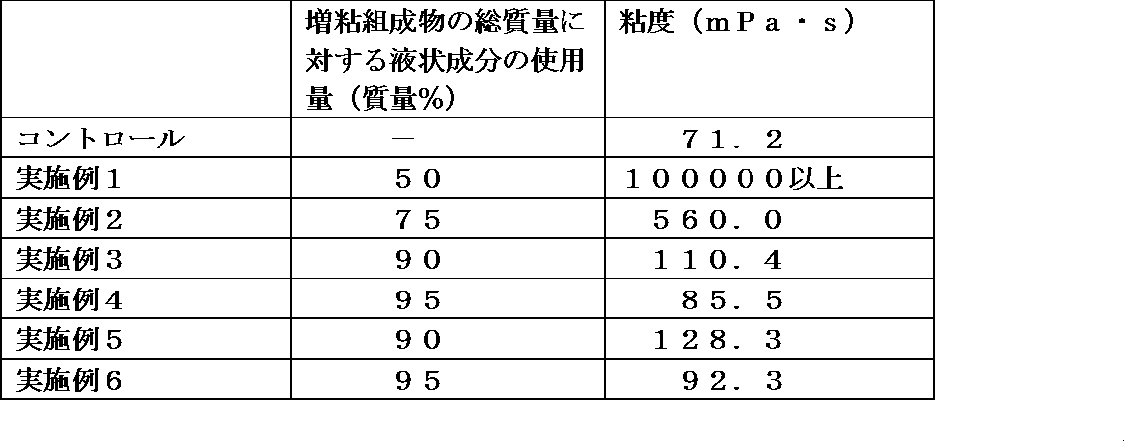
実施例6~8で使用したトリエチルヘキサノイン(日清オイリオグループ株式会社製、商品名:T.I.O)は、疎水性物質としてトリエチルヘキサノインを含み、疎水性物質自体が溶融したもの(溶融物)であるといえる。
増粘剤A’ 40.0gとトリエチルヘキサノイン 40.0gをマルエムスクリュー管No.8(株式会社マルエム社製)の中に入れ20℃で混合し、増粘組成物を得た。ここで、液状成分の使用量は、粉末組成物(増粘剤A’+液状成分)の総質量に対して50質量%であった。
得られた増粘組成物は流動性のある状態(ペースト状)であったが(図4)、上述した測定条件では測定できず、その粘度は100000mPa・s以上であると推定された。
増粘剤A’ 20.0gとトリエチルヘキサノイン 60.0gをマルエムスクリュー管No.8(株式会社マルエム社製)の中に入れ20℃で混合し、増粘組成物を得た。ここで、液状成分の使用量は、粉末組成物(増粘剤A’+液状成分)の総質量に対して75質量%であった。
得られた増粘組成物の粘度は384.5mPa・s(20℃、12rpm、No.1)であった。
増粘剤A’ 8.0gとトリエチルヘキサノイン 72.0gをマルエムスクリュー管No.8(株式会社マルエム社製)の中に入れ20℃で混合し、増粘組成物を得た。ここで、液状成分の使用量は、粉末組成物(増粘剤A’+液状成分)の総質量に対して90質量%であった。
得られた増粘組成物の粘度は62.4mPa・s(20℃、60rpm、No.1)であった。
増粘剤A’ 4.0gとトリエチルヘキサノイン 76.0gをマルエムスクリュー管No.8(株式会社マルエム社製)の中に入れ20℃で混合し、増粘組成物を得た。ここで、液状成分の使用量は、粉末組成物(増粘剤A’+液状成分)の総質量に対して95質量%であった。
得られた増粘組成物の粘度は48.8mPa・s(20℃、60rpm、No.1)であった。
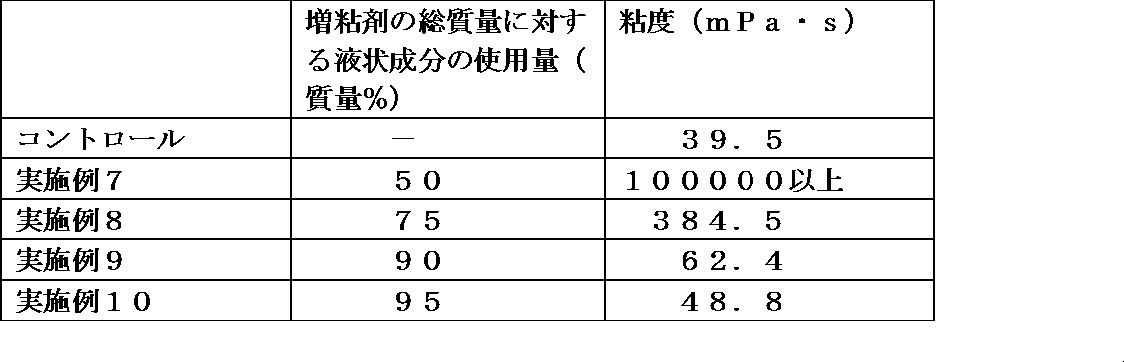

Claims (30)
- 液状成分の増粘剤であって、
前記増粘剤が油脂組成物を含み、
前記油脂組成物が、グリセリンの1位~3位に炭素数xの脂肪酸残基Xを有する1種以上のXXX型トリグリセリドを含む油脂成分を含有し、
前記炭素数xは10~22から選択される整数であり、
前記XXX型トリグリセリドが前記油脂成分の含有量100質量%に対して50質量%以上含有する、
ことを特徴とする、増粘剤。 - 前記増粘剤が粉末状の油脂組成物であって、
前記油脂成分がβ型油脂を含み、
前記粉末油脂組成物の粒子は板状形状を有し、かつ、
前記粉末油脂組成物のゆるめ嵩密度が0.05~0.6g/cm3である
ことを特徴とする、請求項1に記載の増粘剤。 - 前記液状成分が1~300mPa・sの粘度を有する、請求項1又は2に記載の増粘剤。
- 前記液状成分が、疎水性物質を含む、請求項1~3のいずれか1項に記載の増粘剤。
- 前記液状成分が、疎水性物質の溶液である、請求項1~4いずれか1項に記載の増粘剤。
- 前記溶液の溶媒が、液油、アルコール、有機溶剤及びこれらの混合物からなる群より選ばれる、請求項5に記載の増粘剤。
- 前記液状成分が、疎水性物質のエマルジョンである、請求項1~4のいずれか1項に記載の増粘剤。
- 前記疎水性物質のエマルジョンが、水、乳化剤及びグリセリンからなる群より選ばれる1種以上を含む、請求項7に記載の増粘剤。
- 前記疎水性物質が、香料、色素、ビタミン、脂質及びこれらの混合物からなる群より選ばれる、請求項4~8のいずれか1項に記載の増粘剤。
- 前記液状成分が、親水性物質を含む、請求項1~3のいずれか1項に記載の増粘剤。
- 前記液状成分が、親水性物質の溶液である、請求項1~3又は10のいずれか1項に記載の増粘剤。
- 前記溶液の溶媒が、水、アルコール、有機溶剤及びこれらの混合物からなる群より選ばれる、請求項11に記載の増粘剤。
- 前記液状成分が、親水性物質のエマルジョンである、請求項1~3又は10のいずれか1項に記載の増粘剤。
- 前記親水性物質のエマルジョンが、水、乳化剤及びグリセリンからなる群より選ばれる1種以上を含む、請求項13に記載の増粘剤。
- 前記親水性物質が、香料、色素、ビタミン及びこれらの混合物からなる群より選ばれる、請求項10~14のいずれか1項に記載の増粘剤。
- 前記液状成分が、液状食品である、請求項1~15のいずれか1項に記載の増粘剤。
- 前記液状食品が、牛乳、ワイン、果汁、出汁及びヨーグルトからなる群より選ばれる、請求項16に記載の増粘剤。
- 増粘組成物の製造方法であって、
請求項1~17のいずれか1項に記載の増粘剤と、液状成分とを混合する混合工程
を含むことを特徴とする、製造方法。 - 更に、前記増粘剤と、前記液状成分との混合物を冷却する冷却工程を含む、請求項18に記載の製造方法。
- 更に、前記混合工程と前記冷却工程との間に、シーディング法、テンパリング法及び/又は予備冷却法を行う、請求項18~19のいずれか1項に記載の製造方法。
- 前記液状成分の使用量が、増粘組成物の総質量に対して30質量%超~99質量%である、請求項18~20のいずれか1項に記載の製造方法。
- 請求項18~21のいずれか1項に記載の製造方法によって製造された、増粘組成物。
- 請求項1~17のいずれか1項に記載の増粘剤を含み、1~30000mPa・Sの粘度を有する、増粘組成物。
- 製品の原料又は中間体として用いるための、請求項22又は23に記載の増粘組成物。
- 製品が、飲食品、化粧品、医薬部外品、医薬品、日用品、飼料、雑貨、農薬及び化学工業品からなる群より選ばれる、請求項24に記載の増粘組成物。
- 請求項22~25のいずれか1項に記載の増粘組成物を含む、飲食品。
- 嗜好性食品である、請求項26に記載の飲食品。
- 液状成分の増粘化方法であって、
請求項1~17のいずれか1項に記載の増粘剤と、液状成分とを混合する工程を含むことを特徴とする方法。 - 更に、前記増粘剤と、前記液状成分との混合物を冷却する冷却工程を含む、請求項28に記載の方法。
- 請求項28又は29に記載の方法によって増粘化された、増粘組成物。
Priority Applications (4)
| Application Number | Priority Date | Filing Date | Title |
|---|---|---|---|
| JP2017526718A JP6208921B1 (ja) | 2016-01-21 | 2017-01-20 | 液状成分の増粘剤 |
| EP17741545.2A EP3406683A4 (en) | 2016-01-21 | 2017-01-20 | LIQUID COMPONENT THICKENER |
| US16/071,830 US11246322B2 (en) | 2016-01-21 | 2017-01-20 | Thickener for liquid component |
| CN201780007637.5A CN108495904B (zh) | 2016-01-21 | 2017-01-20 | 液态成分的增稠剂 |
Applications Claiming Priority (2)
| Application Number | Priority Date | Filing Date | Title |
|---|---|---|---|
| JP2016-010108 | 2016-01-21 | ||
| JP2016010108 | 2016-01-21 |
Publications (1)
| Publication Number | Publication Date |
|---|---|
| WO2017126668A1 true WO2017126668A1 (ja) | 2017-07-27 |
Family
ID=59361964
Family Applications (1)
| Application Number | Title | Priority Date | Filing Date |
|---|---|---|---|
| PCT/JP2017/001954 Ceased WO2017126668A1 (ja) | 2016-01-21 | 2017-01-20 | 液状成分の増粘剤 |
Country Status (5)
| Country | Link |
|---|---|
| US (1) | US11246322B2 (ja) |
| EP (1) | EP3406683A4 (ja) |
| JP (2) | JP6208921B1 (ja) |
| CN (1) | CN108495904B (ja) |
| WO (1) | WO2017126668A1 (ja) |
Cited By (5)
| Publication number | Priority date | Publication date | Assignee | Title |
|---|---|---|---|---|
| WO2018174204A1 (ja) * | 2017-03-23 | 2018-09-27 | 日清オイリオグループ株式会社 | 離水防止用粉末油脂組成物 |
| WO2018174203A1 (ja) * | 2017-03-23 | 2018-09-27 | 日清オイリオグループ株式会社 | 製菓製パン用粉末油脂組成物 |
| WO2020026946A1 (ja) * | 2018-07-31 | 2020-02-06 | 日清オイリオグループ株式会社 | ソフトカプセル充填用組成物、及びそれを充填したソフトカプセル |
| JP2020054332A (ja) * | 2018-09-28 | 2020-04-09 | 日清オイリオグループ株式会社 | 焼き菓子用フィリング |
| JP2024010643A (ja) * | 2022-07-12 | 2024-01-24 | 日清オイリオグループ株式会社 | 香料含有油脂粉末を使用した加熱処理食品 |
Families Citing this family (8)
| Publication number | Priority date | Publication date | Assignee | Title |
|---|---|---|---|---|
| EP3173464B1 (en) | 2014-07-22 | 2021-11-24 | The Nisshin OilliO Group, Ltd. | Powdered fat/oil composition, food including powdered fat/oil composition, and methods for producing same |
| JP6529597B2 (ja) | 2015-09-24 | 2019-06-12 | 日清オイリオグループ株式会社 | 粉末油脂組成物及びその製造方法 |
| JP6178950B1 (ja) | 2016-01-21 | 2017-08-09 | 日清オイリオグループ株式会社 | 液状成分の増粘剤 |
| EP3406695A4 (en) | 2016-01-21 | 2019-09-11 | The Nisshin OilliO Group, Ltd. | POWDERING AGENT FOR LIQUID COMPONENTS |
| EP3406696A4 (en) | 2016-01-21 | 2019-10-02 | The Nisshin OilliO Group, Ltd. | POWDERING AGENT FOR LIQUID INGREDIENTS |
| US20210076695A1 (en) * | 2017-12-19 | 2021-03-18 | Fonterra Co-Operative Group Limited | Dairy product and process |
| KR102266428B1 (ko) * | 2018-12-26 | 2021-06-18 | 주식회사 에이이 | 미세조류 스피루리나를 활용한 전복양식용 혼합사료 제조방법 |
| JP2021016320A (ja) * | 2019-07-17 | 2021-02-15 | 日清オイリオグループ株式会社 | 香味油組成物、及びそれを含有する食品 |
Citations (6)
| Publication number | Priority date | Publication date | Assignee | Title |
|---|---|---|---|---|
| JP2646422B2 (ja) | 1993-12-10 | 1997-08-27 | 日清製油株式会社 | 有機液状物のゲル化又は固化剤 |
| JP2700377B2 (ja) | 1993-10-28 | 1998-01-21 | 日清製油株式会社 | 有機液体のゲル化又は固化剤 |
| JP2005350660A (ja) * | 2004-05-10 | 2005-12-22 | Asahi Denka Kogyo Kk | 可塑性油脂組成物 |
| WO2010052847A1 (ja) * | 2008-11-06 | 2010-05-14 | 日清オイリオグループ株式会社 | 濃厚流動食 |
| JP2012157370A (ja) | 2007-02-16 | 2012-08-23 | Sanei Gen Ffi Inc | 咀嚼・嚥下困難者用ゲル化剤 |
| WO2015076164A1 (ja) * | 2013-11-19 | 2015-05-28 | 日清オイリオグループ株式会社 | 粉末油脂組成物およびその製造方法 |
Family Cites Families (55)
| Publication number | Priority date | Publication date | Assignee | Title |
|---|---|---|---|---|
| GB879211A (en) | 1958-06-20 | 1961-10-04 | Bibby & Sons Ltd J | Improvements in or relating to glyceride esters |
| GB1316079A (en) | 1971-07-20 | 1973-05-09 | Procter & Gamble | Hard butter comprising randomly esterified triglycerides of c12 nad c16-18 fatty acids |
| US3796816A (en) | 1972-07-05 | 1974-03-12 | Scm Corp | Hard butter compositions from non-randomized triglycerides |
| DE2555262B2 (de) | 1975-12-09 | 1981-05-21 | Dynamit Nobel Ag, 5210 Troisdorf | Erstarrungsbeschleuniger |
| DE2832636C2 (de) * | 1978-07-25 | 1986-01-16 | Walter Rau Lebensmittelwerke GmbH & Co. KG, 4517 Hilter | Fettkompositionen mit einem Gehalt an einem Triglyceridgemisch auf Basis von Fettsäuren mit 8 und 10 Kohlenstoffatomen und einem Zusatz an hochschmelzenden Fetten und ihre Verwendung |
| GB2178752B (en) | 1985-07-12 | 1989-10-11 | Unilever Plc | Substitute milk fat |
| US4877636A (en) | 1986-11-11 | 1989-10-31 | Meiji Seika Kaisha, Ltd. | Chocolate and chocolate additive |
| JPS63240745A (ja) | 1986-11-11 | 1988-10-06 | Meiji Seika Kaisha Ltd | チョコレート添加剤 |
| JPH0827B2 (ja) | 1989-05-13 | 1996-01-10 | 月島食品工業株式会社 | 可塑性油脂及びその製造法 |
| JP2809804B2 (ja) | 1990-03-30 | 1998-10-15 | 株式会社クラレ | 皮革様シート状物 |
| EP0536824B2 (en) | 1991-10-03 | 1999-05-19 | Unilever N.V. | Non-temper, confectionery fats |
| JPH05137506A (ja) | 1991-11-22 | 1993-06-01 | Taiyo Kagaku Co Ltd | 粉末油脂およびその製造方法 |
| JPH0633087A (ja) | 1992-07-17 | 1994-02-08 | Nippon Oil & Fats Co Ltd | 粉末油脂組成物 |
| JPH06245700A (ja) | 1993-02-23 | 1994-09-06 | Snow Brand Milk Prod Co Ltd | 消化吸収性を低減した油脂組成物 |
| JP3083967B2 (ja) | 1995-02-06 | 2000-09-04 | 明治製菓株式会社 | 可溶性粉末チョコレートおよびその製造方法 |
| US6090598A (en) | 1997-01-30 | 2000-07-18 | Fuji Oil Company, Limited | Enzymatic process for interesterification of fats and oils using distillation |
| JPH10295307A (ja) | 1997-04-21 | 1998-11-10 | Snow Brand Food Co Ltd | ミルフィーユ用クリーム粉末ミックス |
| IL129086A0 (en) | 1999-03-22 | 2000-02-17 | Enzymotec Ltd | Surfactant-lipase complex immobilized on insoluble matrix |
| JP3817450B2 (ja) | 2001-08-03 | 2006-09-06 | 明治製菓株式会社 | 粉末チョコレートとその製造方法及びそれを含有した飲食物 |
| JP2003135001A (ja) | 2001-11-02 | 2003-05-13 | Nisshin Oillio Ltd | 食用油脂及びそれを用いた乳化油脂組成物 |
| ATE468384T1 (de) | 2003-07-09 | 2010-06-15 | Nisshin Oillio Group Ltd | Verfahren zur herstellung von symmetrischem triglycerid |
| JP2005073610A (ja) | 2003-09-01 | 2005-03-24 | Ezaki Glico Co Ltd | 含気チョコレートおよびその製造方法 |
| JP2006000087A (ja) | 2004-06-21 | 2006-01-05 | Sanei Gen Ffi Inc | 粉末製剤 |
| JP2006109731A (ja) | 2004-10-13 | 2006-04-27 | L & S International:Kk | 粉末食用油の製造方法。 |
| PL1776870T3 (pl) | 2005-10-21 | 2011-11-30 | Kraft Foods R & D Inc | Produkt cukierniczy zawierający polepszacz masła kakaowego |
| JP4648855B2 (ja) | 2006-03-09 | 2011-03-09 | 理研ビタミン株式会社 | 含気チョコレート |
| JP4627513B2 (ja) | 2006-04-27 | 2011-02-09 | ミヨシ油脂株式会社 | 粉末油脂 |
| US20080089981A1 (en) | 2006-10-17 | 2008-04-17 | N.V. Nutricia | Ketogenic diet |
| NZ579108A (en) | 2007-02-28 | 2011-02-25 | Loders Croklaan Bv | Process for producing 1,3,-dioleoyl-2-palmitoyl glyceride (OPO) |
| US20100119684A1 (en) | 2007-04-02 | 2010-05-13 | Santana Ruben D | Food compositions incorporating medium chain triglycerides |
| TWI441915B (zh) | 2007-09-07 | 2014-06-21 | Nisshin Oillio Group Ltd | 1,3-二飽和-2-不飽和三酸甘油酯的區分方法 |
| GB0723255D0 (en) | 2007-11-28 | 2008-01-09 | Barry Callebaut Ag | Process and product |
| WO2009081777A1 (ja) | 2007-12-26 | 2009-07-02 | The Nisshin Oillio Group, Ltd. | 油脂組成物とその製造方法及びチョコレート類とその製造方法 |
| JP4197357B1 (ja) | 2008-04-11 | 2008-12-17 | 株式会社J−オイルミルズ | 油脂の分別方法 |
| PL2191730T3 (pl) * | 2008-11-19 | 2011-10-31 | Nestec Sa | Stałe oleje w proszku |
| JP5557457B2 (ja) | 2009-03-06 | 2014-07-23 | 日清オイリオグループ株式会社 | 油脂の製造方法 |
| WO2011134627A1 (en) | 2010-04-30 | 2011-11-03 | Loders Croklaan B.V. | Edible oil composition |
| US20130230634A1 (en) | 2010-09-27 | 2013-09-05 | Chie Arai | Oil and fat composition and method of producing thereof |
| CN103402364B (zh) | 2011-03-04 | 2015-06-17 | 日清奥利友集团株式会社 | 油脂组合物及使用该油脂组合物的奶油 |
| WO2012169457A1 (ja) | 2011-06-06 | 2012-12-13 | 日清オイリオグループ株式会社 | 油脂の分別方法 |
| JP5995413B2 (ja) | 2011-06-07 | 2016-09-21 | 日清オイリオグループ株式会社 | 油脂組成物及び該油脂組成物を用いた含気泡チョコレート |
| JP5756074B2 (ja) | 2012-11-02 | 2015-07-29 | 日清オイリオグループ株式会社 | 耐熱性チョコレート及び耐熱性チョコレートの製造方法 |
| JP5601432B1 (ja) | 2012-12-06 | 2014-10-08 | 不二製油株式会社 | 粉末油脂及びその製造法と、それを用いたチョコレート様食品 |
| JP6222921B2 (ja) | 2012-12-25 | 2017-11-01 | 日清オイリオグループ株式会社 | ホイップして使用されるチョコレート |
| JP6085217B2 (ja) | 2013-04-25 | 2017-02-22 | 上野製薬株式会社 | 粉末状油脂 |
| DK2839750T3 (en) | 2013-08-22 | 2018-02-26 | Loders Croklaan Bv | fat Composition |
| MY173666A (en) | 2013-09-06 | 2020-02-14 | Nisshin Oillio Group Ltd | Chocolate |
| EP3173464B1 (en) | 2014-07-22 | 2021-11-24 | The Nisshin OilliO Group, Ltd. | Powdered fat/oil composition, food including powdered fat/oil composition, and methods for producing same |
| CN107404893B (zh) | 2015-02-26 | 2021-01-26 | 日清奥利友集团株式会社 | 巧克力用粉末油脂组合物 |
| US20180027838A1 (en) | 2015-02-26 | 2018-02-01 | The Nisshin Oillio Group, Ltd. | Powdered fat composition for creams |
| CN107249346B (zh) | 2015-02-26 | 2020-10-30 | 日清奥利友集团株式会社 | 粉末巧克力 |
| JP6529597B2 (ja) | 2015-09-24 | 2019-06-12 | 日清オイリオグループ株式会社 | 粉末油脂組成物及びその製造方法 |
| JP6178950B1 (ja) | 2016-01-21 | 2017-08-09 | 日清オイリオグループ株式会社 | 液状成分の増粘剤 |
| EP3406696A4 (en) | 2016-01-21 | 2019-10-02 | The Nisshin OilliO Group, Ltd. | POWDERING AGENT FOR LIQUID INGREDIENTS |
| EP3406695A4 (en) | 2016-01-21 | 2019-09-11 | The Nisshin OilliO Group, Ltd. | POWDERING AGENT FOR LIQUID COMPONENTS |
-
2017
- 2017-01-20 EP EP17741545.2A patent/EP3406683A4/en not_active Withdrawn
- 2017-01-20 JP JP2017526718A patent/JP6208921B1/ja active Active
- 2017-01-20 CN CN201780007637.5A patent/CN108495904B/zh not_active Expired - Fee Related
- 2017-01-20 US US16/071,830 patent/US11246322B2/en not_active Expired - Fee Related
- 2017-01-20 WO PCT/JP2017/001954 patent/WO2017126668A1/ja not_active Ceased
- 2017-09-04 JP JP2017169621A patent/JP2018028091A/ja active Pending
Patent Citations (6)
| Publication number | Priority date | Publication date | Assignee | Title |
|---|---|---|---|---|
| JP2700377B2 (ja) | 1993-10-28 | 1998-01-21 | 日清製油株式会社 | 有機液体のゲル化又は固化剤 |
| JP2646422B2 (ja) | 1993-12-10 | 1997-08-27 | 日清製油株式会社 | 有機液状物のゲル化又は固化剤 |
| JP2005350660A (ja) * | 2004-05-10 | 2005-12-22 | Asahi Denka Kogyo Kk | 可塑性油脂組成物 |
| JP2012157370A (ja) | 2007-02-16 | 2012-08-23 | Sanei Gen Ffi Inc | 咀嚼・嚥下困難者用ゲル化剤 |
| WO2010052847A1 (ja) * | 2008-11-06 | 2010-05-14 | 日清オイリオグループ株式会社 | 濃厚流動食 |
| WO2015076164A1 (ja) * | 2013-11-19 | 2015-05-28 | 日清オイリオグループ株式会社 | 粉末油脂組成物およびその製造方法 |
Non-Patent Citations (2)
| Title |
|---|
| NISSIM GARTI ET AL.: "Crystallization and Polymorphism of Fats and Fatty Acids", 1988, MARCEL DEKKER INC., pages: 32 - 33 |
| See also references of EP3406683A4 |
Cited By (7)
| Publication number | Priority date | Publication date | Assignee | Title |
|---|---|---|---|---|
| WO2018174204A1 (ja) * | 2017-03-23 | 2018-09-27 | 日清オイリオグループ株式会社 | 離水防止用粉末油脂組成物 |
| WO2018174203A1 (ja) * | 2017-03-23 | 2018-09-27 | 日清オイリオグループ株式会社 | 製菓製パン用粉末油脂組成物 |
| WO2020026946A1 (ja) * | 2018-07-31 | 2020-02-06 | 日清オイリオグループ株式会社 | ソフトカプセル充填用組成物、及びそれを充填したソフトカプセル |
| JPWO2020026946A1 (ja) * | 2018-07-31 | 2021-08-26 | 日清オイリオグループ株式会社 | ソフトカプセル充填用組成物、及びそれを充填したソフトカプセル |
| JP2020054332A (ja) * | 2018-09-28 | 2020-04-09 | 日清オイリオグループ株式会社 | 焼き菓子用フィリング |
| JP7309465B2 (ja) | 2018-09-28 | 2023-07-18 | 日清オイリオグループ株式会社 | 焼き菓子用餡 |
| JP2024010643A (ja) * | 2022-07-12 | 2024-01-24 | 日清オイリオグループ株式会社 | 香料含有油脂粉末を使用した加熱処理食品 |
Also Published As
| Publication number | Publication date |
|---|---|
| EP3406683A1 (en) | 2018-11-28 |
| US11246322B2 (en) | 2022-02-15 |
| JP6208921B1 (ja) | 2017-10-04 |
| JPWO2017126668A1 (ja) | 2018-01-25 |
| US20190029283A1 (en) | 2019-01-31 |
| CN108495904B (zh) | 2020-12-15 |
| JP2018028091A (ja) | 2018-02-22 |
| CN108495904A (zh) | 2018-09-04 |
| EP3406683A4 (en) | 2020-02-26 |
Similar Documents
| Publication | Publication Date | Title |
|---|---|---|
| JP6208921B1 (ja) | 液状成分の増粘剤 | |
| JP6216099B1 (ja) | 液状成分の粉末化剤 | |
| JP6216098B1 (ja) | 液状成分の粉末化剤 | |
| JP6178950B1 (ja) | 液状成分の増粘剤 | |
| JP7347620B2 (ja) | 水中油型乳化組成物、及び該水中油型乳化組成物の製造方法 | |
| JP2023153216A (ja) | 水中油型ピッカリングエマルション | |
| WO2018105747A1 (ja) | 水中油型乳化組成物、及び該水中油型乳化組成物の製造方法 | |
| KR20170033870A (ko) | 분말 유지 조성물, 분말 유지 조성물을 포함하는 식품 및 이들의 제조 방법 | |
| JP5507795B2 (ja) | 乳化剤組成物、乳化組成物及びその安定性の改良方法 | |
| JP2008528774A (ja) | 粉末組成物 | |
| JP2003192576A (ja) | カプサイシノイド様物質含有製剤 | |
| JP6664971B2 (ja) | スープ類又はソース類用粉末油脂組成物 | |
| JP6861540B2 (ja) | 含気泡油脂組成物 | |
| EP4501123A1 (en) | Protein, protein particle dispersion and emulsion composition including said protein, and manufacturing methods thereof | |
| HK40045260A (en) | Oil-in-water pickling emulsion |
Legal Events
| Date | Code | Title | Description |
|---|---|---|---|
| ENP | Entry into the national phase |
Ref document number: 2017526718 Country of ref document: JP Kind code of ref document: A |
|
| 121 | Ep: the epo has been informed by wipo that ep was designated in this application |
Ref document number: 17741545 Country of ref document: EP Kind code of ref document: A1 |
|
| NENP | Non-entry into the national phase |
Ref country code: DE |
|
| WWE | Wipo information: entry into national phase |
Ref document number: 2017741545 Country of ref document: EP |
|
| ENP | Entry into the national phase |
Ref document number: 2017741545 Country of ref document: EP Effective date: 20180821 |