WO2017134726A1 - Matériau de traitement absorbant l'eau et son procédé de fabrication - Google Patents
Matériau de traitement absorbant l'eau et son procédé de fabrication Download PDFInfo
- Publication number
- WO2017134726A1 WO2017134726A1 PCT/JP2016/052903 JP2016052903W WO2017134726A1 WO 2017134726 A1 WO2017134726 A1 WO 2017134726A1 JP 2016052903 W JP2016052903 W JP 2016052903W WO 2017134726 A1 WO2017134726 A1 WO 2017134726A1
- Authority
- WO
- WIPO (PCT)
- Prior art keywords
- water
- treatment material
- absorbing treatment
- granulated
- water absorption
- Prior art date
- Legal status (The legal status is an assumption and is not a legal conclusion. Google has not performed a legal analysis and makes no representation as to the accuracy of the status listed.)
- Ceased
Links
Images


Classifications
-
- A—HUMAN NECESSITIES
- A01—AGRICULTURE; FORESTRY; ANIMAL HUSBANDRY; HUNTING; TRAPPING; FISHING
- A01K—ANIMAL HUSBANDRY; AVICULTURE; APICULTURE; PISCICULTURE; FISHING; REARING OR BREEDING ANIMALS, NOT OTHERWISE PROVIDED FOR; NEW BREEDS OF ANIMALS
- A01K1/00—Housing animals; Equipment therefor
- A01K1/015—Floor coverings, e.g. bedding-down sheets ; Stable floors
- A01K1/0152—Litter
- A01K1/0155—Litter comprising organic material
-
- A—HUMAN NECESSITIES
- A61—MEDICAL OR VETERINARY SCIENCE; HYGIENE
- A61F—FILTERS IMPLANTABLE INTO BLOOD VESSELS; PROSTHESES; DEVICES PROVIDING PATENCY TO, OR PREVENTING COLLAPSING OF, TUBULAR STRUCTURES OF THE BODY, e.g. STENTS; ORTHOPAEDIC, NURSING OR CONTRACEPTIVE DEVICES; FOMENTATION; TREATMENT OR PROTECTION OF EYES OR EARS; BANDAGES, DRESSINGS OR ABSORBENT PADS; FIRST-AID KITS
- A61F13/00—Bandages or dressings; Absorbent pads
- A61F13/15—Absorbent pads, e.g. sanitary towels, swabs or tampons for external or internal application to the body; Supporting or fastening means therefor; Tampon applicators
- A61F13/53—Absorbent pads, e.g. sanitary towels, swabs or tampons for external or internal application to the body; Supporting or fastening means therefor; Tampon applicators characterised by the absorbing medium
- A61F13/534—Absorbent pads, e.g. sanitary towels, swabs or tampons for external or internal application to the body; Supporting or fastening means therefor; Tampon applicators characterised by the absorbing medium having an inhomogeneous composition through the thickness of the pad
- A61F13/537—Absorbent pads, e.g. sanitary towels, swabs or tampons for external or internal application to the body; Supporting or fastening means therefor; Tampon applicators characterised by the absorbing medium having an inhomogeneous composition through the thickness of the pad characterised by a layer facilitating or inhibiting flow in one direction or plane, e.g. a wicking layer
- A61F13/53743—Absorbent pads, e.g. sanitary towels, swabs or tampons for external or internal application to the body; Supporting or fastening means therefor; Tampon applicators characterised by the absorbing medium having an inhomogeneous composition through the thickness of the pad characterised by a layer facilitating or inhibiting flow in one direction or plane, e.g. a wicking layer characterised by the position of the layer relative to the other layers
- A61F13/53752—Absorbent pads, e.g. sanitary towels, swabs or tampons for external or internal application to the body; Supporting or fastening means therefor; Tampon applicators characterised by the absorbing medium having an inhomogeneous composition through the thickness of the pad characterised by a layer facilitating or inhibiting flow in one direction or plane, e.g. a wicking layer characterised by the position of the layer relative to the other layers the layer is embedded in the absorbent core
-
- A—HUMAN NECESSITIES
- A01—AGRICULTURE; FORESTRY; ANIMAL HUSBANDRY; HUNTING; TRAPPING; FISHING
- A01K—ANIMAL HUSBANDRY; AVICULTURE; APICULTURE; PISCICULTURE; FISHING; REARING OR BREEDING ANIMALS, NOT OTHERWISE PROVIDED FOR; NEW BREEDS OF ANIMALS
- A01K1/00—Housing animals; Equipment therefor
- A01K1/015—Floor coverings, e.g. bedding-down sheets ; Stable floors
- A01K1/0152—Litter
- A01K1/0154—Litter comprising inorganic material
-
- A—HUMAN NECESSITIES
- A61—MEDICAL OR VETERINARY SCIENCE; HYGIENE
- A61F—FILTERS IMPLANTABLE INTO BLOOD VESSELS; PROSTHESES; DEVICES PROVIDING PATENCY TO, OR PREVENTING COLLAPSING OF, TUBULAR STRUCTURES OF THE BODY, e.g. STENTS; ORTHOPAEDIC, NURSING OR CONTRACEPTIVE DEVICES; FOMENTATION; TREATMENT OR PROTECTION OF EYES OR EARS; BANDAGES, DRESSINGS OR ABSORBENT PADS; FIRST-AID KITS
- A61F13/00—Bandages or dressings; Absorbent pads
- A61F13/15—Absorbent pads, e.g. sanitary towels, swabs or tampons for external or internal application to the body; Supporting or fastening means therefor; Tampon applicators
- A61F13/15203—Properties of the article, e.g. stiffness or absorbency
- A61F13/15252—Properties of the article, e.g. stiffness or absorbency compostable or biodegradable
-
- A—HUMAN NECESSITIES
- A61—MEDICAL OR VETERINARY SCIENCE; HYGIENE
- A61F—FILTERS IMPLANTABLE INTO BLOOD VESSELS; PROSTHESES; DEVICES PROVIDING PATENCY TO, OR PREVENTING COLLAPSING OF, TUBULAR STRUCTURES OF THE BODY, e.g. STENTS; ORTHOPAEDIC, NURSING OR CONTRACEPTIVE DEVICES; FOMENTATION; TREATMENT OR PROTECTION OF EYES OR EARS; BANDAGES, DRESSINGS OR ABSORBENT PADS; FIRST-AID KITS
- A61F13/00—Bandages or dressings; Absorbent pads
- A61F13/15—Absorbent pads, e.g. sanitary towels, swabs or tampons for external or internal application to the body; Supporting or fastening means therefor; Tampon applicators
- A61F13/15203—Properties of the article, e.g. stiffness or absorbency
- A61F13/15252—Properties of the article, e.g. stiffness or absorbency compostable or biodegradable
- A61F2013/1526—Properties of the article, e.g. stiffness or absorbency compostable or biodegradable compostable
-
- A—HUMAN NECESSITIES
- A61—MEDICAL OR VETERINARY SCIENCE; HYGIENE
- A61F—FILTERS IMPLANTABLE INTO BLOOD VESSELS; PROSTHESES; DEVICES PROVIDING PATENCY TO, OR PREVENTING COLLAPSING OF, TUBULAR STRUCTURES OF THE BODY, e.g. STENTS; ORTHOPAEDIC, NURSING OR CONTRACEPTIVE DEVICES; FOMENTATION; TREATMENT OR PROTECTION OF EYES OR EARS; BANDAGES, DRESSINGS OR ABSORBENT PADS; FIRST-AID KITS
- A61F13/00—Bandages or dressings; Absorbent pads
- A61F13/15—Absorbent pads, e.g. sanitary towels, swabs or tampons for external or internal application to the body; Supporting or fastening means therefor; Tampon applicators
- A61F13/53—Absorbent pads, e.g. sanitary towels, swabs or tampons for external or internal application to the body; Supporting or fastening means therefor; Tampon applicators characterised by the absorbing medium
- A61F2013/530007—Absorbent pads, e.g. sanitary towels, swabs or tampons for external or internal application to the body; Supporting or fastening means therefor; Tampon applicators characterised by the absorbing medium being made from pulp
-
- A—HUMAN NECESSITIES
- A61—MEDICAL OR VETERINARY SCIENCE; HYGIENE
- A61F—FILTERS IMPLANTABLE INTO BLOOD VESSELS; PROSTHESES; DEVICES PROVIDING PATENCY TO, OR PREVENTING COLLAPSING OF, TUBULAR STRUCTURES OF THE BODY, e.g. STENTS; ORTHOPAEDIC, NURSING OR CONTRACEPTIVE DEVICES; FOMENTATION; TREATMENT OR PROTECTION OF EYES OR EARS; BANDAGES, DRESSINGS OR ABSORBENT PADS; FIRST-AID KITS
- A61F13/00—Bandages or dressings; Absorbent pads
- A61F13/15—Absorbent pads, e.g. sanitary towels, swabs or tampons for external or internal application to the body; Supporting or fastening means therefor; Tampon applicators
- A61F13/53—Absorbent pads, e.g. sanitary towels, swabs or tampons for external or internal application to the body; Supporting or fastening means therefor; Tampon applicators characterised by the absorbing medium
- A61F2013/530131—Absorbent pads, e.g. sanitary towels, swabs or tampons for external or internal application to the body; Supporting or fastening means therefor; Tampon applicators characterised by the absorbing medium being made in fibre but being not pulp
- A61F2013/530182—Absorbent pads, e.g. sanitary towels, swabs or tampons for external or internal application to the body; Supporting or fastening means therefor; Tampon applicators characterised by the absorbing medium being made in fibre but being not pulp characterized by the connection between the fibres
- A61F2013/530189—Absorbent pads, e.g. sanitary towels, swabs or tampons for external or internal application to the body; Supporting or fastening means therefor; Tampon applicators characterised by the absorbing medium being made in fibre but being not pulp characterized by the connection between the fibres with thermoplastic adhesive
-
- A—HUMAN NECESSITIES
- A61—MEDICAL OR VETERINARY SCIENCE; HYGIENE
- A61F—FILTERS IMPLANTABLE INTO BLOOD VESSELS; PROSTHESES; DEVICES PROVIDING PATENCY TO, OR PREVENTING COLLAPSING OF, TUBULAR STRUCTURES OF THE BODY, e.g. STENTS; ORTHOPAEDIC, NURSING OR CONTRACEPTIVE DEVICES; FOMENTATION; TREATMENT OR PROTECTION OF EYES OR EARS; BANDAGES, DRESSINGS OR ABSORBENT PADS; FIRST-AID KITS
- A61F13/00—Bandages or dressings; Absorbent pads
- A61F13/15—Absorbent pads, e.g. sanitary towels, swabs or tampons for external or internal application to the body; Supporting or fastening means therefor; Tampon applicators
- A61F13/53—Absorbent pads, e.g. sanitary towels, swabs or tampons for external or internal application to the body; Supporting or fastening means therefor; Tampon applicators characterised by the absorbing medium
- A61F2013/530481—Absorbent pads, e.g. sanitary towels, swabs or tampons for external or internal application to the body; Supporting or fastening means therefor; Tampon applicators characterised by the absorbing medium having superabsorbent materials, i.e. highly absorbent polymer gel materials
- A61F2013/530583—Absorbent pads, e.g. sanitary towels, swabs or tampons for external or internal application to the body; Supporting or fastening means therefor; Tampon applicators characterised by the absorbing medium having superabsorbent materials, i.e. highly absorbent polymer gel materials characterized by the form
- A61F2013/530613—Absorbent pads, e.g. sanitary towels, swabs or tampons for external or internal application to the body; Supporting or fastening means therefor; Tampon applicators characterised by the absorbing medium having superabsorbent materials, i.e. highly absorbent polymer gel materials characterized by the form in fibres
Definitions
- the present invention relates to a water-absorbing treatment material that absorbs human or animal excrement and other liquids and a method for producing the same.
- Patent Document 1 describes an excrement treatment material which is a kind of water absorption treatment material.
- this excrement disposal material a core layer containing fibers and a skin layer covering the core layer are provided.
- the skin layer includes ⁇ starch and fibers.
- the water-absorbing treatment material has sufficient water decomposability (bonded fibers and particles are quickly separated by contact with water and dispersed in water. It is necessary to have a property to Insufficient water disintegration property of the water-absorbing treatment material may cause clogging of the toilet.
- the conventional water-absorbing treatment material has room for improvement in terms of water decomposability.
- This invention is made
- a water-absorbing treatment material according to the present invention is a water-absorbing treatment material that absorbs a liquid, and includes a granulated product containing a foaming agent. When the water-absorbing treatment material absorbs the liquid, the water-absorbing treatment material absorbs the liquid. Bubbles are generated inside the granule, and the granule is collapsed.
- the foaming agent is contained in the granulated product.
- the foaming agent reacts, whereby bubbles are generated inside the granulated material, and the granulated material collapses.
- the water disintegration property of the water-absorbing treatment material can be improved.
- the method for producing a water-absorbing treatment material according to the present invention is a method for producing a water-absorbing treatment material that absorbs liquid, and includes an addition step of adding a foaming agent to a granulated material, and the above-mentioned foaming agent is added. And a granulating step of forming a granulated product by granulating the material to be granulated.
- a foaming agent is added to the granulated material prior to granulation of the granulated material.
- the granulated material containing a foaming agent can be obtained.
- the foaming agent reacts during liquid absorption, thereby generating bubbles inside the granulated product. Since the collapse of the granulated material is promoted by the generation of such bubbles, the water disintegration property of the water-absorbing treatment material can be improved.
- FIG. 1 is a schematic diagram showing a first embodiment of a water-absorbing treatment material according to the present invention.
- the water-absorbing treatment material 1 is a water-absorbing treatment material that absorbs liquid, and includes a granulated product 10.
- the water absorption treatment material 1 is, for example, an excrement treatment material for pets such as cats and dogs.
- the granulated product 10 has a function of absorbing and retaining water such as urine.
- the granulated product 10 is formed into a granular shape. Examples of the shape of the granulated product 10 include a sphere, an ellipsoid, and a cylinder.
- the granulated product 10 is mainly made of paper.
- the paper being the main material of the granulated product 10 means that the weight ratio of the paper is the largest in the whole material constituting the granulated product 10.
- Paper refers to a material mainly composed of pulp. Examples of papers include, in addition to ordinary paper, PVC wallpaper classifieds (paper obtained by classifying PVC wallpaper), fluff pulp, papermaking sludge, pulp sludge, and the like.
- a paper diaper can be classified and a water-absorbing polymer can be removed.
- a water-absorbing polymer can be removed since it is difficult to completely remove the water-absorbing polymer, it is usual that some water-absorbing polymer is attached to the fluff pulp.
- Such paper is pulverized to a particle size (fiber length) of 1 mm or less. That is, the paper is pulverized using a pulverizer having a screen opening of 1 mm or less.
- the particle size of the paper is preferably 0.5 mm or less, more preferably 0.3 mm or less.
- the granulated product 10 contains an adhesive material (first adhesive material).
- the adhesive material include dextrin, starch, CMC (carboxymethyl cellulose), PVA (polyvinyl alcohol), and a water-absorbing polymer.
- the water-absorbing polymer preferably has an average particle size of 20 ⁇ m or less.
- the average particle diameter means a minimum opening through which particles of 50% by weight or more can pass when a water-absorbing polymer that is an aggregate of a large number of particles is passed through a sieve. Therefore, an average particle diameter of 20 ⁇ m or less means that 50% by weight or more of particles can pass when the water-absorbing polymer is passed through a sieve having an opening of 20 ⁇ m.
- dextrin is used as the first adhesive material.
- the weight ratio of the first adhesive material in the granulated product 10 is preferably 10% or more and 30% or less.
- the granulated product 10 contains a foaming agent 20.
- the foaming agent 20 is contained in the granulated product 10 in an unreacted state.
- the granulated product 10 may contain a previously reacted foaming agent.
- Such a previously reacted foaming agent is one in which a part of the foaming agent 20 has reacted in the manufacturing process of the water-absorbing treatment material 1.
- a foaming agent is a substance that generates bubbles by a chemical reaction such as thermal decomposition.
- sodium hydrogen carbonate is used as the foaming agent 20.
- the granulated material 10 containing the foaming agent 20 can be formed by granulating the granulated material to which the foaming agent 20 was added, for example.
- the water-absorbing treatment material 1 absorbs the liquid, bubbles are generated inside the granulated product 10 by the reaction of the foaming agent 20, and the granulated product 10 is collapsed.
- sodium hydrogen carbonate (foaming agent 20) reacts, carbon dioxide is generated in addition to sodium carbonate and water, and bubbles are generated inside the granulated product 10 by the carbon dioxide.
- the collapse of the granulated product 10 means that the granulated product 10 is collapsed to such an extent that the granular shape cannot be maintained.
- the water-absorbing treatment material 1 is used in a state where a plurality of granules 10 are laid on an animal toilet or the like. As shown in FIG. 2, the plurality of granulated materials 10 that have collapsed by receiving a liquid such as urine are mixed with each other to form a mixture 30 that is a muddy mass. In this mixture 30, the individual granulates 10 can no longer be distinguished.
- the material (granulated material) constituting the granulated product 10 is pulverized to a predetermined size with a pulverizer, and the pulverized granulated material is put into a mixer at a predetermined ratio and mixed.
- the foaming agent 20 is added to the granulated material (addition process).
- the foaming agent 20 can be added to the granulated material by adding the foaming agent 20 together with the granulated material into a mixer.
- paper, dextrin and sodium hydrogen carbonate are mixed, but this mixing may be carried out stepwise. For example, it is conceivable that dextrin and sodium bicarbonate are mixed in advance and then mixed with paper.
- the granulated material 10 to which the foaming agent 20 has been added is granulated to form the granulated product 10 (granulation step).
- the compressive force applied to the granulated material can be reduced by reducing the thickness of the die of the granulator.
- the granulated product 10 produced in the previous step is passed through a sieve having a sieve with a predetermined size (a sizing step). Thereby, only the granulated material 10 which satisfy
- the foaming agent 20 is contained in the granulated product 10.
- the foaming agent 20 reacts, thereby generating bubbles inside the granulated product 10.
- the collapse of the granulated product 10 is promoted by the generation of such bubbles.
- the granulated product 10 is configured to collapse upon absorption of liquid.
- the granulated product 10 is formed by granulating a granulated material to which the foaming agent 20 is added. That is, prior to granulation of the granulated material, the foaming agent 20 is added to the granulated material. Thereby, the granulated material 10 containing the foaming agent 20 can be obtained easily.
- the granulated product 10 is mainly made of paper.
- Paper is a material excellent in water absorption and water retention.
- relatively long fibers (pulp) constituting the paper are entangled with each other, making it difficult to unravel. It was.
- bubbles are generated inside the granulated product 10 by the foaming agent 20, thereby promoting the collapse of the granulated product 10.
- the water-absorbing treatment material 1 excellent in water disintegration property can be realized while using paper as a main material.
- the paper is crushed to a particle size of 1 mm or less.
- the fibers constituting the papers can be easily unwound, and the water decomposability of the water-absorbing treatment material 1 can be improved.
- the paper is preferably pulverized to a particle size of 0.5 mm or less, and more preferably pulverized to a particle size of 0.3 mm or less.
- the granulated product 10 contains dextrin as an adhesive material. Thereby, the shape retention property of the granulated product 10 before use of the water-absorbing treatment material 1 (before liquid absorption) can be enhanced.
- dextrin has a property that the viscosity decreases upon water absorption. Therefore, when the water-absorbing treatment material 1 absorbs the liquid, the viscosity of the dextrin in the granulated product 10 decreases. This also promotes the collapse of the granulated product 10 in combination with the generation of bubbles by the foaming agent 20.
- the dextrin recovers its viscosity by drying after the viscosity is reduced by water absorption. Therefore, when a certain time has elapsed after the water-absorbing treatment material 1 has absorbed the liquid, the dextrin dries in the mixture 30 and recovers its viscosity. Thereby, dextrin contributes to the improvement of the mass strength of the mixture 30.
- adhesive materials such as dextrin are relatively expensive materials. Therefore, reducing the amount of use contributes to the reduction of the manufacturing cost of the water-absorbing treatment material 1. From this point of view, the weight ratio of the adhesive material in the granulated product 10 is preferably 30% or less.
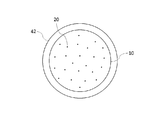
- FIG. 3 is a schematic view showing a second embodiment of the water-absorbing treatment material according to the present invention.
- the water-absorbing treatment material 2 is a water-absorbing treatment material that absorbs liquid, and includes a coating layer portion 40 in addition to the granulated product 10.
- the configuration of the granulated product 10 is as described in the first embodiment.
- the covering layer portion 40 covers the granulated product 10.
- the covering layer portion 40 is a portion that covers at least a part of the surface of the granulated product 10. In the present embodiment, the covering layer portion 40 covers only a part of the surface of the granulated product 10.
- the weight ratio of the covering layer portion 40 to the entire granulated product 10 and the covering layer portion 40 is preferably 1% or more and less than 15%, and more preferably 1% or more and less than 10%.
- the main material of the covering layer portion 40 for example, paper can be used.
- the covering layer portion 40 contains an adhesive material (second adhesive material).
- second adhesive material the same material as the first adhesive material described above may be used, or a different material may be used.
- a water-absorbing polymer having an average particle diameter of 20 ⁇ m or less is used as the second adhesive material.
- the granulated product 10 is formed by the method described in the first embodiment.
- the coating layer part 40 is formed by making the material (coating material) which comprises the coating layer part 40 adhere to the surface of the granulated material 10 (coating process).
- the granulated product 10 is not hydrated. That is, in this embodiment, the coating material is attached to the surface of the granulated product 10 without adding water to the granulated product 10.
- the coating material can be attached by, for example, spraying or spraying using a coating apparatus or the like.
- the water absorption processing material 2 is obtained by performing a granulation process and a drying process.
- the coating layer part 40 containing an adhesive material is provided. Thereby, the mass intensity
- the weight ratio of the covering layer portion 40 to the entire granulated product 10 and the covering layer portion 40 is preferably less than 15%, and more preferably less than 10%.
- the ratio of the coating layer part 40 is too small, the effect of the coating layer part 40 to increase the mass strength is not sufficiently exhibited. From this viewpoint, it is preferable that the weight ratio of the covering layer portion 40 to the entire granulated product 10 and the covering layer portion 40 is 1% or more.
- the covering layer portion 40 covers only a part of the surface of the granulated product 10. In other words, the remaining part of the surface of the granulated product 10 is exposed without being covered with the coating layer part 40. Thereby, at the time of use of the water absorption processing material 2, the granulated material 10 can absorb a liquid rapidly. This is advantageous for promoting the reaction of the foaming agent 20 and enhancing the disintegration property of the granulated product 10.
- the covering layer part 40 contains a water-absorbing polymer as an adhesive material.
- the water-absorbing polymer has a property of swelling during liquid absorption, the water-absorbing polymer swollen in the coating layer portion 40 blocks the liquid from reaching the granulated product 10. For this reason, the swelling of the water-absorbing polymer becomes a factor that deteriorates the disintegration property of the granulated product 10, and consequently the water disintegration property of the water-absorbing treatment material 2.
- the water-absorbing polymer is finely pulverized to suppress swelling during liquid absorption. Therefore, in order to suppress swelling of the water-absorbing polymer, the average particle diameter of the water-absorbing polymer contained in the coating layer portion 40 is preferably 20 ⁇ m or less, and more preferably 10 ⁇ m or less.
- the coating material is adhered to the surface of the granulated product 10 without adding water to the granulated product 10. Thereby, it is possible to prevent an unnecessary amount of coating material from adhering to the surface of the granulated product 10.
- the manufacturing process of the water-absorbing treatment material 2 can be simplified by omitting the hydration process.
- attachment of a coating material can be covered with the water
- FIG. The other effects of this embodiment are as described in the first embodiment.
- the foaming agent which consists of sodium hydrogencarbonate was illustrated.
- a foaming agent what consists of sodium hydrogencarbonate and a citric acid may be used.
- the composition (weight ratio) of the granulated product 10 can be, for example, 80% for papers, 10% for dextrin, 6.5% for sodium bicarbonate, and 3.5% for citric acid.
- citric acid with sodium hydrogen carbonate
- paper is exemplified as the main material of the granulated product 10.
- a water-absorbing material other than paper may be used as the main material of the granulated product 10. Examples of such a water-absorbing material include plastics or tea leaves. The same applies to the main material of the covering layer portion 40.
- the covering layer portion 40 may contain the foaming agent 20. That is, the foaming agent 20 may be contained in both the granulated product 10 and the coating layer portion 42.
- a coating layer portion 42 can be formed, for example, by adding the foaming agent 20 to the coating material prior to adhesion of the coating material to the granulated product 10 in the coating process.
Landscapes
- Life Sciences & Earth Sciences (AREA)
- Environmental Sciences (AREA)
- Health & Medical Sciences (AREA)
- Zoology (AREA)
- Animal Husbandry (AREA)
- Biodiversity & Conservation Biology (AREA)
- Epidemiology (AREA)
- Engineering & Computer Science (AREA)
- Biomedical Technology (AREA)
- Heart & Thoracic Surgery (AREA)
- Vascular Medicine (AREA)
- Animal Behavior & Ethology (AREA)
- General Health & Medical Sciences (AREA)
- Public Health (AREA)
- Veterinary Medicine (AREA)
- Inorganic Chemistry (AREA)
- Chemical & Material Sciences (AREA)
- Housing For Livestock And Birds (AREA)
- Solid-Sorbent Or Filter-Aiding Compositions (AREA)
Abstract
La présente invention concerne un matériau de traitement absorbant l'eau qui présente une excellente capacité de désintégration dans l'eau. L'invention concerne également un procédé de fabrication du matériau de traitement absorbant l'eau. La présente invention concerne un matériau de traitement absorbant l'eau 1 qui absorbe un liquide et comprend une substance granulée 10. La substance granulée 10 contient un agent moussant 20. Lorsque le matériau de traitement absorbant l'eau 1 absorbe le liquide, des bulles sont générées à l'intérieur de la substance granulée 10 suite à la réaction de l'agent moussant 20, et la substance granulée 10 se désintègre.
Priority Applications (4)
| Application Number | Priority Date | Filing Date | Title |
|---|---|---|---|
| PCT/JP2016/052903 WO2017134726A1 (fr) | 2016-02-01 | 2016-02-01 | Matériau de traitement absorbant l'eau et son procédé de fabrication |
| EP16889216.4A EP3412143B1 (fr) | 2016-02-01 | 2016-02-01 | Procede de fabrication d'un materiau de traitement absorbant l'eau |
| CN201680069505.0A CN108366541B (zh) | 2016-02-01 | 2016-02-01 | 吸水处理材料及其制造方法 |
| US16/020,089 US20180303683A1 (en) | 2016-02-01 | 2018-06-27 | Water absorption treatment material and method for manufacturing the same |
Applications Claiming Priority (1)
| Application Number | Priority Date | Filing Date | Title |
|---|---|---|---|
| PCT/JP2016/052903 WO2017134726A1 (fr) | 2016-02-01 | 2016-02-01 | Matériau de traitement absorbant l'eau et son procédé de fabrication |
Related Child Applications (1)
| Application Number | Title | Priority Date | Filing Date |
|---|---|---|---|
| US16/020,089 Continuation US20180303683A1 (en) | 2016-02-01 | 2018-06-27 | Water absorption treatment material and method for manufacturing the same |
Publications (1)
| Publication Number | Publication Date |
|---|---|
| WO2017134726A1 true WO2017134726A1 (fr) | 2017-08-10 |
Family
ID=59499454
Family Applications (1)
| Application Number | Title | Priority Date | Filing Date |
|---|---|---|---|
| PCT/JP2016/052903 Ceased WO2017134726A1 (fr) | 2016-02-01 | 2016-02-01 | Matériau de traitement absorbant l'eau et son procédé de fabrication |
Country Status (4)
| Country | Link |
|---|---|
| US (1) | US20180303683A1 (fr) |
| EP (1) | EP3412143B1 (fr) |
| CN (1) | CN108366541B (fr) |
| WO (1) | WO2017134726A1 (fr) |
Families Citing this family (3)
| Publication number | Priority date | Publication date | Assignee | Title |
|---|---|---|---|---|
| JP7146265B2 (ja) * | 2019-01-23 | 2022-10-04 | 株式会社大貴 | 吸水処理材及びその製造方法 |
| JP7449689B2 (ja) * | 2019-12-19 | 2024-03-14 | 株式会社大貴 | 排泄物処理材及びその製造方法 |
| JP7723739B2 (ja) * | 2021-05-26 | 2025-08-14 | 株式会社大貴 | 排泄物処理材及びその製造方法 |
Citations (3)
| Publication number | Priority date | Publication date | Assignee | Title |
|---|---|---|---|---|
| JPH09308403A (ja) * | 1996-05-24 | 1997-12-02 | Kumiko Watabe | 猫のトイレ砂及び小動物ペット類の敷き材 |
| JP2013071107A (ja) * | 2011-09-29 | 2013-04-22 | Kanichi Adachi | 排泄物処理剤 |
| JP2015198600A (ja) * | 2014-04-08 | 2015-11-12 | 株式会社大貴 | 吸水処理材及びその製造方法 |
Family Cites Families (8)
| Publication number | Priority date | Publication date | Assignee | Title |
|---|---|---|---|---|
| JP4153349B2 (ja) * | 2003-04-09 | 2008-09-24 | 三洋化成工業株式会社 | 動物の排泄物用処理材 |
| CN100497409C (zh) * | 2007-09-06 | 2009-06-10 | 段梦麟 | 吸液速率高、分散性与干爽度优的吸水聚合物的制备方法 |
| EP2764769B1 (fr) * | 2011-12-28 | 2019-09-18 | Daiki Co., Ltd. | Matériau de traitement d'excréments |
| WO2013128978A1 (fr) * | 2012-02-29 | 2013-09-06 | 住友精化株式会社 | Procédé de production de particules de résine absorbant l'eau |
| US20140203208A1 (en) * | 2012-09-12 | 2014-07-24 | Susumu Okamoto | Body waste treating material, method for manufacturing body waste treating material, and apparatus for manufacturing the same |
| JP5379321B1 (ja) * | 2013-03-29 | 2013-12-25 | ユニ・チャーム株式会社 | 排泄物処理材の製造方法及び排泄物処理材 |
| EP2995372A4 (fr) * | 2013-05-10 | 2017-01-04 | Daiki Co. Ltd. | Matériau d'absorption et traitement, et procédé de fabrication de celui-ci |
| WO2015127528A1 (fr) * | 2014-02-27 | 2015-09-03 | 7905122 Canada Inc. | Matériau absorbant chromogène pour litière animale |
-
2016
- 2016-02-01 CN CN201680069505.0A patent/CN108366541B/zh not_active Expired - Fee Related
- 2016-02-01 EP EP16889216.4A patent/EP3412143B1/fr not_active Not-in-force
- 2016-02-01 WO PCT/JP2016/052903 patent/WO2017134726A1/fr not_active Ceased
-
2018
- 2018-06-27 US US16/020,089 patent/US20180303683A1/en not_active Abandoned
Patent Citations (3)
| Publication number | Priority date | Publication date | Assignee | Title |
|---|---|---|---|---|
| JPH09308403A (ja) * | 1996-05-24 | 1997-12-02 | Kumiko Watabe | 猫のトイレ砂及び小動物ペット類の敷き材 |
| JP2013071107A (ja) * | 2011-09-29 | 2013-04-22 | Kanichi Adachi | 排泄物処理剤 |
| JP2015198600A (ja) * | 2014-04-08 | 2015-11-12 | 株式会社大貴 | 吸水処理材及びその製造方法 |
Also Published As
| Publication number | Publication date |
|---|---|
| EP3412143A4 (fr) | 2019-07-17 |
| EP3412143A1 (fr) | 2018-12-12 |
| CN108366541A (zh) | 2018-08-03 |
| US20180303683A1 (en) | 2018-10-25 |
| EP3412143B1 (fr) | 2020-08-12 |
| CN108366541B (zh) | 2021-07-20 |
Similar Documents
| Publication | Publication Date | Title |
|---|---|---|
| JP6422728B2 (ja) | 吸水処理材及びその製造方法 | |
| US11304401B2 (en) | Water absorption treatment material and method for manufacturing the same | |
| JP6480058B1 (ja) | 排泄物処理材及びその製造方法 | |
| WO2017134726A1 (fr) | Matériau de traitement absorbant l'eau et son procédé de fabrication | |
| JP6300995B1 (ja) | 吸水処理材及びその製造方法 | |
| JP2016208903A (ja) | 吸水処理材及びその製造方法 | |
| JP6300994B1 (ja) | 吸水処理材及びその製造方法 | |
| US20180303059A1 (en) | Water absorption treatment material and method for manufacturing the same | |
| JP6599085B2 (ja) | 吸水処理材 | |
| JP6367072B2 (ja) | 吸水処理材及びその製造方法 | |
| WO2018173554A1 (fr) | Matériau de traitement d'excréments et son procédé de fabrication | |
| WO2017086080A1 (fr) | Matériau de traitement d'absorption d'eau et procédé de production associé | |
| JP6385703B2 (ja) | 吸水処理材及びその製造方法 | |
| CN103857278A (zh) | 排泄物处理材料、排泄物处理材料的制造方法及其制造装置 | |
| JP6677964B2 (ja) | 吸水処理材の製造方法 | |
| JP6554273B2 (ja) | 吸水処理材 | |
| HK1251406A1 (zh) | 吸水处理材料及其制造方法 | |
| JP6381360B2 (ja) | 吸水処理材及びその製造方法 | |
| JP6677963B2 (ja) | 吸水処理材 | |
| JP2016041040A (ja) | 吸水処理材及びその製造方法 | |
| JP2016039795A (ja) | 吸水処理材 | |
| JP2016042837A (ja) | 吸水処理材及びその製造方法 | |
| WO2017134724A1 (fr) | Matériau de traitement absorbant l'eau | |
| HK1251405B (zh) | 吸水处理材料 |
Legal Events
| Date | Code | Title | Description |
|---|---|---|---|
| 121 | Ep: the epo has been informed by wipo that ep was designated in this application |
Ref document number: 16889216 Country of ref document: EP Kind code of ref document: A1 |
|
| NENP | Non-entry into the national phase |
Ref country code: DE |
|
| WWE | Wipo information: entry into national phase |
Ref document number: 2016889216 Country of ref document: EP |
|
| ENP | Entry into the national phase |
Ref document number: 2016889216 Country of ref document: EP Effective date: 20180903 |
|
| NENP | Non-entry into the national phase |
Ref country code: JP |