WO2017138608A1 - 添加剤、表面処理剤、表面改質ラテックス粒子、表面改質ラテックス粒子の製造方法、ラテックス凝集反応用試薬、キット、及び標的物質の検出方法 - Google Patents
添加剤、表面処理剤、表面改質ラテックス粒子、表面改質ラテックス粒子の製造方法、ラテックス凝集反応用試薬、キット、及び標的物質の検出方法 Download PDFInfo
- Publication number
- WO2017138608A1 WO2017138608A1 PCT/JP2017/004730 JP2017004730W WO2017138608A1 WO 2017138608 A1 WO2017138608 A1 WO 2017138608A1 JP 2017004730 W JP2017004730 W JP 2017004730W WO 2017138608 A1 WO2017138608 A1 WO 2017138608A1
- Authority
- WO
- WIPO (PCT)
- Prior art keywords
- group
- repeating unit
- latex particles
- mass
- latex
- Prior art date
- Legal status (The legal status is an assumption and is not a legal conclusion. Google has not performed a legal analysis and makes no representation as to the accuracy of the status listed.)
- Ceased
Links
Images

Classifications
-
- G—PHYSICS
- G01—MEASURING; TESTING
- G01N—INVESTIGATING OR ANALYSING MATERIALS BY DETERMINING THEIR CHEMICAL OR PHYSICAL PROPERTIES
- G01N33/00—Investigating or analysing materials by specific methods not covered by groups G01N1/00 - G01N31/00
- G01N33/48—Biological material, e.g. blood, urine; Haemocytometers
- G01N33/50—Chemical analysis of biological material, e.g. blood, urine; Testing involving biospecific ligand binding methods; Immunological testing
- G01N33/53—Immunoassay; Biospecific binding assay; Materials therefor
- G01N33/543—Immunoassay; Biospecific binding assay; Materials therefor with an insoluble carrier for immobilising immunochemicals
- G01N33/54313—Immunoassay; Biospecific binding assay; Materials therefor with an insoluble carrier for immobilising immunochemicals the carrier being characterised by its particulate form
-
- C—CHEMISTRY; METALLURGY
- C08—ORGANIC MACROMOLECULAR COMPOUNDS; THEIR PREPARATION OR CHEMICAL WORKING-UP; COMPOSITIONS BASED THEREON
- C08F—MACROMOLECULAR COMPOUNDS OBTAINED BY REACTIONS ONLY INVOLVING CARBON-TO-CARBON UNSATURATED BONDS
- C08F220/00—Copolymers of compounds having one or more unsaturated aliphatic radicals, each having only one carbon-to-carbon double bond, and only one being terminated by only one carboxyl radical or a salt, anhydride ester, amide, imide or nitrile thereof
- C08F220/02—Monocarboxylic acids having less than ten carbon atoms; Derivatives thereof
- C08F220/52—Amides or imides
- C08F220/54—Amides, e.g. N,N-dimethylacrylamide or N-isopropylacrylamide
- C08F220/56—Acrylamide; Methacrylamide
-
- G—PHYSICS
- G01—MEASURING; TESTING
- G01N—INVESTIGATING OR ANALYSING MATERIALS BY DETERMINING THEIR CHEMICAL OR PHYSICAL PROPERTIES
- G01N33/00—Investigating or analysing materials by specific methods not covered by groups G01N1/00 - G01N31/00
- G01N33/48—Biological material, e.g. blood, urine; Haemocytometers
- G01N33/50—Chemical analysis of biological material, e.g. blood, urine; Testing involving biospecific ligand binding methods; Immunological testing
- G01N33/53—Immunoassay; Biospecific binding assay; Materials therefor
- G01N33/543—Immunoassay; Biospecific binding assay; Materials therefor with an insoluble carrier for immobilising immunochemicals
- G01N33/54393—Improving reaction conditions or stability, e.g. by coating or irradiation of surface, by reduction of non-specific binding, by promotion of specific binding
Definitions
- the present invention relates to an additive, a surface treatment agent, surface-modified latex particles, a method for producing surface-modified latex particles, a reagent for latex agglutination reaction, a kit, and a method for detecting a target substance.
- a latex agglutination method that utilizes an agglutination reaction that occurs between a target substance such as an antigen (antibody) and an antibody (antigen) against the target substance is widely used in areas such as clinical examination and biochemical research (Patent Document 1). .
- This latex agglutination method includes, for example, a sample that may contain a target substance and a first reagent such as a buffer, and this mixture and latex particles on which an antibody (antigen) to the target substance is immobilized. This is performed by mixing with a latex agglutination reaction reagent (second reagent). When the target substance is present in the specimen, the latex particle aggregation reaction that occurs as a result of the antigen-antibody reaction is detected.
- the water-soluble polymer has a drawback that it causes aggregation of latex particles due to factors other than antigen-antibody reaction (such as non-specific adsorption), and noise is generated due to the aggregation, or the water-soluble polymer is used in a reagent for latex aggregation reaction.
- antigen-antibody reaction such as non-specific adsorption
- noise is generated due to the aggregation
- the water-soluble polymer is used in a reagent for latex aggregation reaction.
- the problem to be solved by the present invention is to provide an additive and a surface treatment agent that can suppress aggregation of latex particles contained in the reagent during storage of the reagent for latex agglutination reaction even though the synthetic polymer is an active ingredient. There is to do.
- the present inventors have added a polymer having a specific amount of hydrophilic repeating units and a hydrophobic repeating unit and having a specific weight average molecular weight to latex particles not subjected to blocking treatment, That is, it has been found that aggregation of the latex particles is suppressed by treating the surface of the latex particles with the polymer.
- the present invention provides the following [1] to [18].
- latex particles used in a reagent for latex agglutination reaction, wherein the latex particles are latex particles that are not subjected to blocking treatment, and are hydrophilic repeating units (A) (hereinafter simply referred to as “repeating particles”).
- A hydrophilic repeating units
- An additive (hereinafter also referred to as an additive of the present invention) comprising a polymer (hereinafter also referred to as a specific polymer) having a mass average molecular weight of 3000 or more and a weight average molecular weight of 3000 or more.
- a surface treatment agent for use in the surface treatment of latex particles used in a reagent for latex agglutination reaction, which contains a specific polymer hereinafter also referred to as the surface treatment agent of the present invention).
- the repeating unit (A) includes a polyalkylene glycol chain, a zwitterionic structure, a heterocyclic group, an ester bond, an amide bond, a hydroxy group, an epoxy group, an isocyanate group, a block isocyanate group, and a carboxylic anhydride group. And the agent according to [1] or [2], including one or more selected from an amino group. [4] The above [1] to [3], wherein the repeating unit (A) contains one or more selected from a polyalkylene glycol chain, a zwitterionic structure, a heterocyclic group, an ester bond and an amide bond. The agent in any one of.
- the repeating unit (A) has one or more selected from hydrophilic repeating units derived from (meth) acrylamide monomers and hydrophilic repeating units derived from (meth) acrylate monomers, The agent according to any one of [1] to [4].
- the repeating unit (B) includes one or more selected from a keto group, an ester bond, an amide bond, and an aromatic hydrocarbon group. Agent.
- repeating unit (B) a hydrophobic repeating unit derived from a (meth) acrylamide monomer, a hydrophobic repeating unit derived from a (meth) acrylate monomer, and a hydrophobic repeating unit derived from a styrene monomer
- the repeating unit (B) has one or more selected from a hydrophobic repeating unit represented by the following formula (7) and a hydrophobic repeating unit represented by the following formula (8).
- R 31 represents a hydrogen atom or a methyl group
- R 32 represents —O—, * — (C ⁇ O) —O—, * — (C ⁇ O) —NR 34 —, * —NR 34 — (C ⁇ O) —
- R 34 represents a hydrogen atom or An organic group having 1 to 10 carbon atoms, * represents a position bonded to the carbon atom to which R 31 in formula (7) is bonded) or a phenylene group
- R 33 represents a hydrocarbon group.
- R 35 represents a hydrogen atom or a methyl group
- Z represents an organic group having a formyl group or a keto group.
- a method for producing surface-modified latex particles (hereinafter, also referred to as a method for producing surface-modified latex particles of the present invention), comprising a contact step of bringing a specific polymer into contact with latex particles.
- a contact step of bringing a specific polymer into contact with latex particles comprising a contact step of bringing a specific polymer into contact with latex particles.
- a reagent for latex agglutination reaction comprising the surface-modified latex particles according to [13] or [15] (hereinafter also referred to as a latex agglutination reaction reagent of the present invention).
- a target substance detection method comprising a mixing step of mixing the latex agglutination reaction reagent according to [16] and a sample, and a detection step of optically detecting an agglutination reaction caused by the mixing step ( Hereinafter, it is also referred to as a target substance detection method of the present invention).
- the additive of the present invention is an additive for adding to latex particles used in a reagent for latex agglutination reaction, and the latex particles are latex particles not subjected to blocking treatment, and are hydrophilic repeating units (A). : Polymer having more than 60% by mass and less than 99% by mass in all repeating units and hydrophobic repeating unit (B): 1% by mass to less than 40% by mass in all repeating units, and having a weight average molecular weight of 3000 or more It is characterized by including.
- the surface treatment agent of the present invention is a surface treatment agent for use in the surface treatment of latex particles used in a reagent for latex agglutination reaction, and has hydrophilic repeating units (A): more than 60% by mass in all repeating units. 99% by mass or less and a hydrophobic repeating unit (B): having 1% by mass or more and less than 40% by mass in all repeating units, and comprising a polymer having a weight average molecular weight of 3000 or more.
- “latex particles not subjected to blocking treatment” refers to biological substances such as albumin, casein, gelatin, skim milk, blocking reagent N101 (NOF Corporation), and blocking reagent N102 (NOF Corporation).
- ⁇ refers to latex particles that have not yet been subjected to blocking treatment (surface treatment) using a synthetic polymer such as Lipidure (registered trademark) -BL103, BL203, BL802 (NOF Corporation).
- surface treatment means making a specific polymer and latex particle contact directly so that a specific polymer may adhere to a part or all of the surface of a latex particle.
- the additive of this invention and the surface treating agent may contain only 1 type in the thing applicable to a specific polymer, or may contain 2 or more types.
- “A to B” representing a numerical range or the like means A or more and B or less, and A and B are included in the numerical range.
- the specific polymer has a hydrophilic repeating unit (A).
- a specific polymer has more than 60 mass% and 99 mass% or less of hydrophilic repeating units (A) in all the repeating units.
- the content of the repeating unit (A) is 60% by mass or less, aggregation is likely to occur during storage of the reagent for latex agglutination reaction.
- it exceeds 99% by mass the specific polymer does not sufficiently adhere to the latex particles, and aggregation is likely to occur during storage of the latex agglutination reagent as described above.
- hydrophilic means having a strong affinity for water. Specifically, when it is a homopolymer consisting of only one type of repeating unit (having a number average molecular weight of about 10,000 by the measurement method of the example), it is 1 g or more per 100 g of pure water at room temperature (25 ° C.). When dissolved, the repeating unit is hydrophilic.
- the content of the repeating unit (A) is preferably 65% by mass or more, more preferably 70% by mass or more, and particularly preferably 75% in all repeating units from the viewpoint of suppressing aggregation during storage of the reagent for latex aggregation reaction. From the viewpoint of making it difficult to peel off from the particle surface after the specific polymer is attached to the particle, it is preferably 97.5% by mass or less, particularly preferably 95% by mass or less. is there.
- the content of each repeating unit can be measured by 13 C-NMR or the like.
- Specific polymers include polyalkylene glycol chains, zwitterionic structures, heterocyclic groups (morpholino groups, etc.), ester bonds, amide bonds, hydroxy groups, epoxy groups, isocyanate groups, block isocyanate groups, carboxylic anhydrides What contains 1 type, or 2 or more types chosen from a group and an amino group in a repeating unit (A) is preferable.
- the specific polymer may have the polyalkylene glycol chain or the like in the main chain of the repeating unit (A) or in the side chain, but preferably in the side chain of the repeating unit (A). .
- a specific polymer containing one or more selected from a polyalkylene glycol chain, a zwitterionic structure, a heterocyclic group, an ester bond and an amide bond in the repeating unit (A) is more preferable.
- the polyalkylene glycol chain, - (R 1 O) as represented by the n- is preferably (R 1 represents an alkanediyl group having a carbon number of 2 ⁇ 4, n represents 2 to 100 mean ).
- the number of carbon atoms of the alkanediyl group represented by R 1 is preferably 2 or 3, more preferably 2.
- the alkanediyl group represented by R 1 may be linear or branched, and specifically includes ethane-1,2-diyl group, propane-1,2-diyl group, propane-1,3-diyl.
- n R 1 s may be the same or different.
- n represents an average value of 2 to 100, preferably an average value of 4 to 90, more preferably an average value of 8 to 90, still more preferably an average value of 8 to 60, and still more preferably.
- Each “average value” in this specification can be measured by NMR.
- repeating unit (A) examples include a repeating unit derived from a monomer having an unsaturated bond at the terminal or non-terminal. Specifically, repeating units derived from (meth) acrylamide monomers (hereinafter also referred to as (meth) acrylamide repeating units), repeating units derived from (meth) acrylate monomers (hereinafter referred to as (meth) acrylate repeating units). Unit), repeating units derived from styrene monomers (hereinafter also referred to as styrene repeating units), repeating units derived from unsaturated polyalkylene glycol ether monomers, and the like.
- the repeating unit (A) one of these may be used alone, or two or more may be used in combination.
- a (meth) acrylamide repeating unit, a (meth) acrylate repeating unit, and a styrene repeating unit are preferable, a (meth) acrylamide repeating unit, and a (meth) acrylate repeating unit. Is more preferable.
- the content of the (meth) acrylate-based repeating unit is preferably 0 to 90% by mass, more preferably 0 to 80% by mass, and particularly preferably 0 to 70% by mass with respect to the total amount of the repeating unit (A).
- the repeating unit (A) may have a polyalkylene glycol chain, a zwitterionic structure, a heterocyclic group such as a morpholino group, and the like in a side chain. Moreover, even if it has 1 type independently among these groups, it may have 2 or more types.
- repeating unit (A) a hydrophilic repeating unit having a polyalkylene glycol chain in the side chain (hereinafter also referred to as repeating unit (A-1)) will be specifically described.
- the repeating unit (A-1) include repeating units derived from monomers similar to the monomer species exemplified as the monomer having an unsaturated bond at the terminal or non-terminal, and (meth) acrylate-based repeating units are particularly preferable. preferable.
- the repeating unit (A-1) preferably has a hydrogen atom or an alkyl group having 1 to 4 carbon atoms bonded to the terminal of the polyalkylene glycol chain.
- Examples of such a repeating unit (A-1) include a hydrophilic repeating unit having a structure represented by the following formula (1) in the side chain, and in such a case, represented by the following formula (2): Preferred is a hydrophilic repeating unit.
- R 2 represents a hydrogen atom or an alkyl group having 1 to 4 carbon atoms, R 1 and n are as defined above. ]
- R 3 represents a hydrogen atom or a methyl group
- R 4 represents —O—, * — (C ⁇ O) —O—, * —NR 5 — (C ⁇ O) —
- R 5 represents a hydrogen atom or an organic group having 1 to 10 carbon atoms; Represents a position bonded to the carbon atom to which R 3 in Formula (2) is bonded) or a phenylene group
- Other symbols are synonymous with the symbols in formula (1).
- R 2 represents a hydrogen atom or an alkyl group having 1 to 4 carbon atoms.
- the number of carbon atoms of the alkyl group represented by R 2 is preferably 1 to 3, more preferably 1 or 2, and still more preferably 1, from the viewpoints of the desired effect and availability of the present invention.
- the alkyl group represented by R 2 may be linear or branched, and specifically includes a methyl group, ethyl group, n-propyl group, isopropyl group, n-butyl group, isobutyl group, sec-butyl group. And tert-butyl group.
- R 2 a hydrogen atom and an alkyl group having 1 to 3 carbon atoms are preferable, and a hydrogen atom and an alkyl group having 1 or 2 carbon atoms are more preferable from the viewpoint of the desired effect and availability of the present invention.
- a hydrogen atom or a methyl group is more preferable, and a methyl group is particularly preferable.
- R 4 represents —O—, * — (C ⁇ O) —O—, * —NR 5 — (C ⁇ O) —, or a phenylene group.
- a phenylene group include a 1,2-phenylene group, a 1,3-phenylene group, and a 1,4-phenylene group.
- the organic group represented by R 5 has 1 to 10 carbon atoms, preferably 1 to 6 carbon atoms.
- Examples of the organic group include hydrocarbon groups.
- Such a hydrocarbon group is a concept including an aliphatic hydrocarbon group, an alicyclic hydrocarbon group, and an aromatic hydrocarbon group.
- the aliphatic hydrocarbon group in R 5 may be linear or branched, and specifically includes a methyl group, ethyl group, n-propyl group, isopropyl group, n-butyl group, isobutyl group, sec-butyl group. Alkyl groups such as tert-butyl group, pentyl group, hexyl group, heptyl group, octyl group, nonyl group and decyl group.
- the alicyclic hydrocarbon group is roughly classified into a monocyclic alicyclic hydrocarbon group and a bridged ring hydrocarbon group.
- Examples of the monocyclic alicyclic hydrocarbon group include cycloalkyl groups such as a cyclopropyl group and a cyclohexyl group.
- Examples of the bridged ring hydrocarbon group include an isobornyl group.
- Examples of the aromatic hydrocarbon group include aryl groups such as a phenyl group.
- * — (C ⁇ O) —O— is particularly preferable.
- repeating unit (A) a hydrophilic repeating unit having a zwitterionic structure in the side chain (hereinafter also referred to as repeating unit (A-2)) will be specifically described.
- the repeating unit (A-2) include repeating units derived from monomers similar to the monomer species exemplified as the monomer having an unsaturated bond at the terminal or non-terminal, and (meth) acrylate-based repeating units are particularly preferable. preferable.
- Specific examples include hydrophilic repeating units represented by the following formula (3) or (4).
- both the hydrophilic repeating unit represented by Formula (3) and the hydrophilic repeating unit represented by Formula (4) may be included.
- R 6 represents a hydrogen atom or a methyl group
- R 7 represents an alkanediyl group having 2 to 4 carbon atoms
- R 8 represents an alkanediyl group having 1 to 10 carbon atoms
- R 9 , R 10 and R 11 each independently represents a hydrogen atom or a hydrocarbon group having 1 to 8 carbon atoms
- q represents an average value of 1 to 10.
- Y represents — (C ⁇ O) O ⁇ , — (O ⁇ S ⁇ O) O ⁇ , —O (O ⁇ S ⁇ O) O ⁇ , — (S ⁇ O) O ⁇ , —O (S ⁇ O).
- R 17 represents an alkyl group having 1 to 3 carbon atoms
- R 12 represents a hydrogen atom or a methyl group
- R 13 and R 14 each independently represents a divalent organic group having 1 to 10 carbon atoms
- R 15 and R 16 each independently represents a hydrocarbon group having 1 to 10 carbon atoms.
- R 7 represents an alkanediyl group having 2 to 4 carbon atoms. In the case where R 7 is more, R 7 may be the same or different.
- the carbon number of the alkanediyl group represented by R 7 is preferably 2 or 3, and more preferably 2.
- the alkanediyl group represented by R 7 may be linear or branched, and specifically includes ethane-1,2-diyl group, propane-1,2-diyl group, propane-1,3-diyl. Group, propane-2,2-diyl group, butane-1,2-diyl group, butane-1,3-diyl group, butane-1,4-diyl group and the like. Among these, an ethane-1,2-diyl group is preferable from the viewpoint of the desired effect and availability of the present invention.
- R 8 represents an alkanediyl group having 1 to 10 carbon atoms.
- the number of carbon atoms of the alkanediyl group represented by R 8 is preferably 1 to 6, more preferably 1 to 4, still more preferably 2 or 3, and particularly preferably 2.
- the alkanediyl group represented by R 8 may be linear or branched, and preferred specific examples include the same alkanediyl groups represented by R 7 .
- R 9 , R 10 and R 11 each independently represents a hydrogen atom or a hydrocarbon group having 1 to 8 carbon atoms, preferably a hydrocarbon group having 1 to 8 carbon atoms.
- the carbon number of such a hydrocarbon group is preferably 1 to 4, more preferably 1 or 2, and particularly preferably 1.
- the hydrocarbon group include an alkyl group; an aryl group such as a phenyl group; and an aralkyl group such as a benzyl group, with an alkyl group being preferred.
- the alkyl group may be linear or branched, and preferred specific examples are methyl, ethyl, n-propyl, isopropyl, n-butyl, isobutyl, sec-butyl, tert-butyl. Groups.
- q represents an average value of 1 to 10, preferably 1 to 7 on average, more preferably 1 to 4 on average, and further preferably 1.
- Examples of the monomer constituting the repeating unit represented by the formula (3) include 2- (meth) acryloyloxyethyl-2 ′-(trimethylammonio) ethyl phosphate, (2- (meth) acryloyloxyethyl phosphorylcholine), 3 -(Meth) acryloyloxypropyl-2 '-(trimethylammonio) ethyl phosphate, 4- (meth) acryloyloxybutyl-2'-(trimethylammonio) ethyl phosphate, 2- (meth) acryloyloxyethoxyethyl-2 '-(Trimethylammonio) ethyl phosphate, 2- (meth) acryloyloxydiethoxyethyl-2'-(trimethylammonio) ethyl phosphate, 2- (meth) acryloyloxyethyl-2 '-(triethylammonio) ethyl Phos
- Y is preferably — (C ⁇ O) O 2 — .
- examples of the alkyl group represented by R 17 include a methyl group, an ethyl group, an n-propyl group, and an isopropyl group.
- R 13 and R 14 each independently represent a divalent organic group having 1 to 10 carbon atoms. Such a divalent organic group preferably has 1 to 8 carbon atoms, more preferably 1 to 6 carbon atoms.
- the divalent organic group is preferably a divalent hydrocarbon group, and more preferably a divalent aliphatic hydrocarbon group.
- the divalent aliphatic hydrocarbon group may be linear or branched.
- an alkanediyl group is preferable.
- R 15 and R 16 each independently represents a hydrocarbon group having 1 to 10 carbon atoms.
- the hydrocarbon group preferably has 1 to 6 carbon atoms, more preferably 1 to 4 carbon atoms.
- Examples of the hydrocarbon group represented by R 15 and R 16 include an alkyl group; an aryl group such as a phenyl group; and an aralkyl group such as a benzyl group, with an alkyl group being preferred.
- the alkyl group may be linear or branched, and examples thereof include a methyl group, an ethyl group, an n-propyl group, an isopropyl group, an n-butyl group, an isobutyl group, a sec-butyl group, and a tert-butyl group.
- Examples of the monomer constituting the repeating unit represented by the formula (4) include N- (meth) acryloyloxyethyl-N, N-dimethylammonium- ⁇ -N-methylcarboxybetaine, N- (meth) acryloyloxyethyl- N, N-dimethylammonium- ⁇ -N-propylsulfobetaine and the like can be mentioned, and these may be used alone or in combination of two or more.
- the specific polymer is preferably one containing at least a (meth) acrylamide repeating unit as the repeating unit (A).
- the content of the (meth) acrylamide repeating unit is preferably 10 to 100% by mass, more preferably 20 to 100% by mass, and particularly preferably 30 to 100% by mass with respect to the total amount of the repeating unit (A).
- the (meth) acrylamide repeating unit may have the above polyalkylene glycol chain or zwitterionic structure in the side chain, but the hydrophilic repeating unit represented by the following formula (5) or (6) is Particularly preferred. In addition, both the hydrophilic repeating unit represented by Formula (5) and the hydrophilic repeating unit represented by Formula (6) may be included. Moreover, as a repeating unit (A), what contains at least the hydrophilic repeating unit represented by Formula (6) from a viewpoint of suppressing aggregation in the reagent for latex aggregation reaction preservation
- R 18 represents a hydrogen atom or a methyl group
- R 19 and R 20 each independently represents a hydrogen atom, an alkyl group having 1 to 6 carbon atoms or a hydroxyalkyl group.
- R 21 represents a hydrogen atom or a methyl group
- R 22 and R 23 each independently represents an alkanediyl group having 1 to 3 carbon atoms.
- R 19 and R 20 each independently represent a hydrogen atom, an alkyl group having 1 to 6 carbon atoms, or a hydroxyalkyl group.
- the carbon number of the alkyl group represented by R 19 or R 20 is preferably 1 to 3.
- the alkyl group represented by R 19 or R 20 may be linear or branched, and preferred specific examples include a methyl group, an ethyl group, an n-propyl group, and an isopropyl group.
- the number of carbon atoms of the hydroxyalkyl group represented by R 19 or R 20 is preferably 1 to 6, more preferably 1 to 3.
- the alkyl group contained in the hydroxyalkyl group may be linear or branched, and preferred specific examples of the hydroxyalkyl group include a hydroxymethyl group, a hydroxyethyl group, a hydroxypropyl group, and a hydroxyisopropyl group.
- the substitution position of the hydroxy group in the hydroxyalkyl group is arbitrary.
- dimethyl (meth) acrylamide, diethyl (meth) acrylamide, N-isopropyl (meth) acrylamide, N- (hydroxymethyl) (meth) acrylamide, N- (2-Hydroxyethyl) (meth) acrylamide and the like may be mentioned, and these may be used alone or in combination of two or more.
- R 22 and R 23 each independently represents an alkanediyl group having 1 to 3 carbon atoms. Such an alkanediyl group preferably has 1 to 2 carbon atoms.
- the alkanediyl group may be linear or branched, but is preferably linear. Preferable specific examples include methane-1,1-diyl group and ethane-1,2-diyl group.
- Examples of the monomer constituting the repeating unit represented by the formula (6) include 4- (meth) acryloylmorpholine.
- the specific polymer may contain the anionic repeating unit as a repeating unit (A).
- the repeating unit include a repeating unit having an anionic group such as a carboxy group, a sulfo group, and a phosphoric acid group.
- the repeating unit may have one or two or more.
- the anionic group of the repeating unit (A) may form a salt.
- the salt include alkali metal salts such as sodium salt and potassium salt; alkaline earth metals such as magnesium salt and calcium salt Salt; ammonium salt; organic ammonium salt and the like.
- Monomers constituting the anionic repeating unit include unsaturated dicarboxylic acids such as fumaric acid, maleic acid and itaconic acid or salts thereof; unsaturated carboxylic acids such as (meth) acrylic acid or salts thereof; ethylenesulfonic acid and allylsulfone A sulfo group-containing polymerizable unsaturated monomer such as acid, methallylsulfonic acid, 2-sulfoethyl (meth) acrylate, 2-acrylamido-2-methylpropanesulfonic acid, or a salt thereof; 2- (meth) acryloyloxyethyl acid phosphate; Examples thereof include a phosphate group-containing polymerizable unsaturated monomer such as 2- (meth) acryloyloxypropyl acid phosphate or a salt thereof.
- the monomer constituting the anionic repeating unit is a hydrolyzate of an acrylate ester; a hydrolyzate of an anhydride of an unsaturated dicarboxylic acid such as maleic anhydride or itaconic anhydride; a glycidyl methacrylate or (4-vinylbenzyl )
- An acid group-containing thiol adduct to an epoxy group such as glycidyl ether can also be used.
- Anionic repeating units may be used alone or in combination of two or more.
- the specific polymer of the present invention has a hydrophobic repeating unit (B). Thereby, when an additive and a surface treatment agent are used, the specific polymer easily adheres to the latex particles.
- hydrophobic means having a weak affinity for water. Specifically, when it is a homopolymer consisting of only one type of repeating unit (having a number average molecular weight of about 10,000 by the measurement method of the example), it is less than 1 g with respect to 100 g of pure water at room temperature (25 ° C.). If it only dissolves, the repeating unit is hydrophobic.
- Content of a repeating unit (B) is 1 to less than 40 mass% in all the repeating units.
- the content of the repeating unit (B) is less than 1% by mass, the specific polymer does not sufficiently adhere to the latex particles, and aggregation during the storage of the reagent for latex aggregation reaction tends to occur.
- aggregation easily occurs during storage of the latex aggregation reaction reagent.
- the content of the repeating unit (B) is preferably 2.5% by mass or more, particularly preferably 5% by mass or more, in all repeating units, from the viewpoint that the specific polymer easily adheres to the particles.
- the reagent for the aggregation reaction is preferably 38% by mass or less, more preferably 35% by mass or less, still more preferably 30% by mass or less, and particularly preferably 25% by mass or less in all repeating units. is there.
- the content of the repeating unit (B) is 25% by mass or less, latex particles are less likely to aggregate even when the latex agglutination reaction reagent is stored for a long time under high temperature conditions.
- the specific polymer one or more kinds selected from a keto group, an ester bond, an amide bond, and an aromatic hydrocarbon group (for example, an aryl group such as a phenyl group or an arylene group such as a phenylene group) are repeating units. What is contained in (B) is preferable.
- a specific polymer may have the said keto group etc. in the principal chain of a repeating unit (B), or may have it in a side chain, it is preferable to have in the side chain of a repeating unit (B).
- repeating unit (B) examples include a repeating unit derived from a monomer having an unsaturated bond at the terminal or non-terminal. Specific examples include repeating units derived from (meth) acrylamide monomers, repeating units derived from (meth) acrylate monomers, repeating units derived from styrene monomers, and the like. In addition, as the repeating unit (B), one of these may be used alone, or two or more may be used in combination.
- Styrene monomers include styrene, 4-methylstyrene, 2,4-dimethylstyrene, 2,4,6-trimethylstyrene, 4-ethylstyrene, 4-isopropylstyrene, 4-tert-butylstyrene, ⁇ - And methyl styrene.
- the repeating unit (B) a (meth) acrylamide repeating unit, a (meth) acrylate repeating unit, and a styrene repeating unit are preferable, and a (meth) acrylamide repeating unit and a (meth) acrylate repeating unit are preferred. Is more preferable.
- a hydrophobic repeating unit represented by the following formula (7) or (8) is preferable from the viewpoint of improving hydrophobicity and suppressing nonspecific adsorption, and hydrophobicity derived from alkyl (meth) acrylate.
- the hydrophobic unit represented by the repeating unit represented by formula (8) is more preferred.
- both the hydrophobic repeating unit represented by Formula (7) and the hydrophobic repeating unit represented by Formula (8) may be included.
- R 31 represents a hydrogen atom or a methyl group
- R 32 represents —O—, * — (C ⁇ O) —O—, * — (C ⁇ O) —NR 34 —, * —NR 34 — (C ⁇ O) —
- R 34 represents a hydrogen atom or An organic group having 1 to 10 carbon atoms, * represents a position bonded to the carbon atom to which R 31 in formula (7) is bonded) or a phenylene group
- R 33 represents a hydrocarbon group.
- R 35 represents a hydrogen atom or a methyl group
- Z represents an organic group having a formyl group or a keto group.
- R 32 represents —O—, * — (C ⁇ O) —O—, * — (C ⁇ O) —NR 34 —, * —NR 34 — (C ⁇ O) — or phenylene. Indicates a group. Examples of such a phenylene group include a 1,2-phenylene group, a 1,3-phenylene group, and a 1,4-phenylene group.
- * — (C ⁇ O) —O—, * — (C ⁇ O) —NR 34 —, and a phenylene group are preferable from the viewpoint of the desired effect of the present invention and availability.
- (C ⁇ O) —O— and * — (C ⁇ O) —NR 34 — are more preferred, and * — (C ⁇ O) —O— and * — (C ⁇ O) —NH— are particularly preferred.
- R 33 represents a hydrocarbon group.
- the hydrocarbon group preferably has 1 to 30 carbon atoms, more preferably 1 to 24 carbon atoms, still more preferably 1 to 18 carbon atoms, and particularly preferably 1 to 14 carbon atoms.
- the organic group represented by R 34 has 1 to 10 carbon atoms, preferably 1 to 6 carbon atoms. Examples of the organic group include hydrocarbon groups.
- the hydrocarbon group in R 33 and R 34 is a concept including an aliphatic hydrocarbon group, an alicyclic hydrocarbon group, and an aromatic hydrocarbon group. Further, it may be either linear or branched and may contain a ring structure.
- the aliphatic hydrocarbon group in R 33 and R 34 may be linear or branched, and specifically includes methyl, ethyl, n-propyl, isopropyl, n-butyl, isobutyl, sec Examples thereof include alkyl groups such as -butyl group, tert-butyl group, pentyl group, hexyl group, heptyl group, octyl group, nonyl group and decyl group.
- the alicyclic hydrocarbon group is roughly classified into a monocyclic alicyclic hydrocarbon group and a bridged ring hydrocarbon group.
- Examples of the monocyclic alicyclic hydrocarbon group include cycloalkyl groups such as a cyclopropyl group and a cyclohexyl group.
- Examples of the bridged ring hydrocarbon group include an isobornyl group.
- Examples of the aromatic hydrocarbon group include aryl groups such as a phenyl group.
- R 33 an alkyl group is preferable.
- the number of carbon atoms is preferably 1-30, more preferably 1-24, still more preferably 1-18, and particularly preferably 1-14, as described above.
- alkyl (meth) acrylate is preferable. Specific examples include methyl (meth) acrylate, 2-ethylhexyl (meth) acrylate, lauryl (meth) acrylate, stearyl (meth) acrylate, and these may be used alone or in combination of two or more. .
- R 35 represents a hydrogen atom or a methyl group, preferably a hydrogen atom.
- Z represents an organic group having a formyl group or a keto group.
- the total carbon number of the organic group is preferably 4 or more, more preferably 4 to 13, still more preferably 5 to 11, and particularly preferably 6 to 9.
- the number of formyl groups or keto groups is not particularly limited and may be one or more, but one is preferable.
- Z what has an ester bond or an amide bond is preferable.
- the number of ester bonds or amide bonds is not particularly limited, but one is preferable.
- Z is preferably an organic group having one formyl group or keto group and one ester bond or amide bond, and more preferably a group represented by the following formula (9).
- X 1 represents —O— or —NH—.
- X 2 represents an organic group having 3 to 12 carbon atoms (preferably 4 to 10 carbon atoms, more preferably 5 to 8 carbon atoms) having a formyl group or a keto group; * Indicates a bond. ]
- X 1 is preferably —NH—.
- X 2 is preferably a group represented by the following formula (10).
- R 36 represents a linear or branched alkanediyl group having 2 to 10 carbon atoms (preferably 3 to 8 carbon atoms, more preferably 4 to 6 carbon atoms), X 3 represents a formyl group or — (C ⁇ O) —CH 3 ; * Indicates a bond. ]
- X 2 include groups represented by the following formula (11) or (12). Among these, a group represented by the formula (11) is more preferable, and a group represented by the formula (13) is particularly preferable.
- R 37 to R 40 each independently represents a hydrogen atom, a methyl group or an ethyl group, * Indicates a bond.
- R 41 to R 44 each independently represents a hydrogen atom, a methyl group or an ethyl group, * Indicates a bond.
- Examples of the monomer constituting the repeating unit represented by the formula (8) include diacetone (meth) acrylamide.
- the specific polymer should just contain 1 or more types of repeating units (A) and repeating units (B), respectively. Moreover, the specific polymer may contain repeating units other than the repeating units (A) and (B).
- the weight average molecular weight of the specific polymer used in the present invention is 3000 or more. When the weight average molecular weight is less than 3000, the particles are less likely to adhere to the particle surface, and aggregation is likely to occur during storage of the reagent for latex aggregation reaction.
- the weight average molecular weight (Mw) of the specific polymer is preferably 4000 or more, more preferably 5000 or more, still more preferably 6000 or more, still more preferably 7000 or more, from the viewpoint of the adsorption force on the particle surface and the prozone suppression effect.
- the number average molecular weight (Mn) of the specific polymer is preferably from 500 to 100,000, more preferably from 700 to 95,000, further preferably from 1000 to 90000, further preferably from 1500 to 85000, further preferably from 3000 to 80000. ⁇ 75000 is particularly preferred.
- the molecular weight distribution (Mw / Mn) is preferably 1 to 10, more preferably 1.5 to 8, still more preferably 1.8 to 7, and particularly preferably 2 to 6. In addition, what is necessary is just to measure the said weight average molecular weight, number average molecular weight, and molecular weight distribution according to the method as described in the Example mentioned later.
- Prozone means that when the target substance (antigen, etc.) is in an excessive state, the aggregation of particles due to the reaction between the ligand and the target substance (antigen-antibody reaction, etc.) is suppressed, and the concentration of the target substance is accurately determined. A phenomenon that makes measurement impossible.
- the specific polymer is preferably water-soluble.
- the specific polymer may be soluble in an organic solvent (for example, acetone, ethanol, N-methylpyrrolidone, etc.).
- an organic solvent for example, acetone, ethanol, N-methylpyrrolidone, etc.
- the specific polymer may be a copolymer, and may be any of a block copolymer, a random copolymer, an alternating copolymer, and a graft copolymer.
- the specific polymer is, for example, mixed with monomers that derive each repeating unit, and this mixture is dissolved or dispersed in a solvent such as water, acetonitrile, Ecamide B-100 (manufactured by Idemitsu Kosan Co., Ltd.) as necessary. It can be obtained by radical polymerization by adding a polymerization initiator.
- the polymerization initiator is not particularly limited as long as it is a normal radical polymerization initiator, and examples thereof include benzoyl peroxide, lauroyl peroxide, diisopropyl peroxydicarbonate, t-butylperoxy-2-ethylhexanoate. Ate, t-butylperoxypivalate, t-butylperoxydiisobutyrate, azobisisobutyronitrile, azobisisodimethylvaleronitrile, 2,2′-azobis (2-methylpropionamidine) dihydrochloride, perhydrochloride Examples thereof include sulfate, persulfate monosulfite, and the like.
- the amount of the polymerization initiator used is preferably 0.001 to 10 parts by mass, and more preferably 0.01 to 5 parts by mass with respect to 100 parts by mass in total of all monomers.
- the polymerization temperature is preferably 20 to 100 ° C., and the polymerization time is preferably 0.5 to 48 hours.
- the content of the specific polymer in the additive and the surface treatment agent of the present invention is preferably 0.01 to 100% by mass, more preferably 0.1 to 80% by mass.
- the additive and surface treatment agent of the present invention may contain a solvent in addition to the specific polymer.
- Solvents include water; lower alcohols such as ethanol, methanol, and isopropanol; ketones such as acetone, methyl ethyl ketone, and methyl isobutyl ketone; acetates such as ethyl acetate and butyl acetate; amides such as dimethylformamide; sulfoxides such as dimethyl sulfoxide; Can be mentioned.
- the latex particles are contained in the latex agglutination reaction reagent by adding the specific polymer to the latex particles not subjected to the blocking treatment and treating the surface of the latex particles with the specific polymer.
- the specific polymer is useful as an additive to latex particles not subjected to blocking treatment, and as a surface treatment agent for latex particles, and can be used in a surface treatment method.
- the additive and surface treatment agent of the present invention can be used as a blocking agent, latex particle aggregation inhibitor, latex particle storage stabilizer, detection noise reducing agent, etc., and also used as a prozone inhibitor. May be.
- the specific polymer can be expected to be used as a substitute for biological substances such as albumin, casein, gelatin, skim milk and the like conventionally used as a blocking agent.
- blocking refers to inhibiting nonspecific adsorption to latex particles. Suppression of nonspecific adsorption to latex particles is a concept including reducing detection noise caused by aggregation of latex particles resulting from nonspecific adsorption to latex particles.
- the surface-modified latex particles of the present invention have a specific polymer on the surface of the latex particles.
- latex particles means latex particles used as a reagent for latex agglutination reaction, and includes either latex particles dispersed in a solvent or latex particles not coexisting with a solvent. Is a concept that also includes In the surface-modified latex particles of the present invention, the latex particles are preferably latex particles that are not blocked with a substance other than the specific polymer. “Surface-modified latex particles” refers to those in which a specific polymer is in direct contact with part or all of the latex particle surface.
- the average particle diameter of the latex particles is preferably from 0.01 to 10 ⁇ m, more preferably from 0.05 to 1 ⁇ m. By making the average particle size 0.05 ⁇ m or more, the optical signal sensitization effect is improved. Moreover, the dispersion stability in a solvent improves by setting it as 10 micrometers or less.
- the average particle diameter of latex particles means the volume average particle diameter before ligand immobilization and surface treatment, measured by laser diffraction / scattered particle diameter distribution measurement.
- the latex particles are preferably those in which a ligand for the target substance is immobilized.
- the ligand include an antibody or an antigen against the target substance.
- the ligand may be immobilized on the latex particles by a chemical bond or by physical adsorption, but is preferably immobilized by a chemical bond. According to the present invention, it is possible to suppress the prozone when the ligand and latex particles are immobilized by chemical bonds.
- Preparation of latex particles and immobilization of ligands may be performed according to conventional methods.
- the immobilization by the chemical bonding method may be performed by chemically modifying the surface of the latex particles or introducing a functional group.
- polymerizable unsaturated aromatic compounds, polymerizable unsaturated carboxylic acid compounds, polymerizable unsaturated sulfonic acid compounds or salts thereof, polymerizable carboxylic acid ester compounds, polymerizable unsaturated carboxylic acid amide compounds, polymerizable Particles obtained using at least one compound selected from the group consisting of an unsaturated nitrile compound, a vinyl halide compound, and a conjugated diene compound are preferred, a polymerizable unsaturated aromatic compound, a polymerizable unsaturated carboxylic acid compound, Particles obtained using at least one compound selected from the group consisting of a polymerizable unsaturated sulfonic acid compound or a salt thereof and a polymerizable carboxylic acid ester compound are more preferred.
- Such compounds include styrene, chlorostyrene, ⁇ -methylstyrene, divinylbenzene, vinyltoluene, vinylnaphthalene, divinylnaphthalene, ⁇ -naphthyl (meth) acrylate, ⁇ -naphthyl (meth) acrylate.
- Polymerizable unsaturated aromatic compounds such as; polymerizable unsaturated carboxylic acid compounds such as (meth) acrylic acid, itaconic acid, maleic acid and fumaric acid; polymerizable unsaturated sulfonic acid compounds such as sodium styrene sulfonate or salts thereof ; Methyl (meth) acrylate, ethyl (meth) acrylate, n-butyl (meth) acrylate, 2-hydroxyethyl (meth) acrylate, glycidyl (meth) acrylate, ethylene glycol-di- (meth) acrylic Polymerizable carboxylic acids such as acid esters and tribromophenyl (meth) acrylate Ester compounds and the like.
- polymerizable unsaturated carboxylic acid compounds such as (meth) acrylic acid, itaconic acid, maleic acid and fumaric acid
- polymerizable unsaturated sulfonic acid compounds such as sodium
- Examples of the compound include (meth) acrylonitrile, (meth) acrolein, (meth) acrylamide, N-methylol (meth) acrylamide, methylenebis (meth) acrylamide, butadiene, isoprene, vinyl acetate, vinylpyridine, N-vinylpyrrolidone, Vinyl chloride, vinylidene chloride, vinyl bromide and the like may be used.
- At least one selected from a repeating unit derived from a polymerizable unsaturated aromatic compound, a polymerizable unsaturated carboxylic acid compound, a polymerizable unsaturated sulfonic acid compound or a salt thereof is preferable, and in particular, a copolymer of styrene and at least one selected from a polymerizable unsaturated carboxylic acid compound and a polymerizable unsaturated sulfonic acid compound or a salt thereof is more preferable. preferable.
- particles can be produced only from polystyrene.
- the method for producing surface-modified latex particles of the present invention includes a contact step of bringing a specific polymer into contact with latex particles.
- latex particles that are not subjected to blocking treatment are preferred as latex particles.
- the contact is preferably performed in the liquid phase. Examples of the solvent used in this case include the same solvents as those that can be added to the additive and the surface treatment agent.
- a contact means making a specific polymer and latex particle contact directly so that a specific polymer may adhere to a part or all of the surface of a latex particle.
- Specific examples include a method of dispersing latex particles in a liquid phase containing a specific polymer using a shaker or the like.
- the contact time is usually 10 minutes to 10 hours.
- the contact temperature is not particularly limited, but is usually 10 to 60 ° C.
- the method for producing surface-modified latex particles of the present invention may include a separation step of separating the remaining specific polymer by centrifugation or the like after the contacting step.
- the reagent for latex agglutination reaction of the present invention includes the surface modified latex particles of the present invention or the surface modified latex particles obtained by the method for producing the surface modified latex particles of the present invention.
- the content of the surface-modified latex particles is preferably 0.1 to 3% by mass, more preferably 0.1 to 1% by mass, and 0.1 to 0.6% by mass. Is particularly preferred.
- the reagent for latex agglutination reaction of the present invention may contain a water-soluble polymer and a solvent in addition to the surface-modified latex particles.
- water-soluble polymer examples include polyethylene glycol, polyhydric alcohol, polyvinyl pyrrolidone, carboxymethyl cellulose, methyl cellulose, ethyl cellulose, saccharose, dextran, pullulan, polyamino acid, alginic acid, aminoethanesulfonic acid derivative, aminopropanesulfonic acid derivative, and the like.
- the solvent examples include various types of buffer solutions such as a phosphate buffer solution, a glycine buffer solution, a Good buffer solution, a Tris buffer solution, and an ammonia buffer solution in addition to the solvent that can be added to the surface treatment agent.
- the latex agglutination reaction reagent of the present invention may contain salts, surfactants, preservatives and the like, if necessary.
- the reagent for latex agglutination reaction of the present invention is useful for detection of a target substance in a specimen by a latex agglutination method.
- a kit for use in detection of a target substance in a specimen by the latex agglutination method of the present invention comprises the reagent for latex agglutination reaction of the present invention.
- the kit of the present invention preferably further comprises a reaction buffer (also referred to as a first reagent) in addition to the latex agglutination reaction reagent (also referred to as a second reagent) of the present invention.
- the first reagent may contain the water-soluble polymer.
- the first reagent may contain a solvent and a sensitizer for latex aggregation measurement.
- An aqueous medium is mentioned as a solvent. Examples of the aqueous medium include the various buffers described above.
- the sensitizer for measuring latex aggregation examples include polyvinyl alcohol and polyvinyl pyrrolidone.
- the kit of this invention may be equipped with positive control, negative control, serum dilution liquid, etc. other than the said 1st reagent and 2nd reagent.
- the medium for the positive control and the negative control may be a solvent that does not contain a target substance that can be measured, a physiological saline solution, or a solvent such as the above aqueous medium.
- the kit of the present invention can be used for detection of a target substance in the same manner as a kit for use in detection of a target substance in a specimen by a latex agglutination method.
- the concentration of the target substance can be measured according to a conventional method.
- the target substance detection method of the present invention comprises a mixing step of mixing the latex agglutination reaction reagent of the present invention and a specimen, and a detection step of optically detecting the agglutination reaction caused by the mixing step.
- the target substance usually refers to a target substance to be detected, which may cause an immune reaction such as an antigen, virus, pathogen, antibody, autoantibody.
- target substances include receptors, enzymes, blood proteins (eg, oncofetal protein), infectious disease-related antigens (eg, hepatitis B virus, hepatitis C virus, syphilis pathogen, human immunodeficiency virus, pathogenic E. coli, etc. Antigens) and antibodies to these antigens.
- Antibodies include antibody fragments and the like as long as they have the ability to bind to a specific antigen.
- the mixing step is a step of mixing the latex agglutination reaction reagent of the present invention and the specimen.
- specimens include various biological liquid samples such as serum, plasma, urine, saliva, and crushed specimens of feces and foods.
- a specimen dilution solution obtained by diluting a specimen with a protein such as albumin or globulin, a pH buffer, an amino acid, a surfactant or the like may be used.
- the mixing temperature in the mixing step is usually in the range of 4 to 50 ° C, preferably in the range of 15 to 40 ° C, more preferably in the range of 30 to 40 ° C.
- the mixing time is usually 60 minutes or less.
- the pH of the mixed solution is usually in the range of 5 to 10, and the pH of the mixed solution is more preferably in the range of 6 to 9 in that the stability of the complex of the antibody and the antigen becomes better.
- the detection step is a step of optically detecting the agglutination reaction caused by the mixing step. By this step, the target substance in the specimen is detected, and the concentration of the target substance can also be measured.
- the detection step may be performed using a known device that can automatically track the degree of particle aggregation.
- a known device that can automatically track the degree of particle aggregation.
- Examples of such an apparatus include an optical apparatus that can detect scattered light intensity, transmitted light intensity, absorbance, and the like.
- a method for optically detecting the degree of particle aggregation a known method can be used. For example, (1) a turbidimetric method in which the formation of aggregation is regarded as an increase in turbidity, and (2) the formation of aggregation is determined by particle size.
- Examples include a method of capturing as a change in distribution or average particle diameter, and (3) an integrating sphere turbidity method in which a change in forward scattered light due to the formation of aggregates is measured using an integrating sphere, and a ratio with transmitted light intensity is compared.
- a rate test rate assay
- An end point test endpoint assay
- a turbidity rate test is preferred.
- Examples of clinical laboratory automatic machines suitable for immunolatex agglutination measurement using the target substance detection method of the present invention include commercially available automatic analyzers such as Hitachi 7070, 7150, 7170, 7180, LPIA-A700, and S500. It is done.
- the difference between the absorbance change in the low value region and the background becomes clear in the measurement of turbidity or absorbance.
- the detection sensitivity of the target substance can be increased.
- the generation of prozone can be suppressed.
- the measurement conditions of molecular weight in the examples are as shown below.
- the weight average molecular weight (Mw) and number average molecular weight (Mn) were measured using a TSKgel ⁇ -M column manufactured by Tosoh Corporation, flow rate: 0.5 ml / min, elution solvent: NMP solvent (H 3 PO 4 : 0.016M, LiBr: 0.030M), column temperature: Measured by gel permeation chromatography (GPC) using polystyrene as a standard under analysis conditions of 40 ° C.
- the monomer composition was ACMO 2.0 g, M90G 2.25 g, N-methacryloyloxyethyl-N, N-dimethylammonium- ⁇ -N-methylcarboxybetaine (hereinafter referred to as GLBT (manufactured by Osaka Organic Chemical Industries))
- GLBT N-methacryloyloxyethyl-N, N-dimethylammonium- ⁇ -N-methylcarboxybetaine
- MMA methyl methacrylate
- the monomer composition is 1.5 g of ACMO, 0.25 g of N, N-dimethylacrylamide (hereinafter referred to as DMAA), 1.0 g of M90G, and methoxypolyethylene glycol methacrylate (hereinafter referred to as M230G) having an average addition mole number of ethylene oxide of 23. (Shin Nakamura Chemical Co., Ltd.))
- a copolymer was synthesized in the same manner as in Synthesis Example 1 except that the monomer composition was changed to 1.25 g, GLBT 0.75 g, and MMA 0.25 g. Let the obtained copolymer be a copolymer (P3).
- a copolymer was synthesized in the same manner as in Synthesis Example 1 except that the monomer composition was changed to a monomer composition consisting of 2.0 g of ACMO, 2.5 g of M90G, and 0.5 g of DAAM. Let the obtained copolymer be a copolymer (P12).
- a homopolymer consisting of ACMO-derived repeating units a homopolymer consisting of repeating units derived from DMAA, a homopolymer consisting of repeating units derived from M90G, a homopolymer consisting of repeating units derived from M230G, and a homopolymer consisting of repeating units derived from GLBT
- DMAA a homopolymer consisting of repeating units derived from M90G
- M230G a homopolymer consisting of repeating units derived from M230G
- a homopolymer consisting of repeating units derived from GLBT Each was synthesized (both had a number average molecular weight of about 10,000), and 1 g of homopolymer was added to 100 g of pure water, and dissolved at room temperature (25 ° C.).
- a homopolymer composed of a DAAM-derived repeating unit and a homopolymer composed of a MMA-derived repeating unit were synthesized (both had a number average molecular weight of about 10,000), and 1 g of the homopolymer was added to 100 g of pure water. 25 ° C.).
- R2 Buffer (1) 1.19 g of HEPES and 1 g of sodium chloride were dissolved in 70 g of distilled water. The obtained aqueous solution was mixed with 4.5 g of a 2% by weight aqueous solution of sodium azide, and then the pH was adjusted to about 7.5 to obtain a total of 100 g of an aqueous solution. Let the obtained aqueous solution be R2 buffer (1). In the R2 buffer (1), the concentration of sodium azide is 0.09% by mass.
- Example 1 (Immobilization of antibody to latex particles) Latex particles for immunodiagnosis (type having carboxy group on the surface, average particle size: 0.082 ⁇ m (IMMUTEX P0011, manufactured by JSR Life Sciences)) 5.3 mass% aqueous dispersion 1.4 mL, 0.5 M HEPES buffer 75 mL and 4.9 mL of distilled water were mixed. To this particle dispersion, 0.46 mL of a 16.3 mg / mL aqueous solution of anti-CRP antibody (rabbit) was added and stirred at room temperature for 1 hour.
- WSC 1-ethyl-3- (3-dimethylaminopropyl) carbodiimide hydrochloride
- Examples 2 to 4 Reagents for latex agglutination reaction 2 to 4 in the same manner as in Example 1, except that the copolymer (P1) was changed to the copolymer (P2), the copolymer (P3), and the copolymer (P4), respectively.
- the copolymer (P1) was changed to the copolymer (P2), the copolymer (P3), and the copolymer (P4), respectively.
- Example 5 and 6 The latex particles for immunodiagnostics having a carboxy group on the surface were changed to latex particles for immunodiagnostics having no carboxy group on the surface (average particle size: 0.121 ⁇ m, IMMUTEX P2117 manufactured by JSR Life Sciences) Reagents 5 and 6 for latex aggregation reaction were obtained in the same manner as in Example 1 except that the copolymer (P1) was changed to the copolymer (P5) and the copolymer (P6).
- Example 7 to 11 Except that the copolymer (P1) was changed to the copolymer (P7), the copolymer (P8), the copolymer (P9), the copolymer (P10), and the copolymer (P11), respectively. In the same manner as in Example 1, reagents for latex agglutination reaction 7 to 11 were obtained.
- a latex agglutination reagent 12 was obtained in the same manner as in Example 1 except that the copolymer (P1) was changed to the copolymer (P12).
- Example 2 A latex agglutination reagent 13 was obtained in the same manner as in Example 1 except that the copolymer (P1) was changed to the copolymer (P13).
- a latex agglutination reagent 14 was obtained in the same manner as in Example 1 except that the copolymer (P1) was changed to bovine serum albumin (BSA).
- BSA bovine serum albumin
- Example 4 The latex particles for immunodiagnostics having a carboxy group on the surface were changed to latex particles for immunodiagnostics having no carboxy group on the surface (average particle size: 0.121 ⁇ m, IMMUTEX P2117 manufactured by JSR Life Sciences) A latex agglutination reagent 15 was obtained in the same manner as in Example 1 except that the copolymer (P1) was changed to bovine serum albumin (BSA).
- BSA bovine serum albumin
- Comparative Example 5 As a comparative example using the copolymer (P5) as a sensitizer instead of a surface treatment agent (additive to latex particles not subjected to blocking treatment), antibody-immobilized latex particles surface-treated with bovine serum albumin in advance A reagent for latex agglutination reaction in which the copolymer (P5) was added to a dispersion medium was prepared.
- a latex particle for immunodiagnosis of a type having no carboxy group on the surface (average particle size: 0.121 ⁇ m, IMSRUTE P2117 manufactured by JSR Life Sciences), 5.3 mL of a water dispersion of 1.4 mL, 0.5 M HEPES 0.75 mL of buffer and 4.9 mL of distilled water were mixed.
- 0.46 mL of a 16.3 mg / mL aqueous solution of anti-CRP antibody (rabbit) was added and stirred at room temperature for 1 hour.
- this particle dispersion was transferred to a centrifuge tube, centrifuged at 15,000 rpm for 10 minutes, the supernatant containing unreacted anti-CRP antibody was removed, and antibody-immobilized latex particles were collected as a precipitate. .
- 1 mL of 0.5 mass% aqueous solution of bovine serum albumin (BSA) was prepared, added to the antibody-immobilized latex particles, and dispersed with an aluminum block shaker for 1 hour.
- the obtained particle dispersion was centrifuged at 15,000 rpm for 10 minutes, and the supernatant containing the remaining bovine serum albumin (BSA) was removed.
- BSA bovine serum albumin
- a latex agglutination reagent 17 was obtained in the same manner as in Example 1 except that the 0.5% by mass aqueous solution of the copolymer (P1) was changed to distilled water.
- Example 7 The latex particles for immunodiagnostics having a carboxy group on the surface were changed to latex particles for immunodiagnostics having no carboxy group on the surface (average particle size: 0.121 ⁇ m, IMMUTEX P2117 manufactured by JSR Life Sciences) A latex agglutination reagent 18 was obtained in the same manner as in Example 1 except that the 0.5% by mass aqueous solution of the copolymer (P1) was changed to distilled water.
- the antibody-immobilized latex particles and the copolymer (P5) were added to the dispersion medium (Comparative Example 5), the precipitation of the particles was clearly confirmed. Since the antibody-immobilized latex particles used in Comparative Example 5 are already surface-treated with BSA, the copolymer (P5) is not treated on the surface of the antibody-immobilized latex particles in the reagent. From this, the precipitation of particles is not suppressed only by allowing the specific polymer of the present invention to coexist in a reagent such as a sensitizer, etc. In order to suppress the precipitation of particles, the specific polymer of the present invention is It has been found that it is necessary to add to the non-blocking latex particles, that is, to treat the surface of the latex particles with the specific polymer of the present invention.
- the concentration of the physiological saline dilution of the target substance is 0 mg / dL, 0.05 mg / dL, 0.1 mg / dL, 0.25 mg / dL, 0.5 mg / dL, 1 mg / dL, 2 mg / dL, Each test was conducted at 4 mg / dL.
- the reactivity of the antigen-antibody reaction was confirmed in the same manner as described above using the latex agglutination reagent of Example 3, Example 4, and Comparative Example 3 as the second reagent.
- the results of Test Example 2 are shown in FIG. As shown in FIG. 1, when the surface of the antibody-immobilized latex particles was treated with the copolymers (P1), (P3), and (P4) (Examples 1, 3, and 4), the prozone inhibitory effect was obtained. Obtained.
Landscapes
- Health & Medical Sciences (AREA)
- Immunology (AREA)
- Life Sciences & Earth Sciences (AREA)
- Chemical & Material Sciences (AREA)
- Engineering & Computer Science (AREA)
- Urology & Nephrology (AREA)
- Molecular Biology (AREA)
- Hematology (AREA)
- Biomedical Technology (AREA)
- Medicinal Chemistry (AREA)
- Chemical Kinetics & Catalysis (AREA)
- Microbiology (AREA)
- Cell Biology (AREA)
- Food Science & Technology (AREA)
- Biotechnology (AREA)
- Physics & Mathematics (AREA)
- Analytical Chemistry (AREA)
- Biochemistry (AREA)
- General Health & Medical Sciences (AREA)
- General Physics & Mathematics (AREA)
- Pathology (AREA)
- Polymers & Plastics (AREA)
- Organic Chemistry (AREA)
- Addition Polymer Or Copolymer, Post-Treatments, Or Chemical Modifications (AREA)
Abstract
Description
そのため、ラテックス凝集反応を促進する増感剤が提案されている。このような増感剤として、ポリエチレングリコール、多価アルコール、ポリビニルピロリドン、カルボキシメチルセルロース、デキストラン、アルギン酸、アミノエタンスルホン酸誘導体、アミノプロパンスルホン酸誘導体等の水溶性高分子が知られており(特許文献2~4)、これら水溶性高分子を試薬に添加し一定の条件下にすることで検出感度を増大させている。
しかしながら、上記のような生体由来物質を表面処理剤として用いた場合、BSEに代表される生物汚染問題や製品のロット間差の問題などが懸念される。
〔2〕 ラテックス凝集反応用試薬に用いられるラテックス粒子の表面処理に使用するための表面処理剤であって、特定ポリマーを含む、表面処理剤(以下、本発明の表面処理剤とも称する)。
〔3〕 前記繰り返し単位(A)に、ポリアルキレングリコール鎖、双性イオン構造、複素環基、エステル結合、アミド結合、ヒドロキシ基、エポキシ基、イソシアナート基、ブロックイソシアナート基、無水カルボン酸基及びアミノ基から選ばれる1種又は2種以上を含む、前記〔1〕又は〔2〕に記載の剤。
〔4〕 前記繰り返し単位(A)に、ポリアルキレングリコール鎖、双性イオン構造、複素環基、エステル結合及びアミド結合から選ばれる1種又は2種以上を含む、前記〔1〕~〔3〕のいずれかに記載の剤。
〔5〕 前記繰り返し単位(A)として、(メタ)アクリルアミド系モノマーに由来する親水性繰り返し単位及び(メタ)アクリレート系モノマーに由来する親水性繰り返し単位から選ばれる1種又は2種以上を有する、前記〔1〕~〔4〕のいずれかに記載の剤。
〔6〕 前記(メタ)アクリレート系モノマーに由来する親水性繰り返し単位が、ポリアルキレングリコール鎖又は双性イオン構造を側鎖に有するものである、前記〔5〕に記載の剤。
〔7〕 前記繰り返し単位(B)に、ケト基、エステル結合、アミド結合及び芳香族炭化水素基から選ばれる1種又は2種以上を含む、前記〔1〕~〔6〕のいずれかに記載の剤。
〔8〕 前記繰り返し単位(B)として、(メタ)アクリルアミド系モノマーに由来する疎水性繰り返し単位、(メタ)アクリレート系モノマーに由来する疎水性繰り返し単位、及びスチレン系モノマーに由来する疎水性繰り返し単位から選ばれる1種又は2種以上を有する、前記〔1〕~〔7〕のいずれかに記載の剤。
〔9〕 前記繰り返し単位(B)として、下記式(7)で表される疎水性繰り返し単位及び下記式(8)で表される疎水性繰り返し単位から選ばれる1種又は2種以上を有する、前記〔1〕~〔6〕のいずれかに記載の剤。

R31は、水素原子又はメチル基を示し、
R32は、-O-、*-(C=O)-O-、*-(C=O)-NR34-、*-NR34-(C=O)-(R34は、水素原子又は炭素数1~10の有機基を示し、*は、式(7)中のR31が結合している炭素原子と結合する位置を示す)又はフェニレン基を示し、
R33は、炭化水素基を示す。〕

R35は、水素原子又はメチル基を示し、
Zは、ホルミル基又はケト基を有する有機基を示す。〕
〔11〕 前記ポリマーが水溶性である、前記〔1〕~〔10〕のいずれかに記載の剤。
〔12〕 前記ラテックス粒子が、標的物質に対するリガンドが固定化されたラテックス粒子である、前記〔1〕~〔11〕のいずれかに記載の剤。
〔15〕 前記〔14〕に記載の製造方法により得られた、表面改質ラテックス粒子。
〔17〕 ラテックス凝集法による検体中の標的物質の検出に用いるためのキットであって、前記〔16〕に記載のラテックス凝集反応用試薬を備える、キット(以下、本発明のキットとも称する)。
〔18〕 前記〔16〕に記載のラテックス凝集反応用試薬と検体とを混合する混合工程、及び前記混合工程により生じた凝集反応を光学的に検出する検出工程を含む、標的物質の検出方法(以下、本発明の標的物質の検出方法とも称する)。
本発明の表面処理剤でラテックス粒子を表面処理することによって、ラテックス粒子をラテックス凝集反応用試薬に含有せしめて保存した場合におけるラテックス粒子の凝集を抑制できる。
本発明の表面改質ラテックス粒子は、ラテックス凝集反応用試薬中で保存された場合でも凝集しにくいものである。
本発明の添加剤は、ラテックス凝集反応用試薬に用いられるラテックス粒子に添加するための添加剤であって、前記ラテックス粒子が、ブロッキング処理されていないラテックス粒子であり、親水性繰り返し単位(A):全繰り返し単位中、60質量%超99質量%以下と、疎水性繰り返し単位(B):全繰り返し単位中、1質量%以上40質量%未満とを有し、重量平均分子量が3000以上のポリマーを含むことを特徴とするものである。
本発明の表面処理剤は、ラテックス凝集反応用試薬に用いられるラテックス粒子の表面処理に使用するための表面処理剤であって、親水性繰り返し単位(A):全繰り返し単位中、60質量%超99質量%以下と、疎水性繰り返し単位(B):全繰り返し単位中、1質量%以上40質量%未満とを有し、重量平均分子量が3000以上のポリマーを含むことを特徴とするものである。
ここで、本明細書において、「ブロッキング処理されていないラテックス粒子」とは、アルブミン、カゼイン、ゼラチン、スキムミルク等の生物由来物質、ブロッキング試薬N101(日油社)、ブロッキング試薬N102(日油社)、Lipidure(登録商標)-BL103、BL203、BL802(日油社)等の合成ポリマー等を用いたブロッキング処理(表面処理)が未だ施されていないラテックス粒子のことをいう。
また、本明細書において、「表面処理」とは、特定ポリマーがラテックス粒子の表面の一部又は全部に付着するように特定ポリマーとラテックス粒子とを直接接触させることをいう。
なお、本発明の添加剤、表面処理剤は、特定ポリマーに該当するもののうち、1種のみを含んでいても2種以上を含んでいてもよい。また、本明細書において、数値範囲等を表す「A~B」はA以上、B以下を意味し、A及びBをその数値範囲に含む。
次に、特定ポリマーについて説明する。
特定ポリマーは、親水性繰り返し単位(A)を有する。これにより、添加剤、表面処理剤を用いた際に、ラテックス粒子への非特異吸着を抑制しやすくなる。
また、特定ポリマーは、親水性繰り返し単位(A)を、全繰り返し単位中60質量%超99質量%以下有する。繰り返し単位(A)の含有量が60質量%以下であると、ラテックス凝集反応用試薬保存中における凝集が発生しやすくなる。また、99質量%を超えると、特定ポリマーがラテックス粒子に充分に付着せず、上記と同様にラテックス凝集反応用試薬保存中における凝集が発生しやすくなる。
特に、繰り返し単位(A)の含有量を75質量%以上とすることによって、ラテックス凝集反応用試薬を高温条件下で長期間保存した場合でもラテックス粒子が凝集しにくくなる。
なお、各繰り返し単位の含有量は13C-NMR等により測定可能である。
双性イオン構造としては、第4級アンモニウム塩型カチオン性官能基と、-(C=O)O-、-SO3 -及び-O-(O=P-O-)-O-から選ばれる1価又は2価のアニオン性官能基とを有するものが好ましい。
ポリアルキレングリコール鎖としては、-(R1O)n-で表されるものが好ましい(R1は、炭素数2~4のアルカンジイル基を示し、nは、平均値で2~100を示す)。
R1で示されるアルカンジイル基の炭素数は、好ましくは2又は3であり、より好ましくは2である。
また、R1で示されるアルカンジイル基は直鎖状でも分岐状でもよく、具体的には、エタン-1,2-ジイル基、プロパン-1,2-ジイル基、プロパン-1,3-ジイル基、プロパン-2,2-ジイル基、ブタン-1,2-ジイル基、ブタン-1,3-ジイル基、ブタン-1,4-ジイル基等が挙げられる。これらの中でも、本発明の所望の効果や入手容易性等の観点から、エタン-1,2-ジイル基が好ましい。なお、n個のR1は同一でも異なっていてもよい。
nは、平均値で2~100を示すが、好ましくは平均値で4~90であり、より好ましくは平均値で8~90であり、更に好ましくは平均値で8~60であり、更に好ましくは平均値で8~40であり、特に好ましくは平均値で9~25である。
なお、本明細書における各「平均値」はNMRで測定できる。例えば、下記式(2)の構造について、1H-NMRを測定し、R1で示されるアルカンジイル基と、R2で示されるアルキル基の末端のメチル基との、それぞれのプロトンピークの積分値を比較することで、nの平均値を算出可能である。
これらの中でも、繰り返し単位(A)としては、(メタ)アクリルアミド系繰り返し単位、(メタ)アクリレート系繰り返し単位、スチレン系繰り返し単位が好ましく、(メタ)アクリルアミド系繰り返し単位、(メタ)アクリレート系繰り返し単位がより好ましい。なお、(メタ)アクリレート系繰り返し単位の含有量は、繰り返し単位(A)全量に対して、0~90質量%が好ましく、0~80質量%がより好ましく、0~70質量%が特に好ましい。
なお、上記のとおり繰り返し単位(A)は、ポリアルキレングリコール鎖、双性イオン構造や、モルホリノ基等の複素環基等を側鎖等に有していてもよい。また、これら基のうち1種を単独で有していても2種以上を有していてもよい。
繰り返し単位(A-1)としては、上記不飽和結合を末端又は非末端に有するモノマーとして例示したモノマー種と同様のモノマーに由来する繰り返し単位が挙げられるが、(メタ)アクリレート系繰り返し単位が特に好ましい。

R2は、水素原子又は炭素数1~4のアルキル基を示し、
R1及びnは、前記と同義である。〕
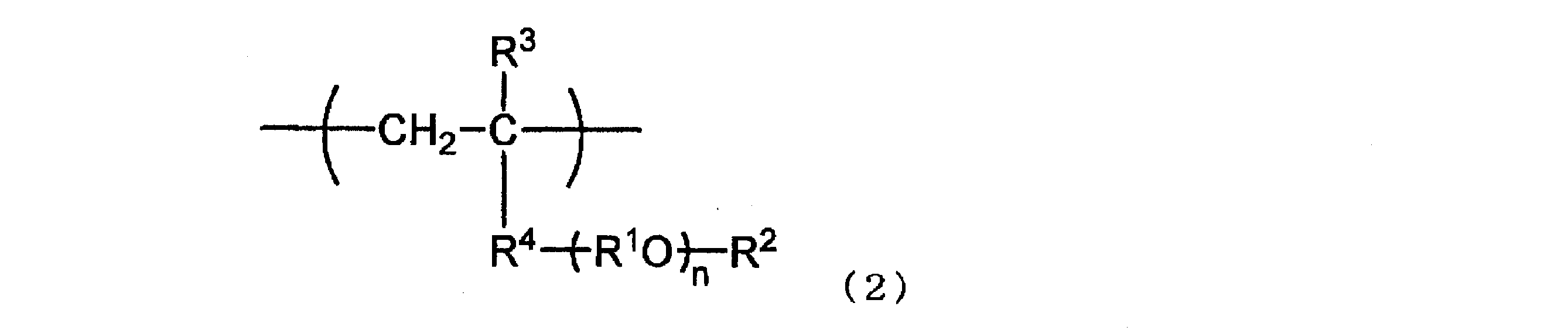
R3は、水素原子又はメチル基を示し、
R4は、-O-、*-(C=O)-O-、*-NR5-(C=O)-(R5は、水素原子又は炭素数1~10の有機基を示し、*は、式(2)中のR3が結合している炭素原子と結合する位置を示す)又はフェニレン基を示し、
その他の記号は式(1)中の記号と同義である。〕
斯様なR2の中でも、本発明の所望の効果や入手容易性等の観点から、水素原子、炭素数1~3のアルキル基が好ましく、水素原子、炭素数1又は2のアルキル基がより好ましく、水素原子又はメチル基が更に好ましく、メチル基が特に好ましい。
また、上記脂環式炭化水素基は、単環の脂環式炭化水素基と橋かけ環炭化水素基に大別される。上記単環の脂環式炭化水素基としては、シクロプロピル基、シクロヘキシル基等のシクロアルキル基が挙げられる。また、橋かけ環炭化水素基としては、イソボルニル基等が挙げられる。
また、上記芳香族炭化水素基としては、フェニル基等のアリール基が挙げられる。
繰り返し単位(A-2)としては、上記不飽和結合を末端又は非末端に有するモノマーとして例示したモノマー種と同様のモノマーに由来する繰り返し単位が挙げられるが、(メタ)アクリレート系繰り返し単位が特に好ましい。具体的には、下記式(3)又は(4)で表される親水性繰り返し単位が挙げられる。なお、式(3)で表される親水性繰り返し単位と式(4)で表される親水性繰り返し単位の両方を含んでいてもよい。

R6は、水素原子又はメチル基を示し、
R7は、炭素数2~4のアルカンジイル基を示し、
R8は、炭素数1~10のアルカンジイル基を示し、
R9、R10及びR11は、それぞれ独立して、水素原子又は炭素数1~8の炭化水素基を示し、
qは、平均値で1~10を示す。〕

Yは、-(C=O)O-、-(O=S=O)O-、-O(O=S=O)O-、-(S=O)O-、-O(S=O)O-、-OP(=O)(OR17)O-、-OP(=O)(R17)O-、-P(=O)(OR17)O-、又は-P(=O)(R17)O-を示し(R17は炭素数1~3のアルキル基を示す)、
R12は、水素原子又はメチル基を示し、
R13及びR14は、それぞれ独立して、炭素数1~10の2価の有機基を示し、
R15及びR16は、それぞれ独立して、炭素数1~10の炭化水素基を示す。〕
また、R7で示されるアルカンジイル基の炭素数は、好ましくは2又は3であり、より好ましくは2である。
また、R7で示されるアルカンジイル基は直鎖状でも分岐状でもよく、具体的には、エタン-1,2-ジイル基、プロパン-1,2-ジイル基、プロパン-1,3-ジイル基、プロパン-2,2-ジイル基、ブタン-1,2-ジイル基、ブタン-1,3-ジイル基、ブタン-1,4-ジイル基等が挙げられる。これらの中でも、本発明の所望の効果や入手容易性等の観点から、エタン-1,2-ジイル基が好ましい。
R8で示されるアルカンジイル基の炭素数は、好ましくは1~6であり、より好ましくは1~4であり、更に好ましくは2又は3であり、特に好ましくは2である。
また、R8で示されるアルカンジイル基は直鎖状でも分岐状でもよく、好適な具体例としては、上記R7で示されるアルカンジイル基と同様のものが挙げられる。
また、上記炭化水素基としては、アルキル基;フェニル基等のアリール基;ベンジル基等のアラルキル基が挙げられるが、アルキル基が好ましい。
上記アルキル基は直鎖状でも分岐状でもよく、好適な具体例としては、メチル基、エチル基、n-プロピル基、イソプロピル基、n-ブチル基、イソブチル基、sec-ブチル基、tert-ブチル基が挙げられる。
また、式(4)中、R13及びR14は、それぞれ独立して、炭素数1~10の2価の有機基を示す。斯かる2価の有機基の炭素数は、好ましくは1~8、より好ましくは1~6である。
また、上記2価の有機基としては、2価の炭化水素基が好ましく、2価の脂肪族炭化水素基がより好ましい。当該2価の脂肪族炭化水素基は、直鎖状でも分岐状でもよい。また、2価の脂肪族炭化水素基としては、アルカンジイル基が好ましい。例えば、メタン-1,1-ジイル基、エタン-1,2-ジイル基、プロパン-1,1-ジイル基、プロパン-1,2-ジイル基、プロパン-1,3-ジイル基、プロパン-2,2-ジイル基、ブタン-1,4-ジイル基、ペンタン-1,5-ジイル基、ヘキサン-1,6-ジイル基等が挙げられる。
R15及びR16で示される炭化水素基としては、アルキル基;フェニル基等のアリール基;ベンジル基等のアラルキル基が挙げられるが、アルキル基が好ましい。当該アルキル基は、直鎖状でも分岐状でもよく、例えば、メチル基、エチル基、n-プロピル基、イソプロピル基、n-ブチル基、イソブチル基、sec-ブチル基、tert-ブチル基が挙げられる。
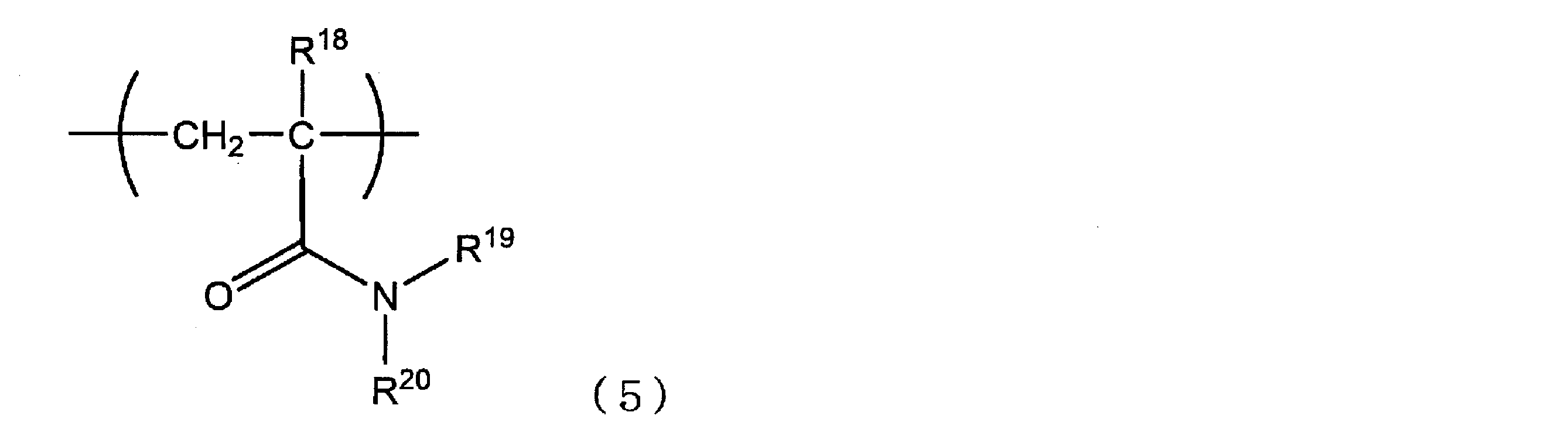
R18は、水素原子又はメチル基を示し、
R19及びR20は、それぞれ独立して、水素原子、炭素数1~6のアルキル基又はヒドロキシアルキル基を示す。〕

R21は、水素原子又はメチル基を示し、
R22及びR23は、それぞれ独立して、炭素数1~3のアルカンジイル基を示す。〕
また、上記R19、R20で示されるアルキル基は直鎖状でも分岐状でもよく、好適な具体例としては、メチル基、エチル基、n-プロピル基、イソプロピル基が挙げられる。
また、上記アルカンジイル基は直鎖状でも分岐状でもよいが、直鎖状が好ましい。好適な具体例としては、メタン-1,1-ジイル基、エタン-1,2-ジイル基が挙げられる。
アニオン性繰り返し単位を構成するモノマーとしては、フマル酸、マレイン酸、イタコン酸等の不飽和ジカルボン酸又はその塩;(メタ)アクリル酸等の不飽和カルボン酸又はその塩;エチレンスルホン酸、アリルスルホン酸、メタアリルスルホン酸、2-スルホエチル(メタ)アクリレート、2-アクリルアミド-2-メチルプロパンスルホン酸等のスルホ基含有重合性不飽和モノマー又はその塩;2-(メタ)アクリロイルオキシエチルアシッドホスフェート、2-(メタ)アクリロイルオキシプロピルアシッドホスフェート等のリン酸基含有重合性不飽和モノマー又はその塩が挙げられる。また、アニオン性繰り返し単位を構成するモノマーは、アクリル酸エステルの加水分解物;無水マレイン酸、無水イタコン酸等の不飽和ジカルボン酸の酸無水物の加水分解物;グリシジルメタクリレートや(4-ビニルベンジル)グリシジルエーテル等のエポキシ基への酸性基含有チオールの付加物などを用いて得ることもできる。アニオン性繰り返し単位は、これらを単独で又は2種以上を組み合わせて用いたものでもよい。
本発明の特定ポリマーは、疎水性繰り返し単位(B)を有する。これにより、添加剤、表面処理剤を用いた際に特定ポリマーがラテックス粒子に付着しやすくなる。
上記繰り返し単位(B)の含有量は、特定ポリマーが粒子に付着しやすくなる観点から、全繰り返し単位中、好ましくは2.5質量%以上、特に好ましくは5質量%以上であり、また、ラテックス凝集反応用試薬保存中における凝集を抑制する観点から、全繰り返し単位中、好ましくは38質量%以下、より好ましくは35質量%以下、さらに好ましくは30質量%以下、特に好ましくは25質量%以下である。
特に、繰り返し単位(B)の含有量を25質量%以下とすることによって、ラテックス凝集反応用試薬を高温条件下で長期間保存した場合でもラテックス粒子が凝集しにくくなる。
また、特定ポリマーとしては、ケト基、エステル結合、アミド結合及び芳香族炭化水素基(例えば、フェニル基等のアリール基、フェニレン基等のアリーレン基)から選ばれる1種又は2種以上を繰り返し単位(B)に含むものが好ましい。なお、特定ポリマーは、上記ケト基等を繰り返し単位(B)の主鎖に有していても側鎖に有してもよいが、繰り返し単位(B)の側鎖に有するのが好ましい。
これらの中でも、繰り返し単位(B)としては、(メタ)アクリルアミド系繰り返し単位、(メタ)アクリレート系繰り返し単位、スチレン系繰り返し単位が好ましく、(メタ)アクリルアミド系繰り返し単位、(メタ)アクリレート系繰り返し単位がより好ましい。
なお、式(7)で表される疎水性繰り返し単位と式(8)で表される疎水性繰り返し単位の両方を含んでいてもよい。

R31は、水素原子又はメチル基を示し、
R32は、-O-、*-(C=O)-O-、*-(C=O)-NR34-、*-NR34-(C=O)-(R34は、水素原子又は炭素数1~10の有機基を示し、*は、式(7)中のR31が結合している炭素原子と結合する位置を示す)又はフェニレン基を示し、
R33は、炭化水素基を示す。〕

R35は、水素原子又はメチル基を示し、
Zは、ホルミル基又はケト基を有する有機基を示す。〕
式(7)中、R32は、-O-、*-(C=O)-O-、*-(C=O)-NR34-、*-NR34-(C=O)-又はフェニレン基を示す。斯かるフェニレン基としては、1,2-フェニレン基、1,3-フェニレン基、1,4-フェニレン基が挙げられる。
R32の中でも、本発明の所望の効果や入手容易性等の観点から、*-(C=O)-O-、*-(C=O)-NR34-、フェニレン基が好ましく、*-(C=O)-O-、*-(C=O)-NR34-がより好ましく、*-(C=O)-O-、*-(C=O)-NH-が特に好ましい。
また、R34で示される有機基の炭素数は1~10であるが、好ましくは1~6である。上記有機基としては、炭化水素基が挙げられる。
上記R33、R34における脂肪族炭化水素基は直鎖状でも分岐状でもよく、具体的には、メチル基、エチル基、n-プロピル基、イソプロピル基、n-ブチル基、イソブチル基、sec-ブチル基、tert-ブチル基、ペンチル基、ヘキシル基、ヘプチル基、オクチル基、ノニル基、デシル基等のアルキル基が挙げられる。
また、上記脂環式炭化水素基は、単環の脂環式炭化水素基と橋かけ環炭化水素基に大別される。上記単環の脂環式炭化水素基としては、シクロプロピル基、シクロヘキシル基等のシクロアルキル基が挙げられる。また、橋かけ環炭化水素基としては、イソボルニル基等が挙げられる。
また、上記芳香族炭化水素基としては、フェニル基等のアリール基が挙げられる。
これらの中でもR33としては、アルキル基が好ましい。その炭素数は上記と同様に、好ましくは1~30であり、より好ましくは1~24であり、更に好ましくは1~18であり、特に好ましくは1~14である。
式(8)中、R35は、水素原子又はメチル基を示すが、好ましくは水素原子である。
また、Zとしては、エステル結合又はアミド結合を有するものが好ましい。エステル結合又はアミド結合の個数は特に限定されないが、1個が好ましい。
Zとしては、ホルミル基又はケト基を1個有し、且つエステル結合又はアミド結合を1個有する有機基が好ましく、下記式(9)で表される基がより好ましい。

X1は、-O-又は-NH-を示し、
X2は、ホルミル基又はケト基を有する炭素数3~12(好ましくは炭素数4~10、より好ましくは炭素数5~8)の有機基を示し、
*は、結合手を示す。〕
X2としては、下記式(10)で表される基が好ましい。

R36は、炭素数2~10(好ましくは炭素数3~8、より好ましくは炭素数4~6)の直鎖状又は分岐状のアルカンジイル基を示し、
X3は、ホルミル基又は-(C=O)-CH3を示し、
*は、結合手を示す。〕

R37~R40は、それぞれ独立して、水素原子、メチル基又はエチル基を示し、
*は、結合手を示す。〕

R41~R44は、それぞれ独立して、水素原子、メチル基又はエチル基を示し、
*は、結合手を示す。〕

本発明で用いる特定ポリマーの重量平均分子量は3000以上である。重量平均分子量が3000未満であると、粒子表面に付着しにくくなり、ラテックス凝集反応用試薬保存中における凝集が発生しやすくなる。
特定ポリマーの重量平均分子量(Mw)は、粒子表面への吸着力、プロゾーン抑制効果の観点から、好ましくは4000以上、より好ましくは5000以上、更に好ましくは6000以上、更に好ましくは7000以上、更に好ましくは8000以上、更に好ましくは9000以上、更に好ましくは1万以上、更に好ましくは1.5万以上、更に好ましくは2万以上、更に好ましくは5万以上、更に好ましくは7万以上、更に好ましくは10万以上、更に好ましくは12.5万以上、特に好ましくは15万以上であり、また、粒子表面にリガンドを固定した場合の、リガンドにおける抗体抗原反応の感度を維持する等の観点から、好ましくは100万以下、より好ましくは30万以下、更に好ましくは27万以下、更に好ましくは25万以下、特に好ましくは22.5万以下である。
また、特定ポリマーの数平均分子量(Mn)としては、500~10万が好ましく、700~95000がより好ましく、1000~90000が更に好ましく、1500~85000が更に好ましく、3000~80000が更に好ましく、10000~75000が特に好ましい。
また、分子量分布(Mw/Mn)としては、1~10が好ましく、1.5~8がより好ましく、1.8~7が更に好ましく、2~6が特に好ましい。
なお、上記重量平均分子量、数平均分子量及び分子量分布は、後述する実施例に記載の方法に従い測定すればよい。
なお、プロゾーンとは、標的物質(抗原等)が過剰状態となる場合に、リガンドと標的物質との反応(抗原抗体反応等)による粒子の凝集が抑制されて、標的物質の濃度を正確に測定できなくなる現象をいう。
特定ポリマーとしては水溶性のものが好ましい。また、特定ポリマーとしては、水の他に、有機溶媒(例えば、アセトン、エタノール、N-メチルピロリドン等)に溶解するものであってもよい。
ここで、本明細書において、0.5質量%のポリマー固形分となるように特定ポリマーを水(25℃)に添加・混合した場合に目視で透明となるときは、その特定ポリマーは水溶性というものとする。
また、0.5質量%のポリマー固形分となるように特定ポリマーを上記有機溶媒(25℃)に添加・混合した場合に目視で透明となるときは、その特定ポリマーは上記有機溶媒に溶解するというものとする。
また、重合開始剤の使用量は、全モノマーの合計100質量部に対して、0.001~10質量部が好ましく、0.01~5質量部がより好ましい。また、重合温度は20~100℃が好ましく、重合時間は0.5~48時間が好ましい。
したがって、特定ポリマーは、ブロッキング処理されていないラテックス粒子への添加剤、ラテックス粒子の表面処理剤として有用であり、表面処理方法に使用することができる。また、本発明の添加剤、表面処理剤は、ブロッキング剤、ラテックス粒子凝集抑制剤、ラテックス粒子保存安定化剤、検出ノイズ低減剤などとして使用することができ、また、プロゾーン抑制剤として使用してもよい。特定ポリマーは、ブロッキング剤として従来用いられてきたアルブミン、カゼイン、ゼラチン、スキムミルク等の生物由来物質の代替品としての利用が期待できる。
なお、本明細書において、「ブロッキング」とは、ラテックス粒子への非特異吸着を抑制することをいう。ラテックス粒子への非特異吸着の抑制は、ラテックス粒子への非特異吸着に起因するラテックス粒子の凝集が引き起こす検出ノイズを低減することを包含する概念である。
本発明の表面改質ラテックス粒子は、特定ポリマーをラテックス粒子の表面に有するものである。
本明細書において、「ラテックス粒子」とは、ラテックス凝集反応用試薬に用いられるラテックス粒子を意味し、溶剤に分散している状態のラテックス粒子、溶剤と共存していない状態のラテックス粒子のいずれをも包含する概念である。本発明の表面改質ラテックス粒子において、ラテックス粒子としては、特定ポリマー以外の物質ではブロッキング処理されていないラテックス粒子が好ましい。
また、「表面改質ラテックス粒子」は、ラテックス粒子表面の一部又は全部に特定ポリマーが直接接触しているものをいう。
ラテックス粒子の平均粒子径は、レーザー回析・散乱粒子径分布測定により測定される、リガンド固定化及び表面処理前の体積平均粒子径を意味する。
また、リガンドは、ラテックス粒子に化学結合で固定化されていても、物理吸着で固定化されていてもよいが、化学結合で固定化されているのが好ましい。本発明によれば、リガンドとラテックス粒子が化学結合で固定化された場合におけるプロゾーンを抑制することができる。
なお、ラテックス粒子の調製やリガンドの固定化は常法に従って行えばよい。例えば、化学結合法による固定化は、ラテックス粒子の表面に化学修飾し、或いは官能基を導入するなどして行えばよい。
一方、物理吸着により固定化させる場合にはポリスチレンのみにより粒子を製造することもできる。
本発明の表面改質ラテックス粒子の製造方法は、特定ポリマーとラテックス粒子とを接触させる接触工程を含むことを特徴とするものである。斯かる製造方法において、ラテックス粒子としては、ブロッキング処理されていないラテックス粒子が好ましい。
上記接触は、液相中で行うのが好ましい。この場合に用いる溶媒としては、上記添加剤、表面処理剤に配合できる溶剤と同様のものが挙げられる。
また、接触とは、特定ポリマーがラテックス粒子の表面の一部又は全部に付着するように特定ポリマーとラテックス粒子とを直接接触させることをいう。具体的には、シェーカー等を用いて特定ポリマーを含む液相中でラテックス粒子を分散させる方法等が挙げられる。
接触時間は通常10分間~10時間である。接触温度は特に限定されないが、通常10~60℃である。
なお、本発明の表面改質ラテックス粒子の製造方法は、接触工程の後、残余の特定ポリマーを遠心分離等により分離する分離工程を含んでいてもよい。
本発明のラテックス凝集反応用試薬は、本発明の表面改質ラテックス粒子又は本発明の表面改質ラテックス粒子の製造方法により得られた表面改質ラテックス粒子を含むものである。
本発明のラテックス凝集反応用試薬中、表面改質ラテックス粒子の含有量は、0.1~3質量%が好ましく、0.1~1質量%がより好ましく、0.1~0.6質量%が特に好ましい。
本発明のラテックス凝集反応用試薬は、表面改質ラテックス粒子の他に、水溶性高分子、溶剤を含んでいてもよい。水溶性高分子としては、例えば、ポリエチレングリコール、多価アルコール、ポリビニルピロリドン、カルボキシメチルセルロース、メチルセルロース、エチルセルロース、サッカロース、デキストラン、プルラン、ポリアミノ酸、アルギン酸、アミノエタンスルホン酸誘導体、アミノプロパンスルホン酸誘導体のほか、ウシ血清アルブミン(BSA)、カゼイン、ブロックエース、アラビアゴム、蛋白質分解物、アミノ酸、ペプチド、ポリペプチド等が挙げられる。溶剤は、上記表面処理剤に配合できる溶剤の他、リン酸緩衝液、グリシン緩衝液、グッド緩衝液、トリス緩衝液、アンモニア緩衝液等の各種緩衝液が挙げられる。
さらに、本発明のラテックス凝集反応用試薬は、必要に応じて、塩類、界面活性剤、防腐剤等を含んでいてもよい。
本発明のラテックス凝集反応用試薬は、ラテックス凝集法による検体中の標的物質の検出に有用である。
本発明のラテックス凝集法による検体中の標的物質の検出に用いるためのキットは、本発明のラテックス凝集反応用試薬を備えることを特徴とするものである。
本発明のキットとしては、本発明のラテックス凝集反応用試薬(第2試薬とも称する)に加えて、反応緩衝液(第1試薬とも称する)を更に備えるものが好ましい。
第1試薬は、上記水溶性高分子を含んでいてもよい。また、第1試薬は、溶剤、ラテックス凝集測定用増感剤を含んでいてもよい。溶剤としては水性媒体が挙げられる。該水性媒体としては、上記各種緩衝液が挙げられる。
また、上記ラテックス凝集測定用増感剤としては、ポリビニルアルコール、ポリビニルピロリドン等が挙げられる。
また、本発明のキットは、上記第1試薬及び第2試薬の他に、陽性コントロール、陰性コントロール、血清希釈液等を備えていてもよい。陽性コントロール、陰性コントロールの媒体は、測定しうる標的物質が含まれていない血清、生理食塩水のほか、上記水性媒体等の溶剤でもよい。
本発明の標的物質の検出方法は、本発明のラテックス凝集反応用試薬と検体とを混合する混合工程、及び前記混合工程により生じた凝集反応を光学的に検出する検出工程を含むことを特徴とするものである。
標的物質とは、通常、抗原、ウイルス、病原体、抗体、自己抗体など免疫反応を引き起こすおそれがあり、検出する対象となるものをいう。
標的物質としては、例えば、レセプター、酵素、血中タンパク(例えばガン胎児性タンパク)、感染症関連抗原(例えばB型肝炎ウイルス、C型肝炎ウイルス、梅毒病原体、ヒト免疫不全ウイルス、病原性大腸菌等の抗原)等の抗原や、これら抗原に対する抗体が挙げられる。抗体には、特定の抗原に対する結合性を有する限り、抗体のフラグメント等も含まれる。
混合工程は、本発明のラテックス凝集反応用試薬と検体とを混合する工程である。
検体としては、血清や血漿、尿、唾液等の各種生物学的液体サンプル、糞便や食品の検体粉砕物等が挙げられる。測定サンプルとして、アルブミンやグロブリン等のタンパク質、pH緩衝液、アミノ酸、界面活性剤等で検体を希釈した検体希釈液を用いてよい。
また、混合時間は、通常60分間以下である。混合液のpHは、通常5~10の範囲であり、抗体と抗原との複合体の安定性がより良好になる点で、混合液のpHは6~9の範囲がより好ましい。
検出工程は、混合工程により生じた凝集反応を光学的に検出する工程である。この工程により、検体中の標的物質が検出され、更に標的物質の濃度も測定できる。
粒子凝集の度合いを光学的に検出する方法としては、公知の方法を用いることができ、例えば、(1)凝集の形成を濁度の増加としてとらえる比濁法、(2)凝集の形成を粒度分布又は平均粒径の変化としてとらえる方法、(3)凝集の形成による前方散乱光の変化を積分球を用いて測定し、透過光強度との比を比較する積分球濁度法等が挙げられる。
上記の測定法においては、例えば、異なる時点で少なくとも2つの測定値を得、これらの時点間における測定値の増加分、すなわち、増加速度に基づき凝集の度合いを求める速度試験(レートアッセイ)や、反応の終点と考えられるある時点で1つの測定値を得、この測定値に基づき凝集の度合いを求める終点試験(エンドポイントアッセイ)を利用できるが、測定の簡便性、迅速性の点から、比濁法による速度試験が好ましい。
重量平均分子量(Mw)及び数平均分子量(Mn)は、東ソー社製TSKgel α-Mカラムを用い、流量:0.5ミリリットル/分、溶出溶媒:NMP溶媒(H3PO4:0.016M、LiBr:0.030M)、カラム温度:40℃の分析条件で、ポリスチレンを標準とするゲルパーミエーションクロマトグラフィー(GPC)により測定した。
4-アクリロイルモルホリン(以下、ACMOと称する(興人フィルム&ケミカルズ社製))2.0g、エチレンオキシドの平均付加モル数9のメトキシポリエチレングリコールメタクリレート(以下、M90Gと称する(新中村化学工業社製))2.5g及びジアセトンアクリルアミド(以下、DAAMと称する)0.5gからなるモノマー組成物を、水40.05gに混合してフラスコに入れ、撹拌子で撹拌した。これに窒素を吹き込みながら60℃まで昇温し、重合開始剤として2,2’-アゾビス(2-メチルプロピオンアミジン)・二塩酸塩の10質量%水溶液5g、及び連鎖移動剤としてα-チオグリセロール0.01gを添加した。これを3時間重合させた後、室温まで冷却した。得られた共重合体を共重合体(P1)とする。
得られた共重合体(P1)のGPCによる重量平均分子量(Mw)は107400であり、Mw/Mnは4.01であった。
モノマー組成物を、ACMO 2.0g、M90G 2.25g、N-メタクリロイルオキシエチル-N,N-ジメチルアンモニウム-α-N-メチルカルボキシベタイン(以下、GLBTと称する(大阪有機化学工業社製))0.25g及びメチルメタクリレート(以下、MMAと称する)0.5gからなるモノマー組成物に変更した以外は、合成例1と同様にして共重合体を合成した。得られた共重合体を共重合体(P2)とする。
モノマー組成物を、ACMO 1.5g、N,N-ジメチルアクリルアミド(以下、DMAAと称する)0.25g、M90G 1.0g、エチレンオキシドの平均付加モル数23のメトキシポリエチレングリコールメタクリレート(以下、M230Gと称する(新中村化学工業社製))1.25g、GLBT 0.75g及びMMA 0.25gからなるモノマー組成物に変更した以外は、合成例1と同様にして共重合体を合成した。得られた共重合体を共重合体(P3)とする。
モノマー組成物を、ACMO 1.0g、DMAA 0.5g、M90G 1.25g、M230G 1.25g及びDAAM 1.0gからなるモノマー組成物に変更した以外は、合成例1と同様にして共重合体を合成した。得られた共重合体を共重合体(P4)とする。
モノマー組成物を、ACMO 2.0g、DMAA 2.5g及びDAAM 0.5gからなるモノマー組成物に変更した以外は、合成例1と同様にして共重合体を合成した。得られた共重合体を共重合体(P5)とする。
モノマー組成物を、ACMO 1.0g、DMAA 1.75g、M230G 1.0g、GLBT 0.25g及びMMA 1.0gからなるモノマー組成物に変更した以外は、合成例1と同様にして共重合体を合成した。得られた共重合体を共重合体(P6)とする。
モノマー組成物を、DMAA 2.0g、M90G 1.5g及びDAAM 1.5gからなるモノマー組成物に変更した以外は、合成例1と同様にして共重合体を合成した。得られた共重合体を共重合体(P7)とする。
モノマー組成物を、DMAA 3.5g及びDAAM 1.5gからなるモノマー組成物に変更した以外は、合成例1と同様にして共重合体を合成した。得られた共重合体を共重合体(P8)とする。
モノマー組成物を、ACMO 1.0g、DMAA 3.0g及びMMA 1.0gからなるモノマー組成物に変更した以外は、合成例1と同様にして共重合体を合成した。得られた共重合体を共重合体(P9)とする。
モノマー組成物を、ACMO 2.0g、M90G 2.75g及びMMA 0.25gからなるモノマー組成物に変更した以外は、合成例1と同様にして共重合体を合成した。得られた共重合体を共重合体(P10)とする。
モノマー組成物を、ACMO 1.0g、M230G 2.25g及びDAAM 1.75gからなるモノマー組成物に変更した以外は、合成例1と同様にして共重合体を合成した。得られた共重合体を共重合体(P11)とする。
モノマー組成物を、ACMO 2.0g、M90G 2.5g、DAAM 0.5gからなるモノマー組成物に変更した以外は、合成例1と同様にして共重合体を合成した。得られた共重合体を共重合体(P12)とする。
モノマー組成物を、ACMO 0.5g、M90G 2.25g、GLBT 0.25g及びMMA 2.0gからなるモノマー組成物に変更した以外は、合成例1と同様にして共重合体を合成した。得られた共重合体を共重合体(P13)とする。
ACMO由来の繰り返し単位からなるホモポリマー、DMAA由来の繰り返し単位からなるホモポリマー、M90G由来の繰り返し単位からなるホモポリマー、M230G由来の繰り返し単位からなるホモポリマー、GLBT由来の繰り返し単位からなるホモポリマーをそれぞれ合成し(いずれも数平均分子量約1万)、ホモポリマー1gを純水100gに添加したところ、常温(25℃)で溶解した。
また、DAAM由来の繰り返し単位からなるホモポリマー、MMA由来の繰り返し単位からなるホモポリマーをそれぞれ合成し(いずれも数平均分子量約1万)、ホモポリマー1gを純水100gに添加したところ、常温(25℃)で溶解しきらなかった。
HEPES 1.19g及び塩化ナトリウム1gを蒸留水70gに溶解した。得られた水溶液をアジ化ナトリウムの2質量%水溶液4.5gと混合した後、pHを約7.5に調整し、合計100gの水溶液を得た。
得られた水溶液を、R1バッファーとする。なお、R1バッファーにおいて、アジ化ナトリウムの濃度は0.09質量%である。
HEPES 1.19g及び塩化ナトリウム1gを蒸留水70gに溶解した。得られた水溶液をアジ化ナトリウムの2質量%水溶液4.5gと混合した後、pHを約7.5に調整し、合計100gの水溶液を得た。
得られた水溶液を、R2バッファー(1)とする。なお、R2バッファー(1)において、アジ化ナトリウムの濃度は0.09質量%である。
HEPES 1.19g及び塩化ナトリウム1gを蒸留水70gに溶解した。得られた水溶液をアジ化ナトリウムの2質量%水溶液4.5gと混合し、これに共重合体(P5)の10質量%水溶液を加えた後、pHを約7.5に調整し、合計100gの水溶液を得た。
得られた水溶液を、R2バッファー(2)とする。なお、R2バッファー(2)において、共重合体(P5)の濃度は2質量%、アジ化ナトリウムの濃度は0.09質量%である。
(ラテックス粒子への抗体固定化)
免疫診断用ラテックス粒子(カルボキシ基を表面に有するタイプ、平均粒子径:0.082μm(JSRライフサイエンス製IMMUTEX P0011))の5.3質量%水分散液1.4mL、0.5M HEPESバッファー0.75mL、及び蒸留水4.9mLを混合した。この粒子分散液に、抗CRP抗体(ウサギ)の16.3mg/mL水溶液を0.46mL添加し、室温で1時間撹拌した。次いで、1-エチル-3-(3-ジメチルアミノプロピル)カルボジイミド塩酸塩(以下、WSCと称する(同仁化学社製))の1質量%水溶液を0.15mL添加し、室温で1時間撹拌した。次に、この粒子分散液を0.51mLずつ遠心管に移し替え、15,000rpmにて10分間遠心分離して、未反応の抗CRP抗体やWSCを含む上清を除去し、抗体固定化ラテックス粒子を沈殿として回収した。
(表面処理剤によるラテックス粒子の表面処理(ブロッキング処理されていないラテックス粒子への添加剤の添加))
次いで、共重合体(P1)の0.5質量%水溶液1mLを準備し、これを上記抗体固定化ラテックス粒子に添加し、アルミブロックシェーカーで1時間分散させた。次に、得られた粒子分散液を15,000rpmにて10分間遠心分離し、残余の共重合体(P1)を含む上清を除去した。このようにして、共重合体(P1)で表面処理された抗体固定化ラテックス粒子の分散液(表面改質ラテックス粒子分散液)を得た。
(ラテックス凝集反応用試薬の調製)
次いで、上記表面処理された抗体固定化ラテックス粒子の分散液に、調製例2で得たR2バッファー(1)5mLを添加し、ラテックス凝集反応用試薬1を得た。
共重合体(P1)を、共重合体(P2)、共重合体(P3)、共重合体(P4)にそれぞれ変更した以外は、実施例1と同様にしてラテックス凝集反応用試薬2~4を得た。
カルボキシ基を表面に有するタイプの免疫診断用ラテックス粒子を、カルボキシ基を表面にもたないタイプの免疫診断用ラテックス粒子(平均粒子径:0.121μm、JSRライフサイエンス製IMMUTEX P2117)に変更し、共重合体(P1)を、共重合体(P5)、共重合体(P6)に変更した以外は、実施例1と同様にしてラテックス凝集反応用試薬5、6を得た。
共重合体(P1)を、共重合体(P7)、共重合体(P8)、共重合体(P9)、共重合体(P10)、共重合体(P11)にそれぞれ変更した以外は、実施例1と同様にしてラテックス凝集反応用試薬7~11を得た。
共重合体(P1)を、共重合体(P12)に変更した以外は、実施例1と同様にしてラテックス凝集反応用試薬12を得た。
共重合体(P1)を、共重合体(P13)に変更した以外は、実施例1と同様にしてラテックス凝集反応用試薬13を得た。
共重合体(P1)を、牛血清アルブミン(BSA)に変更した以外は、実施例1と同様にしてラテックス凝集反応用試薬14を得た。
カルボキシ基を表面に有するタイプの免疫診断用ラテックス粒子を、カルボキシ基を表面にもたないタイプの免疫診断用ラテックス粒子(平均粒子径:0.121μm、JSRライフサイエンス製IMMUTEX P2117)に変更し、共重合体(P1)を、牛血清アルブミン(BSA)に変更した以外は、実施例1と同様にしてラテックス凝集反応用試薬15を得た。
共重合体(P5)を表面処理剤(ブロッキング処理されていないラテックス粒子への添加剤)でなく増感剤として使用した比較例として、牛血清アルブミンで予め表面処理された抗体固定化ラテックス粒子と共重合体(P5)とを分散媒中に添加したラテックス凝集反応用試薬を調製した。
すなわち、カルボキシ基を表面にもたないタイプの免疫診断用ラテックス粒子(平均粒子径:0.121μm、JSRライフサイエンス製IMMUTEX P2117)の5.3質量%水分散液1.4mL、0.5M HEPESバッファー0.75mL、及び蒸留水4.9mLを混合した。この粒子分散液に、抗CRP抗体(ウサギ)の16.3mg/mL水溶液を0.46mL添加し、室温で1時間撹拌した。次に、この粒子分散液を遠心管に移し替え、15,000rpmにて10分間遠心分離して、未反応の抗CRP抗体を含む上清を除去し、抗体固定化ラテックス粒子を沈殿として回収した。
次いで、牛血清アルブミン(BSA)の0.5質量%水溶液1mLを準備し、これを上記抗体固定化ラテックス粒子に添加し、アルミブロックシェーカーで1時間分散させた。次に、得られた粒子分散液を15,000rpmにて10分間遠心分離し、残余の牛血清アルブミン(BSA)を含む上清を除去した。このようにして、牛血清アルブミン(BSA)で表面処理された抗体固定化ラテックス粒子の分散液を得た。
次いで、上記表面処理された抗体固定化ラテックス粒子の分散液に、調製例3で得たR2バッファー(2)5mLを添加し、ラテックス凝集反応用試薬16を得た。
共重合体(P1)の0.5質量%水溶液を、蒸留水に変更した以外は、実施例1と同様にしてラテックス凝集反応用試薬17を得た。
カルボキシ基を表面に有するタイプの免疫診断用ラテックス粒子を、カルボキシ基を表面にもたないタイプの免疫診断用ラテックス粒子(平均粒子径:0.121μm、JSRライフサイエンス製IMMUTEX P2117)に変更し、共重合体(P1)の0.5質量%水溶液を、蒸留水に変更した以外は、実施例1と同様にしてラテックス凝集反応用試薬18を得た。
各実施例及び比較例で調製したラテックス凝集反応用試薬を4℃で一晩静置し、沈殿の有無を目視で観察し以下の基準で評価した。また、各実施例及び比較例で調製したラテックス凝集反応用試薬を4℃で一晩静置した後、更に37℃で一週間静置し、沈殿の有無を目視で観察し以下の基準で評価した。これらの結果を表1~2に示す。
(安定性評価基準)
AA:粒子の沈殿が確認されなかった
A:粒子の沈殿がほとんど確認されなかった
B:粒子の沈殿が僅かに確認された
C:粒子の沈殿がはっきりと確認された


表2に示すとおり、重量平均分子量が3000未満の共重合体(P12)を用いて抗体固定化ラテックス粒子の表面を処理した場合(比較例1)や、繰り返し単位(A)の含有量が60質量%、繰り返し単位(B)の含有量が40質量%の共重合体(P13)を用いて抗体固定化ラテックス粒子の表面を処理した場合(比較例2)、BSAを用いて抗体固定化ラテックス粒子の表面を処理した場合(比較例3、4)には、粒子の沈殿がはっきりと確認された。
また、抗体固定化ラテックス粒子と共重合体(P5)とを分散媒中に添加した場合(比較例5)も、粒子の沈殿がはっきりと確認された。比較例5で用いた抗体固定化ラテックス粒子はBSAで既に表面処理されているため、試薬中で共重合体(P5)が抗体固定化ラテックス粒子の表面に処理されるものではない。このことから、本発明の特定ポリマーを増感剤等のように試薬中に単に共存させるのみでは粒子の沈殿は抑制されず、粒子の沈殿を抑制するためには、本発明の特定ポリマーを、ブロッキング処理されていないラテックス粒子に添加すること、すなわち、本発明の特定ポリマーを用いてラテックス粒子の表面を処理することが必要であることがわかった。
検体として標的物質(CRP抗原)の生理食塩水希釈液又は生理食塩水3μL、及び第1試薬として調製例1で得たR1バッファー100μLを測定セルに加えて撹拌した。次いで、第2試薬として実施例1で調製したラテックス凝集反応用試薬100μLを測定セルに加え撹拌した後、日立7180形自動分析装置を使用し、主波長:570nm、副波長:800nm、測定温度:37℃の条件にて免疫ラテックス凝集測定を行い、抗原抗体反応の反応性を確認した。なお、標的物質の生理食塩水希釈液の濃度は、0mg/dL、0.05mg/dL、0.1mg/dL、0.25mg/dL、0.5mg/dL、1mg/dL、2mg/dL、4mg/dLとしてそれぞれ試験を行った。
また、実施例3、実施例4、比較例3のラテックス凝集反応用試薬を第2試薬として用いて、上記と同様にして抗原抗体反応の反応性を確認した。
試験例2の結果を図1に示す。図1に示すとおり、共重合体(P1)、(P3)、(P4)を用いて抗体固定化ラテックス粒子の表面を処理した場合(実施例1、3、4)は、プロゾーン抑制効果が得られた。
Claims (18)
- ラテックス凝集反応用試薬に用いられるラテックス粒子に添加するための添加剤であって、
前記ラテックス粒子が、ブロッキング処理されていないラテックス粒子であり、
親水性繰り返し単位(A):全繰り返し単位中、60質量%超99質量%以下と、疎水性繰り返し単位(B):全繰り返し単位中、1質量%以上40質量%未満とを有し、重量平均分子量が3000以上のポリマーを含む、
添加剤。 - ラテックス凝集反応用試薬に用いられるラテックス粒子の表面処理に使用するための表面処理剤であって、
親水性繰り返し単位(A):全繰り返し単位中、60質量%超99質量%以下と、疎水性繰り返し単位(B):全繰り返し単位中、1質量%以上40質量%未満とを有し、重量平均分子量が3000以上のポリマーを含む、
表面処理剤。 - 前記繰り返し単位(A)に、ポリアルキレングリコール鎖、双性イオン構造、複素環基、エステル結合、アミド結合、ヒドロキシ基、エポキシ基、イソシアナート基、ブロックイソシアナート基、無水カルボン酸基及びアミノ基から選ばれる1種又は2種以上を含む、請求項1又は2に記載の剤。
- 前記繰り返し単位(A)に、ポリアルキレングリコール鎖、双性イオン構造、複素環基、エステル結合及びアミド結合から選ばれる1種又は2種以上を含む、請求項1~3のいずれか1項に記載の剤。
- 前記繰り返し単位(A)として、(メタ)アクリルアミド系モノマーに由来する親水性繰り返し単位及び(メタ)アクリレート系モノマーに由来する親水性繰り返し単位から選ばれる1種又は2種以上を有する、請求項1~4のいずれか1項に記載の剤。
- 前記(メタ)アクリレート系モノマーに由来する親水性繰り返し単位が、ポリアルキレングリコール鎖又は双性イオン構造を側鎖に有するものである、請求項5に記載の剤。
- 前記繰り返し単位(B)に、ケト基、エステル結合、アミド結合及び芳香族炭化水素基から選ばれる1種又は2種以上を含む、請求項1~6のいずれか1項に記載の剤。
- 前記繰り返し単位(B)として、(メタ)アクリルアミド系モノマーに由来する疎水性繰り返し単位、(メタ)アクリレート系モノマーに由来する疎水性繰り返し単位、及びスチレン系モノマーに由来する疎水性繰り返し単位から選ばれる1種又は2種以上を有する、請求項1~7のいずれか1項に記載の剤。
- 前記繰り返し単位(B)として、下記式(7)で表される疎水性繰り返し単位及び下記式(8)で表される疎水性繰り返し単位から選ばれる1種又は2種以上を有する、請求項1~6のいずれか1項に記載の剤。

R31は、水素原子又はメチル基を示し、
R32は、-O-、*-(C=O)-O-、*-(C=O)-NR34-、*-NR34-(C=O)-(R34は、水素原子又は炭素数1~10の有機基を示し、*は、式(7)中のR31が結合している炭素原子と結合する位置を示す)又はフェニレン基を示し、
R33は、炭化水素基を示す。〕

R35は、水素原子又はメチル基を示し、
Zは、ホルミル基又はケト基を有する有機基を示す。〕 - 前記ポリマーの重量平均分子量が3000~100万である、請求項1~9のいずれか1項に記載の剤。
- 前記ポリマーが水溶性である、請求項1~10のいずれか1項に記載の剤。
- 前記ラテックス粒子が、標的物質に対するリガンドが固定化されたラテックス粒子である、請求項1~11のいずれか1項に記載の剤。
- 親水性繰り返し単位(A):全繰り返し単位中、60質量%超99質量%以下と、疎水性繰り返し単位(B):全繰り返し単位中、1質量%以上40質量%未満とを有し、重量平均分子量が3000以上のポリマーをラテックス粒子の表面に有する、
表面改質ラテックス粒子。 - 親水性繰り返し単位(A):全繰り返し単位中、60質量%超99質量%以下と、疎水性繰り返し単位(B):全繰り返し単位中、1質量%以上40質量%未満とを有し、重量平均分子量が3000以上のポリマーとラテックス粒子とを接触させる接触工程を含む、
表面改質ラテックス粒子の製造方法。 - 請求項14に記載の製造方法により得られた、
表面改質ラテックス粒子。 - 請求項13又は15に記載の表面改質ラテックス粒子を含む、
ラテックス凝集反応用試薬。 - ラテックス凝集法による検体中の標的物質の検出に用いるためのキットであって、
請求項16に記載のラテックス凝集反応用試薬を備える、
キット。 - 請求項16に記載のラテックス凝集反応用試薬と検体とを混合する混合工程、及び
前記混合工程により生じた凝集反応を光学的に検出する検出工程を含む、
標的物質の検出方法。
Priority Applications (5)
| Application Number | Priority Date | Filing Date | Title |
|---|---|---|---|
| CN201780010921.8A CN108700580B (zh) | 2016-02-12 | 2017-02-09 | 添加剂、表面处理剂、表面改性乳胶粒子、表面改性乳胶粒子的制造方法、乳胶凝聚反应用试剂、试剂盒、以及靶物质的检测方法 |
| US16/076,070 US11493506B2 (en) | 2016-02-12 | 2017-02-09 | Additive, surface treatment agent, surface-modified latex particles, method for producing surface-modified latex particles, reagent for latex agglutination reaction, kit, and method for detecting target substance |
| EP17750329.9A EP3415913B1 (en) | 2016-02-12 | 2017-02-09 | Additive, surface treatment agent, surface-modified latex particles, method for producing surface-modified latex particles, reagent for latex agglutination reaction, kit, and method for detecting target substance |
| JP2017566998A JP6845812B2 (ja) | 2016-02-12 | 2017-02-09 | 添加剤、表面処理剤、表面改質ラテックス粒子、表面改質ラテックス粒子の製造方法、ラテックス凝集反応用試薬、キット、及び標的物質の検出方法 |
| US17/817,684 US20220380503A1 (en) | 2016-02-12 | 2022-08-05 | Additive, surface treatment agent, surface-modified latex particles, method for producing surface-modified latex particles, reagent for latex agglutination reaction, kit, and method for detecting target substance |
Applications Claiming Priority (2)
| Application Number | Priority Date | Filing Date | Title |
|---|---|---|---|
| JP2016025316 | 2016-02-12 | ||
| JP2016-025316 | 2016-02-12 |
Related Child Applications (2)
| Application Number | Title | Priority Date | Filing Date |
|---|---|---|---|
| US16/076,070 A-371-Of-International US11493506B2 (en) | 2016-02-12 | 2017-02-09 | Additive, surface treatment agent, surface-modified latex particles, method for producing surface-modified latex particles, reagent for latex agglutination reaction, kit, and method for detecting target substance |
| US17/817,684 Division US20220380503A1 (en) | 2016-02-12 | 2022-08-05 | Additive, surface treatment agent, surface-modified latex particles, method for producing surface-modified latex particles, reagent for latex agglutination reaction, kit, and method for detecting target substance |
Publications (1)
| Publication Number | Publication Date |
|---|---|
| WO2017138608A1 true WO2017138608A1 (ja) | 2017-08-17 |
Family
ID=59563369
Family Applications (1)
| Application Number | Title | Priority Date | Filing Date |
|---|---|---|---|
| PCT/JP2017/004730 Ceased WO2017138608A1 (ja) | 2016-02-12 | 2017-02-09 | 添加剤、表面処理剤、表面改質ラテックス粒子、表面改質ラテックス粒子の製造方法、ラテックス凝集反応用試薬、キット、及び標的物質の検出方法 |
Country Status (5)
| Country | Link |
|---|---|
| US (2) | US11493506B2 (ja) |
| EP (1) | EP3415913B1 (ja) |
| JP (1) | JP6845812B2 (ja) |
| CN (1) | CN108700580B (ja) |
| WO (1) | WO2017138608A1 (ja) |
Cited By (5)
| Publication number | Priority date | Publication date | Assignee | Title |
|---|---|---|---|---|
| WO2019031581A1 (ja) * | 2017-08-10 | 2019-02-14 | Jsr株式会社 | 免疫凝集の検出又は測定方法 |
| JP2021032670A (ja) * | 2019-08-23 | 2021-03-01 | キヤノン株式会社 | 粒子およびその製造方法 |
| JP2023140980A (ja) * | 2022-03-23 | 2023-10-05 | 日鉄ケミカル&マテリアル株式会社 | 標識抗体の製造方法、標識抗体及び免疫学的測定法 |
| WO2025206089A1 (ja) * | 2024-03-28 | 2025-10-02 | 積水メディカル株式会社 | 非特異反応抑制剤、生化学的測定用試薬、生化学的測定用試薬キット、共重合体 |
| WO2025249297A1 (ja) * | 2024-05-28 | 2025-12-04 | 富士レビオ株式会社 | イムノクロマト用試験片、イムノクロマト用装置、イムノクロマト用キット、及び被検物質検出方法 |
Families Citing this family (1)
| Publication number | Priority date | Publication date | Assignee | Title |
|---|---|---|---|---|
| CN113406323B (zh) * | 2021-06-18 | 2022-03-22 | 上海奥普生物医药股份有限公司 | 一种胶乳免疫比浊第二试剂、含其的组合及其制备方法 |
Citations (5)
| Publication number | Priority date | Publication date | Assignee | Title |
|---|---|---|---|---|
| JPH0783923A (ja) * | 1993-09-14 | 1995-03-31 | Nippon Oil & Fats Co Ltd | タンパク質吸着防止剤 |
| JPH08110340A (ja) * | 1994-10-12 | 1996-04-30 | Tokuyama Corp | 改質ラテックス粒子、その製造方法及び免疫学的凝集反応試薬 |
| JPH11287802A (ja) * | 1998-04-03 | 1999-10-19 | Nippon Kayaku Co Ltd | 表面保護剤 |
| JP2009133809A (ja) * | 2007-11-09 | 2009-06-18 | Jsr Corp | 生体関連物質の非特異吸着防止剤および物品のコーティング方法 |
| JP2014153140A (ja) * | 2013-02-07 | 2014-08-25 | Jsr Corp | ブロッキング剤、標的物質に対する抗原または抗体が固定化された担体、これを含む体外診断用試薬およびキット、並びに標的物質の検出方法 |
Family Cites Families (12)
| Publication number | Priority date | Publication date | Assignee | Title |
|---|---|---|---|---|
| JPH08278308A (ja) | 1995-02-08 | 1996-10-22 | Sekisui Chem Co Ltd | 免疫測定法 |
| FR2814170B1 (fr) * | 2000-09-18 | 2005-05-27 | Rhodia Chimie Sa | Nouveau latex a proprietes de surface modifiees par l' ajout d'un copolymere hydrosoluble a caractere amphiphile |
| JP4577747B2 (ja) * | 2001-06-05 | 2010-11-10 | 和光純薬工業株式会社 | 免疫学的測定法用凝集促進剤 |
| JP2003294753A (ja) | 2002-04-01 | 2003-10-15 | Kyokuto Seiyaku Kogyo Kk | 凝集反応増感剤、免疫測定用試薬及び免疫測定法 |
| JP4556605B2 (ja) | 2004-10-08 | 2010-10-06 | 藤倉化成株式会社 | 標的物質の測定方法および測定試薬 |
| JP2006266970A (ja) | 2005-03-25 | 2006-10-05 | Jsr Corp | 免疫診断薬用ポリマー粒子 |
| US9128083B2 (en) | 2007-11-09 | 2015-09-08 | Jsr Corporation | Nonspecific adsorption inhibitor of substance relating to living body and method for coating article |
| EP2437059A4 (en) * | 2009-05-29 | 2013-02-27 | Jnc Corp | Detection method and quantification method of detection target |
| US20120258552A1 (en) * | 2009-11-30 | 2012-10-11 | Sekisui Medical Co., Ltd. | Homogeneous measurement method and measuring reagent |
| CN101974138B (zh) * | 2010-10-26 | 2012-11-07 | 武汉理工大学 | 两亲性梯度共聚物的制备方法 |
| JP6051903B2 (ja) * | 2013-02-06 | 2016-12-27 | Jsr株式会社 | ラテックス凝集反応用凝集促進剤、標的物質の検出方法および標的物質の検出に用いるためのキット |
| US10640732B2 (en) * | 2014-02-06 | 2020-05-05 | Jsr Corporation | Lens solution, contact lens, and production method therefor |
-
2017
- 2017-02-09 US US16/076,070 patent/US11493506B2/en active Active
- 2017-02-09 EP EP17750329.9A patent/EP3415913B1/en active Active
- 2017-02-09 JP JP2017566998A patent/JP6845812B2/ja active Active
- 2017-02-09 WO PCT/JP2017/004730 patent/WO2017138608A1/ja not_active Ceased
- 2017-02-09 CN CN201780010921.8A patent/CN108700580B/zh active Active
-
2022
- 2022-08-05 US US17/817,684 patent/US20220380503A1/en active Pending
Patent Citations (5)
| Publication number | Priority date | Publication date | Assignee | Title |
|---|---|---|---|---|
| JPH0783923A (ja) * | 1993-09-14 | 1995-03-31 | Nippon Oil & Fats Co Ltd | タンパク質吸着防止剤 |
| JPH08110340A (ja) * | 1994-10-12 | 1996-04-30 | Tokuyama Corp | 改質ラテックス粒子、その製造方法及び免疫学的凝集反応試薬 |
| JPH11287802A (ja) * | 1998-04-03 | 1999-10-19 | Nippon Kayaku Co Ltd | 表面保護剤 |
| JP2009133809A (ja) * | 2007-11-09 | 2009-06-18 | Jsr Corp | 生体関連物質の非特異吸着防止剤および物品のコーティング方法 |
| JP2014153140A (ja) * | 2013-02-07 | 2014-08-25 | Jsr Corp | ブロッキング剤、標的物質に対する抗原または抗体が固定化された担体、これを含む体外診断用試薬およびキット、並びに標的物質の検出方法 |
Non-Patent Citations (1)
| Title |
|---|
| See also references of EP3415913A4 * |
Cited By (7)
| Publication number | Priority date | Publication date | Assignee | Title |
|---|---|---|---|---|
| WO2019031581A1 (ja) * | 2017-08-10 | 2019-02-14 | Jsr株式会社 | 免疫凝集の検出又は測定方法 |
| JP2021032670A (ja) * | 2019-08-23 | 2021-03-01 | キヤノン株式会社 | 粒子およびその製造方法 |
| JP7393896B2 (ja) | 2019-08-23 | 2023-12-07 | キヤノン株式会社 | 粒子およびその製造方法 |
| JP7393896B6 (ja) | 2019-08-23 | 2024-04-01 | キヤノン株式会社 | 粒子およびその製造方法 |
| JP2023140980A (ja) * | 2022-03-23 | 2023-10-05 | 日鉄ケミカル&マテリアル株式会社 | 標識抗体の製造方法、標識抗体及び免疫学的測定法 |
| WO2025206089A1 (ja) * | 2024-03-28 | 2025-10-02 | 積水メディカル株式会社 | 非特異反応抑制剤、生化学的測定用試薬、生化学的測定用試薬キット、共重合体 |
| WO2025249297A1 (ja) * | 2024-05-28 | 2025-12-04 | 富士レビオ株式会社 | イムノクロマト用試験片、イムノクロマト用装置、イムノクロマト用キット、及び被検物質検出方法 |
Also Published As
| Publication number | Publication date |
|---|---|
| EP3415913A4 (en) | 2019-07-10 |
| JP6845812B2 (ja) | 2021-03-24 |
| US20220380503A1 (en) | 2022-12-01 |
| JPWO2017138608A1 (ja) | 2018-12-06 |
| CN108700580A (zh) | 2018-10-23 |
| US11493506B2 (en) | 2022-11-08 |
| US20200300847A1 (en) | 2020-09-24 |
| EP3415913B1 (en) | 2022-04-06 |
| CN108700580B (zh) | 2021-12-14 |
| EP3415913A1 (en) | 2018-12-19 |
Similar Documents
| Publication | Publication Date | Title |
|---|---|---|
| US20220380503A1 (en) | Additive, surface treatment agent, surface-modified latex particles, method for producing surface-modified latex particles, reagent for latex agglutination reaction, kit, and method for detecting target substance | |
| JP5184554B2 (ja) | 検出対象の検出方法及び定量方法 | |
| JPWO2002018953A1 (ja) | 再現性良好な凝集イムノアッセイ法及び試薬 | |
| US20220227984A1 (en) | Particle and method for producing particle | |
| JP2023126848A (ja) | 粒子、粒子の製造方法、アフィニティー粒子、及び、これを含む試薬及びキット、並びに標的物質の検出方法 | |
| CN104335048B (zh) | 凝集测定用胶乳粒子 | |
| JP7091128B2 (ja) | 粒子、及びその製造方法 | |
| JP6085983B2 (ja) | ブロッキング剤、標的物質に対する抗原または抗体が固定化された担体、これを含む体外診断用試薬およびキット、並びに標的物質の検出方法 | |
| CN101354400B (zh) | 用于胶乳聚集反应的试剂及检测目标物质的方法 | |
| US9383356B2 (en) | Latex particles for particle agglutination assay | |
| JP2545707B2 (ja) | 免疫学的診断試薬 | |
| WO2019031581A1 (ja) | 免疫凝集の検出又は測定方法 | |
| JP6442291B2 (ja) | 粒子分散液、標的物質の検出に用いるためのキット、及び標的物質の検出方法 | |
| JP6051903B2 (ja) | ラテックス凝集反応用凝集促進剤、標的物質の検出方法および標的物質の検出に用いるためのキット | |
| JP2545503B2 (ja) | 免疫学的診断試薬 | |
| JPH0826092B2 (ja) | 重合体粒子 | |
| JPS61155957A (ja) | 免疫学的診断試薬 | |
| JPH073424B2 (ja) | 免疫学的診断試薬 | |
| JP2003215128A (ja) | 免疫体固定化高分子ラテックス | |
| JPS61218946A (ja) | 免疫学的診断試薬 | |
| WO2017090721A1 (ja) | 検体中の検出対象を定量する方法 | |
| JPH09101308A (ja) | 梅毒トレポネーマ抗体測定法 | |
| JPH0564741B2 (ja) | ||
| JPS61155958A (ja) | 免疫学的診断試薬 | |
| JPS61155959A (ja) | 免疫学的診断試薬 |
Legal Events
| Date | Code | Title | Description |
|---|---|---|---|
| 121 | Ep: the epo has been informed by wipo that ep was designated in this application |
Ref document number: 17750329 Country of ref document: EP Kind code of ref document: A1 |
|
| ENP | Entry into the national phase |
Ref document number: 2017566998 Country of ref document: JP Kind code of ref document: A |
|
| NENP | Non-entry into the national phase |
Ref country code: DE |
|
| WWE | Wipo information: entry into national phase |
Ref document number: 2017750329 Country of ref document: EP |
|
| ENP | Entry into the national phase |
Ref document number: 2017750329 Country of ref document: EP Effective date: 20180912 |