WO2017142087A1 - 黒色粒子及び黒色粒子の製造方法 - Google Patents
黒色粒子及び黒色粒子の製造方法 Download PDFInfo
- Publication number
- WO2017142087A1 WO2017142087A1 PCT/JP2017/005999 JP2017005999W WO2017142087A1 WO 2017142087 A1 WO2017142087 A1 WO 2017142087A1 JP 2017005999 W JP2017005999 W JP 2017005999W WO 2017142087 A1 WO2017142087 A1 WO 2017142087A1
- Authority
- WO
- WIPO (PCT)
- Prior art keywords
- black particles
- solvent
- particles
- less
- particles according
- Prior art date
- Legal status (The legal status is an assumption and is not a legal conclusion. Google has not performed a legal analysis and makes no representation as to the accuracy of the status listed.)
- Ceased
Links
Images


Classifications
-
- C—CHEMISTRY; METALLURGY
- C09—DYES; PAINTS; POLISHES; NATURAL RESINS; ADHESIVES; COMPOSITIONS NOT OTHERWISE PROVIDED FOR; APPLICATIONS OF MATERIALS NOT OTHERWISE PROVIDED FOR
- C09C—TREATMENT OF INORGANIC MATERIALS, OTHER THAN FIBROUS FILLERS, TO ENHANCE THEIR PIGMENTING OR FILLING PROPERTIES ; PREPARATION OF CARBON BLACK ; PREPARATION OF INORGANIC MATERIALS WHICH ARE NO SINGLE CHEMICAL COMPOUNDS AND WHICH ARE MAINLY USED AS PIGMENTS OR FILLERS
- C09C1/00—Treatment of specific inorganic materials other than fibrous fillers; Preparation of carbon black
- C09C1/44—Carbon
- C09C1/48—Carbon black
-
- C—CHEMISTRY; METALLURGY
- C01—INORGANIC CHEMISTRY
- C01B—NON-METALLIC ELEMENTS; COMPOUNDS THEREOF; METALLOIDS OR COMPOUNDS THEREOF NOT COVERED BY SUBCLASS C01C
- C01B32/00—Carbon; Compounds thereof
- C01B32/05—Preparation or purification of carbon not covered by groups C01B32/15, C01B32/20, C01B32/25, C01B32/30
-
- C—CHEMISTRY; METALLURGY
- C01—INORGANIC CHEMISTRY
- C01P—INDEXING SCHEME RELATING TO STRUCTURAL AND PHYSICAL ASPECTS OF SOLID INORGANIC COMPOUNDS
- C01P2002/00—Crystal-structural characteristics
- C01P2002/02—Amorphous compounds
-
- C—CHEMISTRY; METALLURGY
- C01—INORGANIC CHEMISTRY
- C01P—INDEXING SCHEME RELATING TO STRUCTURAL AND PHYSICAL ASPECTS OF SOLID INORGANIC COMPOUNDS
- C01P2002/00—Crystal-structural characteristics
- C01P2002/70—Crystal-structural characteristics defined by measured X-ray, neutron or electron diffraction data
- C01P2002/72—Crystal-structural characteristics defined by measured X-ray, neutron or electron diffraction data by d-values or two theta-values, e.g. as X-ray diagram
-
- C—CHEMISTRY; METALLURGY
- C01—INORGANIC CHEMISTRY
- C01P—INDEXING SCHEME RELATING TO STRUCTURAL AND PHYSICAL ASPECTS OF SOLID INORGANIC COMPOUNDS
- C01P2002/00—Crystal-structural characteristics
- C01P2002/80—Crystal-structural characteristics defined by measured data other than those specified in group C01P2002/70
- C01P2002/82—Crystal-structural characteristics defined by measured data other than those specified in group C01P2002/70 by IR- or Raman-data
-
- C—CHEMISTRY; METALLURGY
- C01—INORGANIC CHEMISTRY
- C01P—INDEXING SCHEME RELATING TO STRUCTURAL AND PHYSICAL ASPECTS OF SOLID INORGANIC COMPOUNDS
- C01P2002/00—Crystal-structural characteristics
- C01P2002/80—Crystal-structural characteristics defined by measured data other than those specified in group C01P2002/70
- C01P2002/84—Crystal-structural characteristics defined by measured data other than those specified in group C01P2002/70 by UV- or VIS- data
-
- C—CHEMISTRY; METALLURGY
- C01—INORGANIC CHEMISTRY
- C01P—INDEXING SCHEME RELATING TO STRUCTURAL AND PHYSICAL ASPECTS OF SOLID INORGANIC COMPOUNDS
- C01P2002/00—Crystal-structural characteristics
- C01P2002/80—Crystal-structural characteristics defined by measured data other than those specified in group C01P2002/70
- C01P2002/89—Crystal-structural characteristics defined by measured data other than those specified in group C01P2002/70 by mass-spectroscopy
-
- C—CHEMISTRY; METALLURGY
- C01—INORGANIC CHEMISTRY
- C01P—INDEXING SCHEME RELATING TO STRUCTURAL AND PHYSICAL ASPECTS OF SOLID INORGANIC COMPOUNDS
- C01P2004/00—Particle morphology
- C01P2004/01—Particle morphology depicted by an image
- C01P2004/03—Particle morphology depicted by an image obtained by SEM
-
- C—CHEMISTRY; METALLURGY
- C01—INORGANIC CHEMISTRY
- C01P—INDEXING SCHEME RELATING TO STRUCTURAL AND PHYSICAL ASPECTS OF SOLID INORGANIC COMPOUNDS
- C01P2004/00—Particle morphology
- C01P2004/30—Particle morphology extending in three dimensions
- C01P2004/32—Spheres
-
- C—CHEMISTRY; METALLURGY
- C01—INORGANIC CHEMISTRY
- C01P—INDEXING SCHEME RELATING TO STRUCTURAL AND PHYSICAL ASPECTS OF SOLID INORGANIC COMPOUNDS
- C01P2004/00—Particle morphology
- C01P2004/54—Particles characterised by their aspect ratio, i.e. the ratio of sizes in the longest to the shortest dimension
-
- C—CHEMISTRY; METALLURGY
- C01—INORGANIC CHEMISTRY
- C01P—INDEXING SCHEME RELATING TO STRUCTURAL AND PHYSICAL ASPECTS OF SOLID INORGANIC COMPOUNDS
- C01P2004/00—Particle morphology
- C01P2004/60—Particles characterised by their size
-
- C—CHEMISTRY; METALLURGY
- C01—INORGANIC CHEMISTRY
- C01P—INDEXING SCHEME RELATING TO STRUCTURAL AND PHYSICAL ASPECTS OF SOLID INORGANIC COMPOUNDS
- C01P2004/00—Particle morphology
- C01P2004/60—Particles characterised by their size
- C01P2004/61—Micrometer sized, i.e. from 1-100 micrometer
-
- C—CHEMISTRY; METALLURGY
- C01—INORGANIC CHEMISTRY
- C01P—INDEXING SCHEME RELATING TO STRUCTURAL AND PHYSICAL ASPECTS OF SOLID INORGANIC COMPOUNDS
- C01P2004/00—Particle morphology
- C01P2004/60—Particles characterised by their size
- C01P2004/62—Submicrometer sized, i.e. from 0.1-1 micrometer
-
- C—CHEMISTRY; METALLURGY
- C01—INORGANIC CHEMISTRY
- C01P—INDEXING SCHEME RELATING TO STRUCTURAL AND PHYSICAL ASPECTS OF SOLID INORGANIC COMPOUNDS
- C01P2004/00—Particle morphology
- C01P2004/60—Particles characterised by their size
- C01P2004/64—Nanometer sized, i.e. from 1-100 nanometer
-
- C—CHEMISTRY; METALLURGY
- C01—INORGANIC CHEMISTRY
- C01P—INDEXING SCHEME RELATING TO STRUCTURAL AND PHYSICAL ASPECTS OF SOLID INORGANIC COMPOUNDS
- C01P2006/00—Physical properties of inorganic compounds
- C01P2006/10—Solid density
-
- C—CHEMISTRY; METALLURGY
- C01—INORGANIC CHEMISTRY
- C01P—INDEXING SCHEME RELATING TO STRUCTURAL AND PHYSICAL ASPECTS OF SOLID INORGANIC COMPOUNDS
- C01P2006/00—Physical properties of inorganic compounds
- C01P2006/40—Electric properties
-
- C—CHEMISTRY; METALLURGY
- C01—INORGANIC CHEMISTRY
- C01P—INDEXING SCHEME RELATING TO STRUCTURAL AND PHYSICAL ASPECTS OF SOLID INORGANIC COMPOUNDS
- C01P2006/00—Physical properties of inorganic compounds
- C01P2006/60—Optical properties, e.g. expressed in CIELAB-values
Definitions
- the present invention relates to black particles having high electrical insulation, high blackness in the visible light region, and excellent dispersibility, and a method for producing the black particles.
- Black particles such as carbon black are widely used as pigments, fillers, weather resistance improvers and the like. Such carbon particles are also used as a black matrix pigment for liquid crystal color displays.
- a carbon black pigment defined by an oxygen amount is coated with a highly insulating resin film.
- Patent Document 2 describes a method of forming an insulating black matrix using an insulating carbon black pigment whose surface is coated with an organic material or a carbon black pigment whose electric resistance is improved by coating with a resin. Yes.
- carbon black pigments are inherently conductive materials, and it has been difficult to achieve sufficient insulation even with resin coating. Moreover, although these carbon particles are supposed to have a high light shielding rate, there is a problem that the visible light shielding property is insufficient.
- carbon particles are used as a colorant for resin colorants, printing inks, paints, etc.
- the carbon particles are required to have excellent dispersibility and colorability.
- the particle diameter has been increased in order to improve the colorability of the carbon particles.
- carbon particles having a large particle diameter are precipitated when they are blended into vehicles and resins of inks and paints. There is a problem in that dispersibility and fluidity decrease.
- black particles with little variation in particle diameter and high monodispersibility are useful for electrophoretic display elements used in electronic paper and the like, but conventional carbon particles such as carbon black are There was a problem that dispersibility was insufficient and aggregation was likely to occur.
- the present invention has been made in view of the above situation, and an object thereof is to provide black particles having high electrical insulation, high blackness in the visible light region, and excellent dispersibility, and a method for producing the black particles.
- the present invention relates to black particles containing amorphous carbon, the amorphous carbon being derived from carbon contained in the oxazine resin, having a specific gravity of 1.8 g / cm 3 or less, and a zeta potential of ⁇ 70 to +80 mV.
- Black particles having an average total light reflectance measured at a wavelength of 400 to 800 nm of 5% or less and a peak intensity ratio of G band to D band of 1.2 or more when measured by a Raman spectrum.
- the present invention is described in detail below.
- the inventors of the present invention contain carbon derived from a predetermined resin, and have specific gravity, zeta potential, average total light reflectance at a wavelength of 400 to 800 nm, and peak intensity ratio of G band and D band. It was found that the black particles within the above range have high electrical insulation, high blackness in the visible light region, and excellent dispersibility, and the present invention has been completed.
- the black particles of the present invention contain amorphous carbon. By containing such amorphous carbon, not only can it be produced at low cost compared to conventional carbon black particles, but it also has higher sphericity and dispersibility, so it has higher performance black pigment Can be used as
- the amorphous carbon constituting the black particles of the present invention has an amorphous structure in which sp2 bonds and sp3 bonds are mixed, and is composed of carbon.
- the peak intensity ratio between the G band and the D band when a Raman spectrum is measured. Is 1.2 or more.
- the amorphous carbon is measured by Raman spectroscopy, two peaks of a G band corresponding to sp2 bond (near 1580 cm ⁇ 1 ) and a D band corresponding to sp3 bond (near 1360 cm ⁇ 1 ) are clearly observed. Note that, when the carbon material is crystalline, one of the two bands is minimized. For example, in the case of single crystal diamond, the G band near 1580 cm ⁇ 1 is hardly observed.
- the D band near 1360 cm ⁇ 1 hardly appears.
- the denseness of the formed black particles is particularly high because the peak intensity ratio between the G band and the D band (peak intensity in the G band / peak intensity in the D band) is 1.2 or more.
- the effect of suppressing sintering between particles at high temperatures is also excellent.
- the peak intensity ratio is less than 1.2, not only the particle compactness and the sintering suppression effect at high temperatures are insufficient, but also the particle strength is lowered.
- the peak intensity ratio is more preferably 1.7 or more, and more preferably 10 or less.
- the black particles of the present invention may contain elements other than carbon.
- elements other than carbon include nitrogen, hydrogen, and oxygen.
- the content of such an element is preferably 10 atomic% or less with respect to the total of carbon and elements other than carbon.
- the black particles of the present invention may contain a resin component.
- the amorphous carbon constituting the black particles of the present invention is derived from the carbon contained in the oxazine resin. Since the oxazine resin can be carbonized at a low temperature, the cost can be reduced.
- the oxazine resin is a resin generally classified as a phenol resin, but is a thermosetting resin obtained by adding and reacting amines in addition to phenols and formaldehyde.
- phenols when a type in which the phenol ring further has an amino group, for example, phenol such as paraaminophenol, is used, it is not necessary to add amines in the above reaction, and carbonization tends to be easily performed. In terms of easiness of carbonization, the use of a naphthalene ring instead of a benzene ring makes carbonization easier.
- the oxazine resin examples include a benzoxazine resin and a naphthoxazine resin, and among these, the naphthoxazine resin is preferable because it is easily carbonized at the lowest temperature.
- a partial structure of the benzoxazine resin is shown in Formula (1)
- a partial structure of the naphthoxazine resin is shown in Formula (2).
- the oxazine resin refers to a resin having a 6-membered ring added to a benzene ring or naphthalene ring, and the 6-membered ring contains oxygen and nitrogen, which is the origin of the name. Yes.
- black particles can be obtained at a considerably lower temperature than other resins such as an epoxy resin. Specifically, carbonization is possible at a temperature of 200 ° C. or lower. In particular, carbonization can be performed at a lower temperature by using a naphthoxazine resin. Thus, black particles containing amorphous carbon can be formed in an appropriate solvent by carbonizing at a lower temperature using an oxazine resin.
- the black particles containing amorphous carbon can be formed by such a method, for example, when naphthalene oxazine resin is used as the oxazine resin, the naphthalene structure in the resin is locally connected by low-temperature heating, This is probably because a layered structure is formed at the molecular level. Since the above layered structure is not treated at a high temperature, it does not progress to a long-distance periodic structure such as graphite, and thus does not exhibit crystallinity.
- the obtained carbon is a graphite-like structure or an amorphous structure is confirmed by whether or not a peak is detected at a position where 2 ⁇ is 26.4 ° by an X-ray diffraction method to be described later. be able to.
- Dihydroxynaphthalene which is a phenol, and triazine, formaldehyde, and amines are used as raw materials for the naphthoxazine resin. These will be described in detail later.
- the amorphous carbon is preferably obtained by heat-treating the oxazine resin at a temperature of 40 to 350 ° C.
- amorphous carbon can be obtained at a relatively low temperature.
- the photograph can be measured by analyzing the image using an image analyzer, and the average sphericity is obtained by, for example, obtaining an average value of sphericity for, for example, 100 particles arbitrarily selected in an electron micrograph. Can be calculated.
- the temperature of the heat treatment is preferably 50 to 300 ° C.
- the black particles of the present invention have a zeta potential (surface potential) of ⁇ 70 to +80 mV. By setting it within the above range, it is possible to obtain black particles having excellent particle diameter uniformity and good dispersibility in a solvent.
- the preferable lower limit of the zeta potential is ⁇ 60 mV, and the preferable upper limit is +70 mV.
- the zeta potential is measured by injecting a solution in which black particles are dispersed into a measurement cell using, for example, a microscope electrophoresis type zeta potential measuring apparatus, and applying a voltage while observing with a microscope, and the particles do not move ( It can be determined by measuring the potential when it is stationary.
- the black particles of the present invention have an average total light reflectance measured at a wavelength of 400 to 800 nm of 5% or less. By setting it within the above range, most of the visible light is absorbed by the black particles, so that high blackness can be expressed in the visible light region. A preferable upper limit of the average of the total light reflectance is 4.5%.
- the total light reflectance when the total light reflectance is measured at a wavelength of 400 to 800 nm, it is preferable that the peak at which the total light reflectance shows a maximum value is not detected.
- the total light reflectance can be measured using, for example, a spectrophotometer with an integrating sphere.
- the black particle of the present invention has a preferable lower limit of the average particle diameter of 0.005 ⁇ m and a preferable upper limit of 50 ⁇ m. By setting the average particle diameter within the range from 0.005 ⁇ m to 50 ⁇ m, sufficient blackness and high dispersibility can be obtained. A more preferable lower limit is 0.01 ⁇ m, and a more preferable upper limit is 40 ⁇ m.
- the black particles of the present invention preferably have a particle diameter variation coefficient (CV value) of 20% or less.
- CV value of the particle diameter is 20% or less, the monodispersity of the black particles is improved, and the particles are easily packed most closely when used as a black pigment. As a result, it is possible to enhance the shielding effect against visible light.
- the upper limit with more preferable CV value of the said particle diameter is 15%.
- the CV value (%) of the particle diameter is a value obtained by dividing the standard deviation by the average particle diameter as a percentage, and is a numerical value obtained by the following formula. The smaller the CV value, the smaller the variation in particle diameter.
- CV value of particle diameter (%) (standard deviation of particle diameter / average particle diameter) ⁇ 100
- the average particle size and standard deviation can be measured using, for example, FE-TEM.
- the black particles of the present invention preferably have an average sphericity of 90% or more. Thereby, the effect of the present invention can be enhanced. A more preferable lower limit of the average sphericity is 95%.
- the sphericity (minor axis / major axis) can be measured by analyzing an electron micrograph taken with FE-TEM or FE-SEM using an image analyzer, and the average sphericity. Can be calculated by obtaining an average value of sphericity for, for example, 100 particles arbitrarily selected in an electron micrograph.
- Black particles of the present invention specific gravity of 1.8 g / cm 3 or less.
- specific gravity When the specific gravity is 1.8 g / cm 3 or less, high dispersibility can be obtained.
- the black particles of the present invention preferably have a volume resistivity of 1.0 ⁇ 10 7 ⁇ ⁇ cm or more.
- the volume resistivity is 1.0 ⁇ 10 7 ⁇ ⁇ cm or more, high insulation can be ensured. More preferably, it is 1.0 ⁇ 10 8 ⁇ ⁇ cm or more, and further preferably 1.0 ⁇ 10 11 ⁇ ⁇ cm or more.
- a preferable upper limit is 1.0 ⁇ 10 18 ⁇ ⁇ cm.
- the black particles of the present invention when measured by time-of-flight secondary ion mass spectrometry (TOF-SIMS), at least one of a mass spectrum derived from a benzene ring and a mass spectrum derived from a naphthalene ring is detected. It is preferable. By detecting a mass spectrum derived from such a benzene ring or naphthalene ring, it is possible to confirm that it is derived from carbon contained in the oxazine resin, and at the same time, it is possible to obtain dense particles.
- TOF-SIMS time-of-flight secondary ion mass spectrometry
- a mass spectrum derived from a benzene ring refers to a mass spectrum near 77.12
- a mass spectrum derived from a naphthalene ring refers to a mass spectrum near 127.27.
- the above measurement can be performed using, for example, a TOF-SIMS device (manufactured by ION-TOF).
- the black particles of the present invention are measured by X-ray diffraction method, it is preferable that no peak is detected at a position where 2 ⁇ is 26.4 °.
- the peak at the position where 2 ⁇ is 26.4 ° is a crystal peak of graphite, and since no peak is detected at such a position, it can be said that the carbon forming the black particles has an amorphous structure.
- the above measurement can be performed using, for example, an X-ray diffractometer (SmartLab Multipurpose, manufactured by Rigaku Corporation).
- Examples of the method for producing black particles of the present invention include a method having a step of reacting a mixed solution containing triazine, dihydroxynaphthalene and a solvent, and reacting a mixed solution containing formaldehyde, aliphatic amine, dihydroxynaphthalene and a solvent. And a method having a step of causing the reaction to occur.
- a mixed solution such as a mixed solution containing triazine, dihydroxynaphthalene and a solvent, or a mixed solution containing formaldehyde, aliphatic amine, dihydroxynaphthalene and a solvent is prepared.
- formalin which is a formaldehyde solution.
- Formalin usually contains a small amount of methanol as a stabilizer in addition to formaldehyde and water.
- the formaldehyde used in the present invention may be formalin as long as the formaldehyde content is clear.
- formaldehyde has paraformaldehyde as its polymerization form, and this form can also be used as a raw material.
- the above-described formalin is preferably used.
- the aliphatic amine is represented by the general formula R—NH 2 , and R is preferably an alkyl group having 5 or less carbon atoms.
- R is preferably an alkyl group having 5 or less carbon atoms.
- the alkyl group having 5 or less carbon atoms include, but are not limited to, for example, methyl group, ethyl group, n-propyl group, isopropyl group, cyclopropyl group, n-butyl group, isobutyl group, s-butyl group, t -Butyl group, cyclobutyl group, cyclopropylmethyl group, n-pentyl group, cyclopentyl group, cyclopropylethyl group, and cyclobutylmethyl group.
- the substituent R is preferably a methyl group, an ethyl group, a propyl group or the like, and methylamine, ethylamine, propylamine or the like can be preferably used as the actual compound name. Most preferred is methylamine with the lowest molecular weight.
- the dihydroxynaphthalene has many isomers. For example, 1,3-dihydroxynaphthalene, 1,5-dihydroxynaphthalene, 1,6-dihydroxynaphthalene, 1,7-dihydroxynaphthalene, 2,3-dihydroxynaphthalene, 2,6-dihydroxynaphthalene, 2,7-dihydroxynaphthalene Is mentioned. Of these, 1,5-dihydroxynaphthalene and 2,6-dihydroxynaphthalene are preferred because of their high reactivity. Further, 1,5-dihydroxynaphthalene is preferred because it has the highest reactivity.
- the ratio of the three components of dihydroxynaphthalene, aliphatic amine and formaldehyde in the mixed solution is as follows. Most preferably, 1 mole of aliphatic amine and 2 moles of formaldehyde are blended with respect to mole. Depending on the reaction conditions, the raw materials are lost due to volatilization during the reaction, so the optimum blending ratio is not necessarily exactly the above ratio, but the aliphatic amine is 0.8 to 1.2 per mole of dihydroxynaphthalene. Mole and formaldehyde are preferably blended in the range of 1.6 to 2.4 moles.
- an oxazine ring By setting the aliphatic amine to 0.8 mol or more, an oxazine ring can be sufficiently formed, and polymerization can be favorably proceeded.
- the amount is 1.2 mol or less, the formaldehyde necessary for the reaction is not excessively consumed, so that the reaction proceeds smoothly and the desired naphthoxazine can be obtained.
- the formaldehyde is 1.6 mol or more, the oxazine ring can be sufficiently formed, and the polymerization can proceed suitably.
- it since it can reduce generation
- the mixed solution contains a solvent for dissolving and reacting the two raw materials or the three raw materials.
- the solvent include alcohols such as methanol, ethanol and isopropanol, ketones such as acetone and methyl ethyl ketone, tetrahydrofuran, dioxane, chloroform, ethyl acetate, dimethylformamide, dimethyl sulfoxide and the like.
- the solvent only a single component may be used, or two or more kinds of mixed solvents may be used.
- a solvent having a solubility parameter (SP value) of 9.0 or more is preferably used.
- the solvent having an SP value of 9.0 or more include ethanol (12.7), methanol (14.7), isopropanol (11.5), cresol (13.3), ethylene glycol (14.2), and phenol.
- the solvent having an SP value of 9.0 or more a solvent having an SP value of 9.0 to 15.0 is more preferable.
- the boiling point is preferably 50 to 150 ° C. More preferably, it contains a solvent having a boiling point of 50 to 130 ° C. and an SP value of 9.0 or more.
- the mixed solvent when the solvent is a mixed solvent composed of two or more kinds of solvents, the mixed solvent contains a solvent having a boiling point of 150 ° C. or higher, and the content of the solvent having a boiling point of 150 ° C. or higher is 60 volumes. % Or less is preferable. Thereby, black particles with a high average sphericity can be obtained.
- the minimum with more preferable content of the solvent whose said boiling point is 150 degrees C or less is 45 volume%.
- the amount of the solvent in the mixed solution is not particularly limited, but when the raw material (solute) containing dihydroxynaphthalene, triazine, aliphatic amine and formaldehyde is 100 parts by mass, it is usually blended at 300 to 200,000 parts by mass. Is preferred (corresponding to a molar concentration of solute of 1.0M to 0.001M). When the amount is 300 parts by mass or more, the solubility of the solute is increased, and when the amount is 200,000 parts by mass or less, the concentration is moderate and the reaction easily proceeds.
- the process which makes the said mixed solution react is performed.
- black particles containing amorphous carbon can be produced after the polynaphthoxazine resin is formed.
- the produced oxazine ring opens, and when polymerization occurs, the molecular weight increases and a so-called polynaphthoxazine resin is obtained.
- the particles are dispersed during the reaction.
- a dispersion method known methods such as stirring, ultrasonic waves, and rotation can be used.
- an appropriate dispersant may be added.
- the heating temperature for the reaction is preferably 50 to 350 ° C.
- the polynaphthoxazine resin is carbonized to form black particles containing amorphous carbon.
- amorphous carbon can be obtained at a low temperature.
- the heat treatment may be performed in air or in an inert gas such as nitrogen or argon. When the heat treatment temperature is 200 ° C. or higher, an inert gas atmosphere is more preferable.
- heating temperature shall be 100 degreeC or more, it is preferable to perform reaction in a pressurized container.
- the step of reacting the mixed solution may be performed in one step or in two steps.
- the method performed in two steps includes a step of reacting the mixed solution to form polyoxazine resin particles and a step of carbonizing the formed polyoxazine resin particles by heat treatment at a predetermined temperature. It is preferable.
- the reaction proceeds gradually even at room temperature, but it is preferable to carry out the reaction at a temperature of 50 to 150 ° C. in order to efficiently proceed the reaction.
- reaction time can be adjusted with temperature and it is preferable that it is normally 30 minutes to 20 hours.
- Spherical polyoxazine resin particles are obtained by the reaction under the above conditions.
- the polyoxazine resin particles obtained in this step show green, brown, or black depending on the reaction conditions.
- the particle size of the polyoxazine resin particles can be adjusted by parameters such as the concentration of the solution, the reaction temperature, the molar ratio of the raw materials, and the stirring conditions.
- the heating temperature is preferably 100 to 350 ° C.
- the heat treatment time is not particularly limited, but is preferably 1 to 30 hours from the viewpoint of completeness of carbonization and economical viewpoint.
- the polynaphthoxazine resin can be carbonized to form black particles containing amorphous carbon.
- a normal resin requires a higher temperature for carbonization, but in the present invention, since an oxazine resin that can be carbonized at a low temperature is used, amorphous carbon can be formed even at a low temperature such as 150 ° C. It becomes.
- the heat treatment may be performed in air or in an inert gas such as nitrogen or argon. When the heat treatment temperature is 200 ° C. or higher, an inert gas atmosphere is more preferable.
- the drying process which dries and removes a solvent by hot air, vacuum drying, etc.
- the heat drying method it is preferable to perform a post-processing step of heating after the drying step.
- the heating temperature in the post-treatment step is preferably 100 to 350 ° C., and the heating time is preferably 30 minutes to 30 hours.
- the black particles of the present invention can be used for applications such as black pigments, fillers, weather resistance improvers, display elements such as electronic paper.
- the present invention it is possible to provide black particles having high electrical insulation, high blackness in the visible light region, excellent dispersibility, and a method for producing the black particles.
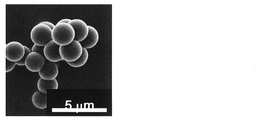
- FIG. 2 is an FE-SEM image of particles obtained in Example 1.
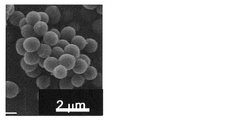
- FIG. 3 is an FE-SEM image of particles obtained in Example 2.
- FIG. 3 is an FE-SEM image of particles obtained in Comparative Example 1.
- 3 is an FE-SEM image of particles obtained in Comparative Example 2.
- Example 1 1.20 g of 1,5-dihydroxynaphthalene (1,5-DHN, manufactured by Tokyo Chemical Industry Co., Ltd.) and 0.98 g of 1,3,5-triazine (manufactured by Tokyo Chemical Industry Co., Ltd.) are sequentially dissolved in 50 ml of ethanol, and an ethanol mixed solution Was made. Next, the obtained mixed solution was heated and stirred (rotation speed: 300 rpm) at 80 ° C. for 1 hour. The solution was filtered through a glass filter, washed three times with ethanol, and then vacuum-dried at 50 ° C. for 3 hours. Then, the black carbon particle was obtained by heating at 110 degreeC for 2 hours.
- nuclear magnetic resonance spectra NMR spectra
- peaks corresponding to the methylene group of the "benzene ring -CH 2 -N” on Nafutokisajin ring and (3.95Ppm) A peak (4.92 ppm) corresponding to the methylene group of “O—CH 2 —N” was detected at almost the same intensity, confirming the formation of a resin component containing a naphthoxazine ring.
- the nuclear magnetic resonance spectrum was measured using 1 H-NMR (600 MHz) manufactured by Varian Inova, and deuterium dimethyl sulfoxide was used for the measurement, the number of spectrum integration was 256 times, and the relaxation time was 10 seconds. did.
- Example 2 In Example 1, instead of 50 ml of ethanol, 35 ml of ethanol and 15 ml of DMF (N, N-dimethylformamide) were used, and the black carbon particles were obtained in the same manner as in Example 1 except that the mixture was heated and stirred at 80 ° C. for 6 hours. Obtained. The heating temperature after drying was 200 ° C.
- Example 3 In Example 1, instead of 50 ml of ethanol, 20 ml of ethanol and 30 ml of DMF (N, N-dimethylformamide) were used. Obtained. The heating temperature after drying was 350 ° C.
- Example 4 0.012 g of 1,5-dihydroxynaphthalene (manufactured by Tokyo Chemical Industry Co., Ltd.), 0.006 g of 40% methylamine (manufactured by Wako Pure Chemical Industries, Ltd.), 0.012 g of 37% formaldehyde aqueous solution (manufactured by Wako Pure Chemical Industries, Ltd.), Were sequentially dissolved in 50 ml of ethanol to prepare an ethanol mixed solution. Next, the obtained mixed solution was processed in an ultrasonic bath at 50 ° C. for 2 hours (ultrasonic frequency: Hz). The solution was then filtered through a glass filter and the particles were washed 3 times with ethanol. The collected particles were vacuum-dried at 50 ° C. for 3 hours and then heat-treated at 110 ° C. for 2 hours. Black carbon particles were obtained.
- Example 1 carbon particles were obtained in the same manner as in Example 1 except that 50 ml of DMF was used instead of 50 ml of ethanol and heated and stirred at 80 ° C. for 6 hours. The heating temperature after drying was 110 ° C.
- Example 2 carbon particles were obtained in the same manner as in Example 1 except that ethanol 15 ml and DMF 35 mlg were used instead of ethanol 50 ml and the mixture was heated and stirred at 80 ° C. for 6 hours. The heating temperature after drying was 150 ° C.
- volume resistivity The volume resistivity of the particles obtained in Examples and Comparative Examples was measured for a volume resistivity at a load of 15 N using a powder resistance measurement system (manufactured by Mitsubishi Chemical Analytech).
- Dispersibility The dispersibility of the particles obtained in Examples and Comparative Examples was evaluated using a centrifugal sedimentation / light transmission type dispersion stability analyzer (LUMiSizer612 manufactured by LUM Co.). Specifically, about 1 ml of a composition in which particles are dispersed at a ratio of 5% by weight with respect to a 5% aqueous solution of polyvinyl alcohol (PVA) is placed in a glass analysis cell, and the supernatant is irradiated with light. The integrated value of the amount of change in the amount of light transmitted per time was determined, and the dispersibility was evaluated according to the following criteria. When the amount of change in the amount of light after 1 hour is 5% or less: ⁇ When the amount of change in the amount of light after 1 hour exceeds 5%: ⁇
- TOF-SIMS measurement The obtained particles were subjected to time-of-flight secondary ion mass spectrometry (Time-of-Flight Secondary Mass Spectrometry, TOF) using a TOF-SIMS type 5 device (manufactured by ION-TOF). -SIMS) confirmed the mass spectrum derived from the benzene ring (near 77.12) and the mass spectrum derived from the naphthalene ring (near 127.27). The TOF-SIMS measurement was performed under the following conditions. Further, in order to avoid contamination derived from the air or a storage case as much as possible, the sample was stored in a clean case for storing silicon wafers.
- the zeta potential of the particles was measured using a zeta potential measuring device (MODEL 502, manufactured by Nippon Lucas). Specifically, a KCl aqueous solution having a concentration of 0.01 M was used as a supporting electrolyte, and a KCl solution in which a small amount of black particles was dispersed was injected into the measurement cell. Thereafter, a voltage was applied while observing with a microscope, and the particles were adjusted until they stopped moving (still stopped), and the potential at that time was defined as a zeta potential.
- the present invention it is possible to provide black particles having high electrical insulation, high blackness in the visible light region, excellent dispersibility, and a method for producing the black particles.
Landscapes
- Chemical & Material Sciences (AREA)
- Organic Chemistry (AREA)
- Inorganic Chemistry (AREA)
- Compositions Of Macromolecular Compounds (AREA)
- Pigments, Carbon Blacks, Or Wood Stains (AREA)
- Carbon And Carbon Compounds (AREA)
Priority Applications (5)
| Application Number | Priority Date | Filing Date | Title |
|---|---|---|---|
| EP17753341.1A EP3418334A4 (de) | 2016-02-18 | 2017-02-17 | Schwarze partikel und verfahren zur herstellung von schwarzen partikeln |
| KR1020187006979A KR102658084B1 (ko) | 2016-02-18 | 2017-02-17 | 흑색 입자 및 흑색 입자의 제조 방법 |
| US16/066,771 US20180354798A1 (en) | 2016-02-18 | 2017-02-17 | Black particles and process for producing black particles |
| CN201780002945.9A CN107949606B (zh) | 2016-02-18 | 2017-02-17 | 黑色粒子以及黑色粒子的制造方法 |
| JP2017518168A JP6941837B2 (ja) | 2016-02-18 | 2017-02-17 | 黒色粒子及び黒色粒子の製造方法 |
Applications Claiming Priority (2)
| Application Number | Priority Date | Filing Date | Title |
|---|---|---|---|
| JP2016-029267 | 2016-02-18 | ||
| JP2016029267 | 2016-02-18 |
Publications (1)
| Publication Number | Publication Date |
|---|---|
| WO2017142087A1 true WO2017142087A1 (ja) | 2017-08-24 |
Family
ID=59625259
Family Applications (1)
| Application Number | Title | Priority Date | Filing Date |
|---|---|---|---|
| PCT/JP2017/005999 Ceased WO2017142087A1 (ja) | 2016-02-18 | 2017-02-17 | 黒色粒子及び黒色粒子の製造方法 |
Country Status (7)
| Country | Link |
|---|---|
| US (1) | US20180354798A1 (de) |
| EP (1) | EP3418334A4 (de) |
| JP (1) | JP6941837B2 (de) |
| KR (1) | KR102658084B1 (de) |
| CN (1) | CN107949606B (de) |
| TW (1) | TWI739802B (de) |
| WO (1) | WO2017142087A1 (de) |
Cited By (5)
| Publication number | Priority date | Publication date | Assignee | Title |
|---|---|---|---|---|
| JP2019085298A (ja) * | 2017-11-07 | 2019-06-06 | 株式会社日本触媒 | 炭素材料の製造方法 |
| WO2020171168A1 (ja) * | 2019-02-20 | 2020-08-27 | 積水化学工業株式会社 | 樹脂組成物、硬化物、ブラックマトリックス、カラーフィルタ、液晶表示装置、有機エレクトロルミネッセンス表示装置及び樹脂組成物の製造方法 |
| JP2020186307A (ja) * | 2019-05-14 | 2020-11-19 | 積水化学工業株式会社 | カーボン被覆粒子及び黒色顔料 |
| JPWO2021100699A1 (de) * | 2019-11-18 | 2021-05-27 | ||
| WO2022045341A1 (ja) * | 2020-08-31 | 2022-03-03 | 積水化学工業株式会社 | 近赤外線透過性黒色材料 |
Families Citing this family (2)
| Publication number | Priority date | Publication date | Assignee | Title |
|---|---|---|---|---|
| JP7436053B2 (ja) * | 2019-04-04 | 2024-02-21 | ナミックス株式会社 | 多孔質炭素及び樹脂組成物 |
| KR102380787B1 (ko) | 2019-09-24 | 2022-03-31 | 서울과학기술대학교 산학협력단 | 흑색 이산화티탄을 이용한 전기영동 디스플레이용 안료 및 잉크 |
Citations (12)
| Publication number | Priority date | Publication date | Assignee | Title |
|---|---|---|---|---|
| JPS543501B1 (de) | 1971-03-19 | 1979-02-23 | ||
| JPH06505693A (ja) * | 1991-03-12 | 1994-06-30 | エデイソン・ポリマー・イノベイシヨン・コーポレイシヨン | ベンズオキサジンによるコンポジットの緻密化 |
| JPH1197011A (ja) * | 1997-09-17 | 1999-04-09 | Unitika Ltd | 非水リチウム二次電池 |
| JP2004285195A (ja) * | 2003-03-20 | 2004-10-14 | Lignyte Co Ltd | カーボン・オキサジン系化合物複合成形材料及び燃料電池用セパレータ |
| WO2007129640A1 (ja) * | 2006-05-01 | 2007-11-15 | Sekisui Chemical Co., Ltd. | 樹脂焼成物及びこれを搭載した電子機器 |
| JP4338479B2 (ja) | 2003-09-04 | 2009-10-07 | 富士フイルム株式会社 | カラーフィルター及びその製造方法 |
| JP2011068829A (ja) * | 2009-09-28 | 2011-04-07 | Sekisui Chem Co Ltd | 耐熱膜の製造方法 |
| WO2013027674A1 (ja) * | 2011-08-19 | 2013-02-28 | 積水化学工業株式会社 | 炭素繊維複合材 |
| JP2014162116A (ja) * | 2013-02-26 | 2014-09-08 | Sekisui Chem Co Ltd | 繊維複合材、繊維複合材の製造方法、繊維束及び繊維束の製造方法 |
| JP2015093883A (ja) * | 2013-11-08 | 2015-05-18 | 積水化学工業株式会社 | 炭素繊維複合材及び炭素繊維 |
| WO2016047606A1 (ja) * | 2014-09-22 | 2016-03-31 | 積水化学工業株式会社 | カーボン被覆二酸化バナジウム粒子 |
| JP2016097654A (ja) * | 2014-11-26 | 2016-05-30 | 積水化学工業株式会社 | 繊維基材、樹脂シート、繊維基材の製造方法及び樹脂シートの製造方法 |
Family Cites Families (5)
| Publication number | Priority date | Publication date | Assignee | Title |
|---|---|---|---|---|
| JP3576433B2 (ja) * | 1999-10-18 | 2004-10-13 | 群栄化学工業株式会社 | 球状フェノール樹脂の製造方法 |
| CN101157451B (zh) * | 2007-09-16 | 2011-04-06 | 中国科学院山西煤炭化学研究所 | 一种树脂基球炭的制备方法 |
| CN101830457B (zh) * | 2010-05-20 | 2012-01-25 | 湖南大学 | 一种炭微球的制备方法及杂多酸在炭微球制备和石墨化中的应用 |
| CN102225996B (zh) * | 2011-05-06 | 2013-07-31 | 大连理工大学 | 一种苯并噁嗪树脂纳米聚合物球及炭球的制备方法 |
| US9714172B2 (en) * | 2012-11-26 | 2017-07-25 | Georgia-Pacific Chemicals Llc | Preparation of polymeric resins and carbon materials |
-
2017
- 2017-02-17 EP EP17753341.1A patent/EP3418334A4/de active Pending
- 2017-02-17 CN CN201780002945.9A patent/CN107949606B/zh active Active
- 2017-02-17 US US16/066,771 patent/US20180354798A1/en not_active Abandoned
- 2017-02-17 KR KR1020187006979A patent/KR102658084B1/ko active Active
- 2017-02-17 JP JP2017518168A patent/JP6941837B2/ja active Active
- 2017-02-17 WO PCT/JP2017/005999 patent/WO2017142087A1/ja not_active Ceased
- 2017-02-18 TW TW106105444A patent/TWI739802B/zh not_active IP Right Cessation
Patent Citations (12)
| Publication number | Priority date | Publication date | Assignee | Title |
|---|---|---|---|---|
| JPS543501B1 (de) | 1971-03-19 | 1979-02-23 | ||
| JPH06505693A (ja) * | 1991-03-12 | 1994-06-30 | エデイソン・ポリマー・イノベイシヨン・コーポレイシヨン | ベンズオキサジンによるコンポジットの緻密化 |
| JPH1197011A (ja) * | 1997-09-17 | 1999-04-09 | Unitika Ltd | 非水リチウム二次電池 |
| JP2004285195A (ja) * | 2003-03-20 | 2004-10-14 | Lignyte Co Ltd | カーボン・オキサジン系化合物複合成形材料及び燃料電池用セパレータ |
| JP4338479B2 (ja) | 2003-09-04 | 2009-10-07 | 富士フイルム株式会社 | カラーフィルター及びその製造方法 |
| WO2007129640A1 (ja) * | 2006-05-01 | 2007-11-15 | Sekisui Chemical Co., Ltd. | 樹脂焼成物及びこれを搭載した電子機器 |
| JP2011068829A (ja) * | 2009-09-28 | 2011-04-07 | Sekisui Chem Co Ltd | 耐熱膜の製造方法 |
| WO2013027674A1 (ja) * | 2011-08-19 | 2013-02-28 | 積水化学工業株式会社 | 炭素繊維複合材 |
| JP2014162116A (ja) * | 2013-02-26 | 2014-09-08 | Sekisui Chem Co Ltd | 繊維複合材、繊維複合材の製造方法、繊維束及び繊維束の製造方法 |
| JP2015093883A (ja) * | 2013-11-08 | 2015-05-18 | 積水化学工業株式会社 | 炭素繊維複合材及び炭素繊維 |
| WO2016047606A1 (ja) * | 2014-09-22 | 2016-03-31 | 積水化学工業株式会社 | カーボン被覆二酸化バナジウム粒子 |
| JP2016097654A (ja) * | 2014-11-26 | 2016-05-30 | 積水化学工業株式会社 | 繊維基材、樹脂シート、繊維基材の製造方法及び樹脂シートの製造方法 |
Non-Patent Citations (1)
| Title |
|---|
| See also references of EP3418334A4 |
Cited By (20)
| Publication number | Priority date | Publication date | Assignee | Title |
|---|---|---|---|---|
| JP2019085298A (ja) * | 2017-11-07 | 2019-06-06 | 株式会社日本触媒 | 炭素材料の製造方法 |
| JP7112192B2 (ja) | 2017-11-07 | 2022-08-03 | 株式会社日本触媒 | 炭素材料の製造方法 |
| WO2020171168A1 (ja) * | 2019-02-20 | 2020-08-27 | 積水化学工業株式会社 | 樹脂組成物、硬化物、ブラックマトリックス、カラーフィルタ、液晶表示装置、有機エレクトロルミネッセンス表示装置及び樹脂組成物の製造方法 |
| KR102801735B1 (ko) | 2019-02-20 | 2025-04-28 | 세키스이가가쿠 고교가부시키가이샤 | 수지 조성물, 경화물, 블랙 매트릭스, 컬러 필터, 액정 표시 장치, 유기 일렉트로 루미네선스 표시 장치 및 수지 조성물의 제조 방법 |
| JP7480035B2 (ja) | 2019-02-20 | 2024-05-09 | 積水化学工業株式会社 | 樹脂組成物、硬化物、ブラックマトリックス、カラーフィルタ、液晶表示装置、有機エレクトロルミネッセンス表示装置及び樹脂組成物の製造方法 |
| KR20210127693A (ko) * | 2019-02-20 | 2021-10-22 | 세키스이가가쿠 고교가부시키가이샤 | 수지 조성물, 경화물, 블랙 매트릭스, 컬러 필터, 액정 표시 장치, 유기 일렉트로 루미네선스 표시 장치 및 수지 조성물의 제조 방법 |
| JPWO2020171168A1 (ja) * | 2019-02-20 | 2021-12-16 | 積水化学工業株式会社 | 樹脂組成物、硬化物、ブラックマトリックス、カラーフィルタ、液晶表示装置、有機エレクトロルミネッセンス表示装置及び樹脂組成物の製造方法 |
| JP2020186307A (ja) * | 2019-05-14 | 2020-11-19 | 積水化学工業株式会社 | カーボン被覆粒子及び黒色顔料 |
| JP7289477B2 (ja) | 2019-05-14 | 2023-06-12 | 積水化学工業株式会社 | カーボン被覆粒子及び黒色顔料 |
| KR20220104142A (ko) | 2019-11-18 | 2022-07-26 | 세키스이가가쿠 고교가부시키가이샤 | 흑색 입자, 흑색 도료, 도막 및 컬러 필터용 블랙 매트릭스 |
| CN114502677A (zh) * | 2019-11-18 | 2022-05-13 | 积水化学工业株式会社 | 黑色粒子、黑色涂料、涂膜及滤色器用黑色矩阵 |
| CN114502677B (zh) * | 2019-11-18 | 2023-11-14 | 积水化学工业株式会社 | 黑色粒子、黑色涂料、涂膜及滤色器用黑色矩阵 |
| WO2021100699A1 (ja) | 2019-11-18 | 2021-05-27 | 積水化学工業株式会社 | 黒色粒子、黒色塗料、塗膜及びカラーフィルター用ブラックマトリクス |
| JP7642376B2 (ja) | 2019-11-18 | 2025-03-10 | 積水化学工業株式会社 | 黒色粒子、黒色塗料、塗膜及びカラーフィルター用ブラックマトリクス |
| JPWO2021100699A1 (de) * | 2019-11-18 | 2021-05-27 | ||
| US12391781B2 (en) | 2019-11-18 | 2025-08-19 | Sekisui Chemical Co., Ltd. | Black particles, black coating material, coating film, and black matrix for color filters |
| KR102927899B1 (ko) | 2019-11-18 | 2026-02-13 | 세키스이가가쿠 고교가부시키가이샤 | 흑색 입자, 흑색 도료, 도막 및 컬러 필터용 블랙 매트릭스 |
| JPWO2022045341A1 (de) * | 2020-08-31 | 2022-03-03 | ||
| WO2022045341A1 (ja) * | 2020-08-31 | 2022-03-03 | 積水化学工業株式会社 | 近赤外線透過性黒色材料 |
| JP7784308B2 (ja) | 2020-08-31 | 2025-12-11 | 積水化学工業株式会社 | 近赤外線透過性黒色材料 |
Also Published As
| Publication number | Publication date |
|---|---|
| CN107949606B (zh) | 2021-10-12 |
| US20180354798A1 (en) | 2018-12-13 |
| KR20180115664A (ko) | 2018-10-23 |
| CN107949606A (zh) | 2018-04-20 |
| TW201733788A (zh) | 2017-10-01 |
| KR102658084B1 (ko) | 2024-04-16 |
| JP6941837B2 (ja) | 2021-09-29 |
| EP3418334A1 (de) | 2018-12-26 |
| EP3418334A4 (de) | 2019-10-09 |
| TWI739802B (zh) | 2021-09-21 |
| JPWO2017142087A1 (ja) | 2018-12-13 |
Similar Documents
| Publication | Publication Date | Title |
|---|---|---|
| JPWO2017142087A1 (ja) | 黒色粒子及び黒色粒子の製造方法 | |
| JP5926868B1 (ja) | カーボン被覆二酸化バナジウム粒子 | |
| US10121717B2 (en) | Carbon-coated thermal conductive material | |
| US11404686B2 (en) | Negative electrode active material for lithium ion battery | |
| CN113851701A (zh) | Lgps系固体电解质的制造方法 | |
| Touidjine et al. | Partially oxidized silicon particles for stable aqueous slurries and practical large-scale making of Si-based electrodes | |
| Mandal et al. | Highly efficient and stable inverted perovskite solar cell using pure δ‐FAPbI3 single crystals | |
| EP3778786A1 (de) | Systeme, zusammensetzungen und verfahren zur verbesserten elektromagnetischen abschirmung und korrosionsbeständigkeit | |
| CN115668011B (zh) | 近红外线透射性黑色材料 | |
| CN108025358B (zh) | 导电材料用粉末、导电材料用油墨、导电糊剂以及导电材料用粉末的制造方法 | |
| CN111908991A (zh) | 一种提高α-AlH3热稳定性的方法 | |
| JP2023107750A (ja) | グラフェン分散液およびグラフェン樹脂複合膜 | |
| JP2012176859A (ja) | インジウム錫酸化物粒子及びその製造方法 | |
| CN112960691A (zh) | 用于短波ir设备的全无机钙钛矿材料 | |
| JP2011068829A (ja) | 耐熱膜の製造方法 | |
| KR20150088551A (ko) | 알칼리금속산화물이 도핑된 텅스텐산화물 복합체, 투명전도성 조성물, 코팅필름 및 이를 포함하는 광학소자 | |
| WO2020073101A1 (en) | Graphitic compositions, coatings and materials | |
| CN107117589B (zh) | 一种高比电容(BC)xNyOz材料及其合成方法 | |
| EP4660146A1 (de) | Hafnium-säure-verbindung enthaltendes material und verfahren zu seiner herstellung | |
| Alkathy et al. | Evaluation of structural and functional differences in BaTi0. 96Sn0. 04O3 ceramics sintered by conventional and microwave techniques | |
| WO2024090406A1 (ja) | ニオブ酸リチウム分散液 | |
| JP2015078109A (ja) | ZnO:Gaナノ粒子の合成方法及びZnO:Ga膜の製造方法 | |
| TW201727977A (zh) | 鋰離子電池用正極活性物質 |
Legal Events
| Date | Code | Title | Description |
|---|---|---|---|
| ENP | Entry into the national phase |
Ref document number: 2017518168 Country of ref document: JP Kind code of ref document: A |
|
| 121 | Ep: the epo has been informed by wipo that ep was designated in this application |
Ref document number: 17753341 Country of ref document: EP Kind code of ref document: A1 |
|
| ENP | Entry into the national phase |
Ref document number: 20187006979 Country of ref document: KR Kind code of ref document: A |
|
| NENP | Non-entry into the national phase |
Ref country code: DE |
|
| WWE | Wipo information: entry into national phase |
Ref document number: 2017753341 Country of ref document: EP |
|
| ENP | Entry into the national phase |
Ref document number: 2017753341 Country of ref document: EP Effective date: 20180918 |