WO2017145254A1 - Procédé d'activation du cortex préfrontal dans le cerveau avec un aliment - Google Patents
Procédé d'activation du cortex préfrontal dans le cerveau avec un aliment Download PDFInfo
- Publication number
- WO2017145254A1 WO2017145254A1 PCT/JP2016/055184 JP2016055184W WO2017145254A1 WO 2017145254 A1 WO2017145254 A1 WO 2017145254A1 JP 2016055184 W JP2016055184 W JP 2016055184W WO 2017145254 A1 WO2017145254 A1 WO 2017145254A1
- Authority
- WO
- WIPO (PCT)
- Prior art keywords
- edible
- brain
- paint
- preparation
- food
- Prior art date
- Legal status (The legal status is an assumption and is not a legal conclusion. Google has not performed a legal analysis and makes no representation as to the accuracy of the status listed.)
- Ceased
Links
Images


Classifications
-
- A—HUMAN NECESSITIES
- A23—FOODS OR FOODSTUFFS; TREATMENT THEREOF, NOT COVERED BY OTHER CLASSES
- A23L—FOODS, FOODSTUFFS OR NON-ALCOHOLIC BEVERAGES, NOT OTHERWISE PROVIDED FOR; PREPARATION OR TREATMENT THEREOF
- A23L5/00—Preparation or treatment of foods or foodstuffs, in general; Food or foodstuffs obtained thereby; Materials therefor
-
- A—HUMAN NECESSITIES
- A23—FOODS OR FOODSTUFFS; TREATMENT THEREOF, NOT COVERED BY OTHER CLASSES
- A23P—SHAPING OR WORKING OF FOODSTUFFS, NOT FULLY COVERED BY A SINGLE OTHER SUBCLASS
- A23P10/00—Shaping or working of foodstuffs characterised by the products
-
- B—PERFORMING OPERATIONS; TRANSPORTING
- B65—CONVEYING; PACKING; STORING; HANDLING THIN OR FILAMENTARY MATERIAL
- B65D—CONTAINERS FOR STORAGE OR TRANSPORT OF ARTICLES OR MATERIALS, e.g. BAGS, BARRELS, BOTTLES, BOXES, CANS, CARTONS, CRATES, DRUMS, JARS, TANKS, HOPPERS, FORWARDING CONTAINERS; ACCESSORIES, CLOSURES, OR FITTINGS THEREFOR; PACKAGING ELEMENTS; PACKAGES
- B65D1/00—Rigid or semi-rigid containers having bodies formed in one piece, e.g. by casting metallic material, by moulding plastics, by blowing vitreous material, by throwing ceramic material, by moulding pulped fibrous material or by deep-drawing operations performed on sheet material
- B65D1/34—Trays or like shallow containers
- B65D1/36—Trays or like shallow containers with moulded compartments or partitions
Definitions
- the present invention relates to a method for activating the prefrontal cortex of a brain using a food that can activate the prefrontal cortex of a human brain, particularly a child's brain, more specifically, in the preparation process of a food,
- the present invention relates to a method for activating the prefrontal region of the brain using a food that can be activated mainly in the left prefrontal cortex.
- a food and drink for improving brain function containing a milk casein-derived peptide is known (for example, see Patent Document 1).
- the oxyhemoglobin concentration in the left and right prefrontal cortex is increased, the activity level of the prefrontal cortex is improved, and the work efficiency is further improved, so that the brain function is improved. Is.
- a brain function improving agent containing krill oil as an active ingredient and a food or drink containing the brain function improving agent are known (see, for example, Patent Document 2).
- a brain function-improving agent By ingesting the brain function-improving agent and the food or drink, oxygenated hemoglobin in the left and right frontal and frontal regions during execution of tasks such as memory tasks and calculation tasks is increased, thereby promoting brain metabolism. It prevents the improvement, recovery, maintenance and decline of brain function.
- a measurement experiment of the brain activity of a child in parent-child cooking suggests that cooking performed by the parent and child may develop various brain functions of the child (for example, see Non-Patent Document 1).
- parent-child cooking was performed by baking and serving hot cake using a gas stove, and as a result of measuring brain activity of the child during cooking, activation of the dorsolateral prefrontal cortex of the left and right cerebral hemispheres was activated. It has been confirmed that cooking habits performed by parents and children have a positive effect on children's cognitive function.
- the human brain controls specific biological functions by specific parts.
- the prefrontal cortex is a high-order human function such as thinking and creativity, specifically working memory, reaction suppression, behavior switching, planning, inference and other cognitive / executive functions, high-order emotional and motivational functions, and It is known to be involved in the decision-making process based on it.
- food and drink useful for improving brain functions of the left and right frontal cortex, left and right frontal and frontal heads, and the dorsolateral frontal front of the left and right cerebral hemispheres of a child in parent-child cooking It is known about the usefulness of brain function development in Maeno.
- there has been no proposal for a method for activating the prefrontal area of the brain particularly focusing on the food preparation process performed by the child alone.
- the present invention has been made in view of the circumstances as described above, and the object of the present invention is to use the food that can activate the prefrontal cortex of the human brain, particularly the child's brain. It is an object of the present invention to provide a method for activating the prefrontal cortex using a food that can activate the prefrontal cortex of the brain, particularly the left prefrontal cortex, particularly in the preparation process of the food.
- the present invention provides a method for activating the prefrontal area of the brain, characterized in that a food is prepared by mixing a plurality of edible paints having different colors and preparing an edible paint having an arbitrary new color. Achieve the goal.
- the present invention achieves the above object by a method for activating the prefrontal cortex of a brain, wherein a food is prepared through a process of applying an arbitrary color scheme to a pattern using a plurality of edible paints having different color tones. To do.
- the above object is achieved by a method for activating the prefrontal area of the brain, characterized in that a food is prepared through a process of creating an arbitrary pattern using a plurality of edible paints having different colors and a pattern outline mold. Achieve.
- This invention achieves the said objective by the prefrontal cortex activation method of the brain characterized by preparing a foodstuff through the following process (1) (2) or (1) (3).
- (1) A step of mixing a plurality of edible paints having different colors and preparing a paint after an edible preparation having an arbitrary new color
- (2) A plurality of pre-edible preparations and / or edible preparations having a different color
- Step of applying an arbitrary color scheme to a pattern using post-painting (3)
- Arbitrary pattern using a plurality of pre-edible composition paints and / or post-edible composition paints and pattern outline molds of different colors Process for creating patterns
- this invention achieves the said objective by the prefrontal cortex activation method characterized by preparing a foodstuff using the brain activation food kit provided with following (A) (B).
- A) A plurality of edible pre-preparation paints having different colors
- B) A mixture of two or more edible pre-preparation paint storage portions and two or more edible pre-preparation paints for storing (A) above.
- a food preparation container comprising an edible pre-prepared paint container for preparing an edible post-prepared paint of any new color
- the following (C) is further provided, and more preferably, the following (D) is further provided.
- (C) A pattern outline formwork for coloring a pattern and / or creating a pattern using an edible pre-preparation paint and / or a post-edible preparation paint of different colors
- (D) The edible paint Eyedropper for at least one of handling, blending, coloring the pattern, creating a pattern
- the Applicant has marketed handmade food kits such as combination sweets that children can easily make (prepare) themselves. From surveys such as questionnaire surveys, group interview surveys, and monitor surveys, we can understand the subjective evaluation of children on finished products made from each handmade food kit. However, in the work process that children actually prepare handmade food kits, it is not possible to objectively grasp how the child feels in the work process, which part of the preparation process feels more fun or more difficult It was.
- the viewpoint of product development was changed to evaluation of each preparation process from the food kit to completion of the finished food, instead of evaluation of the finished food obtained from the conventional food kit.
- the preparation process that makes you feel more fun or more difficult and wants to challenge you more than once can be evaluated and grasped with objective indicators, you can apply it to food products for children with a high repeat rate.
- the handling of monochromatic edible paint is more than the process of handling monochromatic edible paint (transferring and preparing (dissolving, mixing, etc.) using a dropper etc.).
- Mixing multiple edible paints to formulate an edible paint of any new color will stimulate the prefrontal cortex, increasing cerebral blood flow and increasing the concentration of oxyhemoglobin in the human.
- the present inventors have found that the present invention is effective for activating the prefrontal cortex (especially the left prefrontal cortex) of (especially a child).
- the present inventors have found that the present invention is effective for activating the prefrontal cortex (particularly the left frontal cortex) of humans (particularly children).
- the method for activating the prefrontal brain using the food of the present invention includes a step of mixing a plurality of edible paints to prepare any new edible paint, and a pattern contour frame using the plurality of edible paints.
- Prepares food because it is equipped with a slightly complicated preparation process, especially for children, such as the process of coloring a pattern on a pattern, the process of creating an arbitrary pattern in a pattern outline mold using multiple edible paints When you can activate the prefrontal cortex of the brain.
- the brain activated food kit activates the prefrontal area of the brain, particularly the left prefrontal area, through the fun and difficulty felt during preparation, and can feel a sense of accomplishment and satisfaction.
- the prefrontal cortex especially the left frontal cortex, without stress.
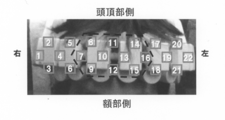
- the figure which shows an example of the measurement point (channel) at the time of mounting the headset of the apparatus which measures the oxyhemoglobin density
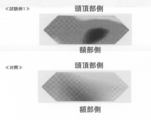
- Brain activity map showing prefrontal oxyhemoglobin concentration distribution measured in the color preparation process (Test Example 1) Explanatory drawing which shows an example of the preparation method of the brain activation food kit used when measuring a brain activation state Oxyhemoglobin concentration measurement graph of prefrontal cortex during color preparation process (Test Example 1) Graph of oxyhemoglobin concentration measurement in prefrontal cortex during coloration process (Test Example 2) Prefrontal oxyhemoglobin concentration measurement graph during the process of creating a pattern (Test Example 3)
- the brain prefrontal activation method using the food of the present invention is a method of activating the prefrontal cortex of the cerebral cortex, particularly the left prefrontal cortex.
- a specific biological function and a specific part of the brain are related, and when brain activation occurs with the biological function, the cerebral blood flow in the related specific part of the brain increases, and as a result, It is known that oxyhemoglobin concentration increases. That is, in the present invention, activating the prefrontal cortex means that the oxyhemoglobin concentration in the blood in the prefrontal area of the brain is increased.
- the prefrontal area of the scalp is irradiated with near infrared rays
- the oxyhemoglobin concentration in the prefrontal cortex is 1.1 times or more, preferably 1.2 times or more than the “control” described later. Refers to the raised state. More preferably, it indicates a state of significant difference p ⁇ 0.05.
- the target age of a human who activates the brain by the method for activating the prefrontal cortex of the present invention is not particularly limited, but children of 3 to 12 years old who are particularly interested in simple actions such as drawing Is preferred. It is also effective for seniors and above for the prevention of dementia.
- a device that can irradiate near-infrared light from above the scalp of the subject and measure the oxyhemoglobin concentration in the blood in the prefrontal area of the cerebral cortex is used.
- Examples include wearable optical topography WOT-220 (manufactured by Hitachi High-Technologies Corporation, 22 channels), FOIR-300 (manufactured by Shimadzu Corporation), and the like.
- FIG. 1 shows a headset of a wearable optical topography WOT-220 device manufactured by Hitachi High-Technologies Corporation as a headset for a device for measuring the oxyhemoglobin concentration in the prefrontal region (built-in near-infrared light source and detector). It is a figure which shows the measurement point (channel) at the time of mounting
- the measurement target part of the oxyhemoglobin concentration in the prefrontal cortex region is a prefrontal cortex region of the cerebral cortex, that is, a region including 10 to 44 fields and 46 fields in the Broadman brain map is a prefrontal region of the brain.
- a maximum of 22 measurement points can be set.
- the measurement points may be appropriately selected according to the size of the head. For example, as shown in FIG. 1, the measurement points corresponding to the prefrontal area of the brain of the head of a 10-year-old child are channels 7 to 16, of which the left prefrontal area corresponds to channels 13 to 16. In this way, the channel selection may be set according to the size of the head to be measured, but when measuring multiple children, it is better to match the size of the head to be measured so that the channels are the same. Good.
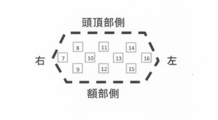
- FIG. 2 is a simulation diagram in which the position of the channel when measuring the head of a 10-year-old child from the top of the face to the forehead of the face in FIG. 1 is replaced with a cross-sectional view.
- “right” indicates the right side of the face and “left” indicates the left side of the face
- channels 13 to 16 are the left prefrontal cortex region.
- FIG. 3 is a brain activity map showing oxyhemoglobin concentration distribution in the prefrontal cortex measured in the step of preparing the color of Test Example 1 to be described later. It is a mapping. The higher the activation state of the brain, the darker the color, and the lower the activation state, the lighter the color.
- the prefrontal area of «Test Example 1» is shown to be dark overall, and in particular, the channels 12, 13, and 15 have the darkest color. . Further, in the range corresponding to the left prefrontal cortex (channels 13, 15, and 16), the difference in density between ⁇ Test Example 1 >> and ⁇ Control >> is remarkable. That is, in ⁇ Test Example 1 >>, the prefrontal cortex of the brain, particularly the left frontal cortex, is more activated than ⁇ Control >>.
- the brain prefrontal activation method includes a step of mixing a plurality of edible paints having different tones to prepare an edible paint having an arbitrary new color tone, and an arbitrary design pattern using the edible paint. It is effective for the prefrontal area of the brain to prepare food through any one or more of the step of applying a color scheme or the step of creating an arbitrary pattern using the edible paint and the pattern outline formwork. It is important in that it is activated.
- the above edible paint refers to a paint-like coloring material that can be eaten by humans, and is a concept that includes both pre-edible and pre-edible paints described below.
- the edible paint may be in any state of solid (powder, granule, etc.), liquid, or fluid (sol, cream, etc.). Good.
- the component include sugars, starches, dextrins, thickeners, powdered fats and oils, coloring agents, fragrances and the like, and one or more of them may be used as appropriate.
- the edible paint can be used in a temperature range from 5 to 30 ° C refrigerated to room temperature, that is, non-heated (5 to 30 ° C) that does not require heating. From this point, it is preferable.
- edible paint refers to edible paint (prepared in advance) used to formulate new colors, and the colors are red, blue, yellow, white, black, etc. Etc.
- the paint after edible preparation refers to an edible paint having a new color obtained by mixing a plurality of paints before edible preparation. For example, green mixed with blue and yellow, purple mixed with red and blue, pink mixed with red and white, orange mixed with red and yellow, tea mixed with red and yellow and black, or tea mixed with red and yellow and blue And so on.
- mixing a plurality of edible paints of different colors to prepare an edible paint of any new color tone uses one or more of the edible pre-preparation paint and the edible post-preparation paint, It means to blend the paint after any edible edible formulation.
- applying an arbitrary color scheme to a pattern using an edible paint means that the edible paint is arbitrarily colored on the pattern.
- creating an arbitrary pattern using edible paint and a pattern outline formwork means freely creating a pattern in the pattern outline form using edible paint and creating a pattern pattern. To do.
- the above pattern outline formwork forms the outline shape of the pattern pattern.
- the pattern pattern can be colored and colored. It is a formwork for creating a pattern by drawing a pattern.
- As the pattern outline formwork one having an outline wall formed along the outline of the pattern may be used.
- the material for the pattern outline mold is made of polystyrene, polypropylene, polyethylene terephthalate, silicone resin, metal, etc., and plastic foods such as clay-like candy and powdered food. Those formed may be mentioned and may be appropriately selected.
- a formwork formed in a concave shape on the surface of a solid confectionery such as candy, or the like may be used.
- a shape of a formwork any of a hollow cylinder shape without a bottom and a concave shape with a bottom may be used.
- the outline shape of the above pattern includes animals (mammals, birds, fish, reptiles, etc.), vehicles (airplanes, trains, cars, etc.) plants, confectionery, food and drink, robots, characters, buildings, national flags, sun, moon, stars , Planetary patterns, geometric patterns, and the like, and may be set as appropriate.
- preparing food through the following steps (1), (2) or (1), (3) effectively activates the prefrontal cortex of the brain.
- a step of mixing a plurality of edible paints having different colors and preparing a paint after an edible preparation having an arbitrary new color (2)
- a plurality of pre-edible preparations and / or edible preparations having a different color (3)
- preparing food using a brain activated food kit comprising the following (A) and (B) effectively activates the prefrontal cortex of the brain: It is important to do.
- B A mixture of two or more edible pre-preparation paint storage portions and two or more edible pre-preparation paints for storing (A) above.
- a food preparation container comprising an edible pre-prepared paint container for preparing an edible post-prepared paint of any new color
- the container for food preparation of (B) is a plurality of edible pre-preparation paint storage units for storing edible pre-preparation paint and a plurality of edible post-preparation paints for preparing post-edible preparation paint It is a container in which an edible paint provided with a storage portion can be stored separately. In addition, it is preferable at the point of the ease of handling that the paint storage part before edible preparation and the paint storage part after edible preparation have a recessed part shape.
- the brain prefrontal activation method of the present invention preferably further comprises the following (C), more preferably further comprises the following (D).
- C A pattern outline formwork for coloring a pattern and / or creating a pattern using an edible pre-preparation paint and / or a new blended edible paint of a different color
- D A dropper for at least one of handling, blending, coloring the pattern, and creating a pattern.
- the dropper in (D) above is handling (transferring, preparing (dissolving, mixing, etc.) the edible paint, etc., preparing the paint after edible preparation, coloring the pattern, It is a dropper for creating at least one of the patterns, especially because it can be easily handled by children, the amount of water added to the powder for edible paint is easy to understand, and it can be measured and transferred without spilling. Is preferred.
- the brain activated food kit includes a step of mixing a plurality of edible paints having different color tones to prepare an edible paint having an arbitrary new color, and a pattern using the edible paints.
- a step of mixing a plurality of edible paints having different color tones to prepare an edible paint having an arbitrary new color, and a pattern using the edible paints.
- the edible pre-preparation paint of (A) above is provided with the edible pre-preparation paint of (A) above, and the food preparation container of (B) above. This is important because it effectively activates the prefrontal cortex.
- a jig for handling edible paint such as a spoon, a spatula, or a brush may be added.
- the brain-activated food kit according to the present invention is an edible formulation according to (A) described above for designing a food preparation process for creating an arbitrary pattern using the edible paint and a pattern outline formwork.
- the provision of the pre-paint and the above-mentioned (B) food preparation container is important from the viewpoint of effectively activating the prefrontal cortex of the brain.
- a jig for handling edible paint such as a spoon, a spatula, or a brush may be added.
- the food prepared using the brain activated food kit according to the present invention may be directly eaten as syrup, chocolate sauce, fruit sauce, jam, cream, etc. It can be chilled to make a frozen dessert.
- the prepared food is an edible paint
- the edible paint may be instantly solidified at room temperature by pouring solidifying powder into a gummy-like, jelly-like or ramune-like food. Or you may play by coloring the solid food or drawing a pattern.
- the solid food include candy, bakery food (bread, baked confectionery, etc.), tableting confectionery such as chewing gum, gummy, chocolate, jelly, and ramune.
- FIG. 4A shows an example of a set of food kits
- 11 is a food preparation container
- 12 is a dropper
- 13 is a tulip-shaped pattern outline formwork.
- an element of paint before edible preparation three types of powdered edible paint red, blue, yellow, etc.
- edible paint are solidified. It is good also as a food kit provided with the powder for solidification together.
- the food preparation container 11 is provided with three edible pre-preparation paint storage portions 21 for storing edible paint. What is necessary is just to provide the number of this edible pre-preparation paint accommodating parts 21 according to the number of the edible pre-preparation paints to be used.
- the food preparation container 11 is provided with eight edible pre-preparation paint storage units 22 for mixing two or more kinds of pre-edible preparation paints to prepare an edible post-preparation paint of any new color. It has been.
- the number of paint storage units 22 after edible preparation may be arbitrarily set, but from the viewpoint of drawing out the child's imagination, the possibility of mixing failure and further mixing of paints after edible preparation are possible. Therefore, it is preferable to provide a larger amount.
- the container 11 for food preparation contains, for example, an element (powder) of edible pre-preparation paint and a powder for solidification.
- a mold mounting recess 23 for mounting the frame 13 is provided.
- the recess 23 for placing the mold is not necessarily limited to containing the solidifying powder. For example, a clay-like candy is put, and the pattern outline mold 13 is pressed thereon to change the color scheme. It may be used for applying or creating a pattern.
- the dropper 12 is used for handling (preparing edible pre-preparation paint, transferring edible pre-preparation paint to edible preparation post-container 22 or preparing edible pre-preparation paint). . Specifically, for example, it is used as a mixing means for dissolving the edible pre-preparation paint (powder) in water to form a liquid edible pre-formulation paint, transferring the liquid edible paint, Used to mix paints.
- the pattern outline mold 13 can be freely colored by painting and coloring the pattern by arbitrarily adding edible paint (paint before edible preparation and / or paint after edible preparation). It is a formwork for drawing and creating a pattern.
- Fig.4 (a) in order to mount and use on the powder for solidification, the shape of the formwork is formed in the hollow cylinder shape.
- the contour shape is not limited to the tulip shape as shown in FIG. 4A, and may be arbitrarily set such as the shape of the paragraph [0041] described above or the shape of the tropical fish shape of FIG. 4D.
- the number of pattern outline molds 13 to be prepared may be arbitrarily set. In FIG. 4, three identical tulip-shaped pattern contour molds 13 are used as described later, but a plurality of different molds may be combined.
- the method for preparing a food kit according to the present invention is as follows. First, an edible pre-preparation paint element (not shown. Three types of powdered edible pre-preparation paints, red, blue and yellow) are prepared separately. It accommodates in the front paint storage part 21, puts water with the dropper 12 from above, and mixes as it is, and as shown in FIG. 4 (a), three colors of edible pre-preparation paint (red, blue, yellow) Get. Further, the solidification powder 30 for solidifying the edible paint is put into the mold mounting recess 23 and leveled flat.
- the pattern outline formwork 13 is optionally used by using the edible pre-preparation paint 41 prepared in the post-edible preparation paint storage unit 22 or the pre-edible preparation paint 40 stored in the pre-edible preparation paint storage unit 21. Color the inside with a color scheme. Since the above preparation process includes a step of blending colors and a step of applying a color (separation), the prefrontal cortex of the brain is activated.
- a tropical fish-shaped pattern contour mold 14 is used. Is mentioned.
- the pattern outline mold 14 a pattern is freely drawn using edible paint (40 and / or 41) obtained in the same manner as in FIGS. 4 (a) to 4 (c). Since this is equipped with a process of creating an arbitrary pattern, the prefrontal area of the brain is activated.
- FIG. 4E shows a tropical fish-shaped pattern contour mold 15 in which the inside of the mold is subdivided, as will be described later.
- a food preparation container is prepared.
- preparation and preparation of edible paint may be performed using a container such as tableware at home.
- examples of the food kit according to the present invention include powders for molded confectionery described in JP-A-9-47221.
- the food kit uses a molding mold described in [0014], and, as described in [0016] and [0019], a solution in which a pigment or the like is dissolved or dispersed is used as a molding recess in the molding mold. Since the powder for molded confectionery is added after being added to the above, the above-mentioned “coloring step” is added in which edible paint is added from above the powder in the specific pattern outline mold.
- a combination confectionery provided with a mixed powder of sugar, pregelatinized starch, thickening polysaccharide, etc., which is the basis of a gummy-like texture, and a solution in which a pigment or the like is dissolved or dispersed.
- the dye solution of different colors in the combination confectionery is mixed to prepare another color, the above-described “color preparation step” is provided, and a cookie mold or the like is removed on the mixed powder.
- the above-described “color arrangement step” is provided.
- Powders 1 to 3 were prepared by mixing the raw materials in the composition shown in Table 1 and serving as a base for the edible pre-preparation paint. Thereafter, as shown in FIG. 4 (a), each of the powders 1 to 3 described above is accommodated in each of the three edible pre-preparation paint accommodating portions 21 in the food preparation container 11, and each of the powders and the water supply Of water (25 ° C.) were mixed at a weight ratio of 1: 3, respectively, to prepare edible pre-preparation paints of blue, red and yellow.
- ⁇ Measurement of oxyhemoglobin concentration in prefrontal brain area As shown in FIG. 4 (a), two or more kinds of edible pre-preparation paints contained in the three edible pre-preparation paint storage units 21 are arbitrarily stored in one edible post-preparation paint. After being transferred to the unit 22, the mixture was mixed, and the oxyhemoglobin concentration in the prefrontal area of the brain during the process of preparing a color different from the color of the original edible pre-preparation paint was measured. Subjects were 18 right-handed healthy children and men who were 10 years old. (1) As shown in FIG. 1, a wearable optical topography WOT-220 headset (manufactured by Hitachi High-Technologies Corporation) was attached to the subject's head.
- the edible pre-preparation paint 40 in the edible pre-preparation paint container 21 of three colors of blue, red, and yellow can be freely selected and used with the dropper 12.
- the edible mixed paint 41 having a color tone different from that of the edible pre-prepared paint was mixed by dropping.
- the oxyhemoglobin concentration in the prefrontal area of the brain during the above step (2) was measured. All of the subjects' heads were of the same size, and channels 7 to 16 were used as measurement points in the prefrontal area as shown in FIG.
- the operation of the above (2) is replaced with the step (2 ′) below, and the frontal brain in the process of transferring one color of the edible pre-preparation paint to the vacant edible preparation post-container container 22 Maeno oxyhemoglobin concentration was measured.
- (2 ′) As shown in FIG. 4B, the blue edible pre-preparation paint 40 in the pre-edible preparation container 21 is moved to the post-edible paint container 22 using the dropper 12. .
- both the test example 1 and the control were performed in 20 seconds, and the above process was performed once, the process was performed four times, and the addition average was performed.
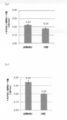
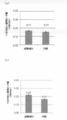
- FIG. 5 is a graph showing the average value of hemoglobin concentration in the prefrontal cortex.
- FIG. 5 (a) shows the results for channels 7 to 16, and
- FIG. 5 (b) shows the results for channels 13, 15, and 16.
- 5 (a) and 5 (b) Test Example 1 showed a higher value than the control (FIG. 5 (a) was 1.13 times that of the control and
- FIG. 5 (b) was 1.26 times that of the control).
- FIG. 5B shows the difference between Test Example 1 and the control in FIG. 5B than in FIG. 5A.
- the process of blending multiple edible paints together with the handling of a single color edible paint to formulate an edible paint of any new color is easier than the process of handling only a single color edible paint.
- Stimulation of the anterior cortex increases cerebral blood flow and increases the concentration of oxyhemoglobin in the blood, indicating that it is effective in activating the prefrontal cortex, particularly the left prefrontal cortex.
- the paint 40 before edible preparation, the paint 41 after edible preparation, and the powder 30 for solidification were prepared.
- ⁇ Preparation of paint before edible preparation In the same manner as in Test Example 1, edible pre-preparation paint 40 of three colors of blue, red, and yellow was prepared.
- ⁇ Preparation of paint after edible preparation The blue, red, and yellow edible pre-preparation paint 40 was appropriately selected and mixed to prepare an orange, green, purple, and brown edible pre-preparation paint 41.
- ⁇ Test Example 2> Using the pre-edible edible preparation paint 40 and the edible post-preparation paint 41 prepared in advance, the oxyhemoglobin concentration in the prefrontal cortex of the brain during the process of coloring in the pattern outline mold 13 was measured. Subjects were 18 right-handed healthy children and men who were 10 years old. In addition, the measurement was performed once in 20 seconds for both Test Example 2 and the control, and the step was repeated four times, and the addition average was performed. (1) As shown in FIG. 1, a wearable optical topography WOT-220 headset (manufactured by Hitachi High-Technologies Corporation) was attached to the subject's head. (2) First, an instruction was given to paint the leaves of the tulip-shaped pattern outline mold 13 in green.
- a color is freely selected from the pre-edible edible preparation paint 40 and the edible pre-preparation paint 41 prepared in advance, and a tulip-shaped pattern outline mold
- the flower portion of the frame 13 was colored using the dropper 12, and the solidified powder 30 was prepared as a tulip-shaped gummy-like texture solid with moisture in the edible paint.
- the leaf portion was instructed in advance to be colored in green.
- the oxyhemoglobin concentration in the prefrontal area of the brain during the above step (2) was measured. All of the subjects' heads were of the same size, and channels 7 to 16 were used as measurement points in the prefrontal area as shown in FIG.
- step (2) was replaced with the step (2 ′) below, and the oxyhemoglobin concentration in the prefrontal cortex of the brain during the following (2) operation was measured.
- step (2) As shown in FIG. 4 (c), the yellow color of the edible paint is instructed to color the flower part and the green color to the leaf part, and is solidified in the formwork installation recess 23 A dropper is added into the tulip-shaped pattern outline mold 13 placed on the powder 30, and the solidifying powder 30 is yellow in all three flower parts due to moisture in the paint before edible preparation. A tulip-shaped gummy-like solid with green leaves was prepared.
- FIG. 6 is a graph showing the average value of hemoglobin concentration in the prefrontal cortex.
- FIG. 6 (a) shows the results for channels 7 to 16, and
- FIG. 6 (b) shows the results for channels 13, 15, and 16.
- 6 (a) and 6 (b) Test Example 2 showed a higher value than the control (FIG. 6 (a) was 1.22 times that of the control, and
- FIG. 6 (b) was 1.7 times that of the control).
- the difference between Test Example 2 and the control is more remarkable in FIG. 6 (b) than in FIG. 6 (a), and FIG. 6 (b) shows a significant difference (p ⁇ 0.05). .
- the process of applying an arbitrary color scheme at one or more locations using edible paints of a plurality of tones is more suitable than the color scheme in the pattern outline frame with a predetermined color scheme (only yellow and green).
- a predetermined color scheme only yellow and green
- the “pattern creation process” affects the prefrontal cortex of the subject's brain using the food kit preparation method shown in FIGS. 4 (a), 4 (b), 4 (d), and 4 (e). The impact was evaluated.
- ⁇ Test Example 3> In the same manner as in Test Example 2, an edible pre-preparation paint 40 and a solidifying powder 30 were prepared, and an edible pre-preparation paint 41 was prepared in advance, and a tropical fish shape as shown in FIG. Using the pattern outline mold 14, the pattern inside the mold was freely drawn with edible paint (40, 41) to create a pattern, and the oxyhemoglobin concentration in the prefrontal area of the brain was measured. As a control, the pattern was made by using a pattern outline mold 15 in which the inside of a tropical fish-shaped mold as shown in FIG. The subjects were 18 right-handed healthy children and men who were 10 years old. Note that the measurement was performed once in 40 seconds for both Test Example 3 and the control, and this step was repeated four times, and the addition average was performed.
- FIG. 7 is a graph showing the average value of hemoglobin concentration in the prefrontal cortex.
- FIG. 7 (a) shows the results for channels 7 to 16, and
- FIG. 7 (b) shows the results for channels 13, 15, and 16. 7A and 7B
- Test Example 3 showed a higher value than the control (FIG. 7A was 1.13 times that of the control, and
- FIG. 7B was 1.29 times that of the control).
- the difference between Test Example 3 and the control is more conspicuous in FIG. 7B than in FIG. 7A, and a significant difference was observed in FIG. 7B (p ⁇ 0.05). .
- the process of creating a pattern in the pattern outline formwork stimulates the prefrontal cortex and increases cerebral blood flow, rather than coloring in the pattern outline formwork that is subdivided in the formwork. Since the concentration of oxyhemoglobin in the medium increased, it was shown to be effective in activating the prefrontal cortex, particularly the left prefrontal cortex.
- control example 3 Note that the difference between the control example 3 and the control example is smaller than the test example 2 because the control of the test example 3 required color selection, and the work time per operation was long and ended halfway. It is presumed that there was also.
Landscapes
- Engineering & Computer Science (AREA)
- Life Sciences & Earth Sciences (AREA)
- Chemical & Material Sciences (AREA)
- Food Science & Technology (AREA)
- Polymers & Plastics (AREA)
- Ceramic Engineering (AREA)
- Mechanical Engineering (AREA)
- Health & Medical Sciences (AREA)
- Nutrition Science (AREA)
- Coloring Foods And Improving Nutritive Qualities (AREA)
Abstract
Le problème décrit par la présente invention est de fournir un procédé d'activation du cortex préfrontal dans le cerveau avec un aliment capable d'activer le cortex préfrontal dans le cerveau d'une personne, en particulier le cortex préfrontal dans le cerveau d'un enfant; plus spécifiquement, un procédé d'activation du cortex préfrontal dans le cerveau avec un aliment capable d'activer le cortex préfrontal, en particulier principalement le cortex préfrontal gauche du cerveau, pendant le procédé de préparation d'un aliment. La solution selon la présente invention consiste à résoudre le problème par le biais d'un procédé d'activation du cortex préfrontal dans le cerveau, ledit procédé étant caractérisé en ce qu'il comprend la préparation d'un aliment par un processus consistant à mélanger les unes avec les autres plusieurs peintures comestibles présentant différentes nuances de couleurs afin de préparer une peinture comestible présentant une nouvelle nuance de couleur arbitraire.
Priority Applications (1)
| Application Number | Priority Date | Filing Date | Title |
|---|---|---|---|
| PCT/JP2016/055184 WO2017145254A1 (fr) | 2016-02-23 | 2016-02-23 | Procédé d'activation du cortex préfrontal dans le cerveau avec un aliment |
Applications Claiming Priority (1)
| Application Number | Priority Date | Filing Date | Title |
|---|---|---|---|
| PCT/JP2016/055184 WO2017145254A1 (fr) | 2016-02-23 | 2016-02-23 | Procédé d'activation du cortex préfrontal dans le cerveau avec un aliment |
Publications (1)
| Publication Number | Publication Date |
|---|---|
| WO2017145254A1 true WO2017145254A1 (fr) | 2017-08-31 |
Family
ID=59685977
Family Applications (1)
| Application Number | Title | Priority Date | Filing Date |
|---|---|---|---|
| PCT/JP2016/055184 Ceased WO2017145254A1 (fr) | 2016-02-23 | 2016-02-23 | Procédé d'activation du cortex préfrontal dans le cerveau avec un aliment |
Country Status (1)
| Country | Link |
|---|---|
| WO (1) | WO2017145254A1 (fr) |
Citations (2)
| Publication number | Priority date | Publication date | Assignee | Title |
|---|---|---|---|---|
| JPH02200148A (ja) * | 1989-01-30 | 1990-08-08 | Kanebo Ltd | 粉末組成物 |
| JP2015123058A (ja) * | 2013-12-27 | 2015-07-06 | クラシエフーズ株式会社 | 成型菓子用粉末及びそれを用いた組合せ菓子 |
-
2016
- 2016-02-23 WO PCT/JP2016/055184 patent/WO2017145254A1/fr not_active Ceased
Patent Citations (2)
| Publication number | Priority date | Publication date | Assignee | Title |
|---|---|---|---|---|
| JPH02200148A (ja) * | 1989-01-30 | 1990-08-08 | Kanebo Ltd | 粉末組成物 |
| JP2015123058A (ja) * | 2013-12-27 | 2015-07-06 | クラシエフーズ株式会社 | 成型菓子用粉末及びそれを用いた組合せ菓子 |
Non-Patent Citations (6)
| Title |
|---|
| CHIIKU KASHI], OEKAKI CAN LAND, BLOG MAINICHI MICHIKUSA, 26 September 2014 (2014-09-26), Retrieved from the Internet <URL:http://mainichi.michi93.jp/p7116.html> [retrieved on 20160322] * |
| HIDENORI KUSUMOTO, SOZO KOI NI OKERU SEISAKU TAISHO OYOBI DOGU NO EIKYO NO HYOKA, March 2009 (2009-03-01), Retrieved from the Internet <URL:http://www.kochitech.ac.jp/library/ron/2008/2008mech/a1090142.pdf> [retrieved on 20160322] * |
| KENJI KAWASAKI ET AL.: "Tezukuri Kashi ga Jido no Zento Zen'ya No Katsudo ni Oyobosu Eikyo", THE JAPAN SOCIETY OF COOKERY SCIENCE TAIKAI KENKYU HAPPYO YOSHISHU, vol. 2015, 24 August 2015 (2015-08-24), pages 101 * |
| NEWS RELEASE SUKINA IRO O KUMIAWASETE JIBUN DAKENO RITTAI RAMUNE O TSUKURO! 'COLORFUL RAMUNE LAND' SHIN-HATSUBAI POPIN'COOKIN' SOZO SERIES, 3 February 2015 (2015-02-03), Retrieved from the Internet <URL:http://www.kracie.co.jp/release/10106835_3833.html> [retrieved on 20160322] * |
| NEWS RELEASE SUKINA IRO O TSUKUTTE, JIYU NI CANDY NI NURO! 'OEKAKI CAN LAND' SHIN-HATSUBAI JIBUN DAKENO CANDY GA TSUKURERU, 16 January 2014 (2014-01-16), Retrieved from the Internet <URL:http://www.kracie.co.jp/release/10094899_3833.html> [retrieved on 20160322] * |
| TABERARERU NENDO 'YUMMY DOUGH, 27 January 2012 (2012-01-27), Retrieved from the Internet <URL:http://allabout.co.jp/gm/gc/389849> [retrieved on 20160322] * |
Similar Documents
| Publication | Publication Date | Title |
|---|---|---|
| Wang et al. | Shortening replacement by hydroxypropyl methylcellulose-based oleogels obtained by different indirect approaches. Texture and sensory properties of baked puff pastry | |
| BR112017013004B1 (pt) | Produto frito obtido a partir de uma composição para um produto frito, uso de uma farinha de microalgas como substituta da gordura e método de preparação de um produto frito | |
| TW201836689A (zh) | 模擬製作食品套組、玩具組、及模擬食品之製造方法 | |
| Ekantari et al. | Stability of chocolate bars fortified with nanocapsules carotenoid of Spirulina platensis | |
| CN103210987A (zh) | 一种彩色木薯月饼皮、包含该月饼皮的月饼及其制备方法 | |
| CN102578183A (zh) | 一种增强记忆缓解脑疲劳的面包 | |
| JP6976611B2 (ja) | 食品を用いた脳の前頭前野活性化方法 | |
| JP6791639B2 (ja) | 食品を用いた脳の前頭前野活性化方法 | |
| ES2381347A1 (es) | Pan de color y procedimiento de obtención del mismo. | |
| RU2496350C1 (ru) | Способ приготовления кулинарного изделия из рыбного фарша для школьного питания | |
| KR20130102437A (ko) | 닥나무를 포함하는 과자 또는 빵의 제조 방법 및 그 방법에 의해 제조된 과자 또는 빵 | |
| CN105192040A (zh) | 一种芒果豆蓉油皮月饼的制作方法 | |
| JPS5942864A (ja) | 食品の着色法 | |
| CN109006934A (zh) | 一种含有虾青素的功能性月饼及其制备方法 | |
| Taylor et al. | We can cook! Snack preparation with toddlers and twos | |
| CN206963832U (zh) | 一种趣味曲奇饼干 | |
| Hammond et al. | Creepy cooking! | |
| EP1629726B1 (fr) | Procédé de coloration des oeufs au moyen d'un composant de transfert de couleur | |
| RU2768981C1 (ru) | Жировая композиция, способ получения указанной жировой композиции и продукт, содержащий данную жировую композицию | |
| CN202354311U (zh) | 一种可健脑葫芦糖 | |
| Mushet et al. | The Art and Soul of Baking | |
| Moran | Minibeasts: Nice or nasty? | |
| CN102485005A (zh) | 一种苹果蛋糕 | |
| Kench | The Icing on the Communication: Text or Video? | |
| Gagnaire | Culinary Constructivism and Note by Note Cooking |
Legal Events
| Date | Code | Title | Description |
|---|---|---|---|
| NENP | Non-entry into the national phase |
Ref country code: DE |
|
| 121 | Ep: the epo has been informed by wipo that ep was designated in this application |
Ref document number: 16891413 Country of ref document: EP Kind code of ref document: A1 |
|
| 122 | Ep: pct application non-entry in european phase |
Ref document number: 16891413 Country of ref document: EP Kind code of ref document: A1 |
|
| NENP | Non-entry into the national phase |
Ref country code: JP |