WO2017145365A1 - Soupape de fermeture et turbine à vapeur - Google Patents
Soupape de fermeture et turbine à vapeur Download PDFInfo
- Publication number
- WO2017145365A1 WO2017145365A1 PCT/JP2016/055852 JP2016055852W WO2017145365A1 WO 2017145365 A1 WO2017145365 A1 WO 2017145365A1 JP 2016055852 W JP2016055852 W JP 2016055852W WO 2017145365 A1 WO2017145365 A1 WO 2017145365A1
- Authority
- WO
- WIPO (PCT)
- Prior art keywords
- valve
- central axis
- mandrel
- valve stem
- cover
- Prior art date
- Legal status (The legal status is an assumption and is not a legal conclusion. Google has not performed a legal analysis and makes no representation as to the accuracy of the status listed.)
- Ceased
Links
Images



Classifications
-
- F—MECHANICAL ENGINEERING; LIGHTING; HEATING; WEAPONS; BLASTING
- F01—MACHINES OR ENGINES IN GENERAL; ENGINE PLANTS IN GENERAL; STEAM ENGINES
- F01D—NON-POSITIVE DISPLACEMENT MACHINES OR ENGINES, e.g. STEAM TURBINES
- F01D17/00—Regulating or controlling by varying flow
-
- F—MECHANICAL ENGINEERING; LIGHTING; HEATING; WEAPONS; BLASTING
- F16—ENGINEERING ELEMENTS AND UNITS; GENERAL MEASURES FOR PRODUCING AND MAINTAINING EFFECTIVE FUNCTIONING OF MACHINES OR INSTALLATIONS; THERMAL INSULATION IN GENERAL
- F16K—VALVES; TAPS; COCKS; ACTUATING-FLOATS; DEVICES FOR VENTING OR AERATING
- F16K1/00—Lift valves or globe valves, i.e. cut-off apparatus with closure members having at least a component of their opening and closing motion perpendicular to the closing faces
- F16K1/02—Lift valves or globe valves, i.e. cut-off apparatus with closure members having at least a component of their opening and closing motion perpendicular to the closing faces with screw-spindle
- F16K1/04—Lift valves or globe valves, i.e. cut-off apparatus with closure members having at least a component of their opening and closing motion perpendicular to the closing faces with screw-spindle with a cut-off member rigid with the spindle, e.g. main valves
-
- F—MECHANICAL ENGINEERING; LIGHTING; HEATING; WEAPONS; BLASTING
- F16—ENGINEERING ELEMENTS AND UNITS; GENERAL MEASURES FOR PRODUCING AND MAINTAINING EFFECTIVE FUNCTIONING OF MACHINES OR INSTALLATIONS; THERMAL INSULATION IN GENERAL
- F16K—VALVES; TAPS; COCKS; ACTUATING-FLOATS; DEVICES FOR VENTING OR AERATING
- F16K1/00—Lift valves or globe valves, i.e. cut-off apparatus with closure members having at least a component of their opening and closing motion perpendicular to the closing faces
- F16K1/32—Details
-
- F—MECHANICAL ENGINEERING; LIGHTING; HEATING; WEAPONS; BLASTING
- F16—ENGINEERING ELEMENTS AND UNITS; GENERAL MEASURES FOR PRODUCING AND MAINTAINING EFFECTIVE FUNCTIONING OF MACHINES OR INSTALLATIONS; THERMAL INSULATION IN GENERAL
- F16K—VALVES; TAPS; COCKS; ACTUATING-FLOATS; DEVICES FOR VENTING OR AERATING
- F16K1/00—Lift valves or globe valves, i.e. cut-off apparatus with closure members having at least a component of their opening and closing motion perpendicular to the closing faces
- F16K1/32—Details
- F16K1/34—Cutting-off parts, e.g. valve members, seats
- F16K1/36—Valve members
- F16K1/38—Valve members of conical shape
- F16K1/385—Valve members of conical shape contacting in the closed position, over a substantial axial length, a seat surface having the same inclination
-
- F—MECHANICAL ENGINEERING; LIGHTING; HEATING; WEAPONS; BLASTING
- F16—ENGINEERING ELEMENTS AND UNITS; GENERAL MEASURES FOR PRODUCING AND MAINTAINING EFFECTIVE FUNCTIONING OF MACHINES OR INSTALLATIONS; THERMAL INSULATION IN GENERAL
- F16K—VALVES; TAPS; COCKS; ACTUATING-FLOATS; DEVICES FOR VENTING OR AERATING
- F16K1/00—Lift valves or globe valves, i.e. cut-off apparatus with closure members having at least a component of their opening and closing motion perpendicular to the closing faces
- F16K1/32—Details
- F16K1/34—Cutting-off parts, e.g. valve members, seats
- F16K1/42—Valve seats
- F16K1/427—Attachment of the seat to the housing by one or more additional fixing elements
-
- F—MECHANICAL ENGINEERING; LIGHTING; HEATING; WEAPONS; BLASTING
- F16—ENGINEERING ELEMENTS AND UNITS; GENERAL MEASURES FOR PRODUCING AND MAINTAINING EFFECTIVE FUNCTIONING OF MACHINES OR INSTALLATIONS; THERMAL INSULATION IN GENERAL
- F16K—VALVES; TAPS; COCKS; ACTUATING-FLOATS; DEVICES FOR VENTING OR AERATING
- F16K31/00—Actuating devices; Operating means; Releasing devices
- F16K31/12—Actuating devices; Operating means; Releasing devices actuated by fluid
- F16K31/122—Actuating devices; Operating means; Releasing devices actuated by fluid the fluid acting on a piston
- F16K31/1221—Actuating devices; Operating means; Releasing devices actuated by fluid the fluid acting on a piston one side of the piston being spring-loaded
-
- F—MECHANICAL ENGINEERING; LIGHTING; HEATING; WEAPONS; BLASTING
- F16—ENGINEERING ELEMENTS AND UNITS; GENERAL MEASURES FOR PRODUCING AND MAINTAINING EFFECTIVE FUNCTIONING OF MACHINES OR INSTALLATIONS; THERMAL INSULATION IN GENERAL
- F16K—VALVES; TAPS; COCKS; ACTUATING-FLOATS; DEVICES FOR VENTING OR AERATING
- F16K35/00—Means to prevent accidental or unauthorised actuation
- F16K35/06—Means to prevent accidental or unauthorised actuation using a removable actuating or locking member, e.g. a key
-
- F—MECHANICAL ENGINEERING; LIGHTING; HEATING; WEAPONS; BLASTING
- F05—INDEXING SCHEMES RELATING TO ENGINES OR PUMPS IN VARIOUS SUBCLASSES OF CLASSES F01-F04
- F05D—INDEXING SCHEME FOR ASPECTS RELATING TO NON-POSITIVE-DISPLACEMENT MACHINES OR ENGINES, GAS-TURBINES OR JET-PROPULSION PLANTS
- F05D2210/00—Working fluids
- F05D2210/10—Kind or type
- F05D2210/12—Kind or type gaseous, i.e. compressible
Definitions
- the present invention relates to a stop valve and a steam turbine.
- the steam turbine rotates the rotor with steam supplied from a boiler.
- the steam turbine operates the generator by transmitting the rotation of the rotor.
- the steam supply pipe that sends steam from the boiler to the turbine body is provided with a stop valve.
- the shut-off valve is open during normal operation of the steam turbine. As a result, steam is supplied from the boiler to the turbine body through the steam supply pipe. For example, when any abnormality occurs in the steam turbine, the shut-off valve closes the steam supply pipe and shuts off the supply of steam from the boiler to the turbine body.
- Patent Document 1 a valve body having a valve seat, a valve body capable of contacting the valve seat, a valve rod having one end connected to the valve body, a drive shaft connected to the other end of the valve rod, There is disclosed a closing valve that includes a drive device that advances and retracts a drive shaft in a direction in which a valve body comes in contact with and separates from a valve seat.
- the valve rod and the drive shaft are connected via a connecting member.
- the connecting member has divided members facing each other with the valve rod and the drive shaft interposed therebetween.
- Each split member has an engagement convex portion that engages with a valve stem side engagement recess formed in the valve stem and a drive shaft side engagement recess formed in the drive shaft.
- the pair of split members sandwich the end of the valve stem and the end of the drive shaft so that the engagement projections formed on the respective split members are engaged with the valve stem-side engagement recess and the drive shaft-side engagement. It is engaged with the recess.
- the pair of divided members are integrally connected by a bolt extending in a direction orthogonal to the central axis direction of the valve stem and the drive shaft.
- vibration is transmitted to the connecting portion between the valve stem and the mandrel due to the pulsation of steam passing through the blocking valve. This vibration may loosen the bolt.
- the present invention is to provide a shut-off valve and a steam turbine capable of easily and reliably connecting a valve stem and a mandrel.
- the present invention employs the following means in order to solve the above problems.
- the blocking valve according to the first aspect of the present invention includes a valve seat provided in a flow path through which a fluid flows, a valve body that contacts the valve seat and closes the flow path, and a central axis. And a valve stem having a first axial end connected to the valve body, and an end surface of the first axial end extending along the central axis is the center of the valve stem.
- a shaft provided opposite to the end surface of the second end portion in the axial direction; and a connecting member that connects the second end portion of the valve rod and the first end portion of the shaft;
- a valve stem side engaged recess that is recessed in the radial direction around the central axis
- the mandrel has a mandrel side engaged recess that is recessed in the radial direction
- the connecting member is on the valve stem side
- a valve stem side engaging convex portion that engages with the engaged recess portion and a mandrel side engaging convex portion that engages with the mandrel side engaged concave portion are provided on the inner peripheral surface, and the center axis is the center.
- the valve stem and the mandrel can be connected only by arranging the cover. can do.
- the movement of the plurality of coupling members to the outside in the radial direction is restricted by the cover, so that the valve stem side engaging convex portion and the valve stem side engaged concave portion, and the mandrel side engaging convex portion and the mandrel side covering are provided.
- the engagement state with the engagement recess can be maintained. Thereby, the valve stem and the mandrel can be reliably connected.
- the cover in the first aspect, may have an abutting portion that abuts against the coupling member from the central axis direction.
- the connecting member is configured so that the contact portion is in contact with the coupling member and the cover member is in the direction of the central axis. You may further provide the control member which controls a movement.
- the coupling member has a protrusion that protrudes in the central axial direction from the cover, and the protrusion is the center.
- a snap ring that is formed in an annular shape around an axis and that is recessed in the radial direction may be provided, and the restricting member may be a snap ring that is engaged with the protruding portion groove from the outside in the radial direction.
- Structuring in this way makes it possible to attach a snap ring as a restricting member at a position visible from the outside after the cover is attached to the coupling member. Therefore, the regulating member can be easily attached, and the connecting member can be easily attached.
- a steam turbine according to a fifth aspect of the present invention is driven by the blocking valve according to any one of the first to fourth aspects and steam supplied from the flow path opened and closed by the blocking valve.
- a turbine main body is driven by the blocking valve according to any one of the first to fourth aspects and steam supplied from the flow path opened and closed by the blocking valve.
- valve stem and the mandrel can be easily and reliably connected.
- FIG. 4 is a view showing a structure in which a valve rod and a mandrel of the block valve are connected by a connecting member, and is a cross-sectional view taken along the line XX in FIG.
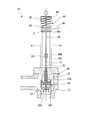
- FIG. 1 is a schematic diagram showing an overall configuration of a steam turbine system configured using a blocking valve according to an embodiment of the present invention.
- the steam turbine system 1 includes a steam turbine 2 driven by steam, a boiler 3 for supplying steam to the steam turbine 2, and a generator 4 driven by the steam turbine 2. .
- the steam turbine 2 includes a turbine main body 2A, a steam supply pipe 5 through which steam as a fluid flows, and a shut-off valve 10.
- a rotor (not shown) rotatably provided integrally with the output shaft 2 s in a casing (not shown) is rotationally driven by steam supplied from the boiler 3. The rotation of the rotor (not shown) is transmitted to, for example, the generator 4 via the output shaft 2s to generate power.
- the steam supply pipe 5 supplies steam from the boiler 3 to the turbine body 2A.
- the shut-off valve 10 adjusts the amount of steam supplied to the turbine body 2A.
- the blocking valve 10 opens and closes the steam supply pipe 5 through which steam flows.
- the closing valve 10 includes a valve main body 20, a valve body 30, a valve rod 32, a valve drive unit 40, a mandrel 46, and a connecting member 50.
- the valve body 20 opens and closes the flow path 20r through which the steam flows in order to adjust the flow rate of the steam in the turbine body 2A.
- the valve body 20 has a flow passage 20r communicating with the steam supply pipe 5 therein.
- the valve body 20 has a valve seat portion 21 and a valve body support portion 22.
- the valve seat part 21 is provided in the flow path 20r through which the steam flows.
- the valve body support portion 22 supports the valve body 30 inside the valve body 20.
- the valve body 30 contacts the valve seat portion 21 and closes the flow path 20r.
- the valve body 30 is supported by a valve body support portion 22 formed in the valve body 20 so as to be movable toward the valve seat portion 21.
- the valve body 30 is formed with a tapered portion 31 whose outer diameter is gradually reduced toward the valve seat portion 21 at the tip portion facing the valve seat portion 21.
- the valve stem 32 extends along the central axis C.
- the valve rod 32 is connected to the valve body 30 at the first end in the central axis C direction.
- the first end of the valve stem 32 in the direction of the central axis C is a lower end 32b. That is, the valve body 30 is connected to the lower end 32 b of the valve rod 32.
- the valve stem 32 extends from the valve body 30 in a direction away from the valve seat portion 21.
- the valve rod 32 has a second end in the direction of the central axis C protruding from the valve body 20 toward the valve drive unit 40.
- the second end of the valve stem 32 in the direction of the central axis C is an upper end 32t.
- the valve rod 32 is supported by a guide bush 22g provided in the valve body support 22 so as to be slidable in the direction of the central axis C.
- FIG. 2 shows the lower side of the drawing.
- the second end side in the direction of the central axis C is simply referred to, the other side in the direction of the central axis C, which is the side on which the valve driving unit 40 is disposed, with respect to the connecting member 50 (see FIG. 2).
- Upper side is simply referred to as the first end portion side in the central axis C direction.
- the valve drive unit 40 moves the valve body 30 by hydraulic pressure.
- the valve drive unit 40 includes a cylinder 42, a piston 43, an urging member 44, and a fluid supply unit 45.
- the cylinder 42 has a cylindrical shape.
- the axis of the cylinder 42 is disposed on the same axis as the central axis C of the valve stem 32.
- the cylinder 42 is supported via the support member 41 with respect to the valve body 20.
- the piston 43 is provided so as to be movable in the direction of the central axis C in the cylinder 42.
- a mandrel 46 is connected to the surface of the piston 43 facing the first end in the direction of the central axis C.
- the biasing member 44 is disposed on the second end side in the central axis C direction with respect to the piston 43 in the cylinder 42.
- the urging member 44 is made of, for example, a coil spring and is provided between the cylinder 42 and the piston 43 in a compressed state. By this urging member 44, the piston 43 is urged toward the side closer to the valve body 20 (the first end portion side in the central axis C direction).
- the fluid supply unit 45 supplies or discharges the fluid L such as oil to the space in the cylinder 42 opposite to the side where the urging member 44 is disposed with respect to the piston 43.
- the mandrel 46 extends along the central axis C of the valve stem 32. That is, the mandrel 46 extends coaxially with the valve stem 32.
- the mandrel 46 is provided so that the end surface of the first end in the direction of the central axis C faces the end surface of the second end of the valve rod 32.
- the first end portion in the central axis C direction of the mandrel 46 in the present embodiment is a lower end 46b.
- the end surface of the lower end 46 b of the mandrel 46 faces the end surface of the upper end 32 t of the valve rod 32.
- the mandrel 46 is connected to the piston 43 at the second end in the direction of the central axis C.
- the second end of the mandrel 46 in the direction of the central axis C is the upper end 32t.
- the mandrel 46 extends through the cylinder 42 toward the first end in the direction of the central axis C.
- the lower end 46b of the mandrel 46 is integrally connected to the upper end 32t of the valve stem 32 via a connecting member 50 described later.
- the lower end 46 b of the mandrel 46 has the same shape as the upper end 32 t of the valve stem 32.
- the valve drive unit 40 fills the space L in the cylinder 42 from the fluid supply unit 45 with the fluid L, and the pressure of the fluid L causes the piston 43 to move to a predetermined level in the cylinder 42. Move to position and hold.
- the valve body 30 supported by the piston 43 via the mandrel 46 and the valve stem 32 is disposed at a position separated from the valve seat portion 21. Thereby, the flow of the steam in the flow path 20r is released, and the steam supply pipe 5 is opened.
- valve drive unit 40 causes the fluid L filled in the cylinder 42 to flow out from the fluid supply unit 45 to the outside.
- the piston 43 moves toward the valve body 20 in the cylinder 42 by the biasing force of the biasing member 44.
- the valve body 30 supported by the piston 43 via the mandrel 46 and the valve stem 32 moves toward the valve seat portion 21 of the valve body 20.
- the taper part 31 hits the valve seat part 21. Thereby, the flow of the steam in the flow path 20r is interrupted, and the steam supply pipe 5 is closed.
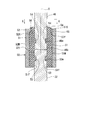
- FIG. 3 is a cross-sectional view showing a connecting member that connects the valve stem and the mandrel of the closing valve.
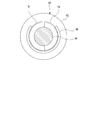
- FIG. 4 is a view showing a structure in which the valve stem and the mandrel of the closing valve are connected by a connecting member, and is a cross-sectional view taken along the line XX in FIG.
- valve stem 32 has a valve stem-side annular groove (valve stem-side engaged recess) 32m that is recessed in the radial direction with the central axis C as the center.
- the valve stem side annular groove 32m of the present embodiment is a groove formed on the outer peripheral surface of the upper end 32t of the valve stem 32 so as to be annularly continuous around the central axis C.
- the valve rod side annular groove 32m has a rectangular cross-sectional shape extending in the direction of the central axis C.
- the mandrel 46 has a mandrel-side annular groove (mandrel-side engaged recess) 46m that is recessed in the radial direction.
- the mandrel-side annular groove 46m of the present embodiment is a groove formed on the outer peripheral surface of the lower end 46b of the mandrel 46 so as to be annularly continuous around the central axis C.
- the mandrel-side annular groove 46m has a rectangular cross-sectional shape extending in the direction of the central axis C.
- the connecting member 50 is integrally connected with the end face of the upper end 32 t of the valve stem 32 and the end face of the lower end 46 b of the mandrel 46 abutting each other in the direction of the central axis C. .
- the connecting member 50 includes a coupling member 51, a cover 52, and a snap ring (regulating member) 58.
- the coupling member 51 is divided into a plurality of parts in the circumferential direction around the central axis C. That is, the connecting member 50 has a plurality (two in this embodiment) of coupling members 51.
- the coupling member 51 of the present embodiment is a member that sandwiches the upper end 32t of the valve stem 32 and the lower end 46b of the mandrel 46 from the outside in the radial direction.
- the pair of coupling members 51 are combined to form a cylindrical shape.
- the coupling member 51 includes a main body 51M, a valve stem side convex portion (valve stem side engaging convex portion) 53, a mandrel side convex portion (mandrel side engaging convex portion) 54, and a small diameter portion (protruding portion) 51S. And have.
- the cross section of the main body 51M perpendicular to the central axis C of the valve stem 32 and the mandrel 46 has a semicircular shape.
- the main body 51M has an inner diameter 51f that is slightly larger in outer diameter than the outer diameter of the upper end 32t of the valve stem 32 and the lower end 46b of the mandrel 46.
- the valve stem side convex portion 53 engages with the valve stem side annular groove 32m.
- the valve stem side convex portion 53 is formed integrally with the main body portion 51M.
- the valve stem side convex portion 53 is provided on the inner peripheral surface 51f of the main body portion 51M.
- the valve stem side convex portion 53 protrudes radially inward from the inner peripheral surface 51f toward the valve stem 32 side, and is formed continuously in the circumferential direction.
- the valve stem side convex portion 53 has a rectangular cross-sectional shape extending in the direction of the central axis C.
- the mandrel side convex portion 54 engages with the mandrel side annular groove 46m.
- the mandrel-side convex portion 54 is formed integrally with the main body portion 51M.
- the mandrel-side convex portion 54 is provided on the inner peripheral surface 51f of the main body portion 51M.
- the mandrel-side convex portion 54 protrudes radially inward from the inner peripheral surface 51f toward the mandrel 46 and is formed continuously in the circumferential direction.
- the mandrel-side convex portion 54 has a rectangular cross-sectional shape extending in the direction of the central axis C.
- the small diameter part 51S protrudes in the central axis C direction from the main body part 51M.
- the small diameter portion 51 ⁇ / b> S protrudes in the direction of the central axis C from the cover 52 in a state where a cover 52 described later is attached.
- the small diameter portion 51S of the present embodiment protrudes from the main body portion 51M toward the mandrel 46 side.
- the small diameter part 51S is formed with an outer diameter smaller than that of the main body part 51M.
- the small diameter portion 51S has a ring groove (projecting portion groove portion) 56 that is formed in an annular shape around the central axis C and is recessed in the radial direction. That is, the ring groove 56 is continuously formed in the circumferential direction with respect to the outer peripheral surface of the small diameter portion 51S.
- an orthogonal surface 55 orthogonal to the direction of the central axis C is formed between the main body portion 51M and the small diameter portion 51S.
- the orthogonal surface 55 is a plane that faces the second end side, which is the side where the mandrel 46 in the central axis C direction is disposed.
- Such a coupling member 51 is configured so that the end surface of the upper end 32t of the valve stem 32 and the end surface of the lower end 46b of the stem 46 are opposed to each other in the direction of the central axis C. It arrange
- the valve stem side convex portion 53 is engaged with the valve stem side annular groove 32m
- the mandrel side convex portion 54 is engaged with the mandrel side annular groove 46m.
- the valve rod 32 and the mandrel 46 are restrained from moving in the direction of the central axis C by these coupling members 51.
- the cover 52 has a cylindrical shape and houses a plurality of coupling members 51 therein.
- the cover 52 restricts the movement of the coupling member 51 outward in the radial direction.
- the cover 52 has a cylindrical shape as a whole.
- the cover 52 is integrally provided with a cover main body 52M and a contact part 52K.
- the cover body 52M is provided so as to cover the outer peripheral surface of the body 51M of the coupling member 51 in a state where the pair of coupling members 51 are opposed to each other in the radial direction.
- the inner peripheral surface of the cover main body 52M is formed so as to be in sliding contact with the outer peripheral surface of the main body 51M.
- the inner diameter of the cover main body 52M is slightly larger than the outer diameter of the main body 51M of the coupling member 51.
- the contact portion 52K is provided at one end of the cover main body 52M in the direction of the central axis C.
- the contact portion 52K contacts the main body portion 51M from the direction of the central axis C.
- the contact portion 52K of the present embodiment is formed integrally with the cover main body portion 52M on the second end side in the central axis C direction.
- the contact portion 52K contacts the main body portion 51M from the second end side in the central axis C direction.
- the abutting portion 52K protrudes inward in the radial direction from the inner peripheral surface of the cover main body portion 52M.
- the abutting portion 52K is formed to be annularly continuous around the central axis C.
- the contact portion 52K is formed with an abutting surface 57f facing the direction of the central axis C on the side connected to the cover body portion 52M.
- the butting surface 57f is a flat surface facing the first end portion side in the central axis C direction.
- the snap ring (restricting member) 58 restricts the movement of the cover 52 in the direction of the central axis C in a state where the contact portion 52K is in contact with the main body portion 51M.
- the snap ring 58 of the present embodiment restricts the movement of the cover 52 relative to the coupling member 51 toward the second end portion in the central axis C direction.
- the snap ring 58 is engaged with the ring groove 56 from the outside in the radial direction. As shown in FIG. 4, the snap ring 58 has an inner diameter smaller than that of the outer peripheral surface of the small diameter portion 51S.
- the snap ring 58 has, for example, a C shape.
- such a cover 52 is configured so that the outer peripheral surface of the coupling member 51 and the inner peripheral surface of the cover main body 52 ⁇ / b> M are in sliding contact with the pair of coupling members 51 facing each other. It is attached to.
- the pair of coupling members 51 is restrained from moving outward in the radial direction by the cover body 52M.
- the cover 52 has the contact part 52K positioned on the second end side in the direction of the central axis C of the small diameter part 51S of the pair of coupling members 51, and the contact surface 57f of the contact part 52K is orthogonal to the coupling member 51 side.
- the surface 55 is provided in contact with the surface 55.
- the small diameter portions 51S of the pair of coupling members 51 protrude toward the second end portion in the central axis C direction from the contact portions 52K.
- a C-shaped snap ring 58 is mounted in the ring groove 56 formed on the outer peripheral surface of the small diameter portion 51S of the coupling member 51.
- the contact portion 52K is sandwiched between the orthogonal surface 55 of the coupling member 51 and the snap ring 58. Thereby, the movement of the cover 52 in the direction of the central axis C is restricted.
- FIG. 5 is a diagram showing a procedure for connecting the valve stem and the mandrel of the blocking valve with a connecting member, and is a cross-sectional view showing how the coupling member is attached.
- FIG. 6 is a diagram showing a procedure for connecting the valve stem and the mandrel of the closing valve with a connecting member, and is a cross-sectional view showing how the cover is attached.
- the end surface of the upper end 32t of the valve stem 32 and the end surface of the lower end 46b of the mandrel 46 are mutually connected in the central axis C direction. Make them face each other.
- the cover 52 is inserted through the mandrel 46 and retracted upward.
- the valve rod 32 and the mandrel 46 are arranged close to the end surface of the upper end 32t of the valve rod 32 and the end surface of the lower end 46b of the mandrel 46 so as to prevent a bolt or the like from being inserted.
- the pair of coupling members 51 is moved from the radially outer side to the inner side with respect to the upper end 32 t of the valve stem 32 and the lower end 46 b of the mandrel 46.
- the valve stem side convex portion 53 is engaged with the valve stem side annular groove 32m
- the mandrel side convex portion 54 is engaged with the mandrel side annular groove 46m.
- the cover 52 of the connecting member 50 is moved toward the coupling member 51, and the pair of coupling members 51 are accommodated in the cover 52.
- the pair of coupling members 51 are restrained in a state in which the outward movement in the radial direction is restricted.
- the cover 52 positions the contact part 52K on the outer side in the radial direction of the small diameter part 51S of the pair of coupling members 51, and the abutting surface 57f of the contact part 52K on the orthogonal surface 55 on the coupling member 51 side. Strike.
- the small diameter portion 51S of the pair of coupling members 51 protrudes from the contact portion 52K. Therefore, the snap ring 58 is attached to the ring groove 56 formed on the outer peripheral surface of the small diameter portion 51S of the pair of coupling members 51. As a result, the movement of the cover 52 in the direction of the central axis C is restricted. As a result, the upper end 32 t of the valve stem 32 and the lower end 46 b of the mandrel 46 are connected by the connecting member 50.
- the movement of the pair of coupling members 51 to the outside in the radial direction can be restricted by the cover main body portion 52M. Therefore, the engagement state of the valve stem side convex portion 53 and the valve stem side annular groove 32m, and the mandrel side convex portion 54 and the mandrel side annular groove 46m is maintained. Therefore, it is possible to prevent the connection from being released when the valve rod 32 and the mandrel 46 move relative to each other due to the pulsation of steam passing through the blocking valve 10 during the operation of the steam turbine 2. Thus, the upper end 32t of the valve stem 32 and the lower end 46b of the mandrel 46 can be reliably connected.
- valve stem 32 and the mandrel 46 can be connected only by arranging the cover 52 after arranging the pair of coupling members 51 on the radially outer side of the upper end 32t of the valve stem 32 and the lower end 46b of the mandrel 46. Can do. That is, the valve stem 32 and the mandrel 46 can be easily connected without performing laborious work such as tightening or loosening the bolts. Therefore, it is possible to easily and surely connect the valve stem 32 and the mandrel 46 to increase the efficiency of assembly work and maintenance work.
- the connecting member 50 can be reduced in size.
- the contact portion 52K contacts the main body portion 51M from the second end side in the central axis C direction, and the abutting surface 57f and the orthogonal surface 55 are in contact with each other. Therefore, it is possible to prevent the cover 52 from shifting to the first end portion side in the central axis C direction. Therefore, it is difficult for the cover 52 to fall off, and the cover 52 can be prevented from being carelessly detached from the coupling member 51.
- the contact portion 52K can be sandwiched between the main body 51M and the snap ring 58 by engaging the snap ring 58 with the ring groove 56 in a state where the abutting surface 57f is in contact with the orthogonal surface 55.
- the cover 52 is restricted from moving toward the first end in the direction of the central axis C when the abutting surface 57f hits the coupling member 51, and is moved toward the second end in the direction of the central axis C by the snap ring 58. Movement is restricted. Therefore, it is possible to prevent the cover 52 from shifting in the direction of the central axis C from the state where the contact portion 52K is in contact with the main body portion 51M. That is, the movement of the cover 52 in the direction of the central axis C is restricted not only by the contact portion 52K but also by the snap ring 58. Therefore, the cover 52 can be more difficult to drop off.
- a ring groove 56 in which the snap ring 58 is engaged is formed in the small diameter portion 51S protruding in the direction of the central axis C from the cover 52. Therefore, even after the cover 52 is attached to the coupling member 51, the ring groove 56 is visible. As a result, the snap ring 58 as a restricting member can be attached to a position that can be visually recognized from the outside. Therefore, the snap ring 58 can be easily attached, and the connecting member 50 can be easily attached.
- the connecting member 50 includes a pair of coupling members 51, but may include a coupling member divided into three or more in the circumferential direction.
- the structure of the steam turbine system 1 was demonstrated in the said embodiment, it can change suitably about the specific structure.
- the blocking valve 10 shown in the above embodiment can also be used for applications other than the steam turbine system 1.
- the configuration described in the above embodiment can be selected or changed to another configuration as appropriate without departing from the gist of the present invention.
- valve stem 32 and the mandrel 46 can be easily and reliably connected.
Landscapes
- Engineering & Computer Science (AREA)
- General Engineering & Computer Science (AREA)
- Mechanical Engineering (AREA)
- Lift Valve (AREA)
Abstract
Une soupape de fermeture est pourvue : d'une tige de soupape 32 reliée à un corps de soupape pour fermer un passage ; d'une tige centrale 46 s'étendant coaxialement à l'axe central C de la tige de soupape 32 et conçue de telle sorte que la surface d'extrémité d'une première extrémité de la tige centrale 46, la surface d'extrémité étant orientée dans la direction de l'axe central C, est disposée en regard de la surface d'extrémité d'une seconde extrémité de la tige de soupape 32, la surface d'extrémité étant orientée dans la direction de l'axe central C ; et d'un élément de raccordement 50 permettant de raccorder la seconde extrémité de la tige de soupape 32 et la première extrémité de la tige centrale 46. L'élément de raccordement 50 présente : une pluralité d'éléments de couplage 51 divisés de façon circonférentielle ayant des saillies 53 de mise en prise côté tige de soupape mettant en prise des évidements 32m de réception de mise en prise côté tige de soupape évidés vers la tige de soupape 32, la pluralité d'éléments de couplage 51 ayant également des saillies 54 de mise en prise côté tige centrale mettant en prise des évidements 46m de réception de mise en prise côté tige centrale évidés dans la direction radiale de la tige centrale 46, les saillies 53 de mise en prise côté tige de soupape et les saillies 54 de mise en prise côté tige centrale étant ménagées sur les surfaces périphériques internes de la pluralité d'éléments de couplage 51 ; et un couvercle 52 ayant une forme cylindrique et recevant en son sein la pluralité d'éléments de couplage 51.
Priority Applications (4)
| Application Number | Priority Date | Filing Date | Title |
|---|---|---|---|
| EP16891522.1A EP3379115A4 (fr) | 2016-02-26 | 2016-02-26 | Soupape de fermeture et turbine à vapeur |
| JP2018501534A JP6541205B2 (ja) | 2016-02-26 | 2016-02-26 | 塞止弁及び蒸気タービン |
| US16/064,857 US10677085B2 (en) | 2016-02-26 | 2016-02-26 | Stop valve and steam turbine |
| PCT/JP2016/055852 WO2017145365A1 (fr) | 2016-02-26 | 2016-02-26 | Soupape de fermeture et turbine à vapeur |
Applications Claiming Priority (1)
| Application Number | Priority Date | Filing Date | Title |
|---|---|---|---|
| PCT/JP2016/055852 WO2017145365A1 (fr) | 2016-02-26 | 2016-02-26 | Soupape de fermeture et turbine à vapeur |
Publications (1)
| Publication Number | Publication Date |
|---|---|
| WO2017145365A1 true WO2017145365A1 (fr) | 2017-08-31 |
Family
ID=59686132
Family Applications (1)
| Application Number | Title | Priority Date | Filing Date |
|---|---|---|---|
| PCT/JP2016/055852 Ceased WO2017145365A1 (fr) | 2016-02-26 | 2016-02-26 | Soupape de fermeture et turbine à vapeur |
Country Status (4)
| Country | Link |
|---|---|
| US (1) | US10677085B2 (fr) |
| EP (1) | EP3379115A4 (fr) |
| JP (1) | JP6541205B2 (fr) |
| WO (1) | WO2017145365A1 (fr) |
Cited By (2)
| Publication number | Priority date | Publication date | Assignee | Title |
|---|---|---|---|---|
| JP2019060483A (ja) * | 2017-09-28 | 2019-04-18 | 三菱重工コンプレッサ株式会社 | 塞止弁及び蒸気タービン |
| JPWO2022113447A1 (fr) * | 2020-11-27 | 2022-06-02 |
Families Citing this family (3)
| Publication number | Priority date | Publication date | Assignee | Title |
|---|---|---|---|---|
| US20180058251A1 (en) * | 2016-08-31 | 2018-03-01 | General Electric Technology Gmbh | Flexible Service Interval Counter Module For A Valve And Actuator Monitoring System |
| CA3115715A1 (fr) * | 2018-10-29 | 2020-05-07 | Emerson Process Management Regulator Technologies, Inc. | Regulateur de fluide |
| CN111102365B (zh) * | 2018-10-29 | 2024-08-02 | 艾默生过程管理调节技术公司 | 流体调节器 |
Citations (3)
| Publication number | Priority date | Publication date | Assignee | Title |
|---|---|---|---|---|
| JPH0688503A (ja) * | 1992-09-07 | 1994-03-29 | Fuji Electric Co Ltd | 主蒸気止め弁のカップリング |
| JP2005505726A (ja) * | 2001-10-05 | 2005-02-24 | ノードソン コーポレーション | 空気圧ポンプ用のシャフトカップリング及びシフト機構 |
| JP2010121523A (ja) * | 2008-11-19 | 2010-06-03 | Toshiba Corp | 蒸気弁 |
Family Cites Families (7)
| Publication number | Priority date | Publication date | Assignee | Title |
|---|---|---|---|---|
| US2067271A (en) * | 1934-05-09 | 1937-01-12 | Drillers Supply & Mfg Company | Coupling for sucker rods and the like |
| US3935877A (en) * | 1974-07-23 | 1976-02-03 | Franceschi Peter A | Tamper-proof locking system for fire hydrants |
| US4159132A (en) * | 1978-04-03 | 1979-06-26 | Hitz Gifford L | Sealed connection |
| US5131632A (en) * | 1991-10-28 | 1992-07-21 | Olson Darwin B | Quick coupling pipe connecting structure with body-tapered sleeve |
| US5261449A (en) * | 1992-05-15 | 1993-11-16 | Val-Matic Valve And Manufacturing Corp. | Quick change coupling for tilted disc check valve with top mounted dashpot |
| US6886805B2 (en) * | 2003-02-07 | 2005-05-03 | Fisher Controls International Llc | Rod connector assembly |
| US7172172B2 (en) * | 2003-07-28 | 2007-02-06 | Fisher Controls International, L.L.C. | Valve packing removal device |
-
2016
- 2016-02-26 WO PCT/JP2016/055852 patent/WO2017145365A1/fr not_active Ceased
- 2016-02-26 EP EP16891522.1A patent/EP3379115A4/fr not_active Withdrawn
- 2016-02-26 US US16/064,857 patent/US10677085B2/en not_active Expired - Fee Related
- 2016-02-26 JP JP2018501534A patent/JP6541205B2/ja not_active Expired - Fee Related
Patent Citations (3)
| Publication number | Priority date | Publication date | Assignee | Title |
|---|---|---|---|---|
| JPH0688503A (ja) * | 1992-09-07 | 1994-03-29 | Fuji Electric Co Ltd | 主蒸気止め弁のカップリング |
| JP2005505726A (ja) * | 2001-10-05 | 2005-02-24 | ノードソン コーポレーション | 空気圧ポンプ用のシャフトカップリング及びシフト機構 |
| JP2010121523A (ja) * | 2008-11-19 | 2010-06-03 | Toshiba Corp | 蒸気弁 |
Non-Patent Citations (1)
| Title |
|---|
| See also references of EP3379115A4 * |
Cited By (8)
| Publication number | Priority date | Publication date | Assignee | Title |
|---|---|---|---|---|
| JP2019060483A (ja) * | 2017-09-28 | 2019-04-18 | 三菱重工コンプレッサ株式会社 | 塞止弁及び蒸気タービン |
| JPWO2022113447A1 (fr) * | 2020-11-27 | 2022-06-02 | ||
| WO2022113447A1 (fr) * | 2020-11-27 | 2022-06-02 | 株式会社フジキン | Soupape |
| KR20230090365A (ko) * | 2020-11-27 | 2023-06-21 | 가부시키가이샤 후지킨 | 밸브 |
| JP7426150B2 (ja) | 2020-11-27 | 2024-02-01 | 株式会社フジキン | バルブ |
| TWI847065B (zh) * | 2020-11-27 | 2024-07-01 | 日商富士金股份有限公司 | 閥 |
| KR102729924B1 (ko) | 2020-11-27 | 2024-11-13 | 가부시키가이샤 후지킨 | 밸브 |
| US12188578B2 (en) | 2020-11-27 | 2025-01-07 | Fujikin Incorporated | Valve |
Also Published As
| Publication number | Publication date |
|---|---|
| US20190003330A1 (en) | 2019-01-03 |
| JP6541205B2 (ja) | 2019-07-10 |
| EP3379115A1 (fr) | 2018-09-26 |
| JPWO2017145365A1 (ja) | 2018-11-08 |
| EP3379115A4 (fr) | 2018-12-26 |
| US10677085B2 (en) | 2020-06-09 |
Similar Documents
| Publication | Publication Date | Title |
|---|---|---|
| WO2017145365A1 (fr) | Soupape de fermeture et turbine à vapeur | |
| JP6272887B2 (ja) | 大きな流量容量のために流体力制御を行う電気油圧式の圧力低減及び解放バルブ | |
| KR101694819B1 (ko) | 일체형 유압 로터리 액추에이터 | |
| US20130200285A1 (en) | Multi-teeth engagement in an actuator piston | |
| KR102342755B1 (ko) | 밸브 장치 | |
| RU2531075C2 (ru) | Избыточное уплотнение сопряженных металлических поверхностей для совместного использования с внутренними клапанами | |
| JP6410742B2 (ja) | 弁開閉時期制御装置 | |
| CN109790943B (zh) | 球阀系统 | |
| JP2009524776A (ja) | ポンプの流量制限装置 | |
| JP2015513366A (ja) | 係止型のクラッチ弁 | |
| JP2016505787A (ja) | 非作動になるラチェットを有するチェーン又はベルトテンショナ | |
| JP5973197B2 (ja) | ピストン式作動流体圧アクチュエータ、および制御弁 | |
| JP5746281B2 (ja) | 流体圧シリンダ | |
| JP2018131962A (ja) | 蒸気弁及び蒸気タービン設備 | |
| US10690001B2 (en) | Stop valve and steam turbine | |
| US9599237B2 (en) | 3-way inline air operated valve | |
| JP2020007943A (ja) | 弁開閉時期制御装置 | |
| CN110762247B (zh) | 一种流体控制阀 | |
| JP6069125B2 (ja) | 流体圧シリンダ | |
| JP2015197126A (ja) | 緩衝器 | |
| CN109372818B (zh) | 液压控制阀装置用滑阀 | |
| JP6309501B2 (ja) | バルブブロック、流体機械及び再生可能エネルギー発電装置 | |
| RU2650919C1 (ru) | Клапан | |
| WO2012128049A1 (fr) | Mécanisme d'amortissement pour cylindre hydraulique | |
| WO2022054949A1 (fr) | Dispositif robotisé |
Legal Events
| Date | Code | Title | Description |
|---|---|---|---|
| ENP | Entry into the national phase |
Ref document number: 2018501534 Country of ref document: JP Kind code of ref document: A |
|
| WWE | Wipo information: entry into national phase |
Ref document number: 2016891522 Country of ref document: EP |
|
| ENP | Entry into the national phase |
Ref document number: 2016891522 Country of ref document: EP Effective date: 20180620 |
|
| NENP | Non-entry into the national phase |
Ref country code: DE |