WO2017146104A1 - Timbre pour cavité buccale - Google Patents
Timbre pour cavité buccale Download PDFInfo
- Publication number
- WO2017146104A1 WO2017146104A1 PCT/JP2017/006622 JP2017006622W WO2017146104A1 WO 2017146104 A1 WO2017146104 A1 WO 2017146104A1 JP 2017006622 W JP2017006622 W JP 2017006622W WO 2017146104 A1 WO2017146104 A1 WO 2017146104A1
- Authority
- WO
- WIPO (PCT)
- Prior art keywords
- drug
- drug layer
- layer
- patch
- oral
- Prior art date
- Legal status (The legal status is an assumption and is not a legal conclusion. Google has not performed a legal analysis and makes no representation as to the accuracy of the status listed.)
- Ceased
Links
Images


Classifications
-
- A—HUMAN NECESSITIES
- A61—MEDICAL OR VETERINARY SCIENCE; HYGIENE
- A61K—PREPARATIONS FOR MEDICAL, DENTAL OR TOILETRY PURPOSES
- A61K45/00—Medicinal preparations containing active ingredients not provided for in groups A61K31/00 - A61K41/00
-
- A—HUMAN NECESSITIES
- A61—MEDICAL OR VETERINARY SCIENCE; HYGIENE
- A61K—PREPARATIONS FOR MEDICAL, DENTAL OR TOILETRY PURPOSES
- A61K47/00—Medicinal preparations characterised by the non-active ingredients used, e.g. carriers or inert additives; Targeting or modifying agents chemically bound to the active ingredient
- A61K47/06—Organic compounds, e.g. natural or synthetic hydrocarbons, polyolefins, mineral oil, petrolatum or ozokerite
- A61K47/08—Organic compounds, e.g. natural or synthetic hydrocarbons, polyolefins, mineral oil, petrolatum or ozokerite containing oxygen, e.g. ethers, acetals, ketones, quinones, aldehydes, peroxides
- A61K47/10—Alcohols; Phenols; Salts thereof, e.g. glycerol; Polyethylene glycols [PEG]; Poloxamers; PEG/POE alkyl ethers
-
- A—HUMAN NECESSITIES
- A61—MEDICAL OR VETERINARY SCIENCE; HYGIENE
- A61K—PREPARATIONS FOR MEDICAL, DENTAL OR TOILETRY PURPOSES
- A61K47/00—Medicinal preparations characterised by the non-active ingredients used, e.g. carriers or inert additives; Targeting or modifying agents chemically bound to the active ingredient
- A61K47/30—Macromolecular organic or inorganic compounds, e.g. inorganic polyphosphates
- A61K47/32—Macromolecular compounds obtained by reactions only involving carbon-to-carbon unsaturated bonds, e.g. carbomers, poly(meth)acrylates, or polyvinyl pyrrolidone
Definitions
- the present invention relates to an intraoral patch.
- This application claims priority based on Japanese Patent Application No. 2016-34513 filed in Japan on February 25, 2016, the contents of which are incorporated herein by reference.
- the intraoral patch adheres to the oral cavity, it is difficult to be swallowed by mistake, and the drug is gradually released by infiltration of saliva, so it is suitable for an application in which the drug is released over a long period of time.
- the release of drugs from the oral patch is affected by the patient's salivary secretion. For example, since saliva secretion decreases during sleep, saliva is less likely to infiltrate the oral patch, and drug release may vary.
- the present invention has been made in view of the above-described circumstances, and an object of the present invention is to provide an intraoral patch capable of stably releasing a drug even when salivary secretion is reduced.
- the present invention is an intraoral patch having a drug layer containing a drug and an infiltration promoter and an adhesion layer containing a component for imparting adhesion to mucous membranes and fixed to the drug layer.
- the infiltration promoter may contain at least one of erythritol and D-sorbitol.
- the infiltration promoter may contain an osmotic pressure regulator having an osmotic pressure at 20 ° C. of 1000 mOsm / kg or more and 2000 mOsm / kg or less.
- the content of the infiltration promoter in the drug layer may be 20% by mass or more and 70% by mass or less.
- the drug may be an ultra-short acting sleep inducer.
- the drug layer may contain at least one of an excipient and a binder.
- the adhesive layer may contain at least one of an excipient and a binder.
- the adhesion imparting component may contain at least one of povidone and carboxyvinyl polymer.
- the infiltration promoter allows saliva to infiltrate into the drug layer, the saliva can be retained in the drug layer, so that the drug can be stably released even when saliva secretion decreases. .
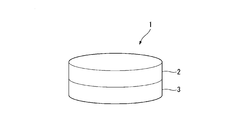
- FIG. 1 is a perspective view showing an example of the dosage form of the intraoral patch of the present embodiment.
- the intraoral patch of the present embodiment is a drug that is used by being stuck in the oral cavity.
- the dosage form of the intraoral patch 1 is a tablet, and in particular, a multilayer tablet having an adhesive layer 3 that can adhere to the oral cavity.
- the shape of the intraoral patch 1 is, for example, a disc shape.
- the oral patch 1 has a diameter of 6 mm to 12 mm and a total thickness of 1 mm to 6 mm.
- the intraoral patch 1 has a drug layer 2 and an adhesion layer 3.
- the drug layer 2 contains a drug and an infiltration promoter.
- the type of drug is not particularly limited.
- an ultrashort-acting sleep induction agent or a short-acting sleep induction agent may be contained in the drug layer 2 of the present embodiment as a drug.
- ultra-short-acting sleep-inducing agents are zolpidem (N, N, 6-Trimethyl-2- (4-methylphenyl) imidazo [1,2- ⁇ ] pyridine-3-acetamide), triazolam, zopiclone, and S Examples include zopiclone.
- Examples of the short-acting sleep induction agent include protizolam, lormetazopam, rilmagaphone and the like.
- Zolpidem may be a base educt or an acid addition salt.
- the acid added to zolpidem is selected from known medically acceptable acids.
- an inorganic acid such as hydrochloric acid or nitric acid may be used as the acid added to zolpidem.
- organic acids such as (hemi) tartaric acid, (hemi) succinic acid, (hemi) fumaric acid, (hemi) maleic acid, malic acid, lactic acid, citric acid, and (hemi) adipic acid May be used.
- the zolpidem acid addition salt is preferably a tartaric acid addition salt or a hemitartaric acid addition salt.
- the drug layer 2 contains zolpidem tartrate (N, N, 6-Trimethyl-2- (4-methylphenyl) imidazo [1,2- ⁇ ] -pyridine-3-acetamide hemi- (2R) as a drug. , 3R) -tartrate) in a predetermined amount of 2 mg to 8 mg.
- the content of the drug in the drug layer 2 may be appropriately set in consideration of a desired drug effect.
- the infiltration promoting agent is contained in the drug layer 2 in order to promote the infiltration of saliva into the drug layer 2.
- the infiltration promoter includes an osmotic pressure adjusting agent for adjusting the osmotic pressure of the drug layer 2 in a state where the intraoral patch 1 of the present embodiment is attached to the oral cavity.
- the osmotic pressure regulator that serves as an infiltration promoter include erythritol and D-sorbitol. That is, the drug layer 2 in the present embodiment may include at least one of erythritol and D-sorbitol.
- the osmotic pressure regulator that can be used as an infiltration promoter is not limited to the above, and may be a substance having an osmotic pressure at 20 ° C. of 1000 mOsm / kg to 2000 mOsm / kg.
- the content of the invasion promoter in the drug layer 2 defines the drug release rate.
- the content of the infiltration promoter in the drug layer 2 defines the time during which the medicinal effect of the oral patch 1 of the present embodiment is maintained.
- the content of the infiltration promoter in the drug layer 2 is a predetermined content in the range of 20% by mass to 70% by mass.
- the infiltration promoter is a drug layer that contains liquid (saliva) necessary for disintegration of the drug layer 2 by taking saliva into the drug layer 2 in a state where the oral patch 1 is attached to the oral cavity. Hold at 2. That is, in the present embodiment, the infiltration promoter contained in the drug layer 2 is an osmotic pressure regulator, so that in the state where saliva has infiltrated into the drug layer 2, the inside of the drug layer 2 is more than the outside of the drug layer 2. Is kept high, and saliva further infiltrates into the drug layer 2. Further, the drug layer 2 is gradually disintegrated from the outside by dissolving the drug and other components in the saliva retained in the drug layer 2.
- the drug layer 2 may contain at least one of an excipient and a binder in addition to the drug and the infiltration promoter. Furthermore, the drug layer 2 may contain other components as necessary.
- the drug layer 2 may contain crystalline cellulose, lactose, lactose hydrate, aminoalkyl methacrylate copolymer, waxes, purified shellac and the like as excipients.
- crystalline cellulose and lactose are included in the drug layer 2 as excipients, the disintegration is excellent.
- the compounding ratio of crystalline cellulose and lactose is preferably 1.5: 1 to 2: 1 by mass ratio.
- lactose is a hydrate.
- the content of the excipient in the drug layer 2 is a predetermined content in the range of 67% by mass to 87% by mass.
- the drug layer 2 includes povidone (polyvinylpyrrolidone), crospovidone, carmellose or a sodium salt thereof, croscarmellose or a sodium salt thereof, hydroxyethyl cellulose, hydroxypropyl cellulose, hydroxypropyl methyl cellulose, ethyl cellulose, carboxy as a binder.
- Vinyl polymers, starches, starch derivatives and the like may be included.
- povidone, croscarmellose, and sodium salt of croscarmellose are particularly preferred as the binder.
- povidone contained in the binder preferably has a K value of about 90 (grade K-90).
- the drug layer 2 is composed of other components that control the release of the drug, additional bioactive components, stabilizers, colorants, lubricants, in addition to the drug and the infiltration promoter.
- An agent or the like may be contained.
- the adhesion layer 3 contains a component (adhesion imparting component) that gives adhesion to the mucous membrane when moisture (saliva) infiltrates.
- the adhesion layer 3 may also contain povidone (polyvinylpyrrolidone), carboxyvinyl polymer, hydroxyethylcellulose, hydroxypropylcellulose, hydroxypropylmethylcellulose, carboxymethylcellulose or a sodium salt thereof, starch, starch derivatives and the like as adhesion imparting components.
- povidone polyvinylpyrrolidone
- carboxyvinyl polymer hydroxyethylcellulose, hydroxypropylcellulose, hydroxypropylmethylcellulose, carboxymethylcellulose or a sodium salt thereof, starch, starch derivatives and the like as adhesion imparting components.
- povidone polyvinylpyrrolidone
- carboxyvinyl polymer hydroxyethylcellulose, hydroxypropylcellulose, hydroxypropylmethylcellulose, carboxymethylcellulose or a sodium salt thereof, starch, starch derivatives and the like
- the povidone contained in the adhesion layer 3 as an adhesion imparting component preferably has a K
- the compounding ratio of povidone and carboxyvinyl polymer is preferably 2: 3 by mass ratio. Moreover, it is preferable that lactose is a hydrate.
- the content of the adhesion-imparting component in the adhesion layer 3 is set based on the time required for the adhesion layer 3 to adhere to the oral mucosa. The content of the adhesion-imparting component in the adhesion layer 3 is preferably, for example, 50% by mass of the entire adhesion layer 3.
- the adhesion layer 3 may contain at least one of an excipient and a binder in addition to the adhesion imparting component. Furthermore, the adhesion layer 3 may contain other components as necessary.
- the adhesion layer 3 may contain maltitol, crystalline cellulose, lactose, starch, dextrin, sucrose and the like as an excipient.
- a combination of maltitol and crystalline cellulose is preferable because maltitol is non-cariogenic and has an appropriate cooling sensation, and crystalline cellulose improves adhesion to the oral mucosa due to a water-conducting effect.
- the blending ratio of maltitol and crystalline cellulose is preferably 3: 2 by mass ratio.
- lactose is a hydrate.
- the content of the excipient in the adhesion layer 3 is preferably, for example, 50% by mass of the entire adhesion layer 3.
- the drug layer 2 may contain povidone (polyvinylpyrrolidone) as a binder.
- the outline of the manufacturing method of the intraoral patch 1 of this embodiment is demonstrated.
- the intraoral patch 1 of this embodiment can be manufactured using the well-known tableting apparatus which can manufacture a two-layer laminated tablet.
- the components of the drug layer 2 are tableted with the first tableting pressure, and then the components of the adhesive layer 3 are laminated on the drug layer 2. Tablet with the second tableting pressure.
- the second tableting pressure is greater than the first tableting pressure.
- the first tableting pressure is a predetermined pressure of 50N to 150N
- the second tableting pressure is a predetermined pressure of 300N to 1000N.
- the intraoral patch 1 of this embodiment is used by being affixed to the oral mucosa such as the tongue belly (back of the tongue), for example. At this time, by bringing the adhesion layer 3 into contact with the mucous membrane, saliva infiltrates into the adhesion layer 3, and the adhesion layer 3 is fixed to the mucosa. In a state where the oral patch 1 of the present embodiment is fixed to the oral mucosa, when saliva comes into contact with the oral patch 1, part of the saliva contacts the infiltration promoter and infiltrates into the drug layer 2. . Thereby, the drug layer 2 gradually collapses.
- the drug and other components contained in the drug layer 2 are dissolved or dispersed in saliva. Even when the supply of saliva to the vicinity of the intraoral patch 1 is reduced because the drug layer 2 contains an infiltration promoter, saliva necessary for the collapse of the drug layer 2 is contained in the drug layer 2. Retained. For this reason, even if the supply of saliva decreases due to going to bed after taking, etc., the amount of drug released from the drug layer 2 is unlikely to decrease.
- the release of the drug from the drug layer 2 is not easily affected by the increase or decrease of the saliva secretion amount, and is not easily interrupted even when the saliva secretion amount is reduced. That is, the intraoral patch 1 of the present embodiment can preferably maintain its medicinal effect even if salivary secretion decreases.
- Zolpidem tartrate exemplified in this embodiment is an ultra-short-acting sleep-inducing agent, and may become awakened when the medicinal properties are cut off during sleep.
- the release of zolpidem tartrate from the drug layer 2 continues even during sleep when the saliva secretion amount decreases.
- a medicinal effect can be suitably maintained during sleep, and after the drug layer 2 is completely disintegrated by infiltration of saliva, the medicinal effect can be quickly lost.
- the intraoral patch 1 of this embodiment containing zolpidem tartrate in the drug layer 2 as an example of an ultra-short-acting sleep-inducing agent it is surely effective during sleep time of a preset length. It is possible to control the release of the drug so as to maintain the sleepiness and leave no sleepiness after waking up.
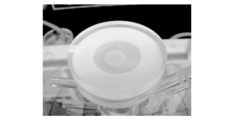
- FIG. 2 is a schematic diagram illustrating a configuration of a chamber used in Experimental Example 1.
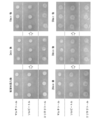
- FIG. 3 is a photograph showing the state of water infiltration into the drug layer in Experimental Example 1.
- Each photograph shown in FIG. 3 is a photograph of the intraoral patch taken 5 minutes, 10 minutes, 20 minutes, 30 minutes, and 50 minutes after supplying purified water to the chamber. In each photograph in FIG.
- the upper row is an oral patch containing maltitol in the drug layer
- the middle row is an oral patch containing D-sorbitol in the drug layer
- the lower row is erythritol in the drug layer. It is an intraoral patch containing.
- the chamber 10 in this experimental example has a filter paper 12 disposed on the bottom surface of a container 11.
- the intraoral patch of this embodiment is placed so that the adhesive layer is in contact with the filter paper 12, and purified water is soaked into the filter paper 12, thereby purifying the oral patch through the filter paper. Water was infiltrated. The amount of purified water is such that the filter paper 12 is immersed in the chamber 10. The purified water was supplied from the periphery of the filter paper 12 to the filter paper 12 so that the purified water was not directly applied to the intraoral patch.
- Examples of intraoral patches include three types of invasion promoters (Experimental Example 1-1: Maltitol, Experimental Example 1-2: D-sorbitol, Experimental Example 1-3: Erythritol). Three each were used. These experimental examples are intended to show the difference in the infiltration aspect of purified water due to the difference in the type of invasion promoter, and the oral patch used in this experimental example is the above-mentioned zolpidem tartrate in the drug layer. It is a placebo not included.
- Table 1 shows the composition of the drug layer in each experimental example. The numbers listed in Table 1 are mass%.
- composition of the adhesion layer in Experimental Examples 1-1 to 1-3 is as follows: excipient: 50 mass% (maltitol: 30 mass%, crystalline cellulose: 20 mass%), adhesion imparting component: 50 mass% (carboxyvinyl) Polymer: 30% by mass, povidone K-90F: 20% by mass).
- Experimental Example 2 is shown as an experimental example of the drug release amount from the drug layer.
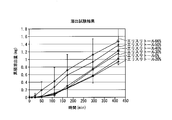
- Experimental Example 2 using the oral patches of Experimental Examples 2-1 to 2-5 and Comparative Example 2-1 each having a drug layer having the composition shown in Table 2, the time course and the amount of drug released Show the relationship.
- composition of the adhesion layer was the same as in Experimental Example 1 above.
- FIG. 4 is a photograph showing the state of the intraoral patch on the membrane (filter paper) at 15 minutes from the start of the test.
- Comparison between Experimental Example 2-3 containing 40% by mass of erythritol (FIG. 4A) and Comparative Example 2-1 containing 40% by mass of maltitol as an infiltration promoter (FIG. 4B) shows that Experimental Example 2 containing erythritol -3 infiltrated the dissolution test solution more rapidly than Comparative Example 2-1 containing maltitol.
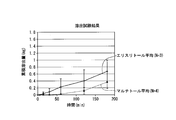
- FIG. 5 is a graph showing the results of measuring the cumulative dissolution amount of the drug in Experimental Example 2-3 and Comparative Example 2-1 up to 180 minutes from the start of the test.
- the horizontal axis represents the elapsed time (min) from the start of the dissolution test
- the vertical axis represents the cumulative dissolution amount (mg) of the drug.
- Example 2-3 which is contained as an agent
- the cumulative amount of drug dissolved is larger than that in Comparative Example 2-1, which contains maltitol. That is, by containing erythritol as an infiltration promoter in the drug layer, elution of the drug is promoted more than when maltitol is contained.
- the drug elution amount per unit time can be considered to be substantially constant in each case.
- FIG. 6 shows the results of measuring the cumulative dissolution amount of the drug from the start of the test to 420 minutes in Experimental Example 2-1 to Experimental Example 2-5 having different erythritol contents and Comparative Example 2-1 not containing erythritol. It is a graph to show.
- the horizontal axis represents the elapsed time (min) from the start of the dissolution test
- the vertical axis represents the cumulative dissolution amount (mg) of the drug.
- the higher the erythritol content in the drug layer the greater the cumulative elution amount of the drug.
- the amount of drug released per unit time is substantially constant in each case.
- Experimental example 3 is shown as an experimental example about the sensory test in the oral cavity of the intraoral patch of this embodiment.
- a placebo tablet having the composition shown in Table 3 below was prepared as an example of the oral patch of the present embodiment, and the oral patch was applied to the subject's tongue before going to bed (around 22:00). Then, the undissolved state of the oral patch at the time of getting up the next morning (around 7 o'clock) was evaluated.
- the subject himself / herself must select one closest to the undissolved state of his / her oral patch from the score of 0 to 5 (see Table 4 below) corresponding to the degree of undissolved. Went by.
- composition of the adhesion layer was the same as in Experimental Example 1 above.
- the oral patch containing triazolam, zopiclone, or eszopiclone instead of zolpidem tartrate (the above-described Experimental Examples 2-1, 2-2, 2-3, 2-4, respectively) And 2-5, and Comparative Example 2-1) were prepared, and the dissolution test was conducted in the same manner as in Experimental Example 2 described above. In the oral patch containing these drugs, zolpidem tartrate was also added. The behavior similar to that of the intraoral patch contained was shown.
- the present invention can be suitably applied to an intraoral patch.
Landscapes
- Health & Medical Sciences (AREA)
- Chemical & Material Sciences (AREA)
- Public Health (AREA)
- Life Sciences & Earth Sciences (AREA)
- Veterinary Medicine (AREA)
- General Health & Medical Sciences (AREA)
- Medicinal Chemistry (AREA)
- Pharmacology & Pharmacy (AREA)
- Epidemiology (AREA)
- Animal Behavior & Ethology (AREA)
- General Chemical & Material Sciences (AREA)
- Chemical Kinetics & Catalysis (AREA)
- Engineering & Computer Science (AREA)
- Oil, Petroleum & Natural Gas (AREA)
- Inorganic Chemistry (AREA)
- Medicinal Preparation (AREA)
- Medicines That Contain Protein Lipid Enzymes And Other Medicines (AREA)
Abstract
La présente invention concerne un timbre pour cavité buccale comprenant une couche de médicament, ladite couche de médicament contenant un médicament et un promoteur d'infiltration, et une couche adhésive, ladite couche adhésive contenant un constituant conférant une propriété d'adhérence aux muqueuses et étant fixée à la couche de médicament.
Priority Applications (1)
| Application Number | Priority Date | Filing Date | Title |
|---|---|---|---|
| JP2018501737A JP6615978B2 (ja) | 2016-02-25 | 2017-02-22 | 口腔内貼付剤 |
Applications Claiming Priority (2)
| Application Number | Priority Date | Filing Date | Title |
|---|---|---|---|
| JP2016034513 | 2016-02-25 | ||
| JP2016-034513 | 2016-02-25 |
Publications (1)
| Publication Number | Publication Date |
|---|---|
| WO2017146104A1 true WO2017146104A1 (fr) | 2017-08-31 |
Family
ID=59686226
Family Applications (1)
| Application Number | Title | Priority Date | Filing Date |
|---|---|---|---|
| PCT/JP2017/006622 Ceased WO2017146104A1 (fr) | 2016-02-25 | 2017-02-22 | Timbre pour cavité buccale |
Country Status (3)
| Country | Link |
|---|---|
| JP (2) | JP6615978B2 (fr) |
| TW (1) | TW201735904A (fr) |
| WO (1) | WO2017146104A1 (fr) |
Cited By (1)
| Publication number | Priority date | Publication date | Assignee | Title |
|---|---|---|---|---|
| US20220117908A1 (en) * | 2018-12-11 | 2022-04-21 | Myospots Australia Pty Ltd | Adhesive pad |
Citations (6)
| Publication number | Priority date | Publication date | Assignee | Title |
|---|---|---|---|---|
| JP2000063268A (ja) * | 1998-06-12 | 2000-02-29 | Lion Corp | 口腔粘膜付着型徐放性錠剤及び歯周疾患治療剤 |
| JP2000178185A (ja) * | 1998-12-18 | 2000-06-27 | Lion Corp | 口腔粘膜付着型徐放性錠剤 |
| WO2008120562A1 (fr) * | 2007-04-02 | 2008-10-09 | Toyo Boseki Kabushiki Kaisha | Comprimé thérapeutique pour une névralgie post-herpétique et procédé de traitement de la névralgie post-herpétique |
| JP2009538301A (ja) * | 2006-05-23 | 2009-11-05 | ハーレイ,ジェフリー,ティー. | キシリトールトローチ並びその使用方法 |
| JP2010535805A (ja) * | 2007-08-07 | 2010-11-25 | エーセルアールエックス ファーマシューティカルズ, インコーポレイテッド | 経口経粘膜剤形を使用する処置時の鎮静および無痛のための組成物および方法 |
| JP2013508286A (ja) * | 2009-10-16 | 2013-03-07 | エーセルリクス ファーマシューティカルズ,インク. | 処置状況における軽度の鎮静、不安緩解および鎮痛のための組成物および方法 |
Family Cites Families (3)
| Publication number | Priority date | Publication date | Assignee | Title |
|---|---|---|---|---|
| JPS60237018A (ja) * | 1984-05-09 | 1985-11-25 | Tanpei Seiyaku Kk | 口腔内付着性組成物 |
| JPH01101975A (ja) * | 1987-10-14 | 1989-04-19 | Sekisui Chem Co Ltd | 口腔粘膜用貼付剤 |
| KR101751631B1 (ko) * | 2013-05-31 | 2017-06-27 | 히사미쓰 세이야꾸 가부시키가이샤 | 구강 첩부제 |
-
2017
- 2017-02-22 WO PCT/JP2017/006622 patent/WO2017146104A1/fr not_active Ceased
- 2017-02-22 JP JP2018501737A patent/JP6615978B2/ja active Active
- 2017-02-23 TW TW106106122A patent/TW201735904A/zh unknown
-
2019
- 2019-11-05 JP JP2019200713A patent/JP6959313B2/ja active Active
Patent Citations (6)
| Publication number | Priority date | Publication date | Assignee | Title |
|---|---|---|---|---|
| JP2000063268A (ja) * | 1998-06-12 | 2000-02-29 | Lion Corp | 口腔粘膜付着型徐放性錠剤及び歯周疾患治療剤 |
| JP2000178185A (ja) * | 1998-12-18 | 2000-06-27 | Lion Corp | 口腔粘膜付着型徐放性錠剤 |
| JP2009538301A (ja) * | 2006-05-23 | 2009-11-05 | ハーレイ,ジェフリー,ティー. | キシリトールトローチ並びその使用方法 |
| WO2008120562A1 (fr) * | 2007-04-02 | 2008-10-09 | Toyo Boseki Kabushiki Kaisha | Comprimé thérapeutique pour une névralgie post-herpétique et procédé de traitement de la névralgie post-herpétique |
| JP2010535805A (ja) * | 2007-08-07 | 2010-11-25 | エーセルアールエックス ファーマシューティカルズ, インコーポレイテッド | 経口経粘膜剤形を使用する処置時の鎮静および無痛のための組成物および方法 |
| JP2013508286A (ja) * | 2009-10-16 | 2013-03-07 | エーセルリクス ファーマシューティカルズ,インク. | 処置状況における軽度の鎮静、不安緩解および鎮痛のための組成物および方法 |
Cited By (2)
| Publication number | Priority date | Publication date | Assignee | Title |
|---|---|---|---|---|
| US20220117908A1 (en) * | 2018-12-11 | 2022-04-21 | Myospots Australia Pty Ltd | Adhesive pad |
| US12458607B2 (en) * | 2018-12-11 | 2025-11-04 | Myospots Australia Pty Ltd | Adhesive pad |
Also Published As
| Publication number | Publication date |
|---|---|
| JP6615978B2 (ja) | 2019-12-04 |
| JP2020015772A (ja) | 2020-01-30 |
| JPWO2017146104A1 (ja) | 2018-10-04 |
| JP6959313B2 (ja) | 2021-11-02 |
| TW201735904A (zh) | 2017-10-16 |
Similar Documents
| Publication | Publication Date | Title |
|---|---|---|
| JP6657454B2 (ja) | ブプレノルフィンの乱用抵抗性粘膜付着性送達デバイス | |
| JP5752122B2 (ja) | 舌下及び口腔用膜組成物 | |
| ES2433930T3 (es) | Composición farmacéutica para administración sublingual | |
| ES2482771T3 (es) | Composiciones y métodos para inhibir la secreción de ácido gástrico | |
| JP2009536147A (ja) | 経口経粘膜送達用の生体接着性薬調合物 | |
| KR20080084857A (ko) | 소용량 경구 경점막 투여 형태 | |
| JP2009535397A (ja) | 経粘膜的組成物 | |
| CN101321515A (zh) | 包含聚乙烯醇-聚乙二醇接枝共聚物的泡沫干胶片 | |
| ES3062720T3 (en) | Sublingual epinephrine tablets | |
| JP2014501224A (ja) | 口腔内崩壊錠 | |
| EA014294B1 (ru) | Комбинация снотворного агента длительного действия и снотворного агента короткого действия | |
| CN117561082A (zh) | 治疗重症抑郁和难治性抑郁的方法 | |
| JP6959313B2 (ja) | 口腔内貼付剤 | |
| JP2014240435A (ja) | 胃酸分泌を阻害するための組成物および方法 | |
| MXPA04007169A (es) | Suministro transmucosal de inhibidores de bomba de protones. | |
| KR20150075962A (ko) | 약물의 용출을 필요에 따라 용이하게 조절할 수 있는 모사프리드 구연산염 서방정 제제 | |
| CA2654477A1 (fr) | Comprime plat combine pour le sevrage tabagique | |
| JP5848432B2 (ja) | ミルタザピンを含有する口腔内崩壊錠 | |
| JP2009539897A (ja) | オピオイド組み合わせウェーハ | |
| JP2007509031A (ja) | ガランタミンの口腔用製剤およびその使用 | |
| TW202310840A (zh) | 阿哌沙班膜及其使用方法 | |
| US20220040120A1 (en) | Pharmaceutical formulations containing gaboxadol for therapeutic treatment | |
| JP2010138123A (ja) | フェンタニル含有口腔内粘膜貼付製剤 | |
| US11364228B2 (en) | Gaboxadol for therapeutic treatment of 1p36 deletion syndrome | |
| KR102956165B1 (ko) | 모사프리드 서방성 제제 |
Legal Events
| Date | Code | Title | Description |
|---|---|---|---|
| ENP | Entry into the national phase |
Ref document number: 2018501737 Country of ref document: JP Kind code of ref document: A |
|
| NENP | Non-entry into the national phase |
Ref country code: DE |
|
| 121 | Ep: the epo has been informed by wipo that ep was designated in this application |
Ref document number: 17756542 Country of ref document: EP Kind code of ref document: A1 |
|
| 122 | Ep: pct application non-entry in european phase |
Ref document number: 17756542 Country of ref document: EP Kind code of ref document: A1 |