WO2017154122A1 - Fil à cœur de flux, procédé de fabrication de raccord soudé et raccord soudé - Google Patents
Fil à cœur de flux, procédé de fabrication de raccord soudé et raccord soudé Download PDFInfo
- Publication number
- WO2017154122A1 WO2017154122A1 PCT/JP2016/057246 JP2016057246W WO2017154122A1 WO 2017154122 A1 WO2017154122 A1 WO 2017154122A1 JP 2016057246 W JP2016057246 W JP 2016057246W WO 2017154122 A1 WO2017154122 A1 WO 2017154122A1
- Authority
- WO
- WIPO (PCT)
- Prior art keywords
- flux
- cored wire
- content
- mass
- oxide
- Prior art date
- Legal status (The legal status is an assumption and is not a legal conclusion. Google has not performed a legal analysis and makes no representation as to the accuracy of the status listed.)
- Ceased
Links
Images




Classifications
-
- B—PERFORMING OPERATIONS; TRANSPORTING
- B23—MACHINE TOOLS; METAL-WORKING NOT OTHERWISE PROVIDED FOR
- B23K—SOLDERING OR UNSOLDERING; WELDING; CLADDING OR PLATING BY SOLDERING OR WELDING; CUTTING BY APPLYING HEAT LOCALLY, e.g. FLAME CUTTING; WORKING BY LASER BEAM
- B23K35/00—Rods, electrodes, materials, or media, for use in soldering, welding, or cutting
- B23K35/02—Rods, electrodes, materials, or media, for use in soldering, welding, or cutting characterised by mechanical features, e.g. shape
- B23K35/0255—Rods, electrodes, materials, or media, for use in soldering, welding, or cutting characterised by mechanical features, e.g. shape for use in welding
- B23K35/0261—Rods, electrodes or wires
- B23K35/0266—Rods, electrodes or wires flux-cored
-
- B—PERFORMING OPERATIONS; TRANSPORTING
- B23—MACHINE TOOLS; METAL-WORKING NOT OTHERWISE PROVIDED FOR
- B23K—SOLDERING OR UNSOLDERING; WELDING; CLADDING OR PLATING BY SOLDERING OR WELDING; CUTTING BY APPLYING HEAT LOCALLY, e.g. FLAME CUTTING; WORKING BY LASER BEAM
- B23K35/00—Rods, electrodes, materials, or media, for use in soldering, welding, or cutting
- B23K35/02—Rods, electrodes, materials, or media, for use in soldering, welding, or cutting characterised by mechanical features, e.g. shape
-
- B—PERFORMING OPERATIONS; TRANSPORTING
- B23—MACHINE TOOLS; METAL-WORKING NOT OTHERWISE PROVIDED FOR
- B23K—SOLDERING OR UNSOLDERING; WELDING; CLADDING OR PLATING BY SOLDERING OR WELDING; CUTTING BY APPLYING HEAT LOCALLY, e.g. FLAME CUTTING; WORKING BY LASER BEAM
- B23K35/00—Rods, electrodes, materials, or media, for use in soldering, welding, or cutting
- B23K35/22—Rods, electrodes, materials, or media, for use in soldering, welding, or cutting characterised by the composition or nature of the material
- B23K35/24—Selection of soldering or welding materials proper
- B23K35/30—Selection of soldering or welding materials proper with the principal constituent melting at less than 1550°C
-
- B—PERFORMING OPERATIONS; TRANSPORTING
- B23—MACHINE TOOLS; METAL-WORKING NOT OTHERWISE PROVIDED FOR
- B23K—SOLDERING OR UNSOLDERING; WELDING; CLADDING OR PLATING BY SOLDERING OR WELDING; CUTTING BY APPLYING HEAT LOCALLY, e.g. FLAME CUTTING; WORKING BY LASER BEAM
- B23K35/00—Rods, electrodes, materials, or media, for use in soldering, welding, or cutting
- B23K35/22—Rods, electrodes, materials, or media, for use in soldering, welding, or cutting characterised by the composition or nature of the material
- B23K35/24—Selection of soldering or welding materials proper
- B23K35/30—Selection of soldering or welding materials proper with the principal constituent melting at less than 1550°C
- B23K35/3053—Fe as the principal constituent
-
- B—PERFORMING OPERATIONS; TRANSPORTING
- B23—MACHINE TOOLS; METAL-WORKING NOT OTHERWISE PROVIDED FOR
- B23K—SOLDERING OR UNSOLDERING; WELDING; CLADDING OR PLATING BY SOLDERING OR WELDING; CUTTING BY APPLYING HEAT LOCALLY, e.g. FLAME CUTTING; WORKING BY LASER BEAM
- B23K35/00—Rods, electrodes, materials, or media, for use in soldering, welding, or cutting
- B23K35/22—Rods, electrodes, materials, or media, for use in soldering, welding, or cutting characterised by the composition or nature of the material
- B23K35/24—Selection of soldering or welding materials proper
- B23K35/30—Selection of soldering or welding materials proper with the principal constituent melting at less than 1550°C
- B23K35/3053—Fe as the principal constituent
- B23K35/3073—Fe as the principal constituent with Mn as next major constituent
-
- B—PERFORMING OPERATIONS; TRANSPORTING
- B23—MACHINE TOOLS; METAL-WORKING NOT OTHERWISE PROVIDED FOR
- B23K—SOLDERING OR UNSOLDERING; WELDING; CLADDING OR PLATING BY SOLDERING OR WELDING; CUTTING BY APPLYING HEAT LOCALLY, e.g. FLAME CUTTING; WORKING BY LASER BEAM
- B23K35/00—Rods, electrodes, materials, or media, for use in soldering, welding, or cutting
- B23K35/22—Rods, electrodes, materials, or media, for use in soldering, welding, or cutting characterised by the composition or nature of the material
- B23K35/36—Selection of non-metallic compositions, e.g. coatings or fluxes; Selection of soldering or welding materials, conjoint with selection of non-metallic compositions, both selections being of interest
-
- B—PERFORMING OPERATIONS; TRANSPORTING
- B23—MACHINE TOOLS; METAL-WORKING NOT OTHERWISE PROVIDED FOR
- B23K—SOLDERING OR UNSOLDERING; WELDING; CLADDING OR PLATING BY SOLDERING OR WELDING; CUTTING BY APPLYING HEAT LOCALLY, e.g. FLAME CUTTING; WORKING BY LASER BEAM
- B23K35/00—Rods, electrodes, materials, or media, for use in soldering, welding, or cutting
- B23K35/22—Rods, electrodes, materials, or media, for use in soldering, welding, or cutting characterised by the composition or nature of the material
- B23K35/36—Selection of non-metallic compositions, e.g. coatings or fluxes; Selection of soldering or welding materials, conjoint with selection of non-metallic compositions, both selections being of interest
- B23K35/3601—Selection of non-metallic compositions, e.g. coatings or fluxes; Selection of soldering or welding materials, conjoint with selection of non-metallic compositions, both selections being of interest with inorganic compounds as principal constituents
- B23K35/3602—Carbonates, basic oxides or hydroxides
-
- B—PERFORMING OPERATIONS; TRANSPORTING
- B23—MACHINE TOOLS; METAL-WORKING NOT OTHERWISE PROVIDED FOR
- B23K—SOLDERING OR UNSOLDERING; WELDING; CLADDING OR PLATING BY SOLDERING OR WELDING; CUTTING BY APPLYING HEAT LOCALLY, e.g. FLAME CUTTING; WORKING BY LASER BEAM
- B23K35/00—Rods, electrodes, materials, or media, for use in soldering, welding, or cutting
- B23K35/22—Rods, electrodes, materials, or media, for use in soldering, welding, or cutting characterised by the composition or nature of the material
- B23K35/36—Selection of non-metallic compositions, e.g. coatings or fluxes; Selection of soldering or welding materials, conjoint with selection of non-metallic compositions, both selections being of interest
- B23K35/3601—Selection of non-metallic compositions, e.g. coatings or fluxes; Selection of soldering or welding materials, conjoint with selection of non-metallic compositions, both selections being of interest with inorganic compounds as principal constituents
- B23K35/3603—Halide salts
- B23K35/3605—Fluorides
-
- B—PERFORMING OPERATIONS; TRANSPORTING
- B23—MACHINE TOOLS; METAL-WORKING NOT OTHERWISE PROVIDED FOR
- B23K—SOLDERING OR UNSOLDERING; WELDING; CLADDING OR PLATING BY SOLDERING OR WELDING; CUTTING BY APPLYING HEAT LOCALLY, e.g. FLAME CUTTING; WORKING BY LASER BEAM
- B23K35/00—Rods, electrodes, materials, or media, for use in soldering, welding, or cutting
- B23K35/22—Rods, electrodes, materials, or media, for use in soldering, welding, or cutting characterised by the composition or nature of the material
- B23K35/36—Selection of non-metallic compositions, e.g. coatings or fluxes; Selection of soldering or welding materials, conjoint with selection of non-metallic compositions, both selections being of interest
- B23K35/362—Selection of compositions of fluxes
-
- B—PERFORMING OPERATIONS; TRANSPORTING
- B23—MACHINE TOOLS; METAL-WORKING NOT OTHERWISE PROVIDED FOR
- B23K—SOLDERING OR UNSOLDERING; WELDING; CLADDING OR PLATING BY SOLDERING OR WELDING; CUTTING BY APPLYING HEAT LOCALLY, e.g. FLAME CUTTING; WORKING BY LASER BEAM
- B23K35/00—Rods, electrodes, materials, or media, for use in soldering, welding, or cutting
- B23K35/22—Rods, electrodes, materials, or media, for use in soldering, welding, or cutting characterised by the composition or nature of the material
- B23K35/36—Selection of non-metallic compositions, e.g. coatings or fluxes; Selection of soldering or welding materials, conjoint with selection of non-metallic compositions, both selections being of interest
- B23K35/365—Selection of non-metallic compositions of coating materials either alone or conjoint with selection of soldering or welding materials
-
- B—PERFORMING OPERATIONS; TRANSPORTING
- B23—MACHINE TOOLS; METAL-WORKING NOT OTHERWISE PROVIDED FOR
- B23K—SOLDERING OR UNSOLDERING; WELDING; CLADDING OR PLATING BY SOLDERING OR WELDING; CUTTING BY APPLYING HEAT LOCALLY, e.g. FLAME CUTTING; WORKING BY LASER BEAM
- B23K35/00—Rods, electrodes, materials, or media, for use in soldering, welding, or cutting
- B23K35/22—Rods, electrodes, materials, or media, for use in soldering, welding, or cutting characterised by the composition or nature of the material
- B23K35/36—Selection of non-metallic compositions, e.g. coatings or fluxes; Selection of soldering or welding materials, conjoint with selection of non-metallic compositions, both selections being of interest
- B23K35/368—Selection of non-metallic compositions of core materials either alone or conjoint with selection of soldering or welding materials
-
- C—CHEMISTRY; METALLURGY
- C22—METALLURGY; FERROUS OR NON-FERROUS ALLOYS; TREATMENT OF ALLOYS OR NON-FERROUS METALS
- C22C—ALLOYS
- C22C38/00—Ferrous alloys, e.g. steel alloys
- C22C38/04—Ferrous alloys, e.g. steel alloys containing manganese
-
- C—CHEMISTRY; METALLURGY
- C22—METALLURGY; FERROUS OR NON-FERROUS ALLOYS; TREATMENT OF ALLOYS OR NON-FERROUS METALS
- C22C—ALLOYS
- C22C38/00—Ferrous alloys, e.g. steel alloys
- C22C38/12—Ferrous alloys, e.g. steel alloys containing tungsten, tantalum, molybdenum, vanadium, or niobium
Definitions
- the present invention relates to a flux-cored wire, a method for manufacturing a welded joint, and a welded joint.
- the present invention eliminates the preheating work for preventing cold cracking or lowers the preheating temperature when welding a high-hardness steel plate having a high carbon content used in the construction machinery field and industrial machinery field.
- the present invention relates to a flux-cored wire for gas shielded arc welding that can be welded without generating hot cracks, a gas shielded arc welding method using the flux-cored wire, and a welded joint obtained by the welding method.
- wear-resistant steel sheets of high Brinell hardness HB450 to HB600 class and high alloy cast steel may be used.
- Such a steel sheet contains a large amount of C and has high hardenability in order to increase the hardness.
- the welded portion particularly the weld heat affected zone (hereinafter referred to as “HAZ”) is markedly hardened, so that cold cracking is very likely to occur.
- a low temperature crack is a crack which occurs in a welded part after the temperature of the welded part has dropped to around room temperature after welding, and is caused by hydrogen that enters the welded part during welding.
- the C content of HB450 to HB600 class wear-resistant steel plates and high alloy cast steel is at least 0.2% and may exceed 0.5%.
- the weld metal is caused by dilution of the base metal during welding (a phenomenon in which a weld metal composed of a molten filler metal is diluted by the molten base metal).
- the C content of becomes high and hot cracking is likely to occur.
- Hot cracking is cracking that occurs in a welded part when the temperature of the welded part is at a high temperature such as the solidification temperature range or immediately below it after welding. In order to suppress hot cracking, various restrictions on the groove shape, the stacking procedure, and welding conditions such as welding current and voltage occur. Therefore, a technique that can sufficiently suppress hot cracking during welding of a steel sheet having a high C content is desired.
- Patent Documents 1 to 12 have been proposed as welding materials for achieving the various requirements described above.
- Patent Document 1 by adding an appropriate amount of Mg to the coating material of the coated arc welding material, the amount of diffusible hydrogen in the weld metal immediately after welding is reduced to about 3.0 to 4.0 ml / 100 g, A technique for improving the cold cracking resistance of a weld metal of a welded joint manufactured from a steel material having a strength of 880 to 1180 MPa is shown.
- Patent Document 2 discloses a technique for suppressing low-temperature cracking of weld metal by limiting the amount of hydrogen contained in a flux-cored wire for gas shielded arc welding.
- Patent Document 3 discloses a flux-cored wire for high-strength steel of 490 to 780 MPa class in which the cold crack resistance of weld metal is improved by containing V in the outer skin or flux.
- Patent Document 4 discloses a flux-cored wire for gas shielded arc welding that contains a titania-based flux and has a ratio of a skin cross-sectional area to a wire cross-sectional area of 90 to 97%. According to Patent Document 4, the amount of welding deformation can be reduced during fillet welding.
- Patent Document 5 discloses a flux-cored wire for gas shield arc welding in which the fluoride content, C content, Mn content, and V content are controlled within predetermined ranges. According to Patent Document 5, it is possible to suppress ductile drop cracking.
- Patent Document 6 includes a metal fluoride, a neutral oxide or a basic oxide, one or two of Al and Mg, a deoxidizer, and a binder, and includes C, Si, and A flux-cored wire for gas shielded arc welding in which the Mn content is within a predetermined range is disclosed. According to Patent Document 6, a flux-cored wire that can provide a weld metal that has excellent welding workability and good low-temperature toughness is provided.
- Patent Document 7 contains one or more compounds selected from the group consisting of oxides containing one or more alkali metals, fluorides, and carbonates, and the specific surface area is within a predetermined range.
- a controlled metal flux-cored wire for gas shielded arc welding is disclosed. According to Patent Document 7, a flux-cored wire having excellent penetration properties and excellent mechanical properties and welding workability of a weld metal is provided.
- Patent Document 8 contains TiO 2 , alkali metal fluoride, and PTFE, and the ratio of the content of alkali metal fluoride to the content of PTFE is controlled within a predetermined range.
- a flux-cored wire for gas shielded arc welding whose content is limited to a predetermined amount or less is disclosed. According to Patent Document 8, a flux-cored wire is provided that prevents diffusible hydrogen from entering the weld during arc welding, has excellent moisture absorption resistance, and exhibits good welding workability.
- Patent Document 9 includes Ti oxide, Si oxide, Al oxide, Na compound and K compound, and metal fluoride, and the apparent density and average particle diameter of Al oxide are controlled within a predetermined range.
- a flux-cored wire for gas shielded arc welding for weathering steel is disclosed. According to Patent Document 9, a flux-cored wire is provided in which welding workability in all-position welding is good and a weld metal excellent in strength and toughness is obtained when weathering steel is welded.
- Patent Document 10 discloses a flux-cored wire for gas shield arc welding that contains a metal fluoride and TiO 2 and whose Mg content and Al content are controlled within a range defined by a predetermined mathematical formula. According to Patent Document 10, a flux-cored wire is provided in which a welded portion having good welding workability and excellent low-temperature toughness is obtained.
- Patent Document 11 discloses a flux-cored wire for arc welding that contains 75% by weight or more of metal powder and one or both of the steel outer shell and the flux contains V. According to Patent Document 11, it is possible to omit preheating or significantly reduce the preheating temperature when welding high-strength steel of 490 MPa class or higher, and a welded portion having excellent crack resistance can be obtained. A flux cored wire is provided.
- Patent Document 12 includes TiO 2 , SiO 2 , ZrO 2 , Al 2 O 3 , and fluoride, and the content thereof is controlled within a range defined by a predetermined mathematical formula, and the amount of hydrogen is equal to or less than a predetermined amount.
- a high-strength steel gas shielded arc-welded flux-cored wire is disclosed. According to Patent Document 12, a flux-cored wire that provides a weld metal having excellent welding workability and excellent mechanical properties is provided.
- Patent Document 13 discloses a method for manufacturing a welded joint using a fluoride-containing flux-cored wire that can reduce the amount of diffusible hydrogen. According to Patent Document 13, a method for manufacturing a welded joint capable of preventing the occurrence of cold cracking without preheating a steel plate of HV380 or higher to 10 ° C. or higher is provided.
- Patent Document 4 does not consider any means for reducing the amount of diffusible hydrogen in the weld metal. Considering the disclosed chemical components, the flux-cored wire described in Patent Document 4 cannot reduce the amount of diffusible hydrogen to such an extent that preheating for avoiding cold cracking can be omitted.
- Patent Document 5 requires a large amount of CaF 2 . Since CaF 2 increases the amount of spatter in welding using 100% CO 2 gas as a shielding gas, the technique of Patent Document 5 cannot improve weldability.
- the flux-cored wire described in Patent Document 6 also requires a large amount of CaF 2 , so that the weldability cannot be improved. Moreover, since the flux cored wire described in Patent Document 6 contains a large amount of Mg, it is considered that the amount of diffusible hydrogen in the weld metal cannot be sufficiently reduced.
- the flux-cored wire described in Patent Document 7 is a metal wire in which the flux does not contain a slag forming agent.
- the weld slag obtained by the slag forming agent has the effect of removing impurities from the molten pool, the effect of adjusting the bead width and bead wave to improve the appearance of the weld metal, and the effect of preventing the oxidation and nitridation of the weld metal immediately after solidification
- the wire disclosed in Patent Document 7 the effect of these welding slags cannot be obtained.
- Patent Document 8 cannot reduce the amount of diffusible hydrogen in the weld metal to less than 1.9 ml / 100 g.
- the inventors cannot improve the low temperature cracking property of the weld metal and reduce preheating or lower the preheating temperature unless the amount of diffusible hydrogen in the weld metal is reduced to 1.0 ml / 100 g or less. I found out.
- Patent Document 8 does not disclose means for reducing the amount of spatter in welding using 100% CO 2 gas as a shielding gas. When the wire of Patent Document 8 is applied to welding using 100% CO 2 gas, it is considered that an excessive amount of spatter is generated and welding workability is lowered.
- Patent Document 9 does not disclose means for improving the cold cracking property of the weld metal.
- the amount of fluoride disclosed in Patent Document 9 is not sufficient to reduce the amount of diffusible hydrogen in the weld metal.
- Patent Document 10 requires a large amount of CaF 2 . Since CaF 2 increases the amount of spatter in welding using 100% CO 2 gas as a shielding gas, the technique of Patent Document 10 cannot improve weldability.
- Patent Document 11 requires a large amount of CaF 2 of 1.5% or more. Since CaF 2 increases the amount of spatter in welding using 100% CO 2 gas as a shielding gas, the technique of Patent Document 11 cannot improve weldability.
- Patent Document 13 Since the method for manufacturing a welded joint described in Patent Document 13 uses a flux-cored wire that needs to contain a large amount of CaF 2 as a filler material, the amount of spatter is reduced when 100% CO 2 gas is used as a shielding gas. Since it increases, weldability cannot be improved.
- weld metal that does not easily generate low-temperature cracks and high-temperature cracks is used as a gas shield. It is required to form by arc welding. Further, in welding using inexpensive 100% CO 2 gas as a shielding gas, it is required to suppress the amount of spatter generated.
- An object of the present invention is to provide a flux-cored wire that has a high toughness, is capable of obtaining a welded portion that is excellent in cold cracking resistance and hot cracking resistance, and can significantly reduce the amount of spatter generated during welding. Further, the present invention can omit the preheating work for preventing the cold cracking of the weld metal or can reduce the preheating temperature, can suppress the hot cracking of the weld metal, and greatly increases the spatter generation amount. It aims at providing the manufacturing method of the welded joint which can be reduced. Furthermore, an object of the present invention is to provide a welded joint including a weld portion having high strength and high toughness and having a good bead shape.
- a flux cored wire includes a steel outer sheath and a flux filled in the steel outer sheath, wherein the flux is fluoride, and CaF 2 , MgF 2 , Na 3 One or more selected from the group consisting of AlF 6 , LiF, NaF, K 2 ZrF 6 , BaF 2 , and K 2 SiF 6 , and F of the fluoride with respect to the total mass of the flux-cored wire
- the above-mentioned fluoride having a total value ⁇ of converted values of 0.21% or more and an oxide, which are Fe oxide, Ba oxide, Na oxide, Ti oxide, Si oxide, Zr oxide, Mg
- the oxide in mass% with respect to the total mass of the flux-cored wire including one or more selected from the group consisting of oxide, Al oxide, Mn oxide, and K oxide, excluding CaO
- the Y value calculated using equation 1 is 5.0% or less
- the content of the CaF 2 is in mass% relative to the total weight of the flux-cored wire Less than 50%
- the content of the Ti oxide is 0.10 to 2.50% in terms of mass% with respect to the total mass of the flux-cored wire
- the ratio of ⁇ to ⁇ is 0.10 to is 4.00
- the MgCO 3 is said Na 2 CO 3
- 0 to 3.00% in mass% total of the content of the LiCO 3 is with respect to the total mass of the flux cored wire
- the dollar The chemical components excluding the oxide, the oxide, the CaO, the carbonate, and the iron powder are in mass% with respect to the total mass of the flux-cored wire, C: 0.003 to 0.030%, Si: 0 .10 to 1.50%, Mn: 0.50 to 3.50%, Mg: 0.10% or less, P: 0.020% or less, S: 0.020% or less, Al: 0.001 to 0
- the total content of the carbonate is more than 0.30% and 3.50% or less, and the MgCO 3 , The total content of one or more of the Na 2 CO 3 and the LiCO 3 may be more than 0.30% and 3.00% or less.
- the total content of the fluoride may be 0.50% or more in terms of F.
- the Y value may be 4.0% or less.
- the content of the Ti oxide is 0.10 to 1 in mass% with respect to the total mass of the flux-cored wire. It may be 80%.
- the content of the CaF 2 is 0.20% or less in terms of mass% with respect to the total mass of the flux-cored wire. There may be.
- the ratio of ⁇ to ⁇ may be 0.50 to 2.50.
- the flux-cored wire according to any one of (1) to (9) above has a total content of unit mass% of Na 3 AlF 6 and NaF with respect to the total mass of the flux-cored wire,
- the fluoride may be 50% or more of the total content of unit mass% with respect to the total mass of the flux-cored wire.
- the steel outer skin may have a seamless shape.
- the steel outer skin may have a slit-like gap.
- the flux-cored wire according to any one of (1) to (12) may further include perfluoropolyether oil applied to the surface of the flux-cored wire.
- a method for manufacturing a welded joint according to another aspect of the present invention includes a step of gas-shield arc welding a steel material using the flux-cored wire according to any one of (1) to (13) above. Is provided.
- the steel material has a plate thickness of 12 to 100 mm, a C content of 0.20 to 0.55% in unit mass%, Steel plate having a CEN of 0.20 to 0.70% calculated using 4 or the plate thickness of 12 to 20 mm and the C content of 0.20 to 0.55% in unit mass% And the CEN is greater than 0.70% and less than or equal to 0.85%, and when the steel is subjected to the gas shielded arc welding, the temperature of the steel is less than 10 ° C.
- Gas shield arc welding may be performed by preheating so that the temperature is 10 ° C. or higher, or if the temperature of the steel material is 10 ° C. or higher, gas shield arc welding may be performed without preheating.
- CEN [C] + (0.75 + 0.25 ⁇ TANH (20 ⁇ ([C] ⁇ 0.12))) ⁇ ([Si] / 24 + [Mn] / 6 + [Cu] / 15 + [Ni] / 20 + ([Cr] + [Mo] + [Nb] + [V]) / 5 + 5 ⁇ [B]):
- the element symbol with [] represents the content of the element corresponding to each element symbol contained in the steel material in unit mass%.
- the steel material has a plate thickness of more than 20 mm and 50 mm or less, and a C content of 0.20 to 0.55% in unit mass%.
- a welded joint according to another aspect of the present invention is obtained by the method for manufacturing a welded joint according to any one of (14) to (16).
- a flux cored wire includes a steel outer sheath and a flux filled in the steel outer sheath, and is defined in JIS Z 3118 using the flux cored wire.
- the diffusible hydrogen content of the weld metal obtained by direct current gas shielded arc welding under the above conditions is 1.0 ml / 100 g or less, and using the flux-cored wire, the wire polarity is positive, the current value is 270 A, the voltage
- a flux cored wire according to another aspect of the present invention includes a steel outer sheath and a flux filled in the steel outer sheath, and the flux cored wire has a total mass of the flux cored wire.
- the content of Ti oxide is 0.10 to 2.50%, Ni: 0 to 0.5%, and using the flux-cored wire, the conditions defined in JIS Z 3118
- the diffusible hydrogen content of the weld metal obtained by direct current gas shielded arc welding is 1.0 ml / 100 g or less, and using the flux-cored wire, the wire polarity is positive, the current value is 270 A, and the voltage value is 29.
- the flux-cored wire according to the present invention has high toughness, a welded portion having excellent cold cracking resistance and hot cracking resistance is obtained, and the amount of spatter generated during welding can be greatly reduced.
- the method for manufacturing a welded joint according to the present invention can omit the preheating work to prevent cracking of the weld metal or can reduce the preheating temperature, can prevent hot cracking of the weld metal, and spattering. The amount generated can be greatly reduced.
- the welded joint according to the present invention includes a weld portion having high strength and high toughness and having a good bead shape.
- the flux-cored wire and welded joint manufacturing method according to the present invention can be applied to any steel material, but it is difficult to apply ordinary flux-cored wire and welded joint manufacturing methods. In particular, when applied to welding of high alloy cast steel or the like, it has a particularly remarkable effect. Even in this case, the present invention can omit the preheating work for preventing the cold cracking or can reduce the preheating temperature during the preheating work and can suppress the occurrence of the hot cracking. Furthermore, the manufacturing method of the flux-cored wire and the welded joint according to the present invention can be combined with any shielding gas, but is combined with 100% CO 2 gas which is difficult to combine with the normal manufacturing method of the flux-cored wire and the welded joint. In particular, it has a remarkable effect. Even in this case, the present invention can suppress the occurrence of sputtering.
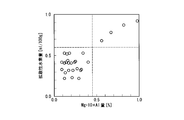
- FIG. 5 is a diagram showing the relationship between the amount of diffusible hydrogen in a weld metal and the crack initiation limit preheating temperature when the HAZ hardness is Hv 550 to 700. It is a figure which shows the relationship between the Y value of a flux cored wire, and the amount of spatters at the time of welding using a flux cored wire. It is a figure which shows the relationship between C content of a base material, C content of a welding material, and a hot crack. It is a figure which shows the relationship between F conversion value of a flux cored wire, and the amount of diffusible hydrogen of the weld metal obtained using the flux cored wire.
- CaF 2 content of the flux cored wire is a diagram showing the relationship between the amount of spatter during welding using flux-cored wire.
- NaF + Na 3 AlF 6 ratio of the flux cored wire is a diagram showing the relationship between the amount of spatter during welding using flux-cored wire. It is a figure which shows the relationship between Mg content of a flux cored wire, and the amount of diffusible hydrogen of the weld metal obtained using the flux cored wire. It is a figure which shows the relationship between "Mg + 10xAl" of a flux cored wire, and the amount of diffusible hydrogen of the weld metal obtained using the flux cored wire. It is a photograph of the cut surface of the wire made by butt welding the edge surfaces. It is a photograph of the cut surface of the wire made by butting the edge surfaces. It is the photograph of the cut surface of the wire made by crimping the edge surface.
- the C content of such a high carbon steel is about 0.55% at maximum, and the HAZ hardness of a welded joint obtained by welding the high carbon steel is about Hv700 at maximum.
- FIG. 1 is a graph showing the relationship between the amount of diffusible hydrogen in a weld metal and the cracking limit preheating temperature when the HAZ hardness is Hv 550 to 700.
- the crack initiation limit preheating temperature is the minimum preheating temperature that does not cause cold cracking in a welded joint when the y-type weld crack test specified in JIS Z3158-1993 “y-type weld crack test method” is performed on the welded joint. is there.
- a welded joint having a crack initiation limit preheating temperature of 50 ° C. is a welded joint that does not cause low temperature cracking if the preheating temperature is 50 ° C.
- a welded joint having a crack initiation limit preheating temperature of 0 ° C. is usually In this environment, it is a welded joint that does not cause cold cracking even if preheating is omitted.
- the present inventors created the graph shown in FIG. 1 by measuring the crack initiation limit preheating temperature of various welded joints having different amounts of diffusible hydrogen in the weld metal. In the y-type weld crack test, the test temperature was 25 ° C., and the presence or absence of cracks was confirmed on the surface and cross section of the weld. The amount of diffusible hydrogen was measured by a gas chromatographic method in accordance with JIS Z3118-2007 “Method for measuring hydrogen content in steel welds”.
- the crack initiation limit preheating temperature is 50 ° C.
- the amount of diffusible hydrogen in the weld metal immediately after welding is stabilized by including a predetermined amount of fluoride and oxide in the flux and keeping the blending ratio of fluoride and oxide within the predetermined range.
- the present inventors have found that it can be suppressed to less than 1.0 ml / 100 g.
- the fluoride contained in the flux sometimes increases the amount of spatter.
- the shielding gas 100% CO 2 gas
- the amount of spatter may become very large.
- the present inventors have repeatedly studied using flux wires in which the types of fluoride contained in the flux are different.
- the present inventors have a good correlation between the F-converted value of the fluoride content and the amount of diffusible hydrogen in the weld metal immediately after welding, and using the following formula: It has been found that there is a good correlation between the calculated sputter generation index Y and the spatter generation amount.
- the fluoride contained in the flux is designed so that the F-converted value of the fluoride contained in the flux is as large as possible and the Y value calculated from the fluoride contained in the flux is as small as possible. If the type and the mixing ratio of the metal are determined, the amount of diffusible hydrogen in the weld metal immediately after welding is less than 1.0 ml / 100 g, and the flux is contained so as not to impair the workability of welding in which the shielding gas is 100% CO 2 gas.
- a wire can be provided.
- Hot cracking of the weld metal is more likely to occur as the C content in the weld metal is higher.
- the weld metal includes a region where a molten filler material (that is, a flux-cored wire) and a molten material to be welded (that is, a base material) are mixed. Therefore, the C content of the weld metal is affected by the C content of both the filler metal and the welded material.
- FIG. 3 is a diagram showing the relationship between the C content of the base material and the C content of the filler metal and hot cracking.
- the present inventors made the graph shown by FIG. 3 by confirming the presence or absence of the hot crack in the various welded joints from which the C content of a base material and the C content of a welding material differ.
- the presence or absence of hot cracking was confirmed by a hot cracking test in accordance with JIS Z3155-1993 “C-shaped jig restraint butt weld cracking test”. In the hot cracking test, the test temperature was 25 ° C.
- the present invention has been made on the basis of such studies, and hereinafter, the flux-cored wire of the present invention will be described separately for a flux component and an alloy component.
- content of the component in description about a welding wire represents the mass% with respect to the welding wire total mass.
- the flux cored wire according to the present embodiment includes a steel outer sheath and a flux filled in the steel outer sheath.
- the flux component will be described.
- the flux of the flux-cored wire according to this embodiment includes fluoride and an oxide excluding CaO, and preferably further includes carbonate.
- the flux of the flux-cored wire according to the present embodiment may further include CaO and iron powder, but CaO and iron powder are not necessary for solving the problem of the flux-cored wire according to the present embodiment. It is better not to be included.
- CaO changes to CaOH, which is a compound containing hydrogen when exposed to the air, and increases the amount of diffusible hydrogen in the weld metal. Therefore, it is preferable to reduce the content of CaOH as much as possible.
- % means “mass% with respect to the total mass of the flux-cored wire” unless otherwise specified.
- the flux of the flux-cored wire includes a total of 0.21% or more fluoride in terms of F with respect to the total mass of the flux-cored wire.
- the F-converted value of fluoride with respect to the total mass of the flux-cored wire indicates the amount of fluorine (F) contained in the fluoride in the flux as mass% with respect to the total mass of the flux-cored wire.
- the fluoride of the flux-cored wire is a group consisting of CaF 2 , MgF 2 , Na 3 AlF 6 , LiF, NaF, K 2 ZrF 6 , BaF 2 , and K 2 SiF 6.
- the chemical formula enclosed in parentheses is the content of the fluoride corresponding to each chemical formula in mass% with respect to the total mass of the flux-cored wire.
- F converted value with respect to the total mass of the flux-cored wire may be referred to as “F converted value”.
- the symbol “ ⁇ ” is the total of F converted values of fluoride with respect to the total mass of the flux-cored wire.
- the above-mentioned F-converted coefficient of each fluoride is calculated from the number and atomic weight of fluorine contained in each fluoride and the molecular weight of each fluoride.
- the coefficient of F converted value of CaF 2 0.487 is a value obtained a value obtained by doubling the fluorine atom amount 19.00 by Xu the CaF 2 chemical formula weight 78.08.
- Fluoride in the flux has the function of reducing the amount of diffusible hydrogen in the weld metal and significantly improving the cold cracking resistance of the weld metal. The reason for this is not clear, but it is presumed that F and hydrogen (H) in the fluoride are combined during welding to form hydrogen fluoride (HF), and this HF is released out of the weld metal. The However, if the total F converted value of fluoride in the flux is less than 0.21%, the amount of diffusible hydrogen in the weld metal cannot be less than 1.0 ml / 100 g. Sexuality becomes insufficient. Therefore, the flux of the flux-cored wire according to this embodiment is required to contain a total of 0.21% or more fluoride in terms of F.
- the lower limit of the total amount of F-converted values is 0.35%, 0.40%, 0.45%, 0.50%, 0.60%,. It may be 70%, 0.80%, or 0.90%.
- the upper limit of the total amount of F converted values is 2.00%, 1.70%, 1.50%, 1.30%. 1.10%, 1.00%, 0.90%, 0.80%, 0.70%, 0.60%, 0.50%, or 0.40%.
- the fluoride content is excessive, the amount of spatter during welding increases.
- the F converted value of fluoride can be selected so that the sputter generation index Y falls within the range described below.
- the fluoride of the flux-cored wire according to the present embodiment is one selected from the group consisting of CaF 2 , MgF 2 , Na 3 AlF 6 , LiF, NaF, K 2 ZrF 6 , BaF 2 , and K 2 SiF 6. Or it is 2 or more types.
- Ca, Mg, Li, Na, K, Zr, Ba, Si, and Al generated by ionization of these fluorides act as deoxidizing elements that combine with oxygen to reduce the amount of oxygen in the weld metal. .
- the above equation measures the amount of spatter generated when a flux-cored wire with various amounts of fluoride varied and is subjected to 100% CO 2 shielding gas welding, and the relationship between the amount of fluoride and the amount of spatter. was obtained by multiple regression analysis.
- the minimum value of the Y value that can satisfy the definition of the F converted value may be set as the lower limit value of the Y value.
- the Y value is minimized when the total F-converted value is the lowest value (0.21%) and the fluoride is composed only of MgF 2 .
- the lower limit of Y value is 0.344%.
- the lower limit of the Y value is 0.40%, 0.60%, 0.80%, 1.00%, 1.20%, 1.40%, It may be 1.60% or 1.80%.
- CaF 2 content is a fluoride that tends to increase the amount of sputtering.
- the present inventors have found that even if the Y value of fluoride is 5.0% or less, CaF 2 of 0.50% or more generates a large amount of spatter and deteriorates welding workability. .
- the present inventors are described below experiments which knowledge was obtained regarding the content of CaF 2.
- Various flux wires having different CaF 2 contents and having a Y value within the above specified range are subjected to welding under the same conditions as when the graph of FIG. 2 was created, and the same as when the graph of FIG. 2 was created.
- the amount of spatter generation of 1.0 mm or more per minute was determined by this method.
- the relationship between the CaF 2 content and the amount of spatter generated at 1.0 mm or more per minute obtained by this experiment is shown in the graph of FIG. From this graph, it was found that when the CaF 2 content was 0.5% or more, the amount of spatter generated at 1.0 mm or more per minute exceeded 5.0 g / min. On the other hand, from this graph, it was found that when the CaF 2 content was 0.2% or less, the amount of spatter generated at 1.0 mm or more per minute was 3.0 g / min or less. Therefore, the CaF 2 content of the flux-cored wire according to this embodiment is determined to be less than 0.50%. A more preferable upper limit value of the content of CaF 2 is 0.20%. If necessary, the CaF 2 content may be less than 0.10%, less than 0.06%, less than 0.04%, or less than 0.02%.
- the total content of unit mass% of Na 3 AlF 6 and NaF with respect to the total mass of the wire is 50% or more of the total content of unit mass% with respect to the total mass of the wire of fluoride.
- the ratio of the total content of unit mass% of Na 3 AlF 6 and NaF with respect to the total mass of the wire to the total content of unit mass% of the total mass of the wire of the fluoride is referred to as Na 3 AlF 6 + NaF ratio. .
- the present inventors used various flux wires with different Na 3 AlF 6 + NaF ratios for welding under the same conditions as when the graph of FIG. 2 was created, and 1 minute in the same manner as when the graph of FIG. 2 was created.
- the amount of spatter generated per hit was 1.0 mm or more.
- the graph of FIG. 6 shows the relationship between the Na 3 AlF 6 + NaF ratio obtained by this experiment and the amount of spatter generated at 1.0 mm or more per minute. From this graph, it was found that when the ratio of Na 3 AlF 6 + NaF was 50% or more, the amount of spatter generated at 1.0 mm or more per minute was less than 2.0 g / min.
- the Na 3 AlF 6 + NaF ratio is preferably 50% or more. If necessary, the Na 3 AlF 6 + NaF ratio may be 60% or more, 80% or more, 90% or more, or 100%.
- Na 3 AlF6 + NaF ratio Na 3 AlF 6, NaF coefficient in the calculation formula of spatter generation index X is 1, and the total content of unit mass% with respect to MgF 2 of total mass of the wire, fluoride wire
- the ratio (Na 3 AlF 6 + NaF + MgF 2 ratio) in the total content of unit mass% with respect to the total mass may be 50% or more, 60% or more, 80% or more, 90% or more, or 100%.
- Type of oxide From the group consisting of Fe oxide, Ba oxide, Na oxide, Ti oxide, Si oxide, Zr oxide, Mg oxide, Al oxide, Mn oxide, and K oxide) (Including one or more selected, excluding CaO) (Total value of oxide content excluding CaO ⁇ : 0.30 to 3.50% in mass% with respect to the total mass of the flux-cored wire) (Ti oxide content: 0.10-2.50% by mass% with respect to the total mass of the flux-cored wire)
- the flux of the flux-cored wire according to this embodiment includes a total of 0.30 to 3.50% of oxides.
- the type of this oxide is one of Fe oxide, Ba oxide, Na oxide, Ti oxide, Si oxide, Zr oxide, Mg oxide, Al oxide, Mn oxide, and K oxide.
- oxide excluding CaO may be simply referred to as “oxide”.
- Oxides other than CaO have the effect of maintaining a good weld bead shape.
- the lower limit value of ⁇ needs to be 0.30%.
- the lower limit value of ⁇ may be 0.40%, 0.50%, or 0.60%. However, if ⁇ exceeds 3.50%, the toughness of the weld metal may be lowered.
- the upper limit of ⁇ is 3.00%, 2.50%, 2.00%, 1.50%, 1.25%, 1.00%, 0.90%, 0.80%, or 0.70 % May be used.
- the type of oxide excluding CaO is not particularly limited.
- ⁇ is Fe oxide, Ba oxide, Na oxide, Ti oxide, Si oxide, Zr oxide, Mg oxide, Al oxide, Mn oxide, and K oxide. In addition to the total amount, it is also the total content of oxides contained in binders and the like used for flux granulation.
- Ti oxide contributes to improvement of weld bead shape. Even when the oxide content is 0.30 to 3.50%, the weld bead shape may be deteriorated if the Ti oxide content is less than 0.10%. Therefore, the lower limit value of the Ti oxide content needs to be 0.10%. In order to obtain a better weld bead shape by using Ti oxide as an arc stabilizer, the lower limit of Ti oxide is 0.15%, 0.20%, 0.25%, 0.30%, or 0.40%. On the other hand, when the Ti oxide content is more than 2.50%, the toughness of the weld metal may be lowered. Therefore, the upper limit value of the Ti oxide content needs to be 2.50%. In order to further improve the toughness of the weld metal, the upper limit of Ti oxide is 2.20%, 1.80%, 1.40%, 0.80%, 0.70%, 0.60%, 0.50. %, 0.40%, 0.35%, or 0.30%.
- the ratio of ⁇ to ⁇ (that is, ⁇ / ⁇ ) is set to 0.10 to 4.00 so that the amount of diffusible hydrogen in the weld metal is less than 1.0 ml / 100 g. It is necessary to.
- the ratio of ⁇ to ⁇ is less than 0.10, the amount of diffusible hydrogen in the weld metal cannot be less than 1.0 ml / 100 g, so the lower limit value of ⁇ / ⁇ is set to 0.10. If necessary, the lower limit value of ⁇ / ⁇ may be set to 0.20, 0.30, 0.50, or 0.70.
- a preferable upper limit of the ratio of ⁇ to ⁇ is 3.80, 3.50, 3.00, 2.50, 2.00, or 1.50.
- Total value of carbonate content 0 to 3.50% by mass% with respect to the total mass of the flux-cored wire
- Total content of MgCO 3 , Na 2 CO 3 , and LiCO 3 0 to 3.00% in mass% with respect to the total mass of the flux-cored wire
- the flux of the flux cored wire according to the present embodiment does not need to contain carbonate. Therefore, in the flux cored wire according to the present embodiment, the lower limit value of the carbonate content is 0%.
- the flux of the flux-cored wire may include carbonate.
- the preferable lower limit of the total content of carbonate is more than 0.30%.
- the lower limit of the total carbonate content may be 0.50%, 0.75%, or 1.00%.
- the upper limit of the total carbonate content is 3.00%, 2.50%, 2.00%, 1.50%, 1.00%, 0.50%, Alternatively, it may be 0.10%.
- Types of carbonate contained in the flux of the flux cored wire according to the present embodiment MgCO 3, Na 2 CO 3 , LiCO 3, CaCO 3, K 2 CO 3, BaCO 3, FeCO 3, and consists of MnCO 3 Although 1 type or 2 types or more selected from a group are included, it is not limited to this. As long as the carbonate content is within the above range, the type and composition of the carbonate are not limited.
- the upper limit of the total content of MgCO 3 , Na 2 CO 3 , and LiCO 3 may be 2.70%, 2.50%, or 2.00%.
- MgCO 3, Na 2 CO 3 , LiCO 3 of the total content of 0.30% exceeds the lower limit of 0.50%, 0.75%, or, It may be 1.00%.
- CaO may be contained in the flux of the flux cored wire according to the present embodiment. However, in the flux-cored wire according to this embodiment, the CaO content in the flux needs to be 0.20% or less. Since CaO changes to CaOH which is a compound containing hydrogen, it increases the diffusible hydrogen of the weld metal and impairs the cold crack resistance of the weld metal. A preferable upper limit of the content of CaO is 0.18%, 0.10%, 0.05%, or 0.01%. Since it is preferable not to include CaO, the lower limit of the content of CaO is 0%.
- iron powder may be included in the flux of the flux-cored wire according to the present embodiment.
- Iron powder may be included as necessary for adjusting the filling rate of the flux in the flux-cored wire or for improving the welding efficiency.
- oxygen attached to the surface layer of the iron powder may increase the oxygen content of the weld metal and reduce toughness. Therefore, in the flux cored wire according to the present embodiment, the iron powder content needs to be less than 10.0%.
- a preferable upper limit of the iron powder content is 8.0%, 6.0%, 4.0%, 2.0%, or 1.0%.
- the lower limit value of the iron powder content is 0%.
- the iron powder is mainly composed of non-oxidized Fe, and the Fe oxide is composed mainly of iron oxide such as hematite, limonite, and magnetite. Both can be discriminated using a known component analyzer such as EPMA.
- the flux according to the present embodiment may include components other than those described above.
- a chemical component of a weld metal, which will be described later, and an alloy component for controlling Ceq are included in the flux in a state that is not fluoride, oxide, or carbonate (for example, a state of metal powder or alloy powder). Also good.
- % means “mass% with respect to the total mass of the flux-cored wire”.
- the chemical components described below may be included in the steel outer shell, may be included in the flux as metal powder or alloy powder as described above, or included in the plating on the outer surface of the steel outer shell. May be. Fluorides, oxides other than CaO, Ti oxides, CaO, and carbonates are discharged out of the weld metal mainly as slag during welding, and the elements contained in the state of metals or alloys are mainly weld metals. Melt in. In the following description, “the chemical component of the flux-cored wire excluding fluoride, oxides other than CaO, CaO, carbonate, and iron powder” may be simply referred to as “the chemical component of the flux-cored wire”.
- C content in a wire shall be 0.030% or less.
- the upper limit of the C content may be 0.025% or less, or 0.022% or less. Since the C content in the wire is difficult to be less than 0.003% due to steelmaking restrictions when manufacturing the outer skin material, this is the lower limit.
- Si is a deoxidizing element and has a function of increasing the cleanliness of the weld metal by reducing the oxygen content of the weld metal and improving the toughness of the weld metal.
- the Si content of the chemical component of the flux-cored wire needs to be 0.10% or more. If necessary, the lower limit of the Si content may be 0.15% or 0.20%.
- the upper limit of the Si content of the chemical component of the flux-cored wire may be 0.80%, 0.70%, 0.60%, or 0.50%.
- Mn has the effect of suppressing the occurrence of hot cracking by narrowing the range of the solid-liquid coexistence temperature of the weld.
- the Mn content of the chemical component of the flux-cored wire needs to be 0.50% or more.
- the lower limit of the Mn content of the chemical component of the flux-cored wire may be 0.60%, 0.70%, 0.80%, or 0.90%.
- the upper limit of the Mn content may be limited to 2.30%, 2.10%, 1.90%, 1.70%, or 1.50%.
- Mg 0.10% or less
- the upper limit of the Mg content of the flux-cored wire according to the present embodiment is 0.10%, and it is preferable that the content is lower.
- the present inventors have found that Mg in the flux-cored wire increases the amount of diffusible hydrogen in the weld metal even if the amount is very small.
- the present inventors need to make the Mg content of the chemical component of the flux-cored wire according to the present embodiment 0.10% or less, and 0.07% or less. Was found to be preferable.
- the amount of TiO 2 is small, the effect of increasing the amount of diffusible hydrogen due to Mg becomes significant.
- the lower limit of the Mg content of the chemical component of the flux-cored wire is 0%.
- Mg has the effect of reducing the oxygen in the weld metal and improving the toughness of the weld metal. Therefore, the Mg content of the chemical component of the flux-cored wire may be 0.05% or more.
- P 0.020% or less
- P is an impurity element and enhances hot cracking sensitivity. Therefore, the P content needs to be reduced as much as possible.
- the P content of the chemical component of the flux-cored wire according to this embodiment is 0.020% or less, an adverse effect on hot cracking susceptibility due to P is allowed. You may restrict
- S is an impurity element and enhances hot cracking sensitivity. Therefore, the S content needs to be reduced as much as possible.
- S content of the chemical component of the flux-cored wire according to this embodiment is 0.020% or less, an adverse effect on hot cracking susceptibility due to S is allowed. You may restrict
- Al is a deoxidizing element and, like Si, has an effect of reducing the amount of oxygen in the weld metal, increasing the cleanliness of the weld metal, and improving the toughness of the weld metal.
- the Al content of the chemical component of the flux cored wire according to this embodiment is set to 0.001% or more.
- Al content of the chemical component of the flux-cored wire exceeds 0.100%, Al forms nitrides and oxides and deteriorates the toughness of the weld metal.
- the upper limit of the Al content of the chemical component of the flux-cored wire may be 0.090%, 0.080%, 0.070%, or 0.060%.
- Ni 0 to 0.50%
- the lower limit of the Ni content of the chemical component of the flux-cored wire is 0%.
- the Ni content of the chemical component of the flux-cored wire may be 0.05% or more.
- the Ni content of the chemical component of the flux-cored wire needs to be 0.50% or less.
- the upper limit of the Ni content of the chemical component of the flux-cored wire may be 0.40% or 0.20%.
- V (V: 0 to 0.40%) Since V is not an essential component, the lower limit of the V content of the chemical component of the flux-cored wire is 0%. On the other hand, V increases the hardenability of the weld metal, so that the strength of the weld metal can be improved. In order to obtain this effect, the lower limit value of the V content of the chemical component of the flux-cored wire may be 0.01%. However, when the V content of the chemical component of the flux-cored wire exceeds 0.40%, V may reduce the toughness of the weld metal. Therefore, the upper limit value of the V content of the chemical component of the flux-cored wire is set to 0.40%. If necessary, the upper limit value of the V content of the chemical component of the flux-cored wire may be set to 0.30%, 0.20%, 0.10%, or 0.04%.
- Cu (Cu: 0 to 0.50%) Since Cu is not an essential component, the lower limit of the Cu content of the chemical component of the flux-cored wire is 0%. On the other hand, since Cu can improve the strength and toughness of the weld metal, the Cu content of the chemical component of the flux-cored wire may be 0.10% or more in order to obtain this effect. Cu may be included in the plating on the surface of the steel outer surface of the flux-cored wire, and may be included in the flux as a single substance or an alloy. Cu plating also has the effect of improving rust prevention, electrical conductivity, and chip wear resistance.
- the Cu content of the chemical component of the flux-cored wire is the total amount of Cu contained in the steel outer sheath and flux and Cu contained in the plating on the wire surface.
- the Cu content of the chemical component of the flux-cored wire exceeds 0.50%, the toughness may decrease. Therefore, the Cu content of the chemical component of the flux-cored wire is 0.50% or less. As needed, it is good also considering the upper limit of Cu content of the chemical component of a flux cored wire as 0.40% or 0.30%.
- the lower limit of the Cr content of the chemical component of the flux-cored wire is 0%.
- the Cr content of the chemical component of the flux-cored wire may be 0.10% or more in order to improve the strength of the weld metal.
- the upper limit of the Cr content of the chemical component of the flux-cored wire is set to 1.00%. As needed, it is good also considering the upper limit of Cr content of the chemical component of a flux cored wire as 0.80%, 0.60%, or 0.40%.
- Mo Mo: 0-1.00% Since Mo is not an essential component, the lower limit of the Mo content of the chemical component of the flux-cored wire is 0%. On the other hand, Mo increases the hardenability of the weld metal, so the Mo content of the chemical component of the flux-cored wire may be 0.05% or more in order to improve the strength of the weld metal. However, when the Mo content of the chemical component of the flux cored wire exceeds 1.00%, Mo may reduce the toughness of the weld metal, so the upper limit of the Mo content of the chemical component of the flux cored wire is 1. 0.000%. As needed, it is good also considering the upper limit of Mo content of the chemical component of a flux cored wire as 0.70%, 0.60%, 0.40%, or 0.20%.
- Ti 0 to 0.300% Since Ti is not an essential component, the lower limit of the Ti content of the chemical component of the flux-cored wire is 0%. On the other hand, Ti is also a deoxidizing element like Al, and has the effect of reducing the amount of oxygen in the weld metal. Ti also has an effect of fixing the solid solution N of the weld metal and mitigating the adverse effect of the solid solution N on the toughness. Therefore, the Ti content of the chemical component of the flux-cored wire may be 0.010% or more.
- the upper limit of the Ti content of the chemical component of the flux-cored wire is 0.300%. As needed, it is good also considering the upper limit of Ti content of the chemical component of a flux-cored wire as 0.100%, 0.050%, 0.030%, or 0.020%.
- Nb 0 to 0.100% Since Nb is not an essential component, the lower limit of the Nb content of the chemical component of the flux-cored wire is 0%. On the other hand, Nb has an effect of improving the strength of the weld metal by solid solution. Therefore, the Nb content of the chemical component of the flux-cored wire may be 0.010% or more. However, when the Nb content of the chemical component of the flux-cored wire exceeds 0.100%, precipitates having a coarse Nb are formed in the weld metal, and the toughness of the weld metal is deteriorated. Therefore, the upper limit of the Nb content of the chemical component of the flux-cored wire is set to 0.100%. As needed, it is good also considering the upper limit of Nb content of the chemical component of a flux cored wire as 0.080%, 0.050%, 0.030%, or 0.020%.
- B (B: 0 to 0.0100%) Since B is not an essential component, the lower limit of the B content of the chemical component of the flux-cored wire is 0%. On the other hand, B contained in a proper amount in the weld metal is combined with solute N to form BN, reducing the adverse effect of solute N on toughness. B also has the effect of increasing the hardenability of the weld metal and contributing to improving the strength of the weld metal. Therefore, the B content of the chemical component of the flux-cored wire may be 0.0010% or more.
- the upper limit value of the B content of the chemical component of the flux-cored wire is set to 0.0100%. As needed, it is good also considering the upper limit of B content of the chemical component of a flux-cored wire as 0.0080%, 0.0060%, 0.0040%, or 0.0020%.
- Bi 0 to 0.0100% Since Bi is not an essential component, the lower limit of the Bi content of the chemical component of the flux-cored wire is 0%. On the other hand, Bi is an element that improves the slag peelability. For this reason, it is good also considering Bi content of the chemical component of a flux cored wire as 0.0010% or more. When the Bi content of the chemical component of the flux cored wire exceeds 0.0100%, solidification cracking is likely to occur in the weld metal, so the upper limit of the Bi content of the chemical component of the flux cored wire is 0.0100%. is there. The upper limit of the Bi content of the chemical component of the flux-cored wire is preferably 0.0080%.
- the lower limit of the Ca content and the REM content of the chemical component of the flux-cored wire is 0%.
- both Ca and REM have the function of changing the structure of sulfides in the weld metal and reducing the size of sulfides and oxides, thereby improving the ductility and toughness of the weld metal. . Therefore, the Ca content of the chemical component of the flux-cored wire may be 0.002% or more, and the REM content of the chemical component of the flux-cored wire may be 0.0002% or more.
- the upper limit of the Ca content of the chemical component of the flux-cored wire is 0.50%, and the preferable upper limit is 0.40% or 0.30%.
- the upper limit of the REM content of the chemical component of the flux-cored wire is 0.0100%, and the preferable upper limit is 0.0080% or 0.0050%.
- the other remaining components are Fe and impurities.
- the Fe component include Fe in the steel outer shell, Fe in the alloy powder contained in the flux, and the like.
- the impurity means a component mixed in the steel outer sheath and alloy powder in the flux, and is allowed within a range that does not adversely affect the flux-cored wire according to the present embodiment.
- Ceq 0.10 to 0.44%
- the chemical component of the flux-cored wire according to this embodiment needs to be controlled so that Ceq is 0.10 to 0.44%.
- Ceq is an index (carbon equivalent) indicating hardenability calculated by the following equation.
- Ceq [C] + [Si] / 24 + [Mn] / 6 + [Ni] / 40 + [Cr] / 5 + [Mo] / 4 + [V] / 14
- the element symbols enclosed in parentheses are the elements corresponding to the respective element symbols included in the chemical components of the flux-cored wire excluding fluoride, oxides other than CaO, CaO, carbonates, and iron powder.
- Ceq Ceq of the flux-cored wire
- the content of elements not included in the chemical components of the flux-cored wire is regarded as 0%. That is, Ceq (Ceq of the flux-cored wire) calculated from the chemical components of the flux-cored wire of this embodiment is included in the flux-cored wire in the state of fluoride, oxide excluding CaO, CaO, or carbonate. It is calculated without considering the content of the element. Elements contained in the flux-cored wire in the state of fluoride, oxides other than CaO, CaO, or carbonate are discharged to the outside of the weld metal as slag during welding, so the hardenability of the weld metal Does not affect.
- the Ceq of the flux cored wire affects the hardenability of the weld metal.
- Ceq When Ceq is high, the weld metal is hardened, so that the tensile strength of the weld metal is improved. On the other hand, the toughness and hot crack resistance of the weld metal are lowered.
- the lower limit value of Ceq may be set to 0.15%, 0.20%, or 0.25%.
- the upper limit value of Ceq may be 0.42%, 0.38%, 0.36%, 0.32%, or 0.30%.
- the chemical component of the flux-cored wire according to this embodiment preferably satisfies the following formula. ([Mg] + 10 ⁇ [Al]) ⁇ 0.45 [Mg] and [Al] are unit masses of the content of each of Mg and Al contained in the chemical components excluding the fluoride of the flux-cored wire, the oxide excluding CaO, and the carbonate with respect to the total mass of the flux-cored wire. It is shown in%.
- the present inventors have a relationship between the amount of Mg and Al contained in the chemical component of the flux-cored wire and the amount of diffusible hydrogen in the weld metal, particularly when the welding atmosphere is hot and humid.
- the shape of the flux cored wire which concerns on this embodiment is demonstrated.
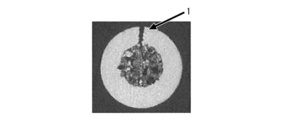
- the flux-cored wire has a shape (seamless shape) having no slit-like gaps, as shown in FIG. Since the seam of the steel outer shell is not welded, the wire is distinguished from any one having a shape including the slit-shaped gap 1. Any shape can be adopted in the flux-cored wire according to the present embodiment. However, in order to suppress the occurrence of cold cracks in the weld metal, it is preferable that the steel outer shell has no slit-like gap.
- Hydrogen that penetrates the weld during welding diffuses into the weld metal and the material to be welded, accumulates in the stress concentration part, and causes cold cracking.
- the supply source of hydrogen is various, when welding is performed in a state where the cleanliness of the weld and the conditions of the gas shield are strictly controlled, moisture (H 2 O) contained in the wire is mainly used. It becomes a hydrogen supply source, and the amount of moisture strongly affects the diffusible hydrogen of the welded joint.
- the entire flux-cored wire should be removed to prevent hydrogen sources such as moisture from entering the flux-cored wire.
- measures to prevent intrusion of hydrogen source such as vacuum packaging, storing in a container that can keep the flux-cored wire dry, or filling the gap between the steel sheaths of the flux-cored wire by brazing. desirable.
- the diameter of the flux-cored wire according to this embodiment is not particularly defined, but is, for example, ⁇ 1.0 to ⁇ 2.0 mm.
- the diameter of a general flux cored wire is ⁇ 1.2 to ⁇ 1.6 mm.
- the filling rate of the flux cored wire according to the present embodiment is not particularly limited as long as the above-described conditions are satisfied. However, the lower limit value of the filling rate is preferably 10% or 12%. The upper limit value of the filling rate is preferably 20% or 17%.
- the flux cored wire according to the present embodiment may further include a lubricant applied to the wire surface.
- the lubricating oil applied to the surface of the wire has an effect of improving the feedability of the wire during welding.
- various kinds of lubricants can be used, but in order to suppress the low temperature cracking of the weld metal, it is preferable to use perfluoropolyether oil (PFPE) not containing hydrogen.
- PFPE perfluoropolyether oil
- the flux-cored wire according to the present embodiment may further include plating formed on the wire surface. In this case, the lubricant is applied to the plating surface.
- the amount of hydrogen contained in the flux-cored wire according to this embodiment is not particularly specified. This is because the amount of hydrogen in the flux-cored wire varies between manufacture and use. However, it is preferably 12 ppm or less with respect to the total mass of the flux-cored wire at the stage immediately after production. The amount of hydrogen in the flux-cored wire may increase due to moisture entering the flux-cored wire during storage of the flux-cored wire. Therefore, when the period from wire manufacture to wire use is long, it is desirable to prevent moisture from entering by the above-mentioned means.
- the flux cored wire according to the present embodiment can be manufactured by a normal flux cored wire manufacturing method. Below, an example of a manufacturing method is demonstrated.
- a method of manufacturing a flux-cored wire having a seamless shape includes a step of preparing a flux, a step of forming a U-shaped open tube by forming a steel strip while feeding a steel strip in the longitudinal direction, Supplying flux into the open pipe through the opening, obtaining a seamless pipe by butt welding the end of the open pipe, and obtaining a flux-cored wire having a predetermined wire diameter by drawing the seamless pipe; And annealing the flux-cored wire during or after the wire drawing step.
- the flux is prepared so that the amount of fluoride in the flux-cored wire, the chemical component, the amount of oxide excluding CaO, the amount of CaO, the amount of carbonate, and the like are within the predetermined ranges described above.
- the flux filling rate determined by the width and thickness of the steel strip, which is the material of the steel outer sheath, and the flux filling amount is also the fluoride content of the flux-cored wire, the oxide amount excluding CaO, the CaO amount, It should be noted that the amount of carbonate and chemical composition are affected.
- the butt welding is performed by electric seam welding, laser welding, TIG welding, or the like.
- a flux cored wire is annealed.
- the hydrogen content of the flux-cored wire is 12 ppm or less, it is necessary that the annealing temperature is 650 to 900 ° C. and the annealing time is 4 hours or more.
- the manufacturing method of the flux-cored wire having the slit-shaped gap is not the step of butt welding the end of the open tube to obtain a seamless tube, but forming the open tube and butting the end of the open tube Except for having a step of obtaining a tube with a gap, it is the same as the method of manufacturing a flux-cored wire having a seamless shape.
- the manufacturing method of the flux-cored wire having the slit-shaped gap may further include a step of caulking the end portion of the opened open tube. In a method for manufacturing a flux-cored wire having a slit-like gap, a tube having a slit-like gap is drawn.
- FIG. 9A to 9C are photographs of the cut surface of the wire. More specifically, FIG. 9A is a photograph of a cut surface of a wire made by butting the edge surfaces, FIG. 9B is a photograph of a cut surface of the wire made by butting the edge surfaces, and FIG. 9C is an edge surface. It is the photograph of the cut surface of the wire made by crimping.
- a wire having no slit-like gap made by butting the edge surfaces and welding may be referred to as a seamless wire.
- the wire without brazing is a wire having a slit-like gap.
- the flux-cored wire of the present embodiment described above can be applied to welding of all kinds of steel materials, and is particularly used for gas shielded arc welding of HB450 to HB600 class wear resistant steel and high alloy cast steel. Suitable for By welding using the flux-cored wire of this embodiment, a weld metal having a diffusible hydrogen content of 1.0 ml / 100 g or less is obtained, and the occurrence of cold cracks in the weld metal is suppressed. Even when arc welding is performed on a high carbon steel material having a high sensitivity to cold cracking, the flux cored wire according to the present embodiment can prevent cold cracking without preheating or at a low preheating temperature.
- the amount of diffusible hydrogen in the present embodiment is the amount of diffusible hydrogen measured by a method based on JIS Z 3118: 2007 “Method for Measuring Hydrogen Amount of Steel Weld”.
- Pcm (%) of steel materials says the value calculated by the following formula.
- Pcm (C) + (Si) / 30 + (Mn) / 20 + (Cu) / 20 + (Ni) / 60 + (Cr) / 20 + (Mo) / 15 + (V) / 10 + 5 ⁇ (B)
- each element enclosed in the parenthesis contained in the said formula shows content (mass%) of each element contained in steel materials.
- the content of elements not contained in the steel material is regarded as 0% by mass.
- the method for manufacturing a welded joint according to the present embodiment includes a step of performing gas shield arc welding of a steel material using the flux-cored wire according to the present embodiment described above.
- the type of steel material material to be welded
- the manufacturing method of the welded joint according to the present embodiment uses the welding wire according to the present embodiment that can suppress cold cracking, it is possible to suppress the occurrence of cold cracking while omitting preheating or lowering the preheating temperature. it can.
- the manufacturing method of the weld joint which concerns on this embodiment uses the welding wire which concerns on this embodiment with low C content, generation
- the method for manufacturing a welded joint according to the present embodiment can obtain a weld metal having good mechanical properties by using the welding wire according to the present embodiment in which the Ceq and oxygen amount are preferably controlled.
- a high-carbon steel sheet such as HB450 to HB600 class wear-resistant steel and high alloy cast steel, which is difficult to weld when using a normal flux-cored wire, is used as the material to be welded, Such a welded joint can particularly exhibit advantages over the prior art.
- the high carbon steel plate is a steel plate having a C content of 0.20 to 0.55%, for example. Further, it is particularly difficult to perform welding when using a normal flux-cored wire, and a high carbon steel plate having a CEN of 0.20 to 0.85% and a plate thickness of 12 to 100 mm is a material to be welded. In some cases, the welded joint according to the present embodiment can further exhibit advantages over the prior art.
- CEN is an index used to estimate the preheating temperature, calculated using the following equation.
- CEN [C] + (0.75 + 0.25 ⁇ TANH (20 ⁇ ([C] ⁇ 0.12))) ⁇ ([Si] / 24 + [Mn] / 6 + [Cu] / 15 + [Ni] / 20 + ([Cr] + [Mo] + [Nb] + [V]) / 5 + 5 ⁇ [B])
- the element symbol with [] represents the content (mass%) of the element corresponding to each element symbol contained in the steel material. The content of elements not contained is regarded as 0.
- the above formula for CEN calculation is: “Welding of Steel Materials”, Sangyo Publishing (1999), p. 163.
- the chemical composition of the high carbon steel sheet suitable for the method for manufacturing a welded joint according to the present embodiment is, for example, C: 0.20 to 0.55%, Si: 0.10 to 0.55%, and Mn: 0.2. ⁇ 2.0%, Al: 0.01 ⁇ 0.10%, P: 0.02% or less, S: 0.015% or less, Cu: 0 ⁇ 0.5%, Cr: 0.1 ⁇ 1. 2%, Mo: 0 to 0.6%, Nb: 0 to 0.05%, B: 0 to 0.0050%, and the balance contains iron and impurities.
- the welding conditions are not particularly limited, and can be appropriately selected according to the type and shape of the material to be welded, the welding environment, and the like.
- a preferred example of a method for manufacturing a welded joint according to the present embodiment includes a step of setting the above-described high carbon steel plate as a base material, and setting the two base materials at a welding position so as to form a groove therebetween, A step of performing gas shield arc welding using the flux-cored welding wire according to the present embodiment and generating a weld metal between the base materials.
- preheating conditions for preventing cold cracking of the welded joint are not particularly limited, but it is preferable that preheating is not performed after welding in order to improve workability.
- a steel plate having a plate thickness of 12 to 100 mm, mass%, C content of 0.20 to 0.55%, and CEN of 0.20 to 0.70%, or a plate thickness of 12 A steel plate having a C content of 0.20 to 0.55% and a CEN of greater than 0.70% and less than or equal to 0.85% by mass% is used for the welded joint according to the present embodiment.
- the temperature of the steel sheet is less than 10 ° C, it may be preheated so that the temperature of the steel sheet is 10 ° C or higher. It is.
- a steel sheet having a thickness of more than 20 mm and not more than 50 mm, a mass%, a C content of 0.20 to 0.55%, and a CEN of more than 0.70% and not more than 0.85% is implemented in this embodiment. What is necessary is just to pre-heat so that the temperature of a steel plate may be set to 100 degreeC or more when carrying out the gas shield arc welding according to the manufacturing method of the welded joint which concerns on a form.
- a flux-cored wire that can sufficiently improve the low temperature cracking resistance of the weld metal is used. Even if is a material to be welded, preheating can be omitted or the preheating temperature can be lowered to further improve the welding workability.
- the method of gas shield arc welding is not particularly limited, and a commonly used method can be adopted.
- the kind of shielding gas is not particularly limited.
- the method for manufacturing a welded joint according to the present embodiment can provide a welded joint that exhibits excellent welding workability and has high strength and high toughness regardless of the type of shield gas.
- 100 vol% carbon dioxide gas and a mixed gas of Ar and 3 to 30 vol% CO 2 which are commonly used, are shielding gases for the method of manufacturing a welded joint according to this embodiment.
- the shield gas at the time of welding using the flux-cored wire according to the present embodiment may include 5 Vol% or less O 2 gas. Since these gases are inexpensive, welding using these gases is advantageous for industrial use.
- the welded joint according to the present embodiment is obtained by the welding method according to the present embodiment described above. Since the weld joint according to this embodiment is manufactured using the welding wire according to this embodiment in which the amount of Ceq, oxygen amount, and slag forming agent is preferably controlled, it has high strength and high toughness, and diffusion. A weld metal having a good bead shape and a hydrogen content of 1.0 ml / 100 g or less is provided. The amount of diffusible hydrogen is measured by a gas chromatograph method based on JIS Z 3118 (Method for measuring the amount of hydrogen in steel welds 2007).
- the tensile strength of the weld metal of the welded joint according to this embodiment (mainly, the metal formed by melting and solidifying the flux-cored wire according to this embodiment) is about 490 MPa or more. In order to prevent hot cracking, the tensile strength of the weld metal is preferably 1180 MPa or less.
- the base material of the welded joint according to the present embodiment is not particularly limited.
- the shape of the welded joint to be manufactured is determined according to the application and is not particularly limited. It can be applied to welded joints that form grooves, such as ordinary butt joints, square joints, and T joints. Therefore, the shape of the steel plate to be welded is not limited as long as at least the portion forming the welded joint is plate-like, and the whole may not be a plate, and includes, for example, a shape steel. Moreover, it is not limited to what is comprised from a separate steel plate, The butt-welding joint of what shape
- a flux-cored wire includes a steel outer sheath and a flux filled in the steel outer sheath, and the conditions defined in JIS Z 3118 are used using the flux-cored wire.
- the amount of diffusible hydrogen of the weld metal obtained by direct current gas shielded arc welding is 1.0 ml / 100 g or less, the current value is 270 A, the voltage value is 29 to 32 V, the welding speed using the flux-cored wire.
- a flux-cored wire includes a steel outer sheath and a flux filled in the steel outer sheath, and the flux-cored wire is in a mass% with respect to the total mass and is oxidized by Ti.
- the content of the product is 0.10 to 2.50% by mass% with respect to the total mass, Ni: 0 to 0.5%, and using the flux-cored wire, under the conditions specified in JIS Z 3118
- the diffusible hydrogen content of the weld metal obtained by direct current gas shielded arc welding is 1.0 ml / 100 g or less.
- the wire polarity is positive
- the current value is 270 A
- the voltage value is 29 to DC gas shielded arc welding with 32 V, welding speed of 30 cm / min, shield gas type of CO 2 100% gas, and shield gas flow rate of 25 L / min.
- the weight per sputter of spatter having a diameter of 1.0 mm or more generated at the time of welding is 5.0 g / min or less.
- the polarity of the wire may be either plus or minus since the influence on the diffusible hydrogen amount and spatter generation amount of the weld metal is negligible, and is preferably plus.
- the wire side is plus, the posture is downward, the current value is 280 A, the voltage value is 30 V, the welding speed is 30 cm / min, the shielding gas type is 100% CO 2 gas, and the shielding gas flow rate is 25 L / min.
- the amount of diffusible hydrogen in the weld metal can be reliably reduced to 1.0 ml / 100 g or less.
- the flux cored wire according to the present embodiment can obtain a welded portion having excellent low temperature cracking resistance, and can greatly reduce the amount of spatter generated during welding.
- preheating work for preventing low temperature cracking is omitted or preheating work is omitted.
- the preheating temperature can be lowered, and the amount of spatter generated can be suppressed even when the shielding gas is 100% CO 2 gas.
- the conditions in the examples are one example of conditions used for confirming the feasibility and effects of the present invention, and the present invention is based on this one example of conditions. It is not limited.
- the present invention can adopt various conditions as long as the object of the present invention is achieved without departing from the gist of the present invention.
- Steel plates 1 to 6 having the components shown in Table 1 (remainder Fe and impurities) were used as welded materials (base materials).
- the backing metal and the base material were the same steel plate.
- Tables 2A to 3B show the composition of the flux component of the prototype flux-cored wire, and Tables 4 and 5 show the composition of the metal component. However, the balance of the whole wire is Fe and impurities.
- the flux-cored wire to which the description “with a gap” is attached in the table is a flux-cored wire in which the steel outer sheath includes a slit-shaped gap.
- the flux-cored wire with the description “PTFE coating” in the table is a flux-cored wire in which perfluoropolyether oil is coated on a steel outer sheath.
- the base material was butted at a root gap of 16 mm and a groove angle of 20 °, and the base material was used as a backing metal, and welding was carried out without preheating unless otherwise noted.
- Tables 6 and 7 show the welding conditions of the samples subjected to the Charpy impact test, the cold crack test, the hot crack test, the diffusible hydrogen amount measurement, and the welding workability evaluation.
- the welding conditions not shown in Tables 6 and 7 are as follows.
- Polarity Wire + (Plus) Current: DC
- Charpy absorbed energy is measured by taking a No. 4 Charpy test piece (2 mmV notch) in accordance with JIS Z3111 (2005) from the weld metal obtained by the above welding and conducting a Charpy impact test at -40 ° C. did.
- a flux-cored wire for which a weld metal having a Charpy absorbed energy at ⁇ 40 ° C. of 27 J or more was prepared was accepted in terms of toughness.
- the low-temperature cracking test was performed in accordance with JIS Z3158 (y-type weld cracking test method 1993), with the atmosphere shown in Tables 8 and 9 except for a part, without preheating.
- the flux-cored wire that was able to create a welded joint with no cracks on the surface and cross-section was considered acceptable for low temperature cracking resistance.
- the hot cracking test is conducted in accordance with JIS Z3155 (C-shaped jig restraint butt weld cracking test method 1993), and the test is carried out at a steel plate temperature of 10 ° C. to 100 ° C. in the atmosphere shown in Tables 8 and 9. Thereafter, the welded portion was bent and fractured in the longitudinal direction, and the fracture surface was examined for the presence of cracks.
- the flux-cored wire that was able to create a welded joint in which cracking was not observed was deemed acceptable for hot cracking resistance.
- the diffusible hydrogen amount measurement test was performed by a gas chromatograph method in accordance with JIS Z 3118 (Method for measuring the hydrogen amount of steel welds 2007).
- a flux-cored wire in which a weld metal having a diffusible hydrogen content of 1.0 ml / 100 g or less was accepted as regards the diffusible hydrogen content.
- the welding conditions of the samples subjected to the welding spatter amount evaluation and the welding workability evaluation are as follows.
- Welding posture downward welding time: 60 seconds
- a flux-cored wire with a sputter amount of 1.0 mm or more per minute being 2.5 g / min or less was regarded as acceptable in terms of sputtering characteristics. Further, the flux-cored wire that generated a significant amount of fume or slag during the welding was determined to be poor in terms of welding workability. The flux-cored wire with less generation of both fume and slag was determined to be good in terms of welding workability.
- Tables 8 and 9 show the results of Charpy absorbed energy test at -40 ° C, results of low temperature cracking test, results of hot cracking test, measurement results of diffusible hydrogen amount, measurement results of welding spatter amount, and welding work. The evaluation result of sex is shown.
- Examples 1 to 31 are all excellent in toughness, cold cracking resistance, hot cracking resistance, low diffusible hydrogen amount, welding spatter amount, welding workability, It was a pass. Furthermore, Examples 1 to 30 were able to achieve weld metal having excellent welding workability and excellent characteristics without preheating. On the other hand, since Comparative Examples 101 to 129 did not satisfy the requirements defined in the present invention, at least one of toughness, cold cracking resistance, and welding workability was rejected.
- the flux-cored wire according to the present invention has a high strength and high toughness, has an excellent cold cracking resistance, and can obtain a weld part having a good bead shape, greatly reducing the amount of spatter generated during welding. can do.
- the welding method according to the present invention can omit the preheating work for preventing the cold cracking of the weld metal, or can reduce the preheating temperature during the preheating work, and can prevent the hot cracking of the weld metal. And the amount of spatter generated can be greatly reduced.
- the welded joint according to the present invention has a weld portion having high strength and high toughness and having a good bead shape.
- the flux-cored wire according to the present invention and the method for manufacturing a welded joint according to the present invention are applied to high carbon steels such as HB450 to HB600 class wear-resistant steel and high alloy cast steel, cold cracking is prevented.
- Preheating work can be omitted or the preheating temperature during preheating work can be reduced, hot cracking can be prevented, and even when the shielding gas is 100% CO 2 gas, the amount of spatter generated can be suppressed.
- the welding work efficiency can be remarkably improved, and the value in the industry is extremely high.
Landscapes
- Engineering & Computer Science (AREA)
- Mechanical Engineering (AREA)
- Chemical & Material Sciences (AREA)
- Inorganic Chemistry (AREA)
- Materials Engineering (AREA)
- Metallurgy (AREA)
- Organic Chemistry (AREA)
- Nonmetallic Welding Materials (AREA)
- Arc Welding In General (AREA)
Abstract
Priority Applications (12)
| Application Number | Priority Date | Filing Date | Title |
|---|---|---|---|
| JP2018503905A JP6766867B2 (ja) | 2016-03-08 | 2016-03-08 | フラックス入りワイヤ、溶接継手の製造方法、及び溶接継手 |
| KR1020187024729A KR102118897B1 (ko) | 2016-03-08 | 2016-03-08 | 플럭스 코어드 와이어, 용접 조인트의 제조 방법 및 용접 조인트 |
| PCT/JP2016/057246 WO2017154122A1 (fr) | 2016-03-08 | 2016-03-08 | Fil à cœur de flux, procédé de fabrication de raccord soudé et raccord soudé |
| CN201680083006.7A CN108698174B (zh) | 2016-03-08 | 2016-03-08 | 药芯焊丝、焊接接头的制造方法和焊接接头 |
| EP16893454.5A EP3427891B1 (fr) | 2016-03-08 | 2016-03-08 | Fil à âme de flux, procédé de fabrication de joint soudé et joint soudé |
| US16/073,192 US10946486B2 (en) | 2016-03-08 | 2016-03-08 | Flux-cored wire, manufacturing method of welded joint, and welded joint |
| MX2018010526A MX395104B (es) | 2016-03-08 | 2016-03-08 | Alambre con nucleo fundente, metodo de fabricacion de junta soldada y junta soldada. |
| BR112018015189-0A BR112018015189B1 (pt) | 2016-03-08 | 2016-03-08 | Arame tubular, método de fabricação de junta sol-dada e junta soldada |
| MYPI2018702639A MY193176A (en) | 2016-03-08 | 2016-03-08 | Flux-cored wire, manufacturing method of welded joint, and welded joint |
| CA3011332A CA3011332C (fr) | 2016-03-08 | 2016-03-08 | Fil a coeur de flux, procede de fabrication de raccord soude et raccord soude |
| AU2016396548A AU2016396548B2 (en) | 2016-03-08 | 2016-03-08 | Flux-cored wire, weld joint manufacturing method and weld joint |
| AU2019203667A AU2019203667A1 (en) | 2016-03-08 | 2019-05-24 | Flux-cored wire, weld joint manufacturing method and weld joint |
Applications Claiming Priority (1)
| Application Number | Priority Date | Filing Date | Title |
|---|---|---|---|
| PCT/JP2016/057246 WO2017154122A1 (fr) | 2016-03-08 | 2016-03-08 | Fil à cœur de flux, procédé de fabrication de raccord soudé et raccord soudé |
Publications (1)
| Publication Number | Publication Date |
|---|---|
| WO2017154122A1 true WO2017154122A1 (fr) | 2017-09-14 |
Family
ID=59790190
Family Applications (1)
| Application Number | Title | Priority Date | Filing Date |
|---|---|---|---|
| PCT/JP2016/057246 Ceased WO2017154122A1 (fr) | 2016-03-08 | 2016-03-08 | Fil à cœur de flux, procédé de fabrication de raccord soudé et raccord soudé |
Country Status (11)
| Country | Link |
|---|---|
| US (1) | US10946486B2 (fr) |
| EP (1) | EP3427891B1 (fr) |
| JP (1) | JP6766867B2 (fr) |
| KR (1) | KR102118897B1 (fr) |
| CN (1) | CN108698174B (fr) |
| AU (2) | AU2016396548B2 (fr) |
| BR (1) | BR112018015189B1 (fr) |
| CA (1) | CA3011332C (fr) |
| MX (1) | MX395104B (fr) |
| MY (1) | MY193176A (fr) |
| WO (1) | WO2017154122A1 (fr) |
Cited By (3)
| Publication number | Priority date | Publication date | Assignee | Title |
|---|---|---|---|---|
| JP2018144071A (ja) * | 2017-03-06 | 2018-09-20 | 新日鐵住金株式会社 | ガスシールドアーク溶接用フラックス入りワイヤ及び溶接継手の製造方法 |
| JP2022061854A (ja) * | 2020-10-07 | 2022-04-19 | 日本製鉄株式会社 | 溶接継手の製造方法 |
| JP7716725B1 (ja) * | 2024-09-20 | 2025-08-01 | 天津大学 | 海洋エンジニアリング用鋼の高性能で予熱なしの溶接プロセスの確定方法 |
Families Citing this family (14)
| Publication number | Priority date | Publication date | Assignee | Title |
|---|---|---|---|---|
| JP6762131B2 (ja) * | 2016-04-28 | 2020-09-30 | 株式会社神戸製鋼所 | フラックス入りワイヤ |
| JP6901868B2 (ja) * | 2016-09-13 | 2021-07-14 | 株式会社神戸製鋼所 | エレクトロスラグ溶接用ワイヤ、エレクトロスラグ溶接用フラックス及び溶接継手 |
| JP6809533B2 (ja) * | 2016-11-08 | 2021-01-06 | 日本製鉄株式会社 | フラックス入りワイヤ、溶接継手の製造方法、及び溶接継手 |
| JP7092634B2 (ja) * | 2017-12-27 | 2022-06-28 | 株式会社神戸製鋼所 | 二相ステンレス鋼のサブマージアーク溶接用ボンドフラックス |
| CN112292229A (zh) * | 2018-03-30 | 2021-01-29 | 霍伯特兄弟有限责任公司 | 由铜涂覆条带制成的管状焊丝 |
| CN109514130B (zh) * | 2018-12-29 | 2021-05-18 | 天津市金桥焊材集团股份有限公司 | 一种碳钢带极堆焊专用埋弧焊剂及其用途 |
| JP7231476B2 (ja) * | 2019-05-09 | 2023-03-01 | 株式会社神戸製鋼所 | フラックス入りワイヤ、溶接方法及び溶接金属 |
| CN114667201B (zh) * | 2019-11-08 | 2024-02-09 | 日本制铁株式会社 | 药芯焊丝以及焊接接头的制造方法 |
| CN114829060A (zh) | 2019-11-26 | 2022-07-29 | 世亚伊萨有限公司 | 用于制造lng罐的不锈钢焊丝 |
| KR102197132B1 (ko) * | 2019-11-26 | 2020-12-31 | 주식회사 세아에삽 | Lng 탱크 제작용 스테인리스강 플럭스 코어드 와이어 |
| JP7831951B2 (ja) * | 2020-12-18 | 2026-03-17 | 株式会社神戸製鋼所 | フラックス入りワイヤ |
| JP7658753B2 (ja) | 2021-02-15 | 2025-04-08 | 株式会社神戸製鋼所 | フラックス入りワイヤ |
| CN115213531B (zh) * | 2022-06-20 | 2023-10-17 | 中铁山桥集团有限公司 | 一种耐候钢hps485wf厚板的焊接工艺 |
| CN115870662B (zh) * | 2022-12-12 | 2025-04-22 | 上海船舶工艺研究所(中国船舶集团有限公司第十一研究所) | 一种用于高强钢中厚板平角接的双丝气保焊焊接方法 |
Citations (5)
| Publication number | Priority date | Publication date | Assignee | Title |
|---|---|---|---|---|
| JP2010194595A (ja) * | 2009-02-26 | 2010-09-09 | Nippon Steel & Sumikin Welding Co Ltd | ガスシールドアーク溶接用フラックス入りワイヤ |
| WO2011074689A1 (fr) * | 2009-12-16 | 2011-06-23 | 新日本製鐵株式会社 | Fil contenant un flux pour une soudure à l'arc sous scellement par un gaz, permettant une soudure dans toutes les positions |
| JP2015006693A (ja) * | 2013-05-31 | 2015-01-15 | 新日鐵住金株式会社 | 溶接継手部の疲労強度と耐低温割れ性に優れるフラックス入りワイヤ |
| WO2015068443A1 (fr) * | 2013-11-08 | 2015-05-14 | 新日鐵住金株式会社 | Procédé de production de raccord soudé |
| JP2016083677A (ja) * | 2014-10-24 | 2016-05-19 | 新日鐵住金株式会社 | ガスシールドアーク溶接用フラックス入りワイヤ |
Family Cites Families (23)
| Publication number | Priority date | Publication date | Assignee | Title |
|---|---|---|---|---|
| JPS5440744B2 (fr) | 1974-01-28 | 1979-12-05 | ||
| JPH01271098A (ja) | 1988-04-21 | 1989-10-30 | Nippon Steel Corp | ガスシールドアーク溶接用フラックス入りワイヤ |
| JP3120912B2 (ja) | 1992-11-27 | 2000-12-25 | 新日本製鐵株式会社 | ガスシールドアーク溶接用フラックス入りワイヤ |
| JPH08257785A (ja) | 1995-01-23 | 1996-10-08 | Nippon Steel Corp | 鋼溶接部の耐低温割れ性を改善するアーク溶接用フラックス入りワイヤ |
| JP3354460B2 (ja) | 1997-11-11 | 2002-12-09 | 川崎製鉄株式会社 | 高張力鋼材の被覆アーク溶接方法 |
| JP2002331384A (ja) | 2001-05-10 | 2002-11-19 | Kobe Steel Ltd | ガスシールドアーク溶接用メタル系フラックス入りワイヤ |
| JP3758040B2 (ja) * | 2002-07-26 | 2006-03-22 | 株式会社神戸製鋼所 | 低合金耐熱鋼用ガスシールドアーク溶接用フラックス入りワイヤ |
| JP2005144539A (ja) | 2003-11-19 | 2005-06-09 | Nippon Steel Corp | 溶接変形低減のためのガスシールドアーク溶接用フラックス入りワイヤおよびそれを用いた溶接変形低減方法 |
| JP4646764B2 (ja) | 2005-09-28 | 2011-03-09 | 株式会社神戸製鋼所 | ガスシールドアーク溶接用フラックス入りワイヤ |
| JP5136466B2 (ja) | 2008-03-28 | 2013-02-06 | 新日鐵住金株式会社 | 高強度鋼溶接用フラックス入りワイヤおよびその製造方法 |
| JP5022428B2 (ja) | 2009-11-17 | 2012-09-12 | 株式会社神戸製鋼所 | 硬化肉盛用migアーク溶接ワイヤおよび硬化肉盛用migアーク溶接方法 |
| JP5768547B2 (ja) | 2011-07-08 | 2015-08-26 | 新日鐵住金株式会社 | 高張力鋼ガスシールドアーク溶接用フラックス入りワイヤ |
| JP2013151001A (ja) | 2012-01-25 | 2013-08-08 | Nippon Steel & Sumikin Welding Co Ltd | 耐候性鋼用ガスシールドアーク溶接用フラックス入りワイヤ |
| CN104271310B (zh) | 2012-05-08 | 2016-04-27 | 新日铁住金株式会社 | 超高强度钢焊接用药芯焊丝 |
| KR101744427B1 (ko) | 2012-09-24 | 2017-06-07 | 신닛테츠스미킨 카부시키카이샤 | 조인트 강도가 우수한 고강도 강판의 스폿 용접 방법 |
| KR101616237B1 (ko) * | 2013-01-31 | 2016-04-27 | 신닛테츠스미킨 카부시키카이샤 | 플럭스 코어드 와이어, 플럭스 코어드 와이어를 사용한 용접 방법, 플럭스 코어드 와이어를 사용한 용접 조인트의 제조 방법 및 용접 조인트 |
| JP6257193B2 (ja) * | 2013-07-12 | 2018-01-10 | 株式会社神戸製鋼所 | 肉盛溶接用フラックス入りワイヤ |
| JP6365063B2 (ja) | 2013-07-29 | 2018-08-01 | 新日鐵住金株式会社 | 立向溶接の作業性に優れた高靭性ガスシールドアーク溶接用フラックス入りワイヤ |
| JP6252104B2 (ja) | 2013-10-25 | 2017-12-27 | 新日鐵住金株式会社 | ボックス柱の製造方法 |
| WO2015068273A1 (fr) * | 2013-11-08 | 2015-05-14 | 新日鐵住金株式会社 | Fil-électrode fourré de soudage à l'arc sous sous atmosphère gazeuse et procédé de soudage d'acier cryogénique l'utilisant |
| KR101674743B1 (ko) * | 2013-11-08 | 2016-11-09 | 신닛테츠스미킨 카부시키카이샤 | 가스 실드 아크 용접용 플럭스 내장 와이어 및 극저온용 강의 용접 방법 및 용접 조인트의 제조 방법 |
| JP5696824B1 (ja) | 2013-11-08 | 2015-04-08 | 新日鐵住金株式会社 | 溶接継手の製造方法 |
| JP5880662B2 (ja) | 2013-11-08 | 2016-03-09 | 新日鐵住金株式会社 | ガスシールドアーク溶接用フラックス入りワイヤ及び極低温用鋼の溶接方法ならびに溶接継手の製造方法 |
-
2016
- 2016-03-08 MX MX2018010526A patent/MX395104B/es unknown
- 2016-03-08 US US16/073,192 patent/US10946486B2/en active Active
- 2016-03-08 CA CA3011332A patent/CA3011332C/fr active Active
- 2016-03-08 KR KR1020187024729A patent/KR102118897B1/ko active Active
- 2016-03-08 CN CN201680083006.7A patent/CN108698174B/zh active Active
- 2016-03-08 AU AU2016396548A patent/AU2016396548B2/en active Active
- 2016-03-08 JP JP2018503905A patent/JP6766867B2/ja active Active
- 2016-03-08 BR BR112018015189-0A patent/BR112018015189B1/pt active IP Right Grant
- 2016-03-08 WO PCT/JP2016/057246 patent/WO2017154122A1/fr not_active Ceased
- 2016-03-08 EP EP16893454.5A patent/EP3427891B1/fr active Active
- 2016-03-08 MY MYPI2018702639A patent/MY193176A/en unknown
-
2019
- 2019-05-24 AU AU2019203667A patent/AU2019203667A1/en not_active Abandoned
Patent Citations (5)
| Publication number | Priority date | Publication date | Assignee | Title |
|---|---|---|---|---|
| JP2010194595A (ja) * | 2009-02-26 | 2010-09-09 | Nippon Steel & Sumikin Welding Co Ltd | ガスシールドアーク溶接用フラックス入りワイヤ |
| WO2011074689A1 (fr) * | 2009-12-16 | 2011-06-23 | 新日本製鐵株式会社 | Fil contenant un flux pour une soudure à l'arc sous scellement par un gaz, permettant une soudure dans toutes les positions |
| JP2015006693A (ja) * | 2013-05-31 | 2015-01-15 | 新日鐵住金株式会社 | 溶接継手部の疲労強度と耐低温割れ性に優れるフラックス入りワイヤ |
| WO2015068443A1 (fr) * | 2013-11-08 | 2015-05-14 | 新日鐵住金株式会社 | Procédé de production de raccord soudé |
| JP2016083677A (ja) * | 2014-10-24 | 2016-05-19 | 新日鐵住金株式会社 | ガスシールドアーク溶接用フラックス入りワイヤ |
Non-Patent Citations (1)
| Title |
|---|
| See also references of EP3427891A4 * |
Cited By (4)
| Publication number | Priority date | Publication date | Assignee | Title |
|---|---|---|---|---|
| JP2018144071A (ja) * | 2017-03-06 | 2018-09-20 | 新日鐵住金株式会社 | ガスシールドアーク溶接用フラックス入りワイヤ及び溶接継手の製造方法 |
| JP2022061854A (ja) * | 2020-10-07 | 2022-04-19 | 日本製鉄株式会社 | 溶接継手の製造方法 |
| JP7594173B2 (ja) | 2020-10-07 | 2024-12-04 | 日本製鉄株式会社 | 溶接継手の製造方法 |
| JP7716725B1 (ja) * | 2024-09-20 | 2025-08-01 | 天津大学 | 海洋エンジニアリング用鋼の高性能で予熱なしの溶接プロセスの確定方法 |
Also Published As
| Publication number | Publication date |
|---|---|
| JP6766867B2 (ja) | 2020-10-14 |
| US20190030655A1 (en) | 2019-01-31 |
| AU2019203667A1 (en) | 2019-06-13 |
| EP3427891B1 (fr) | 2021-05-05 |
| JPWO2017154122A1 (ja) | 2018-10-04 |
| EP3427891A4 (fr) | 2019-11-13 |
| MX395104B (es) | 2025-03-11 |
| CA3011332C (fr) | 2020-10-27 |
| BR112018015189A2 (pt) | 2018-12-18 |
| AU2016396548B2 (en) | 2019-09-12 |
| CA3011332A1 (fr) | 2017-09-14 |
| CN108698174B (zh) | 2020-12-08 |
| BR112018015189B1 (pt) | 2021-07-06 |
| US10946486B2 (en) | 2021-03-16 |
| CN108698174A (zh) | 2018-10-23 |
| KR20180108730A (ko) | 2018-10-04 |
| KR102118897B1 (ko) | 2020-06-04 |
| EP3427891A1 (fr) | 2019-01-16 |
| MY193176A (en) | 2022-09-26 |
| MX2018010526A (es) | 2018-11-09 |
| AU2016396548A1 (en) | 2018-08-02 |
Similar Documents
| Publication | Publication Date | Title |
|---|---|---|
| JP6766867B2 (ja) | フラックス入りワイヤ、溶接継手の製造方法、及び溶接継手 | |
| US20220281024A1 (en) | Flux-cored wire, manufacturing method of welded joint, and welded joint | |
| JP6766866B2 (ja) | フラックス入りワイヤ、溶接継手の製造方法、及び溶接継手 | |
| WO2015068261A1 (fr) | Procédé pour produire un joint soudé | |
| JP6801494B2 (ja) | ガスシールドアーク溶接用フラックス入りワイヤ、および溶接継手の製造方法 | |
| JP6874425B2 (ja) | ガスシールドアーク溶接用フラックス入りワイヤ及び溶接継手の製造方法 | |
| JP7795066B2 (ja) | フラックス入りカットワイヤ及び溶接継手の製造方法 | |
| JP6881025B2 (ja) | ガスシールドアーク溶接用フラックス入りワイヤ、及び溶接継手の製造方法 | |
| JP2019048323A (ja) | ガスシールドアーク溶接用フラックス入りワイヤ、及び溶接継手の製造方法 | |
| JP2019048324A (ja) | ガスシールドアーク溶接用フラックス入りワイヤ、及び溶接継手の製造方法 | |
| JP6891630B2 (ja) | ガスシールドアーク溶接用フラックス入りワイヤ、及び溶接継手の製造方法 | |
| JP7795067B2 (ja) | フラックス入りワイヤ及び溶接継手の製造方法 | |
| JP6728806B2 (ja) | ガスシールドアーク溶接用高Niフラックス入りワイヤ及び溶接継手の製造方法 | |
| JP7623565B2 (ja) | 溶接継手の製造方法及び開先充填用のフラックス入りカットワイヤ |
Legal Events
| Date | Code | Title | Description |
|---|---|---|---|
| ENP | Entry into the national phase |
Ref document number: 2018503905 Country of ref document: JP Kind code of ref document: A |
|
| WWE | Wipo information: entry into national phase |
Ref document number: 3011332 Country of ref document: CA |
|
| ENP | Entry into the national phase |
Ref document number: 2016396548 Country of ref document: AU Date of ref document: 20160308 Kind code of ref document: A |
|
| REG | Reference to national code |
Ref country code: BR Ref legal event code: B01A Ref document number: 112018015189 Country of ref document: BR |
|
| ENP | Entry into the national phase |
Ref document number: 20187024729 Country of ref document: KR Kind code of ref document: A |
|
| WWE | Wipo information: entry into national phase |
Ref document number: 1020187024729 Country of ref document: KR |
|
| WWE | Wipo information: entry into national phase |
Ref document number: MX/A/2018/010526 Country of ref document: MX |
|
| NENP | Non-entry into the national phase |
Ref country code: DE |
|
| WWE | Wipo information: entry into national phase |
Ref document number: 2016893454 Country of ref document: EP |
|
| ENP | Entry into the national phase |
Ref document number: 2016893454 Country of ref document: EP Effective date: 20181008 |
|
| 121 | Ep: the epo has been informed by wipo that ep was designated in this application |
Ref document number: 16893454 Country of ref document: EP Kind code of ref document: A1 |
|
| ENP | Entry into the national phase |
Ref document number: 112018015189 Country of ref document: BR Kind code of ref document: A2 Effective date: 20180725 |