WO2017154656A1 - Procédé de production de nouilles instantanées frites - Google Patents
Procédé de production de nouilles instantanées frites Download PDFInfo
- Publication number
- WO2017154656A1 WO2017154656A1 PCT/JP2017/007646 JP2017007646W WO2017154656A1 WO 2017154656 A1 WO2017154656 A1 WO 2017154656A1 JP 2017007646 W JP2017007646 W JP 2017007646W WO 2017154656 A1 WO2017154656 A1 WO 2017154656A1
- Authority
- WO
- WIPO (PCT)
- Prior art keywords
- noodle
- noodles
- fried noodles
- fried
- oil
- Prior art date
- Legal status (The legal status is an assumption and is not a legal conclusion. Google has not performed a legal analysis and makes no representation as to the accuracy of the status listed.)
- Ceased
Links
Images


Classifications
-
- A—HUMAN NECESSITIES
- A23—FOODS OR FOODSTUFFS; TREATMENT THEREOF, NOT COVERED BY OTHER CLASSES
- A23L—FOODS, FOODSTUFFS OR NON-ALCOHOLIC BEVERAGES, NOT OTHERWISE PROVIDED FOR; PREPARATION OR TREATMENT THEREOF
- A23L7/00—Cereal-derived products; Malt products; Preparation or treatment thereof
- A23L7/10—Cereal-derived products
- A23L7/109—Types of pasta, e.g. macaroni or noodles
- A23L7/111—Semi-moist pasta, i.e. containing about 20% of moist; Moist packaged or frozen pasta; Pasta fried or pre-fried in a non-aqueous frying medium, e.g. oil; Packaged pasta to be cooked directly in the package
-
- A—HUMAN NECESSITIES
- A23—FOODS OR FOODSTUFFS; TREATMENT THEREOF, NOT COVERED BY OTHER CLASSES
- A23L—FOODS, FOODSTUFFS OR NON-ALCOHOLIC BEVERAGES, NOT OTHERWISE PROVIDED FOR; PREPARATION OR TREATMENT THEREOF
- A23L7/00—Cereal-derived products; Malt products; Preparation or treatment thereof
- A23L7/10—Cereal-derived products
- A23L7/109—Types of pasta, e.g. macaroni or noodles
- A23L7/113—Parboiled or instant pasta
-
- A—HUMAN NECESSITIES
- A23—FOODS OR FOODSTUFFS; TREATMENT THEREOF, NOT COVERED BY OTHER CLASSES
- A23B—PRESERVATION OF FOODS, FOODSTUFFS OR NON-ALCOHOLIC BEVERAGES; CHEMICAL RIPENING OF FRUIT OR VEGETABLES
- A23B2/00—Preservation of foods or foodstuffs, in general
- A23B2/90—Preservation of foods or foodstuffs, in general by drying or kilning; Subsequent reconstitution
-
- A—HUMAN NECESSITIES
- A23—FOODS OR FOODSTUFFS; TREATMENT THEREOF, NOT COVERED BY OTHER CLASSES
- A23L—FOODS, FOODSTUFFS OR NON-ALCOHOLIC BEVERAGES, NOT OTHERWISE PROVIDED FOR; PREPARATION OR TREATMENT THEREOF
- A23L7/00—Cereal-derived products; Malt products; Preparation or treatment thereof
- A23L7/10—Cereal-derived products
- A23L7/109—Types of pasta, e.g. macaroni or noodles
Definitions
- the present invention relates to a method for producing instant fried noodles.
- dry instant noodles can be roughly divided into fried (fried) noodles and non-fried noodles.
- the fried noodles are noodles obtained by frying the gelatinized noodles with oil at about 150 ° C. and drying them.
- non-fried noodles are noodles obtained by drying pregelatinized noodles by a drying method other than frying with oil.
- hot air with a wind speed of about 4 m / s or less is applied at about 70 to 100 ° C.
- the hot air drying method is generally used for drying for about 30 to 90 minutes.
- raw-type instant noodles that are pH-adjusted with acid, completely sealed, heat sterilized, and preserved.
- Fried noodles have a porous structure in which the moisture inside the noodles evaporates during the frying process and the noodles swell, resulting in a good restorability and a snack-like flavor that is unique to fried noodles.
- Many instant fried noodles such as bag noodles and cup noodles are on the market.
- fried noodles lack transparency due to the porous structure, and are not suitable for producing noodles having a pasta and spaghetti-like denseness and transparency.
- pasta and spaghetti-like instant noodles that are dense and transparent are mainly non-fried noodles and raw-type instant noodles (for example, References 1 to 3).
- An object of the present invention is to provide a method for producing instant fried noodles that is less swollen than ordinary fried noodles, has a dense texture, and is highly transparent.
- the present invention has been achieved.
- a noodle band is prepared from a kneaded noodle dough by adding 20 to 60 ml of liquid edible oil / fat to 1 kg of the main raw material powder, and the noodle band is rolled to a predetermined noodle thickness within 3 times.
- a method for producing instant fried noodles characterized in that a rolled noodle strip is made into a noodle string with a cutting blade, fried and then dried.
- the noodle strip is preferably rolled two times or less.
- the amount of liquid edible oil / fat is preferably 30 to 50 ml per 1 kg of the main raw material powder.
- the types of instant fried noodles produced in the present invention are mainly pasta and spaghetti, but are not limited to pasta and spaghetti, and may be any known in the art. For example, udon, soba, Chinese noodles and the like can be mentioned.
- ingredient Formulations for instant fried noodles according to the present invention ordinary instant noodle ingredients can be used. That is, as the main raw material powder, wheat flour (including durum flour), flour such as buckwheat flour and rice flour, and various starches such as potato starch, tapioca starch and corn starch may be used alone or in combination. May be.
- starch raw starch, pregelatinized starch, processed starch such as acetylated starch, etherified starch and crosslinked starch can be used.
- auxiliary material for these main raw material powders salt and alkali agents, phosphates, various thickeners, noodle quality improvers, edible fats and oils, which are generally used in the production of instant noodles, pH A regulator, various pigments, and the like can be added. These may be added together with the main raw material powder, or may be added by dissolving or suspending in kneading water.
- the edible oil / fat which is a raw material according to the present invention may be an edible oil / fat that is liquid at the time of addition, and is heated and melted at room temperature to liquid oil / fat and semi-solid or solid oil / fat at room temperature. What is necessary is just to use.
- the fats and oils include soybean oil, rice white squeezed oil, rapeseed oil, palm oil, corn oil, olive oil, sunflower oil, sesame oil, lard, and beef tallow.
- lard or palm oil is preferably a liquid or semi-solid fat at room temperature, and may be used in a liquid state by heating and melting if necessary.
- the amount of edible fats and oils that are raw materials according to the present invention is added so as to be 20 to 60 ml per 1 kg of the main raw material powder. If it is less than 20 ml, a sufficient swelling-inhibiting effect cannot be obtained, and if it exceeds 60 ml, noodle making becomes difficult and the texture becomes poor. More preferably, the amount is 30 to 50 ml with respect to 1 kg of the main raw material.
- the preparation method of the noodle dough (dough) according to the present invention may be performed according to a conventional method. That is, the noodle raw material powder and the kneading water may be mixed in a batch mixer, a flow jet mixer, a vacuum mixer or the like so as to be uniformly mixed, and a rag-shaped dough may be prepared. At this time, if there is a lot of water by kneading water, the dough will be dumped, and not only will it be difficult to make and roll the noodle strips later, but excessive foaming will occur during the frying process due to excessive moisture, replacing moisture and fats and oils. Is promoted, and it becomes easy to swell.
- the preferred amount of water added by the kneading water depends on the temperature of the dough, but it is preferable to add water so that the noodle band moisture is 25 to 45% by weight, more preferably 30 to 40% by weight.
- a method for adding edible fats and oils a method of spraying heated fats and oils directly onto noodle raw material powder as necessary, and separately adding edible fats and oils when mixing noodle raw material powder and kneading water with a mixer And a method of forcibly mixing and mixing edible fats and oils with kneaded water and then adding them to the noodle raw material powder.
- a method of separately adding edible fats and oils when mixing noodle raw material powder and kneading water with a mixer is preferable.
- Noodle strips are prepared using the prepared dough.
- a method for producing the noodle band after making dough into a rough noodle band by a conventional shaping roll, it may be a composite noodle band through a composite roll, but as the number of passes of the roll increases, gluten binding and Since the extension proceeds, it is preferable to use the rough noodle strip as a noodle strip, or not to repeat the composite more than twice. Also, to avoid giving direction to the gluten as much as possible, use an extruder or other extruder to produce a noodle band by extruding or extrude a small lump, and then make a noodle band with a shaping roll. You can also
- the obtained raw noodle strings are ⁇ -ized by steaming and / or boiling by a conventional method.
- a method of cooking not only heating with saturated steam but also heating with superheated steam can be performed, and a process such as warm water immersion can be combined.
- seasoning can also be performed by attaching a seasoning liquid (seasoning liquid) to the noodle strings thus gelatinized by spraying or dipping.
- seasoning process is not necessarily performed and may be omitted.
- the noodle strings are cut into 20 to 50 cm servings.
- the cut noodle strings are put into a metal fry drying device consisting of a lid and a container called a fly retainer.
- Cooling process After frying, remove the lid and take out the noodle mass from the container. The taken noodle mass is cooled for a predetermined time to obtain instant fried noodles.
- a noodle strip is prepared from a kneaded noodle dough by adding 20 to 60 ml of liquid edible fat / oil to 1 kg of the main raw material powder, and the noodle strip is rolled to a predetermined noodle thickness within 3 times. After that, the rolled noodle strip is made into a noodle strip with a cutting blade, and after steaming, it is fried and dried to suppress swelling, and it has a texture that is more dense than ordinary fried noodles. A method for producing instant fried noodles with high transparency can be provided.
- Example 1 To 1 kg of main raw material powder in which 900 g of medium strength powder and 100 g of starch are mixed as main raw material powder, 350 ml of kneading water in which 15 g of salt, 2 g of brine, 1 g of phosphate, 2 g of polymerized phosphate and 0.4 g of pigment are dissolved. In addition, the mixture was kneaded for 3 minutes with a normal pressure mixer, 20 ml of palm olein oil was added, and the mixture was further kneaded for 12 minutes to prepare a rag-like dough.
- the prepared dough was used to prepare a rough noodle band using a normal shaping roll, and two pieces of the rough noodle band were combined again using a shaping roll to prepare a noodle band.
- the noodle band thickness at this time was 18 mm.
- the produced noodle strip was rolled twice with a rolling roll to a predetermined thickness of 1.6 mm (18 mm-2.2 mm-1.6 mm).
- the rolled noodle strip was made into a noodle string using a 16th round cutting blade roll.
- the cut noodle strings were immediately steamed for 30 seconds in a steam chamber supplied with saturated steam at 240 kg / h, then immersed in warm water at 60 ° C. for 20 seconds, and saturated steam again at 240 kg / h. It was cooked for 30 seconds in the steambox supplied.
- the steamed noodle strings were immersed in a seasoning solution in which 60 g of sodium chloride per liter and 5 g of sodium glutamate were dissolved for 5 seconds, and then stretched to cut the noodle strings to 30 cm.
- the cut noodle strings were put into a frying retainer, dipped in a fryer heated to 150 ° C., and fried for 2 minutes 30 seconds to obtain fried noodle samples.
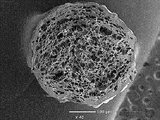
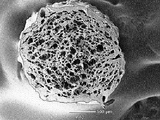
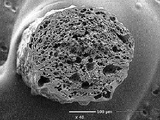
- Ten points of noodle cross section were arbitrarily selected for the fried noodle sample, degreased with ether, observed with an electron microscope, measured for the cross-sectional area, and the average value of the ten cross sections was taken as the noodle cross-sectional area of the sample.
- Example 2 A fried noodle sample was prepared according to the method of Example 1 except that the amount of palm olein oil added was 30 ml. The noodle cross-sectional area was also measured in the same manner as in Example 1.
- Example 3 A fried noodle sample was prepared according to the method of Example 1 except that the amount of palm olein oil added was 40 ml. The noodle cross-sectional area was also measured in the same manner as in Example 1.
- Example 4 A fried noodle sample was prepared according to the method of Example 1 except that the amount of palm olein oil added was 50 ml. The noodle cross-sectional area was also measured in the same manner as in Example 1.
- Example 5 A fried noodle sample was prepared according to the method of Example 1 except that the amount of palm olein oil added was 60 ml. The noodle cross-sectional area was also measured in the same manner as in Example 1.
- Example 6 A fried noodle sample was prepared in accordance with the method of Example 2 except that the number of rolling was one (18 mm ⁇ 1.6 mm). The noodle cross-sectional area was also measured in the same manner as in Example 1.
- Example 7 A fried noodle sample was prepared according to the method of Example 2 except that the number of rolling was 3 (18 mm ⁇ 12.6 mm ⁇ 7.2 mm ⁇ 1.6 mm). The noodle cross-sectional area was also measured in the same manner as in Example 1.
- Example 1 The method of Example 1 except that the number of rolling is 6 without adding palm olein oil (18 mm ⁇ 15.3 mm ⁇ 12.5 mm ⁇ 9.8 mm ⁇ 7.0 mm ⁇ 4.3 mm ⁇ 1.6 mm). A fried noodle sample was prepared. The noodle cross-sectional area was also measured in the same manner as in Example 1.
- Example 2 A fried noodle sample was prepared according to the method of Example 1 except that palm olein oil was not added. The noodle cross-sectional area was also measured in the same manner as in Example 1.
- Example 3 A fried noodle sample was prepared according to the method of Example 1 except that the amount of palm olein oil added was 10 ml. The noodle cross-sectional area was also measured in the same manner as in Example 1.
- Example 4 A fried noodle sample was prepared according to the method of Example 2 except that the number of rolling was 6 (18 mm ⁇ 15.3 mm ⁇ 12.5 mm ⁇ 9.8 mm ⁇ 7.0 mm ⁇ 4.3 mm ⁇ 1.6 mm). . The noodle cross-sectional area was also measured in the same manner as in Example 1.
- the fats and oils to be added are powder oils and fats derived from solid palm oil (average particle size 150 ⁇ m: specific gravity 0.92 g / ml in liquid), and fried noodles according to the method of Example 2 except that 27.6 g is added in powder form A sample was made. The noodle cross-sectional area was also measured in the same manner as in Example 1.
- Examples The samples of Examples and Comparative Examples were cooked and subjected to sensory evaluation of texture and appearance. Cooking was conducted by putting 400 ml of boiled hot water samples in each test section into a container, putting the boiling hot water in a container, holding the lid for 3 minutes, and then stirring the powdered soup to prepare a food sample. The evaluation method was performed in four stages by five skilled panelists. Moreover, the comparative example 1 was made into the standard of evaluation as a normal fried noodle sample.
- ⁇ is very good with a feeling of density
- ⁇ is good with a feeling of density
- ⁇ is lacking in the feeling of density
- X is not feeling the density and is flaky like ordinary fried noodles.
- ⁇ is transparent and very good
- ⁇ is transparent and good
- ⁇ is transparent
- ⁇ is transparent
- ⁇ is not transparent as in ordinary fried noodles.
- Table 1 shows sensory evaluation results and noodle cross-sectional areas of Examples and Comparative Examples.
- a noodle strip was prepared from a kneaded noodle dough by adding 20 to 60 ml of liquid edible fat / oil to 1 kg of the main raw material powder, and the noodle strip was rolled to a predetermined noodle thickness within 3 times. After that, the rolled noodle strip is made into a noodle strip with a cutting blade, and after steaming, it is fried and dried to suppress swelling, and it has a texture that is more dense than ordinary fried noodles. It can be seen that a method for producing instant fried noodles with high transparency can be provided.
- the number of rolling is preferably 2 or less, and the addition amount of liquid oil is preferably 30 to 50 ml.
Landscapes
- Life Sciences & Earth Sciences (AREA)
- Engineering & Computer Science (AREA)
- Chemical & Material Sciences (AREA)
- Food Science & Technology (AREA)
- Polymers & Plastics (AREA)
- Health & Medical Sciences (AREA)
- Nutrition Science (AREA)
- Wood Science & Technology (AREA)
- Zoology (AREA)
- Noodles (AREA)
- Grain Derivatives (AREA)
Abstract
Priority Applications (4)
| Application Number | Priority Date | Filing Date | Title |
|---|---|---|---|
| BR112018068109-1A BR112018068109B1 (pt) | 2016-03-07 | 2017-02-28 | Método para produzir macarrão instantâneo frito |
| US16/082,828 US11311037B2 (en) | 2016-03-07 | 2017-02-28 | Method for producing instant fried noodles |
| CN201780012103.1A CN108777985B (zh) | 2016-03-07 | 2017-02-28 | 即食油炸面的制造方法 |
| EP17762996.1A EP3427596B1 (fr) | 2016-03-07 | 2017-02-28 | Méthode pour produire des nouilles frites instantanées |
Applications Claiming Priority (2)
| Application Number | Priority Date | Filing Date | Title |
|---|---|---|---|
| JP2016-043210 | 2016-03-07 | ||
| JP2016043210A JP6342930B2 (ja) | 2016-03-07 | 2016-03-07 | 即席フライ麺の製造方法 |
Publications (1)
| Publication Number | Publication Date |
|---|---|
| WO2017154656A1 true WO2017154656A1 (fr) | 2017-09-14 |
Family
ID=59789242
Family Applications (1)
| Application Number | Title | Priority Date | Filing Date |
|---|---|---|---|
| PCT/JP2017/007646 Ceased WO2017154656A1 (fr) | 2016-03-07 | 2017-02-28 | Procédé de production de nouilles instantanées frites |
Country Status (8)
| Country | Link |
|---|---|
| US (1) | US11311037B2 (fr) |
| EP (1) | EP3427596B1 (fr) |
| JP (1) | JP6342930B2 (fr) |
| CN (1) | CN108777985B (fr) |
| BR (1) | BR112018068109B1 (fr) |
| HU (1) | HUE054083T2 (fr) |
| TW (1) | TWI695687B (fr) |
| WO (1) | WO2017154656A1 (fr) |
Cited By (1)
| Publication number | Priority date | Publication date | Assignee | Title |
|---|---|---|---|---|
| JP7421677B1 (ja) | 2023-04-14 | 2024-01-24 | エースコック株式会社 | 即席油揚げ麺及びその製造方法 |
Families Citing this family (8)
| Publication number | Priority date | Publication date | Assignee | Title |
|---|---|---|---|---|
| BR112019016918B1 (pt) * | 2017-02-15 | 2022-11-22 | Nissin Foods Holdings Co., Ltd | Método para produzir macarrões instantâneos fritos |
| JP7325265B2 (ja) * | 2019-08-27 | 2023-08-14 | サンヨー食品株式会社 | 波状断面を有する麺線の製造方法 |
| CN112586664A (zh) * | 2020-12-17 | 2021-04-02 | 武汉金香园食品有限公司 | 一种长货架期热干面胚料及其制备方法 |
| US20220378067A1 (en) * | 2021-05-26 | 2022-12-01 | A-Sha Republic Inc. | Method for manufacturing easy-to-cook and easy-to-brew noodles |
| WO2023242034A1 (fr) * | 2022-06-13 | 2023-12-21 | Société des Produits Nestlé S.A. | Procédé de préparation de nouilles frites instantanées |
| TWI850758B (zh) * | 2022-09-02 | 2024-08-01 | 統一企業股份有限公司 | 製造沖泡式直麵麵條的方法 |
| JP2024145204A (ja) * | 2023-03-31 | 2024-10-15 | 日清食品ホールディングス株式会社 | 油脂含有麺の製造方法 |
| CN117598435B (zh) * | 2023-12-27 | 2026-03-03 | 统一企业(中国)投资有限公司昆山研究开发中心 | 速食意大利面及其加工方法 |
Citations (6)
| Publication number | Priority date | Publication date | Assignee | Title |
|---|---|---|---|---|
| JPS5564773A (en) * | 1978-11-06 | 1980-05-15 | Sanyoo Shokuhin Kk | Preparation of instant noodle in western style and its device |
| JPS5925655A (ja) * | 1982-08-04 | 1984-02-09 | House Food Ind Co Ltd | 即席乾燥麺の製造方法 |
| JPH0366792A (ja) * | 1989-08-04 | 1991-03-22 | Idemitsu Petrochem Co Ltd | 天然酸化防止素材及び酸化防止方法 |
| WO2011114690A1 (fr) * | 2010-03-19 | 2011-09-22 | 日清食品ホールディングス株式会社 | Nouilles instantanées et procédé de production de celles-ci |
| JP2014012016A (ja) * | 2010-08-20 | 2014-01-23 | Nissin Foods Holdings Co Ltd | 即席熱風乾燥麺の製造方法 |
| WO2017043187A1 (fr) * | 2015-09-11 | 2017-03-16 | 日清食品ホールディングス株式会社 | Nouilles sautées instantanées |
Family Cites Families (16)
| Publication number | Priority date | Publication date | Assignee | Title |
|---|---|---|---|---|
| JPS53121955A (en) * | 1977-03-29 | 1978-10-24 | Miyoujiyou Shiyokuhin Kk | Production of instant noodles |
| JPH06237719A (ja) | 1993-02-13 | 1994-08-30 | Kanebo Ltd | 即席麺類及びその製法 |
| US5500236A (en) | 1994-06-17 | 1996-03-19 | Campbell Soup Company | Non-fried flavored ramen noodles |
| JP3195740B2 (ja) * | 1996-04-26 | 2001-08-06 | サンヨー食品株式会社 | 即席油揚げ麺の製造方法 |
| JP3950603B2 (ja) * | 1999-01-01 | 2007-08-01 | 日清食品株式会社 | 即席麺類の製造方法 |
| JP2005341831A (ja) * | 2004-06-01 | 2005-12-15 | Yutaka Seisakusho:Kk | 製麺類の圧延ローラ |
| CN100418435C (zh) * | 2006-08-16 | 2008-09-17 | 杜沛沪 | 青稞方便面及其生产工艺 |
| MX2011004733A (es) | 2008-11-12 | 2011-05-30 | Nissin Foods Holdings Co Ltd | Metodo para producir fideos instantaneos secados por vapor de aire caliente a alta temperatura. |
| JP4654315B1 (ja) * | 2009-12-22 | 2011-03-16 | 日清食品ホールディングス株式会社 | 即席麺およびその製造方法 |
| MX2012007129A (es) * | 2009-12-23 | 2012-09-07 | Nestle Singapore Pte Ltd | Fideos instantaneos freidos en aceite que contienen hierro y su proceso de preparacion. |
| JP4772160B1 (ja) | 2010-09-03 | 2011-09-14 | サンヨー食品株式会社 | 即席乾燥麺およびその製造方法 |
| PH12012502133A1 (en) * | 2011-03-22 | 2015-07-22 | Nissin Foods Holdings Co Ltd | Instant noodles and method of producing the same |
| JP5911462B2 (ja) * | 2013-10-01 | 2016-04-27 | 日清食品ホールディングス株式会社 | 即席麺の製造方法 |
| CN104738423A (zh) * | 2013-12-29 | 2015-07-01 | 王世华 | 一种辣味紫薯方便面 |
| CN106659209A (zh) * | 2014-06-23 | 2017-05-10 | 雀巢产品技术援助有限公司 | 包含甘薯粉的非油炸面条面团及其制备方法 |
| JP3195740U (ja) | 2014-11-19 | 2015-01-29 | 株式会社 ドリーム・ダブル | 車椅子 |
-
2016
- 2016-03-07 JP JP2016043210A patent/JP6342930B2/ja active Active
-
2017
- 2017-02-28 EP EP17762996.1A patent/EP3427596B1/fr active Active
- 2017-02-28 HU HUE17762996A patent/HUE054083T2/hu unknown
- 2017-02-28 WO PCT/JP2017/007646 patent/WO2017154656A1/fr not_active Ceased
- 2017-02-28 CN CN201780012103.1A patent/CN108777985B/zh active Active
- 2017-02-28 US US16/082,828 patent/US11311037B2/en active Active
- 2017-02-28 BR BR112018068109-1A patent/BR112018068109B1/pt active IP Right Grant
- 2017-03-07 TW TW106107303A patent/TWI695687B/zh active
Patent Citations (6)
| Publication number | Priority date | Publication date | Assignee | Title |
|---|---|---|---|---|
| JPS5564773A (en) * | 1978-11-06 | 1980-05-15 | Sanyoo Shokuhin Kk | Preparation of instant noodle in western style and its device |
| JPS5925655A (ja) * | 1982-08-04 | 1984-02-09 | House Food Ind Co Ltd | 即席乾燥麺の製造方法 |
| JPH0366792A (ja) * | 1989-08-04 | 1991-03-22 | Idemitsu Petrochem Co Ltd | 天然酸化防止素材及び酸化防止方法 |
| WO2011114690A1 (fr) * | 2010-03-19 | 2011-09-22 | 日清食品ホールディングス株式会社 | Nouilles instantanées et procédé de production de celles-ci |
| JP2014012016A (ja) * | 2010-08-20 | 2014-01-23 | Nissin Foods Holdings Co Ltd | 即席熱風乾燥麺の製造方法 |
| WO2017043187A1 (fr) * | 2015-09-11 | 2017-03-16 | 日清食品ホールディングス株式会社 | Nouilles sautées instantanées |
Non-Patent Citations (1)
| Title |
|---|
| See also references of EP3427596A4 * |
Cited By (2)
| Publication number | Priority date | Publication date | Assignee | Title |
|---|---|---|---|---|
| JP7421677B1 (ja) | 2023-04-14 | 2024-01-24 | エースコック株式会社 | 即席油揚げ麺及びその製造方法 |
| JP2024152336A (ja) * | 2023-04-14 | 2024-10-25 | エースコック株式会社 | 即席油揚げ麺及びその製造方法 |
Also Published As
| Publication number | Publication date |
|---|---|
| EP3427596A1 (fr) | 2019-01-16 |
| BR112018068109B1 (pt) | 2022-07-19 |
| CN108777985B (zh) | 2019-09-24 |
| TWI695687B (zh) | 2020-06-11 |
| US11311037B2 (en) | 2022-04-26 |
| JP6342930B2 (ja) | 2018-06-13 |
| US20190082723A1 (en) | 2019-03-21 |
| BR112018068109A2 (pt) | 2019-01-15 |
| HUE054083T2 (hu) | 2021-08-30 |
| JP2017158440A (ja) | 2017-09-14 |
| EP3427596B1 (fr) | 2021-02-24 |
| EP3427596A4 (fr) | 2019-11-20 |
| CN108777985A (zh) | 2018-11-09 |
| TW201733458A (zh) | 2017-10-01 |
Similar Documents
| Publication | Publication Date | Title |
|---|---|---|
| JP6342930B2 (ja) | 即席フライ麺の製造方法 | |
| JP6334623B2 (ja) | ノンフライ麺の製造方法 | |
| JP6325184B1 (ja) | 即席フライ麺の製造方法 | |
| JP6325137B2 (ja) | 即席フライ麺の製造方法 | |
| JP6785048B2 (ja) | ノンフライ即席麺の製造方法 | |
| JP5389874B2 (ja) | ノンフライ即席麺の製造方法 | |
| JP6811567B2 (ja) | 生麺及び冷凍麺の製造方法 | |
| JP2019140963A (ja) | 即席麺の製造方法 | |
| JP2018033389A (ja) | 乾麺及び半生麺の製造方法 | |
| RU2714250C2 (ru) | Обжаренная в масле лапша быстрого приготовления | |
| JP2018166470A (ja) | ノンフライ中華麺の製造方法 | |
| JPWO2013172117A1 (ja) | 冷凍麺類とその製造方法 | |
| WO2017145885A1 (fr) | Procédé de fabrication de nouilles sautées instantanées | |
| JP2019037145A (ja) | コロッケ風スナック菓子及びその製造方法 | |
| JP7348256B2 (ja) | 即席フライ麺 | |
| JP2018130119A (ja) | 即席フライ麺の製造方法 | |
| HK1256351B (en) | Method of producing fried instant noodles | |
| HK1256351A1 (en) | Method of producing fried instant noodles | |
| JP2022155809A (ja) | 容器入り即席ノンフライ中華麺製品及び容器入り即席ノンフライ中華麺製品の保存中のノンフライ中華麺麺塊の変色抑制方法。 | |
| JP2024152334A (ja) | 即席油揚げ麺の製造方法及び即席油揚げ麺 | |
| JP2016182058A (ja) | 即席熱風乾燥麺の製造方法及び即席熱風乾燥麺 | |
| JP2018038270A (ja) | 即席フライ麺の製造方法 | |
| JP2018038269A (ja) | 即席フライ麺の製造方法 | |
| JP2018130121A (ja) | ノンフライ麺の製造方法 | |
| HK1261031B (zh) | 非油炸面的制造方法 |
Legal Events
| Date | Code | Title | Description |
|---|---|---|---|
| NENP | Non-entry into the national phase |
Ref country code: DE |
|
| WWE | Wipo information: entry into national phase |
Ref document number: 2017762996 Country of ref document: EP |
|
| ENP | Entry into the national phase |
Ref document number: 2017762996 Country of ref document: EP Effective date: 20181008 |
|
| REG | Reference to national code |
Ref country code: BR Ref legal event code: B01A Ref document number: 112018068109 Country of ref document: BR |
|
| 121 | Ep: the epo has been informed by wipo that ep was designated in this application |
Ref document number: 17762996 Country of ref document: EP Kind code of ref document: A1 |
|
| ENP | Entry into the national phase |
Ref document number: 112018068109 Country of ref document: BR Kind code of ref document: A2 Effective date: 20180906 |