WO2017158894A1 - Huile lubrifiante - Google Patents
Huile lubrifiante Download PDFInfo
- Publication number
- WO2017158894A1 WO2017158894A1 PCT/JP2016/079171 JP2016079171W WO2017158894A1 WO 2017158894 A1 WO2017158894 A1 WO 2017158894A1 JP 2016079171 W JP2016079171 W JP 2016079171W WO 2017158894 A1 WO2017158894 A1 WO 2017158894A1
- Authority
- WO
- WIPO (PCT)
- Prior art keywords
- viscosity
- base oil
- low
- lubricating oil
- bulk
- Prior art date
- Legal status (The legal status is an assumption and is not a legal conclusion. Google has not performed a legal analysis and makes no representation as to the accuracy of the status listed.)
- Ceased
Links
Images


Classifications
-
- C—CHEMISTRY; METALLURGY
- C10—PETROLEUM, GAS OR COKE INDUSTRIES; TECHNICAL GASES CONTAINING CARBON MONOXIDE; FUELS; LUBRICANTS; PEAT
- C10M—LUBRICATING COMPOSITIONS; USE OF CHEMICAL SUBSTANCES EITHER ALONE OR AS LUBRICATING INGREDIENTS IN A LUBRICATING COMPOSITION
- C10M171/00—Lubricating compositions characterised by purely physical criteria, e.g. containing as base-material, thickener or additive, ingredients which are characterised exclusively by their numerically specified physical properties, i.e. containing ingredients which are physically well-defined but for which the chemical nature is either unspecified or only very vaguely indicated
- C10M171/02—Specified values of viscosity or viscosity index
Definitions
- the present invention relates to a lubricating oil.
- the energy produced by automobiles is lost as heat in various parts.
- the loss due to the friction of the engine and the drive part ranges from about 20% to 30% of the total loss.
- about 70% of machine performance deterioration and damage are caused by the surface and the contact portion, and are highly related to friction. Therefore, it is considered that the friction and wear control can greatly contribute to the improvement of the energy efficiency of the mechanical system and the improvement of the quality and life of the product.
- Friction can be broadly classified into fluid lubrication and boundary lubrication according to load and speed, and coexistence of low friction in each region is a major issue.
- Low friction in fluid lubrication requires a reduction in fluid resistance, that is, a low viscosity lubricant.
- the lubricating oil having a low viscosity in the fluid lubrication region is easily discharged from the boundary portion with a load, and molecules remaining in the boundary portion without being discharged are also structured. For this reason, in the boundary lubrication region, an increase in the viscosity of the lubricating oil, an increase in friction due to collision between the surfaces, and seizure are caused.
- Non-Patent Documents 1 to 4 In order to prevent such an increase in friction and seizure, conventionally, an additive that adsorbs to the surface or an additive that induces a reaction on the surface has been used to reduce friction in the boundary lubrication region (for example, Non-Patent Documents 1 to 4).
- a resonance shear measurement method has been developed by the present inventors as a method for measuring the characteristics of a liquid in a minute space (see, for example, Non-Patent Document 5).
- the distance between the surfaces can be continuously controlled at the nanometer level from the micrometer order to the contact, and the liquid characteristics are determined from the intensity and frequency of the resonance peak. It has the characteristics that it can be evaluated with high sensitivity, and the characteristics of the liquid between the surfaces can be quantitatively evaluated by physical model analysis. Specifically, by changing the thickness of the liquid sandwiched between two smooth solid surfaces on the order of nanometers, the upper and lower surfaces vibrate relatively in parallel, and the shear response is measured by the resonance method.
- the characteristic change of the sandwiched liquid can be evaluated from the measured resonance frequency and response intensity.
- the present inventors use this resonance shear measurement method to measure the viscosity parameters of four phenyl ether-based lubricants from the fluid lubrication region to the boundary lubrication region (for example, see Non-Patent Document 6). ).
- Non-Patent Documents 1 to 4 there is a problem that the formulation is complicated when the number of blending components is large. Moreover, since the reactive additive does not easily react under low temperature conditions, there is a problem that the friction reducing effect becomes insufficient. Moreover, although a phosphorus type additive and a sulfur type additive may be used as an additive, there also existed the subject that it was necessary to reduce phosphorus and sulfur from a viewpoint of environmental impact.
- an object of the present invention is to provide a lubricating oil that can realize low friction in fluid lubrication and boundary lubrication without using an additive.
- MADE monoalkyl diphenyl ether
- DADE dialkyl diphenyl ether
- m-phenoxyphenoxy m-biphenyl m-4P2E
- m-phenoxyphenoxy m-biphenyl m-4P2E
- m-phenoxyphenoxy m-biphenyl m-4P2E
- m-phenoxyphenoxy m-biphenyl m-bis (m-phenoxyphenoxy) benzene
- m-5P4E m-bis (m-phenoxyphenoxy) benzene
- the viscosity parameter in the fluid lubrication region was found to be m-5P4E> m-4P2E> DADE> MADE, which was found to be in good agreement with the bulk viscosity.
- the viscosity parameter in the boundary lubrication region was MADE> DADE> m-4P2E> m-5P4E, and it was found that the viscosity was reversed.
- the present inventors have repeated trial and error based on the results shown in FIG.
- the normalized peak intensity ratio obtained by the resonance shear measurement method is 0.4 or more when the surface-to-surface distance is 20 nm or more, and the load is greater than 0 mN and 5 mN or less. It is characterized by being 0.2 or less.
- the lubricating oil according to the first aspect of the present invention has a low viscosity in the fluid lubrication region where the distance between the surfaces is 10 nm or more and a small friction force in the boundary lubrication region where the load is 5 mN or less. For this reason, low friction can be realized in fluid lubrication and boundary lubrication.
- the lubricating oil according to the second aspect of the present invention is characterized in that it contains two base oils having different bulk viscosities by 10 times or more.
- the lubricating oil according to the second aspect of the present invention comprises a low-viscosity base oil having a bulk viscosity of a predetermined value or less, and a high-viscosity base oil having a bulk viscosity 10 times or more higher than the low-viscosity base oil. It is preferable to include.
- the lubricating oil according to the second aspect of the present invention includes a first base oil and a second base oil having different viscosity characteristics, and the second base oil has a viscosity in fluid lubrication of the first base oil. It is preferably higher than the base oil and lower in viscosity at the boundary lubrication than the first base oil.
- a base oil having a high bulk viscosity (high viscosity base oil or second base oil) has a bulk viscosity of Compared with a low base oil (low viscosity base oil or first base oil), the viscosity parameter in the boundary lubrication region is low. That is, the high-viscosity base oil has a lower viscosity at the boundary lubrication than the low-viscosity base oil.
- the lubricating oil according to the second aspect of the present invention includes such two base oils, exhibits the viscosity performance of the base oil having a low bulk viscosity in the fluid lubrication region, and the bulk viscosity in the boundary lubrication region.
- the lubricating oil according to the second aspect of the present invention includes such two base oils, exhibits the viscosity performance of the base oil having a low bulk viscosity in the fluid lubrication region, and the bulk viscosity in the boundary lubrication region.
- By exhibiting the high viscosity performance of the base oil it is possible to achieve low friction in fluid lubrication and boundary lubrication.
- the low viscosity base oil preferably has a bulk viscosity of 100 mPa ⁇ s or less. In this case, the viscosity can be lowered in a balanced manner by fluid lubrication and boundary lubrication.
- the lubricating oil according to the second aspect of the present invention may have the characteristics of the lubricating oil according to the first aspect of the present invention.
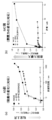
- FIG. 2 shows (a) the relationship between the distance between surfaces on the air separation (AS) side and the normalized peak intensity ratio, and (b) the load on the mica contact (MC) side and the standard obtained based on the resonance curve shown in FIG. It is a graph which shows the relationship with a conversion peak intensity ratio. It is a graph which shows the relationship between the load calculated
- the resonance shear measurement is performed by continuously controlling the distance between the surfaces from micrometer to several nanometers. It was. At the same time, for each distance between the surfaces, the interaction force (load) acting between the surfaces by the lubricating oil was measured using the spring alone method.
- a resonance shear measurement device “RSM-1” manufactured by Advance Riko Co., Ltd., which the present inventors were involved in development, was used.
- a lubricating oil obtained by adding 1.3 wt% of a base oil m-5P4E having a bulk viscosity of 1196 mPa ⁇ s to a base oil MADE having a bulk viscosity of 12 mPa ⁇ s (hereinafter referred to as “m -5P4E added MADE ").
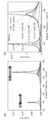
- Fig. 2 shows resonance curves for various distances between surfaces and loads obtained by resonance shear measurement.
- the distance between the surfaces on the air separation (AS) side and the normalized peak intensity ratio (the distance between the surfaces or the peak intensity of the resonance frequency at each load / the maximum peak intensity obtained based on the results of FIG. 3) and the relationship between the load on the mica contact (MC) side and the normalized peak intensity ratio are shown in FIGS. 3 (a) and 3 (b), respectively.
- the results of only the base oil MADE and the results of the base oil m-5P4E are also shown in FIGS. 3 (a) and 3 (b).
- 3A indicates the characteristics of the fluid lubrication region, and the normalized peak intensity ratio decreases as the viscosity increases.
- the relationship on the MC side shown in FIG. 3B shows the characteristics of the boundary lubrication region, and the normalized peak intensity ratio increases as the frictional force increases.
- the m-5P4E-added MADE has a normalized peak intensity ratio of 0.2 or more and a surface-to-surface distance of 15 It was confirmed that the normalized peak intensity ratio was 0.4 or more when it was larger than nm.
- the m-5P4E-added MADE has slightly lower strength than the MADE, but has properties close to that of the MADE, and is confirmed to have a low viscosity. It was also confirmed that when the surface-to-surface distance was smaller than about 10 nm, the strength decreased rapidly as in MADE. As shown in Fig.
- m-5P4E-added MADE is saturated at a load of 1 to 2 mN and strength of 0.1 to 0.17, similar to m-5P4E. It was confirmed that the frictional force was low. Furthermore, the thickness of the liquid film is 0.4 nm ⁇ 0.2 nm for the base oil MADE and 1.3 nm ⁇ 0.2 nm for the base oil m-5P4E, whereas the MADE with m-5P4E added is 1.4 nm ⁇ 0.3 nm, It is considered that the base oil m-5P4E is concentrated in a space of several nanometers.
- FIG. 4 shows the relationship between the load and the frictional force calculated based on the analysis method of Non-Patent Document 7 from the results of FIG.
- the results of only base oil MADE and the results of base oil m-5P4E are also shown in FIG.
- m-5P4E-added MADE was saturated at a load of 1 ⁇ mN or less and a frictional force of about 0.2 ⁇ mN, as with m-5P4E, and had lower friction than MADE.
- this result showed the same tendency as the result obtained by the normalized strength ratio.
- m-5P4E-added MADE has the characteristics of MADE with a low bulk viscosity in the fluid lubrication region and the property of m-5P4E with a high bulk viscosity in the boundary lubrication region, and is low in both lubrication conditions. It was confirmed that friction was obtained.
- m-5P4E-added MADE is highly lubricated by fluid lubrication and boundary lubrication, and can achieve low friction.
- m-5P4E-added MADE does not use additives such as phosphorus-based additives and sulfur-based additives, and can prevent complicated prescriptions and environmental burdens.
- a lubricating oil obtained by adding 1.3 wt% of a base oil PAO40 having a bulk viscosity of 730 mPa ⁇ s to a base oil PAO4 having a bulk viscosity of 25 mPa ⁇ s (hereinafter referred to as “1.3 wt%”). PAO40-added PAO4 ") was prepared.
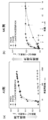
- FIG. 5A shows the relationship between the AS-side surface distance and the normalized peak intensity ratio, and the relationship between the MC side load and the normalized peak intensity ratio, obtained based on the result of the resonance shear measurement. And shown in (b).
- the results of only base oil PAO4 and the results of base oil PAO40 are also shown in FIGS. 5 (a) and 5 (b).
- the 1.3 wt% PAO40-added PAO4 has a normalized peak intensity ratio of 0.3 or more when the surface-to-surface distance is greater than about 10 mm, and the surface-to-surface distance is It was confirmed that the normalized peak intensity ratio was 0.5 or more when the thickness was larger than 20 nm.
- 1.3 wt% PAO40-added PAO4 has characteristics close to those of PAO4 and was confirmed to have a low viscosity. It was also confirmed that when the surface-to-surface distance was smaller than about 10 nm, the strength decreased rapidly as in PAO4. As shown in Fig.
- the strength of 1.3 wt% PAO40-added PAO4 increases more slowly than PAO4 as the load increases, and the normalized peak strength is around 7 mN.
- the ratio was about 0.17, and it was confirmed that the strength was small compared to PAO4 when the load was lower than 10 mm, and the frictional force was low.
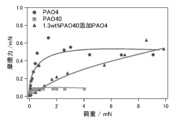
- FIG. 6 shows the relationship between the load and the frictional force calculated from the result of FIG.
- the results of only base oil PAO4 and the results of base oil PAO40 are also shown in FIG.
- the frictional force of PAO4 with 1.3 wt% PAO40 increased more gently than PAO4 as the load increased, and it was lower than that of PAO4 when the load was lower than 10 mN. It was. Moreover, this result showed the same tendency as the result obtained by the normalized strength ratio.
- PAO40-added PAO4 has the same viscosity characteristics as PAO4 with low bulk viscosity in the fluid lubrication region, and due to the effect of PAO40 with high bulk viscosity at a load lower than 10 mm in the boundary lubrication region It was confirmed that a friction reducing effect was obtained.
- 1.3 wt% PAO40-added PAO4 is highly lubricated by fluid lubrication and boundary lubrication with a load lower than 10 ⁇ m, and low friction can be realized.
- 1.3 wt% PAO40-added PAO4 does not use additives such as phosphorus additives or sulfur additives, and can prevent complicated prescriptions and environmental burdens. .
- the lubricating oil according to the embodiment of the present invention can obtain the effect of reducing the frictional force in the boundary lubrication region while keeping the bulk viscosity in the fluid lubrication region low. Further, the lubricating oil according to the embodiment of the present invention does not require an additive, and a friction reducing effect can be obtained only by mixing the base oil, so that the environmental load is small. Moreover, it is possible to prevent the occurrence of unexpected phenomena such as a decrease in lubrication performance due to side reactions such as association of additives and an increase in wear.
Landscapes
- Chemical & Material Sciences (AREA)
- Chemical Kinetics & Catalysis (AREA)
- General Chemical & Material Sciences (AREA)
- Oil, Petroleum & Natural Gas (AREA)
- Organic Chemistry (AREA)
- Lubricants (AREA)
Abstract
La présente invention vise à fournir une huile lubrifiante qui est apte à obtenir des propriétés de faible frottement dans une lubrification par fluide et une lubrification limite sans utiliser d'additifs. La présente invention a un rapport d'intensité de pic normalisé, tel qu'obtenu par un procédé de mesure de cisaillement résonant, d'au moins 0,4 à une distance de surface à surface non inférieure à 20 nm, et d'au plus 0,2 sous une charge supérieure à 0 mN et d'au plus 5 mN. La présente invention comprend de préférence : une huile de base de faible viscosité ayant une viscosité apparente non supérieure à une valeur prescrite ; et une huile de base de viscosité élevée ayant une viscosité apparente au moins 10 fois plus élevée que celle de l'huile de base de faible viscosité. De plus, l'huile de base de faible viscosité a, de préférence, une viscosité apparente de 100 mPa·s ou moins. L'huile de base de viscosité élevée a, de préférence, une viscosité dans une lubrification limite inférieure à celle de l'huile de base de faible viscosité.
Priority Applications (1)
| Application Number | Priority Date | Filing Date | Title |
|---|---|---|---|
| JP2018505222A JPWO2017158894A1 (ja) | 2016-03-16 | 2016-09-30 | 潤滑油 |
Applications Claiming Priority (2)
| Application Number | Priority Date | Filing Date | Title |
|---|---|---|---|
| JP2016052052 | 2016-03-16 | ||
| JP2016-052052 | 2016-03-16 |
Publications (1)
| Publication Number | Publication Date |
|---|---|
| WO2017158894A1 true WO2017158894A1 (fr) | 2017-09-21 |
Family
ID=59851141
Family Applications (1)
| Application Number | Title | Priority Date | Filing Date |
|---|---|---|---|
| PCT/JP2016/079171 Ceased WO2017158894A1 (fr) | 2016-03-16 | 2016-09-30 | Huile lubrifiante |
Country Status (2)
| Country | Link |
|---|---|
| JP (1) | JPWO2017158894A1 (fr) |
| WO (1) | WO2017158894A1 (fr) |
Cited By (1)
| Publication number | Priority date | Publication date | Assignee | Title |
|---|---|---|---|---|
| US20210355404A1 (en) * | 2018-10-25 | 2021-11-18 | Idemitsu Kosan Co.,Ltd. | Lubricating oil base oil, lubricating oil composition, and method for using lubricating oil composition |
Citations (4)
| Publication number | Priority date | Publication date | Assignee | Title |
|---|---|---|---|---|
| JPS5281080A (en) * | 1975-12-29 | 1977-07-07 | Shin Etsu Chem Co Ltd | Working fluids |
| JPS61287986A (ja) * | 1985-06-14 | 1986-12-18 | Kao Corp | 高温用潤滑油組成物 |
| JPH09118889A (ja) * | 1995-07-31 | 1997-05-06 | Tonen Corp | 耐熱性潤滑油組成物 |
| JPH09208976A (ja) * | 1996-01-31 | 1997-08-12 | Japan Energy Corp | ギヤ油およびその製造方法 |
-
2016
- 2016-09-30 JP JP2018505222A patent/JPWO2017158894A1/ja active Pending
- 2016-09-30 WO PCT/JP2016/079171 patent/WO2017158894A1/fr not_active Ceased
Patent Citations (4)
| Publication number | Priority date | Publication date | Assignee | Title |
|---|---|---|---|---|
| JPS5281080A (en) * | 1975-12-29 | 1977-07-07 | Shin Etsu Chem Co Ltd | Working fluids |
| JPS61287986A (ja) * | 1985-06-14 | 1986-12-18 | Kao Corp | 高温用潤滑油組成物 |
| JPH09118889A (ja) * | 1995-07-31 | 1997-05-06 | Tonen Corp | 耐熱性潤滑油組成物 |
| JPH09208976A (ja) * | 1996-01-31 | 1997-08-12 | Japan Energy Corp | ギヤ油およびその製造方法 |
Non-Patent Citations (3)
| Title |
|---|
| JUN'ICHI WATANABE ET AL: "Kyoshin-zuri Sokuteiho ni yoru Junkatsuyu Nano Hakumaku no Tokusei Hyoka to Tribology Kaiseki", POLYMER PREPRINTS, vol. 62, no. 1, 2013, Japan, pages 571 * |
| KAZUE KURIHARA: "Kyoshin-zuri Sokuteiho ni yoru Junkatsuyu Hyoka", PROCEEDINGS OF JAST TRIBOLOGY CONFERENCE 2014 AUTUMN, 2014, pages 88 - 89 * |
| MASASHI MIZUKAMI ET AL: "Molecular Level Elucidation of Lubrication Properties of Liquids", OLEOSCIENCE, vol. 15, no. 5, 1 January 2015 (2015-01-01), pages 205 - 211, XP055602838 * |
Cited By (1)
| Publication number | Priority date | Publication date | Assignee | Title |
|---|---|---|---|---|
| US20210355404A1 (en) * | 2018-10-25 | 2021-11-18 | Idemitsu Kosan Co.,Ltd. | Lubricating oil base oil, lubricating oil composition, and method for using lubricating oil composition |
Also Published As
| Publication number | Publication date |
|---|---|
| JPWO2017158894A1 (ja) | 2019-01-24 |
Similar Documents
| Publication | Publication Date | Title |
|---|---|---|
| JP6077610B2 (ja) | 樹脂潤滑用グリース組成物 | |
| JP2018016686A (ja) | 潤滑グリース組成物 | |
| JP2014516102A (ja) | 表面を調整するナノ潤滑剤 | |
| US11274263B2 (en) | Hybrid grease with low friction coefficients and high wearing protection | |
| Jabal et al. | Tribological characteristics evaluation of mustard oil blends | |
| WO2019017227A1 (fr) | Composition de graisse, élément coulissant mettant en œuvre celle-ci, et procédé de réduction de bruit basse fréquence | |
| JP5796834B2 (ja) | 樹脂潤滑用グリース組成物 | |
| JP7000267B2 (ja) | 倒立構造の振動減衰装置 | |
| CN108822943A (zh) | 柴油机油组合物及其用途 | |
| JPWO2017158894A1 (ja) | 潤滑油 | |
| CN107532105A (zh) | 机油共混物和通过改变钢的塑性响应而降低钢材磨损和消除机油中的zddp的方法 | |
| CN113330099A (zh) | 缓冲器用润滑油组合物、摩擦调整用添加剂、润滑油添加剂、缓冲器及缓冲器用润滑油的摩擦调整方法 | |
| JP7075401B2 (ja) | グリース組成物及びこれを塗布した摺動部材 | |
| Akbarzadeh et al. | Effect of nanoparticles on the running-in behavior in lubricated point contact | |
| Canter | Grease additives: Important contributors not to be overlooked | |
| RU2163921C2 (ru) | Пластичная смазка | |
| US10240104B2 (en) | Agent for mixing into a service fluid for a technical layout, concentrate for mixing into a service fluid for a technical layout, and the service fluid | |
| JP2022126670A (ja) | 鋼の塑性応答を改変することにより、鋼の摩耗を減らし、かつモーターオイル中のzddpを除くためのモーターオイルブレンド及び方法 | |
| KR20160051457A (ko) | 클러치용 그리스 조성물 | |
| CN107779239A (zh) | 一种压缩机内部电机专用润滑油 | |
| EP3872155A1 (fr) | Huile de base d'huile lubrifiante, composition d'huile lubrifiante et procédé d'utilisation de la composition d'huile lubrifiante | |
| WO2018070362A1 (fr) | Composition d'huile de graissage | |
| JP4497384B2 (ja) | 潤滑剤組成物 | |
| JP2012153762A (ja) | 含油軸受用潤滑剤組成物 | |
| JP2019509368A (ja) | 潤滑剤組成物およびその使用 |
Legal Events
| Date | Code | Title | Description |
|---|---|---|---|
| ENP | Entry into the national phase |
Ref document number: 2018505222 Country of ref document: JP Kind code of ref document: A |
|
| NENP | Non-entry into the national phase |
Ref country code: DE |
|
| 121 | Ep: the epo has been informed by wipo that ep was designated in this application |
Ref document number: 16894511 Country of ref document: EP Kind code of ref document: A1 |
|
| 122 | Ep: pct application non-entry in european phase |
Ref document number: 16894511 Country of ref document: EP Kind code of ref document: A1 |