WO2017159103A1 - Film de polypropylène à orientation biaxiale, film stratifié de film métallique, et condensateur à film - Google Patents
Film de polypropylène à orientation biaxiale, film stratifié de film métallique, et condensateur à film Download PDFInfo
- Publication number
- WO2017159103A1 WO2017159103A1 PCT/JP2017/003894 JP2017003894W WO2017159103A1 WO 2017159103 A1 WO2017159103 A1 WO 2017159103A1 JP 2017003894 W JP2017003894 W JP 2017003894W WO 2017159103 A1 WO2017159103 A1 WO 2017159103A1
- Authority
- WO
- WIPO (PCT)
- Prior art keywords
- film
- biaxially oriented
- oriented polypropylene
- temperature
- polypropylene
- Prior art date
- Legal status (The legal status is an assumption and is not a legal conclusion. Google has not performed a legal analysis and makes no representation as to the accuracy of the status listed.)
- Ceased
Links
Images


Classifications
-
- C—CHEMISTRY; METALLURGY
- C08—ORGANIC MACROMOLECULAR COMPOUNDS; THEIR PREPARATION OR CHEMICAL WORKING-UP; COMPOSITIONS BASED THEREON
- C08J—WORKING-UP; GENERAL PROCESSES OF COMPOUNDING; AFTER-TREATMENT NOT COVERED BY SUBCLASSES C08B, C08C, C08F, C08G or C08H
- C08J5/00—Manufacture of articles or shaped materials containing macromolecular substances
- C08J5/18—Manufacture of films or sheets
-
- B—PERFORMING OPERATIONS; TRANSPORTING
- B29—WORKING OF PLASTICS; WORKING OF SUBSTANCES IN A PLASTIC STATE IN GENERAL
- B29C—SHAPING OR JOINING OF PLASTICS; SHAPING OF MATERIAL IN A PLASTIC STATE, NOT OTHERWISE PROVIDED FOR; AFTER-TREATMENT OF THE SHAPED PRODUCTS, e.g. REPAIRING
- B29C48/00—Extrusion moulding, i.e. expressing the moulding material through a die or nozzle which imparts the desired form; Apparatus therefor
- B29C48/001—Combinations of extrusion moulding with other shaping operations
- B29C48/0018—Combinations of extrusion moulding with other shaping operations combined with shaping by orienting, stretching or shrinking, e.g. film blowing
-
- B—PERFORMING OPERATIONS; TRANSPORTING
- B29—WORKING OF PLASTICS; WORKING OF SUBSTANCES IN A PLASTIC STATE IN GENERAL
- B29C—SHAPING OR JOINING OF PLASTICS; SHAPING OF MATERIAL IN A PLASTIC STATE, NOT OTHERWISE PROVIDED FOR; AFTER-TREATMENT OF THE SHAPED PRODUCTS, e.g. REPAIRING
- B29C48/00—Extrusion moulding, i.e. expressing the moulding material through a die or nozzle which imparts the desired form; Apparatus therefor
- B29C48/03—Extrusion moulding, i.e. expressing the moulding material through a die or nozzle which imparts the desired form; Apparatus therefor characterised by the shape of the extruded material at extrusion
- B29C48/07—Flat, e.g. panels
- B29C48/08—Flat, e.g. panels flexible, e.g. films
-
- B—PERFORMING OPERATIONS; TRANSPORTING
- B29—WORKING OF PLASTICS; WORKING OF SUBSTANCES IN A PLASTIC STATE IN GENERAL
- B29C—SHAPING OR JOINING OF PLASTICS; SHAPING OF MATERIAL IN A PLASTIC STATE, NOT OTHERWISE PROVIDED FOR; AFTER-TREATMENT OF THE SHAPED PRODUCTS, e.g. REPAIRING
- B29C48/00—Extrusion moulding, i.e. expressing the moulding material through a die or nozzle which imparts the desired form; Apparatus therefor
- B29C48/25—Component parts, details or accessories; Auxiliary operations
- B29C48/88—Thermal treatment of the stream of extruded material, e.g. cooling
- B29C48/911—Cooling
- B29C48/9135—Cooling of flat articles, e.g. using specially adapted supporting means
- B29C48/914—Cooling drums
-
- B—PERFORMING OPERATIONS; TRANSPORTING
- B29—WORKING OF PLASTICS; WORKING OF SUBSTANCES IN A PLASTIC STATE IN GENERAL
- B29C—SHAPING OR JOINING OF PLASTICS; SHAPING OF MATERIAL IN A PLASTIC STATE, NOT OTHERWISE PROVIDED FOR; AFTER-TREATMENT OF THE SHAPED PRODUCTS, e.g. REPAIRING
- B29C48/00—Extrusion moulding, i.e. expressing the moulding material through a die or nozzle which imparts the desired form; Apparatus therefor
- B29C48/25—Component parts, details or accessories; Auxiliary operations
- B29C48/92—Measuring, controlling or regulating
-
- B—PERFORMING OPERATIONS; TRANSPORTING
- B29—WORKING OF PLASTICS; WORKING OF SUBSTANCES IN A PLASTIC STATE IN GENERAL
- B29C—SHAPING OR JOINING OF PLASTICS; SHAPING OF MATERIAL IN A PLASTIC STATE, NOT OTHERWISE PROVIDED FOR; AFTER-TREATMENT OF THE SHAPED PRODUCTS, e.g. REPAIRING
- B29C55/00—Shaping by stretching, e.g. drawing through a die; Apparatus therefor
- B29C55/02—Shaping by stretching, e.g. drawing through a die; Apparatus therefor of plates or sheets
- B29C55/10—Shaping by stretching, e.g. drawing through a die; Apparatus therefor of plates or sheets multiaxial
- B29C55/12—Shaping by stretching, e.g. drawing through a die; Apparatus therefor of plates or sheets multiaxial biaxial
-
- B—PERFORMING OPERATIONS; TRANSPORTING
- B32—LAYERED PRODUCTS
- B32B—LAYERED PRODUCTS, i.e. PRODUCTS BUILT-UP OF STRATA OF FLAT OR NON-FLAT, e.g. CELLULAR OR HONEYCOMB, FORM
- B32B27/00—Layered products comprising a layer of synthetic resin
- B32B27/06—Layered products comprising a layer of synthetic resin as the main or only constituent of a layer, which is next to another layer of the same or of a different material
- B32B27/08—Layered products comprising a layer of synthetic resin as the main or only constituent of a layer, which is next to another layer of the same or of a different material of synthetic resin
-
- B—PERFORMING OPERATIONS; TRANSPORTING
- B32—LAYERED PRODUCTS
- B32B—LAYERED PRODUCTS, i.e. PRODUCTS BUILT-UP OF STRATA OF FLAT OR NON-FLAT, e.g. CELLULAR OR HONEYCOMB, FORM
- B32B27/00—Layered products comprising a layer of synthetic resin
- B32B27/16—Layered products comprising a layer of synthetic resin specially treated, e.g. irradiated
-
- B—PERFORMING OPERATIONS; TRANSPORTING
- B32—LAYERED PRODUCTS
- B32B—LAYERED PRODUCTS, i.e. PRODUCTS BUILT-UP OF STRATA OF FLAT OR NON-FLAT, e.g. CELLULAR OR HONEYCOMB, FORM
- B32B27/00—Layered products comprising a layer of synthetic resin
- B32B27/18—Layered products comprising a layer of synthetic resin characterised by the use of special additives
-
- B—PERFORMING OPERATIONS; TRANSPORTING
- B32—LAYERED PRODUCTS
- B32B—LAYERED PRODUCTS, i.e. PRODUCTS BUILT-UP OF STRATA OF FLAT OR NON-FLAT, e.g. CELLULAR OR HONEYCOMB, FORM
- B32B27/00—Layered products comprising a layer of synthetic resin
- B32B27/18—Layered products comprising a layer of synthetic resin characterised by the use of special additives
- B32B27/20—Layered products comprising a layer of synthetic resin characterised by the use of special additives using fillers, pigments, thixotroping agents
-
- B—PERFORMING OPERATIONS; TRANSPORTING
- B32—LAYERED PRODUCTS
- B32B—LAYERED PRODUCTS, i.e. PRODUCTS BUILT-UP OF STRATA OF FLAT OR NON-FLAT, e.g. CELLULAR OR HONEYCOMB, FORM
- B32B27/00—Layered products comprising a layer of synthetic resin
- B32B27/28—Layered products comprising a layer of synthetic resin comprising synthetic resins not wholly covered by any one of the sub-groups B32B27/30 - B32B27/42
- B32B27/281—Layered products comprising a layer of synthetic resin comprising synthetic resins not wholly covered by any one of the sub-groups B32B27/30 - B32B27/42 comprising polyimides
-
- B—PERFORMING OPERATIONS; TRANSPORTING
- B32—LAYERED PRODUCTS
- B32B—LAYERED PRODUCTS, i.e. PRODUCTS BUILT-UP OF STRATA OF FLAT OR NON-FLAT, e.g. CELLULAR OR HONEYCOMB, FORM
- B32B27/00—Layered products comprising a layer of synthetic resin
- B32B27/28—Layered products comprising a layer of synthetic resin comprising synthetic resins not wholly covered by any one of the sub-groups B32B27/30 - B32B27/42
- B32B27/286—Layered products comprising a layer of synthetic resin comprising synthetic resins not wholly covered by any one of the sub-groups B32B27/30 - B32B27/42 comprising polysulphones; polysulfides
-
- B—PERFORMING OPERATIONS; TRANSPORTING
- B32—LAYERED PRODUCTS
- B32B—LAYERED PRODUCTS, i.e. PRODUCTS BUILT-UP OF STRATA OF FLAT OR NON-FLAT, e.g. CELLULAR OR HONEYCOMB, FORM
- B32B27/00—Layered products comprising a layer of synthetic resin
- B32B27/30—Layered products comprising a layer of synthetic resin comprising vinyl (co)polymers; comprising acrylic (co)polymers
- B32B27/302—Layered products comprising a layer of synthetic resin comprising vinyl (co)polymers; comprising acrylic (co)polymers comprising aromatic vinyl (co)polymers, e.g. styrenic (co)polymers
-
- B—PERFORMING OPERATIONS; TRANSPORTING
- B32—LAYERED PRODUCTS
- B32B—LAYERED PRODUCTS, i.e. PRODUCTS BUILT-UP OF STRATA OF FLAT OR NON-FLAT, e.g. CELLULAR OR HONEYCOMB, FORM
- B32B27/00—Layered products comprising a layer of synthetic resin
- B32B27/32—Layered products comprising a layer of synthetic resin comprising polyolefins
-
- B—PERFORMING OPERATIONS; TRANSPORTING
- B32—LAYERED PRODUCTS
- B32B—LAYERED PRODUCTS, i.e. PRODUCTS BUILT-UP OF STRATA OF FLAT OR NON-FLAT, e.g. CELLULAR OR HONEYCOMB, FORM
- B32B27/00—Layered products comprising a layer of synthetic resin
- B32B27/32—Layered products comprising a layer of synthetic resin comprising polyolefins
- B32B27/325—Layered products comprising a layer of synthetic resin comprising polyolefins comprising polycycloolefins
-
- B—PERFORMING OPERATIONS; TRANSPORTING
- B32—LAYERED PRODUCTS
- B32B—LAYERED PRODUCTS, i.e. PRODUCTS BUILT-UP OF STRATA OF FLAT OR NON-FLAT, e.g. CELLULAR OR HONEYCOMB, FORM
- B32B27/00—Layered products comprising a layer of synthetic resin
- B32B27/32—Layered products comprising a layer of synthetic resin comprising polyolefins
- B32B27/327—Layered products comprising a layer of synthetic resin comprising polyolefins comprising polyolefins obtained by a metallocene or single-site catalyst
-
- B—PERFORMING OPERATIONS; TRANSPORTING
- B32—LAYERED PRODUCTS
- B32B—LAYERED PRODUCTS, i.e. PRODUCTS BUILT-UP OF STRATA OF FLAT OR NON-FLAT, e.g. CELLULAR OR HONEYCOMB, FORM
- B32B27/00—Layered products comprising a layer of synthetic resin
- B32B27/34—Layered products comprising a layer of synthetic resin comprising polyamides
-
- B—PERFORMING OPERATIONS; TRANSPORTING
- B32—LAYERED PRODUCTS
- B32B—LAYERED PRODUCTS, i.e. PRODUCTS BUILT-UP OF STRATA OF FLAT OR NON-FLAT, e.g. CELLULAR OR HONEYCOMB, FORM
- B32B27/00—Layered products comprising a layer of synthetic resin
- B32B27/36—Layered products comprising a layer of synthetic resin comprising polyesters
-
- B—PERFORMING OPERATIONS; TRANSPORTING
- B32—LAYERED PRODUCTS
- B32B—LAYERED PRODUCTS, i.e. PRODUCTS BUILT-UP OF STRATA OF FLAT OR NON-FLAT, e.g. CELLULAR OR HONEYCOMB, FORM
- B32B27/00—Layered products comprising a layer of synthetic resin
- B32B27/36—Layered products comprising a layer of synthetic resin comprising polyesters
- B32B27/365—Layered products comprising a layer of synthetic resin comprising polyesters comprising polycarbonates
-
- H—ELECTRICITY
- H01—ELECTRIC ELEMENTS
- H01B—CABLES; CONDUCTORS; INSULATORS; SELECTION OF MATERIALS FOR THEIR CONDUCTIVE, INSULATING OR DIELECTRIC PROPERTIES
- H01B3/00—Insulators or insulating bodies characterised by the insulating materials; Selection of materials for their insulating or dielectric properties
- H01B3/18—Insulators or insulating bodies characterised by the insulating materials; Selection of materials for their insulating or dielectric properties mainly consisting of organic substances
- H01B3/30—Insulators or insulating bodies characterised by the insulating materials; Selection of materials for their insulating or dielectric properties mainly consisting of organic substances plastics; resins; waxes
- H01B3/44—Insulators or insulating bodies characterised by the insulating materials; Selection of materials for their insulating or dielectric properties mainly consisting of organic substances plastics; resins; waxes vinyl resins; acrylic resins
- H01B3/441—Insulators or insulating bodies characterised by the insulating materials; Selection of materials for their insulating or dielectric properties mainly consisting of organic substances plastics; resins; waxes vinyl resins; acrylic resins from alkenes
-
- H—ELECTRICITY
- H01—ELECTRIC ELEMENTS
- H01G—CAPACITORS; CAPACITORS, RECTIFIERS, DETECTORS, SWITCHING DEVICES, LIGHT-SENSITIVE OR TEMPERATURE-SENSITIVE DEVICES OF THE ELECTROLYTIC TYPE
- H01G4/00—Fixed capacitors; Processes of their manufacture
- H01G4/002—Details
- H01G4/018—Dielectrics
- H01G4/06—Solid dielectrics
- H01G4/14—Organic dielectrics
- H01G4/18—Organic dielectrics of synthetic material, e.g. derivatives of cellulose
-
- H—ELECTRICITY
- H01—ELECTRIC ELEMENTS
- H01G—CAPACITORS; CAPACITORS, RECTIFIERS, DETECTORS, SWITCHING DEVICES, LIGHT-SENSITIVE OR TEMPERATURE-SENSITIVE DEVICES OF THE ELECTROLYTIC TYPE
- H01G4/00—Fixed capacitors; Processes of their manufacture
- H01G4/32—Wound capacitors
-
- B—PERFORMING OPERATIONS; TRANSPORTING
- B29—WORKING OF PLASTICS; WORKING OF SUBSTANCES IN A PLASTIC STATE IN GENERAL
- B29C—SHAPING OR JOINING OF PLASTICS; SHAPING OF MATERIAL IN A PLASTIC STATE, NOT OTHERWISE PROVIDED FOR; AFTER-TREATMENT OF THE SHAPED PRODUCTS, e.g. REPAIRING
- B29C2948/00—Indexing scheme relating to extrusion moulding
- B29C2948/92—Measuring, controlling or regulating
- B29C2948/92504—Controlled parameter
- B29C2948/92704—Temperature
-
- B—PERFORMING OPERATIONS; TRANSPORTING
- B29—WORKING OF PLASTICS; WORKING OF SUBSTANCES IN A PLASTIC STATE IN GENERAL
- B29C—SHAPING OR JOINING OF PLASTICS; SHAPING OF MATERIAL IN A PLASTIC STATE, NOT OTHERWISE PROVIDED FOR; AFTER-TREATMENT OF THE SHAPED PRODUCTS, e.g. REPAIRING
- B29C48/00—Extrusion moulding, i.e. expressing the moulding material through a die or nozzle which imparts the desired form; Apparatus therefor
- B29C48/16—Articles comprising two or more components, e.g. co-extruded layers
- B29C48/18—Articles comprising two or more components, e.g. co-extruded layers the components being layers
- B29C48/21—Articles comprising two or more components, e.g. co-extruded layers the components being layers the layers being joined at their surfaces
-
- B—PERFORMING OPERATIONS; TRANSPORTING
- B29—WORKING OF PLASTICS; WORKING OF SUBSTANCES IN A PLASTIC STATE IN GENERAL
- B29C—SHAPING OR JOINING OF PLASTICS; SHAPING OF MATERIAL IN A PLASTIC STATE, NOT OTHERWISE PROVIDED FOR; AFTER-TREATMENT OF THE SHAPED PRODUCTS, e.g. REPAIRING
- B29C48/00—Extrusion moulding, i.e. expressing the moulding material through a die or nozzle which imparts the desired form; Apparatus therefor
- B29C48/25—Component parts, details or accessories; Auxiliary operations
- B29C48/36—Means for plasticising or homogenising the moulding material or forcing it through the nozzle or die
- B29C48/49—Means for plasticising or homogenising the moulding material or forcing it through the nozzle or die using two or more extruders to feed one die or nozzle
- B29C48/495—Feedblocks
-
- B—PERFORMING OPERATIONS; TRANSPORTING
- B29—WORKING OF PLASTICS; WORKING OF SUBSTANCES IN A PLASTIC STATE IN GENERAL
- B29C—SHAPING OR JOINING OF PLASTICS; SHAPING OF MATERIAL IN A PLASTIC STATE, NOT OTHERWISE PROVIDED FOR; AFTER-TREATMENT OF THE SHAPED PRODUCTS, e.g. REPAIRING
- B29C48/00—Extrusion moulding, i.e. expressing the moulding material through a die or nozzle which imparts the desired form; Apparatus therefor
- B29C48/25—Component parts, details or accessories; Auxiliary operations
- B29C48/36—Means for plasticising or homogenising the moulding material or forcing it through the nozzle or die
- B29C48/50—Details of extruders
- B29C48/69—Filters or screens for the moulding material
-
- B—PERFORMING OPERATIONS; TRANSPORTING
- B29—WORKING OF PLASTICS; WORKING OF SUBSTANCES IN A PLASTIC STATE IN GENERAL
- B29C—SHAPING OR JOINING OF PLASTICS; SHAPING OF MATERIAL IN A PLASTIC STATE, NOT OTHERWISE PROVIDED FOR; AFTER-TREATMENT OF THE SHAPED PRODUCTS, e.g. REPAIRING
- B29C48/00—Extrusion moulding, i.e. expressing the moulding material through a die or nozzle which imparts the desired form; Apparatus therefor
- B29C48/25—Component parts, details or accessories; Auxiliary operations
- B29C48/88—Thermal treatment of the stream of extruded material, e.g. cooling
- B29C48/911—Cooling
- B29C48/9135—Cooling of flat articles, e.g. using specially adapted supporting means
- B29C48/915—Cooling of flat articles, e.g. using specially adapted supporting means with means for improving the adhesion to the supporting means
- B29C48/917—Cooling of flat articles, e.g. using specially adapted supporting means with means for improving the adhesion to the supporting means by applying pressurised gas to the surface of the flat article
-
- B—PERFORMING OPERATIONS; TRANSPORTING
- B29—WORKING OF PLASTICS; WORKING OF SUBSTANCES IN A PLASTIC STATE IN GENERAL
- B29C—SHAPING OR JOINING OF PLASTICS; SHAPING OF MATERIAL IN A PLASTIC STATE, NOT OTHERWISE PROVIDED FOR; AFTER-TREATMENT OF THE SHAPED PRODUCTS, e.g. REPAIRING
- B29C55/00—Shaping by stretching, e.g. drawing through a die; Apparatus therefor
- B29C55/005—Shaping by stretching, e.g. drawing through a die; Apparatus therefor characterised by the choice of materials
-
- B—PERFORMING OPERATIONS; TRANSPORTING
- B32—LAYERED PRODUCTS
- B32B—LAYERED PRODUCTS, i.e. PRODUCTS BUILT-UP OF STRATA OF FLAT OR NON-FLAT, e.g. CELLULAR OR HONEYCOMB, FORM
- B32B2250/00—Layers arrangement
- B32B2250/02—2 layers
-
- B—PERFORMING OPERATIONS; TRANSPORTING
- B32—LAYERED PRODUCTS
- B32B—LAYERED PRODUCTS, i.e. PRODUCTS BUILT-UP OF STRATA OF FLAT OR NON-FLAT, e.g. CELLULAR OR HONEYCOMB, FORM
- B32B2250/00—Layers arrangement
- B32B2250/03—3 layers
-
- B—PERFORMING OPERATIONS; TRANSPORTING
- B32—LAYERED PRODUCTS
- B32B—LAYERED PRODUCTS, i.e. PRODUCTS BUILT-UP OF STRATA OF FLAT OR NON-FLAT, e.g. CELLULAR OR HONEYCOMB, FORM
- B32B2250/00—Layers arrangement
- B32B2250/04—4 layers
-
- B—PERFORMING OPERATIONS; TRANSPORTING
- B32—LAYERED PRODUCTS
- B32B—LAYERED PRODUCTS, i.e. PRODUCTS BUILT-UP OF STRATA OF FLAT OR NON-FLAT, e.g. CELLULAR OR HONEYCOMB, FORM
- B32B2250/00—Layers arrangement
- B32B2250/05—5 or more layers
-
- B—PERFORMING OPERATIONS; TRANSPORTING
- B32—LAYERED PRODUCTS
- B32B—LAYERED PRODUCTS, i.e. PRODUCTS BUILT-UP OF STRATA OF FLAT OR NON-FLAT, e.g. CELLULAR OR HONEYCOMB, FORM
- B32B2250/00—Layers arrangement
- B32B2250/24—All layers being polymeric
-
- B—PERFORMING OPERATIONS; TRANSPORTING
- B32—LAYERED PRODUCTS
- B32B—LAYERED PRODUCTS, i.e. PRODUCTS BUILT-UP OF STRATA OF FLAT OR NON-FLAT, e.g. CELLULAR OR HONEYCOMB, FORM
- B32B2255/00—Coating on the layer surface
- B32B2255/10—Coating on the layer surface on synthetic resin layer or on natural or synthetic rubber layer
-
- B—PERFORMING OPERATIONS; TRANSPORTING
- B32—LAYERED PRODUCTS
- B32B—LAYERED PRODUCTS, i.e. PRODUCTS BUILT-UP OF STRATA OF FLAT OR NON-FLAT, e.g. CELLULAR OR HONEYCOMB, FORM
- B32B2255/00—Coating on the layer surface
- B32B2255/20—Inorganic coating
- B32B2255/205—Metallic coating
-
- B—PERFORMING OPERATIONS; TRANSPORTING
- B32—LAYERED PRODUCTS
- B32B—LAYERED PRODUCTS, i.e. PRODUCTS BUILT-UP OF STRATA OF FLAT OR NON-FLAT, e.g. CELLULAR OR HONEYCOMB, FORM
- B32B2255/00—Coating on the layer surface
- B32B2255/26—Polymeric coating
-
- B—PERFORMING OPERATIONS; TRANSPORTING
- B32—LAYERED PRODUCTS
- B32B—LAYERED PRODUCTS, i.e. PRODUCTS BUILT-UP OF STRATA OF FLAT OR NON-FLAT, e.g. CELLULAR OR HONEYCOMB, FORM
- B32B2255/00—Coating on the layer surface
- B32B2255/28—Multiple coating on one surface
-
- B—PERFORMING OPERATIONS; TRANSPORTING
- B32—LAYERED PRODUCTS
- B32B—LAYERED PRODUCTS, i.e. PRODUCTS BUILT-UP OF STRATA OF FLAT OR NON-FLAT, e.g. CELLULAR OR HONEYCOMB, FORM
- B32B2264/00—Composition or properties of particles which form a particulate layer or are present as additives
- B32B2264/02—Synthetic macromolecular particles
- B32B2264/0214—Particles made of materials belonging to B32B27/00
-
- B—PERFORMING OPERATIONS; TRANSPORTING
- B32—LAYERED PRODUCTS
- B32B—LAYERED PRODUCTS, i.e. PRODUCTS BUILT-UP OF STRATA OF FLAT OR NON-FLAT, e.g. CELLULAR OR HONEYCOMB, FORM
- B32B2264/00—Composition or properties of particles which form a particulate layer or are present as additives
- B32B2264/02—Synthetic macromolecular particles
- B32B2264/0214—Particles made of materials belonging to B32B27/00
- B32B2264/0228—Vinyl resin particles, e.g. polyvinyl acetate, polyvinyl alcohol polymers or ethylene-vinyl acetate copolymers
- B32B2264/0235—Aromatic vinyl resin, e.g. styrenic (co)polymers
-
- B—PERFORMING OPERATIONS; TRANSPORTING
- B32—LAYERED PRODUCTS
- B32B—LAYERED PRODUCTS, i.e. PRODUCTS BUILT-UP OF STRATA OF FLAT OR NON-FLAT, e.g. CELLULAR OR HONEYCOMB, FORM
- B32B2264/00—Composition or properties of particles which form a particulate layer or are present as additives
- B32B2264/02—Synthetic macromolecular particles
- B32B2264/0214—Particles made of materials belonging to B32B27/00
- B32B2264/025—Acrylic resin particles, e.g. polymethyl methacrylate or ethylene-acrylate copolymers
-
- B—PERFORMING OPERATIONS; TRANSPORTING
- B32—LAYERED PRODUCTS
- B32B—LAYERED PRODUCTS, i.e. PRODUCTS BUILT-UP OF STRATA OF FLAT OR NON-FLAT, e.g. CELLULAR OR HONEYCOMB, FORM
- B32B2264/00—Composition or properties of particles which form a particulate layer or are present as additives
- B32B2264/02—Synthetic macromolecular particles
- B32B2264/0214—Particles made of materials belonging to B32B27/00
- B32B2264/0278—Polyester particles
-
- B—PERFORMING OPERATIONS; TRANSPORTING
- B32—LAYERED PRODUCTS
- B32B—LAYERED PRODUCTS, i.e. PRODUCTS BUILT-UP OF STRATA OF FLAT OR NON-FLAT, e.g. CELLULAR OR HONEYCOMB, FORM
- B32B2264/00—Composition or properties of particles which form a particulate layer or are present as additives
- B32B2264/02—Synthetic macromolecular particles
- B32B2264/0214—Particles made of materials belonging to B32B27/00
- B32B2264/0292—Polyurethane particles
-
- B—PERFORMING OPERATIONS; TRANSPORTING
- B32—LAYERED PRODUCTS
- B32B—LAYERED PRODUCTS, i.e. PRODUCTS BUILT-UP OF STRATA OF FLAT OR NON-FLAT, e.g. CELLULAR OR HONEYCOMB, FORM
- B32B2264/00—Composition or properties of particles which form a particulate layer or are present as additives
- B32B2264/10—Inorganic particles
-
- B—PERFORMING OPERATIONS; TRANSPORTING
- B32—LAYERED PRODUCTS
- B32B—LAYERED PRODUCTS, i.e. PRODUCTS BUILT-UP OF STRATA OF FLAT OR NON-FLAT, e.g. CELLULAR OR HONEYCOMB, FORM
- B32B2264/00—Composition or properties of particles which form a particulate layer or are present as additives
- B32B2264/10—Inorganic particles
- B32B2264/102—Oxide or hydroxide
-
- B—PERFORMING OPERATIONS; TRANSPORTING
- B32—LAYERED PRODUCTS
- B32B—LAYERED PRODUCTS, i.e. PRODUCTS BUILT-UP OF STRATA OF FLAT OR NON-FLAT, e.g. CELLULAR OR HONEYCOMB, FORM
- B32B2264/00—Composition or properties of particles which form a particulate layer or are present as additives
- B32B2264/10—Inorganic particles
- B32B2264/104—Oxysalt, e.g. carbonate, sulfate, phosphate or nitrate particles
-
- B—PERFORMING OPERATIONS; TRANSPORTING
- B32—LAYERED PRODUCTS
- B32B—LAYERED PRODUCTS, i.e. PRODUCTS BUILT-UP OF STRATA OF FLAT OR NON-FLAT, e.g. CELLULAR OR HONEYCOMB, FORM
- B32B2264/00—Composition or properties of particles which form a particulate layer or are present as additives
- B32B2264/12—Mixture of at least two particles made of different materials
-
- B—PERFORMING OPERATIONS; TRANSPORTING
- B32—LAYERED PRODUCTS
- B32B—LAYERED PRODUCTS, i.e. PRODUCTS BUILT-UP OF STRATA OF FLAT OR NON-FLAT, e.g. CELLULAR OR HONEYCOMB, FORM
- B32B2270/00—Resin or rubber layer containing a blend of at least two different polymers
-
- B—PERFORMING OPERATIONS; TRANSPORTING
- B32—LAYERED PRODUCTS
- B32B—LAYERED PRODUCTS, i.e. PRODUCTS BUILT-UP OF STRATA OF FLAT OR NON-FLAT, e.g. CELLULAR OR HONEYCOMB, FORM
- B32B2307/00—Properties of the layers or laminate
- B32B2307/20—Properties of the layers or laminate having particular electrical or magnetic properties, e.g. piezoelectric
- B32B2307/204—Di-electric
-
- B—PERFORMING OPERATIONS; TRANSPORTING
- B32—LAYERED PRODUCTS
- B32B—LAYERED PRODUCTS, i.e. PRODUCTS BUILT-UP OF STRATA OF FLAT OR NON-FLAT, e.g. CELLULAR OR HONEYCOMB, FORM
- B32B2307/00—Properties of the layers or laminate
- B32B2307/20—Properties of the layers or laminate having particular electrical or magnetic properties, e.g. piezoelectric
- B32B2307/206—Insulating
-
- B—PERFORMING OPERATIONS; TRANSPORTING
- B32—LAYERED PRODUCTS
- B32B—LAYERED PRODUCTS, i.e. PRODUCTS BUILT-UP OF STRATA OF FLAT OR NON-FLAT, e.g. CELLULAR OR HONEYCOMB, FORM
- B32B2307/00—Properties of the layers or laminate
- B32B2307/20—Properties of the layers or laminate having particular electrical or magnetic properties, e.g. piezoelectric
- B32B2307/21—Anti-static
-
- B—PERFORMING OPERATIONS; TRANSPORTING
- B32—LAYERED PRODUCTS
- B32B—LAYERED PRODUCTS, i.e. PRODUCTS BUILT-UP OF STRATA OF FLAT OR NON-FLAT, e.g. CELLULAR OR HONEYCOMB, FORM
- B32B2307/00—Properties of the layers or laminate
- B32B2307/30—Properties of the layers or laminate having particular thermal properties
-
- B—PERFORMING OPERATIONS; TRANSPORTING
- B32—LAYERED PRODUCTS
- B32B—LAYERED PRODUCTS, i.e. PRODUCTS BUILT-UP OF STRATA OF FLAT OR NON-FLAT, e.g. CELLULAR OR HONEYCOMB, FORM
- B32B2307/00—Properties of the layers or laminate
- B32B2307/50—Properties of the layers or laminate having particular mechanical properties
- B32B2307/514—Oriented
- B32B2307/518—Oriented bi-axially
-
- B—PERFORMING OPERATIONS; TRANSPORTING
- B32—LAYERED PRODUCTS
- B32B—LAYERED PRODUCTS, i.e. PRODUCTS BUILT-UP OF STRATA OF FLAT OR NON-FLAT, e.g. CELLULAR OR HONEYCOMB, FORM
- B32B2307/00—Properties of the layers or laminate
- B32B2307/50—Properties of the layers or laminate having particular mechanical properties
- B32B2307/54—Yield strength; Tensile strength
-
- B—PERFORMING OPERATIONS; TRANSPORTING
- B32—LAYERED PRODUCTS
- B32B—LAYERED PRODUCTS, i.e. PRODUCTS BUILT-UP OF STRATA OF FLAT OR NON-FLAT, e.g. CELLULAR OR HONEYCOMB, FORM
- B32B2307/00—Properties of the layers or laminate
- B32B2307/70—Other properties
- B32B2307/732—Dimensional properties
-
- B—PERFORMING OPERATIONS; TRANSPORTING
- B32—LAYERED PRODUCTS
- B32B—LAYERED PRODUCTS, i.e. PRODUCTS BUILT-UP OF STRATA OF FLAT OR NON-FLAT, e.g. CELLULAR OR HONEYCOMB, FORM
- B32B2307/00—Properties of the layers or laminate
- B32B2307/70—Other properties
- B32B2307/732—Dimensional properties
- B32B2307/734—Dimensional stability
- B32B2307/736—Shrinkable
-
- B—PERFORMING OPERATIONS; TRANSPORTING
- B32—LAYERED PRODUCTS
- B32B—LAYERED PRODUCTS, i.e. PRODUCTS BUILT-UP OF STRATA OF FLAT OR NON-FLAT, e.g. CELLULAR OR HONEYCOMB, FORM
- B32B2307/00—Properties of the layers or laminate
- B32B2307/70—Other properties
- B32B2307/746—Slipping, anti-blocking, low friction
-
- B—PERFORMING OPERATIONS; TRANSPORTING
- B32—LAYERED PRODUCTS
- B32B—LAYERED PRODUCTS, i.e. PRODUCTS BUILT-UP OF STRATA OF FLAT OR NON-FLAT, e.g. CELLULAR OR HONEYCOMB, FORM
- B32B2410/00—Agriculture-related articles
-
- B—PERFORMING OPERATIONS; TRANSPORTING
- B32—LAYERED PRODUCTS
- B32B—LAYERED PRODUCTS, i.e. PRODUCTS BUILT-UP OF STRATA OF FLAT OR NON-FLAT, e.g. CELLULAR OR HONEYCOMB, FORM
- B32B2419/00—Buildings or parts thereof
-
- B—PERFORMING OPERATIONS; TRANSPORTING
- B32—LAYERED PRODUCTS
- B32B—LAYERED PRODUCTS, i.e. PRODUCTS BUILT-UP OF STRATA OF FLAT OR NON-FLAT, e.g. CELLULAR OR HONEYCOMB, FORM
- B32B2457/00—Electrical equipment
- B32B2457/16—Capacitors
-
- B—PERFORMING OPERATIONS; TRANSPORTING
- B32—LAYERED PRODUCTS
- B32B—LAYERED PRODUCTS, i.e. PRODUCTS BUILT-UP OF STRATA OF FLAT OR NON-FLAT, e.g. CELLULAR OR HONEYCOMB, FORM
- B32B2509/00—Household appliances
-
- B—PERFORMING OPERATIONS; TRANSPORTING
- B32—LAYERED PRODUCTS
- B32B—LAYERED PRODUCTS, i.e. PRODUCTS BUILT-UP OF STRATA OF FLAT OR NON-FLAT, e.g. CELLULAR OR HONEYCOMB, FORM
- B32B2535/00—Medical equipment, e.g. bandage, prostheses or catheter
-
- B—PERFORMING OPERATIONS; TRANSPORTING
- B32—LAYERED PRODUCTS
- B32B—LAYERED PRODUCTS, i.e. PRODUCTS BUILT-UP OF STRATA OF FLAT OR NON-FLAT, e.g. CELLULAR OR HONEYCOMB, FORM
- B32B2555/00—Personal care
-
- B—PERFORMING OPERATIONS; TRANSPORTING
- B32—LAYERED PRODUCTS
- B32B—LAYERED PRODUCTS, i.e. PRODUCTS BUILT-UP OF STRATA OF FLAT OR NON-FLAT, e.g. CELLULAR OR HONEYCOMB, FORM
- B32B2605/00—Vehicles
- B32B2605/08—Cars
-
- B—PERFORMING OPERATIONS; TRANSPORTING
- B32—LAYERED PRODUCTS
- B32B—LAYERED PRODUCTS, i.e. PRODUCTS BUILT-UP OF STRATA OF FLAT OR NON-FLAT, e.g. CELLULAR OR HONEYCOMB, FORM
- B32B2605/00—Vehicles
- B32B2605/10—Trains
-
- C—CHEMISTRY; METALLURGY
- C08—ORGANIC MACROMOLECULAR COMPOUNDS; THEIR PREPARATION OR CHEMICAL WORKING-UP; COMPOSITIONS BASED THEREON
- C08J—WORKING-UP; GENERAL PROCESSES OF COMPOUNDING; AFTER-TREATMENT NOT COVERED BY SUBCLASSES C08B, C08C, C08F, C08G or C08H
- C08J2300/00—Characterised by the use of unspecified polymers
- C08J2300/12—Polymers characterised by physical features, e.g. anisotropy, viscosity or electrical conductivity
-
- C—CHEMISTRY; METALLURGY
- C08—ORGANIC MACROMOLECULAR COMPOUNDS; THEIR PREPARATION OR CHEMICAL WORKING-UP; COMPOSITIONS BASED THEREON
- C08J—WORKING-UP; GENERAL PROCESSES OF COMPOUNDING; AFTER-TREATMENT NOT COVERED BY SUBCLASSES C08B, C08C, C08F, C08G or C08H
- C08J2323/00—Characterised by the use of homopolymers or copolymers of unsaturated aliphatic hydrocarbons having only one carbon-to-carbon double bond; Derivatives of such polymers
- C08J2323/02—Characterised by the use of homopolymers or copolymers of unsaturated aliphatic hydrocarbons having only one carbon-to-carbon double bond; Derivatives of such polymers not modified by chemical after treatment
- C08J2323/10—Homopolymers or copolymers of propene
- C08J2323/12—Polypropene
Definitions
- the present invention relates to a polypropylene film suitable for packaging, industrial use, and the like. More specifically, in high voltage capacitor applications, it has excellent electrical characteristics at high temperatures, and withstand voltages at high temperatures suitable for such capacitor applications.
- the present invention relates to a biaxially oriented polypropylene film that balances reliability and reliability.
- Polypropylene films are excellent in transparency, mechanical properties, electrical properties, etc., and are therefore used in various applications such as packaging applications, tape applications, cable wrapping and electrical applications including capacitors.
- capacitors are particularly preferably used for high voltage capacitors because of their excellent withstand voltage characteristics and low loss characteristics, not limited to DC applications and AC applications.
- Patent Document 1 proposes a proposal to improve withstand voltage performance at a high temperature by adjusting and controlling raw materials and cooling conditions at the time of casting.
- Patent Document 2 proposes the proposal which improves the withstand voltage performance in high temperature by controlling the stereoregularity of a crystal
- formed for example, patent document 2.
- highly stereoregular polypropylene resins are likely to deteriorate at high temperatures (for example, Non-Patent Document 2), and special considerations are required in the conditions during melt extrusion of polypropylene resins.
- JP 2012-209541 A Japanese Patent Laid-Open No. 10-53655
- the inventors of the present invention have arrived at the present invention as a result of intensive studies in order to solve the above problems.
- the present invention relates to a biaxially oriented polypropylene film that is excellent in electrical characteristics under high temperature environment and compatible with film volume resistance value and voltage resistance at high temperature suitable for such capacitor use, particularly in high voltage capacitor use.
- An object of the present invention is to provide a biaxially oriented polypropylene film capable of achieving both high voltage resistance and reliability at high temperatures.
- a biaxially oriented polypropylene film excellent in withstand voltage and reliability under high temperature environment can be provided, so that it can be used for packaging, tape, cable wrapping, capacitors and other electrical applications.
- voltage resistance and reliability at high temperatures can be expressed.
- FIG. 2 is a schematic diagram of a wide-angle X-ray diffraction profile of an unstretched sheet of Example 1.
- FIG. 6 is a schematic view of a wide-angle X-ray diffraction profile of an unstretched sheet of Comparative Example 2.
- the biaxially oriented polypropylene film of the present invention has a film volume resistivity at 125 ° C. of 1.0 ⁇ 10 14 ⁇ ⁇ cm or more. Preferably it is 2.0 ⁇ 10 14 ⁇ ⁇ cm or more, more preferably 3.0 ⁇ 10 14 ⁇ ⁇ cm or more.
- the upper limit is not particularly limited, but is about 1.0 ⁇ 10 17 ⁇ ⁇ cm.
- the film volume resistivity at 125 ° C. is less than 1.0 ⁇ 10 14 ⁇ ⁇ cm, when a capacitor is used, particularly in a high temperature environment, leakage current increases, and the capacitor self-heats. Reliability may be impaired due to a decrease in capacity, short circuit breakage, or a decrease in voltage resistance due to temperature rise.
- the film volume resistivity at 125 ° C. within the above-mentioned range, for example, use a homopolypropylene resin having a high stereoregularity within the range described below for the raw material composition of the film, and the oxygen concentration in the raw material supply hopper.
- a homopolypropylene resin having a high stereoregularity within the range described below for the raw material composition of the film, and the oxygen concentration in the raw material supply hopper.
- To prevent oxidative degradation of the resin to optimize the amount of antioxidant added, to remove foreign matter in the film by high-precision filtration with a filter, and to reduce the casting and longitudinal stretching conditions. It is preferable to increase the mesophase formation of the unstretched sheet within the range described below.
- the biaxially oriented polypropylene film of the present invention has a film breakdown voltage B 125 at 125 ° C. of 420 V / ⁇ m or more.
- it is 500 V / ⁇ m or more, more preferably 550 V / ⁇ m or more, and even more preferably 580 V / ⁇ m or more.
- the upper limit is not particularly limited, but is about 900 V / ⁇ m.
- the film dielectric breakdown voltage at 125 ° C. is less than 420 V / ⁇ m, when a capacitor is used, short circuit breakdown may occur, leading to a decrease in withstand voltage, and reliability may be impaired.
- the present inventors have intensively studied to control the film volume resistivity and film breakdown voltage at high temperatures of the biaxially oriented polypropylene film, and in high voltage capacitor applications, withstand voltage resistance and reliability at high temperatures. It has been found that it is important in terms of obtaining sex.
- the ratio of film breakdown voltage B 80 in the film breakdown voltage B 125 and 80 ° C. at 125 °C (B 125) / value of (B 80) is 0.70 or more It is preferable that it is preferably 0.75 or more, and more preferably 0.80 or more.
- the lower limit of the value of (B 125 ) / (B 80 ) is not particularly limited, but is about 0.10. When the value of (B 125 ) / (B 80 ) is less than 0.70, when a capacitor is used, short circuit breakdown may occur, voltage resistance may be lowered, and reliability may be impaired.
- the casting conditions, longitudinal / lateral stretching conditions, and heat treatment conditions after stretching are within the ranges described below so that the film orientation does not decrease even at high temperatures, to increase the formation of the mesophase of the unstretched sheet, This can be achieved by high orientation by high-stretching, heat treatment at an appropriate temperature, and suppressing relaxation of molecular chain orientation.
- the biaxially oriented polypropylene film of the present invention has dimensional stability in a high temperature environment, and from the viewpoint of obtaining high reliability when used as a capacitor, heat in the heat treatment at 125 ° C. for 10 minutes in the film width direction and the longitudinal direction.
- the sum of the shrinkage rates is 5.0% or less.
- the sum of the heat shrinkage rates in the biaxially oriented polypropylene film of the present invention is more preferably 4.5% or less, and even more preferably 4.0% or less.
- the lower limit is not particularly limited, but is about 1% because the winding state of the element may be loosened due to heat in the capacitor manufacturing process or use process.
- the film itself shrinks due to the heat of the capacitor manufacturing process and the use process, and the withstand voltage decreases due to poor contact with the element end metallicon. Tightening may cause a decrease in capacity or short circuit destruction.
- the “film longitudinal direction” in the biaxially oriented polypropylene film of the present invention is a direction corresponding to the flow direction in the film production process (hereinafter, sometimes referred to as “MD”)
- “film width direction” is The direction perpendicular to the flow direction in the film manufacturing process (hereinafter, sometimes referred to as “TD”).
- MD the film production process
- TD The direction perpendicular to the flow direction in the film manufacturing process
- the biaxially oriented polypropylene film of the present invention preferably has a crystallization temperature Tmc by DSC of 122 ° C. or lower.
- Tmc is more preferably 120 ° C. or less, further preferably 118 ° C. or less, and particularly preferably 116 ° C. or less.
- Tmc of the biaxially oriented polypropylene film exceeds 122 ° C., the crystallization rate is very fast, and the mesophase formation in the unstretched sheet may be hindered. As a result, the film volume resistance in a high temperature environment, The breakdown voltage may be reduced.
- the ash content in the film is preferably less than 30 ppm (mass basis, hereinafter the same). More preferably, it is less than 20 ppm, More preferably, it is less than 15 ppm.
- the ash content in the film is 30 ppm or more, the dielectric breakdown voltage of the film is lowered, and when the capacitor element is used, the dielectric breakdown voltage may be lowered. Controlling the ash content in the film within the above-described range is achieved by using a raw material with little catalyst residue.
- the biaxially oriented polypropylene film of the present invention preferably has a crystallite size of 9.0 to 12.0 nm.
- the crystallite size is more preferably from 9.0 to 11.0 nm, and further preferably from 9.0 to 10.5 nm.
- the crystallite size is larger than 12.0 nm, the amorphous size between crystals increases, and the leakage current flowing through the amorphous part tends to increase.
- a capacitor particularly in a high temperature environment, it leads to an increase in leakage current, resulting in a decrease in capacity due to a temperature increase due to the self-heating of the capacitor, a short circuit breakdown, a decrease in withstand voltage, and the reliability is impaired. There is a case.
- the lower limit is substantially 9.0 nm.
- the raw material composition of the film is set in the range described later, and a homopolypropylene resin having high stereoregularity is used, and the oxygen concentration in the raw material supply hopper is reduced as much as possible. It is preferable to prevent oxidative degradation of the resin, to optimize the amount of addition of the antioxidant, and to remove foreign matter in the film by high-precision filtration with a filter, and to set the casting conditions and longitudinal stretching conditions within the ranges described below. It is particularly preferable to enhance the formation of the mesophase of the unstretched sheet or increase the stretch ratio.
- the biaxially oriented polypropylene film of the present invention preferably has a mesopentad fraction of 0.970 or more.
- the mesopentad fraction is more preferably 0.975 or more, and further preferably greater than 0.980.
- the mesopentad fraction is an index indicating the stereoregularity of the crystalline phase of polypropylene measured by nuclear magnetic resonance (NMR) method. The higher the numerical value, the higher the crystallinity, the higher the melting point, and the higher the temperature.
- NMR nuclear magnetic resonance
- the mesopentad fraction of the polypropylene film is less than 0.970, the regularity of the polypropylene is low, leading to a decrease in the strength of the film in a high temperature environment and a film breakdown voltage, or a process of forming a metal film by vapor deposition or a capacitor element In the winding process, the film may break during film conveyance.
- the upper limit of the mesopentad fraction is not particularly specified.
- a method of appropriately selecting an electron donating component in a so-called Ziegler-Natta catalyst is preferably employed.
- the biaxially oriented polypropylene film of the present invention preferably has a mesopentad fraction of 0.970 or more and a crystallite size of 9.0 to 12.0 nm.
- a mesopentad fraction is high while the crystallite size is small.
- achieving both a high mesopentad fraction and a low crystallite size has been difficult for the following reasons.
- One way to reduce the crystallite size is to increase the draw ratio, but a film with a high mesopentad fraction has a high degree of crystallinity and may have poor stretchability, and has been stretched at a high ratio. In some cases, cracks or voids may occur due to film breakage or excessive stretching.
- the molecular weight distribution Mw / Mn of the film is preferably 2.5 or more and 7.0 or less. More preferably, it is 4.0 or more and 7.0 or less, More preferably, it is 4.5 or more and 6.5 or less.
- Mw / Mn is less than 2.5, film formation stability may be inferior.
- Mw / Mn exceeds 7.0, since a high molecular weight component accelerates
- the molecular weight distribution Mw / Mn of the film it is preferable to include a polypropylene resin having a molecular weight distribution Mw / Mn of 2.5 or more and 7.0 or less. It is also preferable to reduce the oxygen concentration in the raw material supply hopper as much as possible to prevent oxidative degradation of the resin, to optimize the addition amount of the antioxidant, and to suppress degradation of the polypropylene resin during melt extrusion.
- the melt flow rate (MFR) is more preferably 1 to 10 g / 10 minutes (230 ° C., 21.18 N load), particularly preferably 2 to 5 g / 10 minutes (230 ° C., 21.18 N load). The thing of this range is preferable from the point of film forming property.
- a method of controlling the average molecular weight or the molecular weight distribution is employed.
- Such a polypropylene resin is preferably composed mainly of a homopolymer of propylene, but may contain other unsaturated hydrocarbon copolymerization components or the like as long as the object of the present invention is not impaired. Not a polymer may be blended.
- the copolymerization amount or blend amount is preferably less than 1 mol% in terms of copolymerization amount and less than 10 mass% in terms of blend amount from the viewpoint of dielectric breakdown resistance and thermal dimensional stability.
- additives such as an antioxidant, a heat stabilizer, a slipping agent, an antistatic agent, an antiblocking agent, a filler, a viscosity adjusting agent, and a coloring agent are added to such polypropylene as long as the object of the present invention is not impaired.
- An inhibitor or the like can also be contained.
- the selection of the type and amount of the antioxidant is important from the viewpoint of suppressing deterioration during melt extrusion and imparting long-term heat resistance. That is, the antioxidant is a phenolic compound having steric hindrance and has at least one of a high molecular weight type having a molecular weight of 500 or more, more preferably 1,000 or more and a low molecular weight type having a molecular weight of 500 or less. It is preferable to include. Specific examples thereof include various types.
- the low molecular weight type includes 2,6-di-t-butyl-p-cresol (BHT: molecular weight 220.4).
- 1,3,5-trimethyl-2,4,6-tris (3,5-di-t-butyl-4-hydroxybenzyl) benzene for example, Irganox® 1330 manufactured by BASF: Molecular weight 775.2
- tetrakis [methylene-3 (3,5-di-t-butyl-4-hydroxyphenyl) propionate] methane for example, Irganox® 1010 manufactured by BASF: molecular weight 1,177.7, etc. It is preferable to use an antioxidant together.
- the total remaining amount of these antioxidants in the biaxially oriented polypropylene film is preferably 0.03% by mass or more and less than 0.50% by mass, more preferably 0.10% by mass or more and less than 0.40% by mass with respect to the total amount of polypropylene. Preferably, it is 0.15 mass% or more and less than 0.30 mass%. Further, the residual amount of the low molecular weight type antioxidant such as BHT in the biaxially oriented polypropylene film is preferably 0.001% by mass or more and less than 0.10% by mass, and 0.001% by mass or more and less than 0.05% by mass. More preferably, 0.001 mass% or more and less than 0.02 mass% is still more preferable.
- low molecular weight antioxidant such as BHT
- the long-term heat resistance may be poor.
- a low molecular weight type antioxidant such as BHT
- deterioration tends to occur at the time of melt extrusion, and in the case of a capacitor element, leakage current at a high temperature may increase.
- 0.05 mass% or more of low molecular weight type antioxidants, such as BHT are contained with respect to the polypropylene resin before extrusion, 0.17 mass% or more is more preferable, 0.20 mass% or more is further more preferable.
- the total remaining amount of the antioxidant in the biaxially oriented polypropylene film is 0.50% by mass or more
- a leakage current at a high temperature is increased, or bleeding of these antioxidants is caused. Blocking at high temperatures may adversely affect the capacitor element.
- the biaxially oriented polypropylene film of the present invention may contain a resin or particles other than polypropylene on at least one surface within a range not impairing the object of the present invention.
- the resin to be used is a resin that is incompatible with polypropylene, and surface irregularities can be imparted by utilizing a sea-island structure formed by blending a polypropylene and polypropylene with an incompatible thermoplastic resin.
- the thermoplastic resin incompatible with polypropylene resins other than the above-described polypropylene can be used. However, since it is incompatible with polypropylene, it has a relatively high affinity and can reduce the domain size. Is preferred.
- the content of the thermoplastic resin incompatible with polypropylene is 100 parts by mass with respect to the total amount of the polypropylene resin and the polypropylene incompatible thermoplastic resin constituting the layer containing the thermoplastic resin incompatible with polypropylene. In this case, it is preferably 0.5 parts by mass or more and less than 5.0 parts by mass, more preferably 0.8 parts by mass or more and 4.5 parts by mass or less, and further preferably 1.0 parts by mass or more and 4.0 parts by mass or less. .
- the content of the thermoplastic resin that is incompatible with polypropylene is 5.0 parts by mass or more, the influence of the domain interface is increased, which may reduce the voltage resistance in a high-temperature environment.
- thermoplastic resin incompatible with polypropylene when the content of thermoplastic resin incompatible with polypropylene is less than 0.5 parts by mass, unevenness may not be efficiently formed on the film surface, and capacitor element processability may not be obtained.
- other resins include vinyl polymer resins including various polyolefin resins, polyester resins, polyamide resins, polyphenylene sulfide resins, polyimide resins, polycarbonate resins, and the like.
- polymethylpentene Preferred examples include cycloolefin copolymers, cycloolefin polymers, and syndiotactic polystyrene.
- the biaxially oriented polypropylene film of the present invention may contain particles or a resin other than polypropylene on at least one surface within a range not impairing the object of the present invention.
- the particles used include inorganic particles and organic particles.
- inorganic particles include metal oxides such as silica, alumina, titania, zirconia, barium sulfate, calcium carbonate, aluminum silicate, calcium phosphate, mica, kaolin, and clay.
- metal oxides such as silica, alumina, titania, zirconia, and calcium carbonate are preferable.
- Organic particles include polymethoxysilane-based compound crosslinked particles, polystyrene-based compound crosslinked particles, acrylic-based compound crosslinked particles, polyurethane-based compound crosslinked particles, polyester-based compound crosslinked particles, fluorine-based compound-crosslinked particles, or Mention may be made of these mixtures.
- the average particle size of the inorganic particles and organic particles is preferably in the range of 0.03 to 10 ⁇ m.
- the average particle size is more preferably 0.05 to 5 ⁇ m, still more preferably 0.07 to 1 ⁇ m, and most preferably 0.09 to 0.3 ⁇ m. If the average particle size is less than 0.03 ⁇ m, the surface roughness becomes small, and the handling property may be insufficient or the capacitor reliability may be lowered. On the other hand, if it exceeds 10 ⁇ m, the film tends to be broken or falls off from the thin film, which easily causes an insulation defect.
- the content (total amount) of the particles is preferably 0.01 to 1 part by mass when the amount of the polypropylene resin and the particles constituting the particle-containing layer is 100 parts by mass.
- the content of particles is more preferably 0.02 to 0.8 parts by mass, still more preferably 0.04 to 0.6 parts by mass.
- a constituent layer containing a thermoplastic resin that is incompatible with particles or polypropylene may be provided on at least one surface to form a laminated film.
- Lamination methods include laminating films by lamination, co-extrusion feed block method and multi-manifold method, coating method, etc. From the viewpoint of production efficiency and cost, lamination method by melt coextrusion, coating Is preferred.
- the lamination is preferably a construction in which two or more layers are laminated in the film thickness direction. Specifically, it is a construction of two or more layers in which at least one surface layer is an A layer, for example, a two-layer constitution of A layer / B layer.
- a layer / B layer / A layer 3 layer configuration A layer as the outermost layer on both surfaces of the film, 4 layers or more, etc.
- the A layer is defined as a layer containing an incompatible thermoplastic resin, a layer containing particles, or a layer containing a polypropylene resin having a Tmc higher than that of the B layer.
- the ratio of the thickness of the A layer to the total thickness of the film is preferably 1 to 60%, more preferably 5 to 50%, and still more preferably 10 to 40% from the viewpoint of controlling the film forming property and the surface shape.
- the proportion of the A layer is too large, the influence of the thermoplastic resin domain interface that is incompatible with the particles or polypropylene becomes large, so that the withstand voltage in a high temperature environment may be reduced, while the proportion of the A layer If the thickness is too small, unevenness may not be formed efficiently on the film surface, and capacitor element processability may not be obtained. Particularly in the case of a film having a total film thickness of 3 ⁇ m or less, the effect of improving the capacitor element workability can be easily obtained by adopting the above-described laminated structure.
- the film thickness of the A layer is preferably less than 1 ⁇ m, more preferably 0.8 ⁇ m or less, and further preferably 0.6 ⁇ m or less.
- the A layer containing a thermoplastic resin incompatible with particles or polypropylene or The presence can be determined by determining the resin interface between the A layer and the B layer.
- the biaxially oriented polypropylene film of the present invention is excellent in high temperature characteristics, it is suitably used for general industrial applications and packaging applications. It is of course useful for general capacitors of 15 ⁇ m or less, but is particularly suitable for thin film heat-resistant film capacitors required for automobile applications (including hybrid car applications) used in high temperature environments.
- the film thickness is preferably in the range of 0.5 ⁇ m or more and less than 8 ⁇ m, more preferably 0.5 ⁇ m or more and 6 ⁇ m or less, and even more preferably 0.8 ⁇ m or more 3 0.5 ⁇ m or less, particularly preferably 0.9 ⁇ m or more and 3 ⁇ m or less.
- the biaxially oriented polypropylene film of the present invention is preferably used as a dielectric film for a capacitor, but is not limited to a capacitor type.
- a capacitor type either a foil wound capacitor or a metal vapor deposition film capacitor may be used, and it is also preferably used for an oil immersion type capacitor impregnated with insulating oil or a dry type capacitor not using insulating oil at all. It is done.
- it may be a winding type or a laminated type.
- it is particularly preferably used as a metal vapor deposition film capacitor because of the characteristics of the film of the present invention.
- the biaxially oriented polypropylene film since the biaxially oriented polypropylene film usually has low surface energy and it is difficult to stably deposit metal, it is preferable to perform surface treatment before vapor deposition for the purpose of improving metal adhesion.
- Specific examples of the surface treatment include corona discharge treatment, plasma treatment, glow treatment, and flame treatment.
- the surface wetting tension of a biaxially oriented polypropylene film is about 30 mN / m, but by these surface treatments, the wetting tension is 37 to 75 mN / m, preferably 39 to 65 mN / m, most preferably 41 to 55 mN / m. It is preferable to set the degree to about a level because the adhesion to the metal film is excellent and the security is improved.
- the biaxially oriented polypropylene film of the present invention is obtained by biaxial stretching, heat treatment and relaxation treatment using raw materials that can give the above-described properties.
- the biaxial stretching method can be obtained by any of the inflation simultaneous biaxial stretching method, the tenter simultaneous biaxial stretching method, and the tenter sequential biaxial stretching method. Among them, the film formation stability, crystalline / amorphous
- the tenter sequential biaxial stretching method is preferably employed in terms of controlling the structure, surface properties, mechanical properties, and thermal dimensional stability.
- a polypropylene resin is melt-extruded on a support to obtain a polypropylene resin sheet, and the polypropylene resin sheet is subjected to sequential biaxial stretching of longitudinal stretching and lateral stretching, followed by heat treatment and relaxation treatment to produce a biaxially oriented polypropylene film.
- a polypropylene resin sheet is melt-extruded on a support to obtain a polypropylene resin sheet, and the polypropylene resin sheet is subjected to sequential biaxial stretching of longitudinal stretching and lateral stretching, followed by heat treatment and relaxation treatment to produce a biaxially oriented polypropylene film.
- a polypropylene resin is melt-extruded from a single screw extruder, passed through a filtration filter, and then extruded from a slit-shaped base at a temperature of 200 to 280 ° C., preferably 230 to 280 ° C.
- the filtration filter is preferably filtered with a metal fiber sintered type, a metal powder sintered type or a metal wire mesh type filter, and a combination of these, etc., for the molten resin in order to remove foreign substances.
- a filter having a filtration accuracy of 30 ⁇ m or less, more preferably 20 ⁇ m or less, more preferably 15 ⁇ m or less, and particularly preferably 10 ⁇ m or less is used.
- the raw material A in which a resin incompatible with particles and polypropylene resin is previously compounded with polypropylene resin is supplied to a single-screw extruder for the A layer, and the polypropylene resin raw material B is supplied to the single layer for the B layer.
- the resin laminated in a three-layer configuration of A layer / B layer / A layer is extruded from a slit die by a feed block method by melt coextrusion at 200 to 260 ° C.
- the oxygen concentration in the raw material supply hopper is preferably 1% or less (volume basis, the same applies hereinafter), more preferably 0.1% or less, and still more preferably 0.01% or less.
- the oxygen concentration exceeds 1%, the polypropylene resin is oxidatively deteriorated in the extruder, and the generated foreign matter may reduce the film volume resistance, or it may promote crystallization and inhibit the formation of the mesophase. is there.
- the melt-extruded resin is solidified on a cooling drum controlled at a temperature of 10 to 110 ° C. to obtain an unstretched sheet.
- the unstretched sheet forms a mesophase
- the mesophase fraction is preferably 20% or more, more preferably 40% or more, still more preferably 60% or more, particularly preferably 80% or more, and most preferably. Is 90% or more.
- the unstretched sheet is measured by wide-angle X-ray diffraction (WAXD) and calculated using an X-ray diffraction profile.
- WAXD wide-angle X-ray diffraction
- the obtained X-ray diffraction profile is processed with peak separation software to separate the mesophase into an ⁇ -crystal and amorphous profile, and the mesophase fraction is calculated.
- the diffraction profile derived from the ⁇ crystal is observed at a wide angle X-ray diffraction measurement with a diffraction angle (2 ⁇ ) in the range of 10 to 30 degrees, around 14.1 degrees, around 16.9 degrees, and 18.6 degrees. It consists of five peaks near, 21.6 degrees, and 21.9 degrees.
- the diffraction profile derived from the mesophase consists of two peaks at around 15 degrees and around 21 degrees.
- the diffraction profile derived from amorphous is a peak having a diffraction angle of around 16.2 degrees, and can be obtained by measuring a polypropylene resin in a molten state by wide-angle X-ray diffraction.
- any method of an electrostatic application method, an adhesion method using the surface tension of water, an air knife method, a press roll method, an underwater casting method, etc. may be used.
- An air knife method and an air chamber method that are favorable and capable of controlling the surface roughness are preferable. Further, it is preferable to appropriately adjust the positions of the air knife and the air chamber so that air flows on the downstream side of the film formation so as not to cause vibration of the film.
- the temperature of the casting drum is preferably 50 ° C. or less, more preferably 40 ° C. or less, and even more preferably 30 ° C. or less. 25 ° C. or less is particularly preferable.
- the lower limit of the temperature of the casting drum is not particularly limited, but is a temperature range in which the unstretched sheet can be in close contact with the casting drum, and is usually about 10 ° C. By forming the temperature of the casting drum within the above range, the formation of the mesophase of the unstretched sheet can be enhanced.
- the mesophase is an intermediate phase between crystal and amorphous, and is specifically generated when solidified at a very fast cooling rate from a molten state.
- polypropylene is cooled and solidified, it crystallizes and spherulites grow. It is considered that there is a difference in stretching stress between crystals, and local stretching spots are generated, leading to thickness spots and structural spots.
- the mesophase does not take a spherulite form, stretching unevenness does not occur and the uniformity becomes high. Therefore, it is considered that the withstand voltage and reliability of a capacitor are improved.
- this unstretched film is biaxially stretched to be biaxially oriented.
- the unstretched film is preheated through a roll maintained at 40 to 133 ° C., more preferably 50 to 125 ° C., more preferably 60 to 120 ° C., and then the sheet is 60 to 140 ° C., more preferably 80 to After stretching at a temperature of 130 ° C., more preferably 90 to 125 ° C., and stretching in the longitudinal direction by 2 to 15 times, preferably 5 to 12 times, more preferably 5.5 to 10 times, and further preferably 6 to 10 times. Cool to room temperature.
- the film stretched uniaxially in the longitudinal direction is guided to a tenter, and the end of the film is held with a clip, and the temperature is 140 to 175 ° C., preferably 145 to 160 ° C. (stretching temperature in the width direction).
- the film is stretched 15 times, more preferably 9 to 12 times, still more preferably 10.5 to 12 times.
- the subsequent heat treatment and relaxation treatment step is performed at a temperature of 115 ° C. or more and 140 ° C. or less (first-stage heat treatment temperature) while giving a relaxation of 3 to 20% in the width direction while holding the tension in the width direction with a clip.
- first-stage heat treatment After heat setting (first-stage heat treatment), heat-fixing is performed under the condition of exceeding the above-mentioned heat setting temperature (first-stage heat treatment temperature) and less than the stretching temperature in the width direction, with the clip held in tension in the width direction again.
- a multistage heat treatment such as (second stage heat treatment) from the viewpoint of improving film volume resistivity, film breakdown voltage, and thermal dimensional stability in a 125 ° C. environment.
- the relaxation rate is preferably 7 to 25%, more preferably 10 to 20%, from the viewpoint of improving the thermal dimensional stability. If it exceeds 25%, the film will be too slack inside the tenter and the product may wrinkle and cause unevenness during vapor deposition, resulting in deterioration of mechanical properties. On the other hand, if the relaxation rate is less than 7%, it is sufficient. Thermal dimensional stability cannot be obtained, and this may cause capacity reduction or short circuit breakdown under high temperature usage conditions when used as a capacitor.
- the first-stage heat treatment temperature is preferably 115 ° C. or higher and 140 ° C. or lower, more preferably 120 ° C. or higher and 138 ° C. or lower, more preferably 125 ° C., from the viewpoint of maintaining the molecular chain orientation during stretching and enhancing the mechanical properties.
- the temperature is 135 ° C. or lower.
- the heat treatment temperature is lower than 115 ° C., the capacitance may be reduced or the short circuit may be broken in the capacitor characteristics under a high temperature environment.
- the temperature exceeds 140 ° C. the mechanical properties may be deteriorated because the molecular chain orientation formed by stretching proceeds.
- the second stage heat treatment temperature is preferably [(first stage heat treatment temperature) + 5 ° C.] or more and [(width direction stretching temperature) ⁇ 5 ° C.] or less, and [(first stage heat treatment temperature) +8 [° C.] and more preferably [(stretching temperature in the width direction) ⁇ 8 ° C.] or less.
- the clip After undergoing multi-stage heat treatment, the clip is held in tension in the width direction with a clip and then guided to the outside of the tenter through a cooling process at 80 to 100 ° C, the film edge clip is released, and the film edge is slit in the winder process. And roll up the film product roll.
- corona discharge in air, nitrogen, carbon dioxide or a mixed gas thereof in order to improve the adhesion of the deposited metal to the surface to be deposited, corona discharge in air, nitrogen, carbon dioxide or a mixed gas thereof.
- Surface treatment such as treatment or plasma treatment is preferably performed, and plasma treatment is more preferred.
- forming a mesophase at the time of an unstretched sheet after casting is important from the viewpoint of achieving both improvement in film volume resistivity and voltage resistance (film breakdown voltage) at high temperatures (125 ° C.). .
- it is particularly important to suppress crystallization and the following production conditions are preferable. Even if these production conditions are used alone, the effect is small, and the present invention is achieved by combining them.
- the casting drum temperature of the molten sheet is 50 ° C or lower.
- -The oxygen concentration in the raw material supply hopper is 1% or less.
- -The filter filtration accuracy at the time of resin melt extrusion is 30 ⁇ m cut or less.
- -Tmc of the film by DSC is 122 degrees C or less.
- the stereoregularity of polypropylene constituting the film and the remaining amount of antioxidant in the film in order to achieve both improved film volume resistivity and voltage resistance at high temperatures Also, control of the amount of ash is important.
- high stereoregular polypropylene resins with a high mesopentad fraction have been used to increase the film breakdown voltage, but it is known that high stereoregular polypropylene resins are susceptible to degradation at high temperatures ( For example, Non-Patent Document 2), a large amount of antioxidant has been added for the purpose of suppressing deterioration.
- the remaining amount of antioxidant in the film is too large, the leakage current increases in the high-temperature capacitor and the film volume resistivity decreases.
- Control of the amount of ash in the film is also important from the viewpoint of dielectric breakdown voltage. Therefore, it is more preferable to satisfy at least one of the following conditions. It is more preferable to satisfy two or more, and it is particularly preferable to satisfy all three. -The mesopentad fraction of the film is 0.96 or more.
- the total remaining amount of antioxidant in the biaxially oriented polypropylene film is 0.03% by mass or more and less than 0.5% by mass with respect to the total amount of polypropylene.
- the ash content in the film is less than 30 ppm.
- the metal film laminated film according to the present invention is a metal film laminated film in which a metal film is provided on at least one surface of the biaxially oriented polypropylene film of the present invention.
- the method of providing a metal film on the surface of the above-described biaxially oriented polypropylene film to form a metal film laminated film is not particularly limited.
- at least one surface of the biaxially oriented polypropylene film is made of aluminum or aluminum and zinc.
- a method of depositing a metal film such as a deposited film to be an internal electrode of a film capacitor by vapor-depositing the above alloy is preferably used.
- other metal components such as nickel, copper, gold, silver, and chromium can be deposited simultaneously or sequentially with aluminum.
- a protective layer can be provided on the deposited film with oil or the like.
- the surface roughness of the biaxially oriented polypropylene film is different between the front and back surfaces, it is preferable to provide a metal film on the surface side with a smooth roughness to form a metal film laminated film from the viewpoint of increasing the voltage resistance.
- the metal film laminated film can be annealed at a specific temperature or heat-treated.
- a coating of polyphenylene oxide or the like can be applied to at least one surface of the metal film laminated film.
- the metal film laminated film thus obtained can be laminated or wound by various methods to obtain a film capacitor.
- An example of a preferred method for producing a wound film capacitor is as follows.
- Aluminum is deposited on one side of the biaxially oriented polypropylene film under reduced pressure. In that case, it vapor-deposits in the stripe form which has the margin part which runs in a film longitudinal direction.
- a tape-shaped take-up reel having a margin on one side is prepared by inserting a blade into the center of each vapor deposition section on the surface and the center of each margin section. Two tape-shaped take-up reels with margins on the left or right are wound on each other so that the vapor deposition part protrudes from the margin part in the width direction. Get.
- the vapor deposition is performed in a stripe shape having a margin portion that runs in the longitudinal direction of one surface, and the other surface is striped so that the longitudinal margin portion is located at the center of the vapor deposition portion on the back side.
- Vapor deposition Next, a tape-like take-up reel having a margin on one side (for example, a margin on the right side of the front surface and a margin on the left side of the back surface) is prepared on both sides of the front and back margins with a blade. Two each of the obtained reel and undeposited laminated film are overlapped and wound so that the metallized film protrudes from the laminated film in the width direction, and a wound body is obtained.
- the core material can be removed from the wound body produced as described above and pressed, and the metallicon is sprayed on both end faces to form external electrodes, and lead wires are welded to the metallicon to obtain a wound film capacitor.
- film capacitors such as those for railway vehicles, automobiles (hybrid cars, electric vehicles), solar power generation / wind power generation, and general household appliances.
- the film capacitor of the present invention is also suitable for these applications. Can be used. In addition, it can be used in various applications such as packaging films, release films, process films, sanitary products, agricultural products, building products, and medical products.
- the characteristic value measuring method and the effect evaluating method in the present invention are as follows.
- Film thickness A total of 10 arbitrary positions of the biaxially oriented polypropylene film were measured using an electronic micrometer (K-312A type) manufactured by Anritsu Co., Ltd. in an atmosphere of 23 ° C. and 65% RH. The average value was taken as the film thickness of the biaxially oriented polypropylene film.
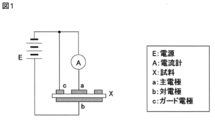
- the main electrode diameter d and the film sample thickness t were calculated using measured values at room temperature.
- Measurement equipment ULTRA HIGH RESISTANCE METER R8340A (made by ADC), TEST FIXTURE TR43C (manufactured by ADVANTEST)
- ⁇ Dimensions of film specimen 40mm ⁇ 40mm -Electrode shape: Main electrode; ⁇ 10mm Annular electrode; inner diameter ⁇ 13mm outer diameter ⁇ 26mm
- Counter electrode ⁇ 28mm -Electrode material: conductive paste for both main and counter electrodes-Ring electrode: metal electrode (gold plated product)
- Applied voltage 100V / 1 minute value
- Pretreatment C-90h / 22 ⁇ 1 °C / 60 ⁇ 5%
- Test temperature 125 ° C.
- the dielectric breakdown voltage test was performed 30 times, and the obtained value was divided by the film thickness ((1) above) and converted into (V / ⁇ m), and the maximum value among the measured values (calculated values) of 30 points in total.
- the average value of 20 points excluding 5 points from the largest to 5 and 5 points from the smallest to the smallest is defined as the film breakdown voltage B 125 in the 125 ° C. atmosphere. Further, in an oven maintained at 80 ° C., the film breakdown voltage was measured in the same manner and with B 80.
- the areas (m 15 and m 21 ) of diffraction profiles having peaks at 15 degrees and 21 degrees derived from the mesophase are calculated, and 14.1 degrees and 16 derived from the ⁇ crystal.
- Areas of diffraction profiles having peaks at .9 degrees, 18.6 degrees, 21.6 degrees and 21.9 degrees was calculated and calculated according to the following formula (3) to determine the ratio of the area of the profile derived from the mesophase, and this was defined as the mesophase fraction.
- the number average molecular weight (Mn) and the weight average molecular weight (Mw) are expressed by the following formulas (4) and (4) according to the molecular number (Ni) of the molecular weight (Mi) at each elution position of the GPC curve obtained through the molecular weight calibration curve. Defined in (5).
- Oxygen concentration measurement in hopper A zirconia oxygen concentration meter RF-400 manufactured by Toray Engineering Co., Ltd. was connected to the vicinity of the extruder inlet inside the extruder hopper, and the oxygen concentration in the hopper was measured.
- the capacitor element was wound up with an element winding machine (KAW-4NHB) manufactured by Minato Seisakusho, and after metallization, heat treatment was performed at 120 ° C. for 10 hours under reduced pressure, and the lead wires were connected. Finished with a mounted capacitor element.
- KAW-4NHB element winding machine
- Capacitor element film is not displaced or deformed, and there is no hindrance to the subsequent process.
- ⁇ Capacitor element film is slightly displaced or deformed, but there is no problem in the later process. Levels ⁇ and ⁇ that are large in deviation and deformation and interfere with subsequent processes can be used. In x, practical use is difficult.
- ⁇ 380 V / ⁇ m or more ⁇ : 360 V / ⁇ m or more and less than 380 V / ⁇ m ⁇ : 340 V / ⁇ m or more and less than 360 V / ⁇ m ⁇ : less than 340 V / ⁇ m ⁇ , ⁇ can be used. ⁇ and ⁇ are inferior in practical performance.
- ⁇ A change in the element shape is observed, or penetration destruction exceeding 10 layers is observed.
- ⁇ e half width of diffraction peak
- (measuring device) X-ray diffractometer manufactured by Rigaku Corporation 4036A2
- X-ray source CuK ⁇ ray (Ni filter used)
- Output 40kV-30mA -Goniometer 2155D type made by Rigaku Denki Co., Ltd.
- Slit 2mm ⁇ -1 ° -1 °
- Detector Scintillation counter / counting recording device RAD-C type manufactured by Rigaku Corporation
- Example 1 As a polypropylene resin for the A layer corresponding to the surface layer part of the A / B / A three-layer composite extrusion, the mesopentad fraction as a polypropylene is 0.985, the melting point is 167 ° C., and the melt flow rate (MFR) is 2.5 g / 10 minutes. 100 parts by mass of a polypropylene resin made by Prime Polymer Co., Ltd. and polymethylpentene resin “TPX” (registered trademark) MX002 (melting point: 224 ° C.) manufactured by Mitsui Chemicals Co., Ltd. were blended at a blending ratio of 4 parts by mass to 260 ° C.
- TPX polymethylpentene resin
- the polypropylene resin raw material (A1) is supplied to a uniaxial melt extruder for the A layer, and as a B layer polypropylene resin corresponding to the base layer portion, the mesopentad fraction is 0.985, the melting point is 167 ° C., 100 parts by mass of a polypropylene resin manufactured by Prime Polymer Co., Ltd. having a melt flow rate (MFR) of 2.5 g / 10 min is supplied to a single-screw melt extruder for the B layer, and each is subjected to melt extrusion at 250 ° C.
- MFR melt flow rate
- the film is guided to a tenter, stretched 10.8 times in the width direction at a temperature of 155 ° C., and then heat treated at 130 ° C. while giving 12% relaxation in the width direction as the first heat treatment and relaxation treatment, Further, as the second heat treatment, heat treatment was performed at 140 ° C. while being held in the width direction by the clip. Then guided through a cooling step at 100 ° C.
- Example 2 A polypropylene polymer manufactured by Prime Polymer Co., Ltd. having a mesopentad fraction of 0.985, a melting point of 167 ° C. and a melt flow rate (MFR) of 2.5 g / 10 min is supplied to an extruder at a temperature of 260 ° C. It is melt-extruded into a sheet form from a T-shaped slit die at 250 ° C., filtered through a 10 ⁇ m cut metal fiber sintered filter, and the molten sheet is closely adhered by an air knife on a casting drum maintained at 25 ° C., and then solidified by cooling. A stretched sheet was obtained. Next, the sheet was preheated to 115 ° C.
- Example 3 As a polypropylene resin for the A layer corresponding to the surface layer part of the A / B / A three-layer composite extrusion, the mesopentad fraction as a polypropylene is 0.983, the melting point is 167 ° C., and the melt flow rate (MFR) is 2.6 g / 10 minutes. 100 parts by mass of a polypropylene resin made by Prime Polymer Co., Ltd. and polymethylpentene resin “TPX” (registered trademark) MX002 (melting point: 224 ° C.) manufactured by Mitsui Chemicals Co., Ltd. were blended at a blending ratio of 4 parts by mass to 260 ° C.
- TPX polymethylpentene resin
- the polypropylene resin raw material (A1) is supplied to a uniaxial melt extruder for the A layer, and as the B layer polypropylene resin corresponding to the base layer, the mesopentad fraction is 0.983, the melting point is 167 ° C., 100 parts by mass of a polypropylene resin manufactured by Prime Polymer Co., Ltd. having a melt flow rate (MFR) of 2.6 g / 10 min is supplied to a uniaxial melt extruder for the B layer, and each is subjected to melt extrusion at 250 ° C.
- MFR melt flow rate
- the film was guided to a tenter, stretched 10.5 times in the width direction at a temperature of 157 ° C., and then heat treated at 136 ° C. while giving 10% relaxation in the width direction as the first heat treatment and relaxation treatment, Further, as the second stage heat treatment, heat treatment was performed at 150 ° C. while being held in the width direction by the clip.
- the film is guided to the outside of the tenter through a cooling step at 100 ° C., the clip at the end of the film is released, and then the corona discharge treatment is performed on the film surface (casting drum contact surface side) at a treatment intensity of 25 W ⁇ min / m 2 in the atmosphere.
- the film having a film thickness of 2.2 ⁇ m was wound up as a film roll.
- the characteristics of the biaxially oriented polypropylene film of this example and the capacitor characteristics are as shown in Table 1.
- Example 4 A polypropylene polymer manufactured by Prime Polymer Co., Ltd. having a mesopentad fraction of 0.983, a melting point of 167 ° C. and a melt flow rate (MFR) of 2.6 g / 10 minutes is supplied to an extruder at a temperature of 265 ° C. It is melt-extruded into a sheet from a T-shaped slit die at 265 ° C., filtered through a 15 ⁇ m cut metal fiber sintered filter, and the molten sheet is closely adhered to an air knife on a casting drum maintained at 27 ° C., cooled and solidified. A stretched sheet was obtained. Next, the sheet was preheated to 105 ° C.
- the film was led to a tenter, stretched 9.5 times in the width direction at a temperature of 153 ° C., and then heat-treated at 137 ° C. while giving 11% relaxation in the width direction as the first heat treatment and relaxation treatment, Further, as the second heat treatment, heat treatment was performed at 149 ° C. while being held in the width direction by the clip.
- the film is guided to the outside of the tenter through a cooling step at 100 ° C., the clip at the end of the film is released, and then the corona discharge treatment is performed on the film surface (casting drum contact surface side) at a treatment intensity of 25 W ⁇ min / m 2 in the atmosphere.
- the film having a film thickness of 2.9 ⁇ m was wound up as a film roll.
- the characteristics of the biaxially oriented polypropylene film of this example and the capacitor characteristics are as shown in Table 1.
- Example 5 Prime Polymer Co., Ltd. polypropylene resin having a mesopentad fraction of 0.978, a melting point of 166 ° C., and a melt flow rate (MFR) of 4.0 g / 10 min is fed to an extruder at a temperature of 260 ° C. It is melt-extruded into a sheet form from a T-shaped slit die at 250 ° C., filtered through a 15 ⁇ m-cut metal fiber sintered filter, and the molten sheet is closely contacted with an air knife on a casting drum maintained at 28 ° C., and is cooled and solidified. A stretched sheet was obtained. Next, the sheet was preheated to 130 ° C.
- the film is guided to a tenter, stretched 8.8 times in the width direction at a temperature of 155 ° C., and then heat treated at 130 ° C. while giving 12% relaxation in the width direction as the first heat treatment and relaxation treatment, Further, as the second heat treatment, heat treatment was performed at 140 ° C. while being held in the width direction by the clip.
- the film is guided to the outside of the tenter through a cooling step at 100 ° C., the clip at the end of the film is released, and then the corona discharge treatment is performed on the film surface (casting drum contact surface side) at a treatment intensity of 25 W ⁇ min / m 2 in the atmosphere.
- the film having a film thickness of 2.1 ⁇ m was wound up as a film roll.
- the characteristics of the biaxially oriented polypropylene film of this example and the capacitor characteristics are as shown in Table 1.
- the film is guided to a tenter, stretched 10 times in the width direction at a temperature of 150 ° C., and then heat treated at 140 ° C. while giving 6% relaxation in the width direction as the first stage heat treatment and relaxation treatment. Heat treatment was performed at 140 ° C. while being held in the width direction.
- the film is guided to the outside of the tenter through a cooling step at 100 ° C., the clip at the end of the film is released, and then the corona discharge treatment is performed on the film surface (casting drum contact surface side) at a treatment intensity of 25 W ⁇ min / m 2 in the atmosphere.
- the film having a film thickness of 2.5 ⁇ m was wound up as a film roll.
- the characteristics and capacitor characteristics of the biaxially oriented polypropylene film of this comparative example are as shown in Table 1.
- Comparative Example 2 A polypropylene resin manufactured by Prime Polymer Co., Ltd. having a mesopentad fraction of 0.978 and a melt flow rate (MFR) of 4.0 g / 10 min is supplied to an extruder having a temperature of 260 ° C., and a T-shaped slit at a resin temperature of 250 ° C. It was melt-extruded into a sheet form from a die, filtered through a 30 ⁇ m cut metal fiber sintered filter, and the molten sheet was brought into close contact with an air knife on a casting drum maintained at 90 ° C. to be cooled and solidified to obtain an unstretched sheet. Next, the sheet was preheated to 135 ° C.
- the film was guided to a tenter, stretched 10 times in the width direction at a temperature of 165 ° C., and then heat-treated at 165 ° C. while giving 8% relaxation in the width direction as the first heat treatment and relaxation treatment.
- the film is guided to the outside of the tenter through a cooling step at 100 ° C., the clip at the end of the film is released, and then the corona discharge treatment is performed on the film surface (casting drum contact surface side) at a treatment intensity of 25 W ⁇ min / m 2 in the atmosphere.
- the film having a film thickness of 2.9 ⁇ m was wound up as a film roll.
- the characteristics and capacitor characteristics of the biaxially oriented polypropylene film of this comparative example are as shown in Table 1.
- the wide-angle X-ray diffraction profile of the unstretched film of Comparative Example 2 is shown in FIG.
- the sheet was preheated to 105 ° C. by a plurality of roll groups, and subsequently passed through rolls maintained at a temperature of 105 ° C. and provided with a difference in peripheral speed, and stretched 4.2 times in the longitudinal direction.
- the film is guided to a tenter, stretched 8.8 times in the width direction at a temperature of 155 ° C., and then heat-treated at 130 ° C. while giving a relaxation of 16% in the width direction as the first stage heat treatment and relaxation treatment.
- heat treatment was performed at 140 ° C. while being held in the width direction by the clip.
- the film is guided to the outside of the tenter through a cooling step at 100 ° C., the clip at the end of the film is released, and then the corona discharge treatment is performed on the film surface (casting drum contact surface side) at a treatment intensity of 25 W ⁇ min / m 2 in the atmosphere.
- the film having a film thickness of 2.7 ⁇ m was wound up as a film roll.
- the characteristics and capacitor characteristics of the biaxially oriented polypropylene film of this comparative example are as shown in Table 1.
- the sheet was brought into close contact with an air knife on a casting drum maintained at 40 ° C. and cooled and solidified to obtain an unstretched sheet.
- the sheet was preheated to 110 ° C. by a plurality of roll groups, and subsequently passed between rolls maintained at a temperature of 110 ° C. and provided with a difference in peripheral speed, and stretched 5.8 times in the longitudinal direction.
- the film was guided to a tenter, stretched 10.5 times in the width direction at a temperature of 155 ° C., and then heat-treated at 165 ° C. while giving 2% relaxation in the width direction as the first heat treatment and relaxation treatment. .
- the film is guided to the outside of the tenter through a cooling step at 100 ° C., the clip at the end of the film is released, and then the corona discharge treatment is performed on the film surface (casting drum contact surface side) at a treatment intensity of 25 W ⁇ min / m 2 in the atmosphere.
- the film having a film thickness of 2.9 ⁇ m was wound up as a film roll.
- the characteristics and capacitor characteristics of the biaxially oriented polypropylene film of this comparative example are as shown in Table 1.
Landscapes
- Engineering & Computer Science (AREA)
- Manufacturing & Machinery (AREA)
- Chemical & Material Sciences (AREA)
- Power Engineering (AREA)
- Mechanical Engineering (AREA)
- Chemical Kinetics & Catalysis (AREA)
- Microelectronics & Electronic Packaging (AREA)
- Polymers & Plastics (AREA)
- Materials Engineering (AREA)
- Health & Medical Sciences (AREA)
- Medicinal Chemistry (AREA)
- Organic Chemistry (AREA)
- Physics & Mathematics (AREA)
- Thermal Sciences (AREA)
- Spectroscopy & Molecular Physics (AREA)
- Fixed Capacitors And Capacitor Manufacturing Machines (AREA)
- Manufacture Of Macromolecular Shaped Articles (AREA)
- Shaping By String And By Release Of Stress In Plastics And The Like (AREA)
Abstract
Priority Applications (4)
| Application Number | Priority Date | Filing Date | Title |
|---|---|---|---|
| EP17766111.3A EP3431530A4 (fr) | 2016-03-17 | 2017-02-03 | Film de polypropylène à orientation biaxiale, film stratifié de film métallique, et condensateur à film |
| KR1020187019238A KR20180126448A (ko) | 2016-03-17 | 2017-02-03 | 2축 배향 폴리프로필렌 필름, 금속막 적층 필름 및 필름 콘덴서 |
| JP2017510686A JP7135320B2 (ja) | 2016-03-17 | 2017-02-03 | 二軸配向ポリプロピレンフィルム、金属膜積層フィルムおよびフィルムコンデンサ |
| CN201780011080.2A CN108699265B (zh) | 2016-03-17 | 2017-02-03 | 双轴取向聚丙烯薄膜、金属膜层叠薄膜和薄膜电容器 |
Applications Claiming Priority (2)
| Application Number | Priority Date | Filing Date | Title |
|---|---|---|---|
| JP2016053682 | 2016-03-17 | ||
| JP2016-053682 | 2016-03-17 |
Publications (1)
| Publication Number | Publication Date |
|---|---|
| WO2017159103A1 true WO2017159103A1 (fr) | 2017-09-21 |
Family
ID=59852063
Family Applications (1)
| Application Number | Title | Priority Date | Filing Date |
|---|---|---|---|
| PCT/JP2017/003894 Ceased WO2017159103A1 (fr) | 2016-03-17 | 2017-02-03 | Film de polypropylène à orientation biaxiale, film stratifié de film métallique, et condensateur à film |
Country Status (5)
| Country | Link |
|---|---|
| EP (1) | EP3431530A4 (fr) |
| JP (1) | JP7135320B2 (fr) |
| KR (1) | KR20180126448A (fr) |
| CN (1) | CN108699265B (fr) |
| WO (1) | WO2017159103A1 (fr) |
Cited By (7)
| Publication number | Priority date | Publication date | Assignee | Title |
|---|---|---|---|---|
| CN110997764A (zh) * | 2017-08-02 | 2020-04-10 | 王子控股株式会社 | 聚丙烯薄膜、金属层一体型聚丙烯薄膜和薄膜电容器 |
| CN112534527A (zh) * | 2018-08-20 | 2021-03-19 | 株式会社村田制作所 | 薄膜电容器、薄膜电容器用薄膜及薄膜电容器用薄膜的制造方法 |
| WO2021193507A1 (fr) * | 2020-03-24 | 2021-09-30 | 東洋紡株式会社 | Procédé de production de film de polypropylène à orientation biaxiale |
| KR20210130714A (ko) | 2019-02-21 | 2021-11-01 | 도레이 카부시키가이샤 | 폴리프로필렌 필름 및 이것을 사용한 금속막 적층 필름, 필름 콘덴서 |
| US11342116B2 (en) | 2017-08-02 | 2022-05-24 | Oji Holdings Corporation | Polypropylene film, metal layer-integrated polypropylene film, and film capacitor |
| WO2022210688A1 (fr) * | 2021-03-31 | 2022-10-06 | 東レ株式会社 | Film de polypropylène |
| WO2022210693A1 (fr) * | 2021-03-31 | 2022-10-06 | 東レ株式会社 | Film de polypropylène |
Families Citing this family (6)
| Publication number | Priority date | Publication date | Assignee | Title |
|---|---|---|---|---|
| JP7722351B2 (ja) * | 2020-02-12 | 2025-08-13 | 王子ホールディングス株式会社 | ポリプロピレンフィルム、金属層一体型ポリプロピレンフィルム及びフィルムコンデンサ |
| TWI871450B (zh) * | 2020-03-24 | 2025-02-01 | 日商東洋紡股份有限公司 | 雙軸配向聚丙烯膜 |
| KR20230109133A (ko) * | 2020-11-17 | 2023-07-19 | 오지 홀딩스 가부시키가이샤 | 폴리프로필렌 필름, 금속층 일체형 폴리프로필렌 필름 및 필름 콘덴서 |
| EP4324642A4 (fr) * | 2021-04-12 | 2025-08-13 | Oji Holdings Corp | Film de polypropylène métallisé |
| US20230065268A1 (en) * | 2021-08-24 | 2023-03-02 | Eaton Intelligent Power Limited | Dielectric nanofluid for a capacitor system |
| CA3246795A1 (fr) * | 2022-01-06 | 2025-07-10 | Tsinghua University | Film diélectrique de polypropylène à orientation biaxiale, matériau de polypropylène modifié et utilisation associée |
Citations (13)
| Publication number | Priority date | Publication date | Assignee | Title |
|---|---|---|---|---|
| JPS5577567A (en) * | 1978-11-29 | 1980-06-11 | Hoechst Ag | Combined twooaxissextended polypropylene film for electric insulation |
| JPH01166955A (ja) * | 1987-11-28 | 1989-06-30 | Hoechst Ag | 同時押出しされた二軸延伸多層フイルム及びこれよりなる電気絶縁フイルム |
| JPH04163042A (ja) * | 1990-10-24 | 1992-06-08 | Toray Ind Inc | 電気物品用ポリプロピレンフィルム |
| JPH1053655A (ja) | 1996-08-09 | 1998-02-24 | Toray Ind Inc | 二軸配向ポリプロピレンフィルムおよびそれからなるフィルムコンデンサー |
| JP2001250738A (ja) * | 2000-03-03 | 2001-09-14 | Toray Ind Inc | コンデンサ用ポリプロピレンフィルム及びそれを用いたコンデンサ |
| JP2004161799A (ja) * | 2002-11-08 | 2004-06-10 | Toray Ind Inc | 二軸延伸ポリプロピレンフィルム |
| JP2007084813A (ja) * | 2005-08-26 | 2007-04-05 | Toray Ind Inc | ポリプロピレンフィルムおよびその製造方法 |
| WO2009060944A1 (fr) * | 2007-11-07 | 2009-05-14 | Oji Paper Co., Ltd. | Film de polypropylène à orientation biaxiale pour condensateur, film revêtu par dépôt obtenu à partir de celui-ci, et condensateur utilisant celui-ci |
| JP2010501712A (ja) * | 2006-08-31 | 2010-01-21 | トレオファン・ジャーマニー・ゲーエムベーハー・ウント・コンパニー・カーゲー | 二軸延伸電気絶縁フィルム |
| JP2012209541A (ja) | 2011-03-17 | 2012-10-25 | Toray Ind Inc | コンデンサ用二軸延伸ポリプロピレンフィルム、金属化フィルムおよびフィルムコンデンサ |
| JP2014231584A (ja) * | 2013-05-30 | 2014-12-11 | 王子ホールディングス株式会社 | コンデンサー用二軸延伸ポリプロピレンフィルム |
| JP2015201610A (ja) * | 2014-03-31 | 2015-11-12 | 王子ホールディングス株式会社 | コンデンサ用二軸延伸ポリプロピレンフィルム |
| JP2016033211A (ja) * | 2014-07-30 | 2016-03-10 | 東レ株式会社 | ポリプロピレンフィルム |
Family Cites Families (10)
| Publication number | Priority date | Publication date | Assignee | Title |
|---|---|---|---|---|
| DE3831355A1 (de) * | 1988-09-15 | 1990-03-29 | Hoechst Ag | Hochleistungsdielektrikumsfolie mit verbesserter thermostabilitaet |
| JP3654541B2 (ja) * | 1995-11-29 | 2005-06-02 | 東レ株式会社 | 耐熱性コンデンサ用ポリプロピレンフィルム |
| WO2007094072A1 (fr) * | 2006-02-17 | 2007-08-23 | Toray Industries, Inc. | Film polypropylène à orientation biaxiale |
| KR100779040B1 (ko) * | 2006-04-05 | 2007-11-28 | 삼영화학공업주식회사 | 커패시터용 초박막 내열성 폴리프로필렌 유전필름의 제조방법 |
| JP2008265267A (ja) * | 2007-03-29 | 2008-11-06 | Toray Ind Inc | 感熱孔版用ポリプロピレンフイルム及びこれからなる感熱孔版原紙 |
| JP6052032B2 (ja) * | 2013-04-15 | 2016-12-27 | 王子ホールディングス株式会社 | 二軸延伸ポリプロピレンフィルム |
| JP6477472B2 (ja) * | 2013-07-23 | 2019-03-06 | 東洋紡株式会社 | 延伸ポリプロピレンフィルム |
| KR102362230B1 (ko) * | 2014-03-28 | 2022-02-11 | 도레이 카부시키가이샤 | 2축 배향 폴리프로필렌 필름 |
| JP6070864B2 (ja) * | 2014-09-19 | 2017-02-01 | 東レ株式会社 | ポリプロピレンフィルムおよびフィルムコンデンサ |
| JP6874373B2 (ja) * | 2015-05-12 | 2021-05-19 | 東レ株式会社 | ポリプロピレンフィルム、金属膜積層フィルムおよびフィルムコンデンサ並びにそれらの製造方法 |
-
2017
- 2017-02-03 KR KR1020187019238A patent/KR20180126448A/ko not_active Ceased
- 2017-02-03 EP EP17766111.3A patent/EP3431530A4/fr active Pending
- 2017-02-03 CN CN201780011080.2A patent/CN108699265B/zh active Active
- 2017-02-03 JP JP2017510686A patent/JP7135320B2/ja active Active
- 2017-02-03 WO PCT/JP2017/003894 patent/WO2017159103A1/fr not_active Ceased
Patent Citations (13)
| Publication number | Priority date | Publication date | Assignee | Title |
|---|---|---|---|---|
| JPS5577567A (en) * | 1978-11-29 | 1980-06-11 | Hoechst Ag | Combined twooaxissextended polypropylene film for electric insulation |
| JPH01166955A (ja) * | 1987-11-28 | 1989-06-30 | Hoechst Ag | 同時押出しされた二軸延伸多層フイルム及びこれよりなる電気絶縁フイルム |
| JPH04163042A (ja) * | 1990-10-24 | 1992-06-08 | Toray Ind Inc | 電気物品用ポリプロピレンフィルム |
| JPH1053655A (ja) | 1996-08-09 | 1998-02-24 | Toray Ind Inc | 二軸配向ポリプロピレンフィルムおよびそれからなるフィルムコンデンサー |
| JP2001250738A (ja) * | 2000-03-03 | 2001-09-14 | Toray Ind Inc | コンデンサ用ポリプロピレンフィルム及びそれを用いたコンデンサ |
| JP2004161799A (ja) * | 2002-11-08 | 2004-06-10 | Toray Ind Inc | 二軸延伸ポリプロピレンフィルム |
| JP2007084813A (ja) * | 2005-08-26 | 2007-04-05 | Toray Ind Inc | ポリプロピレンフィルムおよびその製造方法 |
| JP2010501712A (ja) * | 2006-08-31 | 2010-01-21 | トレオファン・ジャーマニー・ゲーエムベーハー・ウント・コンパニー・カーゲー | 二軸延伸電気絶縁フィルム |
| WO2009060944A1 (fr) * | 2007-11-07 | 2009-05-14 | Oji Paper Co., Ltd. | Film de polypropylène à orientation biaxiale pour condensateur, film revêtu par dépôt obtenu à partir de celui-ci, et condensateur utilisant celui-ci |
| JP2012209541A (ja) | 2011-03-17 | 2012-10-25 | Toray Ind Inc | コンデンサ用二軸延伸ポリプロピレンフィルム、金属化フィルムおよびフィルムコンデンサ |
| JP2014231584A (ja) * | 2013-05-30 | 2014-12-11 | 王子ホールディングス株式会社 | コンデンサー用二軸延伸ポリプロピレンフィルム |
| JP2015201610A (ja) * | 2014-03-31 | 2015-11-12 | 王子ホールディングス株式会社 | コンデンサ用二軸延伸ポリプロピレンフィルム |
| JP2016033211A (ja) * | 2014-07-30 | 2016-03-10 | 東レ株式会社 | ポリプロピレンフィルム |
Non-Patent Citations (3)
| Title |
|---|
| MATERIAL LIFE, vol. 9, no. 4, 1997, pages 180 - 187 |
| NIKKEI ELECTRONICS, 17 September 2012 (2012-09-17), pages 57 - 62 |
| See also references of EP3431530A4 |
Cited By (14)
| Publication number | Priority date | Publication date | Assignee | Title |
|---|---|---|---|---|
| CN110997764A (zh) * | 2017-08-02 | 2020-04-10 | 王子控股株式会社 | 聚丙烯薄膜、金属层一体型聚丙烯薄膜和薄膜电容器 |
| US11342116B2 (en) | 2017-08-02 | 2022-05-24 | Oji Holdings Corporation | Polypropylene film, metal layer-integrated polypropylene film, and film capacitor |
| CN112534527B (zh) * | 2018-08-20 | 2023-06-23 | 株式会社村田制作所 | 薄膜电容器用薄膜的制造方法 |
| CN112534527A (zh) * | 2018-08-20 | 2021-03-19 | 株式会社村田制作所 | 薄膜电容器、薄膜电容器用薄膜及薄膜电容器用薄膜的制造方法 |
| EP3809432A4 (fr) * | 2018-08-20 | 2022-04-06 | Murata Manufacturing Co., Ltd. | Condensateur à film, film pour condensateur à film et procédé de fabrication de film pour condensateur à film |
| US12202958B2 (en) | 2019-02-21 | 2025-01-21 | Toray Industries, Inc. | Polypropylene film, metal layer laminated film using polypropylene film, and film capacitor |
| KR20210130714A (ko) | 2019-02-21 | 2021-11-01 | 도레이 카부시키가이샤 | 폴리프로필렌 필름 및 이것을 사용한 금속막 적층 필름, 필름 콘덴서 |
| JPWO2021193507A1 (fr) * | 2020-03-24 | 2021-09-30 | ||
| JP7563386B2 (ja) | 2020-03-24 | 2024-10-08 | 東洋紡株式会社 | 二軸配向ポリプロピレンフィルムの製造方法 |
| WO2021193507A1 (fr) * | 2020-03-24 | 2021-09-30 | 東洋紡株式会社 | Procédé de production de film de polypropylène à orientation biaxiale |
| WO2022210693A1 (fr) * | 2021-03-31 | 2022-10-06 | 東レ株式会社 | Film de polypropylène |
| JPWO2022210693A1 (fr) * | 2021-03-31 | 2022-10-06 | ||
| WO2022210688A1 (fr) * | 2021-03-31 | 2022-10-06 | 東レ株式会社 | Film de polypropylène |
| US12570815B2 (en) | 2021-03-31 | 2026-03-10 | Toray Industries, Inc. | Polypropylene film |
Also Published As
| Publication number | Publication date |
|---|---|
| CN108699265A (zh) | 2018-10-23 |
| JP7135320B2 (ja) | 2022-09-13 |
| KR20180126448A (ko) | 2018-11-27 |
| EP3431530A4 (fr) | 2019-11-20 |
| JPWO2017159103A1 (ja) | 2019-01-17 |
| CN108699265B (zh) | 2022-02-11 |
| EP3431530A1 (fr) | 2019-01-23 |
Similar Documents
| Publication | Publication Date | Title |
|---|---|---|
| JP7173202B2 (ja) | ポリプロピレンフィルム、金属膜積層フィルムおよびフィルムコンデンサ並びにそれらの製造方法 | |
| JP7135320B2 (ja) | 二軸配向ポリプロピレンフィルム、金属膜積層フィルムおよびフィルムコンデンサ | |
| JP7088019B2 (ja) | ポリプロピレンフィルム、金属膜積層フィルムおよびフィルムコンデンサ並びにそれらの製造方法 | |
| JP6160782B2 (ja) | オレフィン系積層フィルムおよびフィルムコンデンサ | |
| JP6070864B2 (ja) | ポリプロピレンフィルムおよびフィルムコンデンサ | |
| CN106574061B (zh) | 聚丙烯膜和膜电容器 | |
| WO2019044758A1 (fr) | Film de polypropylène, film métallisé et condensateur à film | |
| JP6314509B2 (ja) | コンデンサ素子の製造方法 | |
| JP6926827B2 (ja) | オレフィン系積層フィルムおよびフィルムコンデンサ | |
| WO2020040127A1 (fr) | Film de polypropylène, film stratifié à membrane métallique le mettant en œuvre, et condensateur à film | |
| EP3922436B1 (fr) | Film de polypropylène, film métallisé utilisant le film de polypropylène, et condensateur à film | |
| JP2016188360A (ja) | 二軸配向ポリプロピレンフィルム、金属膜積層フィルムおよびフィルムコンデンサ | |
| JP2019172921A (ja) | ポリプロピレンフィルム、金属膜積層フィルムおよびフィルムコンデンサ | |
| JP6992929B1 (ja) | ポリプロピレンフィルム、それを用いた金属膜積層フィルムおよびフィルムコンデンサ | |
| WO2021166993A1 (fr) | Film de polypropylène, film stratifié à membrane métallique, et condensateur à film | |
| JP6885484B2 (ja) | ポリプロピレンフィルムおよびこれを用いた金属膜積層フィルム、フィルムコンデンサ | |
| JP7318187B2 (ja) | ポリプロピレンフィルム、金属膜積層フィルムおよびフィルムコンデンサ | |
| JP7247919B2 (ja) | ポリプロピレンフィルムおよびこれを用いた金属膜積層フィルム、フィルムコンデンサ | |
| JP2021134352A (ja) | ポリプロピレンフィルム、それを用いた金属膜積層フィルムおよびフィルムコンデンサ | |
| JP7247918B2 (ja) | ポリプロピレンフィルムおよびこれを用いた金属膜積層フィルム、フィルムコンデンサ |
Legal Events
| Date | Code | Title | Description |
|---|---|---|---|
| ENP | Entry into the national phase |
Ref document number: 2017510686 Country of ref document: JP Kind code of ref document: A |
|
| ENP | Entry into the national phase |
Ref document number: 20187019238 Country of ref document: KR Kind code of ref document: A |
|
| NENP | Non-entry into the national phase |
Ref country code: DE |
|
| WWE | Wipo information: entry into national phase |
Ref document number: 2017766111 Country of ref document: EP |
|
| ENP | Entry into the national phase |
Ref document number: 2017766111 Country of ref document: EP Effective date: 20181017 |
|
| 121 | Ep: the epo has been informed by wipo that ep was designated in this application |
Ref document number: 17766111 Country of ref document: EP Kind code of ref document: A1 |