WO2017164307A1 - Structure de montage - Google Patents
Structure de montage Download PDFInfo
- Publication number
- WO2017164307A1 WO2017164307A1 PCT/JP2017/011726 JP2017011726W WO2017164307A1 WO 2017164307 A1 WO2017164307 A1 WO 2017164307A1 JP 2017011726 W JP2017011726 W JP 2017011726W WO 2017164307 A1 WO2017164307 A1 WO 2017164307A1
- Authority
- WO
- WIPO (PCT)
- Prior art keywords
- insertion hole
- mounting structure
- positioning
- claw
- region
- Prior art date
- Legal status (The legal status is an assumption and is not a legal conclusion. Google has not performed a legal analysis and makes no representation as to the accuracy of the status listed.)
- Ceased
Links
Images






Classifications
-
- G—PHYSICS
- G10—MUSICAL INSTRUMENTS; ACOUSTICS
- G10H—ELECTROPHONIC MUSICAL INSTRUMENTS; INSTRUMENTS IN WHICH THE TONES ARE GENERATED BY ELECTROMECHANICAL MEANS OR ELECTRONIC GENERATORS, OR IN WHICH THE TONES ARE SYNTHESISED FROM A DATA STORE
- G10H1/00—Details of electrophonic musical instruments
- G10H1/32—Constructional details
- G10H1/34—Switch arrangements, e.g. keyboards or mechanical switches specially adapted for electrophonic musical instruments
- G10H1/344—Structural association with individual keys
- G10H1/346—Keys with an arrangement for simulating the feeling of a piano key, e.g. using counterweights, springs, cams
-
- F—MECHANICAL ENGINEERING; LIGHTING; HEATING; WEAPONS; BLASTING
- F16—ENGINEERING ELEMENTS AND UNITS; GENERAL MEASURES FOR PRODUCING AND MAINTAINING EFFECTIVE FUNCTIONING OF MACHINES OR INSTALLATIONS; THERMAL INSULATION IN GENERAL
- F16B—DEVICES FOR FASTENING OR SECURING CONSTRUCTIONAL ELEMENTS OR MACHINE PARTS TOGETHER, e.g. NAILS, BOLTS, CIRCLIPS, CLAMPS, CLIPS OR WEDGES; JOINTS OR JOINTING
- F16B5/00—Joining sheets or plates, e.g. panels, to one another or to strips or bars parallel to them
- F16B5/07—Joining sheets or plates, e.g. panels, to one another or to strips or bars parallel to them by means of multiple interengaging protrusions on the surfaces, e.g. hooks, coils
-
- F—MECHANICAL ENGINEERING; LIGHTING; HEATING; WEAPONS; BLASTING
- F16—ENGINEERING ELEMENTS AND UNITS; GENERAL MEASURES FOR PRODUCING AND MAINTAINING EFFECTIVE FUNCTIONING OF MACHINES OR INSTALLATIONS; THERMAL INSULATION IN GENERAL
- F16B—DEVICES FOR FASTENING OR SECURING CONSTRUCTIONAL ELEMENTS OR MACHINE PARTS TOGETHER, e.g. NAILS, BOLTS, CIRCLIPS, CLAMPS, CLIPS OR WEDGES; JOINTS OR JOINTING
- F16B5/00—Joining sheets or plates, e.g. panels, to one another or to strips or bars parallel to them
- F16B5/10—Joining sheets or plates, e.g. panels, to one another or to strips or bars parallel to them by means of bayonet connections
-
- G—PHYSICS
- G10—MUSICAL INSTRUMENTS; ACOUSTICS
- G10B—ORGANS, HARMONIUMS OR SIMILAR WIND MUSICAL INSTRUMENTS WITH ASSOCIATED BLOWING APPARATUS
- G10B3/00—Details or accessories
- G10B3/12—Keys or keyboards; Manuals
-
- G—PHYSICS
- G10—MUSICAL INSTRUMENTS; ACOUSTICS
- G10H—ELECTROPHONIC MUSICAL INSTRUMENTS; INSTRUMENTS IN WHICH THE TONES ARE GENERATED BY ELECTROMECHANICAL MEANS OR ELECTRONIC GENERATORS, OR IN WHICH THE TONES ARE SYNTHESISED FROM A DATA STORE
- G10H1/00—Details of electrophonic musical instruments
- G10H1/32—Constructional details
- G10H1/34—Switch arrangements, e.g. keyboards or mechanical switches specially adapted for electrophonic musical instruments
Definitions
- the present invention relates to a mounting structure that couples parts using the elasticity of a material.
- the present invention relates to a key mounting structure of a keyboard device.
- Patent Document 1 proposes an attachment structure for a printed wiring board.
- Patent Document 1 since the mounting structure proposed in Patent Document 1 does not take into account variations in component dimensions, components may unintentionally be separated due to variations in component dimensions, or components may be mounted together. May become difficult. In Patent Document 1, an attempt is made to improve the mounting accuracy by using a positioning pin. However, the above-described variation in component dimensions causes a decrease in positioning accuracy.
- An object according to one aspect of the present invention is to provide a mounting structure with improved positioning accuracy during mounting.
- An attachment structure includes a first member including a flexible part, an attachment part having a claw part provided at one end of the flexible part, and a positioning part connected to the flexible part, A first insertion hole into which the attachment portion is inserted, and a second member including a second insertion hole into which the positioning portion is inserted, wherein the first insertion hole is formed with respect to the second member.
- the mounting portion penetrates in the direction in which the first member is attached, and the attachment portion projects the claw portion from the first insertion hole in a state where the first member is attached to the second member, and the first insertion hole
- the claw portion can be hooked on the peripheral edge of the opening, and when the first member is mounted on the second member, the positioning portion is tightened against the second insertion hole. It is fitted by fitting.
- the flexible part has a shape extending in one direction
- the positioning part has a shape extending in the same direction as the flexible part.
- a direction in which the flexible portion and the positioning portion are connected coincides with a direction in which the claw portion overlaps the second member.
- the positioning portion is configured to function so as to restrict movement of the mounting portion in a direction perpendicular to a direction in which the first member is mounted with respect to the second member. May be.
- the positioning portion is configured to mount the first member on the second member in a state where the first member is mounted on the second member. It may be configured to work so as to restrict movement.
- the positioning portion includes, in order from the rear end side in the insertion direction with respect to the second insertion hole, a first portion, a second portion that is narrower than the first portion, and the second portion.
- a third portion having a width smaller than that of the portion, and the second insertion hole has, in order from the rear end side in the insertion direction, a first region in which the second portion can be inserted, and a width larger than that of the first region.
- the upper end surface of the second portion of the positioning portion is the first region and the second region in the second insertion hole.
- You may be comprised so that the level
- the third portion of the positioning portion may have a cross shape in a cross section perpendicular to the insertion direction, and the second region of the second insertion hole has a cross section perpendicular to the insertion direction. May be circular, and in a state in which the first member is attached to the second member, each cross-shaped end portion of the third portion is configured to contact an inner wall surface of the second region. Good.
- the surface of the claw portion that contacts the opening peripheral portion of the second insertion hole slides relative to the opening peripheral portion in a direction in which the claw portion overlaps the second member.
- You may be comprised so that it may incline.
- the second member may have a notch that exposes a part of the second insertion hole.
- the second member has, for example, two protrusions at the end of the notch, and the two protrusions are sandwiched by a part of the first member, thereby expanding the notch. It may be configured to be regulated.
- the first member includes a plate-like member connected to the positioning portion, and in the state where the first member is attached to the second member, the plate-like member is You may be comprised so that it may arrange
- the keyboard device includes a frame, a plurality of keys extending in a longitudinal direction, and a plurality of connecting members that rotatably connect the keys to the frame.
- the connecting portion of the member and each key, and the connecting portion of each connecting member and the frame are configured by the mounting structure according to any one of the above forms.
- positioning accuracy at the time of mounting can be improved.
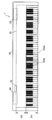
- FIG. 1 is a diagram illustrating a configuration of a keyboard device according to an embodiment.
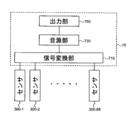
- FIG. 2 is a block diagram illustrating a configuration of the sound source device according to the embodiment.
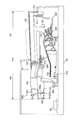
- Drawing 3 is a figure showing an example at the time of seeing the composition inside the case of an embodiment from the side.
- Drawing 4 is a figure showing an example at the time of seeing the composition of the structure containing the rod-shaped flexible part of an embodiment from the side.
- Drawing 5 is a figure showing an example at the time of seeing the composition of the attachment structure of an embodiment from the slanting upper part.
- Drawing 6 is a figure showing an example at the time of seeing composition of the 1st member of an embodiment from the slanting upper part.
- Drawing 7 is a figure showing an example at the time of seeing the composition of the 1st member of an embodiment from the side.
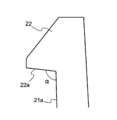
- Drawing 8A is a figure showing an example at the time of seeing the composition of the claw part of an embodiment from the side.
- Drawing 8B is a figure for explaining operation of a claw part of an embodiment.
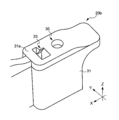
- Drawing 9 is a figure showing an example at the time of seeing composition of the 2nd member of an embodiment from the slanting upper part.
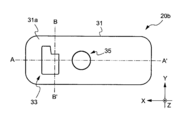
- Drawing 10 is a figure showing an example at the time of seeing composition of the 2nd member of an embodiment from the upper part.
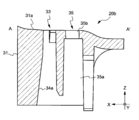
- 11 is a diagram illustrating an example of a cross section taken along line A-A ′ illustrated in FIG. 10 of the second member of the embodiment.
- FIG. 12 is a diagram illustrating an example of a cross section taken along line B-B ′ illustrated in FIG. 10 of the second member of the embodiment.
- Drawing 13 is a figure showing an example at the time of seeing the composition of the 2nd member of an embodiment from the back.
- Drawing 14 is a figure showing an example at the time of seeing composition of an attachment structure of an embodiment from back.
- Drawing 15 is a figure showing an example at the time of seeing composition of an attachment structure of an embodiment from the upper part.
- FIG. 16 is a diagram illustrating an example of a cross section taken along line A-A ′ illustrated in FIG. 10 of the mounting structure of the embodiment.
- FIG. 17A is a diagram illustrating an example of a claw portion according to a modification.
- FIG. 17B is a diagram illustrating an example of a main body according to a modification.
- FIG. 18 is a diagram illustrating an example when the configuration of the first member according to the modification is viewed obliquely from above.
- FIG. 19 is a diagram illustrating an example of the structure of the mounting structure according to the modification as viewed from the rear and obliquely above.
- FIG. 20 is a view showing an example of a cross section corresponding to the line A-A ′ shown in FIG. 10 of the mounting structure according to the modification.
- FIG. 1 is a diagram illustrating a configuration of a keyboard device according to an embodiment.
- the keyboard device 1 is an electronic keyboard instrument that emits sound in response to a user (player) key depression such as an electronic piano.
- the keyboard device 1 may be a keyboard-type controller that outputs control data (for example, MIDI) for controlling an external sound source device in response to a key depression.
- control data for example, MIDI
- the keyboard device 1 may not have a sound source device.
- the keyboard device 1 includes a keyboard assembly 10.
- the keyboard assembly 10 includes a plurality of keys 100 extending in the longitudinal direction.
- the plurality of keys 100 include a plurality of white keys 100w and a plurality of black keys 100b.
- the plurality of white keys 100w and the plurality of black keys 100b are arranged side by side. This arranged direction is called a scale direction.
- the number of keys 100 is 88.
- the number of keys 100 is not limited to such an example, and may be appropriately determined according to the embodiment.
- the white key 100w and the black key 100b are described without particular distinction, they may be simply referred to as “key 100”.
- “w” is added at the end of the reference sign, it means that the structure corresponds to the white key.
- “b” is appended to the end of the code, it means that the configuration corresponds to the black key.
- a part of the keyboard assembly 10 exists inside the housing 90.
- a portion of the keyboard assembly 10 covered by the casing 90 is referred to as a non-appearance portion NV, and a portion exposed from the casing 90 and visible to the user is referred to as an appearance portion PV.
- the appearance part PV is a part of the key 100 and indicates an area where the user can perform a performance operation.
- a portion of the key 100 that is exposed by the appearance portion PV may be referred to as a key body portion.
- a sound source device 70 and a speaker 80 are arranged inside the housing 90.
- the tone generator 70 generates a sound waveform signal when the key 100 is pressed.
- the speaker 80 outputs the sound waveform signal generated in the sound source device 70 to an external space.
- the keyboard device 1 may be provided with a slider for controlling the volume, a switch for switching timbres, a display for displaying various information, and the like.
- directions such as up, down, left, right, front, and back indicate directions when the keyboard device 1 is viewed from the performer when performing. Therefore, for example, the non-appearance part NV can be expressed as being located on the back side with respect to the appearance part PV. Further, the direction may be indicated with the key 100 as a reference, such as the key front end side and the key rear end side. In this case, the key front end side indicates the front side as viewed from the performer with respect to the key 100. The rear end side of the key indicates the back side viewed from the performer with respect to the key 100.
- the black key 100b can be expressed as a portion protruding upward from the white key 100w from the front end to the rear end of the key body of the black key 100b.
- FIG. 2 is a block diagram illustrating a configuration of the sound source device according to the embodiment.
- the sound source device 70 includes a signal conversion unit 710, a sound source unit 730, and an output unit 750.
- the sensor 300 is provided corresponding to each key 100, detects a key operation, and outputs a signal corresponding to the detected content. In this example, the sensor 300 outputs a signal according to the key depression amount in three stages. The key pressing speed can be detected according to the interval of this signal.
- the signal conversion unit 710 acquires the output signal of the sensor 300 (sensors 300-1, 300-2,..., 300-88 corresponding to the 88 key 100), and operates according to the operation state of each key 100. Generate and output a signal.
- the operation signal is a MIDI signal. Therefore, the signal conversion unit 710 outputs note-on according to the key pressing operation. At this time, the key number indicating which of the 88 keys 100 has been operated and the velocity corresponding to the key pressing speed are also output in association with the note-on.
- the signal conversion unit 710 outputs the key number and note-off in association with each other.
- a signal corresponding to another operation such as a pedal may be input to the signal conversion unit 710 and reflected in the operation signal.
- the sound source unit 730 generates a sound waveform signal based on the operation signal output from the signal conversion unit 710.
- the output unit 750 outputs the sound waveform signal generated by the sound source unit 730. This sound waveform signal is output to, for example, the speaker 80 or the sound waveform signal output terminal.
- Drawing 3 is an explanatory view at the time of seeing the composition inside the case in an embodiment from the side.
- the keyboard assembly 10 and the speaker 80 are disposed inside the housing 90.
- the speaker 80 is disposed on the back side of the keyboard assembly 10.
- the speaker 80 is arranged to output a sound corresponding to the depressed key 100 toward the upper and lower sides of the housing 90.
- the sound output downward advances from the lower surface side of the housing 90 to the outside.
- the sound output upward passes through the space inside the keyboard assembly 10 from the inside of the housing 90, and is externally transmitted from the gap between the adjacent keys 100 in the exterior portion PV or the gap between the key 100 and the housing 90. Proceed to
- the keyboard assembly 10 includes a plurality of connecting portions 180, a hammer assembly 200, and a frame 500 in addition to the key 100 described above.
- the keyboard assembly 10 is a resin-made structure whose most configuration is manufactured by injection molding or the like.
- the frame 500 is fixed to the housing 90.
- each connection portion 180 includes a plate-like flexible portion 181 and a key-side support portion 183 that constitute the rear end portion of each key 100, and a rod-like flexible portion 185a.
- the plate-like flexible part 181 extends from the rear end of the key 100.
- the key side support portion 183 extends from the rear end of the plate-like flexible portion 181.
- the rod-like flexible portion 185 a connects the key side support portion 183 and the frame side support portion 585 of the frame 500.
- the rod-shaped flexible part 185 a is disposed between the key 100 and the frame 500.
- the key 100 can be rotated with respect to the frame 500 by bending the rod-shaped flexible portion 185a. That is, the rod-like flexible portion 185a corresponds to the “connecting member” of the present invention, and each key 100 is pivotally connected to the frame 500 by the rod-like flexible portion 185a of each connecting portion 180.
- the attachment portion described later is attached to both the joint portion between the rod-like flexible portion 185a and the key-side support portion 183 of the key 100 and the joint portion between the rod-like flexible portion 185a and the frame-side support portion 585 of the frame 500.
- a structure 20 (so-called snap fit) is provided.
- the mounting structure is designed so that the direction in which the snap-fit claw portion (claw portion 22 described later) is hooked and the longitudinal direction of the key 100 coincide. Since the snap-fit claw portion has a circumstance that it is desired to bend as much as possible, the longitudinal direction is more advantageous from the viewpoint of securing space than the scale direction in which the keys 100 are arranged with high density.
- FIG. 4 is a diagram illustrating a configuration of the structure body 185 including the rod-shaped flexible portion 185a according to the embodiment as viewed from the side surface.
- the structure 185 has a structure in which first members 20a described later are attached to both ends of a rod-like flexible portion 185a.
- a pair of first members 20 a are provided at both ends of the rod-like flexible portion 185 a so as to be opposite to each other. Therefore, by attaching one first member 20a to the key-side support portion 183 and attaching the other first member 20a to the frame-side support portion 585, the key-side support portion 183 and the frame-side support portion 585 can be connected to a bar.
- the flexible portion 185a can be coupled. Details of the mounting structure including the first member 20a will be described later.
- the key 100 includes a front end key guide 151 and a side key guide 153.
- the front end key guide 151 is slidably in contact with the front end frame guide 511 of the frame 500.
- the front end key guide 151 is in contact with the front end frame guide 511 on both sides of the upper and lower scale directions.
- the side key guide 153 is slidably in contact with the side frame guide 513 on both sides in the scale direction.
- the side key guide 153 is arranged in a region corresponding to the non-appearance portion NV on the side surface of the key 100 and exists on the key front end side with respect to the connection portion 180 (plate-like flexible portion 181). You may arrange
- the hammer assembly 200 is attached to the frame 500 so as to be rotatable. At this time, the shaft support part 220 of the hammer assembly 200 and the rotation shaft 520 of the frame 500 are slidably contacted at least at three points.
- the front end portion 210 of the hammer assembly 200 contacts the inner space of the hammer support portion 120 so as to be slidable in the front-rear direction.
- the sliding portion that is, the portion where the front end portion 210 and the hammer support portion 120 are in contact is located below the key 100 in the appearance portion PV (frontward from the rear end of the key body portion).
- a metal weight 230 is disposed on the back side of the rotation shaft.
- the weight portion 230 In a normal state (when the key is not pressed), the weight portion 230 is placed on the lower stopper 410, and the front end portion 210 of the hammer assembly 200 pushes the key 100 back.
- the weight portion 230 moves upward and collides with the upper stopper 430.
- the hammer assembly 200 applies weight to the key depression by the weight portion 230.
- the lower stopper 410 and the upper stopper 430 are formed of a buffer material or the like (nonwoven fabric, elastic body, etc.).
- the sensor 300 is attached to the frame 500 below the hammer support portion 120 and the front end portion 210. When the sensor 300 is crushed on the lower surface side of the front end portion 210 by the key depression, the sensor 300 outputs a detection signal. As described above, the sensor 300 is provided corresponding to each key 100.
- the attachment structure 20 of this embodiment is what is called a snap fit, and couples parts using the elasticity of material.
- a schematic configuration of the mounting structure 20 of the present embodiment will be described with reference to FIG.
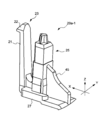
- FIG. 5 is a diagram showing a case where the configuration of the mounting structure 20 of the embodiment is viewed from an oblique direction. Specifically, FIG. 5 shows a state in which the first member 20a and the second member 20b constituting the attachment structure 20 are coupled. In FIG. 5, the description will be focused on only the portion of the attachment structure 20, but as described above, the first member 20 a is a member provided at both ends of the rod-shaped flexible portion 185 a as shown in FIG. 4.
- the second member 20b is a member constituting the mounting structure 20 in a pair with the first member 20a, and is a member provided on the key side support portion 183 and the frame side support portion 585 shown in FIG.
- the mounting structure 20 in this embodiment uses a combination of the first member 20a and the second member 20b.
- the first member 20 a includes a flexible portion 21 extending in the vertical direction, a mounting portion 23 having a claw portion 22 provided at the tip of the flexible portion 21, and a positioning portion 25 coupled to the flexible portion 21.
- the 2nd member 20b is provided with the 1st insertion hole 33 in which the attachment part 23 is inserted from the downward side, and the 2nd insertion hole 35 in which the positioning part 25 is inserted from the downward side.
- the mounting structure 20 is configured so that the first member 20a can be mounted from below the second member 20b. That is, in the present embodiment, the direction in which the first member 20a is attached to the second member 20b (hereinafter also referred to as “attachment direction”) is the vertical direction.
- attachment direction the direction in which the first member 20a is attached to the second member 20b
- the state where the first member 20a is mounted to the second member 20b is the first member as shown in FIG. A state in which 20a and the second member 20b are coupled to each other.
- the front-rear direction of the mounting structure 20 coincides with the longitudinal direction of the key 100 shown in FIGS. Since the key 100 is arranged at a high density in the scale direction (direction orthogonal to the longitudinal direction), there is little room to secure a space for greatly bending the first member 20a. Therefore, by making the front-rear direction of the mounting structure 20 coincide with the longitudinal direction of the key 100, the amount of bending of the first member 20a can be increased as much as possible, and space saving can be achieved.
- Drawing 6 is a figure showing an example at the time of seeing composition of the 1st member 20a in mounting structure 20 of an embodiment from the slanting upper part.
- Drawing 7 is a figure showing an example at the time of seeing the composition of the 1st member 20a in mounting structure 20 of an embodiment from the side.
- the first member 20a shown in FIGS. 6 and 7 corresponds to the claw side member in the mounting structure 20 of the present embodiment.
- the first member 20a has a substantially square columnar flexible portion 21 and a claw portion 22 provided at one end of the flexible portion 21, and has a mounting portion 23 and a flexible portion 21 extending in the mounting direction (that is, the vertical direction).
- the positioning part 25 has a shape that extends in the same direction as the flexible part 21, that is, in the vertical direction.
- the flexible portion 21 is made of a flexible material.
- the flexible material is not particularly limited and may be appropriately selected depending on the embodiment.
- a plastic material can be used as the flexible material.
- the flexible portion 21 of the present embodiment is configured such that the length (thickness) in the direction along the X axis is shorter than the length (width) in the direction along the Y axis. Therefore, the flexibility of the flexible portion 21 is greatly deflected in the direction along the X axis (that is, the front-rear direction), and the direction along the Y axis (that is, the left-right direction) is larger than the direction along the X axis. It is designed to bend slightly. That is, the flexible portion 21 has a shape that is less flexible in the direction along the Y axis than the flexibility in the direction along the X axis.
- the flexible portion 21 is configured such that the claw portion 22 overlaps the second member 20b more deeply (that is, the amount of engagement increases) by increasing the flexibility in the direction along the X axis. ing.
- claw part 22 is a site
- claw part 22 which concerns on this embodiment is provided in the front-end
- the direction in which the claw portion 22 protrudes may not be limited to the front, and may be appropriately determined according to, for example, the configuration of the second member 20b (particularly, the position of the surface on which the claw portion 22 is hooked).
- the lower part of the attachment part 23 from the alternate long and short dash line 24 shown in FIG. 7 is called the flexible part 21, and the upper part is called the claw part 22.
- the flexible portion 21 and the claw portion 22 may be integrally formed, or may be configured by different members.
- the 2nd member 20b is contacted and caught. It is a part that functions as a part.
- the lower surface 22a of the claw portion 22 receives the force in the Z-axis direction applied to the flexible portion 21, so that the first member 20a can be prevented from falling off from the second member 20b.
- FIG. 8A is a diagram illustrating an example when the configuration of the claw portion 22 in the mounting structure 20 of the embodiment is viewed from the side.
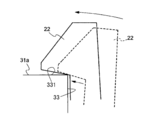
- Drawing 8B is a figure for explaining operation of claw part 22 in attachment structure 20 of an embodiment.
- the lower surface 22a of the claw portion 22 and the surface 21a of the flexible portion 21 are an obtuse angle.
- the lower surface 22a of the claw portion 22 can correspond to a surface inclined in the positive direction of the Z axis (the direction of the arrow) with respect to the X axis shown in FIG.
- the lower surface 22 a of the claw portion 22 can correspond to a surface inclined upward with respect to the flexible direction of the flexible portion 21.
- the claw portion 22 has the lower surface 22a in contact with the upper surface (upper surface 31a described later) of the second member 20b. Superimpose on.
- FIG. 8B shows a state where the claw portion 22 is coming off from the opening peripheral edge portion 331 of the first insertion hole 33 on the upper surface 31a of the second member 20b.
- a force is applied to the claw portion 22 in the direction of the arrow by the elastic force of the flexible portion 21. Therefore, the claw portion 22 slides in the direction of the arrow in a state where the lower surface 22a is in contact with the corner of the upper surface 31a (specifically, the edge of the first insertion hole 33 described later), and the position indicated by the solid line Move to.
- the angle ⁇ formed by the lower surface 22a of the claw portion 22 and the surface 21a of the flexible portion 21 is an obtuse angle, so that the claw portion is in contact with the opening peripheral edge portion 331 of the first insertion hole 33.
- the surface (lower surface 22a) of 22 is configured to be slidably inclined with respect to the opening peripheral edge portion 331 in a direction in which the claw portion 22 overlaps the second member 20b.
- the elastic force that tends to move forward of the flexible portion 21 is moved upward by the lower surface 22a of the claw portion 22. It is converted into the power of.
- the lower surface 22a of the claw portion 22 works in a direction to increase the amount of engagement of the claw portion 22 with the second member 20b (the length with which the claw portion 22 is superimposed on the second member 20b).
- the amount of self-recovering action (nail) Part pulling action) can be added.
- the positioning part 25 extends in the same direction as the attachment part 23, and is a part for determining the relative position of the attachment part 23 (particularly the claw part 22) with respect to the second member 20b.
- the positioning portion 25 and the flexible portion 21 of the attachment portion 23 are connected to each other on the rear end side in the mounting direction by a flat plate-like connecting portion 27. That is, the lower end portion of the positioning portion 25 and the lower end portion of the flexible portion 21 of the attachment portion 23 are connected by the connecting portion 27.
- the direction which connects the flexible part 21 and the positioning part 25 corresponds with the direction where the nail
- the direction in which the flexible portion 21 and the positioning portion 25 are connected and the direction in which the claw portion 22 is superimposed on the second member 20b coincide with the front-rear direction.
- the positioning part 25 can receive the force by the bending in the front-back direction of the flexible part 21 reliably, and can support the flexible part 21.
- the positioning portion 25 is composed of three parts, a first part 25a, a second part 25b, and a third part 25c, in order from the rear end side (that is, the lower end side) in the insertion direction of the second member 20b with respect to the second insertion hole 35. It is configured.
- the widths of the first portion 25a, the second portion 25b, and the third portion 25c in the direction perpendicular to the insertion direction (the direction along the X axis in FIG. 7) are in the ranges of X1, X2, and X3, respectively. These widths are in a relationship of X1> X2> X3. That is, each width such as X1, X2, and X3 does not mean an absolute value, but indicates a relative relationship between the widths of the first portion 25a, the second portion 25b, and the third portion 25c.
- the first portion 25a and the second portion 25b have a rectangular cross section (XY plane) in a direction perpendicular to the insertion direction with respect to the second insertion hole 35, and the third portion 25c extends in the insertion direction.
- the cross section (XY plane) in the vertical direction has a cross shape.
- the shape of each of the portions 25a to 25c is not limited to such an example, and may be appropriately determined according to the embodiment.
- Drawing 9 is a figure showing an example at the time of seeing composition of the 2nd member 20b in attachment structure 20 of an embodiment from the slanting upper part.
- Drawing 10 is a figure showing an example at the time of seeing composition of the 2nd member 20b in mounting structure 20 of an embodiment from the upper part.
- FIG. 11 is a diagram illustrating an example of a cross section taken along line A-A ′ illustrated in FIG. 10 of the second member 20 b in the mounting structure 20 of the embodiment.
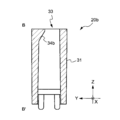
- FIG. 12 is a diagram illustrating an example of a cross section taken along line B-B ′ illustrated in FIG. 10 of the second member 20 b in the mounting structure 20 of the embodiment.
- Drawing 13 is a figure showing an example at the time of seeing composition of the 2nd member 20b in attachment structure 20 of an embodiment from back (back side).
- the second member 20b shown in FIGS. 9 to 13 corresponds to a member on the receiving side with respect to the first member 20a in the mounting structure 20 of the present embodiment.
- the second member 20 b includes a main body 31, and a first insertion hole 33, a second insertion hole 35, a notch 37, and a protrusion 39 provided in the main body 31.
- the main body portion 31 of the present embodiment is a main body portion of the second member 20b and corresponds to the key side support portion 183 and the frame side support portion 585 shown in FIG.
- the first insertion hole 33 extends in the mounting direction of the first member 20a with respect to the second member 20b (that is, the vertical direction) and is provided so as to penetrate the main body 31.
- the attachment portion 23 of the first member 20a is inserted into the first insertion hole 33 from below the main body portion 31.
- the length of the mounting portion 23 in the mounting direction (Z-axis direction) of the flexible portion 21 corresponds to the length of the first insertion hole 33, thereby causing the claw portion 22 to protrude from the first insertion hole 33,
- the claw portion 22 can be hooked on the opening peripheral edge on the upper side of the first insertion hole 33.
- the claw portion 22 of the first member 20 a overlaps the upper surface 31 a of the main body portion 31, whereby the first member 20 a and the second member 20 b are coupled.
- the first insertion hole 33 can correspond to the internal space of the main body portion 31 formed for inserting the attachment portion 23 (the flexible portion 21 and the claw portion 22) of the first member 20a.
- the second member 20b of the present embodiment has two inclined surfaces as the inner wall surface of the first insertion hole 33, that is, a first inclined surface 34a and a second inclined surface 34b.
- the first inclined surface 34 a is an inclined surface that constitutes a part of the front wall surface when the cross section including the X axis is viewed from the left side
- the second inclined surface 34 b is As shown in FIG. 12, when the cross section containing a Y-axis is seen from the front side, it is an inclined surface which comprises a part of wall surface of the right side (the direction of the arrow of a Y-axis). Any inclined surface is provided so that the width of the first insertion hole 33 becomes narrower as it goes upward when the cross section of the first insertion hole 33 is viewed from the side.
- the first inclined surface 34 a and the second inclined surface 34 b are disposed at a position where the claw portion 22 corresponding to the distal end portion of the attachment portion 23 contacts when the attachment portion 23 is inserted into the first insertion hole 33. Therefore, when the attachment portion 23 is inserted into the first insertion hole 33, the claw portion 22 slides on the respective inclined surfaces, so that the position of the claw portion 22 (position with respect to the positioning portion 25) is front and back. Move in the left or right direction.
- the upper surface of the claw portion 22 is in contact with each inclined surface.
- the “upper surface of the claw portion” refers to the entire surface visually recognized when the claw portion 22 is viewed from above. That is, when the claw portion 22 is a quadrangular pyramid as in the present embodiment, vertices and ridge lines included in the range viewed from above are also included in the upper surface.
- the second insertion hole 35 extends in the mounting direction of the first member 20 a with respect to the second member 20 b (that is, the vertical direction) and is provided so as to penetrate the main body portion 31. .
- the 2nd insertion hole 35 has the 1st field 35a and the 2nd field 35b in order from the back end side (namely, lower end side) of the insertion direction of positioning part 25 to the 2nd above-mentioned insertion hole 35. ing.
- the first region 35a is a portion into which the first portion 25a and the second portion 25b shown in FIG. 7 are inserted, and the second region 35b is a portion into which the third portion 25c is inserted.
- the first region 35a has a rectangular cross section (XY plane) perpendicular to the insertion direction of the positioning portion 25 with respect to the second insertion hole 35, and the second region 35b A cross section (XY plane) in a direction perpendicular to the direction is circular.
- region (35a, 35b) may not be limited to such an example, and may be suitably determined according to embodiment.
- the maximum width among the widths along the X axis of the first region 35a is narrower than the width X1 of the first portion 25a, and is the same as or slightly wider than the width X2 of the second portion 25b. .
- the maximum width of the second region 35b along the X axis is narrower than the first region 35a, narrower than the width X2 of the second portion 25b, and is equal to or more than the width X3 of the third portion 25c. Slightly wider.
- the 1st field 35a is constituted so that the 2nd portion 25b can be inserted.
- the second region 35b is configured such that the second portion 25b cannot be inserted and the third portion 25c can be inserted. The relative relationship between these widths will be described later.
- the positioning portion 25 of the first member 20a is inserted into the second insertion hole 35 from below the main body portion 31.
- the width X1 of the first portion 25a of the positioning portion 25 is wider than the maximum width of the first region 35a, the first portion 25a is fixed to the first region 35a by an interference fit. .
- the positioning portion 25 is fixed inside the second insertion hole 35 by an interference fit, whereby the relative positional relationship of the mounting portion 23 with respect to the second member 20b is determined. Therefore, the second insertion hole 35 can correspond to the internal space of the main body portion 31 formed to insert the positioning portion 25 of the first member 20a.
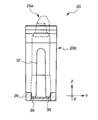
- the notch 13 is a slit-like portion provided on the back surface 31b of the main body 31, and exposes a part of the second insertion hole 35.
- the notch portion 37 is provided to enable placement of a plate-like member (such as a reinforcing portion 45 described later) connected to the positioning portion 25.
- the plate-like member is provided, for example, when reinforcing the strength of the entire mounting structure, or when extending the length of the key side support portion 183 and / or the frame side support portion 585.
- the protrusions 39 are provided at the pair of ends of the notch 37. Each protrusion 39 is provided for the purpose of regulating the spread of the notch 37. Specifically, in a state where the first member 20a is attached to the second member 20b, the two protrusions 39 are sandwiched by a part of the first member 20a, so that the spread of the notch 37 is restricted.
- Drawing 14 is a figure showing an example at the time of seeing composition of attachment structure 20 of an embodiment from back.
- the first member 20a of the present embodiment has a concave portion 29 having a shape that can hold the protrusion 39 when the rear end of the connecting portion 27 is viewed from the back side.
- the connecting portion 27 is indicated by hatching.
- Drawing 15 is a figure showing an example at the time of seeing composition of attachment structure 20 of an embodiment from the upper part.
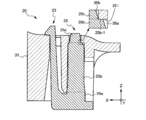
- FIG. 16 is a diagram illustrating an example of a cross section taken along line AA ′ illustrated in FIG. 10 of the mounting structure 20 according to the embodiment.
- the third portion of the positioning portion 25 of the first member 20a is located inside the second insertion hole 35 of the second member 20b.
- a portion 25c is visible.
- the third portion 25 c of the positioning portion 25 is inserted into the second region 35 b of the second insertion hole 35.
- the maximum width of the width X3 of the third portion 25c matches the maximum width of the second region 35b. Therefore, at least a part of the third portion 25 c of the positioning portion 25 is in contact with the inner wall surface of the second region 35 b of the second insertion hole 35.
- the third portion 25c of the positioning portion 25 is formed in a cross-shaped cross section, and the second region 35b of the second insertion hole 35 is formed in a circular cross section. Therefore, as shown in FIG. 15, in the state in which the first member 20a is attached to the second member 20b, the cross-shaped end portions of the third portion 25c are second in a total of four locations in the front-rear and left-right directions. It is comprised so that the inner wall face of the area
- the positioning unit 25 is restricted from moving in the direction (XY plane direction) perpendicular to the mounting direction of the first member 20a with respect to the second member 20b, and as a result, the mounting unit 23 moves in the XY plane direction. Is regulated. That is, the positioning part 25 is configured to restrict the movement of the attachment part 23 in the direction perpendicular to the mounting direction.
- the third portion 25c is formed in a tapered shape whose width becomes narrower from the rear end side to the front end side in the insertion direction, that is, from the lower end side to the upper end side. Therefore, when the positioning portion 25 is inserted into the second insertion hole 35, the third portion 25c can function as a guide, and accurate positioning can be realized.
- the length of the first portion 25a and the second portion 25b of the positioning portion 25 in the insertion direction corresponds to the length of the first region 35a of the second insertion hole 35. Therefore, as shown in FIG. 16, in the state where the first member 20a is attached to the second member 20b, the upper end surface 25b-1 of the second portion 25b is connected to the first region 35a and the second region in the second insertion hole 35. It is comprised so that the level
- the cross section cut along the X axis is seen, but the cross section along any axis in the XY plane including the Y axis has the same configuration.
- the positioning unit 25 is restricted from further movement in the mounting direction (Z-axis direction) of the first member 20a with respect to the second member 20b.
- the positioning portion 25 is configured to restrict the movement of the mounting portion 23 in the mounting direction of the first member 20a with respect to the second member 20b in a state where the first member 20a is mounted on the second member 20b. ing.
- the mounting structure 20 of the present embodiment is inserted into the second insertion hole 35 so that the first member 20a
- the relative positional relationship with the second member 20b can be fixed.
- the positioning portion 25 can be fixed to the second member 20b by an interference fit while restricting the movement of the mounting portion 23 in the XY plane direction by the positioning portion 25.
- the mounting structure 20 of the present embodiment can prevent the mounting portion 23 from being inserted in the mounting direction more than necessary by the positioning portion 25. That is, the positioning portion 25 is fixed to the second insertion hole 35 by an interference fit, and at the same time, the claw portion 22 of the attachment portion 23 protrudes from the first insertion hole 33, and the claw portion 22 is formed on the opening peripheral edge of the first insertion hole 33. Can be caught. Thereby, the play of the nail
- the shape of the flexible portion 21 of the mounting portion 23 may not be limited to a quadrangular prism shape, and any shape can be used as long as it extends in the direction in which the first member 20a is attached to the second member 20b. May be formed.
- the shape of the positioning portion 25 may not be limited to a quadrangular prism shape, and may be any shape as long as it extends in the direction in which the first member 20a is attached to the second member 20b. Also good.
- the shape of other components may be changed as appropriate.
- the flexible portion 21 may be formed in a columnar shape other than a square columnar shape, a plate shape, or the like.
- the positioning part 25 may be formed in shapes, such as columnar shape other than a square columnar shape, cross-sectional cross shape, a cylinder shape, and cross-sectional cross-beam shape.
- the breadth of the notch part 37 is suppressed using a pair of projection part 39 provided in the 2nd member 20b.
- the configuration for suppressing the spread of the notch 37 may not be limited to such an example. If the cutout portion 37 is sandwiched by a part of the first member 20a from the left-right direction, the spread of the cutout portion 37 can be restricted even if each projection 39 is omitted. Note that the notch 37 may be omitted.
- the 3rd part 25c of the positioning part 25 is formed in cross-sectional shape
- region 35b of the 2nd insertion hole 35 is formed in cross-sectional circle shape
- each cross-shaped of the 3rd part 25c is formed.
- the positioning part 25 is configured to restrict the movement of the attachment part 23 in the direction perpendicular to the mounting direction by making the end part contact the inner wall surface of the second region 35b.
- the configuration for restricting the movement of the attachment portion 23 in the direction perpendicular to the mounting direction may not be limited to such an example.
- the positioning portion 25 moves the mounting portion 23 in the direction perpendicular to the mounting direction. You may make it regulate.
- the third portion 25c of the positioning portion 25 may be formed in a cylindrical shape or a cross-sectional shape such as a shape having a portion extending in at least three directions.
- the second region 35b of the second insertion hole 35 may be formed in a cross-sectional shape such as a circular shape, an elliptical shape, or a polygonal shape.
- the positioning part 25 has the upper end surface of the 2nd part 25b of the positioning part 25 in contact with the level
- the configuration for restricting further movement of the mounting portion 23 in the mounting direction at the time of mounting may not be limited to such an example.
- the upper end of the positioning portion 25 is in contact with the bottom of the second insertion hole 35.
- further movement of the mounting portion 23 in the mounting direction at the time of mounting may be restricted.
- claw part 22 and the surface 21a of the flexible part 21 make is an obtuse angle.
- claw part 22 is caught is flat.
- claw part 22 which contacts the opening peripheral part 331 of the 1st insertion hole 33 slides with respect to the said opening peripheral part 331 in the direction which the claw part 22 overlaps with the 2nd member 20b. It is configured to tilt as possible.
- claw part 22 and the opening peripheral part 331 may not be limited to such an example.
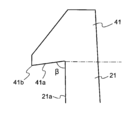
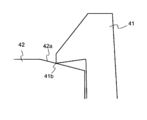
- FIG. 17A illustrates the configuration of the claw portion 41 according to this modification.
- the claw portion 41 when viewed from the side, the claw portion 41 has a lower surface 41a of the claw portion 41 and a surface 21a of the flexible portion 21 (specifically, of the entire surface of the flexible portion 21,
- the angle ⁇ formed with the surface on the side where the lower surface 22a exists is an acute angle.
- the lower surface 22a of the claw portion 22 when viewed from the side, is a surface inclined in the negative direction of the Z axis (the direction opposite to the direction of the arrow) with respect to the X axis shown in FIG.
- the lower surface 22a of the claw portion 22 can correspond to a surface inclined downward with respect to the flexible direction of the flexible portion 21 described above.
- the claw portion 41 having the configuration shown in FIG. 17A When the claw portion 41 having the configuration shown in FIG. 17A is used, the claw portion 41 is not easily deformed even if a strong downward force is applied to the flexible portion 21 and the claw portion 41. That is, according to the present modification, it is possible to realize a mounting structure that has high strength against the force of pulling downward.
- FIG. 17B illustrates a modification of the opening peripheral edge portion of the first insertion hole 33 in the second member 20b.
- the main body portion 42 of the second member may be configured to have an inclined surface 42 a at the opening peripheral edge portion of the first insertion hole 33. That is, in this modification, an example in which the inclined surface (lower surface 22a) is not provided on the claw side as shown in FIG. 8A but on the main body 42 side is shown.
- the front end portion 41b of the claw portion 41 and the inclined surface 42a are in contact with each other, and the forward force due to the bending of the flexible portion 21 is achieved.
- the tip 41b slides on the slope of the inclined surface 42b.
- a force for moving the claw portion 41 to the front side by the inclined surface 42a works while realizing a mounting structure having high strength with respect to the pulling force, so that the amount of engagement of the claw portion 41 with the second member Can be increased. Therefore, according to this modification, the first member and the second member can be stably coupled.
- FIGS. 18 and 19 a plate-like member may be connected to the positioning portion 25 of the first member 20a.
- FIG. 18 is a diagram illustrating an example of the first member 20a-1 according to the present modification as viewed obliquely from above.
- FIG. 19 is a diagram illustrating an example of the structure of the mounting structure 20-1 according to the present modification as viewed from the rear and obliquely above.
- a reinforcing portion 45 made of a plate-like member is provided behind the positioning portion 25.
- the first member 20a-1 is the same as the first member 20a.
- the reinforcing portion 45 is connected so as to straddle the second portion 25b to the first portion 25a of the positioning portion 25, and is connected to the connecting portion 27 on the lower end side.
- the range to which the reinforcement part 45 is connected may not be limited to such an example, and may be appropriately determined according to the embodiment.
- the reinforcing portion 45 is integrally formed with the positioning portion 25 and the connecting portion 27. Therefore, the connection between the positioning portion 25 and the connecting portion 27 becomes very strong, and as a result, the relative positional relationship between the positioning portion 25 and the mounting portion 23 can be stably maintained.
- the reinforcement part 45 may not be limited to such an example and may be comprised by a member different from at least any one of the positioning part 25 and the connection part 27. FIG.
- the reinforcing portion 45 connected to the positioning portion 25 is disposed in the gap of the notch portion 37 provided in the second member 20b.
- the cutout portion 37 is provided in the second member 20b, and the plate member (reinforcing portion 45) that can be arranged in the cutout portion 37 is connected to the positioning portion 25, whereby the first member 20a-1 is connected.
- the strength of the positioning part 25 to be configured can be increased.
- the 2nd insertion hole 35 has penetrated the main-body part 31 in the up-down direction in the 2nd member 20b.
- the second insertion hole 35 may not penetrate the main body portion 31.
- FIG. 20 illustrates a cross section corresponding to the line A-A ′ shown in FIG. 10 of the mounting structure 20-2 according to this modification.
- the positioning portion 25 has three parts, that is, the first part 25a, the second part 25b, and the third part 25c, and the second insertion hole 35 has the first area 35a and the second area 35b. It has two areas.
- the positioning portion 25 and the second insertion hole 35 are not limited to such an example, and the portions 25a to 25c and the regions (35a, 35b) may be omitted as appropriate.
- the third portion 25 c of the positioning portion 25 is omitted, and the second region 35 b of the second insertion hole 35 is omitted.
- the movement of the positioning portion 25 in the XY plane direction is restricted by an interference fit, and the movement in the Z-axis direction (upward) is such that the upper end surface of the second portion 25b is the upper end surface of the first region 35a. It is regulated by hitting.
- region 35b you may comprise so that the 2nd insertion hole 35 may not penetrate the main-body part 31.
- the said embodiment attaches to both the coupling
- a structure 20 is provided. However, for any one of the coupling portions, a different attachment method may be adopted instead of the attachment structure 20. Moreover, in the said embodiment, the example which uses the attachment structure 20 in the keyboard apparatus 1 is shown. However, the mounting structure 20 can be used for devices other than the keyboard device 1. For example, the attachment structure 20 may be used to attach a printed wiring board to an equipment device or the like.
Landscapes
- Engineering & Computer Science (AREA)
- General Engineering & Computer Science (AREA)
- Physics & Mathematics (AREA)
- Acoustics & Sound (AREA)
- Multimedia (AREA)
- Mechanical Engineering (AREA)
- Electrophonic Musical Instruments (AREA)
- Connection Of Plates (AREA)
- Snaps, Bayonet Connections, Set Pins, And Snap Rings (AREA)
Abstract
La présente invention concerne une structure de montage qui comprend : un premier élément qui comprend une partie de montage ayant une partie souple et une partie de crochet disposée sur une extrémité de la partie souple, et une partie de positionnement reliée à la partie souple ; et un second élément qui comprend un premier trou d'insertion dans lequel la partie de montage est insérée, et un second trou d'insertion dans lequel la partie de positionnement est insérée. La partie de positionnement est montée dans le second trou d'insertion par l'intermédiaire d'un raccord d'interférence dans un état dans lequel le premier élément est monté sur le second élément.
Applications Claiming Priority (2)
| Application Number | Priority Date | Filing Date | Title |
|---|---|---|---|
| JP2016-061706 | 2016-03-25 | ||
| JP2016061706A JP2017173701A (ja) | 2016-03-25 | 2016-03-25 | 取付け構造 |
Publications (1)
| Publication Number | Publication Date |
|---|---|
| WO2017164307A1 true WO2017164307A1 (fr) | 2017-09-28 |
Family
ID=59899513
Family Applications (1)
| Application Number | Title | Priority Date | Filing Date |
|---|---|---|---|
| PCT/JP2017/011726 Ceased WO2017164307A1 (fr) | 2016-03-25 | 2017-03-23 | Structure de montage |
Country Status (2)
| Country | Link |
|---|---|
| JP (1) | JP2017173701A (fr) |
| WO (1) | WO2017164307A1 (fr) |
Cited By (2)
| Publication number | Priority date | Publication date | Assignee | Title |
|---|---|---|---|---|
| CN110513374A (zh) * | 2018-05-22 | 2019-11-29 | 法雷奥照明湖北技术中心有限公司 | 连接组件 |
| CN111716085A (zh) * | 2019-03-22 | 2020-09-29 | 发那科株式会社 | 零部件组装构造和自动组装系统 |
Citations (5)
| Publication number | Priority date | Publication date | Assignee | Title |
|---|---|---|---|---|
| JPS59185139U (ja) * | 1983-05-27 | 1984-12-08 | マツダ株式会社 | 自動車のインストルメントパネル |
| JPS614482U (ja) * | 1984-06-14 | 1986-01-11 | リズム時計工業株式会社 | 回路基板の結合構造 |
| JPH03108295U (fr) * | 1990-02-23 | 1991-11-07 | ||
| JP2001124023A (ja) * | 1999-10-25 | 2001-05-08 | Sony Corp | 取付装置 |
| JP2015183841A (ja) * | 2014-03-26 | 2015-10-22 | 株式会社デンソー | 部品固定構造 |
-
2016
- 2016-03-25 JP JP2016061706A patent/JP2017173701A/ja active Pending
-
2017
- 2017-03-23 WO PCT/JP2017/011726 patent/WO2017164307A1/fr not_active Ceased
Patent Citations (5)
| Publication number | Priority date | Publication date | Assignee | Title |
|---|---|---|---|---|
| JPS59185139U (ja) * | 1983-05-27 | 1984-12-08 | マツダ株式会社 | 自動車のインストルメントパネル |
| JPS614482U (ja) * | 1984-06-14 | 1986-01-11 | リズム時計工業株式会社 | 回路基板の結合構造 |
| JPH03108295U (fr) * | 1990-02-23 | 1991-11-07 | ||
| JP2001124023A (ja) * | 1999-10-25 | 2001-05-08 | Sony Corp | 取付装置 |
| JP2015183841A (ja) * | 2014-03-26 | 2015-10-22 | 株式会社デンソー | 部品固定構造 |
Cited By (2)
| Publication number | Priority date | Publication date | Assignee | Title |
|---|---|---|---|---|
| CN110513374A (zh) * | 2018-05-22 | 2019-11-29 | 法雷奥照明湖北技术中心有限公司 | 连接组件 |
| CN111716085A (zh) * | 2019-03-22 | 2020-09-29 | 发那科株式会社 | 零部件组装构造和自动组装系统 |
Also Published As
| Publication number | Publication date |
|---|---|
| JP2017173701A (ja) | 2017-09-28 |
Similar Documents
| Publication | Publication Date | Title |
|---|---|---|
| US10339909B2 (en) | Electronic musical instrument, keyboard apparatus and frame | |
| US10529311B2 (en) | Keyboard apparatus and frame | |
| US10885884B2 (en) | Pivot member and keyboard apparatus | |
| WO2017164307A1 (fr) | Structure de montage | |
| WO2018079668A1 (fr) | Dispositif de clavier | |
| WO2017164308A1 (fr) | Structure de montage | |
| WO2017164310A1 (fr) | Structure de montage | |
| WO2018169080A1 (fr) | Dispositif de clavier | |
| US20190362692A1 (en) | Hammer assembly, keyboard instrument, and hammer | |
| WO2017164128A1 (fr) | Structure de montage | |
| WO2017163947A1 (fr) | Structure de montage | |
| US10796678B2 (en) | Keyboard apparatus | |
| JP2010262018A (ja) | 電子鍵盤楽器 | |
| US10825427B2 (en) | Hammer assembly and keyboard instrument | |
| CN116486767A (zh) | 键盘单元 | |
| WO2018173926A1 (fr) | Élément rotatif et dispositif de clavier | |
| US10692478B2 (en) | Keyboard apparatus | |
| WO2018047579A1 (fr) | Structure de fixation | |
| JP2018017798A (ja) | 取付け構造 | |
| JP2018180070A (ja) | 電子機器 | |
| JP2018180069A (ja) | 電子楽器 | |
| JP2018163191A (ja) | ハンマアセンブリおよび鍵盤装置 | |
| JP2018081137A (ja) | 鍵盤装置 | |
| JP2013073006A (ja) | 電子鍵盤楽器のコントロールパネル支持構造 | |
| JP2009042381A (ja) | 電子楽器用鍵盤装置 |
Legal Events
| Date | Code | Title | Description |
|---|---|---|---|
| NENP | Non-entry into the national phase |
Ref country code: DE |
|
| 121 | Ep: the epo has been informed by wipo that ep was designated in this application |
Ref document number: 17770347 Country of ref document: EP Kind code of ref document: A1 |
|
| 122 | Ep: pct application non-entry in european phase |
Ref document number: 17770347 Country of ref document: EP Kind code of ref document: A1 |