WO2017169826A1 - Robot à comportement autonome qui exécute un comportement de bienvenue - Google Patents
Robot à comportement autonome qui exécute un comportement de bienvenue Download PDFInfo
- Publication number
- WO2017169826A1 WO2017169826A1 PCT/JP2017/010594 JP2017010594W WO2017169826A1 WO 2017169826 A1 WO2017169826 A1 WO 2017169826A1 JP 2017010594 W JP2017010594 W JP 2017010594W WO 2017169826 A1 WO2017169826 A1 WO 2017169826A1
- Authority
- WO
- WIPO (PCT)
- Prior art keywords
- robot
- user
- person
- movement
- entrance
- Prior art date
- Legal status (The legal status is an assumption and is not a legal conclusion. Google has not performed a legal analysis and makes no representation as to the accuracy of the status listed.)
- Ceased
Links
Images



Classifications
-
- B—PERFORMING OPERATIONS; TRANSPORTING
- B25—HAND TOOLS; PORTABLE POWER-DRIVEN TOOLS; MANIPULATORS
- B25J—MANIPULATORS; CHAMBERS PROVIDED WITH MANIPULATION DEVICES
- B25J13/00—Controls for manipulators
- B25J13/08—Controls for manipulators by means of sensing devices, e.g. viewing or touching devices
-
- A—HUMAN NECESSITIES
- A63—SPORTS; GAMES; AMUSEMENTS
- A63H—TOYS, e.g. TOPS, DOLLS, HOOPS OR BUILDING BLOCKS
- A63H11/00—Self-movable toy figures
-
- A—HUMAN NECESSITIES
- A63—SPORTS; GAMES; AMUSEMENTS
- A63H—TOYS, e.g. TOPS, DOLLS, HOOPS OR BUILDING BLOCKS
- A63H11/00—Self-movable toy figures
- A63H11/10—Figure toys with single- or multiple-axle undercarriages, by which the figures perform a realistic running motion when the toy is moving over the floor
-
- A—HUMAN NECESSITIES
- A63—SPORTS; GAMES; AMUSEMENTS
- A63H—TOYS, e.g. TOPS, DOLLS, HOOPS OR BUILDING BLOCKS
- A63H13/00—Toy figures with self-moving parts, with or without movement of the toy as a whole
- A63H13/005—Toy figures with self-moving parts, with or without movement of the toy as a whole with self-moving head or facial features
-
- A—HUMAN NECESSITIES
- A63—SPORTS; GAMES; AMUSEMENTS
- A63H—TOYS, e.g. TOPS, DOLLS, HOOPS OR BUILDING BLOCKS
- A63H3/00—Dolls
- A63H3/36—Details; Accessories
- A63H3/38—Dolls' eyes
- A63H3/40—Dolls' eyes movable
-
- B—PERFORMING OPERATIONS; TRANSPORTING
- B25—HAND TOOLS; PORTABLE POWER-DRIVEN TOOLS; MANIPULATORS
- B25J—MANIPULATORS; CHAMBERS PROVIDED WITH MANIPULATION DEVICES
- B25J13/00—Controls for manipulators
-
- B—PERFORMING OPERATIONS; TRANSPORTING
- B25—HAND TOOLS; PORTABLE POWER-DRIVEN TOOLS; MANIPULATORS
- B25J—MANIPULATORS; CHAMBERS PROVIDED WITH MANIPULATION DEVICES
- B25J9/00—Program-controlled manipulators
- B25J9/16—Program controls
- B25J9/1694—Program controls characterised by use of sensors other than normal servo-feedback from position, speed or acceleration sensors, perception control, multi-sensor controlled systems, sensor fusion
- B25J9/1697—Vision controlled systems
-
- G—PHYSICS
- G05—CONTROLLING; REGULATING
- G05D—SYSTEMS FOR CONTROLLING OR REGULATING NON-ELECTRIC VARIABLES
- G05D1/00—Control of position, course, altitude or attitude of land, water, air or space vehicles, e.g. using automatic pilots
- G05D1/20—Control system inputs
- G05D1/22—Command input arrangements
- G05D1/221—Remote-control arrangements
- G05D1/225—Remote-control arrangements operated by off-board computers
-
- G—PHYSICS
- G05—CONTROLLING; REGULATING
- G05D—SYSTEMS FOR CONTROLLING OR REGULATING NON-ELECTRIC VARIABLES
- G05D1/00—Control of position, course, altitude or attitude of land, water, air or space vehicles, e.g. using automatic pilots
- G05D1/20—Control system inputs
- G05D1/24—Arrangements for determining position or orientation
- G05D1/247—Arrangements for determining position or orientation using signals provided by artificial sources external to the vehicle, e.g. navigation beacons
- G05D1/249—Arrangements for determining position or orientation using signals provided by artificial sources external to the vehicle, e.g. navigation beacons from positioning sensors located off-board the vehicle, e.g. from cameras
-
- G—PHYSICS
- G05—CONTROLLING; REGULATING
- G05D—SYSTEMS FOR CONTROLLING OR REGULATING NON-ELECTRIC VARIABLES
- G05D1/00—Control of position, course, altitude or attitude of land, water, air or space vehicles, e.g. using automatic pilots
- G05D1/60—Intended control result
- G05D1/656—Interaction with payloads or external entities
- G05D1/686—Maintaining a relative position with respect to moving targets, e.g. following animals or humans
-
- A—HUMAN NECESSITIES
- A63—SPORTS; GAMES; AMUSEMENTS
- A63H—TOYS, e.g. TOPS, DOLLS, HOOPS OR BUILDING BLOCKS
- A63H2200/00—Computerized interactive toys, e.g. dolls
-
- B—PERFORMING OPERATIONS; TRANSPORTING
- B25—HAND TOOLS; PORTABLE POWER-DRIVEN TOOLS; MANIPULATORS
- B25J—MANIPULATORS; CHAMBERS PROVIDED WITH MANIPULATION DEVICES
- B25J11/00—Manipulators not otherwise provided for
- B25J11/0005—Manipulators having means for high-level communication with users, e.g. speech generator, face recognition means
-
- B—PERFORMING OPERATIONS; TRANSPORTING
- B25—HAND TOOLS; PORTABLE POWER-DRIVEN TOOLS; MANIPULATORS
- B25J—MANIPULATORS; CHAMBERS PROVIDED WITH MANIPULATION DEVICES
- B25J11/00—Manipulators not otherwise provided for
- B25J11/0005—Manipulators having means for high-level communication with users, e.g. speech generator, face recognition means
- B25J11/001—Manipulators having means for high-level communication with users, e.g. speech generator, face recognition means with emotions simulating means
-
- B—PERFORMING OPERATIONS; TRANSPORTING
- B25—HAND TOOLS; PORTABLE POWER-DRIVEN TOOLS; MANIPULATORS
- B25J—MANIPULATORS; CHAMBERS PROVIDED WITH MANIPULATION DEVICES
- B25J11/00—Manipulators not otherwise provided for
- B25J11/003—Manipulators for entertainment
-
- B—PERFORMING OPERATIONS; TRANSPORTING
- B25—HAND TOOLS; PORTABLE POWER-DRIVEN TOOLS; MANIPULATORS
- B25J—MANIPULATORS; CHAMBERS PROVIDED WITH MANIPULATION DEVICES
- B25J11/00—Manipulators not otherwise provided for
- B25J11/008—Manipulators for service tasks
-
- G—PHYSICS
- G05—CONTROLLING; REGULATING
- G05D—SYSTEMS FOR CONTROLLING OR REGULATING NON-ELECTRIC VARIABLES
- G05D2105/00—Specific applications of the controlled vehicles
- G05D2105/30—Specific applications of the controlled vehicles for social or care-giving applications
-
- G—PHYSICS
- G05—CONTROLLING; REGULATING
- G05D—SYSTEMS FOR CONTROLLING OR REGULATING NON-ELECTRIC VARIABLES
- G05D2107/00—Specific environments of the controlled vehicles
- G05D2107/40—Indoor domestic environment
-
- G—PHYSICS
- G05—CONTROLLING; REGULATING
- G05D—SYSTEMS FOR CONTROLLING OR REGULATING NON-ELECTRIC VARIABLES
- G05D2109/00—Types of controlled vehicles
- G05D2109/10—Land vehicles
-
- G—PHYSICS
- G05—CONTROLLING; REGULATING
- G05D—SYSTEMS FOR CONTROLLING OR REGULATING NON-ELECTRIC VARIABLES
- G05D2111/00—Details of signals used for control of position, course, altitude or attitude of land, water, air or space vehicles
- G05D2111/10—Optical signals
-
- G—PHYSICS
- G06—COMPUTING OR CALCULATING; COUNTING
- G06N—COMPUTING ARRANGEMENTS BASED ON SPECIFIC COMPUTATIONAL MODELS
- G06N3/00—Computing arrangements based on biological models
- G06N3/004—Artificial life, i.e. computing arrangements simulating life
- G06N3/008—Artificial life, i.e. computing arrangements simulating life based on physical entities controlled by simulated intelligence so as to replicate intelligent life forms, e.g. based on robots replicating pets or humans in their appearance or behaviour
Definitions
- the present invention relates to a robot that autonomously selects an action according to an internal state or an external environment.
- robot technology has been rapidly advancing in recent years, it has not been able to realize its presence as a pet-like companion. It is because I do not think that the robot has free will. Human beings feel the presence of free will in pets, sympathize with pets, and be healed by pets by observing such behavior that only the pet's free will seems to be present. Therefore, a robot that can emulate human-biological behavior, in other words, a robot that can autonomously select human-biological behavior, can greatly enhance empathy for the robot. it is conceivable that.
- the present invention is an invention completed based on the above problem recognition, and its main object is to provide an action control technique for enhancing empathy for a robot.
- An autonomous action type robot includes a movement determining unit that determines a moving direction, an action determining unit that selects one of a plurality of types of gestures, and a target detection unit that detects the presence of a person in a monitoring area , A drive mechanism that performs specified movement and gestures.
- the movement judging unit sets a target point of the movement destination in the monitoring area when the presence of a person in the monitoring area is detected, and the action judging unit is a gesture showing favor to the person when the robot reaches the target point. Choose the affection gesture that is defined.
- An autonomous behavior robot includes: a movement determination unit that determines a movement direction; a drive mechanism that executes a specified movement; and a recognition unit that recognizes an external environment by detection information of a sensor Prepare.
- the recognition unit includes, in the indoor space, an entrance specifying unit that specifies a place where a person can pass as an entrance and a presence determination unit that determines whether or not a person is present within a predetermined range from the specified entrance. .
- the movement judging unit is characterized in that, when the presence judging unit judges that a person is present, the specified entrance is set as the movement destination.
- An autonomous behavior robot includes: a movement determination unit that determines a movement direction; a drive mechanism that executes a specified movement; and a recognition unit that recognizes an external environment by detection information of a sensor Prepare.
- the recognition unit includes an entrance specifying unit that specifies a place where a person can pass as an entrance in the indoor space, and a course prediction unit that determines whether a person is moving in a direction toward the specified entrance. including.
- the movement determining unit instructs the drive mechanism to track the person when it is determined that the person goes to the specified entrance.
- An autonomous behavior robot includes: a movement determination unit that determines a movement direction; a drive mechanism that executes a specified movement; and a recognition unit that recognizes an external environment by detection information of a sensor Prepare.
- the movement determination unit determines the movement direction of the robot in the direction toward the new person when the recognition unit recognizes a new person in a space area that can recognize the person.
- FIG. 1A is a front external view of the robot 100.
- FIG. FIG. 1 (b) is a side external view of the robot 100.
- the robot 100 in the present embodiment is an autonomous action robot that determines an action or gesture (gesture) based on an external environment and an internal state.
- the external environment is recognized by various sensors such as a camera and a thermo sensor.
- the internal state is quantified as various parameters representing the emotion of the robot 100. These will be described later.
- the robot 100 according to the present embodiment is premised on indoor behavior, and for example, takes an indoor range of an owner's home as an activity range.
- a human being related to the robot 100 is referred to as a "user”
- a user who is a member of a home to which the robot 100 belongs is referred to as an "owner”.
- the body 104 of the robot 100 has a generally rounded shape, and is formed of a soft and elastic material such as urethane, rubber, or resin.
- the robot 100 may be dressed. By making the body 104 round and soft and have a good touch, the robot 100 provides the user with a sense of security and a pleasant touch.
- the robot 100 has a total weight of 15 kilograms or less, preferably 10 kilograms or less, and more preferably 5 kilograms or less.
- the average weight of a 13-month-old baby is just over 9 kilograms for boys and less than 9 kilograms for girls. Therefore, if the total weight of the robot 100 is 10 kilograms or less, the user can hold the robot 100 with almost the same effort as holding a baby that can not walk alone.
- the average weight of babies less than 2 months old is less than 5 kilograms for both men and women. Therefore, if the total weight of the robot 100 is 5 kg or less, the user can hold the robot 100 with the same effort as holding an infant.
- the various attributes such as appropriate weight, roundness, softness, and good touch realize an effect that the user can easily hold the robot 100 and can not hold it.
- it is desirable that the height of the robot 100 is 1.2 meters or less, preferably 0.7 meters or less.
- being able to hold it is an important concept.
- the robot 100 moves by the wheels 102.
- the rotational speeds and rotational directions of the two wheels 102 can be controlled separately.
- the wheel 102 can be slid upward inside the body 104 of the robot 100 so as to be completely stored in the body 104. Even when traveling, most of the wheels 102 are hidden by the body 104, but when the wheels 102 are completely stored in the body 104, the robot 100 is in a non-movable state (hereinafter referred to as "seating state"). In the seated state, the flat seating surface 108 abuts on the floor surface.
- the robot 100 has two hands 106.
- the hand 106 does not have the function of gripping an object.
- the hand 106 can perform simple operations such as raising, shaking and vibrating.
- the two hands 106 are also individually controllable.
- the eye 110 incorporates a camera.
- the eye 110 can also display an image with a liquid crystal element or an organic EL element.
- the robot 100 incorporates various sensors such as a sound collection microphone and an ultrasonic sensor in addition to the camera incorporated in the eye 110. In addition, it has a built-in speaker and can emit a simple voice.
- a horn 112 is attached to the head of the robot 100. As described above, since the robot 100 is lightweight, the user can lift the robot 100 by grasping the tongue 112.
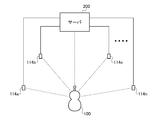
- FIG. 2 is a block diagram of the robot system 300.
- the robot system 300 includes a robot 100, a server 200 and a plurality of external sensors 114.
- a plurality of external sensors 114 (external sensors 114a, 114b, ..., 114n) are installed in advance in the house.
- the external sensor 114 may be fixed to the wall of the house or may be mounted on the floor.
- position coordinates of the external sensor 114 are registered. The position coordinates are defined as x, y coordinates in a house assumed as the action range of the robot 100.
- the server 200 is installed in the home.
- the server 200 and the robot 100 in the present embodiment correspond one to one.
- the server 200 determines the basic behavior of the robot 100 based on the information obtained from the sensors contained in the robot 100 and the plurality of external sensors 114.
- the external sensor 114 is for reinforcing the senses of the robot 100, and the server 200 is for reinforcing the brain of the robot 100.
- the external sensor 114 periodically transmits a wireless signal (hereinafter referred to as a “robot search signal”) including the ID of the external sensor 114 (hereinafter referred to as “beacon ID”).
- a wireless signal hereinafter referred to as a “robot search signal”
- the robot 100 sends back a radio signal (hereinafter referred to as a “robot reply signal”) including a beacon ID.
- the server 200 measures the time from when the external sensor 114 transmits the robot search signal to when the robot reply signal is received, and measures the distance from the external sensor 114 to the robot 100. By measuring the distances between the plurality of external sensors 114 and the robot 100, the position coordinates of the robot 100 are specified. Of course, the robot 100 may periodically transmit its position coordinates to the server 200.
- the external sensors 114 set a monitoring area. Then, the passage of a human (user) in the monitoring area is detected.
- the external sensor 114 transmits a wireless signal (hereinafter, referred to as a “user search signal”) to the monitoring area to a portable device such as a smartphone owned by the user, and the portable device of the user identifies the user
- a radio signal hereinafter referred to as a "user response signal” including an ID (hereinafter referred to as a "user ID" is returned.
- the user reply signal is sent to the server 200, whereby the server 200 recognizes which user is near the external sensor 114.
- the external sensor 114 tracks the position of the robot 100 and the user. The user is identified by the user ID.
- the external sensor 114 in the present embodiment incorporates a sound collection microphone.
- the external sensor 114 can also pick up a living sound or a call from a user by means of a sound collection microphone. The control corresponding to the calling voice will be described in detail later.
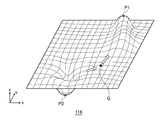
- FIG. 3 is a conceptual view of the emotion map 116.
- the emotion map 116 is a data table stored in the server 200.
- the robot 100 selects an action according to the emotion map 116.
- An emotion map 116 shown in FIG. 3 indicates the magnitude of a bad feeling with respect to the location of the robot 100.
- the x-axis and y-axis of emotion map 116 indicate two-dimensional space coordinates.
- the z-axis indicates the size of the bad feeling. When the z value is positive, the preference for the location is high, and when the z value is negative, it indicates that the location is disliked.
- the coordinate P1 is a point (hereinafter, referred to as a “favory point”) in the indoor space managed by the server 200 as the action range of the robot 100, in which the favorable feeling is high.
- the favor point may be a "safe place” such as a shade of a sofa or under a table, a place where people easily gather like a living, or a lively place. In addition, it may be a place which has been gently boiled or touched in the past.
- the definition of what kind of place the robot 100 prefers is arbitrary, generally, it is desirable to set a place favored by small children such as small children and dogs and cats as a favor point.
- a coordinate P2 is a point at which a bad feeling is high (hereinafter, referred to as a “disgust point”).
- Aversion points are places with loud noise such as near a television, places that are easy to get wet like baths and washrooms, closed spaces or dark places, places that lead to unpleasant memories that have been roughly treated by users, etc. It may be.
- the definition of what place the robot 100 hates is also arbitrary, it is generally desirable to set a place where small animals such as small children, dogs and cats are scared as a disappointment point.
- the coordinate Q indicates the current position of the robot 100.
- the movement distance of the robot 100 may be calculated from the number of rotations of the wheel 102 to specify the current position, or the current position may be specified based on an image obtained from a camera. Good.
- the robot 100 moves in the direction in which it is drawn to the favor point (coordinate P1), in the direction away from the bad point (coordinate P2).
- the emotion map 116 changes dynamically.
- the z-value (favorable feeling) at the coordinate P1 decreases with time.
- the robot 100 can reach the favor point (coordinate P1), and emulate the biological behavior of "feeling of emotion” being satisfied and eventually "being bored” at the place.
- bad feelings at coordinate P2 are also alleviated with time.
- new favor points and aversion points are created, whereby the robot 100 makes a new action selection.
- the robot 100 has an "interest" at a new favor point and continuously makes a new action selection.
- the emotion map 116 expresses the ups and downs of emotion as the internal state of the robot 100.
- the robot 100 aims at the favor point, avoids the disgust point, stays at the favor point for a while, and then takes the next action again.
- Such control can make the action selection of the robot 100 human and biological.
- the map that affects the behavior of the robot 100 (hereinafter collectively referred to as “action map”) is not limited to the emotion map 116 of the type shown in FIG.
- action map is not limited to the emotion map 116 of the type shown in FIG.
- various action maps such as curiosity, fear of fear, feeling of relief, feeling of calmness and dimness, feeling of physical comfort such as coolness and warmth, and so on.
- the destination point of the robot 100 may be determined by weighted averaging the z values of each of the plurality of action maps.
- the robot 100 may have parameters indicating the magnitudes of various emotions and senses separately from the action map. For example, when the value of the emotion parameter of loneliness is increasing, the weighting coefficient of the behavior map for evaluating a safe place may be set large, and the value of the emotion parameter may be lowered by reaching the target point. Similarly, when the value of the parameter indicating a feeling of being boring is increasing, the weighting coefficient of the behavior map for evaluating a place satisfying the curiosity may be set large.
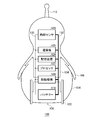
- FIG. 4 is a hardware configuration diagram of the robot 100.
- the robot 100 includes an internal sensor 128, a communication device 126, a storage device 124, a processor 122, a drive mechanism 120 and a battery 118.
- the units are connected to each other by a power supply line 130 and a signal line 132.
- the battery 118 supplies power to each unit via the power supply line 130.
- Each unit transmits and receives control signals through a signal line 132.
- the battery 118 is a secondary battery such as a lithium ion secondary battery, and is a power source of the robot 100.
- the internal sensor 128 is an assembly of various sensors incorporated in the robot 100. Specifically, they are a camera, a sound collection microphone, an infrared sensor, a thermo sensor, a touch sensor, an acceleration sensor, an odor sensor, and the like.
- the communication device 126 is a communication module that performs wireless communication for various external devices such as the server 200, the external sensor 114, and a portable device owned by a user.
- the storage device 124 is configured by a non-volatile memory and a volatile memory, and stores a computer program and various setting information.
- the processor 122 is an execution means of a computer program.
- the drive mechanism 120 is an actuator that controls each mechanism such as the wheel 102 and the hand 106. In addition to this, indicators and speakers will also be installed.
- the processor 122 performs action selection of the robot 100 while communicating with the server 200 and the external sensor 114 via the communication device 126.
- Various external information obtained by the internal sensor 128 also affects behavior selection.
- the drive mechanism 120 mainly controls the wheel 102 and the hand 106.
- the drive mechanism 120 changes the moving direction and the moving speed of the robot 100 by changing the rotational speed and the rotational direction of each of the two wheels 102.
- the drive mechanism 120 can also raise and lower the wheel 102. When the wheel 102 ascends, the wheel 102 is completely stored in the body 104, and the robot 100 abuts on the floor surface at the seating surface 108 to be in the seating state.
- the drive mechanism 120 can lift the hand 106 by pulling the hand 106 through the wire 134. It is also possible to shake the hand by vibrating the hand 106. More complex gestures can also be expressed using multiple wires 134.
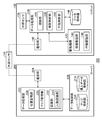
- FIG. 5 is a functional block diagram of the robot system 300.
- the robot system 300 includes the robot 100, the server 200, and a plurality of external sensors 114.
- Each component of the robot 100 and the server 200 includes computing devices such as a CPU (Central Processing Unit) and various co-processors, storage devices such as memory and storage, hardware including wired or wireless communication lines connecting them, and storage It is stored in the device and implemented by software that supplies processing instructions to the computing unit.
- the computer program may be configured by a device driver, an operating system, various application programs located in the upper layer of them, and a library that provides common functions to these programs.
- Each block described below indicates not a hardware unit configuration but a function unit block.
- Some of the functions of the robot 100 may be realized by the server 200, and some or all of the functions of the server 200 may be realized by the robot 100.
- the server 200 includes a communication unit 204, a data processing unit 202, and a data storage unit 206.
- the communication unit 204 takes charge of communication processing with the external sensor 114 and the robot 100.
- the data storage unit 206 stores various data.
- the data processing unit 202 executes various processes based on the data acquired by the communication unit 204 and the data stored in the data storage unit 206.
- the data processing unit 202 also functions as an interface of the communication unit 204 and the data storage unit 206.
- the data storage unit 206 includes a map storage unit 216 and a personal data storage unit 218.
- the map storage unit 216 stores a plurality of action maps.
- the personal data storage unit 218 stores information of the user, in particular, the owner. Specifically, various parameters such as user ID, intimacy, physical characteristics and behavioral characteristics are stored. Attribute information such as age and gender may be stored.
- the robot 100 acquires the user ID of the user's portable terminal, thereby identifying the user.
- the robot 100 may identify the user from physical features or behavioral features of the user.
- the robot 100 always images the surroundings with a built-in camera. Then, physical features and behavioral features of the person shown in the image are extracted.
- the physical features may specifically be visual features associated with the body, such as height, normal body temperature, clothes to be worn preferably, presence or absence of glasses, skin gloss, hair color, etc. Other features such as average temperature, smell, voice quality may also be included.
- the behavioral feature is a visual feature that accompanies the action, such as the place the user likes, the activity activity, and the presence or absence of smoking.
- the robot 100 clusters users who frequently appear as “owners” based on physical features and behavioral features obtained from a large amount of image information. Personal data of the clustered owner is registered in the personal data storage unit 218.
- the method of identifying a user by a user ID is simple and reliable, it is premised that the user has a device capable of providing the user ID.
- the method of identifying the user based on the physical feature or the behavioral feature has a merit that image recognition processing becomes heavy, but even a user who does not have a portable device can identify it. Only one of the two methods may be adopted, or the user identification may be performed using the two methods in combination in a complementary manner.
- the robot 100 has an internal parameter called familiarity for each user.
- familiarity for each user.
- an action indicating favor with itself such as raising itself or giving a voice
- familiarity with the user is increased.
- the closeness to the user who is not involved in the robot 100, the user who is violent, and the user who is infrequently encountered is low.
- the data processing unit 202 includes a position management unit 208, a map management unit 210, and a recognition unit 212.
- the position management unit 208 specifies the position coordinates of the robot 100 by the method related to FIG.
- the position management unit 208 also tracks the position coordinates of the user in real time.
- the map management unit 210 selects one of the plurality of action maps, and determines the moving direction of the robot 100 based on the z value of the selected action map.
- the map management unit 210 may determine the moving direction of the robot 100 by performing weighted averaging on z values of a plurality of action maps.
- the recognition unit 212 recognizes the external environment.
- the recognition of the external environment includes various recognitions such as recognition of weather and season based on temperature and humidity, recognition of an object shade (safety area) based on light quantity and temperature.
- the recognition unit 212 further includes a person recognition unit 214.
- the person recognition unit 214 recognizes a person from an image captured by the built-in camera of the robot 100, and extracts physical features and behavioral features of the person. Then, based on the physical feature information registered in the personal data storage unit 218, it is determined to which person such as a father, a mother, a eldest son, or the like the person being imaged, that is, the person who is looking at the robot 100 corresponds. Do.
- the robot 100 includes a communication unit 142, a data processing unit 136, a data storage unit 148, a drive mechanism 120, and an internal sensor 128.
- the communication unit 142 corresponds to the communication device 126 (see FIG. 4), and takes charge of communication processing with the external sensor 114 and the server 200.
- the data storage unit 148 stores various data.
- the data storage unit 148 corresponds to the storage device 124 (see FIG. 4).
- the data processing unit 136 executes various processes based on the data acquired by the communication unit 142 and the data stored in the data storage unit 148.
- the data processing unit 136 corresponds to a processor 122 and a computer program executed by the processor 122.
- the data processing unit 136 also functions as an interface of the communication unit 142, the internal sensor 128, the drive mechanism 120, and the data storage unit 148.
- the data processing unit 136 includes a recognition unit 156, a movement determination unit 138, and an action determination unit 140.
- the drive mechanism 120 includes a movement drive unit 144 and an action drive unit 146.
- the movement determination unit 138 determines the movement direction of the robot 100.
- the movement drive unit 144 drives the wheel 102 in accordance with the instruction of the movement determination unit 138 to direct the robot 100 to the target point.
- the map management unit 210 of the server 200 calculates the movement destination (target point) of the robot 100 in real time based on the action map.
- the server 200 transmits the coordinates of the target point to the robot 100, and the movement determination unit 138 moves the robot 100 toward the target point.
- it is an action map that determines the outline of the moving direction of the robot 100 the robot 100 according to the present embodiment can also perform specific actions such as "greeting" or "offing" of the user. This will be described later.
- the action determination unit 140 determines the gesture (gesture) of the robot 100.
- a plurality of gestures are defined in advance. Specifically, the robot 100 is made to behave by rotating the two wheels 102 by reversely rotating the two wheels 102, or by charging the hands 102 to accommodate and sit the wheels 102.
- a gesture a gesture which shakes by rotating the wheel 102 in a state where the wheel 102 is stored, and the like are defined.
- the behavior determination unit 140 can also perform a gesture of raising both hands 106 as a gesture that encourages "hug” when a user with high intimacy is nearby, or accommodates the wheel 102 when it gets tired of "hug” It is also possible to express the behavior that annoys the hug by rotating it as it is.
- the action drive unit 146 causes the robot 100 to express various gestures by driving the wheel 102 and the hand 106 according to the instruction from the action determination unit 140.
- the recognition unit 156 interprets external information obtained from the internal sensor 128. For example, when a strong impact is given to the robot 100, it is recognized that the user in the vicinity has been subjected to the "wildbating". When the user facing the robot 100 utters in a specific sound volume region and a specific frequency band, the recognition unit 156 recognizes that a "calling act” has been performed on itself. In addition, when the temperature around the body temperature is detected, it is recognized that the user has made “contact action", and when the upward acceleration is detected in the state where the contact is recognized, it is recognized that "handing” is made. Thus, the recognition unit 156 recognizes various responses of the user to the robot 100. These various actions correspond to pleasure or discomfort.
- the recognition unit 156 or the person recognition unit 214 of the server 200 changes the closeness to the user.
- the closeness to the user who has performed pleasantly is increased, and the closeness to the user who has performed unpleasantness is reduced.
- the map management unit 210 of the server 200 determines comfort / discomfort according to the content of the response, and changes the z value of the point where the comfort / discommitment was performed in the action map expressing “attachment to a place”. Good.
- FIG. 6 is an image diagram of a meeting.
- the robot 100 picks up at the front door.
- the robot 100 sits down at the entrance and lifts both hands 106 to perform a challenging gesture.
- a characteristic "scream" such as a beep may be generated from the built-in speaker.
- the robot 100 When the user goes out, the robot 100 goes to the entrance to see off. At this time, the robot 100 lifts and vibrates one hand 106 to express “bye-bye”. By generating a specific calling voice, it may be possible to act to express the feeling that the user is sad to go out. As described above, when the robot 100 picks up and sees off, the robot 100 goes to the entrance and executes a gesture (hereinafter referred to as “lovely gesture”) which is predetermined and shows a person's favor.
- lovely gesture a gesture which is predetermined and shows a person's favor.
- FIG. 7 is a schematic diagram for explaining the meet-and-see action of the robot 100.
- the external sensor 114 a is installed in the entrance 152 in advance.
- the external sensor 114a transmits a user search signal periodically, for example, once a second, to the monitoring area 150 which is the peripheral area.
- the smartphone owned by the user detects a user search signal and returns a user response signal.
- the user reply signal contains a user ID.
- the external sensor 114a receives the user reply signal, it transmits this to the server 200.
- the external sensor 114a and the server 200 are connected by wire. After detecting the unlocking sound of the door of the entrance 152 or the sound of the door opening, the external sensor 114 may recognize “return home” by detecting the approach of the user to the monitoring area 150.
- the server 200 transmits a control signal for instructing the robot 100 to meet.
- the position coordinates of the target point are specified by the control signal.
- the communication unit 142 of the robot 100 receives this control signal from the server 200, the movement judging unit 138 instructs the movement driving unit 144 to head toward the entrance 152.
- the target point is set within the monitoring area 150.
- the robot 100 checks obstacles with the built-in camera and goes to the target point while avoiding them.
- the server 200 may specify not only the target point but also a route for the robot 100 to travel from the current point to the target point.
- the movement determination unit 138 of the robot 100 may set the position coordinates instructed by the server 200 as it is as a target point, or when the server instructs a meeting, even if the movement determination unit 138 determines the target point itself Good.
- affection gesture is a gesture like sitting on a target point and lifting both hands 106 to "hug".
- affection gesture is a gesture like sitting on a target point and lifting both hands 106 to "hug".
- the user who has returned home recognizes that the robot 100 welcomes his home return and that it is lonely for the robot 100 to go out.
- the user's empathy with respect to the robot 100 can be intensified through the human-biological behavior representation of the robot 100.
- a send-off is performed. Specifically, when the external sensor 114 a receives a user response signal from the indoor side of the monitoring area 150, the external sensor 114 a transmits this to the server 200.
- the server 200 transmits a control signal for instructing the robot 100 to go and see.
- the movement determination unit 138 instructs the movement drive unit 144 to head to the entrance 152.
- the movement determination unit 138 sets a target point inside the monitoring area 150, the robot 100 goes to the target point.
- the action determination unit 140 executes love gestures for sending off.
- the robot 100 may be seated at the target point and “carried”, may move randomly around the target point, or may lift by one hand 106 for a bye-bye.
- calling is also possible.
- a sound collection microphone built in the robot 100 detects this voice, and if it is recognized as a call, the robot 100 Move towards the user.
- the robot 100 may identify the direction of the sound source and set a target point there.
- the call-up words may be some typical words such as "Ode” or "Oi", or may be the name of the robot 100.
- the external sensor 114 is used to reinforce the “hearing” of the robot 100. There is.
- An external sensor 114 b is installed in the Japanese-style room 154.
- the external sensor 114b incorporates a sound collection microphone.
- the external sensor 114b detects this voice and transmits a voice signal to the server 200.
- the position management unit 208 of the server 200 specifies the position of the user who is the voice source.
- the recognition unit 212 determines whether or not it is a call incoming voice by voice recognition. Since the external sensor 114 b is closer to the user of the voice source, it is easier to obtain clear voice than the robot 100.
- the server 200 instructs the robot 100 to move to the coordinate P3.
- the robot 100 receives the instruction signal, it moves to the coordinate P3.
- proximity action an action approaching the user
- the robot 100 when the coordinates P3 of the robot 100 and the voice source are too far, an action approaching the user (hereinafter referred to as “proximity action”) is not performed in response to the call. This is because it is unnatural that the robot 100 always acts in proximity even when a user who is too far from the robot 100 calls. It is desirable that the proximity action be performed on condition that the call-in is performed within a distance that a pet such as a dog or a cat can hear.
- the server 200 estimates the distance from the external sensor 114 that detected the call to the voice source (user), and further estimates the distance from the voice source to the robot 100 from there Do. When the distance is equal to or greater than a predetermined distance, the server 200 does not instruct the robot 100 to perform a proximity action.
- the built-in microphone of the robot 100 When the user calls in, the built-in microphone of the robot 100 also picks up the sound. Even if the sound is not clear, if some kind of sound is picked up, the robot 100 "hears". Therefore, the server 200 may instruct the robot 100 to perform a proximity action, as long as the server 200 can recognize the voice of the call via the external sensor 114 and the robot 100 can detect some voice at the same timing.
- the built-in microphone of the robot 100 does not pick up a voice at the time of calling, or when the volume of the picked-up voice is less than a predetermined threshold, it does not instruct the proximity action as “do not hear”.
- proximity action is not performed when the user's voice is small or when there is a noise barrier such as a wall and it is hard to hear. Further, the proximity action is performed when the user's voice is large even if the robot 100 is away from the voice source, or when only a distance enough to hear the voice even if there is a sound barrier such as a wall. Thereby, the hearing level of the robot 100 can be expressed like a general living thing.
- the robot 100 and the robot system 300 including the robot 100 have been described above based on the embodiment.
- the robot 100 expresses biological action selection which is difficult to predict and can not be patterned by one or more action maps using an action map or the like.
- the robot 100 cooperates with the external sensor 114 to detect that the user passes through a predetermined area, typically the entrance 152, and carries out a send-off or a pick-up action correspondingly.
- a predetermined area typically the entrance 152
- proximity action is performed in a range that can be assumed as an organism and does not become unnatural. Emulate biological behavior selection in this way.
- Attachment to a pet is often attributed to the feeling that the pet needs and is relied upon. When you go home, you will meet you and sit down there for a while. If you go out and see you off, it will be an effective choice for demonstrating that the robot 100 has a strong interest in the user. is there. The same is true for proximity actions associated with a call.
- the attachment of the user to the robot 100 can be intensified by realizing that the robot 100 is also able to meet and send off people who often feel attached to the pet, and to call the robot 100 as well.
- the present invention is not limited to the above-described embodiment and modification, and the components can be modified and embodied without departing from the scope of the invention.
- Various inventions may be formed by appropriately combining a plurality of components disclosed in the above-described embodiment and modifications. Moreover, some components may be deleted from all the components shown in the above-mentioned embodiment and modification.
- the robot system 300 is described as being configured of one robot 100, one server 200, and a plurality of external sensors 114, part of the functions of the robot 100 may be realized by the server 200, or the functions of the server 200 A part or all of may be assigned to the robot 100.
- One server 200 may control a plurality of robots 100, or a plurality of servers 200 may cooperate to control one or more robots 100.
- a third device other than the robot 100 or the server 200 may have a part of the function.
- An aggregate of the functions of the robot 100 and the functions of the server 200 described with reference to FIG. 5 can also be grasped as one “information processing apparatus” as a whole. How to allocate a plurality of functions necessary to realize the present invention to one or more hardwares will be considered in view of the processing capability of each hardware, the specifications required of the robot system 300, etc. It should be decided.
- the recognition unit 212 of the server 200 detects the presence of the user in the monitoring area 150 via the external sensor 114.
- the recognition unit 156 of the robot 100 may detect the presence of the user in the monitoring area 150 via the external sensor 114 or the internal sensor 128.
- the robot 100 may not necessarily identify the user, but may change the behavior according to the user.
- the user ID may be associated with the intimacy degree, and the user who has intimacy degree higher than a predetermined threshold value may go off or pick up when returning home or going out, but may not perform such action when the user is less than the threshold value.
- the robot 100 may periodically detect the user ID from a portable device such as a smartphone owned by the user, and set the intimacy to be higher for the frequently detected user ID.
- the user may be set to be closer to a user who has taken a typical intimacy action such as holding.
- the contact when the user lifts the body 104 may be sensed, or the execution of holding may be recognized by reducing the load applied to the wheel 102.
- the closeness may gradually decrease with the passage of time.
- the robot 100 may recognize a violent act against the robot 100 by detecting an impact applied to the robot 100 by using an acceleration sensor, and may decrease the intimacy of the user who performed the violent act. When the user lifts the robot 100 by grasping the tongue 112, this may be recognized as a violent act.
- the user may be identified not only by the glasses but also by physical characteristics or behavioral characteristics such as height and smoking behavior.
- the external sensor 114 may be a human sensor that detects a person by infrared rays or the like. When the external sensor 114 detects that a person passes through the entrance 152, a detection signal may be transmitted to the server 200 to realize a meeting or a send-off action. In this case, the external sensor 114 may not necessarily identify the user.
- the external sensor 114 may transmit a detection signal to the server 200 when it detects a sound that opens the door of the entrance 152, for example, an unlocking sound or a locking sound, by the built-in sound collection microphone.
- the sound of opening the shoe box, the sound of folding or opening an umbrella, the calling voice such as "I'm coming" or "I'm now” may be used as a trigger for sending off or meeting.
- the robot 100 may specify its own position coordinates by transmitting a search signal and receiving a response signal from each external sensor 114.
- the external sensor 114 may transmit a directional search signal, thereby specifying the distance and direction from the external sensor 114 to the robot 100.
- the robot 100 may detect passage of animals such as cats and dogs as well as humans. If the internal sensor 128 of the robot 100 has high accuracy, the external sensor 114 is not essential. Also, the server 200 may have the function of the external sensor 114. If the internal sensor 128 of the robot 100 can detect the unlocking sound with high accuracy, the robot 100 can perform the meeting action without the external sensor 114 or the server 200.
- a plurality of robots 100 may exchange information with each other.
- the first robot 100 detects the user's return home, the first robot 100 notifies the second robot 100 of the return home by wireless communication, whereby the first and second robots 100 perform a meeting action. May be The same is true for the off-hands.
- the robot 100 further includes a life pattern storage unit for storing a life pattern for each user, and the movement determination unit 138 in FIG. 5 performs an action based on the time for going home or leaving for each user registered in the life pattern storage unit. You may do it.
- the living pattern storage unit may be formed as a part of the data storage unit 206 of the server 200, or may be formed as a part of the data storage unit 148 of the robot 100.
- the robot 100 may move near the entrance when the return time of any user approaches, and may perform a gesture of waiting for the user to return, for example, sitting or rotational movement.
- tracking of the user may be preferentially performed to quickly detect that the user is heading to the front door, and may follow the action.
- the robot 100 may adjust the sensitivity of various sensors based on the accumulated life pattern. For example, when the return time zone approaches, the sensitivity (voltage amplification factor) of the microphone may be increased to detect the sound of opening the door or the sound of opening and closing the gate outside the door.
- the robot 100 can pick up and send off at natural timing by predicting an action based on experience.
- the robot 100 changes the action according to the closeness to each user. For example, when the closeness to the user S2 going out from the holding user S1 is high, the robot 100 performs an "early" gesture, specifically, an action of rotating the wheel 102 with the wheel 102 stored in the body 104. And act to vibrate the hand 106 strongly and move so as to be released from holding. The robot 100 escapes from holding and sees the more intimate user S2 to the entrance. When the closeness to the user S2 who goes out is lower than that of the user S1 who is holding the robot 100, the robot 100 shakes the hand 106 lightly while holding it.
- the robot 100 simply lifts the hand 106 to "hug" when first meeting. If the robot 100 can not hold it, the robot 100 vigorously moves the hand 106 to appeal its own existence. However, if the robot 100 does not hold the wheel 102, the robot 100 may not move unless the wheel 102 is accommodated and held. If the user is not allowed to hold it, the user may feel physical contact or may move around the user.
- FIG. 8 is a modification of the functional block diagram of the robot system 300.
- the data processing unit 136 of the robot 100 includes a pupil control unit 406.
- the recognition unit 156 includes an entrance specifying unit 400, a presence determination unit 402, and a course prediction unit 404.
- the eye 110 of the robot 100 in the modification is a display for displaying a pupil image.
- the pupil control unit 406 changes the position and size of the pupil image of the eye 110.
- the person recognition unit 214 of the server 200 manages the closeness of the user of the robot 100 for each user.
- the person recognition unit 214 increases the closeness to the user when the user performs a predetermined pleasure such as being held by the user.
- a predetermined unpleasant act such as being hit by a user is made, the closeness to the user is reduced.
- the entrance identifying unit 400 identifies an entrance in the indoor space.
- the “port” may be an opening through which people can pass, such as an entrance door, an indoor door, and a window.
- Position coordinates of the entrance in the indoor space may be initialized in advance in the robot system 300.
- the entrance identifying unit 400 identifies the entrance based on the position coordinate information.
- the entrance specifying unit 400 may recognize an image of a variable wall, which is a wall whose state is changed by opening or closing and through which a moving object such as a user normally passes, as an "outlet".
- the presence determination unit 402 determines whether the user is in the vicinity of the entrance identified by the entrance identification unit 400.
- the "specified entrance” does not have to be an actual entrance, but may be a location recognized by the robot 100 as an entrance.
- the presence determination unit 402 determines that there is a person near the entrance when the user recognizes an image within a predetermined range from the entrance, for example, within 1 meter, by various sensors such as a sound collection microphone and a camera. Substantially the same effect as setting the monitoring area 150 around the entrance and exit occurs.
- the external sensor 114 When the external sensor 114 is installed near the entrance, it may be determined from the detection signal from the external sensor 114 that there is a person near the entrance.
- the course prediction unit 404 determines whether there is a user moving toward the entrance.
- the route prediction unit 404 tracks and monitors the position of the user around the robot 100, and whether any user is heading in the direction of the entrance or, preferably, any user has entered within a predetermined range from the entrance It is determined whether or not.
- the route prediction unit 404 may also determine whether or not there is a user moving toward the entrance based on the detection signal from the external sensor 114.
- FIG. 9 is a schematic diagram for explaining the action of the robot 100 when the user enters from the entrance.
- the indoor space 408 is a closed space recognized by the robot 100 by various sensors.
- the indoor space 408 may be an indoor room or a house. It is assumed that the robot 100 has specified the location of the entrance 410 by the entrance identification unit 400.
- users P1 to P3 exist inside the indoor space 408, and a situation where the user P4 newly enters from the entrance 410 is shown.
- An external sensor 114 is installed on the wall near the entrance 410.
- the presence determination unit 402 of the robot 100 periodically monitors whether or not the user is present in an area around the entrance 410, for example, within a range of 1 meter from the entrance 410, by capturing an image around the entrance 410. .
- the presence determination unit 402 monitors by the detection signal from the external sensor 114, and when the external sensor 114 is not installed by the entrance 410, the peripheral image of the entrance 410 is periodically determined. Monitor the presence or absence of the user by confirming
- the robot 100 captures a peripheral image of the entrance 410 even when the entrance 410 is positioned on the back side of the robot 100 by providing the camera capable of capturing the surroundings such as an omnidirectional camera or an anti-spherical camera as a camera. It can detect changes in state.
- “change in state” may be any occurrence of an event different from the steady state, such as passage detection of a moving object in the vicinity of the entrance 410, detection of sound, temperature change, and the like.
- the movement determination unit 138 sets the direction in which the entrance 410 is present as the movement destination. According to such a control method, when the user P4 passes through the entrance 410, it is possible to act to express "meeting" and “offing” by the robot 100.
- the presence determination unit 402 of the robot 100 may determine that a user is present around the entrance 410 when a voice is detected from the direction of the entrance 410 using a directional voice detector such as a microphone array. Since the microphone array comprises a plurality of microphones, it is possible not only to detect speech but also to specify the direction of the speaking source. For example, when an unlocking sound of the entrance 410 is detected, the robot 100 may move in the direction of the entrance 410.
- the presence determination unit 402 may determine that the user is present around the entrance 410 when speech detection of a specific keyword is performed.
- the specific keyword may be a typical term such as “I'm here”, “Welcome back”, “I'm welcome”, “Bye-bye”, “I'll come”, “Oide” etc.
- a user goes out, or when returning home, typical words uttered by the person or a person around him are registered in advance in a database such as the server 200 as “specific voice”.
- the robot 100 may be headed to the point of producing the specific voice.
- any of the users P1 to P3 moves in the direction of the entrance 410 to meet the user P4. It may be.
- the users P1 and P2 meet the user P4.
- the robot 100 may head from the back of the two users to the entrance 410 without leading the users P1 and P2 heading for the meeting. According to such a control method, it becomes possible to express an action of being close to being hidden behind other users P1 and P2 while being interested in the user P4 newly appearing in the indoor space 408. By such an action, the "timidity" and "curiosity” of the robot 100 can be expressed.
- the person recognition unit 214 determines whether the newly appearing user P4 is a known user, or in other words, has already been registered in the database. For example, when the behavioral / physical features of the user P4 correspond to the feature information (profile) of any of the registered users, the user P4 is a "known user". When the user P4 owns a portable terminal capable of transmitting a user ID, the person recognition unit 214 determines whether the user P4 is a known user according to whether the user ID is already registered. To judge.
- the robot 100 changes the behavior according to whether the user P4 is a known user (registered user).
- the behavior determination unit 140 may express “Welcome” by behavior such as shaking the hand 106, moving the neck, and increasing the approach speed.
- the user may take an evasive action such as stopping the meeting and taking a distance from the user P4, stopping on the spot, hiding behind other known users.
- the person recognition unit 214 or the movement determination unit 138 determines that the probability of being a visitor is 33%. According to the above-described determination method, the robot 100 may follow the user who is going to meet and greet "a passive meeting" only when the probability of being a visitor is equal to or more than a predetermined value.
- the robot 100 or the server 200 may include a life pattern storage unit that stores life patterns of the user.
- the communication unit 142 of the robot 100 may appropriately acquire life pattern information for each user by accessing a life pattern storage unit formed as an external database.
- the living pattern storage unit registers, as the living pattern information, the rising time, the leaving time due to going to work, the returning time, and the bedtime for each user. Since these times usually vary, their average value or mode value may be registered as a representative value.
- a plurality of types of life pattern data may be registered not only for each user but also for each day of the week or season.
- the presence determination unit 402 may predict the time when the user returns home with reference to the user's life pattern information.
- the movement determination unit 138 may move in the direction of the entrance 410 when the user's predicted return time approaches, and may "greet" the user in advance. According to such a control method, it becomes easy to realize the meeting with high accuracy. Alternatively, it may be decided not to meet you if the time to return home approaches.
- FIG. 10 is a schematic diagram for explaining the action of the robot 100 when the user exits from the entrance.
- the robot 100 periodically recognizes the positions and moving directions of the users P1 to P3 in the indoor space 408.
- the course prediction unit 404 determines whether the user P3 is moving toward the entrance 410. Specifically, when the movement direction of the user P3 aims at the entrance 410 and such movement continues for a predetermined time or more, the route prediction unit 404 causes the user P3 to pass through the entrance 410 to the indoor space 408. It is determined that you are about to leave the
- the movement determination unit 138 controls the drive mechanism 120 so as to move the user P3 by tracking. According to such a control method, when the user P3 passes through the entrance 410, it is possible to express action “off” by the robot 100.
- the movement determination unit 138 may prohibit the robot 100 from passing through the entrance 410. That is, the movement of the robot 100 may be restricted so as not to leave the indoor space 408 by moving to the vicinity of the entrance 410 in the indoor space 408 but not following it. Alternatively, passage of the entrance 410 may be stopped on the condition that a specific keyword such as “wait”, “to there”, “bye bye” has been uttered.
- the course prediction unit 404 may predict the time when the user leaves the house by referring to life pattern information of the user.
- the movement determination unit 138 moves in the direction of the entrance 410 when the user P3 actually moves in the direction of the entrance 410 in a time zone including the predicted departure time for the user P3, and "sees off" the user. It is also good. For example, if the predicted departure time of the user P3 is 19 o'clock, 18:30 to 19:30 of one hour before and after that is set as a preparation time zone for sending off, and the user P3 is prioritized in the preparation time zone Monitor. Specifically, settings are made such that the frequency of position detection of the user P3 is increased, and the camera is directed regularly to the user P3. According to such a control method, it is easy to effectively execute the off-the-go action at the timing when the possibility of going out is high, instead of performing the off-the-go action each time the user passes through the entrance 410.
- the communication action referred to here may be any action that expresses interest or attention to the user P1, such as being embraced by the user P1, gazing at the user P1, circling the vicinity of the user P1, or the like.
- the robot 100 When the robot 100 is performing a communication action with the user P1, when the presence of the user P4 is specified within the predetermined range from the entrance 410, or the external sensor 114 installed near the entrance 410 is the user P4.
- the movement determination unit 138 and the action determination unit 140 stop the communication action, the movement determination unit 138 may execute the action of welcoming the user P4.
- the user P 4 is a known user, the closeness to the user P 4 is equal to or higher than a predetermined threshold, or the closeness to the user P 4 is equal to or higher than the closeness to the user P 1, etc. You may interrupt communication behavior with P1.
- the robot 100 when the robot 100 is performing a communication action with the user P1, the communication action may be stopped even when the user P3 heads for the entrance 410, and the movement determination unit 138 may see the user P3 off.
- the closeness to the user P3 On condition that the user P3 is a known user, the closeness to the user P3 is equal to or higher than a predetermined threshold, or the closeness to the user P3 is equal to or higher than the closeness to the user P1, etc. You may interrupt the communication behavior of
- the robot 100 may move in the direction of the user when a new user enters a recognizable space area around the robot 100.
- the "recognizable space area” mentioned here is a range that can be recognized as a "person” by the built-in camera.
- the camera may not only recognize “person” as the camera, but also may set as an image recognition range whether the user recognized as the person is a known user or not.
- the size of the recognizable space area depends on the performance and image processing capability of the camera incorporated in the robot 100. Therefore, the “eyesight” of the robot 100 can be substantially expressed by the size of the recognizable space area.
- the robot 100 may move in the direction in which the user is when a new user enters a space area in which the robot 100 can move.
- the robot 100 in the present embodiment is designed on the premise of indoor behavior.
- the robot 100 may be able to move all indoors, or may be set as a non-entry room such as a bathroom or a bedroom.
- the movable range of the robot 100 is set in advance. When the robot 100 recognizes that a new user is present in this movable range, the robot 100 may approach the user. Also in this case, it is possible to express an action as if the robot 100 had a nawabari.
- the robot 100 may direct the pupil image to the user, or in other words, the gesture to direct the robot 100 to look at the user may be defined as a kind of "loving gesture".
- a gesture in which the robot 100 directs the head or body 104 to the user may be defined as a kind of "loving gesture”.
- the user may express that the robot 100 is interested in the user by prescribing the eye 110 and the body 104 to the user. In general, when showing a person's favor, the person takes a look at the person, stares at him, looks at his eyes, turns his head (turns his neck or body), etc.
- the pupil image is directed to the user, the state is maintained for a predetermined time, for example, 1.0 seconds or more, the pupil image is enlarged, and the head or body is directed to the user. It is possible, and such a gesture may be defined as a love gesture showing a person's favor.
- the living pattern may be set by the user.
- the wake-up time may be detected by observing the action of the user by the robot 100.
- the wake-up time of the user A may be specified by registering the time when the user A emerges from the bedroom in the living pattern storage unit.
- the recognition unit 156 of the robot 100 recognizes the wake-up of the user A by a camera or the like, and the communication unit 142 registers the wake-up time of the user A as a life pattern by recording the wake-up time in the data storage unit 148 or an external database. .
- the robot 100 searches for the user A and tracks the user A at 7:40 am 10 minutes before 7:50 am.
- the robot 100 follows the user A and goes to the monitoring area 150.
- the prediction action based on such life pattern information makes it easier for the robot 100 to more surely see the user A off.
- the robot 100 may reference the life pattern information, predict the user's scheduled outing time (mode value, average value, etc.), and start the tracking action for the user from a predetermined time before the scheduled outing time.
- the robot 100 may move to the monitoring area 150 at 8:00 pm 20:20:20 pm and wait for the return of the user A. Alternatively, it may be located in a range where the unlocking sound of the door of the monitoring area 150 can be detected, and wait for the user A to meet.
- the robot 100 refers to life pattern information, predicts the user's scheduled return time (mode value, average value, etc.), and makes a predetermined area near the monitoring area 150 a predetermined time before the scheduled return time. You may move. Then, when the user opens the door of the entrance 152 when the user enters the monitoring area 150 of the entrance 152, or when a specific keyword is detected, "we meet" by executing the love gesture. It is also good.
- the external sensor 114 installed in the entrance 152 detects the user's entry into the monitoring area 150 and notifies the server 200.
- the server 200 transmits control signals instructing the robot 100 to "greet” or “send off", and the robot 100 moves to a target point specified by the server 200. When the robot 100 reaches the target point, it performs affection gestures for the user.
- a greeting or a send-off action may be performed proactively without waiting for an instruction from the server 200.
- the external sensor 114 installed near the door detects that the user passes through the door, the external sensor 114 transmits a detection signal to the server 200, and the server 200 instructs the robot 100 to meet and greet etc. It is also good.
- the detection signal may be directly transmitted from the external sensor 114 to the robot 100, and the movement determination unit 138 of the robot 100 may set the movement target point in the direction in which the door corresponding to the ID of the external sensor 114 exists. After the robot 100 reaches the movement target point, when the recognition unit 156 recognizes the image of the user by the camera, the robot 100 executes the love gesture.
- the robot 100 may move to the door when the opening / closing sound of the door is detected by the built-in microphone (sensor) or the microphone incorporated in the external sensor 114, and may perform affection gesture when the user recognizes the image. Not only when the user passes through the door, but also in a situation where passing is foreseen such as opening and closing of the door, the robot 100 may perform a meeting and the like.
- the robot 100 When the robot 100 detects a specific voice, the robot 100 may move to a generation source of the specific voice, and may execute the affection gesture with the image recognition of the user. Note that which of a plurality of types of affection behavior is to be performed may be randomly selected, or the affection behavior may be selected according to variables such as closeness to the user and emotional parameters.
- one of the robots 100 may notify the other robot 100 of “return home” or “going out”. For example, when the first robot 100 detects the opening / closing sound or unlocking sound of the door of the entrance 152, the first robot 100 also notifies the second robot 100 of the detection of the opening / closing sound by wireless communication. When the first robot 100 recognizes the user's return home by detecting the opening / closing sound etc., it does not not only recognize the return home by notifying the second robot 100 not only to execute the meeting action but also to detect the return home. The second robot 100 can also perform a meeting action. Even when the second robot 100 is far from the entrance 152 and can not detect the opening / closing sound or the unlocking sound, the second robot 100 can perform a meeting action and the like in the same manner as the first robot 100.
- the first robot 100 detects the presence of a person at the entrance 152
- the first robot 100 sets the entrance 152 as the destination point of the movement destination, and executes the love gesture when the target point is reached.
- the first robot 100 detects the presence of a person at the entrance 152
- the first robot 100 transmits a detection signal to the second robot 100.
- the second robot 100 receives the detection signal, it sets the entrance 152 as the destination point of the movement destination, and when reaching the target point, performs the affection gesture similarly to the first robot 100.
- the first robot 100 detects opening and closing of the door, it detects that a person passes through the door, and also when it detects a specific voice, it transmits the detection signal to the second robot 100 in the same manner. It is also good.
- the robot 100 may change the behavior according to the intimacy degree. For example, when another user S2 is detected going out or coming home while being embraced by the user S1, the closeness to the user S1 is compared with the closeness to the user S2, and the action to the user with the higher closeness is Prioritize. The same is true when another user S2 is detected going out or coming home when being called by the user S1.
- the robot 100 is at home when the second user enters the monitoring area 150 of the entrance 152 or when a specific voice by the second user is detected, that is, when the second user's return home is recognized.
- a meeting action or a see-off action may be performed on condition that the closeness to the second user is higher than the closeness to the first user.
- the closeness to the first user and the second user when the action instructed by the first user is being executed, or when the second user comes home while being in contact with the first user You may change the affection behavior according to the difference in closeness of For example, when a second user who is much closer than the first user (the difference is greater than or equal to the first threshold) comes home, the robot 100 moves away from the first user to the entrance 152, and the second user It is good to have a hug. When the second user who is as intimate as the first user (the difference is greater than or equal to the second threshold and less than the first threshold) comes home, the robot 100 moves to the entrance 152 and looks at the second user Then, the user may return to the place where the first user is located. Furthermore, when the second user who is not closer to the first user (the difference is less than the second threshold) returns home, the robot 100 may not perform the affection gesture for the second user.
- the robot 100 can not pass through the door of the entrance 152 but can pass through the indoor door. Moreover, the indoor door which can not pass may be set.
- the server 200 may map the positions of the passable door and the non-passable door, and the robot 100 may limit the movable range according to the map.
- the user may be able to prohibit the robot 100 from passing through the indoor door by emitting a predetermined sound such as "waiting” (hereinafter referred to as "waiting sound").
- the robot 100 may stop passing through the indoor door when the user utters a standby voice such as “wait”, “does not come”, “to there” when chasing the user through the indoor door.
- the robot 100 may learn so that the door prohibited to pass through by the standby sound will not pass through thereafter. According to such a control method, the action possible range of the robot 100 can be controlled by the standby sound.
- the recognition unit 156 of the robot 100 detects the melody of the sound of the interphone or the ringing sound when the door of the entrance 152 is opened, in addition to the unlocking sound and the opening / closing sound of the door of the entrance 152, You may detect the return of Also, the possibility of returning home may be determined from the conversation of home users. For example, when the recognition unit 156 of the robot 100 recognizes a specific voice such as “coming” or “returning” in the conversation of the at-home person, the recognizing unit 156 may determine that the returning home of the user who is out is near. In this case, the robot 100 may immediately move to the entrance 152, or a predetermined point at which the unlocking sound of the entrance 152 can be detected may be set as the movement target point.
- the robot 100 may follow behind the owners and perform a modestly meeting action. For example, you may follow the owner's back and immediately return to the living room without performing affection gestures.
- the robot 100 When there is an obstacle between the movement target point and the current point, for example, when the robot 100 can not reach the entrance 152 because the door of the living room is closed, the robot 100 is in front of the obstacle. Stop and wait, and may perform affection behavior when the user is visually recognized. For example, when the route to the entrance 152 is closed by a glass indoor door, the user may stop in front of the indoor door and execute love gesture when the user who has returned home through the glass is visually recognized.
- the movement target point does not have to be the point where the user exists, as in the case of the entrance 152, but may be a point set on the route toward the point where the user exists.
- the robot 100 may not perform the visiting action when the time zone in which the user B passes the indoor door is the first time zone, and may perform the visiting action during the second time zone.
- the data processing unit 202 of the server 200 or the data processing unit 136 of the robot 100 may have an emotion management unit.
- the emotion management unit manages various emotion parameters that indicate the emotion (such as loneliness, curiosity, approval request) of the robot 100. These emotional parameters are constantly fluctuating.
- the importance of the plurality of action maps changes according to the emotion parameter, the movement target point of the robot 100 changes according to the action map, and the emotion parameter changes according to the movement of the robot 100 or the passage of time.
- the emotion management unit sets the weighting coefficient of the behavior map for evaluating a safe place large.
- the emotion management unit reduces the emotion parameter indicating the loneliness.
- various emotional parameters are also changed by the response action described later. For example, the emotion parameter indicating loneliness declines when being "held" from the owner, and the emotion parameter indicating loneliness gradually increases when the owner is not viewed for a long time.
- the robot 100 may install the external sensor 114 by itself. When the robot 100 is introduced into the home, the robot 100 may instruct the user where to install the external sensor 114 or may install the external sensor 114 itself.
Landscapes
- Engineering & Computer Science (AREA)
- Robotics (AREA)
- Mechanical Engineering (AREA)
- Aviation & Aerospace Engineering (AREA)
- Radar, Positioning & Navigation (AREA)
- Remote Sensing (AREA)
- Physics & Mathematics (AREA)
- General Physics & Mathematics (AREA)
- Automation & Control Theory (AREA)
- Human Computer Interaction (AREA)
- Manipulator (AREA)
- Toys (AREA)
Abstract
Priority Applications (5)
| Application Number | Priority Date | Filing Date | Title |
|---|---|---|---|
| JP2017554104A JP6409206B2 (ja) | 2016-03-28 | 2017-03-16 | お出迎え行動する自律行動型ロボット |
| CN201780020480.XA CN109153127B (zh) | 2016-03-28 | 2017-03-16 | 执行迎接行为的行为自主型机器人 |
| GB1815713.1A GB2563785B (en) | 2016-03-28 | 2017-03-16 | Autonomously acting robot that performs a greeting action |
| DE112017001573.1T DE112017001573B4 (de) | 2016-03-28 | 2017-03-16 | Autonom agierender Roboter, der eine Begrüssungsaktion durchführt |
| US16/045,760 US11135727B2 (en) | 2016-03-28 | 2018-07-26 | Autonomously acting robot that performs a greeting action |
Applications Claiming Priority (2)
| Application Number | Priority Date | Filing Date | Title |
|---|---|---|---|
| JP2016063466 | 2016-03-28 | ||
| JP2016-063466 | 2016-03-28 |
Related Child Applications (1)
| Application Number | Title | Priority Date | Filing Date |
|---|---|---|---|
| US16/045,760 Continuation US11135727B2 (en) | 2016-03-28 | 2018-07-26 | Autonomously acting robot that performs a greeting action |
Publications (1)
| Publication Number | Publication Date |
|---|---|
| WO2017169826A1 true WO2017169826A1 (fr) | 2017-10-05 |
Family
ID=59964378
Family Applications (1)
| Application Number | Title | Priority Date | Filing Date |
|---|---|---|---|
| PCT/JP2017/010594 Ceased WO2017169826A1 (fr) | 2016-03-28 | 2017-03-16 | Robot à comportement autonome qui exécute un comportement de bienvenue |
Country Status (6)
| Country | Link |
|---|---|
| US (1) | US11135727B2 (fr) |
| JP (2) | JP6409206B2 (fr) |
| CN (1) | CN109153127B (fr) |
| DE (1) | DE112017001573B4 (fr) |
| GB (1) | GB2563785B (fr) |
| WO (1) | WO2017169826A1 (fr) |
Cited By (18)
| Publication number | Priority date | Publication date | Assignee | Title |
|---|---|---|---|---|
| WO2019093952A1 (fr) * | 2017-11-13 | 2019-05-16 | Teenage Engineering Ab | Système électronique interactif d'utilisateur et procédé de commande d'un bras robotique |
| WO2019187834A1 (fr) * | 2018-03-30 | 2019-10-03 | ソニー株式会社 | Dispositif de traitement d'informations, procédé de traitement d'informations et programme |
| WO2019240208A1 (fr) * | 2018-06-13 | 2019-12-19 | Groove X株式会社 | Robot, procédé de commande de robot et programme |
| CN110605722A (zh) * | 2018-06-14 | 2019-12-24 | 中瑞福宁机器人(沈阳)有限公司 | 养老服务机器人三层级关怀系统 |
| JP2019219509A (ja) * | 2018-06-20 | 2019-12-26 | カシオ計算機株式会社 | ロボット、ロボットの制御方法及びプログラム |
| JP2020000279A (ja) * | 2018-06-25 | 2020-01-09 | Groove X株式会社 | 仮想キャラクタを想定する自律行動型ロボット |
| WO2020017111A1 (fr) * | 2018-07-20 | 2020-01-23 | ソニー株式会社 | Agent, procédé de création de carte de probabilité de présence, procédé de commande d'action d'agent et programme |
| JP2020049648A (ja) * | 2018-09-26 | 2020-04-02 | ディズニー エンタープライジーズ インコーポレイテッド | 社会的合図をプログラム的に解釈するように構成された対話型自律ロボット |
| JP2020168040A (ja) * | 2019-04-01 | 2020-10-15 | 国立大学法人豊橋技術科学大学 | ロボット |
| CN112536801A (zh) * | 2019-09-23 | 2021-03-23 | 上海庐真实业有限公司 | 一种早教机器人 |
| US20220097230A1 (en) * | 2019-01-31 | 2022-03-31 | Sony Group Corporation | Robot control device, robot control method, and program |
| JP2023014130A (ja) * | 2017-10-31 | 2023-01-26 | ソニーグループ株式会社 | ロボット装置および制御方法 |
| JP2023101501A (ja) * | 2019-02-26 | 2023-07-21 | パナソニックホールディングス株式会社 | 装置、方法、及びプログラム |
| US11926230B2 (en) | 2018-12-03 | 2024-03-12 | Groove X, Inc. | Robot charging station |
| JP2024040159A (ja) * | 2018-08-30 | 2024-03-25 | Groove X株式会社 | ロボット及び音声生成プログラム |
| WO2024071166A1 (fr) | 2022-09-29 | 2024-04-04 | 日東電工株式会社 | Robot |
| US12151180B2 (en) | 2018-12-14 | 2024-11-26 | Groove X, Inc. | Robot that wears clothes |
| US12233532B2 (en) | 2019-02-19 | 2025-02-25 | Groove X Inc. | Robot, and outer skin thereof |
Families Citing this family (40)
| Publication number | Priority date | Publication date | Assignee | Title |
|---|---|---|---|---|
| CN109070330B (zh) | 2016-04-08 | 2022-07-15 | Groove X 株式会社 | 认生的行为自主型机器人 |
| WO2018008323A1 (fr) * | 2016-07-08 | 2018-01-11 | Groove X株式会社 | Robot autonome portant des vêtements |
| US10427305B2 (en) * | 2016-07-21 | 2019-10-01 | Autodesk, Inc. | Robotic camera control via motion capture |
| JP6565853B2 (ja) * | 2016-09-29 | 2019-08-28 | トヨタ自動車株式会社 | コミュニケーション装置 |
| JP6515899B2 (ja) * | 2016-10-04 | 2019-05-22 | トヨタ自動車株式会社 | 音声対話装置及びその制御方法 |
| US11010601B2 (en) * | 2017-02-14 | 2021-05-18 | Microsoft Technology Licensing, Llc | Intelligent assistant device communicating non-verbal cues |
| US11100384B2 (en) | 2017-02-14 | 2021-08-24 | Microsoft Technology Licensing, Llc | Intelligent device user interactions |
| US10467510B2 (en) | 2017-02-14 | 2019-11-05 | Microsoft Technology Licensing, Llc | Intelligent assistant |
| US10449463B2 (en) * | 2017-05-09 | 2019-10-22 | Wowwee Group Ltd. | Interactive robotic toy |
| US10427306B1 (en) * | 2017-07-06 | 2019-10-01 | X Development Llc | Multimodal object identification |
| US11468590B2 (en) | 2018-04-24 | 2022-10-11 | Cyberoptics Corporation | Wireless substrate-like teaching sensor for semiconductor processing |
| MX2020011467A (es) * | 2018-05-01 | 2021-04-13 | Piaggio Fast Forward Inc | Metodo para determinar modelos de comportamiento de un vehiculo autonomo, un vehiculo autonomo, y un metodo de conduccion en un vehiculo autonomo. |
| US20210116934A1 (en) * | 2018-05-01 | 2021-04-22 | Sony Corporation | Information processing apparatus, information processing method, program, and autonomous behavior robot control system |
| US12117848B2 (en) * | 2018-05-15 | 2024-10-15 | Sony Corporation | Control device and control method |
| JP2019207463A (ja) * | 2018-05-28 | 2019-12-05 | 株式会社日立製作所 | ロボット、行動検知サーバ、および行動検知システム |
| JP7379814B2 (ja) * | 2018-11-21 | 2023-11-15 | 富士フイルムビジネスイノベーション株式会社 | 自律移動装置およびプログラム |
| WO2020141637A1 (fr) * | 2019-01-03 | 2020-07-09 | 엘지전자 주식회사 | Procédé de commande destiné à un système de robot |
| EP3882730B1 (fr) * | 2019-01-22 | 2023-04-19 | Honda Motor Co., Ltd. | Corps mobile d'accompagnement |
| KR102279597B1 (ko) * | 2019-01-28 | 2021-07-20 | 엘지전자 주식회사 | 인공지능 이동 로봇 및 이의 제어 방법 |
| CN109857114A (zh) * | 2019-02-26 | 2019-06-07 | 温州市职业中等专业学校 | 校园移动智能机器人及校园智能管理系统 |
| JP7024754B2 (ja) * | 2019-03-25 | 2022-02-24 | カシオ計算機株式会社 | 制御装置、ロボット、制御方法およびプログラム |
| US11276399B2 (en) * | 2019-04-11 | 2022-03-15 | Lg Electronics Inc. | Guide robot and method for operating the same |
| US11429113B2 (en) * | 2019-08-08 | 2022-08-30 | Lg Electronics Inc. | Serving system using robot and operation method thereof |
| WO2021053949A1 (fr) * | 2019-09-17 | 2021-03-25 | ソニー株式会社 | Dispositif de traitement d'informations, procédé de traitement d'informations et programme |
| CN114303365B (zh) * | 2019-10-16 | 2024-07-26 | 松下电器(美国)知识产权公司 | 机器人、控制处理方法以及存储介质 |
| CN111300437B (zh) * | 2019-12-06 | 2022-01-04 | 西南石油大学 | 一种图书馆图书智能收集存储集运机器人 |
| KR102916058B1 (ko) * | 2019-12-18 | 2026-01-21 | 삼성전자주식회사 | 사용자와의 인터랙션 중 인터럽션(제3자로부터의 개입)을 방지하는 로봇 |
| JP7351757B2 (ja) * | 2020-01-24 | 2023-09-27 | 株式会社日立製作所 | 移動するロボットを制御する方法 |
| CN114006959A (zh) * | 2020-07-27 | 2022-02-01 | Oppo广东移动通信有限公司 | 电子设备 |
| KR102576788B1 (ko) * | 2020-08-21 | 2023-09-11 | 한국전자통신연구원 | 로봇 인터랙션 행위 생성 장치 및 방법 |
| JP7113270B1 (ja) * | 2020-12-10 | 2022-08-05 | パナソニックIpマネジメント株式会社 | ロボット制御方法及び情報提供方法 |
| CN115113721A (zh) * | 2021-03-18 | 2022-09-27 | 阿里巴巴新加坡控股有限公司 | 交互方法、设备及存储介质 |
| CN113081665A (zh) * | 2021-03-22 | 2021-07-09 | 上海交通大学 | 运动辅助康复设备 |
| CN113050505B (zh) * | 2021-03-25 | 2021-12-24 | 广东凌霄泵业股份有限公司 | 一种远程控制型多功能spa浴缸智能控制器 |
| US12111633B2 (en) * | 2021-05-10 | 2024-10-08 | Bear Robotics, Inc. | Method, system, and non-transitory computer-readable recording medium for controlling a robot |
| CN113534813B (zh) * | 2021-07-30 | 2024-06-18 | 珠海一微半导体股份有限公司 | 移动机器人作业方法、系统及芯片 |
| CN114167353A (zh) * | 2021-12-07 | 2022-03-11 | 思必驰科技股份有限公司 | 人口流动监测方法、电子设备和存储介质 |
| DE102023201628B3 (de) | 2023-02-22 | 2024-05-16 | BSH Hausgeräte GmbH | Bestimmung eines Zustands eines Fensters oder einer Tür in einem Haushalt |
| US11826670B1 (en) * | 2023-07-27 | 2023-11-28 | Placo Bubbles Limited | Moving bubble toy animal |
| KR102736881B1 (ko) * | 2024-05-10 | 2024-12-03 | (주)로보케어 | 스마트 맵에 기반하여 케어 서비스를 제공하는 방법 및 이를 수행하는 케어 로봇 |
Citations (5)
| Publication number | Priority date | Publication date | Assignee | Title |
|---|---|---|---|---|
| JP2004034274A (ja) * | 2002-07-08 | 2004-02-05 | Mitsubishi Heavy Ind Ltd | 会話ロボット及びその動作方法 |
| JP2004185080A (ja) * | 2002-11-29 | 2004-07-02 | Toshiba Corp | セキュリティシステム及び移動ロボット |
| JP2005063057A (ja) * | 2003-08-08 | 2005-03-10 | Sony Corp | 電子機器間の相互成長システム、電子機器及びロボット装置 |
| JP2005103722A (ja) * | 2003-09-30 | 2005-04-21 | Toshiba Corp | 協調ロボット装置、システム、およびナビゲーションロボット装置 |
| JP2009509673A (ja) * | 2005-09-30 | 2009-03-12 | アイロボット コーポレーション | 個人の相互交流のためのコンパニオンロボット |
Family Cites Families (29)
| Publication number | Priority date | Publication date | Assignee | Title |
|---|---|---|---|---|
| CA2309671C (fr) * | 1998-09-10 | 2010-12-21 | Sony Corporation | Appareil robotique, procede de commande de l'appareil robotique, procede d'affichage et support |
| WO2000067959A1 (fr) | 1999-05-10 | 2000-11-16 | Sony Corporation | Dispositif robotique et procede de commande associe |
| US6519506B2 (en) * | 1999-05-10 | 2003-02-11 | Sony Corporation | Robot and control method for controlling the robot's emotions |
| JP2000323219A (ja) | 1999-05-10 | 2000-11-24 | Sony Corp | 接続装置及びロボットシステム |
| JP2001188551A (ja) * | 1999-12-28 | 2001-07-10 | Sony Corp | 情報処理装置および方法、並びに記録媒体 |
| JP2003296855A (ja) * | 2002-03-29 | 2003-10-17 | Toshiba Corp | 監視装置 |
| JP2005103679A (ja) * | 2003-09-29 | 2005-04-21 | Toshiba Corp | ロボット装置 |
| JP4315872B2 (ja) * | 2004-07-28 | 2009-08-19 | 本田技研工業株式会社 | 移動ロボットの制御装置 |
| JP2007152442A (ja) * | 2005-11-30 | 2007-06-21 | Mitsubishi Heavy Ind Ltd | ロボット案内システム |
| JP2007316966A (ja) * | 2006-05-26 | 2007-12-06 | Fujitsu Ltd | 移動ロボット、その制御方法及びプログラム |
| US20080056933A1 (en) * | 2006-08-29 | 2008-03-06 | Moore Barrett H | Self-Propelled Sterilization Robot and Method |
| JP4871160B2 (ja) * | 2007-02-16 | 2012-02-08 | 株式会社東芝 | ロボットおよびその制御方法 |
| JP4949969B2 (ja) * | 2007-08-20 | 2012-06-13 | 国立大学法人埼玉大学 | コミュニケーションロボットとその動作方法 |
| JP5429462B2 (ja) * | 2009-06-19 | 2014-02-26 | 株式会社国際電気通信基礎技術研究所 | コミュニケーションロボット |
| JP5392028B2 (ja) * | 2009-11-26 | 2014-01-22 | 富士通株式会社 | 自律移動ロボット |
| JP2011224679A (ja) * | 2010-04-16 | 2011-11-10 | Toyota Motor Corp | 応対ロボット、応対制御方法、及び応対制御プログラム |
| JP5552710B2 (ja) * | 2010-11-25 | 2014-07-16 | 株式会社国際電気通信基礎技術研究所 | ロボットの移動制御システム、ロボットの移動制御プログラムおよびロボットの移動制御方法 |
| WO2012153629A1 (fr) * | 2011-05-12 | 2012-11-15 | 株式会社Ihi | Dispositif et procédé pour contrôler la prédiction du mouvement |
| JP5927797B2 (ja) * | 2011-07-26 | 2016-06-01 | 富士通株式会社 | ロボット制御装置、ロボットシステム、ロボット装置の行動制御方法、及びプログラム |
| US8761933B2 (en) * | 2011-08-02 | 2014-06-24 | Microsoft Corporation | Finding a called party |
| WO2013176760A1 (fr) * | 2012-05-22 | 2013-11-28 | Intouch Technologies, Inc. | Interfaces utilisateur graphiques contenant des interfaces de pilotage par pavé tactile destinées à des dispositifs de télémédecine |
| US9156476B2 (en) * | 2012-10-02 | 2015-10-13 | Trevor O'Neill | System and method for remote control of unmanned vehicles |
| CN103341268B (zh) * | 2013-05-24 | 2016-02-10 | 广州睿火智能科技有限公司 | 多功能装置及其应用方法 |
| US9329597B2 (en) * | 2014-01-17 | 2016-05-03 | Knightscope, Inc. | Autonomous data machines and systems |
| EP2933065A1 (fr) * | 2014-04-17 | 2015-10-21 | Aldebaran Robotics | Robot humanoïde avec une capacité de vie autonome |
| EP2933064A1 (fr) * | 2014-04-17 | 2015-10-21 | Aldebaran Robotics | Système, procédé et produit de programme informatique pour manipuler une interaction entre un robot humanoïde et un être humain |
| JP2016022537A (ja) * | 2014-07-16 | 2016-02-08 | 国立大学法人 筑波大学 | ロボット |
| JP6330617B2 (ja) * | 2014-10-21 | 2018-05-30 | ソニー株式会社 | 情報処理装置、通信システム、情報処理方法およびプログラム |
| CN204712059U (zh) * | 2015-06-12 | 2015-10-21 | 姚显平 | 礼仪迎宾仿真机器人模特 |
-
2017
- 2017-03-16 JP JP2017554104A patent/JP6409206B2/ja active Active
- 2017-03-16 CN CN201780020480.XA patent/CN109153127B/zh active Active
- 2017-03-16 GB GB1815713.1A patent/GB2563785B/en active Active
- 2017-03-16 DE DE112017001573.1T patent/DE112017001573B4/de active Active
- 2017-03-16 WO PCT/JP2017/010594 patent/WO2017169826A1/fr not_active Ceased
-
2018
- 2018-07-26 US US16/045,760 patent/US11135727B2/en active Active
- 2018-08-23 JP JP2018156030A patent/JP2019010728A/ja active Pending
Patent Citations (5)
| Publication number | Priority date | Publication date | Assignee | Title |
|---|---|---|---|---|
| JP2004034274A (ja) * | 2002-07-08 | 2004-02-05 | Mitsubishi Heavy Ind Ltd | 会話ロボット及びその動作方法 |
| JP2004185080A (ja) * | 2002-11-29 | 2004-07-02 | Toshiba Corp | セキュリティシステム及び移動ロボット |
| JP2005063057A (ja) * | 2003-08-08 | 2005-03-10 | Sony Corp | 電子機器間の相互成長システム、電子機器及びロボット装置 |
| JP2005103722A (ja) * | 2003-09-30 | 2005-04-21 | Toshiba Corp | 協調ロボット装置、システム、およびナビゲーションロボット装置 |
| JP2009509673A (ja) * | 2005-09-30 | 2009-03-12 | アイロボット コーポレーション | 個人の相互交流のためのコンパニオンロボット |
Cited By (33)
| Publication number | Priority date | Publication date | Assignee | Title |
|---|---|---|---|---|
| JP7613453B2 (ja) | 2017-10-31 | 2025-01-15 | ソニーグループ株式会社 | ロボット装置および制御方法 |
| JP2023014130A (ja) * | 2017-10-31 | 2023-01-26 | ソニーグループ株式会社 | ロボット装置および制御方法 |
| US12337250B2 (en) | 2017-10-31 | 2025-06-24 | Sony Corporation | Robot device |
| US11584018B2 (en) | 2017-11-13 | 2023-02-21 | Teenage Engineering Ab | User interactive electronic system and method for controlling a robotic arm |
| WO2019093952A1 (fr) * | 2017-11-13 | 2019-05-16 | Teenage Engineering Ab | Système électronique interactif d'utilisateur et procédé de commande d'un bras robotique |
| WO2019187834A1 (fr) * | 2018-03-30 | 2019-10-03 | ソニー株式会社 | Dispositif de traitement d'informations, procédé de traitement d'informations et programme |
| JP7259843B2 (ja) | 2018-03-30 | 2023-04-18 | ソニーグループ株式会社 | 情報処理装置、情報処理方法、およびプログラム |
| US12230265B2 (en) | 2018-03-30 | 2025-02-18 | Sony Group Corporation | Information processor, information processing method, and program |
| JPWO2019187834A1 (ja) * | 2018-03-30 | 2021-07-15 | ソニーグループ株式会社 | 情報処理装置、情報処理方法、およびプログラム |
| US11468891B2 (en) | 2018-03-30 | 2022-10-11 | Sony Corporation | Information processor, information processing method, and program |
| WO2019240208A1 (fr) * | 2018-06-13 | 2019-12-19 | Groove X株式会社 | Robot, procédé de commande de robot et programme |
| JPWO2019240208A1 (ja) * | 2018-06-13 | 2021-06-24 | Groove X株式会社 | ロボットおよびその制御方法、ならびにプログラム |
| CN110605722A (zh) * | 2018-06-14 | 2019-12-24 | 中瑞福宁机器人(沈阳)有限公司 | 养老服务机器人三层级关怀系统 |
| JP2019219509A (ja) * | 2018-06-20 | 2019-12-26 | カシオ計算機株式会社 | ロボット、ロボットの制御方法及びプログラム |
| JP7176244B2 (ja) | 2018-06-20 | 2022-11-22 | カシオ計算機株式会社 | ロボット、ロボットの制御方法及びプログラム |
| US11207774B2 (en) | 2018-06-25 | 2021-12-28 | Groove X, Inc. | Autonomously acting robot that imagines virtual character |
| JP2020000279A (ja) * | 2018-06-25 | 2020-01-09 | Groove X株式会社 | 仮想キャラクタを想定する自律行動型ロボット |
| JP7298860B2 (ja) | 2018-06-25 | 2023-06-27 | Groove X株式会社 | 仮想キャラクタを想定する自律行動型ロボット |
| WO2020017111A1 (fr) * | 2018-07-20 | 2020-01-23 | ソニー株式会社 | Agent, procédé de création de carte de probabilité de présence, procédé de commande d'action d'agent et programme |
| JP2024040159A (ja) * | 2018-08-30 | 2024-03-25 | Groove X株式会社 | ロボット及び音声生成プログラム |
| JP2020049648A (ja) * | 2018-09-26 | 2020-04-02 | ディズニー エンタープライジーズ インコーポレイテッド | 社会的合図をプログラム的に解釈するように構成された対話型自律ロボット |
| US11890747B2 (en) | 2018-09-26 | 2024-02-06 | Disney Enterprises, Inc. | Interactive autonomous robot configured with in-character safety response protocols |
| US11926230B2 (en) | 2018-12-03 | 2024-03-12 | Groove X, Inc. | Robot charging station |
| US12151180B2 (en) | 2018-12-14 | 2024-11-26 | Groove X, Inc. | Robot that wears clothes |
| US12023811B2 (en) * | 2019-01-31 | 2024-07-02 | Sony Group Corporation | Robot control device and robot control method |
| US20220097230A1 (en) * | 2019-01-31 | 2022-03-31 | Sony Group Corporation | Robot control device, robot control method, and program |
| US12296481B2 (en) | 2019-01-31 | 2025-05-13 | Sony Group Corporation | Robot control device and robot control method |
| US12233532B2 (en) | 2019-02-19 | 2025-02-25 | Groove X Inc. | Robot, and outer skin thereof |
| JP2023101501A (ja) * | 2019-02-26 | 2023-07-21 | パナソニックホールディングス株式会社 | 装置、方法、及びプログラム |
| JP2020168040A (ja) * | 2019-04-01 | 2020-10-15 | 国立大学法人豊橋技術科学大学 | ロボット |
| JP7320240B2 (ja) | 2019-04-01 | 2023-08-03 | 国立大学法人豊橋技術科学大学 | ロボット |
| CN112536801A (zh) * | 2019-09-23 | 2021-03-23 | 上海庐真实业有限公司 | 一种早教机器人 |
| WO2024071166A1 (fr) | 2022-09-29 | 2024-04-04 | 日東電工株式会社 | Robot |
Also Published As
| Publication number | Publication date |
|---|---|
| JPWO2017169826A1 (ja) | 2018-04-12 |
| CN109153127B (zh) | 2022-05-31 |
| GB201815713D0 (en) | 2018-11-07 |
| DE112017001573B4 (de) | 2020-01-30 |
| JP6409206B2 (ja) | 2018-10-24 |
| JP2019010728A (ja) | 2019-01-24 |
| US11135727B2 (en) | 2021-10-05 |
| CN109153127A (zh) | 2019-01-04 |
| DE112017001573T5 (de) | 2018-12-20 |
| GB2563785B (en) | 2021-03-03 |
| GB2563785A (en) | 2018-12-26 |
| US20180333862A1 (en) | 2018-11-22 |
Similar Documents
| Publication | Publication Date | Title |
|---|---|---|
| JP6409206B2 (ja) | お出迎え行動する自律行動型ロボット | |
| JP6402320B2 (ja) | 人見知りする自律行動型ロボット | |
| JP6494062B2 (ja) | 音源の方向を認識する自律行動型ロボット | |
| JP6467674B2 (ja) | スキンシップを理解する自律行動型ロボット | |
| JP6475872B2 (ja) | 活動量をコントロールされる自律行動型ロボット | |
| JP6436548B2 (ja) | 自律行動型ロボット | |
| CN109414824B (zh) | 穿衣服的行为自主型机器人 | |
| JP6409209B2 (ja) | 涼しさを求める自律行動型ロボット | |
| JP2019135078A (ja) | 自律行動型ロボット及びコンピュータプログラム | |
| JP6557840B2 (ja) | ロボット、サーバ及び行動制御プログラム | |
| JP6671577B2 (ja) | 人を識別する自律行動型ロボット | |
| JPWO2018047900A1 (ja) | ゲストを受け入れる自律行動型ロボット | |
| JPWO2018207908A1 (ja) | ロボット、装身具及びロボット制御プログラム | |
| JP6575005B2 (ja) | ロボットの関節に好適なジョイント構造 |
Legal Events
| Date | Code | Title | Description |
|---|---|---|---|
| ENP | Entry into the national phase |
Ref document number: 2017554104 Country of ref document: JP Kind code of ref document: A |
|
| ENP | Entry into the national phase |
Ref document number: 201815713 Country of ref document: GB Kind code of ref document: A Free format text: PCT FILING DATE = 20170316 |
|
| WWE | Wipo information: entry into national phase |
Ref document number: 1815713.1 Country of ref document: GB |
|
| 121 | Ep: the epo has been informed by wipo that ep was designated in this application |
Ref document number: 17774370 Country of ref document: EP Kind code of ref document: A1 |
|
| 122 | Ep: pct application non-entry in european phase |
Ref document number: 17774370 Country of ref document: EP Kind code of ref document: A1 |