WO2017170854A1 - 有効成分の化学的安定性に優れたフィルムコーティング錠 - Google Patents
有効成分の化学的安定性に優れたフィルムコーティング錠 Download PDFInfo
- Publication number
- WO2017170854A1 WO2017170854A1 PCT/JP2017/013214 JP2017013214W WO2017170854A1 WO 2017170854 A1 WO2017170854 A1 WO 2017170854A1 JP 2017013214 W JP2017013214 W JP 2017013214W WO 2017170854 A1 WO2017170854 A1 WO 2017170854A1
- Authority
- WO
- WIPO (PCT)
- Prior art keywords
- film
- coated tablet
- polyvinyl alcohol
- fatty acid
- plasticizer
- Prior art date
- Legal status (The legal status is an assumption and is not a legal conclusion. Google has not performed a legal analysis and makes no representation as to the accuracy of the status listed.)
- Ceased
Links
- ZXERDUOLZKYMJM-ZWECCWDJSA-N CC[C@H]([C@H](C[C@@H](CC1)O)[C@@]1(C)[C@@H](CC1)[C@@H]2[C@H](CC3)[C@@]1(C)[C@H]3[C@H](C)CCC(O)=O)[C@H]2O Chemical compound CC[C@H]([C@H](C[C@@H](CC1)O)[C@@]1(C)[C@@H](CC1)[C@@H]2[C@H](CC3)[C@@]1(C)[C@H]3[C@H](C)CCC(O)=O)[C@H]2O ZXERDUOLZKYMJM-ZWECCWDJSA-N 0.000 description 1
Classifications
-
- A—HUMAN NECESSITIES
- A61—MEDICAL OR VETERINARY SCIENCE; HYGIENE
- A61K—PREPARATIONS FOR MEDICAL, DENTAL OR TOILETRY PURPOSES
- A61K31/00—Medicinal preparations containing organic active ingredients
- A61K31/56—Compounds containing cyclopenta[a]hydrophenanthrene ring systems; Derivatives thereof, e.g. steroids
- A61K31/575—Compounds containing cyclopenta[a]hydrophenanthrene ring systems; Derivatives thereof, e.g. steroids substituted in position 17 beta by a chain of three or more carbon atoms, e.g. cholane, cholestane, ergosterol, sitosterol
-
- A—HUMAN NECESSITIES
- A61—MEDICAL OR VETERINARY SCIENCE; HYGIENE
- A61K—PREPARATIONS FOR MEDICAL, DENTAL OR TOILETRY PURPOSES
- A61K9/00—Medicinal preparations characterised by special physical form
- A61K9/20—Pills, tablets, discs, rods
- A61K9/28—Dragees; Coated pills or tablets, e.g. with film or compression coating
- A61K9/2806—Coating materials
- A61K9/282—Organic compounds, e.g. fats
- A61K9/2826—Sugars or sugar alcohols, e.g. sucrose; Derivatives thereof
-
- A—HUMAN NECESSITIES
- A61—MEDICAL OR VETERINARY SCIENCE; HYGIENE
- A61K—PREPARATIONS FOR MEDICAL, DENTAL OR TOILETRY PURPOSES
- A61K9/00—Medicinal preparations characterised by special physical form
- A61K9/20—Pills, tablets, discs, rods
- A61K9/28—Dragees; Coated pills or tablets, e.g. with film or compression coating
- A61K9/2806—Coating materials
- A61K9/2833—Organic macromolecular compounds
- A61K9/284—Organic macromolecular compounds obtained by reactions only involving carbon-to-carbon unsaturated bonds, e.g. polyvinyl pyrrolidone
-
- A—HUMAN NECESSITIES
- A61—MEDICAL OR VETERINARY SCIENCE; HYGIENE
- A61K—PREPARATIONS FOR MEDICAL, DENTAL OR TOILETRY PURPOSES
- A61K9/00—Medicinal preparations characterised by special physical form
- A61K9/20—Pills, tablets, discs, rods
- A61K9/28—Dragees; Coated pills or tablets, e.g. with film or compression coating
- A61K9/2806—Coating materials
- A61K9/2833—Organic macromolecular compounds
- A61K9/286—Polysaccharides, e.g. gums; Cyclodextrin
- A61K9/2866—Cellulose; Cellulose derivatives, e.g. hydroxypropyl methylcellulose
-
- A—HUMAN NECESSITIES
- A61—MEDICAL OR VETERINARY SCIENCE; HYGIENE
- A61P—SPECIFIC THERAPEUTIC ACTIVITY OF CHEMICAL COMPOUNDS OR MEDICINAL PREPARATIONS
- A61P1/00—Drugs for disorders of the alimentary tract or the digestive system
- A61P1/16—Drugs for disorders of the alimentary tract or the digestive system for liver or gallbladder disorders, e.g. hepatoprotective agents, cholagogues, litholytics
Definitions
- the present invention relates to chemicals of an active ingredient, which contains, as an active ingredient, obeticholic acid, which is an agonist for FXR, or a pharmaceutically acceptable salt thereof, and suppresses the increase of obeticholic acid dimer which is an easily produced impurity.
- the present invention relates to a film-coated tablet having excellent stability.
- Obeticholic acid also known as INT-747 or DSP-1747
- INT-747 or DSP-1747 represented by the following chemical formula is a ligand that activates farnesoid X receptor (FXR), that is, a compound having a pharmacological action as an FXR agonist. Yes, it is expected to be used for treatment such as NASH and PBC (Patent Documents 1 and 2).
- Patent Document 1 states that oral administration is preferable for the prevention and treatment of FXR-mediated diseases and symptoms of obeticholic acid compounds, and tablets, capsules, cachets, troches as preparations suitable for oral administration
- film-coated tablets containing obeticholic acid there is no description regarding film-coated tablets containing obeticholic acid.
- Patent Document 2 discloses a tablet containing 1 to 25 mg of oveticholic acid, and 1 to 25 mg of oveticholic acid, 157 to 185 mg of microcrystalline cellulose, 12 mg of sodium starch glycolate, 2 mg of oveticic acid. There is a disclosure of a tablet containing magnesium stearate, 4 mg colloidal silicon dioxide, 8 mg coating material (Opadry® II®), ie a specific film-coated tablet.
- obeticholic acid dimer in Patent Document 2, “Impurity 6”, “3 ⁇ (3 ⁇ , 7 ⁇ -dihydroxy-6 ⁇ -ethyl-5 ⁇ -cholan-24-oiloxy)- 7 ⁇ -Hydroxy-6 ⁇ -ethyl-5 ⁇ -3-cholan-24-acid ”and“ 6ECDCA dimer ”are included as one of a plurality of impurities generated in the manufacturing process. Has been.
- Patent No. 4021327 International Publication No. 2013/192020 (Special Table 2015-52162)
- An object of the present invention is to provide a film-coated tablet that contains obeticholic acid or a pharmaceutically acceptable salt thereof as an active ingredient and is excellent in chemical stability of the active ingredient. More specifically, an object of the present invention is to provide a film-coated tablet containing obeticholic acid, which suppresses easy production and significant increase of obeticholic acid dimer, which is an easily produced impurity of obeticholic acid.
- a film-coated tablet containing obeticholic acid or a pharmaceutically acceptable salt thereof (A) an uncoated tablet containing obeticholic acid or a pharmaceutically acceptable salt thereof and (b) a film base on the surface of the uncoated tablet and substantially free of a plasticizer, or Triethyl citrate, lecithin, glycerin fatty acid ester, propylene glycol, triacetin, polyoxyethylene sorbitan fatty acid ester, concentrated glycerin, sorbitan fatty acid ester, sorbitol, glycerin, diethyl phthalate, dibutyl sebacate, tributyl citrate, diethyl sebacate, acetyl A film having a coating layer containing at least one specific plasticizer selected from the group consisting of hydrogenated monoglyceride, acetyl triethyl citrate, acetyl tributyl citrate, diethyl sebacate, acet
- the specific plasticizer is selected from the group consisting of triethyl citrate, lecithin, glycerin fatty acid ester, propylene glycol, triacetin, polyoxyethylene sorbitan fatty acid ester, concentrated glycerin and sorbitan fatty acid ester, [1] or The film-coated tablet according to [3].
- the specific plasticizer is selected from the group consisting of triethyl citrate, lecithin, glycerin fatty acid ester, propylene glycol, triacetin, and polyoxyethylene sorbitan fatty acid ester, [1] and [3] to [6]
- the film-coated tablet according to any one of the above.
- the specific plasticizer is selected from the group consisting of triethyl citrate, propylene glycol, triacetin and polyoxyethylene sorbitan fatty acid ester, according to any one of [1] and [3] to [8] Film-coated tablet.
- the coating layer substantially free of a plasticizer contains at least one film base selected from the group consisting of hydroxypropylmethylcellulose and a polyvinyl alcohol-based resin, [1], [2] and [14] The film-coated tablet according to any one of the above.
- polyvinyl alcohol-based resin is any one of polyvinyl alcohol, a polyvinyl alcohol derivative and a polyvinyl alcohol copolymer, or a mixture thereof.
- the coating layer containing at least one specific plasticizer is at least one selected from the group consisting of hydroxypropylmethylcellulose, hydroxypropylcellulose, methylcellulose, ethylcellulose, polyvinyl alcohol resins, polyvinylpyrrolidone, and methacrylic acid copolymers.
- the coating layer containing at least one specific plasticizer contains at least one film base selected from the group consisting of hydroxypropylmethylcellulose and a polyvinyl alcohol resin. [1], [3] to [13] ] And film-coated tablet in any one of [20].
- polyvinyl alcohol-based resin is any one of polyvinyl alcohol, a polyvinyl alcohol derivative and a polyvinyl alcohol copolymer, or a mixture thereof.
- the obeticholic acid dimer is a very easily produced impurity that can be produced and increased in a relatively small amount even when the obeticholic acid is stored only with the drug substance under the same conditions. I understood.
- the threshold value required for the safety of the decomposed products in the new drug product Depending on the maximum daily dose of the active ingredient, for example, when the maximum daily dose of the new active ingredient is 10 mg to 100 mg, “0.5% or the total daily intake of 200 ⁇ g, whichever is lower” It is said that. Needless to say, it is desirable to reduce the generation of degradation products as much as possible in order to meet this guideline.
- the decomposition product does not exceed 0.5%. That is, in the present invention, one specific problem is to suppress the formation of obeticholic acid dimer, which is the main decomposition product in the obeticholic acid preparation, to less than 0.5% under such conditions. there were.
- the cause of promoting the increase of the obeticholic acid dimer in the preparation disclosed in Patent Document 2 is usually a film coating agent that should stabilize the active ingredient Of some general purpose plasticizers (polyethylene glycol).
- the film coating component is further studied, and the composition of the present invention is characterized in that the composition of the film coating component is different from the formulation disclosed in Patent Document 2, in particular, the plasticizer is substantially not used or the use of a specific plasticizer is used. It was found that the formation and increase of obeticholic acid dimer can be suppressed by making the above.
- an oral preparation particularly a film-coated tablet, which contains oveticholic acid as an active ingredient and is excellent in chemical stability of the active ingredient.
- an easily formed impurity (major decomposition product) obeticholic acid dimer in obeticholic acid preparation Body formation can be suppressed to less than 0.5%.
- the film-coated tablet of the present invention is significantly superior in stability as compared with a film-coated tablet containing a normal plasticizer. Therefore, the film-coated tablets of the present invention can be stored in a state where they are not individually packaged (for example, PTP packaging), so-called rose packaging. Therefore, the film-coated tablets of the present invention are packaged in a simple form (for example, wrapped in glassine paper, medicine wrapping paper, etc.), or in a single package (one-dose package) that is bundled together for each dose. But it can be prescribed to patients.
- a first aspect of the present invention is a coating layer (hereinafter referred to as film coating) containing a film base and substantially free of a plasticizer on the surface of an uncoated tablet containing obeticholic acid or a pharmaceutically acceptable salt thereof.
- film coating a coating layer
- the film-coated tablet is capable of suppressing the decomposition of oveticholic acid, which is an active ingredient, even if it is not subjected to protective wrapping such as aluminum wrapping during long-term storage, and / or generation of obeticholic acid dimer, which is an easily generated impurity. It has the effect of being suppressed.
- Film-coated film-coated tablets usually contain a plasticizer generally used in the film coating part (coating layer), and the general-purpose plasticizer is usually considered to be difficult to react with an active ingredient, and The film coating itself is rather generally considered to stabilize the active ingredient.
- the active ingredient contained in the uncoated tablet part is only in two-dimensional contact with the general-purpose plasticizer contained in the film-coated part at the very limited part of the interface between the two.
- the film coating layer functions as a protective film against the outside, blocking moisture and light from entering the uncoated tablet part. This is possible.
- the cause of promoting the increase in the obeticholic acid dimer as described above is surprisingly that some general purpose in the film coating layer that should normally contribute to the stabilization of the active ingredient. It was found to be a plasticizer, specifically polyethylene glycol.
- the general-purpose plasticizer (polyethylene glycol) contained in the film coating part in this preparation and the obeticholic acid contained in the uncoated tablet part are in contact with each other at the very limited part of the interface between them as described above. Even surprisingly, it has been found that the formation of obeticholic acid dimer is particularly significantly promoted.
- the obeticholic acid is contained in the uncoated tablet part under humidified conditions (for example, 40 ° C., 75% RH, open, 1M and 3M).
- the formulation containing the above-mentioned general-purpose plasticizer (polyethylene glycol) in the film coating portion accelerates the formation of obeticholic acid dimer far exceeding the standard value (for example, 0.5%) (for example, 1% or more). Turned out to be.
- a second aspect of the present invention is a film-coated tablet having a coating layer containing a film base and at least one specific plasticizer on the surface of an uncoated tablet containing obeticholic acid or a pharmaceutically acceptable salt thereof. It is.
- a preferable specific plasticizer found by the present inventors the “specific plasticizer” described in the present specification
- the present inventors is blended in the coating layer so that the coating process proceeds smoothly.
- the second aspect that does not interfere with the production is a more preferable aspect than the first aspect described above.
- Obeticholic acid refers to a compound having the following chemical structure.
- Other chemical names, names or abbreviations for obeticholic acid include 6 ⁇ -ethyl-3 ⁇ , 7 ⁇ -dihydroxy-5 ⁇ -cholan-24-acid, 3 ⁇ , 7 ⁇ -dihydroxy-6 ⁇ -ethyl-5 ⁇ -cholan-24-acid, 6 ⁇ -ethyl-chenodeoxycholic acid, 6-ethyl-CDCA, 6ECDCA, cholan-24-acid, 6-ethyl-3,7-dihydroxy- (3 ⁇ , 5 ⁇ , 6 ⁇ , 7 ⁇ )-, OCA, DSP-1747, and INT -747.
- the CAS registration number for obeticholic acid is 459789-99-2.
- the term encompasses all forms of oveticholic acid (eg, amorphous, crystalline, various crystalline polymorphs, etc.).
- obeticholic acid is treated as an acidic compound, and inorganic salts (for example, sodium salt, potassium salt, lithium salt, barium salt, calcium salt, magnesium salt, etc.) ) And organic salts (for example, pyridinium salts, picolinium salts, triethylammonium salts, etc.).
- obeticholic acid or a pharmaceutically acceptable salt thereof includes solvates thereof.
- pharmaceutically acceptable organic solvents such as ethanol, acetone, ethyl acetate, hexane and the like can be used in addition to water, but the solvent is not limited thereto.
- obeticholic acid or a pharmaceutically acceptable salt thereof is particularly preferably obeticholic acid (free form).
- the form of obeticholic acid is particularly preferably an amorphous form (also referred to as an amorphous form or an amorphous form).
- the obeticholic acid or a pharmaceutically acceptable salt thereof in the present invention may be pulverized to a desired particle size before producing the particles, if necessary.
- the pulverization is performed by a conventional method such as pulverization using a fine pulverizer, but may be very fine particles.
- particles having a volume ratio of 90% or more (D90) are 100 ⁇ m or less, and the average particle diameter by volume ratio (50% particle diameter, D50) is, for example, in the range of 0.1 to 20 ⁇ m, preferably 1 A range of ⁇ 10 ⁇ m is mentioned.
- the amount of obeticholic acid or a pharmaceutically acceptable salt thereof is, for example, in the range of 0.1 to 50% by weight, preferably 1 to 30% by weight, based on the total weight of the tablet when the preparation is a tablet. Particularly preferably, it is selected from the range of 3 to 20% by weight.
- the content of obeticholic acid or a pharmaceutically acceptable salt thereof contained in one tablet is 0.1 to 160 mg, 1 to 80 mg, preferably 2.5 to 40 mg or 2.5 to 50 mg, particularly preferably 2.5 to 20 mg, 5 to 20 mg, 2.5 to 25 mg or 5 to 25 mg can be mentioned.
- a tablet for example, 1 mg tablet, 1.25 mg tablet, 2 mg tablet, 2.5 mg tablet, 5 mg tablet, 10 mg tablet, 12.5 mg tablet, 20 mg tablet, 25 mg tablet, 40 mg tablet, 50 mg tablet, 80 mg tablet or 100 mg tablet 2.5 mg tablets, 5 mg tablets, 10 mg tablets, 20 mg tablets, 25 mg tablets, 40 mg tablets and 50 mg tablets are preferable.
- a 25 mg tablet is particularly preferred.
- Patent Document 2 Japanese Patent Publication No. 2015-52162 discloses a method for producing obeticholic acid.
- obeticholic acid dimer in Patent Document 2 , “Impurity 6”, “3 ⁇ (3 ⁇ , 7 ⁇ -dihydroxy-6 ⁇ -ethyl-5 ⁇ -cholan-24-oiloxy) -7 ⁇ -hydroxy-6 ⁇ -ethyl-5 ⁇ -3-cholan-24-acid” (3 ⁇ ( 3 ⁇ , 7 ⁇ -dihydroxy-6 ⁇ -ethyl-5 ⁇ -cholan-24-oyloxy) -7 ⁇ -hydroxy-6 ⁇ -ethyl-5 ⁇ -cholan-24-oic acid) and “6ECDCA dimer”) Is included as one of six types of impurities generated in the manufacturing process.
- the present impurity is an easily generated (easy-to-generate) impurity during storage of the drug substance or drug product and in the formulation process, and the present inventors have found for the first time as an object of the present invention. It is knowledge.
- the tablet of the present invention is characterized by a specific film coating, in other words, a specific coating layer is formed.
- the film-coated tablet formed with a coating layer
- a film-coated tablet (sometimes referred to as an FC tablet in the present specification).
- the film coating agent used for film coating generally, for example, hypromellose, hydroxypropylcellulose, polyvinylpyrrolidone, polyvinyl alcohol resins (including polyvinyl alcohol, polyvinyl alcohol derivatives, polyvinyl alcohol copolymers), methacrylic acid copolymer L , Methacrylic acid copolymer LD, methacrylic acid copolymer S, aminoalkyl methacrylate copolymer RS, ethyl acrylate / methyl methacrylate copolymer, etc., and generally, for example, polyethylene glycol, propylene glycol, triacetin, triethyl citrate, glycerin And a combination of plasticizers such as glycerin fatty acid esters.
- plasticizers such as glycerin fatty acid esters.
- plasticizer in the present invention means an additive which gives flexibility by giving plasticity to a material, and refers to all plasticizers generally used. For example, it refers to an additive described as “plasticizer” in the “use” of the Pharmaceutical Additives Dictionary 2007, specifically, dioctyl adipate, polyester adipate, epoxidized soybean oil, epoxy hexahydrophthalic acid diester, carion 83, Triethyl citrate, glycerin, glycerin fatty acid ester, sesame oil, vinyl acetate resin, dimethyl polysiloxane / silicon dioxide mixture, D-sorbitol, medium chain triglyceride, corn starch-derived sugar alcohol solution, triacetin, concentrated glycerin, castor oil Phytosterol, diethyl phthalate, dioctyl phthalate, dibutyl phthalate, butyl phthalyl butyl glycolate, propylene glycol, polyoxyethylene (105) poly
- No plasticizer means that the coating layer does not contain any of the above plasticizers or the following specific plasticizers.
- substantially free of plasticizer means that the coating layer does not contain any plasticizer or generally does not function as a plasticizer, that is, contains only an amount that does not impart plasticity to the coating layer. Means. More specifically, the plasticizer content (upper limit) corresponding to the “substantially free” is, for example, less than 1% by weight, preferably less than 0.1% by weight in the coating layer. In the present invention, it is preferable to use the specific plasticizer described below, and the film base described below is preferable.
- (B) Specific plasticizer As the "specific plasticizer” in this embodiment, triethyl citrate, lecithin, glycerin fatty acid ester, propylene glycol, triacetin, polyoxyethylene sorbitan fatty acid ester, concentrated glycerin, sorbitan fatty acid ester, Sorbitol, glycerin, diethyl phthalate, dibutyl sebacate, tributyl citrate, diethyl sebacate, acetylated monoglyceride, acetyl triethyl citrate, acetyl tributyl citrate, monostearin, dioctyl phthalate, butyl phthalyl butyl glycolate and medium chain Examples include fatty acid triglycerides. These compounds are generally blended into a preparation as a plasticizer. In addition, some of these compounds are blended in the preparation as an emulsifier, a dispersant, a brightener,
- At least one specific plasticizer specifically, triethyl citrate, lecithin, glycerin fatty acid ester (including glyceryl monostearate), propylene glycol, triacetin, polyoxyethylene sorbitan fatty acid ester (polyoxy monooleate) Ethylene sorbitan), concentrated glycerin, sorbitan fatty acid ester (including sorbitan sesquioleate, sorbitan monolaurate), sorbitol, glycerin, diethyl phthalate, dibutyl sebacate, tributyl citrate, diethyl sebacate, acetylated monoglyceride, citrate From acetyl triethyl acid, acetyl tributyl citrate, monostearin, dioctyl phthalate, butyl phthalyl butyl glycolate and medium chain fatty acid triglycerides It is preferably incorporated in
- the formation of a dimer of obeticholic acid is further suppressed, and compared with the case where no plasticizer is used, the coating process proceeds smoothly at the time of manufacture, and the coating layer is imparted with plasticity so that film-coated tablets can be obtained.
- the film peeling of the film can be suppressed.
- the glycerin fatty acid ester is not particularly limited as long as it is a fatty acid ester of glycerin, and examples thereof include glyceryl monolaurate, glyceryl monomyristate, glyceryl monopalmitate, glyceryl monostearate, and glyceryl monooleate. In particular, glyceryl monostearate is preferable.
- the polyoxyethylene sorbitan fatty acid ester is not particularly limited as long as it is a fatty acid ester of polyoxyethylene sorbitan.
- polyoxyethylene sorbitan monolaurate polyoxyethylene sorbitan monomyristate, polyoxyethylene sorbitan monopalmitate , Polyoxyethylene sorbitan monostearate, polyoxyethylene sorbitan monooleate, and the like, and polyoxyethylene sorbitan monooleate (also referred to as polysorbate 80) is particularly preferable.
- sorbitan fatty acid ester is not particularly limited as long as it is a sorbitan fatty acid ester.
- sorbitan sesquioleate for example, sorbitan sesquioleate, sorbitan monolaurate, sorbitan monomyristate, sorbitan monopalmitate, sorbitan monostearate, sorbitan monooleate Sorbitan sesquioleate and sorbitan monolaurate are preferable, and sorbitan sesquioleate is particularly preferable.
- the content of these specific plasticizers is selected from the range of, for example, 0.1 to 30 wt%, preferably 1 to 25 wt%, more preferably 1 to 15 wt% in the coating layer.
- Examples of the components contained in the coating layer other than the plasticizer (substantially) and the components contained in the coating layer other than the specific plasticizer include the following.
- cellulose derivatives such as hydroxypropylmethylcellulose (HPMC), hydroxypropylcellulose (HPC), methylcellulose (MC), ethylcellulose (EC), polyvinyl alcohol (PVA) resin, polyvinylpyrrolidone
- vinyl polymers such as (PVP)
- acrylic polymers such as methacrylic acid copolymers.
- Preferred examples include hydroxypropyl methylcellulose and polyvinyl alcohol resins (including polyvinyl alcohol, polyvinyl alcohol derivatives and polyvinyl alcohol copolymers), more preferred examples include hydroxypropyl methylcellulose and polyvinyl alcohol, and more preferred is hydroxypropyl.
- An example is methylcellulose.
- the concentration of the film base in the coating layer is about 5 to about 100% by weight, preferably about 30 to about 100% by weight in the case of a coating layer containing no plasticizer or a coating layer substantially free of a plasticizer. In particular, about 30 to about 98% by weight is preferable. In the case of a coating layer containing a specific plasticizer, it is preferably about 5 to about 99.9% by weight, preferably about 30 to about 98% by weight, especially about 30 to about 93% by weight.
- a polyvinyl alcohol-type resin refers to polyvinyl alcohol (PVA), a polyvinyl alcohol derivative, and a polyvinyl alcohol copolymer, and what is generally marketed can be used.
- polyvinyl alcohol examples include, for example, GOHSENOL (registered trademark) EG-03P, EG-05P, EG-18P, EG-22P, EG-30P, EG-40P, EG-48P, and EG- 05PW, EG-30PW, EG-40PW.
- polyvinyl alcohol copolymers include BASF polyvinyl alcohol / polyethylene glycol / graft copolymer, Kollicoat® IR, and the like.
- polyvinyl alcohol derivatives include POVACOAT (registered trademark) Type F, Type R, and Type L manufactured by Daido Kasei Kogyo Co., Ltd., which are polyvinyl alcohol copolymers.
- Polyvinyl alcohol is usually produced by completely or partially saponifying vinyl acetate after polymerization.
- the polyvinyl alcohol in the present invention for example, those described in the standard of pharmaceutical additives can be used, and a saponification degree of 97 mol% or more is called a complete saponification product, and a saponification degree of 79 to 96 mol% is called a partial saponification product.
- the saponification degree of polyvinyl alcohol is not particularly limited, but it is preferable to use a partially saponified product.
- the viscosity of the polyvinyl alcohol in the present invention is not particularly limited, but the viscosity at 20 ° C.
- a 4% by weight aqueous solution is preferably 2 to 40 mPa ⁇ s, more preferably 3 to 30 mPa ⁇ s, and still more preferably. 4 to 20 mPa ⁇ s, most preferably 4.5 to 6 mPa ⁇ s.
- the viscosity is a value measured by the method described in the 16th revised Japanese Pharmacopoeia General Test Method 2.53 Viscosity Measurement Method 1 Capillary Viscometer Method.
- components that may be added to the coating layer other than the film base and the specific plasticizer include colorants such as titanium oxide and iron sesquioxide (content in the coating layer: about 0.1 to about 50% by weight), anti-sticking agent such as talc (content in coating layer: about 0.1 to about 50% by weight), light anhydrous silicic acid, brightening agent such as carnauba wax (content in coating layer) : About 0.01 to about 10% by weight).
- colorants such as titanium oxide and iron sesquioxide (content in the coating layer: about 0.1 to about 50% by weight)
- anti-sticking agent such as talc (content in coating layer: about 0.1 to about 50% by weight)
- light anhydrous silicic acid brightening agent such as carnauba wax (content in coating layer) : About 0.01 to about 10% by weight).
- blend a plasticizer suitably as needed.
- one or two or more film bases (or film base and specific plasticizer) described above are selected and dissolved in water or an organic solvent such as
- the apparatus classified into a coating pan is mentioned, for example.
- an apparatus classified by a ventilated coating system is used.
- the uncoated tablet “uncoated tablet” may be obeticholic acid or a pharmaceutically acceptable salt thereof alone, but generally comprises other formulation components (additives). These other preparation components may be any as long as there is no inconvenience even if they are blended and there is a need for blending. Examples thereof include excipients, binders, disintegrants, lubricants, and the like. Although a preferable example is illustrated below, this invention has the main characteristics in a coating layer as above-mentioned, and an uncoated tablet component (uncoated part) is not limited to these.
- excipient excipients include sugar or sugar alcohol, crystalline cellulose, anhydrous calcium hydrogen phosphate, calcium hydrogen phosphate, calcium carbonate, calcium sulfate, etc., preferably sugar or sugar alcohol Is mentioned. These excipients can be used alone or in combination of two or more.
- the sugar or sugar alcohol is not particularly limited, and examples thereof include mannitol, erythritol, xylitol, maltitol, sorbitol, lactose, sucrose, and tolhalose.
- mannitol erythritol, lactose and tolhalose
- more preferred are mannitol, erythritol and lactose
- more preferred are mannitol and lactose
- most preferred is lactose.
- the blending amount of the excipient in the present invention is, for example, 30 to 90% by weight, preferably 40 to 80% by weight, more preferably 45 to 75% by weight, based on the total weight of the tablet.
- (E) Binder As the binder in the present invention, a water-soluble polymer binder usually used in formulation can be used.
- methyl cellulose, hydroxypropyl cellulose, hydroxypropyl methyl cellulose, polyvinyl pyrrolidone, polyvinyl alcohol resin and the like can be mentioned. More preferable examples include methyl cellulose and polyvinyl alcohol resin. More preferable examples include polyvinyl alcohol resins.
- Preferable examples of the polyvinyl alcohol-based resin include polyvinyl alcohol (PVA), polyvinyl alcohol derivatives, and polyvinyl alcohol copolymers. Particularly preferred is polyvinyl alcohol.
- PVA polyvinyl alcohol
- PVA polyvinyl alcohol derivatives
- polyvinyl alcohol copolymers Particularly preferred is polyvinyl alcohol.
- One or more of these binders can be used at the same time.
- the blending amount of the binder is, for example, in the range of 0.1 to 10% by weight, preferably 0.2 to 5% by weight, more preferably 0.5 to 4% by weight, particularly preferably based on the total weight of the tablet. It is selected from the range of 1 to 3% by weight.
- polyvinyl alcohol-based resin and “polyvinyl alcohol” are synonymous with those defined in the section of the film base.
- the “polyvinyl alcohol resin” used in the present invention is, for example, 0.1 to 10% by weight, preferably 0.2 to 5% by weight, more preferably 0.5 to 4%, based on the total weight of the tablet. % By weight, more preferably 1 to 3% by weight.
- Disintegrant used in the present invention can be used as the disintegrant in the present invention.
- examples include starches, low-substituted hydroxypropylcellulose, carmellose, carmellose calcium, carmellose sodium, and crospovidone. Croscarmellose sodium, sodium carboxymethyl starch (also called sodium starch glycolate), and the like.
- the disintegrant is preferably starches, low-substituted hydroxypropylcellulose, carmellose, crospovidone, croscarmellose sodium, more preferably starches, low-substituted hydroxypropylcellulose, crospovidone, particularly preferably Starches, crospovidone.
- pregelatinized starches are more preferred, and particularly preferred is partially pregelatinized starch.
- disintegrants can be used alone or in combination of two or more.
- two or more disintegrating agents are combined, for example, preferably two disintegrating agents are combined, preferably a combination of starches and crospovidone, a combination of low-substituted hydroxypropylcellulose and crospovidone, More preferred is a combination of partially pregelatinized starch and crospovidone.
- the disintegrant used in the present invention is, for example, 5 to 50% by weight, preferably 5 to 40% by weight, more preferably 10 to 40% by weight, and further preferably 10 to 40% by weight based on the total weight of the tablet. 30% by weight, more preferably 10 to 25% by weight.
- one of the disintegrants used eg, starches, low-substituted hydroxypropylcellulose, partially pregelatinized) Starch, etc.
- the other disintegrant used is for example 0.1 to 10% by weight, preferably 0. It is 5 to 8% by weight, more preferably 1 to 5% by weight.
- Lubricant A lubricant can be added as a formulation component of the tablet. Lubricants prevent the drug substance and granules from adhering to the die during tableting depending on the type of drug substance and granules, and are expected to produce tablets efficiently.
- the type of lubricant in the present invention is not limited, and examples thereof include stearic acid, magnesium stearate, calcium stearate, sodium stearyl fumarate, talc, carnauba wax, and sucrose fatty acid ester.
- stearic acid magnesium stearate, calcium stearate, sodium stearyl fumarate and sucrose fatty acid ester, more preferably magnesium stearate, calcium stearate and sodium stearyl fumarate, still more preferably magnesium stearate, and Sodium stearyl fumarate is preferable, and magnesium stearate is particularly preferable.
- These lubricants can be used alone or in combination of two or more. The lubricant may be mixed with other components before tableting, or may be sprayed onto the die during tableting.
- the blending amount of the lubricant in the present invention is, for example, 0.2 to 3% by weight, preferably 0.3 to 2% by weight, more preferably 0, based on the total weight of the tablet in the case of the internal lubricant method. .5 to 1.5% by weight.
- the external lubrication method it is, for example, 0.01 to 1.0% by weight, preferably 0.05 to 0.5% by weight, based on the total weight of the tablet.
- a sweetening agent for example, a sweetening agent, a flavoring agent, a flavoring agent, a fragrance
- the present invention is not limited to these, but examples of preparing the FC tablet of the present invention by a wet granulation method will be given below.
- Preparation of aqueous solution of binder Dissolve the binder in purified water.
- the amount of the binder is selected from the range of, for example, 1 to 20% by weight, preferably 2 to 8% by weight, based on the amount of purified water.
- Drying the granulated product The granulated product is dried under reduced pressure or normal pressure. This drying is performed such that the loss on drying value measured with an infrared moisture meter is, for example, within 3% by weight, preferably within 1 to 2% by weight.
- Lubricant formulation A lubricant is added to the granulated product dried in (3) above and mixed.
- a mixer classified as “Diffusion mixers [Table]” is used for the mixing.
- a tumbler blender Tumble Blender
- V blender V Blenders
- Double cone Double Cone
- bin tumbler bin Tumble
- Tablets are prepared by tableting the above mixture.
- Examples of the tableting device include a tableting machine classified as a tablet press.
- the tableting hardness is selected from the range of 30 to 200 N, for example.
- the tablet is coated with the film coating agent.
- the apparatus classified into a coating pan is mentioned, for example.
- the apparatus classified by the air-permeable type coating system Perforated Coating System is mentioned.
- Drying The tablets obtained as described above are dried. Drying is performed under reduced pressure or normal pressure, and the drying loss value measured with an infrared moisture meter is, for example, within 3% by weight, preferably within 1 to 2% by weight.
- Mannitol Peritol 50C: Rocket Japan Crystalline Cellulose (Ceolas PH101): Asahi Kasei Chemicals Corn Starch (Pharmacopeia Matsutani Corn Starch): Matsutani Chemical Lactose (Pharmatose 200M): DFE Pharma Anhydrous lactose (Tablettose 80): MEGLE Partially pregelatinized starch (PCS PC-10): Asahi Kasei Chemicals Crospovidone (Kollidon CL): BASF Sodium carboxymethyl starch (Primojel): DMV Carboxymethylcellulose (NS-300): Nichirin low-substituted hydroxypropylcellulose (L-HPC LH-31): Shin-Etsu Chemical Croscarmellose sodium (Ac-Di-Sol): FMC Calcium hydrogen phosphate (calcium hydrogen phosphate T)
- Test methods in the examples, test examples, and comparative examples are as follows.
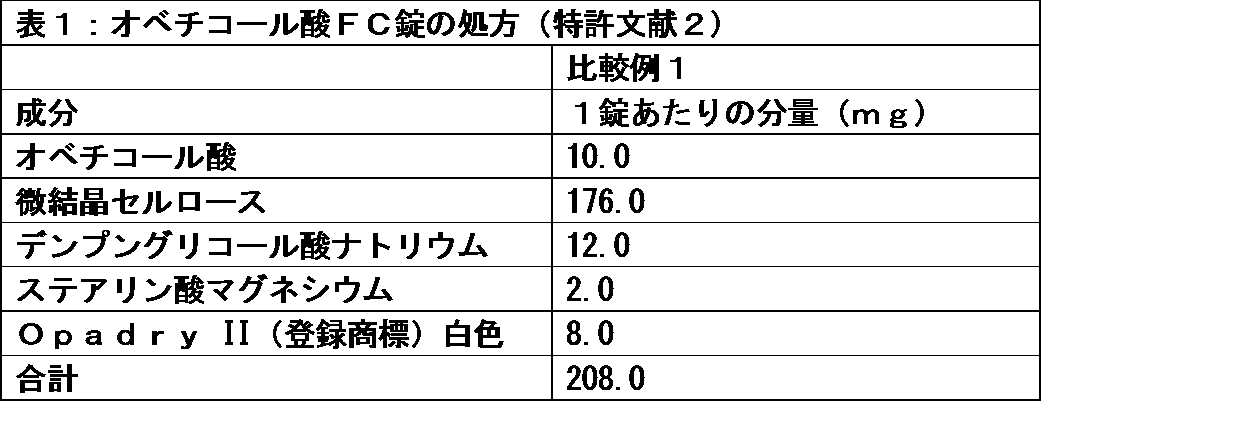
- Patent Document 2 discloses a tablet containing 1 to 25 mg of obeticholic acid. More specifically, 1-25 mg obeticholic acid per tablet, 157-185 mg microcrystalline cellulose, 12 mg sodium starch glycolate, 2 mg magnesium stearate, 4 mg colloidal silicon dioxide, 8 mg coating material There is a disclosure of tablets containing Table 1 shows the formulation of obeticholic acid 10 mg FC tablets described in Patent Document 2.
- the obeticholic acid 10 mg FC tablet used in Comparative Example 1 was prepared by a dry granulation method, and Opadry II (registered trademark) white contains macrogol 4000 (polyethylene glycol 4000) as a plasticizer.
- Detector Charged particle detector
- Column SUPELCO Discovery C8 (particle size 5 ⁇ m, inner diameter 4.6 mm, length 15 cm) manufactured by Sigma-Aldrich
- Mobile phase acetonitrile / methanol / acetic acid aqueous solution (pH 3.0) mixed solution (8/1/1)
- Analysis time 15 minutes
- Flow rate 1.0 mL / min.
- Obeticholic acid the state of a single drug substance that does not contain any additives, hereinafter referred to simply as “single product”.
- Coating ⁇ Preparation of coating solution> A coating solution having a solid content concentration of 15% was prepared so that a coating layer having the composition shown in Table 5 could be formed.
- Opadry registered trademark
- macrogol 4000 polyethylene glycol 4000
- the prepared suspension 1 was sieved with a nylon mesh (150 #) to prepare a coating solution.
- ⁇ Coating> The uncoated tablet prepared in the above (2) was coated using Hicoater HCT30N (Freund Sangyo Co., Ltd.) under the following conditions so that the coating amount of the coating agent was about 4 mg to obtain FC tablets.
- compositions for film coating are generally available, for example, under the trade names Opadry and Opadry II, Colorcon, Inc. Are commercially available or custom made by the company and can be purchased. These compositions can be prepared from the various film bases and plasticizers (eg, polyethylene glycol, lecithin, monostearic acid). (Glycerin, propylene glycol, etc.) may be contained in an appropriate amount, and may be contained in an appropriate amount, and can be conveniently selected by appropriately selecting as a coating agent used in the following Examples.
- Example 1 A film-coated tablet was obtained in the same manner as in Comparative Example 2, except that the uncoated tablet obtained in Comparative Example 2 was used and the above-described commercially available coating agent containing lecithin was used as a plasticizer.
- Example 2 A film-coated tablet was obtained in the same manner as in Comparative Example 2, except that the uncoated tablet obtained in Comparative Example 2 was used and the above-described commercially available coating agent containing glyceryl monostearate as a plasticizer was used.
- Example 3 The same as in Comparative Example 2 except that the unobtainable tablet obtained in Comparative Example 2 was used, the above-described commercially available coating agent containing no plasticizer was used, and the solid content concentration of the coating liquid was 10%. Film-coated tablets were obtained by this method.
- Example 4 Comparative Example 2 except that the uncoated tablet obtained in Comparative Example 2 was used, and the above-mentioned commercially available coating agent containing propylene glycol as a plasticizer was used, and the solid content concentration of the coating liquid was 10%. Film-coated tablets were obtained in the same manner.
- Example 5 An FC tablet was obtained in the same manner as in Comparative Example 2 except that the FC component was changed.
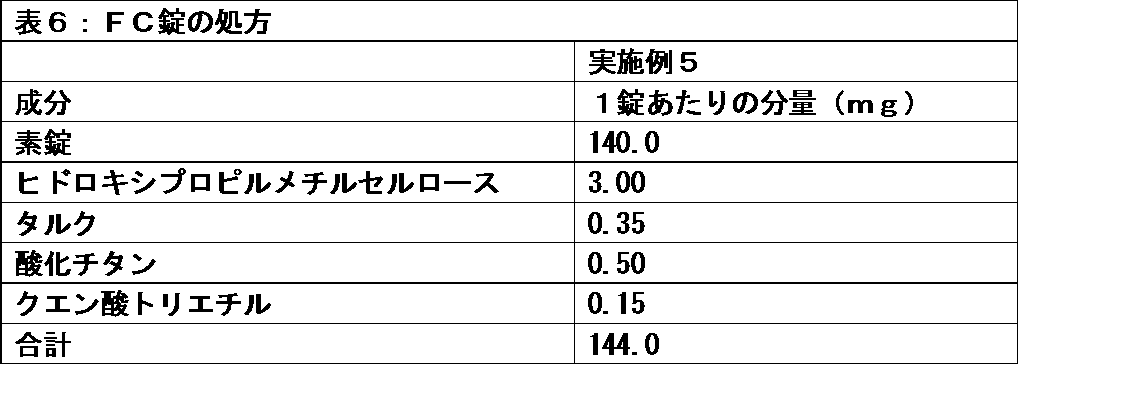
- ⁇ Preparation of coating solution> A coating solution having a solid content concentration of 10% was prepared so that a coating layer having the composition shown in Table 6 could be formed per tablet.
- Hydroxypropyl methylcellulose (TC-5R: Nippon Soda) and triethyl citrate (Citroflex-2: Morimura Shoji) as a plasticizer were added to purified water and dissolved (solution 1).
- talc Tealcan Hayashi: Hayashi Kasei
- titanium oxide titanium oxide NA61: Toho Titanium
- Solution 1 was added and dispersed in the prepared suspension 1, and sieved with a sieve (150 #) to prepare a coating solution.
- Table 7 shows the formulations of obeticholic acid FC tablets prepared in Comparative Example 2 and Examples 1 to 5.
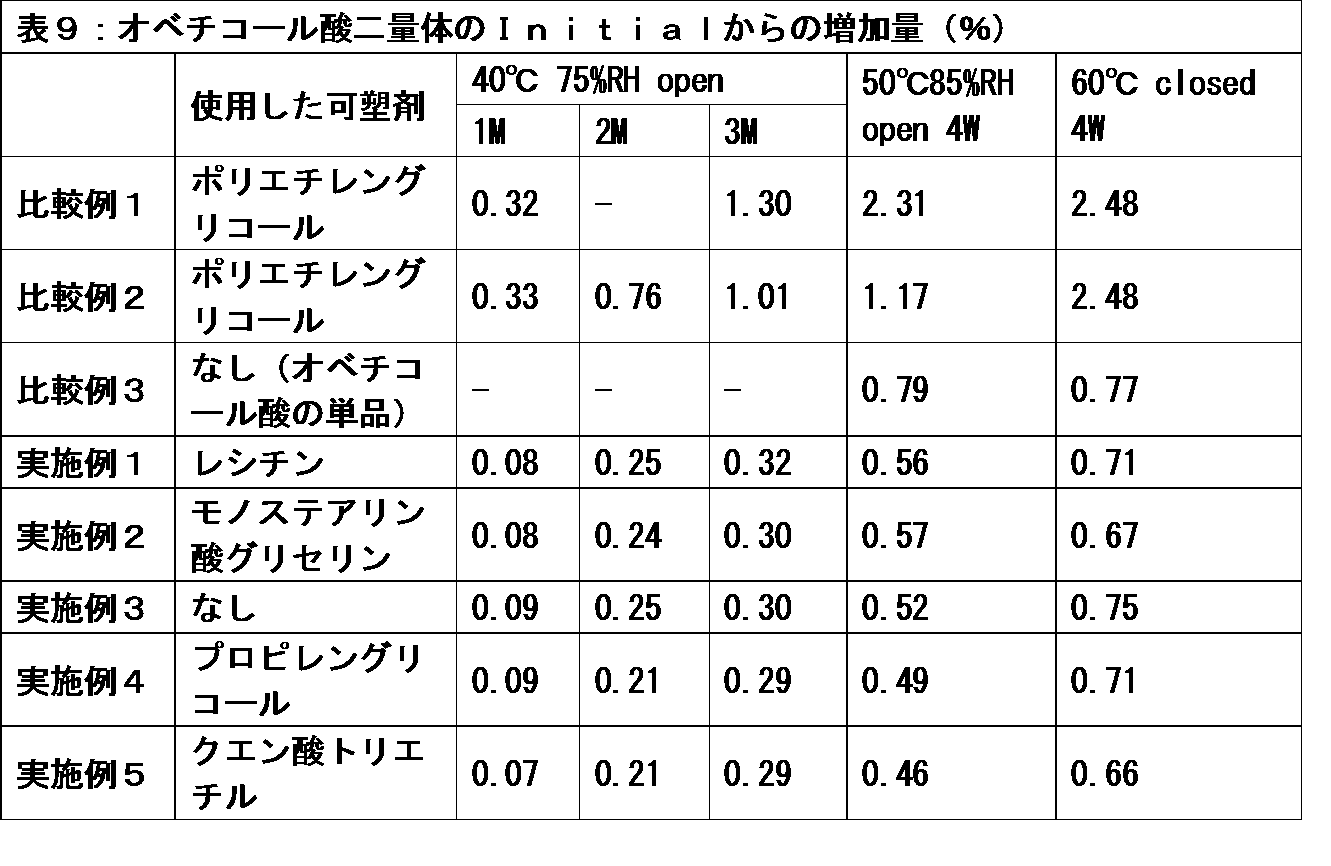
- Comparative Examples 1 to 3 and Examples 1 to 5 are shown in Tables 8 and 9.
- Comparative Examples 1 and 2 using polyethylene glycol, which is a commonly used plasticizer, the increase in obeticholic acid dimer was significantly promoted.
- the increase of the acid dimer was remarkably moderate as compared with Comparative Examples 1 and 2, and was suppressed to the same level as that of obeticholic acid (single product) (Comparative Example 3).
- Example 6- Obeticholic acid 20 mg FC tablet Formulation of FC tablet having 20 mg of obeticholic acid Granules, uncoated tablet and FC tablet having the following composition were prepared in order.
- A Granule formulation and charge
- B Formulation and preparation amount of uncoated tablets
- C Formulation of FC tablets
- Coating ⁇ Preparation of coating solution> A coating solution having a solid content concentration of 10% was prepared so that a coating layer having the composition shown in Table 12 could be formed. Hydroxypropyl methylcellulose and triethyl citrate were added to purified water and dissolved (solution 1). Separately, talc and titanium oxide were added to purified water and suspended and dispersed (suspension 1). Solution 1 was added to and dispersed in the prepared suspension 1, and sieved with a nylon mesh (150 #) to prepare a coating solution.
- Example 6- (2) Obeticholic acid 20 mg FC tablet Partially pregelatinized starch was adjusted to 21 mg per tablet, and the amount was adjusted with lactose, and FC tablet was prepared in the same manner as in Example 6- (1). Obtained.
- Example 6- (3) FC tablets were obtained in the same manner as in Example 6- (1) except that the FC component of obeticholic acid 20 mg FC tablets was changed.
- ⁇ Preparation of coating solution> A coating solution having a solid content concentration of 15% was prepared so that a coating layer having the composition shown in Table 13 could be formed. Polyvinyl alcohol and triethyl citrate were added to purified water and dissolved (solution 1). Separately, talc and titanium oxide were added to purified water and suspended and dispersed (suspension 1). Solution 1 was added to and dispersed in the prepared suspension 1, and sieved with a nylon mesh (150 #) to prepare a coating solution.
- Example 6- (4) Obeticholic acid 20 mg FC tablet Partially pregelatinized starch was 35 mg per tablet, and the amount was adjusted with lactose, and FC tablets were prepared in the same manner as in Example 6- (1). Obtained.
- Example 6- (5) Obeticholic acid 20 mg FC tablet FC tablet was obtained in the same manner as in Example 6- (1) except that crospovidone was not included in the formulation and the amount was adjusted with lactose.
- Example 6- (6) Obeticholic acid 20 mg FC tablet The content per tablet of polyvinyl alcohol was adjusted to 1.4 mg, and the amount was adjusted with lactose, and the FC tablet was prepared in the same manner as in Example 6- (1). Obtained.
- Example 6- (7) Obeticholic acid 20 mg FC tablet The content per tablet of polyvinyl alcohol was changed to 4.2 mg, and the amount was adjusted with lactose, and the FC tablet was prepared in the same manner as in Example 6- (1). Obtained.
- Example 6- (8) Obeticholic acid 20 mg FC tablets Magnesium stearate in an amount of 0.7 mg per tablet and FC tablets were prepared in the same manner as in Example 6- (1) except that the amount was prepared with lactose. Got.
- Example 6- (9) Obeticholic acid 20 mg FC tablet 2.1 mg of magnesium stearate was mixed with the granule prepared in Example 6- (8) to prepare about 141.4 mg of uncoated tablet . Thereafter, FC tablets were obtained in the same manner as in Example 6- (8).
- Example 6- (11) except that obeticholic acid 20 mg FC tablet partially pregelatinized starch was used instead of low-substituted hydroxypropylcellulose, the content per tablet was 16.8 mg, and the amount was adjusted with lactose FC tablets were obtained in the same manner as in Example 6- (1).
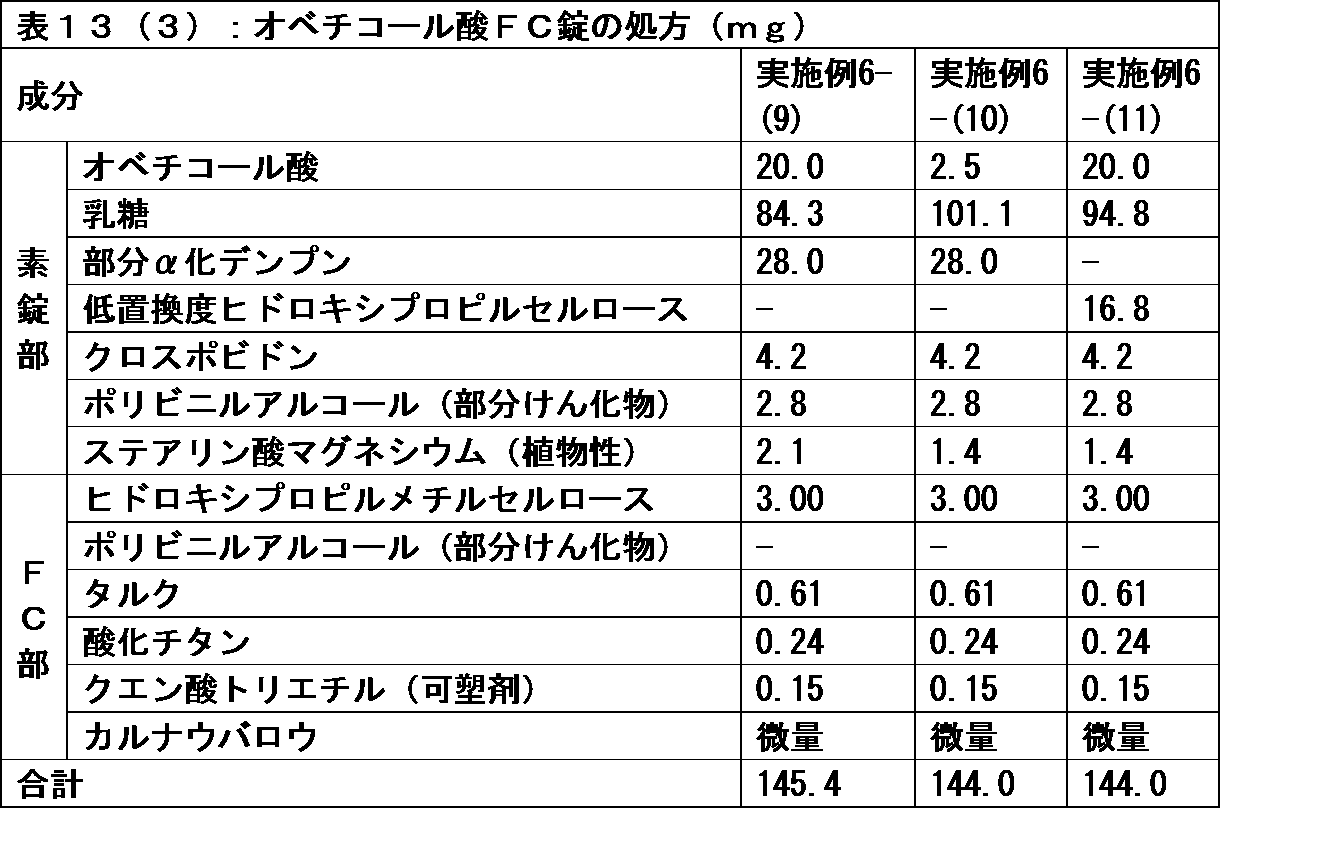
- Table 13 shows the formulations of obeticholic acid FC tablets of Examples 6- (1) to 6- (11).
- Test Example 3 Evaluation of Obeticholic Acid 2.5 mFC Tablet
- the amount of obeticholic acid dimer produced was measured in the same manner as in Test Example 1 except for the preparation of the following sample solutions.
- Acetonitrile / water 9/1 was added to make a constant volume, centrifuged (3000 rpm, 10 minutes), and the supernatant was used as a sample for HPLC measurement (500 ⁇ g / mL as obeticholic acid).
- Test Example 4 Evaluation of Obeticholic Acid 20 mg FC Tablet
- the amount of obeticholic acid dimer produced was measured in the same manner as in Test Example 1 except for the preparation of the following sample solutions.
- Example 6- The increase in the obeticholic acid dimer of 1) to 6- (11) was remarkably gradual as compared with Comparative Example 1 in which polyethylene glycol was used as the plasticizer.
- FC tablets of Example 6 represented by Examples 6- (1), 6- (7), 6- (10) and 6- (11), 1M and / or 40% at 75 ° C. and 75% RH open.
- Example 7 Obeticholic acid 10 mg FC tablets Formulation of film-coated (FC) tablets having an obeticholic acid content of 10 mg Granules, plain tablets and FC tablets having the following composition were prepared in sequence.
- ⁇ Preparation of coating solution> A coating solution having a solid content concentration of 10% was prepared so that a coating layer having the composition shown in Table 18 could be formed. Hydroxypropyl methylcellulose and triacetin were added to purified water and dissolved (solution 1). Separately, titanium oxide was added to purified water and suspended (dispersion 1). Solution 1 was added to and dispersed in the prepared suspension 1, and sieved with a nylon mesh (150 #) to prepare a coating solution.
- ⁇ Coating> The uncoated tablet prepared in the above (3) was coated using a high coater HCT30N (Freund Sangyo) under the following conditions so that the coating amount of the coating agent was about 4 mg to obtain FC tablets.
- Example 8 Obeticholic acid 10 mg FC tablet The uncoated tablet prepared in Example 7 was film-coated to obtain an FC tablet.
- FC tablets were obtained in the same manner as in Example 7, except that polyoxyethylene sorbitan monooleate (polysorbate 80) was used instead of triacetin.
- Table 19 shows the formulations of obeticholic acid FC tablets of Examples 7 and 8.
- Example 9 Obeticholic acid 20 mg FC tablet (biaxial screw wet granulation method) Obeticholic acid 285.7 g, lactose hydrate 1354.29 g, low-substituted hydroxypropylcellulose 240.0 g and crospovidone 60.0 g were weighed and mixed in a plastic bag. The mixed powder was put into a powder supply feeder of a twin screw wet granulator. The mixed powder was supplied into the chamber at 20 kg / h from the powder supply feeder, and an 8.5 wt% aqueous solution of polyvinyl alcohol was added thereto at 80 g / min. Then, granulation was carried out continuously for 4 minutes with a screw configuration of 700 rpm and a screw configuration shown in Table 22.
- the granulated powder was dried with a fluidized bed dryer. 450 g of the dried powder was taken, and granulated at 1200 rpm using a sizing type screen (mesh size: 1.06 mm) using a granulator (product name: Quadrocomil 197S, manufactured by POWREC) with a compression type wing. 4.0 g of magnesium stearate was added to 396 g of the obtained sized powder and mixed. After the tableting, FC tablets were obtained in the same manner as in Example 6- (1).
- Example 10 Obeticholic acid 10 mg FC tablet (biaxial screw wet granulation method) Obeticholic acid 50.0 g, lactose hydrate 524.0 g, low-substituted hydroxypropylcellulose 84.0 g and crospovidone 21.0 g were weighed and mixed in a plastic bag. The mixed powder was put into a powder supply feeder of a twin screw wet granulator. The mixed powder was supplied into the chamber at 20 kg / h from the powder supply feeder, and an 8.5 wt% aqueous solution of polyvinyl alcohol was added thereto at 80 g / min. Then, granulation was carried out continuously for 1.5 minutes with a screw configuration of 700 rpm and a screw configuration shown in Table 22.
- the granulated powder was dried with a fluidized bed dryer. 455 g of the dried powder was taken, and granulated at 1200 rpm using a sizing type screen (mesh size: 1.06 mm) with a granulator (product name: Quadrocomil 197S, manufactured by POWREC) using a compression type wing. 4.0 g of magnesium stearate was added to 396 g of the obtained sized powder and mixed. After the tableting, FC tablets were obtained in the same manner as in Example 6- (1).
- Example 11 Obeticholic acid 10 mg FC tablet (biaxial screw wet granulation method) Obeticholic acid 50.0 g, lactose hydrate 468.0 g, partially pregelatinized starch (Starch 1500: manufactured by Colorcon) 140.0 g, and crospovidone 21.0 g were weighed and mixed in a plastic bag. The mixed powder was put into a powder supply feeder of a twin screw wet granulator. The mixed powder was supplied into the chamber at 20 kg / h from the powder supply feeder, and 13.8 wt% polyvinyl alcohol aqueous solution was supplied to the chamber by a peristaltic pump at 50 g / min.
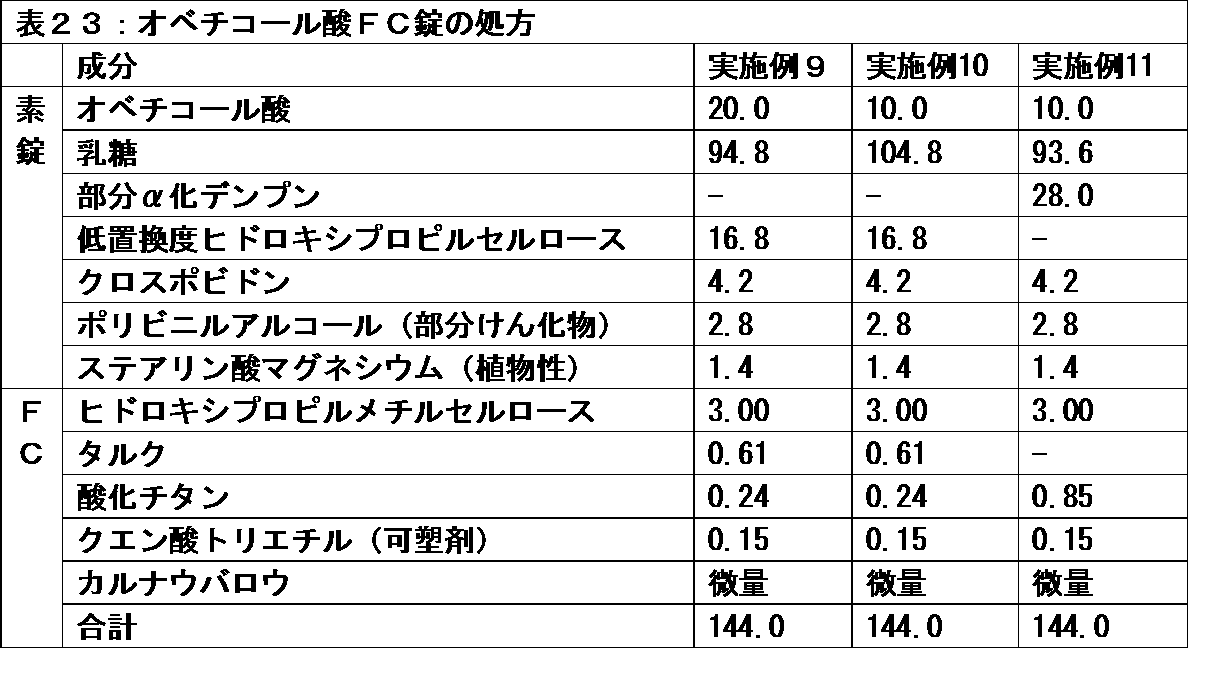
- Table 23 shows the formulations of obeticholic acid FC tablets of Examples 9-11.
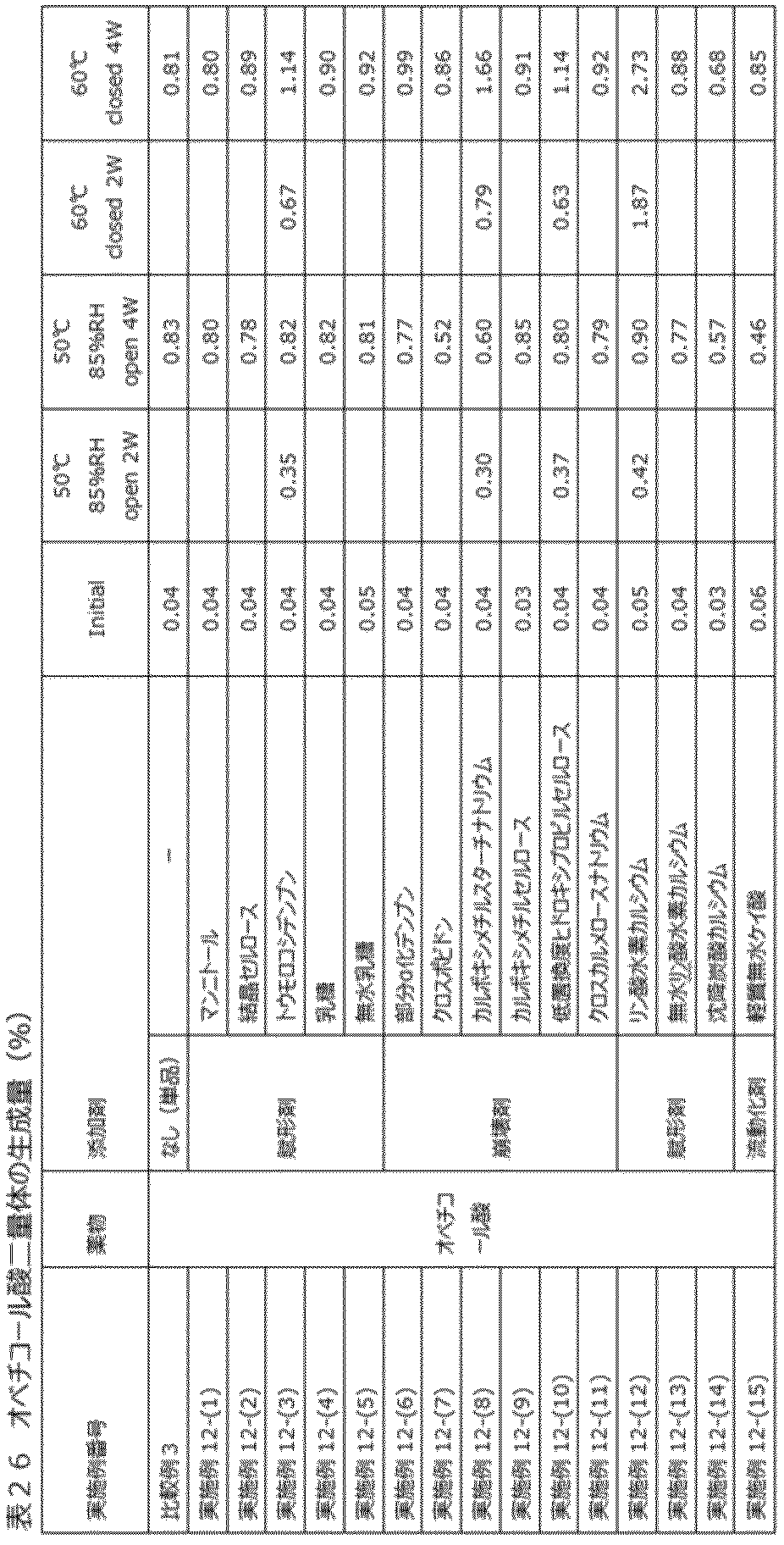
- Example 12- (1) to 12- (15) that is, the increase in oveticholic acid dimer after mixing oveticholic acid and 13 additives (excipient, disintegrant, fluidizing agent) (Single product) It was almost the same as (Comparative Example 3). In other words, none of the various additives tested in this example promoted the increase of obeticholic acid dimer.
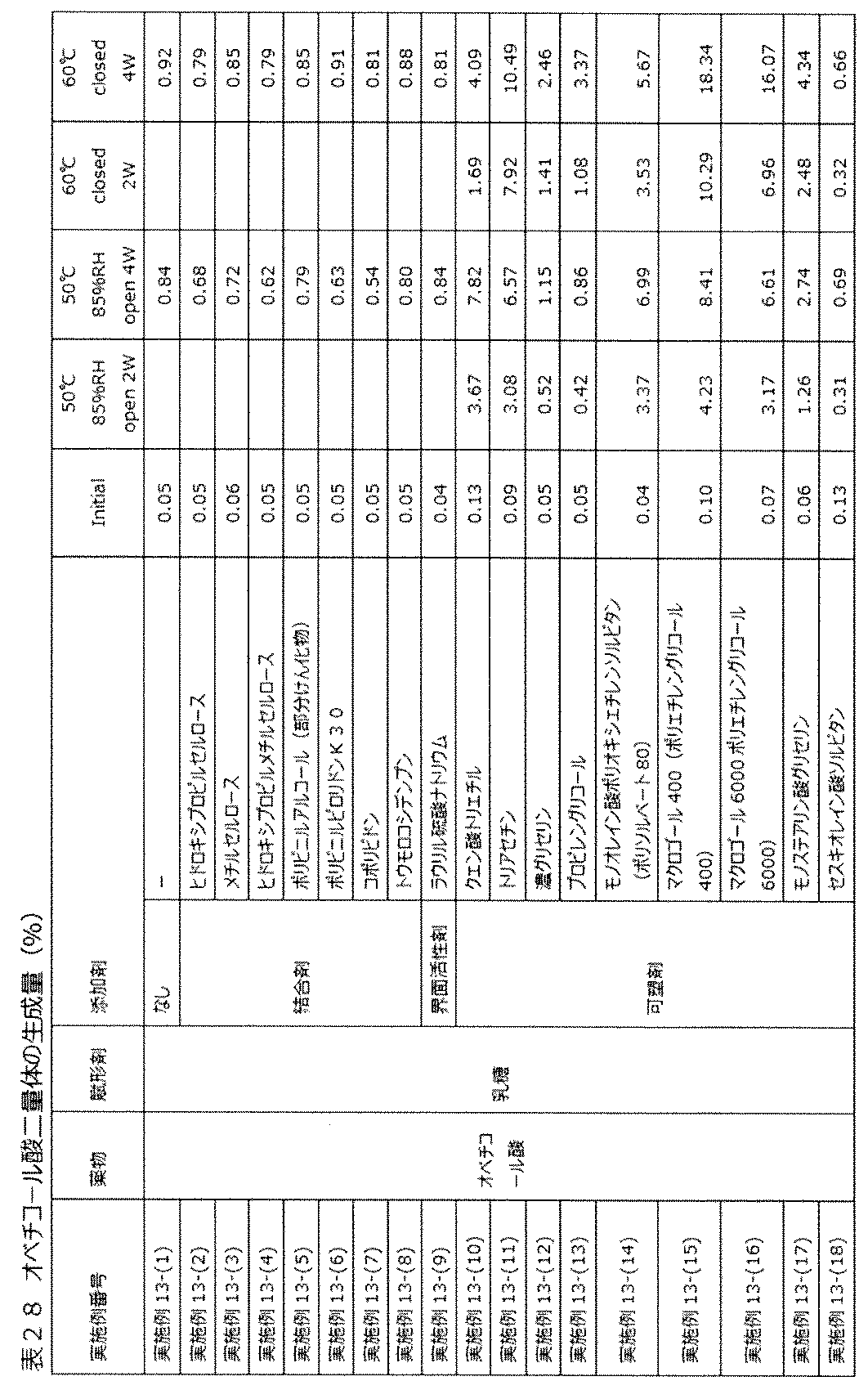
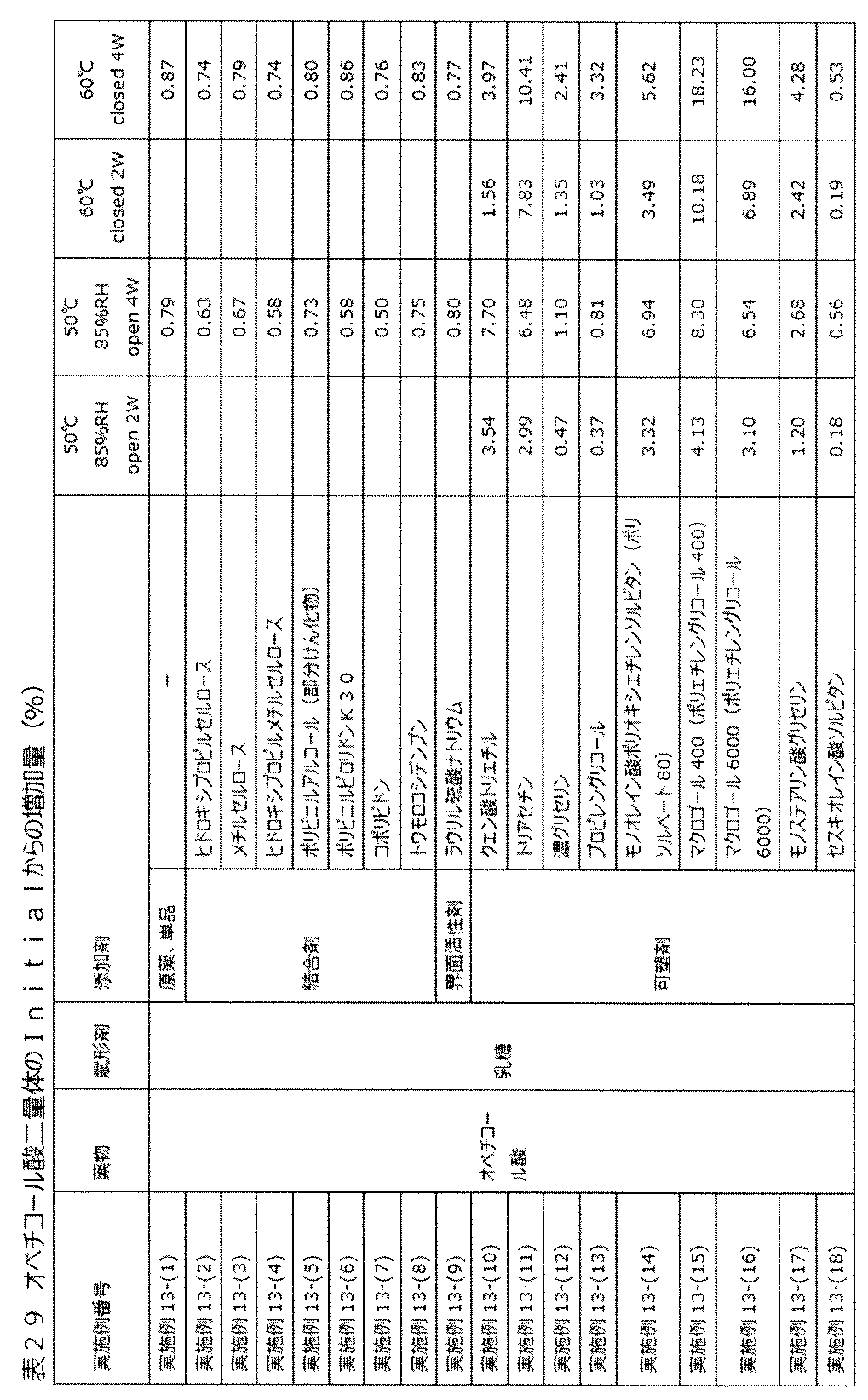
- Example 13 For the purpose of obtaining basic data for designing a desired preparation of the present invention, by the following formulation change test, in the presence of lactose commonly used as an excipient, obeticholic acid and various additives are directly contacted, It was investigated whether there was an additive that promoted the increase of the obeticolic acid dimer, an easily produced impurity.
- the obtained wet mixture was dried with a thermostat (50 ° C., 4 hours), and weighed about 102 mg (corresponding to 5 mg as obeticholic acid) in a test tube and stored. Storage was performed under two conditions of 50 ° C., 85% RH (open), and 60 ° C. (closed), and the storage period was 2 weeks (2 W) and 4 weeks (4 W).
- the production amount of obeticholic acid dimer was measured according to Test Example 2.
- Example 13 The evaluation results of Example 13 are shown in Tables 28 and 29.
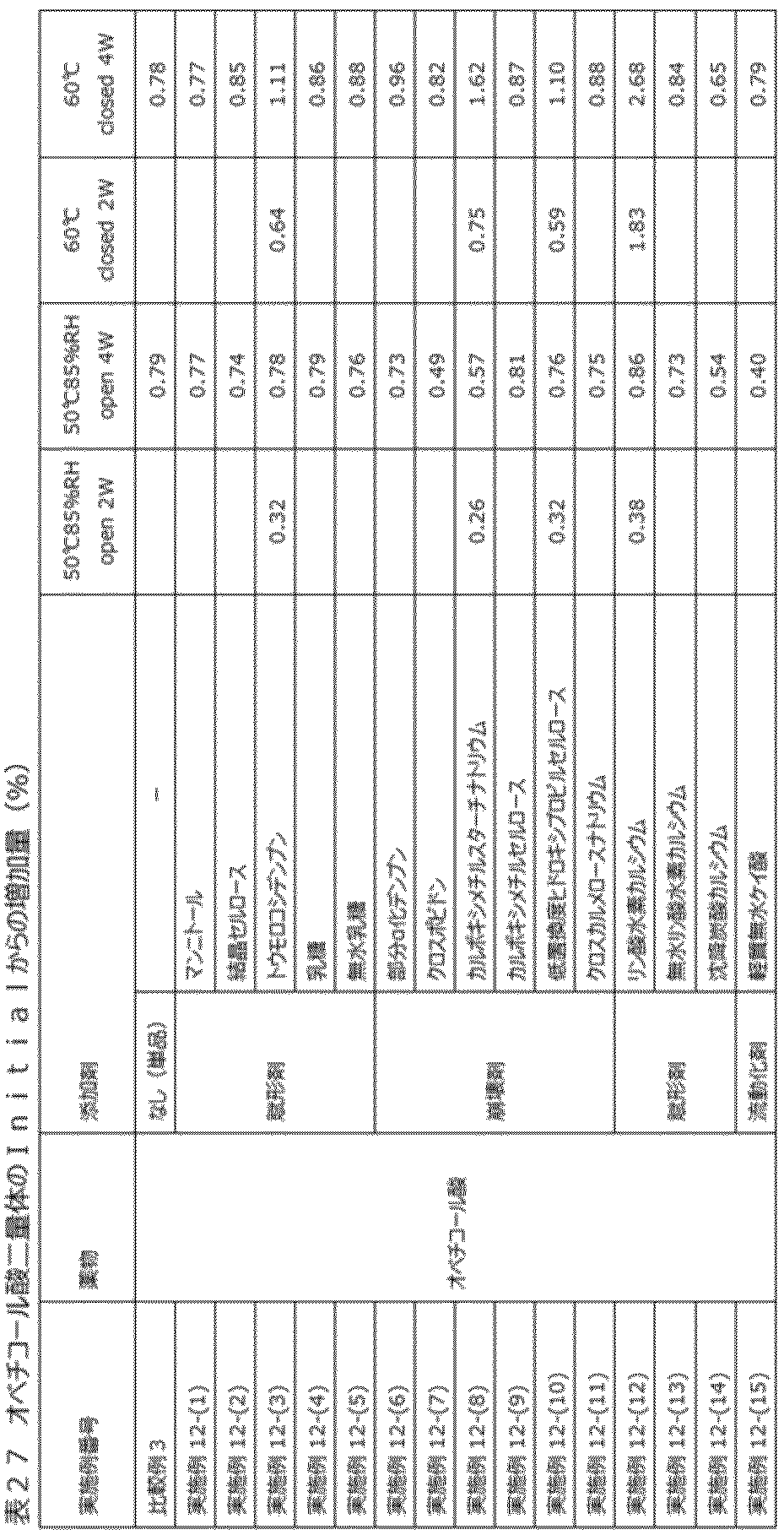
- Examples 13- (2) to 13- (9) ie the increase in the obeticholic acid dimer after mixing obeticholic acid with seven binders and one surfactant in the presence of lactose No. (that is, only obeticholic acid and lactose) was the same as Example 13- (1). That is, none of the binders and surfactants tested in this example promoted the increase in obeticholic acid dimer in the presence of lactose as an excipient.
- Sorbitan sesquioleate (Example 13- (18)) is similar to Example 13- (1) with no additives (ie, only obeticholic acid and lactose) and in the presence of lactose as an excipient. , Did not promote the increase of obeticholic acid dimer.
- macrogol 400 and macrogol 6000 which are polyethylene glycols, are excipients compared to Example 13- (1) in which no additive is added.
- the threshold value or index functioning as a preferred specific plasticizer for the coating layer in FC tablets was polyethylene glycol (Examples 13- (15) and 13).
- -It is lower than the numerical value of the increase amount of the dimer shown in (16) (for example, 16 to 18% at 60 ° C. and closed 4 W), and is shown by triacetin It was considered that the amount of the polymer was increased (for example, 10 to 11% at 60 ° C.
- sorbitan sesquioleate (Example 13- (18)), which does not promote the increase of dimer based on the index discovered and proved by the present inventor, is of course concentrated glycerin (Example 13- (12 )) also promotes the increase in obeticholic acid dimer very slowly in this combination test (for example, 2% at 60 ° C. and closed 4 W), but functions as a preferred specific plasticizer. If the structure and properties are similar to those of a plasticizer that can be classified as a preferred specific plasticizer, and the structure and properties are different from those of polyethylene glycol, any plasticizer that can be determined by those skilled in the art can function as the specific plasticizer.
- the film-coated tablet of the present invention can be obtained.
- the film-coated tablet of the present invention can be obtained.
Landscapes
- Health & Medical Sciences (AREA)
- Animal Behavior & Ethology (AREA)
- Public Health (AREA)
- Veterinary Medicine (AREA)
- Chemical & Material Sciences (AREA)
- General Health & Medical Sciences (AREA)
- Pharmacology & Pharmacy (AREA)
- Medicinal Chemistry (AREA)
- Life Sciences & Earth Sciences (AREA)
- Epidemiology (AREA)
- Engineering & Computer Science (AREA)
- Bioinformatics & Cheminformatics (AREA)
- Nuclear Medicine, Radiotherapy & Molecular Imaging (AREA)
- General Chemical & Material Sciences (AREA)
- Gastroenterology & Hepatology (AREA)
- Chemical Kinetics & Catalysis (AREA)
- Organic Chemistry (AREA)
- Medicinal Preparation (AREA)
- Pharmaceuticals Containing Other Organic And Inorganic Compounds (AREA)
Abstract
Description

[1]オベチコール酸またはその薬学的に許容される塩を含有するフィルムコーティング錠であって、
(a)オベチコール酸またはその薬学的に許容される塩を含有する素錠および
(b)該素錠の表面に、フィルム基剤を含み、可塑剤を実質的に含まないか、もしくは、
クエン酸トリエチル、レシチン、グリセリン脂肪酸エステル、プロピレングリコール、トリアセチン、ポリオキシエチレンソルビタン脂肪酸エステル、濃グリセリン、ソルビタン脂肪酸エステル、ソルビトール、グリセリン、フタル酸ジエチル、セバシン酸ジブチル、クエン酸トリブチル、セバシン酸ジエチル、アセチル化モノグリセライド、クエン酸アセチルトリエチル、クエン酸アセチルトリブチル、モノステアリン、フタル酸ジオクチル、ブチルフタリルブチルグリコレートおよび中鎖脂肪酸トリグリセリドからなる群から選ばれる特定可塑剤を少なくとも1種含む被覆層を有するフィルムコーティング錠。
本発明者が検討した結果、特許文献2に開示されているオベチコール酸を含有する錠剤は、40℃、75%RH、開放条件下での保存中に、原薬由来の不純物の一つとして開示のあるオベチコール酸二量体が、特に容易に生成し、かつ顕著に増加することがわかった。なお、当該オベチコール酸二量体は、同様な条件下、オベチコール酸を原薬のみで保存した場合でさえも、相対的に極微少ながら生成、増加が認められる、非常に易生成の不純物であるとわかった。前記一包化のニーズに確実に対応するためには、製剤中で、この易生成不純物であるオベチコール酸二量体の顕著な増加を抑制する必要がある。すなわち、特許文献2に開示の製剤よりも、オベチコール酸二量体の増加を抑制することが可能な、オベチコール酸の化学的安定性により優れた経口製剤を見出すことが、本願発明の一つの主要な課題となった。
本発明の第1の態様は、オベチコール酸またはその薬学的に許容される塩を含有する素錠の表面に、フィルム基剤を含み、可塑剤を実質的に含まない被覆層(以下、フィルムコーティング部、フィルムコーティング膜、フィルムコーティング層、又は単にコーティング層と記載することがある)を有するフィルムコーティング錠である。前記フィルムコーティング錠は、長期保存においてもアルミ包装等の保護包装を施さなくても有効成分であるオベチコール酸の分解が抑制され、及び/又は、易生成不純物であるオベチコール酸二量体の生成が抑制される効果を奏するものである。
フィルムコーティングされたフィルムコーティング錠は、通常フィルムコーティング部(被覆層)に一般に汎用される可塑剤を含んでおり、そして当該汎用可塑剤は、通常は有効成分とは反応しにくいと考えられ、またフィルムコーティング部自体が、むしろ一般には有効成分を安定化するものと考えられている。これは、フィルムコーティング錠においては、素錠部に含まれる有効成分がフィルムコーティング部に含まれる汎用可塑剤と、両者間の界面という非常に限られた部分で2次元的に接触しているのみで、素錠部内で両者が3次元的に均一に混合接触しているような状態でないこと、及びフィルムコーティング層が外部に対する保護膜として機能し、素錠部への湿気や光の侵入を遮断しうるためである。しかしながら、本発明者の研究によって、前記のようにオベチコール酸二量体の増加を促進する原因が、意外なことに、通常は有効成分の安定化に寄与するべきフィルムコーティング層中の或る汎用可塑剤、具体的にはポリエチレングリコールであることがわかった。この製剤中のフィルムコーティング部に含まれる汎用可塑剤(ポリエチレングリコール)と、素錠部に含まれるオベチコール酸とが前記のようにその両者間の界面という非常に限られた部分で接触することでさえも、意外なことには、オベチコール酸二量体の生成が特に顕著に促進されることがわかった。具体的には、例えば以下の例(比較例1及び2)において示すように、加湿条件下(例えば、40℃、75%RH、open、1M及び3M)で本オベチコール酸を素錠部に含有し、かつ上記汎用可塑剤(ポリエチレングリコール)をフィルムコーティング部に含有した製剤はオベチコール酸二量体の生成が基準値(例えば、0.5%)を大きく超えて(例えば、1%以上)促進されることが判明した。
また本発明者らは、更なる研究によって、オベチコール酸二量体の生成を抑制する好ましい特定の可塑剤があることも見出した。
また、上記コーティング工程の円滑化、フィルム膜剥がれの抑制等、製造においても支障を来たすこともない第2の態様は、前述の第1の態様よりもさらに好ましい態様である。
(a)オベチコール酸またはその薬学的に許容される塩
本明細書中で使用される場合、「オベチコール酸」とは、以下の化学構造を有する化合物をいう。
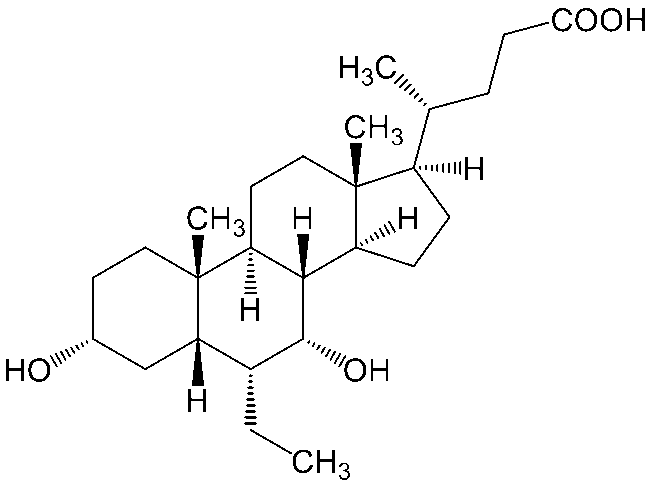
また、本発明においてはオベチコール酸またはその薬学的に許容される塩は、それらの溶媒和物を包含する。当該溶媒和物を形成する溶媒としては、水のほか、薬学的に許容される有機溶媒、例えばエタノール、アセトン、酢酸エチル、ヘキサンなどを用いることができるが、これらに限定されるものではない。
本発明においてオベチコール酸またはその薬学的に許容される塩としては、オベチコール酸(フリー体)が特に好ましい。また、本発明においてオベチコール酸の形態としては、非晶質(アモルファス、非結晶形態とも称される)のものが特に好ましい。
「オベチコール酸二量体」とは、以下の化学構造を有する化合物をいう。
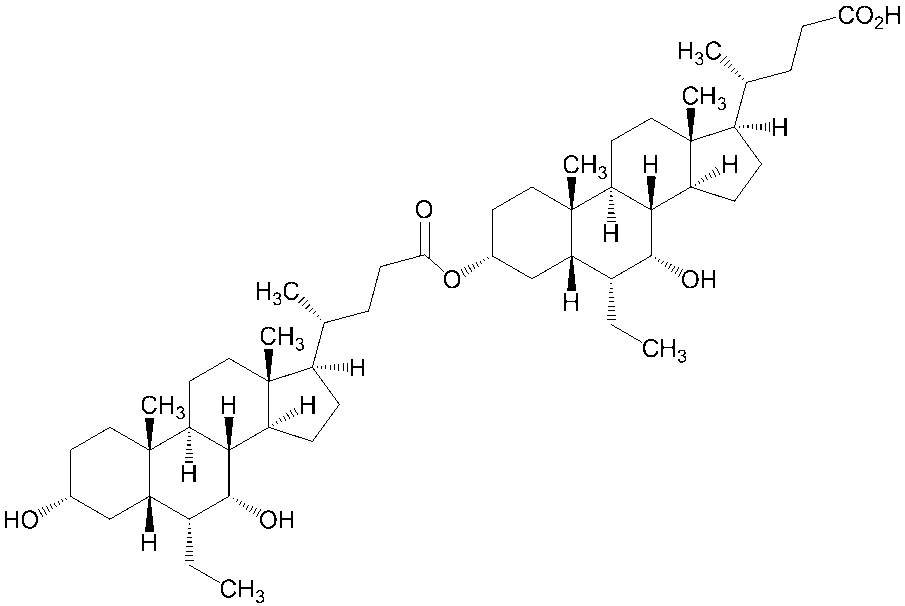
フィルムコーティング剤
本発明の錠剤は、特定のフィルムコーティングがなされる、言い換えれば、特定の被覆層が形成されていることが特徴である。当該フィルムコーティングした(被覆層を形成した)錠剤は、フィルムコーティング錠(本願明細書において、FC錠と記載することもある)と称される。フィルムコーティングに用いるフィルムコーティング剤としては、一般には、例えば、ヒプロメロース、ヒドロキシプロピルセルロース、ポリビニルピロリドン、ポリビニルアルコール系樹脂(ポリビニルアルコール、ポリビニルアルコール誘導体、ポリビニルアルコール共重合体が含まれる)、メタクリル酸コポリマーL、メタクリル酸コポリマーLD、メタクリル酸コポリマーS、アミノアルキルメタクリレートコポリマーRS、アクリル酸エチル・メタクリル酸メチルコポリマーなどのフィルム基材と、一般には、例えば、ポリエチレングリコール、プロピレングリコール、トリアセチン、クエン酸トリエチル、グリセリン、グリセリン脂肪酸エステル等の可塑剤を組み合わせたものが挙げられる。
本発明における「可塑剤」とは、材料に塑性を与えることで柔軟性を与える添加剤を意味し、一般に汎用される全ての可塑剤を指す。例えば医薬品添加物辞典2007の「用途」に「可塑剤」と記載のある添加剤を指し、具体的には、アジピン酸ジオクチル、アジピン酸ポリエステル、エポキシ化ダイズ油、エポキシヘキサヒドロフタル酸ジエステル、カリオン83、クエン酸トリエチル、グリセリン、グリセリン脂肪酸エステル、ゴマ油、酢酸ビニル樹脂、シメチルポリシロキサン・二酸化ケイ素混合物、D-ソルビトール、中鎖脂肪酸トリグリセリド、トウモロコシデンプン由来糖アルコール液、トリアセチン、濃グリセリン、ヒマシ油、フィトステロール、フタル酸ジエチル、フタル酸ジオクチル、フタル酸ジブチル、ブチルフタリルブチルグリコレート、プロピレングリコール、ポリオキシエチレン(105)ポリオキシプロピレン(5)グリコール、ポリソルベート80、ポリエチレングリコール(ポリエチレングリコールには、例えば、マクロゴール400、マクロゴール600、マクロゴール1500、マクロゴール4000、マクロゴール6000等が挙げられる)、ミリスチン酸イソプロピル、綿実油・ダイズ油混合物、モノステアリン酸グリセリン、リノール酸イソプロピル、流動パラフィン等が挙げられる。
「可塑剤を含まない」とは、被覆層に上記の可塑剤あるいは下記の特定可塑剤のいずれも一切含まないことを意味する。
「可塑剤を実質的に含まない」とは、可塑剤を一切含まないか、あるいは一般的に可塑剤として機能しない量、すなわち被覆層に可塑性を付与できない量しか、被覆層中に含まないことを意味する。当該「実質的に含まない」に相当する可塑剤含有量(上限値)は、より具体的には、被覆層中、例えば、1重量%未満、好ましくは、0.1重量%未満である。
本発明では、以下に記載した特定可塑剤を使用することが好ましい特徴となり、また以下に記載のフィルム基材が好ましいものとして挙げられる。
本態様における「特定可塑剤」としては、クエン酸トリエチル、レシチン、グリセリン脂肪酸エステル、プロピレングリコール、トリアセチン、ポリオキシエチレンソルビタン脂肪酸エステル、濃グリセリン、ソルビタン脂肪酸エステル、ソルビトール、グリセリン、フタル酸ジエチル、セバシン酸ジブチル、クエン酸トリブチル、セバシン酸ジエチル、アセチル化モノグリセライド、クエン酸アセチルトリエチル、クエン酸アセチルトリブチル、モノステアリン、フタル酸ジオクチル、ブチルフタリルブチルグリコレートおよび中鎖脂肪酸トリグリセリドが挙げられる。これら化合物は、一般的には可塑剤として製剤に配合されるものである。また、これら化合物の中には、乳化剤、分散剤、光沢化剤、安定化剤、界面活性剤などとして製剤に配合されるものもある。
これら特定可塑剤の含有量は、被覆層中、例えば、0.1~30重量%、好ましくは1~25重量%、より好ましくは1~15重量の範囲から選択される。
フィルム基剤としては、ヒドロキシプロピルメチルセルロース(HPMC)、ヒドロキシプロピルセルロース(HPC)、メチルセルロース(MC)、エチルセルロース(EC)などのセルロース誘導体、ポリビニルアルコール(PVA)系樹脂、ポリビニルピロリドン(PVP)などのビニル高分子類、メタアクリル酸コポリマーなどのアクリル高分子などが例示できる。好ましくは、ヒドロキシプロピルメチルセルロースおよびポリビニルアルコール系樹脂(ポリビニルアルコール、ポリビニルアルコール誘導体及びポリビニルアルコール共重合体が含まれる)が例示でき、より好ましくはヒドロキシプロピルメチルセルロースおよびポリビニルアルコールが例示でき、さらに好ましくはヒドロキシプロピルメチルセルロースが例示できる。被覆層中のフィルム基剤の濃度としては、可塑剤を含まない被覆層もしくは可塑剤を実質的に含まない被覆層の場合、約5~約100重量%、好ましくは約30~約100重量%、とりわけ、約30~約98重量%が好ましい。また、特定可塑剤を含む被覆層の場合、約5~約99.9重量%、好ましくは約30~約98重量%、とりわけ、約30~約93重量%が好ましい。
ポリビニルアルコール系樹脂とは、ポリビニルアルコール(PVA)、ポリビニルアルコール誘導体およびポリビニルアルコール共重合体を指し、一般に市販されているものを用いることができる。ポリビニルアルコールの具体的な商品として例えば、日本合成化学製のゴーセノール(登録商標)EG-03P、EG-05P、EG-18P、EG-22P、EG-30P、EG-40P、EG-48P、EG-05PW、EG-30PW、EG-40PWが挙げられる。ポリビニルアルコールの共重合体の具体的な商品として例えば、BASF製のポリビニルアルコール・ポリエチレングリコール・グラフトコポリマー、Kollicoat(登録商標)IRなどが挙げられる。ポリビニルアルコールの誘導体の具体的な商品として例えば、ポリビニルアルコールコポリマーの大同化成工業製のPOVACOAT(登録商標)Type F、Type R、Type Lなどが挙げられる。
被覆層の形成工程は、上記記載の一種または二種以上のフィルム基剤(またはフィルム基剤および特定可塑剤)を選択し、これを水またはエタノール等の有機溶媒、好適には、水に溶解もしくは懸濁させて製した液状組成物(コーティング液)を素錠のうえに噴霧することにより実施できる。また、コーティング液には、必要に応じて上記着色剤、固着防止剤あるいは光沢化剤などを配合してもよい。
装置としては、例えば、コーティングパンに分類される装置が挙げられる。好ましくは、通気式コーティングシステムで分類される装置が挙げられる。
「素錠」はオベチコール酸またはその薬学的に許容される塩単独であってもよいが、一般的には、他の製剤成分(添加剤)を配合してなる。これら他の製剤成分は、配合しても不都合がなく、且つ、配合の必要性があるものならばいずれでもよい。例えば賦形剤、結合剤、崩壊剤、滑沢剤などがその例として挙げられる。
好ましい例を以下に例示するが、本願発明は前記のとおり被覆層に主な特徴があり、素錠成分(素錠部)は、これらに限定されるものではない。
賦形剤の具体例としては、糖又は糖アルコール、結晶セルロース、無水リン酸水素カルシウム、リン酸水素カルシウム、炭酸カルシウム、硫酸カルシウムなどが挙げられ、好ましくは糖又は糖アルコールが挙げられる。これらの賦形剤は単独又は二種以上を組み合わせて使用することができる。
糖又は糖アルコールとしては、特に限定されるものではないが、例えば、マンニトール、エリスリトール、キシリトール、マルチトール、ソルビトール、乳糖、白糖、トルハロースなどが挙げられる。好ましくは、マンニトール、エリスリトール、乳糖及びトルハロースであり、さらに好ましくは、マンニトール、エリスリトール及び乳糖であり、さらに好ましくは、マンニトール及び乳糖であり、最も好ましくは乳糖である。
本発明における賦形剤の配合量としては、錠剤全重量に基づいて、例えば、30~90重量%、好ましくは40~80重量%、より好ましくは45~75重量%が挙げられる。
本発明における結合剤としては通常製剤化において用いられる水溶性高分子結合剤を用いることができる。例えば、メチルセルロース、ヒドロキシプロピルセルロース、ヒドロキシプロピルメチルセルロース、ポリビニルピロリドン、ポリビニルアルコール系樹脂等が挙げられる。より好ましいものとしては、メチルセルロース、ポリビニルアルコール系樹脂が挙げられる。さらに好ましいものとしては、ポリビニルアルコール系樹脂が挙げられる。ポリビニルアルコール系樹脂について、好ましいものとして、ポリビニルアルコール(PVA)、ポリビニルアルコール誘導体およびポリビニルアルコール共重合体等が挙げられる。特に好ましいものとしてポリビニルアルコールが挙げられる。該結合剤は、これらの1種または同時に2種類以上を用いることができる。結合剤の配合量としては錠剤全重量に基づいて、例えば、0.1~10重量%の範囲、好ましくは0.2~5重量%、より好ましくは0.5~4重量%、特に好ましくは1~3重量%の範囲から選択される。
本発明における崩壊剤としては通常製剤化において用いられる崩壊剤を用いることができ、例えば、デンプン類、低置換度ヒドロキシプロピルセルロース、カルメロース、カルメロースカルシウム、カルメロースナトリウム、クロスポビドン、クロスカルメロースナトリウム、カルボキシメチルスターチナトリウム(デンプングリコール酸ナトリウムとも称される)などが挙げられる。崩壊剤としては、好ましくはデンプン類、低置換度ヒドロキシプロピルセルロース、カルメロース、クロスポビドン、クロスカルメロースナトリウムであり、さらに好ましくはデンプン類、低置換度ヒドロキシプロピルセルロース、クロスポビドンであり、特に好ましくはデンプン類、クロスポビドンである。デンプン類について、さらに好ましくはα化デンプン類であり、特に好ましくは部分α化デンプンである。これらの崩壊剤は単独又は2種以上を組み合わせて使用することもできる。
崩壊剤2種以上を組み合わせる場合は、例えば、好ましくは崩壊剤2種を組み合わせることであり、好ましくは、デンプン類とクロスポビドンの組み合わせ、低置換度ヒドロキシプロピルセルロースとクロスポビドンの組み合わせが挙げられ、さらに好ましくは、部分α化デンプンとクロスポビドンの組み合わせが挙げられる。
本発明の別の態様において、崩壊剤2種以上を組み合わせる場合、特に例えば、崩壊剤2種を組み合わせる場合、用いられる一方の崩壊剤(例えば、デンプン類、低置換度ヒドロキシプロピルセルロース、部分α化デンプンなど)は、錠剤全重量に基づいて、例えば、5~50重量%、好ましくは5~40重量%であり、より好ましくは10~40重量%であり、さらに好ましくは10~30重量%であり、さらに好ましくは15~25重量%であり、用いられるもう一方の崩壊剤(例えば、クロスポビドンなど)は、錠剤全重量に基づいて、例えば、0.1~10重量%、好ましくは0.5~8重量%であり、より好ましくは1~5重量%である。
当該錠剤の製剤化成分として滑沢剤を添加することができる。滑沢剤は、原薬や顆粒の種類により打錠時に杵臼に原薬や顆粒が付着することを防止し、錠剤の効率的な製造が期待される。本発明における滑沢剤の種類は制限されるものではないが、例えば、ステアリン酸、ステアリン酸マグネシウム、ステアリン酸カルシウム、フマル酸ステアリルナトリウム、タルク、カルナウバロウ、ショ糖脂肪酸エステルなどが挙げられる。好ましくは、ステアリン酸、ステアリン酸マグネシウム、ステアリン酸カルシウム、フマル酸ステアリルナトリウム及びショ糖脂肪酸エステルであり、より好ましくはステアリン酸マグネシウム、ステアリン酸カルシウム及びフマル酸ステアリルナトリウムであり、さらに好ましくはステアリン酸マグネシウム、及びフマル酸ステアリルナトリウムであり、特に好ましくはステアリン酸マグネシウムである。これらの滑沢剤は単独又は二種以上を組み合わせて使用することができる。滑沢剤は、打錠前にその他の成分と混合してもよいし、打錠時に杵臼に噴霧してもよい。
結合剤を精製水に溶解する。結合剤の量としては、精製水の量に対し、例えば1~20重量%の範囲、好ましくは2~8重量%の範囲から選択される。
オベチコール酸、水溶性賦形剤、および崩壊剤を仕込んだ流動層造粒機に、上記(1)の工程で調製された結合剤を散布しながら造粒する。
造粒装置としては、例えば、流動層造粒(Fluid Bed Granulation)、高速攪拌造粒(Highshare granulation)、転動型流動層造粒(Roto Fluid Bed Granulation)、二軸スクリュー湿式造粒法等に分類される造粒装置が挙げられる。但し、これらに限定されるものではない。
なお、造粒方法として二軸スクリュー湿式造粒法を使用する場合の結合剤の添加方法は、粉末として添加してもよいし、溶液として添加してもよいし、粉末/溶液の両形態で添加してもよい。
上記造粒物を、減圧または常圧にて乾燥する。この乾燥は、赤外線水分計にて測定される乾燥減量値が、例えば、3重量%以内、好ましくは1~2重量%以内になるように行う。
上記(3)で乾燥した造粒物に滑沢剤を加えて混合する。混合は、例えば、攪拌ミキサー[タンブル](Diffusion mixers [Tumble])に分類される混合機が用いられる。具体的には、タンブラーブレンダー(Tumble Blender)、V ブレンダー(V Blenders)、ダブルコーン(Double Cone)、ビンタンブラー(ビン Tumble)等が挙げられる。但し、これらに限定されるものではない。
上記混合物を打錠して錠剤を調製する。打錠装置としては、例えば、錠剤プレス(Tablet Press)に分類される打錠機等が挙げられる。打錠硬度としては、例えば30~200Nの範囲から選択される。
上記錠剤には、上記フィルムコーティング剤によりフィルムコーティングを施す。コーティング装置としては、例えばコーティングパンに分類される装置が挙げられる。好ましくは、通気式コーティングシステム(Perforated Coating System)で分類される装置が挙げられる。
上記のようにして得られた錠剤を乾燥する。乾燥は減圧または常圧で行い、赤外線水分計にて測定される乾燥減量値が、例えば、3重量%以内、好ましくは1~2重量%以内になるように行う。
マンニトール(パーリトール 50C):ロケットジャパン
結晶セルロース(セオラス PH101):旭化成ケミカルズ
トウモロコシデンプン(局方松谷コーンスターチ):松谷化学
乳糖(Pharmatose 200M):DFE Pharma
無水乳糖(Tablettose 80):MEGGLE
部分α化デンプン(PCS PC-10):旭化成ケミカルズ
クロスポビドン(Kollidon CL):BASF
カルボキシメチルスターチナトリウム(Primojel):DMV
カルボキシメチルセルロース(NS-300):ニチリン
低置換度ヒドロキシプロピルセルロース(L-HPC LH-31):信越化学
クロスカルメロースナトリウム(Ac-Di-Sol):FMC
リン酸水素カルシウム(リン酸水素カルシウムT):富田製薬
無水リン酸水素カルシウム(無水リン酸水素カルシウム):富田製薬
沈降炭酸カルシウム(沈降炭酸カルシウム):備北粉化工業
軽質無水ケイ酸(アエロジール200):日本アエロジル
ヒドロキシプロピルセルロース(HPC-SL):日本曹達
メチルセルロース(SM-4):信越化学
ヒドロキシプロピルメチルセルロース(TC-5E):信越化学
ポリビニルアルコール(部分けん化物)(ゴーセノール EG-05P):日本合成化学
ポリビニルピロリドンK30(PVP K-30):BASF
コポリビドン(Kollidon VA-64):BASF
ラウリル硫酸ナトリウム(SLS):日光ケミカルズ
クエン酸トリエチル(Citroflex-2):森村商事
トリアセチン(トリアセチン):大八化学工業
濃グリセリン(濃グリセロール-S):日油
プロピレングリコール(プロピレングリコール):ADEKA
ポリソルベート80(ポリソルベート80(RS)):日油
マクロゴール400(ポリエチレングリコール400):日油
マクロゴール6000(ポリエチレングリコール6000):日油
モノステアリン酸グリセリン(MGS-BMV):日光ケミカルズ
セスキオレイン酸ソルビタン(SO-15V):日光ケミカルズ
カルナウバロウ(ポリシングワックス-105):フロイント産業
またオベチコール酸(インターセプト社より入手)は、フリー体の非晶質の形態のものを使用した。
特許文献2には、オベチコール酸を1~25mg含有する錠剤についての開示がある。より具体的には、1個の錠剤あたり1~25mgのオベチコール酸、157~185mgの微結晶セルロース、12mgのデンプングリコール酸ナトリウム、2mgのステアリン酸マグネシウム、4mgのコロイド状二酸化ケイ素、8mgのコーティング材料を含有する錠剤の開示がある。特許文献2に記載のオベチコール酸10mgFC錠の処方を表1に示す。比較例1で用いたオベチコール酸10mgFC錠は乾式造粒法で調製されたものであり、Opadry II(登録商標)白色は可塑剤としてマクロゴール4000(ポリエチレングリコール4000)を成分として含有する。
比較例1のオベチコール酸を10mg含有する錠剤を以下の条件で保存した。保存前(Initial)、保存後のオベチコール酸二量体の生成量を試験例1に従い測定した。
・40℃、75%RH 開放条件下(open)で1か月(1M)及び3か月(3M)
・50℃、85%RH(open)で4週(4W)
・60℃密栓条件下(closed)で4週(4W)
<試料溶液の調製>
保存から取り出した、1錠あたりオベチコール酸を10mg含有する錠剤1錠を20mL容メスフラスコに入れた。メスフラスコにアセトニトリル/水=9/1を加え、超音波処理(10分)し、錠剤の崩壊を確認した。振とう器にて十分に振とうさせ(300rpm、60分)、さらに超音波処理(10分)し、オベチコール酸を抽出した。アセトニトリル/水=9/1を加えて定容とし、遠心分離し(3000rpm、10分)、上澄み液をHPLC測定用サンプルとした(オベチコール酸として500μg/mL)。
<標準溶液の調製>
オベチコール酸を100mL容メスフラスコに50mg秤量し、アセトニトリル/水=9/1を用いて溶解させた(500μg/mL)。アセトニトリル/水=9/1を用いて希釈し、15.0μg/mL(3.0%)、5.0μg/mL(1.0%)、0.25μg/mL(0.05%)の標準溶液を調製した。
<定量>
上記、3点の標準溶液を用いて検量線を作成し、試料溶液に含まれるオベチコール酸二量体を定量した。分析条件は以下に示す。
<分析条件>
検出器:荷電化粒子検出器
カラム:Sigma-Aldrich製 SUPELCO Discovery C8(粒径5μm、内径4.6mm、長さ15cm)
移動相:アセトニトリル/メタノール/酢酸水溶液(pH3.0)混液(8/1/1)
分析時間:15分
流量:1.0mL/min.
カラム温度:30℃
注入量:100μL
サンプルクーラー温度:10℃
シリンジ洗浄液:アセトニトリル/メタノール/酢酸水溶液(pH3.0)混液(8/1/1)
試料溶解溶媒:アセトニトリル/水=9/1
荷電化粒子検出器パラメーター
Gas:Nitrogen
Gas pressure:35psi
Range:100pA
Filter:High
比較例1の評価結果を表2および表3に示す。前記の各種条件で保存後、オベチコール酸二量体の顕著な増加がみられた。特に、40℃、75%RH openで1M及び3Mの保存後、0.5%を超える二量体の生成が認められた。


A.オベチコール酸の含量10mgのFC錠の処方
下記組成からなる素錠およびFC錠を順次調製した。
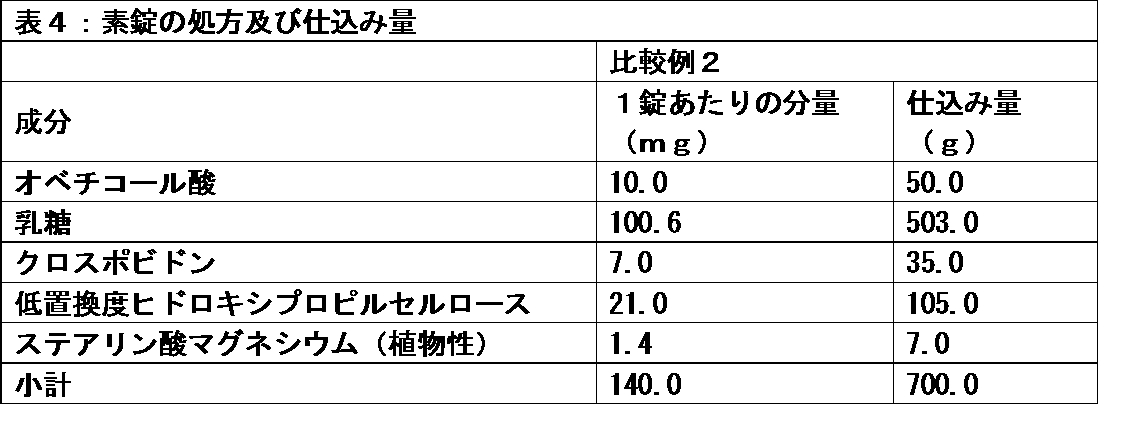
(a)素錠の処方及び仕込み量
(b)FC錠の処方

(1)混合:
表4に記載の仕込み量に従い、オベチコール酸50g、乳糖(Dilactose S:Freund)503g、クロスポビドン(ポリプラスドンXL-10:BASF)35g、低置換度ヒドロキシプロピルセルロース(L-HPC LH-21:信越化学)105gをPE袋に仕込み、十分に手混合した。そこにステアリン酸マグネシウム(植物性:太平化学産業株式会社)7.0gを加えて混合し、打錠用顆粒を得た。
上記(1)で調製した打錠用顆粒を、ロータリー打錠機(VEL2、菊水製作所製)を用いて打錠し、下記条件で打錠を行い、1錠あたり約140mgの素錠を得た。
杵:円形R錠
杵サイズ:φ7mm、10R
回転盤回転数:20rpm
打錠圧縮圧力:錠剤硬度が60~140Nになるように調製した。
<コーティング液の調製>
表5に記載の組成の被覆層が形成できるよう、固形分濃度が15%のコーティング液を調製した。精製水に表5に記載の成分組成を有し、可塑剤としてマクロゴール4000(ポリエチレングリコール4000)を含むOpadry(登録商標)を加え、懸濁分散させた。調製した懸濁液1をナイロンメッシュ(150#)で篩過し、コーティング液を調製した。
<コーティング>
上記(2)で調製した素錠を、ハイコーターHCT30N(フロイント産業製)を用い、コーティング剤の皮膜量が約4mgになるように下記条件でコーティングを行い、FC錠を得た。
<FC条件>
給気温度:85℃
風量:0.6m3/分
パン回転数:24rpm
スプレー圧:0.15MPa
液速:3-5g/分
ガン距離:11cm
実施例1
比較例2で得られた素錠を用い、可塑剤としてレシチンを含む前記の購入可能なコーティング剤を用いた以外は、比較例2と同様の手法でフィルムコーティング錠を得た。
比較例2で得られた素錠を用い、可塑剤としてモノステアリン酸グリセリンを含む前記の購入可能なコーティング剤を用いた以外は、比較例2と同様の手法でフィルムコーティング錠を得た。
比較例2で得られた素錠を用い、可塑剤を含まない前記の購入可能なコーティング剤を用いたこと、コーティング液の固形分濃度を10%としたこと以外は、比較例2と同様の手法でフィルムコーティング錠を得た。
比較例2で得られた素錠を用い、可塑剤としてプロピレングリコールを含む前記の購入可能なコーティング剤を用いたこと、コーティング液の固形分濃度を10%としたこと以外は、比較例2と同様の手法でフィルムコーティング錠を得た。
FC成分を変更した以外は、比較例2と同様の手法でFC錠を得た。
<コーティング液の調製>
1錠あたり表6に記載の組成の被覆層が形成できるよう、固形分濃度が10%のコーティング液を調製した。精製水にヒドロキシプロピルメチルセルロース(TC-5R:日本曹達)及び可塑剤としてクエン酸トリエチル(Citroflex-2:森村商事)を加え、溶解させた(溶液1)。別途、精製水にタルク(タルカンハヤシ:林化成)及び酸化チタン(酸化チタン NA61:東邦チタニウム)を加え、懸濁分散させた(懸濁液1)。調製した懸濁液1に溶液1を加えて分散させ、篩(150#)で篩過し、コーティング液を調製した。
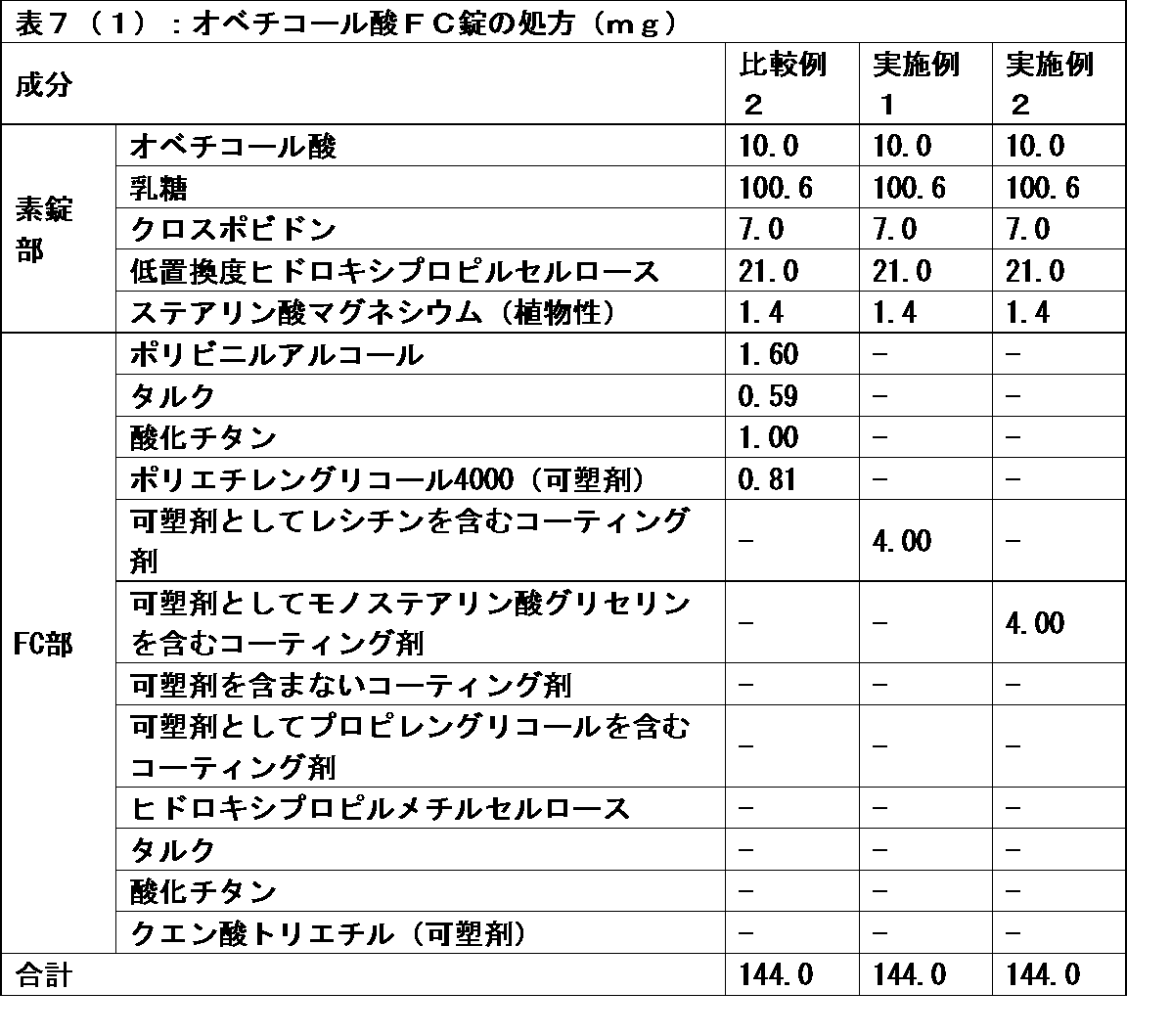
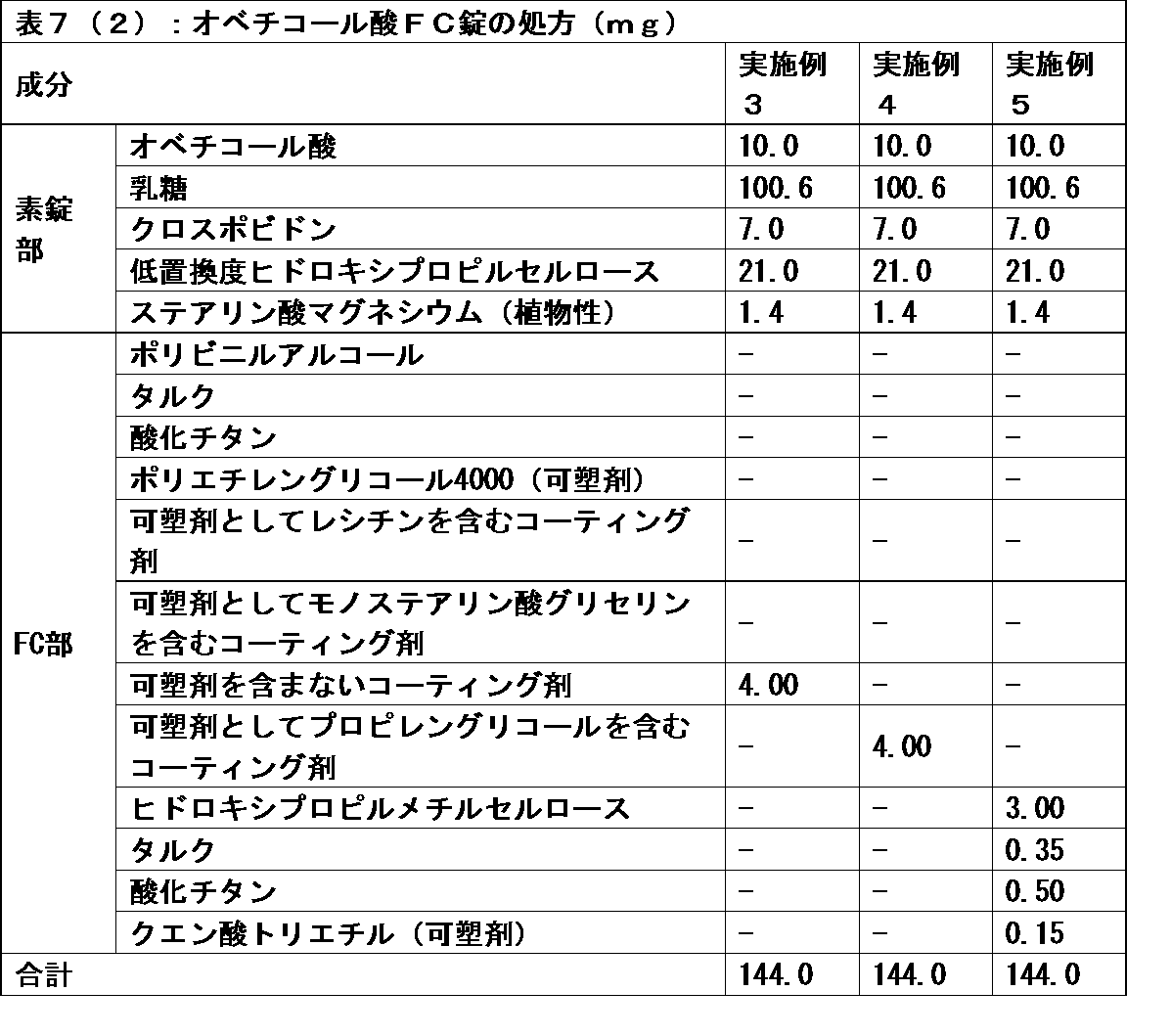
比較例2、実施例1~5で調製したオベチコール酸を10mg含有する錠剤を以下の条件で保存した。保存前(Initial)、保存後のオベチコール酸二量体の生成量を試験例1に従い測定した。
・40℃、75%RH(open)で1か月(1M)及び3か月(3M)
・50℃、85%RH(open)で4週(4W)
・60℃(closed)で4週(4W)
オベチコール酸(単品)を試験管に評価サンプルとして5mgずつ秤量した。
<保存>
実施例1で調製したオベチコール酸(単品)を入れた試験管を以下の条件で保存した。保存前(Initial)、保存後のオベチコール酸二量体の生成量を試験例2に従い測定した。
・50℃、85%RH(open)で4週(4W)
・60℃(closed)で4週(4W)
以下の試料溶液の調製以外は、試験例1と同様の手法でオベチコール酸二量体の生成量を測定した。
<試料溶液の調製>
保存から取り出した試験管にアセトニトリル/水=9/1を10mL正確に加え、超音波処理し、オベチコール酸を抽出した。遠心分離し(3000rpm、10分間)、上澄み液をHPLC測定用サンプルとした(オベチコール酸として500μg/mL)。
比較例1~3、実施例1~5の評価結果を表8、9に示す。通常汎用される可塑剤であるポリエチレングリコールを使用した比較例1及び2において、オベチコール酸二量体の増加が顕著に促進された。可塑剤を使用していない実施例3、並びに特定可塑剤としてレシチン、モノステアリン酸グリセリン、プロピレングリコール、及びクエン酸トリエチルを使用した実施例1、2、4、5のフィルムコーティング錠の保存中オベチコール酸二量体の増加は比較例1及び2と比べて顕著に緩やかであり、オベチコール酸(単品)(比較例3)と同程度まで抑制された。特に実施例1~5のFC錠について、40℃、75%RH openで1M~3Mの保存後、二量体の生成が0.5%未満に抑制されることは優れた効果である。

A.オベチコール酸の含量20mgのFC錠の処方
下記組成からなる顆粒、素錠およびFC錠を順次調製した。
(a)顆粒の処方及び仕込み量
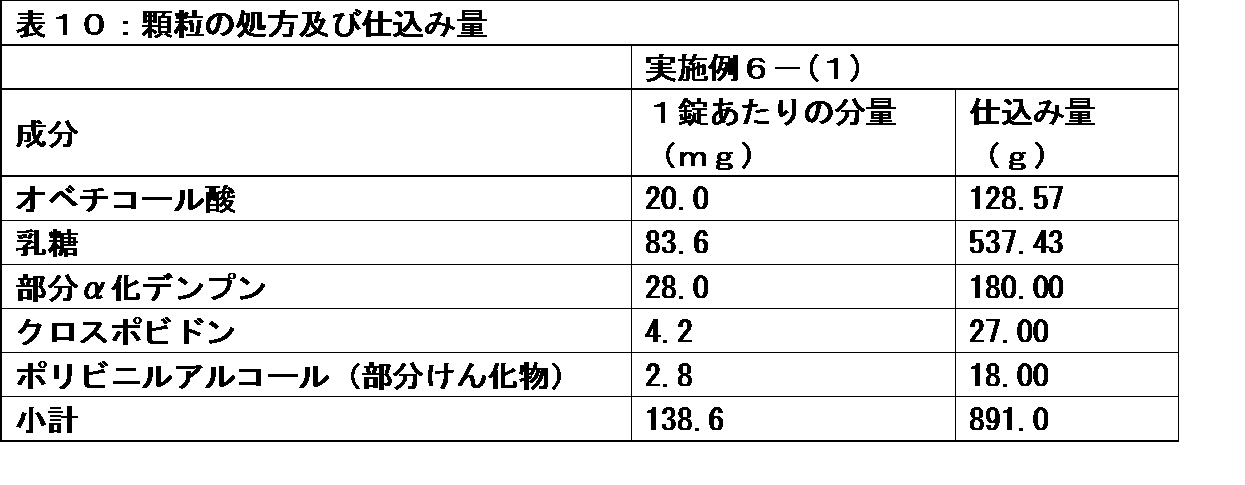
(b)素錠の処方及び仕込み量
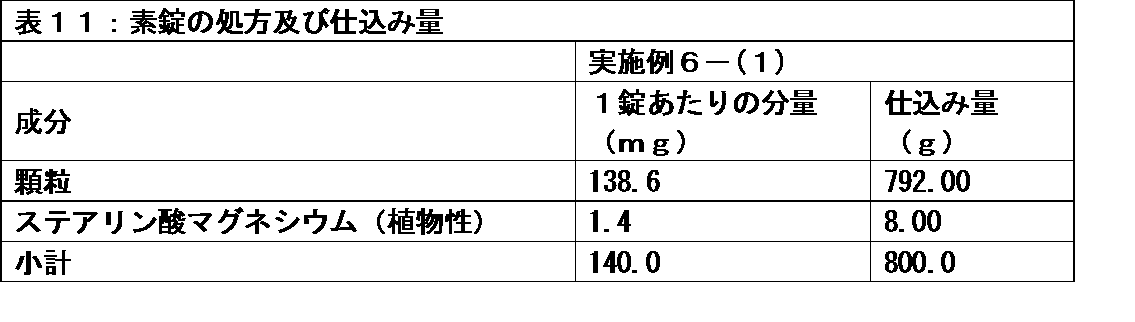
(c)FC錠の処方
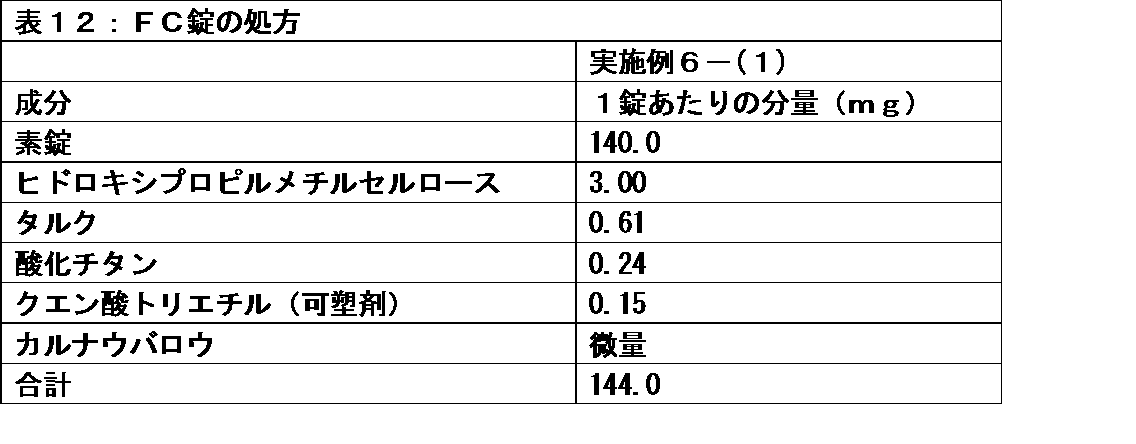
(1)造粒-整粒
<結合液の調製>
水溶性高分子結合剤のポリビニルアルコールを、80℃に加温した精製水に加えて溶解させた。室温に放冷後、精製水を加えて4%結合液を調製した。
<造粒>
表10に記載の仕込み量に従い、ポリビニルアルコール以外の処方を流動層造粒機(マルチプレックスMP-01/パウレック製)に仕込み、上記(1)で調製した結合液を用いて、下記条件でスプレー造粒を行い、顆粒を得た。
<造粒条件>
給気温度:75℃
風量:30-50m3/hr
スプレー速度:8-12g/分
スプレーノズル径:1.0mm
スプレー圧力:0.1MPa
ガン位置:中段
<整粒>
得られた顆粒をスクリーンサイズは710μmのメッシュで篩過し、整粒顆粒を得た。
表11に記載の仕込み量に従い、上記(1)で調製した顆粒にステアリン酸マグネシウムを加え、小型V型混合機(筒井理化学器械製)を用いて、混合(40rpm、5分)し、打錠用顆粒を得た。
上記(2)で調製した打錠用顆粒を、ロータリー打錠機(VEL2、菊水製作所製)を用いて打錠し、下記条件で打錠を行い、1錠あたり約140mgの素錠を得た。
杵:円形R錠
杵サイズ:φ7mm、10R
回転盤回転数:20rpm
打錠圧縮圧力:錠剤硬度が60~140Nになるように調製した。
<コーティング液の調製>
表12に記載の組成の被覆層が形成できるよう、固形分濃度が10%のコーティング液を調製した。精製水にヒドロキシプロピルメチルセルロース及びクエン酸トリエチルを加え、溶解させた(溶液1)。別途、精製水にタルク及び酸化チタンを加え、懸濁分散させた(懸濁液1)。調製した懸濁液1に溶液1を加えて分散させ、ナイロンメッシュ(150#)で篩過し、コーティング液を調製した。
<コーティング>
上記(3)で調製した素錠を、ハイコーターHCT30N(フロイント産業製)を用い、コーティング剤の皮膜量が約4mgになるように下記条件でコーティングを行い、FC錠を得た。カルナウバロウはフィルムコーティング工程の乾燥後に添加した。
<FC条件>
給気温度:85℃
風量:0.6m3/分
パン回転数:24rpm
スプレー圧:0.15MPa
液速:3-5g/分
ガン距離:11cm
部分α化デンプンの1錠あたりの含量を21mgにし、その分を乳糖で調整した以外は実施例6-(1)と同様の手法でFC錠を得た。
FC成分を変更した以外は実施例6-(1)と同様の手法でFC錠を得た。
<コーティング液の調製>
表13に記載の組成の被覆層が形成できるよう、固形分濃度が15%のコーティング液を調製した。精製水にポリビニルアルコール及びクエン酸トリエチルを加え、溶解させた(溶液1)。別途、精製水にタルク及び酸化チタンを加え、懸濁分散させた(懸濁液1)。調製した懸濁液1に溶液1を加えて分散させ、ナイロンメッシュ(150#)で篩過し、コーティング液を調製した。
部分α化デンプンの1錠あたりの含量を35mgにし、その分を乳糖で調整した以外は実施例6-(1)と同様の手法でFC錠を得た。
クロスポビドンを処方中に含有させず、その分を乳糖で調整した以外は実施例6-(1)と同様の手法でFC錠を得た。
ポリビニルアルコールの1錠あたりの含量を1.4mgにし、その分を乳糖で調整した以外は実施例6-(1)と同様の手法でFC錠を得た。
ポリビニルアルコールの1錠あたりの含量を4.2mgにし、その分を乳糖で調整した以外は実施例6-(1)と同様の手法でFC錠を得た。
ステアリン酸マグネシウムの1錠あたりの含量を0.7mgにし、その分を乳糖で調製した以外は実施例6-(1)と同様の手法でFC錠を得た。
実施例6-(8)で調製した顆粒にステアリン酸マグネシウムを2.1mg混合し、約141.4mgの素錠を調製した。その後は実施例6-(8)と同様の手法でFC錠を得た。
オベチコール酸の1錠あたりの含量を2.5mgにし、その分を乳糖で調整した以外は実施例6-(1)と同様の手法でFC錠を得た。
部分α化デンプンの代わりに低置換度ヒドロキシプロピルセルロースを使用し、その1錠あたりの含量を16.8mgにし、その分を乳糖で調整した以外は実施例6-(1)と同様の手法でFC錠を得た。
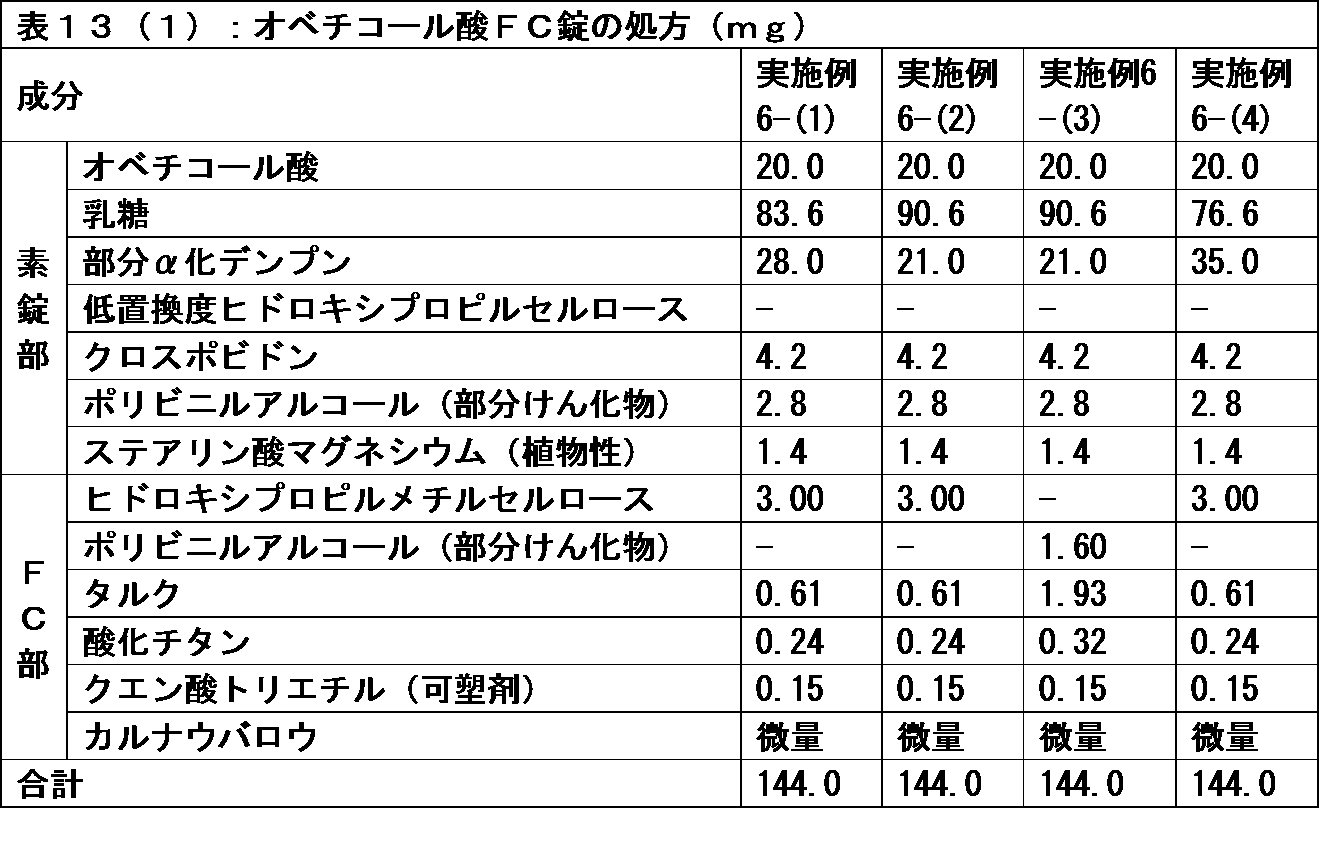

実施例6-(1)~6-(11)で調製したオベチコール酸を2.5mgまたは20mg含有する錠剤を以下の条件で保存した。保存前(Initial)、保存後のオベチコール酸二量体の生成量を以下の試験例3、4の手法で測定した。
・40℃、75%RH(open)で1か月(1M)及び3か月(3M)
・50℃、85%RH(open)で4週(4W)
・60℃(closed)で4週(4W)
以下の試料溶液の調製以外は、試験例1と同様の手法でオベチコール酸二量体の生成量を測定した。
<試料溶液の調製>
保存から取り出した、1錠あたりオベチコール酸を2.5mg含有する錠剤4錠を20mL容メスフラスコに入れた。メスフラスコにアセトニトリル/水=9/1を加え、超音波処理(10分)し、錠剤の崩壊を確認した。振とう器にて十分に振とうさせ(300rpm、60分)、さらに超音波処理(10分)し、オベチコール酸を抽出した。アセトニトリル/水=9/1を加えて定容とし、遠心分離し(3000rpm、10分)、上澄み液をHPLC測定用サンプルとした(オベチコール酸として500μg/mL)。
以下の試料溶液の調製以外は、試験例1と同様の手法でオベチコール酸二量体の生成量を測定した。
<試料溶液の調製>
保存から取り出した、1錠あたりオベチコール酸を20mg含有する錠剤1錠を40mL容メスフラスコに入れた。メスフラスコにアセトニトリル/水=9/1を加え、超音波処理(10分)し、錠剤の崩壊を確認した。振とう器にて十分に振とうさせ(300rpm、60分)、さらに超音波処理(10分)し、オベチコール酸を抽出した。アセトニトリル/水=9/1を加えて定容とし、遠心分離し(3000rpm、10分)、上澄み液をHPLC測定用サンプルとした(オベチコール酸として500μg/mL)。
<結果>
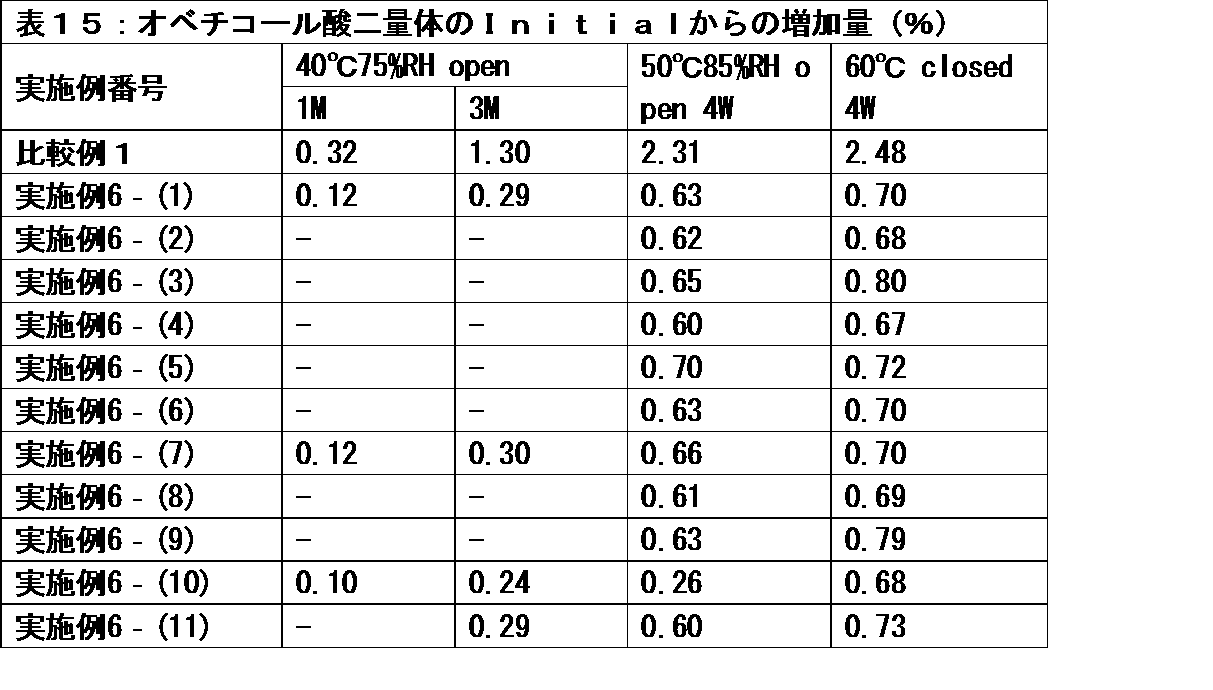
実施例6-(1)~6-(11)の評価結果を表14及び表15に示す。
比較として比較例1の結果も合わせて示す。結果から明らかなように、前述の特定可塑剤として好ましいクエン酸トリエチルを使用したフィルムコーティング錠においては、素錠部の処方はオベチコール酸二量体の増加に影響は及ぼさず、実施例6-(1)~6-(11)のオベチコール酸二量体の増加は可塑剤としてポリエチレングリコールが使用された比較例1と比べて顕著に緩やかであった。特に実施例6-(1)、6-(7)、6-(10)及び6-(11)で代表されるこれら実施例6のFC錠について、40℃、75%RH openで1M及び/又は3Mの保存後、二量体の生成が0.5%未満に抑制されることは優れた効果である。

A.オベチコール酸の含量10mgのフィルムコーティング(FC)錠の処方
下記組成からなる顆粒、素錠およびFC錠を順次調製した。
(a)顆粒の処方及び仕込み量
(b)素錠の処方及び仕込み量

(c)FC錠の処方
(1)造粒-整粒
<結合液の調製>
水溶性高分子結合剤のポリビニルアルコールを、80℃に加温した精製水に加えて溶解させた。室温に放冷後、精製水を加えて4%結合液を調製した。
<造粒>
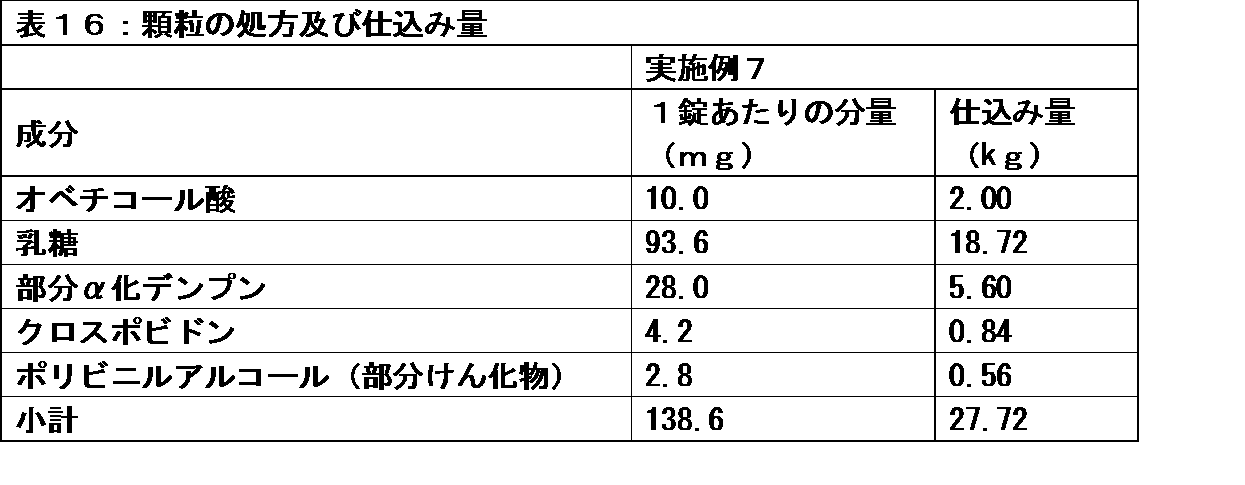
表16に記載の仕込み量に従い、ポリビニルアルコール以外の処方を流動層造粒機(フローコーター、NFLF-30SJC型/フロイント産業製)に仕込み、上記(1)で調製した結合液を用いて、下記条件でスプレー造粒を行い、顆粒を得た。
<造粒条件>
給気温度:75℃
風量:6-8m3/分
スプレー速度:160g/分
スプレーノズル径:1.8mm
スプレーエアー圧力:0.46MPa
<整粒>
得られた顆粒を、サニタリー式振動篩機(502SB型/ダルトン製)を用いて篩過し、整粒顆粒を得た。スクリーンサイズは710μmを用いた。
表17に記載の仕込み量に従い、上記(1)で調製した整粒顆粒にステアリン酸マグネシウムを加え、容器混合機(110L、山崎金属産業製)を用いて、混合(20rpm、5分)し、打錠用顆粒を得た。
上記(2)で調製した打錠用顆粒をロータリー打錠機、AQU30518SW2AII(菊水製作所製)を用いて打錠し、下記条件で打錠を行い、1錠あたり約140mgの素錠を得た。
杵:円形R錠
杵サイズ:φ7mm、10R
回転盤回転数:50rpm
打錠圧縮圧力:錠剤硬度が40~120Nになるように調製した。
<コーティング液の調製>
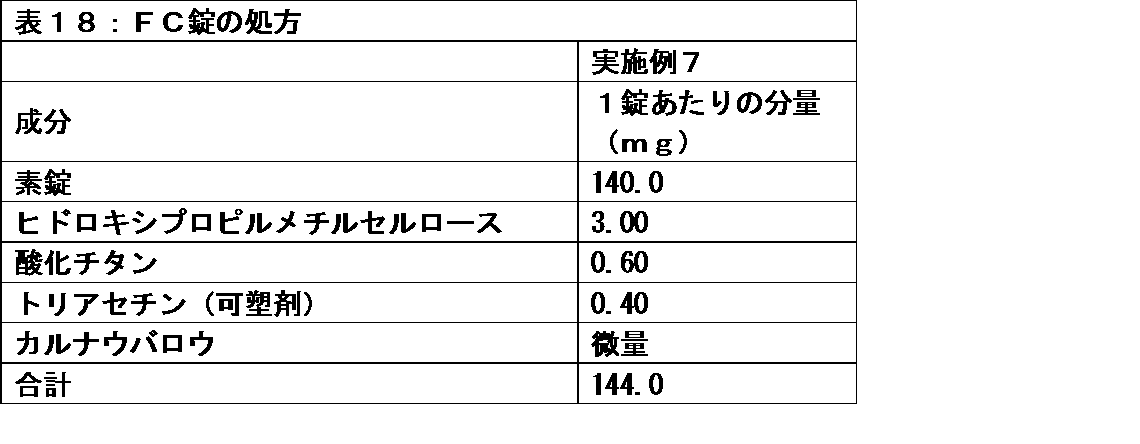
表18に記載の組成の被覆層が形成できるよう、固形分濃度が10%のコーティング液を調製した。精製水にヒドロキシプロピルメチルセルロース及びトリアセチンを加え、溶解させた(溶液1)。別途、精製水に酸化チタンを加え、懸濁分散させた(懸濁液1)。調製した懸濁液1に溶液1を加えて分散させ、ナイロンメッシュ(150#)で篩過し、コーティング液を調製した。
<コーティング>
上記(3)で調製した素錠を、ハイコーターHCT30N(フロイント産業製)を用い、コーティング剤の皮膜量が約4mgになるように下記条件でコーティングを行い、FC錠を得た。カルナウバロウはフィルムコーティング工程の乾燥後に添加した。
<FC条件>
給気温度:85℃
風量:0.6m3/分
パン回転数:24rpm
スプレー圧:0.15MPa
液速:3-5g/分
ガン距離:11cm
実施例7で調製した素錠にフィルムコーティングを行い、FC錠を得た。トリアセチンの代わりにモノオレイン酸ポリオキシエチレンソルビタン(ポリソルベート80)を用いたこと以外は実施例7と同様の手法でFC錠を得た。
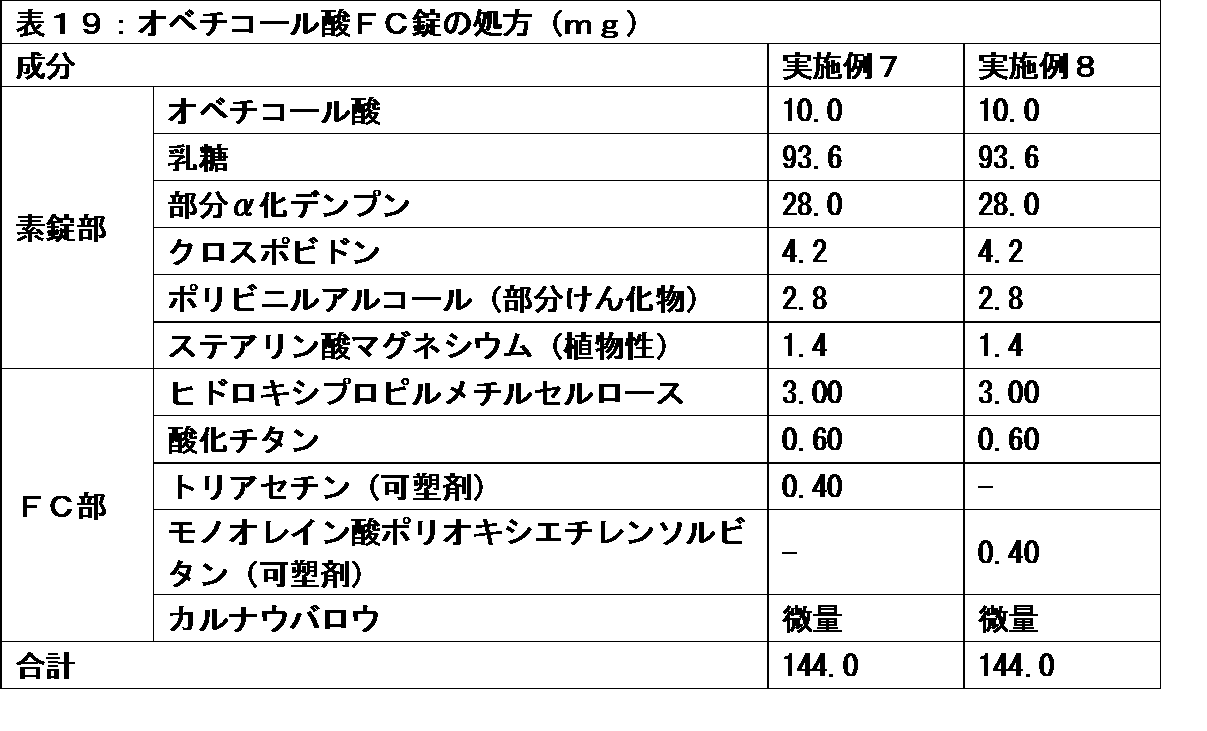
実施例7及び8で調製したオベチコール酸を10mg含有する錠剤を以下の条件で保存した。保存前(Initial)、保存後のオベチコール酸二量体の生成量を試験例1の手法で測定した。
・50℃、85%RH(open)で4週(4W)
・60℃(closed)で4週(4W)
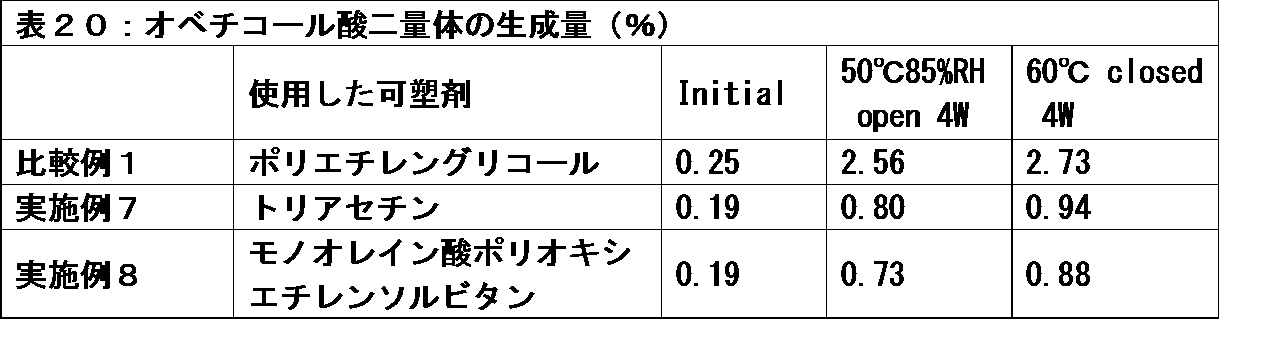
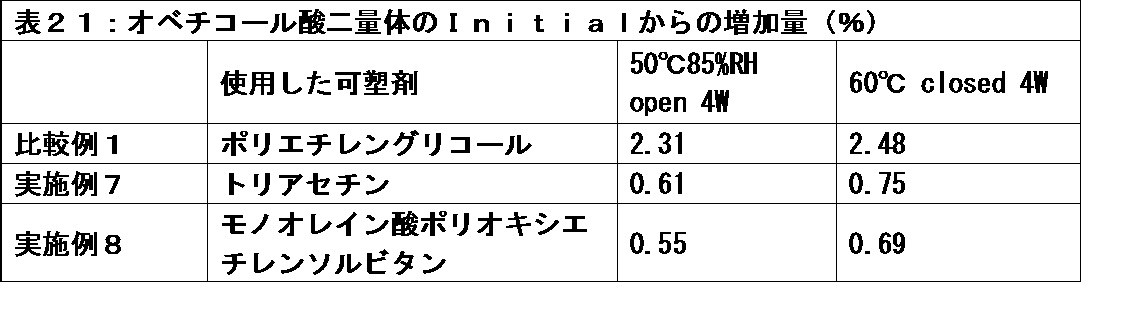
実施例7及び8の評価結果を表20、21に示す。
比較として比較例1の結果も合わせて示す。可塑剤として好ましい特定可塑剤であるトリアセチン、モノオレイン酸ポリオキシエチレンソルビタン(ポリソルベート80)を使用したフィルムコーティング錠の保存中オベチコール酸二量体の増加は、可塑剤としてポリエチレングリコールが使用された比較例1と比べて顕著に緩やかであった。
オベチコール酸285.7g、乳糖水和物1354.29g、低置換度ヒドロキシプロピルセルロース240.0g、クロスポビドン60.0gを秤量し、ポリ袋で混合した。混合末を二軸スクリュー湿式造粒機の粉体供給フィーダーに投入した。混合末を粉体供給フィーダーからチャンバー内に20kg/hで供給し、そこに8.5重量%のポリビニルアルコール水溶液をペリスタポンプで80g/min.で供給しながらスクリュー回転数700rpm、表22に示すスクリュー構成で4分間連続して造粒を行った。造粒末は流動層乾燥機で乾燥した。乾燥末450gをとり、整粒機(製品名:クアドロコーミル197S、パウレック製)を用いておろし金タイプのスクリーン(メッシュサイズ1.06mm)で圧縮型の羽を使用し、1200rpmで整粒した。得られた整粒末396gにステアリン酸マグネシウム4.0gを加えて混合した。打錠以降の工程は実施例6-(1)と同様の手法でFC錠を得た。

オベチコール酸50.0g、乳糖水和物524.0g、低置換度ヒドロキシプロピルセルロース84.0g、クロスポビドン21.0gを秤量し、ポリ袋で混合した。混合末を二軸スクリュー湿式造粒機の粉体供給フィーダーに投入した。混合末を粉体供給フィーダーからチャンバー内に20kg/hで供給し、そこに8.5重量%のポリビニルアルコール水溶液をペリスタポンプで80g/min.で供給しながらスクリュー回転数700rpm、表22に示すスクリュー構成で1.5分間連続して造粒を行った。造粒末は流動層乾燥機で乾燥した。乾燥末455gをとり、整粒機(製品名:クアドロコーミル197S、パウレック製)を用いておろし金タイプのスクリーン(メッシュサイズ1.06mm)で圧縮型の羽を使用し、1200rpmで整粒した。得られた整粒末396gにステアリン酸マグネシウム4.0gを加えて混合した。打錠以降の工程は実施例6-(1)と同様の手法でFC錠を得た。
オベチコール酸50.0g、乳糖水和物468.0g、部分α化デンプン(Starch1500:Colorcon製)140.0g、クロスポビドン21.0gを秤量し、ポリ袋で混合した。混合末を二軸スクリュー湿式造粒機の粉体供給フィーダーに投入した。混合末を粉体供給フィーダーからチャンバー内に20kg/hで供給し、そこに13.8重量%のポリビニルアルコール水溶液をペリスタポンプで50g/min.で供給しながらスクリュー回転数700rpm、表22に示すスクリュー構成で1.5分間連続して造粒を行った。造粒末は流動層乾燥機で乾燥した。乾燥末489gをとり、整粒機(製品名:クアドロコーミル197S、パウレック製)を用いておろし金タイプのスクリーン(メッシュサイズ1.06mm)で圧縮型の羽を使用し、1200rpmで整粒した。得られた整粒末396gにステアリン酸マグネシウム4.0gを加えて混合した。打錠以降の工程は実施例6-(1)と同様の手法でFC錠を得た。
実施例9~11で調製したオベチコール酸を10mg、20mg含有する錠剤を以下の条件で保存した。保存前(Initial)、保存後のオベチコール酸二量体の生成量を、それぞれ試験例1及び4の手法で測定した。
・40℃、75%RH(open)で1か月(1M)及び3か月(3M)
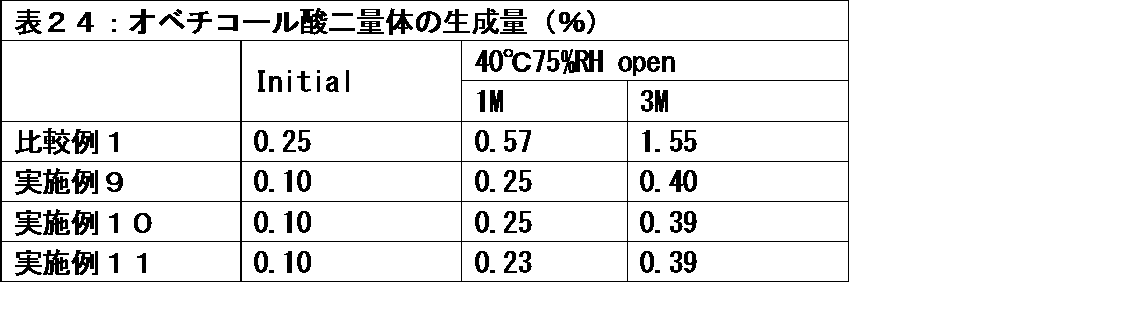
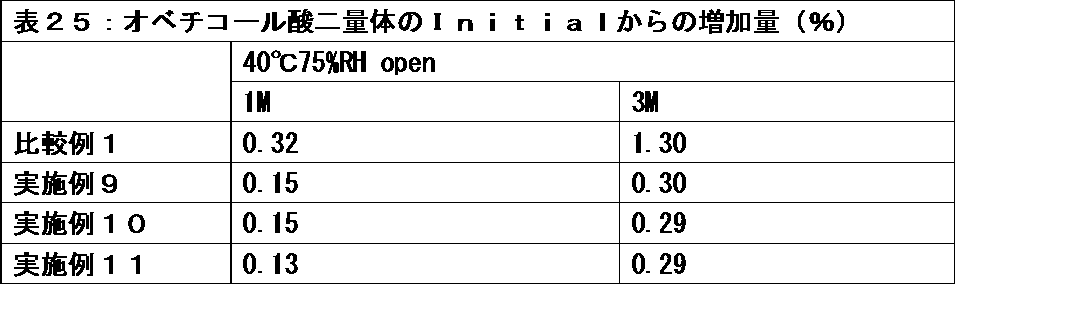
実施例9~11の評価結果を表24及び表25に示す。
比較のため比較例1の結果も合わせて示す。前述の特定可塑剤として好ましいクエン酸トリエチルを使用し、二軸スクリュー湿式造粒法で調製したオベチコール酸フィルムコーティング錠の保存中のオベチコール酸二量体の増加は、可塑剤としてポリエチレングリコールを使用した比較例1と比べて顕著に緩やかであった。特に実施例9~11のFC錠について、40℃、75%RH openで1M及び3Mの保存後、二量体の生成が0.5%未満に抑制されることは優れた効果である。
本発明の所望の製剤を設計するための基礎データを得る目的で、下記の配合変化試験により、オベチコール酸と各種添加剤を直接接触することで、易生成不純物であるオベチコール酸二量体の増加を促進させるものがあるかどうかを調べた。
<配合変化試験:乾式混合>オベチコール酸/各種添加剤=1/19
オベチコール酸/各種添加剤(賦形剤、崩壊剤、流動化剤:全15種)を1/19の比率で十分に乾式混合し、得られた混合物を試験管に約100mg(オベチコール酸として5mg相当)ずつ秤量し、保存にかけた。保存は50℃、85%RH(open)、60℃(closed)の2条件とし、保存期間は2週間(2W)及び4週間(4W)とした。オベチコール酸二量体の生成量を試験例2に従って測定した。
本発明の所望の製剤を設計するための基礎データを得る目的で、下記の配合変化試験により、賦形剤として汎用される乳糖の存在下、オベチコール酸と各種添加剤を直接接触することで、易生成不純物であるオベチコール酸二量体の増加を促進させる添加剤があるかどうかを調べた。
<配合変化試験:湿式混合>オベチコール酸/賦形剤(乳糖)/各種添加剤=1/19/0.4
オベチコール酸/賦形剤(乳糖)を1/19の比率で十分に乾式混合し、得られた混合物に、溶液または懸濁液にした各種添加剤(結合剤7種:実施例13-(2)~13-(8)、界面活性剤1種:実施例13-(9)、可塑剤9種:実施例13-(10)~13-(18))を、オベチコール酸/賦形剤/各種添加剤=1/19/0.4の比率になるように湿式混合した。比較として添加剤を加えないサンプルを実施例13-(1)として実施した。得られた湿式混合物を恒温機(50℃、4時間)で乾燥させ、試験管に約102mg(オベチコール酸として5mg相当)ずつ秤量し、保存にかけた。保存は50℃、85%RH(open)、60℃(closed)の2条件とし、保存期間は2週間(2W)及び4週間(4W)とした。オベチコール酸二量体の生成量を試験例2に従って測定した。
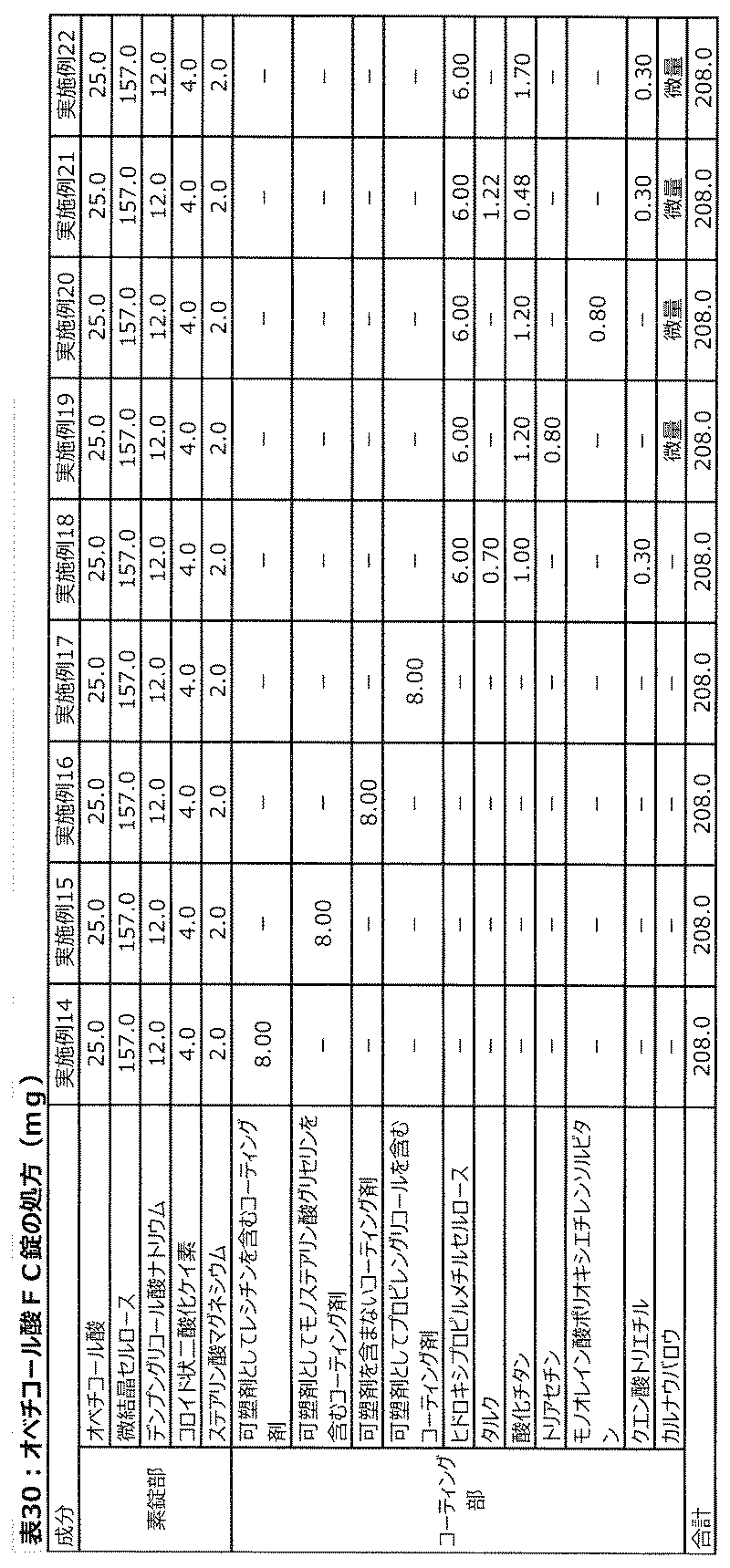
特許文献2に開示されたオベチコール酸を含有する錠剤(特定のフィルムコーティング錠)のコーティング材料を本願発明のものと置換することにより、本願発明のフィルムコーティング錠とすることが可能である。例えば、より具体的には、特許文献2に記載の、1個の錠剤あたり25mgのオベチコール酸、157mgの微結晶セルロース、12mgのデンプングリコール酸ナトリウム、2mgのステアリン酸マグネシウム、4mgのコロイド状二酸化ケイ素、8mgのコーティング材料(Opadry II)を含有する錠剤の開示に基づき、Opadry IIを除くオベチコール酸25mg素錠に対して、実施例1~5、7~8、9(又は10)及び11各々に示すコーティング成分処方(ただし、オベチコール酸や素錠の量に応じて適宜、量を調整)及び記載された方法でコーティングを行い、実施例14~22各々のFC錠を得ることができる。
Claims (25)
- オベチコール酸またはその薬学的に許容される塩を含有するフィルムコーティング錠であって、
(a)オベチコール酸またはその薬学的に許容される塩を含有する素錠および
(b)該素錠の表面に、フィルム基剤を含み、可塑剤を実質的に含まないか、もしくは、
クエン酸トリエチル、レシチン、グリセリン脂肪酸エステル、プロピレングリコール、トリアセチン、ポリオキシエチレンソルビタン脂肪酸エステル、濃グリセリン、ソルビタン脂肪酸エステル、ソルビトール、グリセリン、フタル酸ジエチル、セバシン酸ジブチル、クエン酸トリブチル、セバシン酸ジエチル、アセチル化モノグリセライド、クエン酸アセチルトリエチル、クエン酸アセチルトリブチル、モノステアリン、フタル酸ジオクチル、ブチルフタリルブチルグリコレートおよび中鎖脂肪酸トリグリセリドからなる群から選ばれる特定可塑剤を少なくとも1種含む被覆層を有するフィルムコーティング錠。 - 可塑剤を実質的に含まない被覆層を有する、請求項1に記載のフィルムコーティング錠。
- クエン酸トリエチル、レシチン、グリセリン脂肪酸エステル、プロピレングリコール、トリアセチン、ポリオキシエチレンソルビタン脂肪酸エステル、濃グリセリン、ソルビタン脂肪酸エステル、ソルビトール、グリセリン、フタル酸ジエチル、セバシン酸ジブチル、クエン酸トリブチル、セバシン酸ジエチル、アセチル化モノグリセライド、クエン酸アセチルトリエチル、クエン酸アセチルトリブチル、モノステアリン、フタル酸ジオクチル、ブチルフタリルブチルグリコレートおよび中鎖脂肪酸トリグリセリドからなる群から選ばれる特定可塑剤を少なくとも1種含む被覆層を有する、請求項1に記載のフィルムコーティング錠。
- 特定可塑剤が、クエン酸トリエチル、レシチン、グリセリン脂肪酸エステル、プロピレングリコール、トリアセチン、ポリオキシエチレンソルビタン脂肪酸エステル、濃グリセリン及びソルビタン脂肪酸エステルからなる群から選ばれるものである、請求項1又は3に記載のフィルムコーティング錠。
- ソルビタン脂肪酸エステルがセスキオレイン酸ソルビタンまたはモノラウリン酸ソルビタンである、請求項1、3及び4のいずれかに記載のフィルムコーティング錠。
- ソルビタン脂肪酸エステルがセスキオレイン酸ソルビタンである、請求項1及び3~5のいずれかに記載のフィルムコーティング錠。
- 特定可塑剤が、クエン酸トリエチル、レシチン、グリセリン脂肪酸エステル、プロピレングリコール、トリアセチンおよびポリオキシエチレンソルビタン脂肪酸エステルからなる群から選ばれるものである、請求項1及び3~6のいずれかに記載のフィルムコーティング錠。
- グリセリン脂肪酸エステルがモノステアリン酸グリセリンである、請求項1及び3~7のいずれかに記載のフィルムコーティング錠。
- 特定可塑剤が、クエン酸トリエチル、プロピレングリコール、トリアセチンおよびポリオキシエチレンソルビタン脂肪酸エステルからなる群から選ばれるものである、請求項1及び3~8のいずれかに記載のフィルムコーティング錠。
- ポリオキシエチレンソルビタン脂肪酸エステルがモノオレイン酸ポリオキシエチレンソルビタンである、請求項1及び3~9のいずれかに記載のフィルムコーティング錠。
- 特定可塑剤が、クエン酸トリエチル、プロピレングリコールおよびトリアセチンからなる群から選ばれるものである、請求項1及び3~10のいずれかに記載のフィルムコーティング錠。
- 特定可塑剤がクエン酸トリエチルである、請求項1及び3~11のいずれかに記載のフィルムコーティング錠。
- 特定可塑剤の含有量が被覆層中0.1~30重量%である、請求項1及び3~12のいずれかに記載のフィルムコーティング錠。
- 可塑剤を実質的に含まない被覆層が、ヒドロキシプロピルメチルセルロース、ヒドロキシプロピルセルロース、メチルセルロース、エチルセルロース、ポリビニルアルコール系樹脂、ポリビニルピロリドンおよびメタアクリル酸コポリマーからなる群から選ばれる少なくとも1種のフィルム基剤を含む、請求項1又は2に記載のフィルムコーティング錠。
- 可塑剤を実質的に含まない被覆層が、ヒドロキシプロピルメチルセルロース及びポリビニルアルコール系樹脂からなる群から選ばれる少なくとも1種のフィルム基剤を含む、請求項1、2及び14のいずれかに記載のフィルムコーティング錠。
- ポリビニルアルコール系樹脂がポリビニルアルコール、ポリビニルアルコール誘導体及びポリビニルアルコール共重合体のいずれか又はその混合物である、請求項14または15に記載のフィルムコーティング錠。
- ポリビニルアルコール系樹脂がポリビニルアルコールである、請求項14~16のいずれかに記載のフィルムコーティング錠。
- 可塑剤を実質的に含まない被覆層が、ヒドロキシプロピルメチルセルロースであるフィルム基剤を含む、請求項1、2、14及び15のいずれかに記載のフィルムコーティング錠。
- フィルム基剤の含有量が、被覆層中30~100重量%である、請求項1、2及び14~18のいずれかに記載のフィルムコーティング錠。
- 前記特定可塑剤を少なくとも1種含む被覆層が、ヒドロキシプロピルメチルセルロース、ヒドロキシプロピルセルロース、メチルセルロース、エチルセルロース、ポリビニルアルコール系樹脂、ポリビニルピロリドンおよびメタアクリル酸コポリマーからなる群から選ばれる少なくとも1種のフィルム基剤を含む、請求項1及び3~13のいずれかに記載のフィルムコーティング錠。
- 前記特定可塑剤を少なくとも1種含む被覆層が、ヒドロキシプロピルメチルセルロースおよびポリビニルアルコール系樹脂からなる群から選ばれる少なくとも1種のフィルム基剤を含む、請求項1、3~13及び20のいずれかに記載のフィルムコーティング錠。
- ポリビニルアルコール系樹脂がポリビニルアルコール、ポリビニルアルコール誘導体及びポリビニルアルコール共重合体のいずれか又はその混合物である、請求項20又は21に記載のフィルムコーティング錠。
- ポリビニルアルコール系樹脂がポリビニルアルコールである、請求項20~22のいずれかに記載のフィルムコーティング錠。
- 前記特定可塑剤を少なくとも1種含む被覆層が、ヒドロキシプロピルメチルセルロースであるフィルム基剤を含む、請求項1、3~13、20及び21のいずれかに記載のフィルムコーティング錠。
- フィルム基剤の含有量が、被覆層中30~98重量%である、請求項20~24のいずれかに記載のフィルムコーティング錠。
Priority Applications (9)
| Application Number | Priority Date | Filing Date | Title |
|---|---|---|---|
| CA3019499A CA3019499A1 (en) | 2016-03-31 | 2017-03-30 | Film-coated tablet having high chemical stability of active ingredient |
| ES17775388T ES2901598T3 (es) | 2016-03-31 | 2017-03-30 | Comprimido recubierto con película que tiene una alta estabilidad química del ingrediente activo |
| AU2017244982A AU2017244982A1 (en) | 2016-03-31 | 2017-03-30 | Film-coated tablet having high chemical stability of active ingredient |
| JP2018509432A JP6880000B2 (ja) | 2016-03-31 | 2017-03-30 | 有効成分の化学的安定性に優れたフィルムコーティング錠 |
| CN201780029634.1A CN109195607A (zh) | 2016-03-31 | 2017-03-30 | 具有活性成分的高化学稳定性的薄膜包衣片剂 |
| KR1020187031091A KR20180125573A (ko) | 2016-03-31 | 2017-03-30 | 유효 성분의 화학적 안정성이 뛰어난 필름 코팅정 |
| EP17775388.6A EP3437645B1 (en) | 2016-03-31 | 2017-03-30 | Film-coated tablet having high chemical stability of active ingredient |
| US16/089,544 US11331273B2 (en) | 2016-03-31 | 2017-03-30 | Film-coated tablet having high chemical stability of active ingredient |
| IL262059A IL262059A (en) | 2016-03-31 | 2018-10-02 | A layer coated tablet with high chemical stability of the active ingredient |
Applications Claiming Priority (2)
| Application Number | Priority Date | Filing Date | Title |
|---|---|---|---|
| JP2016-071408 | 2016-03-31 | ||
| JP2016071408 | 2016-03-31 |
Publications (1)
| Publication Number | Publication Date |
|---|---|
| WO2017170854A1 true WO2017170854A1 (ja) | 2017-10-05 |
Family
ID=59965826
Family Applications (1)
| Application Number | Title | Priority Date | Filing Date |
|---|---|---|---|
| PCT/JP2017/013214 Ceased WO2017170854A1 (ja) | 2016-03-31 | 2017-03-30 | 有効成分の化学的安定性に優れたフィルムコーティング錠 |
Country Status (11)
| Country | Link |
|---|---|
| US (1) | US11331273B2 (ja) |
| EP (1) | EP3437645B1 (ja) |
| JP (1) | JP6880000B2 (ja) |
| KR (1) | KR20180125573A (ja) |
| CN (1) | CN109195607A (ja) |
| AU (1) | AU2017244982A1 (ja) |
| CA (1) | CA3019499A1 (ja) |
| ES (1) | ES2901598T3 (ja) |
| IL (1) | IL262059A (ja) |
| TW (1) | TW201735927A (ja) |
| WO (1) | WO2017170854A1 (ja) |
Cited By (4)
| Publication number | Priority date | Publication date | Assignee | Title |
|---|---|---|---|---|
| JP2020002013A (ja) * | 2018-06-25 | 2020-01-09 | 日本酢ビ・ポバール株式会社 | コーティング組成物並びに経口固形剤及びその製造方法 |
| JP2021161103A (ja) * | 2020-03-31 | 2021-10-11 | 日本ジェネリック株式会社 | アジルサルタン及びアムロジピンベシル酸塩を含有するフィルムコーティング錠 |
| KR20230055872A (ko) * | 2021-10-19 | 2023-04-26 | 주식회사 코피텍 | 천연물 함유 필름 코팅용 조성물 |
| JP2024039317A (ja) * | 2022-09-09 | 2024-03-22 | 信越化学工業株式会社 | フィルムコーティング用組成物及び固形製剤並びに固形製剤の製造方法 |
Families Citing this family (1)
| Publication number | Priority date | Publication date | Assignee | Title |
|---|---|---|---|---|
| CN110559270B (zh) * | 2019-09-17 | 2020-06-23 | 扬子江药业集团广州海瑞药业有限公司 | 一种磷酸西格列汀药物组合物及其制备方法 |
Citations (5)
| Publication number | Priority date | Publication date | Assignee | Title |
|---|---|---|---|---|
| JP2004519492A (ja) * | 2001-03-12 | 2004-07-02 | ロベルト ペッリチアリ、 | Fxrに対する作用薬としてのステロイド |
| JP2012509892A (ja) * | 2008-11-26 | 2012-04-26 | サティオゲン ファーマシューティカルズ,インク. | サティオゲン類を含有する組成物及び使用の方法 |
| WO2013192097A1 (en) | 2012-06-19 | 2013-12-27 | Intercept Pharmaceuticals, Inc. | Preparation, uses and solid forms of obeticholic acid |
| JP2015052162A (ja) | 2013-09-09 | 2015-03-19 | 株式会社ブイ・テクノロジー | 成膜マスク、成膜装置及び成膜方法並びにタッチパネル基板 |
| CN106046094A (zh) * | 2016-05-30 | 2016-10-26 | 福建广生堂药业股份有限公司 | 一种奥贝胆酸二聚体杂质及其制备方法 |
Family Cites Families (11)
| Publication number | Priority date | Publication date | Assignee | Title |
|---|---|---|---|---|
| ATE29664T1 (de) * | 1982-06-10 | 1987-10-15 | Ici Plc | Herstellung von deutlich vertieft gepraegten gegenstaenden. |
| ATE273084T1 (de) | 1997-01-06 | 2004-08-15 | Bpsi Holdings Inc | Filmbeschichtungen und filmbeschichtungszusammensetzungen auf der basis von dextrin |
| WO2006011637A1 (ja) | 2004-07-28 | 2006-02-02 | Dainippon Sumitomo Pharma Co., Ltd. | フィルムコーティング錠 |
| BRPI0919249B1 (pt) * | 2008-09-25 | 2017-12-19 | Isp Investments Inc. | Coating composition, method for coating solids and coated product |
| US20110311626A1 (en) * | 2009-02-23 | 2011-12-22 | Gopi Venkatesh | Controlled release compositions comprising anti-cholinergic drugs |
| US9982008B2 (en) * | 2012-06-19 | 2018-05-29 | Intercept Pharmaceuticals, Inc. | Preparation and uses of obeticholic acid |
| US9814733B2 (en) | 2012-12-31 | 2017-11-14 | A,arin Pharmaceuticals Ireland Limited | Compositions comprising EPA and obeticholic acid and methods of use thereof |
| TR201410001A2 (tr) * | 2014-08-26 | 2016-03-21 | Buelent Karaagac | Farmasötik terkipler. |
| PE20180690A1 (es) | 2015-04-27 | 2018-04-23 | Intercept Pharmaceuticals Inc | Composiciones de acido obeticolico y metodos de uso |
| CN106974916A (zh) * | 2016-01-19 | 2017-07-25 | 成都贝斯凯瑞生物科技有限公司 | 奥贝胆酸和二甲双胍的复方组合物及其应用 |
| CN107188917A (zh) * | 2016-03-15 | 2017-09-22 | 正大天晴药业集团股份有限公司 | 奥贝胆酸盐及其药物组合物 |
-
2017
- 2017-03-30 EP EP17775388.6A patent/EP3437645B1/en not_active Revoked
- 2017-03-30 CN CN201780029634.1A patent/CN109195607A/zh active Pending
- 2017-03-30 TW TW106110706A patent/TW201735927A/zh unknown
- 2017-03-30 KR KR1020187031091A patent/KR20180125573A/ko not_active Withdrawn
- 2017-03-30 US US16/089,544 patent/US11331273B2/en active Active
- 2017-03-30 CA CA3019499A patent/CA3019499A1/en not_active Abandoned
- 2017-03-30 ES ES17775388T patent/ES2901598T3/es active Active
- 2017-03-30 AU AU2017244982A patent/AU2017244982A1/en not_active Abandoned
- 2017-03-30 JP JP2018509432A patent/JP6880000B2/ja active Active
- 2017-03-30 WO PCT/JP2017/013214 patent/WO2017170854A1/ja not_active Ceased
-
2018
- 2018-10-02 IL IL262059A patent/IL262059A/en unknown
Patent Citations (7)
| Publication number | Priority date | Publication date | Assignee | Title |
|---|---|---|---|---|
| JP2004519492A (ja) * | 2001-03-12 | 2004-07-02 | ロベルト ペッリチアリ、 | Fxrに対する作用薬としてのステロイド |
| JP4021327B2 (ja) | 2001-03-12 | 2007-12-12 | インターセプト ファーマスーティカル インコーポレイテッド | Fxrに対する作用薬としてのステロイド |
| JP2012509892A (ja) * | 2008-11-26 | 2012-04-26 | サティオゲン ファーマシューティカルズ,インク. | サティオゲン類を含有する組成物及び使用の方法 |
| WO2013192097A1 (en) | 2012-06-19 | 2013-12-27 | Intercept Pharmaceuticals, Inc. | Preparation, uses and solid forms of obeticholic acid |
| JP2015521621A (ja) * | 2012-06-19 | 2015-07-30 | インターセプト ファーマシューティカルズ, インコーポレイテッド | オベチコール酸の調製、使用および固体形態 |
| JP2015052162A (ja) | 2013-09-09 | 2015-03-19 | 株式会社ブイ・テクノロジー | 成膜マスク、成膜装置及び成膜方法並びにタッチパネル基板 |
| CN106046094A (zh) * | 2016-05-30 | 2016-10-26 | 福建广生堂药业股份有限公司 | 一种奥贝胆酸二聚体杂质及其制备方法 |
Non-Patent Citations (6)
| Title |
|---|
| "Formulation Design and Physicochemical Characterization for Pharmaceutical Excipients", part 1 29 January 2016, ISBN: 978-4-7813-1142-5, article MASAHARU MIYAJIMA ET AL.: "Jozai· Capsule-zai ni Shiyo sareru Tenkazai", pages: 3 - 18, XP9514957 * |
| "Japanese Pharmacopoeia", article "General Tests, Processes and Apparatus, 2. 53 Viscosity Determination, Method 1: Viscosity measurement by capillary tube viscometer" |
| HITOSHI YAMAUCHI ET AL.: "Nyumon Koza Iyakuhin Bun'ya ni Okeru Kaimen Kasseizai", OLEOSCIENCE, vol. 2, no. 11, 2002, pages 697 - 704, XP009514376, ISSN: 1345-8949, DOI: 10.5650/oleoscience.2.697 * |
| PHARMACEUTICAL ADDITIVES DICTIONARY, 2007 |
| See also references of EP3437645A4 |
| SHUJI KITAGAWA: "8 Hoshutsu Seigyogata Seizai, 8.3 Johosei Seizai ni Mochiirareru Seizai Genryo no Shurui to Seishitsu", BASIC YAKUGAKU KYOKASHO SERIES 20 YAKUZAIGAKU (YAKUZAI-GAKU DAI 2-BAN (BĒSHIKKU YAKUGAKU KYŌKASHO SHIRĪZU; 20)) [PHARMACOLOGY 2ND EDITION (BASIC PHARMACY TEXTBOOK SERIES; 20)], 2013, pages 169 - 175, XP009518009, ISBN: 978-4-7598-1620-4 * |
Cited By (8)
| Publication number | Priority date | Publication date | Assignee | Title |
|---|---|---|---|---|
| JP2020002013A (ja) * | 2018-06-25 | 2020-01-09 | 日本酢ビ・ポバール株式会社 | コーティング組成物並びに経口固形剤及びその製造方法 |
| JP7194524B2 (ja) | 2018-06-25 | 2022-12-22 | 日本酢ビ・ポバール株式会社 | コーティング組成物並びに経口固形剤及びその製造方法 |
| JP2021161103A (ja) * | 2020-03-31 | 2021-10-11 | 日本ジェネリック株式会社 | アジルサルタン及びアムロジピンベシル酸塩を含有するフィルムコーティング錠 |
| JP7441105B2 (ja) | 2020-03-31 | 2024-02-29 | 日本ジェネリック株式会社 | アジルサルタン及びアムロジピンベシル酸塩を含有するフィルムコーティング錠 |
| KR20230055872A (ko) * | 2021-10-19 | 2023-04-26 | 주식회사 코피텍 | 천연물 함유 필름 코팅용 조성물 |
| KR102734709B1 (ko) * | 2021-10-19 | 2024-11-27 | 주식회사 코피텍 | 천연물 함유 필름 코팅용 조성물 |
| JP2024039317A (ja) * | 2022-09-09 | 2024-03-22 | 信越化学工業株式会社 | フィルムコーティング用組成物及び固形製剤並びに固形製剤の製造方法 |
| JP7770744B2 (ja) | 2022-09-09 | 2025-11-17 | 信越化学工業株式会社 | フィルムコーティング用組成物及び固形製剤並びに固形製剤の製造方法 |
Also Published As
| Publication number | Publication date |
|---|---|
| JP6880000B2 (ja) | 2021-06-02 |
| CN109195607A (zh) | 2019-01-11 |
| JPWO2017170854A1 (ja) | 2019-02-14 |
| EP3437645A1 (en) | 2019-02-06 |
| AU2017244982A1 (en) | 2018-11-01 |
| KR20180125573A (ko) | 2018-11-23 |
| TW201735927A (zh) | 2017-10-16 |
| ES2901598T3 (es) | 2022-03-23 |
| US11331273B2 (en) | 2022-05-17 |
| IL262059A (en) | 2018-11-29 |
| US20200268671A1 (en) | 2020-08-27 |
| EP3437645B1 (en) | 2021-09-22 |
| CA3019499A1 (en) | 2017-10-05 |
| EP3437645A4 (en) | 2019-12-04 |
Similar Documents
| Publication | Publication Date | Title |
|---|---|---|
| WO2009090670A2 (en) | Stabilized sustained release composition of bupropion hydrochloride and process for preparing the same | |
| JP6880000B2 (ja) | 有効成分の化学的安定性に優れたフィルムコーティング錠 | |
| US11413295B2 (en) | Oral preparation of obeticholic acid | |
| JP2015522653A (ja) | プロトンポンプ阻害剤の医薬組成物 | |
| JP2009527554A (ja) | コハク酸メトプロロールe.r.の錠剤およびその調製方法 | |
| US20080139514A1 (en) | Diphosphonic acid pharmaceutical compositions | |
| WO2011064797A2 (en) | Controlled release pharmaceutical compositions of galantamine | |
| WO2005084636A2 (en) | A process for the preparation of controlled-release pharmaceutical composition of metoprolol | |
| JP6626492B2 (ja) | コハク酸メトプロロールのカプセル剤形 | |
| TW202038918A (zh) | 醫藥組合物 | |
| US10835497B2 (en) | Rivastigmine-containing sustained-release pharmaceutical composition | |
| JP5919173B2 (ja) | 徐放性塩酸アンブロキソール口腔内崩壊錠 | |
| WO2014096983A1 (en) | Stable pharmaceutical compositions of saxagliptin or salts thereof | |
| JP6077459B2 (ja) | 固形製剤 | |
| HK1261158A1 (en) | Film-coated tablet having high chemical stability of active ingredient | |
| JP2020075874A (ja) | ルビプロストン含有フィルム状医薬組成物 | |
| WO2018130943A1 (en) | Oral pharmaceutical composition of lurasidone and preparation thereof | |
| WO2024084496A1 (en) | Pharmaceutical compositions comprising acalabrutinib maleate | |
| JP2017132724A (ja) | アムロジピン含有被覆造粒物を含む配合口腔内崩壊錠 | |
| JP2022042886A (ja) | アビラテロン酢酸エステル含有製剤 | |
| JP2008115083A (ja) | 塩酸トラマドール含有コーティング顆粒 | |
| JP2020045367A (ja) | 矯味剤含有顆粒を内在する、服用性が改善された口腔内崩壊錠 | |
| HK40000065A (en) | Oral preparation having exceptional elutability | |
| JP2018184360A (ja) | 経口投与用の腸溶性徐放性製剤 | |
| WO2016121664A1 (ja) | ピロールカルボキサミドの固形組成物 |
Legal Events
| Date | Code | Title | Description |
|---|---|---|---|
| WWE | Wipo information: entry into national phase |
Ref document number: 2018509432 Country of ref document: JP |
|
| ENP | Entry into the national phase |
Ref document number: 3019499 Country of ref document: CA |
|
| NENP | Non-entry into the national phase |
Ref country code: DE |
|
| ENP | Entry into the national phase |
Ref document number: 20187031091 Country of ref document: KR Kind code of ref document: A |
|
| WWE | Wipo information: entry into national phase |
Ref document number: 2017775388 Country of ref document: EP |
|
| ENP | Entry into the national phase |
Ref document number: 2017244982 Country of ref document: AU Date of ref document: 20170330 Kind code of ref document: A |
|
| ENP | Entry into the national phase |
Ref document number: 2017775388 Country of ref document: EP Effective date: 20181031 |
|
| 121 | Ep: the epo has been informed by wipo that ep was designated in this application |
Ref document number: 17775388 Country of ref document: EP Kind code of ref document: A1 |