WO2017171084A1 - Procédé de production de boîtier - Google Patents
Procédé de production de boîtier Download PDFInfo
- Publication number
- WO2017171084A1 WO2017171084A1 PCT/JP2017/013837 JP2017013837W WO2017171084A1 WO 2017171084 A1 WO2017171084 A1 WO 2017171084A1 JP 2017013837 W JP2017013837 W JP 2017013837W WO 2017171084 A1 WO2017171084 A1 WO 2017171084A1
- Authority
- WO
- WIPO (PCT)
- Prior art keywords
- heat
- label
- sensitive adhesive
- shrinkable
- layer
- Prior art date
- Legal status (The legal status is an assumption and is not a legal conclusion. Google has not performed a legal analysis and makes no representation as to the accuracy of the status listed.)
- Ceased
Links
Images












Classifications
-
- B—PERFORMING OPERATIONS; TRANSPORTING
- B29—WORKING OF PLASTICS; WORKING OF SUBSTANCES IN A PLASTIC STATE IN GENERAL
- B29C—SHAPING OR JOINING OF PLASTICS; SHAPING OF MATERIAL IN A PLASTIC STATE, NOT OTHERWISE PROVIDED FOR; AFTER-TREATMENT OF THE SHAPED PRODUCTS, e.g. REPAIRING
- B29C63/00—Lining or sheathing, i.e. applying preformed layers or sheathings of plastics; Apparatus therefor
- B29C63/38—Lining or sheathing, i.e. applying preformed layers or sheathings of plastics; Apparatus therefor by liberation of internal stresses
- B29C63/40—Lining or sheathing, i.e. applying preformed layers or sheathings of plastics; Apparatus therefor by liberation of internal stresses using sheet or web-like material
-
- B—PERFORMING OPERATIONS; TRANSPORTING
- B65—CONVEYING; PACKING; STORING; HANDLING THIN OR FILAMENTARY MATERIAL
- B65B—MACHINES, APPARATUS OR DEVICES FOR, OR METHODS OF, PACKAGING ARTICLES OR MATERIALS; UNPACKING
- B65B53/00—Shrinking wrappers, containers, or container covers during or after packaging
- B65B53/02—Shrinking wrappers, containers, or container covers during or after packaging by heat
-
- B—PERFORMING OPERATIONS; TRANSPORTING
- B29—WORKING OF PLASTICS; WORKING OF SUBSTANCES IN A PLASTIC STATE IN GENERAL
- B29C—SHAPING OR JOINING OF PLASTICS; SHAPING OF MATERIAL IN A PLASTIC STATE, NOT OTHERWISE PROVIDED FOR; AFTER-TREATMENT OF THE SHAPED PRODUCTS, e.g. REPAIRING
- B29C63/00—Lining or sheathing, i.e. applying preformed layers or sheathings of plastics; Apparatus therefor
- B29C63/38—Lining or sheathing, i.e. applying preformed layers or sheathings of plastics; Apparatus therefor by liberation of internal stresses
- B29C63/42—Lining or sheathing, i.e. applying preformed layers or sheathings of plastics; Apparatus therefor by liberation of internal stresses using tubular layers or sheathings
- B29C63/423—Lining or sheathing, i.e. applying preformed layers or sheathings of plastics; Apparatus therefor by liberation of internal stresses using tubular layers or sheathings specially applied to the mass-production of externally coated articles, e.g. bottles
-
- B—PERFORMING OPERATIONS; TRANSPORTING
- B65—CONVEYING; PACKING; STORING; HANDLING THIN OR FILAMENTARY MATERIAL
- B65B—MACHINES, APPARATUS OR DEVICES FOR, OR METHODS OF, PACKAGING ARTICLES OR MATERIALS; UNPACKING
- B65B53/00—Shrinking wrappers, containers, or container covers during or after packaging
-
- B—PERFORMING OPERATIONS; TRANSPORTING
- B65—CONVEYING; PACKING; STORING; HANDLING THIN OR FILAMENTARY MATERIAL
- B65C—LABELLING OR TAGGING MACHINES, APPARATUS, OR PROCESSES
- B65C9/00—Details of labelling machines or apparatus
- B65C9/20—Gluing the labels or articles
- B65C9/24—Gluing the labels or articles by heat
- B65C9/25—Gluing the labels or articles by heat by thermo-activating the glue
-
- G—PHYSICS
- G09—EDUCATION; CRYPTOGRAPHY; DISPLAY; ADVERTISING; SEALS
- G09F—DISPLAYING; ADVERTISING; SIGNS; LABELS OR NAME-PLATES; SEALS
- G09F3/00—Labels, tag tickets, or similar identification or indication means; Seals; Postage or like stamps
- G09F3/04—Labels, tag tickets, or similar identification or indication means; Seals; Postage or like stamps to be fastened or secured by the material of the label itself, e.g. by thermo-adhesion
-
- G—PHYSICS
- G09—EDUCATION; CRYPTOGRAPHY; DISPLAY; ADVERTISING; SEALS
- G09F—DISPLAYING; ADVERTISING; SIGNS; LABELS OR NAME-PLATES; SEALS
- G09F3/00—Labels, tag tickets, or similar identification or indication means; Seals; Postage or like stamps
- G09F3/08—Fastening or securing by means not forming part of the material of the label itself
- G09F3/10—Fastening or securing by means not forming part of the material of the label itself by an adhesive layer
-
- B—PERFORMING OPERATIONS; TRANSPORTING
- B29—WORKING OF PLASTICS; WORKING OF SUBSTANCES IN A PLASTIC STATE IN GENERAL
- B29C—SHAPING OR JOINING OF PLASTICS; SHAPING OF MATERIAL IN A PLASTIC STATE, NOT OTHERWISE PROVIDED FOR; AFTER-TREATMENT OF THE SHAPED PRODUCTS, e.g. REPAIRING
- B29C63/00—Lining or sheathing, i.e. applying preformed layers or sheathings of plastics; Apparatus therefor
- B29C63/02—Lining or sheathing, i.e. applying preformed layers or sheathings of plastics; Apparatus therefor using sheet or web-like material
Definitions
- the present invention relates to a method for manufacturing a package in which a label is attached to an adherend such as a container.
- a package in which various labels are attached to an adherend such as a container is known.
- the label is composed of a label base material on which a design is printed, and is attached to an adherend via an adhesive, for example.
- a heat-sensitive adhesive is used.
- a heat-sensitive adhesive is an adhesive that develops an adhesive force when heated.
- a label having a heat-sensitive adhesive is bonded to an adherend by activation of the heat-sensitive adhesive by applying heat.
- a label having the heat-sensitive adhesive is distinguished based on whether or not it can be thermally contracted, a label composed of a label base material capable of heat shrinking and a label composed of a label base material not thermally shrinkable are known.
- a label formed in a sheet shape and a label formed in a cylinder shape are known.
- a label composed of a heat-shrinkable label base material and having a heat-sensitive adhesive is collectively referred to as a “shrinkable adhesive label”, and a heat-sensitive adhesive composed of a label base material that is not heat-shrinkable.
- the labels that are included may be collectively referred to as “non-shrink adhesive labels”.
- the shrink-bonded label formed in a sheet shape is referred to as a “heat-shrinkable sheet-shaped label”, and the shrink-bonded label formed in a tube shape is referred to as a “heat-shrinkable cylindrical label”.
- a non-shrinkable adhesive label formed in a sheet shape is referred to as a “non-heat-shrinkable sheet-like label”.
- the heat-shrinkable sheet-like label and the non-heat-shrinkable sheet-like label are also referred to as a heat-activated label or a hot-melt label, and particularly in Japan, also referred to as a heat-sensitive label.
- the heat-shrinkable cylindrical label is also called a heat-shrinkable cylindrical label, a shrink tube, a shrink label, or a shrink sleeve.
- the shrinkable adhesive label and the non-shrinkable adhesive label can be attached to the adherend and attached.
- the heat-sensitive adhesive is activated while the label substrate is thermally shrunk by heating. Since the shrinkable adhesive label is thermally shrunk by heating, it can be attached along the outer surface of the adherend having various three-dimensional shapes such as a three-dimensional curved surface. By using such a label, a package having a preferable appearance can be provided.
- steam or hot air has been used as a heating means for heating the heat-sensitive adhesive of the shrinkable adhesive label and the non-shrinkable adhesive label.
- a heating device such as a steam generator and a hot air generator is a relatively large facility and has a high installation cost.
- steam or hot air has low energy efficiency because energy escapes into the atmosphere (in the atmosphere). For this reason, when steam or hot air is used, the heat-sensitive adhesive may not be sufficiently activated for a high running cost.
- Patent Document 1 discloses that a heat-sensitive adhesive is applied in a circumferential direction at the opening end of a label base material, and the label base material is folded in a flat shape and the heat-sensitive adhesive on one side and the other
- a heat-shrinkable cylindrical label is disclosed in which any one of the heat-sensitive adhesives is applied while being displaced in the cylinder axis direction so that the heat-sensitive adhesives on the surface do not face each other.
- the steam or hot air hits the outer surface of the heat-shrinkable cylindrical label that is packaged on the adherend to raise the temperature of the label substrate.
- the heat-sensitive adhesive is activated by the heat of the label substrate whose temperature has been raised acting on the heat-sensitive adhesive. That is, the heat-sensitive adhesive is heated by steam or hot air through the label base material.
- steam and hot air have poor energy efficiency as described above, and therefore do not have enough heat energy to make the heat-sensitive adhesive relatively hot via the label substrate. Therefore, a heat-sensitive adhesive that is activated at a relatively low temperature (for example, around 60 ° C.) is used in the heat-shrinkable cylindrical label.
- each heat-sensitive adhesive is arranged so that the heat-sensitive adhesive on one surface and the heat-sensitive adhesive on the other surface are not opposed to each other, thereby solving the problem.
- Patent Document 1 The method disclosed in Patent Document 1 is also effective, but this method has a problem that the arrangement of the heat-sensitive adhesive is limited and the heat-sensitive adhesive cannot be arranged at a desired position.
- the heat-sensitive adhesive is alternately arranged as in Patent Document 1 since the heat-shrinkable cylindrical label does not adhere to the container in the portion having no heat-sensitive adhesive, Due to the shrinkage difference between the two, the heat-shrinkable cylindrical label after mounting may be deformed at the part that is not adhered. The deformation is, for example, a slight undulation of the label or a wrinkle on the label.
- heat-sensitive adhesives that are activated at a relatively low temperature are generally used in heat-shrinkable sheet-like labels.
- the first object of the present invention is to provide a method for producing a package in which a heat-sensitive adhesive layer is sufficiently activated by an inexpensive method and a label is bonded to an adherend through the heat-sensitive adhesive layer. It is to be.
- a second object of the present invention is to provide a method for producing a package in which a label is attached to an adherend so as not to be deformed in the vicinity of the heat-sensitive adhesive layer.
- the manufacturing method of the package of this invention is a label which has a label base material and the thermosensitive adhesive layer provided in the back surface of the said label base material, Comprising: The said thermosensitive adhesive layer and the said label A preparation step of preparing a label containing an ultraviolet-absorbing exothermic agent in at least one of the regions of the substrate where at least the heat-sensitive adhesive layer is provided, and a mounting step of mounting the label on an adherend. And a step of activating the heat-sensitive adhesive layer by irradiating ultraviolet rays.
- the label prepared in the preparation step includes a cylindrical body in which a heat-shrinkable label base material is formed in a cylindrical shape, and the inner surface of the cylindrical body.
- the heat-sensitive adhesive layer is provided in the entire region extending in a band shape on the inner surface of the cylindrical body.
- the ultraviolet absorbing heat generating agent is contained over the entire surface of the cylindrical body.
- the activation temperature of the heat-sensitive adhesive layer is 70 ° C. or higher.
- the peak wavelength of the ultraviolet light is 200 nm to 399 nm.
- the irradiation intensity of the ultraviolet rays is 780 mW / cm 2 or more.
- the ultraviolet absorbing heat generating agent is contained in the heat sensitive adhesive layer.
- a package in which a label is sufficiently adhered to an adherend via a heat-sensitive adhesive layer can be produced at a relatively low cost. Moreover, according to the preferable manufacturing method of this invention, it can prevent that a heat-shrinkable cylindrical label produces blocking, and also a heat-shrinkable cylindrical label does not produce a deformation
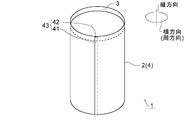
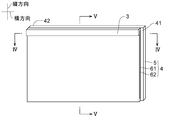
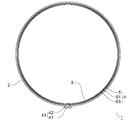
- the perspective view of the heat-shrinkable cylindrical label of 1st Embodiment The enlarged top view which looked at the heat-shrinkable cylindrical label from the upper side.
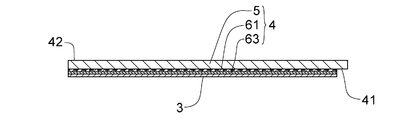
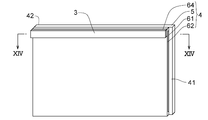
- wire of FIG. The front view containing the right-half cross section which shows the state which coat
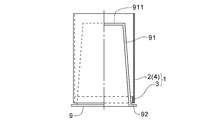
- the front view containing the right half cross section of the package obtained by mounting
- Sectional drawing of the label base material which concerns on the modification of 1st Embodiment (sectional drawing which cut
- FIG. 17 is an enlarged cross-sectional view taken along line XVIII-XVIII in FIG. 16.
- FIG. 17 is an enlarged cross-sectional view taken along line XIX-XIX in FIG. 16.
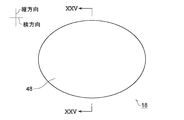
- FIG. 25 is a cross-sectional view taken along line XXV-XXV in FIG. 24.
- the reference sectional view showing the process of mounting the heat-shrinkable sheet-like label on the adherend.
- the front surface refers to one surface of the label substrate
- the back surface refers to the opposite surface.
- the surface of the label base material is a surface that becomes the outer side when it is formed into a cylindrical shape
- the back surface of the label base material is the inner side when formed into a cylindrical shape. It is a surface.
- the horizontal direction refers to one direction in the plane of the label substrate
- the vertical direction refers to a direction orthogonal to the horizontal direction in the plane. In FIG. 3, the horizontal direction is the left-right direction of the drawing.
- the term “first” or “second” is added to the beginning of the term.
- the first or the like is added only to distinguish the term and has a special meaning such as superiority or inferiority. Absent.
- the numerical range represented by “to” means a numerical range including numerical values before and after “to” as a lower limit value and an upper limit value.
- an arbitrary lower limit value and an arbitrary upper limit value can be selected and set to a range connected by “ ⁇ ”. It should be noted that the dimensions such as the thicknesses of the components in each drawing and the ratio between the elements are different from the actual ones.
- a heat-shrinkable cylindrical label is used.
- the heat-shrinkable cylindrical label has a heat-shrinkable label base material and a heat-sensitive adhesive layer provided on the inner surface of the label base material.
- An ultraviolet absorbing heat generating agent is contained in at least one of the heat sensitive adhesive layer and the region of the label base material where at least the heat sensitive adhesive layer is provided.
- the shrink-adhesive label can be broadly classified into a heat-shrinkable single-wafer label and a heat-shrinkable cylindrical label in terms of form.
- the heat-shrinkable cylindrical label will be described in detail.
- the heat-shrinkable cylindrical label 1 used in the manufacturing method of the present embodiment includes at least a cylindrical body 2 that can be thermally contracted in the circumferential direction and at least an inner surface of the cylindrical body 2. And a heat-sensitive adhesive layer 3 provided in a part.
- the cylindrical body 2 is formed by making a label base material 4 having heat shrinkability into a cylindrical shape and adhering both side end portions 41 and 42 thereof.
- At least one of the heat-sensitive adhesive layer 3 and the tubular body 2 in which at least the heat-sensitive adhesive layer 3 is provided contains an ultraviolet absorbing heat generating agent.
- the ultraviolet absorbing heat generating agent is contained in the heat sensitive adhesive layer 3, or (b) the ultraviolet absorbing heat generating agent is at least the heat sensitive adhesive layer 3 in the cylindrical body 2. Contained in the provided region, or (c) the ultraviolet-absorbing exothermic agent is contained in both the heat-sensitive adhesive layer 3 and the region in which the at least the heat-sensitive adhesive layer 3 is provided. Has been.
- the ultraviolet-absorbing exothermic agent is contained in at least the region where the heat-sensitive adhesive layer 3 is provided in the cylindrical body 2
- the heat-sensitive adhesive layer in the cylindrical body 2. 3 is contained only in the region provided, (B) when contained in a part of the cylindrical body 2 including the region provided with the heat-sensitive adhesive layer 3, or (C) cylindrical It is one of cases where it is contained throughout the body 2.
- FIG. 3 shows a label base material viewed from the back side, and is a perspective view for easy understanding of the laminated structure of each layer constituting the label base material.
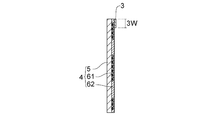
- 4 and 5 are cross-sectional views of the label substrate.
- the label base material 4 has a heat-shrinkable film 5 and optional printing layers 61,... Layer 3 is provided.
- film is synonymous with what is generally called a sheet.
- the printing layer is a layer obtained by applying a known ink by a known printing method such as a gravure printing method and solidifying it.
- the printed layer is a thin layer having a thickness of about 0.5 ⁇ m to 10 ⁇ m.
- the printed layer itself does not have mechanical strength like a heat-shrinkable film, and is different from the film.
- a design printing layer when classified by function, a design printing layer, a base printing layer, a sliding layer, a protective layer and the like can be mentioned. At least one selected from these printed layers is provided on the heat-shrinkable film.
- various printing layers, and a heat-sensitive adhesive layer, a label base material etc. are explained in full detail.
- the heat shrinkable film is a flexible film having heat shrinkability.
- heat shrinkability refers to a property of shrinking at least in the main stretching direction when heated to a heat shrink temperature (for example, 60 ° C. to 200 ° C.).
- the heat-shrinkable film is mainly heat-shrinkable at least in the transverse direction (main stretching direction) and may be slightly heat-shrinked or stretched in the machine direction.
- the label base material is cylindrical (that is, when a heat-shrinkable cylindrical label is formed using the label base material)
- the lateral direction of the heat-shrinkable film is the circumferential direction of the heat-shrinkable cylindrical label. Become.
- a heat-shrinkable film As such a heat-shrinkable film, a uniaxially stretched or biaxially stretched film mainly stretched in the transverse direction can be used.
- the heat-shrinkable film may have a self-stretch property on the condition that it has a heat-shrink property, or may not have a self-stretch property.
- the self-stretching property refers to the property of stretching when a film is pulled and contracting to return to the original length when the tensile force is released.
- the heat shrinkage rate in the transverse direction (main stretching direction) of the heat shrinkable film is not particularly limited, but is preferably 40% or more, more preferably 50% or more, and further preferably 60% or more. In addition, it is so preferable that the thermal contraction rate in the said horizontal direction is large. However, since heat shrinkage is naturally limited, the heat shrinkage rate in the lateral direction is theoretically less than 100% and is usually 90% or less. When the heat-shrinkable film is a film that changes heat in the vertical direction, the heat shrinkage rate in the vertical direction is, for example, -3 to 20%, preferably 1 to 10%. The minus of the thermal contraction rate means thermal elongation.
- the heat shrinkage ratio is the length of the film before heating (original length) and the length of the film after immersion in warm water at 100 ° C. for 10 seconds (length after immersion). The ratio is obtained by substituting into the following formula.
- Heat shrinkage rate (%) [ ⁇ (original length in horizontal direction or vertical direction) ⁇ (length after immersion in horizontal direction or vertical direction) ⁇ / (original length in horizontal direction or vertical direction) ] ⁇ 100.
- the heat-shrinkable film may be transparent or opaque from an optical viewpoint.
- transparent means any number (large size) with black ink on white paper on the back side of a film or layer (printing layer, heat-sensitive adhesive layer, etc.) at a location 1 cm away from the back side. 12 points) is placed, the film or layer is watermarked, and the number can be distinguished from the front side.
- Transparent may be colorless and transparent or colored and transparent.
- “opaque” refers to a state in which numbers placed on the back side under the same conditions as described above cannot be discriminated from the front side through the film or layer (a state in which numbers cannot be recognized).
- the total light transmittance can be used as an indicator of transparency (colorless transparency or colored transparency).
- the total light transmittance is 70% or more, preferably 80% or more, and more preferably 90% or more.
- the total light transmittance refers to a value obtained by measuring a transparent measurement object according to a measurement method in accordance with JIS K 7361 (a test method for the total light transmittance of a plastic-transparent material).
- the transparent measurement object is a transparent heat-shrinkable film
- the film itself is the measurement object.
- the transparent heat-shrinkable film is provided with a transparent layer. Is the measurement target.
- the opaque index is expressed by the total light transmittance, it is, for example, 30% or less, preferably 20% or less.
- the heat-shrinkable film is not particularly limited, and examples thereof include a synthetic resin film and a foamed resin film.
- the foamed resin film is not limited to a film foamed with a foaming agent or the like, and includes a film in which countless bubbles are generated by stretching. Since a transparent heat-shrinkable film can be constituted, it is preferable to use a synthetic resin film. As will be described later, when the heat-shrinkable film is provided with a layer containing the ultraviolet-absorbing exothermic agent, a heat-shrinkable film capable of transmitting ultraviolet rays for generating heat from the ultraviolet-absorbing exothermic agent is used. .
- polyester resins such as polyethylene terephthalate and polylactic acid; olefin resins such as polyethylene, polypropylene and cyclic olefin; polystyrene resins such as polystyrene and styrene-butadiene copolymer; polyamide resins
- thermoplastic resins such as vinyl chloride resins, or a mixture of two or more types.
- the heat-shrinkable film may be a single-layer film or a laminated film in which two or more resin layers are laminated and bonded from the viewpoint of the structure in the thickness direction.
- the thickness of the heat-shrinkable film is not particularly limited, but in the case of a synthetic resin film, it is, for example, 20 ⁇ m to 100 ⁇ m, and in the case of a foamed resin film, it is, for example, 50 ⁇ m to 500 ⁇ m.
- the design print layer is provided mainly for decoration purposes.
- the design print layer is a print layer in which display of desired characters, graphics, and the like is represented by one color or two or more colors.
- display of characters or the like is usually formed from color ink, and generally there are many opaque portions and transparent portions.
- the design printing layer can be formed by printing a known color ink by single color printing or multicolor printing using a conventionally known printing method such as a gravure printing method.
- the thickness of the design print layer is, for example, 0.1 ⁇ m to 5 ⁇ m.
- the base print layer is a layer provided to make the display of the design print layer stand out.
- the base printing layer is a layer provided for providing light shielding properties to the cylindrical body for other purposes.
- the base print layer is a non-patterned opaque print layer in which one color or two or more colors are separately applied, and is preferably a non-pattern single-color opaque print layer.
- the base print layer exhibits an arbitrary color such as, for example, white, gray, silver, black, or red.
- the base printing layer is a non-patterned opaque printing layer exhibiting one color selected from white, gray and black.
- the base print layer exhibiting white can be formed by, for example, printing a white ink containing a white pigment in a solid form by a conventionally known printing method.
- the white pigment include titanium dioxide, zinc white, calcium carbonate, clay, and alumina white.
- the gray base printing layer can be formed by printing a gray ink containing a gray pigment in a solid form by a conventionally known printing method.
- the gray pigment include a black pigment such as carbon black or a pigment obtained by mixing a suitable amount of a silver pigment such as powdered aluminum and a white pigment.
- the undercoat printing layer exhibiting silver can be formed by printing a silver ink containing a silver pigment in a solid form by a conventionally known printing method.
- the silver pigment examples include powdered aluminum and vapor-deposited aluminum.
- the base print layer exhibiting black can be formed, for example, by printing a black ink containing a black pigment such as carbon black in a solid form by a conventionally known printing method.
- the content of the pigment is appropriately set for each pigment.
- the content of the white underprint layer is 30% by weight to 80% by weight with respect to 100% by weight.
- a certain layer is “solid” means that the material constituting the layer extends in the plane direction to form one continuous layer.
- the layer formed by the plate printing method such as the gravure printing method is composed of a collection of materials adhering to dots, when viewed macroscopically, the material extends in the surface direction.
- the thickness of the base print layer is, for example, 0.5 ⁇ m to 5 ⁇ m.
- a sliding layer is a layer provided in order to reduce the friction of the heat-shrinkable cylindrical label with respect to a to-be-adhered body.
- the heat-shrinkable cylindrical label having the sliding layer can be satisfactorily packaged on the adherend.
- the sliding layer is usually provided so as to constitute the innermost surface of the cylindrical body.
- the sliding layer may be either transparent or opaque, but is preferably transparent.
- the sliding layer can be formed, for example, by printing ink containing a sliding component such as a lubricant and substantially free of a colorant (so-called medium ink) in a solid form by a conventionally known printing method.
- the sliding component such as the lubricant is not particularly limited, and examples thereof include polyolefin wax and silicone oil.
- the content of the sliding component is not particularly limited, but is, for example, 1% by weight to 20% by weight with respect to 100% by weight of the entire sliding layer.
- the sliding layer is not limited to being transparent and may be opaque.
- the thickness of the sliding layer is, for example, 0.1 ⁇ m to 3 ⁇ m.
- the protective layer is a layer provided mainly to protect the surface of the heat-shrinkable film.
- the protective layer is preferably transparent, more preferably colorless and transparent. As will be described later, when the design print layer is provided on the surface side of the heat-shrinkable film, the protective layer is provided on the surface of the design print layer. Moreover, you may provide a protective layer in order to protect the surface or back surface of layers other than a design printing layer as needed.
- the protective layer can be formed by printing an ink (so-called medium ink) substantially free of a colorant in a solid form by a conventionally known printing method.
- the protective layer may contain a sliding component such as a lubricant as necessary. Specific examples and amounts of the lubricant are the same as those of the sliding layer.
- the thickness of the protective layer is, for example, 0.5 ⁇ m to 5 ⁇ m.
- the heat-sensitive adhesive layer is an adhesive layer provided for adhering the heat-shrinkable cylindrical label to the adherend.
- the heat-sensitive adhesive layer is provided in a desired range on the back surface of the label substrate.
- the heat-sensitive adhesive layer is usually provided in a solid shape within a desired range, but may be provided in a stitch shape or innumerable dots within the range (not shown).
- the heat-sensitive adhesive layer may be either transparent or opaque, but is usually colorless and transparent.
- the heat-sensitive adhesive layer is provided by printing or coating a heat-sensitive adhesive on the back surface of the label substrate.
- the heat-sensitive adhesive is an adhesive that does not have an adhesive force at room temperature (23 ° C.) and can be activated by heating to exhibit an adhesive force.
- the adhesive is a concept including what is called an adhesive.
- the heat-sensitive adhesive is not particularly limited as long as it does not exhibit adhesiveness at room temperature and can be adhered to an adherend by heating.
- the heat-sensitive adhesive examples include, for example, a delayed tack-type heat-sensitive adhesive, an emulsion-type heat-sensitive adhesive not containing a solid plasticizer (hereinafter simply referred to as “emulsion-type heat-sensitive adhesive”), a solvent-type heat-sensitive adhesive, A hot melt type adhesive agent etc. are mentioned.
- the delayed tack-type heat-sensitive adhesive is an adhesive that does not have an adhesive force at room temperature, is activated by heating to exhibit an adhesive force, and that lasts for a long time after cooling.
- the delayed tack type heat-sensitive adhesive can be applied by printing such as gravure coating.
- delayed tack type heat-sensitive adhesives examples include ethylene-vinyl acetate copolymer, vinyl acetate-acrylic ester copolymer, and emulsion type in which a tackifier and a solid plasticizer are blended with a base resin such as synthetic rubber. Is exemplified.
- Emulsion-type heat-sensitive adhesives and solvent-type heat-sensitive adhesives do not have an adhesive force at room temperature, but develop an adhesive force upon heating.
- Emulsion-type heat-sensitive adhesives and solvent-type heat-sensitive adhesives are, for example, gravure coating solutions prepared by dissolving or dispersing a heat-adhesive resin such as ethylene-vinyl acetate copolymer and a tackifier in water or an organic solvent. It is an adhesive that can be applied by printing.
- the emulsion-type heat-sensitive adhesive and the solvent-type heat-sensitive adhesive are used after being dried.
- a hot melt adhesive does not have an adhesive force at room temperature, and is an adhesive that develops an adhesive force when heated.
- the hot melt type adhesive is an adhesive that can be applied by a hot melt coater, an extrusion laminator, etc. after being melted by heating.
- the hot-melt adhesive include ethylene resins such as ethylene-vinyl acetate copolymer and ethylene acrylic acid copolymer, and base resins such as styrene-butadiene block copolymers and additives such as tackifiers. What was mix
- the activation temperature of the heat-sensitive adhesive is not particularly limited.
- a heat-sensitive adhesive having an activation temperature of 30 ° C. or higher and lower than 70 ° C. may be used.
- a heat sensitive adhesive layer having a relatively high activation temperature can be easily activated, and a heat sensitive adhesive having a relatively high activation temperature.
- a heat-shrinkable cylindrical label having a layer hardly causes blocking.
- the heat-sensitive adhesive (heat-sensitive adhesive layer) used for the heat-shrinkable cylindrical label preferably has an activation temperature of 70 ° C or higher, more preferably 80 ° C or higher, and further 90 ° C or higher. preferable.
- the activation temperature of the heat-sensitive adhesive (heat-sensitive adhesive layer) is too high, the heat-sensitive adhesive (heat-sensitive adhesive layer) may be insufficiently heated even by the ultraviolet absorption heat-generating agent.
- the activation temperature of the heat-sensitive adhesive refers to a temperature at which the heat-sensitive adhesive layer produces an adhesive strength of 0.7 N / 15 mm or more.
- the heat-sensitive adhesive (heat-sensitive adhesive layer) of the present invention does not have a clear melting point, and the activation temperature of the heat-sensitive adhesive is the softening temperature of the heat-sensitive adhesive, and is 0.7 N / It can also be said to be a temperature that produces an adhesive strength of 15 mm or more.
- the adhesive strength of the heat-sensitive adhesive layer is determined by using the film provided with the heat-sensitive adhesive layer as a test piece (length 10 mm in the peeling direction and length 15 mm in the width direction), and setting the heat-sensitive adhesive layer at a desired temperature. Then, the test piece was bonded to a flat plate made of polyethylene terephthalate with a pressure of 0.1 MPa through a heat-sensitive adhesive layer, and a T-type peel test (peeling speed 300 mm / min) by a method according to JIS K 6854-3. min) and measure the adhesive strength of the test piece.
- the temperature at which the adhesive strength of the test piece becomes 0.7 N / 15 mm or more (that is, the activation temperature) can be measured.
- Commercially available products may be used as heat-sensitive adhesives having a relatively high activation temperature such as 70 ° C. or higher.
- trade names “CPH 380-N” of Sanyo Trading Co., Ltd. may be used.
- the thickness of the heat-sensitive adhesive layer is not particularly limited, and is usually about 3 ⁇ m to 30 ⁇ m.
- the heat-shrinkable cylindrical label 1 includes a cylindrical body 2 in which a label base 4 is formed in a cylindrical shape, and a heat-sensitive adhesive provided on the inner surface of the cylindrical body 2.
- agent layer 3 As shown in FIGS. 3 to 5, the label substrate 4 of the present embodiment includes a heat-shrinkable film 5, a design printing layer 61, and a sliding layer 62. Details of these are as described in ⁇ Heat-Shrinkable Film>, ⁇ Design Print Layer>, and ⁇ Slide Layer>.
- Design print layer 61 is provided on the back side of heat-shrinkable film 5 from the viewpoint of preventing scratches. But the design printing layer 61 may be provided in the surface side of the heat-shrinkable film 5 (not shown). In the illustrated example, the design print layer 61 is provided directly on the back surface of the heat-shrinkable film 5. When the design print layer 61 is provided on the back side, a transparent (preferably colorless and transparent) heat-shrinkable film 5 is used. On the other hand, when the design print layer 61 is provided on the surface side, either a transparent or opaque heat-shrinkable film 5 may be used.
- the design print layer 61 is provided on the entire back surface of the heat-shrinkable film 5 except for the first side end portion 41 or a part thereof.
- the design print layer 61 is provided on the entire surface or a part of the surface of the heat-shrinkable film 5 except for the second side end portion 42.
- the first side end portion 41 and the second side end portion 42 are both end portions extending in the vertical direction and facing each other in the horizontal direction.
- the design print layer 61 is provided in a range excluding the first side end portion 41 and both end portions facing each other in the vertical direction.
- the range in which the design print layer 61 is provided is appropriately set according to the design. That is, in this embodiment, the design print layer 61 is provided in places on the back surface of the heat-shrinkable film 5 except for the first side end portion 41 and both end portions facing each other in the vertical direction. If the said range is compared with the sea, the design print layer 61 is dotted and provided in the island form in the sea.
- the sliding layer 62 is provided on the back side of the heat-shrinkable film 5.
- the sliding layer 62 is provided on the entire remaining portion excluding the first side end portion 41.
- the sliding layer 62 is provided across the back surface of the heat-shrinkable film 5 and the back surface of the design print layer 61. Therefore, when the label base material 4 is viewed from the back side, the back side of the heat-shrinkable film 5 is exposed at the first side end portion 41, and the sliding layer 62 is exposed outside the first side end portion 41.
- the lateral length of the back surface exposed portion of the heat-shrinkable film 5 at the first side end portion 41 is not particularly limited, but is, for example, 2 mm to 10 mm from the viewpoint of forming a good seal portion.
- the sliding layer 62 may be either transparent or opaque, but is preferably transparent. By using the transparent sliding layer 62, a portion where the design printing layer 61 is not provided (a portion between the design printing layers 61 provided in a dispersed manner) is transparent. A shaped label 1 can be constructed.
- the heat-sensitive adhesive layer 3 is provided on the back surface of the label substrate 4 having the layer configuration of the heat-shrinkable film 5 / design printing layer 61 / sliding layer 62.
- the heat-sensitive adhesive layer 3 is provided on a part of the back surface of the label substrate 4.
- the heat-sensitive adhesive layer 3 is provided on a part of the back surface of the sliding layer 62 that forms the outermost surface of the label substrate 4.
- the heat-sensitive adhesive layer 3 is provided in a region extending in a lateral band shape in the remaining portion excluding the first side end portion 41 of the label base material 4, and more preferably, in the remaining portion, in the longitudinal direction. It is provided in a region extending in a lateral band shape at the end of the direction.
- the width 3W of the heat-sensitive adhesive layer 3 provided in a strip shape is not particularly limited, but if it is too small, the adhesion area to the adherend becomes smaller. From this viewpoint, the width 3W of the heat-sensitive adhesive layer 3 is preferably 3 mm or more, and more preferably 5 mm or more. On the other hand, if the width 3W of the heat-sensitive adhesive layer 3 is too large, the heat-sensitive adhesive layer 3 occupies most of the inner surface of the heat-shrinkable cylindrical label 1, and the heat-shrinkable cylindrical label 1 is mounted on the adherend. It becomes difficult to do.
- the width 3W of the heat-sensitive adhesive layer 3 is preferably the length of the label substrate 4 (heat-shrinkable cylindrical label 1) in the vertical direction ⁇ 1/3 or less, and more preferably 1/4 or less. Specifically, the width 3W of the heat-sensitive adhesive layer 3 is preferably 30 mm or less, and more preferably 20 mm or less.
- At least one of the label substrate 4 and the heat-sensitive adhesive layer 3 contains an ultraviolet absorbing heat generating agent.
- the ultraviolet-absorbing exothermic agent refers to a substance having a function of converting ultraviolet light into heat energy and raising the temperature of the surroundings with the heat energy (function of generating heat).
- Examples of ultraviolet absorbing heat generating agents include organic materials such as benzophenone compounds, salicylate compounds, cyanoacrylate compounds, benzoate compounds, benzotriazole compounds, and triazine compounds; inorganic materials such as titanium dioxide, zinc oxide, and carbon black; Etc. These ultraviolet absorption heat generating agents may be used alone or in combination of two or more.
- the ultraviolet absorbing heat generating agent is contained over the entire surface of the label substrate 4 or the entire surface excluding the first side end portion 41.
- the heat-shrinkable cylindrical label 1 formed using the label base material 4 containing an ultraviolet-absorbing exothermic agent can be heat-shrinked by ultraviolet irradiation.
- the phrase “the ultraviolet absorbing heat generating agent is contained over the entire surface of the label base material 4” means that the label base material 4 is seen through from the direction orthogonal to the back surface of the label base material 4. This means that the ultraviolet absorbing heat generating agent exists over the entire surface of the substrate 4.
- the ultraviolet absorbing heat generating agent is contained over the entire surface excluding the first side end portion 41 of the label base material 4
- the label base material is viewed from a direction orthogonal to the back surface of the label base material 4.
- 4 indicates that the ultraviolet absorbing heat generating agent exists over the entire surface excluding the first side end portion 41 of the label base material 4.
- the film 5 and the printing layers 61,... Constituting the label substrate 4 may all contain an ultraviolet absorbing heat generating agent, and at least one of them may contain the ultraviolet absorbing heat generating agent.
- the layer or film containing the ultraviolet absorbing heat generating agent may be referred to as a “heat generating portion”.
- the ultraviolet absorbing heat generating agent when the ultraviolet absorbing heat generating agent is contained over the entire surface of the label substrate 4, the ultraviolet absorbing heat generating agent is included in the heat shrinkable film 5. It is mentioned that it is contained.
- the ultraviolet absorbing heat generating agent when the ultraviolet absorbing heat generating agent is contained over the entire surface excluding the first side end 41 of the label substrate 4, May contain an ultraviolet-absorbing exothermic agent.
- the heat generating portion is a portion where the heat-sensitive adhesive layer 3 is in direct contact.
- an ultraviolet absorbing heat generating agent is blended in the sliding layer 62 in direct contact with the heat-sensitive adhesive layer 3.
- the amount of the ultraviolet-absorbing exothermic agent is not particularly limited, but when it is contained in a larger amount, it generates a large amount of heat. There is a risk that it will not be possible to secure the functions of. From this viewpoint, the amount of the ultraviolet absorbing heat generating agent in the sliding layer 62 is 1% by weight to 20% by weight, preferably 2% by weight to 10% by weight, with the entire sliding layer 62 being 100% by weight. .
- the heat-shrinkable film 5 contains an ultraviolet absorbing heat generating agent
- the amount thereof is 2% to 40% by weight, preferably 5% to 30%, based on 100% by weight of the entire film 5. % By weight.
- the heat-sensitive adhesive layer 3 contains an ultraviolet-absorbing exothermic agent
- the amount thereof is 2 to 10% by weight, preferably 100% by weight of the heat-sensitive adhesive layer 3 as a whole. 3 to 8% by weight.
- the label base material 4 of this embodiment is obtained by forming each printing layer on the heat-shrinkable film 5 by a conventionally known printing method.
- the heat-sensitive adhesive layer 3 is formed on the back surface of the label base material 4 by a conventionally known printing method or the like.
- the label base material 4 with a heat-sensitive adhesive layer is obtained.
- the back surface of the first side end portion 41 is overlapped with the surface of the second side end portion 42, and the overlapping portion is adhered.
- the heat-shrinkable cylindrical label 1 shown in FIGS. 1 and 2 is configured. Examples of the bonding method between the back surface of the first side end portion 41 and the surface of the second side end portion 42 include welding using a solvent and bonding using an adhesive.
- the portion that is overlapped and bonded is the seal portion 43.
- the heat-shrinkable cylindrical label 1 is opened in a cylindrical shape when it is attached to an adherend.
- the heat-shrinkable cylindrical label 1 is manufactured, it is folded into a flat shape (not shown) as in the prior art.
- the heat-shrinkable cylindrical label 1 is generally provided in the form of a continuous body that is a continuous strip-like continuous body in which a plurality of the heat-shrinkable cylindrical labels 1 are continuously connected. The And this continuous body is cut
- the heat-shrinkable cylindrical label is not limited to being provided in the form of a continuous continuous body, but may be provided in the form of a continuous base material in which single-wafer-shaped label base materials are continuously connected. Good.
- a substrate continuum in which sheet-like label substrates are continuously connected, one label substrate is cut out from the substrate continuum immediately before being sheathed on the adherend, After being wound around a jig such as a mandrel to form a heat-shrinkable cylindrical label, it is packaged on the adherend.
- the heat-shrinkable cylindrical label 1 includes a cylindrical body 2 in which a heat-shrinkable label base material 4 is formed in a cylindrical shape, and a heat-sensitive adhesive layer 3 provided on the inner surface of the cylindrical body 2. It is configured. As shown in FIG. 2, by forming the label substrate 4 in a cylindrical shape, both side edges of the sliding layer 62 are in contact with each other in the vicinity of the seal portion 43, and the back surface of the sliding layer 62 is on the innermost surface of the cylindrical body 2. It has a cylindrical shape. However, in practice, when the first side end portion 41 and the second side end portion 42 of the label base material 4 are bonded, a slight negligible amount between the side edges of the sliding layer 62 in the vicinity of the seal portion 43.
- the sliding layer 62 is assumed to have a cylindrical shape.
- the ultraviolet absorbing heat generating agent is contained over the entire surface of the cylindrical body 2.
- the above-mentioned “the ultraviolet absorbing heat generating agent is contained over the entire surface of the cylindrical body 2” means that the ultraviolet absorption occurs when the cylindrical body 2 is seen through from any position in the circumferential direction of the cylindrical body 2. This means that there is an exothermic agent.
- the ultraviolet absorbing heat generating agent is contained over the entire surface of the cylindrical body 2 even when there is a slight gap between both side edges of the sliding layer 62.
- both side edges of the heat-sensitive adhesive layer 3 are also in contact with or close to each other.
- the heat-sensitive adhesive layer 3 is provided on the entire inner surface of the cylindrical body 2 (in the illustrated example, the back surface of the sliding layer 62) on the entire region extending in a band shape at the longitudinal end.
- the band shape means a shape having a desired width in the longitudinal direction (however, this width is smaller than the longitudinal length of the cylindrical body 2) and the width is continuous in the circumferential direction.
- the heat-sensitive adhesive layer 3 has an annular shape.
- the heat-shrinkable cylindrical label 1 is heat-shrink mounted on an arbitrary adherend.
- the adherend is not particularly limited, and is typically a beverage container such as coffee, a seasoning container, a food container such as instant noodles, a sanitary container such as shampoo, a detergent container, a cosmetic container, and various containers such as a pharmaceutical container.
- An article itself such as a machine part;
- the material of the outer surface portion of the adherend is not particularly limited, and examples thereof include synthetic resin, glass, metal, and ceramics.
- the form of the adherend is not particularly limited. For example, when the adherend is a container, a bottle-shaped container having a cap part and a body part, a cup-shaped container, a bowl-shaped container, and the like can be given.
- the cup-shaped container 9 has a top-opening barrel 91 and a flange 92 extending radially outward from the upper end of the barrel 91.
- the cup-shaped container 9 can stand on a horizontal plane with the bottom portion 911 of the trunk portion 91 facing down.
- the body portion 91 may have a straight body shape or a non-straight body shape.
- the body portion 91 is a portion to which the heat-shrinkable cylindrical label 1 is attached.
- the straight body shape refers to a shape whose circumferential length does not change in the axial direction of the container 9.
- the body portion 91 in the illustrated example has a non-straight body shape, for example, a taper shape in which the circumferential length decreases toward the lower side.
- a cup-shaped container 9 beverages, foods, and the like are accommodated therein, and the opening of the trunk 91 is closed with a lid (not shown).
- the cup-shaped container 9 can be used as it is without being closed by the lid.
- the container 9 in which the flange portion 92 is formed as shown in FIG. 6, it is easy to attach the heat-shrinkable cylindrical label 1 with the flange portion 92 facing down. Therefore, in FIG. 6, the cup-shaped container 9 is shown upside down.
- the trunk portion 91 may have a shape having a three-dimensional curved surface.
- the heat-shrinkable cylindrical label 1 is opened in a cylindrical shape and is mounted on the body 91 of the cup-shaped container 9.
- the heat-shrinkable cylindrical label 1 is externally mounted on the body portion 91 so that the longitudinal end portion provided with the heat-sensitive adhesive layer 3 is located in the vicinity of the flange portion 92.
- the heat-shrinkable cylindrical label 1 is heated and thermally contracted, and the heat-sensitive adhesive layer 3 is activated and adhered to the body portion 91 of the container 9.
- the heating means ultraviolet irradiation is used. If necessary, steam or hot air conventionally used may be used in addition to ultraviolet irradiation.
- the ultraviolet absorbing heat generating agent is included over the entire surface of the cylindrical body 2, the heat-shrinkable cylindrical label 1 is thermally contracted only by ultraviolet irradiation and the heat-sensitive adhesive layer 3 is formed. Can be activated.
- the entire periphery of the heat-shrinkable cylindrical label 1 is irradiated with ultraviolet rays from the outside of the heat-shrinkable cylindrical label 1 mounted on the container 9 using an ultraviolet irradiation device (not shown).
- the light source of the ultraviolet irradiation device is not particularly limited, and examples thereof include an ultraviolet LED, an ultraviolet lamp (electrode or non-electrode), and an ultraviolet laser.
- Commercially available products can be used as the ultraviolet irradiation device, and examples thereof include trade name “FE300” manufactured by Phoseon Technology.
- the peak wavelength of ultraviolet light is, for example, 150 to 500 nm, preferably 200 nm to 400 nm, more preferably 200 nm to 399 nm, still more preferably 300 nm to 399 nm, and most preferably 350 nm to 399 nm. It is.
- the irradiation intensity of ultraviolet is not particularly limited, since it does not sufficiently exothermic too small and ultraviolet absorbing and heat generating agent in a short period of time, preferably from 780mW / cm 2 or more, 2000 mW / cm 2 or more is more preferable.
- the irradiation time of ultraviolet rays is at least until the purpose can be achieved. That is, the irradiation time of the ultraviolet rays is at least until the heat-sensitive adhesive layer 3 is activated and can be adhered to the container 9, and preferably the heat-shrinkable cylindrical label 1 is in close contact with the container 9. Until the heat-sensitive adhesive layer 3 is activated and can be adhered to the container 9 or more.
- the cumulative amount of ultraviolet light is preferably 400 mJ / cm 2 or more, and more preferably 800 mJ / cm 2 or more.
- the upper limit of the integrated light amount is preferably 8100 mJ / cm 2 or less, for example.
- Accumulated light quantity ultraviolet irradiation intensity ⁇ irradiation time.
- the heat generating portion By irradiating with ultraviolet rays, the heat generating portion (the sliding layer 62 containing the ultraviolet absorbing heat generating agent) generates heat.
- the heat-sensitive adhesive layer 3 When the heat is transferred to the heat-shrinkable film 5 and the heat-sensitive adhesive layer 3, the heat-sensitive adhesive layer 3 is activated almost simultaneously with the heat-shrinkable film 5 (that is, the heat-shrinkable cylindrical label 1). And adheres to the container 9.
- a package 10 is obtained in which the heat-shrinkable cylindrical label 1 is bonded to the container 9 with the heat-sensitive adhesive layer 3 and is in close contact with the container 9 at other portions.
- the heat-shrinkable cylindrical label 1 may not adhere to the recessed portion depending on the shape of the container 9, such as the container 9 having a recessed portion with a partially recessed outer surface, the heat-shrinkable cylindrical label 1 may not adhere to the recessed portion.
- the heat-sensitive adhesive layer is activated using ultraviolet rays
- a relatively small device generally, an ultraviolet irradiation device is smaller than a steam generator and a hot air generator).
- the method of the present invention is excellent in terms of equipment and running cost, and can be carried out relatively inexpensively.
- heat is applied in addition to the heat-sensitive adhesive layer, but only the heat-sensitive adhesive layer and its vicinity can be heated by using ultraviolet rays.
- an adherend for example, a container containing a beverage or the like
- the heat-sensitive adhesive layer can be heated without applying heat to the adherend.
- the ultraviolet absorbing heat generating agent is heated using ultraviolet rays, sufficient heat energy can be supplied to the heat sensitive adhesive layer 3 and the heat sensitive adhesive layer 3 can be activated. For this reason, not only when using a heat-sensitive adhesive activated at a relatively low temperature, but also when using a heat-sensitive adhesive activated at a relatively high temperature of 70 ° C. or higher, the heat-sensitive adhesive layer 3 Can be sufficiently activated to adhere to the adherend. When such a relatively high-temperature heat-sensitive adhesive is used, even if the heat-sensitive adhesive layer 3 is provided in a ring shape in the circumferential direction of the cylindrical body 2 as shown in FIG. .
- the heat-sensitive adhesive layer 3 when the heat-sensitive adhesive layer 3 is flattened as described in Patent Document 1, the heat-sensitive adhesive layer 3 on one surface and the heat-sensitive adhesive layer 3 on the other surface do not face each other. Even if it arrange
- the package body in which the end portion of the heat-shrinkable cylindrical label 1 is adhered to the container 9 in the entire circumferential direction. 10 is obtained.
- the package 10 is mounted without deformation of the end portion of the heat-shrinkable cylindrical label 1 in the vicinity of the heat-sensitive adhesive layer 3 and has a good appearance.
- the ultraviolet absorption heat generating agent when contained over the whole surface of the cylindrical body 2, the heat-shrinkable cylindrical label 1 can also be thermally contracted by ultraviolet irradiation. For this reason, the heat-shrinkable mounting of the heat-shrinkable cylindrical label 1 to the container 9 and the adhesion of the heat-sensitive adhesive layer 3 can be performed with one heating means.
- the heat-shrinkable film 5 and the sliding layer 62 may not contain an ultraviolet absorbing heat generating agent, and the design print layer 61 may contain an ultraviolet absorbing heat generating agent. .
- the design print layer 61 including the ultraviolet absorbing heat generating agent and the partial print layer 65 including the ultraviolet absorbing heat generating agent complement each other, and the entire surface of the label base material 4 (however, the first side end portion 41). UV absorption exothermic agent is present over the
- the present invention is not limited to the first embodiment, and can be variously modified within the scope intended by the present invention.
- each modification of the first embodiment and the second embodiment will be described.
- the configuration and effects different from those of the first embodiment will be mainly described.
- symbol may be used as it is and description of the structure may be abbreviate
- the heat-shrinkable cylindrical label 1 according to the first modification of the first embodiment is mainly provided with a base print layer 63 on the back side of the design print layer 61.
- the label base 4 constituting the heat-shrinkable cylindrical label 1 of the first modified example includes a heat-shrinkable film 5, a design printing layer 61, a base, as shown in FIGS. And a printing layer 63. Details of these are as described above for ⁇ heat-shrinkable film>, ⁇ design printing layer>, and ⁇ underlying printing layer>.
- the design print layer 61 is provided on the back side of the heat-shrinkable film 5 from the viewpoint of preventing scratches.
- the design print layer 61 is provided on the entire remaining portion of the back surface of the heat-shrinkable film 5 except for the first side end portion 41.
- a base print layer 63 is provided on the back surface of the design print layer 61.
- the base printing layer 63 may be one layer or two or more layers. However, in the illustrated example, the base printing layer 63 is shown as one layer for convenience. Examples of the base print layer 63 include a white print layer, a gray print layer, and a black print layer.
- the base print layer 63 preferably includes a white print layer.
- the base print layer preferably has a laminated structure of two or more layers including a gray print layer or a black print layer.
- a laminated structure having at least two layers of a white printed layer and a black printed layer in order from the surface side, (a) a laminated structure having at least two layers of a white printed layer and a black printed layer, (b) a laminated structure having at least two layers of a white printed layer and a gray printed layer (C) Laminated structure having at least three layers of white printed layer and black printed layer / white printed layer, (d) Laminated structure having at least three layers of white printed layer and gray printed layer / white printed layer, etc. It is done.
- a heat-sensitive adhesive layer 3 is provided on the back side of the base print layer 63.
- the design print layer 61 may be provided on the surface side of the heat-shrinkable film 5 (not shown).
- the base print layer 63 is provided on the back surface of the design print layer 61 (between the design print layer 61 and the heat-shrinkable film 5).
- the base printing layer 63 is provided on the back surface of the transparent heat-shrinkable film 5 (preferably a colorless and transparent heat-shrinkable film 5).
- the heat-sensitive adhesive layer 3 is provided so as to be in direct contact with the base print layer 63 which is a heat generating portion, when the design print layer 61 is provided on the surface side of the heat-shrinkable film 5,
- the base printing layer 63 is provided on the back surface of the transparent heat-shrinkable film 5.
- the ultraviolet absorbing heat generating agent is contained in at least one of the label substrate 4 and the heat-sensitive adhesive layer 3.
- an ultraviolet absorbing heat generating agent is contained in the base printing layer 63 in direct contact with the heat-sensitive adhesive layer 3.
- a separate ultraviolet absorbing heat generating agent is blended. Even if not, the base printing layer 63 can function as a heat generating portion. But you may mix
- the amount of titanium dioxide in the base printing layer 63 is 40% by weight to 80% by weight, preferably 50% by weight, based on 100% by weight of the entire printed layer. % By weight to 75% by weight.
- the heat-shrinkable cylindrical label 1 is obtained by forming the label substrate 4 provided with the heat-sensitive adhesive layer 3 in a cylindrical shape in the same manner as in the first embodiment to produce the cylindrical body 2. It is done.
- the heat-shrinkable cylindrical label 1 of the first modification also has a cylindrical body 2 in which a heat-shrinkable label base material 4 is formed in a cylindrical shape, and a heat-sensitive adhesive layer provided on the inner surface of the cylindrical body 2. 3.
- the back surface of the base print layer 63 forms a tube shape on the innermost surface of the cylindrical body 2, and the heat-sensitive adhesive layer 3 that is in contact with the base print layer 63 also has an annular shape. It is made.
- the heat-shrinkable cylindrical label 1 of the first modified example is covered with the adherend and irradiated with ultraviolet rays, whereby the heat generating portion (the base print layer 63) generates heat.
- the heat-sensitive adhesive layer 3 is activated and adhered to the container 9 almost simultaneously, so that the package 10 can be obtained.
- the back surface of the base printing layer 63 constitutes the innermost surface of the cylindrical body 2, but a slipping layer is provided on the back surface of the base printing layer 63.
- the rear surface of the sliding layer may be changed to constitute the innermost surface of the cylindrical body 2 (not shown).
- a slipping layer is interposed between the heat-sensitive adhesive layer 3 and the base printing layer 63.
- an ultraviolet absorbing heat generating agent may be included in the sliding layer as in the first embodiment.
- the ultraviolet-absorbing heat generating agent is mainly contained over the whole surface of the cylindrical body 2 (the whole surface except the 1st side edge part 41 of the label base material 4).
- the case where the heat-shrinkable cylindrical label 1 is used has been described.
- the absorption exothermic agent is contained will be mainly described.
- the label base material 4 constituting the heat-shrinkable cylindrical label 1 of the second modified example of the first embodiment absorbs ultraviolet rays on a part of the back surface side of the heat-shrinkable film 5.
- An arbitrary partial printing layer 64 containing a heat generating agent is provided, and the heat-sensitive adhesive layer 3 is provided so as to overlap the partial printing layer 64.
- the label base material 4 includes, for example, the heat-shrinkable film 5, the design printing layer 61, and the sliding layer 62, as in the first embodiment.
- a partial printing layer 64 containing an ultraviolet absorbing heat generating agent is provided in part.
- the partial print layer 64 may be either transparent or opaque, provided that it contains an ultraviolet absorbing heat generating agent.
- the amount of the ultraviolet absorbing heat generating agent contained in the partial print layer 64 is, for example, about the same as the amount of the ultraviolet absorbing heat generating agent contained in the sliding layer 62 shown in the first embodiment.
- the heat-sensitive adhesive layer 3 is provided on the back surface of the partial print layer 64.
- the heat-shrinkable cylindrical label 1 is obtained by forming the label substrate 4 provided with the heat-sensitive adhesive layer 3 in a cylindrical shape in the same manner as in the first embodiment to produce the cylindrical body 2. It is done. Similarly to the first embodiment, the heat-shrinkable cylindrical label 1 of the second modified example is covered with the adherend and irradiated with ultraviolet rays, so that the heat generating portion (partial print layer 64) generates heat. The heat sensitive adhesive layer 3 is activated. However, since the partial print layer 64 does not exist on the entire surface of the cylindrical body 2, in order to thermally contract the heat-shrinkable cylindrical label 1, a heating means other than ultraviolet rays such as steam or hot air is used in combination.
- a heating means other than ultraviolet rays such as steam or hot air is used in combination.
- a heating means such as steam is applied to the heat-shrinkable cylindrical label 1 to heat the heat-shrinkable cylindrical label 1
- heating means such as ultraviolet rays and steam may be performed simultaneously; or (3) the heating means such as steam is applied to the heat-shrinkable cylindrical label 1 and the heat-shrinkable cylinder.
- the heat-sensitive adhesive layer 3 may be activated by irradiating ultraviolet rays. Even if it does in this way, the package 10 similar to the said 1st Embodiment is obtained.
- the heat-shrinkable cylindrical label 1 in which the ultraviolet absorbing heat generating agent is contained only in the heat-sensitive adhesive layer 3 may be used.
- the label base material 4 does not substantially contain an ultraviolet absorbing heat generating agent. That is, the label base material 4 does not contain an ultraviolet absorbing heat generating agent or does not contain an ultraviolet absorbing heat generating agent that activates the heat-sensitive adhesive layer 3.
- the packaging 10 Is obtained.
- the heat-shrinkable cylindrical label in which the heat-sensitive adhesive layer is mainly provided in a band shape at the longitudinal end portion of the cylindrical body has been described. It is not limited to this.
- the heat-sensitive adhesive layer may be provided in an annular shape at both longitudinal ends of the cylindrical body, or the heat-sensitive adhesive layer may be provided in an annular shape at the longitudinal intermediate portion of the cylindrical body.
- the heat-sensitive adhesive layer may be provided in a strip shape extending in the longitudinal direction of the cylindrical body, or the heat-sensitive adhesive layer may be arranged as in Patent Document 1 (none is shown). .
- the heat-sensitive adhesive layer can be formed at a desired position.
- the heat-shrinkable cylindrical label 1 also has a tubular body 2 that can be thermally shrunk at least in the circumferential direction, and a heat-sensitive adhesive provided on at least a part of the inner surface of the tubular body 2. And an agent layer.
- FIG. 15 does not show the heat-sensitive adhesive layer.
- At least one of the heat-sensitive adhesive layer and at least one of the regions of the cylindrical body 2 where the heat-sensitive adhesive layer is provided contains an ultraviolet absorbing heat generating agent. That is, a heat generating portion (a portion containing the ultraviolet absorbing heat generating material) is provided on a part or the whole of the cylindrical body 2.
- the heat generating portion is formed on the cylindrical body 2 except for the peripheral area of the perforation line 28. It is preferable to be provided.
- FIG. 15 in order to illustrate the heat generating portion in an easy-to-understand manner, a portion corresponding to the heat generating portion is shaded for illustration. More preferably, as shown in the drawing, the heat generating part is formed except for the upper end 2a and the lower end 2b between the two perforations 28, 28 in the peripheral region of the perforation 28 and the upper and lower ends of the cylindrical body 2.
- the cylindrical body 2 is provided.
- the peripheral area of the perforation line is, for example, an area within 10 mm on one side in the circumferential direction and within 10 mm on the opposite side from the perforation line, and preferably within 7 mm on one side in the circumferential direction. And an area within 7 mm on the opposite side.
- the heat generating portion When the heat-shrinkable cylindrical label 1 of the fourth modification is irradiated with ultraviolet rays, the heat generating portion generates heat, and the heat shrinkage is performed except for the peripheral region of the perforation line (because the peripheral region of the perforation line 28 does not have the heat generating portion).
- the substantially entire cylindrical label 1 is thermally shrunk. In other words, since the peripheral region of the perforation line 28 is not thermally contracted, it is possible to prevent the holes constituting the perforation line from greatly expanding. Further, even when the upper end 2a and the lower end 2b between the perforation lines 28, 28 do not have a heat generating portion, the upper end 2a and the lower end 2b are not thermally contracted.
- the heat-shrinkable cylindrical label after ultraviolet irradiation comes to float so that the upper end 2a and the lower end 2b bulge outward. Therefore, the upper end 2a and the lower end 2b can be easily picked with a fingertip, and the heat-shrinkable cylindrical label can be easily divided by using the perforation line 28 by picking it with the fingertip.
- 2nd Embodiment is related with the manufacturing method using the shrink-bonding label comprised from the sheet-like label base material as a label.
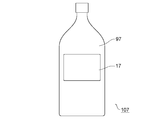
- a non-heat-shrinkable sheet-like label 17 composed of a sheet-like non-heat-shrinkable label base material 47 is used.
- the non-heat-shrinkable sheet-like label 17 includes a sheet-like label base material 47 and a heat-sensitive adhesive layer 37 composed of a heat-sensitive adhesive, and the heat-sensitive adhesive.
- At least one of the agent layer 37 and the region of the label base material 47 where the heat-sensitive adhesive layer 37 is provided contains an ultraviolet absorbing heat generating agent.
- the heat-sensitive adhesive layer 37 is provided on the back surface of the label base material 47.
- the label substrate 47 is substantially non-heat-shrinkable, that is, a non-heat-shrinkable label substrate.
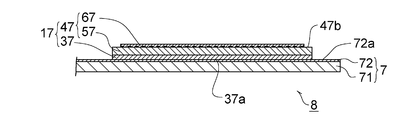
- the non-heat-shrinkable sheet-like label 17 is provided with the back surface 37a of the heat-sensitive adhesive layer 37 in contact with the release surface 7a of the release film 7 and attached.
- a plurality of non-heat-shrinkable sheet-like labels 17 are independently supplied on the release surface 7a of the long strip-like release film 7 in the form of a continuous body 8 attached thereto.
- the continuous body 8 includes a long strip-shaped release film 7 and a plurality of non-heat-shrinkable sheet-like labels 17 attached side by side on the release film 7. As shown in FIG. 17, the continuous body 8 is usually wound in a roll shape and stored and transported.
- the continuous body 8 may be wound with the non-heat-shrinkable sheet-like label 17 on the outside, or may be wound with the non-heat-shrinkable sheet-like label 17 on the inside.
- the continuous body 8 is wound around a core 81 with the non-heat-shrinkable sheet-like label 17 facing outside.
- the release film 7 has a long strip shape.
- the long band shape is a substantially rectangular shape in which the length in one direction is 10 times or more of the length in the direction orthogonal thereto, preferably 30 times or more, more preferably 100. It is more than double.
- the back surface 37 a of the heat-sensitive adhesive layer 37 is weakly adhered to the release surface 7 a of the release film 7, so that the non-heat-shrinkable sheet-like label 17 is attached side by side on the release film 7.
- the adhesive strength of the heat-sensitive adhesive layer 37 of the non-heat-shrinkable sheet-like label 17 to the release surface 7a of the release film 7 is such that the non-heat-shrinkable sheet-like label 17 is wound even if the continuous body 8 is wound into a roll. Is not particularly limited as long as the strength is such that the non-heat-shrinkable sheet-like label 17 can be easily peeled off when necessary.
- the adhesive strength of the heat-sensitive adhesive layer 37 to the release film 7 is 0.05 N / 15 mm to 0.7 N / 15 mm, preferably 0.1 N / 15 mm to 0.5 N / 15 mm.
- the said adhesive strength says the value measured by the method according to 180 degree peeling of JISZ0237.
- the adhesive strength between the back surface of the label base material 47 and the surface of the heat-sensitive adhesive layer 37 is extremely large, and the label base material 47 and the heat-sensitive adhesive layer 37 are separated. Have difficulty.
- the release film 7 is a film having a surface with low wettability.
- the release film 7 includes a base film 71 and a release layer 72 laminated on the entire surface of the base film 71.
- the release layer 72 is formed in a solid shape on the entire surface of the base film 71.
- the surface of the release layer 72 is the release surface 7 a of the release film 7.
- the release layer 72 can be typically formed by a method such as applying a release agent containing a silicone resin or the like to the surface of the base film 71.
- the base film 71 is not particularly limited.
- a synthetic resin film such as a polyester resin, a polystyrene resin, or a vinyl chloride resin; a laminated resin film in which a plurality of different or similar resin layers are laminated; a synthetic paper; a plain paper Paper such as high-quality paper; and a laminated film in which two or more films selected from these are laminated.
- the base film 71 is preferably a synthetic resin film or a laminated resin film.
- the base film 71 only needs to have normal mechanical strength, and the thickness thereof is not particularly limited, and is, for example, 30 ⁇ m to 300 ⁇ m.
- the thickness of the release layer 72 is not particularly limited, and is, for example, about 0.1 ⁇ m to 3 ⁇ m.
- the base film 71 may be either transparent or opaque.
- the mold release layer 72 may be omitted. In this case, the surface of the base film 71 becomes the release surface 7 a of the release film 7.
- a plurality of non-heat-shrinkable sheet-like labels 17 are attached with a desired interval in the longitudinal direction of the long strip-shaped release film 7 or in contact with edges.
- the non-heat-shrinkable sheet-like labels 17 adjacent in the longitudinal direction are arranged at a desired interval. Since the non-heat-shrinkable sheet-like labels 17 are arranged at intervals, the individual non-heat-shrinkable sheet-like labels 17 are made independent when the release film 7 is inverted at a peel portion described later. Can be peeled off.
- 16 illustrates the continuous body 8 in which the non-heat-shrinkable sheet-like labels 17 are arranged in a single row in the short direction of the release film 7. For example, as illustrated in FIG. Two rows of heat-shrinkable sheet-like labels 17 may be arranged in the short direction, and although not particularly shown, three or more rows may be arranged in the short direction.
- the planar view shape of the non-heat-shrinkable sheet-like label 17 is not particularly limited, and is appropriately designed in consideration of design and the like.
- the planar view shape of the non-heat-shrinkable sheet-like label 17 (label base material 47) is a substantially rectangular shape in plan view as shown in FIG. Examples include a polygonal shape, a substantially circular shape, and a substantially elliptical shape.
- substantially in the present invention means a range allowed in the technical field to which the present invention belongs.
- the “abbreviation” of the shape means a shape allowed in the technical field to which the present invention belongs.
- the “substantially” of an approximately polygon such as an approximately rectangle or an approximately triangle includes, for example, a shape in which a corner is chamfered, a shape in which a part of a side is slightly inflated or depressed, and a shape in which a side is slightly curved. included.
- angular part is chamfered means removing the corner
- the “substantially” of the substantially circle and the substantially ellipse includes, for example, a shape in which a part of the circumference is slightly bulged or depressed, and a shape in which a part of the circumference is slightly straight or oblique.
- the non-heat-shrinkable sheet-like label 17 has a sheet-like label base material 47 and a heat-sensitive adhesive layer 37.
- the label base material 47 includes a non-heat-shrinkable film 57 and a printed layer 67 (design printed layer) on which a design is represented, and may have other printed layers as necessary.
- Examples of the other print layer include a protective layer as exemplified in the first embodiment. At least one of the region where the heat-sensitive adhesive layer 37 is provided and the heat-sensitive adhesive layer 37 contains an ultraviolet absorbing heat generating agent.
- the ultraviolet absorbing heat generating agent is contained in the heat sensitive adhesive layer 37, or (b) the ultraviolet absorbing heat generating agent is at least the heat sensitive adhesive layer 37 in the label base material 47. Contained in the provided region, or (c) the ultraviolet-absorbing exothermic agent is contained in both the heat-sensitive adhesive layer 37 and the region in which at least the heat-sensitive adhesive layer 37 is provided. Has been.
- the label base material 47 of the present embodiment includes a flexible film (non-heat-shrinkable film) that does not substantially heat shrink.
- the non-heat-shrinkable film is not particularly limited, and a film selected from non-heat-shrinkable synthetic resin films, paper, synthetic paper, foamed resin films, nonwoven fabrics and the like can be used.
- Examples of the material of the synthetic resin film and the foamed resin film include polyolefin resins such as polypropylene, low density polyethylene, linear low density polyethylene, medium density polyethylene, and ethylene-cyclic olefin copolymer; polyesters such as polyethylene terephthalate and polylactic acid. Resin, halogenated vinyl resin such as polyvinyl chloride; polyamide resin such as 6,6 nylon; one kind of thermoplastic resin such as polystyrene resin such as polystyrene and ABS, and a mixture thereof. it can. As the synthetic resin film, a biaxially stretched polyethylene terephthalate resin film is particularly preferable.
- the non-heat-shrinkable film may be either transparent or opaque.
- a transparent non-heat-shrinkable film 57 is preferable because a package having a good appearance can be formed.
- Examples of such transparent non-heat-shrinkable films include synthetic resin films as described above.
- the thickness of the non-heat-shrinkable film used for the sheet-like label substrate is not particularly limited, but is, for example, 10 ⁇ m to 100 ⁇ m, preferably 15 ⁇ m to 60 ⁇ m, and more preferably 20 ⁇ m to 50 ⁇ m.
- a non-heat-shrinkable sheet-like label made of a label substrate having such a thickness is generally thin and difficult to handle, but in the present invention, a non-heat-shrinkable sheet-like label is attached to a release film. Therefore, problems such as curling due to the thickness of the label substrate do not occur.
- the design print layer 67 is the same as that described in the first embodiment.
- the design print layer of this embodiment may include a base print layer.
- the design print layer 67 is provided on the front or back surface of the non-heat-shrinkable film 57, or is provided on the front and back surfaces of the non-heat-shrinkable film 57.
- the design print layer 67 is provided on the surface of the non-heat-shrinkable film 57 as shown in the illustrated example.
- the design print layer 67 may be provided on the entire front surface (or back surface) of the non-heat-shrinkable film 57, or may be provided in a partial region thereof.
- the design print layer 67 is provided except for the peripheral edge portion of the transparent non-heat-shrinkable film 57, and therefore the peripheral edge portion 47 b of the label base material 47 is an area that does not have the design print layer 67. It is. In FIG. 16, for the sake of convenience, countless dots are added to the range where the design print layer 67 is provided.
- a transparent protective layer (not shown) may be provided on at least the surface of the design print layer 67 in order to protect the print layer.
- the protective layer include those described in the first embodiment.
- the heat-sensitive adhesive layer 37 is an adhesive layer provided to adhere the non-heat-shrinkable sheet-like label 17 to the adherend.
- the heat-sensitive adhesive layer 37 is provided in a desired range on the back surface of the label substrate 47. In the illustrated example, as shown in FIGS. 18 and 19, the heat-sensitive adhesive layer 37 is provided in a solid shape over the entire back surface of the label base material 47. However, the heat-sensitive adhesive layer 37 may be provided in a solid shape on a part of the back surface of the label base material 47 (not shown).
- the heat-sensitive adhesive layer 37 is usually provided in a solid shape within a desired range as described above, but may be provided in a stitch shape or innumerable dot shapes within the range (not shown).
- the heat-sensitive adhesive layer 37 may be either transparent or opaque, but is usually colorless and transparent.
- the heat-sensitive adhesive layer 37 is provided by printing or coating a heat-sensitive adhesive on the back surface of the label substrate 47.
- the delayed tack-type heat-sensitive adhesive, the emulsion-type heat-sensitive adhesive, and the solvent-type heat-sensitive adhesive as described in the first embodiment are used.
- hot melt adhesives are used.
- the activation temperature of the heat-sensitive adhesive (heat-sensitive adhesive layer) is not particularly limited.
- a heat-sensitive adhesive having a lower limit of the activation temperature of 30 ° C. may be used.
- a delayed tack type heat sensitive adhesive having an activation temperature of 40 ° C. to 80 ° C. (preferably 50 ° C. to 65 ° C.) can be used.
- an emulsion type heat sensitive adhesive or a solvent type heat sensitive adhesive having an activation temperature of 40 ° C. to 80 ° C. (preferably 50 ° C. to 65 ° C.) can be used.
- a hot melt adhesive having an activation temperature of 30 ° C. to 50 ° C. (preferably 30 ° C. to 40 ° C.) can be used.
- a heat-sensitive adhesive as disclosed in JP 2014-71369 A can also be used. Briefly explaining this heat-sensitive adhesive, it is a heat-sensitive adhesive having an activation temperature of 60 ° C. to 110 ° C., preferably 60 ° C. to 90 ° C., more preferably 60 ° C. to 70 ° C.
- a non-heat-shrinkable sheet-like label having a heat-sensitive adhesive layer composed of a heat-sensitive adhesive that is activated at such a temperature can be suitably used for producing an in-mold molded product by various molding methods.
- a transparent heat-sensitive adhesive is preferable.
- heat-sensitive adhesive examples include ethylene-vinyl acetate copolymer (EVA), ethylene-acrylic acid ester copolymer, ethylene-methacrylic acid ester copolymer, thermoplastic elastomer (synthetic rubber, ethylene -Base resins such as ⁇ -olefins and other olefins, urethanes and other thermoplastic elastomers), petroleum-based, terpene-based, terpene-phenolic, chroman-indene-based tackifiers, and additives such as waxes and lubricants. The compounded thing is mentioned.
- EVA ethylene-vinyl acetate copolymer
- ethylene-acrylic acid ester copolymer ethylene-methacrylic acid ester copolymer
- thermoplastic elastomer synthetic rubber, ethylene -Base resins such as ⁇ -olefins and other olefins, urethanes and other
- the wax examples include higher fatty acid type and polyethylene type, and examples of the lubricant include amide type.
- a base resin etc. can be used individually by 1 type or in combination of 2 or more types.
- the base resin of the heat-sensitive adhesive contains an ethylene copolymer and an olefin elastomer, and more preferably contains an ethylene-vinyl acetate copolymer and an olefin elastomer.
- Such heat sensitive adhesives are activated at relatively low temperatures.
- the base resin contains an ethylene copolymer (preferably an ethylene-vinyl acetate copolymer) and an olefin elastomer, the content ratio is not particularly limited.
- the content of the ethylene copolymer in the heat-sensitive adhesive is, for example, 20% by mass to 60% by mass, and preferably 25% by mass to 55% by mass.
- the content of the olefin elastomer is, for example, 10 mass% to 50 mass%, preferably 15 mass% to 45 mass%, and the content of the tackifier is, for example, 1 mass% to 40 mass%, preferably 5 mass%. % To 35% by mass.
- a heat-sensitive adhesive containing an ethylene copolymer (preferably an ethylene-vinyl acetate copolymer) and an olefin elastomer as a base resin is preferable.
- the thickness of the heat-sensitive adhesive layer 37 is not particularly limited, and is usually about 3 ⁇ m to 30 ⁇ m.
- a known anchor coat layer (not shown) is provided on the back surface of the label base material 47 in order to firmly bond the back surface of the label base material 47 and the thermosensitive adhesive layer 37, and the back surface of the anchor coat layer.
- a heat-sensitive adhesive layer 37 may be provided.
- the back surface 37a of the heat-sensitive adhesive layer 37 and the release surface 7a of the release film 7 are preferably as smooth as possible. Since the back surface 37a of the heat-sensitive adhesive layer 37 is smooth, the cloudiness of the non-heat-shrinkable sheet-like label 17 can be prevented.
- the ten-point average roughness Rz of the back surface of the heat-sensitive adhesive layer is 3 ⁇ m or less, more preferably 2 ⁇ m or less, and even more preferably 1 ⁇ m or less.
- the lower limit value of the ten-point average roughness Rz on the back surface of the heat-sensitive adhesive layer is theoretically zero, but exceeds zero in practical numerical values.
- the ten-point average roughness Rz is a value measured by a method according to JIS B 0601-1994. Specifically, for example, using a surface roughness measuring machine (trade name “Handy Surf E-35A” manufactured by Tokyo Seimitsu Co., Ltd.), the surface of the sample is scanned by a surface scanning method in accordance with JIS B 0601-1994. The ten-point average roughness Rz is measured by measuring an arbitrary location.
- the non-heat-shrinkable sheet-like label 17 has a transparent part (transparent part).
- the transparent portion is a portion where the transparency of the transparent label base material 47 is not substantially impaired.
- the transparent portion is, for example, (1) a region of the transparent label base material 47 provided with the transparent heat-sensitive adhesive layer 37 and not provided with an opaque print layer (in the illustrated example, the label base material 47 (2) a transparent label base material 47 provided with a transparent heat-sensitive adhesive layer 37, a region where no other opaque layer is provided, and the like. Applicable.
- the transparent portion of the non-heat-shrinkable sheet-like label 17 may be colorless and transparent or colored and transparent, and is preferably colorless and transparent.
- the transparent portion of the non-heat-shrinkable sheet-like label 17 has a total light transmittance of 70% or more, preferably 80% or more, and more preferably 90% or more.
- At least one of the label substrate 47 and the heat-sensitive adhesive layer 37 contains an ultraviolet absorbing heat generating agent.
- the ultraviolet absorption exothermic agent include those described in the first embodiment.
- the ultraviolet absorbing exothermic agent is contained, for example, in the heat-sensitive adhesive layer.
- the ultraviolet absorbing exothermic agent is contained in the non-heat-shrinkable film.
- the ultraviolet absorbing heat generating agent is contained in a printing layer such as a design printing layer.
- the ultraviolet absorbing exothermic agent is contained in at least two selected from a heat-sensitive adhesive layer, a non-heat-shrinkable film, and a print layer such as a design print layer.
- the ultraviolet absorption exothermic agent is contained in a print layer such as a heat-sensitive adhesive layer and / or a design print layer, and more preferably contained in a heat-sensitive adhesive layer.
- the amount of the UV-absorbing exothermic agent is not particularly limited, but if it is included more, it generates a lot of heat, but if it is too large, the amount of other components will be relatively small, and the function of the film or printed layer can be ensured. There is a risk of disappearing.
- the heat-sensitive adhesive layer contains an ultraviolet-absorbing exothermic agent
- the amount is preferably 0.5 to 10% by weight, based on 100% by weight of the heat-sensitive adhesive layer as a whole. Is 0.5 to 8% by weight.
- the amount of the ultraviolet absorbing heat generating agent in the design printing layer is 0.5% to 10% by weight, preferably 0.5% to 8% by weight, based on 100% by weight of the entire design printing layer. It is. In the case where the non-heat-shrinkable film contains an ultraviolet ray absorbing exothermic agent, the amount thereof is 0.5% by weight to 40% by weight, preferably 1% by weight 30% by weight.
- the non-heat-shrinkable sheet-like label 17 is usually provided in the form of a continuous body 8 attached on the release film 7 as shown in FIGS.
- the production method of this continuum is obtained from a release film and a heat-sensitive adhesive by interposing a melted heat-sensitive adhesive between the long-band release film and the long-band film raw fabric.
- the long strip-shaped release film may be prepared as described above, but it is preferable to prepare a release film having a 10-point average roughness Rz of 3 ⁇ m or less on the release surface.
- a release film having a 10-point average roughness Rz of 3 ⁇ m or less on the release surface By using such a release film, a non-heat-shrinkable sheet-like label having a heat-sensitive adhesive layer excellent in back surface smoothness as described above can be easily formed.
- the release film 7 having a 10-point average roughness Rz of 3 ⁇ m or less on the release surface a release layer having a thickness of 0.1 ⁇ m to 3 ⁇ m can be obtained by using a gravure coater or the like on the surface of the long strip-shaped base film. Thus, it can obtain by apply
- the material of the long belt-shaped film raw material those exemplified for the non-heat-shrinkable film can be used. It is preferable that the length of the long strip-shaped film original in the short direction is the same as the length of the release film in the short direction.
- the long belt-shaped film original is provided with the design print layer, the protective layer, and the like at a desired interval in the longitudinal direction.
- an anchor coat layer is provided in a solid shape on the back surface of the original film as necessary.
- the long strip-shaped release film and the long strip-shaped film original are each stored and transported in a state of being wound into a roll.
- FIG. 21 is a schematic diagram illustrating a manufacturing process of a continuous body of non-heat-shrinkable sheet-like labels.
- the long strip-shaped release film A1 and the long strip-shaped film original fabric A2 are each independently conveyed to one side in the longitudinal direction.
- the conveyance direction is indicated by an arrow.
- the release film A1 and the original film A2 are pressure-bonded with the melted heat-sensitive adhesive A3 interposed between the release surface of the release film A1 and the back surface of the original film A2. .
- FIG. 21 is a schematic diagram illustrating a manufacturing process of a continuous body of non-heat-shrinkable sheet-like labels.
- the long strip-shaped release film A1 and the long strip-shaped film original fabric A2 are each independently conveyed to one side in the longitudinal direction.
- the conveyance direction is indicated by an arrow.
- the release film A1 and the original film A2 are pressure-bonded with the melted heat-sensitive adhesive A3 interposed between the release surface of the
- a pressure-bonding roll B3 composed of a main roll B1 and a sub roll B2 so that the release surface of the release film A1 and the back surface of the film original fabric A2 face each other.
- the heat-sensitive adhesive is melted on the release surface of the release film A1 or the back surface of the original film A2. Put A3.
- the heat-sensitive adhesive A3 is heated and melted by an extruder (not shown), and is extruded as a film from the die B4 over the entire short direction of the release film A1 (so-called sand lamination).
- the heating temperature of the heat-sensitive adhesive is not less than the activation temperature of the heat-sensitive adhesive, and is appropriately set according to the type of the heat-sensitive adhesive.
- At least one of the main roll B1 and the sub roll B2 is provided with a cooling device (not shown). While passing through the pressure-bonding roll B3, the melted heat-sensitive adhesive A3 is cooled, and a heat-sensitive adhesive layer is formed between the release surface of the release film A1 and the back surface of the original film A2. .
- a strip-like laminate A4 is obtained which is laminated in the order of release film / thermosensitive adhesive layer / film raw fabric. After obtaining the laminated body A4, it may be wound up once in a roll shape, and the laminated body A4 may be pulled out from the roll to perform the next cutting step. Alternatively, as shown in FIG. 21, the laminated body A4 is obtained.
- the next cutting step may be carried out as it is.
- the surface of the film original fabric A2 is partitioned into a plurality of non-heat-shrinkable sheet-like labels arranged in the longitudinal direction.
- a plurality of non-heat-shrinkable sheet-like labels can be formed by cutting the surface of the film original fabric A2 so as to match the planar view shape of the non-heat-shrinkable sheet-like label.
- the cutting can be performed using, for example, a die roll B5.
- only the film original fabric A2 may be cut, or the film original fabric A2 may be cut including a heat-sensitive adhesive layer. Since the heat-sensitive adhesive layer itself is fragile, an unnecessary portion described later can be removed even when only the original film A2 is cut.
- the unnecessary part A5 of the film original fabric A2 excluding the non-heat-shrinkable sheet-like label partitioned in the cutting step is removed from the release film A1 and collected. At this time, the unnecessary portion A5 is peeled between the heat-sensitive adhesive layer adhered to the back surface of the unnecessary portion A5 and the release surface of the release film A1, and unnecessary with the heat-sensitive adhesive layer. Portion A5 is removed from release film A1. In this way, a continuous body 8 in which a plurality of non-heat-shrinkable sheet-like labels 17 are attached to the release film 7 at a desired interval as shown in FIGS. 16 to 19 is obtained. The obtained continuous body 8 is wound up in a roll shape.
- Non-heat-shrinkable sheet-fed label mounting process A continuous body wound in a roll shape is pulled out, the non-heat-shrinkable sheet-like label is peeled from the continuous body, and attached to an adherend such as a container to obtain a package.
- the adherend is not particularly limited, and examples thereof include various types as described in the first embodiment.
- a sheet-like adhesive label can also be used as an in-mold label.
- the in-mold label is a label that is attached to the container simultaneously with the molding of the container. Examples of the molding method include known molding methods such as injection molding, blow molding, differential pressure molding, compression molding, and foam molding.
- the continuous body 8 is fed in the longitudinal direction by using a conveying device, and the release film 7 is reversed at the peel portion C in the middle thereof, so that the release surface 7 a of the release film 7 is not removed.
- the heat-shrinkable sheet-like label 17 is peeled off.
- each non-heat-shrinkable sheet-like label 17 can be removed from the release film 7 at regular intervals. Further, for example, each non-heat-shrinkable sheet-like label is adjusted while adjusting the feed timing of the continuous body 8 by reading the boundary between the transparent portion of the non-heat-shrinkable sheet-like label 17 and the design print layer using a sensor or the like.
- non-heat-shrinkable sheet-like label 17 can also be removed at desired intervals. Since the non-heat-shrinkable sheet-like label 17 is attached to the release film 7 in the continuous body 8, the non-heat-shrinkable sheet-like labels 17 do not block each other.
- the plurality of non-heat-shrinkable sheet-like labels 17 are arranged in the longitudinal direction of the release film 7 and attached to the release film 7 so as to be peelable. The leaf labels 17 can be easily taken out one by one.
- the adhesive strength of the heat-sensitive adhesive layer of the non-heat-shrinkable sheet-like label to the release surface of the release film is in the above range (0.05 N / 15 mm to 0.7 N / 15 mm)
- the non-heat-shrinkable sheet-like label 17 can be reliably peeled from the mold film 7.
- the non-heat-shrinkable sheet-like label 17 peeled from the release film 7 is irradiated with ultraviolet rays using an ultraviolet irradiation device (not shown).
- the light source of the ultraviolet irradiation device is not particularly limited, and examples thereof include an ultraviolet LED, an ultraviolet lamp (electrode or non-electrode), and an ultraviolet laser.
- a commercially available product can be used as the ultraviolet irradiation device, and examples thereof include a trade name “FJ300” manufactured by Phosseon Technology.
- the peak wavelength of ultraviolet light is, for example, 150 to 500 nm, preferably 200 nm to 400 nm, more preferably 200 nm to 399 nm, still more preferably 300 nm to 399 nm, and most preferably 350 nm to 399 nm. It is.
- the irradiation intensity of ultraviolet is not particularly limited, but is preferably 1000 mW / cm 2 or more, 3000 mW / cm 2 or more is more preferable.
- strength of an ultraviolet-ray For example, it is 15 W / cm ⁇ 2 > or less.
- the irradiation intensity of ultraviolet light in the non-heat-shrinkable sheets leaflets labels 5W / cm 2 ⁇ 12W / cm 2 is particularly preferred.
- the irradiation time of ultraviolet rays is at least until the purpose can be achieved. That is, the irradiation time of ultraviolet rays is at least until the heat-sensitive adhesive layer is activated and can be adhered to the adherend.
- the cumulative amount of ultraviolet light is preferably 400 mJ / cm 2 or more, and more preferably 800 mJ / cm 2 or more.
- the upper limit of the integrated light amount is preferably 8100 mJ / cm 2 or less, for example.
- a heat generating portion (such as a design print layer containing an ultraviolet absorbing heat generating agent) generates heat.
- the heat is transferred to the heat-sensitive adhesive layer, whereby the heat-sensitive adhesive layer is activated and adheres to the adherend.
- a package 107 is obtained in which the non-heat-shrinkable sheet-like label 17 is bonded to an adherend 97 such as a container with a heat-sensitive adhesive layer.
- the non-heat-shrinkable sheet-like label 17 of the present embodiment also has the same effect as that of the first embodiment.
- the non-heat-shrinkable sheet-like label 17 of the present embodiment also activates the heat-sensitive adhesive layer 37 using ultraviolet rays, so that the heat-sensitive adhesive layer 37 is relatively inexpensive and does not apply heat to the adherend. 37 can also be heated. Furthermore, sufficient heat energy can be supplied to the heat-sensitive adhesive layer 37.
- a heat-shrinkable sheet-like label composed of a sheet-like heat-shrinkable label substrate is used.
- the heat-shrinkable sheet-like label 18 includes a heat-shrinkable sheet-like label base material 48 and a heat-sensitive adhesive layer 38 provided on the back surface of the label base material 48.
- At least one of the heat-sensitive adhesive layer 38 and the label substrate 48 in which at least the heat-sensitive adhesive layer 38 is provided contains an ultraviolet absorbing heat generating agent.
- the planar view shape of the label base material 48 constituting the heat-shrinkable sheet-like label 18 is not particularly limited. And a substantially polygonal shape.
- the label base material 48 is formed in a substantially elliptical shape in plan view.
- the label base material 48 includes a heat-shrinkable film 58 and an arbitrary print layer such as a design print layer 68.
- the design print layer may include a base print layer.
- the heat-shrinkable film 58 used for the heat-shrinkable sheet-like label 18 may have the same heat-shrinkability as that of the first embodiment, but it is preferable that the heat-shrinkable film 58 is relatively large in both the horizontal direction and the vertical direction.
- the heat shrinkage rate in the horizontal direction and the vertical direction of the heat-shrinkable sheet-like label 18 is independently 20% or more, preferably 25% or more, more preferably 30% or more.
- the heat-shrinkable sheet-like label 18 and the non-heat-shrinkable sheet-like label 17 have the same configuration except for the presence or absence of heat-shrinkability of the label substrate. That is, the configuration of the heat-shrinkable sheet-like label is described by replacing “non-heat-shrinkable” in the description of the first example of the second embodiment with “heat-shrinkable”.
- the heat-shrinkable sheet-like label 18 is attached to an arbitrary adherend by heat-shrinking.
- the adherend is not particularly limited.
- the heat-shrinkable sheet-like label can be neatly attached not only to a flat surface, a bent surface, and a two-dimensional curved surface but also to an adherend having a three-dimensional solid shape such as a three-dimensional curved surface.
- a heat-shrinkable sheet-like label is prepared and attached to the adherend.
- the heat-shrinkable sheet-like label is also provided in the form of a continuous body attached to the release surface of the release film.
- the heat-shrinkable sheet-like label 18 is attached to a container 98 having a three-dimensional curved surface 98a as an adherend.
- a container 98 has a substantially barrel-shaped trunk
- the heat-shrinkable film that constitutes the label substrate 48 is not shown.
- the back surface of the heat-shrinkable sheet-like label 18 (the back surface of the heat-sensitive adhesive layer) is directed to the outer surface of the container 98.
- a pressing jig D 1 is applied from the surface side of the heat-shrinkable sheet-like label 18 while irradiating ultraviolet rays, and the heat-shrinkable sheet-like label 18 is pressed against the outer surface including the curved surface 98 a of the container 98.
- the pressing jig D ⁇ b> 1 has a pressing surface D ⁇ b> 2 having a shape substantially coinciding with the outer shape of the portion (attachment portion) on which the label is to be mounted on the outer surface of the container 98.
- the pressing jig D1 for example, when a jig D1 made of a material that transmits ultraviolet rays is used, the heat shrinkable sheet-like label 18 is irradiated with ultraviolet rays through the jig D1 from the outside of the pressing jig D1. it can. However, a pressing jig D1 formed of a material that does not transmit ultraviolet rays may be used. In this case, the ultraviolet rays are applied to the back side of the heat-shrinkable sheet-like label 18.
- the heat generating part When the ultraviolet ray is irradiated under the same conditions as in the first embodiment, the heat generating part generates heat, and when the heat-shrinkable sheet-like label 18 is thermally contracted, the heat-sensitive adhesive layer 38 is activated and adheres to the container 98 almost simultaneously. To do.
- the heat-shrinkable sheet-like label 18 pressed against the outer surface of the container 98 by the pressing surface D2 of the pressing jig D1 is deformed along the outer shape of the adhered portion of the container 98 while being thermally contracted.
- a package 108 is obtained in which the heat-shrinkable sheet-like label 18 is attached to an adherend such as a container 98.
- the heat-shrinkable sheet-like label 18 is attached to the three-dimensional curved surface 98 a of the container 98.
- the label 18 is attached in close contact with the three-dimensional curved surface 98a without wrinkles or the like at the peripheral edge.
Landscapes
- Engineering & Computer Science (AREA)
- Physics & Mathematics (AREA)
- General Physics & Mathematics (AREA)
- Theoretical Computer Science (AREA)
- Manufacturing & Machinery (AREA)
- Mechanical Engineering (AREA)
- Details Of Rigid Or Semi-Rigid Containers (AREA)
- Labeling Devices (AREA)
- Wrappers (AREA)
- Adhesive Tapes (AREA)
- Laminated Bodies (AREA)
Abstract
Priority Applications (6)
| Application Number | Priority Date | Filing Date | Title |
|---|---|---|---|
| PL17775615.2T PL3438011T3 (pl) | 2016-03-31 | 2017-03-31 | Sposób wytwarzania opakowania |
| EP20204743.7A EP3792038A1 (fr) | 2016-03-31 | 2017-03-31 | Procédé de production de paquet |
| JP2018509707A JP7069005B2 (ja) | 2016-03-31 | 2017-03-31 | 包装体の製造方法 |
| US16/088,649 US20190055043A1 (en) | 2016-03-31 | 2017-03-31 | Production process for package |
| EP17775615.2A EP3438011B1 (fr) | 2016-03-31 | 2017-03-31 | Procédé de production de boîtier |
| US16/994,789 US20200377249A1 (en) | 2016-03-31 | 2020-08-17 | Production process for package |
Applications Claiming Priority (2)
| Application Number | Priority Date | Filing Date | Title |
|---|---|---|---|
| JP2016-071716 | 2016-03-31 | ||
| JP2016071716 | 2016-03-31 |
Related Child Applications (2)
| Application Number | Title | Priority Date | Filing Date |
|---|---|---|---|
| US16/088,649 A-371-Of-International US20190055043A1 (en) | 2016-03-31 | 2017-03-31 | Production process for package |
| US16/994,789 Division US20200377249A1 (en) | 2016-03-31 | 2020-08-17 | Production process for package |
Publications (1)
| Publication Number | Publication Date |
|---|---|
| WO2017171084A1 true WO2017171084A1 (fr) | 2017-10-05 |
Family
ID=59964751
Family Applications (1)
| Application Number | Title | Priority Date | Filing Date |
|---|---|---|---|
| PCT/JP2017/013837 Ceased WO2017171084A1 (fr) | 2016-03-31 | 2017-03-31 | Procédé de production de boîtier |
Country Status (5)
| Country | Link |
|---|---|
| US (2) | US20190055043A1 (fr) |
| EP (2) | EP3438011B1 (fr) |
| JP (1) | JP7069005B2 (fr) |
| PL (1) | PL3438011T3 (fr) |
| WO (1) | WO2017171084A1 (fr) |
Cited By (6)
| Publication number | Priority date | Publication date | Assignee | Title |
|---|---|---|---|---|
| JP2018518389A (ja) * | 2015-05-29 | 2018-07-12 | 株式会社フジシールインターナショナル | スリーブを施した製品の製造方法 |
| JP2020050417A (ja) * | 2018-09-28 | 2020-04-02 | 株式会社フジシールインターナショナル | ラベル貼付装置 |
| CN115109527A (zh) * | 2021-03-23 | 2022-09-27 | 三星Sdi株式会社 | 粘合膜、包含其的光学构件及包含其的光学显示设备 |
| WO2023017821A1 (fr) * | 2021-08-11 | 2023-02-16 | 株式会社フジシールインターナショナル | Procédé de fabrication d'article étiqueté, feuille d'étiquette et étiquette |
| EP3544102B1 (fr) * | 2018-03-19 | 2023-08-16 | SCREEN Holdings Co., Ltd. | Film de support, procédé de fixation et procédé et appareil de fabrication d'ensemble électrode à membrane |
| US12577443B2 (en) | 2021-03-23 | 2026-03-17 | Samsung Sdi Co., Ltd. | Adhesive film, optical member comprising the same, and optical display apparatus comprising the same |
Families Citing this family (5)
| Publication number | Priority date | Publication date | Assignee | Title |
|---|---|---|---|---|
| RU2688597C2 (ru) * | 2015-02-16 | 2019-05-21 | Юпо Корпорейшн | Пленка из термопластичной смолы и способ ее изготовления, вплавляемая этикетка, пластмассовая емкость с этикеткой и способ ее изготовления |
| JP6657715B2 (ja) * | 2015-09-29 | 2020-03-04 | 横浜ゴム株式会社 | パンク修理液収容容器 |
| CN119856194A (zh) * | 2022-09-09 | 2025-04-18 | 耐克创新有限合伙公司 | 用于改善的零售参与的机器人鞋清洁系统 |
| LU103076B1 (en) | 2023-02-27 | 2024-08-27 | Fuji Seal Int Inc | Apparatus for attaching a label on a product and method for attaching a label on a product |
| WO2025078702A1 (fr) * | 2023-10-13 | 2025-04-17 | Pablo Escobar Fuertes | Bande décorative non structurale en papier mince pouvant être tendu pour entourer et étiqueter des objets |
Citations (2)
| Publication number | Priority date | Publication date | Assignee | Title |
|---|---|---|---|---|
| JPS6420475U (fr) * | 1987-07-24 | 1989-02-01 | ||
| JP2008145497A (ja) * | 2006-12-06 | 2008-06-26 | Dainippon Printing Co Ltd | 巻きラベル、巻きラベル付き容器およびこれらの製造方法 |
Family Cites Families (8)
| Publication number | Priority date | Publication date | Assignee | Title |
|---|---|---|---|---|
| JP4184461B2 (ja) * | 1997-09-18 | 2008-11-19 | 大日本印刷株式会社 | 成形容器用ラベル |
| JP4486719B2 (ja) | 1999-04-23 | 2010-06-23 | 株式会社フジシールインターナショナル | チューブ体及びストレッチラベル |
| JP2002059694A (ja) * | 2000-08-22 | 2002-02-26 | Godo Ink Kk | 熱を使用しない箔転写方法 |
| JP2003177672A (ja) * | 2001-12-13 | 2003-06-27 | Toppan Label Co Ltd | シュリンクラベル及びその製造方法 |
| US20060275564A1 (en) * | 2005-06-01 | 2006-12-07 | Michael Grah | Method of activating the shrink characteristic of a film |
| US9757922B2 (en) * | 2010-02-03 | 2017-09-12 | Multi-Color Corporation | Heat transfer label having a UV layer |
| JP6050078B2 (ja) | 2012-09-28 | 2016-12-21 | 株式会社フジシールインターナショナル | インジェクションブロー成形用インモールドラベル及びインジェクションブロー成形容器 |
| JP2014159515A (ja) * | 2013-02-19 | 2014-09-04 | Seiko Instruments Inc | 粘着ラベル、粘着ラベルの製造方法及びラベル発行装置 |
-
2017
- 2017-03-31 PL PL17775615.2T patent/PL3438011T3/pl unknown
- 2017-03-31 US US16/088,649 patent/US20190055043A1/en not_active Abandoned
- 2017-03-31 JP JP2018509707A patent/JP7069005B2/ja active Active
- 2017-03-31 EP EP17775615.2A patent/EP3438011B1/fr active Active
- 2017-03-31 WO PCT/JP2017/013837 patent/WO2017171084A1/fr not_active Ceased
- 2017-03-31 EP EP20204743.7A patent/EP3792038A1/fr not_active Withdrawn
-
2020
- 2020-08-17 US US16/994,789 patent/US20200377249A1/en not_active Abandoned
Patent Citations (2)
| Publication number | Priority date | Publication date | Assignee | Title |
|---|---|---|---|---|
| JPS6420475U (fr) * | 1987-07-24 | 1989-02-01 | ||
| JP2008145497A (ja) * | 2006-12-06 | 2008-06-26 | Dainippon Printing Co Ltd | 巻きラベル、巻きラベル付き容器およびこれらの製造方法 |
Cited By (10)
| Publication number | Priority date | Publication date | Assignee | Title |
|---|---|---|---|---|
| JP2018518389A (ja) * | 2015-05-29 | 2018-07-12 | 株式会社フジシールインターナショナル | スリーブを施した製品の製造方法 |
| EP3544102B1 (fr) * | 2018-03-19 | 2023-08-16 | SCREEN Holdings Co., Ltd. | Film de support, procédé de fixation et procédé et appareil de fabrication d'ensemble électrode à membrane |
| JP2020050417A (ja) * | 2018-09-28 | 2020-04-02 | 株式会社フジシールインターナショナル | ラベル貼付装置 |
| JP7227724B2 (ja) | 2018-09-28 | 2023-02-22 | 株式会社フジシールインターナショナル | ラベル貼付装置 |
| CN115109527A (zh) * | 2021-03-23 | 2022-09-27 | 三星Sdi株式会社 | 粘合膜、包含其的光学构件及包含其的光学显示设备 |
| JP2022151810A (ja) * | 2021-03-23 | 2022-10-07 | 三星エスディアイ株式会社 | 粘着フィルム、それを含む光学部材およびそれを含む光学表示装置 |
| JP7398494B2 (ja) | 2021-03-23 | 2023-12-14 | 三星エスディアイ株式会社 | 粘着フィルム、それを含む光学部材およびそれを含む光学表示装置 |
| CN115109527B (zh) * | 2021-03-23 | 2024-04-30 | 三星Sdi株式会社 | 粘合膜、包含其的光学构件及包含其的光学显示设备 |
| US12577443B2 (en) | 2021-03-23 | 2026-03-17 | Samsung Sdi Co., Ltd. | Adhesive film, optical member comprising the same, and optical display apparatus comprising the same |
| WO2023017821A1 (fr) * | 2021-08-11 | 2023-02-16 | 株式会社フジシールインターナショナル | Procédé de fabrication d'article étiqueté, feuille d'étiquette et étiquette |
Also Published As
| Publication number | Publication date |
|---|---|
| US20200377249A1 (en) | 2020-12-03 |
| US20190055043A1 (en) | 2019-02-21 |
| JPWO2017171084A1 (ja) | 2019-02-14 |
| EP3438011A4 (fr) | 2019-11-13 |
| EP3792038A1 (fr) | 2021-03-17 |
| EP3438011A1 (fr) | 2019-02-06 |
| PL3438011T3 (pl) | 2023-09-04 |
| JP7069005B2 (ja) | 2022-05-17 |
| EP3438011B1 (fr) | 2023-06-21 |
Similar Documents
| Publication | Publication Date | Title |
|---|---|---|
| JP7069005B2 (ja) | 包装体の製造方法 | |
| US20150013273A1 (en) | Expanded Content Heat Shrinkable Label | |
| JP5381085B2 (ja) | 巻きシュリンクラベル、巻きシュリンクラベル付き容器およびこれらの製造方法 | |
| US7829163B2 (en) | Shrink sleeve for an article closure | |
| JP2006281518A (ja) | 転写フィルム | |
| JP2014141303A (ja) | ラベル付きチューブ容器 | |
| JP2004123190A (ja) | ラベル付容器 | |
| JP4527541B2 (ja) | ラベル及びその製造方法 | |
| JP2018135116A (ja) | 台紙及び筒状フィルム付き台紙 | |
| JP6858489B2 (ja) | インモールドラベル連続体、及びその製造方法 | |
| JP3623698B2 (ja) | 感熱性粘着ラベル、感熱性粘着剤原液、および容器 | |
| JP2003200965A (ja) | 遮光性シュリンク積層体 | |
| JP6050078B2 (ja) | インジェクションブロー成形用インモールドラベル及びインジェクションブロー成形容器 | |
| JP2005193984A (ja) | 筒状ラベル付き容器、及び熱収縮性筒状ラベル | |
| JP2006030668A (ja) | 断熱性シュリンクラベル、およびラベル付き容器 | |
| JP2018169558A (ja) | ラベル形成用基材 | |
| WO2014104239A1 (fr) | Contenant de tube étiqueté | |
| JP2018114661A (ja) | ラベル基材の製造方法及びラベル | |
| JP5948912B2 (ja) | 易引裂き性エンボスフィルム及びこれを用いた包装材料 | |
| JP2006027675A (ja) | 熱収縮性ラベル、およびラベル付き容器 | |
| JP2005215512A (ja) | 断熱性シュリンクラベル、およびラベル付き容器 | |
| JP4847080B2 (ja) | 熱収縮性積層フィルム、及び熱収縮性筒状ラベル | |
| JPH0844295A (ja) | 感熱ラベル | |
| JP2010105692A (ja) | チューブ容器及びチューブ体の加飾方法 | |
| JP6715623B2 (ja) | 熱収縮性フィルム積層体 |
Legal Events
| Date | Code | Title | Description |
|---|---|---|---|
| ENP | Entry into the national phase |
Ref document number: 2018509707 Country of ref document: JP Kind code of ref document: A |
|
| NENP | Non-entry into the national phase |
Ref country code: DE |
|
| WWE | Wipo information: entry into national phase |
Ref document number: 2017775615 Country of ref document: EP |
|
| ENP | Entry into the national phase |
Ref document number: 2017775615 Country of ref document: EP Effective date: 20181031 |
|
| 121 | Ep: the epo has been informed by wipo that ep was designated in this application |
Ref document number: 17775615 Country of ref document: EP Kind code of ref document: A1 |