WO2017187605A1 - Appareil de commande - Google Patents
Appareil de commande Download PDFInfo
- Publication number
- WO2017187605A1 WO2017187605A1 PCT/JP2016/063371 JP2016063371W WO2017187605A1 WO 2017187605 A1 WO2017187605 A1 WO 2017187605A1 JP 2016063371 W JP2016063371 W JP 2016063371W WO 2017187605 A1 WO2017187605 A1 WO 2017187605A1
- Authority
- WO
- WIPO (PCT)
- Prior art keywords
- external information
- information
- operation amount
- control
- control device
- Prior art date
- Legal status (The legal status is an assumption and is not a legal conclusion. Google has not performed a legal analysis and makes no representation as to the accuracy of the status listed.)
- Ceased
Links
Images









Classifications
-
- B—PERFORMING OPERATIONS; TRANSPORTING
- B60—VEHICLES IN GENERAL
- B60W—CONJOINT CONTROL OF VEHICLE SUB-UNITS OF DIFFERENT TYPE OR DIFFERENT FUNCTION; CONTROL SYSTEMS SPECIALLY ADAPTED FOR HYBRID VEHICLES; ROAD VEHICLE DRIVE CONTROL SYSTEMS FOR PURPOSES NOT RELATED TO THE CONTROL OF A PARTICULAR SUB-UNIT
- B60W40/00—Estimation or calculation of non-directly measurable driving parameters for road vehicle drive control systems not related to the control of a particular sub unit, e.g. by using mathematical models
- B60W40/08—Estimation or calculation of non-directly measurable driving parameters for road vehicle drive control systems not related to the control of a particular sub unit, e.g. by using mathematical models related to drivers or passengers
- B60W40/09—Driving style or behaviour
-
- E—FIXED CONSTRUCTIONS
- E02—HYDRAULIC ENGINEERING; FOUNDATIONS; SOIL SHIFTING
- E02F—DREDGING; SOIL-SHIFTING
- E02F3/00—Dredgers; Soil-shifting machines
- E02F3/04—Dredgers; Soil-shifting machines mechanically-driven
- E02F3/28—Dredgers; Soil-shifting machines mechanically-driven with digging tools mounted on a dipper- or bucket-arm, i.e. there is either one arm or a pair of arms, e.g. dippers, buckets
- E02F3/36—Component parts
- E02F3/42—Drives for dippers, buckets, dipper-arms or bucket-arms
- E02F3/43—Control of dipper or bucket position; Control of sequence of drive operations
-
- E—FIXED CONSTRUCTIONS
- E02—HYDRAULIC ENGINEERING; FOUNDATIONS; SOIL SHIFTING
- E02F—DREDGING; SOIL-SHIFTING
- E02F9/00—Component parts of dredgers or soil-shifting machines, not restricted to one of the kinds covered by groups E02F3/00 - E02F7/00
- E02F9/20—Drives; Control devices
-
- G—PHYSICS
- G05—CONTROLLING; REGULATING
- G05B—CONTROL OR REGULATING SYSTEMS IN GENERAL; FUNCTIONAL ELEMENTS OF SUCH SYSTEMS; MONITORING OR TESTING ARRANGEMENTS FOR SUCH SYSTEMS OR ELEMENTS
- G05B11/00—Automatic controllers
- G05B11/01—Automatic controllers electric
- G05B11/36—Automatic controllers electric with provision for obtaining particular characteristics, e.g. proportional, integral, differential
Definitions
- the present invention relates to a control device that reproduces the characteristics of an operator.
- an operation is supported on a control target having at least one of an operation support mode in which the control target is operated according to an operation input by the operator and an automatic operation mode in which the control target is automatically operated regardless of the operator input.
- a control device that learns and reproduces an operator's operation characteristics in advance to reduce an operator's uncomfortable feeling and anxiety.
- Patent Document 1 extracts vehicle control information from the inter-vehicle distance, acceleration, and deceleration during manual travel.
- a technique for realizing traveling suitable for characteristics is disclosed.
- Patent Document 2 describes the driver of the host vehicle based on vehicle-related information such as travel state information of the host vehicle, road state information, and environment state information, driver vehicle operation information, and occupant state information indicating the occupant state.
- vehicle-related information such as travel state information of the host vehicle, road state information, and environment state information, driver vehicle operation information, and occupant state information indicating the occupant state.
- the information used to determine the change in the driver's intention is determined in advance, and the information that is not used for the determination of the change in the driver's intention or is not acquired in the first place is not used for the change in the driver's characteristics. It may not be detected sufficiently.
- the present invention has been made in view of the above circumstances, and the object of the present invention is to utilize a large number of diverse information obtained from a cloud server according to the progress of IoT (Internet of Things) society, It is an object of the present invention to provide a control device that more appropriately predicts an operation tendency change of a driver, an occupant, etc., and changes operation support and a control method according to an operator's experience and skill change.
- IoT Internet of Things
- a control device includes an internal information acquisition unit that acquires internal information that is information directly obtainable from a control target, and an operation that acquires an operation amount of an operator for the control target.
- External information selection for acquiring a plurality of external information that is information not directly acquired from the control target and selecting external information that explains the change in the operation amount from the acquired external information Means for determining the operation of the control object using at least one of the internal information and the operation amount, and the external information selected by the external information selection means, and the external information
- the selection unit changes the selection of the external information as time passes, and a relational expression between the selected external information and the operation amount acquired by the operation amount acquisition unit Calculated, the operation determining means is characterized in determining the operation of said controlled object in accordance with the relational expression calculated by the external information selecting means.
- an appropriate operation support / control method is changed in accordance with an operator's experience and skill change, and an operation is performed. It is possible to provide a control device that reduces a sense of discomfort and anxiety of an operator, suppresses variations in operation characteristics among operators, and unifies operation (driving) skills at a high level.
- Example 1 of the control apparatus It is the block diagram which showed the structure of Example 1 of the control apparatus which concerns on this invention. It is the block diagram which showed the detailed structure of Example 1 of the control apparatus which concerns on this invention. It is explanatory drawing which showed an example of operation amount or an operation tendency, and distribution of external information.
- A) is a figure which showed an example of the time transition of selection of external information
- B) is a figure which showed an example of the time transition of a correlation coefficient.
- A) is a figure which showed an example of the time transition of selection of external information
- B) is a figure which showed an example of the time transition of a correlation coefficient.
- (A) is the figure which showed an example of the time transition of external information selection
- (B) is the figure which showed an example of the time transition of a correlation coefficient. It is explanatory drawing which showed the whole structure of the construction machine carrying Example 3 of the control apparatus which concerns on this invention. It is explanatory drawing which showed the system configuration
- Example 1 which is an example of the control apparatus of this invention is demonstrated using FIG. 1 thru
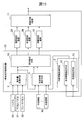
- FIG. 1 is a block diagram showing a part of the configuration of the control device according to the first embodiment of the present invention.
- the control device 1 includes at least an operation amount acquisition unit 2, an external information selection unit 3, an internal information acquisition unit 4, and an operation determination unit 5.
- the control device 1 has, for example, a CPU, a ROM, a RAM, and an input / output device.
- the ROM stores a control flow described with reference to FIGS. 1 and 2.
- the control device 1 determines the operation of the control target 11 and controls an actuator (not shown) mounted on the control target 11 so as to realize the operation.
- the structure which calculates and transmits a command value with respect to the control apparatus (not shown) which controls each actuator mounted in the control object 11 may be sufficient.
- the control device of each actuator receives the command value of the control device 1 through communication or the like, and controls each actuator mounted on the control target 11 based on the command value.
- Actuator varies depending on the type and configuration of the control target 11. For example, if the controlled object 11 is a vehicle, an engine throttle, a brake pump, an electric power steering motor, and the like are actuators (see Example 2 described later). If the control object 11 is a construction machine such as a shovel car, a hydraulic pump of a hydraulic system that determines the operation of the shovel is an actuator (see Example 3 described later).
- the operation amount acquisition means 2 inputs the operation amount 9 of the operator to the control device 1 and stores it in the RAM.
- an analog-digital converter that converts the analog voltage into a digital signal is provided.
- the operation amount is the rotation number or rotation angle of the handle / lever or the like and the pulse voltage of the encoder attached to the rotating portion of the handle or lever is acquired as the operation amount, 0 is obtained when the voltage is less than the threshold value.
- the control object 11 including an input device such as a control panel including a switch or a button or a touch panel, an operation input of the operator by the input device is handled as an operation amount.
- the amount of operation varies depending on the type and configuration of the control target 11. For example, if the control object 11 is a vehicle, the steering wheel angle, steering torque, accelerator pedal and brake pedal angles, pedaling force, and the like are acquired as operation amounts (see Example 2 described later). Further, if the control object 11 is a construction machine such as a shovel car, an angle of a lever for instructing raising / lowering of the shovel is acquired as an operation amount (see Example 3 described later).
- the internal information acquisition unit 3 acquires at least one of information on various sensors (not shown) mounted on the control target 11 and a part of internal calculation information calculated inside the control device 1 and stores it in the RAM. . That is, it is information that can be directly acquired from the control target 11, and the obtained information is determined by the type and configuration of the control target 11. For example, if the control object 11 is a vehicle, the rotational speed acquired by the rotation angle sensor attached to each wheel, the longitudinal acceleration and yaw rate acquired by the acceleration / gyro sensor attached to the vehicle body, the vehicle received by the GPS receiver Current information, object recognition information around the vehicle acquired by a camera, millimeter wave sensor, sonar, and the like are internal information (see Example 2 described later). The internal information also includes internal calculation information such as intermediate variables calculated inside the control device 1 and control command values finally commanded to the actuator.
- the external information selection unit 4 acquires external information 10 that cannot be acquired by the internal information acquisition unit 3 from the outside by communication or the like.
- the number of external information 10 acquired here always changes (according to time).
- a correlation coefficient (or correlation value) between the external information and the operation amount is calculated from the current value and past value of the external information and the current value and past value of the operation amount, and the absolute value of the correlation coefficient is a predetermined value.
- a relational expression between the external information and the operation amount is calculated from the current value and past value of the selected external information, and the current value and past value of the operation amount, and the command operation amount is calculated from the current value of the external information and the relational expression.
- the command operation amount corresponds to the setting of the inter-vehicle distance with the preceding vehicle, the setting of the maximum speed, and the like.
- the operation tendency of the operator may be calculated from the relationship between the internal information acquired by the internal information acquisition means 3 and the operation amount, and the operation tendency may be used instead of the operation amount.
- the inter-vehicle distance from a preceding vehicle detected by a camera, millimeter wave radar, or the like is acquired as internal information, and the relationship between the inter-vehicle distance and the accelerator / brake pedal force is calculated as an operation tendency.
- the reciprocal of the inter-vehicle time the value obtained by dividing the inter-vehicle distance by the current speed of the host vehicle
- the accelerator / brake pedal force is also good.
- External information acquired by the external information selection means 4 is classified into information received using a dedicated terminal and information received using a general-purpose communication terminal that can be connected to the Internet.
- a dedicated terminal For example, in the case of a vehicle, examples such as reception of traffic information by VICS (registered trademark) and reception of map information by a car navigation system are already known.
- VICS registered trademark
- map information For example, information that could not be used conventionally can be received by a general-purpose communication terminal that can be connected to the Internet.
- regional information on the region in which the vehicle is traveling (where the current region is, human characteristics and driving characteristics of the region), weather information (weather, illuminance, temperature, humidity, road surface) Temperature, snow cover, etc.), driver's personal identification information and attributes (age / gender), general driving characteristics of the driver with the attribute, driving history of the driver and other vehicles, Operation characteristics in devices other than vehicles, personal schedule of the driver, internet access history of the driver and preferences estimated based on the history, health information and ecological information of the driver (medical history, visual acuity, heart rate Various kinds of information that can be acquired via the Internet, such as blood pressure, eye line, and the like, is acquired as external information.
- a sensor provided in the control target 11.
- weather information is acquired as external information in a vehicle in which the illuminance sensor and the raindrop sensor are not mounted.
- the operating characteristics of the operator always change according to changes in the psychological state, skill and experience of the operator. Also, since the number and type of external information acquired on the Internet changes daily, the correlation coefficient between the external information and the manipulated variable is always calculated. As a result, the selection of external information changes over time. To do.
- the selection of the external information by the external information selection means 4 may be performed by receiving external information to be selected from an external storage device or a cloud server existing outside the control device 1. That is, the external storage device or cloud server stores the current value and past value of external information, the current value and past value of operation amount, and the correlation between external information and operation amount in the external storage device or cloud server The number is calculated and external information whose correlation coefficient is equal to or greater than a predetermined value is selected.
- the control device 1 receives which external information should be selected from the external storage device or the cloud server. For example, when information indicating that the external information A and the external information D should be selected is received from the five external information A to E, the external information selection unit 4 uses the relational expression between the external information A and the external information D and the operation amount. Is calculated.
- a relational expression between the external information and the operation amount is calculated from the current value and past value of the selected external information and the current value and past value of the operation amount.
- the relational expression may be transmitted by communication.
- the external information selection unit 4 calculates the command operation amount using the received relational expression as it is, and transmits the command operation amount to the operation determination unit 5.
- the operation determination unit 5 determines the operation of the control target 11 based on the command operation amount calculated by the external information selection unit 4. And the control command value of each actuator mounted in the control object 11 is calculated so that the said operation
- the control device 1 is configured to directly control the actuator, a physical quantity for operating each actuator is calculated.
- the vehicle acceleration command value is calculated according to the setting of the inter-vehicle distance with the preceding vehicle, the maximum speed setting, etc., and the engine throttle and brake Control the pressure.
- FIG. 2 is a block diagram showing a specific configuration of the external information selection means 4 of the first embodiment of the control device according to the present invention.
- the external information selection unit 4 includes at least a storage unit 6, a correlation calculation / explanatory variable selection unit 7, and an operation feature amount calculation unit 8.
- the storage unit 6 stores the current value and past value of the manipulated variable and the current value and past value of the external information in an auxiliary storage device such as a RAM, HDD, or SSD. Also, the operator's operation tendency is calculated from the stored operation amount. For example, in the case of a vehicle, by calculating the high-frequency component of the steering wheel angle, the degree of wobbling of the operator (driver) is calculated as the operation tendency. Alternatively, as described above, the operation tendency of the operator may be calculated from the relationship between the internal information acquired by the internal information acquisition unit 3 and the operation amount, and the operation tendency may be used instead of the operation amount.
- Correlation calculation / explanatory variable selection means 7 determines the change in the operation amount or the operation tendency when the operation amount or the operation tendency stored in the storage means 6 differs from the operation amount or the operation tendency acquired at a certain time. Then, the correlation coefficient between the two is calculated from the change of all the acquired external information. Then, external information whose absolute value of the correlation coefficient is larger than a predetermined threshold value is selected.
- the horizontal axis represents the value of the external information X
- the vertical axis represents the value of the operation amount or the operation tendency (hereinafter, simply referred to as the operation amount) U at that time.
- Equation 1 the absolute value of the correlation coefficient increases as the relationship between the external information X and the operation amount U increases, that is, as the minor axis direction 14 is smaller than the major axis direction 13 of the ellipse 12 illustrated in FIG. Become. Further, when the correlation coefficient is small, it indicates that the relationship between the external information X and the manipulated variable U is small. For example, in the example of FIG. 3, there is a relationship that the operation amount U increases as the external information X increases, and the correlation coefficient at this time is a value between 0 and 1.
- the correlation coefficient is a value between ⁇ 1 and 0. Therefore, when the absolute value of the correlation coefficient is higher than a predetermined threshold, the external information X is selected because there is a relationship between the external information X and the manipulated variable U.
- the threshold value may be fixed or variable.
- the number of external information to be selected may be fixed, and the number of external information may be selected in descending order of the correlation coefficient.
- FIG. 4 shows an example of a change over time of selection of the external information X in the control device 1 with a certain device as the control object 11.
- 4A shows an example of the time transition of external information selection
- FIG. 4A shows an example of the time transition of the correlation coefficient at that time.
- this device acquires a total of three pieces of external information A to C at the start of use.
- the external information A whose correlation coefficient with the operation amount change of the operator was equal to or greater than the threshold value was selected, and the operation of the apparatus was determined based on the external information A.
- the external information B and the external information C are not selected because the relationship with the operation amount change is small, that is, the absolute value of the correlation coefficient is equal to or less than a predetermined value.
- the correlation coefficient with the external information A decreases with time
- the correlation coefficient with the external information B and the external information C increases, and the correlation coefficient of the external information B exceeds the threshold value after about 0.6 years. Therefore, the external information B is selected.
- the correlation coefficient of the external information A fell below the threshold value, so the selection was canceled, and acquisition of the external information D was newly started at almost the same timing. Has selected the external information D so that it exceeds the threshold. On the other hand, the correlation coefficient of the external information D, which was initially high, decreases with time, and since the threshold value fell below about 2.9 years, the selection is cancelled.
- External information C was acquired from the beginning, but the correlation coefficient, which was initially less than the threshold, gradually increased, and after about two years, the selection exceeded the threshold and started its selection. Acquisition of the external information E is started at substantially the same timing, and the external information E is selected because the correlation coefficient exceeds the threshold value.
- the correlation calculation / explanatory variable selection means 7 changes the selection of external information over time based on the value of the correlation coefficient.
- the type of external information to be acquired also changes with the passage of time, a new correlation coefficient is calculated every time the external information changes, and the necessity of selection is determined.
- the correlation coefficient is not calculated correctly while the number of data is small. Therefore, as shown in the example of the external information A, D, and E in FIG. 4B, immediately after starting the acquisition of the external information, the threshold value is set to be equal to or less than the threshold, the number of data is sufficiently accumulated in the storage means 6, and the correlation coefficient is the threshold Select as external information from the moment of exceeding.
- the operation feature amount calculation means 8 calculates a relational expression between both based on the current value and past value of the external information selected by the correlation calculation / explanatory variable selection means 7 and the current value and past value of the operation amount or operation tendency. To do. In addition, an operation feature amount is calculated based on the calculated relational expression and the current value of the external information.
- FIG. 5 shows an example of the distribution of the external information X and the operation amount or the operation tendency U, as in FIG.
- A is a coefficient relating to X
- B is a constant.
- This relational expression is represented as a straight line 15 in FIG.
- the relational expression represented by the straight line 15 is derived using, for example, the least square method and the following Expression 3.
- [A, B] ⁇ T ( ⁇ ⁇ T ⁇ ⁇ ) ⁇ ⁇ 1 ⁇ ⁇ ⁇ T ⁇ t
- ⁇ [X1, X2,..., XN] ⁇ T
- t [U1, U2,..., UN] ⁇ T
- Xk and Uk with the subscript k appended to X and U Represents the k-th data.
- T represents transposition.
- the correlation coefficient is set to a threshold value or less immediately after the start of acquisition of external information until the number of data is sufficiently accumulated in the storage means 6.
- external information is not selected until the number of data is sufficiently accumulated, and during that time, the relational expression may not sufficiently reflect the operation amount or operation tendency of the operator. Therefore, as shown in FIG. 6, the external information selection information of the different control target operation information in the other control target (different control target) of the same operator is acquired, and the initial value of the external information selection in the control target 11 (that is, The initial value of the relational expression) may be used.
- FIG. 6 shows a case where the external information A, D, E is selected in the other control target. At this time, unlike FIG. 4, the external information A, D, and E are selected after the correlation coefficient is calculated to be equal to or greater than the threshold immediately after the start of acquisition.
- FIG. 7 is an example in which the transition of the selection of external information at the same time of the same control target is compared between the operator A and the operator B.
- FIG. 7A shows a time transition of selection of external information by the operator A, and this transition is the same as FIG. 4A.
- FIG. 7B is a time transition of selection of external information by the operator B.
- the external information B is not selected, and the external information D and the external information E Selection time is different. In this case, even if the same control target is operated, the operator A and the operator B perform different operations.
- the operation feature quantity calculation means 8 delivers the calculated operation feature quantity to the action determination means 5, and the action determination means 5 determines the action of the control object 11 based on the operation feature quantity as described above.
- FIG. 8 is a flowchart for explaining the system flow of the first embodiment of the control device according to the present invention. In this flow, it is determined at each calculation step whether or not the external information selection needs to be changed. If the change is necessary, the external information selection is changed according to a predetermined means, and the operation amount or the operation tendency and the selected external information and The relationship (correlation coefficient) is calculated, and the operation of the control target 11 is determined.
- an operation amount is acquired by the operation amount acquisition means 2, external information is acquired by the external information selection means 4, and internal information is acquired by the internal information acquisition means 3 (S101).
- an operation amount or an operation tendency of an operator is predicted using at least one of the current operation amount, internal information, and external information ( S102). It is determined whether or not there is a difference between the predicted operation amount or operation tendency and the actual operation amount or operation tendency of the operator, that is, whether or not the operation amount or operation tendency of the operator has changed (S103). When the change is determined (S103: YES), the process proceeds to S104. On the other hand, when the change is not determined (S103: NO), the process proceeds to S110, and the operation feature amount is calculated.
- a correlation coefficient between the operation amount or the operation tendency and all acquired external information is calculated (S104). Then, it is determined whether or not the correlation coefficient is equal to or greater than a predetermined threshold (S105). If the correlation coefficient is greater than or equal to the threshold (S105: YES), the process proceeds to S107, and if it is less than the threshold (S105: NO), the external information is not selected or has been selected so far Stops the selection (S106).
- the process proceeds to S110 to calculate correlation coefficients. If external information that has not been left remains (S109: NO), the process returns to S104.
- the operation feature value is calculated by the operation feature value calculation means 8 (S110). Then, based on the calculated operation feature amount, the motion determining means 5 determines the motion of the control target 11 (S111).
- the operator's operation tendency is predicted more appropriately by using a large number of diverse external information obtained from, for example, a cloud server.
- Change appropriate operation support and control methods according to experience and skill changes to reduce the operator's discomfort and anxiety, and suppress the variation of operation characteristics among operators, and improve the operation (driving) skills Can be unified.
- Example 2 a second embodiment in which the control device according to the present invention is applied to a vehicle travel control device and an automatic driving system for a vehicle is configured will be described with reference to FIGS. 9 to 18.
- symbol is attached
- FIG. 9 is an explanatory diagram showing an overall configuration of a vehicle (sometimes referred to as a host vehicle) 11 as a control target equipped with a second embodiment of a control device (vehicle traveling control device) according to the present invention.
- the FL wheel means the left front wheel
- the FR wheel means the right front wheel
- the RL wheel means the left rear wheel
- the RR wheel means the right rear wheel.
- the vehicle 11 sends command values to the steering control mechanism 30, the brake control mechanism 33, and the throttle control mechanism 40 for controlling the traveling direction of the vehicle 11 based on information from the sensors 22, 23, 24, and 25 that recognize the outside world.
- a vehicle travel control device 21 for calculating is provided. Further, the vehicle 11 controls the steering control device 28 that controls the steering control mechanism 30 based on the command value from the vehicle travel control device 21 and the brake control mechanism 33 based on the command value, and brakes each wheel.
- a braking control device 35 that adjusts the power distribution, an acceleration control device 39 that controls the throttle control mechanism 40 based on the command value and adjusts the torque output of the engine, and a display device 44 that displays a travel plan of the host vehicle 11 and the like. And comprising.
- a camera 22 is provided in the front
- laser radars 23, 24 are provided on the left and right sides
- a millimeter wave radar 25 is provided on the rear.
- Distance and relative speed can be detected.
- the vehicle 11 includes a communication device 43 that performs communication between road vehicles or between vehicles.
- a combination of the above-described sensors is shown as an example of a sensor configuration, but the present invention is not limited to this, and a combination with an ultrasonic sensor, a stereo camera, an infrared camera, or the like may be used.
- the sensor signal (signal output from the sensor) is input to the vehicle travel control device 21.
- the vehicle travel control device 21 has, for example, a CPU, a ROM, a RAM, and an input / output device, which are not shown in detail in FIG.
- the ROM stores a flow of vehicle travel control described with reference to FIG. Although details will be described later, the vehicle travel control device 21 calculates command values of the actuators (the steering control mechanism 30, the brake control mechanism 33, and the throttle control mechanism 40) for controlling the vehicle travel according to the generated travel plan.
- the control devices (the steering control device 28, the braking control device 35, and the acceleration control device 39) of the actuators 30, 33, 40 receive the command value of the vehicle travel control device 21 through communication, and based on the command value, each actuator 30 , 33 and 40 are controlled.
- the pedaling force by which the driver steps on the brake pedal 32 is boosted by a brake booster (not shown), and a hydraulic pressure corresponding to the force is generated by a master cylinder (not shown).
- the generated hydraulic pressure is supplied to the wheel cylinders 36FL, 36FR, 36RL, 36RR provided in each wheel via the brake control mechanism 33.
- the wheel cylinders 36FL to 36RR are composed of cylinders, pistons, pads, disk rotors, etc. (not shown).
- the pistons are propelled by the hydraulic fluid supplied from the master cylinder, and the pads connected to the pistons are pressed against the disk rotors. Is done.
- the disc rotor rotates with the wheels. Therefore, the brake torque acting on the disc rotor becomes a braking force acting between the wheel and the road surface. As described above, a braking force can be generated in each wheel in accordance with the driver's brake pedal operation.
- the braking control device 35 has, for example, a CPU, a ROM, a RAM, and an input / output device, like the vehicle travel control device 21.
- the braking control device 35 includes a combine sensor 34 that can detect longitudinal acceleration, lateral acceleration, and yaw rate, wheel speed sensors 31FL, 31FR, 31RL, and 31RR installed on each wheel, and a steering control device 28 described later.
- a sensor signal from the steering wheel angle detection device 41, a brake force command value from the vehicle travel control device 21 described above, and the like are input.
- the output of the braking control device 35 is connected to a brake control mechanism 33 having a pump (not shown) and a control valve, and generates an arbitrary braking force on each wheel independently of the driver's brake pedal operation. be able to.
- the braking control device 35 estimates the spin, drift-out, wheel lock, etc. of the vehicle 11 based on the above information, generates the braking force of the corresponding wheel so as to suppress them, and improves the steering stability of the driver. Have a role.
- the vehicle travel control device 21 communicates a brake command (value) to the brake control device 35 so that an arbitrary brake force can be generated in the vehicle 11, and automatic operation is not performed in an automatic operation in which no driver operation occurs. It plays the role of braking.
- the present embodiment is not limited to the above braking control device, and other actuators such as a brake-by-wire may be used.
- the steering control device 28 controls the motor 29 to generate assist torque.
- the steering control device 28 also has, for example, a CPU, a ROM, a RAM, and an input / output device, like the vehicle travel control device 21.
- the steering control mechanism 30 is moved by the resultant force of the steering torque of the driver and the assist torque of the motor 29, and the front wheels (FL wheel, FR wheel) are cut.
- the reaction force from the road surface is transmitted to the steering control mechanism 30 according to the turning angle of the front wheel, and is transmitted to the driver as the road surface reaction force.
- the steering control device 28 can control the steering control mechanism 30 by generating torque by the motor 29 independently of the driver's steering operation. Therefore, the vehicle travel control device 21 can control the front wheels to an arbitrary turning angle by communicating a steering force command (value) to the steering control device 28, and is automatic in automatic driving where no driver operation occurs. It is responsible for steering.
- the present embodiment is not limited to the steering control device, and other actuators such as steer-by-wire may be used.
- the depression amount of the accelerator pedal 37 of the driver is detected by the stroke sensor 38 and input to the acceleration control device 39.
- the acceleration control device 39 also has, for example, a CPU, a ROM, a RAM, and an input / output device, like the vehicle travel control device 21.
- the acceleration control device 39 controls the engine by adjusting the throttle opening according to the depression amount of the accelerator pedal 37.
- the acceleration control device 39 can control the throttle opening independently of the driver's accelerator operation. Therefore, the vehicle travel control device 21 can cause the vehicle 11 to generate an arbitrary acceleration by communicating an acceleration command (value) to the acceleration control device 39, and automatically in automatic driving where no driver operation occurs. Has a role to accelerate.
- FIG. 10 is a block diagram showing a part of the configuration of the second embodiment of the control device (vehicle travel control device) according to the present invention.
- the vehicle travel control device 21 includes at least an operation amount acquisition unit 2, an internal information acquisition unit 3, an external information selection unit 4, and a travel control unit 53.
- the operation amount acquisition means 2 detects the steering torque and handle angle input by the driver via the handle 26, the amount of depression of the driver's accelerator pedal 37, the depression force of the driver's brake pedal 32, and the like.
- the internal information acquisition means 3 inputs the operation amount of the operator (driver) to the vehicle travel control device 21 and stores it in the RAM, as in the first embodiment.
- the internal information acquisition unit 3 includes at least a vehicle information detection unit 51 and an object detection unit 52.
- the own vehicle information detection unit 51 specifies the current position of the own vehicle 11 and acquires the operation state quantity.
- the processing for specifying the current position is performed from the external information acquired by at least one of GPS (not shown) and sensors 22 to 25.
- the camera 22 may acquire image data around the host vehicle 11 and collate the stored external image with position information to identify the position of the host vehicle 11. .
- Specific examples of the motion state amount acquired in the motion state amount acquisition process include speed, longitudinal acceleration, lateral acceleration, yaw rate, yaw angle, and the like acquired from the combine sensor 34.
- the object detection unit 52 determines the position information, size, and obstacles of the objects (obstacles, etc.) around the host vehicle 11 from the surrounding outside world information acquired by the sensors 22 to 25 mounted on the host vehicle 11. If is a moving object, the position, speed information, etc. of the moving object are obtained.
- the image data of the camera 22 it is possible to simultaneously identify the types of a plurality of objects and acquire information.
- a stereo camera using two cameras is advantageous because it can detect the relative distance and relative speed of a moving object or an obstacle.
- the external information selection unit 4 acquires external information 10 that cannot be acquired by the internal information acquisition unit 3 from the outside by communication or the like, as in the first embodiment. Then, a correlation coefficient between the external information and the operation amount is calculated from the current value and past value of the external information 10 and the current value and past value of the driver operation amount, and the absolute value of the correlation coefficient is equal to or greater than a predetermined value. Select external information to become. Further, a relational expression between the external information and the operation amount is calculated from the current value and past value of the selected external information, and the current value and past value of the operation amount, and the command operation amount is calculated from the current value of the external information and the relational expression. Is calculated and transmitted to the traveling control means 53.
- the external information selection unit 4 includes at least a storage unit 6, a correlation calculation / explanatory variable selection unit 7, and an operation feature amount calculation unit 8 (see FIG. 2). Is omitted. Although details will be described later, an operation tendency may be used instead of the operation amount as in the first embodiment.
- the external information selection means 4 includes, as external information 10, map information, traffic information, regional information in the area where the vehicle is traveling, weather information, identification information and attributes of the driver, and general information of drivers having the attributes. Estimated based on typical driving characteristics, driving history of the driver in the vehicle and other vehicles, operating characteristics in devices other than the driver's vehicle, personal schedule of the driver, Internet access history of the driver and the history And at least one of the driver's preference, the driver's health information and ecological information.
- external information 10 maps information, traffic information, regional information in the area where the vehicle is traveling, weather information, identification information and attributes of the driver, and general information of drivers having the attributes. Estimated based on typical driving characteristics, driving history of the driver in the vehicle and other vehicles, operating characteristics in devices other than the driver's vehicle, personal schedule of the driver, Internet access history of the driver and the history And at least one of the driver's preference, the driver's health information and ecological information.
- the map information is information related to the road shape, traffic regulations and the like on which the host vehicle 11 is to travel, and is used when generating the target travel path of the host vehicle 11. For example, when the vehicle 11 performs a right / left turn operation at a certain intersection, information on an intersection at which the vehicle 11 turns right / left is acquired. Intersection / road information includes, for example, the number of road lanes at the intersection, road width, road intersection angle, lane width, median strip width, pedestrian crossing width, setback amount from pedestrian crossing intersection, presence of signal, etc. Is mentioned. Such map information may be stored in the storage unit in advance, or may be acquired as map information data via the communication device 43. In particular, when acquiring map information data from a data center or the like via the communication device 43, there is an effect that the latest map information can be acquired. Further, the map information may be acquired from the image information acquired by the camera 22.
- Traffic information is information obtained by acquiring road information around the place where the host vehicle 11 is located.
- a technique for receiving traffic jam information and construction information by VICS (registered trademark) and changing a scheduled travel route (track) is widely spread.
- VICS registered trademark
- a point where accidents or traffic jams frequently occur, a point where many drivers easily reduce the speed, and the like may be stored in a data center or the like, and the information may be received via the communication device 43.
- information such as traffic jams, road obstacles, and construction detected by other vehicles may be accumulated in a data center or the like, and the information may be received via the communication device 43.
- the traffic information includes signal information.
- the signal information may be obtained by displaying a current signal display at an intersection near the host vehicle 11 using the sensors 22 to 25 mounted on the host vehicle 11, or by road-to-vehicle communication using the communication device 43. Current and future signal indications may be obtained.
- Both map information and traffic information are internal information when acquired by the sensors 22 to 25 mounted on the host vehicle 11, and external information when acquired from the outside through communication.
- the region information in the region where the vehicle 11 is traveling is information indicating which region or country the vehicle 11 is currently traveling. It also accepts information that expresses traffic regulations and driving characteristics in the area. For example, in the area A, at the intersection where there is a signal that does not have a right turn lane, when the signal turns blue, if the leading vehicle is a right turn, the opposite straight vehicle will drive the right turn first. Suppose it is general. On the other hand, in the region B, it is assumed that driving in which straight ahead is a priority in any case is common. In this case, for example, the external information “right turn priority at an intersection with a signal without a right turn lane” is acquired as 1 (applicable) in region A and 0 (not applicable) in region B. Alternatively, it may be acquired as a continuous value between 0 and 1 according to the proportion of drivers who take the driving action with priority to the right turn as described above.
- Weather information is information obtained by acquiring the weather, illuminance, temperature, humidity, road surface temperature, snow cover, wind direction, wind speed, etc. at the point where the vehicle 11 is traveling. These pieces of information are obtained directly from, for example, a transmission device installed on the road side by installing a dedicated communication terminal. Or you may acquire from a weather information provision service via the internet, and may acquire the weather information of a nearby observation point directly. Such information can be acquired as internal information in a vehicle equipped with an illuminance sensor, a temperature sensor, a humidity sensor, a raindrop sensor, etc., but is acquired as external information in a vehicle not equipped with these sensors.
- the identification information and attributes of the individual driver are information related to the individual driver, and include age, gender, driving history, driving frequency, and the like. For example, by installing an ID card reading terminal in the host vehicle 11 and performing personal authentication with the ID card every time the vehicle is used, the identification information and attributes of the driver are acquired.
- This ID card is preferably always carried by an individual, such as a driver's license or a personally owned mobile phone.
- personal authentication may be performed by connecting a personally-owned mobile phone and the host vehicle 11 by wire or wireless (for example, (registered trademark) root communication).
- the attribute of the driver's individual may be recorded in the ID card, or may be stored in a cloud server in association with the driver's individual identification information and acquired through the Internet.
- the general driving characteristic of the driver having the attribute represents an operation amount or an operation tendency generally performed by a driver having the same attribute as the attribute of the individual driver. Although details will be described later, for example, as the second embodiment, when the host vehicle 11 performs obstacle avoidance traveling, the speed near the obstacle, the clearance from the obstacle, and the like are acquired as the operation tendency.
- the driving history of the driver and the other vehicle of the driver represents an operation amount or an operation tendency when the driver has driven the vehicle and the other vehicle in the past.
- the speed near the obstacle and the clearance from the obstacle are acquired as the operation tendency.
- These pieces of information are desirably acquired in association with information on vehicle attributes such as the vehicle type, vehicle type, and transmission type. Such information is used, for example, to estimate the operation amount or the operation tendency in the vehicle using the operation amount or the operation tendency in another vehicle when the driver does not drive the vehicle so much.
- the operation characteristics of the driver other than the vehicle represent an operation amount or an operation tendency when the driver operates a device other than the vehicle, for example, a construction machine, a railway, or a control panel of a production line of a factory. Such information suggests whether or not the driver is accustomed to a specific operation, and is used, for example, for predicting the driving skill of the driver.
- the personal schedule of the driver is information obtained by acquiring schedule information registered in the schedule service on the cloud by the driver in association with personal identification information from the Internet.
- the schedule information includes, for example, whether the current movement of the driver is commuting or going to school, a road that is frequently used, a road that is visited for the first time on a trip, or a schedule that is later (or temporal) For example) is included.
- the driver's internet access history and the preference estimated based on the history are information obtained by acquiring the driver's previous website browsing history from the Internet, and the driving estimated based on the browsing history. Expresses the interests and preferences of the person. For example, if the number of times of browsing an automobile-related site is large or the number of times of viewing a car race video is large, it is suggested that the driver may be interested in driving the vehicle.
- the preference estimation technique based on the Internet access history is publicly known in the advertising service, and the preference information linked to the personal account and stored on the cloud server side may be directly acquired on the Internet.
- the driver's health information and biological information are predicted (acquired) from the personal information such as the driver's eyesight, height, heart rate, blood pressure, eyes, pupil diameter, etc. Includes health information that can interfere with the safe driving of the driver.
- These pieces of information can be acquired as internal information if various sensors capable of measuring biological information are mounted on the vehicle, but are acquired as external information on the Internet or the like in a vehicle on which these sensors are not mounted. For example, if the driver has a device that measures his / her health every morning at home, and the health information is stored in a cloud server as a life log, the information can be obtained from the cloud server via the Internet. is there.
- the various external information described above may be acquired by storing in advance in an auxiliary storage device in the vehicle travel control device 21, or may be stored in a cloud server in association with individual driver identification information and acquired via the Internet. May be. Since the capacity of the auxiliary storage device that can be mounted in the vehicle travel control device 21 is limited and the latest information is always obtained when acquired from the Internet, it is desirable to acquire the information via the Internet. .
- External information is not limited to the contents described above, and any information that can be acquired from the outside through the Internet or the like can be external information.
- the travel control means 53 includes the driver's operation amount acquired by the operation amount acquisition means 2, the own vehicle information acquired by the own vehicle information detection means 51, the object detected by the object detection means 52, and the command calculated by the external information selection means 4. Based on the operation amount, a travel plan of the host vehicle 11 is generated, and a steering angle command value and an acceleration / deceleration command value are generated based on the travel plan, and communicated to the steering control device 28, the acceleration control device 39, and the brake control device 35, respectively. The command value is transmitted. At this time, information such as a travel plan of the host vehicle 11 may be displayed on the display device 44.
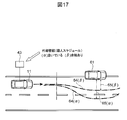
- FIG. 11A shows an example of a travel scene in which a parked vehicle 61 exists on the left side of the travel lane of the host vehicle 11 while the host vehicle 11 is traveling on a two-lane road on a certain date A by a driver's manual operation.
- the vehicle travel control device 21 mounted on the host vehicle 11 detects the parked vehicle 61 by the object detection means 52 and acquires various operation amounts such as the driver's handle angle, accelerator stroke, and brake pedal force by the operation amount acquisition means 2.
- the internal information acquisition means 3 acquires various internal information such as the vehicle speed, position, yaw angle, yaw rate, longitudinal and lateral acceleration of the host vehicle 11.
- the traveling track 62 that avoids the parked vehicle 61 is obtained as a result of manual driving by the driver.
- the traveling track 62 is stored in the storage unit 6 of the external information selection unit 4.
- the vehicle travel control device 21 uses the travel track 62 and the position of the parked vehicle 61 acquired by the object detection unit 52 to provide a clearance 63 between the parked vehicle 61 and the travel track 62. Is calculated as the operating tendency of the driver.
- the vehicle travel control device 21 (the external information selection means 4) acquires the external information 10 by the communication device 43 and stores it in the storage means 6.
- the travel control means 53 of the vehicle travel control device 21 calculates the target travel path 64 during automatic travel according to the target clearance 65 calculated by the operation feature amount calculation means 8. Then, the traveling control means 53 calculates a steering target value so as to follow the target traveling path 64 and instructs the steering control device 28.
- the operation feature amount calculation means 8 calculates a target clearance 65 having the same value as the driver's clearance 63. Therefore, the target trajectory 64 during the automatic traveling at this time is generated so as to coincide with the traveling trajectory 62 of the driver as shown in FIG.
- FIG. 12A shows a target traveling track 64 and a target clearance 65 based on the operating tendency of the driver accumulated in the storage means 6 on the date B when a few days have elapsed from the date A, and the actual driver.
- This shows a scene in which the traveling track 62 and the clearance 63 have different results.
- the weather information has elapsed as shown in FIG. 12B in the external information 10 recorded in the storage unit 6. That is, it is assumed that the sunny weather on date A is raining on date B.
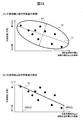
- the correlation calculation / explanatory variable selection means 7 calculates a correlation coefficient from the weather information and the clearance distribution.
- the short axis direction 14 is shorter than the long axis direction 13 of the ellipse 12 indicating an approximate distribution of data, and a correlation coefficient equal to or greater than a predetermined threshold is calculated, this weather information As external information.
- the operation feature amount calculation means 8 calculates a straight line 15 representing a relational expression as shown in FIG. 13B from the relationship between the selected weather information, which is external information, and the clearance. Then, a target clearance 65 (A) when the weather is sunny and a target clearance 65 (B) when the weather is rain are obtained.
- the operation feature amount calculation means 8 selects weather information as external information during automatic traveling, calculates a target clearance 65 as an operation feature amount based on the calculated relational expression (straight line 15), and based on the target clearance 65
- the travel control means 53 calculates a target travel path 64 during automatic travel. Therefore, as shown in FIG. 14, when the weather information is clear (A), the target travel path 64 (A) corresponding to the target clearance 65 (A) is calculated, and when the weather information is rainy (B). A target travel path 64 (B) corresponding to the target clearance 65 (B) is calculated.
- the interval is set according to the percentage of clouds, and the interval between 0 and -1 is set according to precipitation.
- the weather information is acquired as a continuous value between 1 and -1.
- it may be a discrete value composed of three values of 1, 0, ⁇ 1, or text-based weather news is obtained from the Internet, and numerical values corresponding to characters such as “sunny”, “cloudy”, “rain”, etc. May be defined.
- FIG. 15A shows the target travel path 64 and the target clearance 65 calculated by the operation feature amount calculation means 8 according to the weather information on the date D when a few days have elapsed from the date B, and the actual travel trajectory of the driver.
- 62 shows a scene in which 62 and clearance 63 have different results.
- acquisition of the driver's personal schedule is newly started as the external information 10 on the date C between the date B and the date D.
- the driver is approaching the next scheduled time. It is assumed that the situation is “hurrying up”.
- the time transition of the personal schedule accumulated in the storage means 6 is as shown in FIG.
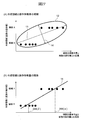
- the correlation calculation / explanatory variable selection means 7 calculates the correlation coefficient from the distribution with the clearance for the weather information and the personal schedule as the external information.
- the weather information is substantially the same in the minor axis direction 14 with respect to the major axis direction 13 of the ellipse 12 indicating the approximate distribution of the data.
- the relationship is small, that is, the correlation coefficient is less than the threshold. Therefore, the weather information is no longer selected as external information.
- the distribution of the individual schedule and the clearance is smaller in the minor axis direction 14 than the major axis direction 13 of the ellipse 12 showing the approximate distribution of data, and the correlation coefficient. Exceeded the threshold. Therefore, a personal schedule is newly selected as external information (instead of weather information).
- the operation feature amount calculating means 8 calculates a straight line 15 representing a relational expression as shown in FIG. 16B from the relationship between the personal schedule and the clearance, which are newly selected external information. And when the next schedule is approaching, that is, the target clearance 65 ( ⁇ ) when the driver is in a hurry ( ⁇ ), and there is time until the next schedule, and the driver's feelings have a margin A target clearance 65 ( ⁇ ) of ( ⁇ ) is obtained.
- the operation feature amount calculation means 8 selects a personal schedule as external information during automatic traveling, calculates a target clearance 65 as an operation feature amount based on the calculated relational expression (straight line 15), and based on the target clearance 65
- the travel control means 53 calculates a target travel path 64 during automatic travel. Therefore, as shown in FIG. 17, when the next schedule is approaching, that is, when the driver is in a hurry ( ⁇ ), as shown in FIG. 17, the target travel path 64 ( ⁇ ) corresponding to the target clearance 65 ( ⁇ ). ) Is calculated, and when there is time until the next schedule and there is a margin in the driver's feelings ( ⁇ ), a target travel path 64 ( ⁇ ) corresponding to the target clearance 65 ( ⁇ ) is calculated.
- FIG. 18 is used to explain the time transition of the external information selection change by the vehicle travel control device 21 (external information selection means 4) described above.
- the weather information was acquired as external information on the date A shortly after the host vehicle 11 started traveling, or shortly after the driver started driving the host vehicle 11, the personal schedule was acquired. It wasn't.
- the correlation coefficient between the weather information and the clearance (the distance between the parked vehicle 61 and the host vehicle 11 when the host vehicle 11 passes by the parked vehicle 61) is preliminarily set.
- the weather information is not selected because it is lower than the predetermined threshold.
- the correlation coefficient between the weather information and the clearance becomes higher than the threshold value, and selection of the weather information is started.
- the personal schedule was newly acquired as external information.
- the correlation coefficient between the personal schedule and the clearance is low, and the personal schedule is not selected as the external information.
- the correlation coefficient between the weather information and the clearance gradually decreased to become lower than the threshold value, and the weather information was not selected as external information.
- the correlation coefficient between the personal schedule and the clearance gradually increases and exceeds the threshold value, and a new personal schedule is selected as external information.
- the above time transition is, for example, that the driver of the vehicle 11 is not used to driving at first, and has taken a lot of clearance when it is raining and has poor visibility. It is a time transition that can occur in the case of driving. At the same time, because he was not used to driving at the beginning, he did not change his driving behavior even if his schedule was not enough. When he got used to driving with time and his schedule was not enough, This is a time transition that can occur when the clearance is increased so that it does not need to slow down much.
- the weather information and the personal schedule are merely examples of the external information 10, and the external information to be selected is not limited to these.
- the vehicle travel control device 21 performs automatic travel.
- the vehicle travel control device 21 provides a driving support system that supports the driving operation of the driver. Is also applicable.
- the driver's future driving behavior is predicted from the driver's past operation tendency, and if the driver deviates from the prediction, it is determined that the driver is performing dangerous driving behavior, and control intervention is performed. , Driving support like this becomes possible.
- Example 3 a third embodiment in which the control device according to the present invention is applied to a construction machine control device will be described with reference to FIGS.
- symbol is attached
- FIG. 19 is an explanatory view showing the appearance of the construction machine 11 as a control target equipped with the third embodiment of the control device (construction machine control device) according to the present invention.
- the construction machine 11 is a hydraulic excavator on which a hydraulic control device is mounted, and mainly includes a traveling body 200, a swivel body 201 having a driver's seat, etc., and a front work machine 202.
- the traveling body 200 travels by driving the left and right crawlers 200a, 200b with the left and right traveling motors 210a, 210b, and the revolving body 201 is swung on the traveling body 200 by a built-in revolving motor 211. It is supposed to be.
- the communication device 43 is mounted on the swivel body 201 or the like.
- the front work machine 202 has an articulated structure including a boom 203, an arm 204, and a bucket 205 for excavating the ground from the revolving structure 201 side, and a boom cylinder 206, an arm cylinder 207, and a bucket cylinder 208 as actuators, respectively. Is driven to rotate in a vertical plane.
- the construction machine 11 to be controlled is a hydraulic excavator
- valve devices corresponding to the travel motors 210a and 210b, the swing motor 211, the boom cylinder 206, the arm cylinder 207, and the bucket cylinder 208 are provided.
- these actuators 206 to 208 may be electric types such as electric linear actuators.
- FIG. 20 is a block diagram showing a part of the configuration of a construction machine equipped with Example 3 of the control device (construction machine control device) according to the present invention.
- a boom cylinder 206, an arm cylinder 207, a bucket cylinder 208, travel motors 210a and 210b, and a swing motor 211 as actuators are a boom control device 231, an arm control device 232, a bucket control device 233, and a travel motor, respectively. It is driven by a control device 234 and a turning motor control device 235.
- the control devices 231 to 235 and the actuators 206 to 208, 210a, 210b, and 211 generate electric power generated by rotating the generator 222 by the prime mover 221, and the control devices 231 to 235 and the actuators 206 to 208, 210a, It is driven by supplying it to 210b and 211.
- a line connecting the generator 222 and the control devices 231 to 235 is a power line 223.
- the construction machine control device 241 controls the control devices 231 to 235.
- the construction machine control device 241 calculates an operation command value from the operation amount by the operation lever 242 and the operation pedal 243 of the operator (operator), and transmits the operation command value to each of the control devices 231 to 235.
- a line connecting the construction machine control device 241 and the control devices 231 to 235 is a signal line 244, and an operation command value is transmitted from the construction machine control device 241 to the control devices 231 to 235 via the signal line 244.
- internal information (position, angle, speed, etc.) of each actuator is transmitted from each control device 231 to 235 to the construction machine control device 241.
- the construction machine control device 241 receives the external information 10 via the communication device 43.
- FIG. 21 is a block diagram showing a part of the configuration of the third embodiment of the control device (construction machine control device 241) according to the present invention.
- the construction machine control device 241 includes at least an operation amount acquisition unit 2, an internal information acquisition unit 3, an external information selection unit 4, and an excavation control unit 251. Since the operations of the operation amount acquisition unit 2, the internal information acquisition unit 3 and the external information selection unit 4 are substantially the same as those in the first embodiment or the second embodiment, detailed description thereof will be omitted, and only the outline thereof will be described below.
- the operation amount acquisition means 2 acquires the operation amounts by the operator's operation lever 242 and the operation pedal 243 and stores them in the RAM. For example, when an analog voltage of a potentiometer attached to the base of the operation lever 242 is acquired as an operation amount, an analog-digital converter that converts the analog voltage into a digital signal is provided.
- the internal information acquisition means 3 receives the sensor information of each actuator and the calculated value in each control device 231 to 235 via the signal line 244 from each control device 231 to 235.
- a sensor such as an accelerometer
- a sensor value detected by the sensor is acquired as internal information.
- information such as the rotation angle, rotation speed, command torque, and current value of the travel motors 210a and 210b is acquired as sensor information of the actuator and calculated values in the control device.
- the bucket control device 233 information such as the cylinder pressure of the bucket cylinder 208 and the propulsive force in the vertical direction is acquired.
- the external information selection unit 4 acquires external information 10 that cannot be acquired by the internal information acquisition unit 3 from the outside by communication or the like. Then, the command operation amount is calculated and transmitted to the excavation control means 251.
- the external information selection unit 4 includes at least a storage unit 6, a correlation calculation / explanatory variable selection unit 7, and an operation feature amount calculation unit 8 (see FIG. 2). Then, explanation is omitted.
- the external information selection unit 4 calculates, for example, the amount of earth and sand to be excavated, the maximum value of excavation force, the coefficient of excavation force with respect to the operation input by the operation lever 242 as the command operation amount.
- the excavation control means 251 is based on the operation amount of the operator (operator) acquired by the operation amount acquisition means 2, the internal information acquired by the internal information acquisition means 3, and the command operation amount calculated by the external information selection means 4.
- the target excavation operation for controlling the excavation of 11 is determined. And based on the said target excavation operation, the control command value with respect to each actuator 206 thru
- the target excavation operation for example, a trajectory of the toe center position at the tip of the bucket 205 is generated.
- FIG. 22 (A) shows a scene in which excavation support is performed using a construction machine control device 241 on a certain date A.
- FIG. The construction machine 11 excavates the ground using a bucket 205 provided at the tip of the front work machine 202 to generate an excavation surface 261.
- the operation of the construction machine control device 241 will be described in the case where the toe height 262 of the bucket 205 in the ground excavation work becomes a time transition as shown in FIG.
- a solid line 264 represents a time transition of the toe height when operated by an experienced operator
- a broken line 265 represents a time transition of the toe height when operated by an inexperienced operator (the operator).
- the broken line 265 is not stable in height as compared with the solid line 264. For example, a sufficient amount of excavation cannot be obtained, it takes time for excavation, the progress of wear of parts of the construction machine 11 due to excessive excavation force, etc. The effect of. Therefore, the operation amount of the skilled person is stored in advance as the ideal target operation amount 264 in the storage unit 6 constituting the external information selection unit 4.
- the construction machine control device 241 performs control intervention when there is a difference (deviation) 266 in the operation amount between the ideal target operation amount 264 and the operation amount 265 of the operator, and the operation amount of the operator is determined by a skilled person.
- the operation support is performed so that the operation amount approaches that of
- control intervention amount is limited (control intervention possible range), and when the difference 266 exceeds the control intervention possible range, the control intervention amount is set within the control intervention possible range, or The control intervention is stopped (that is, the toe height 262 of the bucket 205 is controlled to match the operation amount 265 of the operator). And a part of ideal target operation amount 264 memorize
- FIG. 23 (A) shows that the difference 266 between the ideal target operation amount 264 stored in the storage means 6 and the actual operation amount 265 of the operator on the date B when a certain number of days have elapsed from the date A is shown in FIG. It shows a scene that grew beyond the scope of intervention.
- the weather information has elapsed as shown in FIG. 23B in the external information 10 recorded in the storage unit 6. That is, it is assumed that the sunny weather on date A is raining on date B.
- the correlation calculation / explanatory variable selection means 7 calculates the correlation coefficient from the weather information and the distribution of the difference, as shown in FIG.
- the short axis direction 14 is shorter than the long axis direction 13 of the ellipse 12 indicating the approximate distribution of data, and a correlation coefficient equal to or greater than a predetermined threshold is calculated.
- Weather information is selected as a variable.
- the operation feature quantity calculation means 8 calculates a straight line 15 representing a relational expression as shown in FIG. 24B from the relationship between the selected weather information and the weather information. Then, a difference 266 (A) when the weather is sunny and a difference 266 (B) when the weather is rain are obtained.
- the operation feature amount calculation means 8 selects weather information as external information at the time of operation support, calculates a difference based on the calculated relational expression (straight line 15), and calculates the ideal target operation amount 264 by the calculated difference. change. Accordingly, when the weather information is clear (A) as in the transition of the ideal target operation amount 264 shown in FIG. 25, the ideal target operation amount 264 is calculated as 264 (A), and when the weather information is rainy ( In B), the ideal target operation amount 264 is calculated as 264 (B).
- FIG. 26A shows the difference between the ideal target operation amount 264 calculated by the operation feature amount calculation means 8 according to the weather information and the actual operation amount 265 of the operator on the date D when a few days have passed since the date B.
- 266 shows a scene in which 266 occurs.
- the external information 10 acquisition of information related to the operating device immediately before the operator is newly started on the date C between the date B and the date D, and the operator usually often uses the machine B.
- the machine A is being operated in front of the construction machine 11 at this time.
- the time transition of the information regarding the operating device immediately before the operator stored in the storage unit 6 is as shown in FIG.
- the correlation calculation / descriptive explanatory variable selection means 7 calculates the correlation coefficient from the distribution of the information about the controller immediately before the operator and the difference as external information.
- the short axis direction 14 is smaller than the long axis direction 13 of the ellipse 12 showing the approximate distribution of data, and the correlation coefficient is equal to or greater than the threshold value. Therefore, information related to the operating device immediately before the operator is newly selected as external information.
- the operation feature quantity calculation means 8 is a straight line representing a relational expression, from the relationship between the newly selected external information relating to the operating device immediately before the operator and the difference. 15 is calculated. Then, the difference 266 ( ⁇ ) when the machine that the operator has operated immediately before is the machine A ( ⁇ ), and the machine that the operator has operated immediately before is the machine B ( ⁇ ). The time difference 266 ( ⁇ ) is obtained.
- the operation feature amount calculation means 8 selects information regarding the operating device immediately before the operator as external information at the time of operation support, calculates a difference based on the calculated relational expression (straight line 15), and calculates the calculated difference.
- the ideal target operation amount 264 is changed by the amount. Therefore, as in the transition of the ideal target operation amount 264 shown in FIG. 28, when the previous operating device is the machine A ( ⁇ ), the ideal target operation amount 264 is calculated as 264 ( ⁇ ), and the previous operation is performed. When the machine is the machine B ( ⁇ ), the ideal target operation amount 264 is calculated as 264 (B).
- the machine A is larger than the machine B.
- the amount of excavation becomes larger than usual. This can happen when there is a tendency.
- the same effects as those of the control device 1 of the first embodiment or the vehicle travel control device 21 of the second embodiment can be obtained.
- the construction machine control device 241 of the third embodiment performs both the manual operation mode and the automatic operation mode by the operator.
- the present invention can also be applied to a construction machine provided. In this case, by learning the operator's past operation tendency and reproducing the operation tendency in the automatic operation mode, it is possible to realize an automatic operation with little uncomfortable feeling for the operator.
- a power shovel has been described as an example of construction machines.
- the present invention can be applied to other construction machines such as a dump truck, a crane truck, a bulldozer, a hydraulic breaker, and a Z-hawk. It is.
- the present invention can be applied to industrial machines (processing machines, molding machines, rolling mills, etc.), small mobility (single-seater small cars, motorcycles, inverted pendulum type mobility, etc.), railways, and the like.
- this invention is not limited to the above-mentioned Example, Various modifications are included.
- the above-described embodiments have been described in detail for easy understanding of the present invention, and are not necessarily limited to those having all the configurations described.
- a part of the configuration of one embodiment can be replaced with the configuration of another embodiment, and the configuration of another embodiment can be added to the configuration of one embodiment.
- Control device (Example 1) 2 Operation amount acquisition means 3 Internal information acquisition means 4 External information selection means 5 Operation determination means 6 Storage means 7 Correlation calculation / explanatory variable selection means 8 Operation feature quantity calculation means 9 Operation amount 10 External information 11
- Control object (vehicle, construction machine) ) 21
- Vehicle travel control device (Example 2) 22-25 sensor 26 steering wheel 28 steering control device 32 brake pedal 35 braking control device 37 accelerator pedal 39 acceleration control device 43 communication device 44 display device 51 own vehicle information detection means 52 object detection means 53 travel control means 200 running body 201 turning body 206 Boom cylinder 207 Arm cylinder 208 Bucket cylinder 210a, 210b Traveling motor 211 Turning motor 231 Boom control device 232 Arm control device 233 Bucket control device 234 Traveling motor control device 235 Turning motor control device 241 Construction machine control device (Example 3) 251 Drilling control means
Landscapes
- Engineering & Computer Science (AREA)
- Mechanical Engineering (AREA)
- Physics & Mathematics (AREA)
- Automation & Control Theory (AREA)
- Mining & Mineral Resources (AREA)
- Civil Engineering (AREA)
- General Engineering & Computer Science (AREA)
- Structural Engineering (AREA)
- General Physics & Mathematics (AREA)
- Mathematical Physics (AREA)
- Transportation (AREA)
- Control Of Driving Devices And Active Controlling Of Vehicle (AREA)
Abstract
L'invention concerne un appareil de commande qui permet de réduire la sensation de malaise ou de gêne de l'opérateur en prévoyant de manière appropriée un changement de la tendance d'opération de l'opérateur. La présente invention comprend : un moyen d'acquisition d'informations internes qui permet d'acquérir des informations internes pouvant être acquises directement auprès d'un objet devant être commandé ; un moyen d'acquisition de quantité d'opération qui permet d'acquérir la quantité d'opération mise en œuvre par un opérateur sur l'objet devant être commandé ; un moyen de sélection d'informations externes qui permet d'acquérir, de l'extérieur, de multiples ensembles d'informations externes non directement acquis auprès de l'objet devant être commandé, et de sélectionner un ensemble des informations externes expliquant un changement de la quantité d'opération, parmi les multiples ensembles d'informations externes acquis ; un moyen de détermination de mouvement qui permet de déterminer le mouvement de l'objet devant être commandé au moyen des informations externes sélectionnées par le moyen de sélection d'informations externes et des informations internes et/ou de la quantité d'opération.
Priority Applications (1)
| Application Number | Priority Date | Filing Date | Title |
|---|---|---|---|
| PCT/JP2016/063371 WO2017187605A1 (fr) | 2016-04-28 | 2016-04-28 | Appareil de commande |
Applications Claiming Priority (1)
| Application Number | Priority Date | Filing Date | Title |
|---|---|---|---|
| PCT/JP2016/063371 WO2017187605A1 (fr) | 2016-04-28 | 2016-04-28 | Appareil de commande |
Publications (1)
| Publication Number | Publication Date |
|---|---|
| WO2017187605A1 true WO2017187605A1 (fr) | 2017-11-02 |
Family
ID=60161468
Family Applications (1)
| Application Number | Title | Priority Date | Filing Date |
|---|---|---|---|
| PCT/JP2016/063371 Ceased WO2017187605A1 (fr) | 2016-04-28 | 2016-04-28 | Appareil de commande |
Country Status (1)
| Country | Link |
|---|---|
| WO (1) | WO2017187605A1 (fr) |
Cited By (2)
| Publication number | Priority date | Publication date | Assignee | Title |
|---|---|---|---|---|
| WO2019123511A1 (fr) * | 2017-12-18 | 2019-06-27 | 住友重機械工業株式会社 | Pelleteuse |
| JP2022154961A (ja) * | 2021-03-30 | 2022-10-13 | パナソニックIpマネジメント株式会社 | 駐車支援装置および駐車支援方法 |
Citations (6)
| Publication number | Priority date | Publication date | Assignee | Title |
|---|---|---|---|---|
| JPS59150837A (ja) * | 1983-02-17 | 1984-08-29 | Hitachi Constr Mach Co Ltd | 作業機械の動作再生装置 |
| JPH03260704A (ja) * | 1990-03-09 | 1991-11-20 | Kobe Steel Ltd | アクション決定装置 |
| JPH06199158A (ja) * | 1993-01-07 | 1994-07-19 | Mazda Motor Corp | 自動車用制御装置の制御ゲイン変更装置 |
| JPH10292418A (ja) * | 1997-04-18 | 1998-11-04 | Hitachi Constr Mach Co Ltd | 自動運転ショベル |
| JP2000105900A (ja) * | 1998-09-29 | 2000-04-11 | Koyo Seiko Co Ltd | 車両用制御装置 |
| WO2007077867A1 (fr) * | 2005-12-28 | 2007-07-12 | National University Corporation Nagoya University | Dispositif d’estimation de comportement de conduite, dispositif de support de conduite, systeme d’evaluation de vehicule, dispositif de fabrication de modele de conducteur, et dispositif de determination de comportement de conduite |
-
2016
- 2016-04-28 WO PCT/JP2016/063371 patent/WO2017187605A1/fr not_active Ceased
Patent Citations (6)
| Publication number | Priority date | Publication date | Assignee | Title |
|---|---|---|---|---|
| JPS59150837A (ja) * | 1983-02-17 | 1984-08-29 | Hitachi Constr Mach Co Ltd | 作業機械の動作再生装置 |
| JPH03260704A (ja) * | 1990-03-09 | 1991-11-20 | Kobe Steel Ltd | アクション決定装置 |
| JPH06199158A (ja) * | 1993-01-07 | 1994-07-19 | Mazda Motor Corp | 自動車用制御装置の制御ゲイン変更装置 |
| JPH10292418A (ja) * | 1997-04-18 | 1998-11-04 | Hitachi Constr Mach Co Ltd | 自動運転ショベル |
| JP2000105900A (ja) * | 1998-09-29 | 2000-04-11 | Koyo Seiko Co Ltd | 車両用制御装置 |
| WO2007077867A1 (fr) * | 2005-12-28 | 2007-07-12 | National University Corporation Nagoya University | Dispositif d’estimation de comportement de conduite, dispositif de support de conduite, systeme d’evaluation de vehicule, dispositif de fabrication de modele de conducteur, et dispositif de determination de comportement de conduite |
Cited By (4)
| Publication number | Priority date | Publication date | Assignee | Title |
|---|---|---|---|---|
| WO2019123511A1 (fr) * | 2017-12-18 | 2019-06-27 | 住友重機械工業株式会社 | Pelleteuse |
| JPWO2019123511A1 (ja) * | 2017-12-18 | 2020-12-03 | 住友重機械工業株式会社 | ショベル |
| JP2022154961A (ja) * | 2021-03-30 | 2022-10-13 | パナソニックIpマネジメント株式会社 | 駐車支援装置および駐車支援方法 |
| JP7609523B2 (ja) | 2021-03-30 | 2025-01-07 | パナソニックオートモーティブシステムズ株式会社 | 駐車支援装置および駐車支援方法 |
Similar Documents
| Publication | Publication Date | Title |
|---|---|---|
| US10953883B2 (en) | Vehicle control device | |
| JP6970807B2 (ja) | 移動体制御装置 | |
| US10059336B2 (en) | Systems and methods for dynamically adjusting a vehicle trajectory according to deviations of a driver from expected inputs | |
| JP6360855B2 (ja) | 車両のドライバ勧告システム | |
| US12115979B2 (en) | Method and control device for a system for the control of a motor vehicle | |
| JP6932662B2 (ja) | 車両走行制御装置 | |
| US10698406B2 (en) | Autonomous driving device | |
| CN101318509B (zh) | 根据路径曲率的车辆速度控制装置 | |
| US20190347492A1 (en) | Vehicle control device | |
| JP6930152B2 (ja) | 自動運転システム | |
| CN109804420B (zh) | 车辆控制装置 | |
| US10930152B2 (en) | Travel control system | |
| CN113710530A (zh) | 用于运行自主交通工具中的驾驶员信息系统的方法和驾驶员信息系统 | |
| JP2009274594A (ja) | 車線変更支援装置 | |
| US20070040705A1 (en) | Unsafe location warning system | |
| JP2015219830A (ja) | 運転支援装置 | |
| JP2020104796A (ja) | 運転支援システム | |
| EP4306382B1 (fr) | Trajectoires de planification pour commander des véhicules autonomes | |
| US20230347887A1 (en) | Systems and methods for driver-preferred lane biasing | |
| CN111746553B (zh) | 车辆的控制装置、车辆的控制方法以及车辆的控制系统 | |
| JP2018116404A (ja) | 車両制御システム | |
| JP2022041910A (ja) | 制御システム、非一時的コンピュータ可読媒体、及び方法 | |
| US20220332343A1 (en) | Systems and methods for controlling an autonomous vehicle | |
| US20220371585A1 (en) | Customizable lane biasing for an automated vehicle | |
| JP6819056B2 (ja) | 自動運転車両 |
Legal Events
| Date | Code | Title | Description |
|---|---|---|---|
| NENP | Non-entry into the national phase |
Ref country code: DE |
|
| 121 | Ep: the epo has been informed by wipo that ep was designated in this application |
Ref document number: 16900475 Country of ref document: EP Kind code of ref document: A1 |
|
| 122 | Ep: pct application non-entry in european phase |
Ref document number: 16900475 Country of ref document: EP Kind code of ref document: A1 |
|
| NENP | Non-entry into the national phase |
Ref country code: JP |