WO2017188120A1 - Couche auto-adhésive - Google Patents
Couche auto-adhésive Download PDFInfo
- Publication number
- WO2017188120A1 WO2017188120A1 PCT/JP2017/015904 JP2017015904W WO2017188120A1 WO 2017188120 A1 WO2017188120 A1 WO 2017188120A1 JP 2017015904 W JP2017015904 W JP 2017015904W WO 2017188120 A1 WO2017188120 A1 WO 2017188120A1
- Authority
- WO
- WIPO (PCT)
- Prior art keywords
- self
- adhesive layer
- meth
- resin
- adhesive
- Prior art date
- Legal status (The legal status is an assumption and is not a legal conclusion. Google has not performed a legal analysis and makes no representation as to the accuracy of the status listed.)
- Ceased
Links
Images

Classifications
-
- C—CHEMISTRY; METALLURGY
- C09—DYES; PAINTS; POLISHES; NATURAL RESINS; ADHESIVES; COMPOSITIONS NOT OTHERWISE PROVIDED FOR; APPLICATIONS OF MATERIALS NOT OTHERWISE PROVIDED FOR
- C09J—ADHESIVES; NON-MECHANICAL ASPECTS OF ADHESIVE PROCESSES IN GENERAL; ADHESIVE PROCESSES NOT PROVIDED FOR ELSEWHERE; USE OF MATERIALS AS ADHESIVES
- C09J7/00—Adhesives in the form of films or foils
- C09J7/10—Adhesives in the form of films or foils without carriers
-
- C—CHEMISTRY; METALLURGY
- C09—DYES; PAINTS; POLISHES; NATURAL RESINS; ADHESIVES; COMPOSITIONS NOT OTHERWISE PROVIDED FOR; APPLICATIONS OF MATERIALS NOT OTHERWISE PROVIDED FOR
- C09J—ADHESIVES; NON-MECHANICAL ASPECTS OF ADHESIVE PROCESSES IN GENERAL; ADHESIVE PROCESSES NOT PROVIDED FOR ELSEWHERE; USE OF MATERIALS AS ADHESIVES
- C09J7/00—Adhesives in the form of films or foils
- C09J7/30—Adhesives in the form of films or foils characterised by the adhesive composition
-
- B—PERFORMING OPERATIONS; TRANSPORTING
- B32—LAYERED PRODUCTS
- B32B—LAYERED PRODUCTS, i.e. PRODUCTS BUILT-UP OF STRATA OF FLAT OR NON-FLAT, e.g. CELLULAR OR HONEYCOMB, FORM
- B32B27/00—Layered products comprising a layer of synthetic resin
-
- B—PERFORMING OPERATIONS; TRANSPORTING
- B32—LAYERED PRODUCTS
- B32B—LAYERED PRODUCTS, i.e. PRODUCTS BUILT-UP OF STRATA OF FLAT OR NON-FLAT, e.g. CELLULAR OR HONEYCOMB, FORM
- B32B29/00—Layered products comprising a layer of paper or cardboard
-
- B—PERFORMING OPERATIONS; TRANSPORTING
- B32—LAYERED PRODUCTS
- B32B—LAYERED PRODUCTS, i.e. PRODUCTS BUILT-UP OF STRATA OF FLAT OR NON-FLAT, e.g. CELLULAR OR HONEYCOMB, FORM
- B32B7/00—Layered products characterised by the relation between layers; Layered products characterised by the relative orientation of features between layers, or by the relative values of a measurable parameter between layers, i.e. products comprising layers having different physical, chemical or physicochemical properties; Layered products characterised by the interconnection of layers
- B32B7/04—Interconnection of layers
- B32B7/06—Interconnection of layers permitting easy separation
-
- C—CHEMISTRY; METALLURGY
- C08—ORGANIC MACROMOLECULAR COMPOUNDS; THEIR PREPARATION OR CHEMICAL WORKING-UP; COMPOSITIONS BASED THEREON
- C08L—COMPOSITIONS OF MACROMOLECULAR COMPOUNDS
- C08L33/00—Compositions of homopolymers or copolymers of compounds having one or more unsaturated aliphatic radicals, each having only one carbon-to-carbon double bond, and only one being terminated by only one carboxyl radical, or of salts, anhydrides, esters, amides, imides or nitriles thereof; Compositions of derivatives of such polymers
- C08L33/04—Homopolymers or copolymers of esters
-
- C—CHEMISTRY; METALLURGY
- C09—DYES; PAINTS; POLISHES; NATURAL RESINS; ADHESIVES; COMPOSITIONS NOT OTHERWISE PROVIDED FOR; APPLICATIONS OF MATERIALS NOT OTHERWISE PROVIDED FOR
- C09J—ADHESIVES; NON-MECHANICAL ASPECTS OF ADHESIVE PROCESSES IN GENERAL; ADHESIVE PROCESSES NOT PROVIDED FOR ELSEWHERE; USE OF MATERIALS AS ADHESIVES
- C09J11/00—Features of adhesives not provided for in group C09J9/00, e.g. additives
- C09J11/02—Non-macromolecular additives
- C09J11/06—Non-macromolecular additives organic
-
- C—CHEMISTRY; METALLURGY
- C09—DYES; PAINTS; POLISHES; NATURAL RESINS; ADHESIVES; COMPOSITIONS NOT OTHERWISE PROVIDED FOR; APPLICATIONS OF MATERIALS NOT OTHERWISE PROVIDED FOR
- C09J—ADHESIVES; NON-MECHANICAL ASPECTS OF ADHESIVE PROCESSES IN GENERAL; ADHESIVE PROCESSES NOT PROVIDED FOR ELSEWHERE; USE OF MATERIALS AS ADHESIVES
- C09J133/00—Adhesives based on homopolymers or copolymers of compounds having one or more unsaturated aliphatic radicals, each having only one carbon-to-carbon double bond, and at least one being terminated by only one carboxyl radical, or of salts, anhydrides, esters, amides, imides, or nitriles thereof; Adhesives based on derivatives of such polymers
- C09J133/04—Homopolymers or copolymers of esters
-
- C—CHEMISTRY; METALLURGY
- C09—DYES; PAINTS; POLISHES; NATURAL RESINS; ADHESIVES; COMPOSITIONS NOT OTHERWISE PROVIDED FOR; APPLICATIONS OF MATERIALS NOT OTHERWISE PROVIDED FOR
- C09J—ADHESIVES; NON-MECHANICAL ASPECTS OF ADHESIVE PROCESSES IN GENERAL; ADHESIVE PROCESSES NOT PROVIDED FOR ELSEWHERE; USE OF MATERIALS AS ADHESIVES
- C09J133/00—Adhesives based on homopolymers or copolymers of compounds having one or more unsaturated aliphatic radicals, each having only one carbon-to-carbon double bond, and at least one being terminated by only one carboxyl radical, or of salts, anhydrides, esters, amides, imides, or nitriles thereof; Adhesives based on derivatives of such polymers
- C09J133/04—Homopolymers or copolymers of esters
- C09J133/06—Homopolymers or copolymers of esters of esters containing only carbon, hydrogen and oxygen, the oxygen atom being present only as part of the carboxyl radical
- C09J133/08—Homopolymers or copolymers of acrylic acid esters
-
- C—CHEMISTRY; METALLURGY
- C09—DYES; PAINTS; POLISHES; NATURAL RESINS; ADHESIVES; COMPOSITIONS NOT OTHERWISE PROVIDED FOR; APPLICATIONS OF MATERIALS NOT OTHERWISE PROVIDED FOR
- C09J—ADHESIVES; NON-MECHANICAL ASPECTS OF ADHESIVE PROCESSES IN GENERAL; ADHESIVE PROCESSES NOT PROVIDED FOR ELSEWHERE; USE OF MATERIALS AS ADHESIVES
- C09J133/00—Adhesives based on homopolymers or copolymers of compounds having one or more unsaturated aliphatic radicals, each having only one carbon-to-carbon double bond, and at least one being terminated by only one carboxyl radical, or of salts, anhydrides, esters, amides, imides, or nitriles thereof; Adhesives based on derivatives of such polymers
- C09J133/04—Homopolymers or copolymers of esters
- C09J133/06—Homopolymers or copolymers of esters of esters containing only carbon, hydrogen and oxygen, the oxygen atom being present only as part of the carboxyl radical
- C09J133/10—Homopolymers or copolymers of methacrylic acid esters
-
- C—CHEMISTRY; METALLURGY
- C09—DYES; PAINTS; POLISHES; NATURAL RESINS; ADHESIVES; COMPOSITIONS NOT OTHERWISE PROVIDED FOR; APPLICATIONS OF MATERIALS NOT OTHERWISE PROVIDED FOR
- C09J—ADHESIVES; NON-MECHANICAL ASPECTS OF ADHESIVE PROCESSES IN GENERAL; ADHESIVE PROCESSES NOT PROVIDED FOR ELSEWHERE; USE OF MATERIALS AS ADHESIVES
- C09J5/00—Adhesive processes in general; Adhesive processes not provided for elsewhere, e.g. relating to primers
- C09J5/08—Adhesive processes in general; Adhesive processes not provided for elsewhere, e.g. relating to primers using foamed adhesives
-
- C—CHEMISTRY; METALLURGY
- C09—DYES; PAINTS; POLISHES; NATURAL RESINS; ADHESIVES; COMPOSITIONS NOT OTHERWISE PROVIDED FOR; APPLICATIONS OF MATERIALS NOT OTHERWISE PROVIDED FOR
- C09J—ADHESIVES; NON-MECHANICAL ASPECTS OF ADHESIVE PROCESSES IN GENERAL; ADHESIVE PROCESSES NOT PROVIDED FOR ELSEWHERE; USE OF MATERIALS AS ADHESIVES
- C09J7/00—Adhesives in the form of films or foils
- C09J7/20—Adhesives in the form of films or foils characterised by their carriers
-
- C—CHEMISTRY; METALLURGY
- C09—DYES; PAINTS; POLISHES; NATURAL RESINS; ADHESIVES; COMPOSITIONS NOT OTHERWISE PROVIDED FOR; APPLICATIONS OF MATERIALS NOT OTHERWISE PROVIDED FOR
- C09J—ADHESIVES; NON-MECHANICAL ASPECTS OF ADHESIVE PROCESSES IN GENERAL; ADHESIVE PROCESSES NOT PROVIDED FOR ELSEWHERE; USE OF MATERIALS AS ADHESIVES
- C09J7/00—Adhesives in the form of films or foils
- C09J7/20—Adhesives in the form of films or foils characterised by their carriers
- C09J7/21—Paper; Textile fabrics
-
- C—CHEMISTRY; METALLURGY
- C09—DYES; PAINTS; POLISHES; NATURAL RESINS; ADHESIVES; COMPOSITIONS NOT OTHERWISE PROVIDED FOR; APPLICATIONS OF MATERIALS NOT OTHERWISE PROVIDED FOR
- C09J—ADHESIVES; NON-MECHANICAL ASPECTS OF ADHESIVE PROCESSES IN GENERAL; ADHESIVE PROCESSES NOT PROVIDED FOR ELSEWHERE; USE OF MATERIALS AS ADHESIVES
- C09J7/00—Adhesives in the form of films or foils
- C09J7/20—Adhesives in the form of films or foils characterised by their carriers
- C09J7/22—Plastics; Metallised plastics
-
- C—CHEMISTRY; METALLURGY
- C09—DYES; PAINTS; POLISHES; NATURAL RESINS; ADHESIVES; COMPOSITIONS NOT OTHERWISE PROVIDED FOR; APPLICATIONS OF MATERIALS NOT OTHERWISE PROVIDED FOR
- C09J—ADHESIVES; NON-MECHANICAL ASPECTS OF ADHESIVE PROCESSES IN GENERAL; ADHESIVE PROCESSES NOT PROVIDED FOR ELSEWHERE; USE OF MATERIALS AS ADHESIVES
- C09J7/00—Adhesives in the form of films or foils
- C09J7/30—Adhesives in the form of films or foils characterised by the adhesive composition
- C09J7/38—Pressure-sensitive adhesives [PSA]
- C09J7/381—Pressure-sensitive adhesives [PSA] based on macromolecular compounds obtained by reactions involving only carbon-to-carbon unsaturated bonds
- C09J7/385—Acrylic polymers
-
- C—CHEMISTRY; METALLURGY
- C08—ORGANIC MACROMOLECULAR COMPOUNDS; THEIR PREPARATION OR CHEMICAL WORKING-UP; COMPOSITIONS BASED THEREON
- C08K—Use of inorganic or non-macromolecular organic substances as compounding ingredients
- C08K5/00—Use of organic ingredients
- C08K5/0008—Organic ingredients according to more than one of the "one dot" groups of C08K5/01 - C08K5/59
- C08K5/0025—Crosslinking or vulcanising agents; including accelerators
-
- C—CHEMISTRY; METALLURGY
- C08—ORGANIC MACROMOLECULAR COMPOUNDS; THEIR PREPARATION OR CHEMICAL WORKING-UP; COMPOSITIONS BASED THEREON
- C08K—Use of inorganic or non-macromolecular organic substances as compounding ingredients
- C08K5/00—Use of organic ingredients
- C08K5/16—Nitrogen-containing compounds
- C08K5/29—Compounds containing one or more carbon-to-nitrogen double bonds
-
- C—CHEMISTRY; METALLURGY
- C09—DYES; PAINTS; POLISHES; NATURAL RESINS; ADHESIVES; COMPOSITIONS NOT OTHERWISE PROVIDED FOR; APPLICATIONS OF MATERIALS NOT OTHERWISE PROVIDED FOR
- C09J—ADHESIVES; NON-MECHANICAL ASPECTS OF ADHESIVE PROCESSES IN GENERAL; ADHESIVE PROCESSES NOT PROVIDED FOR ELSEWHERE; USE OF MATERIALS AS ADHESIVES
- C09J2301/00—Additional features of adhesives in the form of films or foils
- C09J2301/30—Additional features of adhesives in the form of films or foils characterized by the chemical, physicochemical or physical properties of the adhesive or the carrier
- C09J2301/312—Additional features of adhesives in the form of films or foils characterized by the chemical, physicochemical or physical properties of the adhesive or the carrier parameters being the characterizing feature
-
- C—CHEMISTRY; METALLURGY
- C09—DYES; PAINTS; POLISHES; NATURAL RESINS; ADHESIVES; COMPOSITIONS NOT OTHERWISE PROVIDED FOR; APPLICATIONS OF MATERIALS NOT OTHERWISE PROVIDED FOR
- C09J—ADHESIVES; NON-MECHANICAL ASPECTS OF ADHESIVE PROCESSES IN GENERAL; ADHESIVE PROCESSES NOT PROVIDED FOR ELSEWHERE; USE OF MATERIALS AS ADHESIVES
- C09J2301/00—Additional features of adhesives in the form of films or foils
- C09J2301/40—Additional features of adhesives in the form of films or foils characterized by the presence of essential components
- C09J2301/408—Additional features of adhesives in the form of films or foils characterized by the presence of essential components additives as essential feature of the adhesive layer
-
- C—CHEMISTRY; METALLURGY
- C09—DYES; PAINTS; POLISHES; NATURAL RESINS; ADHESIVES; COMPOSITIONS NOT OTHERWISE PROVIDED FOR; APPLICATIONS OF MATERIALS NOT OTHERWISE PROVIDED FOR
- C09J—ADHESIVES; NON-MECHANICAL ASPECTS OF ADHESIVE PROCESSES IN GENERAL; ADHESIVE PROCESSES NOT PROVIDED FOR ELSEWHERE; USE OF MATERIALS AS ADHESIVES
- C09J2301/00—Additional features of adhesives in the form of films or foils
- C09J2301/40—Additional features of adhesives in the form of films or foils characterized by the presence of essential components
- C09J2301/414—Additional features of adhesives in the form of films or foils characterized by the presence of essential components presence of a copolymer
-
- C—CHEMISTRY; METALLURGY
- C09—DYES; PAINTS; POLISHES; NATURAL RESINS; ADHESIVES; COMPOSITIONS NOT OTHERWISE PROVIDED FOR; APPLICATIONS OF MATERIALS NOT OTHERWISE PROVIDED FOR
- C09J—ADHESIVES; NON-MECHANICAL ASPECTS OF ADHESIVE PROCESSES IN GENERAL; ADHESIVE PROCESSES NOT PROVIDED FOR ELSEWHERE; USE OF MATERIALS AS ADHESIVES
- C09J2400/00—Presence of inorganic and organic materials
- C09J2400/20—Presence of organic materials
- C09J2400/22—Presence of unspecified polymer
- C09J2400/226—Presence of unspecified polymer in the substrate
-
- C—CHEMISTRY; METALLURGY
- C09—DYES; PAINTS; POLISHES; NATURAL RESINS; ADHESIVES; COMPOSITIONS NOT OTHERWISE PROVIDED FOR; APPLICATIONS OF MATERIALS NOT OTHERWISE PROVIDED FOR
- C09J—ADHESIVES; NON-MECHANICAL ASPECTS OF ADHESIVE PROCESSES IN GENERAL; ADHESIVE PROCESSES NOT PROVIDED FOR ELSEWHERE; USE OF MATERIALS AS ADHESIVES
- C09J2400/00—Presence of inorganic and organic materials
- C09J2400/20—Presence of organic materials
- C09J2400/24—Presence of a foam
-
- C—CHEMISTRY; METALLURGY
- C09—DYES; PAINTS; POLISHES; NATURAL RESINS; ADHESIVES; COMPOSITIONS NOT OTHERWISE PROVIDED FOR; APPLICATIONS OF MATERIALS NOT OTHERWISE PROVIDED FOR
- C09J—ADHESIVES; NON-MECHANICAL ASPECTS OF ADHESIVE PROCESSES IN GENERAL; ADHESIVE PROCESSES NOT PROVIDED FOR ELSEWHERE; USE OF MATERIALS AS ADHESIVES
- C09J2400/00—Presence of inorganic and organic materials
- C09J2400/20—Presence of organic materials
- C09J2400/28—Presence of paper
- C09J2400/283—Presence of paper in the substrate
-
- C—CHEMISTRY; METALLURGY
- C09—DYES; PAINTS; POLISHES; NATURAL RESINS; ADHESIVES; COMPOSITIONS NOT OTHERWISE PROVIDED FOR; APPLICATIONS OF MATERIALS NOT OTHERWISE PROVIDED FOR
- C09J—ADHESIVES; NON-MECHANICAL ASPECTS OF ADHESIVE PROCESSES IN GENERAL; ADHESIVE PROCESSES NOT PROVIDED FOR ELSEWHERE; USE OF MATERIALS AS ADHESIVES
- C09J2433/00—Presence of (meth)acrylic polymer
Definitions
- the present invention relates to a self-adhesive layer and a self-adhesive laminate.
- a sheet-like member having self-adhesiveness (hereinafter, referred to as “self-adhesive sheet” or “self-adhesive layer”) is used as an adhesive sheet that is applied to a smooth adherend such as a window glass. Is being used.
- self-adhesive sheet adhesion methods adhesive adhesion that utilizes the adhesion of the sheet material itself, and adsorption to the adherend due to the suction cup effect that utilizes the fine pores formed in the sheet.
- a self-adhesive sheet that adheres by combining the two adhesive modes is also used.
- the self-adhesive sheet is suitably used for various applications such as interior decoration materials such as interior decoration materials such as wallpaper, and advertising and sticking materials such as posters and stickers.
- a substrate such as a resin film is usually laminated on the self-adhesive layer, and decoration such as printing is applied to the substrate.
- a laminate having a self-adhesive layer and a support layer made of a substrate is referred to as a “self-adhesive laminate”.
- Patent Document 1 foams a resin composition containing a (meth) acrylate copolymer resin having no N-methylol group in the molecule and an oxazoline crosslinking agent.
- a sheet obtained by coating the foamed product on a substrate and then solidifying the foam by heating and drying is disclosed.
- Patent Document 1 describes that the sheet does not generate formaldehyde or hardly.
- the self-adhesive layer is required to have a property that air does not easily accumulate when affixed to a smooth adherend, so-called “air release”.
- air release the use of the (meth) acrylic acid ester copolymer resin having a carboxyl group increases the gel fraction of the (meth) acrylic acid ester copolymer resin. Irregular irregularities are likely to be formed on the surface, and air bleedability may be insufficient.
- an object of the present invention is to provide a self-adhesive layer and a self-adhesive laminate that are excellent in air bleeding and have reduced formaldehyde generation.
- the present inventors can improve the air release property by the glossiness of the sheet surface being an index of the smoothness of the self-adhesive layer being within a predetermined range. It has been found that this can be achieved while reducing the amount of formaldehyde generated, and the present invention has been completed.
- the first aspect of the present invention is a self-adhesive layer comprising a resin and a reactant of a resin composition containing a crosslinking agent and / or an initiator, and has a glossiness of 33 to 90,
- the self-adhesive layer has a formaldehyde generation amount of 2 ppm or less.
- the “reactant of the resin composition” means at least a conjugate in which a bonding structure is formed in or between the molecules of the polymer constituting the resin contained in the resin composition.
- glossiness means glossiness measured at an incident angle of 60 ° in accordance with JIS Z 8741.
- the “formaldehyde generation amount” means a formaldehyde concentration measured by the following method. After pasting a separator film on the self-adhesive layer of the present invention, a test piece cut out to a size of 200 mm ⁇ 200 mm is prepared. Place the specimen in a 5 L Tedlar bag and seal. 2 L of air was sealed in it, left in a thermostat set at 23 ° C. and 50% RH for 6 hours, and then the concentration of formaldehyde (ppm) in the bag was detected with a detector tube (Gastech, No. 91 L). ).
- the resin is preferably a (meth) acrylic acid ester copolymer resin.
- (meth) acryl means “acryl and / or methacryl”.
- the glass transition temperature of the (meth) acrylic ester copolymer resin is preferably ⁇ 10 ° C. or lower.
- the (meth) acrylic acid ester copolymer resin preferably has an N-methylol group and has a gel fraction of 70% or less.
- the resin composition is preferably a foam.
- the foaming ratio of the foam is preferably 1.1 times or more and 4 times or less.
- the crosslinking agent is preferably a carbodiimide-based crosslinking agent.
- the resin composition preferably includes 100 parts by mass of a (meth) acrylic acid ester copolymer resin and 0.1 to 20 parts by mass of a carbodiimide-based crosslinking agent.
- the self-adhesive layer according to the first aspect of the present invention preferably has a thickness of 0.005 mm to 0.5 mm.
- the second aspect of the present invention is a self-adhesive laminate having the self-adhesive layer according to the first aspect of the present invention and a support layer made of a substrate.
- the substrate is preferably a plastic sheet or a paper substrate.
- the self-adhesive layer of the present invention is a self-adhesive layer comprising a resin and a reactant of a resin composition containing a crosslinking agent and / or an initiator, and has a glossiness of 33 to 90. Yes, the amount of formaldehyde generated is 2 ppm or less.
- the glossiness of the self-adhesive layer of the present invention is 33 or more and 90 or less, preferably 37 or more and 90 or less, and more preferably 45 or more and 90 or less.
- the glossiness is within the above range, the air can be easily removed.
- the amount of formaldehyde generated in the self-adhesive layer of the present invention is 2 ppm or less, preferably 1 ppm or less, more preferably 0.5 ppm or less, and further preferably 0.1 ppm or less.
- the self-adhesive layer of the present invention can be suitably used in places and uses where formaldehyde generation is not preferred.
- the resin used in the present invention is not particularly limited as long as the glossiness and formaldehyde generation amount of the self-adhesive layer of the present invention can be within the above appropriate ranges, but a (meth) acrylic acid ester copolymer Resin, polyurethane resin, polyester resin, styrene resin, UV / EB curable resin, olefin resin, alicyclic saturated hydrocarbon resin, and the like. Among them, from the viewpoint of excellent mechanical strength and weather resistance, ) Acrylic ester copolymer resin is preferred.
- the glass transition temperature of the (meth) acrylic acid ester copolymer resin that can be used in the present invention is preferably ⁇ 10 ° C. or lower, and more preferably ⁇ 13 ° C. or lower.
- self-adhesive strength refers to the peel strength between the self-adhesive layer and the adherend
- layer strength refers to the breaking strength of the self-adhesive layer itself.
- (Meth) acrylic acid ester copolymer resin is 50% by mass or more of monomer units from (meth) acrylic acid ester monomers and 50% by mass of monomer units from monomers copolymerizable therewith. It is preferably composed of 70% by mass or more of monomer units from (meth) acrylic acid ester monomers and 30% by mass or less of monomer units from monomers copolymerizable therewith. More preferably, it is composed of 80% by mass or more of monomer units from a (meth) acrylic acid ester monomer and 20% by mass or less of monomer units from a monomer copolymerizable therewith.
- the (meth) acrylic acid ester copolymer resin preferably has an N-methylol group.
- the N-methylol group possessed by the (meth) acrylic acid ester copolymer resin is preferably contained in a monomer unit copolymerizable with the (meth) acrylic acid ester monomer. ) It may be contained in the acrylate monomer unit.
- the (meth) acrylic acid ester monomer that can be used in the present invention is not particularly limited. From the viewpoint of making the glass transition temperature of the (meth) acrylic acid ester copolymer resin easy to be ⁇ 10 ° C. or lower, the glass transition temperature. It is preferable to contain a unit of a (meth) acrylate monomer that forms a homopolymer having a temperature of ⁇ 20 ° C. or lower.
- the (meth) acrylate monomer that forms a homopolymer having a glass transition temperature of ⁇ 20 ° C. or lower is not particularly limited.
- ethyl acrylate the glass transition temperature of the homopolymer is ⁇ 24 ° C.
- (meth) acrylic acid alkoxyalkyl ester forming a homopolymer having a glass transition temperature of ⁇ 20 ° C. or lower (meth) acrylic acid alkoxyalkyl ester forming a homopolymer having a glass transition temperature of ⁇ 20 ° C. or lower is more preferable. If the glass transition temperature of the (meth) acrylic acid ester copolymer resin can be adjusted to ⁇ 10 ° C.
- methyl acrylate (the glass transition temperature of the homopolymer is 10 ° C.), methyl methacrylate (same as above) 105 ° C.), ethyl methacrylate (63 ° C.), n-propyl methacrylate (25 ° C.), n-butyl methacrylate (20 ° C.), and the like.
- acrylic acid ester monomers may be used alone or in combination of two or more.
- Monomers copolymerizable with (meth) acrylic acid ester monomers include N-methylol groups such as N-methylolacrylamide and N-methylolmethacrylamide. It is preferable to use a monomer having By using a monomer having an N-methylol group, the layer strength is increased and the adhesion to the substrate is also increased. As a result, it becomes easy to produce a self-adhesive layer and a self-adhesive laminate having an appropriate self-adhesive force and excellent in smoothness.
- the proportion of the monomer having an N-methylol group is such that the monomer introduced from the monomer having an N-methylol group, with the (meth) acrylic acid ester copolymer resin being 100% by mass.
- the unit is preferably 0.1% by mass or more and 10% by mass or less, and more preferably 0.5% by mass or more and 5% by mass or less.
- the copolymerization monomer another monomer may be used instead of the monomer having an N-methylol group or in addition to the monomer having an N-methylol group.
- the monomer used other than the monomer having an N-methylol group is not particularly limited as long as the glass transition temperature of the (meth) acrylate copolymer resin can be ⁇ 10 ° C. or lower. Specific examples include ⁇ , ⁇ -ethylenically unsaturated polyvalent carboxylic acid complete ester, alkenyl aromatic monomer, vinyl cyanide monomer, carboxylic acid unsaturated alcohol ester, olefin monomer, and other functional groups. And the like. These monomers may be used individually by 1 type, and may use 2 or more types together.
- ⁇ , ⁇ -ethylenically unsaturated polyvalent carboxylic acid complete ester examples include dimethyl fumarate, diethyl fumarate, dimethyl maleate, diethyl maleate, dimethyl itaconate and the like.
- alkenyl aromatic monomer examples include styrene, ⁇ -methylstyrene, methyl ⁇ -methylstyrene, vinyltoluene and the like.
- vinyl cyanide monomer examples include acrylonitrile, methacrylonitrile, ⁇ -chloroacrylonitrile, ⁇ -ethylacrylonitrile and the like.
- carboxylic acid unsaturated alcohol ester monomer examples include vinyl acetate.
- olefin monomer examples include ethylene, propylene, butene, pentene and the like.
- a monomer having a functional group may be used for the purpose of efficiently performing cross-linking between the inside of the copolymer or between the copolymers.
- the functional group include an organic acid group, a hydroxyl group, an amino group, an amide group, a mercapto group, and an epoxy group.
- the monomer having an organic acid group is not particularly limited, and typical examples thereof include monomers having an organic acid group such as a carboxyl group, an acid anhydride group, and a sulfonic acid group. In addition to these, monomers containing sulfenic acid groups, sulfinic acid groups, phosphoric acid groups, and the like can also be used.
- the monomer having a carboxyl group include, for example, ⁇ , ⁇ -ethylenically unsaturated monocarboxylic acids such as acrylic acid, methacrylic acid, and crotonic acid, and ⁇ , ⁇ such as itaconic acid, maleic acid, and fumaric acid.
- ⁇ , ⁇ -ethylenically unsaturated polyvalent carboxylic acid partial esters such as monomethyl itaconate, monobutyl maleate and monopropyl fumarate can be exemplified.
- the monomer having a sulfonic acid group examples include allyl sulfonic acid, methallyl sulfonic acid, vinyl sulfonic acid, styrene sulfonic acid, ⁇ , ⁇ -unsaturated sulfonic acid such as acrylamide-2-methylpropane sulfonic acid, And salts thereof.
- the monomer unit derived therefrom is 100% by mass of (meth) acrylic acid ester copolymer resin, preferably 0.1% by mass or more and 20% by mass or less, More preferably, it is used for the polymerization in such an amount that it is 0.5 to 15% by mass.
- the amount of the monomer having an organic acid group is within the above range, it becomes easy to keep the viscosity of the polymerization system in an appropriate range at the time of polymerization, and the crosslinking of the copolymer proceeds excessively. Thus, it becomes easy to prevent the self-adhesiveness of the self-adhesive layer and the self-adhesive laminate from being impaired.
- the monomer unit having an organic acid group can be easily and preferably introduced into the (meth) acrylic acid ester copolymer resin by polymerization of a monomer having an organic acid group. After the acrylic ester copolymer resin is formed, an organic acid group may be introduced by a known polymer reaction.
- Examples of the monomer having a hydroxyl group include (meth) acrylic acid hydroxyalkyl esters such as (meth) acrylic acid 2-hydroxyethyl and (meth) acrylic acid 3-hydroxypropyl.
- Examples of the monomer having an amino group include N, N-dimethylaminomethyl (meth) acrylate, N, N-dimethylaminoethyl (meth) acrylate, and aminostyrene.
- Examples of the monomer having an amide group include ⁇ , ⁇ -ethylenically unsaturated carboxylic acid amide monomers such as acrylamide, methacrylamide, and N, N-dimethylacrylamide.
- Examples of the monomer having an epoxy group include glycidyl (meth) acrylate and allyl glycidyl ether.
- the monomer unit derived therefrom is 10% by mass or less based on 100% by mass of the (meth) acrylic acid ester copolymer resin. It is preferable to use it for polymerization in such an amount.
- the amount of the functional group other than the organic acid group used is 10% by mass or less, it becomes easy to keep the viscosity of the polymerization system at the time of polymerization within an appropriate range, and the crosslinking of the copolymer proceeds excessively. Thus, it becomes easy to prevent the self-adhesiveness of the self-adhesive layer and the self-adhesive laminate from being impaired.
- a polyfunctional monomer having a plurality of polymerizable unsaturated bonds may be used in combination as a monomer for copolymerization.
- the polyfunctional monomer preferably has the unsaturated bond at the terminal.
- polyfunctional monomer examples include 1,6-hexanediol di (meth) acrylate, 1,2-ethylene glycol di (meth) acrylate, 1,12-dodecanediol di (meth) acrylate, polyethylene glycol di ( (Meth) acrylate, polypropylene glycol di (meth) acrylate, neopentyl glycol di (meth) acrylate, pentaerythritol di (meth) acrylate, trimethylolpropane tri (meth) acrylate, pentaerythritol tri (meth) acrylate, ditrimethylolpropane tri Multifunctional (meth) acrylates such as (meth) acrylate, pentaerythritol tetra (meth) acrylate, dipentaerythritol hexa (meth) acrylate, and 2,4-bis (trichloro Other substituted triazines, such as chill)
- monoethylenically unsaturated aromatic ketones such as 4-acryloxy benzophenone can be used.
- Polyfunctional (meth) acrylate is preferable, and pentaerythritol di (meth) acrylate, pentaerythritol tri (meth) acrylate, and pentaerythritol tetra (meth) acrylate are more preferable.
- a polyfunctional monomer may be used individually by 1 type, and may use 2 or more types together.
- the (meth) acrylic acid ester copolymer resin can be obtained by copolymerizing a (meth) acrylic acid ester monomer and a copolymerization monomer.
- the polymerization method for obtaining the (meth) acrylic acid ester copolymer resin is not particularly limited, and may be any of solution polymerization, emulsion polymerization, suspension polymerization, bulk polymerization and the like, and may be other methods.
- the property of the (meth) acrylic acid ester copolymer resin may be a solid or a dispersion, but if a product obtained as an emulsion or a dispersion by emulsion polymerization or dispersion polymerization is used as it is, crosslinking occurs. In mixing with an agent or a conductive compound, the operation is easy, and it is convenient for foaming the obtained emulsion or dispersion.
- the gel fraction of the (meth) acrylic acid ester copolymer resin is preferably 70% or less, and more preferably 65% or less.
- the gel fraction means that a 500 mg sample of a (meth) acrylic acid ester copolymer resin is immersed in 100 ml of ethyl acetate at room temperature for 3 days, and then the insoluble matter is filtered through an 80-mesh wire mesh for 15 hours.
- the cross-linking agent or initiator used in the present invention is not particularly limited as long as the glossiness and formaldehyde generation amount of the self-adhesive layer of the present invention can be within the above appropriate ranges. It can select suitably according to the crosslinking method.
- carbodiimide-based crosslinking agents such as polyethylene glycol diglycidyl ether, glycerin polyglycidyl ether, sorbitol polyglycidyl ether, bisphenol A polyglycidyl ether; aziridine compounds such as ethyleneimine derivatives such as aldehyde and acrolein; tolylene diisocyanate , Trimethylolpropane tolylene diisocyanate, diphenylmethane triisocyanate, etc., polyfunctional isocyanate crosslinking agent; oxazoline crosslinking agent; metal salt crosslinking agent; metal chelate crosslinking agent; peroxide crosslinking agent; benzophenone, acetophenone Thioxanthone-based, sulfonium-based, iodonium-based photoinitiators, and the like.
- epoxy resins such as polyethylene glycol diglycidyl ether, glycerin polyglycidyl
- a cross-linking agent that causes formaldehyde such as melamine-formaldehyde resin, urea-formaldehyde resin, and phenol formaldehyde resin.
- formaldehyde such as melamine-formaldehyde resin, urea-formaldehyde resin, and phenol formaldehyde resin.
- a (meth) acrylic acid ester copolymer resin having an N-methylol group is used as the resin
- a carbodiimide type is used from the viewpoint of developing excellent strength and reducing the amount of formaldehyde generated during use. It is preferable to use a crosslinking agent.
- carbodiimide-based crosslinking agent (Carbodiimide-based crosslinking agent) Although the carbodiimide type crosslinking agent that can be used in the present invention is not particularly limited, a compound having two or more carbodiimide groups in one molecule is preferably used. A known carbodiimide compound can be used as such a compound.
- the known carbodiimide compound may be synthesized or a commercially available product may be used.
- Examples of commercially available carbodiimide compounds include “DICNAL HX” manufactured by DIC, “Carbodilite (registered trademark)” manufactured by Nisshinbo Chemical Co., Ltd., and the like.
- a polycarbodiimide compound obtained by carbodiimidizing a polyisocyanate by a decarboxylation condensation reaction in the presence of a carbodiimidization catalyst can be used.
- raw material polyisocyanate examples include hexamethylene diisocyanate (HDI), hydrogenated xylylene diisocyanate (H6XDI), xylylene diisocyanate (XDI), 2,2,4-trimethylhexamethylene diisocyanate (TMHDI), and 1,12-diisocyanate decane.
- HDI hexamethylene diisocyanate
- H6XDI hydrogenated xylylene diisocyanate
- XDI xylylene diisocyanate
- TMHDI 2,2,4-trimethylhexamethylene diisocyanate
- 1,12-diisocyanate decane examples include 1,12-diisocyanate decane.
- DI norbornane diisocyanate
- NBDI norbornane diisocyanate
- OCDI 2,4-bis- (8-isocyanate octyl) -1,3-dioctylcyclobutane
- HMDI 4,4′-dicyclohexylmethane diisocyanate
- TMXDI tetramethylxylylene diene Isocyanate
- IPDI isophorone diisocyanate
- TIDI 2,4,6-triisopropylphenyl diisocyanate
- TCDI 4,4′diphenylmethane diiso Anate
- MDI tolylene diisocyanate
- TDI tolylene diisocyanate
- HTDI hydrogenated tolylene diisocyanate
- HTDI hydrogenated tolylene diisocyanate
- the carbodiimidization catalyst is preferably an organophosphorus compound, and phospholene oxides are particularly preferred from the viewpoint of activity.
- phospholene oxides are particularly preferred from the viewpoint of activity.
- the carbodiimide-based crosslinking agent includes the carbodiimide group it has and the functional group in the (meth) acrylic acid ester copolymer resin.
- a carbodiimide-based crosslinking agent is preferable because it is particularly excellent in crosslinking effect at low temperature and can form a self-adhesive layer excellent in strength and self-adhesiveness.
- a (meth) acrylic acid ester copolymer resin having an N-methylol group and a melamine-based crosslinking agent are often used in combination for the purpose of increasing strength.
- an acrylic ester copolymer having an N-methylol group and a melamine crosslinking agent are used in combination, a large amount of formaldehyde is generated during the crosslinking reaction and remains in the self-adhesive layer. Sometimes formaldehyde was generated.
- a carbodiimide-based crosslinking agent even when a (meth) acrylic acid ester copolymer resin having an N-methylol group is used, excellent strength is exhibited and the amount of formaldehyde generated during use is extremely reduced. Is possible.
- the amount of the carbodiimide crosslinking agent used is a solid content with respect to 100 parts by mass of the (meth) acrylic acid ester copolymer resin. As, it is preferable that they are 0.1 mass part or more and 20 mass parts or less, and it is more preferable that they are 0.5 mass part or more and 15 mass parts or less. When the amount of the carbodiimide-based crosslinking agent used is within the above range, it has an appropriate self-adhesive force and can increase the resin strength after crosslinking.
- the resin composition may further contain a formaldehyde scavenger.
- the formaldehyde scavenger that can be used in the present invention is not particularly limited as long as it is a compound that physically adsorbs formaldehyde or chemically reacts with formaldehyde, and is an organic compound including an inorganic compound or a polymer. It may be.
- formaldehyde scavengers include hydroxylamine sulfate, hydroxylamine hydrochloride, ammonium acetate, urea, ethylene urea, dicyandiamide, polyamide resins, triazine compounds, hydrazide compounds and other nitrogen-containing compounds; stabilized chlorine dioxide and other halogen oxides And metal salts such as disodium hydrogen phosphate, zinc sulfate, calcium chloride, and magnesium sulfate; Of these, nitrogen-containing compounds are preferred, and hydroxylamine sulfate is particularly preferred from the viewpoints of availability, handleability, and formaldehyde capture. These formaldehyde scavengers can be used alone or in combination of two or more.
- additives may be added to the resin composition to improve the processability of the self-adhesive layer and the self-adhesive laminate, and to improve the performance of the resulting self-adhesive layer and the self-adhesive laminate, as necessary.
- Examples of additives include foam stabilizers, foaming aids, thickeners, fillers, preservatives, fungicides, gelling agents, flame retardants, anti-aging agents, antioxidants, tackifiers, photosensitizers
- Examples include sensitizers and conductive compounds.
- fatty acid ammonium such as ammonium stearate, sulfonic acid type anionic surfactant such as alkyl sulfosuccinate, quaternary alkyl ammonium chloride, alkylbetaine amphoteric compound, fatty acid alkanolamine and the like can be used.
- sodium lauryl sulfate, sodium alkyldiphenyl ether disulfonate, sodium polyoxyethylene alkylphenol ether sulfate and the like can be used.
- inorganic polymer fine particles such as acrylic polymer particles, fine silica, and reactive inorganic compounds such as magnesium oxide can be used.
- filler calcium carbonate, magnesium carbonate, aluminum hydroxide, magnesium hydroxide, barium hydroxide, clay, kaolin, glass powder and the like can be used.
- antiseptics and fungicides examples include dihydroxydichlorophenylmethane, sodium pentachlorophenate, 2,3,4,6-tetrachloro-4- (methylsulfonyl) pyridine, 2,3,5,6-tetrachloro- 4- (Methylsulfonyl) pyridine, bis (tributyltin) oxide, hexahydro-1,3,5-triethyl-s-triazine, silver complex, zinc complex and the like can be used.
- ammonium salts such as ammonium acetate, ammonium chloride, and ammonium carbonate, alkylphenol alkylene oxide adducts, polyvinyl methyl ether, polypropylene glycol, polyether poly formal, methyl cellulose, hydroxyethyl cellulose, silicone-based heat sensitive agents, etc. are used. it can.
- Flame retardants include phosphate ester compounds, halogen phosphate ester compounds, ammonium polyphosphate, antimony trioxide, zinc borate, barium metaborate, ammonium hydroxide, magnesium hydroxide, tin compounds, organophosphorus compounds, Red phosphorus compounds, silicone flame retardants and the like can be used.
- antioxidant polyphenol-based, hydroquinone-based, hindered amine-based antioxidants and the like can be used.
- tackifiers include gum rosin, tall oil rosin, wood rosin, hydrogenated rosin, disproportionated rosin, polymerized rosin, maleated rosin, rosin / glycerin ester, hydrogenated rosin / glycerin ester and other rosin resins; terpene resins, Terpene resins such as terpene phenol resins and aromatic modified terpene resins; petroleum resins such as aliphatic petroleum resins, alicyclic petroleum resins and aromatic petroleum resins; coumarone indene resins; terpene phenol resins; A compound selected from a series resin; a hydrogenated rosin ester; a disproportionated rosin ester; a xylene resin and the like can be used.
- amines such as n-butylamine, triethylamine, N-methyldiethanolamine, piperidine, N, N-dimethylaniline, triethylenetetramine, diethylaminoethyl (meth) acrylate, urea such as O-tolylthiourea Series compounds, sulfur compounds such as s-benzyl-isothiuronium-p-toluenesulfinate, nitriles such as N, N-dimethyl-p-aminobenzonitrile, phosphorus compounds such as sodium diethylthiophosphate, and the like can be used.
- the photosensitizer itself is not activated by irradiation with ultraviolet rays or the like alone, but when used in combination with a photopolymerization initiator, it has a function of making radical polymerization easier to proceed than in the case of a photopolymerization initiator alone. It is an agent.
- the resin composition is preferably a foam.
- the cross-linked product of the resin composition has a foamed structure, and the self-adhesive layer made of the cross-linked product exhibits adsorptivity due to a suction cup effect utilizing fine pores. it can.
- the method for foaming the resin composition will be described in detail in the foaming step S12 of the production method described later.
- the self-adhesive layer that adheres by adsorption is superior to the self-adhesive layer that adheres only by glue adhesion, and is less likely to have adhesive residue.
- the foamed cells communicate with each other, the air-releasing property is good and anyone can apply it cleanly.
- the self-adhesive laminate of the present invention comprises the self-adhesive layer of the present invention and a support layer comprising a substrate.
- the base material used for the self-adhesive laminate for example, a paper base material, a plastic sheet or the like can be used.
- the paper base material include high-quality paper, art paper, coated paper, craft paper, carton paper, and laminated paper obtained by laminating a thermoplastic resin such as polyethylene on these paper base materials.
- the plastic sheet include polyester resins such as polyethylene terephthalate and polyethylene naphthalate, polystyrene resins, polyvinyl chloride resins, acrylic resins, polycarbonate resins, polyamide resins, and fluorine such as polytetrafluoroethylene.
- the thickness of the support layer made of the substrate is not particularly limited, but is usually 10 ⁇ m to 200 ⁇ m. If what has peelability as a base material is used, after forming a self-adhesive layer on a base material as mentioned later, a base material can be peeled and it can be used as a self-adhesive layer.
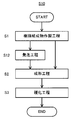
- FIG. 1 is a flowchart for explaining a method S10 for producing a self-adhesive layer according to the present invention (hereinafter sometimes abbreviated as “the present production method S10”).
- this manufacturing method S10 has a resin composition production step S1, a molding step S2, and a curing step S3 in this order, and foaming is performed between the resin composition production step S1 and the molding step S2. It is preferable to have step S12.
- each step will be described.
- Resin composition preparation process S1 is a process of preparing the resin composition containing resin and a crosslinking agent and / or an initiator.
- resin composition is produced by mixing resin which is an essential ingredient mentioned above, a crosslinking agent, and / or an initiator, and other ingredients used as needed by arbitrary methods. be able to.
- the resin When the resin is an emulsion or dispersion, it can be easily mixed by simply adding a cross-linking agent and / or initiator and other components to this in the state of an aqueous dispersion, aqueous solution, etc. with stirring. Can do.
- the mixing method is not particularly limited, and may be mixed using, for example, a roll, a Henschel mixer, a kneader, or the like. Mixing may be batch or continuous.
- the batch mixer include a high viscosity raw material kneader and a stirrer such as a crusher, a kneader, an internal mixer, and a planetary mixer.
- the continuous mixer include a Farrell type continuous kneader in which a rotor and a screw are combined, and a screw type kneader having a special structure.
- the single screw extruder and the twin screw extruder currently used for the extrusion process are mentioned. Two or more of these extruders and kneaders may be combined, or a plurality of machines of the same type may be connected and used.
- the form of the resin composition is not particularly limited, but when it is in the form of an emulsion or dispersion, it is convenient to obtain a self-adhesive layer.
- the viscosity of the emulsion or dispersion is preferably 2,000 to 10,000 mPa ⁇ s, more preferably 3,500 to 5,500 mPa ⁇ s.
- Molding step S2 is a step of molding the resin composition into layers.
- the method for molding the resin composition into layers is not particularly limited.
- a suitable method for example, a method of forming a layer by coating the resin composition on a process paper such as a polyester film which has been subjected to a release treatment, and the like can be mentioned.
- a method of coating the resin composition on the process paper generally known coating apparatuses such as a roll coater, a reverse roll coater, a screen coater, a doctor knife coater, a comma knife coater, and a gravure coater can be used, especially a doctor knife coater. When using, a uniform coating thickness can be obtained.
- the resin composition is preferably applied uniformly, and the thickness accuracy during coating, which is an index of application uniformity, is preferably ⁇ 10%, and is ⁇ 5%. Is more preferable.
- it is important that the coating speed at the time of coating for realizing the glossiness exhibited by the self-adhesive layer of the present invention is constant, and the preferable speed varies depending on the coating method.
- the curing step S3 is a step of performing a curing reaction in the resin composition molded into a layer shape.
- a self-adhesive layer formed by solidifying the layered resin composition can be formed on the process paper by performing a curing reaction in the layered resin composition. At this time, if a peelable paper is used as the process paper, the self-adhesive layer can be easily separated from the process paper.
- the method of heating and drying is not particularly limited as long as the resin composition coated on the process paper can be dried and cross-linked, and is not limited to a normal hot air circulation type oven, hot oil circulation hot air chamber, far infrared heater. A chamber or the like can be used.
- the drying temperature is suitably 60 ° C. to 180 ° C., and the drying conditions can be appropriately selected depending on the properties of the resin composition, the coating amount, the coating thickness, and the like.
- the drying is performed at a low temperature (preferably 60 ° C.) as early as possible, and the temperature is gradually raised, and at a later stage a high temperature and a constant temperature (preferably 120 ° C. or higher and 180 ° C. or lower, More preferably, it is preferable to perform multi-stage drying such that it is sufficiently dried at 140 ° C. or higher and 180 ° C. or lower.
- the internal solvent is efficiently dried without forming a film on the surface of the coating liquid in the first half of the curing process, and the crosslinking reaction is promoted in the second half of the curing process.
- the coating liquid can be sufficiently solidified.
- the line speed is usually 5 to 100 m / min, and preferably 10 to 80 m / min. By reducing the line speed, a large amount of heat is applied, so that the layer strength increases, but the productivity decreases, which is not preferable.
- the resin composition can be cured by light such as UV.
- a cured product is obtained by irradiating a resin composition containing a photocurable resin and a photoinitiator with a predetermined amount of light from a lamp such as a high-pressure mercury lamp (main wavelength 365 nm). According to the embodiment in which photocuring is performed in the curing step S3, the curing time can be shortened, so that productivity is increased.
- the density, thickness, hardness, and the like of the obtained self-adhesive layer are adjusted by the composition of the resin composition, the solid content concentration, the conditions for heat drying and solidification, the mixing ratio of bubbles in the form having the foaming step S12 described later, and the like.
- the thickness of the self-adhesive layer is preferably 0.003 to 3 mm, more preferably 0.005 to 1 mm, still more preferably 0.005 to 0.5 mm, and particularly preferably 0.005 to 0.2 mm. . When the thickness is less than 0.003 mm, when the self-adhesive layer of the present invention is used as an article holding material or an article surface protecting material, the impact absorption is inferior, and the article holding force and article surface protecting function are not sufficient.
- the self-adhesive layer is preferably thin.
- the density of the self-adhesive layer is not particularly limited, but is preferably 0.1 to 1.0 g / cm 3 from the viewpoint of impact absorption.
- the self-adhesive layer or self-adhesive laminate obtained by the curing step S3 is usually wound by a winder after a separator film is pasted on the surface having self-adhesiveness, by press cutting, slitting, etc. Cut into a size that is easy to use.
- a self-adhesive layer can be formed on the base material in the curing step S3 by using the base material as the process paper in the molding step S2.
- a self-adhesive laminate having an adsorption layer composed of layers and a support layer composed of a substrate can be produced.
- Foaming process S12 As described above, it is preferable to have the foaming step S12 between the resin composition production step S1 and the molding step S2. By having the foaming step S12, it is possible to produce a self-adhesive layer having a foamed structure and exhibiting adsorptivity due to a suction cup effect utilizing fine pores. Foaming step S12 is a step of foaming the resin composition to obtain a foam of the resin composition.
- an unsolidified foam can be obtained by foaming the resin composition produced in the resin composition production step S1.
- the resin composition is in the form of an emulsion or dispersion, a foamed emulsion or foamed dispersion is obtained.
- the foaming method mechanical foaming is usually employed.
- the expansion ratio may be adjusted as appropriate, but is usually 1.1 to 5 times, and preferably 1.1 to 4 times, more preferably 1.2 to 3 times from the viewpoint of increasing the glossiness. Yes, more preferably 1.5 to 2 times.
- the method of mechanical foaming is not particularly limited, it can be carried out by mixing a certain amount of air into the emulsion of the resin composition and stirring continuously or batchwise with an Oaks mixer, whipper or the like. The foamed emulsion thus obtained becomes creamy.
- a heat-expandable microcapsule containing a suitable synthetic resin such as a vinylidene chloride copolymer as a shell wall and encapsulating a low-boiling hydrocarbon-based compound is used as an acrylic resin emulsion or a butadiene-based synthetic rubber.
- a foam can also be prepared by a method of adding to an emulsion.
- the self-adhesive laminate of the present invention can be subjected to printing on the substrate surface by, for example, offset printing, seal printing, flexographic printing, silk screen printing, gravure printing, laser printer, thermal transfer printer, inkjet printer, etc. it can.
- the self-adhesive laminate having the substrate surface printed thereon can be used as a decorative material for construction, a sticking material for advertisement, a stationery, or a material for toys.
- sales promotion cards so-called POP cards (posters, stickers, displays, etc.), underlays (lunch mats, table mats, stationery, etc.), hamburgers, sushi, fried buckwheat menus, catalogs, panels, Plate (alternative to metal plate), bromide, store price list, information board (sales guidance, direction / destination guidance, confectionery / food, etc.), gardening POP (feed label, etc.), road sign (funeral / house exhibition place) Etc.), display boards (forbidden to enter, forest road work, etc.), calendars (with images), simple whiteboards, mouse pads, coasters, label writer substitute prints, adhesive labels, etc.
- the self-adhesive layer and the self-adhesive laminate of the present invention can be suitably used as an article surface protecting material or an article holding material for various optical parts, precision parts and the like.
- it can stick and peel off any number of times, by forming a self-adhesive layer on substrates such as various boxes and bags, it can be used as a temporary fixing or sealing material when closing the opening.
- fine debris such as foods, luxury goods and daily necessities are likely to be scattered outside, it is suitable as a temporary fixing after opening because the debris hardly adheres to the self-adhesive layer.
- the self-adhesive layer can increase the air tightness in containers such as boxes and bags, by opening the container of perishable foods and luxury items once again through the self-adhesive layer, The fresh state can be maintained and the contents can be prevented from being damaged by oxygen or moisture. Therefore, as described above, it can be used for packages such as confectionery, coffee, tea, cigarettes, detergents, etc. as applications that may be repeatedly opened and closed and applications that require the contents to be kept fresh. .
- the self-adhesive layer and the self-adhesive laminate of the present invention hardly cause adhesive residue even when used in a high temperature and high humidity environment.
- the self-adhesive layer and the self-adhesive laminate of the present invention can prevent the occurrence of adhesive residue even after being placed in an environment where the temperature is 60 ° C. or higher and the humidity is 80% or higher for two weeks. . Therefore, it can be suitably used even in a severe environment of high temperature and high humidity such as outdoors in summer.
- the effect of preventing adhesive residue when used in a normal environment such as an air-conditioned room is higher than before. It can be said.
- the self-adhesive layer and the self-adhesive laminate of the present invention can reduce the amount of formaldehyde generated, and by appropriately setting the composition of the resin composition, the amount of formaldehyde generated is less than the detection limit (for example, 0 Less than 1 ppm). Therefore, it can be suitably used in places and uses where generation of formaldehyde is prohibited or undesirable. That is, the self-adhesive layer and the self-adhesive laminate of the present invention can be suitably used for architectural interior decoration materials, stationery, toy materials and the like.
- Tg Glass Transition Temperature (Tg) of Acrylate Ester Copolymer Resin
- the glass transition temperature (Tg) of the acrylate copolymer resin used as a material for the self-adhesive laminate described later was measured by the following method.
- the acrylic acid ester copolymer resin-containing aqueous dispersion was coated on a 50 ⁇ m thick polyethylene terephthalate film with a 250 ⁇ m applicator and dried at room temperature for 24 hours to obtain a resin film. Using this film as a sample, in accordance with JIS K 7121, a measurement temperature of ⁇ 50 ° C.
- the gel fraction of the acrylate copolymer resin-containing aqueous dispersion used as a material for the self-adhesive laminate described later was measured by the following method.
- the acrylic ester copolymer resin was applied onto a 50 ⁇ m thick polyethylene terephthalate film with a 200 ⁇ m applicator and dried at room temperature for 24 hours to obtain a resin film.
- a predetermined amount (X) (about 500 mg) was precisely weighed and immersed in 100 ml of ethyl acetate at room temperature for 3 days, and then the insoluble matter was filtered through an 80-mesh wire mesh for 15 hours at room temperature.
- a self-adhesive laminate was prepared as described later, and a test piece cut into a size of 200 mm ⁇ 200 mm was prepared after a separator film was attached to the surface of the self-adhesive layer.
- the specimen was placed in a 5 L Tedlar bag and sealed. 2L of air was sealed in it, left in a thermostat set at 23 ° C and 50% RH for 6 hours, and then the formaldehyde concentration in the bag was measured with a detector tube (Gastech, No. 91L). did.
- the results are shown in Table 3.
- Table 1 shows a summary of the composition of the resin composition Z1.
- This resin composition Z1 was stirred with a whisk, so that the foaming ratio was doubled, and the stirring speed was further reduced and stirring was continued for 5 minutes.
- the obtained foam was applied on a substrate (polyethylene terephthalate film having a thickness of 50 ⁇ m) using a 0.3 mm applicator. This was put in a drying oven and held at 1.3 ° C. for 1.33 minutes at 80 ° C., 1.33 minutes at 120 ° C., and 1.33 minutes at 140 ° C., and then subjected to dry crosslinking to form a 180 ⁇ m self-adhesive layer on the substrate A laminated self-adhesive laminate according to Example 1 was obtained.
- an acrylic ester copolymer resin (II) composition: ethyl acrylate 45 / butyl acrylate 46 / acrylonitrile 10 / N-methylol acrylamide 1.8 copolymer resin, glass transition temperature: ⁇ 14. 5 ° C., gel fraction: 51.8%) containing water dispersion (solid content concentration 55%) 100 parts, carbodiimide-based crosslinking agent (Nisshinbo Chemical Co., Ltd.
- the foam stabilizer [alkylbetaine amphoteric compound / fatty acid alkanolamide mixture (DIC, DICNAL M-20: solid content concentration 40%) / sulfonic acid type anionic surfactant (manufactured by DIC, DINCAL M-40: 1/1 mixture of solid content 35%]] 6 parts, ammonia aqueous solution (manufactured by Omori Chemical Co., Ltd .: concentration 28%) 0.6 parts, and finally thickener (carboxylic acid-modified acrylic ester) About 4.5 parts of polymer (Aron B-300K manufactured by Toagosei Co., Ltd., solid content concentration: 44%) was added to adjust the viscosity to 5000 mPa ⁇ s to obtain a resin composition Z2.
- Table 1 shows a summary of the composition of the resin composition Z2.
- This resin composition Z2 was foamed with a foaming machine so that the foaming ratio was 1.6 times to obtain a foam.
- FIG. 2 shows a schematic view of a coating machine (coating head) used in the following, and an upper drying furnace (F1 to F6) and a crosslinking furnace (K1, K2) through which a foam applied on a substrate passes. .
- the obtained foam was coated on a substrate (a polyethylene terephthalate film having a thickness of 110 ⁇ m) with a coating machine so as to have a thickness of 180 ⁇ m, and the furnace temperature indicated by A in Table 2 at a line speed of 15 m / min.
- Example 3 Acrylate ester copolymer resin (III) (composition: ethyl acrylate 45 / butyl acrylate 46 / acrylonitrile 10 / N-methylol acrylamide 1.8 copolymer resin, glass transition temperature: ⁇ 14.9 ° C., gel (Fraction: 47.8%)
- the resin composition Z3 (100% of the composition is shown in Table 1) containing 100 parts of the aqueous dispersion (solid content concentration 55%) was used.
- a self-adhesive laminate according to Example 3 was obtained.
- Example 4 In the same manner as in Example 3, except that the furnace temperature pattern indicated by B in Table 2 was changed to a thickness of 100 ⁇ m after film formation on a base material (polyethylene terephthalate film having a thickness of 80 ⁇ m). A self-adhesive laminate according to Example 4 was obtained in which a self-adhesive layer of 100 ⁇ m was laminated.
- an acrylic ester copolymer resin (IV) composition: ethyl acrylate 48 / butyl acrylate 47 / acrylonitrile 6 / N-methylol acrylamide 1.4 copolymer resin, glass transition temperature: ⁇ 25.
- the foam stabilizer [alkylbetaine amphoteric compound / fatty acid alkanolamide mixture (DIC, DICNAL M-20) / sulfonic acid type anionic surfactant (DIC, DICNAL M-40) 1/1 mixture] 6 parts, ammonia aqueous solution (manufactured by Daisoh Kako Co., Ltd .: concentration 28%), and finally a thickener (carboxylic acid-modified acrylic ester polymer. Aron B-300K, manufactured by Toagosei Co., Ltd.) About 44 parts by weight (solid content concentration: 44%) was added to adjust the viscosity to 5000 mPa ⁇ s to obtain a resin composition Z4.
- Table 1 shows a summary of the composition of the resin composition Z4.
- This resin composition Z4 was foamed with a foaming machine so that the expansion ratio was doubled to obtain a foam.
- the obtained foam was applied on a substrate (a polyethylene terephthalate film having a thickness of 110 ⁇ m) with the above-mentioned coating machine so as to have a thickness of 180 ⁇ m, and the inside of the furnace indicated by C in Table 2 at a line speed of 15 m / min.
- the furnace flowed in a temperature pattern.
- stacked 180 micrometers of self-adhesive layers on the base material was obtained.
- Comparative Example 2 In the same manner as in Comparative Example 1, except that the temperature pattern in the furnace indicated by D in Table 2 was changed to a thickness of 100 ⁇ m after film formation on a base material (polyethylene terephthalate film having a thickness of 80 ⁇ m). The self-adhesive laminated body which concerns on the comparative example 2 which laminated
- the sheets according to Examples 1 to 4 having a glossiness within the range of the present invention had good air release properties, and generated less formaldehyde.
- the sheets according to Comparative Examples 1 and 2 had good air bleeding due to the glossiness being within the range of the present invention, but generated a large amount of formaldehyde.
- the sheet according to Comparative Example 3 had a small amount of formaldehyde generated, but was inferior in air bleedability due to low glossiness.
Landscapes
- Chemical & Material Sciences (AREA)
- Organic Chemistry (AREA)
- Chemical Kinetics & Catalysis (AREA)
- Health & Medical Sciences (AREA)
- Medicinal Chemistry (AREA)
- Polymers & Plastics (AREA)
- Adhesives Or Adhesive Processes (AREA)
- Laminated Bodies (AREA)
- Adhesive Tapes (AREA)
Abstract
Priority Applications (7)
| Application Number | Priority Date | Filing Date | Title |
|---|---|---|---|
| BR112018070458A BR112018070458A2 (pt) | 2016-04-28 | 2017-04-20 | camada autoadesiva |
| KR1020187028788A KR20190003486A (ko) | 2016-04-28 | 2017-04-20 | 자기점착성 층 |
| EP17789403.7A EP3450519A4 (fr) | 2016-04-28 | 2017-04-20 | Couche auto-adhésive |
| CN201780023022.1A CN109072020B (zh) | 2016-04-28 | 2017-04-20 | 自粘合性层 |
| US16/092,267 US20190092980A1 (en) | 2016-04-28 | 2017-04-20 | Self-adhesive layer |
| RU2018135923A RU2018135923A (ru) | 2016-04-28 | 2017-04-20 | Самоклеящийся слой |
| JP2018514549A JP6897675B2 (ja) | 2016-04-28 | 2017-04-20 | 自己粘着性層 |
Applications Claiming Priority (2)
| Application Number | Priority Date | Filing Date | Title |
|---|---|---|---|
| JP2016-091426 | 2016-04-28 | ||
| JP2016091426 | 2016-04-28 |
Publications (1)
| Publication Number | Publication Date |
|---|---|
| WO2017188120A1 true WO2017188120A1 (fr) | 2017-11-02 |
Family
ID=60160401
Family Applications (1)
| Application Number | Title | Priority Date | Filing Date |
|---|---|---|---|
| PCT/JP2017/015904 Ceased WO2017188120A1 (fr) | 2016-04-28 | 2017-04-20 | Couche auto-adhésive |
Country Status (8)
| Country | Link |
|---|---|
| US (1) | US20190092980A1 (fr) |
| EP (1) | EP3450519A4 (fr) |
| JP (1) | JP6897675B2 (fr) |
| KR (1) | KR20190003486A (fr) |
| CN (1) | CN109072020B (fr) |
| BR (1) | BR112018070458A2 (fr) |
| RU (1) | RU2018135923A (fr) |
| WO (1) | WO2017188120A1 (fr) |
Cited By (3)
| Publication number | Priority date | Publication date | Assignee | Title |
|---|---|---|---|---|
| JP2019101437A (ja) * | 2017-12-06 | 2019-06-24 | スリーエム イノベイティブ プロパティズ カンパニー | グラフィックシート、グラフィックシートの製造方法及び建築構造物 |
| WO2021166861A1 (fr) * | 2020-02-19 | 2021-08-26 | 日本ゼオン株式会社 | Composition pour feuille expansée auto-adsorbante, et feuille stratifiée expansée auto-adsorbante |
| JP2022086747A (ja) * | 2020-11-30 | 2022-06-09 | 大日本印刷株式会社 | 抗ウイルス性粘着シート |
Families Citing this family (5)
| Publication number | Priority date | Publication date | Assignee | Title |
|---|---|---|---|---|
| EP3450518A4 (fr) * | 2016-04-28 | 2020-04-15 | Zeon Corporation | Couche auto-adhésive |
| WO2017188120A1 (fr) * | 2016-04-28 | 2017-11-02 | 日本ゼオン株式会社 | Couche auto-adhésive |
| EP3950791A4 (fr) * | 2019-03-27 | 2022-12-07 | Zeon Corporation | Composition pour une feuille en mousse auto-adsorbante et feuille stratifiée en mousse auto-adsorbante |
| JP7342468B2 (ja) * | 2019-07-09 | 2023-09-12 | 大日本印刷株式会社 | シール型熱転写受像シート |
| US20250346741A1 (en) * | 2022-05-27 | 2025-11-13 | 3D Architech, Inc. | Additive manufacturing and post-treatment of inorganic materials |
Citations (10)
| Publication number | Priority date | Publication date | Assignee | Title |
|---|---|---|---|---|
| JPH01115982A (ja) * | 1987-10-29 | 1989-05-09 | Nitto Denko Corp | 貼り付けシート |
| JP2003076308A (ja) * | 2001-08-31 | 2003-03-14 | Akuto:Kk | 広告ポスターシートの製造方法 |
| JP2006176693A (ja) * | 2004-12-24 | 2006-07-06 | Nippon Zeon Co Ltd | 樹脂組成物、自己吸着性発泡シート、並びに保護材料 |
| JP2009155504A (ja) * | 2007-12-27 | 2009-07-16 | Dic Corp | 艶消粘着テープ |
| JP2011213967A (ja) * | 2010-04-02 | 2011-10-27 | Three M Innovative Properties Co | アクリル系粘着剤 |
| JP2012180495A (ja) * | 2011-02-11 | 2012-09-20 | Nitto Denko Corp | 難燃性熱伝導性粘着シート |
| JP2013104043A (ja) * | 2011-11-16 | 2013-05-30 | Bridgestone Corp | 積層体の製造方法及び積層体 |
| JP2015086339A (ja) * | 2013-11-01 | 2015-05-07 | Dic株式会社 | 両面粘着シート及び物品 |
| WO2016147679A1 (fr) * | 2015-03-17 | 2016-09-22 | 日本ゼオン株式会社 | Feuille de mousse auto-adhésive |
| WO2016147680A1 (fr) * | 2015-03-17 | 2016-09-22 | 日本ゼオン株式会社 | Feuille de mousse autoadhésive |
Family Cites Families (20)
| Publication number | Priority date | Publication date | Assignee | Title |
|---|---|---|---|---|
| US3128202A (en) * | 1960-08-15 | 1964-04-07 | Minnesota Mining & Mfg | Pressure-sensitive adhesive tape |
| JP3466933B2 (ja) * | 1998-10-08 | 2003-11-17 | 神藤プリント株式会社 | 吸着シートの製造法 |
| AU6359999A (en) * | 1998-11-06 | 2000-05-29 | Albright & Wilson Uk Limited | Polymerisable surfactants |
| JP2004160211A (ja) * | 2002-10-21 | 2004-06-10 | Sekisui Chem Co Ltd | 通気性粘着テープ |
| JP2006202926A (ja) * | 2005-01-19 | 2006-08-03 | Sekisui Chem Co Ltd | ダイシングテープ |
| JP5863157B2 (ja) * | 2006-12-18 | 2016-02-16 | 日東電工株式会社 | 粘着シート |
| JP5068089B2 (ja) * | 2007-03-02 | 2012-11-07 | 日東電工株式会社 | 剥離ライナー付き粘着シートおよび剥離ライナー |
| CN101186585A (zh) * | 2007-11-27 | 2008-05-28 | 江苏大学 | 低甲醛含量n-羟甲基丙烯酰胺水溶液的制备方法 |
| JP5342174B2 (ja) * | 2008-05-23 | 2013-11-13 | 日東電工株式会社 | 粘着剤組成物およびその利用 |
| JP5572418B2 (ja) * | 2009-03-04 | 2014-08-13 | 日東電工株式会社 | 積層セラミックシート切断用熱剥離型粘着シート |
| JP5607337B2 (ja) * | 2009-10-27 | 2014-10-15 | リンテック株式会社 | 水分散型アクリル系粘着剤組成物、粘着シート及びその製造方法 |
| CN101760159B (zh) * | 2010-02-02 | 2011-12-07 | 陕西科技大学 | 一种无甲醛的人造板用胶粘剂及其制备方法 |
| JP2013125040A (ja) * | 2011-12-13 | 2013-06-24 | Nitto Denko Corp | 表示用貼付物 |
| JP5437418B2 (ja) * | 2012-03-01 | 2014-03-12 | 日東電工株式会社 | 粘着剤組成物および粘着シート |
| JP6126500B2 (ja) * | 2013-08-30 | 2017-05-10 | 日東電工株式会社 | 透明導電性フィルム用キャリアフィルム及び積層体 |
| JP6674256B2 (ja) * | 2013-10-29 | 2020-04-01 | 日東電工株式会社 | 表面保護シートおよび表面保護シート用水分散型粘着剤組成物 |
| JP6620325B2 (ja) * | 2014-08-06 | 2019-12-18 | 藤森工業株式会社 | 粘着剤層、及び粘着フィルム |
| JP6773031B2 (ja) * | 2015-06-08 | 2020-10-21 | 日本ゼオン株式会社 | 容器、並びに、自己粘着体の製造方法及び使用方法 |
| WO2017188120A1 (fr) * | 2016-04-28 | 2017-11-02 | 日本ゼオン株式会社 | Couche auto-adhésive |
| EP3513967B1 (fr) * | 2016-09-16 | 2023-10-11 | Zeon Corporation | Feuille stratifiée et procédé pour la fabrication de celle-ci |
-
2017
- 2017-04-20 WO PCT/JP2017/015904 patent/WO2017188120A1/fr not_active Ceased
- 2017-04-20 BR BR112018070458A patent/BR112018070458A2/pt not_active Application Discontinuation
- 2017-04-20 CN CN201780023022.1A patent/CN109072020B/zh active Active
- 2017-04-20 RU RU2018135923A patent/RU2018135923A/ru not_active Application Discontinuation
- 2017-04-20 EP EP17789403.7A patent/EP3450519A4/fr not_active Withdrawn
- 2017-04-20 KR KR1020187028788A patent/KR20190003486A/ko not_active Withdrawn
- 2017-04-20 JP JP2018514549A patent/JP6897675B2/ja active Active
- 2017-04-20 US US16/092,267 patent/US20190092980A1/en not_active Abandoned
Patent Citations (10)
| Publication number | Priority date | Publication date | Assignee | Title |
|---|---|---|---|---|
| JPH01115982A (ja) * | 1987-10-29 | 1989-05-09 | Nitto Denko Corp | 貼り付けシート |
| JP2003076308A (ja) * | 2001-08-31 | 2003-03-14 | Akuto:Kk | 広告ポスターシートの製造方法 |
| JP2006176693A (ja) * | 2004-12-24 | 2006-07-06 | Nippon Zeon Co Ltd | 樹脂組成物、自己吸着性発泡シート、並びに保護材料 |
| JP2009155504A (ja) * | 2007-12-27 | 2009-07-16 | Dic Corp | 艶消粘着テープ |
| JP2011213967A (ja) * | 2010-04-02 | 2011-10-27 | Three M Innovative Properties Co | アクリル系粘着剤 |
| JP2012180495A (ja) * | 2011-02-11 | 2012-09-20 | Nitto Denko Corp | 難燃性熱伝導性粘着シート |
| JP2013104043A (ja) * | 2011-11-16 | 2013-05-30 | Bridgestone Corp | 積層体の製造方法及び積層体 |
| JP2015086339A (ja) * | 2013-11-01 | 2015-05-07 | Dic株式会社 | 両面粘着シート及び物品 |
| WO2016147679A1 (fr) * | 2015-03-17 | 2016-09-22 | 日本ゼオン株式会社 | Feuille de mousse auto-adhésive |
| WO2016147680A1 (fr) * | 2015-03-17 | 2016-09-22 | 日本ゼオン株式会社 | Feuille de mousse autoadhésive |
Non-Patent Citations (1)
| Title |
|---|
| See also references of EP3450519A4 * |
Cited By (8)
| Publication number | Priority date | Publication date | Assignee | Title |
|---|---|---|---|---|
| JP2019101437A (ja) * | 2017-12-06 | 2019-06-24 | スリーエム イノベイティブ プロパティズ カンパニー | グラフィックシート、グラフィックシートの製造方法及び建築構造物 |
| EP3720699A4 (fr) * | 2017-12-06 | 2021-08-04 | 3M Innovative Properties Company | Feuille graphique, procédé de production de feuille graphique et structure de construction |
| JP7186076B2 (ja) | 2017-12-06 | 2022-12-08 | スリーエム イノベイティブ プロパティズ カンパニー | グラフィックシート、グラフィックシートの製造方法及び建築構造物 |
| WO2021166861A1 (fr) * | 2020-02-19 | 2021-08-26 | 日本ゼオン株式会社 | Composition pour feuille expansée auto-adsorbante, et feuille stratifiée expansée auto-adsorbante |
| JPWO2021166861A1 (fr) * | 2020-02-19 | 2021-08-26 | ||
| JP7798022B2 (ja) | 2020-02-19 | 2026-01-14 | 日本ゼオン株式会社 | 自己吸着性発泡シート用組成物および自己吸着性発泡積層シート |
| JP2022086747A (ja) * | 2020-11-30 | 2022-06-09 | 大日本印刷株式会社 | 抗ウイルス性粘着シート |
| JP7707530B2 (ja) | 2020-11-30 | 2025-07-15 | 大日本印刷株式会社 | 抗ウイルス性粘着シート |
Also Published As
| Publication number | Publication date |
|---|---|
| US20190092980A1 (en) | 2019-03-28 |
| CN109072020B (zh) | 2021-08-03 |
| EP3450519A1 (fr) | 2019-03-06 |
| RU2018135923A (ru) | 2020-05-29 |
| CN109072020A (zh) | 2018-12-21 |
| EP3450519A4 (fr) | 2020-04-22 |
| BR112018070458A2 (pt) | 2019-02-05 |
| JP6897675B2 (ja) | 2021-07-07 |
| JPWO2017188120A1 (ja) | 2019-03-07 |
| KR20190003486A (ko) | 2019-01-09 |
Similar Documents
| Publication | Publication Date | Title |
|---|---|---|
| US11427691B2 (en) | Method for producing a self-adsorbing foam sheet and method for producing a self-adsorbing laminated foam sheet | |
| JP6897675B2 (ja) | 自己粘着性層 | |
| WO2017188118A1 (fr) | Couche auto-adhésive | |
| US11066206B2 (en) | Package, and methods for producing and for using self-adhesive | |
| CN109641433B (zh) | 层叠片及其制造方法 | |
| JPWO2016147680A1 (ja) | 自己吸着性発泡シート | |
| CN110291145A (zh) | 自吸附性发泡层叠片和自吸附性发泡片用组合物 | |
| JP2006176693A (ja) | 樹脂組成物、自己吸着性発泡シート、並びに保護材料 | |
| JP2017179116A (ja) | ストライプ模様状自己吸着性発泡シート | |
| JP2016172805A (ja) | 自己吸着性発泡シート用樹脂組成物、自己吸着性発泡シート、及び、自己吸着性発泡積層シート | |
| TWI710593B (zh) | 自吸附性發泡片 | |
| JP2017179114A (ja) | 木目調自己吸着性発泡シート |
Legal Events
| Date | Code | Title | Description |
|---|---|---|---|
| WWE | Wipo information: entry into national phase |
Ref document number: 2018514549 Country of ref document: JP |
|
| ENP | Entry into the national phase |
Ref document number: 20187028788 Country of ref document: KR Kind code of ref document: A |
|
| REG | Reference to national code |
Ref country code: BR Ref legal event code: B01A Ref document number: 112018070458 Country of ref document: BR |
|
| NENP | Non-entry into the national phase |
Ref country code: DE |
|
| 121 | Ep: the epo has been informed by wipo that ep was designated in this application |
Ref document number: 17789403 Country of ref document: EP Kind code of ref document: A1 |
|
| WWE | Wipo information: entry into national phase |
Ref document number: 2017789403 Country of ref document: EP |
|
| ENP | Entry into the national phase |
Ref document number: 2017789403 Country of ref document: EP Effective date: 20181128 |
|
| ENP | Entry into the national phase |
Ref document number: 112018070458 Country of ref document: BR Kind code of ref document: A2 Effective date: 20181004 |