WO2017195470A1 - Dispositif d'inspection de substrat multifonctionnel et procédé d'inspection de substrat multifonctionnel - Google Patents
Dispositif d'inspection de substrat multifonctionnel et procédé d'inspection de substrat multifonctionnel Download PDFInfo
- Publication number
- WO2017195470A1 WO2017195470A1 PCT/JP2017/011278 JP2017011278W WO2017195470A1 WO 2017195470 A1 WO2017195470 A1 WO 2017195470A1 JP 2017011278 W JP2017011278 W JP 2017011278W WO 2017195470 A1 WO2017195470 A1 WO 2017195470A1
- Authority
- WO
- WIPO (PCT)
- Prior art keywords
- substrate
- probe
- inspected
- probe base
- contact
- Prior art date
- Legal status (The legal status is an assumption and is not a legal conclusion. Google has not performed a legal analysis and makes no representation as to the accuracy of the status listed.)
- Ceased
Links
Images






Classifications
-
- G—PHYSICS
- G01—MEASURING; TESTING
- G01R—MEASURING ELECTRIC VARIABLES; MEASURING MAGNETIC VARIABLES
- G01R31/00—Arrangements for testing electric properties; Arrangements for locating electric faults; Arrangements for electrical testing characterised by what is being tested not provided for elsewhere
- G01R31/28—Testing of electronic circuits, e.g. by signal tracer
- G01R31/2801—Testing of printed circuits, backplanes, motherboards, hybrid circuits or carriers for multichip packages [MCP]
- G01R31/2806—Apparatus therefor, e.g. test stations, drivers, analysers, conveyors
- G01R31/2808—Holding, conveying or contacting devices, e.g. test adapters, edge connectors, extender boards
-
- G—PHYSICS
- G01—MEASURING; TESTING
- G01R—MEASURING ELECTRIC VARIABLES; MEASURING MAGNETIC VARIABLES
- G01R31/00—Arrangements for testing electric properties; Arrangements for locating electric faults; Arrangements for electrical testing characterised by what is being tested not provided for elsewhere
- G01R31/28—Testing of electronic circuits, e.g. by signal tracer
-
- G—PHYSICS
- G01—MEASURING; TESTING
- G01R—MEASURING ELECTRIC VARIABLES; MEASURING MAGNETIC VARIABLES
- G01R31/00—Arrangements for testing electric properties; Arrangements for locating electric faults; Arrangements for electrical testing characterised by what is being tested not provided for elsewhere
- G01R31/28—Testing of electronic circuits, e.g. by signal tracer
- G01R31/282—Testing of electronic circuits specially adapted for particular applications not provided for elsewhere
- G01R31/2831—Testing of materials or semi-finished products, e.g. semiconductor wafers or substrates
-
- G—PHYSICS
- G01—MEASURING; TESTING
- G01R—MEASURING ELECTRIC VARIABLES; MEASURING MAGNETIC VARIABLES
- G01R31/00—Arrangements for testing electric properties; Arrangements for locating electric faults; Arrangements for electrical testing characterised by what is being tested not provided for elsewhere
- G01R31/28—Testing of electronic circuits, e.g. by signal tracer
- G01R31/2832—Specific tests of electronic circuits not provided for elsewhere
- G01R31/2836—Fault-finding or characterising
- G01R31/2844—Fault-finding or characterising using test interfaces, e.g. adapters, test boxes, switches, PIN drivers
-
- G—PHYSICS
- G01—MEASURING; TESTING
- G01R—MEASURING ELECTRIC VARIABLES; MEASURING MAGNETIC VARIABLES
- G01R31/00—Arrangements for testing electric properties; Arrangements for locating electric faults; Arrangements for electrical testing characterised by what is being tested not provided for elsewhere
- G01R31/28—Testing of electronic circuits, e.g. by signal tracer
- G01R31/3167—Testing of combined analog and digital circuits
-
- G—PHYSICS
- G01—MEASURING; TESTING
- G01R—MEASURING ELECTRIC VARIABLES; MEASURING MAGNETIC VARIABLES
- G01R31/00—Arrangements for testing electric properties; Arrangements for locating electric faults; Arrangements for electrical testing characterised by what is being tested not provided for elsewhere
- G01R31/28—Testing of electronic circuits, e.g. by signal tracer
- G01R31/317—Testing of digital circuits
- G01R31/3181—Functional testing
- G01R31/3185—Reconfiguring for testing, e.g. LSSD, partitioning
- G01R31/318533—Reconfiguring for testing, e.g. LSSD, partitioning using scanning techniques, e.g. LSSD, Boundary Scan, JTAG
-
- G—PHYSICS
- G01—MEASURING; TESTING
- G01R—MEASURING ELECTRIC VARIABLES; MEASURING MAGNETIC VARIABLES
- G01R1/00—Details of instruments or arrangements of the types included in groups G01R5/00 - G01R13/00 and G01R31/00
- G01R1/02—General constructional details
- G01R1/06—Measuring leads; Measuring probes
- G01R1/067—Measuring probes
- G01R1/073—Multiple probes
- G01R1/07307—Multiple probes with individual probe elements, e.g. needles, cantilever beams or bump contacts, fixed in relation to each other, e.g. bed of nails fixture or probe card
- G01R1/07364—Multiple probes with individual probe elements, e.g. needles, cantilever beams or bump contacts, fixed in relation to each other, e.g. bed of nails fixture or probe card with provisions for altering position, number or connection of probe tips; Adapting to differences in pitch
-
- G—PHYSICS
- G01—MEASURING; TESTING
- G01R—MEASURING ELECTRIC VARIABLES; MEASURING MAGNETIC VARIABLES
- G01R31/00—Arrangements for testing electric properties; Arrangements for locating electric faults; Arrangements for electrical testing characterised by what is being tested not provided for elsewhere
- G01R31/28—Testing of electronic circuits, e.g. by signal tracer
- G01R31/2832—Specific tests of electronic circuits not provided for elsewhere
- G01R31/2836—Fault-finding or characterising
- G01R31/2843—In-circuit-testing
Definitions
- the present invention relates to a multifunction substrate inspection apparatus and a multifunction substrate inspection method, and more particularly to a multifunction substrate inspection device and a multifunction substrate inspection method in which many types of inspection are performed in multiple stages.
- the TDR (Time-Domain-Reflectometry) method is used to inspect whether the coupling degree is within a specified value, and polar RZ
- a printed circuit board inspection apparatus that inspects whether a signal voltage and pulse width time are within specified values is known (see, for example, Patent Document 1).
- the TDR method is generally used as an impedance measurement method for transmission lines and printed circuit boards, and is suitable for measuring the characteristic impedance of cables such as interface cables for the purpose of transmitting data signals such as clock pulses. It is.
- the printed circuit board inspection apparatus described in Patent Document 1 allows multiple types of inspections to be performed in multiple stages by selectively contacting only the required probes on both sides of the substrate. It was not a double-sided multifunction board inspection device.
- circuit board inspection jig that has a high degree of freedom in the placement position and insertion direction of the camera for finely correcting the relative position of the circuit board to be inspected and the jig while saving the storage and storage area of the jig.
- a circuit board inspection jig that has a high degree of freedom in the placement position and insertion direction of the camera for finely correcting the relative position of the circuit board to be inspected and the jig while saving the storage and storage area of the jig.
- the circuit board inspection jig has a unique jig part corresponding to the specification of the circuit board to be inspected and a common jig part used in common, and the specific jig part is located at a position corresponding to each inspection contact of the circuit board to be inspected.
- the common jig portion includes a contact block that holds a contact that contacts the other end of each conductor of the inspection contact aggregation board, and a connector wiring board that contacts the contact of the contact block. Then, the state of conduction of each inspection contact of the circuit board to be inspected is known through the connector connection board.
- circuit board inspection jig described in Patent Document 2 is also capable of performing various types of inspections in multiple stages by selectively contacting only the necessary probes on both sides of the substrate. It was not a double-sided multifunction board inspection device.
- the present invention has been made in view of such circumstances, and the purpose of the present invention is to perform various types of inspections by selectively contacting only the necessary probes on both sides of the substrate.
- An object of the present invention is to provide a multi-function substrate inspection apparatus and a multi-function substrate inspection method that can be performed in two stages.
- the present invention has been made to achieve such an object.
- the invention according to claim 1 is directed to inspecting probes (111 to 114, 211 to 217) selected in accordance with switching of the inspection function.
- a multi-function substrate inspection apparatus (500) configured to contact a substrate (30), wherein the probes (111 to 111) can be in contact with the first surface (10) of the substrate to be inspected (30) and have different lengths. 114) and the probes (211 to 217) having different lengths that can come into contact with the second surface (20) of the substrate to be inspected (30).
- the second probe base (200) is positioned between the first probe base (100) and the second probe base (200) and can place the substrate to be inspected (30) thereon.
- a first telescopically movable first driving force (F) capable of pressing the first surface (10) of the substrate to be inspected (30) by a biasing force (F1) via a first biasing means (61).
- the spring constant K1 of the first biasing means (61) and the second biasing means (42). ) And the spring constant K3 of the third biasing means (43) are K2 ⁇ K1 ⁇ K3.
- the inspection function of the inspection circuit (80) includes a boundary scan test, an in-circuit test, Any two or more of the function tests.
- the multifunction substrate inspection apparatus (500, 501) according to the third aspect, wherein the separation distance (L1 to L3) is determined by the second urging means (42) and the The urging force (H) of the third urging means (43), the driving force (F), and the urging force (F1) of the first pole (60, 90) or the elastic support mechanism (60) equivalent thereto.
- the separation distance (L1 to L3) is set to the maximum (L1).
- the probe (111 to 114) can be attached to the substrate to be inspected (30) sandwiched with the separation distance (L1 to L3) being reduced to the minimum (L2).
- L1 to L3 The distance (L1 to L3) is maintained at a medium level (L3), and only the long and distinct long probes (111, 211, 212) are in contact with the substrate to be inspected (30). This corresponds to the function of the boundary scan test or function test.
- the invention according to claim 5 is the multifunction substrate inspection apparatus (500, 501) according to any one of claims 1 to 4, wherein the first pole (60, 90) is a sheath member ( 62, 92) and a rod-like member (63, 93), a telescopic structure in which a first urging means (61) is interposed.
- the invention according to claim 6 is the multifunction substrate inspection apparatus (501) according to any one of claims 1 to 4, wherein the first probe base (100) and the substrate to be inspected (30). And fixed to the tip of the elastic support mechanism (60) having the same function as the first pole (60), and maintained parallel to the first probe base (100) A push plate (400) that is separable in posture and has a through hole (1-4) that penetrates the probe (111-114) implanted in the first probe base (100). Further, the surface of the substrate to be inspected (30) can be elastically pressed by the pressing plate (400).
- S300) is a multi-function substrate inspection method for performing an electrical inspection while making contact with the substrate to be inspected (30), wherein the control unit (70) drives the drive means (50) to perform the first operation.
- the inspection function of the inspection circuit (80) is switched and sequentially executed while the separation distances (L1 to L3) are moved closer to or away from each other by the driving force (F) against the urging force (H) of 43).
- the controller (70) widens the separation distances (L1 to L3) to the maximum (L1) by the driving means (50), whereby the inspected substrate (30 ) Is removed (S40).
- the first telescopic poles (60, 90) that are implanted in the first probe base (100) or an elastic support mechanism equivalent thereto ( 60) presses the first surface (10) of the substrate to be inspected (30) with the biasing force (F1) intervening by the first biasing means (61) based on the driving force (F), While the substrate to be inspected (30) approaches the intermediate plate (300) and the intermediate plate (300) also approaches the second probe base (200), the probe (111) To 114 and 211 to 217) are selectively brought into contact with each other according to the length distinguished by the length.
- the invention according to claim 8 is the multifunction substrate inspection method according to claim 7, wherein the substrate inspection step (S300) includes an in-circuit test step (S310) and a boundary scan test step (S320). And any two or more of the function test steps (S330).
- the invention according to claim 9 is the multifunction substrate inspection method according to claim 8, wherein the substrate inspection step (S300) is performed by the driving force (F) of the driving means (50).
- the probe approach start step (S301) for pushing down the base (100), and the first pole (60, 90) or the elastic support mechanism (60) equivalent thereto is superior to the second biasing means (42).
- the second (lower) probe group selection contact step (S305) to be contacted, and the driving force (F) of the driving means (50) that surpasses the biasing force of the first biasing means (61).
- the pole (60, 90) or the elastic support mechanism (60) equivalent thereto is shortened to the shortest, and all the long and short probes (111 to 114) of the first probe base (100) are attached to the substrate to be inspected (30).
- the first (upper) probe group abutting step (S306) that abuts, and the driving force (F) of the driving means (50) that surpasses the urging force of the third urging means (43).
- the substrate (30) is the intermediate plate (30 )
- a second (lower) probe group all-contacting step in which all the long and short probes (211 to 217) of the second probe base (200) are brought into contact with the substrate to be inspected (30).
- the invention according to claim 10 is the multifunction substrate inspection method according to any one of claims 7 to 9, wherein the separation distance (L1 to L3) is a maximum (L1) and a minimum (L2). And medium (L3), and in the standby step (S100), the substrate placement step (S200) and the substrate removal step (S400), the separation distance ( L1 to L3) are expanded to the maximum (L1) to allow the substrate (30) to be detached, and in the in-circuit test step (S310), the separation distance (L1 to L3) is decreased to the minimum (L2). All the probes (111 to 114, 211 to 217) are brought into contact with the substrate to be inspected (30) sandwiched between the boundary scan test step (S320) or the function test step (S3). 0), the separation distance (L1 to L3) is maintained at a medium level (L3), and only the long probes (111, 211, 212), which are distinguished from each other, are brought into contact with the substrate to be inspected (30). is there.
- the invention according to claim 11 is the multifunction substrate inspection method according to claim 10, wherein the first poles (60, 90) are elastically stretchable and the separation distances (L1 to L3). ) Is maximum (L1) or medium (L3), the telescopic structure is extended by the urging force (F1) of the built-in first urging means (61), and the separation distance (L1 to L3) is minimum (L2). In this case, the telescopic structure is contracted against the urging force (F1) of the first urging means (61).
- a multi-function substrate inspection corresponding to both sides that can perform various types of inspections in multiple stages.
- An apparatus and a multi-function substrate inspection method can be provided.
- the first probe base and the second probe base of the multi-function substrate inspection apparatus are spaced apart from each other at the maximum, and the substrate to be inspected is placed on the intermediate plate located between the two.
- this apparatus shows the state which mounted (henceforth "a mounting board
- FIG. 4 is a front view showing an in-circuit test mode in which the first probe base and the second probe base of the apparatus are held closest to each other, and all the two types of long and short probes are brought into contact with the sandwiched substrate.
- FIG. 5A is a partial longitudinal sectional view showing a short probe of different details used in this apparatus
- FIG. 5A is a structure having two step portions for restricting the advancing and retreating operation of the mandrel
- FIG. 5B is an advancing and retreating operation of the mandrel. The structure which made the step part which regulates to one place is shown, respectively.
- FIG. 6 is a layout diagram for explaining that only a long probe is selectively brought into contact with a substrate in the boundary scan test mode. It is a flowchart which shows the procedure of the multifunctional type
- FIG. 4 is a schematic explanatory diagram in which FIG. 3 is simplified to explain various springs and the like provided in the apparatus. It is a flowchart which shows the procedure of this method based on the function of the various springs shown in FIG. It is a partial cross section figure which shows the modification of the 1st pole used for this apparatus.
- FIG. 10 is a front view showing an in-circuit test mode in which the first probe base and the second probe base of the deformation apparatus are held closest to each other, and all of the two types of long and short probes are brought into contact with the sandwiched substrate.
- Boundary scan test mode in which the distance between the first probe base and the second probe base of the deforming device is kept moderate, only the long probe is brought into contact with the sandwiched substrate, and the short probe is not in contact.
- the in-circuit test is an inspection for detecting defects with analog components as main inspection targets, and is performed by bringing all probes into contact with the substrate.
- the boundary scan test is an inspection for detecting a single component failure or unit failure of a digital component mounted on a substrate, and is performed by bringing an appropriately selected probe into contact with the substrate.
- This boundary scan test is susceptible to adverse effects such as unnecessary radiation due to a high frequency clock operation of several GHz. As described above, it is desired that the probe which is adversely affected by unnecessary radiation and the like and the wire connected thereto are disconnected from the substrate. By doing so, it becomes possible to obtain a more accurate test result.
- the function test is an inspection for inspecting product functions on a board-by-board basis. In addition to supplying power, it is sufficient to bring a probe for input / output signals into contact with the board. Also in this function test, an appropriately selected probe is brought into contact with the substrate. In this way, means for selecting only the necessary probes according to changes in the inspection function and bringing them into contact with the substrate is tentatively referred to as “selective contact / separation jig for probes by multi-stage operation” or “two-stage drawing jig”, and abbreviated. It is also called “this jig”.
- This apparatus which is semi-automated with a simple structure and combined with a multifunctional inspection circuit, will be described below.
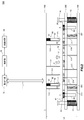
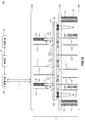
- FIG. 1 is a front view showing a state in which the first probe base and the second probe base of the apparatus are spaced apart to the maximum and a substrate is placed on an intermediate plate positioned between the two.
- the apparatus 500 includes a first probe base 100 and a second probe base 200 in a state where the distance between the two is maintained at a maximum distance L1 (hereinafter also referred to as a “separated state”).
- the first probe base 100 is provided with probes 111 to 114 having different lengths that can come into contact with the first surface (hereinafter also referred to as “upper surface”) 10 of the substrate 30.
- the second probe base 200 is implanted with probes 211 to 217 of different lengths that can come into contact with the second surface (hereinafter also referred to as “lower surface”) 20 of the substrate 30.
- a plurality of spacers 302 are arranged almost evenly on the upper surface of the second probe base 200, and when the intermediate plate 300 is lowered and approaches, it is supported so as to abut against it and define the height.
- the intermediate plate 300 is positioned so as to maintain a parallel relationship between the first probe base 100 and the second probe base 200, and is configured to be able to place the substrate 30 thereon.
- a plurality of spacers 301 are arranged substantially evenly on the upper surface of the intermediate plate 300, and when the substrate 30 descends and approaches, it is supported so as to abut against it and define the height.
- the first pole 60 is implanted in the same direction as the first probe base 100 along with the probes 111 to 114.
- the first pole 60 has a telescopic structure with a built-in coil spring 61.
- the first pole 60 is provided with a biasing force (hereinafter also referred to as “elastic force”) in a direction in which the rod-like member 63 is pushed out from the sheath-like member 62 by the spring 61.
- Y shown in FIG. 1 is a difference in length between the short probes 112 to 114 on the first probe base 100 (upper side) and the first pole 60. This length difference Y will be described later with reference to FIG.
- the first pole 60 has its base portion pushed in the distal direction by the driving force F, so that the distal end portion that can expand and contract with the elastic force of the spring 61 causes the first surface (upper surface) 10 of the substrate 30 to be pushed by the pressing force F1. It is possible to press flexibly.
- the pressing force H (FIGS. 1, 2, 3 and 8) is determined by any of the probes 211 to 217 of the second probe base 200 (lower side). This is the total pressing force that abuts against the lower surface 20 of the substrate 30 and pushes it up.
- the controller 70 causes the driving means 50 to generate a multi-stage driving force F that can resist the pressing force H.
- the driving means 50 is composed of an air cylinder or the like, and changes the separation distances L1 to L3 between the first probe base 100 and the second probe base 200 by generating an appropriately adjusted driving force F.
- the second pole 44 regulates the operation of approaching or moving away from the predetermined range while maintaining the facing posture of the intermediate plate 300 and the substrate 30 in parallel. Further, the tip of the second pole 44 forms a conical spire portion and has a function of a positioning boss. On the other hand, a guide hole (not shown in detail) is drilled in the substrate 30 so that it can be positioned in conformity with the side surface of the spire portion.
- the coil spring 42 is engaged with the second pole 44 so that the coil is loosely wound, and has an elastic force to keep the substrate 30 away from the intermediate plate 300. With these configurations, the substrate 30 is elastically suspended on the intermediate plate 300.
- the third pole 41 is implanted in the second probe base 200, forms a head similar to a countersunk screw, and supports the intermediate plate 300 slidably below the head.
- the third pole 41 restricts the movement of the intermediate plate 300 and the second probe base 200 toward and away from each other within a predetermined range while maintaining the facing posture of the intermediate plate 300 and the second probe base 200 in parallel.
- the coil spring 43 is engaged with the third pole 41 so that the coil is loosely wound, and has an elastic force to keep the intermediate plate 300 away from the second probe base 200. With these configurations, the intermediate plate 300 is elastically suspended on the second probe base 200.
- the inspection function of the inspection circuit 80 is switched by the control unit 70.
- the inspection function of the inspection circuit 80 is preferably any two or more of a boundary scan test, an in-circuit test, and a function test. Note that all the probes 111 to 114 and 211 to 217 are elastically expandable and contractable as will be described later with reference to FIGS. 4 and 5, and are electrically connected to the inspection circuit 80 by a lead wire (not shown). This conducting wire is omitted from FIGS. 1, 3 and 8 to avoid complication.
- FIG. 2 is a front view showing an in-circuit test mode in which the first probe base and the second probe base of the apparatus are held closest to each other, and all the two types of long and short probes are brought into contact with the sandwiched substrate. It is.
- the in-circuit test is an inspection for detecting a single item failure or unit failure of an analog component mounted on the substrate 30.
- the height of the lowered position of the intermediate plate 300 is defined by a plurality of spacers 302 that are substantially uniformly disposed on the upper surface of the second probe base 200.
- the lowering position of the substrate 30 is defined by a plurality of spacers 301 that are substantially evenly arranged on the upper surface of the intermediate plate 300.
- approximatelyched state all the probes 111 to 114 and 211 to 217 are brought into contact with the upper surface 10 and the lower surface 20 of the substrate 30 to perform an in-circuit test.
- FIG. 3 shows a boundary where the distance between the first probe base and the second probe base of the apparatus is moderately maintained, only the long probe is brought into contact with the sandwiched substrate, and the short probe is not in contact.
- FIG. 3 shows scan test mode.
- the first probe base 100 and the second probe base 200 are in a state (hereinafter, also referred to as “halfway state”) that maintains a medium distance L3.
- the midway state (FIG. 3) can be obtained when shifting from either the separated state (FIG. 1) or the approaching state (FIG. 2). Therefore, the order in which different inspections are performed using the distinction between the approaching state (FIG. 2) and the halfway state (FIG. 3) may be either first.
- the distance between the upper surface 10 of the substrate 30 and the first probe base 100 is set so that only the long probe 111 is in contact and the short probes 113 and 114 are not in contact.
- the distance between the second surface 20 of the substrate 30 and the second probe base 200 is set so that only the long probes 211 and 212 are in contact with each other and the short probes 213 to 217 are not in contact with each other.
- FIG. 4 is a partial longitudinal sectional view showing details of a long probe used in the present apparatus.
- a long probe 111 shown in FIG. 4 (the same applies to 211 and 212) is a needle-shaped mandrel 105 in which a pressing force is urged by a sheath-like portion 101 containing a spring 5 in a direction to be pushed out by the elastic force of the spring 5. Is telescopically inserted into and retractable. Further, when the entire stroke P is shortened, the probe 111 sinks the tip to the vicinity of the upper end of the sheath-like portion 101.
- the mandrel part 105 is formed with a thin part with a small diameter in the lower half which is always accommodated in the sheath part 101. That is, except for the both ends of the mandrel part 105, the narrow diameter part and the large diameter part are generally constituted by two kinds of diameters.
- a standby height defining step 106 and a stroke defining step 108 are formed at the boundary between the small diameter portion and the large diameter portion.
- the sheath-shaped portion 101 is provided with a constricted portion having an inner diameter located about 3 lower than the upper end of the sheath-shaped portion 101 than the other inner diameters, and a stroke defining stopper 107 is formed. Note that the position of the stroke regulating stopper 107 may be formed below the upper end of the sheath-like portion 101 appropriately beyond 1/3.
- a mandrel portion 105 is supported on a sheath-like portion 101 so as to freely advance and retract.
- the mandrel 105 moves forward and backward, when the standby height defining step 106 and the stroke defining step 108 of the mandrel 105 abut against the stroke defining stopper 107, the forward movement is prohibited. In this manner, the mandrel portion 105 of the probe 111 has a defined stroke.
- FIG. 5 is a partial longitudinal sectional view showing a short probe with different details used in this apparatus
- FIG. 5A is a structure having two step portions for restricting the advancing and retreating operation of the mandrel
- FIG. 5B is a mandrel.
- movement of a part into one place is each shown.
- the short probes 112 and 218 (113, 114, and 213 to 217) shown in FIG. 5 urge the sheath-like portions 102 and 103 containing the spring 6 in the direction to be pushed out by the elastic force of the spring 6.
- the needle-shaped mandrel portions 125 and 135 thus fitted are telescopically configured to be telescopically inserted.
- a standby height defining step 106 and a stroke defining step 108 are formed at two positions on the mandrel 125 as steps that restrict the advancing and retreating operation of the mandrel 125.
- the probe 112 in FIG. 5A is basically the same as the probe 111 in FIG. 4, and the standby height-defining step 106 abuts on the stroke-defining stopper 107 provided inside the sheath-shaped portion 102, thereby waiting. Height is specified.
- the stroke defining step 108 abuts against the stroke defining stopper 107, the mandrel 125 is defined with a stroke P in the direction of sinking into the inner part of the sheath 102.
- the standby height defining step 106 is formed at one position of the mandrel 135 as a step for restricting the advance / retreat operation of the mandrel 135.
- the stroke in the direction in which the mandrel part 135 sinks into the inner part of the sheath-like part 103 is not particularly strictly regulated. Therefore, the mandrel part 135 can move back and forth until the limit of the contraction of the spring 6 or the contact point 1 is submerged to the same height as the upper end opening of the sheath-like part 103.
- FIG. 6 is a layout diagram for explaining that this apparatus selectively allows only a long probe to come into contact with the substrate in the boundary scan test mode.
- the board 30 includes an input signal terminal 31, an output signal terminal 32, and a test access port (hereinafter referred to as “TAP”) 86 for input / output from / to the outside.
- TAP test access port
- the substrate 30 has a boundary scan register (hereinafter also referred to as “cell”) 33 and a device core logic (hereinafter simply referred to as “core logic (Core)” between the input signal terminal 31 and the output signal terminal 32. Logic) ”) 34).
- cell boundary scan register
- core logic Core logic
- the TAP 86 includes a TDI (Test Data Select In) 81, a TMS (Test Data Select) 82, a TCK (Test Data Clock) 83, a TDO (Test Data Out) 84, and a TRST (Test Reset) 85. Yes.
- the board 30 is connected to an appropriate terminal in the TAP 86 so that an instruction register 35, a bypass register 36, and a test access port controller (hereinafter referred to as “TAP controller”). 37).
- the instruction register 35 is configured by being connected in multiple stages in series.
- a bypass register 36 is connected in parallel to the instruction register 35.
- the instruction register 35 and the bypass register 36 connected in parallel as described above are interposed between the TDI 81 and the TDO 84.
- the TAP controller 37 is connected to the TMS 82, the TCK 83, and the TRST 85.
- the core logic 34 is a semiconductor chip that supports a CPU (Central Processing Unit) (not shown) and is responsible for exchanging signals with peripheral circuits.
- the core logic 34 often includes a memory controller circuit, a graphics interface circuit, a storage interface circuit, a general-purpose I / O circuit, and the like.
- the instruction register 35 partially constitutes an execution unit of the CPU, and stores an instruction currently being executed. In a simple processor, each instruction is stored in the instruction register 35 when each instruction is executed and held until it is decoded and executed. Note that detailed functions and operations unique to the substrate 30 will be omitted.
- TDI 81 is an input signal terminal for test data.
- TMS82 is an input signal terminal for controlling the test operation.
- TCK83 is a test clock input signal terminal.
- TDO 84 is an output signal terminal for result data.
- TRST 85 is an initialization input signal terminal of the TAP controller 37.
- the substrate 30 has a function of executing a boundary scan test.
- This boundary scan test function includes a boundary scan register (cell) 33 set between the input / output signal terminals 31 and 32 and the core logic 34, and a TAP controller 37.
- the boundary scan test cannot be executed for all devices.
- the TAP controller 37 has a control function. This control function makes it possible to execute a boundary scan test in cooperation with the cell 33. Therefore, in this method using the apparatus 500, the boundary scan test is executed when the substrate 30 having a teda device similar to the function shown in FIG.
- an in-circuit test process (S310), a boundary scan test process (S320), and a function test process (S330) are sequentially performed.
- the apparatus 500 is brought into an approaching state (FIG. 2), and all probes 111 to 114, 211 to 217 (not shown) are connected to the test lands of the substrate 30 regardless of the length. (Not shown) is contacted.
- the apparatus 500 is set to a halfway state (FIG. 3), and only the probe selected as necessary is used as a designated test land on the substrate 30. Make contact. On the other hand, unnecessary probes are separated from the substrate 30 and released from contact.
- the midway state (FIG. 3) can be obtained when shifting from either the separated state (FIG. 1) or the approaching state (FIG. 2). Accordingly, the order of the in-circuit test process (S310) performed in the approaching state (FIG. 2), the boundary scan test process (S320) and the function test process (S330) performed in the midway state (FIG. 3) is first. It doesn't matter.
- the boundary scan test process (S320) is performed only on the five terminals of the TAP 86 shown in FIG. ) At this time, since the short probes 112 to 114 and 213 to 217 (not shown) shown in FIG. 3 become obstacles to the boundary scan test, they are separated from the test lands and the like (not shown) of the substrate 30 and contact each other. Canceled. For this reason, it is possible to execute the boundary scan test satisfactorily.
- the selective contact / separation operation of each probe in the function test step (S330) is further multistaged. Can be realized. At this time, the order of the boundary scan test process (S320) and the function test process (S330) may be switched.
- the apparatus 500 can select the probes 111 to 114 and 211 to 217 to be brought into contact with the substrate 30 according to switching of the inspection function.
- the selection criterion is the length of the probes 111 to 114 and 211 to 217, and can be selectively contacted according to the difference in length. All the probes 111 to 114 and 211 to 217 are always electrically connected to the inspection circuit 80 by conducting wires (not shown).
- the connection form between the probes 111 to 114 and 211 to 217 and the substrate 30 corresponds appropriately when the inspection function of the inspection circuit 80 changes to the boundary scan test, the in-circuit test, and the function test. Change.
- the pressing force H is such that the lower surface 20 of the substrate 30 faces upward, including the spring 42, the spring 43, or any probe in contact. This is the sum of the pushing forces.
- the pressing force G is the sum of the forces that press down the upper surface 10 of the substrate 30 including the first pole 60 based on the driving force F and the probe in contact therewith.
- the control unit 70 can adjust the strength relationship between the pressing force H and the pressing force G by adjusting the driving force F.
- the present apparatus 500 can distinguish the separation distances L1 to L3 into three stages of maximum L1, minimum L2, and intermediate L3, or more stages.
- probes 111 to 114 having different lengths are implanted on the first probe base 100. These can contact the upper surface 10 of the substrate 30.
- probes 211 to 217 having different lengths are implanted on the second probe base 200. These can contact the second surface 20 of the substrate 30.
- the first probe base 100 and the second probe base 200 operate so as to approach or move away so as to sandwich the substrate 30. For this reason, the electrical inspection is executed while all the probes 111 to 114 and 211 to 217 having different lengths are selectively brought into contact with the substrate 30 according to the inspection process.
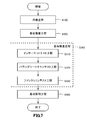
- FIG. 7 is a flowchart showing the procedure of this method.
- this method includes a standby step (S100), a substrate placement step (S200), a substrate inspection step (S300), and a substrate removal step (S400).
- the control unit 70 drives the driving means 50 to extend the separation distances L1 to L3 between the second probe base 200 and the first probe base 100 to the maximum L1 and wait.
- the midway state (FIG. 3) can be obtained when shifting from either the separated state (FIG. 1) or the approaching state (FIG. 2).
- the control unit 70 causes the driving means 50 to generate a driving force F.
- the separation distances L1 to L3 between the first probe base 100 and the second probe base 200 are made closer to or away from each other while resisting the elastic force of the springs 42, 61, 43.
- the inspection circuit 80 sequentially executes different inspections while switching the inspection function in accordance with the operation of changing the separation distances L1 to L3.
- the control unit 70 is in a state in which the driving means 50 widens the separation distances L1 to L3 to the maximum L1.
- an operator, an inspector or the like removes the inspected substrate 30 from the apparatus 500 and moves it to an assembly process (not shown) or a shipping process of the substrate 30.
- the substrate inspection process (S300) is a combination of any two or more of the in-circuit test process (S310), the boundary scan test process (S320), and the function test process (S330).
- the first pole 60 is implanted in the first probe base 100 and is extendable.
- the first pole 60 presses the first surface (upper surface) 10 of the substrate 30 with the pressing force F ⁇ b> 1 based on the driving force F
- the substrate 30 approaches the intermediate plate 300.
- the intermediate plate 300 also approaches the second probe base 200.
- the probes 111 to 114 and 211 to 217 can selectively contact the substrate 30 according to the difference in length.
- the separation distances L1 to L3 can be classified into three stages: maximum L1, minimum L2, and intermediate L3. Further, in the standby process (S100), the substrate placement process (S200), and the substrate removal process (S400), the separation distances L1 to L3 are increased to the maximum L1, and the substrate 30 can be attached and detached.
- the first stage of the substrate inspection process (S300) is an in-circuit test process (S310).
- S310 all the probes 111 to 114 and 211 to 217 are brought into contact with the substrate 30 that is sandwiched with the separation distances L1 to L3 narrowed to the minimum L2.
- the second stage of the substrate inspection process (S300) is a boundary scan test process (S320).
- the separation distances L1 to L3 are maintained at the medium level L3, and only the long probes (111, 211, 212) are brought into contact with the substrate 30.
- the boundary scan test process (S320) or the function test process (S330) is executed only with the long probes 111, 211, 212 (not shown) remaining by reducing the number of contacts compared to the in-circuit test process (S310). Is done.
- the 1st pole 60 has illustrated the thing elastically expandable between the length from the longest to the shortest.
- the first pole 60 flexibly presses the surface 10 of the substrate 30 while expanding and contracting the telescopic structure by the pressing force F ⁇ b> 1 of the built-in first urging means (spring) 61.
- the function of pressing the substrate 30 flexibly does not give a burden such as an abrupt bending stress to the delicate structure on the substrate 30, a failure occurs due to the inspection. In addition, it is possible to obtain a more accurate inspection result.
- the driving force F is strengthened downward in FIGS. 1 to 3, and the upward force is obtained by adding the elastic force of the second urging means (spring) 42, the third urging means (spring) 43 and other elastic forces.
- the balance with the pressing force H is taken into consideration.
- the spring 61, the spring 42, the spring 43, and other elastic forces are contracted by the downward driving force F and the upward pressing force H, whereby the separation distances L1 to L3 are set to the minimum L2.
- the separation distances L1 to L3 are distinguished from the minimum L2 state and the intermediate L3 state, thereby making the probes 111 to 114, 211.
- Two different states are obtained: an in-circuit test process (S310) in which all of ⁇ 217 are brought into contact, and a boundary scan test process (S320) in which only the long probes 111, 211, and 212 are brought into contact with the substrate 30.
- the length of the first pole 60 can be changed in more stages, and in combination with the multi-stage control by the control unit 70, more You may comprise so that a kind of test
- the probes to be brought into contact with the substrate 30 are distinguished in more stages. Can be considered.
- a medium-length probe (not shown) is set as a length positioned between the long probes 111, 211, 212 and the short probes 112-114, 213-217.
- the control unit 70 performs multi-stage control according to changes in the inspection process. That is, as a first step, all of the long, medium, and short probes are brought into contact. As the second stage, the long and medium length probes are brought into contact. As a third step, it is possible to distinguish the probe contact in such a manner that only a long probe is brought into contact.
- the separation distances L1 to L3 between the first probe base 100 and the second probe base 200 are extended to the maximum L1, and the substrate 30 is released.
- the substrate inspection by this method is completed.
- FIG. 8 is a schematic explanatory diagram (hereinafter also referred to as “simplified model”) obtained by simplifying FIG. 3 in order to explain various springs and the like provided in the apparatus. Note that the driving unit 50, the control unit 70, and the inspection circuit 80 are omitted from FIG. 8 to avoid complexity.
- the following description as shown in FIG. 3 and FIG. 8, in order to enable the boundary scan test process (S320), the following first and second conditions are clarified to improve reproducibility. It is explanation for.
- the first condition is to maintain the separation distances L1 to L3 between the first probe base 100 and the second probe base 200 at an intermediate level L3.
- the second condition is that the short probes 112 to 114 are not brought into contact with the upper surface 10 of the substrate 30 in the boundary scan test process (S320). Similarly, the lower short probes 213 to 217 are not brought into contact with the lower surface 20 of the substrate 30.
- F1 F10 + K1 ⁇ X (1)
- K2 Spring constant of spring 42 (second biasing means interposed between intermediate plate 300 and substrate 30)
- F20 Initial elastic force of spring 42
- K3 Spring 43 (second probe base 200 and intermediate plate 300 However, when all of the springs 61, 42, 43 are suspended by a plurality of springs, the resultant force of the plurality of springs (the spring constant is also parallel). Acts on synthesis).
- F Driving force for moving the first probe base 100 (upper side) up and down
- G Sum of downward pressing forces acting on the upper surface 10 of the substrate 30 (also simply referred to as “pressing force”)
- H Sum of upward pressing forces acting on the lower surface 20 of the substrate 30 (also simply referred to as “pressing force”)
- N normal force received from the spacer 301 when the substrate 30 is in contact with the spacer 301 of the intermediate plate 300
- Y between the short probes 112 to 114 on the first probe base 100 (upper side) and the first pole 60 Difference in length
- FUL downward pressing force (assumed constant) that the long probe 111 on the first probe base 100 (upper side) acts on the upper surface 10 of the substrate 30
- FUS A downward pressing force (assumed to be constant) that the short probes 112 to 114 of the first probe base 100 (upper side) act on the upper surface 10 of the substrate 30
- FBL upward pressing force (assuming constant) that the long probes 211 and 212 of the second probe base 200 (lower side) act on the lower surface 20 of the substrate 30
- FBS upward pressing force (assumed constant) that the short probes 213 to 217 of the second probe base 200 (lower side) act on the lower surface 20 of the substrate 30
- the condition of the following formula (2) is set for the spring constant shown in the specifications of the simplified model described above.
- the above-described first condition is satisfied, and the driving force F is appropriately adjusted so that the separation distances L1 to L1 between the first probe base 100 and the second probe base 200 are increased.
- L3 can be maintained at medium L3.
- the distances L1 to L3 between the first probe base 100 and the second probe base 200 are maintained at an intermediate level L3. It becomes possible to execute the boundary scan test process (S320) in which only the long probes 111, 211, 212 are brought into contact with the substrate 30.
- the process proceeds from the substrate placement step (S200) to the in-circuit test step (S310).
- the probes 111 to 114 and 211 to 217 are in contact with the substrate 30 in the order shown below.
- K1 ⁇ X + F10 + FUL F20 + K2 ⁇ X + N + FBL (3)
- K2 ⁇ K1 ⁇ K3 K2 ⁇ X is also ignored.
- K1 ⁇ X + F10 + FUL F20 + N + FBL (4)
- the vertical drag N received from the spacer 301 is positive as shown in the following formula (5) obtained by arranging the above formula (4).
- N K1 ⁇ X + F10 ⁇ F20 + FUL ⁇ FBL> 0 (5)
- the second condition is that the upper short probes 112 to 114 are not brought into contact with the upper surface 10 of the substrate 30 in the boundary scan test process (S320).
- the length difference Y (FIGS. 1 and 8) between the upper short probes 112 to 114 and the first pole 60 is set to be larger than X in the above equation (7). Therefore, it is necessary to satisfy the following formula (8).
- the second condition includes a condition in which the lower short probes 213 to 217 are not brought into contact with the lower surface 20 of the substrate 30, but detailed description thereof is omitted.
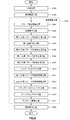
- FIG. 9 is a flowchart showing the procedure of this method based on the functions of the various springs shown in FIG.
- FIG. 9 explains the substrate inspection step (S300) in more detail based on the flowchart of FIG.
- the substrate inspection step (S300) according to this method includes a probe approach start step (S301), a substrate lowering step (S302), and a first (upper) probe group selection contact step (S303).
- the first probe base 100 is pushed down by the driving force F of the driving means 50.
- the first pole 60 pushes down the substrate 30 with the pressing force F1 by the elastic force of the spring 61 over the spring 42.
- the sum G of downward pressing forces acting on the upper surface 10 of the substrate 30 includes the pressing force FUL of the long probe 111 on the first probe base 100 (upper side) and the short probe 112. Up to 114 pressing force FUS is included.
- the long probe 111 of the first probe base 100 contacts the substrate 30.
- the lower surface 20 of the substrate 30 contacts the spacer 301 of the intermediate plate 300.
- the long probes 211 and 212 of the second probe base 200 are in contact with the lower surface 20 of the substrate 30.
- the driving force F of the driving means 50 that is superior to the elastic force of the springs 42, 61 and the like mainly acts on the first pole 60. Due to the driving force F, the rod-like portion 63 is accommodated in the sheath-like portion 62 to some extent, so that it is contracted to a middle length, that is, a length slightly longer than the sheath-like portion 62. As a result, all the long and short probes 111 to 114 of the first probe base 100 abut on the upper surface 10 of the substrate 30.
- the elastic force of the springs 61, 42, 43 and the driving force F of the driving means 50 that are superior to others act mainly on the first pole 60. Due to the driving force F, the entire rod-like portion 63 is accommodated in the sheath-like portion 62, so that it is shortened to the shortest length, that is, the length of only the sheath-like portion 62. At this time, the first pole 60 in a state in which it has shrunk to the limit and has lost its elasticity, pushes down the substrate 30 together with the intermediate plate process 300 while resisting the strongest elastic force of the spring 43. As a result, all the probes 211 to 217 of the second probe base 200 abut on the substrate 30.
- the in-circuit test process (S310) includes all the first and second probe bases 100 and 200 in the first (upper) and second (lower) probe group full contact processes (S306 and S307).
- the probes 111 to 114 and 211 to 217 are in contact with the substrate 30.
- the short probes 112 to 114 of the first probe base 100 are separated from the substrate 30.
- the second (lower) probe group selection canceling step (S 312) the short probes 213 to 217 of the second probe base 200 are separated from the substrate 30. As a result, only the long probes 111, 211, and 212 are left in contact with the substrate 30.
- the boundary scan test process (S320) or the function test process (S330) is executed only with the long probes 111, 211, and 212 that are left with a reduced number of contacts compared to the in-circuit test process (S310). In addition to these three long probes 111, 211, 212, even if a long probe is used in an actual inspection, it will be omitted from the description.
- the halfway state (FIG. 3) can be obtained even when shifting from either the separated state (FIG. 1) or the approaching state (FIG. 2). Accordingly, the order of the in-circuit test process (S310) performed in the approaching state (FIG. 2), the boundary scan test process (S320) and the function test process (S330) performed in the midway state (FIG. 3) is first. It doesn't matter. Referring to FIG. 9, a boundary scan test process (S320) is performed between the second (lower) probe group selection contact process (S305) and the first (upper) probe group full contact process (S306). Alternatively, the function test process (S330) may be executed.
- test processes can be realized using three different lengths of probes including long and short intermediate lengths, that is, a long probe, a medium probe, and a short probe. is there. That is, there are three types of test processes: a first test process using all probe contact, a second test process using medium / long probe contact, and a third test process using only long probe contact.
- the first test process is an in-circuit test process (S310)
- the second test process is a boundary scan test process (S320)
- the third test process is a function test process (S330).
- the three types of test processes are merely examples, and the first, second, and third test processes are necessarily an in-circuit test process (S310), a boundary scan test process (S320), and a function test process (S330). There is no need.
- the control unit 70 pulls up the first probe base 100 by the driving means 50 and sets the separation distances L1 to L3 between the first probe base 100 and the second probe base 200 to the maximum L1. Make it spread out.
- the substrate removal step (S400) the substrate 30 is detached from the apparatus 500, and the substrate inspection by this method is completed.
- the order of the first (upper) probe group selection contact step (S303) and the second (lower) probe group selection contact step (S305) may be reversed.
- the order of the first (upper) probe group full contact step (S306) and the second (lower) probe group full contact step (S307) may be reversed.
- the order of the first (upper) probe group selection cancellation step (S311) and the second (lower) probe group selection cancellation step (S312) may be reversed.
- this apparatus in which this jig is semi-automated with a simple structure and combined with a multifunctional inspection circuit, and the effect of this method using this apparatus are great.
- a double-sided-compatible type capable of performing multiple types of inspections in multiple stages by selectively contacting only the necessary probes on both sides of the substrate to be inspected.
- a multifunction substrate inspection apparatus and a multifunction substrate inspection method can be provided.
- the effect of the first pole 60 will be supplementarily explained.
- the base of the first pole 60 is pushed by the driving force F, so that the distal end portion that can expand and contract with the elastic force of the spring 61 pushes the first surface (upper surface) 10 of the substrate 30.
- F1 the first pole 60 flexibly presses the upper surface 10 of the substrate 30 with the pressing force F ⁇ b> 1 by the elastic force of the spring 61 interposed between the sheath-like member 62 and the rod-like member 63.
- the first pole 60 has no spring 61 elastic force. Even in this case, if the length of the first pole 60 is fixed to an intermediate length between the long probe 111 and the short probes 112 to 114, the first condition and the second condition described above are realized.
- the first condition that is, the separation distances L1 to L3 between the first probe base 100 and the second probe base 200 are maintained at an intermediate level L3.
- the second condition is also realized. That is, the second condition that the short probes 112 to 114 and 213 to 217 are in contact with the upper and lower surfaces 10 and 20 of the substrate 30 in the boundary scan test process (S320) is also realized.
- probing that is, a probe is brought into contact with a contacted portion such as a test pad (Test Pat) to which solder is welded at a specified position on the pattern of the substrate 30 (hereinafter referred to as “probe contact”).
- probe contact a contacted portion
- the accuracy of the contact point (Contact Point) is incorrect on a wavy board.
- there is a problem of contact failure such as skidding from a hemispherical contacted part.
- the flatness of the mounting board may be corrected by attaching a dedicated cover called an outline counterbore (Outline counterbore) to the mounting board, and then the probe may be contacted. There is.
- an outline counterbore Outline counterbore
- the component / solder joint is used to hold the mounting board instantaneously, make contact with the probe, and release instantly at the end of the inspection.
- the substrate may be destroyed due to large strain and stress.
- the first pole 60 provided in the apparatus 500 has a substrate by the elastic force of the spring 61 interposed between the sheath-like member 62 and the rod-like member 63.
- the upper surface 10 of 30 is pressed more uniformly and flexibly. The operation has an effect of holding the substrate 30 uniformly and slowly before contacting the probe, so that the substrate is easily held with flatness.
- the first pole 60 corrects the flatness of the corrugated substrate 30 without difficulty by taking a certain time. That is, there is an effect of eliminating the warpage of the substrate 30. Therefore, when the flatness is corrected, there is an effect that generation of bending and bending stress harmful to quality assurance of the substrate 30 is suppressed. The same is true when the probe contact is released, and the substrate 30 is gradually returned to its original state. As a result, even if the inspection speed is increased, the occurrence of failure due to the inspection is prevented and the probe contact (Probing) becomes highly accurate and stable, so that there is an effect of increasing a series of inspection accuracy.
- FIG. 10 is a partial cross-sectional view showing a modification of the first pole used in the present apparatus.
- the first pole 90 shown in FIG. 10 is fixed with screws 97 so that the support pillars 93 forming the base are implanted in the first probe base 100, and FIGS. 1, 2, 3, and 8 are used.
- the same function as the first pole 60 shown in FIG. In other words, the first pole 90 is pushed in the distal direction by the driving force F at the base portion, so that the distal end portion 94 that can expand and contract with the elastic force of the spring 61 pushes the first surface (upper surface) 10 of the substrate 30. It is possible to press flexibly with the force F1.
- the first pole 90 is different from the first pole 60 in the following two points.
- a base is formed on the side of a column 93 implanted in the first probe base 100, and a telescopic tip 94 is formed on the side of a sheath-like member 92 covering the base.
- a replaceable cap 95 is fixed to the distal end portion 94 by a male / female screw portion 96, and is in contact with the first surface 10 of the substrate 30 through the contact surface 98 of the cap 95.
- the cap 95 is made replaceable in order to adapt the material to the form of the substrate 30 and the inspection contents.
- the material constituting the cap 95 may be a rubber or resin material having an insulating property for avoiding the harm of static electricity to the substrate 30 and a cushioning property for reducing the impact associated with the multi-stage operation of the jig. preferable.
- FIGS. 11 to 13 correspond to FIGS. 1 to 3 used to describe the configuration and operation of the apparatus 500 described above.
- 11 to 13 are diagrams for explaining the configuration and operation including members added to obtain a safer and better function with respect to the apparatus 500 shown in FIGS. 1 to 3. .
- the operation principle of the deformation apparatus is the same as that of the present apparatus 500, redundant description is omitted.
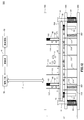
- FIG. 11 is a front view showing a state where the first probe base and the second probe base of the deformation apparatus are spaced apart to the maximum and the mounting board is placed on an intermediate plate positioned between the two.
- FIG. 12 is a front view showing an in-circuit test mode in which the first probe base and the second probe base of the deformation apparatus are held closest to each other and all the two types of long and short probes are brought into contact with the sandwiched substrate. It is.
- FIG. 13 shows a boundary where the distance between the first probe base and the second probe base of the deforming device is maintained at a medium level, only the long probe is brought into contact with the sandwiched substrate, and the short probe is not in contact. It is a front view which shows scan test mode.
- the deformation device 501 corresponds to the problem remaining in the device 500.
- the problem is that the substrate 30 is not pressed against the spacer 301 and other support members (not shown) disposed on the upper surface of the intermediate plate 300, the locations where the substrates 30 are pressed at the tips of the first poles 60 and 90 (FIG. 10).
- the substrate 30 is not pressed against the spacer 301 and other support members (not shown) disposed on the upper surface of the intermediate plate 300, the locations where the substrates 30 are pressed at the tips of the first poles 60 and 90 (FIG. 10).
- In addition to bending the flat surface due to non-uniform bending stress between each of the locations there is also a risk of damage in severe cases.
- the deformation apparatus 501 is pushed by the stretchable support mechanism 60 having the same function as the first pole 60.
- the substrate 30 is pressed by the plate 400.
- the first pole 60 and the stretchable support mechanism 60 are given the same reference numerals because they have equivalent functions, but may have different configurations as long as they have equivalent functions.
- the multi-function substrate inspection apparatus (deformation apparatus) 501 presses the surface of the substrate to be inspected elastically and uniformly against the apparatus 500 shown in FIGS. It further comprises a push plate 400 that is made possible.
- the push plate 400 is located between the first probe base 100 and the substrate to be inspected 30.
- the push plate 400 is fixed to the distal end portion of the stretchable support mechanism 60 having the same function as the first pole 60 with an adhesive 64 and is maintained parallel to the first probe base 100. Can be separated.
- the push plate 400 has through holes 1 to 4 through which the probes 111 to 114 implanted in the first probe base 100 pass.
- the push plate 400 facing the substrate 30 is provided with a counterbore hole or a through hole that inserts a mounting component protruding in the height direction and absorbs the height.
- the pressing plate 400 needs to be processed considerably depending on the type of the substrate 30.
- a dedicated push plate 400 adapted to a different shape depending on the type of the substrate 30 is formed, similarly to the through holes 1 to 4 through which the probes 111 to 114 pass. Since the pressing plate 400 has such a configuration, it can elastically and uniformly press the surface of the inspected substrate 30.
- the elastic support mechanism 60 in the deformation device 501 shown in FIGS. 11 to 13 is configured in substantially the same manner as the first pole 60 in the device 500 shown in FIGS. 1 to 3, but is not limited thereto. Not what you want. That is, it is sufficient if the total strength of all the springs 61 and the function of maintaining the parallelism of the plate members engaged with the springs 61 are equivalent.
- the shape of the sheath-like member 62 and the fixing means 64 for fixing the stretchable support mechanism 60 and the push plate 400 may have different configurations.
- the fixing means 64 may not be fixed by the exemplified adhesive but may be general screwing or the like.
- through holes for penetrating the probes 211 to 217 implanted in the second probe base 200 are also formed in the intermediate plate 300 so as to correspond to the through holes 1 to 4.
- the deformation device 501 can elastically press the surface of the substrate 30 with the push plate 400.
- the push plate 400 is located between the first probe base 100 and the substrate 30, and these can be separated and connected in a posture maintaining parallelism. Therefore, the pressing plate 400 can be pressed in a posture that is maintained parallel to the surface of the substrate 30 to be inspected.
- the space between the spacer 301 and other support members (not shown) disposed on the upper surface of the intermediate plate 300 and the portion where the substrate 30 is pressed at the tip of the first poles 60 and 90 and the portion where the substrate 30 is not pressed is determined. Therefore, it is less likely to receive uneven bending stress.
- the deformation device 501 has an effect that the flat surface of the substrate 30 can be bent and the risk of damage can be reduced. As a result, the problem remaining in the present apparatus 500 could be solved.
- the multi-functional substrate inspection apparatus and multi-functional substrate inspection method according to the present invention include an in-circuit test for detecting a single component failure or unit failure of an analog component mounted on a substrate to be inspected, and a digital mounted on the substrate to be inspected. Continuously switching between two or more types of test (inspection) functions among the boundary scan test for detecting single component defects or unit defects, the function test for inspecting product functions on a board basis, and other tests There is a possibility that the present invention is employed as a multifunctional substrate inspection apparatus and a multifunctional substrate inspection method that are performed in an automated manner.
Landscapes
- Engineering & Computer Science (AREA)
- Physics & Mathematics (AREA)
- General Physics & Mathematics (AREA)
- General Engineering & Computer Science (AREA)
- Computer Hardware Design (AREA)
- Microelectronics & Electronic Packaging (AREA)
- Tests Of Electronic Circuits (AREA)
- Testing Of Short-Circuits, Discontinuities, Leakage, Or Incorrect Line Connections (AREA)
- Measuring Leads Or Probes (AREA)
Abstract
L'invention porte sur un dispositif d'inspection de substrat multifonctionnel qui permet d'amener sélectivement des sondes en contact avec un substrat. Le dispositif d'inspection de substrat multifonctionnel comporte : une première et une seconde base de sonde 100, 200 dans lesquelles sont intégrées des sondes 111-217 ayant des longueurs différentes et pouvant être mises en contact avec les surfaces individuelles 10, 20 d'un substrat 30 ; un moyen d'entraînement 50 qui diminue ou augmente l'intervalle entre la première et la seconde base de sonde ; une plaque intermédiaire 300 sur laquelle le substrat 30 peut être placé entre la première et la seconde base de sonde ; une première tige extensible 60 ou un mécanisme de support extensible 60 similaire qui est intégré dans la première base de sonde 100 et qui peut utiliser la force d'entraînement F du moyen d'entraînement 50 en tant que base pour comprimer le substrat 30 selon une force de sollicitation F1 par l'intermédiaire d'un premier moyen de sollicitation 61 ; un deuxième moyen de sollicitation 42 destiné à éloigner le substrat 30 de la plaque intermédiaire 300 ; et un troisième moyen de sollicitation 43 destiné à éloigner la plaque intermédiaire 300 de la seconde base de sonde 200. Les sondes 111-217 sont sélectivement mises en contact avec le substrat 30 en fonction de leurs différentes longueurs.
Priority Applications (3)
| Application Number | Priority Date | Filing Date | Title |
|---|---|---|---|
| JP2017541721A JP6233946B1 (ja) | 2016-05-11 | 2017-03-21 | 多機能型基板検査装置および多機能型基板検査方法 |
| US16/099,895 US10718792B2 (en) | 2016-05-11 | 2017-03-21 | Multifunctional substrate inspection apparatus and multifunctional substrate inspection method |
| CN201780043335.3A CN109416386B (zh) | 2016-05-11 | 2017-03-21 | 多功能型基板检查装置以及多功能型基板检查方法 |
Applications Claiming Priority (2)
| Application Number | Priority Date | Filing Date | Title |
|---|---|---|---|
| PCT/JP2016/064033 WO2017195300A1 (fr) | 2016-05-11 | 2016-05-11 | Dispositif d'inspection de substrat multifonctionnel et procédé d'inspection de substrat multifonctionnel |
| JPPCT/JP2016/064033 | 2016-05-11 |
Publications (1)
| Publication Number | Publication Date |
|---|---|
| WO2017195470A1 true WO2017195470A1 (fr) | 2017-11-16 |
Family
ID=60266610
Family Applications (2)
| Application Number | Title | Priority Date | Filing Date |
|---|---|---|---|
| PCT/JP2016/064033 Ceased WO2017195300A1 (fr) | 2016-05-11 | 2016-05-11 | Dispositif d'inspection de substrat multifonctionnel et procédé d'inspection de substrat multifonctionnel |
| PCT/JP2017/011278 Ceased WO2017195470A1 (fr) | 2016-05-11 | 2017-03-21 | Dispositif d'inspection de substrat multifonctionnel et procédé d'inspection de substrat multifonctionnel |
Family Applications Before (1)
| Application Number | Title | Priority Date | Filing Date |
|---|---|---|---|
| PCT/JP2016/064033 Ceased WO2017195300A1 (fr) | 2016-05-11 | 2016-05-11 | Dispositif d'inspection de substrat multifonctionnel et procédé d'inspection de substrat multifonctionnel |
Country Status (4)
| Country | Link |
|---|---|
| US (1) | US10718792B2 (fr) |
| JP (1) | JP6233946B1 (fr) |
| CN (1) | CN109416386B (fr) |
| WO (2) | WO2017195300A1 (fr) |
Cited By (2)
| Publication number | Priority date | Publication date | Assignee | Title |
|---|---|---|---|---|
| CN108037443A (zh) * | 2017-12-27 | 2018-05-15 | 江苏凯尔生物识别科技有限公司 | 具有扫码装置的测试标识机 |
| KR102002848B1 (ko) * | 2018-01-15 | 2019-07-24 | (주)티이에스 | Mipcm 검사 장치 |
Families Citing this family (8)
| Publication number | Priority date | Publication date | Assignee | Title |
|---|---|---|---|---|
| US12032013B2 (en) | 2017-12-27 | 2024-07-09 | Jusung Engineering Co., Ltd. | Substrate inspection device and substrate inspection method |
| KR102691923B1 (ko) * | 2017-12-27 | 2024-08-06 | 주성엔지니어링(주) | 기판 검사 장치 및 기판 검사 방법 |
| CN108287284A (zh) * | 2018-03-16 | 2018-07-17 | 重庆安亿达电子有限公司 | 一种手机充电器测试装置 |
| US10914756B2 (en) * | 2018-08-14 | 2021-02-09 | Keysight Technologies, Inc. | Miniature test probe |
| GB202018028D0 (en) * | 2020-11-17 | 2020-12-30 | Rolls Royce Plc | Method of inspecting a component |
| CN113109696B (zh) * | 2021-04-12 | 2023-08-08 | 万安裕维电子有限公司 | 一种pcb板导电孔性能测试方法 |
| TWI773402B (zh) * | 2021-06-24 | 2022-08-01 | 英業達股份有限公司 | 提高邊界掃描測試的腳位測試涵蓋率系統及其方法 |
| TWI815470B (zh) * | 2022-05-23 | 2023-09-11 | 鴻勁精密股份有限公司 | 具調位單元之作業裝置及作業機 |
Citations (5)
| Publication number | Priority date | Publication date | Assignee | Title |
|---|---|---|---|---|
| US4841241A (en) * | 1986-08-07 | 1989-06-20 | Siemens Aktiengesellschaft | Testing device for both-sided contacting of component-equipped printed circuit boards |
| JPH01184480A (ja) * | 1988-01-18 | 1989-07-24 | Tokyo Electron Ltd | 検査方法及び検査装置 |
| JPH0464784U (fr) * | 1990-10-15 | 1992-06-03 | ||
| JPH0550368U (ja) * | 1991-12-04 | 1993-07-02 | 株式会社アイシーティ | Ic実装ボードの検査装置 |
| JPH09138257A (ja) * | 1995-11-14 | 1997-05-27 | Nec Corp | プリント基板の検査装置および方法 |
Family Cites Families (10)
| Publication number | Priority date | Publication date | Assignee | Title |
|---|---|---|---|---|
| JP2806606B2 (ja) | 1990-07-02 | 1998-09-30 | アイシン精機株式会社 | 液圧制御弁装置 |
| JPH0550368A (ja) | 1991-08-23 | 1993-03-02 | Brother Ind Ltd | 搬送経路検索機能付き搬送装置 |
| US6025729A (en) * | 1997-09-11 | 2000-02-15 | Delaware Capital Formation, Inc. | Floating spring probe wireless test fixture |
| JP2003050256A (ja) | 2001-08-08 | 2003-02-21 | Hitachi Ltd | プリント基板検査装置 |
| US7400156B2 (en) * | 2006-09-06 | 2008-07-15 | Mjc Probe Incorporation | Vertical probe device |
| JP2012103184A (ja) | 2010-11-12 | 2012-05-31 | Tsutomu Takahashi | 回路基板検査治具 |
| JP4858657B1 (ja) * | 2011-08-11 | 2012-01-18 | 富士ゼロックス株式会社 | 基板検査装置、及び基板検査方法 |
| JP5687172B2 (ja) * | 2011-11-01 | 2015-03-18 | 三菱電機株式会社 | 半導体テスト治具およびそれを用いた耐圧測定方法 |
| JP6058325B2 (ja) * | 2012-09-12 | 2017-01-11 | 日置電機株式会社 | 基板検査装置および基板検査方法 |
| CN105403826B (zh) * | 2016-01-04 | 2019-02-22 | 京东方科技集团股份有限公司 | 一种测试工装 |
-
2016
- 2016-05-11 WO PCT/JP2016/064033 patent/WO2017195300A1/fr not_active Ceased
-
2017
- 2017-03-21 CN CN201780043335.3A patent/CN109416386B/zh not_active Expired - Fee Related
- 2017-03-21 US US16/099,895 patent/US10718792B2/en not_active Expired - Fee Related
- 2017-03-21 WO PCT/JP2017/011278 patent/WO2017195470A1/fr not_active Ceased
- 2017-03-21 JP JP2017541721A patent/JP6233946B1/ja not_active Expired - Fee Related
Patent Citations (5)
| Publication number | Priority date | Publication date | Assignee | Title |
|---|---|---|---|---|
| US4841241A (en) * | 1986-08-07 | 1989-06-20 | Siemens Aktiengesellschaft | Testing device for both-sided contacting of component-equipped printed circuit boards |
| JPH01184480A (ja) * | 1988-01-18 | 1989-07-24 | Tokyo Electron Ltd | 検査方法及び検査装置 |
| JPH0464784U (fr) * | 1990-10-15 | 1992-06-03 | ||
| JPH0550368U (ja) * | 1991-12-04 | 1993-07-02 | 株式会社アイシーティ | Ic実装ボードの検査装置 |
| JPH09138257A (ja) * | 1995-11-14 | 1997-05-27 | Nec Corp | プリント基板の検査装置および方法 |
Cited By (3)
| Publication number | Priority date | Publication date | Assignee | Title |
|---|---|---|---|---|
| CN108037443A (zh) * | 2017-12-27 | 2018-05-15 | 江苏凯尔生物识别科技有限公司 | 具有扫码装置的测试标识机 |
| CN108037443B (zh) * | 2017-12-27 | 2024-04-05 | 安徽凯尔通讯科技有限公司 | 具有扫码装置的测试标识机 |
| KR102002848B1 (ko) * | 2018-01-15 | 2019-07-24 | (주)티이에스 | Mipcm 검사 장치 |
Also Published As
| Publication number | Publication date |
|---|---|
| US10718792B2 (en) | 2020-07-21 |
| CN109416386B (zh) | 2021-03-26 |
| JPWO2017195470A1 (ja) | 2018-05-24 |
| WO2017195300A1 (fr) | 2017-11-16 |
| US20190162756A1 (en) | 2019-05-30 |
| JP6233946B1 (ja) | 2017-11-22 |
| CN109416386A (zh) | 2019-03-01 |
Similar Documents
| Publication | Publication Date | Title |
|---|---|---|
| JP6233946B1 (ja) | 多機能型基板検査装置および多機能型基板検査方法 | |
| JP6515003B2 (ja) | インターフェース装置、インターフェースユニット、プローブ装置及び接続方法 | |
| US20140062516A1 (en) | Apparatus for the Automated Testing and Validation of Electronic Components | |
| KR102442100B1 (ko) | 향상된 필터링 특성을 갖는 전자 기기의 테스트 장치용 프로브 카드 | |
| JP4532570B2 (ja) | 回路基板検査装置および回路基板検査方法 | |
| JP4660616B2 (ja) | 基板検査装置 | |
| JP6245876B2 (ja) | プローブカード | |
| JP4368704B2 (ja) | 電子部品実装用プリント配線板の電気検査方法および電気検査装置ならびにコンピュータ読み取り可能な記録媒体 | |
| JP2009300103A (ja) | ワイヤープローブ用治具並びに検査装置 | |
| JP2006322918A (ja) | インターフェース、及びそれを用いた半導体テスト装置 | |
| CN106841986A (zh) | Pcba板测试装置及系统 | |
| US9134357B1 (en) | Universal direct docking at probe test | |
| CN104375077A (zh) | 功能测试fct测试工装和测试系统、方法 | |
| KR20150024063A (ko) | 블록단위 결합용 프로브블록을 구비하는 프로브카드 | |
| KR100941750B1 (ko) | 프로브 카드 | |
| CN104215801B (zh) | 探针卡与其制作方法 | |
| KR101386224B1 (ko) | 자동 테스트 장치용 디에스에이 보드 플로팅 장치 및 이를 포함하는 하이픽스 보드 | |
| US20100330830A1 (en) | Vertical probe intrface system | |
| KR100998763B1 (ko) | 프로브 카드 | |
| CN113900013A (zh) | 信号传递装置及设备 | |
| JP2015015441A (ja) | 半導体装置及び半導体装置の検査用パッドに対するプローブの位置を検出する方法 | |
| KR101729068B1 (ko) | 커넥터 지그 | |
| US20160377652A1 (en) | Semiconductor device manufacturing method | |
| US8044675B2 (en) | Testing apparatus with high efficiency and high accuracy | |
| JP2010133786A (ja) | 検査装置、及び検査方法 |
Legal Events
| Date | Code | Title | Description |
|---|---|---|---|
| ENP | Entry into the national phase |
Ref document number: 2017541721 Country of ref document: JP Kind code of ref document: A |
|
| NENP | Non-entry into the national phase |
Ref country code: DE |
|
| 121 | Ep: the epo has been informed by wipo that ep was designated in this application |
Ref document number: 17795831 Country of ref document: EP Kind code of ref document: A1 |
|
| 122 | Ep: pct application non-entry in european phase |
Ref document number: 17795831 Country of ref document: EP Kind code of ref document: A1 |