WO2017195519A1 - 記憶制御システム、システム及びプログラム - Google Patents
記憶制御システム、システム及びプログラム Download PDFInfo
- Publication number
- WO2017195519A1 WO2017195519A1 PCT/JP2017/014875 JP2017014875W WO2017195519A1 WO 2017195519 A1 WO2017195519 A1 WO 2017195519A1 JP 2017014875 W JP2017014875 W JP 2017014875W WO 2017195519 A1 WO2017195519 A1 WO 2017195519A1
- Authority
- WO
- WIPO (PCT)
- Prior art keywords
- information
- storage
- stored
- secretion
- unit
- Prior art date
- Legal status (The legal status is an assumption and is not a legal conclusion. Google has not performed a legal analysis and makes no representation as to the accuracy of the status listed.)
- Ceased
Links
Images





Classifications
-
- G—PHYSICS
- G06—COMPUTING OR CALCULATING; COUNTING
- G06N—COMPUTING ARRANGEMENTS BASED ON SPECIFIC COMPUTATIONAL MODELS
- G06N3/00—Computing arrangements based on biological models
- G06N3/004—Artificial life, i.e. computing arrangements simulating life
- G06N3/008—Artificial life, i.e. computing arrangements simulating life based on physical entities controlled by simulated intelligence so as to replicate intelligent life forms, e.g. based on robots replicating pets or humans in their appearance or behaviour
-
- B—PERFORMING OPERATIONS; TRANSPORTING
- B25—HAND TOOLS; PORTABLE POWER-DRIVEN TOOLS; MANIPULATORS
- B25J—MANIPULATORS; CHAMBERS PROVIDED WITH MANIPULATION DEVICES
- B25J9/00—Program-controlled manipulators
- B25J9/16—Program controls
- B25J9/1602—Program controls characterised by the control system, structure, architecture
- B25J9/161—Hardware, e.g. neural networks, fuzzy logic, interfaces, processor
-
- B—PERFORMING OPERATIONS; TRANSPORTING
- B25—HAND TOOLS; PORTABLE POWER-DRIVEN TOOLS; MANIPULATORS
- B25J—MANIPULATORS; CHAMBERS PROVIDED WITH MANIPULATION DEVICES
- B25J11/00—Manipulators not otherwise provided for
- B25J11/0005—Manipulators having means for high-level communication with users, e.g. speech generator, face recognition means
- B25J11/001—Manipulators having means for high-level communication with users, e.g. speech generator, face recognition means with emotions simulating means
-
- G—PHYSICS
- G06—COMPUTING OR CALCULATING; COUNTING
- G06N—COMPUTING ARRANGEMENTS BASED ON SPECIFIC COMPUTATIONAL MODELS
- G06N3/00—Computing arrangements based on biological models
-
- G—PHYSICS
- G06—COMPUTING OR CALCULATING; COUNTING
- G06N—COMPUTING ARRANGEMENTS BASED ON SPECIFIC COMPUTATIONAL MODELS
- G06N3/00—Computing arrangements based on biological models
- G06N3/004—Artificial life, i.e. computing arrangements simulating life
-
- G—PHYSICS
- G06—COMPUTING OR CALCULATING; COUNTING
- G06N—COMPUTING ARRANGEMENTS BASED ON SPECIFIC COMPUTATIONAL MODELS
- G06N3/00—Computing arrangements based on biological models
- G06N3/02—Neural networks
- G06N3/04—Architecture, e.g. interconnection topology
- G06N3/049—Temporal neural networks, e.g. delay elements, oscillating neurons or pulsed inputs
Definitions
- the present invention relates to a storage control system, system, and program.
- Patent Document 1 Japanese Patent Application Laid-Open No. 2011-253389
- Patent Document 2 Japanese Patent Application Laid-Open No. 10-254592
- Patent Document 3 Japanese Patent Application Publication No. 2013-535067
- a storage control system may include an information acquisition unit that acquires information for determining the emotion of the target object.
- the storage control system may include a secretion information generation unit that generates secretion information indicating a secretion amount of an endocrine substance that affects the determination of the emotion of the target object based on the information acquired by the information acquisition unit.
- the storage control system is based on secretion information and information acquired by the information acquisition unit when the emotion strength of the target object determined based on the information acquired by the information acquisition unit exceeds a predetermined value. You may provide the memory
- the storage control system may include an information selection unit that selects, based on the secretion information, the storage information recalled by the target object from the storage information stored in association with the secretion information.
- the storage control unit performs the first storage based on the first information when the emotion strength of the target object determined based on the first information acquired by the information acquisition unit exceeds a predetermined value.
- the information, the second storage information based on the second information acquired by the information acquisition unit before the first information, and the set of the first storage information and the secretion information may be stored in association with each other.
- the information selection unit When the information acquisition unit acquires new information that matches the second storage information, the information selection unit generates the secret information generated by the secretion information generation unit as the second storage information and the first storage information.
- the first storage information, the second storage information, and the first storage information set are provided on condition that the secretory information stored in association with the set is matched. You may choose.
- the storage control unit suppresses the undulation of the emotion on the condition that the information acquisition unit further acquires new information that matches the first storage information.
- Secretion information in which the secretion amount of the endocrine substance having an action to increase is stored in association with the set of the second storage information and the first storage information.
- the secretory information generation unit when the first storage information is selected by the information selection unit, the second storage on the condition that the information acquisition unit further acquires new information that matches the first storage information.
- the secretion amount of the endocrine substance indicated by the secretion information stored in association with the set of information and the first storage information may be reflected in the secretion information indicating the current secretion amount of the endocrine substance.
- the storage control unit performs the first storage based on the first information when the emotion strength of the target object determined based on the first information acquired by the information acquisition unit exceeds a predetermined value.
- the information selection unit When the information acquisition unit acquires new information that matches the first combination of the second plurality of stored information, the information selection unit generates the secret information generated by the secretion information generation unit as the second plurality of information.
- the first storage information, the first combination, and the first combination of the storage information and the secretory information stored in association with the first combination of storage information You may select the 1st combination of two some memory information, and the group of the 1st memory information.
- the storage control unit when the emotion strength of the target object determined based on the first information acquired by the information acquisition unit exceeds a predetermined value, the first storage information and the second storage information Each of a combination of a plurality of storage information, a first storage information and a set of sequences of third storage information based on third information acquired by the information acquisition unit following the first information, and secretion information. You may make it match and memorize.
- the information acquisition unit acquires new information that matches the first combination of the second plurality of stored information
- the information selection unit generates the secret information generated by the secretion information generation unit as the second plurality of information.
- One storage information, a first combination of the second plurality of storage information, and a sequence combination of the first storage information and the third storage information may be selected.
- the storage control system is associated with one or more pieces of determination information, and when information suitable for the one or more pieces of determination information is acquired, the storage control system is allowed to be selected as information recalled by the target object.
- An allowable information storage unit for storing the stored information may be provided.
- the information selection unit includes information that matches the determination information stored in the allowable information storage unit in association with the set of the second storage information and the first storage information, and information that matches the second storage information.
- the first storage information may be selected as the storage information recalled by the target object.
- the secretion information generation unit selects the second storage information and the second storage information. Based on the second storage information and the new information, the secretory amount of the endocrine substance having an action opposite to the action of the endocrine substance of the secretory amount indicated by the secretory information stored in association with the set of the one memory information The secretory information stored in association with the third set of stored information may be reflected.
- the secretion information generation unit selects the second storage information and the second storage information. Based on the second storage information and the new information, the secretory amount of the endocrine substance having an action opposite to the action of the endocrine substance of the secretory amount indicated by the secretory information stored in association with the set of the one memory information A set of the second storage information and the third storage information, which is reflected in the secretory information stored in association with the third set of stored information, and in which the secretory endocrine substance having an opposite action is reflected. The secretory information stored in association with the secretory information may be reflected in the secretory information indicating the current secretory amount of the endocrine substance.
- the memory control system may include an emotion determination unit that determines the emotion of the target object based on the amount of the endocrine substance indicated by the secretion information and the information acquired by the information acquisition unit.
- the emotion determination unit may determine the emotion of the target object using a neural network that receives input information based on the information acquired by the information acquisition unit.
- the secretion amount of the endocrine substance indicated by the secretion information may affect the coupling coefficient of the artificial synapse included in the neural network.
- the neural network may include a plurality of emotional artificial neurons, which are artificial neurons with defined emotions.
- the emotion determination unit may determine the current emotion of the target object based on the current firing state of each of the plurality of emotion artificial neurons.
- the storage control system may include a control unit that controls the target object in accordance with the emotion of the target object determined based on the information acquired by the information acquisition unit.
- a system in a second aspect of the present invention, may comprise the storage control system described above.
- the system may comprise a target object.
- a program for causing a computer to function as the emotion determination system is provided.
- An example of the whole composition of system 10 concerning this embodiment is shown roughly.
- the functional block structure of the robot 40 and the server 60 is shown schematically.
- An emotion map 300 is schematically shown. 1 schematically illustrates a portion of a neural network used by system 10. It is an example of the sensor corresponding
- the time change of the excitement degree in the robot 40 is shown schematically.
- An example of the time change of the memory intensity of the memory information memorized by storage part 280 is shown roughly. The other example of the time change of the memory intensity of the memory
- stored in the storage part 280 is shown roughly.
- An example of information stored in the storage unit 280 is shown.
- the selection permissible information indicating the recall information permitted to be selected as the recall information is shown.
- FIG. 1 schematically shows an example of the overall configuration of a system 10 according to the present embodiment.
- the system 10 includes a server 60, a robot 40a, a robot 40b, and a robot 40c.
- the server 60 can function as a storage control system.
- Each of the robot 40a, the robot 40b, and the robot 40c is an example of a target object in the storage control system.
- the robot 40a, the robot 40b, and the robot 40c are arranged at home, for example.
- the user 50a is a user of the robot 40a.
- the user 50a is a family member at the home where the robot 40a is arranged or another person who visits the home.
- the robot 40a performs an exchange such as a conversation with the user 50a.
- the robot 40b and the robot 40c perform exchanges such as a conversation with the user 50b and the user 50c, respectively.
- the robot 40a, the robot 40b, and the robot 40c can be applied to a usage form such as being arranged at the reception of a store or an office and responding to a visitor.
- the usage forms of the robot 40a, the robot 40b, and the robot 40c are not limited to these usage forms.
- the server 60 is provided remotely from the robot 40a, the robot 40b, and the robot 40c.
- the server 60 can control the robot 40a, the robot 40b, and the robot 40c through the communication network 90.
- the server 60 acquires sensor information detected by the robot 40a through the communication network 90, determines emotions of the robot 40a and actions to be performed by the robot 40a based on the acquired sensor information, and transmits through the communication network 90.
- the control information is transmitted to instruct the robot 40a.
- the robot 40b and the robot 40c have substantially the same function as the robot 40a.
- the robot 40a, the robot 40b, and the robot 40c may be collectively referred to as the robot 40.
- the server 60 executes a process for determining emotions and actions of the robot 40.
- the robot 40 may execute a part or all of the processing for determining the emotion and action of the robot 40.
- the robot 40 acquires various information detected by the sensor such as the voice and image of the user 50 and information on the external force received by the robot 40 and transmits the acquired information to the server 60.
- the server 60 generates control information for controlling the robot 40 using a neural network (NN) based on the information acquired from the robot 40.
- NN neural network
- the server 60 recognizes the existence of the user 50a from the voice and image of the user 50a, recognizes that the user 50a is “A-kun”, and event information that “A-kun exists”. Is generated. Further, event information such as “boiled” is generated from the external force information acquired from the robot 40. Further, the server 60 generates input information to the neural network from the information acquired from the robot 40.
- the server 60 determines the emotion from the generated input information using information corresponding to the amount of endocrine substances in the living body as action information that affects the determination of the emotion. For example, the server 60 determines an emotion using a neural network using as parameters the amount of endocrine substances such as dopamine, noradrenaline, and serotonin.
- a neural network an increase in the amount of dopamine affects the generation of emotions similar to “happy”.
- An increase in the amount of noradrenaline affects the generation of emotions similar to “anger”.
- an increase in the amount of serotonin acts to suppress the intensity of emotions such as “happy” and “anger”.
- the neural network determines what kind of emotion is likely to be born depending on the sum of the secretion amounts of these endocrine substances.
- the server 60 determines that the strength of the emotion has exceeded the threshold when the total value of the dopamine amount and the noradrenaline amount exceeds the threshold value.
- the server 60 stores secretory information indicating the amount of the endocrine substance together with the storage information based on the information acquired from the robot 40. Examples of the stored information include predetermined types of information such as the above-described event information “A is there” and “boiled”, and image and video information acquired from the robot 40.
- the server 60 generates event information “A is there” from the newly acquired information after storing the stored information.
- the server 60 compares the current endocrine secretion amount of the robot 40 with the endocrine secretion amount stored together with the storage information of “A-kun is present” and “boiled”. If it is determined that the secretory amounts of the endocrine substances are similar, the server 60 selects the storage information “boiled” stored together with the storage information “A is there” as information to be recalled.
- the server 60 is stored together with the storage information “A is there” and “boiled”.
- the emotion of the robot 40 is determined by reflecting the amount of endocrine secretion in the processing of the neural network.
- the endocrine substances stored together with the storage information “A is present” and “boiled” are stored.
- the emotion of the robot 40 is determined by reflecting the secreted amount opposite to the secreted amount in the processing of the neural network. This makes it easier to obtain emotions that are different from “happy”, for example. Thereby, for example, unfortunate emotions are generated.
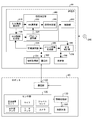
- FIG. 2 schematically shows the functional block configuration of the robot 40 and the server 60.
- the robot 40 includes a sensor unit 120, an information processing unit 130, a control target 160, and a communication unit 102.
- the information processing unit 130 may be a processor such as an MPU.
- the communication unit 102 is responsible for communication with the server 60.
- the communication unit 102 may be a communication device such as a network IF.
- Control object 160 includes a speaker.
- the control object 160 also includes a motor that drives a movable part such as a limb or head of the robot 40.
- the sensor unit 120 includes various sensors such as a microphone, a gyro sensor, a motor sensor, a camera, a battery remaining amount sensor, and an infrared sensor.
- the microphone of the sensor unit 120 acquires ambient sound. For example, the microphone of the sensor unit 120 acquires the voice of the user 50.
- the camera of the sensor unit 120 shoots with visible light and generates image information of moving images and still images.
- the infrared sensor of the sensor unit 120 detects surrounding objects using infrared rays.
- the gyro sensor of the sensor unit 120 detects the angular velocity of the entire robot 40 and each part of the robot 40.
- the motor sensor of the sensor unit 120 detects the rotation angle of the drive shaft of the motor that drives the movable part of the robot 40.
- the remaining battery level sensor of the sensor unit 120 detects the remaining battery capacity of the robot 40.
- the sensor unit 120 is an audio data acquired by a microphone, an image captured by a camera, an angular velocity detected by a gyro sensor, a rotation angle detected by a motor sensor, a remaining capacity detected by a battery remaining amount sensor, and an infrared sensor.
- Various sensor data such as detected object information is output to the information processing unit 130.
- the information processing unit 130 supplies the acquired sensor signal to the communication unit 102 and transmits it to the server 60.
- the information processing unit 130 causes the speaker of the robot 40 to speak or operates the limbs of the robot 40 based on the control information acquired from the server 60.
- the server 60 includes a processing unit 270, a communication unit 202, and a storage unit 280.
- the processing unit 270 includes a secretion information generation unit 200, an input information generation unit 210, a parameter adjustment unit 220, an emotion determination unit 260, a control unit 250, an information selection unit 284, an event information generation part 286, and a storage.
- Emotion determination unit 260 includes NN calculation unit 230 and emotion determination unit 240.
- the communication unit 202 includes an information acquisition unit 204.
- the communication unit 202 is responsible for communication with the robot 40.
- the communication unit 202 may be a communication device such as a network IF.
- the storage unit 280 includes a storage medium such as a hard disk device or a flash memory.
- the storage unit 280 includes a volatile storage device such as a RAM.
- the storage unit 280 stores data necessary for executing the processing of the processing unit 270, in addition to program codes read by the processing unit 270 during execution and various kinds of temporary data.
- the information acquisition unit 202 acquires information for determining the emotion of the robot 40. For example, the information acquisition unit 202 acquires information detected by the sensor unit 120 of the robot 40 through the network 90.
- the event information generation part 286 generates event information based on the information acquired by the information acquisition unit 202. For example, the event information generation part 286 generates event information such as “A is there” or “boiled”.
- the event information can be stored in the storage unit 280 as storage information.
- the secretion information generation unit 200 generates secretion information indicating the secretion amount of the endocrine substance that affects the determination of the emotion of the robot 40 based on the information acquired by the information acquisition unit 202.
- the storage control unit 282 acquires the secret information and the information acquisition unit 202 when the strength of the emotion of the robot 40 determined based on the information acquired by the information acquisition unit 202 exceeds a predetermined value.
- the stored information based on the information is stored in association with each other.
- the storage control unit 282 causes the storage unit 280 to store secretion information and storage information based on the information acquired by the information acquisition unit 202.
- the information selection unit 284 selects the storage information recalled by the robot 40 from the storage information stored in association with the secretion information.
- the storage control unit 282 determines the first information based on the first information when the emotion strength of the robot 40 determined based on the first information acquired by the information acquisition unit 202 exceeds a predetermined value. And the second storage information based on the second information acquired by the information acquisition unit 202 before the first information and the first storage information set and the secretion information are stored in association with each other.
- the information selection unit 284 determines that the secretion information generated by the secretion information generation unit 200 is the second storage information and the first storage information.
- memory control such as so-called federated learning can be implemented.
- the storage control unit 282 is provided on the condition that the information acquisition unit 202 further acquires new information that matches the first storage information.
- Secretion information obtained by increasing the secretion amount of the endocrine substance having the action of suppressing undulations is stored in association with the set of the second storage information and the first storage information. As a result, familiarity with events that occur at a high frequency can be generated.
- the secretory information generation unit 200 on the condition that, when the first storage information is selected by the information selection unit 284, the information acquisition unit 202 further acquires new information that matches the first storage information.
- the secretory amount of the endocrine substance indicated by the secretory information stored in association with the set of the two stored information and the first stored information is reflected in the secretory information indicating the current secretory quantity of the endocrine substance.
- the storage control unit 282 determines the first information based on the first information when the emotion strength of the robot 40 determined based on the first information acquired by the information acquisition unit 202 exceeds a predetermined value.
- the information selection unit 284 indicates that the secretion information generated by the secretion information generation unit 200 is the second information.
- the first storage information as the storage information recalled by the target object on the condition that it matches the first combination of the plurality of storage information and the secretion information stored in association with the first storage information set And a first combination of the second plurality of stored information and a first set of stored information.
- the storage control unit 282 includes the first storage information and the first storage information.
- the secretory information is stored in association with it.
- the information selection unit 284 indicates that the secretion information generated by the secretion information generation unit 200 is the second information.
- Storage information recalled by the robot 40 on the condition that it matches the secretion information stored in association with the first combination of the plurality of storage information and the sequence combination of the first storage information and the third storage information.
- the first storage information, the first combination of the second plurality of storage information, and the sequence combination of the first storage information and the third storage information are selected.
- the storage unit 280 is associated with one or more pieces of determination information, and is allowed to be selected as information recalled by the robot 40 when information suitable for the one or more pieces of determination information is acquired.
- the stored information is stored.
- the information selection unit 284 associates information that matches the determination information stored in the storage unit 280 in association with the set of the second storage information and the first storage information, and information that matches the second storage information. Is acquired within a predetermined time, the first storage information is selected as the storage information recalled by the robot 40. Thereby, it can suppress operating based on the information learned in the completely different scene in the past.
- the secretion information generation unit 200 receives the second storage information. And the secretory amount of the endocrine substance having an action contrary to the action of the endocrine substance of the secretory amount indicated by the secretory information stored in association with the set of the first memory information, the second memory information and the new information And is reflected in the secretory information stored in association with the third set of stored information.
- the secretion information generation unit 200 stores the secretion information stored in association with the set of the second storage information and the third storage information, in which the secretory amount of the endocrine substance having the opposite action is reflected.
- the emotion determination unit 260 determines the emotion of the robot 40 based on the secretion amount of the endocrine substance indicated by the secretion information and the information acquired by the information acquisition unit 202.
- the emotion determination unit 260 determines the emotion of the robot 40 using a neural network that receives input information based on the information acquired by the information acquisition unit 202.
- the NN calculation unit 230 calculates a neural network
- the emotion determination unit 240 determines an emotion based on the result of the neural network calculation by the NN calculation unit 230, thereby determining the emotion.
- the parameter adjustment unit 220 adjusts a calculation parameter for determining emotion from input information based on the secretion amount of the endocrine substance indicated by the secretion information generated by the secretion information generation unit 200.
- Emotion determination unit 260 determines an emotion from input information using a calculation parameter.
- the secretion amount of the endocrine substance indicated by the secretion information affects the coupling coefficient of the artificial synapse included in the neural network.
- the neural network includes a plurality of emotional artificial neurons, which are artificial neurons with defined emotions.
- the emotion determination unit 260 determines the current emotion based on the current firing state of each of the plurality of emotion artificial neurons. For example, the emotion determination unit 260 may determine an emotion assigned to the fired emotional artificial neuron as the emotion of the robot 40.
- the control unit 250 controls the robot 40 according to the emotion determined by the emotion determination unit 260. For example, when the emotion determination unit 260 determines a “happy” emotion, the control unit 250 generates control information for executing an action indicating happiness and transmits the control information to the robot 40. Further, the control unit 250 may generate control information for outputting a voice with a bright tone from the speaker of the robot 40, and cause the robot 40 to have a conversation with the user.
- each unit of the server 60 and a computer may be realized.
- the processing unit 270 may be realized by a processor such as an MPU
- the storage unit 280 may be realized by a recording medium such as a nonvolatile memory.
- the storage unit 280 may store a program executed by the processor.
- the processor executes the program, the secretory information generation unit 200, the input information generation unit 210, the parameter adjustment unit 220, the emotion determination unit 260 including the NN calculation unit 230 and the emotion determination unit 240, the control unit 250,
- the storage control unit 282, the information selection unit 284, and the event information generation part 286 may be mounted, and the control of the storage unit 280 may be realized.
- the program may be read by the processor from the recording medium 290 such as an optical disk and stored in the storage unit 280, or may be provided to the server 60 through the network and stored in the storage unit 280.
- the storage unit 280 and the recording medium 290 may be computer-readable non-transitory recording media.
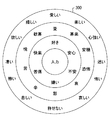
- FIG. 3 schematically shows the emotion map 300.
- the emotions are arranged concentrically radially from the center. The closer to the center of the concentric circles, the more primitive emotions are placed. Outside the concentric circles, emotions representing the state and behavior born from the emotional state are arranged. Emotion is a concept that includes emotions and mental states. On the left side of the concentric circles, emotions generated from reactions that occur in the brain are generally arranged. On the right side of the concentric circles, emotions induced by situation judgment are generally arranged.
- the neural network to be calculated by the NN calculation unit 230 includes an artificial neuron assigned to each emotion shown in the emotion map 300.
- a plurality of artificial neurons for input are assigned to the input located on the innermost side of the concentric circle in the emotion map 300.
- the input information generated by the input information generation unit 210 from the information acquired by the information acquisition unit 204 is input to the plurality of input artificial neurons.
- artificial neurons are generally connected by artificial synapses from the inside to the outside to form a neural network.
- the NN operation unit 230 repeatedly performs a neural network operation based on the input information to determine the firing state of each artificial neuron.
- the emotion determination unit 240 determines the emotion of the robot 40 from the firing state of each artificial neuron. For example, the emotion determination unit 240 determines an emotion to which the fired artificial neuron is assigned as one emotion that the robot 40 has.
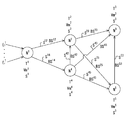
- FIG. 4 schematically illustrates a portion of the neural network used by the system 10.
- a part of the illustrated neural network includes artificial neurons N 1 , N 2 , N 3 , N 4 and N 5 and artificial synapses S 12 , S 14 , S 23 , S 25 , S 42 , S 43 , S 45. and a and S 53.
- Artificial neurons correspond to neurons in the living body.
- An artificial synapse corresponds to a synapse in a living body.
- E 1 indicates input information based on the detection signal.
- Artificial neuron N 1 is an artificial neuron for input. The n pieces of input information E 1 1 ... Input information E n 1 generated based on the detection signals of the sensors are input to the artificial neuron N 1 .
- Artificial Synapse S 12 is an artificial synapses for connecting the neurons and N 1 and the artificial neuron N 2.
- the artificial synapse S 12 the output of the artificial neuron N 1, an artificial synapse inputs to the artificial neuron N 2.
- the artificial synapse S 14 is an artificial synapse that connects the artificial neuron N 1 and the artificial neuron N 4 .
- the artificial synapse S 14 is an artificial synapse that inputs the output of the artificial neuron N 1 to the artificial neuron N 4 .
- an artificial synapse in which j and k are integers and the output of the artificial neuron N j is input to the artificial neuron N k is denoted as an artificial synapse S jk .
- each artificial neuron is denoted by N i.
- N i has a S i representing the status of the N i, and V i m which represents the internal state of the artificial neuron represented by N i, and T i which represents the threshold of the ignition of the N i as a parameter.
- the artificial synapse S jk has a coupling coefficient BS jk as a parameter.
- the artificial neuron may be collectively referred to as an artificial neuron N with its subscript omitted.
- the artificial synapse is collectively referred to as an artificial synapse S with its subscript omitted.
- the parameters of the artificial neuron may be collectively referred to as internal information Vm, threshold value T, and status S with their subscripts omitted.
- the status S, the internal state Vm, and the threshold T of the artificial neuron N are parameters that can be updated as time progresses.
- the status S is information regarding the firing state of the neuron, and indicates at least whether the artificial neuron is in the firing state or in the non-firing state.
- the internal state Vm is information relating to the membrane potential of the neuron, and is an example of a parameter representing the internal state or output of the artificial neuron N.
- the coupling coefficient BS which is a parameter of the artificial synapse S, is a parameter that can be updated as time advances.
- the coupling coefficient BS is information relating to synaptic plasticity, and indicates the coupling strength between the artificial neurons N to which the artificial synapse S is coupled.
- the NN calculation unit 230 updates the above-described parameters in the neural network from the input information, and calculates the internal state Vm of each artificial neuron N.
- the status S of the artificial neuron N is “fired”.
- the artificial neuron N outputs a predetermined signal over a predetermined time.
- the status S of N returns to the last ignition.
- NN arithmetic unit 230 an input I 2 to N 2, is calculated by BS 12 ⁇ Vm 1 ⁇ f ( S 1) + BS 42 ⁇ Vm 4 ⁇ f (S 4).
- f (S) is a function that returns 0 when S is a value indicating unfired, and returns 1 when S is a value indicating the rising phase or the falling phase.
- f (S) a function corresponding to another transfer model of the membrane potential may be applied.
- NN calculation unit 230 an input I i to N i, is calculated by ⁇ j BS ji ⁇ Vm j ⁇ f (S j) + ⁇ j E j i.
- the NN operation unit 230 calculates the inputs I i and S i to the N i at the next time using the BS ji , Vm j , S j , and E j at the current time.
- the NN calculation unit 230 repeats this in time to determine the status S of each artificial neuron N in real time.
- the emotion determination unit 240 determines the feeling of the robot 40 based on the status S of each artificial neuron N. For example, when an artificial neuron assigned with the emotion of “happy” in FIG. 3 fires, the emotion determination unit 240 can determine that the robot 40 has the emotion of “happy”.
- the parameter adjustment unit 220 adjusts the BS based on the information acquired from the robot 40. For example, when it is detected that the remaining capacity that is the remaining amount of the storage battery of the robot 40 is 50% or less, the secretion information generation unit 200 increases the secretion amount of “noradrenaline” as an internal variable. Then, the parameter adjustment unit 220 adjusts the coupling coefficient BS of the artificial synapse S associated with “noradrenaline” based on the secretion amount of “noradrenaline”.
- the generation of “noradrenaline” is set so as to enhance the coupling coefficient BS of the artificial synapse S on the path where the artificial emotional neuron corresponding to the emotion such as “anxiety” or “anger” fires, for example. ing.
- “noradrenaline” acts in such a direction that emotions such as “anxiety” and “anger” are likely to be generated.
- the amount of endocrine secretion is associated with a specific artificial synaptic S binding coefficient BS.
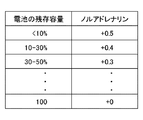
- FIG. 5 is an example of correspondence information that associates the remaining capacity of the storage battery with an endocrine substance.
- the storage unit 280 stores information indicating noradrenaline in association with a plurality of values of the remaining capacity of the storage battery. More specifically, the storage unit 280 stores information indicating an increase in the amount of noradrenaline secreted in association with each remaining capacity of the storage battery. In addition, the increase amount of secretion amount is shown by the ratio with respect to the upper limit 1 of the secretion amount which the internal variable which the NN calculating part 230 uses represents. Thereby, as the remaining capacity of the storage battery decreases, the amount of noradrenaline secreted increases, and the feelings of “anxiety” and “anger” are more likely to be generated.
- FIG. 6 is an example of binding coefficient correspondence information that correlates the secretion amount of noradrenaline and the binding coefficient BS.
- Storage unit 280 in association with total amount of secreted noradrenaline, and increase the coefficient of coupling coefficient BS 14 of the artificial synapse S 14, the increase factor of the coupling coefficient BS 45 of the artificial synapse S 45, the coupling coefficient of the artificial synapse S 43 Information for associating the increase coefficient of the BS 43 is stored. It is assumed that the artificial synapse S taken up here is connected to the artificial neuron N by strong coupling.
- the increase coefficient of BS 14 and the increase coefficient of BS 45 are associated with larger values as the amount of noradrenaline increases.
- the increase coefficient of BS 43 is associated with a smaller value as the amount of noradrenaline increases.
- the increase coefficient may be set so that the coupling coefficient BS of the artificial synapse S can be adjusted in a direction that makes the output destination artificial neuron N difficult to fire.
- the increase coefficient may be set so that the coupling coefficient BS of the artificial synapse S can be adjusted in a direction that makes the output destination artificial neuron N difficult to fire.
- the parameter adjustment unit 220 refers to the binding coefficient correspondence information and adjusts the corresponding binding coefficient BS by an amount corresponding to the total secretion amount of each endocrine substance.
- the adjustment amount of the coupling coefficient BS can be adjusted in a complex manner from the information acquired by the robot 40, and thus the emotional artificial neuron can be fired in various combinations.
- the relationship between the information acquired by the robot 40 and the endocrine substances and the relationship between each endocrine substance and the binding coefficient BS are replaced with humans to make them correspond to each other. Can generate emotions.
- FIG. 7 schematically shows the time change of the excitement level in the robot 40.
- the emotion determination unit 260 calculates, for example, the sum of the secretion amount of dopamine and the secretion amount of noradrenaline as the degree of excitement.
- the degree of excitement is an example of the emotional strength of the robot 40.
- the NN calculation unit 230 when the NN calculation unit 230 performs a calculation based on input information based on information at time t3, and the excitement level exceeds the storage threshold, the information is generated from information at time t3. Event information “boiled” is stored in the storage unit 280. Further, as a result of the calculation performed by the NN calculation unit 230 based on the input information based on the information at the time t13, when the excitement level exceeds the storage threshold, event information “ignored” generated from the information at the time t13 is generated. Stored in the storage unit 280.
- FIG. 8 schematically shows an example of the temporal change in the storage intensity of the storage information stored in the storage unit 280.
- the storage information “ignored” obtained from the information at time t13 will be described.
- the memory intensity at time t13 is an intensity corresponding to the degree of excitement obtained from the input information based on the information at time t13.
- the storage unit 280 stores the storage intensity in association with the storage information.
- the storage unit 280 gradually decreases the storage intensity stored in association with the storage information as time passes.
- the decrease rate of the memory intensity per time may decrease with the passage of time.
- a decrease in memory intensity represents forgetting. You may apply a forgetting curve as a curve which shows the relationship between time and memory intensity.
- the rate of decrease in memory intensity per time may be constant regardless of time.
- Stored information is stored in a manner corresponding to the storage intensity. Specifically, the storage information whose storage intensity exceeds the storage level threshold th1 is stored in the storage unit 280 as manifestation awareness information.
- the storage information stored in the storage unit 280 as the manifestation awareness information is recalled spontaneously at a predetermined frequency.
- the information selection unit 284 selects information “ignored” as recall information at a predetermined frequency. In FIG. 8, it is recalled three times.
- FIG. 8 shows a case where it is determined that the situation of “ignored” does not occur from the information acquired from the robot 40 when the stored information “ignored” is recalled.
- the memory intensity stored in the storage unit 280 is not increased and gradually decreases with time.
- Storage information whose storage intensity is equal to or less than the storage level threshold th1 and whose storage intensity exceeds the storage level threshold th2 is stored in the storage unit 280 as subconscious information.
- the stored information stored in the storage unit 280 as the subconscious information is not recalled spontaneously.
- the stored information is deleted from the storage unit 280.
- the storage intensity of the stored information gradually decreases.
- the data is finally deleted from the storage unit 280.
- the stored information generated in a situation that does not frequently occur in the robot 40 is deleted. Therefore, the storage area of the storage unit 280 can be used effectively.
- FIG. 9 schematically shows another example of the temporal change in the storage intensity of the storage information stored in the storage unit 280.
- the storage information “boiled” obtained from the information at time t3 will be described.
- the memory intensity at time t3 is an intensity corresponding to the excitement degree obtained from the input information based on the information at time t3.
- the storage unit 280 gradually decreases the storage intensity stored in association with the storage information as time passes.
- the storage unit 280 increases the storage strength stored in association with the storage information “boiled” by a predetermined strength. Note that the amount of increase in the memory intensity may be variable. In addition, the storage unit 280 subsequently reduces the rate of decrease in storage intensity per time. As shown in FIG.
- the decrease rate of the memory intensity per time from the recalled time point is smaller than the decrease rate of the memory intensity per time from the time point stored at the time t3. Also, the information selection unit 284 reduces the frequency of recalling the information “boiled”. Details of the parameters for reducing the recall frequency will be described later.
- the memory information “boiled” becomes the subconscious information after the second voluntary recall and the second voluntary recall with a low recall frequency. If a new event that matches the event when the memory information “boiled” is generated after the subconscious information is generated, it is recalled even after the subconscious information is generated.
- the storage information “boiled” is associated with the accompanying storage information “A is there”.
- the storage information “boiled” is associated with the incidental storage information of “A-kun is present”. Can be recalled. A specific example of the storage process and the recall process will be described later.
- FIG. 9 shows a case where it is determined from the information acquired from the robot 40 that the event “boiled” has occurred, as in the above-described fourth spontaneous recall.
- the storage unit 280 increases the storage strength stored in association with the storage information “boiled” by a predetermined strength.
- the storage unit 280 subsequently reduces the rate of decrease in storage intensity per time. As shown in FIG. 9, the rate of decrease in memory intensity per hour from the time point recalled this time is smaller than the rate of decrease in memory intensity per hour point from the time point recalled last time. In this way, the rate of decrease in memory intensity per hour decreases each time you recall, and the memory intensity gradually decreases.
- the information selection unit 284 reduces the frequency of recalling the information “boiled”.
- the stored information when events that match the stored information frequently occur, the memory intensity increases, the rate of decrease of the memory intensity per time decreases, and the recall frequency of the stored information decreases. Therefore, if events that match the stored information occur frequently, the stored information is stored as a more familiar and more common storage. As described above, according to the system 10, the stored information can be stored in such a manner that the memory is fixed by repeated learning by a human.
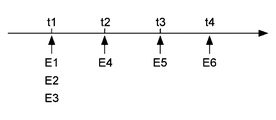
- FIG. 10 is a diagram for explaining an acquisition sequence of information acquired from the robot 40.
- the storage information “boiled” is event information generated based on the information at time t3. From the information at time t1 that is a predetermined time before time t3, incidental storage information “sunny day” is generated, and from the information at time t2, incidental storage information “A is there” is generated. Suppose that Any incidental information is stored in the storage unit 280 in association with the storage information “boiled”.
- incidental storage information “cloudy day” is generated, and from the information at time t12, additional storage information “A is present” is generated. Assume that it has been generated. All of the generated incidental information is stored in the storage unit 280 in association with the storage information “ignored”.
- FIG. 11 shows an example of information stored in the storage unit 280.
- Each storage information of E3, E1 ⁇ E3, E2 ⁇ E3, E13, E11 ⁇ E13, E2 ⁇ E13 is stored in the storage unit 280 in association with the secreted amounts of a plurality of endocrine substances.
- the secretion amount of the endocrine substance associated with the stored information indicates the strength that evokes the emotion that each endocrine substance acts when an event that matches the stored information occurs.
- the amount of secreted dopamine indicates the strength that evokes the feeling of “happy” when an event that matches the memory information occurs.
- the amount of noradrenaline secreted indicates the strength that evokes the feeling of “anxiety” when an event that matches the stored information occurs.
- the amount of serotonin secreted indicates the strength to suppress the undulation of emotion when an event that matches the stored information occurs.
- the amount of serotonin secreted indicates the degree of establishment of the corresponding stored information. For example, the greater the amount of serotonin secreted, the more established the memory. Therefore, the greater the amount of serotonin secreted, the lower the spontaneous recall frequency and the lower the decrease rate of memory intensity per unit time. That is, the storage unit 280 reduces the decrease rate per unit time of the storage intensity of the storage information having a higher serotonin secretion amount. Further, the information selection unit 284 selects the storage information stored in the storage unit 280 in association with a larger amount of serotonin secretion as the recall information at a lower frequency. In addition, the information selection unit 284 selects only storage information whose storage intensity exceeds the storage level threshold th1 from among the storage information stored in the storage unit 280 as spontaneous recall information.
- the storage unit 280 stores dopamine secretion amount 0.6, noradrenaline secretion amount 0, and serotonin secretion amount 0.5 in association with the storage information of E3. Therefore, the event indicated by E3 means that it occurs relatively frequently as compared to events corresponding to other stored information.
- the storage unit 280 stores a dopamine secretion amount of 0, a noradrenaline secretion amount of 0.9, and a serotonin secretion amount of 0.05 in association with the stored information of E13. Therefore, when an event that actually matches E13 occurs when the stored information of E13 is recalled, it means that the feeling of “anxiety” is greatly evoked.
- E1 ⁇ E3 indicates that E3 occurs after E1 occurs.
- E2 ⁇ E3 indicates that E3 occurs after E2 occurs.
- the robot 40 is not used to stroking in the situation where A is present, and “happy” because it is stroking in the situation where A is present, rather than being stroked on a sunny day. It shows that the feelings of the are awakened more greatly.
- E11 ⁇ E13 indicates that E13 occurs after E11 occurs.
- E2 ⁇ E13 indicates that E13 occurs after E2 occurs.
- the robot 40 is not so used to being ignored. It shows that the feelings of the are strongly evoked.
- the amount of dopamine secreted is adjusted to an average value of 0.6 with the current amount of dopamine secreted
- the amount of noradrenaline secreted is adjusted to the current amount of noradrenaline and the average value of 0
- the amount of serotonin secreted is Adjusted to the current secretion amount of serotonin and an average value of 0.4.
- the endocrine information reflected in the current secretion amount of the endocrine substance is not limited to the secretion amount of the endocrine substance associated with E1 ⁇ E3.
- the dopamine secretion amount 0.6, noradrenaline secretion amount 0, serotonin secretion amount 0.5 associated with E3 which is the later storage information in the time order the current endocrine substance It may be reflected in the amount of secretion.
- the secretion amount of the endocrine substance associated with E1 which is the storage information later in the time order in the storage information of E1 ⁇ E3 may be reflected in the current secretion amount of the endocrine substance.
- the stored information of E3 may be selected as the recall information when an event suitable for the event of E1 or E2 occurs based on the stored information of E1 ⁇ E3 or E2 ⁇ E3.
- the information selection unit 284 determines the distribution of the current secretion amount of the endocrine substance and the secretion amount of the endocrine substance associated with E1 ⁇ E3 in the storage unit 280. On the condition that the degree of coincidence with the distribution exceeds a predetermined threshold, the stored information of E3 is selected as the recall information.
- the degree of coincidence of secreted amounts of endocrine substances may be determined by using the short distance of vectors having the secreted amounts of each endocrine substance as a component.
- ⁇ i (q it The reciprocal of -qic ) 2 ⁇ 1/2 may be used as the degree of coincidence of the endocrine secretion.
- ⁇ i represents taking the sum of i.
- the storage information of E3 is selected as the recall information
- the input information suitable for E3 is input and the same event as E3 or the event suitable for E3 occurs
- the storage information of E1 ⁇ E3 Among the associated secretion amount information the secretion amount of serotonin is increased by a predetermined amount.
- the stored information of E13 may be selected as recall information when an event that matches the event of E11 or E2 occurs based on the stored information of E11 ⁇ E13 or E2 ⁇ E13.
- both E3 and E13 may be selected as recall information.
- the information selection unit 284 may select only one of E3 and E13 as the recall information. For example, the information selection unit 284 may recall only the stored information associated with the endocrine substance secretion amount distribution that is closer to the current endocrine substance secretion amount distribution.
- the information selection unit 284 matches the degree of coincidence between the secretion amount distribution of the endocrine substance associated with E2 ⁇ E3 and the current secretion amount distribution of the endocrine substance and the endocrine substance associated with E2 ⁇ E13. By comparing the degree of coincidence between the distribution of the secretion amount and the current distribution of the endocrine substance, only the memory information with the higher degree of coincidence may be selected as the recall information. Even in this case, the information selection unit 284 may not select the recall information when the degree of coincidence with the distribution of the secretion amount of the endocrine substance is smaller than a predetermined value.
- the set of stored information may include two or more pieces of stored information as previous stored information in time order.
- the storage unit 280 displays any combination of E1, E2, and E3.
- a set of storage information Ec ⁇ E4 may be stored in association with the amount of secretion of the endocrine substance.
- Ec is seven of [E1, E2, E3], [E1, E2], [E1, E3], [E2, E3], [E1], [E2], [E3]. That is, a set of seven stored information [E1, E2, E3] ⁇ E4, [E1, E2] ⁇ E4, [E1, E3] ⁇ E4, [E2, E3] ⁇ E4, [E1] ⁇ E4, [ E2] ⁇ E4 and [E3] ⁇ E4 are stored in association with the secretion amount of the endocrine substance. Each set Ec ⁇ 4 of these stored information is also recalled at predetermined time intervals. If an event that matches E4 occurs following Ec, the memory intensity of the corresponding Ec ⁇ E4 is increased.
- the set of storage information may include two or more pieces of storage information as subsequent storage information in time order.
- [E1, E2, E3] ⁇ [E4 ⁇ E5 ⁇ E6] [E1, E2] ⁇ [E4 ⁇ E5 ⁇ E6], [E1, E3] ⁇ [E4 ⁇ E5 ⁇ E6], [E2, E3] ⁇ [E4 ⁇ E5 ⁇ E6], [E1] ⁇ [E4 ⁇ E5 ⁇ E6] may be stored in association with the secretion amount information.
- the recall process will be described by taking a set of stored information of [E1, E2, E3] ⁇ [E4 ⁇ E5 ⁇ E6]. If E1, E2, and E3 events occur at the same time step, the sequence of stored information for E4, E5, and E6 may be selected. That is, it is recalled that events occur in the order of E4, E5, and E6 according to the events of E1, E2, and E3. Then, after E1, E2, and E3 events occur at the same time step, if E4, E5, and E6 continue in this sequence, the memory strength is increased. And the secretion amount of serotonin is increased among the corresponding secretion amount information.
- FIG. 13 is a diagram for explaining an endocrine substance reflected when an event different from the recall information or an event that denies the recall information occurs.
- a vector 1200 indicates a vector of emotions caused by the action of dopamine in the emotion map 300. That is, when input information is input to the input artificial neuron, information transmission is promoted in the direction indicated by the vector 1200 from the central input unit by the action of dopamine.
- a vector 1200 indicates an average direction of a route through which dopamine promotes information transmission. It does not mean that dopamine facilitates information transmission only in the direction of vector 1200.
- Vector 1202 and vector 1204 indicate representative directions of emotions that can be caused by the action of noradrenaline and serotonin, respectively, in emotion map 300.
- Vector 1210 shows a typical direction of emotions caused by the action of a secreted endocrine substance associated with E2 ⁇ E3.
- a vector 1210 is obtained by weighting and adding the vector 1200, the vector 1202, and the vector 1204 according to the secretion amount associated with E2 ⁇ E3.
- the stored information of E3 is selected as the recall information based on the stored information of E2 ⁇ E3
- the secretion amount of the endocrine substance in the direction indicated by the vector 1210 is , Reflected in the current secretion of endocrine substances.
- the secretory information generation unit 200 reflects the endocrine substance acting in the direction of the vector 1212 in the direction opposite to the vector 1210 and the secreted quantity in the secreted quantity of the endocrine substance associated with E2 ⁇ E4.
- the secretory information generation unit 200 converts the endocrine substance acting in the direction of the vector 1212 and the secretory quantity of the endocrine substance corresponding to E2 ⁇ E4 reflecting the secreted quantity into the current secretory quantity of the endocrine substance. reflect.
- the vector 1212 is a typical direction of emotion caused by the action of vasopressin in the vector 1206 in FIG. 13
- the secretory information generation unit 200 has a noradrenaline secretion amount 0.7 and a vasopressin secretion amount 0. .3 is generated and reflected in the current secretion amount of the endocrine substance.
- FIG. 14 shows permissible selection information representing recall information that can be selected as recall information.
- the storage unit 280 stores E31 ⁇ E32, E33 ⁇ E34, and E35, which are stored as actual consciousness information, in association with the event information of E21 and E22 as first selection permission information, and is stored as subconscious information.
- E41 ⁇ E42 and E43 ⁇ E44 are stored.
- the storage unit 280 stores E61 ⁇ E62, E61 ⁇ E65, and E63 ⁇ E64 stored as manifestation awareness information in association with the event information of E51 and E52 as the second selection permission information, and as the subconscious awareness information.
- the storage unit 280 stores E61 ⁇ E31, E61 ⁇ E34, and E62 ⁇ E33 stored as manifestation awareness information in association with the event information of E81 and E82 as the third selection permission information, and as the subconscious awareness information.
- the stored E71 ⁇ E41 and E72 ⁇ E43 are stored.
- the first selection permission information is that when E31 ⁇ E32 storage information is stored as manifestation awareness information, if E31 occurs after E21 and E22, E32 can be selected as recall information. Is shown.
- E33 ⁇ E34 is stored as the manifestation consciousness information
- the storage information of E41 ⁇ E42 and E43 ⁇ E44 is stored as the subconscious information
- E33 occurs after E21 and E22.
- E34 can be selected as recall information when E41 occurs after E21 and E22
- E44 can be selected when E43 occurs after E21 and E22.
- the stored information of E35 is stored as the manifestation consciousness information, it indicates that E35 can be selected as the recall information when E21 and E22 occur.
- the second selection allowance information is E62 or E64 as recall information when E61 occurs after E51 and E52. This indicates that it can be selected.
- E63 ⁇ E64 is stored as the manifestation consciousness information
- E71 ⁇ E72 and E73 ⁇ E74 is stored as the subconscious awareness information
- E63 occurs after E51 and E52.
- E64 can be selected as recall information when E71 occurs following E51 and E52, and E74 when E73 occurs following E51 and E52.
- the storage information of E61 ⁇ E62 and 61 ⁇ E65 is stored as manifestation awareness information. These sets of stored information have the same E61 as the previous stored information in time order.
- the storage information to be preferentially selected as the recall information among the storage information of E61 ⁇ E62 and 61 ⁇ E65 is selected based on the current secretion amount of the endocrine substance or the secretion amount of the specific endocrine substance. It's okay. For example, as described above with reference to FIG. 11, the secretory amount of the endocrine substance associated with the storage information E61 ⁇ E62 in the storage unit 280 and the storage information E61 ⁇ E65 in the storage unit 280.
- the stored information with the highest degree of coincidence may be selected with higher priority as the recall information by comparing each of the secreted amounts of the endocrine substance with the current secretory amount of the endocrine substance.
- the degree of coincidence of the secreted amounts of the endocrine substances may be determined by using the short distance of the vectors having the secreted amounts of the endocrine substances as components. For example, the degree of coincidence between the secretion amount of the endocrine substance associated with the storage information E61 ⁇ E65 and the current secretion amount of the endocrine substance is the secretion amount of the endocrine substance associated with the storage information E61 ⁇ E62. And E65 ⁇ E65 storage information and E65 storage information may be selected as recall information if the degree of coincidence between the secretory and the current secretory amount of the endocrine substance is higher.
- the secretion amount of the specific endocrine substance is The secreted amount of the secretory substance associated with the stored information selected by the user may be applied. For example, a plurality of stored information is presented and the user is requested to rearrange them in a predetermined order. Specifically, it requests that the stored information be rearranged in the most enjoyable order.
- the secretory amount of the endocrine substance associated with the highest stored information by the user may be applied as the secretory amount of the specific endocrine substance.
- the third selection permission information is that E31 or E34 is used as the recall information when E61 occurs after E81 and E82. This indicates that it can be selected.
- the stored information of E62 ⁇ E33 is stored as the manifestation consciousness information
- the stored information of E71 ⁇ E41 and E72 ⁇ E43 is stored as the subconscious awareness information
- E62 occurs after E81 and E82.
- E33 is selectable as recall information when E71 occurs following E81 and E82
- E74 is selectable when E72 occurs following E81 and E82.
- the storage information of E61 ⁇ E31 and 61 ⁇ E34 is stored as the manifestation awareness information.
- the memory information to be preferentially selected as the recall information among the memory information of E61 ⁇ E31 and 61 ⁇ E34 is selected based on the current secretion amount of the endocrine substance or the secretion amount of the specific endocrine substance. It's okay. Since the same processing as the selection processing of E61 ⁇ E62 and 61 ⁇ E65 in the second selection permission information can be applied to this selection processing, description thereof is omitted.
- E31 when E31 occurs after E51 and E52, it is prohibited for E32 to select as recall information.
- E62 can be selected as the recall information.
- E61 occurs following E81 and E82 different from E51 and E52
- E31 can be used as recall information.
- information that can be selected as recall information can be limited or switched according to the sequence of events that occurred immediately before.
- the robot 40 when the robot 40 enjoys playing othello with a child, the robot 40 can act based on information learned by the othello in the past. Therefore, for example, when the robot 40 is enjoying Othello with a child, it is possible to prevent the robot 40 from accidentally taking the learned action when pointing to the father and the shogi.
- the functions of the server 60 described above may be implemented by one or more computers. At least some functions of the server 60 may be implemented by a virtual machine. In addition, at least a part of the functions of the server 60 may be implemented in the cloud.
- the robot 40 is an example of a target object. Various forms other than the robot can be adopted as the target object.
Landscapes
- Engineering & Computer Science (AREA)
- Physics & Mathematics (AREA)
- Theoretical Computer Science (AREA)
- Artificial Intelligence (AREA)
- General Health & Medical Sciences (AREA)
- Software Systems (AREA)
- Mathematical Physics (AREA)
- Health & Medical Sciences (AREA)
- Evolutionary Computation (AREA)
- General Physics & Mathematics (AREA)
- Computing Systems (AREA)
- Biophysics (AREA)
- Computational Linguistics (AREA)
- Data Mining & Analysis (AREA)
- Life Sciences & Earth Sciences (AREA)
- Molecular Biology (AREA)
- Biomedical Technology (AREA)
- General Engineering & Computer Science (AREA)
- Robotics (AREA)
- Mechanical Engineering (AREA)
- Automation & Control Theory (AREA)
- Human Computer Interaction (AREA)
- Audiology, Speech & Language Pathology (AREA)
- Fuzzy Systems (AREA)
- Manipulator (AREA)
Abstract
記憶制御システムは、対象オブジェクトの感情を決定するための情報を取得する情報取得部と、情報取得部が取得した情報に基づいて、対象オブジェクトの感情の決定に作用する内分泌物質の分泌量を示す分泌情報を生成する分泌情報生成部と、情報取得部が取得した情報に基づいて決定された対象オブジェクトの感情の強さが予め定められた値を超えた場合に、分泌情報と、情報取得部が取得した情報に基づく記憶情報とを対応づけて記憶させる記憶制御部と、分泌情報に対応づけて記憶されている記憶情報のうち、対象オブジェクトが想起する記憶情報を、分泌情報に基づいて選択する情報選択部とを備える。
Description
本発明は、記憶制御システム、システム及びプログラムに関する。
ユーザと通話相手との会話を学習してユーザの問いかけに対する通話相手の返答を返答テーブルに蓄積する端末が知られている(例えば、特許文献1参照)。また、ユーザ情報、機器情報及び自身の現在の感情状態を入力して次回の感情状態を出力するニューラルネットを備える感情生成装置が知られている(例えば、特許文献2参照)。また、方向性人工シナプス接続性を有するレイヤ・ニューラルネット関係を有する複数の電子ニューロンを含む連想メモリに時空パターンを記憶する技術が知られている(例えば、特許文献3参照)。
[先行技術文献]
[特許文献]
[特許文献1]特開2011-253389号公報
[特許文献2]特開平10-254592号公報
[特許文献3]特表2013-535067号公報
[先行技術文献]
[特許文献]
[特許文献1]特開2011-253389号公報
[特許文献2]特開平10-254592号公報
[特許文献3]特表2013-535067号公報
従来、記憶された情報の中から、入力情報から画一的に定まる情報しか取り出すことができないという課題があった。
本発明の第1の態様においては、記憶制御システムが提供される。記憶制御システムは、対象オブジェクトの感情を決定するための情報を取得する情報取得部を備えてよい。記憶制御システムは、情報取得部が取得した情報に基づいて、対象オブジェクトの感情の決定に作用する内分泌物質の分泌量を示す分泌情報を生成する分泌情報生成部を備えてよい。記憶制御システムは、情報取得部が取得した情報に基づいて決定された対象オブジェクトの感情の強さが予め定められた値を超えた場合に、分泌情報と、情報取得部が取得した情報に基づく記憶情報とを対応づけて記憶させる記憶制御部を備えてよい。記憶制御システムは、分泌情報に対応づけて記憶されている記憶情報のうち、対象オブジェクトが想起する記憶情報を、分泌情報に基づいて選択する情報選択部を備えてよい。
記憶制御部は、情報取得部が取得した第1の情報に基づいて決定された対象オブジェクトの感情の強さが予め定められた値を超えた場合に、第1の情報に基づく第1の記憶情報と、第1の情報の前に情報取得部が取得した第2の情報に基づく第2の記憶情報及び第1の記憶情報の組と分泌情報とを対応づけて記憶させてよい。情報選択部は、情報取得部が第2の記憶情報に適合する新たな情報を取得した場合に、分泌情報生成部により生成された分泌情報が、第2の記憶情報及び第1の記憶情報の組に対応づけて記憶されている分泌情報に適合することを条件として、対象オブジェクトが想起する記憶情報として、第1の記憶情報と、第2の記憶情報及び第1の記憶情報の組とを選択してよい。
記憶制御部は、情報選択部により第1の記憶情報が選択された場合において、情報取得部が第1の記憶情報に適合する新たな情報を更に取得したことを条件として、感情の起伏を抑制する作用を持つ内分泌物質の分泌量を増加した分泌情報を、第2の記憶情報及び第1の記憶情報の組に対応づけて記憶させてよい。
分泌情報生成部は、情報選択部により第1の記憶情報が選択された場合において、情報取得部が第1の記憶情報に適合する新たな情報を更に取得したことを条件として、第2の記憶情報及び第1の記憶情報の組に対応づけて記憶されている分泌情報が示す内分泌物質の分泌量を、現在における内分泌物質の分泌量を示す分泌情報に反映してよい。
記憶制御部は、情報取得部が取得した第1の情報に基づいて決定された対象オブジェクトの感情の強さが予め定められた値を超えた場合に、第1の情報に基づく第1の記憶情報と、第1の情報の前に情報取得部が取得した第2の複数の情報に基づく第2の複数の記憶情報の任意の組み合わせのそれぞれ及び第1の記憶情報の組と分泌情報とを対応づけて記憶させてよい。情報選択部は、情報取得部が第2の複数の記憶情報の第1の組み合わせに適合する新たな情報を取得した場合に、分泌情報生成部により生成された分泌情報が、第2の複数の記憶情報の第1の組み合わせ及び第1の記憶情報の組に対応づけて記憶されている分泌情報に適合することを条件として、対象オブジェクトが想起する記憶情報として、第1の記憶情報と、第2の複数の記憶情報の第1の組み合わせ及び第1の記憶情報の組とを選択してよい。
記憶制御部は、情報取得部が取得した第1の情報に基づいて決定された対象オブジェクトの感情の強さが予め定められた値を超えた場合に、第1の記憶情報と、第2の複数の記憶情報の任意の組み合わせのそれぞれ並びに第1の記憶情報及び情報取得部が第1の情報に続けて取得した第3の情報に基づく第3記憶情報のシーケンスの組と、分泌情報とを対応づけて記憶させてよい。情報選択部は、情報取得部が第2の複数の記憶情報の第1の組み合わせに適合する新たな情報を取得した場合に、分泌情報生成部により生成された分泌情報が、第2の複数の記憶情報の第1の組み合わせ並びに第1の記憶情報及び第3記憶情報のシーケンスの組に対応づけて記憶されている分泌情報に適合することを条件として、対象オブジェクトが想起する記憶情報として、第1の記憶情報と、第2の複数の記憶情報の第1の組み合わせ並びに第1の記憶情報及び第3記憶情報のシーケンスの組とを選択してよい。
記憶制御システムは、1つ以上の判断情報に対応づけて、当該1つ以上の判断情報に適合する情報が取得された場合に、対象オブジェクトが想起する情報として選択することが許容される1以上の記憶情報を格納する許容情報格納部を備えてよい。情報選択部は、第2の記憶情報及び第1の記憶情報の組に対応づけて許容情報格納部に格納されている判断情報に適合する情報と、第2の記憶情報に適合する情報とを、情報取得部が予め定められた時間内に取得した場合に、対象オブジェクトが想起する記憶情報として第1の記憶情報を選択してよい。
分泌情報生成部は、情報選択部により第1の記憶情報が選択された場合において、情報取得部が第1の記憶情報を否定する新たな情報を取得したときは、第2の記憶情報及び第1の記憶情報の組に対応づけて記憶されている分泌情報が示す分泌量の内分泌物質による作用とは相反する作用を持つ分泌量の内分泌物質を、第2の記憶情報及び新たな情報に基づく第3の記憶情報の組に対応づけて記憶されている分泌情報に反映してよい。
分泌情報生成部は、情報選択部により第1の記憶情報が選択された場合において、情報取得部が第1の記憶情報を否定する新たな情報を取得したときは、第2の記憶情報及び第1の記憶情報の組に対応づけて記憶されている分泌情報が示す分泌量の内分泌物質による作用とは相反する作用を持つ分泌量の内分泌物質を、第2の記憶情報及び新たな情報に基づく第3の記憶情報の組に対応づけて記憶されている分泌情報に反映して、相反する作用を持つ分泌量の内分泌物質が反映された、第2の記憶情報及び第3の記憶情報の組に対応づけて記憶される分泌情報を、現在における内分泌物質の分泌量を示す分泌情報に反映してよい。
記憶制御システムは、分泌情報が示す内分泌物質の分泌量と情報取得部が取得した情報とに基づいて、対象オブジェクトの感情を決定する感情決定部を備えてよい。
感情決定部は、情報取得部が取得した情報に基づく入力情報を入力とするニューラルネットワークを用いて、対象オブジェクトの感情を決定してよい。
分泌情報が示す内分泌物質の分泌量は、ニューラルネットワークに含まれる人工シナプスの結合係数に作用してよい。
ニューラルネットワークは、感情が定められた人工ニューロンである複数の感情人工ニューロンを含んでよい。感情決定部は、複数の感情人工ニューロンのそれぞれの現在の発火状態に基づいて、対象オブジェクトの現在の感情を決定してよい。
記憶制御システムは、情報取得部が取得した情報に基づいて決定された対象オブジェクトの感情に応じて、対象オブジェクトを制御する制御部を備えてよい。
本発明の第2の態様においては、システムが提供される。システムは、上記の記憶制御システムを備えてよい。システムは、対象オブジェクトを備えてよい。
本発明の第3の態様においては、コンピュータを、上記の感情決定システムとして機能させるためのプログラムが提供される。
なお、上記の一般的開示は、必要な特徴の全てを列挙したものではない。また、これらの特徴群のサブコンビネーションも、発明となりうる。
以下、発明の実施の形態を通じて本発明を説明するが、以下の実施形態は請求の範囲にかかる発明を限定するものではない。また、実施形態の中で説明されている特徴の組み合わせの全てが発明の解決手段に必須であるとは限らない。
図1は、本実施形態に係るシステム10の全体構成の一例を概略的に示す。システム10は、サーバ60と、ロボット40a、ロボット40b及びロボット40cとを備える。なお、サーバ60は、記憶制御システムとして機能し得る。ロボット40a、ロボット40b及びロボット40cのそれぞれは、記憶制御システムにおける対象オブジェクトの一例である。
ロボット40a、ロボット40b及びロボット40cは、例えば家庭に配置される。ユーザ50aは、ロボット40aのユーザである。ユーザ50aは、ロボット40aが配置された家庭の家族や、その家庭を訪れた他人である。ロボット40aは、ユーザ50aと会話する等のやりとりを行う。同様に、ロボット40b及びロボット40cは、それぞれユーザ50b及びユーザ50cと会話する等のやりとりを行う。なお、ロボット40a、ロボット40b及びロボット40cは、店舗や事務所の受付等に配置されて、来訪した顧客に応対する等の利用形態も適用できる。ロボット40a、ロボット40b及びロボット40cの利用形態は、これらの利用形態に限られない。
サーバ60は、ロボット40a、ロボット40b及びロボット40cとは遠隔に設けられる。サーバ60は、通信ネットワーク90を通じてロボット40a、ロボット40b及びロボット40cを制御することができる。例えば、サーバ60は、ロボット40aで検出されたセンサ情報を通信ネットワーク90を通じて取得して、取得したセンサ情報に基づいてロボット40aの感情やロボット40aに行わせる動作を決定して、通信ネットワーク90を通じて制御情報を送信してロボット40aに指示する。
なお、ロボット40b及びロボット40cは、ロボット40aと略同一の機能を有する。システム10の説明において、ロボット40a、ロボット40b及びロボット40cを、ロボット40と総称する場合がある。また、システム10では、ロボット40の感情や動作を決定する処理をサーバ60が実行する。しかし、ロボット40の感情や動作を決定する処理の一部又は全てを、ロボット40が実行してもよい。
ロボット40は、ユーザ50の音声及び画像や、ロボット40が受けた外力の情報等、センサで検出した各種の情報を取得して、サーバ60に送信する。サーバ60は、ロボット40から取得した情報に基づいて、ニューラルネットワーク(NN)を用いて、ロボット40を制御するための制御情報を生成する。
具体的に説明すると、サーバ60は、ユーザ50aの音声や画像から、ユーザ50aの存在を認識するとともに、ユーザ50aが「A君」であると認識して、「A君がいる」というイベント情報を生成する。また、ロボット40から取得した外力情報から、「撫でられた」等のイベント情報を生成する。また、サーバ60は、ロボット40から取得した情報から、ニューラルネットワークへの入力情報を生成する。
サーバ60は、感情の決定に作用する作用情報として、生体における内分泌物質の量に対応する情報を用いて、生成した入力情報から感情を決定する。例えば、サーバ60は、ドーパミン量、ノルアドレナリン量、セロトニン量等の内分泌物質の分泌量をパラメータとして用いたニューラルネットワークを用いて、感情を決定する。ニューラルネットワークにおいては、ドーパミン量の増加は、「嬉しい」に類する感情の生成に作用する。また、ノルアドレナリン量の増加は、「怒り」に類する感情の生成に作用する。また、セロトニン量の増加は、「嬉しい」や「怒り」等の感情の強さを抑制する方向に作用する。ニューラルネットワークにより、これらの内分泌物質の分泌量の総和によって、どのような感情が生まれ易くなるかが決まる。
ここで、サーバ60は、ドーパミン量とノルアドレナリン量の合計値が閾値を超えた場合に、感情の強さが閾値を超えたと判断する。この場合、サーバ60は、ロボット40から取得した情報に基づく記憶情報とともに、内分泌物質の量を示す分泌情報を記憶する。記憶情報としては、上述した「A君がいる」、「撫でられた」というイベント情報や、ロボット40から取得した画像やビデオ情報等、予め定められた種別の情報を例示できる。
ここで、サーバ60は、記憶情報を記憶した後に新たに取得した情報から、「A君がいる」というイベント情報が生成されたとする。この場合、サーバ60は、ロボット40の現在の内分泌物質の分泌量を、「A君がいる」及び「撫でられた」という記憶情報とともに記憶されている内分泌物質の分泌量と比較する。内分泌物質の分泌量が類似していると判断すると、サーバ60は、「A君がいる」という記憶情報とともに記憶されている「撫でられた」という記憶情報を、想起すべき情報として選択する。
その後、サーバ60は、ロボット40から新たに取得した情報から、「撫でられた」という情報が実際に生成されると、「A君がいる」「撫でられた」という記憶情報とともに記憶されている内分泌物質の分泌量をニューラルネットワークの処理に反映して、ロボット40の感情を決定する。これにより、過去に撫でられたときに「嬉しい」の感情が生じた場合には、過去に生じた「嬉しい」の感情とは全く反する感情が強く出てしまうことを抑制できる。
一方で、ロボット40から新たに取得した情報からは「撫でられた」という情報が生成されなかった場合は、「A君がいる」「撫でられた」という記憶情報とともに記憶されている内分泌物質の分泌量に相反する分泌量をニューラルネットワークの処理に反映して、ロボット40の感情を決定する。これにより、例えば「嬉しい」とは異なる感情が得られ易くなる。これにより、例えば残念な感情が生じたりする。
このように、システム10によれば、ロボット40が過去に取得した印象的な記憶情報を、内分泌物質の分泌量を考慮して取り出すことができる。そのため、ロボット40から取得した情報に応じた適切な記憶情報を取り出すことができる。その上、取り出される記憶情報が、ロボット40から取得した情報から画一的に定まるようなことがなく、過去に学習した情報と現在の状況に応じて多様な感情を生成することができる。
図2は、ロボット40及びサーバ60の機能ブロック構成を概略的に示す。まず、ロボット40の機能ブロック構成について説明する。ロボット40は、センサ部120と、情報処理部130と、制御対象160と、通信部102とを有する。情報処理部130は、MPU等のプロセッサであってよい。通信部102は、サーバ60との通信を担う。通信部102は、ネットワークIF等の通信デバイスであってよい。
制御対象160は、スピーカを含む。制御対象160はまた、ロボット40の肢部や頭部等の可動部を駆動するモータ等を含む。
センサ部120は、マイク、ジャイロセンサ、モータセンサ、カメラ、電池残量センサ、赤外線センサ等の各種のセンサを有する。センサ部120のマイクは、周囲の音声を取得する。例えば、センサ部120のマイクは、ユーザ50の音声を取得する。センサ部120のカメラは、可視光によって撮影して動画や静止画の画像情報を生成する。センサ部120の赤外線センサは、赤外線により周囲の物体を検出する。センサ部120のジャイロセンサは、ロボット40全体及びロボット40の各部の角速度を検出する。センサ部120のモータセンサは、ロボット40の可動部を駆動するモータの駆動軸の回転角度を検出する。センサ部120の電池残量センサは、ロボット40が備える電池の残存容量を検出する。
センサ部120は、マイクで取得された音声データ、カメラで撮影された画像、ジャイロセンサで検出された角速度、モータセンサで検出された回転角度、電池残量センサで検出した残存容量、赤外線センサで検出した物体情報等の各種のセンサデータを、情報処理部130に出力する。情報処理部130は、取得したセンサ信号を通信部102に供給して、サーバ60へ送信させる。また、情報処理部130は、サーバ60から取得した制御情報に基づいて、ロボット40のスピーカから発話させたり、ロボット40の肢部を動作させる。
次に、サーバ60の機能ブロック構成について説明する。サーバ60は、処理部270と、通信部202と、格納部280とを有する。処理部270は、分泌情報生成部200と、入力情報生成部210と、パラメータ調整部220と、感情決定部260と、制御部250と、情報選択部284と、イベント情報生成分286と、記憶制御部282とを備える。感情決定部260は、NN演算部230と感情判定部240とを有する。通信部202は、情報取得部204を有する。
通信部202は、ロボット40との通信を担う。通信部202は、ネットワークIF等の通信デバイスであってよい。格納部280は、ハードディスク装置、フラッシュメモリ等の記憶媒体を有する。また、格納部280は、RAM等の揮発性記憶装置を有する。格納部280は、処理部270が実行時に読み出すプログラムコードや各種の一時データの他、処理部270の処理の実行に必要なデータ等を格納する。
情報取得部202は、ロボット40の感情を決定するための情報を取得する。例えば、情報取得部202は、ロボット40のセンサ部120で検出された情報を、ネットワーク90を通じて取得する。イベント情報生成分286は、情報取得部202が取得した情報に基づいて、イベント情報を生成する。例えば、イベント情報生成分286は、「A君がいる」「撫でられた」等のイベント情報を生成する。イベント情報は、記憶情報として格納部280に格納され得る。
分泌情報生成部200は、情報取得部202が取得した情報に基づいて、ロボット40の感情の決定に作用する内分泌物質の分泌量を示す分泌情報を生成する。記憶制御部282は、情報取得部202が取得した情報に基づいて決定されたロボット40の感情の強さが予め定められた値を超えた場合に、分泌情報と、情報取得部202が取得した情報に基づく記憶情報とを対応づけて記憶させる。具体的には、記憶制御部282は、分泌情報と、情報取得部202が取得した情報に基づく記憶情報とを、格納部280に格納させる。情報選択部284は、分泌情報に対応づけて記憶されている記憶情報のうち、ロボット40が想起する記憶情報を、分泌情報に基づいて選択する。
記憶制御部282は、情報取得部202が取得した第1の情報に基づいて決定されたロボット40の感情の強さが予め定められた値を超えた場合に、第1の情報に基づく第1の記憶情報と、第1の情報の前に情報取得部202が取得した第2の情報に基づく第2の記憶情報及び第1の記憶情報の組と分泌情報とを対応づけて記憶させる。情報選択部284は、情報取得部202が第2の記憶情報に適合する新たな情報を取得した場合に、分泌情報生成部200により生成された分泌情報が、第2の記憶情報及び第1の記憶情報の組に対応づけて記憶されている分泌情報に適合することを条件として、ロボット40が想起する記憶情報として、第1の記憶情報と、第2の記憶情報及び第1の記憶情報の組とを選択する。これにより、いわゆる連合学習のような記憶制御を実装することができる。
記憶制御部282は、情報選択部284により第1の記憶情報が選択された場合において、情報取得部202が第1の記憶情報に適合する新たな情報を更に取得したことを条件として、感情の起伏を抑制する作用を持つ内分泌物質の分泌量を増加した分泌情報を、第2の記憶情報及び第1の記憶情報の組に対応づけて記憶させる。これにより、高い頻度で生じるイベントに対する慣れを生じさせることができる。
分泌情報生成部200は、情報選択部284により第1の記憶情報が選択された場合において、情報取得部202が第1の記憶情報に適合する新たな情報を更に取得したことを条件として、第2の記憶情報及び第1の記憶情報の組に対応づけて記憶されている分泌情報が示す内分泌物質の分泌量を、現在における内分泌物質の分泌量を示す分泌情報に反映する。これにより、過去に生じた感情からかけ離れた感情が生まれることを抑制できる。
記憶制御部282は、情報取得部202が取得した第1の情報に基づいて決定されたロボット40の感情の強さが予め定められた値を超えた場合に、第1の情報に基づく第1の記憶情報と、第1の情報の前に情報取得部202が取得した第2の複数の情報に基づく第2の複数の記憶情報の任意の組み合わせのそれぞれ及び第1の記憶情報の組と、分泌情報とを、対応づけて記憶させる。情報選択部284は、情報取得部202が第2の複数の記憶情報の第1の組み合わせに適合する新たな情報を取得した場合に、分泌情報生成部200により生成された分泌情報が、第2の複数の記憶情報の第1の組み合わせ及び第1の記憶情報の組に対応づけて記憶されている分泌情報に適合することを条件として、対象オブジェクトが想起する記憶情報として、第1の記憶情報と、第2の複数の記憶情報の第1の組み合わせ及び第1の記憶情報の組とを選択する。
記憶制御部282は、情報取得部202が取得した第1の情報に基づいて決定されたロボット40の感情の強さが予め定められた値を超えた場合に、第1の記憶情報と、第2の複数の記憶情報の任意の組み合わせのそれぞれ並びに前記第1の記憶情報及び情報取得部202が第1の情報に続けて取得した第3の情報に基づく第3記憶情報のシーケンスの組と、前記分泌情報とを対応づけて記憶させる。情報選択部284は、情報取得部202が第2の複数の記憶情報の第1の組み合わせに適合する新たな情報を取得した場合に、分泌情報生成部200により生成された分泌情報が、第2の複数の記憶情報の第1の組み合わせ並びに第1の記憶情報及び第3記憶情報のシーケンスの組に対応づけて記憶されている分泌情報に適合することを条件として、ロボット40が想起する記憶情報として、第1の記憶情報と、第2の複数の記憶情報の第1の組み合わせ並びに第1の記憶情報及び第3記憶情報のシーケンスの組とを選択する。
格納部280は、1つ以上の判断情報に対応づけて、当該1つ以上の判断情報に適合する情報が取得された場合に、ロボット40が想起する情報として選択することが許容される1以上の記憶情報を格納する。そして、情報選択部284は、第2の記憶情報及び第1の記憶情報の組に対応づけて格納部280に格納されている判断情報に適合する情報と、第2の記憶情報に適合する情報とを、情報取得部202が予め定められた時間内に取得した場合に、ロボット40が想起する記憶情報として第1の記憶情報を選択する。これにより、過去に全く異なる場面で学習した情報に基づいて動作することを抑制できる。
分泌情報生成部200は、情報選択部284により第1の記憶情報が選択された場合において、情報取得部202が第1の記憶情報否定する新たな情報を取得したときは、第2の記憶情報及び第1の記憶情報の組に対応づけて記憶されている分泌情報が示す分泌量の内分泌物質による作用とは相反する作用を持つ分泌量の内分泌物質を、第2の記憶情報及び新たな情報に基づく第3の記憶情報の組に対応づけて記憶されている分泌情報に反映する。この場合、分泌情報生成部200は、当該相反する作用を持つ分泌量の内分泌物質が反映された、第2の記憶情報及び第3の記憶情報の組に対応づけて記憶される分泌情報を、現在における内分泌物質の分泌量を示す分泌情報に反映してよい。これにより、想起した記憶情報とは異なるイベントが生じた場合には、想起した記憶情報どおりのイベントが生じた場合とは相反する感情を生成することができる。
感情決定部260は、分泌情報が示す内分泌物質の分泌量と情報取得部202が取得した情報とに基づいて、ロボット40の感情を決定する。感情決定部260は、情報取得部202が取得した情報に基づく入力情報を入力とするニューラルネットワークを用いて、ロボット40の感情を決定する。具体的には、NN演算部230がニューラルネットワークの演算を行い、感情判定部240がNN演算部230によるニューラルネットワークの演算結果に基づいて感情を判定することにより、感情を決定する。
パラメータ調整部220は、分泌情報生成部200が生成した分泌情報が示す内分泌物質の分泌量に基づいて、入力情報から感情を決定するための演算パラメータを調整する。感情決定部260は、演算パラメータを用いて、入力情報から感情を決定する。ここで、分泌情報が示す内分泌物質の分泌量は、ニューラルネットワークに含まれる人工シナプスの結合係数に作用する。
ニューラルネットワークは、感情が定められた人工ニューロンである複数の感情人工ニューロンを含む。感情決定部260は、複数の感情人工ニューロンのそれぞれの現在の発火状態に基づいて、現在の感情を決定する。例えば、感情決定部260は、ロボット40の感情として、発火した感情人工ニューロンに割り当てられている感情を決定してよい。
制御部250は、感情決定部260が決定した感情に応じて、ロボット40を制御する。例えば、感情決定部260によって「嬉しい」の感情が決定された場合、制御部250は、嬉しさを表す行動を実行させる制御情報を生成してロボット40へ送信させる。また、制御部250は、明るい口調の音声をロボット40のスピーカから出力する制御情報を生成して、ロボット40にユーザと会話させてよい。
サーバ60の各部の機能、コンピュータにより実現されてよい。例えば、処理部270は、MPU等のプロセッサ等によって実現され、格納部280は、不揮発性メモリ等の記録媒体により実現されてよい。格納部280は、プロセッサによって実行されるプログラムを格納してよい。プロセッサが当該プログラムを実行することで、分泌情報生成部200、入力情報生成部210及びパラメータ調整部220と、NN演算部230及び感情判定部240を含む感情決定部260と、制御部250と、記憶制御部282と、情報選択部284と、イベント情報生成分286とが実装され、格納部280の制御が実現されてよい。当該プログラムは、プロセッサが光ディスク等の記録媒体290から読み取られて格納部280に格納されてよいし、ネットワークを通じてサーバ60に提供されて格納部280に格納されてよい。格納部280及び記録媒体290は、コンピュータ読み取り可能な非一時的記録媒体であってよい。
図3は、感情マップ300を概略的に示す。感情マップ300において、感情は、中心から放射状に同心円に配置されている。同心円の中心に近いほど、原始的状態の感情が配置されている。同心円のより外側には、心境から生まれる状態や行動を表す感情が配置されている。感情とは、情動や心的状態も含む概念である。同心円の左側には、概して脳内で起きる反応から生成される感情が配置されている。同心円の右側には概して、状況判断で誘導される感情が配置されている。
NN演算部230が演算対象とするニューラルネットワークは、感情マップ300に示す各感情に割り当てられた人工ニューロンを含む。ニューラルネットワークはまた、感情マップ300において同心円の最も内側に位置する入力にも、それぞれ入力用の複数の人工ニューロンが割り当てられている。複数の入力用の人工ニューロンには、情報取得部204が取得した情報から入力情報生成部210が生成した入力情報が入力される。そして、概ね内側から外側に向かって人工ニューロンが人工シナプスで接続されて、ニューラルネットワークを形成する。
NN演算部230は、入力情報に基づいて繰り返しニューラルネットワークの演算を行って、各人工ニューロンの発火状態を決定する。感情判定部240は、各人工ニューロンの発火状態からロボット40の感情を判定する。例えば、感情判定部240は、発火した人工ニューロンが割り当てられている感情を、ロボット40が持つ1つの感情として判定する。
図4は、システム10が用いるニューラルネットワークの一部を概略的に示す。図示されるニューラルネットワークの一部は、人工ニューロンN1、N2、N3、N4及びN5と、人工シナプスS12、S14、S23、S25、S42、S43、S45及びS53とを含む。人工ニューロンは、生体におけるニューロンに対応する。人工シナプスは、生体におけるシナプスに対応する。
E1は、検出信号に基づく入力情報を示す。人工ニューロンN1は、入力用の人工ニューロンである。人工ニューロンN1には、それぞれセンサの検出信号に基づいて生成されたn個の入力情報E1
1・・・入力情報En
1が入力される。
人工シナプスS12は、人工ニューロンN1と人工ニューロンN2とを接続する人工シナプスである。特に、人工シナプスS12は、人工ニューロンN1の出力を、人工ニューロンN2に入力する人工シナプスである。人工シナプスS14は、人工ニューロンN1と人工ニューロンN4とを接続する人工シナプスである。特に、人工シナプスS14は、人工ニューロンN1の出力を、人工ニューロンN4に入力する人工シナプスである。なお、j、kを整数として、人工ニューロンNjの出力を人工ニューロンNkに入力する人工シナプスを、人工シナプスSjkと表記する。
ここで、iを整数として、各人工ニューロンをNiで表記するものとする。Niは、Niのステータスを表すSiと、Niが表す人工ニューロンの内部状態を表すVimと、Niの発火の閾値を表すTiとをパラメータとして持つ。また、人工シナプスSjkは、パラメータとして、結合係数BSjkを持つ。なお、本実施形態においては、人工ニューロンを、その添え字を省略して人工ニューロンNと総称する場合がある。また、人工シナプスを、その添え字を省略して人工シナプスSと総称する場合がある。同様に、人工ニューロンのパラメータについても、それらの添え字を省略して、内部情報Vm、閾値T、ステータスSと総称する場合がある。
人工ニューロンNのステータスS、内部状態Vm、及び閾値Tは、時刻の進展とともに更新され得るパラメータである。ステータスSは、ニューロンの発火状態に関する情報であり、人工ニューロンが発火状態にあるか非発火状態にあるかを少なくとも示す。内部状態Vmは、ニューロンの膜電位に関する情報であり、人工ニューロンNの内部状態又は出力を表すパラメータの一例である。
また、人工シナプスSのパラメータである結合係数BSは、時刻の進展とともに更新され得るパラメータである。結合係数BSは、シナプスの可塑性に関する情報であり、人工シナプスSが結合する人工ニューロンN同士の間の結合強度を示す。
NN演算部230は、入力情報から、ニューラルネットワークにおける上述したパラメータを更新して、各人工ニューロンNの内部状態Vmを算出する。なお、本実施形態において、人工ニューロンNは、内部状態Vmが閾値Tを超えた場合に、ステータスSが「発火」状態となる。発火状態になると、人工ニューロンNからは、予め定められた時間にわたって予め定められた信号を出力する。予め定められた時間が経過すると、NのステータスSは末発火に戻る。
ここで、NN演算部230による演算内容を、N2を取り上げてより具体的に説明する。NN演算部230は、N2への入力I2を、BS12×Vm1×f(S1)+BS42×Vm4×f(S4)により算出する。ここで、f(S)は、Sが未発火を表す値の場合は0を返し、Sが上昇相又は下降相を示す値の場合は1を返す関数である。なお、このf(S)は、ニューロンが発火した場合のみシナプスが活動電位を伝達するモデルに対応する。なお、f(S)=1であってもよい。これは、ニューロンの発火状態によらず膜電位を伝達するモデルに対応する。f(S)として、膜電位の他の伝達モデルに対応する関数を適用してよい。
一般には、NN演算部230は、Niへの入力Iiを、ΣjBSji×Vmj×f(Sj)+ΣjEj
iにより算出する。NN演算部230は、現時刻におけるBSji、Vmj、Sj、Ejを用いて、次の時刻におけるNiへの入力Ii及びSi等を算出する。NN演算部230は、これを時間的に繰り返すことにより、各人工ニューロンNのステータスSをリアルタイムに決定する。そして、感情判定部240は、各人工ニューロンNのステータスSに基づき、ロボット40の感を判定する。例えば、図3における「嬉しい」という感情が割り当てられた人工ニューロンが発火した場合、感情判定部240は、ロボット40が「嬉しい」という感情を持つと判定し得る。
ここで、パラメータ調整部220は、ロボット40から取得した情報に基づいて、BSを調整する。例えば、ロボット40が有する蓄電池の残量である残存容量が50%以下であることが検出された場合、分泌情報生成部200は、内部変数としての「ノルアドレナリン」の分泌量を増加させる。そして、パラメータ調整部220は、「ノルアドレナリン」の分泌量に基づいて、「ノルアドレナリン」に対応づけられた人工シナプスSの結合係数BSを調整する。後述するように、「ノルアドレナリン」の生成は、例えば、「不安」や「怒り」等の感情に対応する人工感情ニューロンが発火する経路上の人工シナプスSの結合係数BSを強化するように設定されている。これにより、「ノルアドレナリン」は、「不安」や「怒り」等の感情が生成され易くなる方向に作用する。
内部分泌物質の分泌量は特定の人工シナプスSの結合係数BSに対応づけられている。これにより、ロボット40で取得した情報によって、内部分泌物質の分泌量を介して、ニューラルネットワークにおける各所の人工シナプスSにおける信号の伝わり易さを変えることができる。そのため、ロボット40で取得した情報から多様な感情を生み出すことが可能になる。
図5は、蓄電池の残存容量と内分泌物質とを対応づける対応情報の一例である。格納部280は、蓄電池の残存容量の複数の値に対応づけて、ノルアドレナリンを示す情報を格納する。より具体的には、格納部280は、蓄電池の残存容量のそれぞれに対応づけて、ノルアドレナリンの分泌量の増加量を示す情報を格納する。なお、分泌量の増加量は、NN演算部230が使用する内部変数が表す分泌量の上限値1に対する割合で示す。これにより、蓄電池の残存容量が減少するほど、ノルアドレナリンの分泌量が多くなり、「不安」や「怒り」の感情が生成され易くなる。
図6は、ノルアドレナリンの分泌量と結合係数BSとを対応づける結合係数対応情報の一例である。格納部280は、ノルアドレナリンの総分泌量に対応づけて、人工シナプスS14の結合係数BS14の増加係数と、人工シナプスS45の結合係数BS45の増加係数と、人工シナプスS43の結合係数BS43の増加係数とを対応づける情報を格納する。なお、ここで取り上げる人工シナプスSは、強結合で人工ニューロンNを接続しているとする。
図示されるように、BS14の増加係数及びBS45の増加係数には、ノルアドレナリン量が多くなるほどより大きい値が対応づけられる。一方、BS43の増加係数には、ノルアドレナリン量が多くなるほどより小さい値が対応づけられる。これにより、例えば、図4に示すニューラルネットワークにおいて、N1からN3に向かう方向より、N1からN5に向かう方向の方が、入力情報により生じた信号が伝わり易くなる。そのため、N1からN5に向かう方向に配置された人工ニューロンが、より発火し易くなる。そのため、例えば図3に示す感情マップにおいて、ノルアドレナリンが増えるほど、同心円の中心部に対して特定の方向に配置された感情、例えば「不安」や「怖い」という感情が発火し易くなる。そのため、人間が空腹な場合に生じる感情に似た感情がロボット40で生まれ易くなるようにすることができる。
なお、ここでは、人工シナプスSの結合係数BSを、出力先の人工ニューロンNを発火させ易くする方向に調整する場合について説明した。しかし、人工シナプスSの結合係数BSを、出力先の人工ニューロンNを発火させにくくする方向に調整できるように、増加係数が設定されていてもよい。例えば、人工シナプスSが強結合の場合は、増加係数を小さくすることで、出力先の人工ニューロンNを発火させにくくすることができる。一方、人工シナプスSが抑制結合で人工ニューロンNを接続している場合、増加係数を大きくすることで、出力先の人工ニューロンNを発火させにくくすることができ、増加係数を小さくすることで、出力先の人工ニューロンNを発火させ易くすることができる。
パラメータ調整部220は、結合係数対応情報を参照して、各内部分泌物質の総分泌量に応じた量だけ、対応する結合係数BSを調整する。これにより、ロボット40で取得された情報から、結合係数BSの調整量を複雑に調整することができ、ひいては、多様な組み合わせで感情人工ニューロンを発火させることができる。しかも、ロボット40で取得された情報と内分泌物質との関係、及び、各内分泌物質と結合係数BSとの関係を、人間に置き換えて意味づけして対応づけることで、人間にとって違和感のない自然な感情を生成できる。
なお、図5に関連して、ロボット40から取得する情報としての蓄電池の残存容量とノルアドレナリンとの対応関係を例示した。また、図6に関連して、ノルアドレナリンと結合係数BSとの対応関係を例示した。しかし、これらの情報の対応関係は、ニューラルネットワークおける内分泌物質の作用を分かり易く説明するために例示したものである。図5及び図6に関連して説明した対応関係以外の対応関係を定めてよいことは言うまでもない。
図7は、ロボット40における興奮度の時間変化を概略的に示す。感情決定部260は、例えばドーパミンの分泌量とノルアドレナリンの分泌量との和を、興奮度として算出する。なお、興奮度は、ロボット40の感情の強さの一例である。算出された興奮度が記憶閾値を超えた場合に、対応するタイミングでイベント情報生成分286が生成したイベント情報が、格納部280に格納される。
例えば、図7に示されるように、時刻t3の情報に基づく入力情報に基づいてNN演算部230が演算を行った結果、興奮度が記憶閾値を超えると、時刻t3の情報の情報から生成された「撫でられた」というイベント情報が格納部280に記憶される。また、時刻t13の情報に基づく入力情報に基づいてNN演算部230が演算を行った結果、興奮度が記憶閾値を超えると、時刻t13の情報から生成された「無視された」というイベント情報が格納部280に記憶される。
図8は、格納部280に記憶される記憶情報の記憶強度の時間変化の一例を概略的に示す。ここでは、時刻t13の情報から得られた「無視された」という記憶情報について説明する。時刻t13における記憶強度は、時刻t13の情報に基づく入力情報から得られた興奮度に応じた強度である。格納部280は、記憶情報に対応づけて記憶強度を格納する。ここで、格納部280は、記憶情報に対応づけて格納する記憶強度を、時間経過に応じて漸減させる。図8に示されるように、時間あたりの記憶強度の減少率は、時間の経過に応じて減少してよい。記憶強度の減少は忘却を表す。時間と記憶強度との間の関係を示す曲線として、忘却曲線を適用してよい。一方で、時間当たりの記憶強度の減少率は、時間によらず一定であってよい。
記憶情報は、記憶強度に応じた態様で記憶される。具体的には、記憶強度が記憶レベル閾値th1を超える記憶情報は、顕在意識情報として格納部280に記憶される。顕在意識情報として格納部280に記憶されている記憶情報は、予め定められた頻度で自発的に想起される。具体的には、情報選択部284は、「無視された」という情報を、予め定められた頻度で想起情報として選択する。図8においては、3回想起されている。
図8は、「無視された」という記憶情報を想起したときに、ロボット40から取得した情報から「無視された」という状況が生じていないと判断された場合を示す。この場合、格納部280に格納される記憶強度は高められず、時間とともに漸減する。
記憶強度が記憶レベル閾値th1以下であり、かつ、記憶強度が記憶レベル閾値th2を超える記憶情報は、潜在意識情報として格納部280に記憶される。潜在意識情報として格納部280に記憶されている記憶情報は、自発的には想起されない。記憶強度が記憶レベル閾値th2以下になった場合は、記憶情報は格納部280から消去される。
このように、記憶情報が想起された場合に、想起した記憶情報に適合する情報をロボット40から取得していない場合には、当該記憶情報の記憶強度は漸減する。その結果、最終的には格納部280から消去される。このように、ロボット40において頻繁に生じない状況で生成された記憶情報は消去される。そのため、格納部280の記憶領域を有効利用できる。
図9は、格納部280に記憶される記憶情報の記憶強度の時間変化の他の例を概略的に示す。ここでは、時刻t3の情報から得られた「撫でられた」という記憶情報について説明する。時刻t3における記憶強度は、時刻t3の情報に基づく入力情報から得られた興奮度に応じた強度である。図8に関連して説明したように、格納部280は、記憶情報に対応づけて格納する記憶強度を、時間経過に応じて漸減させる。
図9においては、時刻t3から続く4回の自発的な想起のうち、4回目に想起した場合に、ロボット40から取得した情報から「撫でられた」というイベントが生じていると判断された場合を示す。例えば、「撫でられた」という記憶情報を4回目に想起した後の予め定められた時間内に、ロボット40から取得した情報から「撫でられた」というイベントが生じたと判断されたとする。この場合、格納部280は、「撫でられた」という記憶情報に対応づけて格納する記憶強度を、予め定められた強度だけ高める。なお、この記憶強度の上昇量は可変であってよい。また、格納部280は、その後に記憶強度の時間当たりの減少率を低下させる。図9に示されるように、想起した時点からの時間当たりの記憶強度の減少率は、時刻t3において記憶した時点からの時間当たりの記憶強度の減少率より小さい。また、情報選択部284は「撫でられた」という情報を想起する頻度を低下させる。想起頻度を低下させるためのパラメータの詳細については、後述する。
図9において、「撫でられた」という記憶情報は、4回目の自発的な想起の後に、低い想起頻度で2回の自発的な想起を行った後、潜在意識情報となる。潜在意識情報となった後、「撫でられた」という記憶情報が生成されたときのイベントに適合するイベントが新たに生じた場合には、潜在意識情報となった後においても想起される。例えば、「撫でられた」という記憶情報は、「A君がいる」という付帯記憶情報に対応づけられている。ここで、「A君がいる」というイベントに適合する情報がロボット40から得られた場合には、「A君がいる」という付帯記憶情報が対応づけられた「撫でられた」という記憶情報が、想起され得る。なお、この記憶処理及び想起処理の具体例については、後述する。
図9においては、上述した4回目の自発的な想起と同様に、ロボット40から取得した情報から「撫でられた」というイベントが生じたと判断された場合を示す。この場合、格納部280は、「撫でられた」という記憶情報に対応づけて格納する記憶強度を、予め定められた強度だけ高める。また、格納部280は、その後に記憶強度の時間当たりの減少率を低下させる。図9に示されるように、今回想起した時点からの時間当たりの記憶強度の減少率は、前回想起した時点からの時間当たりの記憶強度の減少率より小さい。このように、想起する度に時間当たりの記憶強度の減少率は小さくなり、記憶強度はなだらかに低下していく。また、情報選択部284は「撫でられた」という情報を想起する頻度を低下させる。このように、記憶情報に適合するイベントが頻繁に生じる場合は、記憶強度が高まるとともに記憶強度の時間当たりの減少率が低くなり、記憶情報の想起頻度が低下する。したがって、記憶情報に適合するイベントが頻繁に生じる場合は、その記憶情報は、いわばより定着した、ありふれた記憶として記憶されることになる。このように、システム10によれば、人間が繰り返し学習することで記憶が定着していくような態様で、記憶情報を記憶することができる。
図10は、ロボット40から取得する情報の取得シーケンスを説明するための図である。上述したように、「撫でられた」という記憶情報は、時刻t3の情報にもとづいて生成されたイベント情報である。時刻t3より予め定められた時間だけ前の時刻t1の情報からは、「晴れの日」という付帯記憶情報が生成され、時刻t2の情報から、「A君がいる」という付帯記憶情報が生成されているとする。いずれの付帯情報も、「撫でられた」という記憶情報に対応付けて格納部280に格納される。
また、時刻t13より予め定められた時間だけ前の時刻t11の情報からは、「曇りの日」という付帯記憶情報が生成され、時刻t12の情報から、「A君がいる」という付帯記憶情報が生成されているとする。生成された付帯情報はいずれも、「無視された」という記憶情報に対応付けて格納部280に格納される。
なお、以後の説明においては、簡略に説明することを目的として、「撫でられた」をE3、「晴れの日」をE1、「A君がいる」をE2で表す。また、「無視された」をE13、「曇りの日」をE11で表す。
図11は、格納部280に格納される情報の一例を示す。E3、E1→E3、E2→E3、E13、E11→E13、E2→E13の各記憶情報は、それぞれ複数の内分泌物質の分泌量に対応づけて格納部280に格納される。記憶情報に対応づけられる内分泌物質の分泌量は、当該記憶情報に適合するイベントが生じた場合に、それぞれの内分泌物質が作用する感情を呼び起こす強さを示す。
例えば、ドーパミンの分泌量は、記憶情報に適合するイベントが生じた場合に、「嬉しい」の感情を呼び起こす強さを示す。ノルアドレナリンの分泌量は、記憶情報に適合するイベントが生じた場合に、「不安」の感情を呼び起こす強さを示す。また、セロトニンの分泌量は、記憶情報に適合するイベントが生じた場合に、感情の起伏を抑制する強さを示す。
なお、セロトニンの分泌量は、対応する記憶情報の定着度合いを示す。例えば、セロトニンの分泌量が多いほど、記憶がより定着したことを示す。したがって、セロトニンの分泌量が多いほど、自発的な想起頻度を低くし、記憶強度の単位時間当たりの減少率を小さくする。すなわち、格納部280は、セロトニンの分泌量がより多い記憶情報の記憶強度の単位時間当たりの減少率を小さくする。また、情報選択部284は、より多いセロトニンの分泌量に対応づけて格納部280に格納されている記憶情報を、想起情報としてより低い頻度で選択する。また、情報選択部284は、格納部280に格納されている記憶情報のうち、記憶強度が記憶レベル閾値th1を超える記憶情報のみを自発的な想起情報として選択する。
図11に示されるように、格納部280は、E3の記憶情報に対応づけて、ドーパミンの分泌量0.6、ノルアドレナリンの分泌量0、セロトニンの分泌量0.5を格納している。よって、E3が示すイベントは、他の記憶情報に対応するイベントに比べて比較的に頻繁に生じることを意味する。また、格納部280には、E13の記憶情報に対応づけて、ドーパミンの分泌量0、ノルアドレナリンの分泌量0.9、セロトニンの分泌量0.05を格納している。よって、E13の記憶情報を想起して実際にE13に適合するイベントが生じた場合は、「不安」の感情が大きく呼び起こされることを意味する。
E1→E3は、E1が生じた後にE3が生じることを示す。同様に、E2→E3は、E2が生じた後にE3が生じることを示す。図11に示される情報によれば、ロボット40は晴れの日に撫でられることより、A君がいる状況で撫でられることに慣れておらず、A君がいる状況で撫でられることで「嬉しい」の感情がより大きく呼び起こされることを示している。
E11→E13は、E11が生じた後にE13が生じることを示す。同様に、E2→E13は、E2が生じた後にE13が生じることを示す。図11に示される内分泌物質の分泌量によれば、ロボット40は、無視されることにあまり慣れておらず、無視されることを想起した場合に無視されるというイベントが生じると、「不安」の感情が強く呼び起こされることを示している。
なお、E3及びE13の記憶情報だけでなく、E1→E3、E2→E3、E11→E13、E2→E13の記憶情報も、対応するセロトニンの分泌量に応じた頻度で想起される。そして、対応するイベントが生じた場合には、対応する内分泌物質の分泌量が、NN演算部230におけるロボット40の感情の算出に反映される。例えば、E1→E3の記憶情報を取り上げて説明すると、晴れの日に撫でられた場合に、ドーパミンの分泌量0.6、ノルアドレナリンの分泌量0、及びセロトニンの分泌量0.4が、現在の内分泌物質の分泌量に反映される。例えばドーパミンの分泌量は、ドーパミンの現在の分泌量と0.6の平均値に調整され、ノルアドレナリンの分泌量は、ノルアドレナリンの現在の分泌量と0の平均値に調整され、セロトニンの分泌量は、セロトニンの現在の分泌量と0.4の平均値に調整される。なお、現在の内分泌物質の分泌量に反映する内分泌情報は、E1→E3に対応づけられている内分泌物質の分泌量に限られない。例えば、E1→E3の記憶情報において時間順に後の記憶情報であるE3に対応づけられたドーパミンの分泌量0.6、ノルアドレナリンの分泌量0,セロトニンの分泌量0.5を、現在の内分泌物質の分泌量に反映してもよい。その他、E1→E3の記憶情報において時間順で後の記憶情報であるE1に対応づけられた内分泌物質の分泌量を、現在の内分泌物質の分泌量に反映してもよい。
また、E3の記憶情報は、E1→E3又はE2→E3の記憶情報に基づいて、E1又はE2のイベントに適合するイベントが生じた場合に、想起情報として選択される場合がある。例えば、情報選択部284は、E1のイベントに適合するイベントが生じた場合において、現在の内分泌物質の分泌量の分布と、格納部280においてE1→E3に対応づけられた内分泌物質の分泌量の分布との一致度が予め定められた閾値を超えることを条件として、E3の記憶情報を想起情報として選択する。なお内分泌物質の分泌量の一致度は、各内分泌物質の分泌量を成分とするベクトルの距離の短さを指標としてよい。例えば、iを内分泌物質の識別記号として、内分泌物質の現在の分泌量qit、格納部280において記憶情報に対応づけられた内分泌物質の分泌量qicとした場合に、{Σi(qit-qic)2}1/2の逆数を、内分泌物質の分泌量の一致度として用いてよい。ここで、Σiは、iについての和をとることを表す。なお、E3の記憶情報を想起情報として選択した場合において、E3に適合する入力情報が入力されて、E3と同一のイベント又はE3に適合するイベントが生じた場合は、E1→E3の記憶情報に対応付けられている分泌量情報のうち、セロトニンの分泌量を予め定められた量だけ増加させる。
同様に、E13の記憶情報は、E11→E13又はE2→E13の記憶情報に基づいて、E11又はE2のイベントに適合するイベントが生じた場合に、想起情報として選択される場合がある。なお、E2のイベントに適合するイベントが生じた場合には、E3及びE13の両方が想起情報として選択される可能性がある。この場合に、情報選択部284は、E3及びE13の一方のみを想起情報として選択してよい。例えば、情報選択部284は、現在の内分泌物質の分泌量の分布により近い内分泌物質の分泌量の分布が対応づけられている記憶情報のみを想起してよい。例えば、情報選択部284は、E2→E3に対応づけられた内分泌物質の分泌量の分布と現在の内分泌物質の分泌量の分布との一致度と、E2→E13に対応づけられた内分泌物質の分泌量の分布と現在の内分泌物質の分泌量の分布との一致度とを比較して、高い一致度が得られた方の記憶情報のみを、想起情報として選択してよい。この場合においても情報選択部284は、内分泌物質の分泌量の分布との一致度が予め定められた値より小さい場合は、想起情報として選択しなくてよい。
図11においては、E1→E3、E2→E3、E11→E13、E2→E13のように、1対1の記憶情報の組を取り上げて説明した。しかし、記憶情報の組は、時間順で前の記憶情報として、2以上の記憶情報を含んでよい。例えば、図12に示す情報の取得シーケンスにおいて、E1、E2及びE3が同じ時間ステップで生じたことに続いて、E4が生じた場合に、格納部280は、E1、E2及びE3の任意の組み合わせをEcとして、Ecのそれぞれについて、Ec→E4の記憶情報の組を、内分泌物質の分泌量に対応づけて格納してよい。ここで、Ecは、[E1、E2、E3]、[E1、E2]、[E1、E3]、[E2、E3]、[E1]、[E2]、[E3]の7つである。つまり、7個の記憶情報の組[E1、E2、E3]→E4、[E1、E2]→E4、[E1、E3]→E4、[E2、E3]→E4、[E1]→E4、[E2]→E4、[E3]→E4が、内分泌物質の分泌量に対応づけて格納される。これらの記憶情報の各組Ec→4も、それぞれ予め定められた時間間隔で想起される。そして、Ecに続いてE4に適合するイベントが生じた場合は、該当するEc→E4の記憶強度が高められる。また、該当するEc→E4に対応する分泌量情報のうち、セロトニンの分泌量が増加される。これにより、頻繁に生じる記憶情報の組は定着した記憶情報となっていく。一方で、頻繁に生じない記憶情報の組は、比較的に早期に顕在意識情報から潜在意識情報に移行する。そして、滅多に生じない記憶情報の組は、最終的には忘却されたものとして消去される。
また、記憶情報の組は、時間順で後の記憶情報として、2以上の記憶情報を含んでよい。例えば、図12に示す情報の取得シーケンスにおいて、E4に続いてE5、E6のイベントが時間順に続いた場合は、記憶情報の組として、[E1、E2、E3]→[E4→E5→E6]、[E1、E2]→[E4→E5→E6]、[E1、E3]→[E4→E5→E6]、[E2、E3]→[E4→E5→E6]、[E1]→[E4→E5→E6]を、分泌量情報に対応づけて格納してよい。ここで、[E1、E2、E3]→[E4→E5→E6]の記憶情報の組を取り上げて想起処理を説明する。同じ時間ステップでE1、E2及びE3のイベントが生じた場合、E4、E5及びE6の記憶情報のシーケンスが選択され得る。すなわち、E1、E2及びE3のイベントに応じて、E4、E5及びE6の順番でイベントが生じることを想起する。そして、同じ時間ステップでE1、E2及びE3のイベントが生じた後に、E4、E5及びE6がこのシーケンスで続けて生じた場合に、記憶強度が高められる。そして、対応する分泌量情報のうち、セロトニンの分泌量が増加される。なお、[E4→E5→E6]に適合するか否かは、E4、E5、E6のシーケンスで生じた場合に限り、真と判断される。例えば、E4、E6、E5のシーケンスで生じた場合は、[E4→E5→E6]に適合しないと判断される。これにより、頻繁に生じないシーケンスを持つ記憶情報の組は、頻繁に生じるシーケンスを持つ記憶情報の組より、早期に潜在意識情報に移行する。そして、滅多に生じないシーケンスを持つ記憶情報の組は、最終的には忘却されたものとして消去される。これにより、シーケンス性を考慮した記憶処理を実現できる。
図13は、想起情報とは異なるイベント又は想起情報を否定するイベントが生じた場合に反映される内分泌物質を説明する図である。ベクトル1200は、感情マップ300において、ドーパミンの作用により引き起こされる感情のベクトルを示す。すなわち、入力人工ニューロンに入力情報を入力した場合に、ドーパミンの作用によって、中央の入力部からベクトル1200で示される方向に情報伝達が促進されることを示す。なお、ベクトル1200は、ドーパミンが情報伝達を促進する経路の平均的な方向を示しており。ドーパミンがベクトル1200の方向のみに情報伝達を促進することを意味していない。
ベクトル1202及びベクトル1204は、感情マップ300において、それぞれノルアドレナリン及びセロトニンの作用により引き起こされ得る感情の代表的な方向を示す。ベクトル1210は、E2→E3に対応づけられた分泌量の内分泌物質の作用によって引き起こされる感情の代表的な方向を示す。ベクトル1210は、E2→E3に対応づけられた分泌量に応じてベクトル1200、ベクトル1202及びベクトル1204を重み付けして加算したものである。つまり、E2→E3の記憶情報に基づいてE3の記憶情報を想起情報として選択した場合において、E3と同一又はE3に適合するイベントが生じたときには、ベクトル1210が示す方向の内分泌物質の分泌量が、現在の内分泌物質の分泌量に反映される。
ここで、E2→E3の記憶情報に基づいてE3の記憶情報を想起情報として選択した場合において、E3を否定する入力情報が入力され、当該入力情報から、E3とは異なる又はE3を否定するイベントであるE4が生じた場合について説明する。なお、E3が「撫でられた」である場合、E4のイベントは「撫でられなかった」というイベントや「叩かれた」という、所定の否定関係にあると判断されるイベントであってよい。この場合、分泌情報生成部200は、ベクトル1210の逆向きのベクトル1212の方向に作用する内分泌物質とその分泌量を、E2→E4に対応づけられた内分泌物質の分泌量に反映する。また、分泌情報生成部200は、ベクトル1212の方向に作用する内分泌物質とその分泌量が反映された、E2→E4に対応づけられた内分泌物質の分泌量を、現在の内分泌物質の分泌量に反映する。ベクトル1212は、例えば、図13のベクトル1206をバソプレッシンの作用により引き起こされる感情の代表的な方向であるとすると、分泌情報生成部200は、ノルアドレナリンの分泌量0.7と、バソプレッシンの分泌量0.3を示す分泌情報を生成して、現在の内分泌物質の分泌量に反映する。これにより、想起したイベントが生じなかった場合には、想起したイベントが生じた場合に対して感情マップ300内で相反する方向の感情を引き起こし易くすることができる。これにより、想起したイベントが外れた場合に期待される感情の動きをロボット40において適切に反映することができる。
図14は、想起情報として選択することが許容される想起情報を表す選択許容情報を示す。格納部280は、第1の選択許容情報として、E21及びE22のイベント情報に対応づけて、顕在意識情報として記憶されるE31→E32、E33→E34及びE35と、潜在意識情報として記憶されているE41→E42及びE43→E44とを格納する。また、格納部280は、第2の選択許容情報として、E51及びE52のイベント情報に対応づけて、顕在意識情報として記憶されるE61→E62、E61→E65及びE63→E64と、潜在意識情報として記憶されているE71→E72及びE73→E74とを格納する。また、格納部280は、第3の選択許容情報として、E81及びE82のイベント情報に対応づけて、顕在意識情報として記憶されるE61→E31、E61→E34及びE62→E33と、潜在意識情報として記憶されているE71→E41及びE72→E43とを格納する。
第1の選択許容情報は、E31→E32の記憶情報が顕在意識情報として記憶されている場合において、E21及びE22に続けてE31が生じた場合には、E32を想起情報として選択可能であることを示している。同様に、E33→E34の記憶情報が顕在意識情報として記憶され、E41→E42及びE43→E44の記憶情報が潜在意識情報として記憶されている場合においては、E21及びE22に続けてE33が生じた場合はE34を、E21及びE22に続けてE41が生じた場合はE42を、E21及びE22に続けてE43が生じた場合はE44を、想起情報として選択可能であることを示している。また、E35の記憶情報が顕在意識情報として記憶されている場合においては、E21及びE22が生じた場合に、E35が想起情報として選択可能であることを示している。
同様に、第2の選択許容情報は、E61→E62の記憶情報が顕在意識情報として記憶されている場合において、E51及びE52に続けてE61が生じた場合には、E62又はE64を想起情報として選択可能であることを示している。同様に、E63→E64の記憶情報が顕在意識情報として記憶され、E71→E72及びE73→E74の記憶情報が潜在意識情報として記憶されている場合においては、E51及びE52に続けてE63が生じた場合はE64を、E51及びE52に続けてE71が生じた場合はE72を、E51及びE52に続けてE73が生じた場合はE74を、想起情報として選択可能であることを示している。
なお、第2の選択許容情報においては、E61→E62及び61→E65の記憶情報が顕在意識情報として記憶されている。これらの記憶情報の組は、時間順で前の記憶情報として同一のE61を持つ。この場合において、E61→E62及び61→E65の記憶情報のうち、想起情報として優先的に選択するべき記憶情報を、内分泌物質の現在の分泌量又は特定の内分泌物質の分泌量に基づいて選択してよい。例えば、図11に関連して上述したように、格納部280においてE61→E62の記憶情報に対応づけられている内分泌物質の分泌量及び格納部280においてE61→E65の記憶情報に対応づけられている内分泌物質の分泌量のそれぞれを、内分泌物質の現在の分泌量と比較して、最も一致度が高い記憶情報を、想起情報としてより優先して選択してよい。ここで、内分泌物質の分泌量の一致度は、上述したように、各内分泌物質の分泌量を成分とするベクトルの距離の短さを指標としてよい。例えば、E61→E65の記憶情報に対応づけられている内分泌物質の分泌量と内分泌物質の現在の分泌量との一致度が、E61→E62の記憶情報に対応づけられている内分泌物質の分泌量と内分泌物質の現在の分泌量との一致度より高い場合は、E61→E65の記憶情報及びE65の記憶情報を、想起情報として選択してよい。
なお、E61→E62及び61→E65の記憶情報のうち、想起情報として優先的に選択するべき記憶情報を特定の内分泌物質の分泌量に基づいて選択する場合、当該特定の内分泌物質の分泌量として、ユーザにより選択された記憶情報に対応づけられた分泌物質の分泌量を適用してよい。例えば、複数の記憶情報を提示して、所定の順で並べ替えるようユーザに依頼する。具体的には、最も楽しかった順で記憶情報を並べ替えるよう依頼する。ユーザにより最も上位の記憶情報に対応づけられた内分泌物質の分泌量を、特定の内分泌物質の分泌量として適用してよい。
同様に、第3の選択許容情報は、E61→E31の記憶情報が顕在意識情報として記憶されている場合において、E81及びE82に続けてE61が生じた場合には、E31又はE34を想起情報として選択可能であることを示している。同様に、E62→E33の記憶情報が顕在意識情報として記憶され、E71→E41及びE72→E43の記憶情報が潜在意識情報として記憶されている場合においては、E81及びE82に続けてE62が生じた場合はE33を、E81及びE82に続けてE71が生じた場合はE41を、E81及びE82に続けてE72が生じた場合はE74を、想起情報として選択可能であることを示している。第3の選択許容情報においては、E61→E31及び61→E34の記憶情報が顕在意識情報として記憶されている。これらの記憶情報の組は、時間順で前の記憶情報として同一のE61を持つ。この場合において、E61→E31及び61→E34の記憶情報のうち、想起情報として優先的に選択するべき記憶情報を、内分泌物質の現在の分泌量又は特定の内分泌物質の分泌量に基づいて選択してよい。この選択処理には、第2の選択許容情報におけるE61→E62及び61→E65の選択処理と同様の処理を適用できるので、その説明を省略する。
したがって、例えば、E51及びE52に続けてE31が生じた場合には、E32が想起情報として選択することは禁止される。また、E51及びE52に続けてE61が生じた場合は、E62が想起情報として選択され得る。一方で、E51及びE52とは異なるE81及びE82に続けてE61が生じた場合は、E31が想起情報としてされ得る。このように、直前に生じたイベントのシーケンスに応じて、想起情報として選択することが許容される情報を制限又は切り替えることができる。これにより、例えばロボット40が子供とオセロをして楽しんでいる場合には、過去にロボット40がオセロで学習した情報に基づいて行動させることができる。そのため、例えばロボット40が子供とオセロを楽しんでいる場合に、誤ってロボット40が父親と将棋を指しているときに学習した行動をとってしまうことを抑制できる。
以上に説明したサーバ60の機能は、1以上のコンピュータによって実装されてよい。サーバ60の少なくとも一部の機能は、仮想マシンによって実装されてよい。また、サーバ60の機能の少なくとも一部は、クラウドで実装されてよい。また、ロボット40は、対象オブジェクトの一例である。対象オブジェクトとして、ロボット以外の様々な形態を採用し得る。
以上、本発明を実施の形態を用いて説明したが、本発明の技術的範囲は上記実施の形態に記載の範囲には限定されない。上記実施の形態に、多様な変更または改良を加えることが可能であることが当業者に明らかである。その様な変更または改良を加えた形態も本発明の技術的範囲に含まれ得ることが、請求の範囲の記載から明らかである。
請求の範囲、明細書、および図面中において示した装置、システム、プログラム、および方法における動作、手順、ステップ、および段階などの各処理の実行順序は、特段「より前に」、「先立って」などと明示しておらず、また、前の処理の出力を後の処理で用いるのでない限り、任意の順序で実現しうることに留意すべきである。請求の範囲、明細書、および図面中の動作フローに関して、便宜上「まず、」、「次に、」などを用いて説明したとしても、この順で実施することが必須であることを意味するものではない。
10 システム
40 ロボット
50 ユーザ
90 ネットワーク
102 通信部
120 センサ部
130 情報処理部
160 制御対象
120 センサ部
200 分泌情報生成部
210 入力情報生成部
220 パラメータ調整部
230 NN演算部
240 感情判定部
250 制御部
260 感情決定部
270 処理部
280 格納部
282 記憶制御部
284 情報選択部
286 イベント情報生成分
290 記録媒体
300 感情マップ
40 ロボット
50 ユーザ
90 ネットワーク
102 通信部
120 センサ部
130 情報処理部
160 制御対象
120 センサ部
200 分泌情報生成部
210 入力情報生成部
220 パラメータ調整部
230 NN演算部
240 感情判定部
250 制御部
260 感情決定部
270 処理部
280 格納部
282 記憶制御部
284 情報選択部
286 イベント情報生成分
290 記録媒体
300 感情マップ
Claims (16)
- 対象オブジェクトの感情を決定するための情報を取得する情報取得部と、
前記情報取得部が取得した前記情報に基づいて、前記対象オブジェクトの感情の決定に作用する内分泌物質の分泌量を示す分泌情報を生成する分泌情報生成部と、
前記情報取得部が取得した前記情報に基づいて決定された前記対象オブジェクトの感情の強さが予め定められた値を超えた場合に、前記分泌情報と、前記情報取得部が取得した情報に基づく記憶情報とを対応づけて記憶させる記憶制御部と、
前記分泌情報に対応づけて記憶されている前記記憶情報のうち、前記対象オブジェクトが想起する記憶情報を、前記分泌情報に基づいて選択する情報選択部と
を備える記憶制御システム。 - 前記記憶制御部は、前記情報取得部が取得した第1の前記情報に基づいて決定された前記対象オブジェクトの感情の強さが予め定められた値を超えた場合に、前記第1の情報に基づく第1の記憶情報と、前記第1の情報の前に前記情報取得部が取得した第2の前記情報に基づく第2の記憶情報及び前記第1の記憶情報の組と前記分泌情報とを対応づけて記憶させ、
前記情報選択部は、前記情報取得部が前記第2の記憶情報に適合する新たな情報を取得した場合に、前記分泌情報生成部により生成された分泌情報が、前記第2の記憶情報及び前記第1の記憶情報の組に対応づけて記憶されている前記分泌情報に適合することを条件として、前記対象オブジェクトが想起する記憶情報として、前記第1の記憶情報と、前記第2の記憶情報及び前記第1の記憶情報の組とを選択する
請求項1に記載の記憶制御システム。 - 前記記憶制御部は、前記情報選択部により前記第1の記憶情報が選択された場合において、前記情報取得部が前記第1の記憶情報に適合する新たな情報を更に取得したことを条件として、感情の起伏を抑制する作用を持つ内分泌物質の分泌量を増加した前記分泌情報を、前記第2の記憶情報及び前記第1の記憶情報の組に対応づけて記憶させる
請求項2に記載の記憶制御システム。 - 前記分泌情報生成部は、前記情報選択部により前記第1の記憶情報が選択された場合において、前記情報取得部が前記第1の記憶情報に適合する新たな情報を更に取得したことを条件として、前記第2の記憶情報及び前記第1の記憶情報の組に対応づけて記憶されている前記分泌情報が示す内分泌物質の分泌量を、現在における内分泌物質の分泌量を示す前記分泌情報に反映する
請求項2または3に記載の記憶制御システム。 - 前記記憶制御部は、前記情報取得部が取得した第1の前記情報に基づいて決定された前記対象オブジェクトの感情の強さが予め定められた値を超えた場合に、前記第1の情報に基づく第1の記憶情報と、前記第1の情報の前に前記情報取得部が取得した第2の複数の前記情報に基づく第2の複数の記憶情報の任意の組み合わせのそれぞれ及び前記第1の記憶情報の組と、前記分泌情報とを対応づけて記憶させ、
前記情報選択部は、前記情報取得部が前記第2の複数の記憶情報の第1の組み合わせに適合する新たな情報を取得した場合に、前記分泌情報生成部により生成された分泌情報が、前記第2の複数の記憶情報の前記第1の組み合わせ及び前記第1の記憶情報の組に対応づけて記憶されている前記分泌情報に適合することを条件として、前記対象オブジェクトが想起する記憶情報として、前記第1の記憶情報と、前記第2の複数の記憶情報の前記第1の組み合わせ及び前記第1の記憶情報の組とを選択する
請求項1に記載の記憶制御システム。 - 前記記憶制御部は、前記情報取得部が取得した第1の前記情報に基づいて決定された前記対象オブジェクトの感情の強さが予め定められた値を超えた場合に、前記第1の記憶情報と、前記第2の複数の記憶情報の任意の組み合わせのそれぞれ並びに前記第1の記憶情報及び前記情報取得部が前記第1の情報に続けて取得した第3の情報に基づく第3記憶情報のシーケンスの組と、前記分泌情報とを対応づけて記憶させ、
前記情報選択部は、前記情報取得部が前記第2の複数の記憶情報の前記第1の組み合わせに適合する新たな情報を取得した場合に、前記分泌情報生成部により生成された分泌情報が、前記第2の複数の記憶情報の前記第1の組み合わせ並びに前記第1の記憶情報及び前記第3記憶情報のシーケンスの組に対応づけて記憶されている前記分泌情報に適合することを条件として、前記対象オブジェクトが想起する記憶情報として、前記第1の記憶情報と、前記第2の複数の記憶情報の前記第1の組み合わせ並びに前記第1の記憶情報及び前記第3記憶情報のシーケンスの組とを選択する
請求項5に記載の記憶制御システム。 - 1つ以上の判断情報に対応づけて、当該1つ以上の判断情報に適合する情報が取得された場合に前記対象オブジェクトが想起する情報として選択することが許容される1以上の記憶情報を格納する許容情報格納部
をさらに備え、
前記情報選択部は、前記第2の記憶情報及び前記第1の記憶情報の組に対応づけて前記許容情報格納部に格納されている前記判断情報に適合する情報と、前記第2の記憶情報に適合する情報とを、前記情報取得部が予め定められた時間内に取得した場合に、前記対象オブジェクトが想起する記憶情報として前記第1の記憶情報を選択する
請求項2から4のいずれか一項に記載の記憶制御システム。 - 前記分泌情報生成部は、前記情報選択部により前記第1の記憶情報が選択された場合において、前記情報取得部が前記第1の記憶情報を否定する新たな情報を取得したときは、前記第2の記憶情報及び前記第1の記憶情報の組に対応づけて記憶されている前記分泌情報が示す分泌量の内分泌物質による作用とは相反する作用を持つ分泌量の内分泌物質を、前記第2の記憶情報及び前記新たな情報に基づく第3の記憶情報の組に対応づけて記憶されている前記分泌情報に反映する
請求項2から4及び6のいずれか一項に記載の記憶制御システム。 - 前記分泌情報生成部は、前記情報選択部により前記第1の記憶情報が選択された場合において、前記情報取得部が前記第1の記憶情報を否定する新たな情報を取得したときは、前記第2の記憶情報及び前記第1の記憶情報の組に対応づけて記憶されている前記分泌情報が示す分泌量の内分泌物質による作用とは相反する作用を持つ分泌量の内分泌物質を、前記第2の記憶情報及び前記新たな情報に基づく第3の記憶情報の組に対応づけて記憶されている前記分泌情報に反映して、前記相反する作用を持つ分泌量の内分泌物質が反映された、前記第2の記憶情報及び前記第3の記憶情報の組に対応づけて記憶される前記分泌情報を、現在における内分泌物質の分泌量を示す前記分泌情報に反映する
請求項8に記載の記憶制御システム。 - 前記分泌情報が示す内分泌物質の分泌量と前記情報取得部が取得した前記情報とに基づいて、前記対象オブジェクトの感情を決定する感情決定部
をさらに備える請求項1から9のいずれか一項に記載の記憶制御システム。 - 前記感情決定部は、前記情報取得部が取得した前記情報に基づく入力情報を入力とするニューラルネットワークを用いて、前記対象オブジェクトの感情を決定する
請求項10に記載の記憶制御システム。 - 前記分泌情報が示す内分泌物質の分泌量は、前記ニューラルネットワークに含まれる人工シナプスの結合係数に作用する
請求項11に記載の記憶制御システム。 - 前記ニューラルネットワークは、感情が定められた人工ニューロンである複数の感情人工ニューロンを含み、
前記感情決定部は、前記複数の感情人工ニューロンのそれぞれの現在の発火状態に基づいて、前記対象オブジェクトの現在の感情を決定する
請求項11または12に記載の記憶制御システム。 - 前記情報取得部が取得した前記情報に基づいて決定された前記対象オブジェクトの感情に応じて、前記対象オブジェクトを制御する制御部
をさらに備える請求項1から13のいずれか一項に記載の記憶制御システム。 - 請求項1から14のいずれか一項に記載の記憶制御システムと、
前記対象オブジェクトと
を備えるシステム。 - コンピュータを、請求項1から14のいずれか一項に記載の記憶制御システムとして機能させるためのプログラム。
Priority Applications (3)
| Application Number | Priority Date | Filing Date | Title |
|---|---|---|---|
| CN201780026487.2A CN109074511A (zh) | 2016-05-13 | 2017-04-11 | 存储控制系统、系统以及程序 |
| EP17795880.8A EP3435293A4 (en) | 2016-05-13 | 2017-04-11 | STORAGE CONTROL SYSTEM, SYSTEM AND PROGRAM |
| US16/184,980 US20190070727A1 (en) | 2016-05-13 | 2018-11-08 | Memory control system, system and computer readable medium |
Applications Claiming Priority (2)
| Application Number | Priority Date | Filing Date | Title |
|---|---|---|---|
| JP2016-096836 | 2016-05-13 | ||
| JP2016096836A JP6273314B2 (ja) | 2016-05-13 | 2016-05-13 | 記憶制御システム、システム及びプログラム |
Related Child Applications (1)
| Application Number | Title | Priority Date | Filing Date |
|---|---|---|---|
| US16/184,980 Continuation US20190070727A1 (en) | 2016-05-13 | 2018-11-08 | Memory control system, system and computer readable medium |
Publications (1)
| Publication Number | Publication Date |
|---|---|
| WO2017195519A1 true WO2017195519A1 (ja) | 2017-11-16 |
Family
ID=60267025
Family Applications (1)
| Application Number | Title | Priority Date | Filing Date |
|---|---|---|---|
| PCT/JP2017/014875 Ceased WO2017195519A1 (ja) | 2016-05-13 | 2017-04-11 | 記憶制御システム、システム及びプログラム |
Country Status (5)
| Country | Link |
|---|---|
| US (1) | US20190070727A1 (ja) |
| EP (1) | EP3435293A4 (ja) |
| JP (1) | JP6273314B2 (ja) |
| CN (1) | CN109074511A (ja) |
| WO (1) | WO2017195519A1 (ja) |
Families Citing this family (8)
| Publication number | Priority date | Publication date | Assignee | Title |
|---|---|---|---|---|
| DE102018130462A1 (de) * | 2018-11-30 | 2020-06-04 | Bayerische Motoren Werke Aktiengesellschaft | Verfahren, System und Computerprogramm zum Betreiben eines oder mehrerer Roboters, eines Robotersystems und/oder eines Roboterschwarms |
| CN110991618A (zh) * | 2019-12-09 | 2020-04-10 | 华中科技大学同济医学院附属协和医院 | 基于物联网监控的自动化办公用考勤系统及方法 |
| DE102020114737A1 (de) | 2020-06-03 | 2021-12-09 | Bayerische Motoren Werke Aktiengesellschaft | Verfahren, System sowie Computerprogramm zum Betreiben eines oder mehrerer Roboter, eines Robotersystems und/oder eines Roboterschwarms |
| DE102020114738A1 (de) | 2020-06-03 | 2021-12-09 | Bayerische Motoren Werke Aktiengesellschaft | Verfahren, System sowie Computerprogramm zum Betreiben eines oder mehrerer Roboter, eines Robotersystems und/oder eines Roboterschwarms |
| JP2023007084A (ja) * | 2021-07-01 | 2023-01-18 | セイコーエプソン株式会社 | 力制御パラメーター設定支援方法および力制御パラメーター設定支援システム |
| JP7655292B2 (ja) * | 2022-09-26 | 2025-04-02 | カシオ計算機株式会社 | ロボット、ロボット制御方法及びプログラム |
| JP7297342B1 (ja) | 2022-09-26 | 2023-06-26 | 株式会社Creator’s NEXT | 脳情報の分析によるレコメンデーション |
| JP7754146B2 (ja) * | 2023-09-22 | 2025-10-15 | カシオ計算機株式会社 | ロボット、制御方法及びプログラム |
Citations (3)
| Publication number | Priority date | Publication date | Assignee | Title |
|---|---|---|---|---|
| JPH10254592A (ja) | 1997-03-13 | 1998-09-25 | Nec Corp | 感情生成装置およびその方法 |
| JP2011253389A (ja) | 2010-06-02 | 2011-12-15 | Fujitsu Ltd | 端末および擬似会話用返答情報作成プログラム |
| JP2013535067A (ja) | 2010-06-30 | 2013-09-09 | インターナショナル・ビジネス・マシーンズ・コーポレーション | 時空パターンを記憶する方法、そのためのシステム、およびコンピュータ・プログラム |
Family Cites Families (7)
| Publication number | Priority date | Publication date | Assignee | Title |
|---|---|---|---|---|
| JP2001160131A (ja) * | 1999-09-10 | 2001-06-12 | Yamaha Motor Co Ltd | 挙動調整システム及び挙動調整方法 |
| KR100624403B1 (ko) * | 2001-10-06 | 2006-09-15 | 삼성전자주식회사 | 인체의 신경계 기반 정서 합성 장치 및 방법 |
| CN100399307C (zh) * | 2004-04-23 | 2008-07-02 | 三星电子株式会社 | 通过使用角色图像显示便携式终端状态的设备和方法 |
| JP2010094493A (ja) * | 2008-09-22 | 2010-04-30 | Koichi Kikuchi | 視認情景に対する視認者情感判定装置 |
| US20130346920A1 (en) * | 2012-06-20 | 2013-12-26 | Margaret E. Morris | Multi-sensorial emotional expression |
| US9692839B2 (en) * | 2013-03-13 | 2017-06-27 | Arris Enterprises, Inc. | Context emotion determination system |
| JP6851871B2 (ja) * | 2016-03-30 | 2021-03-31 | 光吉 俊二 | 意思創発装置、意思創発方法および意思創発プログラム |
-
2016
- 2016-05-13 JP JP2016096836A patent/JP6273314B2/ja active Active
-
2017
- 2017-04-11 EP EP17795880.8A patent/EP3435293A4/en not_active Withdrawn
- 2017-04-11 WO PCT/JP2017/014875 patent/WO2017195519A1/ja not_active Ceased
- 2017-04-11 CN CN201780026487.2A patent/CN109074511A/zh not_active Withdrawn
-
2018
- 2018-11-08 US US16/184,980 patent/US20190070727A1/en not_active Abandoned
Patent Citations (3)
| Publication number | Priority date | Publication date | Assignee | Title |
|---|---|---|---|---|
| JPH10254592A (ja) | 1997-03-13 | 1998-09-25 | Nec Corp | 感情生成装置およびその方法 |
| JP2011253389A (ja) | 2010-06-02 | 2011-12-15 | Fujitsu Ltd | 端末および擬似会話用返答情報作成プログラム |
| JP2013535067A (ja) | 2010-06-30 | 2013-09-09 | インターナショナル・ビジネス・マシーンズ・コーポレーション | 時空パターンを記憶する方法、そのためのシステム、およびコンピュータ・プログラム |
Non-Patent Citations (2)
| Title |
|---|
| See also references of EP3435293A4 |
| TOMONORI SHINDO: "Pepper no Kanjo Seisei Engine wa RNN o Riyo 7 Shu no Kasoteki Hormone o Mogi shite Kidoairaku", NIKKEI ELECTRONICS, 20 November 2015 (2015-11-20), pages 100 - 101, XP009510604, ISSN: 0385-1680 * |
Also Published As
| Publication number | Publication date |
|---|---|
| US20190070727A1 (en) | 2019-03-07 |
| EP3435293A1 (en) | 2019-01-30 |
| JP6273314B2 (ja) | 2018-01-31 |
| JP2017204216A (ja) | 2017-11-16 |
| EP3435293A4 (en) | 2019-04-17 |
| CN109074511A (zh) | 2018-12-21 |
Similar Documents
| Publication | Publication Date | Title |
|---|---|---|
| JP6273314B2 (ja) | 記憶制御システム、システム及びプログラム | |
| JP6992839B2 (ja) | 情報処理装置、情報処理方法及びプログラム | |
| US10970527B2 (en) | Robot attention detection | |
| JP6351692B2 (ja) | 表示制御装置 | |
| JP2017511936A (ja) | 現在の計算リソースへのニューラルネットワーク適応 | |
| CN113778663A (zh) | 一种多核处理器的调度方法及电子设备 | |
| JP6273313B2 (ja) | 感情特定システム、システム及びプログラム | |
| JP6199927B2 (ja) | 制御システム、システム及びプログラム | |
| CN106462255A (zh) | 一种机器人交互内容的生成方法、系统及机器人 | |
| JPWO2020004213A1 (ja) | 情報処理装置、情報処理方法、およびプログラム | |
| CN108540544B (zh) | 一种运动信息共享方法及终端 | |
| JP7331837B2 (ja) | 情報処理装置および情報処理方法 | |
| KR20200077936A (ko) | 사용자 상태에 기초하여 반응을 제공하는 전자 장치 및 그의 동작 방법 | |
| CN106357986B (zh) | 一种柔光灯亮度控制方法及电子设备 | |
| WO2016143415A1 (ja) | 情報処理装置、情報処理方法およびプログラム | |
| JP2024172925A (ja) | 記憶制御システム、システム及びプログラム | |
| CN121127858A (zh) | 控制系统、系统以及程序 | |
| JP6473511B2 (ja) | ゲームパラメータ制御方法、装置及びゲーム制御方法、装置 | |
| JP2024176716A (ja) | 制御システム、システム及びプログラム | |
| JP2024176842A (ja) | 制御システム及びプログラム | |
| CN119940426B (zh) | 一种基于记忆巩固的持续学习方法、装置、介质及设备 | |
| KR20220122335A (ko) | 상호작용 훈련방법 및 이를 수행하는 로봇 장치 | |
| CN116370954B (zh) | 游戏方法和游戏装置 | |
| WO2020158440A1 (ja) | 情報処理装置、情報処理方法、及びプログラムを記載した記録媒体 | |
| US11413520B2 (en) | Method and system for a personal interaction game platform |
Legal Events
| Date | Code | Title | Description |
|---|---|---|---|
| WWE | Wipo information: entry into national phase |
Ref document number: 2017795880 Country of ref document: EP |
|
| ENP | Entry into the national phase |
Ref document number: 2017795880 Country of ref document: EP Effective date: 20181023 |
|
| NENP | Non-entry into the national phase |
Ref country code: DE |
|
| 121 | Ep: the epo has been informed by wipo that ep was designated in this application |
Ref document number: 17795880 Country of ref document: EP Kind code of ref document: A1 |