WO2017195519A1 - Système de commande de stockage, système et programme - Google Patents
Système de commande de stockage, système et programme Download PDFInfo
- Publication number
- WO2017195519A1 WO2017195519A1 PCT/JP2017/014875 JP2017014875W WO2017195519A1 WO 2017195519 A1 WO2017195519 A1 WO 2017195519A1 JP 2017014875 W JP2017014875 W JP 2017014875W WO 2017195519 A1 WO2017195519 A1 WO 2017195519A1
- Authority
- WO
- WIPO (PCT)
- Prior art keywords
- information
- storage
- stored
- secretion
- unit
- Prior art date
- Legal status (The legal status is an assumption and is not a legal conclusion. Google has not performed a legal analysis and makes no representation as to the accuracy of the status listed.)
- Ceased
Links
Images





Classifications
-
- G—PHYSICS
- G06—COMPUTING OR CALCULATING; COUNTING
- G06N—COMPUTING ARRANGEMENTS BASED ON SPECIFIC COMPUTATIONAL MODELS
- G06N3/00—Computing arrangements based on biological models
- G06N3/004—Artificial life, i.e. computing arrangements simulating life
- G06N3/008—Artificial life, i.e. computing arrangements simulating life based on physical entities controlled by simulated intelligence so as to replicate intelligent life forms, e.g. based on robots replicating pets or humans in their appearance or behaviour
-
- B—PERFORMING OPERATIONS; TRANSPORTING
- B25—HAND TOOLS; PORTABLE POWER-DRIVEN TOOLS; MANIPULATORS
- B25J—MANIPULATORS; CHAMBERS PROVIDED WITH MANIPULATION DEVICES
- B25J9/00—Program-controlled manipulators
- B25J9/16—Program controls
- B25J9/1602—Program controls characterised by the control system, structure, architecture
- B25J9/161—Hardware, e.g. neural networks, fuzzy logic, interfaces, processor
-
- B—PERFORMING OPERATIONS; TRANSPORTING
- B25—HAND TOOLS; PORTABLE POWER-DRIVEN TOOLS; MANIPULATORS
- B25J—MANIPULATORS; CHAMBERS PROVIDED WITH MANIPULATION DEVICES
- B25J11/00—Manipulators not otherwise provided for
- B25J11/0005—Manipulators having means for high-level communication with users, e.g. speech generator, face recognition means
- B25J11/001—Manipulators having means for high-level communication with users, e.g. speech generator, face recognition means with emotions simulating means
-
- G—PHYSICS
- G06—COMPUTING OR CALCULATING; COUNTING
- G06N—COMPUTING ARRANGEMENTS BASED ON SPECIFIC COMPUTATIONAL MODELS
- G06N3/00—Computing arrangements based on biological models
-
- G—PHYSICS
- G06—COMPUTING OR CALCULATING; COUNTING
- G06N—COMPUTING ARRANGEMENTS BASED ON SPECIFIC COMPUTATIONAL MODELS
- G06N3/00—Computing arrangements based on biological models
- G06N3/004—Artificial life, i.e. computing arrangements simulating life
-
- G—PHYSICS
- G06—COMPUTING OR CALCULATING; COUNTING
- G06N—COMPUTING ARRANGEMENTS BASED ON SPECIFIC COMPUTATIONAL MODELS
- G06N3/00—Computing arrangements based on biological models
- G06N3/02—Neural networks
- G06N3/04—Architecture, e.g. interconnection topology
- G06N3/049—Temporal neural networks, e.g. delay elements, oscillating neurons or pulsed inputs
Definitions
- the present invention relates to a storage control system, system, and program.
- Patent Document 1 Japanese Patent Application Laid-Open No. 2011-253389
- Patent Document 2 Japanese Patent Application Laid-Open No. 10-254592
- Patent Document 3 Japanese Patent Application Publication No. 2013-535067
- a storage control system may include an information acquisition unit that acquires information for determining the emotion of the target object.
- the storage control system may include a secretion information generation unit that generates secretion information indicating a secretion amount of an endocrine substance that affects the determination of the emotion of the target object based on the information acquired by the information acquisition unit.
- the storage control system is based on secretion information and information acquired by the information acquisition unit when the emotion strength of the target object determined based on the information acquired by the information acquisition unit exceeds a predetermined value. You may provide the memory
- the storage control system may include an information selection unit that selects, based on the secretion information, the storage information recalled by the target object from the storage information stored in association with the secretion information.
- the storage control unit performs the first storage based on the first information when the emotion strength of the target object determined based on the first information acquired by the information acquisition unit exceeds a predetermined value.
- the information, the second storage information based on the second information acquired by the information acquisition unit before the first information, and the set of the first storage information and the secretion information may be stored in association with each other.
- the information selection unit When the information acquisition unit acquires new information that matches the second storage information, the information selection unit generates the secret information generated by the secretion information generation unit as the second storage information and the first storage information.
- the first storage information, the second storage information, and the first storage information set are provided on condition that the secretory information stored in association with the set is matched. You may choose.
- the storage control unit suppresses the undulation of the emotion on the condition that the information acquisition unit further acquires new information that matches the first storage information.
- Secretion information in which the secretion amount of the endocrine substance having an action to increase is stored in association with the set of the second storage information and the first storage information.
- the secretory information generation unit when the first storage information is selected by the information selection unit, the second storage on the condition that the information acquisition unit further acquires new information that matches the first storage information.
- the secretion amount of the endocrine substance indicated by the secretion information stored in association with the set of information and the first storage information may be reflected in the secretion information indicating the current secretion amount of the endocrine substance.
- the storage control unit performs the first storage based on the first information when the emotion strength of the target object determined based on the first information acquired by the information acquisition unit exceeds a predetermined value.
- the information selection unit When the information acquisition unit acquires new information that matches the first combination of the second plurality of stored information, the information selection unit generates the secret information generated by the secretion information generation unit as the second plurality of information.
- the first storage information, the first combination, and the first combination of the storage information and the secretory information stored in association with the first combination of storage information You may select the 1st combination of two some memory information, and the group of the 1st memory information.
- the storage control unit when the emotion strength of the target object determined based on the first information acquired by the information acquisition unit exceeds a predetermined value, the first storage information and the second storage information Each of a combination of a plurality of storage information, a first storage information and a set of sequences of third storage information based on third information acquired by the information acquisition unit following the first information, and secretion information. You may make it match and memorize.
- the information acquisition unit acquires new information that matches the first combination of the second plurality of stored information
- the information selection unit generates the secret information generated by the secretion information generation unit as the second plurality of information.
- One storage information, a first combination of the second plurality of storage information, and a sequence combination of the first storage information and the third storage information may be selected.
- the storage control system is associated with one or more pieces of determination information, and when information suitable for the one or more pieces of determination information is acquired, the storage control system is allowed to be selected as information recalled by the target object.
- An allowable information storage unit for storing the stored information may be provided.
- the information selection unit includes information that matches the determination information stored in the allowable information storage unit in association with the set of the second storage information and the first storage information, and information that matches the second storage information.
- the first storage information may be selected as the storage information recalled by the target object.
- the secretion information generation unit selects the second storage information and the second storage information. Based on the second storage information and the new information, the secretory amount of the endocrine substance having an action opposite to the action of the endocrine substance of the secretory amount indicated by the secretory information stored in association with the set of the one memory information The secretory information stored in association with the third set of stored information may be reflected.
- the secretion information generation unit selects the second storage information and the second storage information. Based on the second storage information and the new information, the secretory amount of the endocrine substance having an action opposite to the action of the endocrine substance of the secretory amount indicated by the secretory information stored in association with the set of the one memory information A set of the second storage information and the third storage information, which is reflected in the secretory information stored in association with the third set of stored information, and in which the secretory endocrine substance having an opposite action is reflected. The secretory information stored in association with the secretory information may be reflected in the secretory information indicating the current secretory amount of the endocrine substance.
- the memory control system may include an emotion determination unit that determines the emotion of the target object based on the amount of the endocrine substance indicated by the secretion information and the information acquired by the information acquisition unit.
- the emotion determination unit may determine the emotion of the target object using a neural network that receives input information based on the information acquired by the information acquisition unit.
- the secretion amount of the endocrine substance indicated by the secretion information may affect the coupling coefficient of the artificial synapse included in the neural network.
- the neural network may include a plurality of emotional artificial neurons, which are artificial neurons with defined emotions.
- the emotion determination unit may determine the current emotion of the target object based on the current firing state of each of the plurality of emotion artificial neurons.
- the storage control system may include a control unit that controls the target object in accordance with the emotion of the target object determined based on the information acquired by the information acquisition unit.
- a system in a second aspect of the present invention, may comprise the storage control system described above.
- the system may comprise a target object.
- a program for causing a computer to function as the emotion determination system is provided.
- An example of the whole composition of system 10 concerning this embodiment is shown roughly.
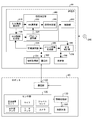
- the functional block structure of the robot 40 and the server 60 is shown schematically.
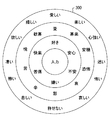
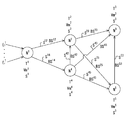
- An emotion map 300 is schematically shown. 1 schematically illustrates a portion of a neural network used by system 10. It is an example of the sensor corresponding
- the time change of the excitement degree in the robot 40 is shown schematically.
- An example of the time change of the memory intensity of the memory information memorized by storage part 280 is shown roughly. The other example of the time change of the memory intensity of the memory
- stored in the storage part 280 is shown roughly.
- An example of information stored in the storage unit 280 is shown.
- the selection permissible information indicating the recall information permitted to be selected as the recall information is shown.
- FIG. 1 schematically shows an example of the overall configuration of a system 10 according to the present embodiment.
- the system 10 includes a server 60, a robot 40a, a robot 40b, and a robot 40c.
- the server 60 can function as a storage control system.
- Each of the robot 40a, the robot 40b, and the robot 40c is an example of a target object in the storage control system.
- the robot 40a, the robot 40b, and the robot 40c are arranged at home, for example.
- the user 50a is a user of the robot 40a.
- the user 50a is a family member at the home where the robot 40a is arranged or another person who visits the home.
- the robot 40a performs an exchange such as a conversation with the user 50a.
- the robot 40b and the robot 40c perform exchanges such as a conversation with the user 50b and the user 50c, respectively.
- the robot 40a, the robot 40b, and the robot 40c can be applied to a usage form such as being arranged at the reception of a store or an office and responding to a visitor.
- the usage forms of the robot 40a, the robot 40b, and the robot 40c are not limited to these usage forms.
- the server 60 is provided remotely from the robot 40a, the robot 40b, and the robot 40c.
- the server 60 can control the robot 40a, the robot 40b, and the robot 40c through the communication network 90.
- the server 60 acquires sensor information detected by the robot 40a through the communication network 90, determines emotions of the robot 40a and actions to be performed by the robot 40a based on the acquired sensor information, and transmits through the communication network 90.
- the control information is transmitted to instruct the robot 40a.
- the robot 40b and the robot 40c have substantially the same function as the robot 40a.
- the robot 40a, the robot 40b, and the robot 40c may be collectively referred to as the robot 40.
- the server 60 executes a process for determining emotions and actions of the robot 40.
- the robot 40 may execute a part or all of the processing for determining the emotion and action of the robot 40.
- the robot 40 acquires various information detected by the sensor such as the voice and image of the user 50 and information on the external force received by the robot 40 and transmits the acquired information to the server 60.
- the server 60 generates control information for controlling the robot 40 using a neural network (NN) based on the information acquired from the robot 40.
- NN neural network
- the server 60 recognizes the existence of the user 50a from the voice and image of the user 50a, recognizes that the user 50a is “A-kun”, and event information that “A-kun exists”. Is generated. Further, event information such as “boiled” is generated from the external force information acquired from the robot 40. Further, the server 60 generates input information to the neural network from the information acquired from the robot 40.
- the server 60 determines the emotion from the generated input information using information corresponding to the amount of endocrine substances in the living body as action information that affects the determination of the emotion. For example, the server 60 determines an emotion using a neural network using as parameters the amount of endocrine substances such as dopamine, noradrenaline, and serotonin.
- a neural network an increase in the amount of dopamine affects the generation of emotions similar to “happy”.
- An increase in the amount of noradrenaline affects the generation of emotions similar to “anger”.
- an increase in the amount of serotonin acts to suppress the intensity of emotions such as “happy” and “anger”.
- the neural network determines what kind of emotion is likely to be born depending on the sum of the secretion amounts of these endocrine substances.
- the server 60 determines that the strength of the emotion has exceeded the threshold when the total value of the dopamine amount and the noradrenaline amount exceeds the threshold value.
- the server 60 stores secretory information indicating the amount of the endocrine substance together with the storage information based on the information acquired from the robot 40. Examples of the stored information include predetermined types of information such as the above-described event information “A is there” and “boiled”, and image and video information acquired from the robot 40.
- the server 60 generates event information “A is there” from the newly acquired information after storing the stored information.
- the server 60 compares the current endocrine secretion amount of the robot 40 with the endocrine secretion amount stored together with the storage information of “A-kun is present” and “boiled”. If it is determined that the secretory amounts of the endocrine substances are similar, the server 60 selects the storage information “boiled” stored together with the storage information “A is there” as information to be recalled.
- the server 60 is stored together with the storage information “A is there” and “boiled”.
- the emotion of the robot 40 is determined by reflecting the amount of endocrine secretion in the processing of the neural network.
- the endocrine substances stored together with the storage information “A is present” and “boiled” are stored.
- the emotion of the robot 40 is determined by reflecting the secreted amount opposite to the secreted amount in the processing of the neural network. This makes it easier to obtain emotions that are different from “happy”, for example. Thereby, for example, unfortunate emotions are generated.
- FIG. 2 schematically shows the functional block configuration of the robot 40 and the server 60.
- the robot 40 includes a sensor unit 120, an information processing unit 130, a control target 160, and a communication unit 102.
- the information processing unit 130 may be a processor such as an MPU.
- the communication unit 102 is responsible for communication with the server 60.
- the communication unit 102 may be a communication device such as a network IF.
- Control object 160 includes a speaker.
- the control object 160 also includes a motor that drives a movable part such as a limb or head of the robot 40.
- the sensor unit 120 includes various sensors such as a microphone, a gyro sensor, a motor sensor, a camera, a battery remaining amount sensor, and an infrared sensor.
- the microphone of the sensor unit 120 acquires ambient sound. For example, the microphone of the sensor unit 120 acquires the voice of the user 50.
- the camera of the sensor unit 120 shoots with visible light and generates image information of moving images and still images.
- the infrared sensor of the sensor unit 120 detects surrounding objects using infrared rays.
- the gyro sensor of the sensor unit 120 detects the angular velocity of the entire robot 40 and each part of the robot 40.
- the motor sensor of the sensor unit 120 detects the rotation angle of the drive shaft of the motor that drives the movable part of the robot 40.
- the remaining battery level sensor of the sensor unit 120 detects the remaining battery capacity of the robot 40.
- the sensor unit 120 is an audio data acquired by a microphone, an image captured by a camera, an angular velocity detected by a gyro sensor, a rotation angle detected by a motor sensor, a remaining capacity detected by a battery remaining amount sensor, and an infrared sensor.
- Various sensor data such as detected object information is output to the information processing unit 130.
- the information processing unit 130 supplies the acquired sensor signal to the communication unit 102 and transmits it to the server 60.
- the information processing unit 130 causes the speaker of the robot 40 to speak or operates the limbs of the robot 40 based on the control information acquired from the server 60.
- the server 60 includes a processing unit 270, a communication unit 202, and a storage unit 280.
- the processing unit 270 includes a secretion information generation unit 200, an input information generation unit 210, a parameter adjustment unit 220, an emotion determination unit 260, a control unit 250, an information selection unit 284, an event information generation part 286, and a storage.
- Emotion determination unit 260 includes NN calculation unit 230 and emotion determination unit 240.
- the communication unit 202 includes an information acquisition unit 204.
- the communication unit 202 is responsible for communication with the robot 40.
- the communication unit 202 may be a communication device such as a network IF.
- the storage unit 280 includes a storage medium such as a hard disk device or a flash memory.
- the storage unit 280 includes a volatile storage device such as a RAM.
- the storage unit 280 stores data necessary for executing the processing of the processing unit 270, in addition to program codes read by the processing unit 270 during execution and various kinds of temporary data.
- the information acquisition unit 202 acquires information for determining the emotion of the robot 40. For example, the information acquisition unit 202 acquires information detected by the sensor unit 120 of the robot 40 through the network 90.
- the event information generation part 286 generates event information based on the information acquired by the information acquisition unit 202. For example, the event information generation part 286 generates event information such as “A is there” or “boiled”.
- the event information can be stored in the storage unit 280 as storage information.
- the secretion information generation unit 200 generates secretion information indicating the secretion amount of the endocrine substance that affects the determination of the emotion of the robot 40 based on the information acquired by the information acquisition unit 202.
- the storage control unit 282 acquires the secret information and the information acquisition unit 202 when the strength of the emotion of the robot 40 determined based on the information acquired by the information acquisition unit 202 exceeds a predetermined value.
- the stored information based on the information is stored in association with each other.
- the storage control unit 282 causes the storage unit 280 to store secretion information and storage information based on the information acquired by the information acquisition unit 202.
- the information selection unit 284 selects the storage information recalled by the robot 40 from the storage information stored in association with the secretion information.
- the storage control unit 282 determines the first information based on the first information when the emotion strength of the robot 40 determined based on the first information acquired by the information acquisition unit 202 exceeds a predetermined value. And the second storage information based on the second information acquired by the information acquisition unit 202 before the first information and the first storage information set and the secretion information are stored in association with each other.
- the information selection unit 284 determines that the secretion information generated by the secretion information generation unit 200 is the second storage information and the first storage information.
- memory control such as so-called federated learning can be implemented.
- the storage control unit 282 is provided on the condition that the information acquisition unit 202 further acquires new information that matches the first storage information.
- Secretion information obtained by increasing the secretion amount of the endocrine substance having the action of suppressing undulations is stored in association with the set of the second storage information and the first storage information. As a result, familiarity with events that occur at a high frequency can be generated.
- the secretory information generation unit 200 on the condition that, when the first storage information is selected by the information selection unit 284, the information acquisition unit 202 further acquires new information that matches the first storage information.
- the secretory amount of the endocrine substance indicated by the secretory information stored in association with the set of the two stored information and the first stored information is reflected in the secretory information indicating the current secretory quantity of the endocrine substance.
- the storage control unit 282 determines the first information based on the first information when the emotion strength of the robot 40 determined based on the first information acquired by the information acquisition unit 202 exceeds a predetermined value.
- the information selection unit 284 indicates that the secretion information generated by the secretion information generation unit 200 is the second information.
- the first storage information as the storage information recalled by the target object on the condition that it matches the first combination of the plurality of storage information and the secretion information stored in association with the first storage information set And a first combination of the second plurality of stored information and a first set of stored information.
- the storage control unit 282 includes the first storage information and the first storage information.
- the secretory information is stored in association with it.
- the information selection unit 284 indicates that the secretion information generated by the secretion information generation unit 200 is the second information.
- Storage information recalled by the robot 40 on the condition that it matches the secretion information stored in association with the first combination of the plurality of storage information and the sequence combination of the first storage information and the third storage information.
- the first storage information, the first combination of the second plurality of storage information, and the sequence combination of the first storage information and the third storage information are selected.
- the storage unit 280 is associated with one or more pieces of determination information, and is allowed to be selected as information recalled by the robot 40 when information suitable for the one or more pieces of determination information is acquired.
- the stored information is stored.
- the information selection unit 284 associates information that matches the determination information stored in the storage unit 280 in association with the set of the second storage information and the first storage information, and information that matches the second storage information. Is acquired within a predetermined time, the first storage information is selected as the storage information recalled by the robot 40. Thereby, it can suppress operating based on the information learned in the completely different scene in the past.
- the secretion information generation unit 200 receives the second storage information. And the secretory amount of the endocrine substance having an action contrary to the action of the endocrine substance of the secretory amount indicated by the secretory information stored in association with the set of the first memory information, the second memory information and the new information And is reflected in the secretory information stored in association with the third set of stored information.
- the secretion information generation unit 200 stores the secretion information stored in association with the set of the second storage information and the third storage information, in which the secretory amount of the endocrine substance having the opposite action is reflected.
- the emotion determination unit 260 determines the emotion of the robot 40 based on the secretion amount of the endocrine substance indicated by the secretion information and the information acquired by the information acquisition unit 202.
- the emotion determination unit 260 determines the emotion of the robot 40 using a neural network that receives input information based on the information acquired by the information acquisition unit 202.
- the NN calculation unit 230 calculates a neural network
- the emotion determination unit 240 determines an emotion based on the result of the neural network calculation by the NN calculation unit 230, thereby determining the emotion.
- the parameter adjustment unit 220 adjusts a calculation parameter for determining emotion from input information based on the secretion amount of the endocrine substance indicated by the secretion information generated by the secretion information generation unit 200.
- Emotion determination unit 260 determines an emotion from input information using a calculation parameter.
- the secretion amount of the endocrine substance indicated by the secretion information affects the coupling coefficient of the artificial synapse included in the neural network.
- the neural network includes a plurality of emotional artificial neurons, which are artificial neurons with defined emotions.
- the emotion determination unit 260 determines the current emotion based on the current firing state of each of the plurality of emotion artificial neurons. For example, the emotion determination unit 260 may determine an emotion assigned to the fired emotional artificial neuron as the emotion of the robot 40.
- the control unit 250 controls the robot 40 according to the emotion determined by the emotion determination unit 260. For example, when the emotion determination unit 260 determines a “happy” emotion, the control unit 250 generates control information for executing an action indicating happiness and transmits the control information to the robot 40. Further, the control unit 250 may generate control information for outputting a voice with a bright tone from the speaker of the robot 40, and cause the robot 40 to have a conversation with the user.
- each unit of the server 60 and a computer may be realized.
- the processing unit 270 may be realized by a processor such as an MPU
- the storage unit 280 may be realized by a recording medium such as a nonvolatile memory.
- the storage unit 280 may store a program executed by the processor.
- the processor executes the program, the secretory information generation unit 200, the input information generation unit 210, the parameter adjustment unit 220, the emotion determination unit 260 including the NN calculation unit 230 and the emotion determination unit 240, the control unit 250,
- the storage control unit 282, the information selection unit 284, and the event information generation part 286 may be mounted, and the control of the storage unit 280 may be realized.
- the program may be read by the processor from the recording medium 290 such as an optical disk and stored in the storage unit 280, or may be provided to the server 60 through the network and stored in the storage unit 280.
- the storage unit 280 and the recording medium 290 may be computer-readable non-transitory recording media.
- FIG. 3 schematically shows the emotion map 300.
- the emotions are arranged concentrically radially from the center. The closer to the center of the concentric circles, the more primitive emotions are placed. Outside the concentric circles, emotions representing the state and behavior born from the emotional state are arranged. Emotion is a concept that includes emotions and mental states. On the left side of the concentric circles, emotions generated from reactions that occur in the brain are generally arranged. On the right side of the concentric circles, emotions induced by situation judgment are generally arranged.
- the neural network to be calculated by the NN calculation unit 230 includes an artificial neuron assigned to each emotion shown in the emotion map 300.
- a plurality of artificial neurons for input are assigned to the input located on the innermost side of the concentric circle in the emotion map 300.
- the input information generated by the input information generation unit 210 from the information acquired by the information acquisition unit 204 is input to the plurality of input artificial neurons.
- artificial neurons are generally connected by artificial synapses from the inside to the outside to form a neural network.
- the NN operation unit 230 repeatedly performs a neural network operation based on the input information to determine the firing state of each artificial neuron.
- the emotion determination unit 240 determines the emotion of the robot 40 from the firing state of each artificial neuron. For example, the emotion determination unit 240 determines an emotion to which the fired artificial neuron is assigned as one emotion that the robot 40 has.
- FIG. 4 schematically illustrates a portion of the neural network used by the system 10.
- a part of the illustrated neural network includes artificial neurons N 1 , N 2 , N 3 , N 4 and N 5 and artificial synapses S 12 , S 14 , S 23 , S 25 , S 42 , S 43 , S 45. and a and S 53.
- Artificial neurons correspond to neurons in the living body.
- An artificial synapse corresponds to a synapse in a living body.
- E 1 indicates input information based on the detection signal.
- Artificial neuron N 1 is an artificial neuron for input. The n pieces of input information E 1 1 ... Input information E n 1 generated based on the detection signals of the sensors are input to the artificial neuron N 1 .
- Artificial Synapse S 12 is an artificial synapses for connecting the neurons and N 1 and the artificial neuron N 2.
- the artificial synapse S 12 the output of the artificial neuron N 1, an artificial synapse inputs to the artificial neuron N 2.
- the artificial synapse S 14 is an artificial synapse that connects the artificial neuron N 1 and the artificial neuron N 4 .
- the artificial synapse S 14 is an artificial synapse that inputs the output of the artificial neuron N 1 to the artificial neuron N 4 .
- an artificial synapse in which j and k are integers and the output of the artificial neuron N j is input to the artificial neuron N k is denoted as an artificial synapse S jk .
- each artificial neuron is denoted by N i.
- N i has a S i representing the status of the N i, and V i m which represents the internal state of the artificial neuron represented by N i, and T i which represents the threshold of the ignition of the N i as a parameter.
- the artificial synapse S jk has a coupling coefficient BS jk as a parameter.
- the artificial neuron may be collectively referred to as an artificial neuron N with its subscript omitted.
- the artificial synapse is collectively referred to as an artificial synapse S with its subscript omitted.
- the parameters of the artificial neuron may be collectively referred to as internal information Vm, threshold value T, and status S with their subscripts omitted.
- the status S, the internal state Vm, and the threshold T of the artificial neuron N are parameters that can be updated as time progresses.
- the status S is information regarding the firing state of the neuron, and indicates at least whether the artificial neuron is in the firing state or in the non-firing state.
- the internal state Vm is information relating to the membrane potential of the neuron, and is an example of a parameter representing the internal state or output of the artificial neuron N.
- the coupling coefficient BS which is a parameter of the artificial synapse S, is a parameter that can be updated as time advances.
- the coupling coefficient BS is information relating to synaptic plasticity, and indicates the coupling strength between the artificial neurons N to which the artificial synapse S is coupled.
- the NN calculation unit 230 updates the above-described parameters in the neural network from the input information, and calculates the internal state Vm of each artificial neuron N.
- the status S of the artificial neuron N is “fired”.
- the artificial neuron N outputs a predetermined signal over a predetermined time.
- the status S of N returns to the last ignition.
- NN arithmetic unit 230 an input I 2 to N 2, is calculated by BS 12 ⁇ Vm 1 ⁇ f ( S 1) + BS 42 ⁇ Vm 4 ⁇ f (S 4).
- f (S) is a function that returns 0 when S is a value indicating unfired, and returns 1 when S is a value indicating the rising phase or the falling phase.
- f (S) a function corresponding to another transfer model of the membrane potential may be applied.
- NN calculation unit 230 an input I i to N i, is calculated by ⁇ j BS ji ⁇ Vm j ⁇ f (S j) + ⁇ j E j i.
- the NN operation unit 230 calculates the inputs I i and S i to the N i at the next time using the BS ji , Vm j , S j , and E j at the current time.
- the NN calculation unit 230 repeats this in time to determine the status S of each artificial neuron N in real time.
- the emotion determination unit 240 determines the feeling of the robot 40 based on the status S of each artificial neuron N. For example, when an artificial neuron assigned with the emotion of “happy” in FIG. 3 fires, the emotion determination unit 240 can determine that the robot 40 has the emotion of “happy”.
- the parameter adjustment unit 220 adjusts the BS based on the information acquired from the robot 40. For example, when it is detected that the remaining capacity that is the remaining amount of the storage battery of the robot 40 is 50% or less, the secretion information generation unit 200 increases the secretion amount of “noradrenaline” as an internal variable. Then, the parameter adjustment unit 220 adjusts the coupling coefficient BS of the artificial synapse S associated with “noradrenaline” based on the secretion amount of “noradrenaline”.
- the generation of “noradrenaline” is set so as to enhance the coupling coefficient BS of the artificial synapse S on the path where the artificial emotional neuron corresponding to the emotion such as “anxiety” or “anger” fires, for example. ing.
- “noradrenaline” acts in such a direction that emotions such as “anxiety” and “anger” are likely to be generated.
- the amount of endocrine secretion is associated with a specific artificial synaptic S binding coefficient BS.
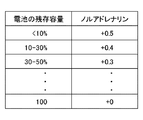
- FIG. 5 is an example of correspondence information that associates the remaining capacity of the storage battery with an endocrine substance.
- the storage unit 280 stores information indicating noradrenaline in association with a plurality of values of the remaining capacity of the storage battery. More specifically, the storage unit 280 stores information indicating an increase in the amount of noradrenaline secreted in association with each remaining capacity of the storage battery. In addition, the increase amount of secretion amount is shown by the ratio with respect to the upper limit 1 of the secretion amount which the internal variable which the NN calculating part 230 uses represents. Thereby, as the remaining capacity of the storage battery decreases, the amount of noradrenaline secreted increases, and the feelings of “anxiety” and “anger” are more likely to be generated.
- FIG. 6 is an example of binding coefficient correspondence information that correlates the secretion amount of noradrenaline and the binding coefficient BS.
- Storage unit 280 in association with total amount of secreted noradrenaline, and increase the coefficient of coupling coefficient BS 14 of the artificial synapse S 14, the increase factor of the coupling coefficient BS 45 of the artificial synapse S 45, the coupling coefficient of the artificial synapse S 43 Information for associating the increase coefficient of the BS 43 is stored. It is assumed that the artificial synapse S taken up here is connected to the artificial neuron N by strong coupling.
- the increase coefficient of BS 14 and the increase coefficient of BS 45 are associated with larger values as the amount of noradrenaline increases.
- the increase coefficient of BS 43 is associated with a smaller value as the amount of noradrenaline increases.
- the increase coefficient may be set so that the coupling coefficient BS of the artificial synapse S can be adjusted in a direction that makes the output destination artificial neuron N difficult to fire.
- the increase coefficient may be set so that the coupling coefficient BS of the artificial synapse S can be adjusted in a direction that makes the output destination artificial neuron N difficult to fire.
- the parameter adjustment unit 220 refers to the binding coefficient correspondence information and adjusts the corresponding binding coefficient BS by an amount corresponding to the total secretion amount of each endocrine substance.
- the adjustment amount of the coupling coefficient BS can be adjusted in a complex manner from the information acquired by the robot 40, and thus the emotional artificial neuron can be fired in various combinations.
- the relationship between the information acquired by the robot 40 and the endocrine substances and the relationship between each endocrine substance and the binding coefficient BS are replaced with humans to make them correspond to each other. Can generate emotions.
- FIG. 7 schematically shows the time change of the excitement level in the robot 40.
- the emotion determination unit 260 calculates, for example, the sum of the secretion amount of dopamine and the secretion amount of noradrenaline as the degree of excitement.
- the degree of excitement is an example of the emotional strength of the robot 40.
- the NN calculation unit 230 when the NN calculation unit 230 performs a calculation based on input information based on information at time t3, and the excitement level exceeds the storage threshold, the information is generated from information at time t3. Event information “boiled” is stored in the storage unit 280. Further, as a result of the calculation performed by the NN calculation unit 230 based on the input information based on the information at the time t13, when the excitement level exceeds the storage threshold, event information “ignored” generated from the information at the time t13 is generated. Stored in the storage unit 280.
- FIG. 8 schematically shows an example of the temporal change in the storage intensity of the storage information stored in the storage unit 280.
- the storage information “ignored” obtained from the information at time t13 will be described.
- the memory intensity at time t13 is an intensity corresponding to the degree of excitement obtained from the input information based on the information at time t13.
- the storage unit 280 stores the storage intensity in association with the storage information.
- the storage unit 280 gradually decreases the storage intensity stored in association with the storage information as time passes.
- the decrease rate of the memory intensity per time may decrease with the passage of time.
- a decrease in memory intensity represents forgetting. You may apply a forgetting curve as a curve which shows the relationship between time and memory intensity.
- the rate of decrease in memory intensity per time may be constant regardless of time.
- Stored information is stored in a manner corresponding to the storage intensity. Specifically, the storage information whose storage intensity exceeds the storage level threshold th1 is stored in the storage unit 280 as manifestation awareness information.
- the storage information stored in the storage unit 280 as the manifestation awareness information is recalled spontaneously at a predetermined frequency.
- the information selection unit 284 selects information “ignored” as recall information at a predetermined frequency. In FIG. 8, it is recalled three times.
- FIG. 8 shows a case where it is determined that the situation of “ignored” does not occur from the information acquired from the robot 40 when the stored information “ignored” is recalled.
- the memory intensity stored in the storage unit 280 is not increased and gradually decreases with time.
- Storage information whose storage intensity is equal to or less than the storage level threshold th1 and whose storage intensity exceeds the storage level threshold th2 is stored in the storage unit 280 as subconscious information.
- the stored information stored in the storage unit 280 as the subconscious information is not recalled spontaneously.
- the stored information is deleted from the storage unit 280.
- the storage intensity of the stored information gradually decreases.
- the data is finally deleted from the storage unit 280.
- the stored information generated in a situation that does not frequently occur in the robot 40 is deleted. Therefore, the storage area of the storage unit 280 can be used effectively.
- FIG. 9 schematically shows another example of the temporal change in the storage intensity of the storage information stored in the storage unit 280.
- the storage information “boiled” obtained from the information at time t3 will be described.
- the memory intensity at time t3 is an intensity corresponding to the excitement degree obtained from the input information based on the information at time t3.
- the storage unit 280 gradually decreases the storage intensity stored in association with the storage information as time passes.
- the storage unit 280 increases the storage strength stored in association with the storage information “boiled” by a predetermined strength. Note that the amount of increase in the memory intensity may be variable. In addition, the storage unit 280 subsequently reduces the rate of decrease in storage intensity per time. As shown in FIG.
- the decrease rate of the memory intensity per time from the recalled time point is smaller than the decrease rate of the memory intensity per time from the time point stored at the time t3. Also, the information selection unit 284 reduces the frequency of recalling the information “boiled”. Details of the parameters for reducing the recall frequency will be described later.
- the memory information “boiled” becomes the subconscious information after the second voluntary recall and the second voluntary recall with a low recall frequency. If a new event that matches the event when the memory information “boiled” is generated after the subconscious information is generated, it is recalled even after the subconscious information is generated.
- the storage information “boiled” is associated with the accompanying storage information “A is there”.
- the storage information “boiled” is associated with the incidental storage information of “A-kun is present”. Can be recalled. A specific example of the storage process and the recall process will be described later.
- FIG. 9 shows a case where it is determined from the information acquired from the robot 40 that the event “boiled” has occurred, as in the above-described fourth spontaneous recall.
- the storage unit 280 increases the storage strength stored in association with the storage information “boiled” by a predetermined strength.
- the storage unit 280 subsequently reduces the rate of decrease in storage intensity per time. As shown in FIG. 9, the rate of decrease in memory intensity per hour from the time point recalled this time is smaller than the rate of decrease in memory intensity per hour point from the time point recalled last time. In this way, the rate of decrease in memory intensity per hour decreases each time you recall, and the memory intensity gradually decreases.
- the information selection unit 284 reduces the frequency of recalling the information “boiled”.
- the stored information when events that match the stored information frequently occur, the memory intensity increases, the rate of decrease of the memory intensity per time decreases, and the recall frequency of the stored information decreases. Therefore, if events that match the stored information occur frequently, the stored information is stored as a more familiar and more common storage. As described above, according to the system 10, the stored information can be stored in such a manner that the memory is fixed by repeated learning by a human.
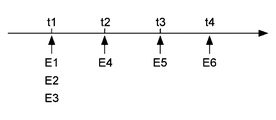
- FIG. 10 is a diagram for explaining an acquisition sequence of information acquired from the robot 40.
- the storage information “boiled” is event information generated based on the information at time t3. From the information at time t1 that is a predetermined time before time t3, incidental storage information “sunny day” is generated, and from the information at time t2, incidental storage information “A is there” is generated. Suppose that Any incidental information is stored in the storage unit 280 in association with the storage information “boiled”.
- incidental storage information “cloudy day” is generated, and from the information at time t12, additional storage information “A is present” is generated. Assume that it has been generated. All of the generated incidental information is stored in the storage unit 280 in association with the storage information “ignored”.
- FIG. 11 shows an example of information stored in the storage unit 280.
- Each storage information of E3, E1 ⁇ E3, E2 ⁇ E3, E13, E11 ⁇ E13, E2 ⁇ E13 is stored in the storage unit 280 in association with the secreted amounts of a plurality of endocrine substances.
- the secretion amount of the endocrine substance associated with the stored information indicates the strength that evokes the emotion that each endocrine substance acts when an event that matches the stored information occurs.
- the amount of secreted dopamine indicates the strength that evokes the feeling of “happy” when an event that matches the memory information occurs.
- the amount of noradrenaline secreted indicates the strength that evokes the feeling of “anxiety” when an event that matches the stored information occurs.
- the amount of serotonin secreted indicates the strength to suppress the undulation of emotion when an event that matches the stored information occurs.
- the amount of serotonin secreted indicates the degree of establishment of the corresponding stored information. For example, the greater the amount of serotonin secreted, the more established the memory. Therefore, the greater the amount of serotonin secreted, the lower the spontaneous recall frequency and the lower the decrease rate of memory intensity per unit time. That is, the storage unit 280 reduces the decrease rate per unit time of the storage intensity of the storage information having a higher serotonin secretion amount. Further, the information selection unit 284 selects the storage information stored in the storage unit 280 in association with a larger amount of serotonin secretion as the recall information at a lower frequency. In addition, the information selection unit 284 selects only storage information whose storage intensity exceeds the storage level threshold th1 from among the storage information stored in the storage unit 280 as spontaneous recall information.
- the storage unit 280 stores dopamine secretion amount 0.6, noradrenaline secretion amount 0, and serotonin secretion amount 0.5 in association with the storage information of E3. Therefore, the event indicated by E3 means that it occurs relatively frequently as compared to events corresponding to other stored information.
- the storage unit 280 stores a dopamine secretion amount of 0, a noradrenaline secretion amount of 0.9, and a serotonin secretion amount of 0.05 in association with the stored information of E13. Therefore, when an event that actually matches E13 occurs when the stored information of E13 is recalled, it means that the feeling of “anxiety” is greatly evoked.
- E1 ⁇ E3 indicates that E3 occurs after E1 occurs.
- E2 ⁇ E3 indicates that E3 occurs after E2 occurs.
- the robot 40 is not used to stroking in the situation where A is present, and “happy” because it is stroking in the situation where A is present, rather than being stroked on a sunny day. It shows that the feelings of the are awakened more greatly.
- E11 ⁇ E13 indicates that E13 occurs after E11 occurs.
- E2 ⁇ E13 indicates that E13 occurs after E2 occurs.
- the robot 40 is not so used to being ignored. It shows that the feelings of the are strongly evoked.
- the amount of dopamine secreted is adjusted to an average value of 0.6 with the current amount of dopamine secreted
- the amount of noradrenaline secreted is adjusted to the current amount of noradrenaline and the average value of 0
- the amount of serotonin secreted is Adjusted to the current secretion amount of serotonin and an average value of 0.4.
- the endocrine information reflected in the current secretion amount of the endocrine substance is not limited to the secretion amount of the endocrine substance associated with E1 ⁇ E3.
- the dopamine secretion amount 0.6, noradrenaline secretion amount 0, serotonin secretion amount 0.5 associated with E3 which is the later storage information in the time order the current endocrine substance It may be reflected in the amount of secretion.
- the secretion amount of the endocrine substance associated with E1 which is the storage information later in the time order in the storage information of E1 ⁇ E3 may be reflected in the current secretion amount of the endocrine substance.
- the stored information of E3 may be selected as the recall information when an event suitable for the event of E1 or E2 occurs based on the stored information of E1 ⁇ E3 or E2 ⁇ E3.
- the information selection unit 284 determines the distribution of the current secretion amount of the endocrine substance and the secretion amount of the endocrine substance associated with E1 ⁇ E3 in the storage unit 280. On the condition that the degree of coincidence with the distribution exceeds a predetermined threshold, the stored information of E3 is selected as the recall information.
- the degree of coincidence of secreted amounts of endocrine substances may be determined by using the short distance of vectors having the secreted amounts of each endocrine substance as a component.
- ⁇ i (q it The reciprocal of -qic ) 2 ⁇ 1/2 may be used as the degree of coincidence of the endocrine secretion.
- ⁇ i represents taking the sum of i.
- the storage information of E3 is selected as the recall information
- the input information suitable for E3 is input and the same event as E3 or the event suitable for E3 occurs
- the storage information of E1 ⁇ E3 Among the associated secretion amount information the secretion amount of serotonin is increased by a predetermined amount.
- the stored information of E13 may be selected as recall information when an event that matches the event of E11 or E2 occurs based on the stored information of E11 ⁇ E13 or E2 ⁇ E13.
- both E3 and E13 may be selected as recall information.
- the information selection unit 284 may select only one of E3 and E13 as the recall information. For example, the information selection unit 284 may recall only the stored information associated with the endocrine substance secretion amount distribution that is closer to the current endocrine substance secretion amount distribution.
- the information selection unit 284 matches the degree of coincidence between the secretion amount distribution of the endocrine substance associated with E2 ⁇ E3 and the current secretion amount distribution of the endocrine substance and the endocrine substance associated with E2 ⁇ E13. By comparing the degree of coincidence between the distribution of the secretion amount and the current distribution of the endocrine substance, only the memory information with the higher degree of coincidence may be selected as the recall information. Even in this case, the information selection unit 284 may not select the recall information when the degree of coincidence with the distribution of the secretion amount of the endocrine substance is smaller than a predetermined value.
- the set of stored information may include two or more pieces of stored information as previous stored information in time order.
- the storage unit 280 displays any combination of E1, E2, and E3.
- a set of storage information Ec ⁇ E4 may be stored in association with the amount of secretion of the endocrine substance.
- Ec is seven of [E1, E2, E3], [E1, E2], [E1, E3], [E2, E3], [E1], [E2], [E3]. That is, a set of seven stored information [E1, E2, E3] ⁇ E4, [E1, E2] ⁇ E4, [E1, E3] ⁇ E4, [E2, E3] ⁇ E4, [E1] ⁇ E4, [ E2] ⁇ E4 and [E3] ⁇ E4 are stored in association with the secretion amount of the endocrine substance. Each set Ec ⁇ 4 of these stored information is also recalled at predetermined time intervals. If an event that matches E4 occurs following Ec, the memory intensity of the corresponding Ec ⁇ E4 is increased.
- the set of storage information may include two or more pieces of storage information as subsequent storage information in time order.
- [E1, E2, E3] ⁇ [E4 ⁇ E5 ⁇ E6] [E1, E2] ⁇ [E4 ⁇ E5 ⁇ E6], [E1, E3] ⁇ [E4 ⁇ E5 ⁇ E6], [E2, E3] ⁇ [E4 ⁇ E5 ⁇ E6], [E1] ⁇ [E4 ⁇ E5 ⁇ E6] may be stored in association with the secretion amount information.
- the recall process will be described by taking a set of stored information of [E1, E2, E3] ⁇ [E4 ⁇ E5 ⁇ E6]. If E1, E2, and E3 events occur at the same time step, the sequence of stored information for E4, E5, and E6 may be selected. That is, it is recalled that events occur in the order of E4, E5, and E6 according to the events of E1, E2, and E3. Then, after E1, E2, and E3 events occur at the same time step, if E4, E5, and E6 continue in this sequence, the memory strength is increased. And the secretion amount of serotonin is increased among the corresponding secretion amount information.
- FIG. 13 is a diagram for explaining an endocrine substance reflected when an event different from the recall information or an event that denies the recall information occurs.
- a vector 1200 indicates a vector of emotions caused by the action of dopamine in the emotion map 300. That is, when input information is input to the input artificial neuron, information transmission is promoted in the direction indicated by the vector 1200 from the central input unit by the action of dopamine.
- a vector 1200 indicates an average direction of a route through which dopamine promotes information transmission. It does not mean that dopamine facilitates information transmission only in the direction of vector 1200.
- Vector 1202 and vector 1204 indicate representative directions of emotions that can be caused by the action of noradrenaline and serotonin, respectively, in emotion map 300.
- Vector 1210 shows a typical direction of emotions caused by the action of a secreted endocrine substance associated with E2 ⁇ E3.
- a vector 1210 is obtained by weighting and adding the vector 1200, the vector 1202, and the vector 1204 according to the secretion amount associated with E2 ⁇ E3.
- the stored information of E3 is selected as the recall information based on the stored information of E2 ⁇ E3
- the secretion amount of the endocrine substance in the direction indicated by the vector 1210 is , Reflected in the current secretion of endocrine substances.
- the secretory information generation unit 200 reflects the endocrine substance acting in the direction of the vector 1212 in the direction opposite to the vector 1210 and the secreted quantity in the secreted quantity of the endocrine substance associated with E2 ⁇ E4.
- the secretory information generation unit 200 converts the endocrine substance acting in the direction of the vector 1212 and the secretory quantity of the endocrine substance corresponding to E2 ⁇ E4 reflecting the secreted quantity into the current secretory quantity of the endocrine substance. reflect.
- the vector 1212 is a typical direction of emotion caused by the action of vasopressin in the vector 1206 in FIG. 13
- the secretory information generation unit 200 has a noradrenaline secretion amount 0.7 and a vasopressin secretion amount 0. .3 is generated and reflected in the current secretion amount of the endocrine substance.
- FIG. 14 shows permissible selection information representing recall information that can be selected as recall information.
- the storage unit 280 stores E31 ⁇ E32, E33 ⁇ E34, and E35, which are stored as actual consciousness information, in association with the event information of E21 and E22 as first selection permission information, and is stored as subconscious information.
- E41 ⁇ E42 and E43 ⁇ E44 are stored.
- the storage unit 280 stores E61 ⁇ E62, E61 ⁇ E65, and E63 ⁇ E64 stored as manifestation awareness information in association with the event information of E51 and E52 as the second selection permission information, and as the subconscious awareness information.
- the storage unit 280 stores E61 ⁇ E31, E61 ⁇ E34, and E62 ⁇ E33 stored as manifestation awareness information in association with the event information of E81 and E82 as the third selection permission information, and as the subconscious awareness information.
- the stored E71 ⁇ E41 and E72 ⁇ E43 are stored.
- the first selection permission information is that when E31 ⁇ E32 storage information is stored as manifestation awareness information, if E31 occurs after E21 and E22, E32 can be selected as recall information. Is shown.
- E33 ⁇ E34 is stored as the manifestation consciousness information
- the storage information of E41 ⁇ E42 and E43 ⁇ E44 is stored as the subconscious information
- E33 occurs after E21 and E22.
- E34 can be selected as recall information when E41 occurs after E21 and E22
- E44 can be selected when E43 occurs after E21 and E22.
- the stored information of E35 is stored as the manifestation consciousness information, it indicates that E35 can be selected as the recall information when E21 and E22 occur.
- the second selection allowance information is E62 or E64 as recall information when E61 occurs after E51 and E52. This indicates that it can be selected.
- E63 ⁇ E64 is stored as the manifestation consciousness information
- E71 ⁇ E72 and E73 ⁇ E74 is stored as the subconscious awareness information
- E63 occurs after E51 and E52.
- E64 can be selected as recall information when E71 occurs following E51 and E52, and E74 when E73 occurs following E51 and E52.
- the storage information of E61 ⁇ E62 and 61 ⁇ E65 is stored as manifestation awareness information. These sets of stored information have the same E61 as the previous stored information in time order.
- the storage information to be preferentially selected as the recall information among the storage information of E61 ⁇ E62 and 61 ⁇ E65 is selected based on the current secretion amount of the endocrine substance or the secretion amount of the specific endocrine substance. It's okay. For example, as described above with reference to FIG. 11, the secretory amount of the endocrine substance associated with the storage information E61 ⁇ E62 in the storage unit 280 and the storage information E61 ⁇ E65 in the storage unit 280.
- the stored information with the highest degree of coincidence may be selected with higher priority as the recall information by comparing each of the secreted amounts of the endocrine substance with the current secretory amount of the endocrine substance.
- the degree of coincidence of the secreted amounts of the endocrine substances may be determined by using the short distance of the vectors having the secreted amounts of the endocrine substances as components. For example, the degree of coincidence between the secretion amount of the endocrine substance associated with the storage information E61 ⁇ E65 and the current secretion amount of the endocrine substance is the secretion amount of the endocrine substance associated with the storage information E61 ⁇ E62. And E65 ⁇ E65 storage information and E65 storage information may be selected as recall information if the degree of coincidence between the secretory and the current secretory amount of the endocrine substance is higher.
- the secretion amount of the specific endocrine substance is The secreted amount of the secretory substance associated with the stored information selected by the user may be applied. For example, a plurality of stored information is presented and the user is requested to rearrange them in a predetermined order. Specifically, it requests that the stored information be rearranged in the most enjoyable order.
- the secretory amount of the endocrine substance associated with the highest stored information by the user may be applied as the secretory amount of the specific endocrine substance.
- the third selection permission information is that E31 or E34 is used as the recall information when E61 occurs after E81 and E82. This indicates that it can be selected.
- the stored information of E62 ⁇ E33 is stored as the manifestation consciousness information
- the stored information of E71 ⁇ E41 and E72 ⁇ E43 is stored as the subconscious awareness information
- E62 occurs after E81 and E82.
- E33 is selectable as recall information when E71 occurs following E81 and E82
- E74 is selectable when E72 occurs following E81 and E82.
- the storage information of E61 ⁇ E31 and 61 ⁇ E34 is stored as the manifestation awareness information.
- the memory information to be preferentially selected as the recall information among the memory information of E61 ⁇ E31 and 61 ⁇ E34 is selected based on the current secretion amount of the endocrine substance or the secretion amount of the specific endocrine substance. It's okay. Since the same processing as the selection processing of E61 ⁇ E62 and 61 ⁇ E65 in the second selection permission information can be applied to this selection processing, description thereof is omitted.
- E31 when E31 occurs after E51 and E52, it is prohibited for E32 to select as recall information.
- E62 can be selected as the recall information.
- E61 occurs following E81 and E82 different from E51 and E52
- E31 can be used as recall information.
- information that can be selected as recall information can be limited or switched according to the sequence of events that occurred immediately before.
- the robot 40 when the robot 40 enjoys playing othello with a child, the robot 40 can act based on information learned by the othello in the past. Therefore, for example, when the robot 40 is enjoying Othello with a child, it is possible to prevent the robot 40 from accidentally taking the learned action when pointing to the father and the shogi.
- the functions of the server 60 described above may be implemented by one or more computers. At least some functions of the server 60 may be implemented by a virtual machine. In addition, at least a part of the functions of the server 60 may be implemented in the cloud.
- the robot 40 is an example of a target object. Various forms other than the robot can be adopted as the target object.
Landscapes
- Engineering & Computer Science (AREA)
- Physics & Mathematics (AREA)
- Theoretical Computer Science (AREA)
- Artificial Intelligence (AREA)
- General Health & Medical Sciences (AREA)
- Software Systems (AREA)
- Mathematical Physics (AREA)
- Health & Medical Sciences (AREA)
- Evolutionary Computation (AREA)
- General Physics & Mathematics (AREA)
- Computing Systems (AREA)
- Biophysics (AREA)
- Computational Linguistics (AREA)
- Data Mining & Analysis (AREA)
- Life Sciences & Earth Sciences (AREA)
- Molecular Biology (AREA)
- Biomedical Technology (AREA)
- General Engineering & Computer Science (AREA)
- Robotics (AREA)
- Mechanical Engineering (AREA)
- Automation & Control Theory (AREA)
- Human Computer Interaction (AREA)
- Audiology, Speech & Language Pathology (AREA)
- Fuzzy Systems (AREA)
- Manipulator (AREA)
Abstract
L'invention concerne un système de commande de stockage, comprenant : une unité d'acquisition d'informations qui acquiert des informations servant à déterminer la sensation d'un objet ; une unité de génération d'informations de sécrétion qui, à partir des informations acquises par l'unité d'acquisition d'informations, génère des informations de sécrétion indiquant une quantité de sécrétion d'une substance endocrine affectant la détermination de la sensation de l'objet ; une unité de commande de stockage qui, lorsque l'intensité de la sensation de l'objet déterminée à partir des informations acquises par l'unité d'acquisition d'informations dépasse une valeur prédéterminée, associe et stocke les informations de sécrétion et des informations de stockage basées sur les informations acquises par l'unité d'acquisition d'informations ; et une unité de sélection d'informations qui, d'après les informations de sécrétion, sélectionne les informations de stockage devant être extraites par l'objet dans les informations de stockage qui ont été stockées en association avec les informations de sécrétion.
Priority Applications (3)
| Application Number | Priority Date | Filing Date | Title |
|---|---|---|---|
| CN201780026487.2A CN109074511A (zh) | 2016-05-13 | 2017-04-11 | 存储控制系统、系统以及程序 |
| EP17795880.8A EP3435293A4 (fr) | 2016-05-13 | 2017-04-11 | Système de commande de stockage, système et programme |
| US16/184,980 US20190070727A1 (en) | 2016-05-13 | 2018-11-08 | Memory control system, system and computer readable medium |
Applications Claiming Priority (2)
| Application Number | Priority Date | Filing Date | Title |
|---|---|---|---|
| JP2016-096836 | 2016-05-13 | ||
| JP2016096836A JP6273314B2 (ja) | 2016-05-13 | 2016-05-13 | 記憶制御システム、システム及びプログラム |
Related Child Applications (1)
| Application Number | Title | Priority Date | Filing Date |
|---|---|---|---|
| US16/184,980 Continuation US20190070727A1 (en) | 2016-05-13 | 2018-11-08 | Memory control system, system and computer readable medium |
Publications (1)
| Publication Number | Publication Date |
|---|---|
| WO2017195519A1 true WO2017195519A1 (fr) | 2017-11-16 |
Family
ID=60267025
Family Applications (1)
| Application Number | Title | Priority Date | Filing Date |
|---|---|---|---|
| PCT/JP2017/014875 Ceased WO2017195519A1 (fr) | 2016-05-13 | 2017-04-11 | Système de commande de stockage, système et programme |
Country Status (5)
| Country | Link |
|---|---|
| US (1) | US20190070727A1 (fr) |
| EP (1) | EP3435293A4 (fr) |
| JP (1) | JP6273314B2 (fr) |
| CN (1) | CN109074511A (fr) |
| WO (1) | WO2017195519A1 (fr) |
Families Citing this family (8)
| Publication number | Priority date | Publication date | Assignee | Title |
|---|---|---|---|---|
| DE102018130462A1 (de) * | 2018-11-30 | 2020-06-04 | Bayerische Motoren Werke Aktiengesellschaft | Verfahren, System und Computerprogramm zum Betreiben eines oder mehrerer Roboters, eines Robotersystems und/oder eines Roboterschwarms |
| CN110991618A (zh) * | 2019-12-09 | 2020-04-10 | 华中科技大学同济医学院附属协和医院 | 基于物联网监控的自动化办公用考勤系统及方法 |
| DE102020114737A1 (de) | 2020-06-03 | 2021-12-09 | Bayerische Motoren Werke Aktiengesellschaft | Verfahren, System sowie Computerprogramm zum Betreiben eines oder mehrerer Roboter, eines Robotersystems und/oder eines Roboterschwarms |
| DE102020114738A1 (de) | 2020-06-03 | 2021-12-09 | Bayerische Motoren Werke Aktiengesellschaft | Verfahren, System sowie Computerprogramm zum Betreiben eines oder mehrerer Roboter, eines Robotersystems und/oder eines Roboterschwarms |
| JP2023007084A (ja) * | 2021-07-01 | 2023-01-18 | セイコーエプソン株式会社 | 力制御パラメーター設定支援方法および力制御パラメーター設定支援システム |
| JP7655292B2 (ja) * | 2022-09-26 | 2025-04-02 | カシオ計算機株式会社 | ロボット、ロボット制御方法及びプログラム |
| JP7297342B1 (ja) | 2022-09-26 | 2023-06-26 | 株式会社Creator’s NEXT | 脳情報の分析によるレコメンデーション |
| JP7754146B2 (ja) * | 2023-09-22 | 2025-10-15 | カシオ計算機株式会社 | ロボット、制御方法及びプログラム |
Citations (3)
| Publication number | Priority date | Publication date | Assignee | Title |
|---|---|---|---|---|
| JPH10254592A (ja) | 1997-03-13 | 1998-09-25 | Nec Corp | 感情生成装置およびその方法 |
| JP2011253389A (ja) | 2010-06-02 | 2011-12-15 | Fujitsu Ltd | 端末および擬似会話用返答情報作成プログラム |
| JP2013535067A (ja) | 2010-06-30 | 2013-09-09 | インターナショナル・ビジネス・マシーンズ・コーポレーション | 時空パターンを記憶する方法、そのためのシステム、およびコンピュータ・プログラム |
Family Cites Families (7)
| Publication number | Priority date | Publication date | Assignee | Title |
|---|---|---|---|---|
| JP2001160131A (ja) * | 1999-09-10 | 2001-06-12 | Yamaha Motor Co Ltd | 挙動調整システム及び挙動調整方法 |
| KR100624403B1 (ko) * | 2001-10-06 | 2006-09-15 | 삼성전자주식회사 | 인체의 신경계 기반 정서 합성 장치 및 방법 |
| CN100399307C (zh) * | 2004-04-23 | 2008-07-02 | 三星电子株式会社 | 通过使用角色图像显示便携式终端状态的设备和方法 |
| JP2010094493A (ja) * | 2008-09-22 | 2010-04-30 | Koichi Kikuchi | 視認情景に対する視認者情感判定装置 |
| US20130346920A1 (en) * | 2012-06-20 | 2013-12-26 | Margaret E. Morris | Multi-sensorial emotional expression |
| US9692839B2 (en) * | 2013-03-13 | 2017-06-27 | Arris Enterprises, Inc. | Context emotion determination system |
| JP6851871B2 (ja) * | 2016-03-30 | 2021-03-31 | 光吉 俊二 | 意思創発装置、意思創発方法および意思創発プログラム |
-
2016
- 2016-05-13 JP JP2016096836A patent/JP6273314B2/ja active Active
-
2017
- 2017-04-11 EP EP17795880.8A patent/EP3435293A4/fr not_active Withdrawn
- 2017-04-11 WO PCT/JP2017/014875 patent/WO2017195519A1/fr not_active Ceased
- 2017-04-11 CN CN201780026487.2A patent/CN109074511A/zh not_active Withdrawn
-
2018
- 2018-11-08 US US16/184,980 patent/US20190070727A1/en not_active Abandoned
Patent Citations (3)
| Publication number | Priority date | Publication date | Assignee | Title |
|---|---|---|---|---|
| JPH10254592A (ja) | 1997-03-13 | 1998-09-25 | Nec Corp | 感情生成装置およびその方法 |
| JP2011253389A (ja) | 2010-06-02 | 2011-12-15 | Fujitsu Ltd | 端末および擬似会話用返答情報作成プログラム |
| JP2013535067A (ja) | 2010-06-30 | 2013-09-09 | インターナショナル・ビジネス・マシーンズ・コーポレーション | 時空パターンを記憶する方法、そのためのシステム、およびコンピュータ・プログラム |
Non-Patent Citations (2)
| Title |
|---|
| See also references of EP3435293A4 |
| TOMONORI SHINDO: "Pepper no Kanjo Seisei Engine wa RNN o Riyo 7 Shu no Kasoteki Hormone o Mogi shite Kidoairaku", NIKKEI ELECTRONICS, 20 November 2015 (2015-11-20), pages 100 - 101, XP009510604, ISSN: 0385-1680 * |
Also Published As
| Publication number | Publication date |
|---|---|
| US20190070727A1 (en) | 2019-03-07 |
| EP3435293A1 (fr) | 2019-01-30 |
| JP6273314B2 (ja) | 2018-01-31 |
| JP2017204216A (ja) | 2017-11-16 |
| EP3435293A4 (fr) | 2019-04-17 |
| CN109074511A (zh) | 2018-12-21 |
Similar Documents
| Publication | Publication Date | Title |
|---|---|---|
| JP6273314B2 (ja) | 記憶制御システム、システム及びプログラム | |
| JP6992839B2 (ja) | 情報処理装置、情報処理方法及びプログラム | |
| US10970527B2 (en) | Robot attention detection | |
| JP6351692B2 (ja) | 表示制御装置 | |
| JP2017511936A (ja) | 現在の計算リソースへのニューラルネットワーク適応 | |
| CN113778663A (zh) | 一种多核处理器的调度方法及电子设备 | |
| JP6273313B2 (ja) | 感情特定システム、システム及びプログラム | |
| JP6199927B2 (ja) | 制御システム、システム及びプログラム | |
| CN106462255A (zh) | 一种机器人交互内容的生成方法、系统及机器人 | |
| JPWO2020004213A1 (ja) | 情報処理装置、情報処理方法、およびプログラム | |
| CN108540544B (zh) | 一种运动信息共享方法及终端 | |
| JP7331837B2 (ja) | 情報処理装置および情報処理方法 | |
| KR20200077936A (ko) | 사용자 상태에 기초하여 반응을 제공하는 전자 장치 및 그의 동작 방법 | |
| CN106357986B (zh) | 一种柔光灯亮度控制方法及电子设备 | |
| WO2016143415A1 (fr) | Appareil de traitement d'informations, procédé de traitement d'informations et programme | |
| JP2024172925A (ja) | 記憶制御システム、システム及びプログラム | |
| CN121127858A (zh) | 控制系统、系统以及程序 | |
| JP6473511B2 (ja) | ゲームパラメータ制御方法、装置及びゲーム制御方法、装置 | |
| JP2024176716A (ja) | 制御システム、システム及びプログラム | |
| JP2024176842A (ja) | 制御システム及びプログラム | |
| CN119940426B (zh) | 一种基于记忆巩固的持续学习方法、装置、介质及设备 | |
| KR20220122335A (ko) | 상호작용 훈련방법 및 이를 수행하는 로봇 장치 | |
| CN116370954B (zh) | 游戏方法和游戏装置 | |
| WO2020158440A1 (fr) | Dispositif de traitement d'informations, procédé de traitement d'informations et support d'enregistrement dans lequel un programme est écrit | |
| US11413520B2 (en) | Method and system for a personal interaction game platform |
Legal Events
| Date | Code | Title | Description |
|---|---|---|---|
| WWE | Wipo information: entry into national phase |
Ref document number: 2017795880 Country of ref document: EP |
|
| ENP | Entry into the national phase |
Ref document number: 2017795880 Country of ref document: EP Effective date: 20181023 |
|
| NENP | Non-entry into the national phase |
Ref country code: DE |
|
| 121 | Ep: the epo has been informed by wipo that ep was designated in this application |
Ref document number: 17795880 Country of ref document: EP Kind code of ref document: A1 |