WO2017195584A1 - Dispositif d'entraînement et dispositif de pompe - Google Patents
Dispositif d'entraînement et dispositif de pompe Download PDFInfo
- Publication number
- WO2017195584A1 WO2017195584A1 PCT/JP2017/016241 JP2017016241W WO2017195584A1 WO 2017195584 A1 WO2017195584 A1 WO 2017195584A1 JP 2017016241 W JP2017016241 W JP 2017016241W WO 2017195584 A1 WO2017195584 A1 WO 2017195584A1
- Authority
- WO
- WIPO (PCT)
- Prior art keywords
- circuit board
- spring
- cover body
- pump
- unit
- Prior art date
- Legal status (The legal status is an assumption and is not a legal conclusion. Google has not performed a legal analysis and makes no representation as to the accuracy of the status listed.)
- Ceased
Links
Images



Classifications
-
- H—ELECTRICITY
- H02—GENERATION; CONVERSION OR DISTRIBUTION OF ELECTRIC POWER
- H02K—DYNAMO-ELECTRIC MACHINES
- H02K7/00—Arrangements for handling mechanical energy structurally associated with dynamo-electric machines, e.g. structural association with mechanical driving motors or auxiliary dynamo-electric machines
- H02K7/14—Structural association with mechanical loads, e.g. with hand-held machine tools or fans
-
- F—MECHANICAL ENGINEERING; LIGHTING; HEATING; WEAPONS; BLASTING
- F16—ENGINEERING ELEMENTS AND UNITS; GENERAL MEASURES FOR PRODUCING AND MAINTAINING EFFECTIVE FUNCTIONING OF MACHINES OR INSTALLATIONS; THERMAL INSULATION IN GENERAL
- F16F—SPRINGS; SHOCK-ABSORBERS; MEANS FOR DAMPING VIBRATION
- F16F1/00—Springs
- F16F1/02—Springs made of steel or other material having low internal friction; Wound, torsion, leaf, cup, ring or the like springs, the material of the spring not being relevant
- F16F1/04—Wound springs
- F16F1/047—Wound springs characterised by varying pitch
-
- F—MECHANICAL ENGINEERING; LIGHTING; HEATING; WEAPONS; BLASTING
- F04—POSITIVE - DISPLACEMENT MACHINES FOR LIQUIDS; PUMPS FOR LIQUIDS OR ELASTIC FLUIDS
- F04C—ROTARY-PISTON, OR OSCILLATING-PISTON, POSITIVE-DISPLACEMENT MACHINES FOR LIQUIDS; ROTARY-PISTON, OR OSCILLATING-PISTON, POSITIVE-DISPLACEMENT PUMPS
- F04C15/00—Component parts, details or accessories of machines, pumps or pumping installations, not provided for in groups F04C2/00 - F04C14/00
-
- F—MECHANICAL ENGINEERING; LIGHTING; HEATING; WEAPONS; BLASTING
- F04—POSITIVE - DISPLACEMENT MACHINES FOR LIQUIDS; PUMPS FOR LIQUIDS OR ELASTIC FLUIDS
- F04C—ROTARY-PISTON, OR OSCILLATING-PISTON, POSITIVE-DISPLACEMENT MACHINES FOR LIQUIDS; ROTARY-PISTON, OR OSCILLATING-PISTON, POSITIVE-DISPLACEMENT PUMPS
- F04C15/00—Component parts, details or accessories of machines, pumps or pumping installations, not provided for in groups F04C2/00 - F04C14/00
- F04C15/0057—Driving elements, brakes, couplings, transmission specially adapted for machines or pumps
- F04C15/008—Prime movers
-
- F—MECHANICAL ENGINEERING; LIGHTING; HEATING; WEAPONS; BLASTING
- F16—ENGINEERING ELEMENTS AND UNITS; GENERAL MEASURES FOR PRODUCING AND MAINTAINING EFFECTIVE FUNCTIONING OF MACHINES OR INSTALLATIONS; THERMAL INSULATION IN GENERAL
- F16F—SPRINGS; SHOCK-ABSORBERS; MEANS FOR DAMPING VIBRATION
- F16F1/00—Springs
- F16F1/02—Springs made of steel or other material having low internal friction; Wound, torsion, leaf, cup, ring or the like springs, the material of the spring not being relevant
- F16F1/04—Wound springs
- F16F1/12—Attachments or mountings
-
- H—ELECTRICITY
- H02—GENERATION; CONVERSION OR DISTRIBUTION OF ELECTRIC POWER
- H02K—DYNAMO-ELECTRIC MACHINES
- H02K11/00—Structural association of dynamo-electric machines with electric components or with devices for shielding, monitoring or protection
- H02K11/01—Structural association of dynamo-electric machines with electric components or with devices for shielding, monitoring or protection for shielding from electromagnetic fields, i.e. structural association with shields
- H02K11/014—Shields associated with stationary parts, e.g. stator cores
- H02K11/0141—Shields associated with casings, enclosures or brackets
-
- H—ELECTRICITY
- H02—GENERATION; CONVERSION OR DISTRIBUTION OF ELECTRIC POWER
- H02K—DYNAMO-ELECTRIC MACHINES
- H02K11/00—Structural association of dynamo-electric machines with electric components or with devices for shielding, monitoring or protection
- H02K11/30—Structural association with control circuits or drive circuits
- H02K11/33—Drive circuits, e.g. power electronics
-
- H—ELECTRICITY
- H02—GENERATION; CONVERSION OR DISTRIBUTION OF ELECTRIC POWER
- H02K—DYNAMO-ELECTRIC MACHINES
- H02K11/00—Structural association of dynamo-electric machines with electric components or with devices for shielding, monitoring or protection
- H02K11/40—Structural association with grounding devices
-
- F—MECHANICAL ENGINEERING; LIGHTING; HEATING; WEAPONS; BLASTING
- F16—ENGINEERING ELEMENTS AND UNITS; GENERAL MEASURES FOR PRODUCING AND MAINTAINING EFFECTIVE FUNCTIONING OF MACHINES OR INSTALLATIONS; THERMAL INSULATION IN GENERAL
- F16F—SPRINGS; SHOCK-ABSORBERS; MEANS FOR DAMPING VIBRATION
- F16F2230/00—Purpose; Design features
- F16F2230/22—Pumps
-
- H—ELECTRICITY
- H02—GENERATION; CONVERSION OR DISTRIBUTION OF ELECTRIC POWER
- H02K—DYNAMO-ELECTRIC MACHINES
- H02K2211/00—Specific aspects not provided for in the other groups of this subclass relating to measuring or protective devices or electric components
- H02K2211/03—Machines characterised by circuit boards, e.g. pcb
Definitions
- the present invention relates to a drive device and a pump device.
- FIG. 1 of the related application 1 filed by the present applicant shows a coil spring, and this coil spring is interposed between the screw and the cover body, and these coil spring, screw, and cover body are The static elimination path is configured to go to the grounded external connection terminal.
- Patent Document 1 discloses a static elimination path as described above.
- Patent Document 1 discloses a configuration in which a protruding spring receiving portion protrudes from a cover body, and a coil spring is supported by the spring receiving portion.
- the coil spring extends so as to straddle the front side and the back side of the circuit board.
- a current is conducted to the coil spring, a magnetic force line penetrating the circuit board is formed, and there is a possibility that the conductive part existing on the circuit board is adversely affected by electromagnetic induction by the magnetic force line.
- the present invention has been made on the basis of the above circumstances.
- the object of the present invention is to reduce the influence of the magnetic field on the circuit board by the coil spring while having a simple structure without the protrusion-shaped spring receiving portion. It is intended to provide a possible drive and pump device.
- a driving force is generated, and at least a part is formed of a conductive member, and a cover is formed of at least a part of the conductive member.
- a circuit board that controls driving of the drive unit is disposed between the cover body and the drive unit, and faces the cover body and the drive unit in an electrically non-contact state.
- the circuit board is disposed over the front and back of the circuit board at the peripheral edge of the circuit board, or is disposed over the front and back of the circuit board through the through hole existing in the circuit board.
- a drive member, a spring member, and a cover body that form a static elimination path that releases static electricity to the outside, and the spring member is wound in a state where adjacent wires are not in contact with each other.
- the A spring deformable portion that enables spring deformation so that adjacent wires approach or separate from each other, and a conductive material that is continuously provided at at least one end of the spring deformable portion and extends across the front and back of the circuit board. And a bypass unit.
- a driving device is provided.
- the conductive bypass portion includes a close contact winding portion in which adjacent wires are in close contact with each other, and the close contact winding portion has a short-circuit current between adjacent wires. Are preferably conducted.
- the tightly wound end portions are disposed on both end sides of the spring deformable portion.
- a driving force is generated, and at least a part of the driving part formed of a conductive member, a cover body formed of at least a part of the conductive member, and a driving part A circuit board that controls driving and is disposed between the cover body and the drive unit and is opposed to the cover body and the drive unit in an electrically non-contact state; and a peripheral portion of the circuit board A spring disposed over the front and back of the circuit board or penetrating a through-hole present in the circuit board and disposed over the front and back of the circuit board and in contact with the cover body and the drive unit in an electrically conductive state.
- the drive unit, the spring member, and the cover body constitute a static elimination path that releases static electricity to the outside, and the spring member is wound adjacently by winding the adjacent wires in a non-contact state.
- a spring deformable portion that enables spring deformation so that a person approaches or separates, and a conductive bypass portion that is continuously provided at at least one end of the spring deformable portion and exists across the front and back of the circuit board.
- the drive unit is a motor unit that applies a driving force to rotate the rotation shaft, and a pump unit is attached to the motor unit, and the pump unit can be rotated and rotated by the rotation shaft.
- the driving device and the pump device of the present invention there is no protruding spring receiving portion, and the influence of the magnetic field on the circuit board by the coil spring can be reduced while having a simple configuration.
- FIG. 2 is a plan view illustrating a configuration of a motor unit of the pump device of FIG. 1 and a partial cross-sectional view. It is a perspective view which shows the state which made the resin mold part integral with a stator core the half cross section. It is a perspective view which shows the structure of a coil spring.
- FIG. 6 is a partial side cross-sectional view of the pump device shown in FIG.
- FIG. 1 shows a state in which the coil spring shown in FIG. 5 is arranged inside the cylindrical hole.
- FIG. 8 is a partial side cross-sectional view of a pump device having a conventional configuration, and shows a state where a coil spring shown in FIG. 7 is arranged inside a cylindrical hole.
- FIG. 8 is a schematic block diagram which shows the schematic structure of the drive device of this invention.
- a pump device 10 including a drive device will be described with reference to the drawings.
- the axial direction of the rotating shaft 31 is described as the X direction
- the cover body 150 side of the rotating shaft 31 is described as the X1 side
- the pump cover 24 side is described as the X2 side.
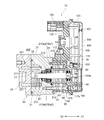
- FIG. 1 is a cross-sectional view showing the configuration of the pump device 10.
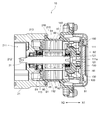
- FIG. 2 is a cross-sectional view showing the configuration of the pump device 10, and is a view showing a cross-sectional shape of the pump unit 20 and the motor unit 30 at a position shifted by 90 degrees in the circumferential direction with respect to FIG. 2, illustration of the outer rotor 22, the inner rotor 23, and the pump cover 24 is omitted.
- the pump device 10 includes a pump unit 20, a motor unit 30, a resin mold unit 100, a circuit board 130, a cover body 150, a spring member 160, and main components. These are integrated by fastening means such as fastening bolts N1 and other screws. Each configuration will be described below.
- the pump unit 20 is a trochoid pump (internal gear pump) in the present embodiment.
- the pump unit 20 includes a pump main body 21, and the pump main body 21 includes a recess 211 for disposing the outer rotor 22 and the inner rotor 23.
- the recess 211 is formed from the end surface on the X2 side of the pump body 21 toward the X1 side, and is recessed by a depth that can accommodate the outer rotor 22 and the inner rotor 23, and the planar shape thereof corresponds to the outer rotor 22. It is a size.
- the pump cover 24 is attached to the X2 side of the pump main body 21, and thereby the recess 211 is covered with the pump cover 24.
- the outer rotor 22 is rotatably disposed in the recess 211. However, the rotation center of the outer rotor 22 is eccentric with respect to the rotation center of the inner rotor 23 and the rotation shaft 31.
- the outer rotor 22 includes an inner peripheral recess 221 on the inner peripheral side, and an inner wall surface of the inner peripheral recess 221 is an internal gear 222.
- An inner rotor 23 is disposed in the inner circumferential recess 221, and an outer gear 231 that contacts and separates from the inner gear 222 is provided on the outer circumferential wall surface of the inner rotor 23.
- the internal gear 222 and the external gear 231 are formed by a trochoid curve.
- the pump device 10 is not limited to the trochoid pump as described above, and various pumps such as an external gear pump, a vane pump, a spiral pump, a cascade pump, and a piston pump can be used.
- the pump body 21 is provided with a through hole 212, and the rotary shaft 31 is inserted into the through hole 212.
- the rotating shaft 31 is rotatably supported by the pump main body 21 via the bearing B1.
- the bearing B1 is fitted into a fitting portion 213 that is recessed from the abutting surface 210 that abuts against the stator core 60 toward the other end side (X2 side).
- the one end side (X1 side end part side) of the rotating shaft 31 is rotatably supported by a bearing B2 fitted in a holder H1 located in a concave fitting part 111a described later.
- an outer peripheral flange portion 215 is provided on the outer peripheral edge portion of the abutting surface 210 so as to protrude toward the X1 side.
- a seal member S1 such as a ring is disposed. When the seal member S1 comes into contact with the X2 side portion of the outer peripheral mold portion 112 of the stator mold portion 110, the inside of the motor portion 30 is sealed from the outside.
- a plurality of holes 210a are provided from the abutting surface 210 so as to go to the X2 side.
- the fastening bolt N1 described above is screwed or a positioning pin 115 described later is inserted into the hole 210a. Therefore, the hole 210a has a hole where a screw thread is formed and a hole where a screw thread is not formed.
- threads are formed in three holes 210a at intervals of 120 degrees, and threads are formed in the remaining three holes 210a. Not.
- the hole 210a in which no thread is formed is referred to as a hole 210a1
- the hole in which a thread is formed is referred to as a hole 210a2.
- the hole portion 210a is configured not to penetrate the pump body 21.
- the fastening bolt N1 is made of a metal that is a conductive member.
- the fastening bolt N1 constitutes a static electricity removal path as will be described later.
- the pump body 21 and the pump cover 24 are formed by die casting using, for example, an aluminum alloy having conductivity, but any material can be used as long as it is a conductive member having conductivity. Also good.
- the outer rotor 22 and the inner rotor 23 are preferably composed of conductive members, like the pump body 21 and the pump cover 24. Practically, for example, aluminum alloys (Al—Si, Al—Si—Cu, Al—Fe—Cu, Al—Si—Mg, Al—Si—Fe—Cu, aluminum alloys) It is preferable to use a metal such as an Al—SiC composite with SiC powder added) or an iron-based material (stainless steel, cast iron, etc.).
- the motor unit 30 corresponds to a drive unit.
- the drive device in the present embodiment includes at least the motor unit 30, the circuit board 130, the cover body 150, and the spring member 160.
- the resin mold unit 100 and other members are included. You may have.
- FIG. 3 is a plan view showing the configuration of the motor unit 30, but also shows a partial cross section.
- the motor unit 30 includes a rotation shaft 31 that is common to the pump unit 20, and a rotor 40 is provided on the outer peripheral side of the rotation shaft 31.
- the rotor 40 includes a yoke 41 and a magnet 42.
- the yoke 41 is attached to the outer peripheral side of the rotating shaft 31, and is formed by, for example, laminating and molding an electromagnetic steel plate such as a silicon steel plate having an electrical insulating film on the surface.
- the yoke 41 may be formed using any magnetic material such as ferrite or a dust core.
- a magnet 42 is attached to the outer peripheral side of the yoke 41.
- the magnet 42 is attached to the outer peripheral side of the yoke 41 in a state where the magnetic pole changes at every predetermined angle.
- the yoke 40 and the magnet 42 constitute the rotor 40 of the motor unit 30.
- the rotor 40 rotates together with the yoke 41 and the magnet 42, it is of course possible to include another member (for example, the rotating shaft 31) that is integral with or separate from the yoke 41 and the magnet 42. .
- the stator 50 is disposed on the outer peripheral side of the rotor 40 so as to face each other. That is, the rotor 40 is located in the central hole 51 of the stator 50.
- the stator 50 includes a stator core 60 and a coil winding body 70.
- the stator core 60 is configured, for example, by press molding after laminating a large number of electromagnetic steel plates 600 such as silicon steel plates having an electrical insulating film on the surface.
- the stator core 60 may be formed using a magnetic material other than the electromagnetic steel plate 600, such as ferrite or a dust core.
- a coil winding body 70 is attached to the stator core 60.
- the coil winding body 70 includes a bobbin 80 and a coil 90.
- the coil 90 is configured by winding a conducting wire around the bobbin 80.
- a connection terminal 81 formed of a conductive member (metal or the like) is integrally attached to the bobbin 80 (see FIG. 2), and the connection terminal 81 has an attachment hole (not shown) of the circuit board 130. It penetrates.
- the resin mold portion 100 is integrally attached to the stator core 60 described above.
- the resin mold portion 100 is provided with a holder core H1 and the like for supporting the bearing B2 in the mold, a stator core 60 to which the coil winding body 70 is further attached, and then a resin core which is injected with resin.
- 60 is a portion provided integrally with 60.
- FIG. 4 is a perspective view showing a state in which the resin mold portion 100 integrated with the stator core 60 is a half section.
- the resin mold part 100 includes a stator mold part 110 and a substrate attachment part 120.
- the stator mold portion 110 is a portion having a substantially cylindrical appearance, and is configured by covering the stator core 60 with a resin.
- the stator mold part 110 constitutes the motor part 30.
- the board mounting portion 120 is a portion provided in a rectangular box shape in appearance, and is continuous with the substantially cylindrical stator mold portion 110.
- a plurality of bosses 121 project from the rectangular box-shaped substrate mounting portion 120.
- the boss 121 is capable of receiving the circuit board 130 at the tip end side of the protrusion.
- any one of the plurality of bosses 121 is provided with a screw hole (not shown). Therefore, the circuit board 130 is attached to the board attaching portion 120 by inserting a screw through the through hole of the circuit board 130 and screwing the screw into the boss 121.
- stator module 140 the one in which the stator core 60 and the like are integrated with the resin mold part 100 is referred to as a stator module 140 as necessary.
- a bottom mold portion 111 is provided on the X1 side, and the bottom mold portion 111 supports the end portion on the X1 side of the stator core 60.
- a concave fitting portion 111a that is recessed toward the X1 side is provided at the radial center side of the bottom mold portion 111, and a concave holder H1 is attached to the concave fitting portion 111a, and the holder H1 is attached to the holder H1.
- the bearing B2 is fitted. And the X1 side of the rotating shaft 31 is supported by the bearing B2.
- an outer peripheral mold portion 112 is provided on the outer peripheral side of the stator core 60 in the stator mold portion 110, and the outer peripheral side of the stator core 60 is covered by the outer peripheral mold portion 112.
- the coil winding body 70 is attached to the stator core 60, and the insulating cover portion 113 is provided so as to cover the X2 side of the coil winding body 70.
- the insulating cover portion 113 protrudes toward the X2 side from the end portion on the X2 side of the stator core 60.
- the insulating cover portion 113 does not cover the entire X2 side of the stator core 60, but a part thereof is exposed.
- the positioning pin 115 protrudes from the outer diameter side of the recessed fitting portion 111a in the bottom mold portion 111.
- the positioning pin 115 extends through the through hole 61 of the stator core 60 and further protrudes toward the X2 side from the stator core 60. That is, the positioning pin 115 extending from the stator core 60 to the X2 side is formed by the resin entering the through hole 61 during the injection molding.
- the distal end side of the positioning pin 115 is inserted into the hole 210a1 of the pump main body 21 described above. Thereby, the circumferential position of the pump body 21 is determined with respect to the stator mold portion 110. Note that it is preferable that at least two positioning pins 115 exist.
- a plurality of (for example, three) insertion holes 116 are provided in the circumferential direction of the stator mold portion 110.
- the insertion hole 116 is provided so as to penetrate the bottom mold part 111.
- the insertion hole 116 is provided so as to communicate with the through hole 61 penetrating all the electromagnetic steel plates 600. For this reason, the stator core 60 is fixed to the pump main body 21 side by inserting the fastening bolt N1 into the insertion hole 116, and further passing through the through hole 61 and screwing it into the hole 210a2.
- At least one of the insertion holes 116 is formed with a guide wall 117 that faces the X1 side in the axial direction (X direction).
- the guide wall portion 117 is a cylindrical portion provided with a cylindrical hole 117 a that communicates with the insertion hole 116, but may be a form in which a part of the cylindrical shape is notched.
- a coil spring 160 is disposed in the cylindrical hole 117a as will be described later.
- a connector terminal 123 as shown in FIG. 1 is attached to the board attaching portion 120 described above, and the connector terminal 123 is inserted into a terminal hole (not shown) of the circuit board 130.
- the connector terminal 123 can be electrically connected to the pattern circuit of the circuit board 130.
- the X2 side of the connector terminal 123 is exposed in the connector cover 124 (see FIG. 1), and is electrically connected to an external connection terminal (not shown).
- one of the plurality of connector terminals 123 is grounded via an external connection terminal. Therefore, this one connector terminal 123 constitutes a static electricity elimination path. However, a plurality of connector terminals 123 may be grounded via external connection terminals.
- the circuit board 130 is provided with pin holes (not shown) for inserting the connection terminals 81 (see FIG. 2).
- a conductive part is provided around the pin hole. Therefore, the circuit pattern of the circuit board 130 and the connection terminal 81 are electrically connected by inserting the connection terminal 81 into the pin hole and further soldering or attaching another member as necessary.
- a conductive elastic member 131 that constitutes a static electricity elimination path is attached to the circuit board 130.
- the conductive elastic member 131 is a member that comes into contact with a cover body 150, which will be described later, in a state of applying a biasing force while having a predetermined compression amount, and is formed of a conductive member (for example, metal) having conductivity. .
- the conductive elastic member 131 is formed by bending a metal. In the configuration shown in FIG. 1, the conductive elastic member 131 is provided so that the shape when viewed from the side is a Z-shape. However, the conductive elastic member 131 may be formed in any shape as long as it has a predetermined compression amount and abuts against the cover body 150 while applying a biasing force.
- the conductive elastic member 131 is electrically connected to at least one connector terminal 123 among the plurality of connector terminals 123, and the connector terminal 123 is grounded via an external connection terminal.
- the connector terminal 123 to be grounded with the external connection terminal is electrically connected to the conductive elastic member 131 via the conductive pattern on the circuit board 130.
- a cover body 150 is attached to the board attaching portion 120.
- the cover body 150 has a function of positioning the circuit board 130 between the board mounting part 120 and protecting the circuit board 130.
- the cover body 150 constitutes a static electricity removal path. Therefore, the cover body 150 is formed of a conductive member (for example, metal) having electrical conductivity.
- the cover body 150 is formed, for example, by press molding a metal plate. Therefore, it is difficult to form the protruding spring receiving portion as in Patent Document 1 described above.
- a coil spring 160 is in contact with a predetermined portion of the bottom wall surface 151 inside the cover body 150.
- the coil spring 160 is disposed in the above-described cylindrical hole 117a.
- a coil spring 160 is disposed in the cylindrical hole 117a.
- the coil spring 160 is a compression spring that constitutes a static elimination path, and is formed by winding a wire 161 made of a metal such as piano wire (SWP), hard steel wire (SWC), stainless steel (SUS), or the like. ing.
- the surface of the wire 161 is in an electrically conductive state without being covered with an insulating coating or the like.
- the X2 side of the coil spring 160 is in contact with the fastening bolt N1, and the X1 side is in contact with the bottom wall surface 151 of the cover body 150. Therefore, when the pump body 21 is charged, current is conducted to the external connection terminal grounded to the outside through the fastening bolt N1, the coil spring 160, the cover body 150, the conductive elastic member 131, and the connector terminal 123. be able to.
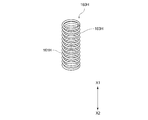
- FIG. 5 is a perspective view showing the configuration of the coil spring 160.
- FIG. 6 is a partial side cross-sectional view of the pump device 10 shown in FIG. 1, and shows a state in which the coil spring 160 shown in FIG. 5 is disposed inside the cylindrical hole 117a.
- the coil spring 160 includes a pair of tightly wound end winding portions 162 and a spring deformation portion 163. In the configuration shown in FIG. 5, the tightly wound end portions 162 are arranged on both ends of the spring deformable portion 163.
- the close contact winding portion 162 existing on the X1 side of the spring deformation portion 163 is referred to as a close contact winding portion 162a
- the close contact winding portion 162 existing on the X2 side of the spring deformation portion 163 is referred to as the close contact winding portion.
- This is referred to as 162b.
- the close contact winding part 162 corresponds to a conductive bypass part.
- the close contact winding portion 162 is a portion where adjacent wires 161 are in close contact with each other. Therefore, when the coil spring 160 is disposed in the cylindrical hole 117a in a compressed state as shown in FIG. 1, the contact end winding portion 162 is in a state in which the dimensional change due to the compression is small.
- the contact end winding portion 162 is a portion that functions as a conductive bypass portion. That is, current can flow through the contact portion between adjacent wires 161. Therefore, the contact end winding portion 162 is in a state similar to that in which a metallic cylindrical portion exists, and in this portion, a state equivalent to a current flowing in one metallic cylindrical portion. It becomes. In this case, since it can be considered that current flows through one wire 161 along the X direction, only a magnetic field corresponding to one wire 161 is generated.
- the close contact winding portion 162 can be regarded as a metallic cylindrical portion.
- an eddy current is generated that generates a magnetic field line in a direction that cancels the magnetic field line.
- the contact end winding portion 162 also functions as a portion that cancels out the lines of magnetic force.
- the spring deforming portion 163 is a portion that is separated from the adjacent wire 161 with a sufficient interval, and the number of turns per unit length is significantly less than that of the tightly wound end portion 162. Yes. Therefore, in the spring deformation portion 163, the dimensional change due to compression is large before and after the biasing force generated when the cover body 150 is attached.
- the tightly wound end portion 162 extends so as to cover the front and back of the circuit board 130.
- the contact end winding portion 162a straddles both the front surface side and the back surface side of the circuit board 130.
- the spring deformation portion 163 is located only on the back side of the circuit board 130. For this reason, when a current is conducted to the wire 161, many lines of magnetic force do not pass through the circuit board 130 and draw a loop that enters and exits between the wires 161 of the spring deformable portion 163.
- the coil spring 160 constitutes a static elimination path for static electricity.
- the static elimination path in the present embodiment is a path for releasing static electricity generated on the pump unit 20 or the motor unit 30 side to the outside.
- the static elimination path includes a fastening bolt N1, a coil spring 160, a cover body 150, a conductive elastic member 131, a conductive pattern on the circuit board 130, and a connector terminal 123.
- the connector terminal 123 is electrically connected to the grounded external connection terminal, so that static electricity generated on the pump unit 20 and the motor unit 30 side can be released to the outside.
- the circuit board 130 faces the cover body 150 and the motor unit 30 in an electrically non-contact state.
- the coil spring 160 is disposed on the front and back of the circuit board 130 at the peripheral edge of the circuit board 130, and is in contact with the cover body 150 and the motor unit 30 in an electrically conductive state.
- the motor part 30, the coil spring 160, and the cover body 150 comprise the static elimination path which releases static electricity outside.
- the coil spring 160 includes a spring deforming portion 163 that allows the adjacent wire 161 to be wound in a non-contact state so that the adjacent wire 161 can be deformed so as to approach or separate from each other, and the spring.
- the deformable portion 163 is provided continuously with at least one end portion, and has a tightly wound end portion 162 as a conductive bypass portion existing over the front and back of the circuit board 130.
- the magnetic force line penetrating the circuit board 130 can be greatly reduced. . That is, the influence of the magnetic field on the circuit board 130 can be greatly reduced.
- FIG. 7 is a perspective view showing a configuration of a coil spring 160H having a conventional configuration.
- FIG. 8 shows a state in which a coil spring 160H having a conventional configuration is attached to the pump device.
- FIG. 8 is a partial side cross-sectional view of a pump device having a conventional configuration, and shows a state in which the coil spring 160H shown in FIG. 7 is disposed inside the cylindrical hole 117a.
- the coil spring 160 ⁇ / b> H is in contact with the adjacent wires 161 ⁇ / b> H only at a portion serving as a seating surface of the end portion. Therefore, there is no portion corresponding to the tightly wound end portion 162 having a predetermined length as shown in FIG. Therefore, as shown in FIG. 8, the spring deforming portion 163 ⁇ / b> H is disposed so as to straddle the front surface and the back surface of the circuit board 130, so that the magnetic lines of force penetrate the circuit board 130. As a result, a noise current may occur in the circuit pattern of the circuit board 130 in the vicinity of the line of magnetic force.
- the coil spring 160 of the present embodiment is disposed so that the tightly wound end portion 162 as the conductive bypass portion straddles the front and back surfaces of the circuit board 130.
- the spring deforming portion 163 does not extend over both the front surface and the back surface of the circuit board 130, but is disposed on only one of the surfaces. For this reason, compared with the arrangement of the conventional configuration shown in FIG. 8, in this embodiment, most of the magnetic force lines generated in the spring deformable portion 163 do not pass through the circuit board 130. Generation of a large current can be reduced.
- the conductive bypass portion includes a close contact winding portion 162 in which adjacent wires 161 are in close contact.
- the close contact winding portion 162 current is conducted in a short circuit between adjacent wires 161.
- the adjacent wires 161 are in close contact with each other to cause a short circuit, and thus the close contact winding portion 162 is the same as the cylindrical conductor portion. Therefore, in this close contact winding portion 162, it is equivalent to a current flowing through one metal conductor portion, and it can be regarded as equivalent to a current flowing through one wire 161 along the X direction. Only a magnetic field corresponding to one wire 161 can be generated.
- the close contact winding portion 162 is disposed on both end sides of the spring deformation portion 163. For this reason, the directionality at the time of arrange
- the pump device 10 includes a motor unit 30 as a driving unit, and the pump unit 20 is attached to the motor unit 30.
- the pump unit 20 includes a rotor portion (an outer rotor 22 and an inner rotor 23) that is rotatable and rotated by a rotation shaft 31.
- the pump device 10 of the present embodiment can reduce the occurrence of noise-like current in the circuit pattern of the circuit board 130 even when static electricity is generated on the pump unit 20 or the motor unit 30 side during operation. Thereby, in the pump apparatus 10 of this Embodiment, desired highly accurate control is realizable.
- the pump device 10 including the motor unit 30 is described as the drive device.
- the drive device is not limited to such a configuration.
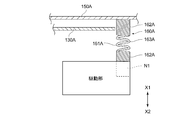
- a drive device including various drive units such as a solenoid, a power cylinder, and a linear actuator can be used. That is, as shown in FIG. 9, the circuit board 130A exists between the driving unit 30A and the cover body 150A, and the driving unit 30A and the cover body 150A are connected in a state where the coil spring 160A can conduct. Any configuration may be used.
- the close contact winding portion 162A as the conductive bypass portion is arranged so as to straddle the front surface and the back surface of the circuit board 130A.
- the spring deforming portion 163A does not extend over both the front surface and the back surface of the circuit board 130A, but is disposed on only one of the surfaces. For this reason, most of the lines of magnetic force generated in the spring deforming portion 163A do not have to pass through the circuit board 130, so that it is possible to reduce the generation of noise current in the circuit board 130A.
- the tightly wound end portions 162 are present on both ends of the spring deformable portion 163.
- the contact end winding portion 162 may be configured to exist at the end portion on either one side of the spring deformation portion 163.
- the coil spring 160 as a spring member may be provided with a portion in place of the close contact winding portion 162.
- a linear straight portion (this straight portion corresponds to the conductive bypass portion) extending from the spring deformable portion 163 in the axial direction (X direction) of the coil spring 160 is provided, and the straight portion is connected to the surface side of the circuit board 130. You may arrange
- the spring member may be a torsion spring other than the coil spring.
- the axial direction of the winding portion of the torsion spring (this winding portion corresponds to the spring deformation portion) may be arranged so as to intersect without being along the axial direction of the cylindrical hole 117a.
- the coil spring 160 is disposed on the peripheral edge of the circuit board 130.
- a configuration in which a through hole is provided in the circuit board 130 and the coil spring 160 is inserted into the through hole corresponds to the present invention.
- the trochoid pump is described with respect to the pump unit 20 of the pump device 10. Therefore, the pump body 21 includes a recess 211 that houses the outer rotor 22 and the inner rotor 23 corresponding to the pump rotor.
- the pump main body may be configured not to include a recess.
- an impeller may be arranged on the flat portion.
- a casing can be provided so as to cover the flat portion.
- the pump unit 20 may be various types of pump units including an oil pump, a water pump, and an air pump.
Landscapes
- Engineering & Computer Science (AREA)
- General Engineering & Computer Science (AREA)
- Power Engineering (AREA)
- Mechanical Engineering (AREA)
- Microelectronics & Electronic Packaging (AREA)
- Physics & Mathematics (AREA)
- Electromagnetism (AREA)
- Details And Applications Of Rotary Liquid Pumps (AREA)
- Structures Of Non-Positive Displacement Pumps (AREA)
- Connection Of Motors, Electrical Generators, Mechanical Devices, And The Like (AREA)
Abstract
La présente invention porte sur un dispositif d'entraînement et sur un dispositif de pompe, qui peuvent réduire l'influence d'un champ magnétique sur une carte de circuit imprimé au moyen d'une spire malgré une structure simple sans partie de réception de ressort semblable à une saillie. Le dispositif de pompe (10) comprend : une unité d'entraînement (30) ; un corps de couvercle (150) ; une carte de circuit imprimé (130) qui fait face au corps de couvercle (150) et à l'unité d'entraînement (30) dans un état électriquement sans contact avec ces derniers ; et un élément ressort (160) qui est disposé d'un côté à l'autre des côtés avant et arrière de la carte de circuit imprimé (130) et en contact avec le corps de couvercle (150) et l'unité d'entraînement (30) dans un état électroconducteur. L'unité d'entraînement (30), l'élément ressort (160) et le corps de couvercle (150) constituent un trajet d'élimination statique. L'élément ressort (160) comprend : une partie de déformation de ressort (163) qui permet une déformation de ressort de telle sorte que des fils adjacents (161) puissent se rapprocher, ou s'éloigner, les uns des autres ; et un trajet de dérivation électroconducteur (162) qui est disposé de façon continue avec au moins une extrémité de la partie de déformation de ressort (163) et est positionné d'un côté à l'autre des côtés avant et arrière de la carte de circuit imprimé (130).
Priority Applications (3)
| Application Number | Priority Date | Filing Date | Title |
|---|---|---|---|
| US16/099,694 US10808783B2 (en) | 2016-05-12 | 2017-04-24 | Drive device and pump device |
| CN201780028501.2A CN109075666B (zh) | 2016-05-12 | 2017-04-24 | 驱动装置及泵装置 |
| DE112017002406.4T DE112017002406B4 (de) | 2016-05-12 | 2017-04-24 | Antriebsvorrichtung und Pumpvorrichtung |
Applications Claiming Priority (2)
| Application Number | Priority Date | Filing Date | Title |
|---|---|---|---|
| JP2016096334A JP6666788B2 (ja) | 2016-05-12 | 2016-05-12 | 駆動装置およびポンプ装置 |
| JP2016-096334 | 2016-05-12 |
Publications (1)
| Publication Number | Publication Date |
|---|---|
| WO2017195584A1 true WO2017195584A1 (fr) | 2017-11-16 |
Family
ID=60267987
Family Applications (1)
| Application Number | Title | Priority Date | Filing Date |
|---|---|---|---|
| PCT/JP2017/016241 Ceased WO2017195584A1 (fr) | 2016-05-12 | 2017-04-24 | Dispositif d'entraînement et dispositif de pompe |
Country Status (5)
| Country | Link |
|---|---|
| US (1) | US10808783B2 (fr) |
| JP (1) | JP6666788B2 (fr) |
| CN (1) | CN109075666B (fr) |
| DE (1) | DE112017002406B4 (fr) |
| WO (1) | WO2017195584A1 (fr) |
Cited By (3)
| Publication number | Priority date | Publication date | Assignee | Title |
|---|---|---|---|---|
| WO2019134779A1 (fr) * | 2018-01-08 | 2019-07-11 | Pierburg Pump Technology Gmbh | Moteur électrique d'unité auxiliaire de véhicule automobile |
| EP3644478A1 (fr) * | 2018-10-24 | 2020-04-29 | TGK CO., Ltd. | Vanne motorisée |
| CN111720607A (zh) * | 2019-03-22 | 2020-09-29 | 株式会社Tgk | 电动阀 |
Families Citing this family (12)
| Publication number | Priority date | Publication date | Assignee | Title |
|---|---|---|---|---|
| US10797555B2 (en) * | 2017-10-25 | 2020-10-06 | Baker Hughes, A Ge Company, Llc | Electrical discharge prevention in bearing for submersible pump motor using a conductive spring between a sleeve and a carrier body |
| JP2019152199A (ja) * | 2018-03-06 | 2019-09-12 | アイシン精機株式会社 | 電動ポンプ |
| DE102019112723A1 (de) * | 2019-05-15 | 2020-11-19 | Minebea Mitsumi Inc. | Stator mit Erdungskontakt |
| CN113036977B (zh) * | 2019-12-24 | 2025-09-05 | 广东德昌电机有限公司 | 泵及其电机定子 |
| DE102020104765A1 (de) | 2020-02-24 | 2021-08-26 | Minebea Mitsumi Inc. | Ventil-Antriebsvorrichtung und Ventileinrichtung zur Steuerung eines Fluidstroms |
| CN114189106A (zh) * | 2020-09-15 | 2022-03-15 | 浙江三花汽车零部件有限公司 | 电子油泵 |
| CN115143098B (zh) * | 2021-03-30 | 2024-04-19 | 浙江三花汽车零部件有限公司 | 电子油泵 |
| DE102022128570A1 (de) * | 2022-10-27 | 2024-05-02 | Minebea Mitsumi Inc. | Motorvorrichtung und Motor |
| JP2024170085A (ja) | 2023-05-26 | 2024-12-06 | 株式会社ミクニ | 電動装置 |
| DE102023119312A1 (de) * | 2023-07-21 | 2025-01-23 | Schaeffler Technologies AG & Co. KG | Elektrische Radialflussmaschine |
| WO2025104787A1 (fr) * | 2023-11-13 | 2025-05-22 | 三菱電機株式会社 | Moteur électrique, soufflante, pompe et climatiseur |
| DE102024121000A1 (de) * | 2024-07-24 | 2026-01-29 | Schaeffler Technologies AG & Co. KG | Elektrische Rotationsmaschine |
Citations (2)
| Publication number | Priority date | Publication date | Assignee | Title |
|---|---|---|---|---|
| JP2002136056A (ja) * | 2000-10-20 | 2002-05-10 | Aichi Electric Co Ltd | ブラシレスモータ |
| JP2014136975A (ja) * | 2013-01-15 | 2014-07-28 | Mikuni Corp | ポンプ装置 |
Family Cites Families (13)
| Publication number | Priority date | Publication date | Assignee | Title |
|---|---|---|---|---|
| WO1997033359A1 (fr) * | 1996-03-07 | 1997-09-12 | Seiko Epson Corporation | Moteur et son procede de fabrication |
| JP2000106297A (ja) * | 1998-09-30 | 2000-04-11 | Casio Comput Co Ltd | タッチパネル付電子機器 |
| JP2010069356A (ja) * | 2008-09-16 | 2010-04-02 | Sanyo Electric Co Ltd | 往復振動器 |
| CN201387438Y (zh) * | 2009-03-20 | 2010-01-20 | 北京普源精电科技有限公司 | 一种具有电磁屏蔽装置的测量仪器 |
| DE102009053472A1 (de) | 2009-11-16 | 2011-06-09 | Siemens Aktiengesellschaft | Elektronische Baugruppe und Verfahren zu deren Herstellung |
| JP5754217B2 (ja) * | 2011-04-07 | 2015-07-29 | セイコーエプソン株式会社 | ばね、静電気の放電路の構造、及び脈拍計 |
| CN202444381U (zh) * | 2012-03-13 | 2012-09-19 | 中国神华能源股份有限公司 | 发电机转轴接地装置 |
| DE102013001314A1 (de) * | 2013-01-26 | 2014-07-31 | Brose Fahrzeugteile GmbH & Co. Kommanditgesellschaft, Würzburg | Rotierende elektrische Maschine |
| DE102013105965B4 (de) * | 2013-06-07 | 2023-08-03 | Minebea Mitsumi Inc. | Stator mit Erdungskontakt |
| JP5898165B2 (ja) * | 2013-11-29 | 2016-04-06 | マブチモーター株式会社 | モータ |
| JP6276573B2 (ja) | 2013-12-10 | 2018-02-07 | エルジー・ケム・リミテッド | 二次電池用負極材及びそれを用いた二次電池 |
| JP6540986B2 (ja) * | 2015-01-26 | 2019-07-10 | 株式会社デンソー | 回転電機 |
| US10598242B2 (en) * | 2016-05-20 | 2020-03-24 | Sealy Technology, Llc | Coil springs with non-linear loading responses and mattresses including the same |
-
2016
- 2016-05-12 JP JP2016096334A patent/JP6666788B2/ja active Active
-
2017
- 2017-04-24 WO PCT/JP2017/016241 patent/WO2017195584A1/fr not_active Ceased
- 2017-04-24 US US16/099,694 patent/US10808783B2/en active Active
- 2017-04-24 DE DE112017002406.4T patent/DE112017002406B4/de active Active
- 2017-04-24 CN CN201780028501.2A patent/CN109075666B/zh active Active
Patent Citations (2)
| Publication number | Priority date | Publication date | Assignee | Title |
|---|---|---|---|---|
| JP2002136056A (ja) * | 2000-10-20 | 2002-05-10 | Aichi Electric Co Ltd | ブラシレスモータ |
| JP2014136975A (ja) * | 2013-01-15 | 2014-07-28 | Mikuni Corp | ポンプ装置 |
Cited By (7)
| Publication number | Priority date | Publication date | Assignee | Title |
|---|---|---|---|---|
| WO2019134779A1 (fr) * | 2018-01-08 | 2019-07-11 | Pierburg Pump Technology Gmbh | Moteur électrique d'unité auxiliaire de véhicule automobile |
| CN111801878A (zh) * | 2018-01-08 | 2020-10-20 | 皮尔伯格泵技术有限责任公司 | 机动车辅助机组电动机 |
| EP3644478A1 (fr) * | 2018-10-24 | 2020-04-29 | TGK CO., Ltd. | Vanne motorisée |
| JP2020067122A (ja) * | 2018-10-24 | 2020-04-30 | 株式会社テージーケー | 電動弁 |
| JP7141100B2 (ja) | 2018-10-24 | 2022-09-22 | 株式会社テージーケー | 電動弁 |
| CN111720607A (zh) * | 2019-03-22 | 2020-09-29 | 株式会社Tgk | 电动阀 |
| CN111720607B (zh) * | 2019-03-22 | 2023-09-01 | 株式会社Tgk | 电动阀 |
Also Published As
| Publication number | Publication date |
|---|---|
| JP2017204954A (ja) | 2017-11-16 |
| CN109075666B (zh) | 2020-07-10 |
| DE112017002406T5 (de) | 2019-02-21 |
| CN109075666A (zh) | 2018-12-21 |
| US20190186571A1 (en) | 2019-06-20 |
| JP6666788B2 (ja) | 2020-03-18 |
| US10808783B2 (en) | 2020-10-20 |
| DE112017002406B4 (de) | 2024-04-18 |
Similar Documents
| Publication | Publication Date | Title |
|---|---|---|
| JP6666788B2 (ja) | 駆動装置およびポンプ装置 | |
| JP6051054B2 (ja) | ポンプ装置 | |
| CN104321955B (zh) | 旋转电机 | |
| JP6063262B2 (ja) | 電動機、電動機を用いたポンプ装置およびステータ | |
| CN107872116B (zh) | 带制动器的电动机 | |
| JP5957713B2 (ja) | モータ | |
| JP6517595B2 (ja) | ポンプ装置 | |
| US10432057B2 (en) | Motor and brake device including same | |
| JP2005273648A (ja) | 電動ポンプ | |
| CN112913113B (zh) | 铁芯、定子及旋转电机 | |
| JP2019180196A (ja) | モータ | |
| US7474028B2 (en) | Motor | |
| JP6024622B2 (ja) | ブレーキ液圧制御装置 | |
| JP2007181314A (ja) | モータ | |
| JP2009247068A (ja) | 磁気シールド板付きリニアモータ、磁気シールド板付き多軸リニアモータ、及び磁気シールド板付きリニアモータの製造方法 | |
| JP4818806B2 (ja) | 着磁装置および着磁方法 | |
| JPWO2012131775A1 (ja) | 電動機 | |
| JP2018110505A (ja) | アキシャルギャップ型回転電機 | |
| JP7385646B2 (ja) | モータ | |
| JP5849415B2 (ja) | リニア駆動装置及びその製造方法 | |
| JP2006302356A (ja) | 磁気ヘッド | |
| JP2005217175A (ja) | 回転式ソレノイド |
Legal Events
| Date | Code | Title | Description |
|---|---|---|---|
| 121 | Ep: the epo has been informed by wipo that ep was designated in this application |
Ref document number: 17795945 Country of ref document: EP Kind code of ref document: A1 |
|
| 122 | Ep: pct application non-entry in european phase |
Ref document number: 17795945 Country of ref document: EP Kind code of ref document: A1 |