WO2017195584A1 - 駆動装置およびポンプ装置 - Google Patents
駆動装置およびポンプ装置 Download PDFInfo
- Publication number
- WO2017195584A1 WO2017195584A1 PCT/JP2017/016241 JP2017016241W WO2017195584A1 WO 2017195584 A1 WO2017195584 A1 WO 2017195584A1 JP 2017016241 W JP2017016241 W JP 2017016241W WO 2017195584 A1 WO2017195584 A1 WO 2017195584A1
- Authority
- WO
- WIPO (PCT)
- Prior art keywords
- circuit board
- spring
- cover body
- pump
- unit
- Prior art date
- Legal status (The legal status is an assumption and is not a legal conclusion. Google has not performed a legal analysis and makes no representation as to the accuracy of the status listed.)
- Ceased
Links
Images



Classifications
-
- H—ELECTRICITY
- H02—GENERATION; CONVERSION OR DISTRIBUTION OF ELECTRIC POWER
- H02K—DYNAMO-ELECTRIC MACHINES
- H02K7/00—Arrangements for handling mechanical energy structurally associated with dynamo-electric machines, e.g. structural association with mechanical driving motors or auxiliary dynamo-electric machines
- H02K7/14—Structural association with mechanical loads, e.g. with hand-held machine tools or fans
-
- F—MECHANICAL ENGINEERING; LIGHTING; HEATING; WEAPONS; BLASTING
- F16—ENGINEERING ELEMENTS AND UNITS; GENERAL MEASURES FOR PRODUCING AND MAINTAINING EFFECTIVE FUNCTIONING OF MACHINES OR INSTALLATIONS; THERMAL INSULATION IN GENERAL
- F16F—SPRINGS; SHOCK-ABSORBERS; MEANS FOR DAMPING VIBRATION
- F16F1/00—Springs
- F16F1/02—Springs made of steel or other material having low internal friction; Wound, torsion, leaf, cup, ring or the like springs, the material of the spring not being relevant
- F16F1/04—Wound springs
- F16F1/047—Wound springs characterised by varying pitch
-
- F—MECHANICAL ENGINEERING; LIGHTING; HEATING; WEAPONS; BLASTING
- F04—POSITIVE - DISPLACEMENT MACHINES FOR LIQUIDS; PUMPS FOR LIQUIDS OR ELASTIC FLUIDS
- F04C—ROTARY-PISTON, OR OSCILLATING-PISTON, POSITIVE-DISPLACEMENT MACHINES FOR LIQUIDS; ROTARY-PISTON, OR OSCILLATING-PISTON, POSITIVE-DISPLACEMENT PUMPS
- F04C15/00—Component parts, details or accessories of machines, pumps or pumping installations, not provided for in groups F04C2/00 - F04C14/00
-
- F—MECHANICAL ENGINEERING; LIGHTING; HEATING; WEAPONS; BLASTING
- F04—POSITIVE - DISPLACEMENT MACHINES FOR LIQUIDS; PUMPS FOR LIQUIDS OR ELASTIC FLUIDS
- F04C—ROTARY-PISTON, OR OSCILLATING-PISTON, POSITIVE-DISPLACEMENT MACHINES FOR LIQUIDS; ROTARY-PISTON, OR OSCILLATING-PISTON, POSITIVE-DISPLACEMENT PUMPS
- F04C15/00—Component parts, details or accessories of machines, pumps or pumping installations, not provided for in groups F04C2/00 - F04C14/00
- F04C15/0057—Driving elements, brakes, couplings, transmission specially adapted for machines or pumps
- F04C15/008—Prime movers
-
- F—MECHANICAL ENGINEERING; LIGHTING; HEATING; WEAPONS; BLASTING
- F16—ENGINEERING ELEMENTS AND UNITS; GENERAL MEASURES FOR PRODUCING AND MAINTAINING EFFECTIVE FUNCTIONING OF MACHINES OR INSTALLATIONS; THERMAL INSULATION IN GENERAL
- F16F—SPRINGS; SHOCK-ABSORBERS; MEANS FOR DAMPING VIBRATION
- F16F1/00—Springs
- F16F1/02—Springs made of steel or other material having low internal friction; Wound, torsion, leaf, cup, ring or the like springs, the material of the spring not being relevant
- F16F1/04—Wound springs
- F16F1/12—Attachments or mountings
-
- H—ELECTRICITY
- H02—GENERATION; CONVERSION OR DISTRIBUTION OF ELECTRIC POWER
- H02K—DYNAMO-ELECTRIC MACHINES
- H02K11/00—Structural association of dynamo-electric machines with electric components or with devices for shielding, monitoring or protection
- H02K11/01—Structural association of dynamo-electric machines with electric components or with devices for shielding, monitoring or protection for shielding from electromagnetic fields, i.e. structural association with shields
- H02K11/014—Shields associated with stationary parts, e.g. stator cores
- H02K11/0141—Shields associated with casings, enclosures or brackets
-
- H—ELECTRICITY
- H02—GENERATION; CONVERSION OR DISTRIBUTION OF ELECTRIC POWER
- H02K—DYNAMO-ELECTRIC MACHINES
- H02K11/00—Structural association of dynamo-electric machines with electric components or with devices for shielding, monitoring or protection
- H02K11/30—Structural association with control circuits or drive circuits
- H02K11/33—Drive circuits, e.g. power electronics
-
- H—ELECTRICITY
- H02—GENERATION; CONVERSION OR DISTRIBUTION OF ELECTRIC POWER
- H02K—DYNAMO-ELECTRIC MACHINES
- H02K11/00—Structural association of dynamo-electric machines with electric components or with devices for shielding, monitoring or protection
- H02K11/40—Structural association with grounding devices
-
- F—MECHANICAL ENGINEERING; LIGHTING; HEATING; WEAPONS; BLASTING
- F16—ENGINEERING ELEMENTS AND UNITS; GENERAL MEASURES FOR PRODUCING AND MAINTAINING EFFECTIVE FUNCTIONING OF MACHINES OR INSTALLATIONS; THERMAL INSULATION IN GENERAL
- F16F—SPRINGS; SHOCK-ABSORBERS; MEANS FOR DAMPING VIBRATION
- F16F2230/00—Purpose; Design features
- F16F2230/22—Pumps
-
- H—ELECTRICITY
- H02—GENERATION; CONVERSION OR DISTRIBUTION OF ELECTRIC POWER
- H02K—DYNAMO-ELECTRIC MACHINES
- H02K2211/00—Specific aspects not provided for in the other groups of this subclass relating to measuring or protective devices or electric components
- H02K2211/03—Machines characterised by circuit boards, e.g. pcb
Definitions
- the present invention relates to a drive device and a pump device.
- FIG. 1 of the related application 1 filed by the present applicant shows a coil spring, and this coil spring is interposed between the screw and the cover body, and these coil spring, screw, and cover body are The static elimination path is configured to go to the grounded external connection terminal.
- Patent Document 1 discloses a static elimination path as described above.
- Patent Document 1 discloses a configuration in which a protruding spring receiving portion protrudes from a cover body, and a coil spring is supported by the spring receiving portion.
- the coil spring extends so as to straddle the front side and the back side of the circuit board.
- a current is conducted to the coil spring, a magnetic force line penetrating the circuit board is formed, and there is a possibility that the conductive part existing on the circuit board is adversely affected by electromagnetic induction by the magnetic force line.
- the present invention has been made on the basis of the above circumstances.
- the object of the present invention is to reduce the influence of the magnetic field on the circuit board by the coil spring while having a simple structure without the protrusion-shaped spring receiving portion. It is intended to provide a possible drive and pump device.
- a driving force is generated, and at least a part is formed of a conductive member, and a cover is formed of at least a part of the conductive member.
- a circuit board that controls driving of the drive unit is disposed between the cover body and the drive unit, and faces the cover body and the drive unit in an electrically non-contact state.
- the circuit board is disposed over the front and back of the circuit board at the peripheral edge of the circuit board, or is disposed over the front and back of the circuit board through the through hole existing in the circuit board.
- a drive member, a spring member, and a cover body that form a static elimination path that releases static electricity to the outside, and the spring member is wound in a state where adjacent wires are not in contact with each other.
- the A spring deformable portion that enables spring deformation so that adjacent wires approach or separate from each other, and a conductive material that is continuously provided at at least one end of the spring deformable portion and extends across the front and back of the circuit board. And a bypass unit.
- a driving device is provided.
- the conductive bypass portion includes a close contact winding portion in which adjacent wires are in close contact with each other, and the close contact winding portion has a short-circuit current between adjacent wires. Are preferably conducted.
- the tightly wound end portions are disposed on both end sides of the spring deformable portion.
- a driving force is generated, and at least a part of the driving part formed of a conductive member, a cover body formed of at least a part of the conductive member, and a driving part A circuit board that controls driving and is disposed between the cover body and the drive unit and is opposed to the cover body and the drive unit in an electrically non-contact state; and a peripheral portion of the circuit board A spring disposed over the front and back of the circuit board or penetrating a through-hole present in the circuit board and disposed over the front and back of the circuit board and in contact with the cover body and the drive unit in an electrically conductive state.
- the drive unit, the spring member, and the cover body constitute a static elimination path that releases static electricity to the outside, and the spring member is wound adjacently by winding the adjacent wires in a non-contact state.
- a spring deformable portion that enables spring deformation so that a person approaches or separates, and a conductive bypass portion that is continuously provided at at least one end of the spring deformable portion and exists across the front and back of the circuit board.
- the drive unit is a motor unit that applies a driving force to rotate the rotation shaft, and a pump unit is attached to the motor unit, and the pump unit can be rotated and rotated by the rotation shaft.
- the driving device and the pump device of the present invention there is no protruding spring receiving portion, and the influence of the magnetic field on the circuit board by the coil spring can be reduced while having a simple configuration.
- FIG. 2 is a plan view illustrating a configuration of a motor unit of the pump device of FIG. 1 and a partial cross-sectional view. It is a perspective view which shows the state which made the resin mold part integral with a stator core the half cross section. It is a perspective view which shows the structure of a coil spring.
- FIG. 6 is a partial side cross-sectional view of the pump device shown in FIG.
- FIG. 1 shows a state in which the coil spring shown in FIG. 5 is arranged inside the cylindrical hole.
- FIG. 8 is a partial side cross-sectional view of a pump device having a conventional configuration, and shows a state where a coil spring shown in FIG. 7 is arranged inside a cylindrical hole.
- FIG. 8 is a schematic block diagram which shows the schematic structure of the drive device of this invention.
- a pump device 10 including a drive device will be described with reference to the drawings.
- the axial direction of the rotating shaft 31 is described as the X direction
- the cover body 150 side of the rotating shaft 31 is described as the X1 side
- the pump cover 24 side is described as the X2 side.
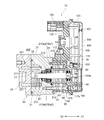
- FIG. 1 is a cross-sectional view showing the configuration of the pump device 10.
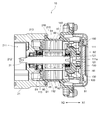
- FIG. 2 is a cross-sectional view showing the configuration of the pump device 10, and is a view showing a cross-sectional shape of the pump unit 20 and the motor unit 30 at a position shifted by 90 degrees in the circumferential direction with respect to FIG. 2, illustration of the outer rotor 22, the inner rotor 23, and the pump cover 24 is omitted.
- the pump device 10 includes a pump unit 20, a motor unit 30, a resin mold unit 100, a circuit board 130, a cover body 150, a spring member 160, and main components. These are integrated by fastening means such as fastening bolts N1 and other screws. Each configuration will be described below.
- the pump unit 20 is a trochoid pump (internal gear pump) in the present embodiment.
- the pump unit 20 includes a pump main body 21, and the pump main body 21 includes a recess 211 for disposing the outer rotor 22 and the inner rotor 23.
- the recess 211 is formed from the end surface on the X2 side of the pump body 21 toward the X1 side, and is recessed by a depth that can accommodate the outer rotor 22 and the inner rotor 23, and the planar shape thereof corresponds to the outer rotor 22. It is a size.
- the pump cover 24 is attached to the X2 side of the pump main body 21, and thereby the recess 211 is covered with the pump cover 24.
- the outer rotor 22 is rotatably disposed in the recess 211. However, the rotation center of the outer rotor 22 is eccentric with respect to the rotation center of the inner rotor 23 and the rotation shaft 31.
- the outer rotor 22 includes an inner peripheral recess 221 on the inner peripheral side, and an inner wall surface of the inner peripheral recess 221 is an internal gear 222.
- An inner rotor 23 is disposed in the inner circumferential recess 221, and an outer gear 231 that contacts and separates from the inner gear 222 is provided on the outer circumferential wall surface of the inner rotor 23.
- the internal gear 222 and the external gear 231 are formed by a trochoid curve.
- the pump device 10 is not limited to the trochoid pump as described above, and various pumps such as an external gear pump, a vane pump, a spiral pump, a cascade pump, and a piston pump can be used.
- the pump body 21 is provided with a through hole 212, and the rotary shaft 31 is inserted into the through hole 212.
- the rotating shaft 31 is rotatably supported by the pump main body 21 via the bearing B1.
- the bearing B1 is fitted into a fitting portion 213 that is recessed from the abutting surface 210 that abuts against the stator core 60 toward the other end side (X2 side).
- the one end side (X1 side end part side) of the rotating shaft 31 is rotatably supported by a bearing B2 fitted in a holder H1 located in a concave fitting part 111a described later.
- an outer peripheral flange portion 215 is provided on the outer peripheral edge portion of the abutting surface 210 so as to protrude toward the X1 side.
- a seal member S1 such as a ring is disposed. When the seal member S1 comes into contact with the X2 side portion of the outer peripheral mold portion 112 of the stator mold portion 110, the inside of the motor portion 30 is sealed from the outside.
- a plurality of holes 210a are provided from the abutting surface 210 so as to go to the X2 side.
- the fastening bolt N1 described above is screwed or a positioning pin 115 described later is inserted into the hole 210a. Therefore, the hole 210a has a hole where a screw thread is formed and a hole where a screw thread is not formed.
- threads are formed in three holes 210a at intervals of 120 degrees, and threads are formed in the remaining three holes 210a. Not.
- the hole 210a in which no thread is formed is referred to as a hole 210a1
- the hole in which a thread is formed is referred to as a hole 210a2.
- the hole portion 210a is configured not to penetrate the pump body 21.
- the fastening bolt N1 is made of a metal that is a conductive member.
- the fastening bolt N1 constitutes a static electricity removal path as will be described later.
- the pump body 21 and the pump cover 24 are formed by die casting using, for example, an aluminum alloy having conductivity, but any material can be used as long as it is a conductive member having conductivity. Also good.
- the outer rotor 22 and the inner rotor 23 are preferably composed of conductive members, like the pump body 21 and the pump cover 24. Practically, for example, aluminum alloys (Al—Si, Al—Si—Cu, Al—Fe—Cu, Al—Si—Mg, Al—Si—Fe—Cu, aluminum alloys) It is preferable to use a metal such as an Al—SiC composite with SiC powder added) or an iron-based material (stainless steel, cast iron, etc.).
- the motor unit 30 corresponds to a drive unit.
- the drive device in the present embodiment includes at least the motor unit 30, the circuit board 130, the cover body 150, and the spring member 160.
- the resin mold unit 100 and other members are included. You may have.
- FIG. 3 is a plan view showing the configuration of the motor unit 30, but also shows a partial cross section.
- the motor unit 30 includes a rotation shaft 31 that is common to the pump unit 20, and a rotor 40 is provided on the outer peripheral side of the rotation shaft 31.
- the rotor 40 includes a yoke 41 and a magnet 42.
- the yoke 41 is attached to the outer peripheral side of the rotating shaft 31, and is formed by, for example, laminating and molding an electromagnetic steel plate such as a silicon steel plate having an electrical insulating film on the surface.
- the yoke 41 may be formed using any magnetic material such as ferrite or a dust core.
- a magnet 42 is attached to the outer peripheral side of the yoke 41.
- the magnet 42 is attached to the outer peripheral side of the yoke 41 in a state where the magnetic pole changes at every predetermined angle.
- the yoke 40 and the magnet 42 constitute the rotor 40 of the motor unit 30.
- the rotor 40 rotates together with the yoke 41 and the magnet 42, it is of course possible to include another member (for example, the rotating shaft 31) that is integral with or separate from the yoke 41 and the magnet 42. .
- the stator 50 is disposed on the outer peripheral side of the rotor 40 so as to face each other. That is, the rotor 40 is located in the central hole 51 of the stator 50.
- the stator 50 includes a stator core 60 and a coil winding body 70.
- the stator core 60 is configured, for example, by press molding after laminating a large number of electromagnetic steel plates 600 such as silicon steel plates having an electrical insulating film on the surface.
- the stator core 60 may be formed using a magnetic material other than the electromagnetic steel plate 600, such as ferrite or a dust core.
- a coil winding body 70 is attached to the stator core 60.
- the coil winding body 70 includes a bobbin 80 and a coil 90.
- the coil 90 is configured by winding a conducting wire around the bobbin 80.
- a connection terminal 81 formed of a conductive member (metal or the like) is integrally attached to the bobbin 80 (see FIG. 2), and the connection terminal 81 has an attachment hole (not shown) of the circuit board 130. It penetrates.
- the resin mold portion 100 is integrally attached to the stator core 60 described above.
- the resin mold portion 100 is provided with a holder core H1 and the like for supporting the bearing B2 in the mold, a stator core 60 to which the coil winding body 70 is further attached, and then a resin core which is injected with resin.
- 60 is a portion provided integrally with 60.
- FIG. 4 is a perspective view showing a state in which the resin mold portion 100 integrated with the stator core 60 is a half section.
- the resin mold part 100 includes a stator mold part 110 and a substrate attachment part 120.
- the stator mold portion 110 is a portion having a substantially cylindrical appearance, and is configured by covering the stator core 60 with a resin.
- the stator mold part 110 constitutes the motor part 30.
- the board mounting portion 120 is a portion provided in a rectangular box shape in appearance, and is continuous with the substantially cylindrical stator mold portion 110.
- a plurality of bosses 121 project from the rectangular box-shaped substrate mounting portion 120.
- the boss 121 is capable of receiving the circuit board 130 at the tip end side of the protrusion.
- any one of the plurality of bosses 121 is provided with a screw hole (not shown). Therefore, the circuit board 130 is attached to the board attaching portion 120 by inserting a screw through the through hole of the circuit board 130 and screwing the screw into the boss 121.
- stator module 140 the one in which the stator core 60 and the like are integrated with the resin mold part 100 is referred to as a stator module 140 as necessary.
- a bottom mold portion 111 is provided on the X1 side, and the bottom mold portion 111 supports the end portion on the X1 side of the stator core 60.
- a concave fitting portion 111a that is recessed toward the X1 side is provided at the radial center side of the bottom mold portion 111, and a concave holder H1 is attached to the concave fitting portion 111a, and the holder H1 is attached to the holder H1.
- the bearing B2 is fitted. And the X1 side of the rotating shaft 31 is supported by the bearing B2.
- an outer peripheral mold portion 112 is provided on the outer peripheral side of the stator core 60 in the stator mold portion 110, and the outer peripheral side of the stator core 60 is covered by the outer peripheral mold portion 112.
- the coil winding body 70 is attached to the stator core 60, and the insulating cover portion 113 is provided so as to cover the X2 side of the coil winding body 70.
- the insulating cover portion 113 protrudes toward the X2 side from the end portion on the X2 side of the stator core 60.
- the insulating cover portion 113 does not cover the entire X2 side of the stator core 60, but a part thereof is exposed.
- the positioning pin 115 protrudes from the outer diameter side of the recessed fitting portion 111a in the bottom mold portion 111.
- the positioning pin 115 extends through the through hole 61 of the stator core 60 and further protrudes toward the X2 side from the stator core 60. That is, the positioning pin 115 extending from the stator core 60 to the X2 side is formed by the resin entering the through hole 61 during the injection molding.
- the distal end side of the positioning pin 115 is inserted into the hole 210a1 of the pump main body 21 described above. Thereby, the circumferential position of the pump body 21 is determined with respect to the stator mold portion 110. Note that it is preferable that at least two positioning pins 115 exist.
- a plurality of (for example, three) insertion holes 116 are provided in the circumferential direction of the stator mold portion 110.
- the insertion hole 116 is provided so as to penetrate the bottom mold part 111.
- the insertion hole 116 is provided so as to communicate with the through hole 61 penetrating all the electromagnetic steel plates 600. For this reason, the stator core 60 is fixed to the pump main body 21 side by inserting the fastening bolt N1 into the insertion hole 116, and further passing through the through hole 61 and screwing it into the hole 210a2.
- At least one of the insertion holes 116 is formed with a guide wall 117 that faces the X1 side in the axial direction (X direction).
- the guide wall portion 117 is a cylindrical portion provided with a cylindrical hole 117 a that communicates with the insertion hole 116, but may be a form in which a part of the cylindrical shape is notched.
- a coil spring 160 is disposed in the cylindrical hole 117a as will be described later.
- a connector terminal 123 as shown in FIG. 1 is attached to the board attaching portion 120 described above, and the connector terminal 123 is inserted into a terminal hole (not shown) of the circuit board 130.
- the connector terminal 123 can be electrically connected to the pattern circuit of the circuit board 130.
- the X2 side of the connector terminal 123 is exposed in the connector cover 124 (see FIG. 1), and is electrically connected to an external connection terminal (not shown).
- one of the plurality of connector terminals 123 is grounded via an external connection terminal. Therefore, this one connector terminal 123 constitutes a static electricity elimination path. However, a plurality of connector terminals 123 may be grounded via external connection terminals.
- the circuit board 130 is provided with pin holes (not shown) for inserting the connection terminals 81 (see FIG. 2).
- a conductive part is provided around the pin hole. Therefore, the circuit pattern of the circuit board 130 and the connection terminal 81 are electrically connected by inserting the connection terminal 81 into the pin hole and further soldering or attaching another member as necessary.
- a conductive elastic member 131 that constitutes a static electricity elimination path is attached to the circuit board 130.
- the conductive elastic member 131 is a member that comes into contact with a cover body 150, which will be described later, in a state of applying a biasing force while having a predetermined compression amount, and is formed of a conductive member (for example, metal) having conductivity. .
- the conductive elastic member 131 is formed by bending a metal. In the configuration shown in FIG. 1, the conductive elastic member 131 is provided so that the shape when viewed from the side is a Z-shape. However, the conductive elastic member 131 may be formed in any shape as long as it has a predetermined compression amount and abuts against the cover body 150 while applying a biasing force.
- the conductive elastic member 131 is electrically connected to at least one connector terminal 123 among the plurality of connector terminals 123, and the connector terminal 123 is grounded via an external connection terminal.
- the connector terminal 123 to be grounded with the external connection terminal is electrically connected to the conductive elastic member 131 via the conductive pattern on the circuit board 130.
- a cover body 150 is attached to the board attaching portion 120.
- the cover body 150 has a function of positioning the circuit board 130 between the board mounting part 120 and protecting the circuit board 130.
- the cover body 150 constitutes a static electricity removal path. Therefore, the cover body 150 is formed of a conductive member (for example, metal) having electrical conductivity.
- the cover body 150 is formed, for example, by press molding a metal plate. Therefore, it is difficult to form the protruding spring receiving portion as in Patent Document 1 described above.
- a coil spring 160 is in contact with a predetermined portion of the bottom wall surface 151 inside the cover body 150.
- the coil spring 160 is disposed in the above-described cylindrical hole 117a.
- a coil spring 160 is disposed in the cylindrical hole 117a.
- the coil spring 160 is a compression spring that constitutes a static elimination path, and is formed by winding a wire 161 made of a metal such as piano wire (SWP), hard steel wire (SWC), stainless steel (SUS), or the like. ing.
- the surface of the wire 161 is in an electrically conductive state without being covered with an insulating coating or the like.
- the X2 side of the coil spring 160 is in contact with the fastening bolt N1, and the X1 side is in contact with the bottom wall surface 151 of the cover body 150. Therefore, when the pump body 21 is charged, current is conducted to the external connection terminal grounded to the outside through the fastening bolt N1, the coil spring 160, the cover body 150, the conductive elastic member 131, and the connector terminal 123. be able to.
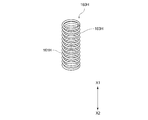
- FIG. 5 is a perspective view showing the configuration of the coil spring 160.
- FIG. 6 is a partial side cross-sectional view of the pump device 10 shown in FIG. 1, and shows a state in which the coil spring 160 shown in FIG. 5 is disposed inside the cylindrical hole 117a.
- the coil spring 160 includes a pair of tightly wound end winding portions 162 and a spring deformation portion 163. In the configuration shown in FIG. 5, the tightly wound end portions 162 are arranged on both ends of the spring deformable portion 163.
- the close contact winding portion 162 existing on the X1 side of the spring deformation portion 163 is referred to as a close contact winding portion 162a
- the close contact winding portion 162 existing on the X2 side of the spring deformation portion 163 is referred to as the close contact winding portion.
- This is referred to as 162b.
- the close contact winding part 162 corresponds to a conductive bypass part.
- the close contact winding portion 162 is a portion where adjacent wires 161 are in close contact with each other. Therefore, when the coil spring 160 is disposed in the cylindrical hole 117a in a compressed state as shown in FIG. 1, the contact end winding portion 162 is in a state in which the dimensional change due to the compression is small.
- the contact end winding portion 162 is a portion that functions as a conductive bypass portion. That is, current can flow through the contact portion between adjacent wires 161. Therefore, the contact end winding portion 162 is in a state similar to that in which a metallic cylindrical portion exists, and in this portion, a state equivalent to a current flowing in one metallic cylindrical portion. It becomes. In this case, since it can be considered that current flows through one wire 161 along the X direction, only a magnetic field corresponding to one wire 161 is generated.
- the close contact winding portion 162 can be regarded as a metallic cylindrical portion.
- an eddy current is generated that generates a magnetic field line in a direction that cancels the magnetic field line.
- the contact end winding portion 162 also functions as a portion that cancels out the lines of magnetic force.
- the spring deforming portion 163 is a portion that is separated from the adjacent wire 161 with a sufficient interval, and the number of turns per unit length is significantly less than that of the tightly wound end portion 162. Yes. Therefore, in the spring deformation portion 163, the dimensional change due to compression is large before and after the biasing force generated when the cover body 150 is attached.
- the tightly wound end portion 162 extends so as to cover the front and back of the circuit board 130.
- the contact end winding portion 162a straddles both the front surface side and the back surface side of the circuit board 130.
- the spring deformation portion 163 is located only on the back side of the circuit board 130. For this reason, when a current is conducted to the wire 161, many lines of magnetic force do not pass through the circuit board 130 and draw a loop that enters and exits between the wires 161 of the spring deformable portion 163.
- the coil spring 160 constitutes a static elimination path for static electricity.
- the static elimination path in the present embodiment is a path for releasing static electricity generated on the pump unit 20 or the motor unit 30 side to the outside.
- the static elimination path includes a fastening bolt N1, a coil spring 160, a cover body 150, a conductive elastic member 131, a conductive pattern on the circuit board 130, and a connector terminal 123.
- the connector terminal 123 is electrically connected to the grounded external connection terminal, so that static electricity generated on the pump unit 20 and the motor unit 30 side can be released to the outside.
- the circuit board 130 faces the cover body 150 and the motor unit 30 in an electrically non-contact state.
- the coil spring 160 is disposed on the front and back of the circuit board 130 at the peripheral edge of the circuit board 130, and is in contact with the cover body 150 and the motor unit 30 in an electrically conductive state.
- the motor part 30, the coil spring 160, and the cover body 150 comprise the static elimination path which releases static electricity outside.
- the coil spring 160 includes a spring deforming portion 163 that allows the adjacent wire 161 to be wound in a non-contact state so that the adjacent wire 161 can be deformed so as to approach or separate from each other, and the spring.
- the deformable portion 163 is provided continuously with at least one end portion, and has a tightly wound end portion 162 as a conductive bypass portion existing over the front and back of the circuit board 130.
- the magnetic force line penetrating the circuit board 130 can be greatly reduced. . That is, the influence of the magnetic field on the circuit board 130 can be greatly reduced.
- FIG. 7 is a perspective view showing a configuration of a coil spring 160H having a conventional configuration.
- FIG. 8 shows a state in which a coil spring 160H having a conventional configuration is attached to the pump device.
- FIG. 8 is a partial side cross-sectional view of a pump device having a conventional configuration, and shows a state in which the coil spring 160H shown in FIG. 7 is disposed inside the cylindrical hole 117a.
- the coil spring 160 ⁇ / b> H is in contact with the adjacent wires 161 ⁇ / b> H only at a portion serving as a seating surface of the end portion. Therefore, there is no portion corresponding to the tightly wound end portion 162 having a predetermined length as shown in FIG. Therefore, as shown in FIG. 8, the spring deforming portion 163 ⁇ / b> H is disposed so as to straddle the front surface and the back surface of the circuit board 130, so that the magnetic lines of force penetrate the circuit board 130. As a result, a noise current may occur in the circuit pattern of the circuit board 130 in the vicinity of the line of magnetic force.
- the coil spring 160 of the present embodiment is disposed so that the tightly wound end portion 162 as the conductive bypass portion straddles the front and back surfaces of the circuit board 130.
- the spring deforming portion 163 does not extend over both the front surface and the back surface of the circuit board 130, but is disposed on only one of the surfaces. For this reason, compared with the arrangement of the conventional configuration shown in FIG. 8, in this embodiment, most of the magnetic force lines generated in the spring deformable portion 163 do not pass through the circuit board 130. Generation of a large current can be reduced.
- the conductive bypass portion includes a close contact winding portion 162 in which adjacent wires 161 are in close contact.
- the close contact winding portion 162 current is conducted in a short circuit between adjacent wires 161.
- the adjacent wires 161 are in close contact with each other to cause a short circuit, and thus the close contact winding portion 162 is the same as the cylindrical conductor portion. Therefore, in this close contact winding portion 162, it is equivalent to a current flowing through one metal conductor portion, and it can be regarded as equivalent to a current flowing through one wire 161 along the X direction. Only a magnetic field corresponding to one wire 161 can be generated.
- the close contact winding portion 162 is disposed on both end sides of the spring deformation portion 163. For this reason, the directionality at the time of arrange
- the pump device 10 includes a motor unit 30 as a driving unit, and the pump unit 20 is attached to the motor unit 30.
- the pump unit 20 includes a rotor portion (an outer rotor 22 and an inner rotor 23) that is rotatable and rotated by a rotation shaft 31.
- the pump device 10 of the present embodiment can reduce the occurrence of noise-like current in the circuit pattern of the circuit board 130 even when static electricity is generated on the pump unit 20 or the motor unit 30 side during operation. Thereby, in the pump apparatus 10 of this Embodiment, desired highly accurate control is realizable.
- the pump device 10 including the motor unit 30 is described as the drive device.
- the drive device is not limited to such a configuration.
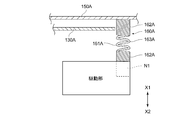
- a drive device including various drive units such as a solenoid, a power cylinder, and a linear actuator can be used. That is, as shown in FIG. 9, the circuit board 130A exists between the driving unit 30A and the cover body 150A, and the driving unit 30A and the cover body 150A are connected in a state where the coil spring 160A can conduct. Any configuration may be used.
- the close contact winding portion 162A as the conductive bypass portion is arranged so as to straddle the front surface and the back surface of the circuit board 130A.
- the spring deforming portion 163A does not extend over both the front surface and the back surface of the circuit board 130A, but is disposed on only one of the surfaces. For this reason, most of the lines of magnetic force generated in the spring deforming portion 163A do not have to pass through the circuit board 130, so that it is possible to reduce the generation of noise current in the circuit board 130A.
- the tightly wound end portions 162 are present on both ends of the spring deformable portion 163.
- the contact end winding portion 162 may be configured to exist at the end portion on either one side of the spring deformation portion 163.
- the coil spring 160 as a spring member may be provided with a portion in place of the close contact winding portion 162.
- a linear straight portion (this straight portion corresponds to the conductive bypass portion) extending from the spring deformable portion 163 in the axial direction (X direction) of the coil spring 160 is provided, and the straight portion is connected to the surface side of the circuit board 130. You may arrange
- the spring member may be a torsion spring other than the coil spring.
- the axial direction of the winding portion of the torsion spring (this winding portion corresponds to the spring deformation portion) may be arranged so as to intersect without being along the axial direction of the cylindrical hole 117a.
- the coil spring 160 is disposed on the peripheral edge of the circuit board 130.
- a configuration in which a through hole is provided in the circuit board 130 and the coil spring 160 is inserted into the through hole corresponds to the present invention.
- the trochoid pump is described with respect to the pump unit 20 of the pump device 10. Therefore, the pump body 21 includes a recess 211 that houses the outer rotor 22 and the inner rotor 23 corresponding to the pump rotor.
- the pump main body may be configured not to include a recess.
- an impeller may be arranged on the flat portion.
- a casing can be provided so as to cover the flat portion.
- the pump unit 20 may be various types of pump units including an oil pump, a water pump, and an air pump.
Landscapes
- Engineering & Computer Science (AREA)
- General Engineering & Computer Science (AREA)
- Power Engineering (AREA)
- Mechanical Engineering (AREA)
- Microelectronics & Electronic Packaging (AREA)
- Physics & Mathematics (AREA)
- Electromagnetism (AREA)
- Details And Applications Of Rotary Liquid Pumps (AREA)
- Structures Of Non-Positive Displacement Pumps (AREA)
- Connection Of Motors, Electrical Generators, Mechanical Devices, And The Like (AREA)
Abstract
突起状のバネ受部が存在しなく、簡素な構成でありながら、コイルスプリングによる回路基板への磁界の影響を低減可能な駆動装置およびポンプ装置を提供する。 ポンプ装置10は、駆動部30と、カバー体150と、カバー体150と駆動部30のそれぞれに電気的に非接触となる状態で対向している回路基板130と、回路基板130の表裏に亘って配置され、カバー体150および駆動部30に導通可能な状態で接触するバネ部材160とを備え、駆動部30、バネ部材160およびカバー体150は、除電経路を構成すると共に、バネ部材160は、隣り合うワイヤ161同士が接近または離間するようなバネ変形を可能とするバネ変形部163と、バネ変形部163の少なくとも一端部に連続的に設けられると共に回路基板130の表裏に亘るように存在する導電バイパス部162と、を備えている。
Description
本発明は、駆動装置およびポンプ装置に関する。
自動車等の車両においては、たとえばエンジンやモータ(駆動用モータ、発電用モータ)といった駆動部分の冷却のために、オイルを用いたポンプ装置が用いられている。そのようなポンプ装置として、本出願人は、特願2015-115140号を行っている(以下、この出願を関連出願1とする)。本出願人が行った関連出願1の図1等には、コイルスプリングが示されており、このコイルスプリングは、ネジとカバー体の間に介在していて、これらコイルスプリング、ネジ、カバー体は、接地されている外部接続端子へ向かうような除電経路を構成している。
また、特許文献1にも、上述したような除電経路が開示されている。特許文献1には、カバー体から突起状のバネ受部が突出していて、そのバネ受部でコイルスプリングが支持される構成が開示されている。
ところで、関連出願1に開示の構成では、コイルスプリングは、回路基板の表側と裏側に跨るように延伸している。この場合、コイルスプリングに電流が導通すると、回路基板を貫くような磁力線が形成され、その磁力線による電磁誘導により、回路基板に存在する導電部に悪影響を与える虞がある。
ここで、回路基板を貫く磁力線を低減するためには、特許文献1に示すように、カバー体に突起状のバネ受部を設けることも考えられる。しかしながら、突起状のバネ受部を設ける場合には、その突起状の部分を形成する分だけ、たとえば金型形状が複雑になり、その分だけコストがかさむ、また取り付け場所も制約される等の問題がある。したがって、コイルスプリングを支持する突起状のバネ受部のような部位は、存在しない方が好ましい。
本発明は上記の事情にもとづきなされたもので、その目的とするところは、突起状のバネ受部が存在しなく、簡素な構成でありながら、コイルスプリングによる回路基板への磁界の影響を低減可能な駆動装置およびポンプ装置を提供しよう、とするものである。
上記課題を解決するために、本発明の第1の観点によると、駆動力を生じさせると共に、少なくとも一部が導電部材から形成される駆動部と、少なくとも一部が導電部材から形成されるカバー体と、駆動部の駆動を制御し、カバー体と前記駆動部の間に配置されていると共に、カバー体と駆動部のそれぞれに電気的に非接触となる状態で対向している回路基板と、回路基板の周縁部において当該回路基板の表裏に亘って配置され、または当該回路基板に存在する貫通孔を貫き当該回路基板の表裏に亘って配置され、カバー体および駆動部に電気的に導通可能な状態で接触するバネ部材と、を備え、駆動部、バネ部材およびカバー体は、静電気を外部に逃がす除電経路を構成すると共に、バネ部材は、隣り合うワイヤが非接触の状態で巻回されることで隣り合うワイヤ同士が接近または離間するようなバネ変形を可能とするバネ変形部と、バネ変形部の少なくとも一端部に連続的に設けられると共に回路基板の表裏に亘るように存在する導電バイパス部と、を備えることを特徴とする駆動装置が提供される。
また、本発明の他の側面は、上述の発明において、導電バイパス部は、隣り合うワイヤを密着させた密着座巻部を備えると共に、密着座巻部では、隣り合うワイヤ間で短絡的に電流が導通する、ことが好ましい。
さらに、本発明の他の側面は、上述の発明において、密着座巻部は、バネ変形部の両端側に配置されている、ことが好ましい。
また、本発明の第2の観点によると、駆動力を生じさせると共に、少なくとも一部が導電部材から形成される駆動部と、少なくとも一部が導電部材から形成されるカバー体と、駆動部の駆動を制御し、カバー体と駆動部の間に配置されていると共に、カバー体と駆動部のそれぞれに電気的に非接触となる状態で対向している回路基板と、回路基板の周縁部において当該回路基板の表裏に亘って配置され、または当該回路基板に存在する貫通孔を貫き当該回路基板の表裏に亘って配置され、カバー体および駆動部に電気的に導通可能な状態で接触するバネ部材と、を備え、駆動部、バネ部材およびカバー体は、静電気を外部に逃がす除電経路を構成すると共に、バネ部材は、隣り合うワイヤが非接触の状態で巻回されることで隣り合うワイヤ同士が接近または離間するようなバネ変形を可能とするバネ変形部と、バネ変形部の少なくとも一端部に連続的に設けられると共に回路基板の表裏に亘るように存在する導電バイパス部と、を備え、駆動部は、回転軸を回転させる駆動力を与えるモータ部であると共に、モータ部には、ポンプユニットが取り付けられていて、ポンプユニットは、回転可能であると共に回転軸によって回転させられるロータ部を備えている、ことを特徴とするポンプ装置が提供される。
本発明の駆動装置およびポンプ装置によると、突起状のバネ受部が存在しなく、簡素な構成でありながら、コイルスプリングによる回路基板への磁界の影響を低減可能となる。
以下、本発明の一実施の形態に係る駆動装置を備えるポンプ装置10について、図面に基づいて説明する。なお、以下の説明では、回転軸31の軸方向をX方向として説明し、回転軸31のカバー体150側をX1側、ポンプカバー24側をX2側として説明する。
<1.ポンプ装置10の構成について>
図1は、ポンプ装置10の構成を示す断面図である。図2は、ポンプ装置10の構成を示す断面図であり、ポンプユニット20およびモータ部30において図1に対して周方向に90度ずれた位置の断面形状を示す図である。なお、図2では、アウターロータ22、インナーロータ23およびポンプカバー24の図示を省略している。
図1は、ポンプ装置10の構成を示す断面図である。図2は、ポンプ装置10の構成を示す断面図であり、ポンプユニット20およびモータ部30において図1に対して周方向に90度ずれた位置の断面形状を示す図である。なお、図2では、アウターロータ22、インナーロータ23およびポンプカバー24の図示を省略している。
図1および図2に示すように、ポンプ装置10は、ポンプユニット20と、モータ部30と、樹脂モールド部100と、回路基板130と、カバー体150と、バネ部材160と主要な構成要素としていて、これらが締結ボルトN1やその他のネジ等の締結手段により一体化されている。以下に、各構成について説明する。
ポンプユニット20は、本実施の形態では、トロコイドポンプ(内接歯車型ポンプ)である。図1に示すように、ポンプユニット20は、ポンプ本体21を備え、そのポンプ本体21は、アウターロータ22およびインナーロータ23を配置するための凹部211を備えている。凹部211は、ポンプ本体21のX2側の端面から、X1側に向かい、アウターロータ22とインナーロータ23とを収納可能な深さだけ窪ませて形成され、その平面形状はアウターロータ22に対応した大きさとなっている。
そして、ポンプ本体21のX2側にはポンプカバー24が取り付けられ、それによって凹部211がポンプカバー24で覆われる。
アウターロータ22は、凹部211に回転自在に配置されている。ただし、アウターロータ22の回転中心は、インナーロータ23および回転軸31の回転中心に対して偏心している。周知のように、アウターロータ22は、内周側に内周凹部221を備えていて、その内周凹部221の内壁面が内歯車222となっている。この内周凹部221にはインナーロータ23が配置されるが、そのインナーロータ23の外周壁面には、内歯車222と接離する外歯車231が設けられている。これら内歯車222と外歯車231とは、トロコイド曲線によって形成されている。
また、インナーロータ23の回転中心には、回転軸31を挿通させる孔部が回転軸31と噛合可能に設けられている。なお、ポンプ装置10としては、上述のようなトロコイドポンプには限られず、外接歯車ポンプ、ベーンポンプ、渦巻きポンプ、カスケードポンプ、ピストンポンプ等、各種のポンプを用いることが可能である。
図1に示すように、ポンプ本体21には、貫通孔212が設けられていて、その貫通孔212には回転軸31が挿通される。回転軸31は、軸受B1を介してポンプ本体21に回転自在に支持されている。この軸受B1は、ステータコア60と突き合わされる突合わせ面210から他端側(X2側)に向かって窪む嵌合部213に嵌め込まれている。なお、回転軸31の一端側(X1側の端部側)は、後述する凹嵌部111aに位置するホルダH1に嵌め込まれた軸受B2に回転自在に支持される。
また、図1に示すように、突合わせ面210の外周縁部には、外周フランジ部215がX1側に向かい突出するように設けられていて、その外周フランジ部215の内周には、Oリング等のシール部材S1が配置されている。このシール部材S1がステータモールド部110の外周モールド部112のX2側の部位と接触することで、モータ部30の内部が、外部から封止される状態となる。
図1に示すように、突合わせ面210からは、X2側に向かうように、複数の穴部210aが設けられている。この穴部210aには、上述した締結ボルトN1が捻じ込まれるか、または後述する位置決めピン115が挿入される。そのため、穴部210aには、ネジ山が形成された穴部と、ネジ山が形成されていない穴部とが存在している。本実施の形態では、60度間隔で合計6つの穴部210aのうち、120度間隔で3つの穴部210aにはネジ山が形成され、残りの3つの穴部210aにはネジ山が形成されていない。以下の説明では、穴部210aのうちネジ山が形成されていないものを穴部210a1とし、ネジ山が形成されているものを穴部210a2とする。なお、穴部210aは、ポンプ本体21を貫通しない構成となっている。
なお、締結ボルトN1は、導電部材である金属を材質として形成されている。この締結ボルトN1は、後述するように、静電気の除電経路を構成する。
ここで、ポンプ本体21およびポンプカバー24は、たとえば導電性を備えるアルミニウム合金を用いて、ダイカストによって形成されているが、導電性を有する導電部材であれば、どのような材質から形成されていても良い。また、アウターロータ22およびインナーロータ23も、ポンプ本体21およびポンプカバー24と同様に、導電部材から構成されるのが好ましい。なお、実用的には、たとえば、アルミニウム合金(Al-Si系、Al-Si-Cu系、Al-Fe-Cu系、Al-Si-Mg系、Al-Si-Fe-Cu系、アルミニウム合金にSiC粉末を添加したAl-SiC複合材等)、鉄系の材質(ステンレス鋼、鋳鉄等)といった金属を材質とするものが好ましい。
次に、モータ部30について説明する。なお、モータ部30は駆動部に対応する。また、本実施の形態における駆動装置は、モータ部30と、回路基板130と、カバー体150と、バネ部材160とを少なくとも有するものであるが、たとえば樹脂モールド部100他、その他の部材等を有していても良い。
図3は、モータ部30の構成を示す平面図であるが、部分的な断面も示している。図1および図3に示すように、モータ部30は、ポンプユニット20と共通の回転軸31を備え、その回転軸31の外周側には、ロータ40が設けられている。ロータ40は、ヨーク41とマグネット42とを備えている。ヨーク41は、回転軸31の外周側に取り付けられていて、たとえば、表面に電気的絶縁皮膜を有するケイ素鋼板等の電磁鋼板のプレス後に積層成型されて形成されている。ただし、ヨーク41は、たとえばフェライトや圧粉磁芯等、どのような磁性材料を用いて形成しても良い。また、ヨーク41を用いない構成を採用しても良い。
このヨーク41の外周側にマグネット42が取り付けられている。マグネット42は、所定の角度毎に磁極が変化する状態でヨーク41の外周側に取り付けられている。そして、このようなヨーク41とマグネット42により、モータ部30のロータ40が構成されている。しかしながら、ロータ40の概念に、ヨーク41やマグネット42と共に回転するものの、ヨーク41やマグネット42に対して一体的または別体的な他の部材(たとえば回転軸31)を含めることは勿論可能である。
なお、後述するように、ステータ50に6つのコイルが存在する場合には、ロータ40の外周側には、S極とN極とがそれぞれ同数ずつ設けられている。
図3に示すように、ロータ40の外周側には、ステータ50が対向する状態で配置されている。すなわち、ロータ40は、ステータ50の中央孔51に位置している。ステータ50は、ステータコア60と、コイル巻線体70とを備えている。ステータコア60は、たとえば、表面に電気的絶縁皮膜を有するケイ素鋼板等の電磁鋼板600を多数積層した後にプレス成型することにより構成されている。しかしながら、ステータコア60は、たとえばフェライトや圧粉磁芯等、電磁鋼板600以外の磁性材料を用いて形成しても良い。
このステータコア60には、コイル巻線体70が取り付けられている。コイル巻線体70は、ボビン80と、コイル90とを備えている。コイル90は、ボビン80に導線を巻回することにより構成されている。また、ボビン80には、導電部材(金属等)により形成される接続端子81が一体的に取り付けられていて(図2参照)、その接続端子81が回路基板130の取付孔(図示省略)を貫通している。
また、上述したステータコア60には、樹脂モールド部100が一体的に取り付けられている。樹脂モールド部100は、金型の内部に、軸受B2を支持するためのホルダH1等を設置し、さらにコイル巻線体70を取り付けたステータコア60を設置した後に、樹脂を射出することによって、ステータコア60と一体的に設けられている部分である。
図4は、ステータコア60と一体的な状態の樹脂モールド部100を半断面とした状態を示す斜視図である。なお、図4においては、構成的に分かり易くするために、一部部品の表示を省略している。図4に示すように、樹脂モールド部100は、ステータモールド部110と、基板取付部120とを有している。ステータモールド部110は、外観が略円筒状の部分であり、ステータコア60を樹脂が覆うことで構成されている。なお、このステータモールド部110は、モータ部30を構成している。また、基板取付部120は、外観が矩形の箱状に設けられている部分であり、略円筒状のステータモールド部110に連なっている。
図2に示すように、矩形の箱状の基板取付部120には、複数のボス121が突出して設けられている。ボス121は、その突出の先端側で回路基板130を受け止めることを可能としている。なお、複数のボス121のうちのいずれかには、不図示のネジ孔が設けられている。そのため、回路基板130の貫通孔にネジを挿通させて、ボス121にネジを捻じ込むことで、基板取付部120に回路基板130が取り付けられる。
また、基板取付部120には、カバー体150も取り付けられ、それによって回路基板130等が外部から封止される。なお、以下の説明においては、ステータコア60等が樹脂モールド部100と一体化されたものを、必要に応じてステータモジュール140と称呼する。
上述のステータモールド部110において、X1側には、底側モールド部111が設けられていて、その底側モールド部111によってステータコア60のX1側の端部が支持される。底側モールド部111の径方向の中央側には、X1側に向かって窪む凹嵌部111aが設けられていて、その凹嵌部111aに凹形状のホルダH1が取り付けられ、そのホルダH1に軸受B2が嵌め込まれる。そして、軸受B2によって回転軸31のX1側が支持される。
また、ステータモールド部110のうちステータコア60の外周側には、外周モールド部112が設けられていて、その外周モールド部112によりステータコア60の外周側が覆われる。
さらに、上述のように、ステータコア60にはコイル巻線体70が取り付けられるが、そのコイル巻線体70のX2側を覆うように絶縁カバー部113が設けられている。図4に示すように、絶縁カバー部113は、ステータコア60のX2側の端部よりもX2側に向かって隆起している。ただし、絶縁カバー部113は、ステータコア60のX2側の全体を覆う訳ではなく、その一部が露出している。
ここで、図1および図4に示すように、底側モールド部111のうち凹嵌部111aよりも外径側からは、位置決めピン115が突出している。位置決めピン115は、ステータコア60の貫通孔61を延伸していて、さらにステータコア60よりもX2側に向かって突出している。すなわち、射出成型の際に、樹脂が貫通孔61に入り込むことで、ステータコア60よりもX2側に延伸する位置決めピン115が形成される。
この位置決めピン115の先端側は、上述したポンプ本体21の穴部210a1に挿入される。それにより、ステータモールド部110に対して、ポンプ本体21の周方向の位置が定められる。なお、位置決めピン115は、少なくとも2本存在することが好ましい。
図4に示すように、ステータモールド部110の周方向には、複数(たとえば3つ)の挿通孔116が設けられている。挿通孔116は、底側モールド部111を貫くように設けられている。この挿通孔116は、全ての電磁鋼板600を貫く貫通孔61と連通するように設けられている。そのため、挿通孔116に締結ボルトN1を入り込ませ、さらに貫通孔61を挿通させて穴部210a2に捻じ込むことで、ステータコア60がポンプ本体21側に固定される。
ここで、挿通孔116のうちの少なくとも1つには、軸方向(X方向)のX1側に向かうようなガイド壁部117が形成されている。ガイド壁部117は、挿通孔116と連通するような筒孔117aを備える筒状の部分であるが、筒状の一部が切り欠かれた形態であっても良い。この筒孔117aには、後述するようにコイルスプリング160が配置される。
また、上述した基板取付部120には、図1に示すようなコネクタ端子123が取り付けられていて、そのコネクタ端子123は回路基板130の端子孔(図示省略)に差し込まれている。そして、コネクタ端子123は、回路基板130のパターン回路と電気的に導通可能としている。また、コネクタ端子123は、そのX2側が、コネクタカバー124(図1参照)内に露出していて、外部接続端子(図示省略)と電気的に接続される。
なお、複数のコネクタ端子123のうちの1本は、外部接続端子を介して、接地されている。そのため、この1本のコネクタ端子123は、静電気の除電経路を構成する。しかしながら、複数本のコネクタ端子123が外部接続端子を介して接地される構成としても良い。
また、回路基板130には、接続端子81(図2参照)を挿通させるためのピン孔(図示省略)が設けられている。かかるピン孔の周囲には、導電部位が設けられている。そのため、ピン孔に接続端子81を差し込み、さらに必要に応じて半田付けや別部材を取り付けることで、回路基板130の回路パターンと接続端子81とが電気的に接続される。
また、回路基板130には、静電気の除電経路を構成する導電弾性部材131が取り付けられている。導電弾性部材131は、後述するカバー体150に対して、所定の圧縮量を有しつつ付勢力を与える状態で当接する部材であり、導電性を備える導電部材(たとえば金属)によって形成されている。また、導電弾性部材131は、金属を折り曲げることで形成されている。図1に示す構成では、導電弾性部材131は、側面視したときの形状がZ字形状となるように設けられている。しかしながら、導電弾性部材131は、所定の圧縮量を有しつつカバー体150に付勢力を与えながら当接するものであれば、どのような形状に形成されていても良い。
この導電弾性部材131は、複数のコネクタ端子123のうちの少なくとも1本のコネクタ端子123と電気的に接続されているが、そのコネクタ端子123は外部接続端子を介して接地されている。このような外部接続端子と接地されるためのコネクタ端子123は、回路基板130上で、導電弾性部材131と導電パターンを介して電気的に接続されている。
図1および図2に示すように、基板取付部120には、カバー体150が取り付けられる。カバー体150は、基板取付部120との間に、回路基板130を位置させて、その回路基板130を保護する機能を有している。このカバー体150は、静電気の除電経路を構成する。そのため、カバー体150は、電気的な導電性を備える導電部材(たとえば金属)によって形成されている。
なお、カバー体150は、たとえば金属板をプレス成型する等によって形成されている。したがって、上述した特許文献1のような突起状のバネ受部を形成し難い状態となっている。図1に示すように、カバー体150の内側の底壁面151の所定の部位には、コイルスプリング160が接触するが、そのコイルスプリング160は、上述した筒孔117a内に配置されている。
<2.コイルスプリングに関して>
次に、コイルスプリング160について説明する。図1に示すように、筒孔117aには、コイルスプリング160が配置されている。コイルスプリング160は、除電経路を構成する圧縮バネであり、たとえばピアノ線(SWP)、硬鋼線(SWC)やステンレス(SUS)等の金属を材質とするワイヤ161を巻回することで形成されている。このワイヤ161の表面は、絶縁被覆等で覆われずに電気的な導電性を有する状態となっている。
次に、コイルスプリング160について説明する。図1に示すように、筒孔117aには、コイルスプリング160が配置されている。コイルスプリング160は、除電経路を構成する圧縮バネであり、たとえばピアノ線(SWP)、硬鋼線(SWC)やステンレス(SUS)等の金属を材質とするワイヤ161を巻回することで形成されている。このワイヤ161の表面は、絶縁被覆等で覆われずに電気的な導電性を有する状態となっている。
このコイルスプリング160のX2側は、締結ボルトN1に接触すると共に、そのX1側は、カバー体150の底壁面151に接触している。したがって、ポンプ本体21が帯電した場合に、締結ボルトN1、コイルスプリング160、カバー体150、導電弾性部材131およびコネクタ端子123を介して、外部へと接地されている外部接続端子に電流を導通させることができる。
図5は、コイルスプリング160の構成を示す斜視図である。図6は、図1に示すポンプ装置10の部分的な側面断面図であり、図5に示すコイルスプリング160が筒孔117aの内部に配置されている状態を示す図である。図5に示すように、コイルスプリング160は、一対の密着座巻部162と、バネ変形部163とを備えている。図5に示す構成では、バネ変形部163の両端側に、密着座巻部162が配置される構成となっている。
以下の説明では、バネ変形部163のX1側に存在する密着座巻部162を密着座巻部162aと称呼し、バネ変形部163のX2側に存在する密着座巻部162を密着座巻部162bと称呼する。しかしながら、両者を特に区別する必要がない場合には、単に密着座巻部162と称呼する。なお、密着座巻部162は、導電バイパス部に対応する。
密着座巻部162は、隣り合うワイヤ161同士が互いに密着した状態となっている部分である。したがって、コイルスプリング160が図1に示すように圧縮された状態で筒孔117aに配置される場合には、密着座巻部162は、圧縮による寸法変化が小さい状態となっている。この密着座巻部162は、導電バイパス部として機能する部分である。すなわち、電流は、隣り合うワイヤ161の接触部分を介して流れることが可能となっている。したがって、密着座巻部162は、いわば金属製の筒状部分が存在するのと同様の状態となっていて、この部分では、1つの金属製の筒状部分に電流が流れるのと同等の状態となる。この場合、X方向に沿う1本のワイヤ161に電流が流れるのと同等と見做せるので、1本の本のワイヤ161に対応した磁界しか生じない状態となっている。
また、密着座巻部162は、金属製の筒状部分と見做せる。金属製の筒状部分を横切るように磁力線が通過すると、その磁力線を打ち消す向きの磁力線を生じさせるような渦電流が生じる。そのため、密着座巻部162は、磁力線の打ち消し部分としても機能する。
一方、バネ変形部163は、隣り合うワイヤ161に対して、十分な間隔を有して離れている部分であり、単位長さ当たりの巻数は、密着座巻部162よりも大幅に少なくなっている。そのため、バネ変形部163では、カバー体150を取り付ける場合に生じる付勢力が作用する前後では、圧縮による寸法変化が大きくなっている。
また、バネ変形部163で囲まれる空芯部では、巻数に比例した大きさの磁束密度が生じる状態となっている。しかしながら、図5に示す構成では、バネ変形部163の両端側に密着座巻部162が設けられている。このため、バネ変形部163の空芯部を通過している磁力線の多くは、バネ変形部163の両端側のワイヤ161間の隙間を介して、空芯部の外側との間で出入している。
ここで、図1に示すように筒孔117aにコイルスプリング160を配置した場合、密着座巻部162は、回路基板130の表裏に亘るように延伸している。たとえば、図1において回路基板130のX1側の面を表面、それとは反対側の面を裏面とするとき、密着座巻部162aは、回路基板130の表面側と裏面側の両方に跨っている。一方、バネ変形部163は、回路基板130の裏面側のみに位置している。このため、ワイヤ161に電流が導通した場合には、多くの磁力線は、回路基板130を貫かずに、バネ変形部163のワイヤ161の間から出入するようなループを描く状態となる。
なお、コイルスプリング160は、静電気の除電経路を構成する。ここで、本実施の形態における除電経路は、ポンプユニット20やモータ部30側で生じた静電気を外部に逃がすための経路である。具体的には、除電経路は、締結ボルトN1、コイルスプリング160、カバー体150、導電弾性部材131、回路基板130上の導電パターン、およびコネクタ端子123を備えている。そして、接地されている外部接続端子にコネクタ端子123が電気的に接続されることにより、ポンプユニット20やモータ部30側で生じた静電気を、外部に逃がすことを可能としている。
<3.効果について>
以上のような構成のポンプ装置10によると、回路基板130は、カバー体150とモータ部30のそれぞれに、電気的に非接触となる状態で対向している。また、コイルスプリング160は、回路基板130の周縁部において、回路基板130の表裏に亘って配置されていて、カバー体150およびモータ部30に電気的に導通可能な状態で接触している。そして、モータ部30、コイルスプリング160およびカバー体150は、静電気を外部に逃がす除電経路を構成している。また、コイルスプリング160は、隣り合うワイヤ161が非接触の状態で巻回されることで、隣り合うワイヤ161同士が接近または離間するようなバネ変形を可能とするバネ変形部163と、このバネ変形部163の少なくとも一端部に連続的に設けられると共に回路基板130の表裏に亘るように存在する導電バイパス部としての密着座巻部162とを備えている。
以上のような構成のポンプ装置10によると、回路基板130は、カバー体150とモータ部30のそれぞれに、電気的に非接触となる状態で対向している。また、コイルスプリング160は、回路基板130の周縁部において、回路基板130の表裏に亘って配置されていて、カバー体150およびモータ部30に電気的に導通可能な状態で接触している。そして、モータ部30、コイルスプリング160およびカバー体150は、静電気を外部に逃がす除電経路を構成している。また、コイルスプリング160は、隣り合うワイヤ161が非接触の状態で巻回されることで、隣り合うワイヤ161同士が接近または離間するようなバネ変形を可能とするバネ変形部163と、このバネ変形部163の少なくとも一端部に連続的に設けられると共に回路基板130の表裏に亘るように存在する導電バイパス部としての密着座巻部162とを備えている。
このため、ポンプユニット20やモータ部30側の静電気を起因としてワイヤ161に電流が流れ、バネ変形部163で磁力線が生じても、回路基板130を貫く磁力線を大幅に低減することが可能となる。すなわち、回路基板130への磁界の影響を大幅に低減可能となる。
ここで、従来構成のコイルスプリング160Hを図7に示す。図7は、従来構成のコイルスプリング160Hの構成を示す斜視図である。また、従来構成のコイルスプリング160Hがポンプ装置に取り付けられている状態を図8に示す。図8は、従来構成のポンプ装置の部分的な側面断面図であり、図7に示すコイルスプリング160Hが筒孔117aの内部に配置されている状態を示す図である。
図7に示す構成では、コイルスプリング160Hには、図5に示すコイルスプリング160と異なり、隣り合うワイヤ161H同士で接触しているのは、端部の座面となる部位のみである。したがって、図5に示すような所定長さの密着座巻部162に相当する部位は存在していない。そのため、図8に示すように、バネ変形部163Hが回路基板130の表面および裏面に跨るように配置されているので、磁力線が回路基板130を貫く状態となっている。それにより、磁力線が貫く付近の回路基板130の回路パターンでは、ノイズ的な電流が発生してしまう虞がある。
これに対して、本実施の形態のコイルスプリング160は、図5に示すように、導電バイパス部としての密着座巻部162が回路基板130の表面および裏面に跨るように配置されているので、バネ変形部163は回路基板130の表面および裏面の双方に跨っている訳ではなく、いずれか一方側の面のみに配置された状態となる。このため、図8に示す従来構成の配置と比較して、本実施の形態では、バネ変形部163で生じる磁力線の多くは、回路基板130を通過させずに済むので、回路基板130にノイズ的な電流が生じるのを低減することができる。
また、本実施の形態では、導電バイパス部は、隣り合うワイヤ161を密着させた密着座巻部162を備えている。加えて、密着座巻部162では、隣り合うワイヤ161間で短絡的に電流が導通している。このように、密着座巻部162では、隣り合うワイヤ161同士が密着して短絡が生じているので、密着座巻部162は筒状の導体部分と同様となる。したがって、この密着座巻部162では、1つの金属製の導体部分に電流が流れるのと同等の状態となり、X方向に沿う1本のワイヤ161に電流が流れるのと同等と見做せるので、1本の本のワイヤ161に対応した磁界しか生じさせない状態とすることができる。また、筒状の導体部分としての密着座巻部162を横切るように磁力線が通過すると、その磁力線を打ち消す向きの磁力線を生じさせるような渦電流が生じるので、密着座巻部162は、磁力線の打ち消し部分として機能させることができる。したがって、回路基板130を貫く磁力線を一層低減することができ、それによって回路基板130の回路パターンにおいて、ノイズ的な電流が生じるのを一層低減可能となる。
さらに、本実施の形態では、密着座巻部162は、バネ変形部163の両端側に配置されている。このため、コイルスプリング160を筒孔117aに配置する際の方向性がなくなり、コイルスプリング160の向きを反対にしても取り付け可能となる。それにより、コイルスプリング160の組み付け工程における管理項目や、完成後のチェック項目を削減することが可能となる。
また、本実施の形態では、ポンプ装置10は、駆動部としてのモータ部30を備え、そのモータ部30にはポンプユニット20が取り付けられている。このポンプユニット20は、回転可能であると共に回転軸31によって回転させられるロータ部(アウターロータ22およびインナーロータ23)を備えている。このため、本実施の形態のポンプ装置10は、作動時にポンプユニット20やモータ部30側で静電気が生じても、回路基板130の回路パターンにノイズ的な電流が生じるのを低減できる。それにより、本実施の形態のポンプ装置10では、所望の高精度な制御を実現可能となる。
<4.変形例>
以上、本発明の各実施の形態について説明したが、本発明はこれ以外にも種々変形可能となっている。以下、それについて述べる。
以上、本発明の各実施の形態について説明したが、本発明はこれ以外にも種々変形可能となっている。以下、それについて述べる。
上述の実施の形態においては、駆動装置としては、モータ部30を備えたポンプ装置10について説明している。しかしながら、駆動装置は、かかる構成に限られるものではない。たとえば、駆動装置としては、ソレノイド、動力シリンダ、リニアアクチュエータ等を始めとする各種の駆動部を備えた駆動装置を用いることができる。すなわち、図9に示すように、駆動部30Aとカバー体150Aの間に回路基板130Aが存在していて、駆動部30Aとカバー体150Aの間をコイルスプリング160Aが導通可能な状態で連結するものであれば、どのような構成であっても良い。
この図9に示す構成でも、導電バイパス部としての密着座巻部162Aが、回路基板130Aの表面および裏面に跨るように配置されている。また、バネ変形部163Aは回路基板130Aの表面および裏面の双方に跨っている訳ではなく、いずれか一方側の面のみに配置された状態となっている。このため、バネ変形部163Aで生じる磁力線の多くは、回路基板130を通過させずに済むので、回路基板130Aにノイズ的な電流が生じるのを低減することができる。
また、上述の実施の形態では、図1に示すように、密着座巻部162は、バネ変形部163の両端側に存在している。しかしながら、密着座巻部162は、バネ変形部163のいずれか一方側の端部に存在する構成としても良い。また、バネ部材としてのコイルスプリング160には、密着座巻部162に代わる部分を設けるようにしても良い。たとえば、バネ変形部163からコイルスプリング160の軸方向(X方向)に延伸する直線状の直線部(この直線部は導電バイパス部に対応)を設け、その直線部が回路基板130の表面側と裏面側に跨るように配置しても良い。また、バネ部材は、コイルスプリング以外の捩じりバネ等を用いても良い。この場合、捩じりバネの巻回部分(この巻回部がバネ変形部に対応)の軸方向が、筒孔117aの軸方向に沿わずに、交差するように配置しても良い。
また、上述の実施の形態では、コイルスプリング160は、回路基板130の周縁部に配置されている。しかしながら、回路基板130に貫通孔を設け、この貫通孔にコイルスプリング160が挿通する状態で配置される構成についても、本発明に該当するのは勿論である。
また、上述の実施の形態では、ポンプ装置10のポンプユニット20に関しては、トロコイドポンプについて説明している。そのためポンプ本体21は、ポンプロータに対応するアウターロータ22およびインナーロータ23を収納する凹部211を備えている。しかしながら、ポンプ本体は凹部を備えない構成を採用しても良い。たとえば、ポンプ装置が渦巻きポンプである場合には、平坦部にインペラが配置される構成としても良い。なお、この場合には、平坦部を覆うようにケーシングを設ける構成とすることができる。
また、ポンプユニット20は、オイルポンプ、ウォーターポンプ、エアーポンプを始めとして、各種のタイプのポンプユニットであっても良い。
10…ポンプ装置、20…ポンプユニット、21…ポンプ本体、22…アウターロータ、23…インナーロータ、24…ポンプカバー、30…モータ部(駆動部に対応)、30A…駆動部、31…回転軸、40…ロータ、41…ヨーク、42…マグネット、50…ステータ、51…中央孔、60…ステータコア、61…貫通孔、70…コイル巻線体、80…ボビン、81…接続端子、90…コイル、100…樹脂モールド部、110…ステータモールド部、111…底側モールド部、111a…凹嵌部、112…外周モールド部、113…絶縁カバー部、115…位置決めピン、116…挿通孔、117…ガイド壁部、117a…筒孔、120…基板取付部、121…ボス、123…コネクタ端子、124…コネクタカバー、130,130A…回路基板、131…導電弾性部材、140…ステータモジュール、150,150A…カバー体、151…底壁面、160,160A…コイルスプリング(バネ部材に対応)、160H…コイルスプリング、161…ワイヤ、162,162a,162b,162A…密着座巻部(導電バイパス部に対応)、163,163A…バネ変形部、210…突合わせ面、210a,210a1,210a2…穴部、211…凹部、212…貫通孔、213…嵌合部、215…外周フランジ部、221…内周凹部、222…内歯車、231…外歯車、600…電磁鋼板、B1,B2…軸受、N1…締結ボルト、S1…シール部材
Claims (4)
- 駆動力を生じさせると共に、少なくとも一部が導電部材から形成される駆動部と、
少なくとも一部が導電部材から形成されるカバー体と、
前記駆動部の駆動を制御し、前記カバー体と前記駆動部の間に配置されていると共に、前記カバー体と前記駆動部のそれぞれに電気的に非接触となる状態で対向している回路基板と、
前記回路基板の周縁部において当該回路基板の表裏に亘って配置され、または当該回路基板に存在する貫通孔を貫き当該回路基板の表裏に亘って配置され、前記カバー体および前記駆動部に電気的に導通可能な状態で接触するバネ部材と、
を備え、
前記駆動部、前記バネ部材および前記カバー体は、静電気を外部に逃がす除電経路を構成すると共に、
前記バネ部材は、隣り合うワイヤが非接触の状態で巻回されることで隣り合う前記ワイヤ同士が接近または離間するようなバネ変形を可能とするバネ変形部と、前記バネ変形部の少なくとも一端部に連続的に設けられると共に前記回路基板の表裏に亘るように存在する導電バイパス部と、
を備えることを特徴とする駆動装置。 - 請求項1記載の駆動装置であって、
前記導電バイパス部は、隣り合う前記ワイヤを密着させた密着座巻部を備えると共に、
前記密着座巻部では、隣り合う前記ワイヤ間で短絡的に電流が導通する、
ことを特徴とする駆動装置。 - 請求項2記載の駆動装置であって、
前記密着座巻部は、前記バネ変形部の両端側に配置されている、
ことを特徴とする駆動装置。 - 駆動力を生じさせると共に、少なくとも一部が導電部材から形成される駆動部と、
少なくとも一部が導電部材から形成されるカバー体と、
前記駆動部の駆動を制御し、前記カバー体と前記駆動部の間に配置されていると共に、前記カバー体と前記駆動部のそれぞれに電気的に非接触となる状態で対向している回路基板と、
前記回路基板の周縁部において当該回路基板の表裏に亘って配置され、または当該回路基板に存在する貫通孔を貫き当該回路基板の表裏に亘って配置され、前記カバー体および前記駆動部に電気的に導通可能な状態で接触するバネ部材と、
を備え、
前記駆動部、前記バネ部材および前記カバー体は、静電気を外部に逃がす除電経路を構成すると共に、
前記バネ部材は、隣り合うワイヤが非接触の状態で巻回されることで隣り合う前記ワイヤ同士が接近または離間するようなバネ変形を可能とするバネ変形部と、前記バネ変形部の少なくとも一端部に連続的に設けられると共に前記回路基板の表裏に亘るように存在する導電バイパス部と、
を備え、
前記駆動部は、回転軸を回転させる駆動力を与えるモータ部であると共に、
前記モータ部には、ポンプユニットが取り付けられていて、
前記ポンプユニットは、回転可能であると共に前記回転軸によって回転させられるロータ部を備えている、
ことを特徴とするポンプ装置。
Priority Applications (3)
| Application Number | Priority Date | Filing Date | Title |
|---|---|---|---|
| US16/099,694 US10808783B2 (en) | 2016-05-12 | 2017-04-24 | Drive device and pump device |
| CN201780028501.2A CN109075666B (zh) | 2016-05-12 | 2017-04-24 | 驱动装置及泵装置 |
| DE112017002406.4T DE112017002406B4 (de) | 2016-05-12 | 2017-04-24 | Antriebsvorrichtung und Pumpvorrichtung |
Applications Claiming Priority (2)
| Application Number | Priority Date | Filing Date | Title |
|---|---|---|---|
| JP2016096334A JP6666788B2 (ja) | 2016-05-12 | 2016-05-12 | 駆動装置およびポンプ装置 |
| JP2016-096334 | 2016-05-12 |
Publications (1)
| Publication Number | Publication Date |
|---|---|
| WO2017195584A1 true WO2017195584A1 (ja) | 2017-11-16 |
Family
ID=60267987
Family Applications (1)
| Application Number | Title | Priority Date | Filing Date |
|---|---|---|---|
| PCT/JP2017/016241 Ceased WO2017195584A1 (ja) | 2016-05-12 | 2017-04-24 | 駆動装置およびポンプ装置 |
Country Status (5)
| Country | Link |
|---|---|
| US (1) | US10808783B2 (ja) |
| JP (1) | JP6666788B2 (ja) |
| CN (1) | CN109075666B (ja) |
| DE (1) | DE112017002406B4 (ja) |
| WO (1) | WO2017195584A1 (ja) |
Cited By (3)
| Publication number | Priority date | Publication date | Assignee | Title |
|---|---|---|---|---|
| WO2019134779A1 (de) * | 2018-01-08 | 2019-07-11 | Pierburg Pump Technology Gmbh | Kfz-nebenaggregat-elektromotor |
| EP3644478A1 (en) * | 2018-10-24 | 2020-04-29 | TGK CO., Ltd. | Motor operated valve |
| CN111720607A (zh) * | 2019-03-22 | 2020-09-29 | 株式会社Tgk | 电动阀 |
Families Citing this family (12)
| Publication number | Priority date | Publication date | Assignee | Title |
|---|---|---|---|---|
| US10797555B2 (en) * | 2017-10-25 | 2020-10-06 | Baker Hughes, A Ge Company, Llc | Electrical discharge prevention in bearing for submersible pump motor using a conductive spring between a sleeve and a carrier body |
| JP2019152199A (ja) * | 2018-03-06 | 2019-09-12 | アイシン精機株式会社 | 電動ポンプ |
| DE102019112723A1 (de) * | 2019-05-15 | 2020-11-19 | Minebea Mitsumi Inc. | Stator mit Erdungskontakt |
| CN113036977B (zh) * | 2019-12-24 | 2025-09-05 | 广东德昌电机有限公司 | 泵及其电机定子 |
| DE102020104765A1 (de) | 2020-02-24 | 2021-08-26 | Minebea Mitsumi Inc. | Ventil-Antriebsvorrichtung und Ventileinrichtung zur Steuerung eines Fluidstroms |
| CN114189106A (zh) * | 2020-09-15 | 2022-03-15 | 浙江三花汽车零部件有限公司 | 电子油泵 |
| CN115143098B (zh) * | 2021-03-30 | 2024-04-19 | 浙江三花汽车零部件有限公司 | 电子油泵 |
| DE102022128570A1 (de) * | 2022-10-27 | 2024-05-02 | Minebea Mitsumi Inc. | Motorvorrichtung und Motor |
| JP2024170085A (ja) | 2023-05-26 | 2024-12-06 | 株式会社ミクニ | 電動装置 |
| DE102023119312A1 (de) * | 2023-07-21 | 2025-01-23 | Schaeffler Technologies AG & Co. KG | Elektrische Radialflussmaschine |
| WO2025104787A1 (ja) * | 2023-11-13 | 2025-05-22 | 三菱電機株式会社 | 電動機、送風機、ポンプおよび空気調和装置 |
| DE102024121000A1 (de) * | 2024-07-24 | 2026-01-29 | Schaeffler Technologies AG & Co. KG | Elektrische Rotationsmaschine |
Citations (2)
| Publication number | Priority date | Publication date | Assignee | Title |
|---|---|---|---|---|
| JP2002136056A (ja) * | 2000-10-20 | 2002-05-10 | Aichi Electric Co Ltd | ブラシレスモータ |
| JP2014136975A (ja) * | 2013-01-15 | 2014-07-28 | Mikuni Corp | ポンプ装置 |
Family Cites Families (13)
| Publication number | Priority date | Publication date | Assignee | Title |
|---|---|---|---|---|
| WO1997033359A1 (en) * | 1996-03-07 | 1997-09-12 | Seiko Epson Corporation | Motor and process for producing the same |
| JP2000106297A (ja) * | 1998-09-30 | 2000-04-11 | Casio Comput Co Ltd | タッチパネル付電子機器 |
| JP2010069356A (ja) * | 2008-09-16 | 2010-04-02 | Sanyo Electric Co Ltd | 往復振動器 |
| CN201387438Y (zh) * | 2009-03-20 | 2010-01-20 | 北京普源精电科技有限公司 | 一种具有电磁屏蔽装置的测量仪器 |
| DE102009053472A1 (de) | 2009-11-16 | 2011-06-09 | Siemens Aktiengesellschaft | Elektronische Baugruppe und Verfahren zu deren Herstellung |
| JP5754217B2 (ja) * | 2011-04-07 | 2015-07-29 | セイコーエプソン株式会社 | ばね、静電気の放電路の構造、及び脈拍計 |
| CN202444381U (zh) * | 2012-03-13 | 2012-09-19 | 中国神华能源股份有限公司 | 发电机转轴接地装置 |
| DE102013001314A1 (de) * | 2013-01-26 | 2014-07-31 | Brose Fahrzeugteile GmbH & Co. Kommanditgesellschaft, Würzburg | Rotierende elektrische Maschine |
| DE102013105965B4 (de) * | 2013-06-07 | 2023-08-03 | Minebea Mitsumi Inc. | Stator mit Erdungskontakt |
| JP5898165B2 (ja) * | 2013-11-29 | 2016-04-06 | マブチモーター株式会社 | モータ |
| JP6276573B2 (ja) | 2013-12-10 | 2018-02-07 | エルジー・ケム・リミテッド | 二次電池用負極材及びそれを用いた二次電池 |
| JP6540986B2 (ja) * | 2015-01-26 | 2019-07-10 | 株式会社デンソー | 回転電機 |
| US10598242B2 (en) * | 2016-05-20 | 2020-03-24 | Sealy Technology, Llc | Coil springs with non-linear loading responses and mattresses including the same |
-
2016
- 2016-05-12 JP JP2016096334A patent/JP6666788B2/ja active Active
-
2017
- 2017-04-24 WO PCT/JP2017/016241 patent/WO2017195584A1/ja not_active Ceased
- 2017-04-24 US US16/099,694 patent/US10808783B2/en active Active
- 2017-04-24 DE DE112017002406.4T patent/DE112017002406B4/de active Active
- 2017-04-24 CN CN201780028501.2A patent/CN109075666B/zh active Active
Patent Citations (2)
| Publication number | Priority date | Publication date | Assignee | Title |
|---|---|---|---|---|
| JP2002136056A (ja) * | 2000-10-20 | 2002-05-10 | Aichi Electric Co Ltd | ブラシレスモータ |
| JP2014136975A (ja) * | 2013-01-15 | 2014-07-28 | Mikuni Corp | ポンプ装置 |
Cited By (7)
| Publication number | Priority date | Publication date | Assignee | Title |
|---|---|---|---|---|
| WO2019134779A1 (de) * | 2018-01-08 | 2019-07-11 | Pierburg Pump Technology Gmbh | Kfz-nebenaggregat-elektromotor |
| CN111801878A (zh) * | 2018-01-08 | 2020-10-20 | 皮尔伯格泵技术有限责任公司 | 机动车辅助机组电动机 |
| EP3644478A1 (en) * | 2018-10-24 | 2020-04-29 | TGK CO., Ltd. | Motor operated valve |
| JP2020067122A (ja) * | 2018-10-24 | 2020-04-30 | 株式会社テージーケー | 電動弁 |
| JP7141100B2 (ja) | 2018-10-24 | 2022-09-22 | 株式会社テージーケー | 電動弁 |
| CN111720607A (zh) * | 2019-03-22 | 2020-09-29 | 株式会社Tgk | 电动阀 |
| CN111720607B (zh) * | 2019-03-22 | 2023-09-01 | 株式会社Tgk | 电动阀 |
Also Published As
| Publication number | Publication date |
|---|---|
| JP2017204954A (ja) | 2017-11-16 |
| CN109075666B (zh) | 2020-07-10 |
| DE112017002406T5 (de) | 2019-02-21 |
| CN109075666A (zh) | 2018-12-21 |
| US20190186571A1 (en) | 2019-06-20 |
| JP6666788B2 (ja) | 2020-03-18 |
| US10808783B2 (en) | 2020-10-20 |
| DE112017002406B4 (de) | 2024-04-18 |
Similar Documents
| Publication | Publication Date | Title |
|---|---|---|
| JP6666788B2 (ja) | 駆動装置およびポンプ装置 | |
| JP6051054B2 (ja) | ポンプ装置 | |
| CN104321955B (zh) | 旋转电机 | |
| JP6063262B2 (ja) | 電動機、電動機を用いたポンプ装置およびステータ | |
| CN107872116B (zh) | 带制动器的电动机 | |
| JP5957713B2 (ja) | モータ | |
| JP6517595B2 (ja) | ポンプ装置 | |
| US10432057B2 (en) | Motor and brake device including same | |
| JP2005273648A (ja) | 電動ポンプ | |
| CN112913113B (zh) | 铁芯、定子及旋转电机 | |
| JP2019180196A (ja) | モータ | |
| US7474028B2 (en) | Motor | |
| JP6024622B2 (ja) | ブレーキ液圧制御装置 | |
| JP2007181314A (ja) | モータ | |
| JP2009247068A (ja) | 磁気シールド板付きリニアモータ、磁気シールド板付き多軸リニアモータ、及び磁気シールド板付きリニアモータの製造方法 | |
| JP4818806B2 (ja) | 着磁装置および着磁方法 | |
| JPWO2012131775A1 (ja) | 電動機 | |
| JP2018110505A (ja) | アキシャルギャップ型回転電機 | |
| JP7385646B2 (ja) | モータ | |
| JP5849415B2 (ja) | リニア駆動装置及びその製造方法 | |
| JP2006302356A (ja) | 磁気ヘッド | |
| JP2005217175A (ja) | 回転式ソレノイド |
Legal Events
| Date | Code | Title | Description |
|---|---|---|---|
| 121 | Ep: the epo has been informed by wipo that ep was designated in this application |
Ref document number: 17795945 Country of ref document: EP Kind code of ref document: A1 |
|
| 122 | Ep: pct application non-entry in european phase |
Ref document number: 17795945 Country of ref document: EP Kind code of ref document: A1 |