WO2017195749A1 - Récepteur chimère de l'antigène et utilisation correspondante - Google Patents
Récepteur chimère de l'antigène et utilisation correspondante Download PDFInfo
- Publication number
- WO2017195749A1 WO2017195749A1 PCT/JP2017/017456 JP2017017456W WO2017195749A1 WO 2017195749 A1 WO2017195749 A1 WO 2017195749A1 JP 2017017456 W JP2017017456 W JP 2017017456W WO 2017195749 A1 WO2017195749 A1 WO 2017195749A1
- Authority
- WO
- WIPO (PCT)
- Prior art keywords
- amino acid
- acid sequence
- seq
- chimeric antigen
- antigen receptor
- Prior art date
- Legal status (The legal status is an assumption and is not a legal conclusion. Google has not performed a legal analysis and makes no representation as to the accuracy of the status listed.)
- Ceased
Links
Images






Classifications
-
- A—HUMAN NECESSITIES
- A61—MEDICAL OR VETERINARY SCIENCE; HYGIENE
- A61K—PREPARATIONS FOR MEDICAL, DENTAL OR TOILETRY PURPOSES
- A61K40/00—Cellular immunotherapy
- A61K40/10—Cellular immunotherapy characterised by the cell type used
- A61K40/11—T-cells, e.g. tumour infiltrating lymphocytes [TIL] or regulatory T [Treg] cells; Lymphokine-activated killer [LAK] cells
-
- A—HUMAN NECESSITIES
- A61—MEDICAL OR VETERINARY SCIENCE; HYGIENE
- A61K—PREPARATIONS FOR MEDICAL, DENTAL OR TOILETRY PURPOSES
- A61K40/00—Cellular immunotherapy
- A61K40/30—Cellular immunotherapy characterised by the recombinant expression of specific molecules in the cells of the immune system
- A61K40/31—Chimeric antigen receptors [CAR]
-
- A—HUMAN NECESSITIES
- A61—MEDICAL OR VETERINARY SCIENCE; HYGIENE
- A61K—PREPARATIONS FOR MEDICAL, DENTAL OR TOILETRY PURPOSES
- A61K40/00—Cellular immunotherapy
- A61K40/40—Cellular immunotherapy characterised by antigens that are targeted or presented by cells of the immune system
- A61K40/41—Vertebrate antigens
- A61K40/42—Cancer antigens
-
- C—CHEMISTRY; METALLURGY
- C07—ORGANIC CHEMISTRY
- C07K—PEPTIDES
- C07K19/00—Hybrid peptides, i.e. peptides covalently bound to nucleic acids, or non-covalently bound protein-protein complexes
-
- C—CHEMISTRY; METALLURGY
- C12—BIOCHEMISTRY; BEER; SPIRITS; WINE; VINEGAR; MICROBIOLOGY; ENZYMOLOGY; MUTATION OR GENETIC ENGINEERING
- C12N—MICROORGANISMS OR ENZYMES; COMPOSITIONS THEREOF; PROPAGATING, PRESERVING, OR MAINTAINING MICROORGANISMS; MUTATION OR GENETIC ENGINEERING; CULTURE MEDIA
- C12N15/00—Mutation or genetic engineering; DNA or RNA concerning genetic engineering, vectors, e.g. plasmids, or their isolation, preparation or purification; Use of hosts therefor
- C12N15/09—Recombinant DNA-technology
-
- C—CHEMISTRY; METALLURGY
- C12—BIOCHEMISTRY; BEER; SPIRITS; WINE; VINEGAR; MICROBIOLOGY; ENZYMOLOGY; MUTATION OR GENETIC ENGINEERING
- C12N—MICROORGANISMS OR ENZYMES; COMPOSITIONS THEREOF; PROPAGATING, PRESERVING, OR MAINTAINING MICROORGANISMS; MUTATION OR GENETIC ENGINEERING; CULTURE MEDIA
- C12N5/00—Undifferentiated human, animal or plant cells, e.g. cell lines; Tissues; Cultivation or maintenance thereof; Culture media therefor
- C12N5/10—Cells modified by introduction of foreign genetic material
- C12N5/12—Fused cells, e.g. hybridomas
- C12N5/16—Animal cells
-
- A—HUMAN NECESSITIES
- A61—MEDICAL OR VETERINARY SCIENCE; HYGIENE
- A61K—PREPARATIONS FOR MEDICAL, DENTAL OR TOILETRY PURPOSES
- A61K2239/00—Indexing codes associated with cellular immunotherapy of group A61K40/00
- A61K2239/38—Indexing codes associated with cellular immunotherapy of group A61K40/00 characterised by the dose, timing or administration schedule
-
- A—HUMAN NECESSITIES
- A61—MEDICAL OR VETERINARY SCIENCE; HYGIENE
- A61K—PREPARATIONS FOR MEDICAL, DENTAL OR TOILETRY PURPOSES
- A61K2239/00—Indexing codes associated with cellular immunotherapy of group A61K40/00
- A61K2239/46—Indexing codes associated with cellular immunotherapy of group A61K40/00 characterised by the cancer treated
- A61K2239/57—Skin; melanoma
-
- C—CHEMISTRY; METALLURGY
- C07—ORGANIC CHEMISTRY
- C07K—PEPTIDES
- C07K16/00—Immunoglobulins [IG], e.g. monoclonal or polyclonal antibodies
Definitions
- CAR-T cell therapy The target diseases of CAR-T cell therapy currently being studied are mostly hematopoietic cancers, and in particular, CAR-T cell therapy targeting CD19 for B-cell lymphoma is not possible with conventional adoptive immunotherapy in clinical trials. It was reported that it showed a remarkable effect that was not possible.
- few clinical studies have shown the effectiveness of CAR-T cell therapy for solid tumors. This is because the transferred CAR-T cells tend to come into contact with cancer cells in hematopoietic tumors, whereas in direct caries with solid tumor cancer cells, they infiltrate outside the blood vessels, and further infiltrate stromal tissue. It is thought that it is necessary to pass. Blood cancer prevalence is less than 5% of all cancer patients, and solid tumors account for many other cancer types. Therefore, there is a need for the development of CAR-T cell therapy for solid tumors.
- one object is to provide new CAR and CAR-T cells that are effective in the treatment of diseases such as cancer.
- a chimeric antigen receptor selected from the group consisting of any of the following chimeric antigen receptors AF: a light chain CDR1 comprising an amino acid sequence having the amino acid sequence of SEQ ID NO: 1; A light chain CDR2 comprising an amino acid sequence having the amino acid sequence of SEQ ID NO: 2, and a light chain CDR3 comprising an amino acid sequence having the amino acid sequence of SEQ ID NO: 3, A heavy chain variable region comprising: and / or a heavy chain CDR1 comprising an amino acid sequence having the amino acid sequence of SEQ ID NO: 5, A heavy chain CDR2 comprising an amino acid sequence having the amino acid sequence of SEQ ID NO: 6, and a heavy chain CDR3 comprising an amino acid sequence having the amino acid sequence of SEQ ID NO: 7, A light chain variable region comprising A chimeric antigen receptor
- Item 2. The chimeric antigen receptor A according to Item 1.
- Item 3. A chimeric antigen receptor T cell or a chimeric antigen receptor NK cell having the chimeric antigen receptor according to Item 1 or 2.
- Item 4. A polynucleotide encoding the chimeric antigen receptor according to Item 1 or 2.
- Item 5. A pharmaceutical composition comprising the chimeric antigen receptor T cell or the chimeric antigen receptor NK cell according to Item 3.
- Item 6. The pharmaceutical composition according to Item 5, which is used for treatment or prevention of cancer.
- An effective means for treating cancer preferably solid cancer is provided.
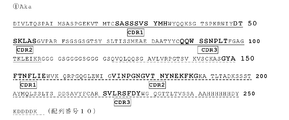
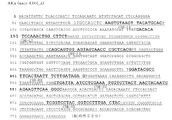
- the amino acid sequence of scFV possessed by the chimeric antigen receptor A is shown.
- the region indicated by the solid underline is the light chain variable region.
- the region indicated by the dashed underline is the heavy chain variable region.
- the region without underlining is a linker.
- the regions shown in bold large font are the light and heavy chain CDRs 1-3 as shown below.
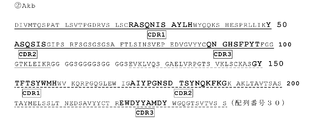
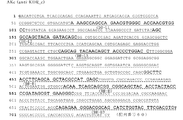
- the amino acid sequence of scFV possessed by the chimeric antigen receptor B is shown.
- the region indicated by the solid underline is the light chain variable region.
- the region indicated by the dashed underline is the heavy chain variable region.
- the region without underlining is a linker.
- the regions shown in bold large font are the light and heavy chain CDRs 1-3 as shown below.
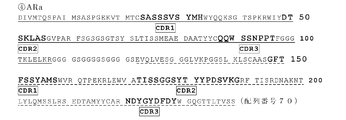
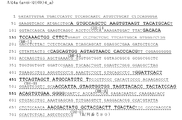
- the amino acid sequence of scFV possessed by the chimeric antigen receptor C is shown.
- the region indicated by the solid underline is the light chain variable region.
- the region indicated by the dashed underline is the heavy chain variable region.
- the region without underlining is a linker.
- the regions shown in bold large font are the light and heavy chain CDRs 1-3 as shown below.
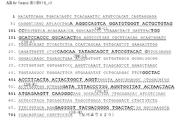
- the amino acid sequence of scFV possessed by the chimeric antigen receptor D is shown.
- the region indicated by the solid underline is the light chain variable region.
- the region indicated by the dashed underline is the heavy chain variable region.
- the region without underlining is a linker.
- the regions shown in bold large font are the light and heavy chain CDRs 1-3 as shown below.
- the amino acid sequence of scFV possessed by the chimeric antigen receptor E is shown.
- the region indicated by the solid underline is the light chain variable region.
- the region indicated by the dashed underline is the heavy chain variable region.
- the region without underlining is a linker.
- the regions shown in bold large font are the light and heavy chain CDRs 1-3 as shown below.
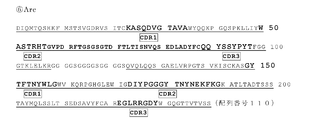
- the amino acid sequence of scFV possessed by the chimeric antigen receptor F is shown.
- the region indicated by the solid underline is the light chain variable region.
- the region indicated by the dashed underline is the heavy chain variable region.
- the region without underlining is a linker.
- the regions shown in bold large font are the light and heavy chain CDRs 1-3 as shown below.
- the base sequence encoding the amino acid sequence of scFV possessed by the chimeric antigen receptor A is shown.
- the region indicated by the solid underline is the light chain variable region.
- the region indicated by the dashed underline is the heavy chain variable region.
- the region without underlining is a linker.
- the regions shown in bold large font are the light and heavy chain CDRs 1-3 as shown below.
- a base sequence encoding the amino acid sequence of scFV possessed by the chimeric antigen receptor B is shown.
- the region indicated by the solid underline is the light chain variable region.
- the region indicated by the dashed underline is the heavy chain variable region.
- the region without underlining is a linker.
- the regions shown in bold large font are the light and heavy chain CDRs 1-3 as shown below.
- a base sequence encoding the amino acid sequence of scFV possessed by the chimeric antigen receptor C is shown.
- the region indicated by the solid underline is the light chain variable region.
- the region indicated by the dashed underline is the heavy chain variable region.
- the region without underlining is a linker.
- the regions shown in bold large font are the light and heavy chain CDRs 1-3 as shown below.
- the base sequence encoding the amino acid sequence of scFV possessed by the chimeric antigen receptor D is shown.
- the region indicated by the solid underline is the light chain variable region.
- the region indicated by the dashed underline is the heavy chain variable region.
- the region without underlining is a linker.
- the regions shown in bold large font are the light and heavy chain CDRs 1-3 as shown below.
- the base sequence encoding the amino acid sequence of scFV possessed by the chimeric antigen receptor E is shown.
- the region indicated by the solid underline is the light chain variable region.
- the region indicated by the dashed underline is the heavy chain variable region.
- the region without underlining is a linker.
- the regions shown in bold large font are the light and heavy chain CDRs 1-3 as shown below.
- a base sequence encoding the amino acid sequence of scFV possessed by the chimeric antigen receptor F is shown.
- the region indicated by the solid underline is the light chain variable region.
- the region indicated by the dashed underline is the heavy chain variable region.
- the region without underlining is a linker.
- the regions shown in bold large font are the light and heavy chain CDRs 1-3 as shown below.
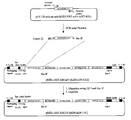
- the construction process of pMXs-IG / CAR [mV- (h28) -h28-h3Z] is shown.
- the construction process of pMXs-IG / CAR [hV- (h28) -h28-h3Z] is shown.
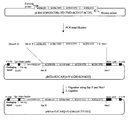
- the construction process of pMXs-IG / CAR [mV- (h8 ⁇ ) -h137-h3Z] is shown.
- the construction process of pMXs-IG / CAR [hV- (h8 ⁇ ) -h137-h3Z] is shown.
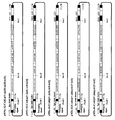
- the structure of the pMXs-IG vector encoding each CAR is shown. The result of having measured the in-vivo anti-tumor effect by CAR-T cell is shown.
- Chimeric antigen receptor is a single-chain antibody (scFv) in which a light chain (VL) and a heavy chain (VH) of a monoclonal antibody variable region are connected in series to the T-cell It is a chimeric protein having a receptor (TCR) ⁇ chain on the C-terminal side. T cells expressing CAR are called CAR-T cells.
- the amino acid sequence of the scFV region possessed by the chimeric antigen receptors A to F and the sequence numbers given to the base sequences encoding it are as shown in Table 1 below.
- the numbers in the table mean the SEQ ID numbers.
- AA means amino acid sequence.
- V means a variable region.
- scFV means the entire scFV region.
- the chimeric antigen receptor A comprises a light chain CDR1 comprising an amino acid sequence having the amino acid sequence of SEQ ID NO: 1, a light chain CDR2 comprising an amino acid sequence having the amino acid sequence of SEQ ID NO: 2, and an amino acid sequence having the amino acid sequence of SEQ ID NO: 3.
- a light chain CDR3 comprising, a heavy chain CDR1 comprising an amino acid sequence having the amino acid sequence of SEQ ID NO: 5, a heavy chain CDR2 comprising an amino acid sequence having the amino acid sequence of SEQ ID NO: 6, and an amino acid sequence having the amino acid sequence of SEQ ID NO: 7 It is preferable to have at least one CDR selected from the group consisting of heavy chain CDR3, more preferably 2 or more, more preferably 3 or more, more preferably 4 or more, more preferably 5 or more, more preferably Has all CDRs.
- the chimeric antigen receptor A preferably has a light chain variable region having the amino acid sequence of SEQ ID NO: 4 and / or a heavy chain variable region having the amino acid sequence of SEQ ID NO: 8.
- the chimeric antigen receptor A preferably has an scFV structure having the amino acid sequence shown in SEQ ID NO: 10.
- the light chain variable region amino acid sequence of chimeric antigen receptor A is 90% or more, preferably 95% or more, preferably 98% or more, preferably 99% or more identical to the amino acid sequence of SEQ ID NO: 4.
- the amino acid sequence of the heavy chain variable region of chimeric antigen receptor A is 90% or more, preferably 95% or more, preferably 98% or more, preferably 99% or more identical to the amino acid sequence of SEQ ID NO: 8.
- chimeric antigen receptor A has 90% or more, preferably 95% or more, preferably 98% or more, preferably 99% or more identity with the amino acid sequence of SEQ ID NO: 10.
- the amino acid sequence of the linker possessed by the chimeric antigen receptor A is arbitrary as long as the function as the chimeric antigen receptor is maintained.
- the chimeric antigen receptor B comprises a light chain CDR1 comprising an amino acid sequence having the amino acid sequence of SEQ ID NO: 21, a light chain CDR2 comprising an amino acid sequence having the amino acid sequence of SEQ ID NO: 22, and an amino acid sequence having the amino acid sequence of SEQ ID NO: 23
- a light chain CDR3 comprising, a heavy chain CDR1 comprising an amino acid sequence having the amino acid sequence of SEQ ID NO: 25, a heavy chain CDR2 comprising an amino acid sequence having the amino acid sequence of SEQ ID NO: 26, and an amino acid sequence having the amino acid sequence of SEQ ID NO: 27
- the chimeric antigen receptor B preferably has a light chain variable region having the amino acid sequence of SEQ ID NO: 24 and / or a heavy chain variable region having the amino acid sequence of SEQ ID NO: 28.
- the chimeric antigen receptor B preferably has an scFV structure having the amino acid sequence shown in SEQ ID NO: 30.
- the amino acid sequence of the light chain variable region of chimeric antigen receptor B is 90% or more, preferably 95% or more, preferably 98% or more, preferably 99% or more identical to the amino acid sequence of SEQ ID NO: 24. Have sex.
- the amino acid sequence of the heavy chain variable region of chimeric antigen receptor B is 90% or more, preferably 95% or more, preferably 98% or more, preferably 99% or more identical to the amino acid sequence of SEQ ID NO: 28.
- chimeric antigen receptor B has 90% or more, preferably 95% or more, preferably 98% or more, preferably 99% or more identity with the amino acid sequence of SEQ ID NO: 30.
- the amino acid sequence of the linker possessed by the chimeric antigen receptor B is arbitrary as long as the function as the chimeric antigen receptor is maintained.
- the chimeric antigen receptor C comprises a light chain CDR1 comprising an amino acid sequence having the amino acid sequence of SEQ ID NO: 41, a light chain CDR2 comprising an amino acid sequence having the amino acid sequence of SEQ ID NO: 42, and an amino acid sequence having the amino acid sequence of SEQ ID NO: 43
- a light chain CDR3 comprising, a heavy chain CDR1 comprising an amino acid sequence having the amino acid sequence of SEQ ID NO: 45, a heavy chain CDR2 comprising an amino acid sequence having the amino acid sequence of SEQ ID NO: 46, and an amino acid sequence having the amino acid sequence of SEQ ID NO: 47
- the chimeric antigen receptor C preferably has a light chain variable region having the amino acid sequence of SEQ ID NO: 44 and / or a heavy chain variable region having the amino acid sequence of SEQ ID NO: 48.
- the chimeric antigen receptor C preferably has an scFV structure having the amino acid sequence shown in SEQ ID NO: 50.
- the amino acid sequence of the light chain variable region of chimeric antigen receptor C is 90% or more, preferably 95% or more, preferably 98% or more, preferably 99% or more identical to the amino acid sequence of SEQ ID NO: 44. Have sex.
- the amino acid sequence of the heavy chain variable region of chimeric antigen receptor C is 90% or more, preferably 95% or more, preferably 98% or more, preferably 99% or more identical to the amino acid sequence of SEQ ID NO: 48.
- chimeric antigen receptor C has 90% or more, preferably 95% or more, preferably 98% or more, preferably 99% or more identity with the amino acid sequence of SEQ ID NO: 50.
- the amino acid sequence of the linker possessed by the chimeric antigen receptor C is arbitrary as long as the function as the chimeric antigen receptor is maintained.
- the chimeric antigen receptor D comprises a light chain CDR1 comprising an amino acid sequence having the amino acid sequence of SEQ ID NO: 61, a light chain CDR2 comprising an amino acid sequence having the amino acid sequence of SEQ ID NO: 62, and an amino acid sequence having the amino acid sequence of SEQ ID NO: 63
- a light chain CDR3 comprising, a heavy chain CDR1 comprising an amino acid sequence having the amino acid sequence of SEQ ID NO: 65, a heavy chain CDR2 comprising an amino acid sequence having the amino acid sequence of SEQ ID NO: 66, and an amino acid sequence having the amino acid sequence of SEQ ID NO: 67
- the chimeric antigen receptor D preferably has a light chain variable region having the amino acid sequence of SEQ ID NO: 64 and / or a heavy chain variable region having the amino acid sequence of SEQ ID NO: 68. In a preferred embodiment, the chimeric antigen receptor D preferably has an scFV structure having the amino acid sequence shown in SEQ ID NO: 70.
- the light chain variable region amino acid sequence of chimeric antigen receptor D is 90% or more, preferably 95% or more, preferably 98% or more, preferably 99% or more identical to the amino acid sequence of SEQ ID NO: 64.
- the amino acid sequence of the heavy chain variable region of chimeric antigen receptor D is 90% or more, preferably 95% or more, preferably 98% or more, preferably 99% or more identical to the amino acid sequence of SEQ ID NO: 68.
- chimeric antigen receptor D has 90% or more, preferably 95% or more, preferably 98% or more, preferably 99% or more identity with the amino acid sequence of SEQ ID NO: 70.
- the amino acid sequence of the linker possessed by the chimeric antigen receptor D is arbitrary as long as the function as the chimeric antigen receptor is maintained.
- the chimeric antigen receptor E comprises a light chain CDR1 comprising an amino acid sequence having the amino acid sequence of SEQ ID NO: 81, a light chain CDR2 comprising an amino acid sequence having the amino acid sequence of SEQ ID NO: 82, and an amino acid sequence having the amino acid sequence of SEQ ID NO: 83
- a light chain CDR3 comprising, a heavy chain CDR1 comprising an amino acid sequence having the amino acid sequence of SEQ ID NO: 85, a heavy chain CDR2 comprising an amino acid sequence having the amino acid sequence of SEQ ID NO: 86, and an amino acid sequence having the amino acid sequence of SEQ ID NO: 87
- the chimeric antigen receptor E preferably has a light chain variable region having the amino acid sequence of SEQ ID NO: 84 and / or a heavy chain variable region having the amino acid sequence of SEQ ID NO: 88.
- the chimeric antigen receptor E preferably has an scFV structure having the amino acid sequence shown in SEQ ID NO: 90.
- the light chain variable region amino acid sequence of chimeric antigen receptor E is 90% or more, preferably 95% or more, preferably 98% or more, preferably 99% or more identical to the amino acid sequence of SEQ ID NO: 84.
- the amino acid sequence of the heavy chain variable region of chimeric antigen receptor E is 90% or more, preferably 95% or more, preferably 98% or more, preferably 99% or more identical to the amino acid sequence of SEQ ID NO: 88.
- chimeric antigen receptor E has 90% or more, preferably 95% or more, preferably 98% or more, preferably 99% or more identity with the amino acid sequence of SEQ ID NO: 90.
- the amino acid sequence of the linker possessed by the chimeric antigen receptor E is arbitrary as long as the function as the chimeric antigen receptor is maintained.
- the chimeric antigen receptor F comprises a light chain CDR1 comprising an amino acid sequence having the amino acid sequence of SEQ ID NO: 101, a light chain CDR2 comprising an amino acid sequence having the amino acid sequence of SEQ ID NO: 102, and an amino acid sequence having the amino acid sequence of SEQ ID NO: 103.
- a light chain CDR3 comprising, a heavy chain CDR1 comprising an amino acid sequence having the amino acid sequence of SEQ ID NO: 105, a heavy chain CDR2 comprising an amino acid sequence having the amino acid sequence of SEQ ID NO: 106, and an amino acid sequence having the amino acid sequence of SEQ ID NO: 107 It is preferable to have at least one CDR selected from the group consisting of heavy chain CDR3, more preferably 2 or more, more preferably 3 or more, more preferably 4 or more, more preferably 5 or more, more preferably Has all CDRs.
- the chimeric antigen receptor F preferably has a light chain variable region having the amino acid sequence of SEQ ID NO: 104 and / or a heavy chain variable region having the amino acid sequence of SEQ ID NO: 108.
- the chimeric antigen receptor F preferably has an scFV structure having the amino acid sequence shown in SEQ ID NO: 110.
- the light chain variable region amino acid sequence of chimeric antigen receptor F is 90% or more, preferably 95% or more, preferably 98% or more, preferably 99% or more identical to the amino acid sequence of SEQ ID NO: 104.
- the amino acid sequence of the heavy chain variable region of chimeric antigen receptor F is 90% or more, preferably 95% or more, preferably 98% or more, preferably 99% or more identical to the amino acid sequence of SEQ ID NO: 108.
- the chimeric antigen receptor F has 90% or more, preferably 95% or more, preferably 98% or more, preferably 99% or more identity with the amino acid sequence of SEQ ID NO: 110.
- the amino acid sequence of the linker possessed by the chimeric antigen receptor F is arbitrary as long as the function as the chimeric antigen receptor is maintained.
- the amino acid identity can be calculated using commercially available analysis tools (for example, software such as FASTA, BLAST, PSI-BLAST, SSEARCH, etc.) available through the Internet.
- main initial conditions generally used for BLAST search are as follows. That is, in Advanced BLAST 2.1, blastp is used for the program, Expect value is 10, Filter is all OFF, BLOSUM62 is used for Matrix, Gap existence cost, Per idresidue gap ⁇ cost, and Lambda ratio are 11, 1, 0.85, respectively.
- the amino acid sequence identity value (%) can be calculated.
- the scFVs (amino acid sequences of SEQ ID NOs: 10, 30, and 50) possessed by the chimeric antigen receptors A to C are derived from monoclonal antibodies that specifically recognize the vascular endothelial growth factor receptor (VEGFR2). VEGFR2 is highly expressed in tumor neovasculature.
- the scFVs (amino acid sequences of SEQ ID NOs: 70, 90, and 110) possessed by the chimeric antigen receptors D to F are derived from monoclonal antibodies that specifically recognize the vascular endothelial cell specific receptor (Robo4). Robo4 is also known as a tumor blood vessel specific marker. Therefore, the chimeric antigen receptors A to F can specifically recognize cancer tissues (tumor tissues).
- Chimeric antigen receptors A to F preferably have a structure in which an scFv region, a spacer sequence, a transmembrane domain, an intracellular domain of a costimulatory factor, and an intracellular domain of TCR are arranged in this order from the N-terminus.
- the length of the spacer sequence provided between the scFv region and the transmembrane domain and the type of amino acid residue constituting the spacer sequence are not limited as long as the function of the chimeric antigen receptor is not inhibited.
- the spacer sequence can be designed to have about 10 to 25 amino acid residues.
- transmembrane domain is not limited as long as it does not inhibit the function of the chimeric antigen receptor.
- CD28, CD3 ⁇ , CD4, CD8 ⁇ and the like expressed in T cells can be used. These transmembrane domains may be appropriately mutated as long as they do not inhibit the function of the chimeric antigen receptor.
- the intracellular domain of the costimulatory factor is not particularly limited as long as it is an intracellular domain derived from a costimulatory factor possessed by T cells and the like.
- one or more selected from the group consisting of OX40, 4-1BB, CD27, CD278, and CD28 can be appropriately selected and used.
- the intracellular domains of these costimulators may be appropriately mutated as long as they do not inhibit the function of the chimeric antigen receptor.
- the intracellular domain of TCR can be, for example, an intracellular domain derived from CD3 or the like also called TCR ⁇ chain.
- CD3 may be appropriately mutated as long as it does not inhibit the function of the chimeric antigen receptor.
- ITAM immunophilic acid-basedineactivation motif
- chimeric antigen receptors A to F can be produced using the methods disclosed in Non-Patent Documents 1 and 2.
- polynucleotide Encoding Chimeric Antigen Receptor The polynucleotide encoding chimeric antigen receptor A is not particularly limited as long as it encodes chimeric antigen receptor A described above.
- the polynucleotide encoding chimeric antigen receptor A comprises a region encoding light chain CDR1 having the base sequence of SEQ ID NO: 11, a region encoding light chain CDR2 having the base sequence of SEQ ID NO: 12, sequence A region encoding light chain CDR3 having the base sequence of No.
- a region encoding heavy chain CDR1 having the base sequence of SEQ ID NO: 15, a region encoding heavy chain CDR2 having the base sequence of SEQ ID NO: 16, and SEQ ID NO: It preferably has at least one region selected from the group consisting of regions encoding heavy chain CDR3 having 17 base sequences, more preferably 2 or more types, more preferably 3 or more types, more preferably 4 or more types , More preferably 5 or more, more preferably all regions.
- the polynucleotide encoding the chimeric antigen receptor A is a region encoding a light chain variable region having the base sequence of SEQ ID NO: 14 and / or a heavy chain variable region having the base sequence of SEQ ID NO: 18. It is preferable to have a region encoding.
- the polynucleotide encoding chimeric antigen receptor A preferably has the base sequence of SEQ ID NO: 20.
- the polynucleotide encoding chimeric antigen receptor A has a nucleotide sequence of SEQ ID NOs: 11 to 20 and 80% or more, preferably 85% or more, preferably 90% or more, preferably 95% or more, preferably It has a base sequence having an identity of 98% or more, preferably 99% or more.
- the polynucleotide encoding the chimeric antigen receptor B is not particularly limited as long as it encodes the chimeric antigen receptor B described above.
- the polynucleotide encoding chimeric antigen receptor B comprises a region encoding light chain CDR1 having the base sequence of SEQ ID NO: 31, a region encoding light chain CDR2 having the base sequence of SEQ ID NO: 32, sequence A region encoding the light chain CDR3 having the base sequence of No.
- the polynucleotide encoding the chimeric antigen receptor B is a region encoding a light chain variable region having the base sequence of SEQ ID NO: 34 and / or a heavy chain variable region having the base sequence of SEQ ID NO: 38. It is preferable to have a region encoding. In a preferred embodiment, the polynucleotide encoding chimeric antigen receptor B preferably has the base sequence of SEQ ID NO: 40.
- the polynucleotide encoding chimeric antigen receptor B comprises a nucleotide sequence of SEQ ID NOs: 31-40 and 80% or more, preferably 85% or more, preferably 90% or more, preferably 95% or more, preferably It has a base sequence having an identity of 98% or more, preferably 99% or more.
- the polynucleotide encoding the chimeric antigen receptor C is not particularly limited as long as it encodes the chimeric antigen receptor C described above.
- the polynucleotide encoding chimeric antigen receptor C comprises a region encoding light chain CDR1 having the base sequence of SEQ ID NO: 51, a region encoding light chain CDR2 having the base sequence of SEQ ID NO: 52, sequence A region encoding light chain CDR3 having the base sequence of SEQ ID NO: 53, a region encoding heavy chain CDR1 having the base sequence of SEQ ID NO: 55, a region encoding heavy chain CDR2 having the base sequence of SEQ ID NO: 56, and SEQ ID NO: It preferably has at least one region selected from the group consisting of regions encoding heavy chain CDR3 having 57 base sequences, more preferably 2 or more types, more preferably 3 or more types, more preferably 4 or more types , More preferably 5 or more, more preferably all regions.
- the polynucleotide encoding the chimeric antigen receptor C is a region encoding a light chain variable region having the base sequence of SEQ ID NO: 54 and / or a heavy chain variable region having the base sequence of SEQ ID NO: 58. It is preferable to have a region encoding. In a preferred embodiment, the polynucleotide encoding chimeric antigen receptor C preferably has the base sequence of SEQ ID NO: 60.
- the polynucleotide encoding chimeric antigen receptor C comprises a nucleotide sequence of SEQ ID NOs: 51 to 60 and 80% or more, preferably 85% or more, preferably 90% or more, preferably 95% or more, preferably It has a base sequence having an identity of 98% or more, preferably 99% or more.
- the polynucleotide encoding the chimeric antigen receptor D is not particularly limited as long as it encodes the chimeric antigen receptor D described above.
- the polynucleotide encoding chimeric antigen receptor D comprises a region encoding light chain CDR1 having the base sequence of SEQ ID NO: 71, a region encoding light chain CDR2 having the base sequence of SEQ ID NO: 72, sequence A region encoding light chain CDR3 having the base sequence of SEQ ID NO: 73, a region encoding heavy chain CDR1 having the base sequence of SEQ ID NO: 75, a region encoding heavy chain CDR2 having the base sequence of SEQ ID NO: 76, and SEQ ID NO: It preferably has at least one region selected from the group consisting of regions encoding heavy chain CDR3 having 77 base sequences, more preferably 2 or more types, more preferably 3 or more types, more preferably 4 or more types , More preferably 5 or more, more preferably all regions
- the polynucleotide encoding the chimeric antigen receptor D is a region encoding a light chain variable region having the base sequence of SEQ ID NO: 74 and / or a heavy chain variable region having the base sequence of SEQ ID NO: 78. It is preferable to have a region encoding. In a preferred embodiment, the polynucleotide encoding chimeric antigen receptor D preferably has the base sequence of SEQ ID NO: 80.
- the polynucleotide encoding chimeric antigen receptor D comprises a nucleotide sequence of SEQ ID NOs: 71 to 80 and 80% or more, preferably 85% or more, preferably 90% or more, preferably 95% or more, preferably It has a base sequence having an identity of 98% or more, preferably 99% or more.
- the polynucleotide encoding the chimeric antigen receptor E is not particularly limited as long as it encodes the chimeric antigen receptor E described above.
- the polynucleotide encoding chimeric antigen receptor E comprises a region encoding light chain CDR1 having the base sequence of SEQ ID NO: 91, a region encoding light chain CDR2 having the base sequence of SEQ ID NO: 92, sequence A region encoding light chain CDR3 having the base sequence of No.
- a region encoding heavy chain CDR1 having the base sequence of SEQ ID NO: 95 a region encoding heavy chain CDR2 having the base sequence of SEQ ID NO: 96, and SEQ ID NO: It preferably has at least one region selected from the group consisting of regions encoding heavy chain CDR3 having 97 base sequences, more preferably 2 or more types, more preferably 3 or more types, more preferably 4 or more types , More preferably 5 or more, more preferably all regions.
- the polynucleotide encoding the chimeric antigen receptor E is a region encoding a light chain variable region having the base sequence of SEQ ID NO: 94 and / or a heavy chain variable region having the base sequence of SEQ ID NO: 98. It is preferable to have a region encoding. In a preferred embodiment, the polynucleotide encoding the chimeric antigen receptor E preferably has the base sequence of SEQ ID NO: 100.
- the polynucleotide encoding chimeric antigen receptor E has a nucleotide sequence of SEQ ID NOs: 91 to 100 and 80% or more, preferably 85% or more, preferably 90% or more, preferably 95% or more, preferably It has a base sequence having an identity of 98% or more, preferably 99% or more.
- the polynucleotide encoding the chimeric antigen receptor F is not particularly limited as long as it encodes the chimeric antigen receptor F described above.
- the polynucleotide encoding chimeric antigen receptor F comprises a region encoding light chain CDR1 having the base sequence of SEQ ID NO: 111, a region encoding light chain CDR2 having the base sequence of SEQ ID NO: 112, sequence A region encoding the light chain CDR3 having the base sequence of No.
- the polynucleotide encoding the chimeric antigen receptor F is a region encoding a light chain variable region having the base sequence of SEQ ID NO: 114 and / or a heavy chain variable region having the base sequence of SEQ ID NO: 118. It is preferable to have a region encoding. In a preferred embodiment, the polynucleotide encoding the chimeric antigen receptor F preferably has the base sequence of SEQ ID NO: 120.
- the polynucleotide encoding the chimeric antigen receptor F has a nucleotide sequence of SEQ ID NO: 111-120 of 80% or more, preferably 85% or more, preferably 90% or more, preferably 95% or more, preferably It has a base sequence having an identity of 98% or more, preferably 99% or more.
- the identity of the base sequence can be calculated using an analysis tool that is commercially available or available through a telecommunication line (Internet). For example, specifically, in Advanced BLAST 2.1, it is possible to calculate the homology value (%) of a nucleotide sequence by performing a search using blastn as a program and setting various parameters to default values. it can.
- the polynucleotide may be optimized for codon usage according to the vector or cell type in which the polynucleotide is expressed.
- the state of the polynucleotide is not particularly limited, and for example, it may be isolated or incorporated into a vector.
- the kind and use of the vector are not particularly limited.
- the vector can be a plasmid vector or a viral vector (eg, adenovirus or retrovirus).
- the vector can be, for example, a cloning vector or an expression vector.
- the expression vector include vectors for prokaryotic cells such as Escherichia coli or actinomycetes, or vectors for eukaryotic cells such as yeast cells, insect cells, or mammalian cells.
- the polynucleotide may be arbitrarily modified, for example, a base sequence encoding a signal peptide may be appropriately added to the 5 ′ end side.
- the polynucleotide may be in a state of being taken up by the host cell.
- the embodiment in which the host cell contains the polynucleotide is not particularly limited.
- the host cell may have the polynucleotide in the form of a vector or the polynucleotide in a form integrated with the genomic DNA in the host cell.
- the type of host cell is arbitrary and not particularly limited.
- host cells can be eukaryotic cells such as yeast cells, insect cells, and mammalian cells, and prokaryotic cells such as E. coli and actinomycetes.
- the host cell is preferably a eukaryotic cell (eg, mammal, human), such as a T cell or NK cell.
- a host cell containing a polynucleotide can be obtained, for example, by introducing the polynucleotide (for example, in the form of a vector) into any host cell.
- the host cell may or may not express a polynucleotide encoding a chimeric antigen receptor.
- the polynucleotide encoding the chimeric antigen receptor is expressed in the host cell, the scFv region constituting the chimeric antigen receptor is exposed to the outside of the cell, and the transmembrane domain, costimulatory factor, and TCR are intracellular.
- the domain is preferably present in the cell membrane or in the cell.
- CAR-T cells T-cells (CAR-T cells) that express any of the chimeric antigen receptors AF described above are provided.
- a T cell or the like expressing a chimeric antigen receptor recognizes an antigen in the scFv region, and then transmits the recognition signal to the inside of the T cell or the like through the ⁇ chain.
- the scFv region recognizes the epitope, it activates a signal that induces cytotoxic activity in the cell via a transmembrane domain and a costimulatory factor, and in conjunction with this, other cells that express the epitope It exerts attack or cytotoxic activity against cells or tissues.
- a cell that exhibits such a function When a cell that exhibits such a function is CTL, it is called a chimeric antigen receptor T cell (CAR-T cell).
- CAR-T cell chimeric antigen receptor T cell
- cells having the possibility of exhibiting cytotoxic activity such as NK cells can also exhibit cytotoxic activity when the scFv region binds to its epitope. Therefore, a host cell (in particular, a host cell having cytotoxic activity) containing a polynucleotide encoding a chimeric antigen receptor is useful as an active ingredient of a pharmaceutical composition.
- a host cell (eg, CAR-T cell) containing a polynucleotide encoding a chimeric antigen receptor can be produced with reference to known methods described in Non-Patent Documents 1 and 2, etc.
- CAR-T cells specifically recognize cancer tissues (tumor tissues), they are useful for treating or preventing tumors.
- the type of tumor is not particularly limited, and includes solid cancer and blood cancer.
- solid cancer include lung cancer, colon cancer, ovarian cancer, breast cancer, brain tumor, stomach cancer, liver cancer, tongue cancer, thyroid cancer, kidney cancer, prostate cancer, uterine cancer, osteosarcoma, chondrosarcoma, and rhabdomyosarcoma. Can be mentioned.
- compositions A pharmaceutical composition containing the CAR-T cells and the like, and a method for treating or preventing a disease using the same are provided.
- the content of the CAR-T cells in the pharmaceutical composition includes the type of target disease (for example, solid cancer), the intended therapeutic effect, administration method, treatment period, patient age, patient weight, etc. It can be set as appropriate in consideration.
- the content of the antibody in the pharmaceutical composition can be about 0.001 to 10 parts by weight based on 100 parts by weight of the whole pharmaceutical composition.
- the cell content in the pharmaceutical composition can be, for example, about 1 cell / mL to 10 4 cells / mL.
- the administration form of the pharmaceutical composition is not particularly limited as long as the desired effect is obtained, and any of oral administration and parenteral administration (for example, intravenous injection, intramuscular injection, subcutaneous administration, rectal administration, transdermal administration, topical administration) It can be administered to mammals including humans by any route of administration. Since the active ingredient is a cell, the preferred dosage form is parenteral administration, more preferably intravenous injection. Dosage forms for oral administration and parenteral administration and methods for producing the same are well known to those skilled in the art, and the antibodies or cells according to the present invention are mixed with a pharmaceutically acceptable carrier or the like according to conventional methods. Can be manufactured.
- the dosage forms for parenteral administration include injectable preparations (for example, intravenous injection, intravenous injection, intramuscular injection, subcutaneous injection, intradermal injection), and external preparations (for example, ointment, poultice, lotion) Suppositories), suppository inhalants, eye drops, eye ointments, nasal drops, ear drops, liposomes and the like.
- injectable preparations for example, intravenous injection, intravenous injection, intramuscular injection, subcutaneous injection, intradermal injection
- external preparations for example, ointment, poultice, lotion) Suppositories
- suppository inhalants for example, eye drops, eye ointments, nasal drops, ear drops, liposomes and the like.
- an injectable preparation is prepared by dissolving or suspending antibodies or cells in distilled water for injection, and if necessary, a solubilizer, buffer, pH adjuster, isotonic agent, soothing agent, preservative , And
- the pharmaceutical composition may further contain other drugs effective for treatment or prevention of diseases.
- the pharmaceutical composition can also contain components such as bactericides, anti-inflammatory agents, cell activators, vitamins, and amino acids as necessary.
- Carriers used for the formulation of pharmaceutical compositions include excipients, binders, disintegrants, lubricants, colorants, flavoring agents, stabilizers, emulsifiers, absorptions as necessary.
- Use accelerators, surfactants, pH adjusters, preservatives, antioxidants, extenders, wetting agents, surface activators, dispersants, buffers, preservatives, solubilizers, soothing agents, etc. Can do.
- the kind of the disease to be treated or prevented using the pharmaceutical composition is not particularly limited as long as the treatment or prevention can be achieved.
- target diseases include tumors.
- the type of tumor is not particularly limited, and includes solid cancer and blood cancer.
- solid cancer include lung cancer, colon cancer, ovarian cancer, breast cancer, brain tumor, stomach cancer, liver cancer, tongue cancer, thyroid cancer, kidney cancer, prostate cancer, uterine cancer, osteosarcoma, chondrosarcoma, and rhabdomyosarcoma. Can be mentioned.
- the administration target (subject) of the pharmaceutical composition is, for example, an animal suffering from the above-mentioned disease or an animal possibly affected. “May be affected” can be determined, for example, by a diagnostic method described below.
- the animal is, for example, a mammal, preferably a human.
- the dosage of the pharmaceutical composition includes, for example, the administration route, the type of disease, the degree of symptoms, the patient's age, sex, weight, severity of the disease, pharmacokinetics and toxicological characteristics, etc. It can be determined by the clinician based on a variety of factors, such as whether a delivery system is used and whether it is administered as part of a combination of other drugs.
- the dosage of the pharmaceutical composition can be about 1 ⁇ g / kg (body weight) to 10 g / kg (body weight) per day.
- the active ingredient is cells (VI), it can be about 10 4 cells / kg (body weight) to 10 9 cells / kg (body weight).
- the administration schedule of the pharmaceutical composition can also be determined in consideration of the same factors as the dosage. For example, the above-mentioned daily dose can be administered once a day to once a month.
- pET15b-mousebanti-hVEGFR2-scFv (aV2-95h) having the gene sequence of anti-hVEGFR2 scFv (SEQ ID NO: 20) was subjected to PCR using the Primer set and KOD Plus shown in Table 2, and upstream Sfi A gene fragment In (Insert 2) ⁇ ⁇ ⁇ having a restriction enzyme site of Sac II downstream of I and (Fig. 14).
- pMXs-IG / CAR [mV- (h28) -h28-h3Z] is cleaved with restriction enzymes Sfi I and Sac II, and pMXs-IG is incorporated by inserting Insert 2 by ligation reaction using DNA Ligation kit Ver. 2.1 / CAR [hV- (h28) -h28-h3Z] was constructed.
- Plasmid pCR4-TOPO / hCD8 ⁇ HD-TMD-hCD137-hCD3zeta having a sequence in which hCD8 ⁇ HD and TMD genes and CD137 STD gene are linked PCR was performed using the Primer set and KOD Plus shown in Fig. 1, and a gene fragment (Insert 3) was constructed that had restriction enzyme sites for Sac II upstream and Not I downstream, and encoded hCD8 ⁇ HD, TMD, and CD137 STD ( Figure 3). 15).
- pMXs-IG / CAR [mV- (h28) -h28-h3Z] was cleaved with restriction enzymes Sac II and Not I, and pMXs-IG / was incorporated by inserting Insert 3 by ligation reaction using DNA Ligation kit Ver. 2.1. CAR [mV- (h8 ⁇ ) -h137-h3Z] was constructed.
- pMXs-IG / CAR [hV- (h28) -h28-h3Z] is cleaved with restriction enzymes EcoR I and Sac II to obtain a gene fragment (Insert 4) having the gene sequence of anti-hVEGFR2 scFv (SEQ ID NO: 20). (Fig. 16).
- pMXs-IG / CAR [mV- (h8 ⁇ ) -h137-h3Z] is cleaved with restriction enzymes EcoR I and Sac II, and pMXs-IG / CAR [hV- (h8 ⁇ ) -h137-h3Z] was constructed.
- mRNA is purified according to a conventional method using mMESSAGE mMACHINE (R) T7 ULTRA Transcription Kit (Ambion, Inc), suspended in Nuclease Free Water (Ambion, Inc), Stored at 20 ° C. In this way, CAR-mRNA was obtained.
- R mMESSAGE mMACHINE
Landscapes
- Health & Medical Sciences (AREA)
- Life Sciences & Earth Sciences (AREA)
- General Health & Medical Sciences (AREA)
- Chemical & Material Sciences (AREA)
- Genetics & Genomics (AREA)
- Organic Chemistry (AREA)
- Epidemiology (AREA)
- Public Health (AREA)
- Veterinary Medicine (AREA)
- Engineering & Computer Science (AREA)
- Animal Behavior & Ethology (AREA)
- Bioinformatics & Cheminformatics (AREA)
- Biotechnology (AREA)
- Zoology (AREA)
- Wood Science & Technology (AREA)
- Biochemistry (AREA)
- Biomedical Technology (AREA)
- General Engineering & Computer Science (AREA)
- Biophysics (AREA)
- Molecular Biology (AREA)
- Microbiology (AREA)
- Plant Pathology (AREA)
- Physics & Mathematics (AREA)
- Medicinal Chemistry (AREA)
- Proteomics, Peptides & Aminoacids (AREA)
- Cell Biology (AREA)
- Peptides Or Proteins (AREA)
- Medicines Containing Material From Animals Or Micro-Organisms (AREA)
- Micro-Organisms Or Cultivation Processes Thereof (AREA)
Abstract
L'invention concerne un nouveau CAR, des lymphocytes T CAR et similaires qui sont efficaces dans le traitement de maladies telles que le cancer. Ce récepteur chimère de l'antigène est choisi dans le groupe constitué par les récepteurs chimères des antigènes A-F. Les lymphocytes T CAR expriment ledit récepteur chimère de l'antigène.
Priority Applications (1)
| Application Number | Priority Date | Filing Date | Title |
|---|---|---|---|
| JP2018517017A JP7054143B2 (ja) | 2016-05-11 | 2017-05-09 | キメラ抗原受容体、及びその利用 |
Applications Claiming Priority (2)
| Application Number | Priority Date | Filing Date | Title |
|---|---|---|---|
| JP2016095125 | 2016-05-11 | ||
| JP2016-095125 | 2016-05-11 |
Publications (1)
| Publication Number | Publication Date |
|---|---|
| WO2017195749A1 true WO2017195749A1 (fr) | 2017-11-16 |
Family
ID=60267945
Family Applications (1)
| Application Number | Title | Priority Date | Filing Date |
|---|---|---|---|
| PCT/JP2017/017456 Ceased WO2017195749A1 (fr) | 2016-05-11 | 2017-05-09 | Récepteur chimère de l'antigène et utilisation correspondante |
Country Status (3)
| Country | Link |
|---|---|
| JP (1) | JP7054143B2 (fr) |
| TW (1) | TWI756223B (fr) |
| WO (1) | WO2017195749A1 (fr) |
Cited By (3)
| Publication number | Priority date | Publication date | Assignee | Title |
|---|---|---|---|---|
| CN114040979A (zh) * | 2019-06-21 | 2022-02-11 | 国立大学法人大阪大学 | 稳定地保持外源基因的人工重组rna病毒的制作方法 |
| JP2022515543A (ja) * | 2018-12-30 | 2022-02-18 | エフ.ホフマン-ラ ロシュ アーゲー | 抗ウサギcd19抗体および使用方法 |
| WO2022082045A1 (fr) * | 2020-10-15 | 2022-04-21 | Cornell University | Anticorps cemip thérapeutiques |
Citations (1)
| Publication number | Priority date | Publication date | Assignee | Title |
|---|---|---|---|---|
| JP2013506419A (ja) * | 2009-10-01 | 2013-02-28 | アメリカ合衆国 | 抗血管内皮増殖因子受容体−2キメラ抗原受容体及び癌の治療のためのその使用 |
Family Cites Families (1)
| Publication number | Priority date | Publication date | Assignee | Title |
|---|---|---|---|---|
| US20160237407A1 (en) * | 2015-02-17 | 2016-08-18 | Batu Biologics, Inc. | Universal donor chimeric antigen receptor cells |
-
2017
- 2017-05-09 JP JP2018517017A patent/JP7054143B2/ja active Active
- 2017-05-09 WO PCT/JP2017/017456 patent/WO2017195749A1/fr not_active Ceased
- 2017-05-10 TW TW106115500A patent/TWI756223B/zh active
Patent Citations (1)
| Publication number | Priority date | Publication date | Assignee | Title |
|---|---|---|---|---|
| JP2013506419A (ja) * | 2009-10-01 | 2013-02-28 | アメリカ合衆国 | 抗血管内皮増殖因子受容体−2キメラ抗原受容体及び癌の治療のためのその使用 |
Non-Patent Citations (7)
| Title |
|---|
| CAWKWELL, L. ET AL.: "Engineering T cells for cancer therapy by expressing a chimeric antigen receptor (CAR) targeting the tumour endothelial marker ROB04", EUR. J. IMMUNOL., vol. 46, no. 1, August 2016 (2016-08-01), pages 124 - 125, ISSN: 1521-4141 * |
| CHINNASAMY, D. ET AL.: "Gene therapy using genetically modified lymphocytes targeting VEGFR-2 inhibits the growth of vascularized syngenic tumors in mice", THE JOURNAL OF CLINICAL INVESTIGATION, vol. 120, no. 11, 2010, pages 3953 - 3968, XP002605940, ISSN: 1558-8238 * |
| INOO, K. ET AL.: "Immunological quality and performance of tumor vessel-targeting CAR-T cells prepared by mRNA- EP for clinical research", MOLECULAR THERAPY - ONCOLYTICS, vol. 3, November 2016 (2016-11-01), pages 16024, XP055509956, ISSN: 2372-7705, DOI: doi:10.1038/mto.2016.24 * |
| KANAGAWA, N. ET AL.: "Tumor vessel-injuring ability improves antitumor effect of cytotoxic T lymphocytes in adoptive immunotherapy", CANCER GENE THERAPY, vol. 20, no. 1, January 2013 (2013-01-01), pages 57 - 64, XP055599900, DOI: 10.1038/cgt.2012.85 * |
| KANAGAWA, N. ET AL.: "Tumor-targeting CTL expressing a single-chain Fv specific for VEGFR2", BIOCHEMICAL AND BIOPHYSICAL RESEARCH COMMUNICATIONS, vol. 394, no. 1, 2010, pages 54 - 58, XP055599905, ISSN: 0006-291X, DOI: 10.1016/j.bbrc.2010.02.085 * |
| NAKAZAWA, YOZO: "Gene-modified t-cell Therapy Using Chimeric Antigen Receptor", THE SHINSHU MEDICAL JOURNAL, vol. 61, no. 4, 2013, pages 197 - 203, XP055516593 * |
| YOSHIKAWA, M. ET AL.: "Robo4 is and effective tumor endothelial marker for antibody-drug conjugates based on the rapid isolation of the anti-Robo4 cell -internalizing antibody", BLOOD, vol. 121, no. 14, 2013, pages 2804 - 2813, XP055077522, ISSN: 1528-0020, DOI: doi:10.1182/blood-2012-12-468363 * |
Cited By (5)
| Publication number | Priority date | Publication date | Assignee | Title |
|---|---|---|---|---|
| JP2022515543A (ja) * | 2018-12-30 | 2022-02-18 | エフ.ホフマン-ラ ロシュ アーゲー | 抗ウサギcd19抗体および使用方法 |
| JP7650802B2 (ja) | 2018-12-30 | 2025-03-25 | エフ. ホフマン-ラ ロシュ アーゲー | 抗ウサギcd19抗体および使用方法 |
| US12378315B2 (en) | 2018-12-30 | 2025-08-05 | Hoffmann-La Roche Inc. | Anti-rabbit CD19 antibodies and methods of use |
| CN114040979A (zh) * | 2019-06-21 | 2022-02-11 | 国立大学法人大阪大学 | 稳定地保持外源基因的人工重组rna病毒的制作方法 |
| WO2022082045A1 (fr) * | 2020-10-15 | 2022-04-21 | Cornell University | Anticorps cemip thérapeutiques |
Also Published As
| Publication number | Publication date |
|---|---|
| TW201806970A (zh) | 2018-03-01 |
| JP7054143B2 (ja) | 2022-04-13 |
| JPWO2017195749A1 (ja) | 2019-05-09 |
| TWI756223B (zh) | 2022-03-01 |
Similar Documents
| Publication | Publication Date | Title |
|---|---|---|
| US20230416408A1 (en) | Compositions and Methods for Targeting Stromal Cells for the Treatment of Cancer | |
| JP7439002B2 (ja) | ヒト化抗cd19キメラ抗原受容体を使用するがんの処置 | |
| US20250257147A1 (en) | Use of trans-signaling approach in chimeric antigen receptors | |
| AU2019201075B2 (en) | Treatment of cancer using humanized anti-EGFRVIII chimeric antigen receptor | |
| AU2017341047B2 (en) | Chimeric antigen receptors for the treatment of cancer | |
| KR20220104217A (ko) | Cd19 및 cd22 키메라 항원 수용체 및 이의 용도 | |
| KR20220032568A (ko) | Flt3l-fc 융합 단백질 및 사용 방법 | |
| JP2022530037A (ja) | 融合タンパク質を使用するtcr再プログラミングのための組成物及び方法 | |
| EP2958942A1 (fr) | Ciblage efficace de la leucémie primaire humaine au moyen de lymphocytes t génétiquement modifiés des récepteurs d'antigènes chimériques anti-cd123 | |
| WO2014039513A2 (fr) | Inhibition de la diacylglycérol kinase pour augmenter le transfert de lymphocyte t adoptif | |
| WO2021232200A1 (fr) | Thérapie par cellules immunitaires armées à il-12 et leurs utilisations | |
| CN113015750A (zh) | 抗liv1免疫细胞癌症疗法 | |
| KR20210043623A (ko) | Hla-dr에 결합하는 키메라 항원 수용체 및 car-t 세포 | |
| JP2022513372A (ja) | シアリルルイスaを標的とするキメラ抗原受容体およびその使用 | |
| JP7054143B2 (ja) | キメラ抗原受容体、及びその利用 | |
| CN110845621A (zh) | 一种靶向egfr和cd19双靶点的嵌合抗原受体方法 | |
| RU2831418C2 (ru) | ЛЕЧЕНИЕ РАКА С ИСПОЛЬЗОВАНИЕМ ХИМЕРНОГО АНТИГЕНСПЕЦИФИЧЕСКОГО РЕЦЕПТОРА НА ОСНОВЕ ГУМАНИЗИРОВАННОГО АНТИТЕЛА ПРОТИВ EGFRvIII | |
| CN118369332A (zh) | 靶向cd33的抗原识别受体和其用途 | |
| BR122020024818B1 (pt) | Molécula de ácido nucleico isolada, molécula polipeptídica isolada, molécula de car isolada, domínio de ligação anti-egfrviii, vetor, método para produção de uma célula e para gerar uma população de células modificadas por rna, e uso de uma quantidade eficaz de uma célula que expressa uma molécula de car |
Legal Events
| Date | Code | Title | Description |
|---|---|---|---|
| ENP | Entry into the national phase |
Ref document number: 2018517017 Country of ref document: JP Kind code of ref document: A |
|
| NENP | Non-entry into the national phase |
Ref country code: DE |
|
| 121 | Ep: the epo has been informed by wipo that ep was designated in this application |
Ref document number: 17796110 Country of ref document: EP Kind code of ref document: A1 |
|
| 122 | Ep: pct application non-entry in european phase |
Ref document number: 17796110 Country of ref document: EP Kind code of ref document: A1 |