WO2017198007A1 - Method and apparatus for determining routing policy - Google Patents
Method and apparatus for determining routing policy Download PDFInfo
- Publication number
- WO2017198007A1 WO2017198007A1 PCT/CN2017/080046 CN2017080046W WO2017198007A1 WO 2017198007 A1 WO2017198007 A1 WO 2017198007A1 CN 2017080046 W CN2017080046 W CN 2017080046W WO 2017198007 A1 WO2017198007 A1 WO 2017198007A1
- Authority
- WO
- WIPO (PCT)
- Prior art keywords
- network
- appeal
- determining
- routing policy
- user
- Prior art date
- Legal status (The legal status is an assumption and is not a legal conclusion. Google has not performed a legal analysis and makes no representation as to the accuracy of the status listed.)
- Ceased
Links
Images



Classifications
-
- H—ELECTRICITY
- H04—ELECTRIC COMMUNICATION TECHNIQUE
- H04L—TRANSMISSION OF DIGITAL INFORMATION, e.g. TELEGRAPHIC COMMUNICATION
- H04L45/00—Routing or path finding of packets in data switching networks
- H04L45/20—Hop count for routing purposes, e.g. TTL
-
- H—ELECTRICITY
- H04—ELECTRIC COMMUNICATION TECHNIQUE
- H04L—TRANSMISSION OF DIGITAL INFORMATION, e.g. TELEGRAPHIC COMMUNICATION
- H04L45/00—Routing or path finding of packets in data switching networks
- H04L45/30—Routing of multiclass traffic
-
- H—ELECTRICITY
- H04—ELECTRIC COMMUNICATION TECHNIQUE
- H04L—TRANSMISSION OF DIGITAL INFORMATION, e.g. TELEGRAPHIC COMMUNICATION
- H04L45/00—Routing or path finding of packets in data switching networks
- H04L45/12—Shortest path evaluation
-
- H—ELECTRICITY
- H04—ELECTRIC COMMUNICATION TECHNIQUE
- H04L—TRANSMISSION OF DIGITAL INFORMATION, e.g. TELEGRAPHIC COMMUNICATION
- H04L45/00—Routing or path finding of packets in data switching networks
- H04L45/12—Shortest path evaluation
- H04L45/121—Shortest path evaluation by minimising delays
-
- H—ELECTRICITY
- H04—ELECTRIC COMMUNICATION TECHNIQUE
- H04L—TRANSMISSION OF DIGITAL INFORMATION, e.g. TELEGRAPHIC COMMUNICATION
- H04L45/00—Routing or path finding of packets in data switching networks
- H04L45/12—Shortest path evaluation
- H04L45/123—Evaluation of link metrics
-
- H—ELECTRICITY
- H04—ELECTRIC COMMUNICATION TECHNIQUE
- H04L—TRANSMISSION OF DIGITAL INFORMATION, e.g. TELEGRAPHIC COMMUNICATION
- H04L47/00—Traffic control in data switching networks
- H04L47/70—Admission control; Resource allocation
- H04L47/83—Admission control; Resource allocation based on usage prediction
-
- H—ELECTRICITY
- H04—ELECTRIC COMMUNICATION TECHNIQUE
- H04L—TRANSMISSION OF DIGITAL INFORMATION, e.g. TELEGRAPHIC COMMUNICATION
- H04L45/00—Routing or path finding of packets in data switching networks
- H04L45/302—Route determination based on requested QoS
-
- H—ELECTRICITY
- H04—ELECTRIC COMMUNICATION TECHNIQUE
- H04L—TRANSMISSION OF DIGITAL INFORMATION, e.g. TELEGRAPHIC COMMUNICATION
- H04L45/00—Routing or path finding of packets in data switching networks
- H04L45/64—Routing or path finding of packets in data switching networks using an overlay routing layer
-
- H—ELECTRICITY
- H04—ELECTRIC COMMUNICATION TECHNIQUE
- H04L—TRANSMISSION OF DIGITAL INFORMATION, e.g. TELEGRAPHIC COMMUNICATION
- H04L47/00—Traffic control in data switching networks
- H04L47/10—Flow control; Congestion control
- H04L47/20—Traffic policing
-
- H—ELECTRICITY
- H04—ELECTRIC COMMUNICATION TECHNIQUE
- H04L—TRANSMISSION OF DIGITAL INFORMATION, e.g. TELEGRAPHIC COMMUNICATION
- H04L47/00—Traffic control in data switching networks
- H04L47/70—Admission control; Resource allocation
- H04L47/76—Admission control; Resource allocation using dynamic resource allocation, e.g. in-call renegotiation requested by the user or requested by the network in response to changing network conditions
-
- H—ELECTRICITY
- H04—ELECTRIC COMMUNICATION TECHNIQUE
- H04L—TRANSMISSION OF DIGITAL INFORMATION, e.g. TELEGRAPHIC COMMUNICATION
- H04L47/00—Traffic control in data switching networks
- H04L47/70—Admission control; Resource allocation
- H04L47/80—Actions related to the user profile or the type of traffic
- H04L47/805—QOS or priority aware
-
- H—ELECTRICITY
- H04—ELECTRIC COMMUNICATION TECHNIQUE
- H04L—TRANSMISSION OF DIGITAL INFORMATION, e.g. TELEGRAPHIC COMMUNICATION
- H04L47/00—Traffic control in data switching networks
- H04L47/70—Admission control; Resource allocation
- H04L47/82—Miscellaneous aspects
- H04L47/826—Involving periods of time
Definitions
- the present application relates to the field of communications, and in particular, to a method and apparatus for determining a routing policy in the field of communications.
- the Operation Support Systems (QSS) architecture has a large number of operation and maintenance costs on the docking multiple systems, such as the network management systems of various vendors.
- a network management system has its own specific routing strategy. It will not change after setting, and these policies are also aimed at operators' operation and maintenance personnel, which cannot be understood by ordinary enterprise users. Therefore, the routing policy cannot be dynamically adjusted according to the needs of users, and the bandwidth is seriously wasted.
- SDN Software Defined Network
- the routing algorithm of the multi-domain controller has no unified standard, so the calculation result of the same routing policy does not have a unified comparison scale, so the routing strategy cannot satisfy the multi-criteria appeal of the user. .
- the embodiment of the present application provides a method and a device for determining a routing policy, and setting different routing policies according to different requests of the user to the network in different time periods, so as to solve the problem that the routing policy cannot be dynamically performed according to the requirements of the user.
- the problem of adjustment is a method and a device for determining a routing policy, and setting different routing policies according to different requests of the user to the network in different time periods, so as to solve the problem that the routing policy cannot be dynamically performed according to the requirements of the user. The problem of adjustment.
- a method for determining a routing policy comprising:
- Adjusting a calendar according to the routing policy determining network appeal information set by the user for the time period, where the network appeal information includes M network appeals, and M weights corresponding to the M network appeals, M is a positive integer, and the M weights are used to measure the degree of demand of the user for the M network appeals;
- the routing policy adjustment calendar includes the network appeal information corresponding to the time period, and the routing policy corresponding to the network appeal information.
- the network appeal can be smooth online, save traffic, and provide high reliability.
- the method for determining a routing policy determines different routing policies according to different requests of the user to the network in different time periods, so that the routing policy can be dynamically adjusted according to user requirements.
- the method before determining a time period in which the user is currently located, the method further includes:
- the routing strategy of the collaboration layer is reflected to the user level.
- a routing strategy that satisfies the user's multiple demands is formulated, so that the routing strategy can meet the customization requirements of the user.
- the determining, according to the network appeal information, the routing policy that meets the M network appeals corresponding to the network appeal information includes:
- the determining the M optimal routes that respectively satisfy the M network appeals includes:
- N is a positive integer, and the i satisfies 1 ⁇ i ⁇ M;
- the route corresponding to the second smallest consumption value of the N consumption values is determined to be a backup route that satisfies the i-th network claim according to the calculation result of the consumption value, so as to be determined according to the minimum route. If the outgoing routing policy cannot be implemented due to network or other reasons, you can use the routing policy determined by the route with the second smallest consumption value to configure the destination route used by the current time range for the user.
- the method may further include:
- the intra-domain routes sent by each of the domain controllers are combined according to the inter-domain link, and the N routes satisfying the i-th network appeal in the M network claims are determined according to the combination result.
- the calculating the N consumption values corresponding to the N routes one by one includes:
- the consumption value is a value obtained by mapping the network appeal value to a Fibonacci sequence.
- the N network appeal values when calculating the N network appeal values that are in one-to-one correspondence with the N routes, the N network appeal values may be respectively mapped to N routing policy appeal values that the network can identify, and according to the routing policy. a mapping relationship between the appeal value and the consumption value, and determining the N consumption values that are in one-to-one correspondence with the N network appeal values.
- the smooth network appeal value is the click response time (seconds)
- the corresponding routing policy request value is the routing delay
- the traffic-saving network appeal value is the proportion of the purchased bandwidth usage value (percentage), and the corresponding routing strategy.
- the appeal value is the routing load size; the network appeal value of the high reliability guarantee is the click response success rate (percentage), and the corresponding routing policy request is the route hop count.
- the determining, according to the M optimal routes and the M weights, Routing strategy including:
- the determining the routing policy according to the M variation curve includes:
- determining a network appeal corresponding to a variation curve forming a minimum area of the area is a target network appeal
- the determined routing policy information or the customized routing policy adjustment calendar may be pushed to the user, so that the user can know the resources occupied by the user in real time.
- the user is allowed to adjust the routing policy adjustment calendar according to different routing policies set for different time periods. For example, the user can adjust the weight of each network appeal in the network appeal information according to the routing policy.
- an apparatus for determining a routing policy for performing the method of any of the first aspect or the first aspect of the first aspect.
- the device includes:
- a determining module for determining a time period in which the user is currently located
- the determining module is further configured to: adjust a calendar according to a routing policy, and determine network appeal information set by the user for the time period, where the network appeal information includes M network appeals, and one of the M network appeals Corresponding M weights, the M is a positive integer, and the M weights are used to measure the degree of demand of the user for the M network appeals;
- a configuration module configured to configure, by the user, a routing policy that meets the M network appeals corresponding to the network appeal information in the time period;
- the routing policy adjustment calendar includes the network appeal information corresponding to the time period, and the routing policy corresponding to the network appeal information.
- a third aspect provides an apparatus for determining a routing policy, including a processor, a memory, a receiver, and a transmitter, wherein the transmitter and the receiver are respectively configured to send and receive information during a communication,
- the memory is used to store instructions
- the processor is configured to execute the instructions stored in the memory, wherein the processor, the memory, and the bus system may also be collectively referred to as a baseband processor, and the transmitter and the receiver may also be collectively referred to as a radio frequency system.
- the processor is specifically used to:
- Adjusting a calendar according to the routing policy determining network appeal information set by the user for the time period, where the network appeal information includes M network appeals, and M weights corresponding to the M network appeals, M is a positive integer, and the M weights are used to measure the degree of demand of the user for the M network appeals;
- a computer readable medium for storing a computer program comprising instructions for performing the method of the first aspect or any of the possible implementations of the first aspect.
- the method for determining a routing policy in the embodiment of the present application determines different routing policies according to different requests of the user to the network in different time periods, so that the routing policy can be dynamically adjusted according to the requirements of the user.
- routing strategy of the collaboration layer is reflected to the user level, by combining the user's demand for different network demands, a routing strategy that satisfies the user's multiple demands is formulated, so that the routing strategy can meet the customization requirements of the user.
- FIG. 2 is a schematic diagram of a method for determining a routing policy according to an embodiment of the present application.
- FIG. 4 is a flowchart of a method for determining a routing policy according to an embodiment of the present application.
- FIG. 6 is a schematic diagram of a routing policy consumption axis according to an embodiment of the present application.
- FIG. 7 is a schematic diagram of a consumption value weighting and variation curve of an embodiment of the present application.
- FIG. 8 is a schematic diagram of a routing policy switching mechanism implemented by the present application.
- FIG. 9 is a schematic structural diagram of an apparatus for determining a routing policy according to an embodiment of the present application.
- FIG. 10 is a schematic structural diagram of an apparatus for determining a routing policy according to an embodiment of the present application.
- FIG. 1 is a schematic structural diagram of an application scenario of an embodiment of the present application.
- the SDN network architecture includes an application layer, a control layer, and an infrastructure layer.
- the application layer includes various services and applications, which can manage and control the network's policy of forwarding/processing the application, and also support the configuration of network attributes to improve network utilization and ensure the security and quality of service of specific applications. It includes a collaboration layer, a controller, and a network element abstraction layer. It is mainly responsible for processing abstract information of data forwarding surface resources, supporting network topology, summarization and maintenance of state information, and calling different forwarding plane resources based on application control;
- the facility layer (data forwarding layer) is responsible for data processing, forwarding, and state collection of traffic-based flow tables.
- the collaboration layer 110, the controller 120, and the user equipment 130 included in the control layer in the SDN network architecture are shown in FIG.
- the controller (also referred to as a domain controller) 120 includes a plurality of controllers such as a controller 121, a controller 122, and a controller 123.
- the user equipment 130 includes a plurality of user equipments such as the user equipment 131, the equipment 132, and the equipment 133.
- three controllers and three user equipments are taken as an example for illustration.
- the collaboration layer 110 communicates with the controller 121, the controller 122, and the controller 123 to implement coordination of multiple controllers; the controller 121, the controller 122, and the controller 123 can control network forwarding according to real-time network information.
- SPTN Software Defined Packet Transport Network
- SDN Software Defined Packet Transport Network
- D controller D controller
- a segmentation route calculation is performed between the controllers.
- Three routing strategies for use such as minimum latency (each controller hierarchical calculation Delay information of each span, based on the end-to-end shortest delay calculation path), minimum hop count (making the number of network elements passing through the service the least, occupying less network resources, but not considering delay factors), load balancing (control).
- the device analyzes the load of each path in the network, and distributes the traffic to different links to prevent unbalanced traffic in the network and maximize the use of network resources.
- the basic principle is to let each controller calculate the route according to the customer's predetermined routing strategy, and merge each segment of the route, which is the overall route.
- SPTN has the following disadvantages: First, the adjustment of the routing policy relies on manual triggering or switching to the alternate path through protection, and the policy and working path used by the alternate path are consistent, and the current network routing situation is not considered, so the routing policy is adopted. The real-time dynamic adjustment cannot be performed according to the user's needs, and the bandwidth may be seriously wasted. Secondly, the routing algorithm of the multi-domain controller has no unified standard, and only the unified northbound interface, so the calculation result of the same routing strategy has no uniform comparison scale ( There are usually multiple routes between the boundary points, and there are problems in intra-domain routing and global routing. Therefore, the routing policy can only be determined according to the most demanding indicators. It is impossible to comprehensively evaluate multiple user appeal indicators. Meet the diverse needs of users.
- the embodiment of the present application provides a method for determining a routing policy, which is to solve the problem that the routing policy cannot be dynamically adjusted according to the requirements of the user by setting different routing policies according to different requirements of the network at different times.
- the method proposed by the embodiment of the present application reflects the routing policy of the collaboration layer to the user level, and combines the user's demand for different network demands to formulate a routing policy that satisfies multiple requirements of the user, so that the routing policy can satisfy the user. Customized requirements.
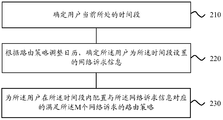
- FIG. 2 is a schematic diagram of a method for determining a routing policy according to an embodiment of the present application. As shown in FIG. 2, the method may be performed in the collaboration layer 110 of the SDN network.
- the execution entity is abbreviated as the collaboration layer 110.
- the method for determining the routing policy includes:
- the network appeal information includes M network appeals, and M weights corresponding to the M network appeals.
- the M is a positive integer, and the M weights are used to measure the degree of demand of the user for the M network appeals.
- the routing policy adjustment calendar includes the network appeal information corresponding to the time period, and the routing policy corresponding to the network appeal information.
- a routing policy refers to a selection policy that maps to a routing channel between data packets of a communication network in an actual communication network.
- the routing policy adjustment calendar includes a plurality of network appeal information and a plurality of routing policies corresponding to the plurality of network appeal information, and the plurality of network appeal information and the plurality of routing policies are in one-to-one correspondence.
- the collaboration layer 110 is directly oriented to the user, and the user can customize his or her personalized online appeal. Therefore, the collaboration layer 110 can find the routing policy corresponding to the network appeal information in the routing policy adjustment calendar according to the network appeal information set by the user.
- M network appeals and M weights corresponding to the M network appeals may be included. Where M is a positive integer. Users can assign different weights to different network appeals to express The degree of user demand for each type of network appeal.
- the user can individually assign different weights according to his own needs for different networks; the user can also set only his own various network demands, and the collaboration layer 110 evenly distributes or fixes multiple network appeals set by the user.
- the ratio is the weight.
- routing policies are determined according to different demands of the user on the network in different time periods, so that the routing policy can be dynamically adjusted according to the needs of the user.
- FIG. 3 is a schematic diagram of a time mapping axis of a network appeal to a routing policy claim in an embodiment of the present application.
- Figure 3 shows the network appeals of users in different time periods.
- Each network appeal corresponds to a routing policy appeal.
- the smooth response to the routing policy is the minimum route delay
- the routing policy corresponding to the saved traffic is Load balancing, high reliability guarantees the corresponding routing policy appeal for the click response success rate.
- the user's network appeals are different in different time periods. Therefore, the routing policy requirements are different in different time periods, and the routing strategies used are different, so that the user personalized adjustment of the network routing policy can be realized.
- the method before determining the time period in which the user is currently located, the method further includes:
- routing strategy of the collaboration layer 110 by embedding the routing policy of the collaboration layer 110 to the user level, by combining the user's demand for different network demands, a routing strategy that satisfies the user's multiple demands is formulated, so that the routing strategy can meet the customization requirements of the user.
- routing policy corresponding to each network appeal information in the routing policy calendar may be executed according to the method detailed below, except that the network appeal information of each routing policy is determined to be different, so the cooperation layer 110 finally targets The routing strategies determined by different network appeal information are also different.
- FIG. 4 is a schematic flowchart of a method for determining a routing policy according to an embodiment of the present application.
- the method illustrated in FIG. 4 is performed by the collaboration layer 110.
- the collaboration layer 110 determines a corresponding routing policy in the routing policy calendar according to the network appeal information set by the user. And in 250, determining, according to the network appeal information, the routing policy that meets the M network appeals corresponding to the network appeal information, including:
- the collaboration layer 110 obtains M network appeals included in the network appeal information set by the user, and M weights corresponding to the M network appeals, and then determines M corresponding to the M network appeals. Optimal route.
- the network appeal information set by the user includes three kinds of network appeals such as smooth Internet access, saving traffic and high reliability, and the weights allocated by the user for these three network claims are 40% and 30% respectively. And 30%.
- the collaboration layer 110 determines three optimal routes corresponding to the three network appeals, for example, determining an optimal route l1 corresponding to the network appeal of satisfying the Internet access, and satisfying the optimal route l2 corresponding to the network appeal of saving traffic. And the optimal route l3 corresponding to the high reliability guarantee of the network appeal.
- the collaboration layer 110 determines the target route configured for the user according to the M optimal routes and the M weights obtained above.
- the collaboration layer 110 respectively assigns the optimal routes (l1, l2, and l3) corresponding to the three network claims, such as smooth Internet access, saving traffic, and high reliability, and the weights respectively assigned by the user for the three network claims ( 40%, 30%, and 30%) to determine the target route that is ultimately selected for the user.
- the optimal routes l1, l2, and l3
- the weights respectively assigned by the user for the three network claims ( 40%, 30%, and 30%) to determine the target route that is ultimately selected for the user.
- the user's weight assigned to a certain network appeal is large, indicating that the user has more demand for the network appeal; the user's weight assigned to a certain network appeal is small, indicating that the user has less demand for the network appeal. .
- the collaboration layer 110 first determines the M optimal routes that satisfy the M network claims, respectively.
- the entire network is composed of a cross-domain collaboration layer 110 and a controller 120.
- the collaboration layer 110 is directly oriented to the tenant, and the tenant can customize the personalized online appeal; the inter-domain collaboration layer is responsible for delivering the specific routing policy to the specific control.
- the controller 121, the controller 122, and the controller 123, the controller 121, the controller 122, and the controller 123 distribute the routing.
- the collaboration layer 110 sends the algorithm tasks of the controllers through a unified scheduling algorithm. It mainly solves the connection problem between domains, but it will generate many problems that are not involved in routing calculation in a single domain.
- FIG. 5 is a schematic diagram of intra-domain routing and inter-domain routing according to an embodiment of the present application.
- the route from A2 to I2 in FIG. 5 if it is in a domain, directly calls the routing algorithm of the domain, and the general routing algorithm will give a route order that satisfies the requirements.
- Cross-domain is complicated. It is necessary to analyze the possible route combinations through the collaboration layer, and multiple routing requests are sent in one domain.
- the user can map the network appeal value indicating the satisfaction level of each network claim to a unified route consumption axis.
- the route consumption axis is a Fibonacci sequence routing consumption axis, and the consumption value on the consumption axis maps the network appeal value to a value on the Fibonacci sequence.
- the user will uniformly map the satisfaction degree of each network appeal to the Fibonacci sequence routing consumption axis, thereby aligning the user's satisfaction with different network demands on one axis, so as to facilitate the operation.
- Comparison between strategies For the specific value corresponding to the satisfaction degree, a default preset corresponding value is required.
- the basic principle may be that the greater the satisfaction degree, the smaller the route consumption value. The greater the consumption value when you are not satisfied, the more you need to circumvent the route at that time.
- the Fibonacci sequence itself has this feature, that is, the larger the value, the larger the increase, and the more uncontrollable.
- the route consumption value is also simply referred to as the consumption value.
- the routing policy selection requirements are different for each network appeal.
- Table 1 when the network appeal is smooth, saves traffic, and has high reliability, the corresponding routing policy selection request has a small routing delay. Small route hops and route load balancing.
- the parameters such as delay and hop count to a consumption axis, so that they have a unified measurement standard, so that the quality of the route satisfying different network demands can be good or bad through the unified measurement standard. Measure and compare to accurately select the routing strategy that satisfies multiple appeals at the same time.
- the Fibonacci sequence routing consumption axis has no units.
- the route consumption value is small, for example, it can be 0; when the click response time is 2s, the user's satisfaction is normal, the route consumption value is moderate, for example, 8; When the click response time is 3s, the user's satisfaction is very poor, and the route consumption value is large, for example, it can be 144.
- Table 2 is an example of the mapping relationship between satisfaction with network appeals and route consumption values.
- mapping relationship of the specific numerical values shown in Table 2 is only an example and not a limitation.
- the relationship between the user's satisfaction with the network appeal and the route consumption value can be based on the mapping relationship set by the network operation and maintenance personnel, and the relationship between the satisfaction of the network appeal and the route consumption value is satisfied. The network situation is adjusted. This application does not limit this.
- the third network appeal corresponds to the respective consumption values of the N routes, and determines the route l3 in which the consumption value is the smallest (assuming the consumption value is z3).
- determining the routing policy according to the M optimal routes and the M weights including:
- the collaboration layer 110 can obtain the consumption values x1, y1, and z1 when the route l1 satisfies the first network appeal, the second network appeal, and the third network appeal respectively; the route l2 satisfies the first network respectively.
- the consumption value of the appeal, the second network appeal and the third network appeal is x2, y2, z2; the consumption value of the route l3 satisfying the first network appeal, the second network appeal and the third network appeal respectively X3, y3, z3.
- the time period here means that the user sets the same network appeal information in the same time period.
- the collaboration layer 110 configures a corresponding routing policy according to the network appeal information set by the user for the time period.
- the routing policy is determined according to the M curve, including:
- the cooperation layer 110 measures the quality contribution of the routing strategy in each cycle by calculating the area of the consumption value weighted sum curve and the time axis enclosing the area.
- the periodic routing under the multi-quality indicator appeals simultaneously considers the weighted mapping of multi-quality indicators and the area calculation based on the time axis to complete the final routing decision.
- the collaboration layer 110 may periodically determine a corresponding routing policy for the user, so as to configure the target route for the user in real time according to the routing policy.
- the collaboration layer 110 sends the decomposed route calculation task to the controller 121.
- the collaboration layer 110 when the collaboration layer 110 selects the optimal route corresponding to each network claim, the route with the second smallest consumption value may also be selected as the backup route.
- the route with the second smallest consumption value may also be selected as the backup route.
- the collaboration layer 110 may compare the backup route by using the foregoing method, and configure the current time period for the user by using the routing policy determined according to the route with the second smallest consumption value. Target routing.
- the method for determining a routing policy according to an embodiment of the present application is described in detail above with reference to FIG. 2 to FIG. 8.
- the apparatus 900 for determining a routing policy according to an embodiment of the present application will be described in detail below with reference to FIG. 9 and FIG.
- FIG. 9 is a structural block diagram of an apparatus for determining a routing policy according to an embodiment of the present application.
- the apparatus 900 for determining a routing policy shown in FIG. 9 is for performing the method of determining a routing policy described in FIGS. 2-8.
- the means for determining the routing policy can be located at the collaboration layer 110.
- the apparatus 900 for determining a routing policy includes a determining module 910 and a configuration module 920.
- the determining module 910 is configured to:
- the configuration module 920 is configured to configure, by the user, a routing policy that meets the M network appeals corresponding to the network appeal information in the time period;
- the routing policy adjustment calendar includes the network appeal information corresponding to the time period, and the routing policy corresponding to the network appeal information.
- the device 900 for determining the routing policy determines different routing policies according to different requests of the user to the network in different time periods, so that the routing policy can be dynamically adjusted according to the requirements of the user.
- the device 900 for determining the routing policy combines the user by embodying the routing policy to the user level. To meet the needs of different network demands, a routing strategy that satisfies users' multiple demands is formulated, so that the routing strategy can meet the customization requirements of users.
- the second determining unit 912 is configured to:
- the first determining unit 911 includes:
- a first determining subunit configured to determine N routes satisfying an i th network claim in the M network claims, where N is a positive integer, and the i satisfies 1 ⁇ i ⁇ M;
- a second determining subunit configured to determine that the route corresponding to the smallest consumption value of the N consumption values is an optimal route that satisfies the i-th network appeal.
- the device 900 for determining a routing policy provides a unified metric for different network appeal indicators by mapping a plurality of different network appeal indicators of the user to a unified scale, such as a Fibonacci sequence routing strategy consumption axis.
- a comprehensive evaluation of a variety of different network demands is achieved, so that an optimal routing strategy that satisfies multiple network demands of users is more accurately obtained.
- the second determining unit 912 includes:
- a third calculating subunit configured to calculate M consumption values of the i-th optimal route in the M optimal routes respectively under the M network claims;
- the fourth determining subunit is for:
- the fourth determining subunit is specifically configured to:
- determining a network appeal corresponding to a variation curve forming a minimum area of the area is a target network appeal
- the embodiment of the present application further provides an apparatus 1000 for determining a routing policy, where the apparatus 1000 for determining a routing policy includes a processor 1001, a memory 1002, a receiver 1004, and a transmitter 1005.
- the processor 1001, the memory 1002, and the receiver 1004 communicate with each other through an internal connection path, and the memory 1002 is configured to store
- the processor 1001 is configured to execute the instructions stored by the memory 1002 and control the receiver 1004 to receive the information.
- the processor 1001, the memory 1002, the receiver 1004, and the transmitter 1005 may be implemented by one or more chips.
- the processor 1001, the memory 1002, the receiver 1004, and the transmitter 1005 may be fully integrated in one chip, or the processor 1001, the receiver 1004, and the transmitter 1005 may be integrated in one chip and the memory 1002 integrated in another chip.
- the processor 1001 is configured to:
- Adjusting a calendar according to the routing policy determining network appeal information set by the user for the time period, where the network appeal information includes M network appeals, and M weights corresponding to the M network appeals, M is a positive integer, and the M weights are used to measure the degree of demand of the user for the M network appeals;
- the routing policy adjustment calendar includes the network appeal information corresponding to the time period, and the routing policy corresponding to the network appeal information.
- the memory in the embodiments of the present application may be a volatile memory or a non-volatile memory, or may include both volatile and non-volatile memory.
- the non-volatile memory may be a read-only memory (ROM), a programmable read only memory (PROM), an erasable programmable read only memory (Erasable PROM, EPROM), or an electric Erase programmable read only memory (EEPROM) or flash memory.
- the volatile memory can be a Random Access Memory (RAM) that acts as an external cache.
- RAM Random Access Memory
- many forms of RAM are available, such as static random access memory (SRAM), dynamic random access memory (DRAM), synchronous dynamic random access memory (Synchronous DRAM).
- SDRAM Double Data Rate SDRAM
- DDR SDRAM Double Data Rate SDRAM
- ESDRAM Enhanced Synchronous Dynamic Random Access Memory
- SLDRAM Synchronous Connection Dynamic Random Access Memory
- DR RAM Direct Memory Bus Random Access Memory
- the disclosed systems, devices, and methods may be implemented in other manners.
- the device embodiments described above are merely illustrative.
- the division of the unit is only a logical function division.
- there may be another division manner for example, multiple units or components may be combined or Can be integrated into another system, or some features can be ignored or not executed.
- the mutual coupling or direct coupling or communication connection shown or discussed may be an indirect coupling or communication connection through some interface, device or unit, and may be in an electrical, mechanical or other form.
- the unit described as a separate component may or may not be physically separated as a unit display
- the components may or may not be physical units, ie may be located in one place, or may be distributed over multiple network elements. Some or all of the units may be selected according to actual needs to achieve the purpose of the solution of the embodiment.
- each functional unit in each embodiment of the present application may be integrated into one processing unit, or each unit may exist physically separately, or two or more units may be integrated into one unit.
- the functions may be stored in a computer readable storage medium if implemented in the form of a software functional unit and sold or used as a standalone product.
- the technical solution of the present application which is essential or contributes to the prior art, or a part of the technical solution, may be embodied in the form of a software product, which is stored in a storage medium, including
- the instructions are used to cause a computer device (which may be a personal computer, server, or network device, etc.) to perform all or part of the steps of the methods described in various embodiments of the present application.
- the foregoing storage medium includes: a U disk, a mobile hard disk, a read-only memory (ROM), a random access memory (RAM), a magnetic disk, or an optical disk, and the like, which can store program codes. .
Landscapes
- Engineering & Computer Science (AREA)
- Computer Networks & Wireless Communication (AREA)
- Signal Processing (AREA)
- Data Exchanges In Wide-Area Networks (AREA)
Abstract
Description
本申请要求于2016年05月17日提交中国专利局、申请号为201610327091.9、发明名称为“确定路由策略的方法和装置”的中国专利申请的优先权,其全部内容通过引用结合在本申请中。The present application claims priority to Chinese Patent Application No. 201610327091.9, entitled "Method and Apparatus for Determining Routing Policy", filed on May 17, 2016, the entire contents of which is incorporated herein by reference. .
本申请涉及通信领域,尤其涉及通信领域中的确定路由策略的方法和装置。The present application relates to the field of communications, and in particular, to a method and apparatus for determining a routing policy in the field of communications.
目前运维支撑系统(Operations Support Systems,QSS)架构在对接多系统上存在大量的运维成本,例如对接的各个厂商的网管系统。通常一套网管系统都有自己特定的路由策略,设置后就不会改变,而且这些策略也是面向运营商运维人员,普通企业用户是无法看懂的。因此路由策略不能按照用户的需求进行动态的调整,并且带宽存在严重浪费。另外,在软件定义网络(Software Defined Network,SDN)中,多域控制器的路由算法没有统一的标准,所以相同路由策略的计算结果没有统一的比较尺度,因此路由策略无法满足用户的多指标诉求。At present, the Operation Support Systems (QSS) architecture has a large number of operation and maintenance costs on the docking multiple systems, such as the network management systems of various vendors. Usually, a network management system has its own specific routing strategy. It will not change after setting, and these policies are also aimed at operators' operation and maintenance personnel, which cannot be understood by ordinary enterprise users. Therefore, the routing policy cannot be dynamically adjusted according to the needs of users, and the bandwidth is seriously wasted. In addition, in the Software Defined Network (SDN), the routing algorithm of the multi-domain controller has no unified standard, so the calculation result of the same routing policy does not have a unified comparison scale, so the routing strategy cannot satisfy the multi-criteria appeal of the user. .
发明内容Summary of the invention
有鉴于此,本申请实施例提供了一种确定路由策略的方法和装置,通过根据用户在不同时间段对网络的不同诉求,设置不同的路由策略,以解决路由策略不能按照用户的需求进行动态调整的问题。In view of this, the embodiment of the present application provides a method and a device for determining a routing policy, and setting different routing policies according to different requests of the user to the network in different time periods, so as to solve the problem that the routing policy cannot be dynamically performed according to the requirements of the user. The problem of adjustment.
第一方面,提供了一种确定路由策略的方法,该方法包括:In a first aspect, a method for determining a routing policy is provided, the method comprising:
确定用户当前所处的时间段;Determine the time period in which the user is currently located;
根据路由策略调整日历,确定所述用户为所述时间段设置的网络诉求信息,所述网络诉求信息包括M个网络诉求,以及与所述M个网络诉求一一对应的M个权值,所述M为正整数,所述M个权值用于衡量所述用户对所述M个网络诉求的需求程度;Adjusting a calendar according to the routing policy, determining network appeal information set by the user for the time period, where the network appeal information includes M network appeals, and M weights corresponding to the M network appeals, M is a positive integer, and the M weights are used to measure the degree of demand of the user for the M network appeals;
为所述用户在所述时间段内配置与所述网络诉求信息对应的满足所述M个网络诉求的路由策略;And configuring, by the user, a routing policy that meets the M network appeals corresponding to the network appeal information in the time period;
其中,所述路由策略调整日历包括所述时间段对应的所述网络诉求信息,以及与所述网络诉求信息对应的所述路由策略。The routing policy adjustment calendar includes the network appeal information corresponding to the time period, and the routing policy corresponding to the network appeal information.
其中,所述网络诉求可以为上网流畅、节省流量和高可靠保障。The network appeal can be smooth online, save traffic, and provide high reliability.
因此,该确定路由策略的方法,通过根据用户在不同时间段对网络的不同诉求,确定不同的路由策略,从而使路由策略能够按照用户的需求进行动态的调整。Therefore, the method for determining a routing policy determines different routing policies according to different requests of the user to the network in different time periods, so that the routing policy can be dynamically adjusted according to user requirements.
结合第一方面,在第一方面的第一种可能的实现方式中,在确定所述用户当前所处的时间段之前,所述方法还包括:In conjunction with the first aspect, in a first possible implementation manner of the first aspect, before determining a time period in which the user is currently located, the method further includes:
获取所述用户为所述时间段设置的所述网络诉求信息;Obtaining the network appeal information set by the user for the time period;
根据所述网络诉求信息,确定与所述网络诉求信息对应的满足所述M个网络诉求的所述路由策略; Determining, according to the network appeal information, the routing policy that meets the M network appeals corresponding to the network appeal information;
根据所述时间段和为所述用户在所述时间段内配置的所述路由策略,生成所述路由策略调整日历。And generating the routing policy adjustment calendar according to the time period and the routing policy configured for the user in the time period.
这样,将协同层的路由策略体现到用户层面,通过结合用户对不同网络诉求的需求程度,制定满足用户多种诉求的路由策略,从而使路由策略能够满足用户的定制化需求。In this way, the routing strategy of the collaboration layer is reflected to the user level. By combining the user's demand for different network demands, a routing strategy that satisfies the user's multiple demands is formulated, so that the routing strategy can meet the customization requirements of the user.
作为一个另实施例,所述根据所述网络诉求信息,确定与所述网络诉求信息对应的满足所述M个网络诉求的所述路由策略,包括:As a further embodiment, the determining, according to the network appeal information, the routing policy that meets the M network appeals corresponding to the network appeal information, includes:
确定分别满足所述M个网络诉求的M个最优路由;Determining M optimal routes that respectively satisfy the M network claims;
根据所述M个最优路由和所述M个权值,确定所述路由策略。Determining the routing policy according to the M optimal routes and the M weights.
作为一个另实施例,所述确定分别满足所述M个网络诉求的M个最优路由,包括:As an additional embodiment, the determining the M optimal routes that respectively satisfy the M network appeals includes:
确定满足所述M个网络诉求中第i个网络诉求的N个路由,所述N为正整数,所述i满足1≤i≤M;Determining N routes satisfying the i-th network claim in the M network claims, where N is a positive integer, and the i satisfies 1 ≤ i ≤ M;
计算与所述N个路由一一对应的N个消耗值;Calculating N consumption values corresponding to the N routes one by one;
确定所述N个消耗值中最小的消耗值对应的路由为满足所述第i个网络诉求的最优路由。Determining, by the route corresponding to the smallest consumption value of the N consumption values, an optimal route that satisfies the i-th network appeal.
可选地,根据消耗值的计算结果,还可以确定所述N个消耗值中第二小的消耗值对应的路由为满足所述第i个网络诉求的备份路由,以便于当根据最小路由确定出来的路由策略因网络等原因无法实现时,可以使用根据消耗值第二小的路由确定的路由策略来为用户配置当前时间段使用的目标路由。Optionally, the route corresponding to the second smallest consumption value of the N consumption values is determined to be a backup route that satisfies the i-th network claim according to the calculation result of the consumption value, so as to be determined according to the minimum route. If the outgoing routing policy cannot be implemented due to network or other reasons, you can use the routing policy determined by the route with the second smallest consumption value to configure the destination route used by the current time range for the user.
可选地,由于SDN网络中的每个域控制器内存在多条路由,控制域和控制域之间也存在多条路径,所述方法还可以包括:Optionally, because each of the domain controllers in the SDN network has multiple routes, and multiple paths exist between the control domain and the control domain, the method may further include:
根据域间链路对所述每个域控制器发送的域内路由进行组合,并根据所述组合结果确定满足所述M个网络诉求中第i个网络诉求的N个路由。The intra-domain routes sent by each of the domain controllers are combined according to the inter-domain link, and the N routes satisfying the i-th network appeal in the M network claims are determined according to the combination result.
作为一个实施例,所述计算与所述N个路由一一对应的N个消耗值,包括:As an embodiment, the calculating the N consumption values corresponding to the N routes one by one includes:
计算与所述N个路由一一对应的N个网络诉求值;Calculating N network appeal values corresponding to the N routes one by one;
根据网络诉求值与消耗值之间的映射关系,确定与所述N个网络诉求值一一对应的所述N个消耗值,所述消耗值用于表示所述用户对网络诉求的满意程度。And determining, according to the mapping relationship between the network appeal value and the consumption value, the N consumption values corresponding to the N network appeal values, wherein the consumption value is used to indicate the satisfaction degree of the user to the network appeal.
可选地,所述消耗值为将所述网络诉求值映射到斐波那契数列上而得到的值。Optionally, the consumption value is a value obtained by mapping the network appeal value to a Fibonacci sequence.
可选地,在计算与所述N个路由一一对应的N个网络诉求值时,可以将所述N个网络诉求值分别映射为网络可以识别的N个路由策略诉求值,并根据路由策略诉求值与消耗值之间的映射关系,确定与所述N个网络诉求值一一对应的所述N个消耗值。Optionally, when calculating the N network appeal values that are in one-to-one correspondence with the N routes, the N network appeal values may be respectively mapped to N routing policy appeal values that the network can identify, and according to the routing policy. a mapping relationship between the appeal value and the consumption value, and determining the N consumption values that are in one-to-one correspondence with the N network appeal values.
例如,上网顺畅的网络诉求值为点击回应时间(秒),对应的路由选择策略诉求值为路由时延;节省流量的网络诉求值为购买带宽使用值占比(百分比),对应的路由选择策略诉求值为路由负载大小;高可靠保障的网络诉求值为点击回应成功率(百分比),对应的路由选择策略诉求为路由跳数。For example, the smooth network appeal value is the click response time (seconds), the corresponding routing policy request value is the routing delay, and the traffic-saving network appeal value is the proportion of the purchased bandwidth usage value (percentage), and the corresponding routing strategy. The appeal value is the routing load size; the network appeal value of the high reliability guarantee is the click response success rate (percentage), and the corresponding routing policy request is the route hop count.
这样,通过将用户的多个不同网络诉求指标映射到统一的尺度上,例如斐波那契数列路由策略消耗轴,为不同的网络诉求指标提供了统一的衡量标准,能够对多种不同的网络诉求进行综合评定,同时实现了多个路由策略之间的比较,从而更加准确地获得满足用户多个网络诉求的最佳路由策略。In this way, by mapping multiple different network appeal indicators of the user to a unified scale, such as the Fibonacci sequence routing strategy consumption axis, it provides a unified measure for different network appeal indicators, and can be applied to many different networks. The appeal is comprehensively evaluated, and at the same time, a comparison between multiple routing strategies is realized, thereby obtaining an optimal routing strategy that satisfies multiple network demands of users more accurately.
结合第一方面和第一方面的任意一种实现方式,在第一方面的第二种可能的实现方式中,所述根据所述M个最优路由和所述M个权值,确定所述路由策略,包括: With reference to the first aspect and any implementation manner of the first aspect, in a second possible implementation manner of the first aspect, the determining, according to the M optimal routes and the M weights, Routing strategy, including:
计算所述M个最优路由中的第i个最优路由分别在所述M个网络诉求下的M个消耗值;Calculating M consumption values of the i-th optimal route in the M optimal routes under the M network claims respectively;
根据所述M个权值和所述M个消耗值,确定所述第i个网络诉求对应的消耗值加权和;Determining, according to the M weights and the M consumption values, a weighted sum of consumption values corresponding to the i-th network appeal;
在所述时间段内,确定所述消耗值加权和的变化曲线,所述变化曲线表示所述消耗值加权和随时间的变化情况;Determining, in the period of time, a change curve of the weighted sum of the consumption values, the change curve indicating a change in the weighted sum of the consumption values over time;
确定与所述M个网络诉求一一对应的M条变化曲线,并根据所述M条变化曲线确定所述路由策略。Determining M variation curves corresponding to the M network claims one by one, and determining the routing policy according to the M variation curves.
作为另一个实施例,所述根据M条变化曲线确定所述路由策略,包括:In another embodiment, the determining the routing policy according to the M variation curve includes:
比较所述M条变化曲线分别与时间轴形成的M个区域面积;Comparing the M regions of the M variation curves with the time axis respectively;
在形成所述M个区域面积的M条变化曲线中,确定形成区域面积最小的变化曲线对应的网络诉求为目标网络诉求;In the M variation curves forming the area of the M regions, determining a network appeal corresponding to a variation curve forming a minimum area of the area is a target network appeal;
根据所述目标网络诉求确定所述路由策略,以便于根据所述路由策略为所述用户配置目标路由。Determining the routing policy according to the target network appeal, so as to configure a target route for the user according to the routing policy.
可选地,还可以将确定好的路由策略信息或者制定的路由策略调整日历推送给用户,使用户可以实时了解自己所占用的资源情况。并且允许用户根据为不同时间周期设置的不同网络诉求对应的路由策略,对路由策略调整日历进行调整。例如用户可以根据该路由策略对网络诉求信息中每个网络诉求的权重进行调整。Optionally, the determined routing policy information or the customized routing policy adjustment calendar may be pushed to the user, so that the user can know the resources occupied by the user in real time. And the user is allowed to adjust the routing policy adjustment calendar according to different routing policies set for different time periods. For example, the user can adjust the weight of each network appeal in the network appeal information according to the routing policy.
第二方面,提供了一种确定路由策略的装置,用于执行上述第一方面或第一方面的任意可能的实现方式中的方法。具体地,该装置包括:In a second aspect, an apparatus for determining a routing policy is provided for performing the method of any of the first aspect or the first aspect of the first aspect. Specifically, the device includes:
确定模块,用于确定用户当前所处的时间段;a determining module for determining a time period in which the user is currently located;
所述确定模块还用于,根据路由策略调整日历,确定所述用户为所述时间段设置的网络诉求信息,所述网络诉求信息包括M个网络诉求,以及与所述M个网络诉求一一对应的M个权值,所述M为正整数,所述M个权值用于衡量所述用户对所述M个网络诉求的需求程度;The determining module is further configured to: adjust a calendar according to a routing policy, and determine network appeal information set by the user for the time period, where the network appeal information includes M network appeals, and one of the M network appeals Corresponding M weights, the M is a positive integer, and the M weights are used to measure the degree of demand of the user for the M network appeals;
配置模块,用于为所述用户在所述时间段内配置与所述网络诉求信息对应的满足所述M个网络诉求的路由策略;a configuration module, configured to configure, by the user, a routing policy that meets the M network appeals corresponding to the network appeal information in the time period;
其中,所述路由策略调整日历包括所述时间段对应的所述网络诉求信息,以及与所述网络诉求信息对应的所述路由策略。The routing policy adjustment calendar includes the network appeal information corresponding to the time period, and the routing policy corresponding to the network appeal information.
第三方面,提供了一种确定路由策略的装置,包括处理器、存储器、接收器和发送器,所述发送器和所述接收器分别用于在通信的过程中发送和接收信息,所述存储器用于存储指令,所述处理器用于执行所述存储器存储的指令,其中,处理器、存储器和总线系统也可以统称为基带处理器,发送器和接收器也可以统称为射频系统,所述处理器具体用于:A third aspect provides an apparatus for determining a routing policy, including a processor, a memory, a receiver, and a transmitter, wherein the transmitter and the receiver are respectively configured to send and receive information during a communication, The memory is used to store instructions, and the processor is configured to execute the instructions stored in the memory, wherein the processor, the memory, and the bus system may also be collectively referred to as a baseband processor, and the transmitter and the receiver may also be collectively referred to as a radio frequency system. The processor is specifically used to:
确定用户当前所处的时间段;Determine the time period in which the user is currently located;
根据路由策略调整日历,确定所述用户为所述时间段设置的网络诉求信息,所述网络诉求信息包括M个网络诉求,以及与所述M个网络诉求一一对应的M个权值,所述M为正整数,所述M个权值用于衡量所述用户对所述M个网络诉求的需求程度;Adjusting a calendar according to the routing policy, determining network appeal information set by the user for the time period, where the network appeal information includes M network appeals, and M weights corresponding to the M network appeals, M is a positive integer, and the M weights are used to measure the degree of demand of the user for the M network appeals;
为所述用户在所述时间段内配置与所述网络诉求信息对应的满足所述M个网络诉求的路由策略; And configuring, by the user, a routing policy that meets the M network appeals corresponding to the network appeal information in the time period;
其中,所述路由策略调整日历包括所述时间段对应的所述网络诉求信息,以及与所述网络诉求信息对应的所述路由策略。The routing policy adjustment calendar includes the network appeal information corresponding to the time period, and the routing policy corresponding to the network appeal information.
第四方面,提供了一种计算机可读介质,用于存储计算机程序,该计算机程序包括用于执行第一方面或第一方面的任意可能的实现方式中的方法的指令。In a fourth aspect, a computer readable medium is provided for storing a computer program comprising instructions for performing the method of the first aspect or any of the possible implementations of the first aspect.
基于上述技术方案,本申请实施例的确定路由策略的方法,通过根据用户在不同时间段对网络的不同诉求,确定不同的路由策略,从而使路由策略能够按照用户的需求进行动态的调整。Based on the foregoing technical solution, the method for determining a routing policy in the embodiment of the present application determines different routing policies according to different requests of the user to the network in different time periods, so that the routing policy can be dynamically adjusted according to the requirements of the user.
另外,由于将协同层的路由策略体现到用户层面,通过结合用户对不同网络诉求的需求程度,制定满足用户多种诉求的路由策略,从而使路由策略能够满足用户的定制化需求。In addition, because the routing strategy of the collaboration layer is reflected to the user level, by combining the user's demand for different network demands, a routing strategy that satisfies the user's multiple demands is formulated, so that the routing strategy can meet the customization requirements of the user.
图1是本申请实施例的一种应用场景的示意性架构图。FIG. 1 is a schematic structural diagram of an application scenario of an embodiment of the present application.
图2是本申请实施例的确定路由策略的方法的示意图。FIG. 2 is a schematic diagram of a method for determining a routing policy according to an embodiment of the present application.
图3是本申请实施例的网络诉求到路由选择策略诉求的时间映射轴的示意图。3 is a schematic diagram of a time mapping axis of a network appeal to a routing policy claim in an embodiment of the present application.
图4是本申请实施例的确定路由策略的方法的流程图。FIG. 4 is a flowchart of a method for determining a routing policy according to an embodiment of the present application.
图5是本申请实施例的域内路由和域间路由的示意图。FIG. 5 is a schematic diagram of intra-domain routing and inter-domain routing according to an embodiment of the present application.
图6是本申请实施例的路由策略消耗轴的示意图。FIG. 6 is a schematic diagram of a routing policy consumption axis according to an embodiment of the present application.
图7是本申请实施例的消耗值加权和变化曲线的示意图。FIG. 7 is a schematic diagram of a consumption value weighting and variation curve of an embodiment of the present application.
图8是本申请实施的路由策略切换机制的示意图。FIG. 8 is a schematic diagram of a routing policy switching mechanism implemented by the present application.
图9是本申请实施例的确定路由策略的装置的示意性结构图。FIG. 9 is a schematic structural diagram of an apparatus for determining a routing policy according to an embodiment of the present application.
图10是本申请实施例的确定路由策略的装置的示意性结构图。FIG. 10 is a schematic structural diagram of an apparatus for determining a routing policy according to an embodiment of the present application.
下面将结合本申请实施例中的附图,对本申请实施例中的技术方案进行描述。The technical solutions in the embodiments of the present application will be described below with reference to the accompanying drawings in the embodiments of the present application.
图1是本申请实施例的一种应用场景的示意性架构图。SDN网络构架包括应用层、控制层和基础设施层。其中,应用层包括各种不同的业务和应用,可以管理和控制网络对应用转发/处理的策略,也支持对网络属性的配置实现提升网络利用率、保障特定应用的安全和服务质量;控制层中包括协同层、控制器和网元抽象层,主要负责处理数据转发面资源的抽象信息,可支持网络拓扑、状态信息的汇总和维护,并基于应用的控制来调用不同的转发面资源;基础设施层(数据转发层)负责基于业务的流表的数据处理、转发和状态收集。图1中示出了SDN网络架构中的控制层包括的协同层110、控制器120和用户设备130。其中控制器(也叫域控制器)120包括控制器121、控制器122和控制器123等多个控制器。用户设备130包括用户设备131、设备132和设备133等多个用户设备。这里以三个控制器和三个用户设备为例进行示意。协同层110与控制器121、控制器122和控制器123之间互通,可以实现多控制器的协同;控制器121、控制器122和控制器123可以根据实时的网络信息对网络转发进行控制。FIG. 1 is a schematic structural diagram of an application scenario of an embodiment of the present application. The SDN network architecture includes an application layer, a control layer, and an infrastructure layer. The application layer includes various services and applications, which can manage and control the network's policy of forwarding/processing the application, and also support the configuration of network attributes to improve network utilization and ensure the security and quality of service of specific applications. It includes a collaboration layer, a controller, and a network element abstraction layer. It is mainly responsible for processing abstract information of data forwarding surface resources, supporting network topology, summarization and maintenance of state information, and calling different forwarding plane resources based on application control; The facility layer (data forwarding layer) is responsible for data processing, forwarding, and state collection of traffic-based flow tables. The
现有技术中在SDN网络的演进中使用了软件定义的分组传送网(Software Defined Packet Transport Network,SPTN)的方案,包括S控制器和D控制器,控制器之间进行分段路由计算,这里提供了三个路由策略供使用,例如最小时延(各个控制器分层计算 各个跨段的时延信息,根据端到端最短时延计算路径),最小跳数(使得业务经过的网元数最少,占用网络资源较小,但不考虑时延因素),负载均衡(控制器分析网络中各个路径的负载情况,把业务分摊到不同的链路上,防止网络中的流量不均衡,最大化利用网络资源)。基本原理就是让各个控制器按照客户预定的路由策略,计算路由,并对各段路由进行合并,就是整体的路由。In the prior art, a software-defined Software Defined Packet Transport Network (SPTN) solution is used in the evolution of an SDN network, including an S controller and a D controller, and a segmentation route calculation is performed between the controllers. Provides three routing strategies for use, such as minimum latency (each controller hierarchical calculation Delay information of each span, based on the end-to-end shortest delay calculation path), minimum hop count (making the number of network elements passing through the service the least, occupying less network resources, but not considering delay factors), load balancing (control The device analyzes the load of each path in the network, and distributes the traffic to different links to prevent unbalanced traffic in the network and maximize the use of network resources. The basic principle is to let each controller calculate the route according to the customer's predetermined routing strategy, and merge each segment of the route, which is the overall route.
但是SPTN存在以下缺点:首先,路由策略的调整依赖手工触发或通过保护倒换到备选路径,且备选路径使用的策略和工作路径是一致的,没有考虑当前的现网路由情况,因此路由策略不能按照用户的需求进行实时动态的调整,带宽可能存在严重浪费;其次,多域控制器的路由算法没有统一的标准,只有统一的北向接口,所以相同路由策略的计算结果没有统一的比较尺度(边界点之间的路由通常有多条,存在域内路由选择和全局路由选择的问题),因此只能根据诉求最强的指标确定路由策略,无法对用户的多个诉求指标进行综合评定,无法同时满足用户的多种不同需求。However, SPTN has the following disadvantages: First, the adjustment of the routing policy relies on manual triggering or switching to the alternate path through protection, and the policy and working path used by the alternate path are consistent, and the current network routing situation is not considered, so the routing policy is adopted. The real-time dynamic adjustment cannot be performed according to the user's needs, and the bandwidth may be seriously wasted. Secondly, the routing algorithm of the multi-domain controller has no unified standard, and only the unified northbound interface, so the calculation result of the same routing strategy has no uniform comparison scale ( There are usually multiple routes between the boundary points, and there are problems in intra-domain routing and global routing. Therefore, the routing policy can only be determined according to the most demanding indicators. It is impossible to comprehensively evaluate multiple user appeal indicators. Meet the diverse needs of users.
为此,本申请实施例提出一种确定路由策略的方法,通过根据用户在不同时间对网络的不同需求,设置不同的路由策略,以解决路由策略不能按照用户的需求进行动态调整的问题。To this end, the embodiment of the present application provides a method for determining a routing policy, which is to solve the problem that the routing policy cannot be dynamically adjusted according to the requirements of the user by setting different routing policies according to different requirements of the network at different times.
并且,本申请实施例提出的方法,将协同层的路由策略体现到用户层面,通过结合用户对不同网络诉求的需求程度,制定满足用户多种诉求的路由策略,从而使路由策略能够满足用户的定制化需求。Moreover, the method proposed by the embodiment of the present application reflects the routing policy of the collaboration layer to the user level, and combines the user's demand for different network demands to formulate a routing policy that satisfies multiple requirements of the user, so that the routing policy can satisfy the user. Customized requirements.
另外,通过将用户的多个不同网络诉求指标映射到统一的尺度上,例如斐波那契数列路由策略消耗轴,为不同的网络诉求指标提供了统一的衡量标准,同时实现了对多种不同的网络诉求的综合评定,从而更加准确地获得满足用户多个网络诉求的最佳路由策略。In addition, by mapping multiple different network appeal indicators of users to a unified scale, such as the Fibonacci sequence routing strategy consumption axis, it provides a unified measure for different network appeal indicators, and achieves a variety of different The comprehensive assessment of network appeals, so as to more accurately obtain the best routing strategy to meet the user's multiple network demands.
图2是本申请实施例的确定路由策略的方法的示意图。如图2所示,该方法可以在SDN网络的协同层110中执行,下面将执行主体简称为协同层110,该确定路由策略的方法包括:FIG. 2 is a schematic diagram of a method for determining a routing policy according to an embodiment of the present application. As shown in FIG. 2, the method may be performed in the
210,确定用户当前所处的时间段。210: Determine a time period in which the user is currently located.
220,根据路由策略调整日历,确定所述用户为所述时间段设置的网络诉求信息,所述网络诉求信息包括M个网络诉求,以及与所述M个网络诉求一一对应的M个权值,所述M为正整数,所述M个权值用于衡量所述用户对所述M个网络诉求的需求程度。220. Adjust a calendar according to a routing policy, and determine network appeal information set by the user for the time period, where the network appeal information includes M network appeals, and M weights corresponding to the M network appeals. The M is a positive integer, and the M weights are used to measure the degree of demand of the user for the M network appeals.
230,为所述用户在所述时间段内配置与所述网络诉求信息对应的满足所述M个网络诉求的路由策略。230. Configure, by the user, a routing policy that meets the M network appeals corresponding to the network appeal information in the time period.
其中,所述路由策略调整日历包括所述时间段对应的所述网络诉求信息,以及与所述网络诉求信息对应的所述路由策略。路由策略是指映射为实际通信网络中数据包在通信设备之间的路由通道的选择策略。The routing policy adjustment calendar includes the network appeal information corresponding to the time period, and the routing policy corresponding to the network appeal information. A routing policy refers to a selection policy that maps to a routing channel between data packets of a communication network in an actual communication network.
具体地,路由策略调整日历中包括多个网络诉求信息和多个网络诉求信息对应的多个路由策略,并且多个网络诉求信息和多个路由策略一一对应。协同层110直接面向用户,用户可以定制自己的个性化上网诉求。因此,协同层110根据用户设置的网络诉求信息,就可以在路由策略调整日历中查找到与该网络诉求信息对应的路由策略。Specifically, the routing policy adjustment calendar includes a plurality of network appeal information and a plurality of routing policies corresponding to the plurality of network appeal information, and the plurality of network appeal information and the plurality of routing policies are in one-to-one correspondence. The
在该网络诉求信息中,可以包括M个网络诉求,以及与M个网络诉求一一对应的M个权值。其中M为正整数。用户可以为不同的网络诉求分别分配不同的权重,以表达 用户对每一种网络诉求的需求程度。In the network appeal information, M network appeals and M weights corresponding to the M network appeals may be included. Where M is a positive integer. Users can assign different weights to different network appeals to express The degree of user demand for each type of network appeal.
应理解,用户可以自己为不同的网络诉求根据自己的需求分配的不同的权重;用户也可以只设置自己的各种网络诉求,而协同层110为用户设置的多个网络诉求平均分配或者按照固定比例该权重。It should be understood that the user can individually assign different weights according to his own needs for different networks; the user can also set only his own various network demands, and the
因此,通过根据用户在不同时间段对网络的不同诉求,确定不同的路由策略,从而使路由策略能够按照用户的需求进行动态的调整。Therefore, different routing policies are determined according to different demands of the user on the network in different time periods, so that the routing policy can be dynamically adjusted according to the needs of the user.
下面结合图3详细描述网络诉求信息和路由策略的对应关系。图3是本申请实施例的网络诉求到路由选择策略诉求的时间映射轴的示意图。图3中示出了用户在不同时间段的网络诉求,每一个网络诉求都对应一个路由选择策略诉求,例如上网顺畅对应路由选择策略诉求为路由延时最小,节省流量对应的路由选择策略诉求为负载均衡,高可靠保障对应的路由选择策略诉求为点击回应成功率。用户在不同时间段的网络诉求不同,因此在不同时间段的路由选择策略诉求也不同,所使用的路由策略就不相同,从而可以实现网络路由策略的用户个性化调整。The correspondence between the network appeal information and the routing policy will be described in detail below with reference to FIG. 3 is a schematic diagram of a time mapping axis of a network appeal to a routing policy claim in an embodiment of the present application. Figure 3 shows the network appeals of users in different time periods. Each network appeal corresponds to a routing policy appeal. For example, the smooth response to the routing policy is the minimum route delay, and the routing policy corresponding to the saved traffic is Load balancing, high reliability guarantees the corresponding routing policy appeal for the click response success rate. The user's network appeals are different in different time periods. Therefore, the routing policy requirements are different in different time periods, and the routing strategies used are different, so that the user personalized adjustment of the network routing policy can be realized.
举例来说,用户在网上看电影,则优先保证上网流畅;平时周一到周五,用户白天上班,根本不用宽带,可以将自己的带宽释放出去,降低带宽成本的同时,释放的带宽可以提供给其他需要的用户;周六和周日如果需要登陆银行网站进行网上购物等,就需要有高的可靠性,保障订单等关键业务的正确操作性。这些需求反映在网络内部的路由,就是看电影要流畅,路由选择就要时延最短;需要节省流量,实际上就要能够实时调整路由带宽,同时要保证带宽调整过程中不能影响其他的业务,反映在路由策略中为负载均衡;周末网上购物,就需要高可靠性,反映在路由上为路由经过的设备最小,即最小跳数的路由。For example, if a user watches a movie online, the priority is to ensure smooth Internet access. From Monday to Friday, users go to work during the day and do not need broadband at all. They can release their bandwidth and reduce the bandwidth cost. The released bandwidth can be provided. Other users who need it; if you need to visit the bank's website for online shopping on Saturdays and Sundays, you need to have high reliability and ensure the correct operation of key business such as orders. These requirements are reflected in the internal routing of the network, that is, the film should be smooth, the routing should have the shortest delay; the need to save traffic, in fact, it must be able to adjust the routing bandwidth in real time, while ensuring that the bandwidth adjustment process can not affect other services, It is reflected in the routing policy as load balancing; on weekends, online shopping requires high reliability, which is reflected in the routing of the smallest route, that is, the minimum number of hops.
应理解,用户的网络诉求并不限于此,用户设置的网络诉求信息中可以包括多种网络诉求。这里以M个网络诉求中的三个,例如上网流畅、节省流量和高可靠保障这三种网络诉求为例进行说明。It should be understood that the user's network appeal is not limited to this, and the network appeal information set by the user may include multiple network appeals. Here, three of the M network appeals, such as smooth Internet access, saving traffic and high reliability, are described as examples.
表一是网络诉求与衡量其满意度的衡量参数之间的对应关系以及网络诉求对应的路由选择策略诉求。如表一所示,上网顺畅对应的路由选择策略诉求为路由时延小,其衡量参数为点击回应时间(秒);节省流量对应的路由选择策略诉求为路由负载均衡,其衡量参数为购买带宽使用值占比(百分比);高可靠保障对应的路由选择策略诉求为路由跳数小,其衡量参数为点击回应成功率(百分比)。Table 1 is the correspondence between the network appeal and the measurement parameters that measure its satisfaction, and the routing policy appeal corresponding to the network appeal. As shown in Table 1, the smooth routing policy corresponding to the Internet has a small routing delay, and the measurement parameter is the click response time (seconds); the routing policy corresponding to the saving traffic is route load balancing, and the measurement parameter is the purchase bandwidth. Use value proportion (percentage); high reliability guarantee corresponding routing policy appeal is small routing hop count, and its measurement parameter is click response success rate (percentage).
表一Table I
作为另一个实施例,在确定所述用户当前所处的时间段之前,该方法还包括:As another embodiment, before determining the time period in which the user is currently located, the method further includes:
240,获取所述用户为所述时间段设置的所述网络诉求信息。240. Acquire, by the user, the network appeal information set for the time period.
250,根据所述网络诉求信息,确定与所述网络诉求信息对应的满足所述M个网络 诉求的所述路由策略。250. Determine, according to the network appeal information, that the M network meets the network appeal information. The routing strategy of the appeal.
260,根据所述时间段和为所述用户在所述时间段内配置的所述路由策略,生成所述路由策略调整日历。260. Generate the routing policy adjustment calendar according to the time period and the routing policy configured for the user in the time period.
具体地,协同层110可以生成一份路由策略调整日历。协同层110根据用户为不同时间段设置的多个不同的网络诉求信息,确定与多个网络诉求信息一一对应的多个路由策略。并将该多个网络诉求信息和多个路由策略的对应关系进行保存形成路由策略日历。当确定了用户当前所处的时间段后,协同层110根据该路由策略调整日历,就可以查找出与用户为该时间段设置的网络诉求信息对应的路由策略,并根据该路由策略为用户选择合适的目标路由。Specifically, the
因此,通过将协同层110的路由策略体现到用户层面,通过结合用户对不同网络诉求的需求程度,制定满足用户多种诉求的路由策略,从而使路由策略能够满足用户的定制化需求。Therefore, by embedding the routing policy of the
下面结合图4至图7详细描述230中如何根据网络诉求信息确定对应的路由策略。应理解,路由策略日历中的每一个网络诉求信息对应的路由策略,都可以依照下面详述的方法来执行,区别在于决定每一个路由策略的网络诉求信息是不同的,因此协同层110最终针对不同网络诉求信息确定的路由策略也不同。How to determine the corresponding routing policy according to the network appeal information in 230 will be described in detail below with reference to FIG. 4 to FIG. 7. It should be understood that the routing policy corresponding to each network appeal information in the routing policy calendar may be executed according to the method detailed below, except that the network appeal information of each routing policy is determined to be different, so the
图4是本申请实施例的确定路由策略的方法的示意性流程图。图4中所示的方法由协同层110执行。协同层110根据用户设置的网络诉求信息在路由策略日历中确定对应的路由策略。其中,在250中,根据所述网络诉求信息,确定与所述网络诉求信息对应的满足所述M个网络诉求的所述路由策略,包括:FIG. 4 is a schematic flowchart of a method for determining a routing policy according to an embodiment of the present application. The method illustrated in FIG. 4 is performed by the
410,确定分别满足所述M个网络诉求的M个最优路由。410. Determine M optimal routes that respectively satisfy the M network appeals.
具体地,协同层110获取用户设置的网络诉求信息中包括的M个网络诉求,以及与M个网络诉求一一对应的M个权值后,确定与这M个网络诉求一一对应的M个最优路由。Specifically, the
举例来说,M=3,用户设置的网络诉求信息中包括上网顺畅、节省流量和高可靠保障这三种网络诉求,且用户为这三种网络诉求分配的权值分别为40%、30%和30%。协同层110确定与这3个网络诉求一一对应的3个最优路由,例如确定满足上网顺畅这个网络诉求时对应的最优路由l1,满足节省流量这个网络诉求时对应的最优路由l2,以及满足高可靠保障这个网络诉求时对应的最优路由l3。For example, M=3, the network appeal information set by the user includes three kinds of network appeals such as smooth Internet access, saving traffic and high reliability, and the weights allocated by the user for these three network claims are 40% and 30% respectively. And 30%. The
420,根据所述M个最优路由和所述M个权值,确定所述路由策略。420. Determine the routing policy according to the M optimal routes and the M weights.
具体地,协同层110根据上述获取的M个最优路由和M个权值,确定为用户配置的目标路由。Specifically, the
举例来说,协同层110根据上网顺畅、节省流量和高可靠保障这三种网络诉求分别对应的最优路由(l1、l2和l3),以及用户为这三种网络诉求分别分配的权值(40%、30%和30%),来确定最终为用户选择的目标路由。For example, the
应注意,用户为某个网络诉求分配的权值大,说明用户对该项网络诉求的需求更多;用户为某个网络诉求分配的权值小,说明用户对该项网络诉求的需求较小。It should be noted that the user's weight assigned to a certain network appeal is large, indicating that the user has more demand for the network appeal; the user's weight assigned to a certain network appeal is small, indicating that the user has less demand for the network appeal. .
在410中,协同层110首先要确定分别满足所述M个网络诉求的M个最优路由。如图4所示,全网由跨域协同层110和控制器120组成。协同层110直接面向租户,租户可以定制自己的个性化上网诉求;跨域协同层负责将具体的路由策略下发到具体的控
制器例如控制器121、控制器122和控制器123,于是控制器121、控制器122和控制器123分布式计算路由,协同层110通过统一的调度算法,将各个控制器的算法任务下发,主要是解决域之间的连接问题,但会衍生出很多单个域内路由计算不涉及的问题。图5是本申请实施例的域内路由和域间路由的示意图。例如图5中的A2到I2的路由,如果在一个域内,就直接调用本域的路由算法就搞定了,一般的路由算法会给出满足要求的路由排序。跨域就复杂了,需要通过协同层,来分析可能的路由组合,会在一个域内下发多个计算路由请求。At 410, the
因此,一种路由策略下,计算返回的路由组合很多,就会存在多个路由拼接、消耗叠加的问题。所以在实际消耗叠加之前需要进行消耗映射。Therefore, under a routing strategy, there are many combinations of routes returned, and there will be multiple routing splicing and consumption superposition. So you need to do a consumption map before actually consuming the overlay.
为了解决不同路由策略之间的比较,以及相同路由策略不同控制器之间的消耗比较,本申请实施例中引入路由策略消耗映射标尺,具体如图6所示。图6是本申请实施例的路由策略消耗轴的示意图。用户可以根据自己对网络诉求的满意程度,将对应的网络诉求值映射到消耗轴上。In order to solve the comparison between the different routing policies and the consumption comparison between different controllers of the same routing policy, the routing policy consumption mapping scale is introduced in the embodiment of the present application, as shown in FIG. 6 . FIG. 6 is a schematic diagram of a routing policy consumption axis according to an embodiment of the present application. Users can map the corresponding network appeal value to the consumption axis according to their satisfaction with the network appeal.
具体地,客户对网络服务的满意度,将直接反映在对具体诉求的衡量上。例如如何理解上网流畅,如果一个点击、一个操作或者一个视频的拖拽,能够在肉眼无法识别停顿的情况下完成,才是满足要求的。根据统计,人眼神经的反应速度为1/24秒,所以如果是视频专线,耗时就需要在此时间内以内。如果一个页面的点击,1秒以内就感觉不到时差。故不同上网业务的诉求对时间的要求是不同的,对质量的要求也是不同的。所以需要用户来定义对网络的满意度,并将对不同网络诉求的满意度映射到统一的消耗轴上。Specifically, customer satisfaction with web services will be directly reflected in the measurement of specific claims. For example, how to understand the smooth flow of the Internet, if a click, an operation or a video drag and drop, can be completed without the naked eye can recognize the pause, it is satisfactory. According to statistics, the reaction speed of the human eye is 1/24 second, so if it is a video line, it takes time to be within this time. If you click on a page, you won't feel the time difference within 1 second. Therefore, the requirements for different Internet services are different in time, and the requirements for quality are different. So users need to define satisfaction with the network, and map the satisfaction of different network appeals to a unified consumption axis.
举例来说,用户可以将表示对每个网络诉求满足程度的网路诉求值,映射到统一的路由消耗轴上。可选地,该路由消耗轴为斐波那契数列路由消耗轴,该消耗轴上的消耗值为将所述网络诉求值映射到斐波那契数列上的值。For example, the user can map the network appeal value indicating the satisfaction level of each network claim to a unified route consumption axis. Optionally, the route consumption axis is a Fibonacci sequence routing consumption axis, and the consumption value on the consumption axis maps the network appeal value to a value on the Fibonacci sequence.
也就是说,用户将对每一个网络诉求的满意程度,都统一映射到该斐波那契数列路由消耗轴上,从而将用户对不同网络诉求的满意度拉齐在一个轴上,以便于进行策略间的比较。对于满足度对应的具体的值,需要有一个默认的预置对应值,基本原则可以为满足度越大路由消耗值越小。不满意的时候消耗值的越大,越要将该时的路由进行规避。而斐波那契数列本身就有该特点,即数值越大,增幅越大,越趋向于不可控。这里将路由消耗值也简称为消耗值。That is to say, the user will uniformly map the satisfaction degree of each network appeal to the Fibonacci sequence routing consumption axis, thereby aligning the user's satisfaction with different network demands on one axis, so as to facilitate the operation. Comparison between strategies. For the specific value corresponding to the satisfaction degree, a default preset corresponding value is required. The basic principle may be that the greater the satisfaction degree, the smaller the route consumption value. The greater the consumption value when you are not satisfied, the more you need to circumvent the route at that time. The Fibonacci sequence itself has this feature, that is, the larger the value, the larger the increase, and the more uncontrollable. Here, the route consumption value is also simply referred to as the consumption value.
在用户侧,由于衡量每一个网络诉求的参数是不同的,例如点击回应时间、购买带宽/使用带宽和点击回应成功率,他们的参数值的单位也不一样,例如为秒或者百分比,因此需要通过该消耗轴将这些无法统一衡量的参数拉齐在同一个轴上,以便于进行比较。On the user side, since the parameters for measuring each network appeal are different, such as click response time, purchase bandwidth/usage bandwidth, and click response success rate, their parameter values are different in units, such as seconds or percentages, so The parameters that cannot be uniformly measured are aligned on the same axis by the consumption axis for comparison.
在路由侧,由于每个网络诉求对应的路由策略选择诉求各不相同,例如表一中,网络诉求为上网顺畅、节省流量和高可靠保障时分别对应的路由策略选择诉求为路由延时小、路由跳数小和路由负载均衡。在路由计算时,需要将时延、跳数等参数拉齐到一个消耗轴上,以便于他们具有统一的衡量标准,从而可以通过该统一的衡量标准对满足不同网络诉求的路由的质量好坏进行衡量与比较,以准确的选择同时满足多种诉求的路由策略。On the routing side, the routing policy selection requirements are different for each network appeal. For example, in Table 1, when the network appeal is smooth, saves traffic, and has high reliability, the corresponding routing policy selection request has a small routing delay. Small route hops and route load balancing. In the calculation of the route, it is necessary to pull the parameters such as delay and hop count to a consumption axis, so that they have a unified measurement standard, so that the quality of the route satisfying different network demands can be good or bad through the unified measurement standard. Measure and compare to accurately select the routing strategy that satisfies multiple appeals at the same time.
如图6所示,斐波那契数列路由消耗轴是没有单位的。用户对每个网络诉求的满意度越大,则映射到菲波那契数列路由消耗轴上的路由消耗值越小。对每个网络诉求的满意度越小,则映射到菲波那契数列路由消耗轴上的路由消耗值越大。例如图6所示,上 网顺畅要求点击回应时间短。当点击回应时间为1s时,用户的满意度较高,则路由消耗值很小,例如可以为0;当点击回应时间为2s时,用户的满意度一般,则路由消耗值适中,例如可以为8;当点击回应时间为3s时,用户的满意度很差,则路由消耗值较大,例如可以为144。表二是对网络诉求的满意度和路由消耗值之间的映射关系的示例。As shown in Figure 6, the Fibonacci sequence routing consumption axis has no units. The greater the user's satisfaction with each network appeal, the smaller the route consumption value mapped to the Fibonacci sequence routing consumption axis. The less satisfied with each network appeal, the greater the route consumption value mapped to the Fibonacci sequence routing consumption axis. For example, as shown in Figure 6, on The web smoothly requires a short response time. When the response time of the click is 1s, the user's satisfaction is higher, the route consumption value is small, for example, it can be 0; when the click response time is 2s, the user's satisfaction is normal, the route consumption value is moderate, for example, 8; When the click response time is 3s, the user's satisfaction is very poor, and the route consumption value is large, for example, it can be 144. Table 2 is an example of the mapping relationship between satisfaction with network appeals and route consumption values.
表二Table II

应理解,表二所示的具体数值的映射关系仅为示例而非限定。在满足“满足度越大路由消耗值越小”的情况下,用户对网络诉求的满意度和路由消耗值之间的关系,可以在网络运维人员设定的映射关系的基础上,根据自身网络情况进行调整。本申请对此不做限定。It should be understood that the mapping relationship of the specific numerical values shown in Table 2 is only an example and not a limitation. The relationship between the user's satisfaction with the network appeal and the route consumption value can be based on the mapping relationship set by the network operation and maintenance personnel, and the relationship between the satisfaction of the network appeal and the route consumption value is satisfied. The network situation is adjusted. This application does not limit this.
因此,通过将用户的多个不同网络诉求指标映射到统一的尺度上,例如斐波那契数列路由策略消耗轴,为不同的网络诉求指标提供了统一的衡量标准,同时实现了对多种不同的网络诉求的综合评定,从而更加准确地获得满足用户多个网络诉求的最佳路由策略。Therefore, by mapping multiple different network appeal indicators of users to a unified scale, such as the Fibonacci sequence routing strategy consumption axis, it provides a unified measure for different network appeal indicators, and achieves multiple different The comprehensive assessment of network appeals, so as to more accurately obtain the best routing strategy to meet the user's multiple network demands.
作为另一个实施例,在410中,确定分别满足所述M个网络诉求的M个最优路由,包括:As another embodiment, in 410, determining M optimal routes that respectively satisfy the M network claims, including:
411,确定满足所述M个网络诉求中第i个网络诉求的N个路由,所述N为正整数。411. Determine N routes that satisfy an i-th network appeal in the M network claims, where N is a positive integer.
412,计算与所述N个路由一一对应的N个消耗值。412. Calculate N consumption values that are in one-to-one correspondence with the N routes.
413,确定所述N个消耗值中最小的消耗值对应的路由为满足所述第i个网络诉求的最优路由。413. Determine a route corresponding to the smallest consumption value of the N consumption values as an optimal route that satisfies the i-th network appeal.
具体地,协同层110确定用户能够涉及的N个路由,并且确定满足M个网络诉求中的第i个网络诉求的N个路由,计算该N个路由各自的消耗值。该消耗值为与N个路由一一对应的N个消耗值。协同层110满足第i个网络诉求的N个路由的N个消耗之中,选择最小的消耗值,并将该最小消耗值对应的路由确定为该第i个网络诉求的最优路由。Specifically, the
其中,所述N为正整数,所述i为满足1≤i≤M的正整数。Wherein, the N is a positive integer, and the i is a positive integer satisfying 1 ≤ i ≤ M.
作为另一个实施例,计算与所述N个路由一一对应的N个消耗值,包括:As another embodiment, calculating N consumption values corresponding to the N routes one by one, including:
4121,计算与所述N个路由一一对应的N个网络诉求值。4121. Calculate N network appeal values corresponding to the N routes one by one.
4122,根据网络诉求值与消耗值之间的映射关系,确定与所述N个网络诉求值一一对应的所述N个消耗值,所述消耗值用于表示所述用户对网络诉求的满意程度。4122. Determine, according to a mapping relationship between the network appeal value and the consumption value, the N consumption values that are in one-to-one correspondence with the N network appeal values, where the consumption value is used to indicate that the user is satisfied with the network appeal. degree.
具体地,参考表一,并结合前面描述的用户将对每个网络诉求的满足程度映射到统一的路由消耗轴上的方式,协同层110可以根据网络诉求值与消耗值之间的映射关系,将N个路由的消耗值,转化为菲波那契数列消耗轴上的消耗值。Specifically, referring to Table 1, and in combination with the manner in which the user maps the satisfaction degree of each network appeal to the unified route consumption axis, the
举例来说,假设M=3,i=1时表示第一个网络诉求(上网顺畅),i=2时表示第二个网络诉求(节省流量),i=3时表示第三个网络诉求(高可靠保障)。用户为这三种网络诉求分别分配的权值为上网顺畅40%、节省流量30%和高可靠保障30%,且这三个网络 诉求上网顺畅、节省流量和高可靠保障分别对应的最优路由策略为l1、l2和l3。For example, suppose M=3, i=1 indicates the first network appeal (smooth Internet access), i=2 indicates the second network appeal (saving traffic), and i=3 indicates the third network appeal ( High reliability guarantee). The user's weights assigned to these three network appeals are 40% smooth Internet access, 30% traffic saving, and 30% high reliability. These three networks The optimal routing strategies corresponding to the smooth Internet access, saving traffic and high reliability are respectively l1, l2 and l3.
协同层110首先计算针对i=1时,即第一个网络诉求(上网顺畅)对应的N个路中每一个路由的消耗值,并确定其中消耗值最小的路由l1(假设消耗值为x1);i=2时,即第二个网络诉求(节省流量)对应的N个路由各自的消耗值,并确定其中消耗值最小的路由l2(假设消耗值为y2);以及i=3时,即第三个网络诉求(高可靠保障)对应的N个路由各自的消耗值,并确定其中消耗值最小的路由l3(假设消耗值为z3)。The
具体地,对于单个路由策略,由于每个域控制器的返回存在多条路由,故需要根据域间链路进行组装,将联通的多条路由进行拼接,所以存在多种组合。如图5所示,需要实现A2到I2的路由。Specifically, for a single routing policy, since there are multiple routes in the return of each domain controller, it is necessary to assemble according to the inter-domain link and splicing multiple routes of the communication, so there are various combinations. As shown in Figure 5, routing of A2 to I2 needs to be implemented.
在控制器121中,能够和其他控制器连接的路由节点为C1和C3,故由A2到C1或C3的路径有两条,分别为:D1L1:A2-B1-C1和D1L2:A2-B3-C3。In the
在控制器122中,能够和其他控制器连接的路由节点为E1、E3和G1,故由E1到G1,以及E3到G1的路径有三条,分别为:D2L1:E1-F1-G1;D2L2:E2-F1-G1和D2L3:E3-F2-G1。In the controller 122, the routing nodes that can be connected to other controllers are E1, E3, and G1, so there are three paths from E1 to G1, and E3 to G1, respectively: D2L1: E1-F1-G1; D2L2: E2-F1-G1 and D2L3: E3-F2-G1.
在控制器123中,能够和其他控制器连接的路由节点为H3和J1,目标节点为J2。由H3到G1的路径有四条,分别为:D3L1:H3-I2;D3L2:J3-I2;D3L3:H3-I3-J3-I2和D3L4:J1-I1-H1-I2。In the controller 123, the routing nodes that can be connected to other controllers are H3 and J1, and the destination node is J2. There are four paths from H3 to G1, namely: D3L1: H3-I2; D3L2: J3-I2; D3L3: H3-I3-J3-I2 and D3L4: J1-I1-H1-I2.
控制器121、控制器122和控制器123分别计算各自控制的域内的路由消耗值,并将该消耗值反馈给协同层110,从而协同层110根据域间链路对上述的多条路由进行组装拼接,获得表三中所示的所有的整体路由的消耗总值。表三所示的消耗值为第i个网络诉求对应的N个路由的N个消耗值。例如i=1的情况下。The
表三Table 3
协同层110根据消耗值的计算结果,选择消耗值最小的路由,例如为D1L2→L3→D3L1作为i=1时的最优路由l1。相应地,协同层110可以采用相同的方式分别确定i=2时的最优路由l2和i=3时的最优路由l3。为了简洁,这里不再赘述。The
协同层110最终可以获取如表四所示的最佳路由l1、l2和l3,以及分别针对每一个
网络诉求进行消耗值计算时该最优路由l1、l2和l3的消耗值。表四是网络诉求与最优路由的消耗值之间的对应关系。The
表四Table 4

在确定好每个网络诉求对应的最优路由后,协同层110结合用户为每个网络诉求分配的权值,确定为用户配置的目标路由。After determining the optimal route corresponding to each network appeal, the
作为另一个实施例,在420中,根据所述M个最优路由和所述M个权值,确定所述路由策略,包括:As another embodiment, in 420, determining the routing policy according to the M optimal routes and the M weights, including:
421,计算所述M个最优路由中的第i个最优路由分别在所述M个网络诉求下的M个消耗值。421. Calculate M consumption values of the i-th optimal route in the M optimal routes under the M network claims respectively.
422,根据所述M个权值和所述M个消耗值,确定所述第i个网络诉求对应的消耗值加权和。422. Determine, according to the M weights and the M consumption values, a weighted sum of consumption values corresponding to the i-th network appeal.
423,在所述时间段内,确定所述消耗值加权和的变化曲线,所述变化曲线表示所述消耗值加权和随时间的变化情况。423. Determine, during the time period, a change curve of the weighted sum of the consumption values, where the change curve indicates a change in the weighted sum of the consumption values over time.
424,确定与所述M个网络诉求一一对应的M条变化曲线,并根据所述M条变化曲线确定所述路由策略。424. Determine M-change curves corresponding to the M network claims one-to-one, and determine the routing policy according to the M-segment curves.
具体地,协同层110根据用户为M个网络诉求中的每个网络诉求分配的权值,以及满足每个网络诉求的最优路由的消耗值,计算与M个网络诉求中的每个网络诉求分别对应的消耗值加权和。由于每一时刻网络状况都在发生变化,因此协同层110根据上述方法计算不同时刻的每个网络诉求对应的消耗值加权和,并在一个周期内,作出每个网络诉求对应的消耗值加权和的变化曲线。从而根据该变化曲线,确定为用户在该时间周期内配置的目标路由策略。Specifically, the
举例来说,i=1时,即第一个网络诉求(上网顺畅)对应的最优路由为l1,被分配的权值为40%;i=2时,即第二个网络诉求(节省流量)对应的最优路由为l2,被分配的权值为30%;i=3时,即第三个网络诉求(高可靠保障)对应的最优路由为l3,被分配的权值为30%。For example, when i=1, the optimal network route corresponding to the first network appeal (smooth Internet access) is l1, and the assigned weight is 40%; when i=2, the second network appeal (saving traffic) The corresponding optimal route is l2, and the assigned weight is 30%; when i=3, the optimal route corresponding to the third network claim (high reliability guarantee) is l3, and the assigned weight is 30%. .
根据表四,协同层110可以获得到路由l1分别满足第一个网络诉求、第二个网络诉求和第三个网络诉求时的消耗值为x1、y1、z1;路由l2分别满足第一个网络诉求、第二个网络诉求和第三个网络诉求时的消耗值为x2、y2、z2;路由l3分别满足第一个网络诉求、第二个网络诉求和第三个网络诉求时的消耗值为x3、y3、z3。According to Table 4, the
那么,最优路由l1对应的消耗值加权和X为:X=x1*40%+y1*30%+z1*30%。 Then, the weighted sum X of the consumption values corresponding to the optimal route l1 is: X=x1*40%+y1*30%+z1*30%.
最优路由l2对应的消耗值加权和Y为:Y=x2*40%+y2*30%+z2*30%。The weighted sum Y of the consumption values corresponding to the optimal route l2 is: Y=x2*40%+y2*30%+z2*30%.
最优路由l3对应的消耗值加权和Z为:Z=x3*40%+y3*30%+z3*30%。The weighted sum Z of the consumption values corresponding to the optimal route l3 is: Z=x3*40%+y3*30%+z3*30%.
这里引入时间轴,协同层110计算一个时间周期内的消耗值加权和变化曲线,并在时间轴与消耗轴围成的坐标系中分别确定消耗值加权和X、Y、Z的变化曲线。图7是本申请实施例的消耗值加权和变化曲线的示意图。如图7所示,协同层110在时间轴与消耗值的坐标系中,确定用户在每个时间周期的消耗值加权和变化曲线。Here, the time axis is introduced, and the
其中,这里的时间周期是指用户在同一个时间周期会设置相同的网络诉求信息。可以参考图3中的时间映射轴,其中的每一个时间段都可以称为一个时间周期。用户每当在此时间周期内使用网络,协同层110就根据用户为该时间周期设置的网络诉求信息,来为其配置对应的路由策略。Here, the time period here means that the user sets the same network appeal information in the same time period. Reference may be made to the time map axis in Figure 3, each of which may be referred to as a time period. Each time the user uses the network during the time period, the
作为另一个实施例,在424中,根据M条变化曲线确定所述路由策略,包括:As another embodiment, in 424, the routing policy is determined according to the M curve, including:
4241,比较所述M条变化曲线分别与时间轴形成的M个区域面积。4241. Compare M area areas of the M variation curves with the time axis.
4242,在形成所述M个区域面积的M条变化曲线中,确定形成区域面积最小的变化曲线对应的网络诉求为目标网络诉求。4242. In the M variation curves forming the area of the M regions, determining a network appeal corresponding to a variation curve forming a minimum area of the region is a target network appeal.
4243,根据所述目标网络诉求确定所述路由策略,以便于根据所述路由策略为所述用户配置目标路由。4243. Determine the routing policy according to the target network appeal, so as to configure a target route for the user according to the routing policy.
具体地,协同层110通过对消耗值加权和变化曲线与时间轴围成区域的面积进行计算,来衡量路由策略在每个周期内的质量贡献。多质量指标诉求下的周期选路同时考虑多质量指标的加权映射和基于时间轴的面积计算,以完成最终的选路决策。Specifically, the
举例来说,以1月2日至1月6日这一时间周期的加权值变化曲线为例。一个时间段的用户满意度反映为图7中曲线到时间轴的面积。面积越小,消耗越小,越满足用户的需求。如图7所示,消耗值加权和X、Y、Z的变化曲线与时间轴围成的区域的面积各不相同。可以看出,在1月2日至1月6日这一时间周期内,最优路由l1对应的消耗值加权和变化曲线X与时间轴围成的区域面积最小,说明消耗值越小,越满足用户的需求。For example, the weighting value curve of the time period from January 2 to January 6 is taken as an example. The user satisfaction of a time period is reflected as the area of the curve to the time axis in Fig. 7. The smaller the area, the smaller the consumption, the more the user's needs are met. As shown in FIG. 7, the variation curve of the consumption value weighting and X, Y, and Z is different from the area of the area surrounded by the time axis. It can be seen that during the time period from January 2 to January 6, the consumption value weighting sum curve X corresponding to the optimal route l1 and the area enclosed by the time axis are the smallest, indicating that the smaller the consumption value, the more Meet the needs of users.
这时,协同层110选择最优路由l1对应的第一网络诉求作为为用户在该时间周期内选择目标路由的标准。其中,最优路由l1是i=1对应的最优路由,即第一个网络诉求上网流畅对应的最优路由。该最优路由是根据时延最小为依据确定的,也就是选择点击回应时间最短的路由作为了最优路由(对应在路由策略中为:点击回应时间在消耗轴上的映射消耗值最小)。At this time, the
因此,协同层110为该时间周期确定的路由策略为:当用户在该时间周期内使用的SDN网络时,计算并选择第一个网络诉求(i=1)对应的N个路由中消耗值最小的路由作为为用户配置的目标路由。也就是选择时延最小的路由为最终的路由策略。Therefore, the routing policy determined by the
其他时间周期上的分析同前,为了简洁,这里不再赘述。针对图7所示的情况,最终可以得到表五所示的路由策略调整日历。根据表五,在后续的时间里,协同层110可以周期性地为用户确定对应的路由策略,以便于根据该路由策略为用户实时配置目标路由。The analysis on other time periods is the same as before, and for the sake of brevity, it will not be repeated here. For the situation shown in Figure 7, the routing policy adjustment calendar shown in Table 5 can be finally obtained. According to Table 5, in a subsequent time, the
表五Table 5
这里将时间因素考虑到确定路由策略的过程中,考察路由策略在整个时间段的指标贡献情况,通过将不同路由策略在某段时间的指标贡献情况用曲线方式表达出来,从而计算该曲线与时间轴围成区域的面积,选择面积小的路由策略为本周期内优选的路由策略。Here, considering the time factor in the process of determining the routing strategy, the index contribution of the routing strategy over the whole time period is investigated, and the curve contribution is calculated by curve-presenting the contribution of different routing strategies in a certain period of time. The area enclosed by the axis and the routing strategy with a small selection area are the preferred routing strategies in this cycle.
应理解,当用户没有设置多指标诉求时,对应单指标诉求,同样可以利用上述方法来确定目标路由。例如可以认为用户为其设置的单指标诉求分配的权值为100%,而为其他诉求分配的权值为0。It should be understood that when the user does not set a multi-indicator appeal, the corresponding method can be used to determine the target route. For example, it can be considered that the weight assigned to the single indicator claim set by the user is 100%, and the weight assigned to other claims is 0.
根据路由策略调整日历,在时间轴的每个变更点,协同层110可以为用户切换路由策略。当用户需要切换路由策略时,可以使用图8所示的路由切换方法,图8是本申请实施的路由策略切换机制的示意图。图8中包括协同层110、控制器121,这里以控制器121为例进行说明,其他控制器的执行步骤与控制器121相同,为了简洁这里不再赘述。该路由切换方法包括:The calendar is adjusted according to the routing policy. At each change point of the timeline, the
801,协同层110分解路由计算任务。801. The
具体地,协同层110根据路由策略时间轴,在到达策略变更前的一小段时间(例如3分钟)时,协同层110分解路由计算任务。这里可以通过设置第一定时器来控制到达策略变更前的该小段时间,例如设置定时器的时长为使用当前路由策略开始,至到达策略变更前的3分钟时刻结束。Specifically, the
802,协同层110将分解后的路由计算任务发送给控制器121。802. The
803,控制器121计算域内路由策略。803. The
具体地,控制器121根据协同层下发的路由计算任务,计算自己控制域内的多个域内路由策略。Specifically, the
804,控制器121将计算的域内路由策略返回给协同层110。804. The
805,协同层110确定新的路由策略。805. The
具体地,对于单个路由策略,由于每个域控制器的返回存在多条路由,故协同层110需要根据域间链路进行组装,根据每个域控制器返回的多条域内路由策略,将联通的多条路由进行拼接,并对拼接后的整体路由的消耗进行计算。其中,该拼接结果存在多种组合。Specifically, for a single routing policy, since there are multiple routes in the return of each domain controller, the
806,协同层110进行路由策略替换。806. The
具体地,协同层110对用户在前一时间段使用的路由策略进行替换,从而使用户业务在到达路由替换触发点时使用新的路由策略。这里可以通过设置第二定时器来控制路由策略的替换时间,例如设置该第二定时器的时长长度等于第一定时器的时长加上3分钟。Specifically, the
应理解,本申请实施例中,当协同层110选择每个网络诉求对应的最优路由时,还可以选择消耗值第二小的路由为备份路由。例如表四中的l1'。协同层可以通过相同的方式获得i=1时的最优路由l1',i=2时的最优路由l2',以及i=3时的最优路由l3'。当最优路由因为网络等原因无法实现时,协同层110可以利用上述方法对该备份路由进行比较,使用根据消耗值第二小的路由确定的路由策略来为用户配置当前时间段使用的
目标路由。It should be understood that, in the embodiment of the present application, when the
还应理解,协同层110还可以将确定好的路由策略信息或者制定的路由策略调整日历推送给用户,使用户可以实时了解自己所占用的资源情况。并且允许用户根据不同网络诉求对应的路由策略,或不同时间周期对应的路由策略,对路由策略调整日历中的路由策略进行调整。例如用户可以根据该路由策略对网络诉求信息中每个网络诉求的权重进行调整。协同层110获取用户调整后的信息,可以更加准确的确定更加优选的路由策略。It should also be understood that the
本申请实施例所述的方法,通过根据用户在不同时间对网络的不同需求,设置不同的路由策略,以解决路由策略不能按照用户的需求进行动态调整的问题。The method described in the embodiment of the present application solves the problem that the routing policy cannot be dynamically adjusted according to the requirements of the user by setting different routing policies according to different requirements of the network at different times.
并且,将协同层的路由策略体现到用户层面,通过结合用户对不同网络诉求的需求程度,制定满足用户多种诉求的路由策略,从而使路由策略能够满足用户的定制化需求。Moreover, the routing strategy of the collaboration layer is embodied at the user level, and the routing policy that satisfies the user's multiple demands is formulated by combining the user's demand for different network demands, so that the routing strategy can meet the customization requirements of the user.
另外,通过将用户的多个不同网络诉求指标映射到统一的尺度上,例如斐波那契数列路由策略消耗轴,为不同的网络诉求指标提供了统一的衡量标准,同时实现了对多种不同的网络诉求的综合评定,从而能够更加准确地获得满足用户多个网络诉求的最佳路由策略。In addition, by mapping multiple different network appeal indicators of users to a unified scale, such as the Fibonacci sequence routing strategy consumption axis, it provides a unified measure for different network appeal indicators, and achieves a variety of different The comprehensive assessment of network appeals enables more accurate acquisition of the optimal routing strategy to meet multiple network demands of users.
还应理解,上述各过程的序号的大小并不意味着执行顺序的先后,各过程的执行顺序应以其功能和内在逻辑确定,而不应对本申请实施例的实施过程构成任何限定。It should be understood that the size of the sequence numbers of the above-mentioned processes does not imply a sequence of executions, and the order of execution of the processes should be determined by its function and internal logic, and should not be construed as limiting the implementation process of the embodiments of the present application.
上文中结合图2至8,详细描述了根据本申请实施例的确定路由策略的方法,下面将结合图9和图10,详细描述根据本申请实施例的确定路由策略的装置900。The method for determining a routing policy according to an embodiment of the present application is described in detail above with reference to FIG. 2 to FIG. 8. The apparatus 900 for determining a routing policy according to an embodiment of the present application will be described in detail below with reference to FIG. 9 and FIG.
图9是本申请一个实施例的确定路由策略的装置的结构框图。图9所示的确定路由策略的装置900用于执行图2至图8所描述的确定路由策略的方法。该确定路由策略的装置可以位于协同层110。如图9所示,该确定路由策略的装置900包括确定模块910和配置模块920。确定模块910用于:FIG. 9 is a structural block diagram of an apparatus for determining a routing policy according to an embodiment of the present application. The apparatus 900 for determining a routing policy shown in FIG. 9 is for performing the method of determining a routing policy described in FIGS. 2-8. The means for determining the routing policy can be located at the
确定用户当前所处的时间段;Determine the time period in which the user is currently located;
根据路由策略调整日历,确定所述用户为所述时间段设置的网络诉求信息,所述网络诉求信息包括M个网络诉求,以及与所述M个网络诉求一一对应的M个权值,所述M为正整数,所述M个权值用于衡量所述用户对所述M个网络诉求的需求程度;Adjusting a calendar according to the routing policy, determining network appeal information set by the user for the time period, where the network appeal information includes M network appeals, and M weights corresponding to the M network appeals, M is a positive integer, and the M weights are used to measure the degree of demand of the user for the M network appeals;
配置模块920,用于为所述用户在所述时间段内配置与所述网络诉求信息对应的满足所述M个网络诉求的路由策略;The configuration module 920 is configured to configure, by the user, a routing policy that meets the M network appeals corresponding to the network appeal information in the time period;
其中,所述路由策略调整日历包括所述时间段对应的所述网络诉求信息,以及与所述网络诉求信息对应的所述路由策略。The routing policy adjustment calendar includes the network appeal information corresponding to the time period, and the routing policy corresponding to the network appeal information.
因此,该确定路由策略的装置900通过根据用户在不同时间段对网络的不同诉求,确定不同的路由策略,从而使路由策略能够按照用户的需求进行动态的调整。Therefore, the device 900 for determining the routing policy determines different routing policies according to different requests of the user to the network in different time periods, so that the routing policy can be dynamically adjusted according to the requirements of the user.
作为另一个实施例,确定模块910还用于:As another embodiment, the determining module 910 is further configured to:
获取所述用户为所述时间段设置的所述网络诉求信息;Obtaining the network appeal information set by the user for the time period;
根据所述网络诉求信息,确定与所述网络诉求信息对应的满足所述M个网络诉求的所述路由策略;Determining, according to the network appeal information, the routing policy that meets the M network appeals corresponding to the network appeal information;
根据所述时间段和为所述用户在所述时间段内配置的所述路由策略,生成所述路由策略调整日历。And generating the routing policy adjustment calendar according to the time period and the routing policy configured for the user in the time period.
因此,该确定路由策略的装置900通过将路由策略体现到用户层面,通过结合用户 对不同网络诉求的需求程度,制定满足用户多种诉求的路由策略,从而使路由策略能够满足用户的定制化需求。Therefore, the device 900 for determining the routing policy combines the user by embodying the routing policy to the user level. To meet the needs of different network demands, a routing strategy that satisfies users' multiple demands is formulated, so that the routing strategy can meet the customization requirements of users.
作为另一个实施例,确定模块910包括第一确定单元911和第二确定单元912。其中,第一确定单元911用于:As another embodiment, the determining module 910 includes a first determining unit 911 and a second determining unit 912. The first determining unit 911 is configured to:
确定分别满足所述M个网络诉求的M个最优路由;Determining M optimal routes that respectively satisfy the M network claims;
第二确定单元912用于:The second determining unit 912 is configured to:
根据所述M个最优路由和所述M个权值,确定所述路由策略。Determining the routing policy according to the M optimal routes and the M weights.
作为另一个实施例,第一确定单元911包括:As another embodiment, the first determining unit 911 includes:
第一确定子单元,用于确定满足所述M个网络诉求中第i个网络诉求的N个路由,所述N为正整数,所述i满足1≤i≤M;a first determining subunit, configured to determine N routes satisfying an i th network claim in the M network claims, where N is a positive integer, and the i satisfies 1 ≤ i ≤ M;
第一计算子单元,用于计算与所述N个路由一一对应的N个消耗值;a first calculating subunit, configured to calculate N consumption values corresponding to the N routes one by one;
第二确定子单元,用于确定所述N个消耗值中最小的消耗值对应的路由为满足所述第i个网络诉求的最优路由。And a second determining subunit, configured to determine that the route corresponding to the smallest consumption value of the N consumption values is an optimal route that satisfies the i-th network appeal.
作为另一个实施例,第一计算子单元具体用于:As another embodiment, the first computing subunit is specifically configured to:
计算与所述N个路由一一对应的N个网络诉求值;Calculating N network appeal values corresponding to the N routes one by one;
根据网络诉求值与消耗值之间的映射关系,确定与所述N个网络诉求值一一对应的所述N个消耗值,所述消耗值用于表示所述用户对网络诉求的满意程度。And determining, according to the mapping relationship between the network appeal value and the consumption value, the N consumption values corresponding to the N network appeal values, wherein the consumption value is used to indicate the satisfaction degree of the user to the network appeal.
因此,该确定路由策略的装置900通过将用户的多个不同网络诉求指标映射到统一的尺度上,例如斐波那契数列路由策略消耗轴,为不同的网络诉求指标提供了统一的衡量标准,同时实现了对多种不同的网络诉求的综合评定,从而更加准确地获得满足用户多个网络诉求的最佳路由策略。Therefore, the device 900 for determining a routing policy provides a unified metric for different network appeal indicators by mapping a plurality of different network appeal indicators of the user to a unified scale, such as a Fibonacci sequence routing strategy consumption axis. At the same time, a comprehensive evaluation of a variety of different network demands is achieved, so that an optimal routing strategy that satisfies multiple network demands of users is more accurately obtained.
作为另一个实施例,第二确定单元912包括:As another embodiment, the second determining unit 912 includes:
第三计算子单元,用于计算所述M个最优路由中的第i个最优路由分别在所述M个网络诉求下的M个消耗值;a third calculating subunit, configured to calculate M consumption values of the i-th optimal route in the M optimal routes respectively under the M network claims;
第四确定子单元,用于:The fourth determining subunit is for:
根据所述M个权值和所述M个消耗值,确定所述第i个网络诉求对应的消耗值加权和;Determining, according to the M weights and the M consumption values, a weighted sum of consumption values corresponding to the i-th network appeal;
在所述时间段内,确定所述消耗值加权和的变化曲线,所述变化曲线表示所述消耗值加权和随时间的变化情况;Determining, in the period of time, a change curve of the weighted sum of the consumption values, the change curve indicating a change in the weighted sum of the consumption values over time;
确定与所述M个网络诉求一一对应的M条变化曲线,并根据所述M条变化曲线确定所述路由策略。Determining M variation curves corresponding to the M network claims one by one, and determining the routing policy according to the M variation curves.
作为另一个实施例,第四确定子单元具体用于:As another embodiment, the fourth determining subunit is specifically configured to:
比较所述M条变化曲线分别与时间轴形成的M个区域面积;Comparing the M regions of the M variation curves with the time axis respectively;
在形成所述M个区域面积的M条变化曲线中,确定形成区域面积最小的变化曲线对应的网络诉求为目标网络诉求;In the M variation curves forming the area of the M regions, determining a network appeal corresponding to a variation curve forming a minimum area of the area is a target network appeal;
根据所述目标网络诉求确定所述路由策略,以便于根据所述路由策略为所述用户配置目标路由。Determining the routing policy according to the target network appeal, so as to configure a target route for the user according to the routing policy.
如图10所示,本申请实施例还提供了一种确定路由策略的装置1000,该确定路由策略的装置1000包括处理器1001、存储器1002、接收器1004和发送器1005。其中,处理器1001、存储器1002和接收器1004通过内部连接通路互相通信,存储器1002用于存储
指令,处理器1001用于执行存储器1002存储的指令,并控制接收器1004接收信息。其中处理器1001、存储器1002、接收器1004和发送器1005可以通过一个或多个芯片实现。例如,处理器1001、存储器1002、接收器1004和发送器1005可以完全集成在一个芯片中,或者处理器1001、接收器1004和发送器1005可以集成在一个芯片中而存储器1002集成在另一个芯片中,具体形式此处不做限定。其中,处理器1001用于:As shown in FIG. 10, the embodiment of the present application further provides an
确定用户当前所处的时间段;Determine the time period in which the user is currently located;
根据路由策略调整日历,确定所述用户为所述时间段设置的网络诉求信息,所述网络诉求信息包括M个网络诉求,以及与所述M个网络诉求一一对应的M个权值,所述M为正整数,所述M个权值用于衡量所述用户对所述M个网络诉求的需求程度;Adjusting a calendar according to the routing policy, determining network appeal information set by the user for the time period, where the network appeal information includes M network appeals, and M weights corresponding to the M network appeals, M is a positive integer, and the M weights are used to measure the degree of demand of the user for the M network appeals;
为所述用户在所述时间段内配置与所述网络诉求信息对应的满足所述M个网络诉求的路由策略;And configuring, by the user, a routing policy that meets the M network appeals corresponding to the network appeal information in the time period;
其中,所述路由策略调整日历包括所述时间段对应的所述网络诉求信息,以及与所述网络诉求信息对应的所述路由策略。The routing policy adjustment calendar includes the network appeal information corresponding to the time period, and the routing policy corresponding to the network appeal information.
所属领域的技术人员可以清楚地了解到,为了描述的方便和简洁,上述描述的系统、装置和单元的具体工作过程,可以参考前述方法实施例中的对应过程,在此不再赘述。A person skilled in the art can clearly understand that, for the convenience and brevity of the description, the specific working process of the system, the device and the unit described above can refer to the corresponding process in the foregoing method embodiment, and details are not described herein again.
应注意,本申请实施例中的存储器可以是易失性存储器或非易失性存储器,或可包括易失性和非易失性存储器两者。其中,非易失性存储器可以是只读存储器(Read-Only Memory,ROM)、可编程只读存储器(Programmable ROM,PROM)、可擦除可编程只读存储器(Erasable PROM,EPROM)、电可擦除可编程只读存储器(Electrically EPROM,EEPROM)或闪存。易失性存储器可以是随机存取存储器(Random Access Memory,RAM),其用作外部高速缓存。通过示例性但不是限制性说明,许多形式的RAM可用,例如静态随机存取存储器(Static RAM,SRAM)、动态随机存取存储器(Dynamic RAM,DRAM)、同步动态随机存取存储器(Synchronous DRAM,SDRAM)、双倍数据速率同步动态随机存取存储器(Double Data Rate SDRAM,DDR SDRAM)、增强型同步动态随机存取存储器(Enhanced SDRAM,ESDRAM)、同步连接动态随机存取存储器(Synch Link DRAM,SLDRAM)和直接内存总线随机存取存储器(Direct Rambus RAM,DR RAM)。本文描述的系统和方法的存储器旨在包括但不限于这些和任意其它适合类型的存储器。It should be noted that the memory in the embodiments of the present application may be a volatile memory or a non-volatile memory, or may include both volatile and non-volatile memory. The non-volatile memory may be a read-only memory (ROM), a programmable read only memory (PROM), an erasable programmable read only memory (Erasable PROM, EPROM), or an electric Erase programmable read only memory (EEPROM) or flash memory. The volatile memory can be a Random Access Memory (RAM) that acts as an external cache. By way of example and not limitation, many forms of RAM are available, such as static random access memory (SRAM), dynamic random access memory (DRAM), synchronous dynamic random access memory (Synchronous DRAM). SDRAM), Double Data Rate SDRAM (DDR SDRAM), Enhanced Synchronous Dynamic Random Access Memory (ESDRAM), Synchronous Connection Dynamic Random Access Memory (Synch Link DRAM, SLDRAM) and Direct Memory Bus Random Access Memory (DR RAM). The memories of the systems and methods described herein are intended to comprise, without being limited to, these and any other suitable types of memory.
本领域普通技术人员可以意识到,结合本文中所公开的实施例描述的各示例的单元及算法步骤,能够以电子硬件、或者计算机软件和电子硬件的结合来实现。这些功能究竟以硬件还是软件方式来执行,取决于技术方案的特定应用和设计约束条件。专业技术人员可以对每个特定的应用来使用不同方法来实现所描述的功能,但是这种实现不应认为超出本申请的范围。Those of ordinary skill in the art will appreciate that the elements and algorithm steps of the various examples described in connection with the embodiments disclosed herein can be implemented in electronic hardware or a combination of computer software and electronic hardware. Whether these functions are performed in hardware or software depends on the specific application and design constraints of the solution. A person skilled in the art can use different methods to implement the described functions for each particular application, but such implementation should not be considered to be beyond the scope of the present application.
在本申请所提供的几个实施例中,应该理解到,所揭露的系统、装置和方法,可以通过其它的方式实现。例如,以上所描述的装置实施例仅仅是示意性的,例如,所述单元的划分,仅仅为一种逻辑功能划分,实际实现时可以有另外的划分方式,例如多个单元或组件可以结合或者可以集成到另一个系统,或一些特征可以忽略,或不执行。另一点,所显示或讨论的相互之间的耦合或直接耦合或通信连接可以是通过一些接口,装置或单元的间接耦合或通信连接,可以是电性,机械或其它的形式。In the several embodiments provided by the present application, it should be understood that the disclosed systems, devices, and methods may be implemented in other manners. For example, the device embodiments described above are merely illustrative. For example, the division of the unit is only a logical function division. In actual implementation, there may be another division manner, for example, multiple units or components may be combined or Can be integrated into another system, or some features can be ignored or not executed. In addition, the mutual coupling or direct coupling or communication connection shown or discussed may be an indirect coupling or communication connection through some interface, device or unit, and may be in an electrical, mechanical or other form.
所述作为分离部件说明的单元可以是或者也可以不是物理上分开的,作为单元显示 的部件可以是或者也可以不是物理单元,即可以位于一个地方,或者也可以分布到多个网络单元上。可以根据实际的需要选择其中的部分或者全部单元来实现本实施例方案的目的。The unit described as a separate component may or may not be physically separated as a unit display The components may or may not be physical units, ie may be located in one place, or may be distributed over multiple network elements. Some or all of the units may be selected according to actual needs to achieve the purpose of the solution of the embodiment.
另外,在本申请各个实施例中的各功能单元可以集成在一个处理单元中,也可以是各个单元单独物理存在,也可以两个或两个以上单元集成在一个单元中。In addition, each functional unit in each embodiment of the present application may be integrated into one processing unit, or each unit may exist physically separately, or two or more units may be integrated into one unit.
所述功能如果以软件功能单元的形式实现并作为独立的产品销售或使用时,可以存储在一个计算机可读取存储介质中。基于这样的理解,本申请的技术方案本质上或者说对现有技术做出贡献的部分或者该技术方案的部分可以以软件产品的形式体现出来,该计算机软件产品存储在一个存储介质中,包括若干指令用以使得一台计算机设备(可以是个人计算机,服务器,或者网络设备等)执行本申请各个实施例所述方法的全部或部分步骤。而前述的存储介质包括:U盘、移动硬盘、只读存储器(Read-Only Memory,ROM)、随机存取存储器(Random Access Memory,RAM)、磁碟或者光盘等各种可以存储程序代码的介质。The functions may be stored in a computer readable storage medium if implemented in the form of a software functional unit and sold or used as a standalone product. Based on such understanding, the technical solution of the present application, which is essential or contributes to the prior art, or a part of the technical solution, may be embodied in the form of a software product, which is stored in a storage medium, including The instructions are used to cause a computer device (which may be a personal computer, server, or network device, etc.) to perform all or part of the steps of the methods described in various embodiments of the present application. The foregoing storage medium includes: a U disk, a mobile hard disk, a read-only memory (ROM), a random access memory (RAM), a magnetic disk, or an optical disk, and the like, which can store program codes. .
以上所述,仅为本申请的具体实施方式,但本申请的保护范围并不局限于此,任何熟悉本技术领域的技术人员在本申请揭露的技术范围内,可轻易想到各种等效的修改或替换,这些修改或替换都应涵盖在本申请的保护范围之内。因此,本申请的保护范围应以权利要求的保护范围为准。 The foregoing is only a specific embodiment of the present application, but the scope of protection of the present application is not limited thereto, and any equivalents can be easily conceived by those skilled in the art within the technical scope disclosed in the present application. Modifications or substitutions are intended to be included within the scope of the present application. Therefore, the scope of protection of this application should be determined by the scope of protection of the claims.
Claims (15)
Priority Applications (1)
| Application Number | Priority Date | Filing Date | Title |
|---|---|---|---|
| EP17798571.0A EP3399704B1 (en) | 2016-05-17 | 2017-04-11 | Method and apparatus for determining routing policy |
Applications Claiming Priority (2)
| Application Number | Priority Date | Filing Date | Title |
|---|---|---|---|
| CN201610327091.9A CN107395502B (en) | 2016-05-17 | 2016-05-17 | Method and device for determining routing strategy |
| CN201610327091.9 | 2016-05-17 |
Publications (1)
| Publication Number | Publication Date |
|---|---|
| WO2017198007A1 true WO2017198007A1 (en) | 2017-11-23 |
Family
ID=60324803
Family Applications (1)
| Application Number | Title | Priority Date | Filing Date |
|---|---|---|---|
| PCT/CN2017/080046 Ceased WO2017198007A1 (en) | 2016-05-17 | 2017-04-11 | Method and apparatus for determining routing policy |
Country Status (3)
| Country | Link |
|---|---|
| EP (1) | EP3399704B1 (en) |
| CN (1) | CN107395502B (en) |
| WO (1) | WO2017198007A1 (en) |
Cited By (2)
| Publication number | Priority date | Publication date | Assignee | Title |
|---|---|---|---|---|
| CN109450800A (en) * | 2018-12-17 | 2019-03-08 | 西安空间无线电技术研究所 | A kind of dynamic adjustment star cluster Ad Hoc by interaction cycle method and system |
| CN115866455A (en) * | 2021-09-24 | 2023-03-28 | 中国移动通信集团设计院有限公司 | Route planning method and device, computer equipment and storage medium |
Families Citing this family (3)
| Publication number | Priority date | Publication date | Assignee | Title |
|---|---|---|---|---|
| CN108880895B (en) * | 2018-06-28 | 2021-04-23 | 重庆邮电大学 | SDN joint routing selection and network function deployment method based on user stream transmission cost optimization |
| CN111030928A (en) * | 2018-10-10 | 2020-04-17 | 中国移动通信有限公司研究院 | A routing information determination method, node, system and storage medium |
| CN115801667A (en) * | 2022-09-28 | 2023-03-14 | 阿里巴巴(中国)有限公司 | Routing switching method, computing device and computer storage medium |
Citations (6)
| Publication number | Priority date | Publication date | Assignee | Title |
|---|---|---|---|---|
| CN101217479A (en) * | 2008-01-09 | 2008-07-09 | 中兴通讯股份有限公司 | A network routing management method |
| JP2012039529A (en) * | 2010-08-10 | 2012-02-23 | Nippon Telegr & Teleph Corp <Ntt> | Power characteristic use communication network setting method and network device |
| CN102413545A (en) * | 2011-11-23 | 2012-04-11 | 中兴通讯股份有限公司 | Network selection method and device of multimode terminal |
| CN103702361A (en) * | 2013-12-24 | 2014-04-02 | 中国联合网络通信集团有限公司 | Network capacity adjusting method, platform, PCC (program-controlled computer) solid and server |
| CN104468411A (en) * | 2014-11-28 | 2015-03-25 | 东莞宇龙通信科技有限公司 | Bandwidth allocation method and device and router |
| CN105407010A (en) * | 2015-12-31 | 2016-03-16 | 重庆邮电大学 | Flow generation device capable of realizing software defined routing based on SDN (software defined networking) technologies |
Family Cites Families (6)
| Publication number | Priority date | Publication date | Assignee | Title |
|---|---|---|---|---|
| JP2001257687A (en) * | 2000-03-13 | 2001-09-21 | Nec Corp | PNNI path calculation system for ATM exchange |
| US7002973B2 (en) * | 2000-12-11 | 2006-02-21 | Acme Packet Inc. | System and method for assisting in controlling real-time transport protocol flow through multiple networks via use of a cluster of session routers |
| CN104702502B (en) * | 2013-12-09 | 2019-11-26 | 中兴通讯股份有限公司 | Network path calculation method and device |
| CN105379204B (en) * | 2014-01-14 | 2019-04-05 | 华为技术有限公司 | Method and system for selecting resources for data routing |
| CN104104718B (en) * | 2014-07-02 | 2017-05-17 | 北京邮电大学 | User autonomous routing customization system based on software-defined network |
| CN105376157B (en) * | 2015-11-22 | 2018-06-26 | 东北大学 | A kind of method and apparatus of routed path selection |
-
2016
- 2016-05-17 CN CN201610327091.9A patent/CN107395502B/en active Active
-
2017
- 2017-04-11 EP EP17798571.0A patent/EP3399704B1/en active Active
- 2017-04-11 WO PCT/CN2017/080046 patent/WO2017198007A1/en not_active Ceased
Patent Citations (6)
| Publication number | Priority date | Publication date | Assignee | Title |
|---|---|---|---|---|
| CN101217479A (en) * | 2008-01-09 | 2008-07-09 | 中兴通讯股份有限公司 | A network routing management method |
| JP2012039529A (en) * | 2010-08-10 | 2012-02-23 | Nippon Telegr & Teleph Corp <Ntt> | Power characteristic use communication network setting method and network device |
| CN102413545A (en) * | 2011-11-23 | 2012-04-11 | 中兴通讯股份有限公司 | Network selection method and device of multimode terminal |
| CN103702361A (en) * | 2013-12-24 | 2014-04-02 | 中国联合网络通信集团有限公司 | Network capacity adjusting method, platform, PCC (program-controlled computer) solid and server |
| CN104468411A (en) * | 2014-11-28 | 2015-03-25 | 东莞宇龙通信科技有限公司 | Bandwidth allocation method and device and router |
| CN105407010A (en) * | 2015-12-31 | 2016-03-16 | 重庆邮电大学 | Flow generation device capable of realizing software defined routing based on SDN (software defined networking) technologies |
Cited By (2)
| Publication number | Priority date | Publication date | Assignee | Title |
|---|---|---|---|---|
| CN109450800A (en) * | 2018-12-17 | 2019-03-08 | 西安空间无线电技术研究所 | A kind of dynamic adjustment star cluster Ad Hoc by interaction cycle method and system |
| CN115866455A (en) * | 2021-09-24 | 2023-03-28 | 中国移动通信集团设计院有限公司 | Route planning method and device, computer equipment and storage medium |
Also Published As
| Publication number | Publication date |
|---|---|
| CN107395502A (en) | 2017-11-24 |
| EP3399704A1 (en) | 2018-11-07 |
| EP3399704B1 (en) | 2022-04-27 |
| CN107395502B (en) | 2021-02-09 |
| EP3399704A4 (en) | 2019-01-09 |
Similar Documents
| Publication | Publication Date | Title |
|---|---|---|
| Nguyen et al. | A Mixed-Integer Bi-Level Model for Joint Optimal Edge Resource Pricing and Provisioning | |
| Zhang et al. | A hierarchical game framework for resource management in fog computing | |
| US10623277B2 (en) | Network service pricing and resource management in a software defined networking environment | |
| Jalaparti et al. | Dynamic pricing and traffic engineering for timely inter-datacenter transfers | |
| Tran et al. | How geo-distributed data centers do demand response: A game-theoretic approach | |
| Maia et al. | Optimized placement of scalable IoT services in edge computing | |
| Zhao et al. | Dynamic pricing and profit maximization for the cloud with geo-distributed data centers | |
| WO2017198007A1 (en) | Method and apparatus for determining routing policy | |
| Tang et al. | Dynamic request redirection and elastic service scaling in cloud-centric media networks | |
| US9292354B2 (en) | Self-adjusting framework for managing device capacity | |
| CN107534584A (en) | Coordinate data processing through networked computing resources | |
| CA2626535A1 (en) | System and method for managing use and access of a communication network | |
| US20140143427A1 (en) | Providing Resources in a Cloud | |
| Han et al. | Utility-optimized resource allocation in computing-aware networks | |
| TW202034277A (en) | Transportation method and apparatus | |
| Wang et al. | INVAR: Inversion aware resource provisioning and workload scheduling for edge computing | |
| Nisha et al. | A bilevel programming framework for joint edge resource management and pricing | |
| Gkatzikis et al. | Bandwidth calendaring: dynamic services scheduling over software defined networks | |
| CN112840607B (en) | Computer-implemented method, system, and readable medium for reducing delivery delay jitter | |
| Abusafia et al. | Context-aware trustworthy iot energy services provisioning | |
| CN119052884B (en) | Path determination method, communication device and storage medium | |
| Chakravarthy et al. | Software-defined network assisted packet scheduling method for load balancing in mobile user concentrated cloud | |
| Xu et al. | Improving Fairness for Distributed Interactive Applications in Software‐Defined Networks | |
| Duan et al. | Federated selection of network and cloud services for high-performance software-defined cloud computing | |
| Lim et al. | FARCREST: Euclidean Steiner Tree-based cloud service latency prediction system |
Legal Events
| Date | Code | Title | Description |
|---|---|---|---|
| WWE | Wipo information: entry into national phase |
Ref document number: 2017798571 Country of ref document: EP |
|
| ENP | Entry into the national phase |
Ref document number: 2017798571 Country of ref document: EP Effective date: 20180802 |
|
| 121 | Ep: the epo has been informed by wipo that ep was designated in this application |
Ref document number: 17798571 Country of ref document: EP Kind code of ref document: A1 |
|
| NENP | Non-entry into the national phase |
Ref country code: DE |