WO2017198007A1 - Procédé et appareil permettant de déterminer une politique de routage - Google Patents
Procédé et appareil permettant de déterminer une politique de routage Download PDFInfo
- Publication number
- WO2017198007A1 WO2017198007A1 PCT/CN2017/080046 CN2017080046W WO2017198007A1 WO 2017198007 A1 WO2017198007 A1 WO 2017198007A1 CN 2017080046 W CN2017080046 W CN 2017080046W WO 2017198007 A1 WO2017198007 A1 WO 2017198007A1
- Authority
- WO
- WIPO (PCT)
- Prior art keywords
- network
- appeal
- determining
- routing policy
- user
- Prior art date
- Legal status (The legal status is an assumption and is not a legal conclusion. Google has not performed a legal analysis and makes no representation as to the accuracy of the status listed.)
- Ceased
Links
Images



Classifications
-
- H—ELECTRICITY
- H04—ELECTRIC COMMUNICATION TECHNIQUE
- H04L—TRANSMISSION OF DIGITAL INFORMATION, e.g. TELEGRAPHIC COMMUNICATION
- H04L45/00—Routing or path finding of packets in data switching networks
- H04L45/20—Hop count for routing purposes, e.g. TTL
-
- H—ELECTRICITY
- H04—ELECTRIC COMMUNICATION TECHNIQUE
- H04L—TRANSMISSION OF DIGITAL INFORMATION, e.g. TELEGRAPHIC COMMUNICATION
- H04L45/00—Routing or path finding of packets in data switching networks
- H04L45/30—Routing of multiclass traffic
-
- H—ELECTRICITY
- H04—ELECTRIC COMMUNICATION TECHNIQUE
- H04L—TRANSMISSION OF DIGITAL INFORMATION, e.g. TELEGRAPHIC COMMUNICATION
- H04L45/00—Routing or path finding of packets in data switching networks
- H04L45/12—Shortest path evaluation
-
- H—ELECTRICITY
- H04—ELECTRIC COMMUNICATION TECHNIQUE
- H04L—TRANSMISSION OF DIGITAL INFORMATION, e.g. TELEGRAPHIC COMMUNICATION
- H04L45/00—Routing or path finding of packets in data switching networks
- H04L45/12—Shortest path evaluation
- H04L45/121—Shortest path evaluation by minimising delays
-
- H—ELECTRICITY
- H04—ELECTRIC COMMUNICATION TECHNIQUE
- H04L—TRANSMISSION OF DIGITAL INFORMATION, e.g. TELEGRAPHIC COMMUNICATION
- H04L45/00—Routing or path finding of packets in data switching networks
- H04L45/12—Shortest path evaluation
- H04L45/123—Evaluation of link metrics
-
- H—ELECTRICITY
- H04—ELECTRIC COMMUNICATION TECHNIQUE
- H04L—TRANSMISSION OF DIGITAL INFORMATION, e.g. TELEGRAPHIC COMMUNICATION
- H04L47/00—Traffic control in data switching networks
- H04L47/70—Admission control; Resource allocation
- H04L47/83—Admission control; Resource allocation based on usage prediction
-
- H—ELECTRICITY
- H04—ELECTRIC COMMUNICATION TECHNIQUE
- H04L—TRANSMISSION OF DIGITAL INFORMATION, e.g. TELEGRAPHIC COMMUNICATION
- H04L45/00—Routing or path finding of packets in data switching networks
- H04L45/302—Route determination based on requested QoS
-
- H—ELECTRICITY
- H04—ELECTRIC COMMUNICATION TECHNIQUE
- H04L—TRANSMISSION OF DIGITAL INFORMATION, e.g. TELEGRAPHIC COMMUNICATION
- H04L45/00—Routing or path finding of packets in data switching networks
- H04L45/64—Routing or path finding of packets in data switching networks using an overlay routing layer
-
- H—ELECTRICITY
- H04—ELECTRIC COMMUNICATION TECHNIQUE
- H04L—TRANSMISSION OF DIGITAL INFORMATION, e.g. TELEGRAPHIC COMMUNICATION
- H04L47/00—Traffic control in data switching networks
- H04L47/10—Flow control; Congestion control
- H04L47/20—Traffic policing
-
- H—ELECTRICITY
- H04—ELECTRIC COMMUNICATION TECHNIQUE
- H04L—TRANSMISSION OF DIGITAL INFORMATION, e.g. TELEGRAPHIC COMMUNICATION
- H04L47/00—Traffic control in data switching networks
- H04L47/70—Admission control; Resource allocation
- H04L47/76—Admission control; Resource allocation using dynamic resource allocation, e.g. in-call renegotiation requested by the user or requested by the network in response to changing network conditions
-
- H—ELECTRICITY
- H04—ELECTRIC COMMUNICATION TECHNIQUE
- H04L—TRANSMISSION OF DIGITAL INFORMATION, e.g. TELEGRAPHIC COMMUNICATION
- H04L47/00—Traffic control in data switching networks
- H04L47/70—Admission control; Resource allocation
- H04L47/80—Actions related to the user profile or the type of traffic
- H04L47/805—QOS or priority aware
-
- H—ELECTRICITY
- H04—ELECTRIC COMMUNICATION TECHNIQUE
- H04L—TRANSMISSION OF DIGITAL INFORMATION, e.g. TELEGRAPHIC COMMUNICATION
- H04L47/00—Traffic control in data switching networks
- H04L47/70—Admission control; Resource allocation
- H04L47/82—Miscellaneous aspects
- H04L47/826—Involving periods of time
Definitions
- the present application relates to the field of communications, and in particular, to a method and apparatus for determining a routing policy in the field of communications.
- the Operation Support Systems (QSS) architecture has a large number of operation and maintenance costs on the docking multiple systems, such as the network management systems of various vendors.
- a network management system has its own specific routing strategy. It will not change after setting, and these policies are also aimed at operators' operation and maintenance personnel, which cannot be understood by ordinary enterprise users. Therefore, the routing policy cannot be dynamically adjusted according to the needs of users, and the bandwidth is seriously wasted.
- SDN Software Defined Network
- the routing algorithm of the multi-domain controller has no unified standard, so the calculation result of the same routing policy does not have a unified comparison scale, so the routing strategy cannot satisfy the multi-criteria appeal of the user. .
- the embodiment of the present application provides a method and a device for determining a routing policy, and setting different routing policies according to different requests of the user to the network in different time periods, so as to solve the problem that the routing policy cannot be dynamically performed according to the requirements of the user.
- the problem of adjustment is a method and a device for determining a routing policy, and setting different routing policies according to different requests of the user to the network in different time periods, so as to solve the problem that the routing policy cannot be dynamically performed according to the requirements of the user. The problem of adjustment.
- a method for determining a routing policy comprising:
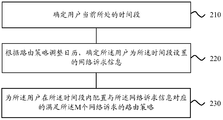
- Adjusting a calendar according to the routing policy determining network appeal information set by the user for the time period, where the network appeal information includes M network appeals, and M weights corresponding to the M network appeals, M is a positive integer, and the M weights are used to measure the degree of demand of the user for the M network appeals;
- the routing policy adjustment calendar includes the network appeal information corresponding to the time period, and the routing policy corresponding to the network appeal information.
- the network appeal can be smooth online, save traffic, and provide high reliability.
- the method for determining a routing policy determines different routing policies according to different requests of the user to the network in different time periods, so that the routing policy can be dynamically adjusted according to user requirements.
- the method before determining a time period in which the user is currently located, the method further includes:
- the routing strategy of the collaboration layer is reflected to the user level.
- a routing strategy that satisfies the user's multiple demands is formulated, so that the routing strategy can meet the customization requirements of the user.
- the determining, according to the network appeal information, the routing policy that meets the M network appeals corresponding to the network appeal information includes:
- the determining the M optimal routes that respectively satisfy the M network appeals includes:
- N is a positive integer, and the i satisfies 1 ⁇ i ⁇ M;
- the route corresponding to the second smallest consumption value of the N consumption values is determined to be a backup route that satisfies the i-th network claim according to the calculation result of the consumption value, so as to be determined according to the minimum route. If the outgoing routing policy cannot be implemented due to network or other reasons, you can use the routing policy determined by the route with the second smallest consumption value to configure the destination route used by the current time range for the user.
- the method may further include:
- the intra-domain routes sent by each of the domain controllers are combined according to the inter-domain link, and the N routes satisfying the i-th network appeal in the M network claims are determined according to the combination result.
- the calculating the N consumption values corresponding to the N routes one by one includes:
- the consumption value is a value obtained by mapping the network appeal value to a Fibonacci sequence.
- the N network appeal values when calculating the N network appeal values that are in one-to-one correspondence with the N routes, the N network appeal values may be respectively mapped to N routing policy appeal values that the network can identify, and according to the routing policy. a mapping relationship between the appeal value and the consumption value, and determining the N consumption values that are in one-to-one correspondence with the N network appeal values.
- the smooth network appeal value is the click response time (seconds)
- the corresponding routing policy request value is the routing delay
- the traffic-saving network appeal value is the proportion of the purchased bandwidth usage value (percentage), and the corresponding routing strategy.
- the appeal value is the routing load size; the network appeal value of the high reliability guarantee is the click response success rate (percentage), and the corresponding routing policy request is the route hop count.
- the determining, according to the M optimal routes and the M weights, Routing strategy including:
- the determining the routing policy according to the M variation curve includes:
- determining a network appeal corresponding to a variation curve forming a minimum area of the area is a target network appeal
- the determined routing policy information or the customized routing policy adjustment calendar may be pushed to the user, so that the user can know the resources occupied by the user in real time.
- the user is allowed to adjust the routing policy adjustment calendar according to different routing policies set for different time periods. For example, the user can adjust the weight of each network appeal in the network appeal information according to the routing policy.
- an apparatus for determining a routing policy for performing the method of any of the first aspect or the first aspect of the first aspect.
- the device includes:
- a determining module for determining a time period in which the user is currently located
- the determining module is further configured to: adjust a calendar according to a routing policy, and determine network appeal information set by the user for the time period, where the network appeal information includes M network appeals, and one of the M network appeals Corresponding M weights, the M is a positive integer, and the M weights are used to measure the degree of demand of the user for the M network appeals;
- a configuration module configured to configure, by the user, a routing policy that meets the M network appeals corresponding to the network appeal information in the time period;
- the routing policy adjustment calendar includes the network appeal information corresponding to the time period, and the routing policy corresponding to the network appeal information.
- a third aspect provides an apparatus for determining a routing policy, including a processor, a memory, a receiver, and a transmitter, wherein the transmitter and the receiver are respectively configured to send and receive information during a communication,
- the memory is used to store instructions
- the processor is configured to execute the instructions stored in the memory, wherein the processor, the memory, and the bus system may also be collectively referred to as a baseband processor, and the transmitter and the receiver may also be collectively referred to as a radio frequency system.
- the processor is specifically used to:
- Adjusting a calendar according to the routing policy determining network appeal information set by the user for the time period, where the network appeal information includes M network appeals, and M weights corresponding to the M network appeals, M is a positive integer, and the M weights are used to measure the degree of demand of the user for the M network appeals;
- a computer readable medium for storing a computer program comprising instructions for performing the method of the first aspect or any of the possible implementations of the first aspect.
- the method for determining a routing policy in the embodiment of the present application determines different routing policies according to different requests of the user to the network in different time periods, so that the routing policy can be dynamically adjusted according to the requirements of the user.
- routing strategy of the collaboration layer is reflected to the user level, by combining the user's demand for different network demands, a routing strategy that satisfies the user's multiple demands is formulated, so that the routing strategy can meet the customization requirements of the user.
- FIG. 2 is a schematic diagram of a method for determining a routing policy according to an embodiment of the present application.
- FIG. 4 is a flowchart of a method for determining a routing policy according to an embodiment of the present application.
- FIG. 6 is a schematic diagram of a routing policy consumption axis according to an embodiment of the present application.
- FIG. 7 is a schematic diagram of a consumption value weighting and variation curve of an embodiment of the present application.
- FIG. 8 is a schematic diagram of a routing policy switching mechanism implemented by the present application.
- FIG. 9 is a schematic structural diagram of an apparatus for determining a routing policy according to an embodiment of the present application.
- FIG. 10 is a schematic structural diagram of an apparatus for determining a routing policy according to an embodiment of the present application.
- FIG. 1 is a schematic structural diagram of an application scenario of an embodiment of the present application.
- the SDN network architecture includes an application layer, a control layer, and an infrastructure layer.
- the application layer includes various services and applications, which can manage and control the network's policy of forwarding/processing the application, and also support the configuration of network attributes to improve network utilization and ensure the security and quality of service of specific applications. It includes a collaboration layer, a controller, and a network element abstraction layer. It is mainly responsible for processing abstract information of data forwarding surface resources, supporting network topology, summarization and maintenance of state information, and calling different forwarding plane resources based on application control;
- the facility layer (data forwarding layer) is responsible for data processing, forwarding, and state collection of traffic-based flow tables.
- the collaboration layer 110, the controller 120, and the user equipment 130 included in the control layer in the SDN network architecture are shown in FIG.
- the controller (also referred to as a domain controller) 120 includes a plurality of controllers such as a controller 121, a controller 122, and a controller 123.
- the user equipment 130 includes a plurality of user equipments such as the user equipment 131, the equipment 132, and the equipment 133.
- three controllers and three user equipments are taken as an example for illustration.
- the collaboration layer 110 communicates with the controller 121, the controller 122, and the controller 123 to implement coordination of multiple controllers; the controller 121, the controller 122, and the controller 123 can control network forwarding according to real-time network information.
- SPTN Software Defined Packet Transport Network
- SDN Software Defined Packet Transport Network
- D controller D controller
- a segmentation route calculation is performed between the controllers.
- Three routing strategies for use such as minimum latency (each controller hierarchical calculation Delay information of each span, based on the end-to-end shortest delay calculation path), minimum hop count (making the number of network elements passing through the service the least, occupying less network resources, but not considering delay factors), load balancing (control).
- the device analyzes the load of each path in the network, and distributes the traffic to different links to prevent unbalanced traffic in the network and maximize the use of network resources.
- the basic principle is to let each controller calculate the route according to the customer's predetermined routing strategy, and merge each segment of the route, which is the overall route.
- SPTN has the following disadvantages: First, the adjustment of the routing policy relies on manual triggering or switching to the alternate path through protection, and the policy and working path used by the alternate path are consistent, and the current network routing situation is not considered, so the routing policy is adopted. The real-time dynamic adjustment cannot be performed according to the user's needs, and the bandwidth may be seriously wasted. Secondly, the routing algorithm of the multi-domain controller has no unified standard, and only the unified northbound interface, so the calculation result of the same routing strategy has no uniform comparison scale ( There are usually multiple routes between the boundary points, and there are problems in intra-domain routing and global routing. Therefore, the routing policy can only be determined according to the most demanding indicators. It is impossible to comprehensively evaluate multiple user appeal indicators. Meet the diverse needs of users.
- the embodiment of the present application provides a method for determining a routing policy, which is to solve the problem that the routing policy cannot be dynamically adjusted according to the requirements of the user by setting different routing policies according to different requirements of the network at different times.
- the method proposed by the embodiment of the present application reflects the routing policy of the collaboration layer to the user level, and combines the user's demand for different network demands to formulate a routing policy that satisfies multiple requirements of the user, so that the routing policy can satisfy the user. Customized requirements.
- FIG. 2 is a schematic diagram of a method for determining a routing policy according to an embodiment of the present application. As shown in FIG. 2, the method may be performed in the collaboration layer 110 of the SDN network.
- the execution entity is abbreviated as the collaboration layer 110.
- the method for determining the routing policy includes:
- the network appeal information includes M network appeals, and M weights corresponding to the M network appeals.
- the M is a positive integer, and the M weights are used to measure the degree of demand of the user for the M network appeals.
- the routing policy adjustment calendar includes the network appeal information corresponding to the time period, and the routing policy corresponding to the network appeal information.
- a routing policy refers to a selection policy that maps to a routing channel between data packets of a communication network in an actual communication network.
- the routing policy adjustment calendar includes a plurality of network appeal information and a plurality of routing policies corresponding to the plurality of network appeal information, and the plurality of network appeal information and the plurality of routing policies are in one-to-one correspondence.
- the collaboration layer 110 is directly oriented to the user, and the user can customize his or her personalized online appeal. Therefore, the collaboration layer 110 can find the routing policy corresponding to the network appeal information in the routing policy adjustment calendar according to the network appeal information set by the user.
- M network appeals and M weights corresponding to the M network appeals may be included. Where M is a positive integer. Users can assign different weights to different network appeals to express The degree of user demand for each type of network appeal.
- the user can individually assign different weights according to his own needs for different networks; the user can also set only his own various network demands, and the collaboration layer 110 evenly distributes or fixes multiple network appeals set by the user.
- the ratio is the weight.
- routing policies are determined according to different demands of the user on the network in different time periods, so that the routing policy can be dynamically adjusted according to the needs of the user.
- FIG. 3 is a schematic diagram of a time mapping axis of a network appeal to a routing policy claim in an embodiment of the present application.
- Figure 3 shows the network appeals of users in different time periods.
- Each network appeal corresponds to a routing policy appeal.
- the smooth response to the routing policy is the minimum route delay
- the routing policy corresponding to the saved traffic is Load balancing, high reliability guarantees the corresponding routing policy appeal for the click response success rate.
- the user's network appeals are different in different time periods. Therefore, the routing policy requirements are different in different time periods, and the routing strategies used are different, so that the user personalized adjustment of the network routing policy can be realized.
- the method before determining the time period in which the user is currently located, the method further includes:
- routing strategy of the collaboration layer 110 by embedding the routing policy of the collaboration layer 110 to the user level, by combining the user's demand for different network demands, a routing strategy that satisfies the user's multiple demands is formulated, so that the routing strategy can meet the customization requirements of the user.
- routing policy corresponding to each network appeal information in the routing policy calendar may be executed according to the method detailed below, except that the network appeal information of each routing policy is determined to be different, so the cooperation layer 110 finally targets The routing strategies determined by different network appeal information are also different.
- FIG. 4 is a schematic flowchart of a method for determining a routing policy according to an embodiment of the present application.
- the method illustrated in FIG. 4 is performed by the collaboration layer 110.
- the collaboration layer 110 determines a corresponding routing policy in the routing policy calendar according to the network appeal information set by the user. And in 250, determining, according to the network appeal information, the routing policy that meets the M network appeals corresponding to the network appeal information, including:
- the collaboration layer 110 obtains M network appeals included in the network appeal information set by the user, and M weights corresponding to the M network appeals, and then determines M corresponding to the M network appeals. Optimal route.
- the network appeal information set by the user includes three kinds of network appeals such as smooth Internet access, saving traffic and high reliability, and the weights allocated by the user for these three network claims are 40% and 30% respectively. And 30%.
- the collaboration layer 110 determines three optimal routes corresponding to the three network appeals, for example, determining an optimal route l1 corresponding to the network appeal of satisfying the Internet access, and satisfying the optimal route l2 corresponding to the network appeal of saving traffic. And the optimal route l3 corresponding to the high reliability guarantee of the network appeal.
- the collaboration layer 110 determines the target route configured for the user according to the M optimal routes and the M weights obtained above.
- the collaboration layer 110 respectively assigns the optimal routes (l1, l2, and l3) corresponding to the three network claims, such as smooth Internet access, saving traffic, and high reliability, and the weights respectively assigned by the user for the three network claims ( 40%, 30%, and 30%) to determine the target route that is ultimately selected for the user.
- the optimal routes l1, l2, and l3
- the weights respectively assigned by the user for the three network claims ( 40%, 30%, and 30%) to determine the target route that is ultimately selected for the user.
- the user's weight assigned to a certain network appeal is large, indicating that the user has more demand for the network appeal; the user's weight assigned to a certain network appeal is small, indicating that the user has less demand for the network appeal. .
- the collaboration layer 110 first determines the M optimal routes that satisfy the M network claims, respectively.
- the entire network is composed of a cross-domain collaboration layer 110 and a controller 120.
- the collaboration layer 110 is directly oriented to the tenant, and the tenant can customize the personalized online appeal; the inter-domain collaboration layer is responsible for delivering the specific routing policy to the specific control.
- the controller 121, the controller 122, and the controller 123, the controller 121, the controller 122, and the controller 123 distribute the routing.
- the collaboration layer 110 sends the algorithm tasks of the controllers through a unified scheduling algorithm. It mainly solves the connection problem between domains, but it will generate many problems that are not involved in routing calculation in a single domain.
- FIG. 5 is a schematic diagram of intra-domain routing and inter-domain routing according to an embodiment of the present application.
- the route from A2 to I2 in FIG. 5 if it is in a domain, directly calls the routing algorithm of the domain, and the general routing algorithm will give a route order that satisfies the requirements.
- Cross-domain is complicated. It is necessary to analyze the possible route combinations through the collaboration layer, and multiple routing requests are sent in one domain.
- the user can map the network appeal value indicating the satisfaction level of each network claim to a unified route consumption axis.
- the route consumption axis is a Fibonacci sequence routing consumption axis, and the consumption value on the consumption axis maps the network appeal value to a value on the Fibonacci sequence.
- the user will uniformly map the satisfaction degree of each network appeal to the Fibonacci sequence routing consumption axis, thereby aligning the user's satisfaction with different network demands on one axis, so as to facilitate the operation.
- Comparison between strategies For the specific value corresponding to the satisfaction degree, a default preset corresponding value is required.
- the basic principle may be that the greater the satisfaction degree, the smaller the route consumption value. The greater the consumption value when you are not satisfied, the more you need to circumvent the route at that time.
- the Fibonacci sequence itself has this feature, that is, the larger the value, the larger the increase, and the more uncontrollable.
- the route consumption value is also simply referred to as the consumption value.
- the routing policy selection requirements are different for each network appeal.
- Table 1 when the network appeal is smooth, saves traffic, and has high reliability, the corresponding routing policy selection request has a small routing delay. Small route hops and route load balancing.
- the parameters such as delay and hop count to a consumption axis, so that they have a unified measurement standard, so that the quality of the route satisfying different network demands can be good or bad through the unified measurement standard. Measure and compare to accurately select the routing strategy that satisfies multiple appeals at the same time.
- the Fibonacci sequence routing consumption axis has no units.
- the route consumption value is small, for example, it can be 0; when the click response time is 2s, the user's satisfaction is normal, the route consumption value is moderate, for example, 8; When the click response time is 3s, the user's satisfaction is very poor, and the route consumption value is large, for example, it can be 144.
- Table 2 is an example of the mapping relationship between satisfaction with network appeals and route consumption values.
- mapping relationship of the specific numerical values shown in Table 2 is only an example and not a limitation.
- the relationship between the user's satisfaction with the network appeal and the route consumption value can be based on the mapping relationship set by the network operation and maintenance personnel, and the relationship between the satisfaction of the network appeal and the route consumption value is satisfied. The network situation is adjusted. This application does not limit this.
- the third network appeal corresponds to the respective consumption values of the N routes, and determines the route l3 in which the consumption value is the smallest (assuming the consumption value is z3).
- determining the routing policy according to the M optimal routes and the M weights including:
- the collaboration layer 110 can obtain the consumption values x1, y1, and z1 when the route l1 satisfies the first network appeal, the second network appeal, and the third network appeal respectively; the route l2 satisfies the first network respectively.
- the consumption value of the appeal, the second network appeal and the third network appeal is x2, y2, z2; the consumption value of the route l3 satisfying the first network appeal, the second network appeal and the third network appeal respectively X3, y3, z3.
- the time period here means that the user sets the same network appeal information in the same time period.
- the collaboration layer 110 configures a corresponding routing policy according to the network appeal information set by the user for the time period.
- the routing policy is determined according to the M curve, including:
- the cooperation layer 110 measures the quality contribution of the routing strategy in each cycle by calculating the area of the consumption value weighted sum curve and the time axis enclosing the area.
- the periodic routing under the multi-quality indicator appeals simultaneously considers the weighted mapping of multi-quality indicators and the area calculation based on the time axis to complete the final routing decision.
- the collaboration layer 110 may periodically determine a corresponding routing policy for the user, so as to configure the target route for the user in real time according to the routing policy.
- the collaboration layer 110 sends the decomposed route calculation task to the controller 121.
- the collaboration layer 110 when the collaboration layer 110 selects the optimal route corresponding to each network claim, the route with the second smallest consumption value may also be selected as the backup route.
- the route with the second smallest consumption value may also be selected as the backup route.
- the collaboration layer 110 may compare the backup route by using the foregoing method, and configure the current time period for the user by using the routing policy determined according to the route with the second smallest consumption value. Target routing.
- the method for determining a routing policy according to an embodiment of the present application is described in detail above with reference to FIG. 2 to FIG. 8.
- the apparatus 900 for determining a routing policy according to an embodiment of the present application will be described in detail below with reference to FIG. 9 and FIG.
- FIG. 9 is a structural block diagram of an apparatus for determining a routing policy according to an embodiment of the present application.
- the apparatus 900 for determining a routing policy shown in FIG. 9 is for performing the method of determining a routing policy described in FIGS. 2-8.
- the means for determining the routing policy can be located at the collaboration layer 110.
- the apparatus 900 for determining a routing policy includes a determining module 910 and a configuration module 920.
- the determining module 910 is configured to:
- the configuration module 920 is configured to configure, by the user, a routing policy that meets the M network appeals corresponding to the network appeal information in the time period;
- the routing policy adjustment calendar includes the network appeal information corresponding to the time period, and the routing policy corresponding to the network appeal information.
- the device 900 for determining the routing policy determines different routing policies according to different requests of the user to the network in different time periods, so that the routing policy can be dynamically adjusted according to the requirements of the user.
- the device 900 for determining the routing policy combines the user by embodying the routing policy to the user level. To meet the needs of different network demands, a routing strategy that satisfies users' multiple demands is formulated, so that the routing strategy can meet the customization requirements of users.
- the second determining unit 912 is configured to:
- the first determining unit 911 includes:
- a first determining subunit configured to determine N routes satisfying an i th network claim in the M network claims, where N is a positive integer, and the i satisfies 1 ⁇ i ⁇ M;
- a second determining subunit configured to determine that the route corresponding to the smallest consumption value of the N consumption values is an optimal route that satisfies the i-th network appeal.
- the device 900 for determining a routing policy provides a unified metric for different network appeal indicators by mapping a plurality of different network appeal indicators of the user to a unified scale, such as a Fibonacci sequence routing strategy consumption axis.
- a comprehensive evaluation of a variety of different network demands is achieved, so that an optimal routing strategy that satisfies multiple network demands of users is more accurately obtained.
- the second determining unit 912 includes:
- a third calculating subunit configured to calculate M consumption values of the i-th optimal route in the M optimal routes respectively under the M network claims;
- the fourth determining subunit is for:
- the fourth determining subunit is specifically configured to:
- determining a network appeal corresponding to a variation curve forming a minimum area of the area is a target network appeal
- the embodiment of the present application further provides an apparatus 1000 for determining a routing policy, where the apparatus 1000 for determining a routing policy includes a processor 1001, a memory 1002, a receiver 1004, and a transmitter 1005.
- the processor 1001, the memory 1002, and the receiver 1004 communicate with each other through an internal connection path, and the memory 1002 is configured to store
- the processor 1001 is configured to execute the instructions stored by the memory 1002 and control the receiver 1004 to receive the information.
- the processor 1001, the memory 1002, the receiver 1004, and the transmitter 1005 may be implemented by one or more chips.
- the processor 1001, the memory 1002, the receiver 1004, and the transmitter 1005 may be fully integrated in one chip, or the processor 1001, the receiver 1004, and the transmitter 1005 may be integrated in one chip and the memory 1002 integrated in another chip.
- the processor 1001 is configured to:
- Adjusting a calendar according to the routing policy determining network appeal information set by the user for the time period, where the network appeal information includes M network appeals, and M weights corresponding to the M network appeals, M is a positive integer, and the M weights are used to measure the degree of demand of the user for the M network appeals;
- the routing policy adjustment calendar includes the network appeal information corresponding to the time period, and the routing policy corresponding to the network appeal information.
- the memory in the embodiments of the present application may be a volatile memory or a non-volatile memory, or may include both volatile and non-volatile memory.
- the non-volatile memory may be a read-only memory (ROM), a programmable read only memory (PROM), an erasable programmable read only memory (Erasable PROM, EPROM), or an electric Erase programmable read only memory (EEPROM) or flash memory.
- the volatile memory can be a Random Access Memory (RAM) that acts as an external cache.
- RAM Random Access Memory
- many forms of RAM are available, such as static random access memory (SRAM), dynamic random access memory (DRAM), synchronous dynamic random access memory (Synchronous DRAM).
- SDRAM Double Data Rate SDRAM
- DDR SDRAM Double Data Rate SDRAM
- ESDRAM Enhanced Synchronous Dynamic Random Access Memory
- SLDRAM Synchronous Connection Dynamic Random Access Memory
- DR RAM Direct Memory Bus Random Access Memory
- the disclosed systems, devices, and methods may be implemented in other manners.
- the device embodiments described above are merely illustrative.
- the division of the unit is only a logical function division.
- there may be another division manner for example, multiple units or components may be combined or Can be integrated into another system, or some features can be ignored or not executed.
- the mutual coupling or direct coupling or communication connection shown or discussed may be an indirect coupling or communication connection through some interface, device or unit, and may be in an electrical, mechanical or other form.
- the unit described as a separate component may or may not be physically separated as a unit display
- the components may or may not be physical units, ie may be located in one place, or may be distributed over multiple network elements. Some or all of the units may be selected according to actual needs to achieve the purpose of the solution of the embodiment.
- each functional unit in each embodiment of the present application may be integrated into one processing unit, or each unit may exist physically separately, or two or more units may be integrated into one unit.
- the functions may be stored in a computer readable storage medium if implemented in the form of a software functional unit and sold or used as a standalone product.
- the technical solution of the present application which is essential or contributes to the prior art, or a part of the technical solution, may be embodied in the form of a software product, which is stored in a storage medium, including
- the instructions are used to cause a computer device (which may be a personal computer, server, or network device, etc.) to perform all or part of the steps of the methods described in various embodiments of the present application.
- the foregoing storage medium includes: a U disk, a mobile hard disk, a read-only memory (ROM), a random access memory (RAM), a magnetic disk, or an optical disk, and the like, which can store program codes. .
Landscapes
- Engineering & Computer Science (AREA)
- Computer Networks & Wireless Communication (AREA)
- Signal Processing (AREA)
- Data Exchanges In Wide-Area Networks (AREA)
Abstract
L'invention concerne un procédé et un appareil permettant de déterminer une politique de routage, consistant : à déterminer un moment actuel dans lequel un utilisateur est situé; à adapter un calendrier selon la politique de routage, et à déterminer des informations d'appel de réseau définies par l'utilisateur pour le moment, les informations d'appel de réseau comprenant M appels de réseau et M valeurs de poids correspondant aux M appels de réseau sur une base biunivoque, M étant un nombre entier positif, et les M valeurs de poids étant utilisées pour mesurer un degré de la demande pour les M appels de réseau de l'utilisateur; et à configurer, dans le moment, l'utilisateur avec une politique de routage qui satisfait les M appels de réseau et correspond aux informations d'appel de réseau. De cette manière, différentes politiques de routage sont déterminées selon différents appels de réseau d'un utilisateur à différents moments, de telle sorte que la politique de routage peut être adaptée de manière dynamique selon les exigences de l'utilisateur.
Priority Applications (1)
| Application Number | Priority Date | Filing Date | Title |
|---|---|---|---|
| EP17798571.0A EP3399704B1 (fr) | 2016-05-17 | 2017-04-11 | Procédé et appareil permettant de déterminer une politique de routage |
Applications Claiming Priority (2)
| Application Number | Priority Date | Filing Date | Title |
|---|---|---|---|
| CN201610327091.9A CN107395502B (zh) | 2016-05-17 | 2016-05-17 | 确定路由策略的方法和装置 |
| CN201610327091.9 | 2016-05-17 |
Publications (1)
| Publication Number | Publication Date |
|---|---|
| WO2017198007A1 true WO2017198007A1 (fr) | 2017-11-23 |
Family
ID=60324803
Family Applications (1)
| Application Number | Title | Priority Date | Filing Date |
|---|---|---|---|
| PCT/CN2017/080046 Ceased WO2017198007A1 (fr) | 2016-05-17 | 2017-04-11 | Procédé et appareil permettant de déterminer une politique de routage |
Country Status (3)
| Country | Link |
|---|---|
| EP (1) | EP3399704B1 (fr) |
| CN (1) | CN107395502B (fr) |
| WO (1) | WO2017198007A1 (fr) |
Cited By (2)
| Publication number | Priority date | Publication date | Assignee | Title |
|---|---|---|---|---|
| CN109450800A (zh) * | 2018-12-17 | 2019-03-08 | 西安空间无线电技术研究所 | 一种动态调整星簇自组网路由交互周期的方法及系统 |
| CN115866455A (zh) * | 2021-09-24 | 2023-03-28 | 中国移动通信集团设计院有限公司 | 路由规划方法及装置、计算机设备及存储介质 |
Families Citing this family (3)
| Publication number | Priority date | Publication date | Assignee | Title |
|---|---|---|---|---|
| CN108880895B (zh) * | 2018-06-28 | 2021-04-23 | 重庆邮电大学 | 基于用户流传输开销优化的sdn联合路由选择及网络功能部署方法 |
| CN111030928A (zh) * | 2018-10-10 | 2020-04-17 | 中国移动通信有限公司研究院 | 一种路由信息确定方法、节点、系统和存储介质 |
| CN115801667A (zh) * | 2022-09-28 | 2023-03-14 | 阿里巴巴(中国)有限公司 | 路由切换方法、计算设备及计算机存储介质 |
Citations (6)
| Publication number | Priority date | Publication date | Assignee | Title |
|---|---|---|---|---|
| CN101217479A (zh) * | 2008-01-09 | 2008-07-09 | 中兴通讯股份有限公司 | 一种网络路由管理方法 |
| JP2012039529A (ja) * | 2010-08-10 | 2012-02-23 | Nippon Telegr & Teleph Corp <Ntt> | 電力特性利用通信網設定方法及びネットワーク装置 |
| CN102413545A (zh) * | 2011-11-23 | 2012-04-11 | 中兴通讯股份有限公司 | 多模终端的选网方法及装置 |
| CN103702361A (zh) * | 2013-12-24 | 2014-04-02 | 中国联合网络通信集团有限公司 | 网络能力调整方法及平台、pcc实体、服务器 |
| CN104468411A (zh) * | 2014-11-28 | 2015-03-25 | 东莞宇龙通信科技有限公司 | 一种带宽分配方法、装置及路由器 |
| CN105407010A (zh) * | 2015-12-31 | 2016-03-16 | 重庆邮电大学 | 基于sdn技术实现软件定义路由的流量发生装置 |
Family Cites Families (6)
| Publication number | Priority date | Publication date | Assignee | Title |
|---|---|---|---|---|
| JP2001257687A (ja) * | 2000-03-13 | 2001-09-21 | Nec Corp | Atm交換機におけるpnni経路計算システム |
| US7002973B2 (en) * | 2000-12-11 | 2006-02-21 | Acme Packet Inc. | System and method for assisting in controlling real-time transport protocol flow through multiple networks via use of a cluster of session routers |
| CN104702502B (zh) * | 2013-12-09 | 2019-11-26 | 中兴通讯股份有限公司 | 网络路径计算方法及装置 |
| CN105379204B (zh) * | 2014-01-14 | 2019-04-05 | 华为技术有限公司 | 用于选择数据路由的资源的方法和系统 |
| CN104104718B (zh) * | 2014-07-02 | 2017-05-17 | 北京邮电大学 | 一种基于软件定义网络的用户自主路由定制系统和方法 |
| CN105376157B (zh) * | 2015-11-22 | 2018-06-26 | 东北大学 | 一种路由路径选择的方法和装置 |
-
2016
- 2016-05-17 CN CN201610327091.9A patent/CN107395502B/zh active Active
-
2017
- 2017-04-11 EP EP17798571.0A patent/EP3399704B1/fr active Active
- 2017-04-11 WO PCT/CN2017/080046 patent/WO2017198007A1/fr not_active Ceased
Patent Citations (6)
| Publication number | Priority date | Publication date | Assignee | Title |
|---|---|---|---|---|
| CN101217479A (zh) * | 2008-01-09 | 2008-07-09 | 中兴通讯股份有限公司 | 一种网络路由管理方法 |
| JP2012039529A (ja) * | 2010-08-10 | 2012-02-23 | Nippon Telegr & Teleph Corp <Ntt> | 電力特性利用通信網設定方法及びネットワーク装置 |
| CN102413545A (zh) * | 2011-11-23 | 2012-04-11 | 中兴通讯股份有限公司 | 多模终端的选网方法及装置 |
| CN103702361A (zh) * | 2013-12-24 | 2014-04-02 | 中国联合网络通信集团有限公司 | 网络能力调整方法及平台、pcc实体、服务器 |
| CN104468411A (zh) * | 2014-11-28 | 2015-03-25 | 东莞宇龙通信科技有限公司 | 一种带宽分配方法、装置及路由器 |
| CN105407010A (zh) * | 2015-12-31 | 2016-03-16 | 重庆邮电大学 | 基于sdn技术实现软件定义路由的流量发生装置 |
Cited By (2)
| Publication number | Priority date | Publication date | Assignee | Title |
|---|---|---|---|---|
| CN109450800A (zh) * | 2018-12-17 | 2019-03-08 | 西安空间无线电技术研究所 | 一种动态调整星簇自组网路由交互周期的方法及系统 |
| CN115866455A (zh) * | 2021-09-24 | 2023-03-28 | 中国移动通信集团设计院有限公司 | 路由规划方法及装置、计算机设备及存储介质 |
Also Published As
| Publication number | Publication date |
|---|---|
| CN107395502A (zh) | 2017-11-24 |
| EP3399704A1 (fr) | 2018-11-07 |
| EP3399704B1 (fr) | 2022-04-27 |
| CN107395502B (zh) | 2021-02-09 |
| EP3399704A4 (fr) | 2019-01-09 |
Similar Documents
| Publication | Publication Date | Title |
|---|---|---|
| Nguyen et al. | A Mixed-Integer Bi-Level Model for Joint Optimal Edge Resource Pricing and Provisioning | |
| Zhang et al. | A hierarchical game framework for resource management in fog computing | |
| US10623277B2 (en) | Network service pricing and resource management in a software defined networking environment | |
| Jalaparti et al. | Dynamic pricing and traffic engineering for timely inter-datacenter transfers | |
| Tran et al. | How geo-distributed data centers do demand response: A game-theoretic approach | |
| Maia et al. | Optimized placement of scalable IoT services in edge computing | |
| Zhao et al. | Dynamic pricing and profit maximization for the cloud with geo-distributed data centers | |
| WO2017198007A1 (fr) | Procédé et appareil permettant de déterminer une politique de routage | |
| Tang et al. | Dynamic request redirection and elastic service scaling in cloud-centric media networks | |
| US9292354B2 (en) | Self-adjusting framework for managing device capacity | |
| CN107534584A (zh) | 通过网络化计算资源对数据进行协调处理 | |
| CA2626535A1 (fr) | Systeme et procede permettant de gerer l'utilisation d'un reseau de communication et l'acces a un reseau de communication | |
| US20140143427A1 (en) | Providing Resources in a Cloud | |
| Han et al. | Utility-optimized resource allocation in computing-aware networks | |
| TW202034277A (zh) | 運輸方法及裝置 | |
| Wang et al. | INVAR: Inversion aware resource provisioning and workload scheduling for edge computing | |
| Nisha et al. | A bilevel programming framework for joint edge resource management and pricing | |
| Gkatzikis et al. | Bandwidth calendaring: dynamic services scheduling over software defined networks | |
| CN112840607B (zh) | 用于减少递送延迟抖动的计算机实现的方法、系统以及可读介质 | |
| Abusafia et al. | Context-aware trustworthy iot energy services provisioning | |
| CN119052884B (zh) | 一种路径确定方法、通信装置及存储介质 | |
| Chakravarthy et al. | Software-defined network assisted packet scheduling method for load balancing in mobile user concentrated cloud | |
| Xu et al. | Improving Fairness for Distributed Interactive Applications in Software‐Defined Networks | |
| Duan et al. | Federated selection of network and cloud services for high-performance software-defined cloud computing | |
| Lim et al. | FARCREST: Euclidean Steiner Tree-based cloud service latency prediction system |
Legal Events
| Date | Code | Title | Description |
|---|---|---|---|
| WWE | Wipo information: entry into national phase |
Ref document number: 2017798571 Country of ref document: EP |
|
| ENP | Entry into the national phase |
Ref document number: 2017798571 Country of ref document: EP Effective date: 20180802 |
|
| 121 | Ep: the epo has been informed by wipo that ep was designated in this application |
Ref document number: 17798571 Country of ref document: EP Kind code of ref document: A1 |
|
| NENP | Non-entry into the national phase |
Ref country code: DE |