WO2017202687A1 - Dispositif de refroidissement comprenant un couvercle de condenseur - Google Patents
Dispositif de refroidissement comprenant un couvercle de condenseur Download PDFInfo
- Publication number
- WO2017202687A1 WO2017202687A1 PCT/EP2017/061980 EP2017061980W WO2017202687A1 WO 2017202687 A1 WO2017202687 A1 WO 2017202687A1 EP 2017061980 W EP2017061980 W EP 2017061980W WO 2017202687 A1 WO2017202687 A1 WO 2017202687A1
- Authority
- WO
- WIPO (PCT)
- Prior art keywords
- condenser
- cooling device
- machine room
- compressor
- cover
- Prior art date
- Legal status (The legal status is an assumption and is not a legal conclusion. Google has not performed a legal analysis and makes no representation as to the accuracy of the status listed.)
- Ceased
Links
Images

Classifications
-
- F—MECHANICAL ENGINEERING; LIGHTING; HEATING; WEAPONS; BLASTING
- F25—REFRIGERATION OR COOLING; COMBINED HEATING AND REFRIGERATION SYSTEMS; HEAT PUMP SYSTEMS; MANUFACTURE OR STORAGE OF ICE; LIQUEFACTION SOLIDIFICATION OF GASES
- F25B—REFRIGERATION MACHINES, PLANTS OR SYSTEMS; COMBINED HEATING AND REFRIGERATION SYSTEMS; HEAT PUMP SYSTEMS
- F25B39/00—Evaporators; Condensers
- F25B39/04—Condensers
-
- F—MECHANICAL ENGINEERING; LIGHTING; HEATING; WEAPONS; BLASTING
- F25—REFRIGERATION OR COOLING; COMBINED HEATING AND REFRIGERATION SYSTEMS; HEAT PUMP SYSTEMS; MANUFACTURE OR STORAGE OF ICE; LIQUEFACTION SOLIDIFICATION OF GASES
- F25B—REFRIGERATION MACHINES, PLANTS OR SYSTEMS; COMBINED HEATING AND REFRIGERATION SYSTEMS; HEAT PUMP SYSTEMS
- F25B6/00—Compression machines, plants or systems, with several condenser circuits
- F25B6/04—Compression machines, plants or systems, with several condenser circuits arranged in series
-
- F—MECHANICAL ENGINEERING; LIGHTING; HEATING; WEAPONS; BLASTING
- F25—REFRIGERATION OR COOLING; COMBINED HEATING AND REFRIGERATION SYSTEMS; HEAT PUMP SYSTEMS; MANUFACTURE OR STORAGE OF ICE; LIQUEFACTION SOLIDIFICATION OF GASES
- F25D—REFRIGERATORS; COLD ROOMS; ICE-BOXES; COOLING OR FREEZING APPARATUS NOT OTHERWISE PROVIDED FOR
- F25D23/00—General constructional features
- F25D23/003—General constructional features for cooling refrigerating machinery
Definitions
- the present invention relates to cooling devices comprising a compressor and a condenser connected to a refrigeration cycle in the thermally-insulated wall thereof.
- Cooling devices in particular refrigerators, comprise a condenser and a compressor connected to a refrigeration cycle.
- the condenser is a heat exchanger that releases the heat absorbed during the refrigeration process to the ambient air.
- condensers in different configurations are used.
- One is the static condenser extending on the rear wall of the cooling device.
- coil condensers providing forced convection due to the compact structure thereof can be used.
- a fan generates an air flow, thus enabling the coil condenser to be cooled.
- the condenser that is produced in the form of a wire-on-tube in order to provide an efficient heat transfer, comprises a tube bent such that each segment is parallel to the other segment, and lined wires extending perpendicular to the tube.
- the Patent No. TR200900786 discloses a cooling device wherein the compressor and the condenser generally operate in the region called the cabinet base and that is situated at the bottom portion of the body.
- a fan disposed in the compartment air is sucked from the outer environment into the compartment and delivered onto the condenser casing that is composed of nested bodies and wherein the condenser is disposed.
- the air leaving the condenser casing is delivered onto the compressor, thus providing the cooling of the compressor.
- the Patent No. WO2012084486 discloses a cooling device comprising a condenser that has a first portion located in front of the fan and a second portion that is integrated to the first portion and that is provided around the fan so as to surround the fan.
- the condenser comprises a helical refrigerant tube and wires surrounded around the tube in the form of a cage.
- the aim of the present invention is to increase the heat transfer efficiency in the machine room in the cooling devices.
- the present invention in order to attain the aim of the said aim is a cooling device comprising a thermally-insulated body and a machine room wherein a compressor, that is connected to a refrigeration cycle cooling an inner volume enclosed by the body, is disposed.
- the preferred embodiment of the present invention comprises a tube-shaped condenser cover that is connected to an outlet of the compressor in fluid communication and that is attached to the body so as to partially cover an open outer surface that is defined by the machine room and that can be accessed from the outside.
- the condenser required for heat transfer covers the open outer surface of the machine room by functioning as a cover and supports the refrigeration cycle by providing heat transfer to the outer environment.
- the condenser cover is attached to the body in an easily detachable manner.
- the machine room can be accessed for maintenance by removing the condenser cover.
- the fluid connection of the condenser cover to the compressor outlet can be a direct connection or can be realized through the intermediate connection of other functional components supporting the refrigeration cycle.
- the open outer surface can be provided as an outer surface of the body facing the outer environment, for example, at the bottom portion of the rear wall of the body.
- the condenser cover extends parallel to an outer wall of the body.
- the condenser cover correspond to the contours of the body and the cooling device is enabled to be easily packaged.
- the cover can have a form following the body wall of the body whereto the cover is to be mounted. Thus, the condenser cover does not deteriorate the visual integrity of the body.
- the condenser cover has a grill-shaped configuration. Thus, while obstructing the entrance of foreign objects into the machine room through the opening, the condenser cover allows air transfer.
- a fan is fixed into the machine room so as to cool both the compressor and the condenser cover.
- the fan receives the ambient air through the open outer surface and circulates the same in the machine room, thus providing forced convection, and by means of the cooling provided by the fan, using a more compact condenser becomes possible.
- a coil condenser is fixed in the vicinity of the fan in the machine room and connected so as to provide fluid communication between the compressor and the condenser cover.
- the hot fluid leaving the compressor is first cooled in the coil condenser and brought to the temperature of the outer environment on the condenser cover.
- the condenser in the refrigeration cycle is composed of two pieces, and use of a coil condenser produced with less material in the machine room becomes possible.
- the fan is positioned in the machine room such that the air circulation provided by the fan circulates through the coil condenser, the compressor and the condenser cover in this order.
- the fan blows air into the machine room in a direction parallel to the condenser cover.
- the fan is enabled to suck the ambient air from one side of the outer opening and discharge the same from the other side, and while the ambient air passes from one side of the condenser cover, the machine room air passes from the other side, thereby providing a forced heat transfer along the entire condenser cover.
- the machine room is in the form of a cavity that is opened at the bottom portion of a rear wall of the body, the port of which defines the open outer surface.
- the cavity is prevented from being seen from the outside and the noise of the functional components generating noise during the refrigeration cycle, such as the compressor, is enabled to be less heard from the front side.
- a preferred embodiment comprises a holder with one end fixed to the rear wall and the other end holding the condenser cover.
- the condenser cover is attached to the rear wall.
- the holder is configured to hold the compressor cover parallel to the rear wall.
- the holder is fixed to the rear wall so as to be adjacent to the open outer surface.
- the condenser cover comprises a single-piece tube that is bent so as to form arms extending parallel to each other in the horizontal direction. By bending the tube at a distance covering the opening, for example at the transversal distance of two opposite edges of the rear wall, the distance to be covered by the refrigerant fluid is increased. Moreover, the parallel arms enable the condenser cover to cover the opening in the horizontal direction.
- the condenser cover comprises an inlet that is fluidly connected to an outlet of the compressor and that extends towards the machine room. Thus, the condenser cover is enabled to extend into the machine room and to be directly connected to an outlet of another component connected to the refrigeration cycle in the machine room.
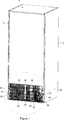
- Figure 1 - is the rear perspective view of a domestic refrigerator comprising a representative embodiment of the condenser cover of the present invention.
- Figure 2 - is the detailed view of the machine room of the refrigerator in Fig. 1.
- Figure 3 - is the schematic view of the layout plan of a cooling device machine room whereto the condenser cover of the present invention is mounted.
- FIG 1 is the rear perspective view of a domestic no-frost refrigerator.
- the refrigerator comprises a thermally-insulated cabinet-shaped body defining an inner volume wherein items to be cooled by means of a refrigeration cycle are placed.
- a cavity-shaped machine room (10) is formed close to the bottom portion of a rear wall (2) of the body (1).
- the machine room (10) is accessed through an open outer surface (14) that is defined by the lower edge of the rear wall (2) from above, a base plate (12) from below and opposite side walls (3) from the sides.
- the open outer surface (14) is covered by means of a wire-on-tube condenser cover (40) in the form of a panel so as to restrict access into the machine room (10).
- the condenser cover (40) is obtained by bending a single-piece tube (46) in U form so as to create successive transversally-lined extensions.
- Wires (48) are fixed onto the tube (46) so as to be successively lined and to increase heat transfer area.
- the wires (48) create a grill-shaped structure that allows air passage into the machine room (10) from the open outer surface (14) but that prevents access into the machine room (10).
- the machine room (10) is shown in close up.
- the condenser cover (40) is attached to the body (1) from two opposite sides so as to be parallel and adjacent to the rear wall (2).
- the holder (20) comprises a flexible first latch (22) that is mounted to the rear side of the side wall (3) from one end and that extends over the condenser cover (40) so as to catch on by being engaged crosswise with the vertical wires (48) arranged on the condenser cover (40), and two second latches (24) set apart from each other that have a similar structure as the first latch (22) and that extend in the opposite direction thereto.
- the holder (20) is detachably mounted to the body (1).
- the condenser cover (40) is removed by removing the holder (20) so as to allow access into the machine room (10).
- the first latch (22) is engaged with the wires (48) so that a flexible extension (26) thereof remains behind the wires (48).
- the condenser cover (40) is horizontally slid in the opposite direction, thus the wires (48) are engaged with the second latches (24) and the first latch (22) is screwed to the side wall (3) from the rear side.
- a radial fan (50) is fixed on an edge portion on the base plate (12) close to an inlet (42) and an outlet (44) of the condenser cover (40).
- the radial fan (50) is positioned close to an end of the machine room (10) so as to circulate the air horizontally.
- the fan (50) sucks the ambient air through an air suction gap (16) left by the condenser cover (40) over the open outer surface (14) at a position close to the side wall (3) and horizontally blows the sucked air into the machine room (10).
- the ambient air moves towards the other end of the machine room (10), cools down the functional components of the refrigeration cycle and leaves the machine room (10) through the condenser cover (40) from the far-end side.
- a coil condenser (30) is fixed to the base plate (12) in the vicinity of the fan (50) oppositely to the air blowing direction.
- the coil condenser (30) is in the form of a three dimensional matrix obtained by bending a coil tube (36) from the ends thereof and by arranging the created panels in parallel so as to form a coil.
- a condenser outlet (34) end of the coil condenser (30) that carries the refrigerant fluid is mounted to the inlet (42) of the condenser cover (40).
- a refrigerant fluid discharging compressor outlet (62) of a compressor (60) fixed to the base plate (12) close to the coil condenser (30) is mounted to a condenser inlet (32) of the coil condenser (30).
- the refrigerant fluid heating up in the compressor (60) due to increased pressure is first delivered to the coil condenser (30) adjacent to the fan (50).
- the compressor outlet (62) is connected to the coil condenser (30) by means of a dryer (66).
- the dryer (66) filters the refrigerant fluid received from the compressor (60).
- a compressor inlet (64) connected to the evaporator (not shown in the figures) sucks the gas received from the evaporator.
- Figure 3 shows the top schematic view of the machine room (10).
- the components are arranged in the flow direction of the ambient air in this order: an air suction gap (16) created by the condenser cover (40) partially leaving the open outer surface (14) open, the fan (50) horizontally blowing air so as to be behind the air suction gap (16), the coil condenser (30) opposite to the air flow direction next to the fan (50) and the compressor (60) remaining behind the coil condenser (30) relative to the fan (50).
- the temperature distribution in the machine room (10) is the densest at a region close to the refrigerant fluid discharging compressor outlet (62) of the compressor (60). Because the compressor (60) compressor the gas received from the evaporator, thus increasing the pressure and the temperature thereof.
- the refrigerant gas is cooled first in the coil condenser (30) with the ambient air accelerated by the fan (50).
- the grill structure of the condenser cover (40) mostly shields the air so as to prevent the ambient air from completely leaving through the open outer surface (14) while flowing horizontally.
- the refrigerant fluid inlet (42) of the condenser cover (40) is positioned close to the air suction gap (16).
- the ambient air sucked by the fan (50) from the air suction gap (16) and delivered to the coil condenser (30) first cools down the inlet (42) and the condenser cover (40) disposed in the vicinity thereof.
- the ambient air passes around the compressor (60) after the condenser (30) and leaves the machine room (10) close to the edge of the open outer surface (14) opposite to the air suction gap (16).
- the condenser cover (40) enables the machine room (10) to be closed so as to prevent access by mostly covering the open outer surface (14) while contacting the ambient air at a region as much as the covered portion of the open outer surface (14) so as to cool down the refrigerant fluid before being delivered to the evaporator.
- the upright outlet (44) of the condenser cover (40) passes through the insulation layer and reaches the evaporator through the body (1).
- the fan (50) provides air circulation along the inner wall of the condenser cover (40) and accelerates the refrigeration process. Moreover, the condenser cover (40) provides that less amount of air blown by the fan (50) leaks from the open outer surface (14), thus improving the cooling efficiency of the fan (50).
Landscapes
- Engineering & Computer Science (AREA)
- Physics & Mathematics (AREA)
- Mechanical Engineering (AREA)
- Thermal Sciences (AREA)
- General Engineering & Computer Science (AREA)
- Chemical & Material Sciences (AREA)
- Combustion & Propulsion (AREA)
- Other Air-Conditioning Systems (AREA)
- Compressor (AREA)
Abstract
La présente invention concerne un dispositif de refroidissement comprenant un corps thermiquement isolé (1) et une salle de machine (10) dans laquelle un compresseur (60), qui est raccordé à un cycle de réfrigération refroidissant un volume interne confiné par le corps (1), est disposé. Le dispositif de refroidissement comprend un couvercle de condenseur en forme de tube (40) qui est raccordé à une sortie de compresseur (62) du compresseur (60) en communication fluidique et qui est fixé au corps (1) de façon à recouvrir partiellement une surface externe ouverte (14) qui est définie par la salle de machine (10) et qui est accessible depuis l'extérieur.
Applications Claiming Priority (2)
| Application Number | Priority Date | Filing Date | Title |
|---|---|---|---|
| TRA2016/06912 | 2016-05-25 | ||
| TR2016/06912A TR201606912A2 (tr) | 2016-05-25 | 2016-05-25 | Kondenser kapak i̇çeren bi̇r soğutucu ci̇haz |
Publications (1)
| Publication Number | Publication Date |
|---|---|
| WO2017202687A1 true WO2017202687A1 (fr) | 2017-11-30 |
Family
ID=58772874
Family Applications (1)
| Application Number | Title | Priority Date | Filing Date |
|---|---|---|---|
| PCT/EP2017/061980 Ceased WO2017202687A1 (fr) | 2016-05-25 | 2017-05-18 | Dispositif de refroidissement comprenant un couvercle de condenseur |
Country Status (2)
| Country | Link |
|---|---|
| TR (1) | TR201606912A2 (fr) |
| WO (1) | WO2017202687A1 (fr) |
Citations (7)
| Publication number | Priority date | Publication date | Assignee | Title |
|---|---|---|---|---|
| US2087257A (en) * | 1934-07-07 | 1937-07-20 | Reconstruction Finance Corp | Refrigerator cabinet |
| US2378524A (en) * | 1941-04-23 | 1945-06-19 | Gibson Refrigerator Co | Refrigerator |
| JPH0526562A (ja) * | 1991-07-19 | 1993-02-02 | Matsushita Refrig Co Ltd | コンデンシングユニツト |
| US20030005720A1 (en) * | 2001-07-07 | 2003-01-09 | Lg Electronics Inc. | Refrigerator incorporating condenser functioning as backcover |
| US20030221442A1 (en) * | 2002-05-20 | 2003-12-04 | Lg Electronics Inc. | Machine room back cover integrated with a condenser for a refrigerator |
| EP2136168A1 (fr) * | 2008-06-20 | 2009-12-23 | Electrolux Home Products Corporation N.V. | Condensateur d'appareil de refroidissement, et appareil de refroidissement l'incluant |
| WO2012084486A1 (fr) | 2010-12-24 | 2012-06-28 | Arcelik Anonim Sirketi | Dispositif de refroidissement comprenant un condenseur refroidi par un ventilateur |
-
2016
- 2016-05-25 TR TR2016/06912A patent/TR201606912A2/tr unknown
-
2017
- 2017-05-18 WO PCT/EP2017/061980 patent/WO2017202687A1/fr not_active Ceased
Patent Citations (7)
| Publication number | Priority date | Publication date | Assignee | Title |
|---|---|---|---|---|
| US2087257A (en) * | 1934-07-07 | 1937-07-20 | Reconstruction Finance Corp | Refrigerator cabinet |
| US2378524A (en) * | 1941-04-23 | 1945-06-19 | Gibson Refrigerator Co | Refrigerator |
| JPH0526562A (ja) * | 1991-07-19 | 1993-02-02 | Matsushita Refrig Co Ltd | コンデンシングユニツト |
| US20030005720A1 (en) * | 2001-07-07 | 2003-01-09 | Lg Electronics Inc. | Refrigerator incorporating condenser functioning as backcover |
| US20030221442A1 (en) * | 2002-05-20 | 2003-12-04 | Lg Electronics Inc. | Machine room back cover integrated with a condenser for a refrigerator |
| EP2136168A1 (fr) * | 2008-06-20 | 2009-12-23 | Electrolux Home Products Corporation N.V. | Condensateur d'appareil de refroidissement, et appareil de refroidissement l'incluant |
| WO2012084486A1 (fr) | 2010-12-24 | 2012-06-28 | Arcelik Anonim Sirketi | Dispositif de refroidissement comprenant un condenseur refroidi par un ventilateur |
Also Published As
| Publication number | Publication date |
|---|---|
| TR201606912A2 (tr) | 2017-12-21 |
Similar Documents
| Publication | Publication Date | Title |
|---|---|---|
| KR101176459B1 (ko) | 냉장고 | |
| CN209893727U (zh) | 压机舱侧壁具有侧通风孔的冰箱 | |
| CN102317718B (zh) | 冰箱 | |
| CN109425171B (zh) | 冰箱 | |
| KR101520704B1 (ko) | 냉장고 | |
| CN111609615A (zh) | 大容积冰箱 | |
| EP2743618B1 (fr) | Réfrigérateur pour aliments | |
| KR102934444B1 (ko) | 냉장고 | |
| JP2001190338A (ja) | サービスカート | |
| CN209893744U (zh) | 大容积冰箱 | |
| CN105972903A (zh) | 冷冻装置 | |
| WO2017202687A1 (fr) | Dispositif de refroidissement comprenant un couvercle de condenseur | |
| JP2012032124A (ja) | 蓄冷剤用の凍結庫 | |
| CN111609623B (zh) | 具有l型冷凝器的冰箱 | |
| JP3702120B2 (ja) | 冷却装置 | |
| KR20100050350A (ko) | 냉장고 | |
| JP2020188844A (ja) | 冷蔵ショーケース | |
| CN108366680B (zh) | 冷藏销售器具 | |
| CN111351286A (zh) | 一种冷柜装置 | |
| CN110375481A (zh) | 底部具有双冷凝器结构的冰箱 | |
| JP3615387B2 (ja) | 蓄冷剤凍結庫 | |
| JP3863697B2 (ja) | 冷却庫 | |
| CN107949759A (zh) | 专用于家用用途的急速冷却器 | |
| CN210625065U (zh) | 回风口形成于箱体侧壁的冰箱 | |
| JPH11264647A (ja) | 蓄冷剤凍結庫 |
Legal Events
| Date | Code | Title | Description |
|---|---|---|---|
| NENP | Non-entry into the national phase |
Ref country code: DE |
|
| 121 | Ep: the epo has been informed by wipo that ep was designated in this application |
Ref document number: 17725926 Country of ref document: EP Kind code of ref document: A1 |
|
| 122 | Ep: pct application non-entry in european phase |
Ref document number: 17725926 Country of ref document: EP Kind code of ref document: A1 |