WO2017204209A1 - 複合粒子、被覆粒子、複合粒子の製造方法、リガンド含有固相担体および試料中の標的物質を検出または分離する方法 - Google Patents
複合粒子、被覆粒子、複合粒子の製造方法、リガンド含有固相担体および試料中の標的物質を検出または分離する方法 Download PDFInfo
- Publication number
- WO2017204209A1 WO2017204209A1 PCT/JP2017/019166 JP2017019166W WO2017204209A1 WO 2017204209 A1 WO2017204209 A1 WO 2017204209A1 JP 2017019166 W JP2017019166 W JP 2017019166W WO 2017204209 A1 WO2017204209 A1 WO 2017204209A1
- Authority
- WO
- WIPO (PCT)
- Prior art keywords
- composite particles
- composite
- particle
- ligand
- magnetic
- Prior art date
- Legal status (The legal status is an assumption and is not a legal conclusion. Google has not performed a legal analysis and makes no representation as to the accuracy of the status listed.)
- Ceased
Links
Images


Classifications
-
- G—PHYSICS
- G01—MEASURING; TESTING
- G01N—INVESTIGATING OR ANALYSING MATERIALS BY DETERMINING THEIR CHEMICAL OR PHYSICAL PROPERTIES
- G01N33/00—Investigating or analysing materials by specific methods not covered by groups G01N1/00 - G01N31/00
- G01N33/48—Biological material, e.g. blood, urine; Haemocytometers
- G01N33/50—Chemical analysis of biological material, e.g. blood, urine; Testing involving biospecific ligand binding methods; Immunological testing
- G01N33/53—Immunoassay; Biospecific binding assay; Materials therefor
- G01N33/543—Immunoassay; Biospecific binding assay; Materials therefor with an insoluble carrier for immobilising immunochemicals
- G01N33/544—Immunoassay; Biospecific binding assay; Materials therefor with an insoluble carrier for immobilising immunochemicals the carrier being organic
- G01N33/545—Synthetic resin
-
- B—PERFORMING OPERATIONS; TRANSPORTING
- B82—NANOTECHNOLOGY
- B82Y—SPECIFIC USES OR APPLICATIONS OF NANOSTRUCTURES; MEASUREMENT OR ANALYSIS OF NANOSTRUCTURES; MANUFACTURE OR TREATMENT OF NANOSTRUCTURES
- B82Y40/00—Manufacture or treatment of nanostructures
-
- C—CHEMISTRY; METALLURGY
- C08—ORGANIC MACROMOLECULAR COMPOUNDS; THEIR PREPARATION OR CHEMICAL WORKING-UP; COMPOSITIONS BASED THEREON
- C08F—MACROMOLECULAR COMPOUNDS OBTAINED BY REACTIONS ONLY INVOLVING CARBON-TO-CARBON UNSATURATED BONDS
- C08F12/00—Homopolymers and copolymers of compounds having one or more unsaturated aliphatic radicals, each having only one carbon-to-carbon double bond, and at least one being terminated by an aromatic carbocyclic ring
- C08F12/02—Monomers containing only one unsaturated aliphatic radical
- C08F12/04—Monomers containing only one unsaturated aliphatic radical containing one ring
- C08F12/06—Hydrocarbons
-
- C—CHEMISTRY; METALLURGY
- C08—ORGANIC MACROMOLECULAR COMPOUNDS; THEIR PREPARATION OR CHEMICAL WORKING-UP; COMPOSITIONS BASED THEREON
- C08F—MACROMOLECULAR COMPOUNDS OBTAINED BY REACTIONS ONLY INVOLVING CARBON-TO-CARBON UNSATURATED BONDS
- C08F2/00—Processes of polymerisation
- C08F2/12—Polymerisation in non-solvents
- C08F2/16—Aqueous medium
- C08F2/22—Emulsion polymerisation
-
- C—CHEMISTRY; METALLURGY
- C08—ORGANIC MACROMOLECULAR COMPOUNDS; THEIR PREPARATION OR CHEMICAL WORKING-UP; COMPOSITIONS BASED THEREON
- C08F—MACROMOLECULAR COMPOUNDS OBTAINED BY REACTIONS ONLY INVOLVING CARBON-TO-CARBON UNSATURATED BONDS
- C08F2/00—Processes of polymerisation
- C08F2/46—Polymerisation initiated by wave energy or particle radiation
- C08F2/56—Polymerisation initiated by wave energy or particle radiation by ultrasonic vibrations
-
- C—CHEMISTRY; METALLURGY
- C08—ORGANIC MACROMOLECULAR COMPOUNDS; THEIR PREPARATION OR CHEMICAL WORKING-UP; COMPOSITIONS BASED THEREON
- C08F—MACROMOLECULAR COMPOUNDS OBTAINED BY REACTIONS ONLY INVOLVING CARBON-TO-CARBON UNSATURATED BONDS
- C08F220/00—Copolymers of compounds having one or more unsaturated aliphatic radicals, each having only one carbon-to-carbon double bond, and only one being terminated by only one carboxyl radical or a salt, anhydride ester, amide, imide or nitrile thereof
- C08F220/02—Monocarboxylic acids having less than ten carbon atoms; Derivatives thereof
- C08F220/04—Acids; Metal salts or ammonium salts thereof
- C08F220/06—Acrylic acid; Methacrylic acid; Metal salts or ammonium salts thereof
-
- G—PHYSICS
- G01—MEASURING; TESTING
- G01N—INVESTIGATING OR ANALYSING MATERIALS BY DETERMINING THEIR CHEMICAL OR PHYSICAL PROPERTIES
- G01N33/00—Investigating or analysing materials by specific methods not covered by groups G01N1/00 - G01N31/00
- G01N33/48—Biological material, e.g. blood, urine; Haemocytometers
- G01N33/50—Chemical analysis of biological material, e.g. blood, urine; Testing involving biospecific ligand binding methods; Immunological testing
- G01N33/53—Immunoassay; Biospecific binding assay; Materials therefor
- G01N33/543—Immunoassay; Biospecific binding assay; Materials therefor with an insoluble carrier for immobilising immunochemicals
- G01N33/54313—Immunoassay; Biospecific binding assay; Materials therefor with an insoluble carrier for immobilising immunochemicals the carrier being characterised by its particulate form
- G01N33/54326—Magnetic particles
-
- G—PHYSICS
- G01—MEASURING; TESTING
- G01N—INVESTIGATING OR ANALYSING MATERIALS BY DETERMINING THEIR CHEMICAL OR PHYSICAL PROPERTIES
- G01N33/00—Investigating or analysing materials by specific methods not covered by groups G01N1/00 - G01N31/00
- G01N33/48—Biological material, e.g. blood, urine; Haemocytometers
- G01N33/50—Chemical analysis of biological material, e.g. blood, urine; Testing involving biospecific ligand binding methods; Immunological testing
- G01N33/53—Immunoassay; Biospecific binding assay; Materials therefor
- G01N33/543—Immunoassay; Biospecific binding assay; Materials therefor with an insoluble carrier for immobilising immunochemicals
- G01N33/54313—Immunoassay; Biospecific binding assay; Materials therefor with an insoluble carrier for immobilising immunochemicals the carrier being characterised by its particulate form
- G01N33/54346—Nanoparticles
-
- G—PHYSICS
- G01—MEASURING; TESTING
- G01N—INVESTIGATING OR ANALYSING MATERIALS BY DETERMINING THEIR CHEMICAL OR PHYSICAL PROPERTIES
- G01N33/00—Investigating or analysing materials by specific methods not covered by groups G01N1/00 - G01N31/00
- G01N33/48—Biological material, e.g. blood, urine; Haemocytometers
- G01N33/50—Chemical analysis of biological material, e.g. blood, urine; Testing involving biospecific ligand binding methods; Immunological testing
- G01N33/53—Immunoassay; Biospecific binding assay; Materials therefor
- G01N33/543—Immunoassay; Biospecific binding assay; Materials therefor with an insoluble carrier for immobilising immunochemicals
- G01N33/551—Immunoassay; Biospecific binding assay; Materials therefor with an insoluble carrier for immobilising immunochemicals the carrier being inorganic
- G01N33/553—Metal or metal coated
-
- H—ELECTRICITY
- H01—ELECTRIC ELEMENTS
- H01F—MAGNETS; INDUCTANCES; TRANSFORMERS; SELECTION OF MATERIALS FOR THEIR MAGNETIC PROPERTIES
- H01F1/00—Magnets or magnetic bodies characterised by the magnetic materials therefor; Selection of materials for their magnetic properties
- H01F1/0036—Magnets or magnetic bodies characterised by the magnetic materials therefor; Selection of materials for their magnetic properties showing low dimensional magnetism, i.e. spin rearrangements due to a restriction of dimensions, e.g. showing giant magnetoresistivity
- H01F1/0045—Zero dimensional, e.g. nanoparticles, soft nanoparticles for medical/biological use
- H01F1/0063—Zero dimensional, e.g. nanoparticles, soft nanoparticles for medical/biological use in a non-magnetic matrix, e.g. granular solids
-
- H—ELECTRICITY
- H01—ELECTRIC ELEMENTS
- H01F—MAGNETS; INDUCTANCES; TRANSFORMERS; SELECTION OF MATERIALS FOR THEIR MAGNETIC PROPERTIES
- H01F1/00—Magnets or magnetic bodies characterised by the magnetic materials therefor; Selection of materials for their magnetic properties
- H01F1/01—Magnets or magnetic bodies characterised by the magnetic materials therefor; Selection of materials for their magnetic properties of inorganic materials
- H01F1/03—Magnets or magnetic bodies characterised by the magnetic materials therefor; Selection of materials for their magnetic properties of inorganic materials characterised by their coercivity
- H01F1/12—Magnets or magnetic bodies characterised by the magnetic materials therefor; Selection of materials for their magnetic properties of inorganic materials characterised by their coercivity of soft-magnetic materials
- H01F1/34—Magnets or magnetic bodies characterised by the magnetic materials therefor; Selection of materials for their magnetic properties of inorganic materials characterised by their coercivity of soft-magnetic materials non-metallic substances, e.g. ferrites
- H01F1/36—Magnets or magnetic bodies characterised by the magnetic materials therefor; Selection of materials for their magnetic properties of inorganic materials characterised by their coercivity of soft-magnetic materials non-metallic substances, e.g. ferrites in the form of particles
-
- H—ELECTRICITY
- H01—ELECTRIC ELEMENTS
- H01F—MAGNETS; INDUCTANCES; TRANSFORMERS; SELECTION OF MATERIALS FOR THEIR MAGNETIC PROPERTIES
- H01F41/00—Apparatus or processes specially adapted for manufacturing or assembling magnets, inductances or transformers; Apparatus or processes specially adapted for manufacturing materials characterised by their magnetic properties
- H01F41/02—Apparatus or processes specially adapted for manufacturing or assembling magnets, inductances or transformers; Apparatus or processes specially adapted for manufacturing materials characterised by their magnetic properties for manufacturing cores, coils, or magnets
- H01F41/0253—Apparatus or processes specially adapted for manufacturing or assembling magnets, inductances or transformers; Apparatus or processes specially adapted for manufacturing materials characterised by their magnetic properties for manufacturing cores, coils, or magnets for manufacturing permanent magnets
-
- G—PHYSICS
- G01—MEASURING; TESTING
- G01N—INVESTIGATING OR ANALYSING MATERIALS BY DETERMINING THEIR CHEMICAL OR PHYSICAL PROPERTIES
- G01N2446/00—Magnetic particle immunoreagent carriers
- G01N2446/40—Magnetic particle immunoreagent carriers the magnetic material being dispersed in the monomer composition prior to polymerisation
Definitions
- the present invention relates to composite particles, coated particles, a method for producing composite particles, a ligand-containing solid phase carrier, and a method for detecting or separating a target substance in a sample.
- magnetic particles and the like can provide an excellent reaction field in an immune reaction between an antigen and an antibody, hybridization between DNAs or DNA and RNA, etc. It has become.
- magnetic particles having a small particle diameter When magnetic particles having a small particle diameter are used for such applications, the magnetic particles have a feature that the surface area per unit mass is large and the amount of biochemical substances bound is large, but the magnetic separation time is long. , There was a drawback of poor magnetic separation.
- magnetic particles having a large particle size should be used. The larger the particle size, the smaller the amount of biochemical substance that can be bound per unit mass. That is, it has been difficult to achieve both an increased amount of biochemical substance binding and excellent magnetic separation.
- conventional magnetic particles have a low magnetic substance content, for example, when magnetic particles are reduced in size, magnetic collection is low or magnetic separation cannot be performed while being dispersed in a liquid. was there.
- One embodiment of the present invention provides composite particles containing a high content of inorganic nanoparticles such as magnetic materials.
- an embodiment of the present invention provides a method capable of easily producing composite particles having a desired shape, which have excellent magnetic separation performance even with a small particle size, with high production efficiency.
- a configuration example of the present invention is as follows.
- a to B representing a numerical range or the like means A or more and B or less, and A and B are included in the numerical range.
- Composite particles containing organic polymer and inorganic nanoparticles The content of the inorganic nanoparticles in the composite particles is more than 80% by mass, Composite particles having a volume average particle size of 10 to 1000 nm.
- ⁇ 4> The composite particle according to any one of ⁇ 1> to ⁇ 3>, wherein the inorganic nanoparticles have a volume average particle diameter of 5 to 25 nm.
- the composite particles include at least one selected from the group consisting of a surfactant, an acid group-containing compound, an amino group-containing compound, a silane group-containing compound, and a titanium atom-containing compound, ⁇ 1> to ⁇ 4>
- the composite particle according to any one of the above.
- ⁇ 6> The composite particle according to any one of ⁇ 1> to ⁇ 5>, wherein the inorganic nanoparticle is a magnetizable particle.
- the inorganic nanoparticles are selected from the group consisting of iron, titanium, cobalt, zinc, copper, manganese, nickel or gadolinium, oxides thereof, or alloys thereof; and ferrites or The composite particle according to any one of ⁇ 1> to ⁇ 6>, comprising two or more kinds of inorganic materials.
- ⁇ 8> The composite particle according to any one of ⁇ 1> to ⁇ 7>, wherein the inorganic nanoparticle is a metal oxide particle.
- ⁇ 9> The composite particle according to any one of ⁇ 1> to ⁇ 8>, which is a magnetic particle.
- ⁇ 10> The composite particle according to any one of ⁇ 1> to ⁇ 9>, which has a surface capable of physically adsorbing at least one ligand.
- ⁇ 11> The composite particle according to any one of ⁇ 1> to ⁇ 10>, which has a surface capable of chemically bonding with at least one ligand.
- Coated particles having the composite particles according to any one of ⁇ 1> to ⁇ 11> and a polymer layer covering the particles.
- Step (1) Step of preparing a monomer mixture by mixing magnetic fluid, monomer and polymerization initiator
- Step (2) Step of preparing an emulsion by dispersing the monomer mixture
- Step (3) In the emulsion Of polymerizing monomers
- a ligand-containing solid phase carrier wherein the solid phase carrier selected from the composite particles according to any one of ⁇ 1> to ⁇ 11> and the coated particles according to ⁇ 12> has a ligand.
- the ligand is at least one selected from the group consisting of antibodies, antigens, nucleic acids, nucleotides, nucleosides, proteins, peptides, amino acids, polysaccharides, sugars, lipids, vitamins, drugs, substrates, hormones and neurotransmitters.
- the ligand-containing solid phase carrier according to ⁇ 14> The ligand-containing solid phase carrier according to ⁇ 14>.
- ⁇ 16> The composite particle according to any one of ⁇ 1> to ⁇ 11>, the coated particle according to ⁇ 12>, or the ligand-containing solid according to ⁇ 14> or ⁇ 15>, which is used for immunoassay or nucleic acid detection Phase carrier.
- ⁇ 17> A method for detecting or separating a target substance in a sample using the ligand-containing solid phase carrier according to ⁇ 14> or ⁇ 15>.
- a composite particle containing a high content of inorganic nanoparticles such as a magnetic material
- a composite particle containing a high content of inorganic nanoparticles such as a magnetic material
- Such composite particles can be suitably used as a carrier, solid phase carrier or medium in the fields of bioengineering, diagnostics, pharmaceuticals and the like where particles containing a high content of inorganic nanoparticles are required.
- composite particles having excellent magnetic separation performance and having a desired shape eg, agglomerates are suppressed and substantially spherical
- FIG. 1 shows the particle size distribution of the composite particles obtained in Example 1.
- FIG. 2 shows the particle size distribution of the composite particles obtained in Comparative Example 1.
- the composite particle according to an embodiment of the present invention is a composite particle including an organic polymer and inorganic nanoparticles, the content of the inorganic nanoparticles is more than 80% by mass, and the volume average particle size is 10 to 1000 nm. Is a particle.
- the “composite particle” is not particularly limited as long as it is a particle containing an organic polymer and inorganic nanoparticles, but is preferably a particle containing inorganic nanoparticles in the organic polymer. It is more preferable that the inorganic nanoparticles are dispersed in the matrix, and magnetic particles are particularly preferable.
- Content of the inorganic nanoparticle in the composite particle which is one Embodiment of this invention is more than 80 mass%.
- the lower limit of the content is preferably 82% by mass, more preferably 85% by mass, and the upper limit is preferably 95% by mass, more preferably 92% by mass.
- the content of the inorganic nanoparticles is within the above range, it becomes a composite particle that can be more suitably used as a support, a solid phase carrier or a medium in the fields of bioengineering, diagnosis and pharmaceuticals, and the inorganic nanoparticle is a magnetic substance.
- magnetic particles it is preferable because composite particles having excellent magnetic separation performance and physical strength can be obtained.
- the volume average particle size (hereinafter also simply referred to as “particle size”) of the composite particles according to an embodiment of the present invention is 10 to 1000 nm, preferably 50 to 700 nm, more preferably 80 to 600 nm.
- particle size of the composite particles is in the above range, it is possible to easily obtain composite particles that are excellent in handleability and hardly contain particles while containing a high content of inorganic nanoparticles.
- the particle size is less than 10 nm, the magnetic responsiveness of the resulting composite particles is inferior, and when it exceeds 1000 nm, the surface area per mass of the composite particles is reduced, resulting in poor reactivity or the amount of biochemical substances bound. Less.
- the composite particles according to an embodiment of the present invention have a particle size in the above-described range, for example, when the composite particles according to an embodiment of the present invention are used for diagnostics or pharmaceutical research, the composite particles
- the binding amount of a ligand preferably a biochemical substance (eg, antibody, antibody fragment, protein, polypeptide, polynucleotide, nucleic acid, nucleic acid fragment, enzyme) that can be bound per unit mass of the particle can be increased.
- a biochemical substance eg, antibody, antibody fragment, protein, polypeptide, polynucleotide, nucleic acid, nucleic acid fragment, enzyme
- the inorganic nanoparticle is a magnetic substance, even if it is a composite particle having the above-mentioned particle size, it becomes a composite particle having excellent magnetic separation performance, so that the amount of biochemical substance binding, which has been difficult in the past, is increased. And excellent magnetic separation can be achieved at the same time.
- the composite particles according to an embodiment of the present invention preferably have a particle size variation coefficient (CV value) of 20% or less.
- CV value particle size variation coefficient
- the particle size and CV value can be measured using, for example, a dynamic light scattering type particle size distribution measuring apparatus (manufactured by Nikkiso Co., Ltd., Nanotrac UPA-EX150). Can be calculated by the following equation.
- CV (%) [particle diameter standard deviation ( ⁇ ) / number average particle diameter (D n )] ⁇ 100
- the composite particle according to an embodiment of the present invention is not particularly limited as long as it includes an organic polymer and an inorganic nanoparticle.
- Other components other than these, for example, a magnetic fluid is used in manufacturing the composite particle.
- a conventionally known component contained in the magnetic fluid may be contained.
- Organic polymer serves as a matrix for composite particles according to an embodiment of the present invention.
- a known polymer can be used as the organic polymer and is not particularly limited.
- a polymer obtained by polymerizing a monomer having an ethylenically unsaturated bond is preferable.
- the monomer include styrene monomers, vinyl chloride, vinyl esters, unsaturated nitriles, (meth) acrylic acid esters and derivatives thereof.
- examples of the monomer include styrene monomers such as styrene, ⁇ -methylstyrene, p-methylstyrene, p-chlorostyrene, and chloromethylstyrene; vinyl chloride; vinyl esters such as vinyl acetate and vinyl propionate; Unsaturated nitriles such as acrylonitrile; methyl (meth) acrylate, ethyl (meth) acrylate, butyl (meth) acrylate, 2-ethylhexyl (meth) acrylate, stearyl (meth) acrylate, ethylene glycol (meth) (Meth) acrylic acid esters such as acrylate, trifluoroethyl (meth) acrylate, pentafluoropropyl (meth) acrylate, cyclohexyl (meth) acrylate, tetrahydrofurfuryl (meth) acrylate, and derivativest
- the organic polymer may have a structural unit derived from a crosslinkable monomer, and may be crosslinked by this structural unit.
- the crosslinkable monomer include divinylbenzene, ethylene glycol di (meth) acrylate, 1,6-hexanediol di (meth) acrylate, neopentyl glycol di (meth) acrylate, trimethylolpropane tri (meth) acrylate, Examples include, but are not limited to, tetramethylol methane tri (meth) acrylate, tetramethylolpropane tetra (meth) acrylate, diallyl phthalate and its isomer, triallyl isocyanurate, and derivatives thereof. These crosslinkable monomers may be used alone or in combination of two or more.
- the organic polymer is preferably a polymer containing a structural unit derived from a styrene monomer from the viewpoint of obtaining composite particles excellent in dispersibility in an aqueous medium.
- the content of the structural unit derived from the styrenic monomer is preferably 100% by mass based on the total amount of the organic polymer contained in the composite particle from the viewpoint of obtaining composite particles that are superior in dispersibility in an aqueous medium. It is 60 to 100% by mass, more preferably 70 to 95% by mass, and still more preferably 80 to 90% by mass.
- the organic polymer can easily obtain a composite particle having a surface capable of chemically binding at least one ligand, specifically, a composite particle capable of binding an antigen or an antibody via a reactive functional group.
- a composite particle having a surface capable of chemically binding at least one ligand, specifically, a composite particle capable of binding an antigen or an antibody via a reactive functional group.
- it in addition to the structural unit derived from the monomer, it may have a structural unit derived from a vinyl monomer containing a reactive functional group.
- the reactive functional group is preferably a group capable of covalently binding an antigen, an antibody, or the like, and may be appropriately selected according to a desired use. For example, a carboxy group, a hydroxyl group, an epoxy group, an amino group Group, triethylammonium group, dimethylamino group, sulfonic acid group.
- vinyl monomer containing such a reactive functional group examples include (meth) acrylic acid, 2-hydroxyethyl (meth) acrylate, glycidyl (meth) acrylate, triethylammonium (meth) acrylate, dimethylamino ( Although (meth) acrylate is mentioned, it is not limited to these illustrations.
- the vinyl monomer containing these reactive functional groups may be used independently and may use 2 or more types.
- the content of the organic polymer in the composite particles according to an embodiment of the present invention is such that the inorganic nanoparticles are firmly held, and composite particles having excellent physical strength can be easily obtained.
- the inorganic nanoparticles are magnetic, the content of the inorganic nanoparticles is within the above range and the inorganic nanoparticles are retained from the standpoint of obtaining composite particles having further excellent magnetic separation performance.
- it is not particularly limited as long as it can be done, it is preferably less than 20% by mass, the upper limit is more preferably 18% by mass, particularly preferably 15% by mass, and the lower limit is preferably 5% by mass, More preferably, it is 8 mass%, Most preferably, it is 10 mass%.
- the material of the inorganic nanoparticles is not particularly limited, but a magnetizable material is preferable, and a magnetic material is more preferable, specifically, a simple substance such as iron, titanium, cobalt, zinc, copper, manganese, nickel, or gadolinium, One or two or more inorganic materials selected from the group consisting of those oxides or their alloys; and ferrites are preferred.
- metal oxides such as hematite that are iron oxides; ferrites such as magnetite, manganese ferrite, nickel ferrite, or manganese zinc ferrite; cobalt alloys; It is preferable to select from nickel alloys.
- the magnetizable material a material having superparamagnetism without residual magnetism is preferable from the viewpoint of obtaining composite particles having excellent magnetic separation performance.
- the material having superparamagnetism is not particularly limited, and examples thereof include various ferrites such as triiron tetroxide (Fe 3 O 4 ) and ⁇ -iron sesquioxide ( ⁇ -Fe 2 O 3 ).
- ferrites such as triiron tetroxide (Fe 3 O 4 ) and ⁇ -iron sesquioxide ( ⁇ -Fe 2 O 3 ).
- metal oxides are preferable, magnetizable metal oxides are more preferable, and triiron tetroxide (Fe 3 O 4 ) is particularly preferable.
- Fe 3 O 4 or the like obtained by dropping a mixed solution containing Fe 2+ and Fe 3+ at a ratio of 1: 2 into a basic solution and performing a coprecipitation reaction may be used. it can.
- a commercially available product such as a magnetic substance contained in a magnetic fluid such as EMG2001 (manufactured by Ferrotec) or ferricolloid HC-50 (manufactured by Taiho Kosai Co., Ltd.) can be used.
- the particle size of the inorganic nanoparticles in the composite particles is preferably 5 in view of obtaining composite particles capable of sufficiently exhibiting the properties of the inorganic nanoparticles, and particularly obtaining composite particles excellent in magnetic separation performance. It is ⁇ 25 nm, more preferably 5 to 20 nm, and further preferably 8 to 15 nm.
- the lower limit of the dispersion diameter of the inorganic nanoparticles in the organic polymer is preferably 1 nm, and the upper limit is preferably 30 nm.
- the dispersion diameter is less than 1 nm, in addition to the difficulty in producing inorganic nanoparticles, the magnetic response characteristics when the inorganic nanoparticles are a magnetic material are lowered, and the magnetic separation performance tends to be lowered.
- the dispersion diameter exceeds 30 nm, when the inorganic nanoparticles are magnetic, residual magnetism tends to occur, and in addition to being easy to self-aggregate, the magnetic substance is likely to be exposed on the surface of the composite particles.
- a more preferable lower limit of the dispersion diameter is 5 nm, and a more preferable upper limit is 20 nm.
- the dispersion diameter can be measured using a transmission electron microscope (TEM).
- the composite particles according to an embodiment of the present invention include conventionally known components contained in the magnetic fluid and surface activity used when producing the composite particles.
- a conventionally known component such as an agent may be included.
- examples of such conventionally known components include surfactants, stabilizers such as acid group-containing compounds, amino group-containing compounds, silane group-containing compounds, and titanium atom-containing compounds other than the surfactants. It is not limited to these examples. These stabilizers may be used alone or in combination of two or more.
- the surfactant is not particularly limited, and a conventionally used compound can be appropriately used.
- a conventionally used compound can be appropriately used.
- Anionic surfactants cationic surfactants such as amino acid salts and quaternary ammonium salts
- ester types such as glycerin fatty acid esters, ether types such as polyoxyethylene alkyl ethers and polyoxyethylene alkyl phenyl ethers, fatty acid polyethylene glycols
- Nonionic surfactants such as ester / ether type, etc .
- amphoteric surfactants such as alkylbetaines.
- Examples of the acid group-containing compound include compounds having a carboxy group or a sulfo group described in JP-A-2008-258564 and inorganic acids, but are not limited to these examples.
- Examples of the amino group-containing compound include, but are not limited to, fluorine-containing amines described in JP-A-7-94315.
- Examples of the silane group-containing compound include a silane group-containing surface treatment agent. Examples of the surface treatment agent include alkoxysilanes described in JP-A-10-4006 and JP-A-2004-205481. Although the silane compound of description is mentioned, it is not limited to these illustrations.
- Examples of the titanium atom-containing compound include a titanium coupling agent.
- Examples of the coupling agent include titanium triisostearoyl isopropoxide, (2-n-butoxycarbonylbenzoyloxy) tributoxy titanium, titanium acetylacetate.
- Non-limiting examples include, but are not limited to, nate, iso-butoxy titanium ethyl acetoacetate, tetraisopropyl titanate, and tetra n-butyl titanate.
- the composite particle according to an embodiment of the present invention can easily provide an excellent reaction field in an immune reaction between an antigen and an antibody, hybridization between DNAs or between DNA and RNA, and the like.
- Composite particles having a surface capable of physically adsorbing at least one ligand preferably composite particles having a hydrophobic surface capable of adsorbing by hydrophobic interaction, or the like, It is preferred that the composite particle has a surface capable of chemically binding at least one ligand, preferably a composite particle having a reactive functional group capable of reacting with the ligand.
- the composite particle having a surface capable of physically adsorbing the ligand can be obtained, for example, by using a monomer such that the organic polymer becomes a hydrophobic polymer, and the composite particle capable of chemically binding the ligand is For example, it can be obtained by using a monomer having a reactive functional group when the organic polymer is synthesized.
- the type of the ligand is not particularly limited as long as it has an appropriate affinity for the target substance.
- Specific examples of ligands include antibodies; antigens; nucleic acids such as DNA and RNA; nucleotides; nucleosides; protein A, protein G, protein L, Fc-binding protein, avidin, streptavidin, enzyme, lectin, and functional variants thereof. And the like; peptides such as insulin; amino acids; saccharides or polysaccharides such as heparin, Lewis X, ganglioside; lipids; vitamins such as biotin; drugs; substrates; hormones; These ligands may be used as they are, but fragments obtained by enzymatic treatment of these compounds may also be used.
- the ligand may be an artificially synthesized peptide, peptide derivative, or recombinant.
- a ligand suitable for immunoglobulin separation or purification includes a protein containing an immunoglobulin binding domain, and may have a plurality of the same or different types of immunoglobulin binding domains.
- the immunoglobulin binding domain is preferably one or two or more immunoglobulin binding domains selected from protein A immunoglobulin binding domain, protein G immunoglobulin binding domain and protein L immunoglobulin binding domain.
- an antibody or an antigen is preferable from the viewpoint that a ligand-containing solid phase carrier suitable for use in a diagnostic agent can be easily obtained.
- the antibody and the antigen are not particularly limited as long as they bind to the target substance.
- Serum protein-related testing antibodies such as apolipoprotein antibodies, anti- ⁇ 2-microglobulin antibodies, anti- ⁇ 1-microglobulin antibodies, anti-immunoglobulin antibodies, anti-CRP antibodies, or antigens thereto; endocrine function testing antibodies such as anti-HCG antibodies or Antigen for this; antibody for drug analysis such as anti-digoxin antibody, anti-lidocaine antibody or the like
- Antigens for infectious diseases such as HBs antigen, HCV antigen, HIV-1 antigen, HIV-2 antigen, HTLV-1 antigen, mycoplasma antigen, toxoplasma antigen, streptolysin O antigen, or antibodies thereto; Examples include autoimmune related test antigens such as heat-denatured human IgG or antibodies thereto.
- the antibody may be a polyclonal antibody or a monoclonal antibody.
- the method for producing the composite particles according to an embodiment of the present invention is not particularly limited, and examples thereof include a method using a suspension polymerization method, a micro suspension polymerization method, a miniemulsion polymerization method, a dispersion polymerization method, and the like. Among these, since a particle having a small particle diameter can be easily produced, a method using the miniemulsion polymerization method is preferable.
- Step (1) Step of preparing a fluid mixture (hereinafter referred to as “monomer mixture”) by mixing magnetic fluid, monomer and polymerization initiator Step (2): Dispersing the monomer mixture and emulsion Step (3): A step of polymerizing monomers in the emulsion
- the step (1) is a step of preparing a monomer mixture by mixing a magnetic fluid, a monomer, and a polymerization initiator.
- a monomer mixed solution is prepared, and composite particles are produced through the subsequent steps using this mixed solution. Therefore, the content of the magnetic substance (inorganic nanoparticles) is high, particularly in the above range.
- the contained composite particles can be easily produced with high production efficiency.
- a magnetic fluid is used in the step (1), composite particles can be produced in a state where the magnetic material contained in the fluid is uniformly dispersed, and the magnetic material (inorganic nanoparticles) in the organic polymer can be produced.
- the composite particles having a dispersion diameter in the above range can be easily produced, and desired composite particles in which aggregation of the magnetic material is suppressed can be easily produced.
- the step (1) since a mixed liquid containing a monomer and a polymerization initiator is prepared, the magnetic substance is uniformly dispersed in a matrix made of an organic polymer, and aggregation of the magnetic substance is difficult to occur.
- it is difficult for the magnetic aggregates to be generated it is easy to control the particle size and shape of the composite particles, and the particle size distribution can be narrowed.
- a magnetic substance dispersion liquid in which a magnetic substance is dispersed in an organic solvent is prepared.
- a magnetic dispersion is prepared by removing water or an organic solvent, which is a liquid medium, from a magnetic fluid to separate the magnetic material, and adding another solvent to the separated magnetic material.
- a monomer mixture was prepared by adding a monomer, a polymerization initiator and a co-surfactant thereto.
- a monomer and a polymerization initiator are added to an emulsion containing a magnetic material.
- the monomer when the monomer is polymerized, it becomes a shape other than a substantially spherical shape or aggregates are generated, resulting in a high content of magnetic material. It has been found that composite particles having a desired shape contained in can not be easily produced with high production efficiency.
- the magnetic fluid is used as it is without passing through the step of processing the magnetic fluid, for example, removing the liquid medium from the magnetic fluid, and the fluid is mixed with the monomer and the polymerization initiator to mix the monomers. It is preferable to prepare a liquid.
- the magnetic fluid used in the step (1) includes inorganic nanoparticles.
- the magnetic fluid comprises (a) a magnetic material having a diameter of several nanometers to several tens of nanometers as inorganic nanoparticles, (b) a liquid (dispersion medium) such as water, an organic solvent or oil, and (c) a magnetic material. And a stabilizer for stably dispersing in the dispersion medium.
- a stabilizer layer such as a surfactant is usually present on the surface of the magnetic material, so that repulsive force works between the magnetic materials, and aggregation and settling do not occur, and the magnetic material is stable in the fluid. Keep the state of dispersion.
- ferrofluid behaves as a normal liquid when no magnetic field is generated, but the viscosity of the liquid changes when a magnetic field is applied, and it behaves as if the entire liquid has ferromagnetism. have.
- external force such as magnetic field, gravity, centrifugal force, etc. is applied from the outside, the dispersed state of inorganic nanoparticles in the fluid, specifically the magnetic material, is maintained.
- the magnetic material having a diameter of several nm to several tens of nm As the magnetic material having a diameter of several nm to several tens of nm, the magnetic material having a diameter of several nm to several tens of nm, preferably having a particle size of 5 to 25 nm can be used.
- the diameter and the like) are the same as those mentioned in the column of inorganic nanoparticles. These magnetic materials may be used alone or in combination of two or more.
- the liquid (dispersion medium) such as water, organic solvent or oil is excellent in dispersibility of the magnetic material, does not dissolve the magnetic material, and can be mixed with the monomer.
- an organic solvent is preferable, and the organic solvent preferably contains an aliphatic hydrocarbon solvent.
- the aliphatic hydrocarbon solvent a linear or branched compound having 5 to 20 carbon atoms is preferable because it is particularly excellent in dispersibility of a magnetic material, and a linear or branched compound having 5 to 7 carbon atoms. Is more preferred. Specific examples include pentane, hexane, heptane, isobutane, and isopentane, but are not limited to these examples.
- the said dispersion medium may be used independently and may use 2 or more types.
- the content of the aliphatic hydrocarbon solvent in the organic solvent is preferably 80% by mass or more.
- the content is 80% by mass or more, the dispersibility of the magnetic material is excellent, and aggregation of the magnetic material in the composite particle according to an embodiment of the present invention can be suppressed.
- the content of the magnetic material in the composite particle according to an embodiment of the present invention Can also be suppressed.
- the content of the organic solvent in the magnetic fluid is preferably 20 parts by mass with respect to 100 parts by mass of the magnetic substance, and preferably 500 parts by mass with respect to 100 parts by mass.
- the content of the organic solvent is less than 20 parts by mass, the magnetic material may not be sufficiently dispersed.
- the content exceeds 500 parts by mass, it is necessary to remove the residual solvent after the following step (3).
- the operation may be complicated.
- the minimum with more preferable content of the said organic solvent is 30 mass parts, and a more preferable upper limit is 300 mass parts.
- the magnetic fluid includes a surfactant, an acid group-containing compound, an amino group-containing compound, a silane group-containing compound, and titanium. It is preferable to include at least one selected from the group consisting of atom-containing compounds.
- Examples of the monomer used in the step (1) include the same monomers as those used when the organic polymer is synthesized, and preferred monomers are also the same. These monomers may be used alone or in combination of two or more.
- the amount of the monomer used is not particularly limited, but it is preferable that the content of the inorganic nanoparticles (magnetic material) in the obtained composite particles is in the above range, and specifically, the magnetic material 100 in the magnetic fluid.
- the amount is preferably 1 to 100 parts by mass, more preferably 3 to 50 parts by mass, still more preferably 5 parts by mass or more, particularly preferably 10 parts by mass or more, and further preferably less than 20 parts by mass with respect to parts by mass.
- the content of the inorganic nanoparticles (magnetic material) is within the above range, and composite particles having excellent magnetic separation performance and physical strength can be easily obtained.
- the polymerization initiator used in step (1) is preferably a heat-polymerizable radical polymerization initiator, such as 2,2′-azobisisobutyronitrile, 2,2′-azobis- (2-methylpropanenitrile).
- Azo initiators such as benzoyl peroxide, cumene hydroperoxide, hydrogen peroxide, acetyl peroxide, lauroyl peroxide, persulfate (eg ammonium persulfate), peroxide esters (eg t- butyl peroxide octoate, alpha-cumyl peroxypivalate) radical polymerization initiator of peroxide type, such as, can be mentioned, but are not limited to these examples.
- These polymerization initiators may benzoyl peroxide, cumene hydroperoxide, hydrogen peroxide, acetyl peroxide, lauroyl peroxide, persulfate (eg ammonium persulfate), peroxide esters (eg t- butyl peroxide octoate, alpha-cumyl peroxypivalate) radical polymerization initiator of peroxide type, such as, can be mentioned, but are not limited to these examples.
- the amount of the polymerization initiator used is not particularly limited, but is preferably 0.1 to 30 parts by mass, more preferably 0.5 to 20 parts by mass, and further preferably 1 to 10 parts by mass with respect to 100 parts by mass of the monomer. Part.
- the order of mixing when mixing the magnetic fluid, the monomer, and the polymerization initiator is not particularly limited, and a surfactant may be used as necessary when mixing.
- the step (2) is a step of preparing an emulsion by dispersing the monomer mixture.
- the monomer mixture is dispersed in an aqueous medium in which a surfactant is dissolved.
- aqueous medium water, such as distilled water and ion-exchange water, is used.
- the aqueous medium refers to a medium in which water occupies at least 50% by mass or more.
- the surfactant is not particularly limited, and any of an anionic surfactant, a cationic surfactant, and a nonionic surfactant can be used. Of these, anionic surfactants are preferred.
- the said surfactant may be used independently and may use 2 or more types.
- the anionic surfactant is not particularly limited, and examples thereof include sodium, potassium or ammonium salts such as dodecyl sulfate, dodecyl benzene sulfate, decyl benzene sulfate, undecyl benzene sulfate, tridecyl benzene sulfate, and nonyl benzene sulfate.
- the cationic surfactant is not particularly limited, and examples thereof include cetyltrimethylammonium bromide, hexadecylpyridinium chloride, and hexadecyltrimethylammonium chloride.
- the nonionic surfactant is not particularly limited, and examples thereof include polyvinyl alcohol.
- Nonionic surfactants include, for example, Triton X-100, X-114, X-305, N-101 (above, Union Carbide), Tween 20, 40, 60, 80, 85 (above, Manufactured by ICI), Brij 35, 58, 76, 98 (above, manufactured by ICI), Nonidet P-40 (manufactured by Shell), Igepol CO530, CO630, CO720, CO730 (Rhone Commercially available products such as those made by Pulan Co., Ltd. can be used.
- a reactive surfactant having a reactive group polymerizable with the monomer can also be used.
- the reactive group for example, an ethylenically unsaturated group such as a vinyl group, an allyl group, or a (meth) acryloyl group is preferable.
- the amount of the surfactant used is not particularly limited, but is preferably 0.01 to 100 parts by mass, more preferably 100 parts by mass with respect to 100 parts by mass of the monomer mixture from the viewpoint that an emulsion can be easily prepared. Is 0.1 to 5 parts by mass.
- Examples of the method for dispersing the monomer mixture include a method in which the monomer mixture is added to an aqueous medium containing a surfactant and emulsified by a shear mixer that generates a high shear force.
- the shear mixing device is not particularly limited.
- a homogenizer manufactured by IKA
- a histocolon manufactured by Microtech / Nichion
- a polytron manufactured by Kinematica
- a TK auto homomixer manufactured by Tokushu Kika Kogyo Co., Ltd.
- Etc Etc .
- Ebara Milder manufactured by Taiheiyo Kiko Co., Ltd.
- TK Fillmix TK Pipeline Homomixer (manufactured by Special Machine Industries Co., Ltd.), Colloid Mill (Shinko Environmental Solution Co., Ltd.) ), Claremix (M Technique Co., Ltd.), Thrasher, Trigonal Wet Pulverizer (Nihon Coke Kogyo Co., Ltd.), Captron (Eurotech Co., Ltd.), Fine Flow Mill (Pacific Kiko Co., Ltd.), etc.
- Continuous emulsifier Microfluidizer (manufactured by Mizuho Industry Co., Ltd.), Nanomizer (Nanomizer Inc.) ) And APV Gaurin (manufactured by Gaurin Co., Ltd.), etc .; membrane emulsifiers such as membrane emulsifiers (manufactured by Chilling Industries Co., Ltd.); An ultrasonic emulsifier such as an ultrasonic homogenizer (manufactured by Branson), among which a probe type ultrasonic disperser is preferably used.
- step (2) from the viewpoint of the same effect as described above, the monomer mixed solution is dispersed so that the particle size of the droplets in the obtained emulsion is approximately the same as the particle size of the desired composite particles. Specifically, it is preferable to disperse the monomer mixture so that an emulsion containing droplets having a particle size similar to the particle size of the composite particles (preferably in the same range) is obtained.
- a preferable lower limit of ultrasonic output is 5 W, and a preferable upper limit is 200 W.
- the ultrasonic output is less than 5 W, large droplets are generated due to insufficient dispersion force, and the polymerization reaction in step (3) may be difficult.
- it exceeds 200 W desired composite particles may not be obtained.
- the ultrasonic irradiation time is preferably in the range of 10 seconds to 10 minutes, more preferably in the range of 30 seconds to 5 minutes, although it depends on the ultrasonic output. The range of 1 minute to 3 minutes is more preferable.
- the ultrasonic irradiation may be performed once or a plurality of times.
- the step (3) is a step of polymerizing the monomers in the emulsion. By this step, composite particles can be obtained.
- the polymerization conditions may be appropriately selected depending on the monomers used, but are usually performed by heating at 50 to 95 ° C. for about 5 to 24 hours.
- This method may include other steps than the steps (1) to (3) as necessary.
- Examples of the other step include a step of washing the composite particle dispersion obtained in the step (3) with water or the like by a magnetic separation method.
- the coated particle which is one embodiment of the present invention has the composite particle which is one embodiment of the present invention and a polymer layer which coats the composite particle.
- the composite particles according to one embodiment of the present invention can be used for various applications as they are, but it is preferable to coat the composite particles with a polymer layer in order to obtain a particle surface according to a desired application.
- the polymer layer is formed, for example, in the presence of composite particles, in the presence of a (co) polymerizable monomer, if necessary, in the presence of a polymerization initiator, an emulsifier, a dispersant, a surfactant, an electrolyte, a crosslinking agent, a molecular weight regulator, and the like.
- a polymerization initiator an emulsifier, a dispersant, a surfactant, an electrolyte, a crosslinking agent, a molecular weight regulator, and the like.
- the polymer layer after forming the polymer layer, it is also possible to modify functional groups that may be present on the surface of the coated particles by methods such as alkali hydrolysis of ethylenically unsaturated carboxylic acid alkyl ester and alkali saponification of vinyl ester. Furthermore, the polymer layer may be formed twice or more. That is, the coated particles may have two or more polymer layers.
- the method for bringing the composite particles and the (co) polymerizable monomer into contact with each other when the polymer layer is formed in this way is not particularly limited.
- the (co) polymerizable monomer may be combined into a batch method or a divided method.
- the method of adding to a composite particle or a composite particle dispersion liquid by either of the continuous addition system is mentioned.
- the polymerization conditions may be appropriately selected depending on the monomers used, the polymerization initiator, and the like.
- the polymerization temperature is usually 10 to 90 ° C., preferably 30 to 85 ° C., and the polymerization time is usually about 1 to 30 hours. It is.
- the coated particles become coated particles that can be more suitably used as a support, a solid phase carrier or a medium in the fields of bioengineering, diagnosis and pharmaceuticals, depending on the content of inorganic nanoparticles in the particles.
- the content of the inorganic nanoparticles in the coated particles is preferably 1 to 95% by mass, more preferably 35 from the viewpoint of obtaining coated particles having excellent magnetic separation performance. To 95% by mass, more preferably 45 to 95% by mass.
- the component of the polymer layer is not particularly limited, but vinyl polymers are preferable, and vinyl monomers used for the synthesis thereof are aromatic vinyl monomers such as styrene, ⁇ -methylstyrene, halogenated styrene, divinylbenzene and the like.
- Vinyl esters such as vinyl acetate and vinyl propionate; unsaturated nitriles such as acrylonitrile; methyl (meth) acrylate, ethyl (meth) acrylate, butyl (meth) acrylate, 2-ethylhexyl (meth) acrylate, lauryl (meth) ), Ethylenic unsaturated carboxylic acid esters such as ethylene glycol di (meth) acrylate, cyclohexyl (meth) acrylate; acrolein; and the like, but not limited to these examples.
- the vinyl polymer may be a homopolymer or a copolymer of two or more monomers.
- the polymer layer may include the vinyl monomer and a conjugated diolefin such as butadiene or isoprene; a mono- or dicarboxylic acid compound such as (meth) acrylic acid, itaconic acid, maleic anhydride, or crotonic acid, or an acid anhydride thereof; (Meth) acrylamide, glycidyl (meth) acrylate, N-methylol (meth) acrylamide, N-isopropyl (meth) acrylamide, 2-hydroxyethyl (meth) acrylate, glycerol mono (meth) acrylate, polyethylene having 2 to 40 chains (Meth) acrylate having a glycol or polypropylene glycol side chain, diallyl phthalate, allyl (meth) acrylate, trimethylolpropane tri (meth) acrylate, styrenesulfonic acid and its sodium salt, 2- Acrylamide-2-methylpropanesulfonic acid and its sodium
- the polymer layer may have a structural unit derived from a vinyl monomer containing a reactive functional group in addition to the structural unit derived from the monomer.
- the reactive functional group is preferably a group capable of covalently binding an antigen or an antibody, and may be appropriately selected according to the desired use. For example, a carboxy group, a hydroxyl group, an epoxy group, an amino group Group, triethylammonium group, dimethylamino group, sulfonic acid group.
- vinyl monomer containing such a reactive functional group examples include (meth) acrylic acid, 2-hydroxyethyl (meth) acrylate, glycidyl (meth) acrylate, triethylammonium (meth) acrylate, dimethylamino ( Although (meth) acrylate is mentioned, it is not limited to these illustrations.
- the vinyl monomer containing these reactive functional groups may be used independently and may use 2 or more types.
- the content (thickness) of the polymer layer is not particularly limited, and is preferably an amount such that the content of the inorganic nanoparticles in the obtained coated particles falls within the above range.
- the polymerization initiator is preferably an oil-soluble polymerization initiator from the viewpoint of solubility in water.
- a water-soluble polymerization initiator there is a tendency that not a polymerization on the surface of the composite particles but a large amount of new particles consisting only of a polymer layer not containing the composite particles are generated.
- oil-soluble polymerization initiator examples include peroxides such as benzoyl peroxide, lauroyl peroxide, t-butylperoxy 2-ethylhexanate, di (3,5,5-trimethylhexanoyl) peroxide, azobisisobutyronitrile, etc. Products, azo compounds and the like, but are not limited to these examples.
- the said polymerization initiator may be used independently and may use 2 or more types.
- the amount of the polymerization initiator used is preferably 0.01 to 8 parts by mass with respect to 100 parts by mass of the monomer.
- emulsifier a commonly used anionic surfactant or nonionic surfactant can be used.
- the said emulsifier may be used independently and may use 2 or more types.
- anionic surfactant examples include alkali metal salts of higher alcohol sulfates, alkali metal salts of alkylbenzene sulfonic acids, alkali metal salts of succinic acid dialkyl ester sulfonic acids, alkali metal salts of alkyl diphenyl ether disulfonic acids, and polyoxyethylene alkyls.
- Nonionic surfactants such as polyoxyethylene alkyl ether and polyoxyethylene alkylphenyl ether, Aqualon RS-20 (manufactured by Daiichi Kogyo Seiyaku Co., Ltd.), Adekari Soap NE-20 (Co., Ltd.) ADEKA) and the like.
- the coated particle can easily provide an excellent reaction field in an immune reaction between an antigen and an antibody, hybridization between DNAs or between DNA and RNA, etc., and particularly, it can be easily used for diagnostic drugs and pharmaceutical research.
- a coated particle having a surface capable of physisorbing at least one ligand preferably a coated particle having a hydrophobic surface capable of adsorbing by hydrophobic interaction, or chemistry of at least one ligand.
- a coated particle having a bondable surface preferably a coated particle having a reactive functional group capable of reacting with a ligand, and contains a reactive functional group in addition to the structural unit derived from the monomer. You may have the structural unit derived from a vinyl monomer.
- the ligand-containing solid phase carrier is the composite particle having a ligand or the coated particle having a ligand, and the ligand is bound to the solid phase carrier selected from the composite particle and the coated particle. It is a carrier.
- the ligand include the same ligands as those described in the composite particle column. Among these, an antibody and an antigen are preferable from the viewpoint that a ligand-containing solid phase carrier suitable for a diagnostic agent can be easily obtained.
- the ligand may be one type or two or more types.
- Ligand binding may be performed according to a conventional method, but is preferably performed by a covalent bonding method.
- the reactive functional group is a carboxy group and the ligand has an amino group, it may be bonded using a dehydrating condensing agent.
- the composite particle, the coated particle and the ligand-containing solid phase carrier according to an embodiment of the present invention can be widely used for in vitro diagnosis, research in the biochemical field, and the like, for example, in the fields of bioengineering, diagnosis and pharmaceuticals. It can be suitably used as a phase carrier or medium, specifically, it can be suitably used as a means for separating and / or detecting a specimen such as an antigen, antibody, biomolecule, nucleic acid, etc., and in particular, an immunoassay and a nucleic acid Especially suitable for detection.
- the composite particles or coated particles according to an embodiment of the present invention may be used as they are, or the ligand-containing solid particles obtained by binding the ligand to the composite particles or coated particles according to an embodiment of the present invention.
- a phase carrier may be used.
- an antigen or antibody such as a protein is bound to the composite particle or coated particle according to an embodiment of the present invention, and the measurement target is quantified / qualified by an antigen-antibody reaction with the measurement target antibody or antigen.
- the antibody is bound to the composite particle and the coated particle according to one embodiment of the present invention, and the antigen, such as a chemical substance such as virus, bacteria, cell, hormone, dioxin, etc., is collected and concentrated.
- chemical substances such as dyes may be collected and detected; avidin or biotin is bound to the composite particles and coated particles according to an embodiment of the present invention to bind biotin or Gin-containing molecules may be recovered and detected; antibodies and antigens are bound to the composite particles and coated particles according to an embodiment of the present invention, and enzyme immunoassay is performed using a colorimetric method or chemiluminescence. May be.
- Substances to be diagnosed include biological proteins, hormones such as luteinizing hormone, thyroid stimulating hormone, various cancer cells, proteins that serve as cancer markers such as prostate-specific markers and bladder cancer markers, hepatitis B virus, Viruses such as hepatitis C virus and herpes simplex virus; bacteria such as Neisseria gonorrhoeae and MRSA; fungi such as Candida and cryptocox; protozoa and parasites such as Toxoplasma; components such as these viruses, bacteria, fungi, protozoa and parasites Proteins and nucleic acids that are: environmental pollutants such as dioxins; chemical substances such as pharmaceuticals such as antibiotics and antiepileptics;
- a method for detecting or separating a target substance in a sample according to an embodiment of the present invention uses the ligand-containing solid phase carrier.
- the target substance is a substance that binds to a ligand.
- antigens antibodies such as monoclonal antibodies and polyclonal antibodies; cells (cancer cells such as normal cells, colon cancer cells, circulating cancer cells in the blood)
- a nucleic acid such as DNA or RNA
- biologically related substances such as proteins, peptides, amino acids, sugars, polysaccharides, lipids, vitamins, etc., and drugs that are drug targets, and small molecule compounds such as biotin.
- the target substance may be labeled with a fluorescent substance or the like.
- the sample may be a sample containing the target substance or a sample that may contain the target substance.
- Specific examples include blood, plasma, serum, and a buffer solution containing the target substance.
- the method for detecting or separating the target substance may be performed according to a conventional method except that the ligand-containing solid phase carrier is used.
- the ligand-containing solid phase carrier and the sample containing the target substance are brought into contact with each other by mixing, etc. (contact process), and the ligand-containing solid phase carrier capturing the target substance is separated from the sample using a magnet or the like.
- the method including the process (separation process) to perform is mentioned.
- the separation step may include a step of detecting the target substance or a step of dissociating the ligand and the target substance.
- the volume average particle diameters of the dispersoids or particles in the solutions in the following Examples and Comparative Examples were measured using a dynamic light scattering type particle size distribution measuring apparatus (Nanotrack UPA-EX150, manufactured by Nikkiso Co., Ltd.). As an example of the measurement results, the particle size distribution of the composite particles obtained in Example 1 is shown in FIG. 1, and the particle size distribution of the composite particles obtained in Comparative Example 1 is shown in FIG.
- the particle size values in FIGS. 1 and 2 are both volume average particle sizes.
- the content of the magnetic substance in the composite particles obtained in the following Examples and Comparative Examples was measured at 500 ° C. using a differential type differential thermal balance (TG-8120, manufactured by Rigaku Corporation).
- EMG2001 (14.3 g of a magnetic substance in 27.0 g of the magnetic fluid, heptane dispersion, manufactured by Ferrotech Co., Ltd.) was used as the magnetic fluid. Even when a magnetic field, gravity, or centrifugal force was applied to the magnetic fluid, the magnetic fluid was not unevenly concentrated in the magnetic fluid, and the dispersed state of the magnetic material in the magnetic fluid was maintained. Such a dispersion state can be judged by visually confirming that there is no precipitation and that there is no separation between the magnetic substance and the dispersion.
- Example 1 To 27.0 g of magnetic fluid “EMG2001”, 1.35 g of styrene, 0.15 g of divinylbenzene and 0.06 g of 2,2′-azobisisobutyronitrile were added and mixed to obtain a monomer mixture. Next, 75 g of an aqueous solution in which 0.75 g of sodium dodecyl sulfate was dissolved was added to the obtained monomer mixture, and an ultrasonic wave was used with an ultrasonic homogenizer (manufactured by Nippon Seiki Seisakusho, US300T) under ice-cooling.
- the treatment (2 minutes of ultrasonic irradiation (ultrasonic output: 150 W) and the subsequent stop of ultrasonic irradiation for 2 minutes) was performed. This sonication was repeated 10 times to prepare an emulsion in which a monomer mixture containing a magnetic material was dispersed in water. The volume average particle diameter of the droplets in the obtained emulsion was 104 nm.
- the obtained emulsion was polymerized at 70 ° C. for 7 hours, and washed with water by magnetic separation to obtain a dispersion of composite particles A.
- the volume average particle size of the composite particles A in the particle dispersion thus obtained was 103 nm, and the magnetic substance content of the composite particles A was 90% by mass.
- the value of the magnetic substance content agrees with the theoretical value, and it can be seen that composite particles (dispersion) were obtained with high production efficiency.
- the theoretical value (% by mass) means a value when it is assumed that the charged magnetic substance, monomer, and initiator are all composite particles. “Magnetic substance amount ⁇ 100 / (magnetic substance amount + each monomer” Amount + initiator amount) ”.
- the particle size distribution of the obtained composite particle became a group, it turns out that the composite particle of the desired shape was able to be obtained with high production efficiency.
- Example 2 Example 1 except that the monomer used was changed from 1.35 g of styrene and 0.15 g of divinylbenzene to 1.35 g of methyl methacrylate and 0.15 g of trimethylolpropane trimethacrylate (hereinafter referred to as “TMP”).
- TMP trimethylolpropane trimethacrylate
- the volume average particle size of composite particle B was 107 nm
- the magnetic substance content of composite particle B was 89% by mass. Since the difference between the magnetic substance content and the theoretical value is as small as 1% by mass, it can be seen that composite particles (dispersion) were obtained with high production efficiency.
- Example 3 To a liquid in which 1.2 g of methyl methacrylate, 0.3 g of TMP, 0.3 g of methacrylic acid and 0.1 g of di (3,5,5-trimethylhexanoyl) peroxide (manufactured by NOF Corporation; Parroyl 355) were mixed. Then, 30 g of an aqueous solution in which 0.15 g of sodium dodecyl sulfate was dissolved was added, and an emulsion c was prepared with an ultrasonic homogenizer (US300T).
- an ultrasonic homogenizer US300T
- Example 2 In a separable flask, 73.5 g of the dispersion of composite particles A prepared in Example 1 (containing 3.0 g of composite particles A) was added, and the emulsion c was added over 2 hours while controlling the temperature at 60 ° C. with a water bath. It was dripped. After completion of the dropping, the temperature was maintained at 60 ° C., polymerization was performed over 1 hour, the temperature was raised to 80 ° C., and then the reaction was completed over 2 hours. The obtained dispersion was washed with water by magnetic separation to prepare a dispersion of coated particles C. The volume average particle size of the coated particles C in the obtained particle dispersion was 109 nm, and the magnetic substance content of the coated particles C was 59% by mass.
- Example 4 A composite particle E (dispersion liquid) was produced in the same manner as in Example 1 except that the amount of sodium dodecyl sulfate was changed to 0.3 g and the ultrasonic treatment was repeated four times.
- the volume average particle diameter of the composite particles E was 232 nm, and the magnetic substance content of the composite particles E was 86% by mass.
- Example 5 Example except that the ultrasonic treatment was changed to ultrasonic irradiation for 1 minute (ultrasonic output: 150 W) and then stopping the ultrasonic irradiation for 1 minute, and this ultrasonic treatment was repeated three times.
- the composite particle F (dispersion liquid) was produced in the same manner as in Example 1. As a result, the volume average particle size of the obtained composite particle F was 515 nm, and the magnetic substance content of the composite particle F was 88% by mass. .
- Example 6 An emulsion was prepared in the same manner as in Example 1 except that the apparatus used was changed from an ultrasonic homogenizer (US300T) to a colloid mill (manufactured by IKA, magic LAB). In addition, the processing conditions at the time of using a colloid mill were 25000 rpm and 20 min. The volume average particle diameter of the droplets in the obtained emulsion was 110 nm. Subsequently, polymerization was performed in the same manner as in Example 1 to prepare composite particles G (dispersion liquid). As a result, the volume average particle size of the obtained composite particles G was 108 nm, and the magnetic substance content of the composite particles G was It was 89 mass%.
- US300T ultrasonic homogenizer
- IKA magic LAB
- Example 7 10 mg of composite particles A are dispersed in a borate buffer having a pH of 9.5, 0.1 mL of a solution in which 0.2 mg of streptavidin is dissolved is added thereto, and the mixture is rotated and stirred at 37 ° C. for 16 hours, and then washed four times with Tris buffer.
- streptavidin-binding particles in which streptavidin was immobilized on the surface of the composite particle A were prepared.
- BCA bicinchoninic acid
- Example 8 10 mg of the coated particles C was dispersed in 1 mL of 100 mM MES (2-Morpholinoethanesulfonic acid, monohydrate) buffer having a pH of 5.0, and 1-ethyl-3-dimethylaminopropylcarbodiimide hydrochloride (WSC, manufactured by Dojindo Laboratories) 0.1 mL of WSC solution dissolved in 100 mM MES buffer of pH 5.0 so as to have a concentration of 10 mg / mL was added, and the mixture was rotationally stirred at room temperature for 2 hours.
- MES 2-Morpholinoethanesulfonic acid, monohydrate buffer having a pH of 5.0
- WSC 1-ethyl-3-dimethylaminopropylcarbodiimide hydrochloride
- Example 9 The methyl methacrylate 1.2 g, TMP 0.3 g, and methacrylic acid 0.3 g used in preparing the emulsion c were changed to glycidyl methacrylate 1.2 g and methacrylic acid 0.3 g.
- a coated particle D (dispersion liquid) was produced in the same manner as in Example 3 except that the dispersion liquid was 73.5 g (containing 1.5 g of composite particles A) of the coated particle C produced in Example 3.
- the volume average particle size of the coated particles D was 165 nm, and the magnetic substance content of the coated particles D was 41% by mass.
- Streptavidin-binding particles were prepared in the same manner as in Example 8 except that the coated particles D were used instead of the coated particles C. When the amount of streptavidin bound was examined by BCA assay, it was 17 ⁇ g / mg composite particles.
- Composite particles (dispersion liquid) were produced in the same manner as in Example 1 except that the obtained magnetic dispersion liquid was used instead of the magnetic fluid “EMG2001”. As shown in FIG. Composite particles having two groups of distributions were obtained, and when visually confirmed, aggregates of magnetic substances were present in the obtained dispersion of composite particles.
- the obtained composite particles had a volume average particle size of 177 nm, and the composite particles had a magnetic substance content of 68% by mass. The value of this magnetic substance content is greatly different from the theoretical value of 24% by mass, and as shown in FIG. 2, the particle size distribution of the obtained composite particles is divided into two groups. It can be seen that composite particles (dispersion) having a desired shape could not be obtained with high production efficiency.
- the manufacturing method of the said composite particle of the comparative example 1 does not correspond to this method.
- Example 10 The dispersion of the composite particles C was magnetically separated to remove the supernatant, and washed twice with 0.1 M MES buffer (pH 5.5). After washing, the supernatant was removed by magnetic separation, and 0.1 M MES buffer (pH 5.5) and anti-PSA (prostate specific antigen) antibody solution were added so that the concentration of antibody was 10 ⁇ g per 1 mg of the composite particles, and EDC (1 -Ethyl-3-dimethylaminopropylcarbodiimide hydrochloride (manufactured by Dojindo Laboratories Co., Ltd., 3 mg / mL) was added so as to be 100 ⁇ g per 1 mg of the composite particles C, and mixed by inverting for 2 hours at 25 ° C.
- EDC Ethyl-3-dimethylaminopropylcarbodiimide hydrochloride
- Dispense 25 ⁇ L of the prepared antibody-bound particle dispersion and then dispense 25 ⁇ L of sample (human serum or standard solution (PSA antigen-containing solution: 0 to 1000 pg / mL)) into the dispensed antibody-bound particle dispersion.
- sample human serum or standard solution (PSA antigen-containing solution: 0 to 1000 pg / mL)
- ALP alkaline phosphatase
- ALP alkaline phosphatase
- Substrate solution (Lumipulse substrate solution: manufactured by Fujirebio Co., Ltd.) was added and reacted at 25 ° C. for 5 minutes, and the luminescence intensity was measured (ARVO X5 (manufactured by PerkinElmer)). The results are shown in Table 2. Depending on the antigen concentration, luminescence intensity with dilution linearity was obtained, so that it was confirmed that the composite particle C can be used as a solid phase carrier for immunoassay.
Landscapes
- Health & Medical Sciences (AREA)
- Engineering & Computer Science (AREA)
- Life Sciences & Earth Sciences (AREA)
- Immunology (AREA)
- Chemical & Material Sciences (AREA)
- Molecular Biology (AREA)
- Biomedical Technology (AREA)
- Hematology (AREA)
- Urology & Nephrology (AREA)
- Medicinal Chemistry (AREA)
- General Health & Medical Sciences (AREA)
- General Physics & Mathematics (AREA)
- Physics & Mathematics (AREA)
- Biochemistry (AREA)
- Analytical Chemistry (AREA)
- Microbiology (AREA)
- Cell Biology (AREA)
- Biotechnology (AREA)
- Pathology (AREA)
- Food Science & Technology (AREA)
- Nanotechnology (AREA)
- Power Engineering (AREA)
- Chemical Kinetics & Catalysis (AREA)
- Polymers & Plastics (AREA)
- Organic Chemistry (AREA)
- Inorganic Chemistry (AREA)
- Manufacturing & Machinery (AREA)
- Dispersion Chemistry (AREA)
- Condensed Matter Physics & Semiconductors (AREA)
- Crystallography & Structural Chemistry (AREA)
- Polymerisation Methods In General (AREA)
- Soft Magnetic Materials (AREA)
- Compositions Of Macromolecular Compounds (AREA)
Abstract
Description
特に、従来の磁性粒子は磁性体含有量が少ないため、例えば、磁性粒子を小粒径化した場合には集磁性が低い、または、液中に分散したまま磁気分離することができないなどの問題があった。
また、本発明の一実施形態は、小粒径であっても磁気分離性能に優れる、所望形状の複合粒子を高生産効率で容易に製造することができる方法を提供する。
本発明の構成例は以下の通りである。
前記複合粒子中の前記無機ナノ粒子の含有量が80質量%超であり、
体積平均粒径が10~1000nmである、複合粒子。
<7> 前記無機ナノ粒子が、鉄、チタン、コバルト、亜鉛、銅、マンガン、ニッケルもしくはガドリニウムの単体、それらの酸化物、またはそれらの合金;およびフェライト類からなる群より選択される1種または2種以上の無機材料からなる、<1>~<6>のいずれかに記載の複合粒子。
<8> 前記無機ナノ粒子が金属酸化物粒子である、<1>~<7>のいずれかに記載の複合粒子。
<9> 磁性粒子である、<1>~<8>のいずれかに記載の複合粒子。
<11> 少なくとも1つのリガンドと化学結合可能な表面を有する、<1>~<10>のいずれかに記載の複合粒子。
工程(1):磁性流体、モノマーおよび重合開始剤を混合してモノマー混合液を調製する工程
工程(2):前記モノマー混合液を分散させてエマルションを調製する工程
工程(3):前記エマルション中のモノマーを重合させる工程
<15> 前記リガンドが、抗体、抗原、核酸、ヌクレオチド、ヌクレオシド、タンパク質、ペプチド、アミノ酸、多糖、糖、脂質、ビタミン、薬物、基質、ホルモンおよび神経伝達物質からなる群より選ばれる少なくとも1種である、<14>に記載のリガンド含有固相担体。
このような複合粒子は、特に、無機ナノ粒子を高含量で含む粒子が要求されるバイオ工学、診断および製薬等の分野における保持体、固相担体または媒体として好適に用いることができる。
また、本発明の一実施形態では、磁気分離性能に優れ、所望形状の(例:凝集体の発生が抑制され、略球状である)複合粒子を高生産効率で容易に製造することができる。
本発明の一実施形態に係る複合粒子は、有機高分子および無機ナノ粒子を含む複合粒子であって、該無機ナノ粒子の含有量が80質量%超であり、体積平均粒径が10~1000nmである粒子である。本明細書において「複合粒子」とは、有機高分子および無機ナノ粒子を含む粒子であれば特に限定されないが、有機高分子中に無機ナノ粒子を含む粒子であることが好ましく、有機高分子からなるマトリックス中に無機ナノ粒子が分散された粒子であることがより好ましく、磁性粒子が特に好ましい。
無機ナノ粒子の含有量が前記範囲にあると、バイオ工学、診断および製薬等の分野における保持体、固相担体または媒体としてより好適に用いることができる複合粒子となり、該無機ナノ粒子が磁性体である磁性粒子の場合には、磁気分離性能および物理的強度に優れる複合粒子が得られるため好ましい。
複合粒子の粒径が前記範囲にあると、取扱い性に優れ、無機ナノ粒子を高含量で含みながらも粒子同士の凝集が起こりにくい複合粒子を容易に得ることができる。
前記粒径が10nm未満であると、得られる複合粒子の磁気応答性が劣り、1000nmを超えると、複合粒子の質量当たりの表面積が小さくなるため、反応性に劣ったり、生化学物質の結合量が少なくなる。
CV値が前記範囲にあると、バラつきが少なく、所望の特性が容易に発揮されやすい複合粒子を容易に得ることができ、特に、磁性体を含む複合粒子である場合には、磁気分離の際に分離時間にバラつきが生じ難いため好ましい。
前記粒径およびCV値は、例えば、動的光散乱式粒径分布測定装置(日機装(株)製、ナノトラックUPA-EX150)を用いて測定することができ、CV値は、具体的には、下記式によって算出することができる。
CV(%)=〔粒径標準偏差(σ)/数平均粒径(Dn)〕×100
前記有機高分子は本発明の一実施形態である複合粒子のマトリックスとしての役割を有する。
前記有機高分子としては公知の高分子を用いることができ、特に限定されないが、例えばエチレン性不飽和結合を有するモノマーを重合した高分子が好ましい。該モノマーとしては、スチレン系モノマー、塩化ビニル、ビニルエステル類、不飽和ニトリル類、(メタ)アクリル酸エステルおよびそれらの誘導体等が挙げられる。
これらのモノマーは単独で用いてもよいし、2種以上を用いてもよい。
これら架橋性モノマーは単独で用いてもよいし、2種以上を用いてもよい。
スチレン系モノマーに由来する構成単位の含有量は、水系媒体中における分散性などにより優れる複合粒子が得られる等の点から、複合粒子に含まれる有機高分子の総量を100質量%として、好ましくは60~100質量%であり、より好ましくは70~95質量%であり、さらに好ましくは80~90質量%である。
前記反応性官能基としては、抗原や抗体などを共有結合により結合可能な基であることが好ましく、所望の用途に応じて適宜選択すればよいが、例えば、カルボキシ基、水酸基、エポキシ基、アミノ基、トリエチルアンモニウム基、ジメチルアミノ基、スルホン酸基が挙げられる。このような反応性官能基を含有するビニルモノマーとしては、例えば、(メタ)アクリル酸、(メタ)アクリル酸-2-ヒドロキシエチル、グリシジル(メタ)アクリレート、トリエチルアンモニウム(メタ)アクリレート、ジメチルアミノ(メタ)アクリレートが挙げられるが、これら例示に限定されない。
これらの反応性官能基を含有するビニルモノマーは単独で用いてもよいし、2種以上を用いてもよい。
前記無機ナノ粒子の材質としては特に制限されないが、磁化可能な材料が好ましく、磁性体がより好ましく、具体的には、鉄、チタン、コバルト、亜鉛、銅、マンガン、ニッケルもしくはガドリニウム等の単体、それらの酸化物、またはそれらの合金;およびフェライト類からなる群より選択される1種または2種以上の無機材料等が好ましい。中でも、磁気分離性能により優れる複合粒子が得られる等の点から、鉄酸化物である赤鉄鉱等の金属酸化物;磁鉄鉱、マンガンフェライト、ニッケルフェライトまたはマンガン亜鉛フェライト等のフェライト類;コバルト合金;およびニッケル合金から選択することが好ましい。
前記分散径のより好ましい下限は5nmであり、より好ましい上限は20nmである。
前記分散径は、透過型電子顕微鏡(TEM)を用いて測定することができる。
本発明の一実施形態である複合粒子は、該複合粒子を製造する際に磁性流体を用いる場合、該磁性流体中に含まれる従来公知の成分や、該複合粒子を製造する際に用いる界面活性剤などの従来公知の成分を含んでいてもよい。このような従来公知の成分としては、界面活性剤、該界面活性剤以外の、酸基含有化合物、アミノ基含有化合物、シラン基含有化合物およびチタン原子含有化合物などの安定化剤が挙げられるが、これら例示に限定されない。
これらの安定化剤は、それぞれ単独で用いてもよいし、2種以上を用いてもよい。
前記アミノ基含有化合物としては、例えば、特開平7-94315号公報に記載の含フッ素アミンが挙げられるが、これら例示に限定されない。
前記シラン基含有化合物としては、例えば、シラン基含有表面処理剤が挙げられ、該表面処理剤としては、例えば、特開平10-4006号公報に記載のアルコキシシラン、特開2004-205481号公報に記載のシラン化合物が挙げられるが、これら例示に限定されない。
前記チタン原子含有化合物としては、チタニウムカップリング剤が挙げられ、該カップリング剤としては、例えば、チタニウムトリイソステアロイルイソプロポキサイド、(2-n-ブトキシカルボニルベンゾイルオキシ)トリブトキシチタン、チタニウムアセチルアセトネート、イソ-ブトキシチタニウムエチルアセトアセテート、テトライソプロピルチタネート、テトラn-ブチルチタネートが挙げられるが、これら例示に限定されない。
抗体、抗原は、標的物質と結合すれば特に制限されないが、例えば、抗アンチプラスミン抗体、抗Dダイマー抗体、抗FDP抗体、抗tPA抗体、抗トロンビン・アンチトロンビン複合体抗体、抗FPA抗体等の凝固線溶関連検査用抗体またはこれに対する抗原;抗BFP抗体、抗CEA抗体、抗AFP抗体、抗TSH抗体、抗フェリチン抗体、抗CA19-9抗体等の腫瘍関連検査用抗体またはこれに対する抗原;抗アポリポタンパク抗体、抗β2-ミクログロブリン抗体、抗α1-ミクログロブリン抗体、抗免疫グロブリン抗体、抗CRP抗体等の血清蛋白関連検査用抗体またはこれに対する抗原;抗HCG抗体等の内分泌機能検査用抗体またはこれに対する抗原;抗ジゴキシン抗体、抗リドカイン抗体等の薬物分析用抗体またはこれに対する抗原;HBs抗原、HCV抗原、HIV-1抗原、HIV-2抗原、HTLV-1抗原、マイコプラズマ抗原、トキソプラズマ抗原、ストレプトリジンO抗原等の感染症関連検査用抗原またはこれに対する抗体;DNA抗原、熱変成ヒトIgG等の自己免疫関連検査用抗原またはこれに対する抗体等が挙げられる。
なお、抗体は、ポリクローナル抗体でもモノクローナル抗体でもよい。
本発明の一実施形態である複合粒子を製造する方法としては特に限定されず、例えば、懸濁重合法、マイクロサスペンジョン重合法、ミニエマルション重合法、分散重合法等を応用した方法が挙げられる。なかでも、粒径の小さな粒子を容易に製造することができることから、ミニエマルション重合法を応用した方法が好適である。
工程(1):磁性流体、モノマーおよび重合開始剤を混合して流体状の混合物(以下、「モノマー混合液」という。)を調製する工程
工程(2):前記モノマー混合液を分散させてエマルションを調製する工程
工程(3):前記エマルション中のモノマーを重合させる工程
前記工程(1)は、磁性流体、モノマーおよび重合開始剤を混合してモノマー混合液を調製する工程である。
前記工程(1)では、このようなモノマー混合液を調製し、この混合液を用いてその後の工程を経て複合粒子を製造するため、磁性体(無機ナノ粒子)が高含量、特に前記範囲で含まれる複合粒子を、容易に、高生産効率で製造することができる。特に、前記工程(1)において、磁性流体を用いるため、該流体中に含まれる磁性体が均一分散した状態で複合粒子を製造することができ、有機高分子中における磁性体(無機ナノ粒子)の分散径が前記範囲にある複合粒子を容易に製造することができ、磁性体の凝集が抑制された所望の複合粒子を容易に製造することができる。また、前記工程(1)において、モノマーおよび重合開始剤を含む混合液を調製するため、磁性体が有機高分子からなるマトリックス中に均一に分散し、かつ、磁性体の凝集が生じ難いために、磁性体含量が80質量%超という高含量の複合粒子を得ることができる。また、磁性体の凝集体が発生し難いために、複合粒子の粒径の制御および形状の制御が容易であり、粒度分布を狭くすることができる。
しかしながら、本発明者が鋭意検討した結果、このような従来の製造方法では、磁性流体から液状媒体を除去する際に磁性体同士が凝集し、分散状態が悪化するため、結果として磁性体を高含量で含む複合粒子を容易に、高生産効率で得ることができないことが分かった。
しかしながら、本発明者が鋭意検討した結果、このような従来の製造方法では、モノマーを重合する際に、略球状以外の形状になったり、凝集体が発生したりして、磁性体を高含量で含む所望形状の複合粒子を容易に、高生産効率で製造することができないことが分かった。
工程(1)で用いる磁性流体は、無機ナノ粒子を含む。
通常、磁性流体は、(a)無機ナノ粒子である直径数nm~数十nmの磁性体と、(b)水、有機溶剤または油などの液体(分散媒)と、(c)磁性体を分散媒に安定に分散させるための安定化剤とを含む。
磁性流体中では、通常、磁性体表面に界面活性剤などの安定化剤層が存在するために、磁性体同士で反発力が働き、凝集や沈降が起こらず、磁性体は該流体中で安定な分散状態を保つ。また、磁性流体は、磁界の発生していない場合には通常の液体として振る舞うが、磁場をかけると液体の粘度が変わり、あたかも液体全体が強磁性を有しているかのように挙動する性質を持っている。また、外部から磁界、重力、遠心力などの外力が加えられても流体中の無機ナノ粒子、具体的には磁性体の分散状態が維持され、このため、液体にもかかわらず磁石に吸引されるという特徴がある。
該磁性体は、単独で用いてもよいし、2種以上を用いてもよい。
前記分散媒は、単独で用いてもよいし、2種以上を用いてもよい。
該安定化剤は、それぞれ単独で用いてもよいし、2種以上を用いてもよく、例えば、磁性流体は、界面活性剤、酸基含有化合物、アミノ基含有化合物、シラン基含有化合物およびチタン原子含有化合物からなる群より選ばれる少なくとも一つを含むことが好ましい。
工程(1)で用いるモノマーとしては、前記有機高分子を合成する際に用いるモノマーと同様のモノマーが挙げられ、好ましいモノマーも同様である。
該モノマーは、単独で用いてもよいし、2種以上を用いてもよい。
このような量でモノマーを用いると、無機ナノ粒子(磁性体)の含有量が前記範囲内にあり、磁気分離性能および物理的強度に優れる複合粒子を容易に得ることができる。
工程(1)で用いる重合開始剤としては、熱重合性のラジカル重合開始剤が好ましく、例えば、2,2’-アゾビスイソブチロニトリル、2,2’-アゾビス-(2-メチルプロパンニトリル)、2,2’-アゾビス-(2,4-ジメチルペンタンニトリル)、2,2’-アゾビス-(2-メチルブタンニトリル)、1,1’-アゾビス-(シクロヘキサンカルボニトリル)、2,2’-アゾビス-(2,4-ジメチル-4-メトキシバレロニトリル)、2,2’-アゾビス-(2,4-ジメチルバレロニトリル)、2,2’-アゾビス-(2-アミジノプロパン)塩酸塩等のアゾ系開始剤;過酸化ベンゾイル、クメンヒドロペルオキシド、過酸化水素、過酸化アセチル、過酸化ラウロイル、過硫酸塩(例:過硫酸アンモニウム)、過酸化エステル(例:t-ブチルペルオクテート、α-クミルペルオキシピバレート)等の過酸化物タイプのラジカル系重合開始剤;が挙げられが、これら例示に限定されない。
該重合開始剤は、単独で用いてもよいし、2種以上を用いてもよい。
前記工程(2)は、前記モノマー混合液を分散させてエマルションを調製する工程である。この工程(2)では、好ましくは、前記モノマー混合液は、界面活性剤を溶解させた水系媒体に分散される。
水系媒体とは、少なくとも50質量%以上を水が占める媒体をいう。
前記界面活性剤は、単独で用いてもよいし、2種以上を用いてもよい。
また、超音波の照射時間としては、超音波出力にもよるが、1回の超音波照射の時間が10秒~10分間の範囲で行うことが好ましく、30秒~5分間の範囲がより好ましく、1分~3分間の範囲がさらに好ましい。
なお、超音波の照射は1回でも複数回でもよい。
前記工程(3)は、前記エマルション中のモノマーを重合させる工程である。この工程により、複合粒子を得ることができる。
本方法は、必要により、前記工程(1)~(3)以外の他の工程を含んでもよい。
該他の工程としては、例えば、前記工程(3)で得られた複合粒子分散液を、磁気分離法により水等により洗浄する工程が挙げられる。
本発明の一実施形態である被覆粒子は、前記本発明の一実施形態である複合粒子と、該複合粒子を被覆するポリマー層とを有する。前記本発明の一実施形態である複合粒子は、そのまま様々な用途に用いることができるが、所望の用途に応じた粒子表面とするために、該複合粒子をポリマー層で被覆することが好ましい。
さらに、前記ポリマー層の形成を2回以上行ってもよい。すなわち、前記被覆粒子は、2層以上のポリマー層を有していてもよい。
前記ビニル系ポリマーは単独重合体であっても、2種以上のモノマーの共重合体であってもよい。
該反応性官能基としては、抗原や抗体などを共有結合により結合可能な基であることが好ましく、所望の用途に応じて適宜選択すればよいが、例えば、カルボキシ基、水酸基、エポキシ基、アミノ基、トリエチルアンモニウム基、ジメチルアミノ基、スルホン酸基が挙げられる。
このような反応性官能基を含有するビニルモノマーとしては、例えば、(メタ)アクリル酸、(メタ)アクリル酸-2-ヒドロキシエチル、グリシジル(メタ)アクリレート、トリエチルアンモニウム(メタ)アクリレート、ジメチルアミノ(メタ)アクリレートが挙げられるが、これら例示に限定されない。
これらの反応性官能基を含有するビニルモノマーは単独で用いてもよいし、2種以上を用いてもよい。
前記重合開始剤は、単独で用いてもよいし、2種以上を用いてもよい。
前記重合開始剤の使用量は、モノマー100質量部に対し、好ましくは0.01~8質量部である。
前記乳化剤は、単独で用いてもよいし、2種以上を用いてもよい。
本発明の一実施形態であるリガンド含有固相担体は、リガンドを有する前記複合粒子またはリガンドを有する前記被覆粒子であり、前記複合粒子および前記被覆粒子から選ばれる固相担体にリガンドを結合させた担体である。
該リガンドとしては、前記複合粒子の欄で説明したリガンドと同様のリガンド等が挙げられる。これらの中でも、診断薬用等に適したリガンド含有固相担体を容易に得ることができる等の点から、抗体、抗原が好ましい。
該リガンドは、1種でも2種以上でもよい。
本発明の一実施形態である複合粒子、被覆粒子およびリガンド含有固相担体は、体外診断や生化学分野における研究等に広く利用でき、例えば、バイオ工学、診断および製薬の分野で保持体、固相担体または媒体として好適に用いることができ、具体的には、抗原、抗体、生体分子、核酸その他等の検体を分離および/または検知する手段として好適に用いることができ、特に、イムノアッセイおよび核酸検出に特に適する。
このような用途では、本発明の一実施形態である複合粒子または被覆粒子をそのまま用いてもよいし、本発明の一実施形態である複合粒子または被覆粒子に前記リガンドを結合させたリガンド含有固相担体を用いてもよい。
本発明の一実施形態に係る試料中の標的物質を検出または分離する方法は、前記リガンド含有固相担体を用いる。
磁性流体「EMG2001」27.0gに、スチレン1.35g、ジビニルベンゼン0.15gおよび2,2’-アゾビスイソブチロニトリル0.06gを加え、混合してモノマー混合液を得た。次いで、ドデシル硫酸ナトリウム0.75gを溶解させた水溶液75gを、得られたモノマー混合液に加え、超音波ホモジナイザー((株)日本精機製作所製、US300T)を用いて、氷冷下で、超音波処理(2分間の超音波照射(超音波出力:150W)と、その後の2分間の超音波照射の停止)を行った。この超音波処理を10回繰り返し、磁性体を含むモノマー混合液が水中に分散したエマルションを調製した。得られたエマルション中の液滴の体積平均粒径は104nmであった。
使用するモノマーを、スチレン1.35gおよびジビニルベンゼン0.15gから、メタクリル酸メチル1.35gおよびトリメチロールプロパントリメタクリレート(以下「TMP」という。)0.15gに変更した以外は、実施例1と同様にして、複合粒子B(の分散液)を作製したところ、該複合粒子Bの体積平均粒径は107nmであり、該複合粒子Bの磁性体含量は89質量%であった。この磁性体含量の値は、理論値との差が1質量%と微差であるため、生産効率よく、複合粒子(分散液)が得られたことが分かる。
メタクリル酸メチル1.2g、TMP0.3g、メタクリル酸0.3gおよびジ(3,5,5-トリメチルヘキサノイル)パーオキサイド(日油(株)製;パーロイル355)0.1gを混合した液に、ドデシル硫酸ナトリウム0.15gを溶解した水溶液30gを添加し、超音波ホモジナイザー(US300T)によりエマルションcを作製した。
ドデシル硫酸ナトリウムの使用量を0.3gに、超音波処理を4回繰り返すことに変更した以外は、実施例1と同様にして、複合粒子E(の分散液)を作製したところ、得られた複合粒子Eの体積平均粒径は232nmであり、該複合粒子Eの磁性体含量は86質量%であった。
前記超音波処理を、1分間の超音波照射(超音波出力:150W)と、その後の1分間の超音波照射の停止に変更し、この超音波処理を3回繰り返したこと以外は、実施例1と同様にして、複合粒子F(の分散液)を作製したところ、得られた複合粒子Fの体積平均粒径は515nmであり、該複合粒子Fの磁性体含量は88質量%であった。
使用する装置を、超音波ホモジナイザー(US300T)から、コロイドミル(IKA社製、magic LAB)に変更した以外は、実施例1と同様にして、エマルションを調製した。なお、コロイドミルを用いた際の処理条件は、25000rpm、20minとした。得られたエマルション中の液滴の体積平均粒径は110nmであった。
続いて、実施例1と同様に重合し、複合粒子G(の分散液)を作製したところ、得られた複合粒子Gの体積平均粒径は108nmであり、該複合粒子Gの磁性体含量は89質量%であった。
複合粒子A10mgをpH9.5のホウ酸バッファーに分散させ、これにストレプトアビジン0.2mgを溶解させた溶液0.1mLを添加し、37℃で16時間回転撹拌した後、トリスバッファーで4回洗浄して、複合粒子Aの表面にストレプトアビジンを固定化したストレプトアビジン結合粒子を調製した。ビシンニコン酸(BCA)アッセイにより、ストレプトアビジンの結合量を調べたところ、20μg/mg複合粒子であった。
被覆粒子C10mgをpH5.0の100mM MES(2-Morpholinoethanesulfonicacid, monohydrate)バッファー1mLに分散させ、そこに、1-エチル-3-ジメチルアミノプロピルカルボジイミド塩酸塩(WSC、(株)同仁化学研究所製)を10mg/mLの濃度となるようにpH5.0の100mM MESバッファーに溶解させたWSC溶液0.1mLを添加し、室温で2時間回転撹拌した。そこに、さらに、ストレプトアビジン0.2mgを溶解させたpH5.0の100mM MESバッファー0.1mLを添加し、室温で8時間回転撹拌した後、トリスバッファーで4回洗浄することにより、未反応のストレプトアビジンを除去し、被覆粒子Cの表面にストレプトアビジンを固定化したストレプトアビジン結合粒子を調製した。BCAアッセイにより、ストレプトアビジンの結合量を調べたところ、18μg/mg複合粒子であった。
エマルションcを作製する際に使用した、メタクリル酸メチル1.2g、TMP0.3gおよびメタクリル酸0.3gを、グリシジルメタクリレート1.2gおよびメタクリル酸0.3gに変更し、複合粒子Aの分散液を、実施例3で作製した被覆粒子Cの分散液73.5g(複合粒子A1.5g含有)に変更した以外は、実施例3と同様にして、被覆粒子D(の分散液)を作製したところ、該被覆粒子Dの体積平均粒径は165nmであり、該被覆粒子Dの磁性体含量は41質量%であった。
被覆粒子Cの代わりに、被覆粒子Dを用いた以外は実施例8と同様にして、ストレプトアビジン結合粒子を調製した。BCAアッセイにより、ストレプトアビジンの結合量を調べたところ、17μg/mg複合粒子であった。
磁性流体「EMG2001」27.0gを、インキュベーター中で、80℃、12時間乾燥させ、濃縮された磁性体17gを得た。得られた磁性体にヘプタン10gを加え、一晩撹拌することで、磁性体分散液を得た。得られた磁性体分散液に磁石を近づけることで磁界を印加したところ、磁性体分散液中の磁性体は、磁石に引き寄せられ、分散状態が維持されなかった。よって、前記磁性体分散液は磁性流体とは異なるものであった。
なお、前記磁性体分散液は磁性流体とは異なるものであったため、比較例1の前記複合粒子の製造方法は、本方法には該当しない。
磁性流体「EMG2001」27.0gを、ドデシル硫酸ナトリウム0.75gを溶解させた水溶液75gに加えた混合液を、実施例1と同様に超音波処理することで、磁性流体が水中に分散したエマルションを調製した。得られたエマルション中の液滴の体積平均粒径は98nmであった。

一方、比較例1では、磁性流体を用いないため、磁性体の分散が不均一となり、磁性体の凝集体が生じ、比較例2では、磁性体の凝集体が生じ、かつ、エマルション中の液滴とモノマーとの接触が不均一となり、得られた複合粒子の一部は、球状ではない異形であったり、凝集物(塊)となっていた。また、比較例1および2では、磁性体含量の多い複合粒子を作製できず、生産効率が著しく低下した。
複合粒子Cの分散液を磁気分離して上清を除き、0.1M MESバッファー(pH5.5)で2回洗浄した。洗浄後、磁気分離して上清を除き、0.1M MESバッファー(pH5.5)および抗PSA(前立腺特異抗原)抗体溶液を、複合粒子C1mgあたり抗体10μgとなるように加え、さらにEDC(1-エチル-3-ジメチルアミノプロピルカルボジイミド塩酸塩((株)同仁化学研究所製、3mg/mL)を複合粒子C1mgあたり100μgとなるように加えて25℃で2時間転倒混和した。反応終了後、磁気分離して上清を除き、トリスバッファー/0.01%Triton X-100で2回洗浄した。ついで、磁気分離して上清を除き、50mMのトリスバッファーにバッファーを置換し、さらに磁気分離して上清を除いた後、得られた粒子をBSA含有バッファー(1重量%BSA含有50mMのトリスバッファー、pH7.5)に懸濁させることで、抗体結合粒子分散液(複合粒子濃度0.05重量%)を得た。
抗原濃度に依存し、希釈直線性のある発光強度が得られたため、複合粒子Cは、免疫測定用の固相担体として使用できることが確認できた。
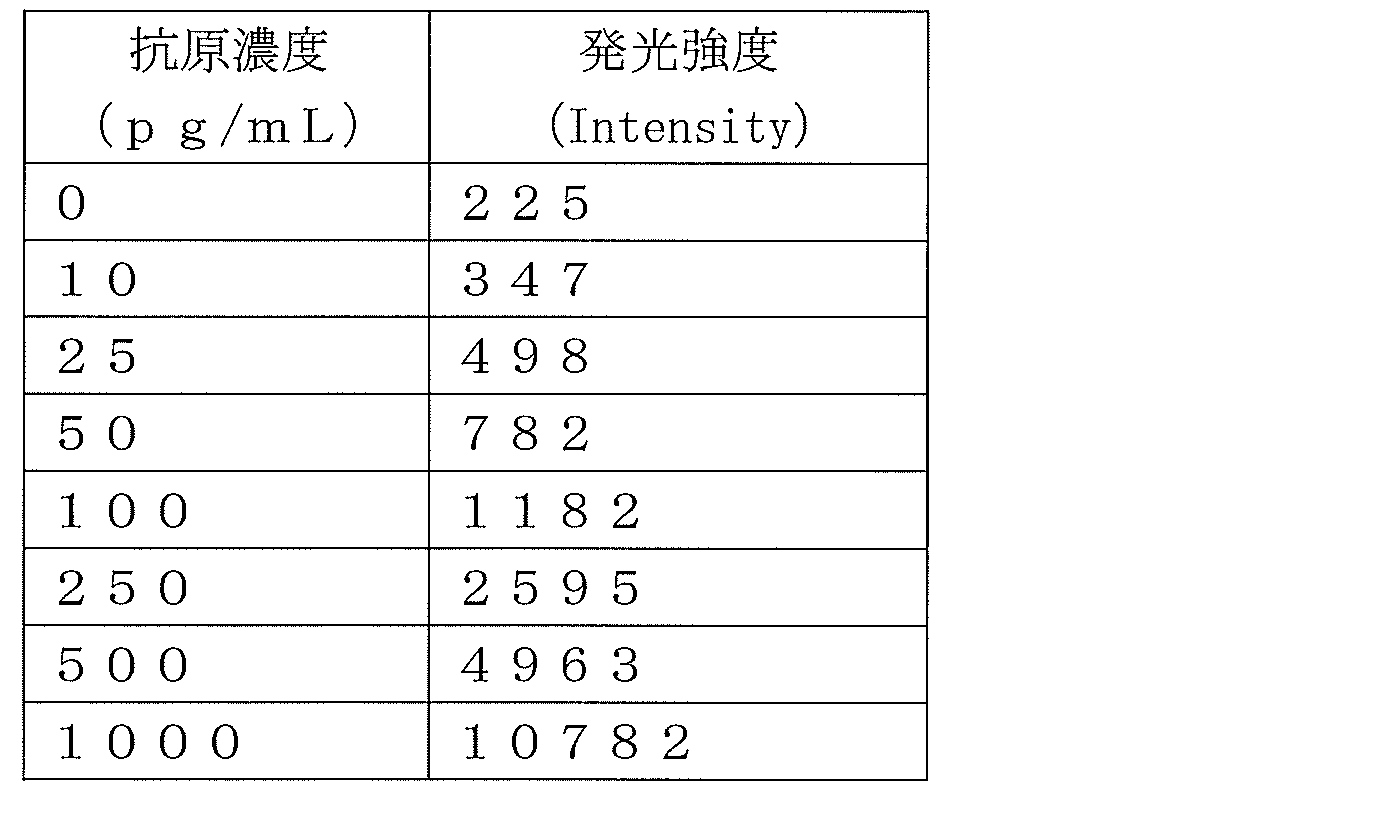
Claims (17)
- 有機高分子および無機ナノ粒子を含む複合粒子であって、
前記複合粒子中の前記無機ナノ粒子の含有量が80質量%超であり、
体積平均粒径が10~1000nmである、複合粒子。 - 体積平均粒径の変動係数が20%以下である、請求項1に記載の複合粒子。
- 前記無機ナノ粒子の含有量が80質量%を超え、95質量%以下である、請求項1または2に記載の複合粒子。
- 前記無機ナノ粒子の体積平均粒径が5~25nmである、請求項1~3のいずれか1項に記載の複合粒子。
- 前記複合粒子が、界面活性剤、酸基含有化合物、アミノ基含有化合物、シラン基含有化合物およびチタン原子含有化合物からなる群より選ばれる少なくとも一つを含む、請求項1~4のいずれか1項に記載の複合粒子。
- 前記無機ナノ粒子が磁化可能な粒子である、請求項1~5のいずれか1項に記載の複合粒子。
- 前記無機ナノ粒子が、鉄、チタン、コバルト、亜鉛、銅、マンガン、ニッケルもしくはガドリニウムの単体、それらの酸化物、またはそれらの合金;およびフェライト類からなる群より選択される1種または2種以上の無機材料からなる、請求項1~6のいずれか1項に記載の複合粒子。
- 前記無機ナノ粒子が金属酸化物粒子である、請求項1~7のいずれか1項に記載の複合粒子。
- 磁性粒子である、請求項1~8のいずれか1項に記載の複合粒子。
- 少なくとも1つのリガンドを物理吸着可能な表面を有する、請求項1~9のいずれか1項に記載の複合粒子。
- 少なくとも1つのリガンドと化学結合可能な表面を有する、請求項1~10のいずれか1項に記載の複合粒子。
- 請求項1~11のいずれか1項に記載の複合粒子と、前記粒子を被覆するポリマー層とを有する、被覆粒子。
- 下記工程(1)~(3)を含む、複合粒子の製造方法。
工程(1):磁性流体、モノマーおよび重合開始剤を混合してモノマー混合液を調製する工程
工程(2):前記モノマー混合液を分散させてエマルションを調製する工程
工程(3):前記エマルション中のモノマーを重合させる工程 - 請求項1~11のいずれか1項に記載の複合粒子および請求項12に記載の被覆粒子から選ばれる固相担体がリガンドを有する、リガンド含有固相担体。
- 前記リガンドが、抗体、抗原、核酸、ヌクレオチド、ヌクレオシド、タンパク質、ペプチド、アミノ酸、多糖、糖、脂質、ビタミン、薬物、基質、ホルモンおよび神経伝達物質からなる群より選ばれる少なくとも1種である、請求項14に記載のリガンド含有固相担体。
- イムノアッセイ用または核酸検出用である、請求項1~11のいずれか1項に記載の複合粒子、請求項12に記載の被覆粒子または請求項14もしくは15に記載のリガンド含有固相担体。
- 請求項14または15に記載のリガンド含有固相担体を用いる、試料中の標的物質を検出または分離する方法。
Priority Applications (4)
| Application Number | Priority Date | Filing Date | Title |
|---|---|---|---|
| US16/303,941 US11237162B2 (en) | 2016-05-24 | 2017-05-23 | Composite particles, coated particles, method for producing composite particles, ligand-containing solid phase carrier and method for detecting or separating target substance in sample |
| EP17802795.9A EP3467502A4 (en) | 2016-05-24 | 2017-05-23 | COMPOSITE PARTICLES, COATED PARTICLES, METHOD FOR THE PRODUCTION OF COMPOSITE PARTICLES, LIGAND-CONTAINING SOLID PHASE CARRIERS, AND METHOD FOR DETECTING OR SEPARATING THE TARGET SUBSTANCE IN THE SAMPLE |
| JP2018519558A JP6965242B2 (ja) | 2016-05-24 | 2017-05-23 | 複合粒子、被覆粒子、複合粒子の製造方法、リガンド含有固相担体および試料中の標的物質を検出または分離する方法 |
| CN201780031673.5A CN109154609B (zh) | 2016-05-24 | 2017-05-23 | 复合粒子、被覆粒子、复合粒子的制造方法、含有配体的固相载体以及对试样中的靶物质进行检测或分离的方法 |
Applications Claiming Priority (2)
| Application Number | Priority Date | Filing Date | Title |
|---|---|---|---|
| JP2016103569 | 2016-05-24 | ||
| JP2016-103569 | 2016-05-24 |
Publications (1)
| Publication Number | Publication Date |
|---|---|
| WO2017204209A1 true WO2017204209A1 (ja) | 2017-11-30 |
Family
ID=60411413
Family Applications (1)
| Application Number | Title | Priority Date | Filing Date |
|---|---|---|---|
| PCT/JP2017/019166 Ceased WO2017204209A1 (ja) | 2016-05-24 | 2017-05-23 | 複合粒子、被覆粒子、複合粒子の製造方法、リガンド含有固相担体および試料中の標的物質を検出または分離する方法 |
Country Status (5)
| Country | Link |
|---|---|
| US (1) | US11237162B2 (ja) |
| EP (1) | EP3467502A4 (ja) |
| JP (1) | JP6965242B2 (ja) |
| CN (1) | CN109154609B (ja) |
| WO (1) | WO2017204209A1 (ja) |
Cited By (4)
| Publication number | Priority date | Publication date | Assignee | Title |
|---|---|---|---|---|
| JPWO2020196581A1 (ja) * | 2019-03-26 | 2020-10-01 | ||
| WO2020218317A1 (ja) * | 2019-04-26 | 2020-10-29 | キヤノン株式会社 | 粒子、アフィニティー粒子、検査試薬、及び検出方法 |
| JPWO2020241665A1 (ja) * | 2019-05-31 | 2020-12-03 | ||
| JPWO2021172591A1 (ja) * | 2020-02-27 | 2021-09-02 |
Families Citing this family (3)
| Publication number | Priority date | Publication date | Assignee | Title |
|---|---|---|---|---|
| CN113614530B (zh) * | 2019-03-26 | 2024-09-10 | 积水医疗株式会社 | 磁性粒子以及检测试剂 |
| US20230118882A1 (en) * | 2020-03-25 | 2023-04-20 | Sekisui Medical Co., Ltd. | Magnetically responsive particles, and immunoassay method and immunoassay reagent using same |
| CN118440519B (zh) * | 2024-07-08 | 2024-09-10 | 青州市博奥炭黑有限责任公司 | 一种高分散性炭黑的制备方法 |
Citations (8)
| Publication number | Priority date | Publication date | Assignee | Title |
|---|---|---|---|---|
| US4873102A (en) * | 1988-03-14 | 1989-10-10 | Manchium Chang | Magnetic particles |
| JP2004205481A (ja) * | 2002-03-25 | 2004-07-22 | Jsr Corp | 診断薬用粒子の製造方法 |
| JP2004528550A (ja) * | 2001-03-20 | 2004-09-16 | アビバ バイオサイエンシーズ コーポレイション | コーティングされた磁気性微粒子を生産するためのプロセスおよびその使用 |
| JP2004533530A (ja) * | 2001-05-10 | 2004-11-04 | ベーイーオー・メリュー | 複合体粒子、誘導されたコンジュゲート、その製造方法および用途 |
| JP2006275600A (ja) * | 2005-03-28 | 2006-10-12 | Jsr Corp | 磁性粒子およびその製造方法、ならびに生化学用担体 |
| JP2008164488A (ja) * | 2006-12-28 | 2008-07-17 | Jsr Corp | 磁性粒子およびその製造方法、ならびに生化学用担体 |
| JP2008241357A (ja) * | 2007-03-26 | 2008-10-09 | Sanyo Chem Ind Ltd | 免疫測定用粒状担体 |
| JP2010091527A (ja) * | 2008-10-10 | 2010-04-22 | Konica Minolta Holdings Inc | 表面プラズモンを利用したアッセイ法 |
Family Cites Families (18)
| Publication number | Priority date | Publication date | Assignee | Title |
|---|---|---|---|---|
| US3926789A (en) * | 1973-07-05 | 1975-12-16 | Maryland Patent Dev Co Inc | Magnetic separation of particular mixtures |
| US3972595A (en) * | 1975-01-27 | 1976-08-03 | International Business Machines Corporation | Ferrofluid display device |
| JPH06148189A (ja) | 1992-11-05 | 1994-05-27 | Nippon Telegr & Teleph Corp <Ntt> | レーザ磁気免疫測定用磁性微粒子およびその作製法 |
| JP3246108B2 (ja) | 1993-08-06 | 2002-01-15 | エヌオーケー株式会社 | 磁性流体 |
| US5676877A (en) | 1996-03-26 | 1997-10-14 | Ferrotec Corporation | Process for producing a magnetic fluid and composition therefor |
| CA2384429A1 (en) * | 1999-09-14 | 2001-03-22 | Michael K. Bahr | Magnetic nanoparticles having biochemical activity, method for the production thereof and their use |
| FR2800635B1 (fr) | 1999-11-05 | 2002-07-26 | Bio Merieux | Nanospheres composites, conjugues derives, procede de preparation et leurs utilisations |
| US7282540B2 (en) | 2002-03-25 | 2007-10-16 | Jsr Corporation | Process for producing particles for diagnostic reagent |
| US6797782B2 (en) | 2002-03-25 | 2004-09-28 | Jsr Corporation | Process for producing particles for diagnostic reagent |
| JP4653652B2 (ja) * | 2005-03-15 | 2011-03-16 | 積水化学工業株式会社 | 磁性体内包粒子、磁性体内包粒子の製造方法、免疫測定用粒子及び免疫測定法 |
| JP2008258564A (ja) | 2007-03-15 | 2008-10-23 | Sanyo Chem Ind Ltd | 磁性流体 |
| JP4897581B2 (ja) * | 2007-06-12 | 2012-03-14 | 積水化学工業株式会社 | 親水化磁性体内包粒子の製造方法、親水化磁性体内包粒子及び免疫測定用粒子 |
| CN101241130A (zh) * | 2008-03-19 | 2008-08-13 | 哈尔滨工业大学 | 一种免疫磁性微球的制备方法 |
| EP2272608B1 (en) * | 2008-03-27 | 2014-09-17 | Hitachi Metals, Ltd. | Coated fine metal particle and process for producing the same |
| WO2012089081A1 (zh) * | 2010-12-28 | 2012-07-05 | 上海杰事杰新材料(集团)股份有限公司 | 一种纳米粒子/聚酰胺复合材料、制备方法及其应用 |
| CN102634125A (zh) * | 2012-04-16 | 2012-08-15 | 天津大学 | 单分散高磁质量分数的Fe3O4/聚合物磁性纳米粒子及制备方法 |
| CN104598475B (zh) * | 2013-10-31 | 2018-02-23 | 中国移动通信集团公司 | 基于行车用量模型事件的存储及索引方法及系统 |
| CA2926883C (en) * | 2013-12-04 | 2019-04-09 | F. Hoffmann-La Roche Ag | Improved process for producing magnetic monodisperse polymer particles |
-
2017
- 2017-05-23 US US16/303,941 patent/US11237162B2/en active Active
- 2017-05-23 WO PCT/JP2017/019166 patent/WO2017204209A1/ja not_active Ceased
- 2017-05-23 JP JP2018519558A patent/JP6965242B2/ja active Active
- 2017-05-23 CN CN201780031673.5A patent/CN109154609B/zh active Active
- 2017-05-23 EP EP17802795.9A patent/EP3467502A4/en not_active Withdrawn
Patent Citations (8)
| Publication number | Priority date | Publication date | Assignee | Title |
|---|---|---|---|---|
| US4873102A (en) * | 1988-03-14 | 1989-10-10 | Manchium Chang | Magnetic particles |
| JP2004528550A (ja) * | 2001-03-20 | 2004-09-16 | アビバ バイオサイエンシーズ コーポレイション | コーティングされた磁気性微粒子を生産するためのプロセスおよびその使用 |
| JP2004533530A (ja) * | 2001-05-10 | 2004-11-04 | ベーイーオー・メリュー | 複合体粒子、誘導されたコンジュゲート、その製造方法および用途 |
| JP2004205481A (ja) * | 2002-03-25 | 2004-07-22 | Jsr Corp | 診断薬用粒子の製造方法 |
| JP2006275600A (ja) * | 2005-03-28 | 2006-10-12 | Jsr Corp | 磁性粒子およびその製造方法、ならびに生化学用担体 |
| JP2008164488A (ja) * | 2006-12-28 | 2008-07-17 | Jsr Corp | 磁性粒子およびその製造方法、ならびに生化学用担体 |
| JP2008241357A (ja) * | 2007-03-26 | 2008-10-09 | Sanyo Chem Ind Ltd | 免疫測定用粒状担体 |
| JP2010091527A (ja) * | 2008-10-10 | 2010-04-22 | Konica Minolta Holdings Inc | 表面プラズモンを利用したアッセイ法 |
Non-Patent Citations (1)
| Title |
|---|
| See also references of EP3467502A4 * |
Cited By (12)
| Publication number | Priority date | Publication date | Assignee | Title |
|---|---|---|---|---|
| JPWO2020196581A1 (ja) * | 2019-03-26 | 2020-10-01 | ||
| WO2020196581A1 (ja) * | 2019-03-26 | 2020-10-01 | 積水メディカル株式会社 | 磁気応答性粒子及びそれを用いた免疫測定方法、免疫測定用試薬 |
| KR20210143251A (ko) * | 2019-03-26 | 2021-11-26 | 세키스이 메디칼 가부시키가이샤 | 자기 응답성 입자 및 그것을 사용한 면역 측정 방법, 면역 측정용 시약 |
| EP3951391A4 (en) * | 2019-03-26 | 2023-04-12 | Sekisui Medical Co., Ltd. | MAGNETIC REACTING PARTICLE AND IMMUNOASSAY PROCEDURE USING THE SAME, REAGENT FOR IMMUNOASSAY |
| KR102802496B1 (ko) * | 2019-03-26 | 2025-05-07 | 세키스이 메디칼 가부시키가이샤 | 자기 응답성 입자 및 그것을 사용한 면역 측정 방법, 면역 측정용 시약 |
| WO2020218317A1 (ja) * | 2019-04-26 | 2020-10-29 | キヤノン株式会社 | 粒子、アフィニティー粒子、検査試薬、及び検出方法 |
| JP2020183946A (ja) * | 2019-04-26 | 2020-11-12 | キヤノン株式会社 | 粒子、アフィニティー粒子、検査試薬、及び検出方法 |
| JP7580936B2 (ja) | 2019-04-26 | 2024-11-12 | キヤノン株式会社 | 粒子、アフィニティー粒子、検査試薬、及び検出方法 |
| JPWO2020241665A1 (ja) * | 2019-05-31 | 2020-12-03 | ||
| JP7464592B2 (ja) | 2019-05-31 | 2024-04-09 | 国立大学法人京都大学 | マクロファージイメージング剤 |
| JPWO2021172591A1 (ja) * | 2020-02-27 | 2021-09-02 | ||
| JP7357975B2 (ja) | 2020-02-27 | 2023-10-10 | 株式会社TearExo | センシング用ナノ粒子及びその製造方法 |
Also Published As
| Publication number | Publication date |
|---|---|
| CN109154609B (zh) | 2022-08-05 |
| EP3467502A4 (en) | 2020-01-01 |
| US20200319171A1 (en) | 2020-10-08 |
| JP6965242B2 (ja) | 2021-11-10 |
| JPWO2017204209A1 (ja) | 2019-03-22 |
| CN109154609A (zh) | 2019-01-04 |
| EP3467502A1 (en) | 2019-04-10 |
| US11237162B2 (en) | 2022-02-01 |
Similar Documents
| Publication | Publication Date | Title |
|---|---|---|
| JP6965242B2 (ja) | 複合粒子、被覆粒子、複合粒子の製造方法、リガンド含有固相担体および試料中の標的物質を検出または分離する方法 | |
| US5814687A (en) | Magnetic polymer particle and process for manufacturing the same | |
| US7732051B2 (en) | Polymer-coated magnetic particles comprising a 2,3-hydroxypropyl group, and probe-bonded particles | |
| JP3738847B2 (ja) | 診断薬用粒子の製造方法 | |
| EP1890147B1 (en) | Organic polymer particles and process for producing the same, magnetic particles for diagnostics, carboxyl group-containing particles and process for producing the same, and probe-bound particles and process for producing the same | |
| US7981512B2 (en) | Organic polymer-magnetic particles and process for producing same | |
| JP2007288133A (ja) | 磁性粒子およびその製造方法 | |
| US20090099342A1 (en) | Process for Preparing Composite Particles, Composite Particles Obtained, and Their Use in a Diagnostic Test | |
| US6797782B2 (en) | Process for producing particles for diagnostic reagent | |
| JP5003867B2 (ja) | 磁性粒子およびその製造方法、ならびにプローブ結合粒子 | |
| WO2019103103A1 (ja) | 細胞を分離する方法、細胞分離または濃縮用粒子およびキット | |
| JP4984025B2 (ja) | 有機ポリマー粒子およびその製造方法、ならびにプローブ結合粒子 | |
| JP4548598B2 (ja) | 磁性粒子およびその製造方法、ならびに生化学用担体 | |
| US7282540B2 (en) | Process for producing particles for diagnostic reagent | |
| JP4653652B2 (ja) | 磁性体内包粒子、磁性体内包粒子の製造方法、免疫測定用粒子及び免疫測定法 | |
| Abdelrahman | Lanthanide-encoded Polysterene Microspheres for Mass Cytometry-based Bioassays | |
| JP2023095763A (ja) | 免疫測定用樹脂微粒子、蛍光樹脂微粒子、標識試薬用材料、および免疫測定試薬 | |
| JP2007262114A (ja) | 磁性粒子およびその製造方法、ならびに磁性粒子分散体 | |
| JP2007211076A (ja) | 有機ポリマー粒子およびその製造方法、ならびにプローブ結合粒子 | |
| JP2006145256A (ja) | 磁性体内包粒子、免疫測定用粒子及びイムノクロマトグラフィ法 | |
| JP2019098228A (ja) | 磁性担体処理装置 | |
| JP2007256151A (ja) | 診断薬用磁性ポリマー粒子およびその製造方法 | |
| JP2006265286A (ja) | ポリマー被覆磁性粒子およびその製造方法、生化学用担体、ならびにビオチン類捕捉用粒子 |
Legal Events
| Date | Code | Title | Description |
|---|---|---|---|
| ENP | Entry into the national phase |
Ref document number: 2018519558 Country of ref document: JP Kind code of ref document: A |
|
| NENP | Non-entry into the national phase |
Ref country code: DE |
|
| 121 | Ep: the epo has been informed by wipo that ep was designated in this application |
Ref document number: 17802795 Country of ref document: EP Kind code of ref document: A1 |
|
| ENP | Entry into the national phase |
Ref document number: 2017802795 Country of ref document: EP Effective date: 20190102 |
|
| WWW | Wipo information: withdrawn in national office |
Ref document number: 2017802795 Country of ref document: EP |