WO2017204243A1 - Composition de résine thermoplastique, corps moulé, film, et stratifié - Google Patents
Composition de résine thermoplastique, corps moulé, film, et stratifié Download PDFInfo
- Publication number
- WO2017204243A1 WO2017204243A1 PCT/JP2017/019329 JP2017019329W WO2017204243A1 WO 2017204243 A1 WO2017204243 A1 WO 2017204243A1 JP 2017019329 W JP2017019329 W JP 2017019329W WO 2017204243 A1 WO2017204243 A1 WO 2017204243A1
- Authority
- WO
- WIPO (PCT)
- Prior art keywords
- thermoplastic resin
- mass
- resin composition
- film
- polymer
- Prior art date
- Legal status (The legal status is an assumption and is not a legal conclusion. Google has not performed a legal analysis and makes no representation as to the accuracy of the status listed.)
- Ceased
Links
Images



Classifications
-
- C—CHEMISTRY; METALLURGY
- C08—ORGANIC MACROMOLECULAR COMPOUNDS; THEIR PREPARATION OR CHEMICAL WORKING-UP; COMPOSITIONS BASED THEREON
- C08F—MACROMOLECULAR COMPOUNDS OBTAINED BY REACTIONS ONLY INVOLVING CARBON-TO-CARBON UNSATURATED BONDS
- C08F265/00—Macromolecular compounds obtained by polymerising monomers on to polymers of unsaturated monocarboxylic acids or derivatives thereof as defined in group C08F20/00
- C08F265/04—Macromolecular compounds obtained by polymerising monomers on to polymers of unsaturated monocarboxylic acids or derivatives thereof as defined in group C08F20/00 on to polymers of esters
- C08F265/06—Polymerisation of acrylate or methacrylate esters on to polymers thereof
-
- C—CHEMISTRY; METALLURGY
- C08—ORGANIC MACROMOLECULAR COMPOUNDS; THEIR PREPARATION OR CHEMICAL WORKING-UP; COMPOSITIONS BASED THEREON
- C08J—WORKING-UP; GENERAL PROCESSES OF COMPOUNDING; AFTER-TREATMENT NOT COVERED BY SUBCLASSES C08B, C08C, C08F, C08G or C08H
- C08J5/00—Manufacture of articles or shaped materials containing macromolecular substances
- C08J5/18—Manufacture of films or sheets
-
- B—PERFORMING OPERATIONS; TRANSPORTING
- B32—LAYERED PRODUCTS
- B32B—LAYERED PRODUCTS, i.e. PRODUCTS BUILT-UP OF STRATA OF FLAT OR NON-FLAT, e.g. CELLULAR OR HONEYCOMB, FORM
- B32B27/00—Layered products comprising a layer of synthetic resin
- B32B27/30—Layered products comprising a layer of synthetic resin comprising vinyl (co)polymers; comprising acrylic (co)polymers
-
- B—PERFORMING OPERATIONS; TRANSPORTING
- B32—LAYERED PRODUCTS
- B32B—LAYERED PRODUCTS, i.e. PRODUCTS BUILT-UP OF STRATA OF FLAT OR NON-FLAT, e.g. CELLULAR OR HONEYCOMB, FORM
- B32B27/00—Layered products comprising a layer of synthetic resin
- B32B27/30—Layered products comprising a layer of synthetic resin comprising vinyl (co)polymers; comprising acrylic (co)polymers
- B32B27/308—Layered products comprising a layer of synthetic resin comprising vinyl (co)polymers; comprising acrylic (co)polymers comprising acrylic (co)polymers
-
- B—PERFORMING OPERATIONS; TRANSPORTING
- B32—LAYERED PRODUCTS
- B32B—LAYERED PRODUCTS, i.e. PRODUCTS BUILT-UP OF STRATA OF FLAT OR NON-FLAT, e.g. CELLULAR OR HONEYCOMB, FORM
- B32B7/00—Layered products characterised by the relation between layers; Layered products characterised by the relative orientation of features between layers, or by the relative values of a measurable parameter between layers, i.e. products comprising layers having different physical, chemical or physicochemical properties; Layered products characterised by the interconnection of layers
- B32B7/04—Interconnection of layers
- B32B7/12—Interconnection of layers using interposed adhesives or interposed materials with bonding properties
-
- C—CHEMISTRY; METALLURGY
- C08—ORGANIC MACROMOLECULAR COMPOUNDS; THEIR PREPARATION OR CHEMICAL WORKING-UP; COMPOSITIONS BASED THEREON
- C08L—COMPOSITIONS OF MACROMOLECULAR COMPOUNDS
- C08L101/00—Compositions of unspecified macromolecular compounds
-
- C—CHEMISTRY; METALLURGY
- C08—ORGANIC MACROMOLECULAR COMPOUNDS; THEIR PREPARATION OR CHEMICAL WORKING-UP; COMPOSITIONS BASED THEREON
- C08L—COMPOSITIONS OF MACROMOLECULAR COMPOUNDS
- C08L33/00—Compositions of homopolymers or copolymers of compounds having one or more unsaturated aliphatic radicals, each having only one carbon-to-carbon double bond, and only one being terminated by only one carboxyl radical, or of salts, anhydrides, esters, amides, imides or nitriles thereof; Compositions of derivatives of such polymers
- C08L33/04—Homopolymers or copolymers of esters
- C08L33/06—Homopolymers or copolymers of esters of esters containing only carbon, hydrogen and oxygen, which oxygen atoms are present only as part of the carboxyl radical
- C08L33/08—Homopolymers or copolymers of acrylic acid esters
-
- C—CHEMISTRY; METALLURGY
- C08—ORGANIC MACROMOLECULAR COMPOUNDS; THEIR PREPARATION OR CHEMICAL WORKING-UP; COMPOSITIONS BASED THEREON
- C08L—COMPOSITIONS OF MACROMOLECULAR COMPOUNDS
- C08L33/00—Compositions of homopolymers or copolymers of compounds having one or more unsaturated aliphatic radicals, each having only one carbon-to-carbon double bond, and only one being terminated by only one carboxyl radical, or of salts, anhydrides, esters, amides, imides or nitriles thereof; Compositions of derivatives of such polymers
- C08L33/04—Homopolymers or copolymers of esters
- C08L33/06—Homopolymers or copolymers of esters of esters containing only carbon, hydrogen and oxygen, which oxygen atoms are present only as part of the carboxyl radical
- C08L33/10—Homopolymers or copolymers of methacrylic acid esters
- C08L33/12—Homopolymers or copolymers of methyl methacrylate
-
- C—CHEMISTRY; METALLURGY
- C08—ORGANIC MACROMOLECULAR COMPOUNDS; THEIR PREPARATION OR CHEMICAL WORKING-UP; COMPOSITIONS BASED THEREON
- C08L—COMPOSITIONS OF MACROMOLECULAR COMPOUNDS
- C08L51/00—Compositions of graft polymers in which the grafted component is obtained by reactions only involving carbon-to-carbon unsaturated bonds; Compositions of derivatives of such polymers
- C08L51/04—Compositions of graft polymers in which the grafted component is obtained by reactions only involving carbon-to-carbon unsaturated bonds; Compositions of derivatives of such polymers grafted on to rubbers
-
- C—CHEMISTRY; METALLURGY
- C08—ORGANIC MACROMOLECULAR COMPOUNDS; THEIR PREPARATION OR CHEMICAL WORKING-UP; COMPOSITIONS BASED THEREON
- C08L—COMPOSITIONS OF MACROMOLECULAR COMPOUNDS
- C08L51/00—Compositions of graft polymers in which the grafted component is obtained by reactions only involving carbon-to-carbon unsaturated bonds; Compositions of derivatives of such polymers
- C08L51/06—Compositions of graft polymers in which the grafted component is obtained by reactions only involving carbon-to-carbon unsaturated bonds; Compositions of derivatives of such polymers grafted on to homopolymers or copolymers of aliphatic hydrocarbons containing only one carbon-to-carbon double bond
-
- G—PHYSICS
- G02—OPTICS
- G02B—OPTICAL ELEMENTS, SYSTEMS OR APPARATUS
- G02B5/00—Optical elements other than lenses
- G02B5/30—Polarising elements
-
- G—PHYSICS
- G02—OPTICS
- G02B—OPTICAL ELEMENTS, SYSTEMS OR APPARATUS
- G02B5/00—Optical elements other than lenses
- G02B5/30—Polarising elements
- G02B5/3025—Polarisers, i.e. arrangements capable of producing a definite output polarisation state from an unpolarised input state
- G02B5/3033—Polarisers, i.e. arrangements capable of producing a definite output polarisation state from an unpolarised input state in the form of a thin sheet or foil, e.g. Polaroid
- G02B5/3041—Polarisers, i.e. arrangements capable of producing a definite output polarisation state from an unpolarised input state in the form of a thin sheet or foil, e.g. Polaroid comprising multiple thin layers, e.g. multilayer stacks
- G02B5/305—Polarisers, i.e. arrangements capable of producing a definite output polarisation state from an unpolarised input state in the form of a thin sheet or foil, e.g. Polaroid comprising multiple thin layers, e.g. multilayer stacks including organic materials, e.g. polymeric layers
-
- C—CHEMISTRY; METALLURGY
- C08—ORGANIC MACROMOLECULAR COMPOUNDS; THEIR PREPARATION OR CHEMICAL WORKING-UP; COMPOSITIONS BASED THEREON
- C08L—COMPOSITIONS OF MACROMOLECULAR COMPOUNDS
- C08L2203/00—Applications
- C08L2203/16—Applications used for films
-
- C—CHEMISTRY; METALLURGY
- C08—ORGANIC MACROMOLECULAR COMPOUNDS; THEIR PREPARATION OR CHEMICAL WORKING-UP; COMPOSITIONS BASED THEREON
- C08L—COMPOSITIONS OF MACROMOLECULAR COMPOUNDS
- C08L2207/00—Properties characterising the ingredient of the composition
- C08L2207/53—Core-shell polymer
-
- C—CHEMISTRY; METALLURGY
- C09—DYES; PAINTS; POLISHES; NATURAL RESINS; ADHESIVES; COMPOSITIONS NOT OTHERWISE PROVIDED FOR; APPLICATIONS OF MATERIALS NOT OTHERWISE PROVIDED FOR
- C09J—ADHESIVES; NON-MECHANICAL ASPECTS OF ADHESIVE PROCESSES IN GENERAL; ADHESIVE PROCESSES NOT PROVIDED FOR ELSEWHERE; USE OF MATERIALS AS ADHESIVES
- C09J201/00—Adhesives based on unspecified macromolecular compounds
- C09J201/02—Adhesives based on unspecified macromolecular compounds characterised by the presence of specified groups, e.g. terminal or pendant functional groups
-
- C—CHEMISTRY; METALLURGY
- C09—DYES; PAINTS; POLISHES; NATURAL RESINS; ADHESIVES; COMPOSITIONS NOT OTHERWISE PROVIDED FOR; APPLICATIONS OF MATERIALS NOT OTHERWISE PROVIDED FOR
- C09J—ADHESIVES; NON-MECHANICAL ASPECTS OF ADHESIVE PROCESSES IN GENERAL; ADHESIVE PROCESSES NOT PROVIDED FOR ELSEWHERE; USE OF MATERIALS AS ADHESIVES
- C09J2203/00—Applications of adhesives in processes or use of adhesives in the form of films or foils
- C09J2203/326—Applications of adhesives in processes or use of adhesives in the form of films or foils for bonding electronic components such as wafers, chips or semiconductors
-
- C—CHEMISTRY; METALLURGY
- C09—DYES; PAINTS; POLISHES; NATURAL RESINS; ADHESIVES; COMPOSITIONS NOT OTHERWISE PROVIDED FOR; APPLICATIONS OF MATERIALS NOT OTHERWISE PROVIDED FOR
- C09J—ADHESIVES; NON-MECHANICAL ASPECTS OF ADHESIVE PROCESSES IN GENERAL; ADHESIVE PROCESSES NOT PROVIDED FOR ELSEWHERE; USE OF MATERIALS AS ADHESIVES
- C09J2301/00—Additional features of adhesives in the form of films or foils
- C09J2301/40—Additional features of adhesives in the form of films or foils characterized by the presence of essential components
- C09J2301/416—Additional features of adhesives in the form of films or foils characterized by the presence of essential components use of irradiation
Definitions
- the present invention relates to a thermoplastic resin composition, a molded body and a film containing such a thermoplastic resin composition, and a laminate obtained by laminating the thermoplastic resin film on an adherend.
- thermoplastic resin composition and a film containing the thermoplastic resin composition are easy to perform primary processing and secondary processing, they are widely used for decorating applications and the like.
- acrylic resin one of the thermoplastic resins, is made of acrylic polymer with methacrylic acid ester as the main component, and has high transparency and low moisture permeability, so it is widely used for optical and decorative applications. in use.
- a film containing a thermoplastic resin composition is often laminated on an adherend via an adhesive.
- a polarizing plate can be produced by laminating a film containing a thermoplastic resin composition on a polyvinyl alcohol polarizer.
- an aqueous adhesive such as an aqueous polyvinyl alcohol solution
- Patent Document 1 aqueous polyvinyl alcohol solution
- the water-based adhesive contains water as a solvent.
- Such a laminating method using a water-based adhesive requires heating for drying the solvent, and thus the laminate is likely to warp.
- the laminated body used by the vehicle-mounted use etc. may be placed in the high temperature environment of 100 degreeC or more, for example, and also in this case, a laminated body tends to warp. These warpages occur when a film containing the thermoplastic resin composition is heated to expand and contract. Similar problems occur when the solvent of the adhesive is an organic solvent.
- an adhesive that does not require drying of the solvent can be used for curing the adhesive, and examples thereof include an active energy ray-curable adhesive.
- an active energy ray-curable adhesive Patent Document 2 discloses an adhesive containing an N-substituted amide monofunctional monomer having a hydroxy group and an acrylate polyfunctional monomer.
- patent document 3 is disclosing the adhesive agent containing an epoxy compound, an oxetane compound, and a photocationic polymerization initiator.
- Patent Document 4 discloses an active energy ray-curable adhesive containing a polymerizable monomer.
- Patent Document 5 discloses a method of laminating an acrylic film having an easy-adhesion layer added to an adhesive surface on a polarizer via an active energy ray-curable adhesive.
- Such an acrylic film is made of a methacrylic polymer blended with elastic particles.
- the polarizer is made of a polyvinyl alcohol resin.
- Such a laminating method has a strong adhesive force between the acrylic film and the polarizer due to the interposition of the easy-adhesion layer, but requires an easy-adhesion layer, which increases the manufacturing cost of the polarizing plate, and requires an easy-adhesion layer, so that productivity is high. Low was an issue. Moreover, sufficient adhesive force was not able to be obtained without the easily bonding layer.
- An object of the present invention is to provide a molded body and a film containing a thermoplastic resin composition that can be firmly bonded to an adherend through an active energy ray-curable adhesive. Further, when the molded body and the film containing the thermoplastic resin composition are firmly bonded to the adherend, the adhesive permeates into the molded body or film, thereby whitening the molded body or film. A new issue was revealed. For this reason, an object of this invention is to provide the thermoplastic resin composition which is hard to be whitened even if the adhesive which osmose
- the inventors of the present invention paid attention to the multilayer structure polymer (C) that forms a multilayer particle structure as a component of the thermoplastic resin composition, and intensively studied the physical characteristics of the multilayer particle structure.
- the thermoplastic resin composition containing the specific multilayer structure polymer (C) it is difficult to whiten even if the active energy ray-curable adhesive permeates, and the molded article has excellent adhesion to the adhesive. And it discovered that a film was obtained and completed this invention.
- the present invention has the following configuration.
- the median diameter Da of the multilayer polymer (C) measured by a laser diffraction / scattering method after dissolving the thermoplastic resin composition in acetone is 200 nm or more and less than 500 nm.
- Thermoplastic resin composition is 200 nm or more and less than 500 nm.
- the multilayer particle structure has an inner layer and an outer layer covering the inner layer
- the multilayer structure polymer (C) is a graft copolymer having a crosslinked rubber polymer component (I) and a polymer component (II) grafted to the crosslinked rubber polymer component (I).
- the crosslinked rubber polymer component (I) is mainly composed of an acrylic acid alkyl ester unit having an alkyl group having 1 to 8 carbon atoms, and forms the inner layer.
- the polymer component (II) contains 80 to 97% by mass of methyl methacrylate units and 3 to 20% by mass of acrylate units, and forms the outer layer.
- the thermoplastic resin composition is a graft copolymer having a crosslinked rubber polymer component (I) and a polymer component (II) grafted to the crosslinked rubber polymer component (I).
- the crosslinked rubber polymer component (I) is mainly composed of an acrylic acid alkyl ester unit having an alkyl group having 1 to 8 carbon
- the thermoplastic resin composition includes at least one acrylate unit selected from benzyl acrylate, cyclohexyl acrylate, tetrahydrofurfuryl acrylate, and tert-butyl acrylate,
- the number average (Fn) of the formula weights of the grafted polymer component (II) is 15,000 to 62,000.
- thermoplastic resin composition according to any one of [2] to [4], wherein the proportion of the polymer component (II) in 100% by mass of the multilayer structure polymer (C) is 10 to 25% by mass. .
- the multilayer structure polymer (C) satisfies the following formula: [1] to The thermoplastic resin composition according to any one of [5].
- thermoplastic resin composition according to any one of [1] to [6], wherein the thermoplastic resin contains a methacrylic polymer (A) containing more than 97% by mass of a methyl methacrylate unit.
- the thermoplastic resin includes the methacrylic polymer (A), an acrylic copolymer (B) containing 80 to 97% by mass of methyl methacrylate units and 3 to 20% by mass of acrylate units. Containing, The acrylic copolymer (B) has a glass transition temperature of 90 to 115 ° C., The acrylic copolymer (B) has a number average molecular weight (MnB) of 15,000 to 50,000.
- thermoplastic resin composition [7] The thermoplastic resin composition. [9] The thermoplastic resin composition according to [8], wherein the acrylic copolymer (B) has a number average molecular weight (MnB) and a glass transition temperature (Tg [° C.]) satisfying the following formula: 365 ⁇ (MnB / 1000) + 3.5 ⁇ Tg ⁇ 420 [10] A molded article comprising the thermoplastic resin composition according to any one of [1] to [9]. [11] A film comprising the thermoplastic resin composition according to any one of [1] to [9]. [12] The film according to [11], wherein the change in heating dimension when the film is heated at 100 ° C. for 30 minutes is ⁇ 2.0 to 2.0%.
- a laminate comprising the film of any one of [11] to [13] laminated on an adherend via an active energy ray-curable adhesive.
- the adherend is a polarizer and functions as a polarizing plate.
- the active energy ray curable adhesive is an ultraviolet curable adhesive.
- the laminate according to any one of [14] to [16], wherein the active energy ray-curable adhesive contains a cationic photopolymerizable compound.
- thermoplastic resin composition of the present invention can be firmly bonded to an adherend via an active energy ray-curable adhesive, and are not easily whitened even when the adhesive penetrates.
- the numerical value specified by this specification shows the value obtained when it measures by the method described in the Example mentioned later.
- the numerical values “A to B” specified in the present specification indicate ranges that are larger than the numerical values A and A and satisfy the values smaller than the numerical values B and B.
- the “film” of the present invention is not limited by the thickness or the like, but includes “sheet” defined in JIS.
- the “A unit” means “a structural unit derived from A”.
- thermoplastic resin composition of the present embodiment can be suitably attached to the surface of the adherend.
- a laminated body is obtained by sticking a molded body and a film containing a thermoplastic resin composition with an adhesive to an adherend.
- a film containing such a thermoplastic resin composition may be simply referred to as a film.
- thermoplastic resin composition contains 70 to 95% by mass of a thermoplastic resin based on 100% by mass of the thermoplastic resin composition.
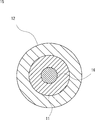
- thermoplastic resin composition further contains a multilayer structure polymer (C) having a multilayer particle structure shown in FIG.
- the multilayer particle structure has an inner layer 11 and an outer layer 12. These layers will be described later.
- the multilayer structure polymer (C) is mixed in a thermoplastic resin.
- the thermoplastic resin composition contains 100% by mass of the thermoplastic resin composition, and 5 to 30% by mass, preferably 10 to 25% by mass, more preferably 15 to 20% by mass of the multilayer structure polymer (C). To do.
- the multilayer structure polymer (C) can enhance the flexibility and adhesiveness of the thermoplastic resin composition. For this reason, the handling of the molded object and film containing a thermoplastic resin composition is easy.
- the multilayer structure polymer (C) of 30% by mass or less can increase the surface hardness of the molded body and the film, and can suppress a dimensional change when the molded body and the film are heated.
- the median diameter Da of the multilayer structure polymer (C) measured by the laser diffraction / scattering method after dissolving the thermoplastic resin composition of the present invention in acetone is 200 nm or more and less than 500 nm.
- the median diameter Da of the multilayer structure polymer (C) is 210, 220, 230, 240, 250, 260, 270, 280, 290, 295, 300, 305, 310, 315, 320, 325, 330, 335, 340, 345, 350, 355, 360, 365, 370, 375, 380, 385, 390, 395, 400, 405, 410, 415, 420, 425, 430, 435, 440, 445, 450, 455, 460, 470, It may be either 480 or 490 nm.
- the median diameter Da is an average value of the outer diameter of the multilayer particle structure of the multilayer structure polymer (C), and can be specifically obtained by the method described later in Examples.
- the thermoplastic resin composition has excellent toughness.
- the molded object and film containing a thermoplastic resin composition are equipped with the outstanding toughness, a heating dimensional change is small, and is excellent in heat resistance.
- Such a thermoplastic resin composition is also excellent in the permeability of the active energy ray-curable adhesive.
- thermoplastic resin composition when the molded body and film containing the thermoplastic resin composition are bonded to an adherend such as a polarizer via an active energy ray-curable adhesive, without providing an easy-adhesive layer or the like, A high adhesive force can be obtained between the adherend and the adherend.
- thermoplastic resin is not particularly limited.
- examples of the thermoplastic resin include norbornene resin, polycarbonate resin, polysulfone resin, polyethersulfone resin, (meth) acrylic resin, polyarylate resin, polystyrene resin, and polyvinyl chloride resin.
- resin which blended 2 or more types among these may be sufficient.
- a film excellent in optical properties, particularly transparency, can be obtained by using a thermoplastic resin as a (meth) acrylic resin, especially a methacrylic resin mainly composed of a methacrylic ester.
- the methacrylic resin may contain a ring structure.
- a methacrylic resin selected as a component of a thermoplastic resin may be referred to as a methacrylic polymer (A).
- the thermoplastic resin may contain components other than the methacrylic polymer (A).
- the methacrylic polymer (A) preferably contains more than 97% by mass of methyl methacrylate units. Thereby, the heat resistance and surface hardness of the film can be further increased.
- the methacrylic polymer (A) may further contain less than 3% by mass of an acrylic acid alkyl ester unit.
- the methacrylic polymer (A) may not contain an acrylic acid alkyl ester unit.
- the methyl methacrylate unit is 98% by mass or more and the acrylate unit is 2% by mass or less.
- the methyl methacrylate unit is 99% by mass or more and the acrylate unit is 0 to 1% by mass. In an even more preferred composition, the methyl methacrylate unit is 100% by mass.
- alkyl acrylate unit examples include methyl acrylate, ethyl acrylate, propyl acrylate, butyl acrylate, 2-ethylhexyl acrylate, and the like.
- a film containing a methacrylic polymer (A) containing at least one of methyl acrylate and butyl acrylate is more than a film made of a methacrylic polymer (A) containing other alkyl acrylate units instead. High heat resistance and moldability are preferable.
- the methacrylic polymer (A) has a triadic syndiotacticity (rr) of preferably 45 to 65%, more preferably 50 to 65%.
- rr triadic syndiotacticity
- the glass transition temperature of the thermoplastic resin can be increased.
- the chemical resistance of the film can be further improved.
- syndiotacticity is a percentage of the ratio of two diads of a triplet that are both racemo (represented as rr).
- a triplet is a chain of three consecutive structural units.
- a duplex is a chain of two consecutive structural units.
- meso methacrylic polymer
- meso methacrylic polymer
- m meso
- racemo racemo
- syndiotacticity (rr) (%) In order to calculate the syndiotacticity (rr) (%), first, a 1 H-NMR spectrum of a polymer molecule is measured at 30 ° C. in deuterated chloroform. Next, from the spectrum, when tetramethylsilane (TMS) was 0 ppm, the area (X) of the region of 0.6 to 0.95 ppm and the area (Y) of the region of 0.6 to 1.35 ppm Is calculated. Syndiotacticity (rr) (%) is represented by the formula: (X / Y) ⁇ 100.
- the number average molecular weight (MnA) of the methacrylic polymer (A) is preferably 25,000 to 75,000, more preferably 30,000 to 70,000, still more preferably 35,000 to 60,000.
- the number average molecular weight (MnA) of the methacrylic polymer (A) is particularly preferably 50,000 or more.
- the number average molecular weight (MnA) is 25,000 or more, the tear strength of the film is improved. Furthermore, the workability in the production of the laminate, that is, reworkability is improved. For this reason, the yield in laminated body manufacture improves.
- the number average molecular weight (MnA) is 75,000 or less, the fluidity of the thermoplastic resin composition containing the methacrylic polymer (A) is improved. For this reason, the workability at the time of manufacturing a molded object and a film by shape
- the number average molecular weight (MnA) of the methacrylic polymer (A) can be obtained by gel permeation chromatography (GPC) based on the molecular weight of standard polystyrene, and specifically obtained by the method described later in Examples. Can do.
- the methacrylic polymer (A) can be produced by a bulk polymerization method, a solution polymerization method, a suspension polymerization method, an emulsion polymerization method or the like. Among these, either the bulk polymerization method or the solution polymerization method is preferable. Of these, the bulk polymerization method is preferred.
- the bulk polymerization method is preferably a continuous bulk polymerization method.
- the acrylic copolymer (B) may be added to the thermoplastic resin.
- the polymerization reaction of the acrylic copolymer (B) will be described separately.
- the polymerization reaction can be started by adding a polymerization initiator to the polymerization reaction raw material.
- the polymerization reaction raw material is a monomer constituting the methyl methacrylate unit and other structural units.
- the molecular weight of the methacrylic polymer (A) obtained can be adjusted by adding a chain transfer agent to a polymerization reaction raw material.
- the amount of dissolved oxygen in the polymerization reaction raw material is preferably 10 ppm or less, more preferably 5 ppm or less, still more preferably 4 ppm or less, and most preferably 3 ppm or less.
- a polymerization reaction raw material having a dissolved oxygen amount in such a range is used, the polymerization reaction proceeds smoothly. For this reason, a silverish color and other coloration are not easily generated in the film.
- the polymerization initiator is not particularly limited as long as it generates a reactive radical.
- examples of the polymerization initiator include tert-hexylperoxyisopropyl monocarbonate, tert-hexylperoxy 2-ethylhexanoate, 1,1,3,3-tetramethylbutylperoxy 2-ethylhexanoate, tert-butyl.
- tert-hexylperoxy 2-ethylhexanoate 1,1-bis (tert-hexylperoxy) cyclohexane, dimethyl 2,2'-azobis (2-methylpropionate) are preferred.
- the polymerization initiator preferably has a predetermined 1 hour half-life temperature.
- the temperature is preferably 60 to 140 ° C, more preferably 80 to 120 ° C.
- the polymerization initiator used for bulk polymerization has a predetermined hydrogen abstraction ability.
- the hydrogen drawing capacity is preferably 20% or less, more preferably 10% or less, and further preferably 5% or less.
- the amount of the polymerization initiator is preferably 0.0001 to 0.02 parts by mass, more preferably 0.001 to 0.01 parts by mass, and further preferably 100 parts by mass of the polymerization reaction raw material. Is 0.005 to 0.007 parts by mass.
- chain transfer agents examples include n-octyl mercaptan, n-dodecyl mercaptan, tert-dodecyl mercaptan, 1,4-butanedithiol, 1,6-hexanedithiol, ethylene glycol bisthiopropionate, butanediol bisthioglycolate.
- Alkyl mercaptans such as butanediol bisthiopropionate, hexanediol bisthioglycolate, hexanediol bisthiopropionate, trimethylolpropane tris- ( ⁇ -thiopropionate), pentaerythritol tetrakisthiopropionate Etc.
- monofunctional alkyl mercaptans such as n-octyl mercaptan and n-dodecyl mercaptan are preferred.
- These chain transfer agents can be used alone or in combination of two or more.
- the amount of the chain transfer agent used is preferably 0.1 to 1 part by weight, more preferably 0.15 to 0.8 part by weight, and still more preferably 0.2 to 0.
- the amount is 6 parts by mass, particularly preferably 0.2 to 0.5 parts by mass.
- the amount of the chain transfer agent used is preferably 2,500 to 7,000 parts by weight, more preferably 3,500 to 4,500 parts by weight, still more preferably 3, to 100 parts by weight of the polymerization initiator. 800 to 4,300 parts by mass.
- the acrylic copolymer (B) By blending the acrylic copolymer (B) with the thermoplastic resin, the dispersibility of the multilayer structure polymer (C) can be improved in the thermoplastic resin, and the active energy ray-curable adhesive The permeability can be increased.
- the acrylic polymer (B) can be produced by emulsion polymerization to obtain an emulsion containing the acrylic polymer (B). For this reason, when blending the multilayer structure polymer (C) into the thermoplastic resin, it is preferable to previously mix the emulsion of the acrylic polymer (B) and the emulsion containing the multilayer structure polymer (C). .
- the mixture of the acrylic polymer (B) and the multilayer structure polymer (C) is agglomerated, and the aggregate is blended with the thermoplastic resin, so that the multilayer structure polymer (C ) And the penetrability of the active energy ray-curable adhesive.
- composition of acrylic copolymer (B) An acrylic copolymer (B) consists of a methyl methacrylate unit and an acrylic ester unit, for example.
- the methyl methacrylate unit in the acrylic copolymer (B) is preferably 80 to 97% by mass.
- the acrylate unit is preferably 3 to 20% by mass.
- a more preferred composition of the acrylic copolymer (B) is 85 to 93% by mass of methyl methacrylate and 7 to 15% by mass of acrylic acid ester.
- the composition ratio of methyl methacrylate can be any of 86, 87, 88, 89, 90, 91 and 92% by mass.
- the composition ratio of the acrylic ester can be any of 8, 9, 10, 11, 12, 13, 14, and 15% by mass.
- the range of the number average molecular weight (MnB) of the acrylic copolymer (B) is preferably 15,000 to 40,000, more preferably 25,000 to 35,000.
- the number average molecular weight (MnB) is 2.6 ⁇ 10 4 , 2.7 ⁇ 10 4 , 2.8 ⁇ 10 4 , 2.9 ⁇ 10 4 , 3.0 ⁇ 10 4 , 3.1 ⁇ 10 4 , It can be either 3.2 ⁇ 10 4 , 3.3 ⁇ 10 4, or 3.4 ⁇ 10 4 .
- the number average molecular weight (MnB) When the number average molecular weight (MnB) is 15,000 or more, the heat resistance of the thermoplastic resin composition can be further improved. By setting the number average molecular weight (MnB) to 40,000 or less, the penetration rate of the active energy ray-curable adhesive can be further increased. For this reason, the adhesive strength between the to-be-adhered body and the molded object or film containing a thermoplastic resin composition can be improved.
- the number average molecular weight (MnB) of the acrylic copolymer (B) can be determined by gel permeation chromatography (GPC) based on the molecular weight of standard polystyrene, and specifically, determined by the method described later in the examples. be able to.
- the glass transition temperature (Tg [° C.]) of the acrylic copolymer (B) is preferably 90 to 115 ° C., more preferably 95 to 110 ° C.
- the glass transition temperature (Tg [° C.]) can be any of 96, 97, 98, 99, 100, 101, 102, 103, 104, 105, 106, 107, 108, and 109 ° C.
- the glass transition temperature (Tg [° C.]) is 90 ° C. or higher, the heat resistance of the thermoplastic resin composition is improved.
- the glass transition temperature (Tg [° C.]) is 115 ° C. or less, the permeability of the active energy ray-curable adhesive to the thermoplastic resin composition is increased. For this reason, adhesive strength improves.
- the glass transition temperature can be determined according to JIS-K7121, and specifically can be determined by the method described later in the examples.
- the number average molecular weight (MnB) and glass transition temperature (Tg [° C.]) of the acrylic copolymer (B) preferably satisfy the following formula.
- the acrylic copolymer (B) satisfying the above relational expression can reconcile the physical properties of the thermoplastic resin composition with the adhesiveness of the active energy ray-curable adhesive at a high level.
- the above relational expression indicates that the number average molecular weight (MnB) should be made smaller when the glass transition temperature (Tg [° C.]) is higher.
- the above relational expression indicates that the number average molecular weight (MnB) should be increased when the glass transition temperature (Tg [° C.]) is lower.
- the heat resistance of the thermoplastic resin composition is suppressed while suppressing a decrease in the permeability of the active energy ray-curable adhesive to the thermoplastic resin composition.
- the value of (MnB / 1000) + 3.5 ⁇ Tg is more preferably 380 or more, and further preferably 400 or more.
- the value of (MnB / 1000) + 3.5 ⁇ Tg is more preferably 380 or more, and further preferably 400 or more.
- the penetration rate can be increased.
- the blending ratio of the acrylic copolymer (B) in the thermoplastic resin composition is preferably 5 to 15% by mass, more preferably 8 to 13% by mass, based on 100% by mass of the thermoplastic resin composition.
- attachment by an active energy ray hardening-type adhesive agent improves because a mixture ratio is 5 mass% or more.
- the heat resistance of a thermoplastic resin composition improves because a compounding ratio is 15 mass% or less.
- the acrylic ester unit of the acrylic copolymer (B) is, for example, a monofunctional acrylic ester.
- acrylate esters include esters of alkyl, cycloalkyl, phenyl, and derivatives thereof.
- the acrylic copolymer (B) may contain two or more of these as acrylate units.
- acrylate monomers examples include methyl acrylate, ethyl acrylate, n-propyl acrylate, iso-propyl acrylate, n-butyl acrylate, iso-butyl acrylate, tert-butyl acrylate 2-ethylhexyl acrylate, n-octyl acrylate, n-lauryl acrylate, hydroxyethyl hexyl acrylate, cyclohexyl acrylate, isobornyl acrylate, tetrahydrofuran acrylate, benzyl acrylate, phenyl acrylate, and the like.
- the acrylic ester is preferably at least one of methyl acrylate, butyl acrylate, cyclohexyl acrylate, and benzyl acrylate.
- a high level of harmony such as the penetration rate of the active energy ray-curable adhesive into the film, the heat resistance of the film, and the ease of handling of the film during the production of the laminate.
- the effect of the corona treatment can be sufficiently obtained by using at least one of cyclohexyl acrylate and tert-butyl acrylate as the acrylate ester.
- the acrylic copolymer (B) is preferably produced by an emulsion polymerization method.
- the kind and amount of the emulsifier used can be appropriately selected. By such selection, the level of stability of the polymerization reaction system can be adjusted. Moreover, the particle diameter of the acrylic copolymer (B) in the emulsion of the acrylic copolymer (B) can be adjusted.
- the emulsifier include an anionic surfactant, a cationic surfactant, and a nonionic surfactant. These emulsifiers can be used alone or in combination. In this embodiment, an anionic surfactant is preferable.
- anionic surfactants include carboxylic acid salts such as sodium stearate, sodium myristate, and sodium N-lauroyl sarcosine; sulfonic acid salts such as sodium dioctyl sulfosuccinate and sodium dodecylbenzene sulfonate; and sodium lauryl sulfate.
- Sulfate ester salt such as sodium mono-n-butylphenylpentaoxyethylene phosphate
- polyoxyethylene alkyl ether carboxylate such as sodium polyoxyethylene tridecyl ether acetate and sodium polyoxyethylene didecyl ether acetate
- Polyoxyethylene alkylphenyl ether phosphate and the like Sulfate ester salt; phosphate ester salt such as sodium mono-n-butylphenylpentaoxyethylene phosphate; polyoxyethylene alkyl ether carboxylate such as sodium polyoxyethylene tridecyl ether acetate and sodium polyoxyethylene didecyl ether acetate Polyoxyethylene alkylphenyl ether phosphate and the like.
- carboxylates or phosphates having at least one of a polyoxyethylene alkyl ether group and a polyoxyethylene phenyl ether group are highly compatible with acrylic and methacrylic ester monomers. For this reason, these emulsifiers can improve the permeability of the active energy ray-curable adhesive to the film.
- emulsifiers include sodium polyoxyethylene tridecyl ether acetate and sodium polyoxyethylene alkylphenyl ether phosphate.
- the number average particle diameter of the acrylic copolymer (B) droplets in the emulsion is preferably 1/2 to 1/10 of the median diameter De of the multilayer structure polymer (C). Moreover, it is preferable to obtain the number average particle diameter concerned by adjusting the quantity of an emulsifier. By using the acrylic copolymer (B) having such a number average particle diameter, the dispersibility of the multilayer structure polymer (C) can be enhanced.
- a compound resulting from the emulsifier may remain as an impurity. Impurities resulting from these emulsifiers may change the performance of the thermoplastic resin composition and may act as, for example, a plasticizer.
- melt viscosity ( ⁇ a) is 500 to 2,000 Pa ⁇ s.
- melt viscosity ((eta) a) can be adjusted also by the molecular design of the above-mentioned acrylic copolymer (B). For this reason, the target melt viscosity ( ⁇ a) at the time of washing may be determined according to the molecular design.
- the polymerization initiator used for emulsion polymerization is not particularly limited.
- Polymerization initiators such as inorganic peroxides such as potassium persulfate and ammonium persulfate; water-soluble such as hydrogen peroxide-ferrous salt, potassium persulfate-acidic sodium sulfite and ammonium persulfate-acidic sodium sulfite Redox initiators; and redox initiators having both water-solubility and oil-solubility such as cumene hydroperoxide-sodium formaldehyde sulfoxylate and tert-butyl hydroperoxide-sodium formaldehyde sulfoxylate are used.
- a chain transfer agent may be used for emulsion polymerization.
- chain transfer agents include n-octyl mercaptan, n-dodecyl mercaptan, tert-dodecyl mercaptan, 1,4-butanedithiol, 1,6-hexanedithiol, ethylene glycol bisthiopropionate, butanediol bisthioglycolate.
- Alkyl mercaptans such as butanediol bisthiopropionate, hexanediol bisthioglycolate, hexanediol bisthiopropionate, trimethylolpropane tris- ( ⁇ -thiopropionate), pentaerythritol tetrakisthiopropionate Etc.
- monofunctional alkyl mercaptans such as n-octyl mercaptan and n-dodecyl mercaptan are preferred.
- addition of a monomer, an emulsifier, an initiator, a chain transfer agent and the like may be carried out by arbitrarily selecting a known method. Examples of such a method include a batch addition method, a divided addition method, and a continuous addition method.
- Multilayer structure polymer (C) The multilayer structure polymer (C) having the multilayer particle structure shown in FIG. 1 will be described below.
- Such a multilayer structure polymer (C) is preferably a graft copolymer.
- the multilayer structure polymer (C) constituting the multilayer particle structure preferably has a crosslinked rubber polymer component (I) and a polymer component (II).
- the polymer component (II) is preferably graft-bonded to the crosslinked rubber polymer component (I).
- the inner layer 11 is preferably formed of a crosslinked rubber polymer component (I).
- the inner layer 11 may be a single layer or may include a plurality of layers having different compositions.
- the inner layer 11 may be the innermost layer, and may further have layers having different compositions inside.
- the outer layer 12 preferably covers the inner layer 11.
- the outer layer 12 may be the outermost layer, and may further have layers having different compositions on the outside thereof.
- the outer layer 12 is preferably formed of the polymer component (II).
- the crosslinked rubber polymer component (I) is covered with the polymer component (II). At this time, the graft bond between the crosslinked rubber polymer component (I) and the polymer component (II) is maintained.
- FIG. 1 only schematically represents the multilayer structure polymer (C). Therefore, the number of the crosslinked rubber polymer component (I) contained in the inner layer 11 and the number of the polymer component (II) contained in the outer layer 12 are not limited.
- the crosslinked rubber polymer component (I) shown in FIG. 1 has an alkyl acrylate ester unit as a main component, and has 50 wt% or more of an alkyl acrylate ester unit and 50 wt% or less of a unit other than the alkyl acrylate ester. Also good.
- the crosslinked rubber polymer component (I) preferably contains 60 to 99% by mass, more preferably 70 to 90% by mass of an acrylic acid alkyl ester unit.
- alkyl acrylate for synthesizing the crosslinked rubber polymer component (I) those having 1 to 8 carbon atoms in the alkyl group are used.
- alkyl acrylate ester include methyl acrylate, ethyl acrylate, propyl acrylate, iso-propyl acrylate, n-butyl acrylate, sec-butyl acrylate, iso-butyl acrylate, tert-butyl acrylate, Examples include pentyl acrylate, hexyl acrylate, heptyl acrylate, octyl acrylate, and the like.
- examples of monomers other than acrylic acid alkyl esters include polyfunctional monomers.
- Polyfunctional monomers include, for example, alkyl methacrylates such as methyl methacrylate and ethyl methacrylate; styrene monomers such as styrene and alkyl styrene; single monomers such as unsaturated nitriles such as acrylonitrile and methacrylonitrile.
- alkenyl esters of unsaturated carboxylic acids such as allyl (meth) acrylate and methallyl (meth) acrylate
- dialkenyl esters of dibasic acids such as diallyl maleate
- alkylene glycol di (meth) acrylate Unsaturated carboxylic acid diesters of glycols such as
- the multilayer particle structure 15 shown in FIG. 2 includes a layer 16 made of another polymer component inside the inner layer 11.
- the other polymer component may have a methacrylic acid alkyl ester unit as a main component.
- the other polymer component may be covalently bonded to the crosslinked rubber polymer component (I).
- crosslinked rubber polymer component (I) may be used in place of the other polymer component.
- the layer 16 may be the first layer and the inner layer 12 may be the second layer.
- two types of the crosslinked rubber polymer component (I) may be synthesized and used for each of the first layer and the second layer. These crosslinked rubber polymer components (I) may be covalently bonded to each other.
- composition of polymer component (II) The polymer component (II) shown in FIG. 1 preferably contains 80 to 97% by mass of methyl methacrylate units and 3 to 20% by mass of acrylic acid ester units in the composition.
- the polymer component (II) more preferably contains 90 to 97% by mass of methyl methacrylate units and 3 to 10% by mass of acrylate units.
- the ester group is, for example, an ester group of alkyl, cycloalkyl, phenol, or a derivative thereof.
- the polymer component (II) may contain two or more of these acrylate units.
- Specific acrylic ester monomers include, for example, methyl acrylate, ethyl acrylate, n-propyl acrylate, iso-propyl acrylate, n-butyl acrylate, iso-butyl acrylate, and tert-butyl acrylate.
- Acrylic acid ester monomers are classified as follows.
- a suitable polymer component (II) can be obtained by appropriately combining the following classification groups (1) to (3).
- thermoplastic resin composition (1) The classification group containing methyl acrylate and butyl acrylate imparts heat resistance to the thermoplastic resin composition. Moreover, the handleability of a thermoplastic resin composition can be improved. For this reason, the balance of physical properties of the thermoplastic resin composition can be maintained at a high level.
- the classification group containing benzyl acrylate and tetrahydrofurfuryl acrylate can improve the affinity between the thermoplastic resin composition and the active energy ray-curable adhesive.
- a taxon containing cyclohexyl acrylate and tert-butyl acrylate is advantageous for corona treatment on a molded article containing a thermoplastic resin composition and a film surface.
- an active group is likely to be generated due to the acrylate structure included in the classification group, and the adhesiveness is enhanced by the film surface.
- the corona treatment can be performed before applying the active energy ray-curable adhesive to the surface of the molded body and the film surface.
- the graft ratio is greatly influenced by the amount of the graft-bonding monomer contained in the crosslinked rubber polymer component (I).
- the amount of the graft-bonding monomer added is increased in order to increase the graft ratio, the crosslinked rubber polymer component (I) becomes hard, and the toughness and impact resistance of the molded product and film tend to decrease.
- the monomer mixture for synthesizing the polymer component (II) has a graft-bonding polyfunctionality. You may mix
- the graft-bonding monomer is preferably an alkenyl ester of an unsaturated carboxylic acid such as allyl (meth) acrylate or methacrylic (meth) acrylate, or a dialkenyl ester of a dibasic acid such as diallyl maleate.
- the number average (Fn) of the formula weight of the polymer component (II) can be 62,000 or less.
- the number average (Fn) of such formula weights is preferably 15,000 to 62,000, more preferably 15,000 to 60,000, still more preferably 20,000 to 55,000, and still more preferably 30, 000 to 50,000.
- the number average of such formula weights is 31, 32, 33, 34, 35, 36, 37, 38, 39, 40, 41, 42, 43, 44, 45, 46, 47, 48, 49, 50, 51, either as 52,53,54,55,56,57,58 and 59, it may be the product of the 10 3.
- the mobility of the polymer component (II) is moderately lowered when the number average (Fn) of the formula weight is 15,000 or more.
- the heat resistance of the thermoplastic resin film is improved.
- the penetration rate of the active energy ray-curable adhesive to the thermoplastic resin composition is improved when the number average (Fn) of the formula weight is 62,000 or less, more preferably 60,000 or less. For this reason, the adhesive strength between the molded object and film containing a thermoplastic resin composition, and a to-be-adhered body increases.
- the number average (Fn) of the formula weight of the polymer component (II) can be adjusted by the blending amount of linear thiol such as n-octyl mercaptan and lauryl mercaptan, and chain transfer agent such as ⁇ -methylstyrene dimer.
- a compounding amount is a compounding amount with respect to the monomer mixture for synthesizing the polymer component (II).
- the number average (Fn) of the formula weight of the polymer component (II) can be estimated from the number average molecular weight of a polymer preparation having the same composition as that of the polymer component (II). Such polymer preparations do not have the crosslinked rubber polymer component (I) and other polymer components.
- the polymer sample is synthesized by charging only the monomer mixture for synthesizing the polymer component (II) in the reaction system excluding the crosslinked rubber polymer component (I).
- the number average molecular weight of a polymer preparation having the same composition as that of the polymer component (II) can be determined by gel permeation chromatography (GPC) based on the molecular weight of standard polystyrene. In an example, it can obtain
- GPC gel permeation chromatography
- the ratio of the monomer used for graft polymerization with respect to the crosslinked rubber polymer component (I) among the monomers for synthesizing the polymer component (II) is controlled. .
- the ratio is preferably 85 to 100% by mass, more preferably 90 to 100% by mass, and still more preferably 95 to 100% by mass, based on 100% by mass of the monomer charge of the polymer component (II).
- the graft ratio of the multilayer structure polymer (C) is a graft ratio between the crosslinked rubber polymer component (I) and the polymer component (II), and is grafted to the crosslinked rubber polymer component (I). Defined as the ratio of polymer component (II) formed.
- the graft ratio (% by mass) can be measured as follows.
- the multilayer structure polymer (C) is immersed in acetone.
- an acetone soluble component and an acetone insoluble component are separated by a centrifuge. Acetone soluble components are removed from these components. The obtained acetone insoluble component is dried and its mass is measured. The graft ratio is calculated based on the following formula.
- the mass of the crosslinked rubber polymer component (I) is the total mass of the monomers of the crosslinked rubber polymer component (I) in the polymerization.
- the graft ratio of the multilayer structure polymer (C) is preferably 11 to 33% by mass, and more preferably 15 to 30% by mass.
- the graft ratio can be any of 16, 15, 17, 18, 19, 20, 21, 22, 23, 24, 25, 26, 27, 28, and 29 mass%.
- the heat resistance of the thermoplastic resin film can be improved while maintaining the penetration rate of the active energy ray-curable adhesive component at a certain level or higher. It is considered that the penetration rate of the active energy ray-curable adhesive component is increased by setting the graft ratio to 33% by mass or less. As a result, the adhesive strength between the film and the adherend can be increased.
- the graft bond between the crosslinked rubber polymer component (I) and the polymer component (II) can be controlled. Therefore, the graft ratio of the multilayer structure polymer (C) can be controlled by the blending ratio of the graft-bonding monomer.
- the polymer component (II) can be grafted by adding an extra graft-bonding monomer to the monomer mixture of the crosslinked rubber polymer component (I). Moreover, you may mix
- the ratio of the polymer component (II) represents the ratio (mass%) of the polymer component (II) in the multilayer structure polymer (C).
- the ratio of the polymer component (II) is preferably 10 to 25% by mass, more preferably 20 to 25% by mass.
- the swelling of the multilayer structure polymer (C) by the active energy ray-curable adhesive can be controlled with higher accuracy. Such swelling occurs when the active energy ray-curable adhesive penetrates into the multilayer structure polymer (C) in the thermoplastic resin composition.
- the freedom degree of the compounding quantity to the polymer component (II) of a graft-bonding monomer can be increased by making the ratio of polymer component (II) into said range. In other words, the range of the blending amount can be made wider.
- the ratio of the polymer component (II) is not particularly limited as long as the graft ratio is obtained.
- the ratio of the polymer component (II) is preferably 10 to 25% by mass, more preferably 15 to 20% by mass, the graft ratio can be easily adjusted within the above range.
- the multilayer The graft ratio of the structural polymer (C) can be within the above range. Moreover, the swelling of the multilayer structure polymer (C) by the active energy ray-curable adhesive can be controlled with higher accuracy.
- the affinity between the multilayer structure polymer (C) and the active energy ray-curable adhesive affects the strength of adhesion by the adhesive. It is considered that the higher the affinity is, the higher the adhesive force between the molded body or film containing the thermoplastic resin composition and the laminate.
- thermoplastic resin composition contains the multilayer structure polymer (C)
- the active energy ray-curable adhesive applied to the molded article or film containing the thermoplastic resin composition particularly the active energy ray therein
- the curable compound easily penetrates into the multilayer structure polymer (C) present in the molded body or film, particularly in the vicinity of the adhesive surface. By irradiating this with active energy rays and curing it, it is considered that an anchor effect is produced and adhesion is improved. Further, such an adhesive or its monomer swells the multilayer structure polymer (C).
- the 3 includes an active energy ray-curable adhesive 21, an adherend 22, and a film 23.
- the film 23 is bonded onto the adherend 22 via the active energy ray curable adhesive 21.
- the film 23 indicates a film after the adhesive 21 that has penetrated into the film is solidified.
- the figure is schematic and is not limited to the presence of the adhesive 21 in the form of particles or strings.
- the multilayer structure polymer (C) may swell.
- the transparency of the laminate having the adherend 22 and the film 23 can be kept good.
- the range of the swelling can be controlled by the degree of swelling of the multilayer structure polymer (C).
- the degree of swelling and the graft ratio correlate with each other through the factor of the ratio of the polymer component (II). Therefore, in order to control the degree of swelling while maintaining a suitable graft ratio, it is preferable to use the following indices.
- the multilayer structure polymer (C) is swollen with acetone at 25 ° C. Specifically, a molded article or film containing the thermoplastic resin composition is dissolved in acetone at 25 ° C. Thereby, an acetone dispersion liquid of the multilayer structure polymer (C) is obtained. The acetone dispersion is analyzed by a laser diffraction / scattering method. Thereby, the median diameter Da of the multilayer structure polymer (C) is obtained. The median diameter Da represents the average value of the outer diameters of the multilayer structure polymer (C) swollen with acetone.
- the median diameter Da is preferably 250 nm to 450 nm, more preferably 300 nm to 400 nm, still more preferably 350 nm to 400 nm.
- the value of the median diameter Da correlates with the outer diameter of the multilayer structure polymer (C) shown in FIG. Therefore, when the median diameter Da is set to 200 nm or more, the toughness of the film 23 and the molded body can be maintained well, and the permeability of the active energy ray-curable adhesive to the multilayer structure polymer (C) can be sufficiently increased. Conceivable. Further, by setting the median diameter Da to less than 500 nm, the transparency of the film 23 or the molded body can be favorably maintained even when the film or the molded body is adhered to the adherend using the active energy ray-curable adhesive. it is conceivable that.
- the mode of production of the multilayer structure polymer (C) will be described with reference to FIG.
- the multilayer structure polymer (C) is preferably synthesized by an emulsion polymerization method.
- a polymerization reaction can be carried out by mixing an emulsifier, a pH adjuster, a polymerization initiator, a monomer (mixture) of the crosslinked rubber polymer component (I), and a chain transfer agent with water.
- the pH adjuster may be sodium carbonate.
- the polymerization initiator may be potassium persulfate.
- the chain transfer agent may be n-octyl mercaptan.
- the second polymerization reaction may be carried out by adding a monomer (mixture) of a crosslinked rubber polymer component (I) different from the above, a polymerization initiator, and a chain transfer agent to the emulsion.
- a monomer (mixture) of a crosslinked rubber polymer component (I) different from the above, a polymerization initiator, and a chain transfer agent to the emulsion.
- the polymer component (II) can be graft-polymerized to the crosslinked rubber polymer component (I) by polymerizing the monomer (mixture) of the polymer component (II).
- the polymerization reaction can be carried out by adding the monomer (mixture) of the polymer component (II), the polymerization initiator, and the chain transfer agent to the emulsion. Thereby, the outer layer 12 containing the polymer component (II) can be formed.
- an emulsion containing the multilayer structure polymer (C) having the multilayer particle structure shown in FIG. 1 is obtained.
- Purification of the multilayer structure polymer (C) from the emulsion can be carried out by solidification by freezing or washing with water.
- the particle design of the multilayer polymer (C) can be optimized based on the median diameter De.
- the median diameter De is an average value of the outer diameters of the multilayer structure polymer (C).
- the outer diameter is determined by diluting the multilayer structure polymer (C) in the emulsion containing the multilayer structure polymer (C) 200 times with water, and analyzing the resulting aqueous dispersion by a laser diffraction / scattering method. Specifically, it can be determined by the method described later in the examples.
- the multilayer structure polymer (C) in the aqueous dispersion is not swollen by an adhesive or acetone, or even if it is swollen, its degree is considered to be small.
- the difference between the median diameter Da and the median diameter De is the presence or absence of swelling of the multilayer structure polymer (C).
- the median diameter Da is larger than the median diameter De, the volume change is large when the multilayer particle structure swells.
- the ratio [Da / De] of the median diameter Da to the median diameter De is preferably in the following range.
- a more preferable range of [Da / De] is as follows.
- the further preferable range of [Da / De] is as follows.
- [Da / De] is 1.16, 1.17, 1.18, 1.19, 1.20, 1.21, 1.22, 1.23, 1.24, 1.25, 1. 26, 1.27, 1.28, 1.29, 1.30, 1.31, 1.32, 1.33, 1.34, 1.35, 1.36, 1.37, 1.38, 1.39, 1.40, 1.41, 1.42, 1.43, 1.44, 1.45, 1.46, 1.47, 1.48, 1.49, 1.50 and 1. 51.
- the penetration rate of the active energy ray-curable adhesive can be sufficiently increased.
- [Da / De] is 2.0 or less, the swelling of the multilayer structure polymer (C) can be suppressed. For this reason, whitening of the thermoplastic resin composition can be suppressed.
- the measurement of the median diameter De can be performed based on the examples.
- the median diameter De is preferably 100 to 350 nm, more preferably 200 nm to 300 nm.
- the median diameter De is 100 nm or more, the molded body and the film including the thermoplastic resin composition can have sufficient toughness.
- the median diameter De is 350 nm or less, the transparency of the thermoplastic resin composition can be increased.
- thermoplastic resin composition As an example of a method for producing a thermoplastic resin composition, a multilayer structure polymer (C) is first obtained. Next, a thermoplastic resin composition is produced by synthesizing a thermoplastic resin in the presence of the multilayer structure polymer (C). As another example, a multilayer structure polymer (C) and a thermoplastic resin are first obtained. Then, both are mixed and a thermoplastic resin composition is manufactured by melt kneading.
- thermoplastic resin composition may include a colorant, a fluorescent brightening agent, a dispersant, a heat stabilizer, a light stabilizer, an infrared absorber, an ultraviolet absorber, an antistatic agent, an antioxidant, and a processing aid. Agents, lubricants, solvents and the like may be added as compounding agents.
- the colorant may be either a pigment or a dye.
- UV absorber absorbs UV light below 400nm. For this reason, the weather resistance of the molded object and film containing a thermoplastic resin composition improves.
- the ultraviolet absorber known ones such as a benzophenone ultraviolet absorber, a benzotriazole ultraviolet absorber, and an acrylonitrile ultraviolet absorber can be used.
- 2,2′-methylenebis (4- (1,1,3,3-tetramethylbutyl) -6- (2H-benzotriazol-2-yl) phenol), 2- (2′-hydroxy-3 ′ -Tert-butyl-5'-methylphenyl) -5-chlorobenzotriazole, 2,4-di-tert-butyl-6- (5-chlorobenzotriazol-2-yl) phenol, 2,2'-dihydroxy- 4,4′-dimethoxybenzophenone, 2,2 ′, 4,4′-tetrahydroxybenzophenone and the like are preferably used.
- 2,2'-methylenebis (4- (1,1,3,3-tetramethylbutyl) -6- (2H-benzotriazol-2-yl) phenol) is particularly preferable.
- the concentration of the UV absorber is selected in consideration of the transmittance of light having a wavelength of 370 nm or less.
- the concentration of the ultraviolet absorber can be selected from a range in which the transmittance is preferably 10% or less, more preferably 5% or less, and further preferably 2% or less.
- the method for containing the ultraviolet absorber in the thermoplastic resin composition is not limited. Examples of such a method include a method in which an ultraviolet absorber is previously blended in a thermoplastic resin or a thermoplastic resin composition; a method in which the ultraviolet absorber is directly supplied at the time of melt extrusion molding of the thermoplastic resin composition.
- infrared absorbers examples include nitroso compounds, metal complexes thereof, cyanine compounds, squarylium compounds, thiol nickel complex compounds, phthalocyanine compounds, naphthalocyanine compounds, triallylmethane compounds, imonium compounds, and diimonium compounds. , Naphthoquinone compounds, anthraquinone compounds, amino compounds, aminium salt compounds, carbon black, indium tin oxide, antimony tin oxide, compounds such as oxides, carbides and borides of metals belonging to periodic table 4A, 5A or 6A Etc. As these infrared absorbers, those capable of absorbing the entire infrared ray are preferably selected.
- the wavelength of the entire infrared ray is included in the range of about 800 nm to 1,100 nm. In order to absorb the entire infrared rays, it is also preferable to use two or more infrared absorbers in combination. When the film is used as a protective film for a polarizer, the amount of the infrared absorber added may be adjusted so that the transmittance of light having a wavelength of 800 nm or more in the film is 10% or less.
- thermoplastic resin composition of the present invention can be molded using a known method such as a T-die method, an inflation method, a profile extrusion method, a melt casting method, a calendar method, an injection molding method, etc., and a molded body or a film can be molded.
- the method for molding the thermoplastic resin composition of the present invention will be illustrated by taking as an example a film which is a particularly preferred embodiment as a molded article of the thermoplastic resin composition of the present invention.
- the film of the present invention is preferably obtained by molding a thermoplastic resin composition by a T-die method.
- a melt-kneaded material such as a thermoplastic resin composition is extruded from a T-die in a molten state. It is preferable to form a film by bringing the surface of a mirror roll or a mirror belt into contact with both surfaces of the extruded thermoplastic resin composition. By such a method, a film having good surface smoothness and low haze can be obtained.
- both the mirror roll and the mirror belt are made of metal. It is preferable to sandwich the extruded melt-kneaded product while pressurizing both sides of the extruded melt-kneaded product with a mirror roll or a mirror belt. It is preferable that the clamping pressure is higher. When the pressure is expressed by linear pressure, it is preferably 10 N / mm or more, and more preferably 30 N / mm or more.
- an extruder type melt extruder with a single screw or twin screw can be used.
- the melt extrusion temperature in the melt extrusion apparatus is preferably 200 to 300 ° C, more preferably 220 to 270 ° C.
- the surface temperature of the mirror roll or mirror belt is preferably 60 ° C. or higher on at least one side of both sides of the extruded melt-kneaded product. Furthermore, it is preferable that the temperature of the surface of the mirror roll or the mirror belt is 130 ° C. or lower on both sides of the extruded melt-kneaded product. Thereby, the film which has favorable surface smoothness, favorable surface glossiness, and low haze is obtained.
- the surface smoothness of the film can be improved and haze can be reduced.
- the temperature of the surface of the mirror surface roll or the mirror surface belt can be adjusted to 130 ° C. or less as described above, the adhesion of the mirror surface roll or the mirror surface belt to the melt-kneaded product can be relaxed. For this reason, when the molded film is peeled off from the mirror roll or the mirror belt, it is possible to prevent the surface of the film from becoming rough. For this reason, while improving the surface smoothness of a film, haze can be reduced.
- the film formed as described above can be biaxially stretched in the longitudinal direction and the width direction to obtain a biaxially stretched film.
- the film is a monolayer or multilayer film having 1, 2, 3, and 4 or more layers.
- a film is a multilayer, at least one layer contains the above-mentioned thermoplastic resin composition.
- the composition of other layers is not limited.
- the multilayer structure polymer (C) may or may not be contained.
- Layer 26 does not include any multilayer polymer.
- the layer 27 includes a multilayer structure polymer (C).
- the film When the film is attached to the adherend, the film may be attached to the adherend so that the layer containing the thermoplastic resin composition of the present invention faces the adherend. By sticking together in this manner, particularly when an active energy ray-curable adhesive is used, it can be firmly bonded in a short time.
- the thickness of the film is not particularly limited, but is preferably in the range of 10 to 1,000 ⁇ m, more preferably in the range of 10 to 300 ⁇ m, still more preferably in the range of 10 to 100 ⁇ m, and still more preferably in the range of 20 to It is in the range of 80 ⁇ m, particularly preferably in the range of 40 to 80 ⁇ m.
- the layer containing the multilayer structure polymer (C) should be 20 to 80% of the total thickness of the film.
- the total thickness of these layers is preferably 20 to 80% of the total thickness of the multilayer film.
- the range of the heating dimensional change of the film is preferably -2.0 to 2.0%, more preferably -1.0 to 1.0%, still more preferably -0.8 to 0.8%, particularly preferably- 0.6 to 0.6%.
- the heating dimensional change of the film refers to a ratio of an irreversible change in the length of the film, when the film was heated at 100 ° C. for 30 minutes and expressed as 100% of the length of the film before heating.
- a positive heating dimensional change indicates that the film has shrunk. If the heating dimensional change is a negative value, it indicates that the film has been stretched.
- the dimensional change in heating can be measured by the method described in JIS K 7133 (ISO 11501), and can be specifically obtained by the method described later in Examples. In the present specification, a small change in the heating dimension means that the absolute value of the heating dimension change is small. When the heating dimensional change is within this range, even when the laminate including the thermoplastic resin film and the adherend is heated, the laminate is unlikely to warp.
- the moisture permeability of the film is preferably 10 g ⁇ m ⁇ 2 ⁇ day ⁇ 1 or more and 200 g ⁇ m ⁇ 2 ⁇ day ⁇ 1 or less.
- the moisture permeability can improve the adhesion between the layers.
- the moisture permeability is a moisture permeability when the film is left for 24 hours in an environment of 40 ° C. and a relative humidity (RH) of 92%. It can be measured by the cup method described in JIS Z0208.
- the molded body and film containing the thermoplastic resin of the present invention can form a laminate by adhering to an adherend via an adhesive.
- An example of the adherend is a polarizer.
- An example of the laminate is a polarizing plate.
- the adhesive is preferably an active energy ray curable adhesive, and more preferably an ultraviolet curable adhesive. The active energy ray-curable adhesive does not require drying, and a strong adhesive force can be obtained.
- the active energy ray-curable adhesive preferably has a low solvent content or no solvent.
- the solvent content is preferably 0 to 2% by mass.
- the solvent content in the adhesive can be measured by gas chromatography or the like.
- the solvent content in the adhesive can be adjusted by the mixing ratio when the solvent and other components are mixed.
- the active energy ray curable adhesive may be referred to as an adhesive.
- the solvent examples include aliphatic hydrocarbons such as n-hexane and cyclohexane; aromatic hydrocarbons such as toluene and xylene; alcohols such as methanol, ethanol, propanol, isopropanol, and n-butanol; acetone, Ketones such as butanone, methyl ethyl ketone, methyl isobutyl ketone and cyclohexanone; esters such as methyl acetate, ethyl acetate and butyl acetate; cellosolves such as methyl cellosolve, ethyl cellosolve and butyl cellosolve; halogens such as methylene chloride and chloroform Hydrocarbons and the like.
- aliphatic hydrocarbons such as n-hexane and cyclohexane
- aromatic hydrocarbons such as toluene and xylene
- alcohols such as methanol
- the viscosity of the adhesive when measured with a B-type viscometer at 23 ° C., it is preferably 50 to 2,000 mPa ⁇ s.
- An adhesive having such a viscosity is excellent in applicability. There are no particular restrictions on the adhesive, and any known adhesive can be used.
- the main component of the adhesive is preferably an active energy ray-curable compound.
- the adhesive preferably contains 50% by mass or more of the active energy ray-curable compound, more preferably 70% by mass or more, and still more preferably 90% by mass or more.
- examples of such compounds include photo radical polymerizable compounds and photo cation polymerizable compounds.
- the radical photopolymerizable compound is cured by causing radical polymerization by active energy rays. Examples of such compounds are compounds having a functional group such as acryloyl group, methacryloyl group, and allyl group.
- the photocationically polymerizable compound is cured by causing a photocationic reaction with active energy rays.
- these active energy ray-curable compounds may be used alone or in combination of two or more.
- the active energy ray-curable compound preferably contains a photocationically polymerizable compound.
- the cationic photopolymerizable compound can be bonded to a functional group generated on the surface of the molded product or film by pretreatment such as corona treatment, and the adhesion between the molded product or film and the adhesive can be improved.
- photo-radical polymerizable compound examples include hydroxyalkyl acrylates such as 2-hydroxyethyl acrylate and 2-hydroxypropyl acrylate; hydroxyaryl acrylates such as 2-hydroxy-3-phenoxypropyl acrylate; 2-acryloyloxyethyl succinic acid, 2- Acrylic modified carboxylic acids such as acryloyloxyethylphthalic acid; polyethylene glycol diacrylates such as triethylene glycol diacrylate and tetraethylene glycol diacrylate; polypropylene glycol diacrylates such as dipropylene glycol diacrylate and tripropylene glycol diacrylate; Others, neopentyl glycol diacrylate, 1,6-hexanediol diacrylate, 1, -Nonanediol diacrylate, bisphenol A ethylene oxide modified diacrylate, bisphenol A propylene oxide modified diacrylate, dimethylol tricyclodecane diacrylate, trimethylol propane triacrylate, penta
- Examples of the photocationically polymerizable compound include bisphenol type epoxy resins such as bisphenol A type epoxy resin and bisphenol F type epoxy resin; compounds classified into novolak type epoxy resins such as phenol novolak type epoxy resin and cresol novolak type epoxy resin; Group epoxy resin, alicyclic epoxy resin, heterocyclic epoxy resin, polyfunctional epoxy resin, biphenyl type epoxy resin, glycidyl ether type epoxy resin, glycidyl ester type epoxy resin, glycidyl amine type epoxy resin; hydrogenated bisphenol A Compounds classified into alcohol-type epoxy resins such as epoxy resins; halogenated epoxy resins such as brominated epoxy resins; rubber-modified epoxy resins, urethane-modified epoxy resins, epoxidized polybutadiene, Compounds having an epoxy group such as a oxy styrene-butadiene-styrene block copolymer, an epoxy group-containing polyester resin, an epoxy group-containing polyurethane resin,
- a bisphenol type epoxy resin and / or a compound having an oxetanyl group it is preferable to include a bisphenol A type epoxy resin and / or 3-ethyl-3- (phenoxymethyl) oxetane.
- These compounds can be bonded to a functional group generated on the surface of the molded product or film by pretreatment such as corona treatment, and can improve the adhesion between the molded product or film and the adhesive.
- a compound that is a photoradical polymerizable compound and a photocationic polymerizable compound is also called a radical / cationic amphoteric monomer.
- amphoteric monomers include (3-ethyloxetane-3-yl) methyl acrylate. These active energy ray-curable compounds may be used alone or in combination.
- the polymerization initiator is selected according to the type of active energy ray used.
- the polymerization initiator include photo radical polymerization initiators such as acetophenone, benzophenone, thioxanthone, benzoin, and benzoin alkyl ether; aromatic diazonium salts, aromatic sulfonium salts, aromatic iodonium salts, metallocene compounds, benzoin Photocationic polymerization initiators such as sulfonic acid esters; and the like.
- a photocationic polymerization initiator is preferable, and an aromatic sulfonium salt is more preferable. These can be used individually by 1 type or in combination of 2 or more types.
- acetophenone photopolymerization initiator examples include 4-phenoxydichloroacetophenone, 4-tert-butyl-dichloroacetophenone, diethoxyacetophenone, 1-phenyl-2-hydroxy-2-methylpropan-1-one, 1- [ 4- (2-hydroxyethyl) -phenyl] -2-hydroxy-2-methylpropan-1-one, 1-hydroxycyclohexyl phenyl ketone and the like.
- benzoin alkyl ether photopolymerization initiator examples include benzoin methyl ether, benzoin ethyl ether, benzoin propyl ether, benzoin isopropyl ether, and benzoin isobutyl ether.
- benzophenone photopolymerization initiator examples include benzophenone, benzoylbenzoic acid, 3,3′-dimethyl-4-methoxybenzophenone, polyvinylbenzophenone, ⁇ -hydroxycyclohexyl phenyl ketone, and the like.
- the cationic photopolymerization initiator can effectively initiate and advance the cationic photopolymerization of the cationic photopolymerizable compound. For this reason, it is preferable that a photocationic polymerization initiator is activated by the light of wavelength 300nm or more.
- the cationic photopolymerization initiator may be an ionic photoacid generator (Photo Acid Generator) or a nonionic photoacid generator.
- the ionic photoacid generator is not particularly limited.
- photoacid generators include onium salts such as aromatic diazonium salts, aromatic halonium salts, and aromatic sulfonium salts; organometallic complexes such as iron-allene complexes, titanocene complexes, and arylsilanol-aluminum complexes; tetrakis (penta And agents having a bulky counter anion such as fluorophenyl) borate.
- onium salts such as aromatic diazonium salts, aromatic halonium salts, and aromatic sulfonium salts
- organometallic complexes such as iron-allene complexes, titanocene complexes, and arylsilanol-aluminum complexes
- tetrakis (penta And agents having a bulky counter anion such as fluorophenyl) borate may be used alone or in combination of two or more.
- Examples of the ionic photoacid generator include “Adekaoptomer” series such as “Adekaoptomer SP150” and “Adekaoptomer SP170” manufactured by Asahi Denka Kogyo Co., Ltd., and a product name of General Electronics Co., Ltd. “UVE-1014”, trade name “CD-1012” manufactured by Sartomer, and trade name “Photoinitiator 2074” manufactured by Rhodia may be used.
- the nonionic photoacid generator is not particularly limited.
- nitrobenzyl ester, sulfonic acid derivative, phosphoric acid ester, phenol sulfonic acid ester, diazonaphthoquinone, N-hydroxyimidophosphonate and the like can be mentioned.
- These nonionic photoacid generators may be used alone or in combination of two or more.
- a preferable blending amount of the polymerization initiator is 0.5 to 20 parts by mass of the polymerization initiator with respect to 100 parts by mass of the active energy ray-curable compound.
- the blending amount is preferably 1 part by mass or more, and preferably 10 parts by mass or less.
- the active energy ray-curable compound is an epoxy resin
- the adhesive can be sufficiently cured when the blending amount is 0.5 parts by mass or more. For this reason, the mechanical strength of a laminated body and the adhesive strength between a film and a to-be-adhered body can be raised.
- a polymerization initiator is ionic, content of an ionic substance increases in the adhesive agent after hardening because the compounding quantity concerned is 20 mass parts or less. For this reason, the fall of the durability of an adhesive agent can be suppressed.
- the photosensitizer improves the reactivity of the adhesive.
- the photosensitizer improves the mechanical strength and adhesive strength of the cured adhesive.
- the photosensitizer is not particularly limited. Examples of the photosensitizer include carbonyl compounds, organic sulfur compounds, persulfides, redox compounds, azo compounds, diazo compounds, halogen compounds, and photoreductive dyes.
- the photosensitizer include benzoin derivatives such as benzoin methyl ether, benzoin isopropyl ether, ⁇ , ⁇ -dimethoxy- ⁇ -phenylacetophenone; benzophenone, 2,4-dichlorobenzophenone, methyl o-benzoylbenzoate Benzophenone derivatives such as 4,4′-bis (dimethylamino) benzophenone, 4,4′-bis (diethylamino) benzophenone; thioxanthone derivatives such as 2-chlorothioxanthone and 2-isopropylthioxanthone; 2-chloroanthraquinone, 2 Anthraquinone derivatives such as methyl anthraquinone; acridone derivatives such as N-methylacridone and N-butylacridone; and others, ⁇ , ⁇ -diethoxyacetophenone, benzyl, fluorenone, oxa
- the addition amount of the photosensitizer is preferably 0.1 to 20 parts by mass, more preferably 0.1 to 5.0 parts by mass when the active energy ray-curable compound is 100 parts by mass. It is.
- Examples of active energy rays include microwaves, infrared rays, visible light, ultraviolet rays, X-rays, and ⁇ rays.
- Ultraviolet rays are particularly preferable because they are easy to handle. Ultraviolet rays are one of these electromagnetic waves that can obtain high energy.
- the adhesive can be efficiently cured by ultraviolet rays.
- the light source used for irradiating active energy rays is not particularly limited.
- the active energy ray in the case of ultraviolet rays, examples of the light source include a low pressure mercury lamp, a medium pressure mercury lamp, a high pressure mercury lamp, an ultrahigh pressure mercury lamp, a chemical lamp, a black light lamp, a microwave excitation mercury lamp, and a metal halide lamp. .
- the irradiation intensity of the active energy ray is not particularly limited.
- the irradiation intensity of light in a wavelength region effective for activating the polymerization initiator in the active energy ray is preferably 0.1 to 100 mW / cm 2 .
- By setting the irradiation intensity to be 0.1 mW / cm 2 or more it is possible to suppress an increase in the reaction time.
- fever can be suppressed in an adhesive agent in a short time. Thereby, it can suppress that the adhesive after hardening yellows. Moreover, deterioration of the adherend represented by a polarizer can also be suppressed.
- the irradiation time of the active energy ray can be appropriately selected according to the irradiation intensity.
- the integrated light quantity is expressed as the product of the irradiation intensity and the irradiation time.
- the integrated light quantity is preferably 10 to 5,000 mJ / cm 2 , more preferably 50 to 2,000 mJ / cm 2, and even more preferably 100 to 1,000 mJ / cm 2 .
- the film of the present invention can be used as a protective film for a polarizer. By sticking a film to at least one surface of a polarizer that is an adherend, the surface can be protected.
- a polarizer with the above film attached is referred to as a polarizing plate.
- the film is bonded to the polarizer through an active energy ray curable adhesive. The following method can be applied to an adherend other than the polarizer.
- the polarizing plate is formed by laminating the above film on at least one surface of a polarizer. You may laminate
- Polymer A commercial item may be used for a polarizer and what comprises polyvinyl alcohol (PVA) system resin is preferred.
- the polyvinyl alcohol resin can be obtained by saponifying a polyvinyl acetate resin.
- As the polyvinyl acetate resin there is polyvinyl acetate which is a homopolymer of vinyl acetate.
- Another example is a copolymer of vinyl acetate and other monomers copolymerizable therewith. Examples of other monomers include unsaturated carboxylic acids, unsaturated sulfonic acids, olefins, vinyl ethers, and acrylamides having an ammonium group.
- the range of the thickness of the polarizer is preferably 5 to 40 ⁇ m, more preferably 10 to 35 ⁇ m.
- the method for applying the adhesive to the polarizer is not limited.
- various coating apparatuses such as a doctor blade, a wire bar, a die coater, a comma coater, and a gravure coater can be used.
- the surface of the polarizer may be subjected to easy adhesion treatment such as saponification treatment, corona treatment, primer treatment, anchor coating treatment and the like.
- thermoplastic resin composition of this invention are used also for uses other than the protective film of a polarizer.
- vehicle decoration parts such as vehicle exteriors and interiors
- building material parts such as wall materials, window films and bathroom wall materials
- household goods such as tableware, musical instruments and toys
- vacuum cleaner housings television housings and air conditioner housings, etc.
- Home appliance decoration parts interior parts such as kitchen door cover materials; ship members; various display cover materials, touch panel cover materials, personal computer housing and mobile phone housing and other electronic communication device parts; LCD protective plate, light guide plate, lead Optical components such as optical films, polarizer protective films, polarizing plate protective films, retardation films, front plates of various displays, diffusers, etc .; solar power generation equipment parts such as solar cell or solar panel panels Is mentioned.
- the polarizing plate is obtained by adhering the above film to a polarizer.
- the deflection plate can be used by being incorporated in an image display device.
- the image display device include a liquid crystal display (LCD), a cathode ray tube display device (CRT), a plasma display (PDP), an electroluminescence display (ELD), a field emission display (FED), a touch panel, a tablet PC, electronic paper, and a head.
- An up display (HUD) etc. are mentioned.
- the polarizing plate has excellent heat resistance in a high humidity environment.
- a polarizing plate is suitable for a liquid crystal display used in a use environment with high humidity and temperature.
- a liquid crystal display can be used for, for example, a large-sized television, a car navigation system, a smart phone, a personal computer such as a tablet or mobile type, a wearable display, and the like.
- the present invention will be described more specifically with reference to examples and comparative examples.
- this invention is not restrict
- the present invention includes all aspects formed by arbitrarily combining matters representing the technical features such as characteristic values, forms, production methods, and uses described in the above embodiment and the following examples.
- MMA methyl methacrylate
- ALMA allyl methacrylate
- MA methyl acrylate
- BA n-butyl acrylate
- t-BA tert-butyl acrylate
- BzA benzyl acrylate
- CHA cyclohexyl acrylate
- THFA tetrahydrofurfuryl acrylate
- St Styrene
- n-OM n-octyl mercaptan
- Number average molecular weight (Mn) and formula weight (Fn) Number average molecular weight (Mn) during and after polymerization of methacrylic polymer (A) and acrylic copolymer (B), and number average (Fn) of formula weight of polymer component (II), ie, weight
- the number average molecular weight of a polymer preparation having the same composition as that of the coalescence component (II) was determined as a polystyrene-equivalent molecular weight based on a value measured using GPC (gel permeation chromatography). The measurement conditions were as follows.
- the area (X) of the region from 0.6 to 0.95 ppm and the area (Y) of the region from 0.6 to 1.35 ppm were measured using the value indicated by tetramethylsilane (TMS) as a reference of 0 ppm.
- TMS tetramethylsilane
- a value calculated based on the formula: (X / Y) ⁇ 100 was defined as syndiotacticity (rr) (%) in triplet display.
- the measurement conditions were as follows.
- the glass transition temperature (Tg [° C]) was measured according to JIS K7121.
- a differential scanning calorimetry (DSC) apparatus manufactured by Shimadzu Corporation; DSC-50 was used for the measurement.
- DSC differential scanning calorimetry
- the sample was heated once to 230 ° C., then cooled to 25 ° C., and then the temperature was raised from 25 ° C. to 230 ° C. at 10 ° C./min.
- the midpoint glass transition temperature was determined from the DSC curve measured at the second temperature increase.
- the intermediate point glass transition temperature was defined as the glass transition temperature (Tg [° C.]).
- the precipitate was dried by vacuum drying together with the centrifuge tube.
- the mass of the acetone insoluble component was determined by weighing the precipitate after drying. Based on the following formula, the graft ratio of the multilayer structure polymer (C) was calculated.
- the mass of the crosslinked rubber polymer component (I) is the total mass of the monomers used for synthesizing the crosslinked rubber polymer component (I) contained in the mass (W) of the sample.
- a multilayer structure polymer (C) was prepared by emulsion polymerization as follows. The emulsion obtained after emulsion polymerization was diluted 200 times with water. The aqueous dispersion was analyzed with a laser diffraction / scattering particle size distribution analyzer (manufactured by Horiba, Ltd .; LA-950V2). The median diameter De was calculated from the analysis value. At this time, the absolute refractive indexes of the multilayer structure polymer (C) and water were 1.4900 and 1.3333, respectively.
- a test piece (length 100 mm ⁇ width 100 mm) was cut out from the film containing the thermoplastic resin composition.
- a straight line having a length of 70 mm was drawn with an oil-based magic at the center of the test piece.
- the straight line was parallel to the machine direction of the original film, based on the original film before cutting out the test piece.
- the test piece was heated for 30 minutes in a forced hot air circulating constant temperature oven maintained at a temperature of 100 ° C. Thereafter, the length L (mm) of the entered straight line was measured, and the change in heating dimension was determined by the following formula.
- Heating dimension change (%) (70-L) / 70 ⁇ 100
- Adhesion with active energy ray-curable adhesive The adhesion between the protective film made of a film containing the thermoplastic resin composition and the polarizing film was evaluated as follows. At 25 ° C., an active energy ray-curable adhesive was applied at a thickness of 2 ⁇ m to one side of a thermoplastic resin film as a protective film. A polarizing film was bonded onto the adhesive. Ten seconds after the bonding, the adhesive disposed between the protective film and the polarizing film was cured by ultraviolet irradiation. The integrated light quantity was 700 mJ / cm 2 . The integrated light quantity was measured using a UV measuring instrument (manufactured by GS YUSASA).
- A Adhesive strength was strong, any film was damaged in all samples, and the polarizing film and the protective film could not be separated in all samples.
- B Nine out of 10 samples were damaged in any film. That is, there was material destruction. Both films could be separated by using the adhesive layer as an interface without damaging both films in one sample. That is, interfacial debonding was achieved.
- C The number of samples in which material destruction occurred was 8 or less. In addition, interfacial peeling was achieved with two or more samples. Comparative examples in which both films can be separated from all samples are also classified here.
- A No whitening was observed in all of the 10 samples.
- B Whitening was observed in one sample out of ten samples. In other samples, no whitening was observed.
- C Whitening was observed in 2 or more samples out of 10.
- the raw material liquid was supplied to the tank reactor connected to the autoclave through the collection tube.
- the volume of the transferred raw material liquid was adjusted to 2/3 or less of the capacity of the tank reactor.
- a batch polymerization reaction was first performed in a tank reactor to obtain a reaction liquid.
- additional supply of the raw material liquid from the autoclave to the tank reactor was started.
- the reaction liquid was extracted from the tank reactor at the same flow rate as the supply flow rate of the raw material liquid.
- the average residence time of the liquid in the tank reactor was set to 150 minutes. In this way, the batch polymerization reaction was switched to the continuous flow polymerization reaction while maintaining the temperature in the tank reactor at 140 ° C. After switching, the polymerization conversion in the steady state was 52% by mass.
- the reaction liquid extracted from the tank reactor in a steady state was supplied to a multi-tube heat exchanger with an internal temperature of 230 ° C. and heated. The flow rate was adjusted so that the average residence time in the multitubular heat exchanger was 2 minutes. The warmed reaction was then introduced into the flash evaporator.
- a molten resin was obtained by removing volatile components mainly composed of unreacted monomers in the reaction solution.
- the molten resin from which volatile components were removed was fed to a vented twin screw extruder.
- the internal temperature of the vented twin screw extruder was 260 ° C. ⁇ was 41 mm.
- the molten resin was discharged in a strand form from a vented twin screw extruder.
- a pellet-shaped methacrylic polymer (A) was obtained.
- the number average molecular weight (Mn) was 58,000.
- the syndiotacticity (rr) was 51%.
- the glass transition temperature was 120 ° C.
- the content of structural units derived from methyl methacrylate was 100% by mass.
- a monomer mixture consisting of 92% by mass of methyl methacrylate, 7% by mass of methyl acrylate, 1% by mass of benzyl acrylate, and 0.42% by mass of n-octyl mercaptan is 2,000% by mass.
- the polymerization reaction was performed by continuously supplying the monomer mixture at a rate of 1.43% by mass / min. Here, the total amount of the monomer mixture is 100% by mass. After the supply of the entire amount of the monomer mixture was completed, the polymerization reaction was completed by maintaining the aqueous medium at 75 ° C. for 60 minutes while stirring. After completion of the polymerization, the polymerization reaction product was cooled to 40 ° C., and then filtered through a 325 mesh wire mesh to obtain a polymer emulsion.
- the obtained emulsion was coagulated by a freeze coagulation method, and the coagulated polymer was washed, filtered and dried to obtain an acrylic copolymer (B).
- the acrylic copolymer (B) had a glass transition temperature of 108 ° C. and a number average molecular weight of 38,000.
- multilayer structure polymers (C1) to (C7) were synthesized as examples of the multilayer structure polymer (C).
- EO sodium polyoxyethylene
- the 1st layer raw material which concerns is dripped continuously over 60 minutes with respect to the said stirred raw material. After completion of the dropping, a polymerization reaction was further performed for 30 minutes. Thus, an emulsion containing the polymer component of the first layer was obtained.
- an emulsion containing the multilayer polymer (C1) was obtained.
- the multilayer structure polymer (C1) was coagulated.
- the coagulated product was washed with water and dried to obtain a powder of the multilayer structure polymer (C1).
- EO polyoxyethylene
- the 1st layer raw material which concerns is dripped continuously over 60 minutes with respect to the said stirred raw material. After completion of the dropping, a polymerization reaction was further performed for 30 minutes. Thus, an emulsion containing the polymer component of the first layer was obtained.
- an emulsion containing a multilayer structure polymer (C2) was obtained.
- the emulsion was frozen to solidify the multilayer structure polymer (C2).
- the solidified product was washed with water and dried to obtain a powder of the multilayer structure polymer (C2).
- Multilayer structure polymer (C3) The powder of the multilayer structure polymer (C3) is the same as the production example 3 except that the compositions of the first layer and the second layer of the component (I) and the component (II) shown in Table 1 are changed. Got the body.
- Multilayer polymer (C4) The powder of the multilayer structure polymer (C4) is the same as the production example 3 except that the compositions of the first layer and the second layer of the component (I) and the component (II) shown in Table 1 are changed. Got the body.
- the multilayer structure polymer (C5) was prepared in the same manner as in Production Example 3 except that the compositions of the first layer and the second layer of the component (I) and the component (II) shown in Table 1 were changed. Of powder was obtained.
- Multilayer polymer (C6) The powder of the multilayer structure polymer (C6) is the same as the production example 3 except that the compositions of the first layer and the second layer of the component (I) and the component (II) shown in Table 1 are changed. Got the body.
- Multilayer polymer (C7) The powder of the multilayer structure polymer (C7) is the same as in Production Example 3 except that the compositions of the first layer and the second layer of the component (I) shown in Table 1 and the composition of the component (II) are changed. Got the body.
- the row of “component (I)” represents the ratio (part by mass) of the crosslinked rubber polymer component (I) in the multilayer structure polymer (C).
- the row of “first layer” represents the ratio (part by mass) of the polymer component occupying the first layer of the crosslinked rubber polymer component (I) in the multilayer structure polymer (C).
- Each row of MMA, MA, and ALMA represents the ratio (mass%) of each monomer used to synthesize the polymer component occupying the first layer.
- the row of “second layer” represents the ratio (part by mass) of the polymer component occupying the first layer of the crosslinked rubber polymer component (I) in the multilayer structure polymer (C).
- Each line of BA, St, and ALMA represents the ratio (mass%) of each monomer used for synthesizing the polymer component occupying the second layer.
- the row of the component (II) represents the ratio (parts by mass) of the polymer component (II) in the multilayer structure polymer (C).
- Each row of MMA, MABzA, CHA, THFA and t-BA represents the ratio (mass%) of each monomer used to synthesize polymer component (II).
- n-OM represents the ratio (% by mass) of the chain transfer agent used for synthesizing the polymer component (II).
- the component (II) ratio row represents the ratio of the polymer component (II).
- the diameter De represents the median diameter De of the multilayer particle structure formed by the multilayer structure polymer (C).
- the graft ratio represents the graft ratio of the multilayer structure polymer (C).
- the formula weight of component (II) represents a number average estimate of the formula weight of polymer component (II).
- Active energy ray-curable adhesive Bisphenol A type epoxy resin (manufactured by Japan Epoxy Resin; trade name jER-828) 35% by weight, 3-ethyl-3-phenoxymethyloxetane (manufactured by Toagosei Co., Ltd .; product) Name Aron Oxetane OXT-211) Propylene carbonate solution containing 59% by weight, active ingredient 50% active ingredient mainly composed of triarylsulfonium hexafluorophosphate as a photocationic polymerization initiator (manufactured by Dow Chemical Company; trade name UVI-6992) 6 An active energy ray-curable adhesive was obtained by blending with wt%. These raw materials were stirred and mixed according to a conventional method.
- Example 1 80 parts by mass of the methacrylic polymer (A) and 20 parts by mass of the multilayer structure polymer (C1) were mixed with a Henschel mixer. Further, a pellet-shaped thermoplastic resin composition was obtained by extruding these melt-kneaded materials with a single screw extruder of 40 mm ⁇ .
- thermoplastic resin composition was extruded from the T die while being melted.
- the opening degree of the die lip of the T die was 1 mm.
- the thermoplastic resin composition was drawn out while applying a linear pressure of 30 N / mm between the metal elastic roll and the rigid roll to the extruded thermoplastic resin composition. As a result, a thermoplastic resin film having a thickness of 80 ⁇ m was obtained.
- the acetone dispersion of the multilayer polymer (C1) obtained by dissolving the obtained film with acetone was analyzed by a laser diffraction / scattering method.
- the median diameter Da was 380 nm.
- [Da / De] was 1.32.
- the active energy ray-curable adhesive was applied to one surface of the thermoplastic resin film using a bar coater.
- the thickness of the adhesive was 2 ⁇ m.
- a polarizing film having a thickness of 10 ⁇ m was superposed on the surface of the adhesive.
- the polarizing film is obtained by subjecting a polyvinyl alcohol (PVA) film to dyeing and stretching with iodine.
- thermoplastic resin film As described above was applied to the surface of the polarizing film not touching the adhesive using a bar coater.
- the thickness of the adhesive was 2 ⁇ m.
- thermoplastic resin film as above was overlaid on the surface of this adhesive.
- the laminate thus obtained was pressed with a roller.
- the laminate had a layer structure of thermoplastic resin film / adhesive / polarizing film / adhesive / thermoplastic resin film.
- the laminated body was irradiated with ultraviolet rays from the side of the film that was superposed later.
- the time from the second application of the active energy ray-curable adhesive to the start of irradiation with ultraviolet rays was set to 10 seconds.
- the integrated light quantity was 700 mJ / cm 2 .
- the integrated light quantity was measured using a UV measuring instrument (manufactured by GS YUSASA). After the ultraviolet irradiation, the laminate was allowed to stand for 24 hours at a temperature of 23 ° C. and a relative humidity of 50% to obtain a laminate (polarizing plate).
- Example 2 A homogeneous mixture was obtained by mixing the emulsion containing the acrylic copolymer (B) and the emulsion containing the multilayer structure polymer (C1) at a mass ratio of 1: 2. A coagulum was obtained from the mixture by freeze coagulation. The coagulum was washed and dried. Thus, 24 parts by mass of the resin mixture was obtained. The resin mixture contained 8 parts by mass of the acrylic copolymer (B) and 16 parts by mass of the multilayer structure polymer (C1).
- Example 3 A homogeneous mixture was obtained by mixing the emulsion containing the acrylic copolymer (B) and the emulsion containing the multilayer structure polymer (C2) at a mass ratio of 1: 3.75. A coagulum was obtained from the mixture by freeze coagulation. The coagulum was washed and dried. As a result, 38 parts by mass of the resin mixture was obtained. The resin mixture contained 8 parts by mass of the acrylic copolymer (B) and 30 parts by mass of the multilayer structure polymer (C1).
- thermoplastic resin film having a thickness of 80 ⁇ m and a polarizing plate were obtained by the same treatment as in Example 2 except that the multilayer structure polymer (C1) was changed to the multilayer structure polymer (C3).
- thermoplastic resin film having a thickness of 80 ⁇ m and a polarizing plate were obtained by the same treatment as in Example 2 except that the multilayer structure polymer (C1) was changed to the multilayer structure polymer (C4).
- thermoplastic resin film having a thickness of 80 ⁇ m and a polarizing plate were obtained by the same treatment as in Example 2 except that the multilayer structure polymer (C1) was changed to the multilayer structure polymer (C5).
- Example 1 In the same manner as in Example 1, except that the methacrylic polymer (A) was 100 parts by mass, and the multilayer polymer (C) was not blended with the methacrylic polymer (A). By processing, a thermoplastic resin film having a thickness of 80 ⁇ m and a polarizing plate were obtained.
- thermoplastic resin film having a thickness of 80 ⁇ m and a polarizing plate were obtained by the same treatment as in Example 2 except that the multilayer structure polymer (C1) was changed to the multilayer structure polymer (C6).
- thermoplastic resin film having a thickness of 80 ⁇ m and a polarizing plate were obtained by the same treatment as in Example 2 except that the multilayer structure polymer (C1) was changed to the multilayer structure polymer (C7).
- Example 1 to 6 and Comparative Example 3 the suppression of whitening in the laminate was higher than that of Comparative Example 2. This is considered to be because the outer diameter of Examples 1 to 6 and Comparative Example 3 was smaller than that of Comparative Example 2 even after the multilayer structure polymer (C) was swollen by the adhesive. This is presumed that in Examples 1 to 6, the median diameter Da was smaller than 580 nm. The inventors considered that the effect of suppressing whitening in the laminate can be sufficiently obtained by setting the median diameter Da to less than 500 nm.
- Example 1 to 6 and Comparative Example 3 the heating dimensional change of the film was smaller than that of Comparative Example 2. This is considered to be because in Examples 1 to 6 and Comparative Example 3, the graft ratio of the multilayer structure polymer (C) was larger than 10. Therefore, it was found that a film having high heat resistance can be obtained by increasing the graft ratio of the multilayer structure polymer (C) to more than 10.
- Example 1 to 6 the adhesiveness in the laminate was higher than that in Comparative Example 3. This is considered to be due to the fact that the multilayer structure polymer (C) in Examples 1 to 6 was swollen to a sufficient size by the adhesive as compared with Comparative Example 3. This is presumed that in Examples 1 to 6, the median diameter Da was larger than 199 nm. The inventors considered that the penetration of the active energy ray-curable adhesive sufficiently occurred in the film by setting the median diameter Da to 200 nm or more.
- Example 1 to 6 it is considered that the change in the outer diameter of the multilayer structure polymer (C) when the multilayer structure polymer (C) was swollen by the adhesive was larger than that in Comparative Example 3. This is inferred from the fact that in Examples 1 to 6, the median diameter ratio Da / De before and after swelling was larger than 1.03. The inventors considered that the penetration of the active energy ray-curable adhesive into the film sufficiently occurred when the median diameter ratio Da / De was larger than 1.03.
- Molding containing the thermoplastic resin composition by dissolving the thermoplastic resin composition of the present invention in acetone and measuring the median diameter Da of the multilayer structure polymer (C) measured by laser diffraction / scattering method is 200 nm or more
- the body and the film can be firmly bonded to the adherend through the active energy ray-curable adhesive.
- the median diameter Da is less than 500 nm, a molded body and a film that are not easily whitened even when the adhesive permeates can be obtained.
- C multilayer polymer (C) 11 inner layer, 12 outer layer, 16 layer, 18 thermoplastic resin, 21 adhesive, 22 adherend, 23 thermoplastic resin film, 25 double layer film, 26 layer, 27 layer
Landscapes
- Chemical & Material Sciences (AREA)
- Chemical Kinetics & Catalysis (AREA)
- Medicinal Chemistry (AREA)
- Polymers & Plastics (AREA)
- Organic Chemistry (AREA)
- Health & Medical Sciences (AREA)
- Physics & Mathematics (AREA)
- Engineering & Computer Science (AREA)
- Manufacturing & Machinery (AREA)
- Optics & Photonics (AREA)
- General Physics & Mathematics (AREA)
- Materials Engineering (AREA)
- Laminated Bodies (AREA)
- Polarising Elements (AREA)
- Manufacture Of Macromolecular Shaped Articles (AREA)
- Compositions Of Macromolecular Compounds (AREA)
- Graft Or Block Polymers (AREA)
Abstract
Priority Applications (5)
| Application Number | Priority Date | Filing Date | Title |
|---|---|---|---|
| CN201780031768.7A CN109312162B (zh) | 2016-05-27 | 2017-05-24 | 热塑性树脂组合物、成形体、膜以及层叠体 |
| EP17802829.6A EP3467047B1 (fr) | 2016-05-27 | 2017-05-24 | Résine thermoplastique, produit moulé, film, et produit en couches |
| US16/098,365 US10858488B2 (en) | 2016-05-27 | 2017-05-24 | Thermoplastic resin, molded product, film, and layered product |
| JP2018519578A JP7202181B2 (ja) | 2016-05-27 | 2017-05-24 | 熱可塑性樹脂組成物、成形体、フィルム及び積層体 |
| KR1020187036281A KR102258873B1 (ko) | 2016-05-27 | 2017-05-24 | 열가소성 수지 조성물, 성형체, 필름 및 적층체 |
Applications Claiming Priority (2)
| Application Number | Priority Date | Filing Date | Title |
|---|---|---|---|
| JP2016106480 | 2016-05-27 | ||
| JP2016-106480 | 2016-05-27 |
Publications (1)
| Publication Number | Publication Date |
|---|---|
| WO2017204243A1 true WO2017204243A1 (fr) | 2017-11-30 |
Family
ID=60412365
Family Applications (1)
| Application Number | Title | Priority Date | Filing Date |
|---|---|---|---|
| PCT/JP2017/019329 Ceased WO2017204243A1 (fr) | 2016-05-27 | 2017-05-24 | Composition de résine thermoplastique, corps moulé, film, et stratifié |
Country Status (7)
| Country | Link |
|---|---|
| US (1) | US10858488B2 (fr) |
| EP (1) | EP3467047B1 (fr) |
| JP (1) | JP7202181B2 (fr) |
| KR (1) | KR102258873B1 (fr) |
| CN (1) | CN109312162B (fr) |
| TW (1) | TWI719212B (fr) |
| WO (1) | WO2017204243A1 (fr) |
Cited By (3)
| Publication number | Priority date | Publication date | Assignee | Title |
|---|---|---|---|---|
| WO2019194210A1 (fr) * | 2018-04-03 | 2019-10-10 | 株式会社クラレ | Film, composition de résine (méth)acrylique et leur procédé de production |
| KR20210095181A (ko) | 2018-11-30 | 2021-07-30 | 주식회사 쿠라레 | (메트)아크릴계 수지 조성물 및 (메트)아크릴계 수지 필름 |
| EP3862382A4 (fr) * | 2018-10-04 | 2022-06-29 | Kuraray Co., Ltd. | Film de résine acrylique |
Families Citing this family (1)
| Publication number | Priority date | Publication date | Assignee | Title |
|---|---|---|---|---|
| JP2020190686A (ja) * | 2019-05-23 | 2020-11-26 | コニカミノルタ株式会社 | 光学フィルム及び光学フィルムの製造方法 |
Citations (13)
| Publication number | Priority date | Publication date | Assignee | Title |
|---|---|---|---|---|
| JP2000086853A (ja) * | 1997-07-31 | 2000-03-28 | Sumitomo Chem Co Ltd | アクリル系樹脂フィルム |
| JP2007127893A (ja) | 2005-11-04 | 2007-05-24 | Nitto Denko Corp | 偏光板 |
| JP2010078700A (ja) | 2008-09-24 | 2010-04-08 | Nitto Denko Corp | 偏光板用接着剤、偏光板、その製造方法、光学フィルムおよび画像表示装置 |
| JP2010209126A (ja) | 2009-03-06 | 2010-09-24 | Sumitomo Chemical Co Ltd | 光硬化性接着剤組成物、偏光板とその製造法、光学部材及び液晶表示装置 |
| JP2010231015A (ja) * | 2009-03-27 | 2010-10-14 | Sumitomo Chemical Co Ltd | 偏光子保護フィルム、偏光板及び液晶表示装置 |
| JP2014160164A (ja) | 2013-02-20 | 2014-09-04 | Sumitomo Chemical Co Ltd | 偏光板 |
| WO2014167868A1 (fr) * | 2013-04-12 | 2014-10-16 | 株式会社クラレ | Film en résine acrylique |
| JP2014232251A (ja) | 2013-05-30 | 2014-12-11 | 住友化学株式会社 | 光学フィルム積層体及びそれを用いた複合偏光板 |
| JP2014533764A (ja) * | 2011-11-23 | 2014-12-15 | エルジー・ハウシス・リミテッドLg Hausys,Ltd. | 耐候性および成形性に優れたアクリル系ラミネートフィルム並びにその製造方法 |
| JP2015123618A (ja) * | 2013-12-25 | 2015-07-06 | 株式会社カネカ | 光学フィルムの製造方法 |
| JP2016106480A (ja) | 2006-12-08 | 2016-06-16 | 株式会社デンソー | 車載ハンズフリー装置およびデータ転送方法 |
| JP2016203416A (ja) * | 2015-04-16 | 2016-12-08 | 株式会社カネカ | 光学フィルムの製造方法及び光学フィルム |
| WO2017115787A1 (fr) * | 2015-12-29 | 2017-07-06 | 株式会社クラレ | Composition de résine et film |
Family Cites Families (12)
| Publication number | Priority date | Publication date | Assignee | Title |
|---|---|---|---|---|
| US6649104B2 (en) | 1997-07-31 | 2003-11-18 | Sumitomo Chemical Company, Limited | Acrylic resin film and laminated film comprising the same |
| JPWO2008020570A1 (ja) * | 2006-08-18 | 2010-01-07 | 東レ株式会社 | アクリル樹脂フィルム |
| WO2008032732A1 (fr) * | 2006-09-15 | 2008-03-20 | Kuraray Co., Ltd. | Composition de résine méthacrylique, modificateur de résine et corps moulé |
| US8308239B2 (en) * | 2009-03-12 | 2012-11-13 | Mattel, Inc. | Infant support structure with supported seat |
| WO2014041803A1 (fr) * | 2012-09-13 | 2014-03-20 | 株式会社カネカ | Film de résine acrylique |
| KR20140086729A (ko) * | 2012-12-28 | 2014-07-08 | 제일모직주식회사 | 투명 열가소성 수지 조성물 및 이를 이용한 성형품 |
| WO2014162370A1 (fr) | 2013-04-05 | 2014-10-09 | 株式会社カネカ | Matériau de résine optique, et film optique |
| CN105102534B (zh) * | 2013-04-05 | 2019-08-23 | 株式会社钟化 | 树脂组合物及其膜 |
| US20140322554A1 (en) * | 2013-04-26 | 2014-10-30 | Fujifilm Corporation | Optical film, polarizing plate and liquid crystal display device |
| JP6359953B2 (ja) * | 2013-11-07 | 2018-07-18 | 株式会社日本触媒 | 成膜助剤 |
| JP6369018B2 (ja) * | 2013-12-05 | 2018-08-08 | 東洋インキScホールディングス株式会社 | 活性エネルギー線重合性樹脂組成物及び積層体 |
| CN108699266B (zh) * | 2016-02-15 | 2021-07-16 | 株式会社可乐丽 | 热塑性树脂膜及其制造方法、以及层叠体 |
-
2017
- 2017-05-24 US US16/098,365 patent/US10858488B2/en active Active
- 2017-05-24 CN CN201780031768.7A patent/CN109312162B/zh active Active
- 2017-05-24 EP EP17802829.6A patent/EP3467047B1/fr active Active
- 2017-05-24 KR KR1020187036281A patent/KR102258873B1/ko active Active
- 2017-05-24 JP JP2018519578A patent/JP7202181B2/ja active Active
- 2017-05-24 WO PCT/JP2017/019329 patent/WO2017204243A1/fr not_active Ceased
- 2017-05-26 TW TW106117537A patent/TWI719212B/zh active
Patent Citations (13)
| Publication number | Priority date | Publication date | Assignee | Title |
|---|---|---|---|---|
| JP2000086853A (ja) * | 1997-07-31 | 2000-03-28 | Sumitomo Chem Co Ltd | アクリル系樹脂フィルム |
| JP2007127893A (ja) | 2005-11-04 | 2007-05-24 | Nitto Denko Corp | 偏光板 |
| JP2016106480A (ja) | 2006-12-08 | 2016-06-16 | 株式会社デンソー | 車載ハンズフリー装置およびデータ転送方法 |
| JP2010078700A (ja) | 2008-09-24 | 2010-04-08 | Nitto Denko Corp | 偏光板用接着剤、偏光板、その製造方法、光学フィルムおよび画像表示装置 |
| JP2010209126A (ja) | 2009-03-06 | 2010-09-24 | Sumitomo Chemical Co Ltd | 光硬化性接着剤組成物、偏光板とその製造法、光学部材及び液晶表示装置 |
| JP2010231015A (ja) * | 2009-03-27 | 2010-10-14 | Sumitomo Chemical Co Ltd | 偏光子保護フィルム、偏光板及び液晶表示装置 |
| JP2014533764A (ja) * | 2011-11-23 | 2014-12-15 | エルジー・ハウシス・リミテッドLg Hausys,Ltd. | 耐候性および成形性に優れたアクリル系ラミネートフィルム並びにその製造方法 |
| JP2014160164A (ja) | 2013-02-20 | 2014-09-04 | Sumitomo Chemical Co Ltd | 偏光板 |
| WO2014167868A1 (fr) * | 2013-04-12 | 2014-10-16 | 株式会社クラレ | Film en résine acrylique |
| JP2014232251A (ja) | 2013-05-30 | 2014-12-11 | 住友化学株式会社 | 光学フィルム積層体及びそれを用いた複合偏光板 |
| JP2015123618A (ja) * | 2013-12-25 | 2015-07-06 | 株式会社カネカ | 光学フィルムの製造方法 |
| JP2016203416A (ja) * | 2015-04-16 | 2016-12-08 | 株式会社カネカ | 光学フィルムの製造方法及び光学フィルム |
| WO2017115787A1 (fr) * | 2015-12-29 | 2017-07-06 | 株式会社クラレ | Composition de résine et film |
Non-Patent Citations (1)
| Title |
|---|
| See also references of EP3467047A4 |
Cited By (5)
| Publication number | Priority date | Publication date | Assignee | Title |
|---|---|---|---|---|
| WO2019194210A1 (fr) * | 2018-04-03 | 2019-10-10 | 株式会社クラレ | Film, composition de résine (méth)acrylique et leur procédé de production |
| JPWO2019194210A1 (ja) * | 2018-04-03 | 2021-05-13 | 株式会社クラレ | (メタ)アクリル樹脂組成物、フィルムおよびその製造方法 |
| JP7322002B2 (ja) | 2018-04-03 | 2023-08-07 | 株式会社クラレ | (メタ)アクリル樹脂組成物、フィルムおよびその製造方法 |
| EP3862382A4 (fr) * | 2018-10-04 | 2022-06-29 | Kuraray Co., Ltd. | Film de résine acrylique |
| KR20210095181A (ko) | 2018-11-30 | 2021-07-30 | 주식회사 쿠라레 | (메트)아크릴계 수지 조성물 및 (메트)아크릴계 수지 필름 |
Also Published As
| Publication number | Publication date |
|---|---|
| JPWO2017204243A1 (ja) | 2019-03-28 |
| EP3467047A1 (fr) | 2019-04-10 |
| CN109312162A (zh) | 2019-02-05 |
| EP3467047B1 (fr) | 2021-11-03 |
| CN109312162B (zh) | 2021-02-26 |
| US10858488B2 (en) | 2020-12-08 |
| EP3467047A4 (fr) | 2020-01-01 |
| US20190153175A1 (en) | 2019-05-23 |
| KR102258873B1 (ko) | 2021-05-31 |
| KR20190013834A (ko) | 2019-02-11 |
| TW201815948A (zh) | 2018-05-01 |
| TWI719212B (zh) | 2021-02-21 |
| JP7202181B2 (ja) | 2023-01-11 |
Similar Documents
| Publication | Publication Date | Title |
|---|---|---|
| TWI608935B (zh) | 塑膠膜疊層板 | |
| US10933614B2 (en) | Resin composition, and molded article and film thereof | |
| TWI545166B (zh) | 影像顯示裝置用黏著片、影像顯示裝置及其製造方法、及黏著性樹脂組成物 | |
| JP6479362B2 (ja) | 偏光子保護フィルムおよび偏光板 | |
| WO2014167868A1 (fr) | Film en résine acrylique | |
| CN103140505A (zh) | 树脂颗粒及其制造方法、以及防眩薄膜、光扩散性树脂组合物及外用剂 | |
| JPWO2014041803A1 (ja) | アクリル系樹脂フィルム | |
| WO2019235160A1 (fr) | Stratifié de verre, son procédé de production et panneau avant de dispositif d'affichage utilisant celui-ci | |
| EP3476595A1 (fr) | Corps moulé comprenant une composition de résine acrylique | |
| WO2017204243A1 (fr) | Composition de résine thermoplastique, corps moulé, film, et stratifié | |
| JPWO2011102132A1 (ja) | 含フッ素(メタ)アクリル(共)重合体およびそのフィルム成形体 | |
| WO2018021449A1 (fr) | Composition de résine de méthacrylate, son procédé de production, corps moulé, film, film stratifié et corps moulé stratifié | |
| JP2013182070A (ja) | 偏光子保護用フィルム及び偏光板 | |
| JP7322002B2 (ja) | (メタ)アクリル樹脂組成物、フィルムおよびその製造方法 | |
| JP7145150B2 (ja) | フィルム製造用ドープ、及びフィルムの製造方法 | |
| JP6764245B2 (ja) | フィルム及び積層体 | |
| CN108603953B (zh) | 光扩散剂、光扩散性树脂组合物和成型体 | |
| US10745505B2 (en) | Graft copolymer and acrylic resin composition containing same | |
| WO2021176976A1 (fr) | Fines particules de résine et procédé pour leur production | |
| JP2020082729A (ja) | 積層フィルム、成形体、及び車載ディスプレイ用前面板 | |
| JP6795250B2 (ja) | 分散液 | |
| JPH11147991A (ja) | メタクリル系耐衝撃性成形材料 | |
| JP2018053210A (ja) | 複層体およびその製造方法、並びに複合体およびその製造方法 |
Legal Events
| Date | Code | Title | Description |
|---|---|---|---|
| WWE | Wipo information: entry into national phase |
Ref document number: 2018519578 Country of ref document: JP |
|
| 121 | Ep: the epo has been informed by wipo that ep was designated in this application |
Ref document number: 17802829 Country of ref document: EP Kind code of ref document: A1 |
|
| NENP | Non-entry into the national phase |
Ref country code: DE |
|
| ENP | Entry into the national phase |
Ref document number: 20187036281 Country of ref document: KR Kind code of ref document: A |
|
| ENP | Entry into the national phase |
Ref document number: 2017802829 Country of ref document: EP Effective date: 20190102 |