WO2018008736A1 - シート - Google Patents
シート Download PDFInfo
- Publication number
- WO2018008736A1 WO2018008736A1 PCT/JP2017/024908 JP2017024908W WO2018008736A1 WO 2018008736 A1 WO2018008736 A1 WO 2018008736A1 JP 2017024908 W JP2017024908 W JP 2017024908W WO 2018008736 A1 WO2018008736 A1 WO 2018008736A1
- Authority
- WO
- WIPO (PCT)
- Prior art keywords
- sheet
- polyvinyl alcohol
- mass
- resin
- less
- Prior art date
- Legal status (The legal status is an assumption and is not a legal conclusion. Google has not performed a legal analysis and makes no representation as to the accuracy of the status listed.)
- Ceased
Links
Images

Classifications
-
- C—CHEMISTRY; METALLURGY
- C08—ORGANIC MACROMOLECULAR COMPOUNDS; THEIR PREPARATION OR CHEMICAL WORKING-UP; COMPOSITIONS BASED THEREON
- C08J—WORKING-UP; GENERAL PROCESSES OF COMPOUNDING; AFTER-TREATMENT NOT COVERED BY SUBCLASSES C08B, C08C, C08F, C08G or C08H
- C08J5/00—Manufacture of articles or shaped materials containing macromolecular substances
- C08J5/18—Manufacture of films or sheets
-
- C—CHEMISTRY; METALLURGY
- C08—ORGANIC MACROMOLECULAR COMPOUNDS; THEIR PREPARATION OR CHEMICAL WORKING-UP; COMPOSITIONS BASED THEREON
- C08L—COMPOSITIONS OF MACROMOLECULAR COMPOUNDS
- C08L1/00—Compositions of cellulose, modified cellulose or cellulose derivatives
- C08L1/08—Cellulose derivatives
- C08L1/16—Esters of inorganic acids
-
- C—CHEMISTRY; METALLURGY
- C08—ORGANIC MACROMOLECULAR COMPOUNDS; THEIR PREPARATION OR CHEMICAL WORKING-UP; COMPOSITIONS BASED THEREON
- C08L—COMPOSITIONS OF MACROMOLECULAR COMPOUNDS
- C08L1/00—Compositions of cellulose, modified cellulose or cellulose derivatives
- C08L1/02—Cellulose; Modified cellulose
-
- C—CHEMISTRY; METALLURGY
- C08—ORGANIC MACROMOLECULAR COMPOUNDS; THEIR PREPARATION OR CHEMICAL WORKING-UP; COMPOSITIONS BASED THEREON
- C08L—COMPOSITIONS OF MACROMOLECULAR COMPOUNDS
- C08L29/00—Compositions of homopolymers or copolymers of compounds having one or more unsaturated aliphatic radicals, each having only one carbon-to-carbon double bond, and at least one being terminated by an alcohol, ether, aldehydo, ketonic, acetal or ketal radical; Compositions of hydrolysed polymers of esters of unsaturated alcohols with saturated carboxylic acids; Compositions of derivatives of such polymers
- C08L29/02—Homopolymers or copolymers of unsaturated alcohols
- C08L29/04—Polyvinyl alcohol; Partially hydrolysed homopolymers or copolymers of esters of unsaturated alcohols with saturated carboxylic acids
-
- C—CHEMISTRY; METALLURGY
- C08—ORGANIC MACROMOLECULAR COMPOUNDS; THEIR PREPARATION OR CHEMICAL WORKING-UP; COMPOSITIONS BASED THEREON
- C08L—COMPOSITIONS OF MACROMOLECULAR COMPOUNDS
- C08L2205/00—Polymer mixtures characterised by other features
- C08L2205/14—Polymer mixtures characterised by other features containing polymeric additives characterised by shape
- C08L2205/16—Fibres; Fibrils
-
- C—CHEMISTRY; METALLURGY
- C08—ORGANIC MACROMOLECULAR COMPOUNDS; THEIR PREPARATION OR CHEMICAL WORKING-UP; COMPOSITIONS BASED THEREON
- C08L—COMPOSITIONS OF MACROMOLECULAR COMPOUNDS
- C08L2312/00—Crosslinking
Definitions
- the present invention relates to a sheet. Specifically, the present invention relates to a sheet containing fine fibrous cellulose.
- fibrous cellulose having a fiber diameter of 10 ⁇ m or more and 50 ⁇ m or less, in particular, fibrous cellulose (pulp) derived from wood has been widely used mainly as a paper product so far.
- fine fibrous cellulose having a fiber diameter of 1 ⁇ m or less is also known.
- a sheet composed of such fine fibrous cellulose and a composite sheet containing a fine fibrous cellulose-containing sheet and a resin have been developed.
- seat and composite sheet containing a fine fibrous cellulose since the contact point of fibers increases remarkably, it is known that tensile strength etc. will improve large.
- Patent Document 1 discloses a composite containing cellulose nanofibers and a polyvinyl alcohol polymer.
- Patent Document 2 discloses a method for producing a polyvinyl alcohol film including a step of casting a film-forming stock solution in which cellulose fibers having a number average fiber diameter of 2 to 150 nm are added to a polyvinyl alcohol resin.
- Patent Documents 1 and 2 describe that a part of the hydroxyl group of cellulose is oxidized to at least one functional group selected from the group consisting of a carboxyl group and an aldehyde group.
- Patent Document 3 discloses a coating process in which a dispersion containing fine fibers having a fiber diameter of 1000 nm or less is coated on a substrate, and a dispersion containing fine fibers coated on the substrate is dried.
- seat by doing is disclosed.
- a hydrophilic polymer can be added to the dispersion.
- JP 2010-242033 A Japanese Patent Laying-Open No. 2015-157955 International Publication WO2014 / 196357
- the present inventors have determined that the tensile strength of the sheet containing fibrous cellulose having a fiber width derived from pulp of 1000 nm or less and a polyvinyl alcohol-based resin is 15 MPa or more. By doing so, it was found that a sheet in which the occurrence of cracks during bending was suppressed was obtained.
- the present invention has the following configuration.
- a sheet comprising fibrous cellulose having a fiber width derived from pulp of 1000 nm or less and a polyvinyl alcohol-based resin, wherein the sheet has a tensile strength of 15 MPa or more.
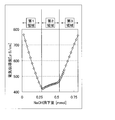
- FIG. 1 is a graph showing the relationship between the amount of NaOH dripped with respect to the fiber material and the electrical conductivity.
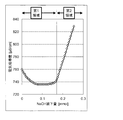
- FIG. 2 is a graph showing the relationship between the amount of dropped NaOH and electrical conductivity for a fiber material having a carboxyl group.
- FIG. 3 is a diagram for explaining a method for evaluating the bending resistance of a sheet.
- the present invention relates to a sheet containing fibrous cellulose having a fiber width derived from pulp of 1000 nm or less and a polyvinyl alcohol-based resin.
- the tensile strength of the sheet of the present invention is 15 MPa or more.
- seat of this invention is a sheet
- seat of this invention is a sheet
- the tensile strength of the sheet of the present invention may be 15 MPa or more, preferably 20 MPa or more, more preferably 30 MPa or more, further preferably 40 MPa or more, and further preferably 50 MPa or more. , 60 MPa or more, particularly preferably 70 MPa or more, and most preferably 80 MPa or more.
- seat For example, it can be 500 Mpa or less.
- excellent bending resistance can be exhibited by setting the tensile strength within the above range.
- the present invention has succeeded in improving the bending resistance in a fine fibrous cellulose-containing sheet, and has found that such an effect can be exhibited by adjusting the tensile strength of the sheet.
- the tensile strength of the sheet is a value measured using a tensile tester Tensilon (manufactured by A & D) in accordance with JIS P8113.
- the test piece is conditioned for 24 hours at 23 ° C. and 50% relative humidity, and the measurement is performed under the conditions of 23 ° C. and 50% relative humidity.
- the tensile strength of the sheet can be within the above range.
- seat excellent in bending resistance can be obtained by controlling tensile strength more than a fixed value.
- the tensile elastic modulus of the sheet of the present invention may be 3.5 GPa or more, preferably 4.0 GPa or more, more preferably 4.5 GPa or more, and further preferably 5.0 GPa or more.
- seat although there is no restriction
- seat of this invention has the outstanding tensile strength.
- the tensile elastic modulus of the sheet is a value measured using a tensile tester Tensilon (manufactured by A & D) in accordance with JIS P8113.
- the sample When measuring the tensile modulus, the sample is conditioned for 24 hours at 23 ° C. and 50% relative humidity, and is measured under the conditions of 23 ° C. and 50% relative humidity.
- the resin type to be contained in the sheet is a polyvinyl alcohol resin, and further, the content of the polyvinyl alcohol resin and the content of the fine fibrous cellulose are appropriately controlled and balanced to obtain a tensile of the sheet.
- the elastic modulus can be within the above range.
- the yellowness of the sheet of the present invention is preferably 5.0 or less, more preferably 3.0 or less, further preferably 2.0 or less, and particularly preferably 1.5 or less. preferable.
- the yellowness of the sheet is the yellowness of the sheet obtained in the sheet forming process, and is the yellowness of the sheet before undergoing the heating and drying process described later.
- the yellowness of the sheet is a value measured according to JIS K 7373. Examples of the measuring device include Color Cute i (manufactured by Suga Test Instruments Co., Ltd.).
- the yellowness after vacuum drying the sheet of the present invention at 200 ° C. for 4 hours is preferably 55 or less, more preferably 50 or less, further preferably 40 or less, and 30 or less. Is more preferably 25 or less, and most preferably 20 or less.
- the yellowness of the sheet after vacuum drying at 200 ° C. for 4 hours is also a value measured according to JIS K 7373 in the same manner as described above.
- YI 2 -YI 1 value ( ⁇ YI) is preferably 55 or less, more preferably 50 or less, even more preferably 40 or less, still more preferably 30 or less, particularly preferably 25 or less, and 20 or less. Most preferably.
- ⁇ YI YI 2 -YI 1 value
- the total light transmittance of the sheet of the present invention is preferably 85% or more, more preferably 90% or more, and further preferably 91% or more. Further, the haze of the sheet is preferably 5% or less, more preferably 3% or less, further preferably 2% or less, and particularly preferably 1% or less. The haze of the sheet may be 0%.
- the present invention is also characterized in that a highly transparent sheet can be obtained.
- the total light transmittance of the sheet is a value measured using a haze meter (HM-150, manufactured by Murakami Color Research Laboratory Co., Ltd.) in accordance with JIS K 7361 and haze in accordance with JIS K 7136. It is.
- a phosphoric acid group or a substituent derived from a phosphoric acid group is introduced into fine fibrous cellulose, and the resin species to be contained in the sheet is a polyvinyl alcohol resin. There is a tendency to easily adjust the value to the above range.
- the thickness of the sheet of the present invention is not particularly limited, but is preferably 5 ⁇ m or more, more preferably 10 ⁇ m or more, and further preferably 20 ⁇ m or more.
- the upper limit of the thickness of the sheet is not particularly limited, but can be, for example, 1000 ⁇ m or less.
- seat can be measured with a stylus type thickness meter (Maltron 1202D by Marl).
- the basis weight of the sheet of the present invention is preferably 10 g / m 2 or more, more preferably 20 g / m 2 or more, and further preferably 30 g / m 2 or more. Further, the basis weight of the sheet is preferably 100 g / m 2 or less, and more preferably 80 g / m 2 or less.
- the basis weight of the sheet can be calculated in accordance with JIS P 8124.
- seat of this invention contains the fibrous cellulose whose fiber width derived from a pulp is 1000 nm or less.
- the fine fibrous cellulose is preferably a fiber having an ionic functional group.
- the ionic functional group is preferably an anionic functional group (hereinafter also referred to as an anionic group).
- the anionic group examples include a phosphate group or a substituent derived from a phosphate group (sometimes simply referred to as a phosphate group), a carboxyl group or a substituent derived from a carboxyl group (sometimes simply referred to as a carboxyl group), In addition, it is preferably at least one selected from a sulfone group or a substituent derived from a sulfone group (sometimes simply referred to as a sulfone group), and at least one selected from a phosphate group and a carboxyl group Is more preferable, and a phosphate group is particularly preferable.
- the fibrous cellulose which has a phosphoric acid group may be called a phosphorylated fine fibrous cellulose.
- the content of fine fibrous cellulose is preferably 40% by mass or more, more preferably 50% by mass or more, and further preferably 55% by mass or more with respect to the total mass of the sheet. Moreover, it is preferable that content of a fine fibrous cellulose is 95 mass% or less.
- seat is not specifically limited, 0.05 time or more is preferable with respect to content of polyvinyl alcohol-type resin, 0.1 time or more is more preferable, 1/9 time Or more, 0.2 times or more, 0.25 times or more, 0.3 times or more, 0.4 times or more, 3/7 times or more, 0.5 times or more, 2/3 times or more, 40/54 times or more, It may be 1 time or more, or 59.9 / 40.1 times or more.
- the upper limit of the content of the fine fibrous cellulose in the sheet is not particularly limited, but is preferably 20 times or less, more preferably 15 times or less, still more preferably 10 times or less, relative to the content of the polyvinyl alcohol resin, 90 It may be 9.9 / 9.1 times or less, 5 times or less, 80/18 times or less, 4 times or less, or 59.9 / 40.1 times or less.
- the content of fine fibrous cellulose in the sheet is preferably 1 to 20 times the content of the polyvinyl alcohol-based resin, and more preferably 2 to 20 times. It is preferably 4 to 20 times, more preferably 4 to 10 times.
- the yellowness change ( ⁇ YI) of the sheet tends to be low.
- the content of fine fibrous cellulose in the sheet is preferably 0.05 to 1 times the content of the polyvinyl alcohol-based resin. 1 to 1 time is more preferable.
- a pulp is used from the point of being easy to acquire and cheap.
- the pulp include wood pulp, non-wood pulp, and deinked pulp.
- wood pulp include hardwood kraft pulp (LBKP), softwood kraft pulp (NBKP), sulfite pulp (SP), dissolved pulp (DP), soda pulp (AP), unbleached kraft pulp (UKP), oxygen bleached craft Chemical pulps such as pulp (OKP) are listed.
- semi-chemical pulps such as semi-chemical pulp (SCP) and chemi-ground wood pulp (CGP), mechanical pulps such as ground wood pulp (GP), thermomechanical pulp (TMP, BCTMP) and the like can be mentioned, but are not particularly limited.
- Non-wood pulp includes cotton pulp such as cotton linter and cotton lint, non-wood pulp such as hemp, straw and bagasse, cellulose isolated from sea squirts and seaweed, chitin, chitosan, etc., but is not particularly limited.
- the deinking pulp includes deinking pulp made from waste paper, but is not particularly limited. The pulp of this embodiment may be used alone or in combination of two or more.
- wood pulp containing cellulose and deinked pulp are preferable in terms of availability.
- chemical pulp has a large cellulose ratio, so the yield of fine fibrous cellulose during fiber refinement (defibration) is high, and the degradation of cellulose in the pulp is small, and the fineness of long fibers with a large axial ratio is high. It is preferable at the point from which fibrous cellulose is obtained.
- kraft pulp and sulfite pulp are most preferably selected. Sheets containing long fibrous fine fibrous cellulose having a large axial ratio tend to provide high strength.
- the average fiber width of the fine fibrous cellulose is 1000 nm or less as observed with an electron microscope.
- the average fiber width is preferably 2 nm or more and 1000 nm or less, more preferably 2 nm or more and 100 nm or less, more preferably 2 nm or more and 50 nm or less, and further preferably 2 nm or more and 10 nm or less, but is not particularly limited.
- the average fiber width of the fine fibrous cellulose is less than 2 nm, the physical properties (strength, rigidity, dimensional stability) as the fine fibrous cellulose tend to be difficult to be expressed because the cellulose molecules are dissolved in water. .
- the fine fibrous cellulose is monofilamentous cellulose having a fiber width of 1000 nm or less, for example.
- Measurement of the fiber width of the fine fibrous cellulose by electron microscope observation is performed as follows. An aqueous suspension of fine fibrous cellulose having a concentration of 0.05% by mass or more and 0.1% by mass or less is prepared, and the suspension is cast on a carbon film-coated grid subjected to a hydrophilic treatment to prepare a sample for TEM observation. To do. When a wide fiber is included, an SEM image of the surface cast on glass may be observed. Observation with an electron microscope image is performed at a magnification of 1000 times, 5000 times, 10000 times, or 50000 times depending on the width of the constituent fibers. However, the sample, observation conditions, and magnification are adjusted to satisfy the following conditions.
- One straight line X is drawn at an arbitrary location in the observation image, and 20 or more fibers intersect the straight line X.
- a straight line Y perpendicular to the straight line is drawn in the same image, and 20 or more fibers intersect the straight line Y.
- the average fiber width (sometimes simply referred to as “fiber width”) of fine fibrous cellulose is an average value of the fiber widths read in this way.
- the fiber length of the fine fibrous cellulose is not particularly limited, but is preferably 0.1 ⁇ m or more and 1000 ⁇ m or less, more preferably 0.1 ⁇ m or more and 800 ⁇ m or less, and particularly preferably 0.1 ⁇ m or more and 600 ⁇ m or less.
- the fiber length of the fine fibrous cellulose can be determined by image analysis using TEM, SEM, or AFM.
- the fine fibrous cellulose preferably has an I-type crystal structure.
- the proportion of the I-type crystal structure in the fine fibrous cellulose is preferably 30% or more, more preferably 50% or more, and further preferably 70% or more. In this case, further superior performance can be expected in terms of heat resistance and low linear thermal expansion coefficient.
- the degree of crystallinity is obtained by measuring an X-ray diffraction profile and determining the crystallinity by a conventional method (Seagal et al., Textile Research Journal, 29, 786, 1959).
- the fine fibrous cellulose preferably has a phosphate group or a substituent derived from a phosphate group.
- the phosphoric acid group is a divalent functional group equivalent to the phosphoric acid obtained by removing the hydroxyl group. Specifically, it is a group represented by —PO 3 H 2 .
- Substituents derived from phosphoric acid groups include substituents such as groups obtained by polycondensation of phosphoric acid groups, salts of phosphoric acid groups, and phosphoric acid ester groups. It may be a group.
- the phosphate group or the substituent derived from the phosphate group may be a substituent represented by the following formula (1).
- R represents a hydrogen atom, a saturated-linear hydrocarbon group, a saturated-branched hydrocarbon group, a saturated-cyclic hydrocarbon group, an unsaturated-linear hydrocarbon group, an unsaturated-branched hydrocarbon group.
- ⁇ is a monovalent or higher cation composed of an organic substance or an inorganic substance.
- the fiber raw material containing cellulose is reacted with at least one selected from a compound having a phosphate group and a salt thereof (hereinafter referred to as “phosphorylation reagent” or “compound A”).
- a phosphorylating reagent may be mixed in a powder or aqueous solution with a dry or wet fiber raw material.
- a phosphorylating reagent powder or an aqueous solution may be added to the fiber raw material slurry.
- the phosphoric acid group introduction step can be performed by reacting a fiber raw material containing cellulose with at least one selected from a phosphoric acid group-containing compound and a salt thereof (phosphorylation reagent or compound A). This reaction may be carried out in the presence of at least one selected from urea and derivatives thereof (hereinafter referred to as “compound B”).
- An example of a method for causing compound A to act on the fiber raw material in the presence of compound B is a method of mixing powder or an aqueous solution of compound A and compound B with a dry or wet fiber raw material.
- Another example is a method in which powders and aqueous solutions of Compound A and Compound B are added to the fiber raw material slurry.
- a method of adding an aqueous solution of Compound A and Compound B to a dry fiber material, or a powder or an aqueous solution of Compound A and Compound B to a wet fiber material is preferred.
- the compound A and the compound B may be added simultaneously, or may be added separately.
- the form of the fiber raw material is preferably cotton or thin sheet, but is not particularly limited.
- Compound A used in this embodiment is at least one selected from a compound having a phosphate group and a salt thereof.
- the compound having a phosphate group include, but are not limited to, phosphoric acid, lithium salt of phosphoric acid, sodium salt of phosphoric acid, potassium salt of phosphoric acid, ammonium salt of phosphoric acid, and the like.
- the lithium salt of phosphoric acid include lithium dihydrogen phosphate, dilithium hydrogen phosphate, trilithium phosphate, lithium pyrophosphate, and lithium polyphosphate.
- Examples of the sodium salt of phosphoric acid include sodium dihydrogen phosphate, disodium hydrogen phosphate, trisodium phosphate, sodium pyrophosphate, and sodium polyphosphate.
- Examples of the potassium salt of phosphoric acid include potassium dihydrogen phosphate, dipotassium hydrogen phosphate, tripotassium phosphate, potassium pyrophosphate, and potassium polyphosphate.
- Examples of the ammonium salt of phosphoric acid include ammonium dihydrogen phosphate, diammonium hydrogen phosphate, triammonium phosphate, ammonium pyrophosphate, and ammonium polyphosphate.
- phosphoric acid and phosphoric acid are introduced efficiently from the viewpoint that the introduction efficiency of phosphate groups is high, the fibrillation efficiency is easily improved in the fibrillation process described later, the cost is low, and the industrial application is easy.
- Sodium salt, potassium salt of phosphoric acid, and ammonium salt of phosphoric acid are preferable.
- Sodium dihydrogen phosphate or disodium hydrogen phosphate is more preferable.
- the compound A is preferably used as an aqueous solution because the uniformity of the reaction is increased and the efficiency of introducing a phosphate group is increased.
- the pH of the aqueous solution of Compound A is not particularly limited, but is preferably 7 or less because the efficiency of introduction of phosphate groups is increased, and more preferably pH 3 or more and pH 7 or less from the viewpoint of suppressing the hydrolysis of pulp fibers.
- the pH of the aqueous solution of Compound A may be adjusted by, for example, using a phosphoric acid group-containing compound that exhibits acidity and an alkalinity, and changing the amount ratio thereof. You may adjust pH of the aqueous solution of the compound A by adding an inorganic alkali or an organic alkali to the thing which shows acidity among the compounds which have a phosphoric acid group.
- the amount of compound A added to the fiber raw material is not particularly limited, but when the amount of compound A added is converted to phosphorus atomic weight, the amount of phosphorus atom added to the fiber raw material (absolute dry mass) is 0.5 mass% to 100 mass%. Or less, more preferably 1% by mass to 50% by mass, and most preferably 2% by mass to 30% by mass. If the amount of phosphorus atoms added to the fiber raw material is within the above range, the yield of fine fibrous cellulose can be further improved. Moreover, the cost of the compound A to be used can be suppressed while improving phosphorylation efficiency by making the addition amount of the phosphorus atom with respect to a fiber raw material into 100 mass% or less.
- Compound B used in this embodiment includes urea, biuret, 1-phenylurea, 1-benzylurea, 1-methylurea, 1-ethylurea and the like.
- Compound B is preferably used as an aqueous solution like Compound A. Moreover, since the uniformity of reaction increases, it is preferable to use the aqueous solution in which both compound A and compound B are dissolved.
- the amount of Compound B added to the fiber raw material is preferably 1% by mass or more and 500% by mass or less, more preferably 10% by mass or more and 400% by mass or less, and 100% by mass or more and 350% by mass or less. More preferably, it is more preferably 150% by mass or more and 300% by mass or less.
- amides or amines may be included in the reaction system.
- amides include formamide, dimethylformamide, acetamide, dimethylacetamide and the like.
- amines include methylamine, ethylamine, trimethylamine, triethylamine, monoethanolamine, diethanolamine, triethanolamine, pyridine, ethylenediamine, hexamethylenediamine, and the like. Among these, triethylamine is known to work as a good reaction catalyst.
- the heat treatment temperature it is preferable to select a temperature at which a phosphate group can be efficiently introduced while suppressing thermal decomposition and hydrolysis reaction of the fiber. Specifically, it is preferably 50 ° C. or higher and 300 ° C. or lower, more preferably 100 ° C. or higher and 250 ° C. or lower, and further preferably 130 ° C. or higher and 200 ° C. or lower. Moreover, you may use a vacuum dryer, an infrared heating apparatus, and a microwave heating apparatus for a heating.
- the concentration of the compound A in the fiber raw material may be uneven, and the introduction of phosphate groups on the fiber surface may not proceed uniformly.
- a very thin sheet-like fiber material is used, or the fiber material and Compound A are kneaded or stirred with a kneader or the like and dried by heating or reduced pressure. The method should be taken.
- the heating device used for the heat treatment is preferably a device that can always discharge the moisture retained by the slurry and the moisture generated by the addition reaction of the fibers such as phosphate groups to the hydroxyl group of the fiber, such as a blower oven. Etc. are preferred. If water in the system is always discharged, the hydrolysis reaction of the phosphate ester bond, which is the reverse reaction of the esterification, can be suppressed, and the acid hydrolysis of the sugar chain in the fiber can also be suppressed. A fine fiber having a high axial ratio can be obtained.
- the heat treatment time is also affected by the heating temperature, but it is preferably 1 second or more and 300 minutes or less, preferably 1 second or more and 1000 seconds or less after moisture is substantially removed from the fiber raw material slurry. Preferably, it is 10 seconds or more and 800 seconds or less.
- the amount of phosphate groups introduced can be within a preferred range by setting the heating temperature and the heating time to appropriate ranges.
- the amount of phosphate group introduced is preferably 0.1 mmol / g or more and 3.65 mmol / g or less, more preferably 0.14 mmol / g or more and 3.5 mmol / g or less per 1 g (mass) of fine fibrous cellulose.
- 0.2 mmol / g or more and 3.2 mmol / g or less is more preferable, 0.4 mmol / g or more and 3.0 mmol / g or less is particularly preferable, and most preferably 0.6 mmol / g or more and 2.5 mmol / g or less.
- the fiber raw material can be easily refined, and the stability of the fine fibrous cellulose can be enhanced.
- the introduction amount of the phosphate group within the above range, it is possible to leave hydrogen bonds between the fine fibrous celluloses while facilitating miniaturization, and good strength expression can be expected in the sheet. .
- the amount of phosphate group introduced into the fiber material can be measured by a conductivity titration method. Specifically, by performing the defibration process step, after treating the resulting fine fibrous cellulose-containing slurry with an ion exchange resin, by determining the change in electrical conductivity while adding an aqueous sodium hydroxide solution, The amount introduced can be measured.
- first region the electrical conductivity rapidly decreases
- second region the conductivity starts to increase slightly
- third region the conductivity increment increases (hereinafter referred to as “third region”). That is, three areas appear.
- the boundary point between the second region and the third region is defined as a point at which the amount of change in conductivity twice, that is, the increase (inclination) in conductivity is maximized.
- the amount of alkali required in the first region is equal to the amount of strongly acidic groups in the slurry used for titration
- the amount of alkali required in the second region is the amount of weakly acidic groups in the slurry used for titration. Will be equal.
- the amount of alkali required in the second region is reduced compared to the amount of alkali required in the first region.
- the amount of strongly acidic groups coincides with the amount of phosphorus atoms regardless of the presence or absence of condensation, so that the amount of phosphate groups introduced (or the amount of phosphate groups) or the amount of substituent introduced (or the amount of substituents) is simply When said, it represents the amount of strongly acidic group. That is, the alkali amount (mmol) required in the first region of the curve shown in FIG. 1 is divided by the solid content (g) in the titration target slurry to obtain the substituent introduction amount (mmol / g).
- the phosphate group introduction step may be performed at least once, but may be repeated a plurality of times. In this case, more phosphoric acid groups are introduced, which is preferable.
- the fiber raw material is subjected to an oxidation treatment such as a TEMPO oxidation treatment, a compound having a carboxylic acid-derived group, a derivative thereof, or an acid thereof.
- oxidation treatment such as a TEMPO oxidation treatment
- Carboxyl groups can be introduced by treatment with an anhydride or derivative thereof.
- the compound having a carboxyl group is not particularly limited, and examples thereof include dicarboxylic acid compounds such as maleic acid, succinic acid, phthalic acid, fumaric acid, glutaric acid, adipic acid and itaconic acid, and tricarboxylic acid compounds such as citric acid and aconitic acid. .
- the acid anhydride of the compound having a carboxyl group is not particularly limited, but examples thereof include acid anhydrides of dicarboxylic acid compounds such as maleic anhydride, succinic anhydride, phthalic anhydride, glutaric anhydride, adipic anhydride, and itaconic anhydride. It is done.
- the derivative of the compound having a carboxyl group is not particularly limited, and examples thereof include an acid anhydride imidized compound having a carboxyl group and an acid anhydride derivative of a compound having a carboxyl group. Although it does not specifically limit as an acid anhydride imidation thing of a compound which has a carboxyl group, Imidation thing of dicarboxylic acid compounds, such as maleimide, succinic acid imide, and phthalic acid imide, is mentioned.
- the acid anhydride derivative of the compound having a carboxyl group is not particularly limited.
- at least some of the hydrogen atoms of the acid anhydride of the compound having a carboxyl group such as dimethylmaleic anhydride, diethylmaleic anhydride, diphenylmaleic anhydride, etc. are substituted (for example, alkyl group, phenyl group, etc. ) Are substituted.
- alkali treatment When manufacturing a fine fibrous cellulose, you may perform an alkali treatment between an ionic functional group introduction
- the alkali compound contained in the alkali solution is not particularly limited, but may be an inorganic alkali compound or an organic alkali compound.
- the solvent in the alkaline solution may be either water or an organic solvent.
- the solvent is preferably a polar solvent (polar organic solvent such as water or alcohol), and more preferably an aqueous solvent containing at least water.
- a sodium hydroxide aqueous solution or a potassium hydroxide aqueous solution is particularly preferred because of its high versatility.
- the temperature of the alkali solution in an alkali treatment process is not specifically limited, 5 to 80 degreeC is preferable and 10 to 60 degreeC is more preferable.
- the immersion time in the alkaline solution in the alkali treatment step is not particularly limited, but is preferably 5 minutes or longer and 30 minutes or shorter, and more preferably 10 minutes or longer and 20 minutes or shorter.
- the usage-amount of the alkaline solution in an alkali treatment is not specifically limited, It is preferable that it is 100 mass% or more and 100,000 mass% or less with respect to the absolute dry mass of a phosphate group introduction
- the functional group-introduced fiber may be washed with water or an organic solvent before the alkali treatment step.
- the alkali treatment in order to improve the handleability, it is preferable to wash the alkali-treated functional group-introduced fiber with water or an organic solvent before the defibrating treatment step.
- the ionic functional group-introduced fiber is defibrated in the defibrating process.
- the fiber is usually defibrated using a defibrating apparatus to obtain a fine fibrous cellulose-containing slurry, but the processing apparatus and the processing method are not particularly limited.
- a defibrating apparatus a high-speed defibrator, a grinder (stone mill type pulverizer), a high-pressure homogenizer, an ultra-high pressure homogenizer, a high-pressure collision type pulverizer, a ball mill, a bead mill, or the like can be used.
- a device for wet grinding such as a disk type refiner, a conical refiner, a twin-screw kneader, a vibration mill, a homomixer under high-speed rotation, an ultrasonic disperser, or a beater should be used. You can also.
- the defibrating apparatus is not limited to the above.
- Preferable defibrating treatment methods include a high-speed defibrator, a high-pressure homogenizer, and an ultra-high pressure homogenizer that are less affected by the grinding media and less concerned about contamination.
- a polar organic solvent in addition to water, a polar organic solvent can be used.
- polar organic solvents include alcohols, ketones, ethers, dimethyl sulfoxide (DMSO), dimethylformamide (DMF), dimethylacetamide (DMAc), and the like, but are not particularly limited.
- alcohols include methanol, ethanol, n-propanol, isopropanol, n-butanol, and t-butyl alcohol.
- ketones include acetone and methyl ethyl ketone (MEK).
- ethers include diethyl ether and tetrahydrofuran (THF).
- THF tetrahydrofuran
- the dispersion medium may be one type or two or more types. Further, the dispersion medium may contain a solid content other than the fiber raw material, such as urea having hydrogen bonding property.
- the fine fibrous cellulose may be obtained by once concentrating and / or drying the fine fibrous cellulose-containing slurry obtained by the defibrating treatment and then performing the defibrating treatment again.
- the concentration and drying methods are not particularly limited, and examples thereof include a method of adding a concentrating agent to a slurry containing fine fibrous cellulose, a generally used dehydrator, a press, and a method using a dryer.
- a well-known method for example, the method described in WO2014 / 024876, WO2012 / 107642, and WO2013 / 121086 can be used.
- it can concentrate and dry by making a fine fibrous cellulose containing slurry into a sheet
- a high-speed defibrator As a device used when the fine fibrous cellulose slurry is concentrated and / or dried and then defibrated (pulverized) again, a high-speed defibrator, a grinder (stone mill pulverizer), a high-pressure homogenizer, an ultra-high pressure homogenizer, Use wet grinding equipment such as high-pressure collision type pulverizer, ball mill, bead mill, disk type refiner, conical refiner, twin-screw kneader, vibration mill, homomixer under high-speed rotation, ultrasonic disperser, beater, etc. However, it is not particularly limited.
- seat of this invention contains polyvinyl alcohol-type resin (PVA-type resin).
- the polyvinyl alcohol-based resin is obtained by saponifying polyvinyl acetate.
- the saponification degree of polyvinyl alcohol is not particularly limited, but is preferably 50 mol% or more, more preferably 60 mol% or more, still more preferably 70 mol% or more, and more preferably 80 mol% or more. More preferably, it is still more preferably 85 mol% or more, particularly preferably 90 mol% or more, and most preferably 95 mol% or more.
- the saponification degree of polyvinyl alcohol may be 100 mol%, it is preferably 99 mol% or less, and more preferably 95 mol% or less.
- the degree of saponification of the polyvinyl alcohol resin can be measured according to JIS K 6726.
- the content of the polyvinyl alcohol-based resin is preferably 9% by mass or more, more preferably 15% by mass or more, still more preferably 20% by mass or more, and 30% by mass with respect to the total mass of the sheet. % Or more, more preferably 40% by mass or more, and particularly preferably 50% by mass or more. Further, the content of the polyvinyl alcohol-based resin is preferably 92% by mass or less, more preferably 80% by mass or less, further preferably 50% by mass or less, and 45% by mass or less. Is particularly preferred. In addition, content of polyvinyl alcohol-type resin can be measured, for example using IR measurement.
- the average degree of polymerization of the polyvinyl alcohol-based resin is not particularly limited, but is preferably 300 or more, more preferably 400 or more, and further preferably 500 or more.
- the average degree of polymerization of the polyvinyl alcohol resin is preferably 20000 or less, more preferably 10,000 or less, further preferably 5000 or less, particularly preferably 2200 or less, and most preferably 1700 or less. preferable.
- the average degree of polymerization of the polyvinyl alcohol-based resin can be measured according to JIS K 6726.
- a polyvinyl alcohol-type resin it is an example of a preferable aspect that a polymerization degree is low and a caking degree is high (for example, average polymerization degree 1700 or less, caking degree 90 mol% or more).
- the polyvinyl alcohol-based resin may be an unmodified polyvinyl alcohol-based resin or a modified polyvinyl alcohol-based resin.
- the polyvinyl alcohol resin a combination of both an unmodified polyvinyl alcohol resin and a modified polyvinyl alcohol resin may be used.
- the modified polyvinyl alcohol resin is a polymer obtained by introducing a functional group other than a hydroxyl group and an acetate group into an unmodified polyvinyl alcohol resin.
- modified polyvinyl alcohol examples include carboxyl group-modified polyvinyl alcohol, carbonyl group-modified polyvinyl alcohol, silanol group-modified polyvinyl alcohol, amino group-modified polyvinyl alcohol, cation-modified polyvinyl alcohol, sulfonic acid group-modified polyvinyl alcohol, and acetoacetyl group-modified polyvinyl alcohol. Etc. Among these, acetoacetyl group-modified polyvinyl alcohol is preferably used.
- the modified polyvinyl alcohol resin may be used alone or in combination of two or more. A part of the modified polyvinyl alcohol-based resin may form a self-crosslinking structure in the sheet manufacturing process. The modified polyvinyl alcohol resin can improve the strength of the sheet by forming a self-crosslinking structure.
- the polyvinyl alcohol-based resin is crosslinked to form a crosslinked polyvinyl alcohol.
- at least a part of the modified polyvinyl alcohol-based resin is crosslinked to form a crosslinked polyvinyl alcohol.
- a crosslinked structure is formed between functional groups (excluding hydroxyl groups and acetic acid groups) introduced into the modified polyvinyl alcohol resin.
- a crosslinking agent that forms a crosslinked structure a crosslinking agent described later can be used.
- Such a crosslinked structure can be detected by performing analysis such as NMR.
- the tensile strength can be improved as described above by appropriately controlling and balancing the content, saponification degree, and average polymerization degree of the polyvinyl alcohol resin.
- seat excellent in the bending resistance can be obtained by controlling tensile strength above a fixed value in this way.
- seat can be raised also by selecting the resin seed
- the sheet of the present invention preferably further contains at least one selected from a crosslinking agent and a functional group derived from the crosslinking agent.
- the cross-linking agent is preferably a cross-linking agent that cross-links the polyvinyl alcohol resin.
- the cross-linking agent added during the production of the sheet cross-links the polyvinyl alcohol resin, and a part of the cross-linked structure is detected as a functional group derived from the cross-linking agent. It becomes.
- the detection of the crosslinking agent and / or the functional group derived from the crosslinking agent can be analyzed using, for example, NMR measurement, IR measurement, MS fragment analysis, UV analysis, or the like.
- crosslinking agent examples include inorganic crosslinking agents such as chromium compounds, aluminum compounds, zirconium compounds, and boron compounds, glyoxal, glyoxylic acid and metal salts thereof, urea resins, polyamine polyamide epichlorohydrin, polyethyleneimine, carbodiimide compounds, oxazoline.
- Organic compounds such as organic compounds, aziridine compounds, hydrazine compounds, isocyanate compounds, melamine compounds, epoxy compounds, aldehyde compounds, N-methylol compounds, acryloyl compounds, active halogen compounds, ethyleneimino compounds
- a crosslinking agent, a metal, and a metal complex salt can be mentioned.
- the cross-linking agent is preferably a cross-linking agent that cross-links the polyvinyl alcohol-based resin.
- a cross-linking agent may cross-link the fine fibrous cellulose or the fine fibrous cellulose and the polyvinyl alcohol-based resin. Also good.
- hydrazine compounds include benzoic hydrazide, formic hydrazide, acetic hydrazide, propionic hydrazide, n-butyric hydrazide, isobutyric hydrazide, n-valeric hydrazide, isovaleric hydrazide, pivalic hydrazide, carbohydrazide, adipic acid Dihydrazide, phthalic acid dihydrazide, isophthalic acid dihydrazide, terephthalic acid dihydrazide, oxalic acid dihydrazide, malonic acid dihydrazide, succinic acid dihydrazide, glutaric acid dihydrazide, sebacic acid dihydrazide, maleic acid dihydrazide dihydrazide polyhydride dihydrazide Etc.
- hydrazine compounds may be used alone or in combination of two or more.
- adipic acid dihydrazide is more preferable.
- crosslinked polyvinyl alcohol is obtained by crosslinking acetoacetyl group-modified polyvinyl alcohol, and adipic acid dihydrazide is used as a crosslinking agent, both terminal amino groups of adipic acid dihydrazide are respectively
- a crosslinked structure is formed by enamine reaction with the carbonyl group in the acetoacetyl group.
- various cross-linked polyvinyl alcohols can be formed by selecting a cross-linking agent and a modified polyvinyl alcohol according to the purpose.
- the content of the crosslinking agent is preferably 0.05% by mass or more and 30% by mass or less with respect to the total mass of the polyvinyl alcohol resin.
- content of polyvinyl alcohol-type resin is 5 mass% or more with respect to the total mass of a sheet
- content of polyvinyl alcohol-type resin is 50 mass% or less, and it is more preferable that it is 40 mass% or less.
- the total content of the polyvinyl alcohol-based resin, the crosslinking agent, and the functional group derived from the crosslinking agent can be calculated using NMR measurement, MS fragment analysis, IR measurement, UV analysis, or the like.
- the sheet of the present invention may contain an optional component other than the components described above.
- optional components include antifoaming agents, lubricants, ultraviolet absorbers, dyes, pigments, stabilizers, and surfactants.
- hydrophilic polymer except the said polyvinyl alcohol-type resin and a cellulose fiber), an organic ion, etc. are mentioned, for example.
- thermoplastic resin emulsion In addition to the polyvinyl alcohol resin, a thermoplastic resin emulsion, a thermosetting resin emulsion, a photocurable resin emulsion, or the like may be added to the sheet of the present invention.
- thermoplastic resin emulsion Specific examples of the thermoplastic resin emulsion, the thermosetting resin emulsion, and the photocurable resin emulsion include those described in JP-A-2009-299043.
- the production process of the sheet includes a step of obtaining a slurry containing fibrous cellulose having a fiber width of 1000 nm or less and a polyvinyl alcohol resin, a step of coating the slurry on a base material, or a step of papermaking the slurry. Including. Especially, it is preferable that the manufacturing process of a sheet
- the fine fibrous cellulose is preferably phosphorylated fine fibrous cellulose.
- the step of obtaining the slurry it is preferable to add 5 parts by mass or more of polyvinyl alcohol resin, more preferably 10 parts by mass or more, with respect to 100 parts by mass of the fine fibrous cellulose contained in the slurry, and 15 parts by mass. More preferably, more than 20 parts by mass are added.
- the addition amount of a polyvinyl alcohol-type resin is 200 mass parts or less, It is more preferable that it is 100 mass parts or less, It is further more preferable that it is 90 mass parts or less.
- the polyvinyl alcohol-based resin is preferably added in a state dissolved in water.
- the coating process is a process of obtaining a sheet by coating a slurry containing fine fibrous cellulose and a polyvinyl alcohol-based resin on a base material, and drying the formed sheet from the base material. is there.
- a coating apparatus and a long base material sheets can be continuously produced.
- the quality of the base material used in the coating process is not particularly limited, but the one with higher wettability to the slurry may be able to suppress the shrinkage of the sheet during drying, but the sheet formed after drying is easier It is preferable to select one that can be peeled off.
- a resin plate or a metal plate is preferable, but not particularly limited.
- resin plates such as acrylic plates, polyethylene terephthalate plates, vinyl chloride plates, polystyrene plates, polyvinylidene chloride plates, metal plates such as aluminum plates, zinc plates, copper plates, iron plates, etc., and their surfaces oxidized, stainless steel A plate, a brass plate or the like can be used.
- a damming frame may be fixed on the base material to obtain a sheet having a predetermined thickness and basis weight. Good.
- the quality of the damming frame is not particularly limited, but it is preferable to select one that can easily peel off the edge of the sheet attached after drying. Among them, a molded resin plate or metal plate is preferable, but is not particularly limited.
- resin plates such as acrylic plates, polyethylene terephthalate plates, vinyl chloride plates, polystyrene plates, polyvinylidene chloride plates, metal plates such as aluminum plates, zinc plates, copper plates, iron plates, etc., and their surfaces oxidized, stainless steel A plate, a brass plate or the like can be used.
- a coating machine for applying the slurry for example, a roll coater, a gravure coater, a die coater, a curtain coater, an air doctor coater, or the like can be used.
- a die coater, a curtain coater, and a spray coater are preferable because the thickness can be made more uniform.
- the coating temperature is not particularly limited, but is preferably 20 ° C or higher and 45 ° C or lower, more preferably 25 ° C or higher and 40 ° C or lower, and further preferably 27 ° C or higher and 35 ° C or lower. If the coating temperature is not less than the above lower limit value, the slurry can be easily applied, and if it is not more than the above upper limit value, volatilization of the dispersion medium during coating can be suppressed.
- the coating step it is preferable to apply the slurry so that the finished basis weight of the sheet is 10 g / m 2 or more and 100 g / m 2 or less, preferably 20 g / m 2 or more and 60 g / m 2 or less.
- the basis weight is within the above range, a sheet having excellent strength can be obtained.
- the coating step preferably includes a step of drying the slurry coated on the substrate.
- a drying method Either a non-contact drying method or the method of drying while restraining a sheet
- the non-contact drying method is not particularly limited, but a method of drying by heating with hot air, infrared rays, far infrared rays or near infrared rays (heating drying method) or a method of drying in vacuum (vacuum drying method) is applied. Can do. Although the heat drying method and the vacuum drying method may be combined, the heat drying method is usually applied. Although drying by infrared rays, far infrared rays, or near infrared rays can be performed using an infrared device, a far infrared device, or a near infrared device, it is not particularly limited.
- the heating temperature in the heat drying method is not particularly limited, but is preferably 20 ° C. or higher and 150 ° C.
- the heating temperature is not less than the above lower limit value, the dispersion medium can be volatilized quickly, and if it is not more than the above upper limit value, it is possible to suppress the cost required for heating and to prevent the fine fibrous cellulose from being discolored by heat. .
- the manufacturing process of the sheet may include a step of papermaking a slurry containing fine fibrous cellulose and a polyvinyl alcohol resin.
- Examples of the paper machine in the paper making process include a continuous paper machine such as a long-mesh type, a circular net type, and an inclined type, and a multi-layered paper machine combining these.
- known paper making such as hand making may be performed.
- the slurry is filtered and dehydrated on a wire to obtain a wet paper sheet, and then the sheet is obtained by pressing and drying.
- the filter cloth at the time of filtration is not particularly limited, but it is important that fine fibrous cellulose and polyvinyl alcohol resin do not pass through and the filtration rate is not too slow.
- seat, fabric, and porous film which consist of organic polymers are preferable.
- the organic polymer is not particularly limited, but non-cellulosic organic polymers such as polyethylene terephthalate, polyethylene, polypropylene, polytetrafluoroethylene (PTFE) and the like are preferable.
- Specific examples include a porous film of polytetrafluoroethylene having a pore size of 0.1 ⁇ m to 20 ⁇ m, for example, 1 ⁇ m, polyethylene terephthalate or polyethylene woven fabric having a pore size of 0.1 ⁇ m to 20 ⁇ m, for example, 1 ⁇ m, but is not particularly limited.
- This manufacturing apparatus discharges a slurry containing fine fibrous cellulose onto the upper surface of an endless belt, squeezes a dispersion medium from the discharged slurry, generates a web, and dries the web to dry the fiber sheet. And a drying section to produce.
- An endless belt is disposed from the squeezing section to the drying section, and the web generated in the squeezing section is conveyed to the drying section while being placed on the endless belt.
- the dehydration method that can be employed is not particularly limited, and examples include a dehydration method that is normally used in paper manufacture.
- a method of dehydrating with a long net, circular net, inclined wire, etc., and then dehydrating with a roll press is preferable.
- the drying method is not particularly limited, and examples thereof include methods used in paper production. For example, methods such as a cylinder dryer, a Yankee dryer, hot air drying, a near infrared heater, and an infrared heater are preferable.
- the present invention may relate to a laminate having a structure in which another layer is further laminated on a sheet. Such other layers may be provided on both surfaces of the sheet, but may be provided only on one surface of the sheet.
- a resin layer and an inorganic layer can be mentioned, for example.
- the laminate include, for example, a laminate in which a resin layer is directly laminated on at least one surface of a sheet, a laminate in which an inorganic layer is directly laminated on at least one surface of a sheet, a resin layer, A sheet, a laminate in which inorganic layers are laminated in this order, a sheet, a resin layer, a laminate in which inorganic layers are laminated in this order, and a laminate in which sheets, inorganic layers, and resin layers are laminated in this order Can do.
- the layer structure of the laminate is not limited to the above, and various forms can be used depending on the application.
- the resin layer is a layer mainly composed of natural resin or synthetic resin.
- a main component refers to the component contained 50 mass% or more with respect to the total mass of a resin layer.
- the content of the resin is preferably 60% by mass or more, more preferably 70% by mass or more, further preferably 80% by mass or more, and 90% by mass with respect to the total mass of the resin layer. The above is particularly preferable.
- content of resin can also be 100 mass%, and may be 95 mass% or less.
- Examples of natural resins include rosin resins such as rosin, rosin ester, and hydrogenated rosin ester.
- the synthetic resin is preferably at least one selected from, for example, polycarbonate resin, polyethylene terephthalate resin, polyethylene naphthalate resin, polyethylene resin, polypropylene resin, polyimide resin, polystyrene resin, and acrylic resin.
- the synthetic resin is preferably at least one selected from polycarbonate resin and acrylic resin, and more preferably polycarbonate resin.
- the acrylic resin is preferably at least one selected from polyacrylonitrile and poly (meth) acrylate.
- polycarbonate resin constituting the resin layer examples include an aromatic polycarbonate resin and an aliphatic polycarbonate resin. These specific polycarbonate resins are known and include, for example, the polycarbonate resins described in JP 2010-023275 A.
- the resin constituting the resin layer one kind may be used alone, or a copolymer obtained by copolymerization or graft polymerization of a plurality of resin components may be used. Moreover, you may use as a blend material which mixed the some resin component with the physical process.
- the adhesive layer may be provided between the sheet and the resin layer, or the adhesive layer may not be provided, and the sheet and the resin layer may be in direct contact with each other.
- an acrylic resin can be used as an adhesive constituting the adhesive layer.
- adhesives other than acrylic resins include vinyl chloride resin, (meth) acrylate resin, styrene / acrylate copolymer resin, vinyl acetate resin, vinyl acetate / (meth) acrylate ester.
- Examples include polymer resins, urethane resins, silicone resins, epoxy resins, ethylene / vinyl acetate copolymer resins, polyester resins, polyvinyl alcohol resins, ethylene vinyl alcohol copolymer resins, and rubber emulsions such as SBR and NBR. It is done.
- the resin layer may have an adhesion assistant, and surface treatment such as hydrophilic treatment may be performed on the surface of the resin layer.
- the adhesion assistant include a compound containing at least one selected from an isocyanate group, a carbodiimide group, an epoxy group, an oxazoline group, an amino group, and a silanol group, and an organosilicon compound.
- the adhesion assistant is preferably at least one selected from a compound containing an isocyanate group (isocyanate compound) and an organosilicon compound.
- organosilicon compounds include silane coupling agent condensates and silane coupling agents.
- surface treatment methods other than hydrophilization treatment include corona treatment, plasma discharge treatment, UV irradiation treatment, electron beam irradiation treatment, and flame treatment.
- the material constituting the inorganic layer is not particularly limited, but for example, aluminum, silicon, magnesium, zinc, tin, nickel, titanium; these oxides, carbides, nitrides, oxycarbides, oxynitrides, or oxycarbonitrides Or a mixture thereof. From the viewpoint that high moisture resistance can be stably maintained, silicon oxide, silicon nitride, silicon oxide carbide, silicon oxynitride, silicon oxycarbonitride, aluminum oxide, aluminum nitride, aluminum oxide carbide, aluminum oxynitride, or these Mixtures are preferred.
- the method for forming the inorganic layer is not particularly limited.
- a method for forming a thin film is roughly classified into a chemical vapor deposition method (chemical vapor deposition, CVD) and a physical film deposition method (physical vapor deposition, PVD), and either method may be adopted.
- CVD method include plasma CVD using plasma, and catalytic chemical vapor deposition (Cat-CVD) in which a material gas is contact pyrolyzed using a heating catalyst.
- Cat-CVD catalytic chemical vapor deposition
- PVD method include vacuum deposition, ion plating, and sputtering.
- an atomic layer deposition method (Atomic Layer Deposition, ALD) can also be employed.
- the ALD method is a method of forming a thin film in units of atomic layers by alternately supplying source gases of respective elements constituting a film to be formed to a surface on which a layer is formed.
- the film forming speed is slow, there is an advantage that it is possible to form a thin film with few defects because it can cleanly cover even a complicated surface more than the plasma CVD method.
- the ALD method has an advantage that the film thickness can be controlled on the nano order and it is relatively easy to cover a wide surface.
- the ALD method can be expected to improve the reaction rate, lower the temperature, and reduce the unreacted gas by using plasma.
- seat of this invention is suitable for the use of light transmissive substrates, such as various display apparatuses and various solar cells. It is also suitable for applications such as substrates for electronic devices, members of household appliances, various vehicles and building windows, interior materials, exterior materials, packaging materials, and the like. Furthermore, it is also suitable for applications in which the sheet itself is used as a reinforcing material in addition to threads, filters, fabrics, cushioning materials, sponges, abrasives, and the like.
- Example 1 ⁇ Production of phosphate group-introduced cellulose fiber>
- Oji Paper's pulp solid content 93% by mass, basis weight 208 g / m 2 sheet-like Canadian standard freeness (CSF) 700 ml, which is disaggregated and measured according to JIS P 8121
- CSF Canadian standard freeness
- 100 parts by mass (absolute dry mass) of the above-mentioned softwood kraft pulp is impregnated with a mixed aqueous solution of ammonium dihydrogen phosphate and urea, and compressed to 49 parts by mass of ammonium dihydrogen phosphate and 130 parts by mass of urea. Pulp was obtained.
- the obtained chemical solution-impregnated pulp was dried with a dryer at 105 ° C. to evaporate the moisture and pre-dried. Then, it heated for 10 minutes with the ventilation dryer set to 140 degreeC, the phosphate group was introduce
- the obtained phosphoric acid-modified cellulose fiber had a phosphate group introduction amount of 0.98 mmol / g. Further, the fiber width of the obtained phosphoric acid-modified cellulose fiber was about 4 to 20 nm.
- Example 2 A sheet was obtained in the same manner as in Example 1 except that the addition amount of polyvinyl alcohol was adjusted to 25 parts by mass.
- Example 3 A sheet was obtained in the same manner as in Example 1 except that the addition amount of polyvinyl alcohol was adjusted to 67 parts by mass.
- Example 4 A sheet was obtained in the same manner as in Example 1 except that the addition amount of polyvinyl alcohol was adjusted to 100 parts by mass.
- Example 5 Polyvinyl alcohol (manufactured by Kuraray Co., Ltd., Poval 117, polymerization degree: 1700, saponification degree: 98 to 99 mol%) was added to ion exchange water so as to be 10% by mass, and the mixture was stirred at 95 ° C. for 1 hour to dissolve. A sheet was obtained in the same manner as in Example 1 except that this polyvinyl alcohol solution was used.
- Example 6 A sheet was obtained in the same manner as in Example 5 except that the addition amount of polyvinyl alcohol was adjusted to 25 parts by mass.
- Example 7 A sheet was obtained in the same manner as in Example 5 except that the addition amount of polyvinyl alcohol was adjusted to 67 parts by mass.
- Example 8 Polyvinyl alcohol (manufactured by Kuraray Co., Ltd., Poval 217, degree of polymerization: 1700, degree of saponification: 87-89 mol%) was added to ion exchange water so as to be 20% by mass, and the mixture was stirred at 95 ° C. for 1 hour to dissolve. A sheet was obtained in the same manner as in Example 3 except that this polyvinyl alcohol solution was used.
- Example 9 A sheet was obtained in the same manner as in Example 8 except that the addition amount of polyvinyl alcohol was adjusted to 100 parts by mass.
- Example 10 Polyvinyl alcohol (manufactured by Kuraray Co., Ltd., Poval 124, degree of polymerization: 2400, degree of saponification: 98 to 99 mol%) was added to ion exchange water so as to be 5% by mass, and the mixture was stirred at 95 ° C. for 1 hour to dissolve. A sheet was obtained in the same manner as in Example 3 except that this polyvinyl alcohol solution was used.
- Example 11 To ion-exchanged water, acetoacetyl group-modified polyvinyl alcohol (Nippon Gosei Co., Ltd., Gohsenx Z200, degree of polymerization: 1200, degree of saponification: 99 mol% or more) was added to 10% by mass, and stirred at 95 ° C. for 1 hour. Dissolved. A sheet was obtained in the same manner as in Example 1 except that this acetoacetyl group-modified polyvinyl alcohol solution was added to 100 parts by mass of fine fibrous cellulose so that acetoacetyl group-modified polyvinyl alcohol was 25 parts by mass. .
- Example 12 A sheet was obtained in the same manner as in Example 11 except that the addition amount of the acetoacetyl group-modified polyvinyl alcohol was adjusted to 100 parts by mass.
- Example 13 The addition amount of acetoacetyl group-modified polyvinyl alcohol was adjusted to 22.5 parts by mass, and a crosslinking agent (manufactured by Nippon Kasei Chemical Co., Ltd., adipic acid dihydrazide, concentration: 35%) was added. A sheet was obtained in the same manner as in Example 12 except that 2.5 parts by mass was added.
- Example 14 The same procedure as in Example 13 was conducted, except that the addition amount of acetoacetyl group-modified polyvinyl alcohol was adjusted to 80 parts by mass and the crosslinking agent was changed so that the addition amount of adipic acid dihydrazide was 20 parts by mass. A sheet was obtained.
- Example 15 To ion-exchanged water, carbonyl-modified polyvinyl alcohol (D-Polymer DF20, manufactured by Nippon Vinegar Poval Co., Ltd.) was added to 10% by mass, and stirred at 95 ° C. for 1 hour to dissolve. A sheet was obtained in the same manner as in Example 14 except that this carbonyl-modified polyvinyl alcohol solution was used.
- D-Polymer DF20 manufactured by Nippon Vinegar Poval Co., Ltd.
- Example 16 Undried softwood bleached kraft pulp corresponding to a dry mass of 100 parts by mass, 1.6 parts by mass of TEMPO, and 10 parts by mass of sodium bromide were dispersed in 10,000 parts by mass of water. Subsequently, 13 mass% sodium hypochlorite aqueous solution was added so that the quantity of sodium hypochlorite might be 3.5 mmol with respect to 1.0 g of pulp, and reaction was started. During the reaction, a 1.0 M aqueous sodium hydroxide solution was added dropwise to maintain the pH at 10 or more and 11 or less. When no change was observed in the pH, the reaction was regarded as completed, and carboxyl groups were introduced into the pulp.
- Example 2 A sheet was obtained in the same manner as in Example 10 except that the polyvinyl alcohol was adjusted to 100 parts by mass.
- Substituent group measurement on cellulose surface The amount of phosphate groups introduced was measured by diluting cellulose with ion-exchanged water so that the content was 0.2% by mass, and then treating with ion-exchange resin and titration with alkali. In the treatment with an ion exchange resin, 1/10 by volume of a strongly acidic ion exchange resin (manufactured by Organo Corporation, Amberjet 1024: conditioned) is added to the 0.2 mass% cellulose-containing slurry, followed by shaking treatment for 1 hour. went. Thereafter, the mixture was poured onto a mesh having an opening of 90 ⁇ m to separate the resin and the slurry.
- a strongly acidic ion exchange resin manufactured by Organo Corporation, Amberjet 1024: conditioned
- the sheets obtained in the examples were excellent in bending resistance, and the occurrence of cracks during bending was suppressed.
Landscapes
- Chemical & Material Sciences (AREA)
- Organic Chemistry (AREA)
- Health & Medical Sciences (AREA)
- Chemical Kinetics & Catalysis (AREA)
- Medicinal Chemistry (AREA)
- Polymers & Plastics (AREA)
- Manufacturing & Machinery (AREA)
- Engineering & Computer Science (AREA)
- Inorganic Chemistry (AREA)
- Materials Engineering (AREA)
- Paper (AREA)
- Compositions Of Macromolecular Compounds (AREA)
- Manufacture Of Macromolecular Shaped Articles (AREA)
- Laminated Bodies (AREA)
- Polishing Bodies And Polishing Tools (AREA)
Priority Applications (5)
| Application Number | Priority Date | Filing Date | Title |
|---|---|---|---|
| CN201780042381.1A CN109415523A (zh) | 2016-07-08 | 2017-07-07 | 片材 |
| KR1020197001068A KR20190017965A (ko) | 2016-07-08 | 2017-07-07 | 시트 |
| JP2018526449A JP7120010B2 (ja) | 2016-07-08 | 2017-07-07 | シート |
| EP17824339.0A EP3483208A4 (de) | 2016-07-08 | 2017-07-07 | Blatt |
| US16/315,379 US20190359795A1 (en) | 2016-07-08 | 2017-07-07 | Sheet |
Applications Claiming Priority (2)
| Application Number | Priority Date | Filing Date | Title |
|---|---|---|---|
| JP2016136201 | 2016-07-08 | ||
| JP2016-136201 | 2016-07-08 |
Publications (1)
| Publication Number | Publication Date |
|---|---|
| WO2018008736A1 true WO2018008736A1 (ja) | 2018-01-11 |
Family
ID=60912145
Family Applications (1)
| Application Number | Title | Priority Date | Filing Date |
|---|---|---|---|
| PCT/JP2017/024908 Ceased WO2018008736A1 (ja) | 2016-07-08 | 2017-07-07 | シート |
Country Status (7)
| Country | Link |
|---|---|
| US (1) | US20190359795A1 (de) |
| EP (1) | EP3483208A4 (de) |
| JP (1) | JP7120010B2 (de) |
| KR (1) | KR20190017965A (de) |
| CN (1) | CN109415523A (de) |
| TW (1) | TWI798181B (de) |
| WO (1) | WO2018008736A1 (de) |
Cited By (6)
| Publication number | Priority date | Publication date | Assignee | Title |
|---|---|---|---|---|
| WO2021200355A1 (ja) * | 2020-03-30 | 2021-10-07 | 王子ホールディングス株式会社 | 感放射線性シート、およびパターン化されたシート |
| WO2022004346A1 (ja) * | 2020-06-29 | 2022-01-06 | 株式会社クラレ | 水溶性フィルムおよび包装体 |
| WO2022124290A1 (ja) * | 2020-12-07 | 2022-06-16 | 王子ホールディングス株式会社 | 生体高分子吸着シートおよびその製造方法 |
| JP2022090648A (ja) * | 2020-12-07 | 2022-06-17 | 王子ホールディングス株式会社 | シートおよびその製造方法 |
| JP2022090649A (ja) * | 2020-12-07 | 2022-06-17 | 王子ホールディングス株式会社 | 生体高分子吸着シートおよびその製造方法 |
| JP7260074B1 (ja) * | 2021-10-12 | 2023-04-18 | 星光Pmc株式会社 | 樹脂組成物及びその製造方法 |
Families Citing this family (4)
| Publication number | Priority date | Publication date | Assignee | Title |
|---|---|---|---|---|
| CN107923126A (zh) * | 2015-08-05 | 2018-04-17 | 王子控股株式会社 | 片材、片材的制造方法及叠层体 |
| KR20190017964A (ko) * | 2016-07-08 | 2019-02-20 | 오지 홀딩스 가부시키가이샤 | 시트 |
| JP7335929B2 (ja) * | 2021-09-27 | 2023-08-30 | 大王製紙株式会社 | セルロース繊維含有物の製造方法、反応セルロース繊維の製造方法、及び反応微細繊維の製造方法 |
| CN115044075B (zh) * | 2022-06-30 | 2025-10-10 | 江南大学 | 低温水溶性pva母粒的改性及其在海岛纤维上的应用 |
Citations (5)
| Publication number | Priority date | Publication date | Assignee | Title |
|---|---|---|---|---|
| WO2013073652A1 (ja) * | 2011-11-18 | 2013-05-23 | 王子ホールディングス株式会社 | 微細繊維状セルロースの製造方法、不織布の製造方法、微細繊維状セルロース、微細繊維状セルロース含有スラリー、不織布、及び複合体 |
| JP2013528239A (ja) * | 2010-05-27 | 2013-07-08 | アクゾ ノーベル ケミカルズ インターナショナル ベスローテン フエンノートシャップ | アニオン性ポリマー含有セルロース系バリア組成物 |
| JP2013227536A (ja) * | 2012-03-26 | 2013-11-07 | Mitsubishi Chemicals Corp | 繊維樹脂複合材料 |
| WO2015033026A1 (en) * | 2013-09-06 | 2015-03-12 | Teknologian Tutkimuskeskus Vtt | Surface-modified cellulose nanofibres, bio composite resin composition and method for producing the same |
| JP2017052840A (ja) * | 2015-09-08 | 2017-03-16 | 三菱化学株式会社 | ポリビニルアルコールフィルム |
Family Cites Families (3)
| Publication number | Priority date | Publication date | Assignee | Title |
|---|---|---|---|---|
| JP2010242063A (ja) | 2009-03-17 | 2010-10-28 | Kuraray Co Ltd | セルロースナノファイバー複合ポリビニルアルコール系重合体組成物 |
| JP5766559B2 (ja) | 2010-09-15 | 2015-08-19 | 株式会社クラレ | ポリビニルアルコールフィルム |
| WO2014196357A1 (ja) * | 2013-06-03 | 2014-12-11 | 王子ホールディングス株式会社 | 微細繊維含有シートの製造方法 |
-
2017
- 2017-07-07 US US16/315,379 patent/US20190359795A1/en not_active Abandoned
- 2017-07-07 TW TW106122878A patent/TWI798181B/zh active
- 2017-07-07 EP EP17824339.0A patent/EP3483208A4/de not_active Ceased
- 2017-07-07 JP JP2018526449A patent/JP7120010B2/ja active Active
- 2017-07-07 KR KR1020197001068A patent/KR20190017965A/ko not_active Ceased
- 2017-07-07 WO PCT/JP2017/024908 patent/WO2018008736A1/ja not_active Ceased
- 2017-07-07 CN CN201780042381.1A patent/CN109415523A/zh active Pending
Patent Citations (5)
| Publication number | Priority date | Publication date | Assignee | Title |
|---|---|---|---|---|
| JP2013528239A (ja) * | 2010-05-27 | 2013-07-08 | アクゾ ノーベル ケミカルズ インターナショナル ベスローテン フエンノートシャップ | アニオン性ポリマー含有セルロース系バリア組成物 |
| WO2013073652A1 (ja) * | 2011-11-18 | 2013-05-23 | 王子ホールディングス株式会社 | 微細繊維状セルロースの製造方法、不織布の製造方法、微細繊維状セルロース、微細繊維状セルロース含有スラリー、不織布、及び複合体 |
| JP2013227536A (ja) * | 2012-03-26 | 2013-11-07 | Mitsubishi Chemicals Corp | 繊維樹脂複合材料 |
| WO2015033026A1 (en) * | 2013-09-06 | 2015-03-12 | Teknologian Tutkimuskeskus Vtt | Surface-modified cellulose nanofibres, bio composite resin composition and method for producing the same |
| JP2017052840A (ja) * | 2015-09-08 | 2017-03-16 | 三菱化学株式会社 | ポリビニルアルコールフィルム |
Non-Patent Citations (4)
| Title |
|---|
| BHATNAGAR, A. ET AL.: "Processing of cellulose nanofiber -reinforced Composites", J. REINF. PLAST. COMPOS., vol. 24, no. 12, 2005, pages 1259 - 1268, XP008121508, ISSN: 0731-6844 * |
| CHENG, Q. ET AL.: "Poly(vinyl alcohol) nanocomposites reinforced with cellulose fibrils isolated by high intensity ultrasonication", COMPOSITES: PART A, vol. 40, no. 2, 2009, pages 218 - 224, XP025772104, ISSN: 1359-835X * |
| LU , J. ET AL.: "Preparation and properties of microfibrillated cellulose polyvinyl alcohol composite materials", COMPOSITES: PART A, vol. 39, no. 5, 2008, pages 738 - 746, XP022611365, ISSN: 1359-835X * |
| See also references of EP3483208A4 * |
Cited By (9)
| Publication number | Priority date | Publication date | Assignee | Title |
|---|---|---|---|---|
| WO2021200355A1 (ja) * | 2020-03-30 | 2021-10-07 | 王子ホールディングス株式会社 | 感放射線性シート、およびパターン化されたシート |
| WO2022004346A1 (ja) * | 2020-06-29 | 2022-01-06 | 株式会社クラレ | 水溶性フィルムおよび包装体 |
| WO2022124290A1 (ja) * | 2020-12-07 | 2022-06-16 | 王子ホールディングス株式会社 | 生体高分子吸着シートおよびその製造方法 |
| JP2022090648A (ja) * | 2020-12-07 | 2022-06-17 | 王子ホールディングス株式会社 | シートおよびその製造方法 |
| JP2022090649A (ja) * | 2020-12-07 | 2022-06-17 | 王子ホールディングス株式会社 | 生体高分子吸着シートおよびその製造方法 |
| JP7739993B2 (ja) | 2020-12-07 | 2025-09-17 | 王子ホールディングス株式会社 | 生体高分子吸着シートおよびその製造方法 |
| JP7764748B2 (ja) | 2020-12-07 | 2025-11-06 | 王子ホールディングス株式会社 | シートおよびその製造方法 |
| JP7260074B1 (ja) * | 2021-10-12 | 2023-04-18 | 星光Pmc株式会社 | 樹脂組成物及びその製造方法 |
| WO2023062863A1 (ja) * | 2021-10-12 | 2023-04-20 | 星光Pmc株式会社 | 樹脂組成物及びその製造方法 |
Also Published As
| Publication number | Publication date |
|---|---|
| EP3483208A1 (de) | 2019-05-15 |
| JPWO2018008736A1 (ja) | 2019-04-25 |
| TWI798181B (zh) | 2023-04-11 |
| TW201821492A (zh) | 2018-06-16 |
| EP3483208A4 (de) | 2020-03-04 |
| CN109415523A (zh) | 2019-03-01 |
| KR20190017965A (ko) | 2019-02-20 |
| JP7120010B2 (ja) | 2022-08-17 |
| US20190359795A1 (en) | 2019-11-28 |
Similar Documents
| Publication | Publication Date | Title |
|---|---|---|
| JP7120010B2 (ja) | シート | |
| JP6252719B1 (ja) | 繊維状セルロースの製造方法及び繊維状セルロース | |
| JP7006278B2 (ja) | シート | |
| JP7120009B2 (ja) | シート | |
| JP6694856B2 (ja) | 繊維状セルロース含有組成物、その製造方法、及び膜 | |
| JP6822420B2 (ja) | 樹脂複合体及び樹脂複合体の製造方法 | |
| JP6834210B2 (ja) | シート | |
| WO2019124364A1 (ja) | シート | |
| JP2019038980A (ja) | 繊維状セルロース含有組成物及び塗料 | |
| JPWO2019203239A1 (ja) | シート及び積層体 | |
| JP2019035095A (ja) | 繊維状セルロース含有組成物、その製造方法、及び膜 | |
| JP7602387B2 (ja) | シート | |
| JP7047369B2 (ja) | 組成物 |
Legal Events
| Date | Code | Title | Description |
|---|---|---|---|
| 121 | Ep: the epo has been informed by wipo that ep was designated in this application |
Ref document number: 17824339 Country of ref document: EP Kind code of ref document: A1 |
|
| ENP | Entry into the national phase |
Ref document number: 2018526449 Country of ref document: JP Kind code of ref document: A |
|
| NENP | Non-entry into the national phase |
Ref country code: DE |
|
| ENP | Entry into the national phase |
Ref document number: 20197001068 Country of ref document: KR Kind code of ref document: A |
|
| ENP | Entry into the national phase |
Ref document number: 2017824339 Country of ref document: EP Effective date: 20190208 |
|
| WWW | Wipo information: withdrawn in national office |
Ref document number: 2017824339 Country of ref document: EP |