WO2018024706A1 - Dentalmaterialien auf der basis von urethangruppenhaltigen vinylcyclopropan-derivaten - Google Patents
Dentalmaterialien auf der basis von urethangruppenhaltigen vinylcyclopropan-derivaten Download PDFInfo
- Publication number
- WO2018024706A1 WO2018024706A1 PCT/EP2017/069387 EP2017069387W WO2018024706A1 WO 2018024706 A1 WO2018024706 A1 WO 2018024706A1 EP 2017069387 W EP2017069387 W EP 2017069387W WO 2018024706 A1 WO2018024706 A1 WO 2018024706A1
- Authority
- WO
- WIPO (PCT)
- Prior art keywords
- radical
- vinylcyclopropane
- meth
- dental
- material according
- Prior art date
- Legal status (The legal status is an assumption and is not a legal conclusion. Google has not performed a legal analysis and makes no representation as to the accuracy of the status listed.)
- Ceased
Links
Classifications
-
- C—CHEMISTRY; METALLURGY
- C08—ORGANIC MACROMOLECULAR COMPOUNDS; THEIR PREPARATION OR CHEMICAL WORKING-UP; COMPOSITIONS BASED THEREON
- C08F—MACROMOLECULAR COMPOUNDS OBTAINED BY REACTIONS ONLY INVOLVING CARBON-TO-CARBON UNSATURATED BONDS
- C08F22/00—Homopolymers and copolymers of compounds having one or more unsaturated aliphatic radicals each having only one carbon-to-carbon double bond, and at least one being terminated by a carboxyl radical and containing at least one other carboxyl radical in the molecule; Salts, anhydrides, esters, amides, imides or nitriles thereof
- C08F22/10—Esters
- C08F22/12—Esters of phenols or saturated alcohols
- C08F22/14—Esters having no free carboxylic acid groups
-
- A—HUMAN NECESSITIES
- A61—MEDICAL OR VETERINARY SCIENCE; HYGIENE
- A61K—PREPARATIONS FOR MEDICAL, DENTAL OR TOILETRY PURPOSES
- A61K6/00—Preparations for dentistry
- A61K6/80—Preparations for artificial teeth, for filling teeth or for capping teeth
- A61K6/884—Preparations for artificial teeth, for filling teeth or for capping teeth comprising natural or synthetic resins
- A61K6/887—Compounds obtained by reactions only involving carbon-to-carbon unsaturated bonds
-
- C—CHEMISTRY; METALLURGY
- C08—ORGANIC MACROMOLECULAR COMPOUNDS; THEIR PREPARATION OR CHEMICAL WORKING-UP; COMPOSITIONS BASED THEREON
- C08L—COMPOSITIONS OF MACROMOLECULAR COMPOUNDS
- C08L35/00—Compositions of homopolymers or copolymers of compounds having one or more unsaturated aliphatic radicals, each having only one carbon-to-carbon double bond, and at least one being terminated by a carboxyl radical, and containing at least one other carboxyl radical in the molecule, or of salts, anhydrides, esters, amides, imides or nitriles thereof; Compositions of derivatives of such polymers
- C08L35/02—Homopolymers or copolymers of esters
-
- C—CHEMISTRY; METALLURGY
- C08—ORGANIC MACROMOLECULAR COMPOUNDS; THEIR PREPARATION OR CHEMICAL WORKING-UP; COMPOSITIONS BASED THEREON
- C08L—COMPOSITIONS OF MACROMOLECULAR COMPOUNDS
- C08L2203/00—Applications
- C08L2203/02—Applications for biomedical use
Definitions
- the present invention relates to urethane Vi- nylcyclopropane, which have a high reactivity in the radikali ⁇ rule polymerization and which are especially suitable for the preparation of dental materials, in particular of cements, composites, coating materials, bonding agents and adhesives ,
- the vinylcyclopropanes are suitable for the stereolithographic production of moldings.
- the polymerisable organic matrix of dental resins, cements or composites mainly consists of a mixture of monomers, initiator components, stabilizers and pigments (J. Viohl, K. Dermann, D. Quast, S. Venz, The Chemistry of Dental Filling Plastics, Carl Hanser Verlag, Kunststoff-Wienl 986, 21-27). Mixtures of dimethacrylates are generally used as resins (see A. Kozfeldt, Resin composites in dentistry: the monomeric systems, Eur. J. Oral., 105: 97-116, 1997), JW Nicolson, HM Anstice, The chemistry of modern Dental filling materials, J.
- polymerization shrinkage can lead, inter alia, to disadvantageous shrinkage stresses and marginal gap formation in filling composites, to reduced substrate adhesion in composite cements or coating materials as well as to the impairment of dimensional stability of denture ⁇ materials.
- radically polymerizable cyclic monomers due to compared to linear monomers, such as methacrylates significantly lower polymerization shrinkage great attention in the production of dental materials found (see RK Sadhir, RM Luck, Expanding Monomers, CRC Press, Boca Raton, etc. 1992).
- Vinylcyclopropanes are distinguished from other known ring-opening monomers, such as methylene-containing spiro-orthocarbonates (SOC), spiroorthoesters (SOE) or bicylic orthoesters (BOE), in that the vinylcyclopropyl (VCP) group is not sensitive to moisture and their radical polymerization polymers are obtained with high molecular weight, containing only hydrolytically stable C-C bonds in the main chain.
- SOC methylene-containing spiro-orthocarbonates
- SOE spiroorthoesters
- BOE bicylic orthoesters
- EP 1 413 569 A1 discloses dental materials based on bicyclic cyclopropane derivatives, such as, for example, 2- [bicyclo [3.1.0] hex-1-yl] -acrylic acid methyl ester, which show an improved reactivity in free-radical polymerization (N. Moszner, Vol. F. Zeuner, UK Fischer, V. Rheinberger, A. de Meijere, V. Bagutski, Macromol Rapid Commun., 24 (2003) 269).
- these more reactive monofunctional bicyclic cyclopropyl acrylates are very difficult to access.
- the invention has the object of providing radically polymethyl risierbare monomers which little shrink in radikali ⁇ rule polymerization and having a high free-radical polymerization reactivity, insbeson ⁇ particular during the photopolymerization.
- the monomers are to be readily accessible synthetically and are suitable for the production of dental materials such as adhesives, cements or composites and for the production of coatings and moldings, for example for the stereolithographic production of moldings.
- X, Y are each 0 or NH, wherein X and Y may not have the same significance ⁇ Be,
- R 1 is a linear or branched C 1 -C 8 -alkyl radical which may be interrupted by O, S, an ester group and / or a urethane group,
- R 2 is a linear or branched C 2 -C 10 -alkylene radical which may be interrupted by O, S, an ester group and / or a urethane group,
- R 3 is a hydrocarbon radical having 1 to 20 carbon atoms, which may additionally contain one or more N, O or S atoms, and
- n 1, 2, 3 or 4, preferably 1 or 2.
- the urethane group optionally present in RR 2 is preferably a non-N-substituted group of the formula -NH-CO-O-.
- formula I and the other formulas shown herein all stereoisomeric forms and mixtures ver ⁇ VARIOUS stereoisomeric forms, such as racemates detected.
- the formulas refer only to those compounds which are compatible with the chemical valence theory.
- the indication that a radical may be interrupted by a group or a heteroatom such as 0 is understood to mean that the group or heteroatom is inserted into the carbon chain or the carbon ring ⁇ ring of the rest, that is bounded on both sides by carbon atoms.
- the number of heteroatoms or groups is therefore smaller than the number of carbon atoms by at least 1, and the heteroatoms can not be terminal. Ci residues can not be interrupted. For hydrocarbon radicals containing carbon and heteroatoms, the number of heteroatoms is always less than the number of carbon atoms, without taking into account substituents.
- the radicals R 1 and / or R 2 may be interrupted by one or more of the abovementioned atoms and groups. Radicals which are not interrupted by a group or an atom or particularly be ⁇ vorzugt are preferred.
- the vinylcyclopropanes of the present invention contain at least one urethane group, i. in Formula I, X must be 0 if Y is NH, or X is NH if Y is 0. X and Y can not have the same meaning.
- R 3 is substituted n-fold by the term in brackets.
- R 3 is a hydrocarbon radical of 1 to 20 carbon atoms which may contain one or more N, O or S atoms.
- R 3 is an aliphatic linear or branched Ci-C2o ⁇ hydrocarbon radical which may be interrupted by 0, S or a Ester michell, an alicyclic or aromatic C6-Ci4 radical or an aromatic or non-aromatic heterocyclic group, the 4 may contain up to 20 carbon atoms and 1 to 6 heteroatoms selected from N, O, and / or S atoms.
- the cyclic radicals mentioned may be mono- or polycyclic groups.
- R 3 may also be formed by a combination of these radicals, for example by a combination of one or more aliphatic and one or more aromatic groups, such as an ali- phatic-aromatic C7-C2o ⁇ radical. Particularly preferred are residues a tricyclodecane group (TCD) included.
- TCD tricyclodecane group
- the compounds of the formula I are radically polymerizable bar.
- Compounds in which n is greater than 1 contain two or more vinylcyclopropane groups.
- Such compounds are referred to herein accordingly ⁇ speaking as monofunctional vinyl cyclopropanes as multifunctional vinyl cyclopropanes and compounds containing only one vinyl cyclopropane group.
- preference is given to compounds of the formula I in which the variables have the following meanings:
- X, Y are each 0 or NH, wherein X and Y may not have the same significance ⁇ tung,
- R 1 is a branched or preferably linear C 1 -C 4 -alkyl radical
- R 2 is a branched or preferably linear C2-C4 alkyl radical
- R 3 is an aliphatic linear or branched C1-C2 0 - hydrocarbon radical, an aromatic C6 ⁇ Ci4 radical, an aromatic or non-aromatic heterocyclic radical containing 4 to 12 carbon atoms and 1 to 2 hetero atoms selected from N or O Are selected, is an alicyclic C6-Ci2-hydrocarbon radical, wherein the cyclic radicals in all cases may be mono- or polycyclic groups, or an aliphatic-aromatic C7-C2o _ radical,
- X, Y are each 0 or NH, wherein X and Y may not have the same significance ⁇ tung,
- R 1 is a methyl or ethyl radical
- R 2 is a linear C 2 -C 4 -alkylene radical
- R 3 is an aliphatic linear or branched Ci-Cio _ hydrocarbon radical, a C6-Ci4 aromatic radical, a C6-Ci2 alicyclic hydrocarbon radical, wherein the cyclic radicals in all cases may be mono- or polycyclic groups, or an aliphatic-aromatic C7-Ci5 radical,
- the vinylcyclopropanes of the formula I are characterized by low shrinkage and high reactivity in the radical look at polymerization.
- the present invention also provides the use of urethane-containing vinylcyclopropanes of the formula I for the production of dental materials, in particular of dental cements, composites, coating materials, bonds and adhesives, as well as for the production of materials for the stereolithographic production of moldings.
- Another object of the invention are moldings, polymers and copolymers which are obtainable by Ho ⁇ mo- or copolymerization of urethane-containing vinyl cyclopropanes of the formula I.
- the urethane-containing monofunctional or multifunctional vinylcyclopropanes of the general formulas I can be prepared simply.
- the synthesis of 1,1-di (alkoxycarbonyl) -substituted 2-vinylcyclopropanes can be carried out by known methods (see US 4,713,478 and US 4,713,479) e.g. by reaction of trans-1,4-dihalobut-2-enes with corresponding malonic acid esters:
- 2-vinylcyclopropane-1-alkoxycarbonyl-1-carboxylic acids can be prepared by partial alkaline hydrolysis:
- 1-dicarboxylic acid can be prepared by reaction with diols in the presence of DCC and DMAP corresponding dihydroxyalkyl derivatives.
- DCC 2-vinylcyclopropane-l
- DMAP corresponding dihydroxyalkyl derivatives
- amines can then be converted by reaction with dialkyl carbonates to urethane derivatives of the invention.
- urethane-containing mono- or polyfunctional vinylcyclopropanes of the general formula I Another possibility for the synthesis of the urethane-containing mono- or polyfunctional vinylcyclopropanes of the general formula I consists in the reaction of vinylcycloprene amines with alkyl chloroformates.
- the Alkylchloroformate can carbonate from the bis (trichloromethyl) and synthesized the entspre ⁇ sponding alcohol:
- multifunctional vinylcyclopropanes can be prepared in the following manner:
- urethane-containing monofunctional or polyfunctional vinylcyclopropanes of the general formulas I according to the invention are:
- the polymerizable urethane-containing vinylcyclopropanes of the general formula I are usually liquid and zei ⁇ gen surprisingly compared to 1,1-bis (alkoxycarbonyl) -2-vinylcyclopropanen significantly improved free-radical polymerizability, especially in the photo ⁇ polymerization, and in comparison to non-cyclic methacrylates a lower polymerization shrinkage.
- dental materials can such as fixing cements or Fuel- lungskomposite manufacture, also with reduced polymerization shrinkage ⁇ .
- the (dental) of the invention comprise materials ⁇ preference, 2 to 95 wt .-%, particularly preferably 5 to 85 wt .-%, most preferably 5 to 60 wt .-% and in particular 10 to 60 wt .-% vinyl cyclopropane ( e) of the general formula I, in each case based on the total mass of the material.
- the materials preferably contain at least one further free-radically polymerizable monomer.
- Other free-radically polymerizable monomers are other vinylcyclopropanes, such as 1,1-di (ethoxycarbonyl) - or 1, 1-di (methoxycarbonyl) -2-vinylcyclopropane, bis (2-vinylcyclopropane-1-carboxylic acid ethyl ester-l carbonamido) -2,2-dimethyl-4-methylhexane, 1,8-bis (2-vinylcyclopropane-1-carboxylic acid ethyl ester-1-carbo- nyloxy) -3,6-dioxaoctane (VCP 5) or the esters of 1-ethoxy - Carbonyl- or l-methoxycarbonyl-2-vinylcyclopropancarbon- acid with ethylene glycol, 1, 1, 1-trimethylol
- bicyclic cyclopropane derivatives disclosed in EP 1 413 569 A1, in particular methyl 2- (bicyclo [3.1.0] hex-1-yl) acrylate or their disubstitution products in the 3-position such as (3, 3-bis (ethoxycarbonyl) bicyclo [3.1.0] hex-1-yl) methyl or ethyl acrylate.
- cyclopropyl acrylates disclosed in EP 1 688 125 Al, in particular methyl ⁇ 3, 3-bis (ethoxycarbonyl) -bicyclo [3.1.0] hexa-1-yl ⁇ acrylate and 2- (3-acetyl-3-ethoxycarbonyl) bicyclo [3.1.0] hexa-1-yl ⁇ methyl acrylate.
- those dental materials which contain as comonomer at least one monofunctional vinylcyclopropane having the general formula II are preferred:
- A, B are each, independently of one another, OH or COOH,
- X, Y are each independently 0 or NH
- R 1, R 2 are each independently H or an aliphatic linear or branched Ci-Cio-, hydrocarbon radical which may be interrupted by 0, S or a Estergrup ⁇ pe, an alicyclic or aromatic C6-Ci4 radical or an aromatic or non-aromatic heterocyclic radical containing 4 to 14 carbon atoms and 1 to 6 heteroatoms contained ⁇ th may be selected from N, 0, and / or S atoms, and
- n, m are each independently 0, 1 or 2.
- the compounds of the formula II are characterized in that they have groups (CO-NH, OH, COOH) which are suitable for the formation of hydrogen bonds.
- the vinylcyclopropanes of the formula II have a low viscosity and are therefore particularly suitable as diluent monomers for viscous monomers.
- Compounds of formula II in which A and B have the same significance ⁇ tung, are preferred.
- R 1 and R 2 may be the same or preferably different.
- the radicals R 1 and / or R 2 of the formula II may be interrupted by one or more of the abovementioned atoms and groups. Preference is given to radicals which are not interrupted by a group or an atom or particularly preferably ⁇ .
- the stated cyclic radicals of the formula II may be mono- or polycyclic groups.
- R 1 and / or R 2 can also be formed by a combination of these radicals, for example by a combination of egg ⁇ ner or more aliphatic and one or more aro- matic group, for example an aliphatic-aromatic C7-C14 radical.
- a particularly radicals which contain a tricyclodecane group (TCD) are preferred.
- R 2 is a branched or preferably linear C 1 -C 3
- n 0 or 1
- R 2 is a linear Ci-C3-alkyl radical
- R 1 is a linear Ci-C3 alkyl group
- the dental materials can also be prepared by free-radical polymerizability mono- or polyfunctional (meth) acrylic acid contain derivatives.
- Monofunctional monomers are compounds having an under multifunctional monomers compounds with two or more, preferably 2 to 4 understood Radika ⁇ lisch polymerizable groups.
- Preferred mono- or multifunctional methacrylates are Me ⁇ thyl-, ethyl, 2 -Hydroxyethyl-, butyl, benzyl, furfuryl tetrahydro- or isobornyl (meth) acrylate, p-cumyl-phenoxy- ethylene glycol methacrylate (CMP-1E) Bisphenol A di (meth) acrylate, bis-GMA (an addition product of methacrylic acid and bisphenol A diglycidyl ether), ethoxy or propoxylated bisphenol A dimethacrylate such as bisphenol A dimethacrylate 2- [4- (3-Methacryloyloxyethoxyethyl) phenyl] -2- [4- (3-methacryloyloxyethyl) phenyl] -propane) (SR-348c) with 3 ethoxy groups or 2, 2-bis [4- (2- (meth) acryloxypropoxy)
- the dental materials may advantageously also contain free-radically polymerizable, acid group-containing monomers, such as polymerizable carboxylic acids, phosphonic acids and phosphoric acid esters.
- polymerizable carboxylic acid monomers are maleic acid, 2- (hydroxymethyl) acrylic acid and 4- (meth) acryloyloxyethyltrimellitic anhydride.
- suitable phosphonic acid monomers are 2-methacryloyloxyethylphosphonic acid, 2-methacrylamidoethylphosphonic acid, 2- [4- (dihydroxy-phosphoryl) -2-oxa-butyl] -acrylic acid ethyl or -2,4,6-trimethylphenyl ester.
- suitable acidic polymerizable phosphoric acid esters are 2-methacryloy loxypropyl dihydrogen phosphate, 2-methacryloyloxyethyl dihydrogen phosphate, 2-methacryloyloxyethylphenyl hydrogen phosphate, dipentaerythritol pentamethacryloyloxy phosphate, 1-methacrylooxydecyl dihydrogen phosphate, and 6- (methacrylamido) hexyl dihydrogen phosphate.
- Acid monomers primarily serve to encourage improvements ⁇ tion of adhesion of the materials to dentin and / or enamel.
- the amount of acidic monomers is preferably in the range of 0 to 20 wt .-%, preferably 0 to 15 wt .-% and particularly preferably 0 to 10 wt .-%, based on the total weight of the dental material.
- the dental materials according to the invention preferably further comprises an initiator for radical Polymerisati ⁇ on.
- an initiator for radical Polymerisati ⁇ on for the initiation of the radical photopolymerization, benzophenone, benzoin and their derivatives or a-diketones or their derivatives, such as 9,10-phenanthrenequinone, 1-phenyl-propane-1,2-dione, diacetyl or 4,4-dichlorobenzil are preferred.
- camphorquinone and 2,2-dimethoxy-2-phenyl-acetophenone and most preferably ⁇ -diketones in combination with amines as reducing agents such as ethyl 4- (dimethylamino) benzoate, N, N-dimethylaminoethyl methacrylate, N, -dimethyl- sym. -xylidine or triethanolamine.
- phosphine oxides such as those commercially avai ⁇ chen compounds 2, 4, 6-trimethylbenzoyl diphenylphosphine and phenylphosphine oxide bis (2, 4, 6-trimethylbenzoyl)
- monoacyltrialkyl, Diacyldialkylgermanium-, triacylalkyl and Tetraacylgermanium compounds such as Benzoyltrimethylgermanium, Dibenzoyldiethylgermanium or bis (4-methoxybenzoyl) diethylgermanium and
- Tetrabenzoylgermanium Tetrabenzoylgermanium. It is also possible to use mixtures of the various photoinitiators, for example dibenzoyl Diethylgermanium in combination with camphorquinone and 4-Dimethylaminobenzoeklareethylester or Tetrabenzoylgermanium.
- aro- matic diaryliodonium or triarylsulfonium salts contained ⁇ th such as the compounds commercially available 4-octyloxyphenyl phenyl iodonium hexafluoroantimonate or-isopropylphenyl-methylphenyl-iodoniumtetrakis- (pentafluorophenyl) borate.
- redox initiator combinations for example combinations of benzoyl peroxide with N, N-dimethyl-sym. -xylidine or N, -dimethyl-p-toluidine.
- redox systems consisting of peroxides or hydroperoxides and such reducing agents, such as ascorbic acid, barbiturates, thioureas or sulfinic acids, are particularly suitable.
- compounds of transition metals which exhibit at least two stable valency states can be used as redox catalysts.
- Kupferver ⁇ bonds are especially compounds of the elements copper, iron, vanadium, nickel or cobalt, and particularly preferred are Kupferver ⁇ bonds and these are preferably as well organo-compounds such as are used as acetylacetonate, naphthenate, or 2-ethyl-hexanoate.
- Dental materials which contain at least one photoinitiator contained ⁇ th are inventively preferred.
- the materials may additionally contain other initiators.
- compositions used according to the invention preferably also contain at least one organic or particularly preferably inorganic particulate filler, for example for improving the mechanical properties or for adjusting the viscosity.
- Preferred inorganic particulate fillers are amorphous spherical materials based on oxides such as SiC> 2 , ZrC> 2 and T1O 2 or mixed oxides of SiO 2 , ZrC> 2 and / or TIO 2 , nanoparticulate or microfine fillers such as fumed silica or precipitated silica (weight average particle size of 10-1000 nm), and mini-fillers such as quartz, glass-ceramic or glass powder having a weight-average particle size of 0.01 to 1 ym.
- More preferred fillers are radiopaque fillers, such as ytterbium trifluoride, nanoparticulate Tan ⁇ valley (V) oxide, barium sulfate, mixed oxides of S1O 2 with ytterbium to (III) oxide or tantalum (V) oxide (weight average Pérog ⁇ ize of 10- 1000 nm) and X-ray opaque glass powders, eg, barium or strontium aluminum silicate glasses (weight-average particle size of 0.2-10 ⁇ m).
- radiopaque fillers such as ytterbium trifluoride, nanoparticulate Tan ⁇ valley (V) oxide, barium sulfate, mixed oxides of S1O 2 with ytterbium to (III) oxide or tantalum (V) oxide (weight average Pérog ⁇ ize of 10- 1000 nm) and X-ray opaque glass powders, eg, barium or strontium aluminum silicate glasses (weight-average particle size of 0.2-10 ⁇ m).
- the filler may be devisflä ⁇ chenmod with suitable coupling reagents.
- Trialkoxysilanes for example 3-methacryloyloxypropyltrimethoxysilane, are particularly suitable for SiC> 2 -based fillers such as SiC> 2 , quartz, glass-ceramic or glass powders.
- trialkoxysilanes which contain vinylcyclopropane groups, very particularly the vinylcyclopropanesilanes described in EP 0 867 444 A2, in which case in particular the 1-methoxy or 1-ethoxycarbonyl-1 - [(3-trimethoxy- or 3-triethoxysilyl) -propylaminocarbonyl )] -2- vinylcyclopropanes are mentioned.
- vinylcycloproansilanes having the following structures are particularly suitable:
- radio frequency Tionalized acidic phosphates such as 10-Methacryloyloxydi- hydrogenphospaphat be used.
- compositions used according to the invention may contain one or more further additives, especially solvents, preferably water, ethanol or a mixture thereof, as well as stabilizers, such as e.g. Polymerization stabilizers, flavorings, colorants, microbiocidal agents, fluoride ion donating additives, optical whiteners, plasticisers and / or UV absorbers.
- solvents preferably water, ethanol or a mixture thereof
- stabilizers such as e.g. Polymerization stabilizers, flavorings, colorants, microbiocidal agents, fluoride ion donating additives, optical whiteners, plasticisers and / or UV absorbers.
- the materials according to the invention are particularly suitable as dental cements, filling materials, coating or veneering materials.
- Dental materials for use as a coating material more preferably contain 0 to 40% by weight, dental materials for use as a cement preferably 10 to 70% by weight, and dental materials to use a filling material (filling composite) preferably 10 to 85% by weight of filler (s).
- Dental materials for use as filling material most preferably have the following composition: a) 2 to 60 wt .-%, preferably 5 to 60 wt .-% and particularly preferably 10 to 60 wt .-% of at least one vinylcyclopropane of the general formula I,
- such dental materials are particularly before Trains t ⁇ that contain only monomers which have, as Radika ⁇ lisch polymerizable groups vinylcyclopropyl (VCP) groups.
- VCP vinylcyclopropyl
- the materials according to the invention are particularly suitable as dental materials, in particular as dental adhesives, cements, filling composites and facing materials as well as Materia ⁇ lien for the production of prostheses, artificial teeth, Germany lays, onlays, crowns and bridges. They are distinguished from dimethacrylate-based materials by a significantly lower polymerization shrinkage and compared to known polymerizable cyclopropane derivatives by a better Polymerization from, in particular in the photo ⁇ polymerization.
- the dental materials are primarily suitable for intraoral use by the dentist for the restoration of damaged teeth (clinical materials), for example as dental cements, filling composites and veneering materials. But they can also be used outside the mouth, for example in the herstel ⁇ development or repair of dental restorations, such as prostheses, artificial teeth, inlays, onlays, crowns and bridges (technical materials).
- the materials are particularly suitable for the production of shaped articles, for example of dental restorations, by generative methods, in particular by stereolithography or 3D printing (cf A. Gebhardt, Generative Manufacturing Methods, 3rd ed., Carl Hanser Verlag, Kunststoff 2007) ,
- the organic phase was washed with HCl IN (75 mL), a saturated NaHCC> 3 solution (75 mL) and a saturated NaCl (75 mL) solution.
- the organic phase was dried ge ⁇ over anhydrous sodium sulfate.
- the solvent was distilled off in vacuo and the crude product purified by chromatography (flash silica gel with ethyl acetate / heptane: 1/2). 11.6 g (72% yield) of a colorless liquid were obtained.
- VCP 1 and VCP 2 The reactivity of the new monomers VCP 1 and VCP 2 compared to the reference compounds 1, 1-bis (ethoxycarbonyl) -2-vinylcyclopropane (VCP 3) or bis (2-vinyl-l, 1-dicarbon Acidmonoethylester) resorcinylester (VCP 4).
- Example 5 Analogously to Example 5, the composite pastes based on VCP 4 were prepared (Table 3). VCP 1 and VCP 3 were used as thinners. The results of the mechanical properties are shown in Table 4 and show that the highly reactive vinylcyclopropane VCP 1 leads to an improvement in mechanical properties as compared to the prior art vinylcyclopropane VCP 3.
- VCP 1 5.22 -
Landscapes
- Health & Medical Sciences (AREA)
- Chemical & Material Sciences (AREA)
- Oral & Maxillofacial Surgery (AREA)
- Medicinal Chemistry (AREA)
- Polymers & Plastics (AREA)
- Organic Chemistry (AREA)
- Chemical Kinetics & Catalysis (AREA)
- Plastic & Reconstructive Surgery (AREA)
- Epidemiology (AREA)
- Life Sciences & Earth Sciences (AREA)
- Animal Behavior & Ethology (AREA)
- General Health & Medical Sciences (AREA)
- Public Health (AREA)
- Veterinary Medicine (AREA)
- Dental Preparations (AREA)
Abstract
Vinylcyclopropan der allgemeinen Formeln I in der X, Y jeweils O oder NH sind, wobei X und Y nicht die- selbe Bedeutung haben können, R ein linearer oder verzweig- ter C 1 -C 8 -Alkylrest ist, der durch O, S, eine Estergruppe oder eine Urethangruppe unterbrochen sein kann, R 2 ein linea- rer oder verzweigter C 2 -C 10 -Alkylenrest ist, der durch O, S, eine Estergruppe oder eine Urethangruppe unterbrochen sein kann, R 3 ein Kohlenwasserstoffrest mit 1 bis 20 Kohlenstoff- atomen ist, der zusätzlich ein oder mehrere N-, O- oder S- Atome enthalten kann, und n 1, 2, 3 oder 4, vorzugsweise 1 oder 2 ist. Die Vinylcyclopropane zeichnen sich durch einen geringen Schrumpf und eine hohe Reaktivität bei der radikali- schen Polymerisation aus und eignen sich besonders zur Her- stellung von Dentalwerkstoffen.
Description
Dentalmaterialien auf der Basis von urethangruppenhaltigen Vinylcyclopropan-Derivaten Die vorliegende Erfindung betrifft urethangruppenhaltige Vi- nylcyclopropane, die eine hohe Reaktivität bei der radikali¬ schen Polymerisation aufweisen und die sich insbesondere zur Herstellung von Dentalwerkstoffen eignen, insbesondere von Zementen, Kompositen, Beschichtungsmaterialien, Bondings und Adhäsiven. Außerdem eigenen sich die Vinylcyclopropane zur stereolithographischen Herstellung von Formkörpern.
Die polymerisierbare organische Matrix von dentalen Harzen, Zementen oder Kompositen besteht vor allem aus einer Mischung von Monomeren, Initiator-Komponenten, Stabilisatoren und Pigmenten (J. Viohl, K. Dermann, D. Quast, S. Venz, Die Chemie zahnärztlicher Füllungskunststoffe, Carl Hanser Verlag, Mün- chen-Wienl 986, 21-27). Als Harze werden meistens Mischungen von Dimethacrylaten eingesetzt (vgl. A. Peutzfeldt, Resin composites in dentistry: the monomer Systems, Eur. J. Oral. Sei. 105 (1997) 97-116; J. W. Nicolson, H. M. Anstice, The chemistry of modern dental filling materials, J. Chem Ed. 76 (1999) 1497-1501; J. W. Stansburry, Curing dental resins and composites by photopolymerization, J. Esthet. Dent . , 12 (2000) 300-308; N. Moszner, T. Hirt, New Polymer-Chemical De¬ velopments in Clinical Dental Polymer Materials: Enamel- Dentin Adhesives and Restorative Composites, J. Polym. Sei. Part A: Polym. Chem. 50 (2012) 4369-4402) . Ein Hauptnachteil der eingesetzten Methacrylate besteht da¬ rin, dass ihre Polymerisation von einer Volumenkontraktion, dem sog. Polymerisationsschrumpf begleitet wird. Bei Dental¬ materialien kann der Polymerisationsschrumpf u.a. zu nachteiligen Schrumpfungsspannungen und zur Randspaltbildung bei Füllungskompositen, zur verminderten Substrathaftung bei Befestigungskompositen oder Beschichtungsmaterialien sowie zur Beeinträchtigung der Dimensionsstabilität von Prothesenkunst¬ stoffen führen. In diesem Zusammenhang haben radikalisch
polymerisierbare cyclische Monomere aufgrund des im Vergleich zu linearen Monomeren, wie z.B. Methacrylaten, deutlich geringeren Polymerisationsschrumpfes große Beachtung bei der Herstellung von Dentalwerkstoffen gefunden (vgl. R. K. Sadhir, R. M. Luck, Expanding Monomers, CRC Press, Boca Raton etc. 1992) .
Vinylcyclopropane zeichnen sich gegenüber anderen bekannten ringöffnenden Monomeren, wie methylengruppenhaltigen Spiro- orthocarbonaten (SOC) , Spiroorthoestern (SOE) oder bicyc- lischen Orthoestern (BOE) , dadurch aus, dass die Vinyl- cycloprpoyl (VCP) - Gruppe nicht feuchtigkeitsempfindlich ist und dass bei ihrer radikalischen Polymerisation Polymere mit hohen Molmassen erhalten werden, die in der Hauptkette nur hydrolytisch stabile C-C-Bindungen enthalten. (N. Moszner, F. Zeuner, T. Völkel, V. Rheinberger, Macromol. Chem. Phys . 200 (1999) 2173) .
Aus der DE 198 12 888 AI sind Vinylcyclopropanderivate und insbesondere Vinylcyclopropan (meth) acrylate bekannt, die sich mit Acrylaten und Methacrylaten copolymerisieren lassen.
Darüber hinaus sind Vinylcyclopropane mit mehreren polymeri¬ sationsfähigen Gruppen bekannt. F. Sanda, T. Takata, T. Endo, Macromolecules 27 (1994) 3986, beschreiben l-Vinyl-5, 7-dio- xaspiro [ 2.5 ] octan- 6-on, ein Hybridmonomer, das eine Vinylcyclopropan- und eine cyclische Carbonat-Gruppe enthält, und T. Okazaki, F. Sanda, T. Endo, Macromolecules 28 (1995) 6026, 1 , 10-Bis (vinyl) -4 , 8 , 12 , 15-tetraoxatrispiro [2.2.2.2.2.2] pen- tadecan, ein Monomer, bei dem zwei Vinylcyclopropangruppen über eine hydrolyseempfindliche Spiroacetal-Einheit mitein¬ ander verbunden sind. Diese Verbindungen weisen im Vergleich zu monofunktionellen Vinylcyclopropanen keine verbesserte radikalische Copolymerisationsfähigkeit mit (Meth) acrylver- bindungen auf.
Die EP 0 798 286 AI betrifft multifunktionelle Vinylcyclo- propanderivate mit zwei bis sechs Vinylcyclopropangruppen, die die Herstellung vernetzter Polymere erlauben. Am Beispiel der radikalischen Copolymerisation von 1,1-Bis- (ethoxycarbonyl) -2-vinylcyclopropan mit Methylmethacrylat (MMA) konnte gezeigt werden (F. Sanda, T. Takata, T. Endo, Macromolecules , 2_7 (1994) 3982), dass sich Vinylcyclopropane im Vergleich zu Methacrylaten durch ein geringeres radikalisches Polymerisationsvermögen auszeichnen, was deren praktischen Einsatz deutlich einschränkt. Besonders nachtei¬ lig ist, dass die bekannten, einfach zugänglichen 1,1-Bis- (alkoxycarbonyl) -2-vinylcyclopropane eine geringe Photopoly¬ merisationsaktivität aufweisen.
Die EP 1 413 569 AI offenbart Dentalwerkstoffe auf der Basis von bicyclischen Cyclopropanderivaten, wie z.B. 2- [Bicyclo- [ 3.1.0 ] hex-l-yl ] -acrylsäuremethylester, die eine verbesserte Reaktivität bei der radikalischen Polymerisation zeigen (N. Moszner, F. Zeuner, U.K. Fischer, V. Rheinberger, A. de Meijere, V. Bagutski, Macromol. Rapid. Commun. 24 (2003) 269). Diese reaktiveren monofunktionellen bicyclischen Cyclo- propylacrylate sind allerding nur sehr schwierig zugänglich. Der Erfindung liegt die Aufgabe zugrunde, radikalisch polyme- risierbare Monomere bereitzustellen, die bei der radikali¬ schen Polymerisation nur wenig schrumpfen und die eine hohe radikalische Polymerisationsreaktivität aufweisen, insbeson¬ dere bei der Photopolymerisation. Außerdem sollen die Monome- re synthetisch gut zugänglich sein und sich zur Herstellung von Dentalwerkstoffen wie Adhäsiven, Zementen oder Kompositen sowie zur Herstellung von Beschichtungen und Formkörpern eignen, beispielsweise zur stereolithographischen Herstellung von Formkörpern.
Diese Aufgabe wird durch urethangruppenhaltige Vinylcyclopro¬ pane entsprechend der allgemeinen Formeln I gelöst:

in der
X, Y jeweils 0 oder NH sind, wobei X und Y nicht dieselbe Be¬ deutung haben können,
R1 ein linearer oder verzweigter Ci-Cs-Alkylrest ist, der durch 0, S, eine Estergruppe und/oder eine Urethangruppe unterbrochen sein kann,
R2 ein linearer oder verzweigter C2-Cio-Alkylenrest ist, der durch 0, S, eine Estergruppe und/oder eine Urethangruppe unterbrochen sein kann,
R3 ein Kohlenwasserstoffrest mit 1 bis 20 Kohlenstoffatomen ist, der zusätzlich ein oder mehrere N-, 0- oder S-Atome enthalten kann, und
n 1, 2, 3 oder 4, vorzugsweise 1 oder 2 ist.
Bei der in R R2 ggf. vorhandenen Urethangruppe handelt es sich vorzugsweise um eine nicht N-substituierte Gruppe der Formel -NH-CO-0- . Durch die Formel I und die übrigen hierin gezeigten Formeln werden sämtliche stereoisomere Formen sowie Gemische ver¬ schiedener stereoisomerer Formen, wie z.B. Racemate, erfasst. Die Formeln beziehen sich nur solche Verbindungen, die mit der chemischen Valenzlehre vereinbar sind. Der Hinweis, dass ein Rest durch eine Gruppe oder ein Heteroatom wie 0 unterbrochen sein kann, ist so zu verstehen, dass die Gruppe oder das Heteroatom in die Kohlenstoffkette oder den Kohlenstoff¬ ring des Restes eingeschoben wird, d.h. beidseitig von Kohlenstoffatomen begrenzt wird. Die Anzahl der Heteroatome bzw. Gruppen ist daher um mindestens 1 kleiner als die Zahl der Kohlenstoffatome, und die Heteroatome können nicht endständig sein. Ci-Reste können nicht unterbrochen sein. Bei Kohlenwasserstoffresten, die Kohlenstoff- und Heteroatome enthalten,
ist die Anzahl der Heteroatome ohne Berücksichtigung von Sub- stituenten stets kleiner als die Zahl der Kohlenstoffatome . Die Reste R1 und/oder R2 können durch eine oder mehrere der genannten Atome und Gruppen unterbrochen sein. Bevorzugt sind Reste, die durch eine Gruppe oder ein Atom oder besonders be¬ vorzugt nicht unterbrochen sind.
Die erfindungsgemäßen Vinylcyclopropane enthalten mindestens eine Urethangruppe, d.h. in Formel I muss X die Bedeutung 0 haben, wenn Y die Bedeutung NH hat, oder X ist NH wenn Y für 0 steht. X und Y können nicht die gleiche Bedeutung haben.
Der Rest R3 ist n-fach durch den in Klammern stehenden Ausdruck substituiert. R3 ist ein Kohlenwasserstoffrest mit 1 bis 20 Kohlenstoffatomen, der ein oder mehrere N-, 0- oder S- Atome enthalten kann. Vorzugsweise ist R3 ein aliphatischer linearer oder verzweigter Ci-C2o~Kohlenwasserstoffrest , der der durch 0, S oder eine Estergruppe unterbrochen sein kann, ein alicyclischer oder aromatischer C6-Ci4-Rest oder ein aro- matischer oder nicht aromatischer heterocyclischer Rest, der 4 bis 20 Kohlenstoffatome und 1 bis 6 Heteroatome enthalten kann, die aus N-, 0-, und/oder S-Atomen ausgewählt sind. Bei den genannten cyclischen Resten kann es sich um mono- oder polycyclische Gruppen handeln. R3 kann auch durch eine Kombi- nation der genannten Reste gebildet werden, beispielsweise durch eine Kombination von einer oder mehreren aliphatischen und einer oder mehreren aromatischen Gruppen, z.B. ein ali- phatisch-aromatischer C7-C2o~Rest. Besonders bevorzugt sind Reste, die eine Tricyclodecangruppe (TCD) enthalten.
Die Verbindungen der Formel I sind radikalisch polymerisier- bar. Verbindungen in denen n größer als 1 ist, enthalten zwei oder mehr Vinylcyclopropangruppen . Derartige Verbindungen werden hierin auch als multifunktionelle Vinylcyclopropane und Verbindungen mit nur einer Vinylcyclopropangruppe dement¬ sprechend als monofunktionelle Vinylcyclopropane bezeichnet.
Erfindungsgemäß sind Verbindungen der Formel I bevorzugt, in denen die Variablen die folgenden Bedeutungen haben:
X, Y jeweils 0 oder NH, wobei X und Y nicht dieselbe Bedeu¬ tung haben können,
R1 ein verzweigter oder vorzugsweise linearer C1-C4- Alkylrest ,
R2 ein verzweigter oder vorzugsweise linearer C2-C4- Alkylrest ,
R3 ein aliphatischer linearer oder verzweigter C1-C20- Kohlenwasserstoffrest , ein aromatischer C6~Ci4-Rest, ein aromatischer oder nicht aromatischer heterocyclischer Rest, der 4 bis 12 Kohlenstoffatome und 1 bis 2 Hetero- atome enthält, die aus N- oder O-Atomen ausgewählt sind, ein alicyclischer C6-Ci2-Kohlenwasserstoffrest ist, wobei es sich bei den cyclischen Resten in allen Fällen um mono- oder polycyclische Gruppen handeln kann, oder ein aliphatisch-aromatischer C7-C2o_Rest,
n 1 oder 2.
Erfindungsgemäß sind Verbindungen der Formel I besonders be¬ vorzugt, in denen die Variablen die folgenden Bedeutungen haben :
X, Y jeweils 0 oder NH, wobei X und Y nicht dieselbe Bedeu¬ tung haben können,
R1 ein Methyl- oder Ethyl-Rest,
R2 ein linearer C2-C4-Alkylenrest ,
R3 ein aliphatischer linearer oder verzweigter Ci-Cio_ Kohlenwasserstoffrest , ein aromatischer C6-Ci4-Rest, ein alicyclischer C6-Ci2-Kohlenwasserstoffrest ist, wobei es sich bei den cyclischen Resten in allen Fällen um mono- oder polycyclische Gruppen handeln kann, oder ein aliphatisch-aromatischer C7-Ci5-Rest,
n 1 oder 2.
Die Vinylcyclopropane der Formel I zeichnen sich durch einen geringen Schrumpf und eine hohe Reaktivität bei der radikali-
sehen Polymerisation aus. Gegenstand der vorliegenden Erfindung ist auch die Verwendung von urethangruppenhaltigen Vinylcyclopropanen der Formel I zur Herstellung von Dentalwerkstoffen, insbesondere von dentalen Zementen, Kompositen, Beschichtungsmaterialien, Bondings und Adhäsiven, sowie zur Herstellung von Werkstoffen zur stereolithographischen Herstellung von Formkörpern. Ein weiterer Gegenstand der Erfindung sind Formkörper, Polymere und Copolymere, die durch Ho¬ mo- oder Copolymerisation der urethangruppenhaltigen Vinyl- cyclopropane der Formel I erhältlich sind.
Die urethangruppenhaltigen monofunktionellen oder multifunktionellen Vinylcyclopropane der allgemeinen Formeln I können einfach hergestellt werden. Die Synthese von 1,1- di (alkoxycarbonyl) -substituierten 2-Vinylcyclopropane kann nach bekannten Verfahren (vgl. US 4,713,478 und US 4,713,479) z.B. durch Umsetzung von trans-1 , 4-Dihalogenbut-2-enen mit entsprechenden Malonsäureestern erfolgen:

Beispielsweise :

Aus den 1, 1-di (alkoxycarbonyl) -substituierten 2-Vinylcyclo- propanen lassen sich durch partielle alkalische Hydrolyse 2- Vinylcyclopropan-l-alkoxycarbonyl-1 -carbonsäuren herstellen :


Aus den 2-Vinylcyclopropan-l-alkoxycarbonyl-l-carbonsäuren lassen sich durch Umsetzung mit Diolen in Gegenwart von Dicyclohexylcarbodiimid (DCC) und 4-Dimethylaminopyridin (DMAP) entsprechende Hydroxyalkyl-Derivate synthetisieren:

Beispielsweise :

Die Reaktion zwischen solchen Hydroxyalkyl-Derivaten und mo¬ no- oder multifunktionellen Isocyanaten ergibt die erfin¬

Beispielsweise :


Aus den 2-Vinylcyclopropan-l-alkoxycarbonyl-l-carbonsäuren lassen sich durch Umsetzung mit N-Boc-Hydroxyalkylaminen (B0C = tert-Butyloxycarbonyl ) in Gegenwart von DCC und DMAP entsprechende BOC-geschützte Amine synthetisieren. Eine Entschützung mit Trifluoressigsäure (TFA) liefert die ent¬ sprech

Konkretes Be sp e :


Beispielsweise :

Eine weitere Möglichkeit zur Synthese der urethangruppen- haltigen mono- oder multifunktionellen Vinylcyclopropane der allgemeinen Formel I besteht in der Reaktion von Vinylcyclop- ropan-Aminen mit Alkylchloroformaten . Die Alkylchloroformate können aus dem Bis (trichloromethyl) carbonat und dem entspre¬ chenden Alkohol synthetisiert werden:
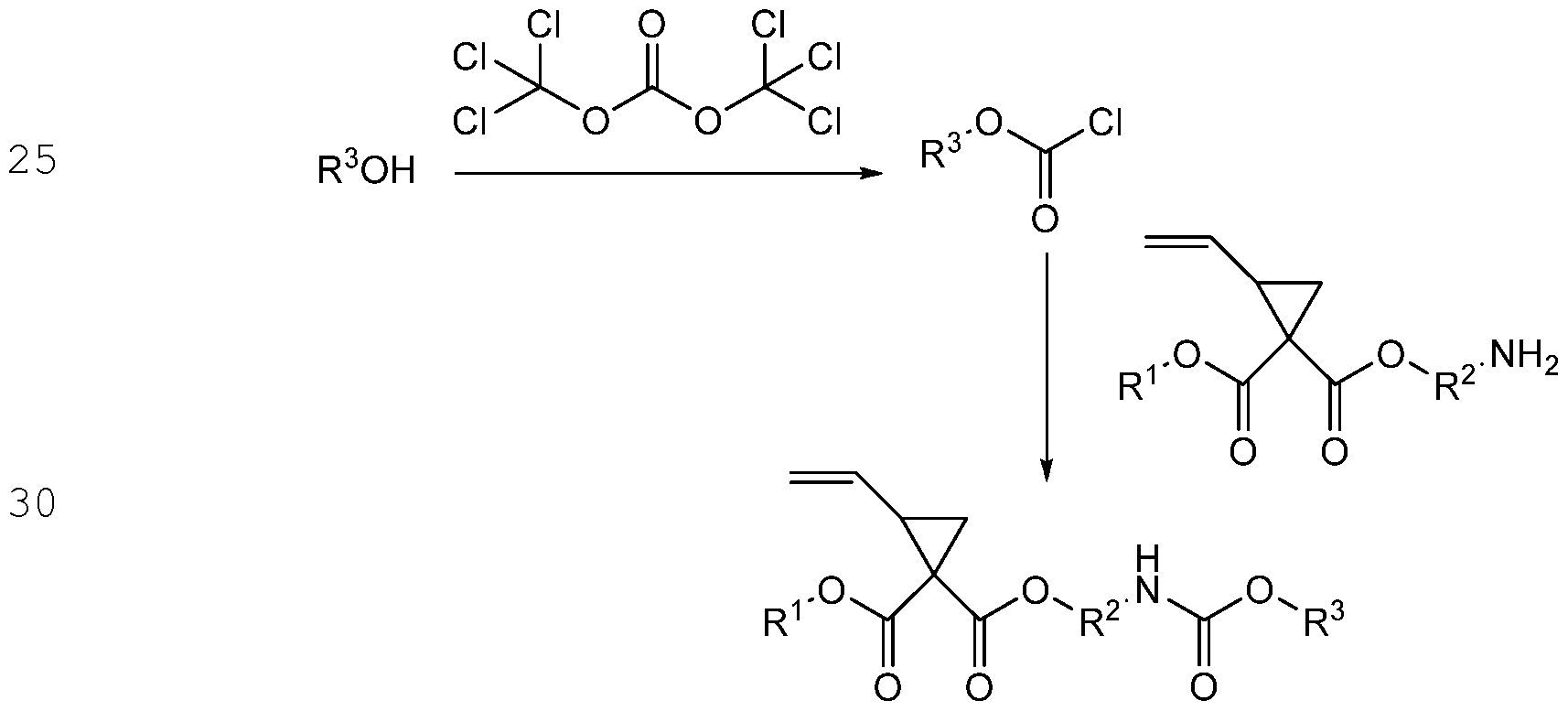

Konkretes Beispiel:

Bevorzugte Beispiele für erfindungsgemäße urethangruppen haltige monofunktionelle oder multifunktionelle Vinylcyclo propane der allgemeinen Formeln I sind:


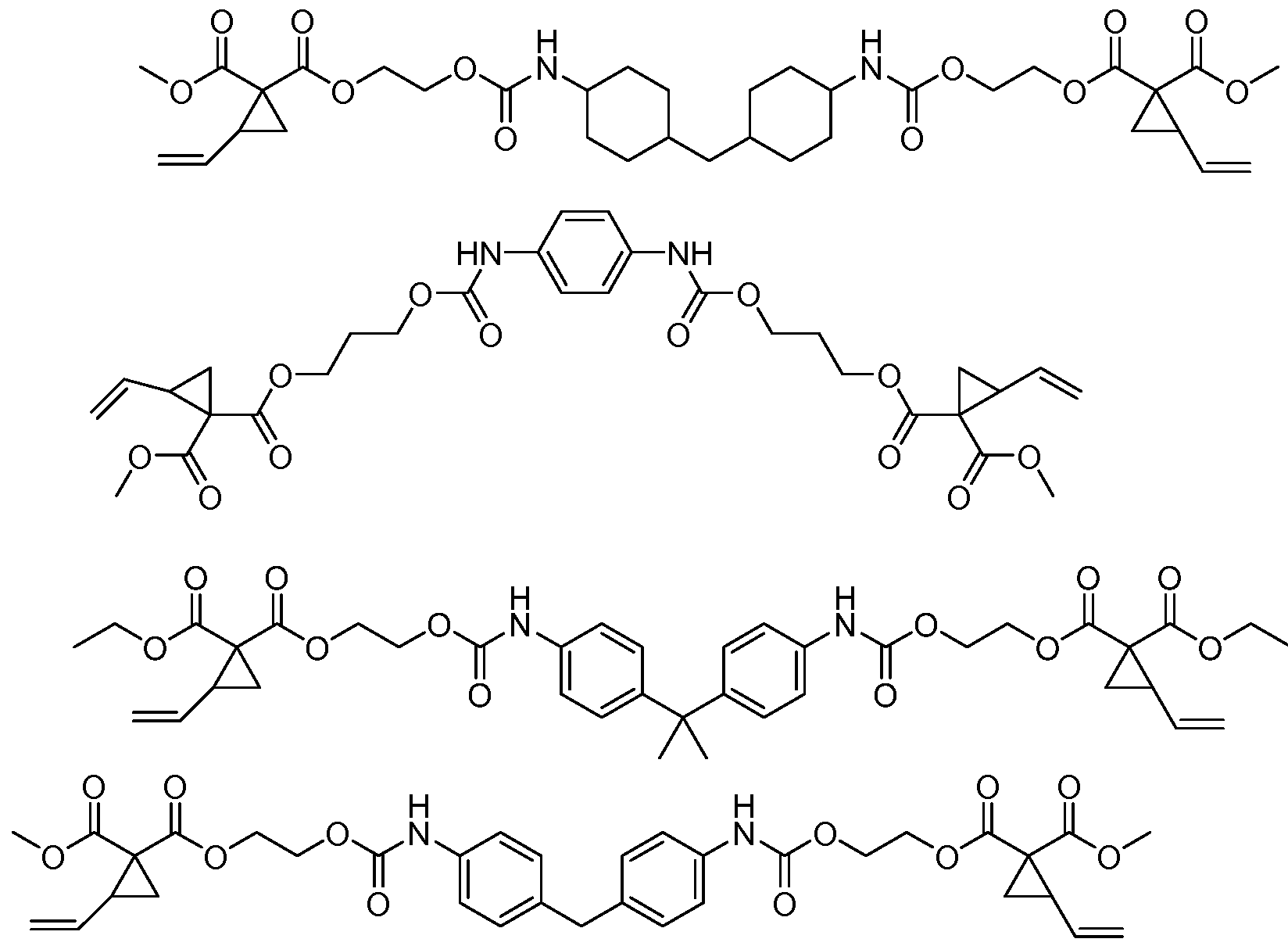

Die polymerisationsfähigen urethangruppenhaltigen Vinylcyclo- propane der allgemeinen Formel I sind meist flüssig und zei¬ gen überraschenderweise eine im Vergleich zu 1,1-Bis- (alkoxycarbonyl) -2-vinylcyclopropanen deutlich verbesserte radikalische Polymerisierbarkeit, insbesondere bei der Photo¬ polymerisation, und im Vergleich zu nicht cyclischen Methac- rylaten eine geringere Polymerisationsschrumpfung. Damit lassen sich Dentalwerkstoffe wie Befestigungszemente oder Fül- lungskomposite mit ebenfalls verringertem Polymerisations¬ schrumpf herstellen.
Die erfindungsgemäßen (Dental-) Werkstoffe enthalten vorzugs¬ weise 2 bis 95 Gew.-%, besonders bevorzugt 5 bis 85 Gew.-%, ganz besonders bevorzugt 5 bis 60 Gew.-% und insbesondere 10 bis 60 Gew.-% Vinylcyclopropan (e) der allgemeinen Formel I, jeweils bezogen auf die Gesamtmasse des Werkstoffs.
Neben einem oder mehreren Vinylcyclopropanen der allgemeinen Formel I enthalten die Werkstoffe vorzugsweise mindestens ein weiteres radikalisch polymerisierbares Monomer. Als weitere radikalisch polymerisierbare Monomere sind andere Vinylcyc- lopropane wie 1 , 1-Di (ethoxycarbonyl) - oder 1 , 1-Di (methoxy- carbonyl) -2-vinylcyclopropan, Bis (2-vinylcyclpropan-l-carbon- säureethylester-l-carbonamido) -2, 2-dimethyl-4-methylhexan, 1, 8-Bis (2-vinylcyclopropan-l-carbonsäureethylester-l-carbo- nyloxy) -3 , 6-dioxaoctan (VCP 5) oder die Ester der 1-Ethoxy- carbonyl- oder l-Methoxycarbonyl-2-vinylcyclopropancarbon- säure mit Ethylenglycol , 1 , 1 , 1-Trimethylolpropan, 1,4-Cyclo- hexandiol oder Resorcin bevorzugt, wie Bis- (2-vinyl-l , 1-di- carbonsäuremonoethylester) resorcinylester (VCP 4), und insbe- sondere die in N. Moszner, F. Zeuner, V. Rheinberger, Macro- mol. Rapid Commun. 18 (1997) 775-780, und N. Moszner, F. Zeu¬ ner, T. Völkel, U. K. Fischer, V. Rheinberger, J. Appl . Po- lym. Sei. 72 (1999) 1775-1782 beschriebenen 2-Vinylcyclo- propane . Weiter bevorzugt sind die in EP 1 413 569 AI offen- barten bicyclischen Cyclopropanderivate, insbesondere 2- (Bi- cyclo [ 3.1.0 ] hex-l-yl ) acrylsäuremethyl- oder -ethylester oder deren Disubstitutionsprodukte in 3-Stellung wie (3,3-Bis- (ethoxycarbonyl )bicyclo[3.1.0] hex-l-yl) acrylsäuremethyl- oder -ethylester .
Ebenso bevorzugt sind die in der EP 1 688 125 AI offenbarten Cyclopropylacrylate, insbesondere { 3 , 3-Bis (ethoxycarbonyl ) - bicylo [ 3.1.0 ] hexa-l-yl } acrylsäuremethylester und 2- (3-Acetyl- 3-ethoxycarbonyl-bicyclo [3.1.0] hexa-l-yl} acrylsäuremethyl- ester.
Erfindungsgemäß sind solche Dentalwerkstoffe bevorzugt, die als Comonomer mindestens ein monofunktionelles Vinylcyclopro- pan mit der allgemeinen Formeln II enthalten:

A, B unabhängig voneinander jeweils OH oder COOH sind,
X, Y unabhängig voneinander jeweils 0 oder NH sind,
R1, R2 unabhängig voneinander jeweils H oder ein aliphatischer linearer oder verzweigter Ci-Cio-Kohlenwasser- stoffrest sind, der durch 0, S oder eine Estergrup¬ pe unterbrochen sein kann, ein alicyclischer oder aromatischer C6-Ci4-Rest oder ein aromatischer oder nicht aromatischer heterocyclischer Rest, der 4 bis 14 Kohlenstoffatome und 1 bis 6 Heteroatome enthal¬ ten kann, die aus N-, 0-, und/oder S-Atomen ausgewählt sind, und
n, m unabhängig voneinander jeweils 0, 1 oder 2 sind.
Wenn X = Y =0, R1 φ H und R2 φ H, dann ist n+m>l . Wenn m = 0 und R1 φ H, wird die freie Valenz an R1 durch H abgesättigt, und wenn n = 0 und R2 φ H, wird dementsprechend die freie Va¬ lenz an R2 durch H abgesättigt.
Die Verbindungen der Formel II zeichnen sich dadurch aus, dass sie über Gruppen (CO-NH, OH, COOH) verfügen, die zur Ausbildung von Wasserstoffbrückenbindungen geeignet sind. Die Vinylcyclopropane der Formel II haben eine geringe Viskosität und eignen sich daher besonders als Verdünnermonomere für dickflüssige Monomere.
Verbindungen der Formel II, in denen A und B dieselbe Bedeu¬ tung haben, sind bevorzugt. Ebenso sind solche Verbindungen bevorzugt, in denen X und Y dieselbe Bedeutung haben. R1 und R2 können gleich oder vorzugsweise verschieden sein. Die Res- te R1 und/oder R2 der Formel II können durch eine oder mehrere der genannten Atome und Gruppen unterbrochen sein. Bevorzugt sind Reste, die durch eine Gruppe oder ein Atom oder be¬ sonders bevorzugt nicht unterbrochen sind. Bei den genannten cyclischen Resten der Formel II kann es sich um mono- oder polycyclische Gruppen handeln. R1 und/oder R2 können auch durch eine Kombination der genannten Reste gebildet werden, beispielsweise durch eine Kombination von ei¬ ner oder mehreren aliphatischen und einer oder mehreren aro- matischen Gruppen, z.B. ein aliphatisch-aromatischer C7-C14- Rest. Besonders bevorzugt sind Reste, die eine Tricyclodecan- gruppe (TCD) enthalten.
Erfindungsgemäß sind Verbindungen der Formel II bevorzugt, in denen die Variablen die folgenden Bedeutungen haben:
A OH,
m 0, 1 oder 2,
R1 H oder ein verzweigter oder vorzugsweise linearer Ci-Cß- Kohlenwasserstoffrest , der durch 0 unterbrochen sein kann, wobei Reste, die nicht durch 0 unterbrochen sind, bevorzugt sind, wobei R1 vorzugsweise nicht H ist, wenn X = 0 und m = 0,
X 0 oder NH, wobei X vorzugsweise NH ist, wenn m = 0 und R1 φ H,
n 0,
R2 ein verzweigter oder vorzugsweise linearer C1-C3-
Alkylrest ,
Y 0; oder bevorzugt
B OH,
0, 1 oder 2,
H oder ein verzweigter oder vorzugsweise linearer Ci-Cß- Kohlenwasserstoffrest , der durch 0 unterbrochen sein kann, wobei Reste, die nicht durch 0 unterbrochen sind, bevorzugt sind, wobei R2 vorzugsweise nicht H ist, wenn Y = 0 und n = 0,
0 oder NH, wobei Y vorzugsweise NH ist, wenn n = 0 und
R2 φ H,
0,
ein verzweigter oder vorzugsweise linearer C1-C3-
Alkylrest
0.
Besonders bevorzugt sind Verbindungen der Formel II, in denen die Variablen die folgenden Bedeutungen haben:
A OH,
m 0 oder 1,
R1 H oder ein linearer Ci-C6-Kohlenwasserstoffrest , wobei R1 vorzugsweise nicht H ist, wenn X = 0 und m = 0,
X 0 oder NH, wobei X NH ist, wenn m = 0 und R1 φ H, n 0,
R2 ein linearer Ci-C3-Alkylrest
Y 0; oder bevorzugt
B OH,
n 0 oder 1,
R2 H oder ein linearer Ci-C6-Kohlenwasserstoffrest , wobei R2 vorzugsweise nicht H ist, wenn Y = 0 und n = 0,
Y 0 oder NH, wobei Y NH ist, wenn n = 0 und R2 φ H, m 0,
R1 ein linearer Ci-C3-Alkylrest ,
X 0.
Außerdem können die Dentalwerkstoffe auch radikalisch polyme- risierbare mono- oder polyfunktionelle (Meth) acrylsäure-
derivate enthalten. Unter monofunktionellen Monomeren werden Verbindungen mit einer, unter multifunktionellen Monomeren Verbindungen mit zwei oder mehr, vorzugsweise 2 bis 4 radika¬ lisch polymerisierbaren Gruppen verstanden.
Bevorzugte mono- oder multifunktionelle Methacrylate sind Me¬ thyl-, Ethyl-, 2 -Hydroxyethyl- , Butyl-, Benzyl-, Tetrahydro- furfuryl- oder Isobornyl (meth) acrylat , p-Cumyl-phenoxy- ethylenglycolmethacrylat (CMP-1E) , Bisphenol-A-di (meth) - acrylat, Bis-GMA (ein Additionsprodukt aus Methacrylsäure und Bisphenol-A-diglycidylether) , ethoxy- oder propoxyliertes Bisphenol-A-Dimethacrylat , wie z.B. das Bisphenol-A- Dimethacrylat 2- [4- ( 3-Methacryloyloxyethoxyethyl ) phenyl ] -2- [ 4- ( 3-methacryloyloxyethyl ) phenyl ] -propan) (SR-348c) mit 3 Ethoxygruppen oder 2 , 2-Bis [ 4- (2- (meth) acryloxypropoxy) - phenyl ] propan, UDMA (ein Additionsprodukt aus 2-Hydroxyethyl- methacrylat (HEMA) und 2 , 2 , 4 -Trimethylhexamethylendiiso- cyanat) , TMX-UDMA (ein Additionsprodukt aus einer Mischung von HEMA und Hydroxypropylmethacrylat (HPMA) mit α,α,ο ,ο - Tetramethyl-m-xylylendiisocyanat (TMXDI)), Di-, Tri- oder Tetraethylenglycoldi (meth) acrylat, Trimethylolpropantri- (meth) acrylat , Pentaerythrittetra (meth) acrylat , sowie Gly- cerindi- und trimethacrylat , 1 , 4-Butandioldi (meth) acrylat , 1, 10-Decandioldi (meth) acrylat (D3MA) oder 1 , 12-Dodecandiol- di (meth) acrylat .
Darüber hinaus können die Dentalwerkstoffe vorteilhaft auch radikalisch polymerisierbare, säuregruppenhaltige Monomere enthalten, wie z.B. polymerisationsfähige Carbonsäuren, Phosphonsäuren und Phosphorsäureester. Bevorzugte Beispiele für polymerisationsfähige Carbonsäuremonomere sind Maleinsäu¬ re, 2- (Hydroxymethyl) acrylsäure und 4- (Meth) acryloyloxyethyl- trimellitsäureanhydrid . Bevorzugte Beispiele für geeignete Phosphonsäuremonomere sind 2-Methacryloyloxyethylphosphon- säure, 2-Methacrylamidoethylphosphonsäure, 2- [ 4- (Dihydroxy- phosphoryl) -2-oxa-butyl] -acrylsäureethyl- oder -2,4,6-tri- methylphenylester . Bevorzugte Beispiele für geeignete acide polymerisationsfähige Phosphorsäureester sind 2-Methacryloy-
loxypropyldihydrogenphosphat , 2-Methacryloyloxyethyldihydro- genphosphat , 2-Methacryloyloxyethylphenyl-hydrogenphosphat , Dipentaerythritolpentamethacryloyloxyphosphat , 1 O-Methacryl- oyloxydecyldihydrogenphosphat und 6- (Methacrylamido ) hexyldi- hydrogenphosphat . Acide Monomere dienen primär zur Verbesse¬ rung der Haftung der Werkstoffe an Dentin und/oder Zahnschmelz. Die Menge an aciden Monomeren liegt vorzugsweise im Bereich von 0 bis 20 Gew.-%, bevorzugt 0 bis 15 Gew.-% und besonders bevorzugt 0 bis 10 Gew.-%, bezogen auf die Gesamt- masse des Dentalwerkstoffs.
Besonders bevorzugt sind Werkstoffe, die mindestens ein mul¬ tifunktionelles radikalischen Monomer, d.h. ein Vinylcyclop- ropan der Formel I und/oder ein anderes multifunktionelles radikalisch polymerisierbares Monomer enthalten.
Die erfindungsgemäßen Dentalwerkstoffe enthalten vorzugsweise weiterhin einen Initiator für die radikalische Polymerisati¬ on. Zur Initiierung der radikalischen Photopolymerisation sind Benzophenon, Benzoin sowie deren Derivate oder a- Diketone oder deren Derivate, wie 9, 10-Phenanthrenchinon, 1- Phenyl-propan-1 , 2-dion, Diacetyl oder 4 , 4 -Dichlorbenzil bevorzugt. Besonders bevorzugt werden Campherchinon und 2,2- Dimethoxy-2-phenyl-acetophenon und ganz besonders bevorzugt α-Diketone in Kombination mit Aminen als Reduktionsmittel, wie z.B. 4- (Dimethylamino) benzoesäureethylester, N,N- Dimethylaminoethylmethacrylat , N, -Dimethyl-sym. -xylidin oder Triethanolamin, verwendet. Besonders geeignet sind auch Nor- rish-Typ-I-Photoinitiatoren, vor allem Acyl- oder Bisacyl- phosphinoxide, wie beispielsweise die kommerziell erhältli¬ chen Verbindungen 2 , 4 , 6-Trimethylbenzoyldiphenylphosphinoxid und Bis (2, 4, 6-trimethylbenzoyl) phenylphosphinoxid. Besonders geeignet sind auch Monoacyltrialkyl- , Diacyldialkylgermanium- , Triacylalkyl- sowie Tetraacylgermanium-Verbindungen, wie z.B. Benzoyltrimethylgermanium, Dibenzoyldiethylgermanium oder Bis ( 4 -methoxybenzoyl ) diethylgermanium sowie
Tetrabenzoylgermanium. Dabei lassen sich auch Mischungen der verschiedenen Photoinitiatoren einsetzen, wie z.B. Dibenzoyl-
diethylgermanium in Kombination mit Campherchinon und 4- Dimethylaminobenzoesäureethylester oder Tetrabenzoylgermanium. Es können vorteilhaft auch Initiatorkombinationen eingesetzt werden, die zusätzlich aro- matische Diaryliodonium- oder Triarylsulfoniumsalze enthal¬ ten, beispielsweise die kommerziell erhältlichen Verbindungen 4-Octyloxyphenyl-phenyl-iodoniumhexafluoroantimonat oder Isopropylphenyl-methylphenyl-iodoniumtetrakis- (pentafluorophenyl ) borat .
Als Initiatoren für eine bei Raumtemperatur durchgeführte Polymerisation werden vorzugsweise Redox-Initiatorkombina- tionen, wie z.B. Kombinationen von Benzoylperoxid mit N,N-Di- methyl-sym. -xylidin oder N, -Dimethyl-p-toluidin, verwendet. Darüber hinaus sind auch Redoxsysteme bestehend aus Peroxiden bzw. Hydroperoxiden und solchen Reduktionsmitteln, wie z.B. Ascorbinsäure, Barbiturate, Thioharnstoffe oder Sulfinsäuren, besonders geeignet. Außerdem lassen sich als Redoxkata- lysatoren Verbindungen von Übergangsmetallen, die mindestens zwei stabile Wertigkeitsstufen zeigen, einsetzen. Das sind vor allem Verbindungen der Elemente Kupfer, Eisen, Vanadium, Nickel oder Kobalt, wobei besonders bevorzugt Kupferver¬ bindungen sind und diese bevorzugt als gut organolösliche Verbindungen, wie z.B. als Acetylacetonat , Naphthenat oder 2- Ethyl-hexanoat , eingesetzt werden.
Dentalwerkstoffe, die mindestens einen Photoinitiator enthal¬ ten, sind erfindungsgemäß bevorzugt. Die Werkstoffe können zusätzlich weitere Initiatoren enthalten.
Weiterhin enthalten die erfindungsgemäß eingesetzten Zusammensetzungen vorzugsweise auch mindestens einen organischen oder besonders bevorzugt anorganischen partikulären Füllstoff, beispielsweise zur Verbesserung der mechanischen Ei- genschaften oder zur Einstellung der Viskosität. Bevorzugte anorganische partikuläre Füllstoffe sind amorphe kugelförmige Materialien auf der Basis von Oxiden, wie SiC>2, ZrC>2 und T1O2 bzw. Mischoxiden aus S1O2, ZrC>2 und/oder T1O2, nanopartikuläre
oder mikrofeine Füllstoffe, wie pyrogene Kieselsäure oder Fällungskieselsäure (gewichtsmittlere Partikelgröße von 10- 1000 nm) , sowie Minifüllstoffe, wie Quarz-, Glaskeramik- oder Glaspulver mit einer gewichtsmittlere Partikelgröße von 0,01 bis 1 ym. Weitere bevorzugte Füllstoffe sind röntgenopake Füllstoffe, wie Ytterbiumtrifluorid, nanopartikuläres Tan¬ tal (V) -oxid, Bariumsulfat, Mischoxide von S1O2 mit Ytterbi- um ( III ) -oxid oder Tantal (V) -oxid (gewichtsmittlere Partikelg¬ röße von 10-1000 nm) und röntgenopake Glaspulver, z.B. Ba- rium- oder Strontiumaluminiumsilikatgläser (gewichtsmittlere Partikelgröße von 0,2-10 ym) .
Zur Verbesserung des Verbundes zwischen den FüllstoffParti¬ keln und der vernetzten Polymerisationsmatrix können die Füllstoffpartikel mit geeigneten Kupplungsreagenzien oberflä¬ chenmodifiziert sein. Für SiC>2-basierende Füllstoffe wie SiC>2, Quarz-, Glaskeramik- oder Glaspulver eignen sich besonders Trialkoxysilanen, wie z.B. 3-Methacryloyloxypropyl- trimethoxysilan . Bevorzugt sind Trialkoxysilane, die Vinyl- cyclopropangruppen enthalten, ganz besonders die in der EP 0 867 444 A2 beschriebenen Vinylcyclopropansilane, wobei hier insbesondere die 1-Methoyxy- oder 1-Ethoxycarbonyl-l- [ (3- trimethoxy- oder 3-triethoxysilyl) propylaminocarbonyl) ] -2- vinylcyclopropane zu nennen sind. Konkret sind Vinylcyclo- proansilane mit den folgenden Strukturen besonders geeignet:

Zur Oberflächenmodifizierung von nicht-silikatischen Füllstoffen, z.B. von ZrÜ2 oder T1O2, können auch funk-
tionalisierte saure Phosphate, wie z.B. 10-Methacryloyloxydi- hydrogenphospaphat eingesetzt werden.
Gegebenenfalls können die erfindungsgemäß eingesetzten Zusam- mensetzungen eine oder mehrere weitere Additive enthalten, vor allem Lösungsmittel, vorzugsweise Wasser, Ethanol oder eine Mischung davon, sowie Stabilisatoren, wie z.B. Polymerisationsstabilisatoren, Aromastoffe, Farbmittel, mikrobiocide Wirkstoffe, fluoridionenabgebende Additive, optische Aufhel- 1er, Weichmacher und/oder UV-Absorber.
Die erfindungsgemäßen Werkstoffe eignen sich besonders als dentale Zemente, Füllungsmaterialien, Beschichtungs- oder Verblendmaterialien .
Dabei sind erfindungsgemäß solche Dentalmaterialien bevor¬ zugt, die die folgenden Komponenten enthalten: a) 2 bis 95 Gew.-%, bevorzugt 2 bis 90 Gew.-% und besonders bevorzugt 10 bis 85 Gew.-% mindestens eines
Vinylcyclopropans der allgemeinen Formel I,
b) 0,01 bis 5 Gew.-%, bevorzugt 0,1 bis 3,0 Gew.-%, beson¬ ders bevorzugt 0,2 bis 2 Gew.-% mindestens eines Initia¬ tors für die radikalische Polymerisation, vorzugsweise einen Photoinitiator,
c) 0 bis 80 Gew.-%, bevorzugt 0 bis 60 Gew.-% und besonders bevorzugt 0 bis 50 Gew.-% andere (s) Monomer (en), und ggf.
d) 0 bis 85 Gew.-%, bevorzugt 0 bis 80 Gew.-% Füllstoff (e) .
Der Füllstoffgehalt richtet sich maßgeblich nach der ge¬ wünschten Anwendung des Dentalwerkstoffs. Dentalwerkstoffe zur Verwendung als Beschichtungsmaterial enthalten besonders bevorzugt 0 bis 40 Gew.-%, Dentalwerkstoffe zur Verwendung als Zement vorzugsweise 10-70 Gew.-% und Dentalwerkstoffe zur Verwendung Füllungsmaterial (Füllungskomposit ) vorzugsweise 10-85 Gew.-% Füllstoff (e) .
Dentalwerkstoffe zur Verwendung als Füllungsmaterial weisen ganz besonders bevorzugt die folgende Zusammensetzung auf: a) 2 bis 60 Gew.-%, bevorzugt 5 bis 60 Gew.-% und besonders bevorzugt 10 bis 60 Gew.-% mindestens eines Vinylcyclo- propans der allgemeinen Formel I,
b) 0,1 bis 3 Gew.-%, bevorzugt 0,2 bis 3,0 Gew.-%, beson¬ ders bevorzugt 0,2 bis 1 Gew.-% mindestens eines Initia¬ tors für die radikalische Polymerisation, vorzugsweise einen Photoinitiator,
c) 0 bis 50 Gew.-%, bevorzugt 0 bis 40 Gew.-% und besonders bevorzugt 0 bis 30 Gew.-% andere (s) Monomer (e), und d) 10 bis 85 Gew.-%, bevorzugt 10 bis 80 Gew.-% Füll¬ stoff (e) .
Wenn nicht anders angegeben beziehen sich alle Mengenangaben hierin auf die Gesamtmasse des Werkstoffs. Die einzelnen Men¬ genbereiche können separat gewählt werden.
Besonders bevorzugt sind solche Werkstoffe, welche aus den genannten Komponenten bestehen. Weiterhin sind solche Werkstoffe bevorzugt, bei denen die einzelnen Komponenten jeweils aus den oben genannten bevorzugten und besonders bevorzugten Stoffen ausgewählt sind.
Erfindungsgemäß sind solche Dentalwerkstoffe besonders bevor¬ zugt, die ausschließlich Monomere enthalten, die als radika¬ lisch polymerisierbare Gruppen Vinylcyclopropyl (VCP) -Gruppen aufweisen .
Die erfindungsgemäßen Werkstoffe eignen sich besonders als Dentalwerkstoffe, insbesondere als dentale Adhäsive, Zemente, Füllungskomposite und Verblendmaterialien sowie als Materia¬ lien zur Herstellung von Prothesen, künstlichen Zähnen, In- lays, Onlays, Kronen und Brücken. Sie zeichnen sich gegenüber auf Dimethacrylaten basierende Materialien durch einen deutlich geringeren Polymerisationsschrumpf und gegenüber bekannten polymerisierbaren Cyclopropanderivaten durch eine bessere
Polymerisationsreaktivität aus, insbesondere bei der Photo¬ polymerisation .
Die Dentalwerkstoffe eignen sich primär zur intraoralen An- wendung durch den Zahnarzt zur Restauration geschädigter Zähne (klinische Materialien), z.B. als dentale Zemente, Fül- lungskomposite und Verblendmaterialien. Sie können aber auch extraoral eingesetzt werden, beispielsweise bei der Herstel¬ lung oder Reparatur von Dentalrestaurationen, wie Prothesen, künstlichen Zähnen, Inlays, Onlays, Kronen und Brücken (technische Materialien) . Die Werkstoffe eignen sich dabei besonders zur Herstellung von Formkörpern, beispielsweise von Dentalrestaurationen, durch generative Verfahren, insbesondere durch Stereolithographie oder 3D-Druck (vgl. A. Gebhardt, Ge- nerative Fertigungsverfahren, 3. Aufl., Carl Hanser Verlag, München 2007) .
Die Erfindung wird im Folgenden anhand von Ausführungsbei¬ spielen näher erläutert.
Ausführungsbeispiele Beispiel 1 Synthese von 1- (2-Ethylcarbamoyloxyethoxycarbonyl) -1-ethoxy- carbonyl-2-vinylcyclopropan (VCP-1 )
1. Stufe: Synthese von 1- (2-Hydroxyethoxycarbonyl) -1-ethoxy- carbonyl-2-vinylcyclopropan (VCP-OH)

2. Stufe: Synthese von 1- (2-Ethylcarbamoyloxyethoxycarbonyl) - thoxycarbonyl-2-vinylcyclopropan (VCP
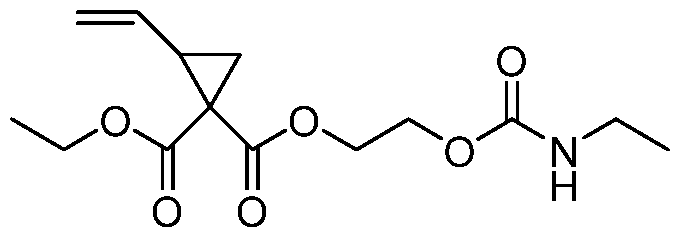
Zu einer gerührten Lösung von 1- (2-Hydroxyethoxycarbonyl) -1- ethoxycarbonyl-2-vinylcyclopropan (VCP-OH , 10.0 g, 43.8 mmol) und Ethylisocyanat (3.42 g, 48.2 mmol) in wasserfreiem Methylenchlorid (60.0 ml) wurde unter Argon eine Lösung von Dibutylzinndilaurat (138 mg, 0.22 mmol) in wasserfreiem Me-
thylenchlorid (10 ml) zugegeben. Es wurde 3 h bei RT gerührt. Das Lösungsmittel wurde im Vakuum abdestilliert und Ethylacetat (150 ml) wurde dem Rückstand zugegeben. Die Lö¬ sung wurde mit 5 %iger NaOH gewaschen (2*50 ml) . Die organi- sehe Phase wurde über wasserfreiem Natriumsulfat getrocknet. Das Lösungsmittel wurde im Vakuum abdestilliert. Es wurden 11.95 g (91 % Ausbeute) einer farblosen Flüssigkeit erhalten.
1R NMR (400 MHz, CDCI3) : δ = 1.14 (t, 3JHH = 7.2 Hz, 3H, NHCH2CH3) ; 1.26 (t, 3JHH = 7.2 Hz, 3H, OCH2CH3) ; 1.59 (dd, 2JHH = 4.8 Hz, 3JHH = 9.0 Hz, 1H, CH2CHCH=CH2) ; 1.73 (dd, 2JHH = 4.8 Hz, 3JHH = 7.6 Hz, 1H, CH2CHCH=CH2) ; 2.60 (q, 3JHH = 8.3 Hz, 1H, CH2CHCH=CH2) ; 3.12-3.30 (m, 2H, CH2NH) ; 4.08-4.44 (m, 6H, CH2OCO) ; 4.69 (s, 1H, NH) ; 5.11-5.17 (m, 1H, CH2=CH) ; 5.26- 5.34 (m, 1H, CH2=CH) ; 5.39-5.51 (m, 1H, CH2=CH) . 13C NMR (101 MHz, CDCI3) : δ = 14.2 (CH3) ; 15.2 (CH3) ; 20.5 (CH2CHCH=CH2) ; 31.4 (CH2CHCH=CH2) ; 35.8 (COCCO) ; 35.9 (CH2NH) ; 61.5 (CH2OCO) ; 62.2 (CH2OCO) ; 63.7 (CH2OCO) ; 118.7 (CH2=CH) ; 132.9 (CH2=CH) ; 155.9 (C=0) ; 167.1 (C=0) ; 169.4 (C=0) .
Beispiel 2
Synthese eines TCD-Diisocyanat-Di-VCP-QH-Adduktes (VCP-2)

Zu einer gerührten Lösung von VCP-OH (9.14 g, 40.0 mmol) und Dibutylzinndilaurat (166 mg, 0.26 mmol) in wasserfreiem Me¬ thylenchlorid (70.0 mL) wurde unter Argon Bis (isoeyanato- methyl ) tricyclo [ 5.2.1.02 ' 6 ] decan (TCD-Diisocyanat (Lanxess) , 5.13 g, 20.8 mmol) zugegeben. Es wurde 4 h bei RT gerührt. Die Lösung wurde mit Wasser gewaschen (75 ml) . Die organische Phase wurde über wasserfreiem Natriumsulfat getrocknet. Das Lösungsmittel wurde im Vakuum abdestilliert und das Rohpro-
dukt chromatographisch (Flash-Kieselgel mit Ethyl- acetat/Hexan : 1/1) gereinigt. Es wurden 11.72 g (83 % Ausbeu¬ te) eines farblosen Harzes erhalten. 1R NMR (400 MHz, CDCI3) : δ = 0.80-2.55 (m, 24H, CH, CH2, CH2CHCH=CH2, OCH2CH3) ; 2.60 (q, 3JHH = 8.3 Hz, 2H, CH2CHCH=CH2) ; 2.88-3.14 (m, 4H, CH2NH) ; 4.13-4.45 (m, 12H, CH2OCO) ; 4.67- 4.90 (m, 2H, NH) ; 5.11-5.19 (m, 2H, CH2=CH) ; 5.26-5.35 (m, 2H, CH2=CH) ; 5.38-5.51 (m, 2H, CH2=CH) .
Beispiel 3 (Vergleichsbeispiel)
Synthese von 1 , 8-Bis (2-vinylcyclopropan-l-carbonsäureethyl- ester-l-carbonyloxy) -3, 6-dioxaoctan (VCP 5)

Zu einer gerührten Lösung von l-Ethoxycarbonyl-2- vinylcyclopropancarbonsäure (12.9 g. 69.9 mmol), Triethylen- glykol (5.0 g, 33.3 mmol) und DMAP (81 mg, 0.67 mmol) in was¬ serfreiem Methylenchlorid (40.0 ml) wurde unter Argon und bei 0 °C DCC (14.4 g, 69.9 mmol) portionsweise zugegeben. Es wur¬ de 30 min bei 0 °C und 15 h bei RT gerührt. Das Reaktionsge¬ misch wurde über eine Fritte gesaugt und der Rückstand mit Methylenchlorid (3x20 ml) gewaschen. Die organische Phase wurde mit HCl IN (75 ml) , einer gesättigten NaHCC>3 Lösung (75 ml) und einer gesättigten NaCl (75 ml) Lösung gewaschen. Die organische Phase wurde über wasserfreiem Natriumsulfat ge¬ trocknet. Das Lösungsmittel wurde im Vakuum abdestilliert und das Rohprodukt chromatographisch (Flash-Kieselgel mit Ethylacetat/Heptan : 1/2) gereinigt. Es wurden 11.6 g (72 % Ausbeute) einer farblosen Flüssigkeit erhalten.
1R NMR (400 MHz, CDCI3) : δ = 1.26 (t, 3JHH = 7.2 Hz, 6H, OCH2CH3) ; 1.57 (dd, 2JHH = 4.9 Hz, 3JHH = 9.0 Hz, 2H,
CH2CHCH=CH2) ; 1.71 (dd, JHH = 4.9 Hz, JJHH = 7.6 Hz, 2H, CH2CHCH=CH2) ; 2.59 (q, 3JHH = 8.4 Hz, 2H, CH2CHCH=CH2) ; 3.62 (s, 4H, OCH2CH20) ; 3.69 (t, 3JHH = 4.9 Hz, 4H, OCH2CH2OCO) ; 4.12-4.35 (m, 8H, CH2OCO) ; 5.10-5.16 (m, 2H, CH2=CH) ; 5.25- 5.33 (m, 2H, CH2=CH) ; 5.37-5.49 (m, 2H, CH2=CH) . 13C NMR (101 MHz, CDC13) : δ = 14.2 (CH3) ; 20.6 (CH2CHCH=CH2) ; 31.4 (CH2CHCH=CH2) ; 35.8 (COCCO) ; 61.5 (CH20) ; 64.6 (CH20) ; 68.9 (CH2OCO) ; 70.6 (CH2OCO) ; 118.6 (CH2=CH) ; 133.0 (CH2=CH) ; 167.2 (C=0) ; 169.6 (C=0) .
Beispiel 4
Bestimmung der Reaktivität bei der Photopolymerisation
Die Reaktivität der neuen Monomeren VCP 1 und VCP 2 wurde im Vergleich zu den Referenzverbindungen 1 , 1-Bis (ethoxy- carbonyl) -2-vinylcyclopropan (VCP 3) bzw. Bis- (2-vinyl-l, 1- dicarbonsäuremonoethylester) resorcinylester (VCP 4) unter- sucht. Zu jedem Monomer wurden 0.5 mol-% Bis (4- methoxybenzoyl ) diethylgermanium ( Ivocerin®, Ivoclar Vivadent AG) als Initiator zugesetzt und die Mischung in einem Diffe- rential-Scanning-Kalorimeter (Modell Diamond, Perkin Elmer) mit Photopolymerisationsaufsatz durch Bestrahlung mit einer LED-Lampe (Modell Bluephase, Ivoclar Vivadent AG) für 2 Minu¬ ten bei 37 °C polymerisiert (I = 20 mW/cm2) . Die Ergebnisse sind in Figur 1 graphisch dargestellt. Das erfindungsgemäße Vinylcyclopropan VCP 1 zeigt im Vergleich zur Referenzverbindung VCP 3 ein deutlich höheres Maximum der Polymerisations- geschwindigkeit .
Das deutlich höhere Maximum der Polymerisationsgeschwindig¬ keit zeigt, dass die erfindungsgemässen VCPs deutlich schnel¬ ler polymerisieren, d.h. aushärten, als die Vergleichsverbin- düngen. Der entscheidende Nachteil der VCPs nach dem Stand der Technik ist ihre langsame Polymerisation.
Die Reaktivität der Mischungen VCP 2/VCP 3 (1 mol/1 mol) und VCP 4/VCP 3 (1 mol/1 mol) wurde anschließend unter den glei¬ chen Bedingungen (0.5 mol% Ivocerin®, 37 °C, I = 20 mW/cm2) bestimmt. Es wurde festgestellt, dass die Mischung VCP 2/VCP 3 deutlich reaktiver als die Referenzmischung VCP 4/VCP 3 ist (Figur 2) . Die Ergebnisse belegen, dass die Einführung von Urethangruppen zu einer signifikanten Zunahme der Reaktivität führt .
Beispiel 5
Herstellung von Kompositen Komposite auf Basis einer Mischung von VCP 2/VCP 5 (1/1: Gew. /Gew.) und TCD 1/TEGDMA (1/1: Gew. /Gew.) wurden hergestellt (Tabelle 1) . Die Kompositpasten wurden mittels Kneter hergestellt. Von den Materialien wurden entsprechende Prüf¬ körper präpariert, die 2 mal 3 min mit einer dentalen Licht- quelle ( Spectramat®, Ivoclar Vivadent AG) bestrahlt und damit ausgehärtet wurden. Nach der ISO-Norm ISO-4049 (Dentistry - Polymer-based filling, restorative and luting materials) er¬ folgte die Bestimmung der Biegefestigkeit und des Biege-E- Moduls (Tabelle 2) . Die Messungen wurden nach 24 h Lagerung in Wasser (37 °C) durchgeführt. Der Schrumpf wurde durch Auf¬ trieb (Archimedes-Methode) bestimmt (Tabelle 2). Das Komposit A auf Basis des Vinylcyclopropans gemäß Formel I weist einen deutlich geringeren Polymerisationsschrumpf als das methacrylatbasierende Komposit B auf.
Tabelle 1: Zusammensetzung der hergestellten Komposite
Komposit A Komposit B
Komponente
[Gew.-%] [Gew.-%]
VCP 2 8.70 -
VCP 5 8.70 -
TCD 17) - 8.70
TEGDMA1} - 8.70
Ivocerin®5) (Initiator) 0.1 0.1
Barium-aluminium-borosilikatglas-Füller2) 33.50 33.50

Tabelle 2: Mechanische Eigenschaften und Volumenschrumpf
Biegefestigkeit Biege-E-Modul Volumenschrumpf
Komposit
(MPa) (GPa) (Vol.-%)
A 128.3 ± 5.0 7.8 ± 0.4 2.7 ± 0.3
130.0 ± 8.9 10.2 ± 0.4 3.6 ± 0.5
Vergleichsbeispiel
Beispiel 6
Herstellung von Kompositen mit verbesserten mechanischen Ei¬ genschaften
Analog zum Beispiel 5 wurden die Kompositpasten auf Basis von VCP 4 hergestellt (Tabelle 3) . VCP 1 und VCP 3 wurden als Verdünner eingesetzt. Die Ergebnisse der mechanischen Eigenschaften sind in Tabelle 4 dargestellt und zeigen, dass das hochreaktive Vinylcyclopropan VCP 1 zu einer Verbesserung der mechanischen Eigenschaften im Vergleich zu dem Vinylcyclopropan VCP 3 , das dem Stand der Technik entspricht, führt.
Tabelle 3 : Zusammensetzung der Komposite
Komposit D Komposit
Komponente
(Gew.-%) (Gew.-%)
VCP 1 5.22 -
VCP 3 - 5.22
VCP 4 12.18 12.18
Ivocerin®5^ 0.1 0.1
EvoCeram Isoftiller SDI6) 34.00 34.00
Barium-aluminium-
33.50 33.50
borosilikatglas-Füller2^
Si02-Zr02 Sphärosil3) 10.00 10.00
YbF3 4) 5.00 5.00
Vergleichsbeispiel
wie Tabelle 1
Tabelle 4: Mechanische Eigenschaften der Komposite
Biegefestigkeit Biege-E-Modul
Material
(MPa) (GPa)
D 108.8 ± 8.8 7.9 ± 0.4
83.3 ± 9.1 6.3 ± 0.6
' Vergleichsbeispiel
Claims
Patentansprüche
Vinylcyclopropan der allgemeinen Formeln I

in der jeweils 0 oder NH sind, wobei X und Y nicht diesel¬ be Bedeutung haben können,
ein linearer oder verzweigter Ci-Cs-Alkylrest ist, der durch 0, S, eine Estergruppe oder eine Ure- thangruppe unterbrochen sein kann,
ein linearer oder verzweigter C2-Cio-Alkylenrest ist, der durch 0, S, eine Estergruppe oder eine Urethangruppe unterbrochen sein kann,
ein Kohlenwasserstoffrest mit 1 bis 20 Kohlenstoff¬ atomen ist, der zusätzlich ein oder mehrere N-, 0- oder S-Atome enthalten kann, und
1, 2, 3 oder 4, vorzugsweise 1 oder 2 ist.
Vinylcyclopropan nach Anspruch 1, bei dem R ein aliphatischer linearer oder verzweigter Ci-C2o~Kohlen- wasserstoffrest , der der durch 0, S oder eine Estergrup¬ pe unterbrochen sein kann, ein alicyclischer oder aromatischer C6-Ci4-Rest oder ein aromatischer oder nicht aromatischer heterocyclischer Rest ist, der 4 bis 20 Kohlenstoffatome und 1 bis 6 Heteroatome enthalten kann, die aus N-, 0-, und/oder S-Atomen ausgewählt sind, wobei die cyclischen Reste mono- oder polycyclische Gruppen sein können und wobei R3 auch durch eine Kombination der genannten Reste gebildet werden kann.
Vinylcyclopropan nach Anspruch 1 oder 2, bei dem die Variablen die folgenden Bedeutungen haben:
X, Y jeweils 0 oder H, wobei X und Y nicht dieselbe Be¬ deutung haben können,
R1 ein verzweigter oder vorzugsweise linearer C1-C4- Alkylrest ,
R2 ein verzweigter oder vorzugsweise linearer C2-C4- Alkylrest ,
R3 ein aliphatischer linearer oder verzweigter C1-C20- Kohlenwasserstoffrest , ein aromatischer C6~Ci4-Rest, ein aromatischer oder nicht aromatischer hetero- cyclischer Rest, der 4 bis 12 Kohlenstoffatome und 1 bis 2 Heteroatome enthält, die aus N- oder 0- Atomen ausgewählt sind, ein alicyclischer C6-C12- Kohlenwasserstoffrest ist, wobei es sich bei den cyclischen Resten in allen Fällen um mono- oder polycyclische Gruppen handeln kann, oder ein ali- phatisch-aromatischer C7-C2o_Rest,
n 1 oder 2.
Dentalwerkstoff, der mindestens ein Vinylcyclopropan ge¬ mäß einem der Ansprüche 1 bis 3 enthält.
Dentalwerkstoff nach Anspruch 4, der zusätzlich mindestens ein weiteres radikalisch polymerisierbares Monomer und vorzugsweise auch einen Initiator für die radikali¬ sche Polymerisation enthält.
Dentalwerkstoff nach Anspruch 5, der als zusätzliches Monomer mindestens eine Verbindung enthält, die aus 1,1- Di (ethoxycarbonyl ) - oder 1, 1-Di (methoxycarbonyl) -2- vinylcyclopropan, Bis (2-vinylcyclpropan-l-carbonsäure- ethylester-l-carbonamido) -2, 2-dimethyl-4-methylhexan, 1, 8-Bis (2-vinylcyclopropan-l-carbonsäureethylester-l- carbonyloxy) -3 , 6-dioxaoctan (VCP 5), den Estern der 1- Ethoxycarbonyl- oder l-Methoxycarbonyl-2-vinylcyclo- propancarbonsäure mit Ethylenglycol , 1 , 1 , 1-Trimethy- lolpropan, 1 , 4-Cyclohexandiol oder Resorcin, Bis- (2- vinyl-1, 1-dicarbonsäuremonoethylester) resorcinylester
(VCP 4), bicyclischen Cyclopropanderivaten, 2- (Bicyc- lo [ 3.1.0 ] hex-l-yl ) acrylsäuremethyl- oder -ethylestern oder deren Disubstitutionsprodukten in 3-Stellung, (3,3- Bis (ethoxycarbonyl )bicyclo[3.1.0] hex-l-yl )acrylsäure- methyl- oder -ethylester ausgewählt ist.
Dentalwerkstoff nach Anspruch 5 oder 6, der als zusätzliches Monomer mindestens ein mono- oder polyfunktionel¬ les (Meth) acrylsäurederivate enthält, das aus Methyl-, Ethyl-, 2-Hydroxyethyl-, Butyl-, Benzyl-, Tetrahydrofur- furyl- oder Isobornyl (meth) acrylat , p-Cumyl-phenoxyethy- lenglycolmethacrylat (CMP-1E) , Bisphenol-A-di (meth) - acrylat, Bis-GMA (ein Additionsprodukt aus Methacryl- säure und Bisphenol-A-diglycidylether) , ethoxy- oder propoxyliertes Bisphenol-A-Dimethacrylat , 2- [4- (3-Meth- acryloyloxyethoxyethyl ) phenyl ] -2- [4- ( 3-methacryloyloxy- ethyl ) phenyl ] -propan) mit 3 Ethoxygruppen, 2, 2-Bis [4- (2-
(meth) acryloxypropoxy) phenyl ] propan, UDMA (ein Additionsprodukt aus 2-Hydroxyethylmethacrylat (HEMA) und 2, 2, 4-Trimethylhexamethylendiisocyanat) , TMX-UDMA (ein Additionsprodukt aus einer Mischung von HEMA und Hydroxypropylmethacrylat (HPMA) mit α,α,α',α'-Tetra- methyl-m-xylylendiisocyanat (TMXDI)), Di-, Tri- oder Tetraethylenglycoldi (meth) acrylat, Trimethylolpropantri-
(meth) acrylat , Pentaerythrittetra (meth) acrylat , Gly- cerindi- und trimethacrylat , 1 , 4-Butandioldi (meth) acry¬ lat, 1, 10-Decandioldi (meth) acrylat (D3MA) , 1 , 12-Dodecan- dioldi (meth) acrylat und säuregruppenhaltigen Monomeren ausgewählt ist.
Dentalwerkstoff nach einem der Ansprüche 4 bis 7, der zusätzlich mindestens einen partikulären Füllstoff enthält .
Dentalwerkstoff nach einem der Ansprüche 4 bis 8, der zusätzlich mindestens ein Additiv enthält, das aus Lö¬ sungsmittel, vorzugsweise Wasser, Ethanol oder eine Mi¬ schung davon, Stabilisatoren, wie z.B. Polymerisations-
Stabilisatoren, Aromastoffen, Farbmittel, mikrobiociden Wirkstoffen, fluoridionenabgebenden Additiven, optischen Aufhellern, Weichmachern und/oder UV-Absorbern ausgewählt ist.
10. Dentalwerkstoff nach einem der Ansprüche 4 bis 9, der a) 2 bis 95 Gew.-%, bevorzugt 2 bis 90 Gew.-% und be¬ sonders bevorzugt 10 bis 85 Gew.-% mindestens eines Vinylcyclopropans der allgemeinen Formel I, b) 0,01 bis 5 Gew.-%, bevorzugt 0,1 bis 3,0 Gew.-%, besonders bevorzugt 0,2 bis 2 Gew.-% mindestens ei¬ nes Initiators für die radikalische Polymerisation, vorzugsweise einen Photoinitiator,
c) 0 bis 80 Gew.-%, bevorzugt 0 bis 60 Gew.-% und be¬ sonders bevorzugt 0 bis 50 Gew.-% andere (s) Mono¬ mer (e) , und ggf .
d) 0 bis 85 Gew.-%, bevorzugt 0 bis 80 Gew.-% Füll¬ stoff (e) enthält,
jeweils bezogen auf die Gesamtmasse des Werkstoffs.
11. Dentalwerkstoff nach Anspruch 10, der 0 bis 40 Gew.-% Füllstoff (e) enthält, zur Verwendung als Beschichtungs- material, oder der 10-70 Gew.-% Füllstoff (e) enthält, zur Verwendung als Zement, oder der 10-85 Gew.-% Füllstoff (e) enthält, zur Verwendung als Füllungskomposit .
12. Dentalwerkstoff nach Anspruch 11 zur Verwendung als Füllungsmaterial, der a) 2 bis 60 Gew.-%, bevorzugt 5 bis 60 Gew.-% und be¬ sonders bevorzugt 10 bis 60 Gew.-% mindestens eines Vinylcyclopropans der allgemeinen Formel I, b) 0,1 bis 3 Gew.-%, bevorzugt 0,2 bis 3,0 Gew.-%, be¬ sonders bevorzugt 0,2 bis 1 Gew.-% mindestens eines Initiators für die radikalische Polymerisation, vorzugsweise einen Photoinitiator,
c) 0 bis 50 Gew.-%, bevorzugt 0 bis 40 Gew.-% und be¬ sonders bevorzugt 0 bis 30 Gew.-% andere (s) Mono¬ mer (e) , und
d) 10 bis 85 Gew.-%, bevorzugt 10 bis 80 Gew.-% Füll¬ stoff (e) enthält,
jeweils bezogen auf die Gesamtmasse des Werkstoffs.
13. Verwendung eines Dentalwerkstoffs nach einem der Ansprü¬ che 4 bis 12 zur Herstellung oder Reparatur von Dentalrestaurationen, Prothesen, künstlichen Zähnen, Inlays, Onlays, Kronen oder Brücken.
14. Verwendung eines Dentalwerkstoffs nach einem der Ansprü¬ che 4 bis 13 zur Herstellung eines Formkörpers durch ein generatives Verfahren.
15. Verwendung eines Vinylcyclopropans der Formel I zur Her¬ stellung eines Dentalwerkstoffs.
Priority Applications (1)
| Application Number | Priority Date | Filing Date | Title |
|---|---|---|---|
| US16/322,827 US11135136B2 (en) | 2016-08-03 | 2017-08-01 | Dental materials based on urethane-group-containing vinylcyclopropane derivatives |
Applications Claiming Priority (2)
| Application Number | Priority Date | Filing Date | Title |
|---|---|---|---|
| EP16182622.7A EP3278786B1 (de) | 2016-08-03 | 2016-08-03 | Dentalmaterialien auf der basis von urethangruppenhaltigen vinylcyclopropan-derivaten |
| EP16182622.7 | 2016-08-03 |
Publications (1)
| Publication Number | Publication Date |
|---|---|
| WO2018024706A1 true WO2018024706A1 (de) | 2018-02-08 |
Family
ID=56567531
Family Applications (1)
| Application Number | Title | Priority Date | Filing Date |
|---|---|---|---|
| PCT/EP2017/069387 Ceased WO2018024706A1 (de) | 2016-08-03 | 2017-08-01 | Dentalmaterialien auf der basis von urethangruppenhaltigen vinylcyclopropan-derivaten |
Country Status (4)
| Country | Link |
|---|---|
| US (1) | US11135136B2 (de) |
| EP (1) | EP3278786B1 (de) |
| ES (1) | ES2718766T3 (de) |
| WO (1) | WO2018024706A1 (de) |
Families Citing this family (3)
| Publication number | Priority date | Publication date | Assignee | Title |
|---|---|---|---|---|
| ES2695237T3 (es) | 2015-09-29 | 2019-01-02 | Ivoclar Vivadent Ag | Fotoiniciadores de acilgermanio y procedimiento para su preparación |
| DE102016225208B4 (de) * | 2016-12-15 | 2026-01-15 | Ivoclar Vivadent Ag | Ausbrennbares Material auf Polymerbasis für die Lost-Wax Technik |
| EP3932383B1 (de) * | 2020-07-03 | 2022-08-24 | Ivoclar Vivadent AG | Komposite mit verringerter polymerisationsschrumpfungsspannung |
Citations (9)
| Publication number | Priority date | Publication date | Assignee | Title |
|---|---|---|---|---|
| US4713479A (en) | 1986-11-28 | 1987-12-15 | National Distillers And Chemical Corporation | Synthesis of high-purity dialkyl 2-vinylcyclopropane-1,1-dicarboxylate |
| US4713478A (en) | 1986-11-28 | 1987-12-15 | National Distillers And Chemical Corporation | Process for the preparation of dialkyl 2-vinylcyclopropane-1,1-dicarboxylates |
| EP0798286A1 (de) | 1996-03-18 | 1997-10-01 | Ivoclar Ag | Multifunktionelle Vinylcy-clopropan-Derivate |
| EP0867444A2 (de) | 1997-03-25 | 1998-09-30 | Ivoclar Ag | Hydrolysierbare und polymerisierbare Vinylcyclopropansilane |
| DE19812888A1 (de) | 1998-03-17 | 1999-10-21 | Ivoclar Ag Schaan | Vinylcyclopropan-(Meth)acrylate und deren Verwendung |
| EP1413569A1 (de) | 2002-10-22 | 2004-04-28 | Ivoclar Vivadent AG | Polymerisationsfähige bicyclische Cyclopropanderivate und deren Verwendung zur Herstellung von Dentalmaterialien |
| EP1688125A1 (de) | 2005-02-07 | 2006-08-09 | Ivoclar Vivadent AG | Polymerisierbare Cyclopropylacrylate |
| JP2010260945A (ja) * | 2009-05-01 | 2010-11-18 | Nissan Chem Ind Ltd | 低重合収縮性ビニルシクロプロパン化合物及びその重合方法 |
| US20120010322A1 (en) * | 2010-07-08 | 2012-01-12 | Ivoclar Vivadent Ag | Dental materials based on dimer acid derivatives with ring opening polymerizable groups |
Family Cites Families (7)
| Publication number | Priority date | Publication date | Assignee | Title |
|---|---|---|---|---|
| US6034151A (en) * | 1997-03-25 | 2000-03-07 | Ivoclar Ag | Hydrolyzable and polymerizable vinylcyclopropane silanes |
| US6136887A (en) * | 1998-03-17 | 2000-10-24 | Ivoclar Ag | Vinylcyclopropane-(meth)acrylates and their use |
| US7485734B2 (en) | 2005-01-28 | 2009-02-03 | Afton Chemical Corporation | Seal swell agent and process therefor |
| ATE423541T1 (de) * | 2005-06-21 | 2009-03-15 | Ivoclar Vivadent Ag | Dentalmaterialien mit einer aussergewöhnlicher verteilung des fluor |
| DE102007035734A1 (de) * | 2006-08-29 | 2008-03-20 | Ivoclar Vivadent Ag | Dentalmaterialien mit geringem Polymerisationsschrumpf |
| JP6315781B2 (ja) * | 2014-03-11 | 2018-04-25 | デクセリアルズ株式会社 | ビニルシクロプロパン、モノマー組成物、ポリマー、ポリマー組成物、及び物品 |
| DE102016214389B4 (de) * | 2016-08-03 | 2024-12-05 | Ivoclar Vivadent Ag | Dentalmaterialien auf der Basis von monofunktionellen Vinylcyclopropan-Derivaten |
-
2016
- 2016-08-03 ES ES16182622T patent/ES2718766T3/es active Active
- 2016-08-03 EP EP16182622.7A patent/EP3278786B1/de active Active
-
2017
- 2017-08-01 US US16/322,827 patent/US11135136B2/en active Active
- 2017-08-01 WO PCT/EP2017/069387 patent/WO2018024706A1/de not_active Ceased
Patent Citations (10)
| Publication number | Priority date | Publication date | Assignee | Title |
|---|---|---|---|---|
| US4713479A (en) | 1986-11-28 | 1987-12-15 | National Distillers And Chemical Corporation | Synthesis of high-purity dialkyl 2-vinylcyclopropane-1,1-dicarboxylate |
| US4713478A (en) | 1986-11-28 | 1987-12-15 | National Distillers And Chemical Corporation | Process for the preparation of dialkyl 2-vinylcyclopropane-1,1-dicarboxylates |
| EP0798286A1 (de) | 1996-03-18 | 1997-10-01 | Ivoclar Ag | Multifunktionelle Vinylcy-clopropan-Derivate |
| EP0867444A2 (de) | 1997-03-25 | 1998-09-30 | Ivoclar Ag | Hydrolysierbare und polymerisierbare Vinylcyclopropansilane |
| DE19714320A1 (de) * | 1997-03-25 | 1998-10-01 | Ivoclar Ag | Hydrolysierbare und polymerisierbare Vinylcyclopropansilane |
| DE19812888A1 (de) | 1998-03-17 | 1999-10-21 | Ivoclar Ag Schaan | Vinylcyclopropan-(Meth)acrylate und deren Verwendung |
| EP1413569A1 (de) | 2002-10-22 | 2004-04-28 | Ivoclar Vivadent AG | Polymerisationsfähige bicyclische Cyclopropanderivate und deren Verwendung zur Herstellung von Dentalmaterialien |
| EP1688125A1 (de) | 2005-02-07 | 2006-08-09 | Ivoclar Vivadent AG | Polymerisierbare Cyclopropylacrylate |
| JP2010260945A (ja) * | 2009-05-01 | 2010-11-18 | Nissan Chem Ind Ltd | 低重合収縮性ビニルシクロプロパン化合物及びその重合方法 |
| US20120010322A1 (en) * | 2010-07-08 | 2012-01-12 | Ivoclar Vivadent Ag | Dental materials based on dimer acid derivatives with ring opening polymerizable groups |
Non-Patent Citations (15)
| Title |
|---|
| A. GEBHARDT: "Generative Fertigungsverfahren, 3. auflage", 2007, CARL HANSER VERLAG |
| A. PEUTZFELDT: "Resin composites in dentistry: the monomer systems", EUR. J. ORAL. SCI., vol. 105, 1997, pages 97 - 116, XP008056431 |
| DATABASE WPI Week 201080, Derwent World Patents Index; AN 2010-P22097, XP002766140 * |
| F. SANDA; T. TAKATA; T. ENDO, MACROMOLECULES, vol. 27, 1994, pages 3982 |
| F. SANDA; T. TAKATA; T. ENDO, MACROMOLECULES, vol. 27, 1994, pages 3986 |
| J. VIOHL; K. DERMANN; D. QUAST; S. VENZ: "Die Chemie zahnärztlicher Füllungskunststoffe", 1986, CARL HANSER VERLAG, pages: 21 - 27 |
| J. W. NICOLSON; H. M. ANSTICE: "The chemistry of modern dental filling materials", J. CHEM ED., vol. 76, 1999, pages 1497 - 1501 |
| J. W. STANSBURRY: "Curing dental resins and composites by photopolymerization", J. ESTHET. DENT., vol. 12, 2000, pages 300 - 308 |
| N. MOSZNER; F. ZEUNER; T. VÖLKEL; U. K. FISCHER; V. RHEINBERGER, J. APPL. POLYM. SCI., vol. 72, 1999, pages 1775 - 1782 |
| N. MOSZNER; F. ZEUNER; T. VÖLKEL; V. RHEINBERGER, MACROMOL. CHEM. PHYS., vol. 200, 1999, pages 2173 |
| N. MOSZNER; F. ZEUNER; U.K. FISCHER; V. RHEINBERGER; A. DE MEIJERE; V. BAGUTSKI, MACROMOL. RAPID. COMMUN., vol. 24, 2003, pages 269 |
| N. MOSZNER; F. ZEUNER; V. RHEINBERGER, MACROMOL. RAPID COMMUN., vol. 18, 1997, pages 775 - 780 |
| N. MOSZNER; T. HIRT: "New Polymer-Chemical Developments in Clinical Dental Polymer Materials: Enamel-Dentin Adhesives and Restorative Composites", J. POLYM. SCI. PART A: POLYM. CHEM., vol. 50, 2012, pages 4369 - 4402, XP055196980, DOI: doi:10.1002/pola.26260 |
| R. K. SADHIR; R. M. LUCK: "Expanding Monomers", 1992, CRC PRESS |
| T. OKAZAKI; F. SANDA; T. ENDO, MACROMOLECULES, vol. 28, 1995, pages 6026 |
Also Published As
| Publication number | Publication date |
|---|---|
| US11135136B2 (en) | 2021-10-05 |
| EP3278786A1 (de) | 2018-02-07 |
| EP3278786B1 (de) | 2019-01-23 |
| ES2718766T3 (es) | 2019-07-04 |
| US20190167533A1 (en) | 2019-06-06 |
Similar Documents
| Publication | Publication Date | Title |
|---|---|---|
| EP3150641B1 (de) | Acylgermanium-photoinitiatoren und verfahren zu deren herstellung | |
| EP2450025B1 (de) | Polymerisierbare Phosphorsäurederivate umfassend ein polyalicyclisches Strukturelement | |
| EP2859876B1 (de) | Dentale Zusammensetzungen und Initiator-Systeme mit farbstabilen Amin-Elektronendonoren | |
| EP2436668B1 (de) | Polymerisierbare Verbindungen umfassend ein polyalicyclisches Strukturelement | |
| EP3166569B1 (de) | Komposite mit gesteuerter netzwerkstruktur | |
| JP2008543743A (ja) | 混成モノマーを含有する歯科組成物 | |
| EP1970042B1 (de) | Verwendung von polymerisierbaren Calix[n]arenen als Dentalmaterialien | |
| US9314408B2 (en) | Dental composite materials comprising tricyclic plasticizers | |
| EP3119377B1 (de) | Photopolymerisierbare und dualhärtende dentalwerkstoffe auf der basis von thioharnstoffderivaten | |
| DE102016214389B4 (de) | Dentalmaterialien auf der Basis von monofunktionellen Vinylcyclopropan-Derivaten | |
| EP3278786B1 (de) | Dentalmaterialien auf der basis von urethangruppenhaltigen vinylcyclopropan-derivaten | |
| EP0798286B1 (de) | Multifunktionelle Vinylcyclopropan-Derivate | |
| EP2404916B1 (de) | Dentalmaterialien auf der Basis von Dimersäure-Derivaten mit ringöffnend polymerisierbaren Gruppen | |
| JP4669399B2 (ja) | 重合可能アクリル酸シクロプロピル | |
| EP3861976B1 (de) | Dentalmaterialien auf basis von cyclopolymerisierbaren vernetzern | |
| EP0943601B1 (de) | Vinylcyclopropan-(Meth) acrylate und deren Verwendung | |
| EP1825843B1 (de) | Dentalmaterialien auf der Basis von multicyclischen Allylsulfiden | |
| EP1864642B1 (de) | Dentalmaterialien auf der Basis von ringöffnend polymerisierbaren, aciden Monomeren | |
| EP2921156B1 (de) | Monomermischung zur Herstellung von Dentalwerkstoffen | |
| EP2623086B1 (de) | Härtbares Gemisch umfassend Weichmacher mit einem polyalicyclischen Strukturelement zur Anwendung bei der Herstellung dentaler Werkstoffe. |
Legal Events
| Date | Code | Title | Description |
|---|---|---|---|
| 121 | Ep: the epo has been informed by wipo that ep was designated in this application |
Ref document number: 17749686 Country of ref document: EP Kind code of ref document: A1 |
|
| NENP | Non-entry into the national phase |
Ref country code: DE |
|
| 122 | Ep: pct application non-entry in european phase |
Ref document number: 17749686 Country of ref document: EP Kind code of ref document: A1 |