EP0867444A2 - Hydrolysierbare und polymerisierbare Vinylcyclopropansilane - Google Patents
Hydrolysierbare und polymerisierbare Vinylcyclopropansilane Download PDFInfo
- Publication number
- EP0867444A2 EP0867444A2 EP98250096A EP98250096A EP0867444A2 EP 0867444 A2 EP0867444 A2 EP 0867444A2 EP 98250096 A EP98250096 A EP 98250096A EP 98250096 A EP98250096 A EP 98250096A EP 0867444 A2 EP0867444 A2 EP 0867444A2
- Authority
- EP
- European Patent Office
- Prior art keywords
- alkylene
- ester
- alkyl
- unsubstituted
- substituted
- Prior art date
- Legal status (The legal status is an assumption and is not a legal conclusion. Google has not performed a legal analysis and makes no representation as to the accuracy of the status listed.)
- Granted
Links
Classifications
-
- C—CHEMISTRY; METALLURGY
- C08—ORGANIC MACROMOLECULAR COMPOUNDS; THEIR PREPARATION OR CHEMICAL WORKING-UP; COMPOSITIONS BASED THEREON
- C08G—MACROMOLECULAR COMPOUNDS OBTAINED OTHERWISE THAN BY REACTIONS ONLY INVOLVING UNSATURATED CARBON-TO-CARBON BONDS
- C08G77/00—Macromolecular compounds obtained by reactions forming a linkage containing silicon with or without sulfur, nitrogen, oxygen or carbon in the main chain of the macromolecule
- C08G77/04—Polysiloxanes
- C08G77/22—Polysiloxanes containing silicon bound to organic groups containing atoms other than carbon, hydrogen and oxygen
-
- A—HUMAN NECESSITIES
- A61—MEDICAL OR VETERINARY SCIENCE; HYGIENE
- A61K—PREPARATIONS FOR MEDICAL, DENTAL OR TOILETRY PURPOSES
- A61K6/00—Preparations for dentistry
- A61K6/80—Preparations for artificial teeth, for filling teeth or for capping teeth
- A61K6/884—Preparations for artificial teeth, for filling teeth or for capping teeth comprising natural or synthetic resins
- A61K6/891—Compounds obtained otherwise than by reactions only involving carbon-to-carbon unsaturated bonds
- A61K6/896—Polyorganosilicon compounds
-
- C—CHEMISTRY; METALLURGY
- C07—ORGANIC CHEMISTRY
- C07F—ACYCLIC, CARBOCYCLIC OR HETEROCYCLIC COMPOUNDS CONTAINING ELEMENTS OTHER THAN CARBON, HYDROGEN, HALOGEN, OXYGEN, NITROGEN, SULFUR, SELENIUM OR TELLURIUM
- C07F7/00—Compounds containing elements of Groups 4 or 14 of the Periodic Table
- C07F7/02—Silicon compounds
- C07F7/08—Compounds having one or more C—Si linkages
- C07F7/18—Compounds having one or more C—Si linkages as well as one or more C—O—Si linkages
- C07F7/1804—Compounds having Si-O-C linkages
-
- C—CHEMISTRY; METALLURGY
- C08—ORGANIC MACROMOLECULAR COMPOUNDS; THEIR PREPARATION OR CHEMICAL WORKING-UP; COMPOSITIONS BASED THEREON
- C08G—MACROMOLECULAR COMPOUNDS OBTAINED OTHERWISE THAN BY REACTIONS ONLY INVOLVING UNSATURATED CARBON-TO-CARBON BONDS
- C08G77/00—Macromolecular compounds obtained by reactions forming a linkage containing silicon with or without sulfur, nitrogen, oxygen or carbon in the main chain of the macromolecule
- C08G77/48—Macromolecular compounds obtained by reactions forming a linkage containing silicon with or without sulfur, nitrogen, oxygen or carbon in the main chain of the macromolecule in which at least two but not all the silicon atoms are connected by linkages other than oxygen atoms
- C08G77/58—Metal-containing linkages
Definitions
- the invention relates to hydrolyzable and polymerizable Vinylcyclopropanesilanes, process for their preparation, from them manufactured silica condensates, polymers and compositions as well as using all of these materials below other for the production of macromolecular masses and for production of composite materials, adhesives, coatings and especially of dental materials.
- silanes Hydrolyzable silanes, the polymerizable organic residues included in the manufacture of coatings, particulate fillers, adhesives and monolithic moldings as well as in the surface modification of reinforcing materials Application.
- the silanes are used alone, in a mixture with other silanes or in the presence of other metal alkoxides hydrolytically condensed and thermally, photochemically or polymerized redox initiated, i.e. hardened.
- organically modified silanes with polymerizable organic groups such as vinyl, (meth) acrylic, allyl or styryl groups
- polymerizable organic groups such as vinyl, (meth) acrylic, allyl or styryl groups
- the polymerizable silanes are generally first hydrolytically condensed in solution. After the thermal initiator or photoinitiator has been added and the solvent has been separated off, nanoparticulate resins are then formed, which are polymerized after shaping and thus hardened.
- Silanes with ring-opening spiro ortho groups be used.
- silicon-containing vinyl cyclopropane derivatives are trimethylsiloxy-substituted vinyl cyclopropanes (see J. Amer. Chem. Soc. 116 (1994), 6453-6454) and 1-trialkylsilyl-2-vinylcyclopropane (M. Katsukiyo et al. Tetrahedron Lett. 30 (1989), 4413-4416) have become known to date, ie compounds of the following formula:
- the invention is based on the object, hydrolyzable and polymerizable vinyl cyclopropane silanes are also available make hydrolytic from which alone or together with others condensable and polymerizable component compositions are producible only with low shrinkage polymerize and as a composite or coating material, Adhesive, adhesion promoter or for the production of fillers or materials suitable for medical or dental purposes are.
- These silanes are said to be in organic-inorganic Have composite materials covalently installed and synthetically so be accessible that the distance between silicon and the polymerizable groups can be varied.
- the invention further relates to the silica condensates according to claim 4, the polymers according to claim 5, the Compositions according to claims 6 and 7 and the use according to claim 8.
- silanes according to the invention are usually in the form of stereoisomer mixtures and especially as racemates.
- the ether, thioether, Are ester, thioester, carbonyl, amide and urethane groups defined by the following formulas: -O-, -S-, -CO-O-, -O-CO-, -CO-S-, -S-CO-, -CS-O-, -O-CS-, -CO-, -CO-NH-, -NH-CO-, -O-CO-NH-and -NH-CO-O-.
- non-aromatic radicals or which are possible in the formulas (I) non-aromatic parts of the residues can be straight-chain, branched or be cyclic.
- Alkyl radicals preferably have 1 to 8 and particularly preferably 1 to 4 carbon atoms.
- Specific examples of possible alkyl residues are methyl, ethyl, n- and iso-propyl, sec.- and tert.-butyl, n-pentyl, Cyclohexyl, 2-ethylhexyl and octadecyl.
- Alkenyl radicals preferably have 2 to 10 and particularly preferably 2 up to 6 carbon atoms.
- Specific examples of possible Alkenyl residues are vinyl, allyl and isobutyl.
- Preferred examples of possible aryl radicals are phenyl and biphenyl and naphthyl.
- Alkoxy radicals preferably have 1 to 6 carbon atoms. Specific Examples of possible alkoxy radicals are methoxy, ethoxy, n-propoxy, iso-propoxy and tert-butoxy.
- Acyloxy radicals preferably have 2 to 5 carbon atoms. Specific examples are acetyloxy and propionyloxy.
- Preferred alkylene radicals are derived from the above preferred ones Alkyl residues and preferred arylene residues are derived from the preferred aryl radicals above.
- Non-aromatic and residues consisting of aromatic part such as alkylaryl, arylalkyl, Alkylene arylene and arylene alkylene radicals are derived from the above preferred alkyl and aryl radicals. Specific examples of this are benzyl, 2-phenylethyl and tolyl.
- the substituted R radicals mentioned carry one or more simple substituents.
- substituents are methyl, ethyl, phenyl, benzyl, hydroxymethyl, hydroxyethyl, methoxy, ethoxy, chlorine, bromine, hydroxy, mercapto, isocyanato, vinyloxy, acryloxy, methacryloxy, allyl, styryl, epoxy, carboxy, SO 3 H, PO 3 H 2 or PO 4 H 2 .
- the individual R radicals can in turn have simple substituents carry.
- preferred compounds are those in which at least one of the variables of formula (I) the one described above preferred definition.
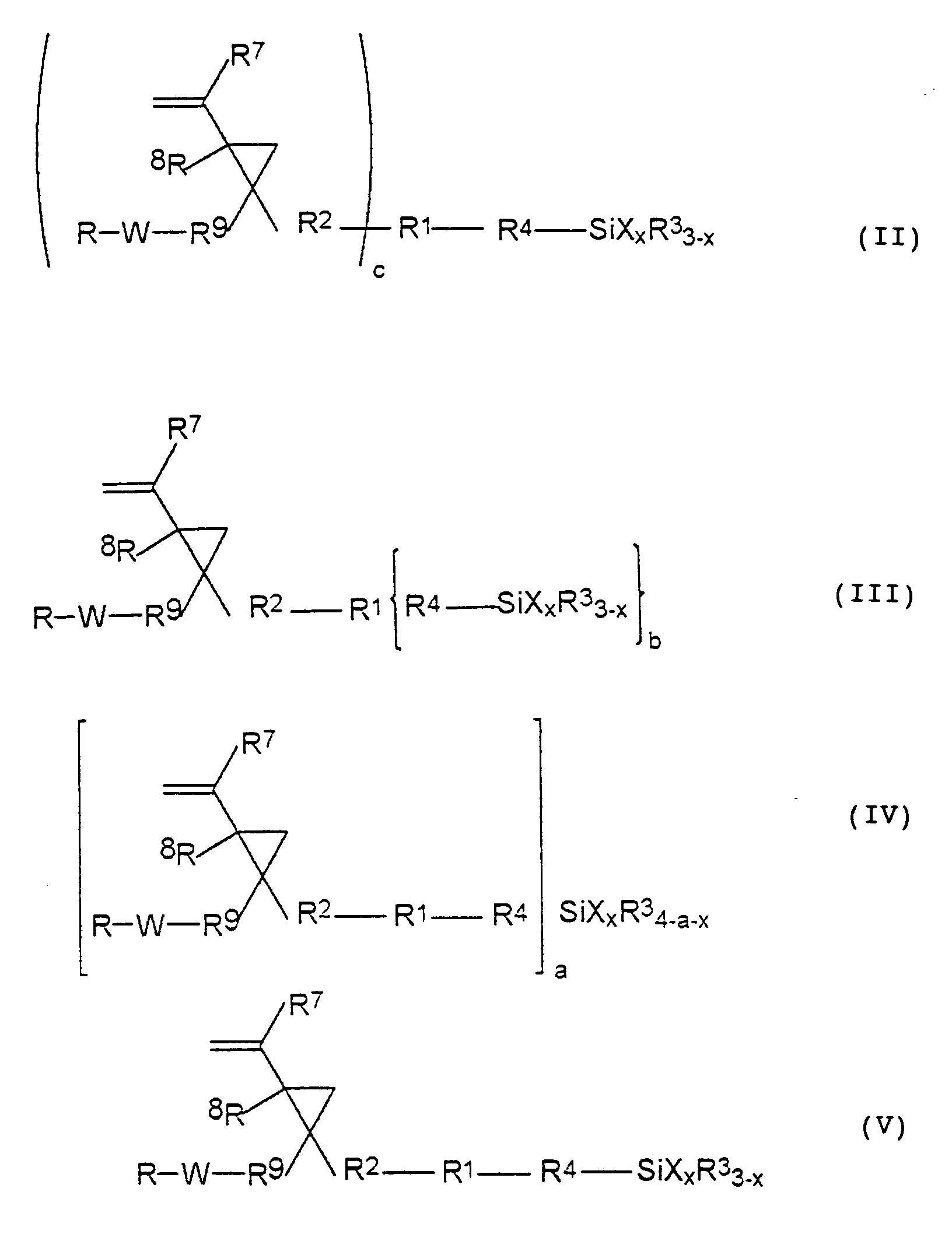
- Those vinylcyclopropanesilanes of the formula (I) in which the indices a, b and / or c have the value 1 are also preferred, and examples of these are the silanes according to the general formulas (II), (III), (IV) and (V).
- the vinylcyclopropanesilanes (I) according to the invention can be prepared in particular via a large number of conventional addition or condensation reactions which are carried out by the methods customary for these reactions.
- Processes that can be used to produce the silanes according to the invention are described, for example, in W. Noll, Chemistry and Technology of Silicones, 2nd edition, Verlag Chemie, Weinheim, 1968, in particular p. 22 ff., And in the review by RC Mehrotra in J Non-Crystalline Solids 100 , (1988) 1-15 and the literature cited in this article.
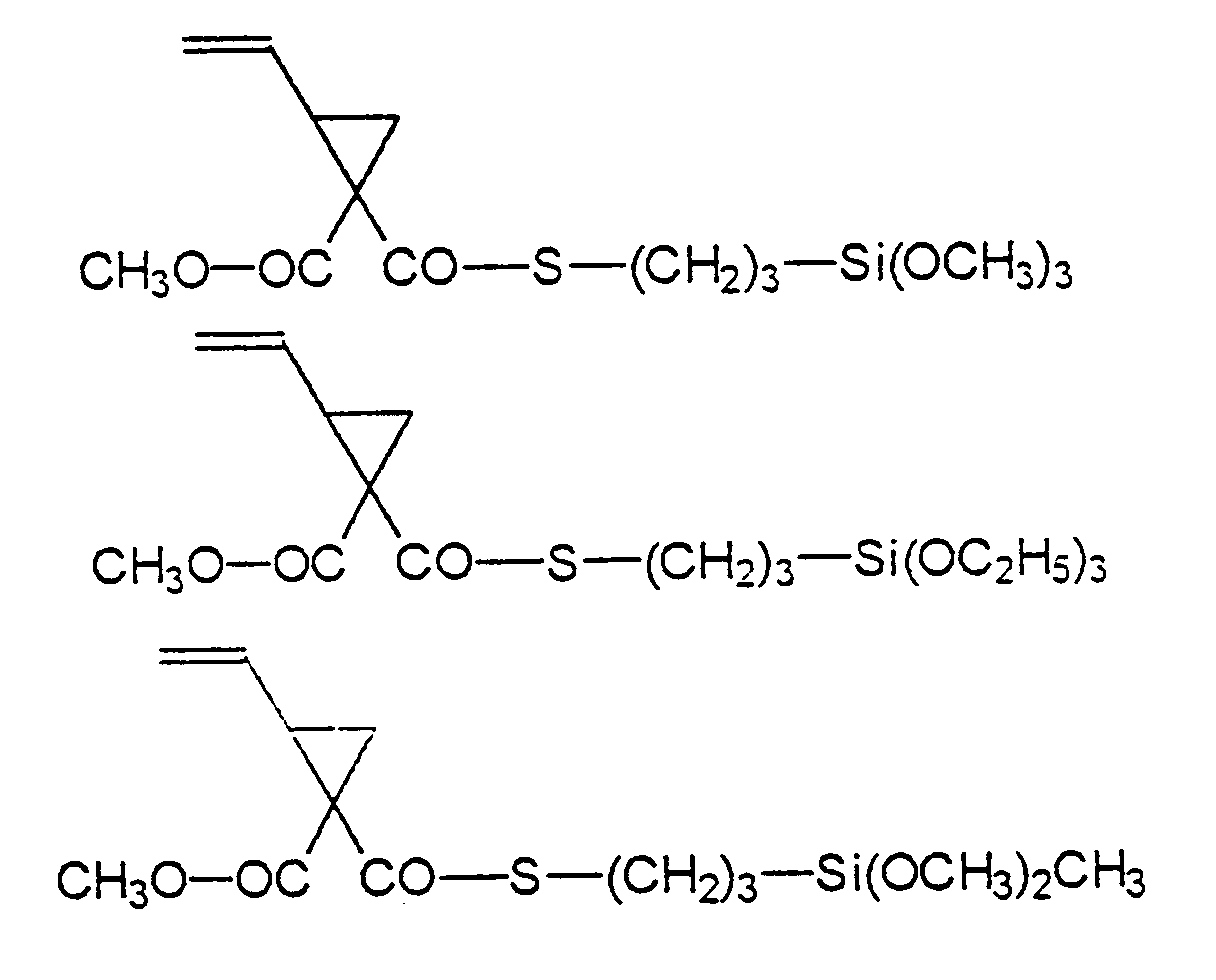
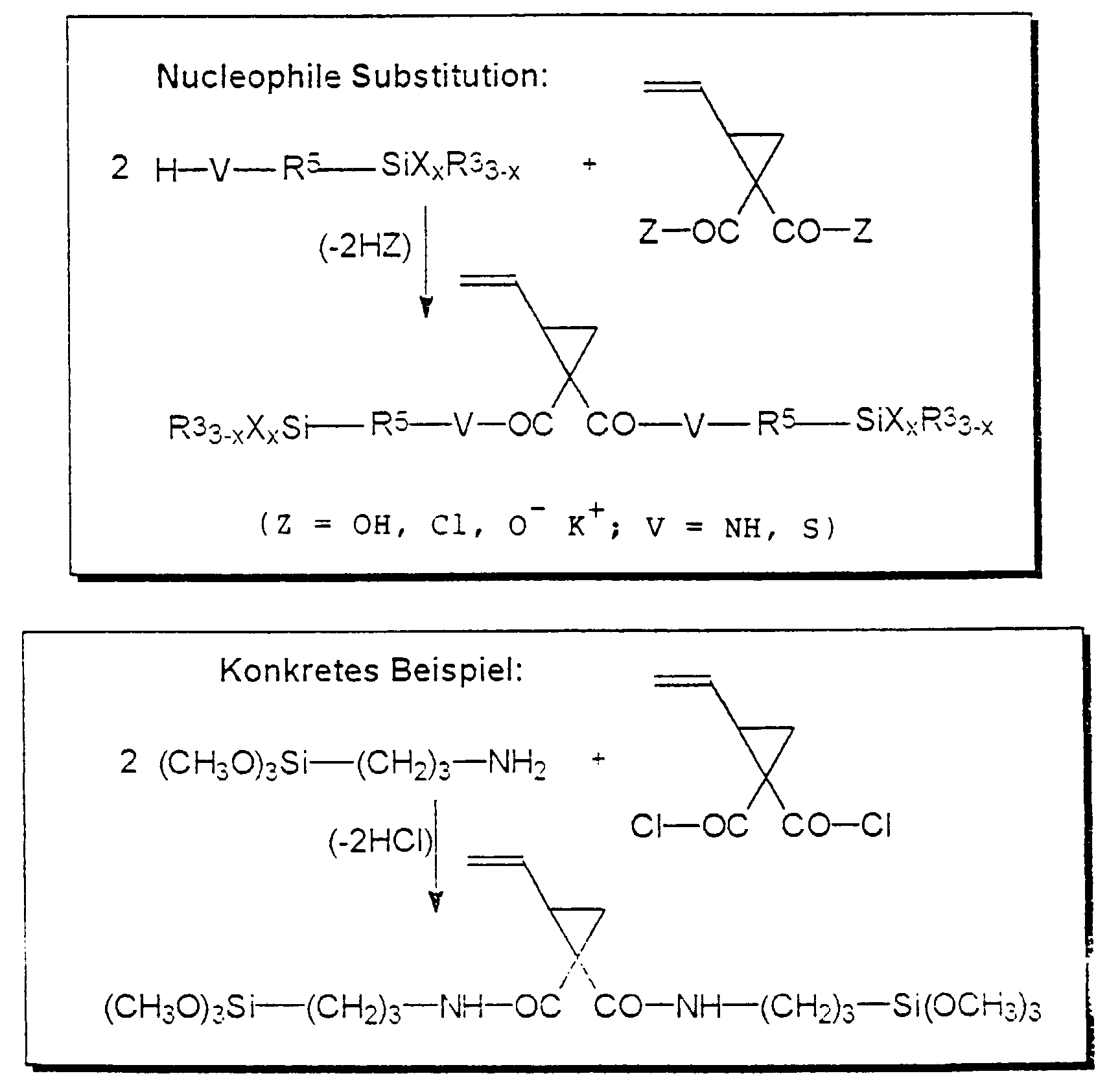
- 1-methoxycarbonyl-2-vinylcy-clopropane-1-carboxylic acid (1) or its acid chloride or potassium salt can be reacted with amino- or mercapto-functionalized silanes as part of a nucleophilic substitution.
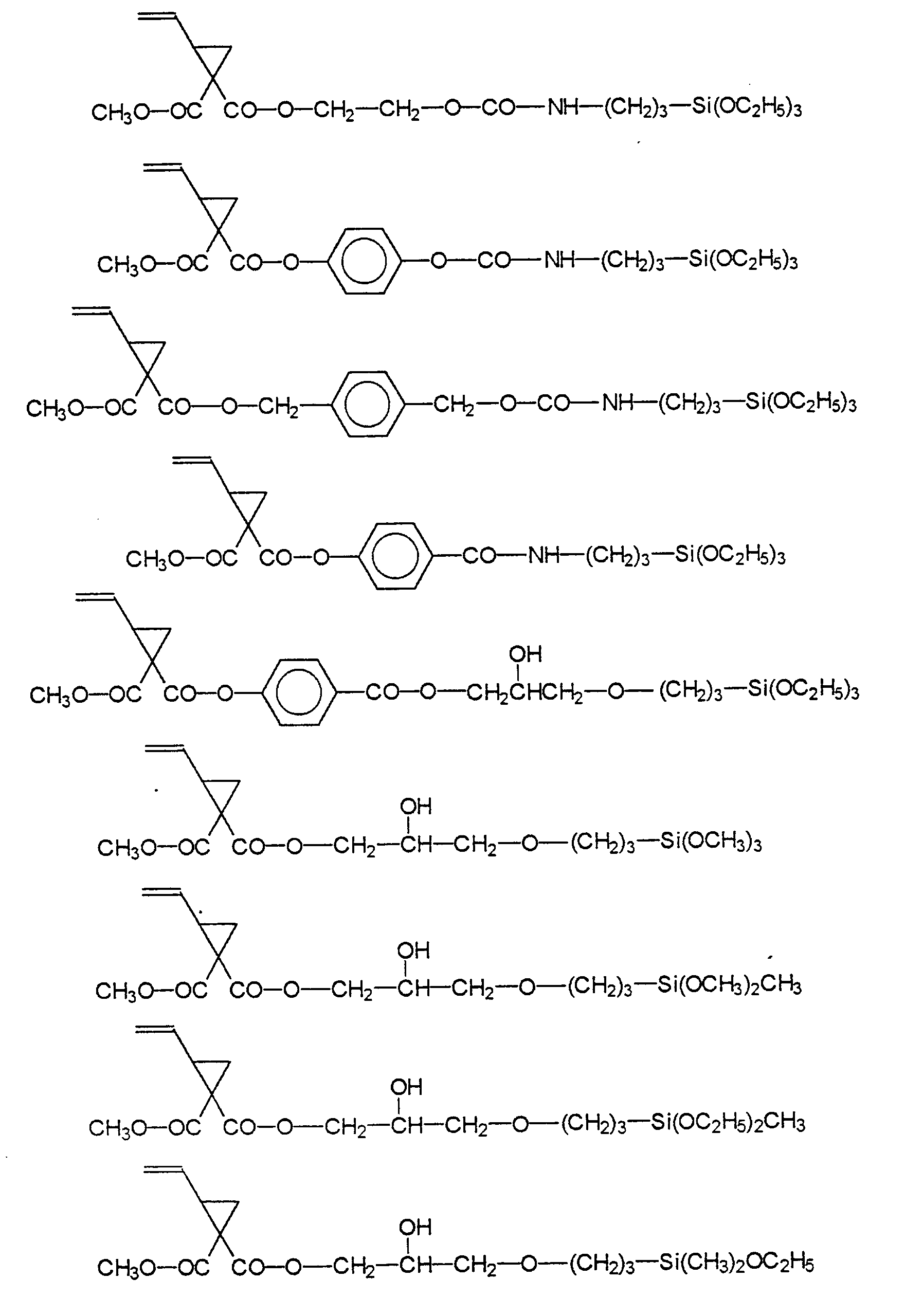
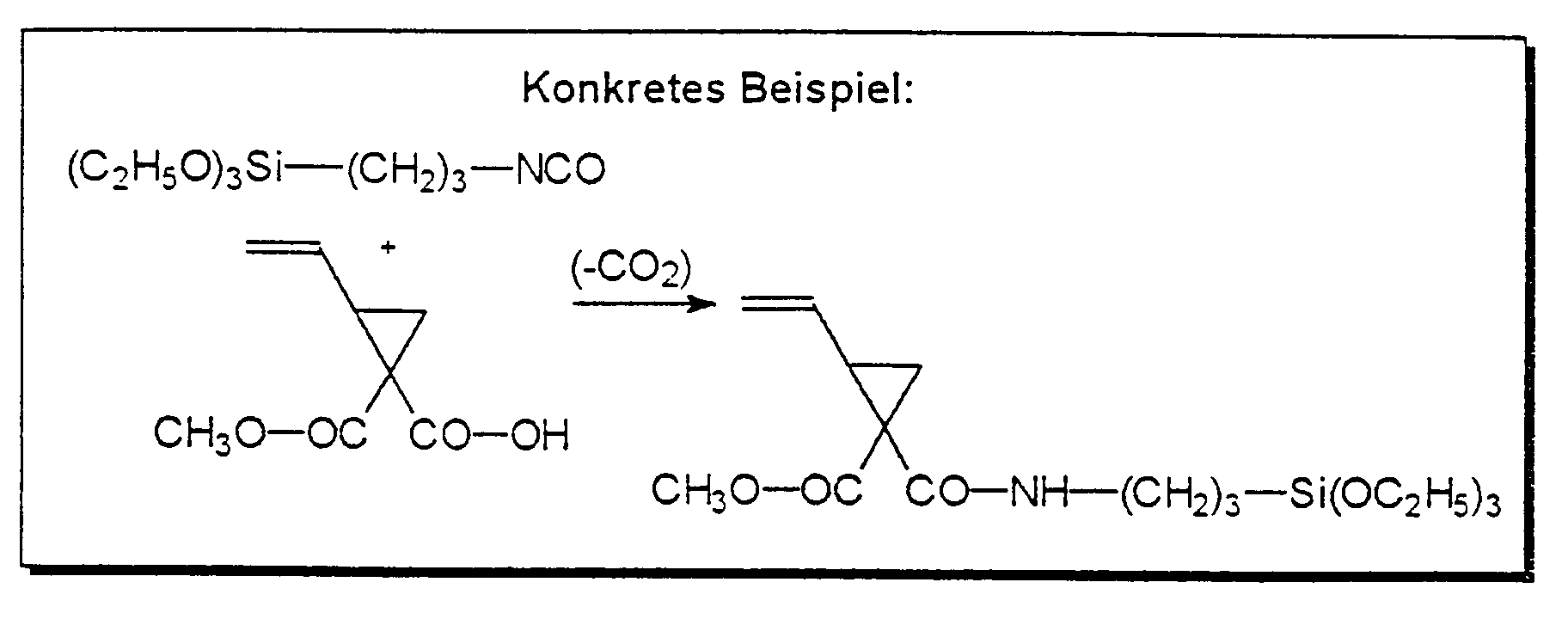
- the acid (1) can also be added to a silane containing isocyanate groups:
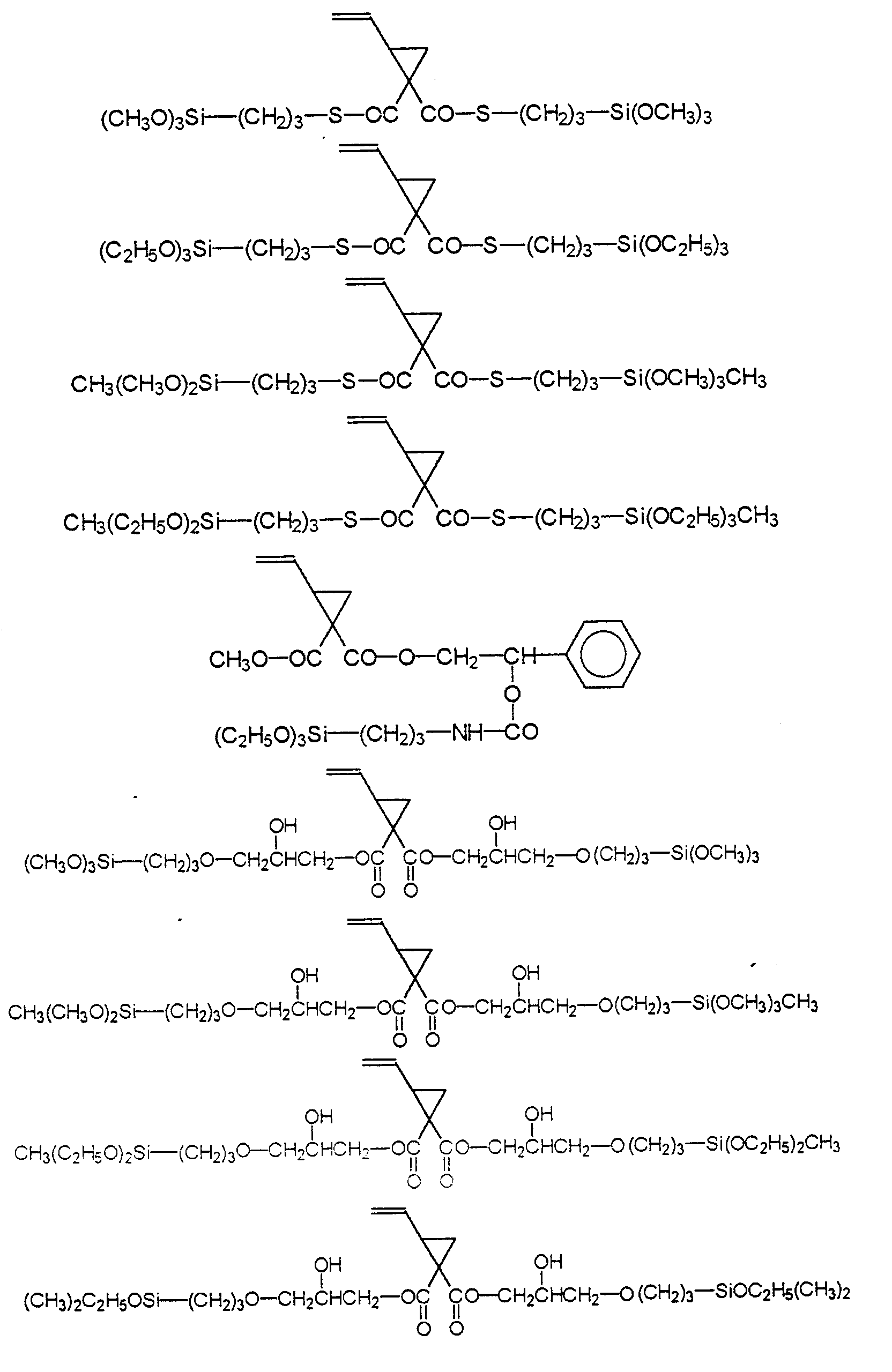
- 1,1-bis (hydroxymethyl) -2-vinylcyclopropane (3) can also be added to silanes containing isocyanate:
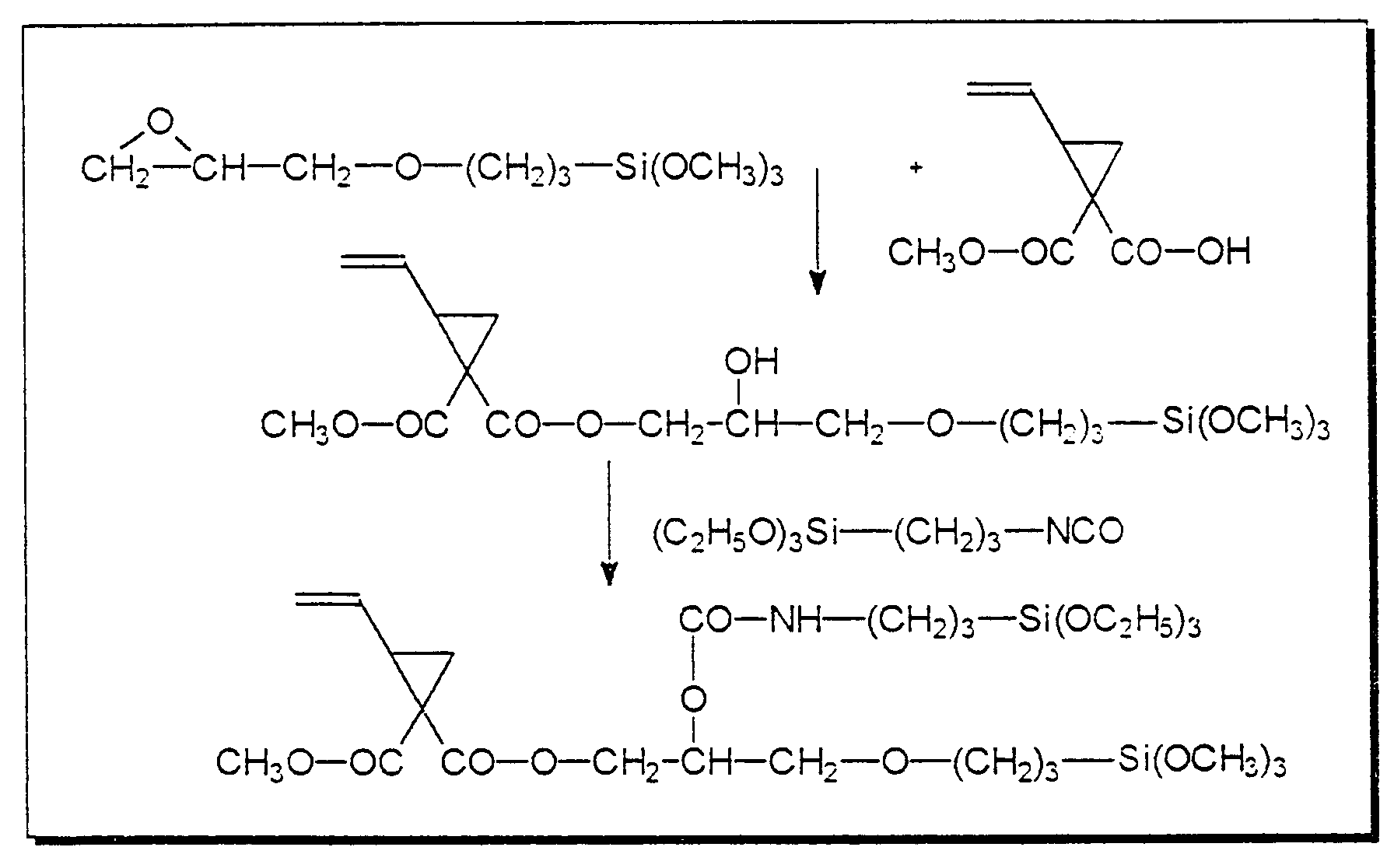
- multifunctional silanes can be obtained by combining the epoxy addition with the isocyanate addition, such as
- the vinylcyclopropane silanes according to the invention make substances higher Reactivity represents the silicate condensates polymerizable during hydrolysis form which in the presence of radical initiators thermally or by exposure to light from the visible or UV range to mechanically stable layers, Moldings or fillers can be polymerized.
- vinylcyclopropane silanes educts used can be the number of hydrolyzable Groups, polymerizable groups and others functional groups can be varied. Depending on the Type and number of hydrolyzable groups and the number of Vinylcylopropane groups condense the vinylcyclopropane silanes and the polymerization of the condensates obtained Materials with properties ranging from silicone rubbery to glassy enough.
- the crosslinking density can also be adjusted, which then also the properties and possible uses of the corresponding Formed silica condensates affected.
- Contain the vinylcyclopropanesilanes according to the invention furthermore ionically crosslinkable groups as substituents, e.g. Epoxy groups, then simultaneously or consecutively, i.e. as a 2-step process, a further increase through their ionic polymerization the crosslink density can be achieved.
- the vinylcyclopropanesilanes according to the invention and their silica condensates have a low volatility, so that they can be processed easily and largely harmlessly.
- the condensable and polymerizable residues of Vinylcyclopropanesilanes according to the invention can be produced therefrom Silicic acid condensates as resins or fillers for various fields of application can be provided.
- silanes (I) are stable compounds, they can either alone or together with other hydrolyzable, condensable and / or polymerizable components to the inventive Silicic acid condensates are processed.
- silica (hetero) condensates In addition to the silanes of the formula (I), other hydrolytically condensable compounds of silicon, aluminum, titanium, Zirconium or phosphorus in the manufacture of the invention Silicic acid condensates are used, which then are referred to as silica (hetero) condensates. These connections can either as such or in pre-condensed Shape can be used. It is preferred if for Preparation of the silica (hetero) condensates according to the invention at least 20 mol%, particularly preferably at least 80 mol% based on monomeric compounds, hydrolyzable silicon compounds be used. It is also preferred if for Production of the silica (hetero) condensates at least 10 mol%, in particular 40 to 100 mol%, each based monomeric compounds, vinylcyclopropanesilanes according to the invention be used.
- zirconium and titanium compounds that can be used are ZrCl 4 , Zr (OC 2 H 5 ) 4 , Zr (OC 3 H 7 ) 4 , Zr (OC 4 H 9 ) 4 , ZrOCl 2 , TiCl 4 , Ti (OC 2 H 5 ) 4 , Ti (OC 3 H 7 ) 4 and Ti (OC 4 H 9 ) 4 .
- Preferred examples of aluminum compounds which can be used are Al (OCH 3 ) 3 , Al (OC 2 H 5 ) 3 , Al (OC 3 H 7 ) 3 , Al (OC 4 H 9 ) 3 and AlCl 3 .
- Complex Zr, Ti and Al compounds can also be used are used as complexing agents i.a. Acids or ⁇ -dicarbonyl compounds can act.
- Silica (hetero) condensates can be used, e.g. Boron trihalides, tin tetrahalides, tin tetraalkoxides and Vanadyl compounds.
- the silica condensates of silanes (I) according to the invention are by hydrolysis of the hydrolyzable groups X present, e.g. Alkoxy groups, and subsequent condensation, which to form an inorganic network of Si-O-Si units leads.
- silica condensates according to the invention can also not in fully hydrolyzed and condensed form. In Such cases are also referred to as so-called pre-condensates.
- silica (hetero) condensates In the production of the silica (hetero) condensates according to the invention one usually proceeds in such a way that if necessary silanes (I) dissolved in a solvent at room temperature or with gentle cooling and in the presence of a hydrolysis and Condensation catalyst with the required amount of water added and the resulting mixture one to several hours long stirring.
- Aliphatic solvents are the main solvents Alcohols, e.g. Ethanol or i-propanol, dialkyl ketones, such as Acetone or methyl isobutyl ketone, ethers such as e.g. Diethyl ether or tetrahydrofuran (THF), esters, such as ethyl or butyl acetate, and their mixtures in question.
- Alcohols e.g. Ethanol or i-propanol
- dialkyl ketones such as Acetone or methyl isobutyl ketone
- hydrolytic condensation is carried out in the presence of reactive Zr, Ti or Al connections performed, so should the water addition gradually at approx. 0 to 30 ° C. It is usually inexpensive not to add water as such, but in the form of aqueous solvents such as e.g. aqueous ethanol, or by release via a chemical reaction, e.g. about an esterification supply.
- aqueous solvents such as e.g. aqueous ethanol
- the hydrolysis and condensation are preferably carried out in the presence a condensation catalyst, proton or hydroxyl ion-releasing Compounds such as organic or inorganic Acids or bases are preferred. Are particularly preferred volatile acids or bases, especially hydrochloric acid or Ammonia. It has proven itself in hydrolysis and condensation Procedures of sol-gel technology to adopt as they do e.g. in C.J. Brinker et al., "Sol-Gel Science", Academic Press, Boston, 1990. The "sol-gel process” is in addition in DE-A-27 58 414, DE-A-27 58 415, DE-A-30 11 761, DE-A-38 26 715 and DE-A-38 35 968.
- silica (hetero) condensates of silanes (I) and optionally further hydrolytically condensable compounds can either as such or after partial or complete Used solvent removal will. In some cases, it can also prove beneficial prove that used for the hydrolytic condensation Replace solvent with another solvent.
- the polymerizable silica (hetero) condensates according to the invention and the silanes (I) and compositions containing these condensates or silanes can be hardened photochemical or redox-induced polymerization be, the polymerization usually after addition suitable initiators and other polymerisable Components. If different polymerizable Groups, e.g. Vinylcyclopropane and epoxy groups, present several hardening mechanisms, e.g. radical and cationic polymerization, simultaneously or in successive Steps are used.
- thermal initiators To initiate the radical polymerization are preferred thermal initiators and / or photoinitiators used.
- Preferred examples of thermal initiators are known peroxides, e.g. Dibenzoyl peroxide, dilauryl peroxide, tert-butyl peroctoate or tert-butyl perbenzoate, and also Azobisisobutyroethyl ester, benzpinacol or 2,2-dimethylbenzpinacol.
- photoinitiators examples include benzophenone, Benzoin and its derivatives or ⁇ -diketones or their derivatives, such as 9,10-phenanthrenequinone, diacetyl or 4,4-dichlorobenzil.
- Camphorquinone and 2,2-methoxy-2-phenyl-acetophe-non are preferred and particularly preferably ⁇ -diketones in combination with amines as a reducing agent, e.g. N-cyanoethyl-N-methylaniline, 4- (N, N-dimethylamino) benzoic acid ester, N, N-dimethylaminoethyl methacrylate, N, N-dimethyl-sym.
- Acylphosphines e.g. 2,4,6-trimethylbenzoyldiphenyl or bis (2,6-dichlorobenzoyl) -4-N-propylphenylphosphine oxide, particularly suitable.
- diaryliodonium or Triarylsulfonium salts e.g. Triphenylsulfonium hexafluorophosphate or hexafluoroantimonate.
- initiators for one carried out at room temperature Polymerization will be redox initiator combinations, e.g. Combinations of benzoyl or lauryl peroxide with N, N-dimethylsym.-xylidine or N, N-dimethyl-p-toluidine used.
- compositions according to the invention in addition to the Silanes (I) or the corresponding silica (hetero) condensates also suitable polymerizable mono- or multifunctional monomers are present, which also as Diluent monomers can be called.
- Particularly preferred Thinner monomers are primarily mono- and multifunctional Vinylcyclopropane derivatives such as 1,1-bis (alkoxycarbonyl) - or 1,1-bis (aryloxycarbonyl) -2-vinylcyclopropane, e.g.
- Diluent monomers such as mono-functional (meth) acrylates, e.g.
- Bisphenyl-A-di (meth) acrylate Bis-GMA (an addition product from methacrylic acid and bisphenol A diglycidyl ether), UDMA (an addition product from 2-hydroxyethyl methacrylate and 2,2,4-hexamethylene diisocyanate), Di-, tri- or tetraethylene glycol di (meth) acrylate, decanediol di (meth) acrylate, Trimethylolpropane tri (meth) acrylate, pentaerythritol tetra (meth) acrylate, Butanediol di (meth) acrylate, 1,10-decanediol di (meth) acrylate or 1,12-dodecanediol di (meth) acrylate, applicable.
- silanes according to the invention can be as such or in at least partially polymerized Shape e.g. as varnishes for coating plastics, Glass or other substrates, as fillers or bulk material for composites and especially for medical materials, e.g. for the production of contact lenses. Especially however, they are preferred as dental material or constituent of it used.
- compositions of the invention also other additives, e.g. Colorants (pigments or Colorants), stabilizers, flavorings, microbicidal agents, Flame retardants, plasticizers or UV absorbers.
- Colorants pigments or Colorants
- stabilizers e.g., stabilizers, flavorings, microbicidal agents, Flame retardants, plasticizers or UV absorbers.
- fillers are quartz, glass ceramic or glass powder, in particular Barium or strontium silicate glass powder, lithium aluminum silicate glass powder, Silicon, zirconium or Aluminum oxide, or mixtures thereof, finely divided silicas, in particular pyrogenic or precipitated silicas, and radiopaque ones Fillers such as Ytterbium trifluoride.
- compositions according to the invention are particularly preferred as dental cement, dental filling material or dental bonding used for filling materials.
- the compositions are used in particular in that it relates to the area to be treated of an artificial or natural tooth and applied by polymerization be hardened.
- compositions that they have a low one hand Show polymerization shrinkage and on the other hand to composite materials lead with high mechanical strength. Such The combination of properties is particularly important with dental materials really important.
- test specimens were shaped in accordance with ISO standard 4049 (1988) and examined by irradiation with a dental light source Spectramat (Vivadent) with light of a wavelength of 400-500 nm (2x3 minutes) hardened. This resulted in a polymerization shrinkage of only 4.5% by volume. Bending strengths of 29 MPa were then determined. A glass transition temperature T g of 90 ° C was determined by means of differential scanning calorimetry (DSC). Because of these properties, the material could be used for a light-curing coating or a light-curing dental material.
- DSC differential scanning calorimetry
- the mixture of pre-hydrolyzate and Zr (OR) complex was stirred for a further 6 h at room temperature. Before the volatile components were removed in vacuo, the mixture was mixed with 20 mmol of 1,1,1-tris - [(2-vinylcyclopropane-1-carboxylic acid methyl ester-1-carbonyloxy) methyl] propane and 30 mmol of 2-vinylcyclopropane-1,1-dicarboxylic acid methyl ester added as a crosslinker and thinner.
- TEOS tetraethoxysilane
- TEOS 100 mmol TEOS was dissolved in 35 ml of anhydrous ethanol.
- the pre-hydrolysis of the TEOS was carried out by adding 150 mmol water in the form of 0.1 N hydrochloric acid. After stirring for 15 minutes at room temperature 25 mmol of the silane (6) was added to the pre-hydrolyzate and it was treated with 37.5 mmol of water in the form of 0.1 N hydrochloric acid hydrolyzed. After 72 h of stirring at room temperature, the volatile components removed in vacuo, and it arose viscous and after the addition of photoinitiator light-curing resin, which are used as a component of a dental material could.
- TEOS 25 mmol was dissolved in 45 ml of anhydrous ethanol.
- the pre-hydrolysis of the TEOS was carried out by adding 37.5 mmol of water in the form of 0.1 N hydrochloric acid. After stirring for 15 minutes at room temperature 100 mmol of the silane from Example 7 became the pre-hydrolyzate given and it was with 150 mmol of water in the form of 0.1 N hydrochloric acid hydrolyzed. After stirring for 72 h at room temperature the volatile components were removed in vacuo and it emerged a viscous resin, which after the addition of a radical Initiator as a component for a light-curing coating or a light-curing dental material could be used.
Landscapes
- Chemical & Material Sciences (AREA)
- Health & Medical Sciences (AREA)
- Organic Chemistry (AREA)
- Oral & Maxillofacial Surgery (AREA)
- Polymers & Plastics (AREA)
- Medicinal Chemistry (AREA)
- Chemical Kinetics & Catalysis (AREA)
- Life Sciences & Earth Sciences (AREA)
- Veterinary Medicine (AREA)
- Public Health (AREA)
- General Health & Medical Sciences (AREA)
- Animal Behavior & Ethology (AREA)
- Epidemiology (AREA)
- Plastic & Reconstructive Surgery (AREA)
- Dental Preparations (AREA)
- Addition Polymer Or Copolymer, Post-Treatments, Or Chemical Modifications (AREA)
- Silicon Polymers (AREA)
- Compositions Of Macromolecular Compounds (AREA)
Abstract
Description


- R =
- Wasserstoff, substituiertes oder unsubstituiertes C1- bis C12-Alkyl, C7- bis C15-Alkylaryl oder C6- bis C14-Aryl, oder R3 3-xXxSi-R4-R1-R2-;
- R1 =
- entfällt oder substituiertes oder unsubstituiertes C1- bis C18-Alkylen, C6- bis C18-Arylen, C7- bis C18-Alkylenarylen oder -Arylenalkylen, wobei diese Reste durch mindestens eine Gruppe ausgewählt aus Ether-, Thioether-, Ester-, Carbonyl-, Amid- und Urethangruppe unterbrochen sein oder diese endständig tragen können;
- R2 =
- entfällt oder substituiertes oder unsubstituiertes C1- bis C18-Alkylen, C6- bis C18-Arylen, C7- bis C18-Alkylenarylen oder C7- bis C18- Arylenalkylen, wobei diese Reste durch mindestens eine Gruppe ausgewählt aus Ether-, Thioether-, Ester-, Thioester-, Carbonyl-, Amid- und Urethangruppe unterbrochen sein oder diese endständig tragen können;
- R3 =
- entfällt oder substituiertes oder unsubstituiertes C1- bis C18-Alkyl, C2- bis C18-Alkenyl, C6- bis C18-Aryl, C7- bis C18-Alkylaryl oder C7- bis C18-Arylal-kyl, wobei diese Reste durch mindestens eine Gruppe ausgewählt aus Ether-, Thioether-, Ester-, Carbonyl-, Amid- und Urethangruppe unterbrochen sein können;
- R4 =
- entfällt oder substituiertes oder unsubstituiertes -CHR6-CHR6-, -CHR6-CHR6-S-R5-, -S-R5-, -Y-CO-NH-R5- oder -CO-O-R5-;
- R5 =
- substituiertes oder unsubstituiertes C1- bis C18-Alkylen, C6- bis C18-Arylen, C6- bis C18-Alkylenarylen oder C6- bis C18-Arylenalkylen, wobei diese Reste durch mindestens eine Gruppe ausgewählt aus Ether-, Thioether-, Ester-, Carbonyl-, Amid- und Urethangruppe unterbrochen sein können;
- R6 =
- Wasserstoff oder substituiertes oder unsubstituiertes C1- bis C18-Alkyl oder C6 bis C10-Aryl;
- R7 =
- Wasserstoff oder substituiertes oder unsubstituiertes C1- bis C10-Alkyl, oder Halogen oder Hydroxy;
- R8 =
- Wasserstoff oder substituiertes oder unsubstituiertes C1- bis C10-Alkyl;
- R9 =
- entfällt oder substituiertes oder unsubstituiertes C1- bis C10-Alkylen;
- W =
- entfällt oder Carbonyl-, Ester-, Ether-, Thioether-, Amid- oder Urethangruppe;
- X =
- eine hydrolysierbare Gruppe, nämlich Halogen, Hydroxy, Alkoxy oder Acyloxy;
- Y =
- O oder S;
- a =
- 1, 2 oder 3;
- b =
- 1, 2 oder 3;
- c =
- 1 bis 6; und
- x =
- 1, 2 oder 3;
- (i) a+x = 2, 3 oder 4
und - (ii) a und/oder b = 1.
- R =
- C1- bis C5-Alkyl, Benzyl oder Phenyl oder R3 3-xXxSi-R4-R1-R2-;
- R1 =
- C1- bis C8-Alkylen, wobei diese Reste durch mindestens eine Gruppe ausgewählt aus Ether-, Thioether-, Ester- und Urethangruppe unterbrochen sein können;
- R2 =
- entfällt oder C1- bis C8-Alkylen, wobei diese Reste durch mindestens eine Gruppe ausgewählt aus Ether-, Thioether-, Ester-, Thioester, Carbonyl-, Amid- und Urethangruppe unterbrochen sein oder diese endständig tragen können;
- R3 =
- entfällt oder Methyl, Ethyl oder Phenyl;
- R4 =
- entfällt oder -CHR6-CHR6-, -S-R5-, -Y-CO-NH-R5- oder -CO-O-R5-;
- R5 =
- C1- bis C8-Alkylen, wobei diese Reste durch mindestens eine Gruppe ausgewählt aus Ether-, Thioether-, Ester-, Carbonyl-, Amid- und Urethangruppe unterbrochen sein können;
- R6 =
- Wasserstoff oder C1- bis C5-Alkyl;
- R7 =
- Wasserstoff oder C1- bis C5-Alkyl;
- R8 =
- Wasserstoff oder C1- bis C5-Alkyl;
- R9 =
- entfällt oder C1- bis C3-Alkylen;
- W =
- Ester-, Amid- oder Urethangruppe;
- X =
- Methoxy, Ethoxy oder Chlor;
- Y =
- O oder S;
- a =
- 1;
- b =
- 1;
- c =
- 1 bis 6;
- x =
- 2 oder 3; und/oder
- a+x =
- 3.







- R10 =
- C1- bis C8-Alkyl, C2- bis C12-Alkenyl oder C6- bis C14-Aryl;
- R11 =
- C1- bis C8-Alkylen, C2- bis C12-Alkenylen oder C6- bis C14-Arylen;
- X' =
- Wasserstoff, Halogen oder C1- bis C8-Alkoxy;
- Z' =
- Mercapto-, Glycidyl-, Acryl-, Methacryl-, Vinyl-, Allyl- oder Vinylethergruppe;
- k =
- 0, 1, 2 oder 3;
- m =
- 0, 1, 2 oder 3; und
- k+m =
- 1, 2 oder 3.
CH3-Si-Cl3, CH3-Si-(OC2H5)3, C2H5-Si-Cl3), C2H5-Si-(OC2H5)3, CH2=CH-Si-(OC2H5)3, CH2=CH-Si-(OCH3)3, CH2=CH-Si-(OC2H4OCH3)3, (CH3)2-Si-Cl2, (CH3)2-Si-(OC2H5)2, (C2H5)3-Si-Cl, (C2H5)2-Si-(OC2H5)2, (CH3)3-Si-Cl, (CH3O)3-Si-C3H6-NH2, (CH3O)3-Si-C3H6-SH, (CH3O)3-Si-C3H6-NH2,

- Me =
- Zr oder Ti;
- R12 =
- Wasserstoff, substituiertes oder unsubstituiertes C1-bis C12-Alkyl, C7- bis C15-Alkylaryl oder C6- bis C14-Aryl;
- R13 =
- Halogen, OH, C1- bis C8-Alkoxy;
- X'' =
- Halogen, OH, C1- bis C8-Alkoxy;
- y =
- 1 bis 4, insbesondere 2 bis 4;
- z =
- 1 bis 3, insbesondere 0 bis 2.
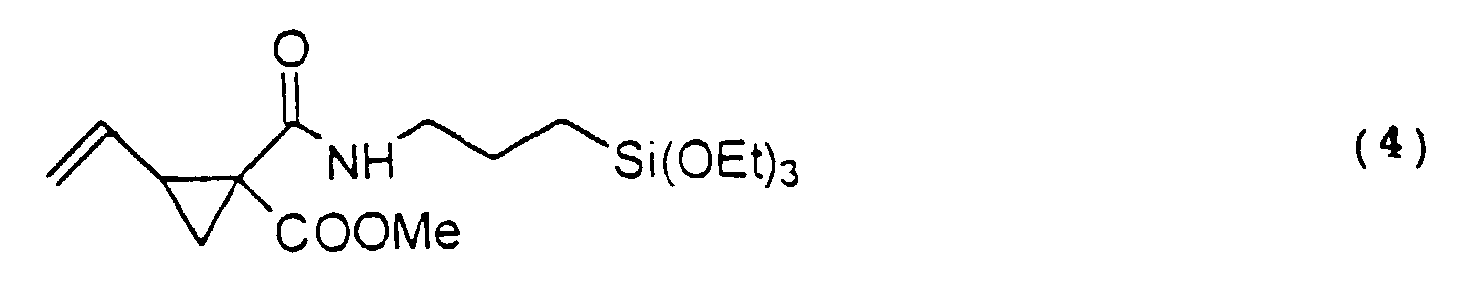
- 1H-NMR (CDCl3):
- 0,6 (t, 2H, CH2Si), 1,25 (m, 11H, CH2, CH3), 1,62 (m, 2H, CH2) , 2,6 (m, 1H, CH), 3,16 (t, 2H, CH2), 3,8 (q, 9H, OCH2, OCH3), 4,80-5,00 (br, 1H, NH), 5,1-5,8 (m, 3H, CH=CH2) ppm.
- IR (Film) :
- 3355, 2979, 1718, 1081 cm-1.

- 1H-NMR (CDCl3):
- 5,00-5,65 (m, 3H, CH=CH2), 4,99 (br, 2H, NH), 3,99 (m, 4H, CH2O), 3,83 (q, 12H, CH2O), 3,18 (t, 4H, CH2N), 1,76 (m, 3H, CH-Cyclopropyl), 1,22 (m 22H, CH2, CH3), 0,61 (t, 4H, CH2Si) ppm.
- IR (Film):
- 3444, 2976, 1718, 1517, 1266, 1077 cm-1.
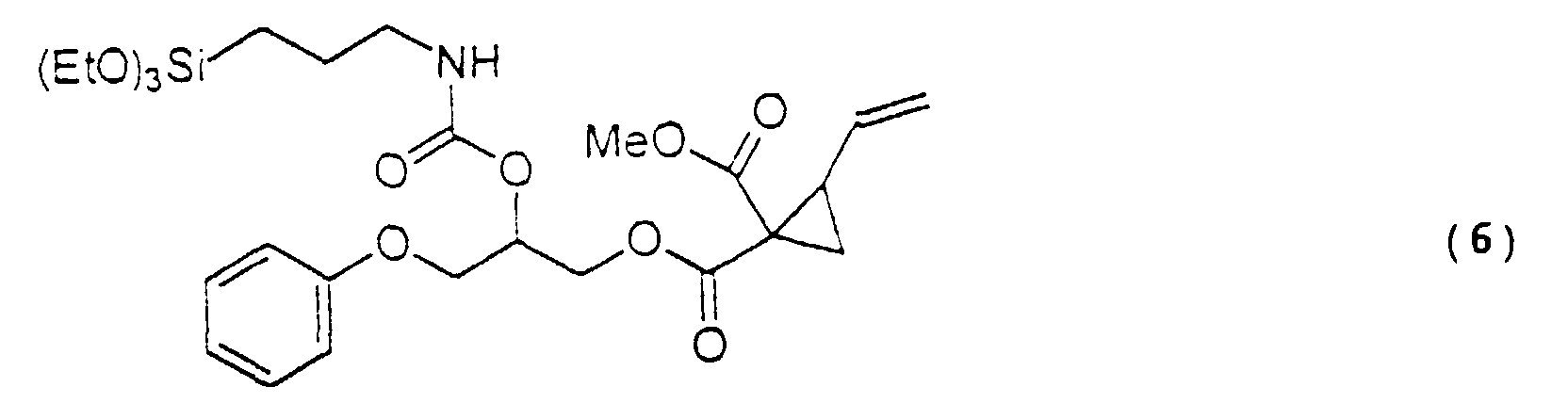
- 1H-NMR (CDCl3):
- 0,5-0,6 (t, 2H, CH2Si), 1,2 (m, 11H, CH2, CH3), 1,5-1,8 (m, 2H, CH2), 2,6 (m, 1H, CH), 3,1-3,4 (t, 2H, CH2), 3,6-3,9 (m, 11H, OCH2, OCH3), 4,1 (m, 1H, CHO), 5,1-5,4 (br, 1H, NH), 6,8-7,3 (5 Harom.) ppm.
- IR (Film) :
- 3385, 2974, 2928, 1729, 1600 cm-1.

- 1H-NMR (CDCl3):
- 0,55-0,66 (t, 4H, CH2Si), 1,15-1,25 (m, 22H, CH3, -CH2-C H 2-CH2-), 1,3-1,8 (br. m, 14H, Cyclohexyl, Cyclopropyl-CH2), 2,55-2,65 (m, 2H, CH), 3,1-3,3 (m, 4H, CH2N), 3,4-3,7 (m, 12H, CH2O), 3,75 (s, 6H, OCH3), 3,85 (t, 4H, CH2), 4,1-4,4 (m, 2H, CHO) , 5,01 (br, 2H, NH), 5,25-5,55 (m, 6H, CH=CH2), ppm.
- IR (Film) :
- 3354, 2975, 1728, 1527, 1078 cm-1.
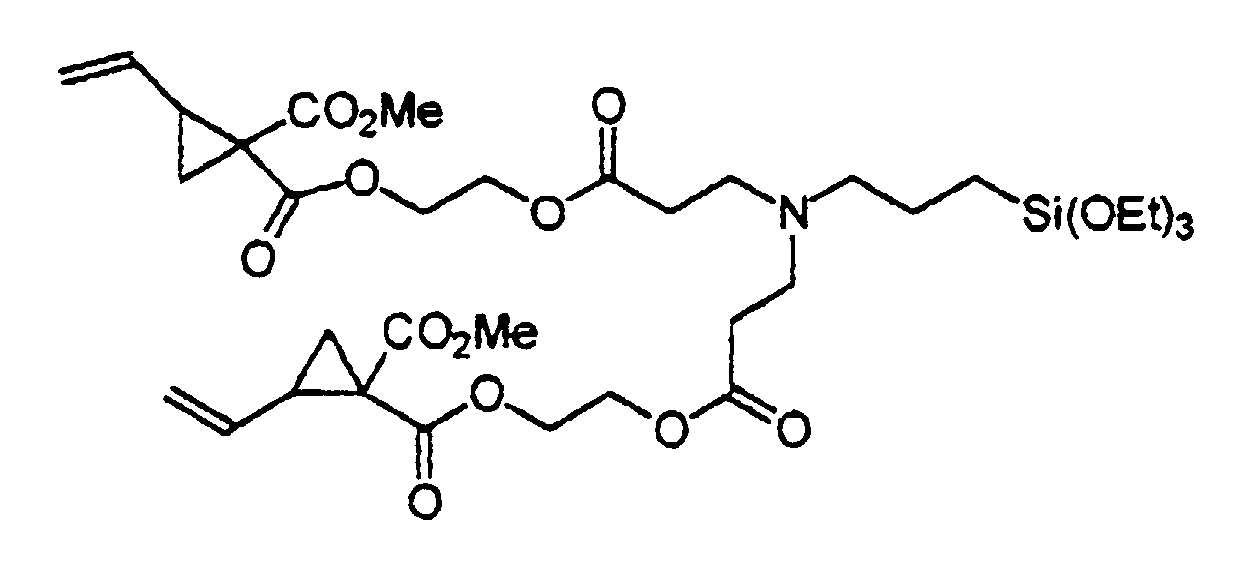
- 1H-NMR (CDCl3):
- 0,56 (t, 2H, SiCH2), 1,22 (t, 9H, CH3), 1,50 (m, 2H, CH2), 1,58-1,76 (m, 4H, Cyclopropyl-CH2), 2,48 (m, 6H, NCH2), 2,61 (m, 2H, Cyclopropyl-CH), 2,78 (t, 4H, OCCH2), 3,74 (s, 6H, OCH3), 3,82 (q, 6H, OCH2), 4,28 (m, 8H, OCH2) und 5,14-5,77 (m, 6H, CH=CH2) ppm.
- IR (Film):
- 2974, 1737 und 1645 cm-1.
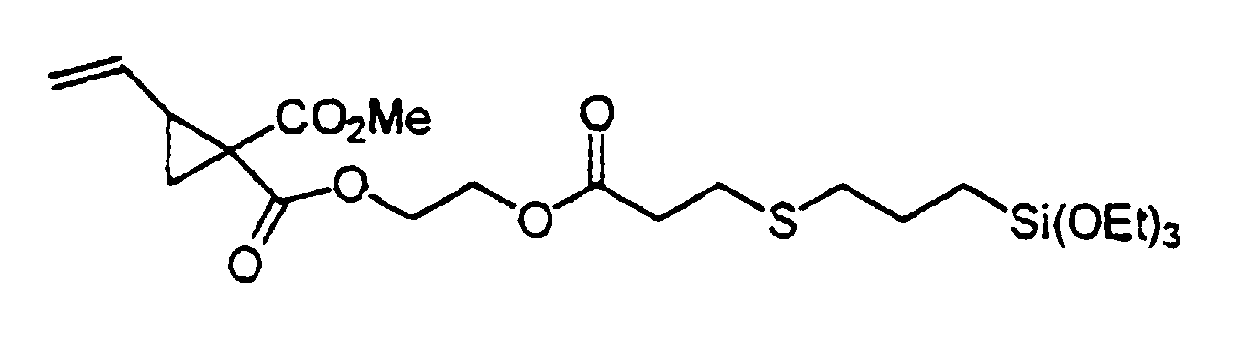
- 1H-NMR (CDCl3):
- 0,73 (t, 2H, SiCH2), 1,24 (s, 12H, CH3), 1,58-1,74 (m, 2H, Cyclopropyl-CH2 und 2H, CH2), 2,52-2,79 (m, 6H, SCH2, OCH und Cyclopropyl-CH), 3,74 (s, 3H, OCH3), 3,82 (q, 6H, OCH2), 4,32 (m, 4H, OCH2) und 5,13-5,84 (m, 3H, CH=CH2) ppm.
- IR Film:
- 2974, 1738 und 1652 cm-1.
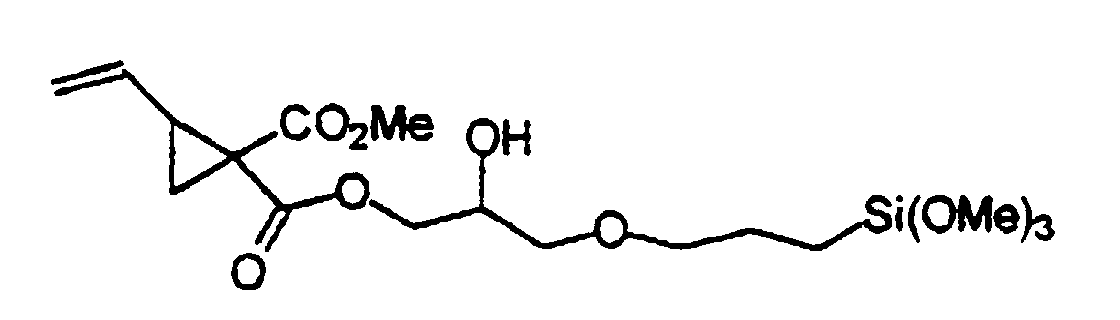
- 1H-NMR (CDCl3):
- 0,68 (br, 2H, SiCH2), 1,73 (br, 2H, CH2), 1,98-2,15 (m, 2H, Cyclopropyl-CH2), 2,61 (m, 1H, Cyclopropyl-CH), 3,40-3,54 (m, 5H, OH-CH-CH 2OCH 2), 3,57 (s, 9H, OCH3), 3,75 (d, 2H, OCH2), 3,83 (s, 3H, OCH3) und 5,24-5,63 (m, 3H, CH=CH2) ppm.
- IR (Film) :
- 3626, 2972, 1736 und 1645 cm-1.

- 1H-NMR (CDCl3):
- 0,62 (br, 4H, SiCH2), 1,24 (t, 18H, CH3), 1,60 (br, 4H, CH2), 2,05-2,19 (m, 2H, Gyclopropyl-CH2), 2,77 (m, 1H, Cyclopropyl-CH), 3,14 (t, 4H, NCH2), 3,76 (s, 12H, OCH2) und 5,22-5,89 (m, 3H, CH=CH2) ppm.
- IR (Film):
- 3346, 2977, 1716 und 1362 cm-1.
Claims (8)
- Hydrolysierbare und polymerisierbare Vinylcyclopropansilane der allgemeinen Formel (I) und Stereoisomere davonwobei die Variablen R, R1, R2, R3, R4, R5, R6, R7, R8, R9, W, X, Y, a, b, c, x, sofern nicht anders angegeben, unabhängig voneinander die folgenden Bedeutungen haben:
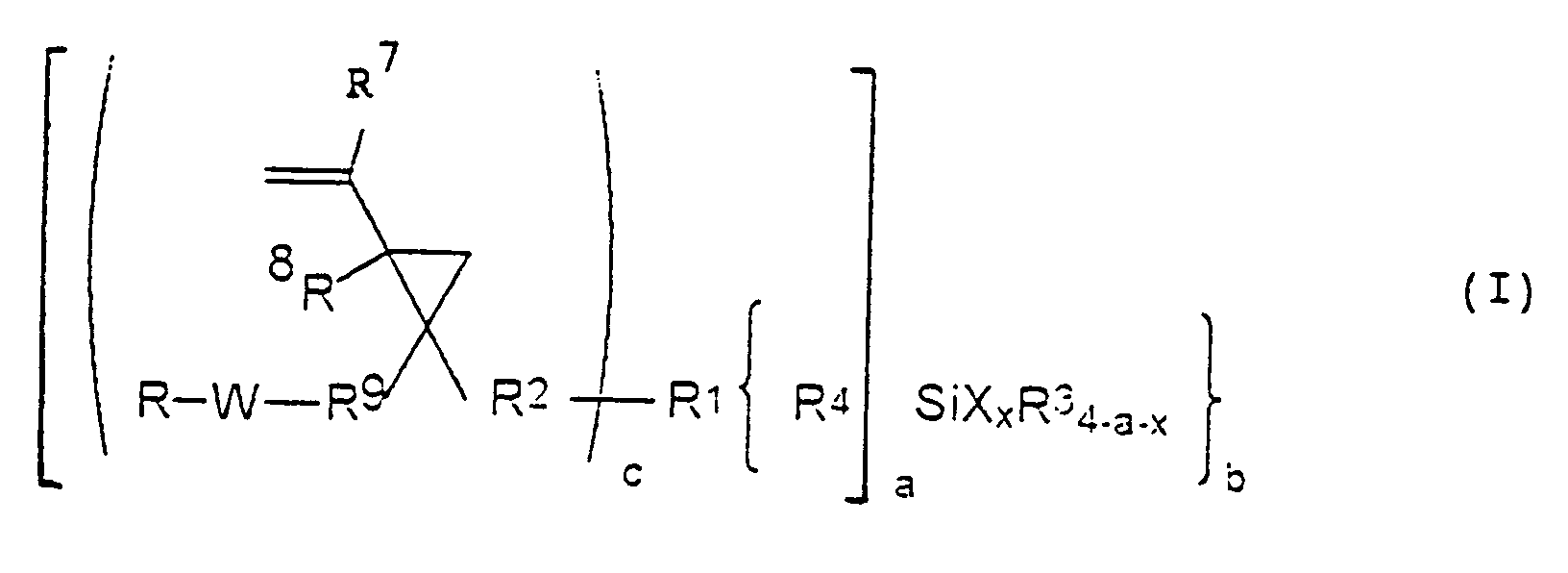
- R =
- Wasserstoff, substituiertes oder unsubstituiertes C1- bis C12-Alkyl, C7- bis C15-Alkylaryl oder C6- bis C14-Aryl oder R3 3-xXxSi-R4-R1-R2-;
- R1 =
- entfällt oder substituiertes oder unsubstituiertes C1- bis C18-Alkylen, C6- bis C18-Arylen, C7- bis C18-Alkylenarylen oder -Arylenalkylen, wobei diese Reste durch mindestens eine Gruppe ausgewählt aus Ether-, Thioether-, Ester-, Carbonyl-, Amid- und Urethangruppe unterbrochen sein oder diese endständig tragen können;
- R2 =
- entfällt oder substituiertes oder unsubstituiertes C1- bis C18-Alkylen, C6- bis C18-Arylen, C7- bis C18-Alkylenarylen oder C7- bis C18- Arylenalkylen, wobei diese Reste durch mindestens eine Gruppe ausgewählt aus Ether-, Thioether-, Ester-, Thioester-, Carbonyl-, Amid- und Urethangruppe unterbrochen sein oder diese endständig tragen können;
- R3 =
- entfällt oder substituiertes oder unsubstituiertes C1- bis C18-Alkyl, C2- bis C18-Alkenyl, C6- bis C18-Aryl, C7- bis C18-Alkylaryl oder C7- bis C18-Arylalkyl, wobei diese Reste durch mindestens eine Gruppe ausgewählt aus Ether-, Thioether-, Ester-, Carbonyl-, Amid- und Urethangruppe unterbrochen sein können;
- R4 =
- entfällt oder substituiertes oder unsubstituiertes -CHR6-CHR6-, -CHR6-CHR6-S-R5, -S-R5-, -Y-CO-NH-R5-oder -CO-O-R5-;
- R5 =
- substituiertes oder unsubstituiertes C1- bis C18-Alkylen, C6- bis C18-Arylen, C6- bis C18-Alkylenarylen oder C6- bis C18-Arylenalkylen, wobei diese Reste durch mindestens eine Gruppe ausgewählt aus Ether-, Thioether-, Ester-, Carbonyl-, Amid- und Urethangruppe unterbrochen sein können;
- R6 =
- Wasserstoff, oder substituiertes oder unsubstituiertes C1- bis C18-Alkyl oder C6 bis C10-Aryl;
- R7 =
- Wasserstoff, oder substituiertes oder unsubstituiertes C1- bis C10-Alkyl, oder Halogen oder Hydroxy;
- R8 =
- Wasserstoff oder substituiertes oder unsubstituiertes C1- bis C10-Alkyl;
- R9 =
- entfällt oder substituiertes oder unsubstituiertes C1- bis C10-Alkylen;
- W =
- entfällt oder Carbonyl-, Ester-, Ether-, Thioether-, Amid- oder Urethangruppe;
- X =
- eine hydrolysierbare Gruppe, nämlich Halogen, Hydroxy, Alkoxy oder Acyloxy;
- Y =
- O oder S;
- a =
- 1, 2 oder 3;
- b =
- 1, 2 oder 3;
- c =
- 1 bis 6; und
- x =
- 1, 2 oder 3;
(i) a+x = 2, 3 oder 4
und(ii) a und/oder b = 1. - Vinylcyclopropansilane nach Anspruch 1, dadurch gekennzeichnet, daß mindestens eine der Variablen der Formel (I), sofern nicht anders angegeben, unabhängig von den übrigen Variablen, die folgende Bedeutung hat:
- R =
- C1- bis C5-Alkyl, Benzyl oder Phenyl oder R3 3-xXxSi-R4-R1-R2-;
- R1 =
- C1- bis C8-Alkylen, wobei diese Reste durch mindestens eine Gruppe ausgewählt aus Ether-, Thioether-, Ester- und Urethangruppe unterbrochen sein können;
- R2 =
- entfällt oder C1- bis C8-Alkylen, wobei diese Reste durch mindestens eine Gruppe ausgewählt aus Ether-, Thioether-, Ester-, Thioester, Carbonyl-, Amid- und Urethangruppe unterbrochen sein oder diese endständig tragen können;
- R3 =
- entfällt oder Methyl, Ethyl oder Phenyl;
- R4 =
- entfällt oder -CHR5-CHR6-, -S-R5-, -Y-CO-NH-R5- oder -CO-O-R5-;
- R5 =
- C1- bis C8-Alkylen, wobei diese Reste durch mindestens eine Gruppe ausgewählt aus Ether-, Thioether-, Ester-, Carbonyl-, Amid- und Urethangruppe unterbrochen sein können;
- R5 =
- Wasserstoff oder C1- bis C5-Alkyl;
- R7 =
- Wasserstoff oder C1- bis C5-Alkyl;
- R8 =
- Wasserstoff oder C1- bis C5-Alkyl;
- R9 =
- entfällt oder C1- bis C3-Alkylen;
- W =
- Ester-, Amid- oder Urethangruppe;
- X =
- Methoxy, Ethoxy oder Chlor;
- Y =
- O oder S;
- a =
- 1;
- b =
- 1;
- c =
- 1 bis 6;
- x =
- 2 oder 3; und/oder
- a+x =
- 3.
- Vinylcyclopropansilane nach Anspruch 1 oder 2, dadurch gekennzeichnet, daß in der Formel (I), sofern nicht anders angegeben, unabhängig von den übrigen Variablen, mindestens eine der Variablen a, b und c = 1.
- Polymerisierbare Kieselsäurekondensate der Vinylcyclopropansilane gemäß einem der Ansprüche 1 bis 3, welche durch Hydrolyse und Kondensation der Vinylcyclopropansilane (I), ggf. in Gegenwart weiterer hydrolysierbarer Verbindungen, erhältlich sind.
- Polymerisate der Vinylcyclopropansilane gemäß einem der Ansprüche 1 bis 3 oder der Kieselsäurekondensate gemäß Anspruch 4.
- Zusammensetzungen mit Gehalt an den Vinylcyclopropansilanen gemäß einem der Ansprüche 1 bis 3 oder an den Kieselsäurekondensaten gemäß Anspruch 4.
- Zusammensetzungen nach Anspruch 6, dieenthalten.(a) 5 bis 90, insbesondere 10 bis 70 Gew.-%, bezogen auf die Zusammensetzung, Kieselsäurekondensat gemäß Anspruch 4,(b) 0 bis 80, insbesondere 0 bis 50 Gew.-%, bezogen auf die Zusammensetzung, Verdünnermonomer,(c) 0,1 bis 5, insbesondere 0,2 bis 2,0 Gew.-%, bezogen auf die Zusammensetzung, Polymerisationsinitiator, und(d) 0 bis 90, insbesondere 0 bis 80 Gew.-%, bezogen auf die Zusammensetzung, Füllstoffe
- Verwendung von den Vinylcyclopropansilanen gemäß einem der Ansprüche 1 bis 3, den Kieselsäurekondensaten nach Anspruch 4, den Polymerisaten nach Anspruch 5 oder den Zusammensetzungen nach Anspruch 6 oder 7 als Dentalmaterial oder als Bestandteil von Dentalmaterial.
Applications Claiming Priority (2)
| Application Number | Priority Date | Filing Date | Title |
|---|---|---|---|
| DE19714320 | 1997-03-25 | ||
| DE19714320A DE19714320A1 (de) | 1997-03-25 | 1997-03-25 | Hydrolysierbare und polymerisierbare Vinylcyclopropansilane |
Publications (3)
| Publication Number | Publication Date |
|---|---|
| EP0867444A2 true EP0867444A2 (de) | 1998-09-30 |
| EP0867444A3 EP0867444A3 (de) | 2000-06-28 |
| EP0867444B1 EP0867444B1 (de) | 2003-10-08 |
Family
ID=7825699
Family Applications (1)
| Application Number | Title | Priority Date | Filing Date |
|---|---|---|---|
| EP98250096A Expired - Lifetime EP0867444B1 (de) | 1997-03-25 | 1998-03-20 | Hydrolysierbare und polymerisierbare Vinylcyclopropansilane |
Country Status (5)
| Country | Link |
|---|---|
| EP (1) | EP0867444B1 (de) |
| JP (1) | JPH10298187A (de) |
| AT (1) | ATE251628T1 (de) |
| CA (1) | CA2232915C (de) |
| DE (2) | DE19714320A1 (de) |
Cited By (6)
| Publication number | Priority date | Publication date | Assignee | Title |
|---|---|---|---|---|
| EP0943601A1 (de) * | 1998-03-17 | 1999-09-22 | Ivoclar Ag | Vinylcyclopropan-(Meth) acrylate und deren Verwendung |
| WO2001008639A1 (en) * | 1999-07-28 | 2001-02-08 | Dentsply International Inc. | Siloxane containing macromonomers and dental composites thereof |
| EP1036827A3 (de) * | 1999-03-11 | 2001-10-17 | Fraunhofer-Gesellschaft zur Förderung der angewandten Forschung e.V. | Verfahren zur Herstellung einer bewitterungsbeständigen Beschichtung |
| WO2007017488A1 (de) * | 2005-08-11 | 2007-02-15 | Siemens Aktiengesellschaft | Beschichtungen für den einsatz im bereich der energieerzeugung |
| EP3278786A1 (de) | 2016-08-03 | 2018-02-07 | Ivoclar Vivadent AG | Dentalmaterialien auf der basis von urethangruppenhaltigen vinylcyclopropan-derivaten |
| DE102016214389A1 (de) | 2016-08-03 | 2018-02-08 | Ivoclar Vivadent Ag | Dentalmaterialien auf der Basis von monofunktionellen Vinylcyclopropan-Derivaten |
Families Citing this family (7)
| Publication number | Priority date | Publication date | Assignee | Title |
|---|---|---|---|---|
| DE19903177C5 (de) * | 1999-01-21 | 2010-09-16 | Ivoclar Vivadent Ag | Verwendung von Materialien auf der Basis von Polysiloxanen als Dentalmaterialien |
| US6569917B1 (en) | 1999-01-21 | 2003-05-27 | Ivoclar Ag | Dental materials based on polysiloxanes |
| DE19937093A1 (de) * | 1999-08-06 | 2001-02-08 | Espe Dental Ag | Adhäsivsysteme III |
| DE10143383A1 (de) * | 2001-09-05 | 2003-03-27 | Basf Coatings Ag | Thermisch und mit aktinischer Strahlung härtbare Stoffgemische, Verfahren zu ihrer Herstellung und ihre Verwendung |
| JP2007291056A (ja) * | 2006-03-29 | 2007-11-08 | Fujifilm Corp | ビニルシクロプロパン化合物、及びホログラフィック記録用組成物、並びに光記録媒体、及び光記録方法 |
| JP5525699B2 (ja) * | 2008-05-27 | 2014-06-18 | 株式会社Kri | 高分子イオン性化合物 |
| DE102012204290A1 (de) * | 2012-03-19 | 2013-09-19 | Evonik Degussa Gmbh | Addukte aus Isocyanatoalkyl-trialkoxysilanen und aliphatischen, alkyl-verzweigten Diolen oder Polyolen |
Family Cites Families (1)
| Publication number | Priority date | Publication date | Assignee | Title |
|---|---|---|---|---|
| EP0058514A1 (de) * | 1981-02-17 | 1982-08-25 | Dentsply International, Inc. | Durch Strahlung aushärtende Klebstoffe auf Silanbasis |
-
1997
- 1997-03-25 DE DE19714320A patent/DE19714320A1/de not_active Ceased
-
1998
- 1998-03-20 DE DE59809834T patent/DE59809834D1/de not_active Expired - Lifetime
- 1998-03-20 EP EP98250096A patent/EP0867444B1/de not_active Expired - Lifetime
- 1998-03-20 AT AT98250096T patent/ATE251628T1/de not_active IP Right Cessation
- 1998-03-23 CA CA002232915A patent/CA2232915C/en not_active Expired - Fee Related
- 1998-03-25 JP JP10077594A patent/JPH10298187A/ja not_active Withdrawn
Cited By (10)
| Publication number | Priority date | Publication date | Assignee | Title |
|---|---|---|---|---|
| EP0943601A1 (de) * | 1998-03-17 | 1999-09-22 | Ivoclar Ag | Vinylcyclopropan-(Meth) acrylate und deren Verwendung |
| EP1036827A3 (de) * | 1999-03-11 | 2001-10-17 | Fraunhofer-Gesellschaft zur Förderung der angewandten Forschung e.V. | Verfahren zur Herstellung einer bewitterungsbeständigen Beschichtung |
| WO2001008639A1 (en) * | 1999-07-28 | 2001-02-08 | Dentsply International Inc. | Siloxane containing macromonomers and dental composites thereof |
| WO2007017488A1 (de) * | 2005-08-11 | 2007-02-15 | Siemens Aktiengesellschaft | Beschichtungen für den einsatz im bereich der energieerzeugung |
| CN101273104B (zh) * | 2005-08-11 | 2013-03-27 | 西门子公司 | 用于能量产生领域的涂层 |
| EP3278786A1 (de) | 2016-08-03 | 2018-02-07 | Ivoclar Vivadent AG | Dentalmaterialien auf der basis von urethangruppenhaltigen vinylcyclopropan-derivaten |
| DE102016214389A1 (de) | 2016-08-03 | 2018-02-08 | Ivoclar Vivadent Ag | Dentalmaterialien auf der Basis von monofunktionellen Vinylcyclopropan-Derivaten |
| WO2018024706A1 (de) | 2016-08-03 | 2018-02-08 | Ivoclar Vivadent Ag | Dentalmaterialien auf der basis von urethangruppenhaltigen vinylcyclopropan-derivaten |
| US11135136B2 (en) | 2016-08-03 | 2021-10-05 | Ivoclar Vivadent Ag | Dental materials based on urethane-group-containing vinylcyclopropane derivatives |
| DE102016214389B4 (de) | 2016-08-03 | 2024-12-05 | Ivoclar Vivadent Ag | Dentalmaterialien auf der Basis von monofunktionellen Vinylcyclopropan-Derivaten |
Also Published As
| Publication number | Publication date |
|---|---|
| EP0867444A3 (de) | 2000-06-28 |
| CA2232915C (en) | 2001-12-11 |
| ATE251628T1 (de) | 2003-10-15 |
| EP0867444B1 (de) | 2003-10-08 |
| JPH10298187A (ja) | 1998-11-10 |
| DE19714320A1 (de) | 1998-10-01 |
| CA2232915A1 (en) | 1998-09-25 |
| DE59809834D1 (de) | 2003-11-13 |
Similar Documents
| Publication | Publication Date | Title |
|---|---|---|
| DE19943712C1 (de) | Hydrolysierbare und polymerisierbare Silane auf der Basis von Methylendithiepan | |
| DE19903177C5 (de) | Verwendung von Materialien auf der Basis von Polysiloxanen als Dentalmaterialien | |
| EP1139973B1 (de) | Polymerisierbare massen auf der basis von zur aushärtung befähigten siloxanverbindungen | |
| EP0804919B1 (de) | Verwendung einer Zusammensetzung als Dentalmaterial und Dentalmaterial | |
| US6096903A (en) | Hydrolysable and polymerizable oxetane silanes | |
| EP0867443B1 (de) | Hydrolysierbare und polymerisierbare Oxetansilane | |
| EP1141094B1 (de) | Vernetzbare monomere auf cyclosiloxanbasis, deren herstellung und deren verwendung in polymerisierbaren massen | |
| EP0867444B1 (de) | Hydrolysierbare und polymerisierbare Vinylcyclopropansilane | |
| WO2012157566A1 (ja) | 歯科材料、歯科材料組成物、歯科修復材料および硬化物 | |
| EP0254950A2 (de) | (Meth)-acrylsäureester | |
| EP0321841B1 (de) | Ester-Urethan-(Meth)-acrylsäurederivate | |
| EP0798286A1 (de) | Multifunktionelle Vinylcy-clopropan-Derivate | |
| US6034151A (en) | Hydrolyzable and polymerizable vinylcyclopropane silanes | |
| EP2743267B1 (de) | Auf polymerisierbaren Alkinen und Aziden basierende Dentalmassen | |
| DE4005231A1 (de) | Dentalwerkstoffe | |
| DE29924636U1 (de) | Dentalmaterialien auf der Basis von Polysiloxanen |
Legal Events
| Date | Code | Title | Description |
|---|---|---|---|
| PUAI | Public reference made under article 153(3) epc to a published international application that has entered the european phase |
Free format text: ORIGINAL CODE: 0009012 |
|
| AK | Designated contracting states |
Kind code of ref document: A2 Designated state(s): AT CH DE FR GB IT LI SE |
|
| AX | Request for extension of the european patent |
Free format text: AL;LT;LV;MK;RO;SI |
|
| K1C3 | Correction of patent application (complete document) published |
Effective date: 19980930 |
|
| PUAL | Search report despatched |
Free format text: ORIGINAL CODE: 0009013 |
|
| AK | Designated contracting states |
Kind code of ref document: A3 Designated state(s): AT BE CH DE DK ES FI FR GB GR IE IT LI LU MC NL PT SE |
|
| AX | Request for extension of the european patent |
Free format text: AL;LT;LV;MK;RO;SI |
|
| RIC1 | Information provided on ipc code assigned before grant |
Free format text: 7C 07F 7/18 A, 7C 08G 77/58 B, 7A 61K 6/093 B, 7C 08G 77/22 B |
|
| 17P | Request for examination filed |
Effective date: 20000724 |
|
| AKX | Designation fees paid |
Free format text: AT CH DE FR GB IT LI SE |
|
| RAP1 | Party data changed (applicant data changed or rights of an application transferred) |
Owner name: IVOCLAR VIVADENT AG |
|
| 17Q | First examination report despatched |
Effective date: 20020206 |
|
| GRAH | Despatch of communication of intention to grant a patent |
Free format text: ORIGINAL CODE: EPIDOS IGRA |
|
| GRAH | Despatch of communication of intention to grant a patent |
Free format text: ORIGINAL CODE: EPIDOS IGRA |
|
| RIN1 | Information on inventor provided before grant (corrected) |
Inventor name: RHEINBERGER, VOLKER, DR. Inventor name: STEIN, SABINE Inventor name: ZEUNER, FRANK, DR. Inventor name: VOELKEL, THOMAS, DR. Inventor name: MOSZNER, NORBERT, PROF. DR. |
|
| GRAA | (expected) grant |
Free format text: ORIGINAL CODE: 0009210 |
|
| AK | Designated contracting states |
Kind code of ref document: B1 Designated state(s): AT CH DE FR GB IT LI SE |
|
| REG | Reference to a national code |
Ref country code: GB Ref legal event code: FG4D Free format text: NOT ENGLISH |
|
| REG | Reference to a national code |
Ref country code: CH Ref legal event code: EP |
|
| REG | Reference to a national code |
Ref country code: CH Ref legal event code: NV Representative=s name: KELLER & PARTNER PATENTANWAELTE AG |
|
| REF | Corresponds to: |
Ref document number: 59809834 Country of ref document: DE Date of ref document: 20031113 Kind code of ref document: P |
|
| REG | Reference to a national code |
Ref country code: SE Ref legal event code: TRGR |
|
| GBT | Gb: translation of ep patent filed (gb section 77(6)(a)/1977) |
Effective date: 20040115 |
|
| PGFP | Annual fee paid to national office [announced via postgrant information from national office to epo] |
Ref country code: SE Payment date: 20040217 Year of fee payment: 7 |
|
| ET | Fr: translation filed | ||
| PLBE | No opposition filed within time limit |
Free format text: ORIGINAL CODE: 0009261 |
|
| STAA | Information on the status of an ep patent application or granted ep patent |
Free format text: STATUS: NO OPPOSITION FILED WITHIN TIME LIMIT |
|
| 26N | No opposition filed |
Effective date: 20040709 |
|
| PGFP | Annual fee paid to national office [announced via postgrant information from national office to epo] |
Ref country code: AT Payment date: 20050218 Year of fee payment: 8 |
|
| PG25 | Lapsed in a contracting state [announced via postgrant information from national office to epo] |
Ref country code: IT Free format text: LAPSE BECAUSE OF NON-PAYMENT OF DUE FEES;WARNING: LAPSES OF ITALIAN PATENTS WITH EFFECTIVE DATE BEFORE 2007 MAY HAVE OCCURRED AT ANY TIME BEFORE 2007. THE CORRECT EFFECTIVE DATE MAY BE DIFFERENT FROM THE ONE RECORDED. Effective date: 20050320 Ref country code: AT Free format text: LAPSE BECAUSE OF NON-PAYMENT OF DUE FEES Effective date: 20050320 |
|
| PG25 | Lapsed in a contracting state [announced via postgrant information from national office to epo] |
Ref country code: SE Free format text: LAPSE BECAUSE OF NON-PAYMENT OF DUE FEES Effective date: 20050321 |
|
| EUG | Se: european patent has lapsed | ||
| PGFP | Annual fee paid to national office [announced via postgrant information from national office to epo] |
Ref country code: GB Payment date: 20090324 Year of fee payment: 12 |
|
| PGFP | Annual fee paid to national office [announced via postgrant information from national office to epo] |
Ref country code: FR Payment date: 20090318 Year of fee payment: 12 |
|
| PGFP | Annual fee paid to national office [announced via postgrant information from national office to epo] |
Ref country code: IT Payment date: 20090326 Year of fee payment: 12 |
|
| PGRI | Patent reinstated in contracting state [announced from national office to epo] |
Ref country code: IT Effective date: 20091201 |
|
| GBPC | Gb: european patent ceased through non-payment of renewal fee |
Effective date: 20100320 |
|
| REG | Reference to a national code |
Ref country code: FR Ref legal event code: ST Effective date: 20101130 |
|
| PG25 | Lapsed in a contracting state [announced via postgrant information from national office to epo] |
Ref country code: FR Free format text: LAPSE BECAUSE OF NON-PAYMENT OF DUE FEES Effective date: 20100331 |
|
| PG25 | Lapsed in a contracting state [announced via postgrant information from national office to epo] |
Ref country code: IT Free format text: LAPSE BECAUSE OF NON-PAYMENT OF DUE FEES Effective date: 20100320 Ref country code: GB Free format text: LAPSE BECAUSE OF NON-PAYMENT OF DUE FEES Effective date: 20100320 |
|
| PGFP | Annual fee paid to national office [announced via postgrant information from national office to epo] |
Ref country code: CH Payment date: 20140324 Year of fee payment: 17 Ref country code: DE Payment date: 20140325 Year of fee payment: 17 |
|
| REG | Reference to a national code |
Ref country code: CH Ref legal event code: PCAR Free format text: NEW ADDRESS: EIGERSTRASSE 2 POSTFACH, 3000 BERN 14 (CH) |
|
| REG | Reference to a national code |
Ref country code: DE Ref legal event code: R119 Ref document number: 59809834 Country of ref document: DE |
|
| REG | Reference to a national code |
Ref country code: CH Ref legal event code: PL |
|
| PG25 | Lapsed in a contracting state [announced via postgrant information from national office to epo] |
Ref country code: CH Free format text: LAPSE BECAUSE OF NON-PAYMENT OF DUE FEES Effective date: 20150331 Ref country code: LI Free format text: LAPSE BECAUSE OF NON-PAYMENT OF DUE FEES Effective date: 20150331 Ref country code: DE Free format text: LAPSE BECAUSE OF NON-PAYMENT OF DUE FEES Effective date: 20151001 |