WO2018043149A1 - Membrane de séparation de gaz, module de séparation de gaz, dispositif de séparation de gaz, procédé de séparation de gaz, et composé de polyimide - Google Patents
Membrane de séparation de gaz, module de séparation de gaz, dispositif de séparation de gaz, procédé de séparation de gaz, et composé de polyimide Download PDFInfo
- Publication number
- WO2018043149A1 WO2018043149A1 PCT/JP2017/029540 JP2017029540W WO2018043149A1 WO 2018043149 A1 WO2018043149 A1 WO 2018043149A1 JP 2017029540 W JP2017029540 W JP 2017029540W WO 2018043149 A1 WO2018043149 A1 WO 2018043149A1
- Authority
- WO
- WIPO (PCT)
- Prior art keywords
- group
- gas separation
- formula
- carbon atoms
- substituent
- Prior art date
- Legal status (The legal status is an assumption and is not a legal conclusion. Google has not performed a legal analysis and makes no representation as to the accuracy of the status listed.)
- Ceased
Links
Images

Classifications
-
- B—PERFORMING OPERATIONS; TRANSPORTING
- B01—PHYSICAL OR CHEMICAL PROCESSES OR APPARATUS IN GENERAL
- B01D—SEPARATION
- B01D53/00—Separation of gases or vapours; Recovering vapours of volatile solvents from gases; Chemical or biological purification of waste gases, e.g. engine exhaust gases, smoke, fumes, flue gases, aerosols
- B01D53/22—Separation of gases or vapours; Recovering vapours of volatile solvents from gases; Chemical or biological purification of waste gases, e.g. engine exhaust gases, smoke, fumes, flue gases, aerosols by diffusion
-
- B—PERFORMING OPERATIONS; TRANSPORTING
- B01—PHYSICAL OR CHEMICAL PROCESSES OR APPARATUS IN GENERAL
- B01D—SEPARATION
- B01D53/00—Separation of gases or vapours; Recovering vapours of volatile solvents from gases; Chemical or biological purification of waste gases, e.g. engine exhaust gases, smoke, fumes, flue gases, aerosols
- B01D53/22—Separation of gases or vapours; Recovering vapours of volatile solvents from gases; Chemical or biological purification of waste gases, e.g. engine exhaust gases, smoke, fumes, flue gases, aerosols by diffusion
- B01D53/228—Separation of gases or vapours; Recovering vapours of volatile solvents from gases; Chemical or biological purification of waste gases, e.g. engine exhaust gases, smoke, fumes, flue gases, aerosols by diffusion characterised by specific membranes
-
- B—PERFORMING OPERATIONS; TRANSPORTING
- B01—PHYSICAL OR CHEMICAL PROCESSES OR APPARATUS IN GENERAL
- B01D—SEPARATION
- B01D71/00—Semi-permeable membranes for separation processes or apparatus characterised by the material; Manufacturing processes specially adapted therefor
- B01D71/06—Organic material
- B01D71/56—Polyamides, e.g. polyester-amides
-
- B—PERFORMING OPERATIONS; TRANSPORTING
- B01—PHYSICAL OR CHEMICAL PROCESSES OR APPARATUS IN GENERAL
- B01D—SEPARATION
- B01D71/00—Semi-permeable membranes for separation processes or apparatus characterised by the material; Manufacturing processes specially adapted therefor
- B01D71/06—Organic material
- B01D71/58—Other polymers having nitrogen in the main chain, with or without oxygen or carbon only
- B01D71/62—Polycondensates having nitrogen-containing heterocyclic rings in the main chain
- B01D71/64—Polyimides; Polyamide-imides; Polyester-imides; Polyamide acids or similar polyimide precursors
-
- C—CHEMISTRY; METALLURGY
- C08—ORGANIC MACROMOLECULAR COMPOUNDS; THEIR PREPARATION OR CHEMICAL WORKING-UP; COMPOSITIONS BASED THEREON
- C08G—MACROMOLECULAR COMPOUNDS OBTAINED OTHERWISE THAN BY REACTIONS ONLY INVOLVING UNSATURATED CARBON-TO-CARBON BONDS
- C08G73/00—Macromolecular compounds obtained by reactions forming a linkage containing nitrogen with or without oxygen or carbon in the main chain of the macromolecule, not provided for in groups C08G12/00 - C08G71/00
- C08G73/06—Polycondensates having nitrogen-containing heterocyclic rings in the main chain of the macromolecule
- C08G73/10—Polyimides; Polyester-imides; Polyamide-imides; Polyamide acids or similar polyimide precursors
-
- C—CHEMISTRY; METALLURGY
- C08—ORGANIC MACROMOLECULAR COMPOUNDS; THEIR PREPARATION OR CHEMICAL WORKING-UP; COMPOSITIONS BASED THEREON
- C08G—MACROMOLECULAR COMPOUNDS OBTAINED OTHERWISE THAN BY REACTIONS ONLY INVOLVING UNSATURATED CARBON-TO-CARBON BONDS
- C08G73/00—Macromolecular compounds obtained by reactions forming a linkage containing nitrogen with or without oxygen or carbon in the main chain of the macromolecule, not provided for in groups C08G12/00 - C08G71/00
- C08G73/06—Polycondensates having nitrogen-containing heterocyclic rings in the main chain of the macromolecule
- C08G73/10—Polyimides; Polyester-imides; Polyamide-imides; Polyamide acids or similar polyimide precursors
- C08G73/1039—Polyimides; Polyester-imides; Polyamide-imides; Polyamide acids or similar polyimide precursors comprising halogen-containing substituents
-
- C—CHEMISTRY; METALLURGY
- C08—ORGANIC MACROMOLECULAR COMPOUNDS; THEIR PREPARATION OR CHEMICAL WORKING-UP; COMPOSITIONS BASED THEREON
- C08G—MACROMOLECULAR COMPOUNDS OBTAINED OTHERWISE THAN BY REACTIONS ONLY INVOLVING UNSATURATED CARBON-TO-CARBON BONDS
- C08G73/00—Macromolecular compounds obtained by reactions forming a linkage containing nitrogen with or without oxygen or carbon in the main chain of the macromolecule, not provided for in groups C08G12/00 - C08G71/00
- C08G73/06—Polycondensates having nitrogen-containing heterocyclic rings in the main chain of the macromolecule
- C08G73/10—Polyimides; Polyester-imides; Polyamide-imides; Polyamide acids or similar polyimide precursors
- C08G73/1075—Partially aromatic polyimides
- C08G73/1078—Partially aromatic polyimides wholly aromatic in the diamino moiety
-
- C—CHEMISTRY; METALLURGY
- C08—ORGANIC MACROMOLECULAR COMPOUNDS; THEIR PREPARATION OR CHEMICAL WORKING-UP; COMPOSITIONS BASED THEREON
- C08G—MACROMOLECULAR COMPOUNDS OBTAINED OTHERWISE THAN BY REACTIONS ONLY INVOLVING UNSATURATED CARBON-TO-CARBON BONDS
- C08G73/00—Macromolecular compounds obtained by reactions forming a linkage containing nitrogen with or without oxygen or carbon in the main chain of the macromolecule, not provided for in groups C08G12/00 - C08G71/00
- C08G73/06—Polycondensates having nitrogen-containing heterocyclic rings in the main chain of the macromolecule
- C08G73/10—Polyimides; Polyester-imides; Polyamide-imides; Polyamide acids or similar polyimide precursors
- C08G73/1075—Partially aromatic polyimides
- C08G73/1082—Partially aromatic polyimides wholly aromatic in the tetracarboxylic moiety
-
- B—PERFORMING OPERATIONS; TRANSPORTING
- B01—PHYSICAL OR CHEMICAL PROCESSES OR APPARATUS IN GENERAL
- B01D—SEPARATION
- B01D2256/00—Main component in the product gas stream after treatment
- B01D2256/24—Hydrocarbons
- B01D2256/245—Methane
-
- B—PERFORMING OPERATIONS; TRANSPORTING
- B01—PHYSICAL OR CHEMICAL PROCESSES OR APPARATUS IN GENERAL
- B01D—SEPARATION
- B01D2257/00—Components to be removed
- B01D2257/50—Carbon oxides
- B01D2257/504—Carbon dioxide
-
- B—PERFORMING OPERATIONS; TRANSPORTING
- B01—PHYSICAL OR CHEMICAL PROCESSES OR APPARATUS IN GENERAL
- B01D—SEPARATION
- B01D67/00—Processes specially adapted for manufacturing semi-permeable membranes for separation processes or apparatus
-
- B—PERFORMING OPERATIONS; TRANSPORTING
- B01—PHYSICAL OR CHEMICAL PROCESSES OR APPARATUS IN GENERAL
- B01D—SEPARATION
- B01D69/00—Semi-permeable membranes for separation processes or apparatus characterised by their form, structure or properties; Manufacturing processes specially adapted therefor
-
- Y—GENERAL TAGGING OF NEW TECHNOLOGICAL DEVELOPMENTS; GENERAL TAGGING OF CROSS-SECTIONAL TECHNOLOGIES SPANNING OVER SEVERAL SECTIONS OF THE IPC; TECHNICAL SUBJECTS COVERED BY FORMER USPC CROSS-REFERENCE ART COLLECTIONS [XRACs] AND DIGESTS
- Y02—TECHNOLOGIES OR APPLICATIONS FOR MITIGATION OR ADAPTATION AGAINST CLIMATE CHANGE
- Y02C—CAPTURE, STORAGE, SEQUESTRATION OR DISPOSAL OF GREENHOUSE GASES [GHG]
- Y02C20/00—Capture or disposal of greenhouse gases
- Y02C20/40—Capture or disposal of greenhouse gases of CO2
-
- Y—GENERAL TAGGING OF NEW TECHNOLOGICAL DEVELOPMENTS; GENERAL TAGGING OF CROSS-SECTIONAL TECHNOLOGIES SPANNING OVER SEVERAL SECTIONS OF THE IPC; TECHNICAL SUBJECTS COVERED BY FORMER USPC CROSS-REFERENCE ART COLLECTIONS [XRACs] AND DIGESTS
- Y02—TECHNOLOGIES OR APPLICATIONS FOR MITIGATION OR ADAPTATION AGAINST CLIMATE CHANGE
- Y02P—CLIMATE CHANGE MITIGATION TECHNOLOGIES IN THE PRODUCTION OR PROCESSING OF GOODS
- Y02P20/00—Technologies relating to chemical industry
- Y02P20/151—Reduction of greenhouse gas [GHG] emissions, e.g. CO2
Definitions
- the present invention relates to a gas separation membrane, a gas separation module, a gas separation device, a gas separation method, and a polyimide compound.
- a material composed of a polymer compound has gas permeability specific to each material. Based on the properties of the gas separation membrane, a desired gas component can be selectively permeated and separated by a membrane made of a specific polymer compound.
- gas separation membranes As an industrial application of gas separation membranes, it is considered to separate and recover carbon dioxide from large-scale carbon dioxide generation sources in thermal power plants, cement plants, steelworks blast furnaces, etc., in connection with the problem of global warming.
- Natural gas and biogas gas generated by fermentation or anaerobic digestion, such as biological waste, organic fertilizer, biodegradable substances, sewage, garbage, or energy crops
- use of a gas separation membrane has been studied (Patent Document 1).
- the membrane In an actual plant, the membrane is plasticized due to high pressure conditions or the influence of impurities (for example, benzene, toluene, xylene) present in natural gas, and this causes a problem in that gas separation selectivity is lowered. Therefore, the gas separation membrane is not only improved in gas permeability and gas separation selectivity, but also has a plasticity that can continuously exhibit good gas permeability and gas separation selectivity under high pressure conditions and in the presence of the impurities. Resistance to crystallization is also required.
- Patent Document 3 employs a 1,3-phenylenediamine component having a substituent at the 2-position and at least one 4- to 6-position as the diamine component of the polyimide compound.
- the gas separation membrane using this polyimide compound in the gas separation layer has gas permeability even under high pressure by making at least one of the substituents at the position and the substituents at the 4-6 position a specific polar group. And gas separation selectivity and high resistance against impurities such as toluene.
- the gas separation layer In order to obtain a practical gas separation membrane, the gas separation layer must be made thin to ensure sufficient gas permeability, and a higher degree of gas separation selectivity must be realized.
- a method for thinning the gas separation layer there is a method in which a polymer compound such as a polyimide compound is made into an asymmetric membrane by a phase separation method, and a portion contributing to separation is made into a thin layer called a dense layer or a skin layer.
- a portion other than the dense layer is allowed to function as a support layer that bears the mechanical strength of the membrane.
- the gas separation layer responsible for the gas separation function and the support layer responsible for the mechanical strength are made of different materials, and the gas separation layer having gas separation ability is thinly formed on the gas permeable support layer.
- the form of the composite film formed in the above is also known.
- the present invention relates to a gas separation membrane that realizes both gas permeability and gas separation selectivity at a sufficient level even when used under high pressure conditions, and enables high-speed and highly selective gas separation.
- the present invention also relates to a gas separation membrane that can maintain good gas separation performance even when it comes into contact with toluene, which is an impurity component.
- the present invention relates to a gas separation module, a gas separation device, and a gas separation method using the gas separation membrane.
- the present invention also relates to a polyimide compound suitable as a constituent material of the gas separation layer of the gas separation membrane.
- the present inventors have a gas separation membrane having a gas separation layer using a polyimide compound, and the diamine component of this polyimide compound has a ring having a substituted sulfamoyl group having a specific structure.
- a gas separation membrane having a gas separation layer containing a polyimide compound as a constituent material The gas separation membrane in which the said polyimide compound contains the repeating unit represented by following formula (I).
- Xa represents an oxygen atom, a nitrogen atom and / or a sulfur atom group, or an aryl group having a fluorine atom in the substituent.
- Xb represents a hydrogen atom or a substituent.
- X a is a structure selected from OH, NH and SH At least one part.
- R a represents a group represented by any of the following formulas (I-1) to (I-28).
- X 1 to X 3 each represents a single bond or a divalent group
- L independently represents —CH ⁇ CH— or —CH 2 —
- R 1 and R 2 each represents a hydrogen atom or a substituent.
- * Indicates a binding site with the carbonyl group shown in formula (I).
- R b represents a group represented by any of the following formulas (I-29) to (I-42).
- X 4 to X 8 represent a single bond or a divalent group
- L represents —CH ⁇ CH— or —CH 2 —
- R Z represents a substituent
- * represents in the formula (I).
- d is each independently an integer of 0 to 3
- e is independently an integer of 0 to 4
- f is independently of an integer of 0 to 5
- g is 0 to 6
- H represents an integer of 0 to 7
- each independently represents an integer of 0 to 9
- k represents an integer of 0 to 10.
- q represents 0 or 1 each independently.
- R a , X b, A a, A b and A c are respectively the formula (I-a) in the R a, X b, A a , A b and A c synonymous It is.
- Xc represents a substituent.
- X c is selected from OH, NH and SH Having at least one structure.
- the support layer is composed of a porous layer and a nonwoven fabric layer, The gas separation membrane according to [10], wherein the nonwoven fabric layer, the porous layer, and the gas separation layer are provided in this order.
- the gas to be separated is a mixed gas of carbon dioxide and methane
- the permeation rate of carbon dioxide at 40 ° C. and 5 MPa is 20 GPU or more
- the permeation rate ratio of carbon dioxide and methane R CO2 / R CH4
- R a represents a group represented by any of the following formulas (I-1) to (I-28).
- X 1 to X 3 each represents a single bond or a divalent group
- L independently represents —CH ⁇ CH— or —CH 2 —
- R 1 and R 2 each represents a hydrogen atom or a substituent.
- * Represents a binding site with the carbonyl group shown in formula (Ib).
- a a , A b and Ac represent a hydrogen atom or a substituent.
- Xb represents a hydrogen atom or a substituent.
- Xc represents a substituent.
- R a represents a group represented by any of the following formulas (I-1) to (I-28).
- X 1 to X 3 each represents a single bond or a divalent group
- L independently represents —CH ⁇ CH— or —CH 2 —
- R 1 and R 2 each represents a hydrogen atom or a substituent.
- a a , A b and Ac represent a hydrogen atom or a substituent.
- Xb represents a hydrogen atom or a substituent.
- R c represents an alkylene group, a cycloalkylene group or an arylene group.
- X d represents a group having 0 to 2 carbon atoms and having a structural part selected from OH, NH and SH.
- substituents, etc. when there are a plurality of substituents, linking groups, etc. (hereinafter referred to as “substituents, etc.”) designated by specific symbols, or when a plurality of substituents etc. are specified simultaneously or alternatively
- each substituent and the like may be the same as or different from each other.
- each partial structure or repeating unit may be the same or different.
- the gas separation membrane, the gas separation module, the gas separation apparatus, and the gas separation method of the present invention realize high-speed and high selectivity by realizing both gas permeability and gas separation selectivity at a sufficient level even under high pressure conditions. Allows gas separation.
- the gas separation membrane, gas separation module, gas separation apparatus, and gas separation method of the present invention can maintain good gas separation performance even when the gas separation membrane is exposed to toluene, which is an impurity component.
- the polyimide compound of this invention can be used suitably as a constituent material of the gas separation layer in the said gas separation membrane.
- the gas separation membrane of this invention contains the polyimide compound of a specific structure in a gas separation layer as the constituent material.
- polyimide compound used in the present invention contains at least a repeating unit represented by the following formula (I).
- R a represents a group represented by any of the following formulas (I-1) to (I-28).
- * represents a binding site with a carbonyl group in the formula (I).
- R a is preferably a group represented by the formula (I-1), (I-2) or (I-4), and is a group represented by (I-1) or (I-4). It is more preferable that the group represented by (I-1) is particularly preferable.
- X 1 to X 3 represent a single bond or a divalent group.
- the divalent group includes —C (R x ) 2 — (R x represents a hydrogen atom or a substituent.
- R x When R x is a substituent, they may be linked to each other to form a ring), — O—, —SO 2 —, —C ( ⁇ O) —, —S—, —NR Y —, —Si (R Y ) 2 — (R Y is a hydrogen atom, an alkyl group (preferably methyl or ethyl) or An aryl group (preferably a phenyl group)), —C 6 H 4 — (phenylene), a heterocyclic group or a combination thereof is preferable, and a single bond or —C (R x ) 2 — is more preferable.
- R x represents a substituent
- substituent group Z an alkyl group (preferable range is synonymous with the alkyl group shown in the substituent group Z described later).
- an alkyl group having a halogen atom as a substituent is more preferable, and trifluoromethyl is particularly preferable.
- X 3 is connected to one of the two carbon atoms described on the left side and one of the two carbon atoms described on the right side thereof.
- Means that X 1 to X 3 preferably have a molecular weight of 500 or less, more preferably 350 or less, and more preferably 10 to 200.
- L is independently —CH ⁇ CH -Or -CH 2 -is shown.
- R 1 and R 2 represent a hydrogen atom or a substituent.
- substituent include a group selected from the substituent group Z described later.
- R 1 and R 2 may be bonded to each other to form a ring.
- R 1 and R 2 are preferably a hydrogen atom or an alkyl group, more preferably a hydrogen atom, a methyl group or an ethyl group, and even more preferably a hydrogen atom.
- the carbon atoms shown in the formulas (I-1) to (I-28) may further have a substituent. That is, in the present invention, a form in which the carbon atom shown in the formulas (I-1) to (I-28) further has a substituent is also included in the repeating unit represented by the formula (I). Specific examples of this substituent include groups selected from the substituent group Z described later, and among them, an alkyl group or an aryl group is preferable.
- R b represents a group represented by any of the following formulas (I-29) to (I-42).
- * represents a bonding site with the imide group shown in formula (I)
- X a ) represents a binding site.
- R b is preferably a group represented by the formula (I-29), (I-33), (I-34) or (I-35), and the formula (I-29) or (I-34) Is more preferable.
- X 4 to X 8 each represents a single bond or a divalent group.
- Examples of the divalent group which can be taken as X 4 , X 5 and X 6 include —O—, —S—, —NR N — ( RN represents a hydrogen atom, an alkyl group or an aryl group), —S. ( ⁇ O) 2 —, —C ( ⁇ O) —, or —C (R x ) 2 — (R x represents a hydrogen atom or a substituent. When R x is a substituent, they are linked to each other to form a ring.
- the preferred form of the divalent group that can be taken as X 7 and X 8 is the same as the preferred form of the divalent group that can be taken as X 1 described above.
- L in formula (I-38) has the same meaning as L in formula (I-4).
- R Z each independently represents a substituent.
- R Z is preferably an alkyl group (preferably an alkyl group having 1 to 10 carbon atoms, more preferably 1 to 6 carbon atoms, still more preferably 1 to 3 carbon atoms, and preferred specific examples include methyl, ethyl and isopropyl.
- This alkyl group preferably has a fluorine atom as a substituent.
- An aryl group preferably an aryl group having 6 to 20 carbon atoms, more preferably 6 to 15 carbon atoms, and still more preferably 6 to 10 carbon atoms).
- Preferred examples include phenyl and naphthyl.
- An alkoxy group preferably an alkoxy group having 1 to 10 carbon atoms, more preferably 1 to 6 carbon atoms, and still more preferably 1 to 3 carbon atoms, Preferable specific examples include methoxy and ethoxy.
- a heterocyclic group preferably an oxygen atom as a ring-constituting heteroatom, A nitrogen atom and / or a sulfur atom, preferably a 3- to 8-membered ring, more preferably a 5- or 6-membered ring, and a halogen atom (specifically, a fluorine atom, a chlorine atom, a bromine atom, and an iodine atom) .
- a hydroxy group, and a carboxy group, and a group selected from an alkyl group, an aryl group, and a halogen atom is more preferable.
- D is an integer of 0 to 3, preferably an integer of 0 to 2.
- e is an integer of 0 to 4, preferably an integer of 0 to 3, and more preferably an integer of 0 to 2.
- f is an integer of 0 to 5, preferably an integer of 0 to 4, more preferably an integer of 0 to 3, and still more preferably an integer of 0 to 2.
- g is an integer of 0 to 6, preferably an integer of 0 to 5, more preferably an integer of 0 to 4, and still more preferably an integer of 0 to 3.
- h is an integer of 0 to 7, preferably an integer of 0 to 6, more preferably an integer of 0 to 5, and particularly preferably an integer of 0 to 4.
- j is an integer of 0 to 9, preferably an integer of 0 to 8, more preferably an integer of 0 to 7, still more preferably an integer of 0 to 6, and particularly preferably an integer of 0 to 4.
- k is an integer of 0 to 10, preferably an integer of 0 to 8, more preferably an integer of 0 to 6, and further preferably an integer of 0 to 4.
- q represents 0 or 1; In the present invention, the case where q is 1 means that there are two sulfamoyl groups shown in the formula (1) in the repeating unit of the formula (1). And included in the repeating unit represented by the formula (1).
- X a represents an oxygen atom, a nitrogen atom and / or a sulfur atom group, or an aryl group having a fluorine atom in the substituent.
- aryl group having a fluorine atom in the substituent does not have any oxygen atom, a nitrogen atom and a sulfur atom.
- Xb represents a hydrogen atom or a substituent.
- X a is a structure selected from OH, NH and SH At least one part.
- the polyimide compound represented by the formula (I) has a sulfamoyl group which is a highly polar group in the diamine component, and this sulfamoyl group has a structure part selected from OH, NH and SH in the structure. With such a structure, the electronic interaction between the polymer chains, the hydrogen bonding interaction, etc.
- X a is, when an aryl group having a fluorine atom in the substituent is a gap due to the repulsion between the fluorine atom while the gas permeability is enhanced, higher by [pi-[pi stacking such aryl groups It is presumed that the gas separation selectivity can be maintained well.
- Xa preferably has a molecular weight of 10 to 400, more preferably 30 to 250. It can take as X a, group having an oxygen atom, a nitrogen atom and / or sulfur atoms are not particularly limited as long as it has an oxygen atom, a nitrogen atom and / or sulfur atoms. Oxygen atoms, nitrogen atoms and / or sulfur atoms function as hydrogen atom acceptors in hydrogen bonding interactions.
- X a group having an oxygen atom, a nitrogen atom and / or sulfur atoms, preferably an acyl group, a carbamoyl group, a thiocarbamoyl group, a sulfamoyl group, a carboxy group, a sulfo group, a phosphoric acid group (-P ( ⁇ O) (OH) 2 ), boric acid group (—B (OH) 2 ), and a group having a group selected from hydroxy groups.
- X a an oxygen atom, a group having a nitrogen atom and / or sulfur atoms, an alkyl group (preferably having 1 to 12 carbon atoms, more preferably 1 to 8 carbon atoms, more preferably 1 to 4 carbon atoms Alkyl group), a cycloalkyl group (preferably a cycloalkyl group having 3 to 10 carbon atoms, more preferably a cycloalkyl group having 3 to 8 carbon atoms), an aryl group (preferably having 6 to 20 carbon atoms, more preferably 6 to 15 carbon atoms, More preferably an aryl group having 6 to 12 carbon atoms), an acyl group (preferably an acyl group having 2 to 20 carbon atoms, more preferably an acyl group having 2 to 15 carbon atoms, and still more preferably an acyl group having 2 to 10 carbon atoms), an arylaminocarbonyl group (Preferably an arylaminocarbonyl group having 7 to 20 carbon atoms, an
- These groups preferably have a fluorine atom, an amino group, an acylamino group, a hydroxy group, a carboxy group, a carbamoyl group, a boric acid group, and a sulfamoyl group as a substituent. More preferred is a form having a group selected from a carboxy group, a carbamoyl group, a boric acid group and a sulfamoyl group as a substituent, and a group selected from a fluorine atom, an acylamino group, a hydroxy group, a carboxy group, a carbamoyl group and a sulfamoyl group is substituted.
- a form having a group is particularly preferable.
- Preferred forms of the amino group, acylamino group, carbamoyl group and sulfamoyl group are the same as the preferred forms of the corresponding groups in the substituent group Z described later.
- the molecular weight of the substituent is preferably 10 to 400, more preferably 30 to 250.
- substituent that can be adopted as Xb and examples thereof include an alkyl group, an alkenyl group, an alkynyl group, an acyl group, a cycloalkyl group, and an aryl group.
- the substituent includes a fluorine atom, an amino group (preferably a monoalkylamino group), an acylamino group, a hydroxy group, a carboxy group, a carbamoyl group, a mercapto group, a boric acid group, phosphorus It is also preferable that a group selected from an acid group, a sulfo group, a sulfino group, a sulfamoyl group, a ureido group, a hydroxamic acid group and a hydrazino group is included.
- alkyl group Preferred forms of the alkyl group, alkenyl group, alkynyl group, acyl group, cycloalkyl group, aryl group, amino group, acylamino group, carbamoyl group, sulfamoyl group, and ureido group are the corresponding groups of the substituent group Z described later. It is the same as the preferable form in.
- Xb is more preferably a hydrogen atom, an alkyl group, an aryl group or an acyl group, further preferably a hydrogen atom, an alkyl group or an aryl group, and particularly preferably a hydrogen atom.
- the repeating unit represented by the formula (I) is preferably a repeating unit represented by the following formula (Ia).
- R a , X a and X b are respectively synonymous with R a , X a and X b in the formula (I), and preferred forms are also the same.
- a a , A b and Ac represent a hydrogen atom or a substituent.
- a a is not particularly limited to substituents which can be taken as A b and A c, for example, it includes groups selected from substituent group Z to be described later.
- an alkyl group preferably an alkyl group having 1 to 12 carbon atoms, more preferably 1 to 6 carbon atoms, still more preferably 1 to 3 carbon atoms, and this alkyl group is preferably an unsubstituted form.
- Methyl, ethyl, isopropyl and t-butyl) and aryl groups preferably aryl groups having 6 to 20 carbon atoms, more preferably 6 to 15 carbon atoms, still more preferably 6 to 10 carbon atoms.
- Examples include phenyl and naphthyl.
- An alkoxy group preferably an alkoxy group having 1 to 10 carbon atoms, more preferably 1 to 6 carbon atoms, and still more preferably 1 to 3 carbon atoms
- a halogen atom for example, a fluorine atom
- a chlorine atom, a bromine atom or an iodine atom a carboxy group, a hydroxy group
- an acylamino group preferably having 2 to 10 carbon atoms, Ri preferably 2 to 6 carbon atoms, and more preferably preferably a group selected from acylamino groups having 2 or 3 carbon atoms, an alkyl group or a halogen atom is more preferable.
- At least one of A a , A b and A c is a substituent, and it is more preferable that at least one of A a , A b and A c is an alkyl group.
- hydrogen atoms other than the alkyl group among A a , A b and A c are preferable.
- the repeating unit represented by the above formula (Ia) is preferably a repeating unit represented by the following formula (Ib).
- R a , X b, A a, A b and A c are respectively the formula (I-a) in the R a, X b, A a , A b and A c synonymous
- Xc represents a substituent.
- X c is selected from OH, NH and SH Having at least one structure.
- group chosen from the substituent group Z mentioned later is mentioned.
- Xc is preferably an alkyl group, an alkenyl group, an alkynyl group, a cycloalkyl group, an aryl group or an amino group.
- the alkyl group that can be taken as X c is preferably an alkyl group having 1 to 10 carbon atoms, more preferably 1 to 6 carbon atoms, and still more preferably 1 to 3 carbon atoms. Preferred specific examples include methyl, ethyl, isopropyl , T-butyl.
- the alkenyl group that can be taken as Xc is preferably an alkenyl group having 2 to 10 carbon atoms, more preferably 2 to 6 carbon atoms, and still more preferably 2 or 3 carbon atoms.
- the alkynyl group that can be taken as X c is preferably an alkynyl group having 2 to 10 carbon atoms, more preferably 2 to 6 carbon atoms, and still more preferably 2 or 3 carbon atoms.
- the cycloalkyl group that can be taken as Xc is preferably a cycloalkyl group having 3 to 10 carbon atoms, more preferably 3 to 8 carbon atoms, and specific examples thereof include cyclopentyl and cyclohexyl.
- the aryl group that can be taken as Xc is preferably an aryl group having 6 to 20 carbon atoms, more preferably 6 to 15 carbon atoms, and still more preferably 6 to 10 carbon atoms.
- the amino group that can be taken as Xc is preferably an alkylamino group (preferably an alkylamino group having 1 to 10, more preferably 1 to 6, more preferably 1 to 3 carbon atoms), an alkenylamino group (preferably Is an alkenylamino group having 2 to 10 carbon atoms, more preferably 2 to 6 carbon atoms, more preferably 2 to 3 carbon atoms, and an alkynylamino group (preferably 2 to 10 carbon atoms, more preferably 2 to 6 carbon atoms, Preferably an alkynylamino group having 2 or 3 carbon atoms), a cycloalkylamino group (preferably a cycloalkylamino group having 3 to 10 carbon atoms, more preferably a cycloalkylamino group having 4 to 8 carbon atoms), or an arylamino group (preferably having a carbon number)
- Xc is more preferably an alkyl group, a cycloalkyl group or an aryl group. Xc is also preferably in a form having at least one fluorine atom as a substituent. Xc is also preferably in a form having a group selected from a carboxy group, a hydroxy group, a carbamoyl group and a sulfamoyl group as a substituent.
- X b is particularly preferably a hydrogen atom.
- the acyl group (—C ( ⁇ O) X c ) in the repeating unit represented by the formula (Ib) serves as a hydrogen bond acceptor (site that interacts with a hydrogen atom).
- the electron withdrawing property can also increase the donor property of hydrogen (X b ) in —N (X b ) —, and the denseness of the polyimide compound will increase, leading to improved gas separation selectivity and plastic resistance. .
- X c has a fluorine atom
- the donor property of —N (X b ) — hydrogen is further enhanced by the electron withdrawing property of the fluorine atom, and at the same time, appropriate vacancies are generated by the repulsive force between the fluorine atoms.
- gas separation selectivity, gas permeability, and plastic resistance can be compatible at a higher level.
- a fluorine atom contributes also to the hydrolysis suppression of a polyimide compound by the water repellency.
- the repeating unit represented by the above formula (Ia) is also preferably a repeating unit represented by the following formula (Ic).
- R a , X b, A a, A b and A c are respectively the formula (I-a) in the R a, X b, A a , A b and A c synonymous
- the preferred form is also the same.
- R c represents an alkylene group, a cycloalkylene group or an arylene group.
- the alkylene group which can be adopted as R c may be linear or branched.
- the alkylene group preferably has 1 to 12 carbon atoms, more preferably 1 to 8 carbon atoms, and still more preferably 1 to 4 carbon atoms.
- the cycloalkylene group that can be employed as R c preferably has 3 to 12 carbon atoms, more preferably 3 to 9 carbon atoms, and particularly preferably 3 to 6 carbon atoms.
- the arylene group that can be used as R c preferably has 6 to 18 carbon atoms, more preferably 6 to 14, more preferably 6 to 10, and still more preferably phenylene.
- X d is a group having a structural part selected from OH, NH and SH, and X d has 0 to 2 carbon atoms.
- Preferred examples of Xd include amino group, monoalkylamino group, acylamino group, hydroxy group, carboxy group, carbamoyl group, mercapto group, boric acid group, phosphoric acid group, sulfo group, sulfino group, sulfamoyl group, ureido group, And a hydroxamic acid group and a hydrazino group, and an amino group, an acylamino group, a hydroxy group, a carboxy group, a carbamoyl group, a boric acid group or a sulfamoyl group is more preferable, and an acylamino group, a hydroxy group, a carboxy group, a carbamoyl group, or a sulfamoyl group.
- the group is
- the repeating unit represented by the formula (Ic) can increase motility by the action of R c which is a linker site, and can realize sufficient gas permeability more reliably.
- R c which is a linker site
- Xd has a structural part selected from OH, NH and SH
- hydrogen bonding interaction between polyimide chains can be enhanced. Therefore, it is considered that good gas separation selectivity and plastic resistance can be realized.
- the repeating unit represented by the above formula (Ic) is also preferably a repeating unit represented by the following formula (Id).
- R a , R c , X d , A a , A b and A c are the same as R a , R c , X d , A a and A in formula (Ic), respectively. It has the same meaning as b and a c, which is the preferred form also the same.
- R d represents an alkylene group, a cycloalkylene group or an arylene group.
- Preferred forms of the alkylene group, cycloalkylene group, and arylene group that can be taken as R d are the same as the preferred forms of the alkylene group, cycloalkylene group, and arylene group that can be taken as R c , respectively.
- X e is a group having a structural part selected from OH, NH and SH, and X e has 0 to 2 carbon atoms.
- a preferred form of X e are the same as the preferred mode of the X d.
- the polyimide compound constituting the gas separation layer is in a dense packing state, and appropriate pores are also generated. It is estimated that gas separation selectivity and gas permeability can be compatible at a high level.
- the polyimide compound used in the present invention may have a repeating unit represented by the following formula (II-a) and / or (II-b) in addition to the repeating unit represented by the above formula (I). .
- R has the same meaning as R a in formula (I), and the preferred range is also the same.
- a d , A e and A f each independently represent a substituent. Examples of the substituent include a group selected from the substituent group Z described later.
- Ad is preferably an alkyl group, a carboxy group, or a halogen atom.
- K1 indicating the number of A d is an integer of 0 to 4, when A d is an alkyl group, preferably k1 is 1-4, more preferably 2-4, more preferably 3 or 4.
- Ad is a carboxy group, k1 is preferably 1 to 2, more preferably 1.
- the alkyl group preferably has 1 to 10 carbon atoms, more preferably 1 to 5, more preferably 1 to 3, and still more preferably methyl, ethyl Or trifluoromethyl.
- the two linking sites for incorporation into the polyimide compound of the diamine component are preferably located at the meta position or the para position relative to each other. More preferably, it is located at a position.
- the structure represented by the formula (II-a) does not include the structure represented by the formula (I).
- a e and A f each preferably represents an alkyl group or a halogen atom, or a group that forms a ring together with X 9 by being linked to each other.
- a form in which two Ae are connected to form a ring and a form in which two Af are connected to form a ring are also preferable.
- the structure in which A e and A f are connected is not particularly limited, but a single bond, —O— or —S— is preferable.
- M1 and n1 representing the numbers of Ae and Af are integers of 0 to 4, preferably 1 to 4, more preferably 2 to 4, and more preferably 3 or 4.
- the alkyl group preferably has 1 to 10 carbon atoms, more preferably 1 to 5 carbon atoms, still more preferably 1 to 3 carbon atoms, and still more preferably Is methyl, ethyl or trifluoromethyl.
- X 9 has the same meaning as X 1 in formula (I-1), and the preferred range is also the same.
- the content of the repeating unit represented by the above formula (I) is preferably 30 to 100 mol%, more preferably 50 to 100 mol%, It is more preferably 70 to 100 mol%, particularly preferably 80 to 100 mol%.
- the repeating unit represented by the above formula (I), the repeating unit represented by the above formula (II-a), and the above formula (II-b) are represented.
- the proportion of the molar amount of the repeating unit represented by the formula (I) in the total molar amount of the repeating unit is preferably 30 to 100 mol%, more preferably 50 to 100 mol%, and more preferably 70 to 100 mol%.
- the repeating unit represented by the above formula (I), the repeating unit represented by the above formula (II-a), and the repeating unit represented by the above formula (II-b) account for the total molar amount.
- the ratio of the molar amount of the repeating unit represented by the formula (I) is 100 mol% means that the polyimide compound contains the repeating unit represented by the above formula (II-a) and the above formula (II-b). ) Means that none of the repeating units represented.
- the polyimide compound used in the present invention comprises a repeating unit represented by the above formula (I), or a repeating unit represented by the above formula (I), and the above formula (II-a) and / or the above formula It is preferably composed of a repeating unit represented by (II-b).
- repeating unit represented by the above formula (II-a) and / or the above formula (II-b) means an embodiment comprising the repeating unit represented by the above formula (II-a), An embodiment comprising a repeating unit represented by the above formula (II-b) or an embodiment comprising a repeating unit represented by the above formula (II-a) and a repeating unit represented by the above formula (II-b) It is the meaning including these three aspects.
- Substituent group Z An alkyl group (preferably an alkyl group having 1 to 30 carbon atoms, more preferably 1 to 20 carbon atoms, particularly preferably 1 to 10 carbon atoms, such as methyl, ethyl, iso-propyl, tert-butyl, n-octyl) , N-decyl, n-hexadecyl), a cycloalkyl group (preferably a cycloalkyl group having 3 to 30 carbon atoms, more preferably 3 to 20 carbon atoms, particularly preferably 3 to 10 carbon atoms, such as cyclopropyl, Cyclopentyl, cyclohexyl, etc.), an alkenyl group (preferably an alkenyl group having 2 to 30 carbon atoms, more preferably 2 to 20 carbon atoms, particularly preferably 2 to 10 carbon atoms, such as vinyl, allyl, -Butenyl, 3-pentenyl, etc.), alky
- an aryl group having 6 to 12 carbon atoms such as phenyl, p-methylphenyl, naphthyl, anthranyl, etc.
- amino group amino group, alkylamino group, arylamino group, hetero
- a cyclic amino group preferably an amino group having 0 to 30 carbon atoms, more preferably 0 to 20 carbon atoms, still more preferably 0 to 10 carbon atoms, and particularly preferably 0 to 6 carbon atoms.
- a alkoxy group (preferably an alkoxy group having 1 to 30 carbon atoms, more preferably 1 to 20 carbon atoms, particularly preferably 1 to 10 carbon atoms, and examples thereof include methoxy, ethoxy, butoxy, 2-ethylhexyloxy and the like.
- An aryloxy group preferably an aryloxy group having 6 to 30 carbon atoms, more preferably 6 to 20 carbon atoms, particularly preferably 6 to 12 carbon atoms, such as phenyloxy, 1-naphthyloxy, 2-naphthyl Oxy and the like
- a heterocyclic oxy group preferably a heterocyclic oxy group having 1 to 30 carbon atoms, more preferably 1 to 20 carbon atoms, particularly preferably 1 to 12 carbon atoms, such as pyridyloxy, Pyrazyloxy, pyrimidyloxy, quinolyloxy, etc.
- An acyl group (preferably an acyl group having 1 to 30 carbon atoms, more preferably 1 to 20 carbon atoms, still more preferably 1 to 12 carbon atoms, and particularly preferably 2 to 8 carbon atoms.
- alkoxycarbonyl groups preferably C2-C30, more preferably C2-C20, particularly preferably C2-C12 alkoxycarbonyl groups such as methoxycarbonyl, ethoxycarbonyl, etc.
- An aryloxycarbonyl group (preferably an aryloxycarbonyl group having 7 to 30 carbon atoms, more preferably 7 to 20 carbon atoms, particularly preferably 7 to 12 carbon atoms, such as phenyloxycarbonyl)
- An acyloxy group (preferably having 2 to 30 carbon atoms, An acyloxy group having 2 to 20 carbon atoms, particularly preferably 2 to 10 carbon atoms, preferably acetoxy,
- alkoxycarbonylamino group preferably an alkoxycarbonylamino group having 2 to 30 carbon atoms, more preferably 2 to 20 carbon atoms, particularly preferably 2 to 12 carbon atoms, such as methoxycarbonylamino
- aryl Oxycarbonylamino group preferably an aryloxycarbonylamino group having 7 to 30 carbon atoms, more preferably 7 to 20 carbon atoms, particularly preferably 7 to 12 carbon atoms, and examples thereof include phenyloxycarbonylamino group
- a sulfonylamino group preferably having 1 to 30 carbon atoms, more preferably 1 to 20 carbon atoms, particularly preferably 1 to 12 carbon atoms, such as methanesulfonylamino, benzenesulfonylamino, etc.
- a sulfamoyl group Preferably 0-30 carbon atoms, more preferred Is a sulfamoyl group having 0 to 20 carbon
- a carbamoyl group (preferably a carbamoyl group having 1 to 20 carbon atoms, more preferably 1 to 16, more preferably 1 to 12, particularly preferably 1 to 7 carbon atoms, such as a carbamoyl group, methylcarbamoyl group, Group, diethylcarbamoyl group, phenylcarbamoyl group, etc.)
- An alkylthio group preferably an alkylthio group having 1 to 30 carbon atoms, more preferably 1 to 20 carbon atoms, particularly preferably 1 to 12 carbon atoms, such as methylthio and ethylthio
- an arylthio group preferably An arylthio group having 6 to 30 carbon atoms, more preferably 6 to 20 carbon atoms, particularly preferably 6 to 12 carbon atoms, such as phenylthio, and a heterocyclic thio group (preferably having 1 to 30 carbon atoms).
- heterocyclic thio group having 1 to 20 carbon atoms, particularly preferably 1 to 12 carbon atoms, such as pyridylthio, 2-benzimidazolylthio, 2-benzoxazolylthio, 2-benzthiazolylthio and the like.
- a sulfonyl group (preferably a sulfonyl group having 1 to 30 carbon atoms, more preferably 1 to 20 carbon atoms, particularly preferably 1 to 12 carbon atoms, such as mesyl, tosyl, etc.), a sulfinyl group (preferably A sulfinyl group having 1 to 30 carbon atoms, more preferably 1 to 20 carbon atoms, particularly preferably 1 to 12 carbon atoms, such as methanesulfinyl, benzenesulfinyl, etc.), ureido group (preferably having 1 carbon atom) -30, more preferably a ureido group having 1 to 20 carbon atoms, particularly preferably 1 to 12 carbon atoms, such as ureido, methylureido, phenylureido, etc.), a phosphoramide group (preferably having a carbon number) A phosphoric acid amide group having 1 to 30, more preferably 1 to 20 carbon
- the heteroatom may be a heterocycle, and examples of the heteroatom constituting the heterocycle include a nitrogen atom, an oxygen atom and a sulfur atom, preferably 0 to 30 carbon atoms, more preferably a heterocycle having 1 to 12 carbon atoms.
- Specific examples include imidazolyl, pyridyl, quinolyl, furyl, thienyl, piperidyl, morpholino, benzoxazolyl, benzimidazolyl, benzthiazolyl, carbazolyl, azepinyl, and the like, and a silyl group (preferably having a carbon number).
- a silyl group having 3 to 40 carbon atoms, more preferably 3 to 30 carbon atoms, particularly preferably 3 to 24 carbon atoms For example, trimethylsilyl, triphenylsilyl, etc.), a silyloxy group (preferably a silyloxy group having 3 to 40 carbon atoms, more preferably 3 to 30 carbon atoms, and particularly preferably 3 to 24 carbon atoms. , Triphenylsilyloxy, etc.).
- These substituents may be further substituted with any one or more substituents selected from the above substituent group Z.
- substituents when one structural site has a plurality of substituents, these substituents are connected to each other to form a ring, or condensed with a part or all of the above structural sites to form an aromatic group.
- a ring or an unsaturated heterocyclic ring may be formed.
- a compound or a substituent when a compound or a substituent includes an alkyl group, an alkenyl group, etc., these may be linear or branched, and may be substituted or unsubstituted. When an aryl group, a heterocyclic group, or the like is included, they may be monocyclic or condensed, and may be substituted or unsubstituted.
- the molecular weight of the polyimide compound used in the present invention is preferably 10,000 to 1,000,000 as a weight average molecular weight, more preferably 15,000 to 500,000, and still more preferably 20,000 to 200,000. It is.
- the molecular weight and the dispersity are values measured using a GPC (gel filtration chromatography) method, and the molecular weight is a weight average molecular weight in terms of polystyrene.
- the gel packed in the column used in the GPC method is preferably a gel having an aromatic compound as a repeating unit, and examples thereof include a gel made of a styrene-divinylbenzene copolymer. Two to six columns are preferably connected and used.
- the solvent used include ether solvents such as tetrahydrofuran and amide solvents such as N-methylpyrrolidinone.
- the measurement is preferably performed at a solvent flow rate in the range of 0.1 to 2 mL / min, and most preferably in the range of 0.5 to 1.5 mL / min. By performing the measurement within this range, the apparatus is not loaded and the measurement can be performed more efficiently.
- the measurement temperature is preferably 10 to 50 ° C, most preferably 20 to 40 ° C. Note that the column and carrier to be used can be appropriately selected according to the physical properties of the polymer compound that is symmetrical to the measurement.
- the polyimide compound used in the present invention can be synthesized by condensation polymerization of a specific bifunctional acid anhydride (tetracarboxylic dianhydride) and a specific diamine.
- a general book for example, Ikuo Imai, edited by Rikio Yokota, “Latest Polyimide: Fundamentals and Applications”, NTS Corporation, August 25, 2010, p. 3-49). , Etc.
- Etc. can be carried out with appropriate reference to the methods described in the above.
- At least one tetracarboxylic dianhydride as one raw material is represented by the following formula (IV). All of the tetracarboxylic dianhydrides used as raw materials are preferably represented by the following formula (IV).
- R a has the same meaning as R a in the formula (I).
- tetracarboxylic dianhydrides that can be used in the present invention include the following.
- At least one diamine compound as the other raw material is represented by the following formula (V).
- R b, X a and X b are respectively the same as R b, X a and X b in the formula (I).
- diamine compound represented by the formula (V) include, for example, those shown below, but the present invention is not limited thereto.
- # indicates a linking site with —S ( ⁇ O) 2 N (X b ) X a in the formula (V). Specific examples of this —S ( ⁇ O) 2 N (X b ) X a are shown below.
- a d and k1 are respectively synonymous with A d and k1 in the above formula (II-a).
- the diamine compound represented by the formula (VI-a) does not include the diamine compound represented by the formula (V).
- a e , A f, X 9, m1 and n1 are A e, A f in each of the above formulas (II-b), and X 9, m1 and n1 synonymous.
- the diamine compound represented by the formula (VI-b) does not include the diamine compound represented by the formula (V).
- the monomer represented by the above formula (IV) and the monomer represented by the above formula (V), (VI-a) or (VI-b) may be used in advance as an oligomer or a prepolymer.
- the polyimide compound used in the present invention may be any of a block copolymer, a random copolymer, and a graft copolymer.
- the polyimide compound used in the present invention can be obtained by mixing each of the above raw materials in a solvent and performing condensation polymerization by a conventional method as described above.
- the solvent is not particularly limited, but ester organic solvents such as methyl acetate, ethyl acetate, and butyl acetate; aliphatics such as acetone, methyl ethyl ketone, methyl isobutyl ketone, diacetone alcohol, cyclopentanone, and cyclohexanone.
- Ether organic solvents such as ketone, ethylene glycol dimethyl ether, dibutyl butyl ether, tetrahydrofuran, methylcyclopentyl ether, dioxane, amide organic solvents such as N-methylpyrrolidone, 2-pyrrolidone, dimethylformamide, dimethylimidazolidinone, dimethylacetamide, dimethyl And sulfur-containing organic solvents such as sulfoxide and sulfolane. These organic solvents are appropriately selected as long as it is possible to dissolve tetracarboxylic dianhydride as a reaction substrate, diamine compound, polyamic acid as a reaction intermediate, and polyimide compound as a final product.
- ester type preferably butyl acetate
- aliphatic ketone preferably methyl ethyl ketone, methyl isobutyl ketone, diacetone alcohol, cyclopentanone, cyclohexanone
- ether type diethylene glycol monomethyl ether, methyl cyclopentyl) Ether
- amide preferably N-methylpyrrolidone
- sulfur-containing dimethyl sulfoxide, sulfolane
- the polymerization reaction temperature is not particularly limited, and a temperature that can be usually employed in the synthesis of a polyimide compound can be employed. Specifically, it is preferably ⁇ 40 to 60 ° C., more preferably ⁇ 30 to 50 ° C.
- a polyimide compound is obtained by imidizing the polyamic acid produced by the above polymerization reaction by a dehydration ring-closing reaction in the molecule.
- a method for dehydrating and ring-closing a general book (for example, Ikuo Imai, edited by Rikio Yokota, “Latest Polyimide: Fundamentals and Applications”), NTS Corporation, August 25, 2010, p. 3 to 49, etc.) can be referred to.
- acetic anhydride or dicyclohexyl is heated in the presence of a basic catalyst such as pyridine, triethylamine or DBU by heating to 120 ° C to 200 ° C for reaction while removing by-product water out of the system.
- a technique such as so-called chemical imidization using a dehydration condensing agent such as carbodiimide and triphenyl phosphite is preferably used.
- the total concentration of tetracarboxylic dianhydride and diamine compound in the polymerization reaction solution of the polyimide compound is not particularly limited, but is preferably 5 to 70% by mass, more preferably 5 to 50% by mass. And more preferably 5 to 30% by mass.
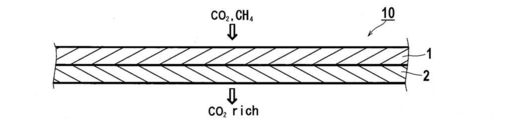
- FIG. 1 is a longitudinal sectional view schematically showing a gas separation composite membrane 10 which is a preferred embodiment of the present invention.
- 1 is a gas separation layer
- 2 is a support layer which consists of a porous layer.
- FIG. 2 is a cross-sectional view schematically showing a gas separation composite membrane 20 which is a preferred embodiment of the present invention.
- the support layer includes the nonwoven fabric layer 3
- the gas separation composite membrane 20 includes the gas separation layer 1, the porous layer 2, and the nonwoven fabric layer 3.
- 1 and 2 show an embodiment in which carbon dioxide is selectively permeated from a mixed gas of carbon dioxide and methane to make the permeated gas rich in carbon dioxide.
- “on the support layer” means that another layer may be interposed between the support layer and the gas separation layer.
- the side of the gas separation membrane to which the gas to be separated is supplied is “upper”, and the side from which the separated gas is discharged is “lower”.
- the gas separation composite membrane of the present invention may be formed or disposed on the surface or inner surface of a porous support (support layer), or at least formed on the surface of the porous support.
- a composite membrane can be easily formed.
- a composite membrane having both high separation selectivity, high gas permeability, and mechanical strength can be obtained.
- the film thickness of the gas separation layer is preferably as thin as possible from the viewpoint of gas permeability as long as the mechanical strength and gas separation selectivity can be maintained at desired levels.
- the thickness of the gas separation layer is not particularly limited, but is preferably 0.01 to 5.0 ⁇ m, more preferably 0.05 to 2.0 ⁇ m.
- the support layer is not particularly limited as long as the mechanical strength and gas permeability are at desired levels, and either an organic material or an inorganic material may be used.
- This support layer is preferably a porous layer of an organic polymer, and the thickness thereof is preferably 1 to 3000 ⁇ m, more preferably 5 to 500 ⁇ m, still more preferably 5 to 150 ⁇ m.
- the average pore diameter is usually preferably 10 ⁇ m or less, more preferably 0.5 ⁇ m or less, and still more preferably 0.2 ⁇ m or less.
- the porosity is preferably 20 to 90%, more preferably 30 to 80%.
- the support layer is “gas permeable” means that carbon dioxide is supplied to the support layer (membrane consisting of only the support layer) at a temperature of 40 ° C. with the total pressure on the gas supply side being 4 MPa.
- the permeation rate of carbon dioxide is 1 ⁇ 10 ⁇ 5 cm 3 (STP) / cm 2 ⁇ sec ⁇ cmHg (10 GPU) or more.
- the gas permeability of the support layer is such that when carbon dioxide is supplied at a temperature of 40 ° C.
- the carbon dioxide permeation rate is 3 ⁇ 10 ⁇ 5 cm 3 (STP) / It is preferably cm 2 ⁇ sec ⁇ cmHg (30 GPU) or more, more preferably 100 GPU or more, and further preferably 200 GPU or more.
- the material for the porous layer examples include conventionally known polymers such as polyolefin resins such as polyethylene and polypropylene, fluorine-containing resins such as polytetrafluoroethylene, polyvinyl fluoride, and polyvinylidene fluoride, polystyrene, cellulose acetate, Various resins such as polyurethane, polyacrylonitrile, polyphenylene oxide, polysulfone, polyethersulfone, polyimide, polyaramid, and the like can be given.
- the shape of the porous layer may be any shape such as a flat plate shape, a spiral shape, a tubular shape, and a hollow fiber shape.
- a support is formed to further impart mechanical strength to the lower part of the support layer forming the gas separation layer.
- a support include woven fabrics, nonwoven fabrics, nets, and the like, but nonwoven fabrics are preferably used in terms of film forming properties and cost.
- the nonwoven fabric fibers made of polyester, polypropylene, polyacrylonitrile, polyethylene, polyamide or the like may be used alone or in combination.
- the nonwoven fabric can be produced, for example, by making a main fiber and a binder fiber uniformly dispersed in water with a circular net or a long net and drying with a dryer. Further, for the purpose of removing the fluff or improving the mechanical properties, it is also preferable to apply a heat treatment with the nonwoven fabric sandwiched between two rolls.
- the method for producing a gas separation composite membrane of the present invention is preferably a production method including forming a gas separation layer by applying a coating liquid containing the polyimide compound on a porous support.
- the content of the polyimide compound in the coating solution is not particularly limited, but is preferably 0.1 to 30% by mass, and more preferably 0.5 to 10% by mass.
- the gas separation membrane of the present invention can be produced by adjusting the molecular weight, structure, composition, and solution viscosity of the polyimide compound used for forming the gas separation layer according to the purpose.
- the organic solvent used as a medium for the coating solution is not particularly limited, and hydrocarbon organic solvents such as n-hexane and n-heptane, ester organic solvents such as methyl acetate, ethyl acetate and butyl acetate, methanol Alcohol organic solvents such as ethanol, n-propanol, isopropanol, n-butanol, isobutanol, tert-butanol, aliphatic ketones such as acetone, methyl ethyl ketone, methyl isobutyl ketone, diacetone alcohol, cyclopentanone and cyclohexanone, ethylene Glycol, diethylene glycol, triethylene glycol, glycerin, propylene glycol, ethylene glycol monomethyl or monoethyl ether, propylene glycol methyl ether, dipropylene glycol methyl ether, Ethers such as propylene glycol methyl ether,
- organic solvents are appropriately selected as long as they do not adversely affect the support, such as ester-based organic solvents (preferably butyl acetate), alcohol-based organic solvents (preferably methanol). , Ethanol, isopropanol, isobutanol), aliphatic ketones (preferably methyl ethyl ketone, methyl isobutyl ketone, diacetone alcohol, cyclopentanone, cyclohexanone), ether organic solvents (ethylene glycol, diethylene glycol monomethyl ether, methylcyclopentyl ether) More preferred are aliphatic ketones, alcohol-based organic solvents, and ether-based organic solvents. Moreover, these can be used 1 type or in combination of 2 or more types.
- siloxane compound layer By providing the siloxane compound layer, the unevenness on the outermost surface of the support can be smoothed, and the separation layer can be easily thinned.
- siloxane compound forming the siloxane compound layer include those having a main chain made of polysiloxane and compounds having a siloxane structure and a non-siloxane structure in the main chain.
- siloxane compound means an organopolysiloxane compound unless otherwise specified.
- siloxane compound having a main chain made of polysiloxane examples include one or more polyorganosiloxanes represented by the following formula (1) or (2). Moreover, these polyorganosiloxanes may form a crosslinking reaction product.
- a cross-linking reaction for example, a compound represented by the following formula (1) is crosslinked by a polysiloxane compound having a group capable of linking by reacting with the reactive group X S of the formula (1) at both ends The compound of the form is mentioned.
- R S is a non-reactive group and is an alkyl group (preferably an alkyl group having 1 to 18 carbon atoms, more preferably an alkyl group having 1 to 12 carbon atoms) or an aryl group (preferably having 6 to 6 carbon atoms). 15, more preferably an aryl group having 6 to 12 carbon atoms, and still more preferably phenyl).
- X S is a reactive group selected from a hydrogen atom, a halogen atom, a vinyl group, a hydroxyl group, and a substituted alkyl group (preferably an alkyl group having 1 to 18 carbon atoms, more preferably an alkyl group having 1 to 12 carbon atoms). It is preferably a group.
- Y S and Z S are the above R S or X S.
- m is a number of 1 or more, preferably 1 to 100,000.
- n is a number of 0 or more, preferably 0 to 100,000.
- X S, Y S, Z S, R S, m and n are X S of each formula (1), Y S, Z S, R S, and m and n synonymous.
- examples of the alkyl group include methyl, ethyl, hexyl, octyl, decyl, and octadecyl.
- examples of the fluoroalkyl group include —CH 2 CH 2 CF 3 and —CH 2 CH 2 C 6 F 13 .
- examples of the alkyl group include a hydroxyalkyl group having 1 to 18 carbon atoms and an aminoalkyl group having 1 to 18 carbon atoms.
- the number of carbon atoms of the alkyl group constituting the hydroxyalkyl group is preferably an integer of 1 to 10, for example, —CH 2 CH 2 CH 2 OH.
- the number of carbon atoms of the alkyl group constituting the aminoalkyl group is preferably an integer of 1 to 10, and examples thereof include —CH 2 CH 2 CH 2 NH 2 .
- the number of carbon atoms of the alkyl group constituting the carboxyalkyl group is preferably an integer of 1 to 10.
- Examples of the hydroxyalkyl group include —CH 2 CH 2 CH 2 COOH.
- the number of carbon atoms of the alkyl group constituting the chloroalkyl group is preferably an integer of 1 to 10.
- the aminoalkyl group include —CH 2 Cl.
- a preferable carbon number of the alkyl group constituting the glycidoxyalkyl group is an integer of 1 to 10.
- Examples of the glycidoxyalkyl group include 3-glycidyloxypropyl.
- the preferable number of carbon atoms of the epoxy cyclohexyl alkyl group having 7 to 16 carbon atoms is an integer of 8 to 12.
- a preferable carbon number of the (1-oxacyclobutan-3-yl) alkyl group having 4 to 18 carbon atoms is an integer of 4 to 10.
- a preferable carbon number of the alkyl group constituting the methacryloxyalkyl group is an integer of 1 to 10.
- Examples of the methacryloxyalkyl group include —CH 2 CH 2 CH 2 —OOC—C (CH 3 ) ⁇ CH 2 .
- a preferable carbon number of the alkyl group constituting the mercaptoalkyl group is an integer of 1 to 10.
- examples of the methacryloxyalkyl group include —CH 2 CH 2 CH 2 SH.
- m and n are preferably numbers that give a molecular weight of 5,000 to 1,000,000 of the compound.
- a reactive group-containing siloxane unit (wherein the number is a structural unit represented by n) and a siloxane unit having no reactive group (wherein the number is m)
- the distribution of the structural unit represented by That is, in the formulas (1) and (2), the (Si (R S ) (R S ) —O) unit and the (Si (R S ) (X S ) —O) unit may be randomly distributed. Good.
- R S, m and n are respectively the same as R S, m and n in formula (1).
- R L is —O— or —CH 2 —
- R S1 is a hydrogen atom or methyl. Both ends of Formula (3) are preferably an amino group, a hydroxyl group, a carboxy group, a trimethylsilyl group, an epoxy group, a vinyl group, a hydrogen atom, or a substituted alkyl group.
- n and n are synonymous with m and n in Formula (1), respectively.
- m and n have the same meanings as m and n in formula (1), respectively.
- m and n are synonymous with m and n in Formula (1), respectively. It is preferable that the both ends of Formula (6) have an amino group, a hydroxyl group, a carboxy group, a trimethylsilyl group, an epoxy group, a vinyl group, a hydrogen atom, or a substituted alkyl group bonded thereto.
- m and n are synonymous with m and n in formula (1), respectively. It is preferable that an amino group, a hydroxyl group, a carboxy group, a trimethylsilyl group, an epoxy group, a vinyl group, a hydrogen atom, or a substituted alkyl group is bonded to both ends of the formula (7).
- the siloxane structural unit and the non-siloxane structural unit may be randomly distributed.
- the compound having a siloxane structure and a non-siloxane structure in the main chain preferably contains 50 mol% or more of siloxane structural units, more preferably 70 mol% or more, based on the total number of moles of all repeating structural units. .
- the weight average molecular weight of the siloxane compound used in the siloxane compound layer is preferably 5,000 to 1,000,000 from the viewpoint of achieving both a thin film and durability.
- the method for measuring the weight average molecular weight is as described above.
- siloxane compound which comprises a siloxane compound layer is enumerated below.
- the thickness of the siloxane compound layer is preferably 0.01 to 5 ⁇ m and more preferably 0.05 to 1 ⁇ m from the viewpoint of smoothness and gas permeability.
- the gas permeability at 40 ° C. and 4 MPa of the siloxane compound layer is preferably 100 GPU or more, more preferably 300 GPU or more, and further preferably 1000 GPU or more in terms of carbon dioxide transmission rate.
- the gas separation membrane of the present invention may be an asymmetric membrane.
- the asymmetric membrane can be formed by a phase change method using a solution containing a polyimide compound.
- the phase inversion method is a known method for forming a film while bringing a polymer solution into contact with a coagulation liquid to cause phase conversion.
- a so-called dry / wet method is suitably used.
- the polymer solution in the shape of a film is evaporated to form a thin dense layer, which is then immersed in a coagulation liquid, and micropores are formed by utilizing the phase separation phenomenon that occurs.
- the thickness of the surface layer that contributes to gas separation is not particularly limited, but is 0.01 to 5.0 ⁇ m from the viewpoint of imparting practical gas permeability. And more preferably 0.05 to 1.0 ⁇ m.
- the porous layer below the dense layer lowers the gas permeability resistance and at the same time imparts mechanical strength, and its thickness is particularly limited as long as it is self-supporting as an asymmetric membrane. It is not a thing.
- the thickness of the lower porous layer in the asymmetric membrane is preferably 5 to 500 ⁇ m, more preferably 5 to 200 ⁇ m, and even more preferably 5 to 100 ⁇ m.
- the gas separation asymmetric membrane of the present invention may be a flat membrane or a hollow fiber membrane.
- the asymmetric hollow fiber membrane can be produced by a dry and wet spinning method.
- the dry-wet spinning method is a method for producing an asymmetric hollow fiber membrane by applying a dry-wet method to a polymer solution that is discharged from a spinning nozzle to have a hollow fiber-like target shape. More specifically, the polymer solution is discharged from a nozzle into a hollow fiber-like target shape, and is passed through an air or nitrogen gas atmosphere immediately after the discharge. Thereafter, the polymer is not substantially dissolved and is immersed in a coagulation liquid having compatibility with the solvent of the polymer solution to form an asymmetric structure. Thereafter, the separation membrane is produced by drying and further heat-treating as necessary.
- the solution viscosity of the solution containing the polyimide compound discharged from the nozzle is preferably 2 to 17000 Pa ⁇ s, more preferably 10 to 1500 Pa ⁇ s, particularly 20 to 1000 Pa ⁇ s at the discharge temperature (for example, 10 ° C.),
- the shape after discharge such as a hollow fiber shape, can be stabilized.
- the film is immersed in the primary coagulation liquid and solidified to such an extent that the shape of the hollow fiber or the like can be maintained, wound on a guide roll, and then immersed in the secondary coagulation liquid to fully saturate the entire film. It is preferable to solidify. It is efficient to dry the coagulated film after replacing the coagulating liquid with a solvent such as hydrocarbon.
- the heat treatment for drying is preferably performed at a temperature lower than the softening point or secondary transition point of the used polyimide compound.
- a siloxane compound layer may be provided as a protective layer on the gas separation layer.
- the siloxane compound layer used as the protective layer preferably has a Si ratio before and after immersion in chloroform represented by the following formula (I) in the range of 0.6 to 1.0.
- Si ratio (Si-K ⁇ X-ray intensity after chloroform immersion) / (Si-K ⁇ X-ray intensity before chloroform immersion)
- a method for measuring the Si-K ⁇ X-ray intensity is described in, for example, Japanese Patent Application Laid-Open No. 6-88792.
- the Si-K ⁇ X-ray intensity is reduced by immersion in chloroform as compared with that before immersion, it means that a low molecular weight component is present and eluted. Therefore, the smaller the degree of decrease in the Si-K ⁇ X-ray intensity after immersion in chloroform, the higher the polymer constituting the siloxane compound layer, and the more difficult it is to elute in chloroform.
- the Si ratio of the siloxane compound layer is in the range of 0.6 to 1.0, the siloxane compound can be present in the layer with high density and uniformity, effectively preventing film defects and gas separation. The performance can be further increased. In addition, use under high pressure, high temperature and high humidity conditions, and plasticization of the gas separation layer due to impurity components such as toluene can be further suppressed.
- the Si ratio of the siloxane compound layer constituting the protective layer is preferably 0.7 to 1.0, more preferably 0.75 to 1.0, still more preferably 0.8 to 1.0, and 0.85 to 1 0.0 is more preferable.
- the siloxane compounds are composed of * —O—M—O— * , * —SMS— * , * —NR a1 C ( ⁇ O) — * , * —NR.
- M represents a divalent to tetravalent metal atom.
- R a1 , R b1 , R c1 , R d1 , R e1 , and R f1 represent a hydrogen atom or an alkyl group. * Indicates a linking site.
- Examples of the metal atom M include aluminum (Al), iron (Fe), beryllium (Be), gallium (Ga), vanadium (V), indium (In), titanium (Ti), zirconium (Zr), and copper. (Cu), cobalt (Co), nickel (Ni), zinc (Zn), calcium (Ca), magnesium (Mg), yttrium (Y), scandium (Sc), chromium (Cr), manganese (Mn), molybdenum
- Examples include metal atoms selected from (Mo) and boron (B), and among these, metal atoms selected from Ti, In, Zr, Fe, Zn, Al, Ga, and B are preferable, and selected from Ti, In, and Al. The metal atom is more preferable, and Al is more preferable.
- the alkyl group that can be adopted as R a1 , R b1 , R c1 , R d1 , R e1 , and R f1 is preferably 1 to 20 carbon atoms, more preferably 1 to 10 carbon atoms, still more preferably 1 to carbon atoms. 7, more preferably an alkyl group having 1 to 4 carbon atoms.
- This alkyl group may be linear or branched, but is more preferably linear.
- Specific examples of preferred alkyl groups include methyl, ethyl, isopropyl, n-butyl, t-butyl, pentyl, hexyl, heptyl, octyl and 1-ethylpentyl.
- the Si ratio of the siloxane compound layer can be easily increased to the range defined in the present invention.
- the linking group * —O—M—O— * is represented by, for example, a siloxane compound having a group having —OH (an active hydrogen-containing group) such as a hydroxy group, a carboxy group, or a sulfo group, and the following formula (B): It can be formed by a ligand exchange reaction with a metal complex (crosslinking agent).
- L L each independently represents an alkoxy group, an aryloxy group, an acetylacetonato group, an acyloxy group, a hydroxy group or a halogen atom.
- y represents an integer of 2 to 4.
- the alkoxy group that can be taken as L L preferably has 1 to 10 carbon atoms, more preferably 1 to 4 carbon atoms, and still more preferably 1 to 3 carbon atoms.
- Specific examples of the alkoxy group that can be taken as L L include, for example, methoxy, ethoxy, tert-butoxy, and isopropoxy.
- the aryloxy group that can be taken as L L preferably has 6 to 10 carbon atoms, more preferably 6 to 8 carbon atoms, and still more preferably 6 to 7 carbon atoms.
- Specific examples of the aryloxy group that can be taken as L L include, for example, phenoxy, 4-methoxyphenoxy, and naphthoxy.
- the acyloxy group that can be taken as L L preferably has 2 to 10 carbon atoms, more preferably 2 to 6 carbon atoms, and still more preferably 2 to 4 carbon atoms.
- Specific examples of the acyloxy group that can be taken as L L include, for example, acetoxy, propanoyloxy, pivaloyloxy, and acetyloxy.
- the halogen atom which can be taken as L L is not particularly limited, and examples thereof include a fluorine atom, a chlorine atom, a bromine atom and an iodine atom. Of these, a chlorine atom is preferable.
- the metal complex represented by the above formula (B) is soluble in an organic solvent used for a coating solution when forming a siloxane compound layer. More specifically, the solubility of the metal complex represented by the above formula (B) with respect to 100 g of tetrahydrofuran at 25 ° C. is preferably 0.01 to 10 g, and preferably 0.1 to 1.0 g. Is more preferable. When the metal complex represented by the formula (B) is soluble in the organic solvent, a more homogeneous metal-crosslinked siloxane compound layer can be formed.
- Preferred examples of the metal complex represented by the formula (B) include aluminum acetylacetonate, gallium acetylacetonate, indium acetylacetonate, zirconium acetylacetonate, cobalt acetylacetonate, calcium acetylacetonate, nickel acetyl.
- ligand exchange reaction is as follows. The following examples show the case where the siloxane compound has a hydroxy group, but when the siloxane compound has an active hydrogen-containing group such as a carboxy group or a sulfo group, the same ligand exchange reaction proceeds, * ⁇ A linking group represented by O—M—O— * is formed.
- R P represents a siloxane compound residue (that is, R P —OH represents a siloxane compound having a hydroxy group).
- R P —OH can usually coordinate up to 4 to one M (form (a) above).
- M is a tetravalent metal atom
- two forms of R P —OH are coordinated (form (c) above), and three are coordinated (form (b) above) )
- 4-coordinated form (form (a) above) are all encompassed by the form having a linking group represented by * —O—M—O— * .
- R P —OH is represented by R P1 — (OH) h
- R P1 is a siloxane compound residue
- h is an integer of 2 or more, that is, one molecule 2 or more OH present in one molecule of R P1 — (OH) h may be coordinated to one M.
- This embodiment also * intended to be encompassed by embodiments having a -O-M-O-* a linking group represented.
- R P —OH can usually be coordinated to one M up to three (form (d) above).
- M is a trivalent metal atom
- two forms of R P —OH are coordinated (form (e) above), and three are coordinated (form (d) above) any form of) are also intended to be encompassed in the form having a linking group represented by * -O-M-O- *.
- R P —OH is represented by R P1 — (OH) h
- R P1 is a siloxane compound residue
- h is an integer of 2 or more, that is, one molecule 2 or more OH present in one molecule of R P1 — (OH) h may be coordinated to one M.
- This embodiment also * intended to be encompassed by embodiments having a -O-M-O-* a linking group represented.
- the form of the (f) is in the form having a linking group represented by the present invention defined by * -O-M-O- *.
- R P —OH is represented by R P1 — (OH) h
- R P1 is a siloxane compound residue
- h is an integer of 2 or more, that is, one molecule 2 or more OH present in one molecule of R P1 — (OH) h may be coordinated to one M.
- This embodiment also * intended to be encompassed by embodiments having a -O-M-O-* a linking group represented.
- the linking structure * -SMS— * can be formed by, for example, a ligand exchange reaction between a siloxane compound having a thiol group and the metal complex represented by the above formula (B). .
- This reaction is a reaction form in which R P —OH is replaced with R P —SH in the above-described reaction for forming * —O—M—O— * . Since —SH is also an active hydrogen-containing group, a ligand exchange reaction can be performed in the same manner as described above.
- the linking group * —NR a C ( ⁇ O) — * is obtained, for example, by reacting a siloxane compound having a carboxy group with a siloxane compound having an amino group in the presence of a dehydration condensing agent (for example, a carbodiimide compound). Can be formed.
- a dehydration condensing agent for example, a carbodiimide compound.
- This reaction can be represented by the following formula.
- RP represents a siloxane compound residue.
- R a linked to one N on the left side is a hydrogen atom, and the rest is a hydrogen atom or an alkyl group. That is, R a on the right side is a hydrogen atom or an alkyl group.
- the linking group can also be formed by reacting a siloxane compound having a carboxy group with a compound having two or more amino groups as a crosslinking agent.
- the said coupling group can also be formed by making the siloxane compound which has an amino group, and the compound which has two or more carboxy groups as a crosslinking agent react.
- the linking group * —NR b1 C ( ⁇ O) NR b1 — * can be formed, for example, by reacting a siloxane compound having an amino group with a chloroformate as a crosslinking agent.
- This reaction can be represented by the following formula. 2R P —N (R b1 ) 2 + Cl—C ( ⁇ O) —O—R Cl ⁇ R P —R b1 N—C ( ⁇ O) —NR b1 —R P + HCl + HO—R Cl
- RP represents a siloxane compound residue
- R Cl represents an alcohol residue of chloroformate.
- R b1 groups connected to one N atom on the left side is a hydrogen atom, and the rest is a hydrogen atom or an alkyl group (that is, R b1 on the right side is a hydrogen atom or an alkyl group).
- the linking group * —O—CH 2 —O— * can be formed, for example, by reacting a siloxane compound having a hydroxy group with formaldehyde as a crosslinking agent. This reaction can be represented by the following formula. 2R P —OH + HC ( ⁇ O) —H ⁇ R P —O—CH (O—R P ) —H + H 2 O
- RP represents a siloxane compound residue.
- the linking group * —S—CH 2 CH 2 — * can be formed, for example, by reacting a siloxane compound having a thiol group with a siloxane compound having a vinyl group.
- This reaction can be represented by the following formula.
- RP represents a siloxane compound residue.
- the linking group can also be formed when a siloxane compound having a thiol group is reacted with a compound having two or more vinyl groups as a crosslinking agent.
- the linking group can be formed by reacting a siloxane compound having a vinyl group with a compound having two or more thiol groups as a crosslinking agent.
- the linking group * —OC ( ⁇ O) O— * can be formed, for example, by reacting a siloxane compound having a hydroxy group with a chloroformate as a crosslinking agent. This reaction can be represented by the following formula. 2R P —OH + Cl—C ( ⁇ O) —O—R Cl ⁇ R P —O—C ( ⁇ O) —O—R P + HCl + HO—R Cl
- RP represents a siloxane compound residue
- R Cl represents an alcohol residue of chloroformate.
- the linking group * —C ( ⁇ O) O — N + (R d1 ) 3 ⁇ * can be formed, for example, by reacting a siloxane compound having a carboxy group with a siloxane compound having an amino group. .
- This reaction can be represented by the following formula.
- RP represents a siloxane compound residue.
- R d1 represents a hydrogen atom or an alkyl group.
- connection structure can also be formed by making the siloxane compound which has a carboxy group, and the compound which has two or more amino groups as a crosslinking agent react.
- said coupling group can also be formed by making the siloxane compound which has an amino group, and the compound which has two or more carboxy groups as a crosslinking agent react.
- the linking group * -SO 3 - N + (R e1) 3 - * can be formed by reacting a siloxane compound having a sulfo group, a siloxane compound having an amino group.
- This reaction can be represented by the following formula.
- RP represents a siloxane compound residue.
- R e1 represents a hydrogen atom or an alkyl group.
- the linking group can also be formed by reacting a siloxane compound having a sulfo group with a compound having two or more amino groups as a crosslinking agent.
- the linking group can also be formed by reacting a siloxane compound having an amino group with a compound having two or more sulfo groups as a crosslinking agent.
- connection structure * —PO 3 H — N + (R f1 ) 3 ⁇ * can be formed, for example, by reacting a cellulose resin having a phosphonic acid group with a siloxane compound having an amino group.
- This reaction can be represented by the following formula.
- R P —PO 3 H 2 + R P —N (R f1 ) 2 ⁇ R P -P ( O) (OH) -O -- N + H (R f1 ) 2 -R P
- RP represents a siloxane residue.
- R f1 represents a hydrogen atom or an alkyl group.
- the linking group can also be formed by reacting a siloxane compound having a phosphonic acid group with a compound having two or more amino groups as a crosslinking agent.
- the linking group can also be formed by reacting a siloxane compound having an amino group with a compound having two or more sulfonic acid groups as a crosslinking agent.
- the linking group * —CH (OH) CH 2 OCO— * can be formed, for example, by reacting a siloxane compound having an epoxy group with a siloxane compound having a carboxy group.
- the linking group is obtained by reacting a siloxane compound having an epoxy group with a compound having two or more carboxy groups as a crosslinking agent, or a siloxane compound having a carboxy group and an epoxy group as a crosslinking agent. It can also be formed by reacting with two or more compounds.
- the linking group * —CH (OH) CH 2 O— * can be formed, for example, by reacting a siloxane compound having an epoxy group with a siloxane compound having a hydroxy group.
- the linking group is obtained by reacting a siloxane compound having an epoxy group with a compound having two or more hydroxy groups as a crosslinking agent, or a siloxane compound having a hydroxy group and an epoxy group as a crosslinking agent. It can also be formed by reacting with two or more compounds.
- the linking group * —CH (OH) CH 2 S— * can be formed, for example, by reacting a siloxane compound having an epoxy group with a siloxane compound having a thiol group.
- the linking group is obtained by reacting a siloxane compound having an epoxy group with a compound having two or more thiol groups as a crosslinking agent, or a siloxane compound having a thiol group and an epoxy group as a crosslinking agent. It can also be formed by reacting with two or more compounds.
- the linking group * —CH (OH) CH 2 NR c1 ⁇ * can be formed, for example, by reacting a siloxane compound having an epoxy group with a siloxane compound having an amino group.
- the linking group includes a reaction between a siloxane compound having an epoxy group and a compound having two or more amino groups as a crosslinking agent, or a siloxane compound having an amino group and an epoxy group as a crosslinking agent. It can also be formed by reacting with two or more compounds.
- the linking group * —CH (CH 2 OH) CH 2 OCO— * can be formed by replacing the epoxy group with an oxetanyl group in the above-described formation of * —CH (OH) CH 2 OCO— * .
- the linking group * —CH (CH 2 OH) CH 2 O— * can be formed by replacing the epoxy group with an oxetanyl group in the above-described formation of * —CH (OH) CH 2 O— * .
- the linking group * —CH (CH 2 OH) CH 2 S— * can be formed by replacing the epoxy group with an oxetanyl group in the above-described formation of * —CH (OH) CH 2 S— * .
- the linking group * —CH (CH 2 OH) CH 2 NR c1 ⁇ * can be formed by replacing the epoxy group with an oxetanyl group in the above-described formation of * —CH (OH) CH 2 NR c — *. it can.
- the linking group * —CH 2 CH 2 — * can be formed, for example, by polymerizing siloxane compounds having a vinyl group (such as a (meth) acryloyl group). It can also be formed by reacting a vinyl group of a siloxane compound having a vinyl group with a hydrosilyl group of a siloxane compound having a hydrosilyl group.
- the structure linked via * —CH 2 CH 2 — * does not include the structure linked via * —S—CH 2 CH 2 — * .
- the siloxane compound layer constituting the protective layer may have one or more of the above-mentioned connection structures.
- connection structure between the siloxane compounds is the above-described * -O-MO- * , from the viewpoint of the reactivity for forming the connection structure and the chemical stability of the connection structure.
- * —SMS— * , * —O—CH 2 —O— * , * —S—CH 2 CH 2 — * , * —OC ( ⁇ O) O— * , * —CH 2 CH 2 — * , And * -C ( ⁇ O) O ⁇ N + (R d1 ) 3 ⁇ * are preferably one or more of a linking structure through a linking group selected from the group * -O—M—O— * , * -S-M-S- * , * -O-CH 2 -O- * and * -S-CH 2 CH 2 - *, * -CH 2 CH 2 - * linked via a linking group selected from one or more preferably two or more structures, * -O-M-
- the siloxane compound used as a raw material for the siloxane compound layer is not particularly limited as long as it is a siloxane compound having a functional group that gives the connecting structure.
- this siloxane compound examples include methacrylate-modified polydialkylsiloxane, methacrylate-modified polydiarylsiloxane, methacrylate-modified polyalkylarylsiloxane, thiol-modified polydialkylsiloxane, thiol-modified polydiarylsiloxane, thiol-modified polyalkylarylsiloxane, hydroxy-modified polysiloxane.
- the modification site by each functional group may be a terminal or a side chain. Moreover, it is preferable that there are two or more modified sites in one molecule. Each functional group introduced by the modification may further have a substituent. Moreover, there is no restriction
- the alkyl group preferably has 1 to 10 carbon atoms, more preferably 1 to 5, more preferably 1 to 3, and still more preferably methyl.
- the aryl group preferably has 6 to 20 carbon atoms, more preferably 6 to 15 carbon atoms, still more preferably 6 to 12 carbon atoms, and even more preferably phenyl.
- the siloxane compound layer constituting the protective layer preferably has at least one structure selected from the following (a) and (b).
- R SL shows an alkyl group or an aryl group each independently.
- L A independently represents a single bond or a divalent linking group.
- X A is * -OM 1 -O- * , * -SM 1 -S- * , * -O-CH 2 -O- * , * -S-CH 2 CH 2- * , * -OC A linking group selected from ( ⁇ O) O— * , * —CH 2 CH 2 — * , and * —C ( ⁇ O) O — N + (R d ) 3 — * .
- M 1 represents Zr, Fe, Zn, B, Al, or Ga
- R d represents a hydrogen atom or an alkyl group.
- a1 and b1 are integers of 2 or more (preferably integers of 5 or more).
- “ * ” Indicates a linking site.
- “**” represents a linking site in the siloxane bond. That is, in the general formulas (1a) to (3a), when ** is an O atom, ** indicates a connecting site with a Si atom, and when ** is a Si atom, ** is an O atom. And the linking site.
- the terminal structure of the general formula (4a) is preferably a group selected from a hydrogen atom, a mercapto group, an amino group, a vinyl group, a carboxy group, an oxetanyl group, a sulfo group, and a phosphonic acid group.
- R SL and R d are alkyl groups, they are preferably alkyl groups having 1 to 10 carbon atoms, more preferably 1 to 5 carbon atoms, still more preferably 1 to 3 carbon atoms, and particularly preferably methyl.
- R SL is an aryl group, the carbon number thereof is preferably 6 to 20, more preferably 6 to 15, further preferably 6 to 12, and still more preferably a phenyl group.
- L A is a divalent linking group
- an alkylene group preferably having 1 to 10 carbon atoms, more preferably an alkylene group having 1 to 5 carbon atoms
- an arylene group preferably having 6 to 20 carbon atoms, more preferably arylene group having 6 to 15 carbon atoms, more preferably has the same meaning as R SL phenylene group
- -Si (R SL) 2 -O- is preferred (R SL is the general formula (2a), the preferred form be the same “O” in —Si (R SL ) 2 —O— is linked to Si shown in the above general formula).
- the structure (a) preferably has a repeating unit represented by the following formula (5a) in addition to the structure represented by any one of the above general formulas (1a) to (3a).
- repeating unit represented by the above formula (5a) is present in the siloxane compound layer with a structure in which the repeating units represented by the above formula (5a) are connected to each other by a siloxane bond.
- the content of the repeating unit represented by the above formula (5a) is preferably 0.01 to 0.55, and preferably 0.03 to 0.40. More preferably, it is 0.05 to 0.25.
- the content of the repeating unit represented by the formula (5a) was determined by using a siloxane compound layer cut into a 2.5 cm square as a measurement sample, and the measurement sample was subjected to X-ray photoelectron spectroscopy (apparatus: Quantra SXM manufactured by Ulvac-PHI).
- the fluorescent X-ray intensity [SA] of the Si—O bond energy peak of the repeating unit (Q component) represented by the formula (5a) and the structure (T component) other than the repeating unit represented by the formula (5a) [SA] / ([SA] + [ST]) is calculated on the basis of the total intensity [ST] of Si—O bond energy peaks, and is defined as the content of the repeating unit represented by the formula (5a).
- the thickness of the siloxane compound layer as the protective layer is preferably 10 to 3000 nm, more preferably 100 to 1500 nm.
- the gas separation membrane (composite membrane and asymmetric membrane) of the present invention can be suitably used as a gas separation recovery method and gas separation purification method.
- a gas separation membrane that selectively permeates and separates carbon dioxide from a gas mixture containing carbon dioxide and hydrocarbon (methane) is preferable.
- the permeation rate of carbon dioxide at 40 ° C. and 5 MPa is preferably 20 GPU or more, more preferably 30 GPU or more, More preferably, it is 35 to 500 GPU.
- the permeation rate ratio of carbon dioxide to methane (R CO2 / R CH4 ) is preferably 15 or more, more preferably 20 or more, further preferably 23 or more, and preferably 25 to 50. Particularly preferred.
- R CO2 represents the permeation rate of carbon dioxide
- R CH4 represents the permeation rate of methane.
- 1 GPU is 1 ⁇ 10 ⁇ 6 cm 3 (STP) / cm 2 ⁇ sec ⁇ cmHg, STP stands for Standard Temperature and Pressure, and GPU stands for Gas Permeation Unit.
- Various polymer compounds can be added to the gas separation layer of the gas separation membrane of the present invention in order to adjust the membrane properties.
- High molecular compounds include acrylic polymers, polyurethane resins, polyamide resins, polyester resins, epoxy resins, phenol resins, polycarbonate resins, polyvinyl butyral resins, polyvinyl formal resins, shellac, vinyl resins, acrylic resins, rubber resins. Waxes and other natural resins can be used. Two or more of these may be used in combination.
- nonionic surfactants, cationic surfactants, organic fluoro compounds, and the like can be added to adjust liquid properties.
- the surfactant include alkylbenzene sulfonate, alkylnaphthalene sulfonate, higher fatty acid salt, sulfonate of higher fatty acid ester, sulfate ester of higher alcohol ether, sulfonate of higher alcohol ether, higher alkyl
- Anionic surfactants such as alkyl carboxylates of sulfonamides, alkyl phosphates, polyoxyethylene alkyl ethers, polyoxyethylene alkyl phenyl ethers, polyoxyethylene fatty acid esters, sorbitan fatty acid esters, ethylene oxide adducts of acetylene glycol,
- Nonionic surfactants such as ethylene oxide adducts of glycerin and polyoxyethylene sorbitan fatty acid esters, and other amphoteric boundaries such as alkyl betaines and amide betaines
- a polymer dispersant may be included, and specific examples of the polymer dispersant include polyvinyl pyrrolidone, polyvinyl alcohol, polyvinyl methyl ether, polyethylene oxide, polyethylene glycol, polypropylene glycol, and polyacrylamide. Of these, polyvinylpyrrolidone is preferably used.
- the conditions for forming the gas separation membrane of the present invention are not particularly limited, but the temperature is preferably ⁇ 30 to 100 ° C., more preferably ⁇ 10 to 80 ° C., and particularly preferably 5 to 50 ° C.
- a gas such as air or oxygen may coexist at the time of forming the film, but it is preferably in an inert gas atmosphere.
- the content of the polyimide compound in the gas separation layer is not particularly limited as long as desired gas separation performance can be obtained. From the viewpoint of further improving the gas separation performance, the content of the polyimide compound in the gas separation layer is preferably 20% by mass or more, more preferably 40% by mass or more, and 60% by mass or more. Is preferable, and it is more preferable that it is 70 mass% or more.
- the content of the polyimide compound in the gas separation layer may be 100% by mass, but is usually 99% by mass or less.
- the gas separation method of the present invention is a method including selectively permeating carbon dioxide from a mixed gas containing carbon dioxide and methane.
- the pressure during gas separation is preferably 0.5 to 10 MPa, more preferably 1 to 10 MPa, and further preferably 2 to 7 MPa.
- the gas separation temperature is preferably ⁇ 30 to 90 ° C., more preferably 15 to 70 ° C.
- a gas separation module can be prepared using the gas separation membrane of the present invention.
- modules include spiral type, hollow fiber type, pleated type, tubular type, plate & frame type and the like.
- a gas separation apparatus having means for separating and recovering or purifying gas can be obtained using the gas separation composite membrane or gas separation module of the present invention.
- the gas separation composite membrane of the present invention may be applied to, for example, a gas separation and recovery device as a membrane / absorption hybrid method used in combination with an absorbing solution as described in JP-A-2007-297605.
- the reaction solution was cooled, diluted with acetone (Wako Pure Chemical Industries, Ltd.), and then isopropyl alcohol (Wako Pure Chemical Industries, Ltd.) was added to obtain a polymer as a solid.
- the operation of dissolving the obtained polymer with acetone and reprecipitating with isopropyl alcohol was repeated twice, followed by drying at 80 ° C. to obtain polyimide (P-1) (18 g).
- Polyimide (P-4) was obtained in the same manner as the synthesis of polyimide (P-2) except that pyromellitic anhydride was used in place of 6FDA in the synthesis of polyimide (P-2).
- polyimide (P-6) was synthesized in the same manner as the synthesis of polyimide (P-5) except that 4,4′-biphthalic anhydride was used instead of pyromellitic anhydride. -6) was obtained.
- Polyimides (P-8), (P-9) and (P-10) are the same as the synthesis of the polyimide (P-1) except that the raw materials used are changed to those corresponding to the following polyimide structures. Got.
- polyimide (P-11a) In the synthesis of the polyimide (P-1), polyimide (P-11a) was obtained in the same manner as the synthesis of the polyimide (P-1) except that 4-aminophenol was used instead of 4-aminobenzoic acid. It was.
- a polyimide (P-13) was obtained in the same manner as the polyimide (P-1) except that iminodiacetic acid was used instead of 4-aminobenzoic acid in the synthesis of the polyimide (P-1). .
- the gas separation composite membrane shown in FIG. 2 was produced (the smooth layer is not shown in FIG. 2).
- 0.08 g of polyimide (P-1) and 7.92 g of tetrahydrofuran were mixed and stirred for 30 minutes, and the resulting mixture was placed on the porous support on which the above smooth layer was formed.
- a gas separation layer was formed by spin coating to obtain a composite film.
- the thickness of the polyimide (P-1) layer was about 100 nm.
- the molecular weight cut off of the used polyacrylonitrile porous layer was 100,000 or less.
- the permeability of carbon dioxide at 40 ° C. and 5 MPa of this porous layer was 25000 GPU.
- the protective layer was provided in the following procedure with respect to the gas separation layer surface of the composite membrane created above. That is, vinyl Q resin (manufactured by Gelest, product number VQM-135) (10 g), hydrosilyl PDMS (manufactured by Gelest, product number HMS-301) (1 g), Karstedt catalyst (manufactured by Aldrich, product number 479527) (5 mg), heptane
- vinyl Q resin manufactured by Gelest, product number VQM-135
- hydrosilyl PDMS manufactured by Gelest, product number HMS-301
- Karstedt catalyst manufactured by Aldrich, product number 479527
- heptane The mixture obtained by mixing (90 g) was spin-coated on the gas separation layer surface of the composite membrane prepared above. The mixed solution was dried and cured at 80 ° C. for 5 hours to obtain a gas separation composite membrane having a 500 nm thick siloxane compound layer (protective layer) on the gas separation layer.
- Example 2 to 13 Production of Composite Film In the same manner as in Example 1 except that polyimide (P-1) was changed to polyimides (P-2) to (P-13) in Example 1 above, Gas separation composite membranes having protective layers of Examples 2 to 13 were produced.
- the measurement is performed under the conditions of carbon dioxide (CO 2 ): methane (CH 4 ) 13:87 (volume ratio) mixed gas, the total pressure on the gas supply side is 5 MPa (CO 2 partial pressure: 0.3 MPa), flow rate The adjustment was carried out so as to be 500 mL / min and 40 ° C.
- the permeated gas was analyzed by gas chromatography.
- the gas permeability of the membrane was compared by calculating the gas permeation rate as gas permeability (Permeance).
- the gas separation selectivity was calculated as the ratio of the CO 2 permeation rate R CO2 to the CH 4 permeation rate R CH4 of this membrane (R CO2 / R CH4 ).
- the above measurement results were evaluated based on the following evaluation criteria.
- R CO2 / R CH4 is 30 or more B: R CO2 / R CH4 is 25 or more and less than 30 C: R CO2 / R CH4 is 20 or more and less than 25 D: R CO2 / R CH4 is 15 or more and less than 20 E: R CO2 / R CH4 is less than 15
- the gas separation membrane in which the gas separation layer was formed using comparative polyimide (C-1) had many membrane defects in the gas separation layer and did not function as a gas separation membrane.
- a gas separation membrane in which a gas separation layer is formed using comparative polyimide (C-2) is inferior in both gas permeability and gas separation selectivity, and is easily plasticized by exposure to toluene and inferior in durability. there were.
- a gas separation membrane in which a gas separation layer is formed using the polyimide compound defined in the present invention has a high gas permeation rate and an enhanced gas separation selectivity. Further, it was found that these gas separation membranes are not easily deteriorated in gas separation performance even when exposed to toluene, and are excellent in plasticization resistance (Examples 1 to 13).
Landscapes
- Chemical & Material Sciences (AREA)
- Chemical Kinetics & Catalysis (AREA)
- Health & Medical Sciences (AREA)
- Medicinal Chemistry (AREA)
- Polymers & Plastics (AREA)
- Organic Chemistry (AREA)
- Engineering & Computer Science (AREA)
- Analytical Chemistry (AREA)
- General Chemical & Material Sciences (AREA)
- Oil, Petroleum & Natural Gas (AREA)
- Separation Using Semi-Permeable Membranes (AREA)
- Macromolecular Compounds Obtained By Forming Nitrogen-Containing Linkages In General (AREA)
Abstract
L'invention concerne : une membrane de séparation de gaz; un module de séparation de gaz, un dispositif de séparation de gaz et un procédé de séparation de gaz, dans lesquels la membrane de séparation de gaz est utilisée. La membrane de séparation de gaz est caractérisée en ce qu'elle peut atteindre la compatibilité entre la perméabilité au gaz et la sélectivité de séparation de gaz à un niveau satisfaisant même lorsqu'elle est utilisée dans des conditions de haute pression, elle a aussi une excellente résistance à la plastification L'invention concerne également un composé polyimide approprié en tant que matière première pour une couche de séparation de gaz dans la membrane de séparation de gaz. La membrane de séparation de gaz est pourvue d'une couche de séparation de gaz contenant un composé de polyimide, le composé de polyimide contenant une unité de répétition représentée par la formule (I). Dans chacun des modules de séparation de gaz, du dispositif de séparation de gaz et du procédé de séparation de gaz, la membrane de séparation de gaz est utilisée. Ra représente un groupe tétravalent spécifique, et Rb représente un groupe trivalent ayant un anneau spécifique. Xa représente un substituant spécifique, et Xb représente un atome d'hydrogène ou un substituant. L'invention concerne également un composé polyimide représenté par la formule (1-b) ou (1-c). Ra représente un groupe tétravalent spécifique, et Rc représente un groupe bivalent spécifique. Chacun parmi Aa, ab, ac et Xb représente un atome d'hydrogène ou un substituant, et chacun de Xc et Xd représente un substituant spécifique.
Priority Applications (2)
| Application Number | Priority Date | Filing Date | Title |
|---|---|---|---|
| JP2018537123A JPWO2018043149A1 (ja) | 2016-08-31 | 2017-08-17 | ガス分離膜、ガス分離モジュール、ガス分離装置、ガス分離方法及びポリイミド化合物 |
| US16/281,127 US20190176081A1 (en) | 2016-08-31 | 2019-02-21 | Gas separation membrane, gas separation module, gas separation device, gas separation method, and polyimide compound |
Applications Claiming Priority (2)
| Application Number | Priority Date | Filing Date | Title |
|---|---|---|---|
| JP2016-168768 | 2016-08-31 | ||
| JP2016168768 | 2016-08-31 |
Related Child Applications (1)
| Application Number | Title | Priority Date | Filing Date |
|---|---|---|---|
| US16/281,127 Continuation US20190176081A1 (en) | 2016-08-31 | 2019-02-21 | Gas separation membrane, gas separation module, gas separation device, gas separation method, and polyimide compound |
Publications (1)
| Publication Number | Publication Date |
|---|---|
| WO2018043149A1 true WO2018043149A1 (fr) | 2018-03-08 |
Family
ID=61305252
Family Applications (1)
| Application Number | Title | Priority Date | Filing Date |
|---|---|---|---|
| PCT/JP2017/029540 Ceased WO2018043149A1 (fr) | 2016-08-31 | 2017-08-17 | Membrane de séparation de gaz, module de séparation de gaz, dispositif de séparation de gaz, procédé de séparation de gaz, et composé de polyimide |
Country Status (3)
| Country | Link |
|---|---|
| US (1) | US20190176081A1 (fr) |
| JP (1) | JPWO2018043149A1 (fr) |
| WO (1) | WO2018043149A1 (fr) |
Families Citing this family (1)
| Publication number | Priority date | Publication date | Assignee | Title |
|---|---|---|---|---|
| GB201510648D0 (en) * | 2015-06-17 | 2015-07-29 | Fujifilm Mfg Europe Bv | Composite membranes |
Citations (4)
| Publication number | Priority date | Publication date | Assignee | Title |
|---|---|---|---|---|
| JPH08333452A (ja) * | 1995-06-06 | 1996-12-17 | Ube Ind Ltd | 芳香族ポリイミド及び半透膜及びその製法 |
| JP2014024939A (ja) * | 2012-07-26 | 2014-02-06 | Fujifilm Corp | ポリイミド樹脂の製造方法、ガス分離膜、ガス分離モジュール、及びガス分離装置、並びにガス分離方法 |
| JP2015051407A (ja) * | 2013-09-09 | 2015-03-19 | 富士フイルム株式会社 | ガス分離複合膜、ガス分離モジュール、ガス分離装置、及びガス分離方法 |
| JP2015083296A (ja) * | 2013-09-20 | 2015-04-30 | 富士フイルム株式会社 | ガス分離膜、ガス分離モジュール、ガス分離装置、及びガス分離方法 |
-
2017
- 2017-08-17 WO PCT/JP2017/029540 patent/WO2018043149A1/fr not_active Ceased
- 2017-08-17 JP JP2018537123A patent/JPWO2018043149A1/ja not_active Ceased
-
2019
- 2019-02-21 US US16/281,127 patent/US20190176081A1/en not_active Abandoned
Patent Citations (4)
| Publication number | Priority date | Publication date | Assignee | Title |
|---|---|---|---|---|
| JPH08333452A (ja) * | 1995-06-06 | 1996-12-17 | Ube Ind Ltd | 芳香族ポリイミド及び半透膜及びその製法 |
| JP2014024939A (ja) * | 2012-07-26 | 2014-02-06 | Fujifilm Corp | ポリイミド樹脂の製造方法、ガス分離膜、ガス分離モジュール、及びガス分離装置、並びにガス分離方法 |
| JP2015051407A (ja) * | 2013-09-09 | 2015-03-19 | 富士フイルム株式会社 | ガス分離複合膜、ガス分離モジュール、ガス分離装置、及びガス分離方法 |
| JP2015083296A (ja) * | 2013-09-20 | 2015-04-30 | 富士フイルム株式会社 | ガス分離膜、ガス分離モジュール、ガス分離装置、及びガス分離方法 |
Also Published As
| Publication number | Publication date |
|---|---|
| US20190176081A1 (en) | 2019-06-13 |
| JPWO2018043149A1 (ja) | 2019-03-28 |
Similar Documents
| Publication | Publication Date | Title |
|---|---|---|
| JP6038058B2 (ja) | ガス分離膜、ガス分離モジュール、ガス分離装置、及びガス分離方法 | |
| WO2014087928A1 (fr) | Membrane de séparation gazeuse, module de séparation gazeuse, dispositif de séparation gazeuse et procédé de séparation gazeuse | |
| WO2015041250A1 (fr) | Membrane de séparation de gaz, module de séparation de gaz, dispositif de séparation de gaz et procédé de séparation de gaz | |
| WO2017130604A1 (fr) | Membrane de séparation de gaz, module de séparation de gaz, dispositif de séparation de gaz, et procédé de séparation de gaz | |
| JP2015073980A (ja) | ガス分離膜およびガス分離膜モジュール | |
| WO2016136404A1 (fr) | Membrane de séparation de gaz, module de séparation de gaz, dispositif de séparation de gaz et procédé de séparation de gaz | |
| JP6366813B2 (ja) | ガス分離非対称膜、ガス分離モジュール、ガス分離装置、及びガス分離方法 | |
| WO2015129553A1 (fr) | Membrane de séparation de gaz, module de séparation de gaz, dispositif de séparation de gaz et procédé de séparation de gaz | |
| WO2015033772A1 (fr) | Membrane de séparation de gaz composite, module de séparation de gaz, appareil de séparation de gaz et procédé de séparation de gaz | |
| US10537859B2 (en) | Gas separation membrane, gas separation module, gas separation device, gas separation method, and polyimide compound | |
| JP6355058B2 (ja) | ガス分離膜、ガス分離モジュール、ガス分離装置、及びガス分離方法 | |
| WO2017145747A1 (fr) | Membrane de séparation de gaz, module de séparation de gaz, dispositif de séparation de gaz, et procédé de séparation de gaz | |
| WO2017175598A1 (fr) | Membrane de séparation de gaz, module de séparation de gaz, dispositif de séparation de gaz, et procédé de séparation de gaz | |
| WO2017145728A1 (fr) | Membrane de séparation de gaz, module de séparation de gaz, dispositif de séparation de gaz, procédé de séparation de gaz, et composé de polyimide | |
| WO2017145432A1 (fr) | Membrane de séparation de gaz, module de séparation de gaz, dispositif de séparation de gaz, procédé de séparation de gaz, composition de formation de couche de séparation de gaz, procédé de production de membrane de séparation de gaz, compose de polyimide et monomère de diamine | |
| JP2017131856A (ja) | ガス分離膜、ガス分離モジュール、ガス分離装置、及びガス分離方法 | |
| WO2018043149A1 (fr) | Membrane de séparation de gaz, module de séparation de gaz, dispositif de séparation de gaz, procédé de séparation de gaz, et composé de polyimide | |
| WO2017145905A1 (fr) | Composé de polyimide, membrane de séparation de gaz, module de séparation de gaz, dispositif de séparation de gaz, et procédé de séparation de gaz | |
| WO2017179396A1 (fr) | Membrane de séparation de gaz, module de séparation de gaz, dispositif de séparation de gaz, procédé de séparation de gaz, composition de membrane de séparation de gaz, et procédé de production de membrane de séparation de gaz | |
| WO2017179393A1 (fr) | Membrane de séparation de gaz, module de séparation de gaz, dispositif de séparation de gaz, procédé de séparation de gaz, composition de membrane de séparation de gaz et procédé de production de membrane de séparation de gaz | |
| WO2016136396A1 (fr) | Membrane de séparation de gaz, module de séparation de gaz, dispositif de séparation de gaz et procédé de séparation de gaz | |
| JP2019010631A (ja) | ガス分離膜、ガス分離モジュール、ガス分離装置、及びガス分離方法 | |
| WO2019044215A1 (fr) | Membrane de séparation de gaz, module de séparation de gaz, dispositif de séparation de gaz, procédé de séparation de gaz, et composé de polyimide | |
| WO2017175695A1 (fr) | Membrane de séparation de gaz, module de séparation de gaz, dispositif de séparation de gaz et procédé de séparation de gaz | |
| WO2021256237A1 (fr) | Membrane, module et appareil de séparation de gaz, et composé de polyimide |
Legal Events
| Date | Code | Title | Description |
|---|---|---|---|
| ENP | Entry into the national phase |
Ref document number: 2018537123 Country of ref document: JP Kind code of ref document: A |
|
| 121 | Ep: the epo has been informed by wipo that ep was designated in this application |
Ref document number: 17846157 Country of ref document: EP Kind code of ref document: A1 |
|
| NENP | Non-entry into the national phase |
Ref country code: DE |
|
| 122 | Ep: pct application non-entry in european phase |
Ref document number: 17846157 Country of ref document: EP Kind code of ref document: A1 |