WO2018066476A1 - 筒状織物 - Google Patents
筒状織物 Download PDFInfo
- Publication number
- WO2018066476A1 WO2018066476A1 PCT/JP2017/035530 JP2017035530W WO2018066476A1 WO 2018066476 A1 WO2018066476 A1 WO 2018066476A1 JP 2017035530 W JP2017035530 W JP 2017035530W WO 2018066476 A1 WO2018066476 A1 WO 2018066476A1
- Authority
- WO
- WIPO (PCT)
- Prior art keywords
- fabric
- tubular
- woven fabric
- acid
- warp
- Prior art date
- Legal status (The legal status is an assumption and is not a legal conclusion. Google has not performed a legal analysis and makes no representation as to the accuracy of the status listed.)
- Ceased
Links
Images

Classifications
-
- D—TEXTILES; PAPER
- D03—WEAVING
- D03D—WOVEN FABRICS; METHODS OF WEAVING; LOOMS
- D03D3/00—Woven fabrics characterised by their shape
- D03D3/02—Tubular fabrics
-
- A—HUMAN NECESSITIES
- A61—MEDICAL OR VETERINARY SCIENCE; HYGIENE
- A61F—FILTERS IMPLANTABLE INTO BLOOD VESSELS; PROSTHESES; DEVICES PROVIDING PATENCY TO, OR PREVENTING COLLAPSING OF, TUBULAR STRUCTURES OF THE BODY, e.g. STENTS; ORTHOPAEDIC, NURSING OR CONTRACEPTIVE DEVICES; FOMENTATION; TREATMENT OR PROTECTION OF EYES OR EARS; BANDAGES, DRESSINGS OR ABSORBENT PADS; FIRST-AID KITS
- A61F2/00—Filters implantable into blood vessels; Prostheses, i.e. artificial substitutes or replacements for parts of the body; Appliances for connecting them with the body; Devices providing patency to, or preventing collapsing of, tubular structures of the body, e.g. stents
- A61F2/02—Prostheses implantable into the body
- A61F2/04—Hollow or tubular parts of organs, e.g. bladders, tracheae, bronchi or bile ducts
- A61F2/06—Blood vessels
-
- A—HUMAN NECESSITIES
- A61—MEDICAL OR VETERINARY SCIENCE; HYGIENE
- A61L—METHODS OR APPARATUS FOR STERILISING MATERIALS OR OBJECTS IN GENERAL; DISINFECTION, STERILISATION OR DEODORISATION OF AIR; CHEMICAL ASPECTS OF BANDAGES, DRESSINGS, ABSORBENT PADS OR SURGICAL ARTICLES; MATERIALS FOR BANDAGES, DRESSINGS, ABSORBENT PADS OR SURGICAL ARTICLES
- A61L27/00—Materials for grafts or prostheses or for coating grafts or prostheses
- A61L27/14—Macromolecular materials
- A61L27/20—Polysaccharides
-
- A—HUMAN NECESSITIES
- A61—MEDICAL OR VETERINARY SCIENCE; HYGIENE
- A61L—METHODS OR APPARATUS FOR STERILISING MATERIALS OR OBJECTS IN GENERAL; DISINFECTION, STERILISATION OR DEODORISATION OF AIR; CHEMICAL ASPECTS OF BANDAGES, DRESSINGS, ABSORBENT PADS OR SURGICAL ARTICLES; MATERIALS FOR BANDAGES, DRESSINGS, ABSORBENT PADS OR SURGICAL ARTICLES
- A61L27/00—Materials for grafts or prostheses or for coating grafts or prostheses
- A61L27/14—Macromolecular materials
- A61L27/22—Polypeptides or derivatives thereof, e.g. degradation products
- A61L27/222—Gelatin
-
- A—HUMAN NECESSITIES
- A61—MEDICAL OR VETERINARY SCIENCE; HYGIENE
- A61L—METHODS OR APPARATUS FOR STERILISING MATERIALS OR OBJECTS IN GENERAL; DISINFECTION, STERILISATION OR DEODORISATION OF AIR; CHEMICAL ASPECTS OF BANDAGES, DRESSINGS, ABSORBENT PADS OR SURGICAL ARTICLES; MATERIALS FOR BANDAGES, DRESSINGS, ABSORBENT PADS OR SURGICAL ARTICLES
- A61L27/00—Materials for grafts or prostheses or for coating grafts or prostheses
- A61L27/14—Macromolecular materials
- A61L27/22—Polypeptides or derivatives thereof, e.g. degradation products
- A61L27/227—Other specific proteins or polypeptides not covered by A61L27/222, A61L27/225 or A61L27/24
-
- A—HUMAN NECESSITIES
- A61—MEDICAL OR VETERINARY SCIENCE; HYGIENE
- A61L—METHODS OR APPARATUS FOR STERILISING MATERIALS OR OBJECTS IN GENERAL; DISINFECTION, STERILISATION OR DEODORISATION OF AIR; CHEMICAL ASPECTS OF BANDAGES, DRESSINGS, ABSORBENT PADS OR SURGICAL ARTICLES; MATERIALS FOR BANDAGES, DRESSINGS, ABSORBENT PADS OR SURGICAL ARTICLES
- A61L27/00—Materials for grafts or prostheses or for coating grafts or prostheses
- A61L27/14—Macromolecular materials
- A61L27/22—Polypeptides or derivatives thereof, e.g. degradation products
- A61L27/24—Collagen
-
- A—HUMAN NECESSITIES
- A61—MEDICAL OR VETERINARY SCIENCE; HYGIENE
- A61L—METHODS OR APPARATUS FOR STERILISING MATERIALS OR OBJECTS IN GENERAL; DISINFECTION, STERILISATION OR DEODORISATION OF AIR; CHEMICAL ASPECTS OF BANDAGES, DRESSINGS, ABSORBENT PADS OR SURGICAL ARTICLES; MATERIALS FOR BANDAGES, DRESSINGS, ABSORBENT PADS OR SURGICAL ARTICLES
- A61L27/00—Materials for grafts or prostheses or for coating grafts or prostheses
- A61L27/50—Materials characterised by their function or physical properties, e.g. injectable or lubricating compositions, shape-memory materials, surface modified materials
-
- A—HUMAN NECESSITIES
- A61—MEDICAL OR VETERINARY SCIENCE; HYGIENE
- A61L—METHODS OR APPARATUS FOR STERILISING MATERIALS OR OBJECTS IN GENERAL; DISINFECTION, STERILISATION OR DEODORISATION OF AIR; CHEMICAL ASPECTS OF BANDAGES, DRESSINGS, ABSORBENT PADS OR SURGICAL ARTICLES; MATERIALS FOR BANDAGES, DRESSINGS, ABSORBENT PADS OR SURGICAL ARTICLES
- A61L27/00—Materials for grafts or prostheses or for coating grafts or prostheses
- A61L27/50—Materials characterised by their function or physical properties, e.g. injectable or lubricating compositions, shape-memory materials, surface modified materials
- A61L27/507—Materials characterised by their function or physical properties, e.g. injectable or lubricating compositions, shape-memory materials, surface modified materials for artificial blood vessels
-
- A—HUMAN NECESSITIES
- A61—MEDICAL OR VETERINARY SCIENCE; HYGIENE
- A61L—METHODS OR APPARATUS FOR STERILISING MATERIALS OR OBJECTS IN GENERAL; DISINFECTION, STERILISATION OR DEODORISATION OF AIR; CHEMICAL ASPECTS OF BANDAGES, DRESSINGS, ABSORBENT PADS OR SURGICAL ARTICLES; MATERIALS FOR BANDAGES, DRESSINGS, ABSORBENT PADS OR SURGICAL ARTICLES
- A61L27/00—Materials for grafts or prostheses or for coating grafts or prostheses
- A61L27/50—Materials characterised by their function or physical properties, e.g. injectable or lubricating compositions, shape-memory materials, surface modified materials
- A61L27/58—Materials at least partially resorbable by the body
-
- A—HUMAN NECESSITIES
- A61—MEDICAL OR VETERINARY SCIENCE; HYGIENE
- A61L—METHODS OR APPARATUS FOR STERILISING MATERIALS OR OBJECTS IN GENERAL; DISINFECTION, STERILISATION OR DEODORISATION OF AIR; CHEMICAL ASPECTS OF BANDAGES, DRESSINGS, ABSORBENT PADS OR SURGICAL ARTICLES; MATERIALS FOR BANDAGES, DRESSINGS, ABSORBENT PADS OR SURGICAL ARTICLES
- A61L33/00—Antithrombogenic treatment of surgical articles, e.g. sutures, catheters, prostheses, or of articles for the manipulation or conditioning of blood; Materials for such treatment
- A61L33/0005—Use of materials characterised by their function or physical properties
- A61L33/0011—Anticoagulant, e.g. heparin, platelet aggregation inhibitor, fibrinolytic agent, other than enzymes, attached to the substrate
-
- A—HUMAN NECESSITIES
- A61—MEDICAL OR VETERINARY SCIENCE; HYGIENE
- A61L—METHODS OR APPARATUS FOR STERILISING MATERIALS OR OBJECTS IN GENERAL; DISINFECTION, STERILISATION OR DEODORISATION OF AIR; CHEMICAL ASPECTS OF BANDAGES, DRESSINGS, ABSORBENT PADS OR SURGICAL ARTICLES; MATERIALS FOR BANDAGES, DRESSINGS, ABSORBENT PADS OR SURGICAL ARTICLES
- A61L33/00—Antithrombogenic treatment of surgical articles, e.g. sutures, catheters, prostheses, or of articles for the manipulation or conditioning of blood; Materials for such treatment
- A61L33/0005—Use of materials characterised by their function or physical properties
- A61L33/0011—Anticoagulant, e.g. heparin, platelet aggregation inhibitor, fibrinolytic agent, other than enzymes, attached to the substrate
- A61L33/0041—Anticoagulant, e.g. heparin, platelet aggregation inhibitor, fibrinolytic agent, other than enzymes, attached to the substrate characterised by the choice of an antithrombatic agent other than heparin
-
- A—HUMAN NECESSITIES
- A61—MEDICAL OR VETERINARY SCIENCE; HYGIENE
- A61L—METHODS OR APPARATUS FOR STERILISING MATERIALS OR OBJECTS IN GENERAL; DISINFECTION, STERILISATION OR DEODORISATION OF AIR; CHEMICAL ASPECTS OF BANDAGES, DRESSINGS, ABSORBENT PADS OR SURGICAL ARTICLES; MATERIALS FOR BANDAGES, DRESSINGS, ABSORBENT PADS OR SURGICAL ARTICLES
- A61L33/00—Antithrombogenic treatment of surgical articles, e.g. sutures, catheters, prostheses, or of articles for the manipulation or conditioning of blood; Materials for such treatment
- A61L33/02—Use of inorganic materials
- A61L33/027—Other specific inorganic materials not covered by A61L33/022 or A61L33/025
-
- D—TEXTILES; PAPER
- D03—WEAVING
- D03D—WOVEN FABRICS; METHODS OF WEAVING; LOOMS
- D03D1/00—Woven fabrics designed to make specified articles
- D03D1/0035—Protective fabrics
-
- D—TEXTILES; PAPER
- D03—WEAVING
- D03D—WOVEN FABRICS; METHODS OF WEAVING; LOOMS
- D03D1/00—Woven fabrics designed to make specified articles
- D03D1/0035—Protective fabrics
- D03D1/0043—Protective fabrics for elongated members, i.e. sleeves
-
- D—TEXTILES; PAPER
- D03—WEAVING
- D03D—WOVEN FABRICS; METHODS OF WEAVING; LOOMS
- D03D11/00—Double or multi-ply fabrics not otherwise provided for
-
- D—TEXTILES; PAPER
- D03—WEAVING
- D03D—WOVEN FABRICS; METHODS OF WEAVING; LOOMS
- D03D15/00—Woven fabrics characterised by the material, structure or properties of the fibres, filaments, yarns, threads or other warp or weft elements used
- D03D15/30—Woven fabrics characterised by the material, structure or properties of the fibres, filaments, yarns, threads or other warp or weft elements used characterised by the structure of the fibres or filaments
- D03D15/33—Ultrafine fibres, e.g. microfibres or nanofibres
-
- A—HUMAN NECESSITIES
- A61—MEDICAL OR VETERINARY SCIENCE; HYGIENE
- A61F—FILTERS IMPLANTABLE INTO BLOOD VESSELS; PROSTHESES; DEVICES PROVIDING PATENCY TO, OR PREVENTING COLLAPSING OF, TUBULAR STRUCTURES OF THE BODY, e.g. STENTS; ORTHOPAEDIC, NURSING OR CONTRACEPTIVE DEVICES; FOMENTATION; TREATMENT OR PROTECTION OF EYES OR EARS; BANDAGES, DRESSINGS OR ABSORBENT PADS; FIRST-AID KITS
- A61F2210/00—Particular material properties of prostheses classified in groups A61F2/00 - A61F2/26 or A61F2/82 or A61F9/00 or A61F11/00 or subgroups thereof
- A61F2210/0004—Particular material properties of prostheses classified in groups A61F2/00 - A61F2/26 or A61F2/82 or A61F9/00 or A61F11/00 or subgroups thereof bioabsorbable
-
- A—HUMAN NECESSITIES
- A61—MEDICAL OR VETERINARY SCIENCE; HYGIENE
- A61F—FILTERS IMPLANTABLE INTO BLOOD VESSELS; PROSTHESES; DEVICES PROVIDING PATENCY TO, OR PREVENTING COLLAPSING OF, TUBULAR STRUCTURES OF THE BODY, e.g. STENTS; ORTHOPAEDIC, NURSING OR CONTRACEPTIVE DEVICES; FOMENTATION; TREATMENT OR PROTECTION OF EYES OR EARS; BANDAGES, DRESSINGS OR ABSORBENT PADS; FIRST-AID KITS
- A61F2250/00—Special features of prostheses classified in groups A61F2/00 - A61F2/26 or A61F2/82 or A61F9/00 or A61F11/00 or subgroups thereof
- A61F2250/0058—Additional features; Implant or prostheses properties not otherwise provided for
- A61F2250/0067—Means for introducing or releasing pharmaceutical products into the body
-
- A—HUMAN NECESSITIES
- A61—MEDICAL OR VETERINARY SCIENCE; HYGIENE
- A61L—METHODS OR APPARATUS FOR STERILISING MATERIALS OR OBJECTS IN GENERAL; DISINFECTION, STERILISATION OR DEODORISATION OF AIR; CHEMICAL ASPECTS OF BANDAGES, DRESSINGS, ABSORBENT PADS OR SURGICAL ARTICLES; MATERIALS FOR BANDAGES, DRESSINGS, ABSORBENT PADS OR SURGICAL ARTICLES
- A61L2300/00—Biologically active materials used in bandages, wound dressings, absorbent pads or medical devices
- A61L2300/40—Biologically active materials used in bandages, wound dressings, absorbent pads or medical devices characterised by a specific therapeutic activity or mode of action
- A61L2300/42—Anti-thrombotic agents, anticoagulants, anti-platelet agents
-
- D—TEXTILES; PAPER
- D10—INDEXING SCHEME ASSOCIATED WITH SUBLASSES OF SECTION D, RELATING TO TEXTILES
- D10B—INDEXING SCHEME ASSOCIATED WITH SUBLASSES OF SECTION D, RELATING TO TEXTILES
- D10B2211/00—Protein-based fibres, e.g. animal fibres
- D10B2211/01—Natural animal fibres, e.g. keratin fibres
- D10B2211/06—Collagen fibres
-
- D—TEXTILES; PAPER
- D10—INDEXING SCHEME ASSOCIATED WITH SUBLASSES OF SECTION D, RELATING TO TEXTILES
- D10B—INDEXING SCHEME ASSOCIATED WITH SUBLASSES OF SECTION D, RELATING TO TEXTILES
- D10B2321/00—Fibres made from polymers obtained by reactions only involving carbon-to-carbon unsaturated bonds
- D10B2321/06—Fibres made from polymers obtained by reactions only involving carbon-to-carbon unsaturated bonds polymers of unsaturated alcohols, e.g. polyvinyl alcohol, or of their acetals or ketals
-
- D—TEXTILES; PAPER
- D10—INDEXING SCHEME ASSOCIATED WITH SUBLASSES OF SECTION D, RELATING TO TEXTILES
- D10B—INDEXING SCHEME ASSOCIATED WITH SUBLASSES OF SECTION D, RELATING TO TEXTILES
- D10B2331/00—Fibres made from polymers obtained otherwise than by reactions only involving carbon-to-carbon unsaturated bonds, e.g. polycondensation products
- D10B2331/04—Fibres made from polymers obtained otherwise than by reactions only involving carbon-to-carbon unsaturated bonds, e.g. polycondensation products polyesters, e.g. polyethylene terephthalate [PET]
-
- D—TEXTILES; PAPER
- D10—INDEXING SCHEME ASSOCIATED WITH SUBLASSES OF SECTION D, RELATING TO TEXTILES
- D10B—INDEXING SCHEME ASSOCIATED WITH SUBLASSES OF SECTION D, RELATING TO TEXTILES
- D10B2401/00—Physical properties
- D10B2401/02—Moisture-responsive characteristics
- D10B2401/024—Moisture-responsive characteristics soluble
-
- D—TEXTILES; PAPER
- D10—INDEXING SCHEME ASSOCIATED WITH SUBLASSES OF SECTION D, RELATING TO TEXTILES
- D10B—INDEXING SCHEME ASSOCIATED WITH SUBLASSES OF SECTION D, RELATING TO TEXTILES
- D10B2509/00—Medical; Hygiene
- D10B2509/06—Vascular grafts; stents
Definitions
- the present invention relates to a tubular woven fabric. More specifically, the present invention relates to a tubular woven fabric useful for fluid, powder transfer, and a hose for protecting a linear object such as a wire, a cable, and a conduit, a tubular filter, and a base material for an artificial blood vessel.
- Cylindrical woven fabrics are used for various industrial applications such as hoses, reinforcements, protective materials, etc., but depending on the usage situation, they are bent, spirally wound, or arranged in a meandering manner according to the space. Take a shape such as. Therefore, a means for improving the kink resistance (flexibility) has been proposed so that the above-mentioned tubular woven fabric is not crushed or twisted in a shape adapted to the usage situation.
- Patent Document 1 is an artificial blood vessel made of a thermoplastic resin fiber and subjected to crimping, and has a specific crimp shape, so that it is flexible, follows a suture needle, and stretches over time.
- a technique that can provide an artificial blood vessel with a small amount of the blood vessel is disclosed.
- Patent Document 2 includes a fabric knitted by a large number of warp yarns and weft yarns, and the fabric includes a fusible element that imparts resistance to fraying by melting the fabric,
- the weft yarn is a woven artificial blood vessel characterized by including a hardening element that gives self-holding property without crimping the woven fabric over the entire length of the woven fabric. Therefore, there is disclosed a technique capable of providing a woven artificial blood vessel that is self-holding and holds an open lumen.
- the artificial blood vessel described in Patent Document 1 is obtained by crimping a cloth made of thermoplastic resin fibers, and the unevenness of the inner surface of the artificial blood vessel becomes large. For this reason, when it uses as an artificial blood vessel, if an internal diameter is thin, a turbulent flow will generate
- the woven artificial blood vessel described in Patent Document 2 is said to have a smooth inner surface that does not require crimping and can prevent fraying.
- the weft yarn has a melting element, the weft melted by heat setting in post-processing is fused with the warp yarn, and the weft yarn is made finer to give stretchability and fray resistance.
- this technique has a problem that the melted component is not uniformly fused with the warp and a perforated portion is generated at the intersection of the weft and the warp that have been made finer.
- Patent Document 3 describes an artificial blood vessel that prevents blood leakage by coating collagen or gelatin on a flexible tube having a tensile strength of 20 kg / cm 2 or more.
- the artificial blood vessel described in Patent Document 3 is not only difficult to follow the movement of an organ because the tube itself is hard, but also difficult to suture when transplanted in a narrow surgical field, and the anastomosis site can be freely selected. Is difficult.
- Patent Documents 4 and 5 describe an artificial blood vessel that prevents blood leakage by coating gelatin on a porous artificial blood vessel. However, both mechanical characteristics required for the artificial blood vessel and prevention of blood leakage are achieved. No specific gelatin coating structure is described.
- the present invention improves the above-mentioned problems of the prior art, and the tubular fabric and artificial blood vessel, particularly a machine having small irregularities on the inner surface of the tubular fabric and excellent in stretchability, flexibility and kink resistance (flexibility).
- An object is to provide an artificial blood vessel having both characteristics and low blood leakage.
- the present invention has the following configuration.
- L2 In the outer diameter of the fabric measured when no stress is applied to the tubular fabric, a marked line is drawn on the outer periphery of the tubular fabric at a distance of 5 times the maximum value of the outer diameter of the fabric. Distance between marked lines when stretched with a stress of 0.01 cN / dtex in the warp direction of the fabric.
- the antithrombogenic material includes a cationic polymer including, as a monomer unit, a compound selected from the group consisting of alkyleneimine, vinylamine, allylamine, lysine, protamine, and diallyldimethylammonium chloride, and the cationic polymer includes The artificial blood vessel according to (9) or (10), wherein the inner surface is covalently bonded to a warp and a weft constituting a tubular woven fabric in contact with blood.
- the bioabsorbable material comprises lactic acid, glycolic acid, caproic acid, oxalic acid, malonic acid, succinic acid, glutaric acid, maleic acid, fumaric acid, ethylene glycol, propylene glycol, vinyl pyrrolidone, and vinyl alcohol.
- the artificial blood vessel according to any one of (12) to (14), which is a homopolymer or copolymer containing a monomer unit selected from the group.
- a cylindrical woven fabric having small irregularities on the inner surface of the cylindrical woven fabric and excellent in stretchability, flexibility and kink resistance (flexibility).
- Such a tubular woven fabric can be usefully used for fluids, powder transfer and hose for protecting linear objects such as wires, cables and conduits, cylindrical filters and artificial blood vessel base materials, among others. It can be usefully used for artificial blood vessels.
- the artificial blood vessel of the present invention maintains flexibility even when transplanted into a bent portion, can prevent blood leakage from the fiber gap, and can be suitably used for emergency surgery.
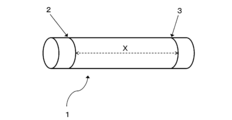
- FIG. 1 is an explanatory diagram for drawing a marked line on a tubular fabric.
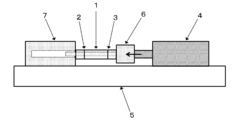
- FIG. 2 is a conceptual diagram of an apparatus for measuring a distance between marked lines during compression of a tubular fabric.
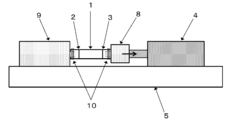
- FIG. 3 is a conceptual diagram of an apparatus for measuring the distance between marked lines when a tubular fabric is stretched.
- FIG. 4 is a diagram for explaining the meaning of the irregularities on the inner surface of the tubular fabric.
- the tubular woven fabric according to the present invention is a tubular woven fabric woven by crossing warps and wefts, and is not subjected to crimping as usual. Therefore, the difference in the outer diameter of the tubular fabric in the warp direction can be made within 10%.
- the above “difference in outer diameter is within 10%” means that five points are measured at 50 mm intervals in the warp direction, the maximum value and the minimum value are evaluated, the minimum value is subtracted from the maximum value, and the value is the maximum value. The value expressed as a percentage by dividing by “outer diameter difference”.
- a gauge line is drawn on the outer periphery of the tubular fabric at a distance of 5 times the maximum value of the outer diameter of the fabric when measured in a state where no stress is applied to the tubular fabric, and 0. 0 in the warp direction of the tubular fabric.
- the relationship between the distance L1 between the marked lines when compressed with a stress of 01 cN / dtex and the distance L2 between the marked lines when stretched with a stress of 0.01 cN / dtex in the warp direction is represented by the following formula: And (L2-L1) /L1 ⁇ 0.1
- the value of (L2-L1) / L1 is preferably 0.15 or more, more preferably 0.18 or more, from the viewpoint that the stretchability and flexibility can be further improved.
- the upper limit is preferably 1.0.
- a tubular woven fabric excellent in stretchability, flexibility, and kink resistance (flexibility) can be provided. That is, when the tubular fabric is bent and bent, stress is applied in the compression direction on the bent inner peripheral side and simultaneously stress is applied in the extension direction on the outer peripheral side. On the other hand, since the outer periphery can be extended sufficiently, it means excellent kink resistance.
- An elongation operation or a compression operation with a stress of 0.01 cN / dtex usually corresponds to a stress when a person gently stretches or compresses the tubular fabric by hand in the warp direction. This means that the operability is good even when the bending operation is performed by hand, and that it has excellent elasticity and flexibility.
- the tubular fabric of the present invention has an elongation of 30% or less when stretched with a stress of 0.01 cN / dtex in the warp direction, and it is easy to feel a response when a person pulls it lightly by hand. This is preferable. More preferably, it is 20% or less, more preferably about 10%.
- the lower limit when stretched with a stress of 0.01 cN / dtex in the warp direction is preferably 5% or more, and more preferably 8% or more from the viewpoint that a person can feel a stretch when lightly pulling by hand. It is more preferable that
- the maximum outer diameter a of the tubular woven fabric and the tubular woven fabric are elongated in the warp direction with a stress of 0.01 cN / dtex.
- the inner diameter difference of the tubular fabric becomes small even when bending, stretching, and compression occur at the same time, ensuring a flow path that does not change. can do.
- the irregularities on the inner surface of the tubular woven fabric are preferably 100 ⁇ m or less, more preferably 80 ⁇ m or less, more preferably 60 ⁇ m or less.
- the lower limit of the unevenness on the inner surface is preferably 3 ⁇ m or more from the viewpoint of endothelium formation when used as an artificial blood vessel.
- the tubular fabric does not have a bellows structure.
- the tubular fabric does not have a bellows structure.
- No bellows structure means that a mandrel having a spiral or annular corrugated groove is inserted into a fiber tube and heated, and is not woven or pleated.
- Synthetic fibers are preferably used for the warp and weft used in the tubular woven fabric of the present invention, and specific examples include nylon fibers and polyester fibers, but it is more preferable to use so-called inelastic yarns.
- “Non-elastic yarn” is a fiber that does not have so-called rubber elasticity, and is a material excellent in extensibility and recoverability, such as a thermoplastic elastomer represented by polyether elastomer, polysulfide elastomer, polyurethane elastomer, etc. It is a fiber different from a fiber having rubber elasticity, so-called elastic yarn.
- inelastic polyester fibers are preferable from the viewpoint of strength and dimensional stability.
- inelastic yarn polyester fibers include fibers made of polyethylene terephthalate, polybutylene terephthalate, polypropylene terephthalate, and copolymers thereof.
- the tubular fabric itself has stretchability.
- tubular woven fabric of the present invention can be manufactured, for example, as follows.
- warp A warp A
- warp B warp A
- inelastic yarns as described above.
- the warp A can be composed of various synthetic fibers such as nylon fiber and polyester fiber. Of these, non-elastic polyester fibers are preferred in terms of strength and dimensional stability. Examples of inelastic yarn polyester fibers include fibers made of polyethylene terephthalate, polybutylene terephthalate, polypropylene terephthalate, and copolymers thereof.
- the warp A constituting the woven fabric may be an ultrafine fiber that is directly spun, or may be an ultrafine fiber that is obtained by removing sea-sea composite fibers.
- a part or all of the single yarn diameter of the synthetic fiber in the warp direction is preferably a multifilament having a size of 5 ⁇ m or less.
- the warp B is preferably composed of dissolved yarn.
- the dissolved yarn is a fiber that is soluble in a solvent such as water or an alkaline solution.
- a solvent such as water or an alkaline solution.
- Specific examples of the dissolved yarn include water-soluble fibers such as polyvinyl alcohol fibers, isophthalic acid, and 5-sodium sulfoisophthalic acid.
- easy-soluble fibers such as polyester fibers and polylactic acid fibers in which a third component such as methoxypolyoxyethylene glycol is copolymerized can be used, but are not particularly limited.
- the temporary yarn removed after weaving can also be used as the warp B.
- the total fineness of each warp is preferably 560 dtex or less, more preferably 235 dtex or less, more preferably 100 dtex or less.
- the weaving density of the warp A after post-processing is preferably 300 pieces / inch (2.54 cm) or less, more preferably 280 pieces / inch (2.54 cm) or less, more preferably 250 pieces / inch (2.54 cm).
- weft C and weft D are at least two types of wefts.
- a tubular woven fabric having a two-layer structure is preferable.
- a preferred embodiment in this case is a case where the weft C is located in the inner layer of the tubular fabric and the weft D is located in the outer layer.
- the weft C located in the inner layer and the weft D located in the outer layer can be composed of various synthetic fibers such as nylon fiber and polyester fiber, but are preferably inelastic yarns. Of these, non-elastic polyester fibers are preferred in terms of strength and dimensional stability. Examples of inelastic yarn polyester fibers include fibers made of polyethylene terephthalate, polybutylene terephthalate, polypropylene terephthalate, and copolymers thereof.
- the weft C located in the inner layer may be an ultrafine fiber obtained by using a sea-island composite fiber or a directly spun ultrafine fiber as a raw yarn, and after the sea-island composite fiber is desealed or directly spun. It is preferable that a part or all of the single yarn diameter of the synthetic fiber of the weft C is a multifilament of 5 ⁇ m or less. By setting the single yarn diameter in the above range, the flexibility of the tubular woven fabric is improved, and a denser structure can be obtained.
- the single yarn diameter of the weft D located in the outer layer is in the range of 10 to 20 ⁇ m.
- the rigidity of the inner layer is improved, deterioration due to hydrolysis can be suppressed, and durability can be improved.
- the total fineness of each weft is preferably 560 dtex or less, more preferably 235 dtex or less, more preferably 100 dtex or less.
- the weave density of each weft after post-processing is preferably 200 pieces / inch (2.54 cm) or less, more preferably 180 pieces / inch (2.54 cm) or less, more preferably 150 pieces / inch (2.54 cm).
- the warp B is woven with a high tension and the warp A is woven with a low tension within a range that does not hinder the opening.
- the tension of the warp B is preferably 0.5 to 1.5 cN / dtex
- the tension of the warp A is preferably 0.05 to 0.15 cN / dtex.
- the warp A and the warp B are preferably arranged at a ratio of 1 warp B to 2 to 10 warps A.
- the weft can be restrained by the warp A with the warp B as a fulcrum, and bumping can be suppressed. Therefore, the crimp rate of the warp A can be increased, and by removing the warp B after weaving, flexibility can be imparted to the tubular fabric.
- the warp B is preferably disposed between the weft C located in the inner layer and the weft D located in the outer layer.
- wefts C which are located in the inner layer of the tubular woven fabric, and wefts D located in the outer layer, structural distortion occurs due to the difference in the circumferential length between the weft C and the weft D.
- extensibility can be provided to a cylindrical fabric.
- the inner diameter of the tubular woven fabric is preferably 100 mm or less, more preferably 50 mm or less, more preferably 10 mm or less.
- a preferable lower limit of the inner diameter of the tubular woven fabric is about 1.5 mm from the viewpoint of weaving.
- the post-processing step is preferably performed through the following steps, for example.
- the case where the internal diameter of a cylindrical fabric is 3 mm is illustrated.
- the raw thread oil agent is dropped and the warp B is contracted by hot water washing.
- the treatment conditions are preferably a temperature of 80 to 98 ° C. and a time of 15 to 40 minutes.
- Pre-heat set stabilizes the shape of the warp A in which the crimp rate has increased as the warp B contracts.
- a round bar having an outer diameter of 2.8 mm is inserted into the cylindrical fabric, and both ends are fixed with a wire or the like, and heat treatment is performed.
- the heat treatment conditions are preferably a temperature of 160 to 190 ° C. and a time of 3 to 10 minutes.
- the material of the said round bar can mention SUS, for example.
- (C-1) Acid treatment The sea component of the sea-island composite fiber is embrittled by acid treatment.
- the acid include maleic acid.
- the acid treatment conditions are preferably a concentration of 0.1 to 1% by mass, a temperature of 100 to 150 ° C., and a time of 10 to 50 minutes. When sea-island composite fibers are not used, acid treatment can be omitted.
- (C-2) Alkali treatment The sea component of the sea-island composite fiber embrittled by the dissolved yarn and the acid treatment is eluted by alkali treatment.
- alkali include sodium hydroxide.
- the alkali treatment conditions are preferably a concentration of 0.5 to 2% by mass, a temperature of 70 to 98 ° C., and a time of 60 to 100 minutes.
- (D) Heat setting (first time) The purpose is to maximize again the crimp of the warp that has been loosened by the sea removal treatment by the first heat setting.
- a round bar having an outer diameter of 3 mm is inserted into a cylindrical woven fabric and heat-treated by fixing both ends with a wire or the like in a state where it is compressed to the maximum in the warp direction so as not to cause wrinkles.
- the heat treatment conditions are preferably a temperature of 160 to 190 ° C. and a time of 3 to 10 minutes.
- the material of the said round bar can mention SUS, for example.
- the second heat set is intended to make a woven fabric having a shrinkage allowance while leaving the bending point of the crimp, but the second heat set may not be performed.
- a round bar having an outer diameter of 3 mm is inserted into a cylindrical woven fabric, and heat treatment is performed by fixing both ends with a wire or the like in a state of extending 20 to 50% in the warp direction.
- the heat treatment conditions are preferably a temperature lower by 10 to 20 ° C. than the first heat setting and a time of 3 to 10 minutes is preferable.
- the material of the said round bar can mention SUS, for example.
- the cylindrical woven fabric thus obtained has a small inner surface unevenness and is excellent in stretchability, flexibility, kink resistance (flexibility), fluid, powder transfer and wire, It can be usefully used for a hose for protecting a linear object such as a cable and a conduit, a cylindrical filter, a base material for an artificial blood vessel, and the like, and can be particularly suitably used as an artificial blood vessel.
- antithrombogenicity is a property that blood does not coagulate on the surface in contact with blood, and inhibits blood coagulation that progresses by, for example, platelet aggregation or activation of blood coagulation factors typified by thrombin. It is a property to do.
- the method for forming the layer of the antithrombotic material is not particularly limited, and the inner surface of the cylindrical fabric is modified and then heparin or a heparin derivative is covalently bonded to the inner surface of the cylindrical fabric (Special Table 2009- No. 545333, Japanese Patent No. 4152075, Japanese Patent No. 3497612), a method of ion-bonding heparin or a heparin derivative to the inner surface of a tubular woven fabric, or a heparin or heparin derivative contained in a gel such as collagen or gelatin. (Patent No.
- the antithrombotic material is preferably a compound having anticoagulant activity.
- the compound having anticoagulant activity may be a compound having a property of inhibiting blood coagulation that proceeds by platelet aggregation or activation of a blood coagulation factor represented by thrombin.
- clopidogrel sulfate Salt prasugrel sulfate, ticlopidine hydrochloride, dipyridamole, cilostazol, beraprost sodium, limaprost alfadex, ozagrel sodium, sarpogrelate hydrochloride, ethyl icosapentate, trapidil, warfarin potassium, heparin sodium, heparin potassium, dalteparin sodium, parnaparin sodium, levapirin Sodium, rivaroxaban, apixaban, endoxaban, dabigatran, argatroban, dextran sulfate, polyvinyl sulfonic acid and polystyrene sulfone
- a cationic polymer specifically, a cationic polymer containing, as a monomer unit, a compound selected from the group consisting of alkyleneimine, vinylamine, allylamine, lysine, protamine and diallyldimethylammonium chloride. More preferably, it contains.
- the polymer Since these monomer units have a cationic nitrogen atom, the polymer becomes cationic, whereas the compound containing a sulfur atom having anticoagulant activity is anionic, so that both of them are ionically bonded. Can do.
- the anionic anticoagulant compound containing a sulfur atom include heparin, heparin derivatives, dextran sulfate, polyvinyl sulfonic acid, and polystyrene sulfonic acid, and heparin or heparin derivatives are more preferable. Heparin or a heparin derivative may be purified or not, and is not particularly limited as long as it can inhibit the blood coagulation reaction.
- Heparin generally used in clinical practice In addition to unfractionated heparin and low molecular weight heparin, anti-thrombin III has high affinity heparin.
- Specific examples of heparin include “heparin sodium” (Organon API).
- the cationic polymer Since the cationic polymer has a cationic property and may develop hemolytic toxicity, it is not preferable to elute it in the blood. For this reason, the cationic polymer is preferably bonded to the warp and the weft constituting the tubular woven fabric whose inner side is in contact with blood, and more preferably covalently bonded.
- the covalent bond refers to a chemical bond generated by sharing electrons between atoms.
- it is a covalent bond between atoms such as carbon, nitrogen, oxygen, sulfur, etc., which the surface of the polymer constituting the antithrombotic material and the substrate has, and may be a single bond or a multiple bond. Absent.
- the kind of covalent bond is not limited, For example, an amine bond, an azide bond, an amide bond, an imine bond, etc. are mentioned. Among these, an amide bond is more preferable from the viewpoint of easy formation of a covalent bond and stability after bonding.
- the cationic polymer may be a homopolymer or a copolymer.
- the cationic polymer when it is a copolymer, it may be a random copolymer, a block copolymer, a graft copolymer or an alternating copolymer, but the repeating unit containing a nitrogen atom is continuous.
- a block copolymer is more preferable because the block portion and a compound having an anionic anticoagulant activity containing a sulfur atom interact to form a strong ionic bond.
- the homopolymer refers to a polymer compound obtained by polymerizing one type of monomer unit
- the copolymer refers to a polymer compound obtained by copolymerization of two or more types of monomers.
- the block copolymer is a copolymer having a molecular structure in which at least two kinds of polymers having different repeating units are connected by covalent bonds to form a long chain.
- a block constitutes a block copolymer. Each of at least two kinds of polymers having different repeating units.
- the structure of the cationic polymer may be linear or branched.
- a more stable ionic bond can be formed with a compound having an anionic anticoagulant activity containing a sulfur atom in many respects, a branched one is more preferable.
- the cationic polymer has at least one functional group among primary to tertiary amino groups and quaternary ammonium groups.
- the quaternary ammonium group is Elution rate of a compound having an anionic anticoagulant activity containing a sulfur atom with stronger ionic interaction with the anionic anticoagulant compound containing a sulfur atom than a primary to tertiary amino group Is preferable because it is easy to control.
- the number of carbon atoms of the three alkyl groups constituting the quaternary ammonium group is not particularly limited, but is effective for the quaternary ammonium group by not increasing the hydrophobicity and steric hindrance.
- an anionic anticoagulant compound containing a sulfur atom easily becomes ionically bonded.
- the number of carbon atoms per alkyl group bonded to the nitrogen atom constituting the quaternary ammonium group is preferably 1 to 12, and more preferably 2 to 6.
- the three alkyl groups bonded to the nitrogen atom constituting the quaternary ammonium group may all have the same carbon number or may be different.
- polyalkyleneimine as the cationic polymer because of the large amount of adsorption based on the ionic interaction with the anionic anticoagulant compound containing a sulfur atom.
- the polyalkyleneimine include polyethyleneimine (hereinafter “PEI”), polypropyleneimine and polybutyleneimine, and further alkoxylated polyalkyleneimine, among which PEI is more preferable.
- PEI examples include “LUPASOL” (registered trademark) (manufactured by BASF) and “EPOMIN” (registered trademark) (manufactured by Nippon Shokubai Co., Ltd.). It may be a copolymer with another monomer or a modified product.
- the modified body refers to a monomer in which the repeating unit of the monomer constituting the cationic polymer is the same, for example, a part of which undergoes radical decomposition, recombination, etc. by irradiation with radiation described below. .
- the weight average molecular weight of the cationic polymer is too small, the molecular weight is smaller than that of the anionic anticoagulant compound containing a sulfur atom, so that a stable ionic bond is not formed, and the target antithrombotic agent is formed. It becomes difficult to obtain sex.
- the weight average molecular weight of the cationic polymer is too large, the anionic anticoagulant compound containing a sulfur atom is encapsulated by the cationic polymer, and the antithrombotic material is buried.
- the weight average molecular weight of the cationic polymer is preferably from 600 to 2,000,000, more preferably from 1,000 to 1500,000, and even more preferably from 10,000 to 1,000,000.
- the weight average molecular weight of the cationic polymer can be measured by, for example, a gel permeation chromatography method or a light scattering method.
- the manufacturing method of the antithrombotic material is shown below.
- a polymer containing as a monomer unit a compound selected from the group consisting of alkyleneimine, vinylamine, allylamine, lysine, protamine and diallyldimethylammonium chloride The target substrate may be immersed in a solution containing a compound having an anionic anticoagulant activity containing a sulfur atom.
- the polymer and the anionic anticoagulant activity containing a sulfur atom may be used.
- the inner surface of the base material is coated with an antithrombotic material after all or any of the compounds have been reacted in advance, and a layer of the antithrombogenic material is formed on the inner surface of the base material. Also good.
- a compound selected from the group consisting of alkyleneimine, vinylamine, allylamine, lysine, protamine and diallyldimethylammonium chloride as the first coating step in order to efficiently develop antithrombogenicity on the surface of the substrate.
- the cationic polymer contains primary to tertiary amino groups
- the ion interaction with an anionic anticoagulant compound containing a sulfur atom is strengthened, and the dissolution rate of heparin is controlled.
- a step of quaternizing the cationic polymer may be added after the first coating step.
- a first coating step after covalently bonding a cationic polymer containing as a monomer unit a compound selected from the group consisting of alkyleneimine, vinylamine, allylamine, lysine, protamine and diallyldimethylammonium chloride to the inner surface of the substrate, A production method in the case of using a method in which a compound having an anionic anticoagulant activity containing a sulfur atom is ion-bonded to the cationic polymer as the second coating step is shown below.
- the method of covalently bonding the cationic polymer to the inner surface of the substrate is not particularly limited, but the substrate is a functional group (hydroxyl group, thiol group, amino group, carboxyl group, aldehyde group, isocyanate group, thioisocyanate, etc. ), There is a method of covalently bonding with a cationic polymer by a chemical reaction.
- a polymer having a hydroxyl group, a thiol group, an amino group, or the like may be covalently bonded to the inner surface of the substrate, or a compound having a hydroxyl group, a thiol group, an amino group, or the like And a method of covalently bonding to the inner surface of a substrate having a carboxyl group and the like.
- a method of covalently bonding a cationic polymer, or irradiation with radiation there is a method of generating radicals in a polymer and covalently bonding the inner surface of the substrate and the cationic polymer by a recombination reaction.
- radiation ⁇ rays and electron beams are mainly used.
- the amount of ⁇ rays is preferably 2.5 million to 10 million Ci, and more preferably 3 million to 7.5 million Ci.
- the acceleration voltage of the electron beam is preferably 5 MeV or more, and more preferably 10 MeV or more.
- the radiation dose is preferably 1 to 50 kGy, more preferably 5 to 35 kGy.
- the irradiation temperature is preferably 10 to 60 ° C, more preferably 20 to 50 ° C.
- an antioxidant may be used to control the amount of radicals generated.
- the term “antioxidant” refers to a molecule that has the property of easily giving electrons to other molecules. Antioxidants to be used are not particularly limited.
- water-soluble vitamins such as vitamin C, polyphenols, alcohols such as methanol, ethanol, propanol, ethylene glycol, propylene glycol and glycerin, glucose and galactose Sugars such as mannose and trehalose, inorganic salts such as sodium hydrosulfite, sodium pyrosulfite, sodium dithionate, uric acid, cysteine, glutathione, bis (2-hydroxyethyl) iminotris (hydroxymethyl) methane (hereinafter referred to as “ Bis-Tris ”) and the like.
- Bis-Tris bis (2-hydroxyethyl) iminotris (hydroxymethyl) methane
- methanol, ethanol, propylene glycol, and Bis-Tris are particularly preferable from the viewpoint of handleability and persistence, and propylene glycol and Bis-Tris are more preferable.
- These antioxidants may be used alone or in combination of two or more. The antioxidant is preferably added to the aqueous solution.
- polyester fiber When polyester fiber is used as the material for the cylindrical woven fabric, it is not particularly limited, but a method of covalently bonding by an aminolysis reaction by contacting a cationic polymer under heating conditions can also be used.
- the ester bond on the inner surface of the substrate can be hydrolyzed by acid and alkali treatment, and the carboxyl group generated on the inner surface of the substrate and the amino group of the cationic polymer can be condensed and covalently bonded.
- the cationic polymer may be brought into contact with the inner surface of the substrate to cause the reaction, but may also be brought into contact with the base while being dissolved in a solvent.
- the monomer constituting the cationic polymer may be polymerized while being in contact with the inner surface of the substrate, and then reacted to be covalently bonded.
- the heating means is not particularly limited, and examples thereof include electric heating, microwave heating, and far infrared heating.
- the heating temperature is preferably near the glass transition point and below the melting point.
- the step of hydrolyzing and oxidizing the ester bond on the inner surface of the base material is important before the first coating step.
- a method of treating with an acid or alkali and an oxidizing agent is preferably used.
- a method of treating with an acid or alkali and an oxidizing agent is particularly preferably used.
- a method of treating with an acid and an oxidizing agent is optimal as a combination of the step of hydrolyzing and oxidizing the ester bond on the inner surface of the substrate with an acid or alkali and an oxidizing agent in the present invention. Moreover, after processing the inner surface of a base material with an alkali, you may process with an acid and an oxidizing agent.
- the type of acid used is not particularly limited.
- Inorganic acids such as phosphoric acid, hexafluoroantimonic acid, tetrafluoroboric acid, chromic acid and boric acid, methanesulfonic acid, ethanesulfonic acid, benzenesulfonic acid, p-toluenesulfonic acid, trifluoromethanesulfonic acid and polystyrenesulfone Sulfonic acids such as sodium acid, acetic acid, citric acid, formic acid, gluconic acid, carboxylic acids such as lactic acid, oxalic acid and tartaric acid, vinyl carboxylic acids such as ascorbic acid and meldrum acid, nucleic acids such as deoxyribonucleic acid and rib
- the type of base used is not particularly limited.
- hydroxides of alkali metals such as lithium hydroxide, sodium hydroxide, potassium hydroxide, rubidium hydroxide and cesium hydroxide, tetramethyl hydroxide Tetraalkylammonium hydroxides such as ammonium and tetraethylammonium hydroxide, alkaline earth metal hydroxides such as calcium hydroxide, strontium hydroxide, barium hydroxide, europium hydroxide and thallium hydroxide, guanidine compounds, diammines
- hydroxides of ammine complexes such as silver (I) hydroxide and tetraammine copper (II) hydroxide, trimethylsulfonium hydroxide and diphenyliodonium hydroxide.
- lithium hydroxide, sodium hydroxide, potassium hydroxide, and the like are more preferable from the viewpoint of handleability and the like.
- the type of the oxidizing agent used is not particularly limited, but for example, potassium nitrate, hypochlorous acid, chlorous acid, perchloric acid, halogen such as fluorine, chlorine, bromine and iodine, potassium permanganate, Permanganate such as sodium permanganate trihydrate, ammonium permanganate, silver permanganate, zinc permanganate hexahydrate, magnesium permanganate, calcium permanganate and barium permanganate, nitric acid Examples include peroxides such as cerium ammonium, chromic acid, dichromic acid, and hydrogen peroxide, Trens reagent, and sulfur dioxide. Among them, the strength of oxidizing agents and the deterioration of antithrombotic materials can be appropriately prevented. Permanganate is more preferable from the viewpoint of being able to do so.
- a method of covalently bonding a cationic polymer to the inner surface of a cylindrical woven fabric containing polyester fibers for example, there is a method of performing a condensation reaction using a dehydration condensing agent or the like.
- the type of the dehydrating condensing agent to be used is not particularly limited.
- the dehydration condensation agent may be used together with a dehydration condensation accelerator.
- the dehydration condensation accelerator to be used is not particularly limited.
- DMAP 4-dimethylaminopyridine
- Examples include imide.
- the cationic polymer, the dehydration condensation agent and the dehydration condensation accelerator may be reacted in the form of a mixed aqueous solution, or may be added in order to carry out the reaction.
- the cationic polymer contains primary to tertiary amino groups
- the ionic interaction with heparin or a derivative of heparin is strengthened, and the elution rate of heparin can be easily controlled.
- a step of quaternary ammonium conversion may be added.
- quaternary ammonium may be formed before the cationic polymer is covalently bonded to the inner surface of the substrate, or the cationic polymer is covalently bonded to the inner surface of the substrate.
- quaternary ammonium may be used later, in order to strengthen the ionic interaction between the cationic polymer and the anionic anticoagulant compound containing a sulfur atom, the quaternary ammonium contained in the cationic polymer. Since the group is preferably present on the innermost surface of the antithrombogenic material, it is preferably quaternized ammonium after covalent bonding to the inner surface of the substrate.
- an alkyl halide compound such as ether chloride or bromide or a glycidyl group-containing quaternary ammonium salt may be directly contacted, You may make it contact in an organic solvent.
- the second coating step for ionically bonding an anionic anticoagulant compound containing a sulfur atom to the cationic polymer is not particularly limited, but a method of contacting in an aqueous solution state is preferable.
- the anti-factor Xa activity of the antithrombotic material was used as an index indicating antithrombogenicity.
- the anti-factor Xa activity is an index representing the degree of inhibiting the activity of factor Xa that promotes the conversion of prothrombin to thrombin, and the surface of heparin or heparin derivatives in the active unit in the antithrombotic material. You can know the amount.
- “Test Team (registered trademark) Heparin S” manufactured by Sekisui Medical Co., Ltd. was used.
- the anti-factor Xa activity is too low, the surface amount of heparin or a heparin derivative in the antithrombotic material is small, and the desired antithrombogenicity is difficult to obtain.
- the anti-factor Xa activity is too high, the surface amount of heparin or a heparin derivative is sufficient to develop the desired antithrombotic properties, but the thickness of the antithrombotic material increases, and The surface fine structure may not be maintained.
- the total coating amount by the anti-factor Xa activity on the surface of the antithrombotic material is preferably 10 mIU / mg or more and 20000 mIU / mg or less per unit weight of the base material, and the total coating amount is 50 mIU / mg or more and 10,000 mIU / mg. More preferably, it is mg.
- the total coating amount here refers to the amount of heparin eluted in normal human plasma after the substrate cut into about 0.5 cm ⁇ 1 cm is immersed in 5 mL of normal human plasma and shaken for 24 hours in an atmosphere of 37 degrees. It is calculated by summing the amount of surface heparin remaining on the surface of the material.
- the artificial blood vessel of the present invention preferably has a layer of a bioabsorbable material on the outer surface of a cylindrical fabric as a base material.
- the bioabsorbable material that covers the outer surface of the tubular fabric functions to prevent blood from leaking from the inside of the artificial blood vessel.
- Bioabsorbability is a property that is decomposed over time and absorbed into the body, and is a property that is decomposed and absorbed by hydrolysis, enzymatic degradation, or phagocytosis by immune cells. After completing the role of preventing blood leakage, it may be broken down and disappear.
- the layer of the bioabsorbable material preferably has an appropriate thickness and has a structure that does not necessarily have voids, because it preferably has a suitable shape retaining property, and preferably follows a cylindrical fabric and easily prevents blood leakage. There is no need to be, and a porous structure including micropores such as communication holes may be used.
- the bioabsorbable material is not particularly limited, but is preferably a polymer compound from the viewpoints of followability and coating processability as described above, and a synthetic polymer or a natural polymer can be used.
- the synthetic polymer is selected from the group consisting of lactic acid, glycolic acid, caproic acid, oxalic acid, malonic acid, succinic acid, glutaric acid, maleic acid, fumaric acid, ethylene glycol, propylene glycol, vinyl pyrrolidone, and vinyl alcohol. Homopolymers or copolymers containing monomer units are particularly preferred because of their clinical experience.
- polysaccharides or proteins are preferably used, and collagen, atelocollagen, and gelatin are preferably used because they have a clinical track record.
- the gelatin preferably has a low endotoxin content in order to avoid an inflammatory reaction in vivo, and B-matrix (registered trademark) gelatin (LS-H, LS-W) (manufactured by Nitta Gelatin Co., Ltd.), RM -Gelatin (RM-50, RM-100, RM-100B) (manufactured by Zelice Co., Ltd.) is more preferred.
- the bioabsorbable material layer is preferably a polymer compound that does not dissolve at body temperature.
- at least the polymer compound is preferably insoluble in water at 37 ° C.
- a method of making the bioabsorbable material a water-insoluble polymer compound, a method in which the composition ratio of the hydrophilic component in the polymer compound is made lower than the ratio of the non-hydrophilic component, or a chemically or physically crosslinked structure is used. Is preferably used.
- the bioabsorbable material is a protein
- a method of making it water-insoluble by chemical crosslinking is known.
- chemical crosslinking with a substance containing a divalent functional group or radiation crosslinking with radiation such as ⁇ rays is used.
- the substance containing a divalent functional group used for chemical crosslinking is not particularly limited, but an amino group, carboxyl group, hydroxyl group, thiol group, isocyaninate group, isothiocyanate group, aldehyde group, epoxy group and A substance containing two or more reactive functional groups selected from the group consisting of guanidino groups can be used.
- glutaraldehyde or formaldehyde which has a track record in medical use, is preferably used.
- the thickness of the bioabsorbable material layer is determined by cutting an artificial blood vessel in a cross section perpendicular to the longitudinal direction, and the cross section is 300 times magnification with a scanning electron microscope (Minscope TM3000 manufactured by Hitachi High-Technologies Corporation). Measured by observation. More specifically, let P1 be a point located on the boundary of an arbitrary thread located on the outermost periphery of the tubular woven fabric in contact with the bioabsorbable material on the side opposite to the center of the artificial blood vessel, and pull it through P1.
- the layer thickness ( ⁇ m) was used.
- the thickness of the bioabsorbable material layer is preferably 10 ⁇ m or more from the viewpoint of improving the durability to blood pressure, and preferably 300 ⁇ m or less from the viewpoint of improving the flexibility of the artificial blood vessel. Further, the thickness of the bioabsorbable material is particularly preferably 30 ⁇ m or more and 200 ⁇ m or less.
- the kink radius of the artificial blood vessel of the present invention is preferably 15 mm or less. When this range is satisfied, it can have good buckling resistance (kink resistance) when placed in the body.
- kink resistance the minimum loop radius that does not buckle when a loop is formed by an artificial blood vessel and the loop diameter is gradually reduced can be used as an index.
- the kink radius is defined as the minimum loop radius that does not buckle.
- the minimum loop radius is measured according to the guidance of IS07198.
- Water permeability was used as an index representing blood leakage from an artificial blood vessel at the time of implantation.
- the water permeability of the artificial blood vessel is preferably as low as possible, and is preferably 10 mL / cm 2 / min or less.
- the water permeability measurement method is in accordance with ISO 7198. The amount of water (mL) flowing out to the outer surface of the artificial blood vessel when a pressure of 120 mmHg is applied to the inner surface of the artificial blood vessel at 25 ° C. is measured in unit area (cm 2 ) and unit time ( 30 sec.).
- the measuring method of various characteristics used in the present embodiment is as follows.
- Fineness, number of filaments The fineness was measured based on JIS L 1013: 2010 8.3.1 Positive Fineness (Method A).
- the number of filaments was measured based on JIS L 1013: 2010 8.4.
- the difference in outer diameter was obtained by subtracting the minimum value from the maximum value and dividing the value by the maximum value.
- FIG. 1 is an explanatory diagram for drawing a marked line on the tubular fabric.
- the first marked line 2 is placed on the outer periphery of the fabric 5 mm from one end of the tubular fabric 1.
- a second mark 3 is drawn on the outer periphery of the fabric at a distance X that is five times the maximum value of the outer diameter of the fabric from the first mark 2.
- the tubular woven fabric 1 is cut in the radial direction at a position of 5 mm from the second marked line 3 toward the outside (the opposite side when the position indicated by the broken arrow is the inside with respect to the marked line 3).
- the distance between the marked line 2 and the marked line 3 in FIG. 1 is the distance between marked lines in the present invention.
- FIG. 2 is a conceptual diagram of an apparatus for measuring the distance between the marked lines at the time of compression of the tubular woven fabric.
- the apparatus is used as a load measuring device (force gauge) 4.
- HANDY DIGITAL FORCE GAUGE HF-1 (rated capacity 10N) manufactured by Nippon Measuring System Co., Ltd. is installed on the gantry 5, a compression chuck jig 6 having a core bar part is attached to the load measuring instrument 4, and the core bar part is inserted.
- a compression receiving jig 7 having a possible hole is attached to the gantry 5.
- the outer diameter of the core rod portion inserted into the cylindrical fabric 1 of the compression chuck jig 6 is a value obtained by subtracting “0.1 mm ⁇ 0.03 mm” from the numerical value of the minimum fabric inner diameter of the cylindrical fabric 1.
- the hole of the compression receiving jig 7 has the same diameter as the smallest woven fabric inner diameter portion of the tubular woven fabric.
- the same diameter does not need to be exactly the same diameter, and a difference of about ⁇ 0.03 mm is treated as the same diameter.
- FIG. 3 is a conceptual diagram of an apparatus for measuring the distance between the marked lines when the tubular fabric is stretched. As shown in FIG. 3, the apparatus is used as a load measuring instrument (force gauge) 4.
- an extension chuck jig 8 having a core rod part that can be inserted into the tubular fabric 1 by installing a HANDY DIGITAL FORCE GAUGE HF-1 (rated capacity 10 N) manufactured by Nippon Measuring System Co., Ltd.
- An extension receiving jig 9 having a core bar portion that can be attached and inserted into the tubular fabric 1 is attached to the gantry 5.
- the outside of the marked lines 2 and 3 of the cylindrical woven fabric 1 is fixed with the fixed string 10, and the distance L2 between the marked lines when stretched with a stress of 0.01 cN / dtex in the warp direction (distance between the marked lines when stretched) was measured with calipers.
- the outer diameter of the tubular fabric was measured with a caliper when the tubular fabric was stretched in the warp direction with a stress of 0.01 cN / dtex.
- the measurement position of the outer diameter is the central part between the two marked lines 2 and 3 marked on the cylindrical fabric 1 and three places 5 mm inside from the marked line.
- the measurement is performed 15 times in order to change the sample 5 times.
- Warp A (sea-island composite fiber): polyethylene terephthalate fiber, 66 dtex, 9 filaments (after sea removal treatment: 52.8 dtex, 630 filaments)
- Warp B (dissolved yarn): easily alkali-soluble polyester fiber copolymerized with 5-sodium sulfoisophthalic acid, 84 dtex, 24 filaments
- Weft C inner layer
- sheft D outer layer
- polyethylene terephthalate fiber 56 dtex, 18 filaments and, during weaving, the tension of warp B is 0.9 cN / dtex and the tension of warp A is 0.1
- warp A 201 / inch (2.54 cm), weft C, 121 / inch (2.54 cm), weft D, 121 / inch (2.54 cm) did.
- the warp A and the warp B were arranged at a ratio of 1 warp B to 3 warps A. Further, the warp B was disposed between the weft C located in the inner layer and the weft D located in the outer layer.
- (C-1) Acid treatment Maleic acid was used as the acid.
- the treatment conditions were a concentration of 0.2% by mass, a temperature of 130 ° C., and a time of 30 minutes.
- the treatment conditions were a concentration of 1% by mass, a temperature of 80 ° C., and a time of 90 minutes.
- Table 1 shows the characteristics of the obtained tubular woven fabric.
- the artificial blood vessel made of the tubular woven fabric does not need to take into account the cutting site and is easy to sew.
- Example 2 In Example 1, the cylindrical woven fabric was obtained in the same manner as in Example 1 except that the inner diameter of the cylindrical woven fabric was 5 mm and the second heat setting was not performed.
- the artificial blood vessel made of the tubular woven fabric does not need to take into account the cutting site and is easy to sew.
- Table 1 shows the characteristics of the obtained tubular woven fabric.
- Example 3 In Example 1, a cylindrical woven fabric was obtained in the same manner as in Example 1 except that the inner diameter of the cylindrical woven fabric was set to 7 mm and 20% was elongated in the second heat setting.
- Table 1 shows the characteristics of the obtained tubular woven fabric.
- the artificial blood vessel made of the tubular woven fabric does not need to take into account the cutting site and is easy to sew.
- Example 1 Using the warp A and the weft C used in Example 1, the tension of the warp A is 0.9 cN / dtex, the weaving density after the post-processing is warp A, 201 / inch (2.54 cm), the weft C A plain woven tubular woven fabric (inner diameter: 3 mm) was woven at 121 / inch (2.54 cm). Thereafter, a tubular woven fabric was obtained in the same manner as in Example 1.
- Table 1 shows the characteristics of the obtained tubular woven fabric.
- Example 1 When the obtained tubular woven fabric was bent by hand, it was not easily bent as compared with Example 1, and was inferior in elasticity and flexibility.
- the artificial blood vessel made of the tubular woven fabric does not need to take into account the cutting site and is easy to sew.
- Example 2 a tubular woven fabric (inner diameter of 3 mm) was obtained in the same manner as in Example 1 except that the tension of the warp B during weaving was 0.9 cN / dtex and the tension of the warp A was 0.9 cN / dtex. It was.
- Table 1 shows the characteristics of the obtained tubular woven fabric.
- Example 1 When the obtained tubular woven fabric was bent by hand, it was not easily bent as compared with Example 1, and was inferior in elasticity and flexibility.
- the artificial blood vessel made of the tubular woven fabric does not need to take into account the cutting site and is easy to sew.
- Table 1 shows the characteristics of the obtained tubular woven fabric.
- Example 4 The tubular fabric obtained in Example 1 was immersed in an aqueous solution of 5.0% by weight potassium permanganate (Wako Pure Chemical Industries, Ltd.) and 0.6 mol / L sulfuric acid (Wako Pure Chemical Industries, Ltd.). The tubular fabric was hydrolyzed and oxidized by reacting at 60 ° C. for 3 hours.
- Example 5 A lactic acid / glycolic acid copolymer (solvent: chloroform) prepared at a concentration of 20 wt% as a bioabsorbable material was applied to the outer surface of the tubular woven fabric obtained in Example 4 and dried at room temperature overnight after application. A layer of bioabsorbable material was formed. The thickness of the formed bioabsorbable material layer was 65 ⁇ m.
- the water permeability when a pressure of 120 mmHg was applied to the inner surface at 25 ° C. was measured on the inner surface of the tubular woven fabric having the layer of the bioabsorbable material, the water permeability was 0 mL / cm 2 / min. Met.
- the kink radius measured in accordance with ISO 7198 guidance was 15 mm.
- Example 6 A lactic acid / ⁇ -caprolactone copolymer (solvent: tetrahydrofuran) adjusted to a concentration of 20 wt% was applied as a bioabsorbable material to the outer surface of the tubular woven fabric obtained in Example 4, and after application, 40 ° C. for 2 hours. Dried to form a layer of bioabsorbable material. The thickness of the formed bioabsorbable material layer was 45 ⁇ m. When the water permeability when a pressure of 120 mmHg was applied to the inner surface at 25 ° C. was measured on the inner surface of the tubular woven fabric having the layer of the bioabsorbable material, the water permeability was 0 mL / cm 2 / min. Met. The kink radius measured in accordance with ISO 7198 guidance was 10 mm.
- Example 7 The outer surface of the tubular woven fabric obtained in Example 4 was coated with a gelatin solution prepared to 30 wt% as a bioabsorbable material (Bee Matrix (registered trademark) gelatin LS-H; manufactured by Nitta Gelatin Co., Ltd.) After coating, the gelatin was solidified by cooling at 4 ° C. for 1 hour and immersed in a 0.2% glutaraldehyde solution for 30 minutes to crosslink the solidified gelatin. After crosslinking, it was dried overnight at 40 degrees. The thickness of the formed bioabsorbable material layer was 120 ⁇ m. When the water permeability when a pressure of 120 mmHg was applied to the inner surface at 25 ° C.
- a bioabsorbable material Bee Matrix (registered trademark) gelatin LS-H; manufactured by Nitta Gelatin Co., Ltd.
- the kink radius measured according to the guidance of ISO 7198 was 7 mm.
- Example 8 When the water permeability of the tubular woven fabric obtained in Example 1 when a pressure of 120 mmHg was applied to the inner surface at 25 ° C. was measured, the water permeability was 188 mL / cm 2 / min. Met.
- the types of warp A, weft C, weft D, warp E, and weft F are polyethylene terephthalate.
- tubular woven fabric according to the present invention can be suitably used for an artificial blood vessel, but its application range is not limited to this.
Landscapes
- Health & Medical Sciences (AREA)
- Life Sciences & Earth Sciences (AREA)
- Veterinary Medicine (AREA)
- Public Health (AREA)
- General Health & Medical Sciences (AREA)
- Animal Behavior & Ethology (AREA)
- Chemical & Material Sciences (AREA)
- Engineering & Computer Science (AREA)
- Epidemiology (AREA)
- Transplantation (AREA)
- Oral & Maxillofacial Surgery (AREA)
- Medicinal Chemistry (AREA)
- Dermatology (AREA)
- Textile Engineering (AREA)
- Vascular Medicine (AREA)
- Hematology (AREA)
- Surgery (AREA)
- Biomedical Technology (AREA)
- Heart & Thoracic Surgery (AREA)
- Cardiology (AREA)
- Materials Engineering (AREA)
- Pulmonology (AREA)
- Gastroenterology & Hepatology (AREA)
- Nanotechnology (AREA)
- Biophysics (AREA)
- Inorganic Chemistry (AREA)
- Materials For Medical Uses (AREA)
- Prostheses (AREA)
- Woven Fabrics (AREA)
Abstract
Description
(L2-L1)/L1≧0.1
L1:上記筒状織物に応力を加えない状態で測定したときの織物外径において、その織物外径の最大値の5倍の距離で筒状織物の外周上に標線を引き、該筒状織物の経糸方向に0.01cN/dtexの応力で圧縮した時の標線間距離。
L2:上記筒状織物に応力を加えない状態で測定したときの織物外径において、その織物外径の最大値の5倍の距離で筒状織物の外周上に標線を引き、該筒状織物の経糸方向に0.01cN/dtexの応力で伸長した時の標線間距離。
変動指数c=(a-b)/a
(L2-L1)/L1≧0.1
変動指数c=(a-b)/a
湯洗により、原糸油剤を落とし、経糸Bを収縮させる。処理条件は、温度80~98℃、時間15~40分が好ましい。
プレ熱セットにより、経糸Bの収縮に伴いクリンプ率が大きくなった経糸Aの形状を安定化させる。外径2.8mmの丸棒を筒状織物に挿入し、両端を針金等で固定して、熱処理を行う。熱処理条件は、温度160~190℃、時間3~10分が好ましい。なお、前記丸棒の材質は、例えば、SUSを挙げることができる。
必要に応じて、前記の経糸A、緯糸Cの脱海処理を行うとともに、経糸Bの溶解除去を行う。
酸処理により、海島複合繊維の海成分を脆化させる。酸としては、マレイン酸を挙げることができる。酸処理条件は、濃度0.1~1質量%、温度100~150℃、時間10~50分が好ましい。海島複合繊維を使用しない場合は、酸処理は省くことができる。
アルカリ処理により、溶解糸および酸処理により脆化した海島複合繊維の海成分を溶出させる。アルカリとしては、水酸化ナトリウムを挙げることができる。アルカリ処理条件は、濃度0.5~2質量%、温度70~98℃、時間60~100分が好ましい。
1回目の熱セットにより、脱海処理により緩んだ経糸のクリンプを再度最大化させることを目的とする。外径3mmの丸棒を筒状織物に挿入し、シワが入らないよう経糸方向に最大限圧縮した状態で、両端を針金等で固定して、熱処理を行う。熱処理条件は、温度160~190℃、時間3~10分が好ましい。なお、前記丸棒の材質は、例えば、SUSを挙げることができる。
2回目の熱セットにより、クリンプの屈曲点を残しながら縮み代を有した織物にすることを目的とするが、2回目の熱セットは実施しなくても良い。外径3mmの丸棒を筒状織物に挿入し、経糸方向に20~50%伸長した状態で、両端を針金等で固定して、熱処理を行う。熱処理条件は、熱セット1回目より10~20℃低い温度とし、時間3~10分が好ましい。なお、前記丸棒の材質は、例えば、SUSを挙げることができる。
繊度は、JIS L 1013:2010 8.3.1 正量繊度(A法)に基づき測定した。
使用するマルチフィラメントの単糸側面をキーエンス製マイクロスコープVHX-2000にて400倍に拡大した写真をもとに測定し、μm単位で算出した。その際、偏平糸などの異形断面糸は側面が最小となる部分で測定した。
ISO7198のガイダンスに則り、テーパー度1/10以下の円錐を垂直にたて、その上に筒状織物を径方向に切断した断面を被せるように垂直にそっと落とし、止まったサンプルの下端位置の円錐の径を測定した。
筒状織物の外径をノギスにて測定した。
先ず、上記(4)により、織物外径の最大値(筒状織物に応力を加えない状態で測定したときの織物外径最大部分)を求める。
荷重(cN)=0.01×経糸繊度×経糸本数
上記(5)と同様の手順で、筒状織物を経糸方向に0.01cN/dtexの応力で圧縮したときの筒状織物の外径をノギスにて測定した。
筒状織物を経糸方向に切断した緯糸断面を電子顕微鏡にて150倍に拡大した写真をもとに、筒状織物内面の隣り合う経糸の頭頂部と緯糸の頭頂部の高さの差を測定した。図4を用いて、筒状織物の内面の凹凸の意味について説明する。このような筒状織物の内面において、隣り合う経糸11と緯糸12の内壁面からの高さの差Yを内面の凹凸という。
JIS L 1096:2010 8.6.1に基づき測定した。
試料を平らな台上に置き、不自然なしわや張力を除いて、異なる5カ所について0.5cm間のタテ糸およびヨコ糸の本数を数え、それぞれの平均値を算出し、2.54cm当たりの本数に換算した。
ISO7198のガイダンスに則り、耐キンク性はキンク半径を測定した。筒状織物をループさせていき、外観上明らかに折れ曲がりが生じた半径を半径既知の円筒状治具を用いて測定した。織成管状体自体の特性を評価するため、内圧維持は行わなかった。
製織工程において、下記の経糸(経糸A、経糸B)および緯糸(緯糸C、緯糸D)を使用した。
・経糸A(海島複合繊維):ポリエチレンテレフタレート繊維、66dtex、9フィラメント(脱海処理後:52.8dtex、630フィラメント)
・経糸B(溶解糸):5-ナトリウムスルホイソフタル酸を共重合した易アルカリ溶解性のポリエステル繊維、84dtex、24フィラメント
・緯糸C(内層)(海島複合繊維):ポリエチレンテレフタレート繊維、66dtex、9フィラメント(脱海処理後:52.8dtex、630フィラメント)
・緯糸D(外層):ポリエチレンテレフタレート繊維、56dtex、18フィラメント
そして、製織時において、経糸Bの張力を0.9cN/dtex、経糸Aの張力を0.1cN/dtexとして、後加工後の織密度が経糸A、201本/inch(2.54cm)、緯糸C、121本/inch(2.54cm)、緯糸D、121本/inch(2.54cm)となる、内径3mmの筒状織物を製織した。なお、経糸Aと経糸Bの配置は、経糸A3本に対して経糸B1本の比率で配置した。また、経糸Bは、内層に位置する緯糸Cと外層に位置する緯糸Dの間に配置した。
処理条件は、温度98℃、時間20分で行った。
外径2.8mmの丸棒を筒状織物に挿入し、両端を針金で固定して、熱処理を行った。処理条件は、温度180℃、時間5分であった。なお、前記丸棒の材質は、SUSであった。
前記の経糸A、緯糸Cの脱海処理を行うとともに、経糸Bの溶解除去を行った。
酸としては、マレイン酸を使用した。処理条件は、濃度0.2質量%、温度130℃、時間30分であった。
アルカリとしては、水酸化ナトリウムを使用した。処理条件は、濃度1質量%、温度80℃、時間90分であった。
外径3mmの丸棒を筒状織物に挿入し、経糸方向にシワが入らないよう最大限圧縮した状態で、両端を針金等で固定して、熱処理を行った。処理条件は、温度180℃、時間5分であった。なお、前記丸棒の材質は、SUSであった。
外径3mmの丸棒を筒状織物に挿入し、経糸方向に30%伸長した状態で、両端を針金等で固定して、熱処理を行った。処理条件は、温度170℃、時間5分であった。なお、前記丸棒の材質は、SUSであった。
実施例1において、筒状織物の内径を5mmとし、熱セット2回目を実施しない以外は実施例1と同様にして、筒状織物を得た。
実施例1において、筒状織物の内径を7mmとし、熱セット2回目に20%伸長した以外は実施例1と同様にして、筒状織物を得た。
実施例1で用いた経糸Aおよび緯糸Cを使用して、経糸Aの張力を0.9cN/dtexとして、後加工後の織密度が経糸A、201本/inch(2.54cm)、緯糸C、121本/inch(2.54cm)となる、平織の筒状織物(内径3mm)を製織した。その後は、実施例1と同様にして、筒状織物を得た。
実施例1において、製織時の経糸Bの張力を0.9cN/dtex、経糸Aの張力を0.9cN/dtexとした以外は実施例1と同様にして、筒状織物(内径3mm)を得た。
製織工程において、下記の経糸Eおよび緯糸Fを使用した。
・経糸E:ポリエチレンテレフタレート繊維、66dtex、72フィラメント
・緯糸F:ポリエチレンテレフタレート繊維、140dtex、144フィラメント
そして、製織時において、経糸Eの張力を0.9cN/dtexとして、後加工後の織密度が経糸A、180本/inch(2.54cm)、緯糸C、120本/inch(2.54cm)となる、内径7mmの筒状織物を製織した。
処理条件は、温度98℃、時間20分で行った。
外径7.0mmのISOメートルネジを筒状織物に挿入し、その上からネジ溝に沿って、ポリエチレン製の糸を1kgの張力で巻き付けて、熱処理を行った。処理条件は、温度170℃、時間30分であった。なお、前記ISOメートルネジの材質は、SUSであった。
実施例1において得られた筒状織物を、5.0重量%過マンガン酸カリウム(和光純薬工業株式会社製)、0.6mol/L硫酸(和光純薬工業株式会社製)の水溶液に浸漬し、60℃で3時間反応させて筒状織物を加水分解および酸化した。
実施例4において得られた筒状織物の外面に、生体吸収性材料として、20wt%の濃度調製した乳酸/グリコール酸共重合体(溶媒:クロロホルム)を塗布し、塗布後に室温で一晩乾燥させ、生体吸収性材料の層を形成した。形成した生体吸収性材料の層の厚みは65μmであった。得られた生体吸収性材料の層を有する筒状織物に対し、内面に25℃で120mmHgの圧力をかけたときの透水性を測定したところ、透水性は0mL/cm2/min.であった。ISO7198のガイダンスに則って測定したキンク半径は15mmであった。
実施例4において得られた筒状織物の外面に、生体吸収性材料として、20wt%の濃度調製した乳酸/ε-カプロラクトン共重合体(溶媒:テトラヒドロフラン)を塗布し、塗布後に40度で2時間乾燥させ、生体吸収性材料の層を形成した。形成した生体吸収性材料の層の厚みは45μmであった。得られた生体吸収性材料の層を有する筒状織物に対し、内面に25℃で120mmHgの圧力をかけたときの透水性を測定したところ、透水性は0mL/cm2/min.であった。ISO7198のガイダンスに則って測定したキンク半径は10mmであった。
実施例4において得られた筒状織物の外面に、生体吸収性材料として、30wt%に調製したゼラチン溶液(ビーマトリックス(登録商標)ゼラチンLS-H;新田ゼラチン株式会社製)を塗布し、塗布後に4度で1時間冷却することでゼラチンを固化させ、0.2%グルタルアルデヒド溶液中に30分浸漬して、固化したゼラチンを架橋した。架橋後、40度で一晩乾燥させた。形成した生体吸収性材料の層の厚みは120μmであった。得られた生体吸収性材料の層を有する筒状織物に対し、内面に25℃で120mmHgの圧力をかけたときの透水性を測定したところ、透水性は0mL/cm2/min.であった。ISO7198のガイダンスに則って測定したキンク半径は7mmであった。
実施例1において得られた筒状織物に対し、内面に25℃で120mmHgの圧力をかけたときの透水性を測定したところ、透水性は188mL/cm2/min.であった。

2 1本目の標線
3 2本目の標線
4 荷重測定器
5 架台
6 圧縮用チャック治具
7 圧縮用受け治具
8 伸長用チャック治具
9 伸長用受け治具
10 固定ヒモ
X 織物外径の最大値の5倍の距離
Y 内面の凹凸
Claims (17)
- 経糸および緯糸を交錯させて製織された筒状織物であり、該筒状織物の経糸方向の外径の差が10%以内である、筒状織物であって、下記式を満たす筒状織物。
(L2-L1)/L1≧0.1
L1:上記筒状織物に応力を加えない状態で測定したときの織物外径において、その織物外径の最大値の5倍の距離で筒状織物の外周上に標線を引き、該筒状織物の経糸方向に0.01cN/dtexの応力で圧縮した時の標線間距離。
L2:上記筒状織物に応力を加えない状態で測定したときの織物外径において、その織物外径の最大値の5倍の距離で筒状織物の外周上に標線を引き、該筒状織物の経糸方向に0.01cN/dtexの応力で伸長した時の標線間距離。 - 筒状織物を経糸方向に0.01cN/dtexの応力で圧縮したときの該筒状織物の最大外径aと、該筒状織物を経糸方向に0.01cN/dtexの応力で伸長したときの該筒状織物の最小外径bの下記式で表される変動指数cが、0.03以上、0.2未満であることを特徴とする、請求項1に記載の筒状織物。
変動指数c=(a-b)/a - 筒状織物の内面の凹凸が100μm以下であることを特徴とする請求項1または2に記載の筒状織物。
- 筒状織物が蛇腹構造を有しないものである請求項1~3のいずれかに記載の筒状織物。
- 筒状織物に使用する経糸および緯糸が合成繊維である請求項1~4のいずれかに記載の筒状織物。
- 筒状織物に使用する合成繊維が、非弾性糸のポリエステルである請求項5に記載の筒状織物。
- 筒状織物を構成する経方向の合成繊維の単糸直径の一部もしくは全てが5μm以下のマルチフィラメントである請求項5または6に記載の筒状織物。
- 請求項1~7のいずれかに記載の筒状織物を基材とする人工血管。
- 請求項1~7のいずれかに記載の筒状織物を基材とし、該基材の内面に抗血栓性材料の層を有する、人工血管。
- 前記抗血栓性材料は、硫黄原子を含むアニオン性の抗凝固活性を有する化合物を含む、請求項9に記載の人工血管。
- 前記抗血栓性材料は、アルキレンイミン、ビニルアミン、アリルアミン、リジン、プロタミンおよびジアリルジメチルアンモニウムクロライドからなる群から選択される化合物をモノマー単位として含むカチオン性ポリマー、を含み、前記カチオン性ポリマーは前記内面が血液と接触する筒状織物を構成する経糸および緯糸と共有結合している、請求項9または10に記載の人工血管。
- 請求項8~11のいずれかに記載の筒状織物を基材とし、該基材の外面に生体吸収性材料の層を有する、人工血管。
- キンク半径が15mm以下である、請求項12に記載の人工血管。
- 内面に25℃で120mmHgの圧力をかけたときの透水性が10mL/cm2/min以下である、請求項12または13に記載の人工血管。
- 前記生体吸収性材料が、乳酸、グリコール酸、カプロン酸、シュウ酸、マロン酸、コハク酸、グルタール酸、マレイン酸、フマル酸、エチレングリコール、プロピレングリコール、ビニルピロリドンおよびビニルアルコ-ルからなる群から選択されるモノマー単位を含むホモポリマーまたはコポリマーである、請求項12~14のいずれかに記載の人工血管。
- 前記生体吸収性材料が、多糖類またはタンパク質である、請求項12~15のいずれかに記載の人工血管。
- 前記タンパク質が、コラーゲン、アテロコラーゲンおよびゼラチンからなる群から選択される、請求項16に記載の人工血管。
Priority Applications (10)
| Application Number | Priority Date | Filing Date | Title |
|---|---|---|---|
| KR1020197008515A KR20190058493A (ko) | 2016-10-07 | 2017-09-29 | 통형상 직물 |
| EP17858314.2A EP3533914B1 (en) | 2016-10-07 | 2017-09-29 | Tubular fabric |
| CN201780061007.6A CN109790654B (zh) | 2016-10-07 | 2017-09-29 | 筒状织物 |
| CA3039448A CA3039448A1 (en) | 2016-10-07 | 2017-09-29 | Tubular woven fabric |
| RU2019113522A RU2019113522A (ru) | 2016-10-07 | 2017-09-29 | Трубчатая ткань |
| JP2017562361A JP6863295B2 (ja) | 2016-10-07 | 2017-09-29 | 筒状織物 |
| MX2019004004A MX2019004004A (es) | 2016-10-07 | 2017-09-29 | Tela tejida tubular. |
| US16/340,081 US11371172B2 (en) | 2016-10-07 | 2017-09-29 | Tubular woven fabric |
| AU2017340701A AU2017340701A1 (en) | 2016-10-07 | 2017-09-29 | Tubular woven fabric |
| BR112019006967A BR112019006967A2 (pt) | 2016-10-07 | 2017-09-29 | pano tecido tubular |
Applications Claiming Priority (4)
| Application Number | Priority Date | Filing Date | Title |
|---|---|---|---|
| JP2016199137 | 2016-10-07 | ||
| JP2016-199137 | 2016-10-07 | ||
| JP2016232444 | 2016-11-30 | ||
| JP2016-232444 | 2016-11-30 |
Publications (1)
| Publication Number | Publication Date |
|---|---|
| WO2018066476A1 true WO2018066476A1 (ja) | 2018-04-12 |
Family
ID=61831403
Family Applications (1)
| Application Number | Title | Priority Date | Filing Date |
|---|---|---|---|
| PCT/JP2017/035530 Ceased WO2018066476A1 (ja) | 2016-10-07 | 2017-09-29 | 筒状織物 |
Country Status (11)
| Country | Link |
|---|---|
| US (1) | US11371172B2 (ja) |
| EP (1) | EP3533914B1 (ja) |
| JP (1) | JP6863295B2 (ja) |
| KR (1) | KR20190058493A (ja) |
| CN (1) | CN109790654B (ja) |
| AU (1) | AU2017340701A1 (ja) |
| BR (1) | BR112019006967A2 (ja) |
| CA (1) | CA3039448A1 (ja) |
| MX (1) | MX2019004004A (ja) |
| RU (1) | RU2019113522A (ja) |
| WO (1) | WO2018066476A1 (ja) |
Cited By (3)
| Publication number | Priority date | Publication date | Assignee | Title |
|---|---|---|---|---|
| WO2019208262A1 (ja) | 2018-04-26 | 2019-10-31 | 東レ株式会社 | 筒状織物およびこれを用いた医療用基材 |
| WO2020045611A1 (ja) * | 2018-08-31 | 2020-03-05 | 東レ株式会社 | インプラント用の筒状体 |
| JP2020125558A (ja) * | 2019-02-05 | 2020-08-20 | 東レ株式会社 | 織物 |
Families Citing this family (3)
| Publication number | Priority date | Publication date | Assignee | Title |
|---|---|---|---|---|
| JP7131392B2 (ja) * | 2017-12-15 | 2022-09-06 | 東レ株式会社 | 織物及びその製造方法 |
| FR3093913B1 (fr) * | 2019-03-18 | 2023-10-20 | Mdb Texinov | Endoprothèse vasculaire |
| CN113324108B (zh) * | 2021-06-23 | 2022-06-03 | 南昌务求环保科技有限公司 | 一种用于通风除尘的圆形布料伸缩管及其制作方法 |
Citations (16)
| Publication number | Priority date | Publication date | Assignee | Title |
|---|---|---|---|---|
| JPS497612B1 (ja) | 1969-02-07 | 1974-02-21 | ||
| JPS6434360A (en) | 1987-07-31 | 1989-02-03 | Toray Industries | Improved hybrid artificial blood vessel |
| JPH0624587B2 (ja) | 1987-12-15 | 1994-04-06 | 宇部興産株式会社 | 人工血管 |
| JPH07265338A (ja) | 1994-03-31 | 1995-10-17 | Nippon Zeon Co Ltd | 人工血管 |
| JPH0824686B2 (ja) | 1987-09-01 | 1996-03-13 | 東レ株式会社 | 高機能人工血管 |
| JPH0880342A (ja) * | 1994-09-13 | 1996-03-26 | Seiren Co Ltd | 人工血管用管状体 |
| JP2960586B2 (ja) | 1990-08-28 | 1999-10-06 | ミードツクス・メデイカルス・インコーポレイテツド | ほつれ防止自己保持型編織製人工血管およびその製造方法 |
| JP2005261867A (ja) * | 2004-02-18 | 2005-09-29 | Ube Ind Ltd | 管状の人工器官 |
| JP3799626B2 (ja) | 1995-04-25 | 2006-07-19 | 有限会社ナイセム | 心臓血管修復材及びその製造方法 |
| WO2008032758A1 (fr) | 2006-09-15 | 2008-03-20 | Toray Industries, Inc. | Substrat et procédé pour la production de celui-ci |
| JP4152075B2 (ja) | 1998-09-09 | 2008-09-17 | カルメダ アクチボラゲット | 表面改質物質を調整する新方法 |
| JP2009545333A (ja) | 2006-05-12 | 2009-12-24 | ゴア エンタープライズ ホールディングス,インコーポレイティド | 物理的操作または殺菌の後に大きな生物活性を有する固定化された生物活性物質 |
| JP4461217B2 (ja) | 2001-01-23 | 2010-05-12 | イェナフィン ゲーエムベーハー | オリゴまたはポリアルキレングリコール結合トロンビン阻害剤 |
| WO2012176861A1 (ja) | 2011-06-23 | 2012-12-27 | 東レ株式会社 | 医療材料 |
| WO2014038219A1 (ja) * | 2012-09-07 | 2014-03-13 | 有限会社ナイセム | 長期間生体内植え込み用極細繊維製医療材料 |
| WO2014168197A1 (ja) * | 2013-04-12 | 2014-10-16 | 東レ株式会社 | 抗血栓性を有する人工血管 |
Family Cites Families (17)
| Publication number | Priority date | Publication date | Assignee | Title |
|---|---|---|---|---|
| JPS6034450A (ja) | 1983-08-03 | 1985-02-22 | テルモ株式会社 | 人工血管 |
| DE3608158A1 (de) | 1986-03-12 | 1987-09-17 | Braun Melsungen Ag | Mit vernetzter gelatine impraegnierte gefaessprothese und verfahren zu ihrer herstellung |
| US5178630A (en) | 1990-08-28 | 1993-01-12 | Meadox Medicals, Inc. | Ravel-resistant, self-supporting woven graft |
| JPH0624587A (ja) | 1992-07-08 | 1994-02-01 | Konica Corp | 給紙装置 |
| WO1994024960A1 (en) | 1993-04-26 | 1994-11-10 | Meadox Medicals, Inc. | Solid woven tubular prosthesis |
| JP3497612B2 (ja) | 1995-06-12 | 2004-02-16 | テルモ株式会社 | 医療用材料及びその製造方法 |
| US6117535A (en) * | 1998-01-14 | 2000-09-12 | Cardiotech International, Inc. | Biocompatible devices |
| US20060085063A1 (en) * | 2004-10-15 | 2006-04-20 | Shastri V P | Nano- and micro-scale engineering of polymeric scaffolds for vascular tissue engineering |
| CN101284148A (zh) * | 2008-05-29 | 2008-10-15 | 东华大学 | 一种人工血管的制备方法及应用 |
| EP2349080B1 (en) * | 2008-10-22 | 2016-04-13 | Boston Scientific Scimed, Inc. | Shape memory tubular stent with grooves |
| CA3009244C (en) * | 2009-06-23 | 2020-04-28 | Endospan Ltd. | Vascular prostheses for treating aneurysms |
| CN102714064B (zh) | 2009-11-06 | 2015-11-25 | 泰拉能源有限责任公司 | 核裂变行波反应堆及迁移燃料组件的系统 |
| CN201798828U (zh) * | 2010-09-10 | 2011-04-20 | 柯博仁 | 胸主动脉支架结构 |
| CN103800097B (zh) * | 2012-11-14 | 2016-12-21 | 深圳迈普再生医学科技有限公司 | 一种组织修复用纤维膜及其制造方法和应用 |
| RU2016125452A (ru) * | 2013-11-28 | 2018-01-10 | Торэй Индастриз, Инк. | Антитромботический материал |
| WO2016118420A1 (en) * | 2015-01-20 | 2016-07-28 | Neurogami Medical, Inc. | Micrograft for the treatment of intracranial aneurysms and method for use |
| JP1563185S (ja) | 2016-03-30 | 2016-11-14 |
-
2017
- 2017-09-29 AU AU2017340701A patent/AU2017340701A1/en not_active Abandoned
- 2017-09-29 CN CN201780061007.6A patent/CN109790654B/zh not_active Expired - Fee Related
- 2017-09-29 RU RU2019113522A patent/RU2019113522A/ru not_active Application Discontinuation
- 2017-09-29 WO PCT/JP2017/035530 patent/WO2018066476A1/ja not_active Ceased
- 2017-09-29 JP JP2017562361A patent/JP6863295B2/ja active Active
- 2017-09-29 BR BR112019006967A patent/BR112019006967A2/pt not_active Application Discontinuation
- 2017-09-29 KR KR1020197008515A patent/KR20190058493A/ko not_active Withdrawn
- 2017-09-29 MX MX2019004004A patent/MX2019004004A/es unknown
- 2017-09-29 CA CA3039448A patent/CA3039448A1/en not_active Abandoned
- 2017-09-29 US US16/340,081 patent/US11371172B2/en not_active Expired - Fee Related
- 2017-09-29 EP EP17858314.2A patent/EP3533914B1/en active Active
Patent Citations (16)
| Publication number | Priority date | Publication date | Assignee | Title |
|---|---|---|---|---|
| JPS497612B1 (ja) | 1969-02-07 | 1974-02-21 | ||
| JPS6434360A (en) | 1987-07-31 | 1989-02-03 | Toray Industries | Improved hybrid artificial blood vessel |
| JPH0824686B2 (ja) | 1987-09-01 | 1996-03-13 | 東レ株式会社 | 高機能人工血管 |
| JPH0624587B2 (ja) | 1987-12-15 | 1994-04-06 | 宇部興産株式会社 | 人工血管 |
| JP2960586B2 (ja) | 1990-08-28 | 1999-10-06 | ミードツクス・メデイカルス・インコーポレイテツド | ほつれ防止自己保持型編織製人工血管およびその製造方法 |
| JPH07265338A (ja) | 1994-03-31 | 1995-10-17 | Nippon Zeon Co Ltd | 人工血管 |
| JPH0880342A (ja) * | 1994-09-13 | 1996-03-26 | Seiren Co Ltd | 人工血管用管状体 |
| JP3799626B2 (ja) | 1995-04-25 | 2006-07-19 | 有限会社ナイセム | 心臓血管修復材及びその製造方法 |
| JP4152075B2 (ja) | 1998-09-09 | 2008-09-17 | カルメダ アクチボラゲット | 表面改質物質を調整する新方法 |
| JP4461217B2 (ja) | 2001-01-23 | 2010-05-12 | イェナフィン ゲーエムベーハー | オリゴまたはポリアルキレングリコール結合トロンビン阻害剤 |
| JP2005261867A (ja) * | 2004-02-18 | 2005-09-29 | Ube Ind Ltd | 管状の人工器官 |
| JP2009545333A (ja) | 2006-05-12 | 2009-12-24 | ゴア エンタープライズ ホールディングス,インコーポレイティド | 物理的操作または殺菌の後に大きな生物活性を有する固定化された生物活性物質 |
| WO2008032758A1 (fr) | 2006-09-15 | 2008-03-20 | Toray Industries, Inc. | Substrat et procédé pour la production de celui-ci |
| WO2012176861A1 (ja) | 2011-06-23 | 2012-12-27 | 東レ株式会社 | 医療材料 |
| WO2014038219A1 (ja) * | 2012-09-07 | 2014-03-13 | 有限会社ナイセム | 長期間生体内植え込み用極細繊維製医療材料 |
| WO2014168197A1 (ja) * | 2013-04-12 | 2014-10-16 | 東レ株式会社 | 抗血栓性を有する人工血管 |
Non-Patent Citations (2)
| Title |
|---|
| MOKHTAR, S. ET AL.: "Optimization of textile parameters of plain woven vascular prostheses", THE JOURNAL OF THE TEXTILE INSTITUTE, vol. 101, no. 12, December 2010 (2010-12-01), pages 1095 - 1105, XP055480609, ISSN: 0040-5000 * |
| See also references of EP3533914A4 |
Cited By (12)
| Publication number | Priority date | Publication date | Assignee | Title |
|---|---|---|---|---|
| WO2019208262A1 (ja) | 2018-04-26 | 2019-10-31 | 東レ株式会社 | 筒状織物およびこれを用いた医療用基材 |
| US11299826B2 (en) | 2018-04-26 | 2022-04-12 | Toray Industries, Inc. | Tubular fabric and base material for medical use using same |
| WO2020045611A1 (ja) * | 2018-08-31 | 2020-03-05 | 東レ株式会社 | インプラント用の筒状体 |
| CN112584796A (zh) * | 2018-08-31 | 2021-03-30 | 东丽株式会社 | 植入物用的筒状体 |
| JPWO2020045611A1 (ja) * | 2018-08-31 | 2021-08-12 | 東レ株式会社 | インプラント用の筒状体 |
| US20210322650A1 (en) * | 2018-08-31 | 2021-10-21 | Toray Industries, Inc. | Cylindrical member for implantation |
| EP3845202A4 (en) * | 2018-08-31 | 2022-05-18 | Toray Industries, Inc. | CYLINDRICAL ELEMENT FOR IMPLANTATION |
| JP7290110B2 (ja) | 2018-08-31 | 2023-06-13 | 東レ株式会社 | インプラント用の筒状体 |
| CN112584796B (zh) * | 2018-08-31 | 2024-05-28 | 东丽株式会社 | 植入物用的筒状体 |
| US12115285B2 (en) | 2018-08-31 | 2024-10-15 | Toray Industries, Inc. | Cylindrical member for implantation |
| JP2020125558A (ja) * | 2019-02-05 | 2020-08-20 | 東レ株式会社 | 織物 |
| JP7243242B2 (ja) | 2019-02-05 | 2023-03-22 | 東レ株式会社 | 織物 |
Also Published As
| Publication number | Publication date |
|---|---|
| MX2019004004A (es) | 2019-06-10 |
| EP3533914A1 (en) | 2019-09-04 |
| KR20190058493A (ko) | 2019-05-29 |
| CN109790654A (zh) | 2019-05-21 |
| RU2019113522A (ru) | 2020-11-09 |
| EP3533914B1 (en) | 2023-03-15 |
| CA3039448A1 (en) | 2018-04-12 |
| BR112019006967A2 (pt) | 2019-07-02 |
| CN109790654B (zh) | 2020-09-18 |
| US11371172B2 (en) | 2022-06-28 |
| EP3533914A4 (en) | 2020-09-16 |
| AU2017340701A1 (en) | 2019-04-04 |
| US20210007838A1 (en) | 2021-01-14 |
| JP6863295B2 (ja) | 2021-04-21 |
| JPWO2018066476A1 (ja) | 2019-07-18 |
Similar Documents
| Publication | Publication Date | Title |
|---|---|---|
| JP6863295B2 (ja) | 筒状織物 | |
| AU2020231004B2 (en) | Medical implant component comprising a composite biotextile and method of making | |
| CN107614024A (zh) | 筒状织物结构体 | |
| KR20230058149A (ko) | 폴리우레탄 복합체 시트, 이러한 복합체 시트의 제조 방법 및 의료용 임플란트 제조에서 이의 용도 | |
| JP7542541B2 (ja) | 複合バイオテキスタイルの製造方法、及びそのような複合バイオテキスタイルを含む医療用インプラント | |
| ES2649170T3 (es) | Vaso sanguíneo artificial | |
| WO2015080143A1 (ja) | 人工血管 | |
| JP6610832B1 (ja) | 平織物、その製造方法およびステントグラフト | |
| AU2015216257B2 (en) | Artificial blood vessel | |
| JP7157930B2 (ja) | 筒状構造体 | |
| JP2004313310A (ja) | 管状の人工器官 | |
| WO2014038219A1 (ja) | 長期間生体内植え込み用極細繊維製医療材料 | |
| WO2020158847A1 (ja) | 心血管留置デバイス用の医療基材 |
Legal Events
| Date | Code | Title | Description |
|---|---|---|---|
| WWE | Wipo information: entry into national phase |
Ref document number: 2017562361 Country of ref document: JP |
|
| 121 | Ep: the epo has been informed by wipo that ep was designated in this application |
Ref document number: 17858314 Country of ref document: EP Kind code of ref document: A1 |
|
| ENP | Entry into the national phase |
Ref document number: 20197008515 Country of ref document: KR Kind code of ref document: A |
|
| ENP | Entry into the national phase |
Ref document number: 2017340701 Country of ref document: AU Date of ref document: 20170929 Kind code of ref document: A Ref document number: 3039448 Country of ref document: CA |
|
| NENP | Non-entry into the national phase |
Ref country code: DE |
|
| REG | Reference to national code |
Ref country code: BR Ref legal event code: B01A Ref document number: 112019006967 Country of ref document: BR |
|
| ENP | Entry into the national phase |
Ref document number: 2017858314 Country of ref document: EP Effective date: 20190507 |
|
| ENP | Entry into the national phase |
Ref document number: 112019006967 Country of ref document: BR Kind code of ref document: A2 Effective date: 20190405 |