WO2018105483A1 - 光輝性塗料 - Google Patents
光輝性塗料 Download PDFInfo
- Publication number
- WO2018105483A1 WO2018105483A1 PCT/JP2017/043048 JP2017043048W WO2018105483A1 WO 2018105483 A1 WO2018105483 A1 WO 2018105483A1 JP 2017043048 W JP2017043048 W JP 2017043048W WO 2018105483 A1 WO2018105483 A1 WO 2018105483A1
- Authority
- WO
- WIPO (PCT)
- Prior art keywords
- component
- layer
- boiling point
- paint
- examples
- Prior art date
- Legal status (The legal status is an assumption and is not a legal conclusion. Google has not performed a legal analysis and makes no representation as to the accuracy of the status listed.)
- Ceased
Links
Images

Classifications
-
- C—CHEMISTRY; METALLURGY
- C09—DYES; PAINTS; POLISHES; NATURAL RESINS; ADHESIVES; COMPOSITIONS NOT OTHERWISE PROVIDED FOR; APPLICATIONS OF MATERIALS NOT OTHERWISE PROVIDED FOR
- C09D—COATING COMPOSITIONS, e.g. PAINTS, VARNISHES OR LACQUERS; FILLING PASTES; CHEMICAL PAINT OR INK REMOVERS; INKS; CORRECTING FLUIDS; WOODSTAINS; PASTES OR SOLIDS FOR COLOURING OR PRINTING; USE OF MATERIALS THEREFOR
- C09D5/00—Coating compositions, e.g. paints, varnishes or lacquers, characterised by their physical nature or the effects produced; Filling pastes
- C09D5/22—Luminous paints
-
- C—CHEMISTRY; METALLURGY
- C08—ORGANIC MACROMOLECULAR COMPOUNDS; THEIR PREPARATION OR CHEMICAL WORKING-UP; COMPOSITIONS BASED THEREON
- C08G—MACROMOLECULAR COMPOUNDS OBTAINED OTHERWISE THAN BY REACTIONS ONLY INVOLVING UNSATURATED CARBON-TO-CARBON BONDS
- C08G18/00—Polymeric products of isocyanates or isothiocyanates
- C08G18/06—Polymeric products of isocyanates or isothiocyanates with compounds having active hydrogen
- C08G18/08—Processes
- C08G18/16—Catalysts
- C08G18/22—Catalysts containing metal compounds
- C08G18/24—Catalysts containing metal compounds of tin
- C08G18/244—Catalysts containing metal compounds of tin tin salts of carboxylic acids
- C08G18/246—Catalysts containing metal compounds of tin tin salts of carboxylic acids containing also tin-carbon bonds
-
- C—CHEMISTRY; METALLURGY
- C08—ORGANIC MACROMOLECULAR COMPOUNDS; THEIR PREPARATION OR CHEMICAL WORKING-UP; COMPOSITIONS BASED THEREON
- C08G—MACROMOLECULAR COMPOUNDS OBTAINED OTHERWISE THAN BY REACTIONS ONLY INVOLVING UNSATURATED CARBON-TO-CARBON BONDS
- C08G18/00—Polymeric products of isocyanates or isothiocyanates
- C08G18/06—Polymeric products of isocyanates or isothiocyanates with compounds having active hydrogen
- C08G18/28—Polymeric products of isocyanates or isothiocyanates with compounds having active hydrogen characterised by the compounds used containing active hydrogen
- C08G18/40—High-molecular-weight compounds
- C08G18/42—Polycondensates having carboxylic or carbonic ester groups in the main chain
- C08G18/44—Polycarbonates
-
- C—CHEMISTRY; METALLURGY
- C08—ORGANIC MACROMOLECULAR COMPOUNDS; THEIR PREPARATION OR CHEMICAL WORKING-UP; COMPOSITIONS BASED THEREON
- C08G—MACROMOLECULAR COMPOUNDS OBTAINED OTHERWISE THAN BY REACTIONS ONLY INVOLVING UNSATURATED CARBON-TO-CARBON BONDS
- C08G18/00—Polymeric products of isocyanates or isothiocyanates
- C08G18/06—Polymeric products of isocyanates or isothiocyanates with compounds having active hydrogen
- C08G18/28—Polymeric products of isocyanates or isothiocyanates with compounds having active hydrogen characterised by the compounds used containing active hydrogen
- C08G18/40—High-molecular-weight compounds
- C08G18/62—Polymers of compounds having carbon-to-carbon double bonds
- C08G18/6216—Polymers of alpha-beta ethylenically unsaturated carboxylic acids or of derivatives thereof
- C08G18/625—Polymers of alpha-beta ethylenically unsaturated carboxylic acids; hydrolyzed polymers of esters of these acids
- C08G18/6254—Polymers of alpha-beta ethylenically unsaturated carboxylic acids and of esters of these acids containing hydroxy groups
-
- C—CHEMISTRY; METALLURGY
- C08—ORGANIC MACROMOLECULAR COMPOUNDS; THEIR PREPARATION OR CHEMICAL WORKING-UP; COMPOSITIONS BASED THEREON
- C08G—MACROMOLECULAR COMPOUNDS OBTAINED OTHERWISE THAN BY REACTIONS ONLY INVOLVING UNSATURATED CARBON-TO-CARBON BONDS
- C08G18/00—Polymeric products of isocyanates or isothiocyanates
- C08G18/06—Polymeric products of isocyanates or isothiocyanates with compounds having active hydrogen
- C08G18/70—Polymeric products of isocyanates or isothiocyanates with compounds having active hydrogen characterised by the isocyanates or isothiocyanates used
- C08G18/72—Polyisocyanates or polyisothiocyanates
- C08G18/77—Polyisocyanates or polyisothiocyanates having heteroatoms in addition to the isocyanate or isothiocyanate nitrogen and oxygen or sulfur
- C08G18/78—Nitrogen
- C08G18/79—Nitrogen characterised by the polyisocyanates used, these having groups formed by oligomerisation of isocyanates or isothiocyanates
- C08G18/791—Nitrogen characterised by the polyisocyanates used, these having groups formed by oligomerisation of isocyanates or isothiocyanates containing isocyanurate groups
- C08G18/792—Nitrogen characterised by the polyisocyanates used, these having groups formed by oligomerisation of isocyanates or isothiocyanates containing isocyanurate groups formed by oligomerisation of aliphatic and/or cycloaliphatic isocyanates or isothiocyanates
-
- C—CHEMISTRY; METALLURGY
- C08—ORGANIC MACROMOLECULAR COMPOUNDS; THEIR PREPARATION OR CHEMICAL WORKING-UP; COMPOSITIONS BASED THEREON
- C08K—Use of inorganic or non-macromolecular organic substances as compounding ingredients
- C08K7/00—Use of ingredients characterised by shape
-
- C—CHEMISTRY; METALLURGY
- C08—ORGANIC MACROMOLECULAR COMPOUNDS; THEIR PREPARATION OR CHEMICAL WORKING-UP; COMPOSITIONS BASED THEREON
- C08L—COMPOSITIONS OF MACROMOLECULAR COMPOUNDS
- C08L75/00—Compositions of polyureas or polyurethanes; Compositions of derivatives of such polymers
- C08L75/04—Polyurethanes
- C08L75/06—Polyurethanes from polyesters
-
- C—CHEMISTRY; METALLURGY
- C08—ORGANIC MACROMOLECULAR COMPOUNDS; THEIR PREPARATION OR CHEMICAL WORKING-UP; COMPOSITIONS BASED THEREON
- C08L—COMPOSITIONS OF MACROMOLECULAR COMPOUNDS
- C08L75/00—Compositions of polyureas or polyurethanes; Compositions of derivatives of such polymers
- C08L75/04—Polyurethanes
- C08L75/14—Polyurethanes having carbon-to-carbon unsaturated bonds
-
- C—CHEMISTRY; METALLURGY
- C09—DYES; PAINTS; POLISHES; NATURAL RESINS; ADHESIVES; COMPOSITIONS NOT OTHERWISE PROVIDED FOR; APPLICATIONS OF MATERIALS NOT OTHERWISE PROVIDED FOR
- C09D—COATING COMPOSITIONS, e.g. PAINTS, VARNISHES OR LACQUERS; FILLING PASTES; CHEMICAL PAINT OR INK REMOVERS; INKS; CORRECTING FLUIDS; WOODSTAINS; PASTES OR SOLIDS FOR COLOURING OR PRINTING; USE OF MATERIALS THEREFOR
- C09D175/00—Coating compositions based on polyureas or polyurethanes; Coating compositions based on derivatives of such polymers
- C09D175/04—Polyurethanes
- C09D175/06—Polyurethanes from polyesters
-
- C—CHEMISTRY; METALLURGY
- C09—DYES; PAINTS; POLISHES; NATURAL RESINS; ADHESIVES; COMPOSITIONS NOT OTHERWISE PROVIDED FOR; APPLICATIONS OF MATERIALS NOT OTHERWISE PROVIDED FOR
- C09D—COATING COMPOSITIONS, e.g. PAINTS, VARNISHES OR LACQUERS; FILLING PASTES; CHEMICAL PAINT OR INK REMOVERS; INKS; CORRECTING FLUIDS; WOODSTAINS; PASTES OR SOLIDS FOR COLOURING OR PRINTING; USE OF MATERIALS THEREFOR
- C09D201/00—Coating compositions based on unspecified macromolecular compounds
-
- C—CHEMISTRY; METALLURGY
- C09—DYES; PAINTS; POLISHES; NATURAL RESINS; ADHESIVES; COMPOSITIONS NOT OTHERWISE PROVIDED FOR; APPLICATIONS OF MATERIALS NOT OTHERWISE PROVIDED FOR
- C09D—COATING COMPOSITIONS, e.g. PAINTS, VARNISHES OR LACQUERS; FILLING PASTES; CHEMICAL PAINT OR INK REMOVERS; INKS; CORRECTING FLUIDS; WOODSTAINS; PASTES OR SOLIDS FOR COLOURING OR PRINTING; USE OF MATERIALS THEREFOR
- C09D5/00—Coating compositions, e.g. paints, varnishes or lacquers, characterised by their physical nature or the effects produced; Filling pastes
- C09D5/004—Reflecting paints; Signal paints
-
- C—CHEMISTRY; METALLURGY
- C09—DYES; PAINTS; POLISHES; NATURAL RESINS; ADHESIVES; COMPOSITIONS NOT OTHERWISE PROVIDED FOR; APPLICATIONS OF MATERIALS NOT OTHERWISE PROVIDED FOR
- C09D—COATING COMPOSITIONS, e.g. PAINTS, VARNISHES OR LACQUERS; FILLING PASTES; CHEMICAL PAINT OR INK REMOVERS; INKS; CORRECTING FLUIDS; WOODSTAINS; PASTES OR SOLIDS FOR COLOURING OR PRINTING; USE OF MATERIALS THEREFOR
- C09D5/00—Coating compositions, e.g. paints, varnishes or lacquers, characterised by their physical nature or the effects produced; Filling pastes
- C09D5/29—Coating compositions, e.g. paints, varnishes or lacquers, characterised by their physical nature or the effects produced; Filling pastes for multicolour effects
-
- C—CHEMISTRY; METALLURGY
- C09—DYES; PAINTS; POLISHES; NATURAL RESINS; ADHESIVES; COMPOSITIONS NOT OTHERWISE PROVIDED FOR; APPLICATIONS OF MATERIALS NOT OTHERWISE PROVIDED FOR
- C09D—COATING COMPOSITIONS, e.g. PAINTS, VARNISHES OR LACQUERS; FILLING PASTES; CHEMICAL PAINT OR INK REMOVERS; INKS; CORRECTING FLUIDS; WOODSTAINS; PASTES OR SOLIDS FOR COLOURING OR PRINTING; USE OF MATERIALS THEREFOR
- C09D5/00—Coating compositions, e.g. paints, varnishes or lacquers, characterised by their physical nature or the effects produced; Filling pastes
- C09D5/38—Paints containing free metal not provided for above in groups C09D5/00 - C09D5/36
-
- C—CHEMISTRY; METALLURGY
- C09—DYES; PAINTS; POLISHES; NATURAL RESINS; ADHESIVES; COMPOSITIONS NOT OTHERWISE PROVIDED FOR; APPLICATIONS OF MATERIALS NOT OTHERWISE PROVIDED FOR
- C09D—COATING COMPOSITIONS, e.g. PAINTS, VARNISHES OR LACQUERS; FILLING PASTES; CHEMICAL PAINT OR INK REMOVERS; INKS; CORRECTING FLUIDS; WOODSTAINS; PASTES OR SOLIDS FOR COLOURING OR PRINTING; USE OF MATERIALS THEREFOR
- C09D7/00—Features of coating compositions, not provided for in group C09D5/00; Processes for incorporating ingredients in coating compositions
- C09D7/20—Diluents or solvents
-
- C—CHEMISTRY; METALLURGY
- C09—DYES; PAINTS; POLISHES; NATURAL RESINS; ADHESIVES; COMPOSITIONS NOT OTHERWISE PROVIDED FOR; APPLICATIONS OF MATERIALS NOT OTHERWISE PROVIDED FOR
- C09D—COATING COMPOSITIONS, e.g. PAINTS, VARNISHES OR LACQUERS; FILLING PASTES; CHEMICAL PAINT OR INK REMOVERS; INKS; CORRECTING FLUIDS; WOODSTAINS; PASTES OR SOLIDS FOR COLOURING OR PRINTING; USE OF MATERIALS THEREFOR
- C09D7/00—Features of coating compositions, not provided for in group C09D5/00; Processes for incorporating ingredients in coating compositions
- C09D7/40—Additives
-
- C—CHEMISTRY; METALLURGY
- C09—DYES; PAINTS; POLISHES; NATURAL RESINS; ADHESIVES; COMPOSITIONS NOT OTHERWISE PROVIDED FOR; APPLICATIONS OF MATERIALS NOT OTHERWISE PROVIDED FOR
- C09D—COATING COMPOSITIONS, e.g. PAINTS, VARNISHES OR LACQUERS; FILLING PASTES; CHEMICAL PAINT OR INK REMOVERS; INKS; CORRECTING FLUIDS; WOODSTAINS; PASTES OR SOLIDS FOR COLOURING OR PRINTING; USE OF MATERIALS THEREFOR
- C09D7/00—Features of coating compositions, not provided for in group C09D5/00; Processes for incorporating ingredients in coating compositions
- C09D7/40—Additives
- C09D7/60—Additives non-macromolecular
- C09D7/61—Additives non-macromolecular inorganic
-
- C—CHEMISTRY; METALLURGY
- C09—DYES; PAINTS; POLISHES; NATURAL RESINS; ADHESIVES; COMPOSITIONS NOT OTHERWISE PROVIDED FOR; APPLICATIONS OF MATERIALS NOT OTHERWISE PROVIDED FOR
- C09D—COATING COMPOSITIONS, e.g. PAINTS, VARNISHES OR LACQUERS; FILLING PASTES; CHEMICAL PAINT OR INK REMOVERS; INKS; CORRECTING FLUIDS; WOODSTAINS; PASTES OR SOLIDS FOR COLOURING OR PRINTING; USE OF MATERIALS THEREFOR
- C09D7/00—Features of coating compositions, not provided for in group C09D5/00; Processes for incorporating ingredients in coating compositions
- C09D7/40—Additives
- C09D7/70—Additives characterised by shape, e.g. fibres, flakes or microspheres
-
- C—CHEMISTRY; METALLURGY
- C08—ORGANIC MACROMOLECULAR COMPOUNDS; THEIR PREPARATION OR CHEMICAL WORKING-UP; COMPOSITIONS BASED THEREON
- C08K—Use of inorganic or non-macromolecular organic substances as compounding ingredients
- C08K3/00—Use of inorganic substances as compounding ingredients
- C08K3/02—Elements
- C08K3/08—Metals
- C08K2003/0812—Aluminium
-
- C—CHEMISTRY; METALLURGY
- C08—ORGANIC MACROMOLECULAR COMPOUNDS; THEIR PREPARATION OR CHEMICAL WORKING-UP; COMPOSITIONS BASED THEREON
- C08K—Use of inorganic or non-macromolecular organic substances as compounding ingredients
- C08K2201/00—Specific properties of additives
- C08K2201/016—Additives defined by their aspect ratio
Definitions
- the present invention relates to a glitter paint.
- This application claims priority based on Japanese Patent Application No. 2016-237247 for which it applied to Japan on December 7, 2016, and uses the content here.
- metal thin films may be formed on these surfaces.
- a metal plating method, a metal vapor deposition method, and the like are known. However, these methods require plating equipment and vapor deposition equipment. Therefore, in recent years, glittering paints containing scaly metal fillers have been used as glitter pigments because the work process is simple and the size of equipment and objects to be coated is not limited.
- a rheology control agent is blended into the glitter paint, a leafing-type metal filler as the scale-like metal filler, or a deposited metal formed by vapor deposition.
- a method of using metal flakes (flakes) obtained by crushing a thin film is common.
- the metal filler is often irregularly oriented with respect to the surface of the coating film, and it has not been easy to express sufficient glitter.
- Patent Document 1 discloses a bright pigment having a hydrophilic or hydrophobic surface treated with a mixture of a hydrophilic resin and a hydrophobic resin. Disclosed are paints with the addition of. According to Patent Document 1, the hydrophilic resin and the hydrophobic resin are phase-separated, and the glitter pigment is unevenly distributed in one of the hydrophilic resin layer and the hydrophobic resin layer. It is disclosed that it is possible to form a coating film rich in.
- the glitter pigment is dispersed in the hydrophilic resin layer or the hydrophobic resin layer, and therefore, sufficient glitter cannot be exhibited.
- An object of the present invention is to provide a glitter paint capable of forming a coating film having excellent glitter.
- the glitter paint according to an aspect of the present invention includes a hydrocarbon solvent (A) having an aniline point of 40 ° C. or higher, a resin (B1) that is incompatible with the hydrocarbon solvent (A), and the hydrocarbon. It contains a solvent (C) that is compatible with the system solvent (A) and the resin (B1) and has a boiling point lower than that of the hydrocarbon solvent (A), and scaly aluminum (D).
- the polarity of the resin (B1) may be higher than the polarity of the hydrocarbon solvent (A).
- a coating film excellent in glitter can be formed.
- the glitter paint according to an embodiment of the present invention contains the following component (A), component (B1), component (C), and component (D).
- the glitter paint according to this embodiment includes a hydrocarbon solvent (A) having an aniline point of 40 ° C. or higher, a resin (B1) that is incompatible with the hydrocarbon solvent (A), A solvent (C) that is compatible with the hydrocarbon solvent (A) and the resin (B1) and has a boiling point lower than that of the hydrocarbon solvent (A), and scaly aluminum (D) are contained.
- the glittering paint which concerns on this embodiment may contain the (B2) component shown below or arbitrary components as needed.
- component (B1) and the component (B2) are collectively referred to as “component (B)”.
- component (A) Component: Hydrocarbon solvent having an aniline point of 40 ° C. or higher
- component (B2) Component: Resin incompatible with component (A)
- component (C) Component: A solvent compatible with the component (A) and the component (B1) and having a boiling point lower than that of the component (A).
- the component (A) is a hydrocarbon solvent having an aniline point of 40 ° C. or higher. If the aniline point is 40 ° C. or higher, as will be described in detail later, it is separated from the component (B) in the process of forming the coating film, and the layer (A) component (hereinafter referred to as “A layer”) and (B). A component layer (hereinafter referred to as “B layer”) is formed.
- the upper limit of the aniline point is not particularly limited, but 90 ° C. is preferable. Solvents with a high aniline point generally have a high molecular weight and therefore tend to have a high boiling point.
- aniline point is 90 degrees C or less, (A) component will volatilize easily by heat processing.
- the aniline point is a value measured according to JIS K 2256: 2013 (ISO 2977: 1997).
- the aniline point is the lowest temperature at which the mixed solution of aniline and sample (volume ratio 1: 1) exists as a uniform solution (from the state where the aniline and sample are completely dissolved, and the two are separated by lowering the temperature. Temperature that causes turbidity.
- component (A) separates from component (B) in the formation process of the coating film and then volatilizes by heat treatment, it hardly remains in the coating film finally. That is, the coating film formed from the glitter paint according to the present embodiment does not substantially contain the component (A).
- Examples of the component (A) include aliphatic hydrocarbon solvents and unsaturated hydrocarbon solvents.
- Examples of the aliphatic hydrocarbon solvent include paraffins represented by a composition formula C na H 2na + 2 (where na ⁇ 6) and monocyclic naphthenes represented by a composition formula C nb H 2nb (where nb ⁇ 7). And alkyl group adducts thereof, bicyclic naphthenes represented by the composition formula C nc H 2nc-2 , and alkyl group adducts thereof.
- normal paraffins such as normal hexane, normal heptane, normal octane, normal nonane, and normal decane
- isoparaffins such as isooctane, isononane, and isodecane
- monocyclic rings such as cycloheptane, methylcyclohexane, ethylcyclohexane, and nonylcyclohexane Naphthenes
- bicyclic naphthenes such as decahydronaphthalene.
- unsaturated hydrocarbon solvent include limonene and diisobutylene. These may be used individually by 1 type and may use 2 or more types together.
- the boiling point of the component (A) is preferably 80 to 220 ° C, more preferably 100 to 200 ° C, and further preferably 120 to 180 ° C. If the boiling point of the component (A) is within the above range (80 to 220 ° C.), it tends to volatilize by heat treatment after separation from the component (B) in the process of forming the coating film.
- the content of the component (A) is preferably 5 to 40% by mass and more preferably 10 to 35% by mass with respect to the total mass of the glittering paint. If the content of the component (A) in the glitter paint is too large, the proportion of the component (B1) which is the main component of the coating film decreases, and thick coating is required to obtain a coating film with a desired film thickness. It may be necessary. Further, the proportion of the component (C) decreases, and as a result, the components (A) and (B) are difficult to be compatible, and it may be difficult to obtain a uniform glitter paint. On the other hand, if the content of the component (A) is too small, the interface between the A layer and the B layer tends to be hardly formed in the process of forming the coating film.
- the component (B1) is a resin that is not compatible with the component (A).
- the component (B1) is a main component of a coating film formed from the glitter paint according to this embodiment.
- “not compatible” means that the component (A) and the component (B) are separated, and an interface between the A layer and the B layer is formed.
- the component (B1) preferably has a higher polarity than the component (A).
- the polarity of the resin (B1) is preferably higher than the polarity of the hydrocarbon solvent (A). If the polarity of the component (B1) is higher than that of the component (A), when the component (A) and the component (B) are separated in the coating film formation process, the layer B having high polarity and higher surface tension is Since it is located below the A layer having a low polarity and a lower surface tension, the component (A) is easily volatilized by the heat treatment.
- the component (B1) is preferably a resin having a functional group (polar group) such as a hydroxy group or a carboxy group or an ether bond in the molecule from the viewpoint of easily increasing the polarity.
- a resin include polycarbonate diol and polyester polyol.
- Polycarbonate diols include diols such as ethylene glycol, propylene glycol, 1,3-propanediol, 1,4-butanediol, 1,5-pentanediol, 1,6-hexanediol, 1,9-nonanediol, neo Examples thereof include compounds obtained by reacting pentyl glycol and the like with carbonates (for example, dimethyl carbonate, diphenyl carbonate, ethylene carbonate, phosgene and the like).
- carbonates for example, dimethyl carbonate, diphenyl carbonate, ethylene carbonate, phosgene and the like.
- polyester polyol examples include dicarboxylic acids (for example, phthalic acid, isophthalic acid, terephthalic acid, maleic acid, fumaric acid, adipic acid, sebacic acid, etc.) and polyhydric alcohols (for example, ethylene glycol, propylene glycol, tetramethylene glycol, 1, 4-butanediol, 1,6-hexanediol, neopentylglycol, trimethylolpropane, pentaerythritol, etc.) and the like; polycaprolactone oligomers and the like.
- dicarboxylic acids for example, phthalic acid, isophthalic acid, terephthalic acid, maleic acid, fumaric acid, adipic acid, sebacic acid, etc.
- polyhydric alcohols for example, ethylene glycol, propylene glycol, tetramethylene glycol, 1, 4-butanediol, 1,6-hex
- the component (B1) may contain a polyisocyanate compound or a melamine resin in addition to the above-described polycarbonate diol and polyester polyol.
- the polyisocyanate compound include pentamethylene diisocyanate, hexamethylene diisocyanate, tolylene diisocyanate, isophorone diisocyanate, xylylene diisocyanate, norbornene diisocyanate, 1,3-bis (isocyanatomethyl) cyclohexane, isophorone diisocyanate, hydrogenated xylylene diisocyanate, Examples include hydrogenated diphenylmethane diisocyanate isocyanurate, biuret, polyhydric alcohol adducts, and modified products by allophanate bonds.
- melamine resin examples include methylated melamine resin, normal butylated melamine resin, and isobutylated melamine resin. These may be used individually by 1 type and may use 2 or more types together.
- the content of the component (B1) is preferably 10 to 80% by mass and more preferably 15 to 70% by mass with respect to the total mass of the glittering paint. If the content of the component (B1) in the glittering paint is too large, the viscosity of the glittering paint tends to be high and it becomes difficult to obtain a smooth painted surface. On the other hand, if the content of the component (B1) is too small, thick coating may be required to obtain a coating film having a desired film thickness. When thick coating is applied, it takes time to cure, and part of the glittering paint flows (dripping) and accumulates, and the film thickness may partially increase.
- the component (B2) is a solvent that is incompatible with the component (A).
- the component (B2) volatilizes by heat treatment before or after the component (A) is separated from the component (A) in the process of forming the coating film. That is, even if the glitter paint according to this embodiment includes the component (B2), the coating film formed from the glitter paint according to this embodiment does not substantially contain the component (B2).
- a solvent having a functional group (polar group) such as a keto group, a hydroxy group or a carboxy group, an element having an unshared electron pair such as nitrogen or sulfur, or an ether bond in the molecule is preferable.
- polar group such as a keto group, a hydroxy group or a carboxy group, an element having an unshared electron pair such as nitrogen or sulfur, or an ether bond in the molecule
- solvents include cyclic carbonate solvents, polyhydric alcohols, ketone solvents, nitrogen-containing element or sulfur-containing aprotic polar solvents, and the like.
- the cyclic carbonate solvent include ethylene carbonate and propylene carbonate. These may be used individually by 1 type and may use 2 or more types together.
- polyhydric alcohol examples include ethylene glycol, propylene glycol, 1,2-butanediol, tetramethylene glycol, 1,3-propanediol, 1,4-butanediol, 1,6-hexanediol, neopentyl glycol, Examples include methylolpropane and pentaerythritol. These may be used individually by 1 type and may use 2 or more types together.
- ketone solvent examples include diacetone alcohol and isophorone. These may be used individually by 1 type and may use 2 or more types together.
- aprotic polar solvent for nitrogen-containing element or sulfur-containing element examples include N, N-dimethylformamide, 1,3-dimethyl-2-imidazolidinone, N-methyl-2-pyrrolidone, N-ethyl-2- Examples include pyrrolidone and dimethyl sulfoxide. These may be used individually by 1 type and may use 2 or more types together.
- the boiling point of the component (B2) may be higher or lower than the boiling point of the component (A), but after the separation of the component (A) and the component (B) in the process of forming the coating film, heat treatment is performed. Therefore, the boiling point of the component (B2) is preferably higher than the boiling point of the component (A).
- the boiling point of component (B2) is preferably 150 to 300 ° C, more preferably 180 to 250 ° C.
- the content of the component (B2) is preferably 60% by mass or less, more preferably 1 to 40% by mass with respect to the total mass of the glittering paint. If the content of the component (B2) in the glitter paint is too large, the proportion of the component (B1), which is the main component of the coating, decreases, and thick coating is required to obtain a coating with a desired film thickness. It may be necessary.
- the component (C) is a solvent that is compatible with the components (A) and (B1) and has a lower boiling point than the component (A).
- the component (C) is preferably compatible with the component (B2).
- “compatible” means that (A) component and (C) component, (B1) component and (C) component, (B2) component and (C) component are not separated, This means that no interface is formed between these components.
- the coating film formed from the glitter paint according to the present embodiment does not substantially contain the component (C).
- Examples of the component (C) include ketone solvents, alcohol solvents, ether solvents, ester solvents, glycol ether solvents, chain carbonate solvents, and the like.
- Examples of the ketone solvent include acetone, methyl ethyl ketone, diethyl ketone, methyl propyl ketone, and methyl isobutyl ketone. These may be used individually by 1 type and may use 2 or more types together.
- Examples of the alcohol solvent include methanol, ethanol, normal propanol, isopropanol, normal butanol, isobutanol, and 2-butanol. These may be used individually by 1 type and may use 2 or more types together.
- ether solvent examples include diethyl ether, diisopropyl ether, methyl isobutyl ether, tetrahydrofuran, cyclopentyl methyl ether, and the like. These may be used individually by 1 type and may use 2 or more types together.
- ester solvents include methyl acetate, ethyl acetate, normal propyl acetate, isopropyl acetate, normal butyl acetate, isobutyl acetate, secondary butyl acetate, methyl propionate, ethyl propionate, normal propyl propionate, methyl-2 -Methyl butyrate and the like.
- glycol ether solvent examples include ethylene glycol monomethyl ether, propylene glycol monomethyl ether, and monoglyme. These may be used individually by 1 type and may use 2 or more types together.
- chain carbonate solvent examples include dimethyl carbonate and ethyl methyl carbonate. These may be used individually by 1 type and may use 2 or more types together.
- the boiling point of component (C) is lower than the boiling point of component (A).
- the boiling point of the component (C) may be lower or higher than the boiling point of the component (B2), but is preferably low.
- the boiling point of the component (C) is preferably 125 ° C. or less, more preferably 50 to 100 ° C. If the boiling point of (C) component is 125 degrees C or less, it will volatilize easily in the formation process of a coating film.
- the content of the component (C) is preferably 10 to 80% by mass and more preferably 20 to 60% by mass with respect to the total mass of the glittering paint. If the content of the component (C) in the glitter paint is too large, the ratio of the component (B1) which is the main component of the coating film decreases, and thick coating is required to obtain a coating film with a desired film thickness. It may be necessary. On the other hand, if the content of the component (C) is too small, an interface is formed between the component (A) containing the component (C) and the component (B) containing the component (C) to form a layer. There are cases where uniform coating becomes difficult.
- the component (D) is scaly aluminum.
- the component (D) is a component that imparts glitter to a coating film obtained from the glitter paint.
- “scale-like” refers to those having an aspect ratio (average particle diameter / thickness) of 50 to 1000, which is the ratio of the average particle diameter to the thickness of aluminum.
- the “average particle diameter” means a 50% particle diameter (D50%) measured by a laser diffraction scattering method (microtrack method).
- the thickness of aluminum is preferably 0.01 to 2 ⁇ m, and more preferably 0.01 to 0.1 ⁇ m.
- Aluminum having a thickness of 0.01 ⁇ m or more is easy to manufacture and difficult to see through, thus increasing the glossiness of the coating film.
- the thickness of aluminum is 2 ⁇ m or less, the appearance of the coating film can be maintained well.
- the thickness of aluminum is 0.1 ⁇ m or less, a metallic coating film can be obtained more easily.
- the thickness of aluminum is measured using an electron microscope.
- the average particle diameter of aluminum is preferably 2 to 30 ⁇ m, more preferably 5 to 20 ⁇ m. If the average particle diameter of aluminum is 2 ⁇ m or more, aluminum having a thickness of 2 ⁇ m or less is easily obtained. On the other hand, if the average particle diameter of aluminum is 30 ⁇ m or less, a smooth metallic coating film can be easily obtained.
- component (D) examples include vapor-deposited aluminum flakes and rolled aluminum flakes. Among these, vapor-deposited aluminum flakes are preferable in that a metallic coating film can be easily obtained. Alternatively, aluminum whose surface is treated with a surface treatment agent such as a fatty acid or a silane coupling agent, or aluminum coated with a resin having transparency may be used as the component (D). “Transparent” means that the metallic tone of the component (D) is not impaired when the surface of the component (D) is coated, and the total light transmittance is preferably 50% or more.
- Vapor-deposited aluminum flakes are pigments prepared by crushing a vapor-deposited aluminum thin film into an irregular shape so as to have a scale shape.
- the vapor-deposited aluminum thin film is obtained, for example, by depositing aluminum on a base film such as polyethylene terephthalate, forming a vapor-deposited aluminum thin film on the base film, and then peeling the vapor-deposited aluminum thin film from the base film.
- a base film such as polyethylene terephthalate
- paste-like deposited aluminum flakes may be used as the deposited aluminum flakes.
- Rolled aluminum flakes are pigments prepared by crushing rolled aluminum into an irregular shape or a circle (including an oval shape) to have a scale shape.
- the irregular rolled aluminum flake is also referred to as “corn flake-shaped rolled aluminum flake”, and the circular rolled aluminum flake is also referred to as “coin-shaped rolled aluminum flake”.
- Coin-like rolled aluminum flakes have smooth edges and a smooth surface.
- paste-like rolled aluminum flakes may be used as the rolled aluminum flakes.
- the content of the component (D) is preferably 0.005 to 10% by mass and more preferably 0.01 to 5% by mass with respect to the total mass of the glittering paint.
- the glitter paint contains components (arbitrary components) other than the components (A), (B), (C), and (D) as necessary as long as the effects of the present invention are not impaired. May be.
- a hydrocarbon solvent having an aniline point of less than 40 ° C. hereinafter, also referred to as “other hydrocarbon solvent”
- a component and (B1) component are compatible
- hydrocarbon solvents examples include benzene, toluene, xylene, ethylbenzene, isopropylbenzene, normal propylbenzene, ethylmethylbenzene, trimethylbenzene, indane, indene, diethylbenzene, dimethyl-ethylbenzene, tetramethylbenzene, 1-methyl- Examples include 3-propylbenzene, 1-methyl-2-normalpropylbenzene, methylindane, naphthalene, pentane, cyclopentane, and cyclohexane. Moreover, mineral spirit, solvent naphtha, etc. are mentioned as a mixed solvent of other hydrocarbon solvents.
- Solvents that are compatible with the component (A) and the component (B1) and have a boiling point higher than or equivalent to the component (A) include ketone solvents, alcohol solvents, ester solvents, glycol ether solvents, Examples thereof include chain carbonate solvents.
- Examples of the ketone solvent include methyl amyl ketone, cyclohexanone, diisobutyl ketone, and methyl hexyl ketone.
- Examples of the alcohol solvent include 3-methoxy-3-methyl-1-butanol, 3-methyl-1-pentanol, normal hexanol, and normal heptanol.
- ester solvents include amyl acetate, isoamyl acetate, normal hexyl acetate, 3-methoxybutyl acetate, 3-methoxy-3-methyl-1-butyl acetate, ethyl-3-ethoxypropionate, 2-methylpropyl- Examples include 2-methylpropionate and ethyl lactate.
- glycol ether solvents include diethylene glycol monomethyl ether, ethylene glycol monoisopropyl ether, diethylene glycol monoisopropyl ether, ethylene glycol monoethyl ether, ethylene glycol mononormal butyl ether, ethylene glycol monoisobutyl ether, dipropylene glycol monomethyl ether, propylene glycol mono Examples thereof include normal propyl ether, ethylene glycol monoethyl ether acetate, propylene glycol monomethyl ether acetate, and ethylene glycol monobutyl ether acetate.
- chain carbonate solvent include diethyl carbonate.
- Additives include curing accelerators such as dibutyltin laurate, extender pigments such as calcium carbonate, color pigments such as carbon, plasticizers such as dibutyl phthalate, cure retarders such as phosphate esters, and viscosity modifiers such as silica powder. Etc. These additives are preferably compatible with the component (B1).
- the organic solvent in which these flakes are dispersed is component (A), component (B2), component (C), or optional
- the organic resin component that is contained in any of the components and in which the flakes are dispersed is contained in either the component (B1) or an optional component.
- the surface treatment agent is included in an optional component.
- the glitter coating material does not substantially contain a resin or additive compatible with the component (A) (hereinafter, these are collectively referred to as “other components compatible with the component (A)”). It is preferable.
- the resin include a low-polar acrylic resin
- examples of the additive include a leveling agent, a surface conditioner, and a surfactant.
- substantially does not contain means that the content of other components compatible with the component (A) is less than 0.1% by mass with respect to the total mass of the glittering paint. .
- the glittering paint also includes the component (B2).
- the glitter paint 10 is applied on the base material 20 (step (a)).
- the glitter paint 10 immediately after being coated on the base material 20 includes (A) component, (B) component, (C) component, and (D) component 13.
- the component (A) and the component (B) are compatible with the component (C).
- the coating method of the glitter paint 10 is not particularly limited, and known coating methods such as brush, trowel, roller, spray, flow coating, dipping coating, shower coating, and printing can be employed.
- Examples of the substrate 20 include a metal substrate and a plastic substrate.
- Examples of the material of the metal substrate include aluminum, iron, nickel, chromium, titanium, copper, silver, zinc, tin, indium, magnesium, oxides thereof, and alloys thereof.
- examples of the plastic substrate material include polyester (eg, polyethylene terephthalate, polybutylene terephthalate, etc.), polyolefin (eg, polyethylene, polypropylene, etc.), polycarbonate, acrylonitrile-butadiene-styrene copolymer resin (ABS), acrylic resin, Examples thereof include acrylonitrile-styrene copolymer resin, acrylic-styrene copolymer resin, and polyvinyl chloride resin.
- polyester eg, polyethylene terephthalate, polybutylene terephthalate, etc.
- polyolefin eg, polyethylene, polypropylene, etc.
- ABS acrylonitrile-butadiene
- the glitter paint 10 of the substrate 20 is naturally dried or heat-treated (step (b)). Since the component (C) has a lower boiling point than the component (A), when the glitter paint 10 is naturally dried or heat-treated, the component (C) in the glitter paint 10 volatilizes before the component (A). At this time, if the boiling point of the component (B2) is lower than the component (C), the component (B2) is volatilized together with the component (C), and if the boiling point of the component (B2) is higher than the component (C), the component (C) Only volatilizes.
- the heating temperature is preferably higher than the boiling point of the component (C) and lower than the boiling point of the component (A).
- component (A) is a hydrocarbon solvent having an aniline point of 40 ° C. or higher
- component (B) is a resin that is incompatible with component (A)
- component (C) volatilizes when component (C) volatilizes, component (A) And the component (B) are separated, and a layer (A layer) 11 of the component (A) and a layer (B layer) 12 of the component (B) are formed.
- the polarity of the component (B1) is higher than that of the component (A)
- the B layer 12 is positioned below the A layer 11 as shown in FIG.
- the component (B) adhering to the surface of the substrate 20 has a higher surface tension than the component (A), and the components (B) attract each other and work to form the B layer 12.
- the component (A) is eliminated from the B layer 12 and the A layer 11 is covered so as to cover the surface of the B layer 12 opposite to the surface in contact with the substrate 20 (gas phase side). It is thought to form. Therefore, even if the base material 20 stands vertically or is applied to the base material 20 having a vertical portion, the B layer 12 is formed on the base material 20 and the A layer 11 is formed on the B layer 12.
- the component (D) is scaly aluminum. Aluminum has an affinity for the component (A) and the component (B).
- the (D) component 13 is adsorbed on the interface between the A layer 11 and the B layer 12 like a surfactant, and the (D) component 13 is localized at the interface between the A layer 11 and the B layer 12. At this time, the orientation of the component (D) varies.
- B layer 12 contains (B1) component, does not contain (B2) component, and the boiling point of (B2) component is higher than (C) component.
- the B layer 12 includes a component (B1) and a component (B2).
- the glittering paint contains an additive that is compatible with the component (B1)
- the B layer 12 contains an additive in addition to the component (B).
- part of the other hydrocarbon solvent is compatible with the component (B) and contained in the B layer 12. The remaining other hydrocarbon solvent exceeding the saturation amount of the component (B) (not compatible with the component (B)) is included in the A layer 11.
- step (c) Natural drying or heat treatment
- the component (A) is volatilized by the step (c).
- the component (B2) and other hydrocarbon solvents are contained in the B layer 12, the component (B2) and other hydrocarbon solvents are volatilized in step (c).
- the A layer 11 disappears and the B layer 12 remains on the substrate 20.
- the B layer 12 after the step (c) contains the component (B1) and additives as necessary, and the component (B2) is generally removed.
- the (A) component is volatilized, the A layer 11 becomes thin and eventually disappears.
- the (D) component 13 is on the surface of the B layer 12.
- a smooth film composed of the component (D) 13 is formed on the surface of the B layer 12.
- the glittering coating film 30 including the B layer 12 and the smooth film composed of the component (D) 13 formed on the surface of the B layer 12 is formed on the base material 20.
- the heating temperature at the time of heat treatment in the step (c) is preferably higher than the boiling point of the component (A).
- the heating temperature in the step (c) is preferably higher than the boiling point of the component (B2).
- the component (D) 13 on the surface of the B layer 12 is easily scratched or deteriorated due to external factors, so that the surface of the glitter coating 30 (the surface on the side opposite to the substrate 20) is not clear. It is preferable to apply a paint to form a clear coating film.
- the component (A) and the component (B) are compatible with the component (C) and the component (D) is dispersed in the paint.
- the component (C) volatilizes first, and the component (A) and the component (B) are separated.
- the component (D) is localized to some extent at the interface between the A layer and the B layer.
- the component (A) is volatilized so that the component (D) is oriented almost completely parallel to the surface of the layer B on the surface of the layer B, and the film of the component (D) is formed on the surface of the layer B. It is formed.
- the component (D) since the component (D) is oriented parallel to the surface of the B layer on the surface of the B layer, it can exhibit excellent glitter. Therefore, according to the glittering paint according to this embodiment, a coating film (brilliant coating film) excellent in glitter can be formed.
- the component (D) has an affinity for the component (A) and the component (B), when the component (A) and the component (B) are separated, It is considered that the component (D) is localized at the interface.
- a bright pigment for example, a pearl pigment
- the bright pigment is hardly localized at the interface between the A layer and the B layer.
- the component (D) needs to be oriented parallel to the surface of the coating film on the surface of the coating film.
- the component (A) and the component (B) are separated, the component (D) is localized at the interface between the layer A and the layer B, the component (A) is volatilized, and the layer A is When disappearing, the component (D) is oriented parallel to the surface of the B layer on the surface of the B layer.
- the component (D) is more parallel to the surface of layer B when the component other than component (D) does not remain on layer B. It's easy to do.
- the glittering paint preferably does not substantially contain other components compatible with the component (A). .
- A-3 Aliphatic petroleum hydrocarbon (“Exxsol DSP 145/160” manufactured by ExxonMobil, aniline point: 66 ° C., boiling point: 146 to 158 ° C.)
- A-4 A mixture of an aliphatic petroleum hydrocarbon and an aromatic petroleum hydrocarbon (manufactured by TonenGeneral Sekiyu KK, “T-SOL 3040 FLUID”, aniline point: 52 ° C., boiling point: 159 to 187 ° C.).
- A-5 Aliphatic petroleum hydrocarbon (“Isopar G” manufactured by ExxonMobil, aniline point: 83 ° C., boiling point: 166 to 176 ° C.)
- A-6 Xylene (aniline point: 28 ° C., boiling point: 144 ° C.).
- A-7 Aromatic petroleum hydrocarbon (“Ipsol 100”, manufactured by Idemitsu Kosan Co., Ltd., aniline point: less than 0 ° C., boiling point: 159 to 172 ° C.)
- B1-1 Polycarbonate diol (manufactured by Asahi Kasei Corporation, “Duranol T5651”).
- B1-2 Isocyanurate type hexamethylene diisocyanate (Asahi Kasei Corporation, “Duranate TPA-100”).
- B1-3 Polycaprolactone diol (manufactured by Daicel Corporation, “Placcel 210”).
- B1-3 is a polyester polyol.
- B1-4 Acrylic polyol (“ARUFON UH-2041” manufactured by Toagosei Co., Ltd.)
- B1-1, B1-2, and B1-3 are resins that are incompatible with the component (A), and B1-4 is a resin that is compatible with the component (A).
- B2-1 Propylene carbonate (boiling point: 240 ° C.).
- -B2-2 Propylene glycol (boiling point: 188 ° C).
- B2-3 1,4-butanediol (boiling point: 230 ° C.).
- B2-4 Diethylene glycol monoethyl ether acetate (boiling point: 217 ° C.).
- B2-1, B2-2, and B2-3 are solvents that are incompatible with the component (A), and B2-4 is a solvent that is compatible with the component (A).
- C-1 acetone (boiling point: 56 ° C.).
- C-2 propylene glycol monoethyl ether (boiling point: 133 ° C.)
- D-1 Evaporated aluminum flakes (manufactured by BASF, “Metasheen 71-0010”, average particle size: 10 ⁇ m, thickness: 0.03 ⁇ m, aspect ratio (average particle size / thickness): 333, nonvolatile content: 10 % By weight, volatiles: ethyl acetate and isopropyl acetate).
- D-2 Evaporated aluminum flake (manufactured by SILBERLINE, “STARBRIGHT 4102 EAC”, average particle size: 12 ⁇ m, thickness: 0.04 ⁇ m, aspect ratio (average particle size / thickness): 300, nonvolatile content: 10 mass %, Volatile content: ethyl acetate).
- D-3 Aluminum flake (Asahi Kasei Co., Ltd., “Asahi Kasei Aluminum Paste FD-5060”, average particle diameter: 6 ⁇ m, thickness: 0.12 ⁇ m, aspect ratio (average particle diameter / thickness): 50, nonvolatile content : 72% by mass, volatile content: mineral spirit and solvent naphtha).
- D-4 Evaporated aluminum flakes surface-treated with a silane coupling agent (manufactured by ECKART, “HYDROSHINE WS 4001”, average particle size: 10 ⁇ m, thickness: 0.04 ⁇ m, aspect ratio (average particle size / thickness ): 250, nonvolatile content: 10% by mass, volatile content: isopropanol and ethylene glycol mononormal butyl ether (mass ratio 1: 1)).
- silane coupling agent manufactured by ECKART, “HYDROSHINE WS 4001”
- average particle size 10 ⁇ m
- thickness 0.04 ⁇ m
- aspect ratio average particle size / thickness
- nonvolatile content 10% by mass
- volatile content isopropanol and ethylene glycol mononormal butyl ether (mass ratio 1: 1)
- D-5 Aluminum flake whose surface is coated with an acrylic resin (Asahi Kasei Co., Ltd., “Asahi Kasei Aluminum Paste TR-5060”, average particle size: 6 ⁇ m, thickness: 0.12 ⁇ m, aspect ratio (average particle size / (Thickness): 50, non-volatile content: 50% by mass, volatile content: mineral spirit and solvent naphtha).
- D-6 Pearl mica (Merck, “Iriogin 111 WNT”).
- DBTDL dibutyltin dilaurate.
- L-95 alkyl imidazoline surfactant (“ Komogenol L-95” manufactured by Kao Corporation). DBTDL is an additive that is incompatible with the component (A), and L-95 is an additive that is compatible with the component (A).
- Examples 1 to 29, Comparative Examples 1 to 8 Each component was mixed based on the composition shown in Tables 1 to 4 to prepare a glittering paint.
- the blending amount of component (D) is the amount of non-volatile content (that is, aluminum flakes or pearl mica).
- “derived from (D)” is a volatile component (corresponding to the component (C) or an optional component) contained in D-1 to D-6.
- a bright paint was applied to an acrylonitrile-butadiene-styrene resin plate (ABS plate) using an applicator so that the film thickness after the step (c) was 20 ⁇ m (step (a)).
- the glittering paint on the ABS plate was dried for 10 minutes under conditions of a temperature of 23 ° C. and a humidity of 50% RH (step (b)), and further dried for 1 hour at a temperature of 80 ° C. (step (c)).
- a coating film was formed.
- the glitter was evaluated as follows. The results are shown in Tables 1 to 4.
- the coating film formed from the glitter paint obtained in each example was excellent in glitter.
- the coating films formed from the glittering paints obtained in Examples 1 to 16 and 18 to 29 without using any additive (alkyl imidazoline surfactant) compatible with the component (A) are (A ) It was superior to the coating film formed from the glittering paint obtained in Example 17 using an additive compatible with the component.
- Example 17 although the interface between the A layer and the B layer is formed and the (D) component is localized at the interface between the A layer and the B layer, a part of the (D) component is completely parallel. Since it was not oriented, it is considered that the glitter was lowered as compared with Examples 1 to 16 and 18 to 29.
Landscapes
- Chemical & Material Sciences (AREA)
- Organic Chemistry (AREA)
- Life Sciences & Earth Sciences (AREA)
- Engineering & Computer Science (AREA)
- Materials Engineering (AREA)
- Wood Science & Technology (AREA)
- Health & Medical Sciences (AREA)
- Chemical Kinetics & Catalysis (AREA)
- Medicinal Chemistry (AREA)
- Polymers & Plastics (AREA)
- Inorganic Chemistry (AREA)
- Paints Or Removers (AREA)
- Application Of Or Painting With Fluid Materials (AREA)
- Led Device Packages (AREA)
Abstract
光輝性塗料であって、アニリン点が40℃以上である炭化水素系溶剤(A)と、前記炭化水素系溶剤(A)と相溶しない樹脂(B1)と、前記炭化水素系溶剤(A)および前記樹脂(B1)と相溶し、かつ前記炭化水素系溶剤(A)よりも沸点が低い溶剤(C)と、鱗片状のアルミニウム(D)と、を含有する。
Description
本発明は、光輝性塗料に関する。
本願は、2016年12月7日に日本に出願された特願2016-237247号に基づき優先権を主張し、その内容をここに援用する。
本願は、2016年12月7日に日本に出願された特願2016-237247号に基づき優先権を主張し、その内容をここに援用する。
自動車の内外装部品や各種成形品などの表面の意匠性や高級感を高めるため、これら表面に金属薄膜を形成することがある。金属薄膜を形成する方法としては、金属めっき法や金属蒸着法などが知られているが、これらの方法はメッキ設備や蒸着設備が必要であった。
そこで、近年、作業工程が簡単で、設備や被塗物の大きさに制限がないことなどから、光輝顔料として鱗片状の金属フィラーを配合した光輝性塗料が使用されている。
そこで、近年、作業工程が簡単で、設備や被塗物の大きさに制限がないことなどから、光輝顔料として鱗片状の金属フィラーを配合した光輝性塗料が使用されている。
光輝性塗料によって光輝性を有する塗膜を形成するためには、塗膜表面上に、該表面に対して鱗片状の金属フィラーを平行に配向させる必要がある。塗膜表面に対して鱗片状の金属フィラーを平行に配向させる方法として、光輝性塗料にレオロジーコントロール剤を配合したり、鱗片状の金属フィラーとしてリーフィングタイプの金属フィラーや、蒸着により形成した蒸着金属薄膜を解砕した金属薄片(フレーク)を用いたりする方法が一般的である。
しかし、実際には金属フィラーが塗膜表面に対し不規則に配向することが多く、充分な光輝性を発現することは容易ではなかった。
しかし、実際には金属フィラーが塗膜表面に対し不規則に配向することが多く、充分な光輝性を発現することは容易ではなかった。
光輝顔料の配向性に優れた金属光沢感に富む塗膜を形成できる塗料として、例えば特許文献1には、親水性樹脂および疎水性樹脂の混合物に、表面を親水性または疎水性処理した光輝顔料を添加した塗料が開示されている。
特許文献1によれば、親水性樹脂と疎水性樹脂とが相分離し、光輝顔料が親水性樹脂の層と疎水性樹脂の層とのうちいずれかの層に偏在することで、金属光沢感に富む塗膜を形成できると開示されている。
特許文献1によれば、親水性樹脂と疎水性樹脂とが相分離し、光輝顔料が親水性樹脂の層と疎水性樹脂の層とのうちいずれかの層に偏在することで、金属光沢感に富む塗膜を形成できると開示されている。
しかしながら、特許文献1に記載の塗料では、光輝顔料が親水性樹脂層または疎水性樹脂層中で分散してしまうため、必ずしも充分な光輝性を発揮できなかった。
本発明は、光輝性に優れる塗膜を形成できる光輝性塗料の提供を目的とする。
本発明の一態様に係る光輝性塗料は、アニリン点が40℃以上である炭化水素系溶剤(A)と、前記炭化水素系溶剤(A)と相溶しない樹脂(B1)と、前記炭化水素系溶剤(A)および前記樹脂(B1)と相溶し、かつ前記炭化水素系溶剤(A)よりも沸点が低い溶剤(C)と、鱗片状のアルミニウム(D)と、を含有する。
前記樹脂(B1)の極性が前記炭化水素系溶剤(A)の極性よりも高くてもよい。
前記樹脂(B1)の極性が前記炭化水素系溶剤(A)の極性よりも高くてもよい。
本発明の上記態様に係る光輝性塗料によれば、光輝性に優れる塗膜を形成できる。
「光輝性塗料」
本発明の一実施形態に係る光輝性塗料は、以下に示す(A)成分と、(B1)成分と、(C)成分と、(D)成分とを含有する。換言すれば、本実施形態に係る光輝性塗料は、アニリン点が40℃以上である炭化水素系溶剤(A)と、前記炭化水素系溶剤(A)と相溶しない樹脂(B1)と、前記炭化水素系溶剤(A)および前記樹脂(B1)と相溶し、かつ前記炭化水素系溶剤(A)よりも沸点が低い溶剤(C)と、鱗片状のアルミニウム(D)と、を含有する。
また、本実施形態に係る光輝性塗料は、必要に応じて以下に示す(B2)成分や任意成分を含有してもよい。なお、(B1)成分と(B2)成分とを総称して「(B)成分」ともいう。
(A)成分:アニリン点が40℃以上である炭化水素系溶剤
(B1)成分:(A)成分と相溶しない樹脂
(B2)成分:(A)成分と相溶しない溶剤
(C)成分:(A)成分および(B1)成分と相溶し、かつ(A)成分よりも沸点が低い溶剤
(D)成分:鱗片状のアルミニウム
本発明の一実施形態に係る光輝性塗料は、以下に示す(A)成分と、(B1)成分と、(C)成分と、(D)成分とを含有する。換言すれば、本実施形態に係る光輝性塗料は、アニリン点が40℃以上である炭化水素系溶剤(A)と、前記炭化水素系溶剤(A)と相溶しない樹脂(B1)と、前記炭化水素系溶剤(A)および前記樹脂(B1)と相溶し、かつ前記炭化水素系溶剤(A)よりも沸点が低い溶剤(C)と、鱗片状のアルミニウム(D)と、を含有する。
また、本実施形態に係る光輝性塗料は、必要に応じて以下に示す(B2)成分や任意成分を含有してもよい。なお、(B1)成分と(B2)成分とを総称して「(B)成分」ともいう。
(A)成分:アニリン点が40℃以上である炭化水素系溶剤
(B1)成分:(A)成分と相溶しない樹脂
(B2)成分:(A)成分と相溶しない溶剤
(C)成分:(A)成分および(B1)成分と相溶し、かつ(A)成分よりも沸点が低い溶剤
(D)成分:鱗片状のアルミニウム
<(A)成分>
(A)成分は、アニリン点が40℃以上である炭化水素系溶剤である。
アニリン点が40℃以上であれば、詳しくは後述するが、塗膜の形成過程において(B)成分と分離し、(A)成分の層(以下、「A層」という。)と(B)成分の層(以下、「B層」という。)とが形成される。アニリン点の上限値については特に制限されないが、90℃が好ましい。アニリン点の高い溶剤は概して分子量が大きく、そのため沸点が高くなる傾向にある。アニリン点が90℃以下であれば、加熱処理によって(A)成分が容易に揮発しやすい。
アニリン点は、JIS K 2256:2013(ISO 2977:1997)に準拠して測定される値である。
なお、アニリン点とは、アニリンと試料との混合液(体積比1:1)が均一な溶液として存在する最低温度(アニリン及び試料が完全に溶け合っている状態から,温度を下げて両者が分離して濁りを生じる温度)である。
(A)成分は、アニリン点が40℃以上である炭化水素系溶剤である。
アニリン点が40℃以上であれば、詳しくは後述するが、塗膜の形成過程において(B)成分と分離し、(A)成分の層(以下、「A層」という。)と(B)成分の層(以下、「B層」という。)とが形成される。アニリン点の上限値については特に制限されないが、90℃が好ましい。アニリン点の高い溶剤は概して分子量が大きく、そのため沸点が高くなる傾向にある。アニリン点が90℃以下であれば、加熱処理によって(A)成分が容易に揮発しやすい。
アニリン点は、JIS K 2256:2013(ISO 2977:1997)に準拠して測定される値である。
なお、アニリン点とは、アニリンと試料との混合液(体積比1:1)が均一な溶液として存在する最低温度(アニリン及び試料が完全に溶け合っている状態から,温度を下げて両者が分離して濁りを生じる温度)である。
なお、(A)成分は塗膜の形成過程において(B)成分と分離した後、加熱処理によって揮発するため、最終的に塗膜には殆ど残らない。すなわち、本実施形態に係る光輝性塗料より形成される塗膜は、実質的に(A)成分を含まない。
(A)成分としては、脂肪族炭化水素系溶剤、不飽和炭化水素系溶剤などが挙げられる。
脂肪族炭化水素系溶剤としては、組成式CnaH2na+2(ただし、na≧6)で表されるパラフィン類、組成式CnbH2nb(ただし、nb≧7)で表される単環ナフテン類およびそのアルキル基付加体、組成式CncH2nc-2で表される二環ナフテン類およびそのアルキル基付加体が挙げられる。具体的には、ノルマルヘキサン、ノルマルヘプタン、ノルマルオクタン、ノルマルノナン、ノルマルデカン等のノルマルパラフィン類;イソオクタン、イソノナン、イソデカン等のイソパラフィン類;シクロヘプタン、メチルシクロヘキサン、エチルシクロヘキサン、ノニルシクロヘキサン等の単環ナフテン類;デカヒドロナフタレン等の二環ナフテン類などが挙げられる。これらは、1種単独で用いてもよいし、2種以上を併用してもよい。
不飽和炭化水素系溶剤としては、例えばリモネン、ジイソブチレンなどが挙げられる。
これらは、1種単独で用いてもよいし、2種以上を併用してもよい。
脂肪族炭化水素系溶剤としては、組成式CnaH2na+2(ただし、na≧6)で表されるパラフィン類、組成式CnbH2nb(ただし、nb≧7)で表される単環ナフテン類およびそのアルキル基付加体、組成式CncH2nc-2で表される二環ナフテン類およびそのアルキル基付加体が挙げられる。具体的には、ノルマルヘキサン、ノルマルヘプタン、ノルマルオクタン、ノルマルノナン、ノルマルデカン等のノルマルパラフィン類;イソオクタン、イソノナン、イソデカン等のイソパラフィン類;シクロヘプタン、メチルシクロヘキサン、エチルシクロヘキサン、ノニルシクロヘキサン等の単環ナフテン類;デカヒドロナフタレン等の二環ナフテン類などが挙げられる。これらは、1種単独で用いてもよいし、2種以上を併用してもよい。
不飽和炭化水素系溶剤としては、例えばリモネン、ジイソブチレンなどが挙げられる。
これらは、1種単独で用いてもよいし、2種以上を併用してもよい。
(A)成分の沸点は、80~220℃が好ましく、100~200℃がより好ましく、120~180℃がさらに好ましい。(A)成分の沸点が上記範囲(80~220℃)内であれば、塗膜の形成過程において(B)成分と分離した後、加熱処理によって揮発しやすい。
(A)成分の含有量は、光輝性塗料の総質量に対して、5~40質量%が好ましく、10~35質量%がより好ましい。光輝性塗料中の(A)成分の含有量が多すぎると、塗膜の主成分である(B1)成分の割合が少なくなり、所望とする膜厚の塗膜を得るために厚塗り塗装が必要となる場合がある。また、(C)成分の割合が少なくなり、結果として、(A)成分と(B)成分が相溶しにくくなり、均一な光輝性塗料が得られにくくなる場合がある。一方、(A)成分の含有量が少なすぎると、塗膜の形成過程においてA層とB層との界面が充分に形成されにくくなる傾向にある。
<(B1)成分>
(B1)成分は、(A)成分と相溶しない樹脂である。
(B1)成分は、本実施形態に係る光輝性塗料より形成される塗膜の主成分である。
本実施形態において、「相溶しない」とは、(A)成分と(B)成分とが分離し、A層とB層との界面が形成されることを意味する。
(B1)成分は、(A)成分と相溶しない樹脂である。
(B1)成分は、本実施形態に係る光輝性塗料より形成される塗膜の主成分である。
本実施形態において、「相溶しない」とは、(A)成分と(B)成分とが分離し、A層とB層との界面が形成されることを意味する。
(B1)成分は、(A)成分よりも極性が高いことが好ましい。換言すれば、樹脂(B1)の極性が炭化水素系溶剤(A)の極性よりも高いことが好ましい。(B1)成分の極性が(A)成分よりも高ければ、塗膜の形成過程において(A)成分と(B)成分とが分離した際に、極性が高く表面張力がより高いB層は、極性が低く表面張力がより低いA層よりも下側に位置するので、加熱処理により(A)成分が揮発しやすい。
(B1)成分としては、極性が高くなりやすい観点から、分子中にヒドロキシ基、カルボキシ基等の官能基(極性基)や、エーテル結合を有する樹脂が好ましい。このような樹脂としては、例えばポリカーボネートジオール、ポリエステルポリオールなどが挙げられる。
ポリカーボネートジオールとしては、ジオール(例えばエチレングリコール、プロピレングリコール、1,3-プロパンジオール、1,4-ブタンジオール、1,5-ペンタンジオール、1,6-ヘキサンジオール、1,9-ノナンジオール、ネオペンチルグリコール等)と、カーボネート(例えばジメチルカーボネート、ジフェニルカーボネート、エチレンカーボネート、ホスゲン等)とを反応させて得られる化合物などが挙げられる。
ポリエステルポリオールとしては、ジカルボン酸(例えばフタル酸、イソフタル酸、テレフタル酸、マレイン酸、フマル酸、アジピン酸、セバシン酸等)と、多価アルコール(例えばエチレングリコール、プロピレングリコール、テトラメチレングリコール、1,4-ブタンジオール、1,6-ヘキサンジオール、ネオペンチルグリコール、トリメチロールプロパン、ペンタエリスリトール等)とを反応させて得られる化合物;ポリカプロラクトンオリゴマーなどが挙げられる。
(B1)成分としては、極性が高くなりやすい観点から、分子中にヒドロキシ基、カルボキシ基等の官能基(極性基)や、エーテル結合を有する樹脂が好ましい。このような樹脂としては、例えばポリカーボネートジオール、ポリエステルポリオールなどが挙げられる。
ポリカーボネートジオールとしては、ジオール(例えばエチレングリコール、プロピレングリコール、1,3-プロパンジオール、1,4-ブタンジオール、1,5-ペンタンジオール、1,6-ヘキサンジオール、1,9-ノナンジオール、ネオペンチルグリコール等)と、カーボネート(例えばジメチルカーボネート、ジフェニルカーボネート、エチレンカーボネート、ホスゲン等)とを反応させて得られる化合物などが挙げられる。
ポリエステルポリオールとしては、ジカルボン酸(例えばフタル酸、イソフタル酸、テレフタル酸、マレイン酸、フマル酸、アジピン酸、セバシン酸等)と、多価アルコール(例えばエチレングリコール、プロピレングリコール、テトラメチレングリコール、1,4-ブタンジオール、1,6-ヘキサンジオール、ネオペンチルグリコール、トリメチロールプロパン、ペンタエリスリトール等)とを反応させて得られる化合物;ポリカプロラクトンオリゴマーなどが挙げられる。
(B1)成分には、上述したポリカーボネートジオール、ポリエステルポリオールに加えて、ポリイソシアネート化合物やメラミン樹脂が含まれていてもよい。
ポリイソシアネート化合物としては、例えばペンタメチレンジイソシアネート、ヘキサメチレンジイソシアネート、トリレンジイソシアネート、イソホロンジイソシアネート、キシリレンジイソシアネート、ノルボルネンジイソシアネート、1,3-ビス(イソシアナトメチル)シクロヘキサン、イソホロンジイソシアネート、水添キシリレンジイソシアネート、水添ジフェニルメタンジイソシアネートのイソシアヌレート体やビウレット体や多価アルコール付加体、アロファネート結合による変性体などが挙げられる。これらは、1種単独で用いてもよいし、2種以上を併用してもよい。
メラミン樹脂としては、例えばメチル化メラミン樹脂、ノルマルブチル化メラミン樹脂、イソブチル化メラミン樹脂などが挙げられる。これらは、1種単独で用いてもよいし、2種以上を併用してもよい。
ポリイソシアネート化合物としては、例えばペンタメチレンジイソシアネート、ヘキサメチレンジイソシアネート、トリレンジイソシアネート、イソホロンジイソシアネート、キシリレンジイソシアネート、ノルボルネンジイソシアネート、1,3-ビス(イソシアナトメチル)シクロヘキサン、イソホロンジイソシアネート、水添キシリレンジイソシアネート、水添ジフェニルメタンジイソシアネートのイソシアヌレート体やビウレット体や多価アルコール付加体、アロファネート結合による変性体などが挙げられる。これらは、1種単独で用いてもよいし、2種以上を併用してもよい。
メラミン樹脂としては、例えばメチル化メラミン樹脂、ノルマルブチル化メラミン樹脂、イソブチル化メラミン樹脂などが挙げられる。これらは、1種単独で用いてもよいし、2種以上を併用してもよい。
(B1)成分の含有量は、光輝性塗料の総質量に対して、10~80質量%が好ましく、15~70質量%がより好ましい。光輝性塗料中の(B1)成分の含有量が多すぎると、光輝性塗料の粘度が高くなり、平滑な塗装面が得られにくくなる傾向にある。一方、(B1)成分の含有量が少なすぎると、所望とする膜厚の塗膜を得るために厚塗り塗装が必要となる場合がある。厚塗り塗装すると、硬化に時間がかかり、光輝性塗料の一部が流れて(垂れて)溜まり、部分的に膜厚が厚くなることがある。
<(B2)成分>
(B2)成分は、(A)成分と相溶しない溶剤である。
(B2)成分は塗膜の形成過程において、(A)成分と分離する前または(A)成分と分離した後、加熱処理によって揮発するため、最終的に塗膜には殆ど残らない。すなわち、本実施形態に係る光輝性塗料が(B2)成分を含んでいても、本実施形態に係る光輝性塗料より形成される塗膜は、実質的に(B2)成分を含まない。
(B2)成分は、(A)成分と相溶しない溶剤である。
(B2)成分は塗膜の形成過程において、(A)成分と分離する前または(A)成分と分離した後、加熱処理によって揮発するため、最終的に塗膜には殆ど残らない。すなわち、本実施形態に係る光輝性塗料が(B2)成分を含んでいても、本実施形態に係る光輝性塗料より形成される塗膜は、実質的に(B2)成分を含まない。
(B2)成分としては、分子内にケト基、ヒドロキシ基、カルボキシ基等の官能基(極性基)、窒素、硫黄等の非共有電子対を有する元素、エーテル結合などを有する溶剤が好ましい。このような溶剤としては、例えば環状カーボネート系溶剤、多価アルコール、ケトン系溶剤、含窒素元素または含硫黄元素の非プロトン性極性溶剤などが挙げられる。
環状カーボネート系溶剤としては、例えばエチレンカーボネート、プロピレンカーボネートなどが挙げられる。これらは、1種単独で用いてもよいし、2種以上を併用してもよい。
多価アルコールとしては、例えばエチレングリコール、プロピレングリコール、1、2-ブタンジオール、テトラメチレングリコール、1,3-プロパンジオール、1,4-ブタンジオール、1,6-ヘキサンジオール、ネオペンチルグリコール、トリメチロールプロパン、ペンタエリスリトールなどが挙げられる。これらは、1種単独で用いてもよいし、2種以上を併用してもよい。
ケトン系溶剤としては、例えばダイアセトンアルコール、イソホロンなどが挙げられる。これらは、1種単独で用いてもよいし、2種以上を併用してもよい。
含窒素元素または含硫黄元素の非プロトン性極性溶剤としては、例えばN,N-ジメチルホルムアミド、1,3-ジメチル-2-イミダゾリジノン、N-メチル-2-ピロリドン、N-エチル-2-ピロリドン、ジメチルスルホキシドなどが挙げられる。これらは、1種単独で用いてもよいし、2種以上を併用してもよい。
環状カーボネート系溶剤としては、例えばエチレンカーボネート、プロピレンカーボネートなどが挙げられる。これらは、1種単独で用いてもよいし、2種以上を併用してもよい。
多価アルコールとしては、例えばエチレングリコール、プロピレングリコール、1、2-ブタンジオール、テトラメチレングリコール、1,3-プロパンジオール、1,4-ブタンジオール、1,6-ヘキサンジオール、ネオペンチルグリコール、トリメチロールプロパン、ペンタエリスリトールなどが挙げられる。これらは、1種単独で用いてもよいし、2種以上を併用してもよい。
ケトン系溶剤としては、例えばダイアセトンアルコール、イソホロンなどが挙げられる。これらは、1種単独で用いてもよいし、2種以上を併用してもよい。
含窒素元素または含硫黄元素の非プロトン性極性溶剤としては、例えばN,N-ジメチルホルムアミド、1,3-ジメチル-2-イミダゾリジノン、N-メチル-2-ピロリドン、N-エチル-2-ピロリドン、ジメチルスルホキシドなどが挙げられる。これらは、1種単独で用いてもよいし、2種以上を併用してもよい。
(B2)成分の沸点は、(A)成分の沸点よりも高くてもよいし、低くてもよいが、塗膜の形成過程において(A)成分と(B)成分との分離後、加熱処理により上側のA層から優先的に揮発するのが望ましいことから、(B2)成分の沸点は(A)成分の沸点よりも高いことが好ましい。
(B2)成分の沸点は、150~300℃が好ましく、180~250℃がより好ましい。
(B2)成分の沸点は、150~300℃が好ましく、180~250℃がより好ましい。
(B2)成分の含有量は、光輝性塗料の総質量に対して、60質量%以下が好ましく、1~40質量%がより好ましい。光輝性塗料中の(B2)成分の含有量が多すぎると、塗膜の主成分である(B1)成分の割合が少なくなり、所望とする膜厚の塗膜を得るために厚塗り塗装が必要となる場合がある。
<(C)成分>
(C)成分は、(A)成分および(B1)成分と相溶し、かつ(A)成分よりも沸点が低い溶剤である。
光輝性塗料が(B2)成分を含有する場合、(C)成分は(B2)成分とも相溶することが好ましい。
本実施形態において、「相溶する」とは、(A)成分と(C)成分、(B1)成分と(C)成分と、(B2)成分と(C)成分とが分離せず、それぞれの成分同士の間に界面が形成されないことを意味する。
(C)成分は、(A)成分および(B1)成分と相溶し、かつ(A)成分よりも沸点が低い溶剤である。
光輝性塗料が(B2)成分を含有する場合、(C)成分は(B2)成分とも相溶することが好ましい。
本実施形態において、「相溶する」とは、(A)成分と(C)成分、(B1)成分と(C)成分と、(B2)成分と(C)成分とが分離せず、それぞれの成分同士の間に界面が形成されないことを意味する。
(C)成分は塗膜の形成過程において揮発するため、最終的に塗膜には殆ど残らない。
すなわち、本実施形態に係る光輝性塗料より形成される塗膜は、実質的に(C)成分を含まない。
すなわち、本実施形態に係る光輝性塗料より形成される塗膜は、実質的に(C)成分を含まない。
(C)成分としては、ケトン系溶剤、アルコール系溶剤、エーテル系溶剤、エステル系溶剤、グリコールエーテル系溶剤、鎖状カーボネート系溶剤などが挙げられる。
ケトン系溶剤としては、例えばアセトン、メチルエチルケトン、ジエチルケトン、メチルプロピルケトン、メチルイソブチルケトンなどが挙げられる。これらは、1種単独で用いてもよいし、2種以上を併用してもよい。
アルコール系溶剤としては、例えばメタノール、エタノール、ノルマルプロパノール、イソプロパノール、ノルマルブタノール、イソブタノール、2-ブタノールなどが挙げられる。これらは、1種単独で用いてもよいし、2種以上を併用してもよい。
エーテル系溶剤としては、例えばジエチルエーテル、ジイソプロピルエーテル、メチルイソブチルエーテル、テトラヒドロフラン、シクロペンチルメチルエーテルなどが挙げられる。これらは、1種単独で用いてもよいし、2種以上を併用してもよい。
エステル系溶剤としては、例えばメチルアセテート、エチルアセテート、ノルマルプロピルアセテート、イソプロピルアセテート、ノルマルブチルアセテート、イソブチルアセテート、セカンダリーブチルアセテート、メチルプロピオネート、エチルプロピオネート、ノルマルプロピルプロピオネート、メチル-2-メチルブチレートなどが挙げられる。これらは、1種単独で用いてもよいし、2種以上を併用してもよい。
グリコールエーテル系溶剤としては、例えばエチレングリコールモノメチルエーテル、プロピレングリコールモノメチルエーテル、モノグライムなどが挙げられる。これらは、1種単独で用いてもよいし、2種以上を併用してもよい。
鎖状カーボネート系溶剤としては、例えばジメチルカーボネート、エチルメチルカーボネートなどが挙げられる。これらは、1種単独で用いてもよいし、2種以上を併用してもよい。
ケトン系溶剤としては、例えばアセトン、メチルエチルケトン、ジエチルケトン、メチルプロピルケトン、メチルイソブチルケトンなどが挙げられる。これらは、1種単独で用いてもよいし、2種以上を併用してもよい。
アルコール系溶剤としては、例えばメタノール、エタノール、ノルマルプロパノール、イソプロパノール、ノルマルブタノール、イソブタノール、2-ブタノールなどが挙げられる。これらは、1種単独で用いてもよいし、2種以上を併用してもよい。
エーテル系溶剤としては、例えばジエチルエーテル、ジイソプロピルエーテル、メチルイソブチルエーテル、テトラヒドロフラン、シクロペンチルメチルエーテルなどが挙げられる。これらは、1種単独で用いてもよいし、2種以上を併用してもよい。
エステル系溶剤としては、例えばメチルアセテート、エチルアセテート、ノルマルプロピルアセテート、イソプロピルアセテート、ノルマルブチルアセテート、イソブチルアセテート、セカンダリーブチルアセテート、メチルプロピオネート、エチルプロピオネート、ノルマルプロピルプロピオネート、メチル-2-メチルブチレートなどが挙げられる。これらは、1種単独で用いてもよいし、2種以上を併用してもよい。
グリコールエーテル系溶剤としては、例えばエチレングリコールモノメチルエーテル、プロピレングリコールモノメチルエーテル、モノグライムなどが挙げられる。これらは、1種単独で用いてもよいし、2種以上を併用してもよい。
鎖状カーボネート系溶剤としては、例えばジメチルカーボネート、エチルメチルカーボネートなどが挙げられる。これらは、1種単独で用いてもよいし、2種以上を併用してもよい。
(C)成分の沸点は(A)成分の沸点よりも低い。光輝性塗料が(B2)成分を含有する場合、(C)成分の沸点は(B2)成分の沸点よりも低くてもよいし、高くてもよいが、低いことが好ましい。
(C)成分の沸点は、125℃以下が好ましく、50~100℃がより好ましい。(C)成分の沸点が125℃以下であれば、塗膜の形成過程において揮発しやすい。
(C)成分の沸点は、125℃以下が好ましく、50~100℃がより好ましい。(C)成分の沸点が125℃以下であれば、塗膜の形成過程において揮発しやすい。
(C)成分の含有量は、光輝性塗料の総質量に対して、10~80質量%が好ましく、20~60質量%がより好ましい。光輝性塗料中の(C)成分の含有量が多すぎると、塗膜の主成分である(B1)成分の割合が少なくなり、所望とする膜厚の塗膜を得るために厚塗り塗装が必要となる場合がある。一方、(C)成分の含有量が少なすぎると、(C)成分を含む(A)成分と、(C)成分を含む(B)成分との間に界面が生じて層が形成されることがあり、均一な塗装が困難となる場合がある。
<(D)成分>
(D)成分は、鱗片状のアルミニウムである。
(D)成分は、光輝性塗料より得られる塗膜に光輝性を付与する成分である。
本実施形態において、「鱗片状」とは、アルミニウムの厚さに対する平均粒子径の比であるアスペクト比(平均粒子径/厚さ)が50~1000であるものをいう。
また、「平均粒子径」とは、レーザー回折散乱法(マイクロトラック法)により測定される50%粒径(D50%)のことである。
(D)成分は、鱗片状のアルミニウムである。
(D)成分は、光輝性塗料より得られる塗膜に光輝性を付与する成分である。
本実施形態において、「鱗片状」とは、アルミニウムの厚さに対する平均粒子径の比であるアスペクト比(平均粒子径/厚さ)が50~1000であるものをいう。
また、「平均粒子径」とは、レーザー回折散乱法(マイクロトラック法)により測定される50%粒径(D50%)のことである。
アルミニウムの厚さは、0.01~2μmが好ましく、0.01~0.1μmがより好ましい。厚さが0.01μm以上のアルミニウムは製造が容易であるとともに、透けにくいので、塗膜の光沢度が高まる。一方、アルミニウムの厚さが2μm以下であれば、塗膜の外観を良好に維持できる。特に、アルミニウムの厚さが0.1μm以下であれば、より金属調の塗膜が得られやすくなる。
アルミニウムの厚さは、電子顕微鏡を用いて測定される。
アルミニウムの厚さは、電子顕微鏡を用いて測定される。
アルミニウムの平均粒子径は、2~30μmが好ましく、5~20μmがより好ましい。アルミニウムの平均粒子径が2μm以上であれば、厚さが2μm以下のアルミニウムが得られやすい。一方、アルミニウムの平均粒子径が30μm以下であれば、滑らかな金属調の塗膜が得られやすくなる。
(D)成分としては、蒸着アルミニウムフレーク、圧延アルミニウムフレークなどが挙げられる。これらの中でも、より金属調の塗膜が得られやすい点で、蒸着アルミニウムフレークが好ましい。
また、アルミニウムの表面が、脂肪酸やシランカップリング剤等の表面処理剤によって表面処理されたアルミニウムや、透明性を有する樹脂で被覆されたアルミニウムを(D)成分として用いてもよい。
なお、「透明」とは(D)成分の表面を被覆した際に(D)成分の金属調を損なわないことを意味し、全光線透過率が50%以上であることが好ましい。
また、アルミニウムの表面が、脂肪酸やシランカップリング剤等の表面処理剤によって表面処理されたアルミニウムや、透明性を有する樹脂で被覆されたアルミニウムを(D)成分として用いてもよい。
なお、「透明」とは(D)成分の表面を被覆した際に(D)成分の金属調を損なわないことを意味し、全光線透過率が50%以上であることが好ましい。
蒸着アルミニウムフレークは、蒸着アルミニウム薄膜を不定形に解砕して鱗片状を有するように調製した顔料である。
蒸着アルミニウム薄膜は、例えば、ポリエチレンテレフタレート等の基材フィルム上にアルミニウムを蒸着し、基材フィルム上に蒸着アルミニウム薄膜を形成した後、蒸着アルミニウム薄膜を基材フィルムから剥離することで得られる。
蒸着アルミニウムフレークとしては、ペースト状の蒸着アルミニウムフレークを用いてもよい。
蒸着アルミニウム薄膜は、例えば、ポリエチレンテレフタレート等の基材フィルム上にアルミニウムを蒸着し、基材フィルム上に蒸着アルミニウム薄膜を形成した後、蒸着アルミニウム薄膜を基材フィルムから剥離することで得られる。
蒸着アルミニウムフレークとしては、ペースト状の蒸着アルミニウムフレークを用いてもよい。
圧延アルミニウムフレークは、圧延されたアルミニウムを不定形または円形(楕円形を含む)に解砕して鱗片状を有するように調製した顔料である。
不定形な圧延アルミニウムフレークを「コーンフレーク状の圧延アルミニウムフレーク」ともいい、円形の圧延アルミニウムフレークを「コイン状の圧延アルミニウムフレーク」ともいう。コイン状の圧延アルミニウムフレークは、滑らかな端部を有し、表面が平滑である。
圧延アルミニウムフレークとしては、ペースト状の圧延アルミニウムフレークを用いてもよい。
不定形な圧延アルミニウムフレークを「コーンフレーク状の圧延アルミニウムフレーク」ともいい、円形の圧延アルミニウムフレークを「コイン状の圧延アルミニウムフレーク」ともいう。コイン状の圧延アルミニウムフレークは、滑らかな端部を有し、表面が平滑である。
圧延アルミニウムフレークとしては、ペースト状の圧延アルミニウムフレークを用いてもよい。
(D)成分の含有量は、光輝性塗料の総質量に対して、0.005~10質量%が好ましく、0.01~5質量%がより好ましい。光輝性塗料中の(D)成分の含有量が多すぎると、鱗片状のアルミニウム同士が重なり合いやすくなり、微細な凹凸形状が形成される。凹凸形状が多数形成されると光を乱反射しやすくなる傾向にある。(D)成分の含有量が10質量%以下であれば、凹凸形状が多数形成されるのを抑制できるので、光の乱反射を防止でき、光輝性を良好に維持できる。一方、(D)成分の含有量が少なすぎると、下地を充分に隠ぺいしにくくなる。
<任意成分>
光輝性塗料は、本発明の効果を損なわない範囲内であれば、必要に応じて(A)成分、(B)成分、(C)成分および(D)成分以外の成分(任意成分)を含有してもよい。
任意成分としては、例えばアニリン点が40℃未満の炭化水素系溶剤(以下、「他の炭化水素系溶剤」ともいう。)、(A)成分および(B1)成分と相溶し、かつ(A)成分よりも沸点が高いもしくは同等の沸点の溶剤、添加剤などが挙げられる。
光輝性塗料は、本発明の効果を損なわない範囲内であれば、必要に応じて(A)成分、(B)成分、(C)成分および(D)成分以外の成分(任意成分)を含有してもよい。
任意成分としては、例えばアニリン点が40℃未満の炭化水素系溶剤(以下、「他の炭化水素系溶剤」ともいう。)、(A)成分および(B1)成分と相溶し、かつ(A)成分よりも沸点が高いもしくは同等の沸点の溶剤、添加剤などが挙げられる。
他の炭化水素系溶剤としては、例えばベンゼン、トルエン、キシレン、エチルベンゼン、イソプロピルベンゼン、ノルマルプロピルベンゼン、エチルメチルベンゼン、トリメチルベンゼン、インダン、インデン、ジエチルベンゼン、ジメチル-エチルベンゼン、テトラメチルベンゼン、1-メチル-3-プロピルベンゼン、1-メチル-2-ノルマルプロピルベンゼン、メチルインダン、ナフタレン、ペンタン、シクロペンタン、シクロヘキサンなどが挙げられる。また、他の炭化水素系溶剤の混合溶剤として、ミネラルスピリット、ソルベントナフサなどが挙げられる。
(A)成分および(B1)成分と相溶し、かつ(A)成分よりも沸点が高いもしくは同等の沸点の溶剤としては、ケトン系溶剤、アルコール系溶剤、エステル系溶剤、グリコールエーテル系溶剤、鎖状カーボネート系溶剤などが挙げられる。
ケトン系溶剤としては、例えばメチルアミルケトン、シクロヘキサノン、ジイソブチルケトン、メチルヘキシルケトンなどが挙げられる。
アルコール系溶剤としては、例えば3-メトキシ-3-メチル-1-ブタノール、3-メチル-1-ペンタノール、ノルマルヘキサノール、ノルマルヘプタノールなどが挙げられる。
エステル系溶剤としては、例えばアミルアセテート、イソアミルアセテート、ノルマルヘキシルアセテート、3-メトキシブチルアセテート、3-メトキシ-3-メチル-1-ブチルアセテート、エチル-3-エトキシプロピオネート、2-メチルプロピル-2-メチルプロピオネート、エチルラクテートなどが挙げられる。
グリコールエーテル系溶剤としては、例えばジエチレングリコールモノメチルエーテル、エチレングリコールモノイソプロピルエーテル、ジエチレングリコールモノイソプロピルエーテル、エチレングリコールモノエチルエーテル、エチレングリコールモノノルマルブチルエーテル、エチレングリコールモノイソブチルエーテル、ジプロピレングリコールモノメチルエーテル、プロピレングリコールモノノルマルプロピルエーテル、エチレングリコールモノエチルエーテルアセテート、プロピレングリコールモノメチルエーテルアセテート、エチレングリコールモノブチルエーテルアセテート、などが挙げられる。
鎖状カーボネート系溶剤としては、例えばジエチルカーボネートが挙げられる。
ケトン系溶剤としては、例えばメチルアミルケトン、シクロヘキサノン、ジイソブチルケトン、メチルヘキシルケトンなどが挙げられる。
アルコール系溶剤としては、例えば3-メトキシ-3-メチル-1-ブタノール、3-メチル-1-ペンタノール、ノルマルヘキサノール、ノルマルヘプタノールなどが挙げられる。
エステル系溶剤としては、例えばアミルアセテート、イソアミルアセテート、ノルマルヘキシルアセテート、3-メトキシブチルアセテート、3-メトキシ-3-メチル-1-ブチルアセテート、エチル-3-エトキシプロピオネート、2-メチルプロピル-2-メチルプロピオネート、エチルラクテートなどが挙げられる。
グリコールエーテル系溶剤としては、例えばジエチレングリコールモノメチルエーテル、エチレングリコールモノイソプロピルエーテル、ジエチレングリコールモノイソプロピルエーテル、エチレングリコールモノエチルエーテル、エチレングリコールモノノルマルブチルエーテル、エチレングリコールモノイソブチルエーテル、ジプロピレングリコールモノメチルエーテル、プロピレングリコールモノノルマルプロピルエーテル、エチレングリコールモノエチルエーテルアセテート、プロピレングリコールモノメチルエーテルアセテート、エチレングリコールモノブチルエーテルアセテート、などが挙げられる。
鎖状カーボネート系溶剤としては、例えばジエチルカーボネートが挙げられる。
添加剤としては、ジブチルスズラウレート等の硬化促進剤、炭酸カルシウム等の体質顔料、カーボン等の着色顔料、ジブチルフタレート等の可塑剤、リン酸エステル等の硬化遅延剤、シリカ粉等の粘性調整剤などが挙げられる。これら添加剤は、(B1)成分に相溶することが好ましい。
また、(D)成分としてペースト状の蒸着アルミニウムフレークやペースト状の圧延アルミニウムフレークを用いる場合、これらフレークが分散している有機溶剤は(A)成分、(B2)成分、(C)成分または任意成分のいずれかに含まれ、フレークが分散している有機樹脂成分は(B1)成分または任意成分のいずれかに含まれる。また、(D)成分としてアルミニウムの表面が脂肪酸やシランカップリング剤等の表面処理剤で表面処理されているアルミニウムを用いる場合、表面処理剤は任意成分に含まれる。
また、光輝性塗料は、(A)成分と相溶する樹脂や添加剤(以下、これらを総称して「(A)成分と相溶する他の成分」ともいう。)を実質的に含有しないことが好ましい。
(A)成分と相溶する他の成分のうち、樹脂としては例えば低極性アクリル樹脂などが挙げられ、添加剤としては例えばレベリング剤、表面調整剤、界面活性剤などが挙げられる。
ここで、「実質的に含有しない」とは、(A)成分と相溶する他の成分の含有量が、光輝性塗料の総質量に対して0.1質量%未満であることを意味する。
(A)成分と相溶する他の成分のうち、樹脂としては例えば低極性アクリル樹脂などが挙げられ、添加剤としては例えばレベリング剤、表面調整剤、界面活性剤などが挙げられる。
ここで、「実質的に含有しない」とは、(A)成分と相溶する他の成分の含有量が、光輝性塗料の総質量に対して0.1質量%未満であることを意味する。
<塗膜の形成>
本実施形態に係る光輝性塗料により塗膜が形成されるまでの過程の一例を、図1を参照しながら説明する。
なお、以下の説明では、光輝性塗料は(B2)成分も含むものとする。
本実施形態に係る光輝性塗料により塗膜が形成されるまでの過程の一例を、図1を参照しながら説明する。
なお、以下の説明では、光輝性塗料は(B2)成分も含むものとする。
まず、基材20上に本実施形態に係る光輝性塗料10を塗装する(工程(a))。
基材20上に塗装された直後の光輝性塗料10には、(A)成分と(B)成分と(C)成分と(D)成分13とが含まれる。(A)成分および(B)成分は、(C)成分に相溶している。
光輝性塗料10の塗装方法としては特に制限されず、例えば刷毛、こて、ローラー、スプレー、流し塗り、ディッピングコート、シャワーコート、印刷などの公知の塗装方法を採用できる。
基材20上に塗装された直後の光輝性塗料10には、(A)成分と(B)成分と(C)成分と(D)成分13とが含まれる。(A)成分および(B)成分は、(C)成分に相溶している。
光輝性塗料10の塗装方法としては特に制限されず、例えば刷毛、こて、ローラー、スプレー、流し塗り、ディッピングコート、シャワーコート、印刷などの公知の塗装方法を採用できる。
基材20としては、金属基材、プラスチック基材などが挙げられる。
金属基材の材質としては、例えばアルミニウム、鉄、ニッケル、クロム、チタン、銅、銀、亜鉛、スズ、インジウム、マグネシウム、これらの酸化物、およびこれらの合金などが挙げられる。
一方、プラスチック基材の材質としては、例えばポリエステル(例えばポリエチレンテレフタレート、ポリブチレンテレフタレート等)、ポリオレフィン(例えば、ポリエチレン、ポリプロピレン等)、ポリカーボネート、アクリロニトリル-ブタジエン-スチレン共重合樹脂(ABS)、アクリル樹脂、アクリロニトリル-スチレン共重合樹脂、アクリル-スチレン共重合樹脂、ポリ塩化ビニル樹脂などが挙げられる。
金属基材の材質としては、例えばアルミニウム、鉄、ニッケル、クロム、チタン、銅、銀、亜鉛、スズ、インジウム、マグネシウム、これらの酸化物、およびこれらの合金などが挙げられる。
一方、プラスチック基材の材質としては、例えばポリエステル(例えばポリエチレンテレフタレート、ポリブチレンテレフタレート等)、ポリオレフィン(例えば、ポリエチレン、ポリプロピレン等)、ポリカーボネート、アクリロニトリル-ブタジエン-スチレン共重合樹脂(ABS)、アクリル樹脂、アクリロニトリル-スチレン共重合樹脂、アクリル-スチレン共重合樹脂、ポリ塩化ビニル樹脂などが挙げられる。
ついで、基材20の光輝性塗料10を自然乾燥または加熱処理する(工程(b))。
(C)成分は(A)成分よりも沸点が低いので、光輝性塗料10を自然乾燥または加熱処理すると、(A)成分よりも先に光輝性塗料10中の(C)成分が揮発する。このとき、(B2)成分の沸点が(C)成分よりも低ければ(C)成分と共に(B2)成分も揮発し、(B2)成分の沸点が(C)成分よりも高ければ(C)成分のみが揮発する。
工程(b)において光輝性塗料10を加熱処理する場合、加熱温度は(C)成分の沸点よりも高く、(A)成分の沸点よりも低い温度が好ましい。
(C)成分は(A)成分よりも沸点が低いので、光輝性塗料10を自然乾燥または加熱処理すると、(A)成分よりも先に光輝性塗料10中の(C)成分が揮発する。このとき、(B2)成分の沸点が(C)成分よりも低ければ(C)成分と共に(B2)成分も揮発し、(B2)成分の沸点が(C)成分よりも高ければ(C)成分のみが揮発する。
工程(b)において光輝性塗料10を加熱処理する場合、加熱温度は(C)成分の沸点よりも高く、(A)成分の沸点よりも低い温度が好ましい。
(A)成分はアニリン点が40℃以上の炭化水素系溶剤であり、かつ(B)成分は(A)成分と相溶しない樹脂であるため、(C)成分が揮発すると、(A)成分と(B)成分とが分離し、(A)成分の層(A層)11と(B)成分の層(B層)12とが形成される。(B1)成分の極性が(A)成分よりも高ければ、図1に示すようにB層12がA層11よりも下側に位置する。また、基材20表面に付着した(B)成分は(A)成分よりも表面張力が高く、(B)成分同士が互いに引き付け合い、B層12を形成しようと働く。
その結果、(A)成分がB層12から排斥されるようにして、B層12の基材20と接している面とは反対側(気相側)の表面を覆うようにA層11を形成すると考えられる。そのため基材20を垂直に立てたり、垂直部分を有する基材20に塗装したりしても、基材20上にB層12が形成され、B層12上にA層11が形成される。
通常、互いに相溶しない複数の液相に粉体を添加した場合、粉体は各液相に分散または沈殿するが、(D)成分は鱗片状のアルミニウムである。また、アルミニウムは(A)成分および(B)成分に対して親和性を有する。よって、(D)成分13は界面活性剤のようにA層11とB層12との界面に吸着し、A層11とB層12との界面で(D)成分13が局在化する。このとき、(D)成分の配向にはバラツキがある。
その結果、(A)成分がB層12から排斥されるようにして、B層12の基材20と接している面とは反対側(気相側)の表面を覆うようにA層11を形成すると考えられる。そのため基材20を垂直に立てたり、垂直部分を有する基材20に塗装したりしても、基材20上にB層12が形成され、B層12上にA層11が形成される。
通常、互いに相溶しない複数の液相に粉体を添加した場合、粉体は各液相に分散または沈殿するが、(D)成分は鱗片状のアルミニウムである。また、アルミニウムは(A)成分および(B)成分に対して親和性を有する。よって、(D)成分13は界面活性剤のようにA層11とB層12との界面に吸着し、A層11とB層12との界面で(D)成分13が局在化する。このとき、(D)成分の配向にはバラツキがある。
なお、(B2)成分の沸点が(C)成分よりも低い場合、B層12は(B1)成分を含み、(B2)成分を含まず、(B2)成分の沸点が(C)成分よりも高い場合、B層12は(B1)成分と(B2)成分とを含む。また、光輝性塗料が(B1)成分と相溶する添加剤を含有する場合、B層12には(B)成分に加えて添加剤も含まれる。光輝性塗料が他の炭化水素系溶剤を含有する場合、他の炭化水素系溶剤の一部は(B)成分に相溶してB層12に含まれる。(B)成分の飽和量を超えた((B)成分に相溶しなかった)残りの他の炭化水素系溶剤は、A層11に含まれる。
ついで、(A)成分と(B)成分とが分離し、(A)成分と(B)成分との界面に(D)成分13が局在化した状態でA層11とB層12とを自然乾燥または加熱処理する(工程(c))。
工程(c)により(A)成分が揮発する。A層11中に他の炭化水素系溶剤が含まれている場合は、工程(c)において他の炭化水素系溶剤も揮発する。B層12中に(B2)成分や他の炭化水素系溶剤が含まれている場合は、工程(c)において(B2)成分や他の炭化水素系溶剤も揮発する。その結果、A層11が消失し、基材20上にはB層12が残る。工程(c)後のB層12には、(B1)成分と必要に応じて添加剤とが含まれ、(B2)成分は概ね除去される。
また、(A)成分が揮発していくと、A層11は薄くなり、やがて消失するが、(A)成分の揮発の過程で(D)成分13はB層12の表面上で該表面に対して平行に配向し、B層12の表面上に(D)成分13から構成される平滑な膜が形成される。こうして、基材20上に、B層12と、B層12の表面上に形成された(D)成分13から構成される平滑な膜とを備えた光輝性塗膜30が形成される。
工程(c)により(A)成分が揮発する。A層11中に他の炭化水素系溶剤が含まれている場合は、工程(c)において他の炭化水素系溶剤も揮発する。B層12中に(B2)成分や他の炭化水素系溶剤が含まれている場合は、工程(c)において(B2)成分や他の炭化水素系溶剤も揮発する。その結果、A層11が消失し、基材20上にはB層12が残る。工程(c)後のB層12には、(B1)成分と必要に応じて添加剤とが含まれ、(B2)成分は概ね除去される。
また、(A)成分が揮発していくと、A層11は薄くなり、やがて消失するが、(A)成分の揮発の過程で(D)成分13はB層12の表面上で該表面に対して平行に配向し、B層12の表面上に(D)成分13から構成される平滑な膜が形成される。こうして、基材20上に、B層12と、B層12の表面上に形成された(D)成分13から構成される平滑な膜とを備えた光輝性塗膜30が形成される。
工程(c)において加熱処理する際の加熱温度は、(A)成分の沸点よりも高い温度が好ましい。
(B2)成分の沸点が(A)成分よりも高い場合、工程(c)における加熱温度は(B2)成分の沸点よりも高い温度が好ましい。また、工程(c)において加熱温度を段階的に上げてもよい。例えば、(A)成分の沸点よりも高く、(B2)成分の沸点よりも低い温度で加熱処理した後、(B2)成分の沸点よりも高い温度でさらに加熱処理してもよい。
(B2)成分の沸点が(A)成分よりも高い場合、工程(c)における加熱温度は(B2)成分の沸点よりも高い温度が好ましい。また、工程(c)において加熱温度を段階的に上げてもよい。例えば、(A)成分の沸点よりも高く、(B2)成分の沸点よりも低い温度で加熱処理した後、(B2)成分の沸点よりも高い温度でさらに加熱処理してもよい。
B層12の表面上の(D)成分13は外的要因により傷がついたり、劣化したりしやすいため、光輝性塗膜30の表面(基材20とは反対側の面)にはクリヤ塗料を塗装して、クリヤ塗膜を形成しておくことが好ましい。
<作用効果>
本実施形態に係る光輝性塗料においては、(A)成分および(B)成分が(C)成分に相溶し、(D)成分が塗料中で分散しているが、上述したように、塗膜の形成過程において、まず(C)成分が揮発して、(A)成分と(B)成分とが分離する。このとき、A層とB層との界面において(D)成分がある程度局在化する。ついで、(A)成分が揮発することで(D)成分がB層の表面上でB層の表面に対して略完全に平行に配向し、B層の表面上に(D)成分の膜が形成される。
このように、(D)成分はB層の表面上でB層の表面に対して平行に配向するので、優れた光輝性を発現できる。よって、本実施形態に係る光輝性塗料によれば、光輝性に優れる塗膜(光輝性塗膜)を形成できる。
本実施形態に係る光輝性塗料においては、(A)成分および(B)成分が(C)成分に相溶し、(D)成分が塗料中で分散しているが、上述したように、塗膜の形成過程において、まず(C)成分が揮発して、(A)成分と(B)成分とが分離する。このとき、A層とB層との界面において(D)成分がある程度局在化する。ついで、(A)成分が揮発することで(D)成分がB層の表面上でB層の表面に対して略完全に平行に配向し、B層の表面上に(D)成分の膜が形成される。
このように、(D)成分はB層の表面上でB層の表面に対して平行に配向するので、優れた光輝性を発現できる。よって、本実施形態に係る光輝性塗料によれば、光輝性に優れる塗膜(光輝性塗膜)を形成できる。
上述したように、(D)成分は(A)成分および(B)成分に対して親和性を有するので、(A)成分と(B)成分とが分離したときに、A層とB層との界面において(D)成分が局在化すると考えられる。(D)成分以外の光輝性顔料(例えば、パール顔料など)を用いた場合は、A層とB層との界面での光輝性顔料の局在化は起こりにくい。
また、塗膜が充分な光輝性を発現するには、塗膜の表面上で(D)成分が塗膜の表面に対して平行に配向している必要がある。本実施形態では、(A)成分と(B)成分とが分離し、(D)成分がA層とB層との界面で局在化した後、(A)成分が揮発してA層が消失する際に、(D)成分がB層の表面上でB層の表面に対して平行に配向する。(A)成分が揮発してA層が消失するとき、B層上に(D)成分以外の成分が残存していない方が、(D)成分はB層の表面に対してより平行に配向しやすい。B層上に(D)成分以外の成分が残存しないようにするためには、上述したように、光輝性塗料は(A)成分と相溶する他の成分を実質的に含有しないことが好ましい。
以下、本発明を実施例によって具体的に説明するが、本発明はこれらに限定されるものではない。
実施例および比較例において使用した原料は、以下の通りである。
実施例および比較例において使用した原料は、以下の通りである。
「使用原料」
<(A)成分>
・A-1:メチルシクロヘキサン(アニリン点:40℃、沸点:101℃)。
・A-2:エチルシクロヘキサン(アニリン点:43℃、沸点:132℃)。
・A-3:脂肪族石油系炭化水素(エクソンモービル社製、「Exxsol DSP 145/160」、アニリン点:66℃、沸点:146~158℃)。
・A-4:脂肪族石油系炭化水素と芳香族石油系炭化水素の混合物(東燃ゼネラル石油株式会社製、「T-SOL 3040 FLUID」、アニリン点:52℃、沸点:159~187℃)。
・A-5:脂肪族石油系炭化水素(エクソンモービル社製、「Isopar G」、アニリン点:83℃、沸点:166~176℃)。
・A-6:キシレン(アニリン点:28℃、沸点:144℃)。
・A-7:芳香族石油系炭化水素(出光興産株式会社製、「イプゾール100」、アニリン点:0℃未満、沸点:159~172℃)。
<(A)成分>
・A-1:メチルシクロヘキサン(アニリン点:40℃、沸点:101℃)。
・A-2:エチルシクロヘキサン(アニリン点:43℃、沸点:132℃)。
・A-3:脂肪族石油系炭化水素(エクソンモービル社製、「Exxsol DSP 145/160」、アニリン点:66℃、沸点:146~158℃)。
・A-4:脂肪族石油系炭化水素と芳香族石油系炭化水素の混合物(東燃ゼネラル石油株式会社製、「T-SOL 3040 FLUID」、アニリン点:52℃、沸点:159~187℃)。
・A-5:脂肪族石油系炭化水素(エクソンモービル社製、「Isopar G」、アニリン点:83℃、沸点:166~176℃)。
・A-6:キシレン(アニリン点:28℃、沸点:144℃)。
・A-7:芳香族石油系炭化水素(出光興産株式会社製、「イプゾール100」、アニリン点:0℃未満、沸点:159~172℃)。
<(B)成分>
・B1-1:ポリカーボネートジオール(旭化成株式会社製、「デュラノール T5651」)。
・B1-2:イソシアヌレート型のヘキサメチレンジイソシアネート(旭化成株式会社製、「デュラネート TPA-100」)。
・B1-3:ポリカプロラクトンジオール(株式会社ダイセル製、「プラクセル 210」)。B1-3はポリエステルポリオールである。
・B1-4:アクリルポリオール(東亞合成株式会社製、「ARUFON UH-2041」)。
なお、B1-1、B1-2およびB1-3は(A)成分と相溶しない樹脂であり、B1-4は(A)成分と相溶する樹脂である。
・B1-1:ポリカーボネートジオール(旭化成株式会社製、「デュラノール T5651」)。
・B1-2:イソシアヌレート型のヘキサメチレンジイソシアネート(旭化成株式会社製、「デュラネート TPA-100」)。
・B1-3:ポリカプロラクトンジオール(株式会社ダイセル製、「プラクセル 210」)。B1-3はポリエステルポリオールである。
・B1-4:アクリルポリオール(東亞合成株式会社製、「ARUFON UH-2041」)。
なお、B1-1、B1-2およびB1-3は(A)成分と相溶しない樹脂であり、B1-4は(A)成分と相溶する樹脂である。
・B2-1:プロピレンカーボネート(沸点:240℃)。
・B2-2:プロピレングリコール(沸点:188℃)。
・B2-3:1,4-ブタンジオール(沸点:230℃)。
・B2-4:ジエチレングリコールモノエチルエーテルアセテート(沸点:217℃)。
なお、B2-1、B2-2およびB2-3は(A)成分と相溶しない溶剤であり、B2-4は(A)成分と相溶する溶剤である。
・B2-2:プロピレングリコール(沸点:188℃)。
・B2-3:1,4-ブタンジオール(沸点:230℃)。
・B2-4:ジエチレングリコールモノエチルエーテルアセテート(沸点:217℃)。
なお、B2-1、B2-2およびB2-3は(A)成分と相溶しない溶剤であり、B2-4は(A)成分と相溶する溶剤である。
<(C)成分>
・C-1:アセトン(沸点:56℃)。
・C-2:プロピレングリコールモノエチルエーテル(沸点:133℃)。
・C-1:アセトン(沸点:56℃)。
・C-2:プロピレングリコールモノエチルエーテル(沸点:133℃)。
<(D)成分>
・D-1:蒸着アルミニウムフレーク(BASF社製、「Metasheen 71-0010」、平均粒子径:10μm、厚さ:0.03μm、アスペクト比(平均粒子径/厚さ):333、不揮発分:10質量%、揮発分:エチルアセテートおよびイソプロピルアセテート)。
・D-2:蒸着アルミニウムフレーク(SILBERLINE社製、「STARBRIGHT 4102 EAC」、平均粒子径:12μm、厚さ:0.04μm、アスペクト比(平均粒子径/厚さ):300、不揮発分:10質量%、揮発分:エチルアセテート)。
・D-3:アルミニウムフレーク(旭化成株式会社製、「旭化成アルミペースト FD-5060」、平均粒子径:6μm、厚さ:0.12μm、アスペクト比(平均粒子径/厚さ):50、不揮発分:72質量%、揮発分:ミネラルスピリットおよびソルベントナフサ)。
・D-4:シランカップリング剤によって表面処理された蒸着アルミニウムフレーク(ECKART社製、「HYDROSHINE WS 4001」、平均粒子径:10μm、厚さ:0.04μm、アスペクト比(平均粒子径/厚さ):250、不揮発分:10質量%、揮発分:イソプロパノールおよびエチレングリコールモノノルマルブチルエーテル(質量比1:1))。
・D-5:アクリル樹脂によって表面が被覆されたアルミニウムフレーク(旭化成株式会社製、「旭化成アルミペースト TR-5060」、平均粒子径:6μm、厚さ:0.12μm、アスペクト比(平均粒子径/厚さ):50、不揮発分:50質量%、揮発分:ミネラルスピリットおよびソルベントナフサ)。
・D-6:パールマイカ(Merck社製、「Iriogin 111 WNT」)。
・D-1:蒸着アルミニウムフレーク(BASF社製、「Metasheen 71-0010」、平均粒子径:10μm、厚さ:0.03μm、アスペクト比(平均粒子径/厚さ):333、不揮発分:10質量%、揮発分:エチルアセテートおよびイソプロピルアセテート)。
・D-2:蒸着アルミニウムフレーク(SILBERLINE社製、「STARBRIGHT 4102 EAC」、平均粒子径:12μm、厚さ:0.04μm、アスペクト比(平均粒子径/厚さ):300、不揮発分:10質量%、揮発分:エチルアセテート)。
・D-3:アルミニウムフレーク(旭化成株式会社製、「旭化成アルミペースト FD-5060」、平均粒子径:6μm、厚さ:0.12μm、アスペクト比(平均粒子径/厚さ):50、不揮発分:72質量%、揮発分:ミネラルスピリットおよびソルベントナフサ)。
・D-4:シランカップリング剤によって表面処理された蒸着アルミニウムフレーク(ECKART社製、「HYDROSHINE WS 4001」、平均粒子径:10μm、厚さ:0.04μm、アスペクト比(平均粒子径/厚さ):250、不揮発分:10質量%、揮発分:イソプロパノールおよびエチレングリコールモノノルマルブチルエーテル(質量比1:1))。
・D-5:アクリル樹脂によって表面が被覆されたアルミニウムフレーク(旭化成株式会社製、「旭化成アルミペースト TR-5060」、平均粒子径:6μm、厚さ:0.12μm、アスペクト比(平均粒子径/厚さ):50、不揮発分:50質量%、揮発分:ミネラルスピリットおよびソルベントナフサ)。
・D-6:パールマイカ(Merck社製、「Iriogin 111 WNT」)。
<任意成分>
・DBTDL:ジブチルスズジラウレート。
・L-95:アルキルイミダゾリン系界面活性剤(花王株式会社製、「ホモゲノール L-95」)。
なお、DBTDLは(A)成分と相溶しない添加剤であり、L-95は(A)成分と相溶する添加剤である。
・DBTDL:ジブチルスズジラウレート。
・L-95:アルキルイミダゾリン系界面活性剤(花王株式会社製、「ホモゲノール L-95」)。
なお、DBTDLは(A)成分と相溶しない添加剤であり、L-95は(A)成分と相溶する添加剤である。
「実施例1~29、比較例1~8」
表1~4に示す配合組成に基づいて各成分を混合し、光輝性塗料を調製した。
なお、表1~4中、(D)成分の配合量は不揮発分(すなわち、アルミニウムフレークまたはパールマイカ)の量である。また、「(D)由来」はD-1~D-6中に含まれる揮発分((C)成分または任意成分に相当)である。
表1~4に示す配合組成に基づいて各成分を混合し、光輝性塗料を調製した。
なお、表1~4中、(D)成分の配合量は不揮発分(すなわち、アルミニウムフレークまたはパールマイカ)の量である。また、「(D)由来」はD-1~D-6中に含まれる揮発分((C)成分または任意成分に相当)である。
アクリロニトリル-ブタジエン-スチレン樹脂製の板(ABS板)に、アプリケータを用いて工程(c)後の膜厚が20μmになるように光輝性塗料を塗装した(工程(a))。ついで、ABS板上の光輝性塗料を温度23℃、湿度50%RHの条件で10分間乾燥させた後(工程(b))、さらに温度80℃の条件で1時間乾燥させ(工程(c))、塗膜を形成した。
得られた塗膜について、以下のようにして光輝性を評価した。結果を表1~4に示す。
得られた塗膜について、以下のようにして光輝性を評価した。結果を表1~4に示す。
<光輝性の評価>
(外観評価)
形成した塗膜の外観を目視にて観察し、以下の評価基準にて評価した。
A:近景、遠景ともにはっきりと映り込む。
B:近景ははっきりと映り込むが、遠景がぼやける。
C:近景がぼやける。
(外観評価)
形成した塗膜の外観を目視にて観察し、以下の評価基準にて評価した。
A:近景、遠景ともにはっきりと映り込む。
B:近景ははっきりと映り込むが、遠景がぼやける。
C:近景がぼやける。
(光沢度の測定)
形成した塗膜について、60°の光沢度をJIS Z 8741に準拠して、鏡面光沢計(BYK-Gardner社製、「マイクロ-トリ-グロスμ」)を用いて測定した。
光沢度は数値が大きいほど光沢が高い(光輝性に優れる)ことを示す。
形成した塗膜について、60°の光沢度をJIS Z 8741に準拠して、鏡面光沢計(BYK-Gardner社製、「マイクロ-トリ-グロスμ」)を用いて測定した。
光沢度は数値が大きいほど光沢が高い(光輝性に優れる)ことを示す。

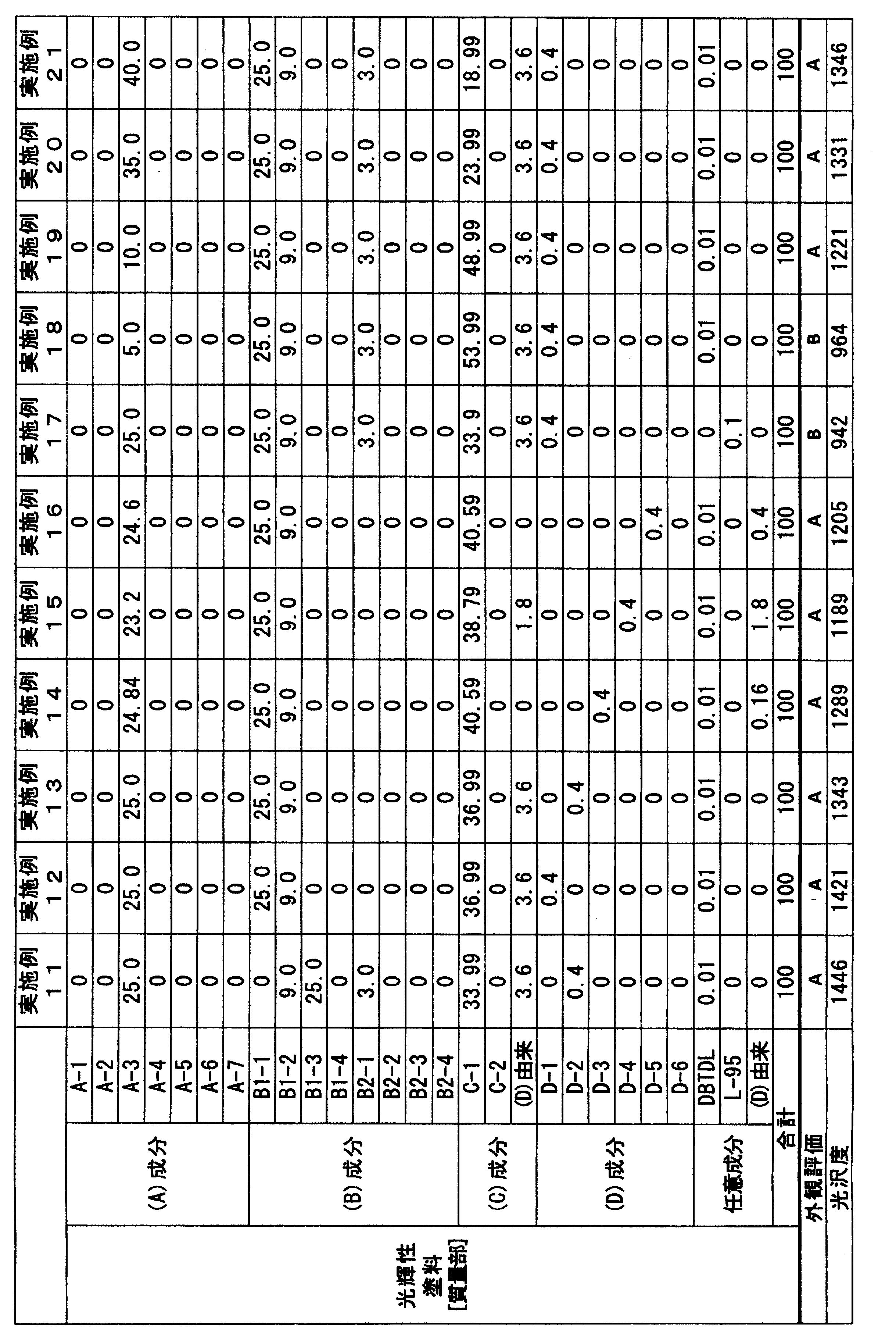
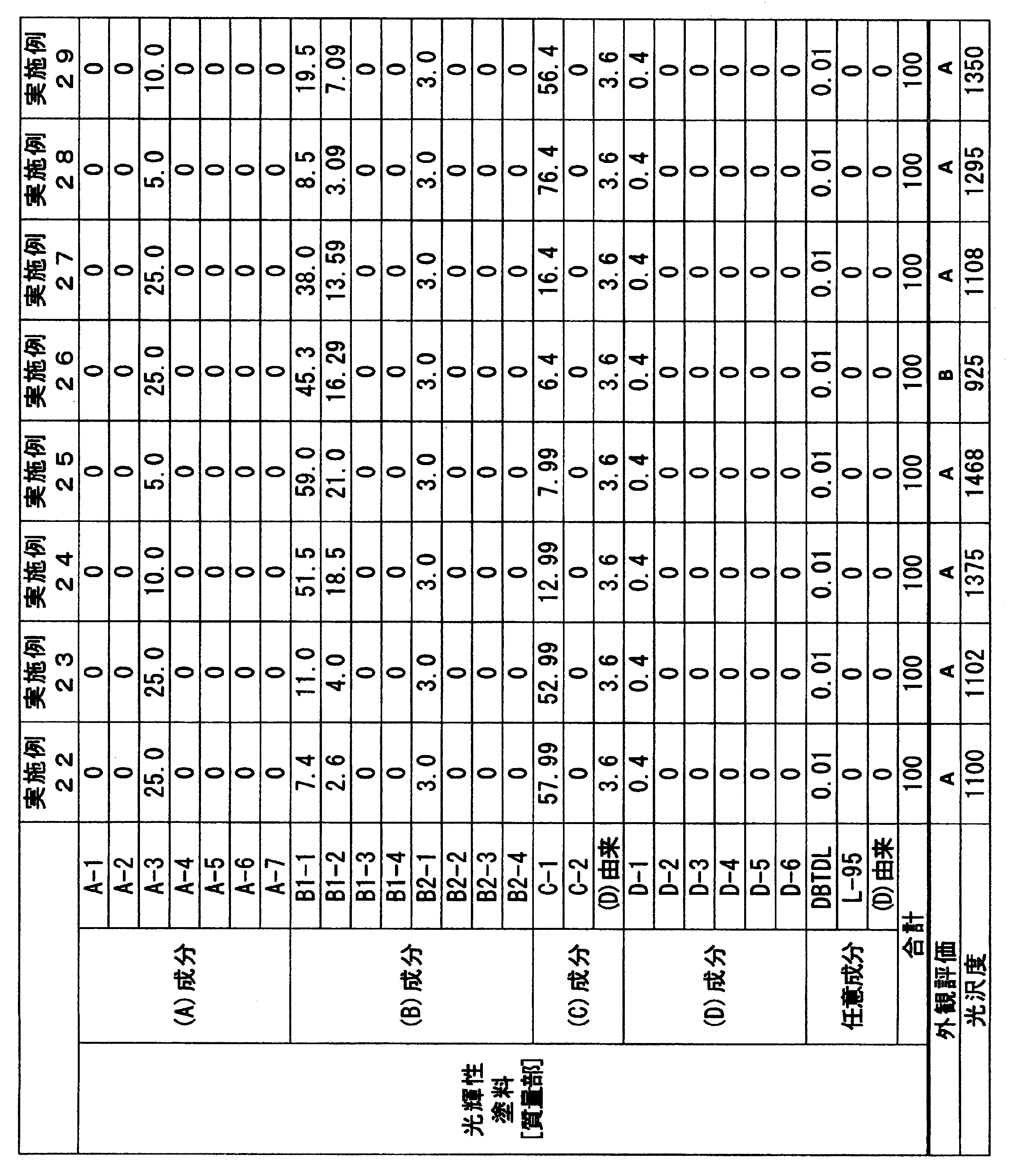
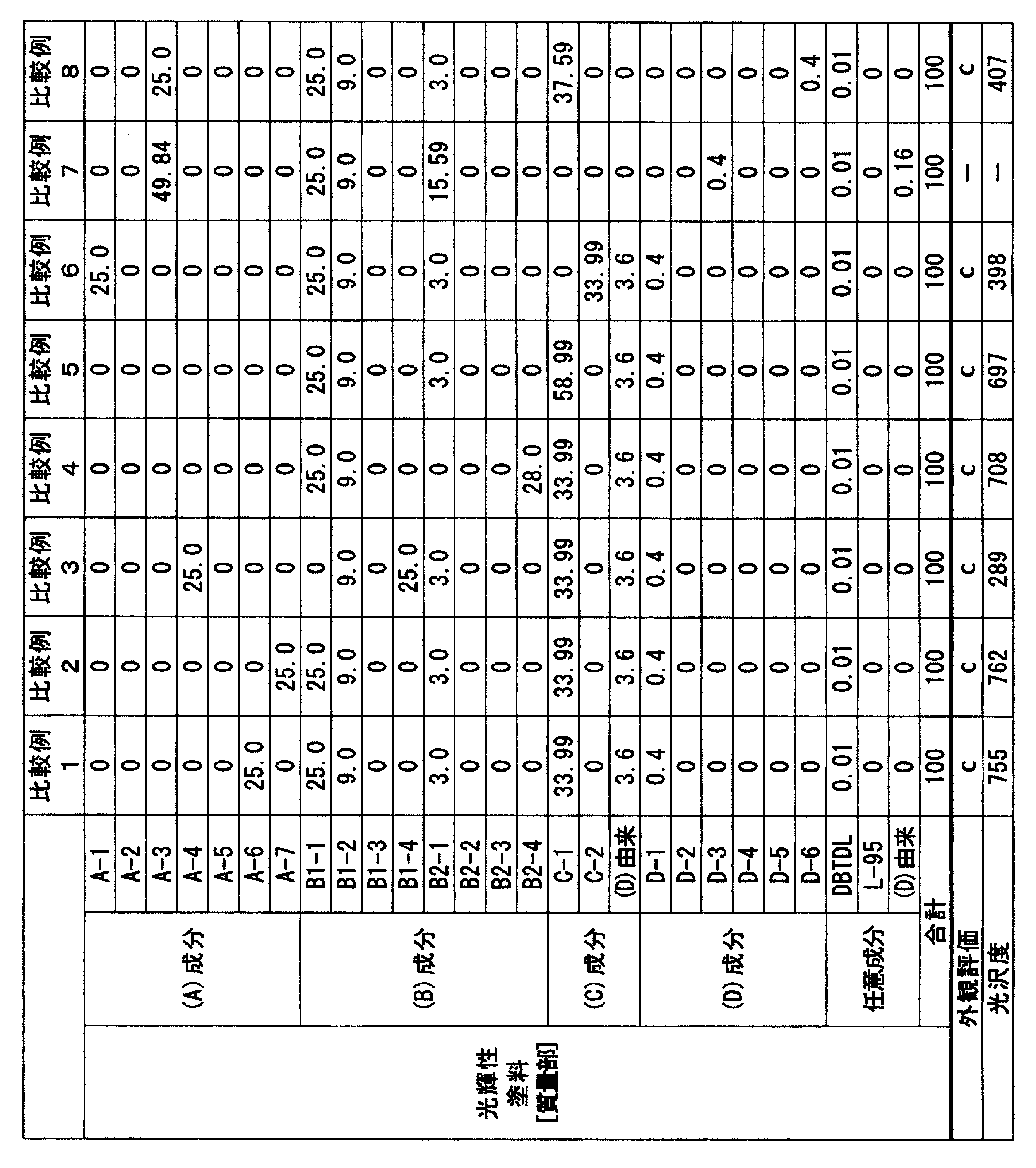
表1~3から明らかなように、各実施例で得られた光輝性塗料より形成された塗膜は、光輝性に優れていた。
特に、(A)成分と相溶する添加剤(アルキルイミダゾリン系界面活性剤)を用いなかった実施例1~16、18~29で得られた光輝性塗料より形成された塗膜は、(A)成分と相溶する添加剤を用いた実施例17で得られた光輝性塗料より形成された塗膜に比べて光輝性により優れていた。実施例17の場合、A層とB層との界面が形成され、A層とB層との界面に(D)成分が局在化したものの、(D)成分の一部が完全に平行に配向しなかったため、実施例1~16、18~29の場合と比べると光輝性が低下したと考えられる。
特に、(A)成分と相溶する添加剤(アルキルイミダゾリン系界面活性剤)を用いなかった実施例1~16、18~29で得られた光輝性塗料より形成された塗膜は、(A)成分と相溶する添加剤を用いた実施例17で得られた光輝性塗料より形成された塗膜に比べて光輝性により優れていた。実施例17の場合、A層とB層との界面が形成され、A層とB層との界面に(D)成分が局在化したものの、(D)成分の一部が完全に平行に配向しなかったため、実施例1~16、18~29の場合と比べると光輝性が低下したと考えられる。
一方、表4から明らかなように、アニリン点が40℃未満であるA-6またはA-7を用いた比較例1、2の場合、(A)成分と(B)成分とが分離しなかったため、A層とB層との界面が充分に形成されず、(D)成分が局在化しなかった。
(A)成分と相溶するB1-4を用いた比較例3の場合、(A)成分と(B)成分とが分離しなかったため、A層とB層との界面が充分に形成されず、(D)成分が局在化しなかった。
(A)成分を含まない比較例4、5の場合、A層とB層との界面が形成されず、(D)成分が局在化しなかった。
(A)成分よりも沸点が高いC-2を用いた比較例6の場合、(A)成分と(B)成分とが分離しなかったため、A層とB層との界面が充分に形成されず、(D)成分が局在化しなかった。
パール顔料であるD-6を用いた比較例8の場合、A層とB層との界面は形成されたものの、A層とB層との界面にD-6が局在化しなかった。
そのため、比較例1~6、8で得られた光輝性塗料より形成された塗膜は、光輝性に劣っていた。
(C)成分を用いなかった比較例7の場合、塗料中で(A)成分と(B)成分とが分離してしまい、塗装できなかった。
(A)成分と相溶するB1-4を用いた比較例3の場合、(A)成分と(B)成分とが分離しなかったため、A層とB層との界面が充分に形成されず、(D)成分が局在化しなかった。
(A)成分を含まない比較例4、5の場合、A層とB層との界面が形成されず、(D)成分が局在化しなかった。
(A)成分よりも沸点が高いC-2を用いた比較例6の場合、(A)成分と(B)成分とが分離しなかったため、A層とB層との界面が充分に形成されず、(D)成分が局在化しなかった。
パール顔料であるD-6を用いた比較例8の場合、A層とB層との界面は形成されたものの、A層とB層との界面にD-6が局在化しなかった。
そのため、比較例1~6、8で得られた光輝性塗料より形成された塗膜は、光輝性に劣っていた。
(C)成分を用いなかった比較例7の場合、塗料中で(A)成分と(B)成分とが分離してしまい、塗装できなかった。
以上、本発明の好ましい実施例を説明したが、本発明はこれら実施例に限定されることはない。本発明の趣旨を逸脱しない範囲で、構成の付加、省略、置換、およびその他の変更が可能である。本発明は前述した説明によって限定されることはなく、添付のクレームの範囲によってのみ限定される。
10 光輝性塗料
11 A層
12 B層
13 (D)成分
20 基材
30 光輝性塗膜
11 A層
12 B層
13 (D)成分
20 基材
30 光輝性塗膜
Claims (2)
- 光輝性塗料であって、
アニリン点が40℃以上である炭化水素系溶剤(A)と、
前記炭化水素系溶剤(A)と相溶しない樹脂(B1)と、
前記炭化水素系溶剤(A)および前記樹脂(B1)と相溶し、かつ前記炭化水素系溶剤(A)よりも沸点が低い溶剤(C)と、
鱗片状のアルミニウム(D)と、
を含有する、
光輝性塗料。 - 前記樹脂(B1)の極性が前記炭化水素系溶剤(A)の極性よりも高い、請求項1に記載の光輝性塗料。
Priority Applications (4)
| Application Number | Priority Date | Filing Date | Title |
|---|---|---|---|
| KR1020197016099A KR102269714B1 (ko) | 2016-12-07 | 2017-11-30 | 광휘성 도료 |
| EP17878740.4A EP3553143B1 (en) | 2016-12-07 | 2017-11-30 | Photoluminescent coating material |
| CN201780074955.3A CN110050045B (zh) | 2016-12-07 | 2017-11-30 | 光致发光性涂料 |
| US16/348,614 US11603476B2 (en) | 2016-12-07 | 2017-11-30 | Photoluminescent coating material |
Applications Claiming Priority (2)
| Application Number | Priority Date | Filing Date | Title |
|---|---|---|---|
| JP2016237247A JP6146529B1 (ja) | 2016-12-07 | 2016-12-07 | 光輝性塗料 |
| JP2016-237247 | 2016-12-07 |
Publications (1)
| Publication Number | Publication Date |
|---|---|
| WO2018105483A1 true WO2018105483A1 (ja) | 2018-06-14 |
Family
ID=59061178
Family Applications (1)
| Application Number | Title | Priority Date | Filing Date |
|---|---|---|---|
| PCT/JP2017/043048 Ceased WO2018105483A1 (ja) | 2016-12-07 | 2017-11-30 | 光輝性塗料 |
Country Status (6)
| Country | Link |
|---|---|
| US (1) | US11603476B2 (ja) |
| EP (1) | EP3553143B1 (ja) |
| JP (1) | JP6146529B1 (ja) |
| KR (1) | KR102269714B1 (ja) |
| CN (1) | CN110050045B (ja) |
| WO (1) | WO2018105483A1 (ja) |
Cited By (1)
| Publication number | Priority date | Publication date | Assignee | Title |
|---|---|---|---|---|
| CN113165008A (zh) * | 2018-12-07 | 2021-07-23 | 花王株式会社 | 涂膜的形成方法 |
Families Citing this family (3)
| Publication number | Priority date | Publication date | Assignee | Title |
|---|---|---|---|---|
| JP7133965B2 (ja) * | 2018-04-17 | 2022-09-09 | 旭化成株式会社 | アルミニウム顔料組成物 |
| JP2023147822A (ja) * | 2022-03-30 | 2023-10-13 | 大日本塗料株式会社 | 塗膜形成方法、塗装体および塗料 |
| JP7406176B1 (ja) * | 2023-10-17 | 2023-12-27 | 藤倉化成株式会社 | 光輝性塗料及び塗装物品 |
Citations (5)
| Publication number | Priority date | Publication date | Assignee | Title |
|---|---|---|---|---|
| JPS59105064A (ja) * | 1982-12-07 | 1984-06-18 | Kansai Paint Co Ltd | 熱硬化性メタリツク塗料 |
| JPH04202486A (ja) * | 1990-11-30 | 1992-07-23 | Nippon Oil & Fats Co Ltd | 塗料組成物 |
| JP2004307672A (ja) | 2003-04-08 | 2004-11-04 | Toyota Motor Corp | 光輝顔料を添加してなる塗料および光輝顔料 |
| JP2006152259A (ja) * | 2004-10-29 | 2006-06-15 | Kansai Paint Co Ltd | 塗料組成物 |
| JP2016190958A (ja) * | 2015-03-31 | 2016-11-10 | 大日本塗料株式会社 | 車両用塗料組成物 |
Family Cites Families (12)
| Publication number | Priority date | Publication date | Assignee | Title |
|---|---|---|---|---|
| JPH09111176A (ja) * | 1995-10-18 | 1997-04-28 | Pilot Ink Co Ltd | マーキングペン用油性インキ組成物 |
| JPH10237373A (ja) * | 1996-12-27 | 1998-09-08 | Toyo Ink Mfg Co Ltd | 印刷インキ |
| JP2001081359A (ja) * | 1999-09-13 | 2001-03-27 | Mitsubishi Rayon Co Ltd | 塗料組成物、およびその乾燥塗膜を有する物品 |
| JP2001240787A (ja) * | 2000-02-29 | 2001-09-04 | The Inctec Inc | インキ組成物 |
| JP2002038096A (ja) | 2000-07-27 | 2002-02-06 | Nippon Paint Co Ltd | ベース塗料組成物 |
| JP2004313983A (ja) * | 2003-04-18 | 2004-11-11 | Kansai Paint Co Ltd | 光輝性複層塗膜形成方法 |
| CN100462413C (zh) * | 2004-10-29 | 2009-02-18 | 关西涂料株式会社 | 涂料组合物 |
| JP2008098312A (ja) * | 2006-10-10 | 2008-04-24 | Tdk Corp | グリーンシート用塗料、グリーンシートおよび積層セラミック電子部品の製造方法 |
| JP2012116988A (ja) * | 2010-12-02 | 2012-06-21 | Kankyo Partnership Kk | 塗料用溶剤およびその製造方法 |
| JP6215578B2 (ja) * | 2013-06-03 | 2017-10-18 | 旭化成株式会社 | アルミニウム顔料組成物、それを含む樹脂組成物、及びその成形品 |
| JP6355907B2 (ja) * | 2013-10-08 | 2018-07-11 | 旭化成株式会社 | アルミニウム顔料組成物、それを含む樹脂組成物、及びその成形品 |
| MY176586A (en) | 2014-04-10 | 2020-08-17 | Kansai Paint Co Ltd | Photoluminescent coating material composition |
-
2016
- 2016-12-07 JP JP2016237247A patent/JP6146529B1/ja active Active
-
2017
- 2017-11-30 WO PCT/JP2017/043048 patent/WO2018105483A1/ja not_active Ceased
- 2017-11-30 CN CN201780074955.3A patent/CN110050045B/zh active Active
- 2017-11-30 KR KR1020197016099A patent/KR102269714B1/ko active Active
- 2017-11-30 US US16/348,614 patent/US11603476B2/en active Active
- 2017-11-30 EP EP17878740.4A patent/EP3553143B1/en active Active
Patent Citations (5)
| Publication number | Priority date | Publication date | Assignee | Title |
|---|---|---|---|---|
| JPS59105064A (ja) * | 1982-12-07 | 1984-06-18 | Kansai Paint Co Ltd | 熱硬化性メタリツク塗料 |
| JPH04202486A (ja) * | 1990-11-30 | 1992-07-23 | Nippon Oil & Fats Co Ltd | 塗料組成物 |
| JP2004307672A (ja) | 2003-04-08 | 2004-11-04 | Toyota Motor Corp | 光輝顔料を添加してなる塗料および光輝顔料 |
| JP2006152259A (ja) * | 2004-10-29 | 2006-06-15 | Kansai Paint Co Ltd | 塗料組成物 |
| JP2016190958A (ja) * | 2015-03-31 | 2016-11-10 | 大日本塗料株式会社 | 車両用塗料組成物 |
Non-Patent Citations (1)
| Title |
|---|
| See also references of EP3553143A4 |
Cited By (2)
| Publication number | Priority date | Publication date | Assignee | Title |
|---|---|---|---|---|
| CN113165008A (zh) * | 2018-12-07 | 2021-07-23 | 花王株式会社 | 涂膜的形成方法 |
| CN113165008B (zh) * | 2018-12-07 | 2022-12-23 | 花王株式会社 | 涂膜的形成方法 |
Also Published As
| Publication number | Publication date |
|---|---|
| EP3553143A4 (en) | 2020-08-05 |
| KR102269714B1 (ko) | 2021-06-25 |
| JP2018090739A (ja) | 2018-06-14 |
| CN110050045A (zh) | 2019-07-23 |
| EP3553143A1 (en) | 2019-10-16 |
| CN110050045B (zh) | 2022-04-12 |
| JP6146529B1 (ja) | 2017-06-14 |
| KR20190082277A (ko) | 2019-07-09 |
| US11603476B2 (en) | 2023-03-14 |
| EP3553143B1 (en) | 2024-01-24 |
| US20190276683A1 (en) | 2019-09-12 |
Similar Documents
| Publication | Publication Date | Title |
|---|---|---|
| JP7164785B2 (ja) | 複層塗膜形成方法 | |
| JP6146529B1 (ja) | 光輝性塗料 | |
| CA3113957C (en) | Effect pigment dispersion and method for forming multilayer coating film | |
| WO2017022698A1 (ja) | 複層塗膜形成方法 | |
| JP7286632B2 (ja) | 光輝性顔料分散体及び複層塗膜形成方法 | |
| CN109996611A (zh) | 多层涂膜形成方法 | |
| JPWO2019054499A1 (ja) | 複層塗膜形成方法 | |
| JPWO2020044672A1 (ja) | 複層塗膜形成方法 | |
| JP6081275B2 (ja) | 塗料組成物 | |
| JP5904710B2 (ja) | 水性顔料着色被覆剤、その製造方法及び塗料の多層被覆の製造のためのその使用 | |
| TWI773559B (zh) | 複層塗膜形成方法 | |
| JP2025061924A (ja) | 水性塗料組成物セット及びそれを用いた複層塗膜の形成方法 | |
| JP7406176B1 (ja) | 光輝性塗料及び塗装物品 | |
| CN104031546A (zh) | 真空镀膜用紫外光固化底漆及真空镀膜用紫外光固化漆 | |
| KR20150071907A (ko) | 이액형 비철금속 코팅제 | |
| KR100542428B1 (ko) | 1-코트 우레탄 피막조성물 | |
| JP2007031688A (ja) | ホログラム効果を発現する印刷物及びこれに用いる印刷インキ | |
| JP7569595B1 (ja) | 光輝性塗料、光輝性塗膜、光輝性積層塗膜および塗装物 | |
| JP5319602B2 (ja) | 鏡面装飾板及びその製造方法 | |
| JP7397026B2 (ja) | 塗料組成物セット | |
| JP7075545B2 (ja) | 2液型塗料組成物及び塗装物 | |
| JP2020171898A (ja) | 漆調塗装物品の製造方法 | |
| JP2025151083A (ja) | 水系塗料組成物及び複層塗膜形成方法 | |
| WO2022075117A1 (ja) | メタリック塗料組成物および塗装体 | |
| JP2002309150A (ja) | 特殊効果顔料組成物 |
Legal Events
| Date | Code | Title | Description |
|---|---|---|---|
| 121 | Ep: the epo has been informed by wipo that ep was designated in this application |
Ref document number: 17878740 Country of ref document: EP Kind code of ref document: A1 |
|
| ENP | Entry into the national phase |
Ref document number: 20197016099 Country of ref document: KR Kind code of ref document: A |
|
| NENP | Non-entry into the national phase |
Ref country code: DE |
|
| ENP | Entry into the national phase |
Ref document number: 2017878740 Country of ref document: EP Effective date: 20190708 |