WO2018123328A1 - ガラス繊維用組成物及びガラス繊維、ガラス繊維を含有するガラス繊維含有複合材料、並びにガラス繊維の製造方法 - Google Patents
ガラス繊維用組成物及びガラス繊維、ガラス繊維を含有するガラス繊維含有複合材料、並びにガラス繊維の製造方法 Download PDFInfo
- Publication number
- WO2018123328A1 WO2018123328A1 PCT/JP2017/041235 JP2017041235W WO2018123328A1 WO 2018123328 A1 WO2018123328 A1 WO 2018123328A1 JP 2017041235 W JP2017041235 W JP 2017041235W WO 2018123328 A1 WO2018123328 A1 WO 2018123328A1
- Authority
- WO
- WIPO (PCT)
- Prior art keywords
- glass fiber
- glass
- temperature
- composition
- fiber
- Prior art date
- Legal status (The legal status is an assumption and is not a legal conclusion. Google has not performed a legal analysis and makes no representation as to the accuracy of the status listed.)
- Ceased
Links
Classifications
-
- C—CHEMISTRY; METALLURGY
- C03—GLASS; MINERAL OR SLAG WOOL
- C03C—CHEMICAL COMPOSITION OF GLASSES, GLAZES OR VITREOUS ENAMELS; SURFACE TREATMENT OF GLASS; SURFACE TREATMENT OF FIBRES OR FILAMENTS MADE FROM GLASS, MINERALS OR SLAGS; JOINING GLASS TO GLASS OR OTHER MATERIALS
- C03C13/00—Fibre or filament compositions
-
- C—CHEMISTRY; METALLURGY
- C03—GLASS; MINERAL OR SLAG WOOL
- C03C—CHEMICAL COMPOSITION OF GLASSES, GLAZES OR VITREOUS ENAMELS; SURFACE TREATMENT OF GLASS; SURFACE TREATMENT OF FIBRES OR FILAMENTS MADE FROM GLASS, MINERALS OR SLAGS; JOINING GLASS TO GLASS OR OTHER MATERIALS
- C03C3/00—Glass compositions
- C03C3/04—Glass compositions containing silica
- C03C3/076—Glass compositions containing silica with 40% to 90% silica, by weight
- C03C3/083—Glass compositions containing silica with 40% to 90% silica, by weight containing aluminium oxide or an iron compound
- C03C3/085—Glass compositions containing silica with 40% to 90% silica, by weight containing aluminium oxide or an iron compound containing an oxide of a divalent metal
- C03C3/087—Glass compositions containing silica with 40% to 90% silica, by weight containing aluminium oxide or an iron compound containing an oxide of a divalent metal containing calcium oxide, e.g. common sheet or container glass
-
- C—CHEMISTRY; METALLURGY
- C03—GLASS; MINERAL OR SLAG WOOL
- C03C—CHEMICAL COMPOSITION OF GLASSES, GLAZES OR VITREOUS ENAMELS; SURFACE TREATMENT OF GLASS; SURFACE TREATMENT OF FIBRES OR FILAMENTS MADE FROM GLASS, MINERALS OR SLAGS; JOINING GLASS TO GLASS OR OTHER MATERIALS
- C03C3/00—Glass compositions
- C03C3/04—Glass compositions containing silica
- C03C3/076—Glass compositions containing silica with 40% to 90% silica, by weight
- C03C3/089—Glass compositions containing silica with 40% to 90% silica, by weight containing boron
- C03C3/091—Glass compositions containing silica with 40% to 90% silica, by weight containing boron containing aluminium
- C03C3/093—Glass compositions containing silica with 40% to 90% silica, by weight containing boron containing aluminium containing zinc or zirconium
-
- C—CHEMISTRY; METALLURGY
- C03—GLASS; MINERAL OR SLAG WOOL
- C03C—CHEMICAL COMPOSITION OF GLASSES, GLAZES OR VITREOUS ENAMELS; SURFACE TREATMENT OF GLASS; SURFACE TREATMENT OF FIBRES OR FILAMENTS MADE FROM GLASS, MINERALS OR SLAGS; JOINING GLASS TO GLASS OR OTHER MATERIALS
- C03C3/00—Glass compositions
- C03C3/04—Glass compositions containing silica
- C03C3/076—Glass compositions containing silica with 40% to 90% silica, by weight
- C03C3/095—Glass compositions containing silica with 40% to 90% silica, by weight containing rare earths
-
- C—CHEMISTRY; METALLURGY
- C04—CEMENTS; CONCRETE; ARTIFICIAL STONE; CERAMICS; REFRACTORIES
- C04B—LIME, MAGNESIA; SLAG; CEMENTS; COMPOSITIONS THEREOF, e.g. MORTARS, CONCRETE OR LIKE BUILDING MATERIALS; ARTIFICIAL STONE; CERAMICS; REFRACTORIES; TREATMENT OF NATURAL STONE
- C04B14/00—Use of inorganic materials as fillers, e.g. pigments, for mortars, concrete or artificial stone; Treatment of inorganic materials specially adapted to enhance their filling properties in mortars, concrete or artificial stone
- C04B14/38—Fibrous materials; Whiskers
- C04B14/42—Glass
-
- C—CHEMISTRY; METALLURGY
- C04—CEMENTS; CONCRETE; ARTIFICIAL STONE; CERAMICS; REFRACTORIES
- C04B—LIME, MAGNESIA; SLAG; CEMENTS; COMPOSITIONS THEREOF, e.g. MORTARS, CONCRETE OR LIKE BUILDING MATERIALS; ARTIFICIAL STONE; CERAMICS; REFRACTORIES; TREATMENT OF NATURAL STONE
- C04B28/00—Compositions of mortars, concrete or artificial stone, containing inorganic binders or the reaction product of an inorganic and an organic binder, e.g. polycarboxylate cements
- C04B28/02—Compositions of mortars, concrete or artificial stone, containing inorganic binders or the reaction product of an inorganic and an organic binder, e.g. polycarboxylate cements containing hydraulic cements other than calcium sulfates
-
- C—CHEMISTRY; METALLURGY
- C03—GLASS; MINERAL OR SLAG WOOL
- C03B—MANUFACTURE, SHAPING, OR SUPPLEMENTARY PROCESSES
- C03B37/00—Manufacture or treatment of flakes, fibres, or filaments from softened glass, minerals, or slags
- C03B37/08—Bushings, e.g. construction, bushing reinforcement means; Spinnerettes; Nozzles; Nozzle plates
-
- C—CHEMISTRY; METALLURGY
- C03—GLASS; MINERAL OR SLAG WOOL
- C03C—CHEMICAL COMPOSITION OF GLASSES, GLAZES OR VITREOUS ENAMELS; SURFACE TREATMENT OF GLASS; SURFACE TREATMENT OF FIBRES OR FILAMENTS MADE FROM GLASS, MINERALS OR SLAGS; JOINING GLASS TO GLASS OR OTHER MATERIALS
- C03C2213/00—Glass fibres or filaments
Definitions
- the present invention relates to a glass fiber composition and glass fiber, a glass fiber-containing composite material containing glass fiber, and a method for producing glass fiber.
- Glass fiber (also referred to as glass fiber or glass filament) is formed into a continuous fiber by using a molding device generally called a bushing device (also referred to as a platinum heating container) having a substantially rectangular appearance. Manufactured by spinning.
- the bushing device is disposed at the bottom of a pot-shaped container having a function of temporarily retaining molten glass, and is composed of a heat-resistant metal material such as platinum, and has a large number of nozzle portions (or orifice portions). It has.
- the temperature of the molten glass is controlled so that the optimum temperature at the tip of the bushing nozzle, that is, the high-temperature viscosity becomes a temperature corresponding to 10 3 dPa ⁇ s. Then, the molten glass is continuously discharged from the bushing nozzle, rapidly cooled, and molded (spun) as glass fibers.
- the liquid phase temperature Ty of the molten glass is equal to or higher than the glass molding temperature Tx (temperature at which the high-temperature viscosity of the glass corresponds to 10 3 dPa ⁇ s), devitrification occurs near the bushing nozzle.
- the causative crystal is likely to precipitate in the molten glass.
- the bushing nozzle is clogged, causing thread breakage, also called break.
- Patent Document 1 SiO 2 , Al 2 O 3 , MgO, CaO and the like as new high elastic glasses for the purpose of improving the fiberizing temperature (that is, the molding temperature Tx) and ⁇ T (that is, the temperature difference ⁇ Txy) are included.
- the composition for glass fiber which controlled content, such as an alkaline-earth metal and an alkali metal oxide to perform is disclosed.
- JP-T 2009-514773 JP-A-5-279072 JP 7-215729 A Japanese Patent Laid-Open No. 9-142871
- the present invention has a composition for glass fiber, glass fiber, and glass fiber-containing composite containing glass fiber, which has a high elastic modulus, good productivity, and can easily produce fine glass fiber. It is an object to provide a material and a method for producing a glass fiber.
- the composition for glass fiber of the present invention has a glass composition expressed in terms of mass percentage in terms of oxide, 50 to 70% SiO 2 , 15 to 25% Al 2 O 3 , 3 to 13% MgO, 3 to 15% CaO , B 2 O 3 0.5 to 5%. By doing in this way, it can be set as the composition for glass fibers which has a high elasticity modulus, favorable productivity, and also can manufacture a glass fiber with a fine count easily.
- the temperature difference ⁇ Txy between the molding temperature Tx and the liquidus temperature Ty is preferably 90 ° C. or more.
- the molding temperature Tx is a temperature at which the high temperature viscosity of the molten glass corresponds to 10 3 dPa ⁇ s.
- the liquidus temperature Ty passes through a standard sieve 30 mesh (300 ⁇ m), and after the glass powder remaining in 50 mesh (300 ⁇ m) is placed in a platinum container, it is kept in a temperature gradient furnace for 16 hours to obtain the crystal precipitation temperature. Identified. Further, the temperature difference ⁇ Txy was calculated as a difference between the molding temperature Tx and the liquidus temperature Ty.
- the glass fiber composition of the present invention preferably has a molding temperature Tx of 1365 ° C. or lower.
- the composition for glass fiber of the present invention preferably has an elastic modulus E of 90 GPa or more.
- the glass fiber composition of the present invention preferably has a linear thermal expansion coefficient ⁇ of 45 ⁇ 10 ⁇ 7 / ° C. or less. By doing in this way, a thermal stress can be made small also in a high temperature environment, and the heat resistance of a glass fiber containing composite material can be improved.
- the linear thermal expansion coefficient ⁇ is an average thermal expansion coefficient in a temperature range of 30 to 380 ° C.
- the glass fiber of the present invention is characterized by containing 95% by mass or more of the glass fiber composition in terms of solid content. By doing in this way, it becomes possible to obtain the glass fiber which has a high elasticity modulus, and also since productivity is favorable, a lot of glass fibers can be produced continuously. Further, it is possible to easily produce fine count glass fibers.
- the solid content conversion is to measure the mass in a dry state so that the moisture on the glass surface is less than 0.1%, further subjected to a strong heat treatment, after heating and removing the organic matter applied to the glass fiber surface, It is calculated by measuring its mass.
- the product form of the glass fiber of the present invention is preferably chopped strand, yarn, or roving.
- the glass fiber-containing composite material of the present invention is characterized in that the glass fiber of the present invention is combined with an organic medium, concrete or mortar. In this way, it can be used in a wide range of applications.
- the method for producing glass fiber of the present invention is characterized in that glass comprising a glass fiber composition having the glass composition and / or characteristics described above is formed into a fiber shape.
- the glass fiber manufacturing method of the present invention is preferably molded by a bushing device.
- the glass fiber production method of the present invention is preferably molded while measuring and managing the molding temperature Tx in the range of ⁇ 20 ° C. with respect to the target temperature. By doing in this way, it becomes easy to control the amount of molten glass outflow from a bushing nozzle, and the production of glass fiber becomes more stable.
- % display means mass%.
- SiO 2 is a main component that forms a glass skeleton structure. Moreover, it is a component which improves the mechanical strength of glass and the acid resistance of glass. On the other hand, if the content of SiO 2 is too large, the viscosity of the molten glass becomes too high and it becomes difficult to obtain a homogeneous molten state. As a result, it becomes difficult to adjust the glass fiber diameter, which is not preferable. Further, if the viscosity is high, the energy required for melting the glass increases, the molding temperature Tx increases, the damage to the noble metal bushing increases, the replacement frequency increases, and the production cost increases. Therefore, the content of SiO 2 is 50 to 70%, preferably 50 to 65%, more preferably 55 to 65%.
- Al 2 O 3 is a component that increases the chemical durability and mechanical strength of the glass, and is a component that improves the elastic modulus E of the glass. When the content of Al 2 O 3 is 15% or more, the mechanical strength of the glass is improved, and the effect of improving the elastic modulus E of the glass is great.
- Al 2 O 3 has an effect of suppressing crystal crystallization and phase separation generation in molten glass by being contained in an appropriate amount in glass, but if contained in a large amount, Al 2 O 3 is contained in molten glass. A devitrification crystal of mullite (3Al 2 O 3 .2SiO 2 ) as a main component is likely to occur.
- the content of Al 2 O 3 is 15 to 25%, preferably 16 to 24%, more preferably 18 to 24%, still more preferably 19 to 24%, and particularly preferably 21 to 23%. .
- MgO is a component having a function as a flux that makes it easy to melt the glass raw material, and has a function of reducing the viscosity at the time of melting the glass, promoting bubble breakage, and lowering the molding temperature Tx. Moreover, it is a component which has the function which improves the mechanical strength of glass and improves the elasticity modulus E.
- the content of MgO is 3 to 13%, preferably 5 to 12%, more preferably 6 to 12%, still more preferably 7 to 12%, and particularly preferably 8 to 11%.
- CaO like the MgO component, is a component that acts as a flux that facilitates melting of the glass raw material, lowers the viscosity at the time of melting the glass, promotes bubble breakage, and lowers the molding temperature Tx at the time of glass fiber molding. It is a component to be made. Moreover, it is a component which improves the mechanical strength of glass and improves the elasticity modulus E of glass. On the other hand, when it is contained in a large amount, devitrification of wollastonite (CaO.SiO 2 ) is easily crystallized from the molten glass, and the linear thermal expansion coefficient ⁇ is increased. Therefore, the CaO content is 3 to 15%, preferably 5 to 13%, more preferably 8 to 12%.
- B 2 O 3 is a component that forms a skeleton in the glass network structure like SiO 2 , but reduces the viscosity of the glass to promote bubble breakage, and further lowers the melting temperature and the molding temperature Tx of the glass. In addition, it is a component having a function of improving the solubility of glass. Further, mullite (3Al 2 O 3 ⁇ 2SiO 2 ), cordierite (2MgO ⁇ 2Al 2 O 3 ⁇ 5SiO 2), since it is possible to significantly suppress the generation of devitrification crystal wollastonite (CaO ⁇ SiO 2), a liquid The phase temperature Ty can be reduced and the temperature difference ⁇ Txy can be increased.
- the productivity can be improved and the production of fine count glass fibers can be facilitated.
- the content of B 2 O 3 in the glass composition is excessively increased, the amount of evaporation of the boron component increases during melting, and it may be difficult to maintain the molten glass in a homogeneous state.
- the content of the B 2 O 3 component is too large, when used in a printed wiring board, it becomes susceptible to the moisture of the surrounding environment, and boron, alkali, etc. are eluted from the glass composition in a high humidity environment. As a result, the electrical reliability may be impaired, for example, the electrical insulation may be deteriorated. Therefore, the content of B 2 O 3 is 0.5 to 5%, preferably 0.8 to 4.5%, more preferably 1 to 4%, and still more preferably 1.5 to 4%. .
- the composition for glass fiber of the present invention contributes to the improvement of the elastic modulus of Al 2 O 3 , MgO, CaO, etc. that easily crystallizes devitrification by containing B 2 O 3 as an essential component in the glass composition. It becomes possible to increase the content of the component. By doing in this way, the elasticity modulus E of the glass obtained can be improved, maintaining favorable productivity. Therefore, Al 2 O 3 + MgO + CaO (total amount of Al 2 O 3 , MgO and CaO) is preferably 35% to 53%, more preferably 36 to 50%, still more preferably 37% to 49%, and particularly Preferably it is 38 to 48%.
- the glass fiber composition of the present invention Al 2 O 3, MgO, by regulating the content ratio of the total amount and B 2 O 3 of CaO, good productivity and high modulus of the glass Can be compatible. That is, as a mass ratio, the value of (Al 2 O 3 + MgO + CaO) / B 2 O 3 is preferably 6.5 to 106, more preferably 7 to 100, still more preferably 8 to 90, and particularly preferably 9 80, most preferably 10-70.
- Glass fiber composition of the present invention shows the above-mentioned component (SiO 2, Al 2 O 3 , MgO, CaO, B 2 O 3) may include other components. However, it is desirable to adjust the composition so that the total content of the above components is 97% or more, 98% or more, particularly 99% or more. The reason for this is that when the total amount of these components is less than 97%, the alkali resistance, acid resistance, and water resistance are lowered due to unintentional mixing of different components, resulting in deterioration of product characteristics, molding temperature and liquid phase. Inconveniences such as a decrease in temperature and a decrease in productivity are likely to occur.
- the alkali metal oxide (the total amount of Li 2 O + Na 2 O + K 2 O) has the effect of reducing the viscosity of the glass and promoting bubble breakage, but if the content is too high, the glass fiber-containing composite material In this case, there is a problem that it is difficult to maintain the strength over time, and it is preferable to reduce the strength. Therefore, the content of the alkali metal oxide is preferably 0 to 3%, 0 to 2%, 0 to 1%, 0 to 0.6%.
- the alkali metal oxide if a high-purity raw material composition of the chemical product is adopted, the composition can be made substantially free as described above, but a natural raw material containing an alkali metal oxide is used. However, if stable quality can be ensured, a content of 0.4% or more, and further 0.5% or more may be allowed.
- TiO 2 is a component that improves the elastic modulus E of glass.
- mullite Al 2 O 3 ⁇ 2SiO 2
- cordierite 2MgO ⁇ 2Al 2 O
- the content of TiO 2 is 0 to 3%, preferably 0.1 to 2%, more preferably 0.3 to 1%.
- ZrO 2 is a component that improves the elastic modulus E of the glass in the same manner as the TiO 2 component.
- mullite Al 2 O 3 ⁇ 2SiO 2
- cordierite 2MgO ⁇ 2Al 2 O 3 ⁇ 5SiO 2
- the content of ZrO 2 is 0 to 3%, preferably 0 to 2%, more preferably 0 to 1%.
- any one or plural kinds selected from SnO 2 , As 2 O 3 , Sb 2 O 3 , F 2 , CeO 2 , SO 3 , and Cl 2 may be contained. .
- Each content is 0 to 2%, preferably 0 to 1%, more preferably 0 to 0.8%.
- components other than the above-described components include SrO, BaO, ZnO, P 2 O 5 , Fe 2 O 3 , Cr 2.
- O 3 , MnO, La 2 O 3 , WO 3 , Nb 2 O 5 , Y 2 O 3 and the like can be contained in appropriate amounts as necessary, and each may contain up to 3%.
- H 2 , O 2 , CO 2 , CO, H 2 O, He, Ne, Ar, N 2 and the like may be contained up to 0.5% each.
- you may contain noble metal elements, such as Pt, Rh, and Au, up to 500 ppm in glass.
- composition for glass fiber of the present invention the glass fiber and the glass fiber-containing composite material will be described.
- the temperature difference ⁇ Txy between the molding temperature Tx and the liquidus temperature Ty is preferably 90 ° C. or higher, more preferably 95 ° C. or higher, still more preferably 100 ° C. or higher, particularly preferably. 110 ° C. or higher, most preferably 115 ° C. or higher.
- the glass fiber composition of the present invention preferably has a molding temperature Tx of 1365 ° C. or less, more preferably 1360 ° C. or less, still more preferably 1355 ° C. or less, particularly preferably 1350 ° C. or less, and most preferably 1345 ° C. or less. It is. By doing in this way, since it can produce at low temperature, production cost can be reduced.
- the glass fiber composition of the present invention preferably has a liquidus temperature Ty of 1300 ° C. or lower, more preferably 1280 ° C. or lower, more preferably 1270 ° C. or lower, particularly preferably 1260 ° C. or lower, most preferably 1250 ° C. It is as follows. By doing so, the temperature difference ⁇ Txy can be easily increased, so that the productivity can be improved and it is possible to easily cope with the production of the glass fiber having a fine count.
- the glass fiber composition of the present invention preferably has an elastic modulus E of 90 GPa or more, more preferably 90.5 GPa or more, still more preferably 91 GPa or more, particularly preferably 92 GPa or more, and most preferably 93 GPa or more.
- an elastic modulus E of 90 GPa or more, more preferably 90.5 GPa or more, still more preferably 91 GPa or more, particularly preferably 92 GPa or more, and most preferably 93 GPa or more.
- the glass fiber composition of the present invention preferably has a linear thermal expansion coefficient ⁇ of 45 ⁇ 10 ⁇ 7 / ° C. or less, more preferably 44.5 ⁇ 10 ⁇ 7 / ° C. or less, and still more preferably 44 ⁇ 10. It is ⁇ 7 / ° C. or less, particularly preferably 43.5 ⁇ 10 ⁇ 7 / ° C. or less.
- the glass fiber of the present invention contains 95% or more of the glass fiber composition described above in terms of solid content. If the glass fiber of the present invention is glass comprising 95% or more of the glass fiber composition described above and the remainder is an organic substance such as a coating agent, the glass fiber is used in various processing steps such as a glass fiber weaving step. Scratches are hardly generated on the surface, and stable strength performance can be maintained. Moreover, glass fiber can fully exhibit various physicochemical performance.
- the glass fiber composition of the glass fiber of the present invention has a glass content of 95 to 100% in terms of solid content, preferably 95.5 to less than 100%, more preferably 96 to 99.99%, More preferably, it is 96.5 to less than 99.99%.
- the weight is measured in a dry state so that the moisture on the glass surface is less than 0.1%, and after applying heat treatment to remove the organic matter applied to the glass fiber surface by heating, The mass is measured and calculated.
- composition for glass fiber when the composition for glass fiber is less than 95% in terms of solid content, the performance of protecting the glass fiber by the organic material applied to the surface is not further improved, and the amount of organic material required for coating is This increases the manufacturing cost and is not economical. Moreover, when the composition for glass fibers exceeds 99.99% by the mass percentage display of solid content conversion, the protection performance of the glass fiber surface may not fully be fulfilled.
- the glass fiber of the present invention has a fiber cross-sectional shape perpendicular to the drawing direction during spinning, in addition to a circular shape, such as an ellipse, a track shape, a flat shape, a rectangular shape, a cocoon shape, and a polygonal shape.
- a circular shape such as an ellipse, a track shape, a flat shape, a rectangular shape, a cocoon shape, and a polygonal shape.
- the shape of an irregular cross section may be sufficient.
- the glass fiber of the present invention preferably has a product form of any of chopped strands, yarns, and rovings. If it does in this way, it can be used for various uses.
- the chopped strand is a fiber obtained by cutting a glass fiber bundle into a predetermined length
- the yarn is a continuous glass fiber twisted
- the roving is a glass fiber bundle in which a plurality of strands are arranged.
- the fiber length and the fiber diameter are not limited, and those suitable for the application can be selected. Further, any method for producing chopped strands can be adopted. Short fibers can be directly formed from the melting step, or once wound as long fibers, they may be cut by a cutting device depending on the application. In this case, any method can be adopted as a cutting method. For example, an outer peripheral blade cutting device, an inner peripheral blade cutting device, a hammer mill, or the like can be used. Moreover, it does not specifically limit about the aggregate form of a chopped strand.
- glass fibers cut to an appropriate length can be laminated in a non-directional direction on a plane and molded with a specific binder, or can be three-dimensionally accumulated in a non-directional direction.
- the glass masterbatch (GMB) pellet it is also called a resin columnar body, LFTP, etc. which contained the glass fiber of the high content rate may be sufficient.
- the size and direction of the twist including the non-twisted yarn are not particularly limited.
- a plurality of strands which are glass fiber bundles, are arranged in a bundle and wound into a cylindrical shape.
- the glass fiber of the present invention can also be used in the form of a continuous strand mat, bonded mat, cloth, tape, braided fabric, milled fiber, or the like. Moreover, it can also be set as the prepreg impregnated with resin. And for usage and molding methods that apply glass fiber, spray-up, hand lay-up, filament winding, injection molding, centrifugal molding, roller molding, or BMC using match die, SMC method, etc. Can do.
- the glass fiber of the present invention can be provided with desired performance by applying various surface treatment agents.
- various surface treatment agents for example, sizing agent, binding agent, coupling agent, lubricant, antistatic agent, emulsifier, emulsion stabilizer, pH adjuster, antifoaming agent, colorant, antioxidant, hindering agent or stabilizer, etc.
- an appropriate amount of a plurality of types can be combined and applied to the surface of the glass fiber to coat it.
- a surface treatment agent or coating agent may be a starch type or a plastic type.
- acrylic, epoxy, urethane, polyester, vinyl acetate, vinyl acetate / ethylene copolymer, and the like can be used as appropriate.
- the glass fiber-containing composite material of the present invention is characterized in that the glass fiber described above is combined with an organic medium, concrete, or mortar.
- the organic medium is typified by an organic resin such as a thermoplastic resin or a thermosetting resin.
- an organic resin such as a thermoplastic resin or a thermosetting resin.
- Concrete is a mixture of cement, sand, gravel and water
- mortar is a mixture of cement, sand and water.
- the type of organic medium it is possible to use one or more types of optimal resins as appropriate depending on the application, and other structural reinforcing materials such as carbon fibers, ceramic fibers, bead materials, etc. may be used in combination. it can.
- the mixing ratio of various components constituting the concrete and mortar and the type of cement are not particularly limited. Fly ash etc. can also be added.
- the glass fiber of the present invention can be used alone.
- the fiber diameter of the glass fiber has a stable dimensional accuracy as a liquid crystal spacer used for maintaining a distance between two substrate glasses. Therefore, it is preferable.
- the glass fiber composition and glass fiber of the present invention can be recycled. That is, the glass fiber composition of the present invention and an article containing glass fiber may be subjected to a remelting step, molded into various shapes other than fibers such as a fiber shape or spherical or granular, and used for other purposes. Good. For example, it can be used as a soil additive, a concrete additive, an aggregate, an asphalt additive, or the like.
- the glass fiber manufacturing method of the present invention can be produced by any manufacturing method as long as the glass composed of the glass fiber composition of the present invention is formed into a fiber shape and desired performance can be realized. Good.
- the glass fiber manufacturing method mixes various inorganic glass raw materials, melts them at a high temperature, continuously pulls them out from the bushing nozzle, and performs rapid cooling using a cooling device arranged so that the nozzle position is sandwiched near the nozzle.
- a glass fiber having a stable fiber diameter with no variation can be obtained as long as the manufacturing method is performed to adjust the glass fiber diameter, that is, the glass long fiber is drawn out in the direction directly below the bushing nozzle.
- DM method direct melt method
- MM method marble melt method
- various organic chemicals may be applied as a coating on the surface of the glass fiber whose diameter is adjusted by rapid cooling.
- the coating method of the coating agent is arbitrary, but the coating amount may be adjusted using a coating method such as a spray method or a roll coating method.
- the coating agent may be coated with a sizing agent, an antistatic agent, a surfactant, an antioxidant, a film forming agent, a coupling agent or a lubricant.
- Examples of coupling agents that can be used for surface treatment include ⁇ -aminopropyltriethoxysilane, N-phenyl- ⁇ -aminopropyltrimethoxysilane, ⁇ -glycidoxypropyltrimethoxysilane, and ⁇ -methacryloxypropyltrimethoxy.
- Silane ⁇ - (2-aminoethyl) aminopropyltrimethoxysilane, ⁇ - (3,4-epoxycyclohexyl) ethyltrimethoxysilane, N- ⁇ - (N-vinylbenzylaminoethyl) - ⁇ -aminopropyltrimethoxy
- silane / hydrochloride ⁇ -chloropropyltrimethoxysilane, ⁇ -mercaptopropyltrimethoxysilane, vinyltriethoxysilane, and the like, which may be appropriately selected depending on the type of resin to be combined with the glass fiber to be used.
- the glass fiber production method of the present invention is preferably molded by a bushing device.
- the glass fiber manufacturing method of the present invention uses a bushing apparatus by a direct melt method (DM method).
- DM method direct melt method
- the glass fiber manufacturing method of the present invention can employ any method for the method of heating, homogenizing, etc. of the molten glass flowing into the bushing device. There is no limitation.
- the glass fiber manufacturing method of the present invention adopts an indirect molding method (MM method: marble melt method) using a bushing device in order to realize a small amount of production as necessary. You can also.
- MM method marble melt method
- the glass fiber production method of the present invention is not limited to the use of a stationary bushing, particularly in the production of short fibers, but a container made of a heat-resistant alloy is rotated as necessary, that is, the bushing device itself is moved. Further, it can be produced by a method in which molten glass is injected from a small hole provided in the wall of the container by centrifugal force and blown off while heating. As other methods, it is possible to make short fibers by blowing the molten glass injected from the bushing device using steam, compressed air, flame or the like. It is also possible to rotate and blow away.
- the glass fiber manufacturing method of the present invention is preferably obtained by molding while controlling and controlling the molding temperature Tx of the molten glass by the bushing device within a range of ⁇ 20 ° C. with respect to the target temperature.
- any measurement means can be used as long as the molding temperature Tx can be measured and managed within a range of ⁇ 20 ° C. with respect to the target temperature.
- it may be a thermocouple or an optical method such as an optical pyrometer.
- the measured results can be monitored at any time by a program, etc., and by adding a heating / cooling system that can quickly respond to a sudden rise or fall in temperature, highly accurate management is possible. Become.
- Table 1 shows the glass fiber composition according to Example 1 of the present invention.
- each glass sample of the example (sample No. 1 to 3) and the comparative example (sample No. 4 and 5) was prepared by the following procedure.
- a predetermined amount of glass raw materials were weighed and mixed using arbitrary natural raw materials and / or chemical raw materials so as to have the glass composition in the table, thereby preparing glass batches.
- this glass batch was put into a platinum rhodium crucible and heated and melted at 1500 ° C. for 5 hours in an air atmosphere.
- the molten glass was stirred using a heat-resistant stirrer during heating and melting.
- the molten glass in a homogeneous state was poured out into a carbon mold, cast into a predetermined shape, and then slowly cooled to obtain a final glass molded body for measurement.
- the physical properties of the obtained glass were measured by the following procedure.
- the molding temperature Tx corresponding to a viscosity of 10 3 dPa ⁇ s of molten glass is measured based on the platinum ball pulling method after the molded glass is put into an alumina crucible, reheated and heated to a molten state.
- the viscosity was calculated by interpolation of viscosity curves obtained by multiple measurements of each viscosity.
- the liquidus temperature Ty passes through a standard sieve 30 mesh (300 ⁇ m) and the glass powder remaining on 50 mesh (300 ⁇ m) is filled in a platinum container in a state having an appropriate bulk density, and the maximum temperature is 1250 ° C.
- the test specimen was taken out together with the platinum container, allowed to cool to room temperature, and then the precipitation temperature of the crystal was specified by a polarizing microscope.
- the temperature difference ⁇ Txy between the molding temperature Tx and the liquidus temperature Ty was calculated from both values.
- the elastic modulus E was measured with a free resonance elastic modulus measuring apparatus (manufactured by Nippon Techno Plus Co., Ltd.) on both surfaces of a plate-like sample having a size of 40 mm ⁇ 20 mm ⁇ 2 mm polished with a polishing liquid in which # 1200 alumina powder was dispersed. The measurement was performed in a room temperature environment.
- the linear thermal expansion coefficient ⁇ was measured by a linear thermal expansion measuring instrument calibrated using NIST's SRM-731 and SRM-738 as a standard specimen with a known linear thermal expansion coefficient.
- the described result is an average linear thermal expansion coefficient measured in a temperature range of 30 ° C. to 380 ° C.
- the molding temperature Tx was as high as 1402 ° C.
- the temperature difference ⁇ Txy between the molding temperature Tx and the liquidus temperature Ty was also less than 90 ° C.
- No. No. 5 had a high molding temperature Tx, a small ⁇ Txy, and an elastic modulus E of less than 90 GPa.
- a glass monofilament having a diameter of 3 ⁇ m can be continuously formed by using a bushing device having a platinum nozzle. Since continuous yarn forming does not easily cause yarn breakage, it is possible to obtain glass fibers having a stable fiber diameter.
- this bushing device is designed to operate a system that can constantly monitor the temperature of the molten glass in the bushing device corresponding to the molding temperature Tx by thermocouple measurement. ⁇ 20 ° C. with respect to temperature. If there is a case where the molding temperature is lowered, stable production is possible by heating to correct it.
- a silane coupling agent or the like is applied to the surface of the glass fiber molded by using the above-described bushing apparatus by an immersion method, and air-dried to obtain a glass fiber to which the sizing agent is applied.
- LFTP LFTP in which the glass fibers are oriented in the same direction can be obtained.
- the glass fiber length can be increased, so that a high-strength glass fiber-containing composite material can be obtained. For example, if the bending strength and the like of a plate-like material are evaluated, the performance is equal to or higher than that of a conventional product.
- the glass fiber using the glass fiber composition of the present invention and the glass fiber-containing composite material exhibit excellent performance, and can be applied to all fields of industry. It is.
- the glass fiber and the glass fiber-containing composite material produced using the glass fiber composition of the present invention can be expected to be used in various applications.
- it can be used for aircraft base materials, interior materials, anti-vibration materials, etc. in aircraft engine applications, and in vehicle-related applications, it is used for vibration damping reinforcements, bumpers, engine undercovers, fenders, roofing materials, bodies, spoilers, Can be used for muffler filters, dash panels, radiators, timing belts, etc. It can also be used for motor boats, yachts, fishing boats, etc.
Landscapes
- Chemical & Material Sciences (AREA)
- Engineering & Computer Science (AREA)
- Materials Engineering (AREA)
- Organic Chemistry (AREA)
- Life Sciences & Earth Sciences (AREA)
- Geochemistry & Mineralogy (AREA)
- Chemical Kinetics & Catalysis (AREA)
- General Chemical & Material Sciences (AREA)
- Ceramic Engineering (AREA)
- Structural Engineering (AREA)
- Civil Engineering (AREA)
- Manufacturing & Machinery (AREA)
- General Life Sciences & Earth Sciences (AREA)
- Inorganic Chemistry (AREA)
- Glass Compositions (AREA)
- Curing Cements, Concrete, And Artificial Stone (AREA)
Abstract
高い弾性率を有し、生産性が良好であり、更に細番手のガラス繊維の製造も容易にできるようなガラス繊維用組成物の提供を課題とする。 本発明のガラス繊維用組成物は、ガラス組成として、酸化物換算の質量百分率表示で、SiO2 50~70%、Al2O3 15~25%、MgO 3~13%、CaO 3~15%、B2O3 0.5~5%を含有することを特徴とする。
Description
本発明は、ガラス繊維用組成物及びガラス繊維、ガラス繊維を含有するガラス繊維含有複合材料、並びにガラス繊維の製造方法に関する。
ガラス繊維(ガラスファイバーあるいはガラスフィラメントともいう)は、一般に略矩形状の外観を有するブッシング装置(白金加熱容器ともいう)と呼称される成形装置を使用して溶融ガラスを連続的に繊維状に成形(紡糸)することで製造されている。ブッシング装置は、溶融ガラスの一時滞留機能を有するポット形状の容器の底部に配設されるものであるが、白金等の耐熱性金属材料により構成されており、多数のノズル部(又はオリフィス部)を備えている。このブッシング装置によって、溶融ガラスをブッシングノズル先端における最適な温度、すなわちその高温粘性が103dPa・sに相当する温度となるように温度管理を行う。そして、溶融ガラスをブッシングノズルから連続的に流出して急冷し、ガラス繊維として成形(紡糸)する。
ガラス繊維の成形を行う場合、溶融ガラスの液相温度Tyが、ガラスの成形温度Tx(ガラスの高温粘性が103dPa・sに相当する温度)以上になると、ブッシングノズル近傍部で失透の原因となる結晶が溶融ガラス中に析出し易くなる。その結果、ブッシングノズルが詰まり、ブレークとも称される糸切れの原因となる。このため、溶融ガラスの液相温度Tyは成形温度Txよりも低い(すなわち、温度差ΔTxy=Tx-Ty>0である)ことが必要であり、更に、温度差ΔTxyは大きい方が好ましい。ただし、成形温度Txを上昇させると溶融ガラスの液相温度Tyとの温度差(ΔTxy)は大きくなるが、この場合、溶融に要するエネルギーの上昇による製造原価の上昇を招くことやブッシング装置等の付帯設備の寿命を短くするという問題を発生させることになる。よって成形温度Txは低くすることが好ましい。
このように、ガラス繊維の製造において、成形温度Txや温度差ΔTxyの管理が非常に重要であるが、その一方で、ガラス繊維含有複合材料の高機能化が求められ、より弾性率に優れたガラス繊維の需要が高まっている。そのような特性のガラス繊維用ガラスとしては、SiO2、Al2O3及びMgOのガラス組成物からなるSガラスや、SiO2、Al2O3、MgO、CaOのガラス組成物からなるRガラスが知られているが、これらは成形温度Txが高く、温度差ΔTxyが小さいため、生産性に問題があった。
そこで特許文献1では、繊維化温度(すなわち成形温度Tx)やΔT(すなわち温度差ΔTxy)の改良を目的とした新規の高弾性ガラスとして、SiO2、Al2O3とMgO、CaOをはじめとするアルカリ土類金属、アルカリ金属酸化物等の含有量を規制したガラス繊維用組成物が開示されている。
加えて、更なる要求として、微細な構造制御を要する機能部材に利用される用途として、細番手のガラス繊維製品への要望も高まっている。例えば、プリント配線基板等では、絶縁基材を介して設けられた任意の導体層間を連結する0.1mm以下の導通孔(ビアホール、ビア、スルーホール、インナビアホール、ブラインドビアホール、バイアホール等と呼称される)をドリル加工やレーザー加工する必要があり、そのような高精度の加工を基板に施すためには、細番手のガラス繊維を使用することが好ましい。
細番手のガラス繊維を紡糸するためには、ブッシングのノズル径を細くすればよいが、細くすればするほど、ノズルのクリープ変形等の問題が発生し易くなり、ブッシングのベースプレートの耐用時間が短くなるという問題がある。このような問題を回避するため、特許文献2や特許文献3などでは、ブッシングやノズルの形状を限定している。また、上記したようなブッシングによるガラス繊維の成形では、ノズルの詰まりは繊維の切断につながり、製品歩留まりを低下させることになるため、それを防止することが重要である。そこで、特許文献4では、ノズルに不均質な異物などが流れてこないようにするための堰を設けている。
しかしながら、特許文献1で開示されたガラス繊維においては、繊維化温度(すなわち成形温度Tx)が低く且つΔT(温度差ΔTxy)が大きいガラス繊維用組成物は存在せず、細番手のガラス繊維製造にも対応し難いと考えられる。更に、特許文献1で得られるガラス繊維の弾性率は必ずしも十分に高いとはいえないものである。
また、細番手に対応するために設備を変更すると、従来想定されていなかった以下のような製造上の問題を新たに発生させる。例えば、ブッシングノズル径を細くすると、設備寿命が短くなるだけではなく、従来問題とされなかった微細な寸法の異物や溶融ガラスの失透までもが糸切れの原因となる。
本発明は、高い弾性率を有し、生産性が良好であり、更に細番手のガラス繊維の製造も容易にできるようなガラス繊維用組成物及びガラス繊維、ガラス繊維を含有するガラス繊維含有複合材料、並びにガラス繊維の製造方法の提供を課題とする。
本発明のガラス繊維用組成物は、ガラス組成として、酸化物換算の質量百分率表示で、SiO2 50~70%、Al2O3 15~25%、MgO 3~13%、CaO 3~15%、B2O3 0.5~5%を含有することを特徴とする。このようにすることで、高い弾性率を有し、生産性が良好であり、更に細番手のガラス繊維の製造も容易にできるガラス繊維用組成物とすることができる。
本発明のガラス繊維用組成物は、成形温度Txと液相温度Tyとの温度差ΔTxyが90℃以上であることが好ましい。このようにすることで、温度差ΔTxyが大きいために特に生産性が良く、細番手のガラス繊維の製造も容易にできるガラス繊維用組成物とすることができる。尚、成形温度Txとは、溶融ガラスの高温粘度が103dPa・sに相当する温度のことである。液相温度Tyは、標準篩30メッシュ(300μm)を通過し、50メッシュ(300μm)に残るガラス粉末を白金製容器に入れた後、温度勾配炉中に16時間保持して、結晶の析出温度を特定した。また、温度差ΔTxyは、成形温度Txと液相温度Tyの差を算出した。
本発明のガラス繊維用組成物は、成形温度Txが1365℃以下であることが好ましい。このようにすることで、低温で繊維化できるようになることから、ブッシング等の繊維化設備の長寿命化が図れ、生産コストを低減することができる。
本発明のガラス繊維用組成物は、弾性率Eが90GPa以上であることが好ましい。このようにすることで、応力に対する歪が小さく物理的強度の強いガラス繊維含有複合材料を得ることができる。
本発明のガラス繊維用組成物は、線熱膨張係数αが45×10-7/℃以下であることが好ましい。このようにすることで、高温環境下でも熱応力を小さくでき、ガラス繊維含有複合材料の耐熱性を向上させることができる。尚、線熱膨張係数αは30~380℃の温度範囲における平均熱膨張係数である。
本発明のガラス繊維は、前記ガラス繊維組成物からなるガラスを固形分換算で95質量%以上含むことを特徴とする。このようにすることで、高い弾性率を有するガラス繊維を得ることが可能となり、更に、生産性が良好であるため、連続して大量のガラス繊維を生産することができる。また、細番手のガラス繊維の製造も容易にできる。尚、固形分換算は、ガラス表面の水分が0.1%未満となるように乾燥した状態で質量を計測し、さらに強熱処理を施して、ガラス繊維表面に塗布された有機物を加熱除去後、その質量を計測することにより算出する。
本発明のガラス繊維は、製品形態が、チョップドストランド、ヤーン、及びロービングの何れかであることが好ましい。
本発明のガラス繊維含有複合材料は、本発明のガラス繊維を有機媒体、コンクリート又はモルタルと複合化させることを特徴とする。このようにすることで、幅広い用途での使用が可能になる。
本発明のガラス繊維の製造方法は、上記に記載のガラス組成及び/又は特性を有するガラス繊維用組成物からなるガラスを繊維状に成形することを特徴とする。このようにすることで、高い弾性率を有し、更に生産性が良好であり、細番手のガラス繊維の製造も容易にできるため、高弾性率のガラス繊維を安定して提供できる。
本発明のガラス繊維の製造方法は、ブッシング装置によって成形することが好ましい。
本発明のガラス繊維の製造方法は、成形温度Txを目標温度に対して±20℃の範囲で計測管理しながら成形することが好ましい。このようにすることで、ブッシングノズルからの溶融ガラス流出量を制御しやすくなり、ガラス繊維の生産がより安定化する。
以下、本発明のガラス繊維用組成物のガラス組成について詳述する。尚、以下の説明において、特別な断りがない限り、%表示は質量%を意味している。
SiO2は、ガラス骨格構造を形成する主要成分である。また、ガラスの機械的強度やガラスの耐酸性を向上させる成分である。一方、SiO2の含有量が多すぎると、溶融ガラスの粘度が高くなりすぎて均質な溶融状態にし難くなり、その結果、ガラス繊維径の調整が困難となるため好ましくない。また、粘度が高いとガラスの溶融に必要なエネルギーが増大し、また、成形温度Txが高くなり、貴金属製ブッシングの損傷が激しくなって交換頻度が上がり、生産コストが高くなる。そのため、SiO2の含有量は、50~70%であり、好ましくは50~65%、より好ましくは55~65%である。
Al2O3は、ガラスの化学的耐久性や機械的強度を高める成分であり、ガラスの弾性率Eを向上させる成分である。Al2O3の含有量が15%以上であるとガラスの機械的な強度が向上し、ガラスの弾性率Eの向上に効果が大きい。一方、Al2O3はガラス中に適量含有させることによって、溶融ガラス中での結晶の晶出や分相生成を抑制する効果を有するが、多量に含有すると溶融ガラス中にAl2O3を主成分とするムライト(3Al2O3・2SiO2)の失透結晶が生じやすくなる。また、Al2O3の含有量が多すぎると溶融ガラスの粘度が高くなりすぎて均質な溶融状態にし難くなり、その結果、ガラス繊維径の調整が困難となる。また、ガラスの溶融に必要なエネルギーが増大し、また、成形温度Txが高くなり、貴金属製ブッシングの損傷が激しくなって交換頻度が上がり、生産コストが高くなる。そのため、Al2O3の含有量は、15~25%であり、好ましくは16~24%、より好ましくは18~24%、更に好ましくは19~24%、特に好ましくは21~23%である。
MgOは、ガラス原料を溶融し易くする融剤としての働きを有する成分であり、ガラス溶解時の粘性を低下させ泡切れを促進し、成形温度Txを低下させる働きを有する。また、ガラスの機械的強度を向上し、弾性率Eを向上させる働きのある成分である。一方、MgOの含有量が多すぎると、Al2O3の含有量が多いガラス組成中では溶融ガラス中からコージェライト(2MgO・2Al2O3・5SiO2)の失透が晶出しやすくなり、ガラス繊維成形時にブッシングのノズル詰まりの原因となる場合がある上、ガラスの線熱膨張係数αが大きくなる。そのため、MgOの含有量は3~13%であり、好ましくは5~12%、より好ましくは6~12%、更に好ましくは7~12%、特に好ましくは8~11%である。
CaOは、MgO成分と同様にガラス原料を溶融し易くする融剤としての働きを有する成分であり、ガラス溶解時の粘性を低下させ泡切れを促進し、ガラス繊維成形時の成形温度Txを低下させる成分である。また、ガラスの機械的強度を向上し、ガラスの弾性率Eを向上させる成分である。一方、多量に含有させると溶融ガラスからウォラストナイト(CaO・SiO2)の失透が晶出しやすくなる上、線熱膨張係数αが大きくなる。そのため、CaOの含有量は3~15%であり、好ましくは5~13%、より好ましくは8~12%である。
B2O3は、SiO2と同様にガラス網目構造において、その骨格をなす成分であるが、ガラスの粘性を低下させて泡切れを促進し、更に、ガラスの溶融温度や成形温度Txを低くし、また、ガラスの溶解性を向上させる働きを有する成分である。また、ムライト(3Al2O3・2SiO2)、コージェライト(2MgO・2Al2O3・5SiO2)、ウォラストナイト(CaO・SiO2)の失透結晶の生成を顕著に抑制できるため、液相温度Tyを低下させ、温度差ΔTxyを大きくすることができる。その結果、生産性を良好にでき、細番手のガラス繊維の製造も容易にできる。一方、ガラス組成中のB2O3の含有量が多くなりすぎると、溶融中にホウ素成分の蒸発量が多くなり、溶融ガラスを均質な状態に維持するのが困難となる場合もある。またB2O3成分の含有量が多くなりすぎると、プリント配線板で使用される場合、周囲環境の湿分の影響を受けやすくなり、高湿度環境でホウ素やアルカリ等がガラス組成から溶出することにより、電気絶縁性が低下するなど電気的信頼性を損なう恐れがある。そのため、B2O3の含有量は、0.5~5%であり、好ましくは0.8~4.5%、より好ましくは1~4%、更に好ましくは1.5~4%である。
本発明のガラス繊維用組成物は、ガラス組成にB2O3を必須成分として含有させることによって、Al2O3、MgO、CaO等の、失透を晶出しやすいものの弾性率向上に寄与する成分の含有量を増加させることが可能となる。このようにすることで、良好な生産性を維持しつつも、得られるガラスの弾性率Eを向上させることができる。そのため、Al2O3+MgO+CaO(Al2O3、MgO、CaOの合量)は、好ましくは35%~53%であり、より好ましくは36~50%、更に好ましくは37%~49%、特に好ましくは38~48%である。
また、本発明のガラス繊維用組成物は、Al2O3、MgO、CaOの合量とB2O3の含有量の割合を規制することにより、良好な生産性とガラスの高弾性率を両立できる。すなわち、質量比で、(Al2O3+MgO+CaO)/B2O3の値が、好ましくは6.5~106であり、より好ましくは7~100、更に好ましくは8~90、特に好ましくは9~80、最も好ましくは10~70である。
本発明のガラス繊維用組成物は、上記した成分(SiO2、Al2O3、MgO、CaO、B2O3)以外の成分を含みうる。ただし上記した成分の含有量が合量で97%以上、98%以上、特に99%以上となるように組成を調節することが望ましい。その理由は、これらの成分の合量が97%未満の場合、意図しない異種成分の混入によって耐アルカリ性、耐酸性、耐水性が低下して製品としての特性が低下したり、成形温度と液相温度の差が小さくなって生産性が低下したりする等の不都合が生じ易い。
その他に、アルカリ金属酸化物(Li2O+Na2O+K2Oの合量)は、ガラスの粘性を低下させて泡切れを促進する効果があるが、含有量が多くなりすぎるとガラス繊維含有複合材料とした場合に、経時的な強度を維持し難くなるといった問題があり、低減するのが好ましい。そのため、アルカリ金属酸化物の含有量は、0~3%が好ましく、0~2%、0~1%、0~0.6%である。しかし、アルカリ金属酸化物については、化成品の高純度な原料構成を採用するならば、前述のように実質上含有させない組成とすることもできるが、アルカリ金属酸化物を含有する天然原料を使用しても安定した品質が確保できるならば、0.4%以上、更に0.5%以上の含有を許容してもよい。
また、TiO2は、ガラスの弾性率Eを向上させる成分であり、SiO2-Al2O3-MgO組成系においてはムライト(3Al2O3・2SiO2)あるいはコージェライト(2MgO・2Al2O3・5SiO2)の失透析出温度を低下させる働きがある。一方、TiO2成分は、多量に含有されると溶融ガラスからTiO2系の結晶を晶出し易くなるため好ましくない。そのため、TiO2の含有量は、0~3%であり、好ましくは0.1~2%、より好ましくは0.3~1%である。
また、ZrO2は、TiO2成分と同様にガラスの弾性率Eを向上させる成分であるが、SiO2-Al2O3-MgO組成系のガラス融液においてはムライト(3Al2O3・2SiO2)あるいはコージェライト(2MgO・2Al2O3・5SiO2)の失透析出温度を上昇させる場合があり、含有量を制限すべき成分である。そのため、ZrO2の含有量は、0~3%であり、好ましくは0~2%、より好ましくは0~1%である。
また、清澄性向上の目的で、SnO2、As2O3、Sb2O3、F2、CeO2、SO3、Cl2のうちから選ばれる任意の一種または複数種を含有させてもよい。それぞれの含有量は0~2%であり、好ましくは0~1%、より好ましくは0~0.8%である。
溶融性、耐アルカリ性、耐酸性、耐水性、成形温度、液相温度の改善のために、上記した成分以外の成分として、SrO、BaO、ZnO、P2O5、Fe2O3、Cr2O3、MnO、La2O3、WO3、Nb2O5、Y2O3等を必要に応じて適量含有することができ、それぞれ3%まで含有してもよい。
更に、H2、O2、CO2、CO、H2O、He、Ne、Ar、N2等についてそれぞれ0.5%まで含有してもよい。また、ガラス中にPt、Rh、Au等の貴金属元素を500ppmまで含有してもよい。
以降、本発明のガラス繊維用組成物の特性や、ガラス繊維及びガラス繊維含有複合材料について述べる。
本発明のガラス繊維用組成物は、成形温度Txと液相温度Tyとの温度差ΔTxyが90℃以上であることが好ましく、より好ましくは95℃以上、更に好ましくは100℃以上、特に好ましくは110℃以上、最も好ましくは115℃以上である。温度差ΔTxyを大きくすることによって、ガラス繊維の生産性を良好にできる上、細番手のガラス繊維の製造に容易に対応することが可能となる。
本発明のガラス繊維用組成物は、成形温度Txが1365℃以下であることが好ましく、より好ましくは1360℃以下、更に好ましくは1355℃以下、特に好ましくは1350℃以下、最も好ましくは1345℃以下である。このようにすることで、低温で生産できるため、生産コストを低減できる。
本発明のガラス繊維用組成物は、液相温度Tyが1300℃以下であることが好ましく、より好ましくは1280℃以下、更に好ましくは1270℃以下、特に好ましくは1260℃以下、最も好ましくは1250℃以下である。このようにすることで、温度差ΔTxyを大きくし易いため生産性を良好にできる上、細番手のガラス繊維の製造に容易に対応することが可能となる。
本発明のガラス繊維用組成物は、弾性率Eが90GPa以上であることが好ましく、より好ましくは90.5GPa以上、更に好ましくは91GPa以上、特に好ましくは92GPa以上、最も好ましくは93GPa以上である。このようにすることで高弾性率のガラス繊維を得ることができる。その結果、応力に対する歪が小さく物理的強度の強いガラス繊維含有複合材料を得ることができる。また、プリント配線基板として用いる場合には、補強材として使用されるガラス繊維の弾性を向上させ、プリント配線板の反りを低減することができる。
本発明のガラス繊維用組成物は、線熱膨張係数αが45×10-7/℃以下であることが好ましく、より好ましくは44.5×10-7/℃以下、更に好ましくは44×10-7/℃以下、特に好ましくは43.5×10-7/℃以下である。このようにすることで、高温環境下でも熱応力を小さくでき、熱衝撃に強いガラス繊維を得ることが可能である。その結果、ガラス繊維含有複合材料の耐熱性を向上させることが可能になる。
本発明のガラス繊維は、上記に記載のガラス繊維組成物からなるガラスを固形分換算で95%以上含む。本発明のガラス繊維は、95%以上が上記に記載のガラス繊維組成物からなるガラスであり、残分が被覆剤などの有機物であるなら、ガラス繊維の製織工程などの各種加工工程でガラス繊維表面に傷が生じにくく、安定した強度性能を維持することができる。また、ガラス繊維が各種の物理化学的な性能を十分に発揮できるものとなる。本発明のガラス繊維におけるガラス繊維用組成物からなるガラスの含有量は、固形分換算で95~100%であり、好ましくは95.5~100%未満、より好ましくは96~99.99%、更に好ましくは96.5~99.99%未満である。ここで、固形分換算は、ガラス表面の水分が0.1%未満となるように乾燥した状態で質量を計測し、さらに強熱処理を施してガラス繊維表面に塗布された有機物を加熱除去後、その質量を計測して算出する。
なお、ガラス繊維用組成物が、固形分換算で95%未満である場合には、表面に塗布された有機物がガラス繊維を保護する性能が一層向上することもなく、また塗布に要する有機物量が増加するため、製造費用が増加し、経済的ではない。またガラス繊維用組成物が、固形分換算の質量百分率表示で99.99%を超えると、ガラス繊維表面の保護性能が十分に果たされなくなる場合がある。
また、本発明のガラス繊維は、紡糸時の引き出し方向に垂直な繊維断面の形状としては、円形状に加えて、楕円、トラック形状、扁平形状、矩形状、マユ型形状、及び多角形などの異形断面の形状であってもよい。
また、本発明のガラス繊維は、製品形態がチョップドストランド、ヤーン、及びロービングの何れかであることが好ましい。このようにすれば、種々の用途に使用することができる。
ここで、チョップドストランドはガラス繊維束を所定の長さに切断した繊維、ヤーンは連続したガラス繊維であって撚糸されたもの、ロービングはガラス繊維束であるストランドを複数本ひき揃えたものである。
チョップドストランドについて、その繊維長さや繊維径は限定されず、用途に適応したものを選択することができる。また、チョップドストランドの製造方法についても任意のものを採用することができる。溶融工程から直接短繊維とすることもできるし、一度長繊維として巻き取った後に用途に応じて切断装置により切断加工してもよい。この場合、切断方法についても任意の方法を採用することができる。例えば、外周刃切断装置や内周刃切断装置、ハンマーミル等を使用することが可能である。また、チョップドストランドの集合形態についても特に限定しない。すなわち、適切な長さに切断加工したガラス繊維を平面上に無方向に積層させて特定の結合剤で成形することもでき、あるいは、3次元的に無方向に集積した状態とすることもできる。また、高含有率のガラス繊維を含有させたガラスマスターバッチ(GMB)ペレット(樹脂柱状体、LFTPなどとも呼称する)であってもよい。
ヤーンについては、所定の撚りを付与してあるものであれば、無撚りヤーンも含め、その撚りの大きさや方向などについては特に限定しない。
また、ロービングについては、ガラス繊維束であるストランドを複数本ひき揃えて束にし、円筒状に巻き取ったものであれば、どのような外観のものであっても支障なく、巻き取られた繊維径やひき揃えた本数についても限定されるものではない。
また、本発明のガラス繊維は、上記以外にもコンティニュアスストランドマット、ボンデッドマット、クロス、テープ、組布、あるいはミルドファイバ等の形態として利用することもできる。また、樹脂を含浸させたプレプレグとすることもできる。そして、ガラス繊維を適用する使用法、成形法などについても、スプレーアップ、ハンドレーアップ、フィラメントワインディング、射出成型、遠心成形、ローラー成形、あるいはマッチダイを使用するBMC、SMC法などにも対応することができる。
また、本発明のガラス繊維には、各種の表面処理剤を塗布して所望の性能を付与することができる。例えば、集束剤、結束剤、カップリング剤、潤滑剤、帯電防止剤、乳化剤、乳化安定剤、pH調整剤、消泡剤、着色剤、酸化防止剤、妨黴剤あるいは安定剤等を単独種あるいは複数種を任意に組み合わせてガラス繊維の表面に適量塗布し、被覆させることができる。また、このような表面処理剤あるいは塗布剤は、殿粉系のものであってもプラスチック系のものであってもよい。
例えば、FRP用の集束剤であれば、アクリル、エポキシ、ウレタン、ポリエステル、酢酸ビニル、酢酸ビニル・エチレン共重合体などを適宜使用することができる。
本発明のガラス繊維含有複合材料は、上記に記載のガラス繊維を有機媒体、コンクリート又はモルタルと複合化させてなることを特徴とする。
ここで、上記の有機媒体は、熱可塑性樹脂や熱硬化性樹脂などの有機樹脂に代表されるものである。また、コンクリートはセメントと砂、砂利、水を混合したもの、モルタルはセメントと砂、水を混合したものである。
有機媒体の種類については、用途に応じて適宜最適な樹脂を単独、あるいは複数種併用することが可能であり、他の構造補強材、例えば炭素繊維やセラミックス繊維、ビーズ材等も併用することもできる。
また、コンクリートやモルタルを構成する各種成分の配合割合やセメントの種類についても特に限定するものではない。フライアッシュ等も添加することができる。
本発明のガラス繊維は、ガラス繊維単独でも使用することができる。例えば、液晶テレビやパソコンの表示装置として利用される液晶表示装置において、2枚の基板ガラス間の間隔を保持するために用いられる液晶スペーサー用途としてもガラス繊維の繊維径が安定した寸法精度を有しているため好適である。
さらに、本発明のガラス繊維用組成物及びガラス繊維はリサイクルも可能である。すなわち、本発明のガラス繊維用組成物及びガラス繊維を含有する物品から再溶融工程を経て、繊維形状、あるいは球状や粒状等の繊維以外の各種形状に成形して他の用途に使用してもよい。例えば、土壌添加材、コンクリート添加材あるいは骨材、アスファルト添加材などとしても使用できる。
本発明のガラス繊維の製造方法は、本発明のガラス繊維用組成物からなるガラスを繊維状に成形し、所望の性能を実現できるのであれば、どのような製造方法によって製造するのであってもよい。ガラス繊維の製造方法は、種々の無機ガラス原料を混合し、高温で溶融した後、ブッシングノズルから連続的に引き出し、ノズル近傍にノズル位置を挟むように配した冷却装置を使用して急速冷却を行ってガラス繊維径を調整する製造方法、すなわちガラス長繊維としてブッシングノズル直下方向に引き出して製造するものであれば、安定したバラツキのない繊維径のガラス繊維を得ることができる。また、ガラス長繊維としては、直接成形法(DM法:ダイレクトメルト法)、間接成形法(MM法:マーブルメルト法)等の各種の製造方法を用途や製造量に応じて採用してよい。本発明のガラス繊維の製造方法では、前記ガラス繊維用組成物に加えて、ガラスカレットを適量使用してもよい。
また本発明のガラス繊維の製造方法は、急速冷却を行ってガラス繊維径を調整したガラス繊維の表面に各種有機物の薬剤を被覆剤として塗布してもよい。この場合、被覆剤の塗布方法は、任意であるが、例えばスプレー法やロール塗布法等の塗布方法を用い、塗布量を調整すればよい。被覆剤の種類としては、具体的には集束剤、帯電防止剤、界面活性剤、酸化防止剤、被膜形成剤、カップリング剤あるいは潤滑剤を被覆したものであってもよい。
表面処理に使用できるカップリング剤を例示すれば、γ-アミノプロピルトリエトキシシラン、N-フェニル-γ-アミノプロピルトリメトキシシラン、γ-グリシドキシプロピルトリメトキシシラン、γ-メタクリロキシプロピルトリメトキシシラン、γ-(2-アミノエチル)アミノプロピルトリメトキシシラン、β-(3,4-エポキシシクロヘキシル)エチルトリメトキシシラン、N-β-(N-ビニルベンジルアミノエチル)-γ-アミノプロピルトリメトキシシラン・塩酸塩、γ-クロロプロピルトリメトキシシラン、γ-メルカプトプロピルトリメトキシシラン、ビニルトリエトキシシラン等があり、使用されるガラス繊維と複合化する樹脂の種類により適宜選択すればよい。
また本発明のガラス繊維の製造方法は、ブッシング装置によって成形することが好ましい。
例えば、本発明のガラス繊維の製造方法は、ダイレクトメルト法(DM法)によるブッシング装置を用いる。
ブッシング装置については、どのようなものであっても、所望の耐熱性を有し、充分な強度を有する装置であって、容器の一部に溶融ガラスを流出させる所定の開口部を有する装置であるならば使用することができる。ブッシング装置の他部位の構造や、付帯された装置の有無等は問わない。また、ブッッシング装置の全体寸法や形状、さらに加熱方式や孔数、孔寸法、孔形状、ノズル形状あるいはノズル数についても特に限定されることはない。そして、所定の強度を有するならどのような材料で構成されたものであっても使用することが可能である。特に好適なものとしては、白金を含有する耐熱金属によって構成されたものである。
また、本発明のガラス繊維の製造方法は、ブッシング装置へと流入する溶融ガラスの加熱方法、均質化方法などについては、任意の方法を採用することができ、溶融ガラスの流量や原料構成などについても限定されることはない。
また、本発明のガラス繊維の製造方法は、その製造方法として、必要に応じて少量の生産を実現するためにブッシング装置を使用して間接成型法(MM法:マーブルメルト法)を採用することもできる。
さらに、本発明のガラス繊維の製造方法は、特に短繊維の製造において、静置したブッシングの使用に代えて、必要に応じて耐熱合金製の容器を回転させ、すなわちブッシング装置自体を可動させて、容器の壁に設けた小孔から溶融ガラスを遠心力により射出し、加熱しながら吹き飛ばす方法により製造することもできる。また、それ以外の方法として、ブッシング装置から射出した溶融ガラスを蒸気や圧縮空気、火炎などを使用して吹き飛ばすことによって短繊維とすることも可能であるし、ドラムに溶融ガラスを乗せてドラムを回転させて吹き飛ばすことも可能である。
また、本発明のガラス繊維の製造方法は、ブッシング装置による溶融ガラスの成形温度Txを目標温度に対して±20℃の範囲で計測管理しながら成形して得ることが好ましい。このようにすることで、成形されるガラス繊維径の変動を抑えるための成形温度Txの微調整が的確に行え、これによりガラス繊維の成形粘度を高度に安定化させることが可能となる。
尚、成形温度Txの計測管理については、成形温度Txを目標温度に対して±20℃の範囲で計測管理可能なものであれば、どのような測定手段で温度計測を行うものであってもよい。例えば、熱電対によるものであっても、オプティカルパイロメーターのような光学的な方法によるものであってもよい。計測された結果については、随時プログラム等によって監視することが可能であり、温度の急激な上昇や下降に即応できるような加熱冷却システムをブッシング装置に付加することで、高精度な管理が可能となる。
本発明の実施例1に係るガラス繊維用組成物を表1に示す。
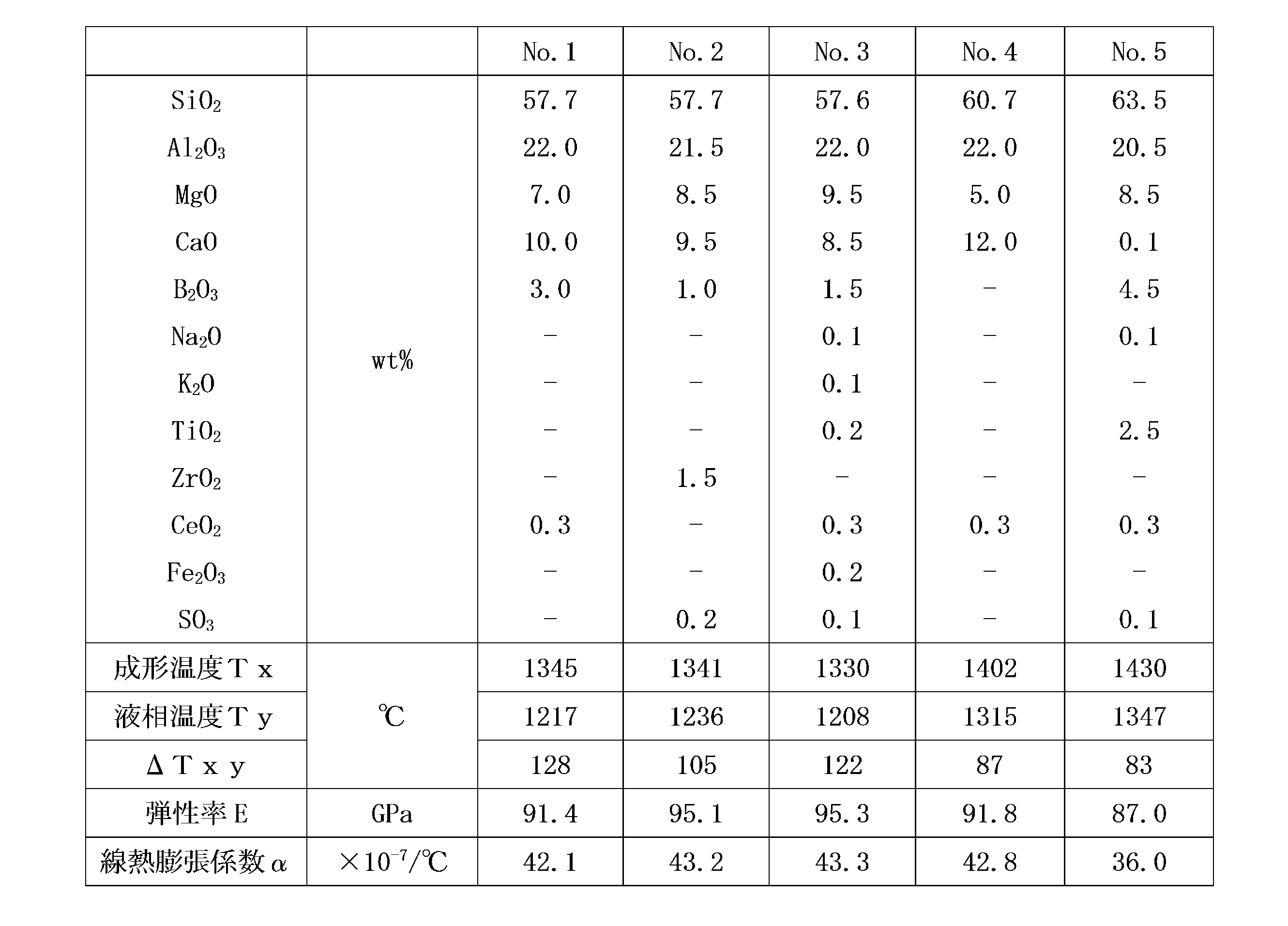
実施例(試料No.1~3)と比較例(試料No.4及び5)の各ガラス試料は以下の手順で作製した。
まず、表中のガラス組成になるように、任意の天然原料及び/又は化成原料を用いて各種ガラス原料を所定量秤量、混合して、ガラスバッチを作製した。次に、このガラスバッチを白金ロジウム坩堝に投入し、大気雰囲気中で1500℃、5時間の加熱溶融を実施した。尚、均質な溶融ガラスとするために加熱溶融の途中で耐熱性撹拌棒を使用して溶融ガラスの撹拌を行った。
その後、均質な状態となった溶融ガラスをカーボン製の鋳型に流し出して所定形状に鋳込み成形を行い、徐冷操作を行って最終的な計測用のガラス成形体を得た。
得られたガラスの物理特性は、以下の手順で計測した。
溶融ガラスの粘度が103dPa・sに相当する成形温度Txは、成形したガラスをアルミナ坩堝に投入して、再加熱し、融液状態にまで加熱した後に、白金球引き上げ法に基づいて計測した各粘度の複数の計測によって得られた粘度曲線の内挿によって算出した。
また、液相温度Tyは、標準篩30メッシュ(300μm)を通過し、50メッシュ(300μm)に残るガラス粉末を白金製容器に適切な嵩密度を有する状態に充填して、最高温度を1250℃に設定した間接加熱型の温度勾配炉内に入れて静置し、16時間大気雰囲気中で加熱操作を行った。その後に白金製容器ごと試験体を取り出し、室温まで放冷後、偏光顕微鏡によって結晶の析出温度を特定した。
成形温度Txと液相温度Tyとの温度差ΔTxyは両者の値から算出した。
弾性率Eは、1200番アルミナ粉末を分散させた研磨液で研磨した40mm×20mm×2mmの寸法の板状試料の両表面について、自由共振式弾性率測定装置(日本テクノプラス株式会社製)により室温環境下にて計測した。
線熱膨張係数αは、NISTのSRM-731、SRM-738を線熱膨張係数既知の標・BR> 試料として使用して校正した線熱膨張計測機器により行った。尚、表記した結果は、30℃から380℃の温度範囲で計測した平均線熱膨張係数である。
表1から明らかなように、実施例である試料No.1~3は、いずれも成形温度Txが1365℃以下であり、成形温度Txと液相温度Tyとの温度差ΔTxyが90℃以上であった。また、弾性率Eが90GPa以上と高かった。
一方、比較例であるNo.4は、成形温度Txが1402℃と高く、成形温度Txと液相温度Tyとの温度差ΔTxyも90℃未満であった。また、No.5は、成形温度Txが高く、ΔTxyが小さく、弾性率Eも90GPa未満であった。
次いで、本発明のガラス繊維と、ガラス繊維含有複合材料について例示する。
例えば、実施例1の試料No.1のガラス組成を有するガラス繊維用組成物を溶融した後、白金製のノズルを有するブッシング装置を使用すれば、3μmの直径を有するガラスモノフィラメントを連続成形することができる。連続成形しても糸切れが発生しにくいため、繊維径の安定したガラス繊維を得ることが可能である。
また、このブッシング装置には、熱電対計測で成形温度Txに該当するブッシング装置内の溶融ガラスの温度を常時監視できるシステムが作動するように設計されており、その監視温度幅は目標とする成形温度に対して±20℃である。成形温度が低くなるようなことがあればそれを是正するように加熱が行われることで安定した生産が可能である。
次に、上記したブッシング装置を用いて成形したガラス繊維の表面に浸漬法によってシランカップリング剤等を適量塗布し、風乾することによって、集束剤が塗布されたガラス繊維が得られる。ガラス繊維を複数本束ねて、ポリプロピレン樹脂よりなる有機溶媒を使用して固め、所望の長さに切断することによって、同一方向にガラス繊維が配向したLFTPを得ることができる。
こうして得られたLFTP(ペレット成形体ともいう)を使用することによって、ガラス繊維長を長くできるので、高強度のガラス繊維含有複合材料を得ることが可能になる。例えば板状物について曲げ強度等を評価すれば、従来品同等以上の性能を有する。
以上のように、本発明のガラス繊維用組成物を用いたガラス繊維、及びガラス繊維含有複合材料は、優れた性能を発揮するものであり、産業のあらゆる分野に適用することが可能となるものである。
本発明のガラス繊維用組成物を用いて作製したガラス繊維およびガラス繊維含有複合材料は、様々な用途での使用が期待できる。例えば、航空機関用途では、航空機用基材、内装材、防振材などに用いることができ、車載関連用途では、制振補強材、バンパー、エンジンアンダーカバー、フェンダー、屋根材、ボディ、スポイラー、マフラーフィルター、ダッシュパネル、ラジエター、タイミングベルトなどに用いることができる。また、船舶関連用途では、モーターボート、ヨット、漁船などに用いることができ、建設・土木・建材関連用途では、化粧壁、光天井・照明カバー、正面貼りクロス、防虫網、ロールブラインド、テント用膜材、バックリット看板、採光用波板・平板・折版、コンクリート防食・補強材、外壁補強材、塗膜防水材、防煙たれ壁、不燃透明間仕切り、映写膜、道路補強材、バスタブ、バストイレユニットなどに用いることでき、レジャー・スポーツ関連用途では、釣竿、テニスラケット、ゴルフクラブ、スキー板、ヘルメットなどに用いることができる。また、電子機器関連用途では、プリント配線基板、絶縁板、端子板、IC用基板、電子機器ハウジング材、電子部品用パッケージ材、光学機器ハウジング材、光部品用パッケージ材、絶縁支持体などに用いることができ、工業施設関連用途では、風車羽根、ガラスフィルターバッグ、不燃断熱材の外被材料、レジノイド砥石の補強材、アルミ濾過フィルターなどに、農業関連用途ではビニールハウス、農業用ポール、サイロタンクなどに用いることができる。また、上述したガラス繊維複合材料は、公知の繊維強化複合材料の強化材としても使用できる。
Claims (11)
- ガラス組成として、酸化物換算の質量百分率表示で、SiO2 50~70%、Al2O3 15~25%、MgO 3~13%、CaO 3~15%、B2O3 0.5~5%を含有することを特徴とするガラス繊維用組成物。
- 成形温度Txと液相温度Tyとの温度差ΔTxyが90℃以上であることを特徴とする請求項1に記載のガラス繊維用組成物。
- 成形温度Txが1365℃以下であることを特徴とする請求項1又は2に記戴のガラス繊維用組成物。
- 弾性率Eが90GPa以上であることを特徴とする請求項1~3の何れかに記載のガラス繊維用組成物。
- 線熱膨張係数αが45×10-7/℃以下であることを特徴とする請求項1~4の何れかに記載のガラス繊維用組成物。
- 請求項1~5の何れかに記載のガラス繊維組成物からなるガラスを固形分換算で95質量%以上含むことを特徴とするガラス繊維。
- 製品形態が、チョップドストランド、ヤーン、及びロービングの何れかであることを特徴とする請求項6に記載のガラス繊維。
- 請求項6又は7に記載のガラス繊維を有機媒体、コンクリート又はモルタルと複合化させてなることを特徴とするガラス繊維含有複合材料。
- 請求項1~5の何れかに記載のガラス繊維用組成物からなるガラスを繊維状に成形することを特徴とするガラス繊維の製造方法。
- ブッシング装置によって成形することを特徴とする請求項9に記載のガラス繊維の製造方法。
- 成形温度Txを目標温度に対して±20℃の範囲で計測管理しながら成形することを特徴とする請求項9又は10に記載のガラス繊維の製造方法。
Priority Applications (4)
| Application Number | Priority Date | Filing Date | Title |
|---|---|---|---|
| EP25171881.3A EP4567011B1 (en) | 2016-12-28 | 2017-11-16 | Composition for glass fiber, glass fiber, glass-fiber-containing composite material containing glass fiber, and method for manufacturing glass fiber |
| EP17887890.6A EP3564196B1 (en) | 2016-12-28 | 2017-11-16 | Composition for glass fiber, glass fiber, glass-fiber-containing composite material containing glass fiber, and method for manufacturing glass fiber |
| US16/473,395 US11312654B2 (en) | 2016-12-28 | 2017-11-16 | Composition for glass fiber, glass fiber, glass-fiber-containing composite material containing glass fiber, and method for manufacturing glass fiber |
| CN201780077755.3A CN110072824B (zh) | 2016-12-28 | 2017-11-16 | 玻璃纤维用组合物和玻璃纤维、含有玻璃纤维的含玻璃纤维的复合材料、以及玻璃纤维的制造方法 |
Applications Claiming Priority (2)
| Application Number | Priority Date | Filing Date | Title |
|---|---|---|---|
| JP2016254843A JP6972548B2 (ja) | 2016-12-28 | 2016-12-28 | ガラス繊維用組成物及びガラス繊維、ガラス繊維を含有するガラス繊維含有複合材料、並びにガラス繊維の製造方法 |
| JP2016-254843 | 2016-12-28 |
Publications (1)
| Publication Number | Publication Date |
|---|---|
| WO2018123328A1 true WO2018123328A1 (ja) | 2018-07-05 |
Family
ID=62707226
Family Applications (1)
| Application Number | Title | Priority Date | Filing Date |
|---|---|---|---|
| PCT/JP2017/041235 Ceased WO2018123328A1 (ja) | 2016-12-28 | 2017-11-16 | ガラス繊維用組成物及びガラス繊維、ガラス繊維を含有するガラス繊維含有複合材料、並びにガラス繊維の製造方法 |
Country Status (5)
| Country | Link |
|---|---|
| US (1) | US11312654B2 (ja) |
| EP (2) | EP4567011B1 (ja) |
| JP (3) | JP6972548B2 (ja) |
| CN (1) | CN110072824B (ja) |
| WO (1) | WO2018123328A1 (ja) |
Cited By (4)
| Publication number | Priority date | Publication date | Assignee | Title |
|---|---|---|---|---|
| US11214512B2 (en) | 2017-12-19 | 2022-01-04 | Owens Coming Intellectual Capital, LLC | High performance fiberglass composition |
| JP2023510200A (ja) * | 2020-01-02 | 2023-03-13 | オウェンス コーニング インテレクチュアル キャピタル リミテッド ライアビリティ カンパニー | より高い弾性率のための繊維ガラス組成物 |
| WO2023100994A1 (ja) * | 2021-12-02 | 2023-06-08 | 日本板硝子株式会社 | ガラス繊維 |
| US20230278923A1 (en) * | 2020-06-18 | 2023-09-07 | Nippon Electric Glass Co., Ltd. | Composition for glass fiber |
Families Citing this family (10)
| Publication number | Priority date | Publication date | Assignee | Title |
|---|---|---|---|---|
| CN114180828A (zh) * | 2016-12-29 | 2022-03-15 | 广东东阳光药业有限公司 | 高耐化学性的硼硅酸盐玻璃及其应用 |
| CN115894105B (zh) * | 2021-09-30 | 2025-12-19 | 淄博华源科技创新发展有限公司 | 一种含硼磷的农业用纤维及其制备方法 |
| CN115093123B (zh) * | 2022-06-21 | 2024-03-15 | 重庆国际复合材料股份有限公司 | 一种低膨胀高模量玻璃纤维组合物以及玻璃纤维 |
| CN115818967A (zh) * | 2022-12-08 | 2023-03-21 | 济南大学 | 一种应用于芯片封装ic载板的低热膨胀系数玻璃纤维及其制备方法、应用 |
| CN116354608A (zh) * | 2023-02-14 | 2023-06-30 | 华润水泥技术研发有限公司 | 一种多矿物组合的耐碱玄武岩纤维原料配方及制备方法 |
| CN119923375B (zh) * | 2023-08-31 | 2025-10-31 | 日东纺绩株式会社 | 玻璃纤维用玻璃组合物、玻璃纤维、玻璃纤维织物以及玻璃纤维强化树脂组合物 |
| CN117185667A (zh) * | 2023-09-27 | 2023-12-08 | 绿丞科技服务(青岛)有限公司 | 一种玻璃纤维丝的增性结构 |
| CN121969584A (zh) * | 2023-11-06 | 2026-05-01 | 日本电气硝子株式会社 | 玻璃纤维用组合物 |
| CN118005283A (zh) * | 2023-12-26 | 2024-05-10 | 武汉理工大学 | 一种高抗折强度无碱高铝玻璃及其制备方法和应用 |
| CN120229870A (zh) * | 2025-03-25 | 2025-07-01 | 武汉理工大学 | 一种高耐碱高强度玻璃及其制备方法和应用 |
Citations (10)
| Publication number | Priority date | Publication date | Assignee | Title |
|---|---|---|---|---|
| JPH05279072A (ja) | 1992-03-27 | 1993-10-26 | Tanaka Kikinzoku Kogyo Kk | ガラス繊維紡糸用ブッシング |
| JPH07215729A (ja) | 1994-01-31 | 1995-08-15 | Central Glass Co Ltd | ガラス繊維製造用のブッシング |
| JPH09142871A (ja) | 1995-11-24 | 1997-06-03 | Nippon Electric Glass Co Ltd | ガラス繊維製造装置 |
| JP2001180969A (ja) * | 1999-12-28 | 2001-07-03 | Central Glass Co Ltd | リチウム含有高ヤング率ガラスおよびガラス物品 |
| JP2002513730A (ja) * | 1998-05-06 | 2002-05-14 | イソベール・サン−ゴバン | 人工ミネラルウール |
| JP2005525985A (ja) * | 2002-01-24 | 2005-09-02 | カール−ツァイス−スティフツング | 抗微生物性非水溶性ケイ酸ガラス粉末およびガラス粉末混合物 |
| JP2006527158A (ja) * | 2003-06-11 | 2006-11-30 | サン−ゴバン ベトロテックス フランス ソシエテ アノニム | 有機及び/又は無機材料の強化に適したガラス糸、この糸を含む複合体、及びこの糸に用いられる組成物 |
| JP2009514773A (ja) | 2005-11-04 | 2009-04-09 | オーシーヴィー インテレクチュアル キャピタル リミテッド ライアビリティ カンパニー | 高性能ガラスのための組成物、高性能ガラス繊維及びその製品 |
| WO2012104999A1 (ja) * | 2011-02-01 | 2012-08-09 | 日東紡績株式会社 | ガラス繊維 |
| JP2013500939A (ja) * | 2009-08-04 | 2013-01-10 | オーシーヴィー インテレクチュアル キャピタル リミテッド ライアビリティ カンパニー | 弾性率が改善されたリチウムを含まないガラス |
Family Cites Families (20)
| Publication number | Priority date | Publication date | Assignee | Title |
|---|---|---|---|---|
| JPH07157975A (ja) * | 1993-12-01 | 1995-06-20 | Asahi Fiber Glass Co Ltd | ゴム補強用ガラス繊維 |
| FR2778399A1 (fr) | 1998-05-06 | 1999-11-12 | Saint Gobain Isover | Composition de laine minerale |
| FR2783516B1 (fr) | 1998-09-17 | 2000-11-10 | Saint Gobain Isover | Composition de laine minerale |
| DE19916296C1 (de) * | 1999-04-12 | 2001-01-18 | Schott Glas | Alkalifreies Aluminoborosilicatglas und dessen Verwendung |
| FR2806402B1 (fr) | 2000-03-17 | 2002-10-25 | Saint Gobain Isover | Composition de laine minerale |
| WO2003050054A1 (en) * | 2001-12-12 | 2003-06-19 | Rockwool International A/S | Fibres and their production |
| JP2007217192A (ja) * | 2004-01-30 | 2007-08-30 | Nippon Sheet Glass Co Ltd | ガラス物品、およびその製造方法 |
| FR2930543B1 (fr) | 2008-04-23 | 2010-11-19 | Saint Gobain Technical Fabrics | Fils de verre et composites a matrice organique et/ou inorganique contenant lesdits fils |
| CN101580344B (zh) * | 2009-06-29 | 2012-10-17 | 巨石集团有限公司 | 一种高强度玻璃纤维组合物 |
| CN101691278A (zh) * | 2009-10-16 | 2010-04-07 | 巨石集团有限公司 | 能作为先进复合材料增强基材的玻璃纤维 |
| EP2354106A1 (en) | 2010-02-05 | 2011-08-10 | 3B | Glass fibre composition and composite material reinforced therewith |
| CN101838110B (zh) | 2010-05-19 | 2014-02-26 | 巨石集团有限公司 | 一种适用于池窑生产的制备高性能玻璃纤维用组合物 |
| US8841222B2 (en) * | 2010-06-08 | 2014-09-23 | Nitto Boseki Co., Ltd. | Glass fiber |
| CN111662009A (zh) | 2010-12-22 | 2020-09-15 | Agy控股公司 | 高强度玻璃组合物和纤维 |
| JP2013121905A (ja) * | 2011-03-03 | 2013-06-20 | Nippon Electric Glass Co Ltd | 樹脂複合体基板用ガラス |
| FR2986227B1 (fr) | 2012-01-27 | 2014-01-10 | Saint Gobain Isover | Procede de production de laine minerale |
| JP6376326B2 (ja) | 2013-05-31 | 2018-08-22 | 日本電気硝子株式会社 | ガラス繊維組成物、ガラス繊維及びガラス繊維の製造方法 |
| JP2015193522A (ja) | 2014-03-28 | 2015-11-05 | 日本電気硝子株式会社 | ガラス製造用カオリン原料及びガラス繊維の製造方法 |
| US9944551B2 (en) * | 2015-05-07 | 2018-04-17 | Ppg Industries Ohio, Inc. | Glass compositions, fiberizable glass compositions, and glass fibers made therefrom |
| WO2017033246A1 (ja) * | 2015-08-21 | 2017-03-02 | 日東紡績株式会社 | ガラス繊維用ガラス組成物 |
-
2016
- 2016-12-28 JP JP2016254843A patent/JP6972548B2/ja active Active
-
2017
- 2017-11-16 US US16/473,395 patent/US11312654B2/en active Active
- 2017-11-16 EP EP25171881.3A patent/EP4567011B1/en active Active
- 2017-11-16 CN CN201780077755.3A patent/CN110072824B/zh active Active
- 2017-11-16 EP EP17887890.6A patent/EP3564196B1/en active Active
- 2017-11-16 WO PCT/JP2017/041235 patent/WO2018123328A1/ja not_active Ceased
-
2021
- 2021-10-08 JP JP2021166045A patent/JP7307406B2/ja active Active
-
2023
- 2023-02-17 JP JP2023023325A patent/JP7440828B2/ja active Active
Patent Citations (10)
| Publication number | Priority date | Publication date | Assignee | Title |
|---|---|---|---|---|
| JPH05279072A (ja) | 1992-03-27 | 1993-10-26 | Tanaka Kikinzoku Kogyo Kk | ガラス繊維紡糸用ブッシング |
| JPH07215729A (ja) | 1994-01-31 | 1995-08-15 | Central Glass Co Ltd | ガラス繊維製造用のブッシング |
| JPH09142871A (ja) | 1995-11-24 | 1997-06-03 | Nippon Electric Glass Co Ltd | ガラス繊維製造装置 |
| JP2002513730A (ja) * | 1998-05-06 | 2002-05-14 | イソベール・サン−ゴバン | 人工ミネラルウール |
| JP2001180969A (ja) * | 1999-12-28 | 2001-07-03 | Central Glass Co Ltd | リチウム含有高ヤング率ガラスおよびガラス物品 |
| JP2005525985A (ja) * | 2002-01-24 | 2005-09-02 | カール−ツァイス−スティフツング | 抗微生物性非水溶性ケイ酸ガラス粉末およびガラス粉末混合物 |
| JP2006527158A (ja) * | 2003-06-11 | 2006-11-30 | サン−ゴバン ベトロテックス フランス ソシエテ アノニム | 有機及び/又は無機材料の強化に適したガラス糸、この糸を含む複合体、及びこの糸に用いられる組成物 |
| JP2009514773A (ja) | 2005-11-04 | 2009-04-09 | オーシーヴィー インテレクチュアル キャピタル リミテッド ライアビリティ カンパニー | 高性能ガラスのための組成物、高性能ガラス繊維及びその製品 |
| JP2013500939A (ja) * | 2009-08-04 | 2013-01-10 | オーシーヴィー インテレクチュアル キャピタル リミテッド ライアビリティ カンパニー | 弾性率が改善されたリチウムを含まないガラス |
| WO2012104999A1 (ja) * | 2011-02-01 | 2012-08-09 | 日東紡績株式会社 | ガラス繊維 |
Cited By (10)
| Publication number | Priority date | Publication date | Assignee | Title |
|---|---|---|---|---|
| US11214512B2 (en) | 2017-12-19 | 2022-01-04 | Owens Coming Intellectual Capital, LLC | High performance fiberglass composition |
| US12344546B2 (en) | 2017-12-19 | 2025-07-01 | Owens Corning Intellectual Capital, Llc | High performance fiberglass composition |
| US12473226B2 (en) | 2017-12-19 | 2025-11-18 | Owens Corning Intellectual Capital, Llc | High performance fiberglass composition |
| JP2023510200A (ja) * | 2020-01-02 | 2023-03-13 | オウェンス コーニング インテレクチュアル キャピタル リミテッド ライアビリティ カンパニー | より高い弾性率のための繊維ガラス組成物 |
| JP2025166000A (ja) * | 2020-01-02 | 2025-11-05 | オウェンス コーニング インテレクチュアル キャピタル リミテッド ライアビリティ カンパニー | より高い弾性率のための繊維ガラス組成物 |
| JP7781757B2 (ja) | 2020-01-02 | 2025-12-08 | オウェンス コーニング インテレクチュアル キャピタル リミテッド ライアビリティ カンパニー | より高い弾性率のための繊維ガラス組成物 |
| JP7894497B2 (ja) | 2020-01-02 | 2026-07-23 | オウェンス コーニング インテレクチュアル キャピタル リミテッド ライアビリティ カンパニー | より高い弾性率のための繊維ガラス組成物 |
| US20230278923A1 (en) * | 2020-06-18 | 2023-09-07 | Nippon Electric Glass Co., Ltd. | Composition for glass fiber |
| WO2023100994A1 (ja) * | 2021-12-02 | 2023-06-08 | 日本板硝子株式会社 | ガラス繊維 |
| JPWO2023100994A1 (ja) * | 2021-12-02 | 2023-06-08 |
Also Published As
| Publication number | Publication date |
|---|---|
| JP6972548B2 (ja) | 2021-11-24 |
| US11312654B2 (en) | 2022-04-26 |
| EP3564196A1 (en) | 2019-11-06 |
| US20200148586A1 (en) | 2020-05-14 |
| JP2023053401A (ja) | 2023-04-12 |
| JP7307406B2 (ja) | 2023-07-12 |
| JP2022000413A (ja) | 2022-01-04 |
| JP7440828B2 (ja) | 2024-02-29 |
| EP3564196A4 (en) | 2020-08-26 |
| EP4567011A3 (en) | 2025-08-27 |
| CN110072824A (zh) | 2019-07-30 |
| CN110072824B (zh) | 2022-06-28 |
| EP3564196B1 (en) | 2025-06-04 |
| EP4567011A2 (en) | 2025-06-11 |
| EP4567011B1 (en) | 2025-12-10 |
| JP2018104245A (ja) | 2018-07-05 |
Similar Documents
| Publication | Publication Date | Title |
|---|---|---|
| JP7440828B2 (ja) | ガラス繊維用組成物及びガラス繊維、ガラス繊維を含有するガラス繊維含有複合材料、並びにガラス繊維の製造方法 | |
| JP5442181B2 (ja) | ガラス繊維組成物、ガラス繊維及びガラス繊維含有複合材料 | |
| JP5152437B2 (ja) | ガラス繊維 | |
| JP5655293B2 (ja) | ガラス繊維用ガラス組成物、ガラス繊維及びガラス製シート状物 | |
| WO2021256217A1 (ja) | ガラス繊維用組成物 | |
| KR102668384B1 (ko) | 고성능 섬유유리 조성물 | |
| JP6080010B2 (ja) | ガラス繊維組成物、ガラス繊維及びガラス繊維の製造方法 | |
| EP2630095B1 (en) | Glass composition for producing high strength and high modulus fibers | |
| US12600665B2 (en) | Fiberglass composition for higher modulus | |
| WO2025100227A1 (ja) | ガラス繊維用組成物 | |
| WO2025121226A1 (ja) | ガラス繊維用組成物 | |
| JP2025092390A (ja) | ガラス繊維用組成物 | |
| JP2013047184A (ja) | ガラス繊維組成物、ガラス繊維及びガラス繊維含有複合材料 | |
| JP2025077986A (ja) | ガラス繊維用組成物 |
Legal Events
| Date | Code | Title | Description |
|---|---|---|---|
| 121 | Ep: the epo has been informed by wipo that ep was designated in this application |
Ref document number: 17887890 Country of ref document: EP Kind code of ref document: A1 |
|
| NENP | Non-entry into the national phase |
Ref country code: DE |
|
| ENP | Entry into the national phase |
Ref document number: 2017887890 Country of ref document: EP Effective date: 20190729 |
|
| WWG | Wipo information: grant in national office |
Ref document number: 2017887890 Country of ref document: EP |