WO2019012705A1 - Attelle de marche - Google Patents
Attelle de marche Download PDFInfo
- Publication number
- WO2019012705A1 WO2019012705A1 PCT/JP2017/025804 JP2017025804W WO2019012705A1 WO 2019012705 A1 WO2019012705 A1 WO 2019012705A1 JP 2017025804 W JP2017025804 W JP 2017025804W WO 2019012705 A1 WO2019012705 A1 WO 2019012705A1
- Authority
- WO
- WIPO (PCT)
- Prior art keywords
- user
- walking
- foot
- achilles tendon
- walking brace
- Prior art date
- Legal status (The legal status is an assumption and is not a legal conclusion. Google has not performed a legal analysis and makes no representation as to the accuracy of the status listed.)
- Ceased
Links
- GBMSZXWHMSSBGP-UHFFFAOYSA-N CC(C)C(C)CN Chemical compound CC(C)C(C)CN GBMSZXWHMSSBGP-UHFFFAOYSA-N 0.000 description 1
Images


Classifications
-
- A—HUMAN NECESSITIES
- A43—FOOTWEAR
- A43B—CHARACTERISTIC FEATURES OF FOOTWEAR; PARTS OF FOOTWEAR
- A43B7/00—Footwear with health or hygienic arrangements
- A43B7/14—Footwear with health or hygienic arrangements with foot-supporting parts
- A43B7/18—Joint supports, e.g. instep supports
-
- A—HUMAN NECESSITIES
- A61—MEDICAL OR VETERINARY SCIENCE; HYGIENE
- A61F—FILTERS IMPLANTABLE INTO BLOOD VESSELS; PROSTHESES; DEVICES PROVIDING PATENCY TO, OR PREVENTING COLLAPSING OF, TUBULAR STRUCTURES OF THE BODY, e.g. STENTS; ORTHOPAEDIC, NURSING OR CONTRACEPTIVE DEVICES; FOMENTATION; TREATMENT OR PROTECTION OF EYES OR EARS; BANDAGES, DRESSINGS OR ABSORBENT PADS; FIRST-AID KITS
- A61F13/00—Bandages or dressings; Absorbent pads
- A61F13/04—Plaster of Paris bandages; Other stiffening bandages
-
- A—HUMAN NECESSITIES
- A61—MEDICAL OR VETERINARY SCIENCE; HYGIENE
- A61F—FILTERS IMPLANTABLE INTO BLOOD VESSELS; PROSTHESES; DEVICES PROVIDING PATENCY TO, OR PREVENTING COLLAPSING OF, TUBULAR STRUCTURES OF THE BODY, e.g. STENTS; ORTHOPAEDIC, NURSING OR CONTRACEPTIVE DEVICES; FOMENTATION; TREATMENT OR PROTECTION OF EYES OR EARS; BANDAGES, DRESSINGS OR ABSORBENT PADS; FIRST-AID KITS
- A61F13/00—Bandages or dressings; Absorbent pads
- A61F13/06—Bandages or dressings; Absorbent pads specially adapted for feet or legs; Corn-pads; Corn-rings
-
- A—HUMAN NECESSITIES
- A61—MEDICAL OR VETERINARY SCIENCE; HYGIENE
- A61F—FILTERS IMPLANTABLE INTO BLOOD VESSELS; PROSTHESES; DEVICES PROVIDING PATENCY TO, OR PREVENTING COLLAPSING OF, TUBULAR STRUCTURES OF THE BODY, e.g. STENTS; ORTHOPAEDIC, NURSING OR CONTRACEPTIVE DEVICES; FOMENTATION; TREATMENT OR PROTECTION OF EYES OR EARS; BANDAGES, DRESSINGS OR ABSORBENT PADS; FIRST-AID KITS
- A61F5/00—Orthopaedic methods or devices for non-surgical treatment of bones or joints; Nursing devices ; Anti-rape devices
- A61F5/01—Orthopaedic devices, e.g. long-term immobilising or pressure directing devices for treating broken or deformed bones such as splints, casts or braces
-
- A—HUMAN NECESSITIES
- A61—MEDICAL OR VETERINARY SCIENCE; HYGIENE
- A61F—FILTERS IMPLANTABLE INTO BLOOD VESSELS; PROSTHESES; DEVICES PROVIDING PATENCY TO, OR PREVENTING COLLAPSING OF, TUBULAR STRUCTURES OF THE BODY, e.g. STENTS; ORTHOPAEDIC, NURSING OR CONTRACEPTIVE DEVICES; FOMENTATION; TREATMENT OR PROTECTION OF EYES OR EARS; BANDAGES, DRESSINGS OR ABSORBENT PADS; FIRST-AID KITS
- A61F5/00—Orthopaedic methods or devices for non-surgical treatment of bones or joints; Nursing devices ; Anti-rape devices
- A61F5/01—Orthopaedic devices, e.g. long-term immobilising or pressure directing devices for treating broken or deformed bones such as splints, casts or braces
- A61F5/02—Orthopaedic corsets
-
- A—HUMAN NECESSITIES
- A61—MEDICAL OR VETERINARY SCIENCE; HYGIENE
- A61F—FILTERS IMPLANTABLE INTO BLOOD VESSELS; PROSTHESES; DEVICES PROVIDING PATENCY TO, OR PREVENTING COLLAPSING OF, TUBULAR STRUCTURES OF THE BODY, e.g. STENTS; ORTHOPAEDIC, NURSING OR CONTRACEPTIVE DEVICES; FOMENTATION; TREATMENT OR PROTECTION OF EYES OR EARS; BANDAGES, DRESSINGS OR ABSORBENT PADS; FIRST-AID KITS
- A61F5/00—Orthopaedic methods or devices for non-surgical treatment of bones or joints; Nursing devices ; Anti-rape devices
- A61F5/01—Orthopaedic devices, e.g. long-term immobilising or pressure directing devices for treating broken or deformed bones such as splints, casts or braces
- A61F5/04—Devices for stretching or reducing fractured limbs; Devices for distractions; Splints
-
- A—HUMAN NECESSITIES
- A61—MEDICAL OR VETERINARY SCIENCE; HYGIENE
- A61H—PHYSICAL THERAPY APPARATUS, e.g. DEVICES FOR LOCATING OR STIMULATING REFLEX POINTS IN THE BODY; ARTIFICIAL RESPIRATION; MASSAGE; BATHING DEVICES FOR SPECIAL THERAPEUTIC OR HYGIENIC PURPOSES OR SPECIFIC PARTS OF THE BODY
- A61H3/00—Appliances for aiding patients or disabled persons to walk about
Definitions
- the present invention relates to a walking brace that assists a user's walking, and more particularly to a walking brace that aids a walk of a patient with Achilles tendon tear.
- Achilles tendon rupture occurs when the calf muscle (triceps cruris) contracts rapidly due to stepping, dashing or jumping, or when the muscle is suddenly stretched due to landing movement.
- Conservative treatment has the advantage of not performing surgery, but it has been recognized that it needs to be fixed over a long period of time by using casts or braces, and that it tends to cause re-tear of Achilles tendon.
- U.S. Pat. No. 5,959,015 discloses a rigid cast useful for securing an injured body part which has a rigid structure and a plurality of cooperating fastener means, which can be removed and subsequently reattached. It is disclosed.
- An object of the present invention is to provide a walking brace capable of optimally fixing the user's Achilles tendon, in order to solve the problems as described above.
- the walking brace according to the present invention is a walking brace that assists the user's walking in order to achieve the above object, and includes a first protection member that covers from the lower thigh rear surface to the back surface of the user; And a first fixing member for fixing the user's foot to the first protecting member at least at one position between the lower knee and the upper ankle, and the first protecting member detects the user's Achilles tendon from the left and right
- a walking orthosis having an accommodation portion for accommodating an internal pad pressed against the pinched ankle peripheral portion.
- FIG. 1 is a view showing a first embodiment 100 of a walking brace according to the present invention.
- FIG. 2 is a view showing a second embodiment 200 of the walking brace according to the present invention.
- FIG. 3 is a schematic view for explaining the part of the foot of the user U.
- FIG. 4 is a view showing a state in which the user U who is an Achilles tendon tear patient wears the walking brace according to the present invention.
- FIG. 5 is a schematic view showing an example of the shape of the first protective member 1.
- FIG. 6 is a schematic view showing an example of an internal pad for pinching the user's Achilles tendon g from the left and right from the left and right and pressing it against the ankle e.
- FIG. 1 is a view showing a first embodiment 100 of a walking brace according to the present invention.
- 1A shows a state before the first fixing member 3 is fixed to the first protective member 1
- FIG. 1B shows that the first fixing member 3 is fixed to the first protective member 1. It is a figure which shows the state of the back.
- FIG. 3 is a schematic view for explaining the part of the foot of the user.
- FIG. 2 is a view showing a second embodiment 200 of the walking brace according to the present invention.
- FIG. 2A shows a state before the first fixing member 3 is fixed to the first protective member 1
- FIG. 2B shows that the first fixing member 3 is fixed to the first protective member 1. It is a figure which shows the state of the back.
- a walking brace 200 according to a second embodiment of the present invention shown in FIG. 2 is a first protection member 1 shown in FIG. 3 covering from the rear thigh X to the back Z of the user;
- the user's foot is first placed at least on one of the lower thigh front Y and the lower knee c and the upper ankle e of the lower thigh front Y covering the lower thigh front Y to the instep d of the foot
- the first fixing member 3 fixed to the protection member 1 and the second protection member 2 is provided.
- the first protective member 1 includes the housing portion 7 for housing the user's Achilles tendon g and pressing it against the periphery of the ankle e from the left and right.
- lower leg rear surface X may refer to the area from the lower part of the lower back of the knee a to the heel b
- the “lower thigh front Y” refers to the lower knee c to the upper ankle e
- the back sole Z refers to the thing from the heel b to the fingertip f.
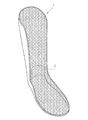
- FIG. 5 is a schematic view showing an example of the shape of the first protective member 1.
- the shape of the first protective member 1 is an internal pad that covers the user's lower thigh rear surface X to the foot surface Z and presses the user's Achilles tendon g from the left and right from the left and right as shown in FIGS. If it is a shape which can have the accommodating part 7 which accommodates, it will not be specifically limited.
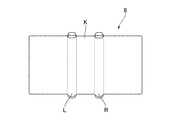
- FIG. 6 is a schematic view showing an example of the internal pad 8 which pinches the user's Achilles tendon g from the left and right from the left and right and presses the periphery of the ankle e.
- the accommodating part 7 which the 1st protection member 1 has is a space which can accommodate the internal pad 8 as is shown by FIG. 6, the space structure will not be specifically limited.
- the inner pad 8 is not particularly limited as long as it is a structure capable of holding the Achilles tendon g of the user U from the left and right from the left and right and against the periphery of the ankle e.
- the inner pad 8 is, for example, a central portion K disposed opposite to the Achilles tendon g, a rod member L disposed along the left side of the Achilles tendon g, and a right side of the Achilles tendon g. It comprises a rod-like member R disposed along.
- the rod-like member L and the rod-like member R are preferably the same material and the same shape, and for example, a cushioning material such as cotton is used, and the diameter is 1.8 to 2.2 cm and the length 8 to 12 cm To be in the shape of
- the method of manufacturing the inner pad 8 is not particularly limited as long as the rod-like member L and the rod-like member R can be disposed at a predetermined distance and the central portion K can be formed to face the Achilles tendon g.
- the rod-like members L and the rod-like members R are disposed at a predetermined interval on a gauze cloth, and another gauze cloth is placed thereon. Then, the central portion K is formed by sewing the peripheral portions of the rod-like members L and R with a thread or the like so as not to be misaligned.
- the inner pad 8 is preferably designed by designing the rod-like member L and the diameter and length of the rod-like member R, and the width of the central portion K in accordance with the shape and thickness of the user's Achilles tendon g.
- a three-dimensional printer (three-dimensional modeling apparatus) outputs a shaped body around the ankle e including the Achilles tendon g by Additive Manufacturing technology.
- the shape and thickness of the achilles tendon g of the user can be grasped by the shaped body around the ankle e including the output Achilles tendon g.
- the shape and thickness of the Achilles tendon g of the user can be grasped without actually performing a direct examination or examination, and an optimum internal pad 8 can be manufactured.
- the thickness of the Achilles tendon g varies among individuals, the thickness of the Achilles tendon g is generally said to be proportional to the physical constitution such as the height of a human.
- the internal pad 8 composed of the rod-like member L, the rod-like member R and the central portion K can be standardized as S size, M size, L size or the like to manufacture the internal pad 8 it can.
- the walking brace according to the present invention can optimally fix the Achilles tendon g of the user by providing the accommodating portion 7 for accommodating the inner pad 8 in the first protective member 1, and the Achilles tendon g is in a state before tearing. It can be easy to heal.
- the Achilles tendon g can not be fixed optimally, and there is a possibility that the Achilles tendon g may be thicker than in the state before tearing. As a result, the thick Achilles tendon g is not preferable because the risk of re-rupture increases.
- the user U may wear the walking brace according to the present invention after holding the inner pad 8 in a state of holding the Achilles tendon g of the user U from the left and right from the left and right around the ankle e.
- the shape of the first protective member 1 may be, for example, a shape shown in FIG. 3 which can integrally cover the lower leg rear surface X to the sole surface Z as one member, and the lower leg rear surface X and the sole surface of the user
- the shape etc. which can make Z each be separate members, can be joined, and can be covered integrally are mentioned.
- the raw material which comprises the outer side of the 1st protection member 1 will not be specifically limited if it is a raw material which can protect the leg
- the hard raw material made from a plastics As a raw material which comprises the outer side of the 1st protection member 1, the hard raw material made from a plastics, the hard raw material made from gypsum, etc. are mentioned, for example.
- the raw material which comprises the inner side of the 1st protection member 1 will not be specifically limited if it is a raw material which can protect the foot
- the material which has fit nature to the foot on the side equipped with the equipment for walking, and the material which has endurance to a walk of user U are mentioned, for example Be
- the shape of the 2nd protection member 2 will not be specifically limited if it is a shape which can cover from the lower thigh front surface Y of the user U to the instep d of a foot
- the 2nd protection member 2 As a shape of the 2nd protection member 2, a shape etc. which can be covered integrally as one member from lower thigh front Y of user U to instep d of a foot are mentioned, for example.
- the raw material which comprises the outer side of the 2nd protection member 2 will not be specifically limited if it is a raw material which can protect the foot
- a hard material made of plastic As a material which constitutes the outside of the 2nd protection member 2, a hard material made of plastic, a hard material made of gypsum, etc. are mentioned, for example.
- the material which comprises the inner side of the 2nd protection member 2 will not be specifically limited if it is a material which can protect the foot by the side equipped with the equipment for walking from inside.
- the material which has fit nature to the foot on the side which equipped the equipment for walking, and the material which has endurance to a walk of user U are mentioned, for example Be
- the first protective member 1 and the second protective member 2 can be designed according to the physique such as, for example, height 150 to 160 cm, height 160 to 170 cm, height 170 to 180 cm, and the like.
- the walking equipment according to the present invention which is composed of the first protection member 1 and the second protection member 2, is standardized as S size, M size, L size, etc., and the walking according to the present invention An orthosis can be manufactured.
- the foot of the user U is at least at one of the lower knee c and the upper ankle e of the lower thigh front surface Y of the user U
- a first fixing member 3 fixed to the first protection member 1 is provided.
- the walking brace 100 fixes the foot of the user U to the first protection member 1 at at least one location of the instep d of the foot of the user U.
- a second fixing member is provided.
- the foot of the user U is at least at one of the lower knee c and the upper ankle e of the lower thigh front surface Y of the user U
- a first fixing member 3 fixed to the first protective member 1 and the second protective member 2 is provided.
- the first fixing member 3 is particularly capable of fixing the foot of the user U to the first protection member 1, in particular. It is not limited.
- the first fixing member 3 fixes the foot of the user U to the first protection member 1 and the second protection member 2 as shown in FIG.
- the first fixing member 3 fixes the foot of the user U to the first protection member 1 and the second protection member 2 as shown in FIG.
- Examples of the first fixing member 3 include a belt with a buckle as shown in FIGS. 1 and 2, and a function of tightening and fixing the belt according to the thickness of the foot of the user U and loosening the belt It is preferable to have a function.
- the horizontal axis H of the sole portion 5 and the lower leg relative to the horizontal axis H of the sole portion 5 Preferably, the angle between the rear surface portion 6 and the rear surface portion 6 is 70 to 80 °, and more preferably 80 °.
- FIG. 4 is a view showing a state in which the user U who is an Achilles tendon tear patient wears the walking brace according to the present invention.
- the foot of the user U can be fixed at an optimal angle that does not extend the Achilles' tendon of the user U, without using an aid such as a crutch. , Allow the user U to walk.
- the user U wearing the walking brace according to the present invention walks, thereby recovering the functional disorder associated with the Achilles tendon rupture. It also makes treatment possible.
- the angle between the horizontal axis H of the sole portion 5 of the foot and the rear thigh portion 6 exceeds the above range (more than 80 °), the user U can relatively stably walk. The user U's Achilles tendon is stretched, and the effect of the rehabilitation treatment for recovering the dysfunction associated with the Achilles tendon rupture can not be obtained.
- the present invention also enables rehabilitation treatment in which the user U walks to recover the dysfunction associated with Achilles tendon rupture.
- the user U wearing the walking equipment according to the present invention can walk without using an aid such as a crutch.
- the walking method of the user U is such that the foot on the side equipped with the walking orthosis is externally rotated about the brow so that the fingertip f faces outward, and the barb b It is preferable to walk so that it takes.
- the walking brace according to the present invention be provided with an external notification function for notifying the walking situation of the user U to the outside.
- the “external” includes, for example, the user U, a rehabilitation treatment support person, and a medical worker.
- the pressure sensor detects the pressure applied to each of the heel portion and the fingertip portion as the user U walks.
- a pressure sensor for example, an FSR sensor (manufactured by Akizuki Electronics Co., Ltd.) or the like is used.
- the external notification function determines that the user U is walking at the center of gravity, that is, the user U It is determined that preferable walking is performed from the viewpoint of rehabilitation treatment, and the determination information is notified to the outside.
- the external notification function determines that the user U is walking at the center of gravity of the fingertip, ie, the user From the viewpoint of rehabilitation treatment, it is determined that U is walking unfavorably, and the determination information is notified to the outside.
- a part of the walking brace according to the present invention emits blue light as a means for notifying to the outside Can be designed to
- a part of the walking brace according to the present invention emits red light as a means for notifying outside. Can be designed.
- the walking brace according to the present invention has a function of detecting information on the walking speed and walking angle of the user U, a function of detecting information on temperature, humidity and pressure in the internal environment of the walking brace, and the walking brace It can also be equipped with a function to detect information on temperature, humidity and pressure in the external environment.
- the walking equipment according to the present invention can also be provided with a function of wirelessly transmitting the detected information to an output device such as a smartphone.
- a wireless transmission function a Bluetooth (registered trademark) system can be adopted using a device capable of wireless transmission.
- a walking brace according to a first embodiment of the present invention 200 A walking brace according to a second embodiment of the present invention
- U user 1 first protective member 2 second protective member 3 first fixing member 4 second Fixing member 5 Foot surface portion 6
- Lower thigh rear surface portion 7 Containing portion 8
- Inner pad X
- Lower thigh front surface Z Foot surface H Horizontal axis
- Rod member R Rod member K Center portion a Knee hollow b ⁇ c Knee lower d e ankle f finger tip g achilles tendon
Landscapes
- Health & Medical Sciences (AREA)
- General Health & Medical Sciences (AREA)
- Public Health (AREA)
- Life Sciences & Earth Sciences (AREA)
- Veterinary Medicine (AREA)
- Animal Behavior & Ethology (AREA)
- Heart & Thoracic Surgery (AREA)
- Engineering & Computer Science (AREA)
- Biomedical Technology (AREA)
- Vascular Medicine (AREA)
- Nursing (AREA)
- Orthopedic Medicine & Surgery (AREA)
- Epidemiology (AREA)
- Rehabilitation Therapy (AREA)
- Physical Education & Sports Medicine (AREA)
- Pain & Pain Management (AREA)
- Rehabilitation Tools (AREA)
- Orthopedics, Nursing, And Contraception (AREA)
Abstract
Priority Applications (2)
| Application Number | Priority Date | Filing Date | Title |
|---|---|---|---|
| JP2019529430A JPWO2019012705A1 (ja) | 2017-07-14 | 2017-07-14 | 歩行用装具 |
| PCT/JP2017/025804 WO2019012705A1 (fr) | 2017-07-14 | 2017-07-14 | Attelle de marche |
Applications Claiming Priority (1)
| Application Number | Priority Date | Filing Date | Title |
|---|---|---|---|
| PCT/JP2017/025804 WO2019012705A1 (fr) | 2017-07-14 | 2017-07-14 | Attelle de marche |
Publications (1)
| Publication Number | Publication Date |
|---|---|
| WO2019012705A1 true WO2019012705A1 (fr) | 2019-01-17 |
Family
ID=65001566
Family Applications (1)
| Application Number | Title | Priority Date | Filing Date |
|---|---|---|---|
| PCT/JP2017/025804 Ceased WO2019012705A1 (fr) | 2017-07-14 | 2017-07-14 | Attelle de marche |
Country Status (2)
| Country | Link |
|---|---|
| JP (1) | JPWO2019012705A1 (fr) |
| WO (1) | WO2019012705A1 (fr) |
Cited By (1)
| Publication number | Priority date | Publication date | Assignee | Title |
|---|---|---|---|---|
| CN111202614A (zh) * | 2020-03-26 | 2020-05-29 | 沈阳促晋科技有限公司 | 一种跟腱断裂修复靴 |
Citations (3)
| Publication number | Priority date | Publication date | Assignee | Title |
|---|---|---|---|---|
| JPS55146116U (fr) * | 1979-04-10 | 1980-10-21 | ||
| JP2000507865A (ja) * | 1996-04-01 | 2000-06-27 | ジョンソン・アンド・ジョンソン・プロフェショナル・インコーポレーテッド | 整形用キャスト・ウォーカー・ブーツ |
| JP3189271U (ja) * | 2013-12-06 | 2014-03-06 | 株式会社アコーズ | アキレス腱ガイドおよびアキレス腱治療具 |
Family Cites Families (2)
| Publication number | Priority date | Publication date | Assignee | Title |
|---|---|---|---|---|
| WO2012086202A1 (fr) * | 2010-12-22 | 2012-06-28 | 株式会社uDesign | Attelle pour articulation et dispositif de rééducation |
| US10070816B2 (en) * | 2014-09-09 | 2018-09-11 | Intel Corporation | Orthotic sensor device |
-
2017
- 2017-07-14 JP JP2019529430A patent/JPWO2019012705A1/ja active Pending
- 2017-07-14 WO PCT/JP2017/025804 patent/WO2019012705A1/fr not_active Ceased
Patent Citations (3)
| Publication number | Priority date | Publication date | Assignee | Title |
|---|---|---|---|---|
| JPS55146116U (fr) * | 1979-04-10 | 1980-10-21 | ||
| JP2000507865A (ja) * | 1996-04-01 | 2000-06-27 | ジョンソン・アンド・ジョンソン・プロフェショナル・インコーポレーテッド | 整形用キャスト・ウォーカー・ブーツ |
| JP3189271U (ja) * | 2013-12-06 | 2014-03-06 | 株式会社アコーズ | アキレス腱ガイドおよびアキレス腱治療具 |
Cited By (1)
| Publication number | Priority date | Publication date | Assignee | Title |
|---|---|---|---|---|
| CN111202614A (zh) * | 2020-03-26 | 2020-05-29 | 沈阳促晋科技有限公司 | 一种跟腱断裂修复靴 |
Also Published As
| Publication number | Publication date |
|---|---|
| JPWO2019012705A1 (ja) | 2020-04-23 |
Similar Documents
| Publication | Publication Date | Title |
|---|---|---|
| US11969373B2 (en) | Orthopedic device | |
| CN105899169B (zh) | 矫形装置 | |
| US9839549B2 (en) | Orthopedic device | |
| US9839548B2 (en) | Orthopedic device | |
| US8926538B2 (en) | Support device for administration of CPR | |
| KR100758751B1 (ko) | 고령자 및 재활환자용 안전재킷 | |
| KR20090025184A (ko) | 보행 조절 시스템 및 방법 | |
| KR102282205B1 (ko) | 인지능력강화 기능이 향상된 보행 재활기기 | |
| US20260007533A1 (en) | Universal Ankle-Foot Orthoses | |
| US20080077066A1 (en) | Lewis lift AFO device | |
| KR100975991B1 (ko) | 보행보조신발 | |
| KR102330974B1 (ko) | 중족지관절 보조장치 | |
| Sposito et al. | Evaluation of xosoft beta-1 lower limb exoskeleton on a post stroke patient | |
| WO2019012705A1 (fr) | Attelle de marche | |
| KR102255057B1 (ko) | 전방십자인대 보조기 | |
| JP2018011903A (ja) | 下肢用サポータ | |
| KR200442354Y1 (ko) | 보행보조 기능을 구비한 근육 인대 보호구 | |
| KR20160130562A (ko) | 퇴행성 관절 및 보행 불편자를 위한 보조기 | |
| KR101638861B1 (ko) | 풋 브레이스 | |
| JP3197911U (ja) | 足首矯正ベルト | |
| KR102945431B1 (ko) | 손상 회복을 위한 인체 보조기 | |
| US20250143907A1 (en) | Elastic neutral ankle foot orthosis | |
| CN107072556A (zh) | 用于与电子监控脚镯一起佩戴的舒适带 | |
| JP3111554U (ja) | 足部サポーター | |
| CN210932107U (zh) | 一种可检测压力的踝关节外固定支具 |
Legal Events
| Date | Code | Title | Description |
|---|---|---|---|
| 121 | Ep: the epo has been informed by wipo that ep was designated in this application |
Ref document number: 17917746 Country of ref document: EP Kind code of ref document: A1 |
|
| ENP | Entry into the national phase |
Ref document number: 2019529430 Country of ref document: JP Kind code of ref document: A |
|
| NENP | Non-entry into the national phase |
Ref country code: DE |
|
| 32PN | Ep: public notification in the ep bulletin as address of the adressee cannot be established |
Free format text: NOTING OF LOSS OF RIGHTS PURSUANT TO RULE 112(1) EPC (EPO FORM 1205A DATED 31/03/2020) |
|
| 122 | Ep: pct application non-entry in european phase |
Ref document number: 17917746 Country of ref document: EP Kind code of ref document: A1 |