WO2019017415A1 - Procédé de production de méthionine purifiée et procédé de prévention de l'agglutination de la méthionine - Google Patents
Procédé de production de méthionine purifiée et procédé de prévention de l'agglutination de la méthionine Download PDFInfo
- Publication number
- WO2019017415A1 WO2019017415A1 PCT/JP2018/027014 JP2018027014W WO2019017415A1 WO 2019017415 A1 WO2019017415 A1 WO 2019017415A1 JP 2018027014 W JP2018027014 W JP 2018027014W WO 2019017415 A1 WO2019017415 A1 WO 2019017415A1
- Authority
- WO
- WIPO (PCT)
- Prior art keywords
- methionine
- wet cake
- water
- caking
- adjustment
- Prior art date
- Legal status (The legal status is an assumption and is not a legal conclusion. Google has not performed a legal analysis and makes no representation as to the accuracy of the status listed.)
- Ceased
Links
- 0 *CCC(C(O)=O)N Chemical compound *CCC(C(O)=O)N 0.000 description 1
Images


Classifications
-
- C—CHEMISTRY; METALLURGY
- C07—ORGANIC CHEMISTRY
- C07C—ACYCLIC OR CARBOCYCLIC COMPOUNDS
- C07C319/00—Preparation of thiols, sulfides, hydropolysulfides or polysulfides
- C07C319/26—Separation; Purification; Stabilisation; Use of additives
- C07C319/28—Separation; Purification
-
- C—CHEMISTRY; METALLURGY
- C07—ORGANIC CHEMISTRY
- C07C—ACYCLIC OR CARBOCYCLIC COMPOUNDS
- C07C323/00—Thiols, sulfides, hydropolysulfides or polysulfides substituted by halogen, oxygen or nitrogen atoms, or by sulfur atoms not being part of thio groups
- C07C323/50—Thiols, sulfides, hydropolysulfides or polysulfides substituted by halogen, oxygen or nitrogen atoms, or by sulfur atoms not being part of thio groups containing thio groups and carboxyl groups bound to the same carbon skeleton
- C07C323/51—Thiols, sulfides, hydropolysulfides or polysulfides substituted by halogen, oxygen or nitrogen atoms, or by sulfur atoms not being part of thio groups containing thio groups and carboxyl groups bound to the same carbon skeleton having the sulfur atoms of the thio groups bound to acyclic carbon atoms of the carbon skeleton
- C07C323/57—Thiols, sulfides, hydropolysulfides or polysulfides substituted by halogen, oxygen or nitrogen atoms, or by sulfur atoms not being part of thio groups containing thio groups and carboxyl groups bound to the same carbon skeleton having the sulfur atoms of the thio groups bound to acyclic carbon atoms of the carbon skeleton the carbon skeleton being further substituted by nitrogen atoms, not being part of nitro or nitroso groups
- C07C323/58—Thiols, sulfides, hydropolysulfides or polysulfides substituted by halogen, oxygen or nitrogen atoms, or by sulfur atoms not being part of thio groups containing thio groups and carboxyl groups bound to the same carbon skeleton having the sulfur atoms of the thio groups bound to acyclic carbon atoms of the carbon skeleton the carbon skeleton being further substituted by nitrogen atoms, not being part of nitro or nitroso groups with amino groups bound to the carbon skeleton
-
- Y—GENERAL TAGGING OF NEW TECHNOLOGICAL DEVELOPMENTS; GENERAL TAGGING OF CROSS-SECTIONAL TECHNOLOGIES SPANNING OVER SEVERAL SECTIONS OF THE IPC; TECHNICAL SUBJECTS COVERED BY FORMER USPC CROSS-REFERENCE ART COLLECTIONS [XRACs] AND DIGESTS
- Y02—TECHNOLOGIES OR APPLICATIONS FOR MITIGATION OR ADAPTATION AGAINST CLIMATE CHANGE
- Y02P—CLIMATE CHANGE MITIGATION TECHNOLOGIES IN THE PRODUCTION OR PROCESSING OF GOODS
- Y02P60/00—Technologies relating to agriculture, livestock or agroalimentary industries
- Y02P60/80—Food processing, e.g. use of renewable energies or variable speed drives in handling, conveying or stacking
- Y02P60/87—Re-use of by-products of food processing for fodder production
Definitions
- the present invention relates to a method for producing purified methionine and a method for preventing the caking of methionine.
- Methionine can be obtained, for example, by hydrolysis of 5- (2- (methylthio) ethyl) imidazolidine-2,4-dione as shown in the following reaction formula (1).
- Methionine is useful as an animal feed additive.
- Various studies have been conducted on methionine production methods from the viewpoint of quality improvement, production cost reduction, etc. (for example, Patent Documents 1 and 2).
- Methionine as a product is in powder form. However, during storage, methionine may clump, and if clumping is promoted, methionine clumps will form. If a lump of methionine is contained in powdered methionine, the handleability of methionine as a product may be impaired. For this reason, there is a need to establish a technique that can prevent the caking of methionine so as to prevent the formation of methionine lumps.
- Patent Document 1 a technique for drying a wet cake of methionine under mechanical agitation is examined with the object of providing a method for producing methionine having a large bulk specific gravity that is easy to handle.
- Patent Document 1 does not disclose any technique for preventing the caking of methionine.
- Patent Document 2 a technique for producing methionine is studied in a cost-effective manner and in view of waste water treatment.
- this patent document 2 does not disclose any technique for preventing the caking of methionine.
- methionine has been produced for a long time, but it has not been sufficiently studied to prevent methionine caking.
- the present invention has been made in view of such circumstances, and an object thereof is to provide a method for producing purified methionine and a method for preventing methionine caking which can prevent caking of methionine.
- the method for producing purified methionine according to the present invention is a method for producing purified methionine from crude methionine, and the method comprises (1) obtaining a wet cake of washed crude methionine; (2) adjusting the pH of the wet cake; (3) drying the wet cake after pH adjustment, wherein the pH of the wet cake after pH adjustment is 5.2 or more and 6.1 or less.
- the pH of the wet cake after pH adjustment is preferably 5.7 or more. According to this configuration, caking of purified methionine can be more effectively prevented.
- the method for preventing caking of methionine is a method for preventing caking of methionine, and the method comprises (1) obtaining a wet cake of methionine, (2) adjusting the pH of the wet cake; (3) drying the wet cake after pH adjustment, wherein the pH of the wet cake after pH adjustment is 5.2 or more and 6.1 or less.
- methionine anti-caking method the wet cake adjusted to a specific pH is subjected to a drying treatment. For this reason, in methionine to which this anti-caking method is applied, caking is effectively prevented. This suppresses the formation of bulk methionine, so the handling of methionine is very good.
- the pH of the wet cake after pH adjustment is preferably 5.7 or more. According to this configuration, caking of methionine can be more effectively prevented.
- the production method of the present invention provides purified methionine in which caking is prevented.
- the application of the anti-caking method of the present invention prevents the caking of methionine. That is, according to the present invention, a method for producing purified methionine and a method for preventing methionine caking are provided, which can effectively prevent caking of methionine.
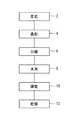
- FIG. 1 is a process diagram showing a flow of steps included in the method for producing purified methionine according to one embodiment of the present invention.
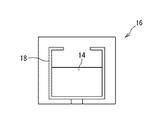
- FIG. 2 is a schematic view showing a state in which the slurry is charged into an apparatus for performing solid-liquid separation.
- FIG. 3 is a schematic diagram illustrating the process of forming a wet cake in one embodiment of the present invention.
- FIG. 4 is a schematic view showing the process of adjusting the pH of the wet cake in Example 1.
- FIG. 1 shows the flow of steps included in the method for producing purified methionine according to one embodiment of the present invention.
- This manufacturing method includes a reaction step 2, a crystallization step 4, a separation step 6, a water washing step 8, an adjustment step 10 and a drying step 12. The contents of each step will be described below.
- a wet cake of crude methionine washed with water as described later may be obtained by a series of processes from reaction process 2 to washing process 8, reaction process 2, crystallization process 4, separation process 6 There is no particular limitation on each step of the water washing step 8.
- each of the reaction step 2, the crystallization step 4, the separation step 6, and the water washing step 8 may be configured the same as the contents of each step in the conventionally known production method.
- reaction process 2 5- [2- (methylthio) ethyl] imidazolidine-2,4-dione is used as a raw material, in the presence of an alkali compound such as potassium hydroxide, sodium hydroxide, potassium carbonate, potassium hydrogen carbonate and the like. , Hydrolyze this. Thus, a reaction solution containing methionine as an alkali salt is obtained.
- an alkali compound such as potassium hydroxide, sodium hydroxide, potassium carbonate, potassium hydrogen carbonate and the like.
- the amount of the alkali compound used is usually 2 to 10 mol, preferably 3 to 10 mol, as potassium or sodium, per 1 mol of 5- [2- (methylthio) ethyl] imidazolidine-2,4-dione. ⁇ 6 moles.
- the amount of water used is usually set to 2 to 20 times the mass of 5- [2- (methylthio) ethyl] imidazolidine-2,4-dione.
- the hydrolysis is carried out in a reaction vessel (not shown) set at a gauge pressure of 0.5 to 1 MPa and a temperature of 150 to 200.degree.
- the reaction time is set in the range of 10 minutes to 24 hours.
- Crystallization process 4 In the crystallization step 4, carbon dioxide is introduced into the reaction solution obtained in the reaction step 2. By the introduction of carbon dioxide, methionine is liberated from the alkali salt of methionine, and methionine precipitates in the reaction solution. This gives a slurry containing methionine in the solid component.
- carbon dioxide is supplied to the reaction vessel containing the reaction liquid.
- the supply of carbon dioxide adjusts the gauge pressure in the reaction vessel to generally 0.1 to 1 MPa, preferably 0.2 to 0.5 MPa.
- the temperature in the reaction vessel (also referred to as crystallization temperature) is usually set to 0 to 50 ° C., preferably 10 to 30 ° C.
- the time required for crystallization (also referred to as crystallization time) is usually 30 minutes to 24 hours, although the time until carbon dioxide is saturated in the reaction solution and methionine is sufficiently precipitated is used as a standard.
- the separation process 6 In the separation step 6, as shown in FIG. 2, the slurry 14 obtained in the crystallization step 4 is put into the basket 18 of the centrifuge 16. After charging, the basket 18 is rotated to separate the slurry 14 from solid and liquid. As a result, as shown in FIG. 3, solid components in the slurry 14 become clumps (wet cakes) 20 and are captured by the basket 18. The liquid component in the slurry 14 is recovered as a filtrate.
- the slurry 14 contains an alkali compound used for hydrolysis, a dimer of methionine, and impurities such as glycine and alanine produced by the decomposition of methionine.
- the lump 20 trapped in the basket 18 contains this impurity in addition to methionine.
- methionine in which impurities coexist is crude methionine. Therefore, the slurry 14 obtained in the above-mentioned reaction step 2 is a slurry of crude methionine, and the above-mentioned lump 20 captured in the basket 18 is a wet cake of crude methionine. That is, in the separation step 6, the slurry 14 of crude methionine is subjected to solid-liquid separation to obtain a wet cake 20 of crude methionine.
- solid-liquid separation of the slurry 14 is not limited to the centrifugal separation method.
- the various conditions for solid-liquid separation are suitably set so that the moisture content of the wet cake 20 is preferably 40% by mass or less.
- the wet cake 20 obtained in the separation step 6 is washed with washing water.
- the wet cake 20 is sprayed with washing water using a spray.
- the entire wet cake 20 is washed with water, and the above-described impurities are removed from the wet cake 20.
- the wet cake 20 from which impurities have been removed is a wet methionine wet cake 20 w (also referred to as a flush wet cake 20 w) that has been washed with water. That is, in the water washing step 8, a wet cake 20w of crude methionine washed with water is obtained.
- the temperature of the washing water is usually properly set in the range of 5 to 35.degree.
- crude methionine from which impurities have been removed is also referred to as clean methionine.
- the above-described washed crude methionine wet cake 20w is a clean methionine wet cake.
- the ratio of the total number of mass parts of impurities to 100 parts by mass of methionine in the wet cake 20 after water washing ie, the water wash wet cake 20 w
- the wet cake 20 before washing is 50% or less of the ratio of the total number of parts by mass of impurities to 100 parts by mass of methionine.
- solid-liquid separation of the crude methionine slurry 14 gives a wet cake 20, and the wet cake obtained by further washing the wet cake 20 with water is the washed crude methionine wet cake 20w.
- a wet cake obtained by solid-liquid separation of a slurry of methionine obtained by adding wash water to the slurry 14 of crude methionine is also a wet cake 20w of crude methionine washed with water.
- the mass of the washing water sprayed on the crude methionine wet cake 20 is preferably 100 g or more and 300 g or less with respect to 100 g of the wet cake 20 mass.
- the weight of the washing water is more preferably 150 g or more, and more preferably 250 g or less with respect to 100 g of the weight of the wet cake 20.
- the washing water water may be used, and an aqueous solution containing methionine may be used.
- an aqueous solution containing methionine is preferable as the wash water.
- the concentration of methionine contained in the wash water is preferably 1.0% by mass or more, and more preferably 2.0% by mass or more. Since the saturated solubility of methionine in water at normal temperature and pressure is 3.0% by mass, the upper limit of the concentration of methionine in this wash water is 3.0% by mass. That is, the concentration of methionine contained in the wash water is 3.0% by mass or less.
- the water used in the present invention is not particularly limited. Examples of this water include distilled water, pure water, ion exchanged water, condensed water of steam, and the like.
- Adjustment process 10 the pH of the above-mentioned washed crude methionine wet cake 20w is adjusted using pH adjusting water.
- the wet cake 20 w whose pH is adjusted by pH adjustment water is the wet cake 20 p after pH adjustment (also referred to as adjustment wet cake 20 p).
- pH adjustment water is preferably sprayed using a spray toward the flush wet cake 20w in a state of being captured by the basket 18 of the centrifuge 16.
- the pH of this wet cake 20 w is adjusted.
- the temperature of this pH-adjusting water is usually set appropriately in the range of 5 to 35.degree.
- the pH of the entire wet cake 20w may be adjusted, and there is no particular limitation on the method of adjusting the pH, for example, the manner of spraying pH adjustment water on the wet cake 20w.
- the spraying of the pH adjusting water onto the water washing wet cake 20 w may be performed any time before the drying step 12 described later.
- the wet cake obtained by solid-liquid separation is usually fed to a dryer via a hopper (not shown). Therefore, after taking out the wet cake 20w from the basket 18 and throwing the wet cake 20w into the hopper, the pH adjustment water is sprayed to the wet cake 20w in the hopper to adjust the pH of the wet cake 20w. Good.
- the pH of the wet cake 20w may be adjusted by spraying pH adjustment water onto the wet cake 20w until the wet cake 20w in the hopper is charged into the dryer.
- the timing of adjusting the pH of the wet cake 20 w is appropriately determined in consideration of the productivity of methionine.
- a wet cake 20w of clean methionine is added to pH adjusted water to obtain a slurry of clean methionine, this slurry is subjected to solid-liquid separation in the manner of the separation step 6 described above, and pH adjusted. You may obtain wet cake 20p.
- the wet cake 20p after pH adjustment may be dried using a conventionally known dryer (not shown). As a result, water is removed to obtain powdered clean methionine, ie, purified methionine.
- the drying step 12 purified methionine in a state in which water is sufficiently removed may be obtained, and the method of drying the wet cake 20 p is not particularly limited.
- the drying step 12 may be configured in the same manner as the drying step in the conventionally known production method.
- the drying temperature is usually 50 to 150 ° C., preferably 100 to 140 ° C.
- the drying time is usually 10 minutes to 24 hours, preferably 30 minutes to 2 hours.
- the state in which water is sufficiently removed means that the water content of purified methionine is 5% by mass or less.
- the production method of the present invention is a method for producing purified methionine from crude methionine, and in one embodiment, in general, reaction step 2, crystallization step 4, separation step 6, water washing step 8 , Adjusting step 10 and drying step 12.
- a wet cake 20w of crude methionine washed with water is obtained by a series of processes from the reaction process 2 to the water washing process 8, and the pH of the wet cake 20w is adjusted in the adjustment process 10.
- the drying step 12 the wet cake 20p after pH adjustment is dried. That is, this manufacturing method is (1) a step of obtaining a wet cake 20w of washed crude methionine, (2) adjusting the pH of the wet cake 20 w; and (3) drying the wet cake 20 p after the pH adjustment.
- the inventors of the present invention have found that the pH of the wet cake of methionine to be subjected to the drying process is deeply involved in the caking of methionine, which was found by the present inventors in
- the pH of the washed wet cake 20w is adjusted in the range of 5.2 to 6.1.
- the pH of the wet cake 20p after pH adjustment is 5.2 or more and 6.1 or less.
- the wet cake 20p after pH adjustment is subjected to a drying treatment.
- caking is effectively prevented.
- the handleability of this purified methionine is extremely good.
- this manufacturing method by grasping the pH of the wet cake 20p of methionine to be subjected to the drying process, it is possible to predict the occurrence of caking in the powdered methionine obtained by the drying process.
- the pH adjustment of the wet cake 20p may be performed once, and in one embodiment, for example, 2 to 5 times (pH readjustment). Since readjustment in the intermediate state of the product is possible, high quality purified methionine can be stably produced. This manufacturing method also contributes to the reduction of the manufacturing cost.
- the pH of the wet cake 20p after pH adjustment is preferably 5.7 or more in that the caking of purified methionine can be prevented more effectively. Further, the pH of the wet cake 20p after pH adjustment is preferably 5.9 or less in that the caking of the purified methionine can be further effectively prevented. The pH of the wet cake 20p after pH adjustment is particularly preferably 5.7 or more and 5.9 or less.
- the pH of the wet cake 20p is represented by the pH value of an aqueous solution obtained by dissolving 1.1 g of the wet cake 20p in 100 mL of water.
- the pH of this wet cake 20p is measured as follows.
- a methionine aqueous solution is prepared by dissolving 1.1 g of wet cake 20p in 100 mL of distilled water.
- the temperature of the aqueous solution is adjusted to 25 ° C. using a thermostatic bath or the like.
- the glass electrode of a glass electrode type pH meter is fixed in a state where a portion about 3 cm long from the tip is immersed in the aqueous solution.
- the display value of the pH meter is stable, and the display value, ie, the pH value is recorded.
- This recorded pH value is taken as the pH of the wet cake 20p.
- a glass electrode type pH meter manufactured by Horiba, Ltd. is used to measure this pH.
- distilled water for example, a trade name "distilled water” manufactured by Wako Pure Chemical Industries, Ltd. is used.
- the pH of the wet cake 20w may be adjusted by spraying pH adjusting water onto the wet crude methionine wet cake 20w that has been washed with water.
- the mass of pH adjusting water sprayed on the wet cake 20 w is preferably 50 g or more, and preferably 400 g or less with respect to 100 g of the mass of the wet cake 20 w.
- the mass of the pH adjusting water is more preferably 150 g or more, and more preferably 300 g or less with respect to 100 g of the mass of the wet cake 20 w.
- the pH of the pH adjusting water is preferably 2 or more and 5 or less.
- pH of this pH adjustment water 2.6 or more are more preferable, and 3.5 or less are more preferable.
- the pH adjusting water used in the adjusting step 10 is not particularly limited.
- an aqueous solution of an acid such as sulfuric acid or hydrochloric acid may be used as pH adjustment water, or an aqueous solution prepared by adjusting the pH of an aqueous solution containing methionine as the above-mentioned wash water with an acid such as sulfuric acid or hydrochloric acid That is, an acidic aqueous solution containing methionine may be used as pH adjusted water. From the viewpoint of preventing the dissolution of methionine in pH adjusted water and improving the yield of methionine in the product, an acidic aqueous solution containing methionine is preferable as this pH adjusted water.
- the concentration of methionine contained in the pH adjusting water is preferably 1.0% by mass or more, and more preferably 2.0% by mass or more.
- the concentration of methionine contained in this pH-adjusted water is preferably 3.0% by mass or less.
- the washed crude methionine wet cake 20w contains water.
- the pH of the wet cake 20 w is adjusted, and caking of methionine is prevented when the pH of the wet cake 20 p obtained by the pH adjustment is within a specific range.
- the moisture content of the wet cake 20 w is preferably 40% by mass or less.
- the moisture content of the wet cake 20 w is obtained by the heating and drying weight measurement method.
- the methionine anti-caking method is a method for preventing methionine caking, which comprises (1) obtaining a wet cake of methionine, (2) adjusting the pH of the wet cake and (3) drying the wet cake after pH adjustment, wherein the pH of the wet cake after pH adjustment is 5.2 or more and 6.1 or less It is characterized by
- a slurry containing methionine is prepared, and in the same manner as the solid-liquid separation of the slurry 14 in the separation step 6 described above, the slurry is solid-liquid separated. This gives a wet cake of methionine.
- the pH of the wet cake is adjusted in the same manner as the manner described for the adjustment step 10 in the above-mentioned production method.
- the wet cake after pH adjustment also referred to as a drying step
- the wet cake whose pH is adjusted is dried in the same manner as the manner described for the drying step 12 in the above-described manufacturing method. . This gives methionine in powder form.
- the pH of the wet cake of methionine to be subjected to the drying process is adjusted within the range of 5.2 to 6.1, as in the above-mentioned production method.
- the pH of the wet cake after pH adjustment is 5.2 or more and 6.1 or less. That is, also in this anti-caking method, the drying process is performed on the wet cake adjusted to a specific pH. For this reason, in methionine to which this anti-caking method is applied, caking is effectively prevented. This suppresses the formation of bulk methionine, so the handling of methionine is very good.
- the pH of the wet cake after pH adjustment is preferably 5.7 or more in that caking of methionine can be prevented more effectively. Further, the pH of the wet cake after pH adjustment is preferably 5.9 or less from the viewpoint of more effectively preventing caking of methionine. The pH of the wet cake after pH adjustment is particularly preferably 5.7 or more and 5.9 or less.
- the methionine targeted by the caking prevention method is preferably methionine from which impurities such as the above-mentioned alkali compounds have been removed, that is, clean methionine. That is, by preparing a wet cake of clean methionine in the wet cake formation step and performing the adjustment step and the drying step on this wet cake, caking of methionine can be effectively prevented.
- This method of preventing caking can be applied to crude methionine obtained in the production process of methionine, but in this case, from the viewpoint of effectively preventing caking, the crude methionine was washed with water to remove impurities. Above, it is preferable to prepare a wet cake of clean methionine.
- this anti-caking method can be applied to methionine stored as a product (hereinafter referred to as product methionine).
- product methionine a product
- impurities are already removed from the product methionine
- a slurry of the product methionine is obtained, and the slurry is subjected to solid-liquid separation in the same manner as the separation step 6 to obtain a wet cake of clean methionine.
- the anti-caking method of the present invention can be applied to methionine in various situations.
- the caking of methionine is resolved by applying this anti-caking method, and regeneration as high-quality purified methionine is possible. it can.
- purified methionine in which caking is prevented can be obtained, and by applying the caking prevention method of the present invention, caking of methionine is prevented or eliminated. be able to. That is, according to the present invention, a method for producing purified methionine and a method for preventing methionine caking can be provided which can prevent (or eliminate) caking of methionine.
- the wet cake after pH adjustment was dried at a temperature of 90 ° C. for 20 hours in a vacuum state using a vacuum dryer. After drying, it was cooled to room temperature in a vacuum dryer to obtain powdered methionine.
- the spray 22 shown by FIG. 4 was used for spraying of pH adjustment water. While rotating the basket B of the centrifuge F at a rotational speed of 400 to 500 revolutions per minute, the pH adjustment water 28 filled in the tank 24 was sprayed from the nozzle 26 toward the wet cake 20 w. Thereby, pH adjustment of the wet cake 20 w was performed. Thus, the wet cake 20p after pH adjustment was obtained.
- Example 2 Powdered methionine was obtained in the same manner as in Example 1 except that the amount of washing water was 350 cc and the pH of the pH adjusting water was 3.2. As shown in Table 1, in this example 2, the pH of the wet cake after pH adjustment was 5.86.
- Example 3 Powdered methionine was obtained in the same manner as in Example 1 except that the amount of washing water was 150 cc and the pH of pH adjusting water was 3.2. As shown in Table 1, in this example 3, the pH of the wet cake after pH adjustment was 5.87.
- Example 4 Powdered methionine was obtained in the same manner as in Example 1 except that the amount of washing water was 50 cc and the pH of the pH adjusting water was 3.2. As shown in Table 1, in this example 4, the pH of the wet cake after pH adjustment was 6.08.
- Comparative Example 1 Powdered methionine was obtained in the same manner as in Example 1 except that the pH of the pH-adjusted water was 2.5. As shown in Table 1, in this comparative example 1, the pH of the wet cake after pH adjustment was 5.08.
- Comparative Example 2 Powdered methionine was obtained in the same manner as in Example 1 except that the amount of washing water was 400 mL, and the pH of the wet cake was not adjusted with pH adjusting water. In this comparative example 2, the pH of the wet cake before drying was 6.30. In Comparative Example 2, the pH of the wet cake before drying is shown in Table 1 as the pH of the wet cake after pH adjustment.
- Example 1-4 in which the pH of the wet cake after pH adjustment is in the range of 5.2 to 6.1, the formation of a mass having a size of several mm or so in Example 4 is confirmed. It was about In particular, in Examples 1 to 3 in which the pH is in the range of 5.7 to 5.9, the formation of a mass was almost not recognized.
Landscapes
- Chemical & Material Sciences (AREA)
- Organic Chemistry (AREA)
- Organic Low-Molecular-Weight Compounds And Preparation Thereof (AREA)
Abstract
La présente invention aborde le problème de la fourniture d'un procédé de production de méthionine purifiée, le procédé étant capable de prévenir l'agglutination de la méthionine. La présente invention concerne un procédé de production de méthionine purifiée à partir de méthionine brute, le procédé comprenant (1) une étape consistant à obtenir un gâteau humide de méthionine brute lavée, (2) une étape consistant à ajuster le pH du gâteau humide, et (3) une étape consistant à sécher le gâteau humide après l'ajustement du pH, le pH du gâteau humide après l'ajustement de pH étant de 5,2 à 6,1.
Priority Applications (5)
| Application Number | Priority Date | Filing Date | Title |
|---|---|---|---|
| SG11202000147TA SG11202000147TA (en) | 2017-07-19 | 2018-07-19 | Method for producing purified methionine and method for preventing caking of methionine |
| JP2019530583A JP7181199B2 (ja) | 2017-07-19 | 2018-07-19 | 精製メチオニンの製造方法及びメチオニンの固結防止方法 |
| EP18834474.1A EP3656761B1 (fr) | 2017-07-19 | 2018-07-19 | Procédé de production de méthionine purifiée et procédé de prévention de l'agglutination de la méthionine |
| US16/631,328 US10995065B2 (en) | 2017-07-19 | 2018-07-19 | Method for producing purified methionine and method for preventing caking of methionine |
| CN201880038785.8A CN110740990A (zh) | 2017-07-19 | 2018-07-19 | 纯化甲硫氨酸的制造方法及甲硫氨酸的固结防止方法 |
Applications Claiming Priority (2)
| Application Number | Priority Date | Filing Date | Title |
|---|---|---|---|
| JP2017-140093 | 2017-07-19 | ||
| JP2017140093 | 2017-07-19 |
Publications (1)
| Publication Number | Publication Date |
|---|---|
| WO2019017415A1 true WO2019017415A1 (fr) | 2019-01-24 |
Family
ID=65016594
Family Applications (1)
| Application Number | Title | Priority Date | Filing Date |
|---|---|---|---|
| PCT/JP2018/027014 Ceased WO2019017415A1 (fr) | 2017-07-19 | 2018-07-19 | Procédé de production de méthionine purifiée et procédé de prévention de l'agglutination de la méthionine |
Country Status (6)
| Country | Link |
|---|---|
| US (1) | US10995065B2 (fr) |
| EP (1) | EP3656761B1 (fr) |
| JP (1) | JP7181199B2 (fr) |
| CN (1) | CN110740990A (fr) |
| SG (1) | SG11202000147TA (fr) |
| WO (1) | WO2019017415A1 (fr) |
Citations (8)
| Publication number | Priority date | Publication date | Assignee | Title |
|---|---|---|---|---|
| US2443391A (en) * | 1945-09-26 | 1948-06-15 | Du Pont | Methionine isolation process |
| JPS4986320A (fr) * | 1972-12-02 | 1974-08-19 | ||
| JP2000143617A (ja) | 1998-09-11 | 2000-05-26 | Sumitomo Chem Co Ltd | メチオニンの製造方法 |
| JP2006070024A (ja) * | 2004-08-05 | 2006-03-16 | Meiji Milk Prod Co Ltd | 顆粒状製剤及びその製造方法 |
| JP2007063141A (ja) | 2005-08-29 | 2007-03-15 | Sumitomo Chemical Co Ltd | メチオニンの製造方法 |
| WO2013129405A1 (fr) * | 2012-02-27 | 2013-09-06 | 住友化学株式会社 | Procédé pour la fabrication de méthionine raffinée |
| WO2017000867A1 (fr) * | 2015-06-30 | 2017-01-05 | 西安蓝晓科技新材料股份有限公司 | Procédé de purification de méthionine |
| JP2017140093A (ja) | 2016-02-08 | 2017-08-17 | キヤノン株式会社 | 被検体情報取得装置 |
Family Cites Families (4)
| Publication number | Priority date | Publication date | Assignee | Title |
|---|---|---|---|---|
| FR2708267B1 (fr) | 1993-07-28 | 1995-09-01 | Rhone Poulenc Nutrition Animal | Méthode de cristallisation de la méthionine. |
| JP2010111640A (ja) | 2008-11-07 | 2010-05-20 | Sumitomo Chemical Co Ltd | メチオニンの製造方法 |
| JP2012201672A (ja) | 2011-03-28 | 2012-10-22 | Sumitomo Chemical Co Ltd | メチオニンの製造方法 |
| CN106432020B (zh) | 2016-09-14 | 2018-11-20 | 宁夏紫光天化蛋氨酸有限责任公司 | 一种d,l-蛋氨酸的分离纯化方法 |
-
2018
- 2018-07-19 SG SG11202000147TA patent/SG11202000147TA/en unknown
- 2018-07-19 WO PCT/JP2018/027014 patent/WO2019017415A1/fr not_active Ceased
- 2018-07-19 JP JP2019530583A patent/JP7181199B2/ja active Active
- 2018-07-19 CN CN201880038785.8A patent/CN110740990A/zh active Pending
- 2018-07-19 US US16/631,328 patent/US10995065B2/en active Active
- 2018-07-19 EP EP18834474.1A patent/EP3656761B1/fr active Active
Patent Citations (8)
| Publication number | Priority date | Publication date | Assignee | Title |
|---|---|---|---|---|
| US2443391A (en) * | 1945-09-26 | 1948-06-15 | Du Pont | Methionine isolation process |
| JPS4986320A (fr) * | 1972-12-02 | 1974-08-19 | ||
| JP2000143617A (ja) | 1998-09-11 | 2000-05-26 | Sumitomo Chem Co Ltd | メチオニンの製造方法 |
| JP2006070024A (ja) * | 2004-08-05 | 2006-03-16 | Meiji Milk Prod Co Ltd | 顆粒状製剤及びその製造方法 |
| JP2007063141A (ja) | 2005-08-29 | 2007-03-15 | Sumitomo Chemical Co Ltd | メチオニンの製造方法 |
| WO2013129405A1 (fr) * | 2012-02-27 | 2013-09-06 | 住友化学株式会社 | Procédé pour la fabrication de méthionine raffinée |
| WO2017000867A1 (fr) * | 2015-06-30 | 2017-01-05 | 西安蓝晓科技新材料股份有限公司 | Procédé de purification de méthionine |
| JP2017140093A (ja) | 2016-02-08 | 2017-08-17 | キヤノン株式会社 | 被検体情報取得装置 |
Non-Patent Citations (1)
| Title |
|---|
| See also references of EP3656761A4 |
Also Published As
| Publication number | Publication date |
|---|---|
| JP7181199B2 (ja) | 2022-11-30 |
| JPWO2019017415A1 (ja) | 2020-05-28 |
| EP3656761A4 (fr) | 2021-04-07 |
| SG11202000147TA (en) | 2020-02-27 |
| US20200207708A1 (en) | 2020-07-02 |
| EP3656761B1 (fr) | 2022-06-29 |
| US10995065B2 (en) | 2021-05-04 |
| EP3656761A1 (fr) | 2020-05-27 |
| CN110740990A (zh) | 2020-01-31 |
Similar Documents
| Publication | Publication Date | Title |
|---|---|---|
| US9227915B2 (en) | Process for the preparation of a crystalline L-MGDA trialkali metal salt | |
| MX2013012811A (es) | Procedimiento para preparar una sal trialcalinometalica cristalina de l-mgda. | |
| JP7237821B2 (ja) | メチオニンの製造方法および製造設備 | |
| CN112166102A (zh) | 制造固体甲基甘氨酸二乙酸(mgda)碱金属盐的方法和固体颗粒 | |
| CN113382980B (zh) | 甲基甘氨酸n,n-二乙酸的易碎相组合物 | |
| WO2013129405A1 (fr) | Procédé pour la fabrication de méthionine raffinée | |
| JP7181199B2 (ja) | 精製メチオニンの製造方法及びメチオニンの固結防止方法 | |
| US8779188B2 (en) | Process for the production of L-carnitine tartrate | |
| WO2016016774A1 (fr) | Formes cristallines de canagliflozine | |
| JP6457953B2 (ja) | 結晶性l−カルノシン亜鉛錯体を含有する精製体の製造方法 | |
| JP4404570B2 (ja) | 無機ヨウ素化合物の製造方法 | |
| JP5125908B2 (ja) | シトルリンの晶析方法 | |
| US6684526B2 (en) | Process for removing trace solvent from a material | |
| JP6983256B2 (ja) | 精製メチオニンの製造方法 | |
| CN106432090B (zh) | 一种氘代咪唑酮化合物的晶型及其制备方法和用途 | |
| JPH1081516A (ja) | 流動性酸化銀とその製造方法 | |
| JPH04310508A (ja) | 硫化ナトリウム低水和物又は無水物の製造方法 | |
| CN107021892A (zh) | 2‑硝基‑4‑甲磺酰基苯甲酸的制造方法 | |
| JP2001181254A (ja) | クレアチンの精製法 | |
| SU254494A1 (ru) | Способ получения кристаллического натрия азотнокислого | |
| JPH0616618A (ja) | β−アミノエチル酸性硫酸エステルの製造方法 | |
| CN104610135A (zh) | 一种处理啶虫脒结晶母液的方法 |
Legal Events
| Date | Code | Title | Description |
|---|---|---|---|
| 121 | Ep: the epo has been informed by wipo that ep was designated in this application |
Ref document number: 18834474 Country of ref document: EP Kind code of ref document: A1 |
|
| ENP | Entry into the national phase |
Ref document number: 2019530583 Country of ref document: JP Kind code of ref document: A |
|
| NENP | Non-entry into the national phase |
Ref country code: DE |
|
| ENP | Entry into the national phase |
Ref document number: 2018834474 Country of ref document: EP Effective date: 20200219 |