WO2019021993A1 - ビスアシルオキシ化エキソメチレン化合物の製造方法 - Google Patents
ビスアシルオキシ化エキソメチレン化合物の製造方法 Download PDFInfo
- Publication number
- WO2019021993A1 WO2019021993A1 PCT/JP2018/027458 JP2018027458W WO2019021993A1 WO 2019021993 A1 WO2019021993 A1 WO 2019021993A1 JP 2018027458 W JP2018027458 W JP 2018027458W WO 2019021993 A1 WO2019021993 A1 WO 2019021993A1
- Authority
- WO
- WIPO (PCT)
- Prior art keywords
- group
- substituent
- carbon atoms
- reaction
- carboxylic acid
- Prior art date
- Legal status (The legal status is an assumption and is not a legal conclusion. Google has not performed a legal analysis and makes no representation as to the accuracy of the status listed.)
- Ceased
Links
Classifications
-
- C—CHEMISTRY; METALLURGY
- C07—ORGANIC CHEMISTRY
- C07C—ACYCLIC OR CARBOCYCLIC COMPOUNDS
- C07C67/00—Preparation of carboxylic acid esters
- C07C67/04—Preparation of carboxylic acid esters by reacting carboxylic acids or symmetrical anhydrides onto unsaturated carbon-to-carbon bonds
- C07C67/05—Preparation of carboxylic acid esters by reacting carboxylic acids or symmetrical anhydrides onto unsaturated carbon-to-carbon bonds with oxidation
-
- C—CHEMISTRY; METALLURGY
- C07—ORGANIC CHEMISTRY
- C07C—ACYCLIC OR CARBOCYCLIC COMPOUNDS
- C07C67/00—Preparation of carboxylic acid esters
- C07C67/04—Preparation of carboxylic acid esters by reacting carboxylic acids or symmetrical anhydrides onto unsaturated carbon-to-carbon bonds
- C07C67/05—Preparation of carboxylic acid esters by reacting carboxylic acids or symmetrical anhydrides onto unsaturated carbon-to-carbon bonds with oxidation
- C07C67/055—Preparation of carboxylic acid esters by reacting carboxylic acids or symmetrical anhydrides onto unsaturated carbon-to-carbon bonds with oxidation in the presence of platinum group metals or their compounds
-
- C—CHEMISTRY; METALLURGY
- C07—ORGANIC CHEMISTRY
- C07B—GENERAL METHODS OF ORGANIC CHEMISTRY; APPARATUS THEREFOR
- C07B61/00—Other general methods
Definitions
- the present invention relates to a process for the preparation of bisacylated exomethylene compounds.
- Bisacylated exomethylene compounds can be used in the same molecule in 2,2-substituted carbon-carbon unsaturated bonds applicable to radical addition reaction, hydrosilylation reaction, hydroformylation reaction, etc., saponification reaction, transesterification reaction, etc. Since it has two applicable acyl groups, it can be used as a manufacturing raw material of various chemical products due to the reactivity (for example, patent documents 1 and 2).
- Non-Patent Document 1 describes a method for producing 1,3-diacetoxy-2-methylenepropane by reacting 1,3-dichloro-2-methylenepropane with sodium acetate.
- Non-Patent Document 2 describes a method for producing 1,4-diacetoxy-2-methylenebutane by reacting methyl itaconate with lithium aluminum hydride and then reacting with acetic anhydride.
- inorganic by-products which are usually waste, are generated in equimolar or more to the product. Therefore, from the viewpoint of environmental load reduction, a manufacturing method that does not generate inorganic by-products is desired.
- Patent Document 3 describes a method for producing 1,3-diacetoxy-2-methylenepropane by reacting methallyl acetate, acetic acid, water and oxygen in the gas phase in the presence of a specific catalyst. ing.
- the conventional methods for producing bisacylated exomethylene compounds that do not generate inorganic by-products are all reactions under gas phase conditions.
- the oxygen concentration must be made lower than the limit oxygen concentration from the viewpoint of safety, operation at a low substrate conversion rate is forced, and a substrate recovery device is essential.
- a vaporization device for the raw material, a reaction tube filled with a catalyst, and a large amount of energy for vaporizing the raw material are also required, and there is a large room for improvement from all of the production efficiency, equipment cost, and energy consumption.
- an object of the present invention is to provide a process for producing a bisacyloxy-modified exomethylene compound which does not generate inorganic by-products and which is improved in production efficiency and cost.
- Another object of the present invention is to provide a process for producing a bisacylated exomethylene compound which does not generate inorganic by-products and has an improved yield.
- the present inventors have found that the above-mentioned problems can be solved by producing a bisacylated exomethylene compound under specific liquid phase conditions, and further investigations are repeated based on the findings, and the first of the present invention is described. Completed the invention.
- the carboxylic acid used in producing a bisacyloxylated exomethylene compound by reacting a monoacylated exomethylene compound, a carboxylic acid and oxygen under specific liquid phase conditions.
- the water generated by the reaction is supplied by supplying a part (remaining part) of the total carboxylic acid to be finally used to the reaction solution in the above-mentioned reaction process by supplying It has been found that the monoacylated exomethylene compound and the desired bisacyloxylated exomethylene compound can be inhibited from being hydrolyzed and the yield is further improved, and further studies are repeated based on the findings.
- the second invention of the present application has been completed.
- the present invention relates to the following [1] to [11].
- a method for producing an acyloxylated exomethylene compound hereinafter sometimes referred to as “bisacyloxylated exomethylene compound (III)”).
- R 1 and R 2 each independently represent a hydrogen atom, an alkyl group having 1 to 8 carbon atoms which may have a substituent, or a carbon number 3 to 8 which may have a substituent
- R 3 is a hydrogen atom, an alkyl group having 1 to 8 carbon atoms which may have a substituent, a substituent
- a cycloalkyl group having 3 to 8 carbon atoms which may have a substituent an alkenyl group having 2 to 6 carbon atoms which may have a substituent, and a carbon number 6 to 14 which may have a substituent.
- R 4 represents a hydrogen atom, a substituent C 1 to C 8 alkyl group which may have one or more substituents, C 3 to C optionally having substituents 8 cycloalkyl group, alkenyl group having 2 to 6 carbon atoms which may have a substituent, or aryl group having 6 to 14 carbon atoms which may have a substituent, n is 1 to 8 Represents an integer) [2]
- R 4 is as defined above, and R 5 is an alkyl group having 1 to 8 carbon atoms which may have a substituent or a carbon number 6 to 14 which may have a substituent
- R 4 is a methyl group
- R 5 is an alkyl group having 1 to 4 carbon atoms.
- the production method according to [7] or [8], wherein the amount of the carboxylic acid used is 0.1 mol or more and 0.6 mol or less with respect to 1 mol of the monoacylated exomethylene compound.
- R 3 and R 4 are methyl groups and n is 1 or 2.
- R 1 and R 2 are hydrogen atoms.
- the first invention of the present application it is possible to provide a method for producing a bisacylated exomethylene compound which does not generate inorganic by-products and which is improved in production efficiency and cost.
- the second invention of the present application it is possible to provide a method for producing a bisacyloxylated exomethylene compound which does not generate inorganic by-products and whose yield is further improved.
- the first aspect of the present invention related to a method for producing a bisacylated exomethylene compound (III), a monoacylated exomethylene compound (I), a carboxylic acid in the presence of a catalyst and optionally a solvent (II) and oxygen are reacted in the liquid phase.
- a step of supplying a carboxylic acid (II) to the reaction solution in the reaction process is included.
- the monoacylated exomethylene compound (I) is oxidized and dehydrated and condensed with the carboxylic acid (II) to produce water together with the bisacylated exomethylene compound (III).
- reaction formula in the preferred embodiment of the present invention is as follows.
- the method includes the step of supplying carboxylic acid (II) to the reaction solution in the above reaction process (ie, reaction process of monoacylated exomethylene compound (I), carboxylic acid (II) and oxygen in liquid phase)
- carboxylic acid (II) ie, reaction process of monoacylated exomethylene compound (I), carboxylic acid (II) and oxygen in liquid phase
- hydrolysis of the monoacylated exomethylene compound (I) as a raw material and the target bisacyloxylated exomethylene compound can be suppressed by water generated by the reaction, and the yield is further improved.
- examples of the alkyl group having 1 to 8 carbon atoms represented by R 1 and R 2 include a methyl group, an ethyl group and an n-propyl group. And isopropyl group, n-butyl group, sec-butyl group, isobutyl group, tert-butyl group, n-pentyl group, n-hexyl group, n-octyl group and the like.
- the alkyl group may have a substituent.
- a substituent for example, a cycloalkyl group having 3 to 8 carbon atoms, an aryl group having 6 to 14 carbon atoms, an alkoxy group having 1 to 8 carbon atoms, an aryloxy group having 6 to 14 carbon atoms, etc.
- the number of substituents is preferably 1 to 3.
- the silyl group include trimethylsilyl group, triethylsilyl group, t-butyldimethylsilyl group, t-butyldiphenylsilyl group and triphenylsilyl group.
- the cycloalkyl group having 3 to 8 carbon atoms represented by R 1 and R 2 may be monocyclic or fused cyclic, and examples thereof include a cyclopropyl group, a cyclopentyl group and a cyclohexyl group.
- the cycloalkyl group may have a substituent.
- a substituent for example, an alkyl group having 1 to 8 carbon atoms, a cycloalkyl group having 3 to 8 carbon atoms, an aryl group having 6 to 14 carbon atoms, an alkoxy group having 1 to 8 carbon atoms, or 6 to 6 carbon atoms 14 aryloxy group, the above-mentioned silyl group and the like.
- the number of substituents is preferably 1 to 3.
- the aryl group having 6 to 14 carbon atoms represented by R 1 and R 2 may be monocyclic or fused cyclic, and examples thereof include a phenyl group, a naphthyl group, an anthryl group and a phenanthryl group.
- the aryl group may have a substituent.
- a substituent for example, the same as those described above as the substituent which may be possessed when R 1 and R 2 are a cycloalkyl group can be mentioned.
- the number of substituents is preferably 1 to 3.
- R 1 and R 2 are preferably each independently a hydrogen atom or an alkyl group having 1 to 8 carbon atoms, and both of them are more preferably hydrogen atoms.
- Examples of the aryl group include those similar to those described above for R 1 and R 2 , and the same applies to substituents.
- the alkenyl group having 2 to 6 carbon atoms represented by R 3 is, for example, ethenyl group (vinyl group), 1-methylethenyl group, 1-propenyl group, 2-propenyl group (allyl group), 1-methyl-1-propenyl group And 1-methyl-2-propenyl group, 1-butenyl group, 2-butenyl group, 3-butenyl group and the like.
- the alkenyl group may have a substituent.
- a substituent for example, the same as those described above as the substituent which may be possessed when R 1 and R 2 are an alkyl group can be mentioned.
- the number of substituents is preferably 1 to 3.
- the alkoxy group having 1 to 8 carbon atoms R 3 represents, for example, methoxy group, ethoxy group, n- propoxy group, isopropoxy group, n- butoxy group, isobutoxy group, sec- butoxy group, isobutoxy group, tert- butoxy And n-pentyloxy group.
- the alkoxy group may have a substituent.
- a substituent for example, the same as those described above as the substituent which may be possessed when R 1 and R 2 are an alkyl group can be mentioned.
- the number of substituents is preferably 1 to 3.
- the alkoxy group may be, for example, an aralkyloxy group having an aryl group as a substituent.
- an aralkyloxy group for example, benzyloxy group, 1-phenylethoxy group, 2-phenylethoxy group, 1-phenylpropoxy group, 2-phenylpropoxy group, 3-phenylpropoxy group, 4-phenylbutoxy group, Examples include 1-naphthylmethoxy and 2-naphthylmethoxy.
- the aryloxy group having a carbon number of 6 to 14 represented by R 3 may be monocyclic or condensed cyclic, and examples thereof include phenoxy group, torinoxy group, xylyloxy group and naphthoxy group.
- the aryloxy group may have a substituent. Examples of the substituent include the same as those described above as the substituent which may be possessed when R 1 and R 2 are a cycloalkyl group. When it has a substituent, the number of substituents is preferably 1 to 3.
- R 3 is preferably an alkyl group having 1 to 6 carbon atoms or an alkenyl group having 2 to 6 carbon atoms, and a methyl group, an ethyl group, an n-propyl group, an ethenyl group and 1- It is more preferably one selected from the group consisting of methylethenyl groups, still more preferably a methyl group or a 1-methylethenyl group, and most preferably a methyl group.
- n is an integer of 1 to 8, and preferably an integer of 1 to 4, More preferably, it is 1 or 2.
- the alkyl group having 1 to 8 carbon atoms represented by R 4 the alkyl group having 3 to 8 carbon atoms, the alkenyl group having 2 to 6 carbon atoms and carbon
- the aryl group of the formulas 6 to 14 include the same ones as described above for R 3 , and the same applies to substituents.
- R 4 is preferably an alkyl group having 1 to 8 carbon atoms or an alkenyl group having 2 to 6 carbon atoms, and a methyl group, an ethyl group, an n-propyl group, an ethenyl group and 1- It is more preferably one selected from the group consisting of methylethenyl groups, still more preferably a methyl group or a 1-methylethenyl group, and most preferably a methyl group.
- the catalyst used in the production method of the present invention may be any catalyst that accelerates the reaction of the monoacylated exomethylene compound (I) and the carboxylic acid (II), and a catalyst having a noble metal supported on a carrier is preferable.
- a commercially available catalyst may be used, or a catalyst synthesized by a known method may be used.
- the noble metal examples include palladium, gold, silver, platinum, rhodium, ruthenium and the like. One of these may be used alone, or two or more may be used in combination. Among them, palladium is preferred.
- the palladium may be metallic palladium or a palladium compound.
- the palladium compound is not particularly limited, and examples thereof include palladium chloride, palladium acetate, palladium nitrate, palladium sulfate, sodium chloropalladate, potassium chloropalladate and barium chloropalladate.
- the carrier is a transition metal from Group 8 to Group 11 of periodic table such as iron, rhodium, copper, gold etc. in addition to palladium, zinc, indium, tin, bismuth etc.
- Base metals of Groups 12 to 15 of the periodic table, semimetals of Groups 13 to 16 of the periodic table such as arsenic and tellurium may be supported. One of these may be used alone, or two or more may be used in combination.
- the carrier includes, for example, solid oxides such as silica, alumina, zeolite and titanium oxide and mixtures thereof; polymer compounds such as polystyrene, polyethylene, polyamide and cellulose and mixtures thereof And activated carbon.
- solid oxides and mixtures thereof or activated carbon are preferable, silica or alumina is more preferable, and silica is more preferable.
- the particle diameter of the carrier is not particularly limited, but is preferably 10 ⁇ m to 10 mm, more preferably 30 ⁇ m to 8 mm. If the particle diameter is 10 mm or less, the raw material can sufficiently penetrate to the inside of the catalyst, and the reaction can be more effectively progressed. If it is 10 ⁇ m or more, the function as a carrier can be more easily exhibited.
- the amount of the catalyst used is not particularly limited, but preferably 0.01 to 20% by mass with respect to the total mass of monoacylated exomethylene compound (I), carboxylic acid (II) and solvent. -10% by mass is more preferable.
- a catalyst activator may be added to the catalyst as required.
- the catalyst activator hydroxides, nitrates, carboxylates or carbonates of alkali metals such as sodium, potassium, cesium and the like; hydroxides of alkali earth metals such as magnesium, calcium, barium and the like, nitrates, carvone And acid salts or carbonates.
- salts of carboxylic acid (II) are preferable, alkali metal salts of carboxylic acid (II) are more preferable, and potassium acetate is more preferable from the viewpoint of availability and reaction activity.
- the amount of the catalyst activator used is not particularly limited, but is preferably 1 to 20% by mass, and more preferably 3 to 15% by mass, with respect to the catalyst.
- the catalyst activator may be used in a state of being supported on a catalyst in advance, or may be charged into the reactor together with the reaction mixture.
- the production method of the present invention may carry out the reaction in the presence of a solvent.
- the solvent include hydrocarbons such as hexane, heptane, methylcyclohexane and benzene (aliphatic hydrocarbons and aromatic hydrocarbons); heterocyclic compounds such as pyridine and quinoline; diethyl ether, tetrahydrofuran, methyl tert-butyl ether And ethers such as cyclopentyl methyl ether; ketones such as acetone, methyl ethyl ketone and isobutyl methyl ketone; carboxylic acid esters, esters such as diethyl carbonate and propylene carbonate; amides such as dimethylformamide and dimethylacetamide; nitriles such as acetonitrile and benzonitrile; And alcohols such as ethanol, isopropyl alcohol and phenol.
- ester (IV) is more preferable from the viewpoint of production efficiency and the yield of the bisacylated exomethylene compound (III).
- R 4 is the same group as R 4 in the carboxylic acid (II) and bis acyloxyalkyl of exomethylene compound (III).
- Examples of the alkyl group having 1 to 8 carbon atoms or the aryl group having 6 to 14 carbon atoms represented by R 5 in the ester (IV) include, for example, the same as those described above for R 1 and R 2. The same is true for
- R 5 is preferably an alkyl group having 1 to 8 carbon atoms, and is preferably an alkyl having 1 to 4 carbon atoms from the viewpoints of easy availability, production efficiency, yield of bisacylated exomethylene compound (III), etc. More preferred is a group.
- oxygen used in the production method of the present invention atomic and / or molecular oxygen can be used, preferably molecular oxygen.
- molecular oxygen is used, it is preferably used as a mixed gas with inert gases such as nitrogen, argon, helium and carbon dioxide.
- inert gases such as nitrogen, argon, helium and carbon dioxide.
- the oxygen concentration be adjusted to a range in which the gas does not have an explosive composition in the reaction system.
- a method of supplying molecular oxygen or a mixed gas containing molecular oxygen to the reaction system there is a method of supplying to the liquid phase in the reaction system, a method of supplying to the gas phase, both liquid phase and gas phase Supply methods.
- the oxygen partial pressure is preferably at least 0.01 atm as gauge pressure, and more preferably at least 0.1 atm.
- the pressure is more preferably 0.2 atm or more, further preferably 200 atm or less, more preferably 100 atm or less, still more preferably 80 atm or less, 20 atm or less, 10
- the pressure may be 8 or less or less.
- the total amount of the solvent and the carboxylic acid (II) used is preferably more than 1 mole and 50 moles or less with respect to 1 mole of the monoacylated exomethylene compound (I), More preferably, it is 5 to 35 mol, and more preferably 2 to 10 mol.
- the total amount is preferably more than 1 mol, hydrolysis of the monoacylated exomethylene compound (I) and the bisacyloxylated exomethylene compound (III) by water generated by the reaction is suppressed, and the production efficiency and bisacyloxy The yield of the halogenated exo methylene compound (III) is further improved.
- the recovery step of the excess solvent and carboxylic acid (II) becomes short, which is economically advantageous.
- the present inventors used the carboxylic acid (II) in an amount of 0.1 per mol of monoacylated exomethylene compound (I). It has been found that high production efficiency and yield can be obtained even when the molar ratio is reduced to 0.6 mol or less.
- the amount of carboxylic acid (II) used falls within the above range, it is industrially very advantageous in that corrosion of the apparatus can be suppressed and introduction of the raw materials can be simplified.
- the reaction conditions such as reaction temperature, reaction pressure and reaction time in the production method of the present invention are appropriately selected according to the kind and combination of monoacylated exomethylene compound (I), carboxylic acid (II) and solvent, catalyst composition, etc.
- the reaction temperature may be set, and not particularly limited.
- the reaction temperature is preferably in the range of 80 to 200 ° C.
- the reaction temperature is preferably in the range of 80 to 200 ° C.
- the reaction temperature By setting the reaction temperature to 80 ° C. or higher, the reaction rate does not become too slow, and the bisacyloxylated exomethylene compound (III) can be efficiently produced.
- the reaction temperature by setting the reaction temperature to 200 ° C. or less, side reactions including combustion are less likely to occur, the bisacylated exomethylene compound (III) can be efficiently produced, and a reaction device using a carboxylic acid Corrosion can also be suppressed.
- the reaction form in the production method of the present invention may be either continuous or batch, and is not particularly limited.
- the catalyst When, for example, a batch system is employed as the reaction mode, the catalyst may be charged together with the raw materials into the reactor, and when a continuous mode is employed as the reaction mode, the catalyst is pre-charged to the reactor. Alternatively, the reactor may be continuously charged with the raw materials.
- the catalyst may be used in any form of fixed bed, fluidized bed and suspension bed.
- a reaction process of monoacylated exomethylene compound (I), carboxylic acid (II) and oxygen in a liquid phase ie, some monoacylated exomethylene compound (I)
- the reaction with carboxylic acid (II) and oxygen is complete, while unreacted monoacylated exomethylene compound (II) remains in the reaction solution)) carboxylic acid (II)
- Including the steps of The step can be carried out by feeding carboxylic acid (II) to the reactor in a semi-batch mode, and more specifically, in the above reaction process, the bisacyloxylated exomethylene compound (III) is substantially eliminated from the reactor (For example, 5% by mass or more of the finally obtained bisacylated exomethylene compound (III) is not taken out of the reactor in the above reaction process), carboxylic acid (II) is continuously It can carry out by dividing and / or dividing and supplying to a reactor.
- the entire amount of the carboxylic acid (II) to be used may be continuously supplied to the reactor, or alternatively, the entire amount of the carboxylic acid (II) to be used may be supplied to the reactor in multiple portions.
- the reaction may be started with some of the carboxylic acid (II) to be used previously contained in a reactor, and then the remainder may be continuously and / or divided into multiple reactions. May be supplied to the From the viewpoint of operability, yield and the like, it is preferable to continuously feed the entire amount of carboxylic acid (II) used to the reactor.
- the above reaction is started in a batch system, or a tubular reactor Such as starting the above reaction continuously while supplying raw materials such as monoacylated exomethylene compound (I) and carboxylic acid (II) to the upstream part using
- the method not including the step of supplying the carboxylic acid (II) is adopted, the monoacylated exomethylene compound (I) of the raw material and the desired bisacylated exomethylene compound (III) are produced by water generated by the reaction.
- the reaction solution in the above reaction process is carboxylic acid (II)
- the reaction may be started above, or may be continuously fed to the reactor.
- the catalyst When the reaction is started after being collectively supplied to the reactor, the catalyst may be collectively charged into the reactor together with the monoacylated exomethylene compound (I) and the like, and the catalyst is continuously supplied to the reactor In the latter case, the catalyst may be pre-charged to the reactor or may be continuously charged to the reactor together with the monoacylated exomethylene compound (I) and the like.
- the catalyst may be used in any form of fixed bed, fluidized bed and suspension bed.
- the bisacyloxylated exomethylene compound (III) produced by the production method of the present invention can be isolated by purifying the reaction solution after separating the catalyst.
- the means for the purification is not particularly limited, but distillation method, extraction method or column chromatography can be used. These methods may be implemented in combination. Among these, distillation or extraction is preferred.
- the raw materials and solvents separated by the purification can be used again for the reaction. Also, the separated catalyst can be used again for the reaction.
- Conversion rate (%) ⁇ (consumed amount of monoacylated exo methylene compound (I)) / (mass of charged monoacylated exo methylene compound (I)) ⁇ ⁇ 100
- Selectivity The ratio of the product mass of the bisacylated exomethylene compound (III) to the consumed substance of the monoacylated exomethylene compound (I) analyzed under the above conditions is calculated using the following formula as the selectivity did.
- Selectivity (%) ⁇ (mass of product of bisacylated exomethylene compound (III)) / (mass of consumed matter of monoacyloxyated exomethylene compound (I)) ⁇ 100
- the catalyst after reduction was washed with water and then dried at 110 ° C. for 4 hours. Thereafter, the above carrier containing metallic palladium was charged in an aqueous solution containing 13.34 g (136 mmol) of potassium acetate, and after absorbing the whole liquid, it was dried at 110 ° C. for 4 hours to prepare catalyst 1.
- the catalyst after reduction was washed with water and then dried at 110 ° C. for 4 hours. Thereafter, the above carrier containing metallic palladium was charged into an aqueous solution containing 13.34 g (136 mmol) of potassium acetate, and after absorbing the whole liquid, it was dried at 110 ° C. for 4 hours to prepare catalyst 2.
- the conversion of isoprenyl acetate was 83%, and the selectivity to 1,4-diacetoxy-2-methylenebutane was 85%.
- the yield of 1,4-diacetoxy-2-methylenebutane is 3.1 g (17 mmol), and the production efficiency of 1,4-diacetoxy-2-methylene butane (yield per unit time and catalyst unit mass) is 0.48 g. It was (product) / ⁇ g (catalyst) ⁇ hr ⁇ .
- Example 2 The reaction was carried out in the same manner as in Example 1 except that 40 g (666 mmol) of acetic acid and 9 g (70 mmol) of isoprenyl acetate were used.
- the conversion of isoprenyl acetate was 80%, 1,4-diacetoxy-
- the selectivity to 2-methylenebutane was 82%.
- the yield of 1,4-diacetoxy-2-methylenebutane is 8.6 g (46 mmol)
- the formation efficiency of 1,4-diacetoxy-2-methylene butane is 1.34 g (product) / ⁇ g (catalyst). It was hr ⁇ .
- the conversion of methallyl acetate was 99%, and the selectivity to 1,3-diacetoxy-2-methylenepropane was 61%.
- the yield of 1,3-diacetoxy-2-methylenepropane is 7.3 g (42 mmol), and the formation efficiency of 1,3-diacetoxy-2-methylene propane is 1.14 g (product) / ⁇ g (catalyst). It was hr ⁇ .
- Comparative Example 2 The reaction was carried out in the same manner as in Comparative Example 1 except that the reaction temperature was changed to 190 ° C.
- the rate of formation of 1,4-diacetoxy-2-methylenebutane was 0.015 g (product) / ⁇ g (Catalyst) ⁇ hr ⁇
- the yield of 1,4-diacetoxy-2-methylenebutane to isoprenyl acetate introduced into the reaction tube was 0.5%.
- nitrogen was allowed to flow at a rate of 15 NL / hr for 1 hour at 190 ° C. under atmospheric pressure, and then cooled to room temperature to take out the catalyst from the reaction tube.
- the catalyst which was gray before the reaction had turned brown.
- Example 4 A reaction was carried out in the same manner as in Example 3, except that 3.2 g (53.3 mmol) of acetic acid and 6.0 g (52.6 mmol) of methallyl acetate were used, and 40 g (399 mmol) of heptane was used as a solvent.
- the conversion of methallyl acetate was 82%, and the selectivity to 1,3-diacetoxy-2-methylenepropane was 60%.
- the yield of 1,3-diacetoxy-2-methylenepropane is 4.5 g (26 mmol), and the formation efficiency of 1,3-diacetoxy-2-methylene propane is 0.70 g (product) / ⁇ g (catalyst). It was hr ⁇ .
- Example 5 The same procedure as in Example 3 was repeated except that 4.5 g (74.9 mmol) of acetic acid and 17.0 g (148.9 mmol) of methallyl acetate were used, and 26.0 g (295 mmol) of ethyl acetate was used as a solvent. The reaction was carried out. The conversion of methallyl acetate was 78%, and the selectivity to 1,3-diacetoxy-2-methylenepropane was 80%.
- the yield of 1,3-diacetoxy-2-methylenepropane is 16.0 g (93 mmol), and the formation efficiency of 1,3-diacetoxy-2-methylene propane is 2.50 g (product) / ⁇ g (catalyst). It was hr ⁇ .
- Example 6 The same procedure as in Example 3 is performed, except that 5.5 g (91.6 mmol) of acetic acid and 20.7 g (181 mmol) of methallyl acetate are used, and 20.7 g (178 mmol) of isobutyl acetate is used as a solvent. The reaction was carried out to find that the conversion of methallyl acetate was 80%, and the selectivity to 1,3-diacetoxy-2-methylenepropane was 86%.
- the yield of 1,3-diacetoxy-2-methylenepropane is 21.5 g (125 mmol), and the formation efficiency of 1,3-diacetoxy-2-methylene propane is 3.36 g (product) / ⁇ g (catalyst). It was hr ⁇ .
- Example 7 A reaction was carried out in the same manner as in Example 1, except that 4.3 g (72 mmol) of acetic acid and 18.2 g (142 mmol) of isoprenyl acetate were used, and 25 g (284 mmol) of ethyl acetate was used as a solvent. The conversion of isoprenyl acetate was 70%, and the selectivity to 1,4-diacetoxy-2-methylenebutane was 82%.
- the yield of 1,4-diacetoxy-2-methylenebutane is 15.2 g (82 mmol), and the production efficiency of 1,4-diacetoxy-2-methylene butane is 2.37 g (product) / ⁇ g (catalyst). It was hr ⁇ .
- Example 8 The reaction was carried out in the same manner as in Example 3 except that 15.8 g (263 mmol) of acetic acid and 30.0 g (263 mmol) of methallyl acetate were used.
- the conversion of methallyl acetate was 75%, 1,1
- the selectivity to 3-diacetoxy-2-methylenepropane is 23%, the yield of 1,3-diacetoxy-2-methylenepropane is 7.8 g (45 mmol), and the formation efficiency of 1,3-diacetoxy-2-methylenepropane is It was 1.22 g (product) / ⁇ g (catalyst) ⁇ hr ⁇ .
- ⁇ 1 Monoacylated exomethylene compound (I) / carboxylic acid (II) / solvent
- ⁇ 2 Conversion rate of monoacylated exomethylene compound (I)
- ⁇ 3 Selection to bisacyloxylated exomethylene compound (III)
- Rate * 4 Formation efficiency of bisacylated exomethylene compound (III) [g (product) / ⁇ g (catalyst) ⁇ hr ⁇ ]
- the conversion of methallyl acetate was 70%, the selectivity to 1,3-diacetoxy-2-methylenepropane was 39%, and the yield of 1,3-diacetoxy-2-methylenepropane was 27%.
- the conversion of methallyl acetate was 88%, the selectivity to 1,3-diacetoxy-2-methylenepropane was 90%, and the yield of 1,3-diacetoxy-2-methylenepropane was 79%.
- the production method of the present invention it is possible to produce a bisacylated exomethylene compound with high yield and high production efficiency without generating inorganic by-products.
- the resulting bisacylated exomethylene compound can be used as a starting material for various industrially useful compounds.
Landscapes
- Chemical & Material Sciences (AREA)
- Organic Chemistry (AREA)
- Organic Low-Molecular-Weight Compounds And Preparation Thereof (AREA)
- Low-Molecular Organic Synthesis Reactions Using Catalysts (AREA)
- Hydrogenated Pyridines (AREA)
Abstract
触媒および必要に応じて溶媒の存在下、下記一般式(I)で表されるモノアシルオキシ化エキソメチレン化合物、下記一般式(II)で表されるカルボン酸および酸素を液相中で反応させる、下記一般式(III)で表されるビスアシルオキシ化エキソメチレン化合物の製造方法。
Description
本発明は、ビスアシルオキシ化エキソメチレン化合物の製造方法に関する。
ビスアシルオキシ化エキソメチレン化合物は、同一分子内に、ラジカル付加反応、ヒドロシリル化反応またはヒドロホルミル化反応などに適用可能な2,2-置換炭素-炭素不飽和結合、および鹸化反応やエステル交換反応などに適用可能な2つのアシル基を持つことから、その反応性に起因して様々な化学品の製造原料として用いることができる(例えば、特許文献1、2)。
従来からビスアシルオキシ化エキソメチレン化合物の製造方法はいくつか知られている。
例えば非特許文献1には、1,3-ジクロロ-2-メチレンプロパンと酢酸ナトリウムを反応させることにより1,3-ジアセトキシ-2-メチレンプロパンを製造する方法が記載されている。
また非特許文献2には、イタコン酸メチルを水素化アルミニウムリチウムと反応させた後、無水酢酸と反応させることで1,4-ジアセトキシ-2-メチレンブタンを製造する方法が記載されている。
しかしながら、これらの製造方法では、通常廃棄物となる無機副生物が生成物に対し等モル以上発生する。したがって、環境負荷低減の観点からは無機副生物を発生させない製造方法が望まれる。
例えば非特許文献1には、1,3-ジクロロ-2-メチレンプロパンと酢酸ナトリウムを反応させることにより1,3-ジアセトキシ-2-メチレンプロパンを製造する方法が記載されている。
また非特許文献2には、イタコン酸メチルを水素化アルミニウムリチウムと反応させた後、無水酢酸と反応させることで1,4-ジアセトキシ-2-メチレンブタンを製造する方法が記載されている。
しかしながら、これらの製造方法では、通常廃棄物となる無機副生物が生成物に対し等モル以上発生する。したがって、環境負荷低減の観点からは無機副生物を発生させない製造方法が望まれる。
一方、無機副生物を発生させない製造方法として、パラジウム触媒存在下、末端オレフィン化合物、カルボン酸および酸素を気相にて反応させ、ビスアシルオキシ化エキソメチレン化合物を製造する方法が知られている。
例えば特許文献3には、酢酸メタリル、酢酸、水および酸素を、気相中において特定の触媒の存在下で反応させることにより、1,3-ジアセトキシ-2-メチレンプロパンを製造する方法が記載されている。この特許文献3には、担持触媒900mLに対し、窒素:酸素:酢酸メタリル:酢酸:水=40.0:2.0:1.2:5.0:3.0(モル/時)の混合ガスを2気圧で通じ、反応温度140℃で気相反応させることにより、酢酸メタリルの転化率25%および選択率95%で1,3-ジアセトキシ-2-メチレンプロパンを得たことが記載されている(1,3-ジアセトキシ-2-メチレンプロパンの生産効率55g/{L(触媒)・hr})。
また特許文献4には、イソブチレン、酢酸および酸素を含む混合ガスをパラジウム触媒上に気相で通じて反応させることにより1,3-ジアセトキシ-2-メチレンプロパンを製造する方法が記載され、副生する酢酸メタリルを循環使用して反応ガス中に添加することが記載されている。この特許文献4には、担持触媒10mLに対し、酢酸:酸素:イソブチレン:酢酸メタリル:水蒸気=20:10:50:10:10の混合ガスを毎時4Lの速度で通じ、反応温度155℃で気相反応させることにより、1,3-ジアセトキシ-2-メチレンプロパンを67g/{L(触媒)・hr}の生産効率で得たことが記載されている。
例えば特許文献3には、酢酸メタリル、酢酸、水および酸素を、気相中において特定の触媒の存在下で反応させることにより、1,3-ジアセトキシ-2-メチレンプロパンを製造する方法が記載されている。この特許文献3には、担持触媒900mLに対し、窒素:酸素:酢酸メタリル:酢酸:水=40.0:2.0:1.2:5.0:3.0(モル/時)の混合ガスを2気圧で通じ、反応温度140℃で気相反応させることにより、酢酸メタリルの転化率25%および選択率95%で1,3-ジアセトキシ-2-メチレンプロパンを得たことが記載されている(1,3-ジアセトキシ-2-メチレンプロパンの生産効率55g/{L(触媒)・hr})。
また特許文献4には、イソブチレン、酢酸および酸素を含む混合ガスをパラジウム触媒上に気相で通じて反応させることにより1,3-ジアセトキシ-2-メチレンプロパンを製造する方法が記載され、副生する酢酸メタリルを循環使用して反応ガス中に添加することが記載されている。この特許文献4には、担持触媒10mLに対し、酢酸:酸素:イソブチレン:酢酸メタリル:水蒸気=20:10:50:10:10の混合ガスを毎時4Lの速度で通じ、反応温度155℃で気相反応させることにより、1,3-ジアセトキシ-2-メチレンプロパンを67g/{L(触媒)・hr}の生産効率で得たことが記載されている。
Macromolecules,1993,26(4),p737-743
Journal of Organic Chemistry,1962,27(6),p1975-1978
従来の、無機副生物を発生させないビスアシルオキシ化エキソメチレン化合物の製造方法はすべて気相条件での反応である。気相条件では、安全上の観点からその酸素濃度を限界酸素濃度以下にしなければならず、低い基質転化率での運転が強いられ、基質の回収装置が必須となる。また原料の気化装置、触媒が充填された反応管、さらには原料を気化するための膨大なエネルギーも必要となり、生産効率、設備コスト、エネルギー消費のいずれの観点からも改善の余地が大きい。
上記現状に鑑み、本発明の課題は、無機副生物を発生させず、かつ生産効率およびコストの改善されたビスアシルオキシ化エキソメチレン化合物の製造方法を提供することにある。
また、本発明の他の課題は、無機副生物を発生させず、かつ収率がより改善されたビスアシルオキシ化エキソメチレン化合物の製造方法を提供することにある。
また、本発明の他の課題は、無機副生物を発生させず、かつ収率がより改善されたビスアシルオキシ化エキソメチレン化合物の製造方法を提供することにある。
本発明者らは鋭意検討した結果、特定の液相条件においてビスアシルオキシ化エキソメチレン化合物を製造することで上記課題を解決できることを見出し、当該知見に基づいてさらに検討を重ねて本願の第1の発明を完成した。
また、本発明者らは鋭意検討した結果、モノアシルオキシ化エキソメチレン化合物、カルボン酸および酸素を特定の液相条件で反応させてビスアシルオキシ化エキソメチレン化合物を製造する際に、使用されるカルボン酸を半回分方式で供給するなどして、最終的に使用される全カルボン酸のうちの一部(残り)を前記反応過程にある反応液に供給することにより、反応により発生する水により原料のモノアシルオキシ化エキソメチレン化合物や目的とするビスアシルオキシ化エキソメチレン化合物が加水分解されるのを抑制することができて収率がより改善されることを見出し、当該知見に基づいてさらに検討を重ねて本願の第2の発明を完成した。
また、本発明者らは鋭意検討した結果、モノアシルオキシ化エキソメチレン化合物、カルボン酸および酸素を特定の液相条件で反応させてビスアシルオキシ化エキソメチレン化合物を製造する際に、使用されるカルボン酸を半回分方式で供給するなどして、最終的に使用される全カルボン酸のうちの一部(残り)を前記反応過程にある反応液に供給することにより、反応により発生する水により原料のモノアシルオキシ化エキソメチレン化合物や目的とするビスアシルオキシ化エキソメチレン化合物が加水分解されるのを抑制することができて収率がより改善されることを見出し、当該知見に基づいてさらに検討を重ねて本願の第2の発明を完成した。
本発明は、下記[1]~[11]に関する。
[1]触媒および必要に応じて溶媒の存在下、下記一般式(I)で表されるモノアシルオキシ化エキソメチレン化合物(以下、「モノアシルオキシ化エキソメチレン化合物(I)」と称する場合がある)、下記一般式(II)で表されるカルボン酸(以下、「カルボン酸(II)」と称する場合がある)および酸素を液相中で反応させる、下記一般式(III)で表されるビスアシルオキシ化エキソメチレン化合物(以下、「ビスアシルオキシ化エキソメチレン化合物(III)」と称する場合がある)の製造方法。
[1]触媒および必要に応じて溶媒の存在下、下記一般式(I)で表されるモノアシルオキシ化エキソメチレン化合物(以下、「モノアシルオキシ化エキソメチレン化合物(I)」と称する場合がある)、下記一般式(II)で表されるカルボン酸(以下、「カルボン酸(II)」と称する場合がある)および酸素を液相中で反応させる、下記一般式(III)で表されるビスアシルオキシ化エキソメチレン化合物(以下、「ビスアシルオキシ化エキソメチレン化合物(III)」と称する場合がある)の製造方法。
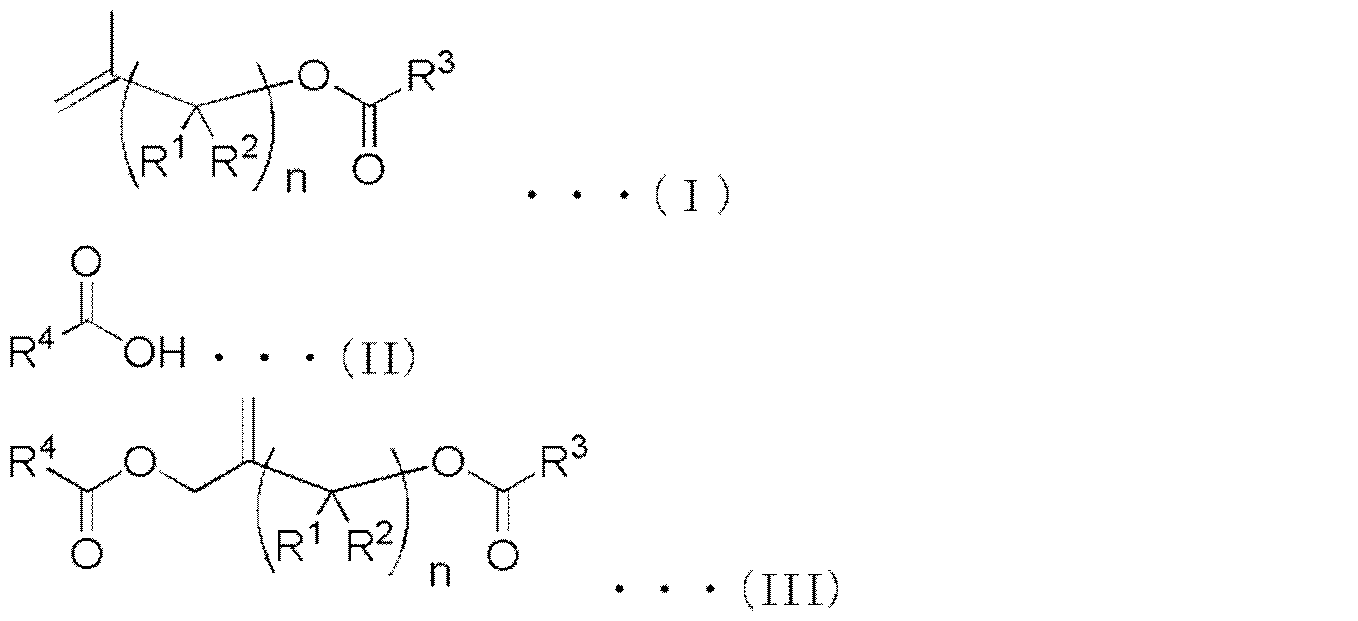
(式中、R1およびR2はそれぞれ独立して水素原子、置換基を有していてもよい炭素数1~8のアルキル基、置換基を有していてもよい炭素数3~8のシクロアルキル基または置換基を有していてもよい炭素数6~14のアリール基を表し、R3は水素原子、置換基を有していてもよい炭素数1~8のアルキル基、置換基を有していてもよい炭素数3~8のシクロアルキル基、置換基を有していてもよい炭素数2~6のアルケニル基、置換基を有していてもよい炭素数6~14のアリール基、置換基を有していてもよい炭素数1~8のアルコキシ基または置換基を有していてもよい炭素数6~14のアリールオキシ基を表し、R4は水素原子、置換基を有していてもよい炭素数1~8のアルキル基、置換基を有していてもよい炭素数3~8のシクロアルキル基、置換基を有していてもよい炭素数2~6のアルケニル基または置換基を有していてもよい炭素数6~14のアリール基を表し、nは1~8の整数を表す。)
[2]前記反応過程にある反応液に前記カルボン酸を供給する工程を含む、[1]に記載の製造方法。
[3]使用される前記カルボン酸の全量を連続的に反応器に供給する、[2]に記載の製造方法。
[4]溶媒の存在下で反応を行う、[1]~[3]のいずれか1つに記載の製造方法。
[5]前記溶媒および前記カルボン酸の合計使用量が、前記モノアシルオキシ化エキソメチレン化合物1モルに対して1モル超50モル以下である、[1]~[4]のいずれか1つに記載の製造方法。
[6]前記溶媒が、炭化水素、複素環式化合物、エーテル、ケトン、エステル、アミド、ニトリルおよびアルコールからなる群から選択される少なくとも1種である、[1]~[5]のいずれか1つに記載の製造方法。
[7]前記溶媒が下記一般式(IV)で表されるエステルである、[6]に記載の製造方法。
[2]前記反応過程にある反応液に前記カルボン酸を供給する工程を含む、[1]に記載の製造方法。
[3]使用される前記カルボン酸の全量を連続的に反応器に供給する、[2]に記載の製造方法。
[4]溶媒の存在下で反応を行う、[1]~[3]のいずれか1つに記載の製造方法。
[5]前記溶媒および前記カルボン酸の合計使用量が、前記モノアシルオキシ化エキソメチレン化合物1モルに対して1モル超50モル以下である、[1]~[4]のいずれか1つに記載の製造方法。
[6]前記溶媒が、炭化水素、複素環式化合物、エーテル、ケトン、エステル、アミド、ニトリルおよびアルコールからなる群から選択される少なくとも1種である、[1]~[5]のいずれか1つに記載の製造方法。
[7]前記溶媒が下記一般式(IV)で表されるエステルである、[6]に記載の製造方法。

(式中、R4は前記定義のとおりであり、R5は置換基を有していてもよい炭素数1~8のアルキル基または置換基を有していてもよい炭素数6~14のアリール基を表す。)
[8]R4がメチル基であり、R5が炭素数1~4のアルキル基である、[7]に記載の製造方法。
[9]前記カルボン酸の使用量が、前記モノアシルオキシ化エキソメチレン化合物1モルに対して0.1モル以上0.6モル以下である、[7]または[8]に記載の製造方法。
[10]R3およびR4がメチル基であり、nが1または2である、[1]~[9]のいずれか1つに記載の製造方法。
[11]R1およびR2が水素原子である、[1]~[10]のいずれか1つに記載の製造方法。
[8]R4がメチル基であり、R5が炭素数1~4のアルキル基である、[7]に記載の製造方法。
[9]前記カルボン酸の使用量が、前記モノアシルオキシ化エキソメチレン化合物1モルに対して0.1モル以上0.6モル以下である、[7]または[8]に記載の製造方法。
[10]R3およびR4がメチル基であり、nが1または2である、[1]~[9]のいずれか1つに記載の製造方法。
[11]R1およびR2が水素原子である、[1]~[10]のいずれか1つに記載の製造方法。
本願の第1の発明によれば、無機副生物を発生させず、かつ生産効率およびコストの改善されたビスアシルオキシ化エキソメチレン化合物の製造方法を提供できる。
また、本願の第2の発明によれば、無機副生物を発生させず、かつ収率がより改善されたビスアシルオキシ化エキソメチレン化合物の製造方法を提供できる。
また、本願の第2の発明によれば、無機副生物を発生させず、かつ収率がより改善されたビスアシルオキシ化エキソメチレン化合物の製造方法を提供できる。
以下、本発明を詳細に説明する。
なお、本発明の発明特定事項の説明とともに、本発明の好ましい形態を示すが、本発明の個々の好ましい形態を2つ以上組み合わせたものもまた、本発明の好ましい形態である。また数値範囲で示した事項について、いくつかの数値範囲がある場合、それらの下限値と上限値とを選択的に組み合わせて好ましい形態とすることができる。
なお、本発明の発明特定事項の説明とともに、本発明の好ましい形態を示すが、本発明の個々の好ましい形態を2つ以上組み合わせたものもまた、本発明の好ましい形態である。また数値範囲で示した事項について、いくつかの数値範囲がある場合、それらの下限値と上限値とを選択的に組み合わせて好ましい形態とすることができる。
ビスアシルオキシ化エキソメチレン化合物(III)を製造する方法に関する本願の第1の発明に係る一態様においては、触媒および必要に応じて溶媒の存在下、モノアシルオキシ化エキソメチレン化合物(I)、カルボン酸(II)および酸素を液相中で反応させる。ここで、本願の第2の発明に係る一態様においては、前記反応過程にある反応液にカルボン酸(II)を供給する工程を含む。
上記の反応においては、形式的には、モノアシルオキシ化エキソメチレン化合物(I)が酸化されてカルボン酸(II)と脱水縮合し、ビスアシルオキシ化エキソメチレン化合物(III)とともに水を生成する。
上記の反応においては、形式的には、モノアシルオキシ化エキソメチレン化合物(I)が酸化されてカルボン酸(II)と脱水縮合し、ビスアシルオキシ化エキソメチレン化合物(III)とともに水を生成する。
本発明の好ましい実施形態における反応式を示すと、次のようになる。

(式中、R1~R4およびnは前記定義のとおりである。)
液相条件を採用することにより、設備およびエネルギーの各コストを抑制できる。また本発明者らの検討により、気相条件では、生成物のビスアシルオキシ化エキソメチレン化合物が高沸点であるため触媒上に吸着し反応を阻害すること、また生成物が気体状態を維持するための高温では触媒の失活が起こることが判明した。すなわち、気相条件では生産性を上げることが難しく、生産効率および収率の観点からも液相条件が有利である。
さらに、前記反応過程(すなわち、モノアシルオキシ化エキソメチレン化合物(I)、カルボン酸(II)および酸素の液相中での反応過程)にある反応液にカルボン酸(II)を供給する工程を含むことにより、反応により発生する水により原料のモノアシルオキシ化エキソメチレン化合物(I)や目的とするビスアシルオキシ化エキソメチレン化合物が加水分解されるのを抑制することができて収率がより改善される。
[原料および目的生成物]
モノアシルオキシ化エキソメチレン化合物(I)およびビスアシルオキシ化エキソメチレン化合物(III)において、R1およびR2が表す炭素数1~8のアルキル基としては、例えばメチル基、エチル基、n-プロピル基、イソプロピル基、n-ブチル基、sec-ブチル基、イソブチル基、tert-ブチル基、n-ペンチル基、n-ヘキシル基、n-オクチル基などが挙げられる。
前記アルキル基は置換基を有していてもよい。そのような置換基としては、例えば炭素数3~8のシクロアルキル基、炭素数6~14のアリール基、炭素数1~8のアルコキシ基、炭素数6~14のアリールオキシ基、シリル基などが挙げられる。置換基を有する場合、置換基の数としては、1~3個が好ましい。
前記シリル基としては、例えばトリメチルシリル基、トリエチルシリル基、t-ブチルジメチルシリル基、t-ブチルジフェニルシリル基、トリフェニルシリル基などが挙げられる。
モノアシルオキシ化エキソメチレン化合物(I)およびビスアシルオキシ化エキソメチレン化合物(III)において、R1およびR2が表す炭素数1~8のアルキル基としては、例えばメチル基、エチル基、n-プロピル基、イソプロピル基、n-ブチル基、sec-ブチル基、イソブチル基、tert-ブチル基、n-ペンチル基、n-ヘキシル基、n-オクチル基などが挙げられる。
前記アルキル基は置換基を有していてもよい。そのような置換基としては、例えば炭素数3~8のシクロアルキル基、炭素数6~14のアリール基、炭素数1~8のアルコキシ基、炭素数6~14のアリールオキシ基、シリル基などが挙げられる。置換基を有する場合、置換基の数としては、1~3個が好ましい。
前記シリル基としては、例えばトリメチルシリル基、トリエチルシリル基、t-ブチルジメチルシリル基、t-ブチルジフェニルシリル基、トリフェニルシリル基などが挙げられる。
R1およびR2が表す炭素数3~8のシクロアルキル基は、単環式でも縮合環式でもよく、例えばシクロプロピル基、シクロペンチル基、シクロヘキシル基などが挙げられる。
前記シクロアルキル基は置換基を有していてもよい。そのような置換基としては、例えば炭素数1~8のアルキル基、炭素数3~8のシクロアルキル基、炭素数6~14のアリール基、炭素数1~8のアルコキシ基、炭素数6~14のアリールオキシ基、前記したシリル基などが挙げられる。置換基を有する場合、置換基の数としては、1~3個が好ましい。
前記シクロアルキル基は置換基を有していてもよい。そのような置換基としては、例えば炭素数1~8のアルキル基、炭素数3~8のシクロアルキル基、炭素数6~14のアリール基、炭素数1~8のアルコキシ基、炭素数6~14のアリールオキシ基、前記したシリル基などが挙げられる。置換基を有する場合、置換基の数としては、1~3個が好ましい。
R1およびR2が表す炭素数6~14のアリール基は、単環式でも縮合環式でもよく、例えばフェニル基、ナフチル基、アントリル基、フェナントリル基などが挙げられる。
前記アリール基は置換基を有していてもよい。そのような置換基としては、例えばR1およびR2がシクロアルキル基である場合に有していてもよい置換基として上述したものと同様のものが挙げられる。置換基を有する場合、置換基の数としては、1~3個が好ましい。
前記アリール基は置換基を有していてもよい。そのような置換基としては、例えばR1およびR2がシクロアルキル基である場合に有していてもよい置換基として上述したものと同様のものが挙げられる。置換基を有する場合、置換基の数としては、1~3個が好ましい。
入手容易性等の観点から、R1およびR2はそれぞれ独立して水素原子または炭素数1~8のアルキル基であることが好ましく、ともに水素原子であることがより好ましい。
モノアシルオキシ化エキソメチレン化合物(I)およびビスアシルオキシ化エキソメチレン化合物(III)において、R3が表す炭素数1~8のアルキル基、炭素数3~8のシクロアルキル基および炭素数6~14のアリール基としては、例えばR1およびR2について上述したものと同様のものが挙げられ、置換基についても同様である。
R3が表す炭素数2~6のアルケニル基としては、例えばエテニル基(ビニル基)、1-メチルエテニル基、1-プロペニル基、2-プロペニル基(アリル基)、1-メチル-1-プロペニル基、1-メチル-2-プロペニル基、1-ブテニル基、2-ブテニル基、3-ブテニル基などが挙げられる。
前記アルケニル基は置換基を有していてもよい。そのような置換基としては、例えばR1およびR2がアルキル基である場合に有していてもよい置換基として上述したものと同様のものが挙げられる。置換基を有する場合、置換基の数としては、1~3個が好ましい。
前記アルケニル基は置換基を有していてもよい。そのような置換基としては、例えばR1およびR2がアルキル基である場合に有していてもよい置換基として上述したものと同様のものが挙げられる。置換基を有する場合、置換基の数としては、1~3個が好ましい。
R3が表す炭素数1~8のアルコキシ基としては、例えばメトキシ基、エトキシ基、n-プロポキシ基、イソプロポキシ基、n-ブトキシ基、イソブトキシ基、sec-ブトキシ基、イソブトキシ基、tert-ブトキシ基、n-ペンチルオキシ基などが挙げられる。
前記アルコキシ基は置換基を有していてもよい。そのような置換基としては、例えばR1およびR2がアルキル基である場合に有していてもよい置換基として上述したものと同様のものが挙げられる。置換基を有する場合、置換基の数としては、1~3個が好ましい。
つまり、前記アルコキシ基は、例えば置換基としてアリール基を有するアラルキルオキシ基であってもよい。そのようなアラルキルオキシ基としては、例えばベンジルオキシ基、1-フェニルエトキシ基、2-フェニルエトキシ基、1-フェニルプロポキシ基、2-フェニルプロポキシ基、3-フェニルプロポキシ基、4-フェニルブトキシ基、1-ナフチルメトキシ基、2-ナフチルメトキシ基などが挙げられる。
前記アルコキシ基は置換基を有していてもよい。そのような置換基としては、例えばR1およびR2がアルキル基である場合に有していてもよい置換基として上述したものと同様のものが挙げられる。置換基を有する場合、置換基の数としては、1~3個が好ましい。
つまり、前記アルコキシ基は、例えば置換基としてアリール基を有するアラルキルオキシ基であってもよい。そのようなアラルキルオキシ基としては、例えばベンジルオキシ基、1-フェニルエトキシ基、2-フェニルエトキシ基、1-フェニルプロポキシ基、2-フェニルプロポキシ基、3-フェニルプロポキシ基、4-フェニルブトキシ基、1-ナフチルメトキシ基、2-ナフチルメトキシ基などが挙げられる。
R3が表す炭素数6~14のアリールオキシ基は、単環式でも縮合環式でもよく、例えばフェノキシ基、トリノキシ基、キシリロキシ基、ナフトキシ基などが挙げられる。
前記アリールオキシ基は置換基を有していてもよい。該置換基としては、例えばR1およびR2がシクロアルキル基である場合に有していてもよい置換基として上述したものと同様のものが挙げられる。置換基を有する場合、置換基の数としては、1~3個が好ましい。
前記アリールオキシ基は置換基を有していてもよい。該置換基としては、例えばR1およびR2がシクロアルキル基である場合に有していてもよい置換基として上述したものと同様のものが挙げられる。置換基を有する場合、置換基の数としては、1~3個が好ましい。
入手容易性等の観点から、R3は炭素数1~6のアルキル基または炭素数2~6のアルケニル基であることが好ましく、メチル基、エチル基、n-プロピル基、エテニル基および1-メチルエテニル基からなる群から選択される1種であることがより好ましく、メチル基または1-メチルエテニル基であることがさらに好ましく、メチル基であることが最も好ましい。
入手容易性等の観点から、モノアシルオキシ化エキソメチレン化合物(I)およびビスアシルオキシ化エキソメチレン化合物(III)において、nは1~8の整数であり、1~4の整数であることが好ましく、1または2であることがより好ましい。
カルボン酸(II)およびビスアシルオキシ化エキソメチレン化合物(III)において、R4が表す炭素数1~8のアルキル基、炭素数3~8のシクロアルキル基、炭素数2~6のアルケニル基および炭素数6~14のアリール基としては、例えばR3について上述したものと同様のものが挙げられ、置換基についても同様である。
入手容易性等の観点から、R4は炭素数1~8のアルキル基または炭素数2~6のアルケニル基であることが好ましく、メチル基、エチル基、n-プロピル基、エテニル基および1-メチルエテニル基からなる群から選択される1種であることがより好ましく、メチル基または1-メチルエテニル基であることがさらに好ましく、メチル基であることが最も好ましい。
[触媒]
本発明の製造方法において用いる触媒は、モノアシルオキシ化エキソメチレン化合物(I)およびカルボン酸(II)の反応を促進するものであればよく、担体に貴金属が担持された触媒が好ましい。触媒は市販されているものを用いてもよく、公知の方法で合成したものを用いてもよい。
本発明の製造方法において用いる触媒は、モノアシルオキシ化エキソメチレン化合物(I)およびカルボン酸(II)の反応を促進するものであればよく、担体に貴金属が担持された触媒が好ましい。触媒は市販されているものを用いてもよく、公知の方法で合成したものを用いてもよい。
前記貴金属としては、例えばパラジウム、金、銀、白金、ロジウム、ルテニウムなどが挙げられる。これらは1種を単独で用いてもよく、2種以上を併用してもよい。中でも、パラジウムが好ましい。前記パラジウムは金属パラジウムであってもよく、パラジウム化合物であってもよい。前記パラジウム化合物としては、特に制限はないが、例えば塩化パラジウム、酢酸パラジウム、硝酸パラジウム、硫酸パラジウム、塩化パラジウム酸ナトリウム、塩化パラジウム酸カリウム、塩化パラジウム酸バリウムなどが挙げられる。
担体にパラジウムが担持された触媒を用いる場合、担体にはパラジウムの他に鉄、ロジウム、銅、金等の周期表第8族から第11族までの遷移金属、亜鉛、インジウム、錫、ビスマス等の周期表第12族から第15族までの卑金属、ヒ素、テルル等の周期表第13族から第16族までの半金属が担持されていてもよい。これらは1種を単独で用いてもよく、2種以上を併用してもよい。
担体に貴金属が担持された触媒を用いる場合、前記担体としては、例えばシリカ、アルミナ、ゼオライト、酸化チタン等の固体酸化物およびその混合物;ポリスチレン、ポリエチレン、ポリアミド、セルロース等の高分子化合物およびその混合物;活性炭などが挙げられる。これらは1種を単独で用いてもよく、2種以上を併用してもよい。中でも、固体酸化物およびその混合物または活性炭が好ましく、シリカまたはアルミナがより好ましく、シリカがさらに好ましい。
前記担体の粒子直径に特に制限はないが、10μm~10mmが好ましく、30μm~8mmがより好ましい。粒子直径が10mm以下であれば、触媒内部まで原料が充分に浸透できるようになり、より有効に反応が進行しやすくなる。10μm以上であれば、担体としての作用をより充分に発揮しやすくなる。
上記触媒の使用量に特に制限はないが、モノアシルオキシ化エキソメチレン化合物(I)とカルボン酸(II)と溶媒との全質量に対して、0.01~20質量%が好ましく、0.1~10質量%がより好ましい。
[触媒活性化剤]
本発明の製造方法においては、触媒に対して必要に応じて触媒活性化剤を添加してもよい。前記触媒活性化剤としては、ナトリウム、カリウム、セシウム等のアルカリ金属の水酸化物、硝酸塩、カルボン酸塩または炭酸塩;マグネシウム、カルシウム、バリウム等のアルカリ土類金属の水酸化物、硝酸塩、カルボン酸塩または炭酸塩などが挙げられる。中でも、カルボン酸(II)の塩が好ましく、カルボン酸(II)のアルカリ金属塩がより好ましく、入手性や反応活性の観点から酢酸カリウムがさらに好ましい。
本発明の製造方法においては、触媒に対して必要に応じて触媒活性化剤を添加してもよい。前記触媒活性化剤としては、ナトリウム、カリウム、セシウム等のアルカリ金属の水酸化物、硝酸塩、カルボン酸塩または炭酸塩;マグネシウム、カルシウム、バリウム等のアルカリ土類金属の水酸化物、硝酸塩、カルボン酸塩または炭酸塩などが挙げられる。中でも、カルボン酸(II)の塩が好ましく、カルボン酸(II)のアルカリ金属塩がより好ましく、入手性や反応活性の観点から酢酸カリウムがさらに好ましい。
前記触媒活性化剤の使用量に特に制限はないが、触媒に対して1~20質量%が好ましく、3~15質量%がより好ましい。
前記触媒活性化剤は予め触媒に担持させた状態で使用してもよく、反応混合物とともに反応装置に仕込んでもよい。
[溶媒]
本発明の製造方法は溶媒の存在下で反応を行ってもよい。当該溶媒としては、例えばヘキサン、ヘプタン、メチルシクロヘキサン、ベンゼン等の炭化水素(脂肪族炭化水素や芳香族炭化水素等);ピリジン、キノリン等の複素環式化合物;ジエチルエーテル、テトラヒドロフラン、メチルtert-ブチルエーテル、シクロペンチルメチルエーテル等のエーテル;アセトン、メチルエチルケトン、イソブチルメチルケトン等のケトン;カルボン酸エステル、炭酸ジエチル、炭酸プロピレン等のエステル;ジメチルホルムアミド、ジメチルアセトアミド等のアミド;アセトニトリル、ベンゾニトリル等のニトリル;メタノール、エタノール、イソプロピルアルコール、フェノール等のアルコールなどが挙げられる。これらは、1種を単独で用いてよく、2種以上を併用してもよい。中でも、カルボン酸エステルが好ましく、生産効率およびビスアシルオキシ化エキソメチレン化合物(III)の収率の観点からからエステル(IV)がより好ましい。
本発明の製造方法は溶媒の存在下で反応を行ってもよい。当該溶媒としては、例えばヘキサン、ヘプタン、メチルシクロヘキサン、ベンゼン等の炭化水素(脂肪族炭化水素や芳香族炭化水素等);ピリジン、キノリン等の複素環式化合物;ジエチルエーテル、テトラヒドロフラン、メチルtert-ブチルエーテル、シクロペンチルメチルエーテル等のエーテル;アセトン、メチルエチルケトン、イソブチルメチルケトン等のケトン;カルボン酸エステル、炭酸ジエチル、炭酸プロピレン等のエステル;ジメチルホルムアミド、ジメチルアセトアミド等のアミド;アセトニトリル、ベンゾニトリル等のニトリル;メタノール、エタノール、イソプロピルアルコール、フェノール等のアルコールなどが挙げられる。これらは、1種を単独で用いてよく、2種以上を併用してもよい。中でも、カルボン酸エステルが好ましく、生産効率およびビスアシルオキシ化エキソメチレン化合物(III)の収率の観点からからエステル(IV)がより好ましい。
エステル(IV)において、R4はカルボン酸(II)およびビスアシルオキシ化エキソメチレン化合物(III)におけるR4と同一の基である。
エステル(IV)において、R5が表す炭素数1~8のアルキル基または炭素数6~14のアリール基としては、例えばR1およびR2について上述したものと同様のものが挙げられ、置換基についても同様である。
入手容易性、生産効率、および、ビスアシルオキシ化エキソメチレン化合物(III)の収率等の観点から、R5は炭素数1~8のアルキル基であることが好ましく、炭素数1~4のアルキル基であることがより好ましい。
[酸素]
本発明の製造方法において用いる酸素としては、原子状および/または分子状酸素を用いることができ、好ましくは分子状酸素である。分子状酸素を用いる場合、窒素、アルゴン、ヘリウムおよび二酸化炭素等の不活性な気体との混合気体として用いるのが好ましい。この場合、酸素濃度は、反応系内で気体が爆発組成とならない範囲に調整して使用するのがより好ましい。
分子状酸素または分子状酸素を含む混合気体を反応系に供給する方法としては、反応系内の液相部に供給する方法、気相部に供給する方法、液相部と気相部の両方に供給する方法が挙げられる。
本発明の製造方法において用いる酸素としては、原子状および/または分子状酸素を用いることができ、好ましくは分子状酸素である。分子状酸素を用いる場合、窒素、アルゴン、ヘリウムおよび二酸化炭素等の不活性な気体との混合気体として用いるのが好ましい。この場合、酸素濃度は、反応系内で気体が爆発組成とならない範囲に調整して使用するのがより好ましい。
分子状酸素または分子状酸素を含む混合気体を反応系に供給する方法としては、反応系内の液相部に供給する方法、気相部に供給する方法、液相部と気相部の両方に供給する方法が挙げられる。
分子状酸素または分子状酸素を含む混合気体を反応系に供給する場合には、酸素分圧はゲージ圧で、0.01気圧以上であることが好ましく、0.1気圧以上であることがより好ましく、0.2気圧以上であることがさらに好ましく、また、200気圧以下であることが好ましく、100気圧以下であることがより好ましく、80気圧以下であることがさらに好ましく、20気圧以下、10気圧以下、8気圧以下であってもよい。
[反応条件]
本発明の製造方法においては、前記溶媒およびカルボン酸(II)の合計使用量が、モノアシルオキシ化エキソメチレン化合物(I)1モルに対して1モル超50モル以下であることが好ましく、1.5モル以上35モル以下であることがより好ましく、2モル以上10モル以下であることがさらに好ましい。前記合計使用量を1モル超とすることで、反応により発生する水によるモノアシルオキシ化エキソメチレン化合物(I)やビスアシルオキシ化エキソメチレン化合物(III)の加水分解が抑制され、生産効率およびビスアシルオキシ化エキソメチレン化合物(III)の収率がより優れたものとなる。前記合計使用量を50モル以下とすることで、過剰な溶媒およびカルボン酸(II)の回収工程が短くなり、経済的に有利となる。
本発明の製造方法においては、前記溶媒およびカルボン酸(II)の合計使用量が、モノアシルオキシ化エキソメチレン化合物(I)1モルに対して1モル超50モル以下であることが好ましく、1.5モル以上35モル以下であることがより好ましく、2モル以上10モル以下であることがさらに好ましい。前記合計使用量を1モル超とすることで、反応により発生する水によるモノアシルオキシ化エキソメチレン化合物(I)やビスアシルオキシ化エキソメチレン化合物(III)の加水分解が抑制され、生産効率およびビスアシルオキシ化エキソメチレン化合物(III)の収率がより優れたものとなる。前記合計使用量を50モル以下とすることで、過剰な溶媒およびカルボン酸(II)の回収工程が短くなり、経済的に有利となる。
なお本発明者らは、本発明の製造方法において溶媒としてエステル(IV)を用いる場合、カルボン酸(II)の使用量を、モノアシルオキシ化エキソメチレン化合物(I)1モルに対して0.1モル以上0.6モル以下に低減した場合にもなお高い生産効率および収率が得られることを見出した。カルボン酸(II)の使用量を前記範囲とすると、装置の腐食を抑制でき、また原料の導入を簡素化することができる点で工業的に非常に有利である。
本発明の製造方法における反応温度、反応圧力および反応時間等の反応条件は、モノアシルオキシ化エキソメチレン化合物(I)、カルボン酸(II)および溶媒の種類や組み合わせ、触媒の組成等に応じて適宜設定すればよく、特に限定されないが、例えば反応温度は80~200℃の範囲内が好ましい。反応温度を80℃以上とすることで、反応速度が遅くなりすぎず、ビスアシルオキシ化エキソメチレン化合物(III)を効率的に製造することができる。一方、反応温度を200℃以下とすることで、燃焼を含めた副反応が起こりにくくなり、ビスアシルオキシ化エキソメチレン化合物(III)を効率的に製造することができ、またカルボン酸による反応装置の腐食も抑制できる。
本発明の製造方法における反応形態は、連続式、回分式のいずれであってもよく、特に限定されない。反応形態として例えば回分式を採用する場合には、触媒は反応装置に原料とともに一括して仕込めばよく、また、反応形態として例えば連続式を採用する場合には、触媒を反応装置に予め充填しておくか、あるいは、反応装置に原料とともに連続的に仕込めばよい。触媒は、固定床、流動床、懸濁床のいずれの形態で使用してもよい。
本願の第2の発明に係る一態様においては、モノアシルオキシ化エキソメチレン化合物(I)、カルボン酸(II)および酸素の液相中での反応過程(すなわち、一部のモノアシルオキシ化エキソメチレン化合物(I)についてカルボン酸(II)および酸素との反応が完了している一方、未反応のモノアシルオキシ化エキソメチレン化合物(II)が残存している状態)にある反応液にカルボン酸(II)を供給する工程を含む。当該工程は、カルボン酸(II)を半回分方式で反応器に供給することにより行うことができ、より具体的には、上記反応過程において反応器からビスアシルオキシ化エキソメチレン化合物(III)を実質的に取り出すことなく(例えば、最終的に得られるビスアシルオキシ化エキソメチレン化合物(III)の5質量%以上が上記反応過程において反応器から取り出されることなく)、カルボン酸(II)を連続的におよび/または複数回に分けて反応器に供給することにより行うことができる。
上記において、使用されるカルボン酸(II)の全量を連続的に反応器に供給してもよいし、あるいは、使用されるカルボン酸(II)の全量を複数回に分けて反応器に供給してもよく、例えば、使用されるカルボン酸(II)のうちの一部を予め反応器に入れておいた状態で反応を開始し、その後、残りを連続的および/または複数回に分けて反応器に供給してもよい。操作性や収率などの観点から、使用されるカルボン酸(II)の全量を連続的に反応器に供給することが好ましい。
例えば、モノアシルオキシ化エキソメチレン化合物(I)、カルボン酸(II)および触媒等の原料を反応器に一括して仕込んだ上で、回分式で上記反応を開始したり、あるいは、筒形反応器等を利用してその上流部にモノアシルオキシ化エキソメチレン化合物(I)およびカルボン酸(II)等の原料を供給しながら連続式で上記反応を開始したりするなど、上記反応過程にある反応液にカルボン酸(II)を供給する工程を含まない方式を採用した場合には、反応により発生する水により原料のモノアシルオキシ化エキソメチレン化合物(I)や目的とするビスアシルオキシ化エキソメチレン化合物(III)が加水分解されてビスアシルオキシ化エキソメチレン化合物(III)の収率が低下しやすいが、上記反応過程にある反応液にカルボン酸(II)を供給する工程を含むことにより、当該収率を向上させることができる。
本願の第2の発明に係る一態様において、モノアシルオキシ化エキソメチレン化合物(I)など、カルボン酸(II)以外のその他の原料の供給方式に特に制限はなく、一括して反応器に供給した上で反応を開始してもよいし、連続的に反応器に供給してもよい。一括して反応器に供給した上で反応を開始する場合には、触媒はモノアシルオキシ化エキソメチレン化合物(I)などとともに一括して反応器に仕込めばよく、また、連続的に反応器に供給する場合には、触媒は、反応装置に予め充填しておくか、あるいは、反応装置にモノアシルオキシ化エキソメチレン化合物(I)などとともに連続的に仕込めばよい。触媒は、固定床、流動床、懸濁床のいずれの形態で使用してもよい。
本発明の製造方法により製造されたビスアシルオキシ化エキソメチレン化合物(III)は、触媒を分離した後、反応溶液を精製することによって単離することができる。前記精製の手段は特に限定されないが、蒸留法、抽出法またはカラムクロマトグラフィーなどを用いることができる。これらの方法は組み合わせて実施してもよい。中でも、蒸留法または抽出法が好ましい。
前記精製により分離された原料および溶媒は、再び反応に用いることができる。また、分離した触媒も、再び反応に用いることができる。
前記精製により分離された原料および溶媒は、再び反応に用いることができる。また、分離した触媒も、再び反応に用いることができる。
以下、実施例等により本発明をさらに詳細に説明するが、本発明はこれらの実施例に何ら限定されない。
〔分析条件1〕
下記の実施例1~8および比較例1、2についての反応後の溶液(反応混合物)の分析は、ガスクロマトグラフ GC2014(島津製作所社製 FID検出器)、キャピラリーカラム(アジレントテクノロジー社製 DB-1、長さ30m、内径0.25mm、膜厚0.25μm)を用いて、下記条件にて行った。
カラム温度 :50℃(5分)→10℃/分→250℃(5分)
FID温度 :250℃
注入口温度 :250℃
キャリアガス :ヘリウム
メイクアップガス :ヘリウム
注入量 :0.2μL
カラムのガス流速 :0.38mL/分
スプリット比 :20
下記の実施例1~8および比較例1、2についての反応後の溶液(反応混合物)の分析は、ガスクロマトグラフ GC2014(島津製作所社製 FID検出器)、キャピラリーカラム(アジレントテクノロジー社製 DB-1、長さ30m、内径0.25mm、膜厚0.25μm)を用いて、下記条件にて行った。
カラム温度 :50℃(5分)→10℃/分→250℃(5分)
FID温度 :250℃
注入口温度 :250℃
キャリアガス :ヘリウム
メイクアップガス :ヘリウム
注入量 :0.2μL
カラムのガス流速 :0.38mL/分
スプリット比 :20
〔分析条件2〕
下記の実施例9および10についての反応後の溶液(反応混合物)の分析は、ガスクロマトグラフ GC2014(島津製作所社製 FID検出器)、キャピラリーカラム(アジレントテクノロジー社製 DB-1、長さ30m、内径0.25mm、膜厚0.25μm)を用いて、下記条件にて行った。
カラム温度 :50℃(5分)→10℃/分→250℃(5分)
FID温度 :250℃
注入口温度 :250℃
キャリアガス :ヘリウム
メイクアップガス :ヘリウム
注入量 :0.2μL
カラムのガス流速 :1.02mL/分
パージ流速 :3.0mL/分
スプリット比 :100
下記の実施例9および10についての反応後の溶液(反応混合物)の分析は、ガスクロマトグラフ GC2014(島津製作所社製 FID検出器)、キャピラリーカラム(アジレントテクノロジー社製 DB-1、長さ30m、内径0.25mm、膜厚0.25μm)を用いて、下記条件にて行った。
カラム温度 :50℃(5分)→10℃/分→250℃(5分)
FID温度 :250℃
注入口温度 :250℃
キャリアガス :ヘリウム
メイクアップガス :ヘリウム
注入量 :0.2μL
カラムのガス流速 :1.02mL/分
パージ流速 :3.0mL/分
スプリット比 :100
・転化率
上記条件で分析したモノアシルオキシ化エキソメチレン化合物(I)の、仕込み物質量に対する消費物質量の割合を転化率として、以下の式を用いて算出した。
転化率(%)={(モノアシルオキシ化エキソメチレン化合物(I)の消費物質量)/(モノアシルオキシ化エキソメチレン化合物(I)の仕込み物質量)}×100
上記条件で分析したモノアシルオキシ化エキソメチレン化合物(I)の、仕込み物質量に対する消費物質量の割合を転化率として、以下の式を用いて算出した。
転化率(%)={(モノアシルオキシ化エキソメチレン化合物(I)の消費物質量)/(モノアシルオキシ化エキソメチレン化合物(I)の仕込み物質量)}×100
・選択率
上記条件で分析したモノアシルオキシ化エキソメチレン化合物(I)の消費物質量に対する、ビスアシルオキシ化エキソメチレン化合物(III)の生成物質量の割合を選択率として、以下の式を用いて算出した。
選択率(%)={(ビスアシルオキシ化エキソメチレン化合物(III)の生成物質量)/(モノアシルオキシ化エキソメチレン化合物(I)の消費物質量)}×100
上記条件で分析したモノアシルオキシ化エキソメチレン化合物(I)の消費物質量に対する、ビスアシルオキシ化エキソメチレン化合物(III)の生成物質量の割合を選択率として、以下の式を用いて算出した。
選択率(%)={(ビスアシルオキシ化エキソメチレン化合物(III)の生成物質量)/(モノアシルオキシ化エキソメチレン化合物(I)の消費物質量)}×100
〔参考例1:触媒1の調製〕
テトラクロロパラジウム酸ナトリウム4.00g(13.6mmol)およびテトラクロロ金酸四水和物2.80g(6.8mmol)を含む水溶液に、シリカ担体(5mmφ)250mLを浸し、全量吸水させた。続いて、メタケイ酸ナトリウム16g(131mmol)を含む水溶液200mLを加え、20時間静置させた。その後、ヒドラジン一水和物9.50g(190mmol)を添加し、パラジウム塩および金塩を金属に還元した。還元後の触媒を水洗した後、110℃で4時間乾燥した。その後、酢酸カリウム13.34g(136mmol)を含有する水溶液中に上記の金属パラジウムを含む担体を投入し、全液を吸収させた後、110℃で4時間乾燥して触媒1を調製した。
テトラクロロパラジウム酸ナトリウム4.00g(13.6mmol)およびテトラクロロ金酸四水和物2.80g(6.8mmol)を含む水溶液に、シリカ担体(5mmφ)250mLを浸し、全量吸水させた。続いて、メタケイ酸ナトリウム16g(131mmol)を含む水溶液200mLを加え、20時間静置させた。その後、ヒドラジン一水和物9.50g(190mmol)を添加し、パラジウム塩および金塩を金属に還元した。還元後の触媒を水洗した後、110℃で4時間乾燥した。その後、酢酸カリウム13.34g(136mmol)を含有する水溶液中に上記の金属パラジウムを含む担体を投入し、全液を吸収させた後、110℃で4時間乾燥して触媒1を調製した。
〔参考例2:触媒2の調製〕
テトラクロロパラジウム酸ナトリウム4.00g(13.6mmol)およびテトラクロロ金酸四水和物3.90g(9.5mmol)を含む水溶液に、シリカ担体(5mmφ)250mLを浸し、全量吸水させた。続いて、メタケイ酸ナトリウム16g(131mmol)を含む水溶液200mLを加え、20時間静置させた。その後、ヒドラジン一水和物9.50g(190mmol)を添加し、パラジウム塩および金塩を金属に還元した。還元後の触媒を水洗した後、110℃で4時間乾燥した。その後、酢酸カリウム13.34g(136mmol)を含有する水溶液中に上記の金属パラジウムを含む担体を投入し、全液を吸収させた後、110℃で4時間乾燥して触媒2を調製した。
テトラクロロパラジウム酸ナトリウム4.00g(13.6mmol)およびテトラクロロ金酸四水和物3.90g(9.5mmol)を含む水溶液に、シリカ担体(5mmφ)250mLを浸し、全量吸水させた。続いて、メタケイ酸ナトリウム16g(131mmol)を含む水溶液200mLを加え、20時間静置させた。その後、ヒドラジン一水和物9.50g(190mmol)を添加し、パラジウム塩および金塩を金属に還元した。還元後の触媒を水洗した後、110℃で4時間乾燥した。その後、酢酸カリウム13.34g(136mmol)を含有する水溶液中に上記の金属パラジウムを含む担体を投入し、全液を吸収させた後、110℃で4時間乾燥して触媒2を調製した。
〔実施例1〕
ガス導入口およびサンプリング口を備えた内容積100mLの電磁撹拌式オートクレーブに、触媒1を1.3g、酢酸を46.0g(766mmol)および酢酸イソプレニルを3.0g(23mmol)仕込み、オートクレーブ内を酸素/窒素=8/92(モル比)の混合ガスで20気圧(ゲージ圧)とした後、撹拌しながらオートクレーブ内の温度を120℃に上げた。その後、酸素/窒素=8/92(モル比)の混合ガスで90気圧(ゲージ圧)を保ちながら200mL/分の流速で混合ガスを流しつつ、5時間反応させた。酢酸イソプレニルの転化率は83%、1,4-ジアセトキシ-2-メチレンブタンへの選択率は85%であった。1,4-ジアセトキシ-2-メチレンブタンの収量は3.1g(17mmol)であり、1,4-ジアセトキシ-2-メチレンブタンの生成効率(単位時間かつ触媒単位質量あたりの収量)は0.48g(生成物)/{g(触媒)・hr}であった。
ガス導入口およびサンプリング口を備えた内容積100mLの電磁撹拌式オートクレーブに、触媒1を1.3g、酢酸を46.0g(766mmol)および酢酸イソプレニルを3.0g(23mmol)仕込み、オートクレーブ内を酸素/窒素=8/92(モル比)の混合ガスで20気圧(ゲージ圧)とした後、撹拌しながらオートクレーブ内の温度を120℃に上げた。その後、酸素/窒素=8/92(モル比)の混合ガスで90気圧(ゲージ圧)を保ちながら200mL/分の流速で混合ガスを流しつつ、5時間反応させた。酢酸イソプレニルの転化率は83%、1,4-ジアセトキシ-2-メチレンブタンへの選択率は85%であった。1,4-ジアセトキシ-2-メチレンブタンの収量は3.1g(17mmol)であり、1,4-ジアセトキシ-2-メチレンブタンの生成効率(単位時間かつ触媒単位質量あたりの収量)は0.48g(生成物)/{g(触媒)・hr}であった。
〔実施例2〕
酢酸を40g(666mmol)および酢酸イソプレニルを9g(70mmol)使用したこと以外は実施例1と同様の操作を行い、反応を行ったところ、酢酸イソプレニルの転化率は80%、1,4-ジアセトキシ-2-メチレンブタンへの選択率は82%であった。1,4-ジアセトキシ-2-メチレンブタンの収量は8.6g(46mmol)であり、1,4-ジアセトキシ-2-メチレンブタンの生成効率は1.34g(生成物)/{g(触媒)・hr}であった。
酢酸を40g(666mmol)および酢酸イソプレニルを9g(70mmol)使用したこと以外は実施例1と同様の操作を行い、反応を行ったところ、酢酸イソプレニルの転化率は80%、1,4-ジアセトキシ-2-メチレンブタンへの選択率は82%であった。1,4-ジアセトキシ-2-メチレンブタンの収量は8.6g(46mmol)であり、1,4-ジアセトキシ-2-メチレンブタンの生成効率は1.34g(生成物)/{g(触媒)・hr}であった。
〔実施例3〕
ガス導入口およびサンプリング口を備えた内容積100mLの電磁撹拌式オートクレーブに、触媒2を1.3g、酢酸を40g(666mmol)および酢酸メタリルを8g(70mmol)仕込み、オートクレーブ内を酸素/窒素=8/92(モル比)の混合ガスで20気圧(ゲージ圧)とした後、撹拌しながらオートクレーブ内の温度を140℃に上げた。その後、酸素/窒素=8/92(モル比)の混合ガスで90気圧(ゲージ圧)を保ちながら200mL/分の流速で混合ガスを流しつつ、5時間反応させた。酢酸メタリルの転化率は99%、1,3-ジアセトキシ-2-メチレンプロパンへの選択率は61%であった。1,3-ジアセトキシ-2-メチレンプロパンの収量は7.3g(42mmol)であり、1,3-ジアセトキシ-2-メチレンプロパンの生成効率は1.14g(生成物)/{g(触媒)・hr}であった。
ガス導入口およびサンプリング口を備えた内容積100mLの電磁撹拌式オートクレーブに、触媒2を1.3g、酢酸を40g(666mmol)および酢酸メタリルを8g(70mmol)仕込み、オートクレーブ内を酸素/窒素=8/92(モル比)の混合ガスで20気圧(ゲージ圧)とした後、撹拌しながらオートクレーブ内の温度を140℃に上げた。その後、酸素/窒素=8/92(モル比)の混合ガスで90気圧(ゲージ圧)を保ちながら200mL/分の流速で混合ガスを流しつつ、5時間反応させた。酢酸メタリルの転化率は99%、1,3-ジアセトキシ-2-メチレンプロパンへの選択率は61%であった。1,3-ジアセトキシ-2-メチレンプロパンの収量は7.3g(42mmol)であり、1,3-ジアセトキシ-2-メチレンプロパンの生成効率は1.14g(生成物)/{g(触媒)・hr}であった。
〔比較例1〕
内径23mm、長さ20cmのステンレス製反応管に触媒1を17g(約30mL)詰めた後、酢酸イソプレニル、酢酸、酸素および窒素を酢酸イソプレニル:酢酸:酸素:窒素=28:3:8:61の体積比で15L/hrの速度で流し、165℃で反応させた。4時間後の反応管出口組成を分析したところ、1,4-ジアセトキシ-2-メチレンブタンの生成速度は0.032g(生成物)/{g(触媒)・hr}であり、反応管に導入した酢酸イソプレニルに対する1,4-ジアセトキシ-2-メチレンブタンの収率は2.3%であった。この結果から、気相反応は液相反応よりも生産性が低いことが示された。
内径23mm、長さ20cmのステンレス製反応管に触媒1を17g(約30mL)詰めた後、酢酸イソプレニル、酢酸、酸素および窒素を酢酸イソプレニル:酢酸:酸素:窒素=28:3:8:61の体積比で15L/hrの速度で流し、165℃で反応させた。4時間後の反応管出口組成を分析したところ、1,4-ジアセトキシ-2-メチレンブタンの生成速度は0.032g(生成物)/{g(触媒)・hr}であり、反応管に導入した酢酸イソプレニルに対する1,4-ジアセトキシ-2-メチレンブタンの収率は2.3%であった。この結果から、気相反応は液相反応よりも生産性が低いことが示された。
〔比較例2〕
反応温度を190℃としたこと以外は比較例1と同様の操作を行い、反応を行ったところ、1,4-ジアセトキシ-2-メチレンブタンの生成速度は0.015g(生成物)/{g(触媒)・hr}であり、反応管に導入した酢酸イソプレニルに対する1,4-ジアセトキシ-2-メチレンブタンの収率は0.5%であった。
その後、190℃、大気圧下で窒素のみを15NL/hrの速度で1時間流したのち、室温まで冷やして反応管から触媒を取り出した。反応後の触媒を観察すると、反応前は灰色であった触媒が茶色に変色していた。
反応温度を190℃としたこと以外は比較例1と同様の操作を行い、反応を行ったところ、1,4-ジアセトキシ-2-メチレンブタンの生成速度は0.015g(生成物)/{g(触媒)・hr}であり、反応管に導入した酢酸イソプレニルに対する1,4-ジアセトキシ-2-メチレンブタンの収率は0.5%であった。
その後、190℃、大気圧下で窒素のみを15NL/hrの速度で1時間流したのち、室温まで冷やして反応管から触媒を取り出した。反応後の触媒を観察すると、反応前は灰色であった触媒が茶色に変色していた。
〔実施例4〕
酢酸を3.2g(53.3mmol)および酢酸メタリルを6.0g(52.6mmol)使用し、さらに溶媒としてヘプタンを40g(399mmol)使用したこと以外は実施例3と同様の操作を行い、反応を行ったところ、酢酸メタリルの転化率は82%、1,3-ジアセトキシ-2-メチレンプロパンへの選択率は60%であった。1,3-ジアセトキシ-2-メチレンプロパンの収量は4.5g(26mmol)であり、1,3-ジアセトキシ-2-メチレンプロパンの生成効率は0.70g(生成物)/{g(触媒)・hr}であった。
酢酸を3.2g(53.3mmol)および酢酸メタリルを6.0g(52.6mmol)使用し、さらに溶媒としてヘプタンを40g(399mmol)使用したこと以外は実施例3と同様の操作を行い、反応を行ったところ、酢酸メタリルの転化率は82%、1,3-ジアセトキシ-2-メチレンプロパンへの選択率は60%であった。1,3-ジアセトキシ-2-メチレンプロパンの収量は4.5g(26mmol)であり、1,3-ジアセトキシ-2-メチレンプロパンの生成効率は0.70g(生成物)/{g(触媒)・hr}であった。
〔実施例5〕
酢酸を4.5g(74.9mmol)および酢酸メタリルを17.0g(148.9mmol)使用し、さらに溶媒として酢酸エチルを26.0g(295mmol)使用したこと以外は実施例3と同様の操作を行い、反応を行ったところ、酢酸メタリルの転化率は78%、1,3-ジアセトキシ-2-メチレンプロパンへの選択率は80%であった。1,3-ジアセトキシ-2-メチレンプロパンの収量は16.0g(93mmol)であり、1,3-ジアセトキシ-2-メチレンプロパンの生成効率は2.50g(生成物)/{g(触媒)・hr}であった。
酢酸を4.5g(74.9mmol)および酢酸メタリルを17.0g(148.9mmol)使用し、さらに溶媒として酢酸エチルを26.0g(295mmol)使用したこと以外は実施例3と同様の操作を行い、反応を行ったところ、酢酸メタリルの転化率は78%、1,3-ジアセトキシ-2-メチレンプロパンへの選択率は80%であった。1,3-ジアセトキシ-2-メチレンプロパンの収量は16.0g(93mmol)であり、1,3-ジアセトキシ-2-メチレンプロパンの生成効率は2.50g(生成物)/{g(触媒)・hr}であった。
〔実施例6〕
酢酸を5.5g(91.6mmol)および酢酸メタリルを20.7g(181mmol)使用し、さらに溶媒として酢酸イソブチルを20.7g(178mmol)使用したこと以外は実施例3と同様の操作を行い、反応を行ったところ、酢酸メタリルの転化率は80%、1,3-ジアセトキシ-2-メチレンプロパンへの選択率は86%であった。1,3-ジアセトキシ-2-メチレンプロパンの収量は21.5g(125mmol)であり、1,3-ジアセトキシ-2-メチレンプロパンの生成効率は3.36g(生成物)/{g(触媒)・hr}であった。
酢酸を5.5g(91.6mmol)および酢酸メタリルを20.7g(181mmol)使用し、さらに溶媒として酢酸イソブチルを20.7g(178mmol)使用したこと以外は実施例3と同様の操作を行い、反応を行ったところ、酢酸メタリルの転化率は80%、1,3-ジアセトキシ-2-メチレンプロパンへの選択率は86%であった。1,3-ジアセトキシ-2-メチレンプロパンの収量は21.5g(125mmol)であり、1,3-ジアセトキシ-2-メチレンプロパンの生成効率は3.36g(生成物)/{g(触媒)・hr}であった。
〔実施例7〕
酢酸を4.3g(72mmol)および酢酸イソプレニルを18.2g(142mmol)使用し、さらに溶媒として酢酸エチルを25g(284mmol)使用したこと以外は実施例1と同様の操作を行い、反応を行ったところ、酢酸イソプレニルの転化率は70%、1,4-ジアセトキシ-2-メチレンブタンへの選択率は82%であった。1,4-ジアセトキシ-2-メチレンブタンの収量は15.2g(82mmol)であり、1,4-ジアセトキシ-2-メチレンブタンの生成効率は2.37g(生成物)/{g(触媒)・hr}であった。
酢酸を4.3g(72mmol)および酢酸イソプレニルを18.2g(142mmol)使用し、さらに溶媒として酢酸エチルを25g(284mmol)使用したこと以外は実施例1と同様の操作を行い、反応を行ったところ、酢酸イソプレニルの転化率は70%、1,4-ジアセトキシ-2-メチレンブタンへの選択率は82%であった。1,4-ジアセトキシ-2-メチレンブタンの収量は15.2g(82mmol)であり、1,4-ジアセトキシ-2-メチレンブタンの生成効率は2.37g(生成物)/{g(触媒)・hr}であった。
〔実施例8〕
酢酸を15.8g(263mmol)および酢酸メタリルを30.0g(263mmol)使用したこと以外は実施例3と同様の操作を行い、反応を行ったところ、酢酸メタリルの転化率は75%、1,3-ジアセトキシ-2-メチレンプロパンへの選択率は23%、1,3-ジアセトキシ-2-メチレンプロパンの収量は7.8g(45mmol)、1,3-ジアセトキシ-2-メチレンプロパンの生成効率は1.22g(生成物)/{g(触媒)・hr}であった。
酢酸を15.8g(263mmol)および酢酸メタリルを30.0g(263mmol)使用したこと以外は実施例3と同様の操作を行い、反応を行ったところ、酢酸メタリルの転化率は75%、1,3-ジアセトキシ-2-メチレンプロパンへの選択率は23%、1,3-ジアセトキシ-2-メチレンプロパンの収量は7.8g(45mmol)、1,3-ジアセトキシ-2-メチレンプロパンの生成効率は1.22g(生成物)/{g(触媒)・hr}であった。
上記した実施例1~8および比較例1、2の結果を下記の表1に示す。

※1:モノアシルオキシ化エキソメチレン化合物(I)/カルボン酸(II)/溶媒
※2:モノアシルオキシ化エキソメチレン化合物(I)の転化率
※3:ビスアシルオキシ化エキソメチレン化合物(III)への選択率
※4:ビスアシルオキシ化エキソメチレン化合物(III)の生成効率[g(生成物)/{g(触媒)・hr}]
〔実施例9〕
ガス導入口およびサンプリング口を備えた内容積100mLの電磁撹拌式オートクレーブに、触媒2を1.3g、酢酸メタリルを30.0g(263mmol)仕込み、オートクレーブ内を酸素/窒素=8/92(モル比)の混合ガスで20気圧(ゲージ圧)とした後、撹拌しながらオートクレーブ内の温度を140℃に上げた。その後、酸素/窒素=8/92(モル比)の混合ガスで90気圧(ゲージ圧)を保ちながら200mL/分の流速で混合ガスを流しつつ、酢酸を3.16g/時間で連続的に供給し、5時間反応させた(酢酸の合計の使用量は15.8g(263mmol))。
酢酸メタリルの転化率は70%、1,3-ジアセトキシ-2-メチレンプロパンへの選択率は39%、1,3-ジアセトキシ-2-メチレンプロパンの収率は27%であった。
ガス導入口およびサンプリング口を備えた内容積100mLの電磁撹拌式オートクレーブに、触媒2を1.3g、酢酸メタリルを30.0g(263mmol)仕込み、オートクレーブ内を酸素/窒素=8/92(モル比)の混合ガスで20気圧(ゲージ圧)とした後、撹拌しながらオートクレーブ内の温度を140℃に上げた。その後、酸素/窒素=8/92(モル比)の混合ガスで90気圧(ゲージ圧)を保ちながら200mL/分の流速で混合ガスを流しつつ、酢酸を3.16g/時間で連続的に供給し、5時間反応させた(酢酸の合計の使用量は15.8g(263mmol))。
酢酸メタリルの転化率は70%、1,3-ジアセトキシ-2-メチレンプロパンへの選択率は39%、1,3-ジアセトキシ-2-メチレンプロパンの収率は27%であった。
〔実施例10〕
ガス導入口およびサンプリング口を備えた内容積100mLの電磁撹拌式オートクレーブに、触媒2を1.3g、酢酸メタリルを17.0g(149mmol)、溶媒として酢酸エチルを26.0g(295mmol)仕込み、オートクレーブ内を酸素/窒素=8/92(モル比)の混合ガスで20気圧(ゲージ圧)とした後、撹拌しながらオートクレーブ内の温度を140℃に上げた。その後、酸素/窒素=8/92(モル比)の混合ガスで90気圧(ゲージ圧)を保ちながら200mL/分の流速で混合ガスを流しつつ、酢酸を0.90g/時間で連続的に供給し、5時間反応させた(酢酸の合計の使用量は4.5g(74.9mmol))。
酢酸メタリルの転化率は88%、1,3-ジアセトキシ-2-メチレンプロパンへの選択率は90%、1,3-ジアセトキシ-2-メチレンプロパンの収率は79%であった。
ガス導入口およびサンプリング口を備えた内容積100mLの電磁撹拌式オートクレーブに、触媒2を1.3g、酢酸メタリルを17.0g(149mmol)、溶媒として酢酸エチルを26.0g(295mmol)仕込み、オートクレーブ内を酸素/窒素=8/92(モル比)の混合ガスで20気圧(ゲージ圧)とした後、撹拌しながらオートクレーブ内の温度を140℃に上げた。その後、酸素/窒素=8/92(モル比)の混合ガスで90気圧(ゲージ圧)を保ちながら200mL/分の流速で混合ガスを流しつつ、酢酸を0.90g/時間で連続的に供給し、5時間反応させた(酢酸の合計の使用量は4.5g(74.9mmol))。
酢酸メタリルの転化率は88%、1,3-ジアセトキシ-2-メチレンプロパンへの選択率は90%、1,3-ジアセトキシ-2-メチレンプロパンの収率は79%であった。
上記した実施例9および10の結果を下記の表2に示す。

※5:モノアシルオキシ化エキソメチレン化合物(I)/カルボン酸(II)/溶媒
※6:モノアシルオキシ化エキソメチレン化合物(I)の転化率
※7:ビスアシルオキシ化エキソメチレン化合物(III)への選択率
本発明の製造方法により、無機副生物を発生させず、かつ収率よく高い生産効率およびコストパフォーマンスでビスアシルオキシ化エキソメチレン化合物を製造可能となる。得られるビスアシルオキシ化エキソメチレン化合物は、工業的に有用な種々の化合物の製造原料として用いることができる。
Claims (11)
- 触媒および必要に応じて溶媒の存在下、下記一般式(I)で表されるモノアシルオキシ化エキソメチレン化合物、下記一般式(II)で表されるカルボン酸および酸素を液相中で反応させる、下記一般式(III)で表されるビスアシルオキシ化エキソメチレン化合物の製造方法。

(式中、R1およびR2はそれぞれ独立して水素原子、置換基を有していてもよい炭素数1~8のアルキル基、置換基を有していてもよい炭素数3~8のシクロアルキル基または置換基を有していてもよい炭素数6~14のアリール基を表し、R3は水素原子、置換基を有していてもよい炭素数1~8のアルキル基、置換基を有していてもよい炭素数3~8のシクロアルキル基、置換基を有していてもよい炭素数2~6のアルケニル基、置換基を有していてもよい炭素数6~14のアリール基、置換基を有していてもよい炭素数1~8のアルコキシ基または置換基を有していてもよい炭素数6~14のアリールオキシ基を表し、R4は水素原子、置換基を有していてもよい炭素数1~8のアルキル基、置換基を有していてもよい炭素数3~8のシクロアルキル基、置換基を有していてもよい炭素数2~6のアルケニル基または置換基を有していてもよい炭素数6~14のアリール基を表し、nは1~8の整数を表す。) - 前記反応過程にある反応液に前記カルボン酸を供給する工程を含む、請求項1に記載の製造方法。
- 使用される前記カルボン酸の全量を連続的に反応器に供給する、請求項2に記載の製造方法。
- 溶媒の存在下で反応を行う、請求項1~3のいずれか1項に記載の製造方法。
- 前記溶媒および前記カルボン酸の合計使用量が、前記モノアシルオキシ化エキソメチレン化合物1モルに対して1モル超50モル以下である、請求項1~4のいずれか1項に記載の製造方法。
- 前記溶媒が、炭化水素、複素環式化合物、エーテル、ケトン、エステル、アミド、ニトリルおよびアルコールからなる群から選択される少なくとも1種である、請求項1~5のいずれか1項に記載の製造方法。
- 前記溶媒が下記一般式(IV)で表されるエステルである、請求項6に記載の製造方法。

(式中、R4は前記定義のとおりであり、R5は置換基を有していてもよい炭素数1~8のアルキル基または置換基を有していてもよい炭素数6~14のアリール基を表す。) - R4がメチル基であり、R5が炭素数1~4のアルキル基である、請求項7に記載の製造方法。
- 前記カルボン酸の使用量が、前記モノアシルオキシ化エキソメチレン化合物1モルに対して0.1モル以上0.6モル以下である、請求項7または8に記載の製造方法。
- R3およびR4がメチル基であり、nが1または2である、請求項1~9のいずれか1項に記載の製造方法。
- R1およびR2が水素原子である、請求項1~10のいずれか1項に記載の製造方法。
Priority Applications (4)
| Application Number | Priority Date | Filing Date | Title |
|---|---|---|---|
| US16/627,484 US10843998B2 (en) | 2017-07-24 | 2018-07-23 | Method for producing bis-acyloxylated exomethylene compound |
| CN201880047209.XA CN110891928A (zh) | 2017-07-24 | 2018-07-23 | 双酰氧基化外向亚甲基化合物的制造方法 |
| EP18838870.6A EP3659995B1 (en) | 2017-07-24 | 2018-07-23 | Method for producing bis-acyloxylated exomethylene compound |
| JP2019532589A JP7168565B2 (ja) | 2017-07-24 | 2018-07-23 | ビスアシルオキシ化エキソメチレン化合物の製造方法 |
Applications Claiming Priority (4)
| Application Number | Priority Date | Filing Date | Title |
|---|---|---|---|
| JP2017142559 | 2017-07-24 | ||
| JP2017-142559 | 2017-07-24 | ||
| JP2017236645 | 2017-12-11 | ||
| JP2017-236645 | 2017-12-11 |
Publications (1)
| Publication Number | Publication Date |
|---|---|
| WO2019021993A1 true WO2019021993A1 (ja) | 2019-01-31 |
Family
ID=65039710
Family Applications (1)
| Application Number | Title | Priority Date | Filing Date |
|---|---|---|---|
| PCT/JP2018/027458 Ceased WO2019021993A1 (ja) | 2017-07-24 | 2018-07-23 | ビスアシルオキシ化エキソメチレン化合物の製造方法 |
Country Status (6)
| Country | Link |
|---|---|
| US (1) | US10843998B2 (ja) |
| EP (1) | EP3659995B1 (ja) |
| JP (1) | JP7168565B2 (ja) |
| CN (1) | CN110891928A (ja) |
| TW (1) | TWI781198B (ja) |
| WO (1) | WO2019021993A1 (ja) |
Citations (5)
| Publication number | Priority date | Publication date | Assignee | Title |
|---|---|---|---|---|
| DE1909964A1 (de) | 1969-02-27 | 1970-09-17 | Bayer Ag | Verfahren zur Herstellung von 2-Methylen-1,3-diacetoxy-propan |
| JPH02264781A (ja) | 1989-04-05 | 1990-10-29 | Toshiba Silicone Co Ltd | アクリロキシ基を有する有機ケイ素化合物 |
| JPH1171327A (ja) * | 1997-08-28 | 1999-03-16 | Mitsubishi Chem Corp | 不飽和グリコールジエステルの製造方法 |
| WO2011102484A1 (ja) * | 2010-02-19 | 2011-08-25 | Jx日鉱日石エネルギー株式会社 | α,β-不飽和結合含有エステル化合物の製造方法 |
| JP2013177576A (ja) | 2012-02-10 | 2013-09-09 | Kuraray Co Ltd | ヒドロキシメチル基含有ビニルアルコール系重合体 |
Family Cites Families (7)
| Publication number | Priority date | Publication date | Assignee | Title |
|---|---|---|---|---|
| BE755029A (fr) * | 1969-08-19 | 1971-02-19 | Bayer Ag | Procede pour la preparation du 1,3-diacetoxy-2-methylene- propane |
| DE2056132C3 (de) * | 1970-11-14 | 1979-02-22 | Hoechst Ag, 6000 Frankfurt | Verfahren zur Herstellung von Glycerinacetaten |
| JPS5922692B2 (ja) * | 1974-03-19 | 1984-05-28 | 三菱化学株式会社 | 酢酸エステルの製造法 |
| DE3020857A1 (de) * | 1979-06-29 | 1981-01-29 | Atlantic Richfield Co | Verfahren zur herstellung von ethylenglykolestern |
| JP4643208B2 (ja) * | 2003-09-10 | 2011-03-02 | 文陽 江口 | 抗酸化剤、美白剤及びこれを配合した皮膚外用剤 |
| WO2005068473A1 (en) | 2003-12-17 | 2005-07-28 | Sgx Pharmaceuticals, Inc. | Bicyclic pyrazolo-fused compounds as protein kinase modulators |
| JP2015193567A (ja) | 2014-03-31 | 2015-11-05 | ダイソー株式会社 | カルボン酸アリルエステルの製造方法 |
-
2018
- 2018-07-23 US US16/627,484 patent/US10843998B2/en active Active
- 2018-07-23 JP JP2019532589A patent/JP7168565B2/ja active Active
- 2018-07-23 TW TW107125371A patent/TWI781198B/zh active
- 2018-07-23 CN CN201880047209.XA patent/CN110891928A/zh active Pending
- 2018-07-23 EP EP18838870.6A patent/EP3659995B1/en active Active
- 2018-07-23 WO PCT/JP2018/027458 patent/WO2019021993A1/ja not_active Ceased
Patent Citations (6)
| Publication number | Priority date | Publication date | Assignee | Title |
|---|---|---|---|---|
| DE1909964A1 (de) | 1969-02-27 | 1970-09-17 | Bayer Ag | Verfahren zur Herstellung von 2-Methylen-1,3-diacetoxy-propan |
| JPS54886B1 (ja) * | 1969-02-27 | 1979-01-18 | ||
| JPH02264781A (ja) | 1989-04-05 | 1990-10-29 | Toshiba Silicone Co Ltd | アクリロキシ基を有する有機ケイ素化合物 |
| JPH1171327A (ja) * | 1997-08-28 | 1999-03-16 | Mitsubishi Chem Corp | 不飽和グリコールジエステルの製造方法 |
| WO2011102484A1 (ja) * | 2010-02-19 | 2011-08-25 | Jx日鉱日石エネルギー株式会社 | α,β-不飽和結合含有エステル化合物の製造方法 |
| JP2013177576A (ja) | 2012-02-10 | 2013-09-09 | Kuraray Co Ltd | ヒドロキシメチル基含有ビニルアルコール系重合体 |
Non-Patent Citations (2)
| Title |
|---|
| JOURNAL OF ORGANIC CHEMISTRY, vol. 27, no. 6, 1962, pages 1975 - 1978 |
| MACROMOLECULES, vol. 26, no. 4, 1993, pages 737 - 743 |
Also Published As
| Publication number | Publication date |
|---|---|
| TW201908278A (zh) | 2019-03-01 |
| EP3659995B1 (en) | 2021-12-22 |
| US20200283367A1 (en) | 2020-09-10 |
| CN110891928A (zh) | 2020-03-17 |
| US10843998B2 (en) | 2020-11-24 |
| TWI781198B (zh) | 2022-10-21 |
| JP7168565B2 (ja) | 2022-11-09 |
| JPWO2019021993A1 (ja) | 2020-05-28 |
| EP3659995A4 (en) | 2021-04-21 |
| EP3659995A1 (en) | 2020-06-03 |
Similar Documents
| Publication | Publication Date | Title |
|---|---|---|
| EP3408251B1 (en) | Efficient synthesis of methacrolein from methanol and propionaldehyde | |
| WO2020099283A1 (en) | Continuos flow synthesis of cannabidiol | |
| JP7291142B2 (ja) | 1-アシルオキシ-2-メチル-2-プロペンの製造方法 | |
| JP7291141B2 (ja) | 1,3-ビスアシルオキシ-2-メチレンプロパンの製造方法 | |
| JP7168565B2 (ja) | ビスアシルオキシ化エキソメチレン化合物の製造方法 | |
| EP3227254B1 (fr) | Oxydation catalytique du but-3-ène-1,2-diol | |
| KR20240128823A (ko) | 술폰산 작용화된 SiO2 담체 상 전이 금속을 포함하는 불균일 촉매 및 이러한 촉매의 에테르 제조 방법에서의 용도 | |
| CN110520403B (zh) | α,α-二氟乙醛半缩醛的制造方法 | |
| BE897876A (fr) | Preparation d'anhydrides d'acides carboxyliques | |
| JP2015193567A (ja) | カルボン酸アリルエステルの製造方法 | |
| JP2025112149A (ja) | アルケニルジアセテートの製造方法 | |
| MXPA04006987A (es) | Procedimiento para la preparacion de 3,5,5-trimetilciclohex-2-en-1,4-diona. | |
| JPWO2011043459A1 (ja) | ケトンの製造方法 | |
| JPS6216448A (ja) | 桂皮酸エステル類の製造法 | |
| JPS6320419B2 (ja) | ||
| CN102770404A (zh) | 含有α,β-不饱和键的酯化合物的制造方法 | |
| JPS64938B2 (ja) |
Legal Events
| Date | Code | Title | Description |
|---|---|---|---|
| 121 | Ep: the epo has been informed by wipo that ep was designated in this application |
Ref document number: 18838870 Country of ref document: EP Kind code of ref document: A1 |
|
| ENP | Entry into the national phase |
Ref document number: 2019532589 Country of ref document: JP Kind code of ref document: A |
|
| NENP | Non-entry into the national phase |
Ref country code: DE |
|
| ENP | Entry into the national phase |
Ref document number: 2018838870 Country of ref document: EP Effective date: 20200224 |